ELEVATE EVERY RECIPE WITH COCOA
ORDER NOW YOUR
COCOA POWDER
info@emf-me.com www.emf-me.com | +961 9 938732
EDITORIAL
Managing director Joumana Dammous-Salamé
KSA’S GIGA PROJECTS: CAN HOTEL F&B THRIVE WITHOUT ALCOHOL?
Publication manager Randa Dammous-Pharaon Editorial manager Rita Ghantous Sub-editor Miriam Dunn Account managers Maha El-Khoury, Josette Hikri, Nour Pharaon advertise@hospitalitynewsmag.com Subscription executives Houayda Haddad-Roumman, Mirna Maroun subscribe@hospitalitynewsmag.com Circulation coordinator Rita Nohra-Kejijian Graphic designer Ibrahim Kastoun To advertise advertise@hospitalitynewsmag.com Published by Hospitality Services LEBANON Dekwaneh Tel: +961 1 480081 UAE HSME Tel: +971 585848018 info@hospitalitynewsmag.com www.hospitalitynewsmag.com All the information disclosed in the magazine was provided by the parties concerned by each publication and checked to the highest possible extent by the editors. However, the magazine cannot ensure accuracy at all times of all information published and therefore could in no case be held responsible should any information reveal to be false or insufficient. We welcome views on any subject relevant to the hospitality industry, but request that letters be short and to the point. The editor reserves the right to select and edit letters. Hospitality News ME is distributed to trade professionals in the catering and lodging industry in the Middle East.
It’s a question that many are asking as the kingdom’s developments gather pace. Abdul Kader Saadi, managing director of Glee Hospitality Solutions, shares his views. Saudi Arabia’s giga projects sit at very different stages. Diriyah, The Red Sea and Qiddiya are already operating. However, AMAALA is only now welcoming its first guests, while NEOM’s Sindalah remains largely closed. This means that while we have enough evidence to read some signals, it’s not enough to decide whether hotel F&B in KSA is “thriving” without alcohol. Instead, the real verdict will come in repeat covers in a few years. Removing the wet revenue What can be assessed already is the shape of the economics, and top of that list is average spend. Removing alcohol doesn’t just remove a line on the menu. Beyond this, it removes a large slice of the check. In a high-end restaurant, alcohol commonly accounts for 40 percent of the bill or more. In contrast, in a wet-led venue such as a beach club or lounge, it reaches 70 percent. So can these concepts thrive without alcohol? Yes, but the model has to change. When you cannot win on spend per head, you have to win on volume. And that makes the model far more dependent on occupancy and footfall than a wet venue. Get occupancy, frequency and overheads right, and the numbers work. Winning on footfall, not spend Crucially, that puts a premium on every other line of the bill. With no wine list to lean on, the discipline shifts to upselling. Items like premium desserts, specialty coffee or signature mocktails, for example, become key revenue levers. Notably, domestic demand is real. Saudi diners have a growing appetite for premium food, cafe culture, dessert-led formats and aspirational social spaces. Hotel F&B should be able to thrive in KSA’s giga projects without alcohol, but with a different model. It might be a harder business to run, but the path is visible and the first venues are already on it. gleehospitality.com
ALWAYS IN OUR HEARTS Conventions, tradeshows and exhibitions are an essential tool for generating additional demand in the hotel and catering industry. This extra demand is seen in positive macroeconomic effects. It is our responsibility, as media, to highlight the special role of conventions and exhibitions, as they provide important opportunities to both the global and local business communities. EDUCATING THE HOSPITALITY PROFESSIONALS OF TOMORROW
Scan to read
Nouhad Dammous (May 2019) Late editor-in-chief Docteur Honoris Causa
AUG-OCT 2026 | HOSPITALITY NEWS ME
3
In this issue AUG - OCT 2026
HORECA NETWORK 8 9 10 11
HORECA Oman returns for its fifth edition as hospitality growth accelerates across the sultanate HORECA Jordan on track for a strong 11th edition HORECA Lebanon reschedules its 30th edition to November 2026 HORECA Riyadh and Salon du Chocolat et de la Pâtisserie Riyadh come together this December at Riyadh Front Exhibition & Conference Center
8
HORECA Oman
14
LIE
47
New projects and investments
EVENTS WHERE TO BE SEEN 12 13 14 16 16 17
Salon du Chocolat et de la Pâtisserie Dubai set to celebrate milestone fifth edition Raising the bar: Whisky Live Beirut’s bold eighth edition Lebanese Industry Expo returns for 2026 WTM Spotlight Riyadh to put Chinese travel growth in focus Four co-located shows to unite food manufacturing and hospitality in Dubai Calendar
BUSINESS INTERVIEW 18
Chef Guy Savoy on elevating gastronomy to a fine art
OPINION 20
The hidden power of third-party management in real estate
INFLUENCERS 22
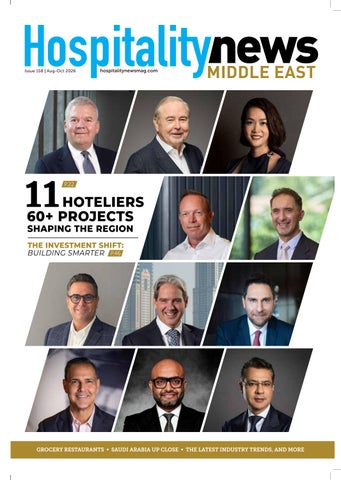
11 influential hoteliers, 60+ new projects
SPECIAL REPORT NEW PROJECTS AND INVESTMENTS 47 48 50 52 54 56 58 60 62 64
4
Saudi Arabia’s next hospitality chapter The new rules of hotel investment Building the new hotels that investors want The art of launching a successful hospitality business Emerging destinations drive MENA’s hotel pipeline Beyond growth: where regional hospitality projects are heading The rise of out of the box hospitality projects Designing AI payments from a new-build advantage New taxes, new hotels: what Gulf developers need to know Hospitality investment for a more disciplined era
HOSPITALITY NEWS ME | AUG-OCT 2026
Hosp
THE LEADING GLOBAL NETWORK OF CULINARY ARTS AND HOSPITALITY MANAGEMENT INSTITUTES
• CULINARY ARTS & GASTRONOMY • NUTRITION & PLANT BASED • WINE & BEVERAGES • HOSPITALITY, RESTAURANT & TOURISM MANAGEMENT • ONLINE LEARNING
ST U DY I N L E BA NON Located in the 5-star hotel Burj On Bay overlooking the Jounieh Bay and offers acclaimed culinary programmes in cuisine and pâtisserie. Beirut-admissions@cordonbleu.edu
cordonbleu.edu PARIS LONDON MADRID JAPAN AUSTRALIA BRASIL CANADA CHILE CHINA INDIA ISTANBUL KOREA LEBANON MALAYSIA MEXICO NEW ZEALAND PERU TAIWAN THAILAND PHILIPPINES SAUDI ARABIA WATCH OUR VIDEO
Hospitality News Advert.indd 1
25/11/2025 10:21
BUSINESS MARKET UPDATE 68
Saudi Arabia: ambition meets discipline
TOURISM 70
How integrated resorts are raising the bar for MENA tourism
72
Designing spaces that forge emotional connections
74
Italian cuisine: 20 regions, one shared language
76
Why family-owned restaurants outlast F&B trends
78
Grocery restaurants: the next big thing in dining?
ARCHITECTURE & DESIGN EYE ON ITALY F&B TRENDS
74
Eye on Italy
82
Human Resources
90
Beverage
SOLUTIONS TECHNOLOGY 80
How virtual concierges are reshaping the guest experience
MANAGEMENT 81
5 essential steps for building market presence
HUMAN RESOURCES 82
The importance of crisis-ready leadership
MARKETING 83
Why airport F&B venues are flying high
GREEN 84
Decarbonization begins with data
PRODUCT ZONE TECHNOLOGY 86
How GEO is transforming the way guests find you
88
Ice cream’s sub-zero success story
90
4 beverage experts on what’s in the mix for syrups
FOOD BEVERAGE CHOCOMANIA 93
Vegan chocolate banana bread
94
New products
ON THE MARKET
Coming issue NOV 2026 - JAN 2027 • Special report Hospitality trends and forecasts • Influencers Nightlife • Technology Small and heavy kitchen equipment • Food Chocolate • Beverage Whisky
6
HOSPITALITY NEWS ME | AUG-OCT 2026
Tog�h�
L E T’ S CU LT IVAT E TAL ENT S "WHERE CHOCOLATE EXCELLENCE MEETS GLOBAL INSPIRATION" L’École Valrhona Dubai
_
HORECA NETWORK
PREVIEW
HORECA OMAN
RETURNS FOR ITS FIFTH EDITION AS HOSPITALITY GROWTH ACCELERATES ACROSS THE SULTANATE From September 14 to 16, 2026, HORECA Oman returns to the Oman Convention & Exhibition Centre for its fifth edition, reinforcing its role as a dynamic platform supporting the continued growth of the country’s hospitality and foodservice industries. Organized by Hospitality Services in collaboration with Al Nimr Expo, the event will once again bring together the full hospitality ecosystem under one roof, welcoming over 8,000 professional visitors and more than 150 exhibitors across 5,500 sqm of exhibition space. Joumana Dammous-Salamé, managing director of Hospitality Services, said: “HORECA Oman continues to evolve as a meaningful meeting point where professionals connect, exchange ideas and explore new opportunities. Our ambition is to provide a platform that supports innovation, nurtures talent and contributes to the long-term development of the industry.” Emphasizing the strategic importance of the event, Salim Al Hashmi, CEO of Al Nimr Expo, stated: “HORECA Oman plays a key role in supporting the development of the hospitality ecosystem in the Sultanate of Oman. By bringing together industry professionals, innovators and emerging talents, the exhibition contributes to strengthening sector capabilities and advancing standards of excellence.” Featuring a comprehensive exhibition gathering suppliers of food and beverage products, hotel and kitchen equipment, hospitality technologies, design solutions and related services, HORECA Oman offers visitors a 360-degree view of the latest trends and business opportunities shaping the sector. Over three days, the event will host a vibrant program combining panel discussions, networking sessions and live demonstrations designed to foster dialogue among industry stakeholders. Through HORECA Talks, professionals will gain valuable insights into emerging trends, operational challenges and growth prospects for the hospitality and foodservice landscape in Oman and the wider region. A series of competitions will place local talent and rising stars in the spotlight. The Hospitality Salon Culinaire and Junior Chef Competition will showcase culinary creativity and technical expertise, while the Art of Service Competition highlights excellence in hospitality operations. The HORECA Oman Barista Competition, Latte Art Competition and Mocktail Competition celebrate beverage innovation, alongside the Bed Making Competition, which tests precision and professionalism in housekeeping skills. Together, these initiatives aim to recognize and reward the next generation of industry leaders. Complementing the competitions, masterclasses and live cooking demonstrations led by experienced professionals will offer practical knowledge and hands-on learning opportunities. In parallel, dedicated B2B meetings and networking sessions
8
HOSPITALITY NEWS ME | AUG-OCT 2026
will create tangible connections between exhibitors, buyers and decision-makers, reinforcing the event’s positioning as a catalyst for business development and collaboration. With its sound reputation as a professional meeting platform, HORECA Oman continues to introduce key regional buyers and industry stakeholders to the country’s evolving hospitality market. The exhibition serves as a live environment where partnerships are built, ideas are exchanged and future opportunities are explored. horecaoman.com
HORECA JORDAN ON TRACK FOR A STRONG 11TH EDITION HORECA Jordan, the premier annual event for the hospitality and foodservice industries, returns to the Jordan International Exhibition Center at Mecca Mall in Amman from October 11 to 13, 2026. Running daily from 2 p.m. to 9 p.m, the 11th edition promises to further cement its position as Jordan's largest exhibition for the hospitality and foodservice sectors, with more than 10,000 visitors expected from across the region. Spanning over 10,000 sqm of exhibition space, HORECA Jordan 2026 will bring together more than 300 exhibitors — showcasing over 600 brands and services — giving industry professionals direct access to the latest products, technologies and innovations shaping the sector. Exhibitors from Jordan will be joined by companies from Palestine, Iraq and Egypt, alongside several international pavilions. The exhibition will cover the full spectrum of hospitality and foodservice, from hotels, restaurants and cafés to catering, kitchen equipment, furniture and design, tableware, packaging, specialized technology, consultancy, recruitment and cleaning and maintenance — along with bakery, pastry, beverages, coffee, tea, meat, poultry, seafood and organic products.
Building on its successful return, the Vegan, Gluten-Free & Organic Food Festival will once again spotlight products, brands and innovations across these fast-growing categories, giving visitors the chance to discover vegan restaurants, sample glutenfree products and explore organic food concepts that reflect shifting consumer expectations and new market opportunities. The Hosted Buyers' Program will also return, welcoming buyers from Iraq, Palestine and Egypt to discover local products and forge new business links and export opportunities with hospitality and foodservice companies in Jordan. Joumana Dammous-Salamé, managing director of Hospitality Services, the company behind the HORECA Network, said: "HORECA Jordan's 11th edition reflects the continued momentum of the hospitality and foodservice industries in Jordan and the region. Every year, the exhibition creates stronger opportunities for professionals to connect, discover, compete and grow, and the 2026 edition is set to build on this role with renewed ambition." Thuraya Al Husseini, chairperson and CEO of Lawrence & Husseini Consult, co-organizer of HORECA Jordan, explained what the event brings to the country. "HORECA Jordan has become a true meeting point for our hospitality and foodservice community, giving local businesses a platform to grow, connect with new markets and showcase what Jordan has to offer. Each edition strengthens the sector's role in the national economy, and we are proud to see it continue to expand in scale and impact." horeca-jordan.com
Beyond facilitating networking and knowledge-sharing among industry leaders, buyers, suppliers and professionals, HORECA Jordan 2026 will host a full calendar of talks, shows and competitions. HORECA Talks will bring together industry figures to discuss the trends shaping the food and beverage scene, while live demonstrations, thematic workshops and curated networking sessions connect hoteliers, chefs, restaurateurs, suppliers and decision makers across the sector. The Hospitality Salon Culinaire remains a centerpiece of the exhibition, with live cooking and display competitions bringing together major hotels, restaurants and culinary talents before the public and a professional jury. The program spans creative display categories, contemporary cuisine, pasta, seafood, junior chef creations, market basket challenges and dedicated contests covering sushi, sandwiches, burgers and pizzas. Alongside this, the Barista Competition will spotlight the country's skilled coffee professionals, while the Bed Making Competition and Art of Service Competition put guest service, hotel operations, precision and presentation center stage. Across the three days, more than 300 participants will compete across over 30 award categories, with daily ceremonies celebrating talent, creativity and professional excellence throughout the industry.
AUG-OCT 2026 | HOSPITALITY NEWS ME
9
HORECA NETWORK
PREVIEW
HORECA LEBANON RESCHEDULES ITS 30TH EDITION TO NOVEMBER 2026 Hospitality Services has announced that the 30th edition of HORECA Lebanon, initially planned for April, will now take place from November 10 to 13, 2026. The decision to postpone is due to recent developments in the country and the region. Following strong demand, the exhibition had already reached full capacity. The new dates will allow for better preparation and an enhanced overall experience for all participants, with all features remaining unchanged. Over the past three decades, HORECA Lebanon has consistently adapted to changing realities while maintaining its role as the annual business meeting place for hospitality and foodservice professionals. “Rescheduling this landmark edition allows us to preserve the level of experience, engagement and meaningful business networking that the industry looks for at HORECA Lebanon,” said Joumana Dammous-Salamé, managing director of Hospitality Services. The four-day event will provide a comprehensive platform combining exhibition, knowledge-sharing initiatives and professional networking opportunities, reaffirming its position as a key meeting place for sector development. Further updates are available on horecashow.com and the official mobile application. About the organizer: Founded over 30 years ago, Hospitality Services specializes in organizing hospitality and foodservice exhibitions and events across the region, including HORECA Lebanon, HORECA Jordan, HORECA Kuwait, HORECA Riyadh, HORECA Oman, Salon du Chocolat et de la Pâtisserie Dubai, Salon du Chocolat et de la Pâtisserie Riyadh and Whisky Live Beirut. horecashow.com
10
HOSPITALITY NEWS ME | AUG-OCT 2026
HORECA RIYADH AND SALON DU CHOCOLAT ET DE LA PÂTISSERIE RIYADH COME TOGETHER THIS DECEMBER AT RIYADH FRONT EXHIBITION & CONFERENCE CENTER From December 7 to 9, 2026, HORECA Riyadh and Salon du Chocolat et de la Pâtisserie Riyadh open simultaneously at the Riyadh Front Exhibition & Conference Center, uniting the kingdom’s hospitality, foodservice and sweet gastronomy sectors under one roof. Organized by Semark, HORECA Riyadh marks its 15th edition, while Salon du Chocolat et de la Pâtisserie Riyadh kicks off its fourth, with both shows running daily from 4 p.m. to 10 p.m. on December 7 and then 2 p.m. to 10 p.m. on the following two days. They are held alongside HOST Arabia. Spread over 50,000 sqm of exhibition space, the combined event brings together more than 600 exhibitors showcasing 24,500 brands, 17 international pavilions representing 47 countries and a full program of competitions, masterclasses, live shows and conference sessions — welcoming around 60,000 professional visitors over the three days. From fresh products and frozen food, tea and coffee, water, juices and syrups, meat, chicken and seafood, bakery and ice cream, dairy, rice, nuts and spices, fruits and vegetables, a single visit gives buyers, chefs, hoteliers, restaurateurs and distributors access to the full spectrum of the industry in one place. “Hosting these exhibitions together has changed what a visit to Riyadh means for our industry,” said Joumana Dammous-Salamé, managing director of Hospitality Services, the firm behind the HORECA brand. “A buyer can source equipment, meet a chocolatier, follow a competition and sit in for a talk without leaving the venue. That density is what professionals tell us they want, and it is what keeps them coming back each December.” Competition runs through both halls. The Hospitality Salon Culinaire gathers 93 elite chefs competing in 83 individual contests across 11 specialized categories, evaluated by a panel of 10 world-class international judges, while the HORECA Barista Competition unites 11 elite baristas from leading cafes and hotels and the Mocktail Competition brings 10 talented mixologists head-to-head before
expert juries, putting coffee mastery and beverage innovation under the spotlight. On the Salon du Chocolat et de la Pâtisserie Riyadh side, the Chocolate Fashion Show returns with 14 chocolate gowns created through collaborations between renowned pastry chefs and fashion design students, while The Competitions welcome 73 professionals across 12 categories covering chocolate showpieces, live pastry challenges and out-of-the-box creations, judged by 7 world-class experts, with the top prize sending a champion to Paris. The Pastry Show hosts 19 interactive masterclasses curated by leading chefs and chocolate specialists from around the globe. Saudi Elite Chefs sits at the meeting point of both. Organized by the Culinary Arts Commission, the strategic partner of the event, the competition returns for its third consecutive year to highlight local culinary talent, offering chefs across the kingdom a prestigious platform to gain recognition and refine their expertise under the supervision of a select group of culinary experts. Running throughout, The Talks will gather 33 expert speakers across nine specialized sessions, bringing over 700 professionals together with global industry leaders to discuss the latest trends and challenges shaping hospitality, foodservice and sweet gastronomy in the kingdom. From her side, Maha El Khoury, projects and sales director at Hospitality Services, noted that: “the Riyadh edition reflects the kingdom’s rapidly evolving culinary scene and its growing appetite for experiential events that combine business, education and entertainment. Co-hosting both shows in the same venue lets us serve the full spectrum of the industry in a single week.” Since its launch in Paris almost 30 years ago, Salon du Chocolat et de la Pâtisserie has become a global reference for those interested in discovering the latest chocolate and pastry trends. Today, the show is held in major cities around the world, including New York, Tokyo, London, Brussels, Cologne, Lyon, Shanghai, Marseille, Zurich, Cannes, Milan, Hong Kong, Riyadh, Beirut and beyond. saudihoreca.com salonduchocolat-ksa.com
AUG-OCT 2026 | HOSPITALITY NEWS ME
11
EVENTS
WHERE TO BE SEEN
SALON DU CHOCOLAT ET DE LA PÂTISSERIE DUBAI SET TO CELEBRATE MILESTONE FIFTH EDITION From September 22 to 24, 2026, Salon du Chocolat et de la Pâtisserie Dubai is returning to Madinat Jumeirah – Madinat Arena, bringing together the region’s vibrant community of chocolate, pastry and coffee enthusiasts for three days of discovery, inspiration and indulgence. Organized by HSME, the internationally celebrated exhibition will once again be a meeting point for professionals, brands, chefs and consumers in a dynamic setting spanning 3,500 sqm of interactive space, welcoming over 7,000 visitors, more than 360 participating brands and 120 exhibitors showcasing products and innovations shaping the confectionery and café sectors. “Salon du Chocolat et de la Pâtisserie continues to evolve as a platform that celebrates craftsmanship, creativity and shared passion,” said Joumana Dammous-Salamé, managing director of HSME. “Each edition is aimed at offering visitors an immersive experience — one that inspires new ideas, encourages exchange and highlights the artistry that defines excellence in this industry.” Besides a comprehensive exhibition gathering chocolatiers, pastry specialists, coffee professionals and suppliers of ingredients, equipment and services — offering visitors a 360-degree overview of new products and concepts — the Dubai edition will be marked by a rich three-day program blending lifestyle experiences with professional engagement. Among the highlights, the iconic Chocolate Fashion Show will once again transform the runway into a celebration of creativity. This year’s theme, executed by the region’s renowned pastry chefs and designers from ESMOD, will celebrate iconic singers and music legends. Elsewhere, leading chefs will host interactive workshops at the Pastry Show and live demonstrations at the Choco Démo, offering audiences the opportunity to discover techniques, trends and flavor innovations. The Talks serve as one of the most anticipated pillars of the event, bringing together industry experts, thought leaders and highlevel decision-makers for a series of insightful, forward-thinking sessions. Designed to spark meaningful dialogue, the program tackles some of the most pressing and compelling topics, from sustainability practices and emerging trends to the evolution of key ingredients and the broader forces driving chocolate, pastry, gelato and coffee development and innovation. Furthermore, a series of competitions will provide a platform for emerging talents and established professionals to showcase their expertise and exchange insights, complemented by specialty
12
HOSPITALITY NEWS ME | AUG-OCT 2026
coffee showcases, including the Coffee in Good Spirits Championship and experiential spaces such as the Brew Bar, where visitors can explore the melting pot between coffee culture and mixology. Maha El Khoury, projects and sales director at HSME, said: “The Dubai edition of Salon du Chocolat et de la Pâtisserie reflects the region’s vibrant culinary scene and its growing appetite for experiential events that combine business, emerging trends and engaging experiences. Through a rich program and international participation, the Salon serves as a dynamic platform that brings the community together around a shared passion.” salonduchocolatdubai.com
RAISING THE BAR:
WHISKY LIVE BEIRUT’S BOLD EIGHTH EDITION From October 7 to 9, 2026, Whisky Live Beirut returns to AVA Venue in Achrafieh, Beirut, for its eighth edition — three evenings of discovery, craftsmanship and refined experiences for whisky lovers, collectors, professionals and press alike. Organized by Hospitality Services, the event will span more than 2,000 sqm and welcome over 60 specialist whisky producers, distributors and suppliers from around the world. Expected to draw more than 7,000 visitors, Whisky Live Beirut 2026 will once again bring together connoisseurs, trade professionals and enthusiasts around some of the finest whiskies and spirits on the market. This year's edition builds on the event's reputation as one of Beirut's most distinctive lifestyle gatherings, uniting tasting experiences, expert-led masterclasses, creative cocktails, pop-up food stations, curated retail corners and dedicated hospitality areas under one roof. Visitors will explore an extensive selection of single malt, Scotch, Irish, bourbon and blended whiskies, while exhibitors will also showcase a white spirit of their choice — expanding the tasting journey to include gin, tequila and other fine spirits. Immersive sessions led by renowned distillers and industry experts will guide visitors through tastings and stories of craftsmanship, offering a deeper appreciation of whisky and spirits and the chance to refine their palate. At the Star Bar, leading local and international bartenders will craft exceptional cocktails using premium spirits, inventive techniques and bold flavors. Nearby, a lineup of food concepts will round out the tasting experience, while the Lifestyle Boutique will offer whiskies, cigars and exclusive accessories for enthusiasts and collectors. For those seeking an elevated experience, the Gold Circle will give ticket holders access to prestigious new releases, limited editions and independent brands in a dedicated premium area. "Whisky Live Beirut has become a signature experience for Lebanon and the region," said Joumana Dammous-Salamé, managing director of Hospitality Services. "It is not simply a tasting event; it is a platform where knowledge, discovery, craftsmanship and hospitality come together in a dynamic setting.” whiskylivebeirut.com
AUG-OCT 2026 | HOSPITALITY NEWS ME
13
EVENTS
WHERE TO BE SEEN
LEBANESE INDUSTRY EXPO RETURNS FOR 2026 The second edition is expected to host more than 150 exhibitors across 10,000 sqm, spanning food, technology and heavy industry. The Association of Lebanese Industrialists (ALI) has announced the second edition of the Lebanese Industry Expo (LIE), from October 28 to 31, 2026 at Seaside Arena, Beirut. Doors open from 3 p.m. to 9 p.m. The event is an initiative by ALI with the support of the Ministry of Industry, organized by Hospitality Services and Promofair. Scale and reach Following the success of its inaugural edition, which marked the return of a major industrial gathering after more than four decades, LIE returns with over 150 exhibitors expected. It will span food and technology, as well as processing, light and heavy industries. Covering 10,000 square meters, LIE 2026 will be a space bustling with innovation and creativity. The exhibition is also expected to draw thousands of professionals, experts and investors from Lebanon and abroad, serving as a platform for interaction, cooperation and new business opportunities that showcase the strength and competitive potential of the country’s industrial sector. Close cooperation among the Ministry of Industry, ALI and the organizers sends a strong message of confidence in national productive sectors and their potential to revive the local economy. The event also aims to highlight the innovative spirit of Lebanese manufacturers, who have shown resilience and adaptability despite challenging circumstances. Notably, they are now tapping into new prospects for export, attracting international buyers and building bridges with regional and global markets.
Talks, innovation and hosted buyers LIE 2026 will feature a rich program of specialized activities, most prominently the discussion sessions titled “Industry Talks.” These bring together experts, industrialists and officials from the public and private sectors to examine new trends and the transition toward a productive and sustainable economy. An Industrial Innovation Pavilion will showcase pioneering homegrown projects in technology and sustainable production. The Hosted Buyers Program, meanwhile, gives local institutions the opportunity to network with international importers interested in sourcing Lebanese products. Among the sectors represented are food and packaging, chemicals and pharmaceuticals, furniture, electronics, building materials, renewable energy, creative industries and technological products, reflecting the exceptional diversity of this vital sector. A vote of confidence Salim Zeenni, president of ALI, affirmed that holding the exhibition on schedule “is a national decision par excellence, aimed at supporting national players and expanding their presence in local markets, while increasing our exports to traditional markets and opening new ones. The value of national industrial production in the local market has reached nearly USD 10 billion, and our objective today is to raise our export levels further, which will reflect positively on Lebanon’s economic and social situation.” Joumana Dammous-Salamé, managing director of Hospitality Services, said: “This event reflects the essence of our mission to support the productive sectors that constitute the backbone of the national economy. We are proud to place our more than three decades of experience at the service of Lebanese industry, as we believe in the ability of national industrialists to innovate and compete. Through this exhibition, we seek to strengthen global confidence in Lebanon’s production and its quality.” LIE 2026 is co-organized by Hospitality Services, whose portfolio in Lebanon and the region also includes HORECA Lebanon, Salon du Chocolat et de la Pâtisserie and Whisky Live Beirut. Each serves as a platform combining creativity and expertise, showcasing Lebanon’s distinctive energy and its promising productive sectors. ali.org.lb
14
HOSPITALITY NEWS ME | AUG-OCT 2026
EVENTS
WHERE TO BE SEEN
WTM SPOTLIGHT RIYADH TO PUT CHINESE TRAVEL GROWTH IN FOCUS The kingdom received Approved Destination Status from China in July 2024. As a result, it can now welcome Chinese tour groups and market group travel within China directly. Notably, this marks a significant step in Saudi Arabia’s tourism strategy.
Debut event will take place from September 8 to 10, 2026. The inaugural edition of World Travel Market (WTM) Spotlight Riyadh will be held at Riyadh Front Exhibition and Conference Center from September 8 to 10, 2026. At the event, Saudi Arabia’s fast-rising appeal among Chinese visitors will be a key focus. Saudi Arabia is fast emerging as a destination for Chinese travelers, and new research will help shape the conversation at WTM Spotlight Riyadh. The findings come from Dragon Trail International, a research partner for the event.
The numbers behind the trend are striking. Flights between Greater China and Saudi Arabia rose by 91 percent in 2025 compared with 2024. Meanwhile, Chinese leisure spend across the Middle East is forecast to climb around 130 percent between 2024 and 2030, according to Tourism Economics. Getting China-ready To capture this demand, the kingdom has moved quickly to become “China-ready.” Consequently, airports now carry Mandarin signage, alongside tailored products and expanded payment options.
These shifts align with Vision 2030, under which Saudi Arabia is targeting 150 million annual visitors by the end of the decade. Danielle Curtis, regional portfolio director – UAE at RX, said the event arrives at an important moment. “Saudi Arabia is rapidly establishing itself as a destination of growing importance for Chinese travelers,” she said. “WTM Spotlight Riyadh provides an important platform for the international travel industry to understand this opportunity better.” The inaugural WTM Spotlight Riyadh is expected to welcome more than 300 exhibitors, over 7,000 attendees and 150 hosted buyers. Ultimately, it will showcase the full tourism ecosystem, from destinations and hospitality to travel technology. wtm.com
FOUR CO-LOCATED SHOWS TO UNITE FOOD MANUFACTURING AND HOSPITALITY IN DUBAI technology providers to Dubai to explore innovation and unlock new business across the region.
Gulfood, ISM Middle East, Private Label Middle East and GulfHost set for joint November event. Dubai World Trade Centre (DWTC) will host four industry events concurrently from November 3 to 5, 2026, connecting the global food manufacturing, hospitality and foodservice sectors. Gulfood Manufacturing returns to DWTC, where it will run alongside ISM Middle East, Private Label Middle East and GulfHost. Together, the co-located shows will bring manufacturers, suppliers, distributors, retailers, hospitality professionals and
16
HOSPITALITY NEWS ME | AUG-OCT 2026
Gulfood Manufacturing, a leading food manufacturing platform, will showcase the latest in ingredients, processing, packaging, automation and supply chain solutions. With the UAE accelerating localization and domestic production, the show is set to highlight the technologies and partnerships shaping a more resilient food ecosystem.
personal care, household products and packaging. This year’s show is expected to once again bring global manufacturers together with retailers and brand owners to support competitive sourcing and longterm partnerships. Additionally, GulfHost will showcase hospitality and foodservice equipment over the three-day event. Visitors will find smart kitchen technologies, energyefficient equipment and new supplier partnerships built to improve performance.
Across the value chain ISM Middle East, meanwhile, will connect international brands with buyers, distributors and retailers across chocolate, snacks, biscuits, ice cream and traditional sweets.
Together, the four shows offer opportunities to connect with decisionmakers, explore emerging technologies and strengthen a foothold in one of the world’s fastest-growing food and hospitality markets.
Running concurrently, Private Label Middle East is recognized as a key private label and contract manufacturing event, spanning food, beverages, beauty,
gulfoodmanufacturing, ismmiddleeast, privatelabelme, gulfhostmena
CALENDAR SEPTEMBER 2026
OCTOBER 2026
8–10 Sep. Riyadh, KSA WTM RIYADH RX wtm.com/spotlight-riyadh
7–9 Oct. LEBANON WHISKY LIVE BEIRUT Hospitality Services whiskylivebeirut.com
10–11 Nov. EGYPT FUTURE HOSPITALITY SUMMIT EGYPT The Bench futurehospitality.com/Egypt
14–16 Sep. OMAN HORECA OMAN 2026 Hospitality Services and Al Nimr Expo horecaoman.com
11–13 Oct. JORDAN HORECA JORDAN Lawrence & Husseini Consult and The Forum Event Management horeca-jordan.com
10–13 Nov. LEBANON HORECA LEBANON Hospitality Services horecashow.com
14–17 Sep. Dubai, UAE ARABIAN TRAVEL MARKET RX Travel Portfolio wtm.com/atm 15–17 Sep. Riyadh, KSA HOTEL & HOSPITALITY EXPO 2026 DMG EVENTS thehotelshowsaudiarabia.com 22–24 Sep. Dubai, UAE SALON DU CHOCOLAT ET DE LA PÂTISSERIE DUBAI 2026 HSME salonduchocolatdubai.com 27–29 Sep. Jeddah, KSA THE SAUDIFOOD SHOW SAUDI FOOD MANUFACTURING Kaoun Arabia thesaudifoodshow.com saudifoodmanufacturing.com 29 Sep. – 1 Oct. Dubai, UAE FHS DUBAI The Bench futurehospitality.com/world
17–21 Oct. FRANCE SIAL PARIS Comexposium sialparis.com/en 28–31 Oct. LEBANON LIE EXPO Association of Lebanese Industrialists Hospitality Services and Promofair ali.org.lb
NOVEMBER 2026
17–19 Nov. SPAIN IBTM SPAIN RX Travel Portfolio ibtmworld.com
DECEMBER 2026 7–9 Dec. Riyadh, KSA HORECA RIYADH HOST ARABIA Semark saudihoreca.com, hostarabia.com.sa
2–5 Nov. FRANCE EQUIPHOTEL PARIS RX equiphotel.com/en-gb.html
7–9 Dec. Riyadh, KSA SALON DU CHOCOLAT ET DE LA PÂTISSERIE RIYADH Semark and Hospitality Services salonduchocolat-ksa.com
3–5 Nov. LONDON WTM LONDON RX wtm.com/london/en-gb.html
8–10 Dec. Oman OMAN PLAST Silver Star Corporation omanplast.net
3–5 Nov. Dubai, UAE ISM MIDDLE EAST PRIVATE LABEL MIDDLE EAST GULFOOD MANUFACTURING GULF HOST DWTC gulfoodmanufacturing.com gulfhost.ae, ism-me.com prime-expo.com
15–18 Dec. Turkey WORLDFOOD ISTANBUL ICA Events worldfood-istanbul.com
AUG-OCT 2026 | HOSPITALITY NEWS ME
17
BUSINESS
INTERVIEW
CHEF GUY SAVOY ON ELEVATING GASTRONOMY TO A FINE ART
From humble roots to the summit of his profession, Guy Savoy has become one of the most celebrated chefs of his generation. With restaurants in Paris and Las Vegas, his accolades range from Michelin stars and five Toques d’Or from Gault&Millau to being named the world’s best restaurant by La Liste. Recently installed as the first chef in France’s Académie des beaux-arts, he tells HN what it means to see gastronomy finally recognized as an art.
18
HOSPITALITY NEWS ME | AUG-OCT 2026
Passion helps you to stay in the right frame of mind to create, and your guests can always sense it.
You began your career as an apprentice, before opening your first restaurant on rue Duret, Paris in 1980. Who shaped those early years?
Dining at Restaurant Guy Savoy has been described as a timeless experience. What do you think gives it that quality?
At 15, I decided I would be a chef or nothing at all. So a chef I became. My apprenticeship taught me both the rewards and the hardships of the craft. First, I learned under Louis Marchand, the chocolate-maker in my hometown. Afterward came the Troisgros brothers (chefs Jean and Pierre). I found the sheer elegance of their technique fascinating. Later still, I spent time working at Lasserre in Paris, the Lion d’Or in Geneva and The Oasis in la Napoule. The French chef Claude Verger then gave me my first real chance at his restaurant La Barrière de Clichy. Then I opened my own restaurant in Paris and, before long, the gastronomic world took notice. Each step, in its own way, built on those foundations.
For me, it is the harmony that ties everything together. The character of the cuisine, the paintings and sculptures on the walls, and the rapport between our teams and our guests all combine to become one complete experience. Indeed, nothing is left to chance, on the plate or on the table. Our produce arrives fresh each day, to be transformed into excellence according to the inspiration of the chef. Furthermore, our home in the heart of historic Paris lends the meal a character found nowhere else. Together, these elements turn a dinner into a unique moment.
You have worked at the top of your game for more than five decades. What is the secret of your success? My secret is simply my passion for cooking. When you love what you do, you never tire of it. Like many chefs, I work two days in one, so it feels as though I have been at this for 114 years! Passion helps you to stay in the right frame of mind to create, and your guests can always sense it. Being daring is also important to me. As the revolutionary Georges Danton put it, “Daring, more daring, daring forevermore!” But chefs also have to limit that rebelliousness. It should only ever be with the aim of pleasing your guests.
Your election as the first chef in the Académie des beaux-arts in 2024 saw gastronomy recognized as an art form for the first time, alongside painting, sculpture and music. What does this recognition mean? First and foremost, it confirms that gastronomy is an integral part of our heritage and culture. This standing has been building for years. Back in 2010, UNESCO recognized the French gastronomic meal, the shared ritual of coming together at the table. Now gastronomy takes its place as an art form. It is a collective recognition too, one that belongs not only to chefs but to the winemakers, farmers, fishermen and breeders who supply us.
Which principles guide you in your work? Several ideas guide me, but the one I always come back to is this: cuisine is the art of instantly transforming products rich with history into joy. I also firmly believe that mastering technique is what sets you free to create.
What are your guests searching for when they dine at Restaurant Guy Savoy? Our guests come seeking happiness and pleasure. In turn, we offer them personalized attention, exquisite cuisine and fine wines. Our whole team looks after their well-being for two or three hours; indeed sometimes longer. Ultimately, it is the height of civilization.
You have earned the top culinary awards and achieved global industry acclaim. Which moment stands out as the most significant to you personally? Many events in my professional life have been pivotal for me. Above all, though, my election to the Académie des beaux-arts is the one that changed my life forever. It is not the culmination of my career, and I certainly hope it does not end there. Rather, it is recognition of all the passion and hard work I have given to this life.
You are a staunch supporter of apprenticeships, having started out as one yourself. What drives that commitment? Our doors are always open to apprentices, in the kitchen and front of house alike. I even open my kitchens to schoolchildren on work experience. I want young people to feel, to see and to touch everything the craft has to offer. I tell them all the same thing: to be a chef is to hold a true skill, one that can open up the whole world. For me, passing on knowledge is the very heart of the profession. Cuisine as it stands today is the product of the generations before us, each adding a brick to this great edifice of gastronomy. I too wish to be a link in this chain of transmission. It is a craft of passion. Only those who dream are capable of inspiring dreams in others. How, then, could I not delight in passing it on?
What are your plans for the future? Quite simply, to give my all. Twice a day, alongside my team, for every single guest and at every table, exactly as I have done for the past 57 years. guysavoy.com AUG-OCT 2026 | HOSPITALITY NEWS ME
19
BUSINESS
OPINION
In collaboration with
THE HIDDEN POWER OF THIRD-PARTY
MANAGEMENT IN REAL ESTATE
With real estate in a state of flux, owners are looking for new ways to lift the value and appeal of their assets. Bastien Blanc, co-founder and board member at TroKadero Hospitality Global, explains why bringing hospitality-driven services and premium amenities into traditional buildings, otherwise known as hotelization, may hold the key. Why choose 3PMs For institutional owners and developers, partnering with a specialized third-party operator offers several distinct advantages: • Real estate developers are masters of brick and mortar, not morning check-ins, linen cycles or curated community events. In contrast, 3PMs bring battle-tested playbooks, hospitality culture and tech stacks straight to the asset.
The real estate landscape is undergoing a massive transformation. Driven by shifting consumer expectations and a need for higher yields, the industry is embracing “hotelization.” For clarity, this is the practice of injecting hospitality-driven services, flexible terms and premium amenities into traditional asset classes. These could be multi-family housing, for example, student living or commercial offices. However, transforming a static property into a vibrant, service-oriented asset is easier said than done. It ultimately requires a fundamental shift from passive rent collection to active operational oversight. Crucially, this is where third-party management companies (3PMs) come in. Indeed, today these have become the invisible engine driving this modern real estate revolution.
• Handing over the keys means trusting an outside entity to manage your asset’s reputation and daily operations. A poor operational run, therefore, can directly damage the property’s underlying real estate value. • Hospitality is notably labor intensive. Navigating who employs the staff (the owner or the 3PM) introduces complex legal, tax and liability questions.
• Unlike traditional major hotel brands that mandate rigid design standards and hefty franchise fees, 3PMs operate behind the scenes. They allow owners to build their own bespoke brand identity or pair a white-label operator with a global franchise brand. As a result, they maximize flexibility.
A three-way dynamic In a third-party management ecosystem, governance relies on a delicate balance of power. It may look like a single entity is running the show. However, the arrangement actually involves a tripartite dynamic:
• Unlike a single asset owner, thirdparty managers with significant portfolios can unlock huge economies of scale for purchasing, marketing and technology procurement.
The asset owners - they are focused on ultimate financial authority. In turn, they fund the working capital, approve the annual budgets and establish the long-term investment strategy.
Third-party management companies have become the invisible engine driving the modern real estate revolution.
Managing the risks Despite the benefits, “hotelization” via a third party comes with inherent challenges that owners must actively mitigate: • Traditional asset managers focus on longterm net operating income (NOI), while operators are often incentivized by top-line revenue percentages. If the contract isn’t carefully structured, the operator’s daily choices may conflict with the owner’s longterm capital strategy.
The third-party operators - they hold full autonomy over daily operations. They hire the staff, for example, deploy the property management systems, manage the guest experience and drive revenue optimization. The brand (optional) - the owner may choose to plug the asset into a major franchise network, like Accor, Marriott or Hilton, for instance, for reservation power. If so, the brand dictates the strict service and quality benchmarks that both the owner and operator must uphold. The “hotelization” of traditional real estate is no longer a temporary trend. Instead, it has become the new baseline for asset differentiation in markets lacking brands’ local presence. For property owners looking to capture premium yields without getting lost in the weeds of daily hospitality operations, third-party management offers huge potential. Indeed, it has become the definitive vehicle for scaling value in a flexible world. tkh.global
20
HOSPITALITY NEWS ME | AUG-OCT 2026
WHERE COMFORT MEETS CONNECTION
BUSINESS
INFLUENCERS
11
INFLUENTIAL HOTELIERS,
60+ NEW PROJECTS Across the Middle East, hotel brands are expanding at pace, with ambitious new openings reshaping the region's hospitality landscape. From luxury coastal resorts and heritage-inspired retreats to midscale properties in secondary cities, operators are growing their portfolios at every level of the market. Here, 11 industry leaders share their pipelines and the people-first thinking behind them.
22
HOSPITALITY NEWS ME | AUG-OCT 2026
AUG-OCT 2026 | HOSPITALITY NEWS ME
23
BUSINESS
INFLUENCERS
HYATT STEPHEN ANSELL Managing director, Middle East and Africa Hyatt hyatt.com hyatt
Your career won’t always follow a straight path, but those experiences often become your greatest strengths.
A people business
Enjoy the journey
I began my Hyatt career in F&B in 1996, learning the hotel business from the ground up. Those early experiences gave me a real appreciation for every role within a hotel. They also reinforced that hospitality is, above all, about people.
The advice I’d give the next generation mirrors what I’ve learned over the years and still try to put into practice myself. Stay curious and don’t be afraid to step outside your comfort zone. Additionally, listen more than you speak, ask questions and take every opportunity to learn from the people around you. Your career won’t always follow a straight path, but those experiences often become your greatest strengths.
ABOUT HYATT
Just as importantly, enjoy the journey along the way and make time for the people who matter most in your life.
The group’s lifestyle brands span the locally rooted Andaz and Thompson Hotels, the design-driven Standard and StandardX, the nightlife-led Dream Hotels, the neighborly Me and All Hotels, and the independent JdV and Bunkhouse Hotels.
To me, being a hotelier means creating environments where people feel welcome, valued and cared for. It’s about creating memorable experiences through exceptional service and going the extra mile in the finer details for guests. At the same time, it’s about supporting your colleagues and working together as one team. Ultimately, hospitality is a people business, and it’s the human connections that make it so rewarding.
Work hard and build houses Throughout my career, I’ve been fortunate to work across different countries and cultures. They have all taught me something new about leadership, teamwork and the importance of staying curious. A phrase that has stayed with me throughout my career is a southern German expression that translates to “work hard and build houses.” For me, it’s a reminder that success comes from putting in the effort, staying grounded and focusing on creating something meaningful over the long term. It has always motivated me to keep learning, keep building and never lose sight of the bigger picture.
24
HOSPITALITY NEWS ME | AUG-OCT 2026
A strong pipeline The future is an exciting one for Hyatt. We continue to grow our portfolio thoughtfully across the Middle East, particularly in Saudi Arabia. Indeed, we’re seeing significant investment in tourism and hospitality in the kingdom. One of the highlights this year has been the opening of Miraval The Red Sea, the first Miraval resort outside the United States. As an all-inclusive luxury wellbeing resort, it offers adult guests the opportunity to slow down, reconnect with themselves and embrace a more mindful approach to travel. Looking ahead in the Middle East, we’re excited for the opening of Grand Hyatt The Red Sea and Hyatt Place AlUla. We’re also looking forward to the reopening of Park Hyatt Dubai in early 2027 following its renovation and transformation. Alongside growing our portfolio, we’ll continue to elevate our brands and our people, and deliver exceptional experiences for our guests.
The Hyatt portfolio spans 37 brands across five collections, serving all travel styles and budgets. Its luxury brands include Park Hyatt in the world’s cultural and financial capitals, the nature-led retreats of Alila, the wellness sanctuaries of Miraval, the character-rich Unbound Collection, the adults-only Impression by Secrets and the Japanese hot-spring ryokans of Atona.
Its inclusive collection, the largest, covers the family resorts Hyatt Ziva, Dreams and Sunscape, the adults-only Hyatt Zilara, Secrets, Breathless and Hyatt Vivid, the wellness-focused Zoëtry, and Bahía Príncipe and Alua. In the classics segment sit the fullservice Grand Hyatt and Hyatt Regency, the boutique Hyatt Centric, the resortled Destination by Hyatt, the flagship HYATT brand and Hyatt Vacation Club. Finally, the operator’s essentials brands cover the reliable Hyatt Place, the extended-stay Hyatt House, Hyatt Studios and Caption, alongside UrCove, Hyatt Select and Unscripted.
NEW HYATT PROJECTS 2027–2028 Andaz Jaumur Marina
Hyatt Place Diriyah Gate
Hyatt Centric Madinah KEC
Delivering 225 contemporary rooms and suites within NEOM’s coastal landscape, this luxury lifestyle property will celebrate local art and architecture as it frames the marina promenade. It will bridge land and sea experiences, offering bespoke beach clubs, water sports and immersive entertainment. Saudi Arabia (2027) Tentative
Part of the historic, multibillion-dollar Diriyah Gate development near Riyadh, this 150-key property will balance functionality with leisure. Positioned as an approachable base for corporate and heritage travelers, it will offer tech-forward select services just steps from the area's cultural landmarks. Saudi Arabia (2027) Tentative
Marking the lifestyle brand's official debut in Saudi Arabia, this 130-room hotel will sit inside the tech-forward Knowledge Economic City. Featuring custom art and boutique design, it will reflect the spiritual identity of Madinah and serve travelers exploring the holy city. Saudi Arabia (2028) Tentative
Grand Hyatt Victoria Falls
Currently undergoing an extensive renovation ahead of its 2027 reopening, Park Hyatt Dubai will unveil a refined new chapter for the luxury destination. Guests will find thoughtfully reimagined accommodations, elevated dining and refreshed wellness offerings, set within the property's tranquil surroundings. Dubai, UAE (2027) Tentative
Following an extensive refurbishment, the hotel will mark the Grand Hyatt brand's debut in Zimbabwe. Located just steps from the UNESCO World Heritage-listed Victoria Falls rainforest, it will offer 245 guestrooms, refined dining and versatile event spaces for both leisure and business travelers. Zimbabwe (2027)
Park Hyatt Dubai
Grand Hyatt Victoria Falls The Kingdom
Park Hyatt Dubai
Park Hyatt Dubai
AUG-OCT 2026 | HOSPITALITY NEWS ME
25
BUSINESS
INFLUENCERS
ROTANA PHILIP BARNES CEO Rotana rotana.com Rotana_Hotels
My philosophy, in both life and career, is to be in the driver’s seat, not the passenger seat.
Decades of guidance
Seen through the team’s eyes
I have been blessed with several mentors, so naming the most influential is a challenge. That said, I worked alongside hospitality veteran Chris Cahill for more than 20 years, and the length of that relationship reflects the high regard I hold for him as a leader.
For me, success is measured by others. If you believe you have been a success, then you need to see yourself through the eyes of your team. Only they can tell you whether you have truly succeeded.
Trust given from day one I trust my team from the day I start working with them, and only take that trust away if they give me reason to. That said, I am never satisfied. I always feel we can do better, and I am not shy about saying so, on any and every subject.
In the driver’s seat My philosophy, in both life and career, is to be in the driver’s seat, not the passenger seat. In the passenger seat, you go where other people take you. Worse still, you risk compromising your own integrity and honesty as a result.
Calm when it counts I have been through many crises, in both my life and my career. One thing I know from experience is that, as the leader, I must remain calm and clear-headed, if the team is to believe in me and follow me.
ABOUT ROTANA Founded in Abu Dhabi in 1992, Rotana is one of the region’s largest hospitality companies, managing more than 120 properties in operation and under development across the Middle East, Africa, Eastern Europe and Türkiye. The group operates six brands. Rotana Hotels & Resorts, its full-service flagship, is built around locally rooted guest experiences, while Rayhaan Hotels & Resorts offers an upscale stay with a contemporary, culturally grounded design. Centro Hotels covers the midscale segment with connected city stays, and Edge by Rotana is a curated collection of hotels, each tailored to its individual setting. For longer stays, Arjaan Hotel Apartments provides serviced apartments, and The Residences by Rotana offers fully furnished or unfurnished long-term living in city locations. A member of the Global Hotel Alliance, the world’s largest alliance of independent hotel brands, Rotana participates in the GHA DISCOVERY loyalty program, which spans more than 950 hotels across 100 countries. Its brand promise, “Treasured Time,” underpins a continued expansion across key markets.
26
HOSPITALITY NEWS ME | AUG-OCT 2026
NEW ROTANA PROJECTS 2027–2030 Edge, Arjaan, Rayhaan and Centro, KSA Rotana is expanding across Saudi Arabia with a pipeline of 10 hotels that will grow its portfolio in the kingdom to 23 properties by 2027, in step with Vision 2030. New Edge by Rotana properties will open across several Riyadh neighborhoods and in Jeddah’s historic Al Balad district, while Arjaan Hotel Apartments and Rayhaan Hotels & Resorts both make their
debut in Al Baha. Centro by Rotana enters Hail for the first time with Centro Hail, developed in partnership with Alkhorayef Investment and Development Co. and the Tourism Development Fund, offering contemporary interiors, social spaces and flexible co-working areas at the gateway to northern Saudi Arabia. Saudi Arabia (2027)
Rayhaan Cairo – New Capital Rayhaan Cairo – New Capital will mark the debut of Rayhaan by Rotana in Egypt. Located in the MU7 district of the New Administrative Capital, the four-star, 200-key hotel forms part of a larger mixed-use complex of office and residential components, placing it at the heart of Egypt’s most ambitious urban development. It will bring culturally attuned hospitality to a destination redefining modern living. Egypt (2030)
Rayhaan, Cairo
Rayhaan, KSA
AUG-OCT 2026 | HOSPITALITY NEWS ME
27
BUSINESS
INFLUENCERS
ROSEWOOD SONIA CHENG CEO Rosewood Hotel Group rosewoodhotelgroup.com soniachengcm
Evolving from our central philosophy, this new era places discovery at the heart of everything we do.
From mathematics to global luxury
Middle East expansion
I graduated from Harvard University with a degree in applied mathematics and economics. Before taking the helm of Rosewood Hotel Group, I worked in real estate investments at a major international investment bank and a USbased global private equity firm. I have been leading Rosewood Hotel Group since 2011, overseeing its transformation from a US heritage brand into a global luxury lifestyle brand.
This marks an exciting new chapter of Rosewood’s strategic expansion into the Middle East region. Over a decade after debuting in Saudi Arabia with Rosewood Jeddah, we are bringing our ultra-luxury offerings to captivating new destinations like Doha, Riyadh, Shura Island and AMAALA. These upcoming openings will continue to strengthen our global presence and ability to deliver exceptional experiences for discerning travelers in this dynamic part of the world.
Beyond hospitality, I focus on building experience-led brands that integrate well-being, private membership and cultural relevance. I also play a prominent role across some of Hong Kong’s leading enterprises, including Chow Tai Fook Jewellery Group, New World Development and HSBC Hong Kong.
Discoveries for a new era Today, Rosewood Hotel Group spans more than 60 properties in 26 countries and territories, with more than 30 new properties currently under development. Evolving from our central philosophy, this new era places discovery at the heart of everything we do, creating experiences that nurture the stories, traditions and people that make each place extraordinary.
28
HOSPITALITY NEWS ME | AUG-OCT 2026
ABOUT ROSEWOOD Rosewood Hotel Group, privately owned by Chow Tai Fook Enterprises, is one of the world’s leading global lifestyle and hospitality management groups. It encompasses four brands: ultra-luxury Rosewood; upper-upscale New World Hotels & Resorts; Asaya, an integrated well-being concept; and Carlyle & Co., a modern and progressive private members club. Its combined hotel portfolio consists of 60 properties in 26 countries and territories, with more than 30 new properties currently under development.
NEW ROSEWOOD PROJECTS 2027–2029 Rosewood Amaala
Rosewood Diriyah
Rosewood AMAALA will sit where the Hijazi mountains meet the world’s fourthlargest barrier reef, within the AMAALA wellness destination on the Red Sea coast. The property will feature 110 guest rooms and suites alongside 25 Rosewood Residences. Designed around the brand’s A Sense of Place philosophy, the resort will focus on the well-being of guests and the area’s flora and fauna. Saudi Arabia (2027)
This new-build property will feature 250 keys, including 48 Wadi Suites, and is crafted around regional Najdi mud-rock architecture. Located within the Diriyah Gate development, adjacent to the AtTuraif UNESCO World Heritage Site, it will offer four restaurants, a kids’ club and the brand’s signature Asaya wellness studio. Saudi Arabia (2027)
Rosewood Dubai and Rosewood Residences Dubai Marking the brand’s debut in Dubai, Rosewood Dubai and Rosewood Residences Dubai will open in 2029 within Peninsula Dubai. The upcoming waterfront destination is set along Jumeirah Beach and overlooks the city’s skyline. The hotel will feature 195 keys and eight private garden villas, alongside four dining venues, a private beach and beach club, a dedicated wellness center and an Explorers Club. An adjacent residential tower will comprise 63 residences and five beachfront villas, with tailored amenities including a 24-hour concierge, spa and movement studio, padel court, private cinema, library and lounge. Dubai, UAE (2029)
Rosewood, Diriyah
Rosewood, Dubai
Rosewood, Amaala
AUG-OCT 2026 | HOSPITALITY NEWS ME
29
BUSINESS
INFLUENCERS
RADISSON TIM CORDON Chief operating officer, Middle East, Africa & Southeast Asia Pacific Radisson Hotel Group radissonhotels.com radissonhotels
Lasting success comes when strong operational discipline is combined with fresh thinking and genuine local relevance.”
From detail to bigger picture To me, being a hotelier is about creating moments that matter, for guests, teams, owners, partners and communities. It is a profession built on service, consistency and care, but also on agility and emotional intelligence. A great hotelier understands the detail, from the guest arrival experience to the commercial performance. However, they do so without ever losing sight of the people behind it. It is about being present, solving challenges with a positive mindset and making sure every guest feels seen, welcomed and valued.
An ever-changing industry Adaptability is essential in hospitality because our industry is always moving. Guest expectations change, markets shift and external pressures can appear without warning. The ability to listen, respond quickly and make pragmatic decisions is what allows a business to remain strong. Originality is equally important, but it has to be meaningful. It is not about being different for the sake of it. Rather, it is about creating experiences that feel relevant to the destination, the guest and the moment. Lasting success comes when strong operational discipline is combined with fresh thinking and genuine local relevance.
Performance meets purpose For me, the taste of success is the feeling of seeing people grow, guests return, owners trust us and teams take pride in what they have built together. In hospitality, success comes from consistency and resilience, even in challenging times. The
30
HOSPITALITY NEWS ME | AUG-OCT 2026
most rewarding part is when performance and purpose come together, when a hotel delivers strong results while creating meaningful experiences for guests and opportunities for its people. That is what success tastes like to me: shared, earned and deeply human.
Resilience in the DNA In a crisis, clarity and calm are critical. The first priority is always people: our guests, our teams and our partners. From there, it is about honest communication, fast decision-making and strong alignment across the business. Hospitality is an industry that deals with pressure daily, so resilience is part of our DNA. But crisis management also requires humility; you need to listen, understand the facts and adapt as the situation evolves. I believe in staying close to teams, empowering local leaders and making decisions that protect trust.
Building meaningful careers My advice to the next generation would be to stay curious, stay humble and learn the business from the ground up. Hospitality offers incredible opportunities, but it rewards people who are willing to listen, work hard and take ownership. Build strong relationships, ask questions and don’t be afraid to make decisions. The next generation will lead an industry shaped by technology, sustainability and changing guest expectations. However, the fundamentals will remain the same. People will always be at the heart of hospitality. If you understand that and if you lead with integrity and care, you can build a very meaningful career.
ABOUT RADISSON Radisson Hotel Group operates a portfolio of 10 brands spanning the luxury, lifestyle, upper-upscale, upscale and midscale segments. Its luxury and lifestyle brands include Radisson Collection, a set of designled properties shaped by local culture, alongside the art-led art’otel, where creativity and destination dining define the stay. In the upper-upscale segment sit Radisson Blu, known for stylish spaces and purposeful service, and Park Plaza, which connects contemporary design with strong local character. The upscale tier covers the Scandinavian-inspired Radisson, built on warmth and balance, together with the playful, design-driven Radisson RED. Across the midscale segment sit Park Inn by Radisson, Country Inn & Suites by Radisson and the sustainability-led Prize by Radisson, a lifestyle brand focused on affordable design. Completing the portfolio, Radisson Individuals brings independent hotels into the group while preserving their identity, supported by its global standards and Yes I Can! service ethos.
NEW RADISSON PROJECTS 2027–2030 Amsa Vue, a member of Radisson Individuals This mixed-use development in Riyadh’s Diplomatic Quarter will feature 240 units across hotel apartments, duplexes, townhouses and villas. Spanning 40,000 sqm, it will also offer a retail plaza, dining outlets, a clubhouse and leisure facilities. Saudi Arabia (2027)
Marsa Alam Port Phoenice, a Radisson Collection Resort This Red Sea resort will offer upscale access to Egypt’s coral reefs and marine life. Designed around diving and active leisure, it will feature private beaches and nature-integrated wellness spaces for modern outdoor travelers. Egypt (2027)
Radisson RED Marjan Island
Radisson Hotel and Apartments, Al Ahsa
Radisson Residences Al Reem Island
Set in the city center of Al Ahsa, 60 km inland from the Arabian Gulf coast, this hybrid property will combine modern hotel rooms with serviced apartments, catering to both business and extendedstay guests. Saudi Arabia (2028)
This standalone residential development will rise across three towers on a shared podium along Al Reem Island’s waterfront, 20 minutes from downtown. It will offer a residential mix ranging from studios to four-bedroom townhouses. Abu Dhabi, UAE (2029)
Radisson RED Marjan Island
Radisson RED Riyadh Diriyah
This 285-room coastal hotel will bring the RED brand’s high-energy, design-led style to Ras Al Khaimah’s growing island hub, with bold social spaces and flexible event areas for younger professional and leisure travelers. Ras Al Khaimah, UAE (2029)
Marking the brand’s debut in the kingdom, this design-led hotel will feature 175 rooms and nine executive suites alongside signature social spaces, including a rooftop pool. Saudi Arabia (2030)
Radisson RED Diriyah
Radisson Residence Al Reem Island Abu Dhabi
Amsa Vue, a member of Radisson Individuals
Radisson Hotel and Apartments, Al Asha
AUG-OCT 2026 | HOSPITALITY NEWS ME
31
BUSINESS
INFLUENCERS
ASCOTT VINCENT MICCOLIS Managing director, Middle East, Africa and Türkiye The Ascott Limited discoverasr.com discoverasr
The Middle East’s hospitality story is no longer just about growth. It’s about choosing the right operating model to create long-term value.
A global hospitality journey
Championing an ‘asset-right’ approach
I began my hospitality career with Ascott in London before taking on leadership roles across Europe and relocating to Dubai in 2014. Over the past decade, I have had the privilege of leading Ascott’s expansion across the Middle East, Africa and Türkiye, supporting our growth across existing markets while expanding our presence into new destinations.
One of my strongest convictions is that successful hospitality investment starts with understanding demand, not simply location. Markets evolve, traveler behavior changes and economic cycles fluctuate, so operators must adopt business models that are resilient, adaptable and capable of delivering long-term value.
With almost 30 years of international hospitality experience, I bring a global perspective to one of the world’s fastestgrowing tourism regions.
Leading Ascott’s regional expansion Today, I lead the growth of Ascott’s operational portfolio and the strategic expansion of our presence across the Middle East, Africa and Türkiye (MEA&T). Working closely with property owners, investors, industry partners and government stakeholders, my focus is on identifying long-term growth opportunities while supporting the continued development of the region’s tourism sector. Since Ascott entered the region in 2014, I have had the privilege of helping grow our portfolio to 44 properties and more than 6,400 units, either in operation or under development, across the UAE, Qatar, Oman, Kuwait, Saudi Arabia, Morocco, Kenya, Kazakhstan and Türkiye.
32
HOSPITALITY NEWS ME | AUG-OCT 2026
At Ascott, our flex-hybrid operating model and multi-typology strategy provide owners with the flexibility to respond to changing market conditions while maintaining strong operational performance and sustainable returns. This approach has enabled us to build a resilient portfolio that continues to perform through different market cycles and supports the long-term ambitions of our owners and partners. Looking ahead, I believe this strategy positions us well to achieve our ambition of reaching 15,000 lodging units across the Middle East, Africa and Türkiye by 2030.
ABOUT ASCOTT The Ascott Limited (Ascott) has a portfolio of 1,000+ properties spanning over 230 cities across more than 40 countries. Its reach extends across Asia Pacific, Central Asia, Europe, the Middle East, Africa and the US. Ascott’s diverse collection of award-winning brands includes Ascott, Citadines, lyf, Oakwood Premier, Oakwood, Somerset, The Crest Collection, The Unlimited Collection, Adoor Apartment, Adoor Suites, Fox, Harris, POP!, Preference, Quest, Vertu and Yello. Ascott specializes in managing and franchising a wide range of lodging options, including serviced residences, hotels, resorts, social living properties and branded residences. Through the Ascott Star Rewards (ASR) loyalty program, members enjoy exclusive privileges and curated experiences, enhancing every aspect of their travel journey. As a wholly owned business unit of CapitaLand Investment Limited, Ascott generates fee-related revenue by leveraging its expertise in both lodging management and investment management. It also drives the expansion of funds under management by growing its sponsored CapitaLand Ascott Trust and private funds.
NEW ASCOTT PROJECTS 2027–2028 Citadines Bab Tangier
Somerset Bole Addis Ababa
Al Mahra Resort by The Crest Collection
A 130-unit apart’hotel beside Tangier International Airport, offering self-catering apartments designed for both long-stay business executives and shorter transit visits. The serviced-apartment format will suit travelers seeking the independence and flexibility of a self-catering stay over a traditional hotel. Morocco (2027)
Marking Ascott’s first serviced residence in Ethiopia, this 99-unit property will sit within a three-hectare mixed-use development in the capital’s Bole district, home to more than 120 embassies. Studios and one- and two-bedroom apartments will be complemented by a restaurant, swimming pool, spa, gymnasium, residents’ lounge and meeting rooms. Ethiopia (2028)
A 539-room upscale beachfront resort on Al Marjan Island in Ras Al Khaimah. The property will blend contemporary luxury with elements of Arabian heritage, drawing on its coastal setting to offer an upscale escape along the emirate’s growing island destination. Ras Al Khaimah, UAE (2028)
Al Theeb Tower by The Crest Collection in Riyadh A heritage-inspired luxury hotel on King Fahd Road, the property will offer bespoke guest experiences in the Saudi capital, pairing the collection’s storytelling-led design with a central location in one of Riyadh’s main commercial corridors. Saudi Arabia (2028)
Al Mahra Resort by The Crest Collection
Citadines Bab Tangier
Somerset Bole Addis Ababa
Signing ceremony of Al Theeb Tower by The Crest Collection in Riyadh
AUG-OCT 2026 | HOSPITALITY NEWS ME
33
BUSINESS
INFLUENCERS
WYNDHAM MOHAMAD HAJ HASSAN Market managing director MEA Wyndham Hotels & Resorts wyndhamhotels.com wyndhamhotels
Innovation sometimes means finding better ways to serve people, solve problems and create meaningful experiences.
Inspired by human connections My journey in hospitality began with a genuine passion for people and the belief that great service has the power to create lasting memories. Over the past 25 years, I have had the privilege of working across diverse markets and cultures. Each experience has taught me the importance of adaptability, resilience and continuous learning. From operational roles to regional leadership positions, I have always been driven by the opportunity to develop teams, build strong partnerships and contribute to the growth of the industry. Ultimately, hospitality is a people business, and that human connection continues to inspire me every day.
A custodian of experiences To me, being a hotelier goes far beyond managing properties or delivering operational results. It means being a custodian of experiences and creating environments where guests feel welcomed, valued and understood. A hotelier leads with empathy, anticipates needs and inspires teams to take pride in making a difference. It is about balancing commercial success with genuine care for people, whether they are guests, colleagues or owners.
Think differently, keep growing Any success I have achieved is the result of the people who supported and challenged me throughout my career. I have been fortunate to work alongside talented teams, trusted mentors and visionary leaders. Collectively, they encouraged me to think differently and continue growing. I also believe consistency, humility and a willingness to embrace change have played
34
HOSPITALITY NEWS ME | AUG-OCT 2026
an important role. The hospitality industry evolves constantly. Therefore, success comes from staying curious, listening carefully and remaining focused on creating value for guests, owners and colleagues.
Evolving with market dynamics Adaptability and originality are essential for anyone seeking long-term success in hospitality. Guest expectations evolve, technology advances and market dynamics shift rapidly. Consequently, leaders and organizations need to remain agile and open-minded. At the same time, originality helps businesses stand out in an increasingly competitive landscape. Innovation does not always mean reinventing everything. Sometimes it means finding better ways to serve people, solve problems and create meaningful experiences. The ability to evolve while remaining true to your values is what ultimately builds resilience and sustained success.
Embrace new challenges Stay curious and never underestimate the value of hard work and humility. Hospitality offers incredible opportunities for those willing to learn from every experience and every person they encounter. Additionally, focus on building relationships, understanding people and developing a genuine service mindset. Do not be afraid to step outside your comfort zone or embrace new challenges, because growth rarely happens in familiar territory. Most importantly, remember that leadership is not defined by titles. Rather, it is defined by integrity, empathy and the positive impact you have on the people around you.
ABOUT WYNDHAM Wyndham Hotels & Resorts is the world’s largest hotel franchising company by number of properties, with approximately 8,400 hotels and 869,000 rooms across nearly 100 countries. Its portfolio of 25 brands spans an owner-first model backed by global scale, wide distribution and a long-established loyalty program. At the upper end sit Wyndham Grand, its upscale flagship, and Dolce, built around meetings and destination events. The Registry Collection and Trademark Collection give independent luxury and boutique properties global scale while preserving their own identity, while Vienna House and TRYP bring locally rooted, design-led character to city destinations. Across the midscale tiers sit Wyndham Garden and the Ramada family — Ramada, Ramada Plaza and Ramada Encore — spanning full-service, uppermidscale and contemporary urban stays, alongside the extended-stay Hawthorn Suites. La Quinta, Days Inn, Super 8 and Howard Johnson anchor the economy segment, offering value-led stays.
NEW WYNDHAM PROJECTS 2027 Grand Le Park Concorde Riyadh Olaya, Trademark Collection by Wyndham
Ramada by Wyndham Riyadh Dhahrat Laban
A 185-room upscale hotel in Riyadh’s commercial district, offering dining and meeting facilities designed for both business and leisure travelers. Saudi Arabia (2027)
A 113-key midscale hotel that will serve both business and domestic travelers in one of Riyadh’s rapidly growing districts Saudi Arabia (2027)
Ramada by Wyndham Mekkah Al Jumaizah A 347-room hotel located near Masjid Al Haram, designed to meet growing pilgrimage demand with quality accommodation and dining options. Saudi Arabia (2027)
Ramada Resort by Wyndham Banjul Kotu
Wyndham Garden Riyadh Olaya A contemporary hotel in Riyadh’s popular Olaya district that will feature a large ballroom, extensive meeting facilities and rentable office space for guests and local businesses. Saudi Arabia (2027)
The country’s first internationally branded resort, featuring 65 beachfront rooms alongside dining, wellness and meeting facilities. The Gambia (2027)
Ramada Resort by Wyndham Banjul Kotu, The Gambia
Ramada by Wyndham Riyadh Dhahrat Laban
Signing of Ramada by Wyndham Mekkah Al Jumaizah
Wyndham Garden, Riyadh, KSA
AUG-OCT 2026 | HOSPITALITY NEWS ME
35
BUSINESS
INFLUENCERS
HILTON GUY HUTCHINSON President, Middle East & Africa Hilton hilton.com Guy Hutchinson Guy.hutchinson
Remember that personal achievements are almost always the result of the efforts of the people and teams who support you.
No two days the same
Holding steady under pressure
At the start of my career, I was fortunate to be selected for a fast-track graduate management program in London by Trusthouse Forte. At the time, this was one of the largest and most elite luxury hotel management companies in the world.
Crisis management has become a critical skill in today’s environment. Strong support structures, well-rehearsed processes and super communications protocols are essential, ensuring teams can respond quickly and effectively when it matters most.
ABOUT HILTON
However, it is equally important that when faced with an actual crisis, management stays firmly in touch with culture and values. There can be no time more important than a crisis to remember that every decision made impacts people. This includes customers, colleagues and stakeholders. Staying true to your culture and human values, by keeping people and their impact on the continuity of your business at the forefront of decision-making, is key. For me, that is the real measurement of success in crisis management.
Its luxury brands include Waldorf Astoria Hotels & Resorts, Conrad Hotels & Resorts, LXR Hotels & Resorts and Signia by Hilton. In the lifestyle segment sit Canopy by Hilton, Curio Collection by Hilton and Tapestry Collection by Hilton.
No day is quite like another in hospitality and I believe that is one of the reasons I am so passionate about the industry. In fact, I cannot recall a day that has been typical for a very long time. This business is so diverse and multi-faceted, it enables you to travel and experience the cultures of the world in an incredible way and presents you with a series of fascinating challenges every day. That said, I do try to start my day with exercise. If I am not traveling, this generally involves walking with my pack of four dogs. Beyond this, each day tends to be unique and really quite different.
Why success is never personal Indeed, I believe considering yourself to be a success can be a hindering thought process. It can be too easy to get caught up in a personal profile. Instead, leadership for me is about staying humble at all times, being open to learning and remembering that any personal success you may achieve is almost always the result of the efforts of the people and teams who support you.
36
HOSPITALITY NEWS ME | AUG-OCT 2026
Building a career with depth I believe hospitality can offer a vibrant and exciting career for anyone who has the real passion to embrace it as a profession. A little patience, planning and discipline to build depth in experience goes a long way. Accelerated careers are built on wellthought-out pathways that balance pace of advancement with acquiring knowledge, expertise and leadership credibility.
Hilton operates a portfolio of 28 brands globally. Across the Middle East and North Africa (MENA), the group has more than 300 hotels trading and in the pipeline across 16 brands, spanning established and emerging destinations.
The group’s full-service brands cover its flagship Hilton Hotels & Resorts and DoubleTree by Hilton, and Embassy Suites by Hilton sits in the all-suites category. In the mid-to-upscale tier sit Hilton Garden Inn, Hampton by Hilton and the premium economy Spark by Hilton, which makes its regional debut in 2026 with Spark by Hilton Makkah Aziziyah. Newer additions to the regional portfolio include the lifestyle Tempo by Hilton and the allsuites Home2 Suites by Hilton, both with signings in Saudi Arabia.
NEW HILTON PROJECTS 2027–2030 Hijla Hotel Abha, Curio Collection by Hilton Visitors will find a boutique, culturally inspired 153-room property that reflects the local heritage and mountainous landscape of the Aseer region. The hotel will be conveniently located close to the airport. Saudi Arabia (2027)
Curio Collection by Hilton Sharm El Sheikh Set in the Naama Bay area on the Red Sea coast, this will be Egypt’s first Curio Collection by Hilton property. The hotel will feature 165 rooms and suites, five dining venues and a selection of outdoor pools. Egypt (2027)
DoubleTree by Hilton New Cairo At Forty Residences
Waldorf Astoria Al Madinah
Tempo by Hilton Riyadh Al Narjis
A renovation of the existing Taiba Front Hotel, this luxury property will rebrand as Waldorf Astoria Al Madinah. It will offer more than 300 rooms and suites, and several refined dining concepts alongside various facilities, including a fitness center. Situated on the northern side of the Prophet’s Mosque, the hotel will provide direct views of the holy site. Saudi Arabia (2028)
A debut property, this 135-room lifestyle hotel will bring Hilton’s wellness-oriented, design-centric Tempo brand to the Middle East for the first time. Saudi Arabia (2029)
Hilton Marjan Island Beach Resort & Spa Providing sweeping views across the Arabian Gulf, this 315-room, five-star waterfront resort will feature extensive beach access and a 360-degree sky pool. Ras Al Khaimah, UAE (2029)
DoubleTree by Hilton Riyadh Al Narjis This premium focused-service hotel will be positioned to capture commercial growth in Riyadh’s rapidly expanding northern suburbs. Saudi Arabia (2029)
Hilton Cairo New Capital Downtown Offering views over the New Capital’s Green River, this five-star flagship property will feature 100 premium rooms. Its additional facilities will include a 1,000-sqm ballroom. Egypt (2030)
This is an upscale extended-stay concept that will blend serviced apartments with full brand amenities and services. The property is located in the heart of New Cairo. Egypt (2028)
Curio in Sharm El Sheikh
Hampton by Hilton Madinah Central District
DoubleTree by Hilton New Cairo At Forty Residences
Tempo by Hilton Riyadh Narjis
Hilton Marjan Island Beach Resort & Spa
AUG-OCT 2026 | HOSPITALITY NEWS ME
37
BUSINESS
INFLUENCERS
IHG HAITHAM MATTAR Managing director, MEA & South West Asia IHG Hotels and Resorts ihg.com ihghotels
The opportunity is to create stays that reflect a destination and leave a lasting impression.
A career unlocking potential
A partner for growth
My journey began with a deep interest in travel, people and the power of destinations to shape experiences. Born Lebanese and an American citizen, I grew up with exposure to different cultures that shaped the way I see the world. I studied marketing at the University of Central Florida. Later, I completed an MBA at the University of Liverpool, where my research focused on tourism sustainability in Dubai. Over the years, I have worked across hotel operations, destination marketing and the public sector, which has given me a broad view of how tourism ecosystems are built, promoted and sustained. Each chapter has been connected by a common thread: helping markets and brands unlock their potential.
My focus is on strengthening IHG’s position as a trusted growth partner across India, the Middle East and Africa, while ensuring our expansion creates longterm value. The region is home to some of the world’s most exciting hospitality markets. These range from Saudi Arabia and the UAE to Egypt, India and key African destinations. In Saudi Arabia, for example, the group has a 50-year legacy. Today, it operates 48 hotels, with a further 62 in the pipeline. We are expanding to meet the full spectrum of travel demand, while supporting Vision 2030 through investment in local talent and long-term owner partnerships.
Adaptability and originality Hospitality is one of the most dynamic industries in the world, because it sits at the intersection of people, culture, travel, technology and economic change. What guests value today can evolve very quickly. Therefore, successful businesses need to listen, respond and keep moving forward. Adaptability allows us to remain resilient through change, whether that is a shift in traveler behavior, a new market opportunity or a period of uncertainty. Originality matters too. This is because travelers increasingly look for experiences that feel distinctive, authentic and rooted in place. The opportunity is not simply to build more hotels. Rather, it is to create stays that reflect the destination and leave a lasting impression.
38
HOSPITALITY NEWS ME | AUG-OCT 2026
A people business Hospitality is a people business first, and those who succeed understand how to listen, connect and create experiences that matter. The next generation will be leading at a time when sustainability, technology, cultural authenticity and talent development are reshaping the sector. They therefore need to be open to change and willing to think differently. In markets such as Saudi Arabia, programs like Masarona by IHG are creating clear pathways for national talent to grow from entry-level roles into senior leadership. My advice would be to stay curious and remain adaptable. Additionally, build your career around purpose as much as performance.
ABOUT IHG IHG Hotels & Resorts operates a portfolio of more than 20 brands across all segments of the market. Its Luxury & Lifestyle brands include Six Senses, known for wellness and sustainability; Regent and InterContinental, offering refined international luxury in landmark destinations; Kimpton and Hotel Indigo, boutique and lifestyle stays rooted in their surroundings; voco in premium; and Ruby, offering pared-back city stays. In the Premium segment sit Crowne Plaza, built for business and blended travel; HUALUXE, designed for Chinese travelers; and EVEN Hotels, with a wellness focus. The Essentials brands cover Holiday Inn and Holiday Inn Express, trusted for family-friendly, good-value stays, alongside Garner and avid. Its Suites and extended-stay brands include Staybridge, Atwell and Candlewood Suites, designed for longer, home-like stays, plus Holiday Inn Club Vacations. The group also operates a set of collection brands, including Vignette Collection, Noted Collection and Iberostar Beachfront Resorts.
NEW IHG PROJECTS 2027 Regent Jeddah Corniche
voco Sharjah
Regent Jeddah Corniche is a 29-storey ultra-luxury landmark set to open in 2027, marking marking Regent’s Saudi debut and its first property in the region. Overlooking the Red Sea and Formula 1 racetrack, the hotel will feature 182 rooms and Regent’s distinctive approach to modern luxury and hospitality. Saudi Arabia (2027)
IHG’s official debut brand entry into Sharjah. This 191-room premium hotel will sit on the Al Dhaid-Masafi Road, targeting global travelers and staycationers, with proximity to Sharjah International Airport, a gym, all-day dining and a pool. Sharjah, UAE (2027)
Regent Jeddah Corniche
voco Sharjah
AUG-OCT 2026 | HOSPITALITY NEWS ME
39
BUSINESS
INFLUENCERS
ACCOR RAKI PHILLIPS Regional president for Middle East, Africa and Türkiye Accor all.accor.com rakiphillips
Every stay is an opportunity to create memorable experiences while leaving a positive impact beyond our walls.
Connected to the destination
Stay curious and humble
My journey began in my hometown of Orlando, Florida, a city where hospitality is part of everyday life. I studied hotel management and, like many people starting out in the industry, I worked across different departments. These included the front desk, concierge and housekeeping, learning first-hand that every role contributes to the guest experience.
Hospitality is one of the few industries that allows you to work across cultures, disciplines and continents. My advice, therefore, is to embrace every opportunity. Stay curious and never stop learning. Don’t chase titles. Instead, chase experiences that broaden your perspective. Above all, protect your reputation, it is what carries you throughout your career. Be known for your integrity, humility and the way you treat people. Technology will continue to transform our industry, but genuine human connection will always be what sets great hospitality apart. Build relationships and remember that your success will be measured by the success of the people you help grow.
An internship opened the door to a role at Universal Studios, which became a seven-year journey. It shaped many of the leadership principles I still carry today. From there, my career took me across global hospitality brands, spanning hotel operations, commercial leadership, tourism and destination development. It taught me that hotels don’t thrive in isolation, but succeed when they’re deeply connected to the destinations they serve.
Hospitality from the heart At Accor, we call our people Heartists because we believe great hospitality comes from the heart. It goes far beyond operating a hotel; it’s about bringing people, cultures and communities together through genuine care. In fact, whenever I travel, I make time to visit our hotels because that’s where the real conversations happen. Every stay is an opportunity to create memorable experiences while leaving a positive impact beyond our walls. That’s what inspires me about Accor’s purpose: using hospitality as a force for good. Great hoteliers don’t just welcome guests; they develop talent, build trusted partnerships, support local economies and help destinations thrive.
40
HOSPITALITY NEWS ME | AUG-OCT 2026
Clarity in uncertainty Strong leadership is about making measured decisions that protect your people, safeguard operations and support your partners. Additionally, it’s about keeping the business moving forward with confidence. In times of uncertainty, people look to leaders for clarity. Hospitality is no stranger to disruption, but markets recover. And when your strategy is aligned with the long-term vision of the destinations you operate in, you’re better positioned to navigate change. My approach is to assess the facts quickly, align on clear priorities and empower local teams to respond because they know their markets best. Leading across more than 30 countries means constantly switching between markets, cultures and priorities. Staying close to the operation keeps me connected to what matters most.
ABOUT ACCOR Accor is one of the world’s largest hospitality groups, operating a portfolio of more than 40 brands across all segments of the market. Its Luxury brands include Raffles, Fairmont and Sofitel, alongside the heritage rail and maritime journeys of Orient Express, the wellness retreats of Banyan Tree, and the design-led Faena, MGallery and Emblems collections. The group’s Lifestyle brands, developed through Ennismore, span Mondrian, SLS, Delano, Hyde, SO/, Mama Shelter, The Hoxton, 25hours, 21c Museum Hotel, Morgans Originals, Our Habitas and the all-inclusive Rixos. In the Premium segment sit Pullman, Swissôtel and Mövenpick, together with Grand Mercure, Angsana, Peppers, The Sebel, Art Series and the conservationfocused Mantis. Accor’s Midscale brands cover Novotel, Mercure and Adagio aparthotels, alongside TRIBE, Mantra and the Handwritten Collection. Its Economy brands include the ibis family (ibis, ibis Styles and ibis budget), plus JO&JOE, greet, Breakfree and hotelF1.
NEW ACCOR PROJECTS 2027–2029 Novotel Living Riyadh
Mercure Makkah Shesha
This property will be strategically located on King Fahd Road, giving it convenient access to King Abdullah Financial District and Digital City. The hotel will feature 170 studios and one- and two-bedroom apartments. Saudi Arabia (Q1, 2027)
This property is currently undergoing a complete renovation ahead of its anticipated reopening. Once completed, the 1,078-key midscale hotel will offer a convenient base for guests looking for a hotel near the Mina pilgrimage site. Saudi Arabia (Q1, 2028)
Mövenpick Istanbul Pera Hotel
Mövenpick Hotel & Apartments Bausher Muscat
Located in the heart of Istanbul’s historic Pera–Taksim district, the hotel will offer 105 contemporary rooms, combining Swiss hospitality with modern comfort and featuring a Turkish hammam, spa and flexible co-working spaces. Türkiye (Sept. 2027)
Swissôtel Ras El Hekma & Swissôtel Residences Ras El Hekma Set on the seafront, the property will feature 250 hotel keys and 100 branded residences, complemented by extensive wellness facilities, dining venues, a beach club and MICE amenities, including a 1,000 sqm ballroom. Egypt (Q1, 2029)
Centrally located in Muscat’s Al Ghubra South district, this hotel is conveniently located close to the Mall of Oman. Inspired by Omani culture, the property will feature 250 rooms and suites, alongside 40 serviced apartments. Oman (Q1, 2028)
Mercure Makkah Shesha guestroom
Mövenpick Hotel Muscat Bausher bistro restaurant
Novotel Living Riyadh social hub
Swissôtel Residences Ras El Hekma
Mövenpick Istanbul Pera lobby
AUG-OCT 2026 | HOSPITALITY NEWS ME
41
BUSINESS
INFLUENCERS
TAJ SAURABH TIWARI VPO for the Middle East, Sri Lanka and Maldives Taj Hotels ihcltata.com tajhotels
True hospitality lies at the intersection of heart, excellence, discipline and creativity.
Four cities, four lessons
Rooms, restaurants, revenue and more
India taught me the very foundation of hospitality, from empathy and humility to service excellence and the importance of putting the guest at the heart of every decision. Then in Dubai, I learned the power of a winning mentality. The city taught me that excellence is not an act but a habit.
The most satisfying aspect of hospitality is remarkably simple — the smile of a guest. In an industry driven by experiences, there is no greater reward than knowing you have created a moment that someone will remember long after they have checked out.
London brought a completely different lesson: fiscal discipline. I learned the importance of precision, governance, accountability and sustainable profitability. Spain, meanwhile, awakened my appreciation for design, aesthetics and the art of creating memorable experiences. It taught me that every element contributes to the guest journey. Each destination left an indelible mark. Together, they shaped my belief that true hospitality lies at the intersection of heart, excellence, discipline and creativity.
Equally gratifying is developing people. Watching a colleague evolve from a junior team member into a confident leader is incredibly fulfilling. When people succeed because someone believed in them, invested in them and guided them, that becomes a legacy far greater than any financial result. I strongly believe that success is not measured by how high you climb, but by how many people you help rise along the way. Ultimately, hospitality is not about rooms, restaurants or revenue. It is about creating memories, nurturing people and leaving every guest, colleague and stakeholder better than you found them.
Multitasking a must
Innovating with consistency
A hotelier is one of the most complete professionals in any industry. They radiate positive energy, warmth, charm, genuine care and comfort. Additionally, they have to be a Jack of all trades and a master of many. One moment they are discussing engineering efficiencies, for example, and the next they are evaluating technology investments. They understand cleanliness and design, F&B trends, guest psychology, revenue optimization, sustainability and brand positioning. Few professions demand such breadth of expertise. Yet technical competence alone is not enough. The hallmark of a great hotelier is fairness, authenticity and humanity.
Adaptability and originality are essential for lasting success, especially in hospitality. Guest expectations, technology and market dynamics are constantly evolving, so standing still is never an option. As leaders, we must embrace change, challenge conventional thinking and continuously improve. Original ideas and authentic experiences are what truly differentiate a brand. The key is balancing innovation with consistency and adapting to what the market needs while staying true to your core values. That is how businesses remain relevant, resilient and successful.
42
HOSPITALITY NEWS ME | AUG-OCT 2026
ABOUT TAJ The Indian Hotels Company Limited (IHCL) and its subsidiaries bring together a group of brands offering warm Indian hospitality and refined service. These include Taj — ranked World’s Strongest Hotel Brand 2025 and India’s Strongest Brand 2025 by Brand Finance; the Claridges Collection, boutique luxury hotels merging elegance with historical charm; Brij, an experiential leisure offering; Atmantan, one of India’s leading integrated wellness destinations; SeleQtions, a named collection of hotels; Gateway, fullservice hotels; Vivanta, upscale hotels; Tree of Life, private escapes in tranquil settings; and Ginger, which is revolutionizing the lean-luxe segment. Incorporated by the founder of the Tata Group, Jamsetji Tata, the company opened its first hotel — The Taj Mahal Palace, in Bombay — in 1903. IHCL now has a portfolio of 645 hotels, including 263 in the pipeline, across four continents, 15 countries and more than 300 locations. IHCL is India’s largest hospitality company by market capitalization and is listed on the BSE and NSE.
NEW TAJ PROJECTS 2028–2029 Taj Diriyah Gate
Taj Manama, Bahrain
Taj Hotel, Makkah
A combination of 205 rooms and suites overlooking the valley and palm groves of Wadi Hanifah, close to key entertainment and cultural attractions. The hotel will include an all-day dining restaurant and two specialty restaurants, plus banqueting and conferencing facilities, a swimming pool, gym, wellness center and spa. Saudi Arabia (2028) Tentative
A 200-room hotel in Downtown Seef, in the heart of Bahrain's capital, catering to business travelers and tourists alike. It will offer a gym, spa and swimming pool, dining that ranges from all-day and specialty restaurants to a pool bar, and banquet areas tailored for meetings, corporate events and weddings. Bahrain (2028) Tentative
The hotel will be situated within walking distance of the Grand Mosque (Masjid AlHaram), the main draw for the more than 6 million pilgrims who visit the city each year. The site sits close to commercial offices, retail and restaurants within the KAAR project. Saudi Arabia (2029) Tentative
Taj Hamala, Bahrain
Taj Wellington Mews, Al Marjan Island, Ras Al Khaimah — branded residences
A resort of 251 rooms designed to reflect the serenity of the island. It will offer an all-day dining restaurant, two specialty restaurants, a swimming pool and an exclusive beach club, alongside a gym and spa. Its 1,200 sqm of banquet facilities will cater to grand events, making it a key player in Bahrain’s emerging leisure sector. Bahrain (2028) Tentative
Set against the backdrop of Yanas mountain and Jebel Jais, the 336 apartments will feature an all-day dining restaurant, a specialty restaurant, a bar and a lounge. Business facilities will include meeting rooms and a board room, alongside a gym, outdoor swimming pool and spa. Ras Al Khaimah, UAE (2028) Tentative
Taj Wellington Mews, Al Marjan Island, Ras Al Khaimah
Taj Hotel, Makkah
AUG-OCT 2026 | HOSPITALITY NEWS ME
43
BUSINESS
INFLUENCERS
MARRIOTT SANDEEP WALIA Chief operating officer, Middle East & Africa, Luxury, Europe, Middle East & Africa and Global Leader, Design Hotels Marriott International marriott.com marriottintl
Leadership is a conversation, an open transparent dialogue.
A nomadic start
The human touch endures
I was born in India, and my childhood was a nomadic one. My father served in the Indian Air Force, so the family moved every few years. Those constant moves, from one city to the next, first sparked my curiosity and my love of travel. That passion carried me to the Indian Institute of Hotel Management, and then to the postgraduate program at the Oberoi School of Hotel Management. My first role was in the butler division at Oberoi Hotels. In 2005, I joined Marriott, and I have been with the company ever since.
Adaptability and originality are essential to lasting success, particularly in an industry that evolves as fast as hospitality. Being adaptable lets us respond to shifting guest expectations, while originality ensures our experiences feel distinct and memorable. Even so, it is just as important to stay grounded in what defines hospitality. The human touch, genuine care and personal connection remain irreplaceable. Technology can enhance the journey, but it cannot replicate it. Ultimately, longterm success comes from balancing fresh thinking with authenticity, and from empowering teams to embrace change without losing sight of our core purpose.
People come first From the very start of my career, brilliant leaders and inspirational mentors empowered me. Today, I feel it is my responsibility to do the same for our associates, to support their growth and, together, make a difference. Across every market and role, I have learned that people come first. You put them in a position to grow and succeed, and the results follow. Leadership, to me, is a conversation, an open transparent dialogue. It means hiring the right people, sharing the focus clearly, then empowering them to get on with the work. The third essential is ruthless prioritization. Performance happens when there are a few big-bet goals and as little distraction as possible.
44
HOSPITALITY NEWS ME | AUG-OCT 2026
Leading through optimism For me, it always starts with people. They drive the culture and success of a company, so leaders must empower their teams and give them the confidence to succeed and to grow in their careers. I also believe that every situation invites a different view or idea. I am an optimist at heart, and I find that optimism brings out the best in any situation and helps deliver stronger results. Above all, we need to view every problem as an opportunity to grow. This is one of Mr. Bill Marriott’s rules of success and is one that resonates with him after experiencing a variety of uncertainties and using those adversities to propel him further.
ABOUT MARRIOTT Marriott International encompasses a portfolio of more than 30 brands across luxury, premium, select, midscale, extended stay and all-inclusive. The group offers a brand for every type of journey, letting guests choose the one that best suits their travel needs. Across its existing operations and upcoming projects, the company has an extensive portfolio in the MENA region, spanning all segments. Marriott Bonvoy organizes its hotels into five main categories: • Luxury: The Ritz-Carlton, St. Regis, JW Marriott, W Hotels and EDITION • Premium: Marriott Hotels, Sheraton, Westin and Le Méridien • Select: Courtyard, AC Hotels, Moxy Hotels and Aloft Hotels • Longer stays: Residence Inn, Element Hotels and Marriott Executive Apartments • Midscale: City Express by Marriott, StudioRes by Marriott, SERIES by Marriott and Four Points Flex by Sheraton.
NEW MARRIOTT PROJECTS 2027 Courtyard by Marriott Makkah Al Naseem Courtyard by Marriott Makkah Al Naseem will comprise 2,179 guestrooms across seven interconnecting towers. The hotel will include a restaurant seating more than 1,800 guests, a lobby lounge and The Market, the brand’s signature grab-and-go concept for on-the-go dining. Saudi Arabia (2027)
Four Points by Sheraton Qurum Muscat
NUMAJ, Autograph Collection
Four Points by Sheraton Qurum Muscat will mark the brand’s debut in Oman, bringing approachable, premium hospitality to the capital. Set in the heart of Qurum, it will offer thoughtfully designed rooms, inviting dining and relaxed social spaces for business and leisure travelers. Oman (2027)
NUMAJ, Autograph Collection will be a 250-key hotel reflecting the cultural and natural identity of AlUla. Designed as an immersive, experience-driven retreat, it will blend contemporary hospitality with local heritage across accommodation, wellness, dining and event spaces within a sustainable, context-driven design. Saudi Arabia (2027)
Moxy Hotels, Dubai This project will mark Moxy’s Middle East debut. Moxy properties are known for their playful, design-led style and vibrant social spaces. The brand is now poised to bring its fresh, lifestyle-driven concept to the region, aimed at the young-at-heart traveler. Dubai, UAE (2027)
The AlUla Marriott Autograph Collection
The AlUla Marriott Autograph Collection
The AlUla Marriott Autograph Collection
The AlUla Marriott Autograph Collection
The AlUla Marriott Autograph Collection
Courtyard by Marriott Makkah Al Naseem
AUG-OCT 2026 | HOSPITALITY NEWS ME
45
SPECIAL REPORT
NEW PROJECTS AND INVESTMENTS
BUILDING SMARTER:
THE CHANGING SHAPE OF REGIONAL HOSPITALITY INVESTMENT Hospitality investment is gathering momentum across key MENA destinations, powered by ambitious government strategies and sustained infrastructure spend. Yet the emphasis has shifted. As the market matures, scale is increasingly balanced by judgment, with investors weighing performance, resilience and long-term value on par with growth. Our special report features insights and in-depth analysis from leading industry experts on everything from the case for build-phase planning to the more disciplined investment strategies defining the sector. Here's to building on solid ground, and scaling with confidence.
FEATURING P.47 SAUDI ARABIA’S NEXT HOSPITALITY CHAPTER
P.56 BEYOND GROWTH: WHERE REGIONAL HOSPITALITY PROJECTS ARE HEADING
P.48 THE NEW RULES OF HOTEL INVESTMENT
P.58 THE RISE OF OUT OF THE BOX HOSPITALITY PROJECTS
P.50 BUILDING THE NEW HOTELS THAT INVESTORS WANT
P.60 DESIGNING AI PAYMENTS FROM A NEWBUILD ADVANTAGE
P.52 THE ART OF LAUNCHING A SUCCESSFUL HOSPITALITY BUSINESS
P.62 NEW TAXES, NEW HOTELS: WHAT GULF DEVELOPERS NEED TO KNOW
P.54 EMERGING DESTINATIONS DRIVE MENA’S HOTEL PIPELINE
P.64 HOSPITALITY INVESTMENT FOR A MORE DISCIPLINED ERA
46
HOSPITALITY NEWS ME | AUG-OCT 2026
In collaboration with
SAUDI ARABIA’S NEXT HOSPITALITY CHAPTER Vision 2030 has added new destinations, business events and entertainment to the kingdom’s established religious tourism offerings. Yet high occupancy does not always translate into profit. Dr. Tong Yin, founder and CEO of InsightBridge Global, examines what it takes to convert demand into lasting owner returns.
Saudi Arabia’s hotel pipeline is one of the most ambitious hospitality expansion stories in the world. However, the next challenge is no longer only construction, branding or opening speed. Rather, it is profitability. As more hotels enter the market, owners and operators must prove that new supply can generate sustainable financial performance, not just impressive visitor numbers.
Demand differs from profit Vision 2030 has created powerful momentum for tourism, entertainment, religious travel, business events and new destinations. Yet demand growth does not automatically translate into profit. A hotel can achieve strong occupancy and still underperform if channel costs are high, discounting becomes excessive, labor productivity is weak or food and beverage margins are poorly controlled. Ultimately, the question is not simply “Can we attract guests?” but “Can we convert demand into durable owner returns?”
Saudi Arabia’s pricing test In the early stage of a fast-growing market, hotels often benefit from limited supply and strong headline demand. However, as more international brands, lifestyle hotels, resorts and serviced apartments open, competition will become more sophisticated. Pricing power will depend on segmentation, brand positioning, distribution discipline and the ability to protect average daily rate (ADR)
during softer periods. Hotels that rely only on revenue per available room (RevPAR) may miss the bigger picture. Net revenue after commissions and operating expenses will become a more important measure of commercial quality.
As more international brands, lifestyle hotels, resorts and serviced apartments open, competition will become more sophisticated.
Operating models come first Many hotels treat the operating model as something to fix after opening. Yet that is too late. For the kingdom’s new hotels, profitability must therefore be designed before the first guest arrives. Specifically, this includes staffing structures, procurement systems, energy management, service standards, technology integration and decision rights between owners, operators and commercial teams. A Red Sea resort, a Riyadh business hotel and a Makkah religious-tourism property cannot use the same operating logic. Instead, each needs a model aligned with its demand pattern, cost structure and guest promise.
AI: decisions, not dashboards AI can support forecasting, pricing, reputation analysis, direct booking and workforce planning. However, technology only creates value when it changes decisions. If AI only produces more reports, it will not improve profitability. Saudi hotel owners should ask whether AI tools help managers price better, reduce avoidable online travel agency (OTA) dependence, forecast staffing needs, identify service risks and act faster across departments. The goal is not more data. Rather, the goal is better commercial discipline.
Owners need a long-term view The success of Saudi Arabia’s hotel expansion will not be judged only by openings or room count. It will be judged instead by whether hotels remain financially healthy through competition, seasonality and changing demand. The strongest properties will combine ambition with operating discipline. Specifically, this means clear positioning, realistic cost structures, stronger direct demand, smarter revenue management and better coordination between asset owners and hotel operators. Saudi Arabia has the demand story. Looking ahead, the next chapter is building hotels that can turn that demand into lasting profitability. insightbridge.global tongyin2020
AUG-OCT 2026 | HOSPITALITY NEWS ME
47
SPECIAL REPORT
NEW PROJECTS AND INVESTMENTS
THE NEW RULES OF HOTEL INVESTMENT Across the Middle East and Africa, the thinking behind a sound hospitality investment is changing. As a result, building hotels for the long term now demands more than a prime location and a strong brand. Jad Shamseddin, COO of Aleph Hospitality, explains what that shift means for developers and owners.
The hospitality industry has always operated in cycles, but today’s development environment is unusually complex. Rising construction costs, inflation, labor shortages, geopolitical uncertainty and shifting traveler expectations are all reshaping investment decisions simultaneously. Additionally, financing structures are more demanding, development timelines are longer and owners are scrutinizing projects more carefully before committing capital.
What investors value now Hospitality remains one of the world’s most resilient real estate sectors. However, the definition of successful hotel development has changed. Investors today are placing greater emphasis on operational resilience, long-term adaptability and the ability to protect returns across different market conditions. Across the Middle East and Africa, owners have become more disciplined in evaluating opportunities. The focus is no longer simply on location, brand affiliation and design appeal. Rather, it is on developing assets that remain financially sustainable over the long term.
48
HOSPITALITY NEWS ME | AUG-OCT 2026
Ultimately, that shift is positive for the industry. According to JLL’s 2025 Global Hotel Investment Outlook, investors are now often prioritizing assets capable of maintaining profitability despite cost inflation and moderating revenue per available room (RevPAR) growth.
A new investment reality One of the most significant changes shaping hotel development today is the growing importance of flexibility. Hotels can no longer rely on a single source of demand. Consequently, the lines between business travel, leisure travel, extended stays, branded residences and lifestyle hospitality continue to blur. Guests today expect hotels to function as integrated work-life hubs where they can stay, work, meet and dine within the same environment. Thus, this shift has major implications for hotel design and asset planning. Public areas are becoming more dynamic and revenueoriented with more flexible commercial spaces, replacing oversized formal lobbies. Moreover, meeting spaces increasingly need to function as flexible event venues or coworking areas depending on demand. Food and beverage outlets must appeal
to local residents alongside hotel guests. Additionally, guestrooms are evolving, with layouts better suited for longer stays and hybrid working patterns. The most resilient hotels today are typically those generating revenue from multiple streams rather than relying almost entirely on room revenue. This is especially important in emerging and complex markets where demand fluctuates significantly. Hotels heavily dependent on a single customer segment often struggle during periods of disruption. However, diversified business models create stronger protection for owners and investors.
Designing for operational efficiency Construction efficiency is another central consideration in development planning. Rising development costs continue to challenge project feasibility globally. Indeed, in some markets, repositioning or converting existing buildings has become more attractive than ground-up developments. This is because they reduce timelines, lower capital exposure and accelerate market entry. At the same time, future-proofing is no longer limited to guest experience alone.
In collaboration with Rather, it is equally about operational efficiency. Efficient back-of-house layouts, optimized room sizing, practical engineering systems and simplified operating models play direct roles in longterm profitability. Notably, some of the industry’s strongest-performing hotels are the ones designed with execution discipline from the beginning. Too many projects still prioritize visual impact while underestimating the longterm effect of payroll costs, maintenance complexity, energy consumption and operational flow. A visually impressive hotel with weak operating fundamentals can, in turn, quickly become financially challenging for owners. Crucially, labor economics are influencing development decisions more heavily than before. Hotels with overly complex service models or inefficient staffing structures, for example, may struggle to maintain margins as labor costs continue to rise.
Sustainability meets profitability Sustainability performance is now influencing financing terms, brand approval processes and long-term asset valuation more than ever. Institutional investors, lenders and international brands are placing far greater emphasis on ESG integration. Meanwhile, utility costs continue to increase across many regions. Hotels that fail to integrate sustainability measures early in the development process often face significantly higher operating costs later.
Efficient cooling systems, water-saving technologies, smart building management systems, solar integration and durable materials all have, in turn, a measurable impact on asset performance. In several African markets, energy efficiency is not simply an environmental objective, but an operational necessity. The future of hospitality will therefore require developers to balance guest wellbeing, employee wellbeing and environmental responsibility within the same strategy.
Technology must support operations Technology is becoming increasingly important in determining both operational performance and guest expectations. The most effective hotels are those that use technology intelligently to simplify operations, improve decision-making and enhance the guest experience without adding unnecessary complexity. Owners today expect far greater visibility into forecasting accuracy, labor productivity, energy consumption and commercial performance. Thus, hotels lacking proper digital infrastructure risk putting themselves at a competitive disadvantage. At the same time, hospitality remains fundamentally people-driven. This is especially true across the Middle East and Africa, where personalized service plays a major role in guest loyalty and brand perception. The objective should be smart hospitality supported by technology, with human connection remaining at the center of the experience.
Guests today expect hotels to function as integrated worklife hubs where they can stay, work, meet and dine within the same environment.
New geographical patterns Location strategy is also changing. For years, development activity focused heavily on gateway cities and established luxury destinations. Those markets remain important. However, strong opportunities are emerging in secondary cities, mixeduse developments, airport corridors and underserved domestic travel markets. For many investors, these markets offer lower development costs, reduced competitive supply and sustained domestic demand growth. Together, these combine to create more potential than saturated gateway destinations. Regional infrastructure spending, expanding connectivity and younger demographics are creating hospitality demand corridors that barely existed a decade ago. In Africa especially, the pattern is shifting. Future growth may lie less in ultra-luxury projects and more in disciplined midscale and upper-midscale developments with efficient operating models and strong commercial distribution.
Future-proof before opening Perhaps the most important lesson is that future-proofing starts long before opening day. The operator, brand, technical services team and commercial strategy must therefore be aligned from the earliest stages of development. Too often, operational realities are considered too late in the process. As a result, inefficiencies are created that remain embedded throughout the life of the asset. The strongest hotel developments are rarely the most excessive. Instead, they are usually the most disciplined. Successful projects, in essence, understand their positioning clearly, build around realistic demand assumptions and prioritize operational efficiency. Moreover, they remain flexible enough to adapt to changing traveler behavior and market conditions. In the next development cycle, the strongestperforming hotel assets will likely be those built around flexibility, disciplined execution and sustainable operating performance rather than short-term market optimism. alephhospitality.com
AUG-OCT 2026 | HOSPITALITY NEWS ME
49
SPECIAL REPORT
NEW PROJECTS AND INVESTMENTS
BUILDING THE NEW HOTELS THAT INVESTORS WANT Across the Middle East, the flagship luxury hotel has traditionally put a destination on the map. And while it remains a strong option in gateway and landmark destinations, other models are now gathering pace. Nicolas Nasra, director of hospitality and tourism advisory for MENA at Colliers, examines the shift from prestige-led to performance-led development.
Capital deployment in the Middle East hospitality sector has entered a new phase of rigorous discipline. The question facing hotel investors has quietly changed. For most of the past decade, there was a standard move. This was to anchor a destination with a flagship upper-tier asset and let prestige carry the rate, the recognition and the financing case. And that logic still holds in the right places. What has shifted, however, is the standard by which a new hospitality-led development now wins its financing case. Increasingly, the answer lies in one of two routes. The first is monetizable mixed-use inventory that helps de-risk the capital stack upfront. The second, for build-tohold strategies, is clustered operating models under a single platform that enhance margins through scale. Performance, operating efficiency, segmentation breadth and risk-adjusted returns now matter more than brand prestige alone. Across the UAE, Saudi Arabia and Egypt, the next phase of hotel development will be judged on those terms.
50
HOSPITALITY NEWS ME | AUG-OCT 2026
The cost equation: currently in transit The forcing function is development cost. Hard construction costs per key have risen by roughly 23–27 percent across the region since 2020. These increases have been driven by material prices, limited specialized labor and procurement timelines that keep stretching. Moreover, shipping and logistics challenges have added further pressure. This is because many construction materials, fit-out components and operating supplies for Gulf projects rely on international trade corridors. Higher freight rates, costlier insurance and longer lead times feed straight into project budgets and contingency lines. A developer underwriting a highspecification luxury build today is working against a higher cost base. It is also less predictable than the one feasibility models assumed two to three years ago. Prudent underwriting now carries wider contingency. Indeed, even well-calibrated assumptions should plan for around a five percent slippage between projection and outcome. So, does this mean luxury is now obsolete? Not at all. Take gateway and landmark
locations, where land values, achievable rates and demand depth justify the spend. There, luxury continues to generate the pricing power that built these markets. The change is that high-end hotels are no longer the automatic answer for every greenfield site seeking “activation.”
Three markets, three starting points Saudi Arabia shows this stratification most clearly. Primary, well-established markets such as Makkah, Riyadh and Jeddah sustain the full positioning spectrum up to and including luxury. Indeed, those assets perform strongly precisely because the demand profile supports premium rates. The picture changes across secondary and tertiary cities such as Abha, Qassim, Hail, Ahsa and Jazan, where demand is largely domestic and functional. Luxury carries little presence in these locations because little is warranted. Instead, these markets are served by efficient mid-market products. Names span both domestic brands such as Boudl, Braira, Aber and EWAA, and internationally branded flags positioned
In collaboration with well below the premium tiers. Across the country, internationally branded supply runs through every segment instead of clustering at the top. Moreover, locally branded and owner-operated stock accounts for almost 58 percent of quality inventory (keys) outside the five primary cities. For greenfield projects still under consideration, the Saudi lesson is less about activation and more about alignment. Formats that match domestic, functional demand are proving easier to justify under today’s CapEx pressures and return thresholds.
Yet they raise the importance of sequencing, positioning and absorption rather than removing the need for underwriting discipline. The winning schemes will translate destination growth into sustained room demand, achievable rates and credible sell-through. They will not assume that a strong headline project lifts every adjacent asset. Future premium supply in the UAE therefore has to be sharper and more selective. Additionally, it has to be more clearly tied to the strength and timing of each corridor’s demand drivers.
The UAE starts from a mature premium core, with meaningful growth still taking shape in specific corridors. Dubai already holds a very large volume of internationally branded luxury and upper-upscale inventory, with approximately 46,200 keys operating. Accordingly, this raises the bar for new entrants. Premium product can still work in that context where it is meaningfully differentiated by location, concept, brand architecture or mixed-use integration. In other words, replication alone no longer clears the hurdle. Development momentum meanwhile remains strong in Abu Dhabi and Ras Al Khaimah. This is particularly evident in destination-led nodes such as Yas Island and Al Marjan Island. Catalysts including Disneyland Abu Dhabi, Sphere Abu Dhabi and Wynn Marjan are expected to materially expand the demand base for new hotels, resorts and branded residences. Those catalysts widen the opportunity set.
Egypt is the expansion story, concentrated in nodes such as West Cairo, New Cairo, the New Administrative Capital and the North Coast. Yet around 88 percent of the announced pipeline is weighted toward upscale, upper-upscale and luxury internationally branded schemes. The open question is whether that positioning matches the rate the underlying demand can sustain across these emerging districts. Or whether parts of the pipeline may require stronger demand growth to support positioning.
Performance, operating efficiency, segmentation breadth and risk-adjusted returns now matter more than brand prestige alone.
Where sellable inventory pays A clear pattern has emerged. To lift blended returns, therefore, developers are increasingly pairing hotels with sellable strata-titled inventory. These take the form of branded residences, hotel investment units or other hospitalityled ownership products. The structure works on three fronts. Upfront unit sales de-risk the capital stack and improve cash flow well before the hotel stabilizes. Where branding is involved, those units can command a meaningful premium over comparable non-branded stock, strengthening land economics and overall project viability. Moreover, where the offering is genuinely integrated, shared amenities, F&B and management create real operating synergies across the wider scheme. Notably, the approach is more demanding from a regulatory and ownership-structuring standpoint. This applies especially to freehold eligibility, escrow, use rights, rental pooling and strata governance, all of which differ across the three markets. Nonetheless, the target returns require us to navigate that complexity.
New hotels built to hold In practice, the formats that work best are usually entry-level upscale, efficient uppermidscale or well-designed midscale. Here, importantly, CapEx per key aligns with achievable rate and operating models stay lean. These formats stabilize faster, carry less downside if one demand segment weakens and convert demand into cash flow with fewer moving parts. Speed to stabilization has become a metric that investors weigh as heavily as headline rate. That is one route to performance. Another lies in operating scale. Hotel portfolios managed as clusters under a common operator platform, even across different brands or locations, can unlock meaningful margin advantages. Specifically, they can achieve this through centralized revenue management, procurement, support functions and shared leadership structures. In practice, that can translate into a GOP uplift of roughly 2–5 percentage points versus a comparable standalone asset. The exact benefit depends on portfolio density, brand mix and how much back-ofhouse and commercial infrastructure can realistically be centralized.
Today’s underwriting realities Crucially, none of this signals a retreat from ambition. Rather, the shift reflects a more mature reading of how investment should be spread across markets. Those markets have grown far more differentiated than they were a decade ago. KSA rewards segmentation by city tier. Equally, the UAE rewards differentiation within an already deep premium pool. At the same time, Egypt rewards selectivity. The real test is whether each district can support the rate, positioning and depth of demand implied by the current pipeline. The same investor logic runs through all three, even though the starting conditions differ. Capital is moving from symbolic development toward a more deliberate allocation. Tellingly, the next cycle will favor owners who convert demand into durable cash flow over those who secure the most recognizable flag. Luxury keeps its place at the top of gateway destinations and landmark schemes, where it remains essential. Across the broader pipeline, the assets that clear investment committees will be those that answer four straightforward questions with evidence. These are: who is the guest? What rate can the market genuinely sustain? How quickly does the asset stabilize? And how clean is the eventual exit? Build against those answers and the logo on the facade becomes the last consideration rather than the first. colliers.com/en-ae
AUG-OCT 2026 | HOSPITALITY NEWS ME
51
SPECIAL REPORT
NEW PROJECTS AND INVESTMENTS
THE ART OF LAUNCHING A SUCCESSFUL
HOSPITALITY BUSINESS
You’d think that vision, passion and financial discipline would be a recipe for success in hospitality. But it’s easy to overlook the most important ingredient — your customers and what they actually want. Daniel G. During, principal and managing director at Thomas Klein International, makes the case for creating venues where guests, and not just their owners, feel at home.
Today is not so much about how high you scored in your hotel management school, but about how well you understand the needs of your target clientele and how to satisfy them. A diploma hanging on the wall may impress your parents. It may even impress your bank manager for a few minutes. Unfortunately, guests rarely walk into a restaurant, hotel or cafe and ask, “Excuse me, before I order, could you please tell me what grade you achieved in your feasibility study exam?” They care about something far more complicated. How you make them feel. And that is where the art of hospitality begins.
Your guest is not you Over the years, I have seen countless entrepreneurs fall in love with their own ideas. They design a restaurant they personally love, build a hotel they personally dream of, create a concept that reflects their own lifestyle — and then they are surprised when the market does not applaud. The problem? They forgot one small detail. They are not the customer.
52
HOSPITALITY NEWS ME | AUG-OCT 2026
Your mother may love your idea. Your friends may tell you it is amazing. Your architect may proudly explain that the chair imported from Italy represents “the dialogue between modern minimalism and traditional craftsmanship.” Wonderful. But if your guest doesn’t find your venue thought-provoking, unique, somehow challenging the norm, they will simply not come. Successful hospitality is not about self-expression. It is about understanding others. Before choosing the color of the walls, before designing the logo, before spending hours discussing whether the plates should be round, square or shaped like a prehistoric fossil, there is one fundamental question: Who am I creating this for? What are they looking for today, and what will they be looking for in five years, once the hotel is finally ready to open its doors? Everything starts there. A business designed for everyone usually connects with no one. A luxury traveler, a young family, a business executive, a digital nomad or a group of friends looking for a casual evening all have different expectations. None is better than the other. They are simply different.
What hospitality really sells The mistake is believing that hospitality is about selling a product. It is not. A hotel does not sell rooms. A restaurant does not sell food. If that were the case, the cheapest bed and the biggest portion would always win. Hospitality sells emotions, memories, comfort, recognition, belonging, escape. It sells the feeling of being exactly where you want to be at that moment. And sometimes, it awakens moments you thought you had forgotten. Like in the famous “Ratatouille” scene, where a simple dish does not just taste good — it transports someone back to a childhood memory hidden somewhere deep inside. That is hospitality.
Emotion needs a spreadsheet But — and here comes the less romantic part — emotions still need a spreadsheet. Many great concepts die not because they were bad ideas, but because nobody bothered to calculate whether they made sense. Passion is beautiful. Passion is necessary. Passion alone also has a remarkable ability to empty your bank account.
In collaboration with
Successful hospitality is not about self-expression. It is about understanding others.
A successful hospitality business needs creativity sitting at the same table as financial discipline. Rent, salaries, food costs, maintenance, marketing, cash flow — these are not boring details that accountants invented to destroy dreams. They are the foundation that allows dreams to survive. The most beautiful restaurant in the world is not successful if it closes after six months. The most important question is never: “Do people like my idea?” The question is: “Does my idea answer current and future guests’ needs so well that they are willing to pay a premium for it?” Less poetic, perhaps. Much more useful.
Decoration is not a concept Another common mistake is confusing decoration with concept. A few plants, warm lighting, vintage furniture and a nice Instagram corner do not create a concept. They create a background. A true concept has a reason to exist. Why this place? Why here? Why now? Why should someone choose you instead of the hundreds of alternatives available? Today’s guests are exposed to thousands of images every day. Beautiful spaces are everywhere. Being attractive is no longer enough. You need a personality. And personality cannot be copied from Pinterest. A successful hospitality business has a soul. It tells a story. Every element supports that story: the design, the menu, the uniforms, the music, the service style, even the way the guest is greeted at the door. Consistency builds trust. Confusion destroys it. And one size fits all buries it.
Communication has changed But there is another uncomfortable truth. You may have created the most extraordinary hospitality concept in the world. The perfect lighting. The perfect menu. The perfect bed. The perfect experience. Congratulations. Nobody cares. At least not until they know you exist. A great product without communication is like preparing the best dinner of your life and forgetting to invite the guests. But communication has also changed. For decades, hospitality believed marketing was about telling customers how wonderful we were. “We have beautiful rooms.” “We offer excellent service.” “We use the finest ingredients.” Wonderful. So does everyone else. Today, successful communication is not only about talking to your potential guest. It is about reaching the people your potential guest listens to. Because people rarely wake up thinking, “Today I need to discover a new hotel.” They see. They hear. They follow. They desire.
Discovery beats being sold Social media does not fill restaurants. It does not put heads on pillows. What it creates is something far more powerful: Relevance. The final decision happens when awareness meets the right moment, the right need, the right price, the right experience — and perhaps the most underestimated emotion in hospitality: Envy. Yes, FOMO. The fear of missing out. Nobody wants to be sold an experience. People want to discover one. They want to feel they found something before everyone else did — even if everyone else found it yesterday.
How do you create that feeling? That, my friend, is the million-dollar question. And the answer is not simply posting more pictures of cocktails at sunset. It is communicating why you exist. What makes you different? What makes you worth someone’s time? What story will your guest want to tell after leaving? Technology can make a reservation. Artificial intelligence can suggest a menu. Algorithms can tell you what people clicked. But hospitality is still humans serving humans. And in a world where everything is becoming automated, genuine human connection may become the greatest luxury of all. So yes, study hospitality. Learn the theories. Understand operations, finance, marketing and management. Knowledge matters. But never forget that the guest did not come to experience your education. They came to experience your vision.
Balance and belonging The art of launching a successful hospitality business is finding the balance between dream and reality, creativity and discipline, personality and profitability. Because in the end, the businesses that survive are not always the ones with the biggest budgets or the loudest openings. They are the ones that understand a very simple truth: hospitality is not about showing people what you created. It is about creating something people think they need and where they feel they belong. thomaskleingroup.com
AUG-OCT 2026 | HOSPITALITY NEWS ME
53
SPECIAL REPORT
NEW PROJECTS AND INVESTMENTS
EMERGING DESTINATIONS DRIVE MENA’S HOTEL PIPELINE Tourism has become a pillar of long-term economic strategy across the Middle East, and investment is following. While the established hubs continue to mature, new builds are also accelerating in giga projects, island resorts, mountain retreats and secondary cities. Nick Witty, group CEO of Cavendish Maxwell, takes us through the numbers and maps out the emerging destinations behind the region's new supply.
The MENA tourism and hospitality industry has witnessed growth at a phenomenal rate in recent years. Government strategies to diversify economies, alongside unprecedented investment in infrastructure and mega projects, have driven that expansion. Across the region, governments are increasingly repositioning tourism as a key pillar for long-term economic growth. Saudi Arabia, Oman and Qatar, notably, are emerging as three of the primary markets for hospitality investment. Across these markets, tourism development is increasingly linked to broader economic diversification strategies rather than hospitality expansion alone. Hotel performance across the Middle East moderated in Q1 2026 due to geopolitical uncertainty affecting regional travel sentiment. Pricing, however, remained relatively resilient across all markets. Saudi Arabia remains the region’s largest hospitality growth market, recording 122 million international and domestic visitors in 2025. The kingdom also has more than 48,000 new hotel rooms in the pipeline. Oman, meanwhile, saw occupancy rise 14 percent last year to reach 57 percent,
54
HOSPITALITY NEWS ME | AUG-OCT 2026
alongside average daily rate (ADR) growth of 4.7 percent. Qatar delivered the strongest combined performance of the three markets. Occupancy there rose 3.7 percent to exceed 71 percent and ADR climbed 20 percent to USD 159.
Investment driving growth Government-led infrastructure investment, spanning airports, transport networks and mixed-use developments, is directly enabling hospitality growth. Saudi Arabia’s tourism sector contributes approximately 5 percent to GDP, with ambitions of doubling this to 10 percent by 2030. Foreign direct investment (FDI) inflows have grown from USD 7.5 billion in 2017 to USD 35.5 billion in 2025. Major Vision 2030 projects, meanwhile, are significantly expanding the kingdom's hospitality offering beyond religious tourism. These include Red Sea Global, AMAALA, Diriyah, AlUla, New Murabba and King Salman Park. In Oman, three- to five-star hotel revenue reached USD 771 million in 2025, representing annual growth of more than 22 percent. Eco-tourism developments, mixed-use waterfront projects, mountain destinations and resort developments continue to support that expansion.
OMRAN and the Ministry of Heritage and Tourism lead the work. Policies such as visa-free access for travelers from more than 100 countries are also helping to boost demand. In Qatar, travel and tourism accounts for around 8 percent of GDP, with a national target of 12 percent by 2030. The country saw accommodation revenue reach USD 2.3 billion in 2025, up 12 percent on the previous year. Government-led tourism initiatives and Qatar’s designation as GCC Tourism Capital 2026 are expected to further support visitor demand.
KSA: new supply country-wide Saudi Arabia’s planned 48,000 new hotel rooms over the next four years will increase current inventory levels of approximately 176,000 by 27 percent. A total of 21,300, notably, are due to open in 2026 alone. At city level, meanwhile, Riyadh has more than 10,650 rooms across 53 hotels under construction. Elsewhere, Jeddah is home to 29 hotels with nearly 5,480 rooms. Dammam, an emerging destination and real estate hotspot, has four hotels with 813 rooms underway.
In collaboration with Emerging destinations flourishing
Mega events shaping demand
Oman’s year-round appeal
Saudi Arabia’s major mixed-use projects all include hospitality as a core component of Vision 2030. Around 40 hotels, for example, are planned for Diriyah, a 14 sq km mixeduse giga project on the outskirts of Riyadh. The development sits at the UNESCOlisted World Heritage Site of At-Turaif. Bab Samhan, a Luxury Collection Hotel, is already open, while brands such as Capella, Address, Ritz-Carlton, Janu, Armani and Raffles are in the pipeline.
Saudi Arabia's mega events include Riyadh Expo 2030 and the FIFA World Cup 2034. Both should generate significant demand across the tourism and hospitality sector. Hotel occupancy rates, particularly in upper-tier and luxury categories, are expected to surge during these events. That surge should help reposition Saudi Arabia from a predominantly religious tourism market into a broader, world-class leisure, sports and entertainment destination.
Red Sea Global and AMAALA are targeting 50 luxury resorts by 2030, covering more than 90 islands across the two destinations. AMAALA’s first eight resorts are expected to open in 2026, anchored by the 128-key Equinox Resort. Shebara Resort, for its part, opened in November 2024 as Red Sea Global’s first owned-and-operated resort.
The Expo site is expected to welcome more than 42 million visitors, driving hotel development across all star ratings. Midmarket properties and serviced apartments, in particular, will be of relevance. With 15 stadiums across five cities, the FIFA World Cup’s multi-city format will distribute demand nationally rather than concentrating it in one location. The format will therefore require accommodation product at scale across all price points.
Government support for tourism in Oman is substantial. It includes USD 260 million in usufruct agreements from the Ministry of Heritage and Tourism. OMRAN has committed USD 31 billion through to 2040, alongside USD 114 million in eco-tourism infrastructure contracts across seven nature reserves. Events such as the Khareef Festival, Muscat Festival, Tour of Oman and the Within Oman Campaign help position Oman as a yearround destination. Moreover, they diversify demand beyond Muscat into secondary locations including Salalah and Musandam.
Future openings at AlUla include Hyatt Place AlUla and NUMAJ by Autograph Collection. Both, in turn, form part of the destination’s continued growth as a cultural and heritage tourism hub. Overall, AlUla is targeting 1 million visitors by 2030. At New Murabba, the 15 sq km mixeduse project in Riyadh, planned hospitality includes the Mondrian Riyadh Al Malga. The 200-key property combines 130 rooms and suites with 70 branded residences. It is scheduled to open in 2028, part of a future 9,000-room offering across the wider project. Riyadh’s 17 sq km King Salman Park announced USD 3.8 billion in new investment commitments earlier in 2026. The development will incorporate hotels, branded residences, a performing arts center and two golf courses.
Equally, the AFC Asian Cup 2027 should sustain demand momentum between the current events cycle and the longer-term macro events. Annual events, meanwhile, continue to support hotel demand from October through to April. These include Riyadh Season, the F1 Grand Prix in Jeddah, the Saudi Cup, Formula E and Diriyah Season.
Government-led infrastructure investment, spanning airports, transport networks and mixeduse developments, is directly enabling hospitality growth.
Consequently, Oman is set to deliver 3,320 rooms across 17 projects in 2026 and 2027. Notably, the bulk of this supply, nearly 2,390 rooms across 14 projects, is expected in 2026. Key luxury projects include Nobu Resort Yiti, Anantara Bandar Al Khairan near Muscat, Four Seasons Muscat and the Jabal Akhdar Mountain Destination ecotourism development. In addition, Club Med Musandam, the Middle East’s first Club Med resort, is targeted for 2028. Port Sultan Qaboos Waterfront, a mixed-use redevelopment, brings together VA Group and OMRAN.
Qatar’s growing pipeline Qatar’s current hotel supply stands at approximately 42,500 keys, with around 1,970 rooms across 15 projects in the 2026 pipeline. For the most part, these are concentrated in Doha and Lusail. Beyond this, the wider pipeline is more than 3,560 rooms across 22 projects through to 2030. Luxury properties including Rosewood Doha and Andaz Doha opened in 2025, while Corinthia Doha on Gewan Island is due to open in 2027. The USD 5.5 billion Simaisma Coastal Destination represents one of the most significant near-term demand-and-supply catalysts for the tourism sector. Doha’s GCC Tourism Capital status is another. Events such as Art Basel Qatar, Web Summit Qatar, F1 Grand Prix, FIFA Arab Cup, FIFA U-17 World Cup, FIBA Basketball World Cup 2027 and the 2030 Asian Games are helping to support consistent, year-round hotel demand. Qatar Airways' continued network expansion and the Qatar Stopover program add incremental room nights. Both enable short-stay visits as part of longer journeys through Hamad International Airport. cavendishmaxwell.com
AUG-OCT 2026 | HOSPITALITY NEWS ME
55
SPECIAL REPORT
NEW PROJECTS AND INVESTMENTS
BEYOND GROWTH:
WHERE REGIONAL HOSPITALITY PROJECTS ARE HEADING
The hospitality sector across the GCC and North Africa is entering a more mature phase. From integrated destinations to disciplined capital, a new investment cycle is taking shape. Hala Matar Choufany, president, Middle East, Africa and South Asia at HVS, spotlights the developments set to define 2027 onward.
For two decades, I have advised on hospitality investments across the Middle East and Africa. During that time, I have witnessed the region’s evolution firsthand, from nascent markets to globally competitive destinations. Today, as we look toward 2027 and beyond, the scale of development stands out. However, the shift in mindset matters just as much. Indeed, we are entering a more mature phase, defined by strategic intent, disciplined growth and a deeper understanding of what drives sustainable value in hospitality.
Beyond growth alone The hospitality sector across the GCC and North Africa is moving beyond recovery and into a new phase of expansion. As a result, the conversation is no longer centered on growth alone. Instead, it is about transformation of destinations, of business models and of investment strategies. The region has demonstrated remarkable resilience over the past decade. Strong tourism fundamentals, supported by infrastructure, global connectivity and diversified demand drivers have been a
56
HOSPITALITY NEWS ME | AUG-OCT 2026
hallmark. However, the next chapter, post2027, will be defined less by volume and more by positioning. In other words, not how much is built, but what is built, where and for whom.
For investors and operators, this implies a more complex operating environment, where success is not only tied to individual asset performance. Beyond this, it depends on the strength of the wider destination.
The evolution of scale
A rebalancing of demand
One of the most defining shifts across the GCC is the transition from standalone hotel development to fully integrated tourism destinations. This trend is especially evident in Saudi Arabia and Egypt.
While international tourism will remain important, rising domestic and regional demand is a significant trend shaping the market.
Notably, these are not traditional projects. Rather, they are master-planned ecosystems combining hospitality, culture, retail, residential and entertainment components. Take the North Coast and Red Sea developments, Diriyah and AlUla. These and similar initiatives represent a fundamental repositioning of the region as a global tourism hub rather than a collection of citybased hotel markets. This approach changes the role of hospitality assets. Hotels are no longer the anchor. Rather, they are part of a broader narrative designed to lengthen stays, drive repeat visitation and create immersive experiences.
Governments across the GCC have actively encouraged residents to explore local destinations, supported by improved infrastructure and targeted offerings. This is not a short-term shift. More than this, it reflects a long-term recalibration of tourism strategies, aimed at creating more resilient demand bases. Weekend leisure travel, drive-to resorts and family-oriented developments are becoming key pillars of the hospitality landscape. Additionally, developers are designing these products with regional preferences in mind, offering space, privacy and flexibility.
In collaboration with North Africa is echoing this shift. Markets such as Egypt, for example, are balancing their global tourism ambitions with a stronger focus on domestic demand. Consequently, they are creating a more stable and diversified market base.
New models gain momentum As demand evolves, so too does the nature of the hospitality product itself. The traditional hotel model, while still dominant, now sits alongside a broader range of asset classes. Branded residences, serviced apartments and extended-stay concepts are becoming increasingly popular. Notably, this is particularly evident in urban markets and secondary destinations. These formats respond to a clear shift in traveler behavior. Guests are seeking flexibility, longer stays and a more residential-style experience. At the same time, developers are looking for diversified revenue streams and improved risk profiles. Resort-led developments are also changing. Wellness-driven destinations, nature-based retreats and lifestyle-oriented resorts are gaining traction, particularly in locations across Saudi Arabia and North Africa. This diversification is not simply a trend. Beyond this, it is a structural shift in how hospitality integrates with real estate and lifestyle.
Market maturation The investment landscape is becoming more disciplined and, significantly, more selective. Sovereign-backed entities continue to play a leading role in driving large-scale developments, particularly in Saudi Arabia. These investments are long term by nature and aligned with national transformation
agendas. At the same time, private capital is becoming more targeted. Investors are placing greater emphasis on fundamentals: location, demand sustainability, brand alignment and exit strategies. There is also a growing interest from institutional investors, particularly in stabilized assets and alternative hospitality segments. This reflects a broader maturation of the market, where hospitality is increasingly viewed as an institutional asset class rather than a purely operational business.
Shifting geographical growth Another important development is the expansion of hospitality into secondary and emerging destinations. In the GCC, this includes well-known cities such as Riyadh and Dubai. However, it also extends to locations that were historically underdeveloped from a tourism perspective. Coastal destinations, heritage sites and nature-driven locations are attracting significant attention. North Africa presents a similar opportunity. Egypt, especially, continues to position itself as a global tourism hub while also exploring new development corridors. Equally, Morocco and Tunisia are seeing renewed investor interest, supported by improving infrastructure and a more diversified tourism offering. The opportunity in these markets lies in unlocking value through careful planning, appropriate positioning and strong operator selection. In summary, these are areas where strategic advisory plays a critical role.
An evolving operator landscape As development becomes more complex, the relationship between owners and operators is also evolving.
Owners are becoming more sophisticated, with a stronger focus on asset management and performance optimization. Operator selection is increasingly strategic. Indeed, it is taking into account not only brand recognition, but also operational capabilities, distribution strength and alignment with the destination's positioning. Additionally, we are seeing more flexible deal structures, including hybrid models and partnerships that allow for greater alignment between stakeholders. In a market characterized by rapid growth, the quality of partnerships will be a key determinant of long-term success.
More disciplined development However, perhaps the most important shift is the move toward a more disciplined approach in relation to development. The last decade was marked by rapid expansion, often ahead of demand. While this created opportunities, it also highlighted the importance of rigorous feasibility analysis and market alignment. This reflects a more mature market, where growth is measured not only in pipeline numbers, but also in long-term value creation.
A new era for the industry The hospitality industry in the GCC and North Africa is entering a defining period. The scale of development is unprecedented, but so too is the level of sophistication required to succeed. The shift from hotels to destinations, from international to regional demand and from rapid expansion to disciplined growth signals a new phase for the industry. Ultimately, the next chapter will not be defined by how much we build, but by how well we build it. In a market entering a more mature phase, disciplined execution will be the true measure of success. hvs.com
Perhaps the most important shift is the move toward a more disciplined approach in relation to development.
AUG-OCT 2026 | HOSPITALITY NEWS ME
57
SPECIAL REPORT
NEW PROJECTS AND INVESTMENTS
THE RISE OF OUT OF THE BOX HOSPITALITY PROJECTS While hospitality is known for reinventing itself, today’s complex landscape is making ever-increasing demands on operators. Yet at the same time, a widening market is opening up new opportunities. Naim Maadad, chief executive and founder of Gates Hospitality, looks at what sets the strongest projects apart.
The hospitality industry has always moved in cycles. It began with independent, often family-run hotels. From this, it shifted into the era of global brands and chains, followed by the rise of lifestyle and experiential concepts. Then, wellness-led retreats that placed wellbeing at the center of the guest journey arrived. Today, we’re seeing the emergence of what people are calling “hotels in a box.” In other words, standardized, ready-to-deploy models designed for speed, consistency and scale.
58
HOSPITALITY NEWS ME | AUG-OCT 2026
Reading the shift
A wider market
For some, that evolution can feel like a loss of character, as if something inherently local or human is being streamlined out of the experience. For others, it represents a logical next step. A way to make hotel development faster, more predictable and more accessible in an increasingly complex market. The reality, as is often the case in hospitality, sits somewhere in between.
Rather than one model replacing another, what we’re really seeing is a widening of the market. “Hotels in a box” are, in many ways, a response to very real structural pressures. Development costs continue to rise and timelines are increasingly compressed. Additionally, investors are demanding clearer returns alongside reduced operational risk. In that environment, a proven, repeatable model is no longer just convenient. Rather, it can be the difference between a project moving forward or remaining on paper.
It isn’t a question of either/or, largely because travelers themselves no longer fit into single, defined categories. Notably, expectations have fragmented. Some guests are actively seeking highly personal, design-led luxury where every detail feels intentional and rooted in place. In contrast, others are far more focused on efficiency, comfort and reliability — a seamless experience that simply works. Depending on the destination and context, both needs can be equally relevant. And crucially, sometimes even within the same market.
In emerging and secondary markets especially, these models can play an important role in unlocking hospitality development that might otherwise stall. By reducing complexity and upfront uncertainty, they create entry points for investment. Consequently, they enable hospitality infrastructure to be delivered at a pace that aligns with broader economic growth.
In collaboration with
What guests remember
Matching projects to place
Clarity of purpose
At the same time, hospitality has never been purely about efficiency or optimization. The places that remain with people long after they leave are rarely remembered for how streamlined they were. Rather, they stay in guests’ minds for how they made them feel. Atmosphere, sense of place and the subtle details of design and service are what give a property its identity. These are not easily standardized. Indeed, they resist replication at scale. And it is precisely for this reason that bespoke hospitality will always have a place in the industry.
That said, supporting bespoke hospitality does not require rejecting scalable models. The industry does not need to choose sides. In practice, different markets require different solutions. Significantly, developers are already responding accordingly by aligning concept with location, demand and investment appetite. A modular hotel concept, for example, may be entirely appropriate for a fastgrowing urban center where speed of delivery and cost efficiency are critical. Conversely, a layered, design-led resort may be what allows a destination to establish its identity and evolve over time. Both approaches can work effectively, provided there is clarity of intent from the outset.
The strongest hospitality businesses, regardless of format, are those that know exactly what they are building. And, just as importantly, they know who they are building it for. Clarity of purpose tends to translate directly into clarity of experience and, ultimately, into stronger performance over time.
My own focus has always remained within high-end, experiential travel and upper to mid-market hospitality. More precisely, these are projects built around character, design and a strong sense of identity rather than templates. There is real value in creating places that feel specific not only to their location, but to the people they are designed to serve. Hospitality, at its best, reflects its surroundings while also offering something distinct within them.
The real challenge is not the model itself, but the loss of clarity when concepts become diluted. In other words, when they attempt to be everything to everyone, or when they are applied without a genuine understanding of the market they are entering. Hospitality is highly sensitive to context, and when that context is overlooked, even an efficient model can feel misaligned.
In that sense, the future of hospitality is not defined by a single dominant model. Rather, it will be characterized by better alignment between concept, capital and context. Some stays will always be about ease and convenience. Others, instead, will be about escape and escapism. Some will prioritize efficiency above all else, while others will lean into immersion, storytelling and place. There is space within the industry for all these expressions. In fact, it is this diversity — not uniformity — that continues to drive hospitality forward. gateshospitality.com
The strongest hospitality businesses, regardless of format, are those that know exactly what they are building.
AUG-OCT 2026 | HOSPITALITY NEWS ME
59
SPECIAL REPORT
NEW PROJECTS AND INVESTMENTS
DESIGNING AI PAYMENTS FROM A NEW-BUILD ADVANTAGE The way hotel guests pay is changing, as systems increasingly book, order and settle up on their behalf. Across the region, a wave of new properties has the chance to design for it from the outset. Monica Eaton, CEO of Chargebacks911, explains why that window matters and how to use it well.
The Middle East is experiencing one of the most significant hotel construction expansions in history. Saudi Arabia alone has approximately 100,000 hotel rooms currently under active development. Indeed, major international brands are expanding aggressively across the kingdom. Hilton, Marriott, Hyatt, Accor and Rotana are all scaling up in line with Vision 2030 targets. The UAE continues to attract substantial foreign investment. Meanwhile, new luxury properties are opening across the Red Sea, Riyadh, Madinah and the emerging NEOM destinations, at a pace that has no recent precedent in global hospitality. These are not legacy hotels retrofitting old infrastructure but are being built from scratch. Their technology stack, as a result, is being chosen today. The decisions being made now about payment architecture, guest experience technology and operational systems will define how these properties run for a decade. Among the most consequential of those decisions is how to handle AI-initiated transactions. However, most properties are not yet thinking about this carefully enough.
60
HOSPITALITY NEWS ME | AUG-OCT 2026
Why new-build hotels start ahead
Where AI handles the volume
The advantage of building from the ground up is that there is no legacy infrastructure to work around. A new property in Riyadh or on the Red Sea coastline can embed API-first payment architecture from the outset. In turn, that connects its property management system, payment gateway and booking channels into a single, unified data environment. That connectivity is the foundation of everything else.
Hotels are already layering AI on top of this foundation. The technology therefore handles the volume and complexity that human teams cannot process at scale. The largest new properties include convention hotels in Riyadh with several thousand rooms and multi-resort destinations on Shura Island. At these, the transaction volume per day runs into thousands of individual charges across room, food and beverage, spa and ancillary services. Significantly, AI-powered reconciliation and anomaly detection handles this in real time. It flags exceptions for human review, rather than requiring staff to process every transaction manually.
In practice, every guest interaction generates a continuous, timestamped data record that flows automatically across the hotel’s systems. Specifically, these records span the initial booking through check-in, in-stay charges, upgrades and final settlement. There is no manual reconciliation, no data entry across platforms and no gap in the evidence trail. Notably, for hotels serving the international and luxury segments that Vision 2030 is targeting, this matters enormously. Guests booking from Europe, Asia and the Americas bring different payment instruments, different consumer protection expectations and different dispute behaviors. A unified payment data architecture accordingly handles all of them within the same framework.
As a result, newly opened hotels in the region hold a structural payment advantage over legacy competitors. They should actively protect it by choosing the right architecture at the outset.
In collaboration with The frictionless guest experience Beyond this, the guest experience dimension of AI-driven payments is where the regional opportunity is most visible. The Middle East hospitality sector is competing at the very top of the global luxury market. The guests it is targeting therefore have high expectations for seamless, frictionless service. AI-initiated transactions are becoming central to delivering that experience. Consider the practical application in a new luxury property. A guest arrives having pre-authorized a set of preferences. These could include, for example, room service within certain parameters, spa bookings and dining reservations. An AI concierge system, acting on those preferences, can initiate bookings and charges on the guest’s behalf. Importantly, it does so without requiring the guest to interact with a payment terminal or confirm each transaction individually. The experience for the guest is that things simply happen, elegantly and without friction. Ultimately, the charge appears on their folio at checkout, within the parameters they set at check-in.
The networks are already live The major networks are deploying this model. Visa’s Agentic Ready program, for example, expanded globally in April 2026. It provides the basis for AI agents to initiate card transactions on behalf of consumers. Mastercard and Santander completed Europe’s first live end-to-end AI agent payment within a regulated banking framework earlier this year. In short, the infrastructure at the network level is in place. The question for hotel operators is whether their own systems can support this model intelligently, capturing the personalization data that makes it work and the evidence data that makes it defensible.
The decisions being made now about payment architecture, guest experience technology and operational systems will define how these properties run for a decade.
Personalization in this context runs deeper than remembering a guest’s preferred pillow type. Specifically, AI systems are trained on guest booking behavior, spend patterns, loyalty program data and in-stay interaction history. They can anticipate what a returning guest will want before they articulate it. Moreover, those systems can initiate the relevant transactions within pre-authorized limits. For newly opened hotels building their guest data profiles from scratch, the architecture decisions made in year one will determine how sophisticated this capability becomes by year three.
3 challenges to solve at the design stage The opportunity is real and the technology is advancing quickly. However, so are the challenges. Hotels that do not address them from the outset will find them significantly harder to resolve once operational. 1) The evidence gap. When a guest disputes a charge on their statement and that charge was initiated by an AI system acting on delegated authority, the traditional dispute resolution framework struggles. Existing chargeback rules were built around a single assumption: a human being make a decision. When an AI agent makes the decision, within parameters set at an earlier point, the question of what was authorized becomes considerably more complex. According to Mastercard, global chargeback volume is already forecast to grow 24 percent between 2025 and 2028. AI-initiated transactions will add a new category of dispute that existing frameworks were not designed to handle. The practical answer is evidence architecture. In other words, hotels should build the consent and permission trail into the payment system from the start. Every AI-initiated transaction should generate a record of what the agent was authorized to do, the limits in place and what it actually executed. Crucially, this needs to be built into the payment infrastructure at the point of installation, not retrofitted after disputes start arriving.
2) Fraud detection calibration. Hotel fraud detection systems were designed to flag unusual human behavior. These include high-velocity transactions, mismatched device data and unusual purchase patterns, for example. AI-initiated transactions disrupt these signals entirely. A legitimate AI concierge system may make multiple charges on a guest’s behalf in rapid succession. To a legacy fraud system, that looks like a compromised account. False positives in this context, in turn, mean legitimate revenue blocked and guest experience damaged. Exactly the outcome a luxury property cannot afford. 3) Trust and transparency. Guests who have pre-authorized an AI system to act on their behalf need to understand clearly what that authorization covers. They also need to know the limits in place. Above all, they need a straightforward route to review or dispute a charge that falls outside their expectations. Hotels that build clear, accessible consent frameworks, presented at check-in or through a guest app, will generate significantly fewer disputes than those that bury authorization terms in fine print. For newly opened hotels in the Middle East, these challenges are entirely manageable at the design stage. The region’s new hotel infrastructure is being built in an environment where AI-driven payments are already a commercial reality. Taken together, building the evidence, fraud calibration and consent architecture in from day one is not a compliance cost. It is the foundation of the guest trust that luxury hospitality in the region will require to sustain the growth now underway. chargebacks911.com
AUG-OCT 2026 | HOSPITALITY NEWS ME
61
SPECIAL REPORT
NEW PROJECTS AND INVESTMENTS
NEW TAXES, NEW HOTELS:
WHAT GULF DEVELOPERS NEED TO KNOW
Rewind a decade and opening a Gulf hotel was relatively straightforward. However, today the process is far more involved. Nimish Goel, Middle East leader at Dhruva, a Ryan affiliate, explains why a regional hotel’s tax obligations begin long before the first booking is confirmed.
Opening a hotel in the Gulf once meant securing a license, hiring a team and printing a rate card. It now also means engaging with a tax system that did not exist a decade ago. Moreover, the obligations begin long before the first booking is confirmed. The rules differ by country and, within the UAE, by emirate. Crucially, the cost of getting them wrong lands hardest in a property’s first year, precisely when cash is tightest.
Registration is not a formality Before a hotel takes a single guest, several registrations must be in place. A trade license and a tourism or classification license are the obvious ones; the tax registrations are less visible and more consequential.
62
HOSPITALITY NEWS ME | AUG-OCT 2026
VAT registration and recovery VAT registration is mandatory once taxable supplies exceed roughly USD 100,000 a year, a threshold any hotel clears immediately. However, the more important decision is voluntary registration during construction. A property incurs substantial input VAT on its build, fit-out and furnishings. Indeed, this is often the largest recoverable sum it will ever face, years before it earns revenue. A 300-room Dubai hotel spending AED 250 million on construction and fit-out, for example, carries around AED 12.5 million of recoverable VAT at 5 percent. Yet a hotel of the same size in Riyadh would generate three times that figure at 15 percent. Failing to register early can strand that money as cost.
Corporate tax, Zakat and incentives In the UAE, corporate tax registration is separately mandatory for every taxable person regardless of profit. In Saudi Arabia, owners must also budget for the 5 percent real estate transaction tax on the property purchase. Additionally, they must decide early whether the entity falls under Zakat or corporate income tax. Incentives can offset some of these costs. Dubai Executive Council Resolution No. 68 of 2025 offers real relief. New hotels in designated emerging areas recover the full municipality fee on room sales and the Tourism Dirham. This applies for their first two years of operation. Certainly, this is a relief worth building into the model from day one.
In collaboration with VAT and the layered guest bill VAT is far from uniform across the region. For example, it is 5 percent in the UAE and Oman, 10 percent in Bahrain and 15 percent in Saudi Arabia. Elsewhere, Qatar and Kuwait have yet to introduce it. An identical headline rate on two booking screens therefore yields very different revenue and very different guest totals. Local levies sit on top. In Dubai, three charges stack up: a municipality fee, a Tourism Dirham of AED 7 to 20 per night and a service charge. Together they can lift a guest’s bill 25 to 30 percent above the advertised rate. Three technical points Three technical points routinely trip operators up. First, whether VAT is charged on top of those local levies or alongside them. Second, the still-unresolved question of whether the municipality fee is a tax on the hotel or a charge on the guest. Notably, this distinction changes the VAT base. Third, the treatment of packages. Here, a room sold with breakfast, transfers and a spa credit is not automatically a single supply. Misapportioning it therefore distorts the VAT due. Extended-stay product adds another trap, since a residential lease is exempt while a hotel stay is standard-rated.
The hotels that treat tax as a build-phase discipline are the ones that open on budget and stay there.
Operators, franchises and the cross-border fee question Most hotels are owned by one party and run by another under a management or franchise agreement. Significantly, that structure carries the heaviest tax consequences. Base and incentive fees, brand royalties, marketing and loyalty contributions, reservation recharges and seconded-staff costs all flow to the operator, frequently across a border. The UAE position Where these payments leave the UAE there is currently no withholding tax. However, they fall squarely within transfer pricing rules. The fees must meet the arm’s length standard, and businesses with revenue above AED 200 million must hold Master and Local files. The exposure here is not a cash tax but a disallowed deduction. This is because a fee set above what an independent party would accept can be stripped out of taxable income. Additionally, the disallowance can raise the owner’s corporate tax bill. Saudi Arabia’s distinct approach Saudi Arabia is the sharper contrast. Payments to a non-resident operator attract withholding tax of 15 percent on royalties and franchise fees and 20 percent on management fees. These are due to the Zakat, Tax and Customs Authority (ZATCA) by the tenth of the following month. For example, a Riyadh hotel paying a foreign brand SAR 10 million in management fees faces SAR 2 million in withholding before the money leaves the country. Treaty relief can reduce this where a residency certificate is held. However, many agreements gross the fee up and push the cost back onto the owner. Seconded executives and operational control can also create a permanent establishment for the operator. Notably, owners rarely price in this exposure.
Costly first-year mistakes The most common errors are predictable and avoidable. The first is treating preopening input VAT as a sunk cost rather than registering in time to recover it. The second is misclassifying supplies, mixing standard-rated rooms, food and beverage, with exempt residential leases in extended-stay units. Here, getting the boundary wrong invites assessment. The third is overlooking the reverse charge on imported services, since design, branding and consultancy bought from abroad during the build remain within VAT. Many hotels also try to recover input VAT on blocked items such as employee entertainment. Moreover, in Saudi Arabia they miss the monthly withholding deadline, where penalties accrue fast. Errors that surface later Two structural mistakes recur. Operators leave transfer pricing documentation until an audit notice arrives, by which point the file cannot be built retrospectively with credibility. Additionally, owners assume a free zone address guarantees a zero percent corporate tax rate. However, only the qualifying income of a qualifying free zone person benefits and most hotel trading income does not. A final, looming mistake is leaving UAE e-invoicing too late. The voluntary pilot opened in July 2026, and structured e-invoicing becomes mandatory for businesses with revenue above AED 50 million from January 2027. Crucially, there is a penalty of AED 5,000 a month for those who fall behind. Tax in this market is no longer an afterthought to be tidied up after opening. The hotels that treat it as a build-phase discipline are the ones that open on budget and stay there. nimishgoel
AUG-OCT 2026 | HOSPITALITY NEWS ME
63
SPECIAL REPORT
NEW PROJECTS AND INVESTMENTS
HOSPITALITY INVESTMENT
FOR A MORE DISCIPLINED ERA Change is afoot within the regional hotel investment environment. Decision-makers are now looking beyond traditional models to balance risk, value and long-term growth. Ali Shahid, CEO of The Bench, organizers of the Future Hospitality Summit, shares his thoughts and the views of four senior hospitality leaders on navigating the new landscape.
Hospitality investment across the Middle East is becoming increasingly strategic, prompting investors to prioritize longterm asset performance, operational resilience and sustainable growth. Strong tourism and infrastructure development, particularly in Saudi Arabia, continues to drive opportunities. More broadly, investment decisions are growing more disciplined and market specific.
Mixed-use developments, branded residences, serviced apartments and lifestyle concepts are all gaining traction as investors diversify and build long-term value. Meanwhile, established hotel brands remain central to investor confidence through their operational expertise, loyalty platforms and global reach. Increasingly,
Beyond room revenue
MUIN SERHAN CEO Amsa Hospitality amsahospitality.com amsahospitality
64
HOSPITALITY NEWS ME | AUG-OCT 2026
success depends on aligning the right brand and operating model with each destination’s evolving demand. So how is this shaping decisions on the ground? I asked four senior hospitality leaders to share their thoughts.
Hotel investment strategies today are becoming far more disciplined than they were a few years ago. Investors are still looking for growth. However, there is greater attention to long-term asset performance, market fundamentals and the flexibility of a project to adapt over time.
What we are seeing is a stronger focus on mixed-use concepts and operating models that provide adaptability in changing market conditions.
What we are seeing is a stronger focus on mixed-use concepts and operating models that provide adaptability in changing market conditions. The most attractive opportunities are often those where hospitality is combined with lifestyle, retail, wellness or residential components, rather than relying solely on room revenue.
Take Saudi Arabia, for example. The country continues to attract significant interest because of its tourism and infrastructure investments. But even beyond the kingdom, sustainable growth depends on operational efficiency, local market understanding and the ability to create experiences that match evolving traveler expectations.
In collaboration with Why branded assets outperform In today’s hospitality environment, resilience has become just as important as returns. Crucially, that is reshaping how investors approach hotel strategies in the Middle East. Successful investment strategies now require a careful balance between risk mitigation and long-term value creation. One of the most effective ways to achieve this is through alignment with globally recognized hotel brands that provide distribution strength, loyalty-driven demand and operational excellence.
WYTZE VAN DEN BERG VP international operations BWH Hotels EMEA bwhhotels.com bestwestern
Diversification is key Radisson Hotel Group’s approach to hotel investment is built around balancing risk, long-term value creation and the ability to respond to changing market dynamics. In today’s environment, diversification is key. This applies not only to geography, but also to brands, product types, owner profiles and business models. Across the Middle East, we see strong opportunities to match the right brand with the right location and demand segment through our portfolio. At the
Some markets are still underdeveloped, while others are maturing or entering a new phase of recovery and reinvestment.
Successful investment strategies now require a careful balance between risk mitigation and long-term value creation.
Geographic diversification also remains important. Some markets are still underdeveloped, while others are maturing or entering a new phase of recovery and reinvestment. This creates opportunities across both established and emerging destinations. Our strategy is to continue building strong, long-term relationships with existing strategic partners, while also expanding our network of new owners and investors. By balancing our management agreements, franchises, branded residences and strategic partnerships, we support profitable hospitality real estate investments for our partners.
Hotel investment strategies across the Middle East are increasingly shifting from pursuing short-term growth to prioritizing long-term asset performance and resilience. Owners today are placing greater emphasis on diversified demand streams and operating flexibility. They are also focusing on hospitality models that can sustain performance across changing market cycles.
Managing director, Middle East, Africa and Türkiye The Ascott Limited discoverasr.com discoverasr
At the same time, the Middle East is evolving beyond its traditional focus on luxury segments. Consequently, growth opportunities are expanding into upper midscale, lifestyle, extended stay and mixed-use developments. This is particularly evident in secondary cities where development economics are more favorable and infrastructure continues to improve.
same time, investors are increasingly looking beyond traditional hotel models. Accordingly, there is growing interest in serviced apartments, resorts, branded residences and mixed-use developments.
Product-market fit over scale
VINCENT MICCOLIS
In times of uncertainty, branded hotels consistently outperform independent assets, supported by robust commercial infrastructure and higher levels of guest trust. As a result, investors are increasingly prioritizing resilience alongside returns, focusing on assets that can adapt and perform across different market cycles.
Owners today are placing greater emphasis on diversified demand streams and operating flexibility.
ELIE MILKY Chief development officer - the Middle East, Cyprus and Greece Radisson Hotel Group radissonhotels.com radissonhotels
At Ascott, we are seeing growing demand for more flexible and assetled hospitality strategies. Rather than applying a standardized approach, the focus is increasingly on aligning the right brand and operating model to the specific asset, market and demand profile. Travel patterns are evolving. As a result, hospitality concepts that cater to different guest needs and lengths of stay are becoming more important. Owners are also looking beyond scale and headline growth potential, placing greater emphasis on product-market fit and demand fundamentals. Ultimately, balancing risk and long-term value comes down to selecting hospitality models that can adapt to changing market conditions while protecting asset value over time. thebench.com AUG-OCT 2026 | HOSPITALITY NEWS ME
65
CRAFTED FOR GUESTS, BUILT FOR HOSPITALITY How the We Proudly Serve Starbucks® Coffee Programme enhances the hotel guest experience. Coffee is no longer just a beverage. It has become a key part of the hotel guest experience, influencing satisfaction, loyalty and overall stay quality. The We Proudly Serve Starbucks® Coffee Programme helps hotels make every cup count.
66
HOSPITALITY NEWS ME | AUG-OCT 2026
Advertorial
Meeting today’s hotel guest expectations Today’s travelers expect more than comfort and convenience. They seek experiences that feel familiar, premium and thoughtfully delivered at every stage of their stay. Increasingly, coffee has become an essential part of the guest journey, shaping moments from breakfast and business meetings to social gatherings and relaxation. Exclusively offered through Nestlé Professional, the We Proudly Serve Starbucks® Coffee Programme enables hotels to serve trusted Starbucks® beverages while maintaining their own identity and atmosphere. Across lobby cafes, lounges, restaurants and other guest-facing spaces, the program helps hotels deliver a coffee experience that guests recognize and trust. Bringing familiarity to hotel hospitality spaces At the heart of the program is a curated menu of Starbucks® beverages crafted using 100 percent Arabica coffee beans.
Every beverage is prepared according to Starbucks® standards. Guests can enjoy familiar favorites such as Cappuccino, Latte and Flat White. They can also choose signature beverages, including White Chocolate Mocha and Starbucks® Frappuccino® blended beverages. Seasonal campaigns and new beverage introductions help hotels keep their coffee offering fresh year-round. As a result, visitors have new reasons to return, while hotels continue to enhance the overall guest experience. Quality, consistency and responsible sourcing for hotels Guests increasingly value consistency, quality and responsible sourcing alongside great taste. Nestlé Professional provides end-to-end operational support, including equipment installation, calibrated recipes, operator training, servicing and ongoing quality audits. As a result, hotels can consistently deliver Starbucks® beverages across every outlet. In addition, the program uses 100 percent Arabica coffee
beans ethically sourced through the Starbucks® C.A.F.E. Practices verification program. This approach helps hotels meet growing guest expectations for premium quality and responsible sourcing. Creating more guest moments to connect Most recently, the program expanded with the introduction of Starbucks® brewed coffee solutions. Hotels can now bring quality coffee to a wider range of guest occasions. From breakfast service and executive lounges to meetings, conferences and gathering spaces, brewed coffee creates additional touchpoints throughout the guest journey. Starbucks® and Nestlé Professional help hotels turn everyday coffee occasions into meaningful moments. Ultimately, the program reinforces the role that exceptional coffee plays in today’s hospitality experience. nestleprofessionalmena.com nestleprofessionalfoodmena
AUG-OCT 2026 | HOSPITALITY NEWS ME
67
BUSINESS
MARKET UPDATE
SAUDI ARABIA: AMBITION MEETS DISCIPLINE Tourism is proving a powerful engine for Saudi Arabia, reflected in record arrivals and a vast hotel pipeline. Faced with external pressures, however, the kingdom is rethinking the pace and shape of its transformation, even as Vision 2030 remains the guiding framework. Nada Alameddine, managing partner at Hodema Consulting Services, examines how the country is balancing continued expansion with fiscal restraint.
Saudi authorities started 2026 in high spirits, following a successful year. GDP grew by 4.5 percent in 2025, according to the General Authority for Statistics (GASTAT), with every sector contributing. Oil-related activities led the way, rising by 5.7 percent. Notably, non-oil revenues were not far behind, up 4.9 percent. Government spending underpinned both, with its own contribution to GDP reaching 14 percent.
The authorities have succeeded in making the kingdom a renowned destination on the global stage in only a few years.
68
HOSPITALITY NEWS ME | AUG-OCT 2026
Forecasts under revision
Shifting strategies
Since then, the country has had to deal with severe disruptions in energy markets and supply chains. Brent crude consequently rose to more than USD 90 a barrel with the closure of the Strait of Hormuz. The World Bank subsequently revised its growth forecast downward in April to 3.1 percent for 2026. The IMF went further in June, lowering its projection to 2 percent. However, the World Bank believes the kingdom can contain most of the impact, with growth picking up again in 2027.
Locally, growth should remain relatively strong, supported by the oil industry, Vision 2030 and a dynamic private sector. But according to BNP Paribas’s latest economic research letter “Eco Perspectives,” that growth also comes with challenges. Public finances and external accounts are increasingly strained, widening the deficit. In turn, those strains could spill over into the banking sector. After three years of considerable public spending, authorities therefore have to tighten their fiscal policies and revise some of their investment strategies.
More broadly, the current economic pressure on the region also presents an opportunity for the authorities to accelerate structural adjustment in governance and regulations.
This means scaling back some of the country’s main infrastructure projects. In fact, changes are already being made. The Public Investment Fund (PIF), which oversees Saudi Vision 2030, is replacing its foreign CEOs with locals. The move is seen as a first step to save money and reallocate spending. The next step, although not confirmed by the authorities, seems to have already been taken. The business media Semafor announced that NEOM has delayed further work on The Line, the futuristic dual skyscrapers, until after 2030. The delays have also hit tourist destinations along the Red Sea, according to the publication. Authorities
In collaboration with will additionally put Trojena on hold, the mountain resort scheduled to host the 2029 Asian Winter Games. The hope is that the scaling down of these mega projects will help contain the growing deficit. Authorities will redirect part of the planned budget to ports and data centers. However, these changes in plans should not affect the country’s general economic health. The government has extensive financial leeway. Furthermore, inflation is contained. Unemployment also remains low, thanks to the creation of millions of jobs, mostly in the private sector. Meanwhile, dynamic domestic demand is helping to mitigate the fiscal pressure.
Diversifying beyond oil Despite global instability and uncertainty, the Saudi government remains focused on Vision 2030’s main goal: diversifying the economy. However, doing so requires more reform efforts, developing non-oil industries and attracting foreign direct investment. Authorities have chosen to put an emphasis on key sectors, in particular artificial intelligence (AI). The aim is to become one of the world’s leading AI nations in the coming decade. Consequently, the government created the company HUMAIN last year to develop products and solutions. According to the World Bank, this strategy could add an extra 0.6 percentage points to GDP growth in the mid-term if all the announced investments are completed.
Tourism takes center stage
Building room supply
Tourism is next in line when it comes to public and foreign investments. Saudi authorities have made no secret in recent years that attracting global visitors is one of their main diversification strategies. The target market spans tourists, pilgrims and business travelers, both male and female. The country has invested billions in softening its conservative image and is still undergoing an ambitious makeover. Additionally, it is developing a large transportation network, new leisure centers and thousands of new hotels and restaurants.
The kingdom currently has more than 171,000 hotel keys, with a further 94,500 under construction or at advanced planning stages. In total, approximately 358,000 hotel rooms are scheduled across the country. Accommodation preferences, crucially, point to high-end establishments, which account for about 60 percent of the hotel offer in the country. This segment is expected to increase in the coming years. The authorities have succeeded in making the kingdom a renowned destination on the global stage in only a few years. Ultimately, they are crafting a multifaceted experience, blending heritage, religion and modern leisure.
Traditionally known for its religious tourism to Makkah and Madinah, Saudi Arabia has, by contrast, expanded the scope of its industry with a varied hotel offer. This now ranges from high-end luxury resorts on the Red Sea coast to budget and midscale chains in the cities for pilgrimages and business trips. The sector’s rapid transformation is due to a mix of simultaneous developments. Specifically, these comprise the expansion of hotel capacity, the arrival of international chains and the development of mega tourism projects. Strong backing from the authorities has, equally, helped attract more foreign investors. Religious and local tourists continue to form a central pillar of demand. However, the massive influx of visitors is creating a more dynamic, competitive and international hospitality landscape. Arrivals reached 123 million last year, up from 116 million in 2024. The Saudi Central Bank recorded foreign tourist spending of SAR 159.86 billion (USD 42.63 billion) in 2025, marking the highest annual level ever. And according to GASTAT, restaurants and hotels’ contribution to GDP reached 12.3 percent in 2025.
Saudi Arabia as mega host To secure a growing influx of visitors, Saudi Arabia has built a year-round calendar of high-profile events. Indeed, it has become a top destination for sports competitions, from tennis to boxing, golf, horse racing and Formula 1. The country even hosted the Dakar Rally earlier this year. Meanwhile, Esports fans will be flocking to Riyadh, where the Esports World Cup takes place in August. The Esports Nations Cup follows in November. On top of the popular Season festivals in various cities, this year will see Western-style events take place that were previously unthinkable in the country. Azimuth Festival is scheduled to take place in AlUla in September, featuring international singers performing alongside immersive art. In the same month, Riyadh is set to host the music competition Intervision, which had its inaugural edition in Moscow last year. Other events in the calendar include the International Book Fair and Fashion Week, followed by a light art festival, Noor Riyadh. Beyond these, authorities are already preparing for their most ambitious events to date: the 2029 Asian Winter Games, the World Expo 2030 and the FIFA World Cup in 2034. hodema.net
AUG-OCT 2026 | HOSPITALITY NEWS ME
69
BUSINESS
TOURISM
HOW INTEGRATED RESORTS
ARE RAISING THE BAR FOR MENA TOURISM
From Asia’s pioneers to the Gulf’s boldest new projects, the integrated resort has become a destination model in its own right. Offering far more than a simple stay, these dynamic ecosystems are raising expectations and reshaping the guest journey. Ashleigh Donald, co-founder of Halo Business Consulting, charts the move from luxury property to complete experience and examines what it means for the region’s hoteliers.
Integrated resorts are not a new concept. However, they are rapidly becoming one of the most consequential development models shaping the future of global tourism. The category encompasses pioneering Asian destination resorts, Singapore’s tightly regulated urban model and the Middle East’s bold new wave of mixed-use destinations. Moreover, it has evolved far beyond the traditional hotel. For hospitality leaders in this region, that evolution demands attention.
A different approach The stakes are straightforward: integrated resorts are redrawing the lines of competition. The market is no longer defined solely by room counts, restaurant quality or service standards. Instead, the strongest destinations adopt a different approach. This includes weaving together hospitality, entertainment, wellness, retail, culture, events, branded residences and leisure infrastructure, for example, into a single, coherent guest experience. For hoteliers who have long measured success through RevPAR alone, it additionally demands a significant shift in thinking.
70
HOSPITALITY NEWS ME | AUG-OCT 2026
From hotel asset to integrated resort An integrated resort is more than a luxury hotel with a spa and several dining outlets. Rather, it is a curated destination ecosystem giving guests multiple reasons to arrive, stay, spend and return. The hotel remains a critical component, but it is no longer the sole commercial driver. Rooms, F&B, retail, events, wellness, attractions, sport, cultural programming, branded residences and sometimes gaming all contribute to the revenue architecture. Indeed, the goal shifts from selling a stay to capturing value across the full guest journey. Performance metrics evolve accordingly. Thus, total revenue per available room (TrevPAR), ancillary spend per guest, length of stay and repeat visitation become equally important measures of success.
Laguna Phuket: the enduring blueprint Long before the current wave of Gulf mega projects, Laguna Phuket set the template with its launch in 1987. Spanning 1,000 acres of reclaimed former tin-mining land along Bang Tao Bay, it transformed an abandoned site once considered too polluted to develop into Asia’s first integrated resort. Once complete, this single destination combined hotels, private residences, golf, beach leisure, lagoons and shared guest infrastructure.
Having worked at Laguna Phuket in the 2000s, I saw first-hand how powerful this thinking can be when operationally connected. Tellingly, the guest experience was never confined to a single hotel. Rather, it was shaped by the broader destination: the landscape, movement between properties, dining, leisure facilities and sense of place. That remains one of the most important lessons for developers in this region today. Integrated resorts work best when they are not simply built at scale, but operated as a living, connected ecosystem.
Singapore’s tourism reset Singapore then elevated the model into something globally recognized. Marina Bay Sands and Resorts World Sentosa repositioned the city-state’s entire tourism proposition by combining world-class hospitality with entertainment, retail, MICE facilities and gaming. Importantly, they did this within a carefully regulated framework. The Singapore Tourism Board’s whole-ofgovernment approach involved coordinating policy, infrastructure, destination marketing and regulation. This, in turn, became as important to the resorts’ success as the properties themselves. Indeed, Marina Bay Sands, which opened in 2010, continues to evolve. Las Vegas Sands’ planned USD 8 billion expansion proves the point. The huge project encompasses
In collaboration with a fourth hotel tower, luxury suites, a major arena, expanded gaming and significant conference space. It also underscores a critical truth: the best integrated resorts are never truly finished. Rather, they are living destinations that grow and adapt with their markets. In this way, the lesson for the Middle East is clear. Integrated resorts achieve their greatest impact when anchored in national tourism strategy, not developed in isolation from it.
The Middle East’s next chapter While mindful of the frameworks established in Asia and Las Vegas, the Middle East is forging its own expression of the integrated resort. Shaping that direction are economic diversification goals and luxury tourism ambitions, for example, alongside entertainment reform, wellness culture and national vision strategies. Notably, the development pipeline reflects the scale of this ambition. The Middle East hotel construction pipeline reached a record 710 projects and 176,402 rooms at the end of Q4 2025, according to Lodging Econometrics. Moreover, as supply grows, differentiation will depend less on room count. Instead, the strength, coherence and originality of the surrounding destination will be key. Two projects in particular illustrate the breadth of this emerging model.
Integrated resorts achieve their greatest impact when anchored in national tourism strategy, not developed in isolation from it.
Wynn Al Marjan Island: embracing entertainment Wynn Al Marjan Island in Ras Al Khaimah is the most closely watched integrated resort development in the GCC. Scheduled to open in 2027, the resort sits on a 60-hectare island in the Arabian Gulf, less than 50 miles from Dubai International Airport. Wynn Resorts secured the UAE’s first commercial gaming operator’s license. Consequently, that aspect will attract industry attention. But the deeper significance lies beyond gaming. Wynn Al Marjan Island represents a new competitive benchmark for the region. Together, hospitality, entertainment, beach, dining, events and leisure combine to create a destination driven by multiple, mutually reinforcing demand streams. For regional hoteliers, it signals that the standard is moving from luxury property to integrated experience.
The Red Sea’s regeneration model Importantly, not every integrated resort needs to be entertainment-led. For example, Saudi Arabia’s Red Sea project offers a compelling alternative: natureled, wellness-focused and built around regenerative principles. Red Sea Global’s destination will ultimately feature 50 hotels and approximately 8,000 keys by 2030. Its plans include 16 resorts set to open by the end of Phase One, alongside 1,000 residential properties. Crucially, the project demonstrates that the integrated resort framework is genuinely flexible, whether coastal, desert, urban, wellness-led or conservation-anchored. What links these varied expressions, however, is the deliberate orchestration of multiple experiences and revenue streams within a single, carefully curated destination identity.
The operational reality The commercial opportunity is significant, but so is the complexity. Integrated resorts are portfolios of interdependent businesses, frequently opening in phases under multiple brands and operating models. Hotels, restaurants, wellness facilities, retail, events, residences and entertainment attractions each carry their own resourcing, procurement, licensing, technology and commercial requirements. The guest sees one seamless destination. However, behind the scenes, the operator is managing an intricate network of businesses. Ultimately, the operators who thrive will be those who hold that complexity together without sacrificing coherence or accountability. Similarly, integrated resorts will not make standalone hotels irrelevant. Boutique properties, urban luxury hotels and independent resorts retain powerful advantages in personality, intimacy, local authenticity and service culture. But they will need to think more expansively. Initiatives could include stronger local partnerships, curated wellness collaborations or neighborhood storytelling, for example. More broadly, event strategies that extend the guest relationship before, during and after the stay are key. The integrated resort has come a long way from Laguna Phuket’s pioneering lagoons. For the region, the central question has shifted from what hotel are we building to what destination are we creating. How much of the guest journey can we meaningfully own also requires thought. With the ambition, capital and tourism momentum this region commands, opportunities to set genuinely new global benchmarks are real. The work now is to ensure these destinations are not only spectacular in scale, but coherent in operation and authentic in identity. gohalo.co.uk
AUG-OCT 2026 | HOSPITALITY NEWS ME
71
BUSINESS
ARCHITECTURE & DESIGN
DESIGNING SPACES THAT FORGE EMOTIONAL CONNECTIONS Why do some rooms and venues stay with us long after we leave them, while others are easier to forget? Perhaps surprisingly, the answer goes well beyond the aesthetics. Antoine Tabet, founder of Antoine Tabet & Associates, explores what makes us remember and return to a place.
Today, memorable concepts need to create strong emotional connections through clear identities, immersive experiences and authentic environments. Only then are they likely to resonate with modern audiences.
What makes spaces memorable It’s a fact that modern lifestyles mean people are constantly encountering new spaces and visual content. As a result, memorability depends on more than just aesthetics. Beyond this, for an environment to remain etched in a visitor’s memory, it needs to feel distinctive, immersive, intentional and emotionally engaging. Notably, it also has to encourage guests to return repeatedly and share their experiences. That instinct to come back, and to tell others, is the clearest measure of a space that has worked. Indeed, guests rarely remember a room for how it looked. However, they will remember how it made
72
HOSPITALITY NEWS ME | AUG-OCT 2026
them feel. A successful concept brings together a combination of key components that collectively create cohesive and memorable environments. Specifically, these comprise storytelling, thoughtful materials, lighting, spatial flow and curated details. Every intentional element strengthens the original vision while transforming spaces into experiences guests genuinely remember and discuss afterward.
Culture without cliches Ultimately, a successful project will always begin with extensive research and conceptual development. For us at Antoine Tabet & Associates, these remain among the most important stages within the creative process. Research gathers the material, while conceptual development is where it becomes a direction. During this phase, we carefully explore the project’s mood, direction, identity, cultural context, brand values and desired guest experience.
Understanding who will use a space, and where it sits culturally, is what allows it to feel like it belongs. Without that groundwork, cultural reference becomes decoration rather than meaning. Importantly, we are not simply designing physical spaces. Instead, it’s about creating narratives and atmospheres that naturally connect emotionally with audiences. Furthermore, each project carries unique stories, audiences and emotional intentions, shaped carefully throughout the early conceptual development process stages. By defining experiences early, projects feel authentic while completely avoiding obvious cultural references, repetitive motifs or predictable design cliches. Once this foundation becomes clear, we move into the detailed design phase with stronger direction, greater purpose and significantly, deeper creative meaning.
In collaboration with New thinking, consistent identity
Storytelling: an essential chapter
Affiliated brands
Additionally, Yasmine Tabet has brought younger perspectives to the practice, along with contemporary sensibilities and closer connections to evolving lifestyles. These sit alongside our established design language rather than replacing it. Indeed, this evolution still maintains the firm’s timeless identity, established values and distinctive design philosophy across international projects.
Storytelling begins during a project’s preliminary research phase, where the earliest layers of identity and guest experience become clearly defined. We know that aesthetics alone cannot carry a space and ensure visitors retain memories of it. Beyond this, a story is what gives every material, every light source and every sightline a reason to be there. In essence, this stage establishes atmosphere, visual direction, emotional intention and the distinct characteristics shaping a venue’s overall personality and experience. As projects progress further, storytelling becomes increasingly refined, intentional, visually cohesive and closely aligned with the client’s original creative vision. Thus, every corner receives greater attention through materials, lighting, circulation and smaller details. Collectively, they beautifully enhance the overall narrative and atmosphere.
The same thinking extends beyond individual spaces and into whole developments. Antoine Tabet & Associates established GT&F Development 12 years ago, focusing on residential and mixed-use developments internationally. The company designs, constructs and develops apartments, townhouses and integrated properties across several expanding international hospitality and residential markets. Recently, GT&F Development has successfully expanded across Athens, Cyprus, Egypt, Saudi Arabia, other GCC markets and additional fast-growing international destinations. Consequently, this expansion allows us to extend our design vision into fully integrated developments with stronger architectural and lifestyle experiences.
Storytelling begins during a project’s preliminary research phase, where the earliest layers of identity and guest experience become clearly defined.
antoinetabetassociates.com
Derwandi, UAE
Abd el Wahab, Lebanon
LMD Cafe, Qatar
Fidar Beach House, Lebanon
Maison M, Lebanon
Kaly Restaurant & Bar, Nigeria
Rise, Lebanon
Al Forno, Lebanon
AUG-OCT 2026 | HOSPITALITY NEWS ME
73
BUSINESS
EYE ON ITALY
ITALIAN CUISINE:
20
REGIONS, ONE SHARED LANGUAGE
From panettone at Christmas to pomodori preserved in summer for winter, Italian cuisine is built on tradition, hospitality and the turning of the seasons. Giovanni M. Papi, Michelin-starred executive chef of Belcanto Dubai and a Gault&Millau UAE Chef de Cuisine of the Year nominee, takes us from region to region and table to table.
74
HOSPITALITY NEWS ME | AUG-OCT 2026
Italian cuisine is all about finding balance through essential ingredients. Indeed, what sets it apart from other cuisines is clear and decisive: simplicity and produce of the highest quality. Consequently, that principle shows itself in the structure of the meal. Where many cuisines serve everything at once, or on a single plate, ours follows a precise sequence. This consists of antipasto (appetizer), primo (first course), secondo (second course), contorno (side dish) and dessert. Each course has its moment. Then there is the regional question, because Italy does not have one cuisine, but 20. Balance also governs how we season. We do not use spices to mask the original flavor of an ingredient. Instead, we reach for aromatic herbs — rosemary, thyme, sage, basil, oregano — which lift a dish without ever overpowering it.
Italian cuisine’s 20 kitchens Each of Italy's 20 regions has its own distinctive style and culinary specialties. In the north, the dishes are rich and hearty, for example. Move to the center and the cooking turns more rustic and closer to the land. Then in the south, the flavors grow vibrant and are characterized by sauces, fresh fish, the famous Neapolitan pizza and extra virgin olive oil. What they have in common, though, is not the food. It is the table. In December 2025, UNESCO inscribed Italian cooking on its Representative List of the Intangible Cultural Heritage of Humanity. The citation doesn't single out any famous recipes. Instead, it honors cooking as a daily, communal practice, built on respect for ingredients, on recipes that waste nothing and on knowledge passed from one generation to the next. As an Italian chef, that makes me proud, personally and collectively.
Sharing a meal, in the Italian tradition, is a daily ritual, a time to be with family and to share emotions.
Around the table
Meeting new expectations
Sharing a meal, in the Italian tradition, is culture. It is a daily ritual, a time to be with family and to share emotions.
This is a period of great vitality. New textures are appearing on the plate, such as powders and chips that add crunch or acidity to a dish. In addition, snacks, amuse-bouche and small appetizers will be a key feature. New formats are emerging too, from tasting menus to Italian-style omakase, and even savory, vegetable-based ice creams. Equally, menus must adapt to customers’ requests, whether gluten-free, vegan or fish-based.
Beyond this, Italian cuisine is a language. Recipes are passed down from generation to generation. In this way, grandma leads with the dishes, and each person then gets busy preparing something. Our cuisine is also about hospitality. Throughout the year, whether at holidays or on Sundays, there are certain dishes that can never be missed. For example, panettone during the Christmas season. Or canning tomatoes in the summer, to use during the colder months. Cooking methods in our gastronomic culture are simple. But a word of warning, simple does not mean banal. Rather, these are techniques that allow flavors to fully release their beneficial properties. Take soffritto: a base of finely chopped celery, carrot and white onion, with the addition of extra virgin olive oil. Or boiling, the classic method for cooking pasta. Roasting, braising and frying follow the same principle.
Evolution without fashion Our traditions are not static. Instead, they are constantly evolving, thanks to the many populations who colonized the peninsula, from the Arabs to the Greeks, through the Etruscans and the Phoenicians in Sardinia. Each arrival left something behind.
More flavor, less waste Looking further ahead, we will pay ever greater attention to our health. Flavors will become more intense and palates more demanding. Much of that comes from the great Asian gastronomic culture, built on spices and deep aromas, which has trained diners to expect more from what they eat. I believe we will also return to cooking and eating more vegetables and greens, and less red meat. In this way, vegetables can begin to replace animal proteins. But above all, my wish and my daily commitment is to waste less food, and then less still. I want the entire world to do the same. It is a difficult task, but not impossible, if each of us commits to it.
That evolution continues today in the modern kitchen. Chefs such as the great maestro Gualtiero Marchesi revolutionized Italian cuisine by combining tradition, aesthetics and nouvelle cuisine. Others turned to molecular gastronomy, although this is a technique I personally disagree with. Italy also gave the world Slow Food, an organization promoting local products across the country. New trends emerge constantly. However, our cuisine stays loyal to its essence, never allowing itself to be conditioned by passing fads. Sooner or later there is always a need to return to tradition and simplicity, while remaining open to innovation.
AUG-OCT 2026 | HOSPITALITY NEWS ME
75
BUSINESS
F&B
WHY FAMILY-OWNED RESTAURANTS OUTLAST F&B TRENDS Over the years, inter-generational eateries have become known for their staying power, weathering industry challenges and short-term fads alike. Rooted in their communities and often run by familiar faces, their appeal to a loyal customer base runs deep. Christian Salloum, managing director at BrandPortunity F&B Consulting, explains what sets these outlets apart and drives their long-term success.
In an industry driven by constant innovation, viral food moments and ever-changing consumer preferences, restaurant trends can rise and disappear quickly. New concepts emerge rapidly and social media reshapes dining behavior overnight. As a result, operators continuously compete to stay relevant in an increasingly saturated market. Yet despite this fast-moving environment, family-owned restaurants demonstrate remarkable resilience. Across generations and markets, family-driven hospitality businesses have survived industry shifts. Indeed, many have become long-lasting institutions within their communities. Unlike concepts designed primarily for rapid growth or short-term visibility, family-owned restaurants are often built around values that transcend trends. These include authenticity, consistency, emotional connection, operational discipline and long-term vision. Consequently, these businesses are not simply commercial ventures. More than this, they are personal legacies tied to reputation, heritage and community relationships.
76
HOSPITALITY NEWS ME | AUG-OCT 2026
Built for generations, not seasons One of the biggest differences between family-owned restaurants and trend-driven concepts lies in their mindset toward growth and sustainability. Many modern restaurant brands are designed around aggressive scalability. Therefore, expansion targets, investor expectations and rapid market penetration often become the primary focus. While this strategy can generate fast visibility, it can also create operational pressure and identity dilution. However, family-owned businesses usually think differently. Their objective is often centered around longevity rather than speed. Notably, owners make decisions with future generations in mind, not simply quarterly performance. This naturally creates a more disciplined and sustainable approach toward expansion, operational management and customer relationships. A strong example is PAUL, the historic French bakery-cafe brand, founded in 1889 and still owned by the Holder family. Over the years, the brand expanded internationally while preserving its artisanal bakery heritage and recognizable cafe culture. The brand’s long-term success was never built around
trends alone. Rather, it was created around consistency, operational discipline and a strong emotional connection with customers. Tellingly, this balance between heritage and evolution is a key reason family-owned businesses often survive longer than trend-driven operators.
Consistency encourages loyalty In hospitality, consistency is one of the most powerful drivers of long-term customer loyalty. Guests may initially visit a restaurant out of curiosity or because of marketing exposure. However, they return because they trust the experience. Significantly, family-owned restaurants often excel in delivering this reliability over many years. Customers know what to expect: • Familiar hospitality • Signature dishes • Stable quality • Recognizable atmosphere • Personal relationships. This predictability creates emotional comfort and trust. And eventually, these evolve into loyalty across generations. In contrast, trend-focused concepts sometimes struggle to maintain consistency while constantly adapting to market hype. Instead, family businesses adapt gradually while preserving the emotional DNA that customers already value.
In collaboration with Take Al Safadi, for example. The brand successfully expanded across the UAE while maintaining authentic Lebanese hospitality, a generous dining culture and operational consistency. Rather than relying on temporary dining trends, Al Safadi built customer loyalty through familiarity, trust and on-the-ground presence. Moreover, it created a strong emotional connection with the community. For many guests, visiting Al Safadi is not simply about eating Lebanese food. Beyond this, it is about experiencing warmth, tradition and continuity.
Emotional connection outshines trends Undoubtedly, one of the greatest advantages family-owned restaurants possess is emotional authenticity. Consumers today increasingly seek experiences that feel genuine and human. Crucially, familyowned restaurants naturally embody this authenticity because their stories are real. Families pass recipes down through generations. Hospitality values are lived daily rather than designed purely for branding purposes. Consequently, customers feel connected not only to the product, but also to the people behind the business. This emotional factor becomes especially important during difficult economic periods or market slowdowns. Indeed, communities are more likely to support businesses they feel personally attached to. Across many regions, family restaurants become part of people’s routines, memories and celebrations. Accordingly, over time, they evolve into cultural institutions rather than simple dining venues.
Prioritizing operational discipline
Adaptation without losing identity
Another reason family-owned restaurants often outlast trends is their financial and operational discipline.
However, survival in hospitality does not mean resisting change entirely. The restaurant industry continues to evolve through technology, delivery platforms, changing dining habits, sustainability expectations and new consumer behaviors. Even the most traditional businesses must adapt to remain relevant. Yet, the most successful family-owned restaurants understand how to evolve without abandoning their identity.
Many family businesses are funded through personal investment and built gradually over time. Consequently, operators tend to manage costs more carefully and expand more strategically. For example, they focus heavily on cashflow stability, operational efficiency and sustainable profitability. Growth is usually more calculated and less speculative. This disciplined approach allows them to survive periods that can eliminate concepts operating with unsustainable expansion models or inflated operating costs. A strong international example is Jollibee, founded by the Tony Tan Caktiong family. What started as a small family business eventually became one of Asia’s most successful restaurant groups. Yet despite its scale, Jollibee maintained a strong emotional connection with consumers by preserving its family-oriented identity and cultural relevance. Additionally, the group became known for its operational consistency. The company’s success wasn’t down to copying global fast-food trends. Instead, it was because it stayed deeply connected to its own market identity and customer expectations.
Customers feel connected not only to the product, but also to the people behind the business.
They modernize carefully: • Improving customer experience • Refreshing store design • Updating menus selectively • Introducing digital tools • Enhancing operational systems. But throughout this process, they preserve the essence of what made customers loyal in the first place. This ability to balance modernization with authenticity is extremely difficult to achieve. However, it often separates enduring hospitality brands from short-lived trends.
The human side of hospitality At its core, hospitality remains a peopledriven industry. Technology may improve convenience, and trends may generate excitement. However, genuine hospitality still depends on emotional connection, trust and human interaction. Customers remember how a restaurant made them feel long after they forget a social media trend or seasonal menu item. Family-owned restaurants often succeed because they preserve this human side of hospitality exceptionally well. Owners remain close to operations and relationships with guests matter deeply. What’s more, employees often stay longer and become part of the restaurant culture itself. This creates an environment that feels personal rather than transactional. In a market increasingly dominated by automation, rapid scaling and short-term trend cycles, these human qualities become even more valuable.
More than restaurants Ultimately, many family-owned restaurants survive because they represent something bigger than food alone. They represent continuity. They represent culture. They represent trust accumulated over years, sometimes generations. Across all three, one principle holds: longterm success in hospitality is rarely built on trends alone. It rests on authenticity, consistency, emotional connection and the patience to think beyond the next season. And while dining trends may continuously evolve, those values rarely go out of style. brandportunity.com
AUG-OCT 2026 | HOSPITALITY NEWS ME
77
BUSINESS
TRENDS
GROCERY RESTAURANTS:
THE NEXT BIG THING IN DINING? In years gone by, supermarkets were where we shopped and restaurants where we dined. Now, though, those worlds are merging into a single outing, taking us from trolley to table under one roof. Judith Cartwright, founder of Black Coral Consulting, explains why the region’s next go-to F&B destination may well be in-store.
For decades, grocery stores and restaurants existed in separate worlds. One was built around necessity. The other around experience. Now, however, those lines are rapidly disappearing. Across global markets, grocery stores are evolving into culinary destinations. Today, they offer everything from chef-prepared meals and sushi counters to artisanal bakeries, cooking demonstrations and gourmet food halls. Concepts such as Eataly, Whole Foods Market and Mercado Little Spain have demonstrated that food retail can become much more than a place to buy ingredients. Beyond this, it can become a destination in its own right. Significantly, this transformation is now beginning to reshape the Middle East. As consumers increasingly seek convenience, quality and experience in one visit, regional grocery retailers are expanding beyond traditional retail models. In doing so, they are positioning themselves to capture a larger share of one of the world’s most valuable consumer markets: food consumption.
78
HOSPITALITY NEWS ME | AUG-OCT 2026
Global shifts in consumer behavior
A region ripe for growth
Crucially, the grocery-restaurant trend reflects a broader shift in how consumers interact with food. The traditional distinction between shopping and dining is becoming increasingly irrelevant. Consumers today no longer think in categories. Rather, they think in experiences. They want flexibility. They want convenience. Moreover, they want high-quality food without necessarily committing to a formal restaurant occasion.
The Middle East presents particularly fertile ground for this evolution. The region’s population is young, digitally connected and increasingly convenience-driven. Indeed, rapid urbanization, changing lifestyles and demand for premium food experiences are creating new diversification opportunities for food retailers.
Globally, prepared foods have become one of the fastest-growing segments within food retail. In the United States, for example, prepared foods account for more than 15 percent of supermarket sales in many leading chains. Meanwhile, retailers continue investing heavily in in-store dining concepts, fresh food production and experiential retail. The model is simple but powerful. It focuses on transforming a routine shopping trip into a culinary experience while creating new revenue streams beyond traditional grocery margins.
According to McKinsey’s State of Grocery Retail report, online grocery sales grew at a CAGR of 27 percent in the UAE and 25 percent in Saudi Arabia between 2021 and 2023. These figures highlight the pace at which consumer shopping habits are evolving. Yet while consumers embrace digital convenience, they are simultaneously seeking physical experiences that offer connection, discovery and immediacy. This presents a significant opportunity for grocery retailers to move beyond competing solely on price. Additionally, operators can differentiate through experience. They can create environments where consumers can shop, dine, socialize and discover new products under one roof.
In collaboration with The everyday experience economy Much of the hospitality industry’s focus on experiential dining has centered on luxury restaurants, celebrity chefs and destination venues. However, some of the most significant changes in consumer behavior are occurring within everyday routines. Consumers today increasingly seek experiences embedded within their daily lives rather than reserved exclusively for special occasions. Crucially, the groceryrestaurant model is perfectly positioned to capitalize on this shift. Unlike traditional restaurants, grocery retailers already enjoy frequent customer visits, established consumer trust and prime real estate locations. By integrating dining experiences into stores, therefore, they can increase dwell time, boost basket size and generate revenue from foodservice operations. The result is a model that combines hospitalitystyle experiences with retail-scale efficiency.
The grocery-restaurant model For operators, the commercial logic is compelling. After all, every consumer has a finite food budget. Historically, grocery stores and restaurants competed for separate portions of that spend. But today, the battle lines are changing. Consumers purchasing freshly prepared lunches from supermarket delis are making decisions that might otherwise have benefited a quickservice restaurant. Likewise, a family picking up premium ready-to-eat meals may bypass casual dining altogether. As grocery retailers expand their foodservice capabilities, they are increasingly competing directly with
segments of the restaurant industry. Moreover, their advantages are significant. For example, they include existing supply chains, purchasing power, established footfall and lower occupancy costs relative to many standalone restaurant operators. This does not signal the decline of restaurants, however. Rather, it reflects the emergence of a parallel foodservice ecosystem that’s reshaping how consumers access meals throughout the day.
Localization will determine success While global examples provide inspiration, the Middle East’s grocery-restaurant evolution will not be a simple copy-andpaste exercise. Instead, success will depend heavily on localization. Consumers across the region have distinct cultural preferences, dining habits and expectations. For example, familyoriented experiences, halal compliance, fresh food preparation and regional flavors will remain essential components of successful concepts. Operators that combine international best practice with local authenticity are likely to outperform those relying solely on imported models. Imagine a premium grocery concept in Riyadh featuring live Saudi cooking stations, for instance. A Dubai retailer showcasing Emirati-inspired grab-and-go meals alongside international cuisines. Or a supermarket in Cairo integrating local street-food favorites into its prepared-food offering. The opportunities are extensive because the model can adapt to the unique characteristics of each market.
New mixed-use anchors Additionally, the implications extend well beyond food retail. Across the Gulf, developers continue to invest heavily in mixed-use communities that combine residential, hospitality, retail and entertainment assets. In these environments, grocery restaurants have the potential to become powerful community anchors. Rather than functioning solely as retail outlets, they can also serve as neighborhood gathering spaces where residents shop, dine and socialize. Significantly, this creates stronger engagement, higher visitation frequency and increased value across the broader development ecosystem. Historically, markets have always played a central role in community life. Today, modern grocery restaurants are simply reinventing that role for contemporary urban living.
What this means for hospitality For hoteliers and hospitality operators, the rise of grocery restaurants should not be viewed purely as competitive pressure. It should also be viewed as a source of inspiration. The success of these concepts highlights growing consumer demand for convenience, authenticity, personalization and flexibility. These are the same attributes increasingly influencing guest expectations across hotels, resorts and branded residences. Indeed, the most successful hospitality brands are already exploring new F&B formats. These include grab-and-go concepts and lifestyle-driven experiences that align with changing consumer behavior. The lesson is therefore clear: consumers no longer separate convenience from quality. Instead, they expect both simultaneously.
The most successful hospitality brands are already exploring new F&B formats.
The future is already arriving The grocery-restaurant trend is more than a retail innovation. Beyond this, it represents a fundamental reimagining of how consumers interact with food, hospitality and community. Across the Middle East, convenience, value and experience are converging into a single expectation. Grocery retailers are uniquely positioned to deliver all three. As a result, they sit at the center of one of the region’s most significant F&B transformations. The most disruptive dining concept of the next decade may not be a restaurant at all. It may be the supermarket. The store once built around necessity is becoming a destination built around experience. blackcoralconsulting.com
AUG-OCT 2026 | HOSPITALITY NEWS ME
79
SOLUTIONS
TECHNOLOGY
In collaboration with
HOW VIRTUAL CONCIERGES ARE RESHAPING THE GUEST EXPERIENCE Digital concierge systems have come a long way since the first FAQ chatbots we all tried to converse with a few years ago. Today’s technology not only responds, but also anticipates and recommends. Lovetto Nazareth, managing director at Prism Digital, unpacks the many opportunities this shift is creating for brands. I’ll be honest with you. When a client in the hospitality sector first asked me two years ago to help market their “virtual concierge,” I pictured a glorified FAQ chatbot with a fancy name. However, I was wrong. What I’ve witnessed here in the UAE since has completely reshaped how I think about AI virtual concierge technology and, frankly, the future of human-brand relationships altogether. We are not talking about automation for the sake of cutting costs. Rather, we are talking about something more interesting: a new kind of intelligence that anticipates rather than just responds.
A marketing challenge Most industry conversations about digital concierge deployments in the UAE focus on efficiency metrics. These include frontdesk inquiries dropping by 40 percent, for example, and guest satisfaction climbing 25 percent. Indeed, those numbers are real. But they miss the bigger story. Tellingly, the real disruption is emotional. Take the case of Palazzo Versace Dubai when it launched “Laura,” a fully integrated AI persona managing multi-channel guest interactions. Notably, the guests weren’t just getting faster responses. Beyond this, they were entering a relationship, but one with a persona that remembers and doesn’t have bad Tuesdays. The transition involved here is as much a marketing challenge as a technological one. Yet most brands aren’t ready for it. Moreover, only a handful of marketing agencies really understand what they are dealing with.
The forces behind the shift
Smart homes, big opportunities
In summary, the AI-driven hospitality revolution in this region is being built on three converging forces:
I am convinced that smart residential communities represent the next big opportunity for virtual concierge services. And significantly, they are extremely under-hyped. Furthermore, the smart home industry is expected to reach USD 179 billion in 2026. Meanwhile, residents of high-end developments throughout the GCC already live in IoT-connected homes so have the hardware. What they don’t have, however, is the intelligence layer. Nor, as you may have guessed, a concierge that integrates their smart home, building management system, lifestyle preferences and service requests into a unified experience. So that gap is a brand opportunity. And right now, it’s wide open.
Predictive AI - systems that have moved from answering guests to forecasting their needs before a request is even typed. For example, your preferred room temperature is already set when you check in. Hyper-personalization at scale - almost three-quarters of travelers in the UAE and Saudi Arabia (74.7 percent) describe AI as critical for planning hassle-free itineraries. Clearly, that’s not a niche preference. Rather, it’s a market expectation. WhatsApp-first culture - in the UAE, WhatsApp is the service rail. The smartest players are building the tech in first, not as an afterthought. The digital concierge system market is growing at a compound annual growth rate (CAGR) of 7.4 percent across the forecast period 2026-2034. Evidently, these systems have transitioned from a possible passing trend to critical infrastructure for the industry.
The brands winning the luxury hotel guest experience race understand that AI virtual concierge technology is a storytelling medium.
What this means for hospitality From where I sit, the brands winning the luxury hotel guest experience race aren’t the ones with the biggest AI budgets. Instead, they’re the ones that understand that AI virtual concierge technology is a storytelling medium. Reports predict that by 2026, hotels will manage up to 95 percent of customer interactions through AI. And in the GCC specifically, the sector has shifted from mass expansion to what industry analysts are calling “hyper-intelligent refinement.” Ultimately, every interaction is a brand touchpoint. Every personalized recommendation is a loyalty mechanism. Every frictionless experience is a word-ofmouth engine. In short, the technology is here and the market is ready. The question is whether your brand strategy has caught up. Mine has. Has yours? prism-me.com
80
HOSPITALITY NEWS ME | AUG-OCT 2026
MANAGEMENT
In collaboration with
5
ESSENTIAL STEPS FOR BUILDING MARKET PRESENCE
Today’s fast-moving F&B scene calls for a disciplined, structured process to establish and expand a brand. Sam A. Jaoude, consultant and CEO of MadenLevant LLC, shares five actions that are key to a successful launch and sustainable growth.
In a competitive food and beverage landscape, market presence is not built by chance. Rather, it is engineered through deliberate positioning and disciplined control of distribution. Brands that succeed abroad are those that understand one fundamental truth: perception, placement and pricing must move in alignment. Additionally, the sequence in which a brand is built is of equal importance. Too often, companies rush into sales without laying the proper foundation. However, the correct order is clear. It should start with a strong branding identity and follow with a structured marketing plan. Only then should it execute a sales program. When brands respect this sequence, market presence becomes intentional and scalable rather than reactive. The following five steps show how.
1
Define your market positioning
Positioning begins with clarity. A brand must decide early whether it wants to compete on authenticity, premium quality, price accessibility or functional benefit. Crucially, this is not a slogan, but a strategic commitment that impacts packaging, storytelling and retail placement. Then, once defined, brands must protect positioning. A premium product placed incorrectly or discounted excessively loses its identity. Indeed, strong brands ensure that every touchpoint — from label design to shelf location — reinforces the same message.
Inconsistent pricing across channels erodes trust with both buyers and consumers.
2
Control your distribution
3
Enforce pricing integrity across channels
Distribution is not just about reach. Beyond this, it is about control. Many emerging brands expand too quickly across channels without a clear hierarchy. Ethnic stores, specialty retailers and mainstream chains each serve a purpose, but they must align with the brand’s positioning. Entering a high-end retailer requires consistency in quality, supply and story. At the same time, overexposure in discount-driven environments can dilute perceived value. The key is balance: controlled expansion, supported by distribution partners who respect brand integrity.
Pricing is one of the most powerful — and most fragile — elements of market control. Indeed, inconsistent pricing across channels erodes trust with both buyers and consumers. If a brand sells a product at significantly different price points between retailers, it signals instability and invites commoditization. Therefore, brands must establish a clear pricing ladder, spanning free on board (FOB), landed cost and retail. Following this, they must enforce it across all partners. Moreover, promotions should be strategic and timebound, not a default tool to drive volume.
4
Own the customer relationship
5
Allocate resources by performance
In a data-driven environment, owning the customer relationship is critical. Brands that rely solely on distributors or retailers for feedback operate blindly. Direct engagement — through tastings, events and digital platforms, for example — allows brands to capture insights. Significantly, it also enables them to understand buying behavior and build repeat demand. Consequently, data becomes a strategic asset, enabling better forecasting and stronger positioning with retail partners.
Brands must manage market presence with discipline. Not all accounts perform equally, however, and resources should follow results. High-performing outlets therefore deserve increased support, such as more sampling, stronger merchandising and consistent follow-up. Underperforming channels, meanwhile, should be reassessed based on pricing, placement or product fit. Strategic reallocation ensures that investments generate measurable returns rather than being spread thinly. Ultimately, managing market presence is a structured process built on sequence, discipline and control. Brands that define their identity first, support it with marketing and execute through focused sales — while protecting positioning, distribution, pricing and data — are the ones that achieve sustainable growth. madenlebanon.com
AUG-OCT 2026 | HOSPITALITY NEWS ME
81
SOLUTIONS
HUMAN RESOURCES
In collaboration with
THE IMPORTANCE OF CRISIS-READY LEADERSHIP With uncertainty the new norm for regional hospitality leaders, preparing for challenges before they arrive has never mattered more. Mark Dickinson, founder of Done! Hospitality Training Solutions, explains why building an insurance policy ahead of time benefits businesses, their teams and their bottom line.
Crises are no longer exceptional events in the Middle East. Indeed, they are a feature of business life. And nowhere do they hit harder or faster than in hospitality, entertainment and dining. The moment uncertainty strikes, customers pull back, emptying your dining room. And then, pressure falls on the most employee-intensive sector in business. Worse still, you are left with a full team and hard decisions to make.
Respect starts before the crisis A proper crisis action plan is therefore the first and clearest signal of how you truly view your people. Many leaders promised themselves they would build one after Covid in 2020. However, the past few months have revealed who did and who did not. Your crisis plan is your character, written in advance. If the plan is solid, there are funds to weather the storm. But if the plan was all talk, you are stuck, and so are your people. Your team depends on you. Junior team members, in particular, live paycheck to paycheck. They don’t spend their days thinking about what happens if the business hits a wall. After all, why would they? Their job is to show up and perform. Moreover, many of them consider the workplace a second home, where they belong, are seen and are valued. Then: bang! The crisis hits. So, what do they expect from you now? Above all, clear leadership, calm decisions and security.
What actually happened
Another crisis is coming
For thousands of employees across this region, the response was a betrayal. Layoffs came immediately. Then came salary reductions, with managers claiming they too were taking a cut, as though that made it acceptable.
I cannot tell you when. Yet I can tell you with absolute certainty that it is coming. We live in what is now described as a VUCA (volatile, uncertain, complex and ambiguous) world. It is the operating reality of our industry in this region.
It was not acceptable. Indeed, it was a failure of preparation, dressed up as solidarity. These teams had trusted their management. They believed the speeches about family, loyalty and being the lifeblood of the business. When the moment came to honor that, they were treated as line items on a spreadsheet.
Responsible ownership means preparing during the good times. Just as a wise family sets aside three months of emergency savings, the hospitality industry must do the same. It should be non-negotiable. Crucially, there is money to be found. Start by taking an honest look at your management structure. Restaurant management layers have, over time, become bloated. Lean management was wisdom once. Return to it. Channel the savings released by building a tighter, higher-performing leadership team into your crisis reserve. Build the insurance policy. Pay into it now.
But not everywhere. The businesses that had disaster plans were largely unmoved. Instead, they navigated through by offering leave, introducing voluntary unpaid leave and maintaining full salaries. Their customers stayed because the relationships between their teams and their guests were real. Built on trust. And tellingly, trust holds under pressure.
A proper crisis action plan is the first and clearest signal of how you truly view your people.
Respond with quiet confidence It is done behind the scenes, out of sight, long before anything goes wrong. Additionally, it is revealed with calm, when things get tough. This is the time when your people look to you and find that you are already ready. “Crisis? What crisis? We are prepared.” That is the standard to aim for. If you are not there yet, start now. The bumps ahead are not hypothetical. Your team generates every dollar of revenue your business produces. Consequently, they deserve to know that when the moment comes, you will be standing, ready for them. They will never forget how you treated them when it mattered most. What’s more, they will reward you for it. done.fyi
82
HOSPITALITY NEWS ME | AUG-OCT 2026
MARKETING
In collaboration with
WHY AIRPORT F&B VENUES ARE FLYING HIGH Not so long ago, food halls and departure lounges were spaces to grab a quick bite while checking screens for flight information. However, today these locations are transforming into curated dining destinations with a loyal following. Monica E. Chikhani, founder and managing director of MEC Workshop, checks in and checks out the trend. For millions of travelers across the Middle East, airports are no longer occasional destinations. Instead, they are recurring touchpoints woven into the rhythm of modern life. Whether it’s a business executive flying between regional hubs or an expat heading home during holidays, many travelers pass through the same airports multiple times each year. Significantly, along the way, they develop habits. This could be the specialty coffee they grab before an early morning flight, for example. Or perhaps the healthy dining concept they seek out during a layover. And these seemingly routine choices are creating a key opportunity for hospitality brands that extends far beyond F&B sales.
From convenience to preference Historically, airport dining was driven by necessity. In practice, travelers ate at airports because they had limited alternatives and little time. However, that dynamic has changed dramatically. Today, modern airport food halls are increasingly curated, offering visitors a mix of established restaurant concepts, premium coffee brands, chefdriven experiences and healthier dining options. Consequently, travelers are no longer settling for convenience, but instead actively choosing where to dine. In fact, many frequent flyers arrive at the airport with specific brands already in mind.
Reaching high-value customers Undoubtedly, few marketing environments offer the level of repeated exposure that airports provide. Notably, a frequent traveler may encounter the same restaurant brand many times throughout the year. Unlike traditional advertising, these interactions are immersive. Travelers are not simply seeing a logo. Rather, they are experiencing the product, service quality, atmosphere and brand promise firsthand.
For hospitality operators, this repeated exposure builds familiarity and trust. Furthermore, research consistently shows that consumers are more likely to choose brands they recognize and have experienced before. Thus, airports become customer acquisition channels rather than just dining venues.
Forward-thinking hospitality operators are now viewing airport locations not only as revenue-generating outlets but as long-term brand-building investments.
The power of airport lounges While food halls often receive the most attention, premium lounges are becoming equally influential. They offer something increasingly rare in today’s fast-paced environment, which is time. In fact, guests may spend up to three hours in a lounge before boarding. As a result, many airlines and lounge operators are investing in elevated dining experiences. These range from specialty coffee programs to wellness-focused menus and partnerships with respected hospitality brands. Consequently, brands are able to showcase quality, consistency and innovation to a highly desirable audience of business travelers, frequent flyers and affluent consumers.
The social media multiplier effect Nowadays, travel and social media have become deeply interconnected. Airport dining experiences frequently appear in travelers’ online content. This could be a beautifully plated, pre-flight breakfast, for example, or a signature coffee. As a result, these food halls and lounges are generating visibility that extends well beyond the terminal. Crucially, a single positive experience can influence future customer decisions, recommendations and online conversations. For hospitality brands, this user-generated content represents an additional layer of marketing value that cannot be measured solely through sales performance.
From transactions to travel rituals Perhaps the most significant shift is that successful airport hospitality brands are becoming part of travelers’ routines. After all, people rarely develop emotional connections with terminals or boarding gates. Rather, they develop connections with experiences. The restaurant they trust. The coffee they look forward to. The lounge they associate with comfort. Forward-thinking hospitality operators are therefore now viewing airport locations not only as revenue-generating outlets but as long-term brand-building investments. Indeed, in an increasingly mobile world, these food halls and lounges have become far more than places to eat and wait. Beyond this, they are shaping habits, influencing preferences and creating lasting relationships with some of hospitality’s most valuable customers. mecworkshop.com
AUG-OCT 2026 | HOSPITALITY NEWS ME
83
SOLUTIONS
GREEN
In collaboration with
DECARBONIZATION BEGINS WITH DATA With reporting now standard practice across the hospitality industry, many hotels already gather detailed environmental information. Applied strategically, those same facts and figures could help hoteliers cut emissions further still. Richard Williamson, COO at Considerate Group, explains why moving from reporting to action is the crucial step on the path to net zero. Across the GCC hospitality sector, sustainability commitments are increasingly shaped by legislation. These include, for example, the UAE’s Federal Decree Law No. (11) and in Saudi Arabia, Mostadam and the Saudi Building Code (SBC), SBC 601 and 1001. While many hospitality businesses have focused on reporting, the priority now is to deliver measurable emissions reductions. The pathway to net zero increasingly depends on one critical factor: granular, automated, asset-level data.
From reporting to action Many hotel groups already collect environmental data for corporate reporting, certifications or investor requirements. Yet reporting alone does not reduce emissions. Instead, the real value lies in using data to drive operational decisions. In many GCC properties, cooling systems account for a significant share of electricity consumption due to high external temperatures and year-round demand. Importantly, building management system data can expose avoidable inefficiencies. These include, for example, simultaneous heating and cooling, poorly calibrated HVAC systems, excessive ventilation rates and fully conditioned unoccupied spaces. Notably, water is another critical area. With widescale desalination across the region, carbon is also embedded in water use. Water efficiency, greywater reuse and smart irrigation should therefore form part of any credible decarbonization strategy. Operational optimization can deliver immediate reductions without major disruption. Adjusting temperature setpoints, improving scheduling, recommissioning building systems and integrating occupancybased controls can lower energy use while protecting guest comfort. Moreover, these “quick win” interventions are often among the most cost-effective measures available.
Net zero strategies cannot rely on assumptions or generic targets. Rather, they require accurate baselines, reliable operational data and realistic implementation plans.
84
HOSPITALITY NEWS ME | AUG-OCT 2026
Where carbon often hides
Building credible net zero pathways
Beyond this, data can reveal overlooked emission sources aside from electricity and fuel consumption. Together, waste management, procurement, outsourced laundry, food sourcing and guest transport can represent a substantial share of a hotel’s carbon footprint.
Net zero strategies cannot rely on assumptions or generic targets. Rather, they require accurate baselines, reliable operational data and realistic implementation plans. This means using ESG data platforms, energy assessments and investment planning to prioritize action. So, where are the quick wins? Which interventions should be planned for in the medium term? Can a major refurbishment also deliver a step change in decarbonization?
Food waste is particularly important in hospitality. Without accurate measurement, hotels often underestimate both the environmental and financial cost of waste generation. Waste-tracking systems, food waste monitoring and supplier engagement programs can help identify inefficiencies across kitchens, buffets and purchasing. Furthermore, procurement data highlights the carbon impact of imported products, excessive packaging and short product lifecycles. In the GCC, where many hospitality supply chains are internationally dependent, supplier transparency and local sourcing strategies become increasingly important.
The role of smart buildings The next stage of hospitality decarbonization will depend on smarter buildings and better integration between operational systems. This is already in evidence at properties like Six Senses The Palm, Dubai. Specifically, modern building management systems can provide real-time visibility across HVAC, lighting, water systems and occupancy trends. As a result, engineering teams can move from reactive maintenance towards predictive optimization. However, technology alone is not enough. This is particularly relevant in the GCC, where energy demand profiles fluctuate significantly between seasons, occupancy levels and operational zones. Hotels integrating granular data into day-to-day decision-making are better positioned to reduce costs, improve resilience and meet ambitious sustainability targets.
Successful programs are typically phased. They often start with operational efficiencies and optimization, then progress toward electrification, renewable energy integration and deeper infrastructure upgrades. However, hospitality remains a people business. Engineering-led pathways must be balanced therefore with staff engagement, training and guest experience. The GCC hospitality sector is well positioned to lead since many hotels are newer assets with advanced infrastructure. Additionally, the region’s sustainability agenda is accelerating investment in renewable energy, efficient technologies and smart city development. Ultimately, net zero will not be achieved through reporting alone. The hotels that succeed will be those that use data not simply to measure emissions, but to actively reduce them. considerategroup.com
+961 81 22 1883
PRODUCT ZONE
TECHNOLOGY
HOW GEO IS
TRANSFORMING THE WAY GUESTS FIND YOU The AI that suggests your venue may not have visited you. Yet. But don’t be fooled: it is already forming an opinion of you from what it reads online, and passing that verdict to whoever’s asking. Duncan Fraser-Smith, CEO of Craft Hospitality Group, explains why Generative Engine Optimization isn’t so much an SEO upgrade as the difference between being recommended and being overlooked.
For the past decade, the hospitality game has been about visibility. Get onto Google’s first page. Win the online travel agency (OTA) algorithm. Collect enough five-star reviews to float above the noise. These things still matter. But something is changing quietly beneath them, and most hotels and restaurants haven’t noticed yet. When someone opens ChatGPT tonight and types “where should I stay in Lisbon for a design-forward long weekend?” they will not see a list of links. Instead, they will receive a recommendation. A confident, conversational answer that names properties, describes their character and explains why they fit. As a result, the person asking will very likely book accordingly. This is Generative Engine Optimization (GEO). It is not an upgrade to SEO but a different game entirely. Indeed, the question is no longer whether AI will become the primary discovery channel for travel. That is already happening. Rather, the question is whether AI will recommend you.
Descriptive identity: a must AI systems like ChatGPT, Google Gemini and Perplexity draw on enormous pools of text to model who you are. This includes reviews, editorial coverage, blogs,
86
HOSPITALITY NEWS ME | AUG-OCT 2026
booking descriptions and press releases, for instance. When someone asks for a recommendation, the AI synthesizes that model and presents it as an answer. It does not visit your property. Instead, it reads what has been written about it. This creates a problem for hospitality operators who have always relied on atmosphere to do the selling. Consider the rooftop terrace with the indirect lighting, for example, or the aroma in the lobby. Similarly, there’s the bartender who remembers your order. None of that transfers to text unless someone has put it there deliberately.
The power of words The practical shift is this: every room category, menu section and package you offer needs a clear, descriptive identity in words. Not marketing language, not adjectives stacked to the ceiling, but specific, honest language. Moreover, it needs to tell a model and a person exactly what something is, who it suits and why it exists. Think of it as designing for understanding and not just for Instagram. The guest who arrives and loves it is wonderful. However, the AI that recommends it confidently to the right guest is what gets them there.
From list to story Restaurant menus are among the worstwritten documents in business. They list. They rarely explain. “Pan-seared seabass, capers, lemon beurre blanc.” Fine. But what does this dish mean? Is it the chef’s take on a coastal upbringing? Is it designed to pair with a specific natural white that the sommelier is excited about? Or perhaps it’s the dish that regulars order on every visit? An AI recommending a special-occasion dinner in your city pulls from reviews, food guides, editorial features and your digital presence. If your menu is a list, it stays a list in the model’s understanding of you. However, if it tells a story, even briefly, the AI has something to work with. The same logic applies to hotel packages. “Romantic Escape Package: two nights, breakfast included.” That is a listing. “Two nights in our corner suite, overlooking the old medina, with a private breakfast served on your terrace and access to our hammam before the rest of the city wakes up.” That is a story. Stories get repeated. By contrast, listings get skipped. When an AI synthesizes who you are, it reaches for the richest, most specific material available. So give it better raw material and it will represent you better.
In collaboration with
When someone asks for a recommendation, the AI synthesizes that model and presents it as an answer. Closing the GEO gap Here is a risk that most operators haven’t considered. AI systems build their picture of you from all available sources, not just your own. That includes reviews written by guests who arrived with mismatched expectations and editorial features from three years ago. It could also be drawing on comparison articles that positioned you against competitors you no longer resemble. As a result, the AI may be recommending a version of your property that no longer exists. This misalignment matters more than a bad review. A bad review is visible and specific. However, an inaccurate AI description sends the wrong guests to your door quietly, at scale. Consequently, they leave disappointed reviews that compound the problem. This discipline requires you to audit what the AI currently says about you. Crucially, ask ChatGPT, Gemini or Claude.
Then read the answers carefully. Are they describing the property you run today? Where there are gaps, the solution is editorial. Commission or write accurate, rich content about your current positioning. Update your website copy to be specific and consistent in tone of voice. In turn, make sure your most recent reviews reflecting the product as it stands are present and visible. AI is a mirror. Notably, you get to help shape what it reflects.
Beat the OTA and own the demand The OTA model has always been extractive. Tellingly, you list with them because you need the distribution. They charge you 15–25 percent for the privilege of being discovered, and the guest relationship belongs to them. However, GEO changes this dynamic in a way that direct booking incentives never quite managed to. When an AI recommends your hotel directly by naming it, describing it and linking to it, the results are significant. The guests who follow that recommendation arrive at your front door with genuine intent. After all, they chose you, not the cheapest available room in your category. They are better qualified, more loyal and more likely to return. The AI has done the positioning work that the OTA was supposed to do, but without the commission.
Bookings made easy Importantly, capturing this demand directly means having a website that justifies the recommendation. Fast and clear, with booking functionality that does not frustrate. With content that extends the story the AI started telling. And a rate that makes direct booking feel like the guest’s own choice. The operators who invest in their GEO presence now are building a distribution advantage. Critically, it will compound as AI search continues to displace the link-list model. The hospitality industry has always understood that reputation is product. Word of mouth, editorial coverage, the recommendation from a friend, for example, have always mattered more than any advertisement. GEO is not a departure from that truth. Rather, it is its latest and most scalable expression. The AI has not visited your venue. But it is forming an opinion of it right now. The question worth asking is: are you helping it get that opinion right? crafthospitality.group
AUG-OCT 2026 | HOSPITALITY NEWS ME
87
PRODUCT ZONE
FOOD
ICE CREAM’S SUB-ZERO SUCCESS STORY
Summers are arriving early, heatwaves are making the news and freezers are working overtime. The good news is that the choice of frozen treats to help keep us cool has never been greater. Nagi Morkos, founder and managing partner at Hodema Consulting Services, has the scoop on ice cream past and present, from booza to mochi.
Most of us think of Italy as the birthplace of ice cream. However, the earliest evidence of the cold delicacy actually comes from China. There, people mixed flour and fermented milk, then refrigerated it in ice and salt. After traveling through Asia and the Arab Peninsula, water ices — the equivalent of sorbets — appeared in Western Europe in the 1660s. Shortly after, milk-based recipes became popular in Naples. Then, in 18thcentury France, chefs developed the formula for a custard-based variety using egg yolks. The invention of the ice cream machine in the 19th century marked a major turning point. Thus, it made what was previously a luxurious treat far more accessible.
Traditional recipes remain local favorites across Arab countries, even though Western flavors have now expanded across the region.
88
HOSPITALITY NEWS ME | AUG-OCT 2026
Italy and the art of gelato Today, Italians continue to have the upper hand in Western countries, raising gelato to the rank of national symbol. In the peninsula, most brands remain family businesses, passing techniques and recipes down through generations. Crucially, gelato celebrates traditional ingredients, with menus often evolving with the seasons. Florence now ranks as the best city for Italian gelato. Establishments such as Perché No draw fans all year round to taste flavors that change every day. Gelaterias usually serve four kinds of frozen products. Specifically, these are traditional creamy ice cream, fruit and water-based sorbets, semifreddo — a gelato with a mousse-type consistency — and granita, a fruit slushie. The industry’s huge success, however, led to mass production and several chain brands drifting away from the historic flavors. The message is clear: stay away from fluffy varieties with high-octane colors, packed with thickeners and chemicals.
France and Spain, although less famous than their Italian neighbor, went down the same road. Both now have a mix of high-end brands, high-street chains and small handmade addresses.
The rise of booza and dondurma As the technique traveled from China to Europe, the Eastern Mediterranean picked it up along the way. The Turks, meanwhile, rapidly developed their own know-how and flavors with the dondurma during the 15th century. Producers traditionally pound cream, salep, mastic and sugar in a freezer drum, giving the dondurma its distinctive elastic texture. During the same period, Arab communities started their own version, the booza, which is slightly lighter in texture. Rose water or orange blossom usually provide the flavors for the creamy base. Producers then coat it with crushed pistachios. Purists, in particular, may well want to travel all the way to Damascus’s Bakdash, a historic shop known for its iconic booza. There, customers will find
In collaboration with booza served to the rhythmic thud made by employees pounding the mixture in steel tubes. Indeed, these and other traditional recipes remain local favorites across Arab countries, even though Western flavors have now expanded across the region. In Lebanon, the landscape is equally diverse. Visitors will find a range of traditional oriental ice cream shops, such as Bachir, Hanna Mitri and Awad. European-style addresses are also in abundance, with Le Flocon, Evasion Chocolatier Glacier, Booza LB, Orso Bianco, Emotions, Oslo and Canelle among those tempting customers. Additionally, Oh My Gelato! offers Asian-inspired mochi.
Ice cream travels west Significantly, the booza is now becoming a trend outside the Arab region. Republic of Booza in New York; Bachir and Bältis in Paris; Diwan Damas, Mama Booza and Festoon in London, all mingle with Turkish brands celebrating the dondurma. Western customers have welcomed oriental flavors enthusiastically. As a result, the market looks likely to continue growing in the coming years. Another up-and-coming trend in Western countries is the kulfi, introduced by Indian communities mainly in the UK and US. Served in cups or on sticks, its recipe nevertheless differs considerably from oriental and Italian varieties. Producers boil the milk until the water evaporates and the proteins caramelize. They then add flavors such as mango, pistachio or cardamom. In London, a handful of wholesalers such as Kasuri Kulfi are driving the business, distributing their products to restaurants and curbside vendors.
Notably, the last part of the world to give this favorite frozen treat a try was the American continent. It has now caught up, however, with hundreds of brands operating, mostly in the fast-food segment. The most successful names, above all, benefited from the rapid spread of supermarkets across the United States in the 1960s. These include Magnum, Ben & Jerry’s, Baskin-Robbins and HäagenDazs. American ice cream, by contrast, is easy to recognize: heavier and richer, it feels more like a real dessert. Its star flavors are chocolate, cream, caramel and sugar syrups.
American reinventions The US is also where alternative versions have emerged in recent decades. Soft serve, sometimes wrongly associated with gelato, is a smooth semi-solid ice cream that appeared in the 1930s as a result of freezing accidents. The Dairy Queen franchise emerged soon after and quickly took off. Similarly, Mr Whippy proved just as popular in the UK. Today, soft serve doubles as a creative base for cakes and waffles. The dipped cone, a scoop of vanilla soft serve in a crisp chocolate shell, remains a classic American treat. In the 1970s, the New England dairy company H.P. Hood developed frozen yogurt, which has since flooded the frozen dessert market. Although considered a classic in American households, it slowly went out of fashion. Nevertheless, the alternative sweet treat then received a boost from the brand Pinkberry, in the form of new tastes. Now, with alternative milks widely available, the fro-yo is a go-to option for healthy, vegetarian and vegan customers. Equally, Asian markets have embraced the trend, adding their own local flavors to the mix.
Other varieties include ice cream sandwiches, which date back to New York in the early 20th century. Notably, these slabs of frozen indulgence between two cookies are now a classic American delicacy. While they haven’t found the same success abroad, social media could be about to come to the rescue. A viral hack recently saw thousands of people dipping Oreos and Biscoff in cream to make their own sandwiches at home.
New flavors, smaller portions The current leading frozen trend is undoubtedly mochi ice cream. The traditional mochi, made of sticky rice, has its roots in Japan. Yet the iced version comes from South Korea, with the United States popularizing it. Many new flavors have appeared, but the black sesame and matcha versions give a nod to tradition. The market is consequently expanding at a double-digit rate, supported by social media campaigns and demand for snack-sized treats. Since the global expansion of frozen yogurt and mochi ice cream, no major new product has emerged in the frozen segment. Even so, there are constant new trends in flavors and textures. Asian fruits and spices, such as yuzu, pandan and miso, have gained popularity recently. Textures, too, are evolving: layered tubes, multitexture combinations and crunchy coatings are the latest innovations. Finally, size matters. Accordingly, many big names are launching their versions of bites and mini cups, to meet Gen Z customers’ preference for smaller portions. hodema.net
AUG-OCT 2026 | HOSPITALITY NEWS ME
89
PRODUCT ZONE
4
90
BEVERAGE
BEVERAGE EXPERTS ON
WHAT’S IN THE MIX FOR SYRUPS Syrups are sometimes thought of as simple sweetening ingredients for cocktails and mocktails. But the truth is that they do much more, adding vital balance, texture and depth. Here, four beverage experts share what’s shaking up the craft today, from fermentation to fruit peels and floral notes.
HOSPITALITY NEWS ME | AUG-OCT 2026
A must-have component
MOHAMAD HIJAZI Beverage manager Four Seasons Hotel Riyadh drinkwithmoe
Behind the bar, we are not just serving beverages, we are serving emotions.
Syrups are essential in mocktail preparation because they provide sweetness, balance, texture and flavor consistency. They help counteract the acidity of citrus juices and the bitterness of certain ingredients, creating a well-rounded and enjoyable drink. Beyond sweetness, flavored syrups add complexity and depth by introducing fruit, herb, spice or floral notes that enhance the overall profile. Syrups also contribute to mouthfeel, giving drinks a smoother and more satisfying body. From an operational perspective, they ensure consistency in taste across every serving, allowing bartenders to maintain quality standards while improving speed and efficiency during service.
A route to creativity Many bartenders choose to work with house-made syrups because they offer complete control over flavor, sweetness, acidity and overall balance. Moreover, they can be tailored to complement specific cocktails and mocktails, resulting in a diverse and consistent beverage program. Modern syrup-making goes beyond simply combining sugar and water. Instead, bartenders often use techniques and
A complementary role
NICOLA RISTIC Head of bars Jumeirah Marsa Al Arab jumeirah.com dzoniiiidzoniiii
Syrups are evolving to deliver authentic flavors, adding depth, aroma, texture and a genuine sense of place.
Syrups are much more than a source of sweetness — they are one of the key building blocks of a balanced cocktail. A well-made syrup allows bartenders to control sweetness with precision while also introducing texture and additional layers of flavor. Whether it is a simple syrup in a Daiquiri or a rich demerara syrup in an Old Fashioned, the right syrup complements the base spirit rather than masking it. Additionally, syrups help integrate acidity, bitterness and alcohol into a cohesive drink, creating harmony in every sip. When developed thoughtfully, they become an essential tool for consistency, creativity and delivering a refined guest experience.
A distinguishing element House-made syrups give bartenders an opportunity to express creativity while creating a unique identity for their bar. By combining seasonal fruits, herbs, spices, teas or even vegetables, a syrup can become the signature element that distinguishes one cocktail from another. The key is restraint. Crucially, every syrup should enhance the drink rather than dominate it. At a luxury
ingredients such as citric acid and malic acid to enhance brightness, improve flavor perception and balance sweetness. House-made syrups also allow the use of fresh fruits, herbs, spices and botanicals. Consequently, these produce a fresher, more authentic taste while encouraging creativity and innovation behind the bar.
Understand your ingredients My advice to aspiring bartenders is to stay humble and remain open to learning every day. Mastering syrups and cocktail balance starts with understanding your ingredients, especially how sweetness, acidity, heat, fat, texture and aroma interact. Even classic international recipes can be adjusted to achieve the desired balance and flavor profile. Whether creating a brighter, richer or frothier cocktail or mocktail, experimentation is essential to understand the results you want to achieve. Most importantly, remember that every drink has a story and a purpose. Behind the bar, we are not just serving beverages. Rather, we are serving emotions, creating sensory experiences and leaving guests with lasting memories.
level, I always encourage bartenders to think beyond sweetness and focus on storytelling through flavor. A carefully designed syrup can represent a destination, a season or a culinary inspiration. As a result, it can transform a familiar cocktail into an experience guests remember and return for.
Trends driving syrup innovation Today’s cocktail industry is moving towards cleaner, more natural and sustainable ingredients. Bartenders are increasingly producing syrups using seasonal produce, local ingredients and zero-waste techniques. For example, they are utilizing fruit peels, stems and other by-products that would normally be discarded. There is also growing interest in tea-based syrups, fermented ingredients, botanical infusions and lowersugar alternatives that create complexity without excessive sweetness. Guests are looking for authentic flavors rather than artificial ones, and syrups are evolving to deliver that expectation. The focus is no longer simply on sweetness but on adding depth, aroma, texture and a genuine sense of place to every cocktail.
AUG-OCT 2026 | HOSPITALITY NEWS ME
91
PRODUCT ZONE
BEVERAGE Match syrup to spirit The syrup should complement the style of the spirit you’re using. Every flavor performs better when it’s paired with the right spirit. For example, barrel-aged spirits work beautifully with nutty, woody, bark-like and warm flavors. In contrast, white spirits generally pair better with fresher ingredients. That said, there are always exceptions. The best way to learn is through trial and error. After all, we’re not performing surgery like doctors. We’re allowed to make mistakes.
Heating versus infusion
TOLGAHAN SARIBUĞDAY Menu and concept consultant han.fun.bar, tolgahansaribugday
Understanding the ingredient is the most important part of what we do.
Understanding the ingredient is the most important part of what we do. You can’t treat a fruit with high water content the same way you’d treat one with low water content. The ratio always depends on the ingredient. For example, the amount of cinnamon sticks you use for a cinnamon syrup is completely different from the amount of ginger you would use for a ginger syrup. It’s also
A unifying role
SANTHOSH TALAVAR Senior head barman The St. Regis Kuwait sam_ktm__1780
Syrups transform a collection of ingredients into a balanced, harmonious and memorable cocktail or mocktail.
92
HOSPITALITY NEWS ME | AUG-OCT 2026
Syrups are fundamental to cocktail creation because they do much more than add sweetness. Beyond this, they balance acidity, soften bitterness, enhance aromas and create a smooth mouthfeel. A well-crafted syrup helps unify all ingredients, ensuring no single flavor dominates the drink. Whether it’s a simple syrup or an infused housemade recipe, syrups provide consistency in every serve and allow bartenders to control sweetness precisely. They also introduce complexity through herbs, spices, fruits, teas or floral infusions. Ultimately, syrups are key in transforming a collection of ingredients into a balanced, harmonious and memorable cocktail or mocktail.
Choose high-quality ingredients Fresh citrus peels, berries, tropical fruits, herbs, spices, flowers, teas, ginger, vanilla, cinnamon, cardamom, rosemary, mint, lavender and hibiscus are excellent choices for syrup infusions. These ingredients release vibrant aromas and natural flavors while complementing both classic and contemporary cocktails. Fruits provide freshness and acidity, herbs contribute brightness, spices create warmth and
important to know which ingredients should be processed cold and which ones benefit from heat. You need to understand what should be heated, what should be sous — vide and at what temperature — and what should simply be infused. We always avoid boiling our syrups. The tools themselves are actually simple. A knife, a scale, a measuring cup, a saucepan and a stirring spoon or whisk are all you need to make a great syrup.
All about balance When experimenting with syrups, the goal is always to highlight the base spirit. Otherwise, the cocktail simply turns into flavored fruit juice. That’s why the amount of syrup should generally be less than half the amount of the base spirit. Another key factor is the syrup’s Brix level (the measure of sugar concentration). A 1:1 syrup and a 2:1 syrup behave very differently, so it’s important to adjust the balance accordingly.
flowers add elegant fragrance. Choosing seasonal, high-quality ingredients enhances authenticity and improves flavor intensity. Bartenders should also select ingredients that naturally complement the drink’s base spirit or non-alcoholic ingredients. This helps to ensure every syrup contributes depth, balance, freshness and a memorable guest experience.
Keep the heat low Significantly, high temperatures can quickly destroy volatile compounds, leaving the syrup flat or bitter. In contrast, low heat protects the natural aromas, essential oils and delicate flavors in herbs, fruits, flowers and spices. Gentle heating also prevents sugar from caramelizing unless intentionally desired. By slowly extracting flavor, bartenders achieve cleaner, brighter and more balanced infusions. This method maintains the freshness of ingredients and produces a syrup with greater complexity and clarity. Professional bartenders understand the importance of patience during preparation. They know it leads to superior flavor, better consistency and cocktails that showcase the intended ingredients without overpowering the overall balance.
CHOCOMANIA
VEGAN CHOCOLATE BANANA BREAD
No animal products? No problem. Pairing naturally sweet ripe banana with rich Callebaut dark chocolate, this teatime treat from the experts at Callebaut Chocolate Academy is proof that plantbased bakes can be as indulgent and flavorful as their classic cousins. Ingredients 540 g ripe fresh bananas 146 g dark brown sugar 115 g vegetable oil 170 g soy milk 5 g vanilla extract 350 g flour 7 g baking powder 7 g baking soda 2 g salt 3 g cinnamon powder 130 g Callebaut Dark 811 - Chocolate Block - 5 kg QS vegan butter
Preparation Preheat the oven to 175°C (347°F). Blend the bananas and sugar in the Thermomix® until smooth. Add the oil and mix well. Add the soy milk and vanilla extract and mix well. Sift the flour, baking powder, baking soda, salt and cinnamon powder. Add all the dry ingredients to the wet ingredients in a Thermomix and blend well. Stir the Callebaut 811 dark chocolate into the batter. Brush the cake mold with melted vegan butter. Make sure to grease the cylinder insert as well. Line the cake mold with parchment paper cut to fit the inside of the mold. Place the cake mold on the scale without the insert. Pipe 380 g (13.4 oz) of batter into the mold. Insert the cylinder and then pipe another 240 g (8.5 oz) of cake mix into the mold. Bake for 30 minutes or until a cake tester inserted in the center of the cake comes out clean. Let the cakes cool down for 10 minutes. Twist the insert cylinder and pull it out gently. Pull out the banana bread and place on a cooling rack to cool completely. Do not remove the parchment paper right away since it keeps the moisture inside. EMF Middle East t. +961 9 938732 | info@emf-me.com www.emf-me.com AUG-OCT 2026 | HOSPITALITY NEWS ME
93
PRODUCT ZONE
NEW PRODUCTS
ON THE MARKET
A round-up of what’s new and causing a buzz on the region’s hospitality scene.
DAVINCI GOURMET SUGAR-FREE LAVENDER SYRUP
1883 DRAGON FRUIT SYRUP 1883 has added Dragon Fruit Syrup to its range. A striking fuchsia pink, it opens with fresh, green notes unfolding into fruity, delicately honeyed flavor. Suited to cocktails, smoothies, desserts and iced teas, the syrup adds an exotic, colorful touch to hot and cold creations. 1883 1883.com
NESPRESSO GIORNO MINI AND STEAMER PRO Nespresso Professional has expanded its B2B portfolio with the Giorno Mini and Steamer Pro. Designed for hospitality venues, offices and small businesses, the compact Giorno Mini delivers premium coffee with one-touch operation, while the Steamer Pro enhances beverage flexibility. Together they offer scalable, space-efficient solutions for professional coffee service. NESPRESSO nespresso.com
DaVinci Gourmet has added Sugar-Free Lavender Syrup, delivering the floral character of its Naturals Lavender in a zero-sugar format. Delicate and botanical, the light-bodied syrup blends into hot or cold drinks, lifting teas, lemonades, dirty sodas, spritzers and coffees. Each bottle yields 25 servings. DAVINCI GOURMET davincigourmet.com
MONIN HOT HONEY AND MAPLE PECAN PIE SYRUPS
GIFFARD 2026 SYRUP COLLECTION
TWO NEW FLAVORS FROM TALENTI
Monin has expanded its lineup with Hot Honey and Maple Pecan Pie syrups, tapping into “swicy” (sweet and spicy) and nostalgia-driven indulgence trends. Hot Honey features jalapeño and bell pepper notes, while Maple Pecan Pie brings buttery, bakery-style caramel and nutty flavors to hot and cold beverages. MONIN monin1912.com
Giffard has expanded its syrup portfolio with three 2026 flavors: Sakura, Tamarind and Rosemary. Sakura delivers delicate floral notes with hints of lychee and raspberry; Tamarind, billed as Europe’s first, offers a tangy, caramelized profile; and Rosemary brings herbaceous, woody flavor without added coloring. Available in 1-liter bottles for HoReCa professionals. GIFFARD giffard.com
Talenti has introduced two frozen desserts: Chocolate Hazelnut Crunch Gelato, featuring roasted Italian hazelnuts, fudge and chocolate cookie pieces, and Paradise Passionfruit Sorbetto, a dairy-free sorbet made with real passionfruit juice. The pair offers rich indulgence and tropical refreshment. TALENTI talentigelato.com
OTTOLENGHI PREMIUM RETAIL COLLECTION
HÄAGEN-DAZS NEW ICE CREAM COLLECTION
WMPO GREEN DREAM ICE CREAM
Ottolenghi has launched a premium retail collection for supermarkets and home dining. It spans two ice creams, Strawberries & Cream with Sumac and Salted Malted Chocolate; two preserves, Apricot & Passion Fruit and Raspberry & Pomegranate; plus Smokey & Sweet Marcona Almonds and Caramelized Sesame Cashews. The chef-led range delivers bold, globally inspired flavors.OTTOLENGHI ottolenghi.co.uk
Häagen-Dazs has expanded its portfolio with six products: Dark Cherry Truffle and Coffee Almond Toffee tubs, Peanut Butter Brittle ice cream, Cherry Dark Chocolate and Toasted Coconut Crunch bars and Dulce de Leche Mini Bars. The range features bold flavors and textures for consumers seeking indulgent frozen treats at home. HÄAGEN-DAZS haagendazs.us
Created for the 2026 WM Phoenix Open, WMPO Green Dream is a limited-edition ice cream from WM and Arizona-based Novel Ice Cream. Mint ice cream is blended with chocolate chips and pretzels, then topped with green and yellow candies. Served in sustainable packaging, it supports the tournament’s zero-waste initiative. NOVEL ICE CREAM novelicecream.com
94
HOSPITALITY NEWS ME | AUG-OCT 2026
MYPROTEIN CLEAR WHEY PROTEIN WATER Myprotein has expanded its beverage range with Clear Whey Protein Water, developed with UK soft drinks maker Nichols. Available in Vimto and Raspberry Lemon, the readyto-drink bottle delivers 15 grams of whey protein per 500ml and is sugar-free, low-carb and low-calorie. It builds on a collaboration that began in 2021. MYPROTEIN myprotein.com
TIM HORTONS READY-TODRINK ICED COFFEE & ICED COFFEE SYRUPS
PEPSI® PREBIOTIC COLA
Tim Hortons has added to its retail range with Ready-to-Drink Iced Coffee and Iced Coffee Syrups for at-home use. Made with 100 percent Arabica beans, the readyto-drink line comes in Medium Roast Black, Vanilla and Caramel. The syrups, in Cappuccino and Mocha, mix with milk or ice to make iced coffee. TIM HORTONS timhortons.ca
Pepsi has launched Pepsi Prebiotic Cola nationwide, becoming the first legacy cola brand to add prebiotic fiber. Available in Original Cola and Cherry Vanilla, it delivers the signature Pepsi taste with 3 grams of prebiotic fiber, 5 grams of sugar, 30 calories and no artificial sweeteners. Sold in 12-oz cans and 8-packs. PEPSI pepsi.com
network 14-16 SEPT 2026
11-13 OCT 2026
oman I 5th Edition
jordan I 11th Edition
horecaoman.com
horeca-jordan.com
10-13 NOV 2026
7-9 DEC 2026
lebanon I 30th Edition
riyadh I 15th Edition
horecashow.com 12-14 APR 2027
kuwait I 15th Edition horecakuwait.com
saudihoreca.com
scan the qr code for sponsorship and exhibitor packages
AUG-OCT 2026 | HOSPITALITY NEWS ME
95
READ MORE ONLINE HOSPITALITYNEWSMAG.COM
ADVERTISERS Hospitality News ME is powered by: 21
CROWNE PLAZA RIYADH
97
HODEMA
98
ELLE ET VIRE
85
HORECA EXPERTS
2
EMF TRADING
5
LE CORDON BLEU
15
GULFOOD MANUFACTURING
66-67
NESTLE PROFESSIONAL MENA
Supporting the industry together Become a Partner
Tel. +961 1 363 040
96
connect@syndicatercnp.com www.syndicatercnp.com
HOSPITALITY NEWS ME | AUG-OCT 2026
96
SYNDICATE OF OWNERS OF RESTAURANTS
7
VALRHONA
Growing the industry together Become a Member
SyndicateRCNP
@syndicateRCNP