All the information disclosed in the magazine was provided by the parties concerned by each publication and checked to the highest possible extent by the editors. However, the magazine cannot ensure accuracy at all times of all information published and therefore could in no case be held responsible should any information reveal to be false or insufficient.
We welcome views on any subject relevant to the hospitality industry, but request that letters be short and to the point. The editor reserves the right to select and edit letters.
Hospitality News ME is distributed to trade professionals in the catering and lodging industry in the Middle East.
SAUDI ARABIA AND COFFEE: WHERE HERITAGE MEETS GLOBAL AMBITION
charts the kingdom’s coffee journey from traditional ritual to contemporary regional hub.
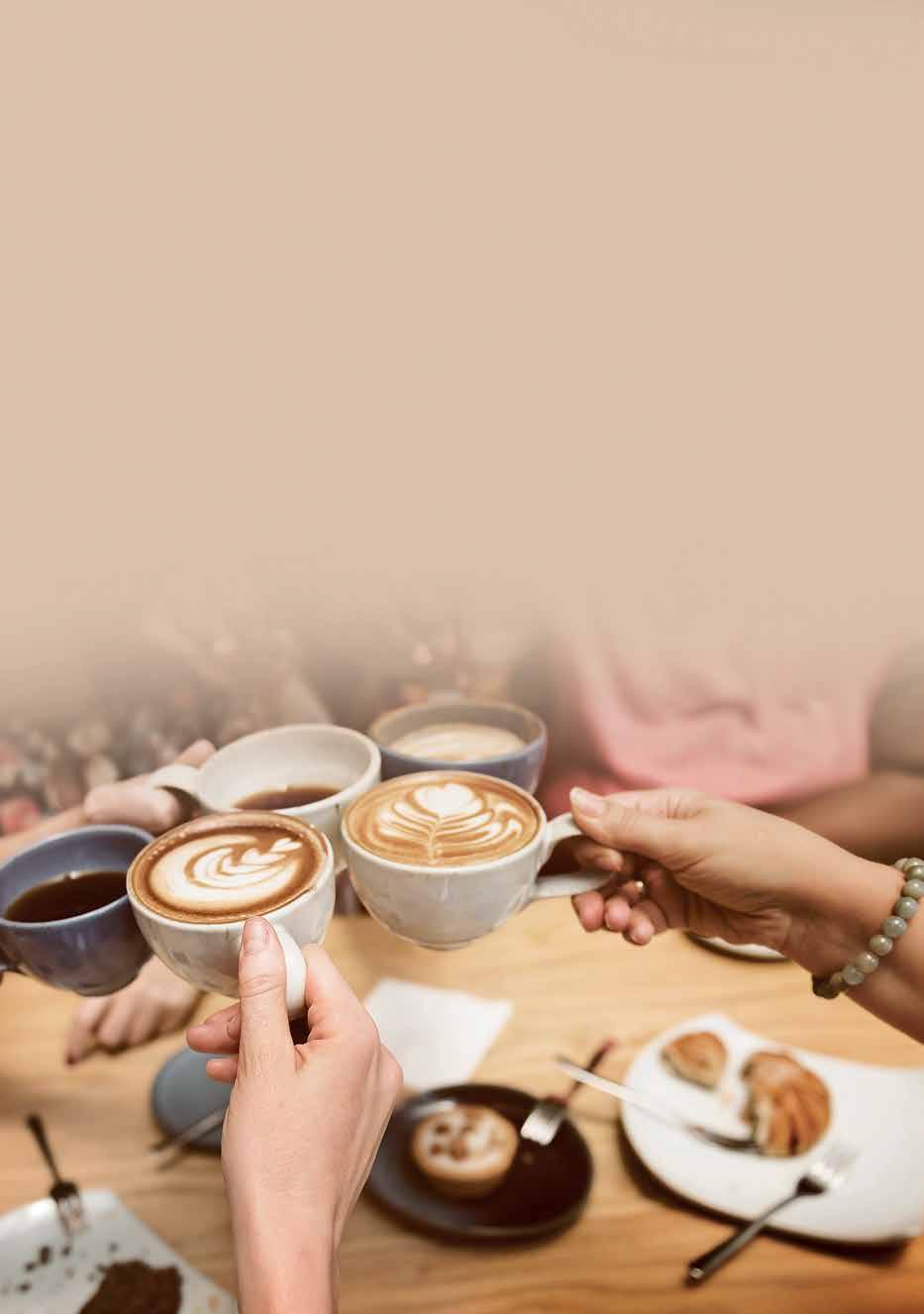
Few beverages carry the cultural and social meaning that coffee holds in Saudi Arabia. From the aromatic qahwa—brewed from lightly roasted beans and infused with cardamom, saffron or ginger—to the sleek specialty cafes emerging in Riyadh and Jeddah, the kingdom is redefining what it means to drink coffee.
Personally, coffee has always been one of those small rituals that shape the rhythm of a day. It also has a remarkable ability to bring people together. Experiencing this in Saudi Arabia adds another dimension, since the tradition here carries a depth of history and hospitality that is both authentic and inspiring.
A market rooted in tradition
Today, Saudi Arabia has developed into one of the most dynamic coffee markets in the Middle East. And, significantly, the kingdom’s young and globally connected population is driving much of this transformation. Many Saudis have studied or lived abroad and returned with an appreciation for specialty coffees, artisanal brewing methods and new experiences. Cafes, moreover, have evolved into social spaces where people meet, work and exchange ideas.
A complete coffee ecosystem
What is particularly striking, however, is that Saudi Arabia’s ambition goes far beyond being a strong consumer market. A key initiative is the Saudi Coffee Company, launched by the Public Investment Fund (PIF), which aims specifically to strengthen the kingdom’s role in the global industry, while supporting sustainable local production. In particular, this includes the Jazan region, where the cultivation of mountain-grown coffee has thrived for generations.
Homegrown Saudi cafe brands are emerging, combining quality, innovation and cultural identity. In turn, many have become gathering places for art, music and community events, further reinforcing the social role that coffee has always played.
From heritage to the future
Qahwa remains at the heart of Saudi hospitality, served in homes and gatherings just as it has been for generations. Yet alongside this tradition, a new chapter is emerging, shaped by creativity, entrepreneurship and thoughtful investment.
Ultimately, Saudi Arabia is steadily positioning itself as one of the most sophisticated coffee markets in the GCC. Each cup carries not only the aroma of freshly roasted beans but also a story of heritage, hospitality and a future that is still brewing.
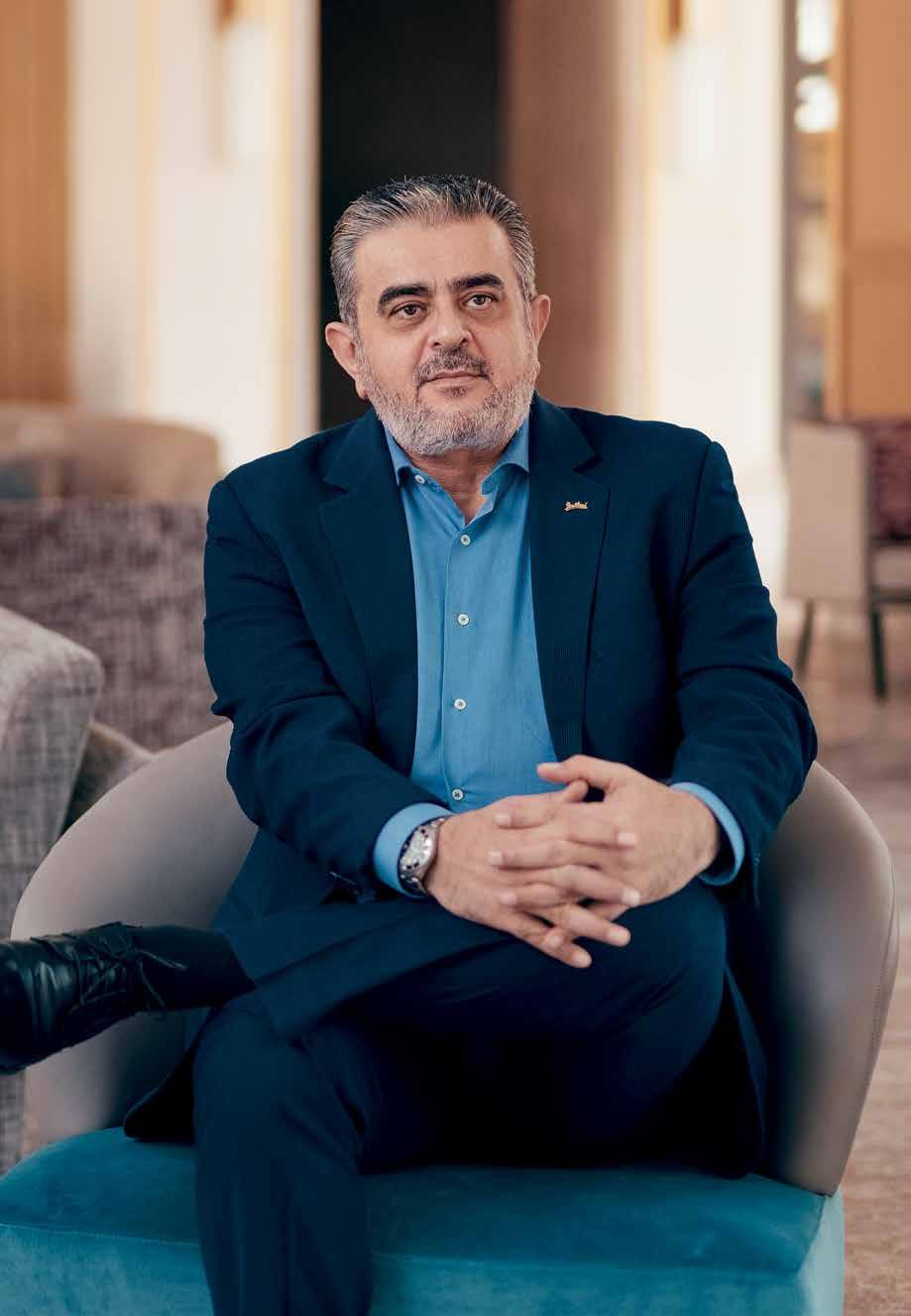
Dagmar Symes CEO at Al Hamra symesdagmar
ALWAYS IN OUR HEARTS
In the field of hospitality, cooking and beverage competitions are certainly not a waste of time. The hotels, restaurants and hospitality universities registering for and participating in these competitions are wideranging. They are considered a golden opportunity for employees and hospitality students, in terms of personal development and credibility in the field of hospitality and its industries.
EDUCATING THE HOSPITALITY PROFESSIONALS OF TOMORROW
Nouhad Dammous (May 2019)
Late editor-in-chief
Docteur Honoris Causa
Scan to read his book
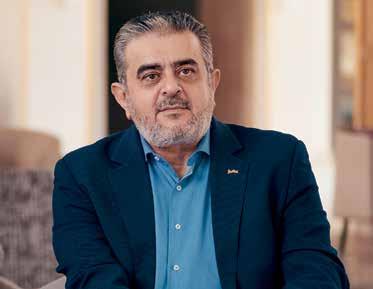
Dagmar Symes, CEO of Al Hamra,
8 On the calendar: Hospitality Services’ 2026 lineup
10 FHS Saudi Arabia returns to drive investment 10 ATM 2026 rescheduled to August at Dubai World Trade Centre 10 The Saudifood Show returns for 2026 10 New August dates for Emirates International Salon Culinaire 2026 10 Calendar
BUSINESS
INTERVIEW
12 Basel Talal on the power of a people-first approach in hospitality OPINION
14 Why discipline is key to leveraging global opportunities INFLUENCERS
16 5 influential chefs on passion,persistence and paying it forward TOURISM
22 Why the algorithm is behind overtourism COUNTRY REPORT
24 The UAE: firm foundations, bold ambitions MANAGEMENT
26 Mastering hospitality growth with an asset-light strategy TRENDS
28 Navigating the future of MENA business travel ARCHITECTURE
30 Bar designs that drive revenue in nightlife venues F&B
32 Why luxury F&B is no longer about extravagance EYE ON SPAIN
34 Spanish cuisine: a celebration of culinary contrasts
Basel Talal
WHERE JOURNEYS MEET
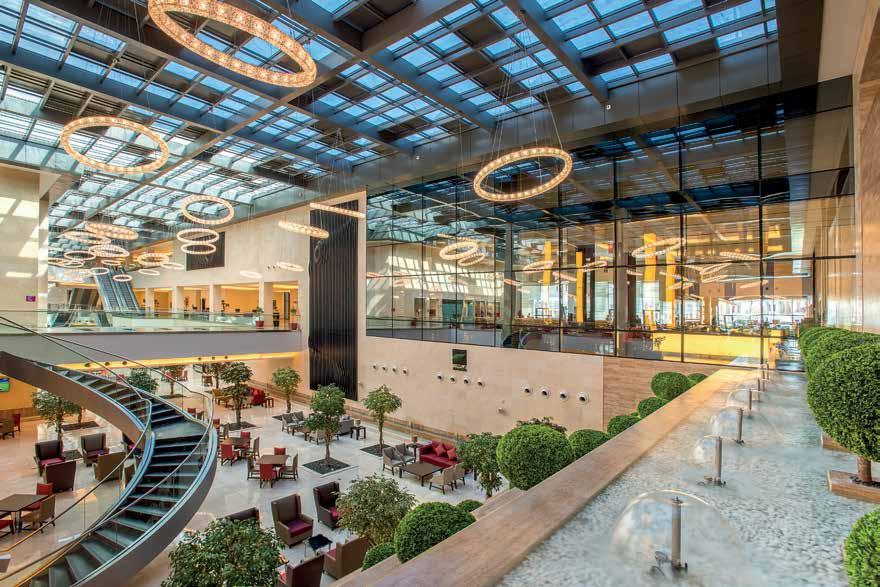
In the heart of Riyadh’s prime business district, Crowne Plaza Riyadh RDC o ers today’s travelers a stay built around connection and purpose.
Enjoy services designed specifically for business travelers, and elevate your workday with an experience that sets a new standard for Riyadh’s business hospitality.
Special report: COFFEE & COFFEE SHOPS
38 Why coffee is the definitive functional beverage
40 The experiential coffee culture transforming MENA
42 Turkish and Arabic coffee: from tradition to trend
44 Homegrown Middle Eastern coffee shops have their day
46 12 original coffee shops redefining cafe culture
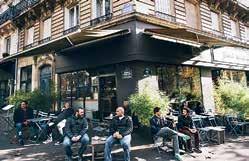
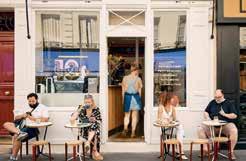
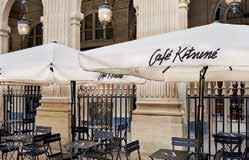
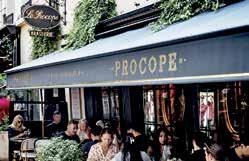
48 7 inspirational Parisian cafes for the MENA coffee scene
50 The hidden logic of roasting
52 How brewing innovation is scaling new heights
54 6 experts on what’s brewing in the coffee industry
56 Inside the neuroscience of coffee
TECHNOLOGY
58 How AI is transforming the events industry HUMAN RESOURCES
59 The key to balancing global expertise with local talent for hospitality success MARKETING
60 Why wellness strategy delivers a competitive edge GREEN
61 3 ways AI can help the events industry reach net zero
66 5 experts on how tea-infused alcoholic beverages are causing a stir CHOCOMANIA
69 Chocolate Fudge Cake ON THE MARKET
70 New products
Coming issue
AUG - OCT 2026
• Special report New projects and investments
• Influencers Hoteliers
• Technology GEO
• Food Ice cream and gelato
• Beverage Syrups
Coffee
Human Resources
ON THE CALENDAR: HOSPITALITY SERVICES’ 2026 LINEUP
For more than 30 years, Hospitality Services has been curating first-class events across the region. Here is what’s planned for 2026.
GAULT&MILLAU SAUDI ARABIA
June 2, 2026
The famous Gault&Millau Yellow Guide makes its kingdom debut this June. An initiative of the Saudi Culinary Arts Commission, developed in collaboration with Gault&Millau France and HSME, the first edition covers nearly 250 restaurants across Riyadh, Jeddah, Abha, AlUla and Dammam. A gala celebration and awards ceremony will bring together chefs, journalists, influencers and partners to mark the occasion.
HORECA OMAN
Sept. 14–16, 2026
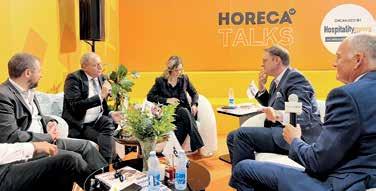
The fifth edition of HORECA Oman returns to the Oman Convention and Exhibition Centre in Muscat. More than 200 local and international exhibitors will spread across 5,000 square meters, with 8,000 professionals expected through the doors. The program includes HORECA Talks alongside a full roster of competitions— Hospitality Salon Culinaire, Junior Chef, Barista, Latte Art, Mocktail, Art of Service and Bed Making.
SALON DU CHOCOLAT ET DE LA PÂTISSERIE DUBAI
Sept. 22–24, 2026
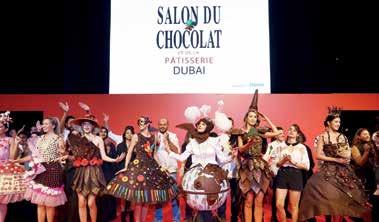
The Middle East’s definitive celebration of chocolate, pastry, gelato and coffee returns to Madinat Jumeirah. World-class chocolatiers, pastry chefs, baristas and mixologists gather for a program of live demonstrations, masterclasses, competitions and the unmissable Chocolate Fashion Show.
WHISKY LIVE BEIRUT
Oct. 7–9, 2026
Lebanon’s most anticipated whisky event brings together top international producers, distributors and experts for a unique tasting experience. Highlights include masterclasses on cask finishes, maturation and blending, a Star Bar serving creative whisky cocktails, pop-up food stations and a Lifestyle Boutique, with a Gold Circle area offering access to rare and limited-edition expressions.
HORECA JORDAN
Oct. 11–13, 2026
Now in its 11th edition, HORECA Jordan returns to the Jordan International Exhibition Center in Amman. The country’s largest food, beverage and hospitality event brings together exhibitors, buyers and professionals for a packed program of competitions, live demonstrations and networking.
HORECA LEBANON
Nov. 10–13, 2026
The flagship event where it all began celebrates its 30th anniversary at Beirut’s Seaside Arena. Expanded this year with a third hall, the landmark edition welcomes more than 24,000 professional buyers and 400 exhibitors across 13,000 square meters, gathering the entire hospitality ecosystem under one roof.
HORECA RIYADH
Dec. 7–9, 2026
Now in its 15th edition, HORECA Riyadh unites key players from across the kingdom and beyond at the Riyadh Front Exhibition and Conference Center. The program focuses on sector growth, innovation, entrepreneurship and emerging talent, with a rich variety of competitions and forums.
SALON DU CHOCOLAT ET DE LA PÂTISSERIE RIYADH
Dec. 7–9, 2026
Celebrating its fourth edition alongside HORECA Riyadh, the kingdom’s premier chocolate, pastry, gelato and coffee showcase brings together world-class chocolatiers, pastry chefs and innovators from around the globe at the Riyadh Front Exhibition and Conference Center.
hospitalityservices.me
BBQ BROS
SIGNS LANDMARK EXPANSION DEAL ACROSS KSA AND JORDAN
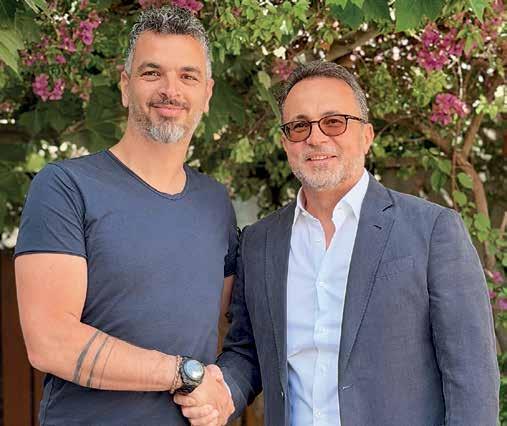
In a move set to reshape the premium live-fire dining landscape of the Middle East, Mario Aoun, founder of BBQ Bros, has officially signed a major strategic partnership with Samer Abu Khadra of Centro Kitchen Company. The agreement grants the company the rights to develop and operate BBQ Bros across Saudi Arabia and Jordan.
A milestone deal
The landmark partnership marks one of the most ambitious hospitality expansions in the region’s open-fire dining sector, covering both large-scale catering operations and full restaurant development across the two countries.
At the heart of the agreement lies the launch of a state-of-the-art central production facility designed to serve as the operational backbone for BBQ Bros in Saudi Arabia. The facility is expected to set new benchmarks in production capacity, quality control, logistics and culinary innovation, supporting everything from luxury events and high-profile gatherings to large-scale hospitality activations.
The partnership also includes the aggressive rollout of multiple BBQ Bros restaurant outlets throughout Saudi Arabia and Jordan, bringing the brand’s signature open-fire experience, theatrical live cooking and globally recognized hospitality culture to two of the region’s most dynamic markets.
Fire-driven hospitality
Jordan is expected to become the first country to launch under the new agreement, with operations targeted for July 2026. Saudi Arabia will follow shortly after, beginning with Riyadh in September 2026, paving the way for what insiders are already calling a major regional hospitality movement.
For years, BBQ Bros has built a reputation far beyond traditional barbecue culture. Under the leadership of Mario Aoun, the brand evolved into an internationally recognized fire-driven hospitality concept, blending premium ingredients, open-fire craftsmanship, live entertainment and immersive guest experiences. From Lebanon to the UAE, Kuwait, Egypt, Belgium and beyond, BBQ Bros has positioned itself as a lifestyle brand centered around what Aoun calls “The Fire Movement.”
From a single concept rooted in Lebanon, BBQ Bros has grown into an international lifestyle brand built around open-fire hospitality. Now, founder Mario Aoun is taking the brand into two dynamic regional markets through an ambitious partnership that marks a bold new chapter in the company’s story.
Long-term vision
“This is not simply a franchise expansion,” said Mario Aoun during the signing ceremony. “This is the beginning of a long-term regional vision. We are building infrastructure, culture and experiences designed to elevate open-fire hospitality to a completely different level across Saudi Arabia and Jordan.”
Samer Abu Khadra emphasized the scale and seriousness of the project, describing the partnership as “a transformative hospitality investment built on operational excellence, culinary innovation and longterm market leadership.”
Industry observers are already watching the partnership closely, particularly given the exceptional growth of Saudi Arabia’s hospitality and lifestyle sectors under Vision 2030, as well as Jordan’s rapidly evolving premium dining scene.
The upcoming launches are expected to introduce a new generation of BBQ Bros destinations, combining high-energy livefire kitchens, elevated design aesthetics, premium catering capabilities and largeformat hospitality experiences tailored to both local and international audiences.
With the ink now dry on the agreement, the flames are officially lit for what could become one of the region’s defining hospitality expansions of the coming years.
From embers to empire, BBQ Bros is entering a new era.
bbqbros.me
EVENTS
FHS SAUDI ARABIA RETURNS TO DRIVE INVESTMENT
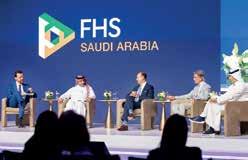
Future Hospitality Summit (FHS) Saudi Arabia returns to Mandarin Oriental Al Faisaliah, Riyadh, from June 22 24. Long recognized as a leading regional dealmaking platform, the 2026 event takes place under the theme Where Opportunity Meets Capital. Significantly, it will gather investors, developers, operators and policymakers at a pivotal moment for the region’s hospitality sector. As a result, the summit brings a sharply focused agenda of investment sessions, networking and highlevel deal-making to Riyadh.
FHS Saudi Arabia 2026 builds on a strong 2025 edition that welcomed more than
ATM 2026 RESCHEDULED TO AUGUST AT DUBAI WORLD TRADE CENTRE
Arabian Travel Market (ATM) 2026 has been rescheduled and will now take place from Aug. 17 20 at Dubai World Trade Centre.
THE SAUDIFOOD SHOW RETURNS FOR 2026
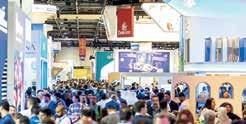
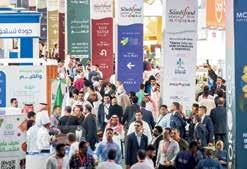
The Saudifood Show 2026 takes place from Sept. 27 29 at the Riyadh Front Exhibition and Conference Center. The event will gather more than 1,300 exhibitors from over 100 countries, showcasing products and solutions across 12 sectors. These include, for example, dairy, seafood, bakery, beverages and confectionery. Highlights
1,100 industry leaders and generated over USD 1.6 billion in business opportunities. In particular, the 2026 program spans real estate, technology, wellness and branded residences. Additionally, highlights include the FHS Start-up Den, the Investor Lounge and curated networking designed to translate dialogue into transactions. futurehospitality.com/sa
Originally planned for May, the event will explore how shifts in technology and traveler behavior are shaping tourism’s future. Significantly, sustainability and connectivity are among the key themes. Now in its 33rd edition, ATM serves as a key global platform connecting destinations, travel suppliers, hospitality brands, airlines and technology providers. Notably, Hospitality News Middle East will host a talk titled Determining Growth: How Hospitality Can Adapt to New Traveller Needs at this year's event. wtm.com/atm/en-gb.html
CALENDAR
JUNE 2026
10-12 June SOUTH AFRICA AFRICA FOOD SHOW
DMG theafricafoodshow.com
22-24 June KSA
FHS SAUDI ARABIA The Bench futurehospitality.com/sa
22-24 June SHARJAH, UAE EXPOCULINAIRE 2026 PurpleKitchen Events expoculinaire.com
AUGUST 2026
17-20 Aug. DUBAI, UAE
ARABIAN TRAVEL MARKET
RX wtm.com/atm/en-gb.html
31 Aug.-2 Sept. DUBAI, UAE EMIRATES INTERNATIONAL SALON CULINAIRE The Emirates Culinary Guild PurpleKitchen Events eisc.ae/salonculinaire
SEPTEMBER 2026
27-29 Sept. KSA THE SAUDI FOOD SHOW DWTC thesaudifoodshow.com
will range from the Saudi Food Summit and Top Table Saudi to Coffee World and the Saudi Food Excellence Awards. Crucially, the Saudifood Show is recognized as a key platform for the kingdom’s F&B industry. In particular, it is known for facilitating in-person meetings between public- and private-sector professionals. Indeed, organizers expect more than 12,000 business-to-business meetings to take place.
thesaudifoodshow.com
NEW AUGUST DATES FOR EMIRATES INTERNATIONAL SALON CULINAIRE 2026
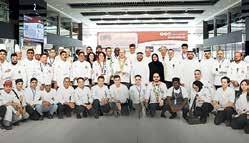
The 29th Emirates International Salon Culinaire (EISC) has been rescheduled to Aug. 31 Sept. 2 at Madinat Jumeirah Conference Centre, Dubai. A wellestablished culinary trade platform, EISC draws executive chefs, F&B directors and procurement managers from across the region. The 2026 edition is set to host over 1,000 chef competitors and more
than 450 participating companies and brands. Moreover, it expects to welcome over 6,000 professional trade visitors. Additionally, the program features more than 45 classes endorsed by Worldchefs and over 30 hours of live culinary demonstrations. eisc.ae
LET’S CULTIVATE TALENTS
"WHERE
CHOCOLATE EXCELLENCE MEETS GLOBAL INSPIRATION"
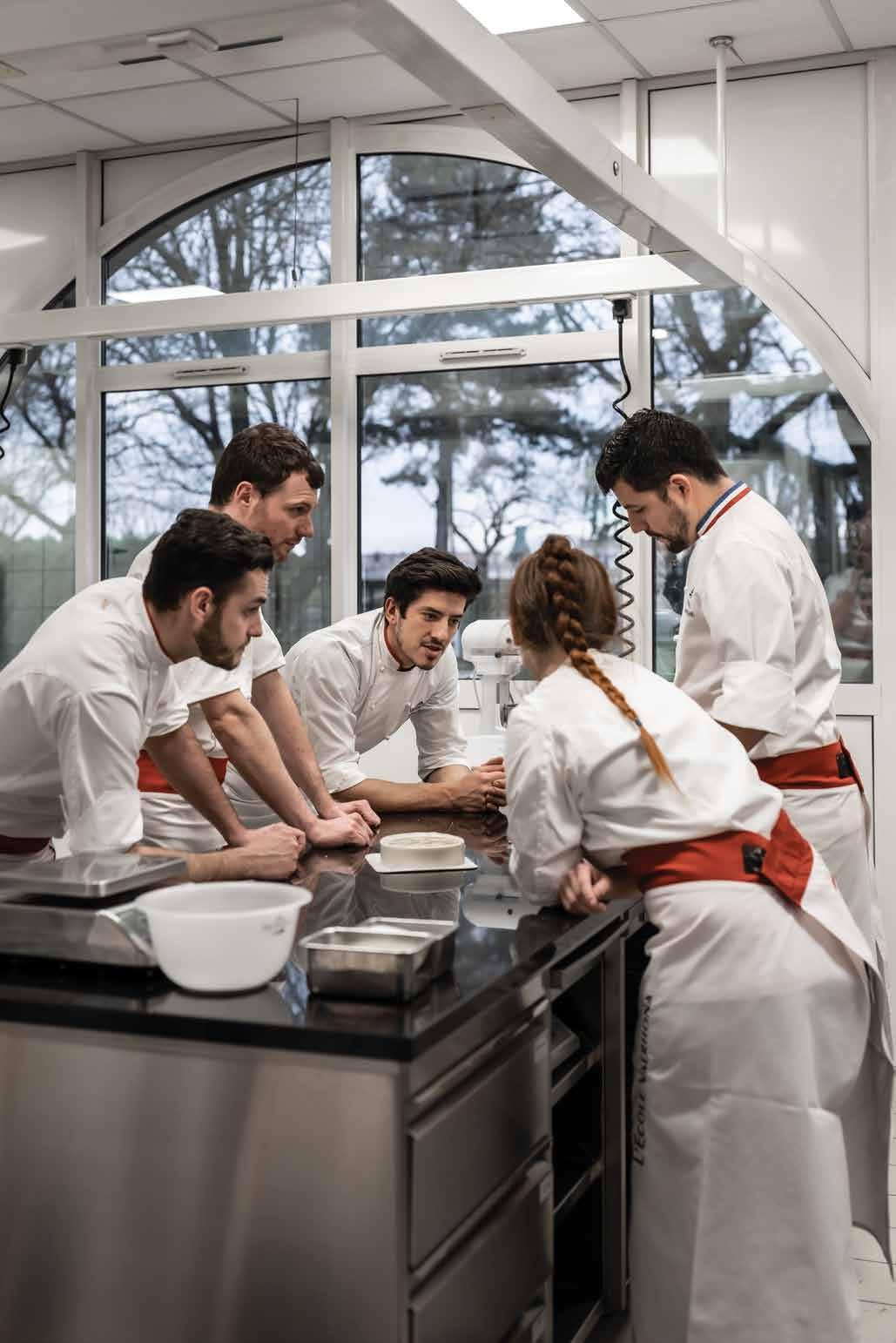
L’École Valrhona Dubai
BASEL
ON THE POWER OF A PEOPLE-FIRST APPROACH IN HOSPITALITY
The regional hospitality market is expanding rapidly, driven by rising guest expectations and evolving travel demand. Innovation, talent and personalization are reshaping how the sector operates, requiring leaders to rethink their approach. Basel Talal, managing director KSA, Kuwait and Levant at Radisson Hotel Group, explains why he believes brands that value human connection will be the ones that stand out.
What role do interaction and passion play in your work?
Interaction and passion play a fundamental role in my work because hospitality is, at its core, a people business. In a regional leadership role, that means creating the right culture and supporting strong leaders. Above all, it means keeping our teams connected to the purpose behind what they do. Passion drives people beyond process to create genuine moments. Meaningful interaction, in turn, brings that to life for both guests and teams. At Radisson Hotel Group, this aligns with our belief that Every Moment Matters. Ultimately, it is the quality of those human connections that defines the experience. What is the main driver in hospitality?
People are the main driver in hospitality. The industry is built on human connection and, consequently, great experiences always come back to great teams. At the same time, it must create value on both sides. We have to deliver for guests and, equally, for owners and partners. The real driver is finding that balance, while keeping quality, consistency and experience at the center. When you get that right, you build something sustainable and relevant for the long term.
How do you approach leadership?
My leadership style is open, hands-on and people-focused. I believe in being present, listening closely and setting a clear direction while giving people the confidence to grow. I also believe leadership should be rooted in trust. Teams, undoubtedly, perform best when they feel supported, recognized and empowered. For me, leadership is about creating the right culture, setting the tone and helping people succeed. When people feel valued, they naturally deliver their best work.
How do you attract and retain top talent at Radisson Hotel Group?
For us, it starts with creating a culture where people feel they can grow, belong and build a real career. At Radisson Hotel Group, we know that attracting talent is only one part of the equation. Retaining it, however, comes from giving people purpose, development and a clear path forward. That is reflected in our employer value proposition, Be a Moment Maker. Specifically, it recognizes that every team member plays an important role in shaping the guest experience. A big part of that is learning and development. Through Radisson Academy, our teams have access to training across operational skills, leadership development and personal growth. We also place a strong focus on internal progression. People, moreover, are more likely to stay when they can clearly see what their next step could be, supported by leadership transition programs and dedicated pathways for future general managers.
The future of hospitality is not about replacing people, it is about enabling them to deliver even better experiences.
What are the biggest challenges facing hospitality today?
One of the biggest challenges is keeping the right balance between efficiency and genuine hospitality. Guest expectations are rising, competition is strong and, as a result, teams are expected to deliver more than ever. Another challenge is talent: attracting the right people, developing them and keeping them engaged in a fast-moving environment. The industry has to keep evolving while protecting the human side that defines it. That balance between performance, adaptability and personal service is, for this reason, one of the biggest priorities for leaders today.
With AI evolving rapidly, do you fear that the hospitality sector will lose its human touch?
No, I see AI as something that can support the sector, not replace it. The essence of this industry is human and, fundamentally, that will not change. Used well, AI can help remove repetitive tasks, improve speed and support personalization. That, in turn, gives teams more time to focus on what matters most, which is the guest. Technology should, by contrast, create more room for human connection, not less. The future of hospitality is not about replacing people, it is about enabling them to deliver even better experiences. Where do you see hospitality heading?
I see the sector becoming more experience-led, more personalized and more flexible. Travelers want stays that feel relevant to their lifestyle, not onesize-fits-all experiences. I also believe sustainability, digital convenience and blended travel will continue to shape the sector. Guests are looking for more than a place to stay. Above all, they want meaning, ease and authenticity. The brands that will stand out are the ones that combine innovation with strong service culture and, importantly, a clear sense of purpose.
How is Radisson Hotel Group positioning itself for what’s ahead? Radisson Hotel Group is evolving by staying focused on relevance, for guests, for owners and for talent. That means investing in digital tools, strengthening our brands and, additionally, creating more tailored experiences across the portfolio. We are also evolving with a clear sense of purpose. Sustainability, personalization, flexibility and talent development are no longer side topics. Rather, they are now central to how the industry moves forward. What matters is evolving in a way that strengthens the experience without losing the human core of the business. That, I believe, is where Radisson Hotel Group is continuing to build real momentum.
radissonhotels.com basel_rd
WHY DISCIPLINE IS KEY TO LEVERAGING GLOBAL OPPORTUNITIES
In hospitality and tourism, we often speak about “global opportunity” as if it were a passing trend. We view it as something to be chased when markets soften or when expansion capital is abundant. However, I would argue the opposite. Leveraging global opportunity is not a moment. Rather, it is a discipline. Indeed, it requires clarity of vision, cultural intelligence and, above all, the ability to balance ambition with operational realism.
The industry today operates within a paradox. On the one hand, demand for travel has never been more diverse or resilient. On the other, competition is sharper, margins tighter and customer expectations significantly higher. Importantly, the winners in this environment are not necessarily the fastest to expand, but the most deliberate in how they grow.
Global opportunities in emerging markets Emerging markets continue to dominate boardroom conversations, and rightly so. Regions across Africa, Southeast Asia and parts of the Middle East offer compelling demographics, underpenetrated supply and long-term growth potential. Yet, too often, expansion strategies are driven by macro headlines rather than micro
In an industry defined by both emotion and economics, hospitality businesses face a balancing act when planning for the future. Hala Matar Choufany, president of HVS Middle East and Africa, explains how ambition and operational realism can combine to deliver long-term success.
understanding. Entering a market is not simply about identifying demand. Instead, it is about understanding nuance—ownership structures, regulatory frameworks, talent availability and cultural expectations. Consequently, without this depth, growth becomes exposure rather than opportunity. Technology, meanwhile, has shifted from being an enabler to a defining competitive lever. The conversation is no longer about whether to invest in digital platforms, but how intelligently those investments are deployed. Data today offers unprecedented visibility into customer behavior, but insight without execution is meaningless. Notably, the brands that stand out are those that translate data into relevance. As a result, they can anticipate guest needs, personalize experiences and create consistency across geographies without losing local authenticity.
Sustainability as a lever
Perhaps the most significant shift, however, is the growing importance of purpose. Sustainability is no longer a peripheral initiative; it is central to long-term value creation. Investors are asking harder questions. Guests are making more conscious choices. In
The winners in this environment are not necessarily the fastest to expand, but the most deliberate in how they grow.
addition, communities are demanding meaningful engagement. Hospitality companies embedding sustainability into their operating models as a measurable commitment will be better positioned to compete globally. This is about building resilient, future-proof businesses, as much as it is about environmental responsibility. Equally critical is the role of partnerships. In a fragmented and complex global landscape, no single operator can do it all. Strategic alliances, then, whether with local partners, global brands or technology providers, are increasingly essential. Crucially, alignment is paramount. Partnerships must be built on shared objectives, transparent governance and a clear understanding of value creation on both sides.
Discipline: the differentiator
Yet, amid all these opportunities, discipline remains the differentiator. Growth for the sake of visibility is rarely sustainable. The most successful hospitality platforms are those that understand where they can create value and where they cannot. They are selective, data-driven and willing to walk away when fundamentals do not align. Global opportunity, then, is not about being everywhere. It is about being relevant in the right places, at the right time, with the right strategy. In a sector defined by both emotion and economics, that balance is not easy to achieve. However, it is precisely where long-term success lies.
hvs.com
INFLUENTIAL CHEFS ON PASSION, PERSISTENCE AND PAYING IT FORWARD 5
The professional kitchen is often described by chefs as a remarkable teacher, with its instruction extending well beyond technique. Cooking with love, staying grounded and giving back are among the lessons that industry veterans say they’ve learned over the years. Here, five influential Middle Eastern chefs, from the many working in the region today, share the wisdom of their decades-long careers.
Lebanese flavors are a bridge between a glorious past and an innovative culinary future.
Cuisine meets culture
Lebanese cuisine is undoubtedly a boundless playground for a chef. What draws me to it is its profound richness and heritage—thousands of years of history plated with vibrance. Indeed, it isn’t just food, but rather, a living culture. The ingredients, from sun-drenched sumac to golden olive oils, for example, offer endless opportunities for discovery. Undoubtedly, I see a bright future here because the cuisine is incredibly versatile, balancing ancient techniques with modern refinement. Its complexity lies in its simplicity, letting the soul of the produce speak. For me, Lebanese flavors are a bridge between a glorious past and an innovative culinary future.
Less is more
If I were to adopt a second nationality, it would be Japanese without hesitation. As a chef, I deeply admire their unparalleled respect for ingredients and the meditative focus they bring to the kitchen. The Japanese culinary philosophy is a masterclass in “less is more.” Every slice of a knife, for instance, is intentional. Their culture is built on a foundation of discipline and humility. Moreover, the way their chefs are raised to seek perfection, or kaizen, is truly inspiring. To possess that cultural DNA would be the ultimate gift for my culinary evolution.
Cooking with humility
In a world that often prizes ego and status, the life of Pope John Paul II was a profound lesson in humility and grace. Therefore, I would have chosen to cook for him, above all others, if asked and given the opportunity. As a chef, we often cook for the elite. However, preparing a meal
for someone of his spiritual stature would have been a grounding, transformative experience. I wouldn’t have aimed for opulence. Instead, I would have served something simple and honest that reflects the earth.
Craft over followers
To the aspiring chefs of tomorrow, my message is indeed simple. Lace up your boots and prepare for hard work. Additionally, you’ll need perseverance and passion. The kitchen is a demanding stage and social media can be a deceptive lens. Moreover, don’t be fooled either by the filtered “fame” you see online. Ultimately, true mastery isn’t found in a viral post. Instead, it’s in the heat of the line and the repetition of the craft. Put your head down, respect the produce and hone your skills with discipline. Focus on the quality of your work rather than the quantity of your followers. As a result, success will follow.
JOE BARZA
Culinary consultant and owner
Joe Barza Culinary Consultancy joebarza.com chefjoebarza
Greatness is something you build—not something you’re born with.
Built around balance
A typical day for me starts with gratitude. Indeed, I wake up energized and happy to be alive, knowing that health is our most important asset. I begin by executing the goals I set the night before, focusing on making progress, even if it’s just one meaningful achievement. Throughout the day, I aim to maintain a balance between work, family, physical activity and personal well-being. This is because ultimately, success means nothing without that balance.
Mentorship as a mindset
I don’t limit mentorship to just one person. In fact, anyone I meet can be a mentor if they teach me something or inspire me. I believe in learning from every experience and every individual, whether it’s a renowned chef or someone I encounter in daily life. Overall, that mindset has shaped my growth the most.
Seek out the science
My advice to the next generation is to truly invest in understanding the science behind food and ingredients. It’s the foundation of everything we create. Seek out internships with great chefs and established restaurants from different nationalities to broaden your perspective and learn diverse techniques. Moreover, don’t be afraid to take risks or experiment. Let your creativity guide you. At the same time, however, stay disciplined and always be honest in your work. Eventually, that’s what builds lasting success.
The steps to success
The philosophy I go by in life is simple: what one person can achieve, another can too. In the culinary world, certainly, this means discipline, curiosity and persistence matter more than talent alone. In the end, greatness is something you build—not something you’re born with.
BOBBY CHINN
Celebrity chef and judge, MBC's Top Chef bobbychinn.com bobbychinn
Food is power and one should be mindful of that.
From finance to food
I became a chef because even though I have a BA in Finance and Economics, I have zero passion for making rich people richer. After working on the floor of the NYSE, research analyst and hedge funds, I hated it. So I flipped the question and treated life like an algebraic equation: eliminate everything you don’t want to do. I stumbled on food. I was always interested in it, from my grandmas’ cooking to dining in San Francisco’s best restaurants, through travel. The equation led me here. I enjoy feeding people, stray cats, street dogs, birds—whatever shows up. That feeling of giving, sharing, brings me joy and that is a dividend no hedge fund can ever match. Success to me is spending your time doing something that you love.
An appreciative audience
Many people have shaped my attitude at different stages of my life. My family, for example. Also, Hubert Keller, who gave me my first major break. I was unqualified,
with no professional kitchen experience, in what was a top French restaurant in San Francisco. I’ve since cooked for plenty of famous people, from Bob Dylan to Hillary and Bill Clinton. I give all of myself because I cook out of love. However, cooking for family, friends and people who truly appreciate food is the most gratifying.
Respecting ingredients
My ethnicity, upbringing and diverse background have given me a very open mind. I’m Chinese and Egyptian, Frenchtrained, from San Francisco, and welltraveled. As a result, I’ve learned the authentic tastes of cuisines across the globe. I might be known for my Vietnamese food in some locations or for fusing different cuisines elsewhere. Importantly, I pride myself on respecting original dishes while borrowing techniques or ingredients from other cultures. I’m mostly simplistic in my approach. That’s easy. The ego, however, is what makes it hard.
A mindful approach
For me, being a chef is about cooking food, managing a kitchen and building a team. Equally, it’s about inspiring others and imparting your values—feeding a community, providing nutritious and emotional comfort. However, building that community through ethical sourcing and reducing food waste is also critical. Food is power and one should be mindful of that. Undoubtedly, supporting local farmers and cooking seasonal goods are part of the solution to the climate crisis we face.
Stay curious, stay humble
There are no shortcuts in this industry. My advice is to find passion in the most mundane tasks. Additionally, think of creativity and originality as salt: too little, you’re flat; too much and you’ve ruined the dish. Moreover, apply kaizen, the Japanese philosophy of continuous improvement, to everything you do. Remember, too, that we are only as good as the last meal we cooked. In this profession, it’s crucial to never stop learning.
HUSSEIN HADID
Chef, caterer, restaurateur and food consultant
The HH Kitchen husseinhadid.com husseinhadid
What remains is the experience you create, the consistency of your work and the trust you build over time.
Connecting through food
What defines my work is immersion. Through the Kitchen Table Experience, I invite people into my space not just to dine, but to connect. Crucially, this is not about performance, but about presence. As a result, guests become part of the process and part of the story. That level of openness in my cooking is rare in this industry. However, for me, it’s where food becomes something more meaningful than what’s on the plate.
The great outdoors
If I could cook for one person, it would be Francis Mallmann. His connection to fire and the open-air cooking process resonates with me. Indeed, I would definitely take it outside. No kitchen, just flame, wood and the elements,
working with the earth’s raw materials in a beautiful, natural setting. A leg of goat meat, for example, slow-grilled, over oak and olive wood. I would infuse it with Middle Eastern herbs and spices, alongside raw goat tartare prepared like kibbeh. Overall, it would be about cooking something that reflects what he stands for, while bringing a sense of where I come from into the plate. Importantly, it would be simple, grounded in earth and culturally rooted.
Visibility as a tool
Fame without substance doesn’t last. Tellingly, social media can amplify what you do, but it cannot replace it. Ultimately, what remains is the experience you create, the consistency of your work and the trust you build over time. If the foundation is strong, visibility becomes a tool, not the goal.
Beyond borders
Currently, I’m focusing on projects that allow Lebanese cuisine and identity to travel. This could be through partnerships, for example, curated experiences abroad or new ventures. The goal is not just expansion, however, but rather to create something that resonates culturally wherever it goes.
TAREK IBRAHIM
CEO and founder
Umami Restaurants
Certified masterchef, World Association ambassador, Meat and Livestock Australia cheftarekibrahim, umami.eg, aussiebeeflambme
What excites me most is the creativity in the kitchen and the endless cycle of learning.
White jacket magic
At the beginning, being a chef felt like a game. You prepare your station, for example, work extremely hard on the line and then receive instant feedback and appreciation. That immediate reward is powerful. What excites me most, however, is the creativity in the kitchen and the endless cycle of learning. Today, we are open to the entire world. Moreover, there’s the opportunity to be your own boss. That was very appealing to me. And of course, the white jacket has its own magic. The respect you earn today as a chef is truly remarkable. If I hadn’t become a chef, I would still be a pilot. Certainly, the feeling you get when flying your own airplane is unlike anything else.
Two turning points
I experienced two major turning points in my life. The first was my mentor and friend, the late chef Byron Chorus, who truly believed in me. He gave me confidence, suggesting which books
to read, for example, which chefs to follow and how to grow. The second was Youssef El Deeb, the founder of Fatafeat. He recognized my passion and my desire to give back. Moreover, he launched my television career. Over the course of 20 years, we produced numerous shows together, so I’m truly grateful to him.
Routine and rigor
Routine is key in my work. I start my day early. By 7 a.m., I’m at the gym, finishing my workout around 9:30 a.m. Then, I head to the restaurant. I begin by checking the pastry section, before moving to the main kitchen to inspect the coolers. After that, I go to my office to review reports, income and customer feedback. If there’s a complaint, I call the customer personally to understand what happened. Crucially, we have a clear policy for follow-ups. If everything is running smoothly, I put on my jacket, grab a coffee and join the team on the floor. From there, we get to work.
Positivity and perspective
We live in a world driven by social media and major awards. Undoubtedly, they’ve become powerful marketing tools. The more people talk about you, for example, the more successful you appear. Positive attention brings more customers, more opportunities and greater financial success. For me, work is a lifestyle. I genuinely love what I do. Of course, awards and recognition matter. However, it’s equally important to give yourself a break and focus on your immediate circle. “Smile at the world, and the world will smile back at you” is my philosophy. It’s simple: if you want positivity, you have to give it. If you need help, you have to help others first. Ultimately, it’s a straightforward way of living. So, keep smiling.
WHY THE ALGORITHM IS BEHIND OVERTOURISM
Cheap flights. Cruise ships. Selfie sticks. Every few months the tourism industry assembles another list of culprits to blame for overtourism. Then, it issues another set of caps and levies, and the queues form again. As a result, the residents protest. Again. Nothing fundamentally changes. Overtourism is not caused by too many tourists. Rather, it is caused by too many tourists receiving the same algorithmic instruction at the same moment and acting on it simultaneously. In other words, it is a synchronization problem. A machinelearning problem. A systems problem. And, moreover, we have been trying to solve it with a marketing toolkit!
The algorithmic funnel Hallstatt, a tiny village in Austria with 780 residents, now receives over 1 million visitors a year. At peak, 10,000 people crowd its narrow lakeside lanes in a single day. The town tried to erect anti-selfie barriers to block the famous viewpoint. However, the tourists are not really the story. The algorithm is.
If something photographs beautifully, social platforms amplify it. Engagement rises. The result is not organic discovery. Instead, it is algorithmic convergence. Millions of people receive the same digital signal: “Go here.” And, unsurprisingly, they do. Modern tourism is no longer guided by curiosity or editorial judgment, but by engagement metrics. And engagement metrics optimize for spectacle, not sustainability.
Global tourism is flourishing, but success has come at a cost for popular destinations, where overcrowding has proved resistant to solutions. Aradhana Khowala , founder and CEO of Aptamind Partners, examines why the industry may have been looking in the wrong place for answers to this critical problem and suggests that the Middle East is ideally placed to build tourism on smarter foundations.
The numbers we are not talking about The industry is fixated on arrivals. A total of 1.47 billion international trips in 2024, up 12.2 percent year-on-year. Indeed, record numbers everywhere. Japan hit 36.9 million foreign visitors, with tourism surpassing semiconductor exports as the country’s second-largest earner. Elsewhere, Morocco reached 17.4 million visitors, pushing revenue up 20 percent. By any headline measure, tourism is thriving.
But what if the headline measure is the wrong measure and the real metric is concentration? This is a problem that social media algorithms and Gen AI are uniquely engineered to cause.
According to Statista, approximately 40 percent of global travelers already use AI-based tools for trip planning. Among Millennials and Gen Z, that figure is 62 percent. The AI tourism market is projected to reach USD 13.9 billion by 2030, up from USD 3.37 billion in 2024. Over half of senior travel technology leaders report their companies now use generative AI during booking.
However, these systems are not curating the world. When travelers ask a chatbot where to go, they do not distribute demand across the full range of possible destinations. Instead, they surface the places with the highest training-data representation. In other words, the most visited, the most photographed and the most written about. Meanwhile, the ones actually capable of
absorbing more visitors without breaking remain structurally invisible to the model.
The Fjadrárgljúfur canyon in Iceland sat quietly unknown until Justin Bieber filmed a video there. Within two years, annual visitor numbers nearly doubled. That is not a cautionary tale about celebrity. Rather, it is a textbook demonstration of algorithmic amplification preceding institutional capacity.
“Smart tourism” was never smart For a decade, destinations have been talking about becoming “smart.” Usually, this meant public Wi-Fi and a mobile app that pushed restaurant recommendations. But that is not intelligence. A genuinely intelligent destination anticipates demand. For example, sensor networks measure footfall in real time, while mobility data reveals movement patterns across districts. Additionally, machine-learning models trained on weather, flight arrivals, event calendars and social media velocity predict crowd surges. And digital twins simulate what happens if cruise arrivals increase or a major festival draws crowds into one neighborhood.
Amsterdam has already begun using computer vision systems to estimate real-time crowd density in popular areas. Singapore does it too. The technology already exists. Even so, the will to deploy it at scale does not yet.
If something photographs beautifully, social platforms amplify it. Engagement rises. The result is not organic discovery. Instead, it is algorithmic convergence.
MENA's structural advantage Europe’s problem, by contrast, is irreversibility. Venice, Barcelona, Amsterdam and Dubrovnik are trying to retrofit 21st-century flow management onto medieval street grids and analog governance structures. Tourism patterns calcified decades ago. Admittedly, changing them requires fighting entrenched commercial interests, fragmented municipal jurisdictions and political constituencies built on visitor volume. It is not impossible—rather, it is just very slow.
Significantly, the Middle East is building its tourism infrastructure now. That is not a minor detail. In contrast, it is the entire argument! Saudi Arabia is designing its giga projects in an era when AI is a mainstream infrastructure layer, not an experimental add-on. The decisions being made today about data architecture, booking systems, mobility infrastructure and visitor identity are crucial. In turn, they will determine whether these places become intelligent destinations or very expensive queues.
In collaboration with
Dubai is the nearest proof of concept. The emirate recorded around 19 million overnight visitors in 2024. Tellingly, this was more than three times the resident population, managed without the civic breakdown visible in European counterparts. The reason is not hospitality culture. Dubai’s transport systems, immigration services, hospitality sector and government platforms operate on highly integrated digital networks. As a result, visitor flows can be observed and adjusted in near real time.
It is not perfect. That said, it is a model of what tourism governance looks like when it functions as a system rather than a marketing campaign.
A new job description for tourism leaders
For most of the 20th century a national tourism board had one real job: attract arrivals. Then count them and, afterward, report growth. That model is over. Or, certainly, it should be. The destination organizations that matter in the next decade will look more like urban operating systems. They will employ data scientists alongside creative directors, and behavioral economists alongside brand strategists. Their dashboards will track visitor distribution indices, ecosystem stress indicators and resident quality-of-life scores, not just arrivals.
AI as an overtourism risk There is, of course, another possibility. AI could make overtourism worse. An algorithm optimized for revenue and volume will ignore displacement costs and carrying capacity. Meanwhile, life for residents becomes harder, noisier and more expensive. Yet, although technology
amplifies the intention behind it, it does not supply the intention. That is a governance problem, not an engineering problem. And it is the reason that the most important question in destination AI is not which platform to deploy. Rather, it is: what exactly are we optimizing for? Revenue? Volume? Legitimacy? Choose well, and the algorithm will pursue it with machine efficiency. However, choose poorly, and smart tourism becomes a more sophisticated version of the same extraction.
The real provocation Overtourism is not an accident. Instead, it is what happens when a destination is marketed like a product but governed like nothing at all.
The Middle East is building tourism systems in an era where AI is infrastructure. As a result, the region can design something the rest of the world never did. The algorithm created the problem; only a smarter, more intentional use of AI will solve it. And the time for building that intelligence into the foundations, rather than bolting it on afterward, is now.
Get that right, and the region builds something the world has not yet seen. A major tourism destination that uses AI not to attract more visitors, but to understand them. To distribute them. And to sustain the thing that made them worth attracting in the first place. Get it wrong, and you build Hallstatt at scale. Only faster. And with better branding.
aptamind.com
THE UAE:
FIRM FOUNDATIONS, BOLD AMBITIONS
The UAE entered the new year with a strong economic and financial track record. In addition, the outlook for 2026 was bright before regional developments shifted the outlook. The Emirates recorded a nominal GDP of USD 569.10 billion, up by 4.8 percent, according to the International Monetary Fund. Equally, inflation was stable. Projections indicated that the economy was forecast to grow by more than 5 percent. Notably, the non-oil sectors were forecast to surpass 5.5 percent, accounting for 78 percent of national GDP.
The country confirmed its competitiveness and attractiveness to businesses and investors globally, thanks to more flexible regulations. Importantly, it is also emerging as a global artificial intelligence (AI) destination. Non-oil sectors, led by tourism and real estate, continued to flourish. Meanwhile, fiscal surpluses increased, with the government setting them aside as a cushion against shocks and to safeguard stability.
The Emirates began 2026 with momentum on its side. Strong economic fundamentals and record 2025 tourism figures had set the pace for another successful year, before regional developments shifted the outlook. Nada Alameddine, managing partner at Hodema Consulting Services, tracks the milestones and assesses what the remaining months may bring.
UAE sets transport benchmarks Infrastructure and transport also recorded major successes. Significantly, Abu Dhabi and Dubai airports broke traffic records, registering 33 million and 95.2 million international travelers in 2025, respectively. These impressive figures have helped to cement the UAE’s position as a global aviation hub. Indeed, Dubai’s figures mark the highest annual international passenger traffic ever recorded by any airport. Major developments also began moving forward on the ground. In particular, the Etihad rail project is due to launch at the end of this year. Connecting 11 cities across the country, the highly anticipated 900-kmlong passenger train will offer millions of commuters an alternative to the Emirates’ heavy traffic. In Dubai, there are also plans for new metro extensions from Expo City to Al Maktoum International Airport.
Abu Dhabi and Dubai airports broke traffic records, registering 33 million and 95.2 million international travelers in 2025, respectively. These impressive figures are cementing the UAE’s position as a global aviation hub.
Record-breaking tourism in 2025
The tourism industry flourished in 2025, contributing USD 70 billion to the economy and accounting for approximately 14 percent of GDP. Hotel occupancy levels remained steady at around 80 percent throughout 2025 and up to February 2026. According to Coldwell Banker Richard Ellis, average daily rates (ADRs) and revenue per available room (RevPAR) increased in 2025 by over 10 percent and 14 percent respectively. Notably, the Hospitality Advisory Council recorded 1,260 hotels and approximately 216,900 hotel rooms at the end of December 2025. According to Dubai authorities, the city welcomed 19.59 million visitors in 2025 followed by 2 million in January 2026. Dubai is making significant investments in the sector, with the aim of attracting 40 million visitors by 2030. Furthermore, investment in travel and tourism is forecast to gradually rise, reaching USD 20.3 billion by 2027. Meanwhile, Abu Dhabi delivered strong results, welcoming 4.4 million hotel guests and generating revenues of USD 1.59 billion.
New openings and investment
Several new resorts were set to debut in 2026. The country’s first Six Senses was expected this summer in Dubai on the Palm Jumeirah’s Western Crescent. Alongside this, hotel chains Mondrian, Kimpton and Baccarat were set to open later this year. Furthermore, the Thai-born Aman brand has announced a new branch for Dubai in 2027. With a focus on luxury, it will feature
a private beach, branded residences and a spa. Meanwhile, the emblematic Las Vegas landmark Bellagio is poised to join The Island Dubai development project, offering premium entertainment and luxury services. In addition, several floating projects are in the works, including the Buddha Bar, the Kempinski Floating Palace and the Floating Venice. One major talking point is a complex taking shape on the World Islands called the Honeymoon Island. Looking ahead, there are plans for Rosewood to make its Dubai debut in Jumeirah Beach in 2029.
Beyond this, Dubai property heavyweight Azizi Developments unveiled a major hospitality investment program. Its plans include building 151 new hotels, 90 percent of which will be located in Dubai. With a budget estimated at Dh75 billion, the program will see 60,000 rooms added to Dubai’s tourism portfolio. Moreover, the initiative should generate over 75,000 jobs required to service the properties. The program comprises 100 four-star hotels, 50 five-star hotels and a seven-star property in a new skyscraper on Sheikh Zayed Road.
Unified visa on the horizon
Significantly, the highly anticipated GCC Unified Tourist Visa is expected to be introduced in late 2026. Informally known as the “Grand Tours Visa” and long awaited, the initiative bodes well for international visitors. Under the new system, tourists will be able to travel between the UAE, Saudi Arabia, Qatar, Oman, Kuwait and Bahrain with a unique, Schengen-style visa. For example, tour operators can begin offering packages pairing Dubai’s nightlife and Saudi Arabia’s historical sites.
In other developments, local destinations and personalities have received highprofile accolades on the global stage. The town of Al Ain was named Capital of Arab Tourism for 2026. Meanwhile, the title of
In collaboration with
“Best Tourism Village in the World 2025” went to the village of Masfout in Ajman. Furthermore, Shaikha Al Nowais became secretary-general of UN Tourism in a move that marked a promotion.
The specter of uncertainty
However, despite its strong fundamentals, the UAE has not been immune to the effects of the regional conflict. According to Moody’s Analytics, hotel occupancy in Dubai fell to 10 percent in the second quarter of 2026 on the back of lower visitor confidence, pushing down room rates.
Air connectivity has also been disrupted, further affecting visitor numbers.
The conflict has also delayed opening timelines for some of the country’s largescale projects, including the Wynn Al Marjan Island in Ras Al Khaimah. The UAE’s first licensed casino resort had already revised its planned opening from 2026 to early 2027. A new timeline has yet to be confirmed.
To counter reduced occupancy, many hotels are advertising staycations as alternative holidays for locals who usually choose to travel abroad. Other properties have taken the opportunity to close temporarily for renovation. These include the Armani Hotel Dubai, the Burj Al Arab and the St. Regis Dubai The Palm. Reopenings are targeted for later in 2026 and 2027.
The external situation has also weighed on the events industry, with organizers rescheduling several fixtures to a later date, including fairs and sports competitions. Most, though, remain on the agenda. Ultimately, the duration and resolution of the conflict will be a defining factor in shaping the Emirates’ outlook for the remainder of 2026. hodema.net
MASTERING HOSPITALITY GROWTH WITH AN ASSET-LIGHT STRATEGY
The hospitality industry has undergone a seismic shift over the last two decades. The era of full property ownership is firmly in the rearview mirror. Today, the titans of the industry primarily exist as assetlight entities. Just like Uber operating as the largest taxi service without owning a single car, most hotel companies own few if any hotels. The same, notably, holds true for restaurant companies. This strategy decouples real estate ownership from brand management and operations, creating a high-speed game of scale that prioritizes intellectual property over physical infrastructure. But as any seasoned leader will tell you, moving fast is dangerous if you aren’t also moving with precision. The case for an asset-light strategy In an asset-light strategy, a brand focuses on its core strengths: marketing, distribution and loyalty. The physical buildings are owned by third-party investors or real estate investment trusts (REITs). Subsequently, the brand expands through two primary vehicles: management agreements and franchising.
In recent years, a growing number of hospitality brands have opted to expand their portfolios without owning the properties that carry their name. Managing that transition, from maintaining standards to navigating the risks, has become a defining industry challenge. Bastien Blanc, co-founder and board member at TroKadero Hospitality Global, takes us through the discipline required to make this model work and the rewards it can deliver.
The benefits of this approach are significant. Rapid scalability is the primary driver, since brands can enter new markets at a fraction of the cost, without the massive capital expenditure required to purchase land or construct buildings. This shift also results in lower financial risk, moving property taxes, maintenance costs and debt service to the owner. As a result, the brand’s balance sheet is effectively protected from real estate market fluctuations. Furthermore, investors generally value service-based, recurring fee streams higher than capital-intensive assets, leading to higher market multiples. Building on this, financial freedom allows brands to pour resources into innovation—specifically in technology platforms, guest experience apps and global marketing campaigns.
Navigating the risks
However, giving up ownership comes with inherent costs. Fee-based income is tied directly to hotel performance, meaning that if the market dips, the brand’s revenue follows—yet brands have less direct power to fix operational inefficiencies. Beyond this, the constant threat of brand dilution looms. When you don't own the
building, maintaining consistent standards across locations becomes a considerable challenge. Ensuring a remote franchise matches the quality of a flagship property, for instance, is no small feat. It can also lead to contractual friction. The interests of a property owner seeking immediate returns may, in practice, clash with a brand’s desire for long-term value. The true magic of the asset-light strategy, that said, is its ability to create a flywheel effect. As the network grows, the brand becomes more valuable. In turn, owners and investors benefit too, from appreciation of their properties, a growing client base or both.
The biggest threat to a rapidly expanding network, though, is the identity crisis. If a guest enjoys a five-star experience at a Dubai property but finds a location of the same brand in London lacking, the brand is damaged globally. Moreover, in an asset-light environment, the brand standards manual serves as the constitution. It must be exhaustive, covering everything from the scent in the lobby to the maximum time a front-desk agent is allowed to make a guest wait.
Prioritizing quality assurance
A manual is only as good as its enforcement, however. Accordingly, successful brands employ quality assurance teams—often including mystery shoppers—who conduct unannounced inspections. These audits must have teeth. If an owner refuses to upgrade equipment or refresh bedding according to the established cycle, there must be a clear path to de-flagging. That process means one thing: the removal of the brand name entirely. Ultimately, protecting the reputation of the entire network is always worth losing a single non-compliant property. This is why brands such as Marriott and Accor, among others, invest heavily in enforcement to protect standards across their networks.
Control is also maintained through technical infrastructure. Mandating that all partners use a proprietary property management system, central reservation system and customer experience surveys is, consequently, non-negotiable. It maintains a direct line to data and pricing. Crucially, guest feedback flows directly to the center too. It is nearly impossible to hide a failing hotel when operational data is visible at corporate headquarters in real-time.
Expansion is about choosing partners as much as it is about choosing locations.
Selecting the right partners
Expansion is about choosing partners as much as it is about choosing locations. In a franchise or management agreement, the brand is essentially entering a long-term marriage. Growth for the sake of growth is a dangerous ideology that can lead to systemic failure. To avoid this, the selection process must be rigorous.
The right partner must first possess capital sufficiency. This means having funds not just to open, but to sustain the property well beyond the initial ramp-up period and throughout the full duration of the contract. Operational alignment is equally important. Owners must understand, above all, that maintaining brand standards requires consistent investment. Indeed, signing with a brand means far more than placing an attractive logo on a facade. Any disregard for those standards will inevitably lead to conflict with the brand’s requirements.
Finally, local expertise is vital. In emerging markets especially, a partner who understands the regulatory landscape and labor market is an invaluable asset.
Training, tech and the digital guest
Because the brand does not technically employ staff at a franchised property, it must act as a central university. Consequently, robust cloud-based training platforms are non-negotiable. They ensure that staff employed by third parties are
nonetheless fully immersed in the brand’s service philosophy. Furthermore, in the digital age, the guest has become the ultimate auditor. Integrating real-time sentiment analysis from global review platforms into the brand’s internal scoring system allows for immediate intervention. If a property’s cleanliness or service score drops below a specific threshold for several consecutive months, an automatic corporate audit is triggered. A mandatory improvement plan must then follow.
From risk to advantage
There is an inherent tension at the heart of the asset-light strategy. The choice to step back from brick and mortar is deliberate, but letting go of physical assets demands gripping standards and processes tighter than ever before. The most successful hospitality networks won’t necessarily be the ones with the most rooms. Above all, they will be the ones with the most consistent offering. By leveraging rigorous partner selection, uncompromising quality control and scalable technology infrastructure, brands can reframe third-party ownership entirely. In essence, what begins as a risk can become their greatest competitive advantage. Ultimately, the brand is not selling a location; it is selling a promise. Even so, consistency is the only way to keep that promise at scale.
tkh.global
NAVIGATING THE FUTURE OF MENA
BUSINESS TRAVEL
The Middle East has become one of the world’s most strategically important business travel regions, shaped by its role as a crossroads for trade, investment, aviation and high-impact events. Even as parts of the region have experienced travel disruption in recent weeks, the wider travel and hospitality ecosystem has shown familiar resilience. Consequently, operations have adjusted quickly, prioritizing clear traveler communications and continuing to confidently welcome international business communities.
Importantly, the Middle East’s corporate travel proposition is no longer built on one sector or one city. Rather, it is powered by a broad mix of demand drivers. These include global airline connectivity through major hubs, significant growth in meetings and events, and a calendar of trade shows and summits. As a result, the region consistently attracts decision-makers across technology, finance, energy, logistics, real estate, aviation and tourism investment.
The Middle East’s corporate travel market is expanding rapidly, driven by a deepening events economy, bold infrastructure investment and national strategies reshaping demand. Ashleigh Donald, co-founder of Halo Business Consulting, tracks the key trends and considers what they mean for the region’s hospitality operators.
Regional connectivity and speed
Business travel is often shaped first by connectivity and frequency. The Gulf’s major hubs, notably, sit within practical flying time of large portions of the global population. Moreover, the region’s airline networks enable efficient multi-city routing across Europe, Asia and Africa. In 2026, industry data continues to show demand growth and expanding seat capacity. Significantly, this higher demand reinforces the region’s role in corporate travel flows, even as external events introduce volatility.
At the same time, however, recent disruption has underlined why resilience planning is now a core component of corporate travel strategy. Airlines, airports and hotels have had to flex quickly. Additionally, corporate programs increasingly expect dynamic rebooking options, responsive traveler support and clear duty-of-care escalation routes. For hospitality brands, what sets the strongest operators apart is steady, practical clarity. Specifically, verified updates are crucial, alongside aligned messaging across every channel. Teams on the ground, ready to support time-pressed travelers quickly and confidently, are also essential.
Business travel and the events economy
A defining feature of Middle East business travel is the strength of its events economy. Flagship trade shows and summits do more than fill hotel rooms. Beyond this, they drive deal cycles, partnerships and repeat visitation throughout the year.
In the UAE, Arabian Travel Market in Dubai remains a cornerstone for the travel trade and hospitality investment community. Similarly, Abu Dhabi’s ADIPEC continues to convene global energy leadership. Dubai’s GITEX GLOBAL, meanwhile, sustains strong demand from technology, enterprise and startup ecosystems.
In Saudi Arabia, LEAP in Riyadh is a major driver for tech-led travel and investment dialogue. In this way, it adds weight to the kingdom’s role in international business convening. Tellingly, the scale and density of this calendar supports a broader point. Today, the Middle East is not just a place people pass through. Instead, it is increasingly a place people must be. For hotels and venues, this shifts the playbook toward year-round corporate segmentation and shoulder-night strategies
around event peaks. Indeed, it calls for tailored experiences combining meetings, networking and decision-making into compressed itineraries.
Saudi Arabia’s growing industry role
Increased momentum in Saudi Arabia is a deliberate outcome of the kingdom’s Vision 2030. The national transformation program has focused on economic diversification and developing new sectors, including tourism, events, culture and entertainment. Saudi’s growing role as a convening platform is reinforced by major wins such as securing Expo 2030 for Riyadh. Crucially, these successes create sustained corporate travel demand tied to planning, delivery, partnerships and participation.
Furthermore, the kingdom is using megaevents to accelerate infrastructure and international engagement. The confirmed 2034 FIFA World Cup, for example, has clear impacts for aviation, hotels and corporate travel linked to partnerships, media and event operations.
Alongside this, a broader visitor strategy aligned to Vision 2030 is designed to support mobility for business, investors and talent at scale.
MICE and the global events platform
Beyond headline events, the region is investing heavily in business events infrastructure and bidding strategies. For example, Dubai’s convention and events pipeline continues to strengthen. Notably, reports highlight a record pipeline of secured global business events expected to attract significant delegate volumes through 2029.
Flagship trade shows and summits do more than fill hotel rooms. Beyond this, they drive deal cycles, partnerships and repeat visitation throughout the year.
Across the region, multiple market outlooks forecast continued expansion in the Middle East MICE sector through to 2030. Here, the UAE and Saudi Arabia are frequently identified as leading growth markets, with venues, airlines and destination strategies maturing together.
Significantly, this growth changes demand shape for the sector, increasing midweek peaks and accelerating compression in key districts. In turn, this expansion raises expectations around meeting space quality, hybrid readiness and seamless delegate experiences. Importantly, it also creates opportunities for secondary cities to capture corporate demand through specialist sector events and regional summits.
Growing corporate travel demand
Global corporate travel forecasts continue to point toward growth. Moreover, industry outlooks highlight the Middle East and Africa’s strong performance relative to pre-pandemic baselines in corporate travel activity. In addition, travel buyers are signaling confidence heading into 2026, even while managing constraints around costs, capacity and policy complexity.
On the ground, this reinforces the Middle East as a high-frequency destination for multinational business—not only for energy, but increasingly across finance, technology, aviation, logistics, real estate and tourism development. It also strengthens the case for hospitality brands to refine corporate propositions around speed, reliability and premium consistency. This is particularly relevant for travelers moving between Dubai, Abu Dhabi, Riyadh, Jeddah, Doha, Manama and Muscat.
Changing expectations
Corporate travel trends point to a shift in what travelers value. In essence, today’s priorities are frictionless journeys, smarter use of technology and experience design that supports well-being and productivity.
In the Middle East, where service expectations are already high, this will likely accelerate focus in four areas:
1. Friction reduction: Faster, genuinely useful digital journeys (pre-arrival, checkin/out, in-stay requests) and transfers/ wayfinding that respect time constraints.
2. Duty of care: Clear safety information, flexible policies where possible, and rapid support if disruption occurs. These are now seen as a trust marker.
3. Bleisure and extended stays: More trips that blend meetings with leisure, particularly around major events. These increase demand for workable public spaces, curated local experiences and wellness-led recovery.
4. Sustainability transparency: More scrutiny from corporate programs. This shift favors hotels and venues that can evidence credible environmental and social standards, not just market them.
The outlook
The Middle East’s business travel story is not a straight line. Indeed, recent disruption is a reminder that agility is essential. Yet the fundamentals remain strong, from global connectivity and a deep pipeline of events to expanding MICE capability. National strategies, meanwhile, are actively pulling in investment, trade and talent.
For hospitality leaders, the opportunity is clear. The winners will be those who choose not to approach business travel as a standalone segment. Instead, they will treat it as a high-value ecosystem shaped by events, experience and trust. Overall, successful operators will be those that make travel easier, safer and more rewarding for the people shaping what comes next.
gohalo.co.uk
BAR DESIGNS THAT DRIVE REVENUE IN NIGHTLIFE VENUES
Across the Middle East, nightlife is undergoing a transformation. Cities such as Dubai, Riyadh, Doha and Beirut are investing heavily in hospitality experiences that rival leading global destinations. Yet, behind the curated playlists, dramatic lighting and impressive cocktail menus lies a quieter but equally powerful driver of success. This is spatial design.
Today, bar architecture is no longer simply about aesthetics. Instead, it has become a strategic tool that shapes how guests move, interact and ultimately spend. Indeed, for hospitality operators, understanding this relationship between design and behavior has become essential. When thoughtfully executed, bar design does far more than create atmosphere. Beyond this, it influences circulation, extends dwell time, improves operational efficiency and ultimately drives revenue.
In the Middle East’s fast-evolving nightlife scene, counters and their surroundings have long added to the ambiance. However, when designed strategically, they can also do much more. Elie Bassil, co-founder of Studio Caramel and business strategist, explains how today’s venues are thinking beyond aesthetics and harnessing spatial design as a powerful commercial tool.
The power of positioning
Among the many architectural decisions within a nightlife venue, the placement of the bar remains one of the most influential. Importantly, a centrally positioned bar naturally attracts attention and movement. Visible from the entrance, it signals energy and invites guests to approach, immediately establishing the social rhythm of the space. Conversely, poorly positioned bars often struggle to activate their surroundings. Guests may bypass them entirely, forcing operators to rely on additional staffing or promotional tactics to generate engagement. In high-investment hospitality markets such as the UAE and Qatar, where every square meter carries significant value, positioning the bar strategically allows it to function as both the social and commercial anchor of the venue.
When sightlines shape spending
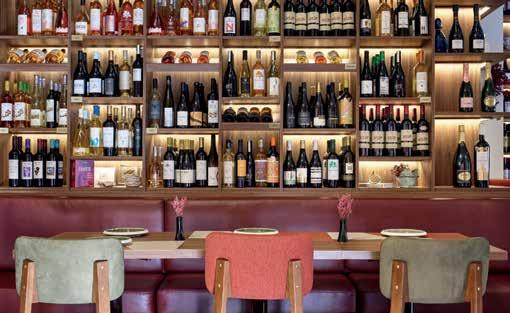
What guests see often determines what they order. For example, illuminated back bars, carefully arranged bottle displays and thoughtful shelving design subtly guide purchasing behavior. Similarly, premium spirits placed within clear sightlines naturally attract attention and communicate quality without requiring explicit upselling. In luxury-driven hospitality markets across the region, visual merchandising has become an extension of bar design. Lighting, shelving geometry and bottle placement work together to frame the product offering. In this way, architecture itself becomes a silent sales tool.
The science behind the bar counter
In essence, behind the elegance of a well-designed bar lies a highly functional workspace. Service efficiency depends heavily on the arrangement of ice wells, refrigeration units, glass storage and preparation surfaces. Crucially, when these elements are poorly positioned, bartenders must take unnecessary steps, slowing down service during peak hours. Equally, in high-volume nightlife environments, even small inefficiencies can significantly affect output. A well-designed counter minimizes movement and allows staff to operate fluidly, increasing the number of drinks served per hour. Operational flow, therefore, is not simply a matter of convenience, but directly influences profitability.
Levain Wine Bar, Lebanon
Balancing turnover and comfort
Nightlife venues must strike a delicate balance between guest comfort and operational turnover. For instance, standingheight tables positioned near the bar encourage shorter visits and maintain a dynamic social atmosphere. In contrast, lounge seating areas invite guests to settle in and extend their stay. By combining different seating typologies within a single venue, operators can accommodate a range of guest behaviors. Some guests may stop in for a quick drink, while others remain for the entire evening. Clear circulation paths further support this balance. Importantly, they ensure guests and staff can move comfortably even when the venue reaches full capacity.
The economics of VIP space VIP seating continues to play a significant role in the financial model of nightlife venues across the Middle East. However, successful premium areas must offer more than exclusivity. They need to balance privacy, visibility and service efficiency. Elevated platforms, semi-private booths and subtle architectural partitions allow VIP guests to feel distinct while remaining connected to the energy of the venue. At the same time, service routes must remain fluid so staff can move easily between sections.
When carefully integrated, VIP zones can significantly increase revenue per square meter while reinforcing the venue’s perception of luxury.
In high-investment hospitality markets, positioning the bar strategically allows it to function as both the social and commercial anchor of the venue.
Mobility as a service strategy
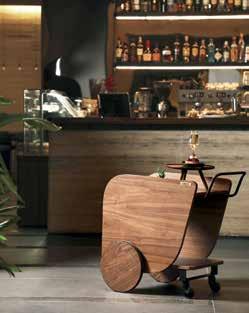
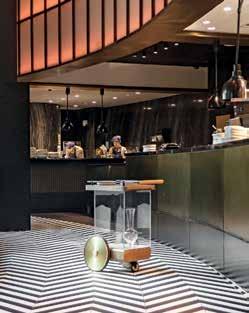
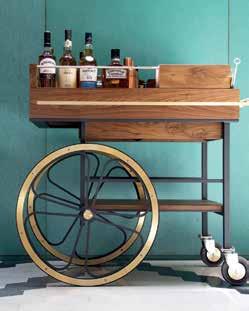
Flexibility is becoming increasingly important in contemporary bar design. In turn, mobile bar carts and service trolleys allow operators to extend service capacity without permanently dedicating additional space to fixed counters. During peak hours, these can activate terraces, lounges or VIP sections, bringing the service directly to the guest. Beyond their operational value, carts introduce an element of theater. For example, tableside cocktail preparation and curated drink rituals create moments of interaction that elevate the hospitality experience. Design studios such as Studio Caramel, which reinterpret the traditional cart, highlight how mobility can combine elegance with functionality. When thoughtfully integrated into a venue’s service strategy, carts become both aesthetic objects and practical tools. As a result, they can support conviviality while improving operational flexibility and revenue.
Designing for longevity
Nightlife venues operate under intense conditions. Notably, heavy traffic, constant cleaning, humidity and airconditioning place significant stress on materials. Selecting finishes that can withstand these demands is, therefore, essential. Natural materials such as solid wood, stone and durable metals tend to age more gracefully and require fewer replacements over time. Admittedly, these materials may involve higher upfront costs. However, their durability often results in lower lifecycle expenses. In hospitality design, longevity is both an aesthetic and financial consideration.
In collaboration with
Sound, atmosphere and dwell time
Acoustics are another crucial, yet often underestimated element of spatial design. Excessively loud environments may create energy, but they can also shorten guest stays. Importantly, when conversation becomes difficult, guests are less likely to remain for multiple rounds. Acoustic zoning offers a solution. By maintaining energetic sound levels near the bar while preserving quieter lounge areas, venues can accommodate different social preferences. The longer guests remain comfortable in the space, the more likely they are to stay and continue ordering.
Lighting that guides behavior
Lighting design, in particular, subtly influences how guests experience a venue throughout the evening. Brighter lighting during early hours supports social interaction and dining. Yet, as the evening progresses, gradual dimming shifts the mood toward a more relaxed nightlife atmosphere. Building on this, strategic spotlighting of counters, architectural elements and premium bottles helps guide visual attention and movement within the space. When layered effectively, lighting enhances both spatial depth and perceived luxury.
As nightlife across the Middle East continues to evolve, the most successful venues are not necessarily the most extravagant. Rather, they are the ones where architecture, operations and guest psychology work together seamlessly. In this new generation of venues, spatial design has become a strategic instrument, shaping atmosphere, guiding behavior and ultimately driving profitability.
studio.caramel studio-caramel.com
Belcanto Restaurant at Dubai Opera, UAE Zur Hotel on Monot Street, Lebanon Baron Bar, Lebanon
WHY LUXURY F&B IS NO LONGER ABOUT EXTRAVAGANCE
Across the world’s finest dining destinations, the meaning of luxury is being steadily and decisively redefined. Precision, simplicity and the integrity of the ingredient are among the qualities reshaping what excellence looks like. Christian Salloum, managing director at BrandPortunity F&B Consulting, examines what this means for F&B brands navigating the high-end regional hospitality landscape.
Luxury in the F&B world is no longer defined by extravagance alone. Crystal chandeliers, oversized portions and high price points, for example, are not sufficient to position brands as truly luxurious. Today, luxury is about precision, clarity and consistency. Indeed, it is about mastering the fundamentals at the highest possible level and delivering them seamlessly. A high-end F&B brand is built on exceptional ingredients, disciplined culinary execution, refined presentation, immersive ambiance and intuitive service. When these pillars align, the result is more than just a meal. Beyond this, it offers a complete experience that encourages clients to repeat visits.
Exceptional ingredients
At the core of any high-end concept lies the product itself. Crucially, ingredient quality is the foundation. Premium seafood, heritage meats, seasonal truffles, rare mushrooms, single-origin chocolate and coffee, aged vinegars, artisanal cheeses, hand-harvested spices and carefully sourced olive oils define
the standard. High-grade caviar, Wagyu beef, bluefin tuna and organic heirloom vegetables elevate perception. However, this only happens when they are treated with respect. These ingredients are not about showcasing wealth; rather, they are about showcasing excellence and purity.
Simplicity and restraint
Modern high-end cuisine increasingly embraces simplicity. The focus is not on complexity for its own sake, but on allowing exceptional products to shine. Caviar paired with warm baby potatoes, delicate pasta, blinis or soft scrambled eggs demonstrates how a humble base can elevate a premium ingredient. Specifically, fresh black truffle shaved over handmade tagliolini or a creamy risotto emphasizes aroma and depth. Similarly, Wagyu served with minimal garnish and a light sauce highlights the meat’s quality rather than masking it. Luxury today is about restraint; in other words, letting the ingredient speak clearly.
The Japanese benchmark
Luxury Japanese cuisine offers one of the purest expressions of this philosophy. Indeed, in high-end sushi counters and kaiseki restaurants, simplicity is elevated to art. Premium toro uni, Hokkaido scallops and A5 Wagyu, for example, arrive with minimal interference. Additionally, the rice temperature, knife precision and balance of seasoning are controlled meticulously. Presentation is clean and deliberate, often highlighting seasonality and harmony. Significantly, in this context, luxury is subtle and disciplined—a benchmark for refined execution worldwide.
Precision over complexity
Such simplicity requires exceptional technique. World-class chefs, particularly those leading restaurants within internationally recognized five-star hotels or their own restaurants, understand that luxury is defined by precision. Sauces must be balanced, textures intentional and temperatures exact. The difference between premium and luxury, notably, often lies in details invisible to the guest but essential
to the result. A perfectly emulsified sauce or an immaculately prepared sashimi cut demonstrates discipline without excess.
Luxury brands within five-star hotels internationally set important benchmarks. From iconic properties in the Gulf to historic grand hotels in Europe and contemporary towers in Asia, these establishments operate under strict standards of quality and consistency. Guests expect excellence, whether dining in Dubai, London, Paris or Tokyo. In essence, consistency across markets reinforces brand credibility and prestige.
Ambiance as a silent signature Presentation remains a defining pillar. Excellence on the plate means clarity and proportion. Dishes are composed thoughtfully, with balanced colors and controlled portions. Moreover, garnishes are purposeful rather than decorative.
Beyond the plate, ambiance shapes perception. Materials such as marble, natural wood, brushed brass, fine fabrics and curated art create understated sophistication. Equally, lighting is warm and controlled, while table spacing ensures privacy. Music supports the atmosphere without dominating it. Overall, these spaces feel calm, structured and coherent.
Modern luxury cuisine increasingly embraces simplicity. The focus is not on complexity for its own sake, but on allowing exceptional products to shine.
The invisible luxury Service is perhaps the strongest indicator of true luxury. In high-end F&B, service is attentive, yet discreet. Teams are knowledgeable about sourcing and preparation methods. Personalization is essential, from remembering preferences to adjusting pacing and anticipating needs. Excellent service feels natural rather than scripted.
Moreover, integrity has become a defining cornerstone in its own right. Sustainability increasingly plays a role in defining modern luxury. Responsible sourcing, seasonal menus and partnerships with local producers enhance credibility. Discerning guests associate luxury not only with indulgence, but with integrity.
One standard, many expressions Across markets, the expression of luxury may differ, but the principles remain constant. In the dynamic UAE hospitality landscape, luxury often combines architectural boldness with premium ingredients and global chef collaborations. Elsewhere, in London’s refined culinary scene, for example, authenticity and product integrity define high-end positioning. In heritagedriven France, meanwhile, technique and terroir anchor excellence. In resilient Beirut, it is expressed through creativity, elevated local ingredients and strong cultural identity, despite complex circumstances. In Tokyo, it is rooted in precision, seasonality and absolute respect for products.
The new definition Redefining luxury in the F&B world, ultimately, means returning to fundamentals. Exceptional ingredients treated with respect. Simple combinations executed flawlessly. Elegant presentation. Refined ambiance. Seamless service.
Importantly, luxury is not about being louder. Rather, it is about being precise, consistent and most importantly memorable. It is about discipline behind the scenes and effortlessness in front of the guest. It is the confidence to allow a single outstanding ingredient to take center stage. It is the balance between sophistication and comfort, innovation and tradition, exclusivity and authenticity. True luxury does not seek to impress through excess. Instead, it earns admiration through mastery.
In today’s global hospitality landscape, where guests travel, compare and experience the best across continents, luxury F&B brands must deliver coherence at every touchpoint. Everything must align with a clear, refined identity, from sourcing, plating and lighting to service, menu narrative and the farewell.
Ultimately, modern luxury is about creating a feeling: one that lingers long after the meal ends. It is about crafting moments that feel personal, intentional and elevated without being overstated. When simplicity meets excellence and precision meets emotion, dining transcends consumption. It becomes an experience, and in that experience lies the true essence of contemporary luxury in the F&B world.
brandportunity.com
SPANISH CUISINE: A CELEBRATION OF CULINARY CONTRASTS
Woven into family, community and centuries of regional tradition, food has long been a way of life in Spain, bringing people together around tables where conversation is as important as eating. Pere Planagumà Sala, chef, producer and lecturer, explores this rich gastronomic heritage, from ancient roots and regional differences to avant-garde innovation.
When we talk about Spanish cuisine, we talk about history, ancestors, traditions and a deep respect for regional ingredients. Ours is, consequently, a culinary identity shaped as much by geography and climate as by centuries of conquest and exchange. It is, in turn, a living map of that history, evolving from a survivalist diet into a global leader in avantgarde gastronomy.
A rich culinary history
The foundation of our cuisine was laid by the Romans, who introduced large-scale olive oil production and viticulture. The Moors’ 800year presence, moreover, brought irrigation, citrus fruits, almonds, saffron and rice: the essential backbone of paella. Significantly, the defining shift came during the Age of Discovery. Explorers, subsequently, returned from the Americas with ingredients that became synonymous with our identity. These included, notably, tomatoes, peppers, chocolate and the humble potato, which eventually gave rise to the iconic tortilla de patatas. In the 20th century, meanwhile, our cuisine moved from regional, rustic kitchens to the global stage. After the postcivil war years, the 1970s saw the birth of Nueva Cocina Vasca (New Basque Cuisine). This, crucially, prioritized fresh, seasonal ingredients over heavy sauces. Momentum peaked with Ferran Adrià and the molecular gastronomy movement, using science to transform textures while keeping traditional flavors intact.
Country-wide contrasts
Spain’s culinary identity stands apart through its hallmark Mediterranean simplicity— prioritizing natural-tasting, high-quality ingredients over complex sauces or heavy seasoning. Our food is, above all, not spicy, unlike many global cuisines. It relies instead on extra virgin olive oil, garlic and pimentón (smoked paprika) for depth. Olive oil is undoubtedly the lifeblood of our kitchen, distinguishing us sharply from French or Northern European cooking, which favors butter, while American styles lean on seed oils.
Our seafood culture is equally intense. Spain is one of the world’s top fish consumers, with staples like octopus and salt cod featuring across every region. Another key influence is our large geographical size. Indeed, the weather determines everything when it comes to food. Catalonia and Galicia, for instance, eat so differently that they could be two separate countries. The Atlantic delivers turbot, clams, razor clams and mussels, while the Mediterranean brings red prawns, lobster and langouste. Cadiz, in the south, is renowned for tuna. Products become plates, and that is what makes our cuisine so gloriously diverse.
Food, family and the art of eating well In Spain, food is rarely just about sustenance: it is the glue that holds our social life together. At the heart of this culture is sobremesa, the period after the meal where we stay at the table for hours to talk, laugh, digest, drink and relax. Unsurprisingly, leaving the moment the plate is empty is considered impolite. The conversation is just as vital as the food itself. Tapas and el tapeo are equally integral to our social structure. Rather than staying in one spot, we move from bar to bar, sharing small plates, encouraging movement, variety and constant interaction. This reflects a communal mindset where sharing, whether large pans of paella on Sundays or croquetas with friends, is simply the norm.
The social side takes different forms across our regions. In Andalusia, for example, we share glasses of Jerez wine alongside Iberian ham. Elsewhere, in San Sebastián’s old town, we stand at the bar with txakoli white wine and pintxos. Despite the global rise of fast food, Spain maintains a rhythm all its own. Late lunches at 2 p.m. and dinners starting at 9 p.m. or later reflect a work-life balance that puts family and friends firmly at the center of the table.
• A la parrilla and asado (grilling and roasting): meats and fresh seafood prepared over open flames or in wood-fired ovens (hornos de leña), imparting a distinct smokiness
• Curing and preserving: air-drying meats (jamón) and pickling vegetables in vinegar or olive oil (escabeche) for both preservation and concentrated flavor.
A gastronomic awakening
Spanish cuisine in 2026 is undergoing what I would call a renaissance of truth. It is moving, decisively, away from over-engineered molecular techniques toward ancestral methods and hyper-local sustainability. Consequently, chefs are returning to the primitive, using open-fire grilling, smoking and slow-cooking over charcoal to let the raw quality of ingredients speak for themselves. Fermentation, similarly, has moved from trend to core pillar. Chefs now study it as both a cultural and biological practice to create complex flavors in high-end kitchens. Meanwhile, AI is pushing the frontiers of cuisine, developing innovative food pairings and plant-based alternatives to traditional sauces such as mayonnaise and alioli
Focus on experimentation
In Spain, food is rarely just about sustenance: it is the glue that holds our social
life together.
Spanish cooking’s building blocks
Our cuisine is celebrated for its simplicity, relying on high-quality ingredients and time-honored techniques to maximize flavor.
Our kitchen is built on extra virgin olive oil: the primary fat for everything from frying to dressing. Other essentials are garlic, onions and a handful of key spices. Chief among these is pimentón, available in sweet (dulce), spicy (picante) and smoked varieties, giving dishes like chorizo their signature color and warmth. Saffron, meanwhile, known as “red gold,” provides the iconic golden hue and earthy aroma of paella. Parsley, rosemary, thyme, oregano and bay leaves, equally, season our meats and broths throughout.
Our traditional cooking methods include:
• Sofrito (lightly fried): garlic, onions and tomatoes gently sautéed in olive oil to create a flavor base for stews and rice dishes
• Guisado (slow cooking): hearty stews like cocido or fabada simmered for hours over low heat until flavors meld and meats become tender
New ingredients, furthermore, are reshaping our menus, with traditional dishes like paella being reinvented with quinoa or black rice. Tellingly, health-conscious diners are driving this demand. In Galicia, for instance, pumpkin-based chorizo offers a meat-free alternative that retains the classic smoky character. Smaller, provenance-driven ingredients are gaining ground too. Among them are zamburiñas, the tiny Galician scallops that celebrate quality over size. Pistachio, meanwhile, has become the defining ingredient of the moment in local bakeries and confectioneries.
The road to 2030
Underpinning all of this is a commitment to circularity. Circular gastronomy, therefore, is becoming standard practice rather than a niche pursuit—fruit peels used for broths, chickpea skins for hummus, leftover bread for crumbs. Restaurants, additionally, are partnering with small local producers to ensure traceability and reduce carbon footprints. Catalonia’s designation as World Region of Gastronomy 2025 and Jerez as Spanish Capital of Gastronomy 2026 are significant. Both signal a broader movement, celebrating regional food cultures on the global stage. By 2030, precision nutrition, biotechnology and hyper-local production are set to transform the sector further still. Their impact will, ultimately, confirm Spanish gastronomy’s place as one of the world’s most dynamic, endlessly inventive culinary forces. pereplanagumasala gastroculturamediterranea.com
A NEW COFFEE CULTURE BEYOND THE BEAN
For centuries, coffee has been central to social and cultural life across the Middle East, serving as a regionally recognized symbol of hospitality and a warm welcome. That tradition is now fueling a new era of cafe culture, where community and connection are as important as the coffee itself. Homegrown brands are expanding at pace, heritage brews are staging a remarkable global revival and a new generation of operators are redefining the experience. Our special report features insights and in-depth analysis from leading industry experts on everything from the science behind a great cup of coffee to the concepts and trends shaping this flourishing market. Fix your favorite brew and explore.
P.38 WHY COFFEE IS THE DEFINITIVE FUNCTIONAL BEVERAGE
P.48 7 INSPIRATIONAL PARISIAN CAFES FOR THE MENA COFFEE SCENE FEATURING
P.40 THE EXPERIENTIAL COFFEE CULTURE TRANSFORMING MENA
P.42 TURKISH AND ARABIC COFFEE: FROM TRADITION TO TREND
P.44 HOMEGROWN MIDDLE EASTERN COFFEE SHOPS HAVE THEIR DAY
P.46 12 ORIGINAL COFFEE SHOPS REDEFINING CAFE CULTURE
P.50 THE HIDDEN LOGIC OF ROASTING
P.52 HOW BREWING INNOVATION IS SCALING NEW HEIGHTS
P.54 6 EXPERTS ON WHAT’S BREWING IN THE COFFEE INDUSTRY
P.56 INSIDE THE NEUROSCIENCE OF COFFEE
WHY COFFEE IS THE DEFINITIVE FUNCTIONAL BEVERAGE
Coffee is the world’s first functional beverage. Simply put, a functional beverage provides physiological benefits beyond basic nutrition, often supporting cognitive performance, energy metabolism or relaxation.
One of the earliest documented uses dates back to 15th-century Yemen, where Sufi communities reportedly consumed coffee to maintain alertness during long hours of prayer.
Setting the record straight
For many decades, coffee was considered unhealthy and believed to have negative effects. These included claims such as stunted growth and irritability. However, there was scant scientific research underpinning these perceptions. Additionally, the limited scientific papers that detractors could cite were riddled with small sample sizes and other methodological flaws. Consequently, their conclusions on coffee’s health effects were largely untrustworthy.
For decades, coffee was considered less than healthy. However, the evidence today tells a very different story. As cutting-edge research continues to reveal its wide-ranging benefits, Garfield Kerr, CEO of Mokha 1450, tells us why coffee is back in the spotlight for all the right reasons.
It wasn’t until the 1990s and 2000s that meta-analysis of earlier studies began to shift perceptions. Specifically, researchers found there were likely far more health benefits in coffee than previously thought. In turn, this spurred a wave of new studies that have since identified coffee as an overwhelmingly healthy beverage.
What’s in the cup
Plant-based ingredients that are key to most functional beverages almost all have caffeine in common. These include green tea, yerba mate and guarana. Caffeine is a naturally occurring plant alkaloid. A mild stimulant, it belongs to the methylxanthine class of psychoactives. These are stimulant compounds derived from purine base, found in coffee, tea and chocolate. Examples include caffeine, theophylline and theobromine. Methylxanthines act primarily as antagonists of adenosine receptors. They can also inhibit phosphodiesterase enzymes. Both mechanisms contribute to increased alertness and stimulation of the central nervous system.
Each cup contains numerous bioactive compounds, including chlorogenic acids and other polyphenols. These exhibit antioxidant activity and may contribute to some of coffee’s observed health associations. In turn, they help to reduce oxidative stress by neutralizing free radicals and offer liver and kidney protection. Additionally, they inhibit the growth of certain unhealthy bacteria in the gut microbiome.
Functional benefits
So, what are the primary functional benefits of a simple cup of black coffee? For those focused on fitness, the benefits are considerable. For instance, coffee has been shown to aid cardiovascular performance, increase alertness and improve reaction time. It also supports fat oxidation at rest and during exercise, while accelerating muscle glycogen resynthesis. Perhaps less well known is that it can reduce perceived exertion and increase pain threshold during exercise, as well as suppress appetite and elevate mood.
Beyond performance, the long-term health evidence is equally compelling.
• Heart health: a significantly reduced risk of heart attack, stroke, heart failure and coronary heart disease
• Reduced disease risk: a lower risk of type 2 diabetes, liver diseases including liver cancer, pancreatic cancer and cirrhosis
• Neuroprotective effects: a lower risk of Parkinson’s, Alzheimer’s and dementia
• Mortality: a reduced overall risk of death
• Mental health: a reduced risk of depression.
A market on the rise
Coffee’s functional credentials sit within a rapidly expanding global market. Today, the global functional beverage market is valued at approximately USD 355 billion. Moreover, it is projected to grow to around USD 490 billion by 2034. With a burgeoning consumer market of this size, there are myriad functional beverage categories to choose from. These range from energy drinks and others that promote focus and concentration to those supporting weight loss and enhancing athletic ability.
The latest research on coffee’s positive effects on the gut microbiome is especially intriguing.
The case for black coffee
I would argue that a simple cup of black coffee is by far the most versatile, healthiest and safest option. This is because it provides all of the benefits found in a functional beverage without several of the downsides. Given that the safe limit is between three and five cups per day, coffee is also much more difficult to abuse than most people believe. Notably, most consumers generally fall well below the upper threshold of what is considered safe consumption. Yet many are under the misconception that the recommended daily limit is well below this number. In contrast, many energy drinks contain large amounts of sugar and B12, alongside other additives that have not been scientifically studied in depth to show efficacy or safety. Furthermore, consuming too many drinks within a number of these categories carries risks that moderate to high consumption of coffee does not entail.
The emerging frontier
The latest research on coffee’s positive effects on the gut microbiome is especially intriguing. The gut microbiome consists of microorganisms, including bacteria, archaea, fungi and viruses, that live in the digestive tract. Considered by many to be the next frontier of science, research suggests it could unlock many technological advances long sought after in medical science, such as living longer and healthier lives with full mental acuity. Consequently, this could lead to cures for multiple diseases, particularly with the help of artificial intelligence (AI).
Agnese Santanatoglia, a postdoctoral researcher specializing in food chemistry, coffee science and human health, offers a compelling scientific perspective. “Coffee is far more than a simple source of caffeine,” she told me. Indeed, she described it as a remarkably complex chemical system, rich in bioactive compounds including chlorogenic acids, melanoidins, diterpenes and other polyphenols. These contribute not only to its physiological effects but also to its distinctive sensory profile, shaped by the roasting and brewing process.
New perspectives on consumption
In our discussion, Santanatoglia also pointed to emerging research on how coffeederived compounds may interact with the gut microbiome. While the field is still developing, early studies suggest certain coffee components may influence microbial composition and metabolic activity. “This emerging area of research is opening new perspectives on how coffee consumption could contribute to broader aspects of human health and wellbeing,” she added. While the science and our general understanding of coffee’s role as a functional beverage keeps evolving, one thing remains clear. Ultimately, coffee is the most accessible, efficacious and ubiquitous functional beverage the world has ever known.
mokha1450 mokha1450.com
THE EXPERIENTIAL COFFEE CULTURE TRANSFORMING MENA
Once a spot to simply enjoy a coffee and snack, cafes have today evolved into diverse lifestyle spaces where customers are encouraged to socialize, work and, most importantly, stay. Naim Maadad, chief executive and founder of Gates Hospitality, explains why regional operators need to create visits that extend well beyond the transaction to keep people coming back for more.
As a native Australian, from a country renowned for some of the best coffee culture in the world, I grew up knowing that coffee is about way more than the drink itself. Extending far beyond the cup, coffee is about ritual and connection. In addition, it’s about community. From the corner cafe, where everyone knows your name, to the staff who smile when you walk through the door, the personal touch is what makes the difference. Indeed, when the barista remembers exactly how you like your flat white, it confirms what coffee has always been: a daily rhythm that brings people together.
Across the GCC region, hospitality has been cultural long before it was commercial. Tellingly, a majlis was never about the coffee alone. Rather, it was
about dialogue, storytelling, laughter, debate and community. Indeed, walking into a regional cafe on any given morning, you’ll see freelancers typing on laptops, friends laughing over lattes and a carefully curated playlist filling the space.
A welcoming ambiance Cafes are, in many ways, the modern majlis. They have evolved into spaces where life happens, ideas are exchanged and connections are made. Admittedly, the setting may be different. For example, they are likely to feature polished concrete floors instead of woven rugs and playlists instead of silence. However, the intention is the same: to create a welcoming environment where people feel seen, heard and connected.
From majlis to modern cafe I’ve always been passionate about placing neighborhoods at the heart of our venues. Over time, it became clear that what our guests were seeking was far more than good food or coffee. Rather, it was a place to belong. Coffee shops, more than any other outlets, have evolved into lifestyle spaces. Significantly, they are no longer just pit stops for caffeine. They are meeting rooms without booking systems, for example, offices without walls, pitch spaces, therapy corners and creative studios. There’s a reason why our latest opening, The Office, in Media One Hotel, has the mantra “connect, chill, repeat.”
The most successful cafes in the region understand a simple truth, which is that they are curating experiential ecosystems.
The experiential shift
For hospitality owners, consequently, this requires a shift in thinking. We are not just selecting beans. Instead, we are designing experiences. Every detail matters. Lighting shapes how long someone stays, for instance. Equally, music sets the tone and pace. Table spacing influences intimacy and conversation. Even the scent in the room affects how people remember their time with us.
Notably, in the GCC, where competition is intense, product parity is real. Many places serve excellent coffee. As a result, what now sets a brand apart is how it makes people feel. If you’re an operator, you need to ask yourself: are you creating an experiential space where entrepreneurs feel inspired, friends linger comfortably or a solo customer feels genuinely welcomed?
Beyond the transaction
Above all, community engagement is no longer optional. Hosting talks, book clubs, pop-ups and collaborations with local artists signals that your space is alive. Moreover, it sends the message that anyone who walks in is part of something bigger.
The most successful cafes in the region understand a simple truth, which is that they are curating experiential ecosystems. Crucially, they know their morning audience differs from their evening one. Specifically, they recognize that freelancers need Wi-Fi and plug points, but also crave warmth and atmosphere. Beyond this, they see that Gen Z values authenticity, while long-standing residents seek comfort and familiarity.
A culture in full bloom
Coffee culture itself is flourishing, too. Specialty beans, artisanal brewing techniques and an appreciation for origin and craft are no longer niche. Rather, they are central to how people connect and express themselves. From independent roasters to pop-up cafes experimenting with flavors, coffee has become a ritual, a hobby and a social statement.
For us as owners, success is no longer just about spend per head or turnover. Instead, it’s about the time spent in the venues. It’s about repeat visits. It’s about seeing a group choose your space every Thursday because it has become part of their ritual. Certainly, in the case of coffee shops, the cup really is only the beginning. gateshospitality.com
TURKISH AND ARABIC COFFEE: FROM TRADITION TO TREND
When asked how they picture the Arab world in their minds, people often respond with answers like orientalist paintings and washed-out photographs of old souks, with carpet sellers playing backgammon. These postcard-style views of the region are sometimes full of cliches. However, one thing is certain: you will always find someone drinking coffee, whether in a bustling cafe on the streets of Cairo or inside a Bedouin tent in Saudi Arabia.
Today, there is more choice and variety of coffee than ever before. Yet the heritage brew is experiencing a remarkable comeback, with younger generations worldwide drawn to the authentic experience and more mindful pace it offers. Nagi Morkos, founder and managing partner at Hodema Consulting Services, charts its remarkable journey from time-honored Middle Eastern ritual to global revival.
The Turkish and Arabic coffee rituals require time, skill and a particular etiquette.
A rich history
Archives of the Ottoman Empire show just how important coffee was in people’s everyday social lives. Turkish coffee, as we call it today, actually came from the Arabian Peninsula. More specifically, it originated in Yemen, where locals imported coffee cherries from Ethiopia and boiled them. Historians believe the drink was popularized by the Ottoman governor of Yemen in the 16th century and by Syrian and Egyptian merchants touring the region. In turn, it earned its Turkish label when people started preparing the finely ground coffee in a copper pot named cezve. As soon as the unfiltered mixture begins to froth, but before it boils over, it is taken off the heat. The coffee then settles at the bottom of the cup, giving the drink its thick, rich flavor. Significantly, this brewing method hasn’t changed in over 500 years and has become deeply rooted in Arab culture.
A ritual of connection
Coffee is more than an energizing drink. Beyond this, it is a ritual of connection that symbolizes hospitality and respect in many communities. Tradition dictates it must be served with the right hand. Moreover, the ritual also calls for sweet delicacies. UNESCO recognized its significance by adding Turkish coffee to its Intangible Cultural Heritage list in 2013. The ceremony has also evolved over time to include customs such as reading the grounds left in the cup. Crucially, this fortune-telling practice has become so popular that it is now officially called tasseography. Notably, drinking coffee is one of the few routines rooted in both public and private life in the Middle East. Whenever a guest is welcomed into a household, coffee is always on the table. In fact, it can even seal marriage proposals. It is equally central to social life in restaurants and cafes. At gatherings, for example, waiters circulate with trays of coffee while guests celebrate, debate or simply play cards.
Turkish and Arabic versions
If we look closely at how coffee is served in different countries, we find notable variations in preparation. Although the generic name remains Turkish coffee, there is an Arabic version that differs greatly in flavor and presentation. Across the Gulf states, qahwa is filled with spices like cardamom, cloves, saffron or even rose water. The coarse beans are also lightly roasted, then simmered in a dallah In contrast, Arabic coffee has a lighter color and a spicier taste than its Turkish counterpart, which is stronger and sweeter. The former is brewed only once, whereas the latter can be heated multiple times. The drink’s name has long been a bone of contention between countries, including Türkiye and Armenia. As Turkish coffee spread across the region, each country gave it a name reflecting its own identity. For example, Greece calls it Greek coffee, while in Egypt it is known as baladi coffee. Recently, the Syndicate of Owners of Restaurants, Cafes, Night-Clubs and Pastries in Lebanon called for the description Lebanese coffee to replace Turkish coffee on restaurant menus. The move aims to celebrate the country’s heritage.
Reinventing heritage
The Arabic and Turkish coffee rituals require time, skill and a particular etiquette. Unsurprisingly, they gradually disappeared as people became busier in the 20th century. Instead, locals began turning to coffee machines and instant coffee to drink on the go. Some followed the global trend for Italian or American-style coffee. Although the traditional techniques never fully disappeared, they survived mainly behind kitchen doors or in dusty cafes. Recently, however, coffee machine designers have worked to revive the traditional custom and even make it trendy. Today, several companies compete to sell electric coffeemakers that mimic the cezve Moreover, these machines recreate the characteristic taste and texture of Turkish coffee without the traditional utensils. Pioneers include the well-known Lebanese brand Café Najjar, whose patented Raqwa machine ranks among the first of its kind.
A regional revival
Cafe developers and investors have also caught the scent of opportunity. Reviving the old-world charm of cafes and blending centuries-old brewing traditions with the latest innovations has considerable appeal. In particular, it holds a special attraction for young Middle Eastern coffee lovers longing for authenticity and a reconnection with
their forgotten heritage. New establishments have embraced this heritage brew but also given it a contemporary twist. For example, Kahve Dünyası and Espressolab, popular chains in Turkiye, are flourishing. Meanwhile, Istanbul’s Kurukahveci Mehmet Efendi, a household name since the early 1900s, is enjoying newfound popularity with locals and tourists.
Reclaiming their roots
With specialty cafes flourishing worldwide, Saudi Arabia has been particularly quick in the Gulf to recognize the business potential of reviving local coffee culture. Significantly, the bean is even cultivated in the mountainous regions of Jazan, Al-Baha and Asir. As part of Saudi Vision 2030, the country launched a public company in 2022 to focus on the sustainable production, distribution and marketing of local Khawlani coffee. In the streets of Riyadh, Draft Cafe, Camel Step and Sociale Cafe offer traditional Arabic coffee, reclaiming their roots. Furthermore, this trend shows no sign of slowing down. Saudi Arabia’s coffee market is currently valued at between USD 1.3 billion and USD 1.9 billion annually. The Project Cafe Middle East 2025 report expects the country to have more than 5,350 coffee outlets by 2027.
A global reach
Other countries in the region are also seizing opportunities. For instance, Bahrain organized its first Coffee Festival last year, celebrating its local brewing recipes. Additionally, the revival extends well beyond Türkiye and its Arab neighbors. The trend has even crossed borders to reach Europe and the United States. In Berlin, home to a significant Turkish community, Kardelen Coffee Studio serves the traditional brew. Elsewhere, in Paris, Ilik Coffee celebrates Turkish culture. In California’s Studio City, Yala Cafe blends old
and new, with a menu featuring traditional sand coffee alongside orange blossom oat latte. In New York, the Turkish Coffee Room offers theatrical sessions of coffee drinking and fortune-telling. There are also a growing number of Yemeni-inspired coffee shops in the United States, including Qahwah House, Haraz and Mokafé. Espressolab is probably the most successful Turkish coffee chain to date, with branches in Germany, Portugal, Egypt, South Africa, Lebanon and Cyprus. Saudi brand Barn’s also proudly exports its local savoir-faire.
Celebrating slowness and experience
Further afield, Turkish and Arabic coffee is offered in Western-style cafes. Indeed, many specialty cafes have put it on their menus under the title “heritage brewing.” In turn, thanks to social media, the beverage travels the world. Moreover, Turkish and Arabic coffee fits another trend: many cafes are evolving into mixed-use spaces, blending work, social and cultural activities. Significantly, the Turkish and Arabic coffee rituals suit this new, more mindful environment. Baristas have embraced Turkish coffee’s slower, more intentional pace, taking time to watch the liquid simmer and perfect the brew. Unlike espresso, Turkish coffee cannot be drunk quickly, since the grounds may mix with the liquid and make the drink bitter. Accordingly, the cezve itself has become an object of design, with new models featuring traditional patterns. Coffee cup reading, meanwhile, has attracted a growing crowd of fans, drawn by its experiential side. The world, it would seem, has developed quite a taste for tradition in a cup.
hodema.net
HOMEGROWN MIDDLE EASTERN COFFEE SHOPS HAVE THEIR DAY
Over the past decade, the Middle East has experienced a remarkable transformation in its coffee culture. Once dominated by international chains, the region is now producing a new generation of homegrown Middle Eastern coffee shops that are redefining specialty coffee. Additionally, these brands are now building concepts capable of expanding across markets.
Buoyed by rising demand, a new wave of homegrown coffee brands is reshaping the region’s specialty coffee landscape. From the UAE to Saudi Arabia, more outlets are opening for business, writing their own success stories and adding to a compelling narrative. Abdul Kader Saadi, managing director of Glee Hospitality Solutions, charts the rise of a movement that is both locally rooted and globally ambitious.
A regional coffee shift
Tellingly, at the heart of this transformation is a new generation of consumers across the Gulf. Younger demographics have embraced specialty coffee not just as a daily beverage but as a social and cultural experience. Coffee shops have become places to work, meet and socialize. Moreover, consumers are increasingly curious about origin, roasting techniques and brewing methods.
This shift is particularly visible in the UAE and Saudi Arabia. Significantly, these two markets have emerged as engines of innovation for the regional coffee industry. Rather than simply opening more cafes, they are developing complete coffee ecosystems, combining roasting, retail, training and product innovation. The result is several local brands that are increasingly positioned to scale through regional expansion, partnerships and franchising.
DUBAI:
From niche to ecosystem
The UAE has played a particularly important role in shaping this evolution. Indeed, Dubai's coffee scene has evolved into one of the most dynamic specialty markets in the region. What began as a niche movement has matured into a sophisticated ecosystem supported by roasters, training academies and design-led cafe concepts.
Building a specialty scene
Several homegrown brands have indeed been instrumental in driving this change. One of the earliest pioneers was RAW Coffee Company, founded in Dubai in 2007. RAW helped establish the foundations of the UAE’s specialty coffee movement through direct trade sourcing, in-house roasting and professional barista training. Beyond operating its own cafe and roastery, the company supplies coffee to hotels, restaurants and cafes across the region. Accordingly, it positioned itself as one of the most influential players in the Middle East's specialty coffee industry.
Another influential name is Nightjar Coffee Roasters, located in Dubai’s Alserkal Avenue creative district. Significantly, Nightjar represents the next generation of coffee brands that combine roasting, retail and product innovation. Known for its industrial-style cafe and experimental approach to brewing, the brand has expanded beyond traditional cafe operations. Today, for example, it also offers ready-to-drink cold brew beverages and other packaged coffee products.
Dubai has also become home to internationally respected specialty coffee operators such as The Espresso Lab, a brand known for its minimalist design and meticulous approach to coffee preparation. By focusing on precision brewing and craftsmanship, the concept has, consequently, helped position specialty coffee as a premium lifestyle experience in the region.
Supply-side growth
Alongside these retail concepts, roasters are also playing a key role in industry expansion. For instance, Seven Fortunes Coffee Roasters and Archers Coffee are strengthening the segment's infrastructure by supplying beans and technical expertise to GCC cafes. Their contribution highlights an important reality about the specialty coffee industry. Beyond cafes, growth is additionally coming from the development of strong upstream supply networks.
Another brand contributing to the UAE’s specialty coffee ecosystem is Boon Coffee, founded by Ethiopian entrepreneur Orit Mohammed. Notably, Boon focuses on
showcasing Ethiopia’s coffee heritage, sourcing beans directly from Ethiopian farms and roasting them in Dubai. The brand has, furthermore, built up a loyal following through its cafes in the UAE, where it introduces consumers to Ethiopian coffee culture. Boon’s success highlights an important dimension of the region's coffee evolution: increasing emphasis on origin, storytelling and direct sourcing. Crucially, these elements are resonating with today's specialty coffee consumers more than ever before.
Collectively, Dubai's coffee ecosystem includes roasteries, green bean traders, barista academies and design-driven cafes. Together, they contribute to one of the most sophisticated specialty coffee scenes outside Europe and North America.
Younger demographics have embraced specialty coffee not just as a daily beverage but as a social and cultural experience.
SAUDI ARABIA:
Passion and craft
Saudi Arabia has, similarly, emerged as one of the most exciting coffee markets in the world. This trend is due in part to the number of cafe openings. However, it is also down to the people behind the counter.
A profession transformed
In recent years, a notable shift has taken place in the Saudi hospitality sector. Importantly, a growing number of young Saudis are today choosing careers as baristas and coffee professionals. As a result, what was once considered an entrylevel job has evolved into a respected craft, driven by pride in local coffee traditions and the growing popularity of specialty coffee.
Passionate Saudi baristas are now a regular sight in cafes across cities such as Riyadh, Jeddah and Khobar. Moreover, these staff approach coffee preparation as both a technical skill and a form of personal expression. As a result, this new generation is helping to create a vibrant coffee culture. In fact, these cafes are not simply retail outlets but community hubs celebrating craftsmanship and hospitality.
From consumer to creator
One brand that captures this new energy especially well is Half Million. Indeed, founded in Saudi Arabia, it has quickly become one of the most recognizable specialty coffee concepts nationally.
In collaboration with
Moreover, with its contemporary design, high-quality coffee program and efficient service model, the brand resonates strongly with younger consumers.
Half Million cafes are known for their clean aesthetic, strong branding and focus on specialty beverages. Yet what distinguishes the concept is its ability to combine premium coffee positioning with scalable operations. Unlike many independent cafes, Half Million was designed with growth in mind. Consequently, the brand has expanded rapidly across Saudi Arabia and continues to explore opportunities beyond the kingdom. In this way, it reflects the increasing ambition of Saudi-born coffee concepts.
Notably, the success of Half Million illustrates a broader trend. Saudi coffee culture is no longer simply about consumption, but also about participation. Furthermore, Saudi nationals are not only customers; they are increasingly the baristas, roasters and entrepreneurs shaping the industry.
From cafes to coffee platforms
Another key characteristic of the new generation of regional coffee brands is their ability to evolve beyond the traditional cafe model. Instead of relying solely on retail locations, many operators are building multilayered platforms that include roasting, wholesale supply, packaged beverages and training programs. Importantly, this diversification stabilizes revenue streams while strengthening quality control and consistency. The most successful operators are no longer thinking purely as cafe owners. Rather, they are thinking as brand platforms capable of scaling across multiple channels.
A coffee revolution
The emergence of homegrown coffee brands undoubtedly marks an important milestone for the region’s hospitality sector. Dubai continues to push the boundaries of specialty coffee innovation, for example. Meanwhile, Saudi Arabia is cultivating a new generation of coffee professionals whose enthusiasm and dedication are reshaping the industry. Together, these markets are creating a coffee culture that is both locally rooted and globally competitive. The Middle East’s coffee revolution is, evidently, only just beginning. gleehospitality.com
12 REDEFINING CAFE CULTURE
ORIGINAL COFFEE SHOPS
Looking at new cafe openings in global cities, one thing quickly becomes clear. The real coffee culture axis today no longer flows through Italy or France. Instead, coffee culture is now about innovation, and innovation takes many forms, from design spaces and social laboratories to cultural hubs.
Pushing boundaries
At the top of the list of coffee culture centers sits Seoul. The city’s experimental cafe scene developed not from Italian espresso bars or Australian third-wave roasters. Rather, it built its own culture entirely. Enormous architectural spaces provide a platform for extreme spatial design. Add coffee experimentation, singular pastries and technical precision, and the result is a merged, immersive experience.
The “new” experience, however, is not just about pairing the bean, the roast and brewing techniques with pastries. Today, baristas and developers go further, adjusting water mineral content to better match different coffee beans and roasts. Ethiopian beans give their best with lower mineral content water, while Colombian beans prefer a slightly higher calcium content. Notably, Kenyan beans perform best with higher magnesium water for acidity.
Gone are the days when coffee was just a drink ordered at a counter or on a terrace. Today, new concepts are emerging that put coffee at the heart of the customer experience rather than simply in a cup. Daniel During, principal and managing director at Thomas Klein International, takes us on a global tour of emerging trends and spotlights 12 cafes with potential for MENA expansion.
From omakase to hybrid spaces
Next comes Tokyo, where precision and ritual are pushed to their limits and cafes treat coffee as a tea ceremony. Tokyo is the home of omakase, where the customer entrusts the barista to decide what to serve. A typical coffee omakase may include a sequence of six tastings or more. This could include anything from a cascara, for example, to a rare micro-lot coffee and dessert pairing, accompanied by an explanation from the barista.
Copenhagen, meanwhile, defines Nordic coffee aesthetics, known for very light roasting, minimal design and a sustainability focus. Next is Los Angeles, where coffee is integral to lifestyle culture. Significantly, today’s economy has pushed cafes to offer a social environment. Hybrid concepts may turn a daytime cafe into an evening cocktail bar, for instance, generating multiple revenue streams. The wider coffee map
Other influential cities are also worth noting. Mexico City, for example, is emerging as Latin America’s coffee capital. Combining local farm connections, vibrant cafe design and a young barista scene, its producers collaborate directly with urban cafes.
Berlin, furthermore, matters for its blend of Nordic roasting influence, experimental roasters and international barista community. Elsewhere, Melbourne is still influential for roasting innovation and barista training. Similarly, London remains prominent as the global trading hub for specialty beans and a base for roasters and importers.
Tradition vs. trends
Years before Starbucks and Melbourne’s third-wave coffee culture, the traditional cafe model was either Italian, French or Austro-Hungarian. Coffee as an excuse for a pause from work, fast, standing at the counter; coffee as something you have while people-watching on a terrace; or coffee with a pastry.
Today, these traditional models still exist. However, as we have seen, new models are emerging where coffee is now the epicenter of the visit. So, before you start planning your next cafe, wake up, get on a plane and smell the coffee… literally.
thomaskleingroup.com
ARCANE ESTATE COFFEE (2025)
New York
• Part of a growing movement of cafes acting as micro-terroir tasting rooms
• Built around Panamanian microlot coffees, focusing on farm-to-cup transparency
• Single-origin flights and curated roasting arcaneestatecoffee.com
COKUUN (2024) Tokyo
• Reservation-only coffee omakase
• Drinks brewed by a champion barista
• Coffee treated as a fine-dining tasting menu cokuun.com
KLOUD (2025) Glasgow
• Coffee shop by day, cocktail bar by night
• Blends third-wave coffee culture with nightlife hospitality
• Reflects cafes becoming social hubs beyond daytime kloudconcept.co.uk
NIKO JUNE CAFE (2025)
Copenhagen
• Created by designer Kim Lenschow and ceramics studio NIKO JUNE
• Combines a café, design studio and gallery
• Cups, tables and space are all curated objects cafe.nikojune.com
ART + WATER CAFE (EXP. 2026)
San Francisco
• Created by Yemeni-coffee pioneer Mokhtar Alkhanshali and writer Dave Eggers
• Conceived as a cultural pavilion, with the cafe as a community hub
• Will combine cafe, art gallery and more
ELAICHI
CO. (2026) San Francisco
• An inversion of the coffeehouse concept
• Chai-only cafe disrupting coffee culture
• Reflects the rise of South Asian beverage culture in Western cafe scenes elaichico.com
KOMAKASE (2024) California
• Format inspired by Japanese omakase transforming coffee into a multi-course sensory experience
• Seven-course coffee tasting menu
• Advance booking recommended komakase.coffee
QUAT (2025) Los Angeles
• A “coffee omakase campus” inspired by Korean specialty coffee culture
• Pioneers of coffee omakase tasting menus
• Includes roastery, cafe, retail and omakasestyle tasting room kumquatcoffee.com
BLUE BOTTLE STUDIO (2024)
Shanghai
• Represents the trend toward hyper-minimalist coffee architecture in Asia
• Interior features raw materials, including stone, concrete, wood and ceramics
• Architecture emphasizes light, shadow and acoustics, so brewing feels like a quiet ritual bluebottlecoffee.com
HARVEST (2024) Paris
• Founded by Iranian barista Farimah Fattahi
• Merges Iran’s specialty coffee culture with Parisian cafe tradition
• Minimal menu and seasonal sourcing harvestcoffeeparis
L'OFFICIEL COFFEE (2025) Tokyo
• L’Officiel fashion magazine cafe in Omotesando district
• Blends fashion publishing, lifestyle retail and specialty coffee
• Demonstrates the rise of “media cafes” lofficielcoffee.com
ROAMING BEAN CAFE (2026) Pittsburgh
• Specialty cafe grown from a mobile coffee cart
• Creative latte concepts and flavored cold foams
• Reflects the trend for hyper-local coffee scenes theroamingbean.coffee
INSPIRATIONAL PARISIAN CAFES FOR THE MENA COFFEE SCENE 7
Once considered secondary to the traditional tearoom culture across Europe, cafes have in recent years regained prominence, delighting a new generation of true coffee enthusiasts. Indeed, Parisian cafes are today experiencing a renewed cultural relevance, blending heritage, craftsmanship and lifestyle appeal.
Ideal lifestyle ambassadors
For more than a century, Paris and coffee have shared a deeply rooted relationship. Indeed, the city’s cafes have long served as cultural hubs where gastronomy, conversation and intellectual life intersect.
Today, this tradition may be entering a new phase. Parisian cafe culture is evolving from a local institution into an exportable hospitality concept
In the Middle East, premium coffee culture is accelerating in cities such as Dubai, Riyadh and Doha. Across the Gulf, coffee shops have evolved far beyond simple beverage venues. Beyond this, they now function as social spaces, creative meeting points and lifestyle destinations. Within this environment, the Parisian cafe carries a powerful brand image associated with elegance, creativity and European sophistication.
As a result, several iconic Paris institutions and innovative cafe brands appear well positioned for international expansion. Indeed, they could soon emerge as compelling ambassadors of French lifestyle across the Gulf’s major urban centers.
Long woven into the fabric of everyday life in Paris, coffee rituals are now finding new audiences far beyond the Seine, including among rising numbers of specialty coffee lovers in the Gulf. Noelle Faure, chef, food sociologist and co-creator of Un Couple en Cuisine, spotlights the models that could add a new dimension to regional coffee culture.
A touch of history
Paris’s iconic literary cafes and celebrated terraces represent far more than simple hospitality venues. Their Art Deco interiors, elegant design and timeless atmosphere have made them enduring cultural landmarks. In global cities such as Dubai and Doha, prestigious European brands already carry strong appeal. Accordingly, concepts inspired by these historic institutions could evolve into cultural destinations. Combining French gastronomy, Parisian design and heritage storytelling, for example, could resonate strongly with Gulf audiences.
Paris and specialty coffee
Additionally, over the past 15 years, the French capital has witnessed the emergence of a dynamic specialty coffee movement. Pioneering addresses have helped redefine the role of coffee in Paris. These cafes treat it as a gastronomic ritual selected for origin, roasting profile and brewing method. Moreover, they bring barista craftsmanship to the forefront. This new generation of venues has introduced global coffee practices and, as a result, is reshaping consumer expectations.
A lifestyle brand
A third model emerging from Paris is the cafe as a lifestyle brand. Merging minimalist design, contemporary coffee culture and a distinctive visual identity, such concepts are strongly positioned on social media. In turn, they appeal to a young, international audience seeking curated lifestyle experiences. In cities such as Riyadh and Abu Dhabi, malls, design districts and creative hubs already shape urban culture. Here and in similar locations, a hybrid concept bridging cafe, design and fashion could therefore find significant traction.
An expanding market
The growth of premium coffee culture in the Middle East is driven by several factors. These include rapid urbanization, a rising affluent middle class and strong global cultural influences. Major Gulf cities are now competing to attract international brands across gastronomy, retail and lifestyle sectors. Within this environment, Parisian cafe culture holds a distinctive advantage thanks to its association with French elegance, culinary heritage and creative expression. However, international expansion requires adaptation. Successful concepts in the Gulf typically involve larger venues, striking architecture and food offerings tailored to regional preferences and cultural expectations.
Gastronomic diplomacy
Beyond commercial opportunity, the international presence of Parisian cafes could represent a new form of culinary diplomacy. Just as French gastronomy and pastries have long served as global ambassadors of French expertise, cafe culture could become another pillar of France’s hospitality influence. For decades, the terraces of Saint Germain des Prés have symbolized European creativity, intellectual exchange and coffee rituals. In an increasingly globalized hospitality landscape, the Parisian cafe may simply be preparing to write its next chapter far from the Seine yet still unmistakably Parisian.
Parisian cafe culture holds a distinctive advantage thanks to its association with French elegance, culinary heritage and creative expression.
CAFE DE FLORE
Located in Saint Germain des Prés, this cafe showcases a world-famous elegant terrace and Art Deco interior.
Historically, it was a popular meeting place for writers, artists and intellectuals who shaped modern European culture. Indeed, visitors included Albert Camus, Boris Vian and Pablo Picasso.
Cafe de Flore’s powerful blend of heritage, design and cultural prestige offers significant appeal and inspiration for the Gulf’s growing cafe market. cafedeflore.fr
KB CAFESHOP
Located near Montmartre, KB CafeShop has become one of the most influential specialty coffee destinations in Paris.
A favorite among creatives and international visitors, the cafe helped introduce thirdwave coffee culture to a wider Parisian audience. Today, it is known especially for its carefully sourced beans, skilled baristas and relaxed yet design-conscious atmosphere.
For MENA hospitality markets, KB CafeShop demonstrates the growing demand for authentic specialty coffee, combined with casual, community-driven environments. kbcoffeeroasters.com
CAFE KITSUNÉ
Cafe Kitsuné represents a new generation of cafe concepts where coffee intersects with fashion, design and lifestyle branding.
Developed by the creators of Maison Kitsuné, the concept combines minimalist aesthetics, strong visual identity and contemporary coffee culture. Its global presence has, in turn, transformed the brand into a lifestyle destination.
In Middle Eastern cities, where retail, hospitality and lifestyle experiences merge, this hybrid concept could indeed find significant success. maisonkitsune.com
LE PROCOPE
Founded in 1680, Le Procope is widely regarded as the first cafe in Paris.
The venue was created by entrepreneur Francisco Procopio dei Coltelli and quickly became a gathering place for philosophers, writers and political thinkers. Indeed, over the centuries, it hosted figures such as Voltaire, Rousseau and Benjamin Franklin.
For Middle Eastern operators, Le Procope demonstrates the power of heritagedriven storytelling in creating a true destination experience. procope.com
TEN BELLES
Ten Belles is widely considered one of the pioneers of Paris’s modern specialty coffee scene. It is known especially for its artisanal roasting and minimalist approach to coffee preparation.
The brand enjoys international recognition among coffee professionals, reflecting shifting consumer expectations toward
COUTUME CAFÉ
Alongside other industry pioneers, Coutume Café has played a key role in transforming how coffee is perceived in Paris.
Rather than focusing solely on tradition, Coutume introduced a contemporary coffee culture built around sourcing, roasting and precision brewing. Indeed, it treated coffee as a gastronomic product selected for origin and roasting profile.
This approach aligns with the Gulf’s rapidly expanding specialty coffee culture, where consumers increasingly value craftsmanship, traceability and quality. coutumecafe.com
LES DEUX MAGOTS
This legendary Parisian cafe is also deeply connected to the intellectual life of the city. In fact, patrons ranged from Jean-Paul Sartre and Simone de Beauvoir to Ernest Hemingway.
The cafe’s name originates from a historic shop. However, over time, it became a cultural institution in its own right.
For Middle Eastern hospitality developers, Les Deux Magots illustrates the potential of cafes as cultural landmarks, having evolved into natural meeting places. lesdeuxmagots.fr
prioritizing quality, sourcing and craftsmanship.
In markets such as Dubai and Riyadh, this model could resonate strongly with younger audiences seeking authentic, high-quality coffee experiences. tenbelles.com sensorielbynoelleetdavidfaure.eatbu.com
THE HIDDEN LOGIC OF ROASTING
In some professional and educational circles, coffee roasting is still described through a vocabulary of “feel,” “instinct,” “good hands,” or accumulated experience. Such expressions are not entirely meaningless, since repetition does refine judgment. Yet scientifically, they are insufficient. They obscure the governing variable that structures roast outcome more decisively than any other: heat transfer. Roast quality is determined not by elapsed time alone, terminal color alone or even a single end-temperature reading. Instead, the determining factors are the mode, distribution, intensity and timing of energy delivery into the bean. Properly understood, roasting is not merely a craft act applied to agricultural matter. Rather, it is a thermophysical and thermochemical process in which sensory development emerges from the way energy is inscribed into structure.
It may be a simple pleasure to coffee lovers, but behind every carefully crafted cup lies a precise science. As MENA’s specialty coffee scene expands, understanding the principles of roasting is becoming critical. Saeed AbdiNasab, coffee teacher and instructor, shares what every roaster needs to know, from heat transfer to energy delivery.
A matrix, not a vessel
The green coffee bean is not a uniform object. It is a multiphase cellular matrix composed of free and bound water, polysaccharides, proteins, lipids, organic acids, minerals, volatile precursors and cell-wall structures of unequal density and resistance. When heat enters this matrix, it does not encounter an inert substrate. Instead, it encounters a body simultaneously undergoing enthalpic absorption, moisture migration, internal pressurization, structural softening and reaction-pathway activation. This is why superficial descriptions of roasting remain weak. Simply put, they describe appearance while leaving mechanism untouched. Significantly, the roaster is never simply applying heat. Beyond this, they govern the rate at which energy traverses matter and thereby shape the transformation itself.
The three modes of roasting Technically, the roasting process proceeds through three primary modes of heat transfer:
Conduction: occurs through direct contact between the bean and heated surfaces, especially the drum wall
Convection: transfers energy through moving hot air surrounding the bean mass
Radiation: contributes energy from hightemperature surfaces and thermal fields.
The key question is not whether these mechanisms exist, but how they are proportioned and modulated within a system. Their balance depends, crucially, on machine design, drum metallurgy, burner configuration, airflow velocity, batch mass, drum speed and thermal inertia. Every roaster, therefore, constitutes a distinct thermal environment with its own pattern of energy distribution.
When conductive loading becomes excessive, this risks a separation between surface development and core development. Energy accumulates, furthermore, at the bean exterior faster than it can diffuse inward, producing steep thermal gradients. The result is developmental asymmetry in which outer layers may enter advanced thermal degradation. Meanwhile, the center remains comparatively underdeveloped. Defects like scorching and, in certain cases, tipping, are therefore not merely visual imperfections but indicators of energetic imbalance. By contrast, well-managed convective transfer distributes energy more evenly and reduces surface-core divergence. Additionally, it supports a more coherent development of the bean mass.
How time and color fall short
For this reason, roast time alone is analytically weak. Two batches may finish in 10 minutes. Yet one may reach that point through aggressive conductive loading while another progresses through a more balanced convective regime. Their temporal similarity reveals nothing about the thermodynamic pathway by which development occurred. Color, meanwhile, behaves similarly. It is a visible consequence of prior thermal history rather than a sufficient index of internal transformation. Indeed, coffees with similar color can differ substantially in porosity, retained gas pressure, volatile preservation, cellular fracture patterns and extraction behavior. Development, therefore, is best understood as the trajectory of energy migration through the bean over time rather than a simple timestamp.
Roasting, I believe, should be interpreted not from the surface of the graph but from the material logic of how the bean receives and reorganizes energy.
The drying stage decoded The early stage, commonly described as drying, illustrates how terminology can conceal mechanism. This phase is not simply the removal of water. More broadly, it involves thermal equilibration of the bean mass, redistribution of internal gradients, evaporation of free moisture and mobilization of bound water. It also includes the controlled weakening of cellular coherence. If the roaster imposes energy too aggressively at this stage, the bean surface may accelerate thermally while the center remains cooler. The result is embedded unevenness that later phases cannot correct. Alternatively, if energy input is insufficient, the bean enters later reaction zones without adequate preparation, leading to dull cup character and reduced aromatic clarity.
From first crack to development In the mid-roast interval, the relationship between energy influx and reaction kinetics becomes decisive. Notably, Maillard reactions, sugar degradation, acid transformation and aroma precursor formation accelerate in response to temperature. Yet they depend not only on temperature itself, but on its relationship with time and moisture state. Excessive heat flux can push the bean exterior into advanced thermal states while the interior remains chemically behind. The resulting cup may present a paradox of strong roast notes combined with hidden underdevelopment.
The roaster should therefore not treat first crack merely as an acoustic marker. Instead, it represents a thermomechanical threshold where internal vapor pressure, gas generation and structural tension produce fracture and expansion. Its importance lies, specifically, in revealing how effectively energy has penetrated and reorganized the bean’s internal architecture. After this point, the roast enters a narrower operational corridor where further heat must balance aromatic development against the growing risk of pyrolytic domination.
Why thermal literacy matters in MENA
No rigorous account of the process can avoid heat-transfer kinetics. In particular, metrics such as “Rate of Rise” matter only when interpreted as indicators of the relationship between system energy and material response. Airflow, equally, regulates convective loading and smoke evacuation, influencing the chemical environment in which reactions proceed. Batch size, drum geometry, probe placement, burner responsiveness and exhaust design all participate in a single energetic system. The skilled roaster is therefore not merely someone who repeats timings. Beyond this, they understand how a machine stores, distributes and releases heat.
Here, philosophy reappears not as decoration but as method. Admittedly, many roasters imagine the bean as passive matter awaiting manipulation. In reality, the bean absorbs, delays, redirects and transforms energy according to its own structural conditions. The process becomes a dialogue between thermal intention and material response. A roast profile is therefore more than a technical record. It is additionally the trace of how energy encountered resistance and how that resistance yielded form.
This perspective, moreover, carries particular relevance in the MENA region. High ambient temperatures, variable storage conditions, logistical challenges and rapid market expansion place additional pressure on consistency. Under such circumstances, heat transfer becomes the hidden determinant of repeatability. Consequently, the distance between an occasionally successful roast and a consistently reproducible one often corresponds to the distance between intuition and thermal literacy.
Energy as interpretation
Roasting, I believe, should be interpreted not from the surface of the graph but from the material logic of how the bean receives and reorganizes energy. This is the argument I make in my book on the science and philosophy of coffee roasting. Indeed, quality is not produced by time alone, color alone or instrumentation alone. More than this, it is the organized consequence of how heat enters, moves through and transforms the bean. Ultimately, the future of roasting in MENA will belong to those who understand that coffee is not simply roasted. It is interpreted through energy.
saeed_abdinasab, saeedabdinasab_coffeetrainer
HOW BREWING INNOVATION IS SCALING NEW HEIGHTS
Brewing innovation is often designed with specific environments in mind. These range from home brewers and coffee enthusiasts to fast-paced commercial cafes. Then, there are also more customized settings like specialty cafes that offer multiple coffee origins. Regardless of the setting, the goal is always the same: to elevate the coffee experience through precision, creativity, repeatability and consistency in both extraction and service.
From intuition to precision
For me, brewing innovation is about understanding coffee extraction more deeply and finding better ways to control it. In this way, it’s possible to achieve specific results. For many years, it relied heavily on experience and intuition. Baristas built their skills through repetition, observation and sensory feedback. Admittedly, that craftsmanship is still essential. However, today, modern equipment and techniques allow us to work with much more precision, reducing the margin of error. Yet it doesn’t stop at the cafe. The coffee itself is changing. How it’s processed on the farm and roasted by the roaster affects how it behaves during brewing. Consequently, our technology adapts to those changes, helping us get the most out of every cup.
One of the most important developments in brewing is the focus on more controlled and repeatable extraction.
The specialty coffee industry is undergoing a significant transformation, driven by advances in science and design. Mariam Erin, brewing champion, inventor and Q Arabica grader, explores what these new tools and techniques mean for both baristas and coffee lovers.
Brewing for consistency and control
One of the most important developments is the focus on more controlled and repeatable extraction. In the past, uneven distribution of grounds often caused channeling, where water finds the easiest path and extracts inconsistently. Today, tools and machines that improve distribution, grind quality, coffee bed preparation and even water quality help solve that. Water is more than just a medium. Indeed, it is a key ingredient. Being able to customize water for coffee, adjusting mineral content and temperature, allows us to highlight coffee’s best flavors. When the coffee is properly prepared and the water is optimized, the result is a more balanced and predictable cup.
Design, geometry and flavor
Beyond this, brewer design is another exciting area of innovation. A better understanding of flow dynamics and geometry means even small changes can make a big difference. Specifically, the angle of the dripper walls, the number of holes and the depth of the coffee bed all play a role in how water interacts with coffee. These refinements give us more control over extraction. They also let us explore different flavor expressions from the same coffee. In addition, techniques are evolving alongside equipment. Furthermore, subtle adjustments in pouring patterns, timing and agitation can have a meaningful impact on clarity, sweetness and overall balance.
Innovation that elevates
Notably, technology is playing an increasingly important role. Tools that measure parameters like temperature, flow and extraction help baristas understand exactly what is happening in the cup. As a result, they can replicate great brews consistently, whether in a cafe or at home. Crucially, this not only supports baristas but also strengthens operations, keeping consistency across multiple team members behind the bar.
Ultimately, brewing innovation is about controlling the relationship between water and coffee. It is not about replacing barista skills, rather, it is about supporting and elevating them. In turn, it gives coffee professionals the confidence to refine their craft, experiment and push the boundaries of what coffee can taste like.
As the specialty coffee industry grows, we will see even more collaboration between baristas, engineers and designers. Together, science, creativity and passion will continue to redefine how we brew coffee and how consistently we can express its full potential. brewinggadgets.com brewing_gadgets, mariam.erin
6
WHAT’S BREWING EXPERTS ON IN THE COFFEE INDUSTRY
Behind every cup of coffee lies a world of craft, tradition and human connection. We caught up with six experts and judges from The World 100 Best Coffee Shops at CoffeeFest Madrid, and asked them to share their insights on the key issues shaping the industry today, from sourcing and science to storytelling. Here’s what they had to say.
MICHALIS DIMITRAKOPOULOS
Coffee consultant, barista trainer, World Coffee in Good Spirits Champion, World Barista Championship runner-up michalis_dimitrakopoulos
When extraction becomes expression It is not just technical skill that separates a good barista from an elite one. Awareness, in fact, matters just as much.
A good barista can follow recipes, dial in coffee and deliver consistency. However, an elite barista understands why every variable matters and can adapt in real time. Moreover, they connect sensory perception with intention, turning extraction into expression.
Beyond the cup, they communicate clearly, inspire trust and elevate the experience for both guests and peers. Elite baristas don’t
chase perfection. Instead, they pursue clarity, balance and meaning in every decision. Ultimately, it’s not about making great coffee, but about understanding it deeply enough to make it matter.
Elite baristas don’t chase perfection. Instead, they pursue clarity, balance and meaning in every decision.
The science of consistent excellence Science doesn’t replace tradition. Rather, it provides analytical rigor for understanding the complexity of coffee. By transcending subjective perception, it allows for the characterization of chemical compounds or microorganisms through analytical processes, controlled microbiology or biochemistry. In turn, these transform empirical processes into systematic, verifiable and objective ones.
The monitoring and correlation of critical variables such as pH, Brix degrees
and temperature guarantee consistent excellence. Meanwhile, biotechnology ensures genetic resilience to climate change. Ultimately, quality ceases to be a matter of chance. Instead, it becomes the result of precise technical decisions, from soil science to the thermodynamics of roasting.
Quality ceases to be a matter of chance and becomes the result of precise technical decisions.
DARVERIS RIVAS DUGARTE CEO Café y Ciencia cafeyciencia
TANTY HARTONO
Co-founder
Homebarista Indonesia tjhartono
The story behind the cup
In coffee, storytelling is not just marketing. It comes from real relationships and real experiences. The best cafes and roasters care about connecting with farmers and understanding the bean’s journey. Consequently, that authenticity becomes a story that people can feel. When someone shares their story firsthand after visiting a farm and meeting a producer, it carries emotional weight. Certainly, seeing the process up close makes it feel human and honest.
JOLIE
MARLENE
Founder CoffeeMap coffeemapcompany.com
Championing trust-based trade
Sourcing models need to move from transactional to relational. Currently, most systems prioritize scale, price and quality, often at the expense of producers’ realities and livelihoods. Consequently, what’s missing here is trust and empathy. In contrast, we work through trust-based trade. This includes, for example, long-term relationships, a human-centered approach and shared risk. Adopting this approach allows producers, especially women, to plan, invest and lead on their own terms. Real
Making coffee meaningful
Helping consumers to understand coffee’s end-to-end journey, from origin, farmers and processing to roasting and brewing is key. By doing this, coffee becomes much more than just a drink. Indeed, it transforms into a full experience.
This deeper understanding is significant. Crucially, it creates a connection and, by doing so, makes coffee feel more relatable and meaningful. When consumers know what is in the cup and where it comes from, their appreciation naturally increases.
People do not only buy coffee for its taste. Beyond this, they buy into meaning, connection and values. A genuine story ultimately turns coffee into something personal. It builds trust, creates emotional connection and influences buying decisions. Moreover, once people feel it, it changes how they choose, what they value and who they support.
People do not only buy coffee for its taste. Beyond this, they buy into meaning, connection and values.
Transparency beyond data
One of the main challenges limiting transparency in the coffee supply chain is distance: not only geographical, but relational. Significantly, many producers still lack direct access to buyers. As a result, information often passes through multiple intermediaries, reducing visibility and traceability.
Pricing, quality expectations and production practices are not always clearly communicated. Notably, these breakdowns in communication cause the true value of coffee at origin to be lost.
change means implementing shifts in power, from buyers setting terms to producers co-creating them. Admittedly, transparency matters. However, agency matters more. Better sourcing models put people at their center, not just product.
Real change means implementing shifts in power, from buyers setting terms to producers co-creating them.
As a result, people begin to notice flavors and appreciate the quality of what they’re drinking. Just as importantly, they value the care, skill and hard work that has gone into making each cup of coffee in front of them.
When consumers know what is in the cup and where it comes from, their appreciation naturally increases.
Founder and head roaster Newbery Street Coffee Roasters newberyst.com
Transparency requires more than data. Indeed, it requires presence, trust and longterm relationships. We walk the journey with producers, understand their challenges and commit to partnership grounded in respect. Accordingly, we ensure the supply chain recognizes and reflects the true value of coffee at origin.
Transparency requires more than data. Indeed, it requires presence, trust and long-term relationships.
Co-founder and CEO Bean Voyage Coffee beanvoyage.org
PACK KATISOMSAKUL
SUNGHEE TARK
INSIDE THE NEUROSCIENCE OF COFFEE
Humans experience the world through the language of the senses. Light enters the eyes, for example, and becomes color. Additionally, vibrations reach the ears and become sound. Molecules drifting through the air become aroma, while chemical signals on the tongue become taste. Yet what we perceive is not a direct copy of reality. The brain constantly interprets and assembles these sensory signals into a coherent picture of the world around us.
Tellingly, flavor is one of the clearest examples of this process. What we call “taste” is not simply a property of food or drink, but a multisensory experience constructed by the brain. In other words, flavor is not merely detected, it is created.
Neurogastronomy and coffee
This insight, notably, sits at the center of neurogastronomy, a field that explores how the brain integrates sensory signals to produce the perception of flavor. For professionals in coffee and hospitality, therefore, the implications are profound. When a guest drinks a cup of coffee, they are not responding only to the chemistry of the beverage; they are responding to an entire sensory environment: the sound of the room, the weight of the cup, the visual presentation, the aroma in the air and the ritual of service.
What makes a cup of coffee truly memorable? The answer, it turns out, starts in the brain, well before we’ve even taken a first sip. Reza Kosar, co-founder and managing partner at Slick Coffee Co., explores how everything from the weight of the cup and the background music to the lighting and decor shapes the way we experience our favorite drink.
Sonic seasoning: hearing the acidity
One of the more intriguing ideas emerging from sensory science is sonic seasoning. This is the notion that sound can influence how we perceive flavor. Research in crossmodal perception, the science of how our senses interact, reveals significant findings. It suggests that certain sound frequencies are consistently associated with particular taste qualities. Experiments from Oxford University’s Crossmodal Research Laboratory, led by psychologist Charles Spence, have shown that higherpitched sounds tend to enhance perceived sweetness and acidity. Meanwhile, lower frequencies can amplify bitterness and heavier flavor impressions such as cocoa or roasted notes.
Importantly, environmental noise also affects perception. Extremely loud environments are known to suppress taste sensitivity. By contrast, in quieter spaces with moderate ambient sound, flavors tend to feel more defined and balanced. Crucially, for cafes, this means that music is not merely background decoration. The acoustic environment becomes part of the sensory context in which coffee is experienced. A bright, energetic playlist may complement a vibrant, fruit-forward coffee, while deeper, slower soundscapes may align more naturally with darker roast profiles.
How the brain tastes with the eyes
Visual information reaches the brain before any other sensory signal involved in drinking coffee. Long before the first sip, the brain begins forming expectations about what the beverage will taste like. This phenomenon is often described as visual priming. The appearance of the coffee, the clarity of the brew, the color and thickness of the crema, and the design of the cup all create cues that shape how the brain interprets flavor and quality.
Consider, for example, two identical espressos served in different vessels. One arrives in a thin, angular porcelain cup; the other in a rounded, heavy ceramic bowl. The beverage is exactly the same, yet the guest’s expectations shift before the first sip. Significantly, the brain interprets the angular form as brightness while the heavier, rounded cup signals sweetness and body.
Psychological research shows consistent associations between shapes and sensory qualities. Rounded forms tend to be linked with smoothness and sweetness, while angular forms suggest sharpness or acidity. These associations can subtly influence how a beverage is perceived. Weight plays a role, as well. Studies in consumer psychology suggest that heavier objects are often perceived as more valuable or substantial.
For instance, when guests hold a heavier ceramic cup, the experience may feel richer or more premium than drinking from a lightweight paper cup. Even if it contains the same coffee.
Even color can alter perception. A stark white mug creates strong contrast with dark coffee, often increasing the bitterness. Softer colors or darker ceramics, meanwhile, reduce that contrast and subtly shift how the drink is interpreted.
Spaces that shape perception
A cafe is more than a service counter. It is an environment that shapes how guests think, feel and interpret the coffee they drink. Research in environmental psychology, moreover, shows that spatial design influences mood, comfort and cognitive processing. Collectively, elements such as lighting, materials and acoustic texture all contribute to how the brain interprets a space.
One widely discussed concept is biophilic design, which incorporates natural elements like wood, stone and plants into interior environments. These features tend to promote relaxation and increase perceptions of authenticity and comfort. Ambient sound levels also influence how people use cafes. Moderate background noise can stimulate abstract thinking and creativity. This helps to explain why many people find
In the end, a memorable cup of coffee is not simply brewed. It is assembled in the mind of the guest.
cafes productive places to work or study. Thoughtful spatial design, therefore, shapes not only the atmosphere of a cafe, but also the cognitive state of the people within it.
Aroma and memory
Among all sensory inputs, aroma has the strongest connection to memory and emotion. The neural pathways responsible for processing smell are closely linked to regions of the brain involved in emotional processing and memory formation. This is why the smell of freshly ground coffee can trigger vivid recollections.
Aroma also plays a central role in flavor perception. The tongue detects basic tastes such as sweet, sour, bitter, salty and umami. However, the complex character of coffee, which is its floral, fruity or chocolate-like notes, is largely perceived through smell. Specifically, two pathways contribute to this process. Orthonasal perception occurs when we smell coffee before drinking. Retronasal perception occurs when aromatic compounds travel from the mouth to the nose while swallowing. Importantly, it is this retronasal pathway that creates much of the flavor recognition we associate with coffee.
Ritual, experience and behavior
Ultimately, coffee consumption is not driven by flavor alone. It is, above all, deeply tied to habit, routine and social experience. Neuroscience describes how repeated behaviors form patterns. These are known as habit loops, consisting of a cue, a routine and a reward. The daily visit to a cafe often follows this structure: the morning commute becomes the cue, the stop for coffee the routine and the sensory satisfaction the reward.
Over time, the anticipation of the experience itself begins to activate the brain’s reward system. The aroma of the coffee, the familiar environment and the expectation of the drink all contribute, collectively, to that cycle. Small gestures in hospitality, furthermore, reinforce these loops. When a barista recognizes a regular guest and prepares their usual order, the interaction strengthens the sense of ritual and belonging. In a broader social sense, coffee shops often function as what sociologists call a third place. In other words, a space between home and work where people gather, socialize or spend time in a shared public environment.
The future of cognitive hospitality
As the coffee industry evolves, quality can no longer be defined solely by roasting precision or brewing methods. Flavor does not exist exclusively in the cup. It emerges, rather, from the interaction between the beverage and the brain of the person drinking it. The visual presentation, the soundscape of the room, the aroma in the air, the weight of the cup and the rituals of service all shape how that experience is interpreted.
When these elements align with the character of the coffee, the brain perceives coherence. And in the cognitive world of human perception, coherence translates into quality. In the end, a memorable cup of coffee is not simply brewed. It is assembled in the mind of the guest.
rezakosar_, slickcoffeeco
Artificial intelligence (AI) is rapidly reshaping the global events industry, increasingly regarded by organizers as an essential tool rather than an optional extra. Across large-scale conferences and trade shows, cutting-edge technology is now being used to streamline logistics, analyze attendee behavior and personalize experiences in real time. As these systems become more advanced, they are also changing how events are designed and delivered.
A rapidly shifting landscape
Across the region, adoption has accelerated at pace. Countries such as the UAE have positioned themselves as early users of digital innovation, introducing new technologies into major public and private sector events. As a result, AI is now a visible presence across leading conference venues and exhibitions.
However, this shift is not happening in isolation. It reflects a wider global movement toward digital-first event design, where technology is no longer an add-on but a core part of planning and delivery. In turn, organizers are rethinking their events from the outset.
Smarter ways of working
For industry players, AI is increasingly seen as a practical tool rather than a novelty. Large-scale events involve complex logistics, from scheduling and supplier coordination to marketing and registration. However, many of these processes can now be automated. Accordingly, planners are able to reduce manual workload and improve efficiency. Data tools can also recommend venues, estimate costs and analyze past performance. In turn, decision-making is becoming faster and more informed. Crucially, this shift allows organizers to focus more on strategy and experience design, rather than administrative execution.
HOW AI IS TRANSFORMING THE EVENTS INDUSTRY
From global conferences to regional trade exhibitions, artificial intelligence is becoming an increasingly embedded part of how events are planned and experienced. Lovetto Nazareth, managing director at Prism Digital, maps out the move toward digital-led event design and considers what the new tech means for organizers and attendees.
AI can help identify opportunities for connection more efficiently. However, it cannot replicate the authenticity of face-to-face interaction.
More personalized experiences
Importantly, large conferences can often feel overwhelming for attendees. Multiple sessions, overlapping talks and networking opportunities can make navigation difficult. However, AI-powered systems are helping to simplify this experience. Event platforms can now suggest sessions based on professional interests, highlight relevant exhibitors and connect attendees with potential collaborators. As a result, participation becomes more focused and intentional. Similarly, digital assistants are increasingly being used to support attendees in real time. Instead of searching for information manually, users can access instant responses, improving flow throughout the event.
Why human connection still matters But despite these advances, the purpose of events remains fundamentally human. People attend to connect, exchange ideas and build relationships. While technology can facilitate these interactions, it cannot replace them. In fact, some of the most valuable moments still happen outside formal programming. Conversations in corridors or chance meetings often leave the strongest impact. Therefore, human connection continues to define the event experience. AI can help identify
opportunities for connection more efficiently. Yet it cannot replicate the authenticity of face-to-face interaction. As a result, most industry professionals view it as an enhancement tool rather than a replacement.
Balancing opportunity and risk
While the benefits of using AI in the events industry are clear, challenges remain. Data privacy is one of the most significant concerns. These systems rely on personal information to deliver tailored experiences. Therefore, transparency and responsible data use are essential. Beyond this, over-reliance on technology presents operational risks. If systems fail during an event, disruption can be immediate and widespread. For this reason, human oversight remains critical to ensure continuity and resilience.
Finding the right balance
Looking ahead, AI is expected to become even more integrated into the events industry. However, its long-term success will depend on balance. While it can improve efficiency and personalization, it must not overshadow the human experience at the heart of events. Ultimately, events are about people. When used thoughtfully, technology can enhance those connections. However, responsibility lies with organizers to ensure that innovation strengthens, rather than replaces, what makes events meaningful.
prism-me.com
The best leadership lesson I ever learned began with someone being trained to take my job.
Almost 40 years ago, I stepped off a plane in Shanghai. At 23, I was appointed senior banquet manager in the 1,000-room Hua Ting Sheraton. I was tall, loud, foreign and very much “in charge.” Working beside me every day was my shadow manager, a sharp young Shanghainese man. Tellingly, his only job was to follow me and learn my role. I already had five years of experience. By contrast, he had none. We worked shoulder to shoulder, and when I left, he took my position. As a result, the knowledgetransfer program was declared a success.
Lessons learned on the ground Crucially, that early experience became my template. Years later in Tokyo, I witnessed the same pattern at the Tokyo American Club with a young Japanese supervisor called Yamazaki-san. He had real potential. Therefore, we promoted him from bowling alley supervisor to grill room manager. When I moved on, he stayed. Today, he is the assistant general manager of the entire club, the first Japanese to hold that role.
A two-way partnership
Ultimately, global expertise and local talent are not rivals. Rather, they represent a partnership. Global experts carry two responsibilities. First, they must bring real expertise, from broad industry knowledge and experience to creative problem solving, systems, structure and standards. Second, they must actively mentor and prepare the local team members to take over. Indeed, anything less is simply expensive tourism.
THE KEY TO BALANCING GLOBAL EXPERTISE WITH LOCAL TALENT FOR HOSPITALITY SUCCESS
When implemented in the right way, knowledge transfer delivers long-term benefits and growth all round. Mark Dickinson, founder of DONE! Hospitality Training Solutions, shares the lessons he has learned over the years about making these vital partnerships work.
Nurturing talent, harnessing tension However, there is an unavoidable tension. The expatriate wants to stay and the local employee wants the same seat. If the global expert deliberately does not develop his successor, he becomes a bottleneck. Similarly, if the homegrown worker fails to step up and grow, the operation stays dependent on outsiders.
Three practical truths I have picked up along the way:
1. Local talent development must be the top priority of experts: Unfortunately, too many nationalization programs focus solely on numbers and percentages in the organization chart. Real progress depends upon more. Experts must identify the locals willing to learn the difficult skills and accept the discipline of international standards. However, it is not a plug-and-play formula. Instead, the process needs time, care and mentoring. Once locals truly own their standards, they become powerful, turnover drops, guest loyalty rises and guest service feels authentic.
The strongest expatriates are the ones who leave every property better than they found it, with local leaders whom they have brought through.
2. Global experts must keep improving or become disposable: The days when an expatriate could coast on a Western passport and past experience are over. Today’s global experts must bring current, transferable knowledge and a genuine commitment to succession. If you are not constantly sharpening your skills and actively handing over the baton, you are not an asset. In contrast, you are an expensive insurance policy that the business will eventually cancel. The strongest expatriates are the ones who leave every property better than they found it, with local leaders whom they have brought through.
3. Knowledge transfer as a purposeful strategy: As an expert, your role is to create clear structures, proper job descriptions, measurable training paths and two-way mentoring. Consequently, knowledge can flow in both directions. When experts and local employees pool their efforts and work together on knowledge transfer, conflict fades. Crucially, the business gains more than either could achieve working alone.
When devising their strategies, senior management will resist the temptation to cling to imported experts. Instead, they will consistently focus on bringing through longterm local talent.
I leave you with two simple questions:
1. Who is ready to rise up to a new level of responsibility?
2. Who is preparing them to do so?
Figure this out and you will have the perfect balance.
done.fyi
For decades, wellness in hospitality lived quietly inside the spa menu, a massage treatment, a yoga class or perhaps a detox program. Today, however, wellness is undergoing a strategic shift. Indeed, it is no longer simply an amenity designed to enhance a guest’s stay. Instead, it is increasingly becoming the core operating model for premium hospitality destinations. This evolution, consequently, reflects a deeper transformation in traveler priorities. Guests are no longer seeking only relaxation or luxury. Increasingly, they are looking for experiences that improve how they live, feel and perform long after their stay ends.
Wellness as a core value
Historically, hotels positioned wellness as an optional add-on. Guests might book a treatment during their stay, but the primary offering remained accommodation and leisure. Today, however, leading hospitality brands are integrating wellbeing into the very architecture of their properties. From air purification systems and circadian lighting to sleep optimization programs and wellness-focused design, hotels are embedding health-conscious elements into every stage of the guest journey. This shift transforms wellness from a service category into a defining feature of the hospitality product itself.
The rise of longevity tourism
One significant development within this transformation is the emergence of longevity tourism, focused on proactive health optimization. Rather than traditional spa treatments alone, travelers are increasingly interested in experiences that support long-term wellbeing. Programs now include metabolic diagnostics, recovery therapies, nutrition consultations and stress management protocols. Notably, destinations in Europe and Asia have already begun integrating medical wellness centers within hospitality environments. As a result, hybrid models
WHY WELLNESS STRATEGY DELIVERS A COMPETITIVE EDGE
Once an add-on, wellness has evolved into a defining strategic priority for hospitality operators, driven by shifts in guests’ demands. Monica E. Chikhani, managing director and founder of MEC Workshop, explains how integrating wellbeing into every aspect of a stay can help brands stand out and succeed.
are emerging, where guests can combine leisure travel with preventive health practices. For hospitality operators, longevity-focused programs offer clear commercial advantages. For example, benefits include longer stays, higher guest engagement and an increased willingness to pay for specialized services.
Increasingly, guests are looking for experiences that improve how they live, feel and perform long after their stay ends.
Experience design as differentiator
Experiential marketing has long been part of hospitality storytelling, but its role is becoming more strategic. Accordingly, wellness-driven destinations now treat experience design as a structured discipline rather than a collection of activities. Instead of isolated offerings, successful properties are curating integrated journeys that combine physical environment, programming and service rituals. For example, guided nature immersion, breathwork sessions and mindful culinary experiences are designed not simply as entertainment. Rather, they feature as components of a cohesive brand philosophy. In this model, every guest interaction contributes to the perception of the destination’s wellness identity.
Hospitality as a lifestyle platform
Another emerging shift is the growing role of hospitality spaces as communities of shared interests rather than temporary accommodation. Together, wellness retreats, educational workshops and curated gatherings are transforming hotels into environments where guests connect around personal development, health and lifestyle exploration. This evolution reflects a broader change in traveler expectations. Increasingly, guests are not only seeking relaxation but also personal enrichment and meaningful social experiences during their stay.
Authentic integration wins While wellness is rapidly gaining momentum across the hospitality sector, its success ultimately depends on authenticity. Importantly, travelers quickly recognize when wellbeing initiatives are superficial marketing additions rather than genuine operational commitments. Above all, the brands that stand out are those that integrate wellness across architecture, service culture, programming and brand narrative. When wellbeing becomes embedded in the philosophy of the destination, hospitality evolves from a place of temporary escape into a platform for lasting impact on the guest’s lifestyle. mecworkshop.com
The global events industry faces increasing pressure to reduce its environmental footprint and align with net-zero targets. From conferences to festivals, events typically generate significant emissions through travel, energy consumption, logistics, materials and waste. Artificial Intelligence (AI) is emerging as a powerful tool to help event organizations measure, manage and reduce these emissions.
AI can support events industry organizers in three critical ways: data-driven emissions monitoring; operational optimization; and smarter sustainability decision-making.
1
Measuring the carbon footprint
One of the biggest challenges for event organizations is accurately measuring their environmental impact. AI-powered data analytics can aggregate and analyze large volumes of sustainability data. These range from travel patterns and venue energy use to waste streams and supply chains. Importantly, this allows organizations to establish reliable baselines for emissions and identify the most significant sources of environmental impact.
For example, AI systems can analyze attendee travel data to estimate transportation-related emissions. They can then suggest lower-carbon alternatives such as optimized flight routes, rail travel or virtual participation. AI can also use natural language processing to analyze supplier sustainability disclosures. Additionally, it can do the same for ESG reporting. As a result, event organizers are able to assess which partners align with environmental goals.
AI can support events industry organizers in three critical ways: data-driven emissions monitoring; operational optimization; and smarter sustainability decision-making.
3 WAYS AI CAN HELP THE EVENTS INDUSTRY REACH NET ZERO
From carbon footprints to supply chain emissions, event organizers face a mounting sustainability challenge. Jane Thomason, section chief editor of Metaverse and Web3 at Frontiers in Blockchain, examines how artificial intelligence is reshaping the way these businesses are able to measure, manage and reduce their environmental impact.
2
Optimizing events industry operations
AI can significantly reduce emissions by improving operational efficiency for events industry operators. Machine-learning models can optimize energy consumption in venues by analyzing real-time data from building sensors, adjusting lighting, heating and cooling according to occupancy patterns. Smart building analytics and IoT sensors can monitor air quality, energy use and environmental conditions.
Additionally, digital twin technologies create a virtual replica of an event venue or logistics system. AI can simulate different scenarios—crowd flows, transport patterns and infrastructure loads, for example—to identify the most efficient and sustainable operational strategies. These powerful simulations enable organizers to reduce energy demand, streamline logistics and prevent unnecessary resource consumption.
AI can also optimize supply chains and materials management. For example, predictive analytics can forecast demand for catering, merchandise and event materials, reducing food waste and overproduction. Meanwhile, smart procurement systems can identify suppliers with lower carbon footprints and support circular economy practices. Examples include reusable staging, modular exhibition stands and recyclable materials.
3
Improving sustainability governance and reporting
Critically, reaching net zero requires strong governance and transparent reporting. AI can automate ESG data collection and reporting processes, reducing administrative burden and improving accuracy. For instance, automated dashboards can track key sustainability indicators, such
as emissions, resource use and waste reduction. In this way, event organizers can monitor progress toward climate targets in real time.
Importantly, these insights also support better strategic decision-making. AI predictive models can estimate the environmental impact of different event formats, locations and operational choices before they occur. This allows organizations to design lower-carbon events from the outset rather than attempting to offset emissions afterward.
A path toward net-zero
events
Taken together, digital technologies are expected to accelerate progress toward sustainability goals across many sectors. Looking ahead, AI will play a critical role in ensuring that events remain economically vibrant while moving decisively in the direction of low-carbon, net-zero operations. drjanethomason.net
7
WAYS FOOD PROCESSING
DELIVERS HEALTHIER FOOD PRODUCTS
Food processing has long been blamed for many nutrition problems. However, that view is too simple. Processing itself, in fact, is not the issue. Instead, how it is used is what makes the difference. Today, food processing is one of the strongest tools manufacturers have to deliver healthier food products at scale. When applied correctly, it protects nutrients, improves absorption, reduces harmful ingredients and creates products that meet both consumer demand and commercial goals.
This is not about choosing between fresh and processed. It is about using technology and formulation to make processed foods better. Here are seven ways food processing is already delivering on this:
At times viewed in a negative light, food processing is now emerging as a key industry tool, helping manufacturers to deliver healthier food products consistently, efficiently and profitably. Sam A. Jaoude, consultant and CEO of MadenLevant LLC, shares seven ways it is achieving this at pace.
1
Protecting nutrients through better technology
Modern processing methods are far more precise than older systems. High-pressure processing, improved pasteurization controls, rapid freezing and aseptic packaging help preserve vitamins and minerals more effectively.
For example, frozen vegetables are often processed at peak harvest and quickly frozen. This locks in nutrients before they begin to degrade. In many cases, frozen vegetables maintain comparable or even higher vitamin levels than fresh produce that sits in distribution for days.
In dairy and plant-based beverages, controlled heating systems eliminate harmful bacteria without destroying sensitive nutrients. Moreover, microencapsulation techniques protect ingredients such as omega-3 oils and probiotics so they remain stable during storage.
Processing today is, above all, about precision, not just preservation.
2
Improving nutrient absorption
Keeping nutrients in food is only part of the job, however. Beyond this, the body must absorb them effectively.
Fermentation in dairy products and sourdough bakery reduces compounds that block mineral absorption. Additionally, enzyme treatments in grains improve digestibility. Emulsification in beverages, meanwhile, helps the body absorb fatsoluble vitamins more efficiently.
Iron-fortified cereals and enriched flours, similarly, are designed to use forms of iron that are more easily absorbed. Protein drinks are processed to improve solubility and digestibility while maintaining taste.
The goal is not just adding nutrients but delivering them in a usable form.
3
Reducing sugar, salt and saturated fat
Reformulation is one of the biggest opportunities in processed foods.
Tellingly, in bakery and desserts, sugar does more than add sweetness. It also affects texture, color and moisture. Significantly, manufacturers now use blends of fibers, rare sugars and natural sweeteners to reduce sugar without damaging product structure.
In frozen meals and savory snacks, sodium reduction is achieved through mineral salt blends and flavor systems that increase salt perception without increasing total sodium.
In dairy products and spreads, fat structuring technologies allow lower saturated fat levels while maintaining creaminess and stability. By reorganizing fat droplets and using advanced emulsions, manufacturers can improve the fat profile without sacrificing taste.
Notably, these changes require science and controlled processing, not simple ingredient removal.
4 Adding more protein
Protein-enriched products continue to grow across categories.
For instance, bakery items now include whey, pea or wheat proteins to increase protein content while keeping texture intact. In the same way, frozen meals are formulated to provide 20 to 30 grams of protein per serving to meet consumer demand for satiety.
Ready-to-drink beverages use advanced mixing and stabilization systems to prevent protein separation. Plant-based dairy alternatives combine multiple protein sources to improve amino acid balance.
Importantly, without proper processing techniques, these high-protein products would not remain stable or appealing.
5 Fiber and micronutrient fortification
Fiber is another key focus. Soluble fibers such as inulin and resistant dextrin are added to cereals, snacks and beverages to improve digestive benefits and sometimes enhance texture.
Micronutrient fortification, undoubtedly, remains one of the most effective ways to improve population nutrition. Flour, rice, dairy and plant-based beverages are fortified with iron, calcium, vitamin D and B vitamins using controlled blending systems that ensure even distribution.
Crucially, this level of precision requires industrial processing. Millions of servings are therefore able to deliver consistent nutritional value.
6 Clean label preservation
Consumers want simpler ingredient lists and, notably, this has pushed innovation forward rather than backward.
Natural preservatives such as rosemary extract and cultured ingredients, for example, are replacing synthetic additives in bakery and ready meals. Meanwhile, modified atmosphere packaging extends shelf life without chemical preservatives.
High-pressure processing helps keep juices and dips safe while maintaining fresh characteristics. Fermentation in dairy and plant-based products provides both flavor and preservation benefits.
Clean label does not mean less technology. Rather, it means smarter technology.
Consumers are not abandoning processed foods. Instead, they are choosing improved versions.
7
Sugar reduction and fat innovation
Sugar reduction is complex, however, because sugar affects many functional properties. Modern solutions use combinations of natural sweeteners, sweetness enhancers and fibers to maintain taste and texture.
In beverages, multi-sweetener systems balance sweetness while reducing calories. In frozen desserts and bakery, bulk replacements likewise help maintain structure.
Fat innovation is equally advanced. Structured emulsions and oil-based systems allow manufacturers to reduce saturated fats while maintaining mouthfeel. In plant-based spreads and dairy alternatives, fat structuring replicates creaminess without relying on hydrogenated fats.
These improvements are only possible through controlled processing and formulation expertise.
Food processing as a business advantage
More broadly, healthier processed foods are not a niche trend: they are driving category growth. High-protein frozen meals, low-sugar beverages, fortified plant-based milks and fiber-enriched bakery products are expanding shelf space in retail. Consumers are not abandoning processed foods. Instead, they are choosing improved versions.
Retail buyers, in particular, are actively looking for products that combine strong nutrition profiles with reliable taste and consistent supply. Products that successfully reduce sugar or sodium without compromising flavor consequently build repeat purchases and brand loyalty.
Processing enables scalability, margin control and supply-chain stability. In turn, that combination supports both growth and profitability.
Food processing should not be viewed as the problem. It is a tool. Indeed, when used strategically, it becomes a competitive advantage. Technology protects nutrients. Reformulation reduces sugar, salt and saturated fat. Protein and fiber enrichment improve value. Fortification increases nutritional impact. Clean label preservation responds to consumer demand.
Ultimately, the companies that succeed will be those that invest in science, precision and product development. Healthier processed foods are not achieved by removing technology. They are achieved by improving it. Processing, when done correctly, allows manufacturers to deliver better food products at scale—consistently, efficiently and profitably.
madenlebanon.com
10 COFFEE MACHINES POWERING
TODAY’S CAFE CULTURE
The coffee machine has become the centerpiece of the modern cafe. As a result, it is no longer just a piece of equipment, but a statement about craft, technology, sustainability and brand. Indeed, over the last few years, the category has moved far beyond “just espresso” into a world of AI-driven personalization, connected IoT ecosystems, eco-conscious engineering and bold, design-led aesthetics. For operators, understanding these trends is key to choosing machines that impress guests, streamline operations and future-proof the business.
For coffee shop owners, the takeaway is not that every venue needs every trend, but that each supports a different strategic goal.
AI-driven innovation
Baristas and guests increasingly expect machines that “learn,” adapt and support consistency under pressure. AI and softwaredriven automation are now moving from fully automatic hotel lobby machines into serious specialty cafe equipment.
The cafe equipment market is evolving fast, in line with changing consumer demand, and the coffee machine is at the heart of that shift. Today’s models reflect everything from cuttingedge automation to bold aesthetic choices and eco-conscious engineering. Duncan Fraser-Smith, CEO of Craft Hospitality Group, spotlights 10 models and the thinking behind them.
Key trends shaping coffee machines today include:
• Adaptive shot profiling based on real-time extraction data
• Built-in recipes and workflows that guide newer baristas
• Predictive maintenance and self-diagnostics
• Integration with customer profiles and loyalty programs for “remembered” drinks
Making smart choices
For coffee shop owners, the takeaway is not that every venue needs every trend, but that each supports a different strategic goal. AI and automation suit high-volume shops and multi-site operators wanting consistency with reduced training overhead. IoT connectivity, meanwhile, becomes essential when managing several locations or making data-driven decisions on menu, staffing and maintenance. Equally, eco-conscious design aligns with sustainability positioning and can meaningfully reduce running costs over time.
Bold aesthetics work best when the cafe experience is design-led and the machine is a key visual signature. Compact versatility, in turn, is critical for small formats, kiosks or hybrid spaces where every square meter must work hard.
The 10 coffee machines featured here all reflect the latest trends in the industry. Moreover, together, they map where coffee machine innovation is heading. crafthospitality.group
EVERSYS ENIGMA SERIES
AI-powered personalization
The Eversys Enigma sits at the intersection of automation and specialty quality. Indeed, its internal sensors and software constantly monitor grind, extraction time and yield. Once dialed in, it reproduces complex drinks at scale with minimal variance. For busy cafes that need speed and consistency, this AI-assisted approach reduces training pressure. Significantly, it also provides usage data that owners can act on. eversys.com
LA MARZOCCO KB90 WITH SCALES & SOFTWARE SUITE
Intelligent automation
While not a super-automatic, the KB90 shows how traditional manufacturers are embracing intelligent assistance. Integrated scales and advanced shot timers capture extraction metrics that can be logged and analyzed. Combined with POS and training tools, this supports consistent recipes. Moreover, it reduces waste and helps managers identify quality issues before they reach the guest.
lamarzocco.com
VICTORIA ARDUINO EAGLE ONE
Eco-conscious design
The Eagle One was engineered around New Engine Optimization which, notably, focuses on reducing energy loss. Smaller internal boilers and improved insulation cut power consumption while maintaining temperature stability. A smart eco-mode standby reduces energy draw during slow periods without long warm-up times. As a result, the Eagle One is well suited to urban cafes focused on both footprint and operating costs.
victoriaarduino.com
LA MARZOCCO MODBAR / STRADA AV
Visual identity
Modbar’s under-counter system removes the traditional machine from sight, replacing it, instead, with sleek taps. As a result, it opens up the visual field between barista and guest. The system is ideal for gallery-style venues. Alternatively, La Marzocco’s custom color options on the Strada AV allow cafes to match their brand palette. In this way, the espresso machine becomes a coherent design statement. lamarzocco.com
WMF 1500 S+ / 5000 S+
IoT connectivity
WMF’s latest super-automatic models are built around connectivity. Owners can monitor drink volumes, peak periods and ingredient usage from a central dashboard. Beyond this, they can push recipe updates across multiple sites. For multi-site operators, this reduces downtime and standardizes quality. Equally importantly, it delivers clear, actionable insight into sales patterns and operational performance. wmf-coffeemachines.com
SANREMO YOU / SANREMO CAFÉ RACER
Energy efficiency
Sanremo’s recent machines incorporate multi-boiler systems and heavy insulation. Accordingly, they heat only the water required for brewing rather than large volumes that then sit idle. Programmable eco-modes, LED lighting and modular components reduce both running costs and lifecycle impact. Consequently, the machines hold appeal for coffee shops that want to position themselves credibly as eco-conscious operators. sanremomachines.com
FRANKE A LINE / FRANKE A1000
Compact footprint
The A1000 produces espresso-based drinks, flavored beverages and, with addon modules, cold foam and iced options. Moreover, it does so from a compact footprint, making the machine ideal for cafes with limited bar space or satellite counters. In this way, operators can deliver a full coffee menu without the back-ofhouse infrastructure that a multi-machine setup requires. franke.com
LA CIMBALI M200
Data-driven operations
The M200 embraces IoT integration, providing detailed performance metrics via Cimbali’s digital platform. Significantly, cafes can track extractions, water usage and cleaning cycles remotely, supporting consistent standards across locations. For multi-site operators, this connected ecosystem informs smarter decisions on maintenance schedules, menu development and, crucially, long-term operational efficiency.
cimbali.com
SLAYER STEAM LP / SLAYER ESPRESSO
Bold aesthetics
Slayer’s machines are as much design pieces as they are tools. Tellingly, their low, angular profiles, wooden paddles and customizable side panels give cafes a distinctive aesthetic anchor. For designled shops particularly, they tell a story of craftsmanship and exclusivity before the first shot is pulled. The machines are available in a range of colors, materials and branded finishes.
slayerespresso.com
LA MARZOCCO LINEA MINI / LINEA MICRA
Multi-drink versatility
The Linea Mini and Micra were originally popular primarily with prosumer and small commercial settings. However, they are now increasingly found in micro-cafes, kiosks and roastery tasting bars. Both deliver specialtygrade espresso in a footprint that fits tight spaces. Accordingly, they hold appeal for concepts such as corner coffee bars or multiuse retail spaces seeking a serious coffee program without a full commercial setup. lamarzocco.com
EXPERTS ON
5 HOW TEA-INFUSED ALCOHOLIC BEVERAGES ARE CAUSING A STIR
Long associated with a traditional afternoon ritual, tea has today found a new home behind leading bars worldwide. Mixologists are now treating it as both a serious ingredient and structural component in contemporary cocktails. Five leading beverage experts explore the trends, techniques and tannins driving this teatime with a difference.
VICTOR DELPIERRE
Gastronomy consultant victor_delpierre
An ingredient-led shift
Tea is incredibly versatile from a flavor perspective. What’s really driving its rise, however, is the shift toward more thoughtful, ingredient-led drinks. In modern mixology, we’re constantly looking for ways to build complexity without relying on sugar or artificial flavoring. In this way, tea offers an enormous aromatic spectrum, from delicate florals to roasted, smoky and umami-driven profiles. Beyond this, at a higher level of cocktail development, tea becomes less of a flavoring and more of a structural component. It allows bartenders to layer aromas and subtle bitterness in a very controlled way. This is particularly valuable as the industry moves toward more refined, balanced drinks.
Beyond the cocktail glass
Tea also aligns with the growing demand for lighter, more mindful drinking experiences. Consequently, it is just as relevant in lowand no-alcohol serves as in cocktails. For me, it represents the natural evolution of how we think about building drinks with ingredients. In other words, it marks a shift in direction for the broader industry rather than a passing trend.
Tea offers an enormous aromatic spectrum, from delicate florals to roasted, smoky and umami-driven profiles.
Thinking like a chef Classic cocktail structures rely heavily on the balance between sweetness, acidity and bitterness. However, tea introduces tannin into that equation, which adds a completely different kind of structure and dryness. This shift opens up interesting possibilities. For example, instead of adding citrus for balance, you can use tea to create a more layered, wine-like profile within a cocktail. Bartenders then have the freedom to approach flavor in a more culinary way, thinking about texture, grip and aromatic progression. As a result, tea is much more than just another ingredient. Instead, it is helping to reshape the architecture of modern cocktails.
VITOR HUGO
Mixologist
vitor.hugo.lourenco
Complexity without sweetness
Tea enhances complexity because it contributes layered aromatics, natural tannin and subtle bitterness. Importantly, these are elements that build structure rather than just sweetness. Syrups and artificial flavorings often deliver a single, dominant note. In contrast, tea evolves on the palate, revealing floral, vegetal, smoky or spice nuances over time. High-quality leaves offer clarity and depth that translate beautifully into cocktails. Additionally, careful sourcing and precision blending allow us to extract refined flavor without harshness. Instead of masking a base spirit, tea integrates with it, thereby creating balance, texture and a more sophisticated, multidimensional drinking experience.
High-quality leaves offer clarity and depth that translate beautifully into cocktails.
Creating through carbonation
Carbonation specifically sharpens and lifts tea-infused drinks by carrying aromatics upward and tightening structure on the palate. The bubbles amplify floral and citrus notes while enhancing tannin, creating a drier, more focused finish.
Head of bars
Dream Global dream-international.com nicola.cester
Tea as a serious base
Wellness culture is influencing beverage choices, with tea perceived as more natural and functional. Increasingly, bars and operators are positioning it as a serious base for sophisticated non-alcoholic drinks and aperitivo-style serves. The question, ultimately, is whether it can become a key driver of the next generation of wellnessfocused bar programs.
Transforming with fizz
Carbonation significantly changes both aroma perception and the structural balance of tea-infused drinks. On the one hand, it acts as an aroma carrier. For example, CO₂ bubbles lift volatile aromatic compounds to the surface, making delicate teas like jasmine, oolong and green tea smell more expressive and vibrant. On the other hand, it affects structure and mouthfeel. Carbonation adds sharpness and acidity, which brightens the natural tannins and prevents the drink from feeling flat or bitter. The bubbles also create a lighter texture, making tea-based drinks feel more like a spritz or highball.
Our precision carbonation system allows us to control pressure and texture, from soft effervescence to Champagne-like lift. Crucially, this control lets us brighten delicate green teas or add tension to smoky black tea builds without diluting flavor. Consequently, the result is greater creativity and refinement. These teainfused cocktails feel lighter, more expressive and, notably, structurally balanced, with aromatics that evolve from first sip to finish.
The art of presentation
Emerging visual trends in tea drinks lean toward minimalism, where flavor is the true star of the show. Clean lines, refined presentation and intentional restraint, for example, allow the ingredients to speak. A pristine ice program ensures clarity and precision, while attractive glassware elevates aroma and texture. Creative, thoughtful garnishes, meanwhile, add nuance without overwhelming the drink. One example is our non-alcoholic Crystali-No, featuring Tanqueray 0.0, Avantcha cold brew oolong tea and locally sourced vanilla infusion. Ultimately, the elegant presentation mirrors its layered profile, which is understated, polished and designed for a complete sensory experience.
Tea's tannins, aromatics and complexity allow it to replicate some of the structure that spirits or fortified wines provide.
From flavoring to foundation
Over the next five years, tea is likely to evolve beyond its role as a flavoring and become a foundational ingredient in global bar culture. Importantly, its tannins, aromatics and complexity allow it to replicate some of the structure that spirits or fortified wines provide. In turn, this makes it ideal for low-ABV and zero-proof cocktails. Tea will, furthermore, encourage greater cross-cultural experimentation. Ingredients such as matcha, hojicha and oolong are shaping new flavor profiles. More broadly, its versatility and sustainability make tea attractive for bars seeking premium yet costefficient ingredients. As a result, it is evolving into a central component of modern cocktail and mindful drinking programs.
NICOLA LAZZARI
CLAUDIU
Beverage manager
Bâoli Dubai
baoli-restaurant.com
Claudiumnerau
Precision and structure
Working with tea undoubtedly requires precision. Extraction changes quickly, for example, depending on temperature, time and the style of tea. When I develop drinks using tea, I treat it almost like a spice or a structural element rather than the dominant flavor. This approach, consequently, changes everything about how a drink is built. Specifically, cold infusions or shorter steeping times are often the key. They allow you to capture the aromatic profile without pulling too much bitterness.
Elegant balance
Additionally, spirit selection plays a big role. Richer, rounder spirits, such as aged tequila, whisky or certain rums, integrate beautifully with tannins. This is because they soften that dryness and create an extremely elegant balance. As a result, when done well, tea doesn’t stand out as a separate component. Instead, it simply adds depth, length and a refined dryness to the drink. We are certainly only just beginning to explore its full potential behind the bar.
Tea will become one of the most important tools for bartenders looking to build complexity in a more natural way.
A crucial tool
Ultimately, I think tea will become one of the most important tools for bartenders looking to build complexity in a more natural way. As cocktail culture matures, there is a growing emphasis on drinks that feel lighter, more aromatic and less sugardriven. As it happens, tea fits perfectly into that direction. Moreover, we will likely see more exploration of single-origin teas, rare varietals and different processing techniques, similar to how the industry embraced specialty coffee or natural wines. At the same time, tea will play a crucial role in expanding sophisticated low- and zeroalcohol programs. Key areas, significantly, will be where structure and depth are often the hardest elements to replicate.
Regional beverage innovation expert
Monin Middle East
nanacoppertone
A quiet backbone
Tea-infused alcoholic beverages and their non-alcoholic counterparts have earned their place behind the bar for good reason. Tea also adds layered flavor, natural color and gentle grip, making drinks feel longer and more complex without being heavy. Infusions and macerations featuring Earl Grey gin, chai bourbon, matcha lattes and tea-infused sangrias, are examples of formats that bring familiar flavors. These are perfect for guests drinking less alcohol but wanting more interest in the glass. For bartenders, moreover, tea is prep-friendly and adaptable. It slips into syrups, cordials, ferments and clarified serves, for instance, building structure and nuance around citrus, spice, fruit or savory notes. As a result, it is becoming a quiet backbone of modern cocktail and mocktail design.
Tea gives you a clearer line of structure and lets other flavors show up with more definition.
Flavor and function in a glass
Consumers are seeking drinks that both taste great and feel like they are doing something for them. Tellingly, tea sits right in that sweet spot. Brewed properly, different styles support a range of wellness cues, from calming and focusing to energizing. Gentle bitters and herbal tones, furthermore, lock in with sweet, spicy and umami elements, creating depth without leaning on sugar. That allows beverage professionals to offer “better-for-you” options that feel indulgent and emotionally satisfying, rather than like a compromise.
A cleaner, refined finish
Tea generally makes a drink feel drier and more refined. Its tannins bind with your saliva, so you get a cleaner, tidier finish and sweetness doesn’t overstay its welcome. Indeed, the sensation is closer to that of a light, chilled red wine. By comparison, traditional botanicals—especially oilrich ones—often bring a softer, rounder mouthfeel that can sit heavier on the palate. Tea, meanwhile, gives you a clearer line of structure and lets other flavors show up with more definition.
MNERAU
NANA SECHERE
CHOCOLATE FUDGE CAKE
Cake sponge
Ingredients
140 g Callebaut Dark 811 - Chocolate Block - 5 kg
340 g water
340 g sugar
200 g butter
6 g bicarbonate of soda
60 g Callebaut cocoa powder
6 g baking powder
270 g all-purpose flour
140 g egg
16 g instant coffee granules
Preparation
Bring the water, coffee granules, sugar and butter to a boil. Lightly whisk the chocolate, cocoa powder and eggs, and add to the above, off the heat.
Mix in the dry ingredients until well combined. Pipe into cake tins and bake at 140°C until firm to the touch, about 15 minutes.
Chocolate ganache
Ingredients
500 g Callebaut Dark 811 - Chocolate Block - 5 kg
250 g cream
50 g glucose syrup
Preparation
Heat the cream and glucose syrup. Pour over the chocolate and emulsify. Set and spread between layers. Reserve one third for glazing.
Indulgent and irresistible, chocolate fudge cake is one of those tempting treats that never loses its appeal. Luscious layers of ganache and mousse, alongside a cocoa mirror glaze, give this interpretation from the experts at Callebaut Chocolate Academy genuine showstopper quality.
811 chocolate mousse
Ingredients
250 g Callebaut Dark 811 - Chocolate Block - 5 kg
140 g milk
10 g gelatin sheet
250 g cream
Preparation
Heat the milk and add the hydrated gelatin, then add the couverture. Allow to cool.
Fold in the whipped cream.
Set in a mold and layer between sponge.
Cocoa mirror glaze
Ingredients
100 g Callebaut cocoa powder
350 g water
50 g sugar
75 g whole milk powder
300 g cream
15 g gelatin
Preparation
Combine all ingredients except the gelatin and bring to a boil over medium heat, stirring continuously for 10 minutes.
Note: begin the timer only once the mixture reaches a full boil. Allow to cool slightly, then add the bloomed gelatin. Ensure the correct temperature and consistency are reached before coating.
Assembly
Glaze the frozen fudge cake with ganache, then with the cocoa mirror glaze. Decorate with chocolate shavings and Mona Lisa Crispearls.
ON THE MARKET
APPIA VIVA AND VIVA GRINDER
Nuova Simonelli has redesigned its Appia Viva espresso machine for contemporary coffee spaces. Paired with the Viva Grinder, the system creates a complete coffee station engineered for speed and consistency during peak hours. Integrating C Automation and E Milk technology, it suits roasters, coffee shops, restaurants and chains.
NUOVA SIMONELLI nuovasimonelli.com/en/machine/appia-viva
HEXCLAD
The hybrid cookware brand HexClad is now available in the UAE. The range combines stainless steel durability with non-stick convenience through a patented hexagonal design that ensures even heat distribution. Compatible with all cooktops and endorsed by chef Gordon Ramsay, HexClad suits professional and home use alike.
HEXCLAD hexclad.ae
A round-up of what’s new and causing a buzz on the region’s hospitality scene.
STARBUCKS COFFEE & PROTEIN
Developed with PepsiCo through the North American Coffee Partnership, Starbucks’ new Coffee and Protein ready-to-drink range is now on the market. Each 12-oz bottle delivers 22 grams of protein and 5 grams of prebiotic fiber. Available in Classic Caffè and Caffè Mocha.
STARBUCKS starbucks.com
REFRESHERS COLLECTION
The 1883 Maison Routin Refreshers Collection is a new range of fruity beverages crafted with natural flavors, 20 percent fruit juice and green coffee bean extract with reduced sugar content. Four varieties are available: Dragon Fruit & Lime; Strawberry & Acai; Mango & Passion Fruit; and Watermelon, Cucumber & Mint.
1883 MAISON ROUTIN 1883.com/en
BARISTA NEW ICED COFFEE FLAVORS
Barista has introduced two refreshing, ready-to-drink iced coffee innovations, designed to meet evolving consumer preferences. The new range comprises Salted Caramel and No Added Sugar, both of
which are crafted with premium coffee and combine bold flavor with smooth texture. The beverages are ideal for coffee lovers who enjoy a spot of indulgence and healthconscious consumers alike.
BARISTA baristaandco.com
UNCONFORM
Unconform is a new UK functional readyto-drink cold brew coffee brand combining flavor with nootropics for targeted health benefits. The range includes three varieties: Flat White for cognitive focus; Salted Caramel Latte for gut health; and Mocha for skin, hair and nails.
UNCONFORM unconform.shop
JIMMY’S DONUT ICED COFFEE
Jimmy's Iced Coffee has added a donut-inspired flavor to its SlimCan range. Made with Rainforest Alliance- certified Arabica coffee, semi-skimmed milk and unrefined Demerara sugar, the ready-to-drink can comes in fully recyclable aluminum.
JIMMY’S ICED COFFEE jimmysicedcoffee.com
INTERNATIONAL DELIGHT
CINNABON® ICED COFFEE
International Delight has launched Cinnabon® Iced Coffee cans in partnership with the bakery brand. The readyto-drink offering combines
cinnamon and cream cheese frosting flavors, and is available year-round as part of International Delight’s iced coffee range. INTERNATIONAL DELIGHT internationaldelight.com
NESPRESSO DECAFFEINATED FLAVORED COFFEES
Nespresso UAE has introduced a new range of decaffeinated flavored coffees. The collection includes French Lavender & Vanilla Decaffeinato and Sweet Vanilla Decaffeinato for Vertuo, and Vaniglia Decaffeinato for Original machines. Using Nespresso’s decaffeination process, the blends preserve floral, sweet and creamy aromas.
NESPRESSO nespresso.com
LIPTON HARD ICED TEA ZERO SUGAR
Lipton Hard Iced Tea Zero Sugar targets health-conscious drinkers. At 5% ABV, it contains 95 calories and no sugar. Flavors include: Lemon; Peach; Raspberry and Half & Half.
LIPTON liptonhardtea.com
MOM WATER ICED TEA + VODKA
Mom Water has launched its first readyto-drink iced tea and vodka range. Non-carbonated and vodka-based, the “Bes-TEAS” variety pack features four fruit flavors: Jenny (Classic); Katie (Peach); Nikki (Raspberry); and Lisa (Strawberry).