What’s the Diagnosis – Case 74
1
What’s the Diagnosis – Case 74
2
What’s the Diagnosis – Case 74
3
What’s the Diagnosis – Case 74
4
What’s the Diagnosis – Case 74
5
What’s the Diagnosis – Case 74
6
What’s the Diagnosis – Case 74
7
What’s the Diagnosis – Case 74
8
What’s the Diagnosis – Case 74
9
What’s the Diagnosis – Case 74
10
What’s the Diagnosis – Case 74
11
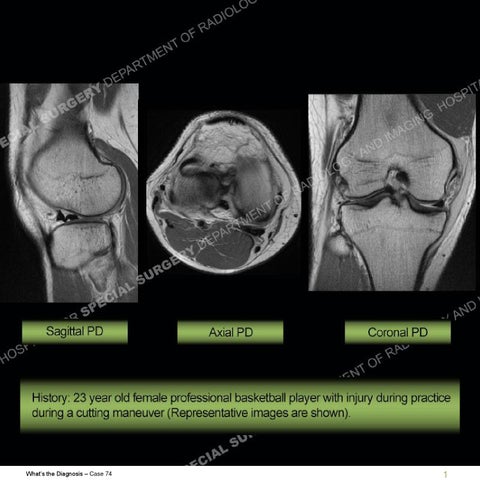
Findings Abnormal architecture of the lateral meniscus with two triangular components (“double delta configuration”) of meniscus seen at the expected location of the anterior horn. No meniscal tissue at the expected location of the posterior horn and abnormal tissue situated within the intercondylar notch. Other abnormalities are present but will be discussed later.
What’s the Diagnosis – Case 74
12
What’s the Diagnosis – Case 74
13
What’s the Diagnosis – Case 74
14
What’s the Diagnosis – Case 74
15
What’s the Diagnosis – Case 74
16
What’s the Diagnosis – Case 74
17
What’s the Diagnosis – Case 74
18
What’s the Diagnosis – Case 74
19
What’s the Diagnosis – Case 74
20
What’s the Diagnosis – Case 74
21
What’s the Diagnosis – Case 74
22
What’s the Diagnosis – Case 74
23
Diagnosis: Bucket Handle tear lateral meniscus A bucket handle tear is a type of longitudinal tear of the meniscus that is typically seen in the younger, active patient population particularly sustained during twisting activities. Longitudinal here implies along the long axis of the meniscus with the meniscal tissue then displaced so that it resembles the handle of a bucket. Knowing the architecture of the meniscus is paramount as in this case. The anterior and posterior horns of the lateral meniscus are typically about the same size and hence all of the tissue anterior can not be a normal lateral meniscus. In addition, through the intercondylar notch there should only be two structures, the ACL and PCL. Any other structure present in the notch must be questioned for displaced tissue. During the cutting motion precipitating this injury, many other injuries occurred mostly related to a valgus stress and external rotation but additionally with a lower grade injury related to varus stress. These included a complete ACL tear with impaction fractures, peripheral tear posterior horn medial meniscus with associated impaction injury, proximal injury of the superficial MCL, and a partial disruption of the popliteofibular ligament with the remainder of the posterolateral corner structures being intact.
What’s the Diagnosis – Case 74
24
What’s the Diagnosis – Case 74
25
What’s the Diagnosis – Case 74
26
What’s the Diagnosis – Case 74
27
What’s the Diagnosis – Case 74
28
What’s the Diagnosis – Case 74
29
What’s the Diagnosis – Case 74
30
What’s the Diagnosis – Case 74
31
What’s the Diagnosis – Case 74
32