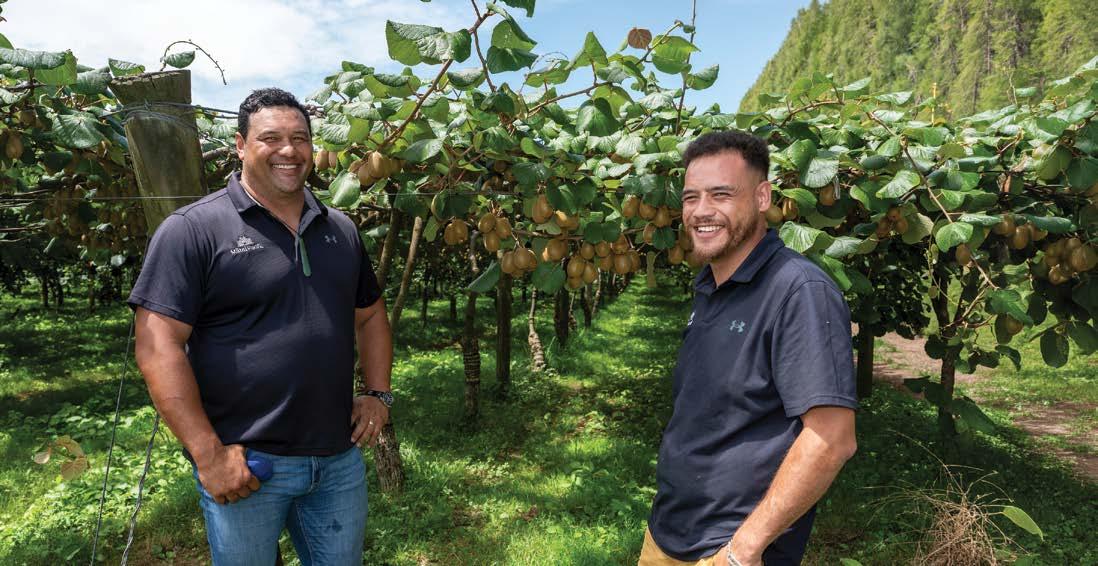
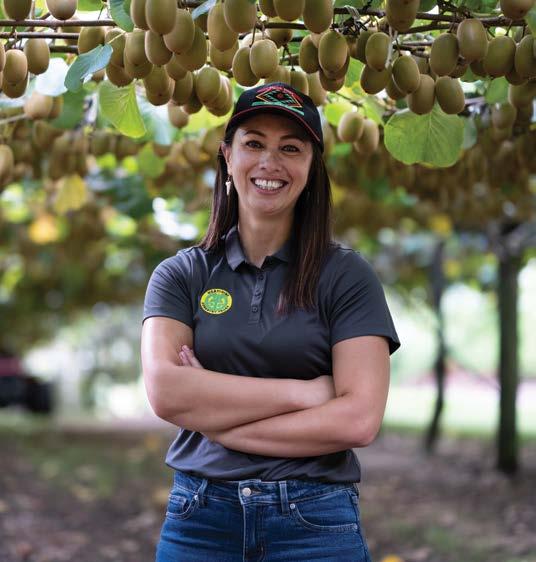
Tony is a freelance writer, photographer and videographer based in rural North Canterbury. He has worked for newspapers and magazines, radio and television, including more than 20 years as a reporter/director with Country Calendar. He speaks with Michelle Pye about industry governance on page 9.
Dan Bloomer
Dan is the LandWISE manager and works independently as a consultant in water, irrigation, soil and land management and agritechnology. He has held board positions with Irrigation NZ, Precision Agriculture NZ and Agritech NZ. Dan shares the latest LandWISE tools for growers on page 42.
Andrew Bristol
Andrew is the new New Zealand Vegetable Council’s (NZVeg) communications manager. He’s spent most of his communications career working for organisations involved in or part of the food and fibre sector. His family farmed at Opiki in the Horowhenua. He finds out how the onion season is shaping up on page 58.
Jonathan Brookes
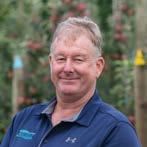
Jonathan has been involved in various roles within the horticulture industry for 35 years and has a strong practical background, with a particular focus on pipfruit. He helps orchardists identify and monitor key performance indicators, and find practical, cost-effective solutions to lift performance and optimise profitability, for example see page 49.
Kasia Frelikow
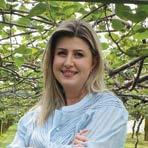
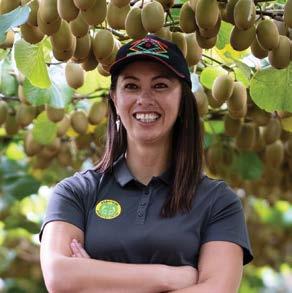
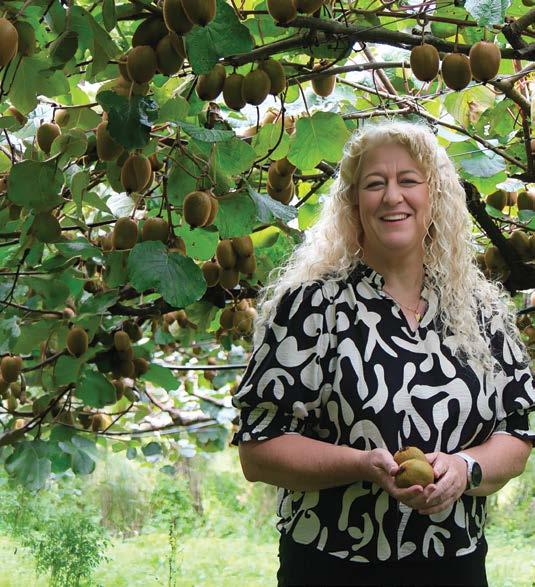
Based in Bay of Plenty, Kasia works in the kiwifruit industry, focusing on plant physiology, soil systems and fruit quality. She works closely with growers on nutrient management, maturity and postharvest performance. On page 38 she shares her thoughts about the size of red kiwifruit this season.
CONTENTS
CONTRIBUTORS
Carly Gibbs
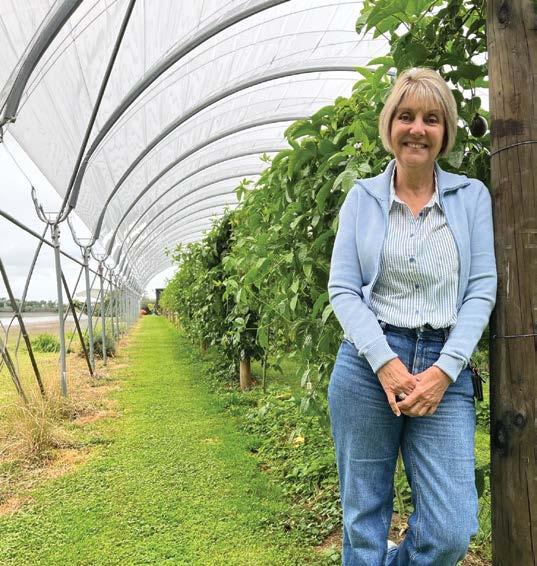
Carly has a background in community and national newspaper journalism – writing for leading New Zealand lifestyle magazines as well as horticulture publications. Carly lives in Te Puke, with her husband and two sons, on a kiwifruit orchard. For this issue she catches up with passionfruit growers on page 6 and meets the finalists for the Ahuwhenua Trophy on page 18.
Jan Pieter de Jong
Jan is agronomy consultant at Soil Craft NZ and an avocado grower based in Bay of Plenty. He journeys with conventional growers who wish to strengthen their orchard ecosystem and biological practice based on regenerative agriculture principles. He highlights the importance of the Cal-Mag Ratio in kiwifruit production on page 45.
Emily Levenson
Emily is an environmental policy advisor at HortNZ, advocating for growers on environmental policy at the central government level and in the Bay of Plenty, Taranaki and Greater Wellington regions. She updates us on natural hazard policy work on page 34.
Sue Linn
Sue is a horticulturist turned garden writer and photographer. She has enjoyed a career-long association with the nursery industry and is editor of Go Gardening Magazine. She lives in Hawke’s Bay with her viticulturist husband and helps out on the family’s boutique vineyard, Wairiki Wines. She meets Kelvin and Cameron Taylor on page 12.
Ellery Tappin
Ellery oversees the MG Group’s communication and marketing programme and is also responsible for developing and driving the MG Group sustainability plan. He joined the MG Group in 2019 after holding a number of communications and consultancy roles for some of New Zealand’s leading brands. On page 36 he talks to MG Charitable Trust chair John Clarke.
INDUSTRY LEADERSHIP REGULARS
3 Bernadine Guilleux, HortNZ chair
4 Kate Scott, HortNZ chief executive
54 Kate Trufitt, Potatoes New Zealand chief executive
56 Dinah Cohen, NZVeg Covered Cropping NZ business manager
&
SYSTEMS UNDER STRAIN
Growing fruit and vegetables in New Zealand has always required planning, investment and a fair bit of determination – but what’s changing now is the level of certainty growers can rely on.
Bernadine Guilleux : HortNZ chair
What were once occasional disruptions are now regular features of the operating environment.
Global supply chains are more volatile, input costs remain high, and transport and logistics pressures are increasingly unpredictable.
At the same time, the growth of our industry and scale of production is making our reliance on ageing public infrastructure too important to ignore.
These systems are under strain and growers and their regional communities experience the impact of this.
This is why HortNZ’s manifesto places such emphasis on getting the enabling environment right. It is about ensuring that as conditions change, the sector is not constantly working against structural weaknesses in the system.
It is clear to see that it is weakening under the pressure of a volatile climate.
The practical question is no longer just how growers can adapt in the moment, but whether the fundamentals are strong enough to support the long-term investment decisions we need to keep growing.
That’s where the focus needs to be.
Reliable, solid infrastructure forms the foundation that determines whether produce gets to market in good condition, on time, and at a viable cost.
This includes roads that accommodate movement of produce from the farm or orchard within peri-urban areas, ports strategically placed to support export growth across the regions, as opposed to focussing on key import hubs only, not to mention adequately maintained water systems and energy networks that make use of key national assets.
Politics aside, there is opportunity in how we think about energy.
Work such as that being advanced by Rewiring Aotearoa highlights the potential to reduce exposure to volatile fuel markets through greater electrification and local generation.
For a sector with significant energy inputs, that shift is not just environmental – there are economic gains to consider for businesses.
Horticulture is vital to New Zealand today and important to its future –supporting regional economies, food security and export growth.
But our ability to do the best we can depends on getting the conditions right: practical policy, sustained investment and infrastructure that gives growers the confidence to keep building.
Because ultimately, the sector performs best when the system around it is built to keep up.
NZGrower & Orchardist is produced by Horticulture New Zealand and is free for all levy payers. The magazine is partially funded by a grant from the NZ Fruitgrowers’ Charitable Trust to ensure all fruit growers in New Zealand receive a copy each month. The magazine is also supported by Vegetables NZ, Process Vegetables NZ, TomatoesNZ, Potatoes NZ and Onions NZ.
The individual comments and views in this magazine do not necessarily represent the view of Horticulture New Zealand.
This publication uses vegetable-based inks and environmentally responsible paper produced from Forest Stewardship Council® (FSC®) certified, Mixed Source pulp from Responsible Sources.
Paper produced using Elemental Chlorine Free (ECF) and manufactured under the strict ISO14001 Environmental Management System.
The wrapper we use is 100 percent recyclable, it is LDPE 4 (Low Density Polyethylene) Soft Plastic and meets the required standards. For further information refer to: www.recycling.kiwi.nz/our-story
MANAGING CURRENT PRESSURES AND FUTURE SHOCKS
As we all know, the horticulture sector plays an absolutely critical role in food security and export earnings for New Zealanders.
Kate Scott : HortNZ chief executive
Eighty percent of vegetables grown in this country are consumed domestically. From breakfast to kids’ lunchboxes, to the evening meal, our produce is there playing an important part in health and nutrition.
Our sector also exports world-class produce around the globe.
A key role of HortNZ’s is to ensure the importance of the sector is fully understood by decision-makers.
With the Middle East conflict causing escalating input costs and significantly impacting the supply chain, we have been working closely with government and other organisations to ensure the needs of the sector are front of mind.
We have been driving home the message about the importance of fuel access to our sector’s operations.
We have also been in regular contact with stakeholders including FMG, the Food & Grocery Council, fertiliser and agrichemical suppliers, and other groups in the primary sector.
Importantly, we have been asking the questions growers want answers to, and updating the sector with new information as it becomes available.
By its very nature, horticulture requires significant advanced planning and preparation. It is also a sector that relies heavily on diesel and petrol, whether that is for machinery, transport or getting produce to market.
We have been asking the questions growers want answers to, and updating the sector with new information as it becomes available
That includes ongoing liaison with the Ministry for Primary Industries and other government agencies to understand the emerging risks and provide daily information to officials about the impact surging input costs are having on growing operations.
What this current situation highlights is the importance of building greater resilience into our systems. We are already seeing some growers use this as an opportunity to innovate – looking at ways to reduce fuel dependency, improve energy efficiency and adopt new technologies that make their operations more self-reliant.
For some, that means investing in more efficient irrigation and machinery. For others, it is exploring alternative energy sources and rethinking logistics.
These are not quick fixes, but they are practical steps that can strengthen businesses over time.
HORTICULTURE RELIES HEAVILY ON DIESEL AND PETROL
There is no one-size-fits-all solution, and not every option will be viable for every grower. But the direction of travel is clear – building resilience through innovation will be increasingly important in managing both current pressures and future shocks.
This uncertainty is challenging for growers and HortNZ is committed to working to support the sector and find solutions in every way we can.
Building resilience through innovation will be increasingly important in managing both current pressures and future shocks
If you or someone you know does start to feel overwhelmed, please reach out. There are many organisations such as Rural Support Trust and Farmstrong that will understand, listen and provide support.
Premium rootstocks now available for the new season.
Whether you’re planting a commercial orchard or a few trees at home, Genesis Nurseries has the rootstock to help you grow world-leading trees. With our top-quality rootstocks and progressive tree management, you can count on trees that are consistent in appearance, vigorous in growth and built to thrive.
Genesis’ partnership with the NZ Tree Crops Association enables flexible supply of our premium rootstocks to home growers, lifestyle block owners, and smaller orchard operations.
ORDER YOUR ROOTSTOCK TODAY!
BULK ORDERS
Genesis Nurseries: 0800 GRAFTED or www.gnl.nz
SMALL QUANTITIES
NZ Tree Crops Assocation: www.treecrops.org.nz
Photo by Tony Benny
PASSIONFRUIT FIGHTING BACK
Wrinkled outside and sunset-coloured inside, passionfruit is one of New Zealand’s most distinctive fruits. However, the niche industry has faced a decade of challenges. CARLY GIBBS meets a husband-and-wife grower team who discuss the difficulties and efforts to fight back.
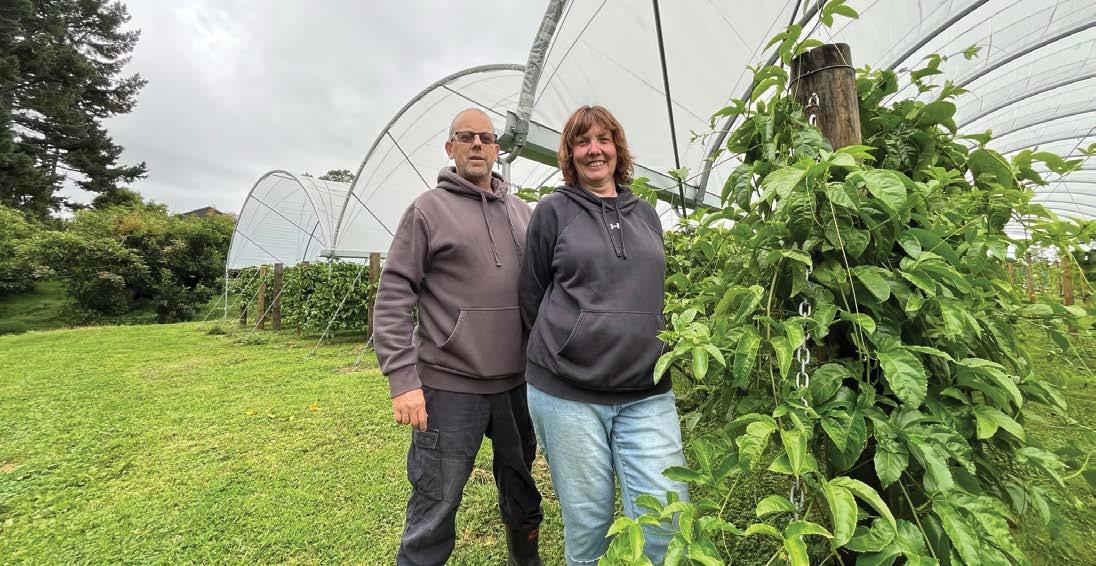
Wayne and Simone Fenton are passionfruit growers who, by default, have also become amateur scientists.
Five years into growing passionfruit, the couple remains patient and persistent, even when faced with challenges more bitter than sweet.
This year is significant for New Zealand’s elite passionfruit industry of just 30 registered growers, because it marks 12 years since the crop-killing disease Fusarium – also known as passionfruit wilt – invaded their orchards.
The Fentons tell NZGrower & Orchardist that, more than a decade after two strains of soil-borne fungus Fusarium were discovered, their industry is conducting DIY trials to fight it, with individual on-orchard experiments having become commonplace.
Seed trials by the New Zealand Passionfruit Growers Association (NZPGA) prove Fusarium doesn’t come from their seeds, but from an outer layer, and if seeds aren’t
washed, it transfers during planting. It can lie dormant until ideal conditions are introduced and be carried through a grower’s water source.
“There’s no current cure, and only preventive orchard husbandry and healthy soil biology may keep it at bay,” says Wayne, who is vice president of the NZPGA.
Serious threat
Fusarium sambucinum, or “Black Leg”, was first detected in passionfruit crops in New Zealand around 2014. Then, a second, more “economically significant” strain, F. oxysporum, emerged. In the last decade, F. oxysporum has threatened to wipe out entire orchards quickly.
Fusarium infects plants through the roots, causing leaves to yellow and the plant to die. Fusarium is present in soils worldwide and affects various plant species, but unfortunately, once it’s detected in soil here, it’s near impossible to eradicate.
Growers Wayne and Simone Fenton have 0.25ha under tunnels, complete with solar panels, and a pump house with tanks to collect roof water
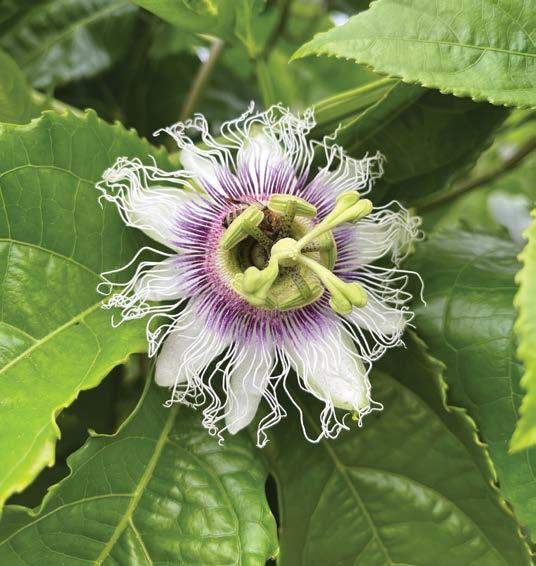
Passionfruit’s most popular consumer variety is Edulis passifloria or simply “purple passionfruit”
This is because New Zealand’s passionfruit industry has few registered on-label chemicals, particularly for fungicides (it costs thousands per product to be on label), and no spare cash for exploration.
Growers using off-label chemicals are held accountable in residue testing at the start of harvest, and there are Maximum Residue Limits (MRLs) set by the industry’s export markets.
With few remedies at its disposal, the industry has turned to its own independent trials to explore alternative options.
These include planting rootstock varieties from seed in both indoor and outdoor environments to test what is hopefully Fusarium-resistant.
To the best of Wayne’s knowledge, trials have been selffunded with no rootstock or plant matter imports.
In their own orchard, Wayne and Simone are in the early stages of grafting Passiflora edulis, aka purple passionfruit, onto passionfruit’s gold and red varieties, in areas of their plastic tunnel houses in Whakamārama, Tauranga.
“We now play the waiting game to see if they survive and are more disease-resistant,” Wayne explains, adding it will take time to get quality recordable results.
The Fentons have 0.25ha of 500 plants under tunnels that Wayne built, complete with solar panels, and a pump house with tanks to collect roof water.
• Provides internal warming more compact flowering
• For use on fruit tree crops
• The “spray on” that adds to all other methods
• Good results have been achieved when applied through irrigation lines
The Fentons say individual on-orchard trials against Fusarium have become common practice in the passionfruit industry
PRESIDENT
By controlling the amount of water their plants receive and the temperature with automated fans that they’re also trialling, they hope the plants thrive.
Backyard science
So far, Wayne’s feeling optimistic, but Simone can’t help feeling “it’s a bitter pill to swallow” that growers are left to come to their own conclusions about Fusarium and how to proceed.
She expressed frustration upon learning that the government recently funded New Zealand scientists to help enhance and future-proof passionfruit production in Southeast Asia through a $6 million VietFruit project. At the same time, New Zealand’s own industry needs assistance.
“The risk is that if we don’t resolve our issues, we could open ourselves up to imports from overseas to satisfy demand,” Simone says.
New Zealand consumers pay a premium price for passionfruit (around $50-plus per kg) because it’s intensive to grow with a limited supply and high demand in a short season (January to May).
High labour inputs, along with seasonal constraints such as plant loss, impact supply. At times, our industry can’t keep up with demand.
Kiwi tenacity
While Fusarium remains a constant threat to growers’ existing and new plantings, growers are impressively still increasing local and export production.
President of NZPGA, Margaret McIsaac, says one protection Kiwi growers can rely on is the absence of the Queensland fruit fly and the Oriental fruit fly.
“This does two things: it keeps our pathway to our main export markets in the United States open, and it prevents fruit from Australia and Asia from coming onto the local market here,” Margaret says.
Right now, New Zealand’s only imported passionfruit is in pulp form.
Pulping is labour-intensive, and our industry can’t compete with low labour costs and import value.
“We also don’t have the volumes to supply the pulp market unless we can grow our industry,” Wayne explains, adding NZPGA is keen to hear from anyone interested in becoming a grower.
Not all bad
Margaret believes that, in time, more commercial varieties will become available, and there are propagators in New Zealand that will grow imported seedlings for keen NZPGA growers.
Passionfruit isn’t grown under licence but is subject to a 3 percent levy payable to NZPGA at the first point of sale.
This season, fruit has maintained a high grower payment, suggesting there may not be much in the local market. As a result, Wayne and Simone have decided not to export on this occasion. Growers juggle all aspects of the work themselves, from growing seedlings to planting, spraying, picking, processing and transporting to their local depot.
Cash crop
Wayne, who also works as a chemical process technician, says passionfruit can be a challenge but remains worth it, because it’s a high-value cash crop.
Plants mature very fast, and because they largely grow on upright structures, there’s more planting surface area available per hectare compared to crops like kiwifruit.
This year, the Fentons achieved good numbers, little waste, and 85 percent of their fruit is large.
Margaret says growers, like their plants, are a good, hardy strain: “tenacious and enthusiastic, and success is well-deserved”.
PUT YOUR HAND UP TO HELP OUT
Canterbury farming leader Michelle Pye, recently elected to the board of Fonterra, following 5 years on the Potatoes New Zealand board, believes it is important to give back to the community and the organisations that contributed to her family’s business success.
Tony Benny
“It comes back to our core values and purposes,” Michelle says. “We’ve had all these industries around us that have helped us grow our business and so it’s only fair that you take your turn at giving back.”
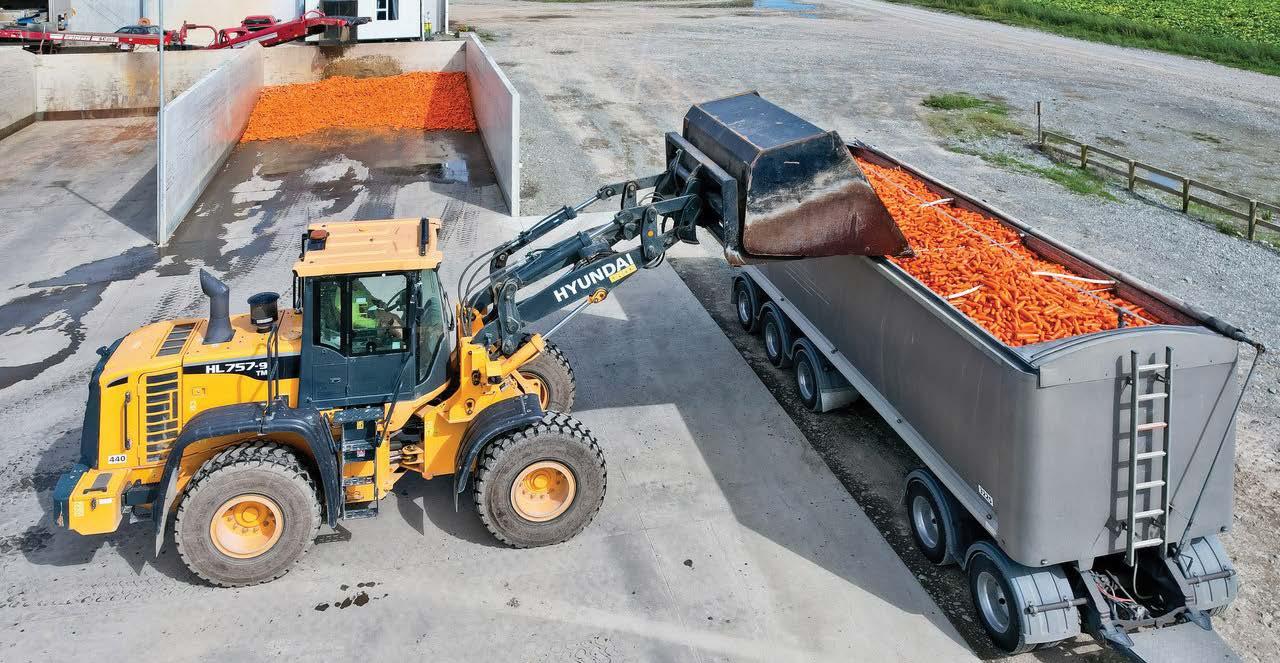
Michelle and her husband Pye Group, a South Canterburybased family corporate that 7000ha, including 10 dairy farms and a large potato and carrot growing operation.
Leighton had previously farmed in partnership with his parents and brother but in 2002 he and Michelle began farming in partnership with Leighton’s father Allan and continued the expansion of the family business.
“It was in those boom years of dairy growth and the Pyes had just started converting,” Michelle says. “They converted one farm and then just kind of went from And we continued the conversions and have grown the business ever since.”
Born on the West Coast but brought up in South Canterbury, Michelle grew up on the mixed arable and livestock farms her father worked on. When she left school she went to work for a Timaru accounting firm. She stayed there 5 years, did her OE and then when she came home, she took a job with Allan Hubbard, well-known as the founder of South Canterbury Finance. She worked there until the Pyes’ first child was born. Since then she has worked in the family business.
Michelle says she didn’t expect to move into governance roles but put her hand up when she and other Canterbury potato growers set up their own co-operative to supply seed potatoes to growers supplying the McCain Foods processing plant in Timaru.
McCain had bought the seed potatoes from growers, stored them and then sold the seed to their suppliers. In 2017 McCain signalled they wanted to discontinue that arrangement. This led to 13 growers forming the Potato Seed Co-operative. Initially they used leased cool storage but in 2021 they opened their own purpose-built, state-of-the-art facility in Ashburton.
As chair Michelle took a key role in setting the co-operative up. “It was a bumpy road and I was very frustrated at times. It was like herding tigers, not cats. But we got there and it was good.
“I think the measure of success is the lift in the yields of the commercial potatoes that we send to McCain and it has it has grown over time. Seed is not the only factor into that, but it is one of the factors.”
Michelle then joined the board of Potatoes New Zealand.
“The potato industry is 120-ish growers and I’ve always thought if you have the skills and the capacity you should be putting your hand up to help out these industry bodies because they need it,” she says.
“It has been interesting because knowledge of the potato industry is definitely not my skill but that’s why you have diversity around the board table. My skill sets come from running the business, with bit of background in accountancy, and I’ve done pretty much every admin role from HR to payroll to environment manager to health and safety in my time.”
With her feet firmly in both dairy farming and vegetable production, Michelle is well placed to compare the two industries
Michelle also served on the Fonterra Shareholders’ Council. “I’ve probably got thick-skinned from when I was on the council because it was in a difficult time at Fonterra. We got a lot of flak for various reasons, but I do think you can differentiate yourself as an individual versus the group and still keep your reputation.”
In 2022 Michelle was elected to the Timaru District Council. She believed a stronger farming voice was needed in the face of an “alarming” draft plan that had been put out for feedback.
“The problem was the rules that they were putting in place. The overlays on a lot of our farms were a worry and nobody really believes me when I say this, but you actually needed a consent to put up a dog kennel or a raised vegetable garden. If you had a leaky irrigation pipe, you couldn’t dig that up without getting consent.”
As it turned out, she was one of two people standing for two seats and was duly elected and re-elected last year.
“For the amount of time farmers spend moaning about their councils, where are the farmers standing for election? No wonder we get results like this when you don’t have anyone with the practical knowledge sitting around the table.”
No longer on the Fonterra Shareholders’ Council, Michelle has had plenty on her plate between working for the Pye Group, serving on the board of Potatoes New Zealand and as a district councillor. And then she was talked into standing for election to the board of Fonterra.
She spent 4 days on the road with meetings, panel discussions, and question and answer sessions. “It’s like being in an exam every single time you’ve been to a meeting. You know your topic but you don’t know what questions you’re going to get asked.”
With her election to the Fonterra board, Michelle will stand down from Potatoes New Zealand at the next Annual General Meeting because she just doesn’t have enough time to do everything.
“The last I really wanted to be was a Fonterra director,” she laughs. “But it’s a massive opportunity for personal development, growth, great connections, great
Pye Group farms 7000ha, including 10 dairy farms and a large potato and process carrot growing operation. Photo by Stu Jackson
Michelle says her skill sets come from running the business, her background in accountancy, and pretty much every admin role from HR to payroll to environment manager to health and safety
opportunities to do some really cool stuff. But actually, it’s that responsibility back to the industry that has helped us and helping govern that.”
With her feet firmly in both dairy farming and vegetable production, Michelle is well placed to compare the two industries and admits dairy has many advantages as a land use in Canterbury.
“The dairy industry has that massive co-operative in the middle of it that will come and pick up your milk no matter how much you supply and pay you for it on the 15th every month. That’s why I probably have co-operative blood running through my veins with Fonterra.
“Contrast that to the horticulture industry. We’ve got to negotiate the price every year, we’ve got to deliver our produce to the factory and if we supply too much or too little, that’s our problem.”
And the risks are far higher in horticulture too, Michelle says. “You know, if you have a hailstorm, you’ve lost your whole income on a cropping farm whereas on a dairy farm, you might just drop production for a day.”
PLANT FOR SUCCESS
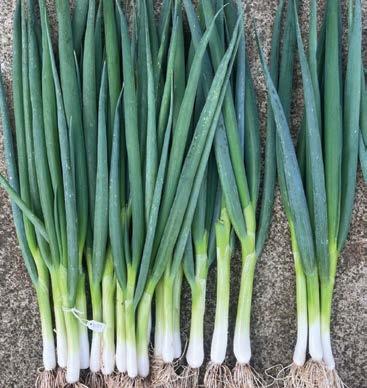
Blizzard F1
Erect, uniform plant with glossy dark green foliage. Straight long white uniform stems. Faster to mature than standard OP lines. Generally better against tipping and presents very well. Hybrids offer better uniformity and vigour, and newer hybrid lines have longer shanks. Year round harvest.
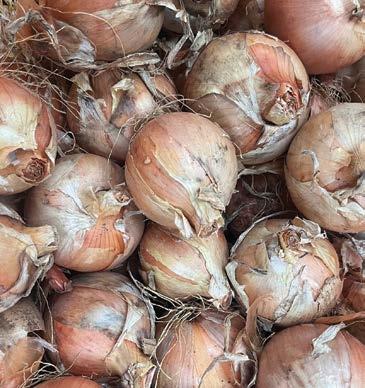
Luna F1
With maturity similar to mid maturing hybrids, Luna is very uniform with three good skins and excellent skin retention. Good field vigour and plant strength. Excellent yield, shape, strong shipping and long storage capabilities. Sowing NI early/ mid July to end of August.
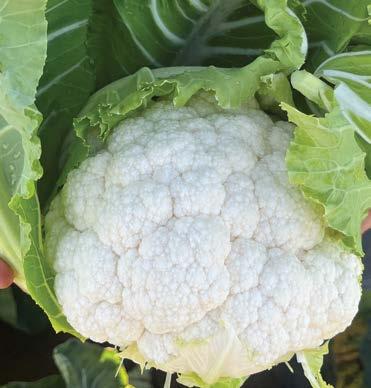
Harvest late autumn to early winter and spring. Medium frame producing 900gm–1.2kg curd, fine to medium floret. Well covered curd with good wrap and strong leaf jacket. Blanco has performed exceptionally well for spring harvest.
READY TO RAMP UP
Cyclone Gabrielle wiped out Taylor Corp’s new Hawke’s Bay packhouse in 2023. Today the Taylors have rebuilt their packhouse and invested in even more high-tech capacity. Trees in replanted orchards are ramping up production. It’s time for the Taylors to switch from recovery mode to expansion, but regulatory barriers unresolved from well before the cyclone are still holding them back.
On a blue sky day in April it’s all go inside Taylor Corp’s enormous packhouse. By the end of the day, 13 shipping containers will be loaded with NZ Queen apples meticulously packed in Taylors brightly branded boxes.
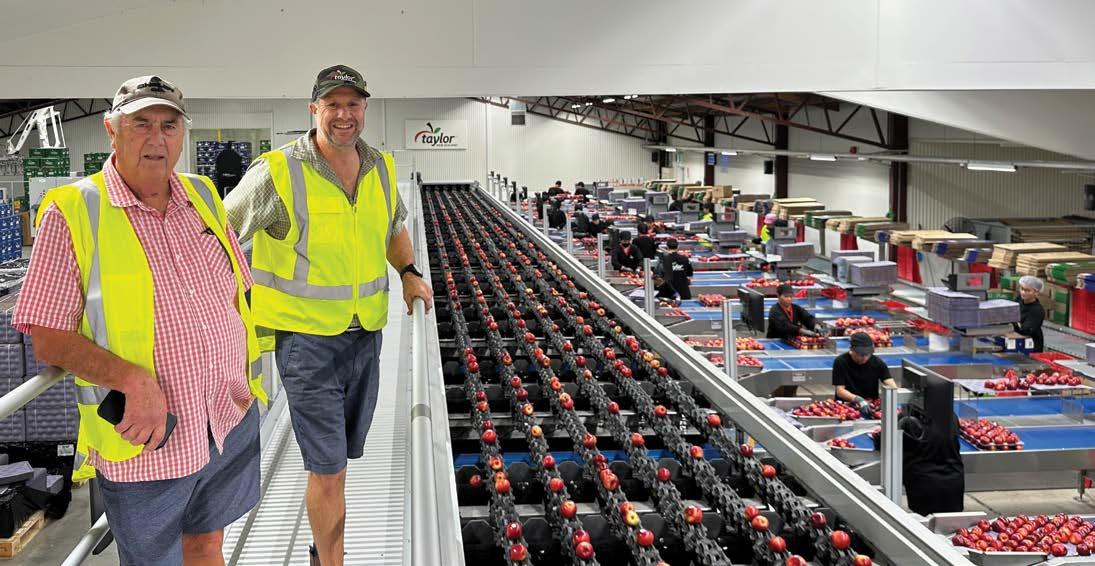
Like a well-coordinated dance, a large team of robots and humans work together in perfect rhythm, sorting and packing as shiny red apples race down the conveyor belts. Upbeat music adds energy to the steady hum of machinery. Driverless forklifts with flashing lights are almost graceful as they waltz around the floor, stacked high with precious cargo. As we walk along the bridge above this vibrant moving scene, our voices are raised in conversation. Cameron and his Dad Kelvin are here every day of the season overseeing operations.
Sue Linn
Every 2 seconds another 18kg box is filled. Every minute another 2000 apples are thoroughly checked for imperfections. Not a single one escapes scrutiny on its way to its dedicated box. Will it go offshore under the Taylor Grade One or another Taylor export grade? Or will it be one of the rejected few to be made into juice? Not a single apple that makes it here from the orchard is wasted.
“Very little is rejected for juice these days,” reveals Cameron. Instead we have various different classes for selling offshore.”
Cameron is the fourth generation in a proud line of Taylors growing and exporting apples in Hawke’s Bay. Sitting in the quiet comfort of the meeting room with its bright apple-red leather sofas, we chat about the New Zealand apple industry, how far it has come and where it is heading.
Kelvin and Cameron Taylor in their newly rebuilt packhouse in Hawke’s Bay
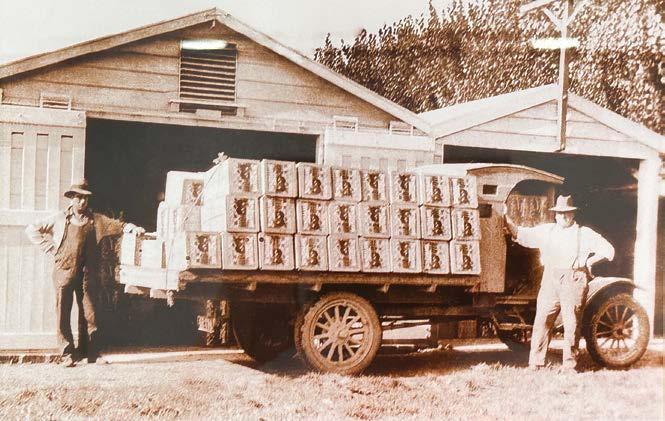
“My grandfather Walter Taylor was exporting apples out of Napier Port 130 years ago,” says Kelvin. On the wall above him, there’s a framed photo of Walter with a truck load of apples packed in wooden boxes ready for shipping. It’s a stark contrast to all the high-tech activity going on around us. That’s not to say innovation wasn’t happening back then. A century ago New Zealand orchardists were welcoming newfangled sprays, refined grafting techniques and progressive rootstocks that helped control pests and
pathogens. Selective breeding was well underway, delivering improvements in flavour, storage qualities and disease resistance. Advances in packaging and cool storage were making it possible to send apples overseas.
These days Taylor Corp is a fully integrated company, growing its own trees, harvesting its own apples and exporting them to market – it seems some things stay the same, despite all the computers, AI and robotics.
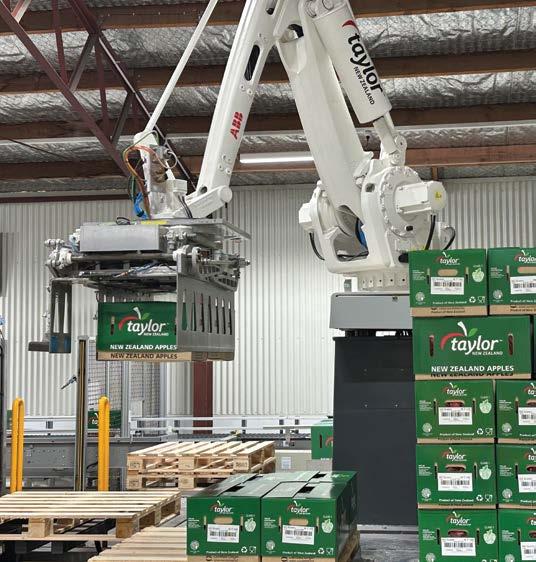
ABB articulated robots deliver high-speed, safe and precise pallet stacking
Kelvin and Cameron are justifiably proud of how far their industry has come – and the growth of their family business. There is an old saying in the family that “Standing still is going backwards”. Their impressive recovery from the double disruption of Covid and Cyclone Gabrielle speaks of the determination and grit Kiwi businesses are known for.
Taylor Corp’s state-of-the-art packhouse, one of the most advanced in Hawke’s Bay, was barely 2 years old when the cyclone left it waist deep in water and muck in February 2023.
New technologies, both in the orchard and in the packhouse, bring significant opportunities for expansion
“It took months and months to suck it all out and it was raining humidity from the walls,” says Cameron. “Everything was pulled out and rebuilt exactly to the original design plans and was back up and running in January the following year.”
The move from manual-heavy packhouse processes to high-tech automation has seen Taylor Corp triple its throughput with the same number of workers. The orchards are still recovering, but making great progress – it takes time to grow a tree in the nursery and then wait for newly planted trees to reach full production.
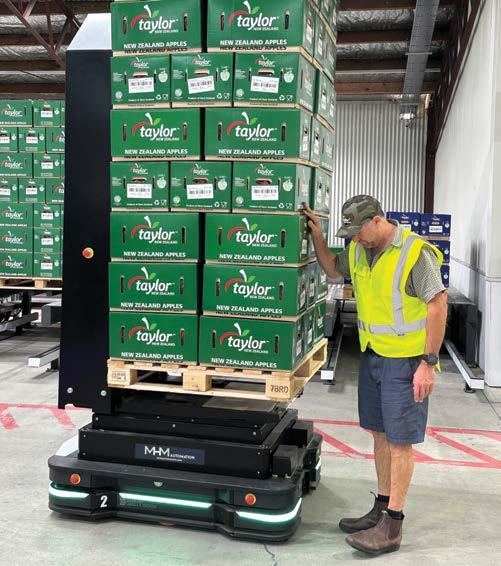
Driverless forklifts reduce visibility-related hazards when operating around people
Trees wiped out by the cyclone have been replaced by high-density 2D orchards. The company had already begun transitioning to the hedgerow system – also known as the ‘fruiting wall’ – before the cyclone. Proven results gave them the confidence to move forward without hesitation.
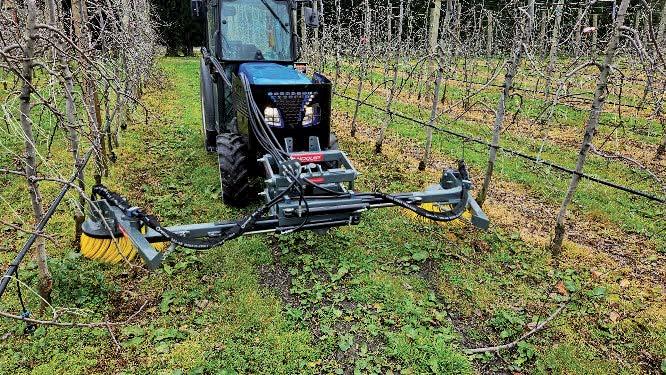
Well over half of Taylor Corp’s 450ha of orchard land is now in hedgerows, either newly planted or converted from traditional orchards. In addition to higher yields, the 2D rows enable greater mechanisation for spraying, thinning and pruning. Autonomous battery-electric weed sprayers and mowers by Agovor are helping to reduce labour costs, though adopting robotics also creates demand for highly skilled operators and technicians.
Robotic harvesting is still to come, but the lower height of hedgerows compared to traditional trees is making harvesting easier and faster with no need for Hydraladas.
Cameron says the newest orchards are pumping out twice the volume of high-quality fruit as older traditional plantings.
New technologies, both in the orchard and in the packhouse, bring significant opportunities for expansion, Cameron agrees. And the markets are steady. But he points to some key frustrations that have been around since pre-Covid times: They need water, they need affordable labour and they need affordable energy more than ever.
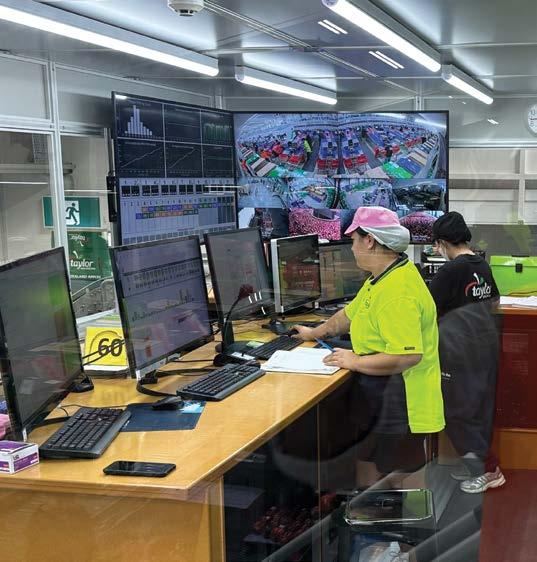
The computer room is the high-tech hub of the packhouse
“The industry has shown some solid recovery since the cyclone in 2023, which is encouraging, but there are still some pretty significant challenges we need to be upfront about,” he says.
“Export revenue does not equal money in the back pocket for growers and right now the cost of production is incredibly high. Energy costs are really starting to bite, putting pressure on growers across the board.”
The lion’s share of the electricity bill goes to cool storage. Solar power is an option they are considering, although in summer that presents a challenge as huge volumes of fruit come in from the orchard at the end of a hot day and need cooling down quickly.
While electricity and gas prices rise, water security is another huge concern among Hawke’s Bay growers. Trees can take years to mature and orchards are long-term investments. Water needs vary over time.
Orchardists worry that future production capacity will be limited under the “actual and reasonable use” (ARU) model where water allocations are being reset based on past usage, not future needs.
“Without reliable access to water it is very difficult to justify new investment in the region,” explains Cameron. “That directly impacts our ability to create jobs and grow the local economy.”
Ironically post Gabrielle, his biggest problem now is finding land with water. “We have some bare land with brand new posts and wires piled ready to go but we’ve had to stop planting because we’ve lost our water consent. We can sell more apples but we can’t grow them unless we know we will have enough water. Without water that land is only good for sheep.”
Currently, Hawke’s Bay’s water regulations are in limbo with Environment Court appeals underway and decisions not expected until early-mid 2027. Meanwhile among growers there is increasing focus on water storage, including big infrastructure projects.
“We welcome the likes of the Government’s commitment to progressing feasibility studies on water storage in Hawke’s Bay and we are looking forward to seeing more detail as the next phase of RMA reform is released,” says Cameron.
“To unlock the region’s potential we also need to start thinking more long-term about fundamentals like roading and energy supply. But I do see a massive future if we can overcome these problems.”
The move from manual-heavy packhouse processes to high-tech automation has seen Taylor Corp triple its throughput with the same number of workers
“Our sector has the capacity to deliver outcomes and double exports. Already we employ more than 7000 people in Hawke’s Bay. We reached $1.26 billion in national export revenue in 2025, but the current legislative settings just aren’t stacking up economically, and that’s squeezing already thin margins and making it harder for our industry to grow.”
ON ORCHARD WITH AHUWHENUA FINALISTS
For Māori, whenua is fundamental to identity: a connection to tūpuna, and a resource that has sustained generations. This year’s three finalists in the Ahuwhenua Trophy Excellence in Māori Horticulture Award demonstrate integration of economic, environmental and social objectives. The winner will be announced on 5 June at a gala dinner in Whangārei.
HortNZ is a Gold Sponsor of the Ahuwhenua Trophy, which it sees as a key programme to promote the Aotearoa Horticulture Action Plan outcome: Māori are strong in horticulture, which should see Māori participation in high-value horticulture triple by 2035.
Carly Gibbs
Photos by Alphapix.nz
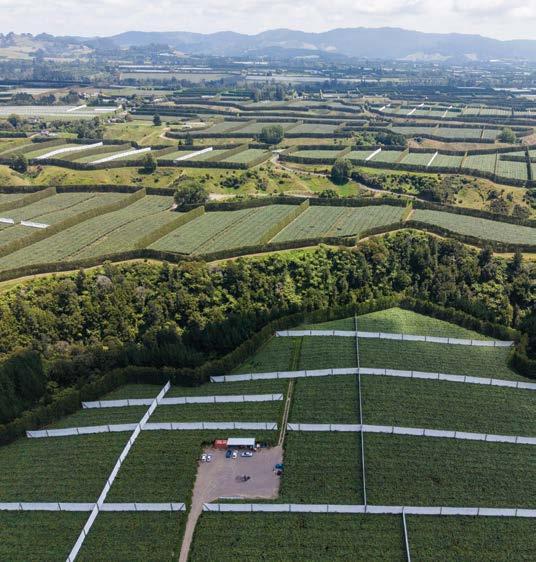
Mātai Pacific Iwi Collective in Te Puke operates across 14 titles, with 101ha of productive canopy
Otama Marere Trust, Te Puke
Mātai Pacific Iwi Collective, Te Puke
Ngāti Hine Forestry Trust, Kerikeri
OTAMA MARERE TRUST
Paengaroa, Te Puke
More than 21ha of kiwifruit, avocados, native plantings
6.3ha of protected wetlands
Otama Marere Trust
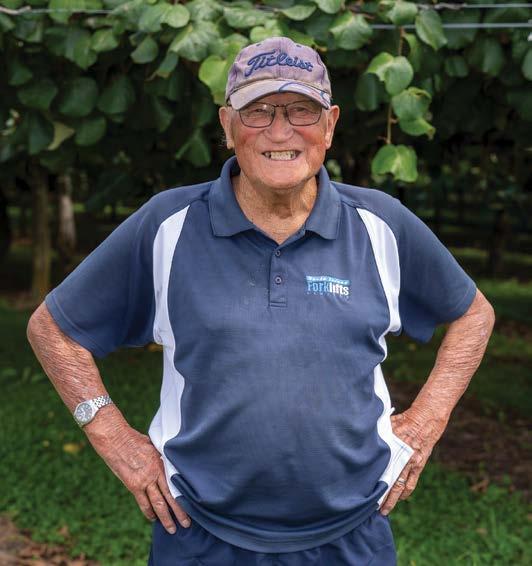
At 83, Homman Tapsell is working full-time and still dreaming big for the future.
The trust’s advisory trustee and orchard manager, clad in contemporary Crocs and sweats, is determined that his successor will have everything set to continue Otama Marere’s legacy upon his eventual retirement.
“I would hate to walk out of the gate and say, ‘it’s all yours now’, and nothing is planned for the future,” he says.
From his elevated vantage point in the orchard, which connects lower terraces to Te Puke’s Kaituna Awa (river), Homman, who lives on-site with his wife, Mary, says that, after 19 years as orchard manager, he is still planning and pushing for growth.
“Every year, I look at our crops and hope numbers are going to be better than the previous year’s. I am always looking for that challenge – that is part of my excitement.”
This is the second time Otama Marere has been a finalist in the national farming Ahuwhenua Trophy, which has included a horticulture division since 2020. The trophy has been running since 1933, established by Sir Apirana Ngata and Lord and Lady Bledisloe.
Judged by an Ahuwhenua panel on governance and strategy, ngā tikanga Māori (social and community), financial performance, and commitment to sustainability and the environment, Otama Marere, led by a humble and skilled leadership team, excels in all, with its every decision ‘defined’ by tikanga Māori.
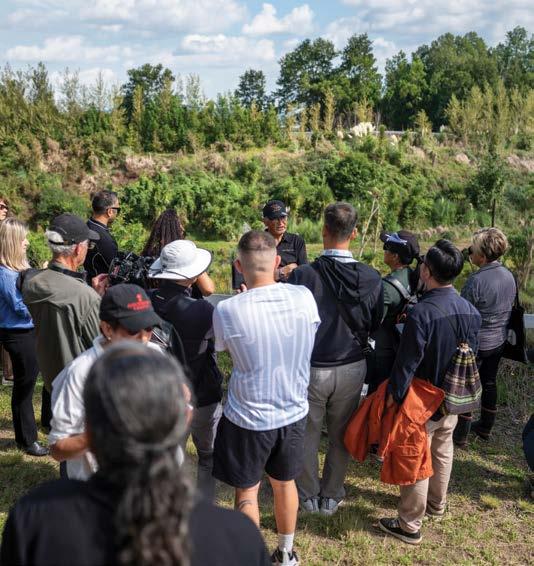
Attendees at Otama Marere Trust’s Ahuwhenua public open day in April talk with Homman Tapsell
The trust generously distributes 68 percent of its profit to community and whānau through a long list of social and educational donations; leads succession planning through a cadet training programme; and prioritises “the reconnections” of whānau to their whenua through regular on orchard whānau days.
At the same time, they have equal commitment to their land’s natural resources.
Today, they have productive organic Zespri SunGold™ crops with a view to expanding organic in their portfolio. This shift aligns with their responsibility as kaitiaki, and elsewhere in the orchard, they’re reducing the use of chemicals and inorganic fertilisers.
Established as an Ahu Whenua (Māori land) Trust in 1979, the property was leased for a 60-year term to Te Puke Golf Club before orchard development began in the 1980s
On a hīkoi (walking tour) of the orchard on the trust’s public open day in April as part of being an Ahuwhenua finalist, Homman explained to some of the 200-plus attendees, which included NZGrower & Orchardist, that the trust has an area of 1.6ha that’s been earmarked for the release of new kiwifruit varieties over the next 3 years, with diversification important for resilience and growth.
Homman manages this Māori freehold land (45ha in total) for Otama Marere, whose name comes from the neighbouring ancient pā.
Established as an Ahu Whenua (Māori land) Trust in 1979, the property was leased for a 60-year term to Te Puke Golf Club before orchard development began in the 1980s under politician and Bay of Plenty descendant Sir Peter Tapsell’s leadership. An allwomen Project Employment Programme crew built its infrastructure.
After managing significant debt, the late Huia Tapsell, from Maketu, restructured operations and established a successful partnership with Seeka.
Today’s portfolio includes kiwifruit, GEM® avocados, native plantings and diversification through various property investment and Māori partnerships.
Cut labour, Reduce bacteria risk
Increase mulching efficiency this pruning season.
Single or Double-Sided Models available - Single: Reliable solution for traditional orchards
- Double: Sweep both sides in one pass (ideal for modern narrow rows) One pass operation | Less Labour required |
MĀTAI PACIFIC IWI COLLECTIVE
Te Puke 100ha across three locations
With a total landholding of 224ha
Mātai Pacific Iwi Collective
Mātai Pacific Iwi Collective is the “pōtiki” (youngest) finalist in Ahuwhenua, having formed less than a decade ago.
“To be measured against your peers who are more experienced as a Māori organisation, we acknowledge it’s a privilege,” says chief executive Charles Russell.
Mātai’s Ahuwhenua public showcase day in March was cancelled due to an orange weather warning. However, judging still took place as planned the day before.
“If we weren’t willing to go out in it, we wouldn’t expect our manuhiri (guests) to be out in it,” Charles reflects. He admits it was an unfortunate situation but believes it was the right decision.
“This is part of dealing with climate change and building resilience.”
Mātai is Zespri’s largest Māori shareholder, and in April, won the Bay of Plenty Regional Supreme title at the Ballance Farm Environment Awards.
The impressive Te Puke collective spans 224ha – including 101ha of productive canopy – and is a partnership between Te Arawa Group Holdings, Ngāti Awa Group Holdings and Rotomā No 1 Incorporation; operating across 14 titles and growing Zespri SunGold and Hayward kiwifruit.
Over the next 2 years, Mātai hopes to grow by 25 percent through further property, shares and post-harvest investments.
Charles, born and bred in Tauranga Moana and in and around orchards since he was 8 years old, has worked “every part of the value chain apart from Zespri”.
He sees Mātai as a leading organisation where learned knowledge can be shared to leverage other Māori into horticultural opportunities.
He respectfully says, “If you’re leading and you’re doing well, you have an obligation to help.
“(Mātai) stands on the shoulders of giants – our founders. They chose to invest in an industry in 2018 that was still recovering from bacterial disease Psa. It took courage to make that decision at the time. I’m the benefactor of the groundwork they laid, and my role is to optimise what we already have and improve it in preparation for growth.”
Mātai is a great example for achieving social and environmental as well as financial objectives.
It has large-scale native plantings to enhance corridors for pekapeka (native bats), is reducing emissions and is focused on wetland creation and riparian restoration.
Its orchards serve as research sites, hosting trials on native pollinators, and innovation is crucial – it recycles 450km of growing string annually into plastic pallets and uses drone technology for pest plant management.
At the community level, it runs a cadets’ scheme, employs only locals for picking and use three different packhouses to ensure resilience in post-harvest operations.
It returns cash distributions to its entities (so far, $21.2 million) and donates to local school, sport and community initiatives.
But despite successes, Charles says staying humble is part of Mātai’s philosophy.
“I’m sure people will look at Mātai and see this corporate, but I want them to see the heart. Ahuwhenua Trophy celebrates our ringaringa (people) that deliver for us every day.”
As well as attending the Ahuwhenua awards in June, Mātai will join fellow regional winners in being considered for the Gordon Stephenson Trophy at the New Zealand Farm Environment Trust’s National Showcase in July.
Chief executive Charles Russell (left) of Mātai Pacific Iwi Collective pictured with Alex Shortcliffe, an orchard manager at Mātai
NGĀTI HINE FORESTRY TRUST
Kerikeri Six
kiwifruit orchards Including 32ha of Zespri Sungold under cover
Ngāti Hine Forestry Trust
When NZGrower & Orchardist asks chief executive of Ngāti Hine Forestry Trust, Heidi Mackey, what it means to be an Ahuwhenua finalist, she promptly replies that it’s “hugely significant” and celebrates five decades of dreams realised.
“The establishment of our trust was 50 years ago, and there was the vision our tūpuna had at the time of amalgamating their lands,” Heidi says, adding that one of those ancestors was her great-grandmother, Rina Shortland.
Amalgamation meant employment for the people and retention of the whenua, which is what the trust has achieved. Heidi explains, “Much of our rohe (district) was either being sold or had already been taken under the Public Works Act and other legislation, which had negative consequences for land loss.”
Heidi is proud that they have achieved their ancestors’ dream, but being a finalist in Ahuwhenua is also a reminder “that the mahi continues”.
She told NZGrower & Orchardist that recognition has been doubly rewarding because Ngāti Hine sits outside the kiwifruit capital of the world, Te Puke, where the other two finalists reside.
“It shows that there are non-traditional regions that still can compete to that standard,” she says.
She believes the Ahuwhenua award “highlights the unique way in which Māori bring together tikanga, long-term thinking, performance and sustainability for intergenerational benefit”.
Heidi Mackey, chief executive of Ngāti Hine Forestry Trust, says that providing employment for their people and preserving their whenua was a vision of their ancestors that the trust has helped to fulfil
Established in 1974, Ngāti Hine manages 6000ha centred around Moerewa and Kawakawa, representing more than 6000 owners through seven trustees. Guided by “He Whenua Hua, He Tangata Ora” (Productive Lands, People Wellbeing), the trust holds interests across kiwifruit, forestry, mānuka honey, dairy, carbon crops and native nurseries. Under Seeka’s lease and supply agreements, the trust has employed 13 orchard staff since 2023, including an orchard manager, building internal capability through horticultural qualifications and Seeka cadetship. In total, the trust employs around 25 permanent and 15 casual staff.
Operations integrate kaitiakitanga with commercial excellence through sustainable land use, water management and responsible inputs.
Strong governance balances intergenerational outcomes while kiwifruit returns diversify income, buffer commodity cycles, and fund marae, education, and cultural initiatives and grants for kaumātua.
“Our decisions are grounded in our values, but we’re also focused on the long-term prosperity of the land, while building opportunity for whānau,” she says. “Our experience has been that when combined with commercial discipline, success follows.”
Learn more about Ngāti Hine Forestry Trust; ngatihine.maori.nz
ORGANIC SYSTEM SHAKE-UP
After years of slow progress through Wellington’s policy-making machine, the new rules for organic growers are about to get real. JOHN GAULDIE finds out how the new regulations will affect growers, retailers, auditors and anyone considering joining New Zealand’s under-developed organic sector.
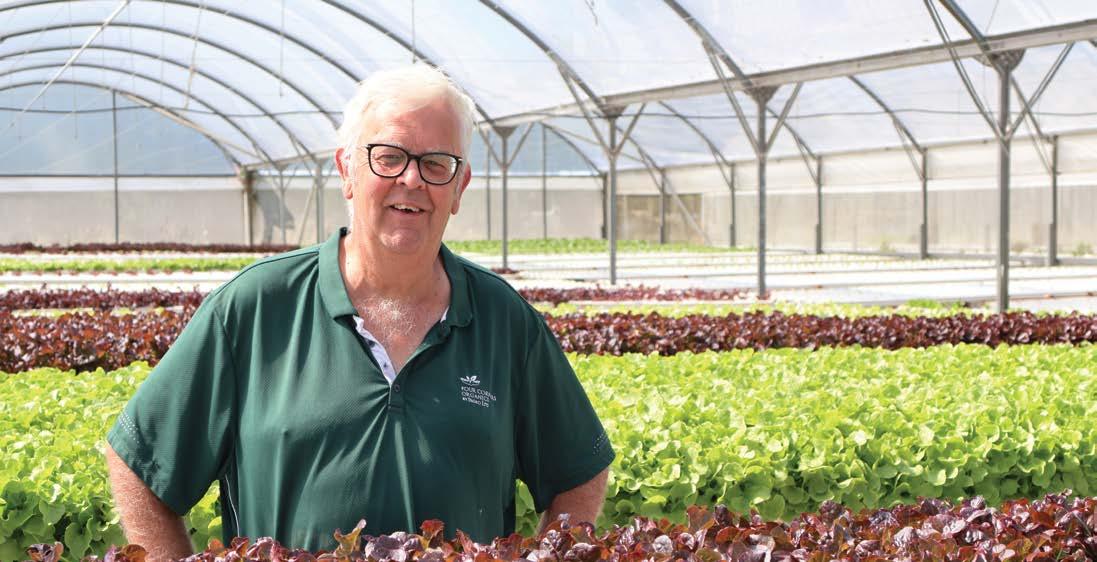
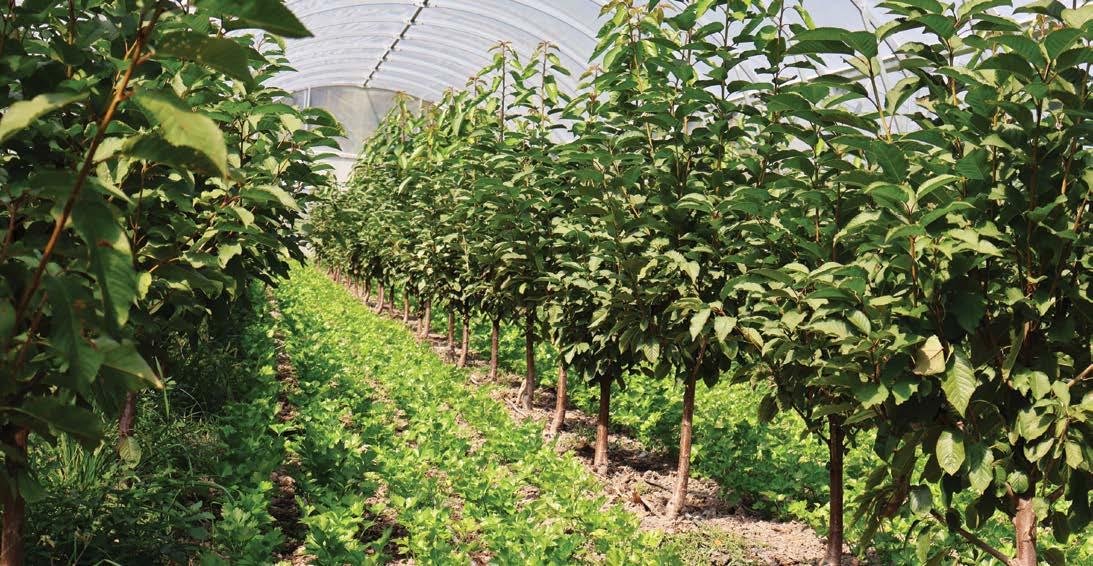
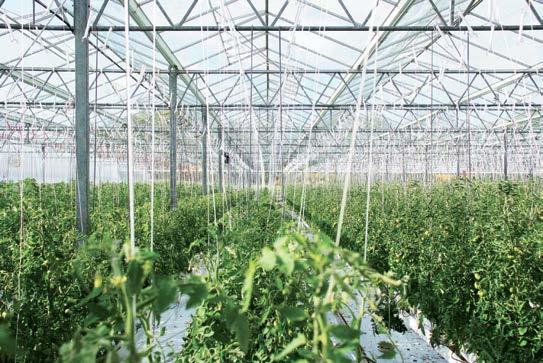
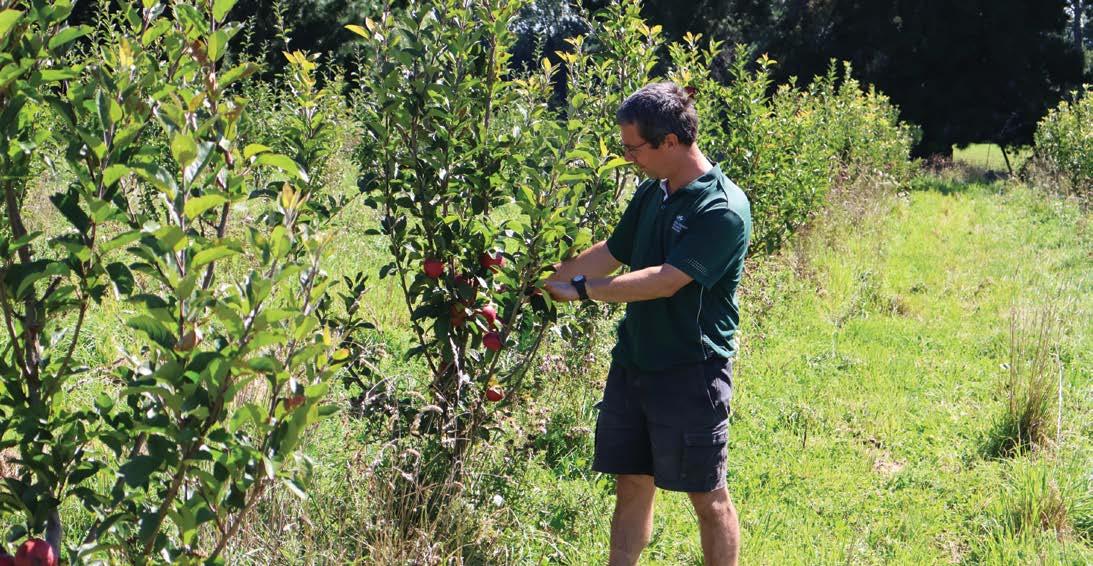
Jos and Rita Paans run Four Corners Organics and Hydroponics near Masterton with son Hendrik. At the farm they grow a variety of organic vegetables including celery, broccoli, eggplants, greenhouse tomatoes – and have recently developed an organic apple orchard and planted cherry trees under cover.
They also grow conventional lettuces hydroponically, supplying the likes of Moore Wilsons in Wellington with varieties including Red Oak, Green Oak, Green Frill, Red Frill, Buttercrunch and Japanese Mizuna. The conventional and organic sides of the business are kept separate. The organic side is certified with BioGro. The farm is also certified with NZGAP.
Like all organic growers in New Zealand, Jos and Rita are preparing for major changes to New Zealand’s organics system.
Essentially, organic certification is moving from voluntary schemes such as those offered by BioGro and AsureQuality
to a government-regulated framework under the Organic Products and Production Act 2023 (OPPA).
By 31 March 2028 at the latest, growers will not be able to market fruit and vegetables as organic in New Zealand without government approval.
To achieve this deadline and give organic operators enough time, the Ministry for Primary Industries (MPI) plans to open the system for approvals on 1 July 2027.
In consultation with industry, MPI is finalising the details of the framework that will determine how organic operators will be audited. HortNZ, on behalf of its organic growers, has submitted on most phases of the consultations, as have many other industry bodies and stakeholders.
Jos believes Four Corners Organics is largely compliant with the new rules and regulations through support from BioGro, but he stays up to date with all the policy development. “I follow all the updates that I’m getting from Emily Levenson at HortNZ.”
Like all organic growers in New Zealand, Jos Paans is preparing for major changes to New Zealand’s organics system
The farm is still growing celery organically until the young Lapin cherry trees mature
Organic system integrity
Jos supports the new organic legislation. “Organic is going to be organic,” he says.
“I sincerely hope that it means the end of the pseudoorganics called spray-free. Because that’s really a big problem in New Zealand. There are quite a few people who sell produce, even through organic shops, which they call ‘organically grown’. So the regulations could help if somebody polices them and if the retailers get behind organic.”
The new system will bring New Zealand in line with international models, says John Thompson, BioGro’s accreditation and technical lead.
“Most major organic markets such as the European Union (EU), United States and Canada already operate regulated national organic systems where the government sets the standard and accredited certification bodies verify compliance.
“From BioGro’s perspective it should strengthen the credibility of the organic claim.”
All products sold as organic in New Zealand will have to meet a new National Organic Standard, including imports.
Marion Wood is executive director at retailer Commonsense Organics, which has five certified organic stores in Wellington and Auckland.
She says Commonsense supports providing clarity to consumers, “Trust in the use of the word organic is really important.”
Wood Pellet Energy Solution
Industry association Organics Aotearoa New Zealand (OANZ) hopes the new system will support organic sector growth. According to the OANZ 2025 Organic Market Report, New Zealand’s organic sector lags behind the rest of the world.
Only 0.6 percent of New Zealand’s total agricultural land is currently under organic production, below the 11 percent in the EU and 2.1 percent global average.
Export markets driving change
However, the main reason to introduce the new regulations is not domestic. Export markets are driving the change. New Zealand’s voluntary standards create problems for trade recognition, threatening our access to markets.
In particular, the European Commission is changing their organic legislation and will require equivalence with EU organic standards before accepting New Zealand products.
“It is export driven but we support that,” Marion says. “It’s fabulous that New Zealand is exporting organics.”
According to OANZ, fruits and vegetables are New Zealand’s largest organic export category, worth $244.7 million in 2024, accounting for over 40 percent of organic exports.
Most of those exports are apples and kiwifruit. NZ Apples and Pears says 4 percent of all hectares planted for export are certified organic.
In kiwifruit, the organic portfolio represents around 4 percent of the total Zespri crop, supplying over 8 million trays, says Michael Fox, Zespri’s head of grower and stakeholder relations.
Over recent years Zespri has seen rapid growth of both Organic SunGoldTM and Organic Green in the United States, the world’s largest organic market. This coming season Japan is set to receive a record 1 million trays of Organic SunGold.
However, the largest region for Zespri’s organic portfolio is Europe. Zespri expects European markets to take 3.8 million trays of Zespri Organics in 2025/26, with around 77 percent from New Zealand and 33 percent from Zespri Global Supply growing regions.
AGRICULTURE LAND CURRENTLY UNDER ORGANIC PRODUCTION
Hendrik Paans caring for the new apple orchard, with young Wairarapa Telstar coming through
EU deadline up in the air
The new organic system has been a focus for Zespri as it seeks to maintain uninterrupted supply into the EU. The new settings will allow New Zealand to gain new recognition and/or equivalency agreements for organics in markets worldwide, says Michael.
“We have worked closely with MPI over the years as it has developed the new organic standards and regulations, with the current Official Organic Assurance Programme (OOAP) requirements expiring in 2028.”
In the absence of a national organic standard, OOAP has set the requirements for organic product market access to overseas markets including the EU, Japan, United States and China.
The OOAP is managed by New Zealand Food Safety. The MPI business unit is also responsible for enforcing the new organic legislation. Deputy director-general Vincent Arbuckle explains that, for export growers, enforcement of the new organics regime may come sooner if MPI can negotiate equivalency with trading partners.
Critically, the European Commission’s deadline for thirdparty equivalence is 31 December 2026.
However, at the end of last year, the European Commission notified New Zealand about a proposal to extend thirdcountry equivalence recognition by a decade. The proposal is just the beginning of the EU legislative process, so nothing is certain.
“MPI has initiated negotiations with the EU and intends to continue prioritising this process,” Vincent says. “In addition, an assessment process for equivalence with the US National Organic Program is underway.”
Grower audit process changing
While export growers will hope that equivalency will help reduce the duplication currently experienced under the OOAP – for example repeated grower audits – additional requirements for some countries may be necessary depending on the outcome of equivalence negotiations.
The new OPPA framework will work in a similar way for both export and domestic growers.
Growers will need to pay for a regular audit from a “recognised entity” (BioGro and AsureQuality both expect to become recognised entities) to verify compliance with the National Organic Standard.
THE NEW ORGANIC SYSTEM WILL BRING NEW ZEALAND IN LINE WITH INTERNATIONAL MODELS, SAYS JOHN THOMPSON, BIOGRO’S ACCREDITATION AND TECHNICAL LEAD
MPI will review applications and decide if growers can make organic claims. MPI is likely to charge growers a regulatory fee. The Cabinet will decide on this fee shortly.
In return for compliance, growers will be listed on a national register of approved businesses. They can also make use of the government’s new organic national mark, which is in development.
BioGro and AsureQuality, which have both been involved in the development of the framework through the Organic Sector Advisory Council, are supporting growers towards compliance.
For example, many organic growers will already be completing their Organic Management Plan, either for voluntary certification or for export requirements. In anticipation of the new requirements voluntary schemes are aligning with the new requirements.
“BioGro has been preparing for the transition to the OPPA and is well placed to support growers, many of whom are already largely compliant with their current practices,” says John. “This puts parts of the industry in a relatively strong position for the transition.
“However, the regulations, notices and supporting guidance under the OPPA still need to be finalised, and there is ongoing work for both growers and certification bodies to fully implement the new framework.
“While many growers are already largely compliant, the National Organic Standard introduces stricter input rules, documentation expectations and audit readiness requirements that will need careful planning and support during the transition.”
MPI is establishing a public register of approved and prohibited inputs for organic production under the OPPA. This is still in development, however once established growers will be required to use only substances listed on the register, follow any specified conditions and circumstances of use, and maintain records for audits.
Reducing the red tape
John says that the audit used for the voluntary certification scheme will be the same used for the national system, so growers will not need to pay for two separate audits.
The new national system also supports group schemes with internal verification, similar to existing group schemes available under NZGAP and through associations like Organic Farm New Zealand and The Organic Traders Association of New Zealand.
Jos is interested in group schemes for organic certification and would like to see integration with other schemes like NZGAP. Like many growers he is frustrated by having the same auditors turn up asking similar questions for different certification schemes.
“We would be interested in anything that brings cost down and still keeps integrity in the system.”
Jos thinks the problem is that compliance comes with inflexible requirements that don’t reflect the reality of seasonal growing or the time demands that multiple audits put on growers.
“It’s a bit sad but by now it’s an almost a zero-trust system. If you miss one piece of paper one year, that’s it.
“The trouble is that all the regulations are written often with large companies in mind that have a compliance management department. Well, I’m the compliance manager, I’m the seedling grower, I’m the chief salesman and you know, all of it. I’m spending 2–3 hours a week on compliance.”
AsureQuality, which is a provider for many audit programmes, say they would support integration of audits with other compliance plans to avoid time-wasting and costly duplicated red tape for growers.
We would be interested in anything that brings cost down and still keeps integrity in the system
“The changes to the rules for gaining approvals have the potential to make it easier to provide this service to our customers,” says Kylea Heaton, AsureQuality Group Services manager auditing.
ASUREQUALITY GROUP SERVICES MANAGER AUDITING
KYLEA HEATON SAYS THE NEW REGULATIONS ARE LIKELY TO INCREASE THE CHOICE OF AUDITORS
She says the new regulations are also likely to increase the choice of auditors for growers, particularly as simplified approval requirements make it easier for sole traders to become registered audit providers.
“This trend has emerged in other domestic sectors under similar changes,” she says.
Consumer recognition
MPI says work is underway to explore options for an organic national mark, and this will include consultation with industry. John says the government-issued mark has the potential to shift how organic products are marketed and how certification bodies manage licensing.
All businesses that are approved by MPI to produce, process and sell organic products will be able to use the mark in their marketing. Use of the mark is optional, and businesses can continue using voluntary scheme private logos under licence.
Kylea says that growers will also need to identify the recognised entity that completed their audit on packaging – using the certification body’s mark will be an acceptable option to comply.
Jos says for now he intends to keep his BioGro licence and use the BioGro mark, even if the government has its own organic national mark.
“I’d hope that it stays like it is. I don’t need an extra mark on my label. I just got a bunch of sticker labels printed.”
Under the new system, international organic producer body IFOAM certification will not be necessary, but Kylea says much depends on how various markets perceive the credibility of the new system.
“We see that during the initial implementation of the National Organics Standard, IFOAM certification will still be important for consumer and market acceptance,” she says. “We anticipate that this will change over time with increasing recognition and acceptance of the National Organic Standard and logos. We will continue to support our customers with IFOAM certification where this supports their activities.”
Micro-credential courses developed by our sector for our sector, enrolments closing soon.
Emerging Leadership in People, Food and Fibre Industries
Supports learners to develop leadership confidence and practical capability to lead teams across Aotearoa’s people, food and fibre industries.
$960 including GST.
Bay of Plenty Cohort 15 June – 23 August 2026
Pukekohe Cohort 29 June – 13 September 2026
Kerikeri Cohort 29 June – 13 September 2026
Freshwater risk management from Horticulture Production Micro-credential
Builds learners knowledge and practical capability to identify, assess and manage risks to fresh water arising from horticultural production.
$640 including GST.
Hamilton start date: Thursday 28 May 2026
Horowhenua start date: Friday 25 September 2026
Where Production Meets Post-Harvest Micro-credential
Develops learners’ capability to analyse and optimise horticultural production and post-harvest systems from ‘paddock to plate’.
$1,280 incl GST.
Course Schedule:
Orientation: Tuesday 2 June 2026, 4:00 PM – 5:00 PM
Weekly Classes: Wednesdays, 4:00 PM – 9:00 PM
(from 3 June to 19 August 2026)
Field Trip: 24 June 2026 (1 day)
For more information: www.fruition.ac.nz/programmes
Price increases passed on to consumers
Marion says Commonsense’s customers know and trust the integrity of the audits underpinning the current voluntary schemes – Commonsense is also certified as a retailer. The retail brand is another way customers develop trust in the integrity of organic produce.
Some of Commonsense’s fresh produce suppliers are very small, although not so small that they fall under the threshold for exemption from the new compliance requirements.
“We do want to support small and local businesses, people that we know are committed to organics, but [the new system] is heaping red tape on small businesses. If they don’t comply, they won’t be able to use the word ‘organic’.”
She says that Commonsense will wait until the regulations are finalised before deciding any changes to their supplier base. It is clear, however, that it will not help to bring down the cost of organic fresh produce.
Organics have become more expensive, but it’s not the growers setting the price or profiting from the premium
“Organic growers are having to pay more for not polluting,” she says.
Commonsense will also need to have an audited Organic Management Plan because they are selling loose produce.
“We want to sell loose produce to use minimal packaging,” she says. “The larger retailers mostly sell pre-packaged organic produce, which is not captured by the new system. So we have extra compliance costs heaped upon us and those have to be shared with our customers. But our customers know that, and they support organic produce, because it’s very needed.
“The New Zealand government has very seldom supported organics. Most other jurisdictions do a lot to support growing organics.”
She highlights the EU – New Zealand’s largest organic produce export market and the very market driving New Zealand’s new organic legislation. The EU has comprehensive policy support for their organic growers.
The European Commission’s Farm to Fork and EU Biodiversity for 2030 strategies set a target for at least 25 percent of the EU’s utilised agricultural area to be organically farmed by 2030. In addition, the Vision for
Agriculture and Food confirms the relevance of continuous support to organic farming. Although the EU is unlikely to hit its target, organic farming already covers an estimated 17.4 million hectares across EU countries.
“What New Zealand organics needs is genuine support and incentives from government to have a clean green country,” Marion says.
While Jos hopes that the system improves the integrity of organics in New Zealand, he’s not expecting the legislation to fix the bigger problems in New Zealand’s food system – problems that have only become worse since he and his wife Rita immigrated from the Netherlands in 2007.
Something’s got to change
Organics have become more expensive, but it’s not the growers setting the price or profiting from the premium.
Approved organic fertilisers, nutrition and crop management inputs cost a lot more than conventional inputs, and deliver less in improved yields. Input costs are also increasing quickly, Jos says, among the many other cost pressures for organic growers.
“Organic growers are mainly small scale or medium scale growers which necessitates a relatively high level of manual labour – which brings with it a fairly high costing. Then the transport is more expensive because the volumes are smaller, that’s another extra cost.
“And then the fun starts because the multiplication factor comes in [as wholesalers and retailers add their percentage on top]. So the end result is a lot higher costs for organic food. For lots of people, their budgets are too stretched and it’s ultimately for the happy few.
“Something’s got to change. People growing the vegetables have to make a living. It’s that simple but it’s become a bit of an issue the last few years. The way the market is running, I can’t see that changing in a hurry. If you want to make any difference to the food system, talk to the supermarkets.”
Meanwhile, Jos and Rita are enjoying life as son Hendrik works more on the farm. They try to make time for their 29 grandchildren (yes 29) spread around the world.
The farm continues trials on new varieties, improving production techniques and building on its organic foundations. Despite the difficulties on the domestic market, Jos still strongly believes in the benefits of organic produce for health, wellbeing and the environment. At the end of the day, growing is the reward.
“One great thing about being an organic grower is that you tend to eat very well!”
NATURAL HAZARDS AND OUR FOOD SUPPLY
Increasingly damaging adverse weather events are not just a problem for growers, HortNZ argues. The Government has a role to play to reduce risks for the sake of all New Zealanders who depend on our fresh produce.
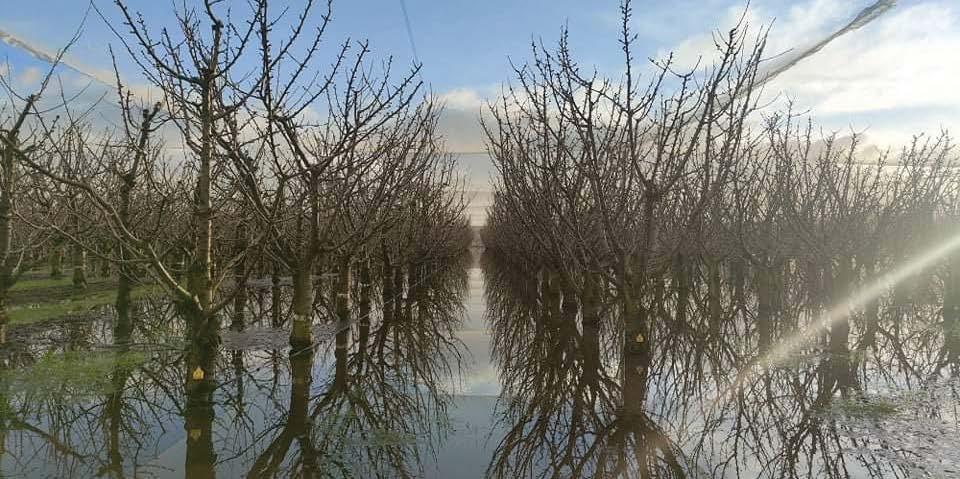
It seems like every year brings several new big flooding and other adverse weather events to growing areas, from the Auckland Anniversary Floods to Cyclone Gabrielle to Tasman. Just this year we have seen flooding in the Upper and Lower North Island and April’s Cyclone Vaianu.
Floods can have severe consequences for growers including crop loss, damage to infrastructure and impacts on soil health.
You might wonder what the policy-makers in Wellington are thinking or doing to help the horticulture industry manage the risk and reduce the impacts of future events. From my perspective, the answer is that climate adaptation is a hot topic and focus for new law and policy but the Government’s thinking about the specific impacts on food supply is less clear.
HortNZ has been consistently pushing for the Government to:
1 Understand and plan for the impact of adverse weather events or other big disruptions on food supply and export
2 Recognise that enabling rules are needed for horticulture throughout the country because regional diversity in where food is grown makes our food system more resilient
3 Not apply the same policies for urban hazard risk to rural environments.
These might seem like common sense, but it’s not always a given based on the draft versions of policies that we sometimes see. That’s why you need a horticulture voice in the room, making sure the Government hears about the importance of fruit and vegetable production at all stages – from when a policy idea is dreamed up to when it’s implemented. Here are a few examples of policy work happening in the adverse weather, flooding and climate adaptation space.
Building resilience to hazards: Long-term insights briefing
Policy writers and planners describe the potential for flooding or slips as “natural hazards”. Planning for natural hazards is part of the resource management system, and councils are required to consider them in their regional and district plans.
The Government asked the public for feedback on a Longterm Insights Briefing on Natural Hazards. The purpose of these briefings is to plan into the future, beyond the usual 3-year election policy cycle. The draft report for consultation did not mention water storage, the role of flood protection, infrastructure or food.
In our submission, HortNZ argued that food supply chains, including the roads and freight that are essential for moving fruits and vegetables to population centres, should be considered part of the critical lifelines in the event of a major emergency. We also argued that ferries, domestic shipping, flood protection and water storage have roles to play in the resilience of New Zealand’s food system.
The Government took up many of our submission points in their final report, even directly quoting HortNZ’s phrasing, writing, “A resilience-focused approach means… strengthening the systems that keep food supply chains running during crises, recognising these as critical lifelines.”
National Policy Statement for natural hazard management
HortNZ had the opportunity to submit twice on a National Policy Statement for Natural Hazard DecisionMaking at different stages in the drafting process. In our first submission, we cautioned the Government that applying the same formula for hazard risk to urban and rural areas could have unintended consequences for horticulture.
For example, district plans often say that seasonal workers’ accommodation can only be located in rural areas. Horticultural land is often on flood plains, and workers’ accommodation needs to be close to the farms and orchards for many reasons. If urban risk accounting was applied to workers’ accommodation, it might say that this housing couldn’t be located in horticultural areas because of flood risk but also couldn’t be located in urban areas because of other planning restrictions – leaving nowhere left to put it!
Based on HortNZ’s submission, the second version of the National Policy Statement released for public consultation did not apply to primary production, allowing time to have a specific conversation about what appropriate hazard management looks like in rural zones in the future.
Natural Environment Bill
The Government is replacing the Resource Management Act, which directs how all the regional and district plans in the country are made, with two new laws – the Planning Bill and the Natural Environment Bill. “Adapting to the effects of climate change and reducing the risks from natural hazards” are two of the objectives of the new laws. In HortNZ’s submission, we asked that the Bills more specifically support community water storage as a form of climate adaptation to increase resilience to drought. We also talked about how spatial plans could be used to plan for flooding risk at a catchment scale, understanding how activities in the upper catchment create impacts downstream during weather events with erosion or woody debris.
Regional advocacy
Following recent flooding events in the regions, work has been needed to clear silt, free up drainage networks and bring the community together to build resilience to future weather events.
HortNZ has been part of these conversations alongside growers, to get remedial works done – for example, silt and debris removal from creeks and ditches in Brooklyn and Riwaka. Together we are raising awareness of growers’ vulnerability to flooding in the lower catchment with those further up the catchment with the ability to slow water and reduce erosion on their land.
What to expect in the policy world
Adverse weather events are becoming more common and severe with climate change. The Government has signalled that they don’t want to spend as much on recovery into the future.
It would not be a surprise if climate adaptation continues to be a focus of policy frameworks, with officials and councils thinking about how to plan ahead and mitigate the damage from adverse weather events. They’ll also be thinking about who will pay (or not pay) for recovery.
HortNZ will keep pushing to get the resilience of domestic food supply and exports on the agenda, helping officials understand how policy will play out in the rural environment.
GROWING IMPACT THROUGH EDUCATION AND INDUSTRY SUPPORT
Since its establishment in 2021, the MG Charitable Trust has set out with a clear purpose which is to support and strengthen New Zealand’s horticulture industry for the benefit of growers and the wider sector.
Ellery Tappin : MG Group general manager communications and sustainability
While still relatively new, the MG Charitable Trust is already demonstrating the value of targeted investment and a long-term approach to building capability.
The Trust is funded by grower owned cooperative, Market Gardeners Limited, trading as the MG Group, which provided an initial cash donation, with ongoing funding generated through annual distributions from shares held by the Trust.
The Trust is governed by five elected Trustees, including four growers and one independent member, who make all decisions about how funding
is allocated. While the Trust is supported by the MG Group, it operates independently, ensuring funding decisions remain focused on what will deliver the greatest benefit to the industry.
To date, the Trust has supported 25 projects and initiatives across the industry, with funding distributed on 33 occasions. Alongside this, 24 individuals have been supported through the Education Fund. In total, $471,489 has been distributed, reflecting a growing commitment to backing programmes and people that deliver meaningful outcomes for horticulture.
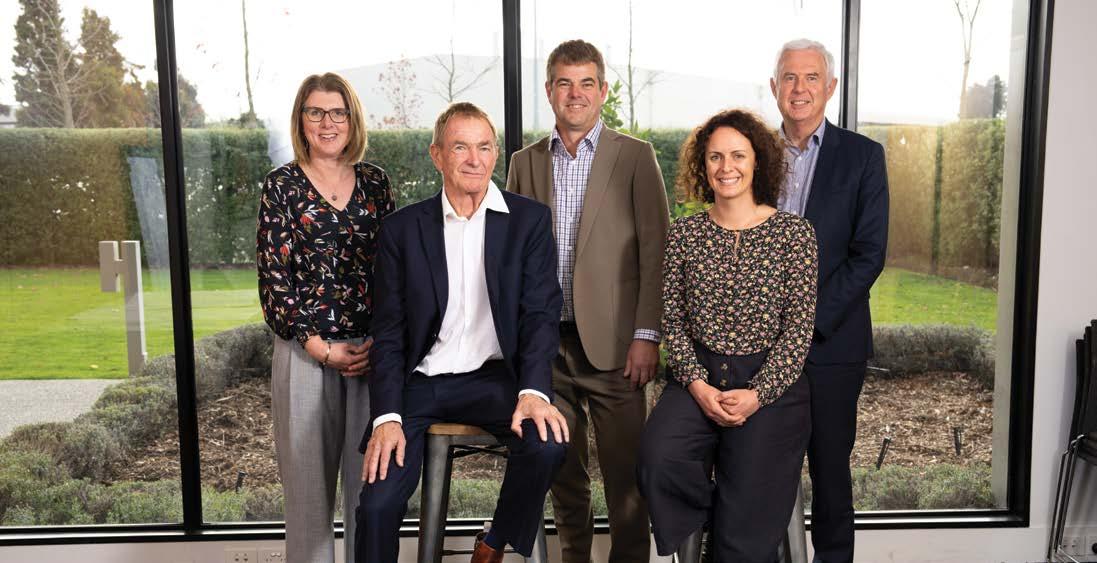
MG Charitable Trust trustees from left: Trudi Webb, John Clarke (chair), Robin Oakley, Catherine Lewis and Alastair Hercus (independent)
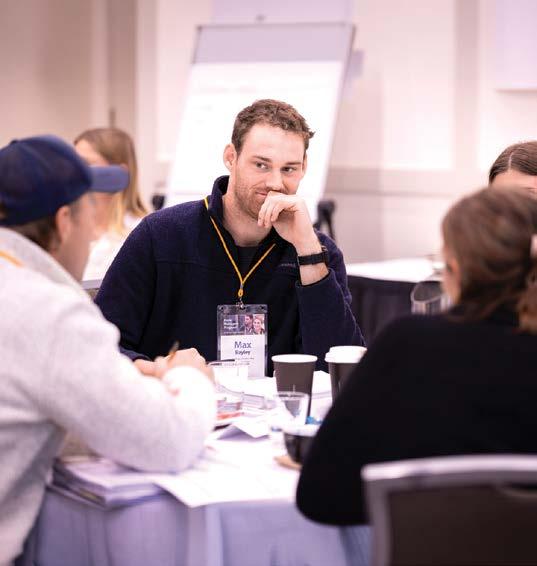
Grower Max Bayley participating in the Rabobank Farm Managers Programme with support from the MG Charitable Trust
Chair John Clarke says the Trust’s greatest impact to date has come through its focus on education and the opportunities it has created for growers to build their capability.
“When we look at what has made the biggest difference, it is clearly the investment in education. Programmes like the Rabobank Farm Managers Programme and the Rabobank Executive Development Programme have been incredibly impactful for our growers. They are helping people grow not just in their roles, but in themselves and in their businesses.”
While the Trust has supported a wide range of initiatives, John says the ability to invest meaningfully in education has been a key driver of its strategy.
“With a relatively limited pool of funds, we have been able to make a real impact by focusing on education. It allows us to support people in a way that delivers lasting value, rather than spreading our resources too thinly.”
The Trust’s Education Fund has become a key vehicle for this approach, supporting individuals to access training, development opportunities and experiences that may otherwise be out of reach. These opportunities are often at the higher end of the market, where cost can be a barrier, and the Trust plays an important role in bridging that gap and improving access for growers.
The programmes supported through the Trust are designed to complement, rather than replace, other education opportunities available across the sector.
They are typically tiered, offering pathways for emerging leaders, more experienced growers, business owners seeking strategic development and those progressing towards governance roles.
Together, this approach reflects the increasing complexity of the industry and the growing range of skills required to succeed. Building capability across all levels is seen as a critical way to strengthen both individual businesses and the sector as a whole.
Alongside its education focus, the Trust has continued to support a range of industry initiatives through its contestable funding. This has included backing grower field days following Cyclone Gabrielle, helping reconnect growers and support recovery, as well as contributing to projects such as the Horticulture Innovation Centre in Katikati and supporting the Agribusiness in Schools programme.
“These initiatives are important and they do make a difference. They support innovation and awareness of our industry.”
In recent years, this thinking has led to a deliberate shift in strategy, with the Trust reducing the number of contestable funding rounds to one each year and placing greater emphasis on education.
“Education has become the cornerstone of what we do because it is where we can have the most meaningful and lasting impact with the resources available.”
The next contestable funding round will open in November, followed by the Education Fund round, providing further opportunities for growers and organisations to access support.
As John prepares to step down as chair in November, he reflects positively on the progress made and the direction the Trust is heading.
“It has been very rewarding to be part of something that is genuinely focused on the good of the industry. The foundations are strong, and we are already seeing the benefits of the approach we have taken.”
Looking ahead, he believes the Trust is well positioned to build on that momentum.
“As the Trust continues to grow its funding base, I see it continuing to focus on education and providing a wider reach to assist with projects. If we keep investing in people, capability and other initiatives, then the Trust will continue to make a real difference for growers and for the industry as a whole.”
As the MG Charitable Trust continues to evolve, its focus remains firmly on supporting the long-term success of New Zealand horticulture. As its resources grow, so too will its ability to back more initiatives, support more people and make an even greater contribution to the future of the industry.
BIG FRUIT — NOT NECESSARILY BETTER FRUIT
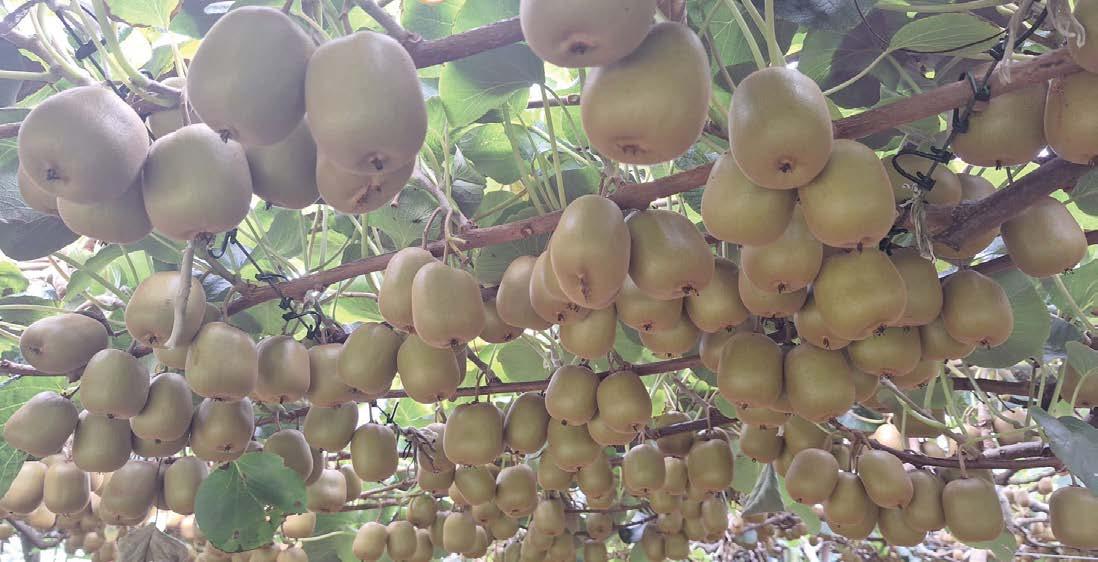
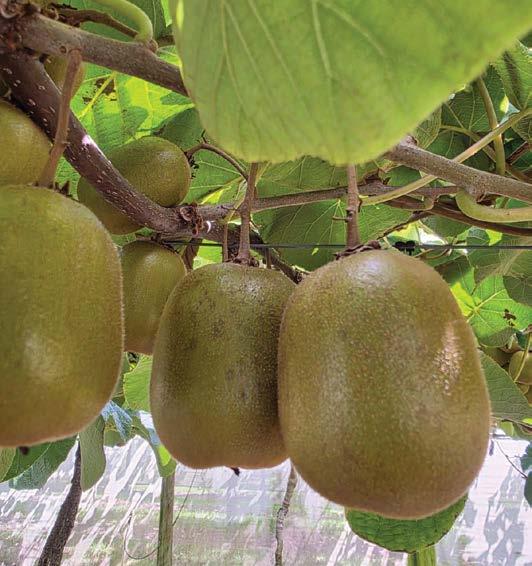
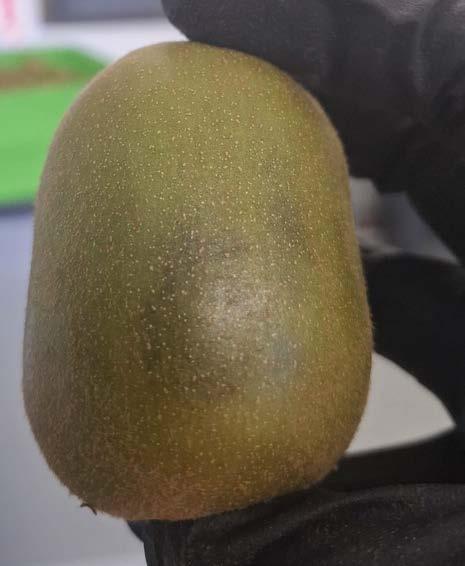
This season started with some red kiwifruit growers reporting very large fruit, rapid softening, and in some cases fruit drop. People half-jokingly called it “kiwifruit jam” on the orchard floor – funny, but not funny, because behind that was a genuine concern around fruit structure, firmness and storage potential.
Kasia Frelikow : Technical and sustainability specialist at DMS Progrowers
Some samples were coming in at 140–160g, which is well beyond the typical commercial range for red cultivars. Zespri even introduced modified firmness dispensations to help manage soft fruit risk in Red19. Alongside this, there have also been reports of small black pitting, brown lesions or side rots, and grey spot. These symptoms may not all share a single cause, but they point toward a season where fruit integrity is under pressure.
When we step back, a few factors appear to have aligned at once:
A wet sizing period with frequent rainfall and high soil moisture
Continued use of girdling as a fruit sizing and dry matter tool
Increased interest in naphthalene acetic acid (NAA) as a size enhancer
Generally strong vine growth and canopy activity.
Individually, none of these are new.
However, with recommendations around two size girdles, and a large number of growers participating in NAA trials, some orchards effectively received multiple size-enhancing treatments – in a season that was already naturally favouring strong fruit growth.
Once several drivers start pushing in the same direction, the plant doesn’t separate them. It responds to all of them.
Fruit size vs fruit structure
This is probably one of the most important ideas in this whole discussion. Fruit size and fruit strength are not the same thing.
Fruit growth in kiwifruit occurs largely through cell expansion, particularly after the early phase of cell division.
As cells expand:
• Cell walls become thinner
• Tissue density decreases
• Structural integrity becomes harder to maintain.
While large fruit may look impressive, they are not more resilient.
In fact, under certain conditions, rapid expansion can result in fruit that are visually large but structurally weaker, making them more prone to softening and postharvest issues.
Large fruit are not automatically better fruit.
Risk arises when cell expansion (water-driven, osmotic – largely potassium driven) outpaces carbon supply (photosynthesis, dry matter accumulation) and structural/mineral support (particularly calcium). That imbalance is where things start to shift.
Potassium is linked to water uptake
Kiwifruit is often described as a potassium-hungry crop, and potassium fertilisation is frequently prioritised.
Interestingly, potassium does not contribute to building structural components of the plant. Instead, it primarily accumulates in both cytoplasm and vacuole, helping drive cell expansion.
One of the key aspects often overlooked is how closely potassium is linked to water movement. Potassium uptake and transport are strongly tied to mass flow in the soil, water uptake by roots and movement through the xylem into expanding tissues.
So when water availability is high, potassium supply to the plant is also high. Under wet conditions: more water is taken up, therefore more potassium is delivered to the plant and finally more potassium accumulates in expanding fruit.
At the same time, potassium plays a central role in maintaining cell turgor, effectively drawing water into cells and driving expansion. Because potassium doesn’t just move with water – it helps move water into the fruit.
When supply exceeds demand
Plants are highly tolerant to potassium and can accumulate large amounts of it, often exceeding their actual nutritional requirements. In fact, potassium is one of the most abundant cations in plant tissue, sometimes making up a significant proportion of dry matter.
When potassium availability in the root zone is high, vines can take it up in excess of what is needed for optimal growth – a phenomenon known as luxury consumption.
Potassium and nutrient balance
However, high potassium levels can interfere with the uptake of other key nutrients – particularly calcium, magnesium, zinc and iron – through a process known as cation antagonism.
This is where potassium becomes more than just a growth driver. It influences nutrient balance within the soil-plant system.
Under conditions of strong growth, high water availability and high potassium supply this system can shift toward rapid cell expansion and increased water content in fruit, which leads to reduced relative calcium accumulation.
Red kiwifruit growers reported very large fruit this season
Basically more potassium in the root zone can mean less effective calcium uptake and distribution.
Although potassium is essential for driving fruit expansion, its abundance – especially under favourable growing conditions – may come at the expense of structural balance within the fruit. Potassium doesn’t build the fruit – it fills it.
Calcium – the structural limitation
Unlike potassium, calcium builds structure.
Calcium movement in plants is:
• Non-mobile within the plant
• Transported primarily via the xylem
• Driven by transpiration, not active uptake.
This means the plant cannot redistribute calcium once it has been deposited.
And more importantly: fruits are weak sinks for calcium. Most calcium accumulates in leaves and roots.
Only a small proportion reaches the fruit. And that is why when it comes to calcium, timing is everything.
Calcium concentration in kiwifruit is highest early after fruit set and then declines rapidly as fruit growth accelerates. The window for calcium accumulation is short – roughly the first 5–6 weeks after fruit set.
After that, even if calcium is available in the soil, the fruit’s ability to accumulate it is limited; foliar applications tend to have limited impact on fruit calcium levels, as demonstrated in recent trials.
Wet weather
This season’s weather likely played a big role. We’ve seen this before – for example in seasons like 2021 and 2022, where rainfall during the key dry matter accumulation period likely limited photosynthesis, and fruit simply didn’t ‘fill’ at the same rate they expanded.
Under wet or humid conditions transpiration drops and calcium movement to fruit is reduced, at the same time soil moisture is increasing, water uptake is strong and potassium-driven expansion continues: fruit keeps expanding… but calcium isn’t keeping up.
Potassium doesn’t build the fruit –it fills it
This season is slightly different. We had rainfall during the period when calcium can enter the fruit, and overall dry matter results are actually quite satisfactory. But that doesn’t mean everything is solved – what it tends to do instead is shift ratios, and that can still have downstream effects on firmness, storage disorders and final eating quality.
Some red kiwifruit were coming in at 140–160g, which is well beyond the typical commercial range for red cultivars. Photo by Phoebe Scherer
Reports of small black pitting, brown lesions or side rots, and grey spot point toward a season where fruit integrity is under pressure. Photo by Phoebe Scherer
Putting it together – a system, not a single cause
Looking at each factor in isolation does not fully explain what we’re seeing. But when considered together, a pattern emerges:
• NAA contributing to increased sink strength
• Girdling increasing carbon flow to fruit
• High potassium supporting osmotic expansion
• Abundant water enabling rapid growth
• Reduced transpiration limiting calcium supply.
This is not a single-cause problem. It is a stacked system effect. When multiple growth drivers align in the same direction, the system can be pushed beyond what the fruit structure can support.
I think the practical takeaway is that large fruit are not the problem – imbalance is. We still operate under knowledge that is 30–40 years old. And what has changed in those decades? Even the last decade? Practically everything.
The challenge is that our industry operates under quite a blanket approach, rather than tailoring inputs to the season, soil and crop behaviour. Recommendations are usually made in winter and the majority of fertiliser is applied early. Only a few growers keep an eye on leaf testing and adjustment if needed.
I’m currently working with growers taking slightly different approaches, such as:
Base saturation and calcium prioritisation
Focus is placed on cation balance rather than absolute levels, maintaining calcium dominance in the exchange complex. Calcium underpins cell wall strength and membrane integrity, translating into improved firmness and storage resilience.
Reducing fertiliser load, particularly KCl (MOP)
There is a shift away from potassium chloride (KCl). Both K+ and Cl- drive osmotic regulation and water movement, promoting cell expansion rather than structure. Excess K can antagonise Ca, Mg, Zn and Fe uptake, while chloride may accumulate under higher rainfall or irrigation.
In-season leaf testing
Supports demand-driven inputs, allowing more precise nutrition and often reduced fertiliser use.
There are different ways to create balance or at least to aim for it.
Rapid expansion can result in fruit that are visually large but structurally weaker, making them more prone to softening and postharvest issues
Measuring the volume of water caught in a bucket during an irrigation performance assessment or ‘bucket test’. Depth applied, uniformity and intensity are all important factors to check
LANDWISE TOOLS FOR GROWERS AND AGRONOMISTS
LandWISE is a charitable organisation providing leadership and support for the development and support of sustainable production. We have been adding to our tools provided to assist growers and agronomists to refine their operations. They include tools for better nutrient management, better water management, and assessing current and possible greenhouse gas footprints.
Our fertiliser equipment calibration checkers are now available as simple pages on the LandWISE website. These tools do not retain your data – everything is done on your computer via a browser. There is one for machines that spread by throwing, and one for placement machines such as planters and side dressers. If you want your data held for you, log on to our fertspread.nz site which holds your information in a database for future reference.
Nitrogen Quick Test strip
To further support efficient nutrient management, we worked on a tool to refine Nitrogen Quick Test strip results.
Using a Nitrachek device to read strips, rather than guessing off the side of the tin, you can get a precise nitrate concentration. Our Nitrachek Calculator has appropriate calibrations and conversions that allow you to convert this to lab quality kg N/ha amounts.
Irrigation Efficiency calculator
In 2003, Page Bloomer Associates set out to build an Irrigation Efficiency calculator that they called IRRIG8. Since then, there have been a few versions and now we have been given web-based calculators for most irrigation system types and for pressure and energy analysis. These calculators do not store any data, so your information is yours and yours alone. When you close or refresh the calculator, your data is deleted (we see this as a feature, not a bug!). But you can download any reports, charts or results files you want before you close and leave. See www.pagebloomer.co.nz/irrig8-online/
One of the problems of spray application can be irrigation application intensities that exceed the soil’s infiltration rate. The result is surface ponding. The result of that is redistribution from slightly higher to slightly lower areas, which can affect crop performance. Even if the irrigation application uniformity is excellent, excessive application rates cause over and underwatering. We made a tool to help determine infiltration rates using disk permeameters. These are not the sort of tool an average grower has, but we would like to see more consultants using them, not only for irrigation, but as a measure of soil health.
The Nitrachek device gives precise readings of nitrate concentrations measured by Quick Test strips. The LandWISE calculator ensures these readings are accurately converted to kg N/ha for nutrient balances and determining fertiliser rates
Setting out a line of catch trays for fertiliser spreading equipment calibration testing to assess distribution patterns
Carbon Calculator
Our Carbon Positive project is focused on soil carbon levels, so we want to sequester as much as we can and lose as little as possible. But CO2 is only one critical factor. Nitrous oxide from fertiliser is one of the biggest contributors to our modelled greenhouse gas footprint. For those involved in cropping, our Carbon Calculator lets you enter your information and easily generate reports. Ours shows nitrogen fertiliser is our biggest factor by far, followed by diesel. Stock are also big emitters, so together with winter treading damage, they are a significant impact on our growing systems. But sheep and cattle do make money, and a lot of other enterprises present.
See the www.landwise.org.nz/home/tools/carbon-calculator
LANDWISE 2026 –SOIL HEALTH FOR PROFIT
Havelock North Function Centre | 27–28 May
The 2026 LandWISE Conference Soil Health for Profit theme in 2026 is, in some ways, a return to the past. LandWISE arose out of work to combat soil erosion through use of minimum tillage and we’re returning to strip-till in 2026. A lot has been learned in the intervening years! Along with that, we’ll look at what can be done to measure and manage crop nutrition and soil health to ensure sustainability and long-term profitability.
We have international speakers from Pennsylvania and Tasmania complementing national and local growers and experts. They will share how they set out to build profitable enterprises with a focus on soil health and an eye to wider sustainability ambitions. We’ve asked them to offer ideas of things to take home and apply or try – to feed the appetites of keen delegates.
We have talks from people applying regenerative principles in cropping, pastures and orcharding, talks on strip-till and crop-stacking, soil amendments and cover cropping, and managing and minimising the cost of nutrient programmes. As always, expect representation of agritech covering a wide range of technologies. Register at www.landwise.org.nz
Antagonism
Decreased availability to the plant of a nutrient due to the action of another nutrient
MULDER’S CHART
Synergism
Increased availability to the plant of a nutrient due to the increase in the level of another nutrient
USING THE CAL-MAG RATIO IN REGENERATIVE KIWIFRUIT
PRODUCTION
When a Bay of Plenty kiwifruit grower decided to implement a biological practice based on regenerative horticulture principles, the initial soil and Soil Food Web analysis served as a starting point for a fundamental shift in thinking about pH and Calcium levels.
Jan
Pieter de Jong : Soil Craft NZ agronomy consultant
While we are approaching season’s end and our fruit is almost harvested, our focus turns to stock-taking the minerals and ascertaining the biological strength in our soils by means of analysis.
Let’s look at a scenario that we encountered in a kiwifruit orchard from one of our customers.
The Hayward Green orchard had been farmed conventionally for decades. Yield had been steady but the orchard had a significant number of dead and sick vines, which amounted to about 1ha being unproductive.
The orchard management company had obtained a standard analysis that was passed on to the grower.
We learned through the soil classification that the orchard has a soil structure that is quite homogenous and with very good Organic Matter levels.
The Cation Exchange Capacity (CEC) was 23 (range 12–25), indicative of the high ability of that particular soil to hold nutrients. The Base Saturation (BS) percentages were as follows: Calcium (Ca) 76 percent, Magnesium (Mg) 8 percent, Potassium (K) 3.2 percent, Sodium (Na) 0.2 percent. The pH was 6.6.
Figure 1: Mulder’s Chart explains the antagonistic and stimulating action that minerals have on each other
The grower had received a conventional fertiliser recommendation to apply a large input of lime, combined with other minerals.
Due to some previous understanding of a biological practice, the grower decided to investigate if a regenerative approach could offer a different recommendation with the goal of reducing input costs, improving fruit nutrient density and lifting overall vine health.
The regenerative approach doesn’t set such parameters but instead aims to optimise fertility and grow food with enhanced post-harvest condition
The grower got in touch with me at Soil Craft. My consultancy assists growers and provides an off-ramp from a conventional practice and an on-ramp for a biological practice based on regenerative agriculture principles.
I’ve been through this process myself as a conventional grower, managing our family avocado orchard and after years of managing orchards in the kiwifruit industry.
That’s where my passion comes from to support other growers to make the same switch to a biological practice based on regenerative principles.
Calcium’s importance
Conventional parameters highlight the importance of adequate Ca presence.
Kiwifruit orchards receive a valuation based on whether their fruit is high or low risk in terms of on and offshore storage. Fruit that is classified as low risk appears to have adequate Ca presence that ensures storability, enhancing post-harvest condition. Fruit that stores and travels well has payment incentives attached to it.
The regenerative approach doesn’t set such parameters but instead aims to optimise fertility and grow food with enhanced post-harvest condition.
Understanding that “No mineral is an Island”, we give particular attention to the Base Saturations (BS), as reflected in the analysis, to formulate the fertiliser composition to support the soil fertility programme.
From a plant physiology and mineral perspective, we know that Ca is involved in the transfer of minerals between cells. It plays an indirect role in photosynthesis as it directly impacts the uptake of key minerals involved in chlorophyll management.
In the natural world we find that minerals can be divided in cations and anions and are grouped and based on their electrical charge (table 1). Positively charged ions are called cations, while negatively charged ions are called anions. Their respective charges determine the storage, plant availability and interplay between minerals in the soil.
Figure 2: The beneficial impact of the intake of oxygen and outbreath of CO2 is dependent upon the friability of your soil. Image courtesy of Nutri-Tech Solutions
MAJOR CATIONS
Calcium Ca++
Magnesium Mg++
Potassium K+
Sodium Na+
Hydrogen H+++
Aluminium Al+++
Ammonium NH4 +
MAJOR ANIONS
Phosphate PO43−
MINOR CATIONS
Zinc Zn++
Iron Fe+++
Manganese Mn++
Copper Cu++
Cobalt Co++ or Co+++
MINOR ANIONS
Borate BO3
Sulphate SO42− Molybdate MoO4 2−
Nitrate N NO3
Table 1: Minerals can be divided into cations and anions and are grouped and based on their electrical charge
The BS consist of six minerals, but the focus generally is on Ca, Mg, K and Na values. The percentages reflect the presence or saturation of one of those four minerals on the clay colloid. The colloid is negatively charged and has a determined number of electrical exchange sites. The ability of the colloid to exchange cations (CEC) is reflected in centimoles of positive charge per kilogram and represents a measure of how many positively charged nutrients the soil can hold.
The expression, “No mineral is an island” is underpinned by studying Mulder’s Chart (figure 1). The chart explains the antagonistic and stimulating action that minerals have on each other. Mulder’s Chart indicates that Ca can have an antagonistic effect on seven other minerals, impacting plant availability.
The conventional recommendation to increase Ca with a large input of lime would therefore further antagonise the uptake of seven other minerals.
You could argue that under-liming is preferable to overliming, which is a major problem. In this situation, overliming the orchard would likely increase incidence of pest and disease pressure. Sap Brix degrees would stay low. Leaf analysis would likely display depressed mineral presence.
Soil acidity in kiwifruit production
Fertility is predominantly determined by the interaction of the BS that determine pH. Since Ca is a major cation it has a huge role to play in pH manipulation. But the other five major cations also play a role, especially Mg.
The late brilliant consultant Bruce Tainio discovered the relevance of sap pH. How does it compare to minerals in the soil? The pH of plant sap is governed by the same minerals that alkalise or acidify both the soil and our bodies. The ideal pH in all three systems (plant, soil and human) is identical. Our urine and saliva should ideally be pH 6.4 upon awakening, just as the plant thrives at that pH. Interestingly, the soil delivers its mineral bounty most ably at that same pH point.
Blueberries, so they say, need a more acidic environment, as do Rhododendrons, but we are still talking about a pH of around 6.0–6.2. Back to Nature; by design kiwifruit is a berry too, and thrives in a forest ecosystem with a preferred pH of around 6.2–6.5.
Part of that level of acidity is needed to promote fungal proliferation that by definition prospers in a slightly more acidic environment. These fungi contribute to that pH environment by their presence and the ‘job’ they do.
Despite the 76 percent Ca and the orchard’s pH of 6.6, the fertiliser recommendation of further lime inputs would push the pH further towards alkalinity and away from the desired pH.
So pH is not the problem that needs addressing on this orchard. Instead the regenerative approach sees the problem in the Cal-Mag Ratio.
The Cal-Mag Ratio
The Cal-Mag Ratio (Ca:Mg) is one of the core principles in regenerative horticulture. The regenerative approach considers the ratio as more important than the absolute levels. The ratio is crucial to create the mineral conditions that promote soil fertility.
Regenerative orcharding is crafting an orchard ecosystem that adheres to the perfect blueprint of Nature while
maintaining profitability
Ca determines your soil’s capacity to breathe. Oxygen (O2) is the most important element for high-production fertility. By managing gas exchange we influence how freely O2 can diffuse into the soil. Then, after the roots and microbes have breathed in O2, they breathe out CO2 That outbreath accumulates in the rootzone, diffuses out of the soil and into the waiting stomates (the entry point for this gas). There, in conjunction with water and sunlight, we have the basis of photosynthesis – the most important process on the planet. The beneficial impact of this intake of O2 and outbreath of CO2 is dependent upon the friability of your soil (see figure 2). That breathing capacity is determined by the Cal-Mag Ratio.
Ca and Mg have a unique relationship, where one can displace the other from the clay colloid, where they are stored. In this unique relationship, on a one-to-one basis, it appears that until this natural balance has been achieved, the breathing capacity of your soil slows right down.
Regenerative approach and results
Looking at the Cal-Mag ratio, the orchard’s Ca was too high at 76 percent and the Mg was too low at 8 percent. Ideally we would like to see Mg increase to 10–12 percent, displacing Ca which will drop to 65–68 percent.
We resolved that, instead of lime, the orchard received Magnesium carbonate (Magnesite) to start the displacement process to balance the soil.
We further added some Potassium sulphate (SOP), some slow-release N, Sodium molybdate, Cobalt sulphate, and NTS soluble humate granules to buffer the salt index of some of the fertilisers and to provide fungal food.
The leaf analysis in spring confirmed that some minerals were low, which we compensated for through alternating foliar sprays containing a rich and balanced mineral cocktail, seaweed from three different species, growth hormones, Pseudomonas fluorescens and fulvic acid for greatly enhanced delivery and uptake.
Boosting the soil and roots came through a sophisticated mix with microbial inoculants. The addition of Calcium nitrate, Magnesium nitrate or Magnesium sulphate, buffered by humates, would compensate for the mineralisation period of the Magnesite.
The orchard is in its second season with this regenerative approach and the data we gather, with a range of testing options, is beginning to tell a story.
When a conventional practice has been prevalent for many years it can take some time before measurable changes take place as a total ecosystem is busy resetting itself. A silver bullet approach does not apply here. The art of soil regeneration is to maintain production in the transition period.
The initial fertiliser costs when embarking on soil balancing can initially be slightly higher. Over time, between 3–5 years, while balancing is occurring, fertiliser inputs generally appear to reduce – both ground-based and foliar inputs.
But it extends further than that. For example, we often see a different vigour that requires less summer pruning.
We have noticed an increase in sap Brix degrees and the Soil Food Web analysis showed improvements. Fruit nutrient density is increasing, which will influence more favourable Taste Zespri Grade payments.
The sward growth has become thicker and new species have emerged while others such as Black Nightshade or Inkweed have diminished in proliferation. The sward seems to calm down, which will require less mowing.
The orchard is in its second season with this regenerative approach and the data we gather, with a range of testing options, is beginning to tell a story
Regenerative orcharding is crafting an orchard ecosystem that adheres to the perfect blueprint of Nature while maintaining profitability.
With this kiwifruit orchard case study, one might begin to understand that the chemical, the biological, and the physical properties of the soil (the three-legged stool) are intricately connected. Overlooking, neglecting or singling out one over the other will be to the detriment of your soil as this cohesion and synergy is the key to fertility.
References and recommended reading available on request
NOT ALL COST CUTTING IS COST SAVING, NOT ALL SPENDING IS GOOD SPENDING
In times of real crisis, successful growers are the ones who have de-risked their business, rationed available resources and are using a precision approach to minimise waste. They do the right things at the right time, and not the wrong things at the wrong time. In many situations this is a combination of luck and good decision-making.
Jonathan Brookes : AgFirst consultant
During extended periods of tough years, those operating within a crisis management mode can easily establish a ‘cost cutting’ culture. This is often at the expense of a production excellence target – instead accepting that an average production result is good enough.
Not all cost cutting is cost saving. Often a blinkered focus on cost cutting will have unintended consequences greater than the cost itself. I have also observed growers with a strong cost cutting culture going backwards against their peers and missing opportunities of high value varieties or production improvements.
When times are good, there is a need for continuous improvement and extra effort in the right places often comes with extra reward. Therefore, it is important that growers maximise the wins to be able to reinvest money correctly for future profitability and business resilience.
Cost reduction traps
While having awareness of costs is good for orchard businesses, the mindset of ‘driving the costs out of my business’ can result in unintended consequences often more costly that the amount that was trying to be saved.
Drone Spraying – a cool new piece of equipment, but it will need consideration on its applicability within your current orchard system before complete adoption
EXAMPLES OF THIS INCLUDE:
• Targeted reduction of permanent labour costs
This likely removes specific staff experience and ability from the orchard and potentially reduces the ability to achieve a precision focus for orchard excellence. Keeping permanent staff employed has a cost but so does continually retraining new staff.
• Reduction in the cost of tree support structures
Without sufficient support structures, trees are generally slower to produce with limitations on maximum production and an increased risk of structure failure at harvest time.
• Hand thinning avoidance
The expectation that hand thinning will not be needed is unrealistic. This creates poor fruit distribution and risks repeatable yield potential and overall fruit quality and size.
• Summer pruning avoidance
While summer pruning is not needed in every block every year, in some blocks it may be necessary to manage tree vigour, improve fruit colour and improve bud quality for next year’s crop. Poor summer pruning delivery can create light and vigour issues within the trees, decrease fruit colour development and reduce future yield potential though excessive canopy reduction or poor fruit bud development.
• Winter pruning avoidance
Reduction in winter pruning needs to be assessed on a case-by-case basis. Winter pruning reduces the spring flower load, impacts the vigour response of trees, targets carbohydrate partitioning into desired buds and increases overall yield potential. The removal of entire flower clusters during pruning can also decrease overall thinning costs.
• Tree training avoidance
Continually cutting out incorrect branches or just waiting for the correct branches to come along is an inefficient use of carbohydrate, a slow way to develop the canopy and likely to negatively impact yield accumulation.
Tree training allows for improved canopy fill, enabling quality light capture and better accumulated yield. If branches are naturally going to fill their allotted space tree training is not needed.
• Reduction of spray applications and scrimping on product costs
The financial risk of spray application failure is generally very high. While there is a range in spray application opinions, techniques and choices across different growers, and the potential for cost savings to be made with a dedicated focus on overall optimisation, savings need to be weighed up against the specific influencing factors of a situation.
Fuji trees with the tops cut off – maybe seemed like a good idea at the time, but will become a vigour management problem going forward
• Removal of Hydraladas and picking platforms
The increase in cost of Hydraladas and picking platforms to pick the tops of trees is an ongoing discussion topic. Removal of these costs might be sensible but only if this can be achieved without a significant drop in the overall yields of the block, otherwise this saving probably won’t add up.
• Removal of ladders
Removal of ladders follows the same rules as the platforms above. There is some justification for ladder removal from a health and safety risk point of view that may be forced upon us in the future. However, maximum yield requires canopies to fill allotted space and if the yields significantly drop as a result of canopy reduction to enable picking from the ground, the financial implications need to be carefully checked.
• Removal of reflective mulch for red fruit colour
Not all blocks require or justify reflective mulch, and Cyclone Gabrielle saw numerous occasions where reflective mulch made the cleanup of silt much more difficult and expensive.
However, reflective mulch was designed to provide significant advantages in early fruit maturity, increased fruit size and improved red fruit colouration, looking to maximise pick out or high colour percentages.
String disease – the opposite of tree training avoidance
Bad spending traps
Good times also pose a risk. When cashflow is less of a problem it is easy to allow bad spending habits to start to creep in to the business and adding costs without achieving added value. Although the need for continuous improvement results in expenditure, bad spending traps might look like the introduction of ideas, practices, tools or equipment that, while not fundamentally incorrect, if used in the wrong place or at the wrong time can lead a grower backwards. As John Wilton used to say, “the road to success is littered with the bones of the innovators”.
HERE ARE A FEW EXAMPLES OF SPENDING TRAPS WHICH DON’T QUITE ADD UP:
• Planting too many trees or buying too much land for your current business capability or capacity. This might look like:
Spending money on development, but not having the time, systems, staff or equipment to get the expected results. As a result, precision results get rounded off and average is the best that can be expected. Excellence is now not an option. New plantings being planted too late due to delays with sterilisation, drainage, irrigation or tree support installation. Late tree purchase decisions meaning plantings are not the quality required to maximise block performance.
Blocks not getting the precision focus required for excellent results, ending up with growth of around 300mm at the end of the year. This then justifies cutting the trees back, putting the orchard an entire year behind and making the cumulative yield results very poor.
• Buying a new piece of equipment to use as a silver bullet, only to find it is not really suited to your business or should not be used as you are using it. This might include sprayers, platforms, pruners, rippers or girdling machines. Often, the specific piece of equipment is good at what it does but may not be exactly suited for your style of orchard.
Over the years I have seen many pieces of equipment that have ended up being parked under a hedge within 5 years. Some retired because they were not used correctly, some were not suitable, some just did not work.
• Changing tree structure systems or tree densities without understanding how to best manage them. Spending more money on extra trees or trellis systems does not guarantee more yield, easier management, better fruit quality or lower costs. More expensive systems need better yield and quality results to break even. Often a greater level of precision management or new management technique is needed to make the new system work.
Brutal tree trimming cut, creating vigour and shading back up the branch, but no fruit!
• Over-cropping young trees with high fruit numbers This has been repeated many times, on many different varieties. A new high paying variety is introduced to growers, the returns are great due to limited supply, and this creates a focus on maximising short-term results, which can increase the cropload above optimum.
As a result, trees may stop growing before full canopy status can be achieved creating a situation where maximum block yield will never be met.
Over-cropped trees create issues with fruit quality. In some scenarios, fruit may get harvested at later maturity, as red coloration is hampered by excessive crop load. This will put fruit pressures and overall eating experience at risk, in a variety that is trying to establish itself in the market.
Over-cropping also runs the risk of inducing biennial bearing, which creates other challenges with yields, optimum fruit size and regularity of supply.
Summary
Being sustainable over the long term in the New Zealand apple industry requires constant business assessment to ensure you are maximising profitability by having the right varieties in the right markets of the right size and quality. Optimising the yield of these high value fruit should be an ongoing goal, therefore spending to help improve yield or fruit value needs to be continuously considered.
When times are good, there is a need for continuous improvement and extra effort in the right places often comes with extra reward
However, often the focus shifts to instead be a removal of costs, as this is often seen as the easiest part of the equation to fix. It is easy to go down rabbit holes chasing cost removal, with many solutions having unintended impacts on fruit value or fruit yields. Solutions or tools often get used outside of their useful scope and become a solution for everything. Don’t blame the tool, blame the fool with the tool.
We have you covered for business and leisure travel
We have a dedicated leisure division that provides support with both RSE recruitment travel, conference & events travel and personal holiday bookings.
Our experienced team members, Karen and Judith, bring a wealth of travel knowledge and are here to assist with all aspects of your business trips as well as your personal travel plans. They would be delighted to help you plan smooth and enjoyable journeys – whether for recruitment, conferences and business trips, or for leisure family holidays and relaxing getaways.
Judith Gearry
judith@rsetravel.nz 021 076 8056
Karen Inwood
karen@rsetravel.nz 021 188 2325
INTERNATIONAL DAY OF POTATO
We are honouring the hands that feed the world –growers – on the International Day of Potato.
Kate Trufitt : Potatoes New Zealand chief executive
For the month of May, our industry has an opportunity to pause and reflect on a crop we all know carries immense value – the potato – and, importantly, the growers who produce it.
On 30 May, Potatoes New Zealand will join producers around the world in recognising International Day of Potato, an official United Nations observance highlighting the role potatoes play in food security, nutrition and livelihoods globally.
Potatoes are one of the few vegetables to have their own internationally recognised day a reflection of their importance as a staple crop that feeds billions. However, this year’s observance comes at a time of significant challenge for the global potato sector.
Across key growing regions internationally, growers are facing a combination of market imbalance, cost pressure and volatility. Record production in parts of Europe has led to oversupply and severe downward pressure on open market prices. In contrast, other regions are dealing with weather-driven shortages, storage constraints and rising input costs. Labour availability, plant protection options, energy and compliance costs remain ongoing concerns in many markets.
Here at home, potato growing is a highly skilled, capital-intensive and risk-exposed business. It requires deep agronomic knowledge, precision management and constant adaptation to climate, market and regulatory change. Our growers consistently deliver a high-quality crop that meets both domestic demand and international standards – no small feat in a complex global environment.
That capability matters. Globally, potatoes continue to be recognised as a crop with enormous potential to support resilient food systems. They deliver high yields of nutritious food from relatively small areas of land and can be grown across diverse environments. As pressure increases on land use, water and inputs worldwide, potatoes are increasingly seen as part of the solution but only when they are grown sustainably, efficiently and with expertise.
New Zealand growers are part of global story.
At the same time, global trade dynamics are shifting. New processing capacity and export growth in emerging regions are reshaping traditional supply chains, while established producers are reassessing acreage, contracts and risk. In many cases, potatoes are being produced efficiently, but margins for growers are under increasing strain.
Against this backdrop, it is worth reflecting on the strength and expertise of New Zealand’s potato growers.
International Day of Potato provides a platform to reinforce the value of what growers do not just to consumers, but within our own industry and with policy-makers. It is a chance to highlight the professionalism, innovation and resilience that underpin potato production in New Zealand, and to ensure the contribution of growers remains visible and understood.
While Potatoes New Zealand will be running consumer-facing activity throughout May, the intent is broader. Building confidence in potatoes as a crop, supporting demand, and reinforcing trust in how food is produced all help underpin the long-term viability of our sector.
In a year where global potato markets are reminding us how quickly conditions can change, International Day of Potato is an opportunity for our industry to stand together — to acknowledge the challenges, recognise the value of our growers and continue positioning potatoes as a critical, future-focused crop.
Most importantly, it is a chance to recognise the people at the heart of it all – our growers.
INDUSTRY EVENTS TO ATTEND
Agronomy Summit
Thursday 6 August Pukekohe Golf Club Register here: summit.potatoesnz.co.nz
Annual General Meeting
Tuesday 25 August Ashburton Events Centre
More information: tinyurl.com/PNZAGM2026
If you have any questions, please contact Potatoes New Zealand.
Phone: 0800 399 674
Email: info@potatoesnz.co.nz
Website: www.potatoesnz.co.nz
FUN FACTS ABOUT POTATOES
Science and space
• Potatoes can grow from a single piece of tuber, producing genetic clones of the parent plant but they also produce flowers and seeds for breeding.
• Potatoes were the first vegetable successfully grown in space, tested aboard Space Shuttle Columbia in 1995.
Colourful and nutritious
• Despite their reputation, potatoes are naturally fat free and rich in vitamin C and potassium, especially with the skin on.
• A potato contains more potassium than a banana and delivers fibre, vitamin B6 and antioxidants.
• Some varieties are naturally blue or purple inside, thanks to high levels of anthocyanins (the same compounds as blueberries).
World records (because of course)
• The heaviest potato on record weighed just under 4kg, grown in the UK.
• The largest potato salad ever made weighed over 3200 tonnes (yes tonnes).
• There are even records held for the largest mash, largest dumpling and most potato varieties displayed at once (667).
Propham® Potato Dust | Prevents sprouts on fresh potatoes
It is a key part of good storage or shipping practice to apply Propham® Potato Dust to prevent sprouting and to keep potatoes fresh, preserve natural flavour, flesh quality and texture.
Easily applied during loading of potatoes
Just one treatment is normally sufficient to keep tubers in condition for 8 months at 6–8oC
Propham® Potato Dust is packaged in 25kg bags for commercial use
As you might be aware, Vegetables NZ and TomatoesNZ have made some changes to how we operate effective from 1 April 2026. This follows feedback from their covered crop members, who asked for us to work together more closely as there are so many similarities in the greenhouse sector, including the growers themselves.
Dinah Cohen: Covered Cropping NZ business manager
The new organisation is called Covered Cropping NZ. It will focus on the needs of capsicum, cucumber, aubergines, chilli and tomato growers.
What does this mean?
For growers, this means that I will become your first point of contact for these crops. In terms of governance, the TomatoesNZ Board members, who –as growers of capsicums, cucumbers, aubergines and chillies in addition to tomatoes – already had good insight into the challenges and opportunities for these crops, have been joined by two members selected by Vegetables NZ.
The enhanced Board has developed a workplan for the new financial year for Covered Cropping NZ, which includes projects looking at research and development, pests and diseases, energy and promotions for all five crops.
What isn’t changing?
There are some aspects of TomatoesNZ and Vegetables NZ that won’t be changing. Both entities will remain as separate legal operations for levy collection and the levy rates won’t be changing. Your ability as a grower to have a voice and share your thoughts also won’t change. We place a lot of importance on hearing from growers of all sizes, including all areas of the country. For example, if you’re a small grower in the South Island, you will still have a voice and representation on the Board.
What TomatoesNZ and Vegetables NZ hope to achieve
Ultimately, the hope is that the needs and concerns of all five crops will be addressed in a way that avoids overlap, and maximises collaboration and levy money. Covered Cropping NZ will regularly report to the Vegetables NZ Board about projects that are planned, underway and completed, including how the Vegetables NZ levy for capsicums, cucumbers, aubergines and chillies is being spent.
The needs and concerns of all five crops will be addressed in a way that avoids overlap, and maximises collaboration and levy money
Covered Cropping NZ will also communicate on projects and education opportunities with the wider grower group, making sure that all TomatoesNZ and Vegetables NZ growers have access to resources that are developed and events that are planned.
This change is part of a wider organisation restructure, with the formation of the New Zealand Vegetable Council (NZVeg). A press release about this is available at: www.tomatoesnz.co.nz/latest-news/nzveg
As ever, if you have any questions, please email or phone me.
Dinah Cohen, Covered Cropping NZ Manager
Phone: 021 922 414
Email: dinah.cohen@tomatoesnz.co.nz
Events coming up
Covered Cropping NZ already has some events lined up which we would love to see you at:
14 May | Energy – 1 day, 2 events
Morning: Energy Efficiency and Conservation Authority (EECA) sponsored demonstration site tour to see three nursery greenhouses that have installed energy efficiency technology and/or moved away from using gas. Only a few places remain, so please contact me ASAP to secure your place and for meeting details.
Afternoon: Energy supplier event. In its third year, this event brings together energy suppliers to have meaningful, one-on-one conversations with growers to talk about what is right for your business. Key suppliers confirmed as attending are: Apricus Eco, Farmlands Flex and Nature’s Flame.
15 May | Pukekohe Young Grower of the Year competition
Covered Cropping NZ will be attending the gala dinner to support the greenhouse growers who are
12 August | Covered Cropping NZ mini conference
I am organising a mini conference, which will take place on the same day as the TomatoesNZ and Vegetables NZ Annual General Meetings.
Where: Tuakau (with assistance for South Island growers to attend)
Timing: TBC but likely 11am – 5.30pm
Themes | The presentations and workshops will include technical sessions on issues like Fusarium and leaf mould, as well as presentations on growing with PepMV, tackling thrips and whitefly. The programme is still being worked on so please get in touch if you have an issue that you think should be covered.
We will also be farewelling Barry O’Neil who has been the TomatoesNZ chair for the past eight years. Come and join us to celebrate the success that the industry has had under his guidance.
The date won’t change, so if you need to book flights
GREENHOUSES
• Fully automated roof and side ventilation
• Insect-screening of vents optional
• Energy efficient twin or singleskin cladding
• Super heavy duty Duratough cladding
• Building permits and consent work included
• Ultra-strong RHS frame all bolted assembly
• Your growing under-cover solution for 40 years
ONION EXPORT SEASON IN FULL SWING
The New Zealand onion export season is in full swing, with high quality product that is ready to go.
Andrew Bristol: NZVeg communications manager
“Product is on its way and volumes are ramping up,” says New Zealand Vegetable Council (NZVeg) Outdoor Crops business manager, Kazi Talaska.
“Despite global headlines regarding shipping disruptions, our onion exports are currently unaffected, and shipments are proceeding as planned.
“However, substantial shipping cost increases are hurting exporters. A fuel surcharge was imposed just after the war in the Middle East started. This has culminated in exporters facing cost increases of up to NZD$1000 per container.”
Kazi says quality is good despite weather-related challenges earlier in the season.
“This is a testament to the high calibre of New Zealand’s growing standards. Growers have managed the crop well, ensuring moisture did not compromise the integrity of the bulbs.
“Growers and exporters send only the best quality product to market, so consumers can expect good tasting, quality onions again this year. However, international buyers should be aware that export volumes are limited so they should secure their orders quickly, to guarantee supply.”
New Zealand onion growers in discussion with their Indonesian counterparts
Visit to Indonesia
Kazi visited Indonesia, a key market for New Zealand onions, as part of an Onions New Zealand delegation in early April.
“New Zealand onions arrived in Indonesia in early March, and exporters continue to work with importers to secure supply to this market.
“Our industry values the relationship we have with the Indonesian market and government officials, so we engage regularly.
“June 2026 marks the end of a 3-year cooperation agreement, focused on supporting the development of Indonesian allium growers. It was great for the delegation to see how the agreement has benefited more than 650 Indonesian growers, through demonstration plots, grower workshop groups and by the end of this year, a grower crop guide.”
Other markets
Kazi says prices are good in North Asia, but in Europe, sales are slower than usual.
“This is likely because we’ve seen good growing conditions in Europe. March 2025 was reported as one of the driest months for the Netherlands, but crop recovered and there was a record yield in the 2025 season of approximately 1.7 million tonnes.
“In terms of supplying product to Europe, nothing –apart from the considerable cost increase – has changed.”
Kazi says Onions New Zealand, like the rest of the horticulture industry, is hoping for an ease in cost pressures.
“There are cost increases across all aspects of the supply chain. The cost of inputs like fertiliser and the cost of services like transport are just the tip of the iceberg. Overall, the cost increases that growers are facing are immense.”
Weekly Newsletter
TESTING TRANS-TASMAN PATHWAY FOR CROP PROTECTION PRODUCTS
In March, the Ministry for Primary Industries announced a pilot to test Trans-Tasman product registration. This pathway accepts assessments from Australia, meaning growers may have faster access to products already available in Australia.
HortNZ is interested to work with product groups and Animal & Plant Health NZ to progress products through this pathway. Please get in touch with risk policy manager Qinhua Shen at qinhua.shen@hortnz.co.nz if you know of any products available in Australia that your sector could benefit from.
EMPLOYMENT LEAVE BILLS
HortNZ has lodged its submission on the Employment Leave Bill, supporting the goal of a simpler and more modern leave system but raising serious concerns about how the proposed changes would affect casual workforces. The submission argues that the Bill applies a one-size-fits-all approach that does not reflect the realities of casual work.
Key concerns include the proposed increase in the Leave Compensation Payment from 8 to 12.5 percent, which would significantly increase labour costs for growers, and the Public Holiday, Otherwise Working Day test, which creates unfair public holiday outcomes for employers. We seek a separate framework for casual workers, retention of the current 8 percent leave payment, and a simpler percentage-based alternative for public holiday entitlements, while supporting clearer hourly leave accrual rules and improved definitions that better reflect modern work arrangements.
RESEARCH PROJECT: SME LEARNING FOR RESILIENCE
If you are a small to medium-sized vegetable growing business, would you be keen participate in a research project exploring the kind of pressures you face, how you prepare for them, what you do when pressure is on, and how those experiences have shaped the way you run your business over time?
Erin Tram Mai is a postgraduate student completing a Master of Business (Management) at Massey University and the current recipient of the Horticulture New Zealand Postgraduate Scholarship. Erin would appreciate hearing from you to arrange an interview. Contact erin.mai1710@gmail.com
SIGN UP
Get the latest horticulture policy and risk updates, industry programmes and events in your inbox and have your say with HortNZ’s Weekly Newsletter. Follow the QR code or visit hortnz.co.nz to sign up.
$165 incl GST for 11 issues (New Zealand postal addresses)
for all HortNZ levy payers thanks to support from the horticulture sector
The Cream of the Crop
HREZ
ENZA ZADEN
Whether you grow on the vine or prefer loose pick, Formoza and Tobinaro consistently deliver ideal fruit size in the 150-180 grams range, backed by reliability growers can trust.