A regular advertorial section of new products and services. This publication does not endorse the products or services featured here.
20 Botector®: Dual protection for kiwifruit – now with Psa label claim
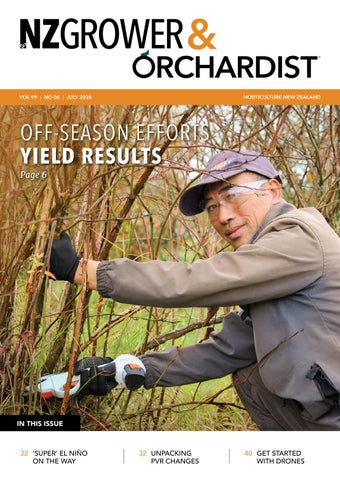
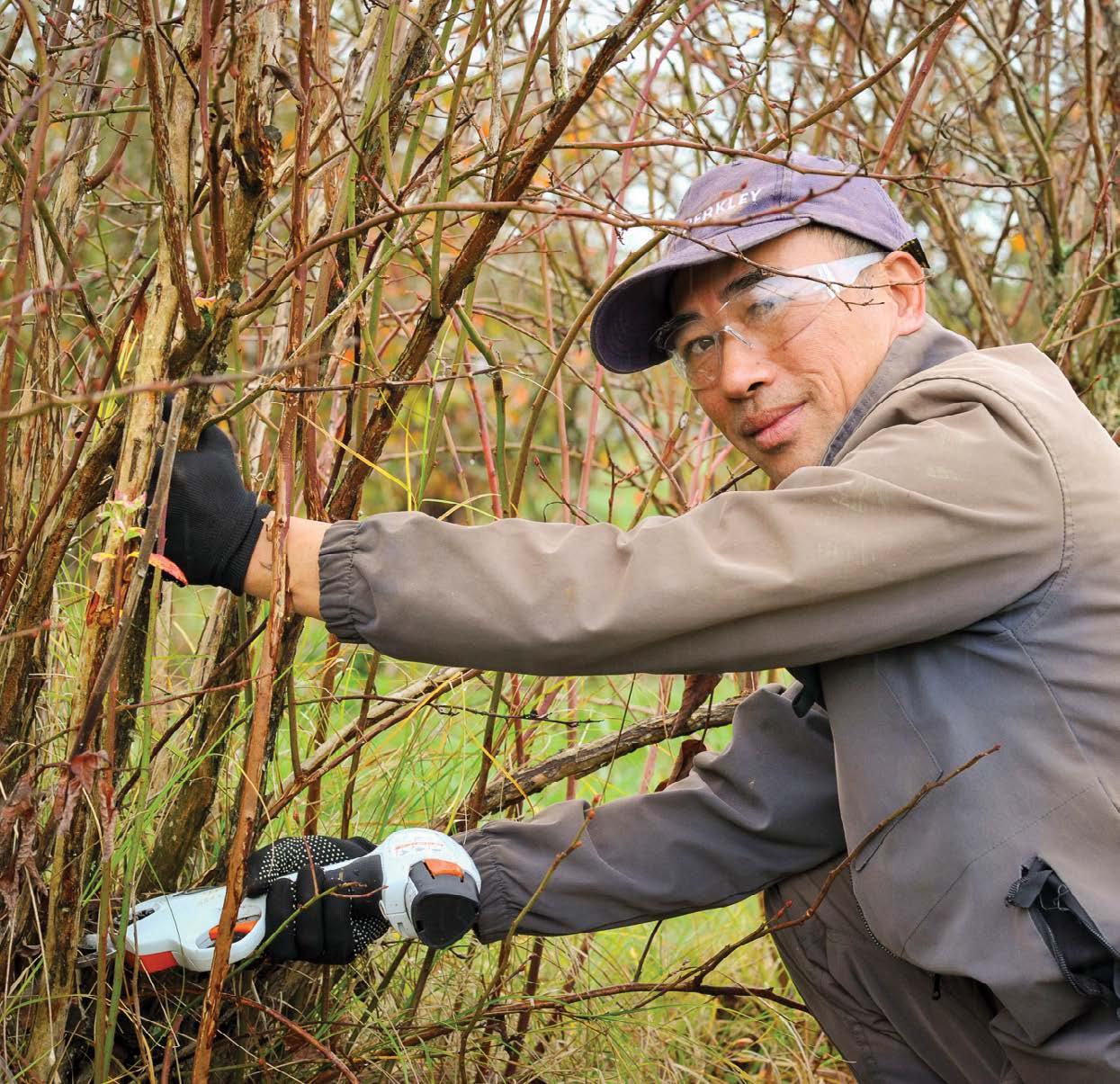
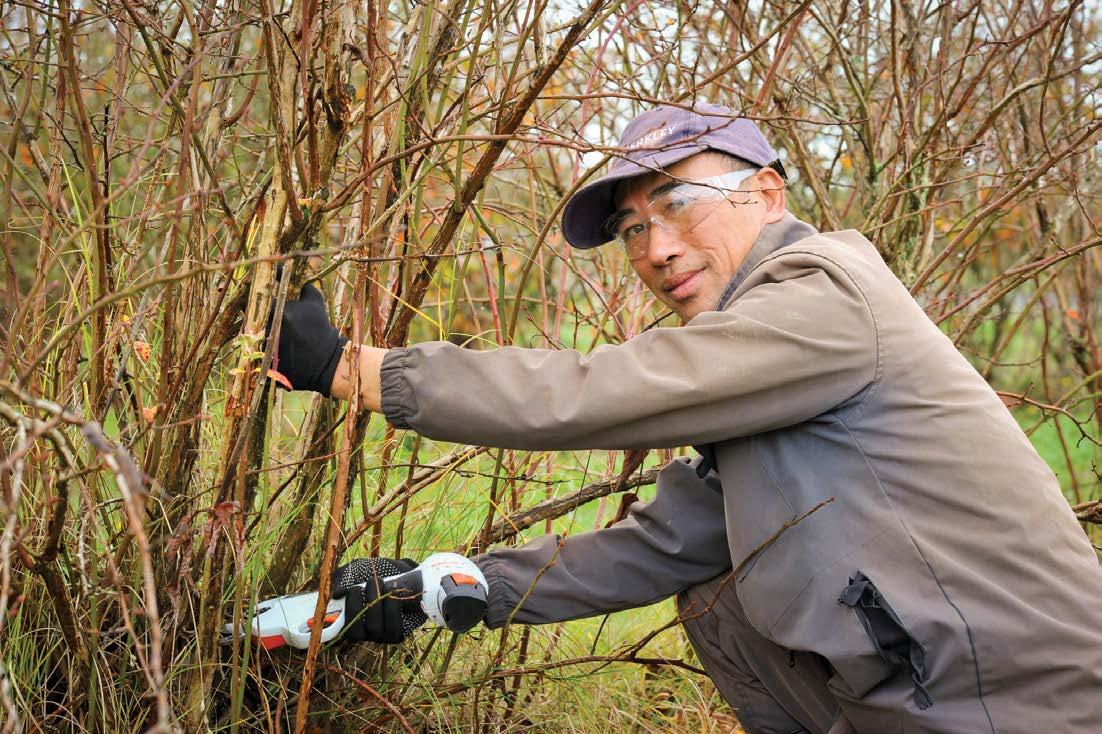
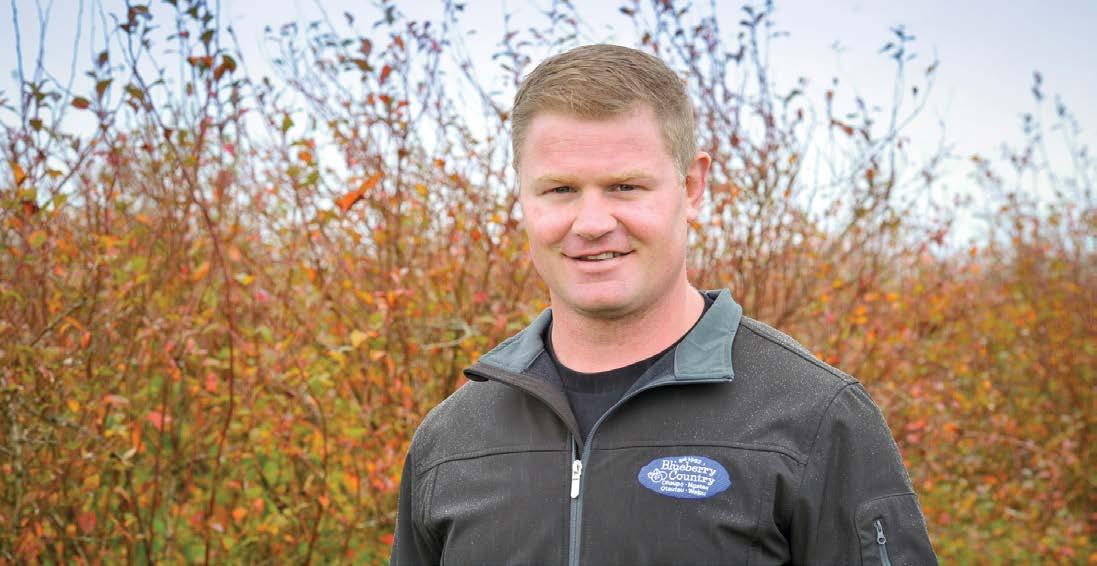
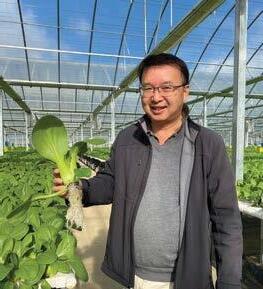
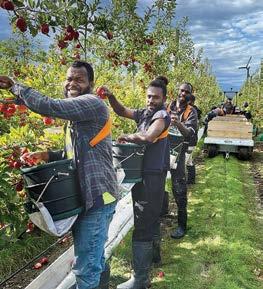
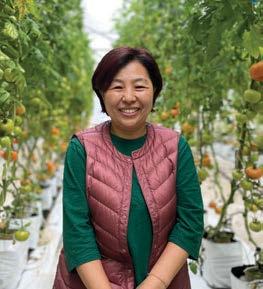
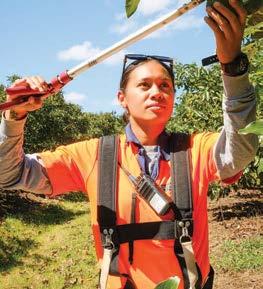
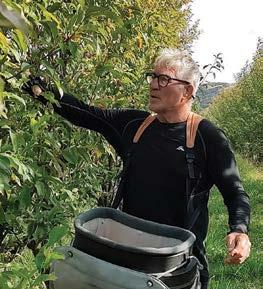
Sunny Li pruning bushes at Blueberry Country in Waikato. See page 6.
by Trefor Ward
Photo
NZGrower & Orchardist is produced by Horticulture New Zealand and is free for all levy payers. The magazine is partially funded by a grant from the NZ Fruitgrowers’ Charitable Trust to ensure all fruit growers in New Zealand receive a copy each month. The magazine is also supported by Vegetables NZ, Process Vegetables NZ, TomatoesNZ, Potatoes NZ and Onions NZ.
The individual comments and views in this magazine do not necessarily represent the view of Horticulture New Zealand.
Meg Becker
CONTRIBUTORS
At AgFirst Hawke’s Bay, Meg has a passion for grower consultancy in precision systems, identifying and overcoming block challenges and working with greenfield developments to optimise orchards from the ground up. She co-authors a winter pruning update on page 36.
Andrew is the new New Zealand Vegetable Council’s (NZVeg) communications manager. He’s spent most of his communications career working for organisations involved in or part of the food and fibre sector. His family farmed at Opiki in the Horowhenua. He reviews the vegetable research roadshow on page 56.
Kim Parkinson
Kim is a newspaper reporter, freelance writer and orchardist who lives on an orchard in Gisborne with her partner Chris. They grow mandarins, lemons, limes, tangelos, Hass avocados and Avogrey® Greenskins. She visits one of the few remaining orchards in the country selling from a roadside shop on page 11.
Richard Pentreath
Richard is a Hawke’s Bay grower and horticultural consultant with more than 25 years’ experience in production management, field research, extension and advisory roles. He operates Boost Horticulture, providing technical and business consulting services alongside fruit and pollen production, with a focus on profitable and regenerative horticultural systems. He shares his thoughts on soil health performance on page 46.
James Dale
Distinguished Professor James Dale is the inaugural Director of the Centre for Tropical Crops and Biocommodities at Queensland University of Technology, leading around 50 researchers and 25 postgraduate students. On page 26, he discusses key themes in his new book, The Future of Bananas
This publication uses vegetable-based inks and environmentally responsible paper produced from Forest Stewardship Council® (FSC®) certified, Mixed Source pulp from Responsible Sources.
Paper produced using Elemental Chlorine Free (ECF) and manufactured under the strict ISO14001 Environmental Management System.
The wrapper we use is 100 percent recyclable, it is LDPE 4 (Low Density Polyethylene) Soft Plastic and meets the required standards. For further information refer to: www.recycling.kiwi.nz/our-story
Sarah McArley
Sarah is a horticultural consultant based in Hawke’s Bay with AgFirst. She works closely with growers on orchard systems, benchmarking and applied research, combining practical field knowledge with data-driven insights. She co-authors a winter pruning update on page 36.
Trefor Ward
Trefor is a freelance photographer and writer with over 30 years’ experience and a long-standing contributor to NZGrower & Orchardist Based in Hamilton, his work has featured in magazines nationally and internationally. On page 6, he visits Blueberry Country to meet the new general manager.
Liarna and John White
Liarna and John are horticultural scientists, kiwifruit and avocado growers, and founders of Falcon Precision Drone Services, a precision agriculture and drone technology business. On page 40, they share advice for growers considering trialling a drone programme and what to ask operators.
INDUSTRY LEADERSHIP REGULARS
3 Bernadine Guilleux, HortNZ chair
4 Kate Scott, HortNZ chief executive
58 Dinah Cohen, NZVeg Covered Cropping NZ business manager
54 Kate Trufitt, Potatoes New Zealand chief executive
TODAY’S REALITY REQUIRES CONSTANT ADAPTATION
KPMG’s 2026 Agribusiness Agenda, From Status Quo to Status Change, puts into words what growers are experiencing every day.
Bernadine Guilleux : HortNZ chair
Drawing on input from 136 agri-industry leaders, the report asks whether, in a changing global food system, the sector is for the status quo or for change.
This is a trick question – for even those who favour the status quo recognise that today’s reality requires constant adaptation – to technology, markets and shifting global conditions, both political and environmental.
This report has been published annually for the past 17 years and over this time has built itself as a trusted source within the agri-think ecosystem.
Over the last 12 months, it notes a shift in priorities for the sector towards climate resilient systems. Whether it be water storage, roading infrastructure, access to modern crop protection tools, this further confirms what growers are needing us to advocate for on their behalf.
That is why HortNZ’s 2026 election manifesto matters. It connects our growers’ needs with the practical policy choices New Zealand can make to support a stronger, more secure food-producing sector.
Achieving that will take growers’ innovation, commitment and investment, alongside government policy that gives growers confidence and enables food production. It will also take a strong commitment to developing climate resilient systems to mitigate risks that are on our horizon.
The manifesto sets out six priorities: Biosecurity and modern crop protection tools; less red tape and duplication; enduring water security; a skilled workforce; fair and competitive grocery markets; and investment in infrastructure.
With the right support, growers can help build the food system this country needs – one that:
Horticulture as a sector is growing – it produces nutritious food for our growing communities, supports regional jobs and is making a significant contribution to export earnings. This sector of ours can continue to grow with the right settings.
Through the Aotearoa Horticulture Action Plan, we have a shared ambition to double the farmgate value of horticulture production by 2035.
HortNZ is advocating strongly to ensure New Zealand does not take domestic food supply for granted. Ahead of the election, we are asking political parties and policymakers to back practical settings that protect and strengthen our ability to grow food here.
KPMG’s report also notes the link globally between food security and wider national security. Our exporters are well aware that the ability for us to supply food to our international customers is the basis upon which we may be able to negotiate for securing international goods our country is reliant on – such as fuel – as the recent deal between New Zealand and Singapore is currently demonstrating.
With the right support, growers can help build the food system this country needs – one that feeds our people, strengthens our regions and keeps us relevant in a changing global marketplace.
DEVELOPING OUR CAPABILITY
At Fieldays, I joined industry leaders, Ministers, MPs, officials, growers and farmers for the launch of the Ministry for Primary Industries’ (MPI) latest export forecasts.
Kate Scott : HortNZ chief executive
On paper, the outlook is positive. The Situation and Outlook for Primary Industries (SOPI) report forecasts horticulture export revenue will increase seven percent to $9.5 billion* in the year to 30 June 2026 and grow to more than $9.7 billion* the following year.
Export revenue from kiwifruit, apples and pears is expected to grow, which is great news. At a time when New Zealand needs productive, sustainable growth, horticulture is proving once again that it can help lead the way.
The sector earns valuable export revenue, supports regional jobs and feeds consumers around the world. These results are no accident – they reflect the hard work, resilience and investment of growers, exporters and the wider supply chain.
But we should not let the headline numbers lull us into thinking the job is done. The story across horticulture is more uneven, and more important, than one export forecast can show.
In my discussions with Ministers, officials and others with an interest in the sector, I keep making the same point: Horticulture is bigger than any single crop, market or season.
It is one of New Zealand’s best opportunities to turn our natural advantages into highvalue, low-impact growth, provided we are prepared to back growers to make good long-term decisions.
The Government and MPI are right to recognise the opportunity in front of horticulture, but opportunity on its own will not deliver the future we need.
The report also forecasts vegetable exports will ease three percent to $710 million, with a further decline in 2027 before recovery.
The real gains will come if we use this period to invest in resilience, not simply recover from the past few difficult years
That is why this moment matters: Better returns give us the breathing room to make longer-term choices.
The real question is not simply how we grow more. It is how we use land-use flexibility to help build a sector that is more sustainable, more profitable and more resilient than the one we have today.
The Government and industry’s recent land-use flexibility announcement gives us a practical example to test this thinking.
MPI’s $19.14 million contribution along with Zespri and New Zealand Kiwifruit Growers Inc contribution, will support a five-year, $47.87 million programme aimed at helping kiwifruit orchards create more value from the same land through better orchard systems, improved technology and applied science.
Strong export earnings also do not automatically translate into stronger profitability at the farm gate. Many growers are facing cost pressures from fuel, fertiliser, agrichemicals, freight, labour and compliance.
For me, the important point is not simply that the project is expected to support higher production. It is that it is focused on producing better results from fewer inputs, with stronger returns and a lighter footprint.
The same thinking should apply across horticulture.
If the insights from these projects are made accessible and practical, they can give growers more confidence to assess options, manage risk and adapt their businesses over time.
HORTICULTURE IS BIGGER THAN ANY SINGLE CROP, MARKET OR SEASON. IT IS ONE OF NEW ZEALAND’S BEST OPPORTUNITIES TO TURN OUR NATURAL ADVANTAGES INTO HIGH-VALUE, LOW-IMPACT GROWTH.
That is the point of land-use flexibility. It is about giving growers room to move when processing capacity changes, water is constrained, climate risk increases or customers ask for something different.
Yes, we should celebrate the forecast lift in export revenue. It is good for the national economy, good for regional New Zealand and a reminder of what growers can achieve when the settings are right.
But if we want horticulture’s potential to be realised, growth must be sustainable, profitable and spread across the sector. It must encourage innovation, support smart diversification and give communities confidence that horticulture has a long-term future.
The real gains will come if we use this period to invest in resilience, not simply recover from the past few difficult years.
The industry’s ambition to double the farmgate value of production by 2035 is achievable, but it will take the courage to think differently about where, what and how we grow.
It will require stronger biosecurity, access to effective crop protection tools, reliable water, sensible environmental settings, a capable workforce, functioning infrastructure, planning rules that recognise the importance of commercial fruit and vegetable production, and policy settings that allow growers to adjust land use where that improves productivity, profitability and environmental outcomes.
The good times are when we should be doing the hard thinking. If New Zealand wants the benefits of a growing horticulture sector, we need to create the conditions that allow growers to innovate, diversify and grow more value from the land they care for – while protecting the resources future generations will depend on.
* The Situation and Outlook for Primary Industries (SOPI) report includes wine in its horticulture forecasts. For a more detailed SOPI overview, see page 52.
Let’s plan for future planting together
Redeveloping an orchard and getting trees in the ground is no easy feat. That’s why we’re supporting local growers and New Zealand’s fruit tree production with market leading and consistently performing trees. Reach out today and join our family of growers.
SPECIALIST VARIETIES AVAILABLE Apples • Apricots Plums • Peaches • Cherries Nectarines • Pears • Rootstock
OPTIMISING OPEN-AIR BLUEBERRIES
Rather than investing in covered production systems, Blueberry Country is focused on matching varieties to local growing conditions at its four orchards in Northland, Waikato and Southland. New manager Christiaan Crous shares the company’s approach.
After just six months as general manager of Blueberry Country, Christiaan Crous has already experienced what many would describe as a baptism by fire.
Arriving in December at the height of harvest, the former fast-moving consumer goods (FMCG) executive stepped into one of New Zealand’s largest blueberry businesses with little horticultural experience but a strong background in sales, strategy and business development.
“I started the same week we started picking,” Christiaan says. “I knew nothing about horticulture or how to grow a blueberry. I’ve learned fast.”
That rapid learning curve has coincided with a successful season for the company which operates four orchards across New Zealand and is investing heavily in both orchard productivity and frozen fruit capability.
Before joining Blueberry Country, Christiaan spent almost 20 years in the FMCG sector with companies including Cerebos Greggs, Pernod Ricard, Fonterra and DB Breweries. Seeking a change from corporate Auckland, he was attracted by the opportunity to lead a hands-on business with strong growth potential.
“This role is much more operational. You’re involved in everything from the orchard through to the packhouse.”
Fortunately, Blueberry Country’s experienced orchard managers have helped ease the transition.
The company operates orchards at Ōhaupō and Ngatea in the Waikato, a large Southland property at Otautau, and a newer orchard at Waipu in Northland. Together, the sites provide production across multiple growing regions, helping spread climatic risk and extend harvest windows.
The Waipu orchard is expected to eventually provide earlier-season fruit, although recent seasons have been heavily affected by adverse weather.
“We’ve had floods, strong winds and a lot of weatherrelated challenges up there,” says Christiaan. “We’re not yet seeing the commercial quantities we’d hoped for, but it’s been very successful as a pick-your-own destination.”
At the opposite end of the country, the Southland orchard provides valuable late-season production. At almost 200ha, it is one of the company’s largest properties, although the cooler climate limits the production window to just eight weeks each season.
Strong results across the orchards
The 2025/26 season delivered encouraging results. Ngatea produced around 13 percent more fruit than the previous season, which Christiaan attributes largely to increased investment in pruning.
“We spent more on pruning during the off-season and saw the benefit in the crop.”
At Ōhaupō, overall production was slightly lower, but the orchard achieved a significant shift toward hand-harvested fruit destined for the fresh market rather than machineharvested fruit for processing.
The difference came down to both orchard management and weather conditions.
“We had more opportunities to hand-pick because the weather was cooperative. In wetter seasons we tend to machine harvest more frequently because the fruit still needs to come off.”
I knew nothing about horticulture or how to grow a blueberry. I’ve learned fast
Unlike many blueberry operations, Blueberry Country’s Waikato orchards are grown on peat soils and operate without irrigation. While prolonged dry conditions affected production during the previous season, improved rainfall during late summer helped maintain fruit quality and yields this year.
All four orchards remain open-air operations with no tunnels, bird netting or irrigation systems.
Christiaan Crous joined Blueberry Country in December and has learned fast about horticulture at the company’s four orchards
Southland delivered one of the strongest performances, with production increasing by approximately 50 percent. The improvement reflected favourable weather, better orchard management and the maturation of plantings established three years ago.
Genetics and growth
CHRISTIAAN DESCRIBES TWO KEY ISSUES LOOKING AHEAD: 1 THE RISK OF INTRODUCING PESTS THAT AREN’T CURRENTLY PRESENT IN NEW ZEALAND. 2 THE COMMERCIAL PRESSURE THAT LOWER-COST PRODUCTION COUNTRIES COULD PLACE ON LOCAL GROWERS.
Variety selection remains central to Blueberry Country’s future plans.
In Southland, the company continues expanding plantings of cooler-climate Northern Highbush varieties, especially Sunset Blue and Reka. Across the Waikato orchards, approximately 32 varieties are grown, with older cultivars gradually being replaced by newer genetics.
“Over time we’re replacing some of the older varieties with newer genetics,” says Christiaan.
Northern and Southern Highbush varieties such as Sunset Blue, Reka and Legacy remain the standout performers because of their yield potential and favourable market timing, while other varieties such as Centra Blue are being introduced to help extend harvest windows.
Investing in frozen fruit
While fresh blueberries remain the company’s core business, one of its most significant investments is occurring in frozen fruit processing.
Blueberry Country is installing a new Individual Quick Freezing (IQF) tunnel ahead of the coming season. The upgrade will significantly increase freezing capacity while reducing energy consumption.
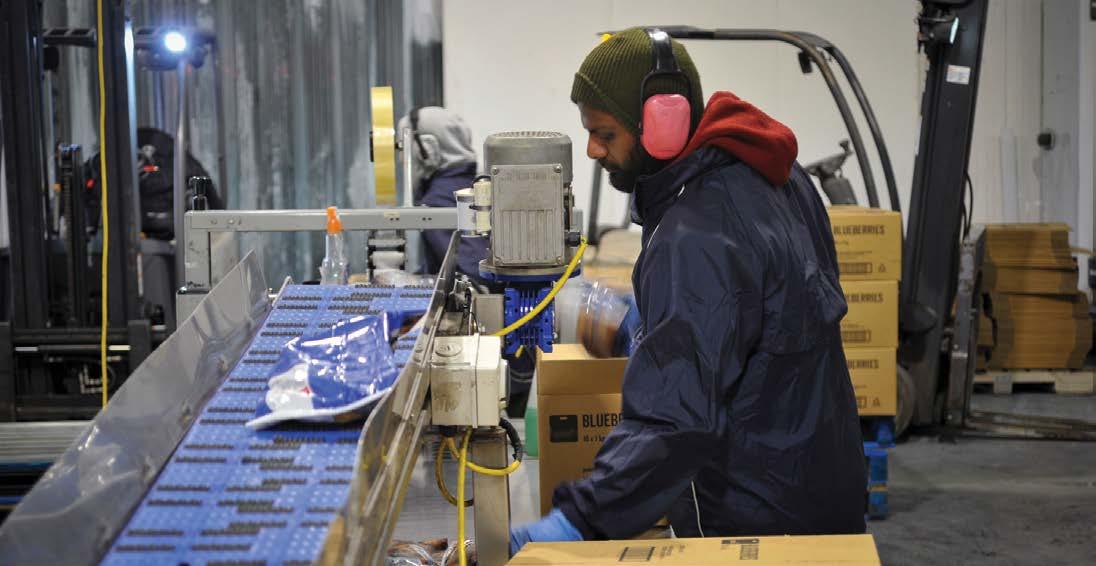
Danny Babu packing bags of frozen Blueberries into boxes for shipment, part of an increase in the company’s processing capability
“Our new freezer will use significantly less power and operate much more efficiently,” says Christiaan.
The new system will also replace Freon refrigerants with a carbon dioxide-based system, improving environmental performance while lowering operating costs.
The expanded freezing capability will allow the company to handle increasing fruit volumes and provide greater flexibility when fresh market conditions are less favourable.
“If the fresh market isn’t right, we can freeze the fruit and retain value.”
The company also sees opportunities to provide freezing services for other blueberry growers, processing fruit through washing, sorting and IQF systems to create premium free-flowing frozen product for retail and food-service markets.
A legacy of innovation
Blueberry Country remains owned by the Furniss family, whose influence extends well beyond blueberry production.
HERBICIDE
ATTACHMENT
Founder Greg Furniss continues to play an active role in the business, contributing his extensive horticultural knowledge and experience.
“Greg still comes in most days and remains passionate about growing blueberries,” says Christiaan.
The family’s impact on the wider industry is perhaps best known through BBC Technologies, the fruit sorting business established by Greg’s son, Geoff Furniss, before its acquisition by global sorting company Tomra.
Today, Geoff remains a director of Blueberry Country while leading CAILU, a technology company developing AI-driven grading and sorting systems for horticultural crops including onions, apples, kiwifruit and blueberries.
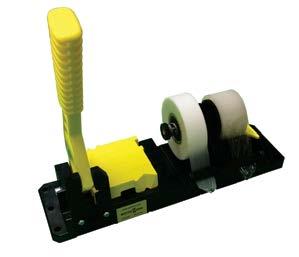
EXPAND PROSPR’S CAPABILITIES WITH THE NEW HERBICIDE ATTACHMENT
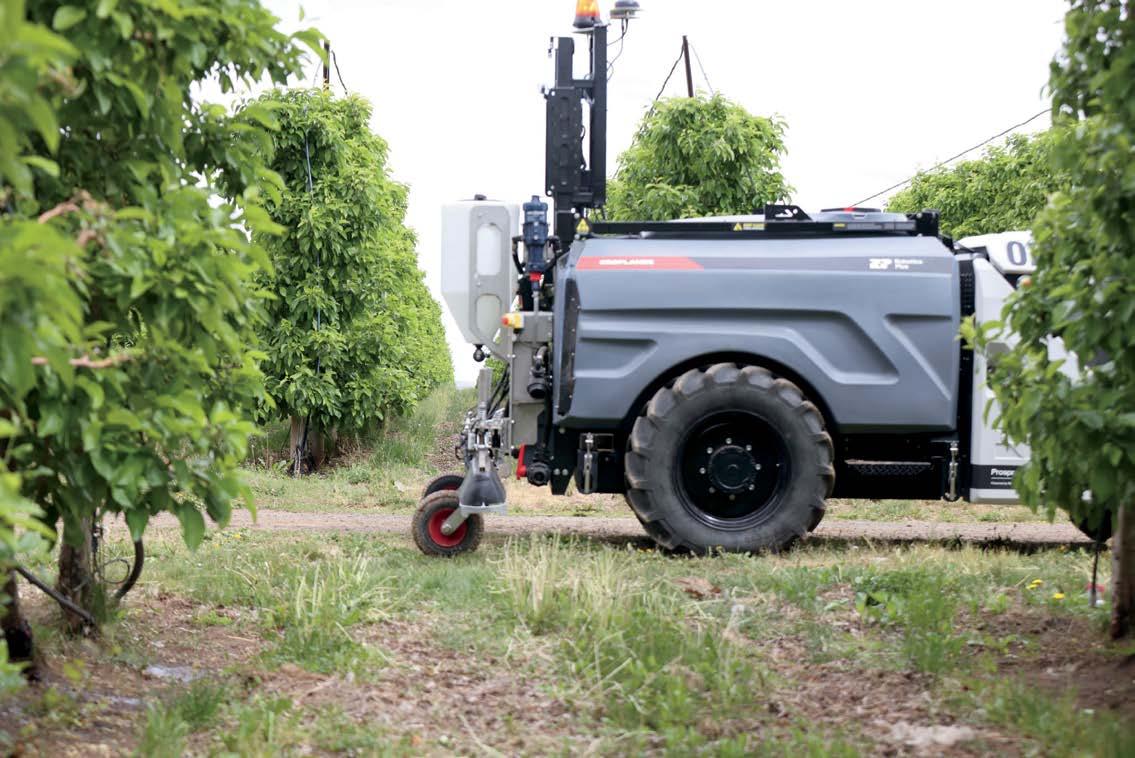
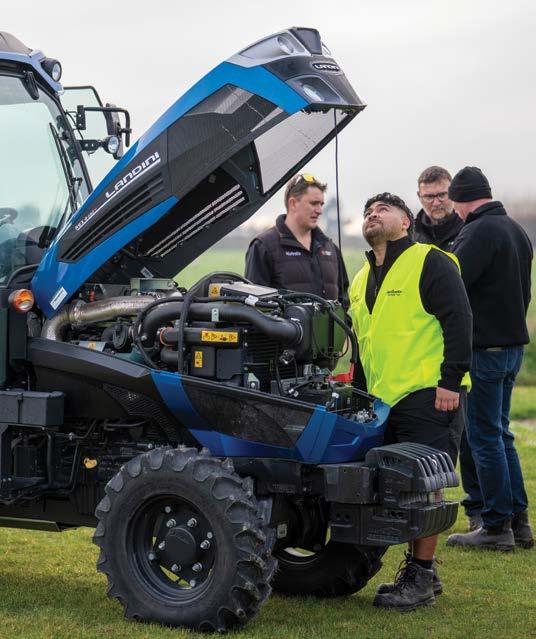
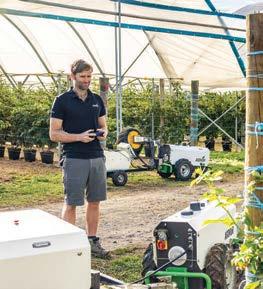
Croplands have introduced Yamaha Agriculture’s Herbicide Attachment, designed as a seamless integration with Prospr. Prospr is the robust, autonomous multi-use hybrid vehicle platform for tree crops and vineyards. The herbicide attachment enables growers to enhance automation across weed control applications and improve efficiency in orchards.
PROPOSED IMPORT REQUIREMENTS FOR FRESH BLUEBERRIES
On 15 June HortNZ submitted on the proposed import health standard (IHS) from the Ministry for Primary Industries (MPI) for importing fresh blueberries from Chile, Mexico, Morocco, Peru and the USA for human consumption.
The submission raised significant concerns about the residual risk in relation to high-impact pests such as fruit flies. HortNZ recommended changes to strengthen the IHS, including: Remove the systems approach from MPI-specified measure as an option for managing economically significant fruit fly species – due to detection limitations and uncertainty on pest presence in Peru. Implement stronger risk management settings, including a mandatory phytosanitary ‘kill-step’ treatment.
Increase in pre-border and border inspection, monitoring and verification requirements, including a zero-tolerance threshold for high-impact organisms until sustainable compliance is proven. Explicitly acknowledge post-border downstream risks in risk management settings, particularly the underestimated cumulative risk from repeated low-probability high-impact pest incursions.
The relationship provides Blueberry Country with access to emerging technology and opportunities to trial new innovations.
“Geoff is working with a number of growers on upgrading their equipment, including us. He’s able to test and trial technology on our line and potentially scale it across the wider industry.”
Looking ahead
One of the biggest issues facing the blueberry sector is the possibility of imported blueberries entering the New Zealand market.
Current discussions around import access have raised concerns about both biosecurity risks and the impact of lower-cost international production on local growers.
“There are two issues,” says Christiaan. “One is the risk of introducing pests that aren’t currently present in New Zealand. The second is the commercial pressure that lower-cost production countries could place on local growers.”
For now, however, Blueberry Country remains focused on improving orchard performance, expanding frozen fruit capability and preparing for future growth.
With increasing production in Southland, developing opportunities in Waipu and major investment in processing infrastructure, the company is positioning itself to maximise value from every berry produced.
For a manager who only six months ago was learning the difference between blueberry varieties, it has been a remarkably productive start.
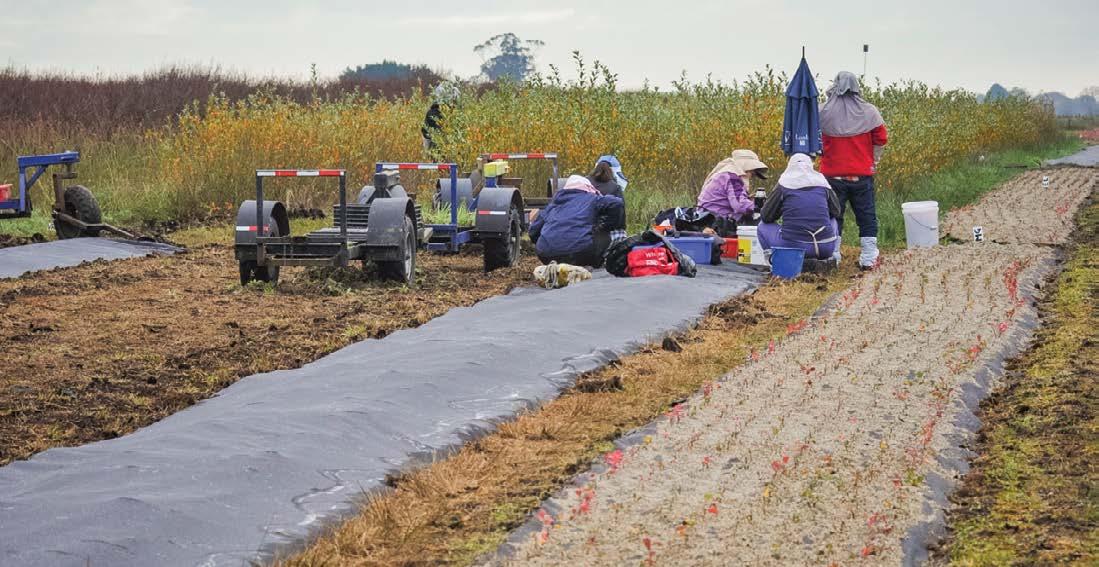
Teams planting new blueberry seedlings to winter outside
Without supplying supermarkets, just the orchard-gate shop and the local farmers’ market, Teesdale Orchard has generated a good living for Andrew and Joanne Teesdale for decades. But it is coming to the end of an era.
Kim Parkinson
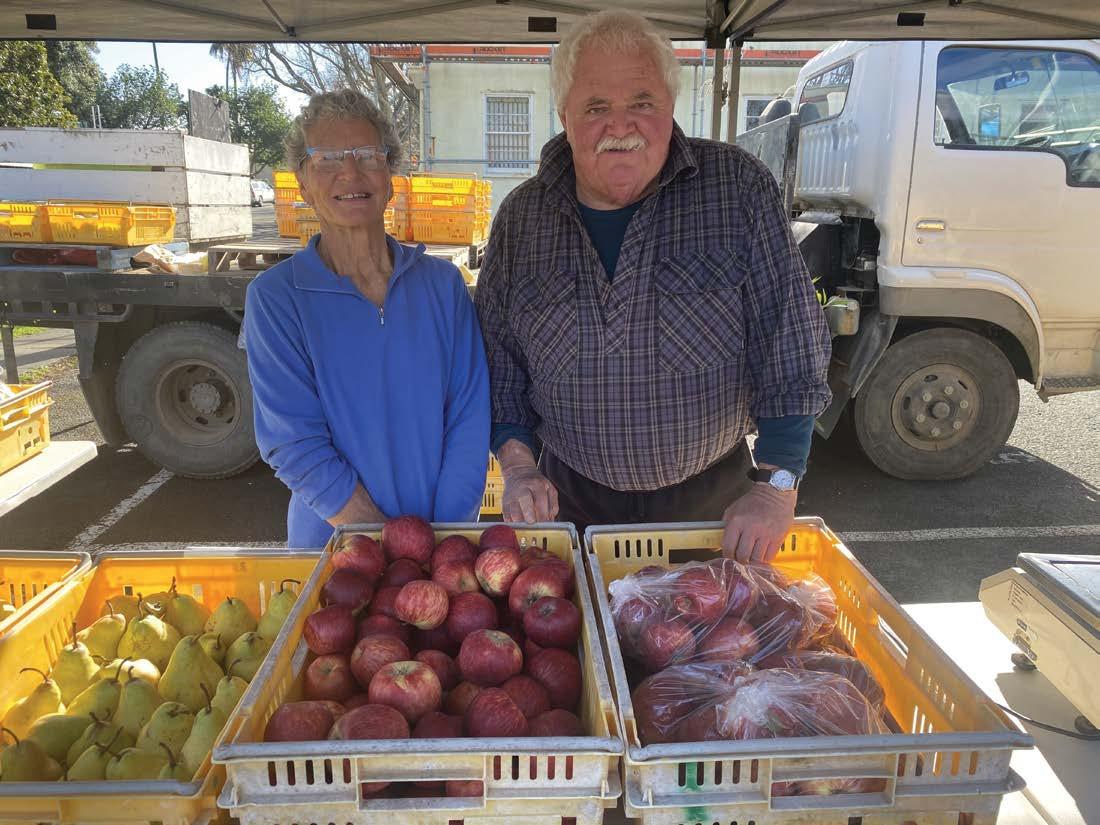
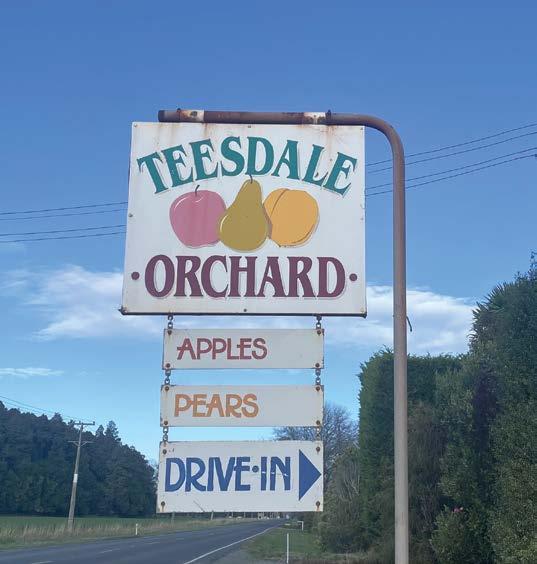
Teesdale Orchard in Waihīrere, Gisborne, owned by Andrew and Joanne Teesdale, has supplied top quality tree-ripened fruit to the Gisborne community since 1956.
It is one of the few remaining orchards in the country to sell from a roadside shop, but they’ve always done things differently. It is coming to the end of an era for the growers as they downscale in preparation for retirement.
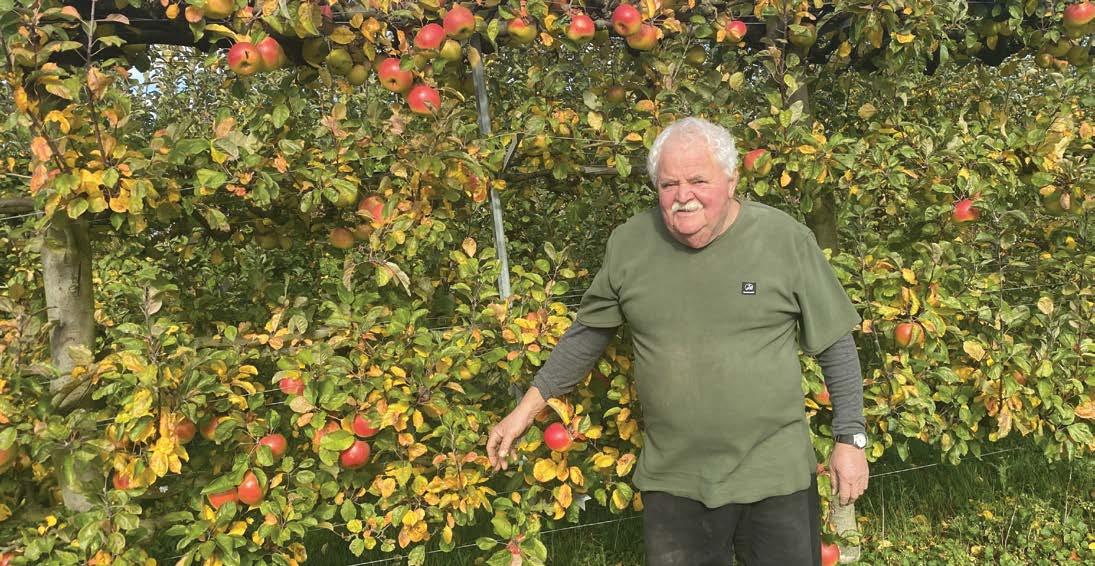
Known for their Packham pears, Red Delicious and Royal Gala apples, they are also the only grower of the Ballarat cooking apple in the North Island. In addition, they grow cornice pears and Granny Smiths, sweetcorn,
Golden Queen peaches, nectarines, plums, tomatoes, Red Kuri pumpkins and green squash pumpkins.
After trying to sell the business, the Teesdales have downsized in the last few years, selling off a block of land in 2022. They now have 10 acres (4ha) and still run their orchard-gate shop. They also sell at the Saturday Gisborne Farmers’ Market.
The second generation to farm the block on Back Ormond Road, Andrew purchased the orchard from his father James in 1982.
It was always James Teesdale’s dream to own an orchard. The Scotsman emigrated to New Zealand after serving in the Royal Air Force in the Second World War.
James bought a 5-acre (2ha) block of land on Back Ormond Road in 1956, about a 10-minute drive from central Gisborne.
“Dad started small planting pears and worked in town. Then as he made some money, he slowly bought the adjoining land, which he sharecropped in maize and planted apples.”
There’s
not much left for the grower after paying all those costs, so we have done it a different way and don’t supply supermarkets
Andrew and Joanne bought the orchard in 1982 and continued growing apples and pears back when the industry was regulated by the Apple & Pear Marketing Board, which would guarantee a price for the growers.
From the mid-1990s there was increasing pressure to deregulate the industry and the board’s selling monopoly was removed in 2001.
“Probably the worst year we had was when the Apple & Pear Marketing Board deregulated,” Andrew says. “Before that, they made sure the grower got a fair price – supermarkets were only allowed to put a 40 percent markup on the fruit. After deregulation, the average markup was 100 percent.”
Not keen to pay royalties for new apple varieties or be limited to how their fruit was packed and distributed, they decided to concentrate on supplying the local market and cut out the middleman.
“There’s not much left for the grower after paying all those costs, so we have done it a different way and don’t supply supermarkets.
“We’ve got all the good old varieties you can’t get anymore, like Granny Smiths, Red Delicious, Royal Gala, Golden Delicious and Ballarat cooking apples.”
They tried growing apricots for a while, but the climate wasn’t cold enough, so they pulled them out.
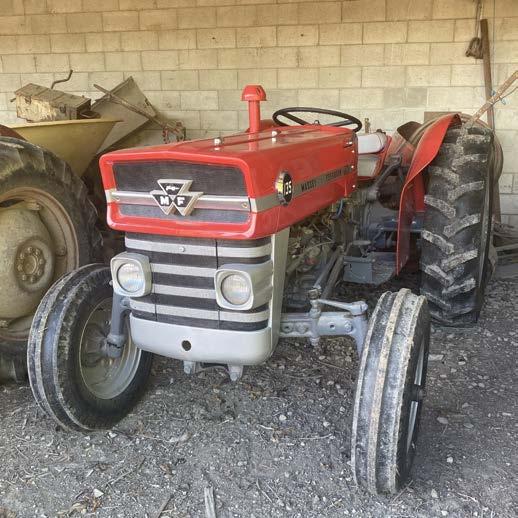
Andrew is a car and tractor enthusiast and has an impressive collection
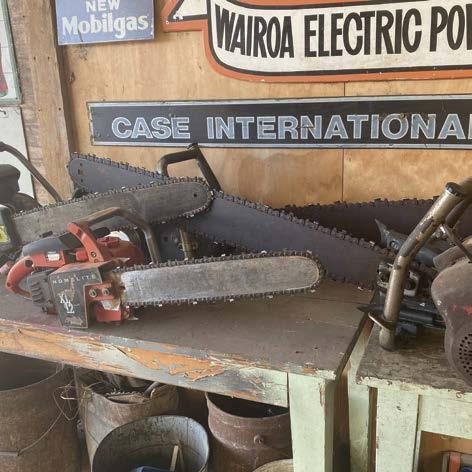
The collection includes vintage farming equipment
DAD STARTED SMALL PLANTING PEARS AND WORKED IN TOWN. THEN AS HE MADE SOME MONEY, HE SLOWLY BOUGHT THE ADJOINING LAND, WHICH HE SHARECROPPED IN MAIZE AND PLANTED APPLES.
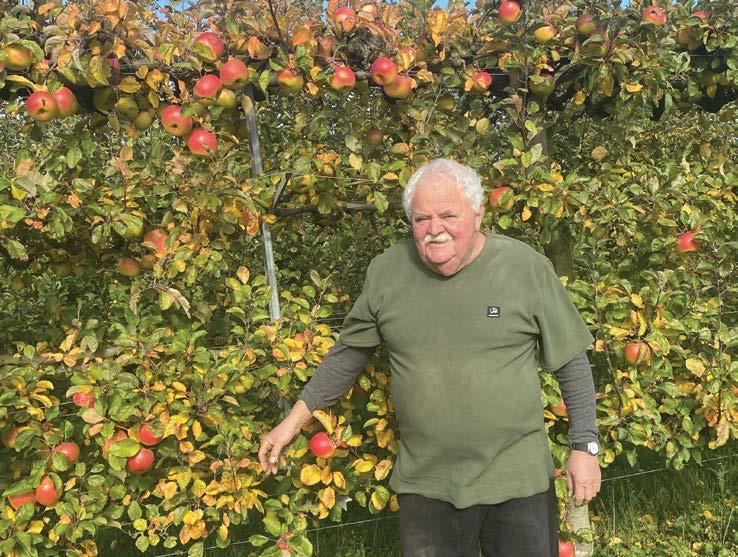
Andrew Teesdale grows old-fashioned varieties like the Ballarat cooking apple pictured here at the orchard on Back Ormond Road in Gisborne
“We’ve made a good living here, but it’s tapered off a bit now – our old regular customers are dying off.”
In 1973 the orchard got hit by hail wiping out the entire crop of pears. The insurance didn’t cover hail damage, and it was a tough lesson.
It was after that James built the shop and installed a chiller. He never looked back – it was a game-changer for the business.
Being able to store the fruit and keep it fresh means the Teesdales can pick ahead of any extreme weather events and save the fruit.
At peak production they had four chillers on site, but some have now been retired and converted into storage sheds.
Andrew spent six years successfully growing Muscat grapes on a 5-acre (2ha) leased block for Soljans Estate Winery in Kumeū, Auckland.
Nowadays they grow enough sweetcorn to meet local demand as well as Beefsteak tomatoes. They grow the tomatoes on wires to keep them raised off the ground, so they don’t get waterlogged in heavy rain.
We’ve made a good living here, but it’s tapered off a bit now
“It’s worth investing the time and putting in the infrastructure, so they stand the weather,” Andrew says.
“We often have tomatoes through until June, especially if we get a hot dry autumn, but this year it’s been wet so they haven’t done as well.”
high quality fruit trees
Authorised Nursery to propogate Summerland Cherry Varieties in NZ: Celeste® Cristalina® Samba® Staccato® Stardust® Sandra Rose Santina® Sonnet® Sylvia®
Part of the secret of their success has been to grow just enough to satisfy local demand and not try to grow too many varieties.
One of the founding members of the Gisborne Farmers’ Market, they started selling there around 20 years ago when it was at the Gisborne Showgrounds in Makaraka.
They also supply Twisted Citrus with pears, apples and peaches, which go into mixed fruit boxes to be delivered around the country.
Andrew’s advice to orchardists starting out in Gisborne is to plant early varieties of stone fruit like nectarines and peaches and pick tree-ripened fruit.
“That way you can pick early at the end of November, about six weeks ahead of everyone else. But it all depends on whether you can get the right varieties.”
The biggest challenge they face is weather.
flooded in Cyclone Gabrielle and lost a lot of trees. Their crops suffer every time there is heavy rain and they are waiting for the council to put in culverts, which should mitigate flooding.
The couple have five children and nine grandchildren but expect they will be the last generation to work on the orchard.
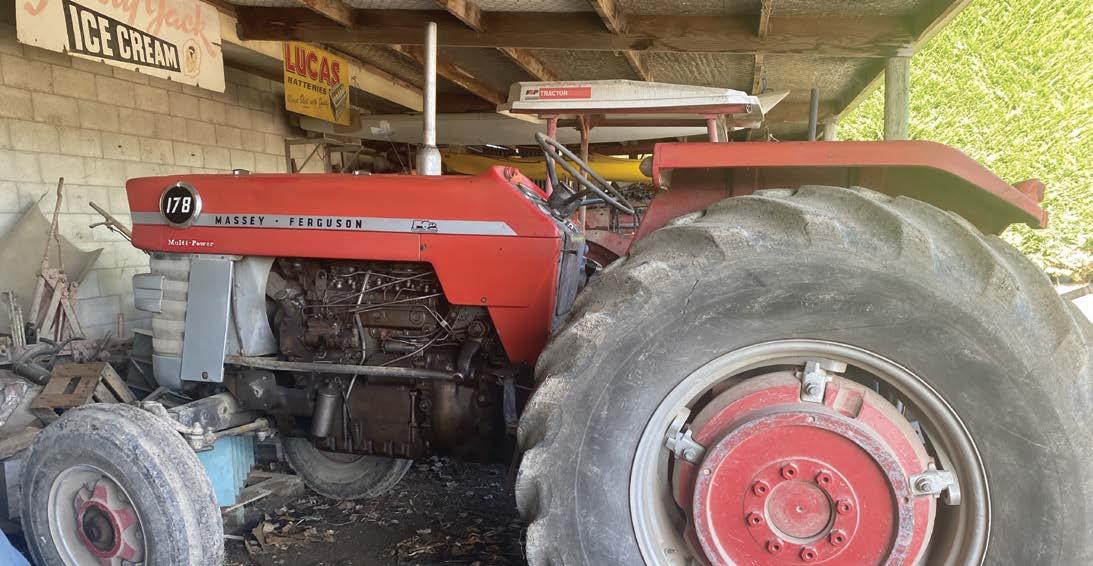
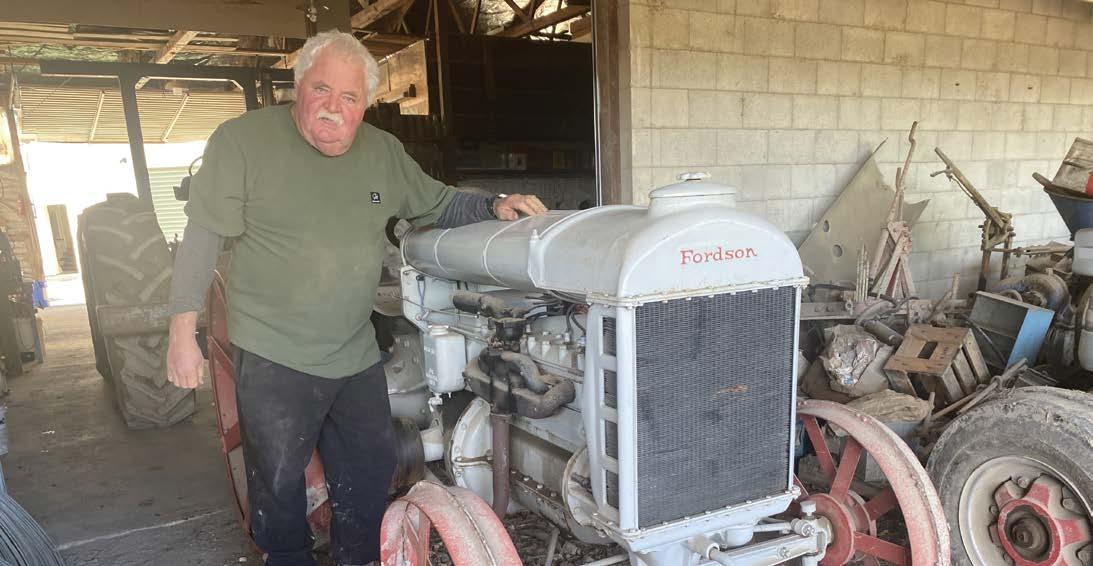
Andrew is a car and tractor enthusiast and has an impressive collection. His oldest tractor is a Fordson dating back to 1918. He has 75 tractors in total, mostly in working order. He also collects old farming equipment, chainsaws and number plates, including a collection of USA plates from each of the 50 states.
He’s the proud owner of an orange and black Mustang Mach 1 and an old Ford truck, the F100. Every year he takes a few of his vintage tractors to the A&P Show.
Andrew Teesdale with the Fordson tractor from 1918
Andrew’s collection includes 75 tractors, mostly in working order
The Teesdales are one of the few remaining orchards in the country to sell from a roadside shop
“This year’s theme is 80 years for the grey Fergie TEA20 and 70 years for the 35 Massey Ferguson.”
Part of the secret of their success has been to grow just enough to satisfy local demand and not try to grow too many varieties
Andrew says he likes being his own boss, thinking outside the square to ensure he “makes a bob.” It is this entrepreneurial spirit that has kept the business going.
Working on the land, getting to know and interact with customers, indulging a passion for collecting, the Teesdales have been living ‘the good life.’
As they come into winter there is still plenty to keep them busy with pruning to do and general orchard maintenance. Over the next few weeks they will sell the last of their stock before closing up for winter.
Visit us at booth 27 at the New Zealand Horticulture Conference 2026
HEAD TO CROMWELL FOR THE YOUNG GROWER FINAL
The 2026 regional events in the NZ Young Grower of the Year competition are wrapping up as this issue of NZGrower & Orchardist goes to print. The regional winners go into the running for the national title at the Young Grower of the Year final in Cromwell on 27–28 August.
This year the Young Grower of the Year national final awards dinner will be held at the new Te Puna Mahara Cromwell Memorial Events Centre on 28 August, bringing together the seven finalists from across the regions competing for the national title.
The Young Grower of the Year competition is an annual event, run by HortNZ, designed to recognise and celebrate our most talented young growers.
The competition highlights the skills, knowledge and leadership potential of our next generation, ensuring the industry remains strong and sustainable.
The Young Grower of the Year competition is open to fruit and/or vegetable growers in their respective regions: Pukekohe, Bay of Plenty, Gisborne, Hawke’s Bay, Nelson, Canterbury and Central Otago.
We’ll introduce all seven winners of each of the regional competitions in the next issue of NZGrower & Orchardist As finalists, they will contest a range of modules and challenges hoping to be crowned the NZ Young Grower of the Year at the awards dinner on 28 August.
Dinner tickets are on sale, offering a great opportunity to be part of a memorable evening recognising the finalists and the wider industry. Help celebrate the next generation of horticulture leaders.
The 2026 Pukekohe Young Grower of the Year awards dinner in Tuakau
The national Young Grower of the Year trophy
For tickets to the national final awards dinner in Cromwell on 28 August, head to www.younggrower.co.nz
The Young Grower of the Year competition is open to fruit and/or vegetable growers in their respective regions:
The Gisborne regional Young Grower of the Year competition getting underway in June
A crisp June morning for the Hawke’s Bay Young Fruitgrower of the Year. Photo by John Cowpland/Alphapix
Pukekohe
Central Otago Bay of Plenty
Hawke’s Bay
Canterbury
Gisborne
HORTICULTURE WINNERS IN MĀORI AGRICULTURE AWARDS
The 2026 Ahuwhenua Trophy winner is Mātai Pacific Iwi Collective, and Te Rina Joe is the 2026 Ahuwhenua Young Māori Grower. The announcements were made in early June at the Ahuwhenua Awards dinner in Whangārei.
The Ahuwhenua Awards recognise Māori farmers and growers and young Māori in the sheep and beef, dairy and horticultural sectors. The awards run on a three-year cycle, with the 2026 competition covering horticulture.
HortNZ is a sponsor of both awards and joined the awards dinner attended by more than 700 guests from across the primary sector, government and Māori communities.
Ahuwhenua Young Māori Grower
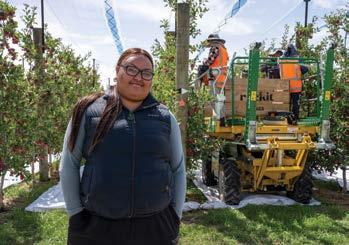
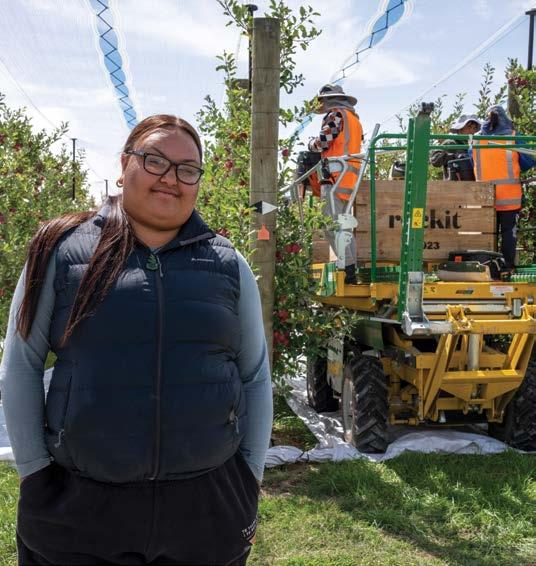
Te Rina Joe (Ngāti Pāhauwera, Ngāti Kahungunu) won the Ahuwhenua Young Māori Grower award. She is a supervisor/orchard hand at Pakuratahi Orchard for Ngāti Pāhauwera Commercial Development Ltd at Tangoio, Hawke’s Bay.
She began picking fruit with her whānau at 15-years-old and has since built a career grounded in purpose working for her iwi, overseeing teams of 40–60 workers across a 55ha apple operation.
“Horticulture is such a big part of my life,” she says, “and just having the chance to be part of the competition has been an amazing experience.”
Ahuwhenua Trophy Management Committee chair Nukuhia Hadfield says Te Rina’s story is one of real purpose.
“She had the opportunity to work for her iwi, on their land, and she took it. The connection between a person, their people and place is exactly what this award is about,” Nukuhia says.
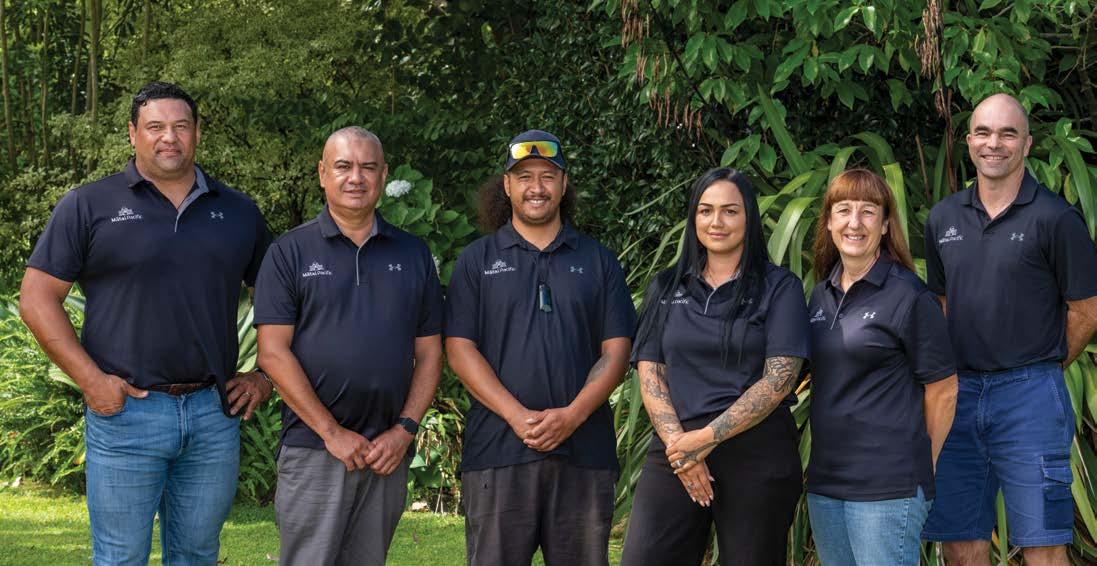
The team behind the Ahuwhenua Trophy winner Mātai Pacific Iwi Collective (from left): Chief executive Charles Russell, director Nelson Meha, orchard management Arapeta Raki, admin Jordan-Leigh Taite-Potaka, director Sally Gardiner, orchard management Tim Woodward. Photo by John Cowpland/Alphapix
Ahuwhenua Young Māori Grower Te Rina Joe at Pakuratahi Orchard in Hawke’s Bay. Photo by John Cowpland/Alphapix
“This competition continues to show us is that the talent is there, young Māori who are grounded in who they are, serious about their craft and ready to lead, quietly shaping what Māori horticulture looks like for the generations ahead.”
Ahuwhenua Trophy 2026
Zespri’s largest Māori shareholder, Mātai Pacific Iwi Collective was the Ahuwhenua Trophy winner for 2026. It has grown its combined asset value beyond $130 million since 2018, embodying kotahitanga as a commercial force.
“We’re absolutely elated, really proud of our team and it’s an honour and a privilege to stand alongside Otama Marere and Ngāti Hine Forestry Trust on this occasion,” Mātai Pacific Iwi Collective chief executive Charles Russell says.
FINALISTS 2026
The Ahuwhenua Trophy – now in its ninety-third year –was contested by three outstanding finalists: Mātai Pacific Iwi Collective (Te Puke) – Winner
Otama Marere Trust (Paengaroa)
Ngāti Hine Forestry Trust (Kerikeri)
The Ahuwhenua Young Māori Grower finalists in the 2026 competition were:
Te Rina Joe (Ngāti Pāhauwera, Ngāti Kahungunu), Pakuratahi Orchard for Ngāti Pāhauwera Commercial Development Ltd, Hawke’s Bay – Winner
Robert John Manuel (Ngāti Kahu, Ngāti Rehia, Ngāpuhi, Ngāti Raakaipaaka), Ngāti Hine Forestry Trust, Kerikeri
“Our whakataukī is ‘one orchard at a time’… that’s where we exercise our mana motuhake and our rangatiratanga.
“We’ve grown this land for generations and if we go back to our roots, I’m sure that’s where the prosperity is.”
Nukuhia says that all three finalists set a remarkable benchmark.
“You could not have separated the standard of operations by passion or purpose but Mātai Pacific Iwi Collective rose to the top. What they collectively represent for Te Ao Māori and the sector is something every New Zealander should take pride in.”
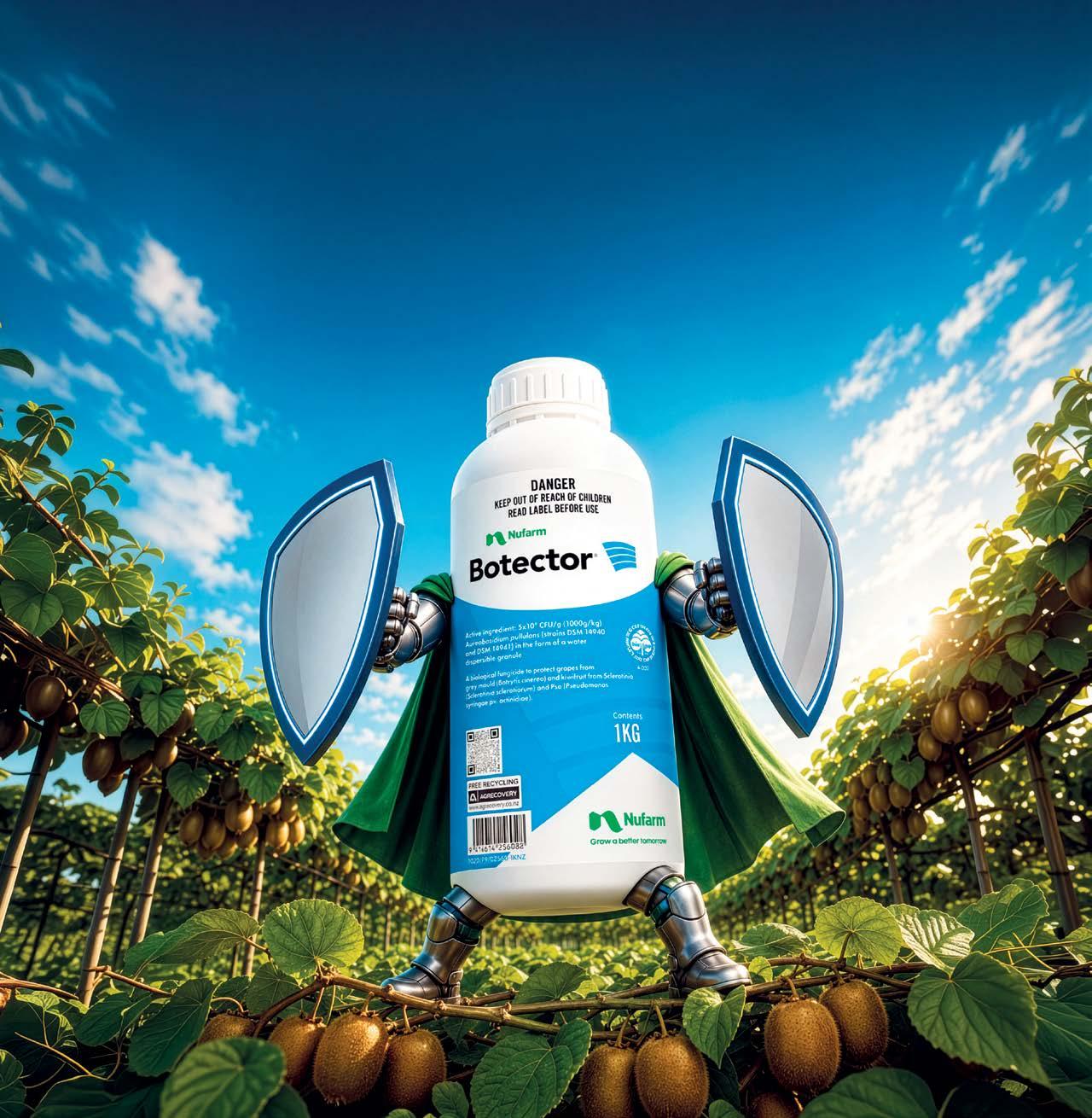
BOTECTOR : DUAL PROTECTION FOR KIWIFRUIT –
NOW WITH PSA LABEL CLAIM
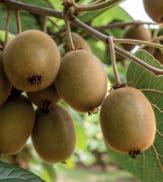
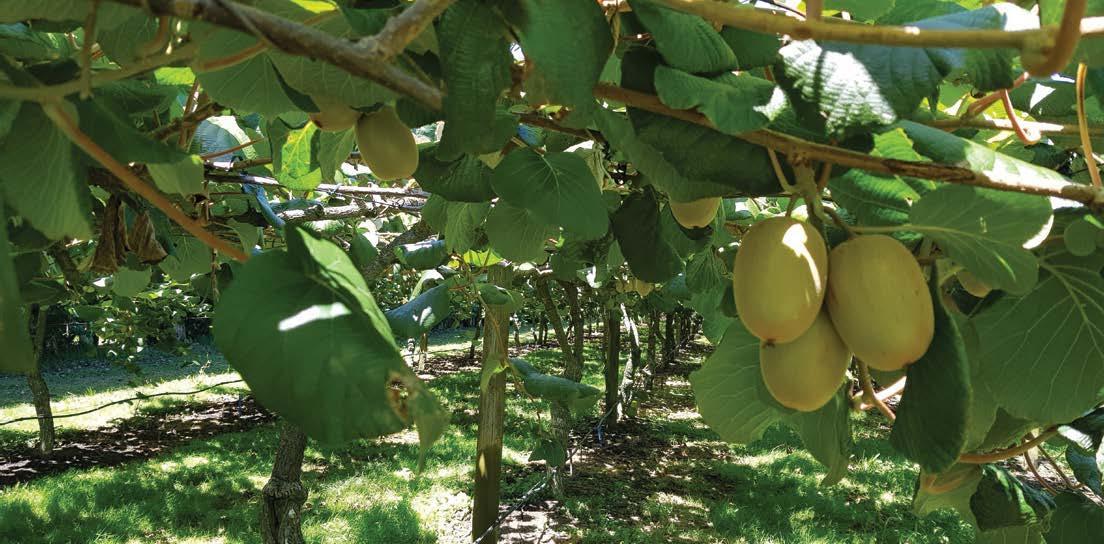
Kiwifruit growers in New Zealand face ongoing pressure from two key diseases, Pseudomonas syringae pv. actinidiae (Psa) and Sclerotinia sclerotiorum (Sclerotinia). While Psa remains the most economically damaging, Sclerotinia continues to pose a significant threat during flowering, impacting fruit quality through scarring, rot and fruit loss. Managing both effectively requires a programme that is preventative, flexible and sustainable. The recent label extension for Botector® strengthens its position as a valuable tool in meeting this challenge.
Botector® is a biological fungicide based on the naturally occurring microorganism Aureobasidium pullulans. Its mode of action, competitive exclusion, sets it apart from conventional chemistry. Once applied, Botector rapidly colonises flowers, fruitlets and plant surfaces, forming a protective barrier that prevents pathogens from establishing.
This mechanism is highly effective against Sclerotinia, a disease that infects during flowering under warm, humid conditions. Infection begins on flower parts, which can then transfer to developing fruit, causing scarring and rot. By colonising these infection sites early, Botector helps break the disease cycle and reduce downstream impacts on fruit quality.
The same protective action also underpins Botector’s role in Psa management. While not a bactericide, Botector reduces the number of available entry points for Psa by occupying wounds and natural openings, key infection pathways for the disease. This makes it a valuable addition to integrated Psa programmes, particularly during high-risk periods such as spring, or following events like pruning, frost, or before weather and infection events.
Botector contains two strains of A. pullulans, enabling reliable performance across a wide range of environmental conditions. This ensures consistent colonisation when it matters most, supporting both Sclerotinia control during flowering and Psa protection during active growth phases.
From a practical perspective, Botector offers an excellent fit within existing kiwifruit programmes. It is crop safe through flowering and fruit set, has no known resistance risk, and is exempt from MRL (maximum residue level) requirements. Its compatibility with a wide range of products including copper, further enhances its utility, allowing growers to integrate it alongside established Psa control strategies.
Botector rapidly colonises flowers, fruitlets and plant surfaces, forming a protective barrier that prevents pathogens from establishing
As a protectant product, timing is critical. Applications should be made preventatively, particularly during flowering for Sclerotinia control, and around periods of high Psa risk.
With proven activity on Sclerotinia and now a label claim for Psa, Botector offers growers a dual-purpose solution. In an increasingly complex disease landscape, it delivers the flexibility and reliability needed to protect both yield and quality in New Zealand kiwifruit production.
For more information contact your local Nufarm Business Development Manager on 0800 NUFARM or visit us at nufarm.co.nz
Botector THE PROTECTOR
DEFENDING
FROM DISEASE THREATS
Botector® is the only biofungicide giving Kiwifruit growers a cutting-edge alternative to protect against Sclerotinia and now Psa.
So keep your guard up this season with Botector, a certified solution for organics.
For more information, contact your Horticultural supplier, Nufarm Business Development Manager or visit us at nufarm.co.nz/botector
RISK OF DROUGHT IN ‘SUPER EL NIÑO’
A potentially historic ‘Super El Niño’ is coming our way. Many growers with drought-sensitive crops are watching the weather pattern develop with bated breath.
John Gauldie
El Niño has not yet been officially declared in New Zealand, but likely will be soon after this issue of NZGrower & Orchardist reaches growers.
Formally known as the El Niño Southern Oscillation (ENSO), the event is a variation in sea surface temperatures in the tropical Pacific, which tends to trigger a cascade of impacts influencing weather patterns around the globe.
On 11 June the US National Oceanic and Atmospheric Administration (NOAA) issued an El Niño Advisory, kicking off what many forecasters were already expecting to become a ‘Super El Niño’.
Chris Brandolino from Earth Sciences NZ says modelling is pointing to a potentially historic El Niño. “This event may rank in the top five or it might be a new record in intensity.”
The threat of a ‘formidable’ El Niño had been telegraphed early by meteorologists worldwide, including Earth Sciences NZ, starting back in April as the La Niña weather pattern was only just ending.
While much uncertainty remains at this early stage, this El Niño comes on the back of a major overhaul of how international agencies monitor El Niño and La Niña. Earth Sciences NZ and overseas agencies such as Australia’s Bureau of Meteorology and NOAA have recently switched to a new measure of ENSO conditions – the Relative Oceanic Niño Index (RONI).
Without this change, Earth Sciences NZ says meteorologists would tend to over-detect and over-forecast El Niño events and miss all but the strongest La Niña events.
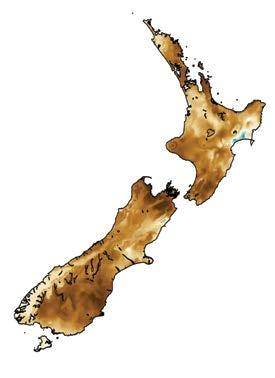
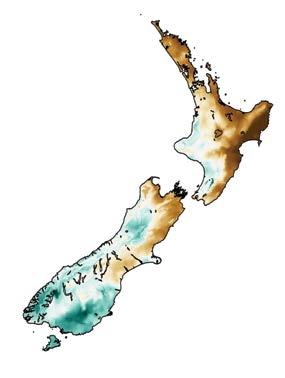
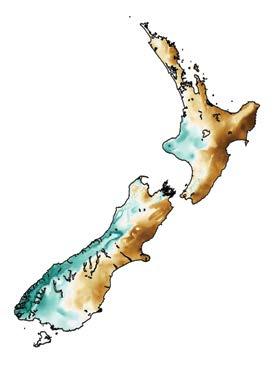
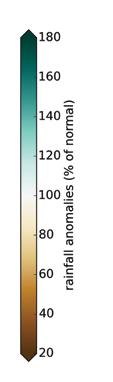
However, while RONI provides a clearer picture of El Niño intensity, it doesn’t necessarily predict the impacts on the ground. Reviewing how summer rainfall differed from normal (rainfall anomalies) during the three strongest El Niños in recent memory (1972/73, 1982/83, 1997/98) highlights the varying impacts the event can have on different parts of the country.
As Chris explains, El Niño contributes no more than 25 percent of all the factors influencing climate patterns, so cautions against using past events as a barometer of 2026/27 summer impacts. Nevertheless, he says there are compelling reasons to expect dryness to be elevated. “What we don’t know is which areas will be affected. Every El Niño has its own fingerprints, its own nuances.”
Get prepared
Given this uncertainty, early preparation will be important, says Ministry for Primary Industries (MPI) national response manager Andrew Curtis. MPI will be working with sector groups to support growers. However, he says that heading into winter just after a wet La Niña summer and autumn puts much of the country in a solid position.
Plan for an alternative water supply if you start to run low
“What this means practically on the ground is that most farmers and growers have had a wet summer,” he says. “Most are heading into winter with full dams.”
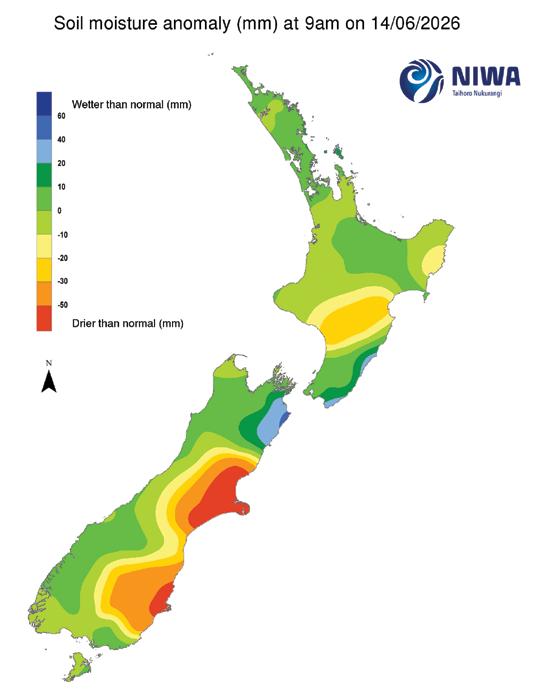
Water storage levels are high around the country, although parts of Canterbury are currently very dry. Parts of the North Island are drier than normal as well.
Winter is an important season for ground water recharge, and the second half of winter and early spring should bring more rain.
Andrew encourages growers to be prepared for El Niño and to have a plan. That includes setting dates for key decisions, depending on climate conditions, and to use irrigation water as efficiently as possible.
“Plan for an alternative water supply if you start to run low.”
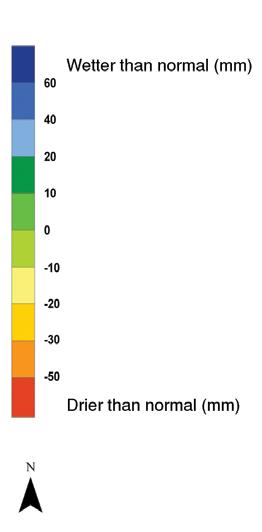
How summer rainfall differed from normal (rainfall anomalies) during the three strongest El Niños in recent memory
1972/1973
1982/1983
1997/1998
Three intense El Niño events had very different impacts on rainfall. For example Central Otago had much lower than normal rainfall in the summer of 1972/1973 followed by near normal rainfall in subsequent events
TOOLS TO KEEP AN EYE ON
Drought forecasting tool
Updates daily to provide districtlevel predictions of dryness and drought up to 3 to 5 weeks out.
Website: shiny.niwa.co.nz/ drought-forecast/
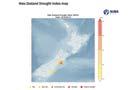
New Zealand Drought Monitor
Keep track of drought conditions across New Zealand based on a standardised climate index.
Although Canterbury and Otago headed into the first half of winter in much drier than normal conditions, a wetter second half of winter and spring should help recharge ground water
What to expect
Early winter has been unusually warm, but the second half of the winter is likely to bring more unsettled weather and may give way to cold snaps.
If these disruptions tighten global supply, they may partly offset some of New Zealand’s domestic production challenges through firmer international prices
Spring is likely to bring unusually high winds. Southerly changes could increase frost risks, however ocean temperatures are currently high around New Zealand. Overall Chris says spring is a turbulent time of year, and as El Niño takes shape he expects the spring highs to be high and the lows low, and rapid changes between them.
Heading into the summer months, El Niño typically brings drier, windier conditions in many growing regions, exposing Northland and eastern regions such as Canterbury, Hawke’s Bay and Tairāwhiti to the risk of lower rainfall, reduced soil moisture and greater irrigation pressure.
Tropical cyclone risks could be elevated but the outlook for that will follow later in the year.
The latest MPI export report notes that if dry conditions intensify into drought, the financial effects for farmers and growers could be significant. Reduced water availability would put pressure on production, tighten cash flow and increase demand for working capital.
Global supply chain disruption
Dramatic impacts on globally important large scale weather systems look likely, such as the Indian monsoon and the North Pacific storm track.
The MPI report notes that El Niño is likely to disrupt production in several competing food-producing regions. Drought across parts of Australia, Southeast Asia and northern Brazil could reduce crop yields, while heavier rainfall and flooding in parts of the USA and South America could damage crops, disrupt infrastructure and interrupt supply chains.
If these disruptions tighten global supply, they may partly offset some of New Zealand’s domestic production challenges through firmer international prices.
$165 incl GST for 11 issues (New Zealand postal addresses) Free for all HortNZ levy payers thanks to support from the horticulture sector
OUTPACING PANAMA
Distinguished Professor James Dale and his team at the Queensland University of Technology created QCAV-4, a Cavendish banana that is resistant to Panama Disease and the world’s first genetically modified banana approved for commercial production. His book The Future of Bananas is out in July, tracing the history of the banana and how science and technology might save the world’s most popular fruit.
Photos courtesy of QUT Media
Although New Zealand does not grow bananas at any significant commercial scale, the Cavendish banana is our favourite fruit, accounting for approximately 7.7 percent of produce department sales and amounting to an average annual banana consumption per person of approximately 16kg, according to Fresh Facts 2025. New Zealand imported 85,292 tonnes of bananas in the year to 30 June 2025.
We hear a lot about Panama Disease. How soon will we see bananas disappearing from grocery shelves?
Panama Disease (aka Fusarium wilt) tropical race 4 (TR4) is a soil-borne fungal disease that infects many if not most banana cultivars and landraces. Its predecessor, Panama Disease race 1, wiped out the previous export banana, Gros Michel, by the early 1950s.
Gros Michel was replaced by Cavendish, which has very similar fruit to Gros Michel but is resistant to race 1. However, in the 1990s, TR4 was identified particularly because it infects and kills Cavendish. The early reports were from Taiwan but the fungus and the disease have since spread, firstly within Asia and Australia (Northern Territory), before moving probably inadvertently by humans through Asia, the Middle East and Africa.
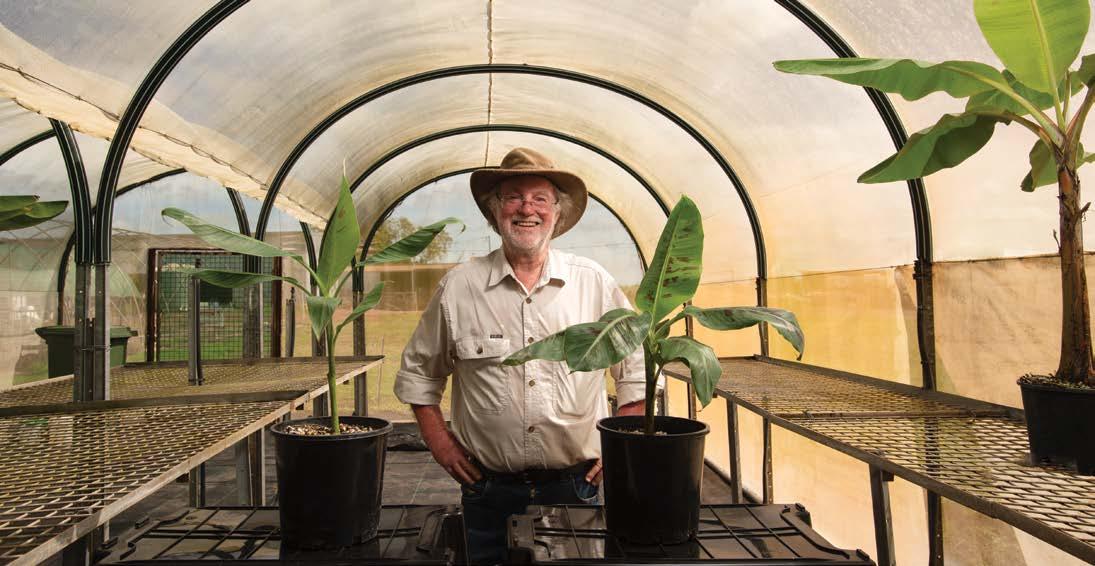
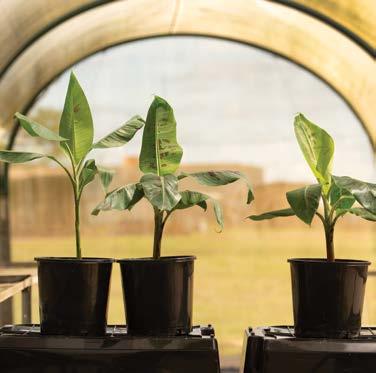
Professor James Dale with on his right a young wild banana plant and on his left a young Cavendish banana plant
Africa is an unusual case as TR4 has only been recorded in Mozambique, whereas elsewhere the disease usually spread rapidly to neighbouring countries.
There are a number of conventional banana breeding programmes already well established that are making significant progress towards a dessert banana with resistance
The major wake-up call came in 2019 when TR4 was found in Colombia, followed quickly by Peru, Venezuela and last year Ecuador. More than 85 percent of the world’s export bananas come from South and Central America and the Caribbean. Ecuador is the largest individual exporter. Virtually all of those exported bananas are Cavendish.
Unlike the 1950s, there is no ‘off the shelf’ TR4 resistant cultivar to replace Cavendish. While the catastrophising media often suggest that there is an existential threat to bananas and that the banana is on the verge of extinction, this is not the case. The reality is that the disease spreads relatively slowly and we are unlikely to see any serious impact on production and supply of Cavendish within the next decade.
How is the horticulture industry fighting back against Panama Disease?
The banana industry has recognised that it must develop a disease-resistant Cavendish or Cavendish lookalike. There are a number of conventional banana breeding programmes already well established that are making significant progress towards a dessert banana with resistance.
At Queensland University of Technology, we have released a genetically modified (GM) Cavendish that is nearly immune to TR4. We and others are also attempting to develop disease-resistant Cavendish using ‘gene editing’.
This involves very minor changes to the DNA of the plant rather than adding DNA. These changes can occur naturally and are not considered genetic modifications in many counties including Australia, Japan, most of the Americas and probably Europe.
I am confident that within a decade, there will be one or more new disease-resistant cultivars of Cavendish or something close to Cavendish that will be able to supply the world export market. The Cavendish cultivars will likely be GM or gene-edited, while those that are not Cavendish but similar will likely come from one of the conventional breeding programmes.
ThermoMax
• Provides internal warming more compact flowering
• For use on fruit tree crops
• The “spray on” that adds to all other methods
• Good results have been achieved when applied through irrigation lines
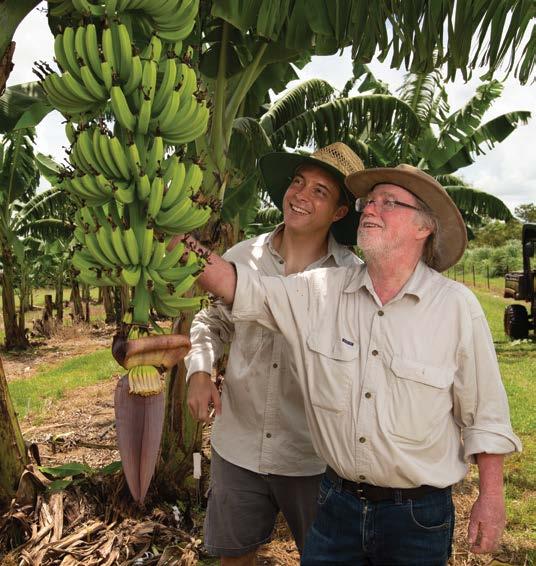
Dr Jean-Yves Paul (left), and Professor James Dale with a bunch of QCAV-4 bananas at the QUT facility in the Northern Territory
Currently New Zealand imports bananas mostly from South America and the Philippines, but not from Australia. Will Australian disease-resistant bananas become more competitive for export?
Our GM Cavendish, QCAV-4, will be very useful in areas where TR4 already is affecting production but it will not change the overall cost of production of bananas in Australia. Australian Cavendish bananas will therefore not be in a position to compete on the world market.
Given the existing risk of Panama Disease in Australia, why have no commercial volumes of QCAV-4 been grown yet?
For the Australian industry, the major concern with QCAV4 is consumer acceptance. Being the first is always a bit daunting as I have personally experienced with QCAV-4. If, in a decade, there are no non-GM TR4 resistant Cavendish bananas available, then I suspect QCAV-4 will play a role in global export banana production. There is already growing interest outside Australia. The biggest challenge will be the cost of deregulation in producing and importing countries.
Can stricter biosecurity measures protect the industry?
The Australian banana industry has implemented world-leading biosecurity strategies to contain TR4. Despite this, the disease continues to move – going from the first infested plantation in 2015 to 11 plantations in 2026. The industry can continue to supply the Australian market for the foreseeable future and could potentially open up new land (as happened with race 1 in the Americas and also in the Philippines for TR4). Ultimately, the Australian industry will move to resistant cultivars, be they GM, gene-edited, cisgenic [involving transfer of a new gene into the genome of a plant using gene technology] or a Cavendish lookalike.
New Zealand’s Gene Technology Bill is currently stalled in Parliament. Do New Zealand breeders risk losing their competitive edge without it?
QCAV-4 could not have been generated without the use of genetic modification or maybe gene editing. Cavendish is highly heterozygous and also virtually sterile and it would be nearly impossible to add TR4 resistance to Cavendish through conventional breeding.
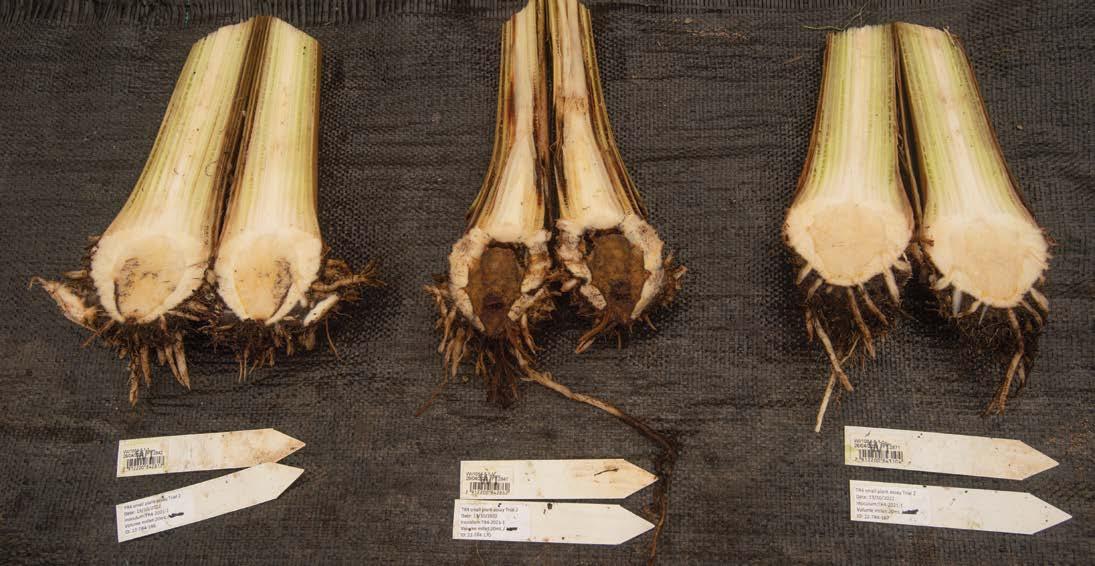
Cross-sections of young Cavendish banana plants show the stages of Panama Disease. From left: Start of the disease, advanced disease and no disease
From left a wild banana plant, a Cavendish banana plant and a QCAV-4 banana plant
GM unfortunately has a poor but undeserved reputation as well as being highly regulated, which makes this approach less appealing as a strategy for developing new cultivars. However, it is likely that gene editing and cisgenics will not have the same stigma and will not be regulated in many countries.
The great advantage of GM, gene editing and cisgenics is providing an avenue to genetically improve a cultivar without changing ‘the essence’ of that cultivar. QCAV-4 looks, yields and tastes the same as its parent Cavendish. The difference is that it contains a disease resistance gene from a wild banana.
In the future, I am certain it will be possible to develop gene-edited or cisgenic Huanglongbing [also known as citrus greening disease] resistant Washington Navel and Valencia oranges rather than developing entirely new and different oranges, or mildew resistant Pinot Noir or Shiraz grapes or fire blight resistant apples. There will also be greater challenges than diseases in the future – particularly with global warming. Many of our horticultural crops just won’t have the genes in their gene pool to cope with changing climates – be it elevated temperatures, extended droughts etc. We will need all the tools available to adjust to this coming reality.
James Dale’s new book The Future of Bananas, published by Melville House UK, traces the history of the banana to understand why it is such an important fruit, why its future is under threat, and why the western world is obsessed with one variety: The Cavendish. To get a copy, head to a good book store or search online.
KILTER
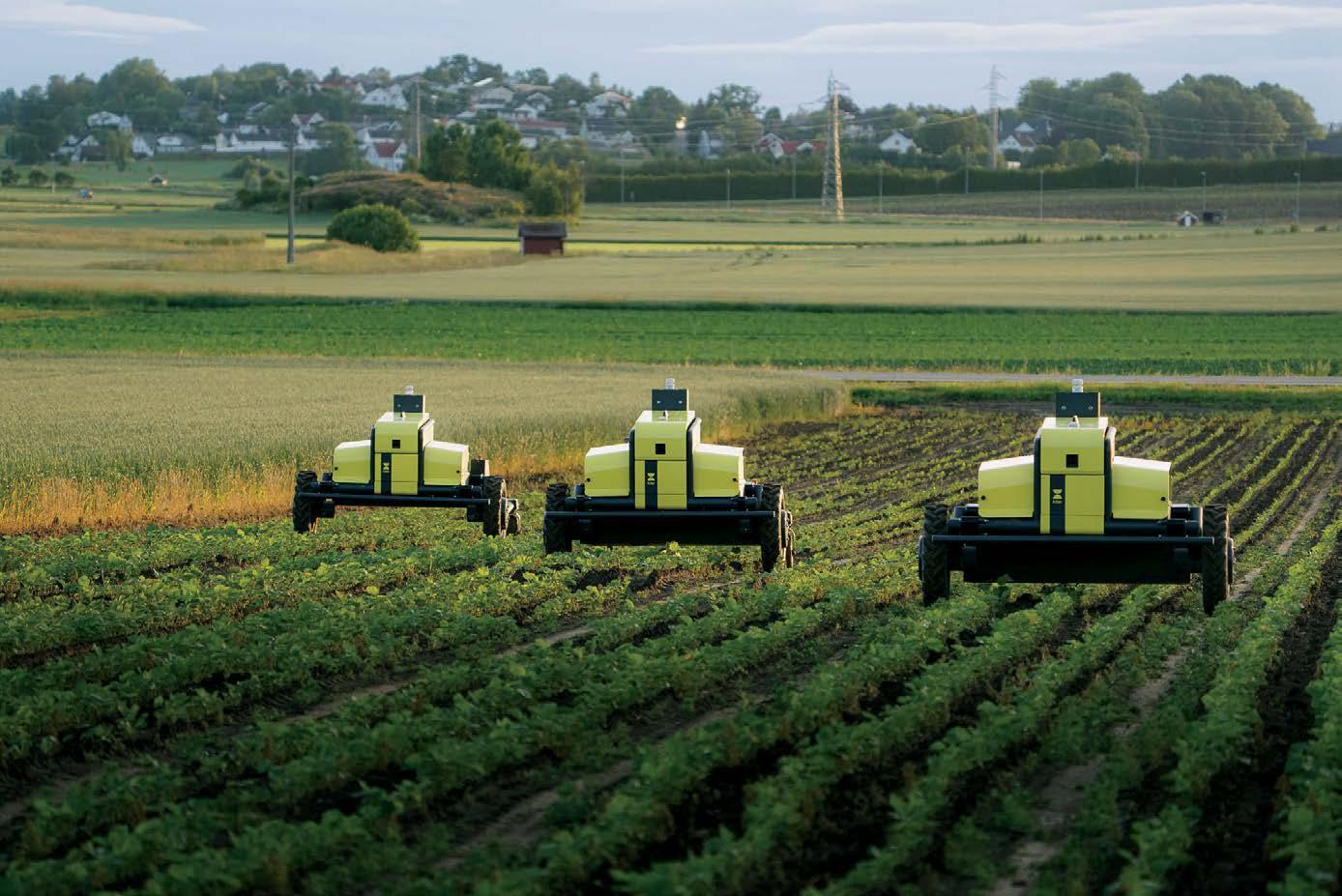
Croplands have introduced Kilter’s autonomous robot AX-1 to vegetable farmers. The
Where insight, leadership and industry come together
This July, the New Zealand Horticulture Conference brings the sector together in Wellington for two days of insight, connection and practical thinking. Hear from industry leaders, explore the issues shaping our future, and build your own agenda across three streams: strategic, technical and people-focused.
Whether you’re looking to deepen knowledge, strengthen networks or gain fresh perspective, this is where the industry moves forward together. Secure your place today.
RSE IN ACTION
Martin Chavez, 2024 Nuffield International Farming Scholar
Kate Scott, CEO, Horticulture New Zealand
Loua Fesola’i-Ward - National Manager Pacific, Ministry of Business, Innovation and Employment
Barbara Wilkinson - Ministry of Foreign Affairs and Trade
Meriama Taufale - Eastern Institute of Technology
PERFORMING UNDER PRESSURE
Gilbert Enoka - Coach, All Blacks
WOMEN IN HORTICULTURE NEW RESEARCH & WORKSHOP
Maximising Impact in the Workplace: Practical Tools for Performing Under Pressure
Jenny-May Clarkson, Presenter
Kate Gear, Research Manager, Scarlatti
THE FUTURE CONSUMER
Nicola O’Rourke - Director, Joy Consulting
Thanh Truong AKA The Fruit Nerd
Kate Meyer - Founder, Planetary Accounting Network
Geoff Rolleston - Māori Kiwifruit Growers
As the horticulture sector looks ahead, understanding the future consumer is no longer optional—it is critical to shaping today’s decisions.
Framed through a 2050 lens, this session explores the rise of the intentional consumer—a generation that will demand more from food: more transparency, more function, more meaning, and more proof. These expectations are already emerging, driven by changing values, technology, health awareness, and cultural identity.
From how consumers engage with food, to how they evaluate value, trust, authenticity, and sustainability, this session brings together diverse perspectives to unpack what will matter most—and what it means for growers, exporters, and the wider sector today.
Together, our speakers will challenge assumptions, highlight emerging signals, and connect the dots between consumer behaviour, market expectations, and how value is communicated, proven, and differentiated in-market.
VOICES OF THE SCHEME: WORKERS & EMPLOYERS
Australia Leilua (Aussie), Pastoral Care Lead - Lewis Farms
Elena Paitusi, Samoa RSE workerTeamwork (and JR Orchards)
FEATURED KEYNOTE
Sir Ian Taylor
Ali Lawn - RSE Manager, Bostock
Coralie Cross - HR Manager, Apata
Deane Caughey - General Manager, Thornhill Horticulture and Viticulture Contracting
ELECTION 2026: SETTING THE AGENDA FOR HORTICULTURE
With a general election on the horizon, decisions made in the next political cycle will play a critical role in shaping the future of New Zealand’s horticulture sector.
This session brings together representatives from across the political spectrum to share their perspectives on the key issues facing the industry—from market access and trade, to environmental regulation, labour, and infrastructure. As expectations continue to grow around sustainability, resilience, and global competitiveness, policy direction will be a defining factor in how the sector adapts and succeeds.
Hon Todd McClay (National)
Hon Andrew Hoggard (ACT)
Hon Shane Jones (NZ First)
Hon Jo Luxton (Labour)
Steve Abel (Green Party)
This moderated discussion will provide a platform to explore where parties align, where they differ, and what their priorities mean in practice for growers and exporters.
INSIDE THE ECONOMICS OF NZ FOOD: POWER, PROFIT AND THE PATH FORWARD
New Zealand’s food system is under increasing pressure—from rising costs and climate volatility to shifting consumer behaviour and concentrated market structures. While growers produce high-quality food, much of the value is captured elsewhere in the system.
Dr Hamish Gow - Sir Graeme Harrison Professorial Chair in Global Value Chains and Trade
Erin Mai - The Fresh Grower
Hugh Ritchie and more
This session takes a deep dive into the economics of New Zealand food, unpacking how power, pricing, regulation, and consumer choices shape grower returns—and what may need to change.
Bringing together economic insight, regulatory perspective, consumer data, and realworld grower experience, the session will explore where value is created, where it is lost, and the structural forces driving those outcomes.
SECTOR RALLIES BEHIND PROPOSED PVR AMENDMENTS
John Gauldie
Growers producing plant material protected by Plant Variety Rights (PVRs) can look forward to an extra five to seven years tacked on to their right-to-grow licence under changes proposed by Cabinet in May.
For example, New Zealand PVRs granted in 2016 for 23 years to ‘Zesy002’ kiwifruit, sold as Zespri SunGold™, are due to expire in 2039. Under the proposed amendments to the Plant Variety Rights Act 2022, the grant will increase to 30 years, expiring in 2046.
Gillian Sharp, corporate governance and intellectual property policy manager at the Ministry of Business, Innovation & Employment (MBIE), says the Government intends to extend maximum terms across all plant varieties. Woody plants, vines and potatoes would be eligible for up to 30 years, while all other plants would have a maximum of 25 years. She says the changes would apply to current and future grants, but would not be retrospective for recently expired grants.
The amendments will also restore effective provisional protection while applications are being examined. Work is underway on these amendments, which will be subject to parliamentary processes and timelines.
Innovation drives long-term productivity
New Zealand growers share the investment risk with breeders. For all the successful varieties, there are of course plenty of Intellectual Property (IP) varieties for which markets and orchard and farm gate returns have disappointed.
Some growers are also breeders and have launched their own PVR-protected varieties or are themselves the licensee for imported PVR-protected plant genetics with exclusive rights to grow in New Zealand.
Overall, despite the risk, growers have benefitted from PVR-protected varieties through higher premiums, and beneficial traits such as higher yields, optimised harvest windows, pest and disease resistance as well as new varieties that can respond to the changing climate.
Woody plants, vines and potatoes would be eligible for up to 30 YEARS
while all other plants would have a maximum of 25 YEARS
MBIE commissioned a report on PVRs from economists Berl in 2023 which shows longer PVR terms better match the biological and commercial reality of horticulture, allow growers and breeders to recover late-stage investment and sustain innovation. The report links PVRs directly to productivity gains, improved cultivars and long-term value creation – all of which directly benefit growers.
...extension generates a longer runway to work with, providing increased certainty for managing growers’
investment
Grower bodies including HortNZ, NZ Kiwifruit Growers Inc, Māori Kiwifruit Growers and NZ Apples & Pears have supported the latest changes. HortNZ says the Government’s proposed amendments are positive for the horticulture sector and will drive innovation, investment and long-term productivity.
NZ Apples & Pears chief executive Danielle Adsett says growers who have invested the time and money in PVR varieties view the extension as very valuable.
“Growers who invest in these varieties often face a sizeable initial outlay,” she says. “For them, the extension generates a longer runway to work with, providing increased certainty for managing their investment.
“As a sector, we’re fortunate these PVR varieties are complemented with the classic New Zealand Royal Gala, a commodity variety, which will remain a key apple in our product mix for years to come and can still fetch a premium.”
Changes
ensure future success
The amendments have also been welcomed by breeders, licensees and plant genetics importers.
Emma Brown, the Bioeconomy Science Institute’s general manager plant varieties, says the changes are necessary to provide more certainty to investors as variety breeding becomes more complex. Even in successful variety launches, the necessary return on investment often only comes in the final years of the PVR grant.
MORE THAN HALF OF NEW ZEALAND’S APPLE
PLANTINGS ARE IN IP-PROTECTED VARIETIES, WHICH DELIVER STRONGER PRODUCTIVITY AND RETURNS, AS WELL AS CONSISTENT DEMAND IN GLOBAL MARKETS
“It’s a significant amount of time as you’re bulking up a variety and getting it into market, getting it out with growers, building confidence with consumers and growers in the variety, and understanding how to optimise the production of the variety for the highest quality fruit with the best yields. It doesn’t come in year one.”
Emma also notes that 100 percent of the Bioeconomy Science Institute’s revenue from royalties through commercialisation of PVR and other IP goes back into science investment.
The 30-year term for woody plants (sometimes referred to as trees and vines) is in line with some of New Zealand’s main trading partners, including the European Union, United Kingdom and Japan.
Zespri’s revenue from licence fees can be several hundred million dollars a year, but the amount depends on the number of new hectares released –which can vary greatly year to year
It’s worth noting that extending New Zealand’s PVR terms will have no effect on other jurisdictions with shorter PVR terms, such as Australia, China, South Korea, Viet Nam and the USA. In those jurisdictions, grant terms for woody plants can be between 20 and 25 years.
It’s also worth noting that PVR legislation has no effect on trademarks, which can continue to add value after PVR expiry.
Trademarks are also not bound to a particular protected variety. For example, ‘Zes008’ kiwifruit (also known as Red19) is sold under the Zespri RubyRed™ trademark. ‘ZR80’ (Red80) is a filed PVR application for a new variety that will also be sold under the Zespri RubyRed™ trademark.
For growers, this extends the potential lifetime of earning a premium from their fruit by diversifying their portfolio as new reds are released. For consumers it means a continued assurance of quality.
New Zealand breeder success stories
Seventy-five percent of kiwifruit export sales comes from Zespri’s PVR-protected varieties developed at the Kiwifruit Breeding Centre, a Bioeconomy Science Institute – Zespri joint venture.
New Zealand kiwifruit growers licensed to grow Zespri’s PVR-protected varieties paid more than $63 million in royalties over total net sales in 2025. The royalty is deducted from the grower pool returns before payouts are made to growers.
Offshore kiwifruit production under Zespri licence also generates royalties through the Zespri Global Supply programme, supporting grower shareholder returns in New Zealand.
The royalty applies to fruit sold, separate from Zespri’s right-to-grow licence fee per hectare, which is sold at auction. The licence is a one-off capital cost and becomes an asset that the grower can sell or transfer.
Zespri’s revenue from licence fees can be several hundred million dollars a year, but the amount depends on the number of new hectares released – which can vary greatly year to year.
The amount released is based on an annual assessment of market demand, which looks at how much more fruit can be sold at high value. This model is key to long-term grower returns and ability to invest in brands and new varieties.
The price is set by growers through an open auction. This year Zespri released about 400 hectares for ‘Zesy002’ production, which reached a final price of $684,000 per hectare at auction.
Orchard Gate Return forecasts for ‘Zesy002’ production for the 2026/27 season are between $172,000 and $204,000 per hectare (Zespri’s March guidance).
PLANT VARIETY RIGHTS TIMELINE
1987
Parliament passes the Plant Variety Rights Act 1987, granting PVRs for up to 23 years for woody plants (think apples, kiwifruit, blueberries, stone fruit, etc) and 20 years for non-woody plants (including potatoes).
1991
The International Union for the Protection of New Varieties of Plants Convention agrees a new version (UPOV 91), strengthening plant breeders' rights, with a minimum 25-year PVR term for woody plants and potatoes and 20 years for all other plants.
1994-1996
The European Union establishes its PVR system with 30-year terms for potatoes, trees and vines.
1997
The UK Plant Varieties Act 1997 extends protection to 30 years for potatoes, trees and vines.
1997-2017
New Zealand’s review of the 1987 Act to bring it line with UPOV 91 is delayed by Treaty of Waitangi obligations and international trade obligations expected in the Comprehensive and Progressive Agreement for Trans-Pacific Partnership, which entered into force in 2018.
2023
The Plant Variety Rights Act 2022 comes into force. The Act increased the term for woody plants and potatoes to 25 years, bringing New Zealand in line with the UPOV 91 minimum terms – but this did not apply retrospectively to existing PVR grants.
2026
In May the Government proposes amendments to the Plant Variety Rights Act 2022.
Similarly, PVR-protected varieties underpin the pipfruit sector. Prevar is a joint venture of NZ Apples & Pears, the Bioeconomy Science Institute and Apple and Pear Australia Ltd. Prevar develops and commercialises premium apple and pear varieties including varieties sold under brands like Rockit™, Dazzle™, Sassy™ and PIQA® pears.
Tony Martin, Prevar chief executive, says New Zealand’s apple and pear industry’s future growth is firmly focused on value rather than volume.
“Intellectual property is at the heart of that strategy. Today, more than half of New Zealand’s apple plantings are in IPprotected varieties, which deliver stronger productivity and returns, as well as consistent demand in global markets.”
Another New Zealand IP success story is the ‘Scilate’ apple variety, commercialised, marketed and sold as ENVY™ branded apples by T&G Global. Developed in 1985 by scientists at the Bioeconomy Science Institute (then part of DSIR), the variety was exclusively commercialised by T&G in 2008 as ENVY™ apples. T&G, through its global plant variety commercialisation and management company VentureFruit, owns the trademark and licences for ENVY™, which is now sold in 55 markets worldwide.
This year, ENVY™ surpassed NZD$1 billion in global retail sales, which T&G says makes it the first New Zealand apple brand to reach this milestone.
T&G partners with more than 900 growers globally to produce its premium ENVY™ apples in 13 countries, ensuring consumers can buy the brand every day of the year. In New Zealand T&G grows ENVY™ apples on its own orchards, and also partners with around 100 independent licensed growers in Hawke’s Bay, Tairāwhiti and Nelson.
Although its licence fees and royalty agreements are confidential, T&G says that in 2025, ENVY™ apple growers in New Zealand earned an average Orchard Gate Return of over $67,000 per hectare, with leading performers achieving over $108,000 per hectare.
New variety investment is risky
Breeders work through many cultivars before hitting upon a billion-dollar success story, which requires decades of trials followed by lengthy market commercialisation investment.
Similarly, importing plant genetics is a costly and lengthy process, followed by field trials to determine the value to New Zealand growers across the country’s various climates and growing conditions.
Eurogrow is an importer of potato varieties. General manager Tony Hendrikse was heavily involved in advocating for changes to the 2022 legislation, including appearing at Parliamentary Select Committee.
“The people around the table are not horticulture experts, they’re politicians,” he says. “So it really helps to have the opportunity to talk to them, and give them an understanding of how the industry actually works.”
Intellectual property is at the heart of that strategy
He says only 1 in 10 varieties imported ends up adding value to New Zealand growers and becoming established in commercial production.
“The market here is pretty mature, so only varieties that can really make a difference become successful.”
Eurogrow is the New Zealand licensee for successful varieties with live PVR grants such as ‘Laura’, ‘Mustang’, ‘VR 808’, ‘Marabel’ and ‘Jelly’, imported from breeders in the United Kingdom, the Netherlands, Belgium and France (as well as New Zealand-bred varieties). More than 70 potato varieties have live PVR grants in New Zealand.
“I’ve just come back from Europe talking to our partners over there,” Tony says. “They are really pleased to hear
about these changes that would bring our legislation in line with Europe, which saves some complications.”
Sharing the highs and the lows
Balancing the risks and obligations within contracts and terms between breeders, growers and marketers is a highly complex legal area, often without much external transparency due to the commercial sensitivity.
“We operate quite a wide range of licences and licencing mechanisms,” Emma says. “From a non-exclusive nursery licence where plants are sold to any grower with no control over the fruit production through to a really highly controlled, highly managed, controlled global exclusive licence.”
Emma says that, while contracts will vary, the philosophy behind the different models remains splitting the risk with growers through a one-off licence fee to engage with the new variety followed by royalties on fruit sold.
If, due to a terrible weather event, growers end up not having the crop they expect, the royalties will be lower than in a season with high prices and a bumper crop.
“We share in the highs and the lows with growers,” Emma says. “That’s an ideal model from our perspective.”
PLANT FOR SUCCESS
Zucchini
Ballistic: Market standard. Easy pick top grade fruit. For spring through to autumn harvest and undercover early and late.
Armour: Straight fruit get to length then fatten evenly. Wide planting window.
Maveric: Parthenocarpic variety for indoor.
Uniform 14–20cm cylindrical fruit, small blossom scar. Early maturity with no fruit loss due to poor pollination. Also available Bazooka.
Early Sweetcorn
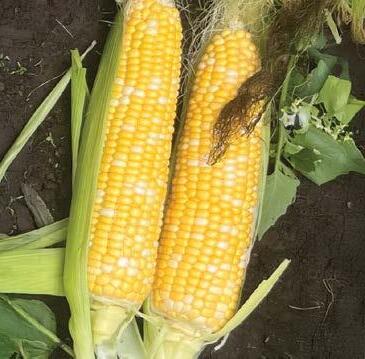
Nirvana, Xanadu & Globetrotter: All with 20cm cobs, good husk cover and excellent flag. Slightly tapered with excellent colour and flavour. Easy pick with strong disease package. Xanadu is 2–3 days later than Nirvana and Globetrotter 5 days later. Reliable, uniform varieties. High quality seed available.
Rock Melon
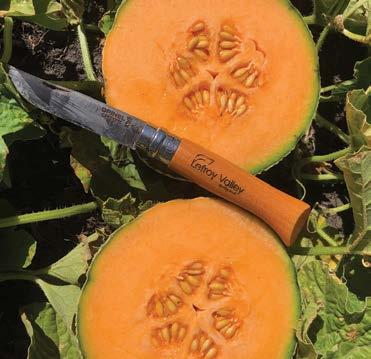
Inca & Mayan Gold: 1.6–1.9kg, 12–14°Brix with excellent internal colour and flavour. Both are sutured with small cavities, strong vines and easy setting ESL types. For early season Aurous and late Olmec
PRUNING WITH PURPOSE
With harvest complete, attention turns to setting up next season’s crop. Winter pruning is not just about branch removal and tree structure. It influences light distribution and interception, tree vigour status, cropload potential and sets up the ‘framework’ for next season’s crop.
Sarah McArley and Meg Becker : AgFirst Consultants
The type of cut, and its timing, influences how the tree responds, grows and crops through the coming season, so all winter pruning should be carried out with the desired response and block targets front of mind.
While pruning styles will change with block age, cultivar, training system and management objectives, the underlying tree physiology principles remain consistent. If done poorly, pruning can stimulate unnecessary growth and increase shading, adding cost back into the value chain later. Therefore, it is vital growers understand the implications of different cuts and pruning techniques to optimise light, improve canopy structure, manage vigour, support fruit quality and keep the production system efficient.
Canopy architecture, light and vigour balance
The first purpose of pruning is to establish and maintain canopy architecture. In young trees, this means building the canopy framework and filling the tree’s allotted space efficiently. Priorities should be branch texture, light and bud quality. In mature trees, this means holding the shape and function of the canopy so that fruiting wood remains productive and accessible, while maintaining adequate light exposure and carbohydrate efficiencies.
Light drives photosynthesis, and photosynthesis drives the carbohydrate supply needed for growth, floral initiation, fruit set, fruit size, colour and maturity. Both light interception and light distribution are important.
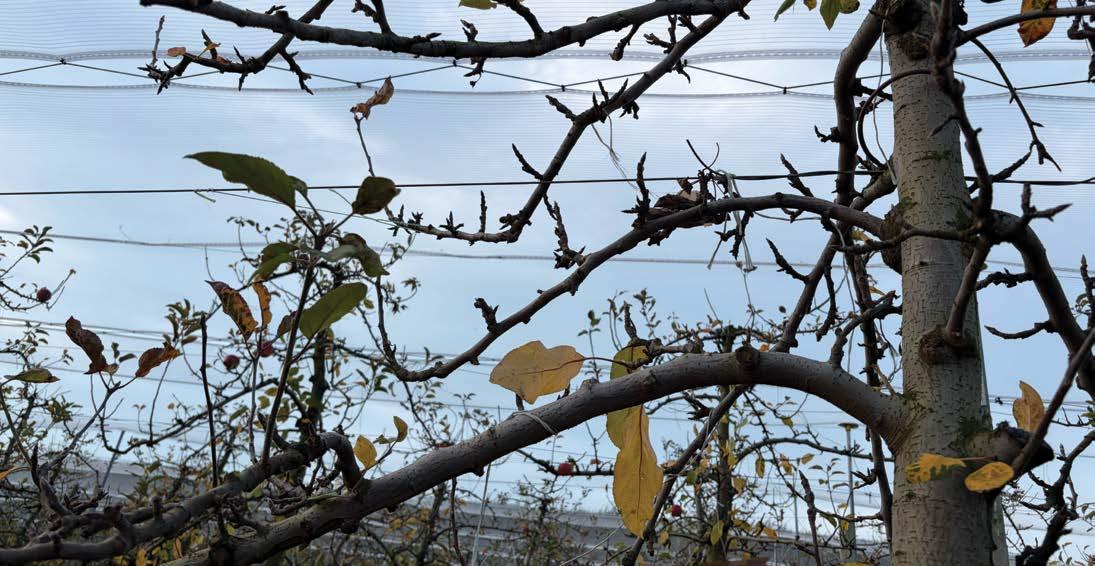
Stacked branches resulting in poor light distribution through the tree, leading to blind budding and poor bud quality in the bottom branch
For example, while dense tops can intercept plenty of light overall, they can still shade the lower and inner canopy, limiting distribution. Pruning helps shape a canopy that captures light well and distributes it more evenly through the tree.
In young trees, growth is needed to build a framework and fill space. However, in mature trees, the goal shifts to balance. Sufficient vegetative growth is still needed to provide renewal wood and maintain leaf area, but not so much that vegetative growth dominates the canopy, suppressing cropping potential and creating shading.
Response to the removal of a terminal bud, where the dormant bud has pushed new growth
Retaining lower-vigour, fruitful wood and removing overly vigorous, non-productive shoots helps direct resources towards developing bud quality rather than unnecessary extension growth, or water shoots. However, a canopy with too little vigour is also not ideal, as adequate leaf area is still needed to support crop development and maintain fruit size, fruit finish and return bloom.
Pruning with tree response in mind
Pruning changes hormone distribution and resource allocation within the canopy. Auxin and cytokinin are both hormones that influence growth habits, and pruning cuts interrupt the signals created by those hormones in different ways depending on the type and position of the cut.
The concept of apical dominance is an important one to understand when determining how trees are likely to respond. Terminal buds, the buds at the ends of stems, are responsible for primary growth. Auxin is produced by terminal buds and is transported down the plant, where it suppresses the lateral buds. However, if the apical bud is removed, the buds directly below it will break. This is because the auxin pathway is interrupted, resulting in a flow of cytokinin that activates the dormant buds. This may be useful where there are insufficient buds in a canopy, or where branching is needed. These types of cuts can also create a strong vigour response if too many large cuts are made, or if cuts occur in the wrong type of wood. For example, heading cuts are a tool that can be used to promote branching in a tree that has gone blind by stimulating shoot extension from lower or dormant buds. However, this type of cut leads to a vigour response due to interrupted sap flow and the tree needing to re-establish apical dominance.
In addition, the timing of pruning within the season affects the growth response. Dormant pruning is inherently invigorating because it concentrates stored reserves into fewer buds. Summer pruning is more devigorating, as it reduces the tree’s leaf area, and lowers photosynthetic potential and carbohydrate production.
Pruning as early cropload management
While pruning influences light interception and resource allocation, it also contributes to early cropload management by removing excess buds and potential fruiting sites before the tree reaches flowering and fruit set. Flowering is one of the most physiologically demanding points in the season, as the tree is drawing on stored reserves at a time when the plant’s photosynthetic potential is very low.
The apical dominance and auxin influence effect pushing a new bud
Before After
Cut Dormant bud
New branch from released axillary bud
Fruit bud numbers directly correlate to the number of floral sites expected in spring, and this metric can be used to support pruning decisions. By adjusting bud numbers early, and prioritising bud quality and positioning, growers can better align bud load with target fruit numbers and reduce competition for resources in the spring. This influences vigour status, fruit size and fruit quality outcomes.
Pruning changes hormone distribution and resource allocation within the canopy
Detail pruning can be used to support early fruit size development, drive fruit quality and achieve even crop distribution through the tree. However, if detail pruning is not optimised, the cropload burden simply shifts downstream, potentially compromising carbohydrate efficiencies as the plant’s reserves are spread across fruit that will later be removed and not end up in the bin at harvest.
Detail pruning can also support labour management, with the potential to make more educated decisions at chemical thinning and relieve pressure at hand thinning where blocks have already been pruned close to the target cropload. This then gives managers the ability to prioritise thinners elsewhere.
Using bud-to-fruit ratios
AgFirst encourages growers to use the ‘bud-to-fruit’ ratio concept to help quantify how much detail pruning may be required to achieve early cropload management. The bud-to-fruit ratio is simply the number of fruit buds in a tree relative to the target number of harvested fruit. Growers can use bud counts to understand the starting number of buds in the block, which in turn guides the level of reduction needed to get closer to the block’s postprune target. As a tree matures and settles, bud numbers tend to increase, particularly in spur varieties. In spring, flowers act as a carbohydrate sink when the plant is not yet photosynthesising fully, drawing on reserves.
Where the grower has decided to use a high bud-to-fruit ratio, there may in turn be greater floral competition, which can influence fruit set and spring carbohydrate use efficiency as a result of plant stress. This may be used as a vigour management strategy.
Running a low bud-to-fruit ratio is a well-used strategy in young canopies where growth is being prioritised, or when trying to get an early lift in fruit size in spring, particularly in a settled canopy.
There is no hard and fast rule, and not all fruit buds are equal. However, used well, bud-to-fruit ratios help growers align pruning, thinning and crop load decisions early, giving blocks the best chance of achieving the desired vigour status, target fruit numbers, fruit size and quality.
Cytokinin
Winter bud monitoring in practice
Best practice winter bud monitoring includes:
Fruit bud counts
Count all fruit buds regardless of size and shape, including spurs and terminal buds on darts and bourse shoots. For tip-bearing varieties, do not be tempted to count one-year buds. These are treated as ‘bonus flowers’ due to their lower reliability and typically do not produce the highest-quality fruit within the tree.
Most growers count buds as a tree average to understand the overall floral load. However, splitting the tree into zones allows growers to target specific parts of the tree. Where are the quality buds located, and where can detail pruning therefore be targeted? When quantified, this helps refine pruning instructions with confidence that the target cropload will still be achieved. If pruning is not being done to a target bud number, an understanding of the post-prune bud count can then guide chemical thinning decisions, including how hard to go and the level of floral stress the tree may already be under at flowering.
Fruit bud floral capacity assessments
Fruit buds are sampled prepruning and assessed under the microscope to determine their floral potential. This is a best-practice winter pruning metric, helpful on blocks where floral capacity is unknown or on biennial varieties, particularly in an off year. This allows growers to adjust their bud-to-fruit ratio up or down more confidently.
In practice, the aim of pruning is to build and maintain a canopy that intercepts light efficiently, supports high-quality fruit production and stays in balance with the tree’s growth habit. It comes back to reading the tree, anticipating its response, and using the right cuts to set the orchard up well for the season ahead.
Settled tree showing high bud density in the tops in comparison to the bottoms
FOR MANY OPERATIONS, THE DRONE HAS BECOME A REGULAR AND RELIED-UPON PART OF HOW THE SEASON GETS DONE
For many growers, fertiliser spreading will be the most immediately rewarding entry point into drone use
GETTING REAL VALUE FROM DRONE APPLICATION
Drone use for spraying and fertiliser spreading is proving a powerful new addition to the New Zealand grower’s toolkit – when it’s done well. If you are considering trialling a drone programme, these are the questions to ask your operator to make it count.
Liarna and John White : Horticultural scientists, kiwifruit and avocado growers, and founders of Falcon Precision Drone Services
Drones have been operating in New Zealand horticulture and cropping for several years, and the technology is delivering genuine, practical value on the ground.
With drones, growers are accessing difficult terrain that ground rigs cannot safely reach, applying product during weather windows when machinery would cause soil damage, reducing compaction from repeated passes and targeting inputs with a precision that was not possible before. For many operations, the drone has become a regular and relied-upon part of how the season gets done. Like any application tool, getting the most from it comes down to a fundamental question: Is the product reaching its intended target? That question matters whether you are pushing a fungicide into a dense canopy, timing a near-harvest treatment to a specific fruit development
window or getting even coverage across a paddock that a boom sprayer would damage. The platform changes; the objective does not.
The same rules, a different platform
The good news for any grower who understands spray application is that the fundamentals translate directly: Droplet size, application rate, coverage, timing and product compatibility all still matter from the air.
What changes is how some variables behave. A drone moving too fast through a block can deliver poor coverage, even while applying the right volume per hectare on paper. What works over maize seedlings is not right for mature avocado or apple trees. Height shifts with crop architecture, product type and wind.
Drones can better access older, densely planted trees with closed canopies where a tractor cannot get through
Flight speed, height and spray width together with volume per hectare drive the cost of the job, so a low price per hectare where coverage is not consistently on target is not good value. Work with operators who set parameters deliberately for your crop and your chemistry, not out of habit.
Getting product to the target
The real test of a drone application is not whether the spray came out – it is whether the product reached the surface it needed to reach, at the right rate, at the right time.
Consider a mature avocado block. A full-canopy tree can reach eight metres or more, with dense foliage intercepting a large proportion of any downward spray. Fruit at the top
is the most accessible target, but disease infection points on stems and leaf axils deeper in the canopy require product to penetrate the structure. A single overhead pass with default settings is unlikely to achieve that. It requires deliberate attention to height, droplet size and consideration whether one pass is ever enough.
A mature citrus block presents a similar challenge. Older, densely planted trees with closed canopies are often exactly why a block has been underperforming. Despite regular programmes, the product simply is not getting through. A drone that cannot push product into the canopy interior is not solving the problem; a wellconfigured one can.
Ask your operator specifically how they will demonstrate coverage was achieved through the canopy, not just on top of it.
Timing is everything: Near-harvest applications
Products where timing is tightly coupled to a biological window show particularly well why precision aerial application matters. Harvista™, used on apples as a near-harvest treatment, is a clear example. Critically the product is short lived in solution so must be applied within a narrow timeframe from mixing. Drone application is a practical solution to this challenge.
The application window is specific: Too early and the response is incomplete; too late and the opportunity has passed.
In an orchard where terrain or wet conditions have historically made timely ground-rig access unreliable, a drone changes the calculus entirely. The ability to rapidly get product on in a narrow weather window can be the difference between a crop that reaches its quality potential and one that does not. But that benefit only materialises if the product reaches the fruit.
Ask your operator whether they have applied this product before, what coverage results they can demonstrate and how they approach canopy penetration for your block structure.
Penetrating the dense foliage of a full-canopy avocado tree requires deliberate attention to flight speed, height, droplet size and other factors
Orchards and cropping: Different challenges, same discipline
For orchardists, drone application offers real advantages. For vegetable and cropping operations, the opportunity is different but equally real.
Crops such as sweetcorn or squash are easily damaged by ground rigs after canopy closure. Similarly, on wet soil, ground machinery cause compaction damage. At such times, a targeted application by drone of both fertiliser and pest or disease control can make critical differences –and even save a crop.
Drones are much more flexible and usually more cost effective than helicopters, while also able to operate in many more sensitive areas or at night.
In cropping, weed identification and targeted herbicide spot-spraying with a drone is also an active area of development, with some operations already achieving significant reductions in herbicide use.
Not all products want the same setup
Most agricultural drones use rotary atomiser nozzles, making droplet size a selectable parameter. Droplet size control is an advantage, but only if it is chosen thoughtfully for each product, target and the conditions.
Fine droplets maximise leaf surface coverage and suit many fungicide and some insecticide applications. However, fine droplets drift further and can be wrong for some products and in application conditions where drift control and coverage uniformity is more critical.
In wet conditions, when ground spraying can easily damage crops, drone applications of fertiliser and pest or disease control can make a critical difference
A pre-emergent herbicide, a contact insecticide and a systemic fungicide all have different optimal droplet requirements.
Ask specifically: What droplet size are you using for this product, and why? The answer should be grounded in the chemistry’s mode of action and the target you need to reach.
Drones
are much more flexible and usually more cost effective than helicopters, while also able to operate in many more sensitive areas or at night
Chemistry approvals and efficacy
Confirm before any drone application that the product label specifically permits aerial use in New Zealand – not all ground-approved products carry aerial approval, and a good operator will raise this without being asked.
The efficacy picture under New Zealand conditions is still building, which is an exciting space to watch. Some chemistry and target combinations perform exceptionally well from a drone, particularly where timely, precise application is the critical factor. Start with applications where the drone has a clear operational advantage and build your own on-farm evidence from there.
WHAT TO ASK YOUR DRONE OPERATOR
These are the same questions a good agronomist would ask before recommending any spray programme. A confident operator will welcome them and actively want growers to understand what they are doing and why. The best drone programmes in New Zealand are built on exactly this kind of groweroperator dialogue.
These are the questions worth having that conversation around:
Is this product approved for aerial application under its New Zealand label?
Have you applied this product before, what coverage results can you demonstrate? Have you done coverage monitoring after flights?
Do you have appropriate insurance for commercial aerial application work?
Fertiliser spreading: A great place to start
For many growers, fertiliser spreading is the most immediately rewarding entry point into drone use. Whether applying when ground rigs would cause damage, or applying in areas machinery cannot access, targeting visible variation within a block or reducing compaction from tractor passes – the wins are tangible and quick to see. With fertiliser prices elevated, variable rate application can represent a significant saving. Good local knowledge of your block’s variation is often enough to start targeting applications meaningfully, with mapped data adding precision as your confidence grows.
Finding the right operator
Find an operator with demonstrable experience in your specific crop type. An orchard canopy, a field crop and a vegetable paddock each require quite different approaches.
Ask to see records from comparable jobs and ask whether they have done coverage monitoring after a flight. Confirm they carry appropriate insurance for commercial aerial application work. Do they have the required GAP certification for your industry?
The growers getting the most from drone technology treat it as a genuine working tool, giving it the same critical attention they would any other piece of equipment on the property. That combination of enthusiasm and rigour is exactly what turns a promising technology into a reliable part of how the season gets done.
Do you have the required GAP certification for my industry?
What application rate (L/ha) are you proposing, and how does that compare to the label rate?
What droplet size will you use, and why is that appropriate for this product and crop structure?
What flight speed and height are you planning, and how do those achieve the right coverage for this canopy?
Single pass or double pass, and why?
What wind speed limits apply, and how will you manage changing conditions?
What records will I receive?
Science working for New Zealand
Orchards
Golden age of kiwifruit
Stopping hitchhikers
Go to www.hortnz.co.nz for up-to-date information on the Horticulture New Zealand Incorporated Annual General Meeting and related documents.
A proxy form and AGM information will be provided to eligible growers by email. If you do not receive this information, please email AGM@hortnz.co.nz. The proxy form will also be available on the Horticulture New Zealand website AGM@hortnz.co.nz.
The following motions will be considered at the Horticulture New Zealand Incorporated Annual General Meeting being held at Tākina, Wellington Convention and Exhibition Centre, 50 Cable Street, Wellington on Tuesday, 28 July 2026 at 4.30pm.
MOTION 1
That the Minutes of the 20th AGM of Horticulture New Zealand, held on 26 August 2025 at Tākina, Wellington Convention and Exhibition Centre, 50 Cable Street, Wellington be taken as read and confirmed as a true and correct record of that meeting.
Proposed by the Horticulture New Zealand Incorporated Board.
Explanatory note: A PDF of the Minutes of the 2025 AGM will be available on the Horticulture New Zealand website www.hortnz.co.nz. If you have any questions or would like a hard copy, please email AGM@hortnz.co.nz.
MOTION 2
That the combined Chair and Chief Executive’s message for the financial year ending 31 March 2026, as published in the Annual Report be taken as read and adopted.
Proposed by the Horticulture New Zealand Incorporated Board.
Explanatory note: A PDF of the Annual Report will be available on the Horticulture New Zealand website www.hortnz.co.nz. If you have any questions or would like a hard copy, please email AGM@hortnz.co.nz
MOTION 3
That the audited Financial Statements for the year ended 31 March 2026 be adopted.
Proposed by the Horticulture New Zealand Incorporated Board.
Explanatory note: A PDF of the Annual Report and Financial Statements will be available on the Horticulture New Zealand website www.hortnz.co.nz. If you have any questions or would like a hard copy, please email AGM@hortnz.co.nz
MOTION 4
That the 2027/28 year levy rate for the purposes of the Commodity Levies (Vegetables and Fruit) Order 2024 remain and be set for domestic sales at 0.14% of the price received at the first point of sale, for export sales to remain and be set at 0.14% of the price received after the deduction of all offshore costs and for processed sales to remain and be set at 0.14% of the notional process value.
Proposed by the Horticulture New Zealand Incorporated Board.
Explanatory note: The Commodity Levies (Vegetables and Fruit) Order 2024 allows for a maximum rate to be set for vegetables and fruit at 0.15% for domestic sales and processed sales taken at the first point of sale and at 0.15% for export sales at the first point of sale after all offshore costs (including international freight)
have been deducted. For processed vegetables and processed fruit, the levy is deducted from the notional process value, which is defined in the Order. At the AGM levy paying growers may set any rate up to the maximum for the next calendar year. The current rate for vegetables and fruit is 0.14%. This levy funds the activities of Horticulture New Zealand. The Board recommends that the levy rate be set and remain at 0.14% for the 2027/28 year; this will commence on 1 April 2027 and continue through to 31 March 2028.
MOTION 5
At the time of going to print, the Director remuneration information was not available. This will be available on the Horticulture New Zealand website www.hortnz.co.nz
MOTION 6
That the budget for the year ended 31 March 2027 be endorsed.
Proposed by the Horticulture New Zealand Incorporated Board.
Explanatory note: A copy of the budget for the year ending 31 March 2027 is available on request. Please email AGM@hortnz.co.nz.
MOTION 7
That PKF Kendons based in Petone, Wellington be appointed auditors for the year ending 31 March 2027.
Proposed by the Horticulture New Zealand Incorporated Board.
Explanatory note: PKF Kendons has acted as auditor for Horticulture New Zealand Incorporated for the year ended 31 March 2026. This is this first audit undertaken by them.
If you require further information about the AGM or would like a hard copy of any of the AGM documents go to the Horticulture New Zealand website www.hortnz.co.nz, call 0508 467 869 or email AGM@hortnz.co.nz.
THOUGHT LEADERS
ANSWERS UNDER FOOT
For his Kellogg Rural Leadership Programme research project, Richard Pentreath explored why soil health may be horticulture’s most important sustainability measure. He outlines his findings for NZGrower & Orchardist
Richard Pentreath
When discussions turn to sustainability in horticulture, the focus is often on water quality, greenhouse gas emissions, biodiversity or agrichemical use. Yet beneath every orchard and vegetable crop lies a resource that underpins them all – soil.
Healthy soils are essential for productive, profitable and resilient growing systems. They regulate water, cycle nutrients, support biodiversity, store carbon and help crops withstand climatic extremes. Despite this, soil health rarely receives the same attention as other environmental indicators.
My recent Kellogg Rural Leadership Programme research project explored a simple but challenging question: Should soil health be our number one sustainability goal?
After reviewing international research and interviewing growers, researchers, industry leaders and policy experts, one conclusion became clear: While there is broad agreement that soil health matters, there is still significant work to do before it becomes a central measure of sustainability across New Zealand horticulture.
A growing global concern
Globally, soil degradation is emerging as a major environmental challenge. The United Nations Food and Agriculture Organization estimates that up to 75 percent of the world’s soils are already degraded.
This matters because soil is much more than a growing medium. Healthy soil is a living ecosystem that supports plant growth, regulates water movement, stores carbon and sustains complex communities of microorganisms. When soil health declines, the effects ripple through entire communities.
There is no soil health under concrete
In New Zealand, productive soils face a dual threat. Firstly, there is the ongoing degradation of soil through unsustainable management practices. Secondly, highly productive land is increasingly being lost to urban expansion.
As one interview participant noted, “There is no soil health under concrete.”
For the horticulture sector, where access to versatile, high-quality land is fundamental to future success, both threats deserve serious attention.
Knowledge gaps remain
One of the strongest themes to emerge from the research was the existence of knowledge gaps.
Interestingly, these gaps are not limited to growers. Researchers, industry organisations and policymakers all acknowledged that soil health remains difficult to define, measure and communicate.
Unlike water quality, which can be assessed using relatively straightforward parameters, soil is incredibly complex. It consists of mineral particles, organic matter, water, air and a vast array of living organisms interacting in dynamic ways. Many growers understand the importance of maintaining good soil structure and organic matter. However, uncertainty remains around questions such as:
What does a healthy soil actually look like?
Which measurements matter most?
How much change is required before improvements become meaningful?
How can improvements be linked to productivity and profitability?
Several participants felt that the sector already possesses sufficient knowledge to make meaningful progress. The challenge is not necessarily generating more research but ensuring existing knowledge reaches growers in a practical and accessible form.
The loss of publicly funded extension services during the 1990s was highlighted by several interviewees as a turning point. Many growers now receive advice primarily from commercial suppliers, while access to independent technical support is often limited.
The success of initiatives such as the A Lighter Touch programme demonstrates the value of well-designed extension programmes that connect research with practical on-farm application.
The mindset challenge
While knowledge is important, many participants believed mindset may be an even greater barrier to change.
Several interviewees suggested that growers often perceive soil-health-focused practices as risky, particularly during periods of financial pressure. Established management systems provide predictability, while new approaches can create uncertainty.
This challenge is not unique to New Zealand. International research consistently shows that adoption of sustainable soil management practices is influenced by personal values, social networks, risk perception and identity, as much as by economics.
One grower interviewed during the project commented that he had effectively been applying regenerative principles for decades but had little interest in labelling himself a regenerative farmer. For him, the focus was simply on good management.
...soil health sits at the centre of many sustainability outcomes we already care about
This reflects an important point. Improving soil health does not necessarily require growers to adopt a specific farming philosophy. In many cases, meaningful improvements can be achieved through relatively simple changes such as:
• Reducing unnecessary soil disturbance
• Maintaining living roots in the soil for longer periods
• Increasing organic matter inputs
• Managing traffic to reduce compaction
• Using diverse cover crops
• Improving groundcover management.
Many of these actions carry relatively low business risk while delivering benefits to soil function over time.
Profitability still drives decisions
For most growers, environmental outcomes must sit alongside commercial realities.
The research found that profitability, labour constraints, compliance requirements and market demands often take precedence over long-term soil considerations.
This does not mean growers do not care about soil health. Rather, they operate within systems that reward production and financial performance more directly than environmental stewardship.
Several participants noted that growers are currently paid for producing food, not for improving biodiversity, enhancing soil carbon or protecting ecosystem services.
This creates a disconnect between the benefits healthy soils provide to society and the incentives available to growers.
Interestingly, the research also highlighted examples where soil health and profitability aligned strongly. Well-managed soils were frequently associated with greater resilience, reduced input requirements and improved crop performance.
In other words, soil health should not be viewed as separate from business performance. In many cases, it is a key driver of long-term profitability.
Leading the way?
Markets are likely to drive change
Perhaps the clearest finding from the research was that market signals are likely to influence grower behaviour more strongly than regulation.
The kiwifruit industry was referenced by some interviewees as a sector making positive progress.
Participants pointed to several factors contributing to this success:
• Strong industry collaboration.
• Grower engagement with markets.
• Investment in extension programmes.
• Recognition of the relationship between soil health and crop performance.
The sector’s integrated structure can allow information to flow more effectively between researchers, industry bodies and growers. Several interviewees suggested this collaborative model has accelerated the adoption of soil-health-focused practices.
...soil health should not be viewed as separate from business performance
That said, even within kiwifruit there were differing views about how well growers understand soil health. Some believed awareness was high, while others felt only a minority of growers actively managed soil health as a core business objective.
Export markets are increasingly demanding evidence of environmental stewardship. Sustainability credentials are becoming a prerequisite for market access rather than a point of differentiation.
As overseas customers seek assurance around climate impacts, biodiversity and resource management, soil health is likely to become a more visible part of sustainability reporting.
Several interviewees predicted that soil health scorecards could eventually become as commonplace as current environmental reporting requirements.
Rather than relying solely on regulation, industryled initiatives and market incentives may prove more effective in encouraging widespread adoption of better soil management practices.
Looking ahead
The question posed at the beginning of this project remains deliberately provocative: should soil health be our number one sustainability goal?
The answer may depend on perspective. However, what is increasingly clear is that soil health sits at the centre of many sustainability outcomes we already care about.
Healthy soils support food production, water quality, biodiversity, carbon storage and climate resilience. They are fundamental to both environmental and economic sustainability.
For New Zealand horticulture, the opportunity is significant. Compared with many countries, we still retain productive soils with relatively high organic carbon levels and strong biological potential.
Protecting those soils, improving their health and preventing further loss to urban development may prove to be some of the most important sustainability decisions we make.
After all, every outdoor crop we grow and most sustainability targets we pursue ultimately relate to what is happening beneath our feet.
Redeveloped kiwifruit block with straw mulch and emerging cover crop
TRADING WITH UNCLE SAM
New Zealand’s horticulture exports with the USA soared through the half billion dollar mark in the 2025/26 season, despite trading mostly under various new tariffs imposed by the US administration since the start of April 2025.
John Gauldie
Trade revenue from fruit and vegetable exports to the USA rose more than 30 percent to $508 million (FOB) in the year from 1 April 2025 to 31 March 2026, according to trade figures from Stats NZ.
Although still outside the big four markets (China, EU, Japan, Australia), the USA continues to grow alongside other trading partners such as Taiwan and South Korea in our top ten export markets for fruit and vegetables.
Kiwifruit drives growth
Kiwifruit makes up about 75 percent of all New Zealand horticulture exports to the USA (excluding wine). Zespri says that sales in the USA are showing strong growth, with volumes up more than 30 percent and revenue increasing materially year-on-year.
Since the US administration announced its ‘Liberation Day’ tariffs in April 2025, the tariff regime has been volatile and unpredictable
Supply has increased to meet the strong demand, with Zespri maintaining a dominant position in a fast-growing category, supported by a shift to higher-value products such as Zespri SunGold™, Organic and RubyRed™ Zespri says the market has significant room for growth, with continued expansion expected.
Other growth categories for New Zealand fruit and vegetable exports to the USA include canned fruit, kiwiberries and avocados.
The USA is the New Zealand’s wine industry’s largest export market with a value of $723 million in the year to 31 March 2026, representing 35 percent of all New Zealand wine exports. According to the Ministry for Primary Industries’ Situation and Outlook for Primary Industries report, wine sales to the USA declined 4 percent in volume and 3 percent in value, largely due to US tariffs.
New tariffs coming?
Since the US administration announced its ‘Liberation Day’ tariffs in April 2025, the tariff regime has been volatile and unpredictable.
The original universal 10 percent ‘International Emergency Economic Powers Act (IEEPA)’ tariffs imposed at the start of April 2025 rose to 15 percent in August 2025, when the US administration increased reciprocal tariffs on many countries it saw as operating a trade surplus.
In November 2025 the White House announced a list of agricultural products exempted from its IEEPA tariffs, including categories of food not grown in the USA. The list of exemptions includes fresh kiwifruit, some berries and avocados.
In February 2026, the US Supreme Court struck down the IEEPA tariffs, however the White House immediately imposed a new 10 percent ‘section 122’ tariff, valid for 150 days, which is due to expire on 24 July.
In June the US administration proposed to replace the 10 percent ‘section 122’ tariff when it expires with a new 12.5 percent ‘section 301’ tariff on goods from New Zealand (and 45 other economies).
The exemptions for kiwifruit, berries and avocados remain valid for the ‘section 122’ tariff and will likely also remain valid in the proposed ‘section 301’ tariff.
The US Supreme Court ruling has legal ramifications for the tariffs collected under IEEPA from April to November 2025. Zespri says it is working to understand when and what refunds could be available with US Customs and Border Protection for tariffs paid under IEEPA.
New Zealand has zero or very low tariffs on horticulture products imported from the USA. New Zealand imported almost $170 million in horticulture produce from the USA in the year to 31 March 2026, up about 8 percent on the previous year – mostly citrus, table grapes and nuts (all duty free).
NEW ZEALAND HORTICULTURE EXPORTS TO
THE USA BY QUARTER
$250,000,000
$200,000,000
$150,000,000
$100,000,000
$50,000,000
Horticulture trade with the USA has continued to grow through the tariff changes of the last 18 months. Source: Stats NZ
Apples under pressure
New Zealand’s second largest horticulture export category in the US market is apples, which are not exempted from the tariffs.
In contrast to much of the rest of the world, where demand for New Zealand apples outstripped supply in 2025 (worldwide apple export returns are forecast to have surpassed $1.3 billion in 2025), apple volumes to the US fell slightly in the 2025/26 season.
Pricing is under pressure due to tariffs, compounded by flat demand and a good 2025 Northern Hemisphere season for the US domestic apple supply.
Despite the fall in volume, total apple export revenue was up slightly to $56 million (FOB), helped by higher volumes of (organic) Honeycrisp.
Volumes for the 2025 crop of T&G Global’s New Zealandgrown ENVY™ branded apples exported to the USA were slightly reduced, which T&G says reflects deliberate and strategic rerouting of volumes into other key global markets, most notably to Asia, to protect New Zealand grower returns.
For the latest 2026 ENVY™ crop, export volumes are in line with the year prior, at this point in the season, and will continue to ramp up in the coming months.
According to Shane Kingston, managing director of T&G’s Apples business, the North American apple market remains highly competitive, with strong domestic supply.
“We’re seeing a strategic shift toward the premium segment as consumers seek out superior taste, consistent quality and high-value brands and this is helping drive the growth of premium ENVY™ apples, which are grown in both hemispheres to provide consumers with supply every day of the year.
Pricing is under pressure due to tariffs, compounded by flat demand and a good 2025 Northern Hemisphere season for the US domestic apple supply
“The large majority of ENVY™ apples sold in North America are grown domestically in Washington state and New York state, accounting for 88 percent of total in-market volume. North American-grown fruit typically supplies retail shelves from approximately October to July each year. New Zealand-grown ENVY™ plays a complementary seasonal role, supplying this important market for a shorter, defined off-season window.
“As of early June, North American-grown ENVY™ apples are 86 percent sold – representing a 3 percent increase yearon-year. Throughout the season, we’ve been consistently tracking ahead of our 2025 performance despite the wider apples category coming under pressure.”
TOP 15 NEW ZEALAND EXPORTS TO THE USA
Trade revenue from fruit and vegetable exports to the USA totalled $508 million (FOB) in the year from 1 April 2025 to 31 March 2026.
Source: Stats NZ
GYPELLETS ®
• A finely-ground blend of gypsum and molasses
• Easy to apply granular formulation • Can be mixed with other granular fertilisers
EXPORT REVENUE CONTINUES UPWARDS
Horticulture export revenue (excluding viticulture) is forecast to have increased 10 percent to $7.4 billion in the year to 30 June, according to the latest Situation and Outlook for Primary Industries (SOPI) report.
The Ministry for Primary Industries (MPI) released the SOPI report during Fieldays in June, forecasting another year of double-digit growth in horticulture, driven by kiwifruit export revenue growing 16 percent to $4.8 billion.
While MPI’s report includes wine within the horticulture category, the figures reported here are for fruit and vegetable exports only.
If correct, 2026 export revenue will have outstripped the estimate outlined in last year’s SOPI report by $1 billion. However, the picture isn’t rosy across the board, as vegetable growers in particular face decreasing export revenue. The industry’s export success also comes as global uncertainty increases pressure on grower returns from higher input and freight costs as well as softer pricing.
The report’s long-term growth forecasts suggest that horticulture will continue growing, although not as rapidly, up to $8.3 billion by 2030, driven again by kiwifruit and apple exports.
Finding new markets
Apple volumes up but pricing down
Apple and pear export recovery is on track with a 6 percent rise to $1.3 billion, driven by higher production and export volumes.
The industry’s export success also comes as global uncertainty increases pressure on grower returns from higher input and freight costs as well as softer pricing
The average export price for the 2026 crop is expected to be down slightly on the high-performing 2025 export season. This is due to higher shipping costs and softer demand in some markets from inflationary pressures on consumer purchasing power.
Potatoes
perform well
Export volumes for potatoes are set to rise by over 20 percent to $30 million for fresh potatoes and by about 10 percent to $130 million for frozen and processed products in 2025/26.
Steady demand and higher prices, driven by tighter supply and weather impacts, supported this growth. Processed potatoes also benefited from stronger prices in nearby export markets.
Strong recovery for avocados
THE REPORT’S LONG-TERM GROWTH FORECASTS SUGGEST THAT HORTICULTURE WILL CONTINUE GROWING, UP TO $8.3 BILLION BY 2030, DRIVEN AGAIN BY KIWIFRUIT AND APPLE EXPORTS.
Kiwifruit export growth in China is expected to moderate as the market matures and its domestic supply expands. Europe provides stable baseline demand, despite muted economic conditions.
The report sees an increasing role for market diversification in kiwifruit growth, with expansion in the USA and future potential from improved market access to India with rising incomes and low domestic supply.
Avocado export revenue is forecast to decline 16 percent to $91 million in the year to 30 June, largely reflecting the impact of multiple adverse weather events and tight market windows. Against this backdrop, the 2026/27 export season is expected to see a strong recovery, with forecast export revenue to increase by 28 percent to $116 million.
Cherry season disappoints
Cherry export revenue is forecast at $81 million for the year, down 35 percent from the previous year. While market demand for New Zealand’s premium cherries remained strong, unfavourable rainfall and cooler conditions in Central Otago reduced exportable volumes and packout rates during harvest.
Cherry growers are hopeful of more favourable growing conditions for the 2027 crop leading to a lift in export volumes. The late timing of the 2027 Chinese New Year
The report sees an increasing role for market diversification in kiwifruit growth, with expansion in the USA and future potential from improved market access to India with rising incomes and low domestic supply.
is expected to align well with New Zealand’s harvest window, offering opportunities for the sector to capture demand during a period when global supply is more limited.
Vegetables in decline
Vegetable export revenue is expected to ease slightly. The report forecasts a further decline in 2027 before recovery. A return to growth depends on input costs easing and processing capacity being restored.
High global inventories are keeping prices low across most products. Frozen and processed vegetables remain the main pressure points.
The closure of three Heinz Wattie’s plants in March removed key capacity, leaving an estimated 36,000 tonnes of peas from around 220 Canterbury growers without contracts. This has increased uncertainty and raised the risk of rapid crop switching.
The planned closure the McCain Foods plant in Hastings by January 2027 will remove a further 50,000 tonnes of annual frozen vegetable processing capacity. These changes directly affect planting decisions, grower confidence and regional employment, and highlight the sector’s reliance on a limited number of large processors.
According to the report, some growers are likely to change what they grow or move out of vegetables altogether. Some may shift to livestock or dairy support crops such as maize silage. In key areas like Gisborne Tairāwhiti, planting may decline and crop mix may change.
Notice of election & nomination of candidates
Kiwifruit New Zealand is established under the Kiwifruit Export Regulations 1999 for the purpose of authorising Zespri to export New Zealand grown kiwifruit, to determine collaborative marketing applications, and to monitor and enforce measures that mitigate the potential costs and risks of a single desk exporter.
The Kiwifruit New Zealand Board consists of six members of which three members are elected by producers for a three-year term. Due to one member’s term expiring on 30th September 2026, KNZ will be conducting an election in the coming months to fill that position.
Voting eligibility:
Producers who are eligible to vote in the election are: 1. the owners of land in New Zealand on which kiwifruit is produced for export sale; or 2. such other persons determined by the Board to be producers of such kiwifruit
All producers will be receiving a Notice of Election which will be sent early July 2026. If you believe you are eligible to vote in the election, and do not receive a Notice of Election, please contact Kiwifruit New Zealand (details below). To be eligible to vote, producers are required to provide sufficient evidence that they qualify as a producer. Based on the information provided, the Board will determine the eligibility to vote.
Nominations:
Nominations are invited for the election of one Director to the Board of Kiwifruit New Zealand. The election will be held in September 2026.
To request a candidate nomination form, please contact KNZ at the details below. If more than one nomination is received a vote will be held. The voting papers will be sent by email or post to all producers.
The candidate receiving the most votes will take office for a three-year term effective from 1 October 2026.
Timetable
STAYING AHEAD OF PESTS, DISEASES AND RISK
New Zealand’s potato industry continues to operate in a strong biosecurity environment – but it is one that requires constant vigilance.
Kate Trufitt : Potatoes New Zealand chief executive
While our relative freedom from major global pests and diseases remains a competitive advantage, increasing trade, travel, climate pressures and evolving pest pathways mean the risk landscape is always shifting.
For growers, staying informed is only part of the equation. The real difference lies in early detection, on-farm practice and knowing exactly what to do when something doesn’t look right.
On-farm biosecurity: Your first line of defence
Effective biosecurity starts at the farm gate. Key practices include:
• Cleaning protocols: Machinery, vehicles and equipment should be cleaned before entering production areas
• Staff awareness: Ensure all workers understand hygiene and reporting procedures
• Routine crop scouting: Regular monitoring allows early detection of issues
• Record keeping: Track visitors, inputs and crop health trends.
Good on-farm biosecurity reduces the risk of introducing and spreading pests and diseases and supports faster response if an issue arises.
Key pests and diseases to watch
Tomato potato psyllid and zebra chip
Tomato potato psyllid remains one of the most significant biosecurity challenges for the New Zealand potato industry. The insect spreads the bacterium Candidatus Liberibacter solanacearum, which causes zebra chip disease.
Affected crops can show stunting, yellowing and leaf curling, with internal browning in stems and tubers. When processed, infected tubers develop the characteristic dark stripes that give the disease its name.
While management strategies have improved, the pest remains established. Ongoing monitoring, integrated pest management and early intervention are essential to keep impacts low.
Potato tuber moth
Reports continue across regions, particularly in warmer conditions, reflecting the pest’s ability to thrive under favourable climates. Regular monitoring and storage management remain critical to reducing impact.
Late blight and emerging strains
Late blight remains a high priority disease internationally. Of particular concern is the potential introduction of more aggressive strains (such as A2 mating types), which could significantly increase disease pressure and complicate management.
Continued vigilance around seed sources, crop hygiene and spray programmes is essential to mitigate risk.
High risk exotic threats
Several organisms are not present in New Zealand but pose significant risk if introduced. These include:
• Colorado potato beetle
• Potato brown rot
• Potato ring rot
• Potato spindle tuber viroid
• Leaf mining flies and other invasive insect pests.
These ‘sector risk organisms’ are closely monitored because of their potential to severely impact productivity, market access and export trade.
What to do if you suspect a pest or disease
Early reporting is critical to protecting the wider industry.
If you notice anything unusual:
1 Don’t ignore it – unusual symptoms or pests should be treated seriously
2 Document it – take clear photos and note location and crop details
3 Report it immediately
• Call the Biosecurity New Zealand hotline: 0800 80 99 66
• Or use their online reporting tool.
You are legally required to report notifiable organisms under the Biosecurity Act, and early reporting significantly improves the chances of successful containment or eradication.
The Ministry for Primary Industries (MPI) uses these reports alongside industry intelligence to trigger investigations and responses, with early detection being one of the most important factors in protecting New Zealand’s primary sector.
Strengthening legislation and penalties
New Zealand continues to modernise its biosecurity system. Recent policy changes and proposals include:
• Increased penalties for failing to declare high risk goods at the border
• New infringement offences and stronger enforcement powers
• More flexible import health standards to manage risk while supporting trade
• Faster processes for approving pest management plans and responding to incursions.
Proposed amendments to the Biosecurity Act are also progressing, aiming to ensure the system remains fit for purpose under increasing pressure from trade, climate change and global movement of goods.
For growers, this reinforces that biosecurity is not static, it is evolving, and industry engagement remains critical.
Where to go for more information
Growers have access to a range of resources:
• Potatoes New Zealand biosecurity updates, pest reports and technical resources
• Pest and Disease Handbook and on-farm biosecurity guides
• MPI’s reporting tools and pest identification resources
• Industry-led monitoring and research programmes
The Plant Pest Information Network also supports national surveillance by collecting and sharing pest and disease data across New Zealand.
A shared responsibility
Biosecurity is not just a border issue – it is a shared responsibility across the entire supply chain. Growers, contractors, researchers and industry bodies all play a role in protecting New Zealand’s potato industry.
The message remains simple: STAY ALERT, ACT EARLY AND REPORT ANYTHING UNUSUAL.
With strong on-farm practice and continued collaboration across the sector, the industry is well positioned to manage current risks and respond to future challenges.
Contact Potatoes New Zealand 0800 399 674 info@potatoesnz.co.nz www.potatoesnz.co.nz
INDUSTRY EVENTS
Agronomy Summit
Thursday 6 August Pukekohe Golf Club summit.potatoesnz.co.nz
Annual General Meeting Tuesday 25 August Ashburton Events Centre tinyurl.com/PNZAGM2026
Propham® Potato Dust | Prevents sprouts on fresh potatoes
It is a key part of good storage or shipping practice to apply Propham® Potato Dust to prevent sprouting and to keep potatoes fresh, preserve natural flavour, flesh quality and texture.
Easily applied during loading of potatoes
Just one treatment is normally sufficient to keep tubers in condition for 8 months at 6–8oC
Propham® Potato Dust is packaged in 25kg bags for commercial use
Propham® Potato Dust is an ACVM MPI Registered product P003465 CP Solutions LP | Phone: +64 (0)7 575 8853
The vegetable sector’s 2026 nationwide research roadshow attracted more than 300 growers, advisors, researchers and other industry representatives for practical discussions about the latest in vegetable growing research and innovation.
Andrew Bristol : NZVeg communications manager
“Across the events, more than 300 people attended, with growers making up approximately 40 percent of the audience,” says NZ Vegetable Council (NZVeg) research and development manager Daniel Sutton.
“This year’s format focused on a range of topics depending on the crops grown in each region. Something new was the R&D headlines, delivering practical take-home messages without overwhelming attendees in technical detail.
“Across the regions, discussions covered pest and disease management, soil health, integrated pest management,
resistance management, emerging technologies, biodiversity outcomes and grower-led innovation.”
Daniel says one of the standout moments was at the Ohakune event, where the tailored nematode management session generated particularly strong engagement.
“Feedback from one grower noted they had learned more in that session than they had in years of dealing with the issue on-farm. Moments like this reinforce the value of regionally relevant extension and direct conversations with growers.”
Daniel Sutton presenting while on the road during the vegetable sector 2026 nationwide research roadshow
The roadshow also highlighted a number of emerging research and innovation projects underway across the sector. The black cricket trapping work generated strong interest, particularly the demonstration of the ‘sexy’ cricket call used within the trapping system, which helped bring the science to life in a way that always got a good response from attendees.
Alongside the grower events, sessions at Lincoln University and Massey University provided an opportunity to engage with students about research, innovation and career pathways within the vegetable industry.
“The level of interest and quality of questions from students was extremely encouraging and highlighted the importance of continuing to build stronger connections between industry and emerging talent,” says Daniel.
A key strength of the roadshow continues to be the conversations that happen after the presentations finish.
“Growers staying back over dinner to ask questions, challenge ideas and share practical experiences remains one of the most valuable parts of the programme. Extension is not just about delivering information, it is about building relationships, trust and confidence in new approaches,” says Daniel.
NZVeg would like to sincerely thank all attendees, presenters, hosts and sponsors who helped make the 2026 vegetable sector research roadshow possible.
Sponsor support included:
Gold Sponsor: Corteva Agriscience
Silver Sponsors: Fruitfed Supplies and the Horticentre Charitable Trust
Bronze Sponsors: Potatoes New Zealand, AgNova Technologies, Adria Crop Protection and Wyma Solutions
Supported by A Lighter Touch & Rabobank
A special acknowledgement also goes to Corteva Agriscience for supporting the 2026 roadshow as Gold Sponsor for a second consecutive year.
The roadshow drew a wide-ranging audience, including university students
The format has developed to deliver practical take-home messages without overwhelming technical detail
FIRST QUARTER REPORT
The first quarter of the financial year has been completed, and it has been a busy one for Covered Cropping NZ. We have been involved in all aspects of our strategy, including advocacy, biosecurity readiness, and pests and diseases.
Dinah Cohen: Covered Cropping NZ business manager
Advocacy
We have had meetings with several Members of Parliament (MPs) from across the political divide, with the main topic of discussion being growers’ ability to keep growing, including having affordable and reliable energy to heat their greenhouses.
The coalition Government has made several announcements recently.
As part of the Budget, a loan guarantee is being set up that will allow gas users to get favourable rates from participating banks that are underwritten (up to 80 percent) by the Government. These must be to help gas users with the transition off gas to another form of energy or to reduce
AGM AND COVERED CROPPING NZ MINI CONFERENCE
The Covered Cropping NZ mini conference will take place on 12 August together with the TomatoesNZ and Vegetables NZ Annual General Meetings (AGMs).
• Where | Tuakau (with assistance for South Island growers to attend)
• Timing | TBC but likely 11am – 5.30pm, 12 August
TomatoesNZ Board elections
The Covered Cropping NZ Board is made up of six elected tomato growers, one co-opted Board Director and two Board Directors from Vegetables NZ. The Covered Cropping NZ Board is currently led by Barry O’Neil, as an Independent Chair.
At the TomatoesNZ AGM on 12 August, two TomatoesNZ directors are up for rotation, Jiny Kim and Simon Watson, who have both agreed to stand again but there is the option for a new Board Director to also join.
If you are a levy paying tomato grower with an interest in governance, you are welcome to apply using the form at this link: www.tomatoesnz.co.nz/about/2026-agm/
their energy use by putting in measures like dehumidifiers, screens, etc. To qualify for this loan, you must be using 1000Gj or more of gas per year and be ready to save at least 15 percent with no loss of crop production. Please get in touch if you want more information on this scheme.
In June, the Government also announced that they are still planning to open an LNG terminal in Taranaki to shore up gas supplies in years when renewable electricity supplies are low due to weather patterns (known as ‘dry years’). The plan is to have a contract signed with a builder before the general election and for construction of the terminal to be completed by 2028. How this will be funded is currently being determined.
We are fully aware that not all greenhouse growers use gas and the changes in supply of recycled oil is an issue for many growers. This has been part of our conversations with MPs, so they are fully aware.
Help to transition has also been high on the agenda during these discussions.
Biosecurity readiness
We continue to pay for nursery testing. At the moment, the biggest threat is from Tomato Brown Rugose Fruit Virus, so this is what the greenhouse discharge water is being tested for. As a grower, you can ask your nursery if they are part of this testing so that you can have assurance before your seedlings are delivered. We are happy for more nurseries to be part of this scheme so please let me know if your regular nursery is not.
For future biosecurity threats, we have commissioned a new water testing project that is looking at ENA testing of different environmental factors such as plant versus air versus irrigation water. In the event of a positive test for a virus, it is important to be able to distinguish where the virus is, so that environmental positive tests are not confused with a plant positive test. In future, this testing should be available for a range of different plant diseases – ones that we don’t have in New Zealand as well as ones that are commonly found in greenhouses. We will keep you updated with how this project is going.
Common greenhouse pests and diseases
We currently have projects running looking at Aureo Gold and bacterial canker, considering if the bio-bactericide can be used as a treatment or prevention tool. Results from a study into leaf mould genome sequencing, and the implications that this has on resistant varieties, have shown some interesting results, which Francis Ferrada Hartley will share at the mini conference on 12 August. In the meantime, to help further Francis’ research, he is asking growers to take part in this short anonymous survey about leaf mould awareness: forms.office.com/r/9nzBNF4jnh or use the QR code (above right).
And finally for now, we conducted trials into the residues left by products with a russet mite claim and have produced a technote with points for growers to be aware of. This is on the TomatoesNZ website: www.tomatoesnz.co.nz/ipm
Message from Massey University
Horticulture students need to complete a certain number of hours in practical growing environments to complete their courses. This usually works out best as paid summer work with students usually being available from midNovember to late January (around 13 weeks).
The aim is two ways: For growing operations to have access to tomorrow’s growers and for those students to have a
real-life experience and gain a better understanding of what different jobs might be available to them once they’ve finished their courses.
If you’re interested, please send the following info to Bronwyn Dyer at Massey University B.Dyer1@massey.ac.nz
• Business name and a little about what you grow/size of operation etc
• What the tasks involved might be for a horticulture student
• Contact details for more information
This information could be in the form of a poster for Massey to circulate to current students. Please contact Bronwyn directly if you have any questions.
If you have any questions, please email or phone Dinah Cohen, Covered Cropping NZ business manager 021 922 414 dinah.cohen@tomatoesnz.co.nz
REGIONAL REPS PUT GROWER VOICE CLOSER TO HOME
HortNZ is strengthening its regional presence, with a permanent representative network designed to give growers a more direct line into advocacy, practical support and industry decision making.
HortNZ chief executive Kate Scott says the aim is to build a grower-focused regional connection that reflects the different realities facing growers around the country.
“We know that for growers, local context matters. A production challenge in Gisborne can look very different from one in Central Otago, Canterbury, Northland or the Lower North Island. That is the thinking behind HortNZ’s regional representative network, which is being rolled out permanently after starting as a pilot.
A strong local presence will be especially valuable during severe weather events, when trusted relationships and regional knowledge can speed up support and information-sharing
“Dedicated local contacts who understand local conditions, the challenges and opportunities will help ensure growers’ views are consistently heard.
“These team members will also provide an important feedback loop into HortNZ’s national work. Representatives will gather on-the-ground intelligence from growers and feed it back into the organisation, so advocacy remains relevant, practical and evidence-based.
“This includes identifying emerging issues early and feeding regional insight back into HortNZ.”
The regional representatives will help connect growers with workshops, events, local networks and capabilitybuilding opportunities.
They will also support growers to navigate issues as they arise, acting as a trusted point of contact.
Kate says that local presence becomes especially important when regions are under pressure.
“A strong local presence will be especially valuable during severe weather events, when trusted relationships and regional knowledge can speed up support and information-sharing.”
Representatives will carry out regular grower visits, support forums, maintain event calendars and liaise with wider industry stakeholders. They will also help communicate HortNZ and Aotearoa Horticulture Action Plan priorities, gather feedback on submissions and connect growers with relevant product groups.
WHO COVERS YOUR REGION?
The five regional representative roles currently cover:
Northland, Auckland and Waikato
Arjune Dahya
Lower North and Upper South Island
Matt Thorn
Canterbury David Hickman
Central Otago and Southland
Chelsea Donnelly
Gisborne
Tessa Rodden
The roles are now being rolled out permanently, with further positions potentially added over time.
Kate encourages growers to contact their regional representative for support, to share feedback and to stay connected with developments across the horticulture sector.
More information is available on: www.hortnz.co.nz
Weekly Newsletter
RESOURCE MANAGEMENT REFORM
The Natural Environment Bill and the Planning Bill are under consideration by the Environment Select Committee. HortNZ submitted on both bills in February 2026. The Select Committee was due to release a report of its findings and recommendations in late June. Once released, HortNZ will analyse the report findings in terms of what it means for horticulture, and relief sought in our submissions.
HortNZ is continuing to have conversations with ministers and central government officials to understand more details around the next phase, including making any amendments to the Natural Environment Bill or the Planning Bill, and developing further National Policy Direction. HortNZ is also working closely with other members of the primary sector to understand progress on National Policy Direction and identify opportunities to advocate for horticulture and the wider primary sector.
ANNUAL GROCERY REPORT AND GROCERY SUPPLIER SURVEY
In June the Commerce Commission published its third Annual Grocery Report alongside its second supplier survey, offering an overview of grocery sector competition and supplier sentiment.
The Annual Grocery Report, tracking the state of competition in the grocery industry in 2025, found little observable change in core competition metrics. The major grocery retailers’ combined market shares remain at 82 percent, indicating that the industry continues to be highly concentrated.
With the 2026 Grocery Supplier Survey, the Commerce Commission compares results from the 2024 survey suppliers’ experiences and perspectives. In 2026, the picture has not changed significantly. Respondents commonly have relationships with multiple regulated grocery retailers, but experiences remain mixed and confidence in negotiating agreements is still low. Most suppliers report their experiences are unchanged in the past year. Pricing and delisting continue to drive most issues.
To read the full report, visit: www.comcom.govt.nz/ regulated-industries/grocery/annual-grocery-report/
SIGN UP
Get the latest horticulture policy and risk updates, industry programmes and events in your inbox and have your say with HortNZ’s Weekly Newsletter. Follow the QR code or visit hortnz.co.nz to sign up.
Sign up to our Newsletter
Plutonus
Consistent output for lower nutritional input. Order your Plutonus today from Bev.