A regular advertorial section of new products and services. This publication does not endorse the products or services featured here.
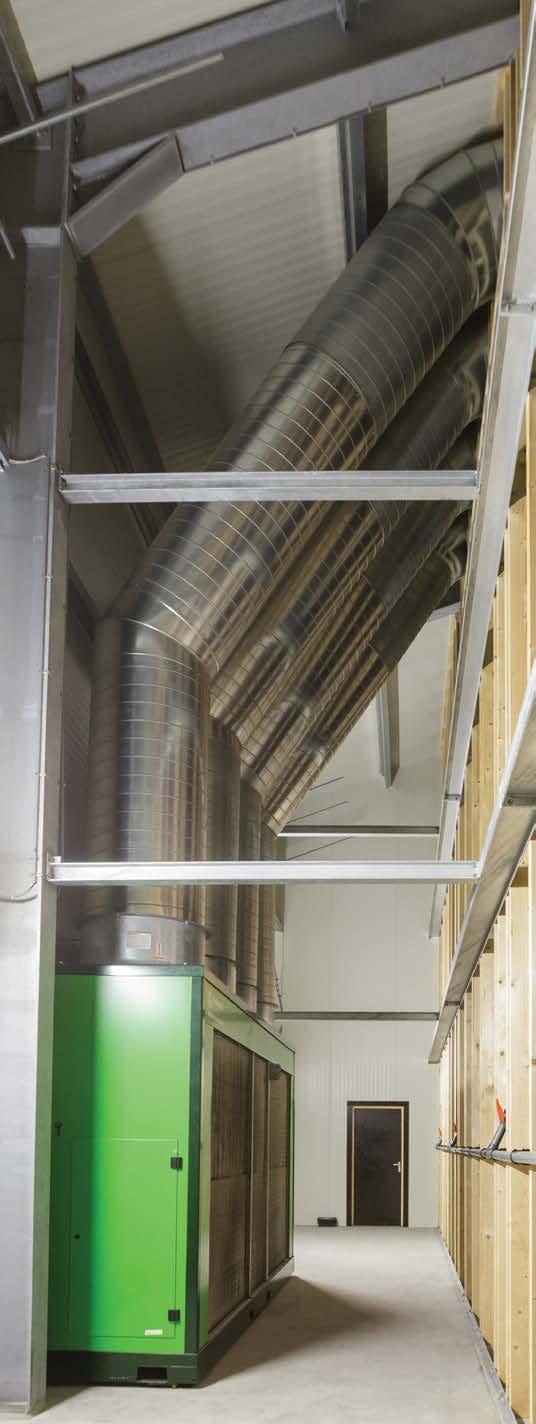
11 Trane: How precision temperature control is powering smarter fruit fly management
20 Trimax: Introducing the versatile Force S2
30 Drape Net: A home-grown solution for orchard crop protection 36 Croplands: New technology update
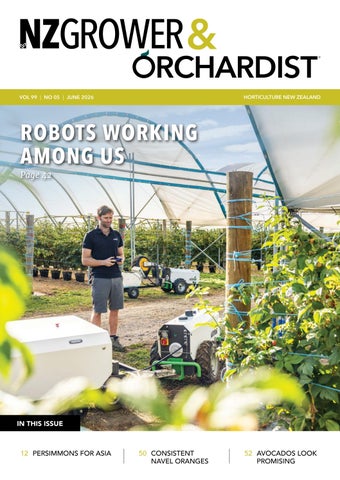
On the cover:
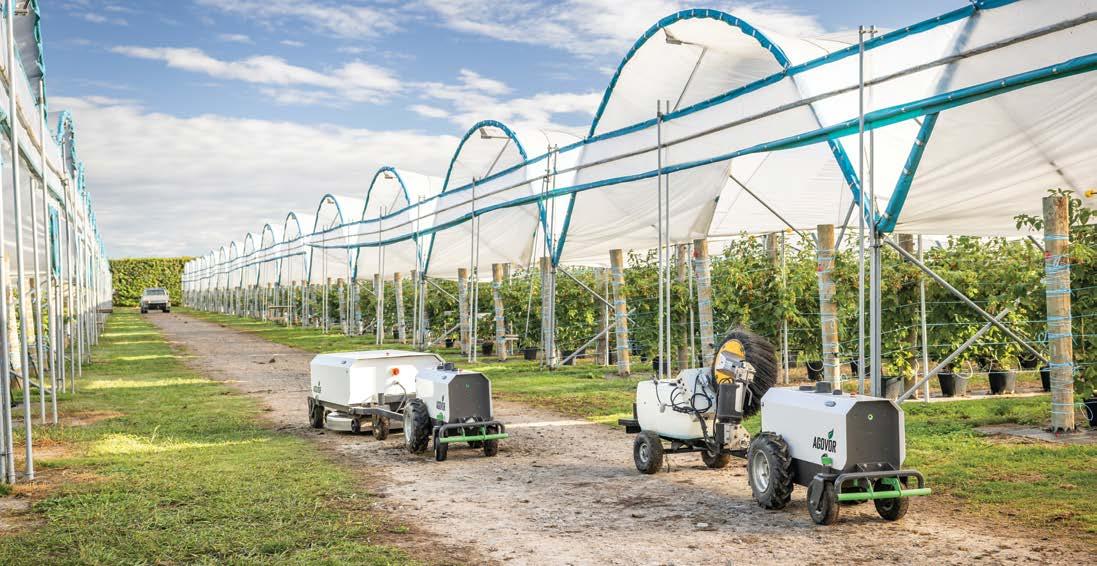
Agovor co-founder Richard Beaumont demonstrating the eTractor. See page 42. Photo courtesy of NZ Story
&
NOMINATIONS ARE OPEN
Two of the great privileges of serving in governance for HortNZ are providing recognition for those who go above and beyond for the industry and working with fellow directors who are passionate about doing the best for our sector.
Bernadine Guilleux : HortNZ chair
So, this is a call to action firstly for nominations for the 2026 Horticulture Industry Awards – an opportunity to celebrate the individuals and teams that often go unrecognised. It’s also a call to action for people across the horticulture spectrum to think about whether they might consider standing for one of the two grower-elected positions in our upcoming HortNZ Board election.
In terms of the director elections, the board is seeking nominees with a mix of skills and experience who can help lead through the opportunities and challenges.
The ability to provide insight and direction, particularly in the areas of finance, risk management, science, technology and innovation, Te Ao Māori, education and training, corporate law and governance, would all be of benefit.
Nominations for both the awards and board roles are now open. People in this sector are very humble. The many who go above and beyond for the good of horticulture aren’t going to be personally putting their hands up for recognition, it’s just business as usual for them.
So, it’s up to those who see the work they are doing, to shine a light on them and their good work, and you can do that by nominating them for one of the industry awards.
The awards span six categories and celebrate excellence, leadership, service and innovation across the breadth of the sector and all levels of experience.
We’re encouraging growers to think about the opportunity and about putting themselves forward to help guide the sector into the future – or perhaps consider tapping someone on the shoulder and saying, “have you considered this, because I think you fit the bill?”
Sometimes people don’t recognise the great value of the skills and experience they have accrued. So, if you know a good potential candidate, please consider putting that thought into their mind.
Nominations for the awards close on Monday 15 June and for the Board election on Friday 19 June.
For more details on both these opportunities go to www.hortnz.co.nz
NZGrower & Orchardist is produced by Horticulture New Zealand and is free for all levy payers. The magazine is partially funded by a grant from the NZ Fruitgrowers’ Charitable Trust to ensure all fruit growers in New Zealand receive a copy each month. The magazine is also supported by Vegetables NZ, Process Vegetables NZ, TomatoesNZ, Potatoes NZ and Onions NZ.
The individual comments and views in this magazine do not necessarily represent the view of Horticulture New Zealand.
This publication uses vegetable-based inks and environmentally responsible paper produced from Forest Stewardship Council® (FSC®) certified, Mixed Source pulp from Responsible Sources.
Paper produced using Elemental Chlorine Free (ECF) and manufactured under the strict ISO14001 Environmental Management System.
The wrapper we use is 100 percent recyclable, it is LDPE 4 (Low Density Polyethylene) Soft Plastic and meets the required standards. For further information refer to: www.recycling.kiwi.nz/our-story
DEVELOPING OUR CAPABILITY
Leadership in horticulture does not begin when someone reaches the top job, whether that’s a chief executive or a chair.
Kate Scott : HortNZ chief executive
It starts much earlier – when a grower, packhouse manager or an adviser is given the opportunity to learn how to lead others.
If New Zealand’s horticulture sector is to continue to grow with confidence over the next decade, investing in our people is paramount.
As a sector, we often talk about investment in land, water, technology and market access. But one of the best investments any sector can make is in leadership and capability.
Leadership development should be seen as core sector ‘infrastructure’, as important as water storage or greenhouses.
That’s because strong industries do not just produce better crops, greater productivity or better returns.
That is why HortNZ believes structured opportunities for leadership development are so important.
There are a wide range of opportunities available in horticulture, from Young Grower and leadership scholarships, to governance development pathways and programmes such as the IFPA Produce Executive Program.
They produce people who can make really good decisions under pressure, bring others with them and keep a long-term view in tough times.
There are a wide range of opportunities available in horticulture, from Young Grower and leadership scholarships, to governance development pathways and programmes
In horticulture, where growers are facing challenges every day and issues are becoming more complex, that kind of leadership is critical.
Unlike in Hollywood movies, leadership is rarely formed in one moment in particular, but is developed through competitions, scholarships, governance roles, industry programmes and mentoring.
I see many young people first discovering their confidence through the regional Young Grower competitions while others improve their strategic thinking through a scholarship or an executive development programme.
Not only do these initiatives build confidence, but they help people recognise that their experience, judgement and voice is valued beyond their own orchard, farm, business or region.
I know the value of those opportunities because I have experienced them myself.
My own career has spanned agribusiness, environmental policy, planning and stakeholder engagement – each role has shaped the way I think about leadership.
Becoming a Nuffield Scholar in 2018 was particularly important.
It pushed me to look beyond my immediate role, ask bigger questions and think more broadly about the future of our sector, and taught me the value of taking time to invest in your own development.
Serving as chair of the New Zealand Rural Leadership Trust has reinforced just how important it is to keep investing in people, not only for their own development, but for the long-term strength of the food and fibre sector as a whole. That matters, especially in horticulture, where many people are busy with the day-to-day demands of growing, managing teams, meeting rules and regulations, and responding to extreme weather events or supply chain pressures.
Without deliberate pathways provided by HortNZ and our partners, the great deal of talent we have in horticulture would remain untapped. That’s lost potential.
We need to keep investing in programmes that identify and stretch people early, and continue supporting them as they move into more senior roles.
This is about future-proofing our people and the sector.
I really encourage growers and organisations to visit the HortNZ website to see the many opportunities out there to develop leadership capabilities.
The future of horticulture will depend not only on what we grow, but on who we grow as well.
Find
When it comes to growing a thriving orchard, not all trees or tree nurseries are created equal. We believe the best trees come from experienced people, refined processes, a nd plenty of mud on the boots.
That’s why we’re out there, listening to Kiwi growers and constantly improving our methods to deliver higher-performing, higher-quality trees. With high-qualit y, handpicked, specialist rootstock and smart growing processes, we deliver trees that are consistent i n a ppearance a nd vigou r
Place your order now for grafting and spring budding for the 2027 crop season - our team of experts are ready to help!
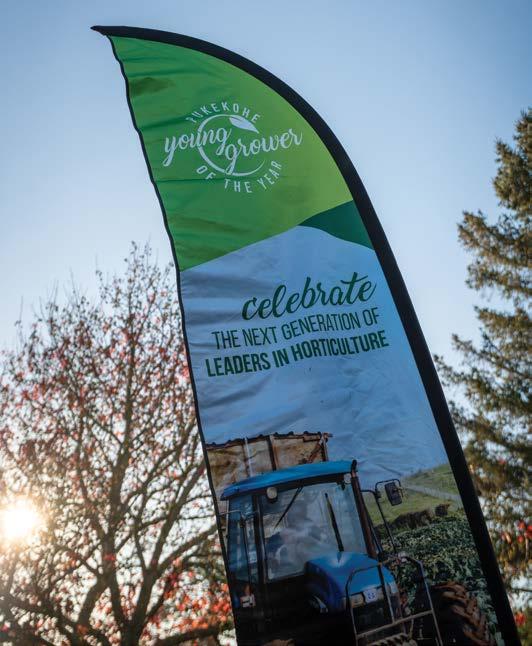
The Young Grower of the Year regionals kicked off in May with the Pukekohe competition. Photo by Stori Films
GETTING INTO KIWIFRUIT
NOT AN EASY WIN
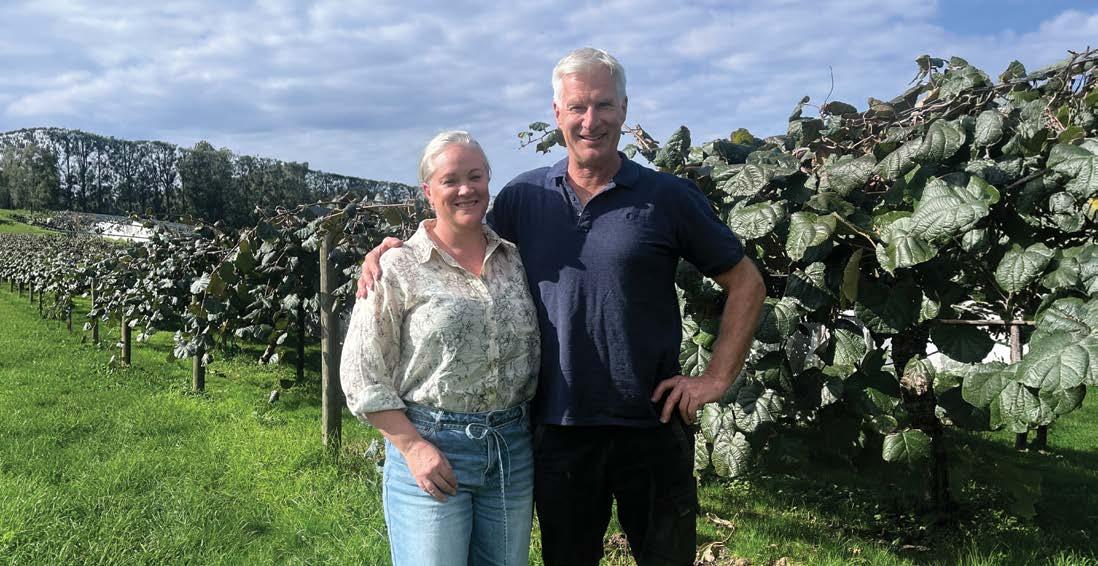
With kiwifruit experiencing another promising harvest season, it’s no surprise that many are eyeing a move into the growing industry. But what should first-time kiwifruit growers keep in mind? CARLY GIBBS speaks with a Katikati couple who candidly share the lessons they’ve learned since taking on their first orchard.
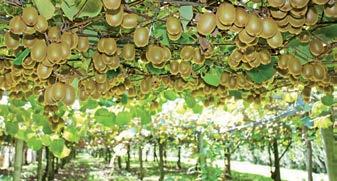
When Paul and Mellissa Berg bought a green kiwifruit orchard during the 2020 Covid lockdown, they were optimistic about the future it would bring.
After years of running their Te Puke-based business, Total Tree Removal, and managing 14 staff, a move to kiwifruit offered a promising change.
“I couldn’t do the stress anymore,” Paul, 58, shares openly of the couple’s decision to sell their tree removal business two years after they moved to Aongatete near Katikati, to a rundown 3.88ha orchard, with a family home, or as Paul sold it to Mellissa, 47, “a diamond in the rough.”
The orchard they named Kiwiberger, in a nod to the Bergs’ Dutch-Kiwi heritage, was seen as a project Paul could move to focus on full-time.
“We bought this place to retire, kind of,” says Paul. “We didn’t want to get rich out of it, we just wanted enough to feed our three children and us.”
But the first-time growers admit that, in hindsight, they underestimated the scale of the undertaking.
Welcome to the jungle
From the outset, the orchard presented big challenges.
Poor drainage made it a wet property, and towering gum trees cast heavy shade over alreadyunhealthy vines.
In short, it was “a big, dense jungle,” Paul recalls.
First-time growers Paul and Mellissa Berg. Mellissa says the amount of blood, sweat and tears that has gone into their orchard is “mind-blowing”
It took two months to remove the orchard’s 500m shelter belt, which came out in 35 logging truck-and-trailer loads, and the hard slog didn’t stop there.
Already a workhorse, Paul now found himself even busier, working seven days a week for “months and months” outside the orchard and then on it after hours and on weekends.
“I guess that shows prospective orchard buyers that it’s not a hobby,” reflects Mellissa. “I mean, it can be if you have the money outright, but it needs work, constantly.”
Luckily, the couple is willing and goal-driven, and saw their efforts as worth it to create a sustainable future for them and their children, Ryan, 17, Madison, 15, Charlotte, 12, and a menagerie of pets, including dogs Kenzie and Mila and cat Alfie.
A series of unfortunate events
However, they suffered a major setback when Cyclone Gabrielle hit in 2023, just a year after Paul went full-time on the orchard.
Before he could install a Novaflo drainage system and trenching, the couple lost a hectare of producing canopy in the cyclone. Then, further weather events, including frost, compounded damage.
They also claim some early canopy management decisions negatively impacted their orchard performance. An experienced kiwifruit grower who later visited the property identified issues, including “pruning shortcuts and broader management concerns.”
Reality bites
The Bergs say the experience has taught them about the realities of orchard ownership as well as the importance of seeking experienced advice early.
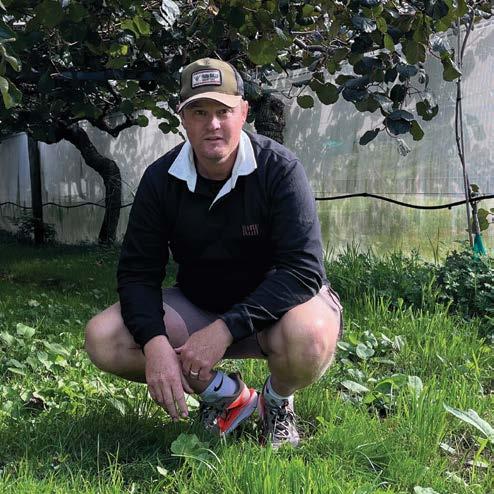
Twelve months ago, they brought in new orchard management under Jono Nicholl from The Growers Grower, who has more than 30 years of industry experience, and was kiwifruit’s first modern apprentice at age 16. Now 46, Jono has owned over 15 orchards across the Bay of Plenty.
Paul and Mellissa say he gave them valuable technical direction and renewed confidence.
The invisible thief:
Stopping spoilage in the cool store
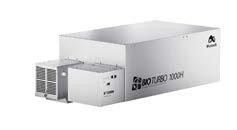
Ethylene from early ripening fruit can easily spoil your produce and your profits. The Bio Turbo unit removes ethylene along with 99.9% or airborne bacteria within the sealed chamber. It’s safer for workers, eliminating residue and removing Ozone via a patented catalyst and returning safe, clean air to the room.
It’s scalable for any size facility – from the Bio Turbo 100i for transport trucks to the Bio Turbo 6000 for large commercial pack houses.
We don’t just sell a box; we provide the engineering support to size the unit correctly for your specific crop and room size.
Stop letting ethylene steal your shelf-life.
Contact Indsol Ltd for a free consultation.
Web: www.indsol.co.nz
Phone: Mike on 027 2080 360
Email: info@indsol.co.nz
Smiling with relief, Paul says the difference is “night and day.” Mellissa agrees: “The orchard looks and feels different now.”
Jono was introduced to the Bergs through a mutual connection and says that on meeting them, their distress was obvious. “Growers often carry these burdens quietly,” he says, “but with the right strategy and commitment, there’s always a pathway forward.”
Previously debt-free, Paul and Mellissa took on financial pressure in recent seasons, and Paul has now returned to off-orchard work, with the couple buying the business AG Shelter Trimmers.
Despite challenges, they’re determined to keep their kiwifruit dream alive and are working closely with their bank to continue.
Turning point
Pleasingly, Jono’s revised orchard strategy has already given encouraging results this season, with a strong early start pick and solid packouts.
One of the key changes he made was to adjust the timing of their Hi-Cane spray application, which regulates plant growth.
Rather than following a traditional calendar-based programme, Jono delayed their application to better align with lower winter chilling accumulation, with his management decisions reflecting seasonal conditions and not just historical timing.
This year’s harvest was completed as early as allowed by maturity standards, with Jono focused on reducing vine stress and supporting rejuvenation.
The orchard, which had fallen to 12,000 trays at its lowest level while owned by the Bergs, this year achieved 34,500 trays on its 2.8ha of producing area, picked on 16 April, at 96 trays per bin.
Fruit performance was encouraging with Total Taste Zespri Grade results of 0.58 and 0.49; they had 91 percent Class 1 fruit, reject levels of 6.3 percent, and an average fruit size of 34 count.
“There is still significant work required to return the orchard to strong, consistent production and value add, but the fundamentals are now in place,” says Jono.
Time to rejuvenate
The turnaround has restored the couple’s optimism and given a direction for their orchard’s future.
“We feel hopeful and relieved,” says Paul, as Melissa adds she feels proud of how far they have come.
“We could’ve sold up so many times over the years, but we’re not quitters,” she says. “We’ve made plenty of sacrifices, but living this lifestyle has been incredible for not just us but for our children. They get to hoon around on their quad bikes; we have cows, chickens; it’s just a great lifestyle for families.”
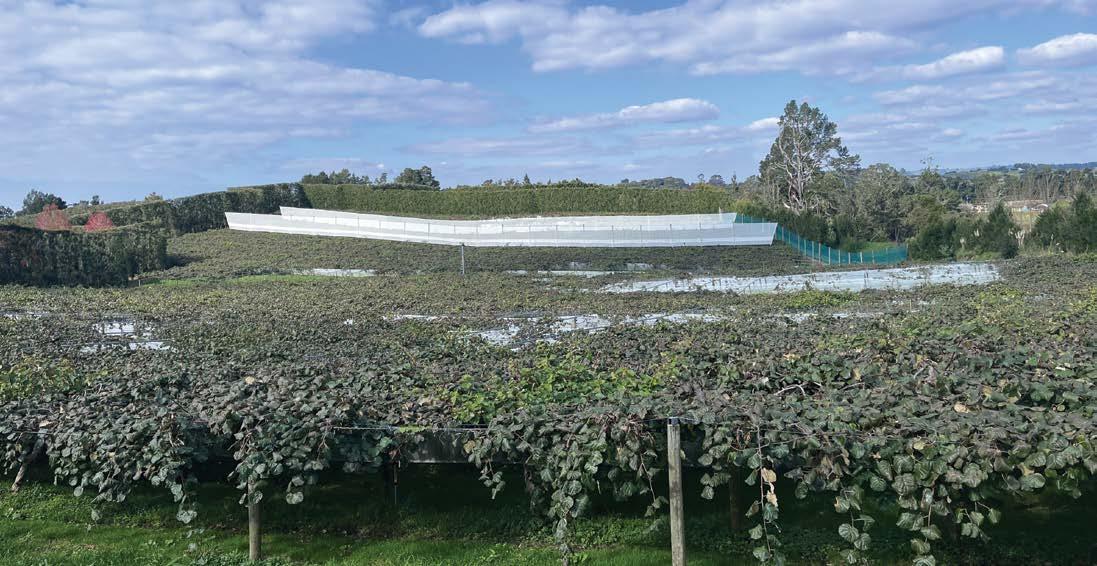
Poor drainage already made the Bergs’ orchard a wet property, then they lost a hectare of producing canopy during Cyclone Gabrielle. This photo was taken in May this year
Looking ahead, there’s now a clear plan, with Jono implementing a soil-conditioning and orchard-rejuvenation programme to support long-term productivity gains.
In early May, their orchard received a biological soil drench, and Biostart’s 6L/ha Mycorrcin, 20L/ha hydrolysed fish, and 3kg/ha BioPower seaweed, alongside a compost application at 15 tonnes per hectare to supercharge root flush during autumn, to give vines a better chance to perform in spring.
Focus has also moved to strengthening vine structure and canopy performance, thanks to Jono’s team developing well-lit, productive wood to tie down a quality canopy.
A move to fill in leader zones on solid structures, with high bud numbers, will also improve productivity and set the orchard up for 2027.
Mellissa says Jono has done an amazing job in turning things around for them, but she is especially proud of Paul, too.
Achieving success in kiwifruit as a self-made person with limited financial backing is no easy feat: “The amount of blood, sweat and tears he put into it is mind-blowing, and he deserves recognition for it.”
MORE DEMAND FOR ‘ATTRACTIVE’ GREEN
In recent years, Zespri has achieved stronger prices for green kiwifruit in offshore markets.
With high prices for gold and red licences, recent green returns, combined with lower capital investment, have made growing green kiwifruit more attractive.
At the time of writing (mid-May), the industry was 25 percent through the Hayward harvest. Green conventional trays were forecasted at $9.25–$10.75 and $12.50–$14.50 for organic green. The 2025/26 February Orchard Gate Return forecast per tray is $10 for green conventional and $13.40 for organic green.
New Zealand Kiwifruit Growers Inc. chief executive Colin Bond says labour is proving “sufficient” so far this season, and growers are hopeful for calm, dry and frost-free weather to ensure the fruit is picked efficiently and in good condition.
RECENT HAYWARD RETURNS, COMBINED WITH LOWER CAPITAL INVESTMENT COMPARED TO OTHER KIWIFRUIT VARIETIES,
HAVE
MADE GROWING GREEN MORE ATTRACTIVE
TIPS FOR BUYING A ‘NON-TURNKEY’ GREEN ORCHARD
Jono Nicholl from The Growers Grower says buyers looking at “tier two” or underperforming Hayward orchards should focus less on appearance and more on fundamentals.
For example, you can fix the canopy, structure and production systems over time, but you can’t fix a location or easily fix soil.
His advice is to prioritise orchards with a strong soil profile – ideally at least 250mm of quality topsoil on free-draining volcanic ash soils.
“Those ash soils are generally very forgiving and allow roots to function well,” he says. “Clay soils aren’t necessarily bad either, but they require much tighter soil management and drainage discipline.”
Buyers should also pay attention to an orchard’s chilling history, as consistent winter chill remains critical for reliable Hayward production.
Other important considerations should be: quality shelter, adequate water supply and the orchard’s overall micro-climate.
“Water quantity and quality matter, and good shelter is hugely important too, particularly for protecting the canopy and maintaining fruit quality.”
Fertiliser history is less important to him than many buyers and growers might assume. “That can all be tailored under new management,” he reckons. “Nutrition programmes should be built around what the orchard actually needs, not what somebody has historically applied.”
Jono believes one of the biggest mistakes in kiwifruit management is applying identical systems across very different properties.
“There’s no cookie-cutter approach that works everywhere. Every orchard has different soils, climate influences, shelter systems, drainage characteristics and production limitations.”
He feels that growers often underperform when management companies apply a one-size-fits-all programme without adapting to the specific orchard environment.
“The best results come from management that understands the individual orchard and tailors decisions around that.”
Note: Green growers can expect to pay between $40,000 and $60,000 per hectare, per year, to run green. Corporate orchards sit on the higher side. Returns vary greatly from orchard to orchard. New Zealand Kiwifruit Growers Inc. advises growers to keep as engaged as possible in their operations to foster the best outcomes, and there is a range of service providers who can provide support where needed.
WHEN ORANGE IS GOLD
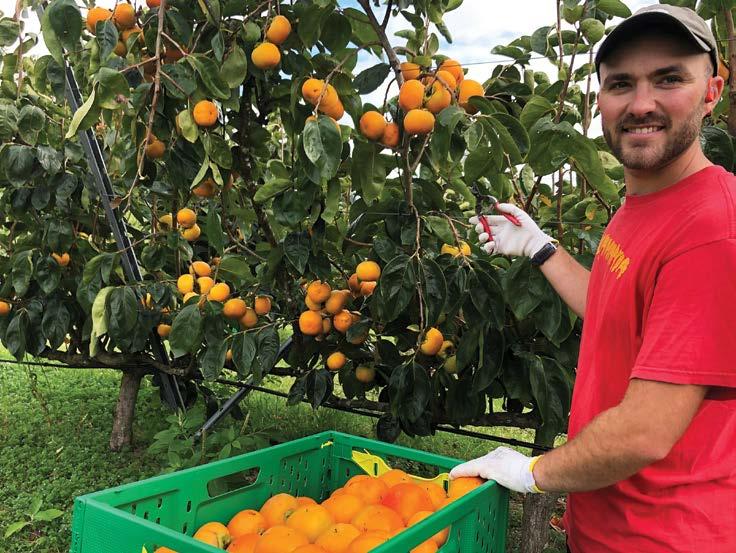
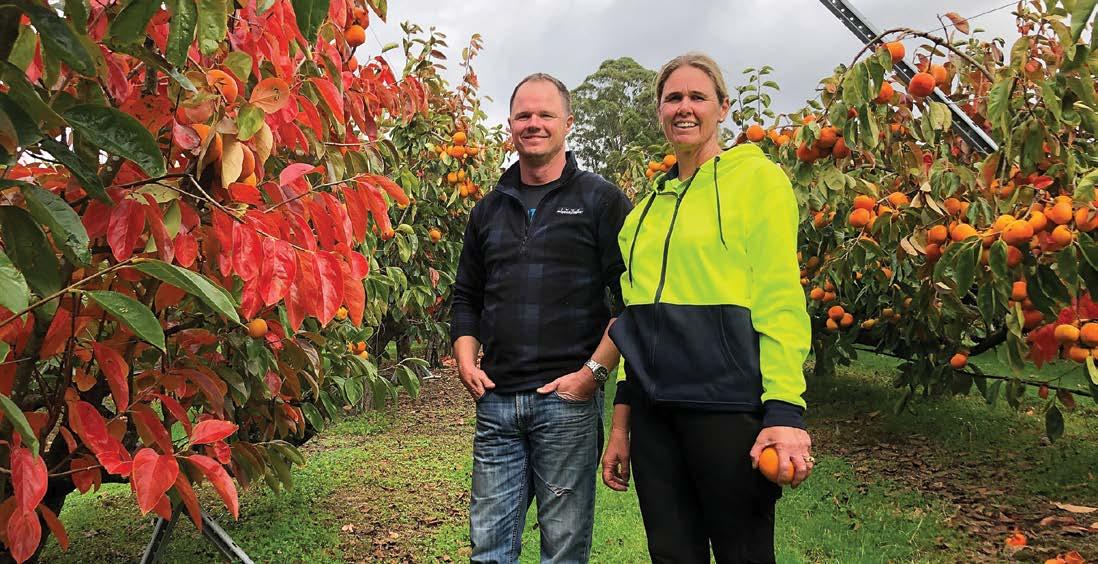
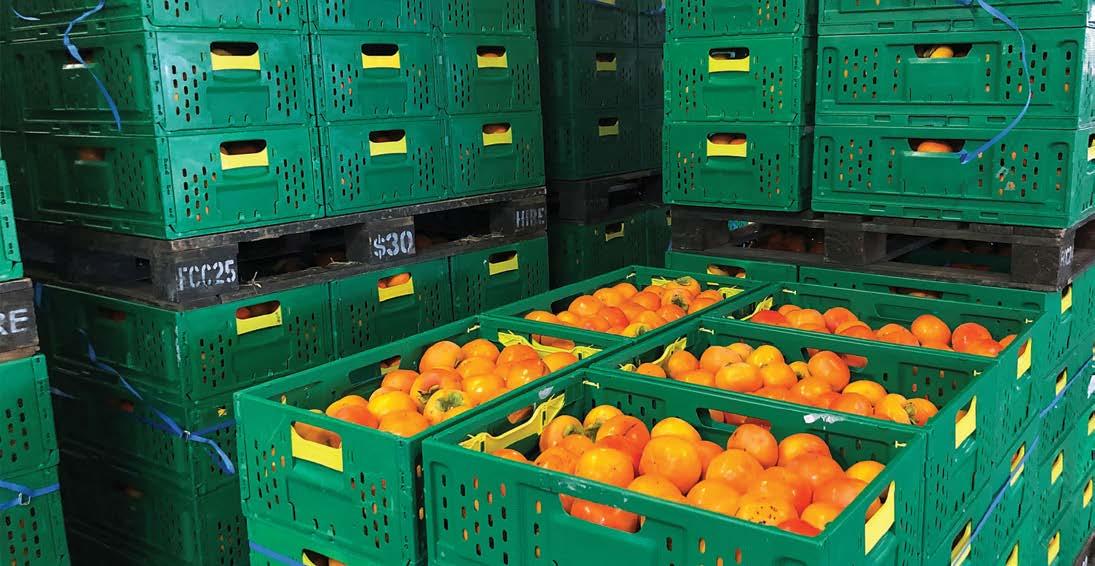
With the short persimmon harvest season now underway, Duane Wells, chair of the New Zealand Persimmon Industry Council, says the unsettled weather over summer has been a bonus for fruit on his family’s orchard in Northland.
Delwyn Dickey
A very hot, dry period during the summer, quickly turning to two months of cloud and rain in the lead-up to harvest, has produced fruit with much higher brix levels than in previous years, Duane says.
Duane, sister Bronwyn Walters and mother Terrie Wells operate NTL Horticulture – a 21ha orchard at Kauri just north of Whangārei – and a packhouse at Maungatapere, where they specialise in avocado and persimmons.
And while the weather has seen harvest starting a little earlier in the bigger orchards further south around Gisborne, Duane says they have purposely started later than usual so fruit will have more colour.
They hope to pick the orchard two or three times this season instead of the usual five to reduce the number of low-coloured fruit which will be rejected for export.
The rich orange skin and flesh is part of the appeal of the fruit. Persimmons have become part of the cultural identity of Asian countries from South Korea to China – where they originate and have been cultivated for over 2000 years.
The national fruit of Japan, persimmons are often given as gifts across Asia and left as offerings at shrines symbolising long life and prosperity. Nearly a million hectares are grown in China alone.
Siblings Duane Wells and Bronwyn Walters run NTL packhouse and orchard
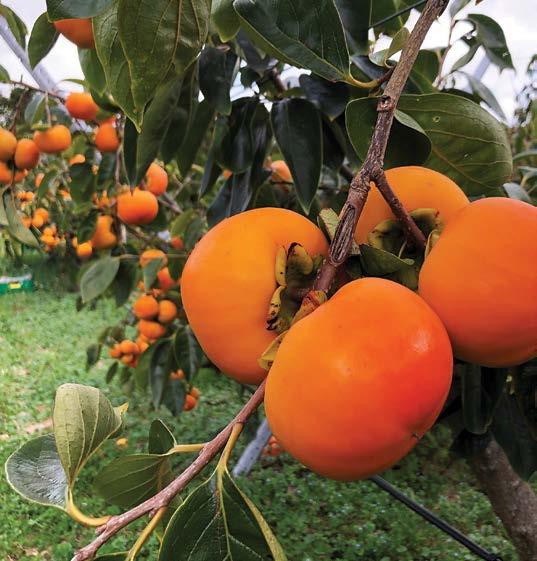
The distinctive persimmon fruit are culturally significant in Asian countries
New Zealand has a modest number of 25 commercial orchards with 90 percent of export volume being supplied from less than 10 growers – mostly in the Gisborne area. They are selling into the same markets as Asian growers –Australia, Asia and increasingly Canada, but aiming at the counter season with our harvest going from mid-April to mid-June.
“Significant work done by Crop & Food Research back in the nineties on storage allows us to keep on selling out to September into both the local and export markets,” says Duane.
Import restrictions see all fresh fruit sold in New Zealand locally grown.
NEW ZEALAND HAS A MODEST NUMBER OF 25 COMMERCIAL ORCHARDS 90 PERCENT OF EXPORT VOLUME IS SUPPLIED FROM LESS THAN 10 GROWERS –
MOSTLY IN THE GISBORNE AREA
Originally planted up in the eighties and run by their father Lindsay – a former soil scientist with what was the Department of Science and Industrial Research, and wife Terrie – a nurse, the Whangārei orchard has grown significantly over the years, from three full-time staff to 40 with the packhouse purchase in 2008.
Surprisingly, neither Duane nor Bronwyn had planned on a career in horticulture or returning to their parents’ orchard on the edge of the Hikurangi Swamp. Duane completed a degree in Management Studies focusing on International Marketing and Management Communication, going into marketing for a tertiary education provider, while Bronwyn went into dental hygiene as a dental nurse in Australia.
AROUND
55,000 TRAYS OF FRUIT FROM THE ORCHARD ARE EXPORTED EACH YEAR
About half the production from the orchard’s 16 canopy hectares is exported each year – around 55,000 trays
“You’re not pruning for just the next year, you’re pruning for the following years as well,” he says.
Aiming at 200 to 250 fruit on each tree gives a good size fruit and yields with some flower rubbing to achieve this.
Like the vast majority of trees nationally, the trees are Diospyros kaki ‘Fuyu’, with the oldest now over 40 years old. Young trees produce better fruit and the pair are looking at removing any poor performing older trees and replanting.
Included in this will be some original trees that look to have been supplied incorrectly with American virginiana rootstock. Many have not performed well over the years in Northland conditions with a high mortality rate and poorer fruiting.
Duane and Bronwyn’s families live on the orchard, as does Terrie who is still heavily involved in administration, including handling financials and the payroll.
SAME CHALLENGES, OBVIOUS DIFFERENCES
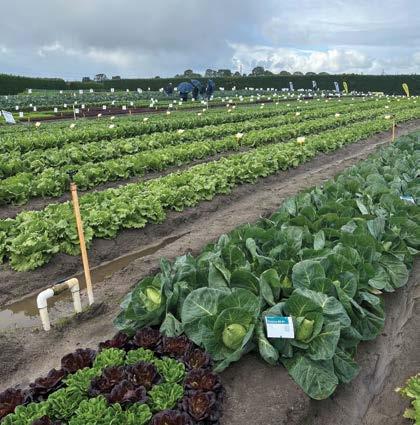
Differences in on-farm approach between growing operations facing the same issues were obvious to participants on the New Zealand Vegetable Council (NZVeg), Fruitfed Supplies and Syngenta Biologicals’ study tour to Victoria, Australia in early May.
Andrew Bristol : NZVeg communications manager
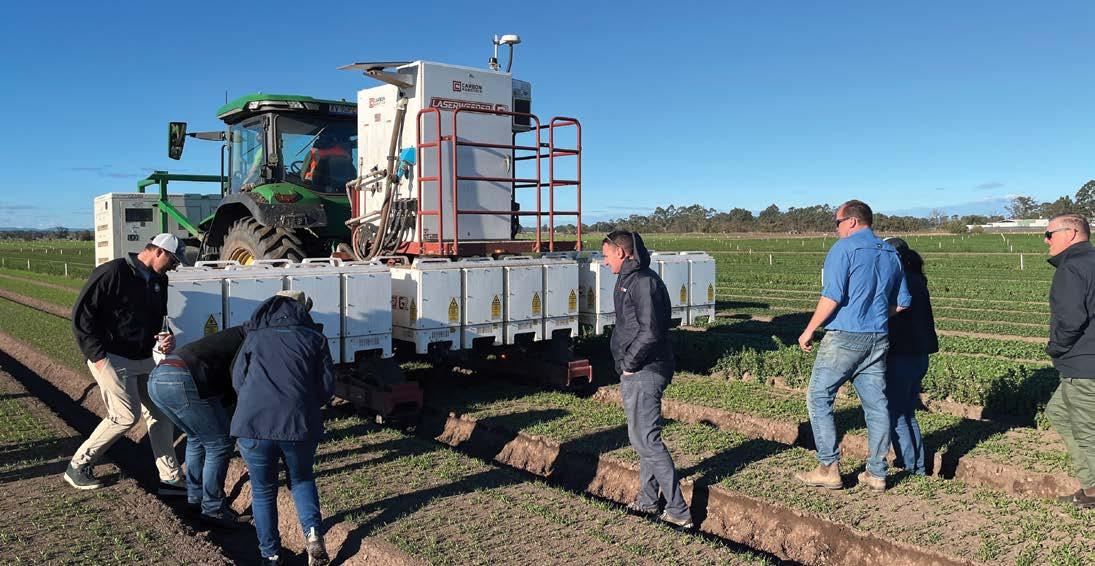
The tour visited Hussey & Co in Newry, Schreurs & Sons in Middle Tarwin, and Gazzola Farms in Somerville on the Mornington Peninsula. The tour concluded that while the operations were similar in size and crop types (leafy greens, celery and leeks), and faced the same challenges, they were three quite different operations due to their different approaches. Weeds are a common challenge. While Hussey & Co said they would like two more laser weeders in addition to the one they already have and work almost 24/7, Schreurs & Sons is helping develop an electric weeder as an alternative to laser weeders, and Gazzola Farms said they would “wait and see,” as their current, more traditional approach to weeds is working.
Hussey & Co, on the particular farm that we visited, employs around 100 people, most of whom work a 38-hour week.
While they mostly employ local people, Hussey & Co scan backpacker social media pages, as they are a good source of skilled labour. For example, they recently employed a backpacker who had worked for John Deere. He taught them things about their John Deere tractors that they did not know.
Hussey & Co said it was easy to get unskilled and semi-skilled staff, but what they “needed the most was the next level up.” Gazzola Farms echoed this sentiment, saying they struggle to find skilled labour.
A Carbon Robotics LaserWeeder in action at Hussey & Co
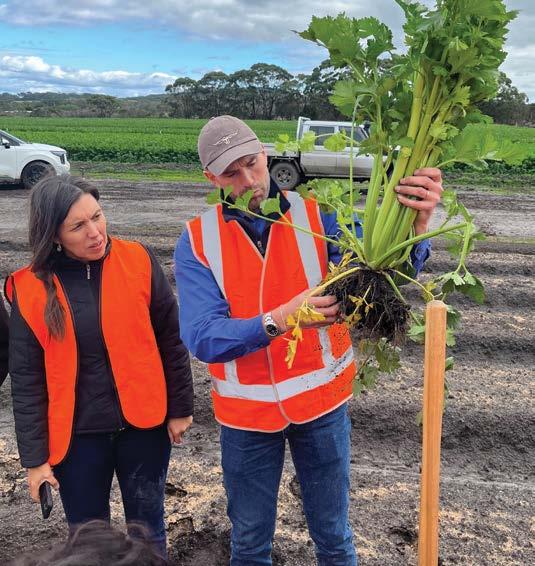
Tour participant Maria Solovera inspects the roots of the celery being held by RMCG principal Carl Larsen, who has been involved with the organic soil carbon project at Schreurs & Sons for several years
“We can get people to work on the ground but it’s very hard to find a skilled tractor driver. That style of labour is hard to get, despite how close Mornington Peninsula is to Melbourne,” they said.
The Hussey & Co farm we visited was in dairy 12 years ago, and the tour drove through a lot of dairy land to get there. They grow 300 plus hectares of baby leaf spinach, wild rocket, brassicas, chard and various fancy lettuces. Their record is harvesting 70 tonnes in 10 hours before last Christmas.
Hussey & Co is very consumer and data driven. They plant according to sales forecast while all of their workers have a digital work sheet. Their so called ‘digital bible’ was developed locally, and they are looking forward to using the data that their laser weeder will be able to provide them.
Water a common focus
Hussey & Co relies on a post-World War Two irrigation scheme that provides the area with water security today. They have a lifetime licence to water, which is tradable. They commented that 20 years ago, land in the area used to change hands for only the price of the water licence fee.
Water is a focus at Schreurs & Sons too. They have just completed their fourth dam and have 18,000 inline sprinklers, which are operated from a mobile phone.
SCHREURS & SONS GROW:
CELERY (1200 ACRES)
LEAKS (500 ACRES)
ROCKET (250 ACRES)
SPINACH (900 ACRES)
Notice of the 21st Annual General Meeting (AGM)
Tuesday 28 July 2026, 4.30pm
Tākina, Wellington Convention and Exhibition Centre
Business
1. Welcome and apologies
2. Voting and proxies
3. Obituaries
4. Approve minutes from the 20th AGM
5. Chair and Chief Executive combined report on Horticulture New Zealand activity
6. Approve audited financial statements for the year ended 31 March 2026
7. Levy rate
8. Director remuneration
9. Approve 2026/27 budget
10. Approve auditors for 2026/27
11. Notices of Motion
12. General business
Call for Notices of Motion
Any Board member, affiliated organisation or active grower member wishing to have a matter considered at the AGM must give notice in writing to Horticulture New Zealand of the Notice of Motion no later than Friday, 19 June 2026 at 10am. Notices should include the wording of the motion to be voted on and up to one A4 page of explanatory notes. Motions can be emailed to AGM@hortnz.co.nz. Notices of Motions will be listed on the Horticulture New Zealand website www.hortnz.co.nz on Friday, 26 June 2026.
Schreurs & Sons grow 1200 acres (approximately 485ha) of celery, 500 of leaks, 900 of spinach and 250 of rocket. They have planted 80,000 native scrubs, are big on Integrated Pest Management, and have been involved in a government-supported, soil carbon improvement project for 11 years, although the farm we visited has only been in vegetable production for a few years.
Schreurs & Sons use composted chicken manure under all celery crops. This manure is composted to Australian standards and treated for E. coli. They plant rye and oat cover crops and beds, so the ground is already prepared to plant celery transplants. This is important if the ground is too wet to cultivate.
In addition, they have experimented with other cover crops, but these led to increased weed load, so they have gone back to only rye and oats.
Diesel use down by a third
Schreurs & Sons operates a no tillage model, where they can. This has resulted in a 33 percent reduction in diesel use, a 50 percent reduction in labour costs, and 50 percent less irrigation in the first six weeks.
“This change in practice obviously came at the right time for us,” was Adam Schreurs’ comment.
Gazzola Farms is a fourth-generation growing business, across two sites on the Mornington Peninsula. They grow celery, iceberg and broccoli and five different Asian vegetables, making them the largest Asian vegetable grower in Australia.
Gazzola Farms supplies supermarkets directly but also operates a wholesale business from the Melbourne Markets, which the tour visited earlier in their schedule. They said wholesale was a blessing and a curse. “Oversupply, and it’s a race to the bottom, and inferior product drags the top end down.”
Gazzola Farms says it is a challenge to get organic matter into their soils. Similar to Schreurs & Sons, they use chicken manure and green waste compost, which they stockpile and prepare themselves.
Like Hussey & Co, Gazzola Farms commented on the pressure to produce perfect produce for customers, and the challenges this creates.
“We have built up a following and need to maintain it. Customers want a clean, green product but they don’t want any insects or holes in leafy veg,” Dean Gazzola commented.
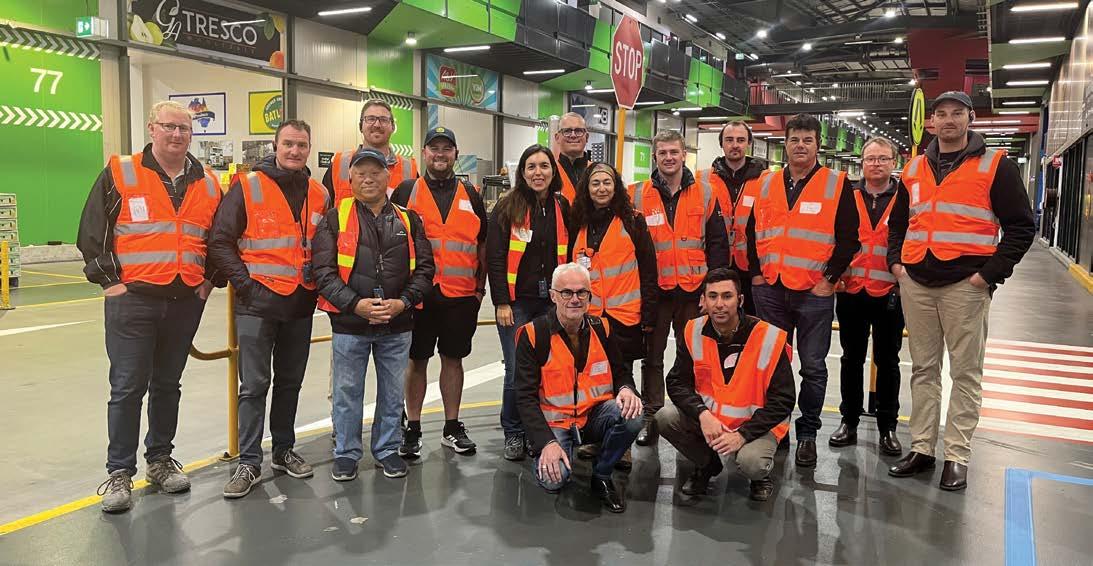
NZVeg tour participants at the Melbourne Markets, after a 4:15am start
SUPPORT APPRECIATED
AUSVEG BRIEFING
At the start of the tour, participants visited AUSVEG, NZVeg’s equivalent in Australia.
They presented us with some sobering statistics on the Australian industry.
THE AVERAGE AGE OF THE 3600 GROWERS THEY REPRESENT IS 58
TWO IN FIVE AUSTRALIAN GROWERS ARE LOOKING TO LEAVE THE INDUSTRY IN THE NEXT 12 MONTHS. HOWEVER, “YOU CAN’T SELL A VEGETABLE FARM IN AUSTRALIA FOR LOVE OR MONEY.”
As a result of the conflict in the Middle East:
28 % OF GROWERS HAVE REDUCED PLANTING 17% OF GROWERS HAVE REDUCED THEIR HARVEST SCHEDULES
NZVeg is scheduled to survey New Zealand growers about the sector in June 2026. These results will be shared in a future article in the NZGrower & Orchardist.
The study tour to Victoria was supported financially and logistically by Fruitfed Supplies and Syngenta Biologicals. They also briefed participants on the biologicals industry – tipped to be worth US$20 billion by 2030 – and their research-based approach to biologicals.
NZVeg appreciates Fruitfed Supplies and Syngenta Biologicals’ ongoing support of grower extension.
Calling for nominations for two grower Directors
The Constitution of Horticulture New Zealand Incorporated provides for a term of three years for elected directors.
The following Directors retire by rotation this year, but are seeking re-election:
• Alistair Petrie
• Doug Brown
There are two vacancies to fill.
In accordance with clause 11.2 of the Constitution nominations are now being sought from active grower members, affiliated product groups and affiliated grower associations.
Candidates must be nominated by at least two active grower members or affiliated organisations.
The election is based on electing the best person for the job; there are no allocated seats for product, sector or regional representatives.
Candidate criteria
Nominated candidates must be:
• An active grower member or
• A director, shareholder, partner or trustee of an active grower member as the principal representative of the entity in their dealings with Horticulture New Zealand or
• An employee of an active grower member who is appointed by that member as the principal representative of the entity in their dealings with Horticulture New Zealand.
If more than two (2) candidates are nominated, an election will be held where individual grower members will be asked to vote at the Annual General Meeting of Horticulture New Zealand on 28 July at Tākina, Wellington. A profile of each candidate will be distributed to growers along with voting information.
The nomination form and position description are available on the HortNZ website www.hortnz.co.nz
Nominations open Friday, 29 May and close Friday, 19 June
HELPING GROWERS DO MORE WITH ONE MACHINE
As workloads increase across New Zealand’s orchards and vineyards, growers are looking for equipment that can do more than just one job well. Versatility, reliability and ease of operation are becoming just as important as cutting performance – especially in demanding conditions where downtime costs time and money.
That’s where the new Trimax Force S2 comes in.
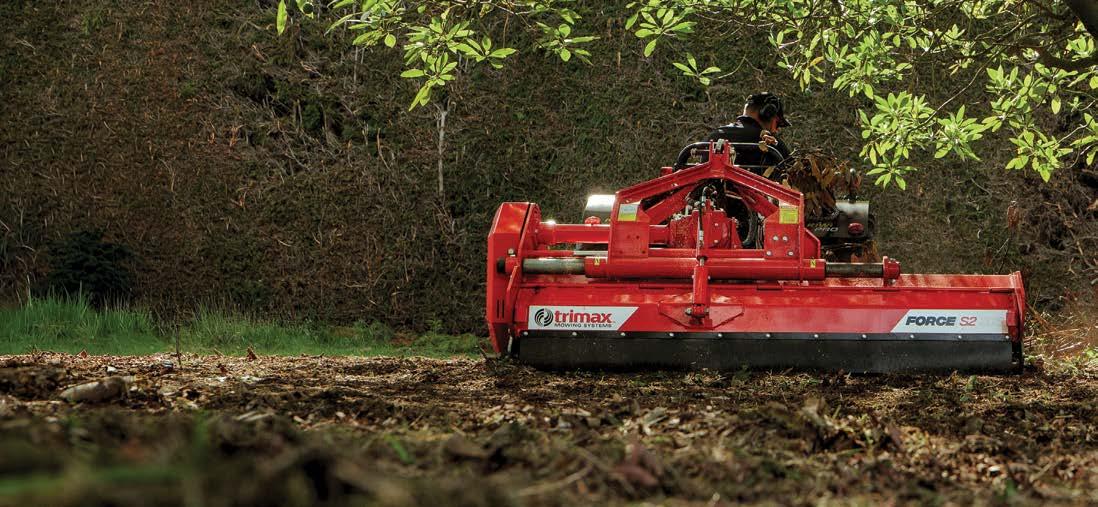
Designed specifically for horticultural and viticultural environments, the Force S2 is built to tackle everything from heavy grass and orchard maintenance to mulching prunings and managing uneven terrain. Whether operating in vineyards, orchards or mixed horticultural blocks, the Force S2 has been developed to give growers one dependable machine capable of handling a range of seasonal tasks.
Built on the proven Force platform, the Force S2 also introduces upgrades focused on long-term durability and reduced maintenance. A redesigned drive system, reinforced headstock, and heavier-duty flails have all been engineered to improve reliability and help reduce downtime during busy periods.
Designed specifically for horticultural and viticultural environments, the Force S2 is built to tackle everything from heavy grass and orchard maintenance to mulching prunings and managing uneven terrain
A major addition to the range is the new 1.6m model, created specifically for vineyard row applications where fit, manoeuvrability and controlled mulching are critical. The mower is designed to process prunings and heavy material efficiently in a single pass while helping maintain clean rows and minimise disruption to soil structure.
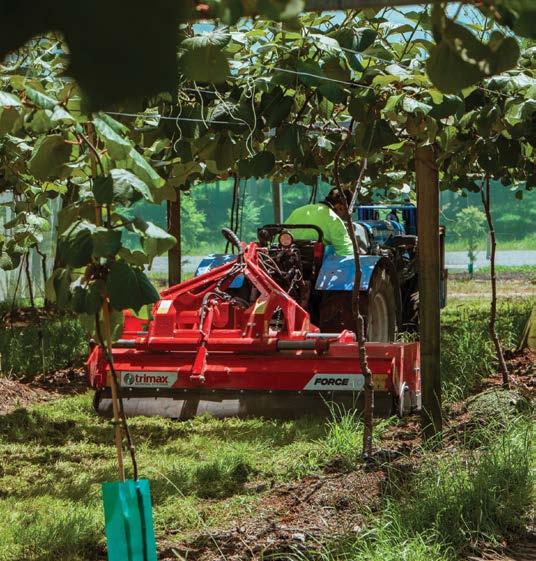
Force S2 being tested at a Southern Cross Horticulture Kiwifruit Orchard in the Bay of Plenty
For orchard operators dealing with rough or uneven ground, optional Height Control Wheels improve stability and ground following, while the Hydraulic Rear Flap allows operators to quickly switch between mowing and mulching from the seat of the tractor.
Backed by Trimax’s local parts and service support, the Force S2 is designed for growers who need practical equipment that works hard season after season –without compromise.
For more information, contact Trimax 07 541 0411 info@trimaxmowers.co.nz www.trimaxmowers.co.nz/force
Celebrate the people who grow our industry
Nominate outstanding people who have made a significant impact in horticulture.
HortNZ is calling for nominations for the 2026 Horticulture Industry Awards, for each of the following categories:
• Bledisloe Cup
• President’s Trophy
• Industry Service Award
• Sustainable Innovation Award
• Manaaki Award
• Horticulture New Zealand Life Member
Criteria for each award is available on the HortNZ website along with the nomination form.
Who can make a nomination?
Any active grower member of HortNZ, an affiliated product group or an affiliated grower association.
How do I nominate someone?
Complete the online nomination form available on the HortNZ website. If you have any questions about making a nomination, please email comms@hortnz.co.nz.
When will the awards be presented?
The awards will be presented at the Industry Awards dinner on Wednesday, 29 July at Takina, Wellington.
Nominations are open now and close on Monday, 15 June.
KIWIFRUIT PART OF SOUTH AUCKLAND COMMUNITY
Over the past three decades, Punchbowl has evolved into a substantial horticulture business at Patumahoe, south of Auckland. NZGrower & Orchardist talks with siblings Simon and Nikki Craig about the family-owned hybrid operation and its community connections here and abroad.
Helena O’Neill
Photos courtesy of Punchbowl
Down a tree-lined drive south of Auckland sits a thriving kiwifruit orchard and packing operation, Punchbowl.
In 1983, Rob and Maree Craig arrived at the current orchard site as orchard managers for the owners at the time, a partnership of Auckland businessmen and professionals. In 1995, their JV company, Punchbowl Coolstores Ltd., purchased the orchard and packhouse with other investors: Neil Craig, Les Brown, and Brian and Elaine Bell.
This business transitioned to become Punchbowl Investments Ltd. the current parent company, with Punchbowl PackCo now the post-harvest operator in the overall operating business.
Today, it is an integrated horticultural agri-business headed by the parent Punchbowl Investments Ltd. It has subsidiary investment activity in post-harvest services to local growers, is a major packaging supplier to the kiwifruit and apple industries, and has several orchard investments in the Patumahoe area, as well as in Bay of Plenty and Hawke’s Bay. It also operates several lease orchards spread from Kerikeri in the north to Te Kohanga in the south.
A family-owned hybrid company, the business has grown into a major local employer in the area, and due to its seasonal nature, many local school students have worked their holidays in the packhouse or in the orchards through the summer, leaving many a local with some sort of connection to Punchbowl. For some, these summer jobs opened up opportunities in the horticulture industry – some are now orchard managers for Punchbowl.
Simon Craig is the general manager field and grower while sister Nikki Craig is general manager post-harvest.
Punchbowl grows all three varieties of kiwifruit – green, gold and red. One of the biggest growing challenges for the Patumahoe orchards is the heavy clay soil.
“Gold is a dream variety to grow; green and red have their own challenges,” Simon says.
Nikki says they also strive to offer opportunities to young people, particularly local high school students
“We’ve had a challenging growing season with a low winter chill throughout the past winter, affecting bud break and flowering. Then it’s been a wet growing season. Through the growers and ourselves, there have been a few hail events, causing damage to a few orchards.
“Our reject rates are looking very good, better than last year, while we also didn’t get the temperatures we usually get over the past summer.”
Nikki says the weather continues to offer added challenges, although the harvest season had a promising start.
“We had an amazing run with good weather for most of the harvest season until mid-April.”
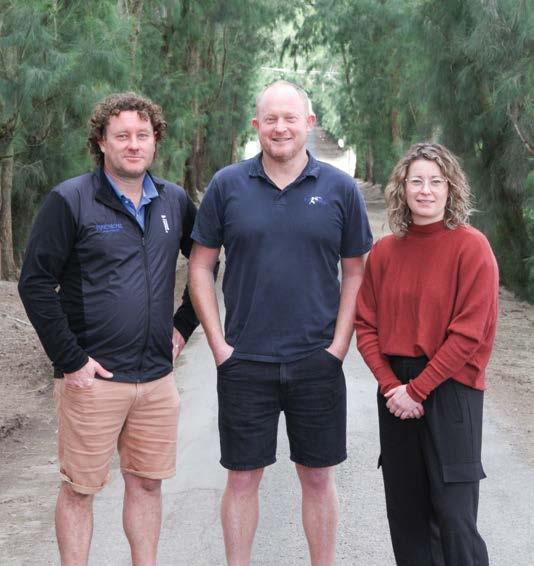
The Craig family Shane, Rob and Simon, with Maree and Nikki at the front
THE ORCHARD HAS A CONTINGENT OF RSE WORKERS FROM VANUATU. WITH MANY BEING FROM THE ISLAND OF ERROMANGO
When it comes to staffing, Punchbowl has a large number of Recognised Seasonal Employer (RSE) workers across the orchards.
“From an orchard point of view, we have a reasonable contingent of RSE workers from Fiji and Vanuatu. The bulk of our RSE workers are from Vanuatu, primarily from the island of Erromango, which is the fourth-largest island of the archipelago.
“Our uncle has a sandalwood venture on Erromango, where it’s very much subsistence living. We’ve seen what the income has done for that community. We have about a 65 percent return rate, and they’re getting pretty skilled.”
Simon hopes to return to Vanuatu later this year to check in on RSE workers and their families.
“It’s a big sacrifice for the families, not having their loved ones for six or seven months. In Vanuatu, some have bought boats, and there are a few guys from Fiji who have bought cars when they returned home and now have an income as Uber drivers there.”
“We have our Punchbowl Undergraduate Scholarship, which is open for students at Massey or Lincoln University. They receive up to $5,000 to help grow their studies and career. It’s one way for us to support the next generation of horticulture’s innovators.”
Keegan Neate is one of these scholarship recipients and is now an orchard manager for Punchbowl, growing red and gold kiwifruit.
www.klickex.com
Send money to any Digicel Pacific phone in Tonga, Samoa, Vanuatu, Fiji or PNG. Register with your passport.
Punchbowl RSE workers from Fiji and Vanuatu
Erromango
Vanuatu
“Horticulture has always faced misconceptions that it’s all just manual labour, but it’s so much more than that. It’s not solely growing, but engineering, research and lab work – there are so many aspects to horticulture,” Nikki says.
Another key part of Punchbowl’s approach is supporting the South Auckland community, she says.
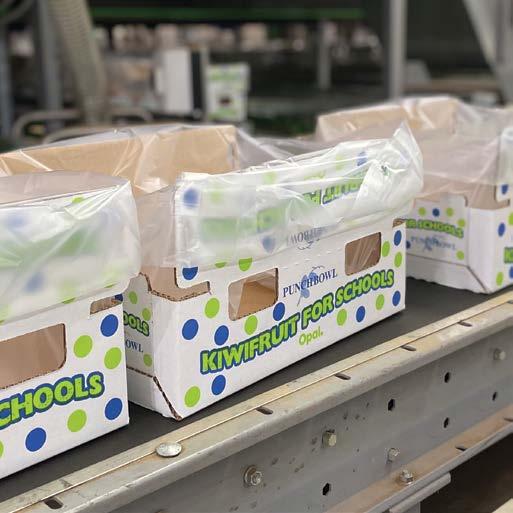
Our Kiwifruit for Schools programme is an initiative that Punchbowl PackCo Ltd. and Opal Kiwi Packaging are very passionate about, donating kiwifruit to local preschools, schools and community groups.
The programme has been running since 2019, and Punchbowl now donates kiwifruit to schools and organisations across South Auckland with support from volunteers who collect and deliver the fruit to all of the different locations.
distributed by two volunteer organisations to about 30 primary and intermediate schools, including a few kindergartens.
“It’s a great way to repurpose fruit that would otherwise go to waste.”
Nikki says that being involved in the local community is important to Punchbowl and, in partnership with their growers, they provide donations to schools, clubs and community events. One of the most recent initiatives sponsored was a quiz night hosted by chartered accountancy firm Campbell Tyson to raise money for the Pukekohe Maternity Hospital Renovation Fund.
Given the orchard’s proximity to Auckland, biosecurity is another one of their biggest risks, Simon says. Being a major international port for both travellers and exports, that’s where biosecurity incursions occur.
Between May and November, kiwifruit that does not meet the required standard for commercial purposes is boxed up and delivered fortnightly to schools. The free fruit is
“Fruit fly, hornet and stink bug. Those incursions, depending on how widespread they are, could impact us.
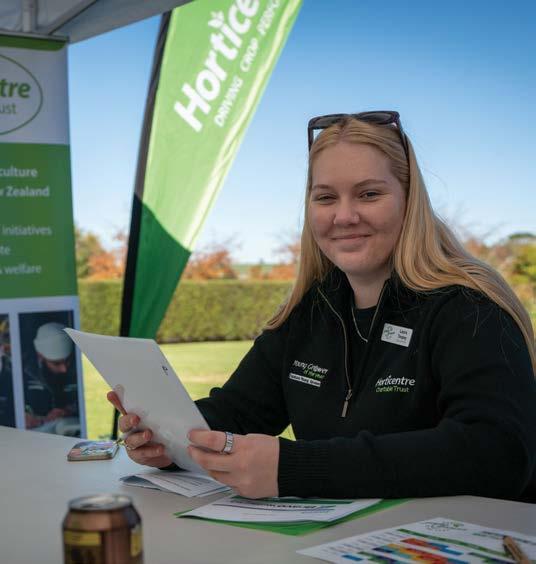
Two Punchbowl employees – orchard manager Keegan Neate and lab manager and field supervisor Laura Torpey – competed at the Pukekohe Young Grower of the Year 2026 regional in May. Photos by Stori Films
“KVH [Kiwifruit Vine Health] manage those responses, and they do an amazing job; they have really good crisis management plans in place.
“When we’re not packing, we supply them with staff for monitoring across the region. Our team enjoys the variation and a little bit of change that it offers. Some of our staff spent six weeks working on the hornet incursion,” Nikki says.
They agree biosecurity responses have come a long way in recent years.
“Six or seven years ago, we had multiple fruit fly incursions around the Auckland area that put restrictions on us around the movement of fruit. KVH is hugely valuable in that space,” Simon says.
Given the stink bug’s destructive invasion of France, it remains a major concern for growers, including Punchbowl.
“We’ve seen what the stink bug does, from a growing point of view, how much damage it causes and how much it affects production, along with the restrictions that follow on from that. Along with fruit fly, they’re the two main biosecurity concerns for us.”
Siblings Shane, Simon and Nikki Craig
Women in Horticulture 2026
Vision
An innovative and collaborative industry that empowers women at all levels.
Mission
Committed to supporting women in horticulture.
We welcome anyone within the New Zealand horticulture industry that is interested in this exciting initiative.
What we are working to achieve:
Purpose
The purpose is to foster an environment that encourages and recognises women’s participation at all levels from entry to leadership.
— Achieve Gender Equity: Strive for at least 30% representation of women on all industry boards and associations.
Build a Supportive Community: Create a strong network where women feel connected, valued and empowered through regional and national events.
— Promote Inclusivity: Encourage a culture of inclusiveness across the industry.
— Celebrate Achievements: Recognise the contributions of women involved in the horticulture industry.
Empower, value, support
Women in Horticulture Workshop at the 2026 New Zealand Horticulture Conference
United Fresh is pleased to announce that Jenny-May Clarkson will be facilitating our Women in Horticulture workshop at the Horticulture Conference in Wellington on Tuesday 28th July 2026 starting at 2pm, followed by a networking opportunity over drinks from 3.45pm.
Maximising Impact in the Workplace: Practical Tools for Performing Under Pressure
This session is designed to equip participants with practical, real-world tools to strengthen their confidence and impact at work. Together, we’ll explore:
— Reframing confidence as a practice, not a personality trait.
— Identifying where confidence can leak in the workplace.
— Practical tools you can use in the moment.
— How to recognise and clearly articulate your value.
Jenny-May brings a wealth of experience and insight, creating an engaging and supportive environment for participants to learn, reflect and grow.
Members of Women in Horticulture are welcome to attend. If you haven’t joined you can do so on our website https://unitedfresh.co.nz/women-in-horticulture or scan the QR code.
Register for the Horticulture Conference. Once the conference app is released, select ‘Women in Horticulture Workshop’ when you build your programme.
Thanks to the MG Trust for sponsoring this workshop and for their continued support of Women in Horticulture.
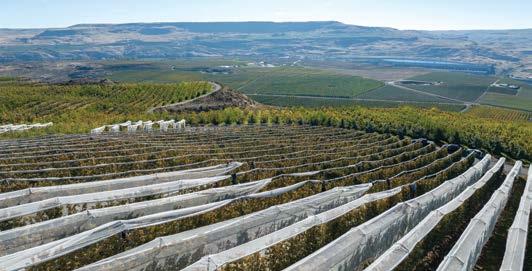
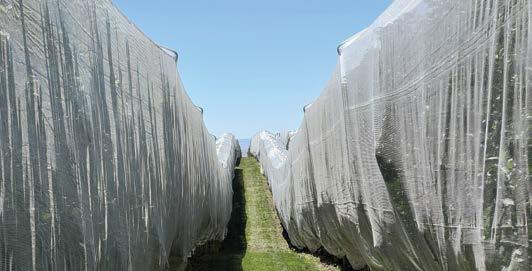
DRAPE NET: A PRACTICAL SOLUTION TO PROTECTIVE ORCHARD NETTING
Drape Net Pty Ltd has been supplying high-quality agricultural netting solutions to New Zealand orchardists for over 12 years. We were the first and original single row draping system in the country, incorporating our specifically designed net with our unique Bullhorn system. Many have tried to copy our system, but Drape Net is still the leader in innovation and cost-effective pricing worldwide.
The business began with a simple frustration familiar to many growers. Founder Michael Cunial, an orchardist himself, watched hail events wipe out entire crops and set out to find a more affordable way to protect his livelihood. After years of trial and error – and plenty of failed attempts – he developed a netting system that worked. More importantly, it was something growers could realistically invest in. Two decades on, some of that original netting is still in use today. That same growerfirst mindset continues to shape everything we do. We specialise in practical, affordable netting designed to protect fruit trees from hail, excessive sun exposure, bird and bat damage, wind damage, insect damage and with the added benefit of reducing irrigation – helping growers safeguard both crop quality and yield.
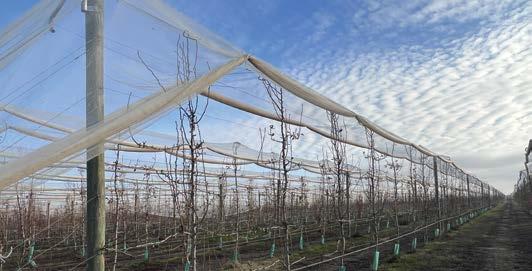
A system that is designed by growers for growers. We are continually advancing our products, using on farm experience and grower feedback. From developing different net designs, incorporating colours and mesh sizes, to adapting our Bullhorns to suit all types of trellis systems. In conjunction with Crendon Machinery we are constantly improving the NetWizz machine, making it easier and quicker to use. We are always looking to develop new accessories such as clips, portable sewing machines, protective covers and reflective material. With the Bullhorn being an integral part of the Drape Net system, most growers are now rolling the net to the top wires making it easy to store above the tree canopy. When needed the net is unclipped from the top wire, quickly falling to the ground where it can be easily secured to the bottom wire. The speed of this process allows the trees
to develop naturally in early spring with bees working unhindered. Once pollination is complete the net is easily dropped down protecting the crop until harvest.
We understand the challenges orchardists face each season and are committed to providing durable products, straightforward advice, and dependable service. Our focus is on delivering reliable crop protection solutions that are effective, easy to implement, and built to perform year after year.
At Drape Net, we believe protecting your orchard should be simple, practical, and cost-effective. We look forward to continuing to support Australasian growers with solutions they can trust.
For more information contact Ross +61 409 169 520 info@drapenet.com.au
TRACKING THE ‘HEALTH’ OF THE HORTICULTURE SECTOR OVER TIME
The sector’s guiding compass, the Aotearoa Horticulture Action Plan (AHAP), has provided us with a five-pillar framework to think about the health of the sector and the trajectory to reach the AHAP goal of “doubling the farmgate value of horticultural production by 2035 in a way that improves prosperity for our people and protects our environment”.
Stewart Graham : Bioeconomy Science Institute
The five pillars are:
Grow sustainably
Optimise value
Māori are strong in horticulture
Underpinned by science and knowledge
Nurture people
Aotearoa’s horticulture story is often told crop by crop, but the indicators developed to track progress against the AHAP let us zoom out and read the sector’s vital signs. Compared to baseline data, the latest numbers are encouraging with farmgate value increasing, export value lifting, and one more crop (avocados) well exceeding $100 million in value and moving to Tier 2.
What’s going up?
The AHAP indicators show New Zealand’s horticulture sector has continued to make strong progress over the past year. Based on the HortNZ levy take there has been a 17 percent increase in farmgate value, though this won’t be realised evenly across the sector.
For example, the ANZ report Shaping the Future of New Zealand Farming part one shows kiwifruit farmers are continuing to increase their earnings before interest and taxes per effective hectare, but this is decreasing in the pipfruit sector.
According to the latest Ministry for Primary Industries’ Situation and Outlook for Primary Industries data, the value of horticulture exports, excluding wine, increased by over $1 billion between 2024 and 2025. This was largely driven by increases across Tier 1 crops (approximate increases of
$1 billion for kiwifruit and $300 million for apples). This was accompanied by positive market access changes in 2025, with trade conditions for squash to Viet Nam being agreed and the temporary suspension of brassicas to Fiji being lifted.
With specialist knowledge across horticultural, rural and lifestyle properties, Ben understands the unique factors that drive value in productive rural land. From crop performance and production potential. Whether you’re considering selling, expanding, or simply want a clearer understanding of your property’s current market position, Ben works alongside landowners to help unlock the true value of their most important asset - their land. Do you know what your biggest asset is worth?
Ben Jameson your rural horticultural specialist, proudly servicing the Franklin area.
Description Change
Grow sustainably
Growers and area with GAP certification
Growers and area with GAP freshwater farm plan certification
New crop protection tools registered in New Zealand
Optimise value
Farmgate value of products
Value of produce exports
Changes in market access
Māori are strong in horticulture
Māori farms’ share of New Zealand total horticulture land area
Value of Māori horticulture farms
Māori working in horticulture
Underpinned by science and knowledge
Change in number/value of Tier 1, 2 and 3 crops
Number and type of Plant Variety Rights granted
Annual public investment in R&D and breeding in horticulture
Nurture people
Growers covered by GAP social practice certification
Horticulture qualification completions
2024–2025: Number decreased by 252, area decreased by 3833ha
2024–2025: Number increased by 17, area increased by 2429ha
2025: No new tools
2024–2025: Increase of $700 million
2024–2025: Increase of $1.68 billion
2025: +2 (1 new and 1 reinstated market access)
2022–2024: 48 percent increase (5 to 7.4 percent)
2020–2024: 39 percent increase ($220 million to $305 million)
2020–2023: Increase of ~100, but no percentage change in the overall workforce (still 17 percent)
2024–2025: One crop has moved from Tier 3 to Tier 2
2023–2024: 23 percent more qualification completions in 2024 (1580)
Another area of significant improvement based on research by BERL is Māori participation in horticulture, with a 48 percent increase in Māori farms’ share of total horticulture area between 2022 and 2024 (5 to 7.4 percent). The value of Māori horticulture farms also increased 39 percent between 2020 and 2024.
Areas to watch?
Areas to monitor include a decline in growers with GAP certification (although we have been informed this decrease is more likely due to improved reporting with fewer duplicates between NZGAP and GLOBALG.A.P. rather than a real decline) and a lack of new horticulture-specific crop protection tools becoming available last year. This figure is expected to improve in the coming years – a number of products are currently in the approval pipeline, and the Government is progressing system-wide opportunities to improve timely access to horticultural products.
We also saw a decrease in public investment in research and development. The discrepancy may be in part due to North Island Weather Events Response and Recovery Funding being active in 2024, but not 2025.
It’s important to note that we are reporting data from last year, rather than the situation today. There is a lot of good work underway to continue driving progress towards the AHAP goals
So what’s the rub?
Together, these indicators give the sector a clear checkin: what’s moving, what’s stalling, and where effort (and investment) will have the biggest payoff.
They’ll be updated regularly over the life of AHAP –through to 2035 – to track long-term change across the value chain and help keep the programme and the wider sector on course. The useful question now is local: what do these signals look like for your crop, and what extra data would help you make better decisions on-farm, on-orchard and in-market?
But how good is our high-level data, really?
What the indicators have also revealed is the difficulty in obtaining comprehensive data for the New Zealand horticulture sector. All indicators are reported with substantial caveats, and there is a real opportunity to improve data quality and quantity to improve our ability to track the health of the sector over time.
It’s important to note that we are reporting data from last year, rather than the situation today. There is a lot of good work underway to continue driving progress towards the AHAP goals and we expect this to be reflected in the data trends in the years to come.
and Central Otago.
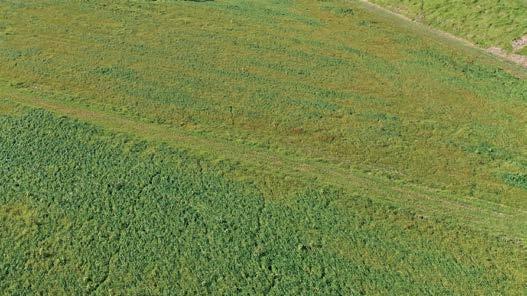
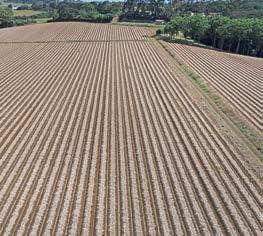
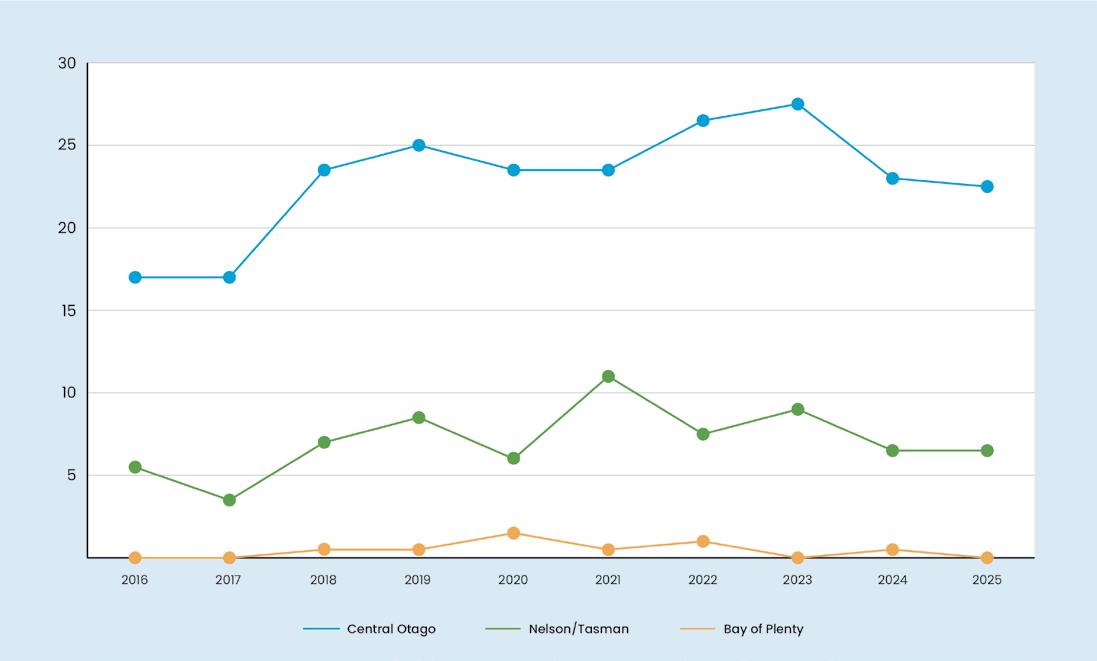
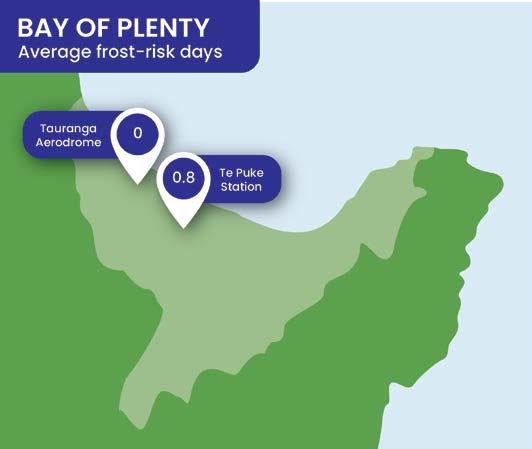
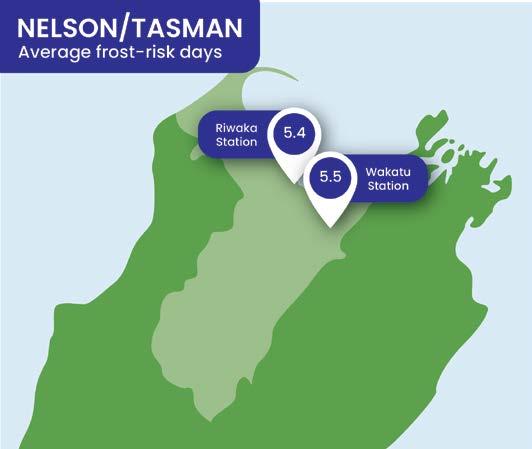
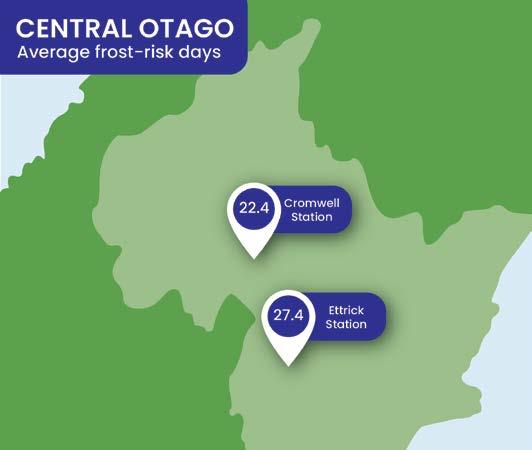
We’ve drawn on 10 years of spring weather data (1 September to end of November) from two science-grade weather stations in each of the three regions to see what story they tell. For the purposes of this analysis, a ‘frost risk day’ is any day in which the temperature has fallen below 2°C at any point, thereby providing conditions that are highly conducive to ground frost when coinciding with clear skies and calm winds.
NUMBER OF FROST RISK DAYS DURING SPRING
Over the past 10 years, the number of days with temperatures conducive to ground frosts has not demonstrated a clear trend in any of the three regions analysed.
What is starker is the difference in frost risk between regions, with Central Otago averaging about 24.9 frost risk days in spring across the decade – six times more than Nelson-Tasman and almost incomparably more than coastal Bay of Plenty.
Average number of frost risk days during spring (2016–2025). MetWatch’s spring frost snapshot was based on data from two science-grade weather stations in each of the three regions analysed
minor, except for some rare but significant frost events –notably in 2022 when a severe frost caused considerable fruit losses for many kiwifruit growers in the area.
What mitigations are possible?
Frosts are difficult to combat, as any grower knows, but there are some interventions which can make a tangible difference.
Frost fans, and in some cases helicopters, can be employed to circulate air and reduce the risk of frost forming, while overhead frost protection sprinklers can be applied to keep plant tissue from falling below 0°C.
Other options include frost blankets or row covers, or design considerations such as planting on slopes – rather than in hollows – or landscaping shelter belts and wetlands into an orchard to block cold air currents and moderate local temperature.
CROPLANDS: NEW TECHNOLOGY UPDATE
For over 50 years, Croplands has been proudly helping New Zealand orchardists with efficient, reliable and engineered solutions to save time, reduce costs and maximise productivity. The very first sprayer was delivered to an orchard over 50 years ago. Since then, they have expanded their range and are always looking to bring the latest tech and innovative solutions from around the world to New Zealand growers. One thing that has never changed is a focus on in-field research and development and thorough testing in New Zealand conditions.
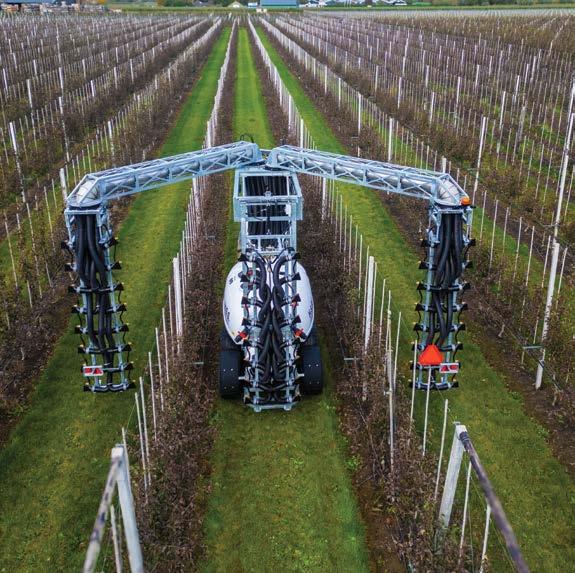
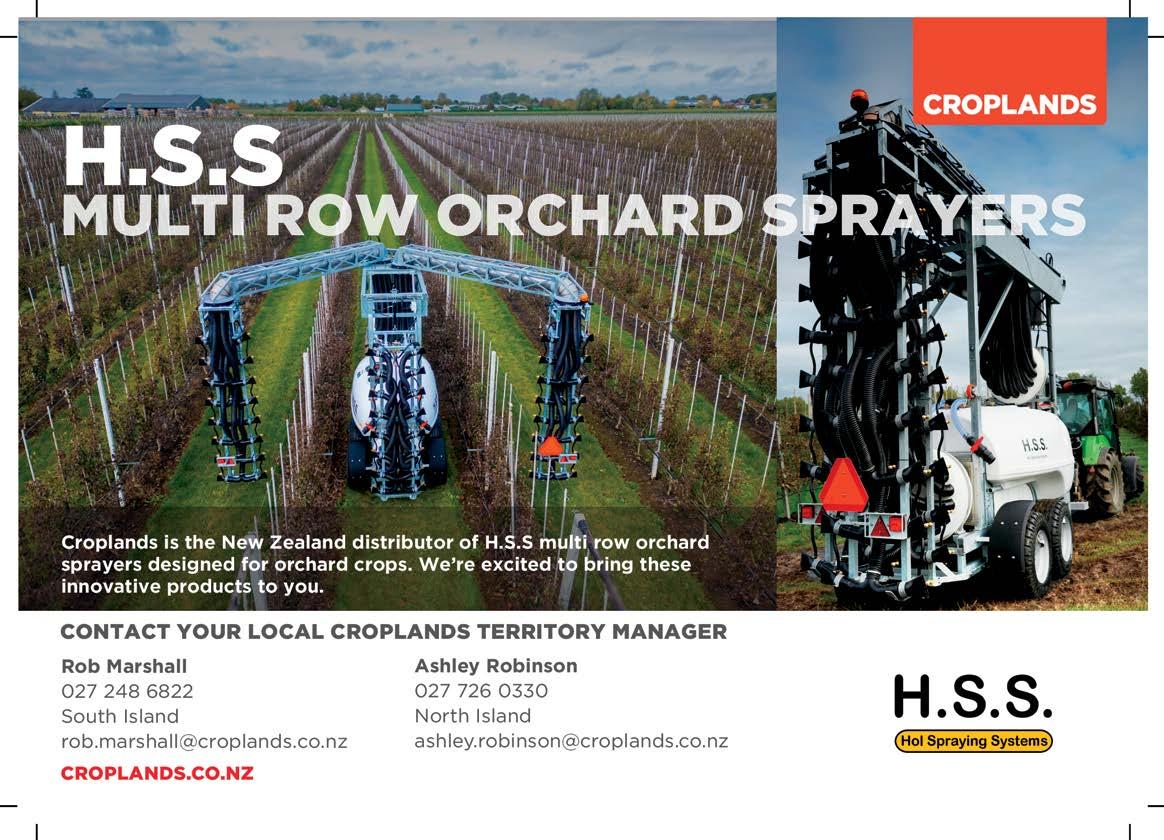
Croplands HSS multirow orchard sprayers
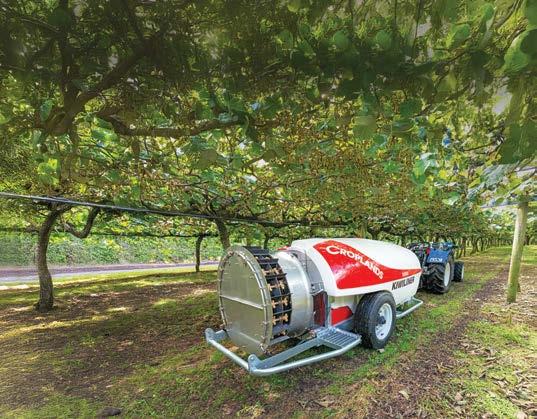
Croplands have partnered with Hol Spraying Systems to bring Kiwi orchardists industry-leading single and multi-row sprayers. Supported by decades of experience and an extensive dealer support network, they’ve got your back.
The multi-row orchard solution gives you the flexibility to spray three rows with every pass, reducing spraying time, operating and repair and maintenance costs. With rear folding, autopositioning booms, along with sequential spray and boom folding functions the time in headland is reduced, again increasing efficiency. Its robustness, low maintenance costs and consistent coverage row after row are hallmarks of its design.
With an electric and diesel hybrid system, the vehicle can operate for extended periods with no need to plug in, minimising downtime and increasing productivity and efficiency.
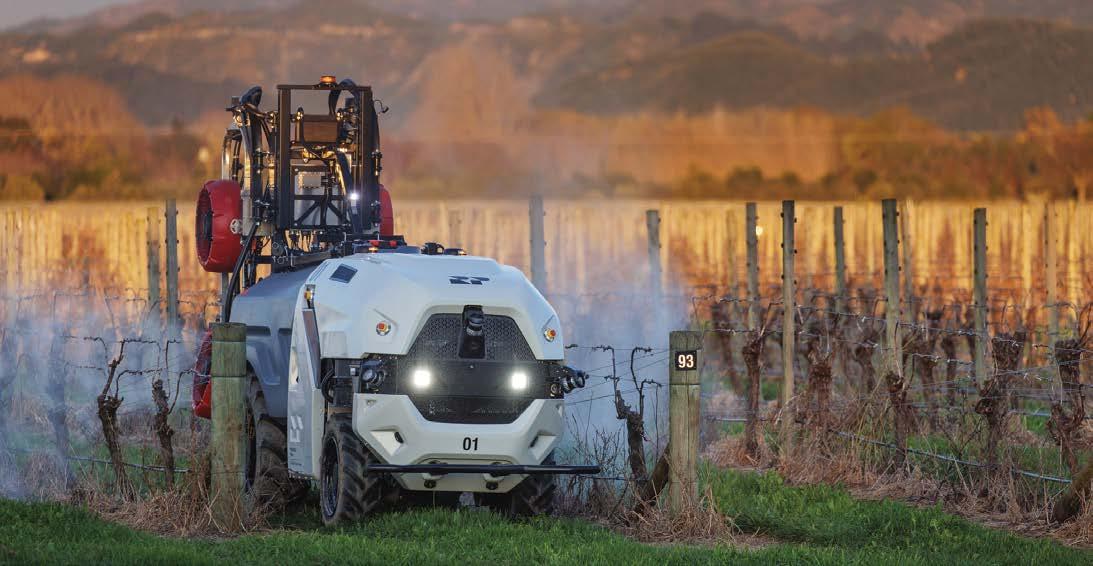
Combining advanced sensors and LiDAR (light detection and ranging) technology, Prospr can navigate with precision, ensuring accurate spraying and minimising chemical wastage.
A herbicide spray unit designed for seamless integration with Prospr is also available, with a range of different attachments coming soon.
Croplands autonomous robot for the vegetable market, Kilter AX-1
Croplands has introduced Kilter’s autonomous robot AX-1 to vegetable growers. The Kilter AX-1 is a lightweight solution that enables earlier weed control on crop beds, while freeing up labour to focus on value tasks across the operation. Running multiple AX-1 units increases productivity, while their compact size and portability make it easy to move between locations.
The AX-1 uses Single Drop Technology to apply a 1150-micron VMD (volume median diameter) droplet every 6mm, targeting weeds at their earliest growth stage while helping preserve soil nutrients and moisture.
The Green-On-Green technology, with AI vision, identifies and targets weeds in a 360-degree area around each crop. The Kilter AX-1 platform currently supports 21 crop types, seven of which are under ongoing research and development to meet the evolving needs of modern growers. The Kilter AX-1 is suitable for both organic and conventional farming operations.
Croplands Robotics Plus Prospr
A robust, autonomous, multi-use hybrid vehicle platform backed by Yamaha Agriculture, Prospr significantly increases efficiency across a variety of crop tasks. Yamaha Agriculture and Croplands have collaborated to design a range of spray configurations for best coverage, which are suitable for various crop types and growing systems.
To learn more about Croplands orchard solutions, contact your local Croplands dealer or territory manager
North Island – Ash Robinson 027 726 0330
South Island – Rob Marshall 027 248 6822
POLITICS IN THE SPOTLIGHT
With the General Election drawing closer, growers at the New Zealand Horticulture Conference will have a chance to hear directly from political representatives about the policy settings that could shape the future of New Zealand horticulture.
A pre-election political panel at the New Zealand Horticulture Conference on 29 July will bring together speakers from five parties for a discussion focused on the issues that matter most to growers – from regulation and infrastructure through to workforce, water and sector resilience.
The session will give attendees a clearer picture of how each party sees the challenges and opportunities facing horticulture, at a time when the sector is also pushing key priorities through HortNZ’s election manifesto.
Representatives scheduled to take part are Hon Andrew Hoggard for ACT, Hon Jo Luxton for Labour, Steve Abel for the Green Party, Hon Todd McClay for National and Hon Shane Jones for New Zealand First.
As well as hearing each party’s perspective, growers will be able to put questions directly to the panel and raise concerns about what proposed policies could mean on the ground for their businesses and communities.
Find out more about the New Zealand Horticulture Conference where you can join us for two days of insights, innovation and industry-wide conversations as we focus on building a stronger, more sustainable sector – together.
Register to attend at www.hortnz.co.nz
A CAUTIONARY TALE FROM FLORIDA
Citrus greening disease is edging closer to New Zealand – it is currently in Papua New Guinea and the psyllid vector has been found in Samoa.
For New Zealand’s horticulture stakeholders, Dr Ariel Singerman from Lincoln University draws out valuable lessons from the disease’s devastating impact on the Florida citrus industry.
Dr Ariel Singerman : Lincoln University associate professor, Department of Land Management and Systems
The marked increase in international trade starting in the twentieth century has unintentionally contributed to the spread of invasive species worldwide. But it is hard to find another example in recent history of an industry as iconic as Florida citrus that has declined so significantly in such a relatively short period of time primarily due to an invasive plant disease.
There are, however, other orchard diseases that currently pose a looming threat to other crops. Panama disease, for example, can cause a 100 percent yield loss on banana farms, jeopardising worldwide production of Cavendish bananas – a cultivar that represents over 40 percent of global banana production and virtually all exports.
Similarly, the impact of the olive quick decline syndrome on the historic Italian olive-producing region of Puglia may prove as significant as that of citrus greening or Huanglongbing (HLB) in Florida; the disease is expected to reduce olive yield by 35 percent in trees younger than 30 years and by 69 percent in older trees.
Clearly, plant health challenges are not unique to any one crop, but the ways industries respond to emerging biosecurity threats can shape their long-term viability.
Florida was once the citrus capital of the United States. In 2003/04, the state produced 85 percent of the United States’ oranges and accounted for nearly three-quarters of national bearing acreage.
New Zealand’s citrus orchards are free of citrus greening disease (also known as Huanglongbing), which has devastated citrus production around the world. Photo courtesy of Citrus NZ
2004 Hurricanes
2004 Hurricanes
2004 Hurricanes
2004 Hurricanes
2004 Hurricanes
2004 Hurricanes
2004 Hurricanes
Charlie (Aug 13, 2004)
Shaded area denotes HLB disease (found in 2005)
Shaded area denotes HLB disease (found in 2005)
Hurricane Freeze ORANGE YIELD IN FLORIDA 1993–2024
Charlie (Aug 13, 2004)
Charlie (Aug 13, 2004)
Charlie (Aug 13, 2004)
Charlie (13 Aug 2004)
Charlie (Aug 13, 2004)
Charlie (Aug 13, 2004)
Frances (Sept 5, 2004)
Frances (5 Sept 2004)
Frances (Sept 5, 2004)
Frances (Sept 5, 2004)
Frances (Sept 5, 2004)
Frances (Sept 5, 2004)
Frances (Sept 5, 2004)
Ivan (Sept 15, 2004)
Ivan (15 Sept 2004)
Ivan (Sept 15, 2004)
Ivan (Sept 15, 2004)
Ivan (Sept 15, 2004)
Ivan (Sept 15, 2004)
Ivan (Sept 15, 2004)
Jeanne (26 Sept 2004)
Jeanne (Sept 26, 2004)
Jeanne (Sept 26, 2004)
Jeanne (Sept 26, 2004)
Jeanne (Sept 26, 2004)
Jeanne (Sept 26, 2004)
Jeanne (Sept 26, 2004)
Shaded
Shaded area denotes HLB disease (found in 2005)
Shaded area denotes HLB disease (found in 2005)
Shaded area denotes HLB disease (found in 2005)
Shaded
Freeze (Feb. 2006)
Freeze (Feb. 2006)
Freeze (Feb. 2006)
Freeze (Feb. 2006)
Freeze (frost) (Feb 2006)
Freeze (Feb. 2006)
Freeze (Feb. 2006)
per Acre Actual Yield Trend pre-HLB Trend with HLB
Hurricane Wilma (Oct 2005)
Huricane Wilma (Oct. 2005)
Huricane Wilma (Oct. 2005)
Huricane Wilma (Oct. 2005)
Huricane Wilma (Oct. 2005)
Huricane Wilma (Oct. 2005)
Huricane Wilma (Oct. 2005)
Hurricane Irma (Sept 2017)
Hurricane Irma (Sept. 2017)
Hurricane Irma (Sept. 2017)
Hurricane Irma (Sept. 2017)
Hurricane Irma (Sept. 2017)
Hurricane Irma (Sept. 2017)
Hurricane Irma (Sept. 2017)
Freeze (Jan. 2022)
Freeze (Jan. 2022)
Freeze (frost) (Jan 2022)
(Jan. 2022)
Freeze (Jan. 2022)
(Jan. 2022)
(Jan. 2022)
1993/941994/951995/961996/971997/981998/991999/002000/012001/022002/032003/042004/052005/062006/072007/082008/092009/102010/112011/122012/132013/142014/152015/162016/172017/182018/192019/202020/212021/222022/232023/24 Boxes per Acre
1: Orange yield in Florida and the impact of citrus greening disease
Two decades later, production has decreased by more than 90 percent, the number of growers has declined by 69 percent, bearing acreage has roughly halved and 83 percent of orange juice processing facilities and 78 percent of packhouses have closed.
HLB – the bacterial disease at the heart of Florida’s decline – sits at the top of Citrus NZ’s biosecurity priority list, alongside its insect vector, the Asian citrus psyllid. So, the industry should take the lessons from Florida as a roadmap of mistakes to avoid.
The shape of contraction
HLB was first detected in Florida in 2005. From seasons 2007/08 to 2016/17 – a decade with no hurricanes or freezes – average yield per acre statewide decreased by 55 percent (Figure 1). It was a consequence of the disease spreading through groves and progressively affecting trees.
From 2017 onward, the cumulative disease impact was compounded by Hurricane Irma, Covid-driven price swings, a fertiliser price shock triggered by the war in Ukraine, a freeze in 2022, and Hurricanes Ian and Milton. The combination drove yields down a further 30 percent (Figure 1).
Freeze
Freeze (frost)
Source: USDA-NASS and author’s calculations
Management responses and economics
Once a tree is infected, growers cannot reverse it. The economic consequences in Florida were severe. The real cost of production per acre rose by 75 percent. But because yields were falling at the same time, the real cost per box increased by 283 percent.
Wanted: Orchards to lease
We have a client seeking Orchard land to Lease in the wider area of Hawke’s Bay.
Prefer planted, open to crop types and will consider bare land.
• Any size considered.
• Must have secure water rights.
• Must have reliable access.
• All areas in Hawke’s Bay considered.
Very conscientious, respectful and experienced grower.
Fruit prices did rise as supply decreased – but not enough to offset the lower output. The average grower faced losses, season after season, causing many to exit the industry.
The lesson for New Zealand growers: Do not assume intensive management can save an orchard once HLB is established. Florida’s growers tried, and the cost increase forced many into bankruptcy.
Coordination and scientific, evidence-based strategies
HLB is not a problem an individual orchard can address in isolation. The psyllid vector moves across property boundaries, meaning individual spray programmes are far less effective without coordination.
Florida had one promising response – voluntary groups of neighbours who coordinated spray timing and chemistry. Research showed that approach worked; yields in wellcoordinated areas were higher in successive seasons compared to those obtained in poorly coordinated ones. Then a policy decision in 2016 negatively affected this structure. Foliar antibiotic sprays were approved for use in commercial groves, despite lack of scientific evidence that they worked.
Growers adopted them widely anyway, and in roughly half of cases, they did so at the expense of participating in coordinated insecticide sprays. However, the antibiotic sprays were later confirmed to be ineffective.
For New Zealand, Florida’s experience suggests that fragmented, individual orchard responses offer a limited benefit once a serious disease is established.
Structural change and long-term implications
Even if a cure were found tomorrow, the Florida citrus industry is highly unlikely to ever reach pre-HLB production levels.
First, much of the land is gone. Florida added millions of residents over two decades. Counties that once had tens of thousands of citrus acres now have urban housing on that land. Solar farms – locked into multi-year leases – now occupy a significant share of former citrus area. Therefore, the opportunity cost of citrus land has risen permanently.
Second, the processing infrastructure is gone. Eighty-three percent of orange juice processors and 78 percent of packhouses have closed. Rebuilding that capacity would require enormous capital investment.
Third, the human capital is gone. Sixty-nine percent of growers exited between 2002 and 2022. Their knowledge, equipment and supply networks are unlikely to come back. The collapse in Florida is not a downturn the industry will eventually recover from. It is structural and largely permanent. Therefore, in New Zealand, prevention is not one option among several – it is the only viable strategy for the time being.
What this means for New Zealand citrus and beyond
New Zealand’s citrus industry is small relative to Florida’s, which creates both vulnerabilities and advantages. Smaller sectors are less able to absorb prolonged losses, but they can often coordinate more quickly, enforce biosecurity more tightly and act collectively before options narrow.
Florida’s experience suggests three broad lessons that resonate across horticulture:
• First, biosecurity at the border is the single highestleverage investment. The psyllid does not need to arrive in container shipments of fruit – it can arrive on nursery stock, ornamental plants or citrus material carried by travellers. Once the vector is established, eradication becomes vastly harder.
• Second, growers should not wait for HLB to plan for collective action. Spray coordination, monitoring networks and grower-to-grower communication are far easier to build before a crisis than during one.
Florida’s lesson is that even a working voluntary system can be destroyed by a single bad policy decision. Building robust institutions now is easier than building them under pressure.
• Third, do not assume a silver bullet solution will be found. When a serious disease arrives, there is enormous political pressure to approve any product that promises relief. Florida’s approval of antibiotic sprays without scientific evidence on their effectiveness is a cautionary case. Insisting on rigorous field scientific evidence before approval is the difference between managing a disease and accelerating its spread.
Florida’s citrus industry was iconic, well resourced and politically influential. Its experience is not a forecast for other sectors, but it does illustrate how quickly options can narrow once prevention fails – and how difficult it is to recover land, infrastructure and capability once they are lost.
AUTOMATING YOUR TRACTOR WORK
Conventional tractors have been getting larger, but is the push for higher productivity through automation – and the cost of diesel – reversing the trend?
Karen Trebilcock
It’s now not too hard to find robots doing the hard work outside on New Zealand farms and orchards.
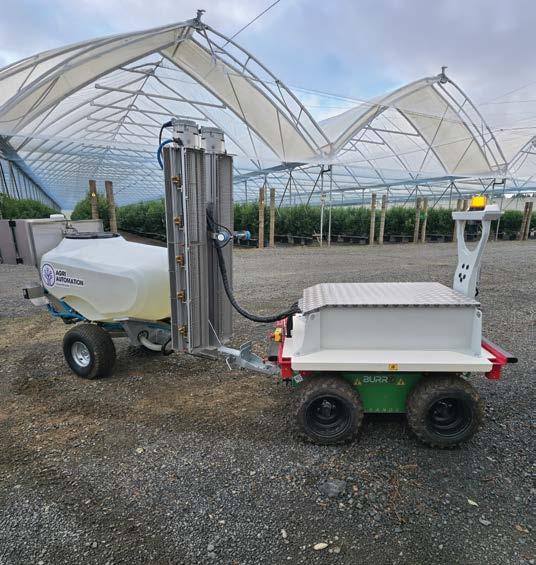
Agri Automation’s Burro (Spanish for donkey) is making an impact with about 30 operational in New Zealand, working in cherries, berries, grapes, flowers and other crop operations. Their New Zealand managing director Chris Clifford says the different models of the small, electric, United Statesbuilt Burro cost between about $35,000 and $80,000. They carry up to 750kg and/or tow up to 2.25t, transporting tools to staff or produce to packhouse as well as spraying and mowing.
And they can be equipped with Guard Dog for 24/7 autonomous patrolling and alerts.
However, although Agri Automation’s GOtrack retrofit package to make tractors autonomous has attracted
interest from large scale and corporate growers and about a dozen or more are working in Australia, none are yet working on this side of the ditch.
“Tractors have developed so one operator can do more at one time,” Chris says. “Their horsepower has slowly increased with their size so they can do more rows and cover more area at once.
“With automation, it’s the other way around. Because they don’t need an operator they can work longer hours so it’s more efficient to go smaller. The Burro’s operating costs are about $2/hour and they can go for up to 12 hours on one charge.”
He thinks there is still a place for large tractor automation but it needed a change of management practice on farm, not just retrofitting one tractor to make it automated.
“You don’t set it going and then leave for the beach.”
The New Zealand-built Agovor eTractor with two different trailer attachments. Photo courtesy of NZ Story
Instead, two or three GOtrack-fitted tractors could be controlled by one person.
“And that’s when you get the savings.
“With fuel prices increasing and the cost and availability of labour becoming a real issue, the rewards for adopting automation are very compelling,” Chris says.
“Which is why we don’t just sell robots. We work with the customer to plan and implement the technology on their farm including adapting existing equipment or providing customised machinery.”
Although the Burro is produced in the United States, New Zealand-based manufacturers are also in the mix. For example, the Agovor eTractor was developed at wholesale plant nursery Ardmore Nurseries at Clevedon south of Auckland during the 2020 COVID-19 lockdown to solve labour shortages.
Agovor co-founder Richard Beaumont says there are about eight working in New Zealand orchards, berry farms and
Growers of
vineyards (including Taylor Corp apple orchards – see NZGrower & Orchardist May issue) and four units had just been delivered to Australia.
However, none were now working at the plant nursery.
“When we started, we were finding a solution for ourselves but the plant nursery business is very small and when we went to scale up, it made us realise what the eTractor was very good at doing was going up and down rows,” Richard says.
With the help of Callaghan Innovation and NZ Trade & Enterprise, Agovor looked at the needs of orchards, horticulture and vineyards and developed a herbicide spray trailer and a mowing trailer.
The eTractor sells for about $40,000 with the eMower $20,000 and the eSprayer $15,000.
Richard says there have been requests for other attachments. A canopy sprayer is in development along with a few others.
Authorised
“It’s a paradigm switch for growers. Instead of having a large, expensive, heavy diesel tractor, which has one operator, these are small, less than $1 a day to run and you can have a whole fleet of them operated by just one person.”
Prospr, another unmanned ground vehicle that can carry, spray, mow and cultivate, has taken a different approach.
Designed and built by Robotics Plus in Tauranga, with Croplands the exclusive Australasian distributor since 2024, Prospr has a diesel generator so it can keep working without the need to plug in. Otherwise, it’s all-electric.
It has regenerative braking and an intelligent all-wheel drive system with independent wheel motors to give grip and control – and reduce ground damage.
Robotics Plus teamed up with Yamaha to form Yamaha Agriculture last year to further develop Prospr and grow a global market.
So far they’re working in orchards and vineyards here, Australia and the United States.
Adding some AI to the mix is the Weedspider.
From Palmerston North, and now holding its own in Santa Maria, California, the Weedspider uses its spidery arms to cultivate the soil between plantings getting rid of weeds or it spot sprays the weeds, minimising chemical use.
Using AI, its hi-tech sensors map the bed shape and adjust blade depth and its imaging system identifies weeds in any light conditions, eliminating the need for curtains or artificial lights.
Attached on the back of a tractor, it’s lightweight, solar powered and fully electric.
And the website promises future possibilities.
“We are working on a few new ideas that are a little bit crazy but could end up more than a little bit useful.”
Although none are working in New Zealand yet, there are six machines running in California full time and one in Yuma, Arizona, where almost all the leafy winter greens are grown for the country. There is another in the UK.
Robotics engineer Sam Lockwood-Geck, who has moved from Palmerston North to Santa Maria with the company, says the new Weedspider’s precision spot spraying was exciting New Zealand growers.
“Our platform now offers a very compelling mechanical weed control and precision spot spraying system. We are the only machine in the world with this capability that we know of,” Sam says.
Meanwhile, New Zealand’s first robotic weeder, imported from the United States last year by Southland carrot and parsnip grower So Sweet, has spent the summer going up and down rows zapping weeds with lasers using AI.
The Carbon Robotics G2 Laser Weeder is still pulled and powered by a conventional tractor although automated options are being explored.
After six months of use, So Sweet managing director Matthew Malcolm says the weeder had produced “very good results”.
Prospr, distributed by Croplands, at work in a New Zealand vineyard. The autonomous sprayer is designed and built by Robotics Plus in Tauranga
“We have grown exceptional organic crops and have experimented on our conventional carrots and parsnips also. “The speed of the machine is still a work in progress and we have found bed preparation is crucial to getting a more acceptable speed so we cover the ground more efficiently.”
And the Southland robotic laser weeder now has a buddy to chat with in New Zealand with Gisborne’s LeaderBrand also importing a model from California.
As in Southland, the unit is two metres wide and also uses a conventional tractor.
LeaderBrand’s general manager of farming, Gordon McPhail, says its weeder would be used for salad leaf production. “We’re currently facing significant weed burden issues, and that impacts our ability to produce reliable quality salad greens, both indoor and outdoor growing.”
The weeder uses cameras and AI to identify weeds before zapping them with a laser. If it can’t distinguish a weed, it uses a Starlink dish to talk to other weeders around the world, including the one in Southland.
The weeder’s purchase by LeaderBrand was assisted with funding support from Ministry for Primary Industries under the Primary Sector Growth Fund.
The United States-built Burro Grande with Agri Automation AutoSpray’s 500 foliar sprayer working amongst blueberries in New Zealand
CARBON POSITIVE: BUTTERNUTS UPDATE
The Carbon Positive Trial is a six-year study based at the LandWISE MicroFarm, comparing three growing systems: Conventional, Hybrid and Regenerative. The trial aims to answer the scientific question: Can soil health and quality be improved by adopting methods that sequester carbon through sustainable and regenerative practices, while maintaining crop quality and profitability?
Olivia Webster : LandWISE project manager – sustainable systems
We have just completed our fourth cropping season, during which we grew butternut pumpkins. All three treatments (Conventional, Hybrid and Regenerative) have now been planted in winter cover crops.
The main differences between treatments throughout the growing season were soil preparation and nutrition. All three treatments received the same spray programme, as the products used on butternuts have a low Environmental Impact Quotient (EIQ).
EIQ is a tool developed by Cornell University that can be used to estimate the ‘field-use’ environmental impact of specific agrichemicals. This score is based on both the toxicity of the product’s active ingredient and the application rate per hectare.
The entire Conventional treatment was sprayed out and cultivated prior to planting. In contrast, the Hybrid and Regenerative treatments were strip-sprayed and strip-tilled, followed by a broadcast spray one week before planting to terminate the remaining winter cover crop and any weeds that emerged after strip tillage.
Subsample collection from the butternut squash hand harvest at the LandWISE MicroFarm
Throughout the season, the Conventional treatment received 77kg N/ha, the Hybrid treatment received 67kg N/ha, and the Regenerative treatment received 19kg N/ha. The Conventional and Hybrid treatments both received the ‘standard’ rate of fertiliser at planting, while the Regenerative treatment received half that rate. In addition, the Hybrid and Regenerative treatments received biological inputs via liquid injection, including Trichostart, Biostart N and Mycorrcin. At side-dressing, the Conventional treatment again received the ‘standard’ fertiliser rate, while the Hybrid treatment received a slightly reduced rate. The Hybrid treatment also received a foliar application of seaweed. The Regenerative treatment only received a foliar application of seaweed, Megafol and fulvic acid, as soil tests indicated sufficient nitrate-N levels.
After the butternuts were harvested, all three treatments were disced twice before being direct drilled. The Conventional and Hybrid treatments were sown in Moata ryegrass, while the Regenerative treatment was planted in a mix of triticale and vetch.
The triticale and vetch established quickly and are expected to provide good ground cover over winter. The Moata ryegrass was slower to establish but is expected to reach full canopy cover within 6–8 weeks, as observed in previous years.
The Conventional treatment will be grazed over winter, while the Hybrid and Regenerative treatments will be left to accumulate biomass.
EIQ is a tool developed that can be used to estimate the ‘field-use’ environmental impact of specific agrichemicals
Our plot sampling showed the Conventional treatment averaged 52.74t/ha, the Hybrid treatment 52.00t/ha, and the Regenerative treatment 49.44t/ha. Statistically, these results were not significantly different. All treatments yielded well ahead of the 25–30t/ha we anticipated at sowing! The Brix levels, fruit size, fruit dry matter, residue biomass, residue dry matter and carbon and nitrogen content in residue and fruit were the same in all treatments.
Carbon Positive is a joint project with LandWISE, Hawke’s Bay Future Farming Trust, Heinz-Wattie’s and McCain Foods. We are grateful to our Operation Advisory Group members for their attendance and input at regular paddock meetings.
Regenerative cover crop on the right, Hybrid and Conventional on the left
GROWING FUTURE LEADERS
HortNZ has opened applications for its 2026 Leadership Programme, with scholarships available for potential and current leaders across the horticulture sector looking to build their capability and broaden their influence across the industry.
Delivered in partnership with Rural Leaders, the programme is designed to help participants strengthen practical leadership skills while developing a wider understanding of the opportunities and pressures shaping New Zealand horticulture.
HortNZ chief executive Kate Scott says the programme sits squarely within the organisation’s broader workforce development focus.
“Horticulture is growing and has an ambitious goal to double the farmgate value of horticultural production by 2035. We are focused on increasing the capability and capacity of the horticulture workforce.
“That emphasis reflects a wider industry need. Growers are increasingly being asked to lead not only productive businesses, but also teams, communities and industry conversations around resilience, sustainability, water, biosecurity and long-term investment.
“Building confidence in those areas is going to become even more important as horticulture continues to expand and attract new entrants.”
Participants in the 2025 Leadership Programme
The programme has earned its reputation by staying grounded in practical outcomes for participants and the businesses they represent, Kate says.
“The HortNZ Leadership Programme is an established and highly regarded programme. It supports participants to gain a greater understanding of leadership and practical leadership skills, and a wider perspective of how to address industry issues.
“For growers considering succession, governance roles or stronger involvement in industry advocacy, the scholarship offers a great chance for people to invest in their leadership capability in a structured way.
The HortNZ Leadership Programme is an established and highly regarded programme. It supports participants to gain a greater understanding of leadership and practical leadership skills, and a wider perspective of how to address industry issues
The 2026 intake will be delivered in two phases, in August and October. Each participant will develop a personal leadership plan as part of the programme.
“There is always strong demand and a high calibre of applicants. We look forward to receiving applications from passionate horticulturalists who want to make a difference to the sector.”
There is a maximum of 16 participants. As well as the 12 scholarships, up to four positions are available for a programme fee of $5,000 + GST plus accommodation.
Applications close on 28 June. For more information and to apply www.hortnz.co.nz
EXECUTIVE PROGRAMME PARTIAL SCHOLARSHIP
The International Fresh Produce Association’s Produce Executive Program is a hands-on leadership initiative designed by industry, for industry. Participants will gain practical strategies to develop business growth, explore global trends and broaden their understanding of domestic and export markets.
HortNZ, in partnership with the New Zealand Fruitgrowers’ Charitable Trust, is offering five partial scholarships including a 35 percent discount to successful candidates. Partial scholarships are available to help make this programme more accessible, supporting current and future leaders to gain the insights to secure a sustainable future for their businesses.
To apply, visit www.hortnz.co.nz
STRONG START SETS THE TONE FOR NAVELS
As harvest begins across New Zealand’s navel orange orchards, early indicators suggest a promising start to the season. While the first fruit is now moving through packhouses and into market, attention is quickly turning to how early quality and consistency will shape returns in what remains a challenging cost environment.
Jo Pentreath : Citrus NZ executive manager
Fruit size is also trending larger in many orchards. Early estimates suggest overall volumes will be broadly similar to last season – potentially down slightly in fruit numbers, with increased size expected to offset at least part of that difference.
For growers across horticulture, this trade-off will be familiar: fewer units, more weight per unit, and the flow-on implications for packouts, logistics and market presentation. Cosmetically, fruit is presenting cleanly, supporting expectations for strong early packouts as the season begins.
The early market window
As New Zealand navels move into the domestic market, attention is focused on managing the early season transition. Historically, it takes around two to three weeks for New Zealand fruit to fully populate the local supply pipeline, making this opening window particularly influential.
Quality sits at the centre of that equation. Across fresh produce categories, the first fruit consumers encounter tends to set expectations for what follows. That initial eating experience shapes confidence, repeat purchase behaviour, and ultimately the pace at which a category builds momentum through the season.
Citrus NZ recognises that imported citrus plays an important role in maintaining retail continuity during seasonal gaps. At the same time, ensuring that New Zealand grown fruit can move efficiently into market during peak harvest periods remains a key focus.
Citrus NZ chair Hugh Ritchie notes that this balance is about supporting growers who are investing in production and managing rising costs, while working constructively with retailers to align supply as local fruit becomes available.
“Our focus is on supporting New Zealand citrus producers so that locally grown produce is available to New Zealand consumers,” he says. “That means paying close attention to timing, availability and alignment across the supply chain, while recognising the role imports play when local supply is limited.”
This year, those early season decisions are being made against a backdrop of elevated costs. Production inputs and supply chain logistics remain under pressure, influenced by global uncertainty and higher freight and energy costs – pressures that are being felt directly at the grower level.
Eating quality and value Independent modelling from crop quality specialists Delytics Ltd underscores why quality consistency matters so much – not just for citrus, but across horticulture.
“Consumer eating experience directly influences purchase intent,” says Mark Loeffen of Delytics.
The modelling shows that consistent positive eating experiences significantly increase repurchase rates. In contrast, a single negative experience can delay repurchase for six to 14 weeks. Once consumer trust is lost, it typically takes two to three positive experiences to rebuild it. Inconsistent quality reduces repurchase rates overall, even when price points remain competitive. “Price is a proxy for perceived quality,” Mark explains. “Delivering consistently good tasting fruit can put your fruit at the top of the market.”
These dynamics are well recognised across fresh produce categories. Whether fruit, vegetables or other horticultural products, consumer confidence is built, or eroded, one eating experience at a time.
What the numbers are showing
For New Zealand navel oranges that meet the current maturity standard, Delytics’ modelling indicates that around 70 percent of consumers will have a positive eating experience.
The navel monitoring standard requires that 75 percent of fruit in a representative sample meet the minimum maturity threshold. Before the current standard was introduced in 2016, just over 60 percent of fruit met that benchmark.
Since adoption of the standard – including a voluntary clearance protocol for navel growers – compliance has remained consistently high. It has never dropped below 80 percent, and in six of the past ten seasons has exceeded 94 percent. Supermarket Distribution Centre monitoring data reinforces this picture, showing steady improvements in market eating quality over time.
“Overall, with maturity consistently exceeding the industry standard, it’s now very difficult to buy a New Zealand navel orange that doesn’t taste good,” Mark says.
That consistency underpins repeat purchasing and supports confidence in the category as the season progresses.
Carrying quality through the season
While these observations relate directly to navels, the implications extend well beyond citrus. Across horticulture, early season quality tends to set the tone for the months that follow. In a year characterised by high costs and cautious consumer spending, reliability and consistency remain among the strongest tools available to protect value.
As the navel season gets underway, early maturity, favourable fruit size and well-established quality systems provide a solid platform. The challenge, shared across crops, is maintaining that consistency through the season so early confidence translates into sustained demand.
In that sense, quality standards are not just a technical benchmark. They are a mechanism for supporting growers, protecting consumer trust and positioning New Zealand fruit strongly in market.
Copperfield Nurseries Citrus Tree Specialists
While diversification remains critical to the industry’s long-term strategy, the reality is that strong Australian demand provides an important commercial foundation as the industry works through a significantly larger crop.
Domestic market dynamics
As it will always do, any changes in seasonal volumes and timing of export packing will influence the domestic market.
Historically, the local market has absorbed around 40 percent of the total crop. While domestic volumes are still forecast to remain substantial, with more classes of fruit earmarked for export the local market
could well see lower overall volumes than the 3 million trays supplied locally during the 2025–26 season. This dynamic is also supported by export packout rates that are projected to lift from around 50 percent to 60 percent.
However, the domestic supply profile or timing may look different from past seasons with a larger proportion of fruit moving through export packing earlier in the season to meet market demands. The local market could therefore see periods of peak volumes, which will require close monitoring of market conditions and careful alignment between promotional activity and fruit availability.
• Provides internal warming more compact flowering
• For use on fruit tree crops
• The “spray on” that adds to all other methods
• Good results have been achieved when applied through irrigation lines
New Zealand’s High Commissioner to Canada Wendy Matthews (second from right) visited the NZ Avocado stand at the Canadian Produce Marketing Association trade show in Toronto, taking the opportunity to meet with exporter representatives
FOLLOWING A WEATHERIMPACTED 2025–26 SEASON, THE YEAR AHEAD IS SHAPING UP AS ONE OF THE INDUSTRY’S LARGER EXPORT OPPORTUNITIES IN RECENT YEARS
Supporting the market through higher volumes
The scale of the season ahead reinforces the importance of coordinated demand-building activity across both export and domestic programmes.
Promotional activity will need to remain responsive rather than fixed. Early-season export market activity will focus on quality and provenance with local market messaging concentrating on versatility and stronger value-driven retail promotions as supply volumes increase.
The objective is straightforward: maintain consumer demand growth at a pace that supports orderly fruit movement throughout the season while protecting market confidence in quality.
Equally important will be the performance of the supply chain itself. Larger crop volumes place additional pressure on harvest timing, packhouse throughput, logistics and shipping coordination. Maintaining fruit quality throughout longer supply chains into export markets remains critical to protecting New Zealand’s reputation and future market opportunities. Ensuring growers, packers and exporters are operationally prepared for the scale of the season ahead will determine how well the industry can capitalise on the opportunity ahead.
Confidence, but not complacency
While the outlook for the season ahead is more positive, the projections remain early estimates and are still subject to crop load, harvest timing, fruit quality and changing market conditions.
The industry also enters the season aware of the challenges experienced over recent years, including weather disruption, shipping volatility, volume peaks and increasing competition. The direct and indirect impacts of the Middle East crisis are already emerging through early signals of shipping disruptions and freight increases, with growers and the supply chain already experiencing increased fuel, fertiliser and other orchard input cost increases.
However, there is growing confidence in the industry’s position. The continued strengthening of market access, including avocados’ success in the New Zealand–India Free Trade Agreement, provides encouraging signals for long-term export opportunities. At the same time, New Zealand’s reputation for trusted trade systems, ease of doing business and counter-season supply continues to differentiate our industry internationally.
The industry focus remains on being a high-trust, highquality seasonal supplier where New Zealand fruit is ‘waited for’ as a preferred supply. Securing demand in the face of increasing competition does take time, yet with increasing market awareness and a clearer more united New Zealand origin story emerging internationally, the industry is on its way to being better positioned to support higher volumes to a more diverse set of markets.
GETTING STORAGE RIGHT
Storage technology continues to advance rapidly overseas, with growers investing in increasingly sophisticated systems to improve quality and consistency.
Kate Trufitt : Potatoes New Zealand chief executive
Globally storage is becoming a core part of the production system, with a strong focus on climate control, airflow and maintaining product quality over longer periods.
While storage duration across the New Zealand potato industry can be dependent on the final use of the crop, interest in advanced storage technologies continues to increase. As expectations around quality and consistency increase, so too does the opportunity to use storage as a tool to deliver better outcomes.
However, as advances in storage continue, one point remains unchanged: storage can only maintain what goes into it.
It starts in the paddock
That was the clear message from University of Idaho Professor Nora Olsen when she spoke at the recent PotatoLink workshop in Australia. Her advice to growers was simple – storage is not a fix.
“You can’t fix a sick potato in storage,” she said. “You can only maintain what you put in.”
Even harvest timing matters. Colder tubers are more prone to damage, meaning conditions throughout the day can influence risk.
Put simply, the foundations for successful storage are set well before the crop leaves the paddock.
Handling the crop with care
Once harvesting begins, how the crop is handled becomes just as important.
The implication is clear. Decisions made in the paddock, particularly in the final weeks before harvest, have a direct impact on storage outcomes.
Maintaining soil moisture leading into harvest can influence tuber condition, although this is not always straightforward in practice. Nutrition also plays an important role. Excess nitrogen late in the season can delay maturity and increase the risk of damage, while adequate calcium supports stronger tubers and reduces susceptibility to bruising.
For growers using more mechanised systems, whether packing into boxes or directly into store, factors such as conveyor speed, drop heights and impact points can significantly influence damage levels. Practical adjustments to growers’ systems –such as moderating flow, reducing drops and identifying highimpact areas – can help protect tubers from unnecessary stress.
At the same time, not all operations use highly mechanised packing or storage systems. Whether handling is manual or mechanised, the principle remains the same: minimising impact and handling stress is critical to maintaining quality.
Research presented by Professor Olsen highlighted the consequences of damage. Bruised tubers are far more likely to develop storage diseases, with losses compounding over time through shrinkage, decay and reduced marketability.
A growing focus on storage systems
While paddock and harvest practices are fundamental, storage technology itself is evolving.
Maarten van Delden from Tolsma Australia, the local branch of the Dutch storage technology giant Tolsma-Grisnich Group, notes that storage has long been a major focus in Europe, where longer storage periods drive the need for more advanced systems. In contrast, New Zealand and Australia have historically had less demand, due to shorter storage windows, traditional ground storage and a wider range of growing conditions.
However, that is beginning to change. Growers are increasingly looking beyond traditional cool stores to better understand:
Risks of ground storage
Airflow, airspeed and active ventilation
Product temperature and humidity control
CO2 monitoring and control
Drying, skin set and curing
The difference between room temperature and product temperature
Maarten explains that these factors all contribute to maintaining quality over time.
The Potato Seed Co-operative in Ashburton provides a strong New Zealand example, where investment in modern storage systems has delivered improvements in both yield and consistency.
Investing for the future
Another consideration for growers is the future of refrigerants used in cool storage.
Synthetic refrigerants with high Global Warming Potential are coming under increasing regulatory pressure. In New Zealand, this is driving a shift towards alternative systems, including natural refrigerants such as ammonia and propane.
These changes are influencing how growers think about new investment, particularly when planning for long-term infrastructure.
There are parallels here with other sectors. The kiwifruit industry, for example, has made sustained investment in post-harvest infrastructure and innovation to maintain quality and maximise returns. Increasingly, similar thinking is being applied within the potato industry.
A Tolsma potato storage ventilation system. Photo courtesy of Tolsma Australia
Getting the system right
What emerges is a clear pattern – storage success is not about one decision or one piece of technology.
It is about the whole system working together.
• Paddock management sets the foundation
• Harvest timing and handling protect quality
• Storage systems maintain and manage the product
As Nora Olsen put it, the focus should be on “managing what is manageable.”
For New Zealand growers, that means recognising that while storage technology is advancing, the fundamentals remain the same.
The better the crop goes into storage, the better the outcome coming out.
Agronomy Summit
Thursday 6 August Pukekohe Golf Club
summit.potatoesnz.co.nz
General Meeting Tuesday 25 August
Ashburton Events Centre
tinyurl.com/PNZAGM2026
Contact Potatoes New Zealand 0800 399 674
info@potatoesnz.co.nz www.potatoesnz.co.nz
PLANT FOR SUCCESS
Early Sweetcorn
Nirvana, Xanadu & Globetrotter: All with 20cm cobs, good husk cover and excellent flag. Slightly tapered with excellent colour and flavour. Easy pick with strong disease package. Xanadu is 2–3 days later than Nirvana and Globetrotter 5 days later.
Lydiard
Excellent white well tucked curd delivering good size and weight. The plant is strong and the jacket and wrap are excellent. Harvest from early December until mid-late April dependent on location. Very adaptable and very reliable.
XR
Cherry tomato with ToBRFV resistance. Strong plant, easily managed. Good sized 16–20gm fruit with 12–14 per truss. High total yield. Pick loose or truss.
NO CLEAR PATHWAY OFF NATURAL GAS FOR MOST GREENHOUSES
While there are options, there’s no clear pathway off natural gas for most users, is the sentiment among the majority of greenhouse operators.
Andrew Bristol : NZVeg communications manager
On 14 May, Covered Cropping NZ hosted more than 30 greenhouse operators. The first part of the day comprised visits to greenhouse operators in the Pukekohe area, while the second part comprised a workshop, where greenhouse growers could interact with and ask questions of energy industry participants. The following day, visits to greenhouse operators continued.
Covered Cropping NZ chair, Barry O’Neil, in opening the afternoon workshop, encouraged greenhouse growers to be open minded as they start their transition journey.
“Look at all the options available, not just one. Talk to other growers and build up a plan for yourself. What works today might not work tomorrow,” Barry says.
Josie Lambert, Passion Fresh NZ Grown Cucumbers, New Zealand’s largest cucumber grower near Pukekohe, says if the greenhouse industry knew what its energy sources were going to be, it would be able to build an energy plan.
Sentiment echoed
This sentiment was echoed by the other greenhouse operators that Covered Cropping NZ visited.
Stuart Attwood, from Southern Paprika Ltd near Warkworth, a large capsicum grower that has recently diversified into tomatoes, says the cost of everything is going up.
“Lots of little growers don’t have the ability to adapt so they will have to learn to grow without heat. They can’t afford the CapEx (to transition) even if they could afford the OpEx.”
“There’s no clear pathway. What we need is for government to set clear policy and let businesses like ours sort out how to operate within it.
“Cucumbers are a hungry crop for CO2 and also use the most heat. The transition (to other energy sources) won’t be any cheaper. We will need to get our productivity up, with CO2 or lighting, and grow more hectares to pay for the new energy source.
“The technology also needs a runway because at the moment, we’re in a like-for-worse situation, because natural gas is so easy.”
Steve Gellert, of Gellert’s house plant nursery, says New Zealand has “turned off an awesome energy source.”
Biomass
Steve installed a biomass wood chip boiler two months ago and is “still getting things going properly.”
He says “wood chips don’t come in a pipe but the fixed price in a gas contract pays for a lot of wood chip.
“Gellert’s had to make the decision to move off natural gas two years ago, and I’ve done lots of homework since then.
“Who knew that dry wood chip was so dusty? And that 300 cubic metres of wood chip equates to three large truck and trailer loads, with transport 35–40 percent of the total cost. But using old figures for natural gas, wood chips are 40 percent cheaper.”
Steve has constructed a purpose-built, 13m high bunker for storing the wood chips, which also has a retractable roof.
“I imported a top loader from Europe as it’s better than a moving floor,” he says.
“Insulation of the boiler and pipes to the buffer tank will be done in July. It’s cheaper to get the insulation and people to install it from Holland than to do it in New Zealand, which is insane.”
Steve is about to start using his own wood chip, made from wooden pallets.
“Making our own is another big chunk of capital. We burn bone dry chip with only 20 percent moisture, so we do not have to use a furnace with the boiler, whereas some use chip with moisture as high as 60 percent and need a furnace.”
The project has come in under budget. “It been a journey, but I’ve enjoyed it and I’m happy to help to get people (thinking about using biomass) a little in front of where I was.”
Landfill gas
Kees van der Eijk, of Forestburg Eggplants near Dairy Flat, is the largest eggplant grower in New Zealand, supplying 80 percent of the market.
Kees considers himself fortunate in the current climate because he is able to pipe landfill gas to his property from only 1km away.
Greenhouse operators explore Gellert’s wood chip bunker during the tour
“They had so much gas they did not know what to do with it 15 years ago, when I first started growing here. But while I am their only customer, my price had doubled too. And landfill gas is not clean, but I am able to capture CO2 from it for use in growing.”
On another note, Kees wants Integrated Pest Management (IPM) to succeed. “But it has to become a little bit easier. When there are only two suppliers and neither of them have what you need, you can’t make IPM work.”
Heat pumps
Andrew Tayler, of Rainbow Park Nurseries near Pukekohe, says they started looking at alternatives “four years ago, when natural gas started to get a little bit squeezy, which was not a nice place to be in.”
They explored wood chips, pellets and heat pumps, going with heat pumps because they were “a better fit for our business” and “the equipment was available locally.”
“We did not like the idea of trucks and trailers, and bins for wood chips. Like natural gas, electricity comes to the site, and I don’t have to worry about it,” says Andrew.
Rainbow Park went with two sets of smaller, modular heat pumps with thermal storage, across their two sites.
“EECA (Energy Efficiency & Conservation Authority) funded a third of the project. There have been few issues, but the main issue was getting power to the sites.
RESPONSE TO GOVERNMENT LOAN ANNOUNCEMENT
On 25 May the Government announced a Gas Transition Loan Guarantee Scheme, making bank loans available to businesses to eliminate or reduce their dependency on gas. The Crown will guarantee 80 percent of each supported loan in return for banks passing on lower interest rates to borrowers.
Covered Cropping NZ welcomes any move from the Government to support growers to move away from gas (and recycled oil) to renewables. However, the transition is complex, one of the issues being the inability of other fuels to reinject food grade CO2 back into greenhouses, resulting in yield drops of up to 20 percent.
That is why Covered Cropping NZ is looking forward to upcoming engagement with the Government to discuss other initiatives that it could consider.
“It’s the cost of getting the required power (to a site) that holds everyone back. The Government needs to work on this. Monthly line charges are also about a third of the total cost of electricity.
“However, we have a 10-year power deal, and our electricity is certified carbon zero. We know exactly where it comes from. The power is a bonus, in addition to the CO2 we do not emit anymore.”
Rainbow Park Nurseries has installed blackout and thermal screens. “They’re expensive but it’s amazing the energy they save. There are so many gains to be made by managing your buildings better.”
Andrew says the life expectancy of the heat pumps is ten years and he expects a return on investment in five years.
“With gas the price as it is, we couldn’t have continued to do what we do if we had not transitioned. Our total energy bill this year is the same as it was last year, when we were still on natural gas. This wouldn’t be the case today.”
If you have any questions, please email or phone Dinah Cohen, Covered Cropping NZ manager 021 922 414 dinah.cohen@tomatoesnz.co.nz
Heat pumps at Rainbow Park Nurseries
Weekly Newsletter
AMENDMENT BILLS AIM TO IMPROVE ACCESS TO CROP PROTECTION TOOLS
Two amendment bills introduced to Parliament on 14 May – the ACVM Amendment Bill and the HSNO Amendment Bill – have been referred to the Primary Production Select Committee. Both bills aim to improve grower access to crop protection tools by streamlining approval processes.
HortNZ welcomes the inclusion of several recommendations made during targeted consultation. We’re pleased to see these reflected in the bills. However, important gaps remain such as changes to the precautionary approach under the HSNO Act, a clear pathway for biopesticides, and better alignment between the ACVM and HSNO systems. HortNZ will be making further submissions through the select committee process on 15 June to advocate for the best outcomes for growers. Your input matters. Share your comments with qinhua.shen@hortnz.co.nz or felicity.lawlor@hortnz.co.nz.
RESOURCE MANAGEMENT REFORM
The Natural Environment Bill and the Planning Bill are currently under consideration by the Environment Select Committee. HortNZ submitted on both bills in February 2026. The Select Committee is due to release a report of its findings and recommendations later in June. Once released, HortNZ will analyse the report findings in terms of what it means for horticulture, and relief sought in our submissions.
WORKSAFE APPROVED CODES OF PRACTICE
HortNZ submitted on the Draft Roles and Responsibilities and Draft Safe Vehicle Operation Approved Codes of Practice (ACOPs) written by WorkSafe. The intent of the ACOPs is to provide practical guidance on how duty holders can meet their obligations under the Health and Safety at Work Act 2015, particularly in relation to managing high-risk activities and clarifying responsibilities where multiple parties are involved. HortNZ’s submission identifies a number of concerns with the current drafts, including unclear treatment of horticulture within scope, inconsistent drafting, uncertainty around the operation of safe harbour, and the overall practicality of the documents for day-to-day use. HortNZ considers that further work is needed to ensure the ACOPs are clear, consistent, workable in practice and appropriately reflect how horticulture operates.
SIGN UP
Get the latest horticulture policy and risk updates, industry programmes and events in your inbox and have your say with HortNZ’s Weekly Newsletter. Follow the QR code or visit hortnz.co.nz to sign up.
Sign up to our Newsletter
Success stories from a muddy VicVid ‘26
Kingranch
Shoulder Season Spinach
Semi-savoy, high yield with HR Pe:1-20
Eztreme
Eazyleaf Lettuce
Strong against Anthracnose, with high yield for any conditions
Xastellar
Winter Uniform Cos
Full mildew resistance, Nr:0 resistance
Hightide
Shoulder Season Spinach
Smooth-leaf, high yield with HR Pe:1-20/Sv
Eazyleaf Lettuce
Strong against Anthracnose, with high yield for any conditions
Nolaf Iceberg Lettuce
Super reliable performance, easy heading and clean head