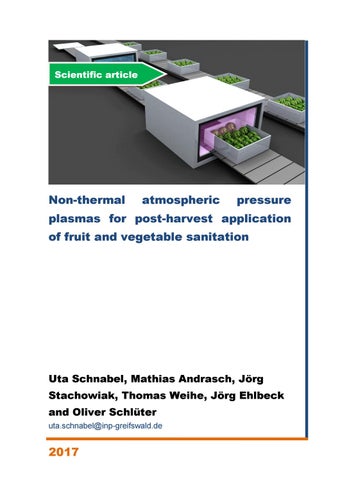
Scientific article
Non-thermal
atmospheric
pressure
plasmas for post-harvest application of fruit and vegetable sanitation
Uta Schnabel, Mathias Andrasch, Jörg Stachowiak, Thomas Weihe, Jörg Ehlbeck and Oliver Schlüter uta.schnabel@inp-greifswald.de
2017
Scientific article
Postharvest
Non-thermal atmospheric pressure
AUTHORS
plasmas for post-harvest application of fruit and vegetable sanitation
Index Title 1. Motivation
2. Traditional technologies
Leibniz Institute for Plasma Science and Technology ▪ Uta Schnabel ▪ Mathias Andrasch ▪ Jörg Stachowiak ▪ Thomas Weihe ▪ Jörg Ehlbeck
3. Alternative sanitation methods
Page 3
4
5
4. Non-thermal atmospheric pressure plasmas
5. Examples from science
6. Conclusion
8
10
13
Table 1: A short overview of different types of cold plasma
Leibniz Institute for Agricultural Engineering and Bioeconomy ▪ Oliver Schlüter
Table 2: Technical characteristics and influencing parameters to describe plasma treatment.
References
Biblioteca Horticultura
14
http://www.bibliotecahorticultura.com
15
16
2
Scientific article
Postharvest
1. Motivation Fresh and fresh-cut produce have a limited shelf life of several days, which only allows a short distribution (locally). The limited shelf life and the associated losses of fresh produce have various causes, but particularly depend on a microbial contamination at all stages in the value chain. The microbial contamination may also cause foodborne illnesses, which occur annually and worldwide. Especially, produce like fresh-cut and fresh vegetables and fruits (e.g. leafy greens, potatoes, tomatoes, sprouts, berries) are frequently affected. The U.S. Food and Drug Administration (FDA) listed them all under the ten riskiest foods in their Center for Science in the Public Interest (CSPI) Report 2009. Whereby leafy greens are on the top [1]. The incidence of all foodborne outbreaks in the USA was enhanced from 0.7 % in the 1970s to 33 % in 2012 [2]. The European Food Safety Authority (EFSA) described in their zoonoses report of 2011, 5,648 reported food-borne outbreaks for 2011 with more than 200,000 confirmed human cases [3]. Among others, the outbreaks were caused by Bacillus toxins, Campylobacter, Clostridium, E. coli mainly Verotoxinproducing Escherichia coli (VTEC) and Listeria, Yersinia. Ready-to-eat as well as fresh-cut fruits and vegetables were also contaminated with these microorganisms. In the E. coli outbreaks, 50 % of the involved products were vegetables and juices and other related products, which is most notably traced back to a large outbreak of haemolytic-uraemic syndrome (HUS) and bloody diarrhea associated with shiga-like toxin-producing E. coli (STEC) O104:H4 infections occurred primarily in northern Germany from May to July 2011.
Examples for treatable specimens and food produce, like fresh fruits and vegetables as well as packaged ones. In addition, grains, seeds and other dry bulk products are possible
Biblioteca Horticultura
http://www.bibliotecahorticultura.com
3
Scientific article
Postharvest
This outbreak is the largest recorded to date in Germany and, based on the number of cases of HUS, the largest outbreak of this sort worldwide. Fenugreek sprouts were identified as the most likely vehicle of the infection. In total, 3,793 STEC cases, including 827 HUS cases with death of 35 patients and 2,966 cases of acute gastroenteritis with death of 18 patients, were reported. Related to the outbreak, 137 cases, including 54 HUS cases, in 15 European and non-European countries were documented internationally. A large outbreak of 10,952 Norovirus cases were reported in Germany in 2012 associated with consumption of imported Chinese frozen strawberries [4, 5]. More than one hundred (103) cases of hepatitis A were counted in 2012-13 in Denmark, Finland, Norway and Sweden associated with frozen strawberries [6, 7]. These are just examples of the remarkable impact of foodborne disease on the health of consumers and resulting direct and indirect consequences, costs and losses. Good Agricultural Practices (GAP), implementation and compliance of standards and certificates are basic steps in terms of food safety. Sporadic presence of pathogens on fresh produce, however, requires effective sanitation techniques to reduce microbial loads without any negative effects on product quality. Because of the significant economic importance, a great demand regarding gentle sanitation in the production and processing of fresh produce exists generally. 2. Traditional technologies Conventional methods of decontamination and cleaning of fresh food are based on heating, pasteurization, cooling and freezing or rinsing with water. Some of these methods rely on lethal heat treatment such as steam pasteurization, autoclaving, ohmic heating, etc. Where thermal technologies have side effects on nutritional, sensory and functional properties of the treated foods. Freezing is an important processing method for imported fruits and vegetables especially berries. For example, 95 % of the raspberries produced in Serbia, one of the main raspberry producers in the world and the main exporter to EU, are frozen [8]. This technology used for extending the shelf life of berries is not able to reduce microbial load, which occur during harvest and growing steps before.
During
processing and consumption of the fruits, these contaminations can outbreak and cause foodborne illnesses.
Biblioteca Horticultura
http://www.bibliotecahorticultura.com
4
Scientific article
Postharvest
For example, Salmonella has the capability to survive freezing [9], and it has been shown that Salmonella survived on frozen whole strawberries [10] as well as in juices and purĂŠes of strawberries [11, 12]. The presence of Norovirus in frozen raspberries has been linked to outbreaks of gastroenteritis in Finland [13] and in the case of frozen strawberries to a large outbreak of the similar symptoms in Germany [4]. The fruits implicated in these outbreaks had been frozen, which demonstrates the capacity of these viruses to survive and remain infectious after undergoing a freezing process. Outbreaks of hepatitis A infection have also been linked with frozen berry fruit [14, 15]. Therefore, the development of environmentally friendly alternative disinfection and cleaning methods is important, but also the product compatibility, costs, environmental impact, impact on product quality and regulatory provisions have to be taken into account [16]. 3. Alternative sanitation methods Alternative non-thermal sanitation methods with chemical sanitizers like ozone, chlorine, electrolyzed water and peracetic acid or physical treatments such as high hydrostatic pressure, pulsed electric field, oscillating magnetic field, UV- or gammairradiation and high-power ultrasound have been developed and studied in recent years [17-19]. These processes retain quality of foods better than conventional methods; however, they have their own drawbacks. They are costly, require specialized equipment as well as trained personnel, are either not fully harmless for consumers or could not achieve the desired success, or even negatively affected the produce quality [19]. Moreover, consumer acceptance and safety issues should be considered [20]. The FDA (Food and Drug Administration of the United States) approved the use of sodium hypochlorite, chlorine dioxide, hydrogen peroxide, peracetic acid and ozone as sanitizers for fresh and minimally processed fruits and vegetables [21, 22]. Sanitization with chlorine products is popular and has been intensively used in food industry [23]. However, increasing public health concerns in terms of the possible formation
of
chlorinated
organic
compounds
such
as
chloramines
and
trihalomethanes, have raised doubts for the use of chlorine especially by the fresh-cut industry [24, 25].
Biblioteca Horticultura
http://www.bibliotecahorticultura.com
5
Scientific article
Postharvest
Trihalomethanes were classified as possible human carcinogens by the United States Environmental Protection Agency (EPA) [26]. Furthermore, the prolonged exposure to chlorine vapors could result in the irritation to the skin and respiratory tract of workers [27]. The safety and efficacy of chlorine might eventually be the reason of the implementation of restrictions by regulatory agencies in USA [28]. Some European countries including Germany, the Netherlands, Switzerland and Belgium prohibited the use of chlorine in convenience produce [29]. In some countries, also the use of sodium hypochlorite is restricted.
In Germany, residual chlorine or its reaction products must be absent in minimally processed vegetables at the consumer level and not adversely causing effects on odor and flavor of the produce. Beside the impairment of the produce, it can be a danger to the consumer health. In France, its use is not actually authorized but only tolerated for disinfection of minimally processed products and the subsequent rinsing with potable water is obligatory. The same process should be done in United States, which allows the use of this chemical product but only with subsequent washing to remove product excess [30]. The trend is that such prohibitions will be expanded, so some alternatives to minimize the use of chlorine or replace this sanitizer are preferable. Ozone is a powerful oxidizing and sterilizing agent used in small concentrations and short contact time to the produce. Since the product of degradation is oxygen, ozone has the great advantage of not being a source of pollution, [31]. Ozone can be used as a sanitizer in the form of a gas or dissolved in water. When ozone is utilized as a gas, the length of exposition is longer (1-4 h) than ozone dissolved in water (1-10 minutes) [32]. In the 1990th, Japan, France and Australia permitted the use of ozone in the food industry and the FDA declared ozone as a GRAS product (Generally Recognized As Safe) [32, 33]. Later the U.S. regulation was modified to allow the use of both aqueous and gaseous phases in food treatment, conservation and transformation [32]. Treatments of vegetables and fruits showed a considerable decrease in mold and bacterial counts without causing any change in their chemical composition and sensory quality [34, 35].
Biblioteca Horticultura
http://www.bibliotecahorticultura.com
6
Scientific article
Postharvest
Fresh-cut lettuce, washed with ozonated water and packed in ozone, showed an extension of shelf life [36]. Although ozone is an efficient sanitizer, it has some limitations when used on food. Moreover, due to its short life span, ozone must be generated on site as storage is not possible [37]. Ozone is a highly instable and corrosive gas. The decomposition of ozone requires elaborate processes depending on the types of radicals formed in solution and on several types of organic matter in the medium that induce, promote or inhibit the reaction chain [38]. In addition, low doses of ozone, which can inactivate pure microbial cultures, can be inefficient against viruses, spores and cysts. In recent years, acidic electrolyzed water is investigated as one of the advanced technologies for non-thermal food processing. Acidic electrolyzed water was developed in Japan and is used as a sanitizer in the food industry to reduce or eliminate bacterial populations on food products, food-processing surfaces, and non– food contact surfaces. This technology was approved as a food additive by Japan and the USA more than 10 years ago [39, 40]. Electrolyzed water is prepared by electrolysis of an aqueous solution of sodium chloride at low concentrations of 0.2% or lower in an electrolytic cell with a diaphragm between a cathodic side and an anodic side. Another possibility is the use of hydrochloric acid solution at a concentration of 2 to 6 % in an electrolytic cell without a separating diaphragm [4144]. Many scientific studies have confirmed the strong antimicrobial effect against most viable bacteria cells, pathogenic and non-pathogenic bacteria and spore, virus and fungus both in vitro and on different food and agricultural produces (fruits and vegetable surfaces) [45-49]. Acidic electrolyzed water has many advantages, especially against chlorine sanitizers. It impacts the environment less adversely, because it is environment friendly as it is generated by the electrolysis of only water and a dilute salt solution [40, 45, 50-52]. When it is exposed to organic matter, or diluted by tap water, it becomes ordinary water again. Since no concentrated chemicals are required during its production, it has been reported to be safer to the user [53-55]. It is more effective, less dangerous and less expensive than most traditional preservation methods such as glutaraldehyde [56, 57], sodium hypochlorite and acetic acid [58]. The main disadvantage of acidic electrolyzed water is the rapidly loss of its antimicrobial activity in a short time because of chlorine loss [59, 60].
Biblioteca Horticultura
http://www.bibliotecahorticultura.com
7
Scientific article
Postharvest
This is obvious when the solution is not continuously supplied with H+, HOCl and Cl2 by electrolysis [61] at a lower pH of 2.5. Especially, high hydrostatic pressure is increasingly being used to stabilize non-thermally treated fruit juices and obtain products with superior sensory quality [62]. In strawberry purée, a reduction of at least 5 lg of Salmonella enterica (a mixture of 4 serovars Montevideo, Newport, St-Paul and Stanley) was obtained for pressures equal or higher than 300 MPa applied for 20 min at 21 °C [63]. When used to decontaminate strawberry purée before freezing, the same reduction was obtained after a few days storage at -1 °C for lower pressures, between 200 and 300 MPa [63]. According to this study, high hydrostatic pressure should reduce the risk of Salmonella in processed strawberries, to a similar extent as for thermal treatments usually applied to fruit juices. However, the impact of high hydrostatic pressures on Salmonella depends greatly on the Salmonella serovars and on the fruit substrate [62]. Another possible alternative method could be the application of nonthermal atmospheric pressure plasma. 4. Non-thermal atmospheric pressure plasmas
What is physical plasma? – A short definition
Alternative sanitizers, which guarantee a low microbial load in combination with retaining high produce quality during shelf life, are of great interest. A promising physical approach is the application of non-thermal plasma (NTP) generated at atmospheric pressure. Plasmas are ionized gases containing neutral particles and a high proportion of free charged particles such as ions and electrons. The application of non-thermal atmospheric pressure plasma is an innovative discipline with increasing attention in the field of food processing and an emerging non-thermal technology for reducing microbial load on the surface of fresh and processed foods.
Biblioteca Horticultura
http://www.bibliotecahorticultura.com
8
Scientific article
Postharvest
Thus, the potential applications of non-thermal atmospheric pressure plasma for the food industry are manifold and it has specific potential for the treatment of foods [6466]. Dry decontamination of food surfaces, granular and particulate foods, and sprouted seeds could be carried out with that method. Furthermore, the surface of packaging material could be sterilized [67-69]. Non-thermal plasma is implemented in the food industry for the decontamination of raw agricultural products such as apples, lettuce, almonds, mangoes, melons, egg surfaces, cooked meat, and cheese [64, 70]. Non-thermal plasma is also suitable for processes, in which high temperatures are not recommended [68, 71]. In food processing, the direct application of so-called “cold plasma� (see Table 1), as well as semi-direct or indirect treatment with thermal plasma is of interest as these can be used to treat the food at low temperatures (<70 °C). For applications in the food sector, preference should be given to processes carried out at atmospheric pressure (e.g. plasma jet, dielectric barrier discharges) because they allow continuous process control and do not accelerate undesirable phase transitions, compared to applications at reduced pressure (p < 1013 mbar) or low pressure (p < 10 mbar) [72].
Physical and chemical components of plasma with antimicrobial/biological effects
Biblioteca Horticultura
http://www.bibliotecahorticultura.com
9
Scientific article
Postharvest
5. Examples from science Food being treated with plasma is exposed to the reactive components in the same way as the contaminating microorganisms. Therefore, the aim is to achieve the highest possible reduction of the microbe count with the lowest possible effect on food quality. Investigations regarding changes of food-related substances have been carried out with isolated compounds. Substance losses were observed depending on the plasma system and exposure time [73-75]. The impact on the chemical composition of plant systems has only been studied with lamb’s lettuce (Valerianella locusta) [76, 77]. After plasma treatment, an increased flavonoid content was reported [77]. The reason behind this observed increase has not yet been elucidated. Scanning electron micrographs of plant surfaces treated with low-temperature plasmas revealed changes due to erosion phenomena in the upper epidermis. Plasma treatment of fresh spinach leaves and subsequent cold storage (24 h) caused discolorations [78, 79]. Possible sensory changes have been rarely investigated to date [80, 81]. The inactivation kinetics of microorganisms due to plasma treatment are also greatly influenced by the surface structure [82-88] and thus strongly varies depending on the food surface [85, 88, 89]. Therefore, investigations using model systems cannot be simply transferred to the conditions prevailing on complex food surfaces.
Examples for food treatment by non-thermal atmospheric pressure plasma. Left side: Plasma treatment of lamb’s lettuce by plasma jet kINPen09. Right side: Plasma treatment of radish seed by plasma jet kINPen09
The efficiency of the method also depends on the specific properties of the product. Thus, the specific energy input, heating of the product and temperature distribution are as important as material properties, composition, geometry and whether the material being treated is uniformly shaped, in pieces, powdered, or a liquid.
Biblioteca Horticultura
http://www.bibliotecahorticultura.com
10
Scientific article
Postharvest
Pores, capillary openings, a high-water content and the buffering capacity are influencing the inactivation efficiency of the plasma. The process temperature is a particularly suitable parameter for comparative assessment of plasma methods. Other parameters, e.g. electron energy distribution, plasma composition, and the specific energy input may also be used; however, they have been difficult to determine so far. Selected relevant parameters are listed in Table 2. Most studies carried out so far have used particulate food products. However, liquid foods, e.g. juices, can also be plasma treated [90, 91].
Example for food treatment by non-thermal atmospheric pressure plasma. Dill (Anethum graveolens) seeds treated with dielectric barrier discharge (DBD). Small photo: DBD with plasma turned on, ringshaped electrode configuration
Currently available data reveal that it is possible to achieve microbial count reductions in food of up to 6 lg units, in some cases even up to 8 lg units [72]. However, general conclusions cannot be drawn from these individual observations. The use of plasma to decontaminate the surface of sensitive products, e.g. fresh-cut produce is also being investigated [92, 93]. It is to be taken into consideration that bacterial cultures can also grow invasively into the food (e.g. through stoma of plant leaves) or migrate into food tissues so that plasma treatment may not reach them [87].
Biblioteca Horticultura
http://www.bibliotecahorticultura.com
11
Scientific article
Postharvest
At industrial scale, two studies were recently published. Within one publication a DBD set-up was used for packed fresh-cut lettuce with significant reductions and the other work used a microwave discharge indirectly for the sanitation of fresh-cut lettuce during washing and rinsing with a reduction of 2 lg steps of native load [94, 95].
Possible microorganisms used for artificial inoculation are Gram-negatives, Gram-positives, spores of fungi or bacteria as well as viruses and fungi itself. Right side: Untreated and plasma treated agar plates with Pectobacterium carotovorum
Biblioteca Horticultura
http://www.bibliotecahorticultura.com
12
Scientific article
Postharvest
6. Conclusion Products or product groups treated with a plasma must be subjected to a case-bycase assessment. The plasma process must be described with respect to its technical parameters. No investigations have been conducted so far on whether toxic compounds are formed because of plasma treatment. In the case that plasma treatment leads to significant changes and affects the nutritional value, constituent composition and/or content of undesirable substances in the food, the treated products must be considered within the scope of the Novel Food Regulation. The possible impact on the allergenicity of foods also requires investigation. Plasma treatment opens new perspectives for lowering the microbial count on food surfaces. For a health assessment, sufficiently substantiated microbiological data are still too scarce. According to the present state of knowledge, plasma-treated products have to be assessed case by case. Further investigations of inactivation pathways and chemical impact of non-thermal atmospheric pressure plasmas on plant tissue are needed and depend on interdisciplinary and international work and cooperation as well as networks dealing with this research topic. Last but not least this innovative research relies on the support of industry and politics/governments. Non-thermal plasmas can support a solution for a safe and sufficient nutrition.
Illustration of the vision how plasma treatment of fresh food for sanitation aspects can be realized in future
Biblioteca Horticultura
http://www.bibliotecahorticultura.com
13
Scientific article
Postharvest
Table 1: A short overview of different types of cold plasma Type
Description
Examples
Plasma is in direct contact with the substrate. Direct
Interaction based on irradiation (VUV, UV),
plasma jet, dielectric barrier
charged molecules, radicals and reactive
discharge (DBD)
particles
Distance between plasma and substrate is much larger than the mean free particle
SemiDirect
path.
surface-DBD with gap,
No interactions with charged particles.
Sterrad process
Antimicrobial effect due to irradiation,
with plasma-activated
longlived
hydrogen
radicals as well as metastable and
peroxide
inhibitory substances
Irradiation with UV and VUV light. Plasma is Indirect
enclosed in a UV/VUV-transparent reactor.
UV lamps
No interaction with plasma particles
ozone generator e.g. for drinking Indirect
Plasma is used to treat gas or liquids
water treatment, plasma processed air (PPA) based on microwave discharge
Biblioteca Horticultura
http://www.bibliotecahorticultura.com
14
Scientific article
Postharvest
Table 2: Technical characteristics and influencing parameters to describe plasma treatment.
Individual Systems
Category
Example Parameters
plasma parameters
current gas composition geometry pressure type of plasma generation
System
voltage applicator parameters
volume of chamber pressure of treatment
product parameters
dosage process temperature area/volume to be treated
radiation
spectral power distribution
charged particles
electron density ion density ion energy distribution
Plasma
neutral particles
density lifetime reactivity temperature type
Biblioteca Horticultura
http://www.bibliotecahorticultura.com
15
Scientific article
Postharvest
References
[1]
The ten riskiest foods regulated by the U.S. food and drug administration, accessed on
17 11 2014, available online at: http://cspinet.org/new/pdf/cspi_top_10_fda.pdf. [2]
Liao X, Liu D, Xiang Q, Ahn J, Chen S, Ye X, Ding T, Inactivation mechanisms of non-
thermal plasma on microbes: A review. Food control 2017, 75, 83-91. [3]
EFSA and ECDC: The European Union Summary Report on Trends and Sources of
Zoonoses, Zoonotic Agents and Food-borne Outbreaks in 2011, EFSA Journal 2013;11(4):3129 [4]
Mäde D, Trübner K, Neubert E, Höhne M and Johne R, 2013. Detection and typing of
norovirus from frozen strawberries involved in a large-scale gastroenteritis outbreak in Germany. Food and Environmental Virology, 5, 162-168. [5]
BfR (Bundesinstitut fuer Risikobewertung), 2012. Tenacity (resistance) of noroviruses in
strawberry compote. BfR opinion No. 038/2012, 6 October 2012, 4 pp. [6]
Anonymous, 2014. Annual Report on Zoonoses in Denmark 2013, National Food
Institute, Technical University of Denmark. [7]
Nordic Outbreak Investigation Team, 2013. Joint analysis by the Nordic countries of a
hepatitis A outbreak, October 2012 to June 2013: frozen strawberries suspected. Eurosurveillance, 18, pii=20520. [8]
Djurkovic M, 2012. SWOT analysis of Serbia's raspberry sector in the competitive
marketplace. Master Thesis. Department of Economics and Resource Management, Norwegian University
of
Life
Sciences,
130
pp.
Available
at:
http://brage.bibsys.no/xmlui/bitstream/handle/11250/187406/Djurkovic%20Marina%202012.pdf? sequence=1 [9]
Jay JM, 2004. Modern Food Microbiology. Seventh edition. Kluwer Academic, New
York, 790 pp [10]
Knudsen DM, Yamamoto SA and Harris LJ, 2001. Survival of Salmonella spp. and
Escherichia coli O157 : H7 on fresh and frozen strawberries. Journal of Food Protection, 64, 1483-1488. [11]
Duan J and Zhao Y, 2009. Antimicrobial efficiency of essential oil and freeze-thaw
treatments against Escherichia coli O157:H7 and Salmonella enterica ser. Enteritidis in strawberry juice. Journal of Food Science, 74, M131-M137. [12]
Huang YX, Ye M and Chen HQ, 2013. Inactivation of Escherichia coli O157:H7 and
Salmonella spp. in strawberry puree by high hydrostatic pressure with/without subsequent frozen storage. International Journal of Food Microbiology, 160, 337-343. [13]
Sarvikivi E, Roivainen M, Maunula L, Niskanen T, Korhonen T, Lappalainen M and
Kuusi M, 2012. Multiple norovirus outbreaks linked to imported frozen raspberries. Epidemiology and Infection, 140, 260-267.
Biblioteca Horticultura
http://www.bibliotecahorticultura.com
16
Scientific article [14]
Postharvest
Gillesberg Lassen S, Soborg B, Midgley SE, Steens A, Vold L, Stene-Johansen K,
Rimhanen-Finne R, Kontio M, Löfdahl M, Sundqvist L, Edelstein M, Jensen T, Vestergaard HT, Fischer TK, Mølbak K and Ethelberg S, 2013. Ongoing multi-strain food-borne hepatitis A outbreak with frozen berries as suspected vehicle: four Nordic countries affected, October 2012 to
April
2013.
Eurosurveillance,
18,
25
April
2013.
Available
online:
http://www.eurosurveillance.org/ViewArticle.aspx?ArticleId=20467 [15]
Rizzo C, Alfonsi V, Bruni R, Busani L, Ciccaglione AR, De Medici D, Di Pasquale S,
Equestre M, Escher M, Montaño-Remacha MC, Scavia G, Taffon S, Carraro V, Franchini S, Natter B, Augschiller M, Tosti ME and the Central Task Force on Hepatitis A, 2013. Ongoing outbreak of hepatitis A in Italy: preliminary report as of 31 May 2013. Eurosurveillance, 18, 4 July 2013. Available online: http://www.eurosurveillance.org/ViewArticle.aspx?ArticleId=20518 [16]
Matthews, K.R. (Editor) Emerging Issues in Food Safety. Microbiology of Fresh
Produce. American Society for Microbiology Press (ASM Press) 2006. [17]
Biazotto Bachelli ML, Álvares Amaral RD, Benedetti BC, 2013. Alternative sanitization
methods for minimally processed lettuce in comparison to sodium hypochlorite. Brazilian Journal of Microbiology 44, 673-678. [18]
Issa-Zacharia A, Kamitani Y, Muhimbula HS, Ndabikunze BK, 2010. A review of
microbiological safety of fruits and vegetables and the introduction of electrolyzed water as an alternative to sodium hypochlorite solution. African Journal of Food Science 4, 778 – 789. [19]
Baier M, Görgen M, Ehlbeck J, Knorr D, Herppich WB, Schlüter O, 2014. Non-thermal
atmospheric pressure plasma: Screening for gentle process conditions and antibacterial efficiency on perishable fresh produce. Innovative Food Science and Emerging Technologies 22, 147–157. [20]
Yun, H., Kim, B., Jung, S., Kruk, Z. A., Kim, D. B., Choe, W. and Jo, C. Inactivation of
Listeria monocytogenes inoculated on disposable plastic tray, aluminum foil, and paper cup by atmospheric pressure plasma. Food Control, 21, 8 2010), 1182-1186. [21]
U.S. Food and Drug Administration (2002) Secondary direct food additives permitted in
food for human consumption. Code of federal regulations. Title 21 – Foods and Drugs. v. 3. Part 173. Section 173.315.2000. [22]
Rico D, Martin-Diana AB, Barat JM, Barry-Ryan C (2007) Extending and measuring the
quality of fresh-cut fruit and vegetables: a review. Trends Food Sci Tech 18:373-386. [23]
Francis GA, O’Beirne D (2002). Effects of vegetable type and antimicrobial dipping on
survival and growth of Listeria innocula and E. coli. Int. J. Food Sci. Technol., 37: 711-718. [24]
Singh N, Singh RK, Bhunia AK, Stroshine RL (2002). Effect of inoculation and washing
methods on the efficacy of different sanitizers against Escherichia coli O147:H7 on lettuce. Food Microbiol., 19: 183-193.
Biblioteca Horticultura
http://www.bibliotecahorticultura.com
17
Scientific article [25]
Postharvest
Ölmez H, Kretzschamr U (2009) Potential alternative disinfection methods for organic
fresh-cut industry for minimizing water consumption and environmental impact. LWT- Food Sci Technol 42:686-693. [26]
Kim C, Hung Y.C, Brackett RE (2000). Efficacy of electrolyzed oxidizing (EO) and
chemically modified water on different types of foodborne pathogens. Int J Food Microbiol., 61: 199-207. [27]
Beuchat LR, Nail BV, Adler BB, Clavero MRS (1998). Efficacy of spray application of
chlorinated water in killing pathogenic bacteria on raw apples, tomatoes, and lettuce. J. Food Prot., 61: 1305-1311. [28]
Sapers GM (2001). Efficacy of washing and sanitizing methods for disinfection of fresh
fruit and vegetable products. Food Technol. Biotechnol., 39: 305–311. [29]
Nguyen-the C, Carlin F (1994). The microbiology of minimally processed fresh fruits and
vegetables. Crit. Rev. Food Sci. Nutr., 34: 371-401. [30]
Baur S, Klaiber R, Hammes WP, Carle R (2004) Sensory and microbiological quality of
shredded, packaged iceberg lettuce as affected by pre-washing procedures with chlorinated and ozonated water. Innov Food Sci Emerg Technol 5:45-55. [31]
Prestes EB (2007) Avaliação da eficiência do ozônio como sanitizante em hortaliças
folhosas minimamente processadas. 135 p. (Tese Doutorado. Faculdade de Engenharia de Alimentos, Universidade Estadual de Campinas). [32]
Carletti L, Botondi R, Moscetti R, Stella E, Monarca D, Cecchini M, Massantini R, 2013.
Use of ozone in sanitation and storage of fresh fruits and vegetables. Journal of Food, Agriculture & Environment 11, 585-589. [33]
Habibi Najafi MB, Haddad Khodaparast MH, 2009. Efficacy of ozone to reduce microbial
populations in date fruits. Food Control 2, 27-30. [34]
Song, J., Fan, L., Hildebrand, P. D. and Forney, C. F. 2000. Biological effects of corona
discharge on onions in a commercial storage facility. Hortic. Technol. 10(3):608-612. [35]
Palou, L., Crisosto, C. H., Smilanick, J. L., Adaskaveg, J. E. and Zoffoli, J. P. 2002.
Effects of continuous 0.3 ppm ozone exposure on decay development and physiological responses of peaches and table grapes in cold storage. Postharvest Biol. Tec. 24:39-48. [36]
Zambuchini, B., Giosia, L. and Sturba, M. 2006. Study of the ozone effect on the shelf-
life of minimally processed salad (Review). Postharvest Biol. Tec. 45:636-643. [37]
Sharma, R. 2005. Ozone decontamination of fresh fruit and vegetables. In Jongen, W.
(ed). Improving the safety of fresh fruit and vegetables. CRC Press, Cambridge U.K. pp. 373386. [38]
Kim, J. G., Yousef, A. E. and Dave, S. 1999. Application of ozone for enhancing the
microbiological safety and quality of foods: A review. J. Food Protect. 62:1071-1087. [39] Food
Rahman SME, Khan I, Oh DH, 2016. Electrolyzed Water as a Novel Sanitizer in the Industry:
Current
Trends
and
Future
Perspectives.
ComprehensiveReviewsinFoodScienceandFoodSafety 15, 471-490.
Biblioteca Horticultura
http://www.bibliotecahorticultura.com
18
Scientific article [40]
Postharvest
Park H, Hung Y.-C, Kim C (2002). Effectiveness of electrolyzed water as a sanitizer for
treating different surfaces. J. Food Prot., 65: 1276-1280. [41]
Gómez-López VM, Ragaert P, Ryckeboer J, Jeyachchandran V, Debevere J,
Devlieghere F (2007). Shelf-life of minimally processed cabbage treated with neutral electrolysed oxidising water and stored under equilibrium modified atmosphere, Int. J. Food Microbiol., 117: 91-98. [42]
Koide S, Takeda J, Shi J, Shono H, Atungulu GG (2009). Disinfection efficacy of slightly
acidic electrolyzed water on fresh cut cabbage. Food Control, 20: 294-297. [43]
Deza MA, Araujo M, Garrido MJ (2005). Inactivation of Escherichia coli, Listeria
monocytogenes, Pseudomonas aeruginosa and Staphylococcus aureus on stainless steel and glass surfaces by neutral electrolyzed water. Lett Appl Microbiol., 40: 341-346. [44]
Deza MA, Araujo M, Garrido, MJ (2007). Efficacy of neutral electrolyzed water to
inactivate
Escherichia
coli,
Listeria
monocytogenes,
Pseudomonas
aeruginosa,
and
Staphylococcus aureus on plastic and wooden kitchen cutting boards, J. Food Prot., 70: 102108. [45]
Kim C, Hung Y.C, Brackett RE (2000). Roles of oxidation-reduction potential in
electrolyzed oxidizing water and chemically modified water for the inactivation of food-related pathogens. J Food Prot., 63: 19-24. [46]
Nakajima N, Nakano T, Harada F, Taniguchi H, Yokoyama I, Hirose J, Daikoku E.,
Sano K (2004). Evaluation of disinfective potential of reactivated free chlorine in pooled tap water by electrolysis. J. Microbiol. Meth., 57: 163-173. [47]
Park H, Hung YC, Chung D (2004). Effects of chlorine and pH on efficacy of
electrolyzed water for inactivating Escherichia coli O157:H7 and Listeria monocytogenes. Int. J. Food Microbiol., 91: 13-18. [48]
Deza MA, Araujo M, Garrido MJ (2003). Inactivation of Escherichia coli O157:H7, S.
enteritidis and Listeria monocytogenes on the surface of tomatoes by neutral electrolyzed water, Lett. Appl. Microbiol., 37: 482-487. [49]
Sharma, R. R., & Demirci, A. (2003). Treatment of Escherichia coli O157:H7 inoculated
alfalfa seeds and sprouts with electrolyzed oxidizing water. International Journal of Food Microbiology, 86, 231–237. [50]
Kim C, Hung Y.C, Brackett RE (2000). Efficacy of electrolyzed oxidizing (EO) and
chemically modified water on different types of foodborne pathogens. Int J Food Microbiol., 61: 199-207. [51]
Koseki, S., Fujiwara, K., & Itoh, K. (2002). Decontaminative effect of frozen acidic
electrolyzed water on lettuce. Journal of Food Protection, 65, 411–414. [52]
Koseki S, Yoshida K, Isobe S, Itoh K (2004). Efficacy of acidic electrolyzed water for
microbial decontamination of cucumbers and strawberries. J. Food Prot., 67: 1247-1251. [53]
Mori Y, Komatsu S, Hata Y (1997). Toxicity of electrolyzed strong acid aqueous
solution-subacute toxicity test and effect on oral tissue in rats. Odontology, 84: 619-626.
Biblioteca Horticultura
http://www.bibliotecahorticultura.com
19
Scientific article [54]
Postharvest
Al-Haq MI, Sugiyama J, Isobe S (2005). Applications of Electrolyzed Water in
Agriculture and Food Industries. Food Sci. Technol. Res., 11: 135-50. [55]
Huang Y.-R, Hung Y.-C, Hsu S.-Y, Huang Y.-W, Hwang D.-F (2008). Application of
electrolyzed water in the food industry. Food Control, 19: 329-345. [56]
Sakurai, Y., Ogoshi, K., Kaku, M., & Kobayashi, I. (2002). Strongly acidic electrolyzed
water: Valuable disinfectant of endoscopes. Digestive Endoscopy, 14, 61–66. [57]
Sakurai, Y., Nakatsu, M., Sato, Y., & Sato, K. (2003). Endoscope contamination from
HBV- and HCV-positive patients and evaluation of a cleaning/disinfecting method using strongly acidic electrolyzed water. Digestive Endoscopy, 15, 19–24. [58]
Ayebah B, Hung YC, Frank JF (2005). Enhancing the bactericidal effect of electrolyzed
water on Listeria monocytogenes biofilms formed on stainless steel. J. Food Prot., 68: 13751380. [59]
Koseki S, Itoh K (2001). Prediction of microbial growth in fresh-cut vegetables treated
with acidic electrolyzed water during storage and under various temperature conditions. J Food Prot., 64:1935-1942. [60]
Koseki S, Isobe S (2007). REVIEW-Microbial Control of Fresh Produce using
Electrolyzed Water. JARQ, 41: 273-82. [61]
Kiura H, Sano K, Morimatsu S, Nakano T, Morita C, Yamaguchi M, Maeda T, Katsuoka,
Y (2002). Bactericidal activity of electrolyzed acid water from solution containing sodium chloride at low concentration, in comparison with that at high concentration. J. Microbiol. Meth., 49: 285-293. [62]
Nguyen-The C, 2012. Biological hazards in processed fruits and vegetables. Risk
factors and impact of processing techniques. LWT - Food Science and Technology, 49, 172177. [63]
Huang YX, Ye M and Chen HQ, 2013. Inactivation of Escherichia coli O157:H7 and
Salmonella spp. in strawberry puree by high hydrostatic pressure with/without subsequent frozen storage. International Journal of Food Microbiology, 160, 337-343. [64]
Afshari, R.; Hosseini, H. Atmospheric Pressure Plasma Technology: A New Tool for
Food Preservation. ICEEB 2012, 33, 275-278. [65]
Niemira, B.A. Cold plasma decontamination of foods. Ann. Rev. Food Sci. Technol.
2012, 3, 125-142. [66]
Pankaj, S.K.; Bueno-Ferrer, C.; Misra, N.N.; Milosavljević, V.; O’Donnell, C.P.; Bourke,
P.; Keener, K.M.; Cullen, P.J. Applications of cold plasma technology in food packaging. Trends Food Sci. Technol. 2014, 35, 5-17 [67]
Kogelschatz, U. Atmospheric-pressure plasma technology. Plasma Phys. Control.
Fusion 2004, 46, B63-B75. [68]
Tendero, C.; Tixier, C.; Tristant, P.; Desmaison, J.; Leprince, P. Atmospheric pressure
plasmas: A review. Spectrochimica Acta B 2006, 61, 2-30. [69]
Misra, N.N.; Tiwari, B.K.; Raghavarao, K.S.M.S.; Cullen, P.S. Nonthermal Plasma
Inactivation of Food-Borne Pathogens. Food Eng. Rev. 2011, 3, 159-170.
Biblioteca Horticultura
http://www.bibliotecahorticultura.com
20
Scientific article [70]
Postharvest
Deng, S.; Ruan, R.; Mok, C.K.; Huang, G.; Lin, X.; Chen, P. Inactivation of Escherichia
coli on Almonds Using Nonthermal Plasma. J. Food Sci. 2007, 72, M62-M66. [71]
Nehra, V.; Kumar, A.; Dwivedi, H. Atmospheric non-thermal plasma sources. Int. J. Eng.
2008, 2, 53-68. [72]
Schlüter O, Ehlbeck J, Hertel C, Habermeyer M, Roth A, Engel KH, Holzhauser T, Knorr
D, Eisenbrand G, 2013. Opinion on the use of plasma processes for treatment of foods. Mol. Nutr. Food Res. 57, 920–927. [73]
Park, B. J., Takatori, K., Sugita-Konishi, Y., Kim, I. H. et al., Degradation ofmycotoxins
using microwave-induced argon plasma at atmospheric pressure. Surf. Coat. Tech. 2007, 201, 5733–5737. [74]
Deng, X. T., Shi, J. J., Kong, M. G., Protein destruction by a helium atmospheric
pressure glow discharge: capability and mechanisms. J. Appl. Phys. 2007, 101, 1–9. [75]
Grzegorzewski, F., Rohn, S., Quade, A., Schröder, K. et al., Reaction chemistry of 1,4-
benzopyrone derivates in non-equilibrium low-temperature plasmas. Plasma Process. Polym. 2010, 7, 466–473. [76]
Grzegorzewski, F., Ehlbeck, J., Schluter, O., Kroh, L. W. et al., Treating lamb’s lettuce
with a cold plasma – Influence of atmospheric pressure Ar plasma immanent species on the phenolic profile of Valerianella locusta. LWT-Food Sci. Technol. 2011, 44, 2285–2289. [77]
Grzegorzewski, F., Rohn, S., Kroh, L.W., Geyer, M. et al., Surface morphology and
chemical composition of lamb’s lettuce (Valerianella locusta) after exposure to a low-pressure oxygen plasma. Food Chem. 2010, 122, 1145–1152. [78]
Klockow, P. A., Keener, K. M., Safety and quality assessment of packaged spinach
treated with a novel ozone-generation system. Lwt-Food Sci. Technol. 2009, 42, 1047–1053. [79]
Klockow, P. A., Keener, K.M., Qualitiy and safety assessment of packaged spinach
treated with a novel atmospheric, non eqiulibrium plasma system. ASABE Meeting Presentation 2008, 1–10. [80]
Selcuk, M., Oksuz, L., Basaran, P., Decontamination of grains and legumes infected
with Aspergillus spp. and Penicillum spp. by cold plasma treatment. Bioresource Technol. 2008, 99, 5104–5109. [81]
Basaran, P., Basaran-Akgul, N., Oksuz, L., Elimination of Aspergillus parasiticus from
nut surface with low pressure cold plasma (LPCP) treatment. Food Microbiol. 2008, 25, 626– 632. [82]
Miao, H., Yun, G., The sterilization of Escherichia coli by dielectric-barrier discharge
plasma at atmospheric pressure. Appl. Surf. Sci. 2011, 257, 7065–7070. [83]
Montie, T. C., Kelly-Wintenberg, K., Roth, J. R., An overview of research using the one
atmosphere uniform glow discharge plasma (OAUGDP) for sterilization of surfaces and materials. IEEE T. Plasma Sci. 2000, 28, 41–50. [84]
Yu, Q. S., Huang, C., Hsieh, F. H., Huff, H. et al., Bacterial inactivation using a low-
temperature atmospheric plasma brush sustained with argon gas. J. Biomed. Mater. Res. B 2007, 80B, 211–219.
Biblioteca Horticultura
http://www.bibliotecahorticultura.com
21
Scientific article [85]
Postharvest
Noriega, E., Shama, G., Laca, A., Diaz, M. et al., Cold atmospheric gas plasma
disinfection of chicken meat and chicken skin contaminated with Listeria innocua. Food Microbiol. 2011, 28, 1293–1300. [86]
Yun, H., Kim, B., Jung, S., Kruk, Z. A. et al., Inactivation of Listeria monocytogenes
inoculated on disposable plastic tray, aluminum foil, and paper cup by atmospheric pressure plasma. Food Control 2010, 21, 1182–1186. [87]
Perni, S., Liu, D. W., Shama, G., Kong, M. G., Cold atmospheric plasma
decontamination of the pericarps of fruit. J. Food Protect. 2008, 71, 302–308. [88]
Song, H. P., Kim, B., Choe, J. H., Jung, S. et al., Evaluation of atmospheric pressure
plasma to improve the safety of sliced cheese and ham inoculated by 3-strain cocktail Listeria monocytogenes. Food Microbiol. 2009, 26, 432–436. [89]
Kim, B., Yun, H., Jung, S., Jung, Y. et al., Effect of atmospheric pressure plasma on
inactivation of pathogens inoculated onto bacon using two different gas compositions. Food Microbiol. 2011, 28, 9–13. [90]
Montenegro, J., Ruan, R., Ma, H., Chen, P., Inactivation of E-coli O157: H7 using a
pulsed nonthermal plasma system. J. Food Sci. 2002, 67, 646–648. [91]
Shi, X. M., Zhang, G. J., Wu, X. L., Li, Y. X. et al., Effect of low-temperature plasma
onmicroorganism inactivation and quality of freshly squeezed orange juice. IEEE T. Plasma Sci. 2011, 39, 1591–1597. [92]
Perni, S., Shama, G., Kong, M. G., Cold atmospheric plasma disinfection of cut fruit
surfaces contaminated with migrating microorganisms. J. Food Protect. 2008, 71, 1619–1625. [93]
Rod, S. K., Hansen, F., Leipold, F., Knochel, S., Cold atmospheric pressure plasma
treatment of ready-to-eat meat: inactivation of Listeria innocua and changes in product quality. Food Microbiol. 2012, 30, 233–238. [94]
https://agrotypos.com/2015/04/09/safe-bag-a-new-technology-for-decontamination-of-
fruits-and-vegetables-without-chemicals-is-presented-to-agrotypos/ (accessed on 2017/03/28) [95]
Andrasch M, Stachowiak J, Schlüter O, Schnabel U, Ehlbeck J, 2017. Scale-up to pilot
plant dimensions of plasma processed water generation for fresh-cut lettuce treatment. Journal of Food Packaging and Shelf Life (paper submitted 2017/02)
Biblioteca Horticultura
http://www.bibliotecahorticultura.com
22
Scientific article
Biblioteca Horticultura
Postharvest
http://www.bibliotecahorticultura.com
23
Scientific article
Postharvest
Dr. Manuel Candela, 26 11ª - 46021 Valencia, España Tel +34 – 649 485 677 info@poscosecha.com info@bibliotecahorticultura.com http://www.poscosecha.com
http://www.postharvest.biz
http://www.horticulturablog.com http://www.bibliotecahorticultura.com
Biblioteca Horticultura
http://www.actualfruveg.com
http://www.bibliotecahorticultura.com
24