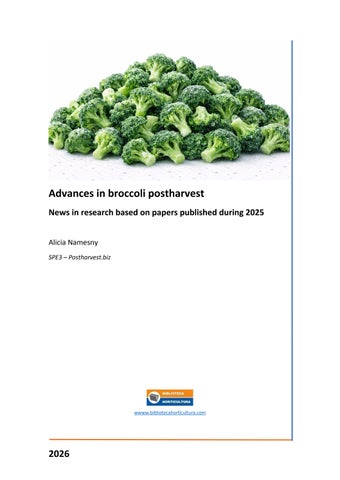
Advances in broccoli postharvest

Page 1


Alicia Namesny

SPE3 – Postharvest.biz

wwww.bibliotecahorticultura.com

4.

Advances in broccoli postharvest

1.

Introduction

In recent decades, broccoli has risen to the top of the list of cruciferous vegetables. This is due in part to its numerous organoleptic and nutritional properties, consumer interest in wellness, ease of use, the availability of varieties that extend the production season from its traditional autumn/winter period to greater availability in spring, consumer information campaigns, and other factors.

Spain is the leading European supplier of this vegetable, with an annual production of approximately 600,000 tons. Consumption has increased tenfold in the last decade, aided by promotional campaigns such as +Broccoli. The market for frozen and ready-to-eat broccoli (fresh, cut, and packaged) shows an upward trend due to the convenience it offers consumers.

The Region of Murcia is the main producer, generating almost half of the national total (approximately 280,000 tons), followed by the Ebro River Basin and Extremadura, the latter experiencing strong growth in cultivated land. Approximately 70 % to 90 % of Spanish production is exported, with the United Kingdom being the largest customer. Promotional campaigns, such as those in Germany, are carried out to boost consumption.

Below are advances in post-harvest handling based on studies published during 2025.

2. Arginine treatment enhances pre-harvest carbohydrate accumulation in broccoli, and postharvest behaviour

Preharvest nutrient accumulation and the related metabolic processes play a crucial role in determining the quality and shelf life of broccoli, which in turn influence its freshness, nutritional value, and overall marketability. However, the regulatory mechanisms underlying these processes remain unclear.

The study by Xue et al. (2025a) investigated the effects of preharvest florets application of 5 mM arginine (ARG) five days prior to harvest, on nutrient accumulation, pigment metabolism, and the maintenance of postharvest quality in broccoli heads.

The application of ARG significantly enhanced the levels of chlorophyll, carotenoids, and fructose during the preharvest stage of broccoli.

Moreover, transcriptomic analysis revealed that ARG treatment significantly upregulated the expression of genes related to photosynthesis, carbohydrate metabolism, and pigment biosynthesis. Consequently, preventing chlorophyll and carotenoids from oxidative damage maintains the stability of photosystems (PSI and PSII), enhances photosynthetic efficiency, and delays postharvest yellowing.

Additionally, up-regulated the expression of sucrose phosphate synthase and 1,4-α-glucanbranching enzyme, hence facilitating carbohydrate accumulation.

In addition, ARG application downregulated the expression level of cellulose degradation genes, contributing to the maintenance of cell wall structure. This study provides a theoretical basis for the intrinsic mechanisms of postharvest preservation and preharvest nutrient accumulation in broccoli.

www.bibliotecahorticultura.com

3. Arginine treatment provided stable energy supply for broccoli to extend storage time

Energy status plays a crucial role in the physiological processes of broccoli, and investigating its post-harvest energy and carbohydrate metabolic pathways can elucidate the mechanisms underlying freshness and nutrient accumulation.

To assess the impact of arginine spraying one day prior to harvest on the post-harvest metabolic mechanisms of broccoli, Xue et al. (2025b) performed transcriptomic and metabolomic analyses.

The results from both transcriptome and metabolome analyses indicated that arginine treatment up-regulated the expression levels of starch synthesis genes (StSy, GPAT) and sucrose synthesis genes (SPS), in addition to facilitated the production of glucose and fructose, thereby ensuring a stable supply of substrates for glycolytic pathways (EMP) as well as the pentose phosphate pathway (PPP), which is essential for maintaining broccoli quality.

Furthermore, arginine treatment inhibited the degradation associated with cellulose-related genes (β-glucosidase, EG) and D-galacturonic acid to preserve cell wall integrity.

Additionally, it enhanced flux through EMP and PPP by up-regulating related gene expressions (FBP1, DDPFK, FBA, GAPD, PGK, TK). Under arginine treatment conditions, increased expression levels of MDH genes by 3.5 fold within the tricarboxylic acid cycle (TCA), resulting in rapid ATP synthesis.

Along with augmented protein synthesis during oxidative phosphorylation (OXPHOS) significantly promoted ATP generation, which leading to an overall enhancement in energy status.

Experimental findings demonstrated that broccoli treated with arginine maintained higher levels of ATP, ADP, and energy charge throughout storage periods. Thus it is evident that extending storage duration for broccoli via arginine application may be attributed to achieving a continuous and stable energy supply.

4. Preharvest spraying with L-Phenylalanine, a potential technique to effectively improve the postharvest storage quality and antioxidant capacity

Broccoli exhibits a high susceptibility to quality deterioration during postharvest storage. Previous studies have shown that preharvest spraying of 2 mmol/L L-phenylalanine (L-Phe) can effectively inhibit the chlorophyll degradation of broccoli during storage, thereby delaying yellowing. However, its effect on reactive oxygen species (ROS) homeostasis and corresponding antioxidant defense mechanisms and antioxidant capacity has not been elucidated.

The study by Wang et al. (2025a) revealed that preharvest spraying with L-Phe significantly enhanced total soluble solids (TSS) and soluble protein content in postharvest broccoli during storage.

www.bibliotecahorticultura.com

Notably, preharvest treatment with L-Phe induced elevated hydrogen peroxide (H 2O2) concentrations while reducing superoxide anion (O2 .-) accumulation in broccoli.

Figure 1. Graphic summary by Wang et al. (2025a) showing L-Phenylalanine effects on broccoli

Furthermore, preharvest application of L-Phe induced a significant increase in key antioxidant enzymes in broccoli, including the activities of NADPH oxidase (NOX), superoxide dismutase (SOD), catalase (CAT), ascorbate peroxidase (APX), and glutathione reductase (GR), but reduced peroxidase (POD), accompanied by upregulated gene expression of BoNOX, BoSOD, BoCAT, BoAPX, and BoGR, and down-regulated expression of BoPOD.

Moreover, it significantly increased the accumulation of key antioxidant compounds, including ascorbic acid (AsA), reduced glutathione (GSH), total phenols, and flavonoids.

Additionally, the treatment also significantly enhances DPPH and FRAP free radical scavenging activity in postharvest broccoli.

These results suggest that preharvest spraying of L-Phe may be a potential technique to effectively improve the postharvest storage quality and antioxidant capacity of broccoli.

5. Reasons for which melatonin treatment delays postharvest yellowing in broccoli effectively

For further understanding the effect of melatonin (MT) treatment on delaying postharvest yellowing in broccoli through regulation of reactive oxygen species (ROS) accumulation, the study by Wang et al. (2025c) investigated changes in the antioxidant system and the BoNAC52BoRBOHF module.

Broccoli heads were treated with a 200 μmol L−1 MT solution and stored at 25 °C for 4 days.

The results showed that MT treatment delayed yellowing, reduced the levels of H2O2, O2·-, and MDA, and improved the antioxidant system activity in broccoli compared to the control during storage.

Transcriptomic analysis identified the BoNAC52-BoRBOHF module as a key regulator of ROS levels during postharvest senescence. MT treatment upregulated BoNAC52 expression and

Advances in broccoli postharvest

suppressed the expressions of four BoRBOHs, correlating with decreased ROS levels in broccoli during storage.

Further investigation confirmed that BoNAC52 directly binds to the promoter of BoRBOHF.

The regulatory role of the BoNAC52-BoRBOHF module in ROS production related to leaf senescence was confirmed through transient silencing and expression of BoNAC52 in tobacco and pak choi.

These findings demonstrate that MT treatment delays broccoli senescence and yellowing during postharvest storage by enhancing the antioxidant ability and activating the BoNAC52BoRBOHF module to control ROS accumulation.

6. Sodium nitroprusside to delay yellowing

In the paper by Zou. et al. (2024), sodium nitroprusside was selected as an exogenous treatment to evaluate its effect on the greening to yellowing of broccoli. The 200 μmol/L SNP treatment protected the apparent quality of broccoli, as evidenced by the delayed increase in the yellowing index, L* value and decrease in –a/b value.

It was also found that the treatment delayed the decrease of chlorophyll fluorescence parameters Fv/Fm and Rfd, which supplemented the evidence that SNP could delay the yellowing process of broccoli. The higher chlorophyll content in the treated group compared to the control group was since the SNP treatment limited the increase in the activities of chlorophyll-degrading enzymes pheophorbide a oxygenase, non-yellow coloring 1, pheophytinase, and chlorophyllase.

This view was supported by the suppression of the up-regulated expression of genes related to chlorophyll catabolism after SNP treatment.

Moreover, the exogenous SNP treatment inhibited endogenous ethylene synthesis during the shelf period, which was mainly manifested by the down-regulation of the expression of ethylene synthesis genes BoACO3, BoACO4, and BoACS2 and the inhibition of the activities of the enzymes 1-aminocyclopropanecarboxylic acid synthase and 1aminocyclopropanecarboxylic acid oxidase, thereby controlling the release of ethylene during the shelf period.

The above results provide data support for the commercialization of SNP as a preservative.

7. Regulatory mechanism of yellowing in postharvest cold storage

Zhu et al. (2025) studied the changes in protein levels and protein phosphorylation that occur in tandem with the yellowing of broccoli using the 4D-Label free method.

Through joint analysis, the focus was directed towards six KEGG-enriched pathways associated with proteins (where no protein differences were observed, yet significant phosphorylation changes took place), namely: protein processing in endoplasmic reticulum and mRNA

www.bibliotecahorticultura.com

surveillance pathway, nucleocytoplasmic transport, spliceosome, plant hormone signal transduction, and MAPK signaling pathway-plant.

Among them, SNF1-related protein kinases 2 (SnRK2) and the transcription factor ABF, ethylene insensitive protein 2 (EIN2), JA-insensitive jasmonate resistant 1 (JAR1), brassinosteroid-signaling kinase (BSK), mitogen-activated protein kinase 6-Like (MAPK6-Like), G-type lectin S-receptor-like serine/threonine protein kinase (GsSRK), receptor-like kinase1, calreticulin, nonsense transcripts UPF2, serine/arginine-rich splicing factor SR45, apoptotic chromatin condensation inducer in the nucleus-like (Acinus) may indirectly affect the yellowing of broccoli.

In the photosynthesis-antenna protein pathway, chlorophyll a/b-binding proteins have emerged as key targets under the purview of multiple omics analyses.

These proteins, in synergy with chlorophyll-metabolizing enzymes, exerted a combined influence on the yellowing of broccoli. Simultaneously, post-harvest broccoli undergoes several notable changes.

Its cell wall structure loosens, leading to a reduction in barrier-protection capabilities.

Meanwhile, the defense response was enhanced, while DNA replication and mRNA synthesis were inhibited.

Additionally, the processes of nonsense mutation and cleavage of degraded transcripts were impeded.

Collectively, these alterations hastened the senescence process of broccoli and were likely to be the causative factors behind its yellowing.

8. Understanding water loss dynamics after cutting the stalk during the harvest

Mechanical wounding during broccoli harvesting, caused by cutting the stalk, rapidly induces water loss and tissue deterioration at the incision site (IC), compromising quality during the postharvest self-adaptive stage (SAS; 0–12 h).

For the first time, Abbas et al. (2026) employed combined LF NMR and transcriptomic analyses to investigate wound-induced water loss mitigation at the IC over 0, 3, 6, and 12 h.

Low-field NMR revealed a sharp disruption of water dynamics within 3 h, marked by a significant reduction in free water at the IC, while the unwounded inner site (IS) retained hydration.

Transcriptomic analysis identified 4134 DEGs at 3 h, a higher number than a later time points.

PCA further confirmed that IC samples, particularly at 3 h, exhibited a distinct transcriptional profile. To prevent water loss, aquaporins (NIPs, TIPs, PIPs) were rapidly downregulated, while fatty acid, cutin, wax, and suberin biosynthesis pathways (ALDHs, KCS, CYP, etc.) were strongly induced.

Carbohydrate metabolism was redirected to provide carbon and energy to downstream processes. Signalling networks, including calcium influx, MAPK cascades, a balanced reactive

www.bibliotecahorticultura.com

Advances in broccoli postharvest

oxygen species (ROS) response, and hormonal regulation (JA, ABA, and ethylene), were upregulated. The shikimate and phenylpropanoid pathways (PAL, 4CL, aro, etc.) were upregulated, promoting the accumulation of lignin and phenolic compounds for structural reinforcement and antioxidant defense.

Callose and pectin deposition (HK, GAUT, CALs, etc.) further enhanced wound healing and water retention. In conclusion, a 3-hour period is crucial for initiating a multifaceted adaptive program in broccoli to heal wounds, conserve water, and reduce postharvest quality loss.

9.

Hydrogen-rich water to delay postharvest yellowing in broccoli

To investigate the mechanism of yellowing and explore control methods, the study by Wang et al. (2025b) focused on the impact and mechanism of hydrogen-rich water (HRW) treatment on broccoli floret yellowing.

The research results indicate that HRW treatment maintains the structural integrity of chloroplasts in broccoli florets during post-harvest storage, slowing down the degradation of chlorophyll and the accumulation of carotenoids.

RT-qPCR results show that HRW treatment inhibits the expression of chlorophyll degradation genes BoNOL1/6/10, BoPAO, BoPOX, BoSGR1, BoCLH1, BoNCY, and BoNYC, as well as carotenoid-related biosynthesis genes BoPSY, BoPDS, BoZDS, BoZISO, BoCRTISO, BoCYP97C1, and BoCCS-1, while increasing the expression level of BoCCD1/4. www.bibliotecahorticultura.com

Figure 2. Summary of what happens with wáter content after cutting broccoli stalk, by Aqleem Abbas et al. (2026)

Furthermore, HRW treatment inhibits the production of endogenous ethylene through downregulation of its biosynthetic genes BoACO1/2 and BoACS1/2/7.

Simultaneously, HRW treatment downregulates ABA biosynthesis genes BoNCED2/3 and BoABA2, resulting in a significant reduction in ABA levels.

In summary, the HRW treatment delays the yellowing of broccoli after harvest by inhibiting ethylene and ABA levels, thereby reducing the degradation of chlorophyll and the accumulation of carotenoids.

10. Oxidative stress and programmed cell death in BY-2 cells

Voltage dependent anion channel protein (VDAC) had been shown to played a critical role in programmed cell death (PCD). However, the functional role of BoVDAC3 in oxidative stress response and PCD process of postharvest broccoli remains unclear.

In the study by Qian et al. (2025) BoVDAC3 was overexpressed in tobacco bright yellow-2 (BY2) cells to investigate its function.

The results showed that the cell morphology and nuclear integrity of transgenic BY-2 cells were severely disrupted after oxidative stress compared with wild-type (WT) cells. BoVDAC3 overexpressing dreadfully increased the content of reactive oxygen species (ROS) and malondialdehyde (MDA) in BY-2 cells, while simultaneously decreasing proline (Pro) synthesis and impairing the function of the AsA-GSH cycle, along with key antioxidant enzymes.

Moreover, the expression levels of AsA-GSH cycle-related genes (NtGST, NtAO, NtAPX), Pro synthesis-related genes (NtP5CR, NtP5CS, Ntδ-OAT), antioxidant enzyme genes (NtSOD, NtPOD, NtCAT), and the anti-apoptotic gene (NtDAD1) were markedly reduced in the transgenic cells compared to the control group following H2O2 treatment.

Conversely, the expression levels of apoptotic genes (NtSIPK, NtERF3) were considerably elevated under the same experimental conditions. Furthermore, treatment with 4,4′diisothiocyanostilbene-2,2′-disulfonic acid (DIDS), a VDAC inhibitor, produced the opposite phenotype to BoVDAC3-overexpressing cells.

These findings suggest that BoVDAC3 overexpression may accelerate ROS accumulation, thereby inducing PCD in BY-2 cells.

11. 2 °C and styrofoam packaging to preserve broccoli quality

This study investigates the postharvest handling of broccoli at XYZ Company in Japan, focusing on storage, packaging, and distribution techniques to maintain product quality.

Using a descriptive qualitative approach supported by field observations, interviews, and literature review, the research identifies key success factors and potential failure points.

Atica et al. (2025) findings show that optimal harvest at 12 cm diameter, cold storage at 2 °C, proper sorting, and the use of styrofoam packaging with ice cubes are essential to preserve freshness. Conversely, temperature fluctuations and poor packaging compromise quality.

The study emphasizes the importance of cold chain systems and quality grading in ensuring product competitiveness in the horticultural supply chain.

12. Research in LED-induced delay of postharvest senescence and yellowing

MicroRNAs (miRNAs) play a significant role in regulating plant growth, development, and senescence. However, the molecular mechanism through which miRNAs regulate senescence and yellowing of broccoli is unclear.

Wang et al. report on an integrated analysis of transcriptome, small RNA-sequencing, and degradome sequencing data, which revealed that miRNAs mediate senescence and yellowing of broccoli by decreasing peroxidase activity, regulating chlorophyll catabolism, and maintaining ROS homeostasis.

Red LED light irradiation induced the expression of miR9557-5p, miR160a-5p, miR169e-3p and miR9557-5p which in turn suppressed the expression of their target genes, BoPRX7, BoPRX17, BoPRX22, and BoPRX67, respectively.

In addition, red LED irradiation suppressed the expression of miR159c-5p, miR168a-5p, PC-5P98712, and miR393b-3p, which in turn enhanced the expression of their target genes, BoCHLH, BoPSAK, BoPORC, and BoCHLD, respectively.

This regulatory model helps to maintain the dynamic balance between ROS production and ROS scavenging, the biosynthesis of chlorophyll, and ROS homeostasis, thereby delaying the senescence and yellowing of broccoli.

Collectively, our results indicate that miRNAs regulate the yellowing and senescence of broccoli by regulating the expression of target genes related to peroxidase activity, chlorophyll-binding, and chlorophyll biosynthetic processes.

13. Adaptative responses to promote sustainable quality retention in Tenderstem® broccoli

Low temperature postharvest management is used to reduce quality and nutritive losses in www.bibliotecahorticultura.com

Figure 3. Styrofoam packaging by Knauf Industries

broccoli after harvest, although this increases postharvest energy demand and the environmental impacts of food supply chain.

Hydrogen peroxide (H2O2) and methyl jasmonate (MeJA) have been shown to reduce postharvest yellowing in broccoli by enhancing oxidative stress resistance and were examined as treatments for Tenderstem® broccoli florets to offset the effects of warmer storage temperatures.

H2O2 elicitation was perceived on a regulatory level through activation of the jasmonate pathway, but did not reduce postharvest yellowing.

MeJA treatment was detrimental to quality, even at concentrations shown to be beneficial for conventional broccoli varieties.

Carotenoid accumulation was shown to be a leading factor in Tenderstem® yellowing during early storage, while photopigment degradation contributed to late stage quality loss. The physiological basis for floret yellowing in Tenderstem® was also shown to be due to carotenoid accumulation rather than chlorophyll loss.

These results, by Gage et al. (2024) highlight the impact of genotypic and developmental effects on stress perception and response, which hinder optimisation of hormesis-based approaches for postharvest management.

14. Glucosinolate extracts, effective against Botrytis cinerea in apple

Because the edible parts of broccoli are the inflorescences, large quantities of non-commercial biomass are produced each year in the field and in the food industry. In order to develop a circular economy around the broccoli crop, Eugui Arrizabalaga et al. (2025) developed glucosinolates (GSL) extracts with antimicrobial capacity for postharvest use in tomato, apple and table white grape against fungal diseases produced by the pathogens Botrytis cinerea, Alternaria alternata and Penicillium expansum

GSL extracts from organic crop management reported a higher content of GSLs than conventional management.

These extracts are not effective in the control of A. alternata and P. expansum, possibly due to the absence of sinigrin.

Furthermore, the extracts were ineffective in the control of B. cinerea on table white grapes, possibly due to the non-climacteric fruit condition and an absence in the induction of ethylenemediated plant defenses.

However, intact GSL extracts were effective in controlling B. cinerea on apple, while the addition of myrosinase enzyme caused effectiveness also on tomato and apple. Therefore, obtaining GSL extracts with biopesticidal capacity against B. cinerea in postharvest could be a circular economy strategy for broccoli agriculture and industry.

15. Broccoli waste extracts to protect cherry tomato during potharvest

The food industry has evolved to create products that meet consumer needs. Factors such as population growth, economic development, and accelerated lifestyle have influenced the search for more nutritious and functional foods. Functional foods are defined as those whose chemical composition provides health benefits, helping in the treatment or prevention of diseases.

One of the alternatives for the food industry to respond to these demands is the use of agroindustrial wastes, which are generated and quantified in the order of tons worldwide, and if they are not properly processed, can become highly polluting, generators of greenhouse gases, undesirable odours, and pest incidence. Due to their biological nature, these residues have a high enzymatic activity and are a potential source of metabolites with functional activity, whose extraction and incorporation into raw materials or finished products represent a range of possibilities not only in the food industry but also in those related to pharmacology, materials, and agronomy itself.

The use of phytochemicals, such as anthocyanins, flavanols, catechins, tannins, and triterpenes, among others, offers benefits including antioxidant, anti-inflammatory, antihypertensive, and hypoglycemic activities. The adoption of new techniques focused on the extraction, purification, characterization, and application of compounds of interest can not only benefit the increase in the production of functional foods but also favour the circular economy and environmental conservation.

One of the examples considered in this chapter is the effect of broccoli fresh residues-based extracts on the postharvest quality of cherry tomato.

16. Broccoli stem extract be a natural anti-browning agent for fresh cut peach

The study by Zhang et al. (2025) focused on the anti-browning effect of broccoli stem extract (BE) on fresh-cut peaches.

Compared to L-cysteine (L-Cys), BE showed the higher inhibition of the surface browning in fresh-cut peach fruit. This was accompanied with a more decreased polyphenol oxidase (PPO) activity and down-regulation of PpPPO expression.

BE showed a non-competitive inhibition for peach PPO, and the highest inhibition rate (85.23 ± 3.86 %) was found when PPO catalyzed the oxidation of catechol. Furthermore, sulfur-containing compounds, including methylthiouracil (MTU), S-Methyl methanethiosulfonate (MMTS) and thiophene, 2-propyl- were identified in BE and shown to inhibit PPO activity.

The molecular docking also indicated that these three compounds spontaneously bound PPO via hydrogen bonding, π-π conjugation and hydrophobic interactions, resulting in the PPO inhibition and its associated browning.

www.bibliotecahorticultura.com

BE also increased the total phenol and flavonoids content as well as antioxidant capacities in fresh-cut fruit, suggested by increased activities of catalase (CAT), ascorbate peroxidase (APX) and 2, 2′-azino-bis (3-ethylbenzothiazoline-6-sulfonic acid) (ABTS) free radical scavenging rate.

Therefore, BE could be a natural anti-browning agent that can be used for the inhibition of PPO-initiated discoloration in peach fruit.

17. H₂S enhances the quality and mitigate nutrient loss of broccoli sprouts

Broccoli sprouts are valued for their rich nutritional profile but are prone to postharvest spoilage and rapid quality deterioration.

Preharvest application of hydrogen sulfide (H₂S) has emerged as a promising strategy to enhance postharvest shelf life.

In this study, Wang et al. (2026) treated broccoli sprouts with varying concentrations (0, 0.2, 0.4, 0.6, 0.8, 1.0, 1.2, 1.4, 1.6, 1.8 and 2.0 mM) of NaHS solutions (H 2S donor) 24 h preharvest, with 1.0 mM identified as the optimal concentration.

After harvest, sprouts were stored at 25 ℃ for 7 days, and samples were analyzed on days 0, 1, 3, 5, and 7.

Preharvest 1.0 mM NaHS treatment significantly delayed yellowing, reduced weight loss and decreased electrolyte leakage compared to the control. It increased total phenols by up to 34.5 % at 5 d postharvest. Specific phenolic acids (chlorogenic acid, ferulic acid, caffeic acid, sinapic acid) and flavonoids (quercetin, cynarin) were significantly elevated.

Antioxidant defense was strengthened, with peroxidase activity 12.7 % higher at 1 d, superoxide dismutase up to 51.3 % higher at 7 d, and catalase peaking earlier and at higher levels than in the control, along with activation of the AsA-GSH cycle. In addition, H 2S treatment upregulated the expression of key genes, including PAL, CM, C4H, C3H, SOD, POD, CAT, and GPX.

Figure 4. Summary of the effect of H₂S application, by Jue Wang et al. (2026)

Advances in broccoli postharvest

In summary, preharvest application of 1.0 mM H₂S effectively delayed senescence, enhanced phenolic accumulation, and strengthened antioxidant capacity in broccoli sprouts, offering a practical approach for improving their postharvest quality.

Front page picture

https://www.foodnet.ltd.uk/our-products/vegetables/broccoli-floret-15-30mm/

References

Abbas, A., Ni, H., Guo, Y., Ji, N., Hao, S., & Xu, H. (2026). Integrated physiological and transcriptomic analysis of wound-induced water loss mitigation mechanisms in broccoli incision site during the self-adaptive stage (SAS). Postharvest Biology and Technology, 233, 114058. https://doi.org/10.1016/j.postharvbio.2025.114058

Atica, M., Mohamad, H., Farida, M., & Wahana, S. (2025). Broccoli postharvest handling at XYZ Company, Japan. Asian Journal of Management Entrepreneurship and Social Science, 5(3), 1–13. https://eprints.ugj.ac.id/id/eprint/2604/

Eugui Arrizabalaga, D., Fernández San Millán, A., Velasco, P., Veramendi Charola, J., Rodríguez, V. M., & Poveda Arias, J. (2025). Broccoli (Brassica oleracea var. italica) biomass as a resource for obtaining glucosinolate extracts to control postharvest fungal diseases. Journal of Plant Diseases and Protection, 132(3), 1–8. https://doi.org/10.1007/s41348025-01099-w

Gage, E., Terry, L. A., & Falagán, N. (2024). Postharvest stress manipulation in Tenderstem® broccoli: Examining the potential for stress adaptive responses to promote sustainable quality retention. The Journal of Horticultural Science and Biotechnology, 100(4), 484–498. https://doi.org/10.1080/14620316.2024.2449032

Orozco-Sifuentes, M., Salas-Tovar, J. A., Soriano-Melgar, L. de A. A., Campos-Múzquiz, L. G., Nery-Flores, S. D., Palomo-Ligas, L., Esparza-González, S. C., Salazar-Villa, E., & Rodríguez-Herrera, R. (2025). Agro-industrial by-products: Alternative solution for functional food ingredients. En G. Sanghvi, A. K. Bishoyi, S. J. Joshi, & H. A. El Enshasy (Eds.), Sustainable food fortification: Biobased approaches and strategies. Springer. https://doi.org/10.1007/978-981-95-1217-1_14

Qian, Y., Chen, J., Cao, S., Luo, M., Jiao, W., Chen, Y., Wei, Y., Shao, X., & Xu, F. (2025). The function of BoVDAC3 from broccoli in oxidative stress response and programmed cell death in BY-2 cells. Postharvest Biology and Technology, 227, 113582. https://doi.org/10.1016/j.postharvbio.2025.113582

Wang, J., Wang, J., Luo, S., Yue, Z., Li, J., Chen, T., Dai, H., Liu, X., Wang, G., Liu, Z., & Yu, J. (2026a). Enhancement of postharvest quality and antioxidative ability in broccoli sprouts by preharvest application of hydrogen sulfide. Postharvest Biology and Technology, 232, 113956. https://doi.org/10.1016/j.postharvbio.2025.113956

Wang, X., Wang, T., Su, N., Liu, W., Gao, M., Li, R., Li, Y., & Bi, Y. (2025a). L-phenylalanine preharvest spraying effectively enhances the reactive oxygen metabolism and

www.bibliotecahorticultura.com

antioxidant capacity in postharvest broccoli. Plant Physiology and Biochemistry, 227, 110185. https://doi.org/10.1016/j.plaphy.2025.110185

Wang, Y., Chen, X., Chen, W., Yang, Z., Shi, L., Li, X., Cao, S., & Song, W. (2025). Hydrogen-rich water delays post-harvest yellowing in broccoli by inhibiting ethylene and ABA levels, thereby reducing chlorophyll degradation and carotenoid accumulation. Postharvest Biology and Technology, 228, 113661. https://doi.org/10.1016/j.postharvbio.2025.113661

Wang, Y., Wang, L., Li, Y., Lei, W., Cheng, J., Cheng, Y., Shen, S., Yao, L., Zhou, L., Liu, Y., Zheng, X., & Huan, C. (2025). Exogenous melatonin activates BoNAC52-BoRBOHF module and antioxidant system involved in the delay in broccoli yellowing during postharvest. Postharvest Biology and Technology, 228, 113675. https://doi.org/10.1016/j.postharvbio.2025.113675

Xue, Q., Gai, Y., Zou, Y., Guo, Y., Ji, N., & Suguro, R. (2025a). Transcriptome and metabolome integrated analysis revealed the effects mechanism of preharvest arginine spraying on carbohydrate and energy metabolism in postharvest broccoli. Food Bioscience, 64, 105961. https://doi.org/10.1016/j.fbio.2025.105961

Xue, Q., Ji, N., Guo, Y., Abbas, A., & Ni, H. (2025b). Multi-omics reveals the regulatory mechanism of nutrients accumulation in broccoli head under preharvest arginine application. Plant Physiology and Biochemistry, 229(Part B), 110434. https://doi.org/10.1016/j.plaphy.2025.110434

Zhang, F., Jiang, S., Jia, S., Gui, B., Wei, Y., Chen, Y., Ye, J., Xu, F., Ding, P., & Shao, X. (2025). Broccoli stem extract enhances browning inhibition in fresh-cut peach fruit by inhibiting polyphenol oxidase activity and improving antioxidant capacity. Postharvest Biology and Technology, 222, 113399. https://doi.org/10.1016/j.postharvbio.2025.113399

Zhu, Y., Ji, S., Li, P., Kang, Y., Wei, B., Luo, M., & Zhou, Q. (2025). Integrating proteomics and phosphoproteomics to reveal the regulatory mechanism of yellowing in postharvest cold storage of broccoli. Postharvest Biology and Technology, 225, 113531. https://doi.org/10.1016/j.postharvbio.2025.113531

Zou, Y., Feng, Z., Sun, L., Guan, Z., Liu, C., & Wang, J. (2024). Exogenous sodium nitroprusside treatment delays postharvest broccoli yellowing by inhibiting endogenous ethylene synthesis. Russian Journal of Plant Physiology, 71, 220. https://doi.org/10.1134/S1021443724607043

www.bibliotecahorticultura.com

ESPECIALISTES EN SERVEIS PER A LA PRODUCCIÓ EDITORIAL, SL

Doctor Manuel Candela 26, 11ª 46021 VALENCIA – ESPAÑA

Tel.: +34-649 48 56 77 / info@poscosecha.com NIF: B-43458744

www.poscosecha.com www.postharvest.biz www.bibliotecahorticultura.com www.tecnologiahorticola.com www.actualfruveg.com

www.bibliotecahorticultura.com

Turn static files into dynamic content formats.

Create a flipbook