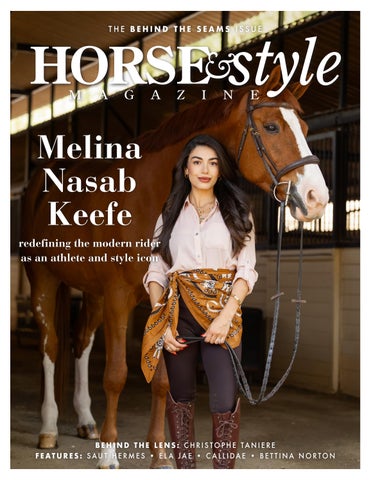

Melina Nasab Keefe
redefining the modern rider as an athlete and style icon


PUBLISHER
Appel sarah@horseandstylemag.com
EDITOR Helen Abrams helen@horseandstylemag.com
ART DIRECTOR
Lauren Allen
ADVERTISING & SALES helen@horseandstylemag.com
COPYEDITOR
Pam Maley
CONTRIBUTORS
Helen Abrams, Lauren Allen, Pam Maley, Alli Addison, Pernilla Nathan, Catie Staszak, Kristin Lee, Ali Kelman, Anne Sherwood, Carrie Wicks, Ph. D., Christine Bjerkan
PHOTOGRAPHERS
Kristin Lee Photography, Christophe Taniere, Justina Reinhart, ESI Photography, Annie MacAller Photgraphy, Emeth Photography, Kim Reirson, photos by Cara Grimshaw and Morgan Froment, Elizabeth Hay, Guillaume Ruchaud, Shelli Wright, Shannon Brinkman


Helen Abrams
Helen Abrams lives in Los Angeles where she works as a marketing executive in the television industry. In her spare time, she competes as an amateur at California's A-Circuit shows. Helen is also the founder and CEO of Life Equestrian, a marketing company for riders and equestrian enthusiasts. With Life Equestrian, Helen brings together her business expertise with her lifelong passion for equine trends, products and safety.

Dr. Carrie Wicks
Dr. Carrie Wicks divides her time between her private sport psychology consulting and family therapy practice, traveling with athletes, and writing. She completed her doctorate in psychology while researching the mental practices of equestrian athletes. Her passions include horses, yoga, mountain biking, skiing, and time in nature with animals.

Lauren Allen
Lauren Allen is a graphic designer and a lifelong equestrian who lives on a small ranch in Oklahoma with her husband and daughter. Her passion for horses and painting began at an early age and inspired her to create a company where she could combine both. She specializes in helping clients find unique and creative ways to grow their businesses. Learn more at seehorsedesign.com.

Anne Sherwood
Anne Sherwood is a freelance photojournalist based in Los Angeles, California and Bozeman, Montana. Covering stories that range from the civil war in Liberia to the bison cull in Yellowstone National Park, Sherwood has traveled to all 50 states, and more than 50 countries on six continents. Her work has appeared in the New York Times, National Geographic Adventure, and Smithsonian. Her corporate clients include Getty Images and Altria.

Pam Maley
An avid former foxhunter, Pam knows well that special bond between horse and rider. With her husband she was co-owner of Dunford Farm, a Thoroughbred farm in Lexington, Kentucky, where she was involved in every aspect of the horses’ lives. Her journey with horses continues as a as Copyeditor and Contributing Writer for H&S. She has a BA in English and History from Vanderbilt University.

Kristin Lee
Kristin Lee, owner and founder of Kristin Lee Photography LLC, has your typical horse girl story. Her love for horses has helped transition her to a leading photographer in the equestrian community. She earned her B.F.A. in Photography from the Brooks Institute for Photography in 2012. She has photographed covers for Sidelines Magazine, Special Olympics 2015, and many more.

Pernilla Nathan
Pernilla Nathan, Psy.D. a high performance consultant, works with female athletes, specializing in equestrians and entrepreneurs. Her passion is helping people reach their dreams and heal their anxiety. You can find her on IG @DrPernillaNathan, website DrPernillaNathan.com, or emial pernilla@equipsyperformance. com.

Catie Staszak
Catie Staszak is the CEO of Catie Staszak Media, Inc. and the color commentator and journalist for the Longines FEI Jumping World Cup™ NAL. Catie has announced at showjumping events across the globe and represented some of the sport's top athletes and operations. When she's not working, she's enjoying time with her superhero horse Zantos, whom she shows in the jumpers, and her dog/sidekick, Omaha.
Touching Grass

Dear Readers,
Just over three years ago, I hung up my tall boots and stepped away from the equestrian world, both as a rider and as a career. An industry that had been such a large part of my life for most of my life suddenly became something I experienced primarily through social media and the pages of this magazine.
While I miss the smell of the barn, the early morning drives down a long driveway to feed and ride horses, and the quiet moments spent with my favorite equine partners, what I miss most is the people. Horse people are truly our own breed. We understand the joy, the heartbreak, the triumphs, the setbacks, and yes, even the barn drama. Deep down, we are all still that little child who fell in love with horses somewhere along the way.
We are also people who choose to be outside. Rain or shine, wind or snow, we willingly spend our days in the company of our favorite animal. In today’s world of social media, constant notifications, and AI, horses remain one of the purest ways to “touch grass,” as I often tell my children. It means being present. Being unplugged. Being connected to something real.
While I no longer make that long drive down a barn road, I have found myself in a new career that somehow still allows me to follow a sport, be surrounded by incredible people, and do what I love—creating experiences and bringing communities together. As Director of Sales for the San Francisco Giants, I now plan events for a different kind of fan and occasionally even get to touch some grass myself—when it’s not game day.
That idea of connection, authenticity, and the things that ground us feels especially fitting for this issue. There is something endlessly inspiring about the details that live just beneath the surface of equestrian life. The quiet craftsmanship behind a perfectly tailored show coat. The early mornings spent preparing for a ride. The thought, care, and intention woven into the products, places, people, and partnerships that shape our sport. This issue is a celebration of those details: the stories behind the seams.
For our 2026 Volume 1 issue, we are thrilled to feature Melina Nasab Keefe on the cover. A personal trainer, Pilates instructor, entrepreneur, show jumper, and unapologetic lover of color, Melina brings a refreshing energy to the equestrian world. Her story reminds us that modern horsewomen are never just one thing. They are athletes, creatives, business owners, riders, and dreamers, building lives that are as layered and dynamic as the sport itself.
This issue also takes us back beneath the soaring glass roof of the Grand Palais for Saut Hermès, where heritage, sport, and Parisian style meet in a way only Hermès can deliver. From world-class show jumping to the quiet elegance of the maison’s equestrian roots, Saut Hermès remains one of the most magical expressions of horse sport on the international stage.
True to our theme, we go behind the seams with brands that continue to define
and redefine equestrian style. R.J. Classics shares its legacy of fit, function, and forward motion, while CALLIDAE opens the door to a new vision of modern athletic style. Ariat gives us a closer look at the innovation shaping the future of show apparel, and Solid Citizen, Hannah Childs Lifestyle, Kensington, and Huntsmen & Hounds each remind us that what we wear in and around the barn can carry meaning, memory, and purpose.
We also explore the brands and makers shaping daily equestrian life, from the timeless ritual of tack care with Tack Butter to the sweet tradition of Mrs. Pastures, the thoughtful mission of Three Mares, and the elevated approach to summer grooming from The Infused Equestrian. These stories remind us that the barn is built not only on sport, but on small rituals, trusted products, and the care we give every day.
On the lifestyle side, we travel through Virginia horse country, step inside the artful world of Bettina Norton, visit the thoughtful design process behind B&D Builders, and look at the growing influence of digital trust, authenticity, and storytelling in the equestrian industry. We also spotlight wellness, recovery, and rider mindset, because caring for ourselves is part of caring for our horses.
From the fashion that carries us from stable to street, to the footing beneath every stride, to the people and brands working quietly behind the scenes, this issue is a love letter to the many layers of equestrian life.
As always, thank you for riding along with us.
Warmly,
Sarah Appel Publisher, Horse & Style Magazine


GRAND PALAIS ÉPHÉMÈRE PARIS, FRANCE


OUT & about
©
CHRISTOPHE TANIERE


PHOTOS
by Lauren Allen photos courtesy of Kerrits
…you might not know about …

Kerrits is a women-founded, womenled apparel brand rooted in the Pacific Northwest, where a small in-house team designs every piece. Sprouted in 1986 as an outdoor activewear company for women on the move, Kerrits went on to change the equestrian world forever by bringing the first performance riding tights to market in 1991. Forty years later, they’re still innovating, still designing for real women of every age, size, and discipline, and still rooted in the connection between rider, horse, and the outdoors.
Learn more at Kerrits.com.

1. Kerrits has been women-founded and women-led since day one. In 1986, Kerri Kent set out to make activewear that actually fit and performed for athletic women, a vision that still drives every decision the brand makes today.
2. It all started with a bathing suit. Frustrated by the options on the market, Kerri bought $50 worth of fabric from the Jantzen outlet store and started sewing her own swimsuits. She sold them out of her car trunk on the banks of the Hood River, and before long Kerrits Activewear was born.
3. Kerrits launched as an outdoor activewear brand for women, built around movement, comfort, and confidence in the places women love to move. That outdoor DNA still shapes every collection today.
4. Kerrits brought the first performance riding tights to market, changing the game for equestrians forever. Before Kerrits, riders made do with gear that wasn’t made to move. After Kerrits, performance, fit, and freedom of movement became the new standard.
5. Innovation is in the brand’s bones. Kerrits was first to bring fabric technologies like Ice Fil® and Coolcore® to equestrian apparel, giving riders cooling performance built for long days in the saddle and in the sun.
6. Every piece is designed in-house by a small, tight-knit team in the Pacific Northwest. Apparel is tested in the region’s wildly varied weather, from cold, wet winters to hot, dusty summers, so it holds up wherever you ride.


7. Kerrits designs for active women of every age, size, and discipline. From schooling rings to trail rides, from young equestrians to lifelong horsewomen, the fit is made for real bodies in real motion.
8. Connection is at the heart of the brand. Connection between rider and horse, between women and the outdoors, and between the riders, retailers, and communities who make the sport what it is.
9. You’ll find Kerrits in hundreds of local tack shops across the country. Supporting the small businesses that anchor the equestrian community has always been part of how Kerrits shows up.
Kerrits invests in the future of the sport through ongoing sponsorships of the United States Pony Club, the Interscholastic Equestrian Association, and the United States Eventing Association, helping the next generation of riders find their seat, their confidence, and their community.


by Laurie Berglie - Congrats on 100 articles with Horse & Style!
BETWEEN the lines what we’re reading now


THE JUMP
Natalie Keller Reinert, author of the popular Eventing Series, is back with her highly anticipated stand-alone hardcover, The Jump. When Brooke Haskell accepts a working student position with one of the country’s top eventers, Eddie O’Neill, she can’t believe her luck. She loads up her horse, Roxie, and heads to Florida’s horse country to learn the ropes. But what Brooke learns are lessons she didn’t see coming. “Against the riveting high-stakes backdrop of the equestrian world, Reinert explores the passions that drive us, the love affairs that fuel us, and the partnerships that help us thrive and find ourselves.”
STARTING IN THE MIDDLE
Tik Maynard’s second memoir, Starting in the Middle, is about living the life you’ve been given – and sometimes that means passionately and boldly pursuing “what’s next?” Tik takes us with him throughout a year of his life where his “what’s next,” is accepting an invitation to compete in the Road to the Horse, the World Championship of Colt Starting. By chronicling his journey, Tik shows us, “how horses, those who study them, and 265 minutes with one colt helped me find myself at midlife.” This is a mesmerizing follow-up to his 2018 bestseller, In the Middle Are the Horsemen.

STAYING THE COURSE
Staying the Course is Book 3 in Jenny Roman’s Livy Series. While riding instructor Livy Stoddard is busy building a life she loves in England, her boyfriend, Simon, is thousands of miles away training horses in Australia. Between conflicting schedules and living in wildly different time zones, the two hardly have time to talk. When unfortunate circumstances force Simon to return, Livy realizes just how badly fractured their relationship is. Now Livy must re-evaluate everything: her future with Simon, her career, and the farm where they work. Will all the dreams they had together go up in smoke?


SONORA
Jenni L. Walsh’s Sonora is inspired by the true story of one of the first female horse divers, Sonora Webster. Set in the heyday of the American carnival scene just prior to the Great Depression, Jenni explores an exciting world of daring feats, mayhem, and adventure. Jenni perfectly captures the story of Sonora, a brave, young woman who swims against the current of societal norms and follows her dreams by answering an ad to dive with horses.
SCARLET FEVER
The exclusive Pemberwick Hunt Club is the setting for Kiki Astor’s Scarlet Fever: A Dark, Suspenseful Old Money Equestrian Gothic Romance. It is here that, “some secrets are too dark to stay hidden,” but June Faulconer is about to uncover quite a few of those secrets. A cryptic email forces her back to Pemberwick, her family’s ancestral estate, where she navigates the wealthy yet dangerous world of fox hunting. Soon June finds herself in a web of betrayal she must fight to free herself from.
Sweet Summer, Styled
The Treat Edit Your Horse Didn’t Know It Needed

There’s something about summer at the barn that feels a little more cinematic. Golden light stretching across the arena, linen shirts tucked into breeches, and that quiet moment post-ride when everything slows. It’s in these in-between moments that the details matter most,. Even the smallest details get an elevated touch.
Enter the summer treat. Not just any treat, but the kind that feels thoughtfully crafted, visually charming, and just indulgent enough to turn a simple reward into a ritual. This season, The Posh Pony is redefining what it means to spoil your horse, with a collection that feels equal parts boutique bakery and barn essential.
At first glance, Posh Pony’s treats feel almost too pretty to give away. Mini donuts, delicately finished patties, and even cupcake-inspired designs bring a playful
yet refined sensibility to the everyday. But beneath the aesthetic is a foundation rooted in simplicity and quality. Each treat is handmade to order, using approachable, recognizable ingredients like oats, molasses, coconut oil, and natural flavor extracts such as apple, banana, and peppermint.
There are no unnecessary additives, no overcomplication, just thoughtfully composed recipes that taste as good as they look. Even better, they’re designed with the show ring in mind. Free from cinnamon and flax, and crafted to align with horse show standards, they’re a seamless addition to your grooming trunk or show day kit. Think of the Posh Pony’s treat lineup as your curated edit for the season.
THE
CLASSIC MINI DONUT
Playful, colorful, and endlessly photogenic, these signature treats are the ultimate crowd-pleaser. Perfect for post-round
rewards or a mid-day pick-me-up, they bring a sense of fun to even the most routine barn days.
POSH PATTIES
For those who prefer a more understated aesthetic, the patties offer a refined alternative that’s minimal, ingredientforward, and just as beloved. Available in fresh summer flavors like apple and banana, they feel effortless yet intentional.
CUPCAKE MOMENTS
A newer addition to the lineup, cupcakestyle treats bring a celebratory twist that’s ideal for show wins, birthdays, or simply marking a beautiful ride.
What makes Posh Pony stand out isn’t just the product, it’s the feeling. These treats turn a simple gesture into something more considered: a pause, a reward, a connection.


There’s something quietly luxurious about reaching into your pocket and offering your horse something that feels curated, not just convenient. It mirrors the broader shift we’re seeing across equestrian style, where performance and polish are no longer separate, but intertwined.
This summer, it’s not about doing more. It’s about doing things beautifully. Because at the end of the day, the most memorable moments at the barn aren’t always the biggest ones. Sometimes, they’re the smallest, like the soft nicker when your horse knows you’ve brought something special. And this season, that something special just happens to be very, very chic.
Shop the edit and explore more from The Posh Pony at: shoptheposhpony.com.


by Helen Abrams

A New Era Takes Flight
The
Premier Jumping League Arrives
The landscape of international showjumping is set for a dramatic transformation with the announcement of the Premier Jumping League (PJL), a bold new global circuit that promises to redefine the sport at its highest level.
Backed by entrepreneur Frank McCourt, whose influence in elite sport includes involvement in major global tour structures such as the Global Champions Tour, the PJL enters the arena with both ambition and serious financial firepower.
At the heart of the league’s debut is a staggering $300 million guaranteed prize pot, the largest in the history of the discipline, signaling a decisive shift toward a more sustainable and professional future for riders. This unprecedented investment aims to address one of showjumping’s long standing challenges: enabling top athletes to pursue the sport as full time professionals without compromising financial stability.
Set to launch its inaugural season in March 2027, the PJL will feature sixteen teams competing across fourteen iconic venues spanning Europe, North America, and the Middle East. The format
introduces a fresh, team based dynamic, alongside an innovative rider selection process drawing from a pool of 250 of the world’s leading athletes, an approach designed to elevate both competition and accessibility.
But the PJL is more than just prize money and prestige. It reflects a broader evolution in how equestrian sport is presented and consumed. With immersive, fan focused events, a free-to-view broadcast model, and collaboration with Emmy Award winning production company Box to Box Films, the league positions itself at the intersection of sport and entertainment. The goal is clear: bring new audiences into the world of showjumping while honoring its traditions.
Equally central to the league’s philosophy is its commitment to horse welfare and long term sustainability. From competition design to travel logistics and veterinary oversight, the PJL emphasizes responsible horsemanship as a non-negotiable pillar of its identity.
For many within the sport, the PJL represents a long awaited evolution. Olympic champion Laura Kraut has
already voiced support for a model that better aligns elite performance with meaningful commercial opportunity, while world number one Scott Brash highlights the potential for riders to prioritize both their careers and their horses under this new structure.
With McCourt’s backing and a leadership team steeped in both sport and entertainment, the Premier Jumping League arrives not just as another circuit, but as a statement. One that suggests the future of showjumping will be bigger, more global, and more professionally structured than ever before.
For a sport rooted in heritage yet hungry for innovation, the PJL may well be the leap forward it has been waiting for. As anticipation builds toward the inaugural 2027 season, riders, fans, and industry leaders alike are invited to follow the journey, engage with the league, and witness firsthand the next chapter of showjumping unfold on a truly global stage.
Visit www.pjl.com to learn more and stay connected.
by Anne Sherwood photos courtesy of Virginia Horse Industry Board
Honoring Tradition, Supporting Growth
Empowering
Virginia’s Horse Industry and Elevating Its Legacy
I’m sitting in a window seat on a flight landing at Dulles Airport in Virginia, and all I can see below are horse farms. One after another: beautiful arenas dotted with colorful jumps, lush green pastures where horses graze, and charming stone barns. My first thought is, “Virginia is horse country.” But it’s more than that—it’s a premier destination for hunter-jumper riders who want to train and compete.
So, what makes Virginia so perfect for horses and riders? Part of the magic lies in the climate.Virginia experiences all four seasons but is never truly too hot or too cold. Unlike New England, there’s rarely a need for an indoor arena. Consistent rainfall keeps the pastures green, giving horses year-round access to grass. The landscape itself is another gift to the sport: rolling hills, varied terrain, and patches of woodlands. Think back to the origins of hunters in the English countryside, and you’ll see the similarity. Not surprisingly,Virginia boasts the oldest and most established foxhunting community in the nation, shaped in part by its landscape.
Virginia’s horse industry also stands out for its robust show schedule and wealth of training barns. Riders of every level, from juniors and amateurs to seasoned professionals, have access to competitions that range from local schooling shows to
nationally recognized events. The state hosts some of the country’s most renowned hunter-jumper competitions, including the Upperville Colt and Horse Show (the oldest horse show in the U.S.) and the Middleburg Classic, both of which attract top horses and riders from across the nation. The Virginia Horse Show Association (VHSA) plays a pivotal role in fostering this thriving circuit. Its year-round schedule accommodates riders of all skill levels, offering opportunities both for beginners just starting out and professionals finetuning their craft. As one local rider put it, “You can decide on a whim to go to a horse show in Virginia and find something almost every weekend.”
Virginia is also steeped in equestrian history. From General Patton showing at Upperville to the Piedmont Fox Hounds, established in 1840 in Middleburg, widely known as the horse and hunt capital of America, the state’s equestrian heritage runs deep. “The whole horse culture here is a way of life, and it has deep, deep roots,” says Linda Moss of Bespoke EQ Brands. Moss and her husband George moved to Virginia from California two years ago with their two off-the-track Thoroughbreds, and they couldn’t be happier. “The community has been incredibly welcoming,” she explains, “and our only regret is that we didn’t do it sooner. In Virginia, the landscape allows the horses to be horses, and the history and
tradition are the blueprint. They teach you to honor the environment here.”
Virginia also benefits from its proximity to major metropolitan areas like Washington, D.C., and Richmond, as well as easy access to other major equestrian venues in neighboring states. This location makes it possible for riders to compete at the highest levels without long-distance travel. Combined with a relatively affordable cost of living and an abundance of preserved open space,Virginia offers equestrians a unique balance of opportunity and accessibility. In fact, one Virginia horse owner mentioned a former showgrounds that allows anyone to school in their arenas for just $25—on the honor system. That’s horse community at its finest.
With its rich equestrian tradition, premier facilities, extensive competition calendar, and vibrant community,Virginia is a true hub for hunter-jumper equestrians. Whether for juniors and amateurs seeking to build their skills or professionals chasing national and international success, the state provides unmatched opportunities for development in the sport.
From that glimpse out my airplane window, I sensed it:Virginia isn’t just horse country—it’s one of the very best places for hunter-jumper riders and their horses to thrive.


by Helen Abrams
photos by Justina Reinhart and The Infused Equestrian
Summer Elevated
A Conversation with The Infused Equestrian

As the season shifts and long, sunsoaked days return to the barn, summer grooming becomes less about routine—and more about intention. With heat, sweat, and insects in full force, riders are rethinking what they put on their horses and themselves. Enter The Infused Equestrian, a line of non-toxic, essential oil–infused grooming products designed to deliver both performance and sensory experience.
We sat down with the brand to talk summer essentials, thoughtful care, and how to keep horses feeling (and looking) their best all season long.
HORSE & STYLE: Summer brings heat, sweat, and more time in the sun—what’s the biggest mistake riders make this time of year?
TIE : A big mistake riders make is trying to solve summer challenges with “more”
instead of “better.” More sprays, more washes, more products. But often those products are loaded with harsh chemicals and names you can’t pronounce. Those ingredients strip skin, dull the coat, create irritation, and leave horses uncomfortable.
At The Infused Equestrian, we design products with therapeutic-grade essential oils and clean, recognizable ingredients because a healthy horse starts with simple formulations that support natural balance and brilliance...not synthetic overload.
H&S: What are your go-to summer essentials from your line?
TIE : First and foremost, Wham Bam. A Coat Spray & Repellent is a must-have for summer. This was our very first product and remains a best-selling formula. Twenty-one essential oils were carefully selected to repel insects while keeping a fresh, natural scent instead of a chemical-heavy one. It’s the
best smelling insect spray you’ll encounter. With regular application, the formula works hard during long days in the ring while remaining safe and pleasant for both horse and rider. We like to think of it as fighting nature with nature.
Then there’s Noggin. A Fresh Helmet Spray & More. Originally curated as a custom offering for a popular subscription box, Noggin offers riders a clean, effective way to refresh gear without machine-washing or toxic sprays. It neutralizes bacteria and odors on helmets, gloves, boots, air vests, and more with ingredients you’d actually want near your skin. Approved by multiple vest manufacturers, our formula evaporates quickly, pulling moisture away from the foam and mesh of your body protector.
Our internal and manufacturer testing shows zero degradation to technical fabrics leaving you just a bone-dry, deodorized


vest that’s ready to ride when you are. We’d rather give you a product that actually works than a ‘fear-free’ formula that leaves your gear soggy. Noggin has become the best seller in its category for good reason.
For newcomers, our Champion’s Companion starter set is a great way to experience a range of thoughtfully curated products that work together seamlessly.
H&S: Fly control is a huge concern in summer—how do you approach it differently?
TIE : We don’t scare people into using products. We empower them with formulations that make sense. Wham Bam repels insects through plant-based essential oils, not synthetics or fear-based claims.
Each oil has a purpose; citronella for flies, peppermint for ants and mosquitoes, rosemary for general repellent support. The result is protection and a coat shine that’s both effective and intuitive.You know exactly what’s on your horse and why it’s there. And, did we mention it’s safe for you to use on yourself too? Use it anytime you are riding, in the garden, cutting the grass or sitting ringside.
H&S: How can riders maintain a healthy coat through constant washing in the summer months?
TIE : Bathing more doesn’t have to mean drying out or frustrating the skin’s natural defenses. Splash. An Intensifying Shampoo was formulated as a 5-in-1 solution. It
cleans, conditions, moisturizes, detangles, and deodorizes. With 98.25% naturally derived ingredients like coconut, palm, oatmeal, and aloe, this shampoo locks in moisture, leaving skin happy, hydrated, and itch-free while coats stay soft, shiny, and oh-so-snuggly. That means you’re not just cleaning, you’re supporting the coat’s natural health. Frequent washes become beneficial care, not damage control.
H&S: What about post-ride recovery in the heat?
TIE : Recovery should be as intentional as the ride itself. Comfort. A Liniment uses 100% pure therapeutic essential oils. We keep it simple with peppermint, spearmint, ginger, and tea tree. These oils are blended
in an aloe base that soothes tired legs, supports circulation, and cools heat-stressed tissue. It’s strong enough for horses yet gentle enough to use on yourself after a long day in the saddle. No harsh chemicals to burn your hands or horse’s legs. No guesswork. Just targeted, clean support.
H&S: You also create products for riders. How does that tie into your philosophy?
TIE : Our products are grounded in one simple question: If you wouldn’t put it on your own skin, why put it on your horse? That mindset drives every formulation. Whether it’s gear refreshers like Noggin or conditioners for hooves, hair and skin, we stick to ingredients you understand and can pronounce. Everything we do is 100% transparent. We never use mysterious synthetics. The Infused Equestrian is elevated care that feels good, smells exquisite, and performs beautifully for both horses and humans.
H&S: Your products are known for being clean and competition-safe. Why is that so important?
TIE : Riders shouldn’t have to choose between performance and peace of mind. Our entire line is formulated to align with USEF and FEI banned substance standards, so you can groom, show, and compete with confidence. There are no hidden surprises, no guesswork. When ingredients are transparent and intentional, your routine becomes a source of trust, not anxiety.
H&S: Any final summer tips for Horse & Style readers?
TIE : Let your horse shine this summer and beyond. Start with clean, natural products, keep your routine simple, and pay attention to comfort and coat health. Small choices make a big difference. Groom with clarity. Compete with confidence.
Discover the full product line at The Infused Equestrian and elevate your summer grooming routine with products designed to perform beautifully from barn to ring. To purchase, visit: theinfusedequestrian.com.
Summer Grooming Checklist
A quick-reference guide for effortless warm-weather care
Daily Essentials
• Apply a natural fly spray like Wham Bam before turnout or riding
• ☐ Brush lightly to remove dust, sweat, and debris
• ☐ Check for irritation, bites, or dry patches
Post-Ride Reset
• ☐ Rinse or spot-clean sweat marks
• Apply a cooling liniment such as Comfort to legs and muscles
• Refresh coat with a lightweight spray like Shiny, our mane & tail conditioner
Weekly Routine
• Bathe with a gentle, hydrating shampoo like Splash, our intensifying 5-in-1 shampoo
• Condition mane and tail with Shiny to prevent breakage
• Apply Pedi, our hoof conditioner, to stimulate growth and maintain healthy hooves

Tack + Rider Care
Clean bits regularly to prevent gunk buildup using Pure Bit Wipes for an easy, effective deep cleanse
Refresh helmet and gear with Noggin, our natural spray
Use calming essential oil blends for yourself, and extend that calm to your horse with @The In Gate, our rider roll-on
Groom in shaded areas or cooler parts of the day
Avoid over-washing—balance is key
☐ Choose non-toxic products safe for daily use

by Helen Abrams

A Legacy of Fit, Function, and Forward Motion

In a sport where tradition runs deep, true innovation is often quiet—woven into seams, shaped through fit, and proven in the ring. For over 25 years, R.J. Classics has built its reputation not by chasing trends, but by refining the essentials of equestrian apparel: precision tailoring, technical performance, and an unwavering commitment to the rider.
BUILT ON HERITAGE, DESIGNED FOR TODAY
R.J. Classics was founded as a family-owned
and operated business with a clear intention to create riding apparel that honors the heritage of equestrian sport while evolving with the needs of modern riders. From the beginning, the brand has focused on the details that matter most: how a coat moves over a jump, how a breech performs through long days at the barn, and how a rider feels stepping into the ring.
That philosophy has carried the brand through its 25th anniversary milestone, marking not just longevity, but consistency.
R.J. Classics has remained a trusted name among riders who value both tradition and progress, those who expect their apparel to perform as beautifully as it looks.
MORE THAN A SHOW COAT
While R.J. Classics is widely recognized for its impeccably tailored show coats, the brand’s offering extends far beyond the ring staple it’s known for.
Today, R.J. Classics delivers a full wardrobe for riders at every level, including breeches designed for both schooling and competition, technical show shirts and everyday riding tops, layering pieces built for changing seasons, a complete men’s line, inclusive sizing including plus size women’s styles, and children’s apparel with sizes starting as young as 2T.
With new collections and colorways launching each spring, summer, and fall, the brand continues to evolve alongside its riders, meeting them wherever they are in their journey.
INNOVATION IN EVERY RIDE
At the core of R.J. Classics is a quiet but constant pursuit of improvement. Every piece is thoughtfully designed to balance tradition with modern performance, ensuring riders feel as confident as they look.
Co-owners and sisters, Jennifer (left) and Michelle (right), with their mother, Roberta, who founded the company.


THE NEW STANDARD: LUXE-TEK BREECHES
R.J. Classics recently launched new LuxeTek breeches, setting a new benchmark for what riders can expect from everyday performance wear. Designed with both function and feel in mind, the Luxe-Tek breeches offer a refined balance of structure and stretch, supportive where you need it and flexible where it matters most.
The result is a breech that moves seamlessly with the rider, whether in the saddle during a full training day or stepping into the show ring. With elevated fabric technology, a flattering fit, and thoughtful detailing, Luxe-Tek reflects R.J. Classics’ ongoing commitment to innovation, delivering premium performance at an accessible price point.
WORN BY CHAMPIONS, BUILT FOR EVERYONE
The early 2026 addition of Olympic gold medalist McLain Ward as a sponsored rider marked a meaningful moment for the brand. Known for his precision, consistency, and horsemanship at the highest level, Ward represents the same values R.J. Classics has championed for decades.
Building on the brand’s relationship with the Ward family, which began with daughters Lilly and Maddy, this partnership reflects a shared belief that riders should never have to compromise between function, style, and tradition. It further underscores R.J. Classics’ commitment to supporting riders at every stage of their journey.
THE FUTURE OF A CLASSIC
In an industry often defined by legacy, R.J. Classics stands out for its ability to balance tradition with forward motion. Every collection, every refinement, and every new silhouette reflects a brand that is not content to stand still.
With the recent launch of the Legacy Lite line of show coats and shadbellies, designed to be lighter, more breathable, and even more responsive in motion, the brand continues to evolve, thoughtfully refining the pieces riders rely on most. Because in riding, as in design, true elegance is not just about where you’ve been. It is about how you move forward.
To shop the latest collection, please visit: rjclassics.com
by Ali Kelman photos by ESI Photography
equestrian gardens

When Jessica Jones first rode into Ocala more than 25 years ago, it wasn’t just the thrill of competition that drew her back year after year—it was the land itself. Enchanted by its natural beauty, she returned in 2023 not as a competitor but as a creator. With the launch of Equestrian Gardens, Jess set out to elevate the equestrian experience through landscapes that reflect the sport’s grace and the land’s spirit. Her landscapes are effortless yet intentional, designed to elevate the rider’s experience with every detail—where nature flows into form, and beauty is simply part of the ride.

“I have always been struck by the vibrant colors of the early sunrise and the deep color of the sky at sunset. The serenity of the open pastures, rolling hills with the most magnificent oak trees you’ll ever see,” Jess continues. “For me, Ocala now has the Hunter/Jumper year-round community and diversity in competition venues available to create a true equestrian lifestyle community and destination.” It’s only natural that Jess and her business, Equestrian Gardens, are deeply focused on the Ocala market, where many farm properties remain largely untouched by development. Recently, Jess connected with Steven A. Saumell, a Realtor with Douglas Elliman and an exclusive agent of
their Farm and Ranch Division, and they are teaming up to bring properties to life in the region.
The collaboration between Jess and Steven provides Equestrian Gardens with an incredible opportunity to integrate unique landscape design into property transformation, enhancing and preserving the natural look and feel rather than conforming to the manicured, uniform aesthetic common to mass residential communities. An immense amount of detail goes into setting the stage for the right plan, approach, and style, with design at the forefront of each project. With careful planning, the horse and the style


of the property owner are integrated into the design, benefiting the ecosystem in a luxurious, lush, and welcoming way. Ocala presents a rare opportunity to preserve and transform without losing the essence of the land. A horse-centric site plan prioritizes safe circulation, training space, and comfortable environments for both horses and riders.
Jess doesn’t just decorate; she orchestrates experiences. Starting with the bare bones of property maps, Jess sees potential where others see obstacles. As Steven describes, “She goes through the entire flow of the barn, meticulously analyzing how vehicles move, where clients park, and highlighting key areas like the entrance, tack room, and access to the riding ring. Her

vision transforms these spaces into aesthetically pleasing and functional areas that leave a lasting impression. Jess delves deeper than surface-level aesthetics, considering the landscape’s topography and the impact of future construction. With an eye for both beauty and practicality, Jess ensures every detail is thoughtfully considered, creating a seamless and unforgettable experience for your clients. She truly thinks of everything.”
Candace Ibrahim reached out to her realtor, Steven, in the spring of 2023 after receiving feedback from multiple people on her property’s curb appeal. At that point, Steven knew exactly who was
needed to enhance Ibrahim’s Another Chestnut Farm in Ocala. The family has been in the equestrian world for years and has chosen to invest in this farm. They are working with Jess and the Equestrian Gardens team to transform the property.
“Jess’s first design proposal literally blew me away. She exceeded my vision with only the basic information I gave her: something clean, functional, manageable, and professional,” said Candace. “Jess had to start with just a barn in the middle of a field and built an entire functional/ beautiful design. We have had great conversations about the design along this

journey. She has always been open to questions and changes along this process. Jess has been able to break up this large project into more manageable pieces for us.”
Jess and Candace together have a specific vision for Another Chestnut Farm that she is bringing to life. It’s clear the designs are changing the feel of the property, bringing it to life with purpose and beauty. She prioritized circulation first, then integrated landscaping, ensuring the layout works beautifully for horses and humans alike. The project is not only about beautification, but also about creating a landscape where the company is building long-term equity into the farm. Wherever Jess works, she sources preferred local
suppliers known for their commitment to quality and reliability, and Ocala isn’t any different.
One of the most distinctive aspects of what Equestrian Gardens has accomplished at Another Chestnut Farm is the native landscape design, with more than 90% native plantings that support pollinators, wildlife habitat, and ecological resilience. Remaining species, including crepe myrtle and birch, are also FloridaFriendly selections.
Another Chestnut Farm began as an idea. Now, it’s becoming a destination for riding, relaxation, and peace, just a few minutes from the showgrounds in Ocala. It has earned Florida-Friendly
Recognition. Reviewed by partners at the University of Florida and recognized for meeting and exceeding Florida-Friendly Landscape™ standards, the owners plan to apply for the program’s “Natural” designation in 2026.
“Our work with the family, as with any client of ours, is truly collaborative,” said Jess. “We approach each step as partners, testing ideas and processes together. There’s never just one way forward. Every decision is made with the horses’ well-being at the center.”
Another Chestnut Farm demonstrates how working equestrian properties can successfully integrate environmental stewardship with functional farm design.

#WeRideTogether, the nonprofit dedicated to eliminating sexual abuse and misconduct in youth and amateur sports, has committed to distributing 1,000,000 free Agano weighted plushies over the next two years to offer comfort, validation, and healing support to survivors in sports and beyond.
Inspired by the real-life horse owned by Carrie Kehring, Agano represents steadiness, safety, and unconditional support - qualities often missing in moments of trauma. More than a plush toy, Agano is a trauma-informed healing tool designed for anyone navigating recovery.
Each plushie includes: a feelings & emotions chart, thoughtful journal prompts, a self-care guide, a gentle weighted design that can be warmed in the microwave for added comfort.
Agano supports grounding, emotional regulation, and reassurance for children, teens, and adults and is used by survivors, families, therapists, medical teams, and advocates.
Order and learn more about Agano: shop.weridetogether.today/products/agano-plushie
“Agano is about reminding survivors they are not alone. Healing doesn’t always start with words—it often starts with feeling safe.” said Carrie Kehring, Founder, #WeRideTogether
by Helen Abrams
From Barn Mornings to Bright Eyes
Upper Blepharoplasty with Dr. Taban


As equestrians, we spend our lives outdoors. Early mornings at the barn, long afternoons under the sun, wind, dust, and weather are simply part of the rhythm. While there’s something grounding and beautiful about that lifestyle, it also means our faces tell our stories early. For me, that story began showing up most noticeably around my eyes.
Over time, I started to feel that my upper eyelids no longer reflected how I felt on the inside. They appeared heavy and tired, especially after long days riding or traveling, even when I felt energized and strong. This wasn’t about changing how I looked; it was about feeling like myself again. After thoughtful consideration, research, and many conversations, I decided to move forward with upper blepharoplasty, now one of the most popular cosmetic procedures worldwide.
Choosing to have the procedure was a personal decision. Choosing the right surgeon, however, was non-negotiable. That choice led me to Dr. Taban, a globally respected oculoplastic surgeon based in Beverly Hills. Dr. Taban is widely
regarded as a pioneer in eyelid surgery, with decades of specialized experience focused exclusively on the delicate anatomy of the eyes. His credentials, precision, and reputation for natural results made the decision feel incredibly easy. When it comes to your vision and the most expressive part of your face, expertise matters.
This philosophy is something Dr. Taban often emphasizes in his practice: “Eyelid surgery is as much about precision and restraint as it is about technique. The goal is never to change someone’s appearance, but to restore what time and environment have taken away.” - Dr. Taban
Those words perfectly captured why I felt so confident moving forward. Dr. Taban’s practice is located in Beverly Hills, and one of the things that immediately stood out to me was how seamless and calm the entire experience felt.
My procedure was performed in his office, not a hospital setting, which made the day feel far less intimidating. The surgery took about 30 minutes and was done using local pain management only, with injected lidocaine. There was no general
anesthesia, no long recovery room wait, and most importantly, no pain. The experience was controlled, efficient, and remarkably comfortable from start to finish.
From check-in to prep to recovery, Dr. Taban and his team were thoughtful, reassuring, and incredibly professional. His calm demeanor and clear communication instilled confidence every step of the way. Surgery day felt smooth and stress free, something I know many people worry about when considering a procedure like this.
Recovery is often what people fear most, so I made a conscious decision to document mine honestly. The first week was all about patience and consistency. Swelling and bruising were present, but very manageable. Ice packs helped tremendously in the first 48 hours, and I followed Dr. Taban’s guidance closely, from using preservative free artificial tears to keeping the area clean and hands off.
By days three to five, I noticed visible improvement. Stitches were removed around day seven, and the process was quick and completely pain free. What surprised
After Before


me most was how predictable and steady the healing felt when following expert instructions. There was no rushing the process, just trusting it.
By two to three weeks post surgery, I was back to my equestrian routine. Being outdoors again, moving confidently, and returning to the saddle felt incredibly empowering. As riders, our focus matters. When you’re riding, you need to be present, balanced, and confident. Feeling your best physically translates directly into how you show up in the saddle.
Upper blepharoplasty offers both aesthetic and functional benefits. Removing excess skin from the upper eyelids creates a more open, refreshed appearance, but it can also improve peripheral vision and reduce that heavy sensation many of us experience after years in the sun. The incision sits in the natural eyelid crease, making scars discreet and typically fading significantly within weeks to months.
One of the most common questions I receive is about longevity. Results from upper blepharoplasty typically last ten to fifteen years, depending on genetics, skin quality, and lifestyle. For me, that made the procedure feel like a true investment rather than a temporary fix.
Sharing my experience publicly was intentional. There is still hesitation around cosmetic procedures, especially for women who value strength, sport, and authenticity. But investing in yourself, your confidence, and your well-being should never require justification.
As equestrians, we invest heavily in our horses, our training, and our care. Choosing to invest in myself felt like a natural extension of that philosophy.
Today, my eyes feel lighter, more open, and more reflective of how I feel internally. The results are subtle, natural, and exactly what I hoped for. I don’t look different. I look rested, focused, and confident.
Upper blepharoplasty may be one of the most popular procedures today, but my experience with Dr. Taban reinforced why expertise matters more than trends. When done thoughtfully and with the right specialist, investing in yourself is always worth it.
Learn more at: tabanmd.com
by Helen Abrams
The Ritual of Tack Care
How a simple barn routine inspired the creation of Tack Butter and why thoughtful leather care remains one of the most timeless traditions in horsemanship.
For many riders, the day rarely ends when the horse is untacked. Instead, it continues quietly in the tack room, where bridles are wiped down, saddles are carefully cleaned, and leather is restored after another ride. These small moments of care are so ingrained in equestrian life that they often go unnoticed, but they represent one of the sport’s most enduring traditions.
Tack care is more than a practical task. It is a ritual that reflects the values of horsemanship: patience, respect for craftsmanship, and appreciation for the tools that support both horse and rider. Saddles and bridles are often significant investments, and when properly maintained, they can last for decades, developing the rich patina and character that only time and use can create.
Yet for many riders, the products traditionally used to clean tack have remained largely unchanged for generations. Glycerin soaps, heavy oils, and wax based conditioners have long filled tack trunks and barn shelves, sometimes leaving residue
or requiring multiple steps to properly clean and condition leather.
As equestrians increasingly look toward natural and simplified solutions across their barns, from horse care to rider wellness, the tack room is evolving as well. That shift toward more thoughtful leather care is part of what inspired the creation of Tack Butter, a leather conditioner and cleaner developed by equestrian entrepreneur Rochelle Woodeshick. Like many riders, Woodeshick spent years cleaning tack and searching for a product that would effectively nourish leather without relying on harsh or overly complicated formulas.
The idea for Tack Butter began not in a laboratory, but in the familiar environment of the barn. Woodeshick, a lifelong rider, understood firsthand the importance of maintaining tack while balancing the busy rhythms of riding, training, and horse care. She set out to create a product that would simplify the process while still delivering the level of conditioning that quality leather requires.
The result was a natural leather conditioner designed to clean and nourish tack with ease. Made with ingredients such as avocado oil, cocoa butter, and beeswax, the formula was created to restore suppleness to leather while protecting it from dryness and wear. While Tack Butter can clean and condition in one step, many riders find the best results come from first removing visible dirt with the natural spray wash, then applying the conditioner for a deeper, more tailored finish.
In developing the product, Woodeshick collaborated with Olympic groom Emma Ford, whose experience in three-day eventing offered valuable insight into how the product would perform in demanding barn environments. From international competition stables to everyday training barns, the goal was the same: to create a leather care product that riders could rely on.
Beyond the barn, Tack Butter also reflects a deeper sense of purpose. The brand supports philanthropic efforts within the equestrian

Product Spotlight: Tack Butter
Designed by riders for riders, Tack Butter is a natural leather conditioner created to simplify tack care while protecting the quality of fine leather.
Why Riders Love It
• Cleans and conditions leather with ease, especially when paired with the natural spray wash for pre cleaning
• Made with natural ingredients including avocado oil, cocoa butter, and beeswax
• Helps maintain softness and longevity of saddles, bridles, and boots
• Safe to use frequently without damaging delicate leather
• Developed with input from Olympic groom Emma Ford
From Pony Club tack rooms to professional show barns, Tack Butter has become a go-to product for riders who want an efficient yet thoughtful approach to leather care.
Learn More at tackbutter.com
community, including contributing to the recovery journey of Lee Lee Jones, a reminder that horsemanship extends beyond care of equipment to care for one another.
“At its heart, horsemanship is about more than what we ride or the tack we use; it is about the people we stand beside. Supporting Lee Lee’s recovery journey is simply an extension of the same care we bring into the barn every day.”
This spirit of community and compassion is woven into the brand’s identity, reinforcing the idea that the rituals of the sport are not only about preservation, but about connection.
Today, Tack Butter has found its way into tack rooms across a range of disciplines, from Pony Club riders learning the basics of tack maintenance to professional grooms responsible for caring for equipment worth thousands of dollars. What resonates with many riders is not only the product’s effectiveness but the philosophy behind it. Tack care, after all, is rarely just about the leather itself.
For many riders, it is a quiet moment at the end of the day when the barn grows still and the pace slows. Cleaning tack offers a chance to reflect on the ride, to notice the details of well worn reins or the softness of a saddle that has carried countless hours of work and partnership.
In an era when technology continues to reshape many aspects of sport, these traditional rituals remain unchanged. The act of caring for tack connects riders to generations of horsemen and women who have followed the same routines, cleaning, conditioning, and preserving the tools of their craft.
It is perhaps no surprise that a product like Tack Butter emerged from this environment. Rather than replacing tradition, it reflects a modern interpretation of it, simplifying the process while honoring the importance of proper leather care.
Because at the heart of horsemanship lies an understanding that the smallest details matter. The care given to a horse, the attention paid to equipment, and the quiet rituals of the barn all contribute to the larger story of the sport.

Founder Q&A:
Rochelle Woodeshick, Creator of Tack Butter
H&S: What inspired you to create Tack Butter?
RW: Like many riders, I spent years cleaning tack and was constantly searching for a product that was both effective and natural. I wanted something simple that would clean and nourish leather without harsh chemicals. That idea eventually became Tack Butter.
H&S: What makes Tack Butter different from traditional tack cleaners?
RW: Most traditional products rely on heavy oils and harsh chemicals that can sit on the surface of the leather or build up over time. Tack Butter goes on smoothly and can be layered, allowing riders to condition their leather to the exact level they prefer while still keeping the material breathable and healthy.
H&S: How did your background in riding influence the product?
RW: Being around horses my whole life meant I understood the importance of good tack care. Saddles and bridles are significant investments, and riders want products that help protect them while fitting naturally into their daily barn routine.


H&S: What role did Olympic groom Emma Ford play in the development?
RW: Emma’s expertise caring for top-level 3 day eventing tack was invaluable. Her insight helped ensure the product would perform well in professional barn environments.
H&S: What do you hope riders feel when they use Tack Butter?
RW: I hope it brings a little enjoyment back into the tack-cleaning ritual. Those quiet moments in the tack room are part of the rhythm of riding, and caring for our equipment is part of honoring the sport.
Rochelle with Lee Lee Jones

by Helen Abrams

As the days grow longer and temperatures rise, summer in the barn brings a familiar set of challenges, heat, insects, sun exposure, and the constant balancing act between turnout and protection. This season, Kensington continues to define what it means to combine performance, durability, and thoughtful design with its lineup of warm-weather essentials built for both horse and rider.
At the core of Kensington’s summer collection is a philosophy rooted in protection without compromise, keeping horses cool, comfortable, and impeccably turned out, even in the height of the season.
THE FOUNDATION: PROTECTIVE FLY SHEETS REIMAGINED
Kensington’s signature Protective Fly Sheet stands as a staple for summer turnout. Crafted from durable Textilene® mesh,
TURNOUT CHECKLIST YOUR SUMMER
Powered by Kensington
the sheet offers an impressive balance of breathability and protection, shielding horses from flies while allowing air to circulate freely.
With up to 73% UV protection, these sheets help prevent coat bleaching and sunburn, particularly important for darker coats and sensitive-skinned horses.
Unlike heavier turnout blankets, fly sheets are designed specifically for warm weather, using open mesh construction to block insects without trapping heat.
The result: a horse that stays cooler, cleaner, and more comfortable during long days in the paddock.
BUILT FOR PERFORMANCE: FABRIC THAT WORKS WITH THE HORSE What sets Kensington apart is its commitment to materials that do more
than just protect. The brand’s proprietary mesh is engineered to:
• Promote airflow and prevent heat retention
• Resist fading, wear, and environmental stress
• Help keep coats clean by repelling dirt and debris
• Encourage natural oil distribution for a healthier, shinier coat
It’s a subtle but powerful difference, products that actively enhance the horse’s condition while they’re being worn.
CUSTOMIZABLE COVERAGE: THOUGHTFUL ADD-ONS FOR TOTAL PROTECTION
Summer turnout isn’t one-size-fits-all, and Kensington’s modular approach reflects that. Riders can build a complete protection system tailored to their
photos provided by Kensington


horse’s needs with:
• Neck covers for mane and crest protection
• Belly bands to shield sensitive underlines
• Fly boots to reduce stomping and irritation
• Tail bags designed to protect growth and fullness
These additions create full-body coverage, especially valuable for horses prone to sweet itch or sensitivity to biting insects. sem sed, ullamcorper libero. Aliquam ac arcu at ipsum convallis interdum.
BEYOND FUNCTION: STYLE MEETS PRACTICALITY
True to Horse & Style’s ethos, performance doesn’t come at the expense of aesthetic. Kensington’s signature plaid patterns and refined colorways bring a polished look to everyday turnout, proof that even functional gear can feel elevated. The brand’s attention to fit also ensures a tailored silhouette, with thoughtful features like contoured cuts, adjustable closures, and padded pressure points that move with the horse rather than against it.
WHY IT MATTERS IN SUMMER
Summer management is about more than comfort, it’s about consistency in condition. From preventing coat damage to minimizing irritation and maintaining overall wellness, the right turnout gear plays a critical role in a horse’s daily routine.
Kensington’s approach simplifies that equation: fewer compromises, more coverage, and products that work as hard as your horse does.
For riders looking to streamline their summer setup, Kensington offers a comprehensive solution rooted in durability, innovation, and thoughtful design. Whether in the show barn or at home turnout, these pieces are built to handle the realities of the season, while keeping horses looking and feeling their best.
SHOP THE COLLECTION
Discover Kensington’s summer essentials and build your horse’s warm-weather wardrobe at: kensingtonproducts.com/ collections/best-seller.
Because great turnout isn’t just about protection—it’s about presence.

by Helen Abrams
The One That Stays: Hannah Childs’ Heart Horse Collection


There are horses we ride… and then there are the ones who shape us. With her latest drop, the Heart Horse Collection, Hannah Childs Lifestyle founder Hannah Childs translates one of the most universal and deeply personal equestrian truths into something you can wear. Inspired by her own horse, Harry, a partner of nearly 21 years, the collection is a quiet, emotional tribute to “the ones who define us”; those rare horses whose presence lingers long after the last ride. This is not just a collection. It’s a memory, stitched into fabric.
A LOVE LETTER, WORN CLOSE
At the heart of the collection are two standout pieces: the Harry Heart Horse Crew Neck Sweater and the Constance Heart Horse Long Sleeve Show Shirt, each designed to balance performance, polish, and sentiment in a way that feels distinctly personal.
THE CONSTANCE HEART HORSE SHOW SHIRT
The Constance show shirt reads, at first
glance, like a refined essential: crisp, tailored, and competition ready. But it’s in the details where the story unfolds.
A hidden embroidered heart rests inside the placket, close to the rider, while a delicate horse head is placed at the cuff. Subtle, intentional, and deeply symbolic, it’s a reminder of the bond that shapes not just how we ride, but who we become.
Technically, it delivers where it matters: a breathable, non sheer mesh with UPF 50+ protection and moisture wicking performance, designed for long show days and warm afternoons in the ring. Emotionally, it does something rarer. It becomes yours.
THE
HARRY
HEART HORSE CREW NECK SWEATER
If the show shirt is about performance, the sweater is about presence. Soft, understated, and effortlessly elevated, the Harry sweater is designed for everything in between, early mornings at the barn, long days at shows, and quiet moments that define the lifestyle as much as the competition does.
photos by Kim Reirson
It carries the same emotional DNA as the shirt: subtle detailing, intentional design, and a feeling that it was made for those who understand the bond without needing to explain it.
This is the piece you reach for not because you need it, but because it feels like home.
MORE THAN APPAREL, A SHARED LANGUAGE
What makes the Heart Horse Collection resonate isn’t just the craftsmanship or the silhouettes, though both are undeniably strong. It’s the universality of the story behind it.
We all have one, the horse who becomes the standard by which every other is measured. And in a sport that often celebrates performance above all else, this collection gently shifts the focus back to something quieter, and arguably more powerful: connection. It speaks to the rider who keeps a piece of their horse with them, in habits, in instincts, in memory.
THE COLLECTION
With both the sweater and show shirt returning May 2026, the next release introduces an added layer of personalization through embroidery options, allowing riders to quite literally carry their own heart horse with them. It’s a natural evolution of the collection, from a shared story to an individual one.
The Heart Horse Collection will be available this May via Hannah Childs Lifestyle, with limited inventory and newly introduced embroidery options for a personalized touch.
Whether you’re looking for a show day essential or an everyday layer that carries meaning beyond the barn, this collection offers something rare, pieces that feel as personal as the horses who inspired them.
FINAL THOUGHTS
In a world of technical fabrics and performance metrics, the Heart Horse Collection reminds us why we started riding in the first place.
Not for the ribbons
Not for the results
But for that one horse. The one who changed everything.


To shop the latest collection, please visit: hannahchildslifestyle.com


by Anne Sherwood

ArcEquine Modern technology for equine health
Sitting around the kitchen table in the UK in 2002 and listening to his wife discuss her PhD in microcurrent therapy, Ian Thirkell had an idea. He’d worked with horses while protecting the Royal Family as a police officer and he knew of their frequent overuse ailments. What if this technology could be applied to horses to help heal soft tissue injuries and increase comfort for hard-working equines?
A few weeks later Thirkell read an article about a successful racehorse who had just suffered a career-ending total rupture of a superficial digital flexor tendon. Thirkell reached out to the trainer to see if he was interested in trying microcurrent therapy. At first reluctant, the trainer eventually decided he had nothing to lose. Ultimately, Thirkell treated 17 racehorses that had suffered catastrophic soft tissue injuries with microcurrent therapy alongside a dynamic, progressive rehab regime. “Of the 17 horses treated and rehabbed by us 14 returned to the racetrack,” says Thirkell. The average
rehab time was 37 weeks and none of the horses sustained a reinjury to the treatment site.
From these stunning results, Thirkell has committed himself completely to helping horses and humans by developing accessible microcurrent technology for the past two decades. ARC Microtech was founded in 2008 with little more than Ian’s idea to combine a love of research with a desire to make innovative equine healthcare wearable and affordable, and the first version of ArcEquine launched in 2012 in the UK and is now shipped worldwide.
Microcurrents are found naturally in the body and bioelectrical impulses are fundamental to all communications between cells, organs, and tissues. These electrical currents are vital to good health – not only in horses, but in all animals. Microcurrent therapy is drug-free, noninvasive, and well-evidenced. It has two predominant effects on the body: to reduce pain, swelling and inflammation, and to
facilitate tissue repair. This subtle approach is designed to stimulate cellular activity without causing discomfort, making it suitable for use in a wide range of situations.
Many equestrians have used the ArcEquine device alongside traditional veterinary medicine to manage conditions including laminitis, navicular, and arthritis in addition to increasing the recovery of soft tissue injuries such as tendon and ligament injuries.
Thirkell didn’t invent microcurrent therapy, but merely transformed bulky equipment into a very consumer-friendly, accessible, drug-free solution to pain management and tissue repair. The equine model “targets ligament and tendon injuries and reduces inflammation and speeds up healing in addition to preventing re-injury” says Anna Fitzgerald, ARC Managing Director. For horses recovering from soft tissue injuriesstrains, tendon injuries, or ligament issues, all common concerns in athletic disciplines such as show jumping, dressage, racing, and
“We like to promote horse AND rider well-being,”


eventing - these effects can be particularly valuable. By encouraging circulation and cellular repair, the therapy may help horses with injuries return to work more comfortably and efficiently.
Testimonials from ARC users talk about impressive results. There are stories of speedy tendon recoveries, soundness after laminitis, healing of traumatic injuries and even a ten-year-old sarcoid falling off with no scarring underneath. Charlotte Dorey bought an ArcEquine for her mare when she had a suspensory injury in 2021. Dorey says, “She wore it religiously for 6 weeks and when the vet came out to scan her,
the hole in her suspensory had completely healed up.”
For horse owners, one of the most appealing aspects of the ArcEquine device is its simplicity. The unit is compact, portable, and easy to use. It’s typically secured to the horse’s leg using and integrated leg strap with a strap over the ARC to keep it in place if needed. Once attached, it delivers gentle microcurrents through pads on the reverse of the strap after applying a thin layer of ARC clear gel for conductivity. The device does not need to be placed near the area of concern, but will work through the whole body and target where it is needed most.
The horse can be in a stall or even a small paddock so it’s not necessary to confine the animal while it’s wearing the ARC. The device turns off automatically after each session and the battery lasts for up to 30 hours before recharging. The progressive programming has four levels that target
different aspects of healing. According to Fitzgerald, “The first program focuses solely on reducing inflammation and managing pain, the second starts to introduce the tissue repair. The third is a balance of both, and the fourth is predominantly tissue repair for the later stage of healing when dealing with tissue damage of any sort. The initial treatment is a standard sixweek protocol - depending a little on the injury or condition - cycling through the programs. This is then followed by ongoing use for maintenance as-and-when required.”
After horse owners started witnessing the positive results on their equines, they used the device on themselves. In 2016, the Arc4Health for humans was launched using the same technology but specifically for people. Knowing that horse owners often overlook their own health while caring for their equines, the company made a device just for them. “We like to promote horse AND rider well-being,” says Fitzgerald. The Arc4Health, is designed for human limbs


rather than horse’s legs. Using it on humans has led to new discoveries in its human benefits like in the treatment of hard-tocure ailments like long Covid and even periodontitis. After using the Arc4Health for a few months, Julie Birkle said her dentist insisted she must have started flossing more as her gums were healthy for the first time in years. “My periodontitis is in remission and my gums are healthy and the only thing I’ve changed is using my Arc4Health.”
The belief is that microcurrent therapy increases ATP (adenosine triphosphate) production which improves cell health resulting in better energy levels and reverses the crushing fatigue long Covid sufferers often experience. Lilas Bass bought an Arc4Health after being diagnosed with chronic inflammation from long Covid.
“After a year of daily use, I can ensure it was a real gamer changer for me. It should be advised for any chronic disease and especially long Covid,” says Bass.
As awareness of advanced recovery techniques continues to grow in the equestrian community, devices like ArcEquine represent a broader shift toward science-driven, horse-centered care. By combining portability, ease of use, and non-pharmaceutical therapy, the ArcEquine device has positioned itself as a leader in the performance horse market.
The ARC is safe, effective and FEI compliant and can be used as often as needed, making it the perfect complement to a show barn’s routine. “It’s a great maintenance tool for competitions because it has an additional calming effect,” says Fitzgerald. “Pop it on the leg, and it will calm the whole body because it has a systemic impact.” Kirsty Shearer says this is an added benefit of the treatments.
Her mare “seems to really enjoy the experience of wearing the ARC and goes into a trance-like, chilled out state during her sessions.”
Equestrians are always looking for non-invasive methods to speed healing, promote general health and improve performance. In a sport and industry where horse welfare is paramount, a tool like the ARC that promotes comfort, recovery, and wellbeing is an invaluable addition to every tack trunk.
For more information, including case studies, please visit arcmicrotech.com.
by Dr Pernilla Nathan
the spring rider reset
Spring is an exciting time in the horse world. New show season, new goals, new training plans, new equipment, and fresh motivation. Everyone is adjusting feed programs, conditioning schedules, shoeing plans, and lesson schedules. But every year I see the same thing happen: the horse gets a full performance program, and the rider gets pressure. So before this season really gets going, here’s something I often suggest riders do - a Spring Rider Reset.
Start With Your Nervous System
Horses are incredibly sensitive to changes in breathing, muscle tension, balance, and heart rate. Research has shown that horses can even synchronize their heart rate with riders during riding and handling.So if you feel anxious, rushed, or tight, your horse feels it immediately.
Spring nervous system check:
Do I hold my breath when I ride?
Do I rush when I’m nervous?
Do I get tight when things don’t go perfectly?
Do I feel pressure every ride?
Do I feel calm when I get on?
Your Brain Thinks a Horse Show is Dangerous
From a neuroscience perspective, this is actually true.The part of your brain that processes fear and pressure cannot tell the difference between:
A physical threat
Public speaking
Competition
Riding into a show ring
Jumping a bigger course
It only detects uncertainty, risk, and pressure. When that system activates:
Your breathing changes
Your muscles tighten
Your vision narrows
Your timing gets worse
Your horse feels all of it
This is why so many riders say: “I ride great at home but different at shows.” You are not a different rider. You are a different nervous system.
Riders Are Athletes, Even if We Forget
Riding requires:
Core stability, Balance, Coordination, Reaction timing, Endurance, Mobility, Focus, Emotional regulation under pressure
Yet many riders:
Don’t drink enough water at shows
Sleep poorly during show weeks
Eat sugar all day
Never stretch
Then wonder why their body collapses in the third round
Many riding “position problems” are actually:
Fatigue problems
Mobility problems
Stress problems
Your horse has a conditioning program. The rider should too.
Confidence Comes From Evidence, Not Positive Thinking
Many riders think confidence comes first, and then performance follows.
In reality, confidence is built through experience and repetition.Your brain builds confidence by collecting evidence that you can handle difficult situations.
Confidence is built by:
Finishing rounds
Making mistakes and continuing
Riding when you’re nervous
Getting back on after bad days
Repeating experiences
Learning instead of quitting
Confidence is not built by telling yourself you are confident. Confidence is built by collecting evidence.
If I could ask every rider one question at the start of spring, it would be this:
Are you riding to improve, or are you riding to prove something?
Those create very different seasons.
Riders who ride to prove something:
Ride tight
Ride careful
Ride frustrated
Feel pressure every ride
Riders who ride to improve:
Ride curious
Ride relaxed
Learn faster
Recover faster
Actually perform better
The Most Important Question for This Season
Spring Rider Check-In
Before the season really begins, ask yourself:
Am I breathing when I ride?
Am I hydrated at shows?
Am I sleeping enough during show weeks?
Am I stretching and taking care of my body?
Am I riding with pressure or with curiosity?
What do I want this season to feel like, not just look like?
Am I riding to improve or riding to prove?
Every spring, riders make plans for their horses.
The riders who improve the most are the ones who also make a plan for themselves — their mindset, their body, their nervous system, and their goals.
Because sometimes the biggest upgrade in the barn is not a new horse, a new saddle, or a new trainer.
Sometimes it’s a new rider.

Pernilla Nathan, Psy.D. a high performance consultant, works with female athletes, specializing in equestrians and entrepreneurs. Her passion is helping people reach their dreams and heal their anxiety. You can find her on IG @DrPernillaNathan, website DrPernillaNathan.com, or emial pernilla@equipsyperformance.com.
ASK dr. carrie

Dear Dr. Carrie,
I am a trainer with a thriving boutique hunter-jumper business. My horses and riders are successful at the shows. Recently, I went from having 15 sound, competitive horses to seven. I know variation is part of the business but I can’t stop thinking that I have done something wrong. My vet keeps repeating that these lameness and health issues are specific to the horses’ particular issues and randomly struck at the same time. I am having a really hard time with this. What do I do when my self worth as a trainer feels like a thunderstorm?
Signed, Thunder
Dear Thunder,
Self worth is an ongoing challenge in life. If you base your self-worth on external material that is beyond your control, like the soundness of the horses in your care or even their results in the ring with their owners, you have given away your power.
Thunderstorms are always on the move and pass quickly with electrical charges similar to emotions. Getting triggered by a series of events like this is normal. Staying triggered, however, is not healthy or necessary.
Take some time to recall your values and even write them down. External values like how many horses you have in your barn or how many horses you have at a show can distract from your true
philosophic values. Consider your integrity with care for the horses, decisions you make on their behalf, and the relationships you have with them. Return to these truths about yourself to neutralize the triggers. Be intentional with your thoughts and actions. Decide what is important to you in this phase.
Once you have calmed the inner storm you can refocus on adjusting your program to efficiently provide care for the injured and potentially make space for new clients, new projects or other professional development that you have not had bandwidth to address. This industry is not only about numbers, rounds, results and shows but it is easy to get lost in this kind of data. Take a few days away from the barn and listen to your inner voices to allow the storm to pass. What happens next will come from your heart and feel inspired when you return!
Dear Dr. Carrie,
The dreaded time has come for me to have to cut back on horse showing. I am graduating college in a couple of months and my parents have always said that when I am done with school I will have to greatly reduce or stop. I have been on a D1 team and have continued competing as an amateur all four years. I am so sad about not being on the circuit much anymore. It feels like a part of me is dying. How do I deal with these emotions and stay sane?
Signed,
Staying Sane
Dear Staying Sane,
The hardest thing about being passionate about horse showing is not being able to do it. However, getting off the traveling horse show wheel offers you access to the other parts of you. You are conditioned to structure your life around horses so it may feel quite disorienting at first. Talk to a career counselor at your university about your goals and dreams and be sure to help them understand that you have been weaving academics, the D1 team, and horse showing into your life for the better part of your life. This is important because it reveals your amazing capacity to do many things well at the same time.
Some people find work outside of horses that is a separate calling and others find a way to weave their education and work into the equestrian world. There is no right way and life tends to have many chapters. You can zoom out and think about your big picture goals and then break the steps into chunks. You only have to focus on the first piece now.
This is a time of transformation and change which usually requires that a part of you dies back so there is energy and room for other parts to bloom. That said, the die back is hard so please reach out to your support network because like horses, we are herd animals and need each other.
Additionally, get support from mentors, advisors, professors and other adults in the horse world as they will help you see what is possible. Ultimately, trust that the passion you have for horses is a drive deep within you that will help you open many doors in your life.
Dr. Carrie Wicks divides her time between her private sport psychology consulting and family therapy practice, traveling with athletes, and writing. She completed her doctorate in psychology while researching the mental practices of equestrian athletes. Her passions include horses, yoga, mountain biking, skiing, and time in nature with animals. If you would like to ask a question for this column or ask about a complimentary Performance Strategy session, please contact Carrie.
Carrie Wicks, Ph.D. | carrie@carriewicks.com | drcarriewicks.com

Photo © Ashley Neuhof
the brand
by Helen Abrams

The Sweet Tradition of

In barns across the country, there’s a familiar sound that horses recognize instantly, the gentle rattle of a cookie jar and the unmistakable aroma of a beloved treat. For generations of riders, trainers, and horse lovers, that moment often means one thing: a handful of cookies from Mrs. Pastures.
A RECIPE BORN IN THE BARN
The story of Mrs. Pastures begins with a simple act of love between a horse and its owner. In 1986, California horsewoman Patricia Burge set out to create a wholesome treat for her daughter Maggie’s horse, Poncho. Determined to make a treat picky Poncho would enjoy, Mrs. Burge started experimenting in her home kitchen.
What began as a small kitchen project quickly caught the attention of fellow riders. Demand grew so quickly that production moved from Mrs. Burge’s kitchen to the viewing area of an indoor riding arena, and eventually to a dedicated
facility as word spread across the equestrian community.
SIMPLE INGREDIENTS, TIMELESS FLAVOR
Part of what makes Mrs. Pastures cookies so beloved is their simplicity. The original recipe relies on a handful of recognizable ingredients — oats, wheat middlings, rolled barley, cane molasses, apples, and water — creating a wholesome, aromatic treat horses eagerly seek out.
The cookies are dehydrated rather than baked, resulting in a crunchy texture that keeps them from crumbling in your pocket and gives them a long shelf life - perfect for busy days at the barn or in the show ring.
A TREAT TRUSTED BY HORSE OWNERS
Over the decades, Mrs. Pastures has become more than just a horse treat - it has become a small but meaningful ritual of connection. Riders often recall feeding them to their
childhood horses, slipping one to a favorite school pony, or offering a cookie after a successful ride.
That enduring trust has made Mrs. Pastures a staple in tack rooms and feed bins across the country. The brand’s dedication to consistent taste, quality, and presentation has helped it build a loyal following among horse owners who want a treat they feel good about sharing.
A GROWING LEGACY
Today, the tradition continues to grow while staying true to its roots. In 2021, Mrs. Pastures joined the family of companies at Alltech, allowing the brand to expand production while honoring the legacy that Patricia Burge created decades ago. Alongside the original cookie, the brand has introduced new options — from innovative show-ring treats to mindful, diet-friendly varieties — ensuring that horses with different needs can still enjoy the same beloved reward.


THE BOND IN EVERY COOKIE
In the end, Mrs. Pastures is about more than ingredients or recipes. It’s about the quiet moments that define life with horses — a reward after a ride, a gesture of trust, and the simple joy of sharing something sweet with a horse who knows exactly what’s coming next.
For many horse lovers, that familiar cookie is not just a treat — it’s part of the story of the barn, passed down from one generation of riders to the next. And judging by the eager nicker that follows the opening of a cookie jar, it’s a tradition horses are more than happy to continue.

BEHIND the brand
by Helen Abrams
Solid Citizen Intentionally designed, distinctly modern.

Equestrian fashion often falls between highly technical performance and a sense of inaccessibility, yet Megan Cameron Muscarella has created something that feels refreshingly grounded while remaining thoughtfully refined. As the founder of Solid Citizen Equestrian, Megan has built a brand rooted in intention, experience, and a deep understanding of the modern rider’s lifestyle.
Known to many as Megs, Megan’s journey into fashion was not traditional, but it was transformative. As a professional fit model based in Los Angeles, she has spent over a decade working behind the scenes with
some of the industry’s leading brands, helping shape garments to fit women of all sizes. That experience, paired with her lifelong connection to horses, became the foundation for something more meaningful: a brand that merges technical precision with everyday elegance.
Solid Citizen Equestrian was born from a deeply personal place. Having stepped away from riding earlier in life due to financial constraints, Megan understands firsthand what it means to be a working amateur, balancing career ambitions with an unwavering passion for horses. That perspective is woven into every collection, grounding the brand in authenticity and relatability.
At its core, Solid Citizen is about accessible luxury. The brand’s mission is simple, yet powerful: to create wardrobe staples that fit beautifully, function effortlessly, and feel elevated without the prohibitive price point often associated with equestrian apparel. From tailored riding tops to polished lifestyle pieces, each design reflects Megan’s commitment to thoughtful construction and wearability across settings, from the barn to everyday life.
What sets Megan apart is her refusal to take shortcuts. Rather than sourcing pre made garments, she builds each piece from the ground up, considering fabric, fit, and function at every stage. Her collections are intentionally developed, with an emphasis on flattering silhouettes and materials that move seamlessly with the rider. This meticulous approach has defined each capsule release, earning the brand a loyal following among riders who value both performance and style.
Those capsule collections have become a signature of Solid Citizen’s evolution. With each release, Megan continues to refine her vision, introducing pieces that feel both timeless and distinctly modern. Her earlier capsules established the brand’s identity through clean lines, feminine tailoring, and versatile designs that transition effortlessly beyond the arena. Now, as anticipation builds for her upcoming capsule, there is a clear sense that the brand is entering its next chapter.
And that chapter feels particularly exciting. The upcoming collection is expected to build on everything Megan has already done so well, while pushing the boundaries


of what equestrian apparel can be. With her background in high level fit development and her continued dedication to quality materials, the next capsule hints at an even more elevated offering. Pieces that not only perform, but inspire confidence no matter the setting.
More than just clothing, Solid Citizen represents a mindset. It is for the rider who answers emails from the tack room, who moves fluidly between responsibilities, and who refuses to compromise on style or substance. Megan designs for the woman she knows intimately, because she is that woman.
This brand is not about profit, it is about passion. And that sentiment is felt in every detail.
As Solid Citizen Equestrian continues to grow, one thing remains clear. Megan is not
chasing trends, she is building something lasting. With each capsule, she is redefining equestrian fashion, while empowering a new generation of riders to feel seen, supported, and effortlessly polished in every aspect of their lives.
And if the next collection is anything like what has come before, it will not just meet expectations. It will set a new standard.
Discover the latest from Solid Citizen Equestrian and explore the upcoming capsule at solidcitizenequestrian.com, and follow along on Instagram for exclusive previews, behind the scenes moments, and launch updates.
AW2026 launches this July and for the first time ever, you’ll be able to shop the capsule in person in Wellington, Ocala, Del Mar, Colorado, Texas, Maryland and more. Find the full stocklist online and follow along as we enter the world of wholesale.


by Helen Abrams
photos by Christophe Taniere
SAUT HERMÈS 2026
Where Heritage, Sport, and Style
Converge Beneath the Grand Palais
Each spring, beneath the soaring glass canopy of Paris’s Grand Palais, Saut Hermès returns as one of the most prestigious events on the international show jumping calendar. Now a global luxury brand, Hermès humbly began in 1837 as the Paris workshop of Thierry Hermès, making harnesses for carriage horses. The horse has never been just a decorative symbol for Hermès; rather the company’s first customer. Saut Hermès is a modern expression of that origin story and a symbol of the brands timeless legacy: precision, leatherwork, movement, discipline, and elegance translated into an elite three day show jumping event.
The event itself launched in 2010 as an international show jumping competition with its goal of bringing high-level equestrian sport back into the center of Paris, and all under the Hermès’ name. The location, Paris’ historic Grand Palais,
is central to this story. Built for the 1900 Universal Exposition, it hosted equestrian competitions from the early 1900s until the late 1950s. Saut Hermès re-ignited that tradition after decades away from competition, making the event part of the venue’s enduring romance.
Attending Saut Hermès is an experience shaped as much by exclusivity as it is by spectacle. While a limited number of public tickets are released each year, access to the most coveted vantage points, particularly within the VIP and hospitality spaces, remains reserved for Hermès clients and guests invited directly through the brand. These coveted invitations unlock the most intimate encounters with the show, where impeccable service, curated dining, and front-row proximity to the ring creates an atmosphere that feels both intimate and grand. For those hoping to secure tickets, timing is everything. The best strategy is to
subscribe to the Saut Hermès newsletter, check the site as soon as sales open, and prioritize the exact session you want to attend, rather than waiting to compare options. It is this balance of accessibility and exclusivity that continues to define Saut Hermès as a social highlight of both the Parisian year and the equestrian show calendar.
From a sporting perspective, Saut Hermès holds significant weight within the FEI international jumping circuit, offering valuable ranking points that contribute to global standings. The CSI5* classes attract the sport’s elite, while the CSIU25 division, Les Talents Hermès, provides a crucial platform for the next generation of competitors. These under-25 riders compete at a high technical level, earning FEI points and gaining exposure in an environment that mirrors the pressure and prestige of more senior competition. For

many riders, success here marks a pivotal step toward championship-level careers, reinforcing the event’s dual role as a peak show venue, as well as providing ground for all riders.
This year, Hermès reimagined the entire palais into a beach theme that transformed the traditional setting into a day at the beach. The Grand sand-toned installations, with sections of the VIP areas, featured sculptural elements that included intricate sandcastles, bringing a tactile, almost surreal coastal atmosphere inside. This creative direction gives a nod to the Year of the Horse, blending natural textures with equestrian heritage in a way that feels playful, yet deeply intentional. The concept of bringing the beach to the barn also underscores Hermès’ unique ability to merge storytelling, design, and sport into a cohesive sensory experience.
The competition unfolds across three dynamic days. Friday sets the tone with CSI5 and U25 classes, including the Prix Hermès Sellier, a fast-paced test against the clock that introduces the rhythm of the weekend. By Saturday, the atmosphere sharpens. The morning begins with Les Talents Hermès CSIU25, before giving way to the CSI5 Prix GL Events and culminating in Le Saut Hermès, a tworound championship class that demands both precision and endurance.
By the second day, the competition settles into something electric, where fractions of a second begin to define the leaderboard. In the CSIU25 ranks, James Connors Smyth delivered one of the standout performances of the weekend, producing a faultless jumpoff in 34.76 seconds aboard Dia Chapila PS to take the win. Close behind, Mathieu Guery and Léon Pieyre followed within just over a second, reflecting the depth and precision of the next generation. Guery had already made his mark earlier in the competition, adding another victory in the speed phase and reinforcing his position as one of the week’s defining young riders.
In the CSI5 classes, the pace intensified. Mathieu Billot set the benchmark in the Prix GL Events with a quick, controlled round, while Le Saut Hermès introduced a more demanding test of consistency across two rounds. It was Pieter Devos and Jarina J who rose to the challenge, delivering a composed yet competitive performance to secure the win, with Jessica Burke and Malin Baryard-Johnsson close behind in a class that rewarded technical mastery


as much as speed. The day closed with the Prix du 24 Faubourg, where Simon Delestre claimed victory in a fast-moving accumulator, adding another layer of energy to an already tightly contested day.
Sunday unfolded with equal precision, opening with the Prix de la Ville de Paris before shifting focus once again to the U25 team competition. Here, Claudia Moore and Olivia Sponer led their team to victory, highlighting the collaborative dimension of the next-generation classes. The weekend reached its peak in the Grand Prix Hermès, where Scott Brash and Hello Chadora Lady delivered a decisive jump-off performance to claim victory. With Martin Fuchs and Harrie Smolders completing the podium, it was a fitting conclusion to three days of world-class sport, bringing Saut Hermès to an elegant and exhilarating close.
Beyond the competition itself, Saut Hermès offers an immersive experience that extends
well beyond the ring, particularly for families. The main level of the Grand Palais hosts a dedicated space where younger guests can step into the world of horses firsthand, riding ponies through miniature obstacle courses. Nearby, a virtual reality riding experience invites visitors to feel the rhythm and precision of show jumping from a rider’s perspective.
The upper level is replete with coffee and delicious food stands and light fare throughout the day. From this elevated vantage point, guests are treated to one of the most striking views of the event, overlooking both the main arena and the warm-up ring—a dual perspective that highlights the teamwork and preparation needed prior to entering the ring.
Certainly not to be missed is the exclusive Saut Hermès boutique, a space that feels as intentional as the competition itself. Conceived as an extension of the maison’s
world, it offers a curated expression of Hermès’ equestrian heritage, where finely crafted riding gear sits alongside Saut Hermès silks and cashmere made available exclusively at the event. These pieces are presented not simply as objects, but as part of a larger narrative of craftsmanship, and design.
Saut Hermès leaves behind more than results and ribbons. It is a reminder of the maison’s enduring relationship with the horse. From the intensity of world-class competition to the details of design, the event exists in a space uniquely its own, where Parisian elegance meets equestrian excellence.
Saut Hermès is not simply a competition to attend, but an experience to absorb, one that lingers long after the the last ribbon is pinned. Learn more at:
by Helen Abrams
photos by Annie MacAller Photgraphy and Emeth Photography
a personal trainer and equestrian with a passion for positivity Melina Nasab Keefe

Some people don’t just “have a lifestyle”, they live it fully out loud. Melina Nasab Keefe (@melnasab) is one of those people. She moves through life with a mix of discipline and lightness, grounded in her routines but never boxed in by them. Whether she’s in the saddle, teaching, training, or building something new, there’s a clear throughline: energy, joy, and a real love for how she spends her days.
That same spirit is what makes her a natural
fit for the cover of Horse & Style, wearing Ela Jae: a jewelry brand founded by sisters Lindsey Bernhardt and Ashley Miller, created from a shared love of horses and design. Described as “for riders, by riders,” Ela Jae takes inspiration from equestrian details and turns them into pieces that feel just as at home in the barn as they do in everyday life.
Based in Orange County, Melina has built a world that blends fitness, fashion, the equestrian sport, and a joyful community. She is a personal trainer, pilates instructor, show jumper, founder of the clothing brand Cloud 100 Los Angeles, and the creator of a fitness device called Kangaboots. More than the titles, though, it’s the way she shows up in all of it that stands out: positive, expressive, and fully herself across every space she enters.
That sense of authenticity is exactly why this collaboration with Ela Jae jewelry is the perfect fit. The brand’s equestrian roots and thoughtful design language align seamlessly with Melina’s own approach to style: a mix of statement and subtle, playful and polished, always reflective of real life in motion.
At the core of it all, Melina’s world is about movement. She’s always riding, training, or sharing parts of her life online. She brings a sense of positivity and presence that people
naturally gravitate toward.
HORSE & STYLE: You wear many hats: fitness instructor, equestrian, entrepreneur, and influencer. How do all of those parts of your life come together to shape who you are?
MELINA KEEFE: Interestingly enough, while it seems like I wear many hats, they are actually all the same hat! Rooted by health & happiness at the core. It started with fitness, at the base of the root, and through that avenue of my passions, the rest grew their branches.
I started my content creation career about 10 years ago, primarily in the fitness & fashion space, as I was (and still am) a private personal trainer who loved expressing herself through vibrant outfits. I then developed a fitness device (Kangaboots) which led the way for me to get back into hopping around on horses!
I genuinely love sharing my life as an open book, and the things that bring me joy along the way. I believe that everything is best when shared! Especially joy! So with all that, “influencing” is a natural branch that grew from the original root of who I am.
H&S: Horses have clearly remained an important part of your life. What is it about riding and having your two horses that continues to ground and inspire you?


MELINA: Once a horse girl, always a horse girl. Even after my 6-year break from riding, getting back into it as an adult just re-ignited the pony kid in me.
The inexplicable bond between me and my horses, treating them like pets, and babying them is what keeps me grounded. The sport itself carries so many parallels to life, with valuable lessons that inspire me to look forward and take every day one step at a time.
While I am proud to say that I already have a very positive outlook on life, this sport only multiplies it. It teaches you that you cannot expect perfection out of yourself, nor your horse.You work together as a team, but you are emotional beings that face challenges sometimes beyond reason. Every day is a good day, some are just better than others. I believe that everything Only Gets Better. “OGB” is the motto. So when things get challenging, I remind myself OGB. When things are amazing, I celebrate

and look forward to life only getting better once again!
As we equestrians know, life with horses is a rollercoaster.You’ve got to train your brain to look at the peak ahead when you’ve ridden the drop. I promise, it really does get better!
H&S: There is such a strong sense of discipline in both fitness and riding. Do you see a connection between those two worlds?
MELINA: Oh absolutely!! Equestrians are ATHLETES. What do athletes do to keep their bodies in performance shape? Train, recover, and maintain. This requires a routine, which requires discipline…exactly like what we do for our sport horses.
I am loving how much more “fitness focus” I’m seeing in the horse world these days! Keep it up, riders!! It’s extremely important to treat our bodies like we treat our horses. My fitness advice: find a fitness routine that
you like first.You are way more likely to stick with it if you enjoy it. Different things work for different people, and the one you enjoy is the one you’re meant to continue and progress in.
It does not need to be running, biking, swimming, etc…or maybe it does! What I’m saying is, it’s not one size fits all. Similar to a horse’s training routine, you find what works, and you keep doing that until it feels like time for a change.
Same goes for recovery, which is arguably even more important! I always say “work hard, recover harder.” What is an active recovery routine that suits you? Massage, stretching, sauna, cold plunge? Of course, with rest and adequate sleep at the top of all this!
To sum it up, yes. The connection between riding and fitness is very strong. A strong rider out of the saddle is a balanced rider in the saddle.

H&S: Your personal style feels eccentric, but still polished. How would you describe your aesthetic?
MELINA: Colorful, to say the least! I mean that both literally and figuratively. My style has evolved as I’ve gotten older, but one thing has not: my love for bright colors. I heard a long time ago that it’s scientifically proven that wearing color makes people happier, so it stuck with me! Why not add a little extra joy to someone’s day, while also being your own mood booster?
In the figurative way, my style is kind of all over the place. I just love leaning into whatever the moment calls for. I hope to inspire others to dress however makes them feel happiest, without the fear of being judged.
How you do anything is how you do everything. So if you start with confidence in how you get dressed in the morning, you can expect that confidence to follow you
throughout the day.
H&S: Ela Jae is a brand rooted in equestrian heritage and refined design. What did you love most about wearing the jewelry for this cover?
MELINA: I love Ela Jae jewelry because it fits my “colorful” style so well, even with just gold and silver. There’s something for everyone in their collection.
In my world, more is more! For me, I like to mix and match their statement pieces with their daintier pieces, as well as mixed metals. All while incorporating equestrianinspired shapes like horseshoes, rein connectors, blanket buckles, and stirrups. This variety is what defines my personal style. Horse-girl class with a little bit of sass.
H&S: As the owner of Cloud100 Los Angeles, you are also building a brand of your own. How has entrepreneurship changed the way you approach style, business, and self expression?
MELINA: Some designers build brands for the masses, and some designers build brands for their people. I am one of those who created my brand for my people.Your vibe attracts your tribe, and my tribe is full of people who are cut from the same cloth. We value self-love, we value comfort, happiness, and high-quality fabric kissing our skin.
Cloud 100 stems from a place of living in the clouds, and whole-heartedly believing that everything only gets better (OGB!) We know that when you are on “cloud 9”, you experience utmost bliss and excitement. Pure happiness. But why stop the high at 9? It could be 100!
I created this brand as a passion project, led by my passion for sharing the things I love. Positivity, self-care, and cute colors to make the world’s frown turn upside down ;) To answer this question in simple terms: building Cloud 100 hasn’t changed the way I approach style, business, or self-expression. It is the way I approach life, as a brand. I

believe it will attract whoever it’s meant to!
H&S: Your audience follows you for more than one reason, fitness, fashion, lifestyle, and inspiration. What do you hope people feel when they engage with your world online?
MELINA: Oh, I love this! I hope I make people feel like they’ve found their people. I hope people feel like their experiences are relatable, as I try to keep it very real on the internet, even if that means sharing my lowlights! I hope to be approachable enough for people to pop in and say what’s on their mind (be nice, now!), and open the path to friendship.
Mainly, I hope people feel like they, too, can express themselves however they please, both in and out of the saddle. Life is too short to live for the approval of others, and there is no better version of you, than you
H&S: What does this moment, being featured on the cover of Horse & Style wearing Ela Jae, mean to you?
MELINA: To be honest, it feels really surreal. It is such an honor, but it also feels really aligned with who I am, my purpose, and what I love sharing! I’ve always just wanted to bring people into this life I love. Through gratitude, good energy, (a little bit of delusion), and a colorful wardrobe, I’ve kind of just been doing my thing… so to see that reflected back in something like this is so special! And getting to wear a jewelry brand that complements my style so naturally makes the moment feel even more complete.
If you’ve made it this far in reading my interview, thank you! I hope you go rock the world the way you feel called to!
Melina Nasab Keefe represents a different kind of equestrian presence. She doesn’t really fit into one category, and that’s exactly what makes her interesting. She brings together athletics, realness, fearless fashion, and her life with horses in a way that feels true to how a lot of modern women actually live. With Ela Jae, it just blends right in. The kind of jewelry you don’t have to think too hard about, just throw on and go. A horse person’s dream!
Follow Melina on Instagram and TikTok @melnasab to see her world in real time. Expect lots of horses, smiles, and everything in between.You can also explore @cloud100losangeles for her loungewear brand, you won’t regret it!

by Helen Abrams
photos by Annie MacAller Photgraphy and Emeth Photography


Inspired by Horses, Designed with Intention.

There is a quiet confidence that defines the equestrian world, an ease that comes not from perfection, but from years of discipline, connection, and time spent in the saddle.
It is a feeling Melina embodies effortlessly. Whether in the ring or just beyond it, her presence reflects the very essence of modern equestrian style: refined, grounded, and deeply personal. It is what makes her the personification of Ela Jae, a brand built not just on design, but on lived experience.
Ela Jae is defined by its beauty and intention, with thoughtfully designed pieces that capture the essence of the equestrian lifestyle with effortless refinement. Timeless in design, each piece is created for daily wear, crafted to endure, and elevated through a quiet, uncompromising sense of luxury.
Founded by sisters Lindsey Bernhardt and Ashley Miller, the brand was created from a shared understanding of the equestrian lifestyle, one shaped equally by the intensity of the sport, and the quiet moments that surround it. On Melina, that story comes to life.
At its core, Ela Jae is built on a simple but powerful idea: equestrian jewelry should feel as refined as the life it represents. Each piece draws from the foundational elements of the sport: the curvature of a stirrup, the structure of a bit, and the balance between strength and precision inherent in equestrian design. These forms are translated into clean, architectural silhouettes, where proportion, scale, and finish are carefully considered. The result is a collection that is subtle enough for everyday wear, yet distinctly recognizable through its equestrian influence. This is jewelry designed for continuity, moving seamlessly from early mornings at the stable to evenings beyond it.
Worn by Melina, Ela Jae takes on an added dimension. Each piece integrates effortlessly into her presence, considered, balanced, and inherently complementary.
What sets Ela Jae apart is not just design, it is intention.The brand is deeply rooted in the emotional connection between horse and rider, a partnership built on trust, patience, and mutual respect.
For founders Lindsey and Ashley, this connection is personal. Ela Jae reflects a shared life, one shaped by horses, creativity, and a desire to create something lasting.
Jewelry here is not decorative, it is symbolic. A marker of time spent in the saddle and a quiet reminder of identity.
Ela Jae is designed to last, not just in craftsmanship, but in meaning. Each piece is created to age beautifully and become part of a rider’s story. It belongs wherever the rider does, from stable to city, from competition ring to everyday life.
Ela Jae is not just something you wear for a moment, it is something you carry with you. As seen on Melina, each piece reflects a life shaped by horses, grounded in purpose, and elevated through design.
Discover the collection at elajae.com

Melina is wearing All the Luck Satellite Necklace in YG, Black Enamel Beaded Chain with the Black Enamel Horse Head Pendant, Back-to-Back Stirrup Earrings, Buckle Up Pendant (showing Ela Jae logo side) in yellow gold on the O-Shaped Adjustable Chain, and Rein Bit Bracelet.


Melina is wearing All the Luck Satellite Necklace in yellow gold, Wishing You Luck Pendant, Back to Back Stirrup Bracelet in mixed metal, and Rein Bit Connector Ring in yellow gold.


Beyond the Barn
Uncompromising quality and heirloom weight—accessible luxury for the modern rider.
Designed to move seamlessly from the saddle to the city, the Ela Jae collection brings elevated craftsmanship to the everyday wardrobe. The brand uses only premium materials, including solid sterling silver finished in a thick, triple micron layer of 14k gold, ensuring every piece is as relilient as the lifestyle that inspired it. Whether stacking the signature Stirrup Bracelets or layering versatile pendants, like a custom-engraved Fleur-de-Lis Amulet honoring a beloved horse, these are more than accessories. They are modern equestrian essentials, distinctly recognizable to those who know, and admired by everyone else.
FDL- Fleur-de-Lis engravable amulet in yellow gold (shown engraved; Amulet is reversible).
Buckle Up Bracelet yellow gold
Buckle Up ring yellow gold
Plaid Buckle Amulet mixed metal; reversible
Left: Black Enamel Beaded Satellite in yellow gold 18” Chain.

by Alli Addison
photos by Elizabeth Hay
RODEO FASHION CULTURE
Notes from the National Finals Rodeo

Every year in Las Vegas at the National Finals Rodeo, fashion does not arrive. It gathers. In the hotel hallways before dusk. At the entrance of the UNLV Thomas and Mack Center. Between the rows of the convention halls. In the long walk from truck to arena.
Fashion gathers in pieces that have lived before. It is not a trend, it is continuation. And no season has proved this more for western fashion than the 2025 National Finals Rodeo.
We call the NFR (National Finals Rodeo) the Super Bowl of rodeo for good reason. Held annually each December in Las Vegas, the rodeo is organized by the Professional Rodeo Cowboys Association, in partnership with the Women’s Professional Rodeo Association.
The top 15 in PRCA world standings in seven core rodeo disciplines compete nightly for ten days for a chance at a world title.
On one hand, the NFR is the peak
culmination of rodeo sport, bringing together the best of the best. And while it is “just a rodeo” to some, the NFR is also the most highly marketed, widely televised, spectator-driven event in western culture. The 2025 NFR brought in a record-setting 175,000+ spectators, drawn not only by the nightly rodeo performances, but auxiliary rodeo events, concerts, shopping experiences and more.
There is something special about witnessing the sea of cowboy hats juxtaposed against the glistening lights of Las Vegas. The energy shifts within the city. What typically feels like a different, almost fantasy-like world suddenly becomes familiar.
And then… there’s the fashion. In terms of the broad range of western and horsecentric stylistic choices, the National Finals Rodeo is vast. The sheer number of spectators should allude to this, as rodeo enthusiasts from around the world show up and show out.
But this years’ NFR fashion culture felt different, more intentional and time-

honored. In the Year of the Horse and the Season of the Horse Girl, rodeo style spotted around the city simply felt more authentic, and the contrast was impossible to ignore. Larger contemporary brands spent 2025 arriving quickly with collections that announced themselves, loudly. Horses printed plainly across shirts, motifs simplified, scaled, and repeated. “Western” interpreted at a distance and applied, rather than lived.
But inside the orbit of the rodeo and its fashion culture, the response was quieter. There was no urgency to match it. Instead, the crowds leaned toward what already existed. Closets opened, drawers revisited and pieces pulled not for novelty, but for meaning.
Belt buckles earned or passed down through the generations. Felt hats worn into familiarity, shaped by years and memories. Shirts and jackets borrowed, sleeves pushed back, collars open. From husbands, grandmothers, boyfriends. From somewhere before. Classic pieces that moved with intention instead of trend.
Equestrian codes surfaced again this year, in restraint. Subtle nods to the enduring cool of the horse girl - high-collared equestrian show shirts paired with black velvet blazers, horse show rosette-inspired brooches, silver tack-esque detailing, and timeless equestrian staples such as turtlenecks, tall boots and overcoats. It was all polish, slightly undone.
Vintage steadied everything. Well-loved denim, worn leather. belt buckles and jewelry that felt more like inheritance than accessory. The 2025 NFR was also the year of the throwback as the event celebrated the 40th anniversary of its Las Vegas debut, so nods to 1980’s western style were abundant and breathed fresh air into rodeo dressing.
Around it all high fashion moved quietly and elegantly with exquisitely-tailored evening jackets, archival house pieces, atelier-level nods to Americana and the west, a true layering of the worlds that have always complemented one another.
And somehow nothing felt overly styled or rented for the sake of costume. NFR fashion holds a new definition now, not with excess or performance but with intention. 2025 was a season of class, not because rodeo culture tried to be elevated, but because it never needed to prove it was. And it will return each December.


Essentials for the all day athlete. Summer 2026.

by Helen Abrams
photos by Kristin Lee Photography
GGT Footing at Pacific Ridge Show Jumping

At the highest levels of equestrian sport, excellence begins from the ground up, literally. As Pacific Ridge Show Jumping continues to establish itself as a premier destination on the West Coast, the choice of footing at the Los Angeles Equestrian Center reflects a commitment to performance, safety, and the long-term well-being of both horse and rider.
At the center of that commitment is GGT Footing, developed by Polysols Inc., a leader in innovative arena surfaces trusted by top venues and competitors alike.
GGT Footing is engineered through a precise blend of high-quality sand and advanced geotextile fibers, designed to create a surface that mirrors the ideal balance riders seek: soft yet supportive, responsive yet stable.
Unlike traditional footing, these fibers integrate seamlessly with sand to prevent excessive compaction while maintaining consistent traction. The result is a surface
that supports peak performance, allowing horses to push off with confidence, land with reduced impact, and move fluidly throughout the course.
For a discipline like show jumping, where fractions of a second and millimeters of precision define outcomes, this level of consistency is not just preferred, it’s essential.
What sets GGT Footing apart is its ability to protect the athlete beneath the rider. The surface is designed to absorb shock and reduce strain on joints and tendons, helping to minimize fatigue and support long-term soundness.
This is especially critical in a competitive setting like Pacific Ridge, where horses perform across multiple classes over several days. A surface that maintains integrity from the first round to the last creates a reliable, confidence-building ride every time a horse enters the ring.
GGT Footing is designed to retain just
enough moisture to reduce dust while allowing for proper drainage, ensuring consistency through varying Southern California conditions.
The integration of GGT Footing at the Los Angeles Equestrian Center reinforces Pacific Ridge Show Jumping’s commitment to delivering a world-class competitive environment. It’s a thoughtful investment not only in performance, but in the longevity and well-being of the sport’s equine athletes.
At Pacific Ridge, the standard is clear: every detail matters, and that includes the ground beneath every stride.
In show jumping, the spotlight may fall on the rider, the horse, and the jump, but the footing is the silent partner in every successful round.
With GGT Footing in place, Pacific Ridge offers more than a venue, it offers stability in every turn, confidence in every landing, and a foundation built for excellence.


HORSE & STYLE: How long does it take to order and install GGT Footing?
GGT: Lead times can vary depending on arena size, location, and supply logistics, but typically range from a few weeks to a couple of months from order to installation. GGT works closely with venues to plan delivery and ensure proper blending with existing or specified sand, making the process efficient and tailored to each facility’s needs.
H&S: Does GGT Footing work in different weather conditions?
GGT: Yes—one of GGT’s key advantages is its adaptability. The geotextile fibers help regulate moisture, allowing the footing to retain enough water to reduce dust in dry climates while still draining effectively during rain.
H&S: How does it perform in California conditions specifically?
GGT: In climates like Southern California, where arenas experience dry heat, sun exposure, and occasional rain, GGT Footing helps maintain consistency. It minimizes dust and keeps the surface stable even as temperatures fluctuate throughout the day.
H&S: Does footing change throughout the day or with use?
GGT: GGT Footing is designed to hold its structure under repeated use. With proper maintenance (dragging and watering as needed), it delivers a consistent ride from morning schooling through afternoon competition classes.
H&S: Why does footing matter so much in show jumping?
GGT: Footing directly impacts performance, safety, and horse longevity. A well-balanced surface supports pushoff, cushions landing, and provides reliable traction, allowing riders to focus on precision and pace without second-guessing the ground beneath them.
For more information, please visit: ggtfooting.com.


BEHIND the brand
by Helen Abrams photos courtesy of Three Mares
THREE MARES
Where Equestrian Brands
Power a Bigger Purpose


Three Mares is a mission-driven company behind the beloved equestrian brands Dreamers & Schemers and ManeJane. Guided by a “products and profits for purpose” vision, Three Mares actively supports organizations working to improve safety, expand accessibility, and nurture healthy sporting environments for all athletes, and is committed to building a more inclusive and sustainable future for the equestrian community. We spoke to Kendall Michaud, CEO of Three Mares, to learn more.
HORSE & STYLE: Three Mares has quickly become one of the most purpose-driven companies in the equestrian space. Can you share the vision behind the brand and what makes the model unique?
KENDALL MICHAUD: Since the beginning, the vision behind Three Mares is to build a company that is bigger than just a product. We are helping create meaningful impact within our sport by supporting nonprofit organizations that support athletes, which can be in the form of product donations or monetary help.
H&S: One of the most recognizable brands in the Three Mares family is Dreamers & Schemers. What makes this brand such a favorite among riders?
KENDALL: Dreamers & Schemers has created an amazing following in the equestrian space by creating fun, high quality socks and accessories. Our iconic Pair & a Spare socks help riders express themselves through fun, whimsical, and bold patterns and color. We promise to keep bringing good vibes and smiles to a tack room near you.
H&S: ManeJane has developed a strong
following among riders for its distinctive leather spur straps and accessories. What sets the brand apart?
KENDALL: ManeJane has mastered the craft of subtle flair. Helping equestrians show their fun side in a way that suits them. We have fun and bright, we have soft and subtle, and a lot in between that I swear add the perfect little touch and good luck to any ride at home, at the show, on the trail, or if you’re like me, maybe even at the grocery store.
H&S: One of the most inspiring parts of the Three Mares story is its commitment to giving back. What impact have you seen so far?
KENDALL: So far, one of the most meaningful impacts we’ve seen has come through our partnerships with organizations like IHSA, IEA, and Pony Club. We’ve supported them by donating prizes and contributing to events, but it goes beyond that.
These organizations are incredibly aligned with our mission—they create real pathways for young riders to access horses and be part of the sport, regardless


of background. Being able to support that kind of accessibility and opportunity has been really powerful for us, and it reinforces why we built Three Mares the way we did.
H&S: How do you decide which organizations to support?
KENDALL: It always comes back to alignment with our core mission: expanding access to horse sport, supporting riders, and strengthening the equestrian community. We look for groups that are creating real, tangible opportunities, especially for younger riders or those who might not otherwise have access to the sport. Beyond that, we value organizations that are building strong communities and fostering a sense of belonging. If those pieces are there, it usually feels like a natural fit.
H&S: What’s next for Three Mares and the brands under its umbrella?
KENDALL: We’re focused on scaling what’s already successful and resonating with our customers and retail partners. They play a huge role in informing our design direction and bringing new products and designs to life. As we grow, the priority is to expand our product offerings and partnerships in a way that amplifies our impact. The bigger we get, the more we’re able to give back and support the sport, which is ultimately the driving force behind everything we do.
H&S: If you could change one thing about the culture of equestrian sport today, what would it be?
KENDALL: You know, this is a tough one, but if I could change one thing, it would be accessibility. Equestrian sport can feel incredibly exclusive, and that limits who gets to experience and enjoy horses. There’s so much value in the connection between a horse and rider, and I believe more people should have the opportunity to experience that. Creating clearer, more inclusive pathways into the sport,especially for younger riders,would make a huge difference in shaping a stronger, more diverse future.
Learn more at threemares.com

by Anne Sherwood photos by Jana Bannan
FROM VISION TO REALITY
Inside the B&D Builders Design and Construction Process

Every exceptional equestrian facility begins with a vision. For horse owners, that vision might be a safe and functional barn, a world-class training arena, or a thoughtfully designed property that supports both horses and the people who care for them. Turning that vision into reality is where B&D Builders’ expertise truly shines. Based in Lancaster, Pennsylvania, their design and construction process is not just about building structures—it’s about creating spaces where horses thrive and equestrian dreams come to life.
The journey starts with listening. At the earliest stage, B&D Builders spends time getting to know their clients, their horses, and their long-term goals. As client Romi Glessner describes the planning process when building her Five Leaf Clover Farm, an equine sanctuary outside Pittsburgh,
“The collaborative ‘think tank’ that took place with B&D was only the beginning of the positive influence their expertise and attention to detail would have on our vision. Consideration was given to our every wish and desire.”
Through detailed interviews and site visits, the team asks questions that go beyond square footage and stall counts. How many horses will live on the property? What disciplines will be practiced? How does the client move through their daily routine with their horses? These conversations help uncover the practical needs and personal preferences that shape the entire project.
For Glessner, that meant creating a space where rescued horses could just be without the expectation to perform. “Throughout the process, the team at B&D Builders remained continually respectful, honoring,
and encouraging our mission to create a barn that would provide an equine lifestyle as close to the way that God intended them to live.”
From there, the planning process begins. B&D’s in-house design team studies the property itself—its terrain, drainage, climate, and setting. A well-designed equestrian facility must work with the land, not against it, and aesthetics always matter. Proper barn orientation for ventilation, natural light, and efficient traffic flow for horses and equipment all play critical roles in the final design.
Once the big picture is established, sketches and digital plans begin to take form. Clients collaborate closely with the design team, refining details such as stall configurations, tack rooms, wash racks, storage spaces, and rider amenities. For some owners, the

priority may be maximizing horse comfort through wider aisles and optimal airflow. For others, the focus might be on creating an elegant show barn with architectural character and communal spaces for socializing.
For Five Leaf Clover Farm, the mission was to give the horses a place where they felt completely at home. “Every detail of the five-stall barn was intentionally designed to support the physical and emotional well-being of the horses living there,” says Daniel Glick, B&D Builders co-owner and co-founder. At Five Leaf Clover Farm, the Douglas fir timber frame is complemented by a lofty ceiling, allowing natural light and fresh air to fill the space. B&D designed custom stall doors using open mesh bottoms and extended head space to provide greater freedom of movement and interaction between horses. To reduce stress from loud noises, traditional doors were replaced with soft-close sliding barn doors. A wellness-inspired kitchen with pantry and fridge was built for creating organic, nourishing meals for the horses; and an owner’s suite was added where people can stay on-site if needed. Each project becomes a bespoke solution tailored to the unique needs of both horse and owner.
Designing equestrian spaces often presents complex challenges. Horses are large animals with specific behavioral and physical requirements, and the facility must support their health and safety as well as riders and workers coming in and out, bringing the elements with them. Flooring choices, structural durability, lighting, and ventilation all require careful consideration. B&D Builders approaches these challenges with decades of experience, ensuring that beauty never compromises functionality. “Typically, when owners picture their future horse barn, they begin with the amenities that impressed them about another barn, whether they experienced it in person or saw it in a magazine,” says Glick. “That’s a good starting place. But opportunities abound for customization. The right touches, done thoughtfully, can turn a barn into something unforgettable.”
Once plans are finalized, the project moves into the construction phase. Coordination becomes key as skilled craftsmen, project managers, and specialized contractors work together to bring the design to life. B&D Builders emphasizes quality materials and precise workmanship, knowing that equestrian structures must withstand daily wear, weather conditions, and the


movement inside and out, of large equines and people with muddy boots.
Though Five Leaf Clover Farm is located in Pennsylvania, B&D Builders has completed projects nationwide. Their in-house crews and project managers travel regularly for out-of-town projects, ensuring the same craftsmanship and attention to detail regardless of location. They typically ship their custom materials and timber components directly from Pennsylvania (including anything produced in their millwork and timber frame shops), and then supplement with trusted local trades and suppliers for certain scopes like site work, utilities, or finishes. This approach allows them to maintain their standard of quality while also establishing local partnerships that make long-term maintenance and future service easier for the client.
Throughout construction, communication with the client remains constant. Progress updates, on-site walkthroughs, and collaborative problem-solving ensure the finished facility stays true to the original
vision. Adjustments are sometimes made along the way as new ideas emerge or site conditions reveal opportunities for improvement. “Consideration was given to our every wish and desire,” emphasizes Glessner. “Constructive criticism and better solutions were presented in areas when needed, and details were never overlooked.”
Finally, the finishing touches transform the project from a construction site into a working equestrian home. Custom stall fronts, carefully selected lighting, thoughtful landscaping, and personalized details all contribute to the final experience. What began as a conversation and a concept is now a space where happy horses live, riders train, and owners build lasting memories. And most importantly, B&D creates spaces where humans and horses enjoy spending time.
At Five Leaf Clover Farm, Glessner, her husband and five children, have a barn that allows rescued horses to be horses in the most nurturing way and allows the family to enjoy them and the lessons they continue
to teach. “We hope the barn will be a place where horses can come to recover, connect, and thrive for years to come,” says Glick.
For B&D Builders, the goal is simple: create facilities that support the daily rhythms of equestrian life while reflecting each client’s unique vision, whether it’s a large-scale, top show barn or a five-stall peaceful sanctuary for horses who need a second chance, from the first conversation to the final walkthrough, every step of the process is guided by a deep understanding of what horses, and the people who love them, truly need.
Project Team and Materials
Architect: Jaimeson Ellis Architects, Inc.
General Contractor: B&D Builders
Timber Frame: Mid-Atlantic Timberframes
Stall Fronts: Blackwood Equestrian Stalls
Custom Iron Handrails: Vintage Millwork and Restoration
For more information, please visit: BDbuilders.com.
by Helen Abrams photos
Performance Meets Polish
The New Look Of Show, By Ariat

In the world of competitive equestrian sport, performance does not begin when the rider enters the ring. It starts long before, in the barn aisle at dawn, during schooling sessions under the sun, and through the countless hours spent preparing horse and rider for competition. Today’s riders demand apparel that performs at the same level as their athletic partners. For decades, Ariat® has been at the forefront of that evolution, designing apparel that blends technical innovation with the polished aesthetic required in the show ring.
With new collections including Allure, Compel, and SolVeil™, Ariat continues to push the boundaries of equestrian apparel, delivering pieces designed to support riders through the full rhythm of the sport. From training rides in the sun to championship rounds beneath the judge’s eye, these collections reflect a deep understanding of the modern rider’s lifestyle.
We recently spoke with the Ariat design team on innovation, rider performance, and the evolution of equestrian apparel.
HORSE & STYLE: Ariat has long been known for blending performance technology with classic equestrian style. When designing
collections like Allure, Compel, and SolVeil, where does the process begin?
ARIAT DESIGN TEAM: The design process is deeply collaborative at its core. It begins with our athletes - the people who live and breathe equestrian sport every day. We invest significant time in in-depth interviews and ongoing conversations with them, really digging into their experiences in the saddle and beyond. We want to understand what’s working for them, what’s falling short, and what’s on their wish lists What the features and innovations they’ve always wanted are, but haven’t yet found in the market.
From there, those insights become the foundation of everything. Athletes aren’t just consulted at the start and then set aside; they’re woven into the process throughout, helping us refine fits, fabrics, and functionality as the collection takes shape. With something like Allure, Compel, or SolVeil, that means balancing highly specific performance needs with the aesthetic sensibility that equestrian riders expect, because looking the part matters just as much as performing at your best.
It’s that combination of real-world athlete feedback and our design team’s vision that
by Ariat


ultimately drives each collection forward.
H&S: The Allure collection brings a very polished, tailored look to the show ring while still maintaining athletic performance. How did you approach that balance?
ARIAT: With Allure, we knew from the outset that performance couldn’t be an afterthought, it had to be the starting point. So we began by grounding ourselves in the fundamental technical needs of the rider: the stretch and recovery required for movement in the saddle and the athletic fit that allows a rider to perform without restriction. Getting that foundation right was non-negotiable.
Once that performance architecture was in place, we turned our attention to the details that elevate a collection from functional to truly special. That’s where the craft really comes in. The meticulous selection of trims, the refined finishing touches, the subtle design elements that give Allure its polished, tailored aesthetic. Things like back pleating, carefully chosen hardware,
and thoughtful silhouette lines that read as sophisticated in the show ring without compromising a single degree of mobility or comfort.
The philosophy is really about sequencing that you build from the inside out. If you lead with aesthetics and try to retrofit performance, something always gets sacrificed. But when you start with an athlete-first foundation and layer beauty on top of that, you end up with a product that doesn’t ask the rider to choose between looking their best and performing their best. With Allure, the goal was always both.
At the center of the collection is the Allure Show Coat, a tailored competition jacket designed specifically for the demands of equestrian sport. The coat combines a feminine, streamlined silhouette with stretch performance fabric that allows riders to move freely in the saddle.
There are many technical features, including ClimateTEK™ technology, which helps regulate body temperature and keep
riders cool under pressure. FreshTEK™ odor control is designed for long days at the showgrounds, and Sun Protection Fabric™ gives additional outdoor coverage. Lastly, we apply stain-resistant finishes that help garments maintain their polished appearance throughout competition.
H&S: What makes the Compel Collection particularly suited to equestrian sport?
ARIAT: At the heart of the Compel collection is fabric and the pursuit of finding exactly the right one. That search took us beyond the equestrian world entirely. We partnered with renowned mills that specialize in high-performance fabrics developed for sports that demand extreme stretch and recovery, like cycling. Those athletes face the physical demands of constant movement, sustained exertion, and the need for a second-skin fit that never fights back. So, the textile innovation happening in those spaces became a real source of inspiration for us.
Selecting a fabric with the right stretch
and recovery is only part of the equation. Weight is equally critical, and honestly, it’s one of the more nuanced challenges in equestrian apparel. Go too heavy, and you’re creating a garment that traps heat and fatigues the rider in warm conditions. Go too light, and you lose the structure and substance needed for those cooler, unpredictable mid-weather days that riders so often compete in. With Compel, we spent considerable time finding that precise middle ground - a fabric weight that performs across a range of conditions without the rider ever having to think about it.
The result is a collection that moves with the rider rather than against them, offering the kind of uninhibited freedom of motion that equestrian sport demands, wrapped in a fabric that’s been engineered and rigorously tested to keep up.
The Compel show coats and breeches are engineered to support the rider’s body through dynamic movement in the saddle. Compressive & high stretch fabrics provide muscle support while maintaining flexibility, as well as adapting to a rider’s position and movement. The strategic, breathable panels help maintain airflow and performance waistbands and ergonomic construction are designed for shirts to stay secure during competition.
H&S: What inspired the development of the SolVeil collection?
ARIAT: SolVeil was born out of a very real and practical challenge that riders face every single day - sun exposure. Equestrians spend an extraordinary amount of time outdoors, often during peak sunlight hours, in open arenas and fields where there’s little to no shade. A visor or a hat can only do so much; the arms, neck, and body remain largely unprotected, and over hours in the saddle, that exposure adds up in a significant way.
We wanted to address that gap with a solution that didn’t ask riders to compromise on comfort, especially in high heat. That meant the fabric had to do a lot of heavy lifting. We developed SolVeil around a silky, lightweight textile that feels cool and comfortable against the skin even in intense temperatures. Nothing stiff, nothing suffocating. At the same time, it needed the stretch and recovery to move freely with the rider through every shift and transition in the saddle.
But the defining feature, of course, is the
sun protection built directly into the fabric itself. Rather than relying on external accessories or topical sunscreens that wear off, SolVeil offers a high level of inherent UV protection in every garment so riders can focus entirely on their performance and their horse, without worrying about what the sun is doing to their skin over the course of a long day outdoors.
It’s a collection that really speaks to the lifestyle of the serious equestrian. It’s practical, protective, and refined enough to wear from the barn to the ring without missing a beat.
H&S: What role do fabric technologies like ClimateTEK and FreshTEK play in Ariat’s
design philosophy?
ARIAT: Everything we develop in equestrian apparel starts and ends with the athlete and their performance. That guiding principle is what led us to invest in proprietary technologies like ClimateTEK and FreshTEK because we recognized that true comfort goes beyond fit and fabric weight. It’s also about what’s happening to the rider’s body throughout a long, demanding day.
ClimateTEK was developed to address one of the most fundamental challenges in performance apparel: temperature regulation. Riders move between intense physical exertion and periods of stillness,

BEHIND the brand

compete in varying weather conditions, and spend hours under the sun, all of which creates real fluctuations in body temperature. ClimateTEK works to manage and regulate that core temperature, helping the body stay in its optimal zone so the rider can stay focused and comfortable regardless of what the environment is throwing at them.
FreshTEK tackles a different but equally important dimension of athlete comfort: odor control. Rigorous riding is a workout, and we never want an athlete distracted or self-conscious about how they feel after hours of hard work in the saddle. FreshTEK addresses that quietly and effectively, so it simply becomes one less thing on a rider’s mind.
And that, really, is the whole point. When we layer these technologies into our garments, the goal is to make the apparel disappear — to create a wearing experience so seamless and supportive that the rider never once has to think about what they have on. The only thing occupying their mind should be their ride, their horse, and their performance. Everything else is our job.
H&S: How do you see equestrian apparel evolving in the future?
ARIAT: When Ariat first entered the equestrian apparel space, the category was deeply rooted in tradition — and not always in ways that served the modern athlete. Fabrics were heavy, structured, and offered very little stretch or technical functionality. There was a reverence for the way things had always been done that, in many ways, had held the category back from evolving the way other performance sports had.
We challenged that. From early on, our belief was that equestrian athletes deserved the same level of technical innovation that athletes in other demanding sports had come to expect from their gear. One of our earliest and most pivotal decisions was to look outside the equestrian world entirely for inspiration.
Our first performance breech fabric, for example, was adapted from the world of rock climbing, which is a sport that places extraordinary demands on apparel in terms of stretch, durability, and freedom of movement. Climbers need gear that won’t restrict them on a vertical face, and those


same properties translated beautifully to the saddle.
That cross-sport approach has defined our innovation philosophy ever since, and it’s one we intend to deepen going forward. We will continue exploring neighboring athletic disciplines, whether that’s cycling, rock climbing, or beyond, to identify fabric technologies and construction techniques that can be translated and refined for the equestrian athlete. We’ll keep building and strengthening our relationships with the world’s leading high-tech fabric mills, staying close to the cutting edge of what’s possible in textile innovation.
The future of equestrian apparel, as we see it, is one where performance and tradition don’t have to be in tension. Riders shouldn’t have to choose between honoring the heritage of the sport and having access to the most advanced, functional apparel available. That balance of pushing boundaries while respecting the aesthetic
and culture of equestrian sport is what will continue to drive everything we create.
ATHLETE PERSPECTIVE
For today’s competitive rider, performance apparel is not simply about appearance; it is about function, confidence, and the ability to stay fully present in the ride. Ariat’s collections are designed with this reality in mind, supporting athletes through every phase of training and competition.
Top riders rely on apparel that moves seamlessly with them, adapting to the demands of the saddle without distraction. From the precision required in technical courses to the endurance needed for long days at the showgrounds, each detail matters.
As an athlete, Callie Schott represents this modern approach to riding, where performance and presentation are equally essential. Her experience in the ring reflects the evolving expectations of equestrian
sport, where riders seek gear that enhances their ability to perform at their highest level.
“In the ring, you want to feel completely focused on your horse and your ride, not your clothing. Having pieces that move with you, regulate temperature, and maintain that polished look throughout the day makes a real difference in how you perform.”
From sun protection during extended training sessions to tailored show pieces that maintain structure under pressure, Ariat’s design philosophy comes to life through riders like Schott. The integration of technical fabrics and thoughtful construction allows athletes to ride with confidence, knowing their apparel is working with them, not against them. This connection between rider and design is what ultimately defines modern equestrian apparel, where innovation is not just seen, but felt in every stride.
feature
by Christine Bjerkan
photos by Cara Grimshaw and Morgan Froment
Trust, Influence and Authenticity
What
Today’s Equestrians Expect
from the Brands Around Them
Equestrian sport has always been shaped by tradition. From the rituals of competition to the daily rhythms of stable life, horsemanship is built on experience, knowledge, and community passed down through generations.Yet the way riders discover information, evaluate brands, and learn about new ideas is evolving rapidly.
Data gathered over the year 2025 suggests that equestrians today are more digitally connected, more discerning, and more interested in credible information than ever before. Rather than relying solely on reputation or advertising, riders increasingly look for authenticity, expertise, and evidence when deciding which products, technologies, and organizations they trust around their horses.
The findings reflect a broader shift within the horse world. Knowledge is more accessible, conversations are more public, and trust is becoming one of the most important currencies in the industry.
THE RISE OF THE DIGITALLY CONNECTED RIDER
One of the report’s clearest findings is how dramatically the discovery journey has changed. Perhaps not a surprise, but social media platforms have become one of the most important sources of information within the equestrian community, not just for entertainment but also for learning and research.
More than half of respondents, 53%, say they would turn to social media first when searching for equestrian information. At the same time, 88% prefer watching a video when learning something new rather than reading written material.
For many riders, short demonstrations, training clips, and product explanations offer a practical way to understand how something works before trying it themselves. In fact, many respondents indicated that the most effective educational videos are very short, often under one minute. Whether it is a quick demonstration
of saddle fit, a brief explanation of horse nutrition, or a snapshot of a professional rider’s training routine, visual content allows knowledge to be shared quickly and widely. This shift does not mean that traditional sources of information have disappeared. Instead, riders now move fluidly between formats. They watch videos, read articles, and discuss ideas with friends and trainers. The difference is that information is now discovered and shared across a much wider digital landscape.
At the same time, the rise of ultra short learning formats raises questions that extend beyond the equestrian industry. Across many sports there is increasing discussion about whether younger participants are becoming accustomed to fast answers and instant results, rather than longer learning processes. While short videos can make knowledge more accessible, they also highlight the importance of ensuring that horsemanship education continues to emphasize patience, understanding, and the time required to develop true riding skill.

feature
AUTHENTICITY MATTERS
MORE THAN EVER
Alongside this digital focus comes a strong preference for authenticity. Riders are not simply interested in polished marketing imagery. They want to see how products and ideas fit into everyday horse care. The report found that 96% of equestrians check a brand’s social media presence before purchasing from them, while 69% say they would like to see more behind the scenes content from equestrian organizations and professionals.
This type of content might include training sessions, stable routines, or honest discussions about challenges as well as successes. These glimpses into real equestrian life help audiences understand how equipment, feed, or management practices are actually used around horses. There were also clear indicators that providing context around the management and routines of professional sport horses would help foster a better understanding of what top level participation looks like. In turn, this type of transparency could help convert casual viewers into more engaged followers of the sport.
Interestingly, the study also suggests that equestrians remain cautious about content that feels overly manufactured or disconnected from genuine experience. Riders value transparency and practical insight, particularly in a sport where decisions directly affect the welfare and performance of the horse.
In this environment, authenticity is not simply a trend but a reflection of credibility.
RIDERS AS TRUSTED VOICES
This emphasis on credibility helps explain why riders and trainers play such an important role in shaping trust within the equestrian community.
According to the report, 89% of respondents say they trust brands more when they work with riders rather than influencers, and 68% say they are more likely to try a product recommended by a professional they respect.
Unlike traditional celebrity or influencer endorsements, equestrian partnerships often carry a sense of practical validation. Riders and trainers work with horses every day, testing equipment and management practices in real world conditions. When


they explain why they use a particular saddle, supplement, or training tool, their experience helps translate technical features into meaningful benefits.
However, credibility depends heavily on authenticity. Riders who carefully select partnerships and clearly explain their reasoning tend to inspire greater trust than those who promote numerous products without context. In a community where expertise is highly valued, the most influential voices are often those who share genuine insight rather than simply visibility.
THE ENDURING IMPORTANCE OF VISUAL IDENTITY
While authenticity and expertise drive trust, aesthetics remain a powerful part of equestrian culture. The report shows that 90% of equestrians say a brand’s visual


design influences their purchasing decisions. This is hardly surprising in a sport where presentation has always mattered. The elegance of competition attire, the organization of a well kept barn, and the craftsmanship of quality tack all contribute to the visual identity of the horse world.
In recent years, equestrian imagery has also gained visibility beyond the sport itself. Fashion editorials, advertising campaigns, and lifestyle brands increasingly draw on equestrian aesthetics such as polished leather, tailored silhouettes, and countryside imagery to evoke a sense of heritage and timeless style.
Within the equestrian community, however, visual identity carries an additional meaning. A brand’s presentation often signals professionalism, attention to
detail, and respect for tradition, all qualities riders value when choosing products for their horses.
THE GROWING DEMAND FOR EVIDENCE AND EXPERTISE
Perhaps the most significant insight from the report is the strong appetite for scientific credibility within the equestrian industry.
An overwhelming 96% of respondents say they would pay more for products that are proven through scientific research, while 78% express interest in learning more about equine studies.
Advances in equine science, from nutrition and biomechanics to performance monitoring technologies, are providing riders with new ways to understand their

horses’ well being. These developments are helping to bridge the gap between traditional horsemanship with modern research.
At the same time, riders remain cautious about innovations that lack clear validation. Veterinary endorsement, transparent data, and accessible explanations are important factors influencing whether new technologies or products gain acceptance.
The message from the research is clear: knowledge matters, and riders want to understand not only what works, but why and how it will benefit their horse.
A COMMUNITY SHAPED BY TRUST
Taken together, these findings suggest that the equestrian world is evolving in ways that balance tradition with new forms of knowledge sharing. Riders continue to value heritage, aesthetics, and community, yet they also expect greater transparency, authenticity, and scientific rigor from the organizations and brands they engage with.
Information now travels quickly across the global equestrian network, and trust is built through a combination of expertise, lived experience, and credible evidence. For those working within the industry,
from equipment manufacturers to equine health companies and equestrian organizations, this changing landscape presents both an opportunity and a responsibility. Brands that share knowledge openly, support research, and communicate honestly about their products are likely to resonate most strongly with today’s riders.
In a sport defined by partnership between horse and human, it is perhaps fitting that the same principle now shapes the wider industry.
Learn more at: equerryco.com.


by Helen Abrams

Bettina Norton: Painting the Spirit of the Herd
For many equestrians, the connection to horses begins long before we can articulate it. For artist Bettina Norton, that connection started as a child sketching horses endlessly, capturing their anatomy, movement, and spirit from every angle she could imagine. Today, that early fascination has grown into a recognizable body of work: a modern collection of equestrian paintings that celebrate the quiet poetry of horses, family, and the rhythm of life around them.
Born and raised between California and Germany, Bettina spent much of her childhood immersed in art and horses. She began drawing horses around the age of
six, often inspired by Breyer models and long hours spent studying the way horses move and interact with one another. Those early sketches evolved into the artistic language she continues to explore today: expressive, minimal compositions that capture the essence of a horse with just a few thoughtful strokes.
ART INSPIRED BY THE HERD
Bettina’s work stands apart in the equestrian art world. Rather than the traditional dark, dramatic equine portraiture often seen in classical sporting art, her paintings are airy, modern, and intentionally simple. Her style relies on light tones, negative space, and clean lines, allowing the horse’s personality and movement to take center stage.
This contemporary approach has resonated deeply with modern horse lovers. Bettina’s collections, such as the beloved Simple Herds series, capture horses not just as individuals, but as members of a living, breathing community.
Many of her pieces depict small groups of horses standing close together, mirroring the natural structure of the herd. The imagery reflects a truth every rider understands: horses are deeply social creatures whose relationships mirror our own.
One of Bettina’s works, appropriately titled “Family,” explores this idea directly. The piece was inspired by what she describes as
Co-owners and sisters, Jennifer (left) and Michelle (right), with their mother, Roberta, who founded the company.


“the beautiful chaos of being part of a herd, always bumping into each other, and always finding your way back.” It is this emotional authenticity that makes her art resonate so strongly with riders.
HORSES, MOTHERHOOD, AND CREATIVE LIFE
In recent years, Bettina’s work has taken on an even deeper personal dimension as her growing family has become central to both her life and creative inspiration. Motherhood has shifted her perspective in ways that now appear throughout her paintings—quiet scenes of togetherness, gentle movement, and connection.
Like many equestrian mothers balancing family life with horses, Bettina often creates wherever inspiration strikes, sometimes traveling with a small painting kit and capturing ideas on the go while spending time with her children and family.


That lived experience informs the warmth of her work. The horses in her paintings are rarely alone; they gather, lean into one another, and exist in subtle harmony, much like a family.
A NEW VOICE IN EQUESTRIAN ART
Bettina’s artwork has grown into a lifestyle brand for horse lovers, with original paintings, prints, and gifts designed specifically for equestrian homes. Her pieces have found their way into barns, tack rooms, living rooms, and studios around the world, offering riders a modern way to celebrate the animals that shape their lives.
What makes Bettina’s work particularly compelling is how it bridges two worlds: the refined elegance of fine art and the deeply personal culture of the horse community. Her paintings speak to the quiet, emotional moments riders recognize
instantly, standing in the field at dusk, watching horses graze together, or simply feeling the calm presence of the herd.
THE HEART OF THE HORSE
At its core, Bettina Norton’s work reminds us that horses are more than athletes or companions—they are teachers of patience, belonging, and connection.
Through her art, Bettina captures something every equestrian understands but few can express: that the bond between horses and people is rarely loud or dramatic. More often, it lives in small moments, the shift of weight in a field, the curve of a neck, or the way a herd gathers close. And perhaps that is why her paintings feel so familiar.
They are not simply images of horses. They are portraits of the lives we build around them.


by Helen Abrams photos by Shelli Wright

Huntsmen & Hounds
Where Craft, Heritage, and the Equestrian Spirit Meet
There is a certain romance woven into the equestrian lifestyle, one that lives beyond the ring. It’s found in the patina of worn leather, the quiet strength of craftsmanship, and the stories carried through generations of riders and makers. It’s within this space that Huntsmen & Hounds finds its voice.
Founded by Michele Rozo and based in Ventura, California, the brand is deeply personal, an extension of a life shaped by horses, creativity, and a commitment to thoughtful design.
What began as a lifelong instinct to create has evolved into a collection of small batch goods that feel both timeless and intentional. Every piece is rooted in purpose, crafted from materials that carry history and meaning.This is not fast fashion. It is slow, considered, and deeply connected to the world it comes from.
HORSE & STYLE: Huntsmen & Hounds feels incredibly personal. How did the brand first come to life?
MICHELE ROZO : It all started when I was working at Patagonia as the apparel graphic art director. Working there gave me so many opportunities I couldn’t even imagine could happen. Working for a company that supported your sport was a perfect time to get back in the saddle. Let my people go surfing translated for me let my people get back in the saddle. I rode in the morning and worked into the night.
Being a designer there and being an inspired equestrian translated, of course, into dreaming of making goods for what I love doing the most. It wasn’t clear at the time what it would be. That’s when the ideas started happening. It wasn’t until later in my career there that I started building H&H on the side, and predictably it started


with graphic tees. It was something I was familiar with. But I had always wanted to do something different. I had a collection of old horse tack and few pony brasses and a drive to figure out what to do with them.
H&S: Your connection to horses runs deep. How has that shaped the brand?
MR : I use the roots of riding as my inspiration. The name Huntsmen and Hounds itself takes you back to the heritage of riding and where it all came from. From the colors of the outdoor lifestyle, to the natural fibers and craftsmanship used to make the clothing, to the tack and saddle. I


have long loved the outdoor lifestyle with horses and dogs. It’s a way of life that feels so right to me.
H&S: There’s a strong emphasis on sustainability and craftsmanship in your work. Where does that come from?
MR : Working for Patagonia had one downfall. And that is you can’t unsee how important true sustainability and craftsmanship is when creating a product. I am forever grateful for all the years of being exposed to what really goes into making a true sustainable product. It’s my roots, it’s what I believe in and what I want
to continue striving for. I want to make goods that can carry that story, that offer transparency about resources, and that make me feel good about the effort made. Being a small batch heritage-made company, it’s been a fun challenge to see what I could do to make it as sustainable as possible.
H&S: The materials you use feel incredibly special. Can you tell us more about that process?
MR : We are dedicated to small batch American manufacturing. Each piece is constructed in the USA using US cattle hides (a bi-product), vegetable tanned at


“I have long loved the outdoor lifestyle with horses and dogs. It’s a way of life that feels so right to me.“
one of two remaining American vegetable tanneries, and paired with responsibly sourced surplus textiles selected through LA material recovery channels. Select styles incorporate durable wax canvas sourced through an established American supplier. Our hardware is carefully curated, blending vintage and modern elements.
H&S: How would you describe the aesthetic of Huntsmen & Hounds?
MR : We are a California based modern heritage craft brand dedicated to small batch bespoke American manufacturing. Rooted in equestrian tradition, but interpreted through a refined, contemporary lens. The aesthetic is intentional, tactile and story driven rather than trend driven. Our goal is to make pieces that last a few lifetimes.
H&S: What do you hope people feel when they carry a Huntsmen & Hounds piece?
MR : Wearing Huntsmen and Hounds should feel like carrying a piece of history, grounded in strength, guided by soul, and uniquely your own.
H&S: What’s next for the brand?
MR : This year, my goal is to gather all the sweaters, hats, accessories and handbags I’ve created over the years, and bring them together in a collection. Sweaters, hats, accessories and handbags. I also have plans for one of a kind upcycled pieces that are part of our origins. I also have the hounds aspect of the brand to think about as well.
Huntsmen & Hounds exists in a space that feels increasingly rare, where craftsmanship is not rushed, materials are chosen with care, and every piece is created with intention. It’s a brand shaped not by trends, but by a life lived alongside horses, art, and nature, a return to things that last.
Discover the collection at: huntsmenandhounds.com.
by Helen Abrams
photos by Guillaume Ruchaud
A Modern Equestrian Story Rooted in Passion and Purpose Mathilde & Sligo

There is a quiet confidence to Mathilde Labat, one that feels deeply rooted in tradition, yet entirely her own. Through her platform, Mathilde et Sligo, she has created more than a following; she has built a lens into the everyday poetry of equestrian life.
Her world is not defined by a single moment in the ring, but by the rhythm that surrounds it. Early mornings, the unspoken connection with her horse, and the balance between discipline and intuition that defines the sport, all shape her perspective. Based in France and traveling across Europe, Mathilde has cultivated a presence that feels both refined and refreshingly real.
As her journey continues to evolve, now with a growing connection to the United States, Mathilde represents a new generation of equestrians. One that seamlessly blends sport, storytelling, and a lifestyle shaped by authenticity.
We sat down with Mathilde to learn more
about where it all began, what continues to inspire her, and where she’s headed next.
HORSE & STYLE: How did your journey with horses begin?
MATHILDE LABAT: My journey with horses started quite simply: I began riding in a small pony club in France when I was around six years old. At the time, I was only riding during school holidays, so it wasn’t something structured or competitive at all. It was really just about discovering horses, being around them, and building that first, very natural connection. But even with that rhythm, I became completely fascinated. Every time the holidays came around, all I wanted was to go back to the barn.
Then quite quickly, everything shifted when I got Sligo. He was a real turning point for me. Having my own horse changed everything: it brought a deeper sense of responsibility, consistency, and connection. It wasn’t just occasional riding anymore, it became part of my daily life.


That’s really where my journey truly began. Sligo is still at the heart of everything I do today, and in many ways, he shaped both the rider I became and the path I chose afterward.
H&S: What continues to fuel your passion for the sport today?
MATHILDE: What continues to fuel my passion today is really the nature of the sport itself. It’s constantly evolving: no two horses are the same, no two days are the same, and there’s always something to improve or refine. I also love how unique equestrian sport is compared to others. It’s a true partnership between horse and rider, and that creates a level of precision and harmony that’s very special to watch and to experience.
There’s also the diversity within the sport: the different disciplines, the environments, the cultures around it. It can take you from

a small local barn to some of the most iconic events in the world, which keeps it incredibly dynamic and inspiring.
And finally, it’s the beauty of it. Whether it’s a competition, a training session, or a moment at the stable, there’s something very timeless about horses that continues to captivate me.
H&S: Your platform, Mathilde et Sligo, has become such a recognizable voice in the equestrian space. What inspired you to create it?
MATHILDE: I didn’t start Mathilde et Sligo with a very strategic vision at first; it came quite naturally. I simply wanted to share my daily life with my horse, Sligo, and document moments that felt meaningful to me. At the time, I felt like the equestrian world was often shown in a very traditional or performance-focused way. What inspired me was the desire to show something
more complete, with everything that exists around the sport, especially the lifestyle and the behind-the-scenes.
Sligo was naturally at the center of it. He’s been part of my story from the beginning, and the platform grew around that relationship. Over time, it evolved into something much bigger. I realized there was a real opportunity to tell the story of equestrian sport differently, through a more immersive and narrative approach, closer to what you see in fashion or lifestyle media.
Today, Mathilde et Sligo is really an extension of that vision: creating content that feels both authentic and elevated, and that allows a wider audience to connect with the world of horses.
H&S: How has your time in France and across Europe shaped you as a rider?
MATHILDE: France has a strong
“This is a journey I’m still writing, one ride at a time.”

equestrian culture with a real emphasis on fundamentals. That structure early on helped me build a technical base that I still rely on today. What really shaped me is the exposure to different systems and mentalities. Each stable approaches riding slightly differently; whether it’s the way horses are produced, trained, or managed. Being able to observe and experience that has been incredibly valuable.
It teaches you to adapt and to stay openminded.You start to understand that there isn’t just one way of doing things, but many ways to achieve harmony and performance. That diversity is something I carry with me today, both in my riding and in the way I approach the sport more globally.
H&S: You have begun expanding your presence in the United States. What excites you most about this next chapter?
MATHILDE: What excites me most about this next chapter is the scale and energy of the equestrian scene in the United States. There’s something very dynamic about it: the level of competition, the infrastructure, and the way the sport is integrated into a broader lifestyle. It’s also a place where sport, media, and business intersect in a very natural way. That creates a lot of opportunities, not just as a rider, but also in terms of storytelling and building projects around the sport.
I’m particularly drawn to environments like Florida or Kentucky, where you have world-class facilities and a very international community. It pushes you to evolve, to think bigger, and to position yourself on a more global stage. It’s not about leaving Europe behind, but more about building a bridge between both worlds, bringing together different cultures of the sport and creating something that resonates on an international level.
H&S: What are your goals as you look ahead?
MATHILDE: Looking ahead, my goal is really to continue building something that sits at the intersection of sport, storytelling, and lifestyle.
On the riding side, it’s about continuing to evolve, to train in the best environments, and to stay connected to high-level sport. Being surrounded by that level of excellence is something that constantly pushes me forward.
STYLE rider
At the same time, I want to keep developing Mathilde et Sligo as a true media platform, one that can tell the story of equestrian sport in a more modern, immersive, and international way. A big part of that is also expanding my podcast, Mentally Stable, and turning it into a stronger editorial space where I can explore deeper conversations around the sport, mindset, and the realities behind the scenes.
In parallel, I’m currently building a marketing and media agency focused on the equestrian and luxury space, with the ambition to help riders, brands, and events elevate their image and create more impactful storytelling. I’m also very focused on expanding my presence in the United States, while maintaining strong roots in Europe, and creating meaningful collaborations with brands and events that share the same vision.
Ultimately, the goal is to build something long-term, with a strong identity, that goes beyond content and becomes a real reference in the equestrian space.
With a perspective shaped by heritage and a voice that feels entirely modern, Mathilde is quietly redefining what it means to live an equestrian life today. Her journey is not just about where she rides, but how she experiences it and how she invites others into that world.
As she continues to move between continents and communities, one thing remains constant: a deep, enduring connection to the horse and a story that is still unfolding.
Visit Mathilde’s website to learn more: mathildeetsligo.com.


by Helen Abrams
The Art of Modern Athletic Style
A conversation with Harriet Posner of CALLIDAE

Few brands capture the intersection of style, performance, and modern equestrian life quite like CALLIDAE. Founded by Harriet Posner, the California-based label has redefined what it means to dress for the sport (and sport in general), bringing a refined, fashion-forward perspective to the traditional riding wardrobe.
With a background as a high-powered lawyer turned equestrian entrepreneur, Posner built CALLIDAE to reflect the lifestyle she felt was missing – timeless, sophisticated, and effortlessly wearable from stable to street.
Ahead of Horse & Style’s Summer Issue, we sat down with Harriet to talk about the evolution of the brand, her design philosophy, and what’s next, including the latest innovations shaping the future of CALLIDAE.
HORSE & STYLE: CALLIDAE has such a distinct point of view. What originally inspired you to create the brand after 30 years of practicing law?
HARRIET: I didn’t start riding until I was in my 40s and happened onto the sport at a particularly difficult period in my life. I fell in love with the sport, with the horses, and
the zen of partnering with another being of another species who speaks a different language, and quickly got more and more involved. As I did, and started learning about the sport and its history, I decided the clothes didn’t capture what I saw as the history and grace of the sport and the lifestyle, and decided to start my own equestrian clothing line.
H&S: How would you define the CALLIDAE woman?
HARRIET: My inspiration for the look and feel of the brand is a photograph by Slim Aarons called “Riding School.” A framed archival print of the image hangs in my house. The CALLIDAE woman is the 21st Century version of the young women in that photograph. Casual yet sophisticated, active, stylish, comfortable, and confident. She has classic sensibilities, but she doesn’t take herself too seriously.
H&S: CALLIDAE is known for bridging performance and lifestyle. How do you approach that balance in your designs?
HARRIET: I don’t see any dissonance between chic clothing and performance. To me, the most stylish clothing is simple,


“The marriage of functional simplicity with an enduring sense of poise; that’s what I think about every time I’m designing a CALLIDAE piece.”

classic, made of beautiful fabrics. A pair of technical, high-performance breeches, a sleek turtleneck, and a beautiful piece of outerwear (vest, sweater, windbreaker) are the modern expression of the quintessential 1950s off-duty uniform. The marriage of functional simplicity with an enduring sense of poise: that’s what I think about every time I’m designing a CALLIDAE piece.
H&S: Your technical pieces, especially your shirts, have become staples. What sets them apart?
HARRIET: A decade spent building relationships with the people who make our clothes. I work closely with our factory partners here in Los Angeles, so I know every piece – not just in a CAD file or production sample, but as they are cut, sewn, and finished for our clients. The same goes for fabrics. We are
constantly sourcing new materials, rather than relying on the standard “performance” textiles you see everywhere. I’ve never been interested in what’s easy or readily available. We look for fabrics that genuinely elevate the experience of wearing them.
As the business scales, maintaining that level of quality control is non-negotiable. Growth only makes sense if the integrity of the product comes with it.
H&S: Your pieces feel rooted in a very specific sensibility. Where does that point of view come from, and how does it guide what you create?
HARRIET: I’ve always been drawn to things that endure – pieces that feel as right today as they would have decades ago. When I started riding, I was inspired by women like Audrey Hepburn and Jackie Kennedy Onassis. There was a quiet confidence
to the way they dressed – nothing forced, nothing excessive, just an ease that is timeless. That sensibility has always guided me.
Equestrian style, at its core, is incredibly honest. It has to function, it has to hold up, and it has to feel natural in motion. There’s no room for pretense, or for anything that isn’t made properly. I think that’s why it translates so well beyond riding.
When we create, we’re not chasing trends. We’re asking: does it perform? Is it beautifully made? Will it still feel relevant years from now? If the answer is yes to each of those questions, then it earns its place. And I think people can feel that when they wear our brand.
H&S: CALLIDAE has continued to evolve since it launched in 2014. Can you share what you’re excited about right now?

HARRIET: I’m excited about redefining what athletic clothing can look like. We’ve become very accustomed to prioritizing comfort above all else, and in doing so, we’ve lost a bit of personality along the way. I don’t think those things have to be in conflict.You can feel completely at ease and still look polished. Moving away from that sense of sameness – that’s what feels interesting to me right now.
H&S: What’s next for CALLIDAE?
HARRIET: For a long time, I’ve felt that CALLIDAE didn’t belong to just one sport. It started in the saddle, but the values behind it are broader: elegance, tradition, function.
From there I started imagining what it would look like to dress “more life” of an active woman. She might ride in the morning, play a set of tennis or live ball in the afternoon, and then sit down with friends for martinis and mahjong. And she should feel entirely like herself and put together in each of those moments.
Our new vertical, JEUDAE, grew out of this vision and the belief that this woman, we call her the “all day athlete,” should not have to change at each stop. JEUDAE is not a departure from CALLIDAE but an expansion of it. We’re taking the same standards we held ourselves to in equestrian – how something fits, how it performs, how it holds up over time – and applying them to our clients’ extended diary.
We are launching with essentials that work beautifully for golf, pickle, and the club. A truly one of one tennis skirt will follow later this year.
View all of the collections now at callidae.com.


by Helen Abrams
A Conversation with Laina Summers of Bayview Farm
Seattle native Laina Summers is the head trainer and founder of Bayview Farm, a premier hunterjumper training program based in Kirkland, Washington. After growing up in the pony hunters and progressing through the junior equitation and jumper ranks, Laina earned a B.Sc. with Honors from the University of St. Andrews in Scotland before moving to Belgium, where she gained hands-on experience in the European system through breeding, young horse development, sales, and showing. After returning to the U.S., she worked for top hunter-jumper barns in the Pacific Northwest before starting Bayview Farm.
I recently had the chance to catch up with Laina to learn more about the successful program she has built at Bayview. After seeing her compete at Desert Horse Park and knowing the reputation of her horses in the show ring, I was excited to speak with her about the foundation behind her program, her approach to developing horses and riders, and the thoughtful care that goes into creating consistent success.
At Bayview, Laina and her team focus on individualized training, thoughtful horse
care, and long-term development for riders and horses, from beginners to the Grand Prix ring.
HORSE & STYLE: What is the philosophy behind Bayview Farm?
LAINA SUMMERS: The philosophy behind Bayview farm is, first and foremost, love your horse. Secondly, we’ve found that it is so important to treat this sport as exactly what it is: a sport. This helps the staff team, clients and owners have a unified vision of how we approach horse and rider mentality, training, and competition. Happy horses, happy riders that are prepared and hungry to perform their best. These two elements are what makes our program not only successful in the show ring, but encourages all of our riders to be quality, curious horsemen both in and out of the tack.
H&S: What makes Bayview’s approach to training unique?
LAINA: Our program works to treat each animal as an individual. We do this by breaking the narrative of making each horse fit into the same training box/rountine.
Instead, we work with each horse and rider combination to find the “box” that best suits them. This comes from listening to the horses and ensuring that they can meet us where they are, and creating the platform for success off that. Some thrive on repetition of exercises, some need a lot of novelty. They are just as different as we are!
H&S: How does Bayview Farm support the care and performance of each horse?
LAINA: We work with a multitude of specialized professionals, similar to an F1 racing team. From bi-annual lameness exams on all of our competition horses, to shoeing as needed, to chiropractic, dental, nutrition, and body work, we have a team of experts to help our horses stay feeling their best. We have an expert staff that handle the horses both at home and at the show. It’s incredibly important to have continuity of care, so we try to keep as much “in house” as possible. We manage each horse’s records with a database. This creates one place that allows us to pick up on patterns and details that can be critical to supporting that horse.
H&S: Bayview also works with sales,

investments, and young horse development. What does that program look like?
LAINA: Here at Bayview Farm, we love developing horses into what they want to be. We have had sales horses come to us green and untried and end up at the top of the sport. Others become fantastic amateur horses. Clear as Day is a personal favorite Bayview alumni, sold to Balmoral and is now a winning conformation hunter at shows like Pennsylvania National. We love producing young jumpers as well. We have a client horse, Cheerio BAIE, who came to us as a three-year-old, and won the Crooks Showjumping Four-year-old Final at Thunderbird Show Park; and then had top finishes with his amateur owner as a five-year-old.. We have had other investment horses that worked their way through the young jumper pipeline from the 1.10m jumpers to successful finishes in the 10-and-under Futurity classes at Desert International Horse Park. We are so excited to see what they do next!
H&S: What do you hope riders and owners feel when they are part of Bayview Farm?
LAINA: We hope that our riders feel inspired and challenged every day. Growth comes just on the other side of the comfort zone. We believe that success is built on hard work and determination, and we aim to support each rider through their individual goals. From your first horse show, to your first night class and everything in between, Bayview is here to ensure that you are successful, competitive, and having fun along the journey. For our owners, it is a privilege to be entrusted with their horses and investment. We approach ownership as a collaboration, so owners are part of the horse’s development process, and we stay aligned in care and goals.
H&S: What is at the heart of Bayview Farm?
LAINA: At the heart of Bayview Farm is a deep love for the horse. We value putting the horse’s well-being, partnership, and
spirit at the center of everything we do. We believe growth comes from staying hungry to learn, curious enough to ask questions and explore new ideas, and humble enough to know there is always more to understand.
The horse will always be our greatest teacher. Those values shape not only how we ride and train, but how we support each other both in and out of the tack.
After talking with Laina, it is easy to see why Bayview Farm has earned such a strong reputation. Her program is guided by a genuine love for the horse, a deep respect for each horse and rider as individuals, and a clear passion for developing confident, capable partnerships.
Whether producing young horses, supporting amateur riders, or competing at the highest levels, Laina and her team continue to show that success begins with thoughtful care, hard work, and putting the horse first.


by Helen Abrams
photos by Kristin Lee Photography

The Tried Equestrian
Where Equestrian Style Finds Its Second Life
In a sport known for tradition, Taylor Hall saw an opportunity to bring something refreshingly modern to the equestrian industry. As the founder of Tried Equestrian, a leading consignment platform for riding apparel and tack, she has created a space where riders can buy and sell high-quality equestrian gear with ease. What began as a simple idea has grown into a trusted destination for riders looking to extend the life of beautiful pieces while making the sport more accessible.
We sat down with Taylor to talk about entrepreneurship, the evolution of equestrian fashion, and how resale is shaping the future of the industry.
HORSE & STYLE: Tell us a little about your background and how Tried Equestrian first began.
TAYLOR: I’ve been riding hunter-jumpers since I was a kid in Southern California and always knew I wanted my career to involve animals in some way. My degree is actually Animal Science and I was planning on going to vet school, but realized I loved business. The veterinarian I worked for in college had a stack of 1000+ bills to collect, and instead of wanting to be in surgery, I was acting as a collections agent. I realized vet school was probably not the path for me.
One weekend my mom asked me to come home and go through my tack and apparel and my sister’s and clear it out, I tried to take it to a few local barns, but they didn’t need it. Then I tried to drop it off at the Assistance League, but for good reason, they declined it. I went home not really sure what to do with it. At the time, Facebook


Marketplace didn’t exist. Instead of figuring out Ebay, I decided to start a business. It was originally a marketplace, but after a year, I pivoted when I realized that equestrians wanted a white glove service to hand off their items, and to handle research through fulfillment.
H&S: You’ve built a business around what riders actually want. What do most people in the industry still misunderstand about how equestrians shop?
TAYLOR: Most people assume equestrians shop broadly, but they don’t. They shop with a very specific eye. Riders know what they want, whether it’s a particular brand, fabric, or even a specific version of a style. Small changes matter. A different rise, a fabric update, a subtle design shift can completely change demand.
What’s often misunderstood is that preowned doesn’t mean “anything goes.” It’s actually even more selective. Buyers are highly discerning about value. The pieces that perform best are higher-end, current,
and still culturally relevant within the sport. That’s where the real demand is.
At Tried, we’ve become very disciplined about that. The more we refine and narrow the assortment, the better everything performs. Shoppers find what they’re looking for faster, and items move more quickly for our consignors. It’s less about offering more, and more about offering exactly what riders are already searching for.
H&S: Resale has become a huge movement across fashion. Why do you think it resonates so strongly in the equestrian world?
TAYLOR: Equestrian sport is expensive, and riders are very aware of where they’re spending. Resale works because it gives access to the same quality, brands, and performance, just without the markup.
Once riders experience that, it’s hard to go back to paying full price. It starts to feel less like a compromise and more like a smarter way to shop. Paying full price is starting to feel optional.
H&S: What’s something riders hold onto that they shouldn’t, and what tends to sell faster than they expect?
TAYLOR: Riders tend to hold onto things they’ve already decided not to wear. A pair of breeches that you have to tug at to keep up, a show shirt that never quite made it into rotation, pieces that still have tags but somehow never get chosen. If you’re consistently passing over something, you’ve already made the decision.
What surprises people is how much timing matters. Items in current styles and fits typically move quickly because they’re still aligned with what riders are actively seeing in their regular tack stores. Small shifts in fabric, rise, or silhouette can change demand faster than people expect. The sooner you let something go, the more value it tends to hold.
H&S: Could you see buying pre-owned go from being practical to being preferred?
TAYLOR: That shift is already happening.


As riders become more comfortable shopping pre-owned across different parts of their lives, it carries over into riding. Once there’s trust in where you’re buying from, it becomes an easy decision. You’re getting the same product, often barely used, at a significantly better price. It stops feeling like a secondary option altogether.
H&S: Who is the Tried customer?
TAYLOR: The Tried shopper isn’t looking for the cheapest option. She just knows what she likes. Usually she has something specific in mind. A hunt coat she saw at a show, a brand of breeches she’s been curious about but hasn’t pulled the trigger on yet, a wide hunter noseband that would look perfect on her horse. She’s coming to us first to see if she can find it for less. She’s really in the sport. She notices details, she cares about quality, and she knows when something’s worth it.
We don’t get as many first-time riders as people might expect, and we’re not a liquidation site. It’s more the rider who likes premium pieces but also knows she doesn’t always have to pay full price for them.
H&S: What are you building toward that most people don’t see yet?
TAYLOR: We’ve processed over 100,000 items through Tried, which gives us a clear understanding of what actually sells. It allows us to approach brands with confidence, because we’re seeing demand play out in real time through the preowned pieces that come through our hands. We’re starting to use that insight to help product move more efficiently through the industry. There’s a large category of inventory that doesn’t fit neatly into traditional retail, including returns, samples, past-season pieces, or excess from tack stores. Historically, that product tends to sit with brands and tack stores, unsold.
We already know which of those items will sell, and at what price. It creates a better outcome on both sides. Brands and retailers can move inventory in a way that protects their positioning, and riders get access to pieces they’re actively looking for at a better price.”
Visit the virtual store at triedequestrian.com. Thousands of styles added monthly. Check back often - your next #triedfind is waiting.
by Catie Staszak photos by Shannon Brinkman
Everything is, in fact, Bigger in Texas

Heading into the FEI World Cup Finals in Fort Worth, Texas, it had been 11 years since I had attended a World Cup Final in person. On that occasion in 2017, McLain Ward (USA) earned his long-awaited World Cup title in front of a home crowd with HH Azur in Omaha, NE.
This year, it was Kent Farrington’s (USA) turn to achieve the feat, earning his first Longines FEI Jumping World Cup™ Final title with another exceptional mare - actually, a pair of mares in Greya and Toulayna.
I was immensely proud to be the lead writer for the FEI at these championships, as well as to host an educational segment on the event’s live broadcast window on CBS Sports Network - an incredible opportunity for equestrian sport -
targeted toward the new fans reached with the exposure.
Three years ago, the World Cup’s North American League hosted a qualifier in Fort Worth at the historic Will Rogers Memorial Center. While onsite for the event, Split Rock Jumping Tour President Derek Braun organized a tour of the Dickies Arena for our team to get a preview of the site of the 2026 Finals. Even with the arena configured to host a lacrosse event at the time, the venue looked like a perfect fit to host elite equestrian sport.
Rated the No.1 indoor stadium (15,000 seats or fewer), Dickies Arena met those lofty expectations. The venue was decorated beautifully, with a gigantic jumbotron making sure there was not a poor vantage point to watch the competition. The warm-up sat beneath

an expansive glass ceiling, where fans could watch from above at Vendor Village. Stabling was across the street, and European and American horses each had their own barn, with horses living in brand new, custom stalls. Athletes got the full “cowboy culture” experience, with each rider receiving a pair of cowboy boots and custom cowboy hat of their choice. The hats, from Sole Rider’s custom cowboy hat bar, were the absolute talk of the town and statement pieces for athletes, officials, and fans. Martin Fuchs (SUI) only took his off for his helmet, and yes, I was also convinced to get one. Country music was also showcased, with Grammy Award-winning band Lady A performing ahead of Saturday’s program.

Coming into the event as the World No. 2, Farrington was the undisputed favorite to take the title, and he earned it, leading through all three phases of competition. Toulayna was tabbed for the opening day’s faults-converted speed round and delivered, before getting to rest on her laurels the rest of the week. That left Greya to finish the job, and she was best in Friday’s jump-off competition before adding a final clear round Sunday to put Farrington three faults ahead of Daniel Deusser (GER). Farrington had to jump clear in that round to win, and he delivered with incredible fortitude. Even with one rail in the first round of Sunday’s Third Final Competition, Farrington just simply appeared to be riding on another level, and the crowd was there to support his focus-first cause. Before the final round, he motioned for the fans to quiet their applause so as not to get an excitable Greya worked up. The crowd instantly silenced, saving their raucous applause for Farrington’s final, faultless performance.
The same could not be said for the dressage athletes. The crowd positively brought down the house for the Zen Elite FEI Dressage World Cup Final’s Freestyle competition, hootin’ and hollerin’ for every extended trot, onehanded piaffe, tempi changes on a circle, and recognizable song choice. In fact,
the crowd was so loud that Christian Simonson’s (USA) horse Indian Rock leapt out of a flying change, while 2024 World Cup Champion Patrik Kittel’s (SWE) partner Touchdown kicked up his heels in excitement. While scores were certainly affected, the riders continued to engage the crowd and exited the arena full of emotion.
I laughed. I cried. It was the most incredible night of dressage I’ve ever been a part of, with no shortage of storylines. Olympic bronze medalist Becky Moody (GBR) and her incredible homebred Jagerbomb were the decisive winners in their World Cup Finals debut. Simonson, also a first timer and the second-youngest rider in the competition, finished second with a personal best. While Kittel finished just off the podium, he praised the crowd and profusely thanked them for being so enthusiastic about his sport. Morgan Barbancon (FRA) announced the retirement of her partner Sir Donnerhall II OLD after their Freestyle; the stillyouthful 20-year-old stallion finished his career with a crescendo at his sixth career World Cup Finals appearance (There were not enough tissues handy for this).
A few not in attendance took to social media to criticize the appearance of stands on the live stream that weren’t completely
full, but I hope those individuals also understand that the crowds that were in attendance couldn’t have been better and made the venue feel like it was at capacity. What can we do to make attendance stronger? I’m not entirely sure who mandates ticket prices and am certain that renting time at a venue like Dickies is not an inexpensive endeavor, but I do hope we can cater more to new fans with affordable pricing, enticing non-equestrian locals to visit and see what the sport is all about. It’s also important to recognize that in Europe, where stands might inherently be fuller, other sports like football and cutting (especially popular in Texas) don’t happen often, if at all.
From inspiring performances to footperfect footing, beautiful and technical courses (massive congratulations, Anderson Lima!), the World Cup Finals more than delivered, shining a strong spotlight on top sport. Now we just need to grow the number of people that get to see it. With a groundbreaking live window on CBS Sports Network, I believe we are trending in the right direction. I couldn’t be more grateful to have been a part of it.
catiestaszak.com @catiestaszakmedia @catiestaszak @catiestaszak
by Helen Abrams
Rooted in Horses, Grounded in Community

In the equestrian world, the most compelling women are often those whose lives with horses shape everything else they build. For Nadine, that connection runs deep, not only in the way she moves through the world as a horsewoman, but also in the way she leads, creates, and gives back.
While attention may naturally fall on the beauty of the projects around her, the more meaningful story is the woman behind them. Nadine’s path reflects a blend of vision, work ethic, and heart, shaped by years in real estate, renovation, and design, and grounded in a desire to create spaces with both beauty and integrity.
Today, that vision is taking shape in Aiken, South Carolina, where Nadine has brought together two defining parts of her life: houses and horses. Aiken, with its historic charm and deeply rooted equestrian culture, feels like a fitting backdrop for someone
whose work is as much about stewardship as it is about style. More than simply building there, Nadine seems committed to contributing to the community around her.
That commitment is evident in the way she approaches both business and outreach. Through Integrity Temple, Nadine leads an all-women team centered on meaningful projects, job creation, and community investment. One of the clearest examples of that mission is the company’s scholarship through the Aiken Technical College Foundation, which supports students pursuing construction-related trades such as welding, HVAC, and electrical work. It is a reflection of the belief that building something lasting is not only about homes or design, but also about creating opportunity for others.
That spirit of giving back feels especially significant in a town long shaped by horses, sport, and tradition. Nadine’s hope
to shine additional light on Aiken and its surrounding equestrian community says a great deal about the values behind her work. Hers is not simply a story about design or development. It is a story about leadership, purpose, and the ways a horsewoman’s life can shape a broader vision.
We had the opportunity to sit down with Nadine to learn more about the path that brought her here, the values that guide her work, and the role horses have played in shaping the woman she is today.
HORSE & STYLE: How did horses first come into your life, and in what ways has being an equestrian shaped the woman you are today?
NADINE: Horses first came into my life through a childhood friend when I was about six years old. She would take me to her grandparents’ farm, and we would spend the day in the barn. Her grandparents


let me tag along, and when she joined 4-H, I went through the program with her and learned so much about horses during that time.
I was not from a horse family, so horses were not really in my family’s orbit. But whenever I needed a break from the world or time to think, I always found myself near a farm or spending time around other people’s horses. Later, when my daughter was old enough, I enrolled her in horse camp. I loved being there so much that the counselors eventually had to ask me to leave because I would linger, watching and interacting with the horses. Four months after she started camp, I bought my own horse.
When I was 19 and in college, I wrote a life to-do list, and one of the things on it was to take riding lessons. I did not take my first lesson until I was 38, but horses had always been part of the life I imagined. Being an equestrian has shaped me because working with animals as large and powerful as horses requires confidence. It is a partnership, whether you are riding or handling a horse on the ground. When doubt shows up in my life, I often remind myself, if I can manage a 1,400-pound animal, I can probably do this too. The capability you develop as a horsewoman spills over into every other area of growth.
H&S: You have built a career around homes, renovation, and design. How did that path begin for you, and what first inspired you to turn that passion into Integrity Temple?
NADINE: My entire life, I have been aware of my environment and how I felt in it. From a young age, I noticed that the spaces around me influenced how I moved, how I made decisions, and what kind of ecosystem I wanted to be in. I always remembered how I felt when I entered someone’s home. I absorbed and studied those spaces. As a child, I noticed the difference between homes with white carpet, where you felt you had to behave carefully, and homes with darker rugs or more relaxed spaces. I paid attention to neat homes, unkempt homes, hotels, museums, schools, theaters, and gyms. Over time, I developed a strong sense of how interiors functioned and how a space could either support or interrupt daily life. Even scent became part of that memory for me. I remember being five years old at a friend’s house where her mother always had eucalyptus oil somewhere in the home. To this day,

eucalyptus delights me, and I use it in my own homes because I remember how happy I felt in that space.
In college, I began in interior design, though I ultimately graduated with a business degree in merchandising management because it allowed me to finish faster. My passion, however, was always design. After college, I worked in the furniture industry and attended furniture markets in North Carolina, and my devotion to homes continued.
After my first child, I left corporate life and began renovating homes. I found that many builders and homeowners did not always know how to perfect a space, so I focused on houses that had the right bones but needed a custom touch. I became very intentional about curb appeal, color, materials, and broad appeal. I never want a buyer to dislike a home because of a design choice that feels too narrow or limiting. I want the home to feel attractive, functional, and welcoming to as many people as possible.
After my years as a full-time stay-at-home mom, I was finally able to dedicate myself fully as an entrepreneur. I had cultivated design and construction experience over those 20 years, and when the gate opened, I established my LLC, bought a property,
hired staff, and created what I believe is one of the most appealing properties under restoration in our market. Integrity Temple became the place where all of those experiences could come together.
H&S: What drew you specifically to Aiken, and why did it feel like the right place to bring together your love of horses, design, and community?
NADINE: When I lived in Michigan, there was a beautiful eventing barn nearby, and in the winter, riders and owners would travel to Aiken to get out of the cold. I kept hearing people talk about this picturesque Southern horse town, and the image I had in my mind fueled my desire to see it one day. Coincidentally, my husband was later recruited from Michigan to Columbia, South Carolina, which is only about an hour from Aiken.
Once we moved, I immediately enrolled my daughter in horse camp at Aiken Pony Club, and I could not get enough of Aiken. I loved the roads, the downtown, the equestrian farms and properties, the well-developed center of town, and the quaintness of it all. I soaked it in. Someone once told me that people who feel a heightened sense of energy often connect deeply with horses, and to me, Aiken has that energy. Horses are energy. Riding is a
relationship with one of the most powerful animals in the world, and Aiken carries that feeling everywhere.
So many urban homes have pastures attached, and that drew me in immediately. I have always imagined a life where horses were part of the picture. Aiken is so horsecentric, from its Winter Colony history to Hitchcock Woods, the urban horse district, the sandy footing, and the moderate climate. It felt like a natural fit.
Aiken also has many of the architectural styles I love. Families from the Northeast brought certain design influences with them, and the older established homes have details that appeal to me deeply, including cedar shake, gambrel roofs, cupolas, crossbuck designs, and barns. All of those elements speak to my interests and my sense of place.
H&S: Integrity Temple has been described as an all-women team with a strong focus on opportunity and outreach. What does supporting women in business and the trades mean to you personally?
NADINE: The women I work with in construction have an intensity about perfecting their craft. Their aim is excellence, and that shared standard elevates the work. When you expect the best, you
create a better product, and that has always been our goal: to raise the construction standard and attract buyers who expect a well-built residence.
For me, supporting women in the trades means helping them build confidence they can carry into any part of the construction industry, whether they continue in residential construction, move into materials or manufacturing, or join another company down the line. If they begin in an environment with a high standard, they can take that foundation with them and be successful elsewhere.
The work we do has real-world consequences. A home should be a place of rest, not a place where the owner feels they have to keep working on unfinished details. Our goal is to absorb the energy, time, and expectation required to make the home feel complete, so the homeowner can simply enjoy the space.
I also carry stories with me: builder stories, architectural stories, design lessons, success stories, and cautionary tales. I use all of that wisdom to navigate each project, leaning into what works and avoiding the mistakes I have seen or heard about. In that way, every project becomes part of a larger learning process.
H&S: Can you share more about the scholarship through Aiken Technical College and why investing in students pursuing the trades felt important to you?
NADINE: Throughout my life, I have always felt that when I receive something, I need to find a way to give back. When I was a community college student, I received
a scholarship from the Traverse City Track Club. It was the only scholarship I ever received, and it was essential in helping me attend school. I came from a blue-collar background, and that scholarship was a huge push forward in my academic life. I always felt it was a debt I needed to pay back in some way.
Investing in students pursuing the trades matters because trades can become life changers. Without skilled trades, we do not have an industry. I see that every day. Many business owners began with a technical degree, developed their craft, built companies, and then brought on apprentices. Our electrician has three apprentices, and they have done all of the electrical work on the property. Seeing young, skilled tradespeople at work makes it clear that we need more of them.
A trade can support a person and a family. Whether someone becomes a journeyman, electrician, HVAC technician, welder, or another skilled professional, that path can create stability and opportunity. It is a strong alternative to a traditional four-year program, especially for people who are drawn to hands-on work and physical labor. Blue-collar work is not always appreciated in the same way as a four-year degree, but it can provide lifelong skills, strong earning potential, and work that is always needed.
H&S: The Sanctuary project feels like a reflection of both your equestrian life and your design sensibility. What does that project say about who you are and what you hope to create in Aiken?
NADINE: The Sanctuary reflects my belief that thoughtful design should make life
easier, more beautiful, and more functional. I learned about lean design in graduatelevel courses, and one of the core ideas is evaluating work as effort. I wanted to create a farm designed with those principles in mind, reducing the daily workload for the farm owner.
My goal was to design a property that one person could manage, so logistics were central to every decision. Things that need to be near each other were placed with intention. The layout was designed to reduce unnecessary movement, simplify daily chores, and support the rhythm of caring for horses.
At the same time, The Sanctuary is also about beauty and feeling. It brings together the practicality of farm life with the design details that make a property feel special. In many ways, it says that I care about stewardship, efficiency, comfort, and creating spaces that support both people and animals. In Aiken, I hope to create places that honor the equestrian lifestyle while contributing something lasting and thoughtful to the community.
For Nadine, the throughline is clear: horses, homes, and community are not separate chapters, but connected parts of the same story. Her work in Aiken reflects a life shaped by observation, resilience, and a deep respect for the spaces where people and animals live, gather, and grow. Through Integrity Temple, The Sanctuary, and her investment in the next generation of skilled tradespeople, Nadine is building more than beautiful properties. She is creating opportunity, honoring tradition, and leaving a thoughtful imprint on a town whose equestrian spirit continues to inspire her.


Hermès
Clou de
transforms into precious jewelry, celebrating the purity of simple forms and lines; where beauty is born from utility. This stunning bracelet in rose gold is set with diamonds and box clasp. Made in France.
The
forge
Clou de forge bracelet, Rose Gold, $56,900


The New Show Collection
Your perfect ride starts here.