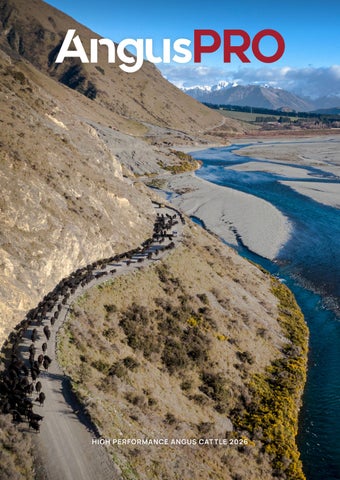
AngusPRO Magazine 2026

Page 1


FROM THE EDITOR

Welcome to this edition of AngusPRO magazine, packed with technical insights and on farm innovation from progressive farmers across New Zealand.

The past twelve months have delivered exactly what quality genetics promise. We have seen strong returns, premium pricing, and markets rewarding producers who get it right. Angus beef and cattle are driving this success, and the momentum isn't slowing.

Throughout these pages, you'll find practical, forward-thinking approaches to breeding and production. But the person who matters most is the consumer. None of this works without consumer demand, and branded Angus beef products are commanding shelf space and premium prices because consumers know what Angus means. It delivers consistency, quality, and an exceptional eating experience when it's farmed right.

Our job is to keep delivering on that promise. Superior genetics. Proven performance. Exceptional beef. When we maintain these standards from paddock to plate, consumer demand takes care of itself.

The data is clear, the markets are responding, and New Zealand Angus is positioned exactly where it should be. Right at the front of the pack.

COVER PHOTO Sarah Horrocks

EDITOR Sarah Horrocks

SUB-EDITOR Sarah Horrocks

DESIGNER Emily Rees Design

ANGUSPRO CHAIRMAN Daimien Reynolds

The views expressed in this magazine are not necessarily the views of Angus Australia or of the AngusPRO members here in New Zealand.

AngusPRO - Our Story

AngusPRO is the collective voice of New Zealand's leading Angus studs, representing about 40% of the country's registered Angus cattle. Our members have united under the progressive governance of Angus Australia, accessing world class genetic evaluation systems and breed development programs that set the global standard for breeding innovation.

Angus Australia's industry leadership provides AngusPRO members and their clients with unparalleled resources, including a support network of over 30 specialist staff, comprehensive educational programs, cutting edge technological tools, extensive research capabilities, and continuous breed development initiatives.

Everyone in the industry knows that profitability within a cattle system can be improved by making educated predictions with factual data. It's scientifically proven. While ensuring cattle are of sound structure and are quiet in nature, the additional use of science and genomics can assist in viewing what's under the skin of an animal, providing an insight into what future progeny will look like, grow like, breed like and essentially, eat like.

Angus cattle are the backbone of New Zealand's beef industry because they're purpose built for our conditions. In the commercial environment, they're expected to survive. Amid winter conditions of driving rain and inches of snow, they will forage and not only survive, but they will thrive. It's in their DNA. AngusPRO genetics demonstrate the resilience, fertility, and efficiency that New Zealand's diverse farming systems demand.

When stud females are mated as heifers, this replicates the commercial farming model and improves overall fertility within the

herd. Increased profitability is therefore bred into those progeny, so to speak. EBVs are the best available tool we have in predicting the performance of future progeny, and when stud breeders use technologies such as Zoetis HD50k, the accuracy of EBVs and Indexes is increased.

While increased profitability for commercial farmers drives our breeding decisions, producing exceptional grass-fed eating experiences for consumers remains an equally important focus. New Zealand's premium beef reputation in international markets begins with superior genetics, and AngusPRO members take pride in their role at the start of this quality chain.

Sustainable farming practice isn't a box ticking exercise. It's fundamental to how AngusPRO members operate. Protecting New Zealand's environment, maintaining clear waterways, building soil health, and prioritising animal welfare are non-negotiable standards.

Many of the studs represented by AngusPRO have stood the test of time. They are the perfect synergy of old school reputability and new school technique.

AngusPRO is committed to advancing Angus cattle within New Zealand's beef industry, ensuring commercial farmers have access to quality genetics that deliver profitability, and guaranteeing Angus remains the premium choice for beef consumers worldwide.

Superior Genetics. Proven Performance.

UNMATCHED

PGG Wrightson goes beyond just buying and selling stock, we’re the only livestock company in New Zealand with a dedicated team of genetics specialists.

MEET THE TEAM

REACH THE RIGHT BUYERS, WHEREVER THEY ARE

Bidr’s online auction platform enables you to reach a nationwide audience of over 14,000 farmers! CLICK HERE TO FIND OUT MORE

Est. 1989

Fertility. Longevity. Temperament.

Cattle bred to p erform in real farming conditions

✓ Fully recorded PRAC Herd

✓ Quiet, easy- doing stock

✓ Proven, functional genetics

2YR OLD PRIVATE TREATY SALES

From 15th October HASTINGS, HAWKES BAY

Stud Master: Lucien Keightley 0275358113

Breeding the Perfect Cow

Ask Jake Stokman what drives the operation at Stokman Angus Farm, and his answer is simple: "We're trying to breed the perfect cow. We'll get there one day…"

WORDS AND IMAGES BY SARAH HORROCKS

It's this breeding philosophy that shapes everything at the Waikite Valley property, nestled between Rotorua and Taupo on the pumice soils that border Lake Ohakuri. The 200 bulls they produce and sell as yearlings? They're simply the byproduct of that relentless pursuit of the ideal female.

Jake knows that the Angus breed is constantly evolving with the introduction of new technology and new genetic information, so they need to ensure they're fluid in their direction, ensuring females produce offspring that are efficient and profitable for their customers.

“That perfect cow gets back in calf every year after breeding as a heifer; she's fertile, maintains her condition, is structurally sound, and rears a good calf every year," Jake explains.

"You never notice her because you never have her in the yards with any issues, and she just does her job year in and year out.

That perfect cow remains the goal, but Jake's mother Sherrie is excited about where the herd has arrived after decades of careful breeding.

"After building the herd for so long from so few cows, we're now at the stage where we can keep the elite females each year and tighten their uniformity. We can get those 'peas in a pod' cows that produce good calves consistently,” says Sherrie.

BUILT ON MONTANA BLOODLINES

The story of Stokman Angus begins with Sherrie's American roots. Her family has owned Sitz Angus in the Rocky Mountains of Montana, farming Angus cattle for over 100 years, so there's Angus cattle running through the bloodlines.

In 1989, tragedy struck when Sherrie's father, Bob Sitz Sr., was killed in a tractor accident. Sherrie was engaged to Mark at the time and was due to move to New Zealand, but with Sitz being an intensive operation and Sherrie's brothers only in their early twenties, plans changed. Instead, Mark moved to Montana.

They stayed for seven years, and Mark developed a real passion and love for the Angus breed. When they returned to New Zealand in 1997, Sherrie's condition was non-negotiable: they had to bring back embryos from a few of her personal cows.

Three cows were flushed, producing thirty embryos that were implanted into recipient cows in 1998.

"From these, we didn't really kick off the herd we'd planned," Mark recalls. "We got seventeen bull calves and only three heifers."

Undeterred, they tracked down and purchased five cows at the Standen dispersal sale that traced back to QAS Traveler 23-4, owned by Sitz in the USA, and Bando 598. Both bulls were renowned for producing exceptional females. From those foundations, the herd has grown to 430 breeding females with strong maternal traits.

THE NEXT GENERATION

Jake now runs the farm under the guidance of Mark and Sherrie. After completing an AgCom degree at Lincoln University, he's built a house with his fiancée Lexie overlooking the sale complex, positioning himself at the heart of the operation.

The property spans 430 hectares, split between 30 ha retained from the home block where Mark and Sherrie live, and the 400 ha farm that borders Lake Ohakuri and houses the spectacular sale barn. The topography divides roughly into thirds: one third workable with a tractor, one third rolling hills, and one third steep hill country. Much of the flatter, workable land sits down near the sale barn.

TECHNOLOGY DRIVING EFFICIENCY

Two years ago, Stokman made a significant investment in Halter collars, placing them on all the cows and sale bulls, and after sale day, switching the bull's collars onto the replacement heifers. The results have exceeded expectations.

"Last year we did an 8kg lift in the weaning weights of the calves in a below-average season, and dropped ½ a condition score off the cows by making the cows work to maintain pasture quality,” says Jake.

Mark says they invested in Halter for efficiency, to better utilise the pasture on the hills and save on labour and machinery costs.

But Sherrie notes another crucial benefit: the mental health improvement.

"Work is more appealing to staff, especially over winter, with no longer having to shift fences all day."

The Stokmans estimate that even with the collar costs factored in, they're about $40,000 better off this past year.

Beyond Halter, Stokmans employs every available breeding technology. They HD50K everything at birth and carcass scan all heifers.

"We want to have as much information as possible on every animal on the property," says Mark.

“We're selling reliability to our clients, and to be honest, we probably know more about our cattle than we know about our kids," Sherrie jokes.

GLOBAL GENETICS, LOCAL FOCUS

Stokman artificially inseminates 75% of their females to about 23 different sires annually. The sires come from across the world, selected not by geography but by how well they fit the program.

"Having good cow families in their lineage is really important to us for the maternal side of things," Sherrie explains.

Her ongoing connection to Sitz Angus provides insider knowledge.

"I still call and talk to my brothers a lot about the sires, and they give me the inside word on a few bulls. The Sitz herd is run very commercially, so their feedback is invaluable."

There are exciting calves on the ground now, particularly those sired by Hart Network and Sitz Logo. One deliberate strategy sets Stokman apart: they use fresh, diverse sires every year at mating to ensure the bulls offered annually are something new for buyers.

The AI program consists of just one round of fixed-time AI, followed by clean-up bulls going out 36 hours later for one and a half cycles. Only the top-end heifers go through fixed-time AI, about half of the yearling heifer mob. This year, they achieved a 70% hit rate with the heifer AI program, a significant lift from the usual 55-60%. Mark studied information from the USA and tweaked a few program details, which they attribute to the improvement.

Follow-up bulls come from two sources: purchased bulls from studs around New Zealand every couple of years, and their three best yearling bulls retained each year to use on the herd.

NO EXCUSES FOR FERTILITY

Heifer mating isn't optional at Stokman.

"If you're not mating heifers, your mortgage can't be that high," Jake says bluntly. "If you're thinking about efficiency, you've got to mate heifers. If they can't breed up as a heifer, they're not fertile enough to stay in the herd."

Planned calving begins August 1st for heifers, with the first of four cow mobs starting August 15th. Calving finishes by October 1st, keeping the operation tight and manageable.

THE YEARLING ADVANTAGE

Mark and Sherrie made an early strategic decision to sell all their bulls as yearlings rather than as two-year-olds. The reasons are both practical and philosophical.

"We're cow rich and land poor," Jake explains. "Selling the bulls as yearlings gives us more space to grow the beef cow numbers. One thing we learned in America is that yearling bulls have a real place in the market. They're more reasonably priced, you can use them on either cows or heifers, they're easier to handle, and they give you an extra year of longevity."

In the lead-up to the sale, bulls spend six weeks on saved grass pasture after being wintered in two mobs on kale and swedes.

Only a few bulls are held as back ups, in case a client has a death or breakdown with their bulls. Buyers know that the yearling bull sale is their best chance to purchase a Stokman bull.

MAKING THE LAND WORK SMARTER

The pumice soils at Waikite are, as Jake describes, "very forgiving and free-draining. We can utilize about 95% of the grass we put in front of cows in winter without pugging."

The property is normally summer-safe, consistently getting rain when needed.

The autumn-calving cow herd serves a dual purpose as a

clean-up tool. Once they wean their calves, they're used to tidy pastures and mop up rank grass.

"They're in work mode," Jake says, though he adds with a grin, "I do despise them in winter when they're a lactating cow.”

The autumn-born bulls are sold to regular clients, with Sherrie noting, "We pretty much have standing orders for the autumnborn 18-month-old bulls."

The spring calving cows are wintered for eight weeks on crops to allow pasture covers to increase on the hills. They're brought off just prior to calving, which is done behind a virtual wire for ease of management with tagging and weighing calves.

As Mark puts it, "Angus cows are bred tough. After we wean the calves, they can be put on rough pasture and they'll burn a bale of silage off their backs."

BREEDING FOR THE COMMERCIAL FARMER

The Stokmans are crystal clear about their client: they're the commercial farmer looking for calves that come easily with no problems and grow well into moderate-framed adults.

When selecting herd sires, bulls must have calving ease, moderate birth weight, above average growth and positive carcass merit. They also must be physically appealing, quiet, and sound.

While Sherrie was initially sceptical about focusing on carcass traits without financial rewards for quality over quantity, that changed ten years ago. They are now placing greater emphasis on enhancing carcass quality by selecting sires that rank above the breed average for key performance traits.

"We know that marbling and grass-fed beef is a very marketable commodity, both here in New Zealand and in the export market," says Mark.

There are fewer dairy farmers buying bulls at the sale now, but those finishing their own dairy cross beef calves continue to attend annually, seeking bulls that will deliver calves that perform. The Stokmans are seeing an increased demand for their semen, for use in AI programs.

DIVERSIFICATION AND THE FUTURE

Since selling the dairy farm nine years ago, diversification has become a key part of the business strategy. Tourism on-farm through accommodation at 'The Stokman' cabins and the wedding venue at the sale barn provide additional revenue streams. The accommodation is booked for around 40-50 nights per year.

The multipurpose sale venue, built in 2018 in a spectacular

position beside Lake Ohakuri on the Waikato River, hosts more than just bull sales, with outside businesses booking it for functions and parties, as well as the weddings.

NO STANDING STILL

There are no sitting ducks at Stokman Angus Farm. If cattle aren't progressing and moving forward, they're down the road. It's a philosophy that extends beyond individual animals to the entire breeding program.

"New Zealand has diversity within the Angus breed, which is good. But if we as breeders don't progress and keep improving the economically important traits, we are at risk of being replaced by breeders selling crossbred bulls," says Mark.

Mark, Sherrie, and now Jake feel they have a duty to provide the beef sector with cattle that improve year on year with the help of modern genetics. The improving genetic gains within their herd, combined with the premiums becoming readily available for qualifying Angus cattle, make Stokman cattle increasingly appealing for commercial farmers.

And that perfect cow? She's getting closer with every breeding season.

E ortless rotational E ortless rotational grazing for beef farms grazing for beef farms

Through virtual fencing and remote shifting

“We’re intensively farming on our whole farm, which we’ve never been able to do before. We’ve already seen the ability to convert pasture to kilograms of liveweight gain to a level more than double a traditional farming system.”

Jon and Fiona Sherlock – Otorohaea, Waikato

Maximising Your Investment: Key Considerations for Bull Selection

Selecting the right bulls is one of the most critical decisions you’ll make for your herd’s future productivity and profitability. With the AngusPRO sales offering exceptional genetics, here are essential breeding tips to guide your selection process.

START WITH YOUR BREEDING OBJECTIVES

Before evaluating any bull, clearly define your breeding goals. Are you focusing on maternal traits, growth performance, or carcass quality? Different bulls excel in different areas, and matching their strengths to your objectives is crucial for success.

EVALUATE STRUCTURE AND SOUNDNESS

Visual appraisal remains fundamental. Look for bulls with correct feet and leg structure, good muscling, and docility. A bull must be physically sound to effectively service cows and pass on desirable traits. Pay particular attention to:

• Scrotal circumference and testicle quality

• Correct leg angles and hoof structure

• Strong topline and adequate bone

• Alert demeanor and good temperament

UNDERSTAND THE NUMBERS

EBVs (Estimated Breeding Values) provide objective data on genetic potential for offspring. Focus on traits that align with your goals. Consider the accuracy of EBVs –higher accuracy indicates more reliable predictions and where AngusPRO members have utilised genomic testing (eg HD50K), accuracy will be improved.

CONSIDER MATERNAL GRANDSIRE POTENTIAL

Today's yearling bulls will be tomorrow's maternal grandsires. Their daughters' maternal ability will significantly impact your herd's long-term productivity. Evaluate milk production, mature cow traits, and fertility traits carefully.

BALANCE IS KEY

Avoid the temptation to select bulls based on a single outstanding trait. The most profitable bulls typically offer good balance across multiple economically important characteristics. Remember, you're building a sustainable breeding program, not chasing trends.

Breeding for Predictability at Hauiti Farm

On a 215-hectare (effective) Hawke’s Bay block in the North Island of New Zealand, a commercial beef producer is running his operation with the discipline of a stud. The results are making people sit up and take notice.

WORDS AND IMAGES BY

Wayne Breeze is not a man who does things by halves, and the banker, turned farmer, is determined to squeeze every drop of juice out of his operation. At Hauiti Farm in Poukawa, Hawke's Bay, he has built a beef finishing system that most commercial operators would consider the domain of elite stud breeders. Everything is weighed at birth. Genetics are matched with the precision of a stud programme. Kill sheet data flows back up the supply chain to inform the next generation of sire selections. And every steer on the place is targeted to finish prime on grass, at 340 to 350 kilograms carcase weight, in under 18 months.

The objective, as Wayne states it plainly, is predictability. Predictability in the animal, predictability in the feed, and predictability in the commercial outcome. It is a word he returns to throughout our conversation, and it is the thread that connects every decision made on the farm.

"Increased beef per hectare and the shorter you can finish them, the better," says Wayne.

"Predictability relates to both the animals, via genetics, and the feed produced so that we can grow them out.”

THE GENETIC FOUNDATION

Hauiti Farm runs as a closed commercial system in close association with Te Mania Angus. The relationship began with bull purchases, but Wayne quickly realised that putting elite genetics over an unknown cow base was limiting the programme's potential.

"Even if you pick great bulls with good genotype, if you don't know what they're covering, I don't know how you can expect good results.”

The issue, as Wayne understood it, partly came down to epigenetics. The cow's influence over her progeny extends well beyond the DNA she passes on. Nutrition, environment, and management experienced by the dam directly modify gene expression in her offspring, with effects that can carry across generations.

"Why shouldn't we be able to utilise the same genetic knowledge and technology that the studs are using? It's available.” “

Wayne is clear on what this means in practical terms: the female is the most important part of the equation, accounting for approximately 75 percent of the epigenetic influence on the calf.

So once he decided he needed to sort out his cow herd, Wayne worked with Will Wilding at Te Mania and genetic advisors Targeted Breeding, led by Jo Scott, to replace his original mixed-background cow herd with surplus Te Mania females. The replacements were not culls. Wayne and Will selected the cows together, with a clear shared objective. He wanted fast finishers.

"Why shouldn't we be able to utilise the same genetic knowledge and technology that the studs are using? It's available.”

The cow herd was replaced two years ago in 2024. Targeted Breeding now applies the same sire-matching principles to Hauiti's cows that they would use in a stud environment, with the difference being that the progeny are destined for commercial beef production rather than the bull sale ring. Hauiti currently runs 171 females to the bull each year, including yearling heifers.

Sire selection draws on full genotype data with high accuracy figures. MateSel sire selection technology is used to ensure the right bulls go over the right females, optimising the desired outcome at an individual pairing level rather than applying a blanket bull-to-mob approach. Wayne's herd will also be registered with Angus Australia as an APR herd in the coming months, bringing further structure and traceability to the programme.

The follow-up bulls are all Te Mania bulls, and Will is assisting to ensure the right sires are selected for both the females at Hauiti and the desired finishing outcome.

AI AND CONCEPTION RATES

Artificial insemination is part of the programme, though Wayne is candid about the variable results they have experienced so far. The first AI run on the cow herd returned an 88 percent conception rate, a result he was told at the time was unusually strong. More recently, the heifer mob returned just 43 percent, which was obviously disappointing.

The outcome was compounded by a follow-up bull being injured, which left a proportion of the heifers dry. It was a reminder that even the most carefully designed genetic programme carries

biological and logistical variables that do not always cooperate.

Wayne notes that the skill of the technician applying the AI semen carries a significant influence on conception outcomes. Human execution remains a critical link in the chain.

FINISHING TARGET: ONE WINTER, PRIME GRADE

The commercial logic of the Hauiti system centres on a single, powerful metric: finishing steers in one winter rather than two. Wayne has done the arithmetic carefully.

"If you do the numbers, having your finishing stock do only one winter increases the MA carrying capacity by 25 to 30 percent, which then increases your gross turnover by 25 to 30 percent.”

Calves born in August and September are targeted to hit 340 to 350 kilograms carcase weight by January/February of the following year, with the balance finishing by late March. That puts the steers through a single winter before processing, cutting out a full year of feed conversion at a less efficient stage of growth, freeing up pasture for additional stock, and reducing the amount of winter cropping required.

The initial programme was designed to finish steers at 17 to 18 months. In practice, Wayne found he needed to pull the first draft earlier, at around 15 to 16 months, to prevent the faster growing

animals from exceeding the premium weight grade window. It is a good problem to have.

Average daily liveweight gain from birth to weaning sits between 1.06 and 1.12 kilograms per day. From there, the target is to hold above one kilogram per day through to the finishing phase, where the steers are recording gains of 1.4 to 1.5 kilograms per day.

The processing yield is also worth noting, achieving 53.74% average in the February 2025 killed steers, and increasing to 54.9% average in the February 2026 killed steers. Wayne finds the yield increases by 2-3% as they come into autumn each year.

All stock is processed through Silver Fern Farms at Whakatu. The progeny consistently grade into Silver Fern Farms' EQ specification, driven by intramuscular fat levels that Wayne attributes to the genetic programme and the feeding system working together. He is looking to push IMF performance further still, positioning the herd ahead of any premium market opportunities that may develop.

"New Zealand currently has a bulk commodity market for buying cattle for processing," he says.

"We produce highly certified beef that is overqualified for the prices being paid. That has to be fixed."

He sees it as a ‘chicken and egg' situation: the premium market requires a product to attract consumers, but processors will not pay premium prices until consumers are already paying them. His response is to be ready when the equation shifts.

COW CONDITION AND THE FEED EFFICIENCY EQUATION

A central belief in Wayne's system is that capital stock must never be allowed to take a backward step in body condition. His cows are fed well throughout the year, without compromise. The reasoning is grounded in both Beef and Lamb New Zealand research and epigenetic science.

"Putting a kilo onto a cow requires six to eight times more feed than is required to put a kilo on a calf. We just don't let the girls get hungry, which also means they're even better mothers.”

Maintaining cow condition means the breeding females are not competing with the finishing progeny for feed. It also means calves are not compromised during gestation, allowing intramuscular fat development to proceed without interruption in utero. Wayne is clear that calves born from well-conditioned, well-fed cows go on to finish faster and more consistently than those that start life at a nutritional deficit.

Calves do stall at weaning in terms of growth rate, but they

do not go backwards. That baseline is protected by the cow management approach, and it sets the platform for the daily gain targets through the finishing phase.

Cow size is also managed deliberately. The herd averages 612 kilograms liveweight, and Wayne has no interest in running heavier cows. A larger-framed cow consumes more feed to maintain condition without a proportionate return in productivity. In a system built around feed conversion efficiency, every kilogram of cow weight carries a higher ongoing feed cost.

PASTURE, SOIL, AND LOW-INPUT PHILOSOPHY

The feed system underpinning Hauiti's performance is grassbased and deliberately low in purchased inputs. Wayne runs high pasture covers and pays close attention to what is happening beneath the sward surface. Visual soil assessments are a regular practice on the farm.

"We dig a lot of holes," he laughs.

Nitrogen application is kept to a minimum. Wayne relies on clover to do the nitrogen fixation work, using artificial nitrogen down the shoot when re-grassing. The rationale is straightforward: a healthy soil biology supporting a strong clover content delivers the same result at a fraction of the cost, without disrupting the soil ecology that underpins long-term pasture performance.

After each grazing rotation, harrows are run through the paddocks. The practice serves two functions. It spreads cattle dung across the pasture as a nutrient source, and it eliminates the bare patches that form where a dung pat sits, which would otherwise become thistle strike points months later. On an intensive hill country block, the flow-on benefit to pasture quality over successive seasons is meaningful.

The bottom of the property is a river flat carrying willows, which provide the equivalent of bales of summer feed for the finishing steers without any cultivation or supplementary feed cost.

Fencing infrastructure is managed with the same cost-conscious

Te Mania's Vytelle system supports feed intake and efficiency monitoring on the stud side, building a body of information that Wayne can draw on without needing to replicate the infrastructure himself. “

approach. Wayne sources ex-vineyard grape posts at one dollar each. These tanalised posts cannot be landfilled or burned, making them essentially worthless to the vineyard sector. With Hawke's Bay's wine industry making a shift toward steel posts in the coming years, Wayne expects a significant and ongoing supply of low-cost fencing material. Not running any sheep means a simple post and two wire fence for block delineation within larger paddocks meets his requirements, keeping infrastructure costs well below those of a traditional sheep and beef block.

DATA, FEEDBACK LOOPS, AND THE COMMERCIAL CONTROL

Wayne describes Hauiti Farm as a commercial control operation relative to Te Mania NZ's stud operation. Kill sheets go back to Te Mania after each processing run, feeding carcase data into the stud's own records. Te Mania contributes monitoring data

from the dam side, and that information flows back through the system. The relationship is collaborative and data-driven in both directions.

Te Mania's Vytelle system supports feed intake and efficiency monitoring on the stud side, building a body of information that Wayne can draw on without needing to replicate the infrastructure himself. He is direct about New Zealand's position in this space: the country is not pioneering the research, but working to validate whether findings from other systems are relevant to local pastoral conditions.

On methane, the early data from fast-growing cattle is pointing in an interesting direction.

"Funnily enough, fast-growing cattle produce less methane. That's what the raw data is saying."

His interpretation, while noting that his third form science may not make him an expert, is practical. “Feed energy either converts to growth, is belched as methane, or passes out the backend.”

A more efficient converter simply has less to lose. From an emissions standpoint, cattle that finish on grass in 15 to 16 months surely represent one of the lowest-footprint beef production systems in the world. This is surely a question that must be asked…

He does not overlook the genetic diversity question. Wayne holds concerns about the concentration of genetics across the New Zealand dairy industry, and applies the same thinking to his own programme: individual bulls, matched precisely to individual females through tools such as MateSel, rather than broad genetic concentration across a herd.

WHAT COMES NEXT

The Hauiti herd is young. With the herd of predominantly heifers purchased only two years ago, the age structure is weighted toward the younger end of the scale. The target cow exit policy is to sell cows at five years of age, in calf, with a fully documented genetic history and a predictable expected finishing outcome for the calf on board.

"We want to start exporting [domestically] that predictability off farm, at scale, every year.”

In round numbers, Wayne expects to scale up further and be moving 80 to 100 females annually. The closed herd is currently retaining most heifers as replacements, building toward a point where the scale of the programme justifies regular commercial sales of foundation females.

Embryo transfer was considered and set aside. Wayne's concern was the epigenetic influence of the recipient dam, which would complicate the very consistency he is trying to build. Starting with actual genetic mothers kept the programme clean and the data interpretable.

At 240 hectares, Hauiti Farm is not a large operation by Hawke's Bay standards. But the system Wayne has built on it, by combining elite genetics, disciplined pasture management, low-input infrastructure, and a genuine commitment to data, is producing results that scale well beyond what most would consider achievable on a commercial finishing block.

The numbers back it up. One winter to premium grade and a kill sheet that keeps improving. Predictability, as Wayne Breeze would say, is the point.

One Stud, Two Herds

Back in the day, Norm Hoggard used to look across at the farm now called Totaranui and say, “One day, I' ll own that.”

He made it happen.

He named it Totaranui after the big old podocarp trees still standing on the place, and in 1937, he brought in Angus females from Scotland and got the stud underway. That was the start of something that's now four generations deep.

These days, Norm's great-grandchildren are all involved, carrying it on. The stud runs over 500 females and has been steadily built over the years, first under Norm, then John and Mary Anne Jackson, and now with Tally Jackson and Daimien Reynolds putting their own stamp on it.

The focus of the stud incorporates two clear breeding objectives. One is maternal, the other terminal.

On the maternal side, Totaranui breeds using genomics and data-driven decisions to produce fertile, growthy, carcase-trait cattle, with bulls sold in June as two-year-olds. All bulls in the sale carry either the AngusPure A or A+ endorsement.

On the terminal side is a herd dedicated to low birthweight, performance cattle, producing yearling bulls for heifer mating, for sale in September.

The two programmes allow the stud to run a larger number of cows without oversupplying either market, and give plenty of culling power to ensure the standard is high at both sales.

Totaranui has never stood still. They were early into genomics, but it's always been built on good type, sound structure and stock that lasts. Fertility isn't negotiable either, and every yearling heifer has been mated for over 35 years. If they can't get in calf, they're down the road.

Totaranui isn't about selling just another black bull. It's for farmers who want cattle that genuinely perform, and who understand that a bull is an investment that will produce cattle that do more than just tidy up a sheep block.

What does the Totaranui name stand for? Excellent cattle. Great people. Strong relationships. Family and staff are working together and enjoying what they do. It's about playing the long game, staying profitable, building something solid, and remembering that while cattle matter, people matter more.

Tim Brittain Concludes Distinguished Tenure as World Angus Secretariat’s Secretary General

After eight years of dedicated service, Tim Brittain completed his tenure as Secretary General of the World Angus Secretariat in May 2025, marking the end of a chapter in his extensive career championing the Angus breed.

WORDS BY SARAH HORROCKS

Brittain's leadership journey with the breed spans well beyond his Secretariat role. As owner of the respected Storth Oaks Angus stud in Otorohanga, he has established himself as one of New Zealand's premier Angus breeders. His stud is known for producing quality genetics that have influenced Angus herds throughout New Zealand and beyond.

Prior to his Secretariat position, Brittain served as President of Angus New Zealand 2012-2014 and was made a Life Member. He was Chairman of AngusPure NZ from 2005-2023, and also Chairman of AngusPRO from its inception in 2019 until February 2025, demonstrating his long-standing commitment to Angus excellence and industry advancement.

One of Brittain's most significant achievements during his tenure was facilitating the transition of New Zealand's AngusPRO

While stepping down from the Secretariat, Brittain continues his hands-on involvement with the breed through his Storth Oaks operation, where he puts into practice the progressive breeding principles he championed throughout his career in industry leadership.

breeders to Angus Australia's animal recording inventory. By facilitating the shift to Angus Australia, Brittain opened the gateway to world-class technological and education facilities for both the AngusPRO studs involved and their clients.

Throughout his eight years at the helm of the World Angus Secretariat, Brittain consistently advocated for modernisation for continued success in changing global markets. During his tenure the Secretariat grew to 28 countries, with six new countries joining in the last two years alone.

The practical insights gained from operating Storth Oaks Angus stud helped ensure his vision remained grounded in the realities faced by breeders, adding credibility to his leadership. His leadership style, characterised by thoughtful diplomacy and forward-thinking vision, helped navigate the organisation through evolving challenges in the beef industry, from shifting consumer preferences to emerging technologies in genetic evaluation.

As the baton passes to his successor, William McLaren from Scotland, Brittain leaves behind a legacy of strengthened

international relationships, enhanced data systems, and a more connected global Angus community.

Industry leaders have acknowledged Brittain's contributions as transformative, noting that his work has not only elevated the profile of the World Angus Secretariat but has also created lasting structures that will continue to serve Angus breeders worldwide.

While stepping down from the Secretariat, Brittain continues his hands-on involvement with the breed through his Storth Oaks operation, where he puts into practice the progressive breeding principles he championed throughout his career in industry leadership.

Brittain's dedication to the Angus breed throughout his career exemplifies the passion and commitment that drives the continued excellence and global prominence of Angus cattle. His experience as both a successful stud breeder and industry leader gives him a unique vantage point that bridges practical implementation with strategic vision.

Unlocking Genetic Potential for Feed Efficiency and Reproductive Success

The introduction of the Mature Body Condition EBV, used exclusively by Angus Australia (AngusPRO) breeders here in New Zealand, represents one of the most significant advancements in Angus genetic evaluation in recent years. This powerful tool allows producers to select for cows that will have improved body condition scores at weaning, directly impacting profitability and herd sustainability.

It's important to note that the Mature Body Condition EBV provided by Angus Australia is genomically enhanced and has a very strong reference population. Within the Angus Australia database, there are over 68,800 animals that have a phenotypic score for body condition, including females in the Angus Sire Benchmarking Program (ASBP). The greater the reference population, the greater the accuracy.

WHAT THE MATURE BODY CONDITION EBV MEASURES

The Mature Body Condition EBV predicts the genetic tendency for a bull's daughters to maintain body condition score throughout lactation to weaning. This trait reflects the cow's inherent ability to partition nutrients efficiently between maintenance, lactation, and reproduction – essentially measuring metabolic efficiency at the cow level.

THE METABOLIC EFFICIENCY ADVANTAGE

Cows with higher Mature Body Condition EBVs possess the genetic potential to maintain adequate flesh while meeting the energy demands of milk production and reproduction. This genetic advantage typically translates into:

• Improved rebreeding rates and shorter calving intervals

• Greater resilience during drought or poor pasture conditions

• Enhanced longevity and lifetime productivity

• Lower overall production costs per calf weaned

BODY CONDITION AND REPRODUCTIVE PERFORMANCE

Research consistently shows that cows maintaining body condition score 5 or above (Beef & Lamb NZ system) have significantly higher conception rates. Cows with genetic potential for maintaining condition are more likely to:

• Cycle earlier post-calving

• Show stronger estrus behaviour

• Maintain pregnancies successfully

• Produce more calves over their lifetime

CORRELATION WITH MATURE COW WEIGHT

Mature Body Condition is strongly positively correlated with Mature Cow Weight (0.87). So, if farmers are selecting for higher MBC, they're also increasing cow weight – which isn't always a desired outcome.

ECONOMIC IMPACT ON YOUR OPERATION

The economic value of improved body condition maintenance is substantial. Studies indicate that cows with superior body condition genetics can:

• Increase weaning rates

• Extend productive life

• Improve overall herd profitability

These improvements compound over time, making the Mature Body Condition EBV one of the most economically important traits for commercial operations.

THE BOTTOM LINE

Mature Body Condition EBVs offer an unprecedented opportunity to improve cow efficiency and profitability. By selecting bulls with positive values for this trait, you're investing in cow families that will thrive in your environment while reducing production costs and improving reproductive performance. This genetic tool represents a pathway to more sustainable, profitable beef production.

Fostering Relationships in Raetihi

Raetihi farmer Mark Bennett is a cattle man through and through; his beloved Angus cattle are the priority stock class on the farm, and he refers to them as his “little black goldmine”, never failing to deliver a return.

Aproud family history and tradition are at the heart of Mark and Glenda Bennett's drystock Raetihi farm, coupled with an eye to the future and willingness to adapt as the next generation takes the reins.

Mark is proudly old school, but open to change, as his son Robert takes over the running of the Ngapakihi Partnership, the fifth generation of Bennetts to farm the land. So long as Robert doesn't sell the Angus herd, family relations will remain intact.

“We are in farm succession right now. Robert, his partner Brooke and son Grady, 2, are taking over. He's one of four boys, and he is the one who was interested in farming; the other boys all have their own careers. This is his third year here at home. He, Brooke and Grady are the future. I'm just the old dog on his way out,” Mark laughs.

The partnership was named after the Ngapakihi survey block, and Mark confesses he is “old fashioned”, an acres and inches man. The farm is 1200 acres, comprising 550 acres of rolling hill

country and 650 acres of flat, with about 150 acres of native bush. Soils are free-draining volcanic loam ash, and annual rainfall is about 60 inches.

Winters can be harsh, which limits the stock carrying capacity.

Stock policies are low fuss, with 800 breeding ewes (Wairere Romney ram) and 160 Angus breeding cows (Ranui Angus bulls). All progeny are fattened on an all-grass and clover feed system. Five-year-old ewes go to a Ranui Hampshire black face ram and lamb in August, while the white face ewes lamb in early to midSeptember.

Lambs are picked regularly as they are ready, at about 21 kg carcase weight.

“You can only sell it once, so we try to maximise the weight.”

The emphasis is on easy care, low input stock classes, and the Angus cattle herd has been heavily influenced by American genetics over the years, thanks to the bulls purchased from Ranui Angus.

The Bennetts keep all their own replacements, 35 heifers a year, and culls go to local trade (AFFCO).

When picking animals, which are all killed through AFFCO, there are no scales; it's all done by eye.

“The first cattle pick is at about two-and-a-half-years. The buyer comes and picks solely on condition, same as the lambs. No scales, old school.”

In keeping with the traditional approach, there is no heifer or hogget mating, stock is allowed to grow and mature.

“We don't pull any calves, I think we have pulled one in 15 years, and that was because it was breech. To me, that's the American bloodlines, the easy calving. The cattle are easy care now.”

Mark's preference for his cattle is clear; he reduced sheep numbers over the years, and cattle are treated as top priority. The sheep are getting pushed back into the hills, and the cattle are taking over on the flats.

“My father was running 2000 breeding ewes in the 80s and 90s, I'm down to 800. We have gone more and more cattle, though we've always had a higher ratio of cattle to sheep.”

The reason is simple – economics.

“Beef has been pretty steady over the years; lamb jumps up and down. Cattle are the most important stock class. I describe my Angus herd as a little black goldmine. It would be the last class of stock I would ever get rid of.”

Mark likes the hardiness of the Angus breed, especially in cold Raetihi winters. Cattle are wintered on the hill country in the bush from early May to September 1, when they come down to the flats to calve.

“The harder the winter, the deeper into the bush they go. They're really good doers; they get out and forage. Then they come down and deliver a calf, calve easily, and we've got the temperament sorted, too. We can walk around cows and calves, and they don't bat an eyelid – that's solely down to buying Ranui bulls with good temperaments.”

The only exception to the all-grass system is a swede crop, used for replacement heifers and weaners.

“The last 10 years we have just set-stocked the cows. My father used to have a sacrifice paddock and break feed them, but he had a bit of trouble with them getting mis-mothered when shedding them out.”

We

bought a lot of Pine Drive bulls and offshoots of Pine Drive Big Sky. That really changed our breed; we got the height and length.

Set-stocked cows are given daily baleage and magnesium, which has virtually eliminated the grass staggers that plagued them through the 80s.

LONG-STANDING RELATIONSHIP

Unsurprisingly, the Bennett family's relationship with the Johnstone family at Ranui Angus is a long standing one. Three generations of Bennetts have purchased bulls and rams from three corresponding generations of Johnstones, an association that reaches back more than 50 years.

Mark's grandfather first went to Ranui to buy bulls in 1974 from Lindsay senior (he explains that the eldest boy in each generation of Johnstones at Ranui has been named Lindsay).

“My grandfather went to Lindsay Johnstone Senior in Te Puke, before they moved to where they are now in Whanganui. They [Ranui] just had their 45th bull sale; we were buying them before that, when they were doing home sales at Te Puke.”

Mark values the history they have with the Johnstones and explains that Ranui genetics have influenced his own herd hugely, as they looked to create a larger framed cattle beast that would kill out at heavy weights, without running over-fat.

“When I left school at 17 and came home here, we were happy if a two-year-old Angus steer killed out at 270kg. They were shorter, fatter cattle, and it was hard to get weight into them. Through the Johnstones, we have gone to larger framed cattle; we wanted to get some size into them.”

For Mark personally, the breakthrough came when Lindsay Snr (Lin), whom his father dealt with, went to Montana, America and started to introduce American bloodlines, particularly through the use of a bull called Pine Drive.

“We bought a lot of Pine Drive bulls and offshoots of Pine Drive Big Sky. That really changed our breed; we got the height and length.”

With the introduction of Estimated Breeding Values (EBVs) the Bennetts began buying based on negative rib fat, chasing the leaner genetics.

“This was because we had got our cattle so big we wanted something we could stuff a lot of grass into without getting the over-fats or trimmers.”

Other EBVs they factored in included low birthweight, good growth rates and lower body fat.

“Pine Drive Big Sky was a big American bull who had all the characteristics we wanted. We followed that up with a lot of American blood, including Scotch Cap and we are on to Hoover Dam now.”

Lindsay Snr (Lin) passed away a few years ago, but his son Lindsay carried on with the American blood and also introduced some Australian genetics.

These days, when looking at traits, Mark's number one priority is temperament. They still look for relatively low birthweight and have just moved to positive rib fat, as they have reached the

stage where they can keep pushing feed into the cattle, which get heavier and heavier, without going over-fat.

Mark also buys black face Hampshire rams from the Johnstone family.

“They have been very good to us.”

Generally, the Bennetts operate a one in, one out policy when it comes to bulls, purchasing one annually, but on the odd occasion, they have purchased two.

CHANGING TIMES

Despite Mark's self-confessed old school tendencies, he is on board with Robert's decision to move away from wool, last year purchasing two purebred Nudie rams from Wairere.

“He doesn't like dags, obviously, and he's going to change to wool-less sheep. That's the young guy coming through. It's a big call, we can always breed our way back I suppose, but what dollars per kilogram would wool have to go to before you go back to wool, $10 or $12 greasy?”

Mark says they're competing with nylon and there's no shortage of it in the world. He just can't see people paying megabucks for wool.

“We have given up on wool, and we're going to raise our sheep like we are raising our cattle – dock, drench, go on the truck.”

All the work currently is in sheep, Mark says; the cattle are easy. The move to Nudies represents a desire for lower inputs and less labour.

Mark is philosophical about the demise of wool.

“It's probably not what a lot of people want to hear, but it's how it is.”

It takes 1.5 labour units to run the farm at the moment, Mark being the .5, and he believes Robert will be able to run at one labour unit in the future.

Development of the ground is complete, and stumping is finished.

“I purchased a digger and finished the last 50 acres they had given up on. My grandfather came here in 1960, it was 2500 acres, a lot in stumps and cut over native bush. They had a D8 Caterpillar bulldozer from their sawmill days and pushed all the stumps into windrows that provide shelter, a lot was burned too – that took 20 years,” Mark recalls.

When Mark's grandfather was running the place, there were five full-time staff employed.

“That's how it's gone with machinery and technology; we can now run it with one man. I think now, it will just be a case of refining things on the farm.”

In many ways, the changing of the guard at the Bennett family farm has mirrored succession at Ranui, representing a willingness to adapt and evolve while honouring the traditional way of doing things.

“The future, my future, is succession with my son. What Lindsay and his wife Maria are doing now with AngusPRO and registering with Angus Australia, importing Australian blood and keeping up with the Americans, I think this new direction means he is still advancing his stud.

“They brought in the temperament score and more structural assessments. I still pick by eye, but my son, he is more interested in buying a bull on figures.”

Mark believes that's why you get out and let the young guy have a go, they have new ideas.

“As long as he doesn't sell the Angus cattle, I will be happy.”

ARTIFICIAL BREEDING SPECIALISTS

• Export Centres for Semen and Embryo collections

• Fertility Evaluations and on Farm Freezing of semen

• AI programs and Fresh Semen collection for AI

• Import and Export of Semen and Embryos

• Storage of all species and Despatching Services

06 376 4955 tararuabreedingcentre@tvg.co.nz tararuabreeding.nz

Tararua Breeding Centre Part of Totally Vets Ltd

Angus Proves Performance in Beef Progeny Test

For AngusPRO breeders, the latest results in Beef + Lamb New Zealand's Beef Progeny Test report deliver a clear message; Angus continues to perform strongly, and in several key maternal traits, the breed is showing real strength.

For more than a decade, Beef + Lamb New Zealand (B+LNZ)'s Beef Progeny Test (BPT) has been building a comprehensive commercial beef dataset. A defining feature of the programme has been the retention of as many commercially viable daughters from maternal Progeny Test sires as possible within the cow herds, allowing maternal traits to be measured across multiple years and calvings.

The most recent report, published at the end of February, focuses on maternal performance for sires involved in both the original

Beef Progeny Test and the ongoing INZB across-breed Beef Progeny Test. Together, these results provide insight into how sires have performed over time, and how they're stacking up in the current across-breed Progeny Test.

COW SIZE AND CONDITION

Across all breeds in the BPT, the average cow weighed 544.4kg, had a body condition score (BCS) of 6.9 and a hip height of 128.5cm.

Two Angus bulls ranked inside the top ten for mature cow weight. While heavier cows may return more when culled, this trait is highly dependent on environment and farm goals, and bigger isn't always better.

Angus bulls made a stronger impression in body condition. Out of 129 bulls assessed for BCS, nine Angus sires ranked inside the top 20, with three in the top 10, including the #2 and #3 positions. Hip height results followed a similar story, with eight Angus sires among the top 20 sires for this trait.

The report reinforces that body condition score is a highly relevant trait for reproductive success. BCS is moderately heritable, at around 27 percent, meaning there is opportunity to influence a herd's ability to maintain condition through genetic selection.

The report also notes a modest genetic correlation (25 percent) between cow BCS and rib fat depth measured in young heifers and steers. While sires with higher rib fat EBVs tend to produce daughters with slightly higher BCS, the correlation is not strong enough to consider rib fat depth a good predictor for cow BCS on its own. This means that using fat depth EBVs to improve condition score will add a lot of fat to carcasses relative to the improvement in BCS of cows.

MILK AND FERTILITY

Across all breeds, the average pregnancy rate in the BPT was 92 percent, with average days to conception sitting just under 25 days. On both traits, Angus sires performed well.

Of the 97 bulls assessed for pregnancy rate, 30 Angus sires ranked inside the top 50, including nine in the top 10.

Days to conception followed a similar trend: of the 110 sires assessed for this trait, 26 Angus sires ranked inside the top 50, with six appearing in the top 10, including #1 and #3 ranked positions.

The BPT data confirms that both pregnancy rate and days to conception are heritable traits, meaning genetics play an important role. With Angus performing strongly, breeders can be confident that selecting the right sires can improve rebreeding outcomes.

REBREEDING PERFORMANCE

Replacing females after their first successful calving season is the most expensive stage in the lifetime production cycle. Replacement costs are high, and returns from calf weaning up until this point are limited. Greater emphasis on rebreeding ability in two year old rebreeding heifers reduces losses.

Research has shown meaningful sire variation in pregnancy rate (heritability of 12–14%) and days to conception (heritability of 11–21%) in two-year-old heifers, indicating that genetics has a significant impact on the ability of two year olds to rebreed.

These latest results in the Maternal Report underpin the Angus breed's performance across the full spectrum of commercially important traits. At the same time, the across-breed Beef Progeny Test continues to highlight the valuable variation that exists both within and across breeds, and the opportunities this presents for ongoing genetic improvement.

For more detailed information on specific sires and their rankings in these traits, refer to the full report on B+LNZ's website: beeflambnz.com

Footnote:

*Days to Conception – 2-year-old Heifer: Represents the average number of Days to Conception of a sire's daughters, from the time when the first heifer in the mob conceived and calculated from estimated Foetal Age ultrasound scanning. The trait combines both the ability to get pregnant (which is represented in the Pregnancy Rate trait), with credit for getting pregnant early in the mating period.

Similar concept to the Days to Calving (DTC) trait used in BREEDPLAN and presented in sale catalogues, but does not include variation in gestation length. This trait has been reported for heifers at their second breeding (as a 30-month-old heifer).

BEEF RESOURCES TOOLBOX

Better Beef Breeding learning module: Based on the popular workshops, the online module helps farmers to select the right bull for their needs. It can be completed in sections, allowing users to come and go as they wish.

Better Beef Breeding book: From setting breeding objectives to bringing your new bull home This book provides detailed information to guide you through the bull selection process.

Visit beeflambnz.com and search “Better Beef Breeding”

INZB Podcast Series: Each episode offers valuable insights into INZB programme outcomes as well as advancements in livestock genetics. From AI-powered cattle monitoring to genetic tools and the future of beef farming in New Zealand

Visit beeflambnz.com/knowledge-hub

Body condition scoring beef cows

Body Condition Score (BCS) is an important production measure of the energy reserves of an animal, in the form of fat and muscle. Condition scoring to a standard scale allows consistency within and between herds over time and more objective assessment of BCS differences

Carrying out a structural assessment of a bull

There are fed bulls and there are bred bulls, and it is the latter commercial buyers should be targeting when buying bulls. To help farmers select bulls that are functional for a number of years, B+LNZ Genetics has enlisted the services of Accredited Structural Assessment Technician Bill Austin

B+LNZ Genetics, with the help of Austin, has put together a video which steps farmers through the process of assessing the structure and docility of beef bulls using the Beef Class Structural Assessment System

In the 14-minute video, Austin urges farmers to ignore a bull’s overall bodyweight and condition on sale day and focus on whether its Estimated Breeding Values meet their overall breeding objectives and their structural soundness.

The Structural Assessment considers a bull’s temperament, the front and rear claw set, the front and rear feet (hoof angle), the rear legs side and hind views, the front legs’ front view and the sheath and navel.

To view the video visit beeflambnz.com and search “beef class assessment”

Watch a 20-minute video which covers what a Body Condition Score is, why you should utilise this tool, when you can condition score on farm, and demonstrates how to Body Condition Score beef cows. Visit beeflambnz.com and search “Cow BCS”

B+LNZ focuses on Beef on Dairy

How does the beef industry accommodate the 1.8 million calves born on dairy farms every year that are not currently entering the beef supply chain?

They are both an opportunity and a challenge, and Beef + Lamb New Zealand (B+LNZ) is working alongside other organisations to find solutions that benefit both the dairy and red meat industries as work continues to minimise calf wastage.

Duncan Elliott, who has recently joined B+LNZ as an Operations Specialist, is certainly up for the challenge.

He, alongside Lucy Coleman and others in B+LNZ's Farming Excellence and Science and Research teams, is working on various Beef on Dairy projects – all focused on adding value to the calves born on dairy farms by developing commercial tools that can be used at every stage of the value chain.

Duncan says some farmers are doing it well, but there are challenges, particularly with a high-cost production model, and while it can be profitable if farmers get it right, there are pitfalls.

Working from first principles, B+LNZ is working to determine the current state of the industry. This includes surveying calf rearers to better understand how calves are being reared across the country.

“We know we have some large-scale rearers, and there are a huge number of smaller operators, and we are actively seeking feedback from rearers about their systems and what tools they would like from us,” says Duncan.

They also want to know what challenges calf rearers are facing and what success looks like for them.

B+LNZ is working closely with other industry partners and talking to Irish dairy farmers who are world-leading in minimising wastage in the dairy industry by adding value to their nonreplacement calves.

Duncan says they will be drawing on the findings of a number of trials underway.

One is a Massey University trial, which is looking at front-loading feed and milk into calves from an early age: “If you are rearing calves, is there a commercial opportunity to make more quality feed and milk available from an early age to set the calves up for success?”

The pair will also be analysing the wealth of data collected through B+LNZ's Dairy Beef Progeny Trial (DBPT) to understand how it can best be used by the industry.

This includes using the info from the Progeny Test to enable dairy farmers to compare bulls both within and across breeds and find genetics that can add value to their businesses.

Another study is underway looking at how dairy-origin calves sired by good quality beef sires grow and finish compared to industry average beef animals.

This study is being undertaken by On-Farm Research at the Poukawa research farm in Hawkes Bay, which is representative of the many east coast dryland farms where beef cattle are grown and finished.

“We want to know how they perform in the real world under commercial conditions,” says Duncan.

B+LNZ is working closely with other industry partners and talking to Irish dairy farmers who are world-leading in minimising wastage in the dairy industry by adding value to their non-replacement calves.

“While their systems are different, we are keen to collaborate with them.”

Lucy Coleman is a Dunedin based scientist who is leading the communities of practice and extension work for B+LNZ's Beef on Dairy work.

Lucy says while they are looking to establish communities of practice with dairy farmers and calf rearers, ultimately, they will be working towards establishing these communities along the whole Beef on Dairy supply chain.

Lucy did her PhD on phase one of B+LNZ's DBPT, so she feels she has come full circle and is looking forward to taking what was learnt in the initial phase – and the findings of phase two and three – to help dairy farmers, calf rearers and ultimately finishers generate the best value from calves born on dairy farms.

A large piece of her extension work will be around the value of the DBPT and how that data can be used to improve the genetic merit of beef-on-dairy calves.

She says the DBPT has clearly identified bulls that deliver for both dairy farmers – with calving ease, low birthweights and short gestation – and finishers with fast growth rates and good carcase traits.

“B+LNZ is working on ways to speed up the feedback time for the breeders involved, so these DBPT bulls can be better used by dairy farmers. However, the number of progeny-tested bulls is small, and there is a much wider pool of bulls, often younger, available to dairy farmers,” says Lucy.

“The 10 years of data have provided a strong foundation for this work, but progress is still reliant on breeders submitting bulls to the Progeny Test.”

The initial work focuses on breeds that have been wellrepresented in the DBPT, and the team is hoping to include more beef breeds over time.

"While the current dataset gives us a strong base, the work is identifying how we need to fill the gaps for other breeds,” says Lucy.

“Once we have enough data, we can start extrapolating that information across the wider bull community.”

The changing face of Kakahu genetics

Eighteen years ago, Tom Hargreaves gave up his career as a full-time architect to take up the reins of his family's South Canterbury farming business, including the longestablished Kakahu Angus stud.

In that time, the business has added a 175 ha dairy farm to its existing commercial sheep and stud beef operation, become industry and, arguably, world leaders in breeding Charolais bulls for use in the dairy industry, reduced its reliance on two annual bull sales for cash-flow, established a Changus stud, and continued to breed Angus bulls that meet the needs of today's –and tomorrow's – commercial beef breeders and markets.

While it's a far cry from Tom's life as a Melbourne-based architect, it is a life that he and his wife Anna have embraced, and they have enjoyed the challenge of diversifying their business on the solid base built by Tom's parents, Gerald and Sue.

Today, Kakahu covers more than 1600 ha and runs 2000 commercial ewes, 800 commercial cattle, 450 Angus stud cattle, 90 stud Charolais, 60 Changus cows and 420 dairy cows.

Tom says they run an integrated business, testing their genetics through their own dairy cows, ensuring they're breeding bulls they know will add value to both dairy and traditional beef businesses.

Tom and Anna have no desire to sell extremely high-priced bulls. Instead, their focus is on breeding quality animals that remain within reach of the average commercial beef breeder.

They have certainly shown what is possible with their Charolais stud and, seeing the direction of travel around the need to reduce wastage in the dairy industry, have produced bulls that can safely be used across dairy cows to produce high carcase value, fast finishing beef calves.

The Hargreaves bought their Charolais stud 18 years ago, and Tom says they made the decision to breed Charolais with a focus on calving ease and growth rates so they could be used confidently in the dairy industry.

“Ethically, dairy farmers want to reduce the number of bobby calves they produce and are looking for beef cattle to add value to their businesses. They need exceptional calving ease and growth rates, and we have been able to achieve this with our Charolais.”

CHANGE IN FOCUS

Tom describes Kakahu as a diverse business, of which Angus is a part.

Traditionally, 70 percent of Kakahu's income came from two annual Angus bull sales. For Tom and Anna, this represented too much risk, and today bull sales account for 31 percent of income while overall income has doubled over the past 10 years.

“We wanted to improve our income without taking on so much risk,” says Tom.

The Kakahu Angus stud was established by Tom's grandfather in 1954. Tom's parents, Gerald and Sue, grew stud cow numbers to 600, from which they would sell upwards of 300 bulls annually.

Today, they run 450 cows and sell around 200 bulls every year. While numbers have reduced, income from bull sales has not, with bulls now averaging $10,000, up from $6,500 when Tom first returned home.

Tom and Anna have no desire to sell extremely high-priced bulls. Instead, their focus is on breeding quality animals that remain within reach of the average commercial beef breeder.

Increasingly, income is being generated through the sale of semen and embryos, particularly into the dairy industry.

Tom says there are dairy farmers who do not require a colour mark and are very comfortable using Angus genetics to add value to their non-replacement calf crop.

Kakahu genetics are now being sold into the UK, Ireland and Australia, alongside New Zealand, with very recent first sales into Uruguay.

They have been particularly motivated by the success of selling Charolais genetics into the dairy industry, and Tom says that more than 70 percent of Charolais dairy-cross calves born in NZ are now sired by a Kakahu bull.

You can’t always blame the bulls. Bulls have an influence, but calving ease isn’t something you can fix overnight. You need to follow a robust programme. “

DON’T FORGET THE COWS

There is a lot of focus on bulls when it comes to genetics, but Tom points out that cows still have an influence on how the calf comes out.

He says it is important to have calving ease inherent in the herd, and this means looking at the pedigrees and genetics when selecting replacement heifers.

“You can't always blame the bulls. Bulls have an influence, but calving ease isn't something you can fix overnight. You need to follow a robust programme."

URUGUAY

Last year, Tom was contacted by a friend with interests in a farming operation in Uruguay. Keen to improve the performance

of a 3000-cow beef herd, he asked Tom to supply the genetics to help achieve their production goals.

Tom travelled to Uruguay and was excited by the potential to lift beef production in a country very similar to New Zealand, with a grass-based system and benign climate.

“It's the first time New Zealand beef genetics have been used at this scale in Uruguay, and it's super-cool to be part of that.”

The farming operation, using Kakahu genetics, is a leading business in Uruguay and will demonstrate what is possible with the right mix of genetics and forages.

“They' ll be leading the charge. Most farmers don't want to take risks; they want to see that it works before making changes.”

Tom and Anna are looking forward to hosting Uruguayan farmers in May and plan to return later in the year, believing the country represents a market with significant untapped potential.

ARTIFICIAL BREEDING

Even within New Zealand, there has been growing interest in artificial breeding in commercial beef herds, and Tom believes this reflects a genuine focus on genetics, whether sourced from New Zealand or elite overseas bulls.

“If farmers are keen to run a synchronisation and AI programme, it shows they are thinking seriously about genetics and using it as a tool to drive change.”

AI gives farmers access to bulls they may not be able to justify purchasing outright, while also offering management benefits. Cattle handled frequently through an AI programme are typically quieter than their herd-mates.

“Genetics is only part of docility. While it does play a role, management has a significant influence.”

Before investing in genetics, Tom encourages farmers to focus on the traits that pay the bills. For commercial beef breeders, this means carcass traits particularly weight and yield.

He says carcass weight is under-rated, and carcasses yielding just four percent above the national average can generate hundreds of thousands of dollars over a farmer's lifetime, simply through the use of the right genetics.

FUTURE FOCUSED

Tom believes conversations around the environmental impact of livestock farming are not going away and are an issue the sector cannot ignore.

Given New Zealand's greenhouse gas profile, the carbon footprint of cattle remains under scrutiny, and Tom is mindful that farmers could be asked to reduce livestock numbers as a simple pathway to lower emissions.

“We may have to reduce numbers unless we can prove we are carbon neutral.”

He believes future progress will rely on breeding cows that are more feed-efficient, although research in this area remains in its early stages, particularly in pasture-based systems.

Within their own business, resilience to a changing climate is a key focus, with options such as wintering barns under consideration.

Tom and Anna have embraced technologies, including genomics and DNA testing, to accelerate genetic gain.

“Without genomics, genetic gain simply isn't fast enough. There is too much guesswork.”

Genomics improves the accuracy of Estimated Breeding Values (EBVs) by providing clearer insight into which side of the pedigree an animal has inherited.

“It allows us to see where calves truly sit genetically, so there are fewer surprises and far more accuracy in the numbers.”

Tom says farmer expectations around genetics have changed significantly.

“In the past, there was more of a ‘she' ll be right' attitude. That's no longer the case and rightly so, because we're investing more in genetics.”

“We as performance breeders, are telling our clients what our bulls will do, so we have to stand behind our genetics. If they don't perform, farmers will come back and tell us.”

Where commercial breeders were once loyal to a single stud, Tom says many are now buying genetics from multiple sources and measuring what performs best in their system.

He has also noticed increased interest in beef production, particularly as farmers get older.

“People are falling out of love with sheep. Wool has been disappointing, and there's more work involved. Cattle are easier to manage, and farmers are being rewarded for investing in genetics.”

Tom sees it as a privilege to meet clients' needs and have a tangible impact on their bottom line.

Managing Mature Cow Size

Mature cow weight is a consistent theme of discussion among seedstock and commercial beef producers.

Several recent Beef Central genetics columns have looked at implications associated with mature size, ranging from concerns associated with increased feed demands and fertility implications through to impacts on profitability. The emphasis from these articles is that larger cows require more feed and infrastructure, and they may not yield proportional gains in productivity.

While these concerns are well recognised in industry commentary, a recently published study in the Journal of Animal Science has presented additional information identifying the genetic and management factors driving these trends.

The research analysed more than 650,000 records of mature cow traits from Angus herds in both the US and Australia. The study team included Ayooluwa O. Ojo, Gabriel S. Campos, Henrique A. Mulim, Allan P. Schinckel, and Hinayah Oliveira from the Department of Animal Sciences at Purdue University, Indiana;

Andre Garcia and Kelli Retallick-Riley from Angus Genetics Inc, American Angus Association, Missouri; and Australians, Christian Duff, formerly of Angus Australia and now with ABRI; and Stephen Miller from the Animal Genetics and Breeding Unit.

The study explored multiple factors influencing mature cow size. While rising input costs, particularly feed, were a key motivator, two additional aims were to:

• Assess the limited use of Body Condition Score (BCS) in genetic evaluation, particularly in the US

• Evaluate the feasibility of joint genetic evaluations between Australia and the US.

The study utilised extensive datasets from the American Angus Association and Angus Australia, enabling analysis on a significant scale.

It was proven that MWT and MHT were moderately to strongly correlated with early growth traits, reinforcing that selection for growth (eg, Weaning Weight or Yearling Weight) will often increase mature size unless directly managed.

HERITABILITIES

Heritability estimates for mature cow weight (MWT) and mature height (MHT) were found to be moderate to high in both countries, indicating strong genetic influence and potential for genetic progress through selection.

Estimated heritabilities were: MWT – 0.45 (U.S.) and 0.40 (Australia); MHT – 0.57 (U.S.) and 0.63 (Australia). In contrast, body condition score (BCS) showed lower heritability at 0.18 in both populations, suggesting greater environmental influence and limited potential for change through selection alone.

Repeatability for MWT and MHT was high (0.68–0.77), meaning these traits remain consistent across measurements and need fewer records per animal. In contrast, BCS repeatability was lower (0.31–0.35), highlighting greater variability and the need for more frequent, standardised measurements to improve reliability.

The study found MHT and BCS to be only weakly correlated (0.11 in the US) and not significantly correlated in Australia, confirming that body condition is largely independent of height. MWT and BCS had a modest correlation, meaning heavier cows may hold condition slightly better, but not consistently.

It was proven that MWT and MHT were moderately to strongly correlated with early growth traits, reinforcing that selection for growth (eg, Weaning Weight (WW) or Yearling Weight (YW)) will often increase mature size unless directly managed. BCS had low correlations with growth traits and must therefore be treated as a separate selection trait.

In addition, MWT and MHT were negatively correlated with fat traits such as rib fat and intramuscular fat. BCS showed weak positive correlations with these traits. These results indicate that ultrasound fat measures are not reliable proxies for body condition in selection decisions.

In accessing data from both the US and Australia, it was possible to consider the genetic correlations between the same traits as measured in both countries. It found that the correlation for Mature Height was 0.98; Mature Cow Weight was 0.91, and Body

Condition Score 0.65. These high values, particularly for weight and height, support the feasibility of joint genetic evaluations. Shared sire lines and comparable trait definitions will further strengthen this potential.

The moderate correlation for Body Condition Score may reflect genotype-by-environment interaction, likely due to differences in feeding systems (eg, pasture vs. supplementation) and scoring scales. However, the correlation is high enough to justify inclusion in a joint framework if scoring methods are standardised.

While some of these findings reinforce previous studies, it is valuable to have them reinforced, and at a production level, include them as part of an approach to selection decisions. Producers can have greater confidence in using mature cow weight EBVs when selecting sires.

BREEDERS CAN CONSTRAIN MATURE SIZE WHILE MAINTAINING EARLY GROWTH

Given the trait's heritability, breeders can constrain mature size while maintaining early growth, provided they monitor both traits during selection.

The research also highlights the importance of monitoring early growth trait selection (eg, YW, WW), as these traits are

Bull Sale: Thursday, 25 June 2026

The

findings also show that body condition is a distinct and more environmentally sensitive trait, requiring its own focus in genetic programs.

genetically tied to mature size and can inadvertently increase cow weight if not balanced.  It is also recommended, particularly for seedstock breeders to record cow weights and condition at or near weaning. Even one or two records can improve prediction accuracy for weight and height.

Beef producers should treat Body Condition Score (BCS) as a separate trait. Its weak association with growth and fat traits means direct measurement is necessary. As such, producers shouldn't assume that condition will track with weight or scanning data.

This most recent study provides solid genetic evidence that mature cow size is under control of heritable traits and is closely linked to early growth. While selection has often

favoured growth, this approach brings with it an increase in mature size, unless size is actively managed in breeding decisions.

The findings also show that body condition is a distinct and more environmentally sensitive trait, requiring its own focus in genetic programs.

Selection remains a powerful tool to manage mature size, provided producers also monitor early growth traits and avoid unintentional increases in cow weight. Body condition, being more environmentally sensitive, must be measured directly. With feed costs continuing to rise, using existing data to align cow size with environment and inputs is both timely and essential.

Arohiwi Station’s medal-winning formula

The combination of Angus genetics, feeding and management is proving to be a winning one for Hawke's Bay’s Arohiwi Station.

Last year, beef bred and finished on the 1471 ha rolling hill country property won medals at the World Steak Challenge held in the Netherlands, with two silver medals being awarded to their rib-eye and sirloin steaks, while their fillet steak won a bronze - but these medals weren't an anomaly.

Since switching to Storth Oaks genetics five years ago, the station has lifted the percentage of prime beef hitting Silver Fern Farm's premium-paying EQ (eating quality) targets from 20 percent to 70 percent, and for Arohiwi Station's manager Robbie Schaw, this is money in the bank.

“It makes a big difference at the end of the day,” says Robbie.

This year, Robbie is trialling Halter collars on half of the weaner steers to see what difference the technology can make to weight gains, the kilograms of drymatter grown, and potentially, stocking rates.

Robbie says one of their steers had one of the highest marbling scores in the country, made even more impressive by the fact that they focus on maternal traits when selecting their bulls and don't use terminal sires.

Arohiwi Station, which is 56 kilometres north-west of Napier in the Puketitiri district, is owned by Presbyterian Support Trust East Coast. It runs 400 Angus breeding cows (which includes first calving heifers) alongside 4200 Romney ewes.

Typically, all progeny born on the farm are finished, although they may sell a small number of store lambs if it is a tough season.

The cattle play an important role in maintaining pasture quality on the summer-safe property, which has an annual rainfall of over 1500mm, but they also contribute significantly to the bottom line by producing fast growing calves that are generating a premium for eating quality.

Robbie says the calves are weaned in April, drafted according to sex and then rotated around saved pasture until spring, often behind a wire.

A small number of lighter calves may be wintered on crop.

In spring, the yearlings are given a bit more scope and allowed to make the most of the spring flush, with 90 percent of them being finished at 18-20 months to a target carcase weight of 300kg.

The balance will be carried through winter and sold in early spring.

This year, Robbie is trialling Halter collars on half of the weaner steers to see what difference the technology can make to weight gains, the kilograms of drymatter grown, and potentially, stocking rates.

In early summer, he intends to transfer the collars to the cows as he likes to give the yearlings more space at that time of the year, but wants to ensure the cows are doing the job of cleaning up pastures without compromising the pre-weaning growth rates of their calves at foot.

After weaning, the mixed-age breeding cows spend their winter preparing pastures for spring and cleaning up some of the station's steeper country. They are often integrated into the ewe flock, or grazed ahead or behind them, until calving in spring.

As the farm sits at 460-750m above sea level, Robbie says they do experience long winters and the cows can do it tough – but they want cows that can look after themselves through winter, calf unassisted, produce a fast-growing calf and get back in calf – and the Storth Oaks genetics are ticking all of these boxes.

Robbie says he is looking for a medium frame cow with positive fats that can produce a growthy calf, but fertility is his number one priority when selecting bulls, followed by calving ease.

“This is big for us. Our cows are just left to it, so we can't have any calving issues.”

The improvement in carcase characteristics has been a huge bonus, and this has been reflected in the premium payments for eating quality as well as their success at the 2025 World Steak Championships in the Netherlands.

KEEPING HEIFERS FIT

All yearling heifers are mated, going to a two-year-old Angus bull, in the first week of December. Mating in the mixed-age cows starts on 20 December.

After mating, the heifers are run onto the steeper parts of the farm but managed so their on-going growth is not compromised.

“We still want them to be gaining weight as we want them to be in good condition going into spring. I believe this sets them up for life.”

Robbie has a philosophy of feeding the heifers well while keeping them fit on hill country pre-calving.

“This really helps with calving; we haven't pulled a calf in over two years.”

The focus is then on ensuring the heifers are in good condition before going to the bull for their second mating.

The best of the female calves from the heifers are retained as replacements, as this helps speed genetic gain.

Such is the performance Arohiwi Station is getting out of their Angus genetics that they have no need to consider terminal sires or bulls specifically for heifer mating.

Robbie says the two-year-old bulls they buy for heifer mating are then used across the mixed-age cows, so they are getting a good return on their investment.

Landfall Signature S1755

The first 2 year sons of the record breaking A$240,000 Landfall Signature to sell. Very limited opportunity in 2026 to secure one. He is regarded with exceptional performance figures, particularly growth, carcase quality and calving ease. He has a very strong phenotype, excellent temperament and a combination of positive fat and carcase data. His sons will feature at Storth Oaks Annual Bull Sale: Wednesday 3rd June 2026, 1pm on-farm and Bidr

THE RIGHT BALANCE

The farm runs a sheep to cattle ratio of 60:40 and Robbie finds this is just the right balance.

The cattle complement their 4200 Romney ewe flock, a proportion of which are put to a Suftex terminal sire. The ewes are lambing around 155 percent.

Robbie says he has no plans to significantly change sheep or cattle numbers, rather the focus will be on continuing to incrementally improve the performance of their existing stock.

He is excited about the potential of wearable technologies and is looking forward to seeing if they make a difference to their productivity.

With so many new technologies emerging in the agricultural sector, Robbie says it is a great time to be working in the industry, especially this season with such strong returns for both beef and cattle.

SUPPORTING COMMUNITY SERVICES

Environmental protection and enhancement are an important part of Arohiwi Station's management strategy, and indigenous bush, exotic forestry, retired pasture and broadleaf forestry sit alongside livestock production.

The station was partly gifted to Presbyterian Support Trust East Coast (PSEC) some years ago, and in 2013 organisation became the sole shareholder. The farm generates funds to support people through PSEC's community services, Enliven and Family Works.

The farm is administered by a Board of Independent Directors, which includes local farmers.

The Angus Table Podcast

Angus Australia has recently launched ‘The Angus Table’, its new podcast series. The weekly series is designed to offer meaningful conversations that speak directly to Angus seedstock and commercial cattle producers across New Zealand, Australia, and around the world.

Hosted by Angus Australia CEO Scott Wright, the podcast features a diverse lineup of guests whose work intersects with the beef industry in practical and influential ways. From producers and processors to innovators and professionals in adjacent sectors, each episode will explore ideas and experiences that matter to those working with Angus cattle.

“We're bringing together voices that offer practical insight and fresh thinking,” says Scott. “It's about sharing ideas that can add value to our members and to the wider beef community.”

Throughout the series, listeners also hear from Angus Australia staff, who share information about their work and the initiatives they are delivering for members and commercial farmers. These episodes provide insight into how Angus Australia's programs and services are helping to support the breed and drive value for producers.

“This podcast is a reflection of our commitment to an Angus for Every System.”

“Through these conversations, we're bringing to life Every System, Every Story, sharing practical insights and real experiences from people working across the many areas. The Angus breed plays a central role in a wide network of industries that shape how food is produced, marketed and consumed.”

It's about making space for conversations that connect, inform and inspire, wherever people are ready to listen, so just pull up a chair and join the conversation around The Angus Table.

Black Angus in a Valued Relationship

In search of a profitable yet enjoyable balance between farming and family life, Rob and Jane McClure have flipped farming on its head at their Five Forks farm, Mole Hill Downs, moving from sheep to a 100% Angus cattle system.

WORDS BY REBECCA GREAVES

BY ANNIE STUDHOLME

It all starts with the foundation for Rob McClure, the cow herd, and there's nothing he enjoys seeing more than a nice, even line of black cattle in the paddock.

Rob and wife Jane farm Mole Hill Downs at Five Forks, half an hour inland from Oamaru in the South Island. Both originally from a mixed cropping background in Canterbury, the couple purchased their hill country property in 2008.

“We were keen on stock and hill country, so with minimal savings and a bank that would kindly back us, we stumbled our way down here,” Rob explains.

It is fairly extensive farming on the 826 hectare property; there is about 200 ha of workable country, which has 19 paddocks, most including a gully, and the rest is in 12 blocks, averaging 40 ha. The blocks tend to be steep around the river faces, with native bush at the edges.

“It's quite a steep place and truck only access, which is a bit of a feature of the property. Our agents are really good around truck only access and only when it is dry, so we all have to negotiate around that.”

Rainfall varies, but is about 550ml annually. They usually get rain in December, but being on the East Coast, Rob says the weather pattern can be changeable.

When they initially arrived in North Otago 18 years ago, they ran only sheep, no cattle. Since moving to Mole Hill in 2008, they had been slowly increasing their Angus cattle numbers, and it was when their children went off to boarding school about eight years ago that they decided to change things up.

“We found that school holidays, around Christmas, were always so busy with sheep. We asked ourselves, how can we turn things on their head to make it more enjoyable, have more family time off the farm and be more profitable?”

In a complete reversal, sheep were out, and cattle were in.

“Because I'm half Irish, half Scottish, my goal was to sell a cattle beast a day within a low cost system, and because of the nature of the country with the gullies, cows and calves in the gullies and fattening animals on the workable country was a good fit.”

The McClures put 400 breeding females to the bull, including 85 yearlings. They have 10 bulls and they keep their own replacement females. The bull goes out to the heifers on December 10 and to the mixed age cows about a week later.

Everything calves in the gullies, but Rob does keep a close eye on the heifers, opting to run them on the easier blocks. “We try to calve where calves won't slide into gullies.”

They single sire mate where possible, loading up the better bulls, and rotating the bulls after the first cycle.

“Our fertility has increased. The heifers are down to 38 days with the bulls. For the mixed age cows, we give them two cycles, plus up to a week extra to cover the change over.”

Rob says they are hovering at around 3-4% dry at scanning, losing about 3% more at calving.

“It's pretty good, it's been increasing over the last three years, and the mixed age cows are calving at about 94%. We're happy with that.”

Weaning typically happens in March to coincide with early scanning and selling the culls, if it's a dry season.

They usually put in 10 ha of swedes for the steer calves. That paddock will then have two crops - rape and grass - after the swedes, before being sown back down. They have changed their grass to a tetraploid ryegrass, which gives them a four year grass, with red and white clover.

Heifer calves are rotated around the better country on pasture, as one mob of about 170. They also buy in about 200 bales of baleage to supplement the heifers and steers.

The McClures have been supplying all their steers to Five Star Beef, the ANZCO Foods feedlot, for about four years. Most animals are committed under a minimum price contract. The feedlot at Wakanui, Ashburton, has an annual capacity of 40,000 head of grain finished beef.

“Grant Robertson, our agent, understands our farm and the access issues. They go to Five Star mainly to be finished for the Japanese market.

“With our genetics we are now getting rid of them earlier, the first lot were sold pre-Christmas. For the next three to four months, we will be continuously selling as they come ready.”

The aim is to sell the steers at 500kg liveweight at 15 months old.

Cull heifers are a little more flexible, depending on theseason and market, but the goal is to sell them in early winter. Some heifers go to Silver Fern Farms and/or Hazlett or Rural Livestock and about 85 are kept as replacements, which Rob feels is high enough.

FINDING A BALANCE

Moving to cattle has cut down significantly on labour. Rob is mostly a one man band, with Jane working three days a week at a medical centre in Oamaru as a nurse.

“Other days she helps out with any jobs that need doing, takes care of the farm bookwork and is pretty handy with a knapsack.”

Calf marking and weaning are the big jobs, and their children are often home to lend a hand, too. Daughter Molly has just started her second year of primary teacher training at university, while son Stan is in his second year of an engineering apprenticeship, as well as being fortunate enough to have an academy opportunity playing rugby.

“Our children are keen on farming, but we have encouraged them to experience opportunities and get other qualifications behind them as a backstop.”

Rob purchased a drone several years ago and says it has been a game changer. “It is phenomenal out here in the gullies. I use it for shifting the cattle. You can make sure there are no cows left behind in the scrub. It's magic.”

The drone is simple to operate and saves on gear, time, and fuel, not to mention dogs.

“I'm not very computer savvy, but it has been a game changer for me. It is so simple to round them up, and the cattle respond well to the drone.”

As far as development goes, Rob would like to do a bit more fencing and install some laneways to improve access and subdivision. “It would be good to pay down a bit of debt, but mostly, to just enjoy it [the farm].”

BLACK CATTLE PREFERRED

Rob has always liked Angus cattle and says you can't beat a nice, uniform mob of one colour.

“I'm a bit fussy. They always look good as a mob, and they command a premium, whatever the market, whether it is store or prime.”

Over the years, they have tried bulls from different studs, finding the bulls off irrigated flat land didn't suit their property. They settled on Te Akau based Twin Oaks Angus Stud in 2011, establishing a long-standing relationship that they value with stud owners Roger and Susan Hayward.

“We are fussy with the catalogue and will check parent EBVs as well. I like to eyeball them to make sure they are good, solid bulls with excellent temperament, plenty of width and depth of carcase.” “

Rob says they are quite fussy about what they like. They've been focusing on the Estimated Breeding Values (EBVs), while keeping a lid on mature cow weight, to build a herd that suits their country.

“Our bull team is sitting at the Australasian average for EBVs, and we feel the AngusPRO goalposts are quite a bit higher, which appeals very much.”

Now the cow herd is where they want it, the McClures are adding a bit more 400-day weight into their system, as well as Intramuscular fat (IMF), with their average currently at over +2.5.

“We are fussy with the catalogue and will check parent EBVs as well. I like to eyeball them to make sure they are good, solid bulls with excellent temperament, plenty of width and depth of carcase.”

Rob feels they get a good selection that meets their criteria at Twin Oaks, and he says they are excited about the new EBVs for mature cow body condition and mature cow height.

“We feel we can now add a bit more carcase data without affecting mature cow weight, as long as they have good cow EBVs. We want to retain thickness and condition in the cow herd.”

Rob and Jane have built a friendship with the Haywards over the 15 years they have been purchasing bulls from Twin Oaks, and this is something they attach great importance to.

“Roger and Susan are genuine, humble people. They attempt to come down to Mole Hill annually to have a look around, see our cattle, and both of them know and understand our programme and breeding objectives.

Rob emphasises the great relationship they have with Roger and Susan.

AngusPRO Index developed specifically for the New Zealand farming system and markets

Selection indexes have been published within the TransTasman Angus Cattle Evaluation for several decades and have made an important contribution to the genetic improvements that have been achieved within the Angus breed during this time.

Selection indexes aid in the selection of animals for use within a breeding programme where there are several traits of economic or functional importance by providing an overall “score” of an animal's genetic value.

Selection indexes are calculated for a specific breeding purpose and are calculated based on weightings placed on individual traits that are deemed to be important for that purpose.

The selection indexes assist in making “balanced” selection decisions, taking into account the relevant attributes of each animal to identify animals with genetics that are most aligned with the breeding objective for the given selection scenario.

The selection indexes published within TransTasman Angus Cattle Evaluation are economic selection indexes and are derived using BreedObject software, as developed by the Animal Genetics & Breeding Unit (AGBU) in Armidale, NSW.

Ten indexes are currently published as part of the TransTasman Angus Cattle Evaluation. Of these, the Angus Breeding and Angus Breeding Low Feed Cost selection indexes are general purpose selection indexes that are suitable for use in the majority of commercial beef operations, while the AngusPRO selection index is specific to New Zealand production systems and beef markets.

ANGUSPRO INDEX ($PRO)

SELECTION INDEX SUMMARY

• New Zealand production system

• Self replacing herd

• Daughters are retained for breeding

• Steer progeny are finished on pasture for the AngusPure programme.

• Steer progeny slaughtered at a carcase weight of 290kg at 20 months of age

• Significant premium for steers that exhibit superior marbling

The AngusPRO index ($PRO) estimates the genetic differences between animals in net profitability per cow joined in a commercial self-replacing herd based in New Zealand that targets the production of grass finished steers for the AngusPure programme.

Daughters are retained for breeding and therefore female traits are of importance.

Steers are assumed marketed at approximately 530kg live weight (290kg carcase weight with 10mm P8 fat depth) at 20 months of age, with a significant premium for steers that exhibit superior marbling.

TRAITS CONTRIBUTIONS

This graph shows the traits that are considered in the $PRO index, and how much they contribute to the overall balance of the selection index. The larger the segment, the greater the impact on the Selection Index.

SELECTION ADVANTAGE

Figure 2 shows the selection advantage if animals are selected using the $PRO index.

The selection advantage is calculated by ranking well-used sires within the Angus breed on the $PRO index, and comparing the average EBVs of the sires in the highest 10% with the average EBVs of all sires from which they were selected. For example, the sires ranked in the highest 10% based on the $PRO index had 9kg higher 400 Day Weight EBVs and 1.2kg lower Birth Weight EBVs than the average EBVs of the sires from which they were selected.

The selection advantage is indicative of the long-term direction and relativity of response that will occur in individual traits if selection is based on the $PRO index. The actual response that is observed will vary depending on the features of the individual breeding programme.

A feature of the $PRO index is a selection advantage of close to zero for mature cow weight, meaning that selection on this index will maintain mature cow weight, while still increasing growth to 200, 400 and 600 days of age.

Figure 2: Selection Advantage for the AngusPRO index

Building Blocks of IMF

IMF gives beef its flavour, taste, tenderness and juiciness, and processors are rewarding farmers who deliver it in their cattle because the more there is, the more beef the consumer demands.

The process of achieving IMF begins at conception, and there are a number of opportunities throughout the year when the farmer can get things right or wrong.

IMF develops in the perimysial connective tissue between muscle fibres, opening up and disrupting the organisation of intramuscular connective tissue, making it easier to chew. More fat within the muscle also improves the aroma and flavour of meat during cooking and eating. This is how we get tender, tasty beef.

Farmers around Australia and New Zealand are now selecting bulls with favourable estimated breeding value (EBV) figures for IMF because they want to breed progeny that will have good marbling at killing time. But there's more to the equation – stock bred to deposit higher levels of IMF also need to be nourished to encourage the trait, and that nutrition starts in utero.

In a Head Shepherd podcast, hosted by neXtgen Agri chief executive Dr Mark Ferguson, he spoke with Dr Charlotte Westwood (PGG Wrightson Seeds) about the importance of not just the quantity and quality of the feed going into animals, but also the timing throughout the lifetime that this feed is available.

While the ratio of the value of genetics to nutrition in livestock production is a well-debated topic, there's no denying that genetics is a slower burn, whereas the results from nutrition can be seen in a much shorter time frame.

Westwood is a veterinary nutritionist who did a PhD at the University of Sydney, looking at cattle reproduction and how it's influenced by the interaction between nutrition and genetic merit. At field days, she has discussed the importance of genetics, nutrition and other management aspects when trying to increase the amount of IMF in a beef carcase.

GETTING THE BALANCE RIGHT

Westwood says it's an interplay between genetics and all aspects of management.

“We've got the sex effects and the age of the animal, their liveweight as a percentage of mature weight, and the time of slaughter if they're a little bit younger.”

She says a lot of what is happening when the animal reaches its finished stage for processing has started while still in utero.

“Opportunity to improve IMF in the finishing animal actually does start inside mum's tum, and there's a term that's framed the ‘marbling window'.”

While this might sound a bit mystical, the last trimester of pregnancy, from day 180–190 onwards, can influence both the number and potential future growth of the fat cells (adipocytes) within the muscle itself.

“So if we work mum a little bit too hard during the last trimester of pregnancy, that may influence the decision around stem cells inside the unborn calf – whether they're going to turn themselves into fat cells or muscle cells or fibre cells, like collagen-producing cells.”

Westwood explains there's a drafting gate happening during the marbling window, so if the nutrition isn't done right during that time, it can, in a small way, influence future IMF deposition in the progeny.

It's not limited just to inside mum's tum. There is some degree of plasticity around continuing to encourage more stem cells to end up as adipocytes in progeny up to about 250 days of age.

Adipocytes, also known as lipocytes and fat cells, are the cells that primarily compose adipose tissue and are specialised in storing energy as fat.

“So yes, beef cows have to do what they have to do and suck it up… for other capital stock classes during winter, and work a bit harder.

“But if we are looking for … an end-to-end aspect around nutrition and IMF deposition, it does start inside mum's tum and during that critical first 250 days.”

WORDS & IMAGES BY SARAH HORROCKS

Westwood says if you're looking for the added benefits that come from genetics, nutrition is a key part of the management strategy.

“You can't run a Ferrari on 91 fuel.”

She says essentially the gestational diet of the breeding cows is what is being looked at, encouraging better foetal maternal programming for the calf. Improving cow condition at calving and feeding optimal nutrition for lactation performance and mating go hand in hand with this science.

If you're already ticking these boxes then you're already giving your Ferrari genetics (as Westwood terms them) the opportunity to express themselves.

WHAT ELSE TO CONSIDER

While Westwood spoke about IMF in isolation during the podcast, she did note that it shouldn't be looked at in isolation from other aspects around productivity and profitability, for example, growth.

“I wouldn't suggest we tip a farming system on its head just to chase more IMF cells being deposited within the muscle bundles in an unborn calf, but it kicks a few goals along the way.”

She says farmers are chasing IMF in their bull-buying decisions, and while, of course, the science tells them that they've got to have the genetics there to get that IMF into finishing progeny, they don't want to burn those progeny by not getting their nutrition right from conception onwards.

“Some think that genetics is a silver bullet, and there are also those at the other end of the spectrum who think it's only about feeding.”

The two work together, and it is a key issue in terms of IMF predisposition. Genetics is certainly a strong attribute to part of it, like putting a jigsaw puzzle together.

“You know, if you've got half a jigsaw puzzle piece missing, well, you're not going to get the complete picture in the end product.”

You don't create a premium product such as high-marbling beef by accident, you have to get all aspects of the production system right, every time.

The finishing phase is equally important with IMF, since all the different fat depots inside that animal are laid down in a specific order. First is intra-abdominal or visceral fat, which protects internal organs and serves as an energy source; the second is subcutaneous fat, deposited under the skin as an energy source and protects the skeleton from harm; third is intramuscular fat, also an energy source, though surrounding moving muscle surfaces, therefore serving to reduce friction from muscle movement. It's not until the fourth and final stage of fattening, when an animal is typically getting closer to its mature liveweight, that the IMF gets laid down.

If things come unstuck – perhaps you hit a drought, bad weather, a feed deficit, stress or there's no feed budget in place – the IMF will

disappear. Any of these examples can be enough for the animal to go through a short period of negative energy balance, and it starts to mobilise fat. They' ll mobilise it out in the same order that was laid down. So the IMF that you've lovingly sculpted through a combination of genetics and good nutritional management is the first to peel out.

“So if we see back-fat mobilisation, as in a drop in body condition score, heaven forbid, in our prime cattle, the IMF is probably long gone, and we're gonna have to start that process again.

Breed for it, feed for it, and farmers will be rewarded for it.

JUST FEED THEM

Grain feeding is the typical way to pump IMF into finishing animals around the world, but in New Zealand, there's a far greater focus on grass-fed, forage-based finishing. The opportunities are there with forage-based feeding, but in order to look at which are most suitable, Westwood says it's important to look at the biochemistry involved in creating intramuscular fat.

Westwood says intramuscular fat cells love their glucose, and they take their glucose and turn it into fat.

“The subcut internal fat tends to prefer making fat directly from some of the VFAs [volatile fatty acids] … inside the rumen.”

So when a lot of good quality leafy green feed is fed, it potentially improves the total amount of volatile fatty acids. This creates more of a special VFA called propionate, which is converted in the liver and makes more blood glucose.

She says overseas research has shown that more blood glucose is better in a finishing programme, because those little IMF fat cells prefer glucose as the building blocks to deposit fat. Therefore any diet that can increase blood glucose is good.

On a feedlot, starchy grains such as maize, corn grain and sorghum, all lift blood glucose in two ways. Increasing VFAs in the rumen (subsequently creating more propionate), and secondly, there is some rumen bypass of starch which also drives up blood glucose.

Westwood says that because of NZ's temperate climate, she predominantly sees C3 pastures, legumes, and increasing amounts of herbs such as plantain and chicory being used for finishing. “It seems that chicory drives higher dry matter intake as a percentage of liveweight. So they're eating a whole lot more, which means a whole lot more VFAs, which coincidentally along for the ride, brings more propionate.”

Feeding high-quality forages at an allocation well above maintenance maximises the likelihood of IMF accumulation in finishing cattle.

Westwood says there's a resounding take-home message that's applicable to all ruminant species.

“Just feed them.”

Ben & Caroline Murray 82 Clarence Valley, RD1, Kaikoura E carolineandben@xtra.co.nz

70 bulls sired by Knowla So Right S48, Hoover About it, Woodbank Tank 21065, Woodbank Bomber 9017, Woodbank Milestone 20268, Woodbank Investor 8106, Karoo Realist N278, Clunie Range Plantation P392, Turiroa Complete 18P250

On the Ground: GenAngus Tasmania

Jake Stokman from Stokman Angus in Rotorua, was among 14 carefully selected young professionals for the GenAngus Future Leaders Program 2025, which took place in Tasmania from May 26-30, 2025. This milestone educational initiative brought together emerging leaders from across Australia and New Zealand to advance their understanding of leadership, technical skills, and industry dynamics in the beef and agricultural sectors.

The diverse cohort included participants from Victoria, New South Wales, Queensland, Western Australia, Tasmania, and New Zealand, each bringing unique perspectives and experiences to the intensive five day program. Through hands-on workshops, rigorous conversations, and shared commitment to progress, participants were immersed in an environment that championed collective growth and personal transformation.

JAKE’S JOURNEY

Building Connections: Jake began the program alongside 2024 GenAngus alumni who joined for ice-breaker activities, creating an atmosphere of camaraderie. The day included challenging escape room exercises that pushed participants to work together creatively under pressure, followed by mindset workshops and DISC profiling sessions that helped participants understand their individual personalities and how different types work together.

Key Learnings: Throughout the program, Jake encountered several sessions that particularly resonated with his current situation and future goals.

Succession Planning Workshop: Jake found particular value in Mark Westcott's succession planning session, which provided raw and honest insights with actionable tools vital for inter generational transitions. “The succession planning workshop was another good session,” said Jake. “It's something that I'm right in the middle of right now and resonated back with me. I've really got some key points just to talk about when I get home.”

Inspirational Business Stories: Jake was deeply moved by Chad Taylor's candid presentation about Mumblebone Merino Stud's evolution through adversity. The story of perseverance and staying true to core values struck a chord with Jake and other participants. “I just really enjoyed the speech… It's an inspiring story, how he stuck to his guns… It's just awesome to see,” Jake said.

Industry Insights: Jake also benefited from sessions covering beef market trends with Simon Quilty, breeding objectives with Nancy Crawshaw, and leadership under pressure with former SAS Patrol Commander James Jensen. The program's comprehensive approach ensured participants gained both technical knowledge and leadership skills.

REAL-WORLD APPLICATION

The program concluded with property visits that provided Jake and his cohort with real world validation of the concepts discussed throughout the week. At Pleasant Vale Angus, they were welcomed by alumni Cody Best, who shared his family's cattle history and future ambitions while demonstrating how the GenAngus program had impacted his life and business. The group was challenged to analyse and advise on key business operations, showcasing the practical application of their learning.

A subsequent visit to Landfall Angus offered Jake further insights as Ed Archer, Alex Ferguson, and their team shared their approach to running successful seedstock and commercial ventures while managing family dynamics in business.

NETWORK AND CONNECTIONS

Beyond the formal learning sessions, Jake valued the opportunity to connect with like minded peers from across the Tasman. The program fostered deep personal connections and professional relationships that extend well beyond the five day intensive program. The vulnerability and openness encouraged throughout the program helped break down barriers and create lasting bonds among participants.

MENTORSHIP OPPORTUNITY

As part of the program, Jake will receive a 12 month mentorship from industry experts, helping bridge the gap between theory and real world application. The 2025 cohort has also committed to mentoring the 2026 intake, creating a growing tradition of leadership development.

The program was supported by Achmea Farm Insurance, the Angus Foundation, and the Rabo Community Fund, demonstrating the industry's investment in developing future leaders like Jake Stokman.

The Vision Behind AngusPure: One Man's Mission to Transform New Zealand Beef

Guy Sargent's journey from sourcing genetics in 1980s America to creating New Zealand's premium Angus brand is a masterclass in forward thinking and an unwavering commitment to quality beef.

WORDS & IMAGES BY SARAH HORROCKS

When Guy Sargent travelled to America on his first cattle trip in 1984, he was on a mission that was not commonplace at the time: sourcing semen and embryos for New Zealand breeders. Those early trips took two months, crisscrossing American farms to view bulls in person. Today, with AI now commonplace in the beef sector, the same annual trip takes just a couple of weeks, visiting mostly centralised AI centres, where most of the better bulls are held. But it was during those lengthy journeys across the United States that Guy realised a vision that would change the trajectory of Angus beef in New Zealand forever.

On his very first trip, Guy visited Summitcrest Farms, owned by Fred Johnstone, then president of the American Angus Association and the driving force behind Certified Angus Beef in America. The relationship that formed during that visit, and the subsequent stays with Fred over the years, gave Guy a front row seat to a revolution in beef production.

"Over the years and during these visits, I could see that the landscape of Angus was changing and becoming more about the eating experience than anything else," Guy recalls. "Consumers needed a consistent eating experience, and we needed a focus on genetics to do that.”

This revelation sparked an idea that would transform New Zealand's beef industry. At the time working for PGG Wrightson, Guy approached John Turner, the President of Angus New Zealand, with a bold proposition. He wanted to take Angus beef out of the commodity bin and turn it into a premium product.

"That needed a branded programme.”

In 1999, after establishing a 50/50 partnership with Angus New Zealand, Saatchi & Saatchi in Auckland was tasked with writing the brand brief that was developed by Design Works to come up with the AngusPure brand by 2001. Guy became the sole shareholder of AngusPure Ltd in 2024 when he purchased the shares held by Angus New Zealand, cementing his position as the architect of New Zealand's premier Angus beef programme.

The AngusPure programme is built on strict quality requirements that separate it from commodity beef. All cattle must be 75% Angus, sired by a registered Angus bull and out of an Angus or Angus X dam. This deliberately excludes dairy cross beef progeny (because they're only 50% Angus), maintaining the genetic integrity focused on eating quality.

The registered Angus bull requirement serves a dual purpose. First, it protects registered breeders in New Zealand, ensuring

they remain essential in the supply chain. Second, it enables quality improvement through EBVs, the crucial tool for selecting sires that deliver progeny with premium carcass attributes.

Currently, all AngusPure cattle are processed through Wilson Hellaby in Auckland, producing two distinct products. AngusPure serves the domestic market with 21 day aged beef, while AngusPure Special Reserve (APSR) targets export markets, primarily through Broadleaf Game in America. APSR is aged 28 days and requires a minimum marbling score of 1 on the AusMeat scale, with payment incentives for marble scores of 2 and above.

The numbers tell the story of success to date. Along with all the domestic beef sold, AngusPure NZ currently exports three shipping containers of APSR to Broadleaf every week, distributed across America by Mark Mitchell, a New Zealander based in Los Angeles who specialises in distributing and marketing boutique meat brands.

THE SOURCE & TRACE DIFFERENCE

Traceability is paramount in the AngusPure system. Every animal requires an AngusPure Source & Trace ear tag, distinguishable by the black tag with white 'A' marking. These tags prove cattle's breed heritage, and the market has responded.

"You see at the sale yards that the cattle with the A in their ears are fetching higher prices than plain black cattle.”

At less than two dollars per animal to add to usual tagging products, it's an investment that's proving its worth. "Now it is more important than ever to future proof your progeny for the markets because there will be future opportunities for premiums awarded to tagged cattle."

CHANGING THE LANDSCAPE

The McDonalds Angus burger venture launched in 2009, while not using AngusPure beef, significantly boosted the profile of generic ‘Angus' as a superior beef product. AngusPure verified the plants and audited the beef to ensure Angus cattle were being used, and the whole McDonald's exercise contributed to consumer education.

"The townies have been well educated, and they know what Angus is.”

Today, most processors run branded Angus programmes, typically paying at least a ten cent premium over other breeds. This transformation in the profile of Angus cattle traces directly back to Guy's vision and persistence.

The American grid system for Angus beef (Prime, Certified Angus Beef, Choice, and Select) demonstrates how quality segregation works in mature markets. Lower quality grades are discounted on the price paid, and they have virtually disappeared from retail.

"Those shitty old steaks don't really exist in the USA now," Guy says bluntly.

Guy's recent conversations with Certified Angus Beef about their sourcing grass fed Angus from New Zealand highlight both opportunity and competition. That programme would accept 50% Angus cattle (sired by an Angus sire), opening doors for Angus cross dairy progeny. But it also underscores a critical reality — if New Zealand can't deliver the quality international markets demand, they'll simply source grass fed beef from Australia or North and South America, both of which have excellent grass fed programmes.

THE PROFITABILITY EQUATION

For farmers, the equation is straightforward. If they focus on eating quality, profitability follows.

"We've got a lot more breeders focusing on EBVs for carcass data, and the finishers are hunting out those bulls that will deliver progeny that will go on to fetch higher premiums at the processor.”

Intramuscular fat (IMF) is the key. Quality marbling creates the tenderness, juiciness, and flavour that makes consumers happy to pay premium prices for beef in restaurants and retail. When consumers demand quality, that demand pulls through the supply chain, lifting prices for finishers and, ultimately, stud breeders.

"Once stud breeders look farther than themselves, focusing instead on how profitable farming will be for their clients who are finishing and processing cattle, the whole game changes.”

LOOKING FORWARD

Guy's outlook is unequivocally positive, but with a clear caveat… Quality matters more than ever.

"I think the outlook is really good for quality beef, and that's what we're trying to drive, but there's still a shortage of quality beef out there.”

Those involved with AngusPRO understand that consumer focus isn't optional, but rather that it's essential. Why farm beef if the end consumer isn't the focus?

The AngusPure story demonstrates what's possible when one person with vision commits to transforming an industry. Guy Sargent has proven that New Zealand Angus can compete at the highest levels internationally. The key has always been the same, and that is an unwavering commitment to quality, genetic selection for eating experience, and never forgetting that ultimately, it's the consumer's satisfaction that drives profitability back through the entire supply chain.

Built by Angus Australia for Angus breeders.

Angus GenetiQ. Advanced analytics. Intelligence for genetic progress.

Angus GenetiQ –

What you should know

Recently, Angus Australia announced the launch of Angus GenetiQTM. While the work is being led out of Australia, it’s relevant for New Zealand breeders, both seedstock and commercial, to understand what it is and what it means moving forward.

Firstly, a bit of reassurance. Angus GenetiQ is not replacing the current system. The TransTasman Angus Cattle Evaluation (TACE), supported by BREEDPLAN, remains the primary genetic evaluation and the figures you will see in sale catalogues. Angus GenetiQ is being run alongside TACE, allowing time for evaluation, industry feedback and a smooth transition if any future changes are adopted.

WHAT IS ANGUS GENETIQ?

Angus GenetiQ is Angus Australia's internal genetic evaluation and has been developed over several years, with a focus on improving capability, efficiency and ensuring it delivers practical value. Angus GenetiQ was initially implemented to calculate the Mature Body Condition and Mature Cow Height EBVs and was also used to calculate the Coat Type Research Breeding Value.

At present, Angus GenetiQ provides estimated breeding values (EBVs) as a Research Breeding Value for:

• Gestation Length

• Birth Weight

• Weaning Weight

• Yearling Weight

• Final Weight

• Mature Weight

• Mature Body Condition

• Mature Cow Height

• Maternal Value

• Scrotal Size

• Carcase Weight

• Carcase EMA

• P8 Fat

• MSA Marbling Score

• Coat Type (RBV)

Importantly, this is not the final list of traits; the Angus Australia team are continuing to work on providing our membership with several other economically important traits, such as calving difficulty, fertility/pregnancy traits, temperament, carcase and efficiency traits. Additionally, research continues for the development of estimated breeding values for Immunity and Coat Type, and they are being prioritised for transition to official reporting.

Some key differences between the genetic evaluations for Angus breeders to be aware of are:

• Angus GenetiQ only includes pedigree, genomic and performance information from New Zealand Angus animals that are registered with Angus Australia; in contrast, TACE is a joint genetic evaluation between Angus Australia and Angus New Zealand, which includes pedigree, genomic and performance data from both associations.

• T here are slight differences in trait heritability and genetic correlations between the two evaluations due to the differences in the reference population and how the traits are modelled.

• One main modelling difference is how Angus GenetiQ accounts for age or weight in the breeding value estimation of the weight and carcase traits. Angus GenetiQ incorporates these effects within the model, estimating these effects directly from the data at each evaluation rather than pre-

The fundamentals still hold. Using registered Angus bulls with reliable TACE EBVs remains the most effective way to drive genetic progress in a commercial herd.

adjusting the raw data as in TACE. Therefore, age and weight effects are current and updated with each Angus GenetiQ evaluation.

• Additionally, Angus GenetiQ uses improved functionality for incorporating overseas estimated progeny differences (EPDs) into the analysis, which differs from the methodology utilised by TACE.

These differences may result in variation in the EBVs obtained from Angus GenetiQ or TACE.

A SHIFT TOWARD MSA MARBLING

One of the changes breeders will notice is the shift from Intramuscular Fat (IMF) EBV to MSA Marbling EBV.

For many New Zealand breeders, IMF has been the familiar measure for selecting animals with improved eating quality. The TACE IMF EBV describes genetic differences in intramuscular fat percentage in a carcase at the 12th/13th rib site, measured on a 400 kg carcase.

The Angus GenetiQ, MSA Marbling EBV measures the same biological trait—marbling at the 12th/13th rib site—but reports it on a different scale, aligned with current carcase grading in Australia via the Meat Standard Australia (MSA) guidelines.

For both, higher EBVs still indicate animals with greater marbling potential. In practical terms, this means New Zealand breeders can continue selecting for eating quality just as they have before—what changes is the scale and the label, not the biological outcome.

LOOKING AHEAD

Markets are increasingly rewarding consistency and eating quality. While MSA Marbling EBVs are currently specific to Australia, understanding this system now will help New Zealand Angus producers stay informed and prepared for future alignment across regions.

The fundamentals still hold. Using registered Angus bulls with reliable TACE EBVs remains the most effective way to drive genetic progress in a commercial herd. As more information becomes available, producers will have a clearer view of how Angus GenetiQ can be used alongside existing tools

AUS-MEAT scores marbling (0–9) visually, focusing mainly on the amount of IMF, and is widely used by NZ processors to assess marbling. MSA Marbling (100–1190) considers not only the amount of IMF but also the distribution and fineness. Both assess the longissimus dorsi muscle between the 12th and 13th rib.

What this means for New Zealand breeders:

• Higher MSA Marbling EBVs indicate animals with greater marbling potential.

• Selection decisions aimed at improving eating quality remain the same.

• The transition from IMF EBVs to MSA Marbling EBVs is primarily a change in reporting, not a change in breeding strategy.

AUS-MEAT AND MSA MARBLE SCORES

Worm Egg Count Research: Adding Genetic Resistance to the Breeder's Toolbox

Internal parasites remain one of the most persistent productivity challenges facing beef graziers across New Zealand and Australia. While seasonal conditions vary, the impact of worms on growth and overall performance is consistent and costly.

Angus Australia are investing in research aimed at providing breeders another tool in the box: the ability to genetically improve resistance to internal parasites through Worm Egg Count (WEC) data.

Since 2023, Angus Australia has been collecting individual worm egg counts on the Angus Sire Benchmarking Program (ASBP) progeny during immune competence testing at weaning. To date,

over 2000 individual phenotypes for WEC have been collected at weaning. Additionally, after treating the weaners with a single lifetime drench, they have followed a subset of animals through and re-tested them as yearlings. Interestingly, early results indicate that animals recording higher WECs at weaning often remain higher shedders when re-tested as yearlings, suggesting that parasite burden may have a repeatable biological and genetic component.

WHY WORM EGG COUNTS MATTER

WEC is a measure of the number of parasite eggs present per gram of faeces. In simple terms, it provides an indicator of an animal's parasite burden and its ability to regulate internal worm populations.

Animals that maintain lower worm egg counts under challenge are considered more resistant. Over time, selecting for this resistance may:

• Reduce reliance on chemical drenches

• Slow the development of drench resistance

• Improve growth rates under parasite pressure

• Support productivity in higher rainfall and coastal environments

Importantly, genetic resistance does not eliminate the need for good parasite management, but it can significantly strengthen it.

WHAT RESEARCH IS UNDERWAY?

Angus Australia is actively building datasets that link Worm Egg Count phenotypes with genomic information.

This work involves:

• Collecting WEC records under natural parasite challenge

• Correcting for environmental and management effects

• Linking phenotypes to genotypes

Investigating heritability and genetic correlations with economically important traits (eg growth and immune competence).

Preliminary analysis has also identified a favourable relationship between WEC and immune competence at weaning, with animals displaying lower immune competence tending to record higher worm egg counts.

WHY THIS MATTERS FOR ANGUS BREEDERS

For members operating in higher rainfall zones or regions with significant parasite pressure, genetic resistance could provide long term cost savings and production stability.

This is particularly important as:

• Drench resistance continues to increase

• Chemical options become more limited

• Consumer and regulatory scrutiny around chemical use grows

A genetic approach may offer a permanent, cumulative and cost effective addition to existing parasite management programs.

A LONG TERM INVESTMENT

Developing robust breeding values (RBVs / EBVs) requires large, high quality datasets, which takes time.

The work currently underway is about building the scientific foundations properly and ensuring that when tools are delivered to members, they are accurate, robust and commercially relevant.

HOW CAN YOU GET INVOLVED?

This research represents a strategic investment in the resilience and profitability of Angus cattle across diverse Australian and New Zealand production systems.

Angus Australia look forward to sharing further updates as analyses progress and datasets expand.

For further information or information on how to get involved, please email liam.mowbray@angusaustralia.com.au

KNOW YOUR GENETICS, KNOW YOUR FUTURE. Predictability isn’t luck… It’s registered. When you buy a registered Angus bull, you’re investing in proven genetics that deliver consistency, performance and breeding confidence. No surprises, just the assurance that comes with registered high quality Angus cattle. Choose confidence. Choose progress. Discover registered Angus genetics at angusaustralia.com.au

ANGUSPURE PARTNER STUD

AngusPure NZ has teamed up with 91 Angus studs who share in our vision - to focus on the end consumer. This stud is proud to be named as one of them, and by using the finest genetics and implementing best management practice they can help you produce more premium quality Angus beef.

ANGUSPURE ENDORSED BULLS

AngusPure NZ continues to endorse bulls for sale that are either at or above +$131 for the AngusPure index (API) and at or above +$118 for the AngusPRO index ($PRO). These indexes give commercial farmers confidence that by using these selection tools, bulls are most likely to leave progeny with superior carcase quality. At the same time, they achieve desirable outcomes for self-replacing herds, as the AngusPure & AngusPRO indexes still reward cattle with strong maternal attributes like calving ease, scrotal and growth, along with carcase weight.

To qualify, bulls will be => +$131 for AngusPure index OR => +$118 for AngusPRO index

Only our AngusPure Partner studs display these devices in their sale catalogues. They indicate bulls endorsed by AngusPure NZ. Enquiries to:

EXTRA ANGUSPURE ENDORSEMENT FOR MARBLING

In addition to the ‘A’, and to assist bull buyers who wish to select for more marbling AngusPure is rewarding those animals that are either at or above +$147 for the AngusPure Index (API) and at or above +$132 for the AngusPRO Index ($PRO). In addition to this, they must have an IMF EBV (for marbling) equal to or greater than +2.6. These bulls will be awarded an ‘A+’ endorsement. Marbling is one of the very highest eating quality attributes and is necessary in order to meet some of the highest premium requirements for the export program, AngusPure Special Reserve.

To qualify, bulls will be => +$147 for AngusPure index OR => +$132 for AngusPRO index, and in addition all bulls must be => +2.6 for IMF EBV AngusPure NZ recognises the need to lift the amount of marbling in our New Zealand cow genetics, in order to fill the requirements of consumers going forward. Marbling has two critical components; genetics and feeding. Feeding on a rising plane of nutrition is vital but without the right genetics, these attributes will not be able to express themselves.

McNEIL FARMING LIMITED

Pauariki Station

2nd annual On Farm Sale

Thursday 29th October 26 - 12 Noon 263 Mata Road - Tokomaru Bay

800 15mth Angus & Angus X Steers

Top quality steers renowned for their temperament and shifting ability

EAST COAST - NZ

Puketoro Station

11th annual On Farm Sale

Thursday 7th January 27 - 12 Noon 2754 Ihungia Road - Tokomaru Bay

950 15mth Angus Steers

200 15mth Angus Heifers Off the foothills of Mt Hikurangi Known for their ability to shift and grow out

Puketoro -Tennant McNeil 021 864879 / Tom McLean 027 5946164 Pauariki - Burne McNeil 027 2466684 / Scott McNeil 027 3469196 Auctioneer - Shane Scott 027 4956031 - shane@centrallivestock.co.nz

Young Cambridge Herd Ticking the Boxes

From policing the beat to walking the hills, Nick Rolley’s pathway to farming is not what you’d call conventional, but he’s found a clever way to maximise efficiency from first calvers on his Cambridge block, while minimising the impact on the land.

Searching for a profitable, but flexible, system that involved owning their own stock, Cambridge beef farmers Nick and Michelle Rolley hit on their policy of calving heifers and then, once the calves are weaned, killing them while still on the heifer schedule.

The couple's 120 hectare (100 ha effective) block boasts a prime location on the outskirts of Cambridge, near Lake Karapiro. The farm's back boundary is the pest-proof fence at Sanctuary Mountain Maungatautari.

The farm includes an 8 ha QEII block and a chunk of land behind the pest proof fence. Over the last 10 years, the couple has planted 15,000 native trees on the farm, retired areas and fenced off waterways.

With 1200-1400mm of rain annually, the allophanic soils are free draining and good for growing plenty of grass, but big heavy cattle on over winter tend to cut it up, hence the younger cattle are a good fit environmentally.

With location comes land value. Opportunity for expansion is limited, and Nick and Michelle have created a viable system from

their block, on a smaller scale. Michelle works full time off farm as a financial advisor and branch manager for Forsyth Barr, and Nick spends a day or two a fortnight off farm working as a farm consultant for Total Ag. The couple has two boys, Finn, 15, and Blake, 12.

Nick completed a Bachelor of Agricultural Science at Massey University and spent time working for Rabobank and National (now ANZ) before a 15 year career in the police force in Hamilton as a Detective and then Detective Sergeant.

At the age of 40, Nick left the police and returned to his rural roots, realising a long held dream to own a farm.

“The timing was perfect. I wanted to go farming at 16, but my mother convinced me to get something involving higher education behind me. We've been here 16 years now. We had a little lifestyle block, and 10 years ago, we managed to secure the neighbour's farm and turn it into a commercial operation, on a

small scale. Even though I'm working, it doesn't feel like it.”

Having the off farm income takes the seasonal cashflow of farming out of the equation and gives them flexibility.

When they started out, they went down the dairy grazer pathway. “When we bought the farm, we had truckloads of debt, and it meant we didn't have to buy capital stock.”

The first couple of seasons were plain sailing, with favourable weather conditions and plenty of grass growth to match feed demand. But Nick soon discovered that with good seasons come challenging ones.

“The heifers grew well, and I was patting myself on the back. Then we had a few dry summers, grass didn't grow, and we used all the supplementary feed we had made, and had to buy in more. Every day, I was driving around working out how much money I was losing.”

“We discovered the pitfalls of having stock we had overcommitted to, and we needed to send them back in good condition. The flexibility was zero.”

Searching for a profitable, but flexible, system that involved owning their own stock, they hit on their current policy of calving heifers and then killing them while still on the heifer schedule. This highly efficient system means the Rolleys get a quality calf and, once weaned, send mum to the works on a good schedule. This also means they avoid having heavy cattle on during the winter months.

They do run a small flock of 150-200 terminal ewes on the steeper country, reserving the less erodible country for the cattle. It's a simple policy; they finish everything on grass and aim to have 80% of lambs killed off mum before Christmas.

Nick puts in a 3 ha rape forage brassica crop for in calf heifers in February/March. “If we're going to feel a pinch for feed, it's then. It also gives the grass a break and means we avoid facial eczema, which is a saving in not having to bolus cattle. They spend a month on the crop with baleage, and it allows us to do pasture renewal where we can.”

The cattle policy allows them to offload stock in early autumn. All weaner steers are sold at the Frankton Weaner Fair, held in the first week of March each year. Nick worked out that if he could make a margin of $600-$800 per steer, he would be winning. Since he started selling at the fair, he's never averaged less than $1000/head. This year, the top pen averaged 283kg and sold for a whopping $1995/head. His average for the 32 steers sold was $1860 (averaged 266kg).

“This year is certainly out the gate (price-wise), although it is going to be slightly painful buying in replacements.”

All heifer calves are retained and calved as yearlings. They aim to calve 100 Angus or Angus cross heifers annually, putting between 110 and 120 to the bull. They pregnancy test in February and get rid of any empties.

Nick aims for a 90% calving rate from the 100-odd that are in calf. While calving itself is usually good, it's Theileria that really stings them, and Nick is yet to discover a magic solution, losing about five calves a year to the disease.

“Ticks transmit the disease, which breaks down the red blood cells in the animal, and they get really weak and anaemic. Older cattle that contract it will generally be dull but tend to come right if you take the pressure off. Calves, if they get dehydrated, will lose their suck reflex. It's the biggest animal health challenge that we have.”

When it comes to treating calves, it's a case of lighting a candle and praying. “It's a fine line. You want to take the pressure off so they don't get stressed, but I think sometimes the stress of treating them can tip them over the edge. It's a terrible disease.”

To combat Theileria Nick tries to keep tick numbers down in the first place, but he's yet to find anything that eliminates it. Those dams that come through it will have immunity, which they pass on to their calves. For this reason, when buying cattle, Nick tries to source them from areas where they have been exposed to Theileria, usually north of their farm.

Generally, 95% of the in calf heifers will produce a live calf; it's the Theileria that knocks off another 5% post calving.

All heifer calves are kept, while all steer calves are sold the first week of March at Frankton. Heifers are weaning a couple of weeks earlier; steers are weaned the day of the sale. As soon as the dams have reared a calf, if they're in good condition, they are sent to the works, still on the heifer schedule (as opposed to the mature cow schedule). Everything is killed by Wilson Hellaby in Auckland.

It's a simple but effective system – Nick is basically fattening a heifer and getting a calf out of her along the way.

“We are killing them at 500 to 550kg liveweight, they are big girls when they go, but they go before winter, and we avoid having them over winter. If it's a dry season, I' ll put them all on the truck, no matter what their condition. If it's a good season, I might hold a few lighter ones for longer. It depends on the feed and the season.”

Nick's ideal animal can milk well enough to rear him a good calf, but retain its condition and go to the works. He finds the Angus heifers, particularly their own homebred ones, fit the bill perfectly.

Unsurprisingly, calving ease and low birthweight traits are high on Nick's list of considerations when selecting yearling bulls. He also looks at the 200-day and 600-day growth rates, given that he is

targeting a marketable product for the March weaner fair.

“We want easy calving and a high growth rate. My policy when looking for a bull is to target those in the top 20% of the breed for calving ease traits, including calving ease of the daughters, which is important because I'm retaining them for breeding. I then like to have 200 to 600-day growth rates at, or above the breed average.”

Figures are important, but visual assessment plays a role. Nick admits he has purchased bulls on figures alone in the past, and regretted it. “It's got to be structurally sound, and you need a bull you're happy to keep on and like the look of. Temperament is important, too.”

With a smaller operation, he balances affordability with the traits he's chasing. When putting a value on a bull, he has to consider

For Nick, bulls from Mark and Sherrie at Stokman Angus in Rotorua tick all the boxes in terms of calving ease, growth rates and ability for daughters to have calves and milk well.

the fact that it will only be on the farm for a maximum of two seasons, and be killed before it's three, when they're getting too big to put to heifers (and with the potential for his daughters to be coming through).

“We have to be mindful of the commercial reality. I'm not building a stud or retaining the heifers for a long time. We can't afford to buy elite bulls, those real curve bending bulls. I find I can usually get a bull that suits us, at an affordable price,” he says.

“Bulls are expensive, but the value you get from good genetics, peace of mind at calving and a good, saleable product come to the weaner fairs, it's worth it.”

His aim is for no more than 3% assisted ‘normal presentation' calvings in his heifers. “The six weeks over calving in spring are probably the biggest stressful time on the farm for us. If it goes well, you sleep a lot better at night.”

For Nick, bulls from Mark and Sherrie at Stokman Angus in Rotorua tick all the boxes in terms of calving ease, growth rates and ability for daughters to have calves and milk well.

“They have a big selection of bulls and plenty that fall into the categories we are looking for. We have purchased two bulls a couple of years ago and another two last year. Some of the steers that just sold at Frankton were Stokman progeny.”

The bulls have impressed Nick enough to stay for two seasons, and he plans to purchase more yearling bulls from Stokman Angus in the future.

“One bull got an infection last year, which was no fault of theirs, but Mark put another bull straight on the truck so I was covered for the rest of mating. Their level of service is amazing; they really look after their clients. When mating was finished, I sent him home.”

The reason Nick chose the Angus breed is simple. He sees they are always sought after, and a line of attractive black cattle attracts buyers. Sourcing replacements is generally easy, as there are enough numbers out there and, perhaps most importantly, they perform.

BULLS ARE ONLY HALF THE STORY

Te Mania’s maternal strength delivers fertility, calving ease, and milk production that builds better herds.

FEMALE HERD AVERAGE FOR MATURE BODY CONDITION (MBC) SITS AT 0.34 (ABOVE TOP 35%)

CLEARDALE

Ben Todhunter

Rakaia Gorge

P. +64 21 140 3760

E. genesforprofit@gmail.com

W. cleardale.co.nz

GRAMPIANS

Jono Reed

Culverden

P. +64 27 258 0732

E. grampians@amuri.net

W. grampiansangus.co.nz

KAHURANGI

Hunter Harrison

Murchison

P. +64 27 833 1368

E. kahurangi_angus@hotmail.com

W. kahurangiangus.co.nz

KAINGAROA

Shane and Kirsty Vinac

Kaitaia

P. +64 21 0279 8580

E. shanekristy22@gmail.com

KAKAHU

Tom Hargreaves

Geraldine

P. +64 27 692 3451 or +64 3 697 4979

E. tom@kakahufarm.com

W. kakahufarm.com

KIWIKAWA

Mike Fraser

Hastings

P. Lucien Keightley (Manager) +64 27 535 8113

Mike Fraser +64 27 443 6851

E. lucienkeightley@live.com

KOMAKO

Dave & Nicole Stuart

Ashhurst

P. +64 6 329 4748 or +64 27 422 7239

E. komako.farm@gmail.com

LAKE FARM GENETICS

Colin Brown

Cambridge P. +64 27 575 0301

E. colinbr@gmail.com

W. lakefarmgenetics.co.nz

MADISON RIVER

Rod Snow

Te Puke

P. +64 27 256 2841

E. rod@silkwoodliving.co.nz

MARANUI

Graeme Brown

Waihi Beach

+64 21 0372 350

E. maranui.stud@xtra.co.nz

MOUNT LINTON

Trudi Baird (Admin Manager)

Otautau

P. +64 3 225 4838

E. office@mountlinton.co.nz

W. mountlinton.co.nz

NGĀPUTAHI

Forbes & Angus Cameron

Ashhurst

P. Forbes +64 6 329 4050 or +64 27 529 4050

Angus +64 6 329 4711

+64 27 299 1350

E. cameronfamily@inspire.net.nz

ORANGA

Blair McCarroll

Apiti

P. +64 27 247 7143

E. orangatrust@xtra.co.nz

RANUI

Lindsay & Maria Johnstone

Kai Iwi

P. +64 27 445 3211

E. ranui.w@farmside.co.nz

W. ranuiangus.co.nz

RISSINGTON

Daniel Absolom

Rissington

P. +64 21 989 067

E. daniel@rissington.com

W. rissington.com

ROTOWAI

Alan & Natasha Cave

Te Kuiti

P. Alan +64 21 162 3177

Natasha +64 27 278 7509

E. rotowaifarmsltd@outlook.co.nz

SEVEN HILLS

Bryan Bendall

Pahiatua

P. +64 27 243 3449

E. sevenhills@inspire.net.nz

W. sevenhillsangus.co.nz

STOKMAN

Mark, Sherrie & Jake Stokman

Rotorua

P. Mark +64 27 640 4028

Jake +64 27 787 4008

Sherrie +64 27 499 7692

E. mtkiwi@farmside.co.nz

W. stokmanangus.com

STORTH OAKS

Tim & Kelly Brittain

Otorohanga

P. +64 27 593 5387

E. tim@storthoaks.co.nz

W. storthoaks.co.nz

TAKAPOTO

Jacques Oelofse

Cambridge

P. +64 27 371 8135

E. jacques@takapoto.co.nz

W. takapoto.co.nz

TE MANIA

Will Wilding

Parnassus

P. +64 27 826 4015

E. will@temania.co.nz

W. temania.co.nz

THE SISTERS

Hamish Haugh

Cheviot

P. +64 27 270 3952

E. hamish.haugh@xtra.co.nz

TOTARANUI

Daimien Reynolds & Tally Jackson

Pahiatua

P. +64 21 430 710

E. bulls@totaranuistud.co.nz

W. totaranuistud.co.nz

TWIN OAKS

Roger & Susan Hayward

Te Akau

P. Roger +64 27 6855 989

Susan +64 27 274 5636

E. twinoaksangus@gmail.com

W. twinoaksangus.co.nz

VERMONT

Russell & Kim Berquist

Alford Forest

P. +64 3 303 0888 +64 27 478 5981

E. rkberquist@netspeed.net.nz

VILLAGE FARM

Bruce Wallace & Gary Meyer Auckland

P. Bruce +64 21 922169

Gary +64 21 449489

E. bwallace@wallacegroup.co.nz

WAITANGI

John, Joss & Phil Bayly

Waitangi

P. John +64 27 474 3185

Phil +64 27 426 3072

E. jbayly@xtra.co.nz

W. waitangiangus.co.nz

WAKARE

Michael Salvesen & Bryce Vreugdenhil

Mount Somers

P. Michael +64 27 450 9980

Bryce +64 27 823 5868

E. salvesen@farmside.co.nz

WHANGARA

Tom Sanson & Andrew Cribb

Gisborne

P. Tom +64 27 248 9098

E. tom@whangaraangus.co.nz

W. whangaraangus.co.nz

WOODBANK

Ben & Caroline Murray

Kaikoura

P. +64 27 449 4409

E. carolineandben@xtra.co.nz

Everyone in the industry knows that profitability within a cattle system can be improved by making educated predictions with factual data. It’s scientifically proven.

AngusPRO are a group of New Zealand Angus studs that encompasses about 40% of New Zealand’s registered Angus cattle. These studs are part of the progressive governing body that is Angus Australia.

Angus Australia pride themselves on their quality of leadership in the delivery of innovative programs that will enhance and promote the value of Angus cattle and beef.

Cleardale Grampians

Kahurangi

Kaingaroa

Kakahu

Kiwikawa

Komako

Lake Farm Genetics

Madison River

Maranui

McNeil Farming

Mount Linton

Ngaputahi

Oranga

Ranui

Rimanui Farms

Rissington

Rotowai

Seven Hills

Stokman

Storth Oaks

Takapoto

Te Mania

The Sisters

Totaranui

Twin Oaks

Vermont

Village Farm

Waitangi

Wakare

Whangara

Woodbank

Turn static files into dynamic content formats.

Create a flipbook
AngusPRO Magazine 2026 by HorrocksMedia - Issuu