PreservingKakogawa’sKofunforthe FuturethroughDigitalTechnologies
Implementing“As-builtVerification/EarthworkVolumes/Information
Sharing”withPointCloudsinaHigh-SchoolPBLProgramme
ActivityReport2025–26:ConstructionDigitalTransformationProjectTeam(FabLab Studio)

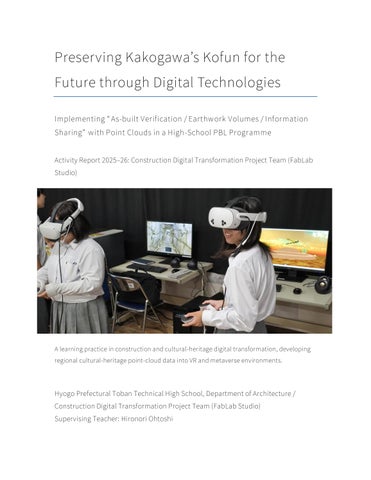
Alearningpracticeinconstructionandcultural-heritagedigitaltransformation,developing regionalcultural-heritagepoint-clouddataintoVRandmetaverseenvironments.
HyogoPrefecturalTobanTechnicalHighSchool,DepartmentofArchitecture/ ConstructionDigitalTransformationProjectTeam(FabLabStudio)
SupervisingTeacher:HironoriOhtoshi
Abstract
Thisreportpresentstheoutcomesofthe2025–26activitiesdeliveredbythe ConstructionDigitalTransformationProjectTeam(FabLabStudio)withinthe DepartmentofArchitectureatHyogoPrefecturalTobanTechnicalHighSchool.
Takinglocalculturalheritage kofunburialmounds asapracticalfield,students capturedthree-dimensionalpoint-clouddatasetsthroughdronesurveyingand terrestriallaserscanning.Theythencarriedoutcoreconstruction-analyticstasks, includingtheproductionofcontourmapsandsectionalprofilesandthecalculation ofearthworkvolumes,usingpoint-cloudprocessingandanalysissoftware.The workflowwasextendedintoVRandmetaverse-styleenvironmentsviaagame engine,enablingaproject-basedlearningmodelthatconnectsmeasurement, analysis,andpublic-facingvisualisationinonecontinuouspipeline.
Theprojectsupportedmeasurablelearninggainswhilealsocontributingtoregional outreach,publiccommunication,andexternalrecognition,includingmedia coverage.Thenextphasewillfocusonmulti-user,co-locatedexperiencesusingAR headsets,strengtheningcollaborationacrossindustry,government,andacademia, andlinkinglocalpracticetointernationaldissemination.
ThisworkformspartoftheFabLabStudio’scurriculum-basedprojectactivityand wasimplementedinpartnershipwithstakeholdersfromindustry,government,and academia.
1. ActivityLogandFigure
Notes
8-1Measuring
Three-dimensional documentationoflocalcultural heritage

Figure2.GNSSsurveyingatNishi-Ōtsuka Kofun(HiokayamaKofunCluster).
Studentsconfirmedproceduresfor establishingandobservinggroundcontrol points(GCPs)anddevelopedan understandingofthepositional-accuracy requirementsneededfordronesurveying andpoint-cloudgeneration. IncollaborationwithHarimaSekkei ConsultantCo.,Ltd.

Figure3.ConfirmationofthedronesurveyingworkflowatNishi-ŌtsukaKofun (flightplanning,safetymanagement,and aerialimagecapture).Students understoodtheprocessingpipelinefrom capturedimagerytoorthomosaic (orthorectified)imageryandpoint-cloud generation.
In collaboration withHarima Sekkei ConsultantCo.,Ltd.

Figure4.Practicaltraininginterrestrial laserscanning.High-accuracypoint-cloud datawerecapturedatNishi-ŌtsukaKofun andpreparedasthebasedatasetfor downstreamanalysessuchassectional profilesandcontourmapping.
Site:Nishi-ŌtsukaKofun. WithsupportfromSpaceGrabCo.,Ltd. andMaekawaConstructionCo.,Ltd.

usingaLiDAR-enabledtablet.Students confirmeditseffectivenessforcapturing areasthataredifficulttorecordusing dronesorterrestriallaserscanners, particularlyconfinedspacesandzones aroundobstacles.
Site:Nishi-ŌtsukaKofun.
WithsupportfromMaekawaConstruction Co.,Ltd.

Figure6.Point-cloudanalysisconducted atthesiteofficeofMaekawaConstruction Co.,Ltd.Datasetsacquiredviadrone, terrestriallaserscanning,andtabletbasedLiDARwereintegratedtoimprove thethree-dimensionalreconstruction accuracyoftheterrainsurroundingthe kofun.StudentsalsoobservedhowICT anddigitalworkflowsareimplementedon constructionsites,understandinghow measurementandanalysisconnectto professionalpractice.

Figure7.Orthomosaic(orthorectified) imageofNishi-ŌtsukaKofunproduced fromdronesurveydata.Theplan geometrycanbeunderstoodwithout distortion,supportingboundarychecks, drawingproduction,andyear-on-year comparisonasabaselinerecord.
ProvidedbyHarimaSekkeiConsultant Co.,Ltd.
8-2Analysing
Interpretingkofunstructures frompointclouds

Figure8.Point-cloudanalysisinterface forNishi-ŌtsukaKofun.Sectionalprofiles andcontourmapswereproducedfrom thecapturedpointcloud,andearthwork volumes(cut–filldifference)were calculated(fillsurplus:approx.1,790m³).
ProvidedbyMaekawaConstructionCo., Ltd.

Figure9.Cross-sectionaldrawingofNishiŌtsukaKofun.Three-dimensionalpointcloudanalysisresultswereextractedinto atwo-dimensionaldrawing,clearly showingthemoundheightandkey characteristicsofthesectionprofile.
ProvidedbyMaekawaConstructionCo., Ltd.
8-3RecordingtheInterior
High-resolutiondigitalarchiving ofstonechambers


Figures10and11.Laserscanningofthe stonechambersofIkejiriNo.8Kofun(left) andMasudayamaNo.15Kofun(right).The dry-stoneconstructionassociatedwith
theHeisōLakeKofunCluster(LateKofun period)wasrecordedashigh-accuracy pointclouds.Theteamalsoestablisheda practicalbasisfordigitalarchiving, includingacquisitionproceduresfor confinedspaces.Thecaptureddatasets weresubsequentlyusedtoproduce developeddrawingsofthechambers.

Figure12.Developeddrawingsofthe stonechambersofIkejiriNo.8Kofun(left) andMasudayamaNo.15Kofun(right). Usingpoint-clouddatacapturedbylaser scanning,thechamberinteriorswere convertedintodrawings,visualisingthe stoneworkgeometryanddimensional relationshipsastwo-dimensional referencematerials.Theseoutputscan serveasbaselinedocumentationfor investigationandconservation.

Figure13.SurveytargetatIkejiriNo.8 Kofun(HeisōLakeKofunCluster).The moundandsurroundingterrainwere capturedaspointcloudsandusedasthe basedatasetforsubsequentanalysis(3D modellinganddrawingproduction).
8-4Visualising
Outputsfrompoint-cloud analysis(drawingsand visualisation)

Figure14.Visualisationofthecaptured pointcloud,organisedtoenablean overviewofgeometryandspatial relationships.Asabaselinevisualoutput fordocumentationandexplanation,this viewwasusedasabridgetosubsequent drawingproduction(e.g.,sectional profilesandcontourmaps).

Figure15.Deploymentofthepoint-cloud outcomestoametaverseenvironment (Cluster),establishingasettinginwhich thesamemodelcanbesharedremotely. Thisservedasameansofpresentationto supportinformationsharingand explanation(alignmentofunderstanding) amongstakeholders.Thepublicplatform usedwasCluster(seeSection7). ProducedbytheDepartmentof ArchitectureFabLabStudio,Hyogo PrefecturalTobanTechnicalHighSchool.
8-5
Sharing Outreachthroughdigital technologies

Figure16.AttheschoolOpenDay, studentsexplainedtheworkflowand outcomesofpoint-cloudmeasurement (visualisation)toprospectivejunior-high studentsandtheirparents/guardians.By presentingthesequencefromacquisition throughorganisationtoexplanation,they practisedthecompleteprocessofsharing outcomesandinformation.

Figure17.Ascommunityoutreachand widerdisseminationoftheoutcomes,the OpenDayalsofeaturedpaneldisplays introducingtheprogramme’sworkin digitaltransformationforconstruction andculturalheritage.Studentsexplained theactivitiesandworkflowtovisiting junior-highstudents.
8-6Reconstructing
Fromdigitaldatatophysicalscale models


Figure18.Productionprocessfora1:10 scale3D-printedmodelofahouse-shaped haniwaexcavatedfromGyōjazukaKofun. (Topleft)slicersettings(Cura)/(topright) 3Dprintinginprogress/(bottomleft)PVA support-removalprocess/(bottomright)
completedmodelafterremoval. Usingthehouse-shapedhaniwafrom GyōjazukaKofunintheSaijōKofun Clusterasthesubject,studentscarried outthefullworkflowasasingleprocess from3Dmodellingthroughprintingto supportremoval.Inadditiontopointcloudandsurvey-basedrecording,this waspositionedasafabricationprocess thatreconstructsdigitaldataintoa physicalmodel.
8-7Experiencing
Spatialunderstandingthrough VR,AR,andmetaverse environments

Figure19.A3Dmodelgeneratedfrom pointcloudswaspreparedforimmersive viewinginVR,AR,andmetaverse environments.Theteamtrialledthisasa presentationmethodtosupport explanationandinformationsharing facilitatingalignmentofunderstanding andconsensus-buildingthroughintuitive
sharingofgeometryandspatial relationships.
8-8ConnectingwithProfessional Practice
Practicalunderstandingof culturalheritageandconstruction
digital-transformationtechnologies

Figure20.Lectureoncultural-property investigationattheInstituteofHistorical Studies,OtemaeUniversity.Through observationofartefactsandexplanations ofinvestigativemethods,students confirmedanalyticalperspectivesand approachestoconservationusedin cultural-heritageresearch.Thiswas positionedaspartofapractical collaborationthatlinksconstructionsector3Dmeasurementanddata utilisationtothecultural-heritagefield.

Figure21.Hands-onexperienceofthreedimensionalmeasurementattheInstitute ofHistoricalStudies,OtemaeUniversity. Studentsexaminedthestructureofa3D scannerusedincultural-property investigationandconfirmedthe measurementprocess,understanding thathigh-precisiondigitalrecordingforms afoundationforheritagetransmission andpreservation.

Figure22.Drone-operationtraining deliveredwithTamura-gumiCo.,Ltd.as instructors.Inanindoorsetting(the martial-artshall),safetyconditionswere establishedinadvance,andstudents practisedbasicpilotingandconfirmedkey operationalconsiderations.Thissession waspositionedasfoundationaltraining
fordroneoperationwithinconstruction ICTandsiteworkflows.

Figure23.Operationalexperiencewith thequadrupedrobotBostonDynamics Spot,deliveredwithsupportfrom SpaceGrabCo.,Ltd.Inthegymnasium, demonstrationsofautonomouswalking andremoteoperationwerecarriedout, andstudentsconfirmedbasictabletbasedcontrols.Thesessionalsoexplored potentialapplicationsforpatroland inspectioninenvironmentsthatare difficulttoaccess suchasconstruction sites,tunnels,anddisasterareas and sharedanoperationalconceptinwhich 3Ddatacapturedbyonboardsensorsis integratedwithpoint-cloudanalysisand BIM/CIMtosupportremotesituational awarenessandassetmaintenance.
WithsupportfromSpaceGrabCo.,Ltd.

Figure24.Operatingexperiencewitha backhoeequippedwithmachineguidance (MG).Studentsexaminedhowexcavation andgradingaresupportedusingsurvey dataandunderstoodhowICT-enabled constructionmachinerycanimprove executionaccuracyandoperational efficiency.
WithsupportfromMaekawaConstruction Co.,Ltd.
8-9OpeningtoSociety
Externalrecognitionand dissemination


Figure25.Theactivitiesofthisproject teamwerefeaturedintheDaily ConstructionIndustryNewspaper(26May 2025and11July2025)andtheKobe Shimbun(17June2025).Through continuedmediacoverage,the programme’sinitiativesinconstruction digitaltransformationeducationand cultural-heritagedigitaltransformation weresharedwithaudiencesbeyondthe school.
2.
Summary
In addition, data captured in the previousyearwerereusedinthisyear’s VR and metaverse outputs, establishing a framework for crossyear data utilisation and continuity of outputs and learning outcomes. The activities were also covered on an ongoingbasisbyoutletsincludingthe Daily Construction Industry Newspaper and the Kobe Shimbun , demonstrating successful external dissemination.
Based on these outcomes, the next chapteroutlinesfuturedevelopments, including further utilisation of pointcloud datasets and the creation of AR andmulti-userexperiences.
In the 2025–26 activities of the Construction Digital Transformation Project Team, the programme carried out surveying and digital archiving of kofun clusters, centred on threedimensional measurement and pointcloudanalysisusingdrones,GNSS,and terrestrial laser scanning. The captureddatasetsweredevelopedinto core analyses such as sectional profiles, contour maps, and earthwork-volume calculations and were further connected to VR and metaverse-style visualisation and publicrelease.Inthisway,theproject provided an implemented example of an end-to-end workflow that extends frommeasurementthroughtosharing outcomeswithwideraudiences.