Reclaiming Control Through Creativity: Art's Role in PTSD Healing
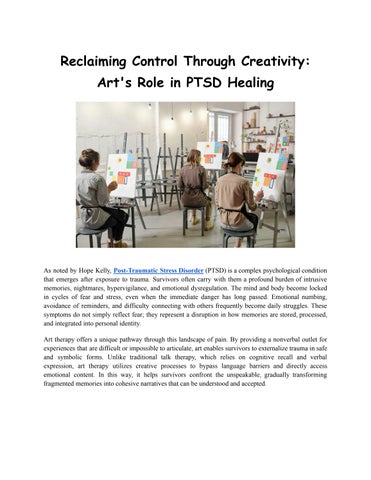
As noted by Hope Kelly, Post-Traumatic Stress Disorder (PTSD) is a complex psychological condition that emerges after exposure to trauma. Survivors often carry with them a profound burden of intrusive memories, nightmares, hypervigilance, and emotional dysregulation. The mind and body become locked in cycles of fear and stress, even when the immediate danger has long passed. Emotional numbing, avoidance of reminders, and difficulty connecting with others frequently become daily struggles. These symptoms do not simply reflect fear; they represent a disruption in how memories are stored, processed, and integrated into personal identity. Art therapy offers a unique pathway through this landscape of pain. By providing a nonverbal outlet for experiences that are difficult or impossible to articulate, art enables survivors to externalize trauma in safe and symbolic forms. Unlike traditional talk therapy, which relies on cognitive recall and verbal expression, art therapy utilizes creative processes to bypass language barriers and directly access emotional content. In this way, it helps survivors confront the unspeakable, gradually transforming fragmented memories into cohesive narratives that can be understood and accepted.