Issue 006: Friday 24th June
Keeping our community safe:
Safeguarding at Honywood School
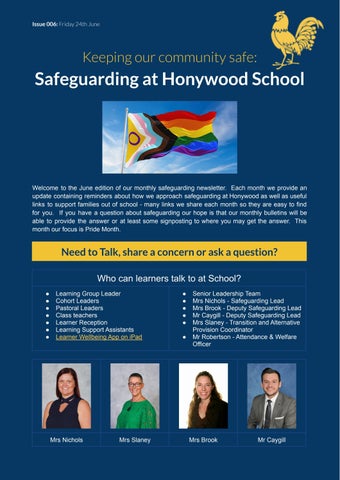
Welcome to the June edition of our monthly safeguarding newsletter. Each month we provide an update containing reminders about how we approach safeguarding at Honywood as well as useful links to support families out of school - many links we share each month so they are easy to find for you. If you have a question about safeguarding our hope is that our monthly bulletins will be able to provide the answer or at least some signposting to where you may get the answer. This month our focus is Pride Month.
Need to Talk, share a concern or ask a question? Who can learners talk to at School? ● ● ● ● ● ● ●
Learning Group Leader Cohort Leaders Pastoral Leaders Class teachers Learner Reception Learning Support Assistants Learner Wellbeing App on iPad
Mrs Nichols
Mrs Slaney
● ● ● ● ● ●
Senior Leadership Team Mrs Nichols - Safeguarding Lead Mrs Brook - Deputy Safeguarding Lead Mr Caygill - Deputy Safeguarding Lead Mrs Slaney - Transition and Alternative Provision Coordinator Mr Robertson - Attendance & Welfare Officer
Mrs Brook
Mr Caygill
Learner Information Please refer to the Honywood Wellbeing app on your school iPad, link below https://sites.google.com/honywoodschool.com/learnerwellbeing/home If you need Wellbeing & Mental Health support out of school, please contact: YOUNG MINDS - text YM to 85258, or https://youngminds.org.uk/find-help Kooth - your online mental wellbeing community https://www.kooth.com/ Emotional Wellbeing and Mental Health Service 0300 300 1600 to get in touch directly. For the out of hours crisis support, please call the general NELFT switchboard on 0300 555 1201 and ask for the EWMHS Crisis Support Service Childline 08001111 Weekly Bullying and Peer on Peer Abuse reporting form All learners and parents receive a weekly email link and reminder that if they have any concerns about the behaviour of any learners in school that could be considered bullying and/or peer on peer abuse, they may report it using the following link: https://docs.google.com/forms/d/e/1FAIpQLSeqPKQTTxpfBS8arLEYimPdpIyfObw_7P-yitTKhXMX S1LeBA/viewform If you have any questions about the form before completing it please feel free to email me scaygill@honywoodschool.com Similarly if you have any feedback regarding the structure/questions of this form please do share this too as the form could evolve over the coming weeks with any feedback shared.
Parents/Carers For support and information please contact: For information about support for children, young people and families please see the Essex County Council website. If you are a parent or carer, child or young person and you need support, you can phone 0345 603 7627 and ask for the Children's Line. Useful General Resources Safeguarding Policy https://www.honywoodschool.com/attachments/download.asp?file=67&type=pdf KCSIE September 2021 https://assets.publishing.service.gov.uk/government/uploads/system/uploads/attachment_d ata/file/1020050/KCSIE_2021_September_guidance.pdf Responding to Harmful Sexual Behaviours Policy https://www.honywoodschool.com/attachments/download.asp?file=116&type=pdf
Pride It’s Pride Month in the UK, which marks the celebration of and focus on LGBTQ+ communities. It is also an important time to shed light on the difficult everyday situations which many young people who are exploring their sexuality or who identify as LGBTQ+ find themselves in. In 2021, Childline reported a 29% increase in the number of young people speaking about ‘coming out’ compared to the previous year. According to the NSPCC, children and young people in the LGBTQ+ community may ‘experience homophobic, biphobic or transphobic bullying or hate crime’. All children and young people have the right to be protected and kept safe from abuse and neglect. LGBTQ+ children and young people face the same risks as all children and young people, but they are at greater risk of some types of abuse. For example, they might experience homophobic, biphobic or transphobic bullying or hate crime. In addition, children and young people who are discovering their sexual identity may be more at risk of grooming, online aabuse and being encouraged to take part in underage sexual exploration (Barnardo’s and Fox, 2016; McGeeney et al, 2017; Xu and Zheng, 2014). Education is key. Understanding the context of their lives and lived experiences empowers us all with a greater level of understanding on how we can protect and support them. For some young people who identify as part of this community, there can be extra challenges to face, something that as parents, carers and school staff, we should all be aware of.
How can you support a child or young person in the LGBTQ+ community? Create a safe environment in which children and young people feel they can talk about their gender or sexual identity. Never force the conversation! Affirm the conversation: Always thank your young person for talking with you, opening up and being honest. This may also be a good opportunity to remind them how much you love them. Active listening: Take the time to stop, listen and acknowledge what they are trying to tell you. Acknowledge you won’t always get it right. We all make mistakes, when we do it’s important to own it and apologise; It’s okay – we all make them! For example, if you accidently use the wrong word or phrase, don’t panic. Correct yourself and apologise. This can help your young person understand that you are listening and trying to support them. Find age-appropriate resources. The danger of leaving young people to find their own resources is that they may encounter harmful or age-inappropriate content online, sometimes of a sexual nature. Trusted Adults – Talk to your young person about who their team of trusted adults are and who they can talk to, if they don’t feel comfortable talking to you. Don’t make assumptions. Young people may not disclose mental health issues, bullying or abuse in fear that their sexual or gender identity will be blamed.
Seek out support for yourself! It’s okay if you need extra support as a parent or carer. There are multiple online and in person resources, including organisations specifically for parents and carers of LGBTQ+ people. We have outlined some of these in the Signposting and Further Resources section below. Whilst children and young people of the LGBTQ+ Community may face different adversities, it is possible to help mitigate these by providing support and understanding. Research has shown that acceptance and support from peers and family help provide protective factors against depression, drug misuse and self-harm amongst the LGBTQ+ youth. Support, such as family affirmation, can have incredibly positive effects on self-esteem, general wellness, and acts as a ‘buffer’ against poor mental health. The importance of representation cannot be understated. 52% of LGBTQ+ pupils reported that seeing other members of the LGBTQ+ community around their school makes the most positive difference in their daily lives.
Contextual Safeguarding Factsheet for LGBTQ+ Young People Understanding the context of young people’s lives will greatly improve your capacity to respond to their needs. This factsheet has been developed from statistics found in national reports. It provides you with a level of understanding of the experiences of LGBTQ+ (Lesbian, Gay, Bisexual, Trans, Queer/Questioning or other gender or sexual minority) young people in schools.
Overview ● ● ● ● ● ● ● ● ● ● ●
There is likely to be at least 2 LGB pupils per class, and 1 trans pupil in each year group (1) 52% of LGBTQ+ pupils hear homophobic slurs ‘frequently’ or ‘often’ at school (2) 41% of youth who experienced homophobic bullying said that it led them to attempt or consider ending their lives (3) 45% of LGBTQ+ pupils who are bullied never tell anyone about the bullying (4) 68% of LGBTQ+ pupils report that teachers ‘sometimes’ or ‘never’ challenged homophobic language when they hear it (5) More than four in five trans young people have self-harmed, as have three in five lesbian, gay and bi young people who aren’t trans (6) More than two in five trans young people have attempted to take their own life, as have one in five lesbian, gay and bi students who aren’t trans (7) Almost half (45%) of all LGBTQ+ pupils still face bullying at school (Stonewall 2017) (8) When LGTBQ+ young people leave school to enter employment, 1 in 5 report discrimination based on their sexuality (9) Approximately 1 in 6 LGBTQ+ people felt discriminated against during the pandemic (10) 69% of LGBTQ+ people exhibited depressive symptomology (11)
References (1)https://www.stonewall.org.uk/system/files/an_introduction_to_supporting_lgbt_young_people_-_a_guide_for_schools_ 2015.pdf (2) https://www.stonewall.org.uk/media/lgbt-facts-and-figures
(3)https://assets.publishing.service.gov.uk/government/uploads/system/uploads/attachment_data/file/539682/160719_RE PORT_LGBT_evidence_review_NIESR_FINALPDF.pdf (4)(5) https://www.stonewall.org.uk/system/files/the_school_report_2017.pdf (6)(7) https://www.stonewall.org.uk/media/lgbt-facts-and-figures (8 )https://www.stonewall.org.uk/system/files/the_school_report_2017.pdf (9) https://www.stonewall.org.uk/about-us/new-research-lgbt-young-people-shut-out-education-and-employment (10)(11) 1https://www.medrxiv.org/content/10.1101/2020.08.03.20167403v1
Glossary Bisexual Usually refers to a person attracted to both genders (not usually equally). Cis/Cisgender A term used to describe someone whose gender is the same as the sex assigned at birth. Coming out When a person chooses to tell others in their life about their sexual orientation or gender identity. Usually happens once, but also happens when an LGBTQ+ person meets someone new. Cross-Dresser The act of dressing in the opposite gender’s clothes, this can be a form of self-expression and does not necessarily mean a person is trans. Deadnaming When a person continues to use a trans person’s birth name, after they have transitioned. Usually used to bully and degrade someone. Gay Usually refers to a person attracted to the same sex (usually men but sometimes women). Gender Identity A person’s sense of their ‘gender’ this can refer to our feelings and appearances of ‘masculinity’ or ‘femininity’. This can be the same or different than the gender we were assigned at birth. Non- Binary or Gender non-Binary An identity category used for someone who doesn’t fit clearly into either male or female. Gender-Fluid/Gender-Queer An identity category used by someone who has no fixed gender that is likely to fluctuate or change. They may have both masculine and feminine (or neither) traits when expressing their gender. Gender Refers to our appearance, mannerisms and expected social behaviours. (Note: It’s possible that biological sex and gender identity do not match). Heteronormativity/Heterosexism The idea that relationships and attraction are mainly between opposite sex partners. Also, the assumption that everyone is heterosexual, and that these relationships are more acceptable, normal, or even preferred.
Heterosexual/Straight Someone who is attracted romantically, sexually and emotionally to a member of the opposite sex. Homophobia, Biphobia and Transphobia (HBT) The irrational fear and hatred of LGBTQ+ people, their identities, and behaviours. Can include negative attitudes, discrimination, and violence toward LGBTQ+ people. Intersex Someone who was born with variations in primary sex characteristics including genitals, chromosomes, and sex hormones. Their bodies do not usually fit standard medical definitions of male or female. Lesbian Usually refers to same sex attracted women. LGBTQ+ Umbrella term for lesbian, gay, bi-sexual, trans, queer or questioning or plus (the plus refers to all other gender or sexual minorities). Outing When an LGBTQ+ person’s sexual orientation and/or gender identify is disclosed publicly without their knowledge or consent. Pansexual An attraction to a person of any sex or gender. Passing When a trans person is ‘perceived’ to be the gender they are comfortable in. (Gender) Pronouns Words used to refer to a person including he/she/they and his/hers/theirs note some people will use gender neutral pronouns (it’s always better to ask for preferred pronouns). Queer Can be seen as offensive by some but has been reclaimed by others, refers to feelings of ‘otherness’ or different identities, is considered less restrictive than LGBTQ+. Questioning When a person is reflecting on their sexual and/or gender identity. This is a normal experience for all young people, as they pass through puberty. Sex Our biological sex is determined by our bodies and hormones. For some of us it’s possible that our biological sex (body/hormones) and gender (appearance/mannerisms) do not match. This is called being trans. Sexual orientation Sexual orientation is used to describe a person’s sexual or romantic attraction to another person – sometimes people call this sexuality. People can be attracted to the same sex as themselves or the opposite. They can also be attracted to one or more sex.
Trans Preferred umbrella term that refers to both transgender and transsexual (these are both different). Transgender Refers to someone whose gender identity differs than the one assigned to them at birth. Transition The process of changing gender or sex, note this starts as a social transition (changing names, pronouns, clothes etc.). Medical transition refers to surgery to help with transition or ‘confirmation’. Transsexual Considered outdated, it used to refer to people who have undergone gender reassignment surgery. Note that not all trans people want or desire to undergo surgery. https://ineqe.com/wp-content/uploads/2021/06/Factsheet_LGBTYoungPeople_2021_Final.pdf
Signposting & Further Resources Childline NSPCC Helpline NSPCC Resources The Be you Project Young Minds Mind Out (For Parents/ Caregivers ) FFLAG Papyrus Prevention of Young Suicide
Mental Health Support Resources for Parents Exam Stress. The following link covers a wide-range of tips to keep students mentally healthy. Supporting Your Child during Exam Time (Young Minds) Exam Time & Exam Stress | Parents Guide To Support Young Minds https://youngminds.org.uk/ EWMHS. Emotional well being and mental health service have recently launched a new Instagram account to provide advice and support to young people experiencing mental health issues. Please encourage your children to follow the account where they will be able to access early intervention advice and support. https://www.instagram.com/ewmhs_nhs/
MindEd is a free educational resource on children and young people's mental health for all adults: https://www.minded.org.uk/ Safe and reliable advice about young people’s mental health, created by experts and parents together: https://www.mindedforfamilies.org.uk/young-people NHS Mental Health Charities directory: Mental health charities and organisations Parent zone - 10 mental wellbeing apps for all the family: https://parentzone.org.uk/article/10-mental-wellbeing-apps-all-family Gov.uk COVID-19: guidance on supporting children and young people’s mental health and wellbeing Headstogether - Changing the conversation on mental health: https://www.headstogether.org.uk The Mix - Essential support for under 25s: https://www.themix.org.uk/
Safeguarding Support Resources for Parents Safeguarding when learning to drive. We are aware that from time to time, concerns are raised by post-16 learners and their parents in Essex about inappropriate conduct of driving instructors. We have been given the following information to help to safeguard those accessing driving lessons: https://www.gov.uk/learn-to-drive-a-car https://www.gov.uk/find-driving-schools-and-lessons (all instructors on the list will have had a DBS check and passed all the qualification tests to become an instructor) https://www.gov.uk/complain-about-a-driving-instructor Parent zone - County Lines: https://parentinfo.org/article/county-lines-what-is-it-and-who-is-at-risk?
Parent zone - Sleep Advice: https://parentzone.org.uk/article/how-sleep-easy-during-global-pandemic Parent line Family Support: Parentline family support and bullying helpline Domestic Abuse support: #ReachIn
Welfare Support Resources for Parents Essex Welfare Service (EWS). The EWS, a service to help vulnerable people in the community in need of support and unable to access it at this time: https://essexwelfareservice.org/ Parents are able to ‘self-refer’ if they are experiencing difficulties EWS Contact details: Phone: 0300 303 9988 Email: provide.essexwelfareservice@nhs.net Website: https://essexwelfareservice.org/ Opening hours: Monday to Friday, 8am to 7pm Saturday and Sunday, 10am to 2pm Livewell Essex There is a real need to collectively find solutions that contribute towards wellbeing in order to reduce the cost to health and social care. The Livewell campaign is designed to engage communities, families and individuals and to provide information about all that is on offer in Essex to improve health and wellbeing. All 13 Essex Local Authorities and our partners have come together to collaborate on the health and wellbeing agenda and work towards achieving better health outcomes for people across Essex. Household Support Fund ECC has received funding from central government to support vulnerable families and adults this winter. There are a range of initiatives in place to ensure help with household food and utility bills, essential items and emergency situations are provided for. To find out more about how to access this support please follow the link for access points where parents, young adults and adults can be signposted to www.essex.gov.uk/money-debt-and-benefits/household-support-fund
Key Contacts in School Please see the key contact list below to support you to address any concerns. Leadership Team Mr Saunders Mrs Brook Mr Munro Mr Calver Mr Caygill Mrs Downes
Headteacher Deputy Headteacher Deputy Headteacher Assistant Headteacher Assistant Headteacher Assistant Headteacher
jsaunders@honywoodschool.com jbrook@honywoodschool.com jmunro@honywoodschool.com dcalver@honywoodschool.com scaygill@honywoodschool.com pdownes@honywoodschool.com
Mrs Hickford Miss McPhail Mr Smith Mr Williams
Assistant Headteacher Associate Assistant Head Associate Assistant Head Associate Assistant Head
jhickford@honywoodschool.com amcphail@honywoodschool.com dsmith@honywoodschool.com jwilliams@honywoodschool.com
Safeguarding, welfare and support team Mrs Nichols Mrs Slaney
Safeguarding Officer Mrs Slaney - Transition & Alternative Ed Coordinator Mr Robertson Attendance Concerns Mrs Loydall Medical concerns
knichols@honywoodschool.com sslaney@honywoodschool.com crobertson@honywoodschool.com medical@honywoodschool.com
Cohort Leaders Cohort 7 Cohort 8 Cohort 9 Cohort 10 Cohort 11
Mr Hall Ms Ward Ms Martin Mr Scott Mrs Reece
shall@honywoodschool.com tward@honywoodschool.com amartin@honywoodschool.com dscott@honywoodschool.com ereece@honywoodschool.com
SEND team Mrs Vaughan SENCO cvaughan@honywoodschool.com Mr Wood Deputy SENCO (Autism Hub)mwood@honywoodschool.com