21st November 2025
HEADLINES By Mr D Smith Designated Safeguarding Lead
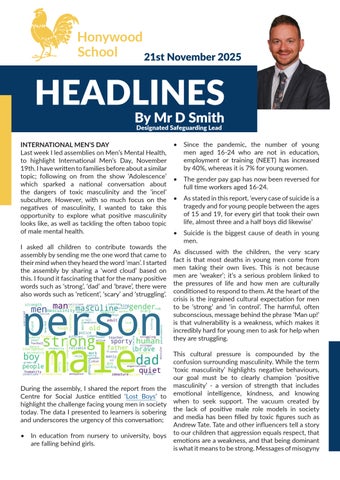
INTERNATIONAL MEN’S DAY Last week I led assemblies on Men’s Mental Health, to highlight International Men’s Day, November 19th. I have written to families before about a similar topic; following on from the show ‘Adolescence’ which sparked a national conversation about the dangers of toxic masculinity and the ‘incel’ subculture. However, with so much focus on the negatives of masculinity, I wanted to take this opportunity to explore what positive masculinity looks like, as well as tackling the often taboo topic of male mental health. I asked all children to contribute towards the assembly by sending me the one word that came to their mind when they heard the word ‘man’. I started the assembly by sharing a ‘word cloud’ based on this. I found it fascinating that for the many positive words such as ‘strong’, ‘dad’ and ‘brave’, there were also words such as ‘reticent’, ‘scary’ and ‘struggling’.
During the assembly, I shared the report from the Centre for Social Justice entitled ‘Lost Boys’ to highlight the challenge facing young men in society today. The data I presented to learners is sobering and underscores the urgency of this conversation; • In education from nursery to university, boys are falling behind girls.
• Since the pandemic, the number of young men aged 16-24 who are not in education, employment or training (NEET) has increased by 40%, whereas it is 7% for young women. • The gender pay gap has now been reversed for full time workers aged 16-24. • As stated in this report, ‘every case of suicide is a tragedy and for young people between the ages of 15 and 19, for every girl that took their own life, almost three and a half boys did likewise’ • Suicide is the biggest cause of death in young men. As discussed with the children, the very scary fact is that most deaths in young men come from men taking their own lives. This is not because men are ‘weaker’; it’s a serious problem linked to the pressures of life and how men are culturally conditioned to respond to them. At the heart of the crisis is the ingrained cultural expectation for men to be ‘strong’ and ‘in control’. The harmful, often subconscious, message behind the phrase ‘Man up!’ is that vulnerability is a weakness, which makes it incredibly hard for young men to ask for help when they are struggling. This cultural pressure is compounded by the confusion surrounding masculinity. While the term ‘toxic masculinity’ highlights negative behaviours, our goal must be to clearly champion ‘positive masculinity’ - a version of strength that includes emotional intelligence, kindness, and knowing when to seek support. The vacuum created by the lack of positive male role models in society and media has been filled by toxic figures such as Andrew Tate. Tate and other influencers tell a story to our children that aggression equals respect, that emotions are a weakness, and that being dominant is what it means to be strong. Messages of misogyny