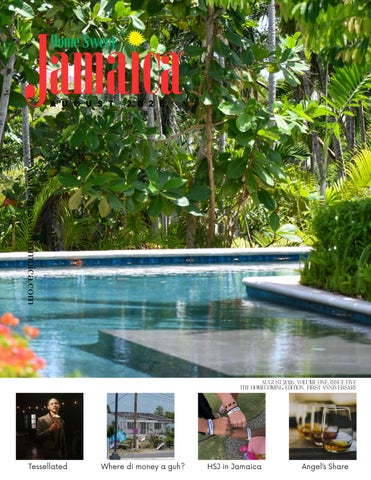
A U G U S T
2 0 2 6
www.homesweetjamaica.com AUGUST 2026 · VOLUME ONE, ISSUE FIVE THE HOMECOMING EDITION · FIRST ANNIVERSARY
Tessellated
Where di money a guh?
HSJ in Jamaica
Angel’s Share
Home Sweet Jamaica is a Trademark of Sunfloral Company Copyright © 2026 by Gina Tulloch. Cover Photography: Emma Wheelhouse Cover: Round Hill Hotel and Villas Published by Home Sweet Jamaica. All rights reserved. No part of this publication may be reproduced, distributed, or transmitted in any form or by any means, including photocopying, recording, or other electronic or mechanical methods, without prior written permission from the publisher, except for brief quotations used in reviews or critical articles. For information, contact: Home Sweet Jamaica P.O. Box 970492 Coconut Creek, FL 33097
HOME SWEET JAMAICA
EDITOR’S NOTE So much had changed since my last visit to Jamaica. My father died. A hurricane passed through. My children are grown. I started a new chapter with this magazine, which turns one year old this month, launched in August in recognition of my father's birth month. Returning to our beloved island, the only way to commemorate the occasion was to follow the path I so fondly remember taking with him. Rhea came with her best friends, volunteering to witness Jamaica's recovery firsthand. Emma came too, photographer extraordinaire, to document the journey. We set out for the west end of the island to see the damage Melissa left behind and how people are coping. It was an emotional journey through time. I was happy to traverse the bumpy roads I once travelled with my father, even as local motorists whizzed and weaved their death defying feats around me. The thought that Rhea may someday make this journey without me brought a smile to my face. Tradition.
We set out to report on Jamaica's recovery. It turned into something more. Though we travelled all over, this issue settled, inadvertently but naturally, on Lethe. As one must do after a major storm, you check in on your tribe and make sure everyone is okay. That is what this edition is about. Carrying on the tradition of sharing the island with friends. Remembering the people and places that make a life full. Taking care of each other.
Some of that path is gone. Cosmo's Seafood Restaurant and Bar, where Jamaicans and foreigners alike ate Jamaican food under a thatched roof by the sea, closed its doors several years ago now.
Our hearts broke at the devastation. And then, in the Westmoreland swamp lands, we saw new foliage pushing up green through the wreck of it, and we found ourselves looking at places and people defying the odds and filled with possibility.
From left: Emma, Rhea, and me
4
TABLE OF CONTENTS 06.
Tessellated turns Jamaica's spirit of contradiction into musical gold
11.
Where is the money going? Ten months after Hurricane Melissa.
15
21.
Home Sweet Jamaica Junior Correspondents report
The Angel’s Share What makes rum Jamaican?
26.
Little London is home to Goda-me
29.
We know how to find champions. What about off the field?
Community Mapping
33. 5
d e t a l l e s s Te The Alchemist of Sound
Article By Jeremy Gardner Photographs courtesy of Tessellated
How Tessellated Turns Jamaica's Spirit of Contradiction into Musical Gold The Jamaican Way
I
n Jamaica there exist certain combinations of ingredients that are so ubiquitous with island life that we never stop to think about the absurdity and deep alchemy that goes into them. Who, for example, was the first man or woman to add saltfish to ackee? Who mixed the first brew of Pine and Ginger? Jamaicans mix the disparate and the contradictory to balance and sustain life. And the artist Tessellated is a master of bringing this practice to his music.
Breaking Ground At the root of his creative process lies what to others might be a contradiction. Tess is the first and the only Jamaican artist to have a song, I Learnt Some Jazz Today, reach number one on Billboard's Smooth Jazz Songs chart in 2019. This effort earned him a Primetime Emmy nomination through the Apple AirPods 'Bounce' commercial. These achievements, on their face, show someone unafraid to embody difference, who is no stranger to pushing boundaries and exploring more idiosyncratic avenues through sound. And if that was all he did, Tess would be a notable jazz talent and the conversation would stop there. But he also leans heavily into the reggae and dancehall traditions.
Rooted and Reaching Tessellated aims in every song to be both authentic to himself and his own ambitions to create genredefying mosaics (as his name suggests), but also to remain rooted firmly in the earth. "It is a responsibility," he says, "to wave the flag and represent, but also to let life inform the process, to stay inspired and to live life inspiringly so that the music and its message is never a lie."
It is a responsibility to wave the flag and represent
7
TESSELLATED Something for Everyone More balancing acts characterise his work. To enjoy the process of creation and synthesising new sounds is his first love where being a musician is concerned. And yet, in time, he has come more and more to enjoy the art of performance. For him, the music must be for and by the people. He makes music to be listened to. It cannot only be concept work and grand orchestral harmonies. It is certainly those things, but it is also a simple rocksteady anthem to relax to or a melody that sticks with you long after you listen. That yin and yang of forces that would pull another musician to a side where he is most comfortable instead pushes Tess to stay in that zone where there is something for both the cerebral listener and the jazz-educated as well as the more poporiented crowd. Eternal themes cascade through his sound: a broken heart, a song to feel good to, but always with a twist that keeps the mix idiosyncratic, surprising, and fresh.
In the Mix Now His recent single, 'Where We End,' featuring Surfer Girl, is at once reggae and blues, dancehall and jazz. It relays one side of a story of a breakup, and it becomes clear by the end that there is no response to the call. A break from convention that structurally conveys the finality of the heartbreak. Little details come together in a song that is easy and pleasant to the ears, while being deceptively complex in its formulation and messaging. More contradictions easily resolved.
8
THE MAN BEHIND THE MUSIC
Joshu a Meeks
Tess describes himself as a serial hobbyist and enjoys calisthenics and jiu-jitsu, reading chess books and learning the guitar. He finds that the more balance he encourages in his personal life and practice, the better the mixture of his music gets and the more he becomes his own first instrument. Tessellated describes his creative process as a form of synesthesia, translating what he sees as colourful visual tapestries into melody, humming what he sees and making of it a complex soundboard. Tess grew up in Kingston, Jamaica. Even as a child, Tessellated was always playing music. Whatever instruments were available, whether drums or piano or later saxophone or guitar, he'd entertain family at gatherings. As a result, no one ever discouraged him from pursuing his creativity or really had reason to doubt his drive or his potential. The main obstacle to his career was never overcoming external forces or the pervasive badmind that plagues the land. Instead, it has been a spiritual struggle to separate the intrinsic joy of creation from the drudgery of work. Betrayals over money early on soured him to the industry, but he's ensured in time to carve out that sacred environment in himself where the purity of the process remains and nothing can dissuade either him or his message.
What Comes Next Inspired by Quincy Jones's ability to navigate the contradiction of minimalism and overproduction, and Walshy Fire's nuanced exploratory soundscapes and Jamaican authenticity, we look forward to more and more lessons in the Tao from Tessellated. His upcoming album, set to be released this year, is promised to be more dancehall leaning than his earlier work, and the excitement is palpable. What alchemical recipe will he provide the people with this time?
9
Yu remember what yu did that week? Hurricane Melissa made landfall in late October 2025. Many of us felt helpless, and some of us felt something closer to hopeless. So we did what we could. We rushed to help the island we love. Maybe you sent money through a relief fund. Maybe you filled a barrel and paid the shipping without looking too hard at the receipt. Maybe you sat in a church hall in the Bronx or Brixton or Broward and put an envelope in a basket, then went home and rang your aunt in Sav to make sure she had water. And then, some months later, you saw a photograph. A house in the country with blue tarpaulin still stretched over the rafters, held down with old tyres. And a thought came that you probably did not say out loud, because saying it felt disloyal.
Where did the money go? It is a fair question, and it deserves a straight answer rather than a rumour. Here is what the public record shows.
WHERETHE MONEY IS GOING Ten months after Melissa, a plain accounting for everyone abroad who gave
Size Matters Start here, because nothing else makes sense without it. The Planning Institute of Jamaica, working with the United Nations Economic Commission for Latin America and the Caribbean, assessed the total damage, losses and associated costs of Hurricane Melissa at J$1.952 trillion. That is US$12.2 billion, and it is equivalent to 56.7 per cent of Jamaica's entire economic output for 2024. More than four times Gilbert. The costliest event in the country's recorded history, by a distance. The Office of Disaster Preparedness and Emergency Management recorded 156,000 homes damaged. Of those, 24,000 were total losses. Against that, the Inter-American Development Bank has noted that Jamaica's total available resources for response came to roughly US$1.08 billion, and that figure already includes a US$415 million disbursement from the International Monetary Fund in January 2026. Roughly one dollar available for every twelve dollars of damage. That is what a small country being hit by something enormous looks like. And it is the single most important fact for understanding why the help, wherever it came from, felt thin when it arrived.
11
Three different pots, often confused
Here is where most of the confusion sits, and untangling it changes the picture. There were three separate streams of money after Melissa. The money the public donated to Government. The money Government spent on repair grants. And the money that never passed through Government at all. They came from different places, they were spent on different things, and each has its own problems. The first pot: what we donated. Donations collected by the Government through its relief portal and held by ODPEM amounted to J$1.44 billion by late February 2026. That is the pot most of us think we contributed to. The second pot: what Government spent. The repair grants come from here, not from the donations. The Restoration of Owner or Occupant Family Shelters programme, known as ROOFS, was funded with a J$10 billion allocation from the national budget. By June 2026, the Ministry of Finance reported that J$67 billion had been spent on recovery across ministries and agencies through supplementary estimates for the 2025/26 financial year. So when someone says the diaspora gave millions and families received J$75,000, they are placing two unrelated numbers beside each other. The grants were never funded from the donations. The third pot: what never touched Government. NCB reported mobilising J$450 million with its partners for Melissa recovery, and separately offered customers payment breaks, refinancing and extended repayment terms through April. Food For The Poor, Global Empowerment Mission, UNICEF and others moved aid directly through their own networks. None of that appears in the ODPEM donation figure or in the ROOFS allocation. If you gave through a church, a charity or a bank drive, your money is in this third pot, and it is the least visible of the three. All three matter. But they answer different questions, and they have different problems.
What the grants are, and what they buy ROOFS pays in three tiers, based on a formal damage assessment. J$75,000 for minor damage, meaning a structurally sound house with damage to roof, windows, doors or fixtures. J$200,000 for major damage, where structural elements were compromised. Up to J$500,000 for severe damage, where a home requires demolition and complete reconstruction. At roughly J$160 to the United States dollar, that is about US$470, US$1,250 and US$3,100. Nobody rebuilds a house for US$3,100. The programme was never designed to. It was designed to put something in a family's hand quickly, at a scale the country could afford across tens of thousands of households at once. Understanding that is not the same as being satisfied with it. The disbursement has been real and it has been substantial. By mid March 2026, more than J$5.2 billion had been paid out under ROOFS and 100,000 properties had been assessed. Separately, the National Housing Trust had processed about 5,100 applications worth J$2.2 billion by late June 2026, out of roughly 8,300 received, with most coming from Westmoreland, St James and St Elizabeth.
12
So why is that house still under tarpaulin? Three documented reasons, none of them dramatic, all of them consequential. The first is verification. By late April 2026, more than 114,000 households had been assessed, but only 42,617 had been fully verified and issued their vouchers or payment notifications. Assessment is not payment. Between those two numbers sit tens of thousands of families waiting, and most of them have no way of knowing where in the queue they are. The second is reach. Residents in St James told the Gleaner they had watched assessment teams pass through their districts and were never contacted afterward. The Ministry acknowledged that access difficulties, communication gaps and data inconsistencies had caused delays in rural communities. Anyone who has driven a country road in the months after a storm will understand exactly how that happens.
Auditor General Pamela Monroe Ellis wrote that weaknesses in financial management, governance and programme accountability had limited transparency over the relief resources.
The third is the most quietly frustrating. In Westmoreland it was reported that recipients were travelling to Savanna la Mar to redeem their grants and spending close to J$100,000 in transport to do it, leaving J$400,000 of a J$500,000 grant in actual materials. The grant erodes before it reaches the roof.
The audit documented failures of record keeping, control and governance. It did not find theft. That distinction is not a technicality and it should not be blurred by anyone, in Jamaica or abroad.
The accountability question, stated precisely In May 2026, the Auditor General tabled a real time audit in Parliament. It is a public document, and it is worth reading rather than hearing about. It found that of the J$1.44 billion in donations received by 23 February 2026, J$26.2 million, or 1.8 per cent, had been spent by that date. It found J$34 million in roofing materials that could not be verified because delivery slips and goods received notes were missing, and a further J$141.1 million in committed expenditure without confirmed payment documentation. It found that ODPEM had no formal agreement governing the retention of donated funds, and that unspent balances from Hurricane Beryl in 2024 had not been disclosed to the Finance Ministry.
Two things should be said about this, both of them true.
And the Government's response is also part of the record. It noted that a real time audit is a snapshot of a process still underway, and that while the donated funds sat largely uncommitted, some J$11.3 billion was being spent across more than 400 relief and recovery contracts. There is a third thing worth noticing, and it is the most encouraging fact in this entire article. An independent office audited a live relief programme, published what it found, and tabled it in Parliament while the work was still going on. That is a system examining itself in public. Not every country does that.
13
What to ask the next time
Two more habits worth forming.
Because there will be a next time, and this part is actually in your hands.
Give to the second year, not only the first week. Emergency appeals close after a month. The tarpaulins are still there after ten.
The lesson of the past ten months is not that giving does not work. It is that giving without asking questions leaves you with no way to know. So ask three before you send anything. Where exactly is it going, and to whom? Look for organisations that name places. BREDS, the Treasure Beach Foundation, states plainly that it works across the eight districts of the Greater Treasure Beach area on the south coast of St Elizabeth, and that it has been working there for close to thirty years through sport, healthcare and education programmes, long before any storm arrived. A claim that specific can be checked. "The Caribbean" cannot. How does it actually reach a family? The serious organisations will tell you, and they will count. After Melissa, Food For The Poor moved 229 ocean containers into Jamaica and completed 21 air shipments, delivering more than US$10 million in food, hygiene supplies, medical support and building materials through local partners on the ground. It reports 234 roofs restored, 22 fishing boats repaired, and every beekeeper in its programme back in production. That last figure is the tell. An organisation that counts beekeepers is an organisation that is actually counting. What did last time produce? This is the one most people skip. Before you give, look for the report on the previous emergency. After Hurricane Beryl, the NCB Foundation's Building a Better Jamaica Fund published what its J$459 million produced: 1,821 homes, facilities and roofs restored, 1,191 small farmers supported, and humanitarian aid reaching more than 12,685 people. It reported a utilisation rate of 94.2 per cent and an average spend of J$31,787.60 per beneficiary, measured against international humanitarian benchmarks. It also named every partner organisation that delivered the work, among them Food For The Poor, Mustard Seed Communities, UNICEF and the American Friends of Jamaica. Those figures are the Foundation's own, not an independent audit. But whether or not you would give to that fund, that is the shape of an accounting you can actually read.
And give to organisations already working in Jamaica before the storm. Groups with existing relationships in a parish move faster than groups arriving cold, because they already know whose roof is gone.
What we owe each other There is a version of this article that would be easier to write, and angrier, and it would travel further. But we are not looking for someone to blame. We are looking for impacted Jamaican family homes to have roofs as the next storm season approaches. What the record shows is a country hit by something more than half the size of its own economy, responding with about a twelfth of what it needed, imperfectly, publicly, and while being watched. What it also shows is a diaspora that gave before being asked. From yard to abroad, the connection held. Now it needs to hold longer than the news cycle did. Sources: Planning Institute of Jamaica quarterly briefing, March 2026, drawing on the damage and loss assessment prepared with the UN Economic Commission for Latin America and the Caribbean. Auditor General's Department, Real Time Audit of the Hurricane Melissa Relief Initiative, tabled in Parliament May 2026 and available at auditorgeneral.gov.jm. Ministry of Finance and the Public Service post Cabinet briefing, June 2026. Ministry of Labour and Social Security and Office of the Prime Minister releases on the ROOFS programme. National Housing Trust. Office of Disaster Preparedness and Emergency Management. Inter-American Development Bank. N.C.B. Foundation, Building a Better Jamaica Fund, jncb.com. BREDS The Treasure Beach Foundation, bredsfoundation.org. Food For The Poor, foodforthepoor.org. Reporting by the Jamaica Gleaner and the Jamaica Observer. Jamaican dollar conversions calculated at approximately J$160 to US$1. Figures reflect the public record as at July 2026.
14
HOME SWEET JAMAICA Junior Correspondents
H
ome Sweet Jamaica was created to celebrate and connect the global Jamaican community, from yard to abroad. Rooted in heritage and driven by heart, we look for the people and the stories that carry this culture forward. This summer, three young women representing a new era of purpose driven travel volunteered to witness the spirit of Jamaican culture and its people in the aftermath of Hurricane Melissa. Rhea Adams, Chloe Humbles and Adriana Taylor travelled as our Junior Correspondents. Rhea spent three weeks on the island, two of them volunteering her time alongside the neurosurgeon Dr Franz Pencle as he treated patients across hospitals in Montego Bay, Ocho Rios and Savanna-la-Mar, and a third in community work alongside Chloe and Adriana, who joined her for that final week. They belong to Generation Z, and they travel the way their generation increasingly does, wanting to be useful somewhere rather than simply photographed there. In Jamaica we do not turn up at anybody's door empty handed, and the girls understood that. The work began long before they set foot on the island. They organised the fundraising themselves, raised the money themselves, and decided between them where it should go. What they write about here is what happened after.
From left: Mother Joy (Hope Teaching clinic ) Chris Brown, Rhea Adams, Gina Tulloch-Adams, Adriana Taylor, Chloe Humbles, and Martena Weatherly (Good Shepherd Foundation)
Emma Wheelhouse and I travelled with the girls as chaperones, and her images appear alongside these pieces. Chris Brown, a family friend of many years, joined them on occasion and kept a watchful eye during their evenings out. LegendStar Foundation, Inc., the United States charity of which I am President, supported the charitable component of the journey. Rhea Adams is my daughter. What follows is written entirely in their own words. Our warmest thanks to Elaine and Monty Kong, who opened their home to us. Thanks also to the Jamaica Tourist Board, and particularly to Candace Thomas, for facilitating the journey; to Mrs Allison McGhie and Monica Barrett at Lethe Primary and Infant School; to Martena Weatherly of the Good Shepherd Foundation; and to Dr Pencle, who gave Rhea two weeks of his time. We are grateful to each of them for the doors they opened to three young women with more curiosity than credentials.
15
A QUIET Chloe Humbles
Junior Correspondent
A
rriving in Jamaica, the three of us quickly found our favourite spot: Lethe. Stepping foot in the village, the power of the community could be felt immediately. Everybody knew each other, people casually hung out on the bumpy roads, and we felt welcomed. We made our way to the bamboo rafts, where Chris, a local who would soon become a close friend, was waiting to show us around the river. The water and trees were beautiful. Past the rafts, three local boys were already swimming down the current before climbing up to a rope swing and launching back into the water. Slightly scared, we swam over to them, and they taught us how to swing. My friends and I travelled to Jamaica not only to experience the culture, but to understand what the island was still recovering from. Hurricane Melissa had left many families without the materials and resources they needed, and rebuilding was not simple or cheap. Once we saw the true scale of it, we partnered with LegendStar Foundation to bring donations and a little joy to the children of Lethe.
Victory
Chris was the one who brought us to Lethe Primary and Infant School. We brought footballs, training bibs, pumps, goals and basketball hoops. We greeted the principal, Mrs Allison McGhie, who was very grateful, and she explained how excited the children would be to have more to play with. We were told that children often come to the school even though they are on summer break, but I did not believe it. I was wrong. After some time, I decided to pump one of the footballs to test it out. Chris and I passed it back and forth for a few minutes when two boys with their own ball came to join us. Within minutes, there were around eight boys playing football with us. I soon realised the same boys from the river were there as well. It felt like we became a part of the flow of Lethe without it ever feeling forced. Leaving Lethe, what stayed with me was not the beauty of the river or the excitement of the game, but how little it took to be welcomed into both. Without knowing where we were from or how long we would be there, they made room for us anyway. In a place still recovering from so much loss, that kind of unity was its own quiet victory. Now the three of us leave the country with matching hand made bracelets of black, green, yellow and red.
16
Adriana Taylor
Junior Correspondent
D
Jamaica
uring my trip to Jamaica, at almost every destination I visited, I was asked, "First time in Jamaica?" When I answered yes, they told me it wouldn't be the last, and now I understand why. It may seem stereotypical to associate Jamaica with the phrase "One Love," but in the span of one week on the island, I learned exactly what it meant. Visiting small communities such as Lethe, the sense of unity was remarkable. People everywhere were welcoming, and they put family and joy above material things in a way I am not used to seeing at home. The natural beauty there seems to be a big part of many lives, especially with tourism being one of the main sources of jobs in Jamaica. It was wonderful to see people appreciating and caring for the sights that draw visitors from all over the world. Unfortunately, Hurricane Melissa struck many parts of Jamaica that relied on tourism, and caused businesses to stop running, whether through the destruction of buildings or a lack of resources. Many of the places where people go to experience Jamaica's wilderness were clearly affected by the storm, but those who live there are doing their best to restore them and make the most of the situation. That told me a lot about the mindset there. I went to Jamaica to volunteer, to see the island properly, and to help deliver donations to organizations that were devastated by Hurricane Melissa. The donation was a small part of a much bigger week, but it was the part that took us to places most visitors never see.
17
One experience that moved me was visiting the Mustard Seed Communities children's home, which houses many disabled children who need extra care. A pastor we met explained that during the hurricane, the children were trapped in the upper levels of the dormitories for weeks because of flooding. It was clear that the facility had been severely damaged, even though the staff have worked very hard to repair the major parts of the buildings. Despite all that destruction, the attitudes of the staff never failed to be optimistic and positive. As someone working toward a career in healthcare, it was inspiring to see how this was handled, because a big part of success in an institution like that is being able to overcome challenges that require an enormous amount of perseverance. All of the children staying in the home were clearly very happy as well, keeping that same cheerfulness I observed all over the island. Being able to visit the Mustard Seed community and interact with the children there was extremely impactful, and I hope to see this organization grow, and more places like it emerge, because the care they provide is irreplaceable. Overall, the week I spent in Jamaica gave me insight into a new perspective that I will keep by my side for the rest of my life.
THREE WEEKS Rhea Adams
L
Junior Correspondent
iving in Jamaica for three weeks was an out of this world experience. This summer I had the incredible opportunity of shadowing Dr Franz Pencle for two weeks, and spending a third week visiting attractions and communities in need. Both of these experiences combined had a tremendous impact on me. They grounded me and showed me a different way of living life. Growing up, I lived in Jamaica and lived a carefree life. At the age of seven I moved to America, and I had not been back for ten years. Going back to the place I spent my childhood years was extremely nostalgic. I saw my old school, my old house, my grandfather's property, and many other places. Since I lived there at a very young age, nothing was really how I remembered it. Not only because of the hurricane, but because I almost Americanised Jamaica and changed what places looked like in my head. After spending three weeks there, I have the majority of Montego Bay memorised now, and since I am older I will always remember and cherish the views, the good and the bad.
Home
Seeing Jamaica after the hurricane was devastating. Houses torn apart, families in need, and landmarks that were once beautiful, destroyed. But even with all the damage Hurricane Melissa caused, the majority of Jamaicans I met were happy and still living life to the fullest. For the first two weeks I shadowed Dr Pencle, who is an astounding neurosurgeon. He is extremely kind and extremely intelligent, and he has ideas I would not have thought of in a hundred years. Most days he would pick me up and take me straight to a hospital. He works at several, mostly in Montego Bay, but in those two weeks I travelled with him to Ocho Rios and Savanna-la-Mar as well. We would see patients and listen to their presenting symptoms. Dr Pencle would look at MRIs, CT scans and lab results, and as he read them he would explain what he was seeing and what it meant. I already had a good foundation, because in my junior year of high school I took a pre med class before school and learned about the body systems and the illnesses and diseases that affect them. Over the two weeks I observed four procedures: two epidurals, a lumbar puncture, and a brain operation. For the brain operation I scrubbed in and observed from inside the theatre, from the start of the procedure through to the end. It was long, it was fascinating, and it made my love for medicine stronger than ever.
19
THREE WEEKS
Home
From left: Patricia Yap-Chung, Emma Wheelhouse, Gina Tulloch-Adams, Elaine Kong, Monty Kong, Michael James, Rhea Adams, Chloe Humbles and Adriana Taylor.
The part I was not prepared for happened outside the theatre. I met families who could not afford the care they needed, families being asked to choose between saving someone's life and staying out of financial trouble. Watching skilled doctors do extraordinary work, and then realising that the work is out of reach for so many people, was the hardest thing about those two weeks. I think I noticed it because of the way I was raised. My grandfather, Francis Tulloch, started a legacy in my family of helping people, by creating job opportunities, building schools, and finding new ways to bring people to Jamaica. My mother, Gina Tulloch-Adams, has followed that legacy. She founded two charities and is vice president of another. They are both my inspiration, and they taught me to give back to people rather than look down on them. I am truly Junior Correspondent grateful I was raised that way, because I would not be me without them. I think they are the reason I want to go down the medical career path, and to do everything possible to help people thrive. I arrived in Jamaica two weeks before Chloe and Adriana. On my first night there, I put together 150 gift bags of sweets and small toys to take to Lethe Primary and Infant School as an end of school treat. I handed them out on the Thursday, the day before the children broke for summer. That was when I saw how little they had to play with. I called my mother and asked her to bring some of the football gear my brother Daniel and I already had at home, and to buy the rest. Two weeks later she landed with Chloe and Adriana, and the footballs, training bibs, pumps, goals and basketball hoops came with them. For my last week in Jamaica, Chloe, Adriana and I spent our days in communities. Before the trip we had sold popcorn through Double Good and raised US$600. At Hope (Teaching) Clinic, Martena Weatherly of the Good Shepherd Foundation showed us through the facility, which the Foundation built and which the clinic now operates within. We donated US$400 to the clinic and US$200 to Blessed Assurance, a Mustard Seed Communities home.
Students and staff of Lethe Primary and Infant School with Junior Correspondent Rhea Adams, centre back row, and the gift bags she brought on the last day before summer break.
Spending those days across different communities opened my eyes to something. These communities survive and thrive on unity and on giving. Because of people's kindness, children and families are able to eat, live and receive the medical care they need. Jamaica is an extremely beautiful country, not only because of the views, but because of a culture that unites people and makes them one. Out of all the places I visited, and some of them were lovely hotels on the beach, my favourite place was Lethe. Lethe is my favourite because you can experience first hand a community that supports each other. Being there feels like a home away from home.
20
THE ANGEL’S SHARE What makes rum Jamaican, and the question now before the courts
assing a cane field on cutting day, the smell hits you before you see the field. It is heavy P and sweet and green all at once. It is the smell of the beginning of a very long process, though most of us have only ever met the end of it, poured over ice. Rum is part of Jamaica's heritage. The evidence stands all over the island, in the remnants of sugar mills long forgotten. Between the cane and the glass there is a great deal of work, and a sense of pride even among those of us who do not fully understand how it is done. As Jamaicans we are happy to proclaim the magnificence of Jamaican rum as we splash in a bit of coconut water. But have you ever considered what makes rum Jamaican? There is an argument going on in the courts right now about one particular stage of that process, and it is difficult to follow the argument without knowing what the stage is for. So before the dispute, the rum.
From cane to glass Cane is cut and crushed, and the juice boiled down. What crystallises out is sugar. What is left behind, dark and thick and still sweet, is molasses. Most Jamaican rum begins there. The molasses is watered down and left to ferment, and this is where Jamaica goes its own way. Elsewhere fermentation is quick, a day or two in a sealed tank. Several Jamaican distilleries take weeks, using wild yeasts and two ingredients found almost nowhere else. Dunder is what remains in the still after distilling, kept and returned to the next batch. Muck is a pit of organic material tended for years like a sourdough starter. Both are rich in acid, and acid is what produces esters, the compounds that give Jamaican rum its ripe banana and pineapple character. The world calls it funk. The wash is then distilled, mostly in pot stills, which are slower than the tall column stills used for lighter spirits and carry far more flavour through. What comes off is clear, strong and fierce.
21
THE ANGEL’S SHARE
This is why Jamaica has always mattered out of all proportion to its size. Our heaviest rums are so concentrated they are not sold to be drunk alone. They are shipped abroad and used in small measures to give other countries' rums their flavour. Jamaica does not simply make rum. Jamaica makes the rum other people put in theirs. From here, a rum goes one of two ways. It is bottled as it is, which is what our overproof whites are, or it goes into a barrel and waits. The argument is over the barrel.
What the Jamaican climate does A barrel does not seal. Wood breathes. Over years, liquid escapes through the staves, and distillers, with a poetry that has survived because it is accurate, call what is lost the angel's share. How much the angels take depends entirely on where the barrel sits. In the cool warehouses of northern Europe, a cask loses around two per cent in its first year and less each year after. In Caribbean heat, published figures generally put annual losses between seven and ten per cent. After a decade in Jamaica, a cask that went in full may hold less than half of what it started with. Our climate does not only take. It also works. Warm days and cooler nights push the spirit into the wood and draw it out again, over and over, so that a rum aged three to five years in the tropics can show a depth that might take eight or twelve years to develop in a Scottish warehouse. The trade calls this tropical ageing, as against continental ageing in cooler climates.
Two barrels. The same rum, off the same still, for the same number of years. One rested in Trelawny, one in England. What comes out is not the same drink. Now hold both sides of that at once, because everything ahead depends on it.
Tropical ageing is why anyone would argue that Jamaican rum must be aged in Jamaica. The climate is not a detail of the process. It is part of what makes the rum what it is, in a way no other country can copy. Tropical ageing is also why anyone would argue the opposite. Losing up to half your stock to evaporation is not a romantic idea when you are the one paying for the warehouse. Shipping the spirit somewhere cool is, in plain commercial terms, cheaper. Both of those things are true. Neither cancels the other. There is a further layer, and Jamaicans already understand it from coffee. Blue Mountain commands the price it does partly because the region entitled to use the name is small and strictly drawn. Scarcity, properly protected, raises what a thing is worth. The same logic applies to rum, and so does the same catch. Tighter rules can raise what a bottle fetches. They also increase what it costs to fill it, because every year in a Jamaican warehouse is a year of paying to store rum that is quietly disappearing. Whether the premium covers the cost is the commercial question underneath the legal one, and nobody in this dispute has published a figure either way.
22
THE ANGEL’S SHARE
The question before the courts In 2016 the words "Jamaica Rum" were entered on Jamaica's register as a geographical indication, held on behalf of the island's distilleries by the Spirits Pool Association. A geographical indication is a promise attached to a name: this thing comes from this place and was made this way. Champagne works on the same principle. So do Scotch whisky, Parma ham, and Blue Mountain Coffee.
The requirement to age at home, in other words, was newly written in at the Spirits Pool's request. It was not an old rule that National Rums attacked. National Rums appealed to the Supreme Court.
Jamaica has done this before. Blue Mountain Coffee is protected by the same law and the same office. Two applications were later made to change what the rum promise said. National Rums of Jamaica, which operates Long Pond in Trelawny and Clarendon Distillers, filed first, in December 2020. It asked that aged rum be aged under Jamaican supervision in Jamaica, directly or indirectly, and proposed that supervision of ageing overseas be delegated to a reputable certification organisation approved by a unanimous vote of Spirits Pool members. It also sought changes to permitted water sources, barrel types and fermenting agents. The Spirits Pool Association filed its own application. According to the court judgment, it arose from the association's wish to register Jamaica Rum with the European Union Intellectual Property Office, and followed a decision taken at an extraordinary general meeting in July 2020. On 2 October 2024 the Jamaica Intellectual Property Office decided both. National Rums succeeded in part and failed on the question of where ageing may take place. The Spirits Pool's application was granted, and the register was rewritten to say that ageing shall be carried out only in Jamaica, in approved food grade wooden barrels of no more than 250 litres. Producers holding rum stored overseas were given twentyfour months to seek certification from the Spirits Pool.
What each side says These are the positions as stated publicly and as recorded in the judgment. No worker at any distillery has been asked to speak here, and none should be expected to. The Spirits Pool Association holds that the character of Jamaican rum is bound up with where it rests, and that allowing rum to be aged abroad under the Jamaican name risks the name meaning less than it should. Its general manager, Christopher Gentles, has argued publicly that a belief in Jamaica rum means ageing it in Jamaica, and that the work surrounding a barrel, warehousing, bottling, labelling, quality control and the tourism built around it, stays on the island only if the barrel does. The association's application was driven by its aim of securing European registration, where a stricter standard is understood to carry more weight.
23
THE ANGEL’S SHARE
National Rums of Jamaica holds that what makes the rum Jamaican happens before the barrel, in the cane, the water, the yeast, the fermentation and the still. Its chief executive, Martha Miller, has framed the company's case around its employees and the communities around its distilleries. The company has also pointed to history: Jamaican rum was shipped and matured in British warehouses for centuries. It is worth noticing what the trade called it. London Dock. The appeal itself turns chiefly on a legal question, whether the hearing officer who decided the applications held the authority to decide them, or whether that power belonged to the Registrar alone. J. Wray and Nephew, the majority shareholder in the Spirits Pool, argues something else again: that nothing substantial changed in October 2024, because ageing always had to happen in Jamaica in any event, supervised by the Excise office, whose authority stops at Jamaica's shores. Government has spoken in general terms. Delano Seiveright, Minister of State in the Ministry of Industry, Investment and Commerce, has described rum as a strategic pillar touching agriculture, manufacturing, logistics, tourism, exports and rural livelihoods, and has said more value stays on the island when ageing, bottling and quality control stay on the island.
Where matters stand On 19 September 2025 Justice Cresencia Brown Beckford granted National Rums interim relief. She declared, for the time being only, that the hearing officer's decision and everything flowing from it is null and void. She restrained the Spirits Pool from processing certification applications, and restrained all defendants from telling anyone, including the European Commission, that the rewritten entry is in force. She refused a stay, on the ground that the proceedings had already ended and there was nothing left to stay. She granted leave to appeal her declaration. None of that decides anything finally. It is interim relief, granted to hold the position while the real argument is heard. The substantive appeal was listed for February 2026, and as at the time of writing no judgment beyond the September 2025 ruling appears on the court file.
There is one moment in the court record where the interests of ordinary employees appear directly. At paragraph 43 of the September 2025 ruling, the judgment notes that Mr Gentles, giving evidence for the defence, agreed that requiring rum to be aged within the jurisdiction could bring irreparable harm to National Rums, harm that would severely affect the company's numerous employees and the rum industry in general. That is the general manager of the association seeking the rule acknowledging, on the record, what it could cost.
24
THE ANGEL’S SHARE
Some things worth noticing
What the reader is left with
A few facts sit oddly against the shape most people would expect.
The barrels are working while this is argued. In warehouses in Trelawny and Clarendon and St Elizabeth, rum laid down years ago is doing what it has always done, taking colour from the wood, giving up a little of itself to the heat each afternoon, waiting. Following Hurricane Melissa, the Spirits Pool projected a fall in output of around twenty per cent or worse for the current season, with damage reported at Appleton and Hampden.
National Rums of Jamaica is itself a shareholder in the Spirits Pool Association. It is in dispute with an association it belongs to. National Rums had earlier joined the other shareholders in unanimously agreeing to submit the original code of practice for registration, and raised its objections afterwards. J. Wray and Nephew joined the original hearings as an interested party on its own motion. When the case reached the Supreme Court and it was named a defendant, it applied to be removed. The court refused. Then there is the ownership, which does not line up the way anyone would guess. J. Wray and Nephew, which argues for keeping ageing on the island, is owned by the Italian group Campari. National Rums of Jamaica, which argues for the freedom to age abroad, is reported to be owned in equal thirds, one of them held by the Jamaican government through the Sugar Company of Jamaica. So the case for holding the Jamaican name tightly is argued in part by foreign capital, and the case for flexibility is argued in part by the Jamaican state. That does not make either argument weaker. It does mean the simple version of this story, heritage against commerce, does not survive contact with the shareholders' register.
The court will decide what the words mean. The consequences will be felt in Trelawny and Clarendon. And the underlying question is not really legal at all. If Jamaica Rum is to mean what champagne means, then Jamaica needs the warehouses, the bottling lines, the laboratories and the visitor centres that make the claim real. That is a matter of investment and will, and no judgment settles it. So the question we would put to you is the one the court is not being asked. Knowing what our climate does to a barrel, and knowing what it costs to leave it there, where do you think Jamaican rum should sleep?
Home Sweet Jamaica holds no position in this dispute. We were drawn to it because the sides do not fall where you expect them to, and because the people with most at stake are often without a voice. We offer it in the hope of a good conversation. Court material in this article is drawn from National Rums of Jamaica Ltd v Registrar of Industrial Property and others [2025] JMCC Comm 32.
And this is not only a Jamaican argument. Barbados has spent roughly a decade unable to agree a rum geographical indication among its own producers, divided on very similar lines, and still has none.
25
LITTLE LONDON Home of the Goda-me and the spirit of resilience By Ann-Marie Patrick here are some places in Jamaica that never Tmake the glossy tourism brochures, yet somehow manage to leave the deepest imprint on your heart. Little London, nestled between Savanna-la-Mar, the capital and commercial heartbeat of Westmoreland, and Negril, the world famous Capital of Casual, is one such place. For many Jamaicans, Little London is simply a point along the roadway, a place you pass through on your way to somewhere else. But for those of us who know it, Little London is far more than a dot on a map. It is a dynamic community, rich in history, culture, resilience, and stories that deserve to be told. Originally established as a dormitory community for workers employed in nearby Negril, Jamaica's internationally renowned tourism epicenter, and on the sugar estates of Frome, Little London became home to East Indian indentured laborers who arrived in Jamaica following Emancipation. Their arrival helped fill the labor shortage left behind as formerly enslaved Africans sought new opportunities beyond the plantations. Traces of that heritage remain woven into the fabric of the community's identity, and the children born of those two labor forces, African and Indian, are fondly called Royals.
Seasoned goda-me fish. Photo Credit: Ann-Marie Patrick
At the center of it all is the town square, a vibrant meeting place surrounded by institutions that continue to serve generations of residents. The post office, the medical clinic, the primary school, the high school and, more recently, a newly built and modernized police station all stand as a reminder that even small towns can have a big heartbeat. That heartbeat was, however, quickened recently, and the palpitation heightened. A tachycardia of sorts, to use a medical term loosely. Like many communities across western Jamaica, Little London felt the devastating effects of Hurricane Melissa. Homes were damaged, livelihoods disrupted, and uncertainty settled heavily over families already facing economic challenges. Yet if there is one thing Jamaicans know how to do, it is to rise.
26
LITTLE LONDON
That spirit of resilience is exactly what inspired the creation of Little London Day in 2018. What began as an initiative to showcase the community's positive contributions has evolved into something much larger: a celebration of identity, culture, entrepreneurship and hope. This year's observance, held on June 5, carried even greater significance. Beyond the entertainment and festivities, it represented a community's determination to rebuild stronger than before. Visitors found traditional foods, arts and crafts, children's activities, performances, and a farmers' market brimming with fresh produce, much of which was only then returning to market after Hurricane Melissa ravaged the crops. Government agencies and private sector partners were on hand, providing practical assistance ranging from document replacement services to other needed recovery resources. Yet perhaps the most fascinating attraction could not be found on a stage, in a booth or in a stall. It can be found in a fish. A very small fish. And a very big story. For generations, Little London has been known as the home of the Goda-me. The Goda-me, known scientifically as Dormitator maculatus, is a small indigenous fish found in rivers and swamps. While not considered commercially valuable in the traditional fishing industry, it has earned legendary status in western Jamaica for its uniqueness. It can be fried, curried, parched, stewed, or added to soup. But what truly makes the Goda-me remarkable is its ability to survive outside water for extended periods, if kept in cool, damp conditions.
Photo Credit: Emma Wheelhouse HSJ Staff Photographer
Like the people of Little London, it has an uncanny ability to endure. I remember my great grandmother, affectionately called Mama, purchasing Goda-me from local river fishermen who would set pots in the shallows of streams, gutters and drainage channels after heavy rainfall. To a child, it seemed almost magical that these tiny fish could appear from nowhere. Older folks would say, "When rain come dung, Goda-me aguh run." Mama would use the fish to create the most delectable culinary delights, worthy of the approval of any fine dining restaurant. She would transform them into the sweetest curry stew, or into fish tea imaginable. Looking back, I am not sure whether it was the fish itself that tasted so good or simply Mama's love that seasoned the pot. What I do know is that every plate and every bowl came with a story, because of course every Jamaican community has a story. And apparently every fish has a story attached to its name.
27
LITTLE LONDON
According to local folklore, long ago the Creator was busy naming every animal on Earth. It was an enormous undertaking that took ages. One by one the creatures received their names, until finally the Creator finished and, exhausted from the task, sat down to rest. Then, from somewhere in the distance, came a tiny voice. "God?" The Creator sprang from his chair. "Did I miss someone? Who dat?" Slowly, a frightened little fish emerged from the shadows, nervous, wide eyed, barely able to speak. The Creator looked down. The fish looked up. And in a trembling voice it said: "Gadda-mi." And that, according to Little London folklore, is how the Goda-me got its name.
AI Photo illustration
Whether fact or fiction hardly matters, because stories like these are Jamaica's cultural treasures. Storytelling is part of our intangible heritage. These stories connect us to our grandparents, our communities and our childhoods. They remind us who we are. In celebrating its people, its history and its future, even in the wake of Melissa, Little London holds up the Goda-me as a symbol of fortitude, and it offers an unexpected lesson. Small things can survive in adverse conditions and overcome great challenges. Communities can recover. People can rebuild. And even the humblest places can produce fascinating attractions, and are often home to stories worth telling. The real spirit of Little London Day is not merely a celebration of a town, but a celebration of the resilience, resourcefulness and sense of community that continue to define Jamaica at its best.
AI Photo illustration
In Little London, the spirit of the Goda-me is alive and well.
28
WE KNOW HOW TO FIND
Jamaica built one of the finest talent identification systems in world sport. We have never built the equivalent for the classroom.
CHAMPIONS By O.L.D. Brown Every year the National Stadium fills for Champs, the schools athletics championships that have run since 1910, and for a few days a country of fewer than three million people runs the most effective talent search in world athletics. No parish is left behind. A girl from a country school in St Elizabeth, a boy from a small district in Trelawny, a child whose family has no tangible assets, can walk onto that track and be seen. Coaches watch. Potential evaluated and scholarships follow. Somewhere in the stands, someone writes a name down. That is not luck. That is infrastructure. Jamaica decided generations ago that athletic ability would be found wherever it lived on the island, and that greatness should never be limited by circumstance. World records followed, but only because the scouting came first. We have not built the same systems for intellect.
Every so often a parent goes public with an appeal to fund their child's education. Crowdfunding accounts are launched. A parent sits in front of a camera. The child in question has done everything that was asked. Worked hard every year, at every level, and then the family has arrived at a number they cannot reach. The appeals circulate for a few days, empathetic family and strangers send what they can, and the story disappears. Then another one gets circulated. It is worth understanding exactly where that number comes from, because most Jamaicans, including many who have been to university, have never seen the arithmetic laid out.
29
We Know How to Find Champions
The cliff nobody mentions
The University of the West Indies does not charge every student the same fee. Tuition for nationals of contributing countries who are sponsored by their governments is calculated at 20 per cent of the economic cost of the programme. The government pays the remaining 80 per cent. Students from contributing countries who are not sponsored pay 33.3 per cent. In practical terms, for the 2025/2026 academic year at Mona, medicine looks like this. A sponsored Jamaican student pursuing the MBBS pays J$784,901 for the year. A student from the same country, sitting in the same lecture theatre, who does not hold sponsored status pays J$3,042,077. That is a life altering difference. Most Jamaican students never encounter this, and that is precisely the problem. It stays invisible until the day it comes crashing down on them, and by then they are already enrolled, already committed, already three years into a five year programme. For context, the annual sponsored rate for most arts, science and social sciences degrees at Mona is J$346,533. There is a miscellaneous fee of J$45,577 that applies to everyone regardless of programme, and it applies before anybody has bought a textbook, paid rent, or eaten.
The UWI Mona Chapel, rebuilt stone by stone from an eighteenth century sugar works in Trelawny. Photo: David Tulloch
What help exists, and where the arithmetic breaks
It is not true that assistance does not exist. It exists, and Jamaicans built it. The Students' Loan Bureau has been lending since 1970. It receives more than ten thousand applications a year and approves close to all of them. Its Targeted Loan carries no repayment until studies are complete. Its Pay As You Study (PAYS) facility lends up to J$1 million per academic year, but it is available only where the borrower is employed and repayment begins immediately by salary deduction, which in practice means a working parent or relative borrowing on the student's behalf. Combined, the two cannot exceed J$2 million in any academic year. At Mona, students on the PATH programme and wards of the state automatically receive a Grant in Aid of J$60,000 alongside their loan.
30
We Know How to Find
Champions
The Jamaica Values and Attitudes Programme pays 30 per cent of a student's tuition, capped at J$350,000, in exchange for two hundred hours of voluntary public service, with the Students' Loan Bureau lending the remaining 70 per cent. It is a genuinely fine idea, and thousands of students have used it. Look at those two numbers beside the fee schedule, though, and the difficulty becomes plain. JAMVAT's J$350,000 ceiling covers essentially the whole of a J$346,533 arts degree. Set against the non-sponsored MBBS rate, it covers about a ninth. The support was designed around the average programme. It was never scaled to the top of the range, and medicine, dentistry and law sit at the top of the range. There is a second difficulty, quieter and rarely discussed beyond the campus. At Mona, a student must be registered and financially cleared to sit final assessments. A memorandum issued to all students by the Campus Registrar in April 2026, implementing regulations in effect since July 2025, sets out what that means: all prior semester fees, current miscellaneous fees and the semester's tuition paid in full, or an approved arrangement made with the Bursary. The University does provide routes through, and this should be said plainly. Instalment plans are available, and students facing difficulty are urged to approach the Bursary directly with a proposal for settling what they owe. But the same memorandum sets out what follows when clearance does not come in time. A student is admitted to assessments only from the point at which they become financially cleared, and no consideration is given for work missed in the meantime. They must re-register for the course when it is next offered, and pay for it again.
So a late payment does not cost a student an examination. It costs them the course, the semester, and a second set of fees for teaching they have already sat through. And there is the difficulty the hardship clause cannot reach. A student whose loan disbursement is late through no fault of their own has nothing to propose to a bursary. We do not know how many students this has affected. Nobody publishes that figure. But if one student did the work and was kept from the room, that is one too many. The scope of the problem
This is not only about medicine, and it does not only impact one family. A World Bank assessment cited by the American Foundation for the University of the West Indies found that the Caribbean has the lowest higher education enrolment rate in the hemisphere, below 25 per cent, against roughly 60 per cent in North America and about 52 per cent in Latin America. Local analysts have long estimated that no more than a fifth of Jamaicans hold any post secondary qualification at all. The real measure is not the individual heartbreak, though the heartbreak is real, but the compounding national cost of the doctors, engineers, agronomists and researchers who were fully capable and simply never got in the room. What the diaspora already does
Here is the part of this story that deserves more attention than it gets, and it belongs to us.
31
We Know How to Find
Champions
The American Foundation for the University of the West Indies is a New York based charity that has been funding Caribbean students for nearly three decades. Its annual gala, held for the twenty ninth time this year, supports roughly fifty UWI students annually. Over the past ten years the foundation has granted close to 650 tuition scholarships and bursaries, alongside some US$8.3 million in books, computers, furnishings and medical equipment sent to campuses across the region. The UWI Toronto Gala funds scholarships from Canada. Alumni chapters in New York, Florida and Washington DC have run their own campaigns, including one that placed fifty laptops directly into the hands of Mona students who had none. Past students associations attached to Jamaican high schools quietly send money home every year, often without ever announcing it. This is not charity at a distance. These are Jamaicans who emigrated but never stopped paying attention to the needs of the island.
Photo illustration. Graduate image via Canva; background photograph of the UWI Mona Chapel by David Tulloch.
What we are actually asking
There is no shortage of brilliance in Jamaica. There never has been. Our difficulty has never been finding the talent. It has been raising up the ones we can already see. We know how to do this. We do it every March at the National Stadium, with a system so good the rest of the world studies it. Jamaica built that. So the question is not whether we are capable of building such a thing. It is whether we are willing to build it twice. Some of that work has already begun, and it began abroad. Every fund named in this article was built by people who left and kept paying attention. If you belong to a past students association, an alumni chapter, or a church that quietly sends money home each year, you are already part of the machinery. The rest of us can join it, and joining costs less than most of us spend on a barrel. The child who needs it now is not on a track. They are waiting to sit an examination they may not be permitted to enter, in a country that has already decided, in one arena at least, that where you were born will not determine how far you are allowed to run. Sources: The University of the West Indies, Mona Campus, Undergraduate Fee Schedule 2025/2026. Office of the Campus Registrar, UWI Mona, Memorandum to All Students, Regulations Governing Accessing Semester Two 2025-2026 Final Assessments, 8 April 2026. The UWI Statement of Fees Policy. Students' Loan Bureau, Jamaica. UWI Mona Office of Student Financing. Jamaica Values and Attitudes Programme. The American Foundation for the University of the West Indies. Figures reflect the published record as at August 2026.
32
THE VILLAGE THAT DREW ITS OWN MAP
Photo by: Emma Wheelhouse
Building resilience through community
knowledge
in
Lethe, Jamaica
By Venus Dulani and Julian Menko
J amaica and her Caribbean siblings are
often described as resilient. A resilient people and a resilient land. To survive and thrive in the face of adversity, exploitation, natural and unnatural disaster, throughout their history into their present, resilience is very evident. Resilience exists in a space of vulnerability, and of environmental and economic precarity. The recent devastation of Hurricane Melissa has made this once again so heartbreakingly clear. The lived reality of many, particularly the most vulnerable and marginalised, forced yet another display of resilience, where they had to adapt to new realities, innovate, and rely on community care networks. Some especially benefited from strong community leadership and cohesion, encompassing both mitigation and preparedness efforts, as well as responsiveness.
This year, Jamaica marks 64 years of Independence, under the theme of "United in Celebrating Resilience". While we rightly celebrate our resilience, we also ask how this resilient spirit can be used to better protect and prepare our communities for various crises. Up in the hills, smaller communities such as Lethe can easily be forgotten in larger scale efforts to respond and prepare. Representing the plight of many such communities in the west of the island following Hurricane Melissa, Lethe is geographically unique in that it is situated along the border of two parishes, divided by the Great River flowing through the centre of the community, Hanover to the west and St James to the east.
33
COMMUNITY MAPPING
MAPPING DIAGRAM
34
COMMUNITY MAPPING
Lethe Primary and Infant School, 12 June 2026. Back row, from left: Christopher Brown, community stakeholder; Julian Menko, organiser; Eleanor Crichton-Hussey, organiser and community stakeholder; Allison McGhie, principal; Alicia Sterling, teacher; Pauline Wright, retired teacher; Monica Barrett, teacher; Brenda-Lee Black, past student and Alumni President. Front row, from left: Lee-Andrea Black, Jaheem Myers, Tiana Hibbert, Sizani Brown, Toniann Hibbert, Lataya Hawthorn, Toriann Hibbert.
Almost ten months following the passage of Melissa, Lethe is still building back. Homes are still destroyed, without water, while the infant school remains unusable, squeezing all the community's children into one school building. The schoolchildren recount how high the water from the river reached in the building, sharing this new reality with us as they imagine rebuilding a small garden and managing classes in the smaller, shared spaces. Though remnants of the damage remain in the schoolyard, with broken play equipment and what is left of benches and tables, it is hard to picture the space inundated by river water just months earlier. Support for the community has taken a number of forms, such as Rebecca Hussey and Eleanor Crichton of Lethe, who mobilised funds and resources through an online fundraiser in the wake of the hurricane, providing supplies to the school and other affected families. This is just one example of the engagement from locals and Jamaica's diaspora communities. Having learned of Lethe's situation through the fundraiser, we saw an opportunity to spotlight Lethe and connect with the community to support continued efforts towards building resilience. Often, when it comes to creating solutions to strengthen resilience at this level, the community's voice is left out. But is the community not the one with all the knowledge about the place they live in? They are the first to know when a road has a pothole or to feel the impacts of changes in tourism patterns, because they are the first to suffer when such a thing happens. With the intention to amplify and activate the community's voice, we set out to take our learnings from the university theoretical setting, and put them into practice in Lethe. With support from Rebecca and Eleanor, we facilitated a community-first workshop that utilised a well-researched urban planning tool: Community Mapping.
35
COMMUNITY MAPPING
Rafting needs to be protected from being taken over by outsiders. Lethe community needs full access.
River needs protecting in terms of pollution. Can be used for hydroelectricity + water harvesting.
Safety In a time of crisis there are no safe areas Persons who have to converge at homes that are made of concrete (hurricane)
No current structures are safe enough. A shelter would need to be built. Closest safe church is outside of Lethe.
Rafters need to come together as a business that operates like Chukka. Keep a percentage of profit for emergency response
Keeping machinery in Lethe to allow for roads to be cleared is essential. Blocked roads resulted in deaths. All roadways compromised.
Ideal Shelter would be mulipurpose, like a community center. Shelter on both sides of the bridge in case the bridge is not safe to cross.
Need a proper census to determin shelter needs.
Important to Protect River Vegetation Square (center of community happenings) Bridge School Rafting (livelihood)
Vulnerable Roads Bridge Buildings River Safety/Help Leave the community Hills (elevated area)
36
COMMUNITY MAPPING
Community Mapping is a visual tool that allows residents to pinpoint their thoughts about their community on a map, be it positive, neutral, or negative. Participants are asked to mark infrastructure, programmes, or natural resources that they like or dislike, as well as to identify on the map the contextually specific social relations and structures which influence responses to crises. Through the support of our community connections and the identification of community champions, we conducted a community mapping session on 12 June, held at Lethe Primary and Infant School. With the aim of gathering and empowering voices with diverse perspectives, we brought together twelve community members ranging from students to retired persons, and from educators and social workers to tour guides and bamboo raft captains. During the session, community members were asked to share what they believe is important to protect, where they identify key vulnerabilities, and what they rely on in the present day in a time of crisis. Key highlights included participants identifying the need to protect and maintain physical features, such as the historic Stone Bridge, which serves both practical and social functions to connect the two sides of the community. The bridge has long provided a space for people to socialise, strengthening residents' sense of belonging and identity. Given that the bridge is also an important heritage landmark built by enslaved people in 1820, community members emphasised the need to provide an additional way to safely cross the river in order to allow, for instance, heavy water trucks to cross without damage, and to ensure that one side of Lethe would not be isolated should the Stone Bridge be compromised.
Flowing under this iconic bridge is another physical feature highlighted by residents, the Great River, which is not only a natural beauty and source of pride, but also the underpinning of Lethe's primary economic driver, raft tours. Though the river was calm upon our visit, it was clear that the force of nature cannot be underestimated, knowing that the river overflowing during the hurricane caused significant damage and flooding to the surrounding areas. Pauline Wright, a retired teacher, shared a memory that 47 years earlier, on the very day of the workshop, the river had overflowed its banks, just as it did during Hurricane Melissa. This local historic knowledge reiterates the unpredictability of major flooding, highlighting the risks posed to the livelihoods of raft tour guides. In response, rafters and other community members emphasised the power of operating as a collective. Representing the future of Lethe, the eager Grade 5 and 6 students shared their concerns and ideas about the need to avoid water pollution and keep the river clean by engaging young people to help clean up and encourage a sense of community responsibility. With a creative imagination, they suggested using the plentiful resource of bamboo, used to make the iconic rafts, to create garbage bins for proper waste disposal around the community.
37
COMMUNITY MAPPING
Important to Protect River Vegetation Square (center of community happenings) Bridge School Rafting (livelihood)
Vulnerable Roads Bridge Buildings River Safety/Help Leave the community Hills (elevated area)
The mapping exercise also found a close relationship between community assets and vulnerabilities, with consensus around needing to protect the tourism industry and the river flowing through the community, recognising these as unique areas of potential. While the community can rely on each other in times of need by opening up homes to neighbours and facilitating consistent community dialogue, existing responses to crises show that there is a general lack of adequately secure structures and shelters to stay safe. The hope with such a hands-on and responsive process is to ensure that research does not stay as research; that academics, policymakers, and businesses do not only speak in their own circles, but rather prioritise community needs and voices and steer community-led solutions. Now that the community of Lethe has come together to build consensus on what they believe is important, they are more likely to continue working together to co-create their own initiatives as well as communicate their resource needs at the institutional level. To jumpstart the latter process, all findings from the Lethe workshop were then presented at the Caribbean Urban Forum in Kingston, Jamaica on 19 June, to a room of roughly twenty participants. The conference, which started as the inspiration for the Lethe workshop, came full circle when we presented our findings to support the conference's theme on rethinking resilience and recovery in the Caribbean. We facilitated a "next steps" session to brainstorm potential policy and programme solutions for the Lethe community based on what they shared was important to them. In order to bridge the gap between the community members and conference participants, community members were invited to share thoughts on the process via video conference at the session, thereby increasing the visibility of Lethe's needs and grounding the workshop in real experiences.
38
COMMUNITY MAPPING
The project showcased that true knowledge of a place comes from the communities themselves and their lived experiences. We hope this work has created momentum, engagement, and action. Methods like community mapping provide a structure and a voice, all while supporting stronger community cohesion and dialogue. "I am extremely honoured to know person[s] have interest in our little village. I embraced the opportunity to share the uniqueness of our community and the treasures that lie within. Looking forward [to] any future initiatives to build back stronger and maintain our rich heritage." ~ Brenda-Lee Black, past student and Alumni President, Lethe Primary and Infant School This is just a first step for Lethe, having tapped into their inherent knowledge of and care for their community. While this foundation provides a platform for them to identify their needs and advocate for them, the wider Jamaican community, at home and abroad, bears a responsibility to listen and support in line with these identified needs. In this way, Jamaica can empower its communities, redefining their resilience, while setting an example for the region as a whole.
Venus Dulani is based in Hong Kong and holds a Master of Urban Planning from the National University of Singapore, and a Bachelor of Science in Urban and Regional Studies from Cornell University. She has a background in policy and sustainability research and consulting, including a stint at the United Nations under the Small Island Developing States programme, and is eager to meaningfully contribute to capacity building for resilience and recovery in the Caribbean. Julian Menko is a graduate of an MSc in Urban Science, Policy and Planning in Singapore and former Policy Advisor for Planning in the Cayman Islands. As a West Indian, Julian shares in the grief and urgency of recovery and resilience in the face of more devastating climate events due to human activity. His experiences have focused on participatory planning and placemaking, urban research, regenerative design, heritage preservation and community-led approaches outside of dominant western narratives.
39
Home Sweet Jamaica is a Trademark of Sunfloral Company Copyright © 2026 by Gina Tulloch. Cover Photography: Emma Wheelhouse Cover: Round Hill Hotel and Villas Published by Home Sweet Jamaica. All rights reserved. No part of this publication may be reproduced, distributed, or transmitted in any form or by any means, including photocopying, recording, or other electronic or mechanical methods, without prior written permission from the publisher, except for brief quotations used in reviews or critical articles. For information, contact: Home Sweet Jamaica P.O. Box 970492 Coconut Creek, FL 33097
FAITH
Inspired
ORDER NOW