AKWAABA: In the Akan language of West Africa, akwaaba means welcome
Love Jamaica The Sound: Jamaica on Every Stage
16.
Sandals: More than a Sponsor
25. 11.
20.
29.
One
Maxine Walters: Dancehall Queen
Jamaica in the World Jamaica’s Creative Soul
editor’s note
Finding Our People
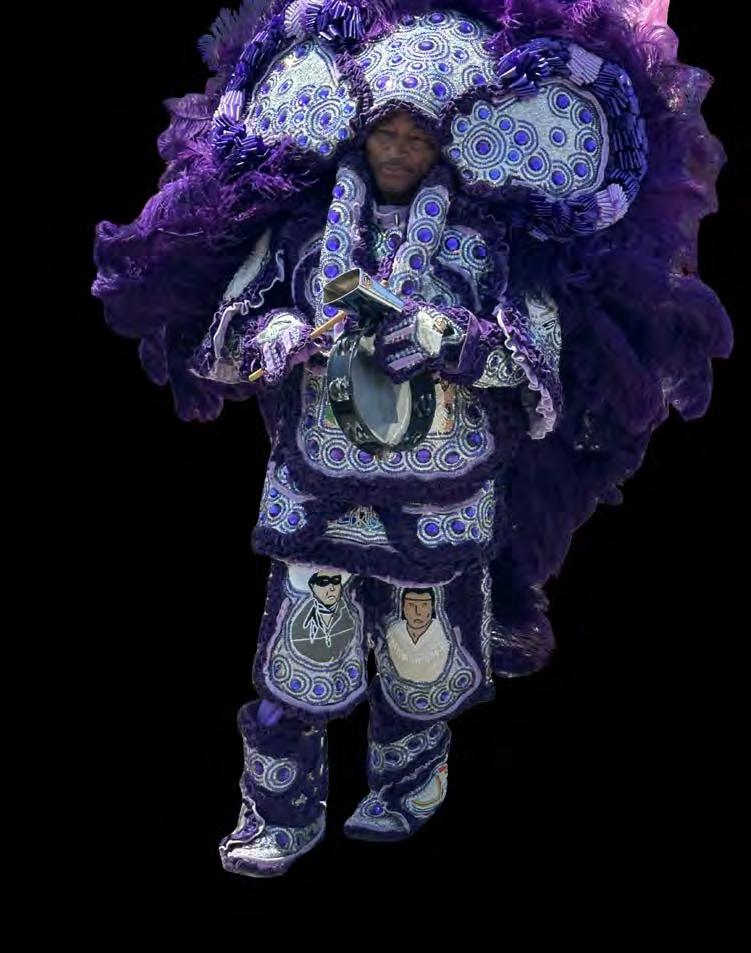
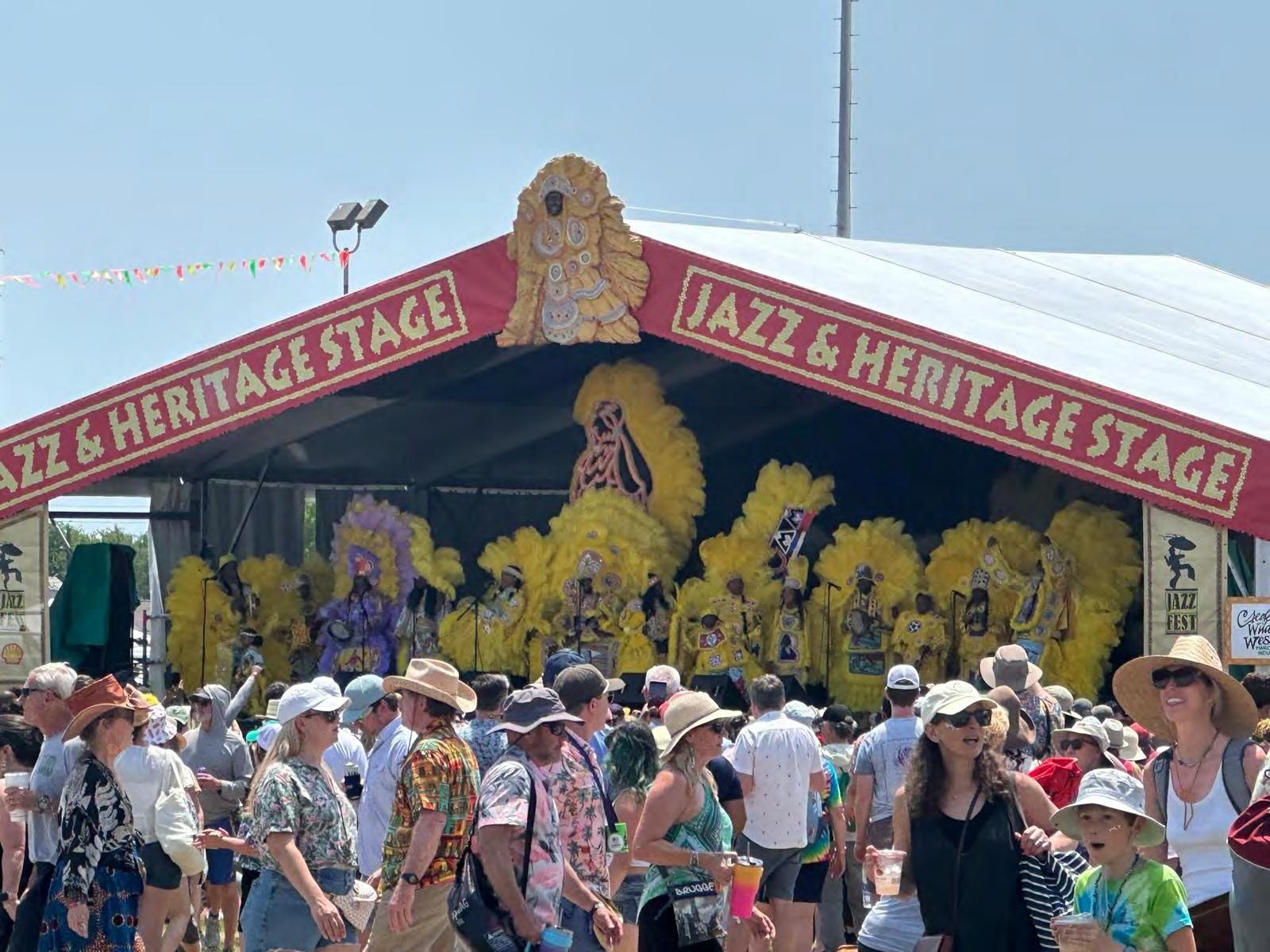
Itwas opening dayat the NewOrleansJazz and Heritage Festival.As Iweaved my way through the vast crowd, I was stopped in my tracks. The Mardi Gras Indians: beating drums, dancing feet, breathtaking handcrafted regalia brilliant with color and alive with meaning. The joy. The pride. Rooted in heritage, it brought Jonkonnu to mind: cultural identity worn on the body, carried in the rhythm. Enthralled attendees pressed in front of me to memorialize the beautifulspectacle on film. I became overwhelmed.
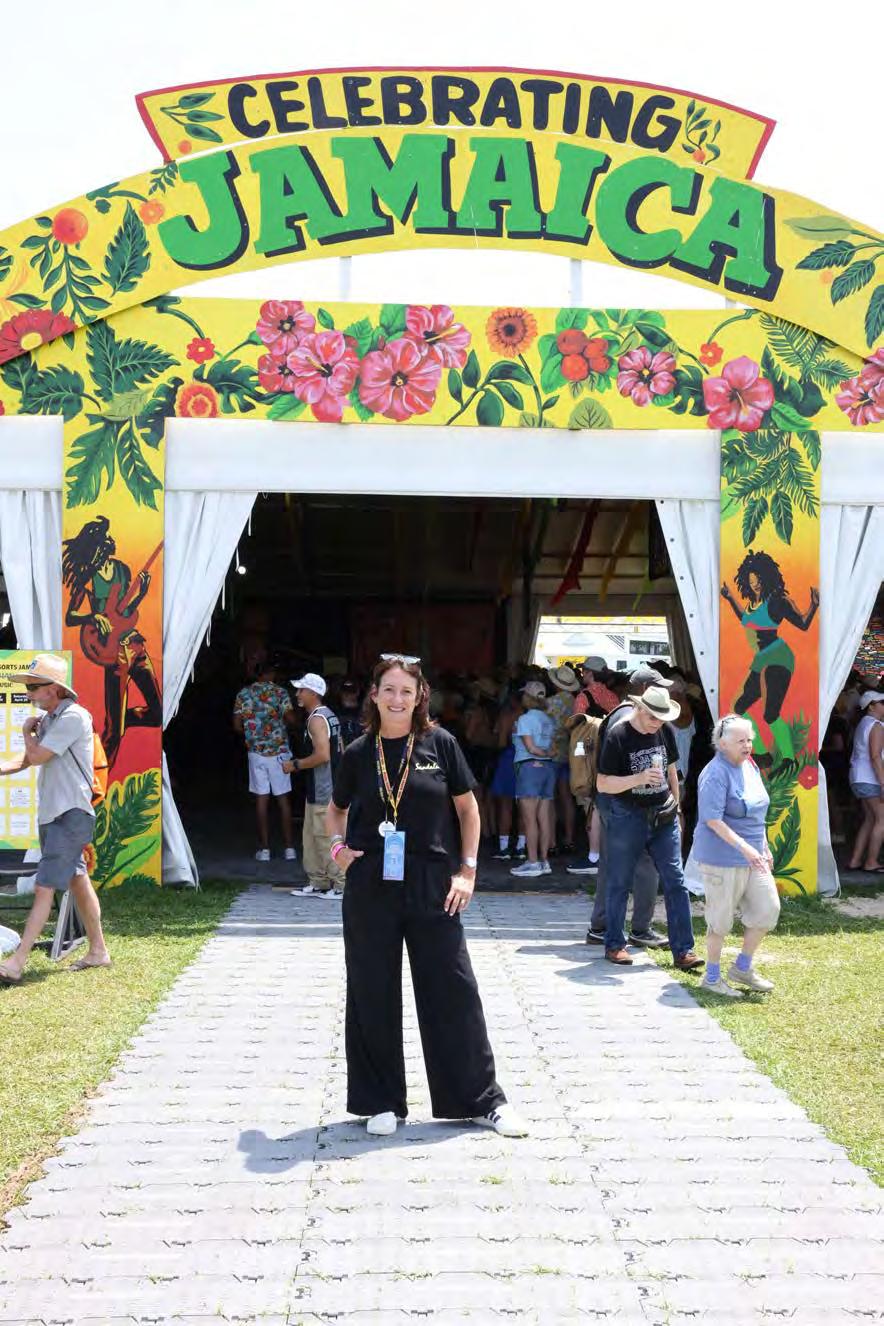
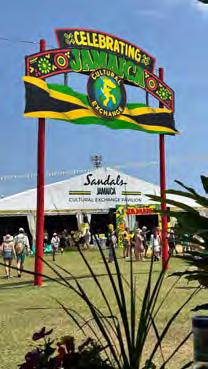
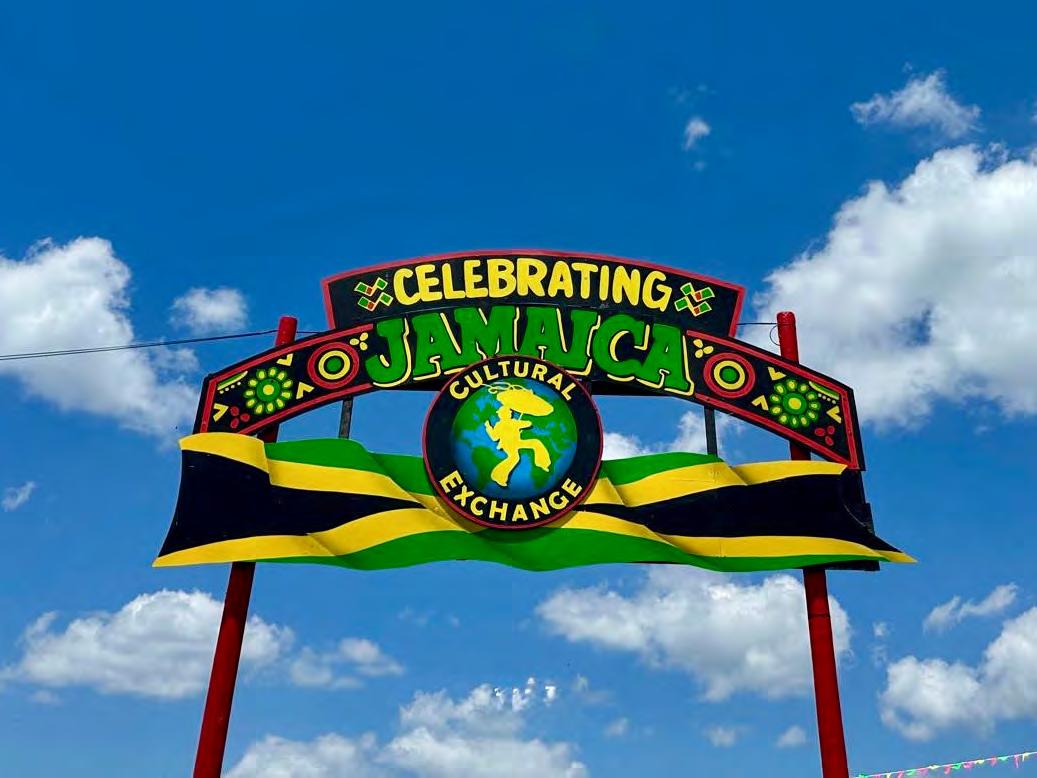
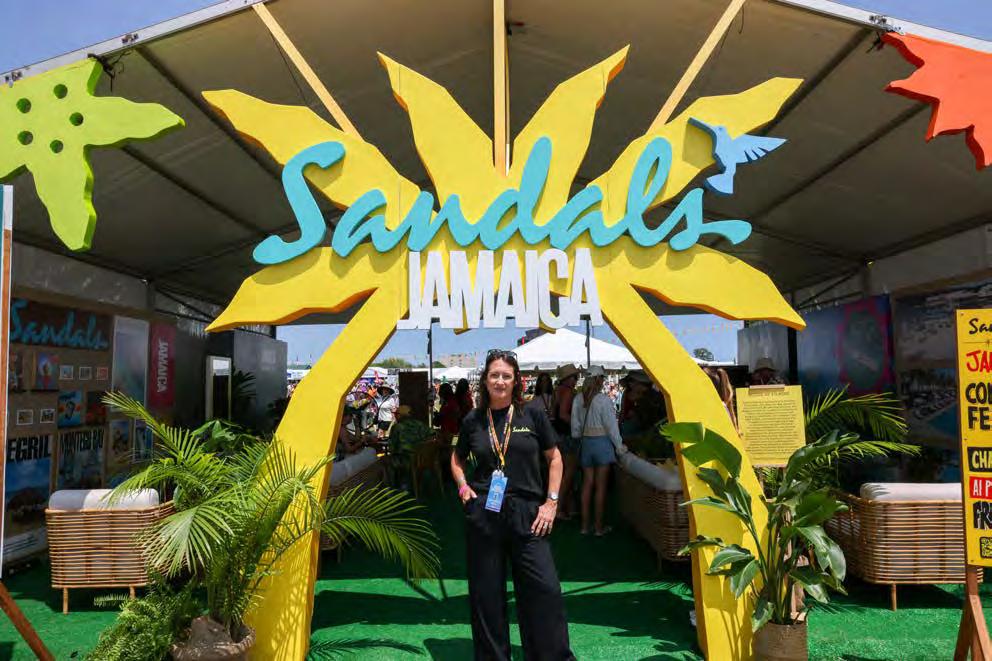
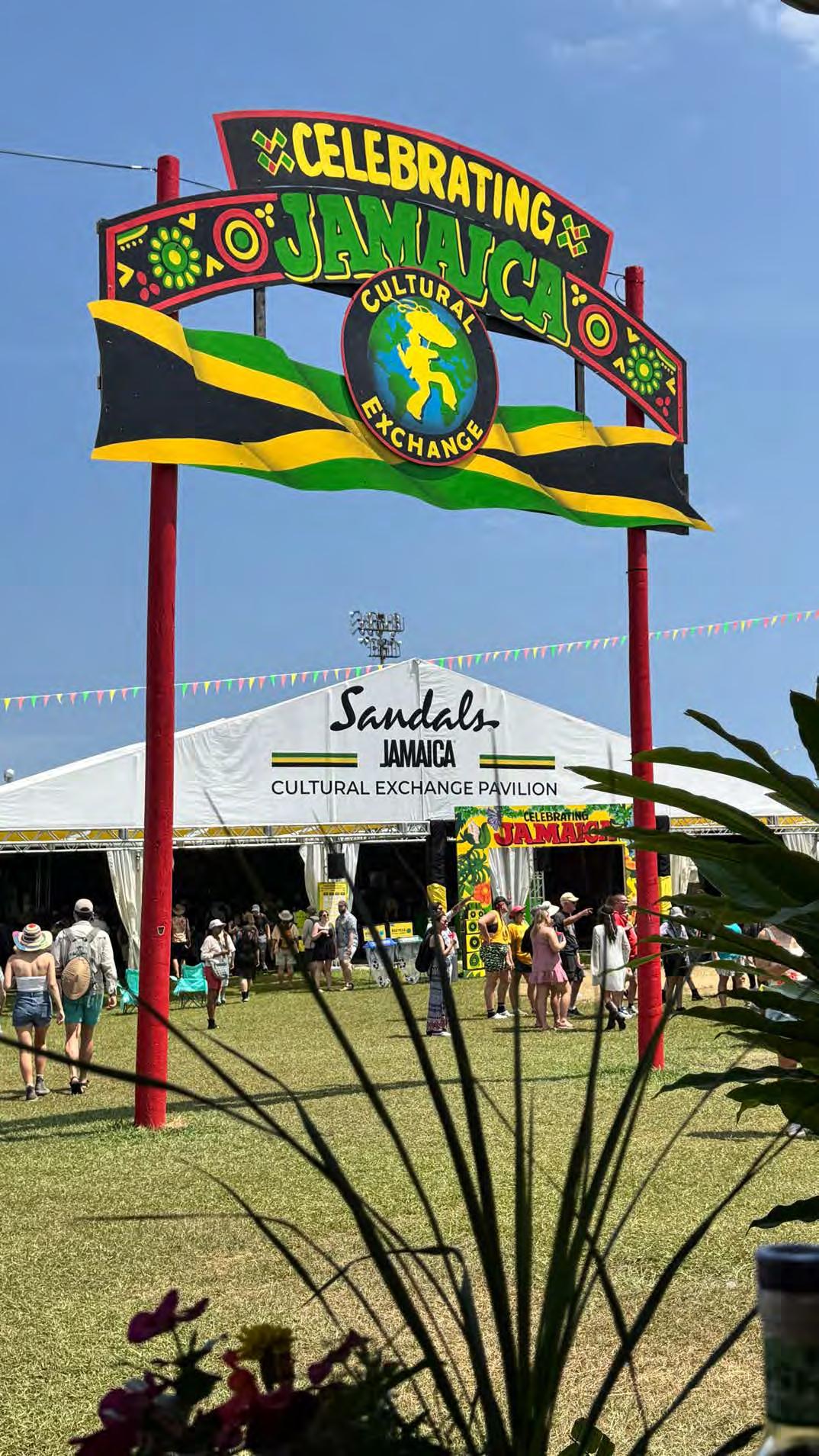
But then it reached me. That alluring Jamaican rhythm. I followed it. And as I drew closer, I looked up: the American flag, the Louisiana state flag, Jamaica's flag, and the Cultural Exchange flag, together on one pole, waving us into the Sandals Resorts Jamaica Cultural Exchange Pavilion. My spirit calmed. I found mypeople.
For over five decades, Jazz Fest has been one of the world's most beloved celebrations of music, culture, food, and the indomitable human spirit. It is a celebration that honours roots.And thisyear,Jamaica's roots ran deep through the Fair Grounds. Our artists took the stage not as guests, but as rightful participants in a global conversation about what culture can do, what it can heal, andwhat it can inspire.
Jamaican artists and performers commanded stages in front of audiences who mayneverhave set foot on ourisland.Acuriosity.Arecognition. Strangers singing every word of timeless Jamaican melodies: soulful poetry of the struggles faced by many, the fight against oppression. Resilience. Victories. One Love. Jamaica does not need to shout to be noticed. She simply shows up, and theworld turns toward her.Afamiliartune.Avibe.
There were many moments that took my breath away. The artisans. The musicians. The craftspeople who brought the work of their hands across the water to share the soul of Jamaica. From dancehall signs to on-site artist installations, nothing that could be downloaded or streamed or replicated. Tangible. Real. Reflective. Living proof that Jamaican creativity is not a moment. It is a movement.
When the rain came, as it sometimes does, they adapted. They accepted the blessing, knowing the sun would shine again. Just as New Orleans rose from Katrina, Jamaica rose from Hurricane Melissa. The spirit of both communities, battered and drenched yet defiantly, the music plays on. Undeterred, rain becomes part ofthe storyratherthan the end ofit.
This special edition of Home Sweet Jamaica exists to honour what happened here: the culture, the music, the commitment, the craft, and yes, the rain. When the Jamaican community shows up on an international stage, it is with dignity, pride, and resilience, no matter what the weather brings. This is a love letter in recognition of everyone who showed up and made it possible, and of the visionaries who boldly understood that putting Jamaica in front of the world is not just good programming. It is nation building.
With pride andwith love,
GinaTulloch-Adams Publisher, Home SweetJamaica
AKWAABA
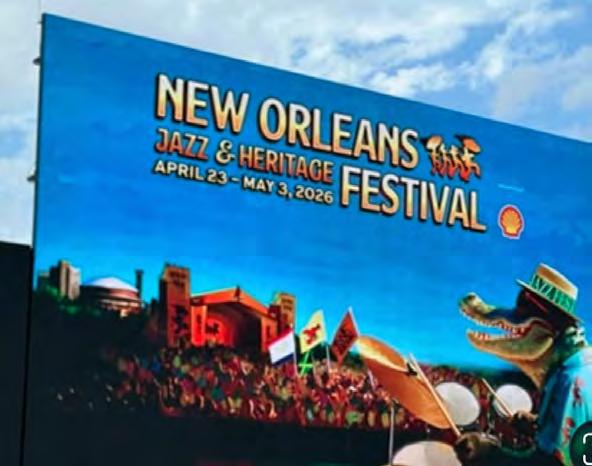
In the Akan language of West Africa, akwaaba means welcome. But on the groundsofthe2026NewOrleansJazzand HeritageFestival,itmeantsomethingolder and deeper than that. It meant: We know you. We remember you. We have been waiting.
Two communities, separated for centuries by the Middle Passage, finding each other again through the one language neither colonizer nor hurricane could ever silence. Music.Heritage.Culture.
They are not the same thing, though we oftenspeakofheritageandcultureasone.
Heritage is what was passed down: the ancestral memory, the roots, the history that lives in the body before it lives in the mind. Culture is what grew from those roots: the dance, the food, the celebration, the living proof that what was planted survived. Heritage looks back. Culture moves forward. And music? Music is the expression of both. It carries the weight of the spiritual and the historical in the same breath. Jazz. Reggae. Gospel. It is why, whentheJamaicanrhythmreachedacross the Fair Grounds at Jazz Fest 2026, it was morethanentertainment.Itwastestimony.
WhenJamaicatookthestageatJazzFest 2026, it was not simply a Caribbean island taking its place at one of America's great cultural events. It was a homecoming. It was a recognition between two peoples shaped by the same ancestral hand, separated by water and history, reunited byrhythm.
To understand why Jamaica belonged at Jazz Fest, you have to begin not in 1970, when the festival was founded, but centuries earlier, in a small patch of grass at the edge of the French Quarter that would change the course of American musicforever.
Akwaaba.Welcome.
AKWAABA
THE PROOF WAS IN THE INSTRUMENTS
The proof was never just in the music itself. It was in the instruments. The banjo, that most American of sounds, was first documented in Jamaica in 1687, decades before it appeared on the North American mainland. It came from West African gourd lutes, the akonting, the kora, the xalam, carried across the Middle Passage byenslavedpeoplewhorefusedto arrive empty handed. That same instrument appeared in the streets of New Orleans by the early 1800s, holdingdowntherhythmsectionof earlyjazz.
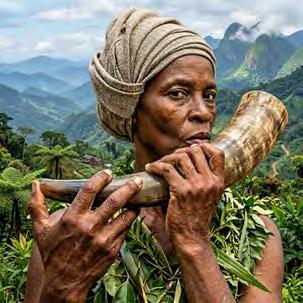
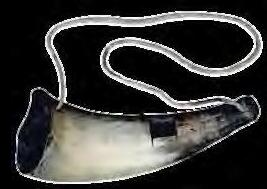
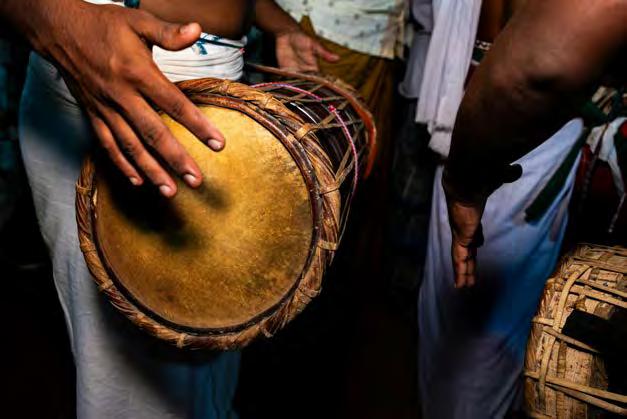
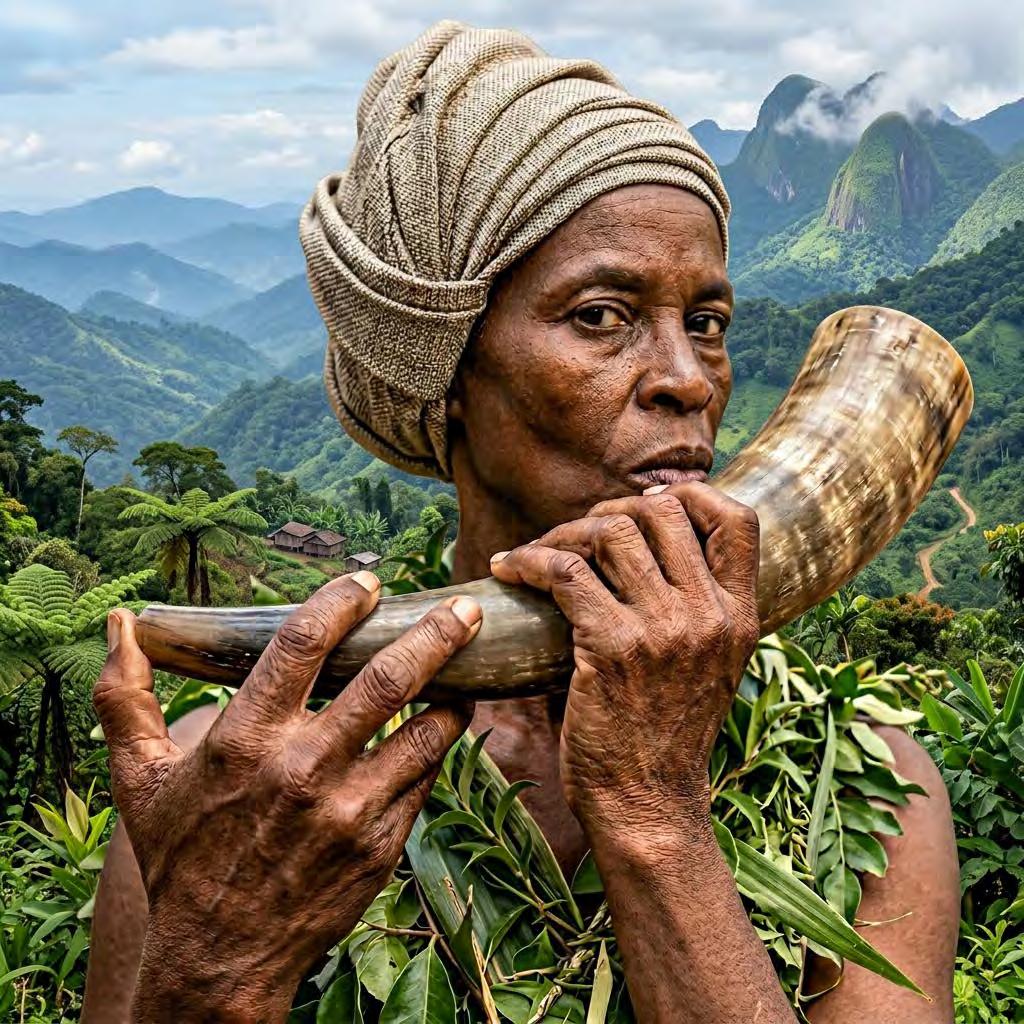
The drums tell an equally powerful story. In the mountains of Jamaica, the Maroons, escaped enslaved Africans who fought and won their freedom from the British as early as 1739, preserved African drumming traditions in their purest form, using the Gumbeh drum and the Abeng horn to communicate, to worship, and to resist. That spirit of survival carried forward through generations, through Kumina, through Burru, through the Nyabinghi drumming of the Rastafari movement, each one a living link in an unbroken chain of resilience, until those rhythms became the spiritual heartbeat of reggae itself. In Congo Square in New Orleans, those same African drums thundered every Sunday, feeding what would become jazz. The call and response that defined gospel and jazz in New Orleans was the same vocal structure embedded in mento, Jamaica's first folk music.
Jazz and reggae are two answers to the same question.
Howdoyoufindfreedomasaslave?
Freedomthroughmusic.
Differentblossoms.Sameroot.
Congo Square: The Heartbeat That Started It All AKWAABA
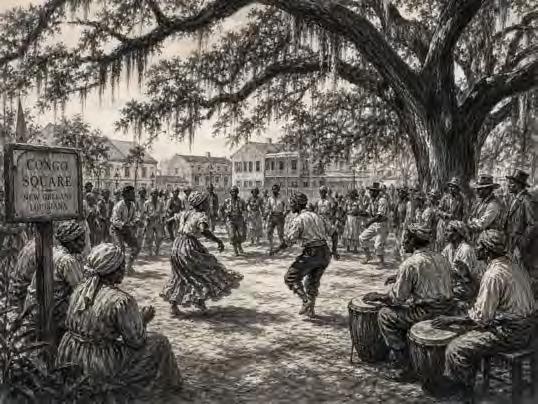
In the 1700s, under French and Spanish colonialrule,enslavedAfricansinNewOrleans were permitted to gather on Sundays in an open space that came to be known as Congo Square. There, they drummed. They danced. They sang in the languages of their homelands. They kept alive the cultural memory that slavery was designed to erase. The rhythms they played, the Bamboula, the Calinda, the Congo, carried with them the musical DNA of West Africa. Those rhythms didnotdisappear.Theyseepedintothesoilof New Orleans and eventually became jazz, the blues, the second line, the Mardi Gras Indian tradition.
As one New Orleans city ordinance restoring the site's name declared, jazz is the only truly indigenous American art form, and Congo Squareisarguablywhereitwasborn.
But what was really happening in that square went far deeper than music. In a world designed to strip enslaved people of everything, those Sunday gatherings were an act of profound cultural resistance. The music carried coded messages that the oppressor could hear but never fully understand. It organized communities. It preserved languages. It held ancestral memory in the body when every other means of holding it had been taken away. The authorities understood this even if they could not articulate it. In 1835 the Sunday gatherings were banned. In 1851 they were shut down permanently. You do not ban something that doesnotthreatenyou.
Improvisation, the beating heart of jazz, was itself an act of defiance. To improvise is to refuse to be bound by the written rule or the fixed structure. To make something new and unrepeatable in the moment. Every jazz improvisation carries in its DNA the spirit of a peoplewhorefusedtolettheircircumstances define them. The body could be enslaved. The spirit, expressed through music, could not.
What is less often told is who was in that square.Historicalrecordsconfirmthatamong the enslaved people brought to Louisiana during the French colonial period were men and women from Jamaica and other Caribbean islands, already carrying within them cultural traditions formed under strikingly similar conditions. The dances performed in Congo Square shared direct featureswiththoseoftheFrenchandSpanish West Indies. The Kumina, one of Jamaica's oldest and most sacred African rooted ceremonial traditions, is among the dance formsdocumentedatCongoSquare.
Jamaica and New Orleans were not simply shaped by the same African origins. In some cases,theywereshapedbythesamepeople.
Akwaaba.Welcome.
AKWAABA
Born in Congo Square: The Festival That Grew Into a Movement
On April 22, 1970, the first New Orleans Jazz and Heritage Festival took place in Congo Square, then still known as Beauregard Square. Fewer than 350 people attended. The headliners included Duke Ellington, the Olympia Brass Band, and the Mardi Gras Indians, who paraded through the grounds every day. In a moment that would define the spirit of the festival for decades, gospel legendMahaliaJackson,performingnearbyat the Municipal Auditorium, joined an impromptu second line with the Eureka Brass Band, singing as she marched. Producer George Wein handed her a microphone. She sang.Thecrowdfollowed.
AndJazzFestwasborn.
From the beginning, Wein's vision extended beyond jazz. He emphasized African, Caribbean, and French culture alongside Louisiana's indigenous music traditions. Caribbean rhythms, Caribbean food, Caribbean spirit were woven into Jazz Fest's founding DNA. The festival was never meant to be a local event. It was always meant to celebrateeverywhereitsrootscamefrom.
By the mid 1970s the festival had outgrown Congo Square entirely and moved to the Fair Grounds Race Course, its current home. It grew steadily from those 350 early attendees into one of the world's most celebrated cultural festivals, drawing nearly 500,000 visitors across two weekends each spring. Fifty five years on, Jazz Fest remains what it was always meant to be: not just a music festival but, in the words of producer Quint Daviswhohasguideditforoverfivedecades, aculturalfestival.Thedistinctionmatters.
Heritage brought people to Congo Square in 1970.Culturekeptthemcomingback.
Akwaaba.Welcome.
THE GEOGRAPHY: HOW TWO WORLDS WERE ALWAYS CONNECTED
The ships left the same shores of West Africa. Some went to Jamaica. Some went to Louisiana.SomewenttoJamaicafirst,andthen to Louisiana. Historical records confirm that enslavedAfricansandAfro-Creolepeoplewere sold to Louisiana from Jamaica and other Caribbean islands during the French colonial period. Jamaica was not just a destination. It was also a transit point. The same human beings, or their cultural descendants, brought from West Africa to Jamaica, were sometimes movedagaintoNewOrleans.
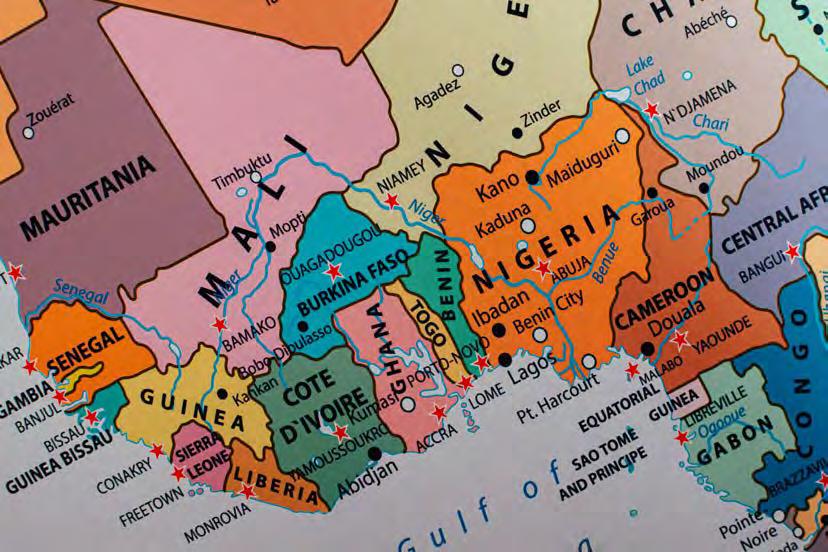
Both territories drew from the same regions of West Africa: the Gold Coast, the Bight of Benin, theBightofBiafra,theKingdomofKongo.They did not simply share African ancestry in general. They shared specific ethnic and cultural origins. The Akan people, whose language gave us Akwaaba, were among the largest groups brought to Jamaica. The Yoruba and Fon peoples were heavily represented in Louisiana.ThesewereneighborsinWestAfrica, peoples who shared trade routes, cultural practices, and music long before the ships came.
It was never a coincidence that the banjo appeared in Kingston before it appeared in New Orleans. Or that the rhythms of Congo Square echoed the ceremonial dances of Jamaica's mountains. Or that the call and response of the jazz choir sounded so familiar to anyone who had ever stood in a revival meeting in Kingston. These were not influences traveling across the Atlantic. They were memories traveling within the same people.
Which is perhaps why, when Jamaica finally took the stage at Jazz Fest 2026, something in the crowd recognized it beforeitcouldnamewhatitrecognized.
Thereunionhadbeenalongtimecoming. Akwaaba.
TheSound: JamaicaonEveryStage
At the 2026 New Orleans Jazz and Heritage Festival, Jamaica did not arrive with a single sound. She arrived with all the sounds of a nation's passion. She came to represent. From the oldest folk rhythms of the countryside to the conscious fire of roots reggae, the global swagger of dancehall, the spiritual depth of the revival movement, and the sophisticated elegance of Caribbean jazz, the lineup offered a musical portrait of an island whose creative range continues to move the world. What follows is not simply a list of performances. It is a journey through the soul of Jamaica, from where she began to where she is going, told in the voices of theartistswhoarecarryingherthere.
"Jamaica is back! These artists demonstrate the resilience of the Jamaican people. It is a great opportunity to be here and to be recognized."
WhereItAllBegan:Mento ShowJamMentoBand
Before reggae. Before ska. Before the world knew Jamaica's name, there was mento. Jamaica's first folkmusic,bornintheruralparishesoftheislandin the late 1800s, mento carried the rhythms of Africa and the melodies of the Caribbean in equal measure. The ShowJam Mento Band brought this foundational sound to the Cultural Exchange Pavilion with warmth, authenticity, and the quiet pride of people who know they are carrying somethingprecious.Completewiththerhumbabox providing its distinctive bass heartbeat, they played standards including a version of the traditional mento song "Day-O," made famous internationally by Harry Belafonte, to audiences who leaned in with the curiosity of first encounter. Many heard mentoforthefirsttimethatafternoon.Theywillnot forgetit.
Without the Skatalites, there is no reggae. It is that simple. Formed in 1964, they backed the earliest recordings of Bob Marley and the Wailers and laid the rhythmic foundation on which all of modern Jamaican music rests. They reunited in 1983 and have been playing ever since, releasing 17 studio albums across a career that is less a discography than a living archive of Jamaican musical history. At Jazz Fest 2026, they took the stage during the rain adjusted second weekend schedule and played as though the weather was irrelevant. For them, it was. When you have been making music for over six decades, a little rain is just percussion.
TheConscience:RootsReggae
WinstonRodney—BurningSpear
At 81 years old, Winston Rodney, known to the world as Burning Spear, does not perform so much as he testifies. Taking the Congo Square Stage on the first Saturday, he led his band through "Slavery Days," "Jah No Dead," and "Rocking Time" with the unhurried authority of a man who has spent five decades insisting that the African story must be told and the roots must be honored. The crowd grew larger with every song, drawn by something that transcended entertainment. This was bearing witness. At Congo Square, on sacred ground where the ancestors of both Jamaica and New Orleans once kept their traditions alive, the message landed exactly where it was always meant to.
TheConscience: RootsReggae
ZiggyMarley
Ziggy Marley brought his ninth studio album, Brightside, to the Congo Square Stage on the rain soaked second Friday. Stagehands swept puddles from the stage before Ziggy and his band came out. The crowd that had waited through the delays stayed, because Ziggy Marley is worth waiting for. The rain never stood a chance. New songs sat alongside Wailers classics that drew the loudest applause of the night. In true Jamaican style, Ziggy adapted and the crowd with him. Soaked and smiling, the Fair Grounds sang along.
StephenMarley
Stephen Marley brought eight Grammy Awards and over 45 years of musical artistry to the Congo Square Stage on opening night of Jazz Fest 2026. A singer, songwriter, and producer of formidable range, he moved between his own work, including songs from Old Soul, and Wailers classics including "Iron Lion Zion," "Jammin'," and "Get Up, Stand Up." The audience sang every word. They always do.
LutanFyah
Nineteen full length studio albums and a live record. Few artists in any genre can claim that kind of sustained creative output, and fewer still can claim that the quality of the work has never wavered. Lutan Fyah is one of roots reggae's most prolific and committed voices, his music rooted in Rastafari conviction and socially conscious lyrics that speak directly to the struggles and triumphs of everyday people. His Jazz Fest performances left audiences with something to carry home beyond a good memory.
JesseRoyal
At 36, Jesse Royal represents roots reggae's living future. His third studio album, No Place Like Home, earned a Grammy nomination in 2025, and the deluxe version arrives May 16, 2026. He performed on the opening day of the second weekend with the lyrical depth and spiritual grounding that connects him directly to the tradition roots reggae has carried for five decades. The thread is unbroken and Jesse Royal knows it.
Luciano
One of roots reggae's most revered voices, Luciano brought his message of love, faith, and cultural pride to the second weekend. A vocalist of extraordinary warmth and conviction, his presence in the pavilion was a reminder that Jamaican music has always been about something larger than entertainment. It has always been about belief.
TheRevolution:ConsciousRevival
Protoje
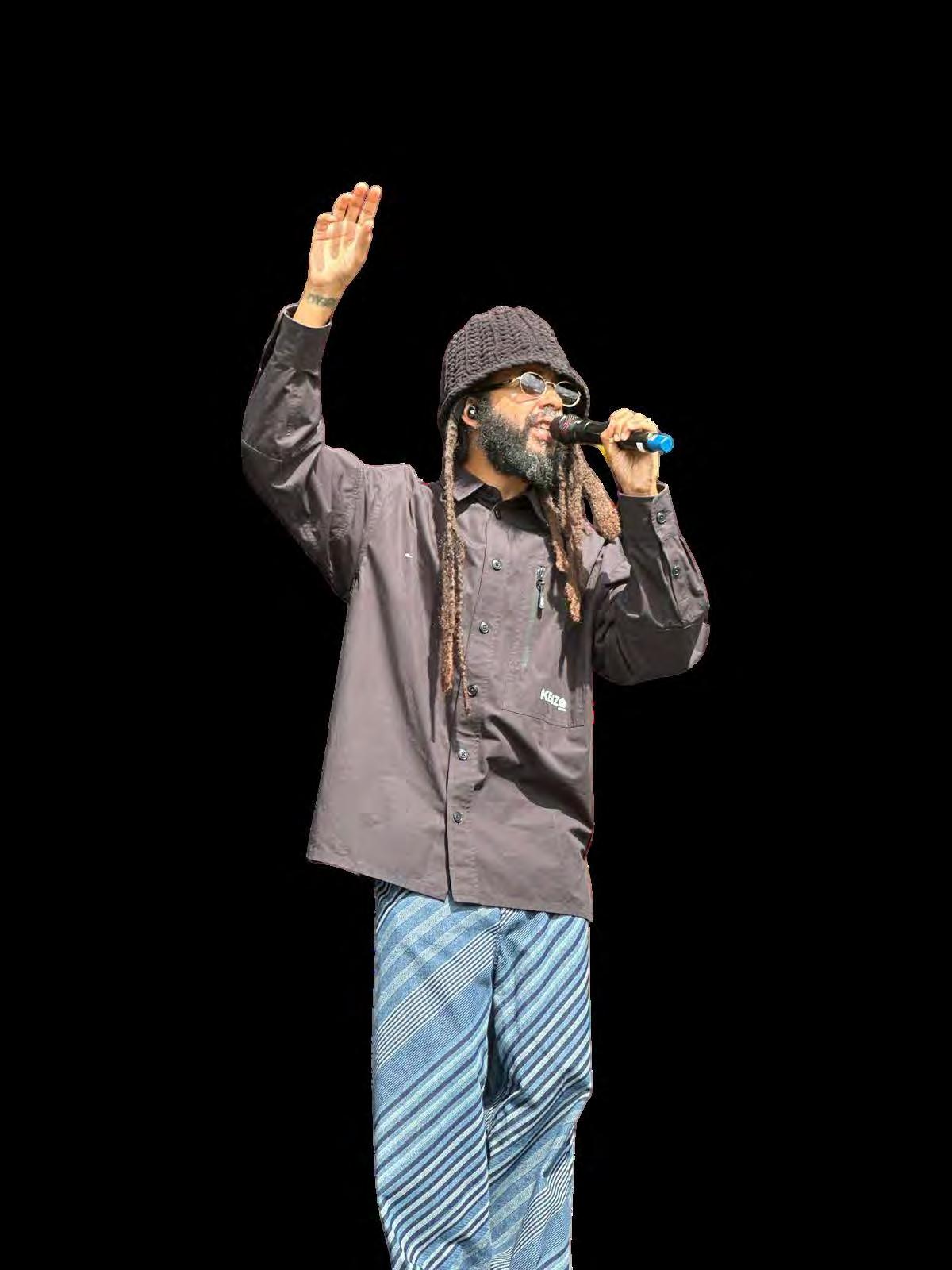
With his signature call, "O-okay!" resounding across the Fair Grounds, Protoje opened the gates for a new school of reggae at Jazz Fest 2026. Founder of the In.Digg.Nation Collective, he has spent a decade building a movement that blends roots reggae with conscious lyrics, dancehall riddims, and R&B influences, nurturing artists who have gone on to reshape the genre entirely. His Congo Square Stage performance on the first Friday drew couples dancing, strangers exchanging knowing smiles, and a New Orleans reggae community that recognized immediately what it was witnessing. A new generation, fully formed, fully arrived.
Sevana
With a voice one New Orleans reggae DJ described as bringing people together regardless of race or religion, Sevana held two performances on the first Friday, at the Pavilion and on the Gentilly Stage. She first appeared on Protoje's 2015 Ancient Futures album and has been building a devoted following ever since. Audiences near the Cultural Exchange Pavilion could hear her sing "Mi love you like mango" and "Lowe mi, mek mi live" over classic rocksteady and roots reggae rhythms. She is one song away from becoming a household name. Jazz Fest may have been that song.
LilaIké
Grammy nominated and ascending with remarkable speed, Lila Iké brings a smoky, soulful sound to contemporary reggae that sits beautifully between roots tradition and modern R&B. Her debut album Treasure Self Love, featuring H.E.R. and Joey Bada$$, announced her arrival to the world, and her Grammy Awards performance this year confirmed it. Closing out the Cultural Exchange Pavilion on the final Sunday of Jazz Fest, she gave the festival its most emotionally resonant ending. A voice that carries weight without forcing it.
Runkus&RoyalBluwithDubSquad
TheRevolution: ConsciousRevival
Performing through the weather disruptions of the second weekend with exactly the spirit the moment demanded, Runkus & Royal Blu with Dub Squad delivered one of the pavilion's most energetic performances. They came. They played. They gave everything. Jamaica does not wait for perfect conditions.
TheGlobalAmbassador:Dancehall
SeanPaul
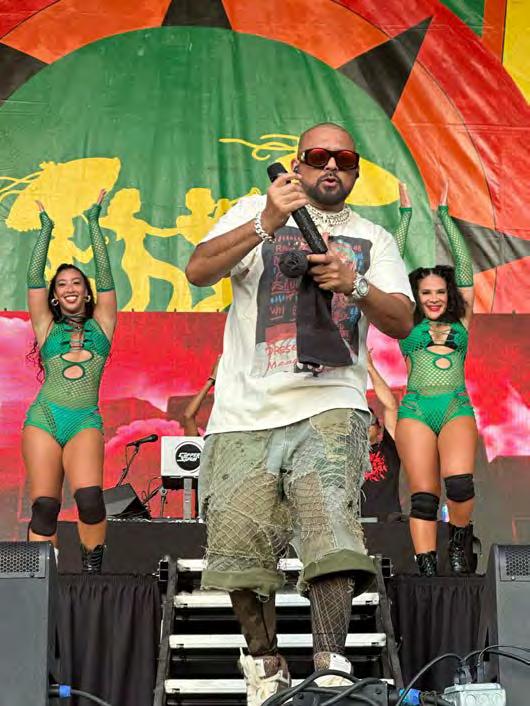
Sean Paul is dancehall at its most joyful, its most infectious, and its most unapologetically Jamaican. For over two decades, he has carried Jamaica's rhythm to every corner of the world, turning the island's sound into a global language that needs no translation. His Congo Square Stage headline set was described by multiple people as their favorite performance of the entire weekend. The energy, the hits that audiences on every continent know by heart, the pure unfiltered joy of a Jamaican party done right. His dancers commanded the stage with a precision and sensuality that matched every beat, and the crowd could not take their eyes off them, cheering as much for the movement as for the music.
TheDebut:ANewVoice
RikJamwithIslandFederation
Hailing from Kingston, Rik Jam released his debut album The Genesis in 2025, a deeply personal record rooted in faith, upbringing, and the search for identity. He performed on opening day on both the Congo Square Stage and in the Cultural Exchange Pavilion, one of the few artists to bridge both stages in a single day. A debut performance at Jazz Fest is not a small thing. Rik Jam handled it with the grace of someone who has been preparing for exactly this moment his entire life. Remember the name.
TheConnectiveThread:SteelandStrings
SilverBirdsSteelOrchestra
Silver Birds Steel Orchestra began in 2007 as a high school outreach programme in Jamaica and has since become a staple of the island's resort and performance circuit. Featuring steel drums and a repertoire that moves fearlessly from Bob Marley to Lady Gaga, they performed across multiple stages during the first weekend, including the Jazz & Heritage Stage on Saturday. There is something about steel drums in the open air that makes time feel briefly irrelevant. Silver Birds understand this. They use it beautifully.
TheBridge:CaribbeanJazz
Dr.MontyAlexander,C.D.,O.J.
Born in Kingston, Jamaica on June 6, 1944, Monty Alexander was playing by ear at four, performing in local clubs at 14, and participating in the foundational ska recording sessions that would help give birth to reggae by his mid teens. By 19, he was in New York City. Today he is Grammy nominated, cited among the five greatest jazz pianists of all time, documented on over 75 recordings, and honored by the Jamaican government with the Order of Jamaica for his contributions to the promotion of Jamaican music globally. His Jazz Fest 2026 headline performance at the WWOZ Jazz Tent was titled "Jamericana," his signature artistic concept: the fusion of Jamaica's African-rooted rhythmic tradition with the jazz born in America's Deep South. When Dr. Alexander sat down at that piano on opening night, Kingston and New Orleans converged on one stage. One unbroken line of Black musical genius, from the ska sessions of late 1950s Jamaica to the sacred ground of the Jazz Tent, finally and fully home.
Akwaaba.
HeritageinMotion
KayaJonkonnuBandandWalkingTallJamaica
Not all of Jamaica's music at Jazz Fest 2026 happened on a stage. The Kaya Jonkonnu Band and Walking Tall Jamaica paraded through the Fair Grounds on both weekends in the spectacular regalia of Jamaica's oldest masquerade tradition. Phone cameras went up. Children pressed forward. Adults stopped mid-stride. And somewhere in the crowd, it became difficult to discern where the Jonkonnu ended and the Mardi Gras Indians began. Two traditions, born from the same ancestral memory, moving through the same sacred ground, speaking the same language of resilience, color, and joy.
Akwaaba.
MORE THAN A SPONSOR
Sandals has always understood that one one coco full basket. Jamaican tourism is built on more than its place in the sun. It is built on her music, her culture, her food, her craft, her people, and the countless acts of care and investment that, taken together, tell the world who Jamaica truly is. At Jazz Fest 2026, Sandals showedupwithafullbasket.
Sandals has spent over four decades demonstrating that tourism must do more than fill hotel rooms. It must transform communities. Build lives. Preserve culture. And leave the islands better than it found them. To achieve this,theSandalsFoundationwascreated.
The Sandals Story at Jazz Fest 2026
THE PHILANTHROPIC HEART: SANDALS FOUNDATION
The Sandals Foundation works tirelessly to help Caribbean communities thrive by investing in sustainable projects in education, environment, and community aimed at improving people's lives and preserving our natural surroundings. Founded in2009astheformalphilanthropicarmofSandals
Resorts International, it is, as Adam Stewart describes it, quite literally their love of home put intoaction.
Sandals Resorts proudly supports all administrative and management costs so that 100 percent of every dollar donated goes towards the funding of initiatives in education, community, and the environment. That single fact separates the Sandals Foundation from most corporate philanthropy.
Heidi Clarke, Executive Director of the Sandals Foundation, whose work preserving Caribbean craft, culture, and community brought twoJamaicanartisanstotheworldstageatJazzFest2026.
THE PHILANTHROPIC HEART: SANDALS FOUNDATION
And their work is extraordinary in its scope and diversity.The Foundation has established marine sanctuaries and coralrestoration sites inJamaicaandSaintLucia.Ithasplantedover 25,000 trees across the Caribbean. It has provided free healthcare to thousands of locals. It has empowered over 4,000 women through various empowerment programs across the Caribbean. And its invitation to Pack for a Purpose has resulted in over 90,000 pounds of supplies donated to Caribbeanschools.
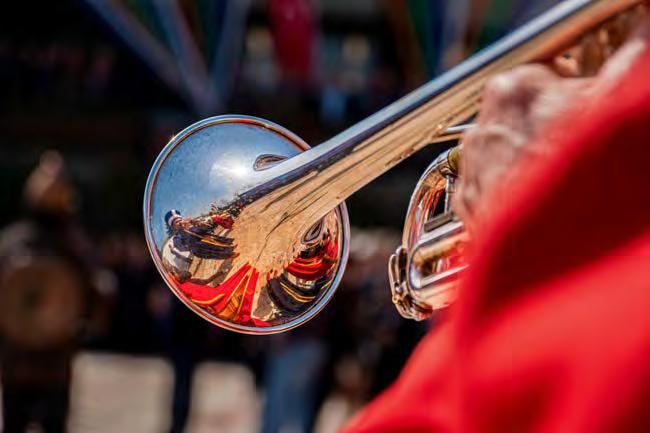
Recognizing the importance of music to Jamaica, the Sandals Foundation has supported the Skyliner Marching Band, delivered specialized brass music education workshops with Sam Sharpe Teachers' College, and invested in the island's renownedAlpha SchoolofMusic, collectively nurturing the next generation of Caribbean musicians and preserving the region's rich musical heritage. Music is an integral part of Jamaica's identity. The Sandals Foundation's supportivepresenceatJazzFest2026wasan investmentinJamaica.
But perhaps the Foundation's most culturally resonant initiative, and the one most directly connectedtowhatunfoldedatJazzFest2026, is the Caribbean Artisan Collection Programme.LaunchedinJamaicain2018with support from the Development Bank of Jamaica, the Government ofJamaica, and the World Bank, the programme brought product development, packaging, marketing, and key business skills to artisans across the region. Sinceitslaunch,yearonyearsalesofproducts for artisans trained under the programme increased by 23 percent, and locally made crafts became one of the best selling items withinresortshops.Todaytheprogrammehas supported over 30 artisans across all nine islandswhereSandalsResortsoperates.
Throughtheircrafts,artisansnotonlykeepthe culture of their communities alive but provide employmenttoanextendednetworkofsupply chain producers and distributors. As Heidi Clarke, Executive Director of the Sandals Foundation, put it: when we support artisans, we are not just preserving craft. We are protecting livelihood and strengthening communities. At Jazz Fest 2026, those words tookphysicalform. “When we support artisans, we are not just preserving craft. We are protecting livelihood and strengthening communities.” ~ Heidi Clarke
Therootsrundeep.
MusicWasAlways insandals’DNA
The Sandals story at Jazz Fest 2026 did not begin at the Fair Grounds. It began in Jamaica, in 1996, when Gordon "Butch" Stewart, as chairman of Air Jamaica, launched the Air Jamaica Jazz and Blues Festival at Rose Hall Great House in Montego Bay. That same year, the New Orleans Jazz and Heritage Festival launched its Cultural Exchange Pavilion, celebrating the music and culture of Caribbean nations. Jamaica's artists graced the Jazz Fest stages for decades. Yet a dedicated spotlight onJamaica as a nation had never come. Until 2026. Butch Stewart understood instinctively that Jamaicaandjazzsharethesameancestral root, the same African memory, the same gift for turning suffering into beauty. He brought the world's greatest jazz and blues artists to Jamaica's shores, among them George Benson, Buddy Guy, Patti LaBelle, Al Jarreau, and Ziggy Marley. When others doubted thatJamaica could host a world class jazz festival, Butch Stewartwasalreadybuildingone.
FromButchtoAdam,fromonegeneration tothenext,theStewartfamilycontinuesto keep Jamaica's story in the spotlight. At Jazz Fest 2026, with the Sandals Resorts Jamaica Cultural Exchange Pavilion flying Jamaica's flag at one of the world's greatest music festivals, that story found one of its most extraordinary stages, whereJamaicasitscomfortably.
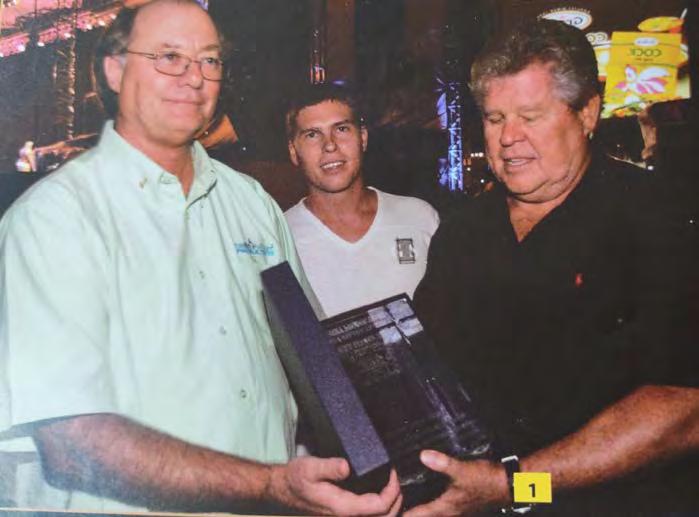
Turnkey Productions President Walter Elmore, left, presents the Executive Producers Award to the Hon. Gordon "Butch" Stewart at the Air Jamaica JazzandBluesFestival.ThenCEOofSandalsResorts,AdamStewart,looks on.
AFTER HURRICANE MELISSA: SHOWING UP WHEN IT MATTERED MOST
In the aftermath of Hurricane Melissa, the Sandals Foundation acted decisively and expediently, knowing that restoring livelihood means restoring dignity. In rural districts, agriculture, fisheries, and other small enterprises comprise the backbone of Jamaica's everyday life. Preserving the cultural traditions that would otherwise be lost is as important as clearing roads and repairing buildings after a Category 5 storm that shakes thecore.
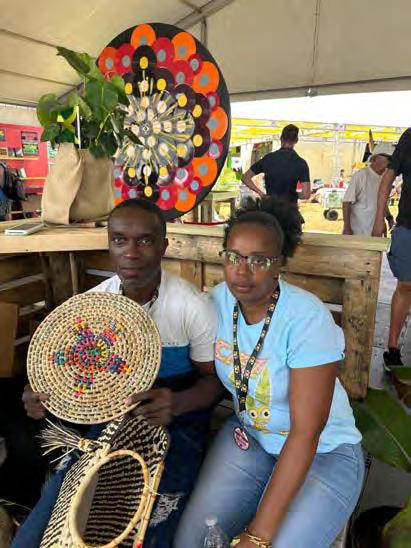
ForJazz Fest artisans Omar"Sheldon" Daleyand Lavern Evans, co-founders of FIRSTSTRAW Company, the Foundation's response was deeply restorative. "Even when there seems like there's no hope, hope comes along." The Sandals Foundation intervened, installing a solar energy system that allowed them to return to making a living. Jamaican resilience in action. That isheritagetourismatitsmostintentional,anditsmosthuman.
THE CRAFT: HANDS THAT TELL THE STORY
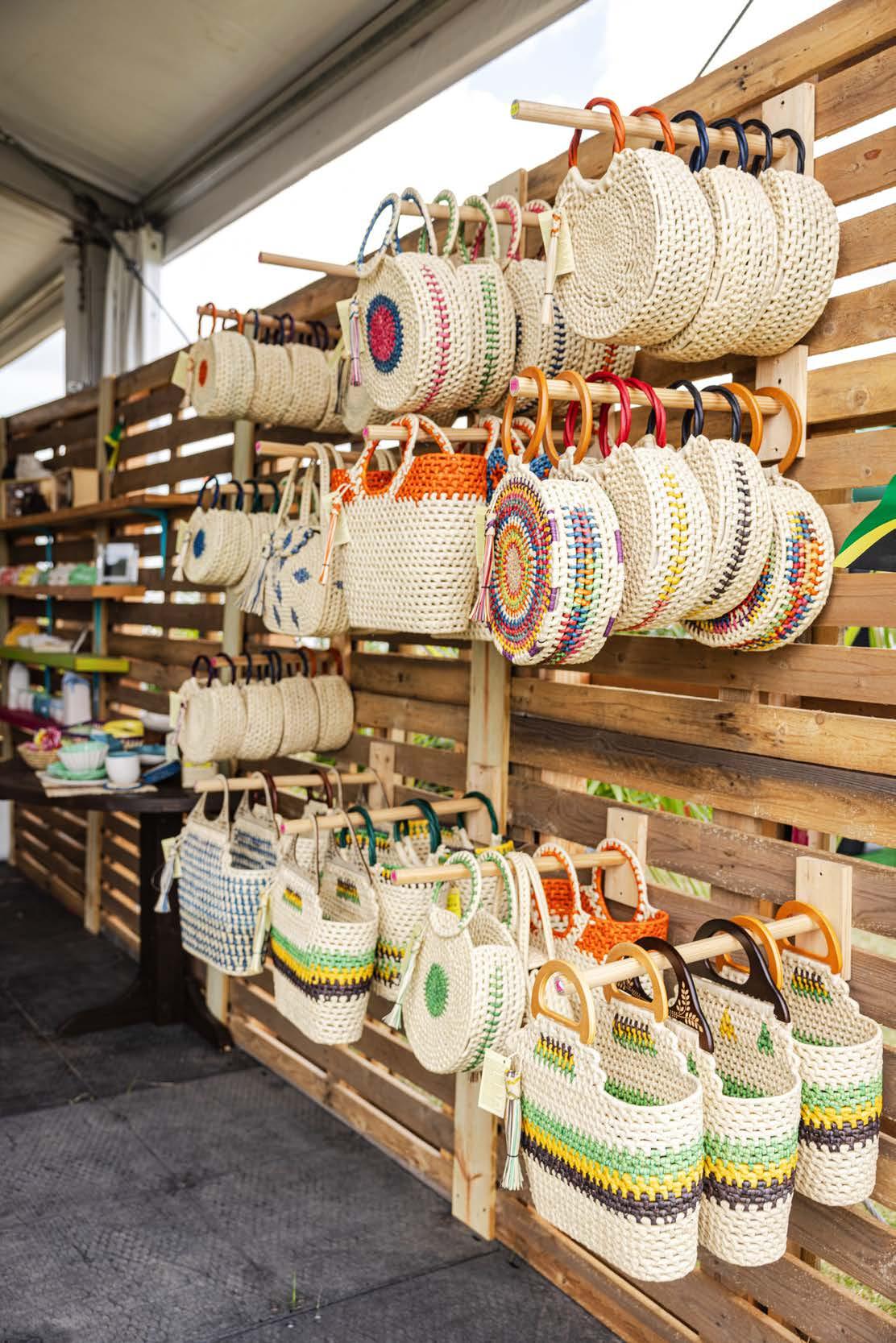
FIRSTSTRAW Company, a family enterprise rooted in the ancestral craft of strawweaving. Together they represent Westmoreland's living craft tradition at the Cultural Exchange ArtistDemonstrationTent.Omarlearnedthecraftfromhismother,atraditionrootedinthe ancestral practices of Jamaica's Taíno and African heritage. He weaves bags, baskets, trays, and more, blending traditional techniques with contemporary design in pieces that are,asheputithimself,areflectionofwhoweare.Outofmany,onepeople.
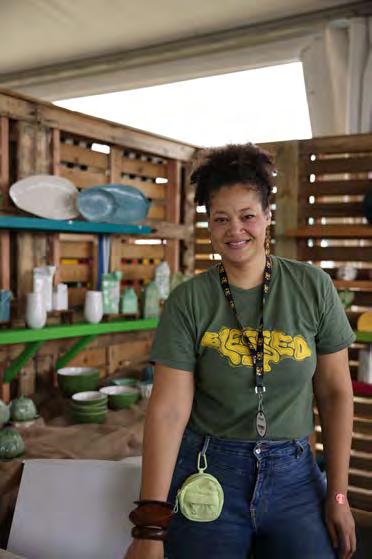
Dana Baugh, founder of BAUGHaus Design Studio, brings a different but equally rooted dimension of Jamaican craft to the world. Working in porcelain, she handcrafts tableware, planters, and sculpturalpieces that capture the quiet beauty of everyday Jamaican life. Over a decade of refining a practice that merges functional design with cultural storytelling, Dana's work does not simply sit on a shelf. It asks to be held, used, and lived with. A plate. A planter. A breadfruit.Apatty.UniquelyanddistinctivelyJamaica.
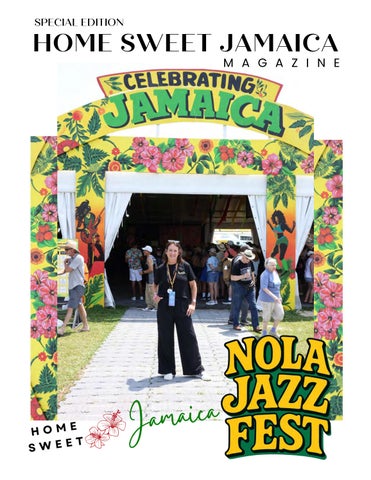
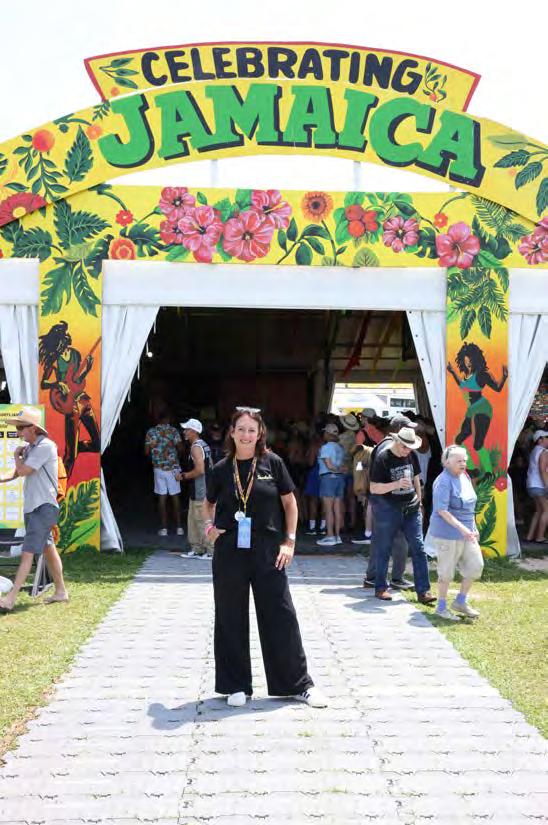
The Sandals Resorts Jamaica Cultural Exchange Pavilion was the cultural heart: the performance stage,theJonkonnuparade,andthesoundsofeverygenreJamaicahasevergiventheworld.For twofullweekends,itwasthemostJamaicansquarefootageonearthoutsidetheislanditself.
Omar 'Sheldon' Daley and Lavern Evans, co-foundersofFIRSTSTRAWCompany
Dana Baugh displays her handcrafted porcelain tableware and sculptural pieces. The quiet beauty ofeverydayJamaicanlife.
The CulturalExchangeArtist DemonstrationTentwaswhereJamaica's hands told herstory. Dana Baugh and Omar "Sheldon" Daley brought the work of their craft to an international audience,proofthatJamaicancreativityisnotconfinedtoastage.
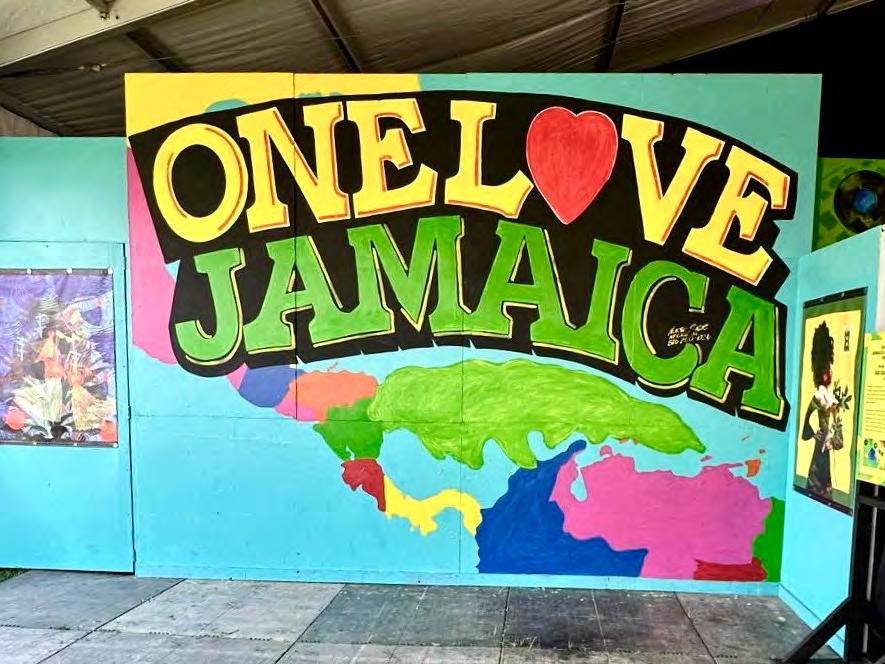
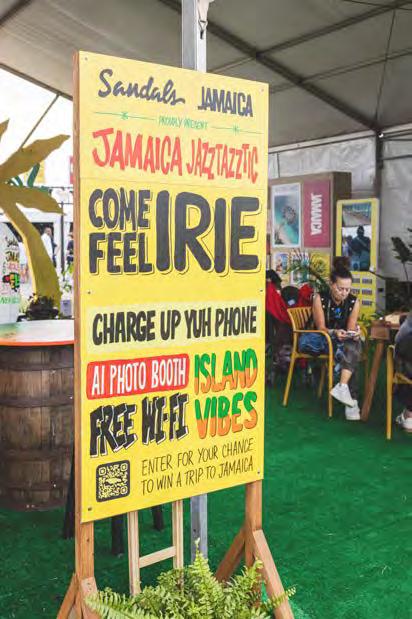
The Sandals Resorts and Jamaica Hospitality Tent offered something equally valuable: refuge. A place to stop. To breathe. To recharge, literally, with complimentary phone charging stations and freeWi-Fi, and figuratively,with lounge style seating that evoked the warmth of a Sandals resort. The Jamaica Tourist Board was on hand. Dominoes waited for anyone who needed a break from the music without leaving the Jamaica experience behind. Interactive photo moments transported visitors to iconic Jamaican settings, from cascading waterfalls to beachfront villas. Vibrant murals and vintage inspired dancehall postersturnedeverywallintoawindowontotheisland.
And every day, the sweepstakes. Festival exclusive daily giveaways offered four day, three night all-inclusive stays for two at Sandals Montego Bay, Sandals Royal Caribbean, and Sandals South Coast, and a family escape for four to Beaches Negril. For hundreds ofJazz Fest attendees who had never considered Jamaica as a destination, it became not just a feelingbutapossibility.Atripwiththeirnameonit.
Just steps away at the cultural food court, the festival's signature One Love Rum Punch, crafted from Appleton Estate Jamaica Rum, was available in both classic and frozen versions,acool,sweettasteoftheislandonawarmNewOrleansafternoon.
WHAT IT MEANS TO SHOW UP
The New Orleans Jazz and Heritage Festival's invitation to Jamaica was an acknowledgment of somethingtheworldisbeginningtounderstandmorefully:thatJamaica'sgreatestexportisnotjust hermusicorherbeaches,butherspirit.AtJazzFest2026,thatspiritshowedupineveryperformance, every handwoven basket, every piece of porcelain fired in a Westmoreland studio. Jamaican resilience,personified.AsAdamStewartdeclaredinthewakeofHurricaneMelissa:thereisnostorm orweathereventthatisgoingtostopJamaica.TheSandalsFoundation'svisionarycommitmentto puttingJamaicainfrontoftheworldensuresthatmessageresonateslongafterthemusicstops.
The Sandals Resorts Jamaica Cultural Exchange Pavilion at the 2026 New Orleans Jazz and Heritage Festival. For two full weekends, the most Jamaicansquarefootageonearthoutsidetheislanditself.
MAXINE WALTERS Bringing Jamaica’s Visual Soul to the World
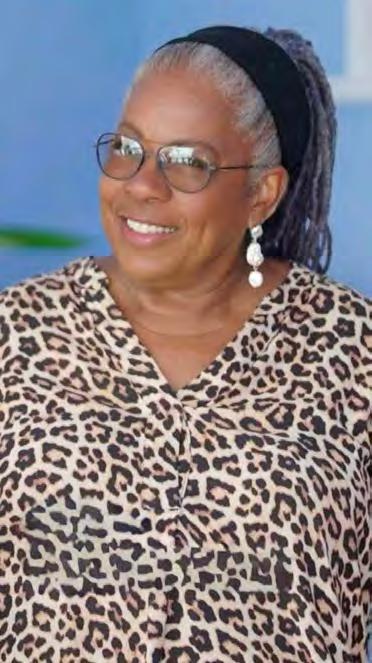
Maxine Walters is a champion of Jamaican culture. She carries it across borders and oceans, and refuses to let the world forget what Jamaica looks like from the inside. She has been doing this, in one form or another, for her entireremarkablelife.
Before the signs, before the sarongs, before the skies of Air Jamaica, Maxine Walters was already shaping Jamaica's cultural landscape in ways the world would only come to appreciate decades later. In 1978 she was one of five young Jamaican entrepreneurs, led by Tony Johnson, who founded Reggae Sunsplash, the festival that introduced reggae music to a global audience and createdJamaica'ssummertourismseasonalmostsinglehandedly. The group called themselves Synergy Productions, and together they built something that would run for nearly two decades and change the trajectory of Jamaican music internationally. Maxine stepped away from Synergy after the inaugural festival, but her fingerprints remain on one of the most important culturaleventsinCaribbeanhistory.
She began her career as one of Air Jamaica's first flight attendants, working on the airline's inaugural flight, a fitting start forawomanwhowould spend the rest ofher life introducing Jamaica to the world at every altitude. From the skies she moved into public relations, then fashion,launchingherownlineofsarongsthatcaughtthe attention of Macy's, which purchased 1,000 pieces and invited her to perform promotional shows across California.While in the United States she became, byher own account, the go-to person for all things Jamaican. The Jamaica Tourist Board called on her. Sandals hired her as a PR officer and sales representative, covering an area from Vancouver to New Mexico. She told the Jamaica Gleaner: the things I know best are my culture and myisland, and like allJamaicans, I loveJamaicawith a passion. So I promotedJamaica.Theywould use me to closetheirshowsbecausemypassionforJamaicawasso strongthatIcouldtakepeoplewithme.
Maxine returned to Jamaica in 1988 and reinvented herself as a media expert, building a successful film and television production company, teaching production for feature films at universities across the Caribbean for twelve years, and cementing her reputation as what the Jamaica Gleaner would later call a social legend and an inspirational front-runner: a cultural force who emerged at a time when the preferred fashion was to laud and welcome all things foreign. Maxine Walters was having none of it.
But it is what she has been doing since 1999 that has brought her to the attention of the world in ways that even she may not have anticipated.
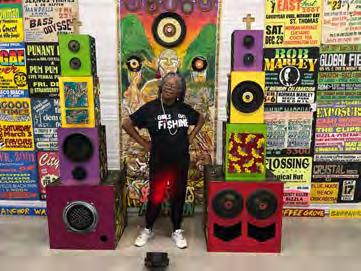
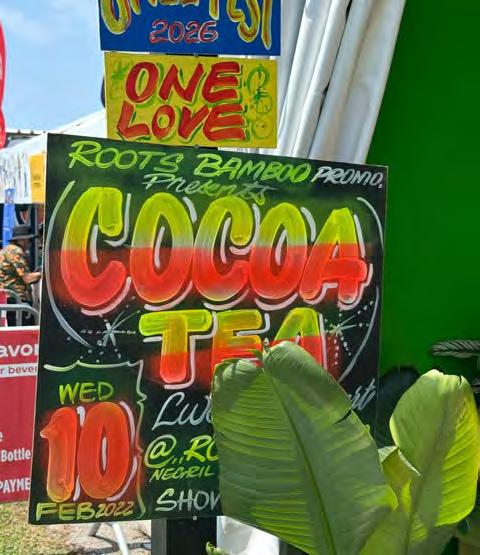
Maxine Walters, the Queen of Jamaican Dancehall Signs.Guardianofaculture,onesignatatime.
Saving the Signs
It started with a gift. An artist friend visiting fromtheUnitedStatespresentedMaxinewith a hand-painted dancehall sign on her departure. Maxine fell in love immediately. Whatshesawinthatsignwasnotadvertising.
It was art. It was language. It was Jamaica speaking to itself in a voice that was bold, irreverent,colorful,andcompletelyitsown.
Shebegancollecting.Thenshebegansaving.
Because the signs, those magnificent handpainted posters nailed to poles and trees across the island advertising bashments held at bars, on beaches, and in primary schools, had no one fighting for them. The city considered them litter. After the events passed,thesignsstayedonthepolesuntilthe authoritiestookthemdownandburnedthem.
Maxinecollectedthembeforethefirescame.
Over more than four decades she has amassed a collection of approximately 4,000 signs, an archive of Jamaican popular culture that is now recognized internationally as one of the most significant collections of its kind anywhere in the world. In 2009, Maxine was invited to exhibit in the Cuban Biennial, and it didn’t end there. Montreal, Senegal, Rio de Janiero, the Cité de la Musique in Paris showcased the signs. Gallery in Connecticut was her first American exhibition. Berlin and Japancamecalling.
In her own words: they are beautiful and simple. Some are hysterical, and others are really serious. They are signs, and to me they arealsoascienceofcommunication,whichis completely unique and organic. Making the world aware of the uniqueness of Jamaican typography.I'minlovewiththem.
Matthew McCarthy, dancehall inspired artist, speaks with HSJ atthe2026NewOrleansJazzandHeritageFestival.Jamaica's visualstory,toldinlivingcolor.
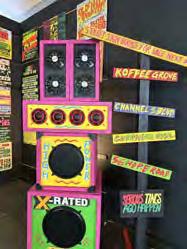
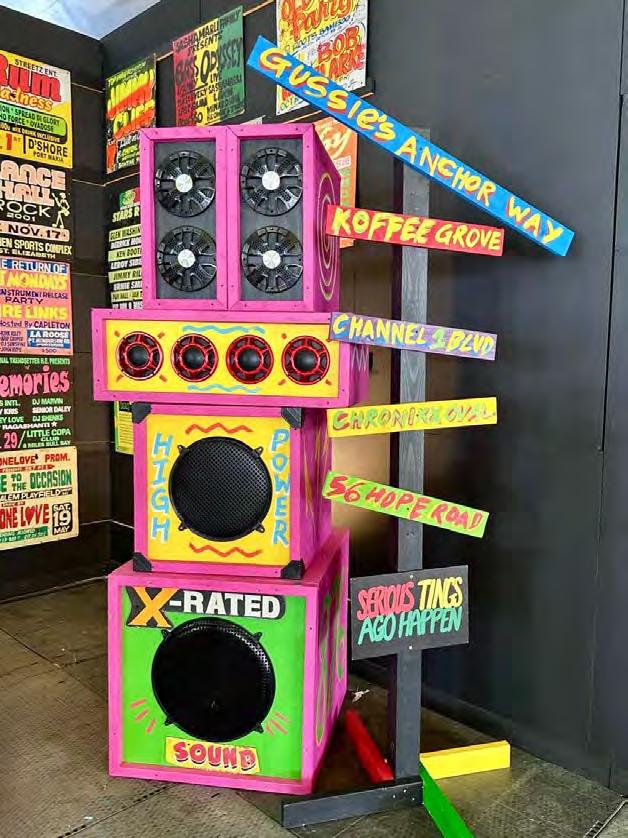
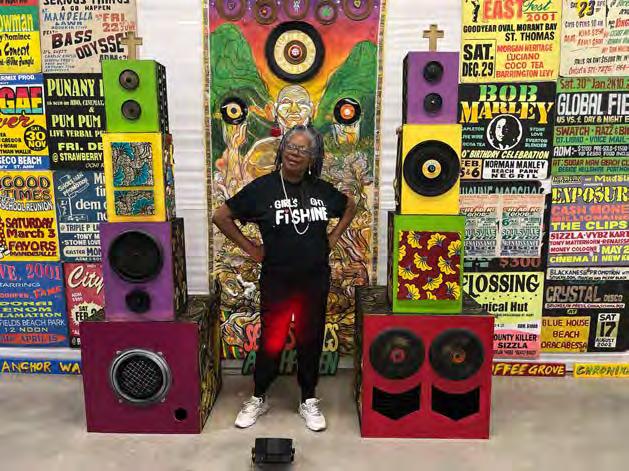
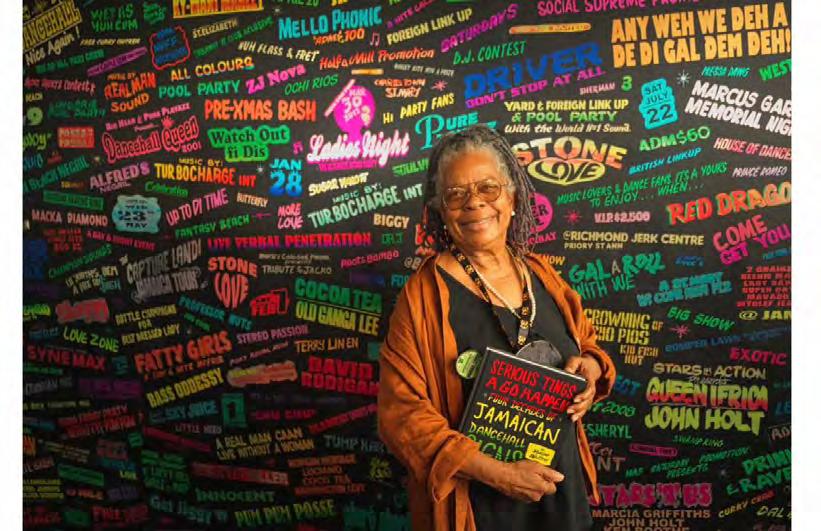
Maxine Walters at the Serious T'ings A Go Happen exhibit, Three decades of Jamaicandancehallcultureononewall.
THE BOOK THAT CHANGED EVERYTHING
The collection became a book. Serious T'ings a Go Happen: Four Decades of Jamaican Dancehall Signs brought together more than 200 original posters and signs from the early 1980s through today, selfpublished by Serious T’ings, a division of Walters Productions, with an introduction by Booker Prize winning author Marlon James and music journalist VivienGoldman.Itwasnotsimplyacoffeetablebook. It was, as Marlon James wrote in his introduction, an unofficial history of Jamaican dancehall music told through its graphic design. Every page a document. Everysignastory.
Proceeds from the book went to the Consie Walters Cancer Care Hospice at St Joseph's Hospital in Kingston.ThatisMaxineWaltersinfull:thecultureand thecommunity,inseparable.
The book's impact rippled far beyond Jamaica. Grammy nominated DJ and producer Walshy Fire of MajorLazercredits seeing Maxine's book as the direct inspiration for his own dancehallvisual history project, telling the Jamaica Gleaner: that is when I was like, okay, I need to really think about putting something together. Cindy Breakspeare, former Miss World and lifelong friend, opened Maxine's first exhibition at Harmony Hall Art Gallery in Tower Isle, St Mary, describing her as a doer who doesn't just talk about things.Shebringsherideastofruition.
THE HONOUR SHE ALWAYS DESERVED
Jamaica eventually said officially what those who know Maxine have always known. She was awarded the Order of Distinction by Jamaica's Governor-General at the National Honours and Awards Ceremony at King's House, with Prime Minister Andrew Holness among the dignitaries present,fordistinguishedcontributiontothepromotionandpreservationofJamaicanculture.The citationwaspreciseandperfectlyearned.
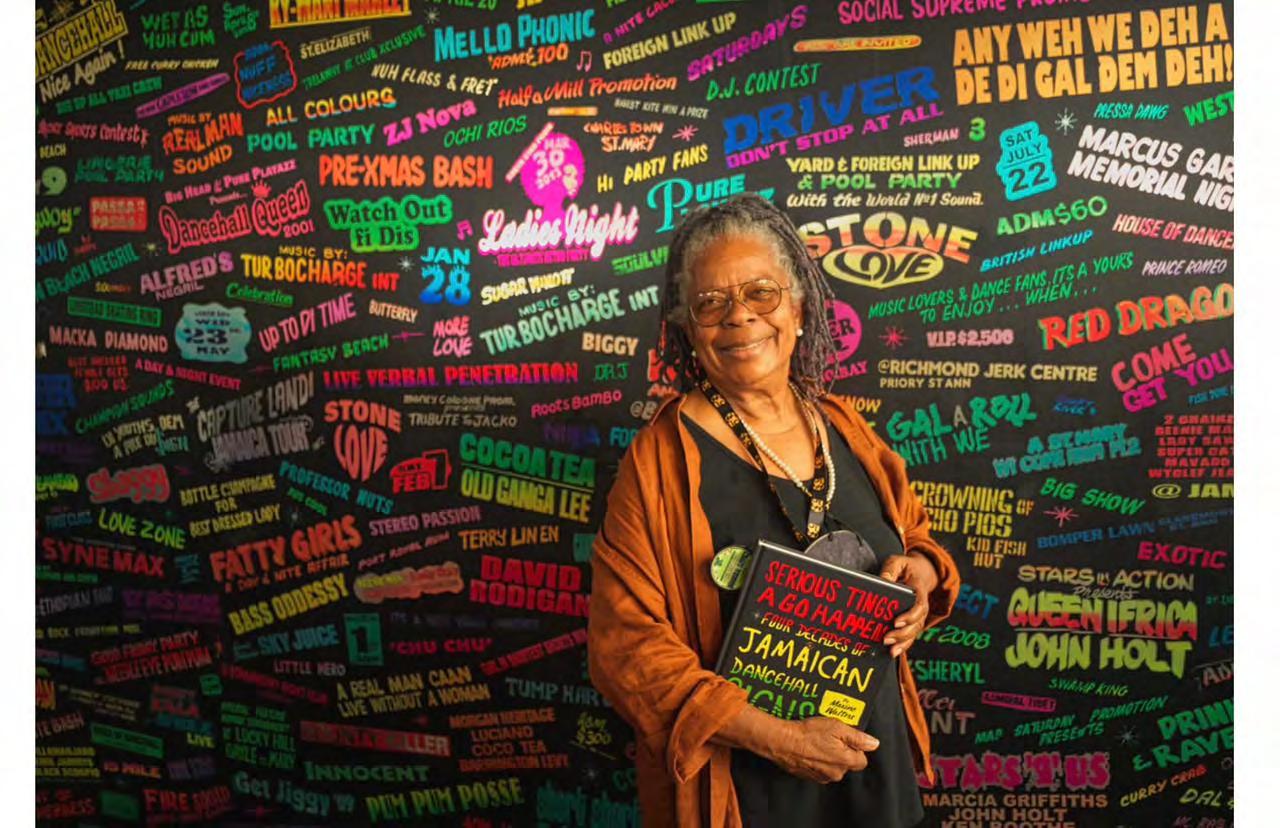
Maxine Walters at the Flavor Paper dancehall wallpaper installation, created in collaboration with Jon Sherman. Jamaica'sstreets,reimaginedonaNewOrleanswall.
Maxine Walter Continued
At the Sandals Resorts Jamaica Cultural Exchange Pavilion at Jazz Fest 2026, Maxine Walters brought her life's work to one of its most extraordinary stages yet. The exhibit, titled Serious T'ings A Go Happen, plastered one corner of the pavilion with her signs: bright, bold, hand-painted windows into Jamaica's dancehall soul. Alongside her collection, artist Matthew McCarthy contributed his own dancehall-inspired original artwork and performed live painting throughout the festival, bringing the visual language of the signs into the present moment in real time. Together their work stopped festival-goers in their tracks, drawing them in the way a great dancehall sign has always done: with color, with energy, and with the irresistible suggestion that something extraordinary is happening just around the corner.
The collaboration extended further still. Jon Sherman, founder of New Orleans born luxury wallpaper company Flavor Paper, partnered with Maxine to transform the pavilion walls themselves into a canvas, printing her dancehall archive as wallpaper that surrounded every performer, every artisan, and every visitor who entered the space. A New Orleans creative and a Jamaican cultural guardian, meeting exactly where they were always meant to meet.
Maxine's book was available for purchase in the artist demonstration tent throughout both weekends. For many Jazz Fest attendees, it was their first encounter with this dimension of Jamaican creativity. It will not be their last.
Those who have known Maxine Walters across a lifetime will not be surprised by any of this. She has always known that Jamaica's culture is worth fighting for, worth carrying across every border, worth introducing to every room she enters. What Jazz Fest 2026 gave her was simply a bigger room. And she filled it completely.
When I think of Maxine, I think of Home Sweet Jamaica.
Dancehall wallpaper by Maxine Walters in collaboration with Jon Sherman,founderofNewOrleansbornluxurywallpapercompanyFlavor Paper.Jamaica'sstreetsmeetaNewOrleanswall.
TSpend. Occupancy rates. Market share. These are the metrics that governmentsmeasureandministersreport.ButtheJamaicaTourist Board has always understood something that the numbers alone cannotcapture.
Not a brochure. Not a billboard. Not a digital campaign, however sophisticated. When a person stands in the middle of the New Orleans Fair Grounds and hears a Jamaican rhythm pulling them through a crowd of half a million people, something happens that no advertisement can manufacture. They feelJamaica before they have ever set foot on the island. And once you feel Jamaica, you wantthevibe.
Cultural Diplomacy as National Strategy
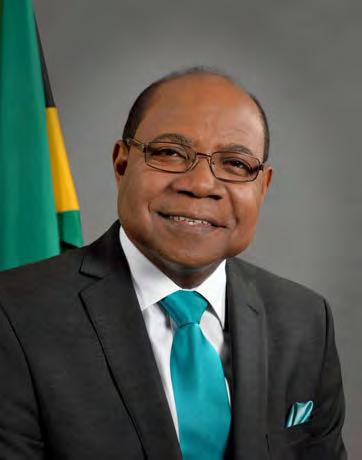
Edmund Bartlett has spent decades building a philosophy of tourism that extends far beyond the beach.As the longest-serving Tourism Minister in Caribbean history and the only individual ever appointed to the role three times in Jamaica, he has had more opportunity than any of his predecessors to shape Jamaican tourism. His handprint will extend beyond his tenure in defining what tourism means and where it is going in Jamaica. That continuityofvisionisnotincidental.ItisoneofthereasonsJamaica arrived at Jazz Fest 2026 not as a destination looking for attention, butasaculturalforcethatknewexactlywhatithadtooffer.
The Honourable Edmund Bartlett, OJ, CD, MP, Minister of Tourism, Jamaica. The longest-serving Tourism Minister in Caribbean history and the architect of Jamaica's vision for cultural diplomacy on theworldstage.
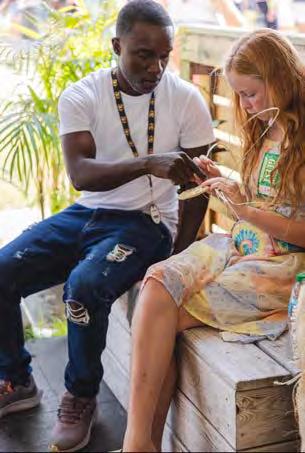
Omar"Sheldon"Daleysharestheancientart of thatch straw weaving with a young festival-goer.Thetraditionliveson.
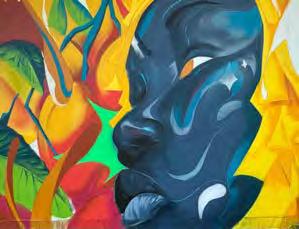
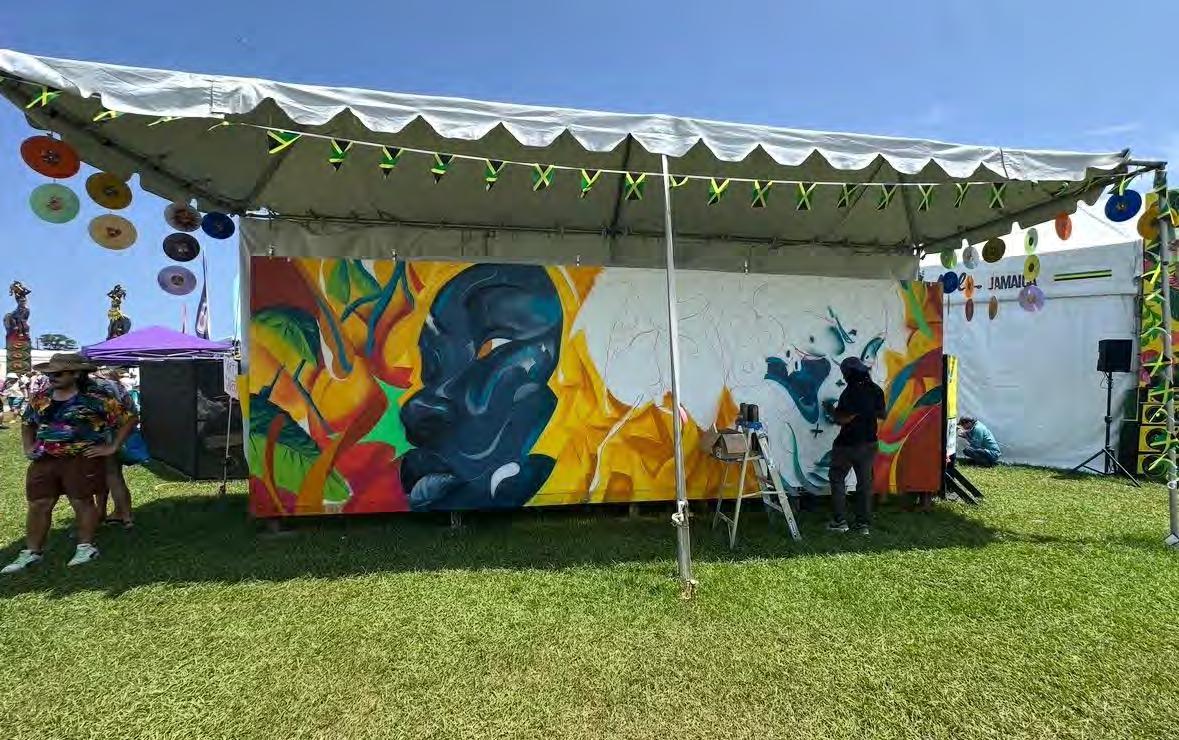
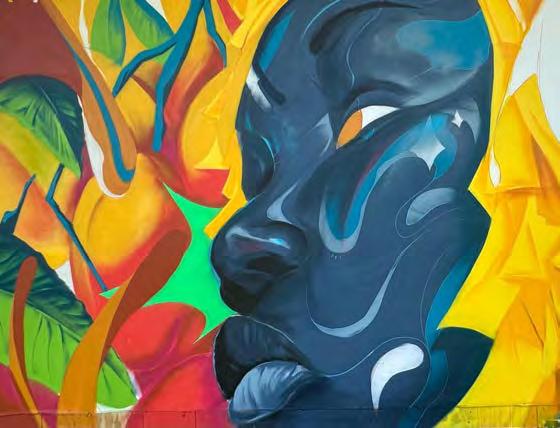
TajFrancis,Jamaicanillustrator,animatorandmuralist,createslive art at the Sandals Resorts Jamaica Cultural Exchange Pavilion, 2026 New Orleans Jazz and Heritage Festival. Exploring African Caribbeanidentitythroughasurrealistlens.
Under his leadership Jamaica has become not just a destination but a global thought leader: the architect of the world's first Global Tourism Resilience and Crisis Management Centre, a convener of international tourism policyatconferencesfromNairobitoBerlin,andanationthat understands,with unusualclarity, that tourism is a diplomatic instrument as much as an economic one. His most recent strategicframework,Tourism3.0,identifiescommunitybased enterprises, local artisans, cultural performers, and tour operatorsasessentialcontributorstothetourismvaluechain, not as add-ons but as theveryheart ofwhat makesJamaica worthexperiencing.
AtJazz Fest 2026, thatvision took one ofits mostvivid forms yet."We are proud to bringJamaica to the NewOrleansJazz and Heritage Festival," Bartlett said. "Music, art and culinary innovation have always been at the heart of our identity, and the Cultural Exchange Pavilion is the perfect stage to showcase the depth of Jamaica's heritage and reinforce Jamaica'spositionasaleadingdestination."
Thatstatementisworthreadingcarefully.Bartlettdidnotsay the pavilion was the perfect stage to sellJamaica. He said it was the perfect stage to showcase the depth of Jamaica's heritage. The distinction matters enormously. One is marketing.Theotherisnationbuilding.
Jamaica Thrives: The Numbers Behind the Spirit
When Hurricane Melissa made landfall on October 28, 2025 as a Category 5 storm, the question being asked around the world was not simply how much damage had been done. It waswhetherJamaicacouldcomeback,andhowfast. Theanswerhasbeenextraordinary.
Bythe first quarterof2026,Jamaica hadwelcomed overone million visitors and generated nearly one billion dollars in foreign exchange earnings, representing an 80 percent recoveryinvisitorarrivalscomparedtopre-stormprojections. That figure, achieved in a compressed timeframe that few disaster-stricken regions have ever matched, is not simply a tourism statistic. It is a nationalstatement. Bymid-December 2025,lessthantwomonthsafterthestorm,nearly72percent ofJamaica's hotelroom inventoryhad alreadybeen returned toservice.
Philip Rose, Deputy Director of Tourism for the Americas, Jamaica Tourist Board. A champion of Brand Jamaica for over two decades, Rose representedtheJTBonthegroundduringWeekend Two of the 2026 New Orleans Jazz and Heritage Festival.
Feelingirie.TheSandalsResortsJamaicaHospitality Pavilion offered festival-goers a place to recharge, reconnect, and experience Jamaica's legendary warmthfirsthand.
Themedium-termgoalisclear:fivemillionannualvisitorsandfivebilliondollarsinearningsbythe end of the decade. The longer-term vision is even bolder: eight million annual visitors by 2030. These are not aspirational numbers. They are targets being built upon a foundation of resilience, marketdiversification,andtheoneforcethatnohurricanecandiminish:thepoweroftheJamaican diaspora. As Philip Rose, Deputy Director of Tourism for the Americas, has emphasized, the diasporadidnotwaittobeasked.Itshowedup,itinvested,ittraveled,andittoldeveryoneitknew that Jamaica was ready. That is the diaspora at its most powerful: not just as a community, but as anambassador,acheerleader,andalifeline,allatonce.
The People Who Made It Happen
Visions are built in strategy rooms. But they are deliveredbypeople.
At the Sandals Resorts and Jamaica Hospitality
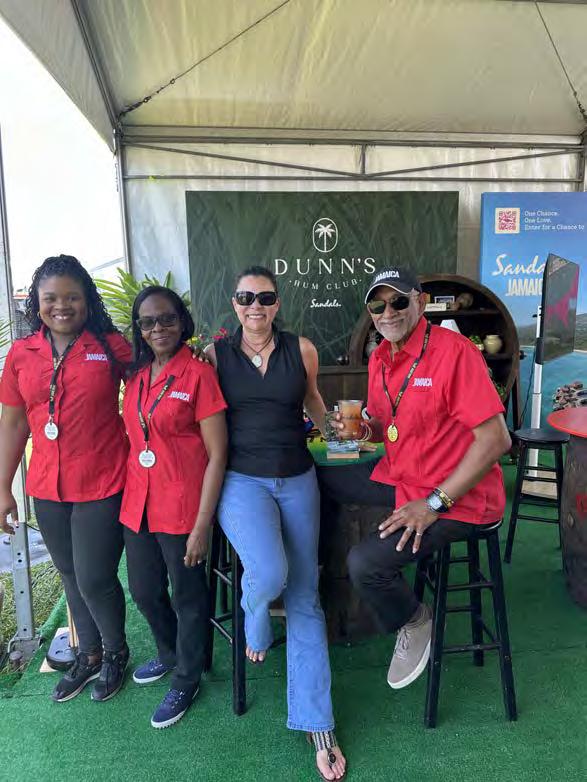
Tent during the first weekend of Jazz Fest 2026, the Jamaica Tourist Board was represented by three people who embodied everything that Edmund Bartlett's vision is ultimately about: Karlene Shakes, National Sales Manager for the JTB's Southeast USA office; Maxine GarrisonAnderson, Administrative Assistant to the Deputy Director of Tourism; and Christopher Wright, also oftheJTBSoutheastUSAteam.
Therewerenospeeches.Nopodiums.Noformal presentations. Just three Jamaicans, standing in the middle of one of the world's greatest music festivals, greeting every person who walked through that pavilion with the one thing Jamaica has always given the world freely and without reservation:warmth.
They greeted attendees with big smiles and genuine Jamaican hospitality, delighted to share information about the island, encourage participation in the events, and highlight Jamaica's extraordinary stage lineup and cultural programme. They answered questions with enthusiasm, directed curious festival-goers toward performances they could not afford to miss, and made every interaction feel less like a tourism transaction and more like a conversation between friends. The grace and warmth they brought to that tent was not performance. It was simplywhotheyare.
form.Notabrandpromise.Alivedreality.
Christopher Wright, watching the performances from the pavilion, captured the spirit of the weekend in a single statement: Jamaica is back. These artists demonstrate the resilience of the Jamaican people. It is a great opportunity to be here andtoberecognized.
For the second weekend, Philip Rose, Deputy Director of Tourism for the Americas, was on the ground as the skies opened and the rain came. He stayed. As HSJ checked in with him during the festival, his assessment was direct and deeply felt: the Jamaican performers were amazing. Fourwords.Fromamanwhohasspenttwo decades watching Jamaica perform for the world. That is not a press release. That is a witnessspeaking.
DonovanWhite,DirectorofTourismattheJTB,perhaps said it best: Jamaica isn't just a place you visit. It's something you feel. From the music to the flavors to thecreativityofourpeople,there'sanenergythatstays with you. Jazz Fest gives us the perfect opportunity to share that spirit in a way that's immersive, vibrant, and unmistakablyJamaican.
Jamaica has always understood this intuitively. Her culture does not sit behind glass. It pulls you onto the dance floor. It feeds you from a pot on the street. It makesyousingalongtowordsyouthoughtyoudidnot know. At Jazz Fest 2026, the JTB gave half a million festival-goersthechancetofeelallofthatwithoutever boarding a plane. And in doing so, it planted the most powerfulseedinthetourismindustry:desire.
The Alignment: Why Jazz Fest and Jamaica Were Always Meant to Find Each Other
ThealignmentbetweentheJamaicaTouristBoard'svisionandtheNewOrleansJazzandHeritage Festival'sidentityisnotcoincidental.Bothbelievethatcultureisnotaproducttobepackagedand sold but a living, breathing force to be experienced and honored. Both understand that music, food,andcraftarenotaccessoriestoaneventbutitsverysoul.Andbothknowthatwhenpeople feelsomethinggenuine,theycomeback.
JazzFestProducerandDirectorQuintDavisputitsimply:theFestivalisgratefultoSandalsResorts and the Jamaica Tourist Board for helping bring the magic of Jamaica to Jazz Fest. Both cultures are famous for giving the world music that inspires great joy. The hope, he said, is that the celebrationinspirespeopletoexperienceJamaicaforthemselves.
That hope lives in Edmund Bartlett's decades of strategic vision. It lives in Donovan White's conviction that Jamaica is something you feel. It lives in Philip Rose's presence on a rain-soaked second weekend. And it lived, most vividly, in the smiles of Karlene Shakes, Maxine GarrisonAnderson,andChristopherWright,threeJamaicansstandingatthegatewaytooneoftheirisland's mostextraordinarystagesyet,welcomingtheworldintheonlywayJamaicaknowshow.
WHERE JAMAICA'S CREATIVE SOUL CAME TO LIFE THE CULTURAL EXCHANGE
Not all of Jamaica's story at Jazz Fest 2026 was told onastage.Someofitwastoldataworkbench.Some of it on a canvas. Some of it in the quiet, deliberate movement of a hand pulling thread through fabric, or a brush meeting wood with the confidence of someone who has done this ten thousand times before.
The Cultural Exchange Artist Demonstration Tent was exactly what its name suggests: a space where art was not displayed behind glass but demonstrated, explained, shared, and in many cases, created live in front of anyone curious enough to stop and watch. AndatJazzFest2026,peoplestopped.Theywatched. They asked questions. They stayed longer than they intended. Because what was happening in that tent wasnotaperformance.ItwasJamaicaatwork.
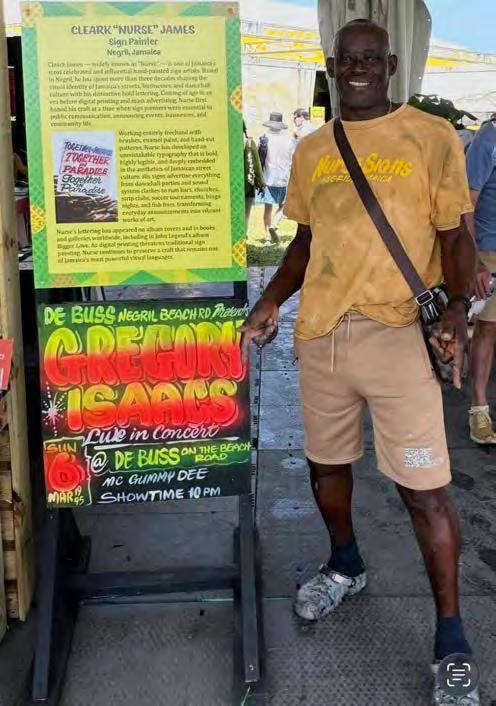
Cleark"Nurse"James: ThirtyYearsofBoldLetters
For over three decades, Cleark James, known universally as Nurse, has been shaping the visual identity of Jamaica's streets from his base in Negril. His hand-painted signs, bold lettered, color saturated, and alive with the energy of the communities they advertise, have earned him a cult following that stretches from Japan to the United States to Europe, where collectors seek out his work as both art and culturalartifact.
At Jazz Fest 2026, Nurse brought that three decade tradition to the Fair Grounds. Watching him work is to understand immediately that sign painting is not simplyatrade.Itisavisuallanguage,onethatJamaica developed organically, outside the formal art world, on roadsides and telephone poles and the sides of buildings, in response to the needs of communities that needed to communicate with color and confidence.
When he arrived at Jazz Fest, Nurse said it simply: RespecttotheJazzFestfamily.Iwascalledupon.I'm very happy to be here. When they say Jamaica, I am Jamaican.
RUSHANE "BUG" DRUMMOND: BORNTOPAINT
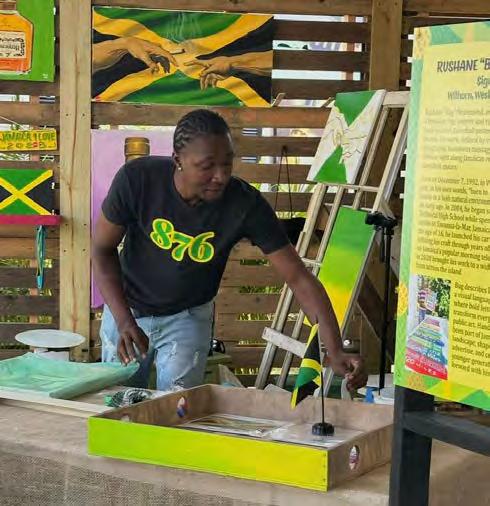
Born and raised near Savanna-la-Mar in Westmoreland, Rushane Drummond, known as Bug, grew up surrounded by Jamaica's visual texture: the typography of hand-painted shopfronts, the murals of dancehall culture, the vernacular poetry of roadside messages. Art,hehassaid,runsinthefamily.Hisolderbrotherwas thefirsttoputabrushinhishand.
He went on to apprentice under respected local artists, graduatingwithaCXCinvisualartsbeforelaunchinghis career as an independent sign painter in 2009. Today thestreetsofwesternJamaicaare,inthetruestsense,a gallery of his work. His bold hand-painted dancehall posters, party boards, and commercial signs combine vibrant color, hand-lettered typography, and energetic graphic motifs that stop traffic, literally, on Jamaican roadsides.
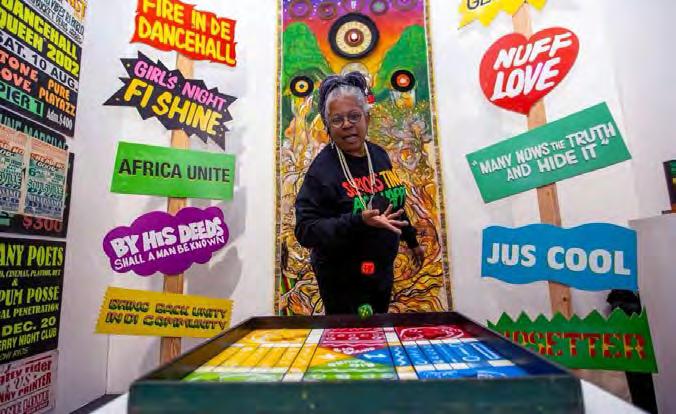
AtJazzFest2026,Bugbroughtanotherdimensionofhis work to the demonstration tent: his hand-painted Ludi boards.Ludi,apopularCaribbeanboardgamesimilarto Parcheesi, is as embedded in Jamaican community life as the music and the food. Bug demonstrated how to play throughout the festival, turning the art demonstration into something interactive, warm, and completelyJamaicaninspirit.
Youcametowatchanartist.Youstayedforagame.
Taj Francis: Jamaica Through a SurrealistLens
Taj Francis does not paint signs. He builds worlds. A prolific illustrator, animator, and graphic designer whose large-scale murals can be seen across the globe, Francis was born and raised in KingstonandtrainedattheEdnaManleyCollegeoftheVisualandPerformingArts,Jamaica'smost celebrated arts institution. His work focuses on exploring African Caribbean identity through a surrealistlens,creatingvividandsymbolicvisualsthatinvestigateculturalmemory,mythology,and thecontemporaryBlackexperience.
His client list reads like a who's who of global creative culture: HBO, Universal Studios, Samsung, and recording artist Protoje, whose own musical vision of Jamaica's identity aligns naturally with Francis's visual one. His work has been featured in Vanity Fair and Vice. His murals appear on walls acrossmultiplecontinents.
At Jazz Fest 2026, Francis performed live painting in the demonstration tent, creating work in real time in front of festival-goers who may never have encountered this dimension of Jamaican visual artbefore.TowatchTajFrancisworkistounderstandthatJamaica'screativelegacydoesnotbegin andendwithmusic.Itlivesineverymediumherartistschoosetoinhabit.
ATentFullofJamaica
KOKAB ZOHOORI-DOSSA: WHERE ANCESTRAL CRAFT MEETS CONTEMPORARY VISION
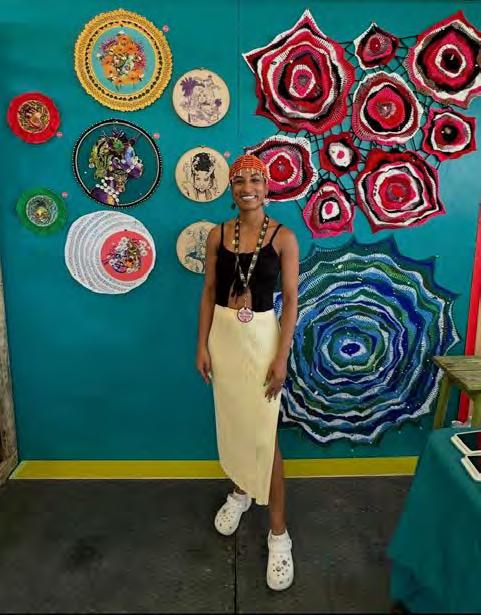
Kokab Zohoori-Dossa is a multidisciplinary artist from Kingston, Jamaica, born to an Iranian mother and a West African father, whose layered heritage informs every thread of her work. Trained as an illustrator, digitalartist,painter,andgraphicdesigner,hercurrent fine art practice has turned toward textiles: working with embroidery, crochet, fabric, and beadwork to explore how traditional crafts and ancestral themes cantranslateintoexpressiveandcontemporaryart.
Her wall textile display at the Cultural Exchange Artist Demonstration Tent was one of the tent's most visually arresting moments. Large scale, richly textured, and deeply rooted in cultural memory, her work asked the same question that the entire pavilion was asking in different ways: what does it mean to carry your heritage in your hands? For Kokab, the answeriswovenintoeverypieceshemakes.
FacesofHeritage:PatrickPlanter
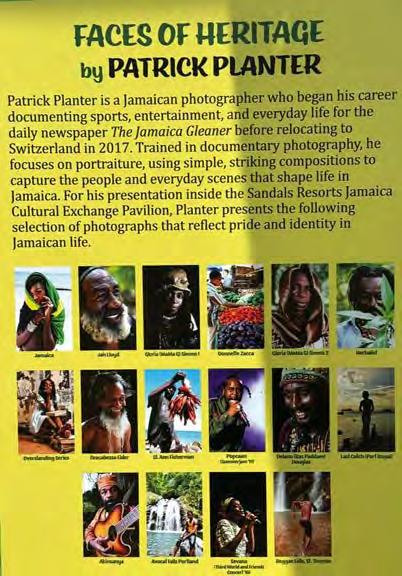
Patrick Planter is a Jamaican photographer who began his career documenting sports, entertainment, and everyday life for The Jamaica Gleaner before relocating to Switzerland in 2017. Trained in documentary photography, he focuses on portraiture, using simple, strikingcompositionstocapturethepeopleandeveryday scenes that shape life in Jamaica. His exhibition at the Sandals Resorts Jamaica Cultural Exchange Pavilion, titled Faces of Heritage, presented a selection of photographs that reflect pride and identity in Jamaican life.FromJahLloydandtheOracabessaEldertoaSt.Ann fisherman and the cascading waters of Avocal Falls in Portland, from market vendor Donnette Zacca to performer Popcaan at Summerjam 2019, Planter's lens finds dignity and beauty in the faces and landscapes that Jamaica sometimes takes for granted. His work reminds theworld,andJamaicaherself,ofexactlywhosheis.
Taken together, these four artists represent something that no stage performance, however extraordinary, can fully capture: the breadth of Jamaica's creative identity. From dancehall signs to surrealistmurals,fromhand-paintedLudiboardstotextileinstallations,theCulturalExchangeArtist Demonstration Tent offered a portrait of an island whose creativity does not fit in a single category, asinglegenre,orasinglemedium.
KokabZohoori-Dossa,multidisciplinarytextileartist,infrontof her wall textile display at the Cultural Exchange Artist Demonstration Tent, 2026 New Orleans Jazz and Heritage Festival.