In This Issue:
Volume 11 • Issue 1 • Spring 2021
No Bones About it Hard Act to Follow
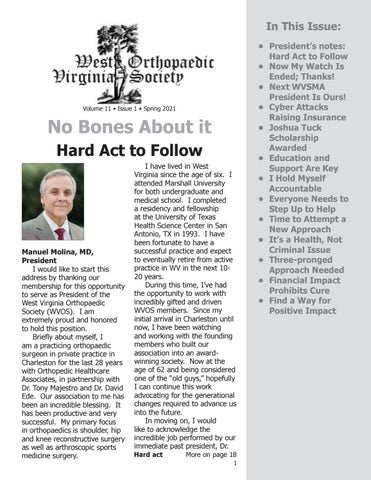
Manuel Molina, MD, President I would like to start this address by thanking our membership for this opportunity to serve as President of the West Virginia Orthopaedic Society (WVOS). I am extremely proud and honored to hold this position. Briefly about myself, I am a practicing orthopaedic surgeon in private practice in Charleston for the last 28 years with Orthopedic Healthcare Associates, in partnership with Dr. Tony Majestro and Dr. David Ede. Our association to me has been an incredible blessing. It has been productive and very successful. My primary focus in orthopaedics is shoulder, hip and knee reconstructive surgery as well as arthroscopic sports medicine surgery.
I have lived in West Virginia since the age of six. I attended Marshall University for both undergraduate and medical school. I completed a residency and fellowship at the University of Texas Health Science Center in San Antonio, TX in 1993. I have been fortunate to have a successful practice and expect to eventually retire from active practice in WV in the next 1020 years. During this time, I’ve had the opportunity to work with incredibly gifted and driven WVOS members. Since my initial arrival in Charleston until now, I have been watching and working with the founding members who built our association into an awardwinning society. Now at the age of 62 and being considered one of the “old guys,” hopefully I can continue this work advocating for the generational changes required to advance us into the future. In moving on, I would like to acknowledge the incredible job performed by our immediate past president, Dr.
Hard act
More on page 18
1
• President’s notes: Hard Act to Follow • Now My Watch Is Ended; Thanks! • Next WVSMA President Is Ours! • Cyber Attacks Raising Insurance • Joshua Tuck Scholarship Awarded • Education and Support Are Key • I Hold Myself Accountable • Everyone Needs to Step Up to Help • Time to Attempt a New Approach • It’s a Health, Not Criminal Issue • Three-pronged Approach Needed • Financial Impact Prohibits Cure • Find a Way for Positive Impact
By WVOS Past President Felix Cheung, MD
Now My Watch Is Ended; Thanks!
“I feel that we were fortunate that we did not have to layoff anyone and that we were able to keep our doors open. Many businesses were not so lucky.” - Clint Welch, JD First Settlement Orthopaedics
It has been my pleasure to serve as your President for the past two year. I would like to think we did it under unique circumstances, dealing with a novel pandemic, fearing for our health, our patients’ health. But we always deal with unique circumstances. I promised we would work on 3M’s when I took office two years ago: Membership, Mentorship, Mission. Looking back at what we have done, I am proud of what we have achieved, and humbled to see the opportunities ahead. Over the past year, we have increased our membership by 4%. This is not a small accomplishment given the steady trend in decrease in membership for all organizations over the years. This does not happen in a vacuum. This happens because you created activities that orthopaedic surgeons wanted to participate in. You are active in the society events, serving as an example for your colleagues. You ASK them to be members. YOU are why we have this increase, and you should be proud of this. But we have more to go. How do we get more participation from our younger members, and our hospital system employed orthopods? How do we provide more targeted programming and benefits that make membership a no brainer? Board Director Karim Boukhemis came up with regional membership drives, 2
and although the pandemic shut those down, they were fun and successful. I want you to give us those ideas and help us implement them. With the pandemic, I was worried we would not be able to fulfill our goal of mentoring each other. But we discovered the power of Zoom and we have moved our programming to an on line forum. We have had a monthly journal club started by our Vice President Shafic Sraj, which has connected experts around the state with our membership, discussing the latest techniques and research. We have had several general membership meetings discussing the virus, diversity in orthopaedics, and vaccine safety. This has introduced orthopaedic surgeons to our Society who otherwise would have sat on the sidelines. We have connected members to each other. AND, by acknowledging the success of science and vaccines, we were brave enough to have an in person meeting in April. In a huge mistake, Sandy Emery let me play in his golf foursome; and I am insulted my own Marshall residents shunned me from theirs. But the time together, the praising, the chiding—this is why we chose to meet in person. There is simply no substitute. This meeting, for me, is cathartic, hopefully a firm symbol of My watch More on page 17
By WVOS/WVAOE Executive Director Diane Slaughter, CAE, APR, Fellow PRSA
Next WVSMA President Is Ours! The West Virginia Orthopaedic Society (WVOS) was established in 1986 and its purpose has been "the advancement of Orthopaedic Surgery as a medical specialty" (WVOS.org). The West Virginia State Medical Association (WVSMA) was
established in 1867. WVSMA's mission and vision are to advance health and promote quality and safety in the practice of medicine in West Virginia and to serve as the unified voice for the practice of medicine and the premier authority for health policy in the State. (Ref WVSMA.org). This year, WVOS and WVSMA will be closer than ever, with WVOS Vice President Shafic Sraj, MD about to assume the presidency of WVSMA during the upcoming Healthcare Summit on August 21-22, 2022. WVOS had a little chat with our own Shafic about his experience and path towards WVSMA Presidency. Diane Slaughter: How long have you been active and how did you get involved in WVSMA? Shafic Sraj: I have been a member of both WVOS and WVSMA for around 10 years. As a matter of fact, it was WVOS that lead me to WVSMA. It happened during my very first WVOS meeting. I had reached out to CME Chair Jack Steel, MD, and asked to present my point of view about informed consents. It was at that time when WVOS (then) President Brett Whitfield, MD advised me to reach out to WVSMA. I’ve been a member since then.
Diane Slaughter: What led you to get involved with medical organizations? Shafic Sraj: When I finished training and got my first job, my focus was to establish myself as a trustworthy and skilled surgeon. It did not take me long to realize that knowledge and skill are not enough, and that it is very important that physicians' voices be heard. It became clear to me that, no matter how good and well intentioned we are, we are bound to follow laws and regulations created by others, most of whom are not physicians. I took it upon myself to become part of the equation and be a catalyst for other physicians to speak up and have their voices heard. Former AAOS Councilor Greg Krivchenia often said, “If we are not at the table, we must be on the menu.” It cannot be more true. Diane Slaughter: How about your involvement in other medical organizations? Shafic Sraj: I am a member of the AAOS and currently serve on the Exhibits Committee as the chair of the Innovation Theater subcommittee. I am also a member of the AMA. I would love to be a member of more organizations. Unfortunately, my foreign residency training and resulting board-ineligibility has been a major block stopping me from joining most specialty-specific organizations President
More on page 15 3
“...knowledge and skill are not enough...it is very important that physicians’ voices be heard.” - Shafic Sraj, MD
By Tayler Gardner, Professional Risk Associates
Cyber Attacks Raising Insurance
“The increase in cyberattacks and its subsequent effect on the insurance market is particularly dangerous to the healthcare industry.” -Tayler Gardner
Since early 2018, ransomware attacks have increased 486%, leading to more aggressive underwriting and as much as a 20%-50% increase in some cyber policy premiums (Greenwald, J, 2021). The increase in cyberattacks and its subsequent effect on the insurance market is particularly dangerous to the healthcare industry. In 2020, healthcare rose from tenth place to the seventh most targeted sector for cyberattacks and its data breaches continue to have the highest associated cost of any leading industry (Davis, J 2021). As an independent insurance agency, Professional Risk Associates has closely monitored the changes in the cyber liability market over the last few years. According to the market trends they have observed, both the number of attacks and the associated financial risks have increased due to the high dollar value of Electronic Medical Records (EMRs). The wealth of personal information available in an EMR system has made them a coveted commodity among hackers. Additionally, the recent migration to telehealth services and much of the workforce now working remotely has opened new opportunities for malicious actors and the risk of a cyber security breach only increases further. Higher premiums for this coverage may be shocking at first, but cyber security 4
insurance is a crucial part of ensuring a medical practice’s financial security. EMRs Are a Valuable Commodity Your EMR system may seem innocuous, but the sensitive data the system holds represents one of the most lucrative targets for hackers. A 2017 study found a complete EMR database can go for as much as $500,000 when sold on the Dark Web (Rosario Fuentes, M, 2017). EMRs are valuable because of the sheer volume of sensitive information they contain. This sensitive information can be used to create fraudulent documents like fake IDs, tax returns, birth certificates, or they may be used to obtain prescriptions for controlled substances. The incentive for hackers to target EMR systems is not the only concern hospitals or medial practices should have regarding these attacks. The associated cost of a breach is also a threat to any practice’s financial security. On average, a data breach costs $499 per patient record (Ikeda, S 2021). This cost can include business interruption, with an average period of over 90 days to detect a breach and up to 236 days to recover from one (Ikeda, S 2021). Additional fees incur from legal defense, breach detection and response, and patient notification about the threat to their sensitive Cyberattacks
More on page 16
By WVAOE President Antoinette Summers
Josh Tuck Scholarship Awarded The West Virginia Association of Orthopaedic Executives (WVAOE) is pleased to announce the awarding of the 2021 Joshua Tuck Scholarship. Our recipient is Camden Lawrence), a senior at Richwood High School, who will be attending Fairmont State University this fall. When Joshua Tuck died in May 2018 at the age of 30 from a car wreck, he was the Vice President of the West Virginia Association of Orthopaedic Executives at the time of his death. The Joshua Tuck Scholarship was created by the WVAOE Board of Directors to help support a student studying healthcare management. Applicants were required to be (1) West Virginia high school seniors; (2) must major in healthcare management and (3) enroll in one of four schools offering the healthcare management major; and (4) submit a 450 – 500 word essay answering the question: “Describe your community’s issues with opioids and explain how you would reduce the problem.” We were pleased to receive nine applicants this year (down two from 2020 due to school closings for COVID) from Berkeley, Cabell, Mercer, Nicholas (3), Wayne and Wood (2) Counties. Grade point averages ranged from 3.44 to 4.60. To get the perspective from the next generation of West
Virginians, we are reprinting their essays on the following pages. The essay from our winner is identified by name; the remaining eight are identified by high school and county. One applicant did not provide an essay. As part of our efforts to help bring awareness to the opioid issue and ways orthopaedic surgeons can help reduce the problem, we will be sharing this issue of the newsletter with members of our congressional delegation during meetings later this year. The Josh Tuck Scholarship is a one-time-only $2500.00 scholarship. We would welcome your contributions to keep this scholarship viable for years to come. Contact the WVAOE/WVOS office to donate.
WVAOE is honoring Joshua Tuck’s legacy with a scholarship. You can contribute to keep keepthis it going. going for the future!
5
By 2021 Josh Tuck Scholarship Recipient Camden Lawrence, Richwood High School
Education and Support Are Key
“Education is key as well as groups that support not only the abuser but the family as well.” - Camden Lawrence
Opioids are a problem everywhere in the United States, both bigger cities and smaller cities. In my community more and more people are beginning to use and abuse opioids. Whether some are prescribed by a doctor or just for recreational use, opioid addiction is taking over smaller communities. Addiction to opioids keeps getting worse and worse. Like other addictions, once you start using, it’s very difficult to stop. Using these substances has further consequences than just leading to addiction or health problems. Parents lose kids over them due to the fact that they would rather buy some drugs rather than paying the water bill. Brothers and sisters don’t speak to each other, because they borrowed money to buy the opioids with, not telling their sibling what they needed the money for. In addition, other people in the community not only look at you differently but look at your family differently because of you using opioids. It is sad these days that many people choose drugs over their family and friends. Some try to stop while others just keep using. Many feel it is a disease and for those families struggling with supporting and losing loved ones, it is just the same as losing someone to an illness or an accident. There are programs and therapy started to assist people 6
in ending their addiction, in contrary many people who are addicted do not feel the need to attend them. To reduce the amount of users in my community, I believe there should be more discussion groups to discuss your addiction, find more of these substances on the streets like the people selling it and arrest them and make sure they attend programs too, and improved prescriptions by doctors to state only necessary reasons for getting drugs like oxycodone. We see arrests being made, but the users are right back out and continuing their addiction. Some users want to stop but it is very difficult to end an addiction, and that is why they need to know that there are people out there that want to help and be with you during your withdrawal. That just comes down to being a better community. If people want opioids in their town to end or reduce, it begins with the whole community not just a certain amount of people. To sum this up, opioids have and always will be a problem in life, but lowering the number of users is what could happen. Family and friends separate because of these addictions. More supportive groups need to be built and more users need to know that they aren’t alone when trying to stop and withdrawal. To conclude, Success keys More on page 14
By Princeton Senior High School, Mercer County, Scholarship Applicant
I Hold Myself Accountable No one truly adjusts to the constant reports of overdoses and drug raids or the constant sounds of ambulance and police sirens. As a civilian, you become mindful of the phenomena of the town. Living in southern West Virginia, more specifically, Mercer County, it fashioned a strong obligation that I, among others in my generation, must work to combat the prolonged opioid crisis. It is not uncommon for you to see someone suffering from opioid misuse or abuse. These people have a distinct appearance. Some will appear exhausted, confused, malnourished, and filthy. In some cases, the needle marks or bruising are visible on their arms or legs. As a young person, to ensure that the community around me will grow successfully, I hold myself accountable. To begin, I believe that doctors who wrongly prescribe medications are the foundation of the opioid crisis. For example, throughout a doctor’s visit an individual’s prescribed a serious pain medication. During follow up visits to see the doctor, months after the pain has stopped, the doctor writes the prescription for the same pain medication. This type of practice is common. The improper prescribing of pain killing medication leads to the abuse of opioids. While patients often mislead, or lie to
their prescriber about the pain to receive the medication, the prescription is the gateway to their addiction or dependence. Consequentially, doctors are an initial factor in the opioid crisis in my community. Beyond that, illicit substances are an alternative route to the problem at hand. Constant opioid use changes behavior and as we all know, leads to addictions and overdoses in my community. Some of the socioeconomic factors in Mercer County such as employment, education, and income , play a key role in people deciding to recreationally use opioids and other controlled substances. Finally, I believe that there should be a safer way for people to get what they need. For example, I have seen several needle exchange programs. This way, people are minimizing the spread of serious virus like HIV and AIDS. I will implement a procedure to allow patients to receive supervision or monetarization while taking serious medication. The supervision would consist of watching for common signs of addiction. Signs such as: anxiety, nausea, vomiting, sweating, weight loss, lack o f control, and irritability. At the same time, all people are different , and the prescribers should also have supervision over how much they prescribe, reducing the problem with opioid misuse or abuse. Accountable More on page 14 7
“As a young person, to ensure that the community around me will grow successfully, I hold myself accountable.”
By Richwood High School, Nicholas County, Scholarship Applicant
Everyone Needs to Step Up to Help
“This issue is serious and needs to end.”
First, as you know, an opioid is a class of drugs that are primarily used to reduce pain. The most common opioids are medications such as oxycodone, hydrocodone, codeine, fentanyl, and morphine. In my community, the use of opioids is much higher compared to those of the state of West Virginia . Although the numbers are horrifying, Nicholas County has had a steady decrease in the use of opioids. According to the West Virginia Board of Pharmacy Prescription Opioid Indicators Report, there was a 44% decrease in opioid prescriptions filled from 2014 to 2019. For it may appear as the problem is getting under control, loved ones are still being taken away by t his horrible addiction. Personally, I have watched several family members risk losing absolutely everything they have to get their hands around drugs such as opioids. I have watched children get taken away from their homes, people become homeless, a home get completely ripped apart during a search, and unfortunately seen people lose their life to opioids. This issue is serious and needs to end. I find it devastating that so many people would give up everything they own for something such as drugs. In my community, people go as far as robbing stores, stealing vehicles, and taking from their 8
loved ones to come up wit h cash so that they can ultimately “feel good.” I believe that CPS as well as other organizations are doing what they can possibly do to keep the children in these families safe. I have seen several people go to rehab facilities in hopes of breaking their addiction to substances but sadly, some of these people get a taste of freedom again, and their old habits start back up but this is not always the case for everyone. Finally, I would reduce my community’ s opioid problem by raising awareness through social media, campaigning, and sharing stories of those who were affected by opioids. The first step I would make in ending this crisis would be to change the method that is used to help people get clean. Those who are recovering from opioids are often known to instead use drugs such as suboxone to wean themselves off of them. Because I know the road to recovery is not fun nor easy, I want to be there for each and every person who needs it. With the odds stacked against me, there would be almost no way to completely end this issue in my community but with hope and support from those around me, making some sort of impact on my community would mean everything to me. The opioid crisis is heart breaking for Nicholas County, West Virginia, Step up More on page 14
By Nicholas County High School, Nicholas County, Scholarship Applicant
Time to Attempt a New Approach Here in Nicholas County, we have a serious problem with opioid addiction. Part of it is the poverty rate of this state and the other part, l believe, is how many counties still treat drug users during and after prosecution. Addiction is a disease, and it is possible to recover for some but others are a lost cause unfortunately. However, just because some may not benefit much from rehabilitation and encouragement to reform from the legal system via parole, does not mean we should simply immediately punish those inflicted with this sad disease without any consultation with them. By no means are all victims of addiction innocent people, but not all of them are beyond recovery. Most people with an opioid addiction have rather poor decision-making skills so I believe it is our job to teach them how to deal with their issues without illegal substances. Some counties in West Virginia have drug courts which attempt to accomplish exactly what I speak of. Lightening the punishments of drug abusers and encouraging them to change their ways. At the same time, they are monitored and tested by officers to ensure they are actually trying to recover. I believe this practice is the most effective weapon we have against this opioid
epidemic. Punishing drug abusers without giving them the ultimatum of changing their ways will do nothing but repeat the cycle we’ve been seeing for years with drug addicts. My father, Circuit Court Judge of Nicholas County, Steve Callaghan’s d rug court is one of the largest in the state. It is my belief that the process he vouches for, pushes, and improves so frequently is one of the only tools we have to fight against not only drug addiction, but civilian productivity, employment rate, and perhaps even the number of people depressed in this state. If I had absolute power over the situation without having to go through the legislative system to pass laws and regulations to achieve my goals; my immediate thought would be to make drug courts mandatory, and to always provide the ultimatum of reform to any drug user that isn’ t charged with any further crime past drug use and possession (excluding intent to distribute). Perhaps if we make them all see how their addiction is affecting the people around them, they could see just how much they need to change their ways to live a happy life. If they cannot agree to an attempt to reform, then they shall face the sentencing of a court. I am no fool either. I realize the flaws Drug courts More on page 14 9
“If I had absolute power over the situation... my immediate thought would be to make drug courts mandatory...”
By Parkersburg South High School, Wood County, Scholarship Application
It’s a Health, Not Criminal Issue
“West Virginia could be an amazing state but it has so many things that is holding it back and this is one of them.”
I have spent all my eighteen years of life in Parkersburg. In those eighteen years, I have seen countless numbers of disregarded needles on the side of the road, people that were so drugged up they had no idea where they were, and an infinite number of police/S.W.A.T units swarming run-down drug houses. All my life I have been told to stay away from drugs. There has been a large number of motivational speakers come into local schools and tell everyone to stay away from opioids and other drugs. Since elementary school, I have been aware of the problem with opioids that continues to rage on in my town and state. This opioid epidemic has been going on for years now and there is no sign of it slowing down any time soon. It is extremely difficult to control and monitor such a widespread problem . The only way we can really do anything about the problem is to help those who are already addicted and are destroying their lives. All of us, as a community, need to help find a solution to this horrifying problem. I believe that we need to put a much larger focus on this problem we face. It destroys people’s lives, families, and communities. I believe that government officials in West Virginia should treat this problem 10
more like a health problem rather than a criminal offense. Many of those affected by opioid addiction did not intend to be that way. Most addictions to opioids began with the prescription from many doctors. These were most commonly given out after major surgeries in order to deal with large amounts of pain post-operation to help with recovery. In 2018, West Virginia providers wrote over 69 opioid prescriptions for every 100 persons which was higher than the average in any other state in the United States. These prescriptions should not be given out as much as they are and we need to cut back on how often doctors should be allowed to prescribe them. We are setting normal, everyday US citizens up for failure. We could also open up clinics for addicts to have a safe space to speak on their addiction and be able to get help for a low cost or even free depending on their circumstances. Addiction is a very hard thing to deal with especially if no one is around to help those in need of assistance. This problem has been raging on for far too long and it is not going anywhere for awhile. We must fight it back full force. West Virginia could be an amazing state but it has so many things that is holding it back and this is one of them.
By Cabell Midland High School, Cabell County, Scholarship Applicant
Three-pronged Approach Needed 149. The county that I live in, Cabell County, had the greatest number of overdoses in 2018 with “at least 149” (WVDHHR). Being the greatest of the state is typically prideful but being the greatest for opioid deaths is nothing but heartbreak. 27. My county made National headlines for the number of heroin overdoses in only four hours in 2016. This is not a statistic I am proud of, but it did happen. The numbers above are not just numbers but each of those numbers are a person within my community. It is with no surprise, we have a problem within my community and helping reduce the problem is possible through education, communication, and assistance. Our community must be educated about addiction. Addiction is a disease and educating our youth as early as possible can help prevent addiction before it begins. One way to get the word across to our youth is having programs throughout our schools. In the sixth grade, I was nominated by my upperclass peers to be a member of Teen Summit. Teen Summit is an organization at each school in our county that is ran by the students to help promote the dangers of drugs. This organization gives me a voice to help other teens understand why it is important to just say no. Just say no,
was a popular phrase in the 80’s but from my experience, kids need to be reminded of those three words. Those three words can help save a kid from becoming addicted to opioids. Communicating about opioids should not stop once a child graduates, but our community must learn to continue to communicate about the dangers of drugs. Speaking about drugs may not always be the best dinner table conversation, but opioids are not going away, so the communication about the dangers of drugs must continue. I’ve been able to volunteer at my church with recovering addicts and from my experience, the recovering addict needs the encouragement to stay clean because not only does it help them, but our community. It is vital that people with addiction have a place to live or meet to provide the necessary assistance while dealing with addiction. The residence should have counseling and activities necessary to help those in recovery throughout their journey. By having a safe, drug free home to come to at the end of the day and know that there will be a reliable, dependable person to share your day with can make a difference with an addict. For the past six years, I have been an advocate Three prongs More on page 14 11
“...the last thing I want is to hear I have lost a classmate to drugs.”
By Parkersburg High School, Wood County, Scholarship Applicant
Financial Impact Prohibits Cure
“Opioids ruin families, lives, friendships, behavior and even your brain cells.”
When people think of West Virginia, they usually think of drugs or hillbillies. As someone who lives in the state, I know the struggle that some but not all people face. Parkersburg seems to be a hotspot for those struggling with substance abuse, or addiction. I personally live right across the road from a rehab facility. I witness the type of people that go in and those that go out. It’ s hard to be a recovering addict in a world that you can get drugs as easily as candy. I’m not going to say that Parkersburg doesn’ t have any issues with opioids because I know it’s not true. We see on the news that someone overdosed or was arrested for distribution almost every night. We’ re told at a young age that opioids are bad, and to never do drugs, but that only does so much. A high schooler can be prescribed opioids after an injury or surgery, and instantly get addicted. Often, it seems as if we are set up for failure. My uncle falls under these categories. He was in rehab many times and is still on the path to getting clean. It’s hard to watch from a family members perspective, and see someone you love turn into a completely different person. I
12
can only imagine what goes through a child’s mind when he/she sees their parents on opioids, and can’ t do anything about it. We try to come up with resolutions as a community to help with our opioid problem. Which usually results in sending people to rehab for 60 days and then letting them back out on the streets. Some cities even tell people to come to Parkersburg for drugs or rehab. I live in downtown Parkersburg near Lynn and Latrobe street, these are often places you don’t drive through because of the people in the area. My family likes to say it’s a reality TV show because you never know what you will see. I personally believe, that in a perfect world there would still be problems with substance abuse, and it‘s not something you can get rid of. Opioids ruins families, lives, friendships, behavior, and even your brain cells. I don’ t see why people would want that, but some look to it as a resort of happiness. To reduce this problem is not easy, it would mean having to do free therapy or free antidepressants; which aren’t cheap. I personally think we can’t fix our opioid problem because of the financial support it has in our economy.
By Spring Valley High School, Wayne County, Scholarship Applicant
Find a Way for Positive Impact Within my community, opioid abuse and addiction is a very prevalent thing. As heart breaking as it is to watch friends, family and even strangers turn to unnecessary means to numb their pain, it is a sad reality that has become another normal in today’s society. This problem is very real across the entire nation nowadays, but especially in my home town of Huntington, West Virginia. As upsetting as it is to live in a town known for the immense amount of drug and opioid uses, it is even more disturbing to watch people turn a blind eye to the issue. Plenty of light has been shed on the crisis, even a Netflix series called “Heroin(e)” was created and discussed the hard truth of my community. Although everyone knows the dangers of starting or being around opioids, people within my community seem to just accept their fates or watch people fatally except theirs without trying to become or push someone to be more than the drugs they are hooked on. It’s a shame the amount of life people are willing to waste chasing a temporary amount of satisfaction. Addiction is a very real and challenging thing to overcome, but everyone has a choice in the beginning. Not only do the opioids affect the
person taking them directly, but it has pried apart families and households throughout my community for years. As well as broken households, it has brought in dangerous people and activity into my community. Th e making and selling of any version of opioids is a highly illegal act, thus criminals have moved into the area. My community’s safety level has plummeted due to the increase of illegal drug activity. The increase of murder and gun violence has also followed, and it will only continue to get worse unless someone decides to finally take a stand and make a change. I have personally watched loved ones go down the wrong path, and I refuse to watch lives be wasted again. Good people can get lost sometimes, but without any help or guidance they will never find their way back to the person they once were. To make a change I would start with trying to positively impact the people who are lost and off of a good path. I would guide them into a better direction, listening to their reasoning behind their addictions and trying to understand their struggles. Fun get together activities within my community might positively help people see a new light and meaning. I think a little compassion is step one in fighting the endless opioid fight.
13
“I have personally watched loved ones go down the wrong path and I refuse to watch lives be wasted again.”
The Rest of the Essays...
These are continuations of the earlier student essays.
Accountable More from page 7 With that said, since there is an ongoing problem in my community, I would want to make sure that all individuals have access to treatment programs. As for the other factors at play, I believe it is important to provide physical therapy to patients who have chronic pain. My community should also implement a way to dispose of prescriptions that are unwanted. Most people collect them or throw them out in the trash, which is unsafe.
Success keys More from page 6 to help stop the opioid issue in my community, not just a couple people but everybody needs to contribute to help end the opioid issue. Better education and alternative means to deal with pain relief. This can begin with the medicine that is prescribed by doctors. Good people can become addicted; family members can get addicted, children can get addicted, and people die. Big drug companies need to also be held accountable as well. Education is key as well as groups that support not only the abuser but the family as well. WV leads the nation in opioid abuse and something has to change. 14
Step up More from page 8 and for the United States. Sometimes we do not realize how big the problem is until we personally see it change our lives and as for me, I have. I encourage everyone to step up and make a difference in helping their community.
Three prongs More from page 11 about the dangers of drugs to my peers. I pray that the words I have preached to my classmates over the past years about the importance of not participating with drugs carries with them throughout life after high school because the last thing I want is to hear I have lost a classmate to drugs.
Drug courts More from page 9 in my plan. I understand that in my hypothetical mandate prosecutors may be more desperate to place charges beyond drug use and possession to ensure jail time which will only expand the issue. I am aware that many people in the judicial system would disapprove of my idea protest it, but we’ve tried imprisoning these people countless times before. It is time we attempt a new approach to this daunting issue.
President More from page 3 such as the Sports Medicine and Hand societies. Diane Slaughter: What should WVOS members know about your WVSMA presidency? Shafic Sraj: When I joined WVSMA, my main focus was 'togetherness.' I looked at the physician landscape and saw many specialty and subspecialty organizations, but little overlap. I truly believe that all physicians face the same challenges and can benefit from our collective wisdom and coordinated effort. We are, after all, physicians first, and specialists second. I plan to promote physician unity and diversity in our state and open more channels of communication between various state medical and surgical societies through WVSMA's platforms following a house-of-medicine model. Diane Slaughter: How can WVOS support your presidency? Shafic Sraj: I believe that WVOS has a strong impact in West Virginia, and I would like to see more communication and collaboration with WVSMA
and other specialty societies. I will use my presidency to create such opportunities. WVOS can be a leader society and help enrich and promote those opportunities. Diane Slaughter: What's the impact of an Orthopaedic surgeon serving as WVSMA President? Shafic Sraj: I think that an Orthopaedic Surgeon serving as president of a state medical organization is a proof of concept that we, as specialists, can choose to be relevant in the overall picture. I get asked how I, an orthopaedic surgeon, ended up with WVSMA leadership. It is very simple: I showed up, put in the necessary effort and time, and had the one goal of promoting the wellbeing of physicians and the practice of medicine no matter who they are, what they do, or how they do it as long as they are taking care of our patients and communities. If I can do it, anyone can do it. I would like my experience to be seen as an example to our upcoming WVOS members.
15
“We, as specialists, can choose to be relevant in the overall picture.”
“There is also the potential for secondary losses, such as a clinic’s damaged professional reputation due to the incident.”
Cyberattack More from page 4 information. There is also the potential for secondary losses, such as a clinic’s damaged professional reputation due to the incident, losing current patients, or negative publicity leading to fewer new patients. The COVID-19 Pandemic Increased Cybersecurity Threats The COVID-19 pandemic has further exposed the weaknesses in healthcare cybersecurity systems as the industry was forced to rapidly institute and/or expand upon their telehealth services and remote working functions. In a study published by Bitglass, 2020 saw more than a 55% increase in healthcare-related cyberattacks (Ikeda, S, 2021) and of these cyberattacks, roughly 28% were ransomware (Davis, J, 2021). The increase in these cyberattacks is likely the result of practices shifting to remote work, additional devices connecting to secure networks from outside the workplace, and the rapid transition of cloud-based services. As the healthcare industry continues to expand upon telemedicine, a new threat emerges as the risk of a cyberattack is not only contingent upon the healthcare entity, but also on the patient’s (or practice’s) network security. A cyberattack threatens both the practice and the
16
patient’s health and safety. Hospitals and medical practices must monitor their systems and create step-by-step plans for what to do in the event of an attack. The pandemic and new technology may be creating new opportunities for malicious actors, but as always, the greatest weakness or strength in a cybersecurity plan is the people using the system. One of the best ways a practice can help protect itself against a cyberattack is ensuring the employees receive regular cybersecurity training. Routine education may help employees identify phishing or spam attacks and this could prevent a devastating cyber incident. Employee training will help reduce the risk of an attack, but adequate cyber coverage is still paramount when protecting your practice.
Davis, Jessica. (February 25, 2021). Healthcare Cyberattacks Doubled in 2020, with 28% Tied to Ransomware. Article [Website]. Retrieved from: Healthcare Cyberattacks Doubled in 2020, with 28% Tied to Ransomware (healthitsecurity.com) Greenwald, Judy. (March 4, 2021). Cyber insurance rates to increase 20-50% this year: Aon. Analysis of report [Web Page]. Retrieved from: Cyber insurance rates to increase 20-50% this year: Aon | Business Insurance Ikeda, Scott. (February 26, 2021). Healthcare Cyber Attacks Rise by 55% Over 26 Million in the US Impacted. Article [Webpage]. Retrieved from: Healthcare Cyber Attacks Rise by 55%, Over 26 Million in the U.S. Impacted - CPO Magazine Rosario Fuentes, Mayra. (2017). Cybercrime and Other Threats Faced by the Healthcare Industry. Statics and analysis [PDF]. Retrieved from: The Expansion of Cyber Underground Goods to Electronic Health Data (trendmicro.com)
My watch More from page 2 the beginning of the end of this terrible pandemic which has killed over half a million Americans. Please continue to encourage our patients, our employees and ourselves to get vaccinated. For our mission, AAOS counselor Joe Prud’homme helped lead us on VIRTUAL visits with our Congressional delegation and Senators. Usually we travel to DC for these meetings and because of last minute schedule changes, we usually only meet with their aides. But the unique circumstances of ZOOM visits allowed us to actually talk to our elected officials, and lobby for things that matter to us and our patients. These included legislation to help combat the opioid epidemic, removing restrictions on telemedicine, fighting surprise billing tactics from insurance companies and reversing reimbursement cuts on Medicare. These are things that will make a difference in the lives of our patients, and I am proud to have been part of these battles.
John France told me “You can’t make chicken salad out of chicken sh!t.” And we were definitely given chicken sh!t this year. But I believe your board has made the best of what we were given. I would like to thank our Executive Board and the Board of Directors for their work, ideas, mentorship and friendship during this term. A special shout out to my family who (mostly) agreed to stay out of the “Zoom Room” during our meetings, and only asking rarely why Daddy was yelling at the computer. And a very special thanks to Diane Slaughter, our executive director, whose dedication to our organization is unequalled. We are all practicing surgeons, and we get busy, and without her, nothing would stay on task. Thank you. They say the Vice Presidency isn’t worth a warm bucket of spit, and I am only hopeful the role of Immediate Past President isn’t even worth that. Thank you for letting me serve. Good luck to the new board. And now my watch is ended.
17
“I want to thank my family, the WVOS officers, board and executive director for their work, ideas and friendship.” -FHC
“Felix has been and continues to be an inspiration for all of our leadership and is going to be a hard act to follow.”
Hard act More from page 1 Felix Cheung. We all know his boundless energy, enthusiasm and passion for orthopaedics. During the period of unprecedented challenge such as COVID-19, Dr. Cheung’s leadership rose to another level. Leading the board with a gifted manner of persuasion, he accomplished and exceeded goals established by the board and went above and beyond. Using his talents, he guided us through the painful decision to cancel our 2020 spring conference and its ramifications while keeping the agenda and its speakers together for 2021. He continued to pursue and accomplish committee business by instituting frequent virtual meetings to keep us on track. Taking advantage of these circumstances, he also integrated Zoom meetings to educate our membership (at a very early time) about the impact of COVID-19 with the assistance of invited specialists from infectious disease, immunology and virology to do Q&A sessions with our members. He used Zoom meetings to involve open discussion on diversity and inclusion in orthopaedics and meetings with our Congressional delegation to discuss current topics of interest prior to an election. He kept our finances in good shape, remaining stable. He kept membership at a growth rate and continued to progress our strategic plan as reviewed and approved by WVOS. Truly, he was the right man for this difficult time we endured. He has been and continues to be an inspiration for all of our 18
leadership and is going to be a hard act to follow. Our current vice president, Dr. Shafic Sraj, has elected to maintain his WVOS position, due to his upcoming rise in the leadership of the WV State Medical Association as president. The enormous privilege that the WVOS has one of its own members in this role is incalculable. Congratulations, Dr. Sraj! Your incredible energy and passion to service in our medical community is infectious to all around you. This year alone, he was instrumental in establishing our monthly journal club, an effort to provide CME to our membership after the cancellation of our 2020 spring meeting, but more importantly to expand communication and dialogue during an unprecedented lockdown, a great example of his “thinking outside the box.” We have all greatly benefited from your participation as well as that of those members who enthusiastically work to make his project a success. It is with immense satisfaction to announce the reappointment of Dr. Joe Prudhomme to an additional three-year position as our AAOS Councilor. He has been an exceptional representative with incredible influence. His knowledge of the pertinent issues, experience and associations have represented and benefitted our society enormously. He has been, in my opinion, invaluable to our governance and, as always, continues to do so in his own style. Working with our board, Hard act More on page 19
Hard act More from page 18 his contributions are a major key to our continued success. Additional kudos go to the participation and leadership from our teaching institutions. Dr. Sandy Emery (WVU School of Medicine) and Dr. Ali Oliashirazi, (Marshall University School of Medicine) continue to enhance the stature of our society by their contribution from an academic perspective. Raising the bar of our society’s performance and integrating their educational expertise to our membership has been invaluable over recent decades. The inclusion and representation of residents from these truly great programs on our board and at our yearly conferences continues to enlighten us on the absolute need to value the perspective of our future physicians. With the promotion and progression of officers, the at large board members have changed and we acknowledge the service provided by those who assisted us in the last two years. Dr. Karim Boukhemis will be staying on the board to continue his service and he will be joined by new members Dr. Dana Lycans (sports medicine and hip arthroscopy specialist from Huntington), Ereny Bishara (trauma specialist and orthopaedic department chair, from Charleston), Shari Cui (spine specialist from Morgantown/WVU), and Dr. Paul Legg (sports medicine and joint reconstruction from Charleston). We look forward to working with the new board and expansion of its ideas and labor force.
We acknowledge that Dr. Lycans is a return member to the board, having served as a resident member during his time with Marshall University. Dr. Ryan Murphy will be moving from the board and assuming the position of Treasurer/ Secretary for the board, and Dr. Vevik Neginhal has been advanced to chairmanship of the membership committee to replace Dr. Majestro, who has effectively turned over the reins after many years of service to the society. Dr. Jack Steel has chosen to retire and, although he will not disappear from the service of the WVOS, he is stepping down as chairman of the CME/program committee and has been replaced by Dr. Bret Whitfield from Princeton. Finally, the position of chairman of the advocacy/legislative committee has been appointed to Dr. Richard (Ret) Topping from Elkins in the hopes he can revive and assist in information gathering and advocacy directives. He will take over representation of some of the legislative issues and advocacy directives that in the past have also been covered by Dr. Prudhomme. We welcome these members to the new board of directors, voting and nonvoting alike. I truly look forward to working with this new board of directors for the diverse representation throughout the state geographically as well as their diversity in practice, whether it be academic or private. In the next two years, my primary goal is to strengthen and expand membership. We Hard act More on page 20 19
“Dr. Sandy Emery and Dr. Ali Oliashirazi continue to enhance the stature of our society by their contribution from an academic perspective.”
Goals: • Strengthen and expand membership • CME programs • Advocacy
Hard act More from page 19 will seek out to establish a firm core listing of all orthopaedic surgeons in the state and reach out to those in all five geographic districts in the hopes that they would see the benefits of the WVOS and, if nonmember or if a past member, reestablish their association with the WVOS. Under the leadership of Dr. Vivek Neginhal as chairman of the committee, we will initially bring in committee members that have knowledge of the regions and associations with those functioning orthopaedic surgeons within those areas. We will seek out the osteopathic physicians to continue to evolve the WVOS as an inclusive organization that represents all of our interests. Our society here in West Virginia, as are all others, is becoming increasingly diverse and we must embrace these changes and accept new memberships and relationships to secure our relevance to the future. Second, the continuing medical education directive has been of primary importance to the society since its conception in 1986. The yearly programs provide an exceptional opportunity for our members to share experiences, knowledge and training to the levels of stateof-the-art practice. It blends camaraderie and cooperation with its participants and leads to enhanced relationships throughout our state that can benefit all of us as members of the orthopaedic community. With the retirement of Dr. Jack Steel, our new CME 20
chairman, Dr. Bret Whitfield, will continue to promote and enhance this objective with the assistance of an enlarged committee that combines ideas and experiences from different regions. We look forward in the years to come to new and relevant topics for our state yearly meeting. Throughout the year, the journal club will continue to serve as an expanded educational source under the leadership and assistance of Dr. Shafic Sraj and the CME committee members. We hope to continue this venue in multiple forms, whether it be straight didactic review of articles or possible expansion to debates of controversial topics that could continue to add relevance and enjoyment to the monthly meetings. Third, our mission must be involved in advocacy with an understanding that participation with our national and local organizations is essential to our commitment to the practice of orthopaedics in this state. We look forward to working with Dr. Ret Topping, who has been appointed the chair of the advocacy/legislative committee with assistance from additional committee members. It is essential that the WVOS be in the room where it happens. We must know the conditions and the proposed changes in the medical practice in the state and be at the forefront of shaping these policies and legislation as best as possible. We must advocate for ourselves. We must choose to review and participate in the legislative process with the guidance of Dr. Joe Prudhomme Hard act
More on page 21
Hard act More from page 20 who, with his experience, will shape the directives that we can pursue to further enhance orthopaedics in the state as physicians, but also guarding the practice of orthopaedics to our patients as well. My promise is to uphold these goals and to promote, encourage and build on the efforts of our past leaders. I wish to “stand on their shoulders” and reach higher. I enthusiastically look forward to working together with our members and leaders to build a better relationship that can further what is well accepted as an excellent collaboration in our
association. In closing, I was reminded as I was being nominated and promoted to this position, that being president is not a “one man job,” nor is it a presentation or pursuit of my single agenda, but rather a cohesion of ideas of all its members, whether on the board or not, that can further the interests and support of our society and continue the expansion of our influence as well as our own personal growth. Thank you. Most Sincerely, Manuel Molina President
“My promise is to uphold these goals and to promote, encourage ad build on the efforts of our past leaders.”
21
President
Manuel Molina, MD Charleston, WV 304.343.4691 manmo99@aol.com
Consider contributing to Ortho PAC to help make your voice heard on issues of importance to orthopaedic medicine and
Vice President
Shafic Sraj, MD Morgantown, WV shaficsrajmd@gmail.com
Secretary-Treasurer Ryan Murphy, MD Morgantown, WV tmurphy@hsc.wvu.edu
Immediate Past President Felix Cheung, MD Huntington, WV 304.691.1262 cheungf@marshall.edu
At-large Members
Karim Boukhemis, MD Huntington, WV 25702 kboukhemis@scottorthopedic.com Paul Legg, MD Charleston, WV plegg@bonedoc.net Shari Cui, MD Morgantown, WV shcui@hsc.wvu.edu Dana Lycans, MD Huntington, WV lycans@marshall.edu Ereny Bishara, DO Charleston, WV ebishara1@yahoo.com
your patients!
AAOS Councilor
Joseph Prud’homme, MD Morgantown, WV 304.293.2779 jprudhomme@hsc.wvu.edu
Advocacy Chairman
Richard (Ret) Topping, MD Elkins, WV retopping@yahoo.com
Membership Chairman Vivek Neginhal, MD Huntington, WV vneginhal@hotmail.com
Program Chairman
No Bones About It is published four times a year by the West Virginia Orthopaedic Society (WVOS). Manuel Molina, MD, President Diane Slaughter CAE, APR, Executive Director
Brett Whitfield, MD Princeton, WV bone_broke@yahoo.com
Ex Officio Members
Sanford Emery, MD, MBA Morgantown, WV semery@hsc.wvu.edu Ali Oliashirazi, MD Huntington, WV oliashirazi@marshall.edu Lunden Ryan, MD Morgantown, WV 304.293.1168 LeeAnne Torres, MD Huntington, WV 304.631.1262
WVOS reserves the right to determine suitability of advertisements and content. Correspondence regarding subscriptions and changes of address should be sent to: WVOS • PO Box 13604 • Charleston, WV 25360 (304) 984-0308 • wvos@frontier.com No Bones About It is a member service of the WVOS and may not be reproduced without permission. WVOS © 2021.
Executive Director
Diane Slaughter, CAE, APR, Fellow PRSA PO Box 13604 Charleston, WV 25360 304.984.0308 wvos@frontier.com
24