Home Automation

Page 1


Home Automation Myths Debunked:

What’s True and What’s Not?

The idea that only the wealthy can afford home automation is one of the most pervasive misconceptions about it. This was accurate in the early days of smart technology, but the cost of contemporary automation systems has never been lower.

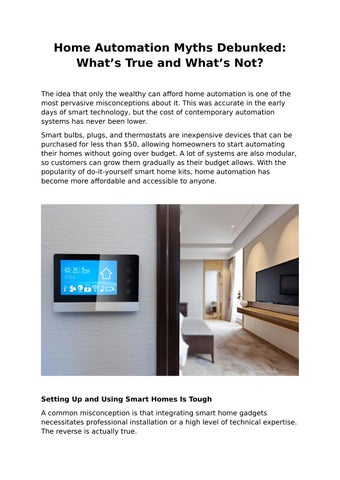
Smart bulbs, plugs, and thermostats are inexpensive devices that can be purchased for less than $50, allowing homeowners to start automating their homes without going over budget. A lot of systems are also modular, so customers can grow them gradually as their budget allows. With the popularity of do-it-yourself smart home kits, home automation has become more affordable and accessible to anyone.

Setting Up and Using Smart Homes Is Tough

A common misconception is that integrating smart home gadgets necessitates professional installation or a high level of technical expertise. The reverse is actually true.

Smart home solutions nowadays are made to be easy to use. Platforms like Apple HomeKit, Google Home, and Amazon Alexa make it easier to link devices, and basic smartphone apps can do the same. Plug-and-play is a feature of most smart gadgets, and voice commands and user-friendly drag-and-drop interfaces now enable even more complicated configurations.

Transform your living space with advanced home lighting automation systems for comfort, security, and efficiency—click here to learn more.

Although they are frequently not required for a simple setup, numerous businesses provide reasonably priced installation services for individuals who would rather have professional assistance.

Automation at Home Is Dangerous for Security

Although there are legitimate security issues in any digital environment, it is inaccurate to say that home automation is always dangerous. Using excellent practices and selecting trustworthy products are crucial.

Strong encryption mechanisms, two-factor authentication, and frequent firmware upgrades to fix vulnerabilities are features that top manufacturers of smart home appliances include. Users can further improve security by:

Using secure and distinctive passwords

Updating gadgets

Smart device and main network separation via guest Wi-Fi

Utilising mobile apps to monitor access

Because they provide motion detection, remote monitoring, and immediate alarms, smart home systems can actually improve security when properly installed.

The Idea of Home Automation Is Only a Trend

Home automation, according to some detractors, is a fleeting trend that offers no practical benefits. By 2026, the worldwide smart home market is expected to grow to a value of over $200 billion, indicating a robust and sustained demand.

Upgrade your lifestyle with cutting-edge smart home solutions designed for convenience, energy savings, and security—go here for details.

There are concrete advantages to home automation, including:

Using smart lights and thermostats to save energy

Using surveillance cameras and smart locks to increase home security

Accessibility and convenience for older people and disabled

Utility cost savings through efficient usage habits

These are useful benefits that raise property values and enhance daily living, not frivolous extras.

Every Smart Device Is Interoperable

Despite the industry's emphasis on interoperability, not all devices are compatible with one another. A common misconception among homeowners is that they can combine any smart product.

In actuality, compatibility is contingent upon various elements, such as platform ecosystems (Google, Amazon, Apple) and communication protocols (Zigbee, Z-Wave, Wi-Fi, and Bluetooth). It's essential to:

Prior to buying devices, find out if they are compatible.

Select a platform or hub to act as the backbone.

Choose brands that promote broad integration or open standards.

This allows homeowners to create a scalable and integrated smart home system.

Smart Homes Invade Privacy and Listen Constantly

Privacy issues are common with gadgets like smart speakers and webcams. These gadgets continually listen and gather information without permission, according to the notion.

Voice recognition is a function of smart devices, although most of them only work when a wake phrase like "Alexa" or "Hey Google" is spoken. Furthermore, consumers can see that major brands have stringent privacy policies.

Examine and remove the voice recordings.

When not in use, turn off cameras and microphones.

You can modify privacy settings in partner apps.

In order to assist consumers in efficiently managing their data, manufacturers are becoming more open and offering privacy dashboards.

Homeowners Lose Control Due to Automation

People fear that automating their homes will result in the loss of manual control. The reverse is also true. With the various control layers that home automation provides, customers can:

Manually change the settings

Establish schedules and procedures for automation. Use physical switches, applications, or voice instructions.

Homeowners receive more responsiveness and flexibility instead of losing control. Lights can be programmed to switch on automatically at sunset, for instance, but can be manually adjusted via a switch or app.

The eighth myth is that smart homes need a steady internet connection.

While a lot of smart gadgets use the internet to update and retrieve data remotely, not all automation features require continuous connectivity. Hub-based control or local processing is supported by many systems, which means:

Devices can use local networks to communicate.

Motion-triggered routines and basic features like scene illumination are still functional offline.

Some hubs, such as SmartThings or Home Assistant, are designed to function even in the event of an outage.

While an internet connection improves usefulness, it is not necessary for essential functions.

Experience effortless light control and privacy with stylish automatic window blinds—visit our website to explore customizable options today.

The ninth myth is that older homes cannot be automated.

The idea that automation is only possible in brand-new or specially designed homes is a prevalent misconception. The truth is that retrofit options are generally accessible. Modern smart technologies, ranging from

wireless switches to battery-operated sensors, are made to function in any kind of building, regardless of age.

Installation in older homes is both viable and economical because most systems rely on Wi-Fi or mesh networks, negating the need to rewire the house. Many homeowners have easily renovated Victorian homes or ranch-style homes from the 1950s.

The Expense of Automation Is Not Worth It

Some contend that home automation's initial expenses outweigh its benefits. However, smart home technology offers a significant return on investment, particularly when taking into account:

Energy savings: Up to 23% can be saved on HVAC expenses with smart thermostats.

Discounts on insurance: A lot of companies give homes with improved security lower premiums.

Property value: Smart homes sell more quickly and for more money, according to real estate data.

Many homeowners also value the time saved, convenience, and peace of mind.

In summary, although home automation is the future, it is also here today.

Home automation myths are sometimes the result of inaccurate information or out-of-date presumptions. Automation is now easier, safer, more economical, and more useful than ever, thanks to the quick development of smart technology.

Enjoy outdoor living in comfort and style with automatic porch screens— discover the benefits of a motorized screen porch today.

Adopting smart living improves daily living while preparing households for a connected, sustainable future. Unlocking the full potential of home automation requires separating fact from myth.

Related Blogs

Overview of the Future of Sustainable and Intelligent Living

From Screen to Security: How Smart Systems are Revolutionizing Home Cinemas

Smart Homes for the Elderly

Creating a Smart Home Cinema

Turn static files into dynamic content formats.

Create a flipbook
Home Automation by homeautomations - Issuu