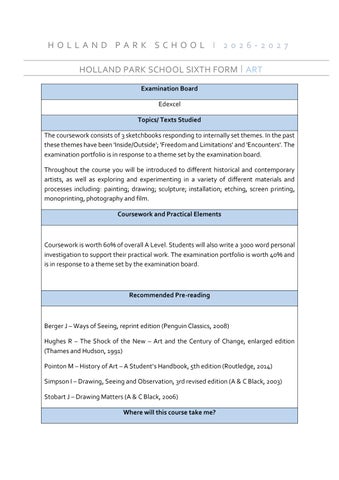
HOLLAND PARK SCHOOL I 2026-2027 HOLLAND PARK SCHOOL SIXTH FORM I ART Examination Board Edexcel Topics/ Texts Studied The coursework consists of 3 sketchbooks responding to internally set themes. In the past these themes have been 'Inside/Outside'; 'Freedom and Limitations' and 'Encounters'. The examination portfolio is in response to a theme set by the examination board. Throughout the course you will be introduced to different historical and contemporary artists, as well as exploring and experimenting in a variety of different materials and processes including: painting; drawing; sculpture; installation; etching, screen printing, monoprinting, photography and film. Coursework and Practical Elements
Coursework is worth 60% of overall A Level. Students will also write a 3000 word personal investigation to support their practical work. The examination portfolio is worth 40% and is in response to a theme set by the examination board.
Recommended Pre-reading
Berger J – Ways of Seeing, reprint edition (Penguin Classics, 2008) Hughes R – The Shock of the New – Art and the Century of Change, enlarged edition (Thames and Hudson, 1991) Pointon M – History of Art – A Student’s Handbook, 5th edition (Routledge, 2014) Simpson I – Drawing, Seeing and Observation, 3rd revised edition (A & C Black, 2003) Stobart J – Drawing Matters (A & C Black, 2006) Where will this course take me?
Architecture, Interior design, graphic design, film, photography, 3d visualisation, game visualisation, animation, production, set design, teacher, costume and prop design, fashion, textiles, make up artistry and special effects visualisation, website design, product design, automobile design, illustrator, exhibition design, curation, art sales, furniture design, visual merchandiser, marketing, creative director, design consultant. Why should you study this course?
It might sound like a cliche, but studying art encourages us to find beauty in the world around us - however challenging that may be at times. Yes, it certainly helps to develop critical thinking and interpetative skills, but it is this sense of self-expression that is at the subject's core. In Art A Level we work both independelty and collaboratively, but always seeking to hone our individual identity and our expression of it. As part of this, we find our own work mediated through that of other artists and one of the pleasures of the subject is to take the time to appreciate and interrogate some of the finest and most dynamic artwork that has been produced. What a wonderful way to spend your time in school! What are the entry requirements?
In addition to the general entry requirements, you will need a grade 7 or above in GCSE Art to study this course.
HOLLAND PARK SCHOOL I 2026-2027 HOLLAND PARK SCHOOL SIXTH FORM I BIOLOGY Examination Board AQA Topics/ Texts Studied
Year 12: Topic 1 (Biological Molecules); Topic 2 (Cells, Viruses and the Reproduction of Living Things); Topic 3 (Classification and Biodiversity); Topic 4 (Exchange and Transportation). Year 13: Topic 5 (Energy for Biological Processes); Topic 6 (Microbiology and Pathogens); Topic 7 (Modern Genetics); Topic 8 (Origins of Genetic Variation); Topic 9 (Control Systems) and Topic 10 (Ecosystems). Coursework and Practical Elements
The assessment of practical skills is a compulsory requirement of the course of study for A level qualifications in biology, chemistry and physics. It will appear on all students’ certificates as a separately reported result, alongside the overall grade for the qualification. Students will participate in 16 core practicals over the course of study in biology. Each practical will test core competencies and will contribute to passing the practical component on the qualification. The core practicals will also be examined in paper 3. Recommended Pre-reading
Richard Dawkins: The Selfish Gene The Blind Watchmaker. Unweaving the Rainbow Climbing Mount Improbable The Ancestor’s Tale
Steve Jones: Y: The Descent of Men In the Blood: God, Genes and Destiny Almost Like a Whale: The 'Origin of Species' Updated The Language of the genes Matt Ridley Genome: The Autobiography of a Species in 23 Chapters The Red Queen: Sex and the Evolution of Human Nature The Language of Genes Francis Crick: Discoverer of the Genetic Code Nature Via Nurture: Genes, Experience and What Makes Us Human James Watson: DNA: The Secret of Life The Double Helix: Personal Account of the Discovery of the Structure of DNA Lewis Thomas: The Lives of a Cell: Notes of a Biology Watcher. The Medusa and the Snail: More Notes of a Biology Watcher Barry Gibb: The Rough Guide to the Brain (Rough Guides Reference Titles) Charles Darwin: The origin of species Armand Marie Leroi: Mutants: On the Form, Varieties and Errors of the Human Body David S. Goodsell: The Machinery of Life Ernst Mayr: This Is Biology: The Science of the Living World George C. Williams: Plan and Purpose in Nature Steve Pinker: The Language Instinct Edward O Wilson: The Diversity of Life Richard Leaky: The Origin of Humankind Bill Bryson: A Short History of Nearly Everything
Oliver Sachs: The Man Who Mistook His Wife For A Hat Daniel Chamovitz: What A Plant Knows Where will this course take me?
Biology can lead to many practical, vocational or research-based careers including Medicine, research, scientific writing, education, ecology, microbiology, forensics, dentistry, pharmacy, veterinary medicine, toxicology, wildlife biology and civil service. Why should you study this course?
Biology is the scientific study of life itself, and like this, it is a rich and diverse field of study. Like any living organism it is versatile and ever-changing as we delve into ever-increasing levels of detail. The scope of the subject ranges from examination on a cellular level to the appreciation of the way an entire ecosystem functions. For all its scientific rigour, it remains a discipline rooted in the physical reality of the world around us. What are the entry requirements?
In addition to the general entry requirements, you will need a grade 77 or above in GCSE Combined Science or a grade 7 in GCSE Biology to study this course.
HOLLAND PARK SCHOOL I 2026-2027 HOLLAND PARK SCHOOL SIXTH FORM I BUSINESS Examination Board Edexcel Topics/ Texts Studied Students will study three papers. Paper 1 will assess marketing, people and global businesses. Questions will be drawn from Themes 1 and 4, and from local, national and global contexts. Paper 2 will assess business finance and operations, business decisions and strategy. Questions will be drawn from Themes 2 and 3, and from local, national and global contexts. Both papers are out of 100 marks and are two hours long. Paper 3 will assess content across all four themes. Questions will be drawn from local, national and global contexts. For Paper 3, there will be a pre-released context document issued on our website in November of the previous year. A new context will be given to centres each year and will relate to the examination series for the following summer. The context will focus on a broad context, such as an industry or market in which businesses operate. The question paper will be in two sections. The first section will focus on the broad context provided. This will be outlined to centres through the pre-released document. Questions will focus on the broad context. The second section will focus on at least one strand within the context provided, such as a particular business. Each section will contain unseen stimulus materials comprising quantitative and qualitative evidence. Students are required to apply their knowledge and understanding from Themes 1, 2, 3 and 4 and their understanding of the broad context to this evidence. Students cannot take any of their research or investigation data carried out as part of the pre-release into the examination.
Theme 1: Marketing and people
Theme 2: Managing business activities
Students will develop an understanding of: • Meeting customer needs • The market • Marketing mix and strategy • Managing people • Entrepreneurs and leaders
Students will develop an understanding of: • Raising finance • Financial planning • Managing finance • Resource management • External influences
Theme 3: Business decisions and strategy
Theme 4: Global business
This theme develops the concepts introduced in Theme 2. Students will develop an understanding of: • Business objectives and strategy • Business growth • Decision-making techniques • Influences on business decisions • Assessing competitiveness • Managing change
This theme develops the concepts introduced in Theme 1. Students will develop an understanding of: • Globalisation • Global markets and business expansion • Global marketing • Global industries and companies (multinational corporations)
Coursework and Practical Elements
There are no coursework elements and no practical elements for this course. Students will be assessed through 3 x 2 hour examinations at the end of the course. Recommended Pre-reading There is a plethora of Business-related books on the market with autobiographies from self-made millionaires as the likes of Steve Jobs, Steve Barlett – Diary of a CEO to the world famous – Rich Dad Poor Dad. Here are a few more: How I Made It: 40 Successful Entrepreneurs Reveal How They Made Millions - Rachel Bridge An essential read for anyone that is thinking about starting their own business. Successful Entrepreneurs are interviewed about how the spotted a gap in a market, and developed a USP.
The Tipping Point: How Little Things Can Make a Big Difference - Malcolm Gladwell A very readable and fascinating book, which looks into the reasons products become market leaders. The Google Story: David A. Vise An interesting investigation into the culture at Google, includes insights into the four day working week and soft management styles. The questions is; are these the things that made Google the world’s number one search engine? The Toyota Way: 14 Management Principles from the World's Greatest Manufacturer Jeffrey Liker Covers Japanese Management Techniques such as Kaizen and TQM. Billions of Entrepreneurs: How China and India Are Reshaping Their Futures and Yours Tarun Khanna An investigation into Asia’s two growing economic powers. Business Stripped Bare: Adventures of a Global Entrepreneur - Sir Richard Branson The autobiography of Britain’s most famous entrepreneur. Sun Tzu -The Art of War for Managers: 50 Strategic Rules Updated for Today's Business - Gerald A. Michaelson Applying the ancient Chinese rules of battle to modern day business. The Intelligent Investor: Benjamin Graham The classic book on stock market investment, as recommended by Warren Buffet. No Logo: Naomi Klein Klein investigates the negative side to marketing and globalisation. House of Cards: How Wall Street's Gamblers Broke Capitalism - William D Cohan Explains the reason behind the continuing global financial crisis, which started in September 2008. There are many Netflix series and movies that one can watch including; dirty money, rotten, Joy, The founder, Inside job, The big short, The pursuit of happiness, Jobs, among many others. Where will this course take me? Business offers students the opportunity to study different types of businesses in different industries. It looks at why they exist, how they are set up and how they are run. Everyone works in an organisation which is a business of some sort – so studying business is useful as you develop skills that are found in most jobs. Business Studies will give you the skills of coming up with business ideas, using maths skills to analyse data, making decisions and developing your communication skills through presentations and reports - all highly transferable skills.
Business Studies can lead into a wide range of careers such as marketing, HR, finance and law. Studied alongside maths it can open doors into careers related to finance or running your own business. Why should you study this course? Business Studies A-level is a great choice for anyone interested in the world of commerce and entrepreneurship. It's a great way to prepare for university courses in the fields of business and management, and to equip yourself with the know-how to start up your own business or follow a career in finance, accounting, marketing or management post university. Through Business Studies A-level, you'll engage with the world of business through the context of current business developments and real business situations. You'll learn how management, leadership and decision-making can improve performance in marketing, operational, financial and human resources. You'll also explore the interrelated nature of business activities and how they affect businesses, be they large or small, UK or internationally focussed and in different sectors such as service or manufacturing. The aim is to encourage students to develop a critical understanding of different businesses, the context in which they operate, the markets they serve, and ultimately recommend actions that businesses should take to be successful. Students will be expected to immerse themselves in a business-like mindset and to pay attention to the world around them. For example, students would be expected to take note of relevant news items, which may be used as a basis for discussion and class-work. What are the entry requirements? Students must have a grade 6 in Maths and English. Students are advised to choose Business if they have a true desire to learn about Business operations and have a problem-solving can-do attitude. Students who have taken GCSE Business may find that a lot of the content overlap therefore they must be prepared to revisit prior learning and be proactive in connecting their current understanding to reallife case studies.
HOLLAND PARK SCHOOL I 2026-2027 HOLLAND PARK SCHOOL SIXTH FORM I CHEMISTRY Examination Board AQA Topics/ Texts Studied The course is divided into three main sections. Physical, Inorganic & Organic chemistry. Topics included: Atomic structure, bonding and structure, redox I and II, thermodynamics, electrochemistry, inorganic and periodic table trends, quantitative chemistry, organic I, II and III, analytical techniques I and II, energetics I and II, kinetics I and II, equilibrium I and II. Coursework and Practical Elements
The assessment of practical skills is a compulsory requirement of the course of study for A level qualifications in biology, chemistry and physics. It will appear on all students’ certificates as a separately reported result, alongside the overall grade for the qualification. Students will participate in approximately 12 required practical activities over the course of study. Each practical will test core competencies and will contribute to passing the practical component of the qualification. The required practicals will also be examined in all three papers, with at least 15% of the the total marks being awarded. Recommended Pre-reading
The Chemistry of Life (Steven Rose) Chemistry (Brock) Principles of Biochemistry (White, Handler and Smith) Chemistry for Changing Times (Hill, McCreary and Kolb) Materials Science (Ramsden) The Periodic Kingdom (Atkins) Mendeleev’s Dream – the search for the elements (Strathern) Periodic Tables – The Curious Life of the Elements (Aldersty and Williams) The Disappearing Spoon (Kean) 50 Ideas you really need to know about Chemistry (Birch) The Periodic Table – a field guide to the elements (Parsons and Dixon) Where will this course take me?
Chemistry is a must have for anyone looking to study medicine, dentistry or veterinary medicine at university, as well as leading to further study in chemistry, biochemistry or chemical engineering. The skills and knowledge you develop in chemistry will lead you to be successful in careers in scientific research, technology, pharmaceuticals, engineering, education, finance, law, consulting or the environment. Why should you study this course?
Chemistry is all around us from cooking to chemicals changing the colour of leaves. It is often a deeply theoretical and complex subject but it seeks to answer questions and explain our observations of the world on an atomic level. The subject will challenge the ideas you hold and help you build links between all of the sciences. What are the entry requirements?
In addition to the general entry requirements, you will need a grade 77 or above in GCSE Combined Science or a grade 7 in GCSE Chemistry to study this course.
HOLLAND PARK SCHOOL I 2026-2027 HOLLAND PARK SCHOOL SIXTH FORM I ECONOMICS Examination Board AQA Topics/ Texts Studied Study topics include Microeconomics; Macroeconomics; Behavioural Economics; and the international economy. Coursework and Practical Elements No coursework. A rich programme of talks and visits. Recommended Pre-reading AQA Economics Books 1 and 2 by Ray Powell and James Powell, published by Hodder Education. An extensive reading list is available. Where will this course take me? A degree in Economics can lead to a wide range of careers. Very few students of Economics go on to a career as a professional economist, rather going into careers in banking, accountancy, insurance, consulting and the public sector. Why should you study this course? Economics is a subject that asks us to analyse Man's relationship with that supposed 'root of all evil' and think how it is applied in real world situations. Economics encourages students to think analytically about the world around them and to express this analysis in a practical and clear manner.
What are the entry requirements?
In addition to the general entry requirements, you will need a grade 7 or above in GCSE Mathematics and English Language or Literature to study this course.
HOLLAND PARK SCHOOL I 2026-2027 HOLLAND PARK SCHOOL SIXTH FORM I ENGLISH Examination Board AQA Topics/ Texts Studied
Year 12: King Lear, Richard II, a selection of Keats poetry. Year 13: The Murder of Roger Ackroyd (Agatha Christie), Atonement (Ian McEwan), a selection of 'crime poetry' that includes the work of George Crabbe, Robert Browning and Oscar Wilde, unseen passages of crime writing Coursework and Practical Elements
Two 1,500 word coursework assignments. The first is on a novel of the student's choosing, the second is on a collection of poetry. Past choices have included Phillip Larkin, W.B. Yeats and Andrew Marvell. Recommended Pre-reading
All reading is useful! Read widely, often, and across genres. For Shakespeare, Macbeth, the Tempest, Othello, Henry IVth Parts I and II. For Keats, we recommend students study his Odes and have an essential grasp of Romanticism. For crime writing, we encourage a wide range of crime literature, including other Agatha Christie, the hard-boiled writing of Raymond Chandler, Charles Dickens, and even modern commercial thrillers - Lee Child has made an appearance! Where will this course take me?
Anything and everything from working in the media, marketing, law, finance, academia, government. English A level is a rigorous essay subject that is applicable to many fields possibly excluding scientific research!
Why should you study this course?
English A-Level touches on all the great questions: what’s the meaning of life? What is power, who has it, and how to people misuse it? Is the world fair? Why are we fascinated by awful people and awful behaviours? The A Level covers a broad range of texts and equips students with essential skills such as inference and essay writing, with opportunities to develop your own interpretations of your own text choices in the coursework along with extensive help and guidance on the best lines of argument from experienced teachers. What are the entry requirements?
In addition to the general entry requirements, you will need a grade 7 or above in GCSE English Language or Literature to study this course.
HOLLAND PARK SCHOOL I 2026-2027 HOLLAND PARK SCHOOL SIXTH FORM I FRENCH Examination Board AQA Topics/ Texts Studied The film La Haine, Camus' novel L'Etranger (or another of the set texts, depending on the cohort), as well as a range of cultural and political topics affecting France and other Frenchspeaking countries today. Coursework and Practical Elements
1x 25 minute speaking exam, for which you prepare an Independent Research Project on any topic relating to France/the francophone country of your choice. Recommended Pre-reading
Any reading on French history, culture or politics would be helpful. For example, A Very Short Introduction to French History or the Rough Guide to France. Important French literary texts (that you can read in translation) include Madame Bovary (Flaubert), Les Misérables (Hugo) and Le Comte de Monte-Cristo (Dumas). Elsewhere in the Francophone world, you might consider Ben Jelloun’s L’Enfant du sable and Miriama Bâ’s Une si longue lettre. Where will this course take me?
Any career which requires you to communicate clearly - the study of a foreign language demonstrates a desire to communicate ideas, as well as understand foreign cultures. Literature and film components support English Literature very well. The study of another language also means that you could take up a career abroad, thus enlarging the geographical potential of your job prospects. Why should you study this course?
The studies about language learning are clear: people who speak more than one language are more likely to earn more, keep degenerative disorders at bay, and show greater empathy. Learning beyond your mother tongue demonstrates an appreciation of difference and a desire to broaden horizons. More than 300 million people speak French on the five continents. A knowledge of French therefore not only gives you an advantage on the job market, but also offers direct access to Francophone culture including philosophy, cooking, fashion and literature. In the words of (Austrian) Wittgenstein, ‘the limits of my language mean the limits of my world’. What are the entry requirements?
In addition to the general entry requirements, you will need a grade 7 or above in GCSE French to study this course.
HOLLAND PARK SCHOOL I 2026-2027 HOLLAND PARK SCHOOL SIXTH FORM I FURTHER MATHS Examination Board Edexcel Topics/ Texts Studied
Year 12: the entire A-Level Maths syllabus in one year, plus AS Further Maths: Complex numbers. Matrices. Sum of series. Algebra and functions. Proof. Vectors. Year 13: Complex numbers and De Moivre’s Theorem. Maclaurin series. Hyperbolic functions. Polar coordinates. Further calculus. Differential equations. Further Vectors. Conics. t – formulae. Taylor series. Leibnitz’s theorem. L’Hopital’s rule. Numerical Methods. Reducible differential equations. Momentum and Impulse. Work,energy and power. Elastic strings and springs. Elastic collisions. Coursework and Practical Elements
No coursework. Recommended Pre-reading
A Hodges 'Alan Turing, the Enigma', Dr. Richard Elwes 'How to Solve the Da Vinci Code', William Dunham 'Journey Through Genius: The Great Theorems of Mathematics', Leonard Mlodinow 'Euclid's Window: The Story of Geometry from Parallel Lines to Hyperspace'. Where will this course take me?
Economics, Engineering, PPE, Statistician, Teaching, Research, Accountancy, Insurance, Risk Management. Why should you study this course?
A level Further Mathematics is fun and rewarding. It broadens your mathematical skills and promotes deeper mathematical thinking. You will be introduced to interesting new areas of pure mathematics and applied mathematics in a wider range of contexts. For progression to many courses at university it is important to have strong mathematics skills.Those students who had studied Further Mathematics to A level standard reported coping better with the mathematical content of the degree, and as such perceived that they required less additional support throughout their studies. It is generally required for studying mathematics and some physics and engineering degrees at leading universities. What are the entry requirements?
In addition to the general entry requirements, you will need a grade 8 or above in GCSE Mathematics to study this course.
HOLLAND PARK SCHOOL I 2026-2027 HOLLAND PARK SCHOOL SIXTH FORM I GEOGRAPHY Examination Board Edexcel Topics/ Texts Studied Coasts, Tectonics, The Water Cycle, The Carbon Cycle, Regeneration, Globalisation, Superpower and Migration and Identity. Coursework and Practical Elements NEA is an individual investigation. This is a 3000 word report that is produced from data you have collected in the UK and is rooted in one of the topics you have studied. It is a change for you to develop a strong geographical topic of your choice. It is marked out of 70 and worth 20% of the A Level. Recommended Pre-reading
• People Quake: Mass Migration, Ageing nations and the Coming Population Crash by F Pearce • Introducing Human Geographies • Prisoners of geography by Tim Marshall • Sea Change: Britain’s coastal Catastrophe by R Girling • The Making of the British Landscape: How we have transformed the land by F Pryor Where will this course take me?
Geography is valuable A level and it is regarded as a facilitating subject by many Russell Group universities, these are subjects most commonly preferred. This is because geography has many transferable skills such as problem solving and critical thinking. A geography A level and degree can lead into many careers such as environmental sustainability, accounting, law and even the Prime minister.
Why should you study this course?
There has never been a better or more important time to study A level Geography. Dealing with vital issues such as climate change, migration, environmental degradation, social issues and natural hazards, A level Geography is one of the most relevant subjects you could choose to study. It is a subject as rooted in ourselves as the earth itself. What are the entry requirements?
In addition to the general entry requirements, you will need a grade 7 or above in GCSE Geography to study this course.
HOLLAND PARK SCHOOL I 2026-2027 HOLLAND PARK SCHOOL SIXTH FORM I HISTORY Examination Board AQA Topics/ Texts Studied
Year 12: The Tudors (Henry VII and Henry VIII). Weimar Germany.Year 13: The Tudors (Edward VI, Mary I and Elizabeth I) and Nazi Germany. There is a 2 hour 30 minute exam for each unit (Tudors and Germany) at the end of Year 13 encompassing the content of both Year 12 and 13. Coursework and Practical Elements
One 4500 word essay worth 40 marks and 20% of the A Level. It is completed on a project of your choice although your teacher will select a topic area that spans 100 years, for example African American Civil Rights, 1860-1970. You will then select an area of interest and complete coursework on a question of your choosing. Recommended Pre-reading
Geoffery Elton 'England under the Tudors', John Guy 'Tudor England', Julia Boyd 'Travellers in the Third Reich' Where will this course take me?
History is a highly valuable and well regarded A Level. Universities and employers recognise the difficulty of the subject as well as the analysis, deduction, evaluation and literacy skills that go into achieving highly in it. A career in law, finance, consultancy, academia are all very plausible. Why should you study this course?
A Level history interrogates the question of where we come from and, thus, who we are, whilst along the way captivating students with gripping narratives of social and political turmoil set against shrewd and decisive decision-making and everything inbetween. As well as grasping these historical details in depth, the subject equips students with the skills to debate at the highest and most incisive level. One's ability to argue and analyse will be honed as well as skills in selecting key information in order to support a stance. A Level history asks questions about the past, but also asks us to critique others' views and so, on some level, seeks to ascertain an essential truth to the world and its events, however amorphous that idea may be. What are the entry requirements?
In addition to the general entry requirements, you will need a grade 7 or above in GCSE History to study this course.
HOLLAND PARK SCHOOL I 2026-2027 HOLLAND PARK SCHOOL SIXTH FORM I LATIN Examination Board OCR Topics/ Texts Studied Cicero (Pro Caelio), Virgil (Aeneid) Coursework and Practical Elements No coursework Recommended Pre-reading Homer's Iliad and Virgil's Aeneid (in translation). Where will this course take me?
The study of Classics develops and demonstrates skill in all areas of the humanities, and is as solid a foundation as one could desire for entering professions such as law, consulting, the Civil Service, journalism, and many more. Why should you study this course?
If it weren't worth it, we wouldn't still be doing it! Challenge your mind with the demands of reading complex, real Latin, gain a grounding in political thinking and persuasive language, and dive into some of the most fascinating, rich, humorous, energetic, and influential poetry ever written. What are the entry requirements? In addition to the general entry requirements, you will need a grade 7 or above in GCSE Latin to study this course.
HOLLAND PARK SCHOOL I 2026-2027 HOLLAND PARK SCHOOL SIXTH FORM I MATHS Examination Board Edexcel Topics/ Texts Studied
Year 12: Further Algebra; Differentiation; Integration; 2D Vectors; Coordinate geometry; Trigonometry; Exponentials and logarithms; Mechanics; Statistics. Year 13: Differentiation; Integration; Proof; Functions; Sequences and series; Binomial expansion; Trigonometry. Numerical methods; Parametric equations; 3D vectors; Mechanics; Statistics. Coursework and Practical Elements
No coursework. Recommended Pre-reading
Paul Glendinning 'Maths in Minutes: 200 Key Concepts Explained in an Instant', Martin Gardner 'Entertaining Mathematical Puzzles', Simon Singh 'Fermat’s Last Theorem', Max Tegmark 'Our Mathematical Universe' Where will this course take me?
Economics, Engineering, Computer Science, PPE, Statistician, Teaching, Research, Accountancy, Insurance, Risk Management Why should you study this course?
A Level Mathematics is about challenge. First and foremost, the escalation in challenge between the A Level and the GCSE is significanct, but beyond that, the course challenges logic, it challenges problem solving, and challenges students to think creatively and
analytically in the manipulation of the subject. A Level Mathematics also challenges students' resilience as they come to terms with writing structured solutions, proofs and justification of results to formulate reasoned arguments. the benefits of this rigour are immense however, not only in honing one's numeracy and ability to process and interpret data, but also in offering a gateway to fascinating and challenging careers. What are the entry requirements?
In addition to the general entry requirements, you will need a grade 7 or above in GCSE Mathematics to study this course.
HOLLAND PARK SCHOOL I 2026-2027 HOLLAND PARK SCHOOL SIXTH FORM I MUSIC Examination Board AQA Topics/ Texts Studied
Year 12: Western classical tradition 1650-1910; baroque solo concerto; the operas of Mozart, the piano music of Chopin, Brahms and Grieg. Year 13: Two areas of study from pop music, music for media, music for theatre, jazz, contemporary traditional music or art music since 1910. The areas of study provide an appropriate focus for students to develop and demonstrate their appraisal and in-depth knowledge and understanding of musical elements, musical contexts and musical language. Coursework and Practical Elements
A musical performance of one or more pieces of music with a combined minimum duration of three and a half minutes, which is assessed as a solo and/or ensemble performance as an instrumentalist, or vocalist and/or in the area of music production (via technology). Two compositions lasting a minimum of four and a half minutes of music in total. A composition one piece of music with a duration of at least two minutes. Compositions may be in response to a set brief or be freely composed. Recommended Pre-reading
Harmony in Practice, ISBN-10: 1854728334 Harmony in Practice: Answer Book, ISBN-10: 1854729926 The Study of Counterpoint, ISBN-10: 0393002772 371 Harmonized Chorales, ISBN-10: 0793525748 Haydn: String Quartets, Op. 50 (Cambridge Music Handbooks), ISBN-10: 0521399955
Harmony, Melody and Composition, ISBN-10: 0521569087 The Symphony: A Listener's Guide, ISBN: 0195126653 Where will this course take me?
It could lead to studying a degree in music and becoming a musician, sound technician, music therapist or teacher, or it might open doors to a range of pathways for education and employment in the arts and creative industries. This could include work in film, TV, radio and theatre. Music is also regarded as a highly academic A Level subject and could complement your other studies. Why should you study this course?
One’s relationship with music is so unique to each individual that its potential impact on one’s life has no bounds. It is often described as a subject worth studying for its transferable skills, such as listening, analytical writing, independent study, creativity, presentational skills and building your self-confidence. But you might wish to study music because you simply could not imagine a world without it, so important is it to you. What are the entry requirements?
In addition to the general entry requirements, you will need a grade 7 or above in GCSE Music to study this course.
HOLLAND PARK SCHOOL I 2026-2027 HOLLAND PARK SCHOOL SIXTH FORM I PHYSICS Examination Board Edexcel Topics/ Texts Studied
Year 12: Working scientifically, mechanics, electric circuits, materials, waves and the particle nature of light, further mechanics. Year 13: Electric and magnetic fields, nuclear and particle physics, thermodynamics, space, nuclear radiation, gravitational fields, oscillations Coursework and Practical Elements
The assessment of practical skills is a compulsory requirement of the course of study for A level qualifications in biology, chemistry and physics. It will appear on all students’ certificates as a separately reported result, alongside the overall grade for the qualification. Students will participate in approximately 12 core practicals over the course of study. Each practical will test core competencies and will contribute to passing the practical component on the qualification. The core practicals will also be examined in paper 3. Recommended Pre-reading
Six easy pieces (Feynman), Six not so easy pieces (Feynman), The character of physical law (Feynman), The elegant universe (Greene), Storm in a teacup - the physics of everyday life (Czerski), Seven brief lessons on physics (Rovelli), How to teach quantum physics to your dog (Orzel), Black hole blues (Levin), Mapping the universe (Natarajan)
Where will this course take me?
Physics is a highly regarded A level. Universities and employers will recognise the level of challenge and problem solving skills required to be successful. Physics A level can enhance your application to a wide range of university courses, including, in addition to physics: engineering, natural sciences, chemistry, biology, biotechnology, maths, computer science, medicine and all other healthcare courses, geology, geography, electronics, as well as a wide range of apprenticeships including software development or sound engineering. Students who study physics have access to a wide range of careers, from working in medicine as a medical physicist to designing new structures as an engineer or architect, or creating films and computer games as programmers. Physics students also may choose to work in the environmental sector (for example by developing new technologies in the renewable energy industry). Physics provides a logical, questioning, scientific approach which is invaluable in setting up businesses or writing for a newspaper. The world that physics can open up for you is quite endless, and others choose to discover the nature of reality by pursuing research physics, considering the possibility of multiple dimensions or how to detect gravitational waves. Why should you study this course?
During A level physics, you will develop skills that can be transferred to just about any other area of work, from setting up a business to working towards a greener future for our planet. You will begin to think like a physicist, developing your problem solving skills and ability to ask the right questions - namely the questions that underpin the reality of the universe we inhabit. You will also learn how to apply maths to the real world and explore worlds typically beyond the scope of mundane human understanding - namely particle physics and cosmology. What are the entry requirements?
In addition to the general entry requirements, you will need a grade 7 or above in GCSE Physics or a grade 77 in the double award to study this course. You will also need a grade 7 in mathematics.
HOLLAND PARK SCHOOL I 2026-2027 HOLLAND PARK SCHOOL SIXTH FORM I POLITICS Examination Board EDEXCEL Topics/ Texts Studied The course covers political participation; UK government; political ideologies and global politics. Coursework There is no coursework element to this course. Recommended Pre-reading Following the news regularly, ideally through a blend of The Economist, The Financial Times, The Guardian, the BBC and Al Jazeera news. You may also wish to start listening to podcasts regularly, including The Rest is Politics and The News Agent. Where will this course take me? An A-level in Government and Politics provides an excellent background for careers in law, journalism, the caring professions, teaching, and a range of management and business areas. Example degree courses which generally require or accept Government & Politics A-level include Politics, Economics, Journalism, Law, International Relations, History and Social Policy. Why should you study this course?
Studying A-level Government and Politics will provide insight into political beliefs central to an understanding of the modern world. It also develops analytical and evaluative skills in relation to interesting topics prevalent in the turbulent political climate of today. Studying Government & Politics will develop your understanding of structures of authority and power, how political systems differ, and enable you to interpret, evaluate and comment on the nature of politics and government. You will also develop a range of transferrable analytical, debating and communication skills - all of which are vaulable in a wide range of careers. What are the entry requirements?
In addition to the general entry requirements, you will need a grade 6 or above in either English Language or Literature and/or History.
HOLLAND PARK SCHOOL I 2026-2027 HOLLAND PARK SCHOOL SIXTH FORM I PSYCHOLOGY Examination Board AQA Topics/ Texts Studied
Social psychology, cognitive psychology, developmental psychology, psychopathology, approaches to psychology, biopsychologogy, research methods, relationships, schizophrenia, forensic psychology Coursework and Practical Elements
No coursework Recommended Pre-reading
The Brain, David Eagleman. The Social Animal, Elliot Aronson. The Collected Schizophrenias, Esme Weiji Wang. How the Mind Works, Stephen Pinker Where will this course take me?
Psychology is a valuable subject for any career that involves working with people, which is a vast range of career paths. Aside from the more obvious career paths such as clinical, counselling and educational psychologists; those studying Psychology find themselves pursuing carrers as wide ranging as detectives to market researchers. Why should you study this course?
A Level psychology asks us to think analytically about how we act, think and feel. Through it, we glean an essential understanding of the processes that govern human behaviour and so gain a greater appreciation of who we are and the world around us. It delves into fascinating questions like 'How can we succumb to evil?'; 'How come we fail to live
cohesively with others?'; 'How do we make choices?'. helps you understand human behaviour and mental processes and allow you to better understand how we act think and feel. What are the entry requirements?
In addition to the general entry requirements, you will need a grade 6 or above in GCSE English Language and Mathematics to study this course.
HOLLAND PARK SCHOOL I 2026-2027 Religion, Philosophy & Ethics Examination Board Edexcel Topics/ Texts Studied
Students will study three papers. Paper 1 is a study of the philosophy of religion and includes topics such as arguments for God's existence, the afterlife and religious language. Paper 2 is a study of ethics. Students will learn about different ethical systems, including Siutation Ethics, Utilitarianism, Kantian Ethics and Virtue Ethics alongside topics such as war and peace, sexual ethics, medical ethics and environmental ethics. The final paper is a study of religion. Holland Park School chooses to specialise in Buddhism. Coursework and Practical Elements
There are no coursework elements and no practical elements for this course. Students will be assessed through 3 x 2 hour examinations at the end of the course. Recommended Pre-reading
There are plenty of introductory texts available to help you to access philosophy and ethics, but I recommend beginning with the moral dilemmas illustrated in the works of fiction. Consider these: 'Never Let Me Go,' by Kazuo Ishiguro; 'We Need to Talk About Kevin,' by Lionel Shriver; 'Sophie's World,' by Jostein Gaader; 'The Sage Train,' by Nicky Hansell; 'Under the Net,' by Iris Murdoch and 'The Unbearable Lightness of Being,' by Milan Kundera. For some non-fiction alternatives consider: 'A Little History of Philosophy,' by Nigel Warburton; 'A History of God,' by Karent Armstrong, 'Nausea,' by Jean Paul Satre or 'The Complete Philosophy Files,' by Stephen Law. Where will this course take me?
The study of RE and the skills one acquires complements a wide range of subjects and so students have gone on to study at undergraduate level subjects as diverse as medicine, law, philosophy, MFL, history, English, politics, anthropology, the sciences and forensics.
The course equips students with analytical skills suitable for a wide range of careers. Recent students now work in the civil service, in law, in medicine, journalism and finance. Why should you study this course?
Religious Studies is a rigorous and demanding academic discipline in its own right. It engenders critical thinking and rigour in the search for truths in uncertain fields. It encourages philosophical thought, decision making skills, collaboration and independent working skills and the search for compromise and conflict resolutions that work. It creates opportunities for young people to develop their skills of dialogue, interpretation and analysis in a coherent context. All these are vital skills in a modern workforce where communication, collaboration and cooperation are core skills. Religious Studies has a multidisciplinary nature, involving textual study, philosophical thinking, ethics, social understanding and the skills of analysis and reasoning developing core skills of literacy. It makes a key and unique contribution to understanding British heritage, plurality, values and futures and provides an excellent opportunity for young people to engage with contemporary contentious issues, developing social, cultural, political, philosophical and historical awareness. Religious Studies supports students to learn to respect themselves and understand their own identity, to respect others, and to understand their own and others' rights and responsibilities. At a time when communities are becoming more diverse there is an even greater need for a more religiously literate and tolerant society. Religious Studies plays a key role in creating social cohesion and generating genuine understanding between communities reducing friction, intolerance and social unrest. What are the entry requirements?
In addition to the general entry requirements, you will need a grade 7 or above in GCSE RE to study this course. We do accept some students who have not studied RE at GCSE. Here, the requirement will be a grade 7 in English Language or Literature.
HOLLAND PARK SCHOOL I 2026-2027 HOLLAND PARK SCHOOL SIXTH FORM I SPANISH Examination Board AQA Topics/ Texts Studied
The film Maria, Llena eres de gracia, Federico Garcia Lorca's play La Casa de Bernarda Alba, as well as a range of cultural and political topics affecting Spanish speaking countries today. Coursework and Practical Elements
1x 25 minute speaking exam, for which you prepare an Independent Research Project on any topic relating to Spain/the Hispanic world of your choosing. Recommended Pre-reading Any reading on Spanish history, culture or politics would be helpful. For example, The Spanish Civil War: A Very Short Introduction or the Rough Guide to Spain. Where will this course take me?
Learning another language can increase both your level of employability and earning potential. Spanish is the third most influencial language in the world, meaning it can increase your level of employability. Languages are an essential tool to compete in a global job market, and to succeed in the workplace. Employers are increasingly aware of the benefits that language skills bring to their companies.Language students are more attractive to employers than others thanks to the wide range of transferable skills they obtain from learning a language. Any career which requires you to communicate clearly the study of a foreign language demonstrates a desire to communicate ideas, understand foreign cultures, as well providing the tools to embark on a career in International Relations or diplomacy.
Why should you study this course?
Studying a language strengthens your written and oral communication competence, your organisational skills, your aptitude in analysing and synthesising information, your ability to contribute to discussions and suggest ideas, and your understanding of other countries and cultures in a global world. A Level Spanish truly makes the world global as it not only opens students' minds to the culture of Spain, but also the vast Spanish-speaking world with its many fascinating cultures and traditions. What are the entry requirements?
In addition to the general entry requirements, you will need a grade 7 or above in GCSE Spanish to study this course.
HOLLAND PARK SCHOOL I 2026-2027 HOLLAND PARK SCHOOL SIXTH FORM I COMPUTER SCIENCE Examination Board OCR Topics/ Texts Studied • • • • • • • •
The characteristics of contemporary processors, input, output and storage devices Software and software development Exchanging data Data types, data structures and algorithms Legal, moral, cultural and ethical issues Elements of computational thinking Problem solving and programming Algorithms to solve problems and standard algorithms Coursework and Practical Elements
There is a Programming project component (H446/03)which is a practical portfolio based assessment with a task that is chosen by the teacher or learner and is produced in an appropriate programming language. This Coursework unit is worth 20% of overall A Level. Students will choose a computing problem to work through and develop a software based solution. Students will also document their planning of the solution and create documentation that includes the following: • • • •
Analysis of the problem Design of the solution Developing the solution Evaluation Recommended Pre-reading
A/AS Level Computer Science for OCR Student Book by Alistair Surrall, Adam Hamflett
Where will this course take me?
An A level in computer science allows you to pursue a career in almost any industry that requires use of computers and/or any type of role that makes use of computational thinking. Some future roles possible include: Software Developer, Systems Analyst, Data Scientist, Network Engineer, Database Administrator, Cybersecurity Analyst, Web Developer, Mobile App Developer, IT Project Manager, Machine Learning Engineer, Cloud Solutions Architect, DevOps Engineer, AI Research Scientist, UX/UI Designer, Computer Systems Analyst, IT Consultant, Full Stack Developer, Information Systems Manager, Game Developer, Software Tester/QA Engineer, Big Data Engineer.
Why should you study this course? Computer science allows you to develop your problem solving skills and take contol of the devices ingrained in our daily life. It allows you to explore the complex systems that allow this digital world to exist and integrate within our lives. This course will arm you with the knowledge needed to understand concepts that underpin the world of computing,ranging from understanding how hardware works to how the CPU processes information. It is versatile and covers a broad range of topics from software development in python to web development in javascript; all while keeping you upto date with latest software development methodologies and the key algorithms that form part of 1000s of software. The course will give you the practical experience needed for a career in tech, alongside knowledge of how to break into more complex roles like network engineering and software engineering. It will allow you to explore your curiosity of computing while building your know how of how to solve any problem using computational thinking, allowing you to progress in an infinitely diverse set of careers. What are the entry requirements?
In addition to the general entry requirements, you will need a grade 7 or above in GCSE Mathematics to study this course.