HEMPSTEAD, NY
THE HOFSTRA CHRONICLE
KEEPING THE HOFSTRA COMMUNITY INFORMED SINCE 1935
New Peace Corps Prep program set to start Fall 2026
By Katelyn Buchalter
ASSISTANT NEWS EDITOR
Hofstra University plans to implement a new Peace Corps Prep program for the Fall 2026 semester. The new Peace Corps Prep program will allow undergraduate students of all majors to earn a Peace Corps Prep Certificate. The program will prepare students for international volunteer service and expand their cultural awareness. Members of the Peace Corps typically assist with international projects in education, health and agriculture development.
Students who participate in this program will spend time taking at least three courses related to one of the six Peace Corps sectors: education, health, environment, agriculture, youth in development or community economic development.
“I think the program will give students a world view, and I think it will encourage students to look beyond the borders of the United States,” said Scott
Brinton, assistant professor of journalism and Peace Corps Prep coordinator. “The curriculum is designed to kind of steer students toward classes that would … improve foreign language skills [and] improve their sense of the world beyond the borders of the [U.S.]. It’s a
interesting,” said Jake Schettini, a sophomore sports media major. “I really didn’t know much about it before going to the meeting, but I think it would be a great learning experience for whoever decides to make the commitment.”
For around two years, mem-
“The curriculum is designed to ... improve their sense of the world beyond the borders of the [U.S.]. It’s a lot about culture; it’s a lot about cultural understanding.”
lot about culture; it’s a lot about cultural understanding.”
During a panel discussion on Wednesday, March 11, Brinton, along with several other faculty members, highlighted their experience working with the Peace Corps.
“I think the program is super
bers of the Peace Corps often serve in a designated country.
During the panel, Brinton spoke of his time in Bulgaria, while other panelists spoke about their time in other countries, like Russia and Guyana.
CONTINUED ON A5
TUESDAY March 31, 2026 ARTS & ENTERTAINMENT
most anticipated comeback yet: ‘ARIRANG’

According to Billboard, BTS earns their 7th No. 1 Album on the Billboard 200 chart with ‘ARIRANG.’
By Kimberly Lopez ASSISTANT ARTS AND ENTERTAINMENT EDITOR
Back when BTS announced their hiatus on June 14, 2022, for mandatory military service and solo projects, it seemed like it would be forever until their 2025 return. Time eventually flew, with the group announcing their comeback album “ARIRANG” on Jan. 15, to be released on Friday, March 20.
“ARIRANG” is named after “Arirang,” a 600-year-old Korean traditional folk song. The song almost functions like a national anthem due to its themes of resilience and cultural identity for Korean people. When the album title was announced, fans immediately realized its significance, setting the tone for possible album themes and meanings.
In the lead up to the album release, the track list was released with early looks at songwriters and producers. This was nothing new, as it’s something most K-pop groups do leading up to a new album. What was new, however, were some of the col-
laborators BTS worked on this album with. Some artists credited included Teezo Touchdown, Tame Impala, JPEGMAFIA and Mike WiLL Made-It, who were either listed as producers or writers on the tracks. Artists like these made non-ARMY – the name of BTS’ fandom – audiences excited for the album. The album contains pop, rap, hip-hop, trap and even some elements of rock sprinkled throughout. Upon first listen, some tracks left much to be desired, but others were instant ear worms. Some listeners have complained that the album is too “westernized,” misuses African American Vernacular English and is a downgrade compared to the rest of the group’s discography.
I don’t think people have a right to decide whether this album is too “westernized” or not Korean enough. It is BTS’ culture. That aside, the complaint doesn’t really ring true. The album title itself shows BTS’ appreciation for their culture; plus, they sample the actual “Arirang” folk song on the first track.
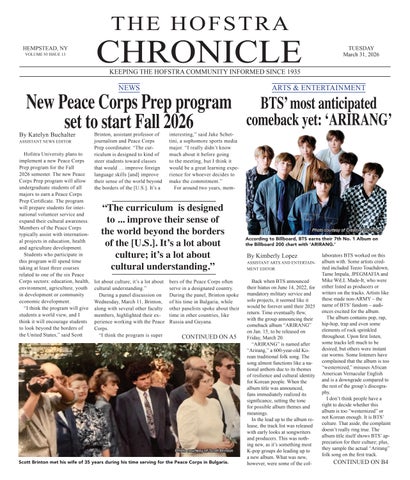
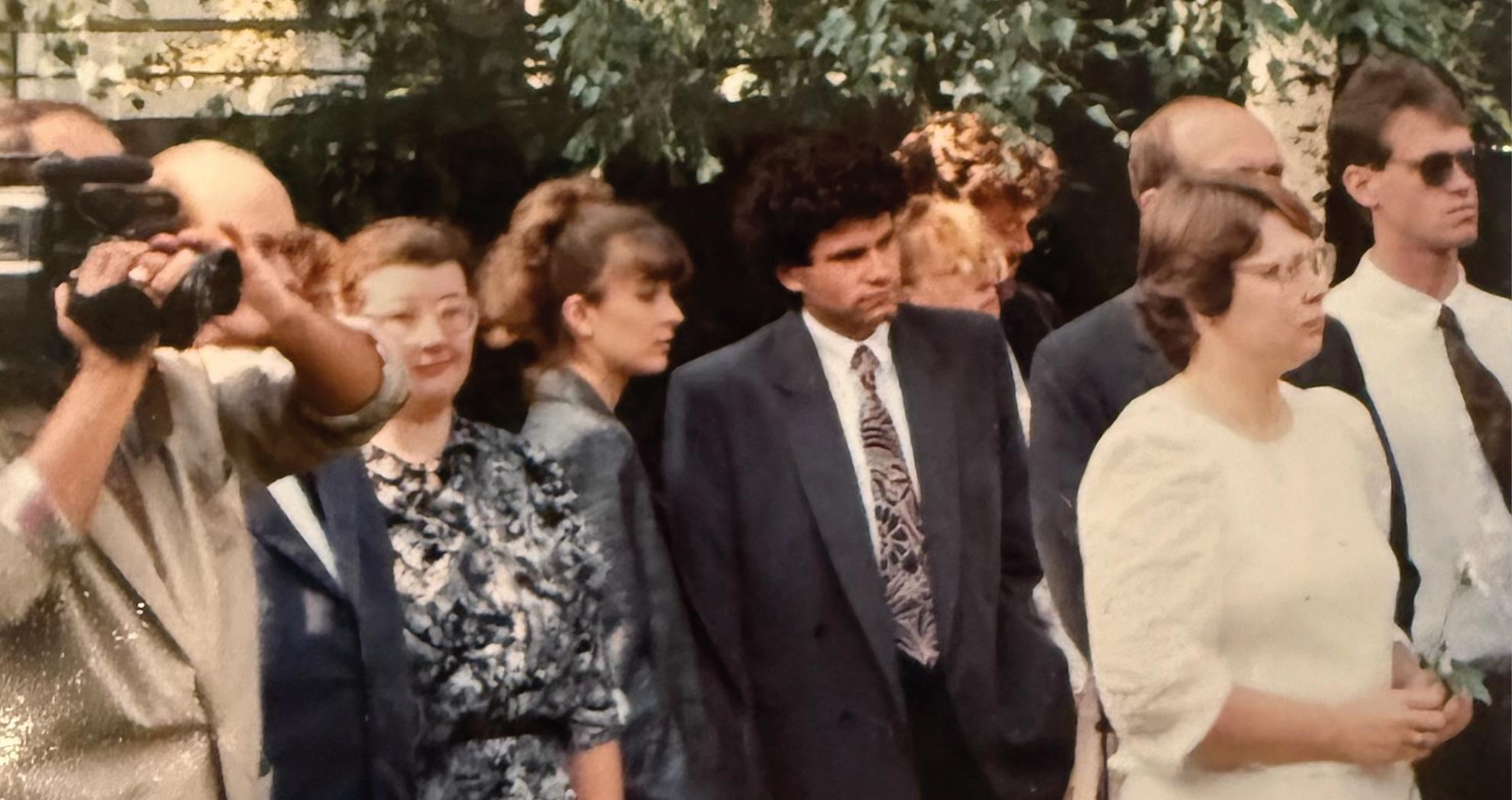
Scott Brinton met his wife of 35 years during his time serving for the Peace Corps in Bulgaria.
Photo courtesy of Creative Commons
Photo courtesy of Scott Brinton

hofstrachronicle@gmail.com
Editor-in-Chief
Managing
Secretary
Business Managers
Timothy
News
Assistant
Arts
Abby
Assistant
Sports
Assistant
Features
Opinion
Hofstra celebrates launch of Wiener Institute for Professional Services
By Natalia Rivera ASSISTANT NEWS EDITOR
Hofstra University received a major donation from alumnus Jeffrey Wiener, who gave $5 million dollars to establish the Jeffrey M. Wiener Institute for Professional Services at the Frank G. Zarb School of Business, with an initiative aimed at preparing students for the evolving demands of the workplace.
The dedication ceremony on Wednesday, March 11, opened with a speech from Hofstra’s President Susan Poser, where she emphasized the generosity of the gift and the long-term impact that it would have on students. Poser talked about how the institute represents Hofstra’s strength with alumni networks and commitment to interdisciplinary education.
The institute is funded by Wiener and his wife Tracy. It is designed to bridge the gap between academic learning and real-world professional experience. The program will integrate disciplines such as accounting, finance, technology, communications and law, tackling the challenges that students can face beyond the classroom.
Weiner, a 1979 Hofstra graduate and former chairman and chief executive officer of accounting firm Marcum LLP, reflected on his own journey and the role that Hofstra had played in the development of his career. As a first-generation college student, Weiner said that his education provided the foundation that led him to build a successful business.
“Education gives you a foundation, but there needs to be a bridge,” Wiener said. “The institute will provide that connection between what students are learning and what they’ll be doing.”
only technical skills, but also the expectations and realities that come with these professional roles.
Dean Janet Lenaghan of the Zarb School of Business noted that the institute strengthens career readiness, particularly in industries that must adapt to emerging technologies like artificial intelligence (AI).
“It’s going to have a tremendous impact on how we prepare our students for the careers of tomorrow,” Lenaghan said. “What the institute is going to do is give them insights into what the profession really looks like day in and day out.”
Wiener echoed this sentiment, noting that while technology continues to evolve, it should be seen as a tool rather than a threat.
“I think AI is a tool,” Wiener said. “It’s not going to take jobs away the way people fear it will.”
Students also see the institute as an opportunity to gain handson experience. Sean Mullen, a student in the accounting

how it truly made a difference.
“You’re only seeing it through textbooks or a test, but real-world problems are always going to come in different shapes,” Mullen said.
“I didn’t just want to write a check and put my name on a building. I wanted to do something that would be meaningful for students going forward.”
masters program and intern for Wiener, said hands-on learning is essential in preparing for a career.
Assistant
The institute will support faculty research, student scholarships and industry partnerships as well as will host an annual conference bringing together students and professional industry leaders. The key goal is to help students understand not
“You can learn the concepts in the classroom, but actually being faced with real-world problems is completely different,” Mullen said. “This institute is going to help students connect those two.”
Mullen looked back at his experience as an undergraduate with what he learned about being in a professional setting and
Mullen added that internships and experiential learning play a key role in understanding the profession, especially in fields like accounting where client relationships and problem-solving are critical.
“Accountants aren’t just people who sit behind a desk,” Mullen said. “We’re financial advisors, and clients rely on us to answer important questions.”
Other students at the event highlighted the importance of giving back. Maddie Stewart,
a sophomore public relations major, described the donation as both impactful and inspiring.
“Generosity is such an amazing trait to have,” Stewart said. “It was an honor to be invited to this event and hear from an industry expert.”
For Wiener, the decision to give back was personal. He credited his wife with strengthening their family’s commitment to philanthropy and said he wanted the institute to create a lasting impact.
“I didn’t just want to write a check and put my name on a building,” Wiener said. “I wanted to do something that would be meaningful for students going forward.”
As Hofstra continues to expand interdisciplinary programs, university leaders believe the institute will serve as a hub for innovation, collaboration and career development.
“This is about preparing students, not just to get jobs, but to understand what those professions demand and how to succeed in them,” Lenaghan said.
At the dedication ceremony, Jeffrey Wiener’s children and Hofstra University intern supported him in the audience.
Photo courtesy of Matteo Bracco / Hofstra University
What you may have missed
7:45 AM
A rebel group in eastern Congo detained civilians and journalists – Tuesday, March 24
In Goma of eastern Congo, rebel group M23 has detained civilians, including at least two journalists, in metal shipping containers, according to Reporters Without Borders. According to AP News, the group reported that the containers lacked light and ventilation and were being used as makeshift cells under “inhumane” and “degrading” conditions.
Costa Rica works with the Donald Trump administration to allow deported migrants into the country – Tuesday, March 24
Costa Rica agreed to take up to 25 deportees a week from the United States. The deal is a bigger part of President Donald Trump’s efforts to find nations willing to take migrants who are being deported. Costa Rica’s President Rodrigo Chaves Robles told the media that the deal is voluntary and nonbinding, as the country chooses which deportees to accept as well as the nationality of who they will accept, according to The New York Times.
Canterbury Cathedral in England enthrones its first female archbishop – Wednesday, March 25
The Canterbury Cathedral added a new name to its engraved slabs of stone: Sarah Elisabeth Mullally. Mullally received the most senior cleric role of archbishop in the Anglican Communion. She first took the role of archbishop in January, but Wednesday, March 25, was the symbolic start of her ministry work. She delivered an inaugural sermon to almost 2,000 guests. The theme in her sermon was to extol the power of hope.
North Korea’s leader Kim Jong Un and Belarusian President Aleksandr Lukashenko hold an official visit – Wednesday, March 25 Belarusian President Aleksandr Lukashenko arrived in Pyongyang, North Korea, on Wednesday, March 25, for an official visit and talk with North Korean leader Kim Jong Un. Both Lukashenko and Kim have strengthened their countries’ allyship to Russia and have supported the Russo-Ukrainian war in Ukraine.
Women’s Business Expo highlights Hofstra’s commitment to women in business


By Mark Lussier STAFF WRITER
As Hofstra University students walked through the Sondra and David S. Mack Student Center during common hour on Monday, March 23, they were greeted with tables promoting a variety of businesses during the Women’s Business Expo.
The expo, which centered around identity and purpose, allowed for aspiring businesswomen to market themselves and their brands. Eye catching signs and banners that featured great designs were placed around the tables in the student center.
There were a variety of career paths featured at the table including hairstylists, bakers and women’s health advocates, displaying the diversity of businesses that women have built on and off Hofstra’s campus.
Being hosted in the student center atrium, the location allowed for visibility from students, staff and other members of the Hofstra community.
Those curious about what these businesses had to offer could stop at any table to discuss the services or products each one provided.
Each business represented a deeply personal aspect of the entrepreneur’s life and craft.
Aydan Smith, a senior international business major, runs her business, OurBloom, a women’s health company run by women of color.
Smith explained how events like the expo help to achieve her business’ goals.
“Getting to interact with the people … helps us do our mission of educating the public and providing more information regarding common menstrual diseases and disorders,” Smith said.
In addition to promoting her own brand, Smith applauded Hofstra for sponsoring events similar to the Women’s Business Expo throughout the academic year.
“Hofstra does a great job of platforming marginalized communities and their projects,”
Smith said.
Most of the businesses operate on or around Hofstra’s campus, providing a very local atmosphere for the expo. While most entrepreneurs are students, it shows that creating a business is achievable for anyone determined to do so.
The expo provided a platform for like-minded individuals to consult with and support one another. Each table promoted themselves and also encouraged those who stopped at their table to go to someone else’s business down the line.
Amy Grover, a junior business analytics major, is a part of SheEOs, the women in business focused club at Hofstra. The organization has a strong network of future business leaders and brings them together on campus.
Grover spoke about the benefits of participating in an organization and how rewarding it is to see others succeed.
“Being able to see people grow their work experience because of our help is really amazing,” Grover said.
Sponsored by both Zarb Women in Business and Intercultural Engagement & Inclusion (IEI), the expo incorporated a combination of promotional
opportunities and highlighted the important work being done by women.
Hugo Morales, the associate director of IEI, spoke about the importance of providing a space for aspiring businesswomen.
“The expo enforced the idea that [entrepreneur’s] contributions matter and should be celebrated because they are carving their own path by simply having an idea and believing in it,” Morales said.
Morales continued by speaking about the event’s timing during Women’s History Month and the weight that it carries.
Entrepreneurs hoping to participate in the expo filled out a submission form, which was available on social media. This gave entrepreneurs the opportunity to talk about their businesses and for IEI to highlight their products and services authentically.
Participating in an expo provided an abundance of opportunities for not just those featured, but also those who are consumers. Although this event is for one day, it will continue to stay in the minds of those who stopped to support.
The IEI’s website and their Instagram profile advertise more events centered around inclusion and promotion of groups throughout the semester.

Graphic designed and information compiled by Natalia Rivera
Joe Orovitz / The Hofstra Chronicle
By Marilyn Steele ASSISTANT MULTIMEDIA EDITOR
Hofstra University students and residents of Long Island were able to come together for all things spooky, unnerving and macabre on Saturday, March 14, and Sunday, March 15, in the David S. Mack Sports and Exhibition Complex for the Moonlight Market Expo. This event was the first of its kind to be hosted in the complex, with two floors of vendors, workshops and performances.
The expo, hosted by El Churro Entertainment, brought a unique collection of people and merchandise to Hofstra’s campus, as well as special guests including actor Harvey Guillén and contortionist Doug Jones.
Throughout the venue, there were over 150 vendors selling tarot decks, spellbooks, taxidermy and unique trinkets, providing a space for collectors who enjoy less conventional items. Similarly, clothing and accessories were offered by several other vendors, including custom-made vampire teeth and necklaces made of animal bones.
“If you want a stuffed alien, you come to Moonlight Market,” said Chaz Velez,
Moonlight Market Expo hosted in Mack Sports Complex
representing the Long Island Ghostbusters children’s charity at the event. “If you want some amazing jewelry, some fun anime pins, if you wanna get a horse that’s been stuffed and miniaturized and put in a jar, we could probably find you a vendor.”
Both floors of the Complex were lively. There were free workshops for several interesting topics, such as moth pinning and Victorian mourning rituals. Participants were encouraged to take home what they made during their workshops as keepsakes.
Performances took place on the right-hand side of the second floor which included cover bands, open discussions and, most notably, the burlesque performances that happened throughout the entire weekend.
Huntress Holly, the host for

dance-off events. Holly said that events like this can be very beneficial to the local community.
“I feel like alternative style –
Holly said. “There are a lot of people out there who enjoy the style and enjoy the things that come with it, but there’s not many events.”
“I feel like alternative style – like goth culture and alternative culture – is a very niche thing, especially on Long Island.”
the burlesque shows, was hired to work with the expo after she had participated in one of their
like goth culture and alternative culture – is a very niche thing, especially on Long Island,”

Gabe Kurtz, a sophomore health science major, felt similarly, having previously gone to alternative events in his hometown in Florida.
“It’s such a fun way to meet new people, and for people who aren’t part of this scene already, it’s a way to get to know it in a safe and fun environment,” Kurtz said.
While the event wasn’t Hofstra affiliated, many students who stayed on campus for the beginning of spring break were able to enjoy the festivities.
Awsten Word, a sophomore criminology and psychology double major, thinks the university should host more events like the Moonlight Market Expo.
“What made me really excited for this was the fact that I’ve never been to an oddities expo, and I’m a very alternative person,” Word said.
Word talked about the convenience of being able to access the event due to its on-campus status.
“I think it is so cool, and I really hope that they host it again,” Word said. “Being able to just walk from my dorm to an event like this is awesome.”
Community events, like the Moonlight Market Expo, allow for better connections and similar events to be held in the future.
“I feel very strongly about Hofstra as a school contributing to the greater Long Island community,” Kurtz said. “I think being able to host events like this is a really nice way to show our support and get our name out.”
Photo courtesy of Grace Lacek
Photo courtesy of Grace Lacek
This “oddities” expo featured over 150 vendors, many who were there dressed in costume.
“I think this program offers amazing opportunities for students, especially [by] living in a different country and learning about their culture while teaching them as well,” said Janet Conklin, a junior journalism and dance double major.
Along with the cultural awareness, Schettini acknowledged the value of reflection that the program indirectly fosters.
“I thought it was eye-opening when panelists were talking about little things in the U.S. that we take for granted,” Schettini said.
The program was introduced to Hofstra by Brinton, who served in the Peace Corps after earning his master’s degree.
“I was stationed in Bulgaria – the Republic of Bulgaria,” Brinton said. “It’s a former communist nation; it was 45 years under communism. I ar-
A new Peace Corps Prep program set to start Fall 2026 cont.
rived in 1991, only months after it had transitioned from communism to social democracy.”
Brinton was inspired to join the Peace Corps after taking a conflict resolution class in his freshman year of college at the State University of New York College at Geneseo.
“I took a class when I was a freshman in college, and that class was conflict resolution,” Brinton said. “The fellow who taught the class was a colonel in the Army Reserve, and I thought it was strange that, you know, a colonel in the Army Reserve would be teaching a class in conflict resolution, but I realized after having taken [the] class that there’s probably nobody better to teach a class in peace and conflict resolution than somebody who’s actually been in the army.”
Brinton recalled his professor’s description of the Peace Corp as an “alternative” to the army, in which one provides a
different service for one’s country through volunteer work.
“He didn’t talk a lot about the specifics of it because he wasn’t in the Peace Corps, but he did talk a lot about it, and when I went to graduate school in New York City, I just found myself in a Peace Corps volunteer recruiter’s office one day and thought, ‘Let’s do it,’” Brinton said.
Along with having experience in the Peace Corps, Brinton is also a member of the National Peace Corps Association and a board member for the Center of Civic Engagement at Hofstra.
“I had become a board member of the Center for Civic Engagement, and I thought this would be a perfect home for Peace Corps Prep because this is basically what the Center for Civic Engagement is about,” Brinton said. “It’s about peace studies. There is already a peace and conflict studies minor that is housed at the Center
for Civic Engagement, and I proposed [the Peace Corp Prep program] to the board, and everybody loved the idea.”
Students who want to join
the Peace Corps Prep program or learn more about the Peace Corps in general should reach out to Brinton by email at scott. brinton@hofstra.edu.
On Saturday, March 7, 2026, at 7 p.m., an HU student reported to PS that they observed another student searching through their wallet in the David S.
Mack Fitness Center locker room. When confronted, the money taken from the wallet was returned. This matter has been referred to CS.
On Saturday, March 7, 2026, at 8:21 p.m., two students reported to PS that their personal belongings were taken from the laundry room in Estabrook Hall by an unknown person. An investigation is being conducted into this matter.
On Monday, March 9, 2026, at 7:40 p.m., an HU student reported to PS that
they left their AirPods on a window ledge in Brower Hall. Upon return, the AirPods were missing. The student was able to send a chime to the AirPods and they were found in the men’s bathroom in Brower Hall.
On Saturday, March 14, 2026, at 1:55 p.m., the fire alarm in the Lawrence Herbert School of Communication building was activated due to suspected vaping. The fire alarm sounded, and the building was evacuated within three minutes with-
out incident. PS and HFD responded to the location, the situation was corrected and the fire alarm was reset.
On Wednesday, March 18, 2026, at 2:22 p.m., the fire alarm in the Leo A. Guthart Hall for Innovation and Discovery activated due to burnt food. The fire alarm sounded, and the building was evacuated within eight minutes without incident.
PS and UFD responded to the location, the situation was corrected and the fire alarm was reset.
On Thursday, March 19, 2026, at 10:46 a.m., while conducting a health and safety inspection in Williamsburg House, the resident director observed an electric scooter and a disarmed smoke detector in one of the rooms. The electric scooter was removed and vouchered by PS. A work order was requested to fix the smoke detector. The student will be referred to the Office of Residents Life.
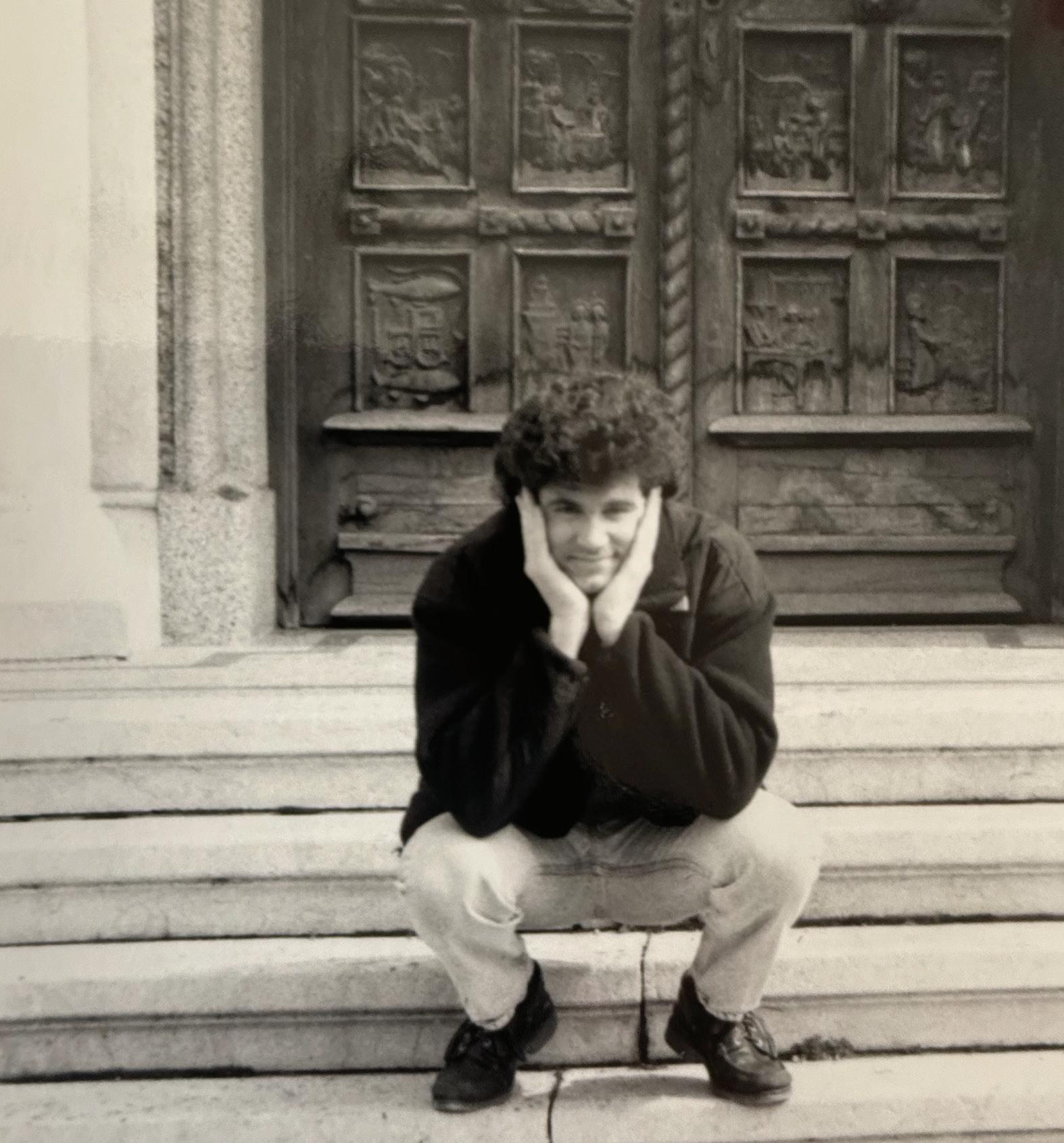
Scott Brinton spent a year and a half writing a guidebook of Bulgaria.
Photo courtesy of Scott Brinton
By Denivia Rivera FEATURES EDITOR
After 27 years as a Hofstra University dance professor – with 16 of those years as director of the dance program –Rachel List is retiring.
List became an adjunct professor in 1999, teaching ballet. In 2010, former Director Lance Westergard retired, and List moved into the role. She became a full-time professor and the director of the dance program at the same time, which she said was a steep learning curve.
As director of Hofstra’s Dance Department and a full-time professor, List’s role is that of many responsibilities.
“Part of my role is teaching ballet to all different levels at the school and to choreograph one piece a year, usually in the fall,” List said. “As the director of the dance program, I also organize the master schedule for all the dance classes. I assign teachers to their classes, and I also organize the musicians to play for all the classes.”
List said she is also responsible for researching and hiring new adjunct professors and guest choreographers.
“Producing the fall and spring performances means lining up all the choreographers, organizing and supervising the dance auditions, organizing the rehearsal schedules and running the production meetings to make sure the stage manager, lighting designer, costume designer and everyone else involved are on the same page,” List said.
If there are new courses added to the dance department or changes to the curriculum, List is responsible for going through the administrative processes to ensure everything is in order.
In 2017, List was working to bring the dance Bachelor of Fine Arts (BFA) degree to Hofstra. The process had been started by previous dance faculty but never came to fruition. List takes pride in being the one to finally make the BFA dance degree possible.
Prior to teaching at Hofstra,
FEATURES
This Hofstra Life: Rachel List
List’s earliest training and performance work was as a ballet dancer. She worked with a professional dance company in Montreal before returning to New York and joining a ballet class.
“It was a class taught by Margaret Craske, who was about 80-something at the time, but she had actually studied with [Enrico] Cecchetti himself,”
List said. “So, I was introduced to the Cecchetti technique, but what was most interesting about that class was there were a lot of professional modern dancers in that class. There were people from the Limon [Dance] Company, from the [Merce Cunningham Trust, and] Paul Taylor came occasionally.”
For List, this experience led her to start attending modern concerts, studying modern dance and eventually working with some smaller modern companies.
“Then, I joined a company,”
List said. “Livia Vanaver was also in that class. She had not only [run] a modern company but also did a lot of world dance styles – balkan dancing and music and rhythms; and music from Africa and rhythmic dance; and
for a while called Rachel List and Dancers. She also ran a summer dance intensive in Vermont for 11 years called Manchester Dance. During this time, List would hire other choreographers and would learn about producing concerts. This also taught her to research different teachers and learn how to advertise her program to students.
“All of that stuff really prepared me for what I do at Hofstra, because it’s kind of the same thing, except in an academic setting,” List said. “In 1983, I was hired at Queens College as an adjunct. I really liked working in academia – not everybody does. But I found that very satisfying.”
List pursued her undergraduate degree at SUNY Empire State University and went on to get her Master of Fine Arts at the University of Wisconsin-Milwaukee.
“You had to be in residence for two summers, but everything else you did at home,” List said. “That was very popular with professional dancers from both New York City and from the West Coast. Once I had my papers in hand, I could think about applying for full time positions. So,
ence], but no modern, or a lot of ballet, but no street styles. I think the mix is excellent.”
Throughout her years of teaching many Hofstra dance students, List’s fondest memories come when students have revelations during class.
“Try to really embrace all different kinds of dance because they’re all important, and they’re all around us all the time ...”
Appalachian clogging. So, that was another big revelation for me, and I worked with [Vanaver] for many years. We traveled all over the world and got to perform.”
Later on, List auditioned for the New York Baroque Dance Company and worked with the company for many years, learning more about the history of ballet. The company traveled with live music.
In addition to training and performing in different styles of dance, List ran a small company
when the opportunity came up at Hofstra, I felt prepared.”
One thing that List really loves about Hofstra is the variety of students who are in the dance program.
“What I like about Hofstra being a liberal arts program is that we have people who come who are incredible dancers, but we also have people who come from a wide variety of backgrounds,” List said. “I think that’s great because everybody can learn from everybody else. You see people come with a lot of jazz [experi-
“Sometimes people come in and they’ve had bad experiences with different kinds of training, especially with ballet, I found,” List said. “By the end of their time at Hofstra, they have come around saying, ‘Oh, I see the value in this, and it can be positive. It doesn’t have to be negative.’
Also, just seeing people in their performances but also as teachers and how they develop in both of those areas, has been very gratifying.”
As her time at Hofstra is coming to an end, List’s words
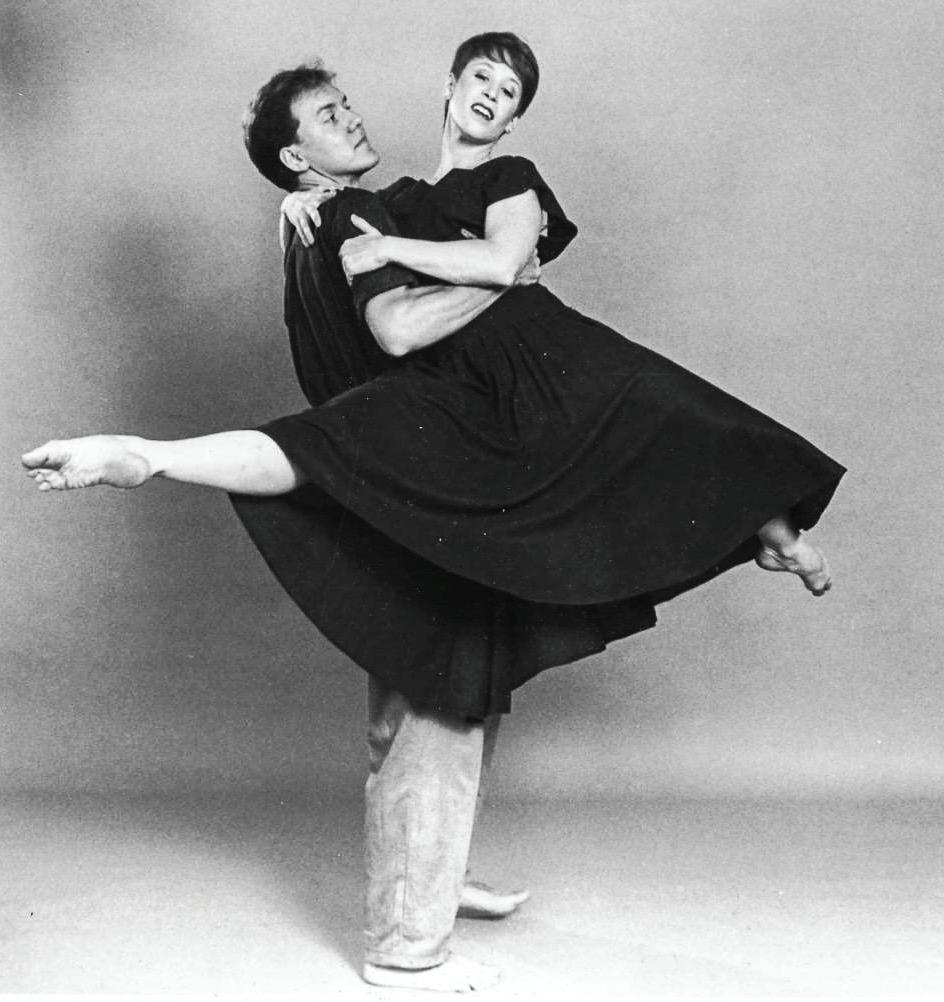
Photo by Gene Bagnato
of wisdom to her students are to be open minded and be kind to others.
“Try to really embrace all different kinds of dance because they’re all important, and they’re all around us all the time,” List said. “The more you can learn about all different kinds of dance, the more it’s going to help you in whatever area you go forward in. The other thing is to be kind and generous. The dance world is so small that you’re gonna run into people again, and if you were kind and helpful toward somebody, they might be kind and helpful to you.”
List’s retirement is a moment of change for not only herself, but also for the Hofstra dance department.
“I’ve had a very broad and terrific experience performing, teaching and choreographing,” List said. “I don’t know what’s coming up next, but I hope that it will be a continuing exploration of what’s next in dance. I feel very bittersweet about finishing at Hofstra. I love Hofstra and have had such a good experience here. I’m excited to see what’s gonna happen next, so I hope to stay in touch with everybody.”
FEATURES
Personal Essay: The never-ending exodus
By Eleazar Sánchez López SPECIAL TO THE CHRONICLE
Youth, with its voracity, fire, spontaneity and liberty is usually driven by a search for belonging, meaning, purpose, self-discovery and even adventure. To pursue this search, it is important to have a guiding force in one’s voyage. In my case, I found myself searching for a new home in the United States during my teenage years.
This search for a home –which can also be interpreted as a search for belonging – marks the immigrant experience in the U.S. All of us who have been forced to leave behind our homes in the pursuit of liberty, dignity and progress, we come to face the challenge of neglecting our past and having to adapt to a place that often rejects our culture. We can also opt to preserve our identity and build a home for ourselves and our families in this “concrete jungle.”
I recently realized that being with my family in Florida feels like home. This feeling started
By Esa Gadson SPECIAL TO THE CHORNICLE
during my freshman year of college at Hofstra University, when I often traveled between Miami and New York. After years of searching for a place and facing challenges, I found in Florida a safe haven that reminded me of my childhood in my hometown: Matagalpa, Nicaragua.
In Florida, I tasted the familiar flavor of freshly toasted coffee beans, my mom cooked the same recipes from Nicaragua and the family gathered to go to church on Sunday. After, we would prepare a huge dinner for family and friends, which would require some effort from all of us. Together, we worked, chatted and laughed.
Unfortunately, this beautiful fantasy, this primordial place of grace, shattered when, in Nov. 2025, my grandfather – who had worked in this country for over 30 years – was captured by Immigration and Customs Enforcement outside our home. This not only threatened to separate our family, but it also deprived me of that safe haven I had longed for during my semesters in college and that I had been able to
establish in Florida.
This unexpected and dramatic event also acted as a catalyst that triggered a need to reinvent myself as a student, as an activist-historian, as a writer and as a chronicler of what Pope Francis described as “existential peripheries.” I sought a future where my refuge and my professional career would be intertwined.
It has already been seven years since I originally departed from my hometown of Matagalpa. As I reflect upon my last visit to Nicaragua this past January, which was necessary to visit my now-deported grandfather, I can’t stop thinking about how everything suddenly seemed very unfamiliar and strange there. As I was talking to my old local friends, I recognized they treated me differently, not just as a distant figure of the past, but also as a tourist – disconnected from the reality of our country and from the Latin American experience as a whole.
From this recent visit to Nicaragua, there is a specific image that now haunts me: I’m looking back through the bus
window, the wind is blowing in my face and in the distance the mountains of my city, that familiar landscape that was once my source of inspiration growing up in Matagalpa, are saying goodbye again. This was the last thing I saw from my city this past January, as it was banished to the horizon. It was the very same last heartbreaking memory from the first time I went back home in 2023 and the same image before I began my voyage to a distant land the first time I left. After this departure, I found myself in the dilemma of not belonging anywhere.
In the U.S., I am constantly identified as “other” due to my accent, my ethnicity and even my race, which is perceived in a completely different way in this country than it is in Latin America. I am condemned to be seen as a foreign individual, under the threat of the uncomfortable question, “Where are you really from?”
In Nicaragua, I was drowning in survival remorse after witnessing how the nation had stopped progressing and how
my friends, neighbors and relatives had become used to believing in a better future while the government intended to control every aspect of their lives. I am constantly reminded of my acquisition power by using U.S. dollars, but I am also reminded of how “Americanized” I have become.
Many immigrants in the U.S., specifically immigrant college students, face this reality: a persistent feeling of loss and an ongoing longing to belong to a society that has marginalized them to existential edges. They experience internal exile caused by war, dictatorships, repression, poverty and external exile provoked by ongoing discrimination and dehumanization. Still, beyond these existential peripheries, I find peace in knowing – as many of you surely do – that yearning, searching for meaning and experiencing loss are universal aspects of our human journey. So, the journey – here in college and beyond –shall continue!
This Hofstra Life: Sienna Olivares
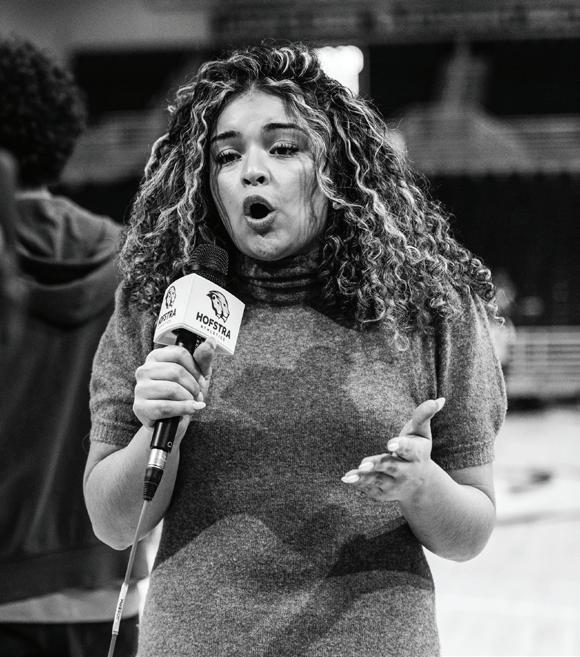
At Hofstra University, female sports broadcasting is making strides. At WRHU Radio, sophomore sports media major Sienna Olivares created the station’s first female sports talk show, which highlights women’s sports and their impact on her own life.
“When I was in the training class last spring around this time, my goal was to create a women’s sports show,” Olivares said.
WRHU is Hofstra’s five-time
Marconi Radio Award-winning radio station, featuring music, talk, news, sports and entertainment. Up until Feb. 20, 2026, WRHU never had a women’s sports talk show.
“It wasn’t really something I thought anybody would be into,” Olivares said.
Now, almost a year after joining WRHU, she successfully launched her show.
Before the show aired, Olivares was already making her presence known within the station’s sports department.
She is the current sports social media manager and covers both men’s and women’s basketball at Hofstra. She has done play-byplay, color and sideline reporting. At the beginning of March, she traveled to Washington, D.C., and did the play-by-play reporting for the Hofstra women’s basketball team as they took on the Coastal Athletic Association Championship.
Adding to her list of experi-
ence, she is now the producer and creator of “She Got Game.”
The show was originally going to be called “Winning Woman,” but after deliberation with other station members, the name was changed.
“It really grasps how women are just as good as men in playing sports,” Olivares said.
Airing every Friday from 2 p.m. to 3 p.m., the show focuses on educating and entertaining its audience on what’s going on in the female sports world.
“Women’s sports are here, and it’s here to stay,” Olivares said. She aims to highlight topics that aren’t talked about every day. Her love for sports in school inspired her to start a show, after noticing how female sports, like the WNBA, weren’t being covered as much as other major men’s leagues.
“Everyone’s always attracted to the big three – the MLB, NBA, NFL.” Olivares said. “[Women’s sports] is what is happening
behind closed doors, and this is what the media fails to cover.”
Playing basketball for most of her life, her love for sports sparked early on, as she participated in varsity basketball and flag football at Commack High School.
She began her journey at Hofstra, unsure of what path she wanted to take upon her arrival.
“I was trying to find my place, trying to find my niche of where I was going to thrive,” Olivares said. “I feel like women’s sports was definitely that thing for me.”
In the spring of her freshman year, she joined WRHU’s training class with the idea of her show already brewing in her mind.
“I know it’s been tried to be done before, and it didn’t work out,” Olivares said. “And for me to be able to do it and put my best foot forward … it just feels so unreal.”
Now in its seventh week, Olivares has secured interviews with multiple female sports icons,
including Julia Morales, the first female broadcaster for the Houston Astros, as well as Doris Burke, Hall of Fame broadcaster for the NBA.
Creating the show hasn’t been easy. Olivares is currently the only producer and often comes up with topics on her own. She says it’s been difficult, especially since there isn’t much going on with female sports currently.
“There may not be a WNBA season, the [Professional Women’s Hockey Leave] is fresh off their winter Olympics and the women’s baseball league is starting up in the summer,” Olivares said. “There just really isn’t anything going on right now, so I really try for this show to be something educational.”
Despite this, the show has continued to grow and make history at WRHU.
Olivares said, “I couldn’t be more grateful for WRHU to have trust in me, have faith in my plan and to see it through.”
Joe Orovitz / The Hofstra Chronicle
MAN ON THE UNISPAN
“What’s your weirdest comfort show?”
By Denivia Rivera FEATURES EDITOR

“I know exactly what it is. It’s ‘Boys Over Flowers.’”
- Mia Ramos, sophomore

“Criminal Minds.”
- Tabitha Knudson, junior
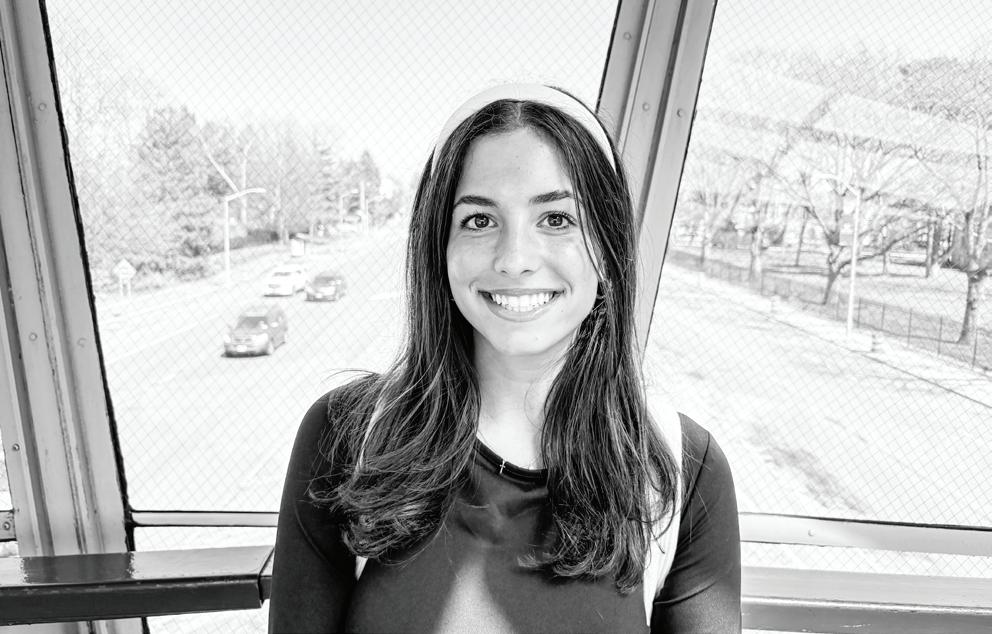
“Can it be a movie? ‘Teen Beach Movie.’”
- Cassidy Bonadonna, sophomore

O verheard @ h O fstra
“Why would anyone bother going to Europe? They don’t have vapes or deodorant.”
“It was October for the entire month of October.”
“Everything I like was made in China: my clothes, my microwave ... my wife.”
“The worst thing about not being a minor is being unable to justify going on Omegle.”
“I thought Paul Revere was a singer.”
“When you fart, you remind me of being a beluga whale.”
“You’re my favorite ‘white savior’ of all time.”
“My barber’s actually gay. And he’s Jewish.”
“You look like a [television] when it’s turned off! I’m gonna hit you with a brownie bazooka!”

If there’s something funny you overhear, you can now submit it here!
Spread by Hannah Mudry, Emilie Morrissette and Denivia Rivera
Marilyn Steele / The Hofstra Chronicle
By Anthony Favilla OPINION EDITOR
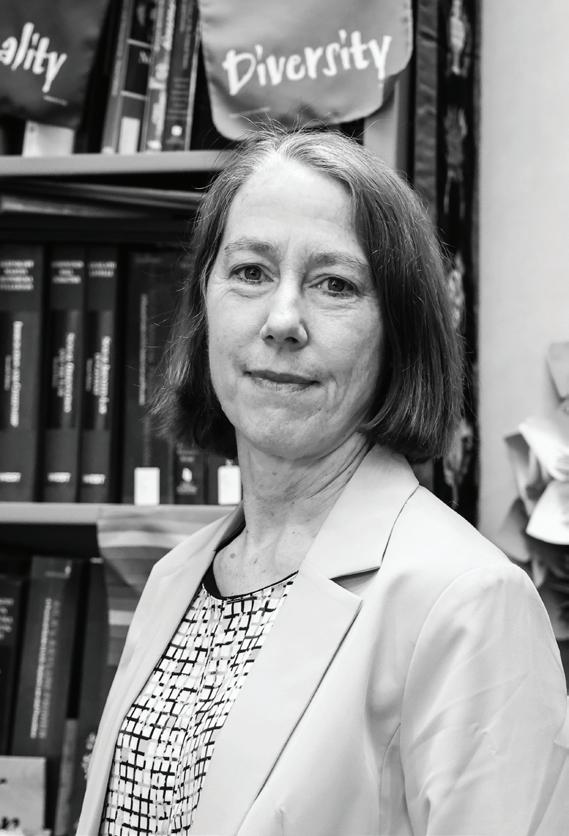
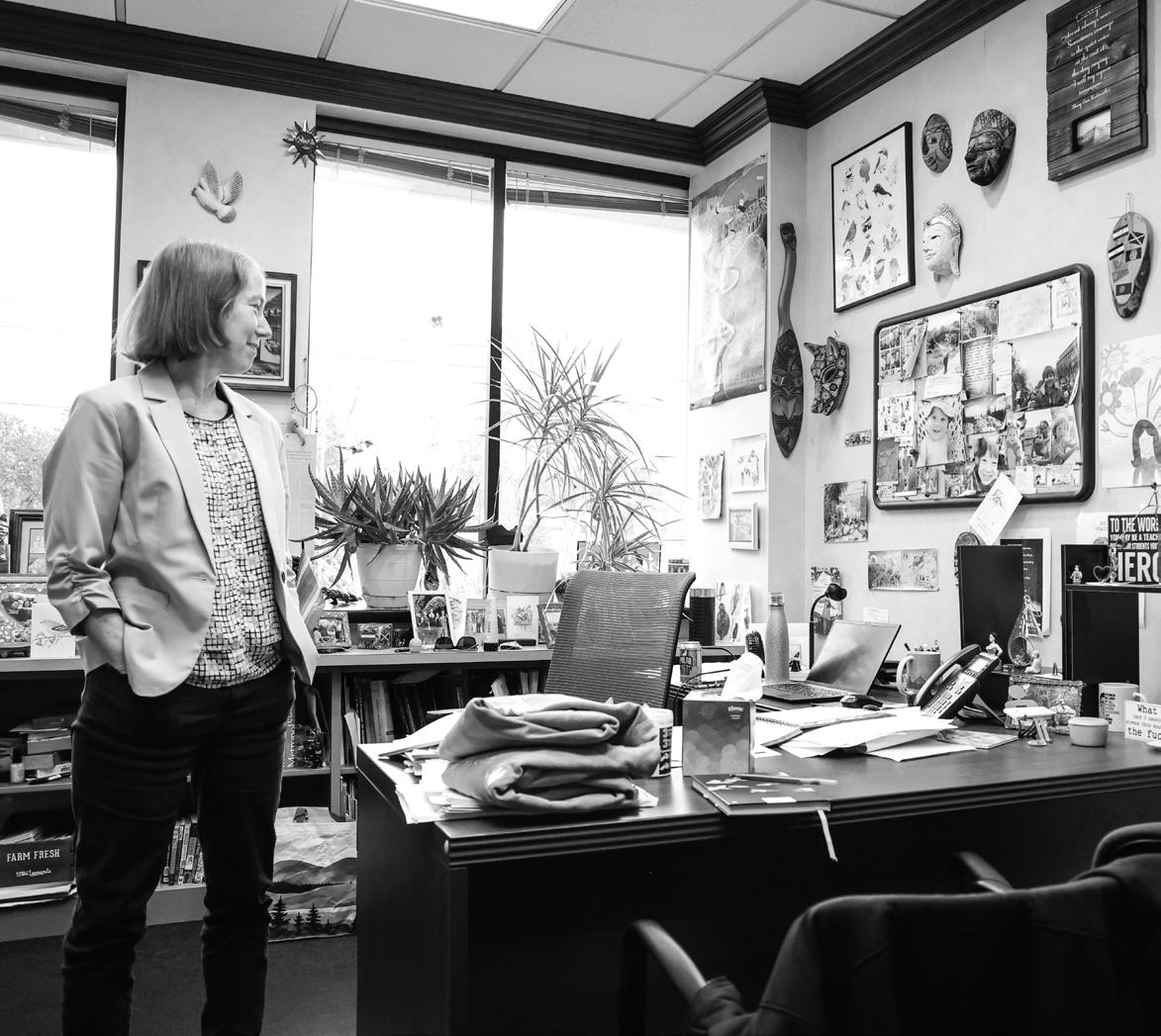
Tucked away in Joan Axinn Hall on the south side of Hofstra University’s campus, you will find a branch of the Maurice A. Deane School of Law. One professor who works there has an office packed with artwork on her walls and around her room. There, you will see anything from a balloon covered in Sari cloth to a crocheted stuffed rabbit looking down on you from a shelf. Paintings, pictures and trinkets cover the room, giving it a vibrant yet cozy feel.
This is the office of Lauris Wren, director and founder of the Asylum Clinic at the law school. The clinic does pro bono work by providing legal representation for immigrants in the area who are seeking asylum.
The artwork in her office is
FEATURES
This Hofstra Life: Lauris Wren
from her students who work in the clinic. Their final project is to make something that relates to their time spent there. Her office proudly shows her and her student’s passion for helping immigrants.
One art piece is a framed cross stitch of a quote from Audre Lorde, which states, “Caring for myself is not self-indulgence, it is self-preservation, and that is an act of political warfare.” Wren gave a student that quote as advice to make sure she took care of herself while also taking care of her clients. The student made that cross stitch for her project, as a token of gratitude.
“I had talked about creating boundaries so that you don’t burn out, at which point you’re unhappy and you’re not any use for your clients anyhow,” Wren said.
That student is now an immigration attorney, as are many of the students who go through the Asylum Clinic program. Wren takes about six to eight law student applicants per semester, and each student handles asylum cases under her supervision.
Students work in teams of two on the cases and represent the client in court. Though the minimum time a student can spend at the clinic is one semester, some students volunteer after their semester is finished.
Wren gives her students guidance by teaching seminars and meeting with the student teams to make sure they know what to do when in an asylum office or in
court. According to Wren, though cases sometimes spend years in appellate courts, the clinic has not lost a case yet.
“Usually, [the students] handle it better than the vast majority of attorneys do,” Wren said. “They do a really terrific job.”
Wren grew up in Queens and moved to Garden City before going to Williams College in Massachusetts for her bachelor’s degree. She earned her law degree from Columbia University in 1993 and began practicing law. However, it was not until she took a trip to Costa Rica that she discovered that she wanted to work in immigration law.
During her trip, she worked for Center for Justice and International Law, representing people from countries near Costa Rica in human rights cases. It was there that she fell in love with working with people of Latin American descent and had an itch to work in immigration law.
She spent a few years working for the Central American Refugee Center in Hempstead and went on human rights missions to Mexico and Malaysia before approaching Hofstra with the idea of a political asylum clinic in 2003. Wren wanted to be closer to her parents, who were experiencing health problems at the time. She came to Hofstra under the impression that she would not stay for long.
“My idea was that I would probably stay at Hofstra for a few years to see if I like teaching,” Wren said.
She found that teaching students immigration law while also helping clients gain asylum was extremely fulfilling. This year will mark 23 years since she started at the university.
Wren describes her clients as the best people she has ever met. One client helped her build a permanent fixture in her work. This client, according to Wren, was persecuted in their home country due to her being part of the LGBTQ+ community. After coming to the United States, she fought a long battle for asylum and eventually gained her citizenship. Wren and her client found that there were not many resources available for queer

immigrants on Long Island, particularly Spanish-speaking ones. Together, they started an LGBTQ+ immigrant support group, which her client now runs. It has been going strong for 10 years now. Wren expressed the importance of providing this kind of support due to the gap in resources for queer immigrants.
“It’s been like a family to the people in the group,” Wren said. “I think it’s been lifesaving to many members.”
Though Wren loves her work, it has gotten more challenging in the last two years due to immigration crackdowns by President Donald Trump’s administration. The presence of Immigration and Customs Enforcement surging across the country has made immigrants less safe and has led to more captures and detainments. Talk of deporting undocumented immigrants to places that are not their home country has left many people fearful.
In late Nov. 2025, the United States Citizenship and Immigration Services (USCIS) placed a hold on issuing decisions for all asylum seekers. That hold is still in effect, with no timetable on when it will be lifted. The USCIS decision has hampered Wren’s work, as clients who may have been waiting for a decision for years still do not have one.
Since the second Trump Administration started, Wren’s work has become much harder and more taxing. She has seen many people in her field burn out, lose hope or leave immigration
law altogether. However, she finds that setting boundaries for herself with her work helps. She, herself, follows the advice of Lorde. She also finds inspiration to keep going from her clients.
“They have been through an incredible amount, yet they are still very hopeful,” Wren said. “You don’t try to come to a new country and start a new life unless you have hope that things can be better than how they are. It is a stunning example of resilience and the capacity of the human spirit for resilience.”

Anthony Favilla / The Hofstra Chronicle
Anthony Favilla / The Hofstra Chronicle
Anthony Favilla / The Hofstra Chronicle
Anthony Favilla / The Hofstra Chronicle

Take a Hint, Hofstra


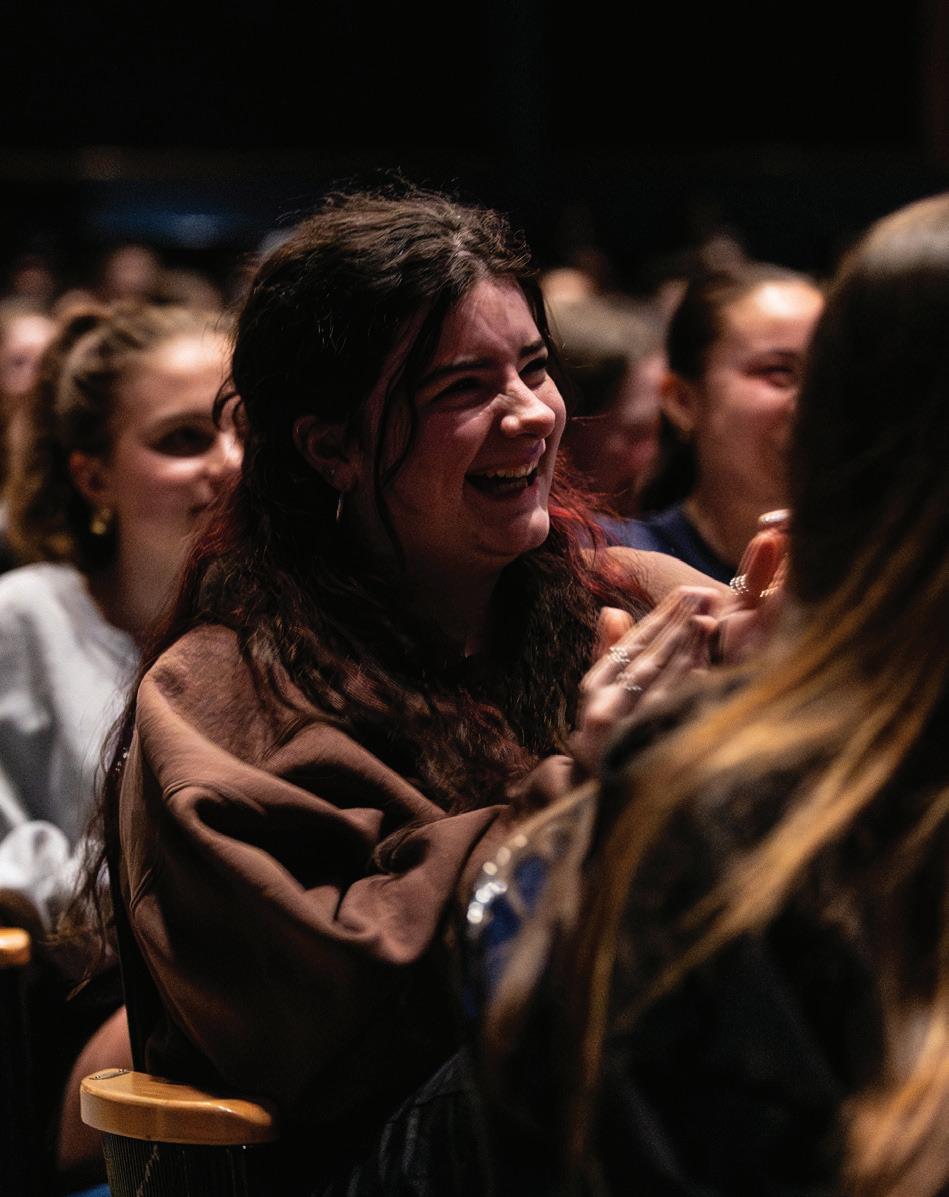
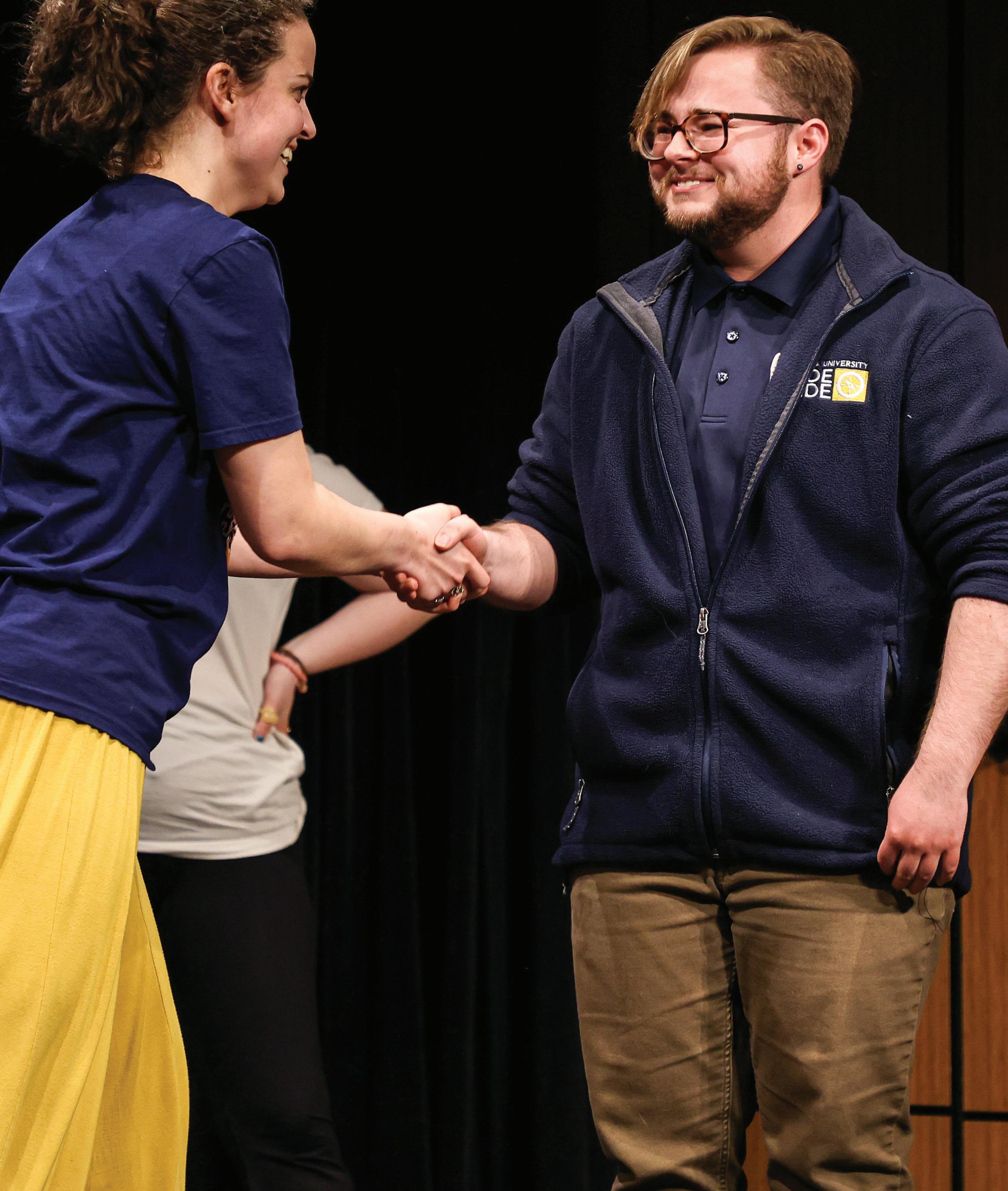
Actress Liz Gillies visited campus on Thursday, March 26, for a Q+A hosted by Office of Student Leadership and Engagement. Senior political science and journalism double major Camryn Bowden and senior public relations and strategic communications double major Lindsey Lolkema commenced the show with a quick biography Gillies. Throughout the panel, Gillies spoke about her experiences in the acting industry. She spoke of the 2010 television series “Victorious,” CW’s “Dynasty” and future acting roles.



Show Your Stuff
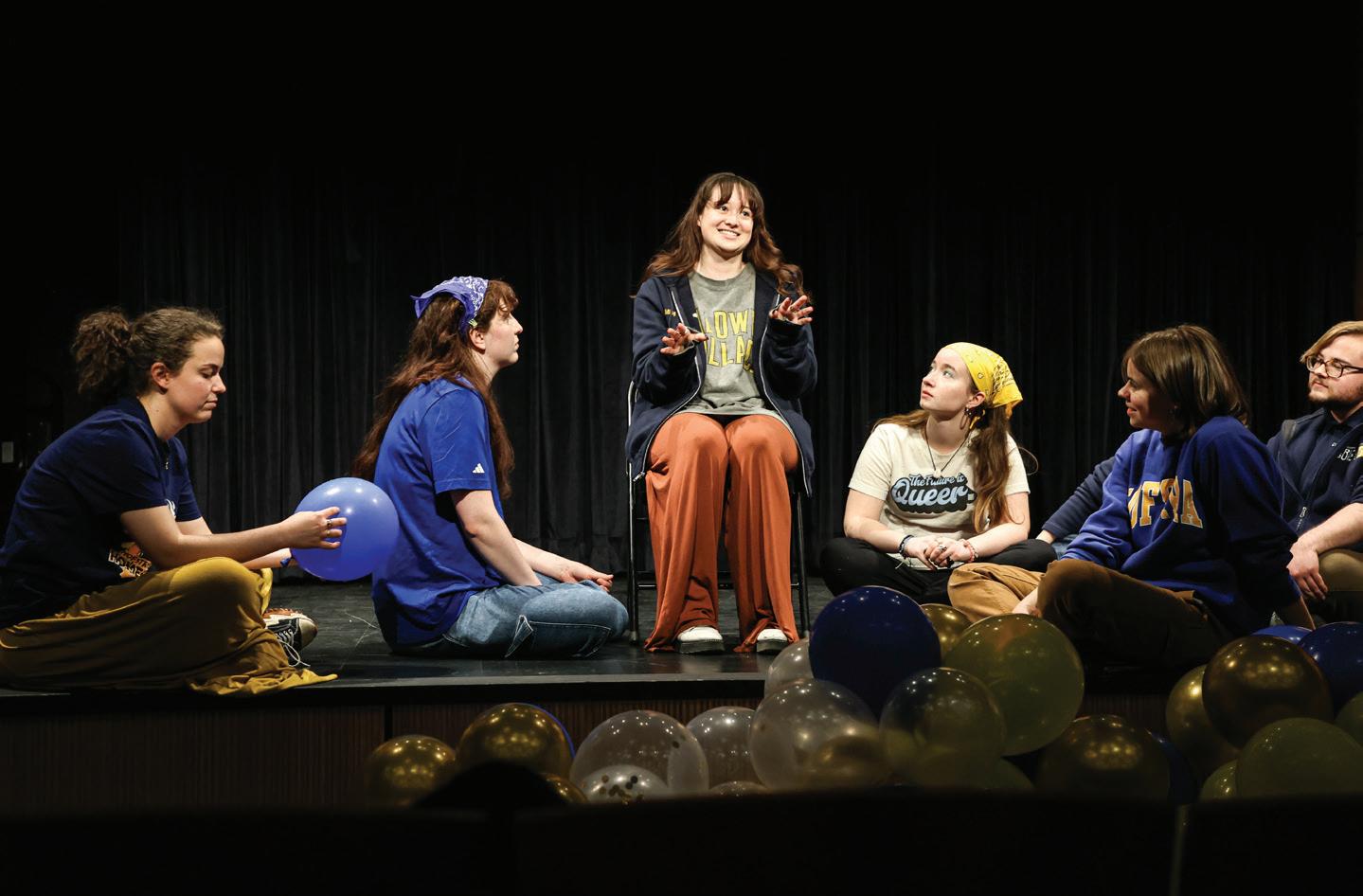
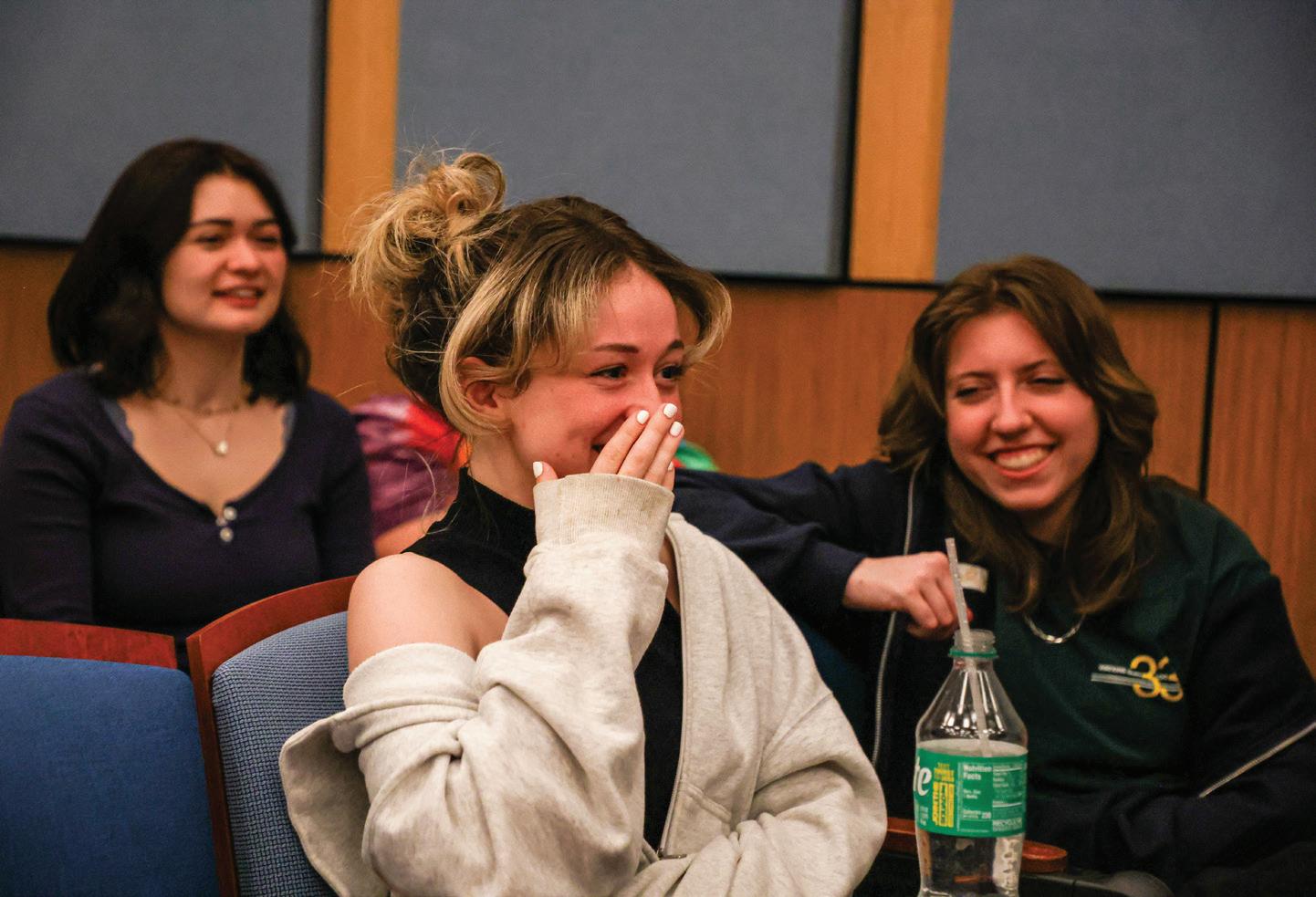
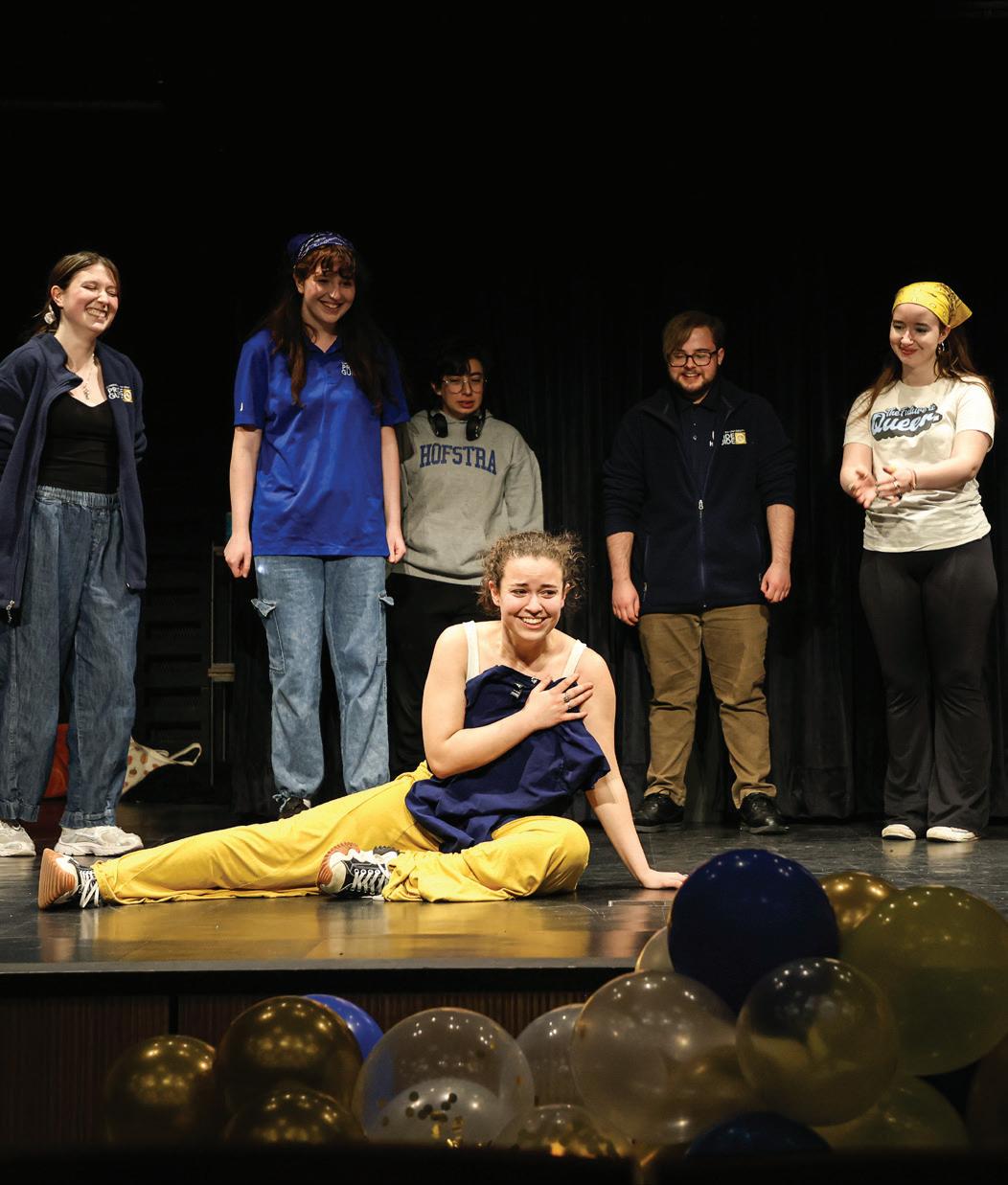
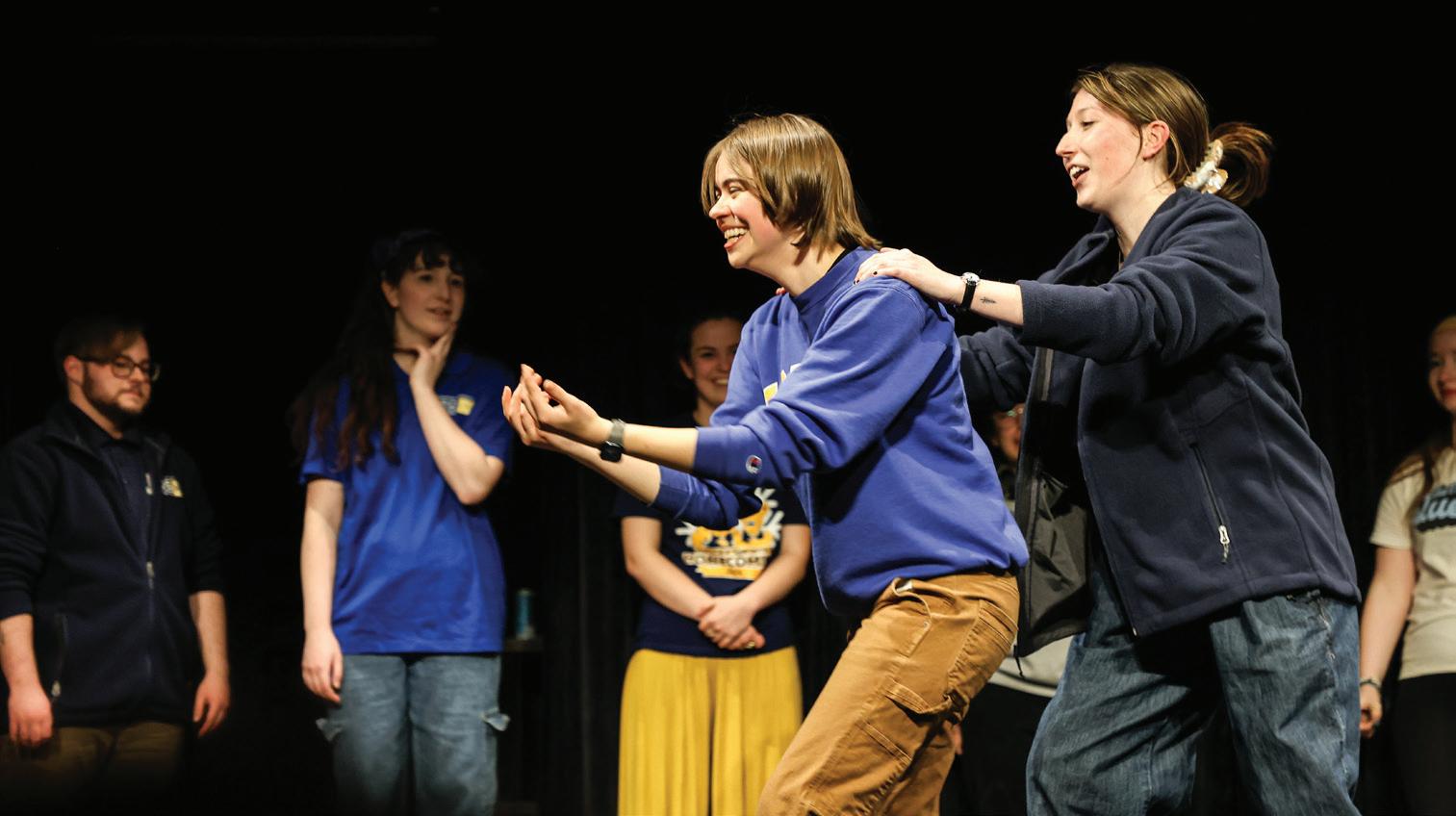
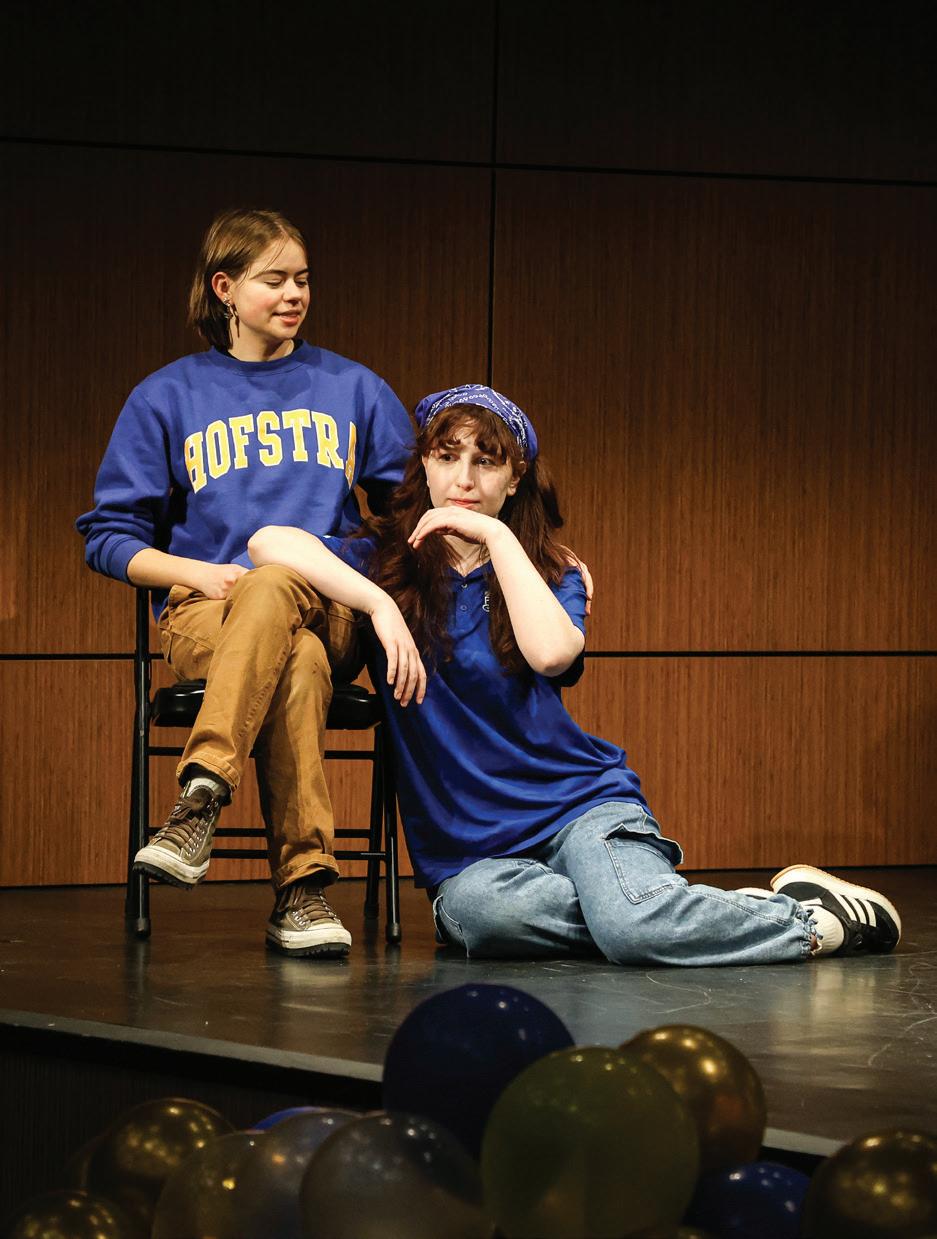
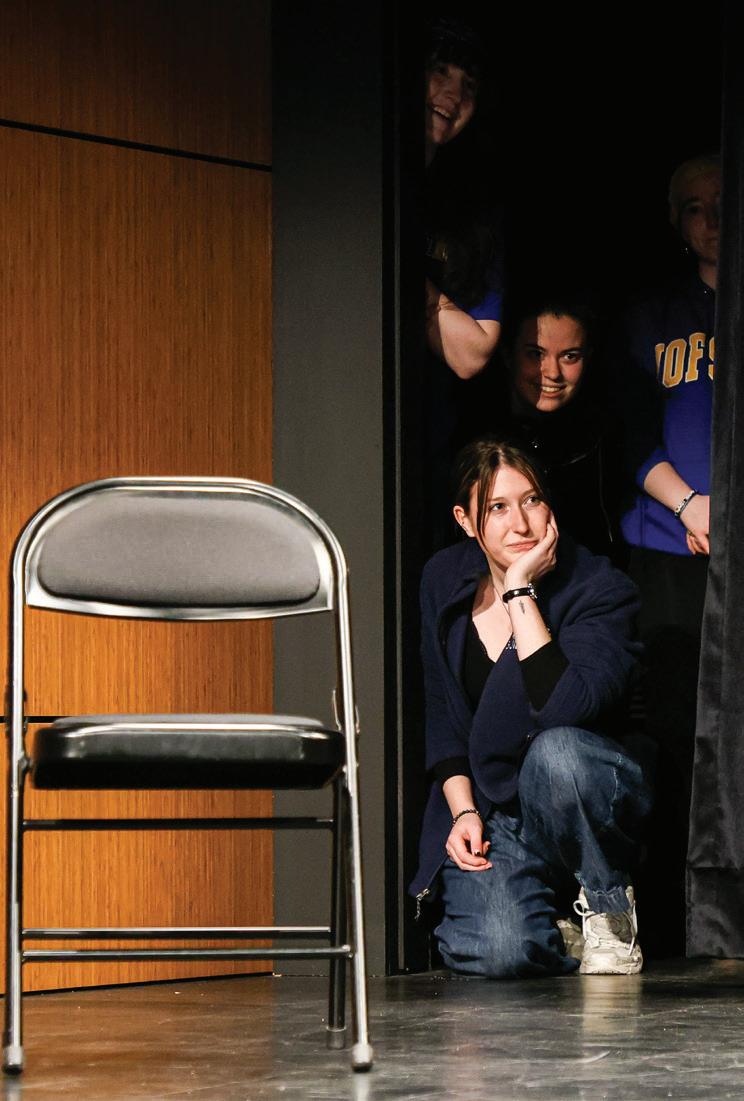
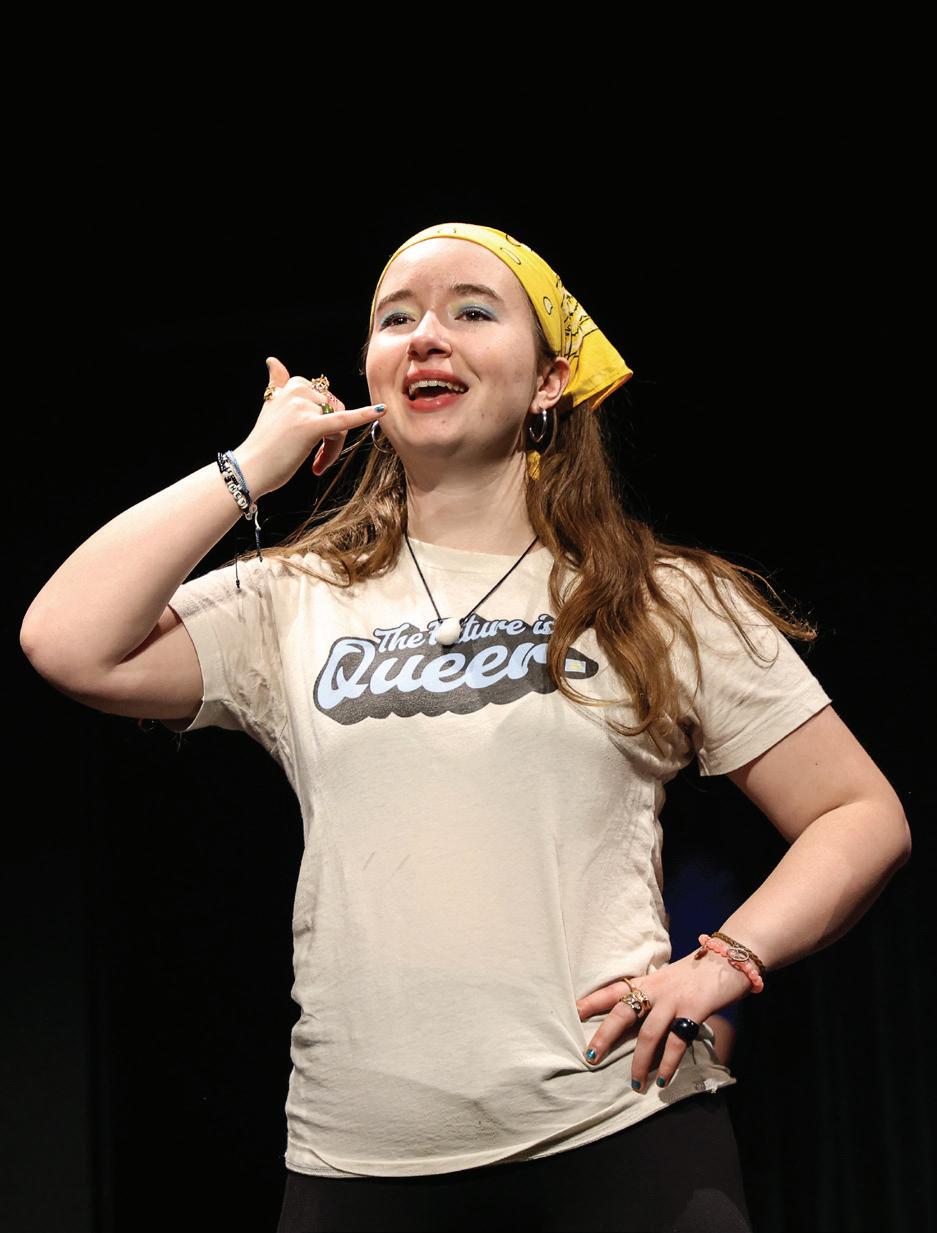
Tequila Mockingbird hosted their first performance of the semester in the Hofstra Cultural Center on Friday, March 27. Audience participation was prevalent throughout the entire event, with audience members being asked for improv ideas and being brought onto the stage. The performance was filled with laughter from both the cast and audience members from the absurdity of the games that were played.
Background by Marilyn Steele / The Hofstra Chronicle Spread by Joe Orovitz, Kumba Jagne, Shaina Skeen and Marilyn Steele
Background by Joe Orovitz / The Hofstra Chronicle
Kumba Jagne / The Hofstra Chronicle
Kumba Jagne / The Hofstra Chronicle
Joe Orovitz / The Hofstra Chronicle Joe Orovitz / The Hofstra Chronicle
Joe Orovitz / The Hofstra Chronicle
Joe Orovitz / The Hofstra Chronicle
Marilyn Steele / The Hofstra Chronicle
Marilyn Steele / The Hofstra Chronicle
Marilyn Steele / The Hofstra Chronicle
Marilyn Steele / The Hofstra Chronicle
Marilyn Steele / The Hofstra Chronicle Marilyn Steele / The Hofstra Chronicle
Marilyn Steele / The Hofstra Chronicle
'Project Hail Mary' is a must-see
By Paige Sanacora ARTS & ENTERTAINMENT EDITOR
*SLIGHT SPOILERS AHEAD*
The long-awaited film adaptation of Andy Weir’s 2021 science fiction sensation, “Project Hail Mary,” finally hit the big screen on Friday, March 20. The film, starring Ryan Gosling, marks the second of Weir’s books to be adapted for the screen, following the widely successful release of “The Martian” (2015). “The Martian” starred Matt Damon and was based on Weir’s 2011 novel.
The film follows Ryland Grace, a science teacher who wakes up alone on a spaceship with little memory of who he is or how he got there. Through a sequence of flashbacks, both Grace and the audience learn that he has been tasked with uncovering the secrets behind a mysterious substance that is causing the sun to die, threatening life on Earth. Coming in at just over 150 minutes, “Project Hail Mary” is a visual and emo-
tional spectacle that will have you crying tears of sorrow and laughter.
The novel has been widely loved by readers since its release, winning the 2021 Goodreads Choice Award for Best Science Fiction Novel.
The audiobook, narrated by Ray Porter, has also garnered a lot of acclaim from both fans and critics, receiving the 2022 Audie Awards for Science Fiction and Audiobook of the Year.
MGM Studios bought the rights to the film adaptation in 2020, before the book had even been published. Drew Goddard, who wrote the screenplay for “The Martian,” signed on as the film’s screenwriter, and the acclaimed duo of Phil Lord and Christopher Miller signed on to direct. Gosling had been slated to play Grace since March 2020, although filming did not begin until early 2024.
The film debuted with a 95% on the “Rotten Tomatoes” Tomatometer and is “Certified Fresh” based on 325 reviews,
making it the highest rated movie of Gosling’s career.
As an adaptation, the film ensured that the book’s integrity remained intact. While it can be argued that a lot of the meat is missing, it was really just condensed for the film. Instead of sitting through the 50-odd pages that Grace spends developing an in-depth language system with his new five-legged alien friend Rocky (James Ortiz), viewers get the cliff notes via a comedic montage. Sure, those who have only seen the movie might leave with a few questions on the specifics of the science or of the characters from Grace’s life on Earth, but luckily you can still turn to the source material for a more in-depth look into Weir’s world.
Gosling truly showed his range in this role. At the beginning of the film, Grace is a shell of a person with no memory, no one to talk to and no idea where in the universe he is. Throughout the film, he uncovers the reality of what he
has set out to do, sending him through a rollercoaster of emotions in coming to terms with the finality of his fate within his quest. We also get to see Grace as a loveable science teacher, a cowardly scientist and, to put it simply, an angry man.
The film has gained a lot of appraisals for its visuals and practical effects. There were no green screens used at all throughout the making of the film. Computer-generated imagery and other visual effects were used in some places, such as in touching up the appearance of Rocky and some exterior shots. However, several different puppets and robots were used to bring Rocky to life on screen, rather than him being digitally inserted during post-production.
“Project Hail Mary” finds a wonderful balance between the drama and the humor, making for both an uplifting and emotional watch.
'Hannah Montana' turns 20 years old
By Abby Gibson ARTS & ENTERTAINMENT EDITOR
Celebrating nostalgia, wigs and the best of both worlds, Miley Cyrus brought back her Disney Channel character Hannah Montana in a special for Disney+. The special marked the show’s 20th anniversary on Tuesday, March 24.
It was hosted by “Call Her Daddy” podcast host Alex Cooper and included performances by Cyrus, conversations with those close to the show and a look into the actual set from the show. The date was coined by Cyrus and fans as the “Hannahversary” and opened with a scene of Cyrus driving from her character Miley Stewart’s home to the set of the anniversary. She performed “The Best of Both Worlds,” the theme song for “Hannah Montana,” in front of a crowd of influencers, family and friends in Los Angeles at Sunset Gower Studios.
“If I do a show or a concert or show, it’s exclusive to the people who can make it,” Cyrus said during the special when asked why she believed this was the way to celebrate the 20-year anniversary.
“This, to me, was the way that I could really invite everybody into this celebration.”
“Hannah Montana” ran from March 24, 2006, until Jan. 16, 2011, spanning four seasons and one movie titled “Hannah Montana: The Movie.”
“Hannah, she gave me my start, but my fans gave me this life,” Cyrus said when talking to Cooper about how the show affected her career.
Gary Marsh, the president and chief creative officer for Disney Branded Television from 1988 to 2021, read an email he wrote to his team in front of Cyrus and her mother Tish Cyrus, describing why he thought Cyrus was the correct casting choice for Hannah.
“Is she a risk? Unquestionably. Is she a potential star? Absolute-
ly,” Marsh’s email read.
Prior to the show, Cyrus had no acting experience.
Cyrus talked about how she began teasing the special before it was even a confirmed production. She said that Dolly Parton taught her to “promote something before it’s happening because then they can’t say no.”
Reminiscing on the era, Cyrus spoke about her love life back then. She said she dated Dylan Sprouse from the Disney Channel show “The Suite Life of Zack & Cody” and that she had a crush on co-star Mitchel Musso in the early ages of her show. She also schemed for the Jonas Brothers to open for her “Best of Both Worlds” Tour, which took place from Oct. 2007 to March 2008, during the time she was dating Nick Jonas.
“I wanted to not leave my boyfriend, so I’d be like, ‘Okay, I’ll go on tour if my boyfriend can come,’” Cyrus said. “I was always like, ‘It’ll be more fun if
Quick Hits

Want more A&E Content? Scan to learn more about what's happening in the world of entertainment!

new adaptation of
on Wednesday, March 25.

Nick is there.’”
Cyrus’ dad, Billy Ray Cyrus, appeared near the end of the special. The two talked about their fatherdaughter duo on the screen and read a scene from the last episode of the show titled “I’ll Always Remember You.”
Other special guests included Selena Gomez and Kayleigh Amstutz, widely known as Chappell Roan. Gomez played Mikayla Skeech on the show. Roan listed Cyrus’ role as Hannah as an inspiration for her on-stage persona.
The special ended with a performance of a new song from Cyrus titled “Younger You,” which was released on Friday, March 27. During the performance, a montage of black and white clips from Cyrus’ years during the show played.
Throughout the almost hour-long special, fans had a chance to dance around and see Hannah for what felt like the last time for a while.
Season 5 is in production as of Tuesday, March 24, focusing on Francesca


The
J.K. Rowling's "Harry Potter" book series released its first teaser
"Bridgerton"
Bridgerton and Michaela Stirling.
Photo courtesy of Teen Vogue
Photo courtesy of Esquire
Disney+ officially renewed "Wonder Man" for a second season.
ABC's 22nd season of "The Bachelorette" was cancelled due to controversy regarding Bachelorette Taylor Frankie Paul.
Photo courtesy of The New York Times
Photo courtesy of Good Morning America
Editor's Picks

TV SHOW
'Invincible' Season 4 (2026)
Creator: Robert Kirkman

BOOK
'Anatomy of an Alibi: A Novel' (2026)
Author: Ashley Elston

VIDEO GAME
'Resident Evil Requiem' (2026)
Creator: Capcom

MOVIE 'Hamnet' (2025)
Director: Chloé Zhao

SONG
'I Know You're Hurting.' (2026)
Artist: RAYE
By Riley Buck and Micaela Delgado
SPECIALS TO THE CHRONICLE
Chappell Roan vs. the paparazzi
The paparazzi are known for bugging celebrities and shoving cameras in their faces. Through photography and videography, paparazzi “expose” celebrities to ultimately profit from their mere existence. From satirical skits like “Robarazzi” from “Victorious” to genuine invasions of personal privacy – such as the notorious Britney Spears shaved head incident – their behavior has long sparked controversy.
The paparazzi’s defense is often simple: It’s completely legal, it (often) happens in public spaces and it’s how they make a living for themselves. The methods used by the paparazzi are largely protected by the First Amendment. Freedom of the press and speech doesn’t have to be one-sided, though. Celebrities have the freedom to stand up to audacious photographers – Chappell Roan (Kayleigh Amstutz) did.
Chappell Roan, the 2024 MTV Video Music Awards (VMAs) and 2025 Grammy Awards Best New Artist winner, is known for her bold music and striking aesthetic. She has won the hearts of Generation Z with singles “HOT TO GO!,” “Pink Pony Club” and “Good Luck, Babe.” As a rapidly growing act, just many pop princesses before her, the media could not look away. An obsession rose, and the paparazzi answered the call without hesitation. Chappell Roan was an emerging artist rapidly stepping into the spotlight, and the world wanted more. She began getting followed and ambushed more frequently and became increasingly fed up.
In an article with “The Tab,” Oreoluwa Adeyoola noted that, “[Chappell] Roan has been accused of being rude to everyone: celebrities, fans, interviewers and most constantly, the paparazzi.” Roan often snaps back at pushy fans or photographers and isn't afraid to speak her mind, which some people perceive as
rude. However, like many young artists today, Chappell Roan grew up witnessing how figures, like Spears, were treated under intense media scrutiny. Sometimes, fighting the wave of harsh media perception takes a sharp tongue. One of her most notable negative encounters with the paparazzi was at the 2024 VMAs. Chappell Roan walked the red carpet and posed for the flashing cameras. Minutes in, a photographer shouted, “I’m not going to shut the f— up. She missed the spot!” in reference to her not posing in a way they wished. Chappell Roan snapped back instantly with “You shut the f— up! Don’t. Not me b—.”
Shocked fans and spectators commented on the encounter online, sparking public discourse over the singer’s response. Some were proud of Chappell Roan for standing up to the photographer and felt it was time to call out inappropriate behavior on red carpets. Red carpets are usually filled with noise, mainly from photographers shouting celebri-
ties’ names. People claim that it is aggressive and unprofessional, so many fans were sympathetic and in agreement with Chappell Roan’s remark. On the other hand, others felt Chappell Roan’s harsh comment was uncalled for. Some say that celebrities like Chappell Roan sought this glamorous life filled with attention, flashing cameras and admiration and now they have to deal with the responsibility of being a public figure. These circumstances repeat on every red carpet and will continue to repeat.
The concept of the paparazzi challenges privacy and media freedom. It stirs conversation about whether celebrities have a right to privacy in public spaces or if they need to accept that fame comes with a price. Chappell Roan set a clear boundary between photographers and herself, leaving an imprint on her fans and audiences. Being in the entertainment industry requires strength. Whether celebrities can justifiably “fight back” with the paparazzi is up to interpretation.
'The Great Gatsby' on Broadway
By Lily Hiebert STAFF WRITER
From the original 1926 movie adaptation to the 2013 remake, the 1925 novel “The Great Gatsby” by F. Scott Fitzgerald has seen many interpretations. Most recently, “The Great Gatsby” hit the Broadway stage in 2024. “The Great Gatsby” takes place in 1920s New York and tells the story of Jay Gatsby, a mysterious millionaire and war veteran. He enlists the help of his neighbor, Nick Carraway, as he tries to win back his lost love, Nick’s cousin, Daisy Buchanan. Issues arise, however, when the behaviors of those in the community are revealed.
From the opening number, the show transports you to the 1920s and sets the tone for a fun and festive performance. It introduces Nick, played by Michael Maliakel, as he begins to set up the story. He explains that he recently moved to New York
from Minnesota after the war and is looking forward to a new life. The opening number, “Roaring On,” is filled with energy and excitement, giving the audience
a rich lifestyle and her views on money in society, allowing audiences to understand more about her character’s actions and what drives her to make those

an understanding of what’s ahead for the rest of the show.
Numbers like “New Money” and “Le Dee Dah With You” showcase the party lifestyle many of the characters have and highlight amazing voices within the cast. Samantha Pauly – who plays Jordan Baker – powerfully demonstrates Baker’s desire for
decisions. “New Money” also features real-life fireworks that set off on stage.
Jeremy Jordan’s portrayal of Gatsby encapsulates the emotions of the character and moves the audience. He is able to perfectly balance the feeling of longing with humor and nervousness, allowing audiences to relate to the charac-
ter and understand his emotional turmoil throughout the stage.
With moving cars and flats and projections, the set work is an intricate part in transporting the stage into the 1920s setting. The elaborate sets beautifully showcase the possibilities of the Broadway stage and allow audiences to feel as if they are witnessing the real lives of these characters. The costumes add depth to the characters by highlighting differences in wealth and lifestyle across the social classes. While characters like Daisy, Gatsby and Baker are seen wearing lavish outfits, others like George and Myrtle Wilson wear more simple clothing.
“The Great Gatsby” is a musical for anyone looking to have a fun time. With its moving set, era-relevant costumes and emotionally dense characters, “The Great Gatsby” explores themes of love, loss, greed and the price you pay for those you love.
Photo courtesy of Animation Magazine
Photo courtesy of Playstation
Photo courtesy of Penguin Random House
Photo courtesy of PHOENIX magazine
Photo courtesy of Spotify
Photo courtesy of The Great Gatsby
"The Great Gatsby" on Broadway features a lot of intricate costumes and set designs.
BTS' most anticiapted comeback yet: 'ARIRANG' cont.
CONTINUED FROM A1
We also see this cultural influence on the sixth track, “No. 29.” This song is completely silent minus a very subtle bell sound at the beginning, which can be identified as The Divine Bell of King Seongdeok, one of Korea’s most respected historical artifacts. The whole album campaign was also centered around the first official recording of “Arirang,” which was made by seven Korean men at Howard University in 1896, making it full circle for the seven members of BTS.
The first half of the album is very hip-hop and rap centric, with high energy and an “in-yourface” vibe. Most of these tracks were lacking for me, personally, and weren’t too memorable upon first listen. They’re probably better performed live and might grow on me over time.
The track that showcases those genres best to me, was “Aliens,” where they rap about being successful in the K-pop industry despite feeling like outsiders
in the industry. Translated to English, the lyics read, “Are you still cursing us? You thought we’d flop, but look at us go,” according to blogger Doolset, who has translated many BTS songs.
“No. 29” also serves as a divider between the two halves of the album. After the transition, listeners get serene and popadjacent tracks, where the vocal line really shines. The rest of the tracks are mostly in English, and most of these songs went into my playlist immediately.
The first track of the bunch is “SWIM.” It feels like a soothing lullaby, destined to be a radio hit. Kim Namjoon, who goes by RM, took charge of this track lyrically, adding to its sentiments of “swimming forward without stopping in the waves of life,” according to the track’s official description. This, to me, is their best fully-English single thus far, which almost makes me emotional as a fan, as it showcases their growth.
My personal favorites on the

album are also in this second half: “Merry Go Round” and “Like Animals.” “Merry Go Round” follows “SWIM,” keeping the same calming tone and making everything feel still for a moment. I recently listened to it while driving on a rainy day, and it fit the vibe perfectly.
On Apple Music, you can listen to BTS break down each track. For “Merry Go Round,” they said, “Merry Go Round is
about life’s repetitiveness, like a carousel, and about enduring that cyclical grind in life. I hope this song can be for our ARMY going through hard times or feeling overwhelmed – a source of comfort, even if only for a moment.”
“Like Animals” is my top song on the album right now. Jimin’s (Park Ji-min) vocals are really highlighted here, and though the track remains mellow, the song is slightly more intense than the previous ones. In fact, a bit of electric guitar peeks through at the end and it scratches your brain just right. To me, it’s perfect.
Most of the album is amazing melodically but lacking lyrically. I think I didn’t enjoy the first half of the album as much as the second because of this, as the lyrical repetition fell through for me. For example, I struggle to like the track “FYA,” as it includes lyrics like “everything lit is fire” being sung over and over again.
Despite everything, it’s clear this album tells a story. This is
a new chapter for BTS. They’ve each matured their solo sounds and came back together as one to remind the industry who they are at this new level. The album mixes confidence, Korean pride and support for their fans during troubling times.
Just a day after release, “ARIRANG” became the most streamed K-pop album in Spotify history and the most streamed album in a single day in 2026 so far, according to Spotify. It also sold over one million copies in five minutes upon release.
On Saturday, March 21, BTS did a live stream on Netflix to celebrate the album while performing at the historic Gwanghwamun Square in Seoul. They ended the set with a sweet surprise to fans by performing “Mikrokosmos,” a classic and beloved BTS track.
Whether some tracks need to grow on you or you fell in love first listen, BTS is back, along with new records to be broken and more history to be made.
Big night for horror at the Academy Awards
By Vanessa Flanagan
ASSISTANT ARTS & ENTERTAINMENT
EDITOR
Conan O’Brien hosted the 98th Academy Awards on Sunday, March 15. “One Battle After Another,” directed by Paul Thomas Anderson, took home the most Oscars with six, including the Oscar for Best Picture. Surprising major losses included Chloe Zhao’s “Hamnet” and Josh Safdie’s “Marty Supreme.” Despite winning big at a few precursor awards, the only Oscar between the two was Best Actress in a Leading Role, given to Jessie Buckley for her performance in “Hamnet.” Buckley’s win was widely predicted as she completed a full sweep by winning every Best Actress award from prior award shows this season. Horror movies are often overlooked at the Oscars as they are thought of as “less elevated”
than other genres, according to Screen Rant. So, it’s a huge deal that many horror films were nominated and even won Oscars this year. “Frankenstein,” directed by Guillermo del Toro, won three of its nine nominations, with Jacob Elordi being nominated for his supporting performance as The Creature.
Half of the acting awards this season were given to performances in horror films. Micheal B. Jordan won Best Actor in a Leading Role for “Sinners,” and Amy Madigan won Best Actress in a Supporting Role for her performance in “Weapons.” “Sinners” won four awards, including Best Original Screenplay, which was awarded to Ryan Coogler, and Best Cinematography awarded to Autumn Durald Arkapaw, who was the Oscars’ first-ever female winner in the category. Previous notable horror wins have been “The Silence of the Lambs” (1991), “Misery”
(1990) and “Jaws” (1975). “The Silence of the Lambs” swept the 63rd Academy Awards and is the only horror movie to have ever won Best Picture. Kathy Bates won Best Actress for “Misery,” and “Jaws” won three Oscars, including Best Editing. This year’s Oscars saw three different horror movies winning a total of eight awards and breaking records.
Last year, the big horror film recognized during awards season was “The Substance,” winning one of five Oscar nominations. Though it won, there was still discourse about snubs surrounding the movie. Margaret Qualley was disregarded from the supporting actress category despite being nominated at the Critics’ Choice and Golden Globe awards.
Demi Moore won Best Actress at both awards but failed to score the Oscar. The film also won Best Original Screenplay at the Critics’ Choice but lost to
“Anora” at the Oscars. With the horror genre dominating the awards this year, the door is held open to keep proving its importance and that it is as “elevated” a genre as any. Other notable statistics from the Oscars include the first K-pop song to win Best Original Song, “Golden,” from Netflix’s “KPop Demon Hunters.” Warner Bros. Entertainment Inc. tied the record for most studio wins in one night with 11, and Sean Penn became the fourth male actor to win three Oscars between the Best Actor in a Supporting Role and Best Actor in a Leading Role categories. Timothée Chalamet became a big topic of conversation surrounding the awards for his performance in “Marty Supreme.”
It began with the brilliance of his acting, but the conversation turned when he commented during a CNN/Variety Town Hall that ballet and opera are
art forms that people don’t care about anymore. Some people seem to think those comments lost him the Oscar for Best Actor in a Leading Role, but he made those statements after voting had closed. Chalamet was a strong contender for the award, so the fact that he lost without the help of his distasteful comments is shocking.
The ceremony ended with a gag where O’Brien was unfortunately murdered, in reference to the ending of “One Battle After Another,” and it appears that YouTube personality Mr. Beast could host next year in an effort to promote the Oscars’ transition to YouTube in 2029.
Though we are far from the 2027 awards season, many films are already creating Oscar-buzz despite not being out yet, like “Dune: Part 3,” “The Odyssey” and “Disclosure Day.”
BTS' newest album is the most streamed K-pop album in Spotify history.
Photo courtesy of Amazon.ae
The views and opinions expressed in the Opinion section are those of the authors. They are not an endorsement of the views of the Chronicle or its staff. The Chronicle does not discriminate based on the opinions of the authors.
The written word is not always best
By Kat Powers STAFF WRITER
The written word, while very much a rewarding and worthwhile pursuit, is not the only mode of storytelling and never has been. Not only that, but with our current technology, we have only increased the modes of storytelling and communication.
The idea that books are a superior medium is frankly an antiquated concept. That is not to say they don’t have value or that their value has deteriorated over time. It is to say, though, that they are no longer the main form of entertainment in our current society.
I love reading, and I always have. It is one of my favorite pastimes, and when I read, movie scenes play out in my mind, almost like magic. Now, we can present those scenes
in the form of movies. And that is a form of storytelling that takes just as much work as writing a book, if not more. Describing characters, clothing, settings, colors, lighting and sounds is an art form, but literally designing and creating the sound, cinematography, costumes and sets for movies, plays and television shows takes an incomparable amount of work. The sheer number of people required to make a movie could take a good ten minutes of the allotted screen time for the credits to roll by. Before movies, we had theater, concerts and radio. Any form of media that involves the written word as a language is often imperative to communication, but at times I get frustrated because I have such a clear image or story laying out in scenes in my mind that
Timothée Chalamet
By Kimberly Lopez ASSISTANT A&E EDITOR
With the press run for Timothée Chalamet’s latest movie, “Marty Supreme,” sparking recent controversies, it seems that audiences have grown displeased with the actor. While everyone is entitled to their own critiques, I draw the line at criticisms of his craft.
From 2025 to present day, people have claimed that Chalamet has grown an irritating ego. It started when he made his notorious speech at the 2025 Screen Actors Guild Awards, now the Actor Awards.
“I’m really in the pursuit of greatness,” Chalamet said in his speech. “I want to be one of the greats; I’m inspired by the greats.”
He went on to shout out people like Viola Davis and Marlon Brando as those greats.
People really took this speech to heart and criti-
I struggle to find the words to accurately convey it to others. Picking up a paintbrush or a pencil is oftentimes easier. The technical skill required to really tell a story in any form of media is not something to be taken lightly. We are often taught the skills for analytical writing, but not the ones for creative writing – not unless we actively seek it out. I must acknowledge my bias: I have been trained in techniques for fine arts starting at 5 years old. For me, I can more accurately relay a scene through a painting than a piece of prose.
Many people who prefer to read literature in their free time see their interest as superior to other interests. Since writing is considered more academic, professors and writers like to sit in their ivy-covered towers (their offices on
the second floor of crumbling buildings), casting judgement on those who do not share their enjoyment of literature. There is definitely snobbery in the art world as well as in the world of literature, but it stems from the breadth of interpretation of its meaning rather than from the presumption that art supersedes all other media.
Even historically, there were always artists. People who write songs to tell their stories and people who put brushes and paints to their chosen canvas show their stories.
Walk with me: when people write, especially creatively, they are attempting to put an image or series of images in their reader’s mind. When people make movies, paint pictures or create any other form of visual media, they are literally presenting their audience with images.
To borrow an old adage, a picture is worth a thousand words; so why is the medium that relies on words held to the heavens as a shining example of the best we have to offer?
I love the privilege of the autonomy to imagine the story when I read, but I also love having it spoon-fed to me when I watch movies. I love being wrapped up and enveloped in a world that is not my own. I would argue that is the purpose of all art: to wrap you up in other worlds, expose the similarities between your world and the world these artists and writers created, find the familiar in the unfamiliar and expose universal truths through specific experiences.
Kat Powers is a senior English major. You can find her on Instagram @annecatherinehurley.
is exactly who he thinks he is
cized Chalamet for not being humble. This take has always confused me. Chalamet didn’t claim to be great yet – just that he aspired to be. He said that he is on the path to greatness, which is true.
Chalamet is 30 years old. He received a lead actor nomination at the Academy Awards when he was only 22 years old. Since then, he has gotten three other Oscars nominations and been a part of eight films nominated for Best Picture.
Since I became a fan of him in 2019, I can’t remember an award season where Chalamet wasn’t around, and it will continue to be this way. This is why I don’t care that he hasn’t won his Oscar yet; he’ll be back next year.
It’s clear that Chalamet has range. He has played the tragic Paul Atreides in the “Dune” franchise, Bob Dylan, Willy Wonka and a cannibal in “Bones and All,” among other roles. I doubt there’s a
role that Chalamet couldn’t set his mind to attain.
This goes into the preparation for his work. For “Marty Supreme,” he excessively practiced table tennis for seven years, beginning four years before the movie started filming and while working on other projects. According to Rolling Stone, in preparation for “A Complete Unknown,” Chalamet worked with a guitar teacher, a dialect coach, a movement coach and a harmonica teacher. He did all the singing as Dylan in the biopic.
During a CNN and Variety Town Hall event, Chalamet stated that “no one cares” about the ballet or opera industries anymore. Due to those comments, people have begun to fully turn on Chalamet. While I agree it was a bad choice for him to say that, I also believe people are overacting – people are acting like he murdered somebody. Awards season is long over, and people are still trying to
make discourse about it. People have gone as far as to claim that Chalamet has changed from when he first stepped into the spotlight. Chalamet has always been the same. In fact, there is a TikTok posted by @thealienstookover with a clip of Chalamet during a promo for his movie “The King,” where he said, “I started to get it was a sense of opera or ballet or something. It’s kind of, like, a dying art form, or something.”
This shows that Chalamet has always felt this way, and nobody cared back then. Why are people holding pitchforks to him about it now?
The Hollywood Reporter recently came out with an article titled “It’s Time for a Chalamet Break,” which couldn’t be further from the truth. What’s wrong with an actor working hard and being constantly booked? Their main point was that Chalamet could disappear before “Dune: Part Three” releases, and that
it would make him appealing to general audiences again. Chalamet doesn’t need to go away. His work and the films he’s in speak for that. Despite “Marty Supreme” getting no Oscar wins, Chalamet still got the most awards of the 2025 awards season, with 26 Best Actor awards for his portrayal of Marty Mauser. His Oscar win is coming in due time; it’s inevitable. Even if he gets the Leonardo DiCaprio treatment by the Academy of Motion Picture Arts and Sciences, it will come. Chalamet is going to be here for a very long time. Even if you can’t stand him, you’ll probably watch a movie with him in it in the future, and it might just be one you enjoy. Stop trying to deny greatness because someone who knows exactly who they are scares you.
Kimberly Lopez is a freshman journalism and music business double-major.
The
Easy Listening
ACROSS
1 Rack up, as debt
6 Leave out 10 Cast a ballot
14 Florida getaway city
15 "Firework" singer Perry 16 Online auctioneer
17 Music genre for a junk collector?
19 Lasso material
20 "Now I get it!"
21 One-named singer with a 100-show Las Vegas residency
22 Clutter
23 Bring into custody
26 Stephen Sondheim's "__ the Woods"
28 Music genre for a long-distance runner?
34 Sicilian capital city
36 A or I, for example 37 Pampering attention acronym 38 Slangy greeting 40 Football distances, for short 41 "The Fresh Prince of __"
45 Excites
49 Music genre for a zombie impersonator?
51 Cruise destination, perhaps
52 Coastlines
56 Throat clearing sound
OPINION
59 Teenage turmoil
62 Long-necked Australian bird
63 Baby's first word, maybe
64 Music genre for a candy enthusiast?
67 Despicable
68 Volcano near 34-Across
69 10-Down, for one
70 Basketball hoop attachments
71 Like a __ in headlights
72 Singer-songwrite r John DOWN
1 :( meaning, in words
2 For a specialized audience
3 Diamond mass measurement
4 Actress Thurman
5 Tear to shreds
6 Gave the go-ahead
7 Aussie buddy
8 Slanted typeface option
9 Advil alternative
10 Maple syrup producer of the Northeast
11 Slender orchestral woodwind
12 Light touches
13 Peepers
18 Grand estate
24 Muscle prone to tears, abbreviation
25 Anger
27 Day after Mon.
29 iMessage alternative, for short
30 Down, on a map
31 Texter's "until next time"
32 Some wine choices 33 Calendar periods, for short 34 Desperate request
35 Human rights protection group, for short
37 "Truth be told", abbreviation
39 Vietnamese soup
42 Cats and dogs, for example
43 The "I" of T.G.I.F.
44 Connected through family
46 Oxidizes
47 "Sort of" suffix
48 Hollywood icon DiCaprio, familiarly
50 Symbolize
53 Settle a debt
54 Twitch chat symbol, informally
55 Prefix with hero or market
56 "You can say that again!"
57 Possess
58 Give off, as light
60 No longer present
61 The sun, for one
65 Belief system suffix
66 GPS calculation, for short
OPINION
The views and opinions expressed in the Opinion section are those of the authors. They are not an endorsement of the views of the Chronicle or its staff. The Chronicle does not discriminate based on the opinions of the authors.
Tabletop games tell a story
By Matthew Carlinsky STAFF WRITER
I think it is fair to say that everybody loves a good story. Vivid descriptions, good delivery and an engaging plot all come together to leave us, as an audience, enthralled. But what if I told you that there is a way to not just engage in but also be a direct part of a story as it is being told?
That’s exactly what tabletop games allow you to do. Tabletop roleplaying games, such as Dungeons & Dragons (D&D) or Cyberpunk RED, are a part of larger popular culture due to the success of the video games Baldur’s Gate 3 and Cyberpunk 2077, respectively. Since D&D and Cyberpunk RED are
played in person, it’s a lot more dynamic in how events play out. The actions you take as a player directly shape the course of the story you’re playing. Character interactions can lead to entirely different outcomes, ones that the Game Master running the session didn’t even anticipate.
However, it is not only roleplaying games that can make for good storytelling. I have found tabletop war games to also make for great stories. Just from recounting some Trench Crusade matches I have played against a friend to others and explaining the events that transpire, the inside jokes behind them and context behind certain moves, it transforms from a mere battle report to a
narrative.
Another thing that’s great about tabletop games as a medium for storytelling is their settings. The settings and rules are already established, each with their own unique world building. That framework can allow you to take the concepts already there and fill in the gaps via world building to make something truly interesting and unique. I think it is also worth not just restricting yourself to a single roleplaying game. There are tons of interesting systems and settings out there. Do not be afraid to get all the inspiration you can find.
Matthew Carlinsky is a senior English major and a computer science minor.
Value socialness while you can
By Ricky Hubert STAFF WRITER
There’s a lyric from the musical Cabaret that asks, “What good is sitting alone in your room? / Come hear the music play / Life is a cabaret, old chum / Come to the cabaret.”
As I prepare to graduate from Hofstra University this May, I reflect on my time at school and wish I would’ve gone out more during the first three years of my collegiate experience. I mean, I went out, but not enough, I feel. By and large, I’m happy with what I did at Hofstra, but like anything else, you look back and go, ‘what could I have done differently?’ I could’ve “visited the cabaret” more.
I think my insecurity about my own public perception had gotten the better of me and resulted in me staying inside the comfort zone of my room. Since then, I’ve had this realization that my college days are coming to an end. Despite my fear, I’m trying to face it more often and go out more than I did the first three years so I have less regret when I graduate.
Think about it, if someone stays inside all the time, they won’t be able to enjoy a night out with friends, share a smile or laugh with someone, have the chance to try something different and discover a new interest or meet people who have the possibility to change their life for the better. All of
Choose your words wisely
By Ryan Monke MANAGING EDITOR
*This article contains references to suicide, physical and sexual violence.*
Through cycle after cycle of social media trends, Generation Z has championed an array of new slang, often derived from internet culture and phenomena. Many new slang terms, like “rizz,” “sigma” and “6-7” are lighthearted or absurd. Yet some linguistic trends driven by Gen Z on social media platforms have proven to be dangerous by desensitizing users to important topics.
Running rampant on TikTok, Instagram Reels and other shortform social media platforms is a system of words and symbols used to represent controversial subject matter. Examples of this include saying “unalived” instead of “murdered” or “committed suicide;” “PDF file” instead of “pedophile” or writing “essay” instead of “SA,” the common abbreviation for
sexual assault. The trend has also grown to include symbols. Instead of writing the word “rape,” users will often use the grape emoji, and instead of writing “porn,” they will often use the corn emoji.
These replacement words and symbols, coined “algospeak,” generally resemble the original words they mean to convey. They can be spelled phonetically – like using “seggs” for “sex” – or use rhyming substitutions that many users understand. This trend stems from the desire to avoid censorship coming from word-based algorithm moderation. Platforms like TikTok use automated moderation systems that scan video captions, hashtags and on-screen text for any violations of community guidelines. Some words like “murder,” “rape” or “porn” risk setting off flags in the automated moderation process. As a result, content could be demonetized, restricted or even removed.
Content creators’ goal of
keeping content visible by using alternative words and symbols to avoid moderation is understandable. While some do so to keep their content monetized, others do so with the intention of bringing important dialogues about sensitive subjects to wider audiences.
Despite the reasoning, however, this trend threatens to desensitize users to extremely sensitive and important topics. The word “rape” should carry a certain weight. While the topic must not be ignored, its discussion should be treated thoughtfully. Replacing the word “rape” with an emoji of a fruit makes a mockery of one of the most traumatic things a human can experience. Similarly, the term “unalive” takes away from the grave nature of homicide or suicide. “Unalive,” when used as a verb, is passive and vague. It does not indicate whether the act was intentional or accidental, and in many cases, it removes responsibility from the perpetrator. While
terms like “homicide,” “murder” and “suicide” can be difficult to discuss, and can result in online content being censored, it is imperative to use proper terms rather than sugarcoating and weakening the discussion of such a serious subject matter.
Additionally, algospeak makes it much more difficult for those who might have trauma related to a particular topic to use content filtering to avoid the discussion of those topics. If a TikTok user were to enact a filter to avoid seeing content that includes the words “rape” or “sexual assault,” it would be largely ineffective, as so much of the content discussing rape on TikTok or Instagram is done so by referencing grape emojis or the plethora of other words and symbols used instead of the proper terms.
While it may seem easy to dismiss the phenomenon of algospeak as a strange byproduct of online platforms, it has already made its way off screens
which has happened to me throughout my four years of college, on the days and nights I decided to face my fears and face the world.
After my epiphany, I’m now trying to make these moments more common occurrences now and beyond graduation. I am now allowing myself to get swept up in the beautiful music that is the cabaret of life. No matter who you are, I hope you do the same.
Ricky Hubert is a senior podcasting & audio storytelling major. You can find him on Instagram @therichardhubert.
and into common speech. In August 2024, the Museum of Pop Culture sparked outrage after an exhibit on the “27 Club,” a group of famous musicians who all coincidentally died at 27-years-old, featured a note that read, “Kurt Cobain un-alived himself at 27.”
Speech is constantly evolving, and every generation brings new linguistic trends that seem absurd. Letting the constraints of corporations and social media platforms dictate how we talk is dangerous. Words like “murder,” “suicide” and “rape” carry a certain weight. They represent topics that must be talked about with sensitivity. Talking about concepts like sexual violence through emojis and rhymes minimizes the impact of the words and makes a mockery of those whose lives have been changed by such traumas.
Ryan Monke is a senior mass media studies and political science double-major. You can find him on Instagram @rjmonke.
CJ Griggs walks it off for series victory
By Samantha Nadler ASSISTANT SPORTS EDITOR

Just two days after Michael Brown hit a walk-off single to give the Hofstra University baseball team a victory in their series opener against Northeastern University, the Pride got a bit of déjà vu on Sunday, March 29, when CJ Griggs’ walk-off single sent pinch hitter Tyler Castrataro home for a 12-11 victory.
“I was looking for a fastball because [Northeastern pitcher Matthew Sapienza’s] fastball didn’t really do much,” Griggs said on facing a prior-seen
pitcher for the walk-off. “I was just trying to get a good approach, get something over the plate and just hit it hard.”
Griggs’ go-ahead hit on a pitcher who had previously struck him out gave Hofstra their first series win of the season. The Pride improved to 8-14 on the season and 4-5 against Coastal Athletic Association (CAA) opponents. The Huskies sit at 14-12 overall and 8-4 in conference play.
“[I’m] very proud of the guys after yesterday’s tough loss, coming back, scoring four runs in the first three innings,” said Hofstra head coach Frank Catalanotto. “When we lost the lead, it kind of deflated us a little bit, but the guys stayed up on the bench and scored some runs late. And then in that last inning, it was a perfect recipe.”
Sean Hamilton recorded the most pitches thrown in an outing this season with 109. He gave up four runs – all earned – on nine hits in 5.1 innings while striking out seven batters. Unlike Saturday’s game,
Hofstra’s entire pitching staff consistently threw to the strike zone, striking out a combined 10 hitters.
“I thought [Hamilton] was outstanding,” Catalanotto said. “I was very happy because we needed that out of him in this game, and I thought his stuff was really good.”
Hofstra’s pitchers ultimately started to struggle in the sixth inning, as Hamilton faced Northeastern’s lineup for the third time and gave up an RBI double to Chris Walsh. Jackson Bauer entered the game, loaded the bases and gave up a crucial grand slam, giving the Huskies a 7-4 lead. A trio of pitches dealt between Bauer and Deuce Musial caused traffic on the basepath, and the final out of the inning came after AJ Aschettino came home as Cooper Tarantino was ruled out attempting to advance to third base.
Daniel Escalante hit a solo home run in the bottom of the sixth, cutting the Hofstra deficit to three runs.
Harrison Feinberg, the Preseason CAA Player of the Year, opened the eighth inning with his own solo home run, and Musial left the game with runners on first and second base. Grady Lacourciere did not advance either of his inherited runners, as he gave up a flyout to Charlie Criscola.
The Pride came back the next inning to position themselves within two runs of the Huskies. George Holt led off with the first hit of his Hofstra career, a double to left field. Holt advanced on a pair of sacrifice hits by Brown and JJ DeVito, the latter of which sent Holt home. Tyler Cox followed up with a solo home run.
Lacourciere opened the ninth inning by loading the bases and sending home Carmelo Musacchia on Feinberg’s sacrifice fly. Nick Reese came in for the final out of the game to get the first win of his collegiate career.
Two pitchers the Pride had seen earlier in the series, Sapienza and Andrew Basel,
reappeared on the mound in the bottom of the ninth. Entering the inning trailing 10-7, Escalante drove in a run on a one-out single. Sapienza relieved Basel and loaded the bases, plunking Castrataro. Brown sent Gabriel Melara home on a sacrifice grounder. DeVito walked to load the bases again, then Cox walked in the game-tying run as Griggs stepped up to the plate to deliver the game-winning RBI single up the middle.
“We had the best guy that I wanted up at the bat in that situation in [Griggs] because he’s got such a good eye,” Catalanotto said. “He’s one of my best hitters, and I know if he’s not going to get a hit, he’s probably going to walk. So, it was good to have him up there, and luckily, he was able to get one through the infield.”
Hofstra will play a midweek game at Rutgers University on Tuesday, March 31. First pitch is set for 6 p.m.
Pride battle in loss to Sacred Heart University
By Conner Keough STAFF WRITER
The Hofstra University men’s lacrosse team fell 15-13 in a tough match to No. 20 Sacred Heart University at James M. Shuart Stadium on Saturday, March 28. The Pride’s losing ways continued as they dipped to 2-7 on the season. Sacred Heart remains one of three undefeated teams left at the Division I level.
“Our guys played hard,” said Hofstra head coach Seth Tierney. “The ball has not gone our way at times. We need to make it go
our way, but the way we played against a very talented, ranked team; [I hope] it puts some juice back in us.”
Sophomore Drew Bogardus had a season-high four goals, bringing him up to 10 on the season. Anthony Mollica, Trevor Natalie, Joey DeYoung and Gus Langtry all had multiple goals in the contest.
“Things are starting to balance out for [Bogardus],” Tierney said. “He put the ball in the back of the goal a lot today. I’m awfully proud of him. He could’ve turned on the team when things weren’t going his way, but he didn’t. He stuck to the game plan, and for him to put in four today, I’m really proud of him.”
DeYoung broke the scoring for the Pride only 38 seconds in. Sacred Heart retaliated quickly to tie the game at one apiece. With time dwindling on the possession, Pioneers goalie Craig Daria took a shot downfield to avoid a turnover. Hofstra goalie Shea Kennedy had left his net to mark
a defender, allowing Daria to score Sacred Heart’s first goal.
The Pride played close with the ranked Pioneers, never allowing them to lead by more than one in the first half. A huge reason was Hofstra’s improvement on faceoffs today. They won just 33.7% of faceoffs coming into the day. Against Sacred Heart, Nico Ghicas won 13-27.
“I can’t tell you how hard we’ve work at [faceoffs] with different gameplans,” Tierney said. “[Ghicas] is learning. He’s a freshman going against much bigger faceoff guys. Today, he did a much better job.”
In the second half, Sacred Heart pulled away, building a four-goal lead at its largest. Bogardus and DeYoung struck to cut the lead to two, but the Pride could not find another goal to mount a full comeback against the No. 20 team in the country.
The Pride won most facets of the game, including having fewer turnovers, more ground balls and more caused turnovers.

“Three out of the last four games, if you covered the names on the scoresheet and just looked at both teams’ stats, you would have thought we won based on how well we played,” Tierney said. “We’ve been winning all the stats, just that final stat is eluding us. The guys have done everything we’ve asked of them, and it just hasn’t resulted in that final most important stat for the team – a win.”
The Pride played their most complete game of the season according to Tierney, saying they played “Turnpike tough today.”
“During the season, you lose a little bit of your aggressiveness when you’re losing,” Tierney said. “You’re trying little things to fix it. Today, I was going to be alright with ‘Turnpike Style,’ with effort plays. We all want what’s best. We’re going to get there or die trying.”
The Pride fell last weekend to Monmouth University to drop to 0-2 in Coastal Athletic Association games. The Pride will finish their three-game homestand with a conference game against Fairfield University on Saturday, April 4.
Sophomore Drew Bogardus has 12 points on the season.
Royce Dickson-Child / The Hofstra Chronicle
Pride propelled by Nikki Mennella’s eight-point day
By Royce Dickson-Child ASSISTANT SPORTS EDITOR

The Hofstra University women’s lacrosse team continued their undefeated run in Coastal Athletic Association (CAA) play on Saturday, March 28, taking down Towson University in a 13-10 victory. The Pride were spirited by Nikki Mennella’s six goals.
Early in the first quarter, Hofstra received two freeposition attempts. Shannon Steck attempted both, targeting the far post on her first attempt but failing to score. On the
second attempt, Steck switched her strategy by targeting the near post and scored the opening goal of the game.
The Pride struck again 31 seconds later, as Kayleigh Bender increased the lead to 2-0. Bender received a pass to the left of the cage from Natalie DeMeo and fired it past Towson’s goalie into the top right corner.
Towson responded with a goal of their own midway through the opening frame; however, Mennella capitalized on a free position shot of her own to send the game into the quarter break up 3-1.
Hofstra continued to pile on the pressure throughout the second quarter with three straight goals. Bender was the next member of the Pride to take advantage of a free position attempt. Charli Joyce scored in her homecoming game, and Julia Harris scored on a quick release from a Mennella pass.
Following the three-goal push by Hofstra, the Tigers showed some fight with a 3-1 run to close the first half. Luca DeMaio and Katie Roszko scored for Towson, while Mennella responded with one more for the Pride. Hofstra led at half 7-4.
Towson carried their momentum through halftime, and, in spite of being down by five points at one point in the game, the Tigers managed to tie the score at seven apiece.
Mennella refused to see the Pride’s early lead go to waste, however, fighting back with a natural hat trick. Mennella scored her first of the three with a jump shot in front of the crease. Her next goal was only 41 seconds later when she split two defenders en route to the net and fired the ball past the goalie. She wrapped up the natural hat trick on a free position shot roughly a minute into the fourth quarter. Mennella’s efforts put Hofstra up 10-7.

Towson refused to quit, and they brought the game score back within one with back-toback goals. Despite the Tigers’ efforts, the Pride iced the game with three straight goals down the stretch in the fourth quarter. Goals came courtesy of Kate Lemery on a man-up opportunity, Mennella on a free position shot and DeMeo on a feed from Bender.
Valerie Thompson scored one last goal for Towson
before time expired, but it was not enough, and Hofstra was victorious 13-10. With the win, the Pride sit at the top of the CAA standings with their 3-0 conference record. Hofstra will put their undefeated conference record on the line against Drexel University on Saturday, April 4. Start time is set for noon at James M. Shuart Stadium.
Hofstra sweeps Drexel University behind a season-best performance from Emma Falen
By Frank Chiapperino STAFF WRITER
The Hofstra University softball team completed their series sweep of Drexel University with a 9-5 victory on Sunday, March 29. The Pride have now won six consecutive Coastal Athletic Association games, improving to 11-1 in conference play and 16-14 overall.
Following a two-run first inning from the Dragons, the Pride responded with all nine of their runs in the bottom of the inning. Dahlia Palacio led the team with three RBIs, and Lily Yepez finished the game with a 3-3 performance.
Madison Steppe made her 13th start in the circle for the Pride. Through one inning of work, she allowed four earned runs on three hits, striking out two hitters. Emma Falen appeared in relief, shutting down the Dragons
offense after surrendering a home run on the first pitch. Her nine strikeouts tied a season high.
Hofstra head coach Susan Cassidy-Lyke talked about what she saw from Falen following the home run in the second inning.
“[Falen] settled in,” CassidyLyke said. “You know, she’s very hard on herself. She went back, took a couple deep breaths and went right after it after that.”
For the Dragons, Courtney Kols made her third start of the series in the circle. In 5.1 innings pitched, she allowed three earned runs on four hits, striking out two hitters.
Drexel scored their first runs of the series with two runs on two hits in the first inning. The Dragons placed a runner in scoring position after Olivia Sciulli led off the game with a single and Kylah Reading walked. The bases were loaded after Alanna Morse could not
make a play on a groundball hit by Natalie Alldred. Steppe bounced back to strike out Kalea Calugay for the first out of the game. Jackie Masone kept runners on the corners with a double down the left field line to score Sciulli and Reading. Macie Bergmann walked to load the bases for the second time in the inning, but Steppe escaped trouble, striking out Devyn Demchak and getting Annabelle Smink to ground out to end the inning.
The Pride erupted for nine runs on six hits in the bottom half of the inning. After Morse grounded out to start the game, the Pride loaded the bases after a walk to Palacio and back-to-back singles from Gabby Sultan and Chelsea Villar. Ryleigh Smith blooped a single to left field to score the first run for the Pride. Nicole Cancel tied the game on an RBI groundout to Demchak, loading
the bases for the second time in the inning. Mackenzie Fitzgerald followed with a double on the first pitch to give the Pride a 5-2 lead. Yepez, the ninth hitter of the inning, dunked in a single to score Fitzgerald. Morse singled and Palacio sent a ball over the right field wall for her second home run of the series.
Smith followed up her six-RBI performance in the second game of the series with her RBI in the bottom of the first.
“I think [the girls] know that everyone’s going to get an opportunity, and it’s good we’re getting it throughout the lineup,” Cassidy-Lyke said. “So, today we knew we needed to put [Smith] in the batting order after yesterday.”
The Dragons scored three runs in the second inning to trim the lead to four. Steppe allowed the first two batters to reach base, as Quinn Cunningham wore a
pitch off the sleeve, and Sciulli singled for her second hit of the game. Falen appeared in relief, surrendering a home run to Reading on the first pitch. Falen struck out two of the next three batters she faced to escape further trouble.
Falen continued to command the strike zone, striking out the side in the fifth inning on nine pitches.
Yepez recorded her eighth multi-hit game of the season, surpassing her totals from her freshman and sophomore seasons. Morse extended her hitting streak to 11 games, and Sultan extended her streak to 10 games.
The Pride travel to Jersey City, New Jersey, for a nonconference doubleheader against Saint Peter’s University on Tuesday, March 31. First pitch from Joseph J. Jaroschak Field is scheduled for 1 p.m.
Nikki Mennella leads the Pride with 39 goals this season.
Photo courtesy of E and P Photography / Hofstra Athletics
By Eric Leaf STAFF WRITER
Over the last two seasons, I’ve had the honor of a lifetime being the Hofstra University men’s basketball team’s beat reporter, which has taken me to numerous different arenas that generate different storylines each game. I’ve stood in Washington, D.C. to cover the Pride’s early tournament heartbreaks along with a program-defining championship. I’ve made the trip to the snowy streets of Syracuse, New York, to cover the Pride’s second Atlantic Coast Conference win in a week. However, nothing compared to where the job took me this March, where the Pride punched their ticket to the biggest stage in college hoops: Tampa, Florida.
The journey to Tampa began in the nation’s capital, when Hofstra climbed the ladder to cut the nets after their first
The championship experience
Coastal Athletic Association (CAA) championship since 2020. The 25-year March Madness drought finally ended.
Once the final buzzer of that last CAA game sounded, chaos ensued in the CareFirst Arena. Security fortified the hardwood as photographers rushed to the players, who were celebrating at center court. Everyone was trying to capture the first moments of elation as Hofstra was once again CAA champions. In the midst of it all, I was caught in the middle, dazed, with my head spinning, gripping my microphone, trying to ready myself for an interview with German Plotnikov. As he approached me, wiping his tears of joy, I was doing the same.
The sideline interview was ingrained with raw emotions, the kind that only came out with a moment of this magnitude. The emotions were radiating throughout the arena, and the joy was palpable.

As the celebration began, in the middle of madness, everything slowed down. I was standing there watching players and coaches embrace their families with tears streaming down their faces. In those moments, you realize you’re not just a part of a game; you are in a moment of history.
Once the tears were wiped away, it was time to ready myself for what came next. It was time to go dancing.
After Selection Sunday, a dream suddenly became a reality – a date, time and location – and an opponent was born: University of Alabama. The preparation began immediately. Just moments after the matchup was set, it was time to get to work. Countless hours making it my mission to become an expert in Alabama basketball were underway. My goal was to understand what made the Crimson Tide tick.
After the matchup was set, something I never anticipated began to unfold. Podcasters and fellow reporters began to reach out to The Hofstra Chronicle to speak with me. These people wanted insight and interviews from the beat reporter. The same work I had been doing all season was now being seen on a larger stage.
These experiences were humbling. They were a
reminder that this run wasn’t just elevating the program; it was elevating everyone connected to it.
Once we landed in Tampa, the countdown to the Big Dance began. The moments and memories shared with my fellow Hofstra reporters are what really set this trip apart from the rest. Dylan Brett, Calvin Wille, Sienna Olivares, Olivia Hillestad and I created a special bond – one that only the five of us can share. The dinner trips to Chili’s and Yard House may have seemed like ordinary dinners, but they turned out to be much more than that. Those nights became the ones that will stick with me for a lifetime – a group of five college students, hundreds of miles away from home, sharing laughs and soaking it all in.
We used to sit by the hotel pool talking about life and how crazy it was that we were all here together. Each night, we got together in a hotel room feverishly preparing for the days ahead of us. In those moments, we all became enraptured with our work, trying to produce the best work we could. In between the hard work and late nights, we still found time to laugh and smile.
Then came the real work. Walking through a March Madness shootaround, in and out of press conferences and
locker rooms, through all of the behind-the-scenes access – it had all been the moment I could’ve only dreamt of when I first came to Hofstra. Right before tip-off, I closed my eyes and took a deep breath as the sound of thousands of fans cheering slowly faded out. The lights had never been brighter for both the team and me. In that very moment, I realized I had never been more certain that this is where I was meant to be.
Hofstra made all of Long Island proud that night but the Pride ultimately came up short. A five-month season was over, and so was my two-year stint as the beat reporter. Just like in D.C., emotions began to flood in, and I was left trying to soak it all up. However, I was left with one word that I couldn’t get out of my head: gratitude. I have gratitude for all the editors who have helped me at the Chronicle, for every member of the basketball program that trusted me to tell their story truthfully, for all my friends and family who instilled confidence in me and pushed me to keep going. Most importantly, I have gratitude for the last two seasons. Tampa was only a chapter in a larger book for me, something that I’ll have for long after that final buzzer sounded.
The Pride’s pitching one-two punch
By Shannon Bickert SPORTS EDITOR
The Hofstra University softball team leads the Coastal Athletic Association (CAA) north division with an 11-1 CAA record, and the pitching duo of Madison Steppe and Emma Falen have been the catalyst for the Pride’s hot start.
There is no gap in the rotation when Steppe or Falen take the circle. In CAA play, Falen has pitched to an ERA of just 0.84, while Steppe tossed to an ERA of 2.37. Both pitchers have been undefeated in conference play.
“They’re very different pitchers, so it’s kind of unique,”
said Hofstra head coach Susan Cassidy-Lyke. “I think they know it’s not like we have a ‘one’ and someone’s a ‘two,’ it’s more like any day we can really feel confident having either one of them out there. And they’re very different, so that’s what’s helpful for us.”
Most weekends, the rookie Steppe gets the ball for game one, while Falen follows for game two and Steppe rounds out the series.
“I think they compete a little bit, very friendly competing like ‘[Steppe] went yesterday, I’m gonna do the same today,’” Cassidy-Lyke said.
Steppe, a Charlottesville, Virginia, native, instantly earned
her stripes opening weekend against Florida Gulf Coast University. Steppe got the day two start against FGCU and shoved nine innings, allowing just four earned runs while fanning five hitters.
In Steppe’s first conference series start against Stony Brook University, she tossed two complete games and shutdown the Prides’ Long Island rival, allowing just five hits across 14 innings.
“She’s very composed when she’s on the mound, and especially for a freshman, it’s very impressive, so we feel confident when she’s out there, and so does the whole entire team,” Cassidy-Lyke said.
Falen entered the picture last season as a transfer from the University of California, Riverside. Falen showed an electric presence in the circle and proved to be a workhorse, pitching a team-leading 151.2 innings.
Falen tossed a no-hitter against Monmouth University on May 1, 2025, solidifying herself as one of the premier pitchers in the CAA.
The senior has been no different this year, pitching to a sub-one ERA in CAA play. Falen has allowed just three earned runs in her last four outings across 22 innings pitched.
“[Falen is] a gamer, she’s
strong,” Cassidy-Lyke said.
“She knows what she can do. She’s always competitive out there, so we’re confident when she’s out on the mound.”
The two never share time on the diamond but can be seen in the dugout hyping each other up. During Steppe’s first CAA start against Stony Brook, Falen rallied the entire team around the freshman star in between innings.
The CAA’s most dangerous one-two punch has been nothing short of a momentum booster for a Hofstra team that started the season 3-10 and has improved to above .500 on the year.
Royce Dickson-Child / The Hofstra Chronicle Eric Leaf interviews German Plotnikov after the Championship.
By Olivia Hillestad EDITOR AT LARGE
Samuel Stampley: Sideline support
Athletic trainers aren’t known for stealing the spotlight, but for the Hofstra University wrestling team, Samuel Stampley is hard to ignore. In a room built on discipline, weight cuts and grit, Stampley always makes sure there’s still space for laughter.
“[Stampley’s] the best,” said wrestler Jurius Clark. “He’s always there for us. He is a great trainer, but he’s also like another guy on the team … and he always comes with the jokes. He’s the man.”
Stampley didn’t grow up knowing he wanted to be an athletic trainer. He describes his younger self as “kind of aimless.” However, he found his direction after a series of events.
Stampley was taking an anatomy class when he tore his ACL. Later, while playing baseball at East Texas Baptist University, Stampley faced many other injuries.
“Going through that process with my athletic trainer, that’s when it first got in the back of my mind,” Stampley said. “I just was constantly hurt, was always in the athletic training room, so I just said ‘screw it, I’m gonna make that my major.’”
Eventually, the injuries were too much for him to continue his career as a player, but his experience now shapes his care, instilling in him a level of empathy and understanding that he would not have otherwise.
“I think I just have a better idea of exactly what [the players are] going through,” Stampley said. “Especially
some of the sleep stuff – being tired all the time, still needing to do schoolwork – and then feeling like crap because you just practiced or you did something challenging.”
For some athletes, like Will Conlon, their connection with Stampley is personal.
“One of the biggest things for me in my relationship with [Stampley] was that we had the same injury; we both tore ACLs,” Conlon said. “There were times even in the season after I got the surgery where I’m still doubting myself … and he was the guy who had my back, offering me encouragement, saying he was in the same boat.”
On a typical day, Stampley is there before practice begins. He sets up the hot tubs, tapes joints and runs rehab sessions for the injured athletes. After practice, he’s icing, treating and preparing them for the next day.
Meet days are even longer. As the trainer for wrestling, Stampley has to manage weigh-ins and skin checks, while also working before, during and after the dual.
“It could turn into a 10-, 13hour day,” Stampley said.
Still, Stampley shows up every day with seemingly endless and infectious energy.
“[Stampley is] a goofball,” said wrestler Alex Turley. “He’s always joking around, not taking things – stuff – too seriously, which I think is good. Sometimes some of us take it a little too serious, so it kind of balances out a little bit.”
Seeing Stampley is what marks the start of the day for the wrestlers.
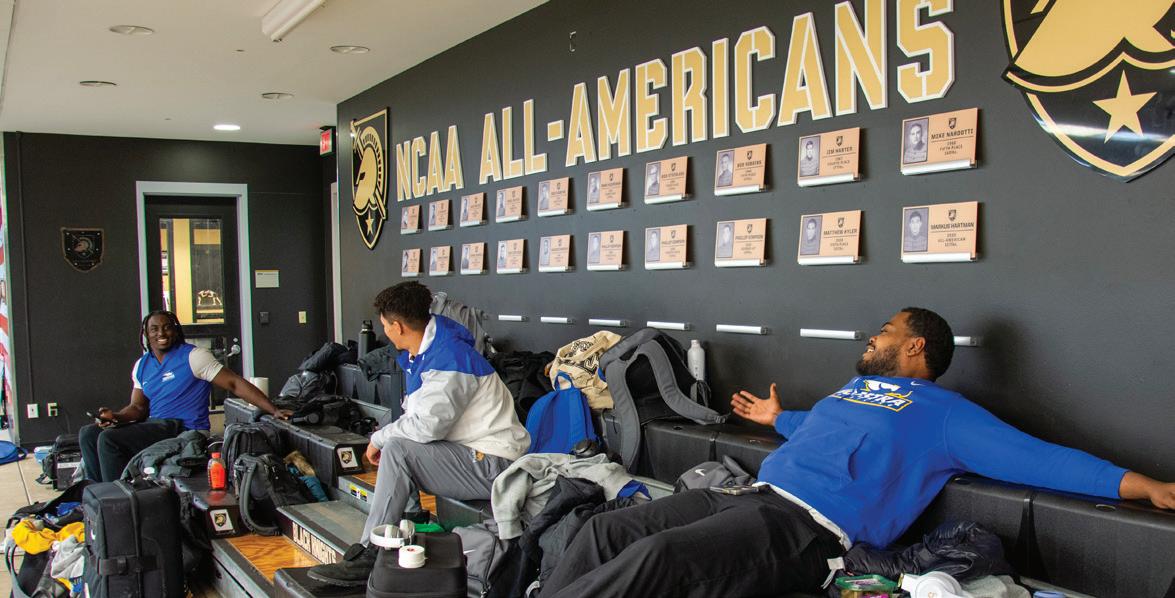
“I look forward to coming in the morning,” Turley said. “It’s always a good time. We just kind of talk crap and just joke around every morning. He always writes something stupid on the whiteboard or something.”
That whiteboard is known beyond just the team. It is a canvas for debates, jokes and the kinds of crazy questions that only make sense that early in the day.
“When I come in, he’s usually pretty energetic, got something written down on his famous whiteboard,” Conlon said. “He’s got some funny thing he wants people to debate or a question he
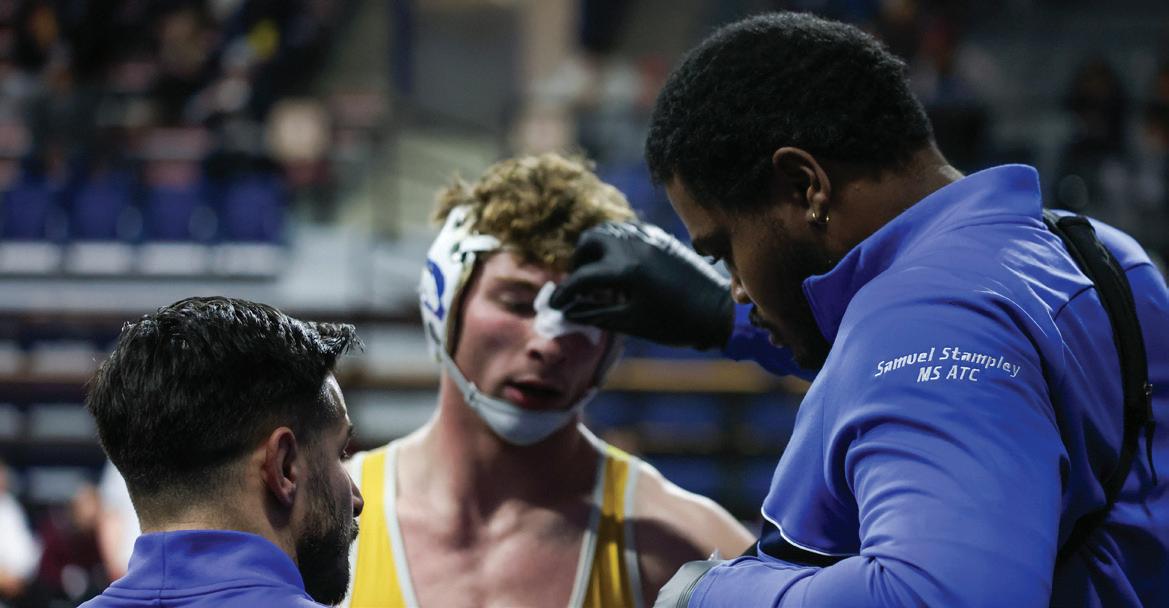
means a lot and he just brings that good, happy energy.”
“He’s very vibrant,” Clark said. “You’re never really going to catch him in a bad mood.”
This dynamic is very important to Stampley, who doesn’t lean on authority to connect with athletes. Instead, he intentionally avoids it.

white board] just contributes to a positive atmosphere.”
The camaraderie Stampley shares with the team makes all the long and hard days worth it.
“I’d probably say my favorite moments, honestly, are just right in the morning before practice,” Stampley said. “We just cut up; we say all kinds of nonsense between all of us. Getting to do handball … the camaraderie. It wasn’t exactly one moment but continually being around all the guys all the time – I would say – is my favorite moment, if I had to pick.”
For Stampley, athletic training is more than just addressing physical ailments. The guys on the team trust him and rely on him for support.
“Win or lose, he’s always there, calling us his little demons,” said wrestler Chase Liardi. “I think his support
“I probably shouldn’t say it, but it does sometimes feel like being teammates,” Stampley said. “But I appreciate that, though, because I can feel their gratitude. It feels authentic – the interactions between us … I prefer it that way instead of taking some sort of authoritative stance. I honestly don’t think kids these days respond well to that stuff anyway.”
Stampley has worked across multiple sports and roles. He was the head athletic trainer for a school district back in Texas before working at Long Island University. He’s been at Hofstra since the spring of 2022 and works with wrestling as well as men’s and women’s tennis.
For a sport such as wrestling, where getting injured is almost unavoidable, and many wrestlers feel pressure to push through pain, having someone literally in your corner can mean the world.
“I’m there to help you, not scare you away,” Stampley said.
Liardi recalled dealing with a lingering knee injury during the season.
“He basically told me, ‘It’s not getting better; we just have to try to manage it,’” Liardi said. “So he helped me out in that way, just telling me what to do recovery wise.”
“He’s starting to really understand wrestling after
all the years that he’s done it,” Conlon said. “And the knowledge that he’s able to bring in terms of words of encouragement or advice for us, specifically with what he can help us do with our injuries, it means a lot to us.”
For all his energy, Stampley is honest about the sacrifices it takes to work in college athletics.
“In order to be here, sometimes I’m sacrificing a lot,” Stampley said. “I’ve missed out on birthdays; I’ve missed funerals this year; there are friends I haven’t been able to keep in touch with. You have to make sacrifices to make it work, and some of the sacrifices are a lot, but when you get to come here and serve guys that are great to you, as these guys are, it’s really not that bad of a deal, truthfully. When you’re serving people who enjoy what you do and what you do for them, it’s a rewarding process.”
On paper, Stampley’s role is to keep athletes healthy, but he does much more than that. He knows when to push his athletes, when to listen, when to jump in with a joke and when to simply be there. He’s a steady presence in an unpredictable sport. A source of energy in the morning. He is a part of the team.
The official wrestling season might be over, but for Stampley, the work never ends. Whether it’s tennis, off-season work or another early morning laughing with the athletes, he’ll be there. For Hofstra athletes, having someone like Stampley in their corner means the world. And for him, that’s the real reward. Although, if you have them, he’d never say no to some Nerds Gummy Clusters or Skittles.
Olivia Hillestad / The Hofstra Chronicle
Samuel Stampley graduated from East Texas State University in 2017.
Samuel Stampley completed his fourth season with the Hofstra University wrestling team.
Olivia Hillestad / The Hofstra Chronicle
Olivia Hillestad / The Hofstra Chronicle
SPORTS
The impact of a championship: What Hofstra’s tournament berth meant to Hempstead
By Eric Leaf STAFF WRITER
They call it March Madness for a reason. Sixty-eight teams from colleges and universities across the United States, competing in a crazy three-week thrill ride of upsets, heartbreaks and buzzer beaters. It is reality television at its best and, arguably, the most exciting sporting event in the country.
The NCAA Division I men’s basketball tournament is raw, on-the-edge-of-yourseat sports entertainment. It is the Big Dance, and it never disappoints.
An invitation to the dance is special. For a mid-major like Hofstra University, you only punch your ticket by winning a conference championship.
A trip to the NCAA tournament, alone, can be a defining moment for the program. When mid-majors are granted an invitation to a national stage, they reap the benefits of the madness.
For Hofstra, it’s about something more unifying than a trophy. The real significance of this year’s electrifying run goes far beyond the bracket.
The lasting impression on the school’s return to college basketball’s biggest stage was not left on the court. It is on the campus and in the greater Hofstra community at large. Hempstead, New York, is where it all began for many Hofstra students, past and present. Watching Hofstra play in the March Madness spotlight, representing their school, it was like being back on campus. It was a thrill they will not soon forget.
Hofstra’s appearance in the NCAA tournament not only thrust the basketball program and the university into the national spotlight, but unified a community that had been waiting for a moment like this for decades.
“It’s bringing our community together,” said Hofstra President Susan Poser. “There’s just so much
excitement … We’re going to ride this wave as long as we can.”
That wave has been gathering for years.
For much of the past two decades, Hofstra men’s basketball teetered on the edge of the bracket bubble and just outside of the national spotlight. Year after year, competitive teams and strong seasons kept the program relevant within its conference, but the breakthrough moment that could put Hofstra back on a national stage remained elusive.
That breakthrough nearly came in 2020 when the Pride won the Coastal Athletic Association championship, earning an automatic bid to the NCAA Tournament. That opportunity was taken away almost immediately when the tournament was canceled due to the COVID-19 pandemic.
This year’s squad broke through, finally accomplishing something that past teams were never quite able to do. The team didn’t just end a 25-year tournament drought; it reclaimed something unfinished.
“Redemption, man,” said alumnus Brandon Fauci, who graduated in 2020. “When [Kyle Scher and I] were both at the school, the tournament was canceled, so this is a shot of redemption. This feels like a long time coming.”
Scher, also a member of the Class of 2020, remembers the excitement of that earlier championship and the disappointment that followed.
“We thought we were going to be able to watch them and, obviously, it didn’t happen,” Scher said. “So, it’s so sick six years later we get to do it.”
For alumni like Scher and Fauci, this year’s special run closed a chapter on a book of disappointment that had remained open for too long. As meaningful as that closure has been, the impact has extended well beyond those who experienced 2020 firsthand.
On campus, the shift has been immediate.
Senior accounting major Michael Matusiak described the moment Hofstra clinched its place in the tournament as something he had been missing throughout his college experience.
“Being a student of a school on the smaller side, I always felt I was missing out on that rowdy school pride and something to cheer for,” Matusiak said. “But, on that night, I could not have been more proud to be a Hofstra student.”
Hundreds of students and fans packed into a Selection Sunday watch party on campus, so many that it had to be relocated to a different room within Hofstra’s Sondra and David S. Mack Student Center. When Hofstra’s name appeared on the bracket, the reaction reflected more than excitement; it reflected a shift in identity.
“It’s hard to describe,” Matusiak said. “But knowing they’ll be getting national recognition, and even something as simple as everyone having to read the name ‘Hofstra’ while filling out their brackets, was so wholesome to me. It put some respect on Hofstra’s name.”
That recognition has been one of the most immediate and measurable impacts of Hofstra’s tournament appearance.
According to Hofstra Athletics, the program’s social media presence has surged dramatically since its conference championship. In February, the team generated approximately 1.2 million impressions and nearly 40,000 engagements. By Friday, March 27, those numbers had jumped to nearly eight million impressions and more than 210,000 engagements, along with over 1.1 million video views.
The audience has grown by roughly 2,000 followers in just weeks.
For athletic director Rick Cole Jr., those numbers reflect something deeper than exposure.
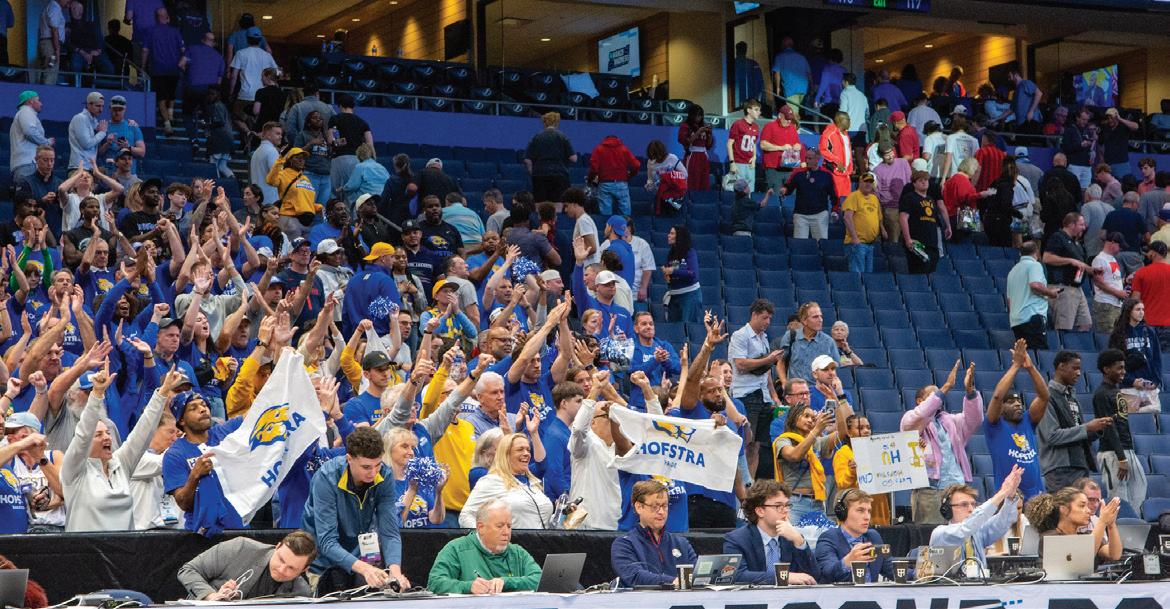
“It means so much, but I don’t think it’s just to the athletic department,” Cole said. “I think it’s for the entire university … the student body, our alumni, the community that we’re fortunate enough to be a part of on Long Island.”
Cole credits much of that impact to the culture built by head coach Speedy Claxton, who has emphasized throughout the season that the program’s success is shared.
“You always hear [Claxton] talk about how it takes a village,” Cole said. “When it’s that kind of culture, everyone feels the benefit and the joy of when you accomplish something special … It’s so much more than just athletics.”
That idea that this moment belongs to everyone was echoed inside the locker room as well.
Senior guard German Plotnikov, a four-year member of the program, has witnessed the growth of both the team and its support system.
“Ever since we won the championship, I always say it’s not just us who won it,” Plotnikov said. “I’m so grateful to the whole coaching staff and the Hofstra community … It was amazing to see the Selection Sunday party. There were a lot of people who showed up. It was pretty packed.”
The packed watch party became a snapshot of the larger transformation taking place, one where a program’s success translated into a shared experience across campus.
That sense of connection has also bridged generations of
Hofstra basketball.
Former head coach Joe Mihalich, who led the 2020 championship team, was invited by the program to travel with the team to the tournament, a gesture that underscored the continuity between past and present.
“It is so surreal,” Mihalich said. “I cried when the team asked me to travel with them … It’s just surreal.”
Moments like that highlight how this dance into March Madness has become more than a singleseason achievement. It has tied together former players, current athletes, students, alumni and university leadership in a way that few events can.
In many ways, that is the lasting significance of Hofstra’s return to the NCAA tournament.
Yes, it brought national exposure. Yes, it elevated the basketball program. And yes, it ended a 25-year absence from the tournament. But more importantly, it created something that extended beyond the court.
It gave students a moment of pride. It gave alumni a sense of closure. It gave the university a surge in visibility. And it gave the surrounding community a reason to rally together.
For a program that had spent years knocking on the door, finally getting in felt so good.
But for Hofstra, the real story isn’t just that the door opened; it’s how many people walked through it together.
Hofstra University entered the NCAA Tournament as the 13 seed.
Olivia Hillestad / The Hofstra Chronicle
THE HOFSTRA CHRONICLE
SPORTS
March 31, 2026

W alk off W eekend
CJ Griggs hit a walkoff on Sunday, March 29, and Michael Brown brought in the game-winner on Friday, March 27, to push the Pride past Northeastern University.
Kim Nadler / The Hofstra Chronicle