HEMPSTEAD, NY
THE HOFSTRA CHRONICLE
Arrest made in 2021 acid attack involving Hofstra student
By Sahana Shastry NEWS EDITOR
Nearly two years after she was attacked with sulfuric acid in the driveway of her home, Hofstra University student Nafiah Ikram said during a press conference, “To the person that did this, I know that you are going to get
leaving Ikram with severe burn injuries and years of reconstructive surgeries ahead of her.
The liquid melted her contact lens, leaving her without vision in her right eye, and gave her second and third degree burns on her face, chest and arms.
“One minute, I was a student and a pharmacy [technician],
“To the person that did this, I know that you are going to get your karma one day.”
your karma one day.” On Tuesday, Feb. 10, nearly five years after the attack, 29-year-old Terrell Campbell was charged with assault, criminal possession of a weapon and unlawfully possessing noxious material.
Then 21-year-old Ikram had just returned to her home on Arlington Avenue in Elmont, New York around 8 p.m. on March 17, 2021, when an unidentified male threw sulfuric acid at her,
working 30 to 40, sometimes 50 hours a week, going to the gym,” Ikram said. “And then all of a sudden, [my] whole identity [changed], [my] whole face is burnt. That night I was driving home; I still haven’t driven a car since.”
Hofstra spokesperson Neena Samuel issued a statement on behalf of the university following the attack.
“We’re shocked by this horrific
attack, and our thoughts are with [Ikram], her family and friends as she focuses on her recovery,” Samuel wrote in the statement.
“We are committed to supporting her through that process and will cooperate and facilitate that in whatever ways are helpful.”
Ikram was a sophomore community health major with a pre-med track at Hofstra. Despite the life-changing trauma, Ikram made use of student accommodations and returned to her classes to pursue her dream of becoming a doctor.
“Even back then I would be like, you know, let me make my weakness my strength. So, in that sense, even when it comes to school and stuff like that, I would go in for class even when I had [a] surgical wound in my shoulder,” Ikram said. “I couldn’t even turn my neck. I was still going to class.”
A GoFundMe page that was set up to help Ikram has raised over $600,000 thus far.
Pride flag returns following removal at Stonewall
By Arlo Lachenmeyer SPECIAL TO THE CHRONICLE
On Monday, Feb. 9, the Pride flag flying over the Stonewall National Monument was taken down by National Park Service (NPS) employees in compliance with a directive from the TrumpVance administration.
In response to inquiries from outraged members of the LGBTQ+ community, NPS released a statement on the matter explaining that in accordance with new policies enacted by the current presidential administration,
“only the U.S. flag and other congressionally or departmentally authorized flags are flown on NPS-managed flagpoles, with limited exceptions.”
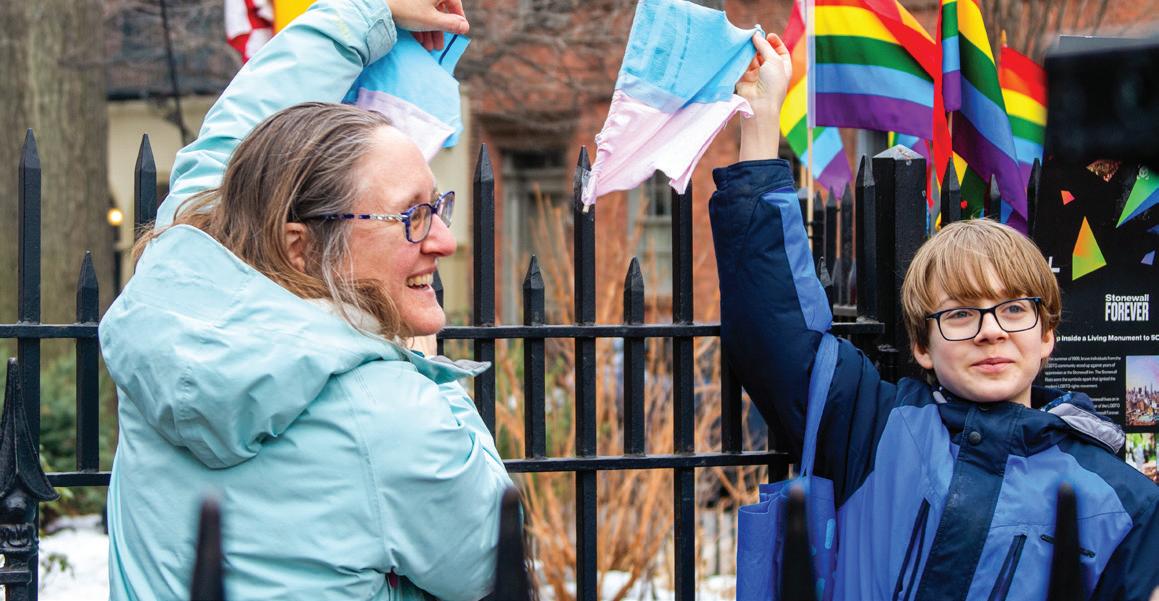
On Wednesday, Feb. 11, hundreds of demonstrators gathered in front of the bare flagpole on Christopher Street. Jay W. Walker, co-founder of the ReClaim Pride Coalition and the Queer Liberation March, decided to organize the demonstration after hearing that there was an official press conference scheduled for later in the week.
Speedy Claxton secures 100th win as men’s basketball head coach
By Eric Leaf STAFF WRITER
The Hofstra University men’s basketball team continued its surge with a commanding 8268 victory over Northeastern University on Saturday, Feb 21.
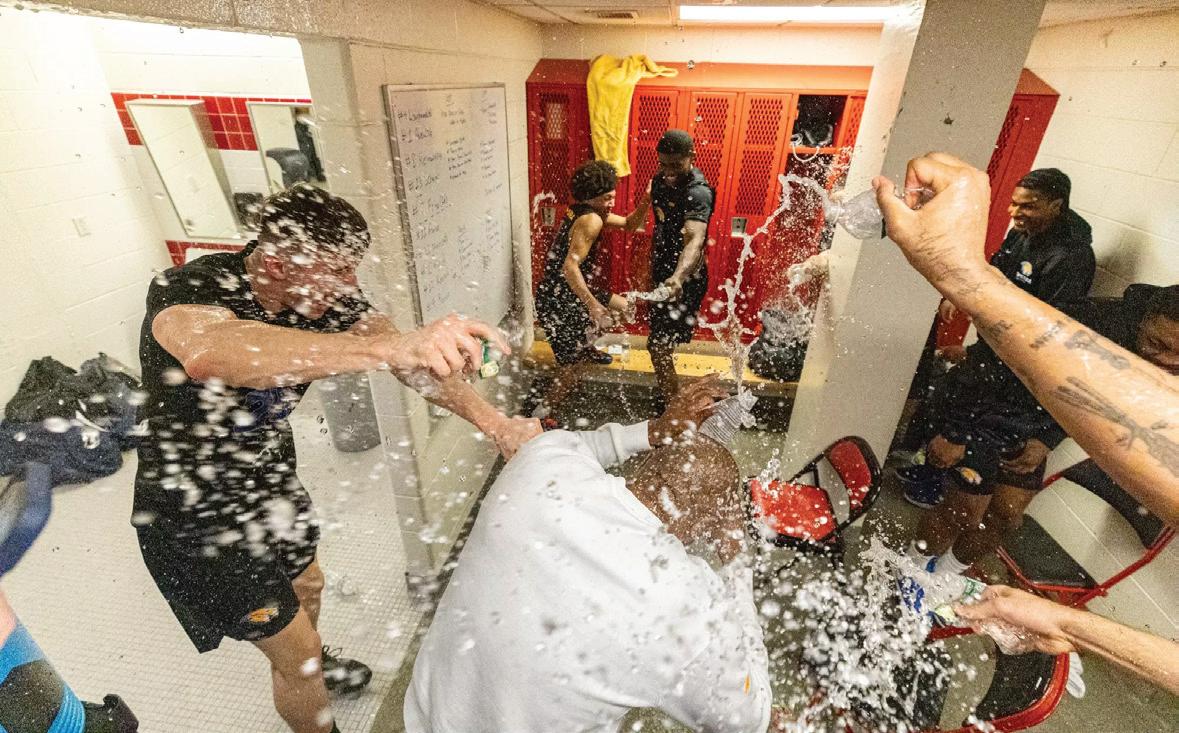
Powered by the Pride’s electric backcourt tandem, head coach Speedy Claxton secured his 100th career win in just his fifth season at the helm – a milestone that adds another chapter to Claxton’s legacy at Hofstra.
Claxton, who is a former NBA champion and a Hofstra Hall of Famer, continues to add to an already remarkable resume with the program. Under his coaching, the Pride have eclipsed the 20-win mark in three of his first four seasons, and one more victory this year would make his record four 20win campaigns in five seasons, a testament to the sustained standard that he has built in Hempstead.
“It means a lot,” Claxton
said. “To tell you the truth, honestly, I had no idea. I’m happy about it. Hopefully, I have many more wins in the bag left.”
With the win, Hofstra remained in third place in the Coastal Athletic Association (CAA) standings, improving to 10-6 in conference play as the postseason picture continues to take shape.
“Great road win,” Claxton said.
Players spray Speedy Claxton in celebration of his 100th win.
Photo courtesy of Amelia Bashy / Hofstra Athletics
Demonstrators wave flags in front of the Stonewall monument in protest of LGBTQ+ flag removal.
Photo courtesy of Arlo Lachenmeyer

hofstrachronicle@gmail.com
Editor-in-Chief
Madeline Sisk
Managing
Secretary
Business Managers
Timothy
News
Assistant
Katelyn
Arts
Abby Gibson Craig Mannino
Sanacora
Assistant
Kimberly Lopez Vanessa Flanagan
Sports
Assistant
Samantha Nadler Royce Dickson-Child
Features
Assistant
Opinion
Assistant
Gianna Costanzo
Assistant
New pride flag raised over Stonewall after federally mandated removal cont.
Walker felt that the community deserved an immediate response and organized the rally that very same day.
Hundreds of people were in attendance. Walker returned to the Monument every day following the flag’s removal and told the crowd that each time their flag is removed, he will raise another in its place as an act of civil disobedience.
Federally enforced acts of erasure have become commonplace during President Donald Trump’s second term as president and are reminiscent of this Administration’s repeated removal of plaques, monuments and museum exhibits that are meant to display United States history.
“With the Trump administration, there is a particular investment in erasing any kind of history or proof of there being opposition to mass bigotry. They are really invested in making it seem as though there is no precedent for there being any type of resistance or pushback to social authoritarianism,” said Grayson Lazarus, adjunct professor within the department of Radio, Television, Film at Hofstra University. “There is a top-down assault on all marginalized communities right now. It’s an active warzone, not just literally on the streets in many cases, but also in textbooks and museums.”
Corbin Wolfendale, a sophomore music business major, talked of the importance of recognizing our historical struggles.
“About a year ago, the Trump administration required government websites to shorten the acronym ‘LGBTQ’ to just ‘LGB.’
The erasure of [transgender] people is just the first step in the broader wish that the Trump administration has where they want to erase all mentions of Queer people … They’re starting with the most vulnerable group of people which is [transgender] people,” Wolfendale said. “It’s a lot harder to connect with your past and the people who fought for
your rights when you don’t even know they existed. The whole goal of that is just to disconnect us from our communities and scare us into submission. We can’t just hide and let history go. We have to fight for it, because it’s one of the most important things we have as a minority in this country.”
State government officials held a press conference on Sunday, Feb. 15, in front of the Stonewall National Monument formally condemning the Trump administration’s actions. The removal of the only officially sanctioned Pride Flag on federally owned land in the U.S. sparked immediate backlash from local and federal officials, with Senate Minority Leader Chuck Schumer (D-NY) addressing a crowd of demonstrators in front of the Memorial.
“The Trump administration’s removal of the Pride Rainbow Flag … is a deeply outrageous action that must be reversed, it’s an effing disgrace,” Schumer said. Other officials who attended the demonstration on Sunday included Senator Eric Bottcher (D-NY) and Manhattan Borough President Brad Hoylman-Sigal.
“I hear a lot of people saying ‘Oh, I’m not going to watch the news anymore.’ That’s a privilege –for you not to tune in, for you not to know what is happening to your brother or sister. We are all connected. It’s the pride flag today, tomorrow it’s going to hit home for you. You have to be cognizant of the shifts that are happening,” said Sekiya Dorsett, assistant professor within the department of Radio, Television, Film. “At this moment, unfortunately, there are so many things occurring that we honestly cannot keep up. Social media has us in a mindless loop at times. This story is important. We cannot let anything slip by. We must report on everything, stand up for every part of our psyche which is under attack. If the name of the country is the United States of America, then the country should reflect that name in its legislation.”
The Stonewall National Monu-
ment was established in 2016 by former President Barack Obama to honor and memorialize the 1969 Stonewall Uprising’s role in the LGBTQ+ civil rights movement and has become a place of pilgrimage for many Queer Americans. The name Stonewall is synonymous with the idea of Queer resilience in the face of oppression and discrimination.
“When the Pride flag flies, it’s not simply a reminder of Stonewall in 1969. It is a reminder that we as Queer people across the globe are here, are present, are living and are loving. We have fought and are now celebrating,” Dorsett said. “When you see that flag, it’s an identity of who we are as a people.”
The first Pride flag was created by Gilbert Baker in 1978 following the assassination of Harvey Milk, the first openly gay man elected to public office in the state of California. The original rainbow flag created by Baker had eight colors, each representing a different aspect of life.
“A flag is not a threatening thing. If you don’t identify with that flag, that’s okay. It should just be something that you can leave alone. I, along with lots of other Queer people, find that if you see a little Queer flag on a storefront, it just brings a smile to my face. I know I’m going to be safe, it feels welcoming,” said Casey Miller, a senior filmmaking major. “Taking away that symbol of hope … is just fearmongering.”
The flag has undergone multiple changes in the decades since its introduction, including the addition of light blue, pink, white, brown and black stripes to better represent transgender and Queer people of color.
Eighty-two-year-old Greenwich Village resident Bill Dolive recalled the night he joined the 1969 uprising.
“It was about midnight when we emerged from the Christopher Street subway station, preparing to cap off the evening with a drink at the Stonewall, my favorite bar. As we exited the station we were surprised to see helmeted cops, flaming garbage cans, paddy wagons … and glorious, noisy chaos. I joined the fracas on the five subsequent evenings of disorder, but little did I realize the profound significance of those events,” Dolive said. “To many of us we just wanted the cops out of our bars. And now this outrage – the desecration of our park, our flag, our heritage. I’m as pissed off now as I was then.”
Dolive has attended nearly every Pride event held in Greenwich Village since the late 1960s and was in attendance this past Sunday.
“I guess these battles are not over. I’ve been a villager since 1967 and I’m not going anywhere. We won’t go back,” Dolive said. The Pride flag returned to its rightful place overlooking Stonewall on Thursday, Feb. 12, surrounded by hundreds of supporters.
Editor-at-Large
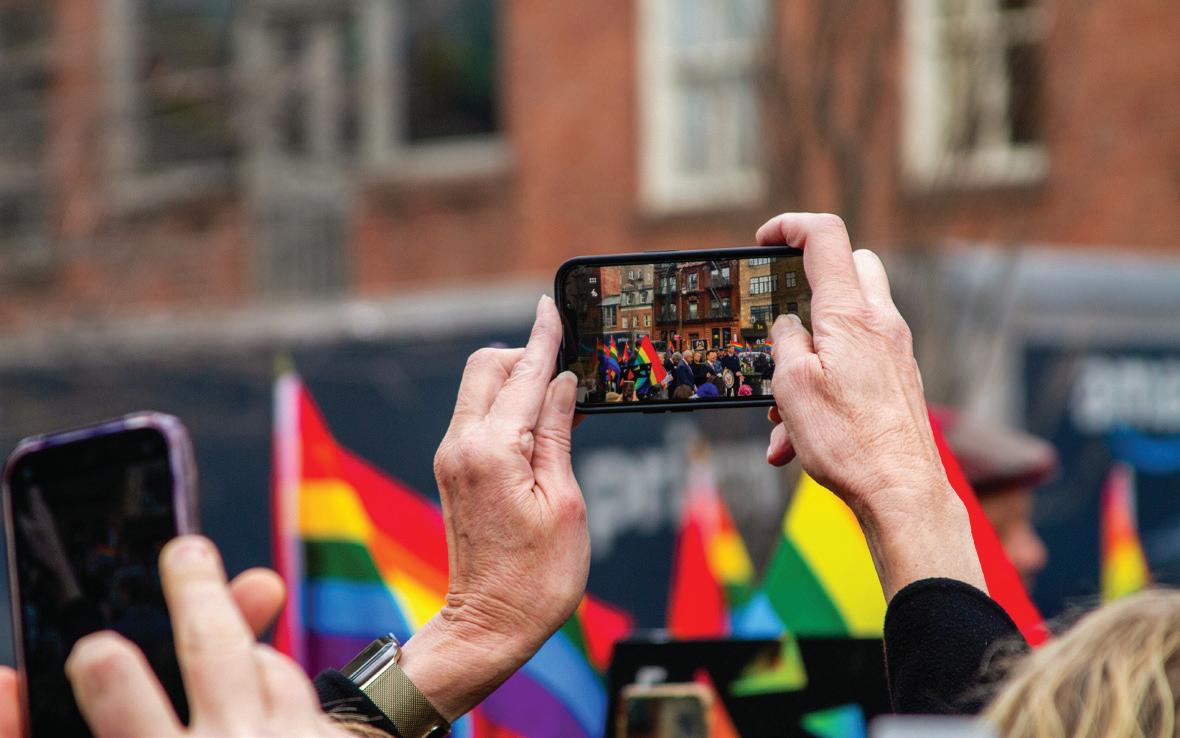
The Stonewall National Monument is the country’s first monument dedicated to LGBTQ+ rights and history.
Photo courtesy of Arlo Lachenmeyer
What you may have missed
7:45 AM
Australia temporarily bans citizen with alleged ties to militant Islamic State group –Wednesday, Feb. 18
Australia enacted its counterterrorism law to ban a citizen with alleged ties to the militant Islamic State group from returning home from a detention camp in northeastern Syria. The woman was part of a group of 34 Australian women and children who had planned to fly into Australia from the Al-Roj refugee camp where they have been for the last six years.
Russia and Ukraine officials meet in Geneva for United States-brokered talks –Wednesday, Feb. 18
Officials from Russia and Ukraine met in Geneva for United States-brokered peace talks one week before the fourth anniversary of Russia’s invasion of Ukraine. Neither side agreed on the terms regarding territory or future security arrangements. The U.S. gave Ukraine and Russia a June deadline to reach a peace deal.
Galgotias University removed from India AI Impact Summit 2026 over a robotic dog –Wednesday, Feb. 18
Galgotias University, a private Indian university, was asked to withdraw from an artificial intelligence summit in New Delhi after a communications professor, Neha Singh, displayed a robotic dog made in China. Event organizers said that the dog was presented as the university’s innovation. Singh denied claiming that the robot was developed by the university. The exhibit was removed from the summit.
Fireworks shop explosion killed 12 in central China – Wednesday, Feb. 18
A fireworks shop exploded in Hubei, China, killing 12 people in the town of Xiangyang. Emergency responders extinguished the blaze that same afternoon. The explosion followed the Lunar New Year celebrations, during which fireworks generally pose heightened safety risks in China.
Step Afrika! kicks off Black History Month at Hofstra
By Katelyn Buchalter ASSISTANT NEWS EDITOR


To kick off Black History Month, “stepping” group Step Afrika! engaged Hofstra University students with a high energy, percussive dance performance on Sunday, Feb. 8, at the John Cranford Adams Playhouse. While the event was free, attendees were encouraged to bring non-perishable food items to go toward the Hofstra Pantry and the Mary Brennan INN Soup Kitchen.
The 90-minute-performance involved guest participation, something that has been a part of the step tradition since the 1990s. Members of the audience were invited to clap, stomp and cheer with the performers on stage.
Anthony Collins, executive director of Hofstra’s Cultural Center (HCC), inaugurated the event by thanking the staff involved, along with telling a brief history of stepping and Step Afrika!
“Stepping was created by African American fraternities and sororities and today is celebrated by thousands upon thousands. Since its inception in 1994, Step Afrika!’s mission has been to establish, preserve and extend the most dynamic dance form,” Collins said.
Stepping focuses on pride, love and respect that is derived from community. To highlight that, members of Step Afrika! regularly engaged with the audience, asking them to make as much noise as possible when
they enjoyed specific parts of the performance.
Each segment of stepping was followed by jokes and history from the members of Step Afrika!
Before the gumboot dance, a story about African workers and how they used boots and stomping to communicate with each other in the mines was shared.
Step Afrika! told the crowd they were fortunate enough to travel back to South Africa and work with the Soweto Dance Theater to perfect their gumboot dance skills.
Third year member of Step Afrika!, Jerod Coleman, highlighted the importance of sharing culture, specifically through dance.
“We want to spread knowledge of this art form and how it’s connected to basically the world. So, it’s so similar to the South African Gumboot dance that you see in the show, it opens your mind to what other percussive art forms [there are] that are similar, but have never come into contact with each other,” Coleman said. “So, it’s like a full cultural exchange from top to bottom.”
Step Afrika! members travel around the world performing and spend long hours practicing and perfecting the dances and movements.
“Every day, for the most part when we’re back at home in Washington D.C., we rehearse from 10 a.m. to 5 p.m.,” Coleman said. “When we’re on the road, hours vary from: ‘We need
to wake up at 2 a.m. to rehearse real quick,’ or we wake up and we space when we get to the place.”
Many members from Step Afrika! come from Black Greek organizations. Joseph Vasquez, a member of Lambda Sigma Upsilon Latino Fraternity, Inc. at Rutgers University, became a member of Step Afrika! four years ago and tours around the world.
“There’s something about doing the college shows that kind of gives like a family-oriented space,” Vasquez said. “[Sometimes], we get to bring people up on stage and be in people’s faces, so that’s the fun part. That’s what’s different about this show.”
A huge segment of the performance involved several volunteers joining the dancers on stage. Vasquez highlighted the importance of feeling liberated.
“Being comfortable with being uncomfortable, just being okay with being loud, being okay with talking, getting loud and speaking up. It should be fun. Life is so difficult at times, you just gotta scream,” Vasquez said.
HCC continues to host events oriented towards Black History Month.
“We look at our office as a classroom without boards. It’s our responsibility as a university, not only to educate our students, but also to share what we’re doing here on campus with the community,” Collins said.

Graphic designed and information compiled by Natalia Rivera
Step Afrika! was founded in 1994 by C. Brian Williams, bringing explosive footwork, vibrant choreography and contemporary African movement to campuses and audiences worldwide.
Kumba Jagne / The Hofstra Chronicle
Black@Hofstra expands student collaboration and community impact
By Natalia Rivera ASSISTANT NEWS EDITOR
Members of Hofstra University’s community attended this year’s Black@Hofstra event on Wednesday, Feb. 11. Black@ Hofstra is a campus-wide celebration of Black culture, history and identity during Black History Month.
The event is a part of the Identities@Hofstra series. It opened with food and drinks which encouraged conversation and networking before the program and performances began.
Hugo Morales, director of the Office of Intercultural Engagement and Inclusion, said organizers were intentional about expanding the event through student collaboration.
“The turnout was great. From what we tracked, we had close to 140 people there,” Morales said. “The engagement felt much stronger this year.”
Morales credited the studentled organization for the increase in attendance.
“I think the student performances brought more people out because friends came to support their peers,” Morales said. “The student organizations involved also encouraged their members to attend because they helped plan it.”
Cornell Craig, vice president for Equity and Inclusion, said institutional support is critical to maintaining that momentum.
“It’s important to have a university that shows up and produces these events,” Craig said. “It’s important that our organizations and Greek organizations thrive.”
Morales said planning began about a month before the event.
Faculty organizers met with Black student organizations to design a program that highlighted their impact on campus.
“Our goal was to reach as many students as possible, and the best way to do that was by ensuring students were directly involved in the planning process,” Morales said.
The collaborations with students led to student-focused performances, education of “Hip Hop Through the Decades” and “Historical Figures” through wall displays, focus on Blackowned business via the snack selections and interactive activities such as human bingo and Black trivia. Faculty and students also
student poet Ashlei Williams delivered an original piece titled “What Am I Feeling.”
These performances allowed students to get a feel of what was to come later within the
Craig emphasizes that visibility matters, particularly for Black Greek-letter organizations and student leaders.
“When the university shows up and supports us, it sends a
“It subconciously tells young people that they, too, can achieve their goals and be successful. It says, ‘If they can do it, I can do it too.’”
partnered with Hofstra’s Student Government Association to discuss food options and worked with campus partners.
The Hofstra Gospel Ensemble started the event by performing the Black national anthem, and
program while opening the floor for conversation between the performances.
Sakari Clendinen, a senior film studies and production major, and Dayshaa Patrick, a junior psychology major, both on the Creativz dance team, performed a dance that ended with raised Black Power fists.
“We ended with the Black Power fist because it represents our people,” Clendinen said. “We’re here for Black History Month and Black people.”
Patrick said the symbolic ending was intentional, especially at a predominantly white institution.
“It’s really important that we come together, especially during this time and with what’s going on in the world right now,” Patrick said. “It’s nice to see Black students celebrating African American culture and speaking positively about ourselves.”
message that what we’re doing matters,” Craig said.
Members of Black Greek organizations, termed as Divine Nine organizations, shared information about their chapters and campus resources. The Kappa Phi chapter of Alpha Kappa Alpha Sorority Inc., the first Black sorority at Hofstra, is celebrating 50 years in May.
Corey Champagnie, a senior community health major, attended the event representing both the Caribbean Student Association and Alpha Phi Alpha Fraternity Inc.
“I love seeing the Black community coming together,” Champagnie said. “There’s a large portion of the Black community on campus that doesn’t know these things exist. This was very good exposure.”
While Black@Hofstra centers around Black identity and culture, Morales and Craig empha-
sized that the event is open to the entire Hofstra community.
“Events like this are very important because they help create community and provide opportunities for people to learn from others who may not identify like them,” Morales said.
“It subconsciously tells young people that they, too, can achieve their goals and be successful. It says, ‘If they can do it, I can do it too.’”
Craig echoed that sentiment, noting that sustained institutional commitment helps ensure those spaces remain strong.
“It’s important that we keep these events strong,” Craig said. “When our organizations thrive, the community thrives.”
Morales said Black@Hofstra will continue alongside other identity-centered initiatives such as Queer@Hofstra, Women@ Hofstra and Asian American Native Hawaiian Pacific Islander (AANHPI)@Hofstra.
Ultimately, Morales said, the goals extend beyond celebration.
“The purpose of Black@ Hofstra is to create a space where students, faculty, staff and administrators can come together to build community and network,” Morales said. “In many ways, life is not just about what you know, but also about who you know.”
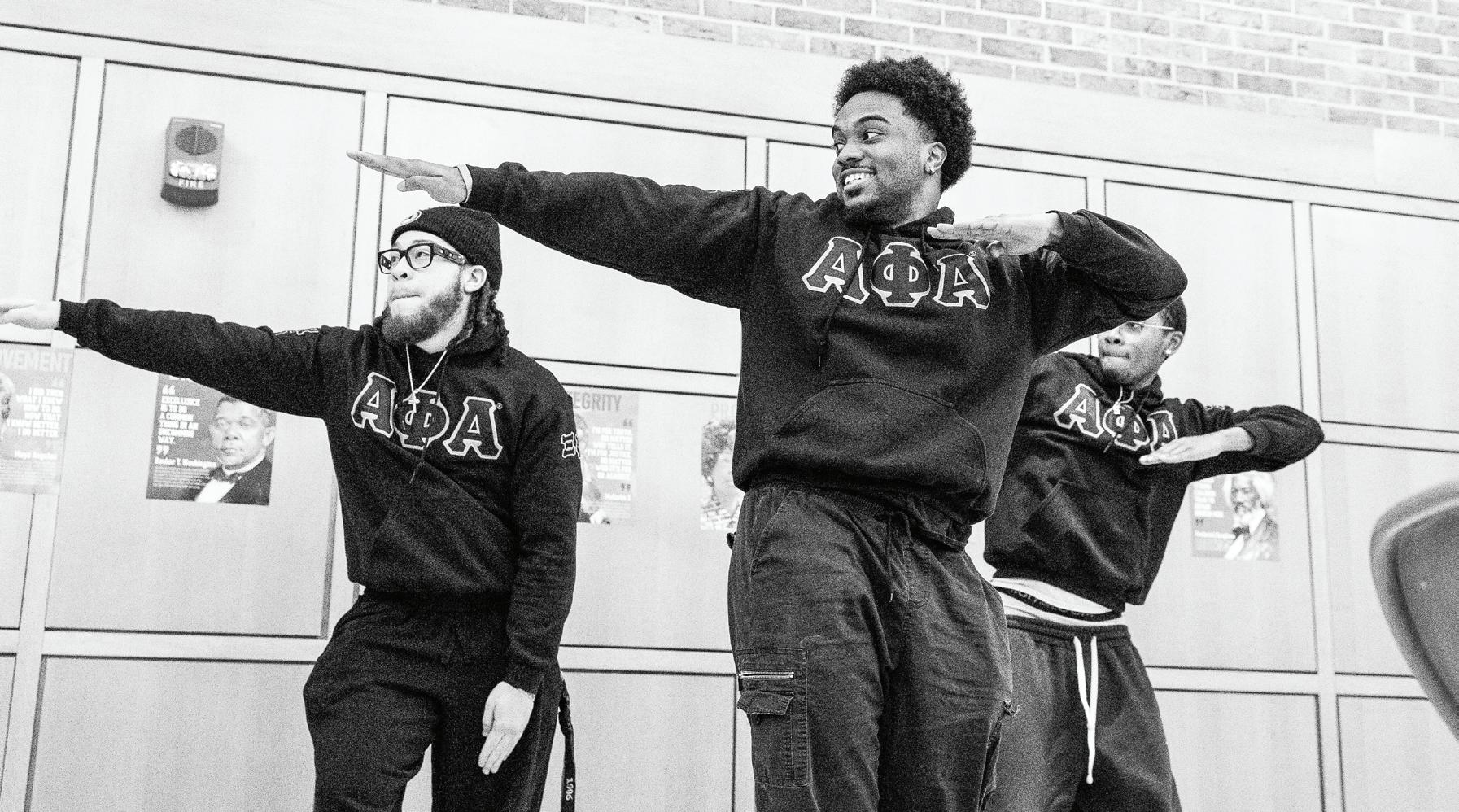
Alpha Phi Alpha Fraternity Inc. performed a stepping routine for attendees.
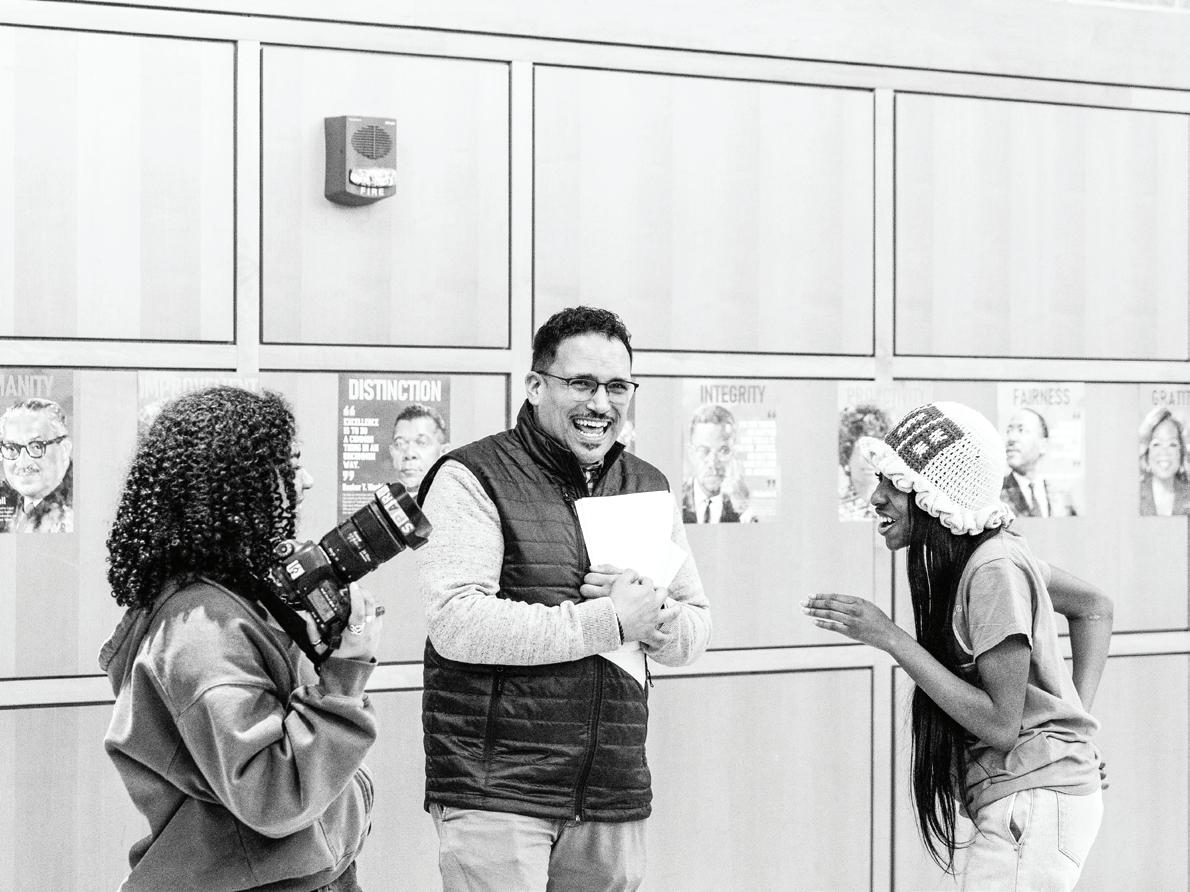
Hugo Morales, director of the Office of Intercultural Engagement and Inclusion collaborated with students to increase involvement.
Shaina Skeen / The Hofstra Chronicle
Shaina Skeen / The Hofstra Chronicle
Arrestmadein2021acidattackinvolvingHofstrastudentcont.
Ikram regularly shared updates of her journey since the attack through the page. Her most recent update was posted on Tuesday, Feb. 17, where she detailed her struggles and addressed the arrest.
“I really appreciate everyone that reached out regarding the arrest with your kind wishes [and] loving regards. It was so nice to see that everyone else is just [as] angry as me to this day [and] it also was nice how the community really has my back,” Ikram wrote. “I’m very grateful that Allah (God) has revealed a piece of the puzzle. Insha’Allah (God willingly) when it’s the right time everything will fall right into place perfectly [and] hopefully everything will eventually make sense in some way.”
Even though the surveillance video of the attack has now reached over 219,000 views on YouTube, the police were unable to find the attacker until nearly five years later.
“They really need to catch this guy, seriously, I don’t live too far away and I worry so much for my two little girls.
The police really needs to step up!!” user @Reserved.allthetime wrote four years ago in a YouTube comment.
The reward in connection with the acid attack that had started with $5,000 increased to $50,000 by 2023.
Two years after the anniversary of the attack, Nassau County Legislator Carrié Solages joined local community leaders and the family to call for renewed intensity to provide justice for Ikram. Three years post attack, the family of Ikram publicly criticized the police for the lack of progress in finding the attacker.
The Nassau County District Attorney and Nassau County Police Department received information in connection with the attack in late 2025 through an anonymous tip which proved to be the first important breakthrough, leading investigators directly to Campbell. Campbell is a flower delivery worker and aspiring rapper living in Brooklyn with his mother.
Ikram stated that she did not have any prior connections with Campbell.
Key pieces of evidence that
came to light included the getaway car that was identified to be owned by Campbell’s mother, Campbell’s search history on the day of the attack which included searches like “How do I remove sulfuric acid from my car’s fabric?” and a music video of the aspiring rap artist.
Two years after the attack, Campbell felt confident enough to post a YouTube music video titled “Obsidian,” in which he rapped about the incident. One line stating, “On the street in the night like a hitman assassin, try to run up, have your face burning in acid.”
“A harrowing attack boiled down to some lyrics to get him attention,” said District Attorney Anne Donnelly at a news conference on Tuesday, Feb. 10.
Ikram stated that although she feels safer now that there was an arrest, there are still unanswered questions regarding the perpetrator’s accomplices, noting that there were two or three people involved.
“Unfortunately, I’m thinking the worst-case scenarios. In a way, it’s like I’m hallucinating things – like flashbacks – I’ll think I saw a shadow of the per-
son running across again. And I’m like, ‘No, like stop it, that’s not him, he’s in jail,’” Ikram said. “That’s where me feeling relieved is applied in reference to [Campbell] … I’m pretty sure multiple people were in the car. [I’m] hoping that if that comes to light, the reason would be unfolded and maybe I’ll get some closure.”
The five-year statute of limitations was nearing in the case, which would have prevented authorities from making any arrests or prosecuting anyone involved in the attack.
Campbell pleaded not guilty
and was ordered to be held without bail. Police previously said that there was no evidence to determine whether the attack was a hate crime. Today, Donnelly said that the motive is still being investigated, leaving unanswered questions.
Campbell faces 25 years in jail, if convicted. The next court date is March 10.
Ikram is currently on a medical leave of absence at Hofstra. She is a junior in credits and plans to return to Hofstra and continue her degree in the future.
Public Safety Briefs Compiled by Katelyn Buchalter
On Wednesday, February 4, 2026, at 5:45 p.m., an HU student reported to PS that they misplaced a ring inside their residence hall. Plant had worked on the sink in the bathroom where the ring was last seen on the counter.
On Thursday, February 5, 2026, at 1:40 p.m., while driving through the Hagedorn Hall parking lot, vehicle one, driven by an HU student, struck vehicle two, also driven by an HU student, causing it to collide into vehicle three, which was parked. Its owner is unknown. Vehicle one sustained damage to the front right fender. Vehicle two sustained damage to the front bumper. Vehicle three sustained damage to the right bumper and wheel well. There were no injuries. Nassau County Police responded and took a report.
On Friday, February 6, 2026, at 2:18 p.m., a nonstudent reported to PS that, while attending the JP Sports Card & Memorabilia Show in the multipurpose room in the Sondra and David S. Mack Student Center, their son put down a bag containing approximately $1,000 worth of sports cards, and they could not locate it. A search of the area was met with negative results.
On Friday, February 6, 2026, at 9:13 p.m., an RA at Constitution Hall reported to PS that they were given a folding knife, which was found in the lounge area of
the building. The knife was vouchered by PS for safekeeping.
On Sunday, February 8, 2026, at 8:42 a.m., 7:19 p.m. and 10:05 p.m., the fire alarms in Constitution Hall and Estabrook Hall were activated due to a water pump issue. Each time that the fire alarms sounded, the buildings were evacuated within one minute without incident. PS and UFD responded, the situations were corrected, and the fire alarms were reset.
On Wednesday, February 11, 2026, at 5:10 p.m., an HU student reported to
PS that they left their phone outside a room in Breslin Hall to charge. When they returned at 4:30 p.m., their phone was gone. At approximately 6 p.m., a professor found the phone on the first floor and returned it to PS, where the student went to retrieve it.
On Thursday, February 12, 2026, at 6:35 p.m., an RA at Suffolk Hall reported to PS that there was an odor of marijuana emanating from one of the rooms on the third floor. The occupants of the room admitted to smoking marijuana and were referred to CS.
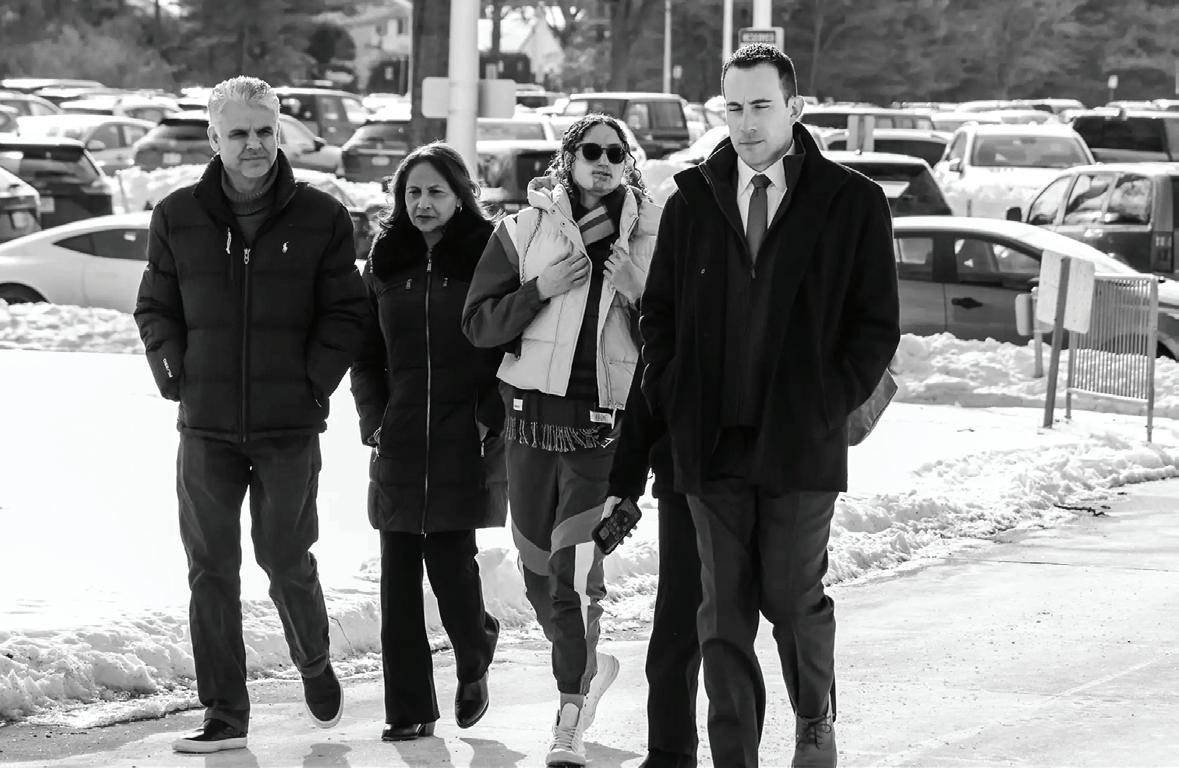
The indicted attacker, Terrell Campbell, pleaded not guilty and is set to face 25 years in prison if convicted.
Photo courtesy of Dennis A. Clark via New York Post
FEATURES
This Hofstra Life: HofUSA’s David Stanford
By Emilie Morrissette ASSISTANT FEATURES EDITOR
Hofstra USA, commonly known as HofUSA, is a latenight dining establishment on Hofstra University’s campus, perfect for anyone in need of a midnight munch. With plenty of available seating and a charming game room area, HofUSA is a popular hangout spot after a study session or club meeting to dine and chill.
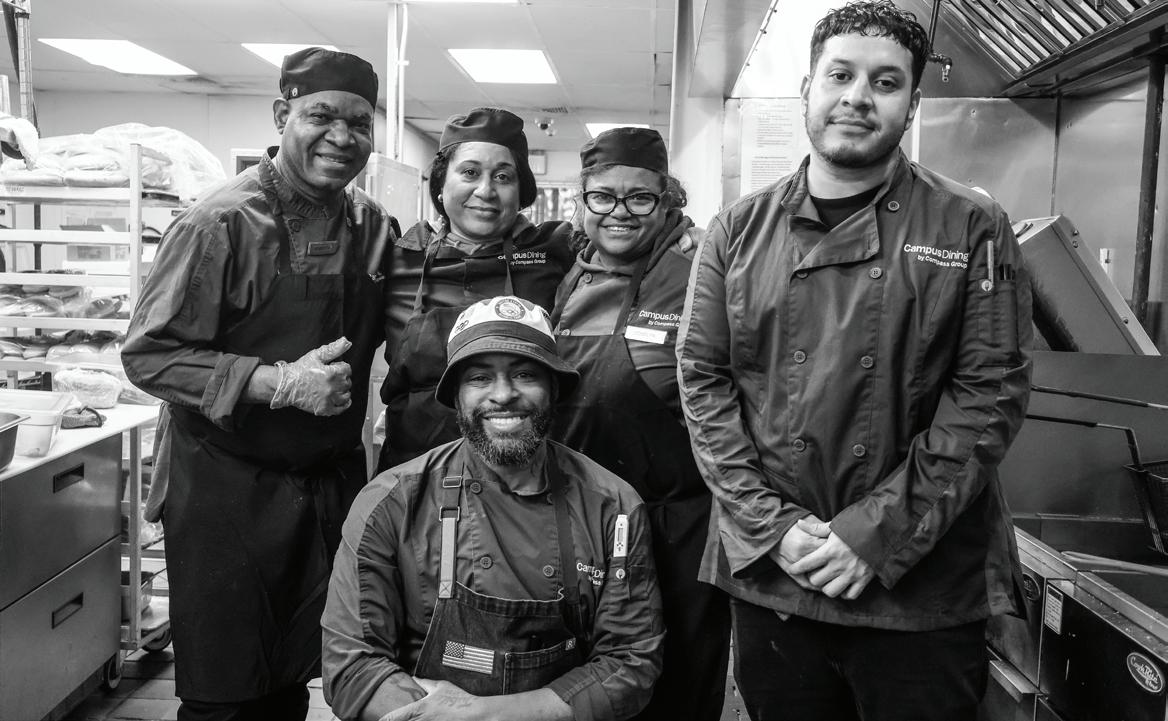
Behind the pick-up counter stands a team of dedicated chefs whose hard work should not go unnoticed.
Forty-five-year-old David Stanford started off as a senior cook in the Sondra and David S. Mack Student Center, working his way up to junior sous-chef. He then moved to HofUSA as Chef Graham Beck’s supervisor chef.
Stanford pursued culinary practice and got his associates degree at Johnson & Wales University. Before his career at Hofstra, he had gained experience working in various restaurants.
“[I worked at] a lot of restaurants in old Manhattan. I know the pressure, and it sounds crazy, but I liked it,” Stanford said. “You understand when the chef really takes interest in you – he wants to see you shine, but he’s gonna beat you up to make you stronger.”
This kind of strength can only be learned through experience
and dedication to the culinary arts.
Open from the hours of 6 p.m. to 3 a.m., the HofUSA menu offers a variety of fun appetizers, quesadillas, burgers, sandwiches, salads, pastas, desserts, milkshakes, dirty sodas and soft drinks. From the hours of midnight to close, the menu reduces slightly.
Each day, the team communicates with one another so that all tasks and responsibilities are accounted for.
“[When] I come in and say hello to my chef, he gives me the information I need to know because he’s usually the first one in,” Stanford said. “We do recaps every night. I make sure there’s no issues. I check the stations. [I]make sure I check the email,
ahead and adequate preparation.
“As a supervisor chef of Hofstra USA, I have to make sure the night before that they’re ready to open with enough product,” Stanford said. “I leave here at four in the morning, and before that, I’m thinking, ‘They’re not gonna have enough pasta.’ I still punch out on time and make pasta for [the next day’s] service.”
HofUSA’s kitchen crew works tirelessly, giving up their evenings to prepare and serve warm meals to the Hofstra community.
“You just learn to stay on your feet for 10 to 15 hours. It’s not that bad, it’s just the frustration of a ticket order or somebody calling out and finding coverage. It all backs stuff up,” Stanford said.
To help streamline operations
“Sometimes they get really backed up which isn’t really their fault, but it happens a lot which can be annoying,” Forgione said. “There’s been times where it’s taken 45 minutes to an hour regardless of whether you Boost it or not.”
“But a lot of the students, no matter where they come from, say, ‘Thank you. Have a good night,’ and appreciate it. I show them love. They respect me and I respect them. They do make it worth it.”
texts and voicemails.”
Working in a restaurant or any kitchen setting requires planning
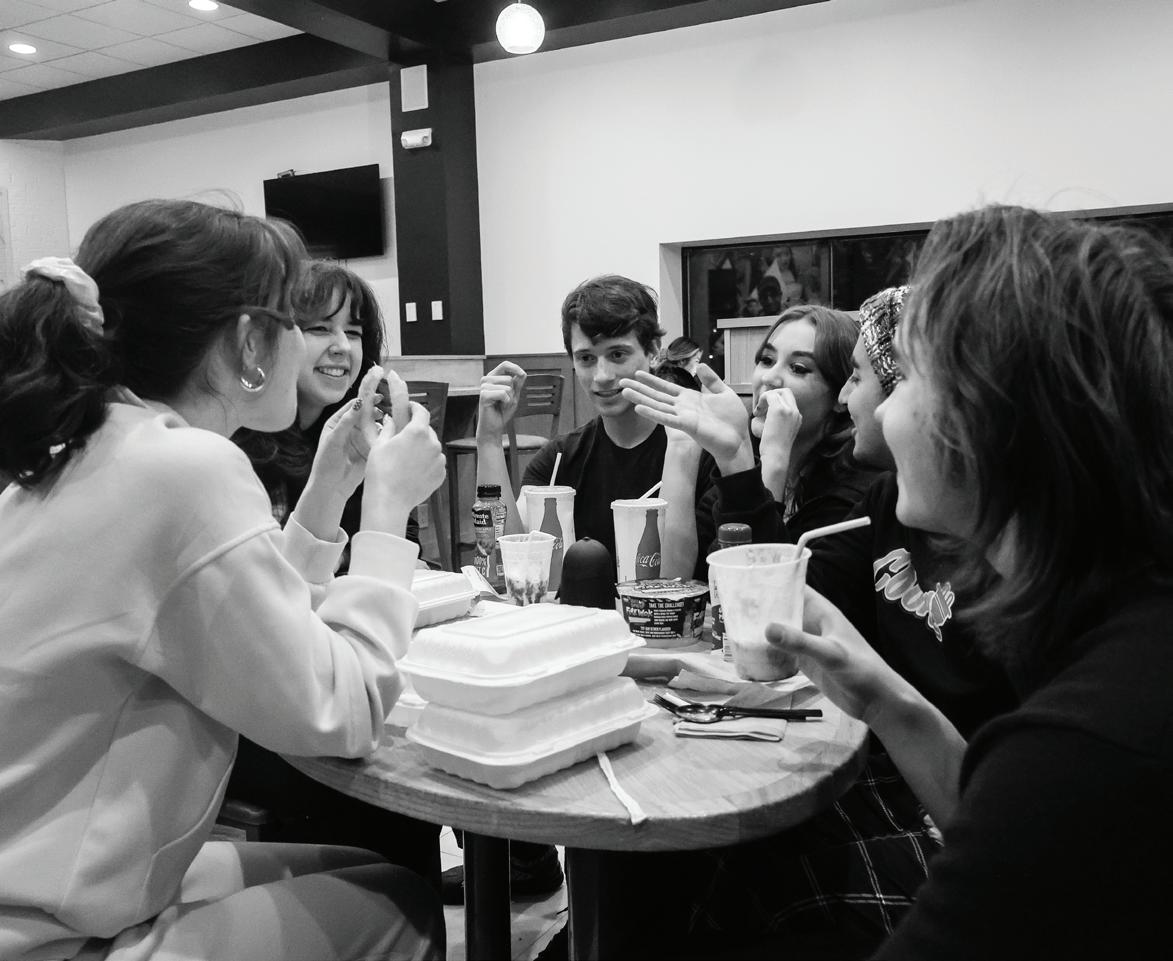
during these long shifts, HofUSA allows mobile orders to be placed through the Boost app. HofUSA staff receive an order five minutes before a student’s pick-up time.
“The Boost system only gives us five to 10 orders at a time, and it won’t push the next batch in until you complete those,” Stanford said. “There’s always room for growth. There’s always hiccups in the computer part of the ticket system. We all have to be trained to put out fires basically, it’s a growing process.”
Many students express concern when the HofUSA kitchen gets behind with orders. Alyssa Forgione, a freshman forensic science major, commented on the matter.
These worries are not ignored and are consistently being taken into consideration.
While students notice the delays, staff members say they are working under constant pressure to keep orders moving quickly. “It should not take longer than three or four minutes to put out fried food. It has to be fast,” Stanford said. “You jump through hoops with this. It’s about the students; nobody wants to wait long for their food. The faster it’s out, the less tickets pile up.”
A possible reason for long wait times could be potential understaffing issues that they’ve been facing.
“We used to get in people from different locations in Hofstra just to help us out because a lot of
people want a job and then quit in a week, Stanford said. “Coverage is hard.”
Most people find the hours to be unmanageable – working during the night and squeezing in a few hours of sleep during the day. Somehow, the HofUSA staff is able to find a way to make it work for them.
“I like working these hours because I’m not a morning person,” Stanford said. “I have five kids total. I have two of them [living] with me; I’ve got to get my 7-year-old ready for school. Yesterday, I went to sleep at 1:30 [p.m.] and had to be back here at 5:30 [p.m.] that same day.”
Even with a full schedule and children to take care of, Stanford sacrifices a “normal” sleep schedule to provide for his family. These efforts are admirable and deserve recognition.
“When I left college, my first restaurant job was more of a militant type of vibe,” Stanford said. “I played a lot of sports, so I listen to my coaches like my head chef. ‘Do what you gotta do, keep your head down and just don’t piss them off.’” Stanford and the rest of his team demonstrate an unimaginable amount of discipline.
When it comes to the student-staff relationship, respect is a two-way street.
“One student was like, ‘It’s about time,’” Stanford said. “But a lot of the students, no matter where they come from, say, ‘Thank you. Have a good night,’ and appreciate it. I show them love. They respect me and I respect them. They do make it worth it.”
Emilie Morrissette / The Hofstra Chronicle
Emilie Morrissette / The Hofstra Chronicle
FEATURES
Our Voices at Hofstra: Saskia Laurié
By Denivia Rivera FEATURES EDITOR
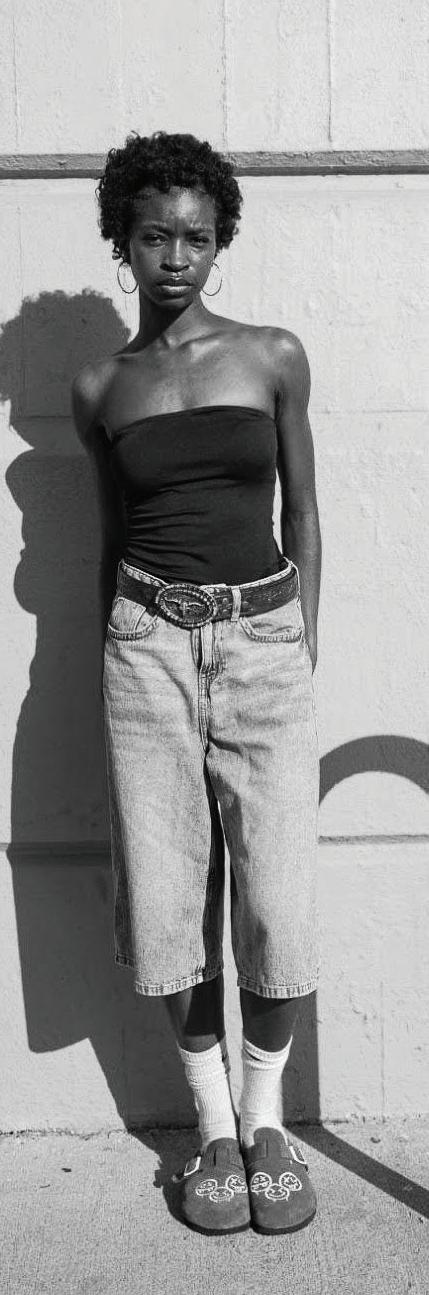
“What drives me is the desire and the want to see people strive in different ways,” said senior dance and speech-language-hearing sciences double major Saskia Laurié. “I think that diversity and equity is very important, as well as having faith and the right tools to be successful in your career field. I kind of wanted to be that person to give back to my community that way.”
Laurié is president of three clubs on Hofstra University’s campus: Hofstra’s chapter of National Association for the Advancement of Colored People (NAACP), Hofstra Gospel Ensemble and Melanin Movers.
“My role as president is mainly to ensure that all tasks are getting done and being able to advocate for the club and its members by creating events that tailor to their needs and wants and support the mission statement of each club,” Laurié said.
For NAACP, the mission is to provide justice and equity within the Hofstra community, to create a safe space for students of color
and to ensure that all students on campus and faculty feel seen and heard.
“Hofstra Gospel Ensemble is more so to bring people together who are either finding their faith or have their faith and creating a sense of ministry and ensemble through songs, dance and events,” Laurié said.
In the spring of 2025, Laurié created Melanin Movers to provide a safe space for dancers of color to be able to gain knowledge on what it takes to be a professional dancer in the field.
Laurié expressed that identity-based organizations create spaces where people can be around others who look like them, who are culturally bound to them or who are related to them in ways that are harder to find outside of these spaces.
“It’s very important to have identity-based clubs on campus because I feel like, as college students, sometimes we’re in the sense of finding ourselves, and sometimes we need people to help us find who we are,” Laurié said.
In addition to her multiple president roles, Laurié is a resident
assistant (RA) for the first-year housing in the Netherlands Complex, which is full of students who are adjusting to a new space.
“The reason why I decided to be an RA is because I like to assure people that they have a space here,” Laurié said. “I like to make sure everyone is okay –safety wise, health wise, mentally, physically – and create programs that tailor to helping people feel that they’re at home.”
She said that her role as an RA is to ensure that her residents are in a safe, home-like community to create programming and to check in with residents to help them seek a sense of guidance.
Laurié is also a part of Hofstra’s Student Diversity Advisory Board.
“The Student Diversity Advisory Board is a board full of students to have that sense of call-to-action,” Laurié said. “We hold a lot of fireside chats. We’ve been working on podcasts, touching base on issues that are either happening in the world or on campus and our perspective on it.”
Laurié said that it’s important to have students of color in lead-
ership positions to be role models and examples to others.
“In this society, we’re kind of seen as the people who are held to low expectations, that we don’t do enough work, but we’re so much more than that,” Laurié said. “I feel like being a student of color on its own holds so much power, and seeing people like us in a role kind of gives everyone else this extra push like ‘I could be that too.’”
In addition to her leadership positions, Laurié is on Hofstra’s Pride Court. She said that this position has allowed her to have conversations with people from different cultures and different clubs and to be a helping hand for more than just her people.
“Being a student leader of color sometimes seems to take more work because I feel like I have to show up a certain way in order to be heard,” Laurié said. “It’s very important that myself and other student leaders of color are heard because we have a lot of opinions that we know can change the culture of Hofstra and can enhance [its] values and mission statement.”
Personal Essay: Please bring back the dab
By Hannah Mudry
FEATURES EDITOR
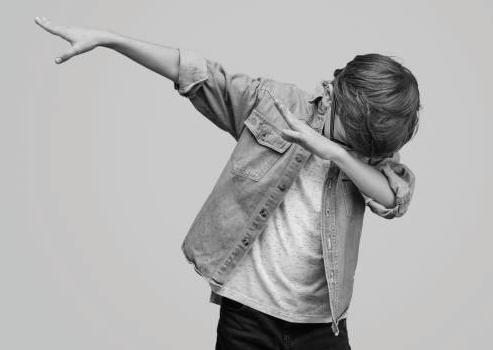
In 2016, American rapper iLoveMemphis released “Lean and Dabb,” a song that shaped youth culture. The first verse starts with the iconic line, “Wake up in the morning then I dab.” With the rise of short-form video platform Musical.ly, the song had every young teen at the time leaning into the elbow crease of their bent right arm and extending their left arm upward.
The dab died relatively quickly; it was our generation’s version of “six-seven.” At the time, I considered it kind of annoying, but I did the dance anyway. I did it with my friends, for my silly little social media videos and during softball practices. Looking back, I miss the dab. That dance move now represents a time when life was simpler for a lot of people.
I was 10 years old, enjoying the last little bit of elementary school I had left. I remember days when I would beg my mom to get me the Starbucks Unicorn Frappuccino, to go shopping at Justice or to use her phone to film my videos for Musical. ly. I was sure I would become famous.
This year, Generation Z began posting a campaign saying that we should make 2026 feel like 2016 in a nostalgic attempt to romanticize life before the 2020 COVID-19 pandemic. In my opinion, the best place to start is by bringing back the dab. Before writing this personal essay, I asked people how they would feel if we brought back the dab. Every single person smiled the second I mentioned the dance move, then proceeded to do it. Even if someone said they haven’t hit the dab since 2016, they still smiled, remembering what the move meant to
them during their younger years. It makes our generation automatically feel happier because it reminds us of a time where life was simpler.
When I have a really long essay that I need to write or a grade that stresses me out, I just hit the dab. I am so mortally embarrassed about the fact that I just performed a dance move that was popular when I was 10 years old that I am automatically happier than I was before I did this move. When I do a good workout or have a tasty coffee, I solidify my happiness through a dab. It comes back when I am sad, happy or annoyed. Honestly, with any emotion I feel, I hit the dab.
I remember my brother and I would hit the dab continuously around the house for no apparent reason. It was a time when I could just be a kid with no real responsibilities. In high
school, it was so easy for me to get caught up in work and school that I forgot it was okay to have fun and still feel like a child. I was going from classes to extracurriculars to work and getting super overwhelmed because I was trying to emulate what I thought the transition from childhood to adulthood had to look like.
Whenever I hit the dab, I remember that life is not that serious and everyone is here just to have a good time. If little kids can yell “six-seven,” then I can hit the dab. I want to bring it back because, for me, it connects me with all my childhood memories and reminds me that it is okay to explore childhood humor even as an adult.
Photo provided bySaskia Laurié
Photo courtesy of iStock
Special Edition of Man on the Unispan:
Hofstra Crew in the Stu
“How are you spending the blizzard day?”
By Hannah Mudry FEATURES EDITOR
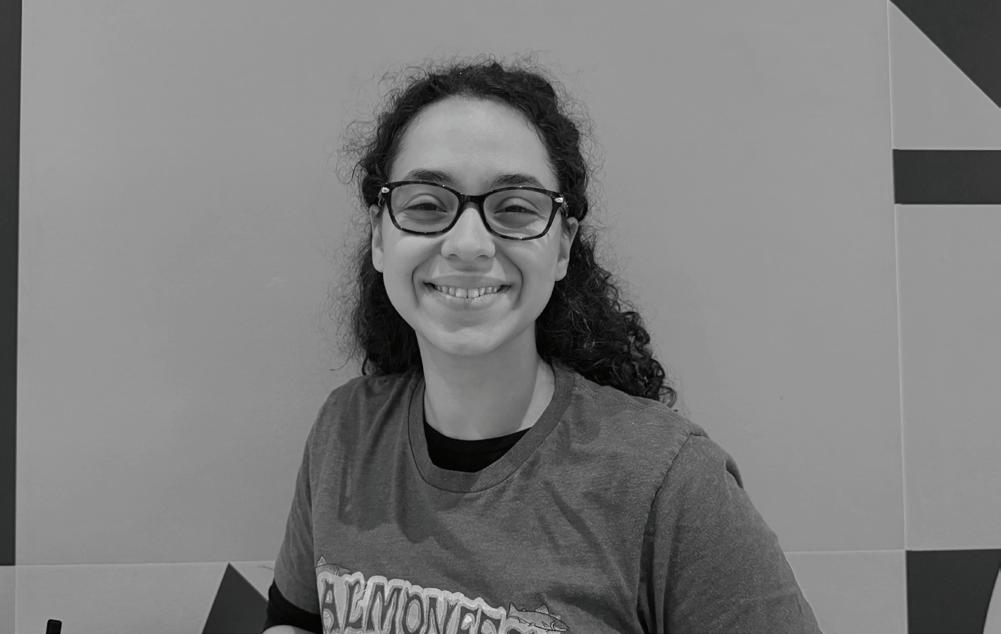
“First, I was gonna do all my work, but I feel like you gotta build a snowman. Maybe build a snowman later, but it’s a Monday.”
- Arietta Xylas, Senior
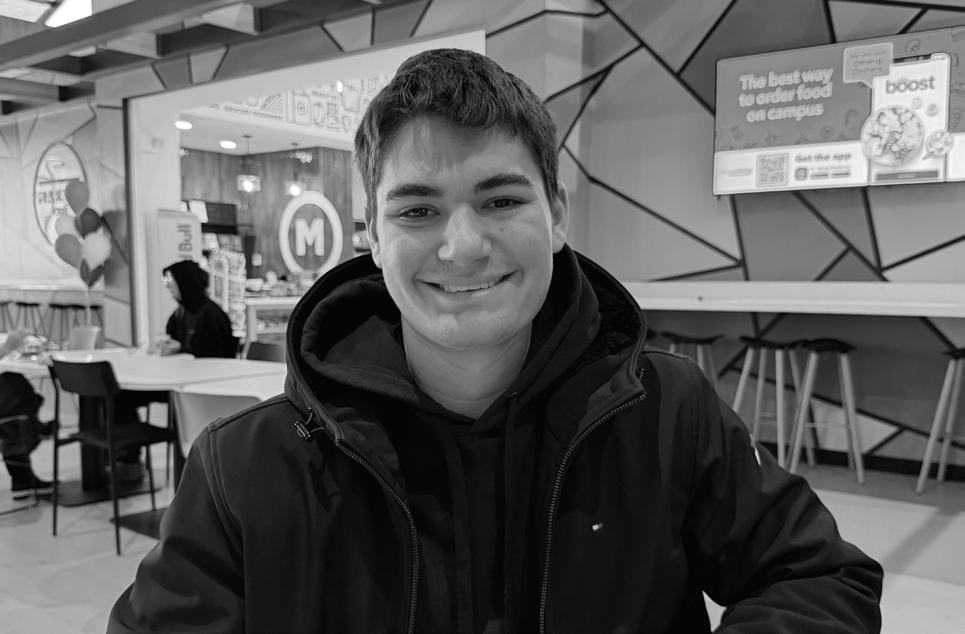
“I’m going to classes [virtually] and doing my laundry because there’s nothing else to do.”
- Jacob Edelson, freshman
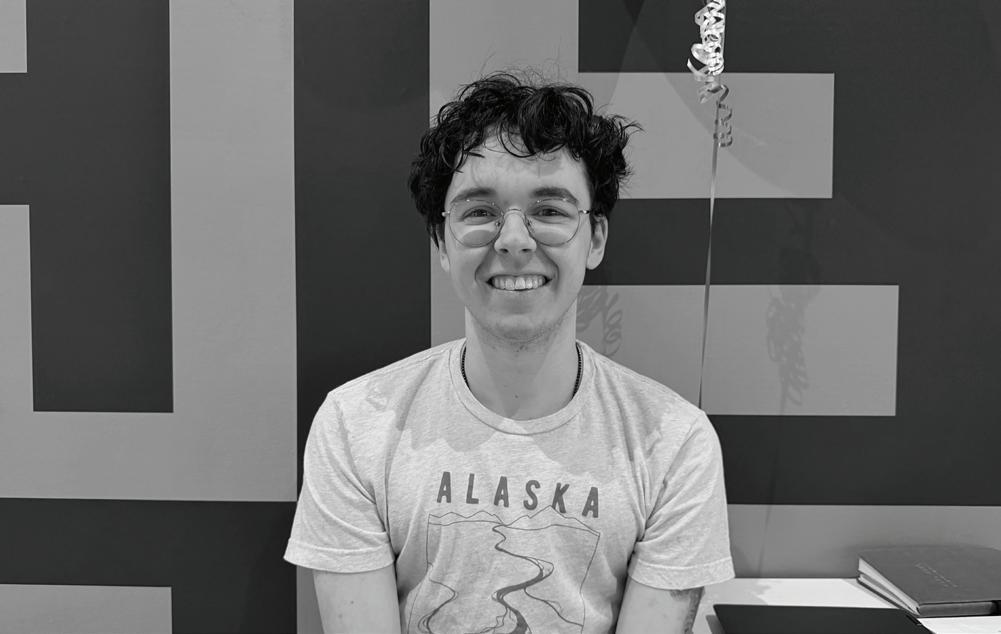
“I treked here in the snow for breakfast. I am studying for tests because they got moved to Wednesday now. I think a hot chocolate and a snowman are definitely in the future.”
- Morgan Christopherson, junior

O
verheard @ h O fstra
“It makes me sad when men don’t wear sparkles.”
“You’re sweet and you’re cute, but you have an RBF and it scares me.”
“She’s giving Ted cruz.”
“It’s not giving rave; it’s giving hijab.”
“It’s not like I’m chewing a leaf, but more like I’m sniffing a mushroom.”
“Do men do curling because I only ever see beautiful, young women do it?”
“I can’t handle 18 inches; there’s nowhere for it to go.”
“But I don’t want to drink the Italian seasoning”

If there’s something funny you overhear, you can now submit it here!
Spread by Hannah Mudry and Denivia Rivera
Hannah Mudry / The Hofstra Chronicle
Alumni Feature: Shannon Caturano
By Hannah Mudry FEATURES EDITOR
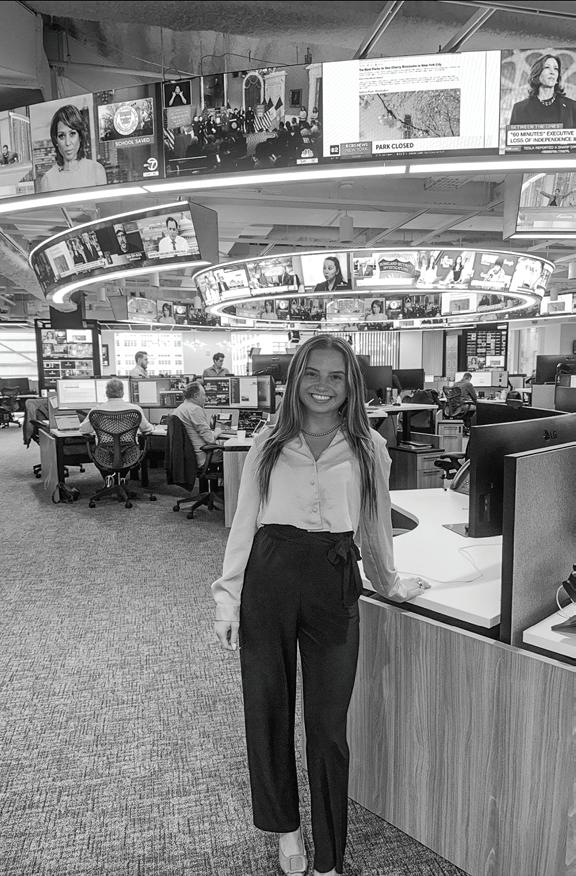
The news industry is always changing and adapting. From print newspapers to television broadcasts to social media communications, journalists strive to be ahead of the change. Shannon Caturano, a 2018 Hofstra University graduate, continues to watch how the communications industry advances and strives for success with each change.
“Something I really love about my path is that I’ve had experience with all different platforms.
I’ve worked in TV for local news, for broadcast, for streaming, for digital,” Caturano said. “I’ve done some print too and social media, and now I’m doing live news. I’ve loved that I’ve had a mix of storytelling across all different platforms.”
Caturano currently produces for the Wall Street Journal’s Leadership Institute. She works on a live summit where she produces conversations with chief executive officers and business leaders, while other c-suite executives watch from a live audience.
“I get to see live how people are reacting to the shows I produce, which are really exciting,” Caturano said.
Caturano started at the WSJ in Aug. 2025. This new career path was the first time Caturano focused on one topic in a newsroom. She covers all leadership business news to show how big corporations operate. In the age of artificial intelligence, Catura-
no is excited to report where the future of the business world is headed.
Before taking a position at the WSJ, Caturano worked with ABC News Live, where she produced weekly segments for medical and business news.
“I build those from the ground up,” Caturano said. “I moved over to managing the social media accounts for ABC News Live, so I built those from the ground up as well – we got to 1.1 million followers on TikTok in a year, which is so exciting.”
Caturano learned how to repurpose traditional broadcast stories for every social media platform during her time at ABC News Live.
“Every story works with every platform,” Caturano said.
Not only did she learn the

of fine journalists.
Caturano’s mentor during her undergraduate years at Hofstra was her journalism professor, Carol Fletcher. Also being her internship advisor, Fletcher pushed Caturano to complete an internship. Fletcher was there through the whole process for Caturano.
operations post-graduation.
Caturano was also a part of WRHU 88.7, Hofstra’s student-produced radio station.
During the 2016 presidential debate at Hofstra between Trump and Democratic nominee Hillary Clinton, Caturano broadcasted
“I’ve always been staying as close to the industry change as possible and I hope I can still do that,” Caturano said. “I think that’s a big part of my success.”
importance of social media storytelling, but she also researched and produced TV stories. One project that she worked on was exploring the impact of social media on teenagers through a 30-minute segment titled “Generation Swipe.”
“Generation Swipe” won the 2025 Dateline Award for Excellence in Local Journalism from the Society of Professional Journalists’ D.C. Chapter. She was recognized in the Television, Business category.
The story followed families who were positively and negatively influenced by social media use. Caturano takes pride in the interviews she conducted that turned into an important story, which can be streamed on Hulu and Disney+.
During her entire career, Caturano had the opportunity to be a mentor to those she produced and wrote stories with. She believes that being a mentor is an extremely important aspect to the development
“Hofstra really taught me how to tell stories,” Caturano said. “I covered the presidential debate with ABC when it was the ABC News Presidential Debate with [President Donald] Trump and Kamala Harris. It was so funny because it was a full circle moment – the first story I covered at Hofstra was the presidential debate.”
Caturano came to Hofstra as a transfer student from Suffolk County Community College in 2016 to pursue broadcast journalism.
Caturano felt behind when she arrived at the university.
“I was so impressed with where the Hofstra students were,” Caturano said.
After her first semester, she didn’t feel so behind anymore. She joined HEAT Network by working on Hofstra Today, a student-led news TV broadcast. She did a lot of on-camera work during her undergraduate years, so she was grateful to gain experience with the behind-the-scenes
the first Facebook Live that the radio station produced.
Her resume earned her an internship with Spectrum News NY1 during her first semester of her senior year. She was grateful to continue working freelance in her spring semester of senior year. She worked 50 hours a week while juggling her class schedule.
By graduation, balancing her workload paid off because she was offered a full-time position and stayed with NY1 for four years.
At NY1, Caturano worked through the COVID-19 pandemic, where digital storytelling grew rapidly.
Caturano helped create the Spectrum News app with newly introduced push notifications. She enjoyed the rush of racing other news organizations with the newest COVID update. She fell in love with digital news because she saw that the best way to get a story out was through a cell phone.
“If COVID never happened, I don’t think I ever would have been in digital news,” Caturano said.
She saw that the news industry was going to digital anyway, but COVID just gave it the push. In her undergraduate classes, she was introduced to digital storytelling because her professors knew digital news was up-andcoming.
“I’ve always been staying as close to the industry change as possible, and I hope I can still do that,” Caturano said. “I think that’s a big part of my success.”
Caturano majored in journalism because she wanted to tell stories that people could react to and learn about. The first time she wrote a feature story in one of her classes, she knew she would make a difference in the field.
“I’m really grateful that in my career there have been so many people who have trusted me to tell their stories,” Caturano said.
Although Caturano has always been ahead of the curve, she knows she’s still learning.
“Everything feels slow while you’re doing it, but then, you look back and think, ‘Wow, I actually did a lot this year, and I’m proud of that,’” Caturano said. “I hope I get to continue growing in my career.”
Her advice is to always vouch for the stories that are important by going past the headline of the day.
“Sometimes, the best stories are the ones that take longer to tell,” Caturano said. “Be ready to change with the industry.”
Photo provided by Shannon Caturano
Photo provided by Shannon Caturano

Detroit ‘67
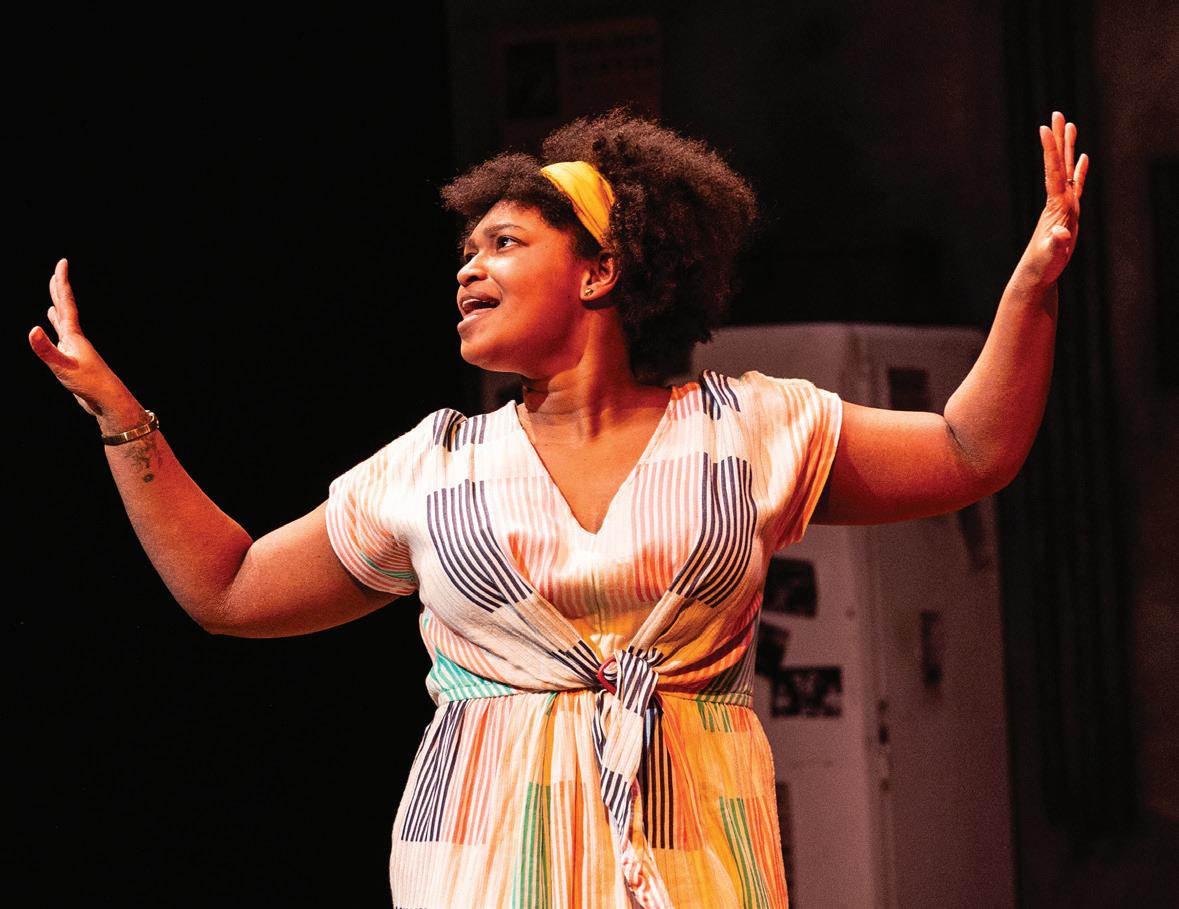
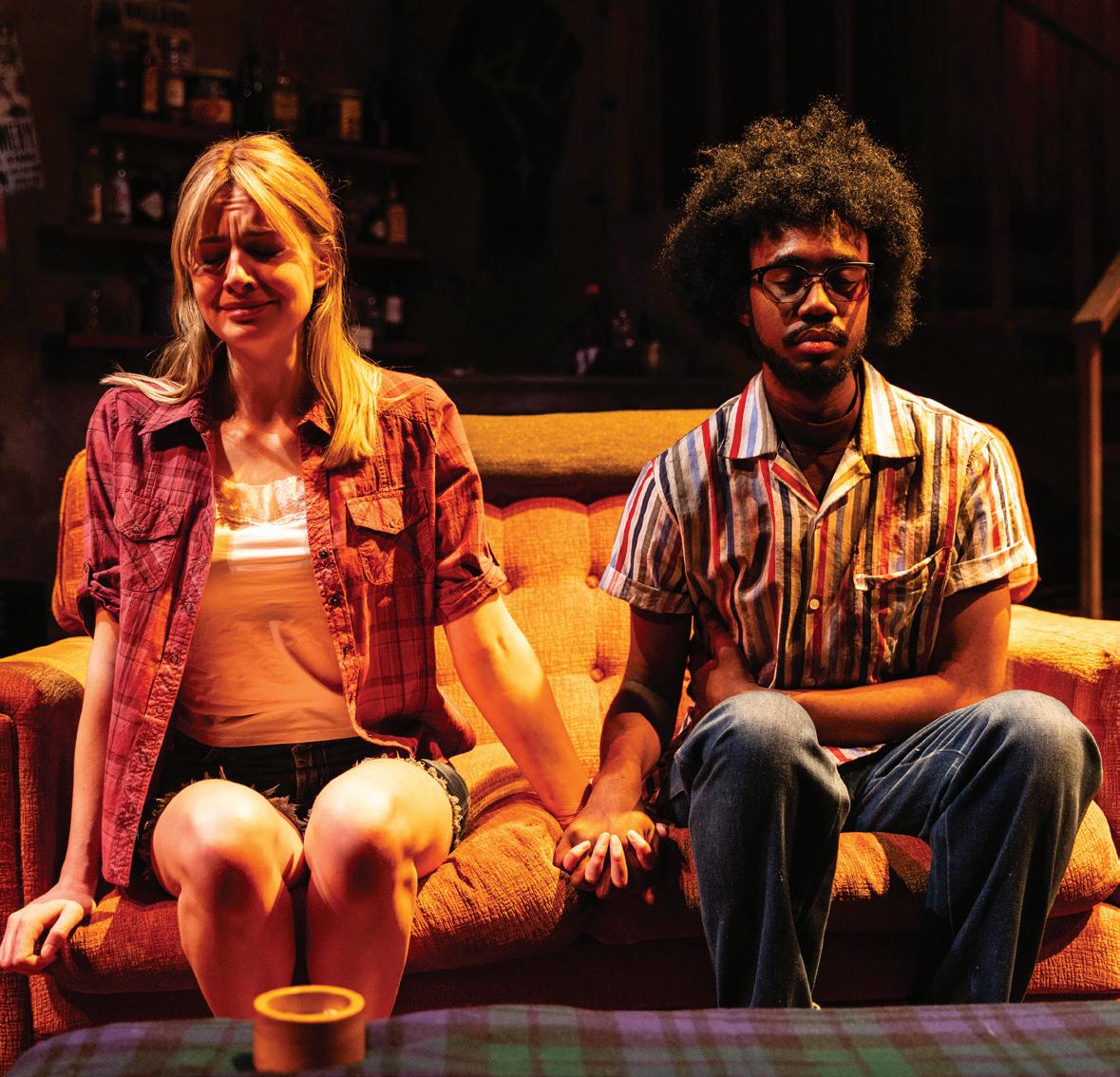
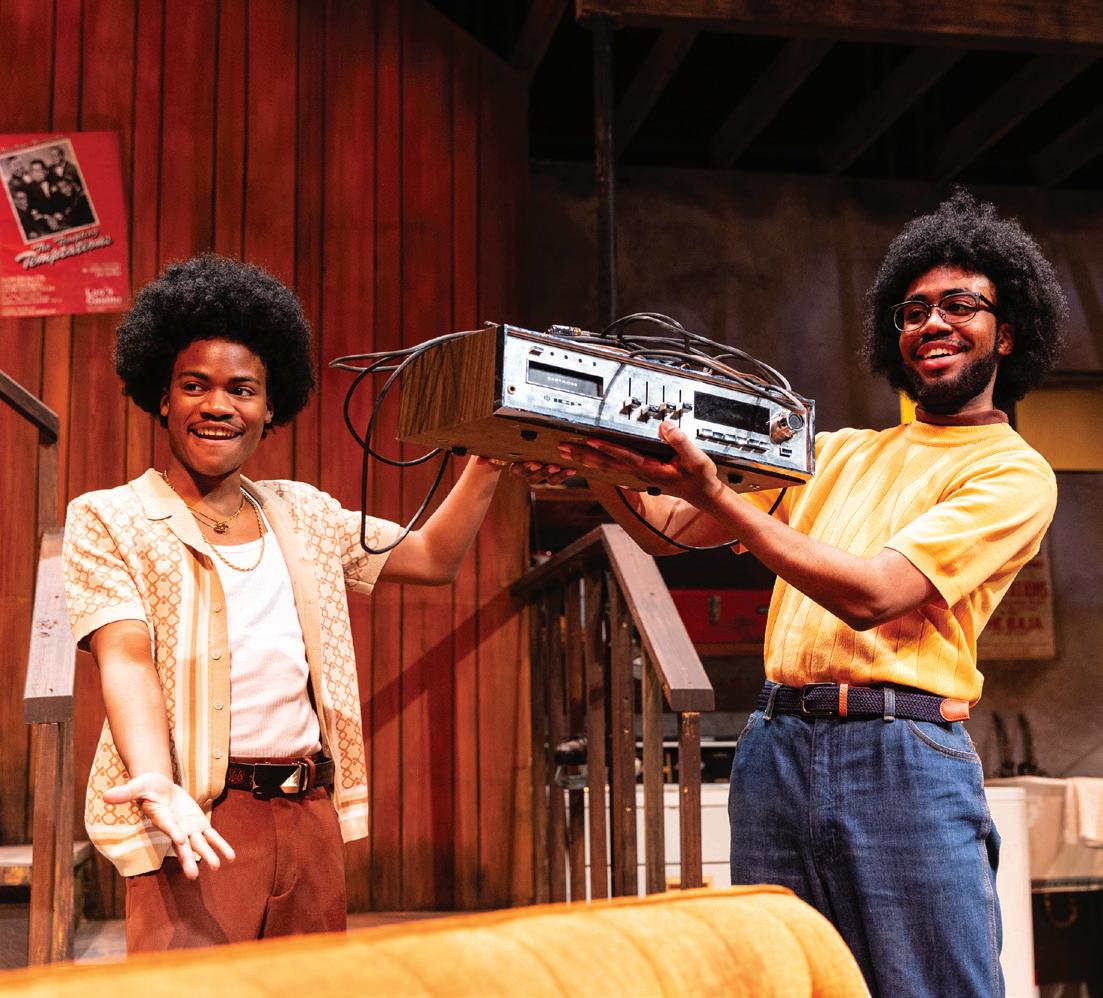
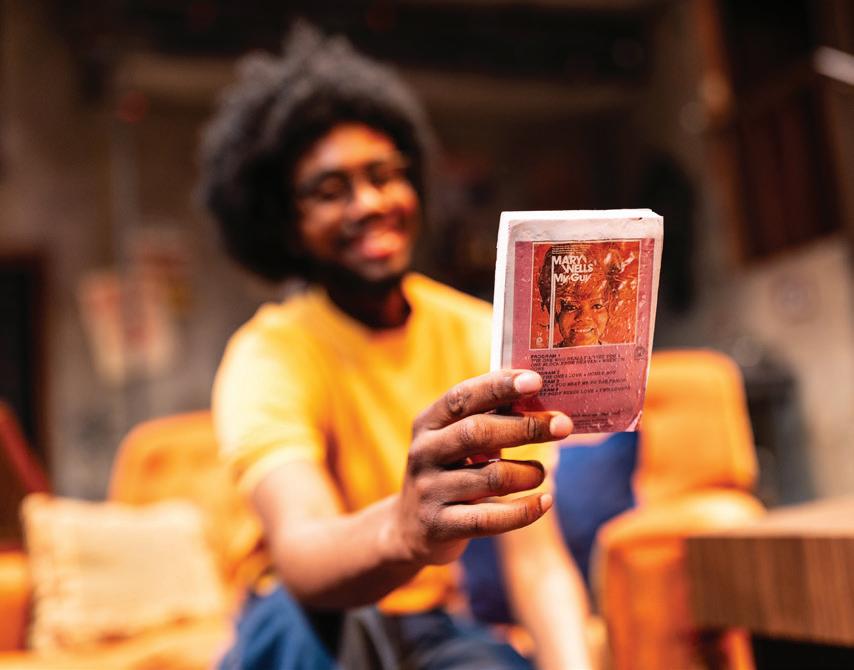
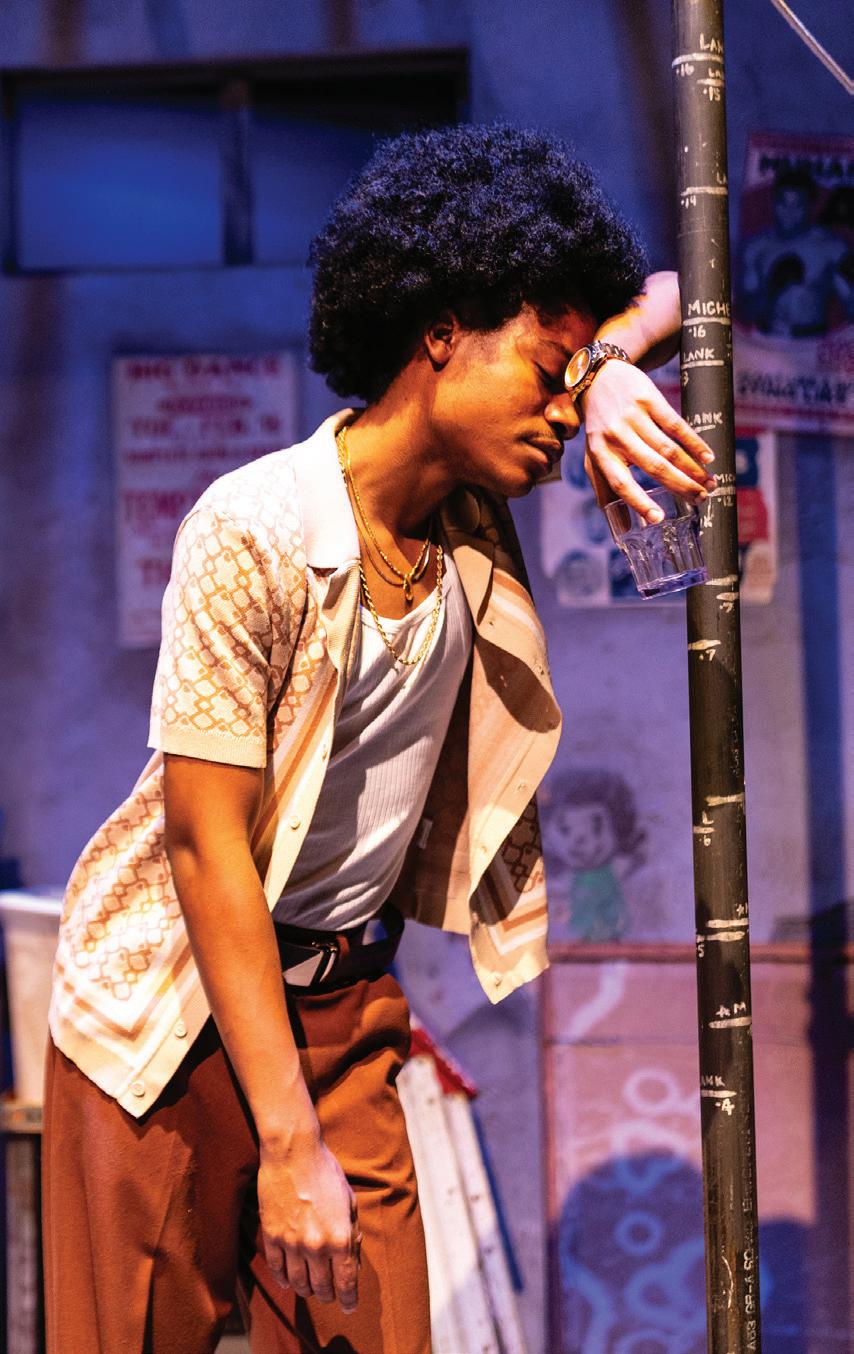
The Hofstra University Department of Drama and Dance presented Detroit ‘67. To celebrate Black History Month, adjunct professor G.D. Kimble directed students in this award-winning production set during the 1967 Detroit riots. The show centers around siblings Chelle and Lank, who try to navigate their relationship and life in their community while running their own “afterhours joint” in their basement. Their future performances are on Thursday, Feb. 26; Friday, Feb. 27; Saturday, Feb. 28 and Sunday, March 1.


Background by Anthony Favilla / The Hofstra Chronicle
Anthony Favilla / The Hofstra Chronicle
Anthony Favilla / The Hofstra Chronicle
Anthony Favilla / The Hofstra Chronicle
Anthony Favilla / The Hofstra Chronicle
Anthony Favilla / The Hofstra Chronicle
Spread by Kumba Jagne and Joe Orovitz
Background by Joe Orovitz / The Hofstra Chronicle
Joe Orovitz / The Hofstra Chronicle
Joe Orovitz / The Hofstra Chronicle
Joe Orovitz / The Hofstra Chronicle
Joe Orovitz / The Hofstra Chronicle
Joe Orovitz / The Hofstra Chronicle
Arts And EntErtAinmEnt

Photo courtesy of House & Garden
'Wuthering Heights' fails as an adaptation
By Carmen Pope STAFF WRITER
Over the weekend, I went to an early showing of Emerald Fennell’s “Wuthering Heights.” The film received plenty of attention, gaining mixed reviews from critics and viewers alike. It has a 59% rating on the Rotten Tomatoes’ “Tomatometer” and 2.9 stars out of five rating on Letterboxd. Although, the soundtrack by Charli xcx was widely liked, the only thing everyone has seemingly agreed upon is that the movie was a terribly horrific adaptation of the book.
I would like to preface this review by saying that I actually enjoyed the movie. I even found myself crying toward the end. With that being said, how did “Wuthering Heights” disappoint audiences so badly? It could not have been the set, which was designed by Suzie Davies, who also worked with Fennell on “Saltburn” (2023). She did a great job designing
the various scenes and representing how much wealth the Linton family had. Nor was it the costume designer, twotime Academy Award winner Jacqueline Durran, who had an incredible take on the gowns and dresses designed for Catherine (Margot Robbie). Durran’s recent and most iconic project was Greta Gerwig’s “Barbie,” in which Vogue stated, “Durran was responsible for that cultural phenomenon’s brilliant wardrobe.”
The reasoning behind the film’s failure differs, but all roads lead back to the film’s title: “Wuthering Heights.”
The book “Wuthering Heights” is an English gothic tragedy. Published in 1847 by author Emily Brontë, the novel follows two vengeful young adults who are consumed by their obsessive love for one another. Since the book’s release, there have been 25 movie adaptations, the most recent being Fennell’s in 2026. Her approach was the most original that anyone has
seen. As much as I liked the film and found it interesting, you cannot create a movie using your original idea and call it an adaptation. If the film had no attachments to the novel and went by another title, I can see the reactions being different. Although I have not read the source material myself, I have done much research, and the differences between the novel and the film are too big to ignore.
Fennell turned the tragedy into more of an erotic romance and completely misunderstood the characters. In the novel, Catherine and Heathcliff only kissed a few times, not holding much significance to the physical and sexual nature of their relationship. The novel relied heavily on their shared moments, spiritual connection and profound draw to one another to develop their relationship. In the film, Catherine and Heathcliff have a full-on sexual affair while she is married and pregnant. It seems that
Fennell was infatuated with the idea of young love becoming something more, but couldn’t fathom that the novel, which she drew inspiration from, was actually nothing more than an ill-fated love, leaving both parties in anguish.
The film has also come under fire for its casting decisions. In the book, Heathcliff is a man of color. In the film, he is played by Jacob Elordi, a white man. Also, Elordi is 28 and Robbie is 35, making them both double the ages of the characters from the book.
Despite the negative reviews surrounding the film, it has been a box office success, grossing over $90 million globally with a budget of $80 million. It is now Elordi’s highest-grossing film. Though this adaptation does not make Fennell a bad writer or director, I hope she takes this as an opportunity to start giving herself more credit in originality.
Bad Bunny: A reign of Latino success
By Kimberly Lopez ASSISTANT ARTS & ENTERTAINMENT EDITOR
You probably can’t go a full week without hearing about rapper Bad Bunny at least once. Over the past few years, the buzz over his name has only kept growing, with 2026 reaching new heights. With humble beginnings and a loud pride for Puerto Rico, Bad Bunny’s flowers are certainly deserved.
Benito Antonio Martínez Ocasio, better known as Bad Bunny, began singing at a young age. His notorious stage name came about when he posted a picture of himself as a kid in a bunny suit, looking upset. He later created an X, formerly Twitter, account under his stage name and kept it as he rose to fame.
Bad Bunny attended the University of Puerto Rico at Arecibo, where he studied Audiovisual Communications,
with aspirations to become a radio host. At night, he would work on creating songs among the reggaeton and trap genres, eventually leading him to drop out of college to focus on music.
Bad Bunny first posted his music on SoundCloud, a major audio-streaming platform and social networking platform. His single “Diles” was discovered by Puerto Rican producer DJ Luian in 2016. This led to Bad Bunny’s signing to the Hear This Music label, founded by DJ Luian. In 2017, Bad Bunny began to make a name for himself by releasing more singles and collaborating with popular Latino artists like Prince Royce.
He earned his first No. 1 hit with a feature on the song “I Like It” by Cardi B with J Balvin. This broadened his United States audience, as well as a future collab with Drake titled “MÍA.”
He won his first Grammy Award for his album “YHLQMDLG” (an acronym
for “Yo Hago Lo Que Me Da La Gana”). This album further cemented his success with hits like “Yo Perreo Sola.”
In late 2020, he released another album titled “Un Verano Sin Ti,” which won a Latin Grammy for Best Música Urbana (Best Urban Music) and was the first Spanish language album to debut at No. 1 on the Billboard Hot 200 Chart.
Bad Bunny reached his magnum opus with “DeBÍ TiRAR MáS FOToS,” which released in Jan. 2025. This album was a love letter to his homeland, Puerto Rico, and it received immense critical acclaim. To this day, it is still making history. It won Album of the Year at the 2026 Grammys, becoming the first fully Spanishspeaking album to do so.
With its release, Bad Bunny booked a month-long residency in Puerto Rico at the José Miguel Agrelot Coliseum. He titled the tour “No Me Quiero Ir
Quick Hits

Want more A&E Content? Scan to learn more about what's happening in the world of entertainment!

de Aquí” – which translates to “I don’t want to leave here” – the perfect title for someone performing at the home they love dearly. He decided not to tour at all in the continental United States for this album, bringing dedicated fans to travel to his homeland. With all dates sold out, the tour made Puerto Rico’s economy flourish. Following this, he was picked as the 2026 Superbowl Halftime Show artist.
On Tuesday, Feb. 17, Bad Bunny made history with “DtMF” once again, when the single became the first all-Spanish language solo single to reach No. 1 on the Billboard Hot 100.
With Bad Bunny’s landing his first lead acting role in a film called “Porto Rico,” directed by rapper Rene “Residente” Pérez Joglar, it is clear that his reign of success is far from over, as his legacy continues to inspire Latinos across the world to bet on themselves.

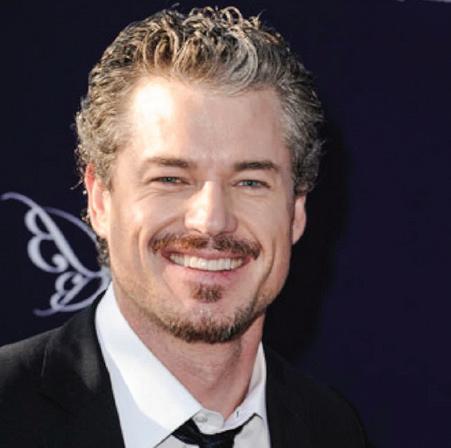
Netflix released a posthumous interview with Eric Dane after the actor lost his battle to ALS disease.
McKenna Grace will play Daphne in Netflix's live action 'Scooby Doo' series.
Photo courtesy of Parade
Photo courtesy of IMDb
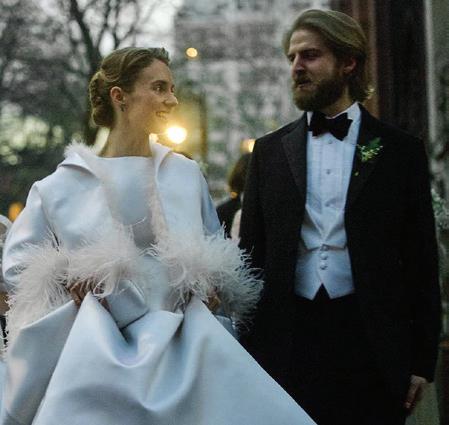
Maya Hawke and singer Christian Lee Hutson got married on Sunday, Feb. 14.
Phoebe Dynevor, star of 'Bridgerton,' was cast as January in 'Beach Read' film adaptation.
Photo courtesy of People
Photo courtesy of Deadline
Editor's Picks



'Wonder Man' brings humanity back to Marvel
By Lyba Khan STAFF WRITER
*SPOILER
WARNING*
On Tuesday, Jan. 27, Marvel Studios, LLC quietly released what may be its most emotionally grounded miniseries in years. With almost no promotion, “Wonder Man” arrived on Disney+ without the noise that usually surrounds a Marvel Cinematic Universe (MCU) project. What it delivered instead feels rare – a superhero story rooted in vulnerability and the human need to belong. From the opening moments, Simon Williams (Yahya Abdul-Mateen II) feels less like a hero and more like someone we recognize – a character chasing his big break. His struggle was reminiscent of Emma Stone’s role as an aspiring actress in “La La Land” and Andrew Garfield’s portrayal of Jonathan Larson in “Tick, Tick... Boom!” These are characters who cling to hope
even as rejection slowly wears them down. As an actor, Simon earnestly awaits his big break, believing it will come even as doors continue to close.
The first episode starts with a few questionable choices on Simon’s end, making it a little frustrating to watch – he fumbles opportunities and seems to push himself further from his goals. It’s easy to dismiss him as self-centered or clueless from the first few minutes of the episode alone. Yet, as the series slows and allows us to sit with him, small details begin to reshape our understanding. Hesitation, insecurity and quiet disappointment reveal a man defined less by ego and more by his own personal fear of failure. He becomes someone who is shaped by his ability to be human instead of being defined by his powers.
The emotional core of the series lies in Simon’s friendship with Trevor Slattery (Ben Kingsley), the disgraced actor
once presented to the world as the Mandarin. Returning to the MCU still shadowed by that infamous role, Trevor becomes an unlikely mentor and confidant to Simon. Their bond brings warmth and humor to a show with such raw feeling while also giving Simon something he lacks: someone who truly sees him and keeps him grounded when he feels lost.
The season’s major plot twist arrives in the finale, when Simon discovers that Trevor has been hired to spy on him for the Department of Damage Control. After the growth both characters have shown throughout the season, the revelation lands with heartbreaking weight, as Simon realizes his closest friend may never have truly been on his side. In response, he loses control of his powers more violently than ever before.
In this time of the MCU, enhanced individuals are no longer universally celebrated; they are viewed with suspi -
cion. Episode 4, “Doorman,” illustrates why. DeMarr Davis’ story functions as a mirror for Simon. Both men are ordinary individuals thrust into extraordinary circumstances, struggling to understand their limits. Where DeMarr loses control, Simon recognizes what he could become and what he fears most.
What makes “Wonder Man” stand out is how human it feels. The story isn’t driven by world-ending stakes or constant action. Although the superheroes shape their world, the series is more grounded in exploring self-identity.
Despite minimal advertising, the show is already finding an audience drawn to characterfocused storytelling, and its quiet release contrasts louder projects that deliver far less emotional weight. If this miniseries proves anything, it’s that “Wonder Man” doesn’t need to be the biggest story to leave a lasting impression.
Megan Moroney reaches for the sky in 'Cloud 9'
By Abby Gibson ARTS & ENTERTAINMENT EDITOR
Pink clouds, dreamy guitar strums and relationship insecurities are all at play in Megan Moroney’s third studio album, “Cloud 9,” which released on Friday, Feb. 20. Across 15 tracks, this country pop singer created an album that leans into her self-appointed “emo cowgirl” persona, delivering a project that feels cohesive and captures the ups and downs of a relationship. With strong production and vulnerable lyrics, “Cloud 9” shows growth in Moroney’s songwriting and sound.
Moroney co-produced the album with Kristian Bush and Luke Liard and co-wrote it with Amy Allen, Ed Sheeran, Jessi Alexander and others. Moroney says that she almost named the project after the punchy, upbeat song “Medicine” before deciding on the dreamy love song “Cloud 9.”
“I just got to a point in my life – it was like a very foreign feel-
ing, to feel so happy,” Moroney said in an interview with Taste of Country. “Just like an excitement to live, which you know I feel like is rare for a lot of us to just wake up and be like, ‘Wow, today is wonderful.’”
This sentiment is felt in the opening track, which begins with a catchy guitar riff exuding strong romantic energy. She sings about being so in love with a guy that she’s higher than Cloud 9. In contrast, “Medicine” takes an edgier approach. With a more aggressive tone, the song is about giving a man a taste of his own medicine, diving into themes of revenge and emotional manipulation. The difference between these two tracks showcases the range of Moroney’s lyrical and emotional abilities.
Compared to her 2024 album titled “Am I Okay? (I’ll Be Fine),” “Cloud 9” feels like she is continuing her reign as an “emo cowgirl” while showing off her improvement in both lyrical
structure and musical cohesion. If one were to loop the album backto-back, they would hear the last track, “Waiting On the Rain,” fading out and would be brought back into a dream-like state with “Cloud 9” acting as the cycle shape that relationships can take.
Each song in Moroney’s newest album can capture and describe a specific moment within a relationship. It starts with a period of infatuation in “Cloud 9” and moves towards the doubtful and heart-breaking ballad “Waiting On the Rain” that reinforces the emotional arc of the record.
The album has two features: Ed Sheeran on “I Only Miss You” and Kacey Musgraves on “Bells & Whistles.” Both collaborations feel meaningful and purposeful rather than names used to promote the album. Moroney has called Musgraves one of her primary songwriting influences and told Absolute Country Radio, “That collab is my Super Bowl.”
When asked why “Who Hurt
You?” was a vulnerable track for Moroney in an interview with Elaina Smith, Moroney said that she actively avoided answering questions about that situation. The situation in question comes from a rumored love triangle between her and two other country music stars: Ella Langley and Riley Green. The track goes beyond this speculation as she captures the frustration of public scrutiny and private relationships. In a similar theme, Moroney calls out the unfair standards for women in the music industry in “Liars & Tigers & Bears,” adding to the emotional depth of the album.
One track that feels sonically out of place is “Wedding Dress.” While lyrically strong, the production doesn’t match the tempo of the song, which makes it stick out of the cohesive flow.
With “Cloud 9,” Moroney shows that she can balance sweetness with sharp honesty and vulnerability as she refines her style and embraces her emotions.
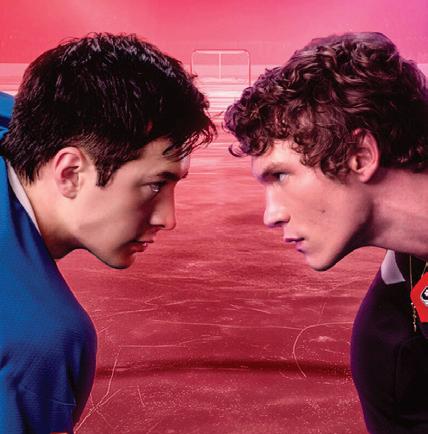
'Heated Rivalry' (2025) Creator: Jacob Tierney
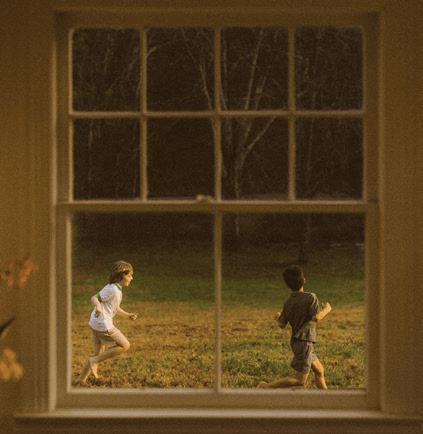
'The Memory Collectors' (2025) Author: Dete Meserve Book
'The Moment' (2026) Director: Aidan Zamiri Movie
'Don't be Dumb' (2026) Artist: A$AP Rocky Album
'The Great Divide' (2026) Artist: Noah Kahan Song
Photo courtesy of Washington Blade
Photo courtesy of IMDb
Photo courtesy of Penguin Random House
Photo courtesy of Wikipedia
Photo courtesy of Genius
By Peter Massarrone STAFF WRITER
Hitting a varial heelflip at 25 mph in a lo-fi dreamscape while listening to electric psych-pop is an experience unlike any other – and it’s freaking awesome.
“Skate Story” by Sam Eng, an indie game developer from New York, combines the immense pain of skating with
Glass, pain and skating: 'Skate Story'
the atmosphere of a psychedelic wonderland. Players skate, ollie and kickflip in the Underworld beneath New York City, trying to fulfill an impossible contract with the devil to eat the moon.
To uplift the insane plot into the cosmos, Eng collaborated with secretive music group Blood Cultures and indie artist John Fio to create a soundtrack for otherworldly skating.

'Emily
By Kat Powers STAFF WRITER
In the newest season of “Emily in Paris,” the writers presented viewers with a lot of changes. The first being Emily’s new hairdo – a chic, Parisian bob – despite the fact Emily spent most of her time in Rome.
Beyond the debut of the new hair, the show graced us with a host of glamorous changes – a 1970s inspired Yves Saint Laurent power suit, Sylvie sleeping around in sheers and unlined lace dresses (drawing a parallel to Kim Cattrall’s iconic character of Samatha Jones in “Sex and the City”) and Mindy finding herself amidst a love triangle with two unlikely players. With Gabriel serving as a personal chef overseas, he is no longer stealing Emily’s heart or attention this season.
Sylvie, the audacious businesswoman, was threatened by her rather salacious life choices this
Serene synthesizers, lo-fi electric guitar tracks and brutally heavy electronic dance hits allow your tricks to feel both fragile and legendary.
For $20 and a four hour runtime, the game packs in nine distinct chapters with little to no downtime. It melds skateboarding with a story about determination, poetry and darkness. Your journey to eat the moon takes you to various corners of the underworld, both comically realistic in its context and otherworldly in its nature. One minute, you’ll be skating through demon eyes trying to stop you from awakening some “eternal centipede,” and the next, you’ll be washing the devil’s pants in a laundromat.
There are legendary characters such as a manuscript-writing pigeon who needs you to find scattered letters across the Underworld to help him write his magnum opus. Despite the craziness, it’s these little comical absurdities that allow you to connect with the game and invest in your character, the
mute demon skater.
Most of the game’s runtime is spent learning new skate tricks and using them to blast bosses or other demons into the stratosphere. To attack and survive in the Underworld, you have to land as many tricks as possible, as fast and possible and make sure they’re stylish, too. Landing three different variations of a kickflip while rotating 180 degrees to stomp a demon out of this existence is incredibly satisfying.
For anybody that’s played “Tony Hawk’s Pro Skater,” the “Skate” series or owns a skateboard at all, this experience will heighten your interest in the hobby. Skateboarding is about feeling as light as air on a tiny piece of wood, all with the possibility of getting flung off at any minute and eating pavement. Shattering into glass pieces when you fail to land an ollie against a mythical demon trying to throw you off matches the feeling of falling on your butt quite impressively. What drew me to this game, and what should interest you,
is that it truly recreates what skating feels like both mentally and physically. In real life, seeing other skaters perform tricks and trying to do the same, only to fall over and crash repeatedly, is mentally taxing, but brutally rewarding when you finally master a trick. When you crash into a wall in “Skate Story,” and your glass body depletes into a million shards, you’re disappointed, but you get back up again, then ollie, kickflip and treflip until that wall crashes through you.
After mastering every trick I possibly could and watching the credits roll, the celestial feeling I developed when skating failed to leave my mind. I found myself listening to the psychedelic soundtrack in the car, doing homework or whenever I wanted to relive the brutal rush of bombing a hill in that digital landscape. If you want something new, creative and incredibly insane, try out “Skate Story.”
In Paris:' Looking back on Season 5
season. She may have cut back on the class a bit, especially when she wound up sleeping with her newly reunited best friend’s son, but her clothing choices did a great job of reflecting this crisis in character.
In opposition, following her promotion to run the Rome office, Emily is taking more control of her life. She does this by choosing to go to Rome, and then, by deciding to leave both Rome and Marcello. Emily’s autonomy grew, and with that, her fashion choices were still bold, but now, they were bold with a clearer purpose. She is growing up. She is no longer the bright-eyed ingénue who arrived at Agence Grateau four seasons ago. Emily’s outfits are classier than they have been in previous seasons. In fact, the strappy, little black dress she slipped into in Episode 1: “La Dolce Emily” and the white and black polka-dotted number she wore in the opening scene of the final episode, “Veni, Vidi,
Venezia,” were the stars of her wardrobe this season.
Emily has never been afraid to mix prints, vibrant hues and adornments such as feathers, so this classier twist on her bold style is a great way to signify that she is growing into a slightly more mature person.
Unlike Emily, Mindy’s life is not so much coming together as it is falling apart in a plotline that can only be described as poorly written. This season, it felt like the writers didn’t know what to do with her, so they stuck her in a cheap love triangle. Alfie (Lucien Laviscount) could have chemistry with a brick wall, so the tired plotline isn’t a complete disaster, especially due to his off-the-(brick) walls chemistry with Mindy (Ashley Park). The main issue I find with this plotline is that the writers sacrificed Mindy’s character. Mindy is a girl’s girl; there’s no way she would have slept with her best friend’s

ex-boyfriend and then kept it a secret.
Her ill-fitting plotline was reflected in her outfits. While still moderately outlandish, we lost the sexy, Mindy flair from the first four seasons. The only truly memorable outfit Mindy graced our screens with was the soft blue pearl draped dress she wore in Episode 2: “Got to be Real,” while she sang Sabrina Carpenter’s “Espresso.” While it
was memorable, it didn’t meet the Mindy standard set throughout the previous seasons.
In closing, while the plot points may not always be the most realistic, that is part of what draws so many fans to “Emily in Paris” in the first place. We love the allure of being swept away into a world of luxury, beautiful places, beautiful people and, most importantly, beautiful clothes.
Photo courtesy of ScreenRant Netflix has greenlit "Emily in Paris" for a sixth season, which showrunners say may show Emily in an all-new European city.
"Skate Story" has sold over 40 thousand units on Steam, with a positive rating of 96.6% by players.
Photo courtesy of Steam
OPINION
The views and opinions expressed in the Opinion section are those of the authors. They are not an endorsement of the views of the Chronicle or its staff. The Chronicle does not discriminate based on the opinions of the authors.
Celebrities do not care about your best interests
By Tom Saxa ASSISTANT OPINION EDITOR
In the midst of what could be looked at as the most dishonest, polarizing and combative administration in United States history, more and more people feel powerless in the face of the total lack of accountability of our supposed “public servants.” Justice used to be a guaranteed truth, but it has become a distant fantasy. This has forced people to look for other means of hope outside the one in Washington D.C., including industries with direct ties to the administration, like the American film industry, also known as Hollywood.
Since the 1970s, the cultural expectation for celebrities has been to push against
government injustice, which is congruent with the mission of art as a concept. Punk music would inform the listeners about war crimes, and action films could ironically pose as warnings against the moral corruption of violence. Hollywood, while being a distributor of impactful art, can easily water it down just as much as it can hoist it.
This means that art can exist without Hollywood, but the inverse could not be true. Hollywood is a business, and celebrities are willing to be as transactional as they want regarding their fans.
Let’s take a look at the celebrities who recently crafted complicated and underinformed cryptocurrency schemes into consideration, like Logan Paul or Richard
Karn. Cryptozoo – Paul’s side business – notoriously bankrupted many of its users while he continued to peddle the “I grinded so you don’t have to” mentality of making money. Celebrities are always looking for their next grift, so it is natural that when the recent influx of celebrities denounced President Donald Trump –most notably Billie Eilish and Mark Ruffalo’s coalition for their recent Artists4Ceasefire campaign – the general public questioned whether they were doing it for virtuous reasons. Eilish, specifically, underwent a controversy involving an indigenous tribe criticizing her recent comments during the Grammy Awards, when she claimed that “nobody’s illegal on stolen ground.” The problem with blanket state -
ments like that one is that, while they might be ethically well-intentioned, they will inevitably lead to others calling out hypocrisy. This specific example drew criticism from the Tongva tribe, who claimed that Eilish’s $20 million dollar mansion resides on top of former Tongva territory. This situation is similar to when outspoken celebrities criticized climate change inaction while pumping carbon into the atmosphere, like Taylor Swift or Leonardo DiCaprio.
Ironically, celebrities have also utilized their positions to gain political favor in the past. When the line between a celebrity’s influence and a politician’s influence could be blurred to the degree that celebrities start running for office, it reframes how impactful
a celebrity’s influence really is.
Fortunately, it is not a celebrity’s job to educate the public about current events, nor is it their job to guide the public. Even though they have the influence to make an impact through social channels and the average citizen could probably name more actors and musicians than senators and lawmakers, politicians thankfully have more sway in Congress. These are artists, and it is well within their rights to be as outspoken as they so choose to be, but they should not feel betrayed when obvious hypocrisy is shown.
Tom Saxa is a junior film studies and production and English double-major.
The Olympics have never been politically neutral
By Ryan Monke MANAGING EDITOR
On Thursday, Feb. 12, Ukrainian skeleton racer Vladyslav Heraskevych was disqualified from the 2026 Olympic Games for violating International Olympic Committee (IOC) Rule 50 – which prohibits political speech – after continually wearing a helmet that featured the images of Ukrainian athletes who had been killed in the Russia-Ukraine war. Heraskevych has filed a challenge to the decision, arguing that “some things are more important than medals.”
Heraskevych’s disqualification is only the most recent instance of the IOC attempting to enforce its political neutrality policy by dampening political speech. However, the Olympic Games have never existed within a political bubble and the IOC’s attempts at censorship are ignorant of sports’ ever-present relationship with politics.
Leading up to the 1936 Olympics in Berlin, Germany,
several United States groups raised concerns about the Nazi regime’s discriminatory policies against Jewish people.
Facing increasing pressure to boycott the 1936 Games, Avery Brundage, then head of the American Olympic Committee, toured Berlin’s facilities and proclaimed that Jewish athletes would be treated fairly. He ultimately concluded that American athletes should not become involved in what he called the “Jew-Nazi altercation.”
Brundage’s decision for the U.S. to participate in the Berlin Games played a large part in allowing the Nazi regime to use the Olympic Games as a tool for political propaganda, theatrically projecting the image of Nazi grandeur on the largest international stage. It masked the vile conditions that grew into one of the most horrific genocides in human history.
In the wake of World War II, Brundage was elected as president of the IOC, where he continued to advocate for keeping the Olympic Games free from politics and political speech.
During the 1968 Olympics in Mexico City, Mexico, American track athletes Tommie Smith and John Carlos took to the podium without shoes, each raising a black-gloved fist in the air in protest of the unfair treatment of Black Americans. Smith and Carlos, alongside Australian competitor Peter Norman, also wore pins representing the athlete-led Olympic Project for Human Rights.
The image of Smith and Carlos with their fists in the air became an iconic symbol of the Civil Rights Movement but resulted in the two track stars being dismissed from the Olympic Village and suspended by the U.S. Olympic Committee. Presumably in reaction to the protest, the IOC officially enacted Rule 50 in 1975, which prohibited political, religious or racial demonstrations.
Nearly every iteration of the Olympic Games has seen some form of political speech that has raised questions about IOC restrictions. In 2016, Ethiopian marathon runner Feyisa Lilesa crossed his wrists above his
head at the finish line to protest repression of the Oromo people in Ethiopia. Similarly, during the 2020 Summer Olympics, U.S. shot putter Raven Saunders crossed her arms above her head on the medal podium, representing the intersection of oppressed people. The 2020 Olympics also saw several women’s soccer teams kneel before matches in protest of racial injustice, continuing the trend of using the Olympic stage to address prevalent political issues.
The involvement of politics in sports has always been controversial. When an American Olympic skier expressed discomfort representing the U.S. given current political turmoil, President Donald Trump responded by calling the skier a “real loser,” while Vice President JD Vance argued that athletes should not “pop off” about politics during the Olympics.
Telling athletes on the largest international stage to keep quiet about political circumstances, many of which that reflect con-
cerns about human rights violations, is inappropriate. As an institution built on international cooperation, the IOC cannot turn a blind eye to the international political landscape. Having banned Russia from participating in the 2026 Olympic Games due to its invasion of Ukraine, the IOC has acknowledged having a role in politics. But drawing that line of involvement at athletes’ speech is unfair to the many athletes that are closely affected by international issues. While the relationship between politics and sports remains unresolved, the nature of the Olympics makes it impossible to ignore timely international issues. The IOC’s continuous attempts to keep the Olympics politically neutral are futile and ultimately harmful to the athletes the Games are built on.
Ryan Monke is a senior mass media studies and political science double-major. You can find him on Instagram @rjmonke.
OPINION
The views and opinions expressed in the Opinion section are those of the authors. They are not an endorsement of the views of the Chronicle or its staff. The Chronicle does not discriminate based on the opinions of the authors.
ACROSS 1 Faucet
4 Chanel and Dior, for example 10 Truth counterpart 14 Blow away
15 Ventilate, as a stuffy room
16 Skin care giant
17 Jaded group of executives?
19 Area
20 Impolite sound at the table
21 Actress Thurman
22 Goes after
23 __ and crafts
25 Require
27 Place for a facial
30 Paltry
32 Texting format initials
35 50th state
38 Solitary human spirit?
40 From the top 41 Digital map technology, for short
42 Hospital employee
43 Reasonable transportation fee?
45 Clicked Ctrl+V
46 Explosive material in Minecraft
47 Performed before the main act
49 Donkey, colloquially
50 Pro bono 51 Oozing volcanic output
54 "Get lost!" 57 "The Matrix" protagonist 59 Some choir members
63 Small batteries 64 Unadorned aircraft 66 Saturday Night Live sketch 67 Influenza sufferer's necessity 68 Curling surface 69 Egg layers 70 RSVP 'yes'
71 Guided
1 Things opened in browsers
2 Nowhere to be found, in the army
3 Country north of Chile
4 Celebrity's negative press
5 Bone in a cage 6 Stimulate
7 Linguist Chomsky
8 Dodge SUVs
9 Contraction after an unsafe hookup, for short
10 Took a nap 11 Plant with soothing gel 12 Tournament standing 13 Peepers
18 Notable period of time
22 Tennis icon Williams
24 "I didn't need to know that," for short 26 Long fish 27 Mine cart passageway 28 Polytheistic worshipper 29 Anticipate 31 Colorado skiing destination 32 In a way, casually 33 Inspirations 34 Snow sliders 36 __ Jordan sneakers 37 Tell 39 Shady, in internet slang
41 Approved, as a film
44 Tarzan's raiser
45 Valentine's Day annoyance, for short
48 Fictional Plaza Hotel resident
50 Observes Ramadan, say 52 Took a hit?
53 Taylor Swift hit "__ Too Well"
54 Pageant accessory
55 Birthday treat
56 Precipitate
58 Sunrise direction
60 Word after pig or pony
61 Less than twice
62 Gardening requirement
64 School fundraising group, for short
65 Abbey dweller
OPINION
The views and opinions expressed in the Opinion section are those of the authors. They are not an endorsement of the views of the Chronicle or its staff. The Chronicle does not discriminate based on the opinions of the authors.
Let athletes be themselves
By Tom Norman OPINION EDITOR
On Feb 15, 2026, 16-time NBA all-star player Kevin Durant was exposed for allegedly using a fake alias on X to communicate with fans through group chats.
Dubbed “The KD Files” (Kevin Durant Files), Durant allegedly used this burner account to share his many opinions, primarily his negative ones about both current and former teammates.
It is important to note that nothing has been confirmed about the true identity of the account’s owner.
While this may not be the greatest example of a situation where a celebrity exercises freewill, as some of Durant’s alleged
comments definitely crossed the line, this situation made me wish there were more athletes like Durant. Being active on social media for well over a decade, Durant has rarely shied away from expressing his thoughts. Situations like these are great reminders of how athletes aren’t as different from us as we may think they are. I am sure everyone reading this has said something about somebody privately that they would not wish to be made public. Because of his job, Durant does not get the same luxury the rest of us do when it comes to keeping matters like these private, and that is a shame. In my opinion, sports are a lot more fun when
teams let athletes speak their mind or appear “more genuine.” Social media seems like it should be a perfect place for this exact thing, yet organizations typically control a lot of what their athletes can or cannot say.
Do I agree with what Durant has allegedly said in these specific leaked messages? No. However, if entertainment value is as necessary as most believe, then perhaps sports could use more athletes who are unafraid to express themselves on social media the same way Durant is.
Tom Norman is a senior journalism major. You can find him on Instagram @_tomnorm.
Have a little faith
By Ricky Hubert SPECIAL TO THE CHRONICLE
We, as people, tend to have a negative perception of other people. We have little to no faith in humanity because we believe people are bound to disappoint us. Now, sometimes that may be true. In my experience, however, if you open up and give people a chance, you are bound to be pleasantly surprised. Going into college I had a very judgmental view of fraternities and sororities, believing that they were superficial and the members were drunk party animals who didn’t care about their education. So, imagine my dismay when in my Spanish class in Spring 2023, I
was assigned to be in a group with a member of a Hofstra University fraternity, which shall remain nameless. I’m not omitting the name to protect the innocent, I’m omitting the name because I forgot what it was.
Anyways, the professor wanted the groups to participate and share their responses with the class. Of course, awkward silence ensued – no one wanted to break the ice. I assumed that if I were to raise my hand, the frat guy next to me would be telling all his brothers about the nerdy teacher’s pet that he was assigned to work with in class.
Sure enough, it was the fraternity brother next to
We have to read for ourselves
me who courageously raised his hand first and broke the ice. My hypothesis was proven false. Looking back, it’s easy to see why. After all, I used preconceived notions to judge a person I never spoke to. In theory, isn’t that insane? So, how about instead of judging people we’ve never spoken to, we open our minds, mouths and hearts to engage with them. If you’re like me, the outcome may be a pleasant surprise, and in the long run, a real gift: a little more faith in humanity.
Ricky Hubert is a senior podcasting & audio storytelling major. You can find him on Instagram @therichardhubert.
By Jacob Aurelus STAFF WRITER
The late Charlie Kirk often argued that college is a scam. While many disagree with his point (and there is some reason to), there is a truth to what he said. Look at the modern university. It is not a place of education, and the lack of personal reading among college students shows that.
Oxford Languages defines education as “[giving] intellectual, moral and social instruction to someone (especially a child), typically at a university.” This presupposes that the people providing the education both are of good morality themselves and can achieve morally good results for their students. Education is supposed to bring order to the soul of the student and to provide proper guidance.
To be blunt, this is not happening, and the poor mental health of students is evidence
of the disservice that universities are causing. According to Harvard Health Publishing, 63% of college students in the United States felt “overwhelming anxiety” in 2018, and only 23% of U.S. students were being treated for it during that year. Additionally, a 2023 NIH study found that 39% of North American college students suffer from anxiety disorders. While this issue requires more study, it’s obvious that universities are either perpetuating or enabling the aspects of classroom life that make anxiety feel inevitable.
The modern university also teaches ideological antagonism and stagnation, hence the need for self-education. While pretending to be propagators of freedom, universities don’t realize that their students either self-censor or are directly censored by professors or administrators. According to the Foundation for Individual Rights and Expression (FIRE),
“166 of the 257 schools surveyed got an F for their speech climate.” This comes at a politically contentious time where speech should be the answer we look toward. Now, no one is willing to come to the table and discuss. Make no mistake, this is clearly miseducation.
However, as harsh as this may sound, college does serve a purpose. It creates the space for us to realize that our education is exactly that: ours. This requires that the students themselves take their education into their own hands. The best way they can do this is by reading.
You might be asking: “Don’t we already read for our classes?” Well, sometimes we do. If we think it is valuable to do so for a class, we will most likely read the book assigned to us. Yet, assigned reading only serves two purposes either the reading is providing legitimacy for the ideological
capture of the class, or it is just plain busy work?
The fast-paced nature of college discourages assigned reading in the first place. Students are too tired after a day of extracurriculars, jobs, internships or homework to read 30 pages of a book that the teacher will summarize next class. When reading for class feels pointless, it conditions students to not desire to read at all. A 2025 Harvard University study also suggests that students start abandoning personal reading in their teenage years when they have no choice over what they read. When reading is only done in the classroom, students develop a negative perception of reading and are discouraged from adopting good reading habits. This leads to students only hearing the professor’s perspective, which is most likely the same as the rest of liberal academia, instead of experiencing a wider diversity
of opinions giving students room to develop their own perspectives.
This is why we need to read on our own time. This will force us to expand our viewpoints beyond what our professors are telling us. While many college students may not have the attention spans or wills to read outside of what is required, it is a critical part of developing into independent thinkers within an institution that isn’t likely to change anytime soon.
In summation, education does not belong to those in the ivory tower. It belongs to those who are willing to challenge the status quo on campus. It belongs to those who are willing to counter opinions and pursue truth in a sea of conformity.
Jacob Aurelus is a junior journalism and political science double-major. You can find him on Instagram @jacob_caa.
By Ethan Poole SPORTS EDITOR
The Hofstra University women’s basketball team delivered an emphatic 75-43 win over UNC-Wilmington on Sunday, Feb. 22. The win is the Pride’s second straight and the third in four games, improving them to 6-19 with a 4-10 record in the Coastal Athletic Association (CAA). UNCW fell to 6-20 with a 2-13 conference mark.
“I’m really proud of how this team came out and performed,” said Hofstra head coach Danielle Santos Atkinson.
“When you’ve got 20 assists and nine turnovers, that says a lot.”
Ball security has been an adventure for Hofstra this season. The Pride is averaging 16.7 turnovers per game but only turned the ball over nine times on Sunday. They stayed below double-digit turnovers for just the fourth time this season.
Hofstra rolls over Seahawks
Micaela Carter delivered a career night, pouring in a game and career high 23 points, and hauling in two steals.
“I just think my teammates found me. I was running the floor well, and I was just taking open shots when I had them, so it was giving me a lot of confidence throughout the game,” Carter said.
Carter’s big day started in the first quarter when she picked off a pass and took the ball to the hoop for two. One possession later, she drained her first of five 3-pointers.
Hofstra never trailed, taking the lead 48 seconds in and refusing to relinquish it. Ema Karim dominated the first half along with Carter, with 10 points and five rebounds.
“I feel like everyone was sharing the ball, so it was easy to shoot when I was open,” Karim said.
Hofstra took a 21-11 lead into the second quarter but were quickly on their heels. The Seahawks scored two
straight buckets to cut the deficit to two possessions for the final time. After an Angelina Pelayo jumper, which brought UNCW within six, the Seahawks saw a scoring drought in which Hofstra scored 16 points and opened a 37-16 lead before UNCW’s next point. The Pride took a 3918 lead into halftime.
Hofstra kept the foot on the gas in the second half, Carter continued her dominance, and Sana’a Garrett took the game over, scoring nine of her 11 points in the second half and grabbing two steals.
“She came out and did exactly what we needed of her,” Santos said. “I thought she did a great job not only of sharing the ball, having four assists with zero turnovers, but then, also finding her opportunities at the rim.”
Hofstra’s frontcourt was consistently rotating. Sandra Magolico, Ayen Angoi, Deivejon Harris, Olivia VanPatten, Kiyanna Blacks-
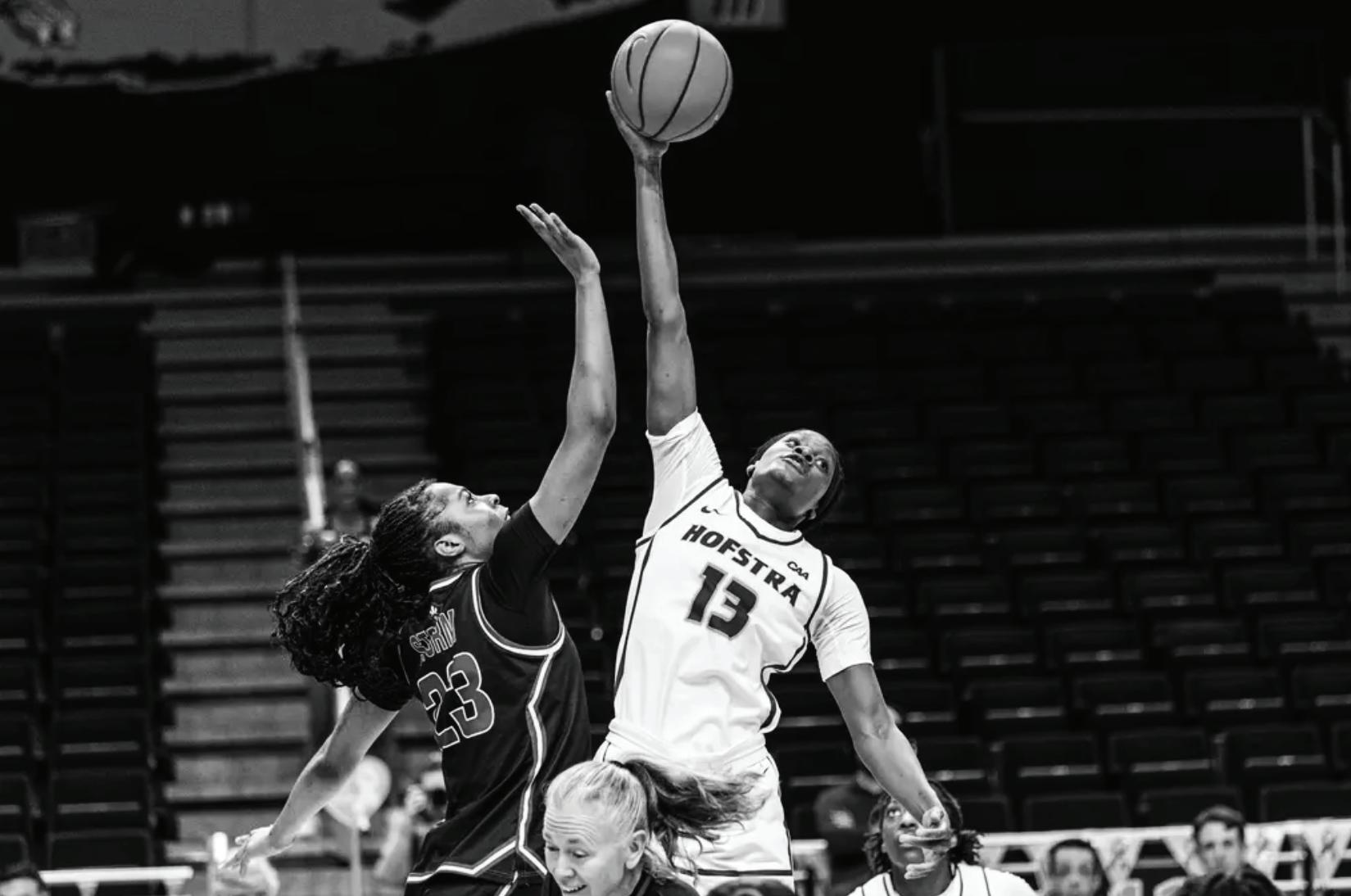
Stewart and Michaela Hodge all got playing time, yet none of them played for more than 20 minutes.
“It’s great to have the depth that we have [and] to be able to bring people in and have a rotation where when we sub, I don’t feel as though we drop off one bit,” Santos said Next up for the Pride is a game that many have circled on their calendar. Elon
Pride fall to George Mason
University is heading to Long Island on Friday, Feb. 27, for a 6 p.m. clash. The game isn’t only a crucial conference matchup, it is the return of LaNae’ Corbett. Corbett spent last year with the Pride and was honored as a member of the CAA All-Rookie team. She is averaging 11.5 points and four rebounds per game this season.
By Shannon Bickert SPORTS EDITOR
After picking up the first win of the Susan CassidyLyke coaching era, the Hofstra University softball team fell 6-3 to George Mason University in the finale of the George Mason Tournament on Saturday, Feb. 21. The Pride fell to 1-7 on the young season, while the Patriots moved to 5-3.
Victoria Frobosilo had the only two-hit game for the Pride. Kaleigh Friend and Payton Auerbach notched two hits and an RBI apiece in the win for the Patriots.
Freshman Madison Steppe got the start in the circle for Hofstra. Steppe allowed three earned runs on six hits across three innings. Kailyn Haig made her third relief appearance of her collegiate career. She saw her longest appearance thus far, pitching three innings of work and allowing two earned runs on two hits and two walks.
George Mason’s pitching staff looked sharp, allowing just two earned runs. Bri Lencz got the start and allowed the only earned runs in her three innings in the circle, while bullpen arm Abbey Lane worked four innings of scoreless softball. After stranding a baserunner in the first, the Patriots played small ball to earn a run in the bottom of the second frame.
Logan Pickford started the inning off with a single to left and cruised into second on a misplay by left fielder Chelsea Villar. Friend followed with an RBI double to right field. Friend tried to extend her double into a triple, but right fielder Frobosilo gunned Friend down for the first out of the inning. Steppe successfully retired the next two batters to get out of the inning. Hofstra struggled to get their offense going, and George Mason kept mashing in the bottom of the third inning. Leadoff hitter Auerbach got things going with a single up the middle and advanced to
second on Maddie Lemasters’ single to right field. Heads-up baserunning put two runners in scoring position on Tess Altevers Harris’ foul out. Madi Sobota brought both baserunners home on a triple through the right-center field gap to give the Patriots the 3-0 heading into the fourth.
The Pride answered in the following frame, knotting the score at three all. Gabby Sultan capitalized on back-toback errors to get into scoring position. Villar was brought aboard on a hit by pitch to set up Mackenzie Fitzgerald for an RBI double down the left field line. Lane came in relief for Lencz after giving up the double, but Lane struggled to set in early, walking Frobosilo. Nicole Cancel brought in two runs on single through the right side.
The Patriots responded in the bottom of the inning. Friend’s single to left center field ended Steppe’s day and brought Haig in. Haig forced a flyout to

the first hitter she faced but walked the following hitter. A double steal put both Patriots baserunners into scoring position, setting up Auerbach for an RBI single. Auerbach advanced to second on the throw home, and Jessica Chan kept the scoring rolling with a single up the middle that brought home two runs to give the Patriots the 6-3 lead.
The pitching stood strong on both sides throughout the final
three innings, allowing limited baserunners and no runs.
The Pride look to pick up their second win of the season at the Lakeside Book Company Invitational in Harrisburg, Virginia. Hofstra will face the University at Buffalo and former Coastal Athletic Association foe James Madison University, who went on a Women’s College World Series run in 2021. First pitch is set for Friday, Feb. 27, at 1 p.m.
The Pride have won 10 of their 11 games against UNCW.
Joe Orovitz / The Hofstra Chronicle
Photo courtesy of Nick De Castro / Hofstra Athletics
The Pride start conference play on March 6.
By Ethan Poole SPORTS EDITOR
Pride drop third consecutive game
The Hofstra University men’s lacrosse team dropped their third straight game on Saturday, Feb. 21, with a 9-8 loss to St. John’s University at Rams Field of Farmingdale State College. The Pride fell to 1-3 and have been held to 10 goals or less in their last three games. The Red Storm improved to 2-2 on the season.
The loss was the first time St. John’s has defeated the Pride in their yearly series since 2021. Hofstra won last season’s meeting 13-12 in overtime,
thanks to seven goals from Drew Bogardus and a gamewinner from Trevor Natalie. Although Natalie had two goals in Saturday’s defeat, Bogardus was silenced by the Johnnies’ defense.
Hofstra saw offense from an unlikely source as John Hicks, in his first career start, kept the Pride in the game early by scoring their two initial goals –the first of his collegiate career. Hicks was an active part of the offense for the entire game.
Jake Wright opened the scoring for St. John’s in the second minute of play, and the Red Storm scored two straight after Hicks tied it shortly after. Brody Hergott fired a bouncing shot which beat Hofstra goalkeeper Shea Kennedy. Mitch Campbell buried one as well.
Trailing against St. John’s isn’t an unfamiliar spot for Hofstra, as they overcame a 5-1 deficit last year in Queens. This time, they quickly erased their 3-1 second-quarter
disadvantage thanks to Hicks and Natalie. Natalie scored his first of the afternoon on a manadvantage opportunity that he created after he took an illegal hit from Connor Dodd.
The Red Storm restored order soon after. Quinn Falasca received a clear attempt with under five minutes to go, and the next time the ball left his stick, it was behind Kennedy and in the net. About a minute later, Noah Plenn and the St. John’s forecheck forced Kennedy into a turnover, Plenn picked up the ball and fired it into the open net, restoring the two-goal lead heading into halftime.
If you looked away for the first seven seconds of the third quarter, you would have missed a goal. Ethan Wiegand picked up the ground ball off the faceoff win and went coast to coast, burying a goal and giving his squad a 6-3 lead.
From there, the energy shifted. Hofstra’s Joey DeYoung scored twice to cut
the Johnnies’ lead to one, and Topher Accetta beat Red Storm goalkeeper Matt Nelson to tie the game heading into the fourth quarter.
Natalie didn’t take long to get going in the fourth. He gave the Pride their first lead of the afternoon near the four-minute mark and Anthony Mollica added insurance to bring the Hofstra lead to 8-6 four minutes after Natalie’s goal.
As the game reached crunch time, St. John’s piled on the pressure. Kennedy, who finished the game with 12 saves, stood tall at first, but cracked as the clock dipped below four minutes remaining. Wright scored his second goal of the game while Matthew Vilas was serving a penalty. The third time was the charm for Wright, who missed two shots on the possession before striking true.
The Red Storm seemed to smell blood in the water when they cut their deficit to 8-7. They won the draw and got
back to work; the ball reached the stick of Adrian Nowak, who tied the game.
St. John’s dominated faceoffs in the fourth quarter, winning five of six draws, including one directly after they tied the game. This quickly turned into the game-winning goal. Hergott beat Kennedy and sent the traveling Red Storm fans into delirium.
The Pride lost the faceoff but still had an opportunity to tie the game. Chase Huggard committed a tripping infraction, which gave the Pride a manup opportunity for the game’s final 23 seconds. Mollica sent a shot wide, and Gus Langtry’s desperate last-second shot rang off the post, beating the defense and the goaltender, but still staying out of the net.
The Pride will travel to Piscataway, New Jersey, Saturday, Feb. 28, for a tilt with Rutgers University. The opening draw is set for 3 p.m.
Speedy Claxton scores 100th win cont.
CONTINUED FROM A1
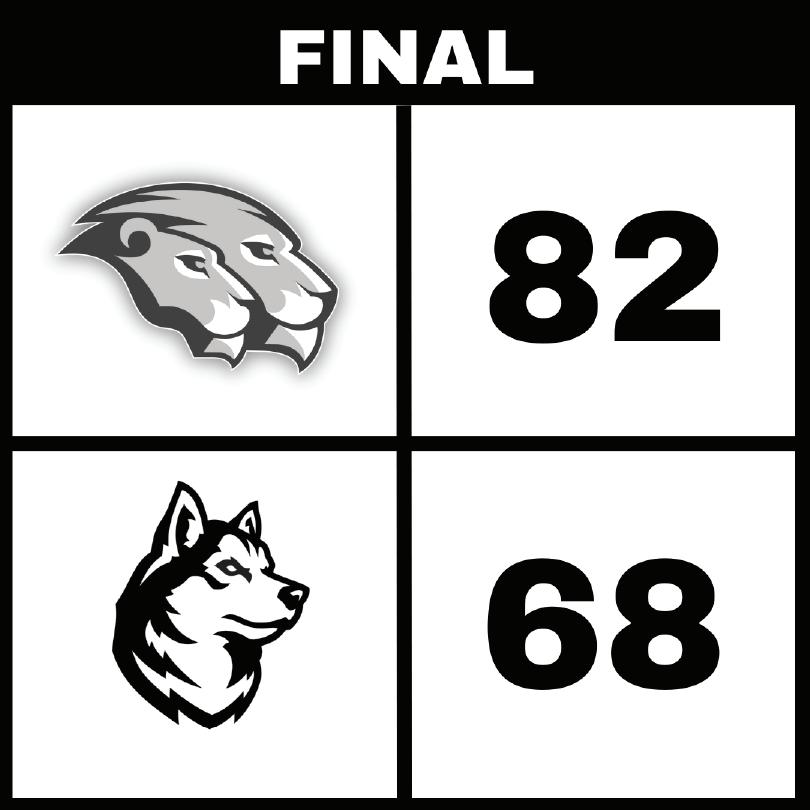
“I thought my guys approached this game very well [and] stood on business because it was the perfect trap game. [Northeastern] is a last place team. We could have very easily came in and not handled business, but we did. We handled the game the right way.”
To secure Claxton’s elusive 100th victory, Hofstra’s dynamic backcourt duo rose to

the occasion once again. CAA Player of the Year frontrunner, Cruz Davis, led all scorers with 22 points, continuing his stellar campaign. The nation’s 16th-leading scorer shot an efficient 46% from the field and completed another impressive performance with three assists and three rebounds.
The other half of Hofstra’s two-headed monster, freshman guard Preston Edmead, delivered an offensive clinic of his own. The Long Island native poured in 19 points on an efficient 6-12 shooting night, while also stuffing the statistic sheet with five assists and five rebounds.
“We go [as far] as they go,” Claxton said. “They’ve been very consistent throughout the whole year. [I’m] not surprised by it. We rely on them, and both of those guys had a great game for us.”
The offensive masterclass extended well beyond the backcourt, as Hofstra veteran

German Plotnikov broke out of his recent shooting slump in a big way. He poured in 18 points and knocked down three shots from beyond the arc. It marked his most efficient outing in six games, shooting 54% from the field.
“He’s just making shots and being solid,” Claxton said. “He’s our glue guy, and it’s great to see him make some shots –because he missed some open ones. He made some, so I’m
happy about that.”
With just two games remaining in conference play, Hofstra will face one of its most pivotal matchups of the season when they host Stony Brook University at the David S. Mack Sports and Exhibition Complex. The Pride currently holds a slim half-game lead over Stony Brook in the standings. Tipoff is scheduled for 7 p.m. on Saturday, Feb 28.
Hofstra is third in the Coastal Athletic Association standings.
Davis leads the Coastal Athletic Association with 21.1 points per game.
Photo courtesy of Amelia Bashy / Hofstra Athletics
Photo courtesy of Amelia Bashy / Hofstra Athletics
By Royce Dickson-Child ASSISTANT SPORTS EDITOR
The Hofstra University women’s lacrosse team fell 9-8 to Fairfield University on Saturday, Feb. 21. The Pride’s offense was spearheaded by attackers Nikki Mennella and Kristen Redding, who recorded four points and a hat trick, respectively.
Hofstra struggled with discipline, receiving 11 penalty cards. Fortunately for the Pride, they managed to go 8-11 in man-down situations, only giving up three goals to the Stags during these opportunities.
“We got to learn how to become more disciplined,” said Hofstra head coach Shannon Smith. “I felt that we played way too much man-down defense.”
The Pride opened the scoring with three consecutive goals within the first 10 minutes, two were courtesy of Mennella,
Pride fall in final minutes
while one was scored by Redding. Mennella scored her first by splitting two defenders and her second from a stepdown shot. Redding fired the ball into the net from a pass by Kayleigh Bender, who was behind the net.
While Hofstra jumped into an early lead, Fairfield was not deterred as they responded with six goals in a row to lead 6-3. The Stags’ Kelly Haggerty scored a hat trick within their 6-0 run.
However, Bender refused to let Fairfield take the momentum into the locker room. She rifled a step-down shot into the top corner of the net to send the game into half with 6-4 in favor of the Stags.
Scoring slowed down for both teams during the third quarter, as each side scored one goal. Hofstra’s Natalie DeMeo scored just over two minutes into the second half from a free position shot. The Pride goalie
Luchianna Cardello stopped a Fairfield free position shot in the third.
Scoring production jolted back up in the fourth quarter when the Stags added their eighth goal of the day just over two minutes into the quarter.
Despite the 8-5 deficit in the final frame, the Pride clawed their way back into the game with three unanswered goals to tie the match. Redding grabbed two of the goals to claim her hat trick, while attacker Julia Harris tallied the other.
Redding’s hat trick was her first of the season and came following her absence from the win against Quinnipiac University last weekend.
“[Redding] was really confident out there on the field, finishing her shots and playing free,” Smith said. “It was really nice to see, and we’re going to continue to need that from [Redding].”
Although Hofstra managed
to force the game back into a tie, Fairfield broke the deadlock with roughly two minutes and three seconds left in the contest.
Stags’ attacker Charlotte Loughlin received the ball in front of the crease and had no issue putting it away for the game winner to give the Stags the 9-8 victory.
In the face of the loss, the Pride still managed to come away from the game with some bright spots. Hofstra dominated the draws, going 13-19 at
midfield.
“We’ve got to continue to take it day by day, we’ve got to continue to get better. I think a big thing is cleaning up our mental mistakes,” Smith said.
The Pride looks to get back in the win column as they hit the road next week with matchups against Marist University and Rutgers University. Hofstra will take on the Red Foxes of Marist on Wednesday, Feb. 25, at noon.
Pride ready for a bounce back season
By Samantha Nadler ASSISTANT SPORTS EDITOR
There is a telltale of spring’s coming that isn’t the birds chirping, the last snow of the season melting or the little critters waking up from hibernation; it’s the sound of the pop of a catcher’s mitt, the smell of freshly cut outfield grass and the feel of the sunshine at the ballpark. For the Hofstra University baseball team, the transition from winter to spring is the perfect time to show off the skills and drills that they have been working on all offseason.
Now entering his fifth season as the Pride’s skipper, Hofstra head coach Frank Catalanotto is ready for a healthy and wellrested team to play some ball.
“We’re excited,” Catalanotto said. “Last year, we had a lot of injuries, especially to pitchers. Four guys had Tommy John surgery, and seven pitchers were out for the season. This year, they’re all healthy, and the team looks really good, so I’m really
excited.”
After losing key players like Alex McCoy and setting back rehab for Carlos Martinez and Sean Hamilton, Hofstra’s 2025 season was one for resetting and rebuilding. Relying on a roster mostly made of freshmen, the Pride went 18-36 overall and 8-19 against fellow Coastal Athletic Association (CAA) members last season, placing last in CAA standings and missing out on the annual conference tournament.
But Catalanotto saw last year as a trial period.
“[Last season] was a very trying year, not only for the players, but also for the coaches,” Catalanotto said. “You had young kids getting a lot of playing time that were making some young mistakes, and we were missing a lot of our really good pitchers, so it was frustrating. But we learned a lot. As coaches, we learned that sometimes we have to take a step back and develop these players, and maybe we’re not going to make the playoffs this year, but we’re playing to get
these guys some experience for next year.”
Now, after the graduation of five students and the signing of All-CAA standout Dylan Palmer to the Pittsburgh Pirates, an added level of pressure and responsibility has been put on Hofstra’s young core.
“[The young players] have hit the ground running,” Catalanotto said. “They’re much more mature. They know what to expect.”
Pitching remained the elephant in the room for Hofstra last season. The team’s pitching staff rose to a concerning 8.63 earned run average (ERA) last season and gave up 2.01 walks and hits per inning pitched. Since Martinez and Hamilton returned to full health and other young pitchers have gotten more mound time, the team’s Achilles’ heel may be more protected for the future season.
Martinez was Hofstra’s sole representative on the 2026 Preseason All-CAA team. He was one of four pitchers recovering from Tommy John surgery last year. Martinez had

a 6-4 campaign in 2024, putting up five wins and an impressive 1.24 ERA against CAA teams.
“When you have a healthy [Martinez] leading the staff, that’s a good place to be,” Catalanotto said. “We expect this kid to get drafted this year at some point. He’s a leader, and I think these guys are going to feed off his leadership.”
Most pitching problems have been fixed in-house with the return of seven injured pitchers. Martinez will return to the ace position as the team’s Friday starter, while Hamilton
will return in the two-spot of the rotation and appear most Saturdays.
The Sunday starter and other midweek pitching arrangements are still up in the air, but Catalanotto leans toward giving sophomores Christian Rasmussen and Grady Lacourciere – notable bullpen arms as rookies in 2025 – opportunities to start games with more mature arms and smoother ball control.
Photo courtesy of Ivy Rose Ball / Hofstra Athletics
In his return, Carlos Martinez allowed three earned runs in 3.2 innings.
Nikki Mennella scored both of her goals in the first quarter.
Joe Orovitz / The Hofstra Chronicle
Pride ready for a bounce back season cont.
CONTINUED FROM A17
“When you have a guy like [Martinez], it kind of sets everything up for success,” Catalanotto said. “What we haven’t seen in the past is guys challenging hitters and throwing strikes. So I’m expecting [the team’s] ERA to go down quite a bit and for us to be pitching more to contact as opposed to walking guys.”
Catalanotto’s ideal starting lineup combines returning faces with some transfer students who showed promise during fall exhibition games.
Michael Brown is predicted to be the leadoff hitter and regular shortstop. Last season, Brown had a team-leading 118 assists with a .274 batting average, appearing in every game for the Pride. He is a batter who tends to stay late in the count, drawing 22 walks and holding a .361 on-base percentage last year.
Tyler Cox aims to return from an injury that kept him out of the second half of the season, and he should see plenty of playing time in center field. In just 33 games in his first season with the Pride, Cox drew a team-high 28 walks and hit six home runs, two of which came during a late-March Sunday matinee at the College of William & Mary.
Tyler Castrataro will reprise his role as the Pride’s regular second baseman, a position in
which he started at more often as the season progressed. He is also slated to bat third in the revamped Hofstra lineup. Castrataro had an impressive rookie season for the Pride, slashing .274/.323/.469, hitting eight home runs and driving in 33 runs, earning him a spot on the All-CAA Rookie team.
A new face for the Pride, Danny Corona, will most likely bat cleanup and play first base.
Corona played at Wake Forest University from 2022 to 2023 and transferred to the University of Missouri in 2024. Then, he joined the Trenton Thunder of the MLB Draft League in 2025, where he batted in five runs and put up a .986 fielding percentage in 45 games.
Catalanotto is hoping that Melara will bat sixth. Melara joins the Pride after two seasons at Skyline College, a junior college in California, where he made it into the California Community College Baseball Coaches Association’s preseason poll and put up a combined .356/.476/.551 slash line with 61 RBIs. He also has a combined .973 fielding percentage, proving him as a reliable counterpart to Corona at first base.
In the lower third of the batting lineup, Nick Gallello is anticipated to significantly increase his playing time in right field following the loss of previous regular right fielder, Luke Masiuk. Gallello got nine
constant with this new team’s strength: their stellar defense, a bright spot of last year’s lineup.
Catalanotto’s 2025 roster held a .965 fielding percentage, with most errors coming from the rookie middle infield.
“This year they’re all healthy, and the team looks very good.
CJ Griggs will return as the team’s designated hitter, a position he assumed during his rookie season. He is set to bat fifth for Hofstra. In 97 at-bats last season, Griggs batted .309 and drove in 16 runs.
Gabriel Melara is slated to make his NCAA debut this season and will fill out the corner infield as the Pride’s regular third baseman.
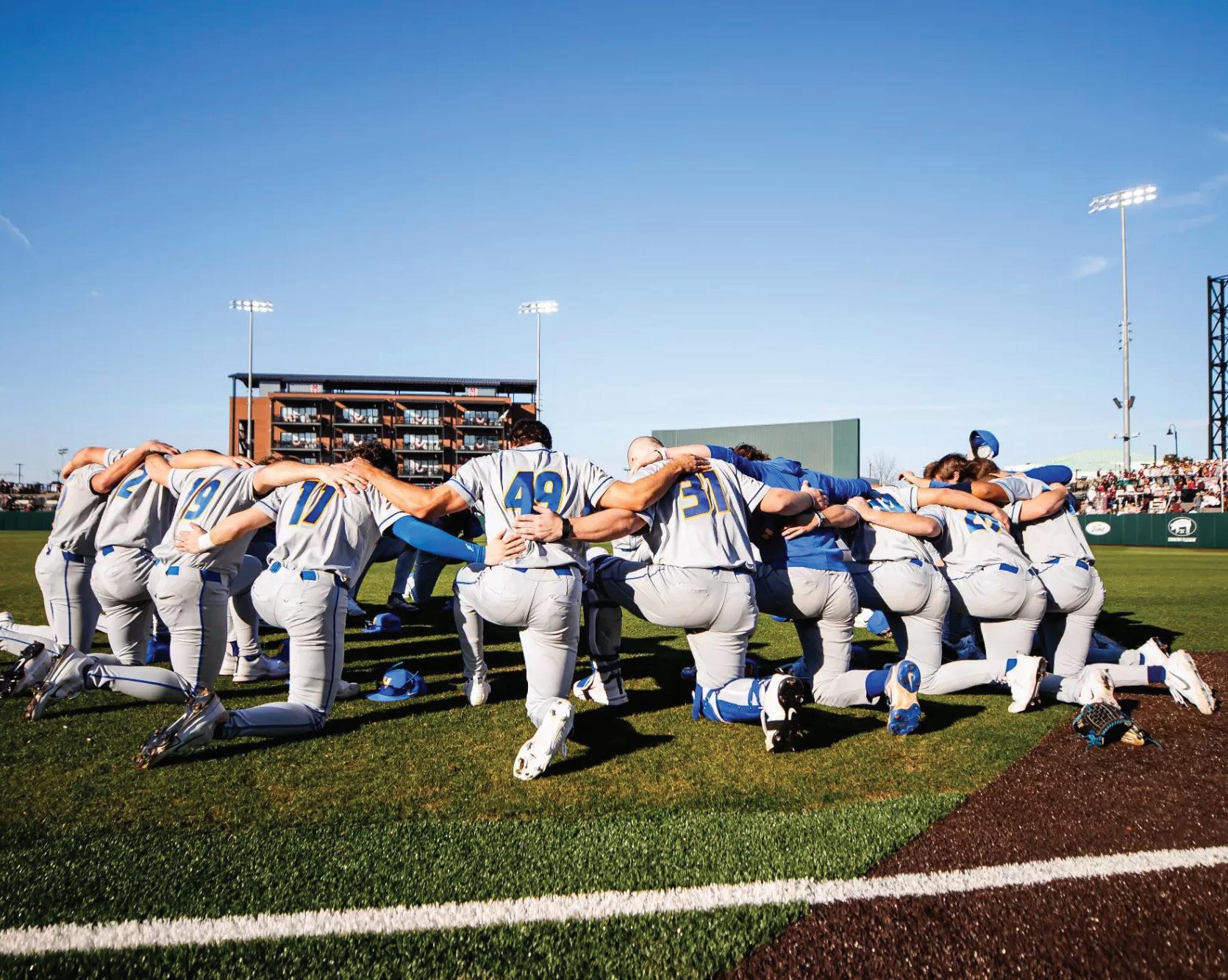
starts toward the end of his rookie season and batted .375. He also hit a home run at the College of Charleston in the final series of last season.
JJ DeVito is the last newcomer to Catalanotto’s ideal lineup and rounds out the outfield by playing in left field. Transitioning to Division I baseball, DeVito played two seasons at Division II Molloy University and was named to the All-East Coast Conference team twice, proving his power at the plate and speed by slugging .571 with 13 career home runs and 38 career stolen bases. DeVito saw significantly less playing time in his first season of Division I baseball, only playing in 10 games with St. John’s University last year.
Nick Biddle rounds up the lineup, likely by batting ninth and catching. As a rookie, Biddle hit .300 and drove in seven runs, but his biggest asset is his arm; he made 22 assists and can quickly throw the ball to an infielder if he suspects an attempt at stealing a base.
Despite the changes in the lineup, one thing remains
“There weren’t a lot of good things that came out of last year, but I think our defense was one of them,” said Catalanotto. “I think we’re even better this year on the defensive side.”
A notable change within the CAA is the introduction of a North and a South division for baseball, partially to give more playoff opportunities for northern teams who may be overshadowed by powerhouse baseball programs from the geographic south. A new rule that comes with the introduction of divisions is the fact that the Pride will now play their division rivals twice during the regular season, one home series and one road series.
“There are a lot of really good teams in the south, so I feel like we’re right where we should be: tied for second,” Catalanotto said. “[Northeastern University] is a tough team, but I think we’re going to give them a run for their money, because it’s a much different team and a more mature team.”
Hofstra will play in the inaugural North Division alongside Monmouth University, Northeastern, Stony Brook University and Towson University and is predicted to finish the season in a three-way tie for second place with Stony Brook and Towson.
The Pride opened their season against Mississippi State University, who finished their 2025 season with a 3623 overall record and earned a spot in the Tallahassee regional of the NCAA Baseball Tournament, eliminating 2025 CAA champion Northeastern, but losing to host Florida State University in double elimination. The opening series to both teams’ 2026 campaigns marks their first-ever meeting.
After an unranked but successful season, Mississippi State is ranked No. 4 in Division I Baseball’s preseason power rankings, but the Pride is committed to opening their seasons against some of the strongest baseball teams in the country, whether it be the 2024 champion, University of Tennessee, or a high-ranked program like Mississippi State.
“The guys all like going to play the best of the best, and we kind of use it as a measuring stick to see where we’re at,” Catalanotto said.
“Obviously, [opening the season against Tennessee] last year didn’t go very well. Hopefully, we can make some adjustments, and hopefully we can give Mississippi State a fight.”
First pitch of the season took place on Friday, Feb. 13 in Starksville, Mississippi.
Photo courtsey of Hofstra Athletics / Ivy Rose Ball
Nick Gallello hit .455 opening weekend with three RBIs.
Hofstra scored 11 runs in the opening series against Mississippi State University.
Photo courtesy of Hofstra Athletics / Ivy Rose Ball
Pride eye run under helm of Susan Cassidy Lyke
By Frank Chiapperino STAFF WRITER
The Hofstra University softball team saw their 2025 season come to an end after an elimination-round loss against the University of Delaware during the Coastal Athletic Association (CAA) Tournament. This season, the Pride enters a new era, taking the field under new head coach Susan Cassidy-Lyke.
Cassidy-Lyke previously spent 20 seasons as the head coach and director of athletics at Division II Molloy University, where she led the Lions to four East Coast Conference (ECC) Championships. She also earned four consecutive ECC Coach of the Year Awards and recorded the program’s highest winning percentage at .560. As Cassidy-Lyke enters her first season with the Pride, she looks to make an immediate impact by setting a strong standard for the team.
“It’s a different level, obviously; it’s Division I, but it’s the same thing I want to bring,” Cassidy-Lyke said. “I want to bring accountability. I have high expectations. One of my biggest benefits for me is I can bring out the best in players. I’m gonna do the same stuff that I did over there, just at a different level … We have a lot more things to work with: with strength and conditioning,
spending a lot more time with them on the field and in [The Hofstra Dome].”
Cassidy-Lyke is ecstatic to lead this team throughout the season as they start their campaign for another ring.
“It’s got such a rich tradition of winning,” Cassidy-Lyke said. “They’ve won so many conference championships and been to so many NCAA tournaments.”
Cassidy-Lyke plans to lead the team with a strong mindset and is ready to change the culture of the team.
“We’re here to win,” Cassidy-Lyke said. “I came here to win, and I know we can do that. We have to bring back that winning consistency. They’ve had 18 NCAA appearances; they have won 21 conference championships and [Molloy’s softball team] haven’t really done that on a steady basis before.”
The Pride returned a starstudded offense including Alanna Morse, Dahlia Palacio and Chelsea Villar, all who hit over .300 last season.
In 2024, Palacio served mainly as the team’s pinch hitter and recorded 25 at-bats. In her first full season with the Pride, she emerged as one of the team’s key players, becoming a catalyst for the team’s success and run in the CAA Championship.
Palacio led the team with 18 doubles, the fourth most in
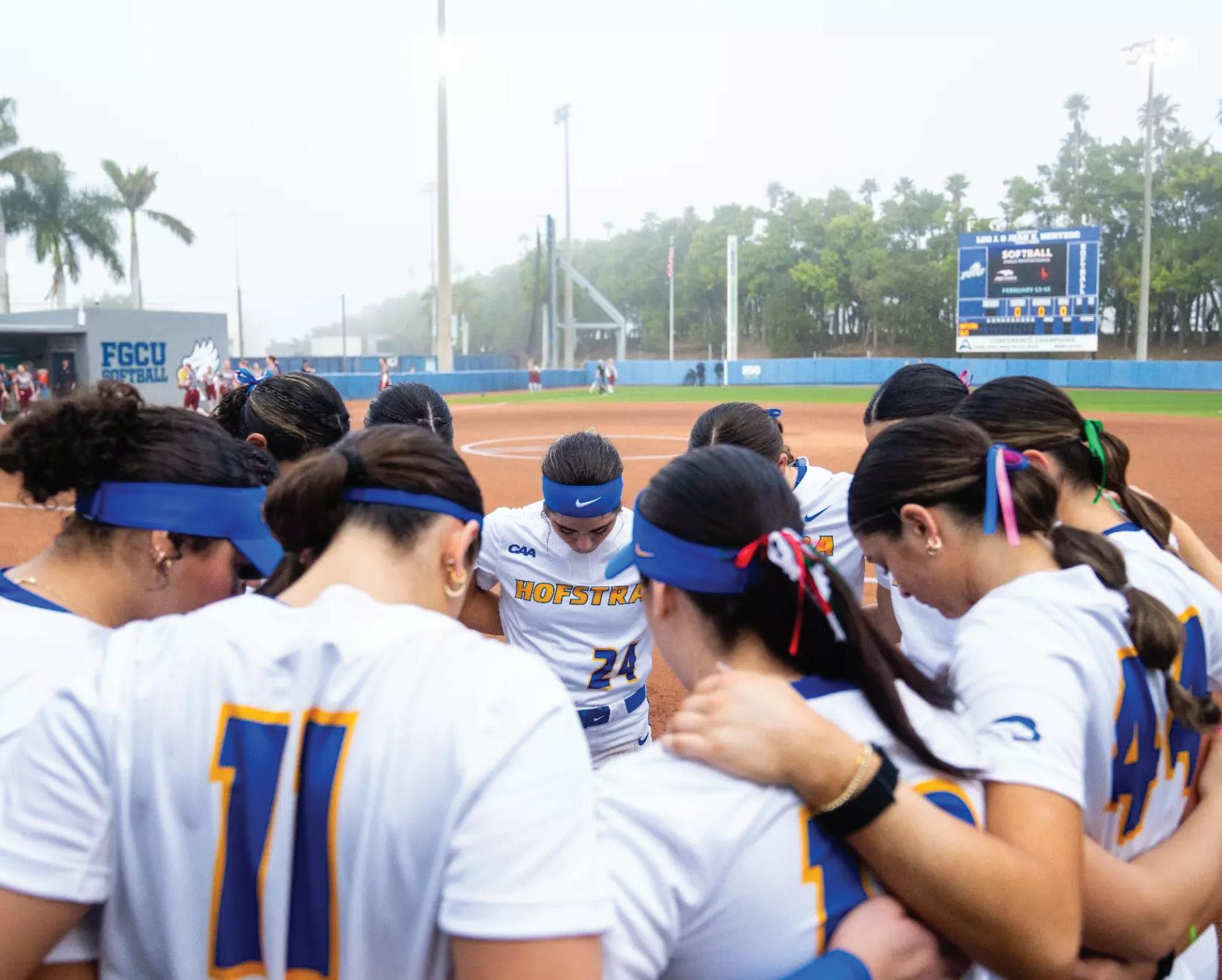
program history. She ranked second on the team with a .317 batting average. She also accumulated an .854 on base plus slugging, .514 slugging percentage, 73 total bases and eight stolen bases. She was named to the CAA AllTournament Team, headlined by three multi-hit games.
“I love hitting every day, whether that’s tee work, front toss [or] machine, [I’m] always doing something to keep my mind and body connected,” Palacio said. “I love watching baseball. When I visually see a player being successful, I take what they do into my game.”
As Palacio enters her third season with the Pride, she opens up about the lessons she’s learned along the way.
“The last two seasons I had so much fun with the team,” Palacio said. “So just enjoying the travel, whether it’s plane rides, bus trips or in the hotel. Having team chemistry is so pivotal to us being successful.”
Palacio credits her success to the athlete she looks up to the most in professional sports, Corey Seager.
“I just love his [Seager’s] style of play,” Palacio said. “He’s a very quiet guy, not showy at all. You always have to keep that team goal in mind above any personal accolades, and I think he does that pretty well. Even though he’s very successful getting World Series MVP’s, he’s just such a humble guy, and that’s who I try to emulate.”
The Pride attributes a key piece of their success to their pitching staff member Emma Falen, who pitched to a 3.14 earned run average (ERA) last season. However, the Pride lost freshman phenom Carley Ernst, who transferred to the University of Southern Florida after her rookie year.
After not playing in 2025, sophomore pitcher Jillian Locher will debut this season for the Pride after being named National Fastpitch Coaches Association/Easton AllAmerica Scholar-Athlete in 2025.
In addition to the returners, the Pride welcomed seven
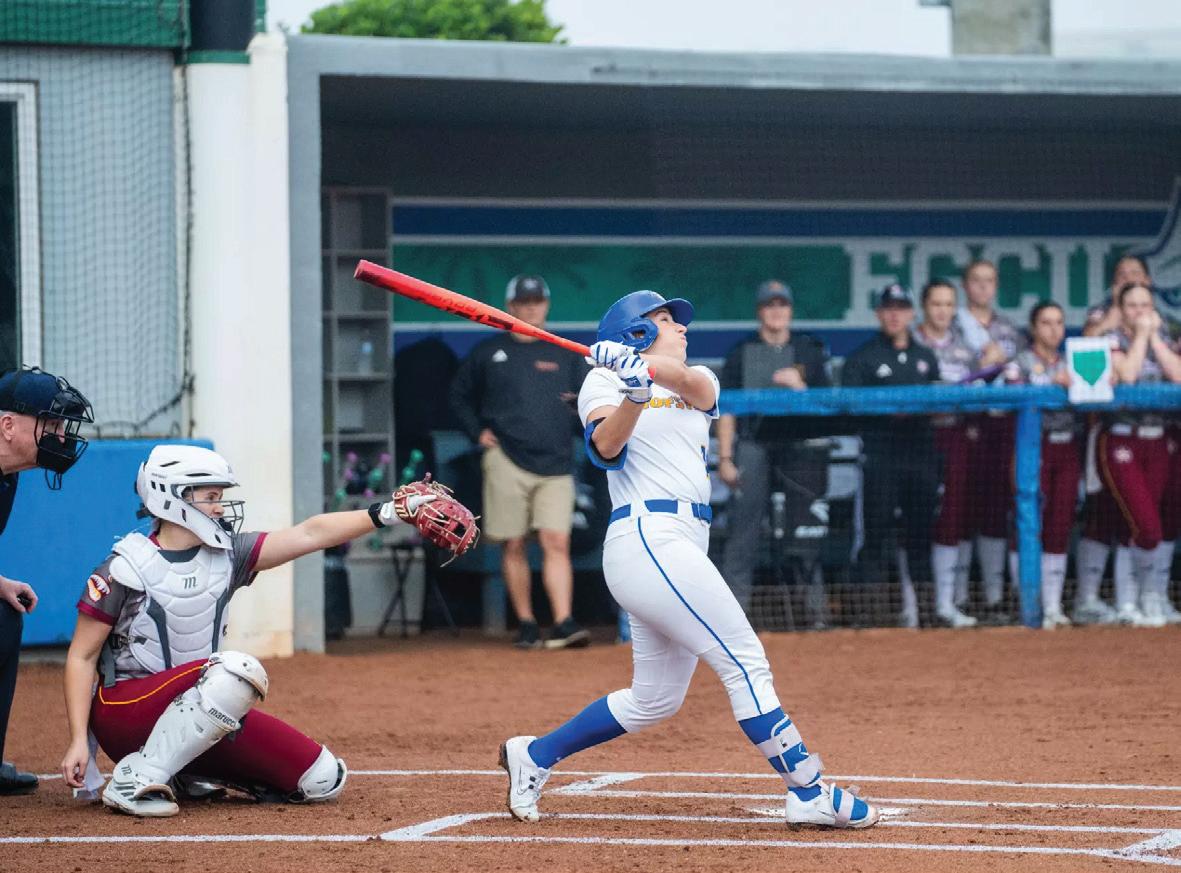
freshmen who will bring much needed depth to the roster this season. The additions include Kimmya Sims from Elizabeth Seton High School, Emily Jovel from East Hampton High School, Ryleigh Smith from Stephen Decatur High School, Madison Steppe from Monticello High School, Kailyn Haig from Yale Secondary School, Casey McKeon from The Pingry School and Elaina Faux from Delran High School.
Smith, Steppe and McKeon headline the additions for the Pride. Smith set the singleseason home run record with nine as a freshman in high school. She helped lead the Seahawks to four consecutive regional championships, becoming the first four-time First-team All-Bayside South Conference selection in school history and team MVP in 2024.
Steppe recorded 557 strikeouts in 293 innings for the Mustangs. As a junior in 2024, she recorded a career-high 217 strikeouts in 116 innings, including four consecutive no-hitters. Steppe was a two-time First-team All-Region Honoree in 2023. She led Monticello with a 0.60 ERA, and in 2025, she was named the District and Central Virginia player of the year.
McKeon graduated with an overall batting average of .390 with 106 hits and 87 runs batted in in four seasons with the Big Blue. She also finished
with 446 career strikeouts and a 2.20 ERA. McKeon was a four-time New Jersey Prep A All-State selection, a FourTime All-Skyland Conference Honoree and a Four-Time AllArea selection. In 2024 and 2025, McKeon saw immense success, winning Prep A State Championship titles.
Since being appointed to the head coach position in July 2025, Cassidy-Lyke has gotten to know the players both on and off the field.
“They’re really hard workers, and they’re wellrounded,” Cassidy-Lyke said. “They’ve done a lot of community service that I’ve done with them. They support the other teams. They really bought into what we brought in and have been respectful of that.”
Palacio gives fans a preview of what to expect of the team this season.
“Be excited about this team,” Palacio said. “We got a great freshman class. Our pitching staff has grown so much, and we have a ton of exciting players.”
The Pride’s 2026 campaign began on Friday, February 13, at the Florida Eagle Invitational in a tournamentstyle weekend against Louisiana Monroe University and Florida Gulf Coast University.
Photo courtesy of Hofstra Athletics / Nick De Castro
Dahlia Palacio led the conference in doubles with 18 in 2025.
Photo courtesy of Hofstra Atheletics / Nick De Castro
The Pride opened their 2026 season with a 1-6 record.
THE HOFSTRA CHRONICLE
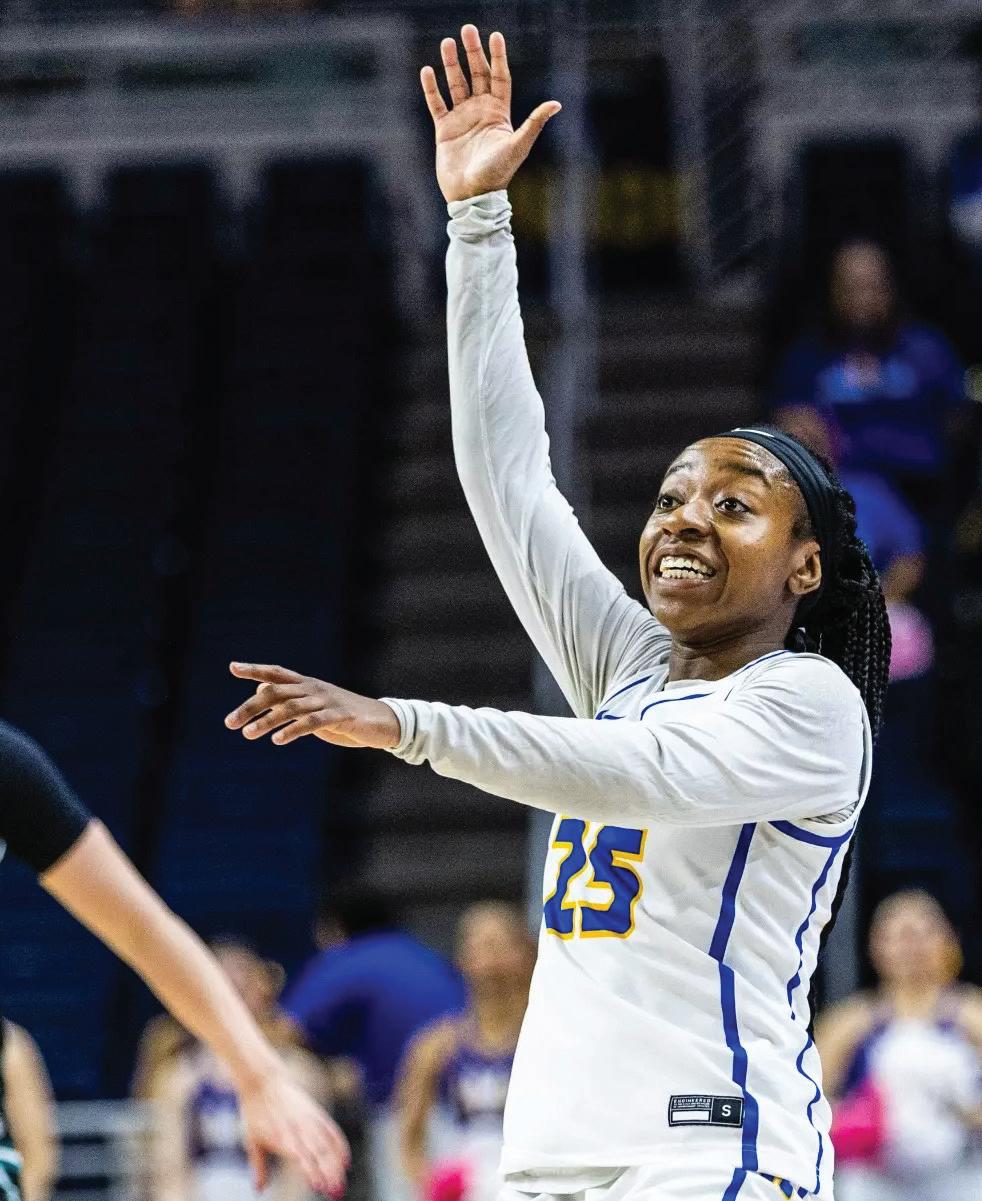
February 24, 2026
SUNDAY BEST
Miceala Carter’s 23 points powered Hofstra to a 75-43 win over UNCW.
Joe Orovitz / The Hofstra Chronicle