Hofstra study reveals new data on decrease of white births in United States
By Mark Lussier STAFF WRITER
A groundbreaking Hofstra University study found that white births are now the minority in the United States. This study was conducted by two OB-GYN professors at the Donald and Barbara Zucker School of Medicine at Hofstra University/ Northwell.
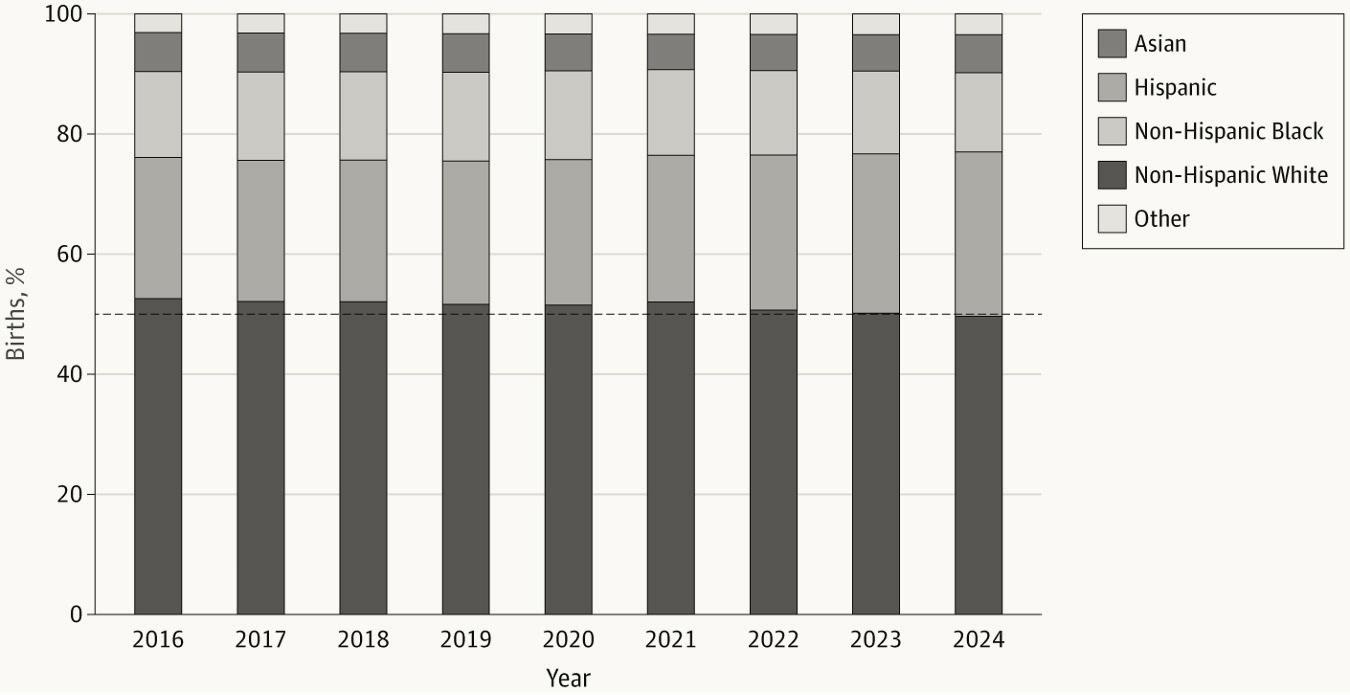
years of data (2016-2024) and found that minority births including Hispanic, Black and Asian, among others have surpassed white births in the U.S.
It was found that 49.6% of those births were white, while
racial groups. However, Hispanic births went up by 3.9%, the only group to have a significant increase.
“Our study is meant to show that we are a country of immigrants, a country of new and old people.”
Dr. Amos Grünebaum and Dr. Frank A. Chervenak are professors of obstetrics and gynecology who published their study in the Journal of the American Medical Association (JAMA) regarding the shift in race and ethnicity births in the U.S.
The study examined eight
50.4% of births were of any other racial and ethnic group, capturing the major demographic shift that’s underway in the U.S. Multiple trends discovered that the data showed yearly births in the U.S. declining by 8.4% over the eight years amongst major
The U.S. is one of the only countries in the world that collects race and ethnicity data following birth. This collection process is done through selfidentification. Due to self-identification, all these data trends are impacted because the Center for Disease Control and Prevention and other organizations utilize birth certificate data to determine the specific number of births from a particular racial or ethnic population.
With an abundance of data and information, both Grüne-
By Paige Sanacora, Vanessa Flannigan, Katelyn Buchalter
ARTS & ENTERTAINMENT
EDITOR,
ASSISTANT ARTS & ENTERTAINMENT EDITOR, ASSISTANT NEWS
EDITOR
It is only fitting to pay tribute to Catherine O’Hara during her favorite season: Awards!
On Friday, Jan. 30, O’Hara passed away at the age of 71. Her career spanned 50 years as an actress, comedian and screenwriter, during which she played iconic roles in beloved movies and television shows, including “Home Alone” and “Schitt’s Creek.”
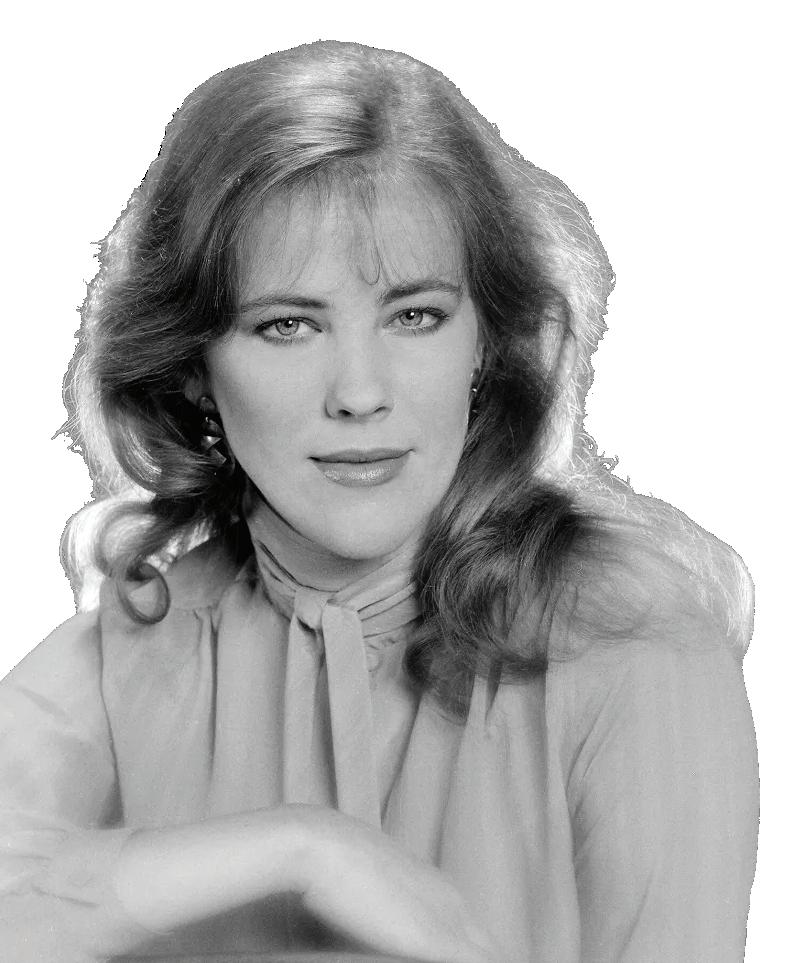
Her career began on Canadian sketch comedy show “Second City Television,” which ran from 1976 to 1984, for which she won her first Emmy Award for Outstanding Writer for a Variety Series. O’Hara kept acting until her death. Most recently, she appeared in the TV shows “The Last of Us” and “The Studio,” securing Emmy nominations for both.
Hofstra snaps eight-game losing streak
By Thomas Montana STAFF WRITER
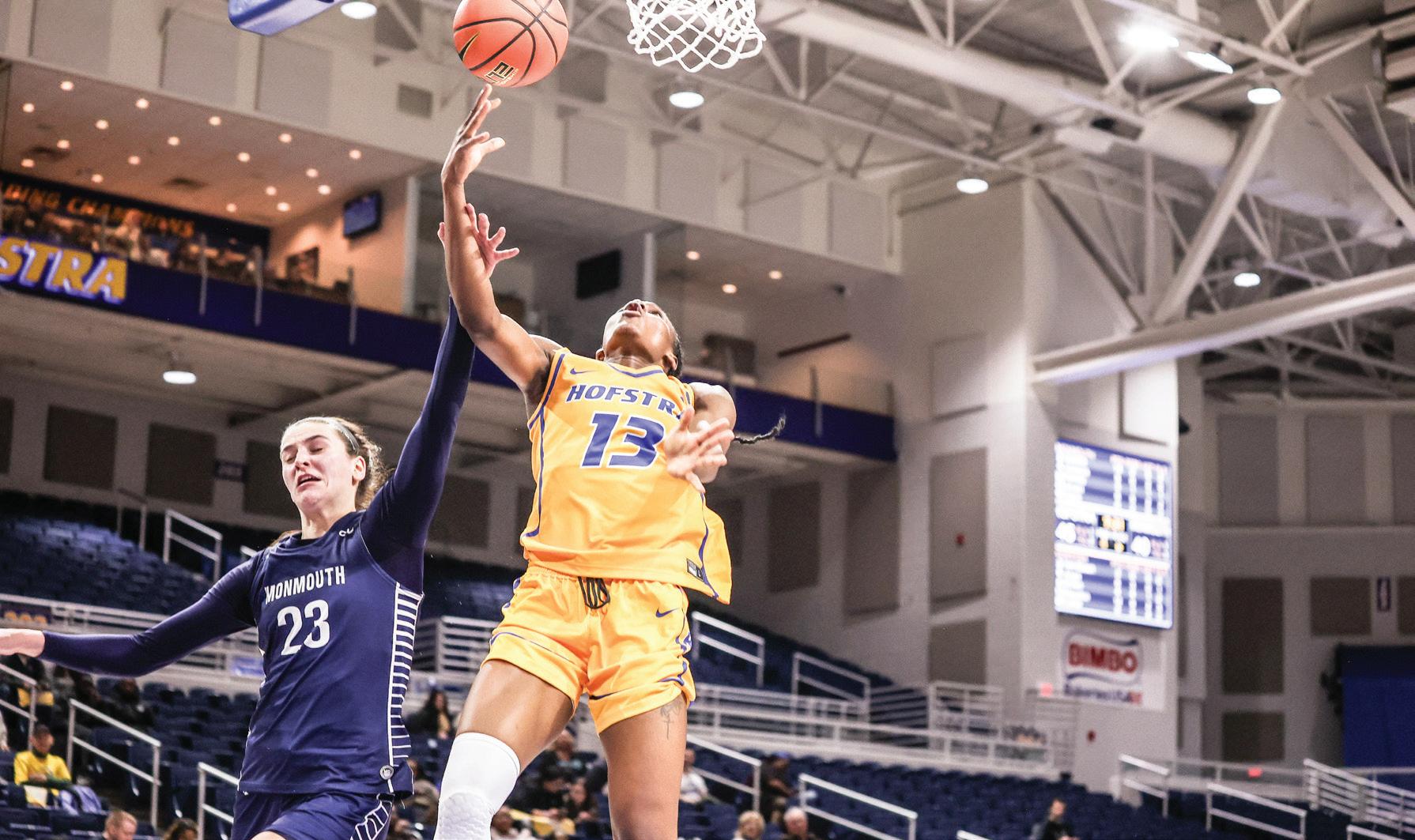
The Hofstra University women’s basketball team snapped its eight-game losing streak in a blowout 75-59 over Hampton University on Sunday, Feb. 8.
The Pride played its best game all season, and now sits at 4-18 and 2-9 in Coastal Athletic Conference (CAA) play.
“I’m just so proud of this team. We talk a lot about how they continue to show up, how they continue to fight,” said Hofstra head coach Danielle Santos Atkinson. “It’s a hard season, and for them to continue to show up the way that they do, and continue to work on the things we’re asking of them, and buy into the
connection that we have to have, it just says a lot about the character of the players that we have on our team.”
Every game through this conference run felt the same, but this game was different, as Hofstra trailed for just 33 seconds, regaining the lead with just under seven minutes left in the first quarter and not giving it up. Hofstra led by as much as 22 points.
“I don’t care if it’s just us and the people in that room that believe it, but this team has it,” Santos said. “We have everything we need in order to go get this thing done, it’s just getting over the hump of being able to close.”
Lilith Walpole / The Hofstra Chronicle
Photo courtesy of NBCUniversal

hofstrachronicle@gmail.com
Editor-in-Chief
Madeline Sisk
Managing Editor Ryan Monke
Secretary Gianna Costanzo
Business Managers
Timothy Daly
Anthony Favilla
News Editor
Sahana Shastry
Assistant News Editors
Katelyn Buchalter
Natalia Rivera
Arts & Entertainment
Editors
Abby Gibson
Craig Mannino
Paige Sanacora
Assistant Arts & Entertainment Editors
Kimberly Lopez
Vanessa Flanagan
Sports Editors
Shannon Bickert
Ethan Poole
Assistant Sports Editors
Samantha Nadler
Royce Dickson-Child
Features Editors
Hannah Mudry Denivia Rivera
Assistant Features Editor
Emilie Morrissette
Opinion Editors
Timothy Daly
Tom Norman
Assistant Opinion Editors
Anthony Favilla
Tom Saxa
Copy Chiefs
Gianna Costanzo
Meredith Tarsi
Assistant Copy Chiefs
Paula Amoroso Lomelí
Madison Demko
Emily Hyman
Multimedia Editors
Kumba Jagne
Joe Orovitz
Assistant Multimedia Editor
Christine Acuña
Shaina Skeen
Marilyn Steele
Social Media Manager
Lindsey Lolkema
Assistant Social Media Managers
Mariana Augustin
Mariya Morales
Madi Valentin
Editor-at-Large
Olivia Hillestad
Hofstra University scores five-year partnership with New York Islanders and UBS Arena
By Adriel Ventura SPECIAL TO THE CHRONICLE
Hofstra University solidified its connection to Long Island’s professional sports scene by announcing a major five-year partnership with the New York Islanders and UBS Arena, becoming their official university partner. The comprehensive agreement, which was first introduced in December 2025, aims to foster a strong link between the university and the sports entertainment industry by giving students access to hands-on training and educational opportunities, as well as educational support to the team’s employees.
An important focus of the partnership is the career development of Hofstra’s students. University officials said that the partnership will give students access to internships and handson projects in areas of high demand such as sports media, video production, public relations and marketing. Students will be able to work directly with a National Hockey League franchise, setting Hofstra students apart from other institutions in the region.
increased cooperation within the community. The collaboration with the New York Islanders and UBS Arena serves as a flagship project for this initiative. By integrating professional experience into the curriculum, the university hopes to bridge the gap between classroom theory and real-world application.
Students are already experiencing the benefits of the partnership’s hands-on experience.
Jose Farina Jr., a sophomore sports media major, has been able to use the proximity of the New York Islanders and UBS Arena to enhance his professional skills. As a first-generation college student, Farina noted that these practical experiences are vital for building a professional network early in his academic career.
“The Islanders so far have toned my skills in communication, teamwork, radio skills and professionalism,” Farina said.

convenient and affordable way for Hofstra students who seek entertainment but consider New York City to be pricey and too far away. It is located just minutes from the Hofstra campus in Elmont and has quickly become a premier destination for sports and music on Long Island.
“The Islanders so far have toned my skills in communication, teamwork, radio skills and professionalism ... ”
“I am very excited about this partnership with the New York Islanders and UBS Arena and the opportunities it will provide our students,” said University President Susan Poser per Hofstra News. “Collaborations like this prepare students for success and grow Hofstra’s network on Long Island and beyond.”
The partnership aligns with Hofstra 100 – the university’s strategic plan leading up to its centennial in 2035. The plan emphasizes student success and
“I faced adversity, and being able to persevere through it and learn is a rewarding feeling. I’m grateful for every [time] I get to be a part of an Islanders broadcast.”
Beyond academic and professional opportunities, the partnership has several benefits for the campus community. A dedicated ticket portal will now provide discounted ticket prices for select New York Islanders home games at Belmont Park for Hofstra students, faculty and staff.
The UBS Arena offers a
“It is good to see the university connect with large organizations such as this,” said Brandon Hurtado Araujo, a junior mechanical engineering major. “Accessing games right near campus is a huge benefit for students.”
The partnership will also provide educational opportunities for full-time employees of the New York Islanders, UBS Arena and the Oak View Group, the operating company for the arena. Employees will be eligible for tuition reimbursement at Hofstra if they pursue a graduate degree.
In a news release, Kelly
Cheeseman, president of business operations for the New York Islanders and UBS Arena, called the deal a “true win” that will help develop future leaders in the industry.
“As Long Island’s hockey team in a world-class venue, we’re excited to offer unmatched, hands-on professional experiences,” Cheeseman said. “We look forward to working with Hofstra to develop the next generation of sports-and-entertainment leaders and to grow our fan base for years to come.”
As part of the partnership, Hofstra will host annual guest lectures featuring top executives from the team and arena. These events are expected to be coordinated through the Lawrence Herbert School of Communication and the Frank G. Zarb School of Business, providing students with the opportunity to meet and learn from experts in the field.
Additionally, there will be joint community events where Hofstra’s mascots, Kate and Willy, will appear alongside the New York Islanders’ mascots, Sparky and Nyisles, to promote school spirit.
Hofstra has been celebrating the new partnership on social media and at New York Islander games.
Photo courtesy of Hofstra University
Laura Fernández wins presidential election in Costa Rica – Sunday, Feb. 1
Costa Rica elected its second female president, Laura Fernández, on Sunday, Feb. 1. Fernández ran with a tough-on-crime policy and won in the first round of voting, an achievement no presidential candidate has accomplished in a decade.
Heavy snow in Japan leaves 30 dead –Tuesday, Feb. 3
Throughout regions of Japan, the 72 inches of snowfall have created transportation difficulties and sent soldiers to clear snow from the homes of elderly. The severe weather has destroyed homes, buried people and resulted in more than 200 injuries and the deaths of at least 30 individuals.
Air Strike in Gaza kills 21 Palestinians –Wednesday, Feb. 4
A fight broke out along the border after one Israeli officer was shot and killed, leading Israel to strike Gaza using tanks and an aircraft. The strike resulted in the deaths of 21 Palestinians, including several children and a paramedic.
Spain aims to ban social media for teens under 16 – Wednesday, Feb. 4
Spain’s prime minister, Pedro Sánchez, announced a plan to ban social media for teens under 16 on Wednesday, Feb. 4. Spain is joining the global push to limit and ban social media for children under a certain age due to the harms caused by social media platforms. The ban is part of legislative and regulatory measures that hold platform executives accountable for harmful or illegal content. Currently, the ban is still awaiting parliament approval.



Graphic designed and information compiled by Natalia Rivera
Graphic designed and information compiled by Mariya Morales
The Emily Lowe Gallery examines America’s ‘Unfinished Revolution’
By Natalia Rivera ASSISTANT NEWS EDITOR
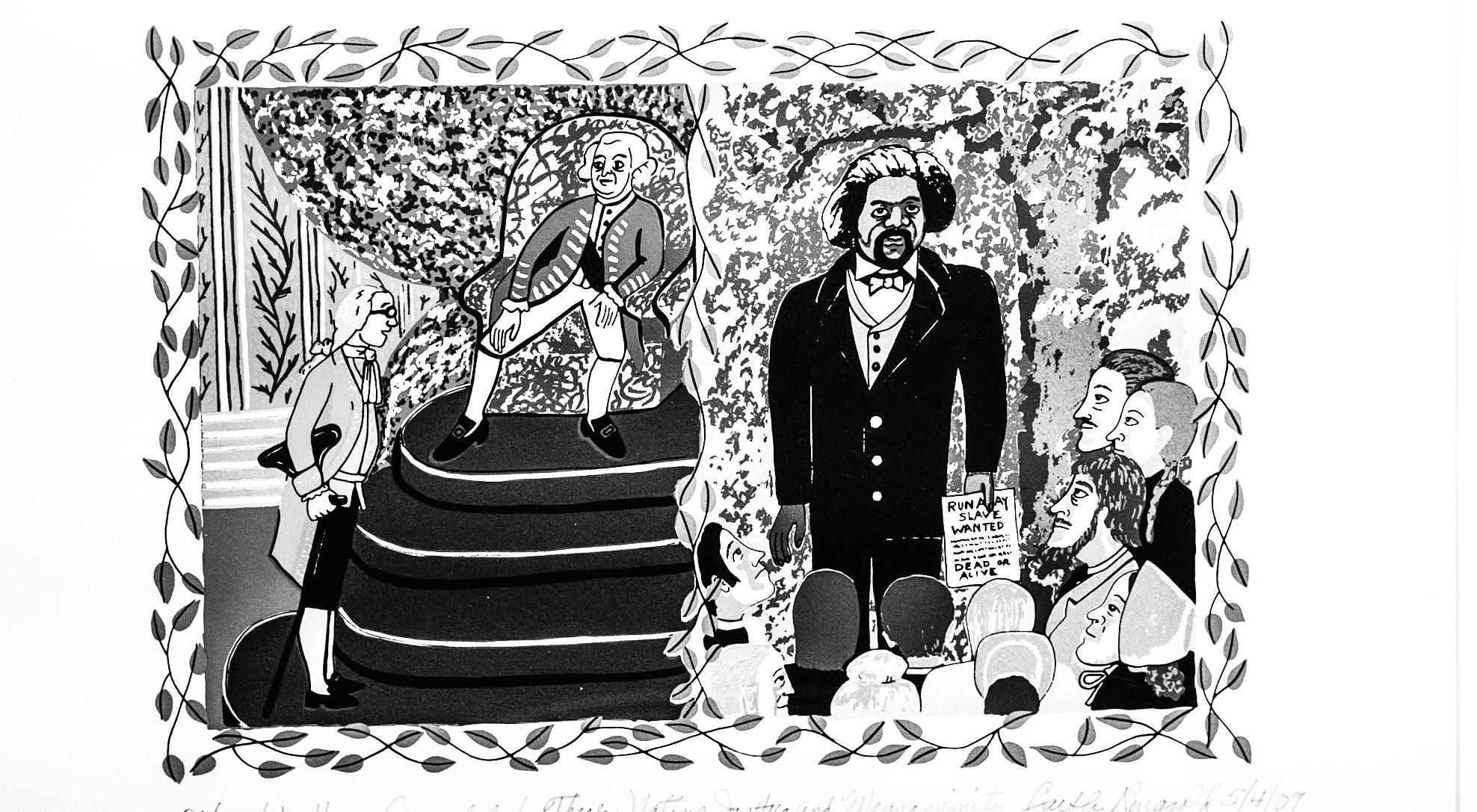
The Emily Lowe Gallery at Hofstra University’s Museum of Art opened a new exhibition on Thursday, Feb. 5, titled “Our Unfinished Revolution,” which explores the legacy of the American Revolution. The display highlights the experiences of multiple groups who were excluded from the freedoms promised in the Declaration of Independence.
The exhibition coincides with the upcoming 250th anniversary of the American Revolution and is part of Hofstra’s campus-wide initiative, “Revolution 250: Untold Stories.”
Alexandra (Sasha) Giordano, museum director, said the timing of the exhibition was intentional.
“It was important that the exhibition overlapped with the 250th anniversary of the American Revolution and the signing of the Declaration of Independence,” Giordano said.
“We wanted to bring together the exhibition, academic classes and community programming to build toward that anniversary.”
Giordano and the gallery collaborated with Hofstra’s history department, led by Sally D. Charnow, chair of the department. The partnership integrated the exhibition into research and coursework across 10 classes during this spring semester, as well as community programming.
The exhibition focuses on four groups: women, Black Americans, indigenous peoples and immigrants, each of whom played a role during the American Revolution, but were largely excluded from the liberties promised in 1776.
Presley Rodriguez, assistant director of exhibitions and collections and curator of the exhibition, said that it is organized around four anniversary years: 1776, 1876, 1976 and 2026.
“Each wall represents the struggles these groups have experienced over time, while also highlighting victories related to the expansion of civil rights,” Rodriguez said.
Rodriguez added that one of the main challenges during curation was balancing historical accuracy with respectful representation.
“These histories involve violence and injustice,” Rodriguez said. “We wanted to tell those stories honestly while also honoring the dignity of the people we’re representing.”
Giordano emphasized the importance of student engagement regarding the exhibition.
“It’s important that students come into the exhibition and consider untold stories of people they don’t normally associate with the Declaration of Independence and think beyond the Founding Fathers,” Giordano said. “We want students to think about history in a broader context, especially through the 10

classes that helped curate this exhibition.”
Rodriguez said the exhibition encourages visitors to understand art as a form of freedom of expression.
“When visitors come to the museum, they see how art has not only recorded history but has also opened people’s minds to different ideas and perspectives,” Rodriguez said. “These outcomes come from ordinary people coming together around common ideals, and it’s up to us to determine the next chapter.”
The artwork featured in the exhibition includes pieces selected from more than 5,000 works in the Hofstra University Museum of Art’s collection, spanning from ancient to contemporary art from various cultures. The exhibition also includes loans from other institutions and contemporary artists that Giordano said help “fill the gaps” in telling the exhibition’s story.
One of the featured contemporary artists is Jeremy Dennis, a member of the Shinnecock Indian Nation and a Long Island native, who created new work specifically for the exhibition.
Dennis said that he was invited to participate after meeting Giordano at a museum conference last year focused on planning for the 250th anniversary.
“This became an opportunity to think about Native connec-
tions to the American Revolution in a new way,” Dennis said.
Dennis contributed eight photographs, including seven from his series “Rise,” which incorporates historical references, symbolism and popular culture to explore Indigenous presence and memory.
Through his work, Dennis aims to challenge narratives that separate Native and non-Native histories. He uses his knowledge of Native culture and Shinnecock history to illustrate how Indigenous people were present on both sides of the Revolutionary War.
“I really want students to see this as a jumping-off point,” Dennis said. “I hope anthropology and history students want to learn more about Shinnecock topics and that art students see what’s possible within photography. It’s not just candid or street photography, you can use it like painting.”
Dennis added that building connections between the Shinnecock Nation and the academic community is essential.
“We’re a small nation of about 600 people, and we need as many allies as possible to amplify our voice,” Dennis said.
Students who attended the opening reception said the exhibition offered perspectives often missing from history courses.
Eleazar Sanchez Lopez, a sophomore double majoring in history and Latin American
and Caribbean studies, said the exhibition highlights overlooked contributions.
“When commemorating the 250th anniversary of American independence, it’s important to reflect on those who contributed to the Revolution but aren’t often discussed in history courses,” Sanchez Lopez said. “What would America be without Indigenous people, without women, without immigrants?”
Sanchez Lopez said one of the most striking aspects of the exhibition was its focus on landscape and geography.
“The beauty of the land is almost omnipresent throughout the exhibition,” Sanchez Lopez said. “Just as the country is diverse in culture and ideology, it’s also diverse in natural beauty.”
Sara Braun, a senior art history major, said the curatorial choices strengthened the exhibition’s message.
“Seeing how contemporary works, like [Dennis’] photography, speak to older pieces was really powerful,” Braun said.
Ashley Jayne, a senior double majoring in dance and history, said the exhibition reflects how younger generations are reexamining the past.
“Our generation wants to see different perspectives,” Jayne said. “That’s exactly what this exhibition does.”
The exhibition included works from artists such as William Hogarth, Alexander Calder, Faith Ringgold and Jeremy Dennis.
The exhibition will be open to guests throughoput the spring semester as part of the Hofstra 100 Strategic plan.
Photo courtesy of Amari Manasse
Photo courtesy of Amari Manasse
Hofstra study reveals new data on decrease of white births in United States cont.
baum and Chervenak conducted their study. The information regarding birth certificates was crucial as everyone delivering a baby is required to fill one out by law and, in the duration of those eight years, there were over 33 million births.
“It’s not the answers, but it’s the questions that are important … how you ask a question and how you ask a question of the birth certificate data will give you the answers,” Grünebaum said.
The doctors felt compelled to conduct this study for a variety of reasons but especially because of the dangerous trend of a declining rate of yearly births.
“Births are down in the [U.S.], however not at a crisis level … we have to acknowledge it … if this is not corrected this will become a major public health issue,” Chervenak said.
Additionally, the doctors felt it was necessary to not only highlight the decline in births, but the communities that are most at risk because of current medical treatment of many racial and ethnic
groups in the U.S.
“Maternal mortality disproportionately affects Black and Hispanic patients and when there are cutbacks to Medicaid and support … they are going to be more affected with adverse deaths,” Chervenak said.
Both doctors agreed that the current decline in immigration over the past year is due in part to the federal government’s treatment of individuals that belong to these immigrant populations.
They also argued that these birth numbers have already been affected in just a year and could have massive consequences in years ahead.
“Our study is meant to show that we are a country of immigrants, a country of new and old people,” Grünebaum said. “And we cannot vilify anybody.”
The new precedent set by this study shows that there must be new terminology when it comes to describing specific groups in America and examining race in the U.S.
“We need to stop referring to
certain segments of our population as the minority, they’re now going to be the majority,” Grünebaum said.
Monica Gibson, a sophomore political science major, spoke about the political implication of this study.
“I believe these survey results will continue to apply pressure to white leaders. I hope it will force government officials to
listen to their non-white constituents,” Gibson said.
Gibson also echoed the concerns of both Grünebaum and Chervenak about current immigration practices by the current federal government.
“We are seeing many families being deported, leaving because of fear or simply not coming to the U.S.,” Gibson said. “The American Dream is changing
for non-white people, which seems to be the goal of the Trump administration.”
Both Chervenak and Grünebaum recapped what the intention of their study was and the intention of the work they’ve done throughout their lives.
“We’re trying to teach people how to be ethical and how to treat others with respect,” Grünebaum said.
Public Safety Briefs Compiled by Katelyn Buchalter
Key:
PS – Public Safety
HU – Hofstra University
UFD – Umiondale Fire Department
On Sunday, Jan. 25, 2026, at 10:15 a.m., while driving on Holland House Road by Adams Hall, a FedEx truck made a right turn onto Primrose Lane and struck a fire hydrant. There were no injuries to Plant personnel who were notified and responded to the location.
On Tuesday, Jan. 27, 2026, at 7 p.m., two HU students reported to PS that at some point between Dec. 17, 2025, and Dec. 21, 2025, two bottles of perfume went missing from their on campus residence. Both students stated that they passed by a room with the door open and saw bottles of the same perfume sitting on a desk. The students did not confront the occupants of the room at the time. PS spoke with the occupants of the room. One of the occupants stated that the perfume belonged to them and provided a copy of the order number and date of delivery.
On Tuesday, Jan. 27, 2026, at 5 p.m., an HU student reported to PS that while fixing the heat in their residence hall, an HVAC mechanic moved their desk and the student’s Apple Watch fell onto the ground, shattering the face of the watch.
On Tuesday, Jan. 27, 2026, at 6:31 p.m., the fire alarm in the Sondra and David S. Mack Student Center activated due to vaping. The building was evacuated within one minute without incident. PS and UFD responded to the location. The situation was corrected, and the fire alarm was reset.
On Wednesday, Jan. 28, 2026, at 7:21 a.m., while plowing snow in parking field 2A, an HU-owned snowplow struck a parked vehicle owned by an HU student, causing damage to the driver’s side, rear quarter panel, bumper and taillight. There was no damage to the snowplow and the student was notified. Police assistance was declined at the time.
On Saturday, Jan. 31, 2026, at 9:59 p.m., the fire alarm in Hofstra USA activated due to an unknown cause. The building was evacuated within one minute without incident. PS and UFD responded to the location. The situation was corrected, and the fire alarm was reset.
On Sunday, Feb. 1, 2026, at 10 p.m., the fire alarm in Estabrook Hall activated due to an unknown cause. The building was evacuated within five minutes without incident. PS and UFD responded to the location. The situation was corrected, and the fire alarm was reset.
Trends in the distribution of United States live births by maternal race and ethnicity, 2016-2024 from the National Vital Statistics System show white births are decreasing
Photo courtesy of 2026 Grünebaum A et al. JAMA Network Open.
FEATURES
Our voices at Hofstra: Adanya Collins
By Denivia Rivera FEATURES EDITOR
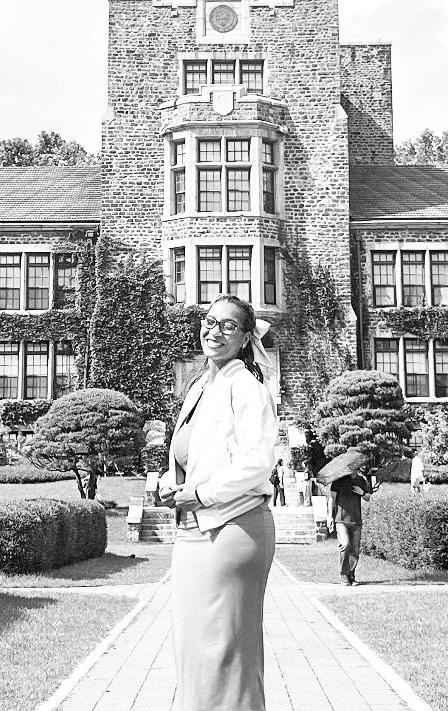
“I think especially since there are not as many Black students on campus, having identity-based clubs is very important,” said Adanya Collins, a junior linguistics major. “Not only do they allow students to feel heard and understood by administration, but also their peers.”
Collins is a student leader on Hofstra University’s campus. One of her roles is being the president of Hofstra’s Queer and Trans People of Color Coalition (QTPOCC).
“As president, I essentially create events with my executive board and execute the events,” Collins said. “I also make sure the resources we have on campus are easily accessible to students in the LGBTQ+ community. A lot of people don’t know about the opportunities that Hofstra provides like the name change policy, the pronouns policy and how to report biased incidents with professors and staff on campus.”
Collins said her main goal as president has been to receive more recognition for QTPOCC,
so students are aware of the club’s existence. She thinks it’s important that students feel like there’s a place on campus where they feel comfortable.
“Last semester I heard a lot of new members expressing [that] they didn’t previously know QTPOCC was a club on campus,” Collins said. “Hearing that makes me feel really good about the work I’ve been doing with creating events, attending meetings with our advisors and going to all the required training. At the end of the day, the only thing I want to do is make sure that the LGBTQ+ community on campus feels heard.”
Some of Collins’ past student leadership roles include former public relations chair for Black Leaders Advocating for Change at Hofstra, former social media chair for Drop of Drag and Summer 2025 Welcome Week leader.
In the Fall 2026 semester, Collins became a Hofstra study abroad ambassador, a role dedicated to helping students navigate and understand the steps and preparation needed to study abroad.
“The reason I decided to join was because when I was applying to study abroad, I felt the Hofstra
website was a little bit difficult to use,” Collins said. “I also felt that I didn’t know that many other Black students that had currently studied abroad or at least had openly talked about it in a social setting.”
Collins studied abroad in Seoul, South Korea, last summer. She feels that a lot of students share their experiences studying abroad in European countries, but not as many do so when they went to other continents and countries.
“We [study abroad ambassadors] talk about our experiences studying abroad, how the Hofstra system works and how to set up meetings with the study abroad office,” Collins said. “There’s so many different routes on how to study abroad, so we can give a glimpse of how our trip went and how you can plan for your study abroad.”
Collins is also the financial secretary of the Kappa Phi chapter of Alpha Kappa Alpha Sorority Inc.
“Essentially when it comes to anything financial, I’m the one helping the treasurer, writing reports and [handling] anything income-related for events,” Collins said. “We all work together when it comes to creating events
and making sure we’re in good standing with Hofstra’s [Fraternity and Sorority Life].”
Collins said her sorority is very big on discussing social justice issues.
“Last semester we did an event called ‘Your Voice Matters,’ and it just happened to be after the town hall meeting,” Collins said.
“It was a very important event because students were able to get their voices out there; it allowed for other people to know what’s happening on campus and be aware of what Black students on campus are facing.”
Collins said that it’s important to have student leaders of color on campus so that other students are interested in getting involved and having their voices heard.
“I think the biggest thing with leadership is a lot of people are scared to put themselves out there, especially when you are the minority in a predominantly white institution,” Collins said. “It can be very hard to feel seen, so I think seeing other people of color in these leadership roles is important because they feel like they can do it too.”
Collins continues to work in
her leadership roles and strives to create safe spaces for students to feel authentically themselves.
“My experience being a leader on Hofstra’s campus has been very rewarding,” Collins said. “I feel like I’ve made a lot of great connections and like I’ve made some sort of impact on campus. It feels great, and I hope to be able to continue doing the work I’m always very excited to do.”
Chron Critique: Starbucks’ pistachio menu
By Hannah Mudry
FEATURES EDITOR
In January, Starbucks unveiled their pistachio menu in the United States. Due to the launch, the menu’s popularity grew on social media. At Hofstra University, signs popped up all over the Sondra and David S. Mack Student Center to promote the new pistachio drink menu, sparking my curiosity.
Wanting to get a taste of the new menu, I tried the pistachio cream cold brew and the iced pistachio latte.

Pistachio Cream Cold Brew:
The pistachio cream cold brew made its mark on the Starbucks menu in 2021, but it has since blown up over social media when the seasonal pistachio rolled out again this year. Following the pumpkin cream cold brew and peppermint mocha, the pistachio drink really had its time to shine with the booming popularity of TikTok.
Starbucks describes the drink as their “signature cold brew sweetened with vanilla syrup, topped with silky, pistachio cream cold foam and finished with salted brown-buttery sprinkles.”
The pistachio cream cold brew honestly doesn’t taste different from the regular vanilla sweet cream cold brew. As someone who finds the Starbucks cold brew a weak blend and rather sweet, the cold brew itself became unappealing after an hour, leading to my throwing out the drink with a quarter left (and I only got a tall). I’ve
always heard that cold brews need to be drunk within a half-hour, but I enjoy casually sipping a beverage during my classes. Since the cold brew is only sweetened with one pump of vanilla, it does hold the same flavor as Starbucks’ signature crew cold brew.
The cold foam is made with pistachio syrup to give that desired flavor; however, there was no flavor. The cold foam tasted just like the vanilla sweet cream cold foam.
The best thing about the pistachio cream cold brew was the absence of pistachio.
Iced Pistachio Latte:
The Starbucks iced pistachio latte debuted in 2021, when the pistachio cream cold brew did. Starbucks describes the coffee as having a “sweet pistachio flavor paired with espresso and milk, served over ice and finished with a salted brown-buttery topping – a creamy, smooth iced latte made to bring you
a renewed feeling in the new year.”
When I received my drink, I first noticed that I was not given the salted brown topping, which made me slightly disappointed, but that didn’t ruin the drink – it was already bad.
The pistachio latte tasted just like milk. I did not have any inkling of an espresso shot being in the drink.
The flavoring had a very intricate taste. It reminded me a lot of oat milk, which was concerning because there was no oat milk in my drink. I ordered the coffee with my typical 2% milk.
I will literally never get that taste out of my mouth. The fair flavor I had with the pistachio cream cold brew is not even close to the disastrous mess that this drink was.
The pistachio cream cold brew gave me a fairly enjoyable experience, whereas the iced pistachio latte was a horror movie in a cup. The problem

was that the pistachio flavoring is just not my first pick syrup to add to a latte or cold brew. Starbucks’ coffee is also not my first choice for a caffeinated beverage due to its weak blends.
The pistachio cream cold brew was similar to the vanilla sweet cream cold brew with vanilla sweet cream cold foam. The iced pistachio latte tasted like an oat milk latte. The coffee drinkers who enjoy those latter beverages may also enjoy the pistachio option.
Photo provided by Adanya Collins
Photo courtesy of Starbucks
Photo courtesy of Starbucks
FEATURES
Alumni Feature: Rylee Johnston
By Hannah Mudry FEATURES EDITOR
Rylee Johnston spends her dayto-day discussing trends, outdated clothes and timeless pieces with stylists featured in her fashion-forward, fun and informational stories.
Johnston works as a News and Deals Shopping writer for People, Inc. where she covers a wide range of lifestyle topics including fashion, brands and celebrity content.
“My job is finding ways to turn products into a journalistic story,” Johnston said. “I combine reporting with shoppable links.”
Being a shopping writer falls under the category of service-journalism as Johnston’s content provides readers with information they can use. For example, what products they should purchase and which products they could pass on.
Johnston’s employee biography on People’s website reads, “[Johnston] covers the items you’ll want to reach for on repeat from skin-brightening vitamin C serums to comfy matching sets that are trendy enough to leave the house in. Her pop culture expertise keeps her up to date on the latest
By Emilie Morrissette ASSISTANT FEATURES EDITOR
Located on the lower level of the Sondra and David S. Mack Student Center lies Hofstra University’s hidden gem: the Game Room. This spot is a social hub for both residents and commuters, filled to the brim with games of all kinds. From nostalgic games like Just Dance and Nintendo Wii to high-end gaming consoles such as the PlayStation 5 – the Game Room has it all.
Julia Murphy, a sophomore television business major, has been employed by the Game Room since Spring 2025 and could not recommend it more.
“It’s just a change of pace to come here and get your mind off of something without going on your phone or going on social media,” Murphy said. “Students can use this space as a decompression tool.”
The Game Room serves as a laidback area where students can
celeb-used products and collaborations, and [it] has led to more than a dozen celebrity interviews.”
Her favorite aspect of the job is interviewing prominent individuals and experiencing lively opportunities.
Through her career at People, Johnston has met supportive peers who encourage her to produce strong articles.
“Sometimes at school, postgrad life can be really daunting,”
Johnston said. “I feel like even though [journalism] is a competitive field, you’d be so surprised [about] how supportive people are in the industry.”
Johnston started networking during her time at Hofstra University. She encouraged conversations to develop connections and expand her network.
“People want to help and that’s something you forget about,”
Johnston said. “As much as it is a competitive landscape, we often forget that people are helpful and do feel for you.”
For those entering the workforce,
Johnston says reaching out to employers and alumni is a positive way to begin career development.
Johnston graduated from
Hofstra in 2020 with a bachelor’s degree in journalism and minors in international affairs and European studies.
To prepare for her future career, Johnston took advantage of many club opportunities, including but is not limited to, meeting speakers, making connections and researching internships.
“The [Lawrence Herbert School of Communication] is well-integrated through media,” Johnston said. “If you take advantage of all the clubs offered, it will prepare you even more.”
Johnston was involved in Her Campus Magazine, Zeta Phi Eta, Model UN, Entertainment Unlimited and Alpha Epsilon Phi.
In her classes, Johnston found that there wasn’t a large concentration in magazine journalism, but rather a push towards television and broadcast journalism. Through clubs and internships, she was able to explore all areas of journalism.
As a junior, Johnston started her internship journey at American Spa Magazine. There, Johnston produced beauty and spa features, wrote news content, conducted research and supported the editorial team by assisting in planning
the annual Women in Wellness Conference.
She followed this opportunity as an editorial intern with PSFK, an American business media company, where she researched and wrote articles about the leading brands in retail.
Her last internship during her undergraduate years was with NBC Universal as a digital editorial intern for the Today Show.
Johnston’s internship exposure gave her the hands-on experience in lifestyle journalism that her classes were not necessarily providing her. However, she heard sound advice from her professors about the industry as a whole:
“There are still some professors working in media, so they can give you good advice on the media industry right now,” Johnston said.
Not only did Johnston utilize her professors’ knowledge, but she also took advantage of the Center for Career Design & Development and her preprofessional fraternity to guide her professionally.
The Career Center operated as a powerful tool for resume building and meeting new people, whereas Zeta Phi Eta gave her a space to shadow older
Level up in the Game Room
let loose from the academic stress of their daily lives. It is accessible due to its late hours and welcoming environment. It opens at noon Monday through Friday, closing at 7 p.m. on Monday and Tuesday, 9 p.m. on Wednesday and Thursday and 11 p.m. on Friday. On Saturday and Sunday, the Game Room opens at 6 p.m. and closes at 11 p.m. and 10 p.m., respectively.
“Common hour is a great time to come because you can play pool with your friends or get closer with people that you might not already know,” Murphy said.
Along with the classic games such as air hockey and foosball, there are also several gaming personal computers (PC) that run plenty of modern games as well. Fortnite, Minecraft, FIFA, Call of Duty: Warzone, Apex Legends, Valorant and Rocket League are just a few fan favorites. Students can use the Game Room login to access their downloaded games or sign in to their own personal Steam accounts.
“Lugging your PC from home is a lot,” Murphy said. “The fact that we have them here is a good resource. When you’re in your room, you may be prone to overusing it or feeling like you’re distracted.”
The Game Room has an abundance of comfortable seating options including cozy couches and both low- and high-top tables. The tables are perfect for chatting with friends or playing games like chess and checkers.
Ahmir Wells, a freshman marketing major, takes full advantage of the lounge.
“I usually come every day –from the time they open to the time they close,” Wells said. “A lot of my friends come and play pool; we’re always competing to see who’s the best.”
Wells enjoys using this space to strengthen his skills in pool and fill his time during football’s offseason. He appreciates the fact that there is a fun, engaging spot on Hofstra’s campus that motivates him to leave his dorm.
peers as they applied for jobs and performed other “adult tasks.”
Johnston found joining clubs was a powerful way to take advantage of her undergraduate years, especially being involved in clubs outside of the Lawrence Herbert School of Communication.
“When you are in the school of communication, you have tunnel vision,” Johnston said. “More clubs means more connections.”
Johnston’s advice: diversify what you’re involved in and reach out to employers.

“I can’t stress this enough: I feel like people need a space to have fun,” Wells said. “There’s not a lot of spaces on campus that are primarily just for that.”
For students looking to strengthen their social life on campus, this is the place for them. Wells recommends the Game Room to commuter students especially.
“A lot of my friends that come here are commuters so usually our time to bond together is here in between classes,” Wells said.
If you’re looking for something to do on Friday nights, you can catch the esports club in action. The Game Room hosts regular tournaments with Super Smash Bros. being a huge highlight of the event. The room can fill up, so get ready to experience the energy for yourself.
Gem Silva, a sophomore biology major, commented on the relevance of the esports club.
“Just knowing that we have an esports club and that this room is for esports makes me feel a lot
more positive towards Hofstra,” Silva said.
To Silva, the prescence of the esports club proves that Hofstra cares about the community.
When it comes to working at the Game Room, Murphy emphasized that they are always looking to upgrade the space so that no student will be stuck with faulty equipment. Murphy also explained that this job has strengthened her connection to the school.
“I think being able to say that you’re employed by the school in some way makes you feel closer to the Hofstra community overall,” Murphy said.
Murphy wishes that the Game Room was talked about more, as many students are unaware of its existence. Whether students are looking for an on-campus job, needing to let loose and have fun, or searching for a commuter-friendly place to hang in between classes: the Game Room is the place.
Photo provided by Rylee Johnston
M AN ON THE U NISPAN
“What’s your favorite Super Bowl snack?”
By Denivia Rivera FEATURES EDITOR

“I’d say chips like Tostitos or potato chips –something salty and fun.”
- Marissa Schmier, junior

O verheard @ h O fstra
“My grandfather used to drive with two left feet, but I never knew him with legs.”
“That’s so stupid, bro, and it’s not even a fantasy football punishment.”
“Being a DILF isn’t a lifestyle, it’s a mindset.”

“That’s a good question. I didn’t even have any snacks yesterday. I’ll do pretzels. It’s generic.”
- Imani Washington, senior

“Chips.”
- Ricky Chen, sophomore
“He always smells like a water park.”
“Is it politically incorrect to call someone a vegetarian?”
“I told her I loved her, then told her I’ve had a peanut allergy since I was born.”
“I think he choked out his former chef.”
“Jerking off on the job – you’re making Pizza Hut look bad and yourself look bad.”
“I feel personally victimized by the Christians of Scattergories.”

If there’s something funny you overhear, you can now submit it here!
Spread by Hannah Mudry, Denivia Rivera and Emilie Morrissette
Joe Orovitz / The Hofstra Chronicle
Personal Essay: My graduation speech helped me conquer college loneliness
By Kumba Jagne MULTIMEDIA EDITOR

A year and a half ago I graduated high school wearing a cap that said, “plant seeds and grow,” then gave a speech to my class of 400 people and our families about the skill of growth. I opened the speech by giving inspiration to the current senior representative, my successor, for her speech. I told her to write from the heart. A month ago, feeling nostalgic, I opened my high school Google Docs account and saw my graduation speech floating at the top. While reading through it and thinking about my current bout of college loneliness, I realized I wrote that speech for present me.
“Think about your time these past few years but particularly the terribles of it all: the challenges you faced in high school, the
failed grades and lost friendships – all of it,” I wrote.
The speech came at a good point in my life, summer was on the horizon and I was finally leaving the school that I was itching to be free of. My time in that town, though, came with its terribles.
My family and I moved to Leander, Texas, from The Gambia when I was 15 years old. My knowledge of Texas before I moved was that it shut down because of a couple inches of snow the previous year. Safe to say, I would have chosen another state.
Central Texas felt flat compared to the rolling mountains of Washington, where I grew up, and dry in comparison to always being 30 minutes from a beach in The Gambia. My aunties in Washington practically raised me along with my own parents, and my cousins were like siblings.
An Airbnb was our shelter for June and July, and so I spent hours of my time in bed, bored out of my mind. School was not for another couple months and I had no friends. My “best friend” from The Gambia began ghosting me for weeks on end.
I got a drawing kick for a few days and portrayed how all the severances in my life came from change. When my auntie and cousins came to visit in August, I felt at home for the first time. My barely used diary was marked with how I would wait for Leander to feel like home on its own.
The speech continued, “And now I want you to think of how

“And if there was growth, there will be growth. If you adapted, you will adapt. If you evolved, you will evolve. If you overcame those challenges, you will overcome again.”
I was at my grandma’s house every weekend in The Gambia. My whole life I had been surrounded by an abundance of family to the point of annoyance. But in Texas, my extroverted self ached in the comparingly-empty space.
you overcame those challenges and grew as a person as a result.”
After months of teenage loneliness, I began making friends. Moving across the world twice forced me to take a deeper look at my friendship-making skills. I

learned to take a little extra effort to engage with people whose company I enjoyed, rather than just the ones who happened to be in the hallway that day, as I had done in Washington. I had to balance out the inverse and understand when to stop pouring my efforts into people who did not appreciate them, like I did in The Gambia. Changing environments pulled the safety net out from under my feet and revealed my flaws that I didn’t know existed, thus giving me an opportunity to work on them.
Change felt less like a severance and more like water to me – a necessity.
So, I did it again. Off on a mission to discover who I was, I set off – like many others – to New York. Soon, the idea of it all began to terrify me.
“In the months leading up to [graduation] the realization set in that these friends I made, routines I created and this way I had of being, I would have to find all over again,” I wrote on. “And what really terrified me was the idea that I wouldn’t be able to.”
Here I am, a year and a half later, and I find myself craving warm blue skies, sweet tea and a queen-size bed. This feeling of loneliness, like the water in a bowl after washing it, sits almost constantly in my chest. I have
never been surrounded by so many people, yet I feel this fractural isolation. My closest friends are in Texas, and they are first in line for my crash-out recaps, but my friends here actually understand my day-to-day. The only person who knows both is me, and it is heavy to rely only on myself to carry the weight of who I am and what I am going through all the time.
This reminds me of sleeping until 3 p.m. because I had nothing to do that first summer in Texas or crying before bed – not just because I was sad, but because I had no one to talk to about being sad. It brings a weird sense of comfort. The idea that I’ve been through periods of loneliness followed by periods of social abundance or comfort in the emptiness shows me that if I figured it out once before, I could do that again. The bowl always dries; it just needs time.
“Here’s the thing about skills, they’re second nature,” the speech continued, “like how you learned to read, you learned to grow and that’s a part of you now. And if there was growth, there will be growth. If you adapted, you will adapt. If you evolved, you will evolve. If you overcame those challenges, you will overcome again.”
Sometimes I forget my age. I assume that because at one time I was younger, I must have it all figured out now. In reality, I am only 20. But in a way, I already have figured it out.
Photo courtesy of Ousainatou Jallow
Photo courtesy of Ousainatou Jallow
Photo courtesy of Ousainatou Jallow


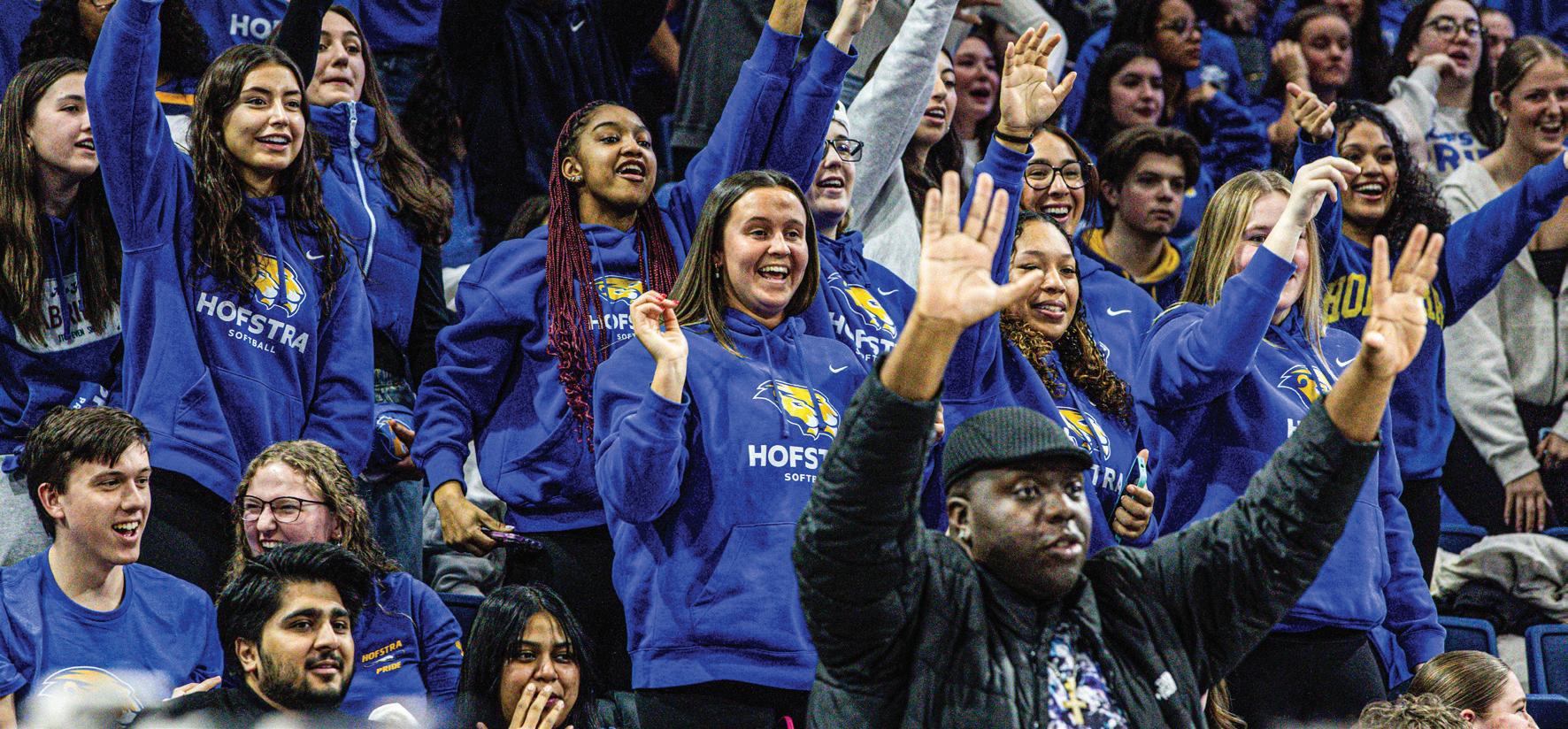
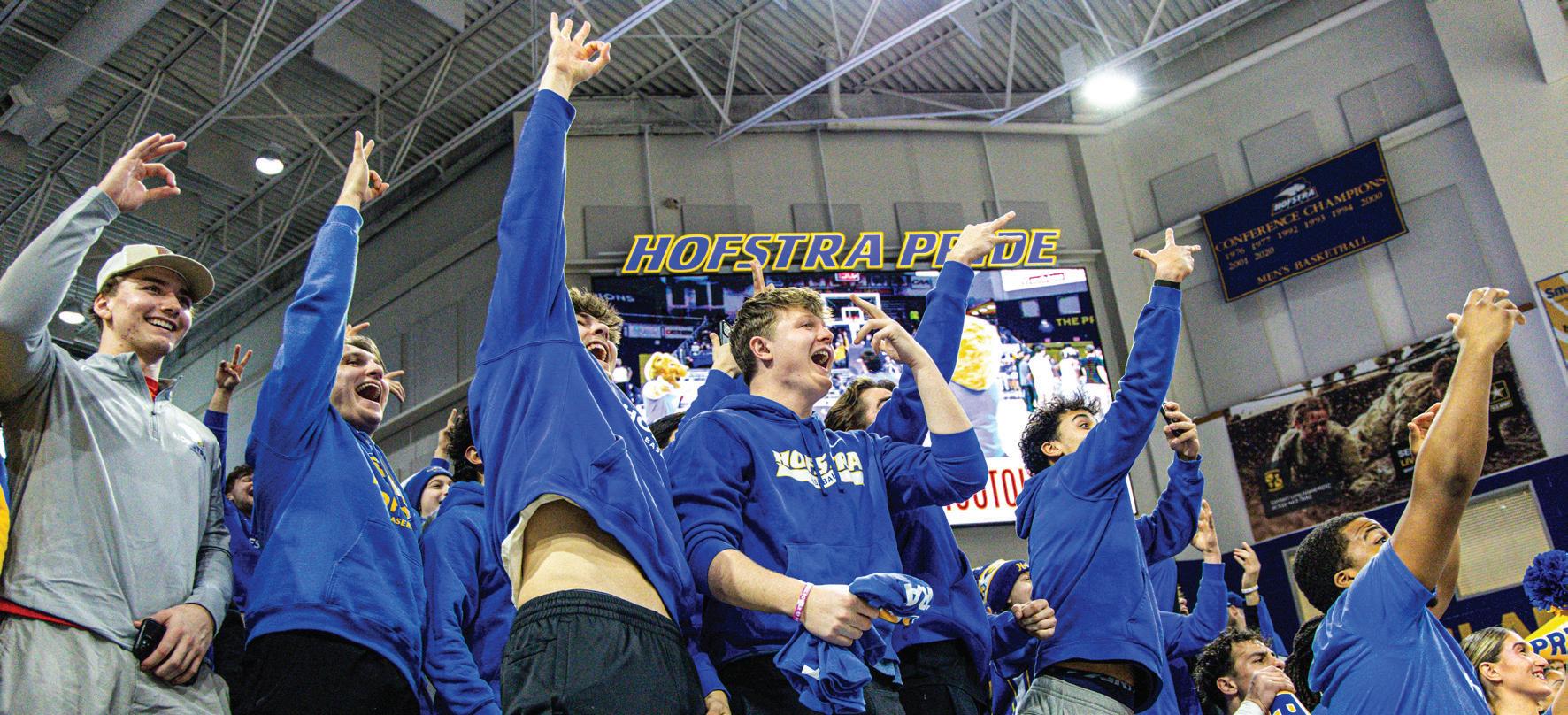

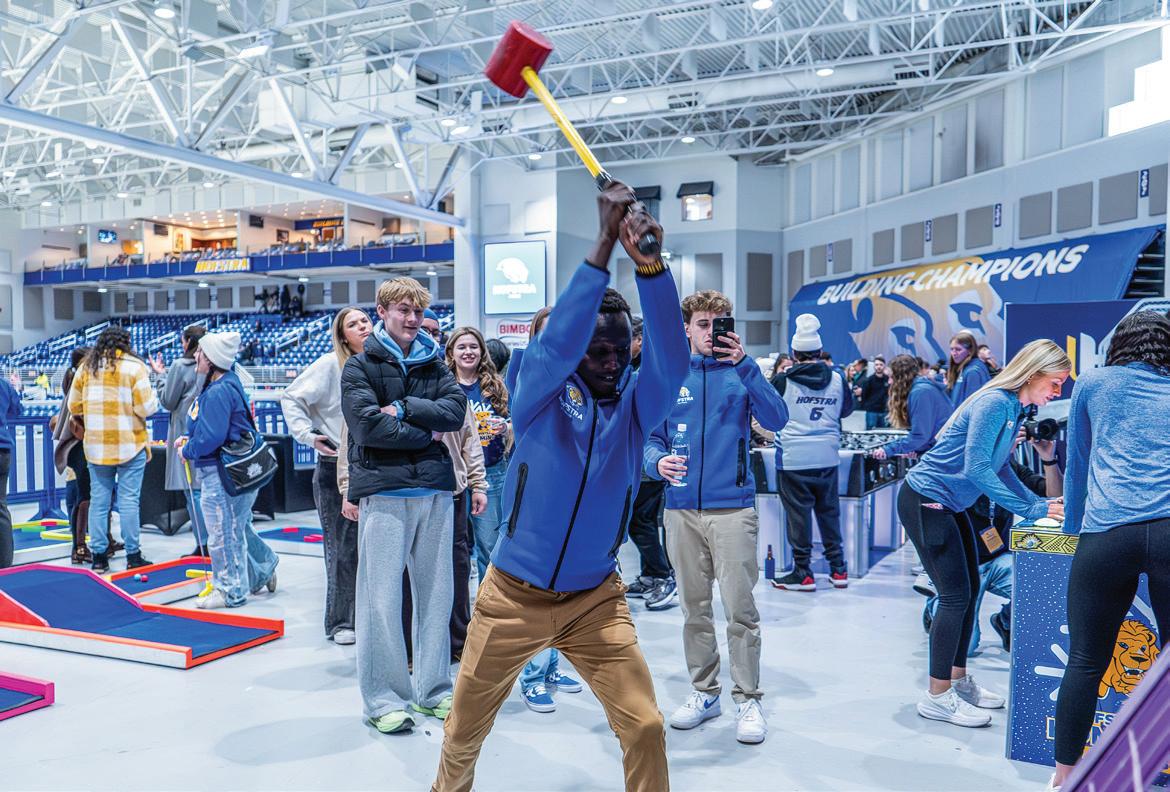
HOMECOMING 2026: A WINNING WEEKEND
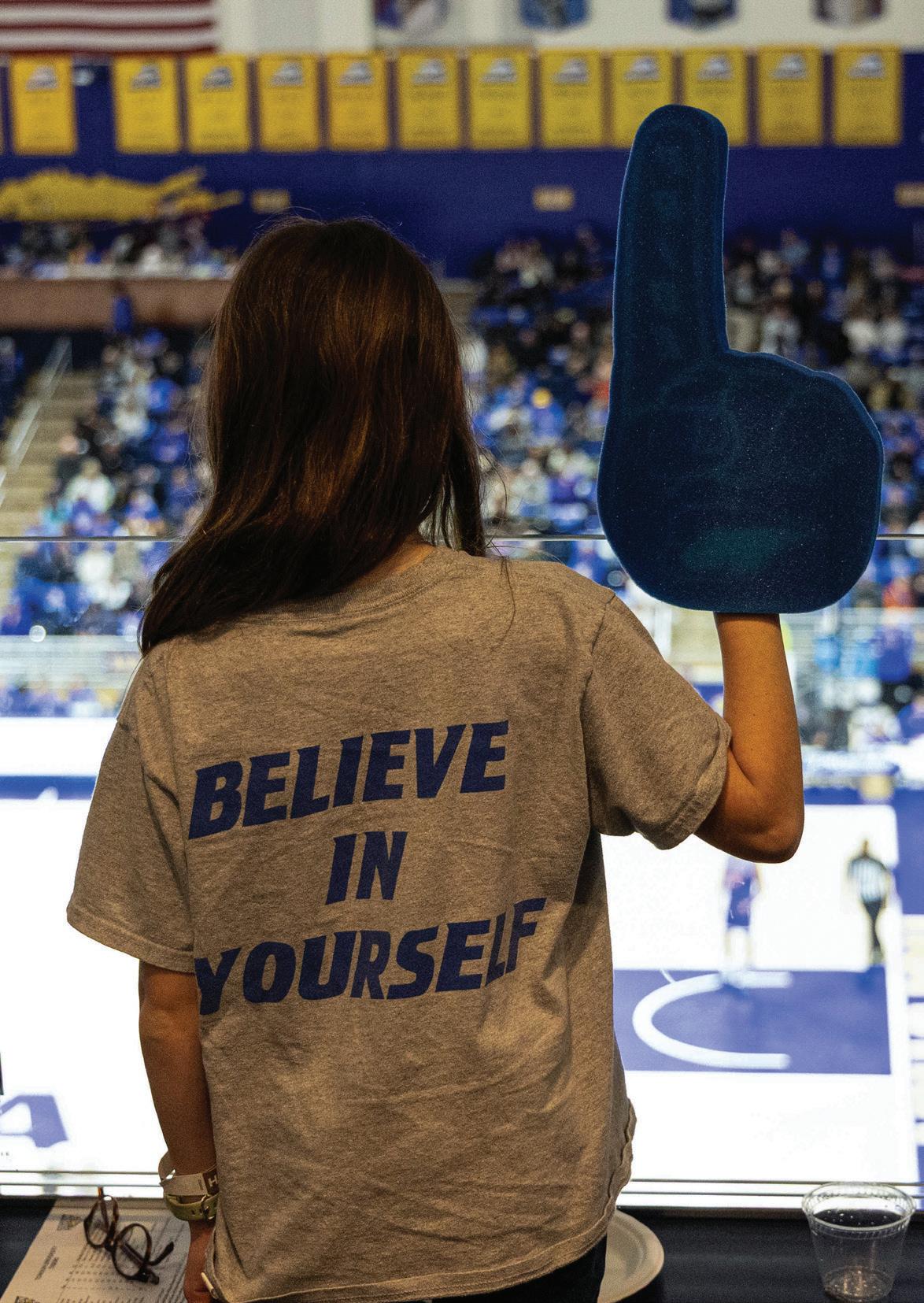
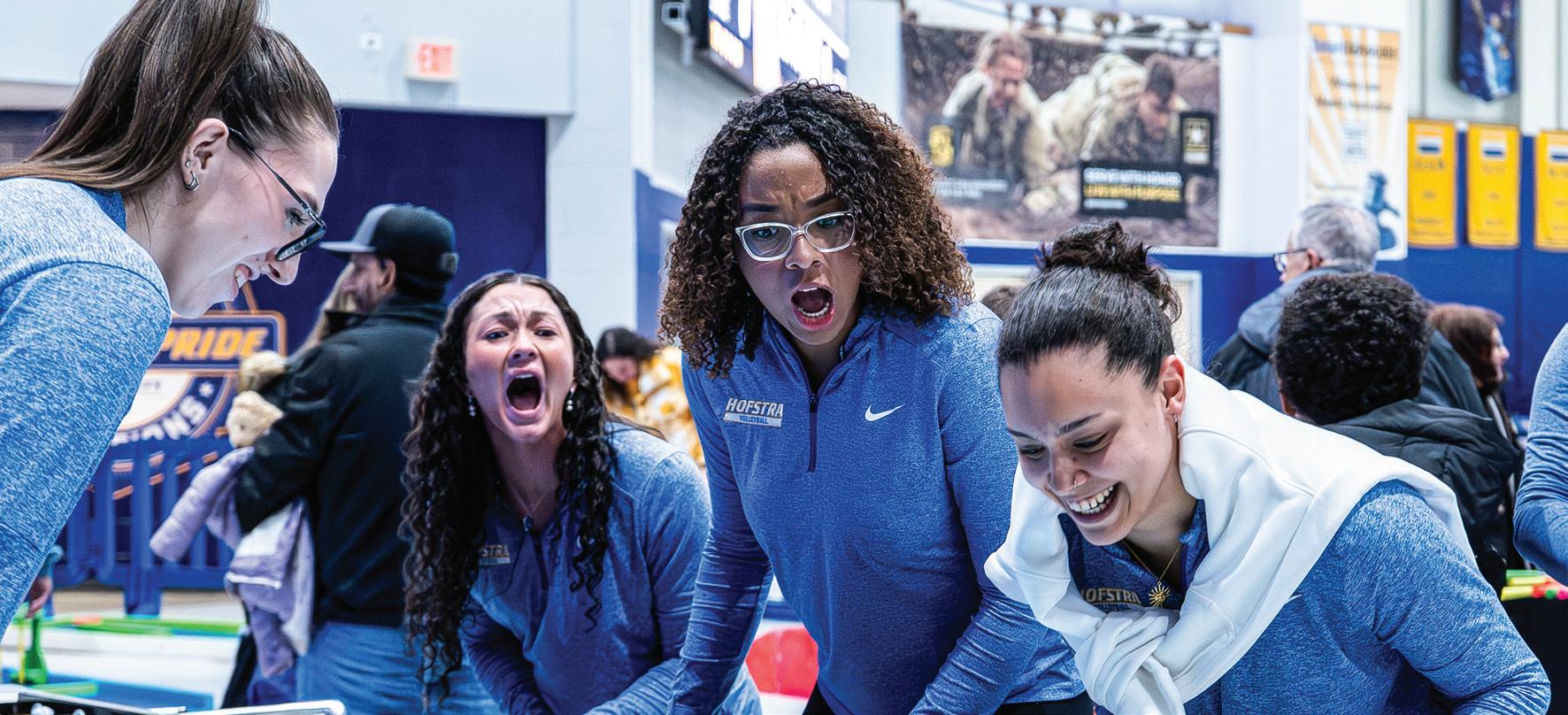
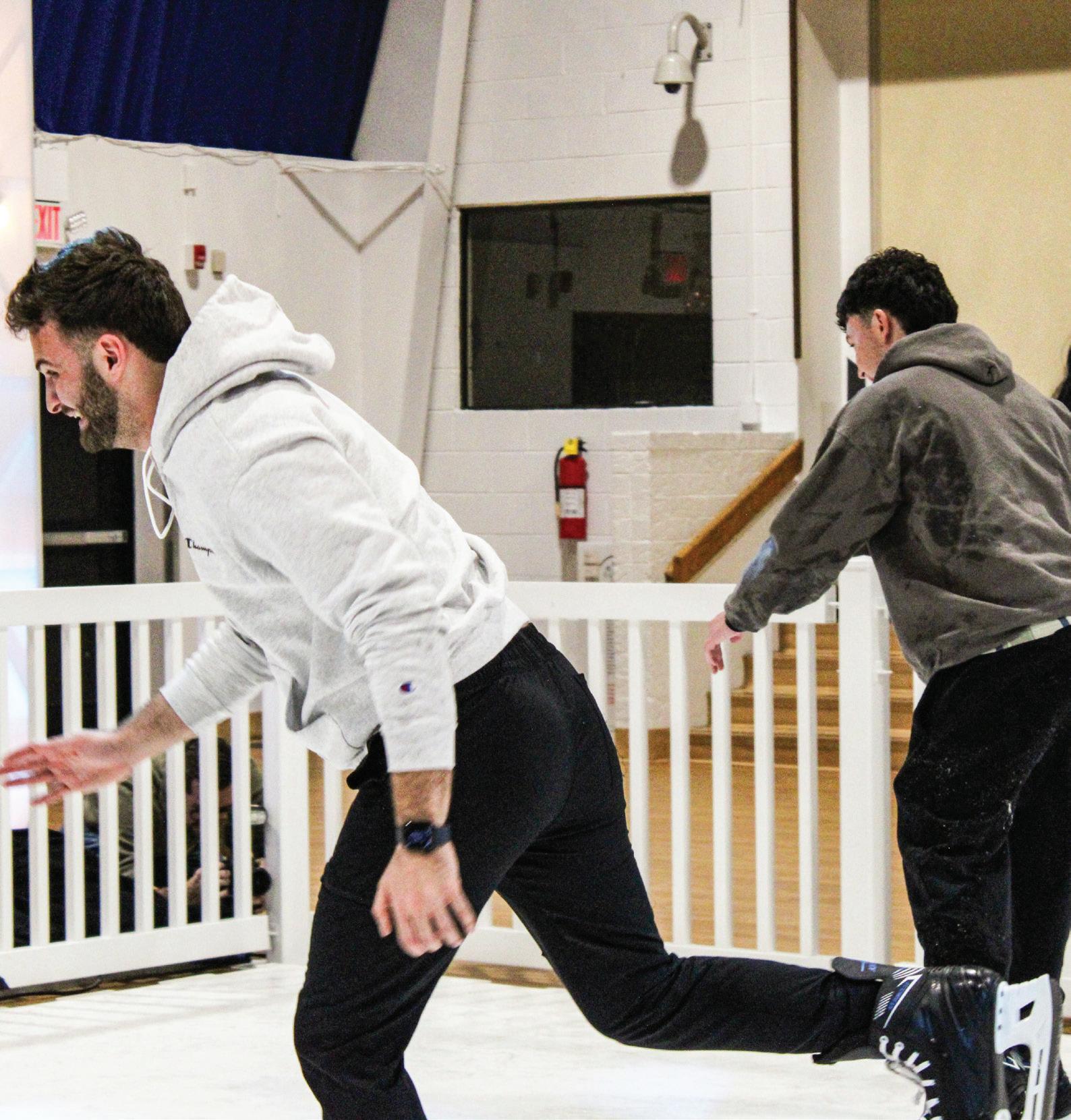
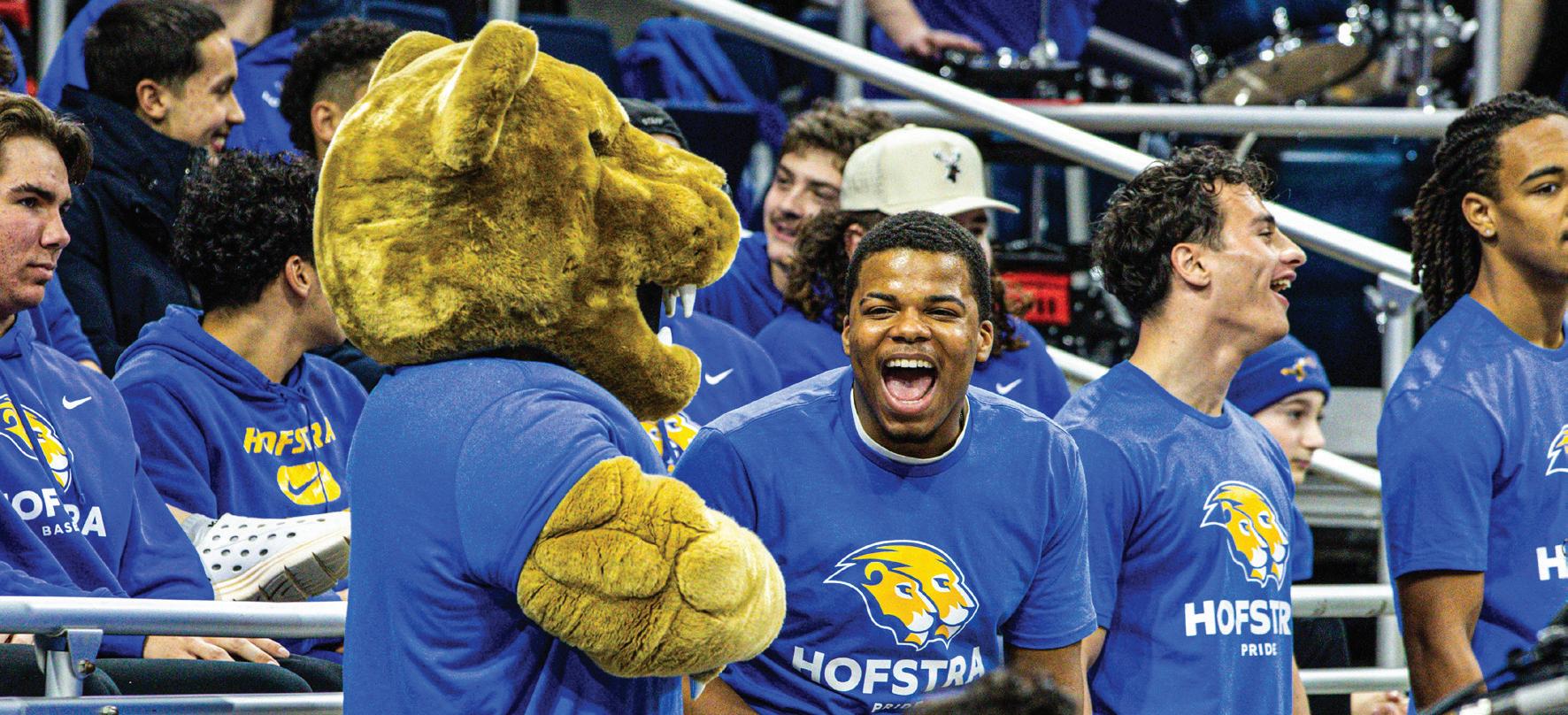
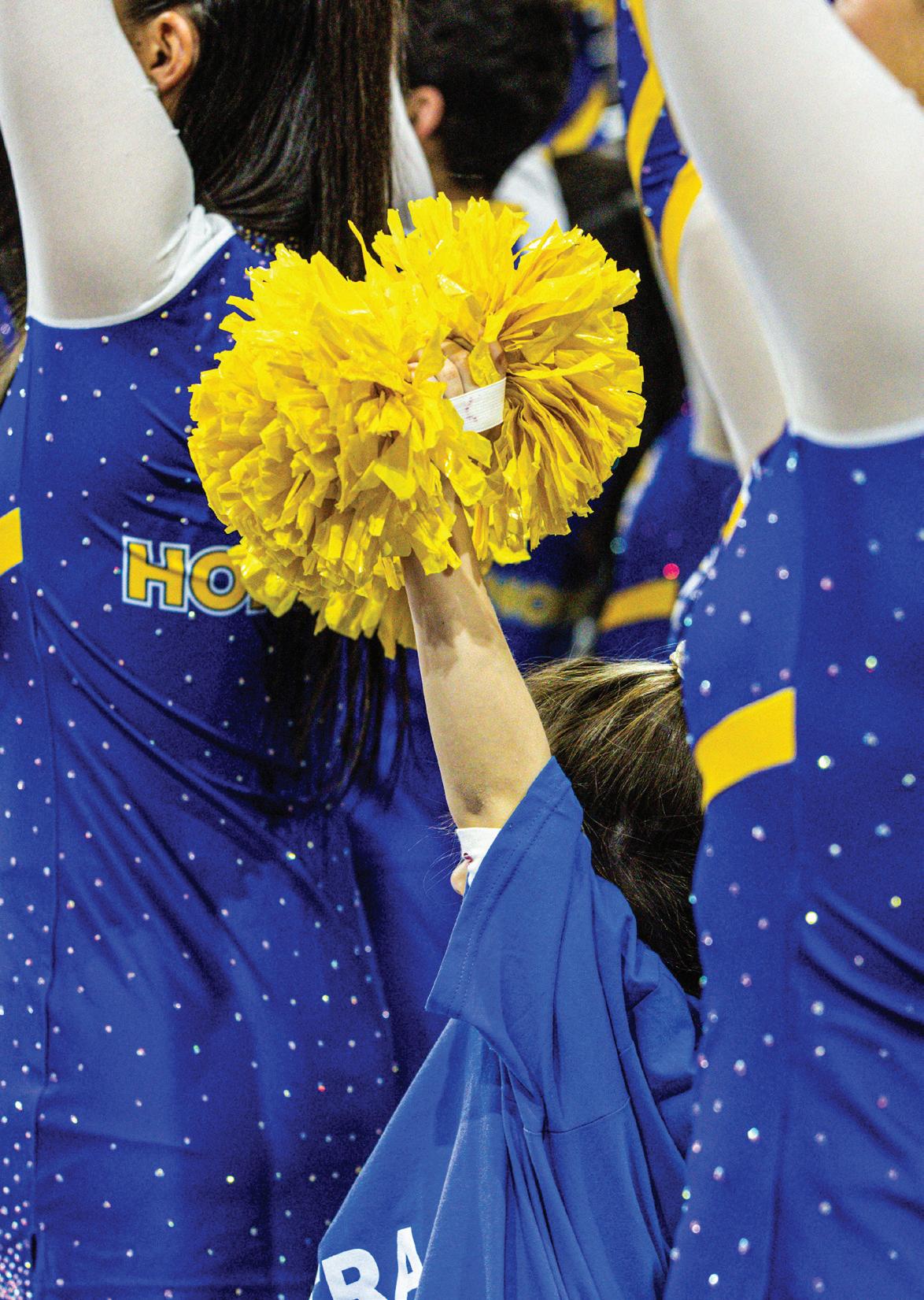
The Hofstra University men’s basketball team beat Towson University 71-49 in their homecoming game on Saturday, Feb. 7. The Hofstra women’s basketball team beat Hampton University by 26 points on Sunday, Feb. 8. Winter Ice Skating in Hofstra USA on Tuesday, Feb. 3, and a comedy performance from YouTuber Trevor Wallace on Friday, Feb. 6, eased students back into the Hofstra spirit. On the day of the homecoming game students and faculty enjoyed a giant foosball table, carnival-style games and free food at the Homecoming Tailgate.
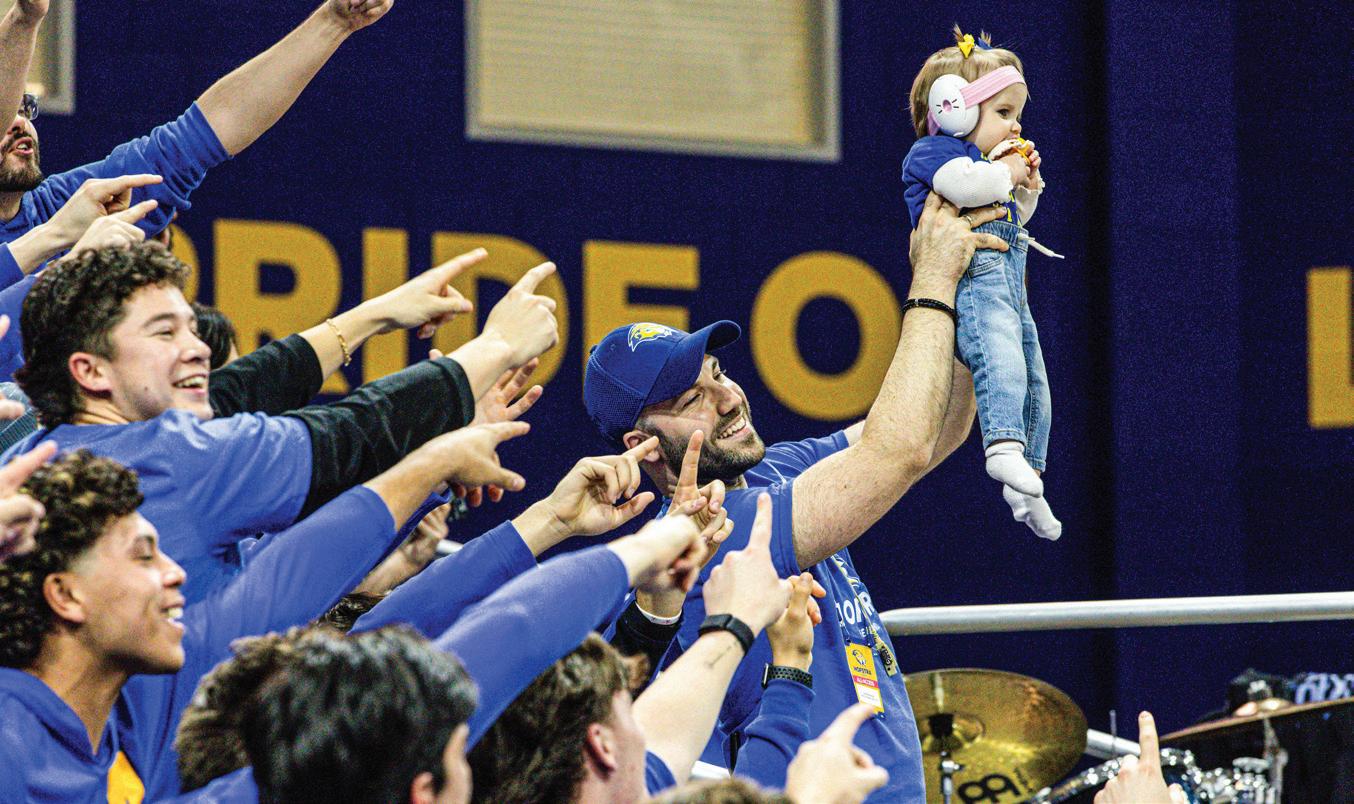

Spread by Kumba Jagne and Joe Orovitz
Background courtesy of Kaylee Roche
Hannah Mudry / The Hofstra Chronicle Kim Nadler / The Hofstra Chronicle
Kim Nadler / The Hofstra Chronicle
Kim Nadler / The Hofstra Chronicle Kim Nadler / The Hofstra Chronicle
Kim Nadler / The Hofstra Chronicle Kim Nadler / The Hofstra Chronicle
Kim Nadler / The Hofstra Chronicle
Kim Nadler / The Hofstra Chronicle
Kim Nadler / The Hofstra Chronicle
Photo courtesy of Kaylee Roche
Photo courtesy of Kaylee Roche
Arts And EntErtAinmEnt

Photo courtesy of Vanity Fair
'Marriage of Figaro' reimagined
By Katelyn Buchalter ASSISTANT NEWS EDITOR
The lights dimmed as the curtain rose to reveal the cluttered setting of a hotel casino set in Las Vegas. After weeks of preparation, the well-rehearsed cast of “The Marriage of Figaro” finally took to the stage on Friday, Jan. 30, and Sunday, Feb. 1, to perform a 90-minute adaptation of this famous opera at Hofstra University’s John Cranford Adams Playhouse.
With a total of four acts, the opera opens with Figaro happily measuring the new space given to him by the Count. The scenes that follow depict issues between the characters, like Susanna –who plans to marry Figaro – and Marcellina – who has the power to marry Figaro if he does not pay the money that he owes her. This conflict continues along with other plot lines that get resolved in Act 4, like the Countess’ discontent with her husband and the Count’s eagerness to go after Susanna.
The performance came together through the vision of Alex Paul Sheerin, artistic director of Hofstra’s Opera Theater and the stage director for the production of “The Marriage of Figaro.”
“The real ‘Marriage of Figaro’ takes place in the 1700s in a castle and a kind of a period set, but to me, the whole piece is really about class structure and kind of the hierarchy of the castle,” Sheerin said.
Using the original Mozart piece, Sheerin created a modern version of the opera with lines sung in Italian and subtitles presented above the stage in English. This new version included a casino “with the casino owner kind of acting as the Count, and everyone kind of falling below the chain,” Sheerin said.
Along with Sheerin’s creative direction, Violetta Zabbi was the show’s music director and pianist.
“She is a very talented pianist and musical director,” said junior music education major Rishi Patel. “She’s directed countless
operas. She’s worked with professionals, students and children. She’s taught piano, she’s taught voice, she’s taught quite literally everything and she’s a very kind person. She’s been very understanding in meeting everyone where they are at. I personally have never sung Italian, and she was able to help coach me through it.”
Mia Remeika and Ali Kosteck, two freshmen studying music education, shared what it was like to perform in “The Marriage of Figaro.”
“As a freshman, it’s a huge privilege to be a part of this production,” Kosteck said. “I’ve learned a lot by watching and listening to my older peers and more experienced opera performers. This is my first time in the opera, and I couldn’t have asked for a better production team and group of castmates to work alongside.”
Preparations for the performance began last fall semester and carried on throughout the winter term. “It was a lot of learning music
on my own, listening to recordings and plunking out notes over and over again, and then studying the [International Phonetic Alphabet] and all of the translations to really get the feeling of the songs,” Remeika said. “Finally, we came together and worked on everything as a whole group.”
The students involved in the play arrived at the university in January before most of the other students returned to campus.
“A week [after the cast arrived on campus] I started staging rehearsals, so we’ve been here for about three weeks – pretty much every day – putting the show together,” Sheerin said. “I just love watching the students who have never been a part of an opera before get to experience what it’s like to sing a role like this – [a role] that’s been done [and] that was created over 300 years ago – get to do it today and get to put their own spin on it and see their own ideas.”
'The Pitt' is a medical drama done right
By Kimberly Lopez ASSISTANT ARTS & ENTERTAINMENT EDITOR
The astonishing new hit show “The Pitt” first graced screens on Jan. 9, 2025, on HBO Max. Despite being only a year old, the show has received critical acclaim and accolades. After the success of the first season, the cast quickly got to work on Season 2, which debuted on Jan. 8, 2026. With talks of Season 3’s film schedule already in the works, “The Pitt” is clearly here to stay at a promising and consistent rate.
The show usually follows the day shift at the Pittsburgh Trauma Medical Center, with each episode being an hour of the shift. “ER” star Noah Wyle plays Michael “Robby” Robinavitch, the chief attending physician during the day. Wyle is a co-producer, writer and director for the show.
“We pride ourselves on being the most medically accurate show to date on television,” Wyle said
to GQ. Wyle goes on to credit the technical advisors on the show’s staff – including Dr. Joe Sachs and Dr. Mel Herbert – as legends in the field of emergency medicine.
Like Season 1, episodes for the second season are released weekly on Thursdays, with the last episode scheduled for release on April 16. Despite only five episodes being out right now, the season is already picking up steam, creating the forefront of factors that will reside for the rest of the show.
Last season, the biggest conflicts included “Pittfest” – a music festival that ended in a shooting –and Dr. Frank Langdon’s (Patrick Ball) benzodiazepine addiction. This season is teasing a possible power outage, artificial intelligence (AI) complications and the fallout of Langdon’s return from rehab. Each character also has a subplot of their own, such as Dr. Mel King’s (Taylor Dearden) first malpractice lawsuit.
With Dr. Robby preparing to
take a sabbatical, this season showcases his final shift before leaving. With this happening, new character Dr. Baran Al Hashimi (Sepideh Moafi) comes from the Veterans Affairs Hospital to cover for him as chief attending physician. She has her own ways of running things and introduces her differences early to the rest of the residents. This includes the usage of an AI transcript app, which listens in to doctor-patient discussions and writes the charting notes for you. Patients are also able to look at the whole transcript of their visit if they’d like. This is a clear example of one of the many ways “The Pitt” showcases modern medical issues and ideas. Emergency room shifts are typically 12 hours, so with 15 episodes set for this season, it seems the day shift will go overtime once again like in Season 1. With what has been teased and the whole shift taking place during the Fourth of July, we can only imagine the impending doom that will hit the
Quick Hits

Want more A&E Content? Scan to learn more about what's happening in the world of entertainment!

Feb.

trauma center. Despite this, fans are anticipating seeing the night shift crew again, including attending physician, Dr. Jack Abbot, played by Shawn Hatosy.
“The Pitt” has taken home many prestigious awards despite only being around for one award season thus far. They have received the Emmy and Critics Choice Awards for Best Drama Series, Best Lead Actor in a Drama Series, to Wyle, and Best Supporting Actress in a Drama Series, granted to Katherine LaNasa, who plays the powerhouse nurse Dana. They also won the Golden Globe Awards for Best Drama Series and Best Lead Actor in a Drama Series, as well.
“The Pitt” brings a new life to medical dramas. With compelling and relatable characters, heartfelt stories and impeccable pacing, there’s no reason why you shouldn’t tune in to everybody’s new favorite show. Catch “The Pitt” on HBO Max every Thursday at 9 p.m.


Hoda Kotb replaced Savannah Guthrie on the 'TODAY Show' Friday,
6, after Guthrie's mother went missing.
Paul Thomas Anderson won Outstanding Directoral Achievement in Theatrical Feature Film at DGA Awards.
Photo courtesy of Barron's
Photo courtesy of Bravo
Taylor Swift released a new music video for 'Opalite' from her recent album 'The Life of a Showgirl.'
Bad Bunny became the most watched Superbowl half time show since 2018 on Sunday, Feb. 8, at Superbowl LX.
Photo courtesy of ELLE
Photo courtesy of The Hollywood Reporter
Catherine O'Hara's lasting legacy cont.
CONTINUED FROM A1
Throughout the 1980s, O’Hara began landing roles in notable films, such as “After Hours” and “Heartburn.” In 1988, O’Hara portrayed Delia Deetz in Tim Burton’s comedy-horror classic “Beetlejuice.” Delia is stepmother to Lydia Deetz (Winona Ryder), a depressed gothic teen still grieving the death of her mother. The Deetz family moves into the house of the recently deceased Maitland couple, who
then, with the help of a psychotic demon, try to scare the family out of the house. Delia’s character longs for the life in the city that the Deetz’s have left behind, and O’Hara’s hilarious portrayal of her artsy coping mechanisms for isolation create a nice change of pace from the otherwise disconcerting plot of the movie.
In the 2024 sequel “Beetlejuice Beetlejuice,” Delia is once again in distress, this time because of her husband’s passing. Even though some aspects of the

sequel felt a little forced or untrue to the original characters, O’Hara returned to Delia’s shoes as if she had gone back to 1988. “Beetlejuice” also marked O’Hara’s first project with Burton, with whom she would do three more movies throughout her career.
In the 1990s, O’Hara famously played Kevin’s (Macauley Culkin) mom in “Home Alone” and “Home Alone 2: Lost in New York.” In both films, she plays the kind of mother everyone wants. She is a warm, powerful and brave woman who stops at nothing to get back to her son. In the sequel, in true mom fashion, she singlehandedly finds Kevin in one of the biggest cities in the world. The emotional final scenes of both movies depict the pair reuniting, ensuring that they won’t have to spend Christmas without each other.
Following her passing, Culkin posted a touching tribute to his TV mom on Instagram saying, “Mama. I thought we had time … I love you. I’ll see you later.” The picture showed a side-by-
side of Culkin and O’Hara, one from a still in “Home Alone” and the other from a more recent event, both grown up.
Beyond her live-action roles, O’Hara has voiced many iconic characters in animated films throughout the years. Her most notable voice acting role was as Sally (and Shock) in Burton’s holiday classic “The Nightmare Before Christmas” (1993), which she did both the speaking and singing parts for. She also lent her voice to “Frankenweenie,” “Over the Hedge,” “Monster House” and “The Addams Family” (2019), just to name a few.
Another one of O’Hara’s most notable roles was her participation in popular sitcom “Schitt’s Creek” as the comedic character Moira Rose. With co-stars and show creators, Dan Levy and Eugene Levy, O’Hara morphed Moira into a catalyst of her own vision. Using Daphne Guiness as a fashion reference, along with a unique accent that O’Hara herself created, she perfected Moira’s character. Moira
would not have been the eccentric and beautifully deep narcissistic character without O’Hara’s portrayal.
After the announcement of O’Hara’s passing, Dan Levy recounted his time working with her in an Instagram post: “What a gift to have gotten to dance in the warm glow of O’Hara’s brilliance for all those years.”
“Schitt’s Creek” will forever be a highlight of O’Hara’s successful career and of the way she perfectly delivered comedic lines. Thanks to her role in this show, she won the Emmy, Golden Globe, Critics’ Choice and SAG awards for Best Actress in a Comedy Series in 2020. O’Hara’s wigs, wit and wonderful portrayal of Moira will be remembered as authentic and irreplaceable.
O’Hara will continue to be adored by those she worked with and those who watched her work. As “Schitt’s Creek” co-star Annie Murphy wrote on Instagram, “Gosh, were we ever lucky to have her.”
Politics take the stage at the 68th Grammy Awards
By Abby Gibson
ARTS & ENTERTAINMENT EDITOR
The 68th Annual Grammy Awards premiered on Monday, Feb. 2, as comedian Trevor Noah hosted for his sixth consecutive year, which also marked his final time hosting the Grammys. Continuing the theme of last times, CBS/Paramount+ will no longer host the Grammys and the show will move over to ABC/ Disney+ beginning next year. The show lasted over three hours, running eight minutes past its end time of 11:30 p.m. Only nine awards were handed out during the broadcast, with 86 being given during the pre-telecast. This left audiences desiring more out of the show award-wise, especially with the plethora of commercials shown in between performances and awards, and sometimes lengthy talks between Noah and the crowd.
There was a Best New Artist medley that included a perfor-
mance by all the nominees in the category. A technical difficulty occurred during Alex Warren’s performance of “Ordinary,” as his in-ears were not matched with the backtrack, leading to an off-time performance. While he eventually caught up, he posted on TikTok the next day poking fun at the incident, reading, “When you’re performing at the Grammys and all you hear is this in your in-ears,” followed by a lagged, overlaid audio of his song.

I think those people deserve to be celebrated,” Dean said during her acceptance speech. “We’re nothing without each other.”
The Best New Artist winner, Olivia Dean, spoke during her acceptance speech about having an immigrant grandmother. She is best known for her song “Man I Need” that has over 720 million streams on Spotify as of Monday, Feb. 9.
“I’m a product of bravery, and
Rapper Kendrick Lamar won the most awards including Best Rap Album for “GNX”, Best Rap Song for “tv off (feat. lefty gunplay)” and one of the big four categories, Record of the Year for “luther (with sza)”.
Lamar also broke Jay-Z’s record for the most-awarded rapper, now earning 26 Grammys over Jay-Z’s 25.
Bad Bunny, 2026 Super Bowl
performer, made history having the first Spanishlanguage album to win Album of the Year.
Artists like Bad Bunny and Billie Eilish used their award acceptance speeches as a chance to denounce recent activity by the Immigration and Customs Enforcement in Minneapolis, Minnesota.
“I want to dedicate this award to all the people who had to leave their homeland to follow their dreams,” Bad Bunny said.
He continued this sentiment while accepting Album of the Year for “DeBÍ TiRAR MáS FOToS,” saying, “We’re not savages, we’re not animals, we’re not aliens. We are humans and we are Americans.”
The Lifetime Achievement Award went to Cher and the Dr. Dre Global Impact Award went to Pharrell Williams.
Cher had one of the memorable
moments of the night, in addition to winning the Lifetime Achievement award. She was expected to announce the nominees and winner for Record of the Year but announced it to “Luther Vandross” instead of the song, “luther” by Lamar and SZA.
“That’s his frequency that allowed us to win and that allowed it to be memorable,” SZA said, making light of the moment. “So, she’s not wrong. And she’s from that era – she probably really knew Luther Vandross.”
Another milestone went to Steven Spielberg as he officially became an EGOT winner –someone who has won an Emmy, Grammy, Oscar and Tony. His Grammy win was for Best Music Film for “Music by John Williams.”
The 68th Annual Grammy Awards were, as always, something special and allowed for more Grammy history to be made and political protests to be had.
President Donald Trump threatened to sue host Trevor Noah after the ceremony for his jokes about Epstein files
"The Studio" canceled their appearance at Apple TV's press day panel following the news of Catherine O'Hara's death
Photo courtesy of Slate
Photo courtesy of Getty Images
Timothée Chalamet is at his best in 'Marty Supreme'
By Vanessa Flanagan ASSISSTANT ARTS & ENTERTAINMENT
EDITOR
*SPOILERS AHEAD*
“Marty Supreme,” which was released in Dec. 2025, follows Marty Mauser (Timothée Chalamet), a professional table tennis player, who will stop at nothing to be the absolute best. Marty is hard to root for, making him an atypical protagonist. His selfish nature gets him into tricky situations, but he wins the audience over with his charming attitude. Marty seems like a complicated character to play, but Chalamet does so flawlessly.
The film takes place less than 10 years after the Holocaust, yet Marty cracks jokes about it like it’s just another Tuesday, always towing the line between clever and risky. Chalamet plays Marty perfectly. He found a strong balance between a determined dreamer and a manchild who throws public tantrums. The film is heavily marketed as a table tennis movie, and even though Marty is a professional player, it is not the sole
plot point of the movie. The sport itself gets the least amount of attention in this film as it is overshadowed by thrilling chase scenes, embezzlement and theft. Though a spot in the table tennis world championships is Marty’s main goal, he ultimately falls short. Marty smooth-talks his way into dragging the people closest to him into his various troubles. He got his childhood friend shot, multiple people killed or injured and caused people to lose large amounts of money. Even with all that happening, you still find yourself rooting for everything to work out for Marty just so he can pay everyone back. The ups and downs make it frustrating when his main goal doesn’t get fulfilled.

Part of the movie’s promotion included a bright orange “Marty Supreme” table tennis ball –indicating that it would be a big part of the film – yet the orange ball is only mentioned a handful of times throughout the whole film. The movie has absolutely nothing to do with that ball, which was incredibly misleading and confusing when it was
sidelined as a plot point. The film’s score leans more toward 1980s synth pop, despite it taking place in the early 1950s, but it works well and matches Marty’s energy and ambition. The needle-drops in the film include “Forever Young” by Alphaville and “The Order of Death” by Public Image Ltd. Despite the decade gap in setting and soundtrack, each song elevates the movie efficiently. The ending leaves some ambiguity as Marty’s close friend, Rachel (Odessa A’zion), gives birth to their baby. Despite Rachel carrying his child, Marty was very unattached throughout most of the movie. Marty’s “entitled douchebag” front is dropped the second he sees
his child for the first time. For the first time in the film, tears escaped his eyes over something other than a table tennis match. Some people interpreted this ending as Marty crying over his newfound responsibility and having to give up his dreams, while others believe Marty cried because he had a change of heart and saw his new responsibilities in a positive light. Regardless of the meaning, it is an emotional scene and the fact that he even went to see the baby in the first place – after being convinced it wasn’t his and saying Rachel should put it up for adoption – is a step in the right direction for Marty.
“Marty Supreme” is nominated for nine Academy Awards, including Best Actor, Best Director and Best Picture. Chalamet, now a four-time Oscar nominee, has a producer credit on the film and has already taken home Best Actor at the Critics’ Choice and Golden Globe awards. Time will tell, but Marty Supreme’s award reign is most likely far from over.
How relevant is 'Stranger Things: The First Shadow?'
By Paige Sanacora ARTS & ENTERTAINMENT EDITOR
*SPOILERS AHEAD*
“Stranger Things: The First Shadow” began its Broadway run in April 2025 at the Marquis Theatre following a successful run in London’s West End. The play is acclaimed for its outstanding visual spectacle, having won four Tony Awards in 2025 for Scenic Design, Lighting Design and Sound Design, in addition to a special award for illusions and technical effects. After 10 years, the “Stranger Things” television show concluded with the final episode of its fifth season premiering on Netflix on Dec. 31, 2025, leaving many fans feeling there were holes that needed to be filled. Since it’s end, fans have been wondering how relevant “Stranger Things: The First Shadow” is to the show, and whether it can fill in some of those holes.
“Stranger Things: The First Shadow” is set in 1959, 25 years before the events of Episode 1 of “Stranger Things,” focusing mainly on Henry Creel’s backstory. The Creel family had just moved from Nevada to Hawkins, Indiana, looking for a fresh start after an “incident” occurred between Henry and another child in their old town. Henry is in the early days of learning to grapple with his psychokinetic powers, which are clearly disturbing and tormenting him.
We follow Henry during his first day at Hawkins High School, where fans of the show will see many familiar faces. Although Henry struggles to connect with his peers, he is able to form a connection with Patty Newby, daughter of the school’s principal and one of the few original characters in the production. The two meet at the first rehearsal for the play that Joyce Maldonado, who viewers will know as Joyce Byers, is putting on at the school.

The development of Henry and Patty’s relationship through the school play and the exploration of Henry’s powers serve as the primary plots for the show. We also follow a young Joyce, Jim Hopper and Bob Newby as they investigate the mysterious killings of pets around town.
In terms of where “Stranger Things: The First Shadow” fits into the bigger “Stranger Things” universe, much of the play focuses on the backstory of the “Upside Down” and the progression of Henry’s powers. While we don’t get to see Henry with his powers from day one, the play does clarify that the man in the cave from Season 5 is in fact from Hawkins Lab, and that the substance in his briefcase is what gave Henry his powers.
The play shows Henry learning to use radio static to journey through the void and manipulate aspects of the physical world. We also see communication between Henry and the Mind Flayer, with specific emphasis on just how much control the Mind Flayer really has over Henry’s mind. Finally, viewers are given an explanation for why Henry kills his family, as seen in Season 4. Perhaps most importantly, the second act reveals the origins of Henry’s relationship with
Dr. Brenner, as well as some of Brenner's backstory. The second act explains why Henry has a connection to the Mind Flayer and the Upside Down, and how Brenner uses him to create the program that Eleven (Millie Bobby Brown) is a part of in the show.
“Stranger Things: The First Shadow” is a truly jaw-dropping production that had me both on the edge of my seat with anticipation and cowering in fear. The visuals are unmatched to any stage production that I have ever seen, and the talent within such a young cast is astounding. Whether you’re looking for answers or just trying to fill the “Stranger Things” shaped void in your life, I think the play is worth your time. It’s more than just three well-curated hours of fan service; it’s a boundarybreaking example of what live theater can be.
Jamie Campbell Bower, Vecna in "Stranger Things," cameoed in "Stranger Things: The First Shadow"
Timothée Chalamet practiced table tennis for seven years to prepare for the role.
Photo courtesy of The Times Tribune
Photo courtesy of Broadway Shows
OPINION
The views and opinions expressed in the Opinion section are those of the authors. They are not an endorsement of the views of the Chronicle or its staff. The Chronicle does not discriminate based on the opinions of the authors.
By Matthew Carlinsky STAFF WRITER
Over winter break, while trying to open the social media app Bluesky on my phone, I accidentally opened X instead. On X, I noticed notifications from verified users forced onto users, regardless of whether or not you follow them.
Out of curiosity, I wanted to see what kind of slop was being peddled to me, and at first glance it looked normal. Most of the posts were of people posting various selfies – nothing unheard of for social media. But when I looked at the comments, they caught me way off guard.
“Grok, put this person in a cosplay of [this character].”
AI cannot be held accountable
“Grok, put this person in a bikini.” “Grok, put this person in a translucent micro-bikini.”
It was almost comedic, in a shocking sort of way, how some people were pushing for Grok – X’s inhouse artificial intelligence (AI) – to generate pornographic content. Nowhere in these comments was consent asked for or given. These people were just doing this out in the open without hesitation.
And yet, somehow it gets worse. There are instances of people asking Grok to manipulate photos of children to become sexual, something that is sickening to think about. This is the product of Elon Musk placing such an emphasis on being resistant to supposed censorship on X. I can only hope that laws can
be made to ban this use of AI. There is another thing that really frustrates me about all of this: the news coverage of this topic, and the pattern found in their headlines.
“Grok says this,” “Grok apologizes for that,” “Grok did this.” They all refer to Grok as a person, as something capable of thinking and acting for itself.
Grok did not do any of these things. It is an AI, or more accurately, a large language model (LLM). It can neither act nor think independently; it can only respond to input and provide approximations based on all the data it has been trained on to give a relevant and acceptable answer. It can help to think of it as providing an average of a series of numbers but applied
to text.
Why do we continue to act like Grok is a person? I do not want to be unfair here, and I understand how easy it is to fall into the habit of personifying chatbots like that. One can have something like a conversation with it, and it has the appearance of having a personality. These make it very easy to refer to it as its own being, since it certainly seems to act like it has its own thoughts and feelings. I would even go so far as to say it could fool a few people administering the Turing Test against it. It is for these reasons that it is so important to make the clarification that AI is not a person. Grok is an LLM that cannot be held accountable for its actions. It is important to understand that
because it had to be given a command to do something it did not act on its own accord. It leaves me frustrated and disappointed that well-known news publications, such as The New York Times, Reuters and Wired, are holding Grok accountable rather than the company who created it or the people asking it to make pornographic content. We should be demanding answers from Elon Musk and X.AI Corp., not Grok. Look at the people who opted not to put safeguards in place instead, the people who allowed Grok to make these kinds of image edits.
Matthew Carlinsky is a junior English major and computer science minor.
Body positivity needs a middle ground
By Kat Powers STAFF WRITER
Have you ever squeezed the fat in your thigh and noted the dimples that are proof of cellulite? I know I have. Society teaches women that their worth relies on their looks. Unfortunately for women, the standard of beauty is always changing. There are two different schools of thought on how to manage and mitigate issues related to body positivity. The first is to counter all the negativity and judgment toward different body types by replacing it with body positivity and spreading the rhetoric that all bodies are beautiful in an attempt to undo all the damage that was caused by the constant body shaming from the heroin-chic era of the 1990’s and 2000’s. This mindset change could not undo the eating disorders, the diet culture or the degree to which so many women grew to hate themselves. While this pendulum swing in the opposite
direction is understandable, logical and good-intentioned, it doesn’t work. Consider these questions: Do you find all bodies beautiful? Do you look at morbidly obese people and think, “Wow, they’re so beautiful! I would kill for a body like that”? I would be willing to bet that the answer is no. While we have some control over the way we see the world, there are certain societal biases that are hard to argue with. What we find attractive is one of those concepts. Moreover, this body positivity movement causes people’s self-worth to be intertwined with physical attributes. Both the hating of your body and the loving of your body are slippery concepts; they are self-indulgent slopes that put your looks at the forefront of your mind. Instead of forcing ourselves to like our bodies for what they look like – something that often lands us in a place of toxic positivity in which we delude ourselves and feed our minds stories that we don’t truly
believe – let’s take a step back from viewing our bodies as objects which only function is to be seen. Let us instead start to incorporate the idea of caring less about what our bodies look like and more about what they can do.
Many people whose bodies are consumed by disease or age reminisce on what their bodies used to be able to do and on how great they used to look back when they believed that they looked terrible. They think along the lines of, “I can’t believe I criticized my old body. That body could walk up the stairs; that body could run and play.” I don’t say this to encourage you to pretend to love your body if you don’t, but rather to shift your focus. Bodies are vessels that allow us to have a human experience, and many of those human experiences are dependent on our bodies’ ability to perform basic functions. We could not smile, crinkle our eyes in laughter or feel cool water slide down our parched throats in the dead of summer if
we didn’t have faces or heads. Our bodies are with us in all of our human experiences and it’s imperative to treat them with respect.
This philosophy was exposed to me by Spencer Barbosa, an Instagram influencer whose entire platform is about lifting women up. She shows her fat rolls, her body hair and all her insecurities online for the world to see. She has gone on her own self-love journey where she has learned to accept the body that she lives in – the only body that she has. War with our own bodies leads to eating disorders, to starving ourselves in search of validation or to craving normalcy next to other girls with the same body types.
The often misunderstood crux of Barbosa’s platform is that she is not promoting sitting on the couch and eating junk all day just to then say, “I love my body, my body is beautiful!” She is promoting the idea that healthy bodies have many different shapes and sizes. She shares herself exercising and
fueling her body to show that “skinny” is not the goal, that being healthy is the goal. In order to perform any task or to go anywhere, our bodies must be able to function. Taking care of our bodies is essential to our well-being.
While flooding the media with images of women with socalled “perfect bodies” is not a realistic or accurate representation, neither is it flooding spaces with largely overweight bodies modeling clothing. At a certain point, the focus should be on the everyday people, not the extremes. Curves and weight and height varieties should all be represented. Overweight women need to be represented too, but it seems that this country has a wealth disparity. We have chosen to highlight two diametrically opposed body types. We need the middle.
Kat Powers is a senior English major. You can find her on Instagram @annecatherinehurley.
OPINION
The views and opinions expressed in the Opinion section are those of the authors. They are not an endorsement of the views of the Chronicle or its staff. The Chronicle does not discriminate based on the opinions of the authors.
Back to School
ACROSS 1 Tablet running on 21-Across 5 All-encompassi ng prefix 9 Page in an atlas
Guy
__ and gloom
Tiny particle
Straight talkers 18 Online reselling platform
20 One with flaming pants 21 Apple mobile platform
23 Place to be pampered 24 Only nation with a non-rectangular flag
26 Fractions of a musical measure
29 Sports pro 31 Gizmos and trinkets
32 Bio or chem subject, for short 33 Long-necked bird
35 Like Thor and Loki 36 Educator's workplace, and where to find the ends of 17-, 26-, 52- and 60-Across
Style of the past
Long, long time
Special someone, for short
OK, informally
Homilies
Electric pianos
Big health insurance name
Environmentally friendly prefix
Knight's title
Toy for windy days
Things
NPR office concerts 66 Command for a 2-Down, shown with an open palm
67 Stretched circle
68 "I'm working ___!"
69 __ Lanka
70 "Miss Independent" R&B singer
71 The Beatles' "Abbey ___"
1 Words from a bride
2 Little dog
3 Hofstra's Long Island rival university
4 Doechii's "__ IS A RIVER"
5 Heavy stink
6 Cattle sound
7 Mobile phone maker
8 "Count me in!"
9 Irate
10 Had a bite
11 Sabrina Carpenter, for example
15 Fuel-efficient hybrid bikes
17 Unit of hay
19 Soooo last year
22 Bay Area airport code
24 Lil __ X
25 List extending letters
26 Garment edges
27 Double negative?
28 "Hamilton" star Leslie __ Jr.
30 Earl Grey, for one 34 Utilize
36 Bed for a newborn
37 Nike's swoop, for example
38 Monica's brother, on "Friends"
39 Formula __
40 Collects leaves
41 Puts in office
42 Auditions for 29-Acrosses
44 Says 63-Down
45 Bed-and-breakf ast
46 Ad of warning 48 Owns
49 Disney merking 51 Surprise military attack
52 Falling star
54 Take the wheel
58 __ Ren of "Star Wars"
60 Where high achievers go
61 BTW alternative
63 Yea's opposite
64 Korean car manufacturer
65 HPV, for one
Graphic by Dana Livian
OPINION
The views and opinions expressed in the Opinion section are those of the authors. They are not an endorsement of the views of the Chronicle or its staff. The Chronicle does not discriminate based on the opinions of the authors.
Con: The trolley isn’t worth it
By Craig Mannino A&E EDITOR
The Hofstra University Trolley is controversial. Many dislike its price tag, while others find problems with its appearance or its inaccessibility to the student body; some of us want a ride, and some of us hate that we can’t get one. The trolley, though definitely nice to look at, is better suited as an admissions tool than as transportation for our student body.
The biggest argument for opening the trolley to students is its cost: if our tuition dollars paid for that trolley, why can’t we ride it? Although exact figures are not publicly available, refurbished buses can cost hundreds of thousands of dollars, meaning Hofstra’s trol-
ley is likely within that range.
However, that price tag is the strongest argument against regular use. Upkeep of any vehicle is expensive, and upkeep of a custom-made bus is likely even more so. Because of that, minimizing its use is key to minimizing its costs. If the trolley drove regular bus routes, in a matter of years, it would burn more tuition dollars in maintenance than any cool-looking ride is worth. Plus, when used exclusively in admissions, the trolley is a moneymaker. Hopefully, prospective students are drawn in by the trolley, get hooked by the school and commit to becoming tuition-paying students –making back the trolley’s costs and then some.
Ultimately, the trolley’s
Pro: The trolley has potential
By Tom Saxa ASSISTANT OPINION EDITOR
It is safe to say that shortform media platforms like TikTok and Instagram have become the Internet’s new Wild West. They have replaced YouTube as the most unregulated platform for content creators and give way for forms of monetization that could lead to legal scrutiny in any other context. The days of children’s channels maliciously disguising toy adverts as “reviews” have all but been replaced with surprise Rainbet advertisements in the middle of a reel, leaving Meta, congress and, most importantly, the users with the question of: When will it come to an end?
An industry as ethically scrutinized as gambling, with decades of criticism regarding its low odds of winning compared to the promise of
allure to current Hofstra students implies that it’s attracting prospective students, too. College admissions are a difficult game, especially now, and Hofstra needs every boost it can get to not only stay alive but also continue offering the support it gives its student body. Keeping the trolley out of regular use increases the time it can spend attracting new students and decreases its operating costs, maximizing the amount of money it can make and minimizing the amount of your tuition dollars it takes.
Craig Mannino is a senior English and writing studies major. You can find him on Instagram @craigarg.
By Anthony Favilla ASSISTANT OPINION EDITOR
Hofstra University’s trolley is a beautiful vehicle that takes prospective students on a scenic tour around campus. It is new, having been introduced during the Spring 2025 semester. It’s used in campus advertising and is frequently brought out for tours. Its colors match the university’s very well, and it is a welcome addition to the atmosphere during spring and autumn. While it looks pretty and can attract potential students, its only function is to serve tours. The trolley should be open to students and operate regularly.
The trolley being brought out exclusively for prospective students
feels insulting. The student body helped pay for it through tuition, only for it to be dangled in front of tour groups. Besides, prospective students would be disappointed to find that the only time they can ride that trolley is during a tour. The trolley feels like a giant advertisement when it can be so much more.
The trolley should run at least a limited service around campus. It could follow a similar route as the Pride Ride Shuttle, a pilot program that ran through north campus. It stopped at Colonial Square, Hofstra USA and the Sondra and David S. Mack Student Center’s east circle. It could add more stops around north campus and even run to central points on south
Gambling ads need to change
wealth that it advertises, has historically stooped low on the ethical totem pole when advertising their business. Congress has long since held a microscope under the industry. However, in 2018, the Supreme Court overturned the Professional and Amateur Sports Protection Act (PASPA) – a 1992 bill that made sports betting illegal nationwide – which almost immediately turned sports betting into a multi-billion dollar industry.
Companies like Draft Kings, FanDuel and Kalshi have cleverly shifted their market audience towards a younger, more psychologically vulnerable market. The issue is that history, as it often does, is destined to repeat itself. In the case of United States v. Edge Broadcasting (the case that established PASPA), radio company Edge
Broadcasting Co. wished to broadcast lottery advertisements across the Virginia border and into the small North Carolina zone where they owned broadcast rights.
The issue was that while Virginia was a lottery state, North Carolina was not, prompting the Company to file a federal lawsuit against the U.S. for “Violating the First Amendment and the Equal Protection Clause.”
Officials argued that, while commercial free speech was protected under the first amendment, North Carolina had the right to regulate free speech the way that they deem ethical. Once the dust from this case had settled, a precedent was established: Commercial free speech does not protect businesses advertising anything the court considers “vices.”
Once congress had over-
turned PASPA, the potential grew for companies to exploit their market on a scale wider than anything previously seen. While gambling was hitherto an industry that operated in clandestine ways, factors such as the overturning of PASPA and the industry’s realization that congress hardly regulated internet commerce began to make online gambling one of the fastest growing industries in the world.
When you combine the fastpaced nature of the internet with the addictive appeal of gambling and the vulnerability of young consumers, you’re left with one of the most insidious vices that exists in our world today. Gambling companies have adapted to younger markets through unethical and deceptive practices, often sneaking advertisements in the middle of an unrelated viral video, or
campus, such as Au Bon Pain and Breslin Hall. This would give students key access points to their classes while enjoying the trolley ride. On Fridays and weekends, it can be reserved for tours, preserving its original purpose. Upkeep should be minimal using this short route. It could also run only a few times a day, Monday-Thursday, saving money on maintenance. This plan gives the severely underused trolley a much bigger purpose, making something that we helped pay for open to all.
Anthony Favilla is a sophomore journalism major. You can find him on Instragram @anthony_favilla_jrnl.
slowly integrating generative artificial intelligence in most of their advertisements, as we’ve seen with recent Kalshi commercials. Just as Youtubers were criticized for undisclosed gambling sponsorships (which is illegal under the Federal Trade Commission, Section 5), the same unethical practices are used in shortform content where creators fail to disclose a sponsorship opportunity.
It’s essential to reiterate that companies must first approve of a sponsored video before it is posted, demonstrating the continued pattern of immoral business practices among gambling companies that bypass legal restrictions even while legal to advertise.
Tom Saxa is a junior film studies and English double major.
Pride lost double overtime heartbreaker
By Conner Keough STAFF WRITER

Shea Kennedy’s 18 saves were not enough for the Hofstra University men’s lacrosse team to hold off Holy Cross University and stop the Pride’s falling to 9-8 in double overtime.
The Pride led 8-6 at the start of the fourth quarter but they could not close out the game. Ryan Botek netted the double overtime, sudden-victory goal for the Crusaders to beat Hofstra in the teams’ first-ever meeting.
Jude Lynch topped the scoresheet with three goals for the Crusaders. Joey DeYoung and Anthony Mollica each recorded multiple goals for Hofstra.
In goal, Kennedy and Holy Cross’s JR Long made 18 and 13 saves, respectively.
The Pride fell behind early, allowing Holy Cross to score in the first five minutes. The Crusaders continued to pummel Hofstra, scoring on all three of their first shots.
Long held the Pride off the board, allowing just one goal in the first quarter. The defenses remained strong in the second quarter, with DeYoung being the lone player on either side to record a tally in the frame.
At halftime, Hofstra and Holy Cross were tied 3-3. Hofstra’s offense came alive in the third quarter, with its top players returning to form. Trevor Natalie, Drew Bogardus and Trey Parkes all found the net as the Pride built a two-goal lead with 15 minutes left to play.
Hofstra could not close out the game in the fourth quarter, though. Holy Cross scored early, then capitalized on a 30-second man advantage opportunity following a penalty on Austin Clarke to tie the game. The Crusaders are three-for-three on the man advantage this season.
Hofstra was outshot 10-4 in the fourth quarter. The Pride turned the ball over twice as often as Holy Cross, and their shots lacked accuracy. They were not the same team they were in the third quarter.
The Pride struggled in several areas. Hofstra won just seven of 22 faceoffs against Holy Cross, who entered the game having won just 37% of faceoffs in its season opener. Those wins consistently allowed the Crusaders to begin with possession.
Defensively, the Pride was strong for much of the game, forcing seven turnovers and collecting 22 ground balls. However, there were moments when Holy Cross’ ball

movement left Hofstra out of position, creating open cutting opportunities in front of the cage. Those lapses put Kennedy in difficult situations that Holy Cross capitalized on.
Hofstra’s typical top scorers had trouble getting hands-free shots. Holy Cross’ defense made Natalie and Bogardus work to get the ball to the net. Anytime they dodged a
player at the top of the offensive third, a defender would switch onto them. As a result, Hofstra only had 32 shot attempts. Hofstra will look to rebound in its next game on Saturday, Feb. 14. They will play in Loudonville against Siena College. The game starts at noon.
Hofstra snaps eight-game losing streak
CONTINUED FROM A1
This was the Pride’s best offensive game all season as they scored their most points against a Division I opponent. They made the most 3-pointers in a game all season with nine and shot their best from beyond the arc with 45%. They dominated the boards, out rebounding Hampton by 20 and 11 on the offensive side.
“We believe what this team is capable of,” Santos said. “To be able to see it on paper is great”. Hofstra saw four strong performances from their guards. Senior guard Emma Von Essen had her best game of the season, finishing with 14 points, four rebounds and a season high four 3-pointers. Since she became a starter, Von Essen’s minutes and shot attempts have been limited, but her impact on the court is always felt. With her four threes, Von Essen is just one 3-pointer away from tying Jen Brickey for second place in 3-pointers made by a Hofstra
women’s basketball player, with 230 3-pointers.
“I wish I got one more tonight, but that’s great,” Von Essen said. “Now I’m looking forward to the future even more.”
Micaela Carter continues to show up in her best season with the Pride, totaling 15 points, four rebounds and two assists. She has an inability to lose confidence and allows followthrough on her shots, with two of her rebounds coming from her own shots. She’s averaging nine points per game and shot 54.3% from the field in her last six games.
Since entering the rotation at the start of conference play, Nevaeh Brown has made an impact offensively. She has three games with more than 15 points, with the Pride going 2-1 in those games. Brown has the ability to complete tough shots, always showing up in dire moments, whether it’s the end of the shot or play clock with a mid-range shot. She finished
the game with 17 points and six rebounds on 7-11 shooting.
“Whenever you have a good game personally, it doesn’t feel good when you don’t come up with the win, so honestly I’m happier about the win than how well I played,” Brown said.
Chloe Sterling has been the Pride’s most consistent and reliable scorer, gaining points by any means necessary. She finished the game with a near triple-double of 15 points, eight rebounds, eight assists, a steal and a block while coming off a 20-point performance on Friday, Feb. 6.
“She’s like a double-edged sword,” Brown said. “Not only can she pass to us and get us open, but she can get in there and go get a bucket too.”
Last season, the Pride hit a seven-game skid in late January to mid-February but finished the season by winning five of their last six games. This year, the Pride went on an eight-game losing streak from January to February. The game against
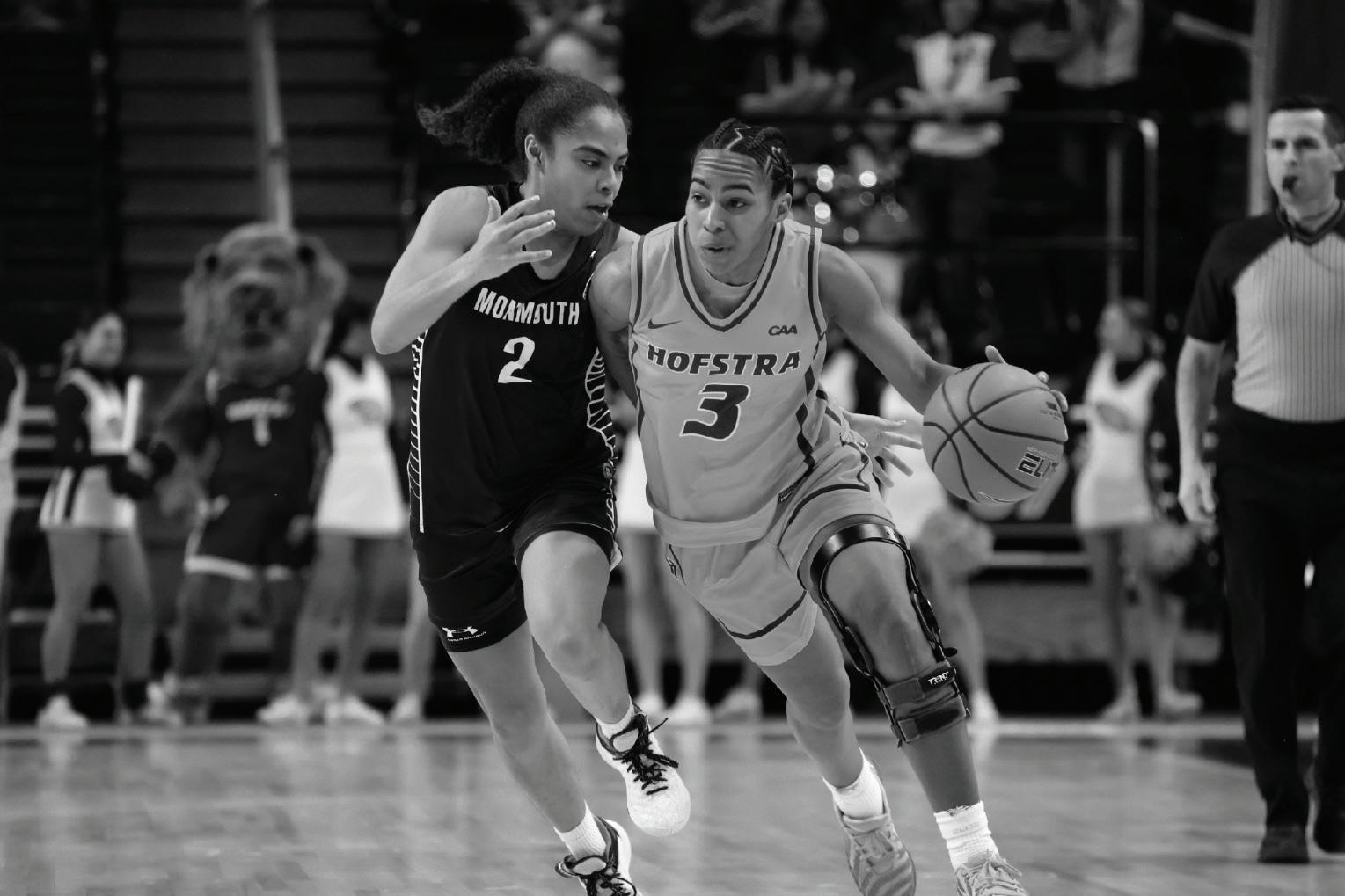
Hampton could be the one that this team needs to turn the score around just before the conference tournament in March.
“[This win] is everything, not just because it’s that point in the season where you want to be putting it all together, but we have to be able to get the confidence that we need going into the conference tournament,” Santos said. “I think this allows us to see what
we’re capable of and continue that through the remainder of this conference play.”
Hofstra will travel to the John W. Pope Jr. Convocation Center in North Carolina to take on Campbell University on Friday, Feb. 13, at 7 p.m. Hofstra leads the all-time series between the two teams 2-1. They won their last matchup 55-47 last season.
Trevor Natalie scored one goal and added an assist in the loss.
Kaylee Roche / The Hofstra Chronicle
Lilith Walpole / The Hofstra Chronicle
Chloe Sterling is averaging 9.9 points per game.
SPORTS
Hofstra dominates in homecoming game
By Eric Leaf STAFF WRITER
The Hofstra University men’s basketball team delivered a top-to-bottom masterclass on Saturday, Feb. 7, cruising to a statement 71-49 blowout victory over Towson University. The Pride capped off their annual homecoming game in front of a lively crowd of 3,525 fans at the David S. Mack Sports and Exhibition Complex.
In a season highlighted by two wins over Atlantic Coast Conference teams, Saturday’s dominant victory over the Tigers may stand as one of Hofstra’s most impressive showings of the season. The Tigers are the preseason No. 1 team in the conference.
The Pride now sits at 7-5 in the Coastal Athletic Association, tied for third place.
“It is great to be healthy,” said Hofstra head coach Speedy
Claxton. “[Preston Edmead] and [Biggie Patterson] were tremendous. [Patterson] came off the bench and gave us a real spark – not just on the offensive end but on the defensive end. I thought all around great effort by the guys.”
Any hopes Towson had of pulling out a road victory were ripped away early, beginning on the defensive end. Hofstra was superb defensively, stunting any rhythm the Tigers tried to build. Towson endured a nightmare first half, shooting just 25% from the field and two-foreight from 3-point range. The Tigers went into halftime with a stunningly low 20 points. Defense was only half the story for Hofstra, as the Pride soon began to score in bunches. Holding a slim 13-11 lead midway through the first half, Hofstra’s offense exploded, ripping off a 25-5 run to blow the game open and take a 38-16
advantage. Hofstra walked into halftime with a 28-point lead.
“The first 20 minutes of this game, I’ve never seen this team play better basketball on both sides of the basketball,” Claxton said.
The leader of the offensive charge was senior guard Patterson. The Richmond, Virginia, native came off the bench and took over the game, leading all scorers with 20 points on an impressive 60% shooting from the field. With just over eight minutes remaining in the first half, Patterson pulled up for a transition 3-point shot, drew contact and drilled the shot – sending him to the line and Hofstra’s faithful fans into a frenzy.
“As soon as he checked in, he was just locked in and focused on both ends of the basketball,” Claxton said. “When he’s playing like that, he changes our team.”
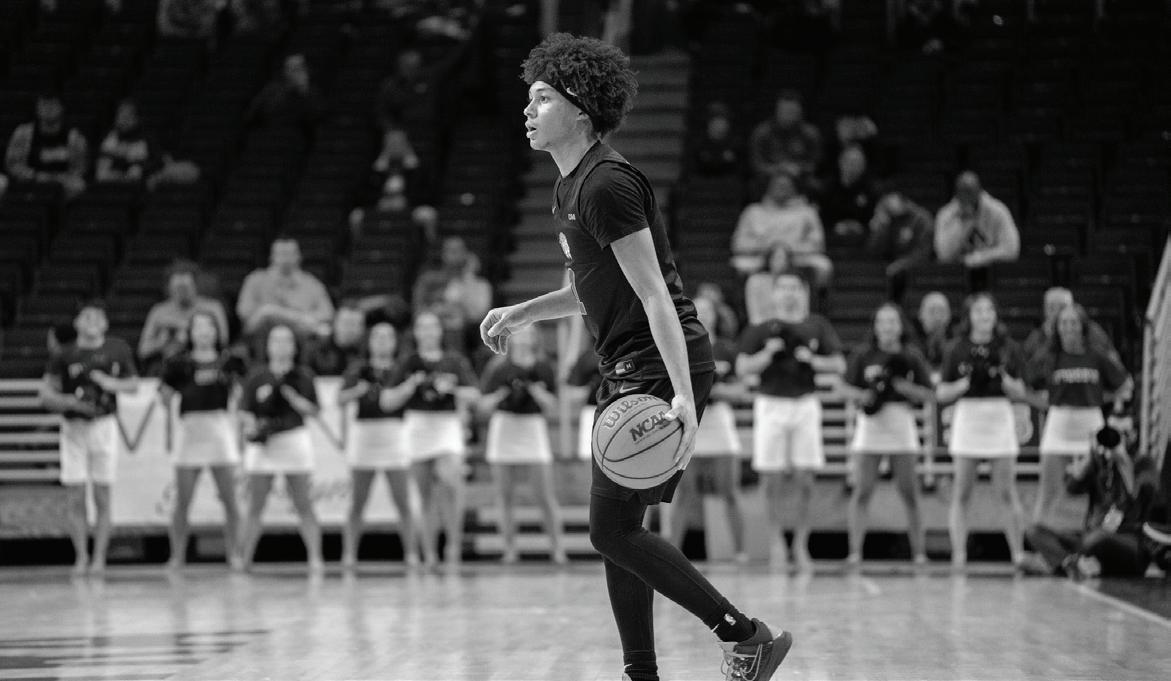
Hofstra’s elite play carried into the second half. Although Towson’s shooting improved to 36% after the break, the Pride’s defensive management of the Tigers’ top players kept them from ever gaining traction. Towson’s second-leading scorer, Dylan Williamson, who averages 14.5 points per game, was completely shut down. Williamson went a stunning 0-8 from the field and finished with
just three points. Cruz Davis and Edmead continued to prove themselves as one of the most formidable duos in the conference, with both players combining for 29 points and 14 assists.
Hofstra looks to continue their winning streak on Thursday, Feb. 12, on the road against the College of Charleston at TD Arena. Tipoff is set for 7 p.m.
Gauge Shipp and Jake Slotnick win for Pride
By Olivia Hillestad EDITOR AT LARGE
Up north in West Point, New York, the Hofstra University wrestling team fell 35-10 to the United States Military Academy. The Pride won just two matches against one of the best Eastern Intercollegiate Wrestling Association (EIWA) teams. The loss is the Pride’s 12th of the season, dropping them to an overall record of 2-12 and conference record of
2-5. The dual was also Hofstra’s last away meet of the season, as they return home for four straight duals and one final tournament before the EIWA Championships.
Against the Black Knights, Hofstra dropped the first five matches of the night, which ranged from 174 pounds to 125 pounds. At 133 pounds, Gauge Shipp broke the streak by beating Nain Vazquez. Shipp earned his first points after Vazquez attempted a fireman’s carry. Shipp countered with a

crotch lock to pull Vazquez over before switching his hands to hold Vazquez in a tilt, earning a takedown and near fall points. Shipp then adjusted his grip and exposed Vazquez multiple times to earn a win by technical fall 17-0. The win is Shipp’s 16th of the season.
Jake Slotnick ended the night for the Pride with a win at 165 pounds. Against Ryan Alvarado, Slotnick started slow. Both wrestlers went scoreless in the first period. Slotnick earned an escape and a takedown before riding Alvarado out for the rest of the second period. Slotnick picked up his pace in the third, allowing Alvarado an escape before taking him down with a throw by to a single leg.
Slotnick allowed Alvarado up two more times, scoring two takedowns in quick succession. He ended the match after exposing Alvarado’s back for two sets of near fall points.
Slotnick won the match by technical fall 18-3. The victory marked Slotnick’s third straight and 17th win of the season.

At 141 pounds, Chase Liardi put up a tough fight against No. 16 Braden Basile. After a back and forth on their feet, Liardi came out on top for the first takedown of the match.
Basile earned an escape after the takedown and another at the start of the second period. The two once again found themselves in a 50/50 situation but it was Basile that came out victorious. Liardi chose neutral to start the third period, needing a takedown to win the match. After Liardi was injured in an exchange, Basile was put
in the bottom position. There was a review for riding time before action started again. Basile responded quickly, finding an escape and takedown to beat Liardi by decision 9-4.
The Black Knights wrestled the Sharks directly after Hofstra on Saturday, Feb. 7, with Army earning a 41-3 victory. Hofstra’s first match up in the homestand was against Long Island University on Monday, Feb. 9, at 7 p.m. in the David S. Mack Sports and Exhibition Complex.
Preston Edmead has been named Coastal Athletic Association Rookie of the Week seven times.
Royce Dickson-Child / The Hofstra Chronicle
Gauge Shipp is 16-13 on the season.
Olivia Hillestad / The Hofstra Chronicle
Jake Slotnick ranked No. 32 during the first US LBM Coaches Poll of the season.
Olivia Hillestad / The Hofstra Chronicle

Pride drops season opener
By Royce Dickson-Child ASSISTANT SPORTS EDITOR

The Hofstra University women’s lacrosse team opened their 2026 campaign on the road against Siena University on Friday, Feb. 6. The Pride opened the scoring but fell behind the Saints in the first quarter, leaving them in a hole they could not climb out of. They lost 10-6.
Nikki Mennella picked up the new season right where she left off, potting Hofstra’s first goal of the year. Mennella rolled to the inside of the defender and cut to the crease, putting the ball past the goalie just four minutes
into the game. The redshirt junior later tacked on a second goal in the final minutes of the game.
The Pride and the Saints went on to trade a pair of goals a few minutes later, taking Hofstra’s lead to 2-1. Elizabeth Wamp scored first for Siena, while Kayleigh Bender responded for Hofstra just a minute and a half later.
The Pride controlled the game until there were just over three minutes left in the first quarter. Olivia Nicholson tied the contest at two for the Saints, and the tides turned in their favor. Siena used the momentum to score two more before the quarter ended, putting themselves ahead 4-2.
Hofstra took little-to-no time to respond in the second quarter, with Kate Lemery pulling the Pride within one. However, Siena maintained their composure and continued their push from late in the first quarter, moving their lead to 6-3.
Shannon Steck opened her college career with a goal,
tallying Hofstra’s fourth halfway through the second frame. Steck dodged through two defenders and ripped the ball toward the net for the score.
The Saints once again had a response, scoring two goals in the final three minutes of the half, to take an 8-4 lead into the break. In the first half, Siena outshot Hofstra 15-11, with three more shots on goal than the Pride.
The game was played in favor of Hofstra in the second half as the Pride dominated their possessions, outshooting the Saints 11-5. Hofstra led in turnover margin, turning the ball over seven times compared to Siena’s 11. Despite Hofstra’s dominance, Saints goalie McAllister Salter managed to make five saves on seven shots on goal to keep Siena in the lead.
Both teams scored two goals in the second half, resulting in a 10-6 win for the Saints. The Pride’s goals in the second half were provided by freshman Charli Joyce and Mennella. Joyce scored while cutting
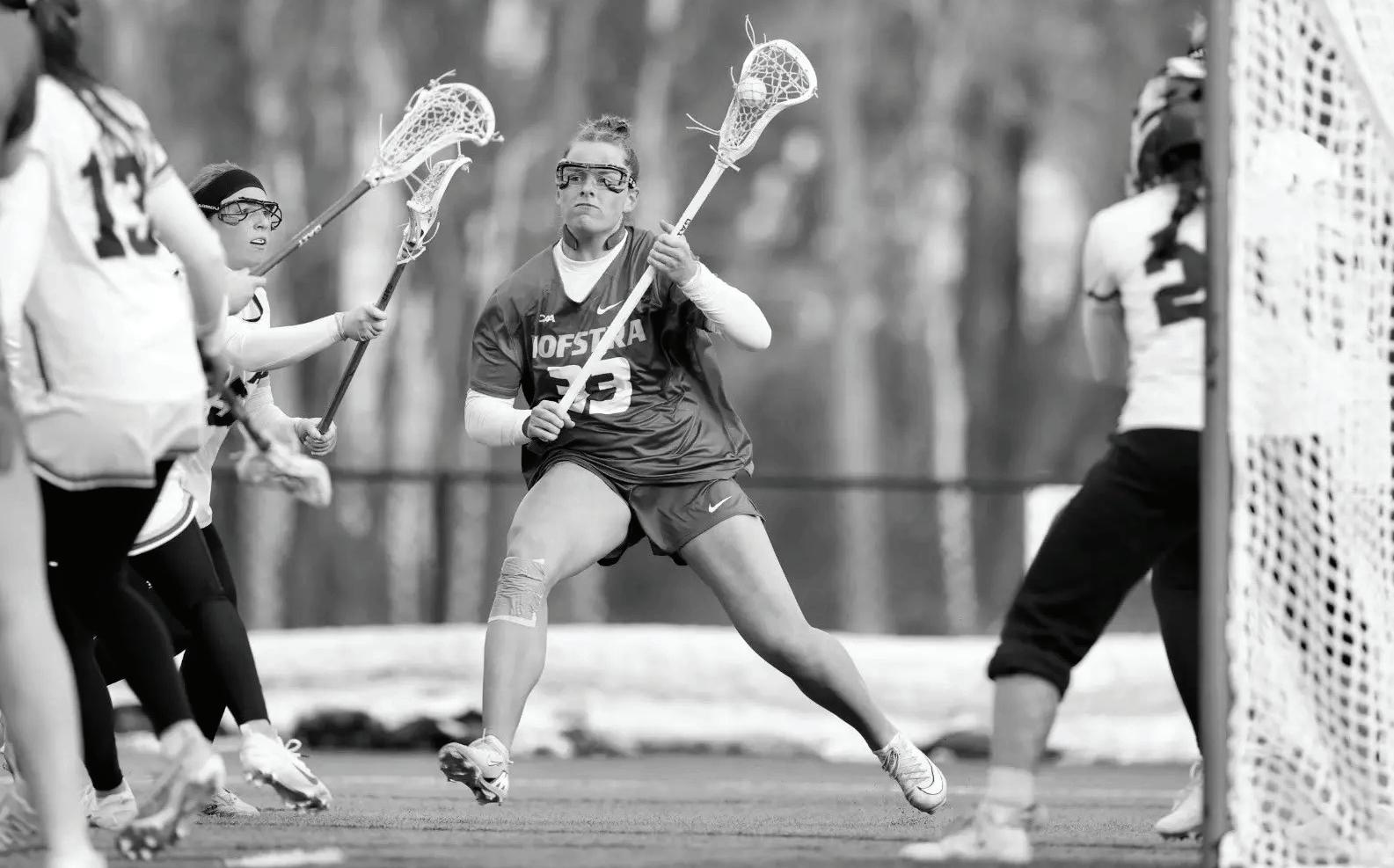
notched four points in the loss.
across the front of the cage for her first collegiate goal. Meanwhile, Mennella scored using her spin move once again, which is already proving to be dangerous.
Bender and Evin Terzioglu were the two standouts for Hofstra in their season opener. Bender not only scored but also tacked on an additional three assists to lead the team in points. On the defensive side of the field, Terzioglu scooped up three ground balls and tallied five of the Pride’s 11 caused turnovers.
While Hofstra dropped
their season opener, they still proved that there is a lot to look forward to this season. Mennella looked great right from the jump, the freshmen are already scoring goals and Terzioglu is looking like a force to be reckoned with on the back end.
The Pride looks to grab their first win of the year on Wednesday, Feb. 11, when they face off against Manhattan University at Captains Field. The last time the two schools faced each other, Hofstra won 18-5.
Photo courtesy of Schuyler Meyer / Hofstra Athletics
Kayleigh Bender
Pride on the brink of CAA success in 2026
By: Conner Keough STAFF WRITER
Last season, the Hofstra University men’s lacrosse team finished 8-7 with a birth in the Coastal Athletic Association (CAA) conference tournament for the first time since 2022. For Hofstra head coach Seth Tierney, that wasn’t good enough.
“We don’t like the way we finished last season,” Tierney said. “We had a couple of close losses, in particular – two to Towson [University] by less than two goals. I thought we had a good edge to us early on, but we need to learn to finish stronger.”
Last season, Hofstra started the year 7-2 before dropping five of their last six games. Their only win came against a winless Hampton University 27-4.
Hofstra’s road back to CAA contention won’t be easy as Tierney scheduled a tough nonconference schedule.
The Pride have split their two opening games, starting things off with a 14-7 win over Iona University, but falling 9-8 to Holy Cross University in double overtime. The nonconference slate isn’t getting any easier, with the Pride going on the road for a grudge match with Siena University.
Last season, the Saints tied
for the Metro Atlantic Athletic Conference championship and handled the Pride 1711 on Valentine’s Day. The nonconference schedule also includes familiar foes Rutgers University and Yale University.
“We wanted to play a tough nonconference schedule,”
Tierney said. “Siena tripped us up last year and we’ve had some spirited battles with Yale over the last few years.”
CAA play doesn’t get any easier. Hofstra opens conference play with a night game at Stony Brook University on March 13 – a team the Pride needed double overtime to beat last season. The Pride then hosts Drexel University, who has won the last three meetings against Hofstra. They also travel to the back-to-back CAA conference champions against preseason No. 16 Towson University, who eliminated Hofstra in the semifinals of last year’s CAA tournament.
Hofstra will need to rely on their offense, which was the strength of last year’s squad. The Pride are top 15 in the country in goals per game, averaging just under 13 goals a game. They had the most explosive offense of any team that failed to make the NCAA tournament, with a lot of that success having to do with scoring diversity.
Hofstra was the only
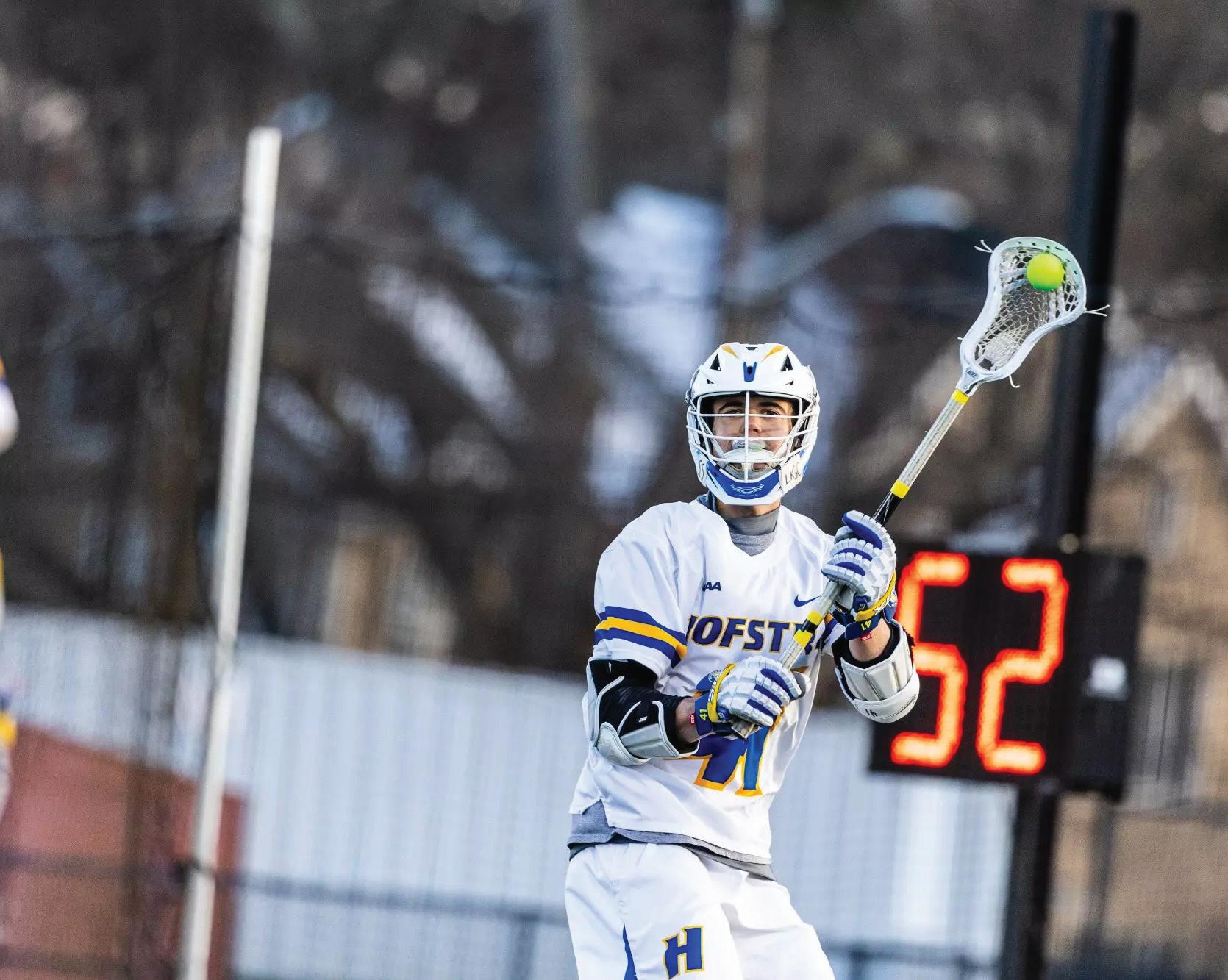
Division I team in the country to have six or more scorers hit at least 35 points before the NCAA tournament. Colgate University was the only team that was close to that figure with five players.
A lot of the offensive personnel are returning in 2026, including Anthony Mollica.
“The cat’s out of the bag about [Mollica,]” Tierney said. “Everyone in the conference knows who he is and he’s done a good job working on his game in the offseason.”
Also returning is CAA Rookie of the Year runner up Drew Bogardus. In his freshman campaign, Bogardus finished second in goals and points by a rookie. He scored the most points by a freshman since Ryan Tierney in 2017.
“[Bogardus] had a fantastic freshman campaign. He’s coming off of a few off-season injuries but we’re excited to see what he’s got back,” Tierney said.
Also returning to the Pride are Trey Parkes and captain Trevor Natalie. Both players had breakout junior campaigns with 37 and 40 points, respectively.
Hofstra lost two of their starting attackers from last season in John Madsen and Rory Jones to graduation. Jones and Madsen both finished their five-year careers with over 120 points. The Pride will look to depth players like Joey DeYoung, Anthony Laber and Lorenzo Varona to fill in for the missing production.
“Building off of last year’s chemistry and experience is huge,” Mollica said. “Last year we had a newer team, so we took a little while to get going. This season we should get going right away.”
Mollica led the Pride in scoring with 50 points on 26 goals and 24 assists last season. He’s also taken on some additional responsibilities as one of the Pride’s captains this season.
“I’ve taken a more leadership role [this year],” Mollica said.
“I’m joined by Matt Vilas, Will Delaney, Natalie and Blake
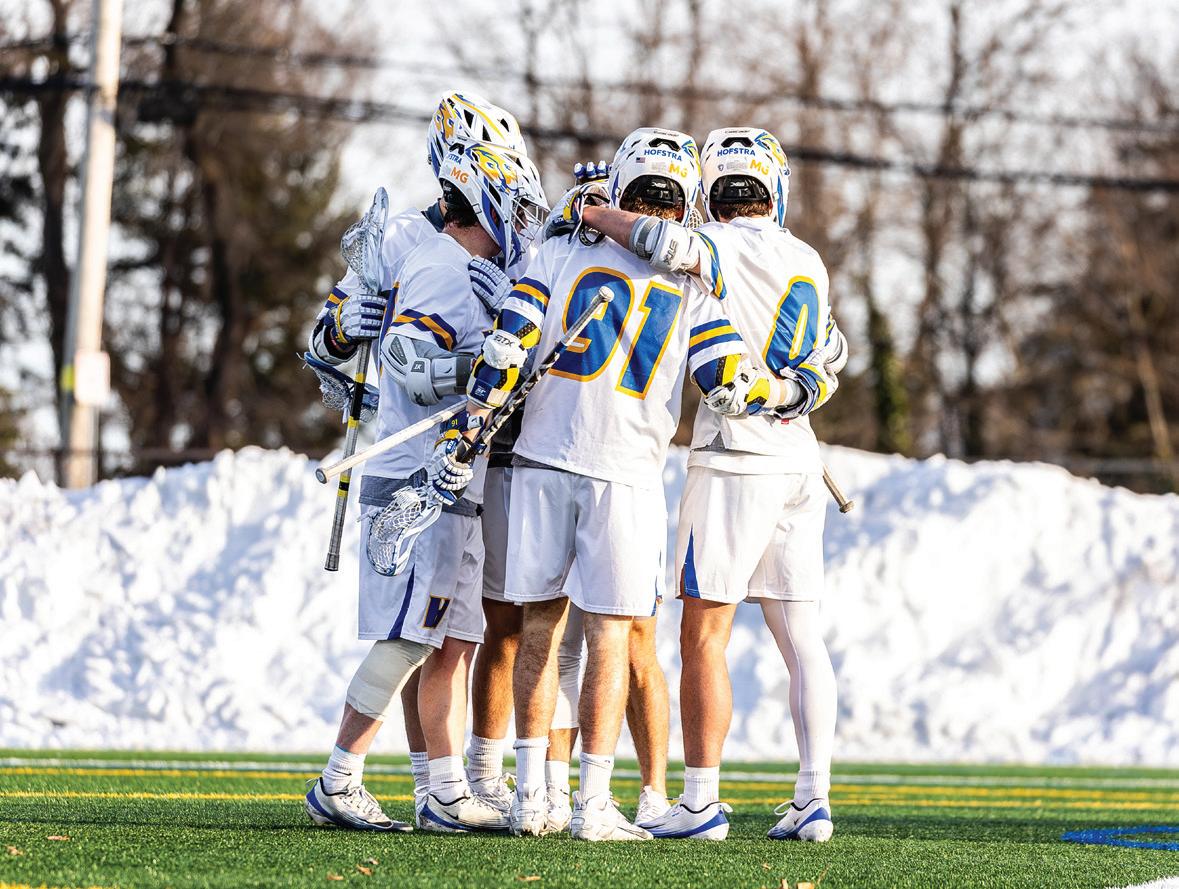
Cooling. They set the standard high and we’re just trying to reach it. Being a captain is awesome; it’s one of my greatest accomplishments ever.”
Four out of six of the Pride’s offense starters from last season returned, while all three close defenders returned. Henry Troy, Austin Clarke and Delaney combined for 62 ground balls and 34 caused turnovers. Clarke earned a preseason All-CAA first team defender spot. These three players and redshirt sophomore Shea Kennedy in net helped the Pride bring down their goal against average from 12.1 in 2024 to 10.1 in 2025.
“In regards to [Clarke, Delaney and Troy], these are three guys back who logged a lot of minutes for us,” Tierney said. “We’re excited to see what they bring back.”
According to Tierney, Cooling will continue to play at the long stick defensive midfielder position and be the number one option there.
In goal, Kennedy redshirted in 2024 and became the fulltime starter in 2025. In his 15 appearances, Kennedy had a .551 save percentage and made 167 saves; Hofstra’s team save percentage rose from .456 to .558 with Kennedy in the net.
“Shea had a great season last year,” Tierney said. “He was a big part of keeping the ball out of the net.”
Tierney is also happy about
the depth in the specialty positions.
“Early in the year, we want to share the miles on everyone’s tires,” Tierney said. “We’re deep at the short stick and long stick defensive midfield positions and we like to run two, three, even four different guys in there during the course of the game.”
To become true CAA contenders, Hofstra must improve in the faceoff dot. The Pride were one of two CAA teams to finish below 50% on the draw last season. Ben Niesman graduated, but the Pride retained senior Cole Meyers and sophomore Owen Bosak, who is back from injury.
Hofstra will try to right the wrongs of a cold second half of last season. The Pride dropped their final three conference games to Drexel, Towson and Fairfield University, limping into the CAA tournament as the four seed. Their season ended in a tough overtime game against Towson.
“We’re trying to build on last year and we’re happy with what happened then,” Tierney said. “We know we’ve got some new challenges: new teams on our schedule, new players on the roster. We’re trying to build on everything we did, and we’re trying to take the next step.”
The Pride look to get their first conference title since 2008.
Kaylee Roche / The Hofstra Chronicle
The Pride finished third in the Coastal Athletic Association after a 4-3 conference record in 2025.
Anthony Mollica led the Coastal Athletic Association in assists per game with 1.75.
Joe Orovitz / The Hofstra Chronicle
Women’s lacrosse eyes tournament run
By Ethan Poole SPORTS EDITOR
It’s lacrosse season on Long Island once again, and despite the recent frigid temperatures, excitement for the new season is red hot.
During season opener, the Hofstra University women’s lacrosse team performed well, though below their lofty standards last season. A 9-7 overall record with a 4-4 mark in Coastal Athletic Association (CAA) play left the Pride on the outside looking in on the conference tournament. Despite being excluded from the postseason, Hofstra head coach Shannon Smith took plenty of positives from last season.
“I’m just really proud of the resilience of our team last year and the growth that all of our players have had,” Smith said. “[Whether it was] playing on the field and actually getting the minutes or getting the reps on scout team or through practice minutes, there was a lot of growth from each of our players.”
Hofstra has a gauntlet of a schedule this year before they even get to CAA play, with matchups against No. 6 Princeton University and No. 7 University of Maryland. While the prestige of their nonconference schedule is daunting, attacker Nikki Mennella welcomes the challenge and sees it as an opportunity.
“We have a hard schedule this year,” Mennella said. “We play Maryland [and] we play
Princeton, and we have a goal to beat those teams and put our team on the map.”
Mennella was the engine that powered the Pride’s attack last season. Mennella had one of the greatest offensive seasons not just in Hofstra history, but in the history of college lacrosse: 62 goals and 37 assists for 99 points in just 15 games. Her 6.60 points per game set a CAA record and is the 11th highest mark in NCAA lacrosse history. She was named CAA Offensive Player of the Week five times and has been showered in accolades since the season ended: including, CAA Attacker of the Year, Intercollegiate Women’s Lacrosse Coaches Association All-Region, twotime National Offensive Player of the Week and preseason AllAmerican honorable mention.
“I’m super grateful to have had the successful season that I had last year, and [being named All-American] is a huge honor,”
Mennella said. “[It] definitely wouldn’t be possible without my teammates and coaches setting me up to be that successful … Every day at practice, [my teammates] prepare and push me to make me a better player.”
Smith knows what Mennella brings to the table offensively and wants to see her continued emergence as a leader.
“[Mennella’s] always going to get her goals, points and assists. For [Mennella], it’s about continuing to build that leadership, continuing to grow and lead the offense, which she has done so well,” Smith said. “The challenge this year will be
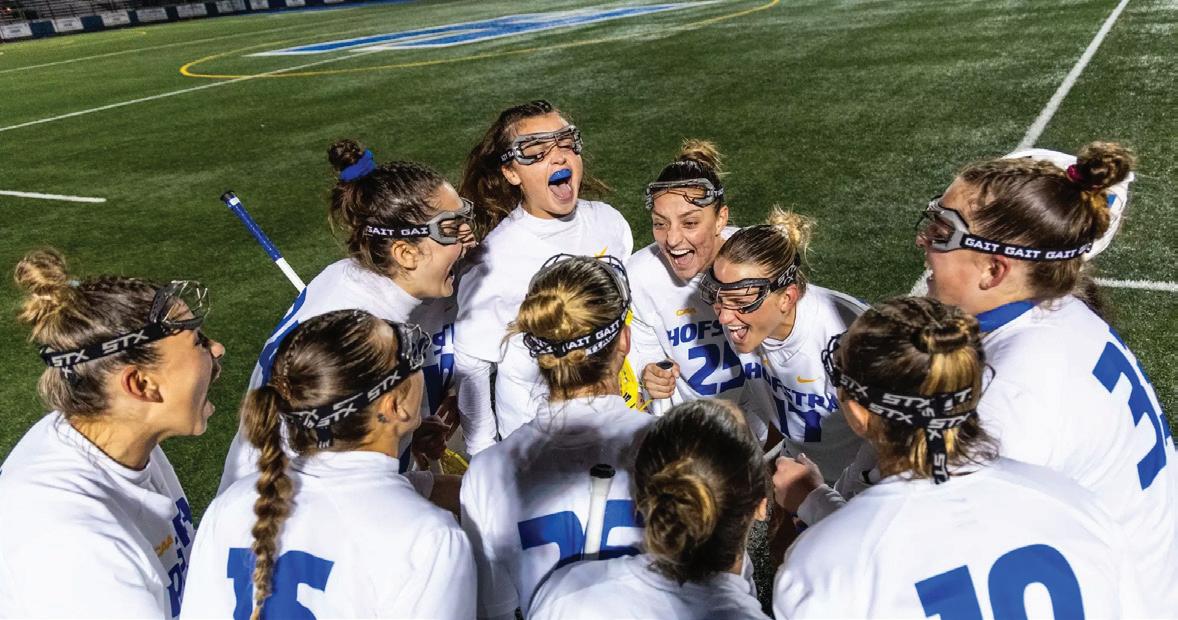
what types of defenses teams throw at us.”
The leadership of Mennella, alongside her fellow captains, Christine Dannenfelser and Luchianna Cardello, will be crucial for the Pride this year. Hofstra has 20 combined sophomores and freshmen on this year’s team. The leadership core understands the important role they will play this season and in the development of the underclassmen.
“[We] try to be a voice for them and let them know we’re here if they have any questions,” Mennella said. “They’re definitely fitting in well.”
Mennella isn’t alone on offense; Julia Harris, Kristen Redding and Kayleigh Bender all had at least 22 goals last season and are all returning. After a year together, Smith hopes the quartet can build on last year’s scoring prowess.
“I think just having a full year underneath [us] and building that chemistry and that growth is really going to help us going into the season,” Smith said. “Playing on offense is all about having that chemistry, that connection and understanding where each of them is going to be on the field. It’s been really fun to watch that grow and have them build that chemistry with other players on the field too.”
Bender was the surprise breakout of the bunch. She scored 31 goals on her way to CAA Freshman of the Year honors. She and Mennella play very different styles of lacrosse, which keeps defenses on their toes. Mennella can create space even while doubled, and often weaves in and out of the defense before shooting at point-blank range. Bender doesn’t need that space; her rocket of a shot is incredibly accurate and can be fired from a distance. Mennella is excited to see what Bender will do this season.
“She’s much more confident [this year]. I could see her doing really big things again,” Smith said.
Hofstra’s prolific offense may need to put up goals early and
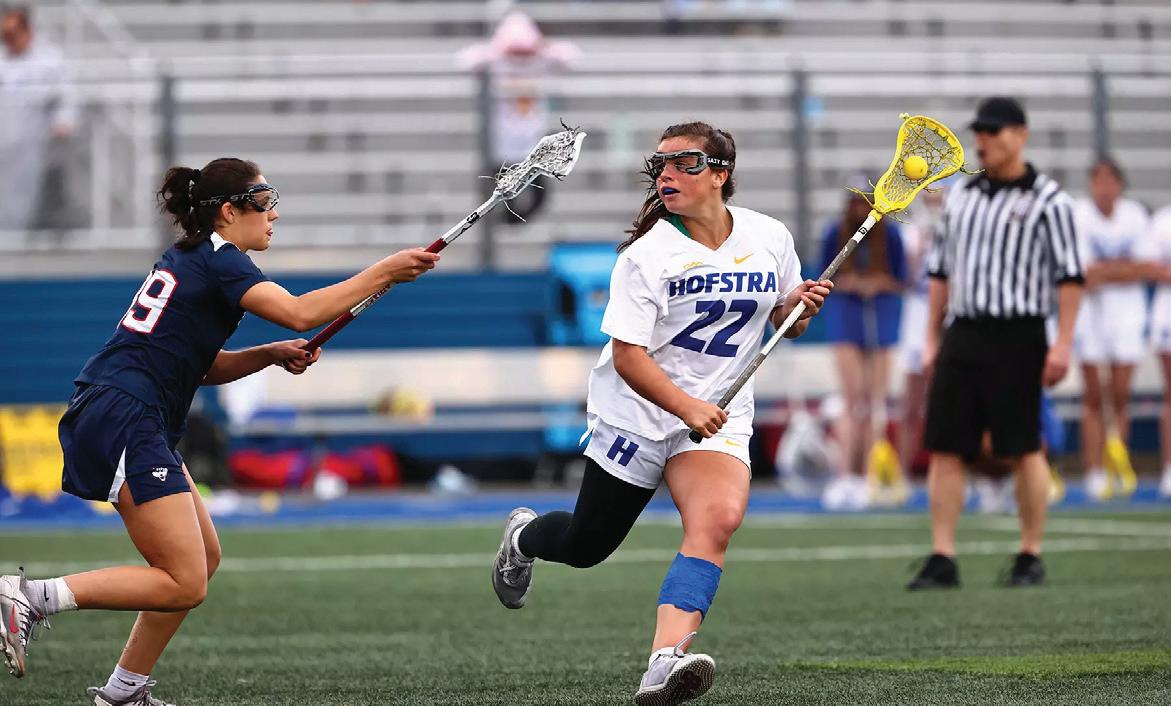
often this season. While the defense is led by Dannenfelser – who was All-CAA First Team last year and was honored as a preseason All-CAA selection – the rest of the unit is young. While it will take some time for the defensive rotations to take shape, Smith has been impressed by a few newcomers.
“Practice and fall ball is a little bit different from when you put your jersey on, and the games mean a lot,” Smith said. “Grace Varley and Cece Thurmond on the defensive side of the field had a really tremendous fall.”
Of course, Cardello will once again be the last line of defense as the starting goalkeeper.
“Everyone loves playing in front of her. She’s been our starting goalkeeper for four years, so to have that in the net is really, really big for us,” Smith said.
Despite the question marks defensively, Dannenfelser should provide stability.
“[Dannenfelser] is a very fiery leader and is very passionate. [She] wants to be successful and wants our team to be successful,” Smith said. “She has a very high lacrosse IQ, and the team really believes in her and respects her.”
The reality of collegiate athletics is that players only get a certain amount of time in their college careers, and the Pride lost several key contributors from last season: Angelina Sparacio, Megan Flannery, Kyndall Jackson, Julia West, Emily Weigand and Brynn Hepting – all either graduated
or transferred. Hepting was a captain, and Sparacio and Flannery each contributed double-digit goals last season.
“Anytime you lose a senior class, you lose leadership, and you lose those veterans who have poured their heart into this program for four years,” Smith said. “I think that our team this year has a lot of great leaders in the juniors and seniors, and I’m really excited to watch them take over that role.”
As for a breakout candidate? Mennella has her eyes on Kate Lemery, who started nine games and had 11 points in her freshman campaign last year.
“She played a bunch last year, but she was also just a freshman, so I definitely see her having more confidence,” Mennella said. “She’s going to play a big role for us.”
The goal for the season is obvious: win the CAA championship. Smith and her squad understand that there are many steps to take and smaller boxes to check.
“We’ve got to take it game by game and find the ways to win a lacrosse game,” Smith said. “If we can do that and take care of each game and our goals, hopefully we find ourselves in a really good position to be competing for a CAA championship at the end of the year.”
Step one is making their way back to the conference tournament for the second time in three years. That quest will start on March 14 against Elon University after over a month of nonconference clashes.
Nikki Mennella led the Coastal Athletic Association in points per game with 6.38 in 2025.
The Pride averaged 10.50 goals per game last season.
Photo courtesy of Hofstra Athletics / Jon Reiss
Joe Orovitz / The Hofstra Chronicle
THE HOFSTRA CHRONICLE
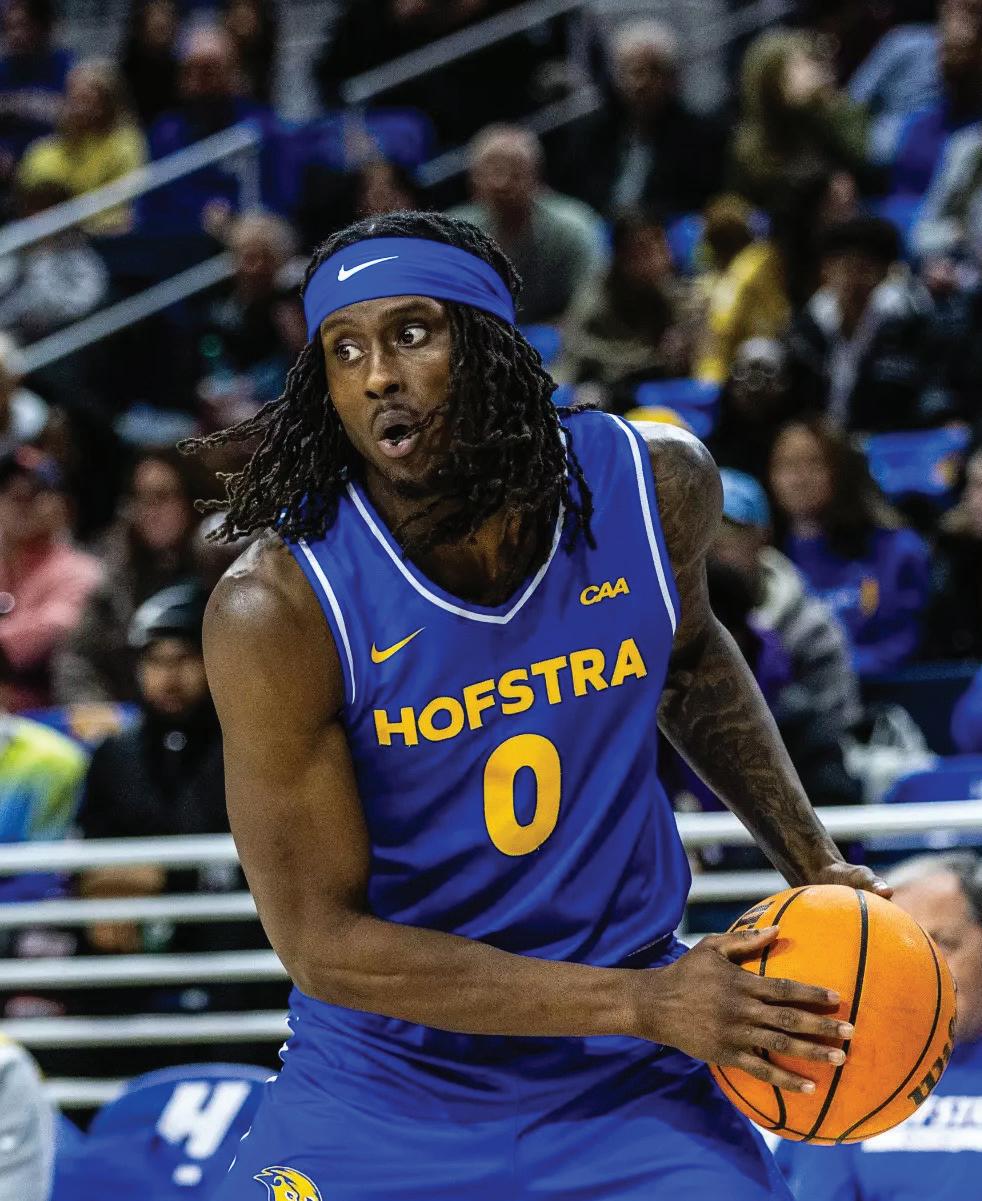
February 10, 2026
H ome sweet
H omecoming
Biggie Patterson dropped 20 points en route to a 7149 Hofstra win during homecoming.
Joe Orovitz / The Hofstra Chronicle