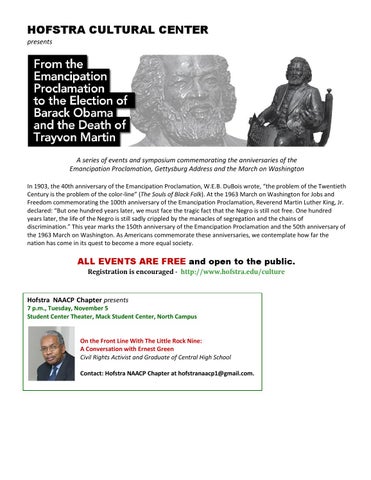
HOFSTRA CULTURAL CENTER presents
A series of events and symposium commemorating the anniversaries of the Emancipation Proclamation, Gettysburg Address and the March on Washington In 1903, the 40th anniversary of the Emancipation Proclamation, W.E.B. DuBois wrote, “the problem of the Twentieth Century is the problem of the color-line” (The Souls of Black Folk). At the 1963 March on Washington for Jobs and Freedom commemorating the 100th anniversary of the Emancipation Proclamation, Reverend Martin Luther King, Jr. declared: “But one hundred years later, we must face the tragic fact that the Negro is still not free. One hundred years later, the life of the Negro is still sadly crippled by the manacles of segregation and the chains of discrimination.” This year marks the 150th anniversary of the Emancipation Proclamation and the 50th anniversary of the 1963 March on Washington. As Americans commemorate these anniversaries, we contemplate how far the nation has come in its quest to become a more equal society.
ALL EVENTS ARE FREE and open to the public. Registration is encouraged - http://www.hofstra.edu/culture
Hofstra NAACP Chapter presents 7 p.m., Tuesday, November 5 Student Center Theater, Mack Student Center, North Campus
On the Front Line With The Little Rock Nine: A Conversation with Ernest Green Civil Rights Activist and Graduate of Central High School Contact: Hofstra NAACP Chapter at hofstranaacp1@gmail.com.
The Symposium - Student Center Theater
Sondra and David S. Mack Student Center, North Campus THURSDAY, NOVEMBER 7, 2013 9:35-11 a.m., Session I: What Does John F. Kennedy’s Call to Public Service Mean for American Youth Today? Panel discussion on presidential leadership and public service. Howard B. Dean III, Chairman, Democratic National Committee, 2005-2009 Senior Presidential Fellow, Peter S. Kalikow Center for the Study of the American Presidency, Hofstra University Edward J. Rollins, Political Strategist Senior Presidential Fellow, Peter S. Kalikow Center for the Study of the American Presidency, Hofstra University Scott D. Reich, Associate, Willkie Farr & Gallagher LLP Author, The Power of Citizenship: Why John F. Kennedy Matters to a New Generation Presented by the Peter S. Kalikow Center for the Study of the American Presidency 11:15 a.m.-12:45 p.m., Session II: Slavery on Long Island-I Panelists: Geri Solomon, Assistant Dean of Special Collections & University Archivist, Hofstra University Claude J. Magnum, Professor Emeritus, Fordham University Joysetta & Julius Pearse, African American Museum and Center for Education and Applied Arts Kathleen Velsor, SUNY Old Westbury Debra A. Willett, Hofstra University 1 -2 p.m. , LUNCH (on your own) Session III: Film showing: The March The March is the feature documentary on the renowned and historic 1963 March on Washington for Jobs and Freedom. A watershed moment of the civil rights movement, the March brought together a huge coalition of powerful and revered civil rights organizations, labor unions, and civil rights leaders. It was to become the biggest civil protest in American history. 2:30 – 4 p.m., Session IV: Film Showing: Slavery and the Law Slavery and the Law is a captivating documentary that follows a group of Brooklyn youth as they work to create a wall mural that commemorates the shift from enslavement to the Civil Rights Movement. The youth seen in the film are participants in the Youth and Congregations in Partnership (YCP), and Gender-Responsive Assistance Support Program (GRASP), community outreach programs under the office of the Kings County District Attorney. As the title suggests, the legal system is introduced in the film as the youth and professors explore the laws imposed on slaves. The legal implications of slavery are documented in the film by looking at the Three Fifths Compromise in the United States Constitution, and the Fugitive Slave Act. Commentary: Gloria Browne-Marshall, John Jay College, CUNY Joan B. Gabbidon, Kings County District Attorney Office Alan Singer, Hofstra University
4:30-6 p.m., Session V: Slavery and the Law: From EP to Barack Obama to Trayvon Martin The panel addresses the continuing racial disparity in America pertaining to the justice system including the recent decision in the Voting Rights Act; the new forms of Slavery -- prison pipeline system, human trafficking, domestic slave labor, sweat shops and the like, as well as myriad forms of expression and activism that have followed in its wake over the last 150 years. Panelists: Jonathan Lightfoot, Hofstra University Gloria Browne-Marshall, John Jay College, CUNY Randolph McLaughlin, Pace University Grant Hayden, Hofstra University Rep, Nassau County ACLU (invited) 6-7:30 p.m., DINNER BREAK (on your own) Session VI: Film Showing – The Abolitionists Radicals. Agitators. Troublemakers. Liberators. Called by many names, the abolitionists tore the nation apart in order to make a more perfect union. Men and women, black and white, Northerners and Southerners, poor and wealthy, these passionate antislavery activists fought body and soul in the most important civil rights crusade in American history. What began as a pacifist movement fueled by persuasion and prayer became a fiery and furious struggle that forever changed the nation. Introduction: Andor Skotnes, The Sage Colleges 7:30 p.m., KEYNOTE ADDRESS (100)50 Years: At the Crossroads of Jobs, Freedom and Equality
Roslyn Brock Chairman, National Board of Directors National Association for the Advancement of Colored People (NAACP)
Co-sponsored by Hofstra NAACP Chapter, Hofstra Black and Hispanic Alumni Association, New Opportunities at Hofstra (NOAH) Program
FRIDAY, NOVEMBER 8, 2013 10-11:30 a.m., Session VII History and Impact of the Emancipation Proclamation Andor Skotnes, The Sage Colleges Lincoln and Gettysburg Alan Singer, Hofstra University 11:30 a.m.-12:30 p.m. LUNCH (on your own) Session VIII: Film Showing – Underground Railroad: The William Still Story The William Still Story tells the dramatic story of William Still, one of the most important yet largely unheralded individuals of the Underground Railroad. Still was determined to get as many runaways as he could to "Freedom’s Land,” smuggling them across the US border to Canada. William Still was a humble Philadelphia clerk who risked his life shepherding runaway slaves to freedom in the tumultuous years leading up to America’s Civil War. Still was the director of a complex network of abolitionists, sympathizers and safe houses that stretched from Philadelphia to what is now Southern Ontario. In his fourteen years in the service of the Underground Railroad, he helped nearly eight hundred former slaves to escape.
12:45-2:15 p.m., Session IX: Slavery on Long Island-II Alan Singer, Hofstra University Lynda Day, Brooklyn College, CUNY Rep, African American Burial Ground in NY (invited)
Hofstra University Latin American and Caribbean Studies Program presents a panel discussion 11:15 a.m.-12:40 p.m. (Common Hour), Wednesday, November 13, Leo A. Guthart Cultural Center Theater, Axinn Library, First Floor, South Campus The Challenges of Emancipation in the Atlantic World Participants: Benjamin Talton, Temple University Defending the Political Kingdom: Capitalism, Humanitarianism and the Limits of African Sovereignty in the 20th Century Enrique Martino, Humboldt University of Berlin Enduring Atlantic Economies in the 20th Century: Nigerian Indentured Labour on the Plantation Island of Fernando Po Christopher Schmidt-Nowara, Tufts University Defending Slavery in an Age of Emancipation: Spain, Cuba, and Puerto Rico in the Early Nineteenth Century Contact: Benita Sampedro at benita.sampedro@hofstra.edu