
Phenoscreen of NeuroDevelopment (PoND) Study
Sarah Shivsankar and Emma Condy, Ph.D.
Department of Psychology, Hofstra University, Hempstead, NY 11549
Introduction
This study will use a Phenoscreen approach (Doyle et al., 2021) to study restricted and repetitive behaviors (RRBs) in toddlerhood.
RRBs are seen in typical development and neurodevelopmental disorders (e.g., ASD).
Effortful control, an element of temperament, is an early precursor to inhibition and emotion regulation which are thought to relate to RRB development.
Using the Rothbart Temperament Scales and the RBS-EC, we will investigate how these two behaviors interact over time in early childhood.
Study Aims
• Assess the feasibility of using community-sampling to recruit for RRB phenotypes in toddlers.
• Bring toddlers in for neuroimaging studies based on screening results.
Study Design
Initial Contact
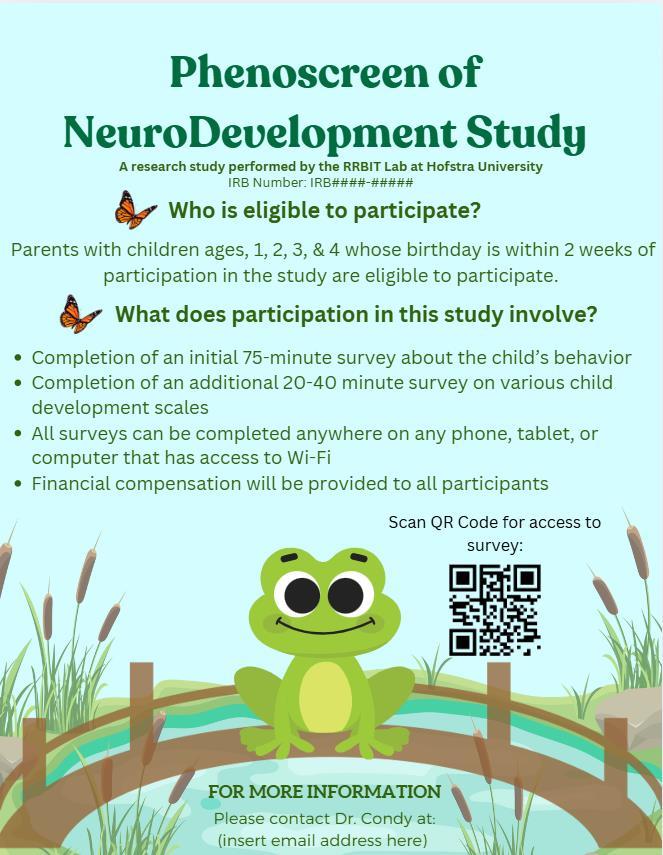
Recruitment through flyers, social media ads, or via recruitment events organized by research team
Complete the Contact Form
Parent provides contact information & child’s age
Timeline
Research Team Contact
One of two email scripts will be sent depending on the age of child
Ages 12, 24, 36 months ± 2 weeks
Email Script 1 indicating immediate eligibility.
Other ages between 6-35 months
Email Script 2 indicating they need to wait until child reaches eligibility.
of Spring Semester 2025 Preliminary Data Analyses
Time 1 Data Collection
Participants will fill out
Time 1 Qualtrics survey and cognitive assessment (Developmental Profile-4)
Deferred Enrollment
Research team will recontact parent when eligible based on child’s age.