SchoolLeadership’sRoleinShaping
Parents’andRetiredTeachers’PerspectivesofSharedReading
JulieBethRosslee HofstraUniversity
Introduction
Problem:
Leadership’sroleinsupportingemergentreaders’exposureto readingpracticescanimpactchildren’spresentandfutureattitudes towardsreadingaswellastheiracademicsuccesses.
Purpose:
Thefindingsoftheseresearchquestionscanhelpeducatorstobetter understand,motivate,support,andeducatechildrenasreadersand learnersthroughtheattitudestheyexhibittowardsreading,asthose whoexhibitpositiveattitudesandoutlookstowardsreadingaremore likelytocontinuetoengagewithreadingmaterialswhilethosewhodo notaremorelikelytobereluctanttoengageinthereadingprocess.
Leadersmustnotonlyidentifywaystoclosetheachievementgaps betweenlearners;theymustalsoseektodevelopanappreciationof readinginalllearners,nomatterthepastreadingexperiencesof childrenasemergentreaders.
ParticipantsandFieldSettings
Participants(IdentifiedThroughPurposefulSelection):
Twoadultandchildreadingdyadswhoresideinthecasestudy schooldistrict
Threeteacherswhoretiredfromthecasestudyschooldistrict FieldSettings:
Eachsharedreadingdyad’shomeforobservationsandinterviews
GoogleMeetforretiredteachers’focusgroup
DataAnalysis
Conductedtheobservationandinterviewsandmoderatedthefocus group
Conductedfirstcyclecoding(analyzeddata;focusedontheresearch questions;createdaprioricodesinahierarchyscheme)
Conductedsecondcyclecoding(color-codeddatainthedatatableto identifyquotesthataligned;lookedatthedata’scolor-codedscheme andcollapsedsimilarcodesfromtheoriginalcodinghierarchy; extractedinformationandcreatedindividualtabswithintheExcel workbooktoidentifyportionsofdatathatrelatedtothesamecodes; remergedalltheinformationintoanewtab,listingeachpieceof informationthatrelatedtoagivencodeinorderunderthatcode; organizedchunksofdata;determinedthethemesthateachcode presentedandidentifiedthemeaningofthesethemesastheyrelated totheresearchquestions)
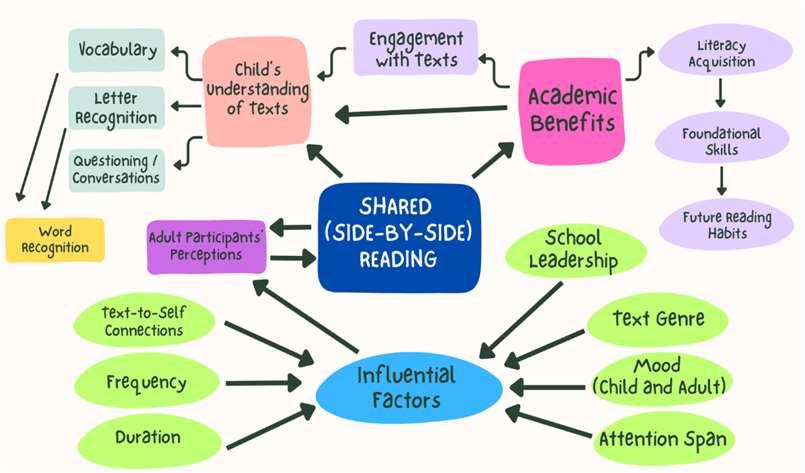
1.AcademicImplicationsofStudentsParticipatinginSharedReading
ResearchQuestions
Whataretheadultreadingpartner’sperceptionsoftheeffectsofshared readingexperiencesonthechildparticipant?
Howdoestheadultreadingpartner’sperceptionofthechild’sresponseto thissharedreadingexperienceinfluencetheadultparticipant’swillingness anddesiretoengageinfuturesharereadingexperiences?
Howaretheadultparticipant’sperspectivesofsharedreadingshapedbythe schoolleadership?
Howhaveretiredteachers’perspectivesofsharedreadingbeenshapedby theschoolleadership?
ConceptualFramework
Conclusion
Adultsrecognizetheacademicbenefitsofsharedreading(Evansetal.,2011; Merga,2017).
Verballyactivechildrenenableadultstoestablishsomecontextsthrough whichthechildrenspeakduringsharedreadingactivities(Torr,2020).
Teachers’perspectiveswithrespecttotheimpactplayhasondeveloping literacyskillsimpactshowtheysetuptheirclassroomcenters,thetypesof playtheyencourageintheirclassroom,andthesupportandengagement theyprovideinteacher-directedplay(Pyleetal.,2017).
Theenvironmentofhomemayinfluencechildren’semergentliteracyskills whentheyengageinsharedreading(Huttonetal.,2017).
Sharedbookreadingbeginningatsixmonthsofageforthechildcanhave positiveeffectsontheparent-childrelationship(Canfieldetal.,2020).
Parentsenjoytheopportunitytohaveprotectedtimewiththeirchildren, whichincludesthetimeandabilitytotalk(Levyetal.,2018).
Parentswhohavepoorpersonalrelationshipswithreadingcandevelop positiverelationshipswithreadingthroughengaginginsharedreading activities(Levyetal.,2018).
Observations:
DataCollectionMethods
Eachofthetwoobservationsincludedanadultandchilddyadengagedin asharedreadingactivity
Interviews:
Eachinterviewincludedtheadultreadingpartneroftheobservation,as thispersonbothhadaccesstoachildandcouldcompletetheobserved sharedreadingactivitypriortobeinginterviewed
FocusGroup:
Threeretiredteachersfromthecasestudyschooldistrict
Artifacts:
Documents,websitepostings,summerreadinginitiatives,socialmedia posts,andonlinecurriculumlistingsfromtheschooldistrictofthiscase studythatsupportedat-homereadingpartnerinitiatives,suchasPIR (PartnersinReading)andWorldReadAloudDay.
Websiteofthetownlibraryofthecasestudyschooldistrict
Discussion
Parentsinthisstudyindicatedmaintainingroutinesharedreading practicestohelpexpandtheirchildren’sacademicunderstandings.
Throughverbalinteractions,thechildrenconnectedwiththeadult readersandencouragedtheadultstocontinueparticipatingintheshared readingactivities.
Interactionssharedbetweenanadultparticipantandchildwhenengaged insharedreadingpositivelyimpactedtheadultparticipant’sperceptions ofthechild’sresponsestothesharedreadingexperience,thereby influencingfuturesharedreadingpracticesofthepair.
Theretiredteachersexplainedthatthecasestudy’sadministration promotedtheParentsasReadingPartnersprogramwithineachofthe district’selementaryschools,yetparentsinthisstudywereunawareof thedistrictleadership’sroleinsupportingsharedreadinginitiatives.
Findings:ThemesEvidentThroughDataAnalysis
Positivemodeling
Learningopportunitiesforchildren
Opportunitiesforchildrentoconnectwithadults InfluencesonAdults’Perceptions:
Physicalandemotionalresponses
Childinvolvement
Valuetheadultplacesonconsistencyofengaginginsharedreading
SchoolLeadership’sInfluenceonAdultReadingParticipants:
Classroominitiatives
Programs
SchoolLeadership’sInfluenceonRetiredTeachers: Programs
2.ImpactofSharedReadingonParticipants’Perceptions 3.FactorsthatInfluenceDyads’ParticipationinSharedReading
BenefitsofSharedReading:
LiteratureReview:OrganizedintoThreeThemes
