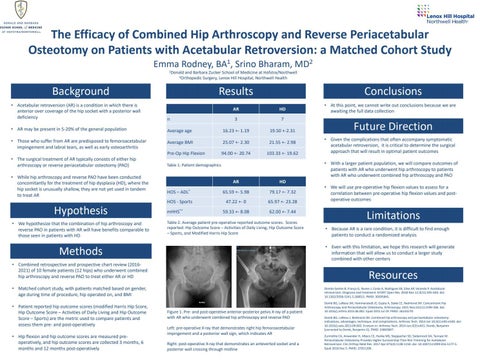
The Efficacy of Combined Hip Arthroscopy and Reverse Periacetabular Osteotomy on Patients with Acetabular Retroversion: a Matched Cohort Study Emma Rodney, 1Donald
1 BA ,
Srino Bharam,
2 MD
and Barbara Zucker School of Medicine at Hofstra/Northwell 2Orthopedic Surgery, Lenox Hill Hospital, Northwell Health
Background
Results
• Acetabular retroversion (AR) is a condition in which there is anterior over coverage of the hip socket with a posterior wall deficiency
n
• AR may be present in 5-20% of the general population
Average age
• Those who suffer from AR are predisposed to femoroacetabular impingement and labral tears, as well as early osteoarthritis • The surgical treatment of AR typically consists of either hip arthroscopy or reverse periacetabular osteotomy (PAO) • While hip arthroscopy and reverse PAO have been conducted concomitantly for the treatment of hip dysplasia (HD), where the hip socket is unusually shallow, they are not yet used in tandem to treat AR
Hypothesis • We hypothesize that the combination of hip arthroscopy and reverse PAO in patients with AR will have benefits comparable to those seen in patients with HD
Conclusions
AR
HD
3
7
16.23 +- 1.19
19.50 +-2.31
Average BMI
25.07 +- 2.30
21.55 +- 2.98
Pre-Op Hip Flexion
94.00 +- 20.74
103.33 +- 19.62
AR
HD
HOS – ADL*
65.59 +- 5.98
79.17 +- 7.32
HOS - Sports
47.22 +- 0
65.97 +- 23.28
59.33 +- 8.08
62.00 +- 7.44
Table 2. Average patient pre-operative reported outcome scores. Scores reported: Hip Outcome Score – Activities of Daily Living, Hip Outcome Score – Sports, and Modified Harris Hip Score
• Combined retrospective and prospective chart review (20162021) of 10 female patients (12 hips) who underwent combined hip arthroscopy and reverse PAO to treat either AR or HD
• We will use pre-operative hip flexion values to assess for a correlation between pre-operative hip flexion values and postoperative outcomes
Limitations • Because AR is a rare condition, it is difficult to find enough patients to conduct a randomized analysis
Resources
• Matched cohort study, with patients matched based on gender, age during time of procedure, hip operated on, and BMI
• Hip flexion and hip outcome scores are measured preoperatively, and hip outcome scores are collected 3 months, 6 months and 12 months post-operatively
• Given the complications that often accompany symptomatic acetabular retroversion, it is critical to determine the surgical approach that will result in optimal patient outcomes
• Even with this limitation, we hope this research will generate information that will allow us to conduct a larger study combined with other centers
Methods
• Patient reported hip outcome scores (modified Harris Hip Score, Hip Outcome Score – Activities of Daily Living and Hip Outcome Score – Sports) are the metric used to compare patients and assess them pre- and post-operatively
Future Direction • With a larger patient population, we will compare outcomes of patients with AR who underwent hip arthroscopy to patients with AR who underwent combined hip arthroscopy and PAO
Table 1. Patient demographics
mHHS**
• At this point, we cannot write out conclusions because we are awaiting the full data collection
Direito-Santos B, França G, Nunes J, Costa A, Rodrigues EB, Silva AP, Varanda P. Acetabular retroversion: Diagnosis and treatment. EFORT Open Rev. 2018 Nov 12;3(11):595-603. doi: 10.1302/2058-5241.3.180015. PMID: 30595845.
Figure 1. Pre- and post-operative anterior-posterior pelvis X-ray of a patient Figure 7: Independent CRISPR knockout of CDK4 or CDK6 ARdropout whoinunderwent combined hip arthroscopy and reverse PAO doeswith not cause most breast cancer cell lines studied.
Left: pre-operative X-ray that demonstrates right hip femoroacetabular impingement and a posterior wall sign, which indicates AR Right: post-operative X-ray that demonstrates an anteverted socket and a posterior wall crossing through midline
Domb BG, LaReau JM, Hammarstedt JE, Gupta A, Stake CE, Redmond JM. Concomitant Hip Arthroscopy and Periacetabular Osteotomy. Arthroscopy. 2015 Nov;31(11):2199-206. doi: 10.1016/j.arthro.2015.06.002. Epub 2015 Jul 29. PMID: 26233270. Domb BG, LaReau J, Redmond JM. Combined hip arthroscopy and periacetabular osteotomy: indications, advantages, technique, and complications. Arthrosc Tech. 2014 Jan 10;3(1):e95-e100. doi: 10.1016/j.eats.2013.09.002. Erratum in: Arthrosc Tech. 2014 Jun;3(3):e421. Domb, Benjamin [corrected to Domb, Benjamin G]. PMID: 24843847. Zurmühle CA, Anwander H, Albers CE, Hanke MS, Steppacher SD, Siebenrock KA, Tannast M. Periacetabular Osteotomy Provides Higher Survivorship Than Rim Trimming for Acetabular Retroversion. Clin Orthop Relat Res. 2017 Apr;475(4):1138-1150. doi: 10.1007/s11999-016-5177-5. Epub 2016 Dec 5. PMID: 27921206.