TOP STORIES
A10
A lens on love and life Hofstra exhibits message from LI photographer BY NICHOLAS SPANGLER
Hempstead resident Jamel Shabazz’s photographs are collected by the Whitney Museum of American Art and the Smithsonian. Now the Hofstra University Museum of Art has opened the first solo exhibition on Long Island for Shabazz, one of the preeminent recorders of New York City street life. “Love Is the Message” is composed of nearly 50 prints from the artist’s collection and pieces related to his work. Shabazz, 65, became famous for portraits of Black and brown people posing in the style and manner of early hip-hop stars, but he has also captured moments of candid intimacy between family members and friends, and there are many of those on the Emily Lowe Gallery walls. The exhibit is intended to capture “the evolution of hip-hop culture, fashion trends, and music,” highlighting the bonds of friends and family,” museum director Sasha Giordano wrote in a forward to the exhibition catalog.
Talking to students Shabazz, in a talk for visiting high school students Thursday at Hofstra’s student center, said he
DEBBIE EGAN-CHIN
nicholas.spangler@newsday.com
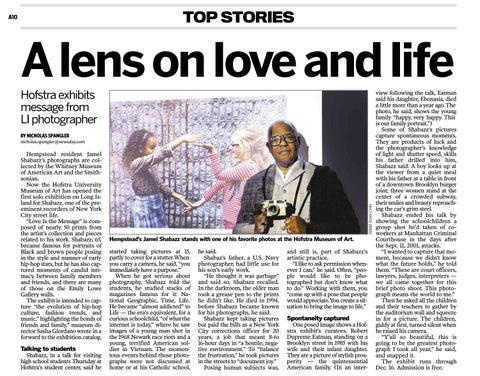
Hempstead’s Jamel Shabazz stands with one of his favorite photos at the Hofstra Museum of Art. started taking pictures at 15, partly to cover for a stutter.When you carry a camera, he said, “you immediately have a purpose.” When he got serious about photography, Shabazz told the students, he studied stacks of magazines famous for it: National Geographic, Time, Life. He became “almost addicted” to Life — the era’s equivalent, for a curious schoolchild, “of what the internet is today,” where he saw images of a young man shot in the 1968 Newark race riots and a young, terrified American soldier in Vietnam. The momentous events behind those photographs were not discussed at home or at his Catholic school,
he said. Shabaz’s father, a U.S. Navy photographer, had little use for his son’s early work. “He thought it was garbage” and said so, Shabazz recalled. In the darkroom, the older man took a grease pen to the prints he didn’t like. He died in 1994, before Shabazz became known for his photographs, he said. Shabazz kept taking pictures but paid the bills as a New York City corrections officer for 20 years, a job that meant 8-to 16-hour days in “a hostile, negative environment.” To “balance the frustration,” he took pictures in the streets to “document joy.” Posing human subjects was,
and still is, part of Shabazz’s artistic practice. “I like to ask permission whenever I can,” he said. Often, “people would like to be photographed but don’t know what to do.” Working with them, you “come up with a pose that people would appreciate.You create a situation to bring the image to life.”
Spontaneity captured One posed image shows a Hofstra exhibit’s curators, Robert Dupreme Eatman, standing on a Brooklyn street in 1985 with his wife and their infant daughter. They are a picture of stylish prosperity — the quintessential American family. (In an inter-
view following the talk, Eatman said his daughter, Ebonasia, died a little more than a year ago.The photo, he said, shows the young family “happy, very happy. This is our family portrait.”) Some of Shabazz’s pictures capture spontaneous moments. They are products of luck and the photographer’s knowledge of light and shutter speed, skills his father drilled into him, Shabazz said. A boy looks up at the viewer from a quiet meal with his father at a table in front of a downtown Brooklyn burger joint; three women stand at the center of a crowded subway, their smiles and beauty reproaching the car’s grim steel. Shabazz ended his talk by showing the schoolchildren a group shot he’d taken of coworkers at Manhattan Criminal Courthouse in the days after the Sept. 11, 2001, attacks. “I wanted to capture that moment, because we didn’t know what the future holds,” he told them. “These are court officers, lawyers, judges, interpreters — we all came together for this brief photo shoot. This photograph means the world to me.” Then he asked all the children and their teachers to gather by the auditorium wall and squeeze in for a picture. The children, giddy at first, turned silent when he raised his camera. “Y’all so beautiful, this is going to be the greatest photograph I took all year,” he said, and snapped it. The exhibit runs through Dec. 16. Admission is free.
BY NICHOLAS GRASSO nicholas.grasso@newsday.com
A Central Islip man was sentenced to 25 years to life in prison for fatally shooting an acquaintance, Suffolk County District Attorney Ray Tierney said Thursday. Jeremias Anaribamoran, 47, pleaded guilty last month to the shooting death of Gustavo Godinez-Carcamo, 40, of Central Islip, Tierney said in a news release. Anaribamoran admitted that just before midnight on March 15, he and Godinez-Carcamo were engaged in “a verbal dis-
pute” while seated in a car parked in front of his acquaintance’s home, according to the district attorney’s release. They were socializing and drinking alcohol with two other people earlier in the day. The argument escalated when Anaribamoran “pulled out a 9 mm pistol and shot Godinez-Carcamo three times,” the release said. Suffolk police found Godinez-Carcamo at his home, Tierney said. He “quickly lost consciousness” as police attempted to render aid, according to the release. Upon arrival, Central Islip Volunteer Ambulance Co. EMS personnel also
NEWSDAY/ JAMES CARBONE
NEWSDAY, FRIDAY, OCTOBER 24, 2025
newsday.com
Central Islip man sentenced to 25 years to life for fatal shooting
Jeremias Anaribamoran tried to aid the gunshot victim and transported him to South Shore University Hospital, where he was pronounced dead. His autopsy revealed he “suffered multiple perforating
gunshot wounds of his torso and right arm,” Tierney’s office said. Three days after the shooting, Suffolk police Homicide Squad detectives arrested Anaribamoran after surveilling his residence, the district attorney said. On Sept. 4, Anaribamoran pleaded guilty to second-degree murder before acting Supreme Court Justice Karen M. Wilutis at Suffolk County Court in Riverhead, according to Tierney. He was sentenced on Thursday. Anaribamoran’s defense attorney, Katherine Fernandez,
did not immediately return a telephone message left at her office Thursday afternoon. Anaribamoran is a Honduras national and the U.S. Department of Homeland Security, Immigration and Customs Enforcement “lodged a detainer to take custody and deport Anaribamoran after he serves his sentence,” the district attorney’s office said. “This senseless act of violence took Mr. Godinez-Carcamo’s life,” Tierney said in a statement. “Today’s conviction will ensure that the defendant is forever removed from our streets.”