Is the Fish ladder at Woodhull Dam (Riverhead, NY) a Hotspot for Predation of Spawning Alewife (Alosa pseudoharengus)? Mohini Haque and Dr. Peter Daniel INTRODUCTION Long Island, New York has dams that, while serving our community, interfere with aquatic life by obstructing waterways. Fortunately, fish ladders were built at these locations to reconnect them again and support fish migration. This allows for fish to swim upstream in search for habitats that will feed and grow their spawn, sustaining their population (Agostinho et al., 2007). Along the Peconic River in Long Island is the Woodhull fish ladder, which allows the passage of spawning Alosa pseudoharengus, also known as Alewife (Figure 1). Alewife are anadromous fish that have experienced population decreases due to dams (Mattocks et al., 2017). They are low-trophic-level forage-fish that gain an abundance of nutrients from eating plankton, transferring to predators that eat them (Mattocks et al., 2017). Because they are also migratory fish, they transfer those nutrients to multiple ecosystems and populations (Mattocks et al., 2017). But obstructions to fish migration can cause fish to reabsorb eggs, deplete energy faster, increase mortality, and decrease the dispersal of the population (Katopodis et al., 2001). With their far reach to other ecosystems, Alewife population decreases would decrease the biomass supplied to multiple ecosystems (Mattocks et al., 2017). Luckily, fish ladders help prevent that. An effective fish ladder is one that attracts fish to its entrance and provides a safe and quick transport upstream (Katopodis et al., 2001). However, an underperforming fish ladder could work as a predation hotspot. If fish find it difficult to climb the ladder, they may pool at one end like a bottleneck effect. In a study observing predation at a fish ladder on Brazil's Tocantins River, migratory fish were approached by predators such as river dolphins, birds, and predatory piscivorous fish (Agostinho et al., 2012). With the limited size of a fish ladder and high concentration of fish gathering there, predators could locate the fish easier (Agostinho et al., 2012). Predation can also exhaust the fish. When avoiding predators, fish use burst speeds, which is their highest but most energy-consuming speed (Katopodis et al., 2001). So when fish arrive at the ladder, attempts to avoid predators exhaust their ability to go upstream while poor passage efficiency makes fish easier to spot by predators. In 2024, the Woodhull fish ladder attracted 92% of the Alewife that passed Grangebel (Appel et al., 2024). But, only 2.5% were able to proceed upstream while the rest were stuck at the first antenna (Appel et al., 2024). With that, Woodhull’s fish ladder was concluded to be poorly efficient in fish passage. This makes it likely for the site to attract many predators. With that comes the project objective of observing predator behavior in response to Alewife returns. The hypothesis is that on days tagged fish are recorded, there should be predator sightings. The more tagged fish recorded downstream of the fish ladder, the more predators recorded as well.
RESULTS
RESULTS The Peconic River and Woodhull Fish Ladder a
a
Alewife Predators b
c
d
b
Figure 1. (a) Map of Peconic River and (b) view of the Woodhull fish ladder Figure 2. Alewife predators (a) raccoon (b) osprey (c) great egret (d) night heron caught on wildlife camera
Species Recorded Over Time
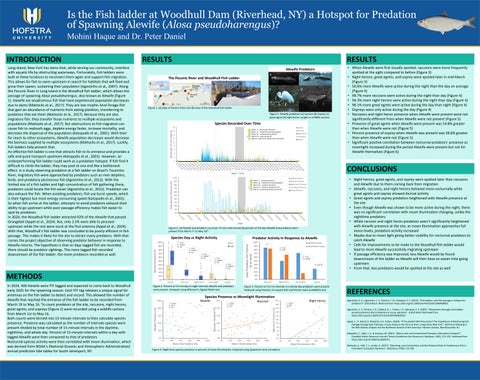
• When Alewife were first visually spotted, raccoons were more frequently spotted at the sight compared to before (Figure 3) • Night herons, great egrets, and osprey were spotted later in mid-March (Figure 3) • 50.6% more Alewife were active during the night than the day on average (Figure 4) • 99.7% more raccoons were active during the night than day (Figure 4) • 94.3% more night herons were active during the night than day (Figure 4) • 98.1% more great egrets were active during the day than night (Figure 4) • Ospreys were only active during the day (Figure 4) • Raccoons and night heron presence when Alewife were present were not significantly different from when Alewife were not present (Figure 5) • Presence of great egrets when Alewife were present was 54.8% greater than when Alewife were not (Figure 5) • Percent presence of osprey when Alewife was present was 28.6% greater than when Alewife were not (Figure 5) • Significant positive correlation between nocturnal predators' presence as moonlight increased during the period Alewife were present but not for Alewife themselves (Figure 6)
CONCLUSIONS
Figure 3. (a) Alewife and predator count per 15-min interval and (b) percent of the day Alewife and predators were present from March 1st to May 16th
Species Day vs Night Activity
Predator Activity in Response to Alewife
• Night herons, great egrets, and osprey were spotted later than raccoons and Alewife due to them coming back from migration • Alewife, raccoons, and night herons behaved more nocturnally while great egrets and osprey showed diurnal activity • Great egrets and osprey predation heightened with Alewife presence at the site • Even though Alewife was shown to be more active during the night, there was no significant correlation with moon illumination changing, unlike the nighttime predators • While raccoon and night heron predation wasn’t significantly heightened with Alewife presence at the site, as moon illumination approaches full moon levels, predation activity increased • Maybe due to moon light giving better visibility for nocturnal predators to catch Alewife • Calls for improvements to be made to the Woodhull fish ladder would lead to more Alewife successfully migrating upstream • If passage efficiency was improved, less Alewife would be found downstream of the ladder as Alewife will then have an easier time going upstream • From that, less predators would be spotted at the site as well
METHODS In 2024, 400 Alewife were PIT tagged and expected to come back to Woodhull early 2025 for the spawning season. Each PIT tag releases a unique signal for antennas on the fish ladder to detect and record. This allowed the number of Alewife that reached the entrance of the fish ladder to be recorded from March 16 to May 16. To count predators at the site, raccoons, night herons, great egrets, and ospreys (Figure 2) were recorded using a wildlife camera from March 1st to May 16. Both counts were binned into 15-minute intervals to then calculate species presence. Presence was calculated as the number of intervals species were present divided by total number of 15-minute intervals in the daytime, nighttime, and whole day. Percent of 15-minute intervals within a day with tagged Alewife were then compared to that of predators. Nocturnal species activity were then correlated with moon illumination, which was derived from NOAA’s (National Oceanic and Atmospheric Administration) annual prediction tide tables for South Jamesport, NY.
Figure 4. Percent of 15-min day vs night intervals Alewife and predators were present. Analyzed using Wilcoxon’s Signed-Ranks test
Figure 5. Percent of 15-min intervals in a whole day predators were present. Analyzed using Pearson chi-square test and Fischer exact probability test
Species Presence vs Moonlight Illumination Alewife
Raccoon
Night Heron
REFERENCES Agostinho, A. A., Agostinho, C. S., Pelicice, F. M., Marques, E. E. (2012). “Fish ladders: safe fish passage or hotspot for predation?” SciELO Brazil. Retrieved from https://doi.org/10.1590/S1679-62252012000400001. Agostinho, C. S., Pereira, C. R., Oliveira, R. J., Freitas, I. S., Marques, E. E. (2007). “Movements through a fish ladder: temporal patterns and motivations to move upstream”. SciELO Brazil. Retrieved from https://doi.org/10.1590/S1679-62252007000200010. Appel, C., P. Daniel, K. McCartin, K.V. Putten. (2024). “If You Build It Will They Come? The Importance of Monitoring Fish Passage through New Fishways: A Case Study on the Peconic River, Long Island, New York”. 2024 Joint Meeting of the Mid-Atlantic Chapter and the Northeast Division of the American Fisheries Society. New Brunswick, NJ. Katopodis, C., Kells, J. A., & Acharya, M. (2001). “Nature-Like and Conventional Fishways: Alternative Concepts?” Canadian Water Resources Journal / Revue Canadienne Des Ressources Hydriques, 26(2), 211–232. Retrieved from https://doi.org/10.4296/cwrj2602211.
Figure 6. Night-time species presence vs percent of moon illumination. Analyzed using Spearman rank correlation
Mattocks, S., Hall, C. J., Jordan, A. (2017). “Damming, Lost Connectivity, and the Historical Role of Anadromous Fish in Freshwater Ecosystem Dynamics”. BioScience, 67(8), 713-728.