How has the language of brand websites evolved? Kristine Dziedziula, Hofstra University Advisor: Dr. Li Results Huang Department of Marketing , International Business and Legal Studies Background Brand websites have evolved from static informational hubs to immersive digital experiences Early websites emphasized technical detail & information density Modern websites prioritize emotional engagement, storytelling, & brand identity Marketing research highlights the rise of emotional branding and experiencedriven communication However, most studies focus on consumer-generated content (e.g., social media, reviews) Less attention has been given to how brand-authored website communication has evolved Research on web design has focused on technical and visual changes, rather than language & tone
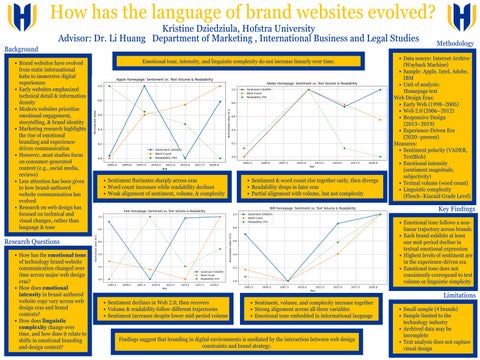
Emotional tone, intensity, and linguistic complexity do not increase linearly over time.
Sentiment fluctuates sharply across eras Word count increases while readability declines Weak alignment of sentiment, volume, & complexity
Sentiment & word count rise together early, then diverge Readability drops in later eras Partial alignment with volume, but not complexity
Data source: Internet Archive (Wayback Machine) Sample: Apple, Intel, Adobe, IBM Unit of analysis: Homepage text Web Design Eras: Early Web (1998–2005) Web 2.0 (2006–2012) Responsive Design (2013–2019) Experience-Driven Era (2020–present) Measures: Sentiment polarity (VADER, TextBlob) Emotional intensity (sentiment magnitude, subjectivity) Textual volume (word count) Linguistic complexity (Flesch–Kincaid Grade Level)
Key Findings Emotional tone follows a nonlinear trajectory across brands Each brand exhibits at least one mid-period decline in textual emotional expression Highest levels of sentiment are in the experience-driven era Emotional tone does not consistently correspond to text volume or linguistic simplicity
Research Questions How has the emotional tone of technology brand website communication changed over time across major web design eras? How does emotional intensity in brand-authored website copy vary across web design eras and brand contexts? How does linguistic complexity change over time, and how does it relate to shifts in emotional branding and design context?
Methodology
Limitations Sentiment declines in Web 2.0, then recovers Volume & readability follow different trajectories Sentiment increases despite lower mid-period volume
Sentiment, volume, and complexity increase together Strong alignment across all three variables Emotional tone embedded in informational language
Findings suggest that branding in digital environments is mediated by the interaction between web design constraints and brand strategy.
Small sample (4 brands) Sample limited to the technology industry Archived data may be incomplete Text analysis does not capture visual design