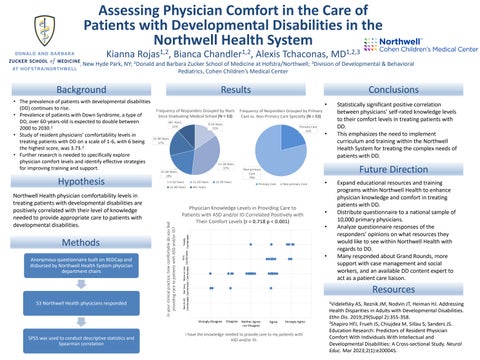

Assessing Physician Comfort in the Care of Patients with Developmental Disabilities in the Northwell Health System
Kianna
Rojas1,2, Bianca Chandler1,2, Alexis Tchaconas, MD1,2,3
Northwell, New Hyde Park, NY; 2Donald and Barbara Zucker School of Medicine at Hofstra/Northwell; 3Division of Developmental & Behavioral Pediatrics, Cohen Children’s Medical Center
Background
• The prevalence of patients with developmental disabilities (DD) continues to rise.
• Prevalence of patients with Down Syndrome, a type of DD, over 60-years-old is expected to double between 2000 to 2030.1
• Study of resident physicians’ comfortability levels in treating patients with DD on a scale of 1-6, with 6 being the highest score, was 3.73.2
• Further research is needed to specifically explore physician comfort levels and identify effective strategies for improving training and support.
Hypothesis
Northwell Health physician comfortability levels in treating patients with developmental disabilities are positively correlated with their level of knowledge needed to provide appropriate care to patients with developmental disabilities.
Methods
Results
Frequency of Responders Grouped by Years Since Graduating Medical School (N = 53)
Conclusions
• Statistically significant positive correlation between physicians’ self-rated knowledge levels to their comfort levels in treating patients with DD.
• This emphasizes the need to implement curriculum and training within the Northwell Health System for treating the complex needs of patients with DD.
Future Direction
• Expand educational resources and training programs within Northwell Health to enhance physician knowledge and comfort in treating patients with DD.
• Distribute questionnaire to a national sample of 10,000 primary physicians.
In your clinical practice, how comfortable do you feel providing care to patients with ASD and/or ID?
Physician Knowledge Levels in Providing Care to Patients with ASD and/or ID Correlated Positively with Their Comfort Levels (r = 0.718 p < 0.001)
• Analyze questionnaire responses of the responders’ opinions on what resources they would like to see within Northwell Health with regards to DD.
• Many responded about Grand Rounds, more support with case management and social workers, and an available DD content expert to act as a patient care liaison. Anonymous questionnaire built on REDCap and disbursed by Northwell Health System physician department chairs
Resources
1Videlefsky AS, Reznik JM, Nodvin JT, Heiman HJ. Addressing Health Disparities in Adults with Developmental Disabilities. Ethn Dis. 2019;29(Suppl 2):355-358.
I have the knowledge needed to provide care to my patients with ASD and/or ID.
2Shapiro HFJ, Frueh JS, Chiujdea M, Sillau S, Sanders JS. Education Research: Predictors of Resident Physician Comfort With Individuals With Intellectual and Developmental Disabilities: A Cross-sectional Study. Neurol Educ. Mar 2023;2(1):e200045.
53 Northwell Health physicians responded