Hofstra Art Education
January 19, 2021
HOFSTRA ART ED NEWS! Hofstra | Art Ed Alumni | Newsletter | Volume 2
Hofstra Alumni: Meet Chris Coffin: Art educator, artist & surfer.
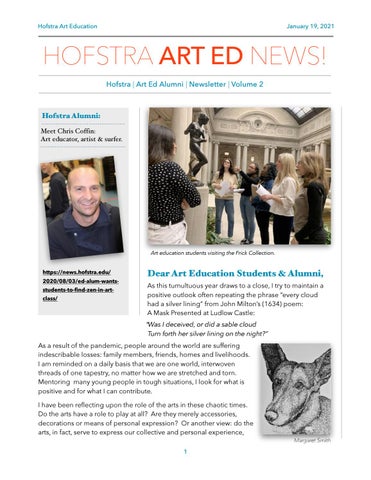
Art education students visiting the Frick Collection. https://news.hofstra.edu/
Dear Art Education Students & Alumni,
2020/08/03/ed-alum-wants-
As this tumultuous year draws to a close, I try to maintain a positive outlook often repeating the phrase “every cloud had a silver lining” from John Milton’s (1634) poem: A Mask Presented at Ludlow Castle:
students-to- nd-zen-in-artclass/
“Was I deceived, or did a sable cloud Turn forth her silver lining on the night?” As a result of the pandemic, people around the world are suffering indescribable losses: family members, friends, homes and livelihoods. I am reminded on a daily basis that we are one world, interwoven threads of one tapestry, no matter how we are stretched and torn. Mentoring many young people in tough situations, I look for what is positive and for what I can contribute. I have been re ecting upon the role of the arts in these chaotic times. Do the arts have a role to play at all? Are they merely accessories, decorations or means of personal expression? Or another view: do the arts, in fact, serve to express our collective and personal experience,
Margaret Smith
fl
fi
1
Hofstra Art Education
January 19, 2021
needs and hopes. Are the arts essential to survival?
Jessica DeAngelo
One of my favorite writers, Ellen Dissanayake, is an American researcher who has investigated the role of art and culture in society from the beginning of human development. She has had the audacity to explore answers to the most fundamental questions in our eld: What is art? What is its purpose? How has art facilitated human survival? Why has every group of people taken risks to create and defend their art?
Beginning in the 1960s, Dissanayake differed from other academics and critics in the eld by exploring the role of the arts as an evolutionary process and focusing on the needs of creators instead of viewers. What primarily interested her was art as a behavior that was universal, that actually provided an evolutionary advantage. She explained, “Birth, marriage, wartime, sickness, death-these are moments of great uncertainty and anxiety.” (2001). Making art, Dissanayake wrote in Homo Aestheticus, enables us to rein in the chaos and gives us “the ability to shape and thereby exert some measure of control over the untidy material of everyday life.” (2001) Dissanayake’s words resonate with me at this chaotic time in our lives and the lives of our children. I see the importance of art-making as critical as ever. Teachers, parents, children and students have all been placed under enormous stress. Despite this, what I hear from you--alumni, art teachers, and professors at Hofstra--is that rising to meet the challenges posed by this pandemic and the current political turmoil has actually been transformative as you negotiate Chloe Kesten new ways of teaching and communicating on the screen. It’s been wonderful to observe that creativity has ourished leading to new and unexpected ways of teaching. As we closed the Hofstra campus last semester due to Covid, I was in the midst of teaching a new course that I created with my colleague, Evangeline (Angel) Christodoulou, on teaching early childhood art for preservice elementary school teachers. With the support of Hofstra’s outstanding technology assistance programs, our school’s art education professors--Evangeline, Christodoulou, Amanda Rummenie Christiansen, Mark Fay and myself--were able to employ many
fi
fi
fl
2
Hofstra Art Education
January 19, 2021
Hofstra students enjoying museum course onsite before lockdown…
…at Th
e Jewis
h Muse
um..
…and at MOMA.
new techniques to make distance learning as engaging as possible including VoiceThread, Google Classroom, Discussion Board, video, animations, break-out rooms, and the Teaching Channel among others. We also used Qualtrics assessment to invite our students to participate in a midsemester evaluation. From the feedback I received, it’s clear that our students appreciated our efforts and felt that their learning continued unabated. Although we all sorely missed the in-person face to face discussion and studio style art making, learning proceeded apace. Students in my Drawing for Teachers course produced excellent, digital drawing portfolios, demonstrating mastery of drawing techniques, selection of art history exemplars and development of varied assessment approaches. Our art education methods courses employed many techniques that you will read about below. Our student teachers also excelled, teaching primarily remotely, and we received glowing reports about them from their cooperating teachers. As I write this, I am working on my Art in NYC course. Since I will be teaching this course remotely, I am revising it to be a virtual experience where we visit museums and galleries internationally. Fortunately—in order to survive-museums are currently developing creative approaches to engage audiences as well as reconsidering their more traditional approaches. There is almost no ‘gig economy‘ for artists now, but we can visit them and their curators virtually. I wonder: Are artists who are creating now depicting the pandemic, their personal travails, their ways of surviving? Are they pointing down the road? Are artists predicting cultural shifts and changes? Can we crack the code of the future with their guidance? Have racial, ethnic, and
3
January 19, 2021
immigration strife and newly emerging voices altered the contents and approaches of museums and galleries? For those of you who are teaching art, what does 2021 look like? Will you able to continue making your own art? How will you keep children engaged and involved with art while keeping yourselves and your students safe, secure and productive? I would love to hear from you for advice as we work on preparing new art teachers in order to bene t from your teaching practices and creative activities. Please share your experiences, advice and artwork along with images of your students’ artwork. I welcome any and all suggestions and submissions so they can be included in our next newsletter. A special thanks to my colleagues at Hofstra. We are blessed with a great group of art educators and educators from other areas of development. Evangeline Christodoulou, Amanda Rumenie Christiansen and Mark Fay join me teaching art education courses. Evangeline and Amanda graduated from our program at Hofstra. Amanda Patricia Puls presently teaches at Farmingdale High School. Evangeline taught at West Hempstead High School. Mark Fay has taught art at the elementary school level for 41 years in Manhasset, among other communities. Each present their own thoughts about teaching in 2020 here. Thank you for all that you do. Wishing you a safe, creative, productive and happy 2021. ~Susan Zwirn
Greetings from Evangeline Christodoulou: 2020: The Year of Teaching Creatively As educators we are always searching for new creative ways to introduce lessons to our students. This past year shook many of us out of our comfort zones with the tremendous challenges of teaching online, let alone teaching creative art education classes online. We no longer had an art classroom or studio, we only had a computer screen. This is not the way I learned how to teach art or even pictured it in my wildest dreams. You know the teaching anxiety nightmares teachers have at the start of a new year or semester: losing your ash drive containing all
4
fl
fi
Chloe Kesten
Hofstra Art Education
Hofstra Art Education
January 19, 2021
your teaching notes and documents for the rst day of class, custodians moving and misplacing your le cabinets, all of your photography equipment getting stolen during the summer break, art supplies for ve classes not arriving, the list is long. In March 2020, those dreams were nothing compared to the reality of teaching my mostly non-art students who did not have any art supplies or even access to buy them since we were in Covid-19 lockdown. Before the pandemic, Susan Zwirn and I designed a new course, Art and the Young Child, which was to begin in the Spring 2020 semester. We worked Melinda Kiefer hard and long, building a bond of respect, mutual admiration and appreciation as we collaborated on creating this wonderful course. We were proud and excited to prepare our early education students for 21st century learning, integrating arts education into their teaching curriculum. I quickly learned that being exible, super-positive, and open to all of the new technologies, methods and Zoom meetings were essential to making this work. There was no choice if I wanted my students to have the educational experience they wanted and deserved. Mark Paczkowski
I had to completely revise my syllabus, which took hours and hours to initially write to make it work for a fully remote learning experience. How was I supposed to replicate my student-centered, art-making class to keep it exciting and interesting on a computer screen? How the heck do you make art online on a university level? What type of art education discourse would we be able to have looking at a computer screen with many students faces not on camera? I worried that I would lose the creative student energy of my fast-paced classroom and I was determined not to let that happen. That’s where the creative part came in. We would accomplish/learn the same things, but would we do it differently. I had planned to take my class to the Early Childhood Center to observe the children and their teachers, but instead I researched and found excellent art educational videos online and embedded them into my keynote presentations. Instead of visiting the Hofstra University Museum of Art to showcase how a museum visit would enhance the education and lives of children, we went on virtual trips to art museums around the world.
fi
fi
fi
fl


5
Hofstra Art Education
January 19, 2021
Art supplies? We made musical instruments called rainsticks using materials found at home: beans, toilet paper rolls (no shortage of those!), paper, crayons, paints, glue, string, yarn, beads, buttons, and aluminum foil. Music? We created a concert using visual symbols, such as stars, shapes, owers for a score representing notes and made our own sounds with common objects found at home. We performed it for another class on Zoom. I am still waiting for a Grammy Award nomination!
Melinda Kiefer
Hofstra offered professors such amazing support with online learning courses, seminars, and workshops, which I happily signed up for. Colleagues, teacher friends and Facebook teacher groups were a huge help. I vowed to be prepared to tackle my fall classes with the zeal I had been building up through the summer.
One of our class highlights of the fall semester was inviting another class to join us via Zoom for a STEAM lesson making buzzing, swirling, whirling drawing machines I call DoodleBots. We used clay to make animal vessels and pinch pots. We wove using yarn and twigs channeling a multicultural art lesson. We collected outdoor objects from nature to create sculptures a la the artist and environmentalist Andy Goldsworthy. An abstract vegetable and fruit printing lesson led to a fun and quite delectable array of beautiful student-made artwork. Invited as the “artist teacher du jour” in one of Susan’s drawing classes, I introduced students to drawing and painting with coffee and tea. What fun! We had marvelous guest speakers, Amanda Rummenie Hofstra alumni and Andrea Muirhead adjunct professor and Ann Koppel a veteran art teacher extraordinaire spoke about student teaching, job seeking and interviewing. Donna Tudda, the director of The Diane Lindner-Goldberg Child Care Institute spoke to us about the early education program for infants, toddlers and preschoolers at Hofstra. Looking back, I am inspired and in awe of the students I have had these past few semesters. They patiently put up with me as I learned how to use Zoom and new tech tools. They taught me about many new platforms and programs to use for remote learning. They led me through technology
fl
6
Hofstra Art Education
January 19, 2021
malfunctions and restored my faith in using humor, mostly self-directed myself, and 99 percent of them kept their screens on--all the time. They worked diligently to come up with essays, thoughts, and opinions. I looked forward to seeing their creative solutions to the art making problems I had assigned them each week. Class discussions and getting to know them were not as dif cult as I thought it would be. They never let me down. My Zoom classroom had a different type of creative energy than my physical classroom, but it was educational and creative after all.
Working with elementary
My takeaway lesson? Teaching creatively is what you make it, not where.
education pre-service teachers to explore STEAM concepts through the creation of doodlebots.
Hello from Mark Fay: Aside from my 41 years as an elementary art teacher, 6 years covering 7 separate K-12 art leaves and one leave for the chair of the art department at LIU Post, I have been an adjunct instructor in Hofstra's Education and Art Education departments since 1999. Because I feel it is essential for art teachers to be actively engaged in their own artistic work, I have been a residential and commercial mural artist for thirty years as well as a Signature Member of the Pastel Society of America since 2013.
sa Maris
Whit
Along with my cousin, also a muralist, I am currently chronicling the life and work of my grandfather and muralist, Charles Gulbrandsen, whose work most notably included the ceiling of the Grand Central Terminal.
eld
From the beginning, the arts have been an inseparable part of who we are as people, and the role of the art teacher must be to foster, nurture and encourage the creative spirit within each person.
7
ski
fi
fi
Mark P aczkow
Hofstra Art Education
January 19, 2021
Happy New Year from Amanda Rummenie-Christiansen: Remote teaching has certainly presented many challenges this year. I have been teaching art in public schools for 20 years, and this year has been the least expected and most demanding. As educators we are constantly required to make situations work to the best of our ability. In accordance with the times the re ection, exibility and creativity of an art teacher have been the “essential” qualities of a pandemic pedagogue. I have learned quickly to nd the silver lining in the most dire of situations. After being asked my profession, I used to be greeted with “ohh, that’s fun!” which has been replaced with “how do you teach ceramics through a screen?”. The answer is: I teach with patience, an open mind and positivity. It’s easy to see the negative in our new normal. What of the positive? I have been thrust into the development of new and innovative lesson work, incorporating readily available and free material, I’ve researched lots of new ways to see art virtually, and been able to decipher and imagine new ways to greet social emotional issues in my classes. We are currently creating quilled paper sculptures atop upcycled cardboard armatures. We are gaining knowledge on structure and form, and learning how to make things that are typically weak stand on their own. On the days we can come to school, we are focusing on clay and learning the importance of diligent, focused work; so our projects don’t dry out or crack. We’ve learned to nish our ceramic pieces using more than just glazes. We are embracing the unconventional, we are taking Bloom’s taxonomy to the highest level and we are consistently evaluating our artistic outcomes. Professionally, I am noticing that while remote education can have detriments there are many attributes for our schools. Long gone are the days where our students must fall behind as they’re disciplined through suspension. The children who suffer from immense anxiety that usually keeps them from school are thriving behind the safety and comfort of their avatar. Students are becoming more inventive, appreciative and are contributing to the education process by adapting to a lack of materials and embracing outside of the box thinking. High school students are becoming more independent and therefore more college ready. Though I could write for hours about the past 6 months, I think it best to admit that as teachers, we are ying the plane as we build it… but I am con dent that the plane we end up with will y higher and faster than the one we left behind. Margaret Smith
fl
fl
fl
fi
fi
fl
fi
8
January 19, 2021
Student Comments… “I bene ted tremendously from the enriching Art Education Courses last semester. The humongous body of knowledge and new experiences that I garnered, along with the positive work ethics of the dedicated professors, will certainly equip me to evolve into an excellent art educator. ~ Andrea Muirhead Candidate for MSE “This was my rst semester in the art education masters program and I couldn’t be more excited to be on this path. My passion for sharing the arts with children has grown deeper with every experience in my classes and while observing in the classroom. ~ Jessica D’Angel Candidate for MSE “The settings of the class may change, but truly great lessons will never be impeded by this. Last semester I took the course SED 277 Drawing for Teachers online which taught us two crucial skills for Art Education, how to observe and how to teach observation to students. The next few semesters may continue to be challenging, but Hofstra's Fine Arts Education department has proven their ability and eagerness to adapt to these challenges to provide us with an exceptional learning experience. ~Maggie Smith-Coleman Candidate for MSE "At Hofstra, I gained insight into the theories of child and adolescent education, especially the most current practices in the eld of art education. I feel con dent to apply these concepts to my work in the classroom. I also feel my role as an artist, visually exploring ideas, is strengthened. ~ Melinda Kiefer Candidate for MSED
Jessica DeAngelo
Alumni & Faculty Accomplishments Please send your accomplishments and artwork to share. susan.g.zwirn@hofstra.edu evangeline.christodoulou@hofstra.edu
Hope you have enjoyed our newsletter! Warm Regards, Angel Evangeline Christodoulou, MSED Adjunct Instructor of Fine Arts Education School of Education Department of Teaching, Learning & Technology 291 Hagedorn Hall 119 Hofstra University Hempstead, NY 11549-1190 Of ce / 516.463.5768 Fax / 516.463.6196 evangeline.christodoulou@hofstra.edu
”
”
"
”
D
D
D
o
fi
fi
fi
fi
9
fi
Hofstra Art Education