
Public Perception of Public transportation on Long Island
Hillary Flurkey
Mentor: Dr. Sasha Pesci
Department of Geology, Environment,
and Sustainability
Introduction

• From the belt parkway to the first Levitt town, Long Island has long been the testing ground for personal automobiles like cars.
• Thanks to the likes of technocrats like Robert Moses and his infamous low hanging bridges, (Schindler, 2015) large vehicles like buses have been hindered.
• This lack of public transportation has led to transit deserts (Jomehpour Chahar Aman & Smith-Colin, 2020) and contributes to food deserts (Hamidi, 2020).
• This research focuses on residents of Northport and East Northport, Long Island, where there are buses available, but their schedules are inconsistent, and they have slow turnaround times.
Research questions

1. How do Northport and East Northport residents feel about an expansion of the town’s current public transportation system?
2. What are their opinions holistically? (Whole responses)
3. What are the themes of their opinions?

Methods
• Distributed online survey questionnaire to Northport and East Northport residents
• Collected demographic data about automobile usage and public transportation usage
• Gathered data on the opinions and feelings of respondents
• Qualitative analysis:
• Coded overall sentiments of each response (Holistic)
• Broke down each response into themes (Thematic)

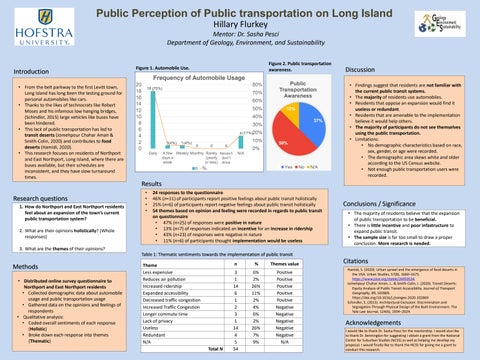
Frequency of Automobile Usage




Results
• 24 responses to the questionnaire
• 46% (n=11) of participants report positive feelings about public transit holistically
• 25% (n=6) of participants report negative feelings about public transit holistically
• 54 themes based on opinion and feeling were recorded in regards to public transit on questionnaire
• 47% (n=25) of responses were positive in nature
• 13% (n=7) of responses indicated an incentive for an increase in ridership
• 43% (n=23) of responses were negative in nature
• 11% (n=6) of participants thought implementation would be useless
Table 1: Thematic sentiments towards the implementation of public transit

Discussion

• Findings suggest that residents are not familiar with the current public transit systems.
• The majority of residents use automobiles.
• Residents that oppose an expansion would find it useless or redundant
• Residents that are amenable to the implementation believe it would help others.
• The majority of participants do not see themselves using the public transportation.
• Limitations:
• No demographic characteristics based on race, sex, gender, or age were recorded.
• The demographic area skews white and older according to the US Census website.
• Not enough public transportation users were recorded.

Conclusions / Significance
• The majority of residents believe that the expansion of public transportation to be beneficial.
• There is little incentive and poor infastructure to expand public transit.
• The sample size is far too small to draw a proper conclusion. More research is needed.

Citations
Hamidi, S. (2020). Urban sprawl and the emergence of food deserts in the USA. Urban Studies, 57(8), 1660–1675. https://www.jstor.org/stable/26959534
Jomehpour Chahar Aman, J., & Smith-Colin, J. (2020). Transit Deserts: Equity Analysis of Public Transit Accessibility. Journal of Transport Geography, 89, 102869. https://doi.org/10.1016/j.jtrangeo.2020.102869
Schindler, S. (2015). Architectural Exclusion: Discrimination and Segregation Through Physical Design of the Built Environment. The Yale Law Journal, 124(6), 1934–2024.

Acknowledgements
Figure 1. Automobile Use.
Figure 2. Public transportation awareness.