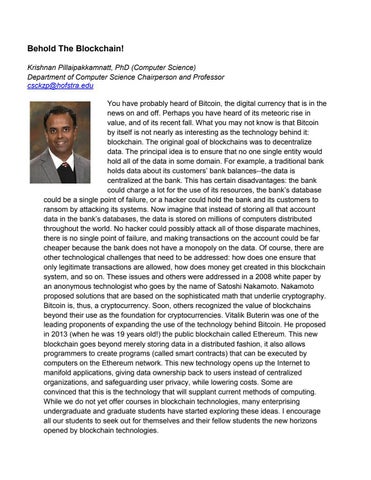
Behold The Blockchain! Krishnan Pillaipakkamnatt, PhD (Computer Science) Department of Computer Science Chairperson and Professor csckzp@hofstra.edu You have probably heard of Bitcoin, the digital currency that is in the news on and off. Perhaps you have heard of its meteoric rise in value, and of its recent fall. What you may not know is that Bitcoin by itself is not nearly as interesting as the technology behind it: blockchain. The original goal of blockchains was to decentralize data. The principal idea is to ensure that no one single entity would hold all of the data in some domain. For example, a traditional bank holds data about its customers’ bank balances--the data is centralized at the bank. This has certain disadvantages: the bank could charge a lot for the use of its resources, the bank’s database could be a single point of failure, or a hacker could hold the bank and its customers to ransom by attacking its systems. Now imagine that instead of storing all that account data in the bank’s databases, the data is stored on millions of computers distributed throughout the world. No hacker could possibly attack all of those disparate machines, there is no single point of failure, and making transactions on the account could be far cheaper because the bank does not have a monopoly on the data. Of course, there are other technological challenges that need to be addressed: how does one ensure that only legitimate transactions are allowed, how does money get created in this blockchain system, and so on. These issues and others were addressed in a 2008 white paper by an anonymous technologist who goes by the name of Satoshi Nakamoto. Nakamoto proposed solutions that are based on the sophisticated math that underlie cryptography. Bitcoin is, thus, a cryptocurrency. Soon, others recognized the value of blockchains beyond their use as the foundation for cryptocurrencies. Vitalik Buterin was one of the leading proponents of expanding the use of the technology behind Bitcoin. He proposed in 2013 (when he was 19 years old!) the public blockchain called Ethereum. This new blockchain goes beyond merely storing data in a distributed fashion, it also allows programmers to create programs (called smart contracts) that can be executed by computers on the Ethereum network. This new technology opens up the Internet to manifold applications, giving data ownership back to users instead of centralized organizations, and safeguarding user privacy, while lowering costs. Some are convinced that this is the technology that will supplant current methods of computing. While we do not yet offer courses in blockchain technologies, many enterprising undergraduate and graduate students have started exploring these ideas. I encourage all our students to seek out for themselves and their fellow students the new horizons opened by blockchain technologies.
Hellos and Goodbyes! We welcome to the Computer Science Department the following faculty members: ● Dr. Rajesh Kumar: Dr. Kumar will be joining the department as a tenure-track assistant professor. He recently graduated from Syracuse University with a Ph.D. in Computer Science. His areas of expertise include behavioral biometrics and applied machine learning. Prior to joining Hofstra, he was a visiting professor at Haverford College. Dr. Kumar has indicated that he is open to working with students who are curious about biometrics or have an interest in using machine learning to solve interesting problems. ● Prof. Aman Luthra: We are happy to welcome Prof. Luthra back to the department--this time as an adjunct faculty member! Aman (he’ll always be “Aman” to me) graduated from Hofstra about two years ago with an M.S. in Computer Science. His thesis was in applied cryptography. Since then, he has been working as a Technology Analyst at Goldman Sachs. ● Prof. Antonio Leo: We also happily welcome back to our fold Prof. Leo, who worked as the Director of Operations/Systems of Hofstra’s IT department prior to his retirement. Prof. Leo brings to us a wealth of experience building, running and maintaining critical computing infrastructure. We look forward to our students benefiting from his vast expertise. We wish fond farewells to: ● Dr. Simon Ben-Avi: Dr. Ben-Avi has decided to retire from Hofstra. He joined Hofstra as Founding Dean of the School of Engineering and Applied Science in 2012. Prior to joining Hofstra, he was Associate Dean at The Cooper Union. He oversaw the overhaul of the two SEAS buildings, Adams Hall and Weed Hall, injecting into these 50-year-old buildings new life and a brighter interior. The Computer Science Department, in particular, gained multiple new labs, including the $1 million Big Data Lab. We wish Dr. Ben-Avi happy retirement! ● Dr. Angeliki Zavou: We will greatly miss Dr. Zavou as a teacher and as a colleague. She has decided to seek other pastures. As a teacher, Dr. Zavou brought zest into her classes--her students always knew they would find a professor who went above and beyond when they approached her in class or outside. She founded the Hofstra chapter of WiCys, the Women in Cybersecurity group, and was a mentor to a number of women students in computing. From everyone in Adams: “Στο καλό!”