
Evaluating Perception of Clinical Trials within Multicultural Communities
Ethan Royka, BA1,2, Nhi Nguyen, BA1,2, Chase Shipp, BA1,2, Phyu Niang, MD3 , Juliet Muir, MD3, Manoj Ravichandran, MD3, Arsalan Boodhun, MD3, Scott Jones, MS4, Elizabeth Cohen, RN, PhD, FAAN4 and Daniel King, MD, PhD2,3
1Northwell, New Hyde Park, NY, 2Donald and Barbara Zucker School of Medicine at Hofstra/Northwell, 3Institute of Cancer Research, Feinstein Institutes for Medical Research, 4Northwell health, Institute of Health Systems Science

Background
• Clinical trial participation is low among racial minorities
• Certain barriers have been identified, but the perceptions of diverse population is poorly understood
• These perceptions may prove insight into low clinical trial participation rates
• Queens, NY provides a unique research opportunity given its remarkable diversity.

Hypothesis
Perceptions of clinical trial participation differ across racial, ethnic, and cultural groups, with values, language, and community networks shaping trust and willingness to enroll.
Methods
• Setting: Queens Cancer Center
• Approach: 20–30-minute surveys consisting of 46 questions (Likertscale+ open-ended)
• Assess patient demographics, perceptions, and barriers
• Analysis: includes descriptive stats, nonparametric tests, and topic modeling of open-test responses

Results
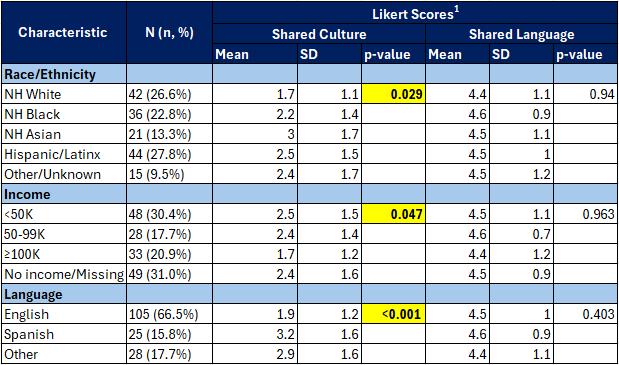
Table
1: Likert Scores by Demographic Group
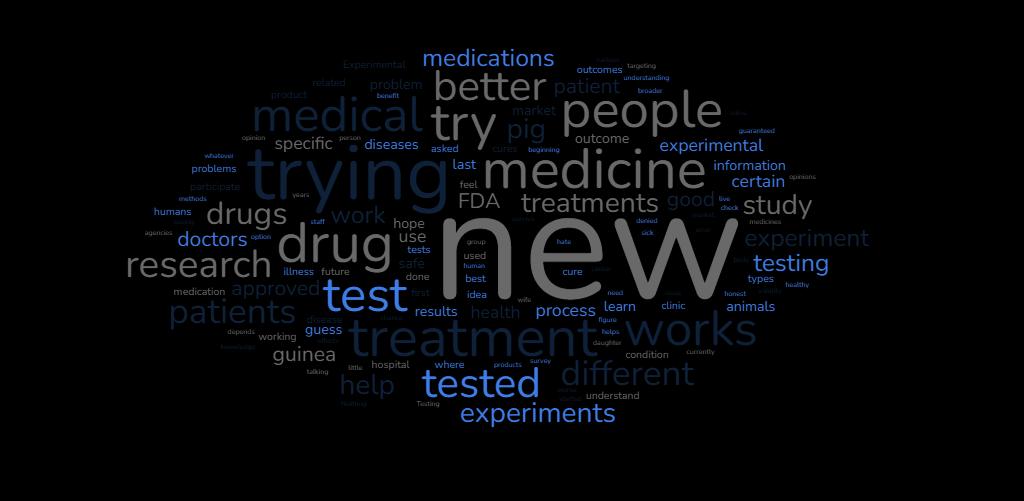
Word Cloud of open-ended responses to the question :”What does the term ‘clinical trial’ mean to you?”
• ~19% of all patients could not provide a definition of a clinical trial
Future Direction
• Further research into why perceptions vary among ethnic groups
1 Likert scores based on how important these factors are in one’s decision whether to not to participate in a clinical trial. Shared Culture: How important is it to you that you and your doctor share the same culture?; Shared Language: How important is it to you that you and your doctor speak the same language?. Likert scores ranged from 1-5 with 1 being “Not Important at All” and 5 being “Very Important”. P-values produced from a Chi-squared test. Highlighted cells reflect statistically significant p-values (<.05).
Conclusions
• Some aspects of clinical trial perceptions differed significantly by race/ethnicity, income, and primary language while others were consistent cross all groups.
• Further data analysis using Latent Class Analysis and topic modeling (LDA) of open-text responses.
• Develop community-tailored education initiatives to improve awareness with the aid of local communities.
Resources
Figure 1: Word Cloud of Patient’s