
Foreword
Where Art Inspires and Transforms
September 2010 marks the beginning of the 75th anniversary of Hofstra University, a significant benchmark in the history of this institution.

Since its founding as a liberal arts college in 1935, the arts have been integral to its academic and cultural life. In tandem with the growth of Hofstra, as early as 1949 major gifts of art began to be donated to the school. One of the earliest major donors was Mrs. W. Halsted VanderPoel, who contributed 19th century French bronze and marble sculptures as well as paintings, furniture and numerous decorative art objects to Hofstra.
Art donors, in fact, whether they are alumni, art collectors, artists, faculty, friends, or trustees, have played a significant and enduring role in the development of what is now known as the Hofstra University Museum (HUM).


Officially opened in 1963, the Hofstra University Museum has been an American Association of Museums (AAM)accredited institution since 1985, with its most recent subsequent accreditation awarded in 2009. AAM awards this distinction only to museums that have achieved excellence in all areas of their operations and educational mission. Currently, the Hofstra University Museum is the sole universitybased museum on Long Island to have received this level of recognition.
The Museum also owes a debt of gratitude to those presidents, provosts, vice presidents, directors, professional staff, faculty, and volunteers who have provided leadership throughout the years, guiding the direction of acquisitions that have so enriched the collection.
In the early 1960s Hofstra University Fine Arts Professor John Hopkins stated, “Beyond the collection’s obvious value to art students and historians it enables those in other disciplines to view and integrate their understanding of the visual arts.” Those words are as meaningful today as they were almost 50 years ago.

exhibitions, its outdoor sculpture and its interpretive programs, the Museum is committed to being a vital partner in the educational, pedagogical, and cultural life of Hofstra University students, faculty and staff, as well as the residents of the greater New York metropolitan region. It strives to achieve this mission by adherence to the highest professional standards in the collection, preservation, exhibition and interpretation of works of art.
This exhibition, Acquired Riches: Highlights From the Hofstra University Museum Collection, is knowledgeably and sensitively curated by Assistant Director um is a vital of Exhibitions and Collections


During the past eight decades, the permanent collection has grown to nearly 5,000 works of art and ethnographic objects that represent six continents, dating from the preColumbian to the contemporary. This growth and diversity has come almost exclusively through the generosity of art donors. It is fair to say that the Hofstra University Museum would not be the success it is today without the commitment of our art donors, and their understanding of the role of philanthropy in helping the Museum and Hofstra University achieve their educational goals and objectives.
Today, the Muse learning laborat 12,000 individua works of art mak connections and and faculty in m explorations so e global society.
Acory for more thaq n K u aren T i . A r lbert, and is offered in ls a year, where celebration of the 75th anniversary e curricular of Hofstra. The e exhibition selections engage students provide examples of the diverse ulticultural
Each year Hofstr students in discip as anthropology, creative writing, elementary educa and psychology, utilize exhibitions and permanent collection works to enhance and underscore concepts and learning objectives that have clear relevance to their curricula.

The Hofstra University Museum’s mission, as adopted in 2006, has changed through the years from one that focused primarily on collection care, to the following:
The Hofstra University Museum is dedicated to furthering the understanding and enjoyment of the visual arts. It helps people to make deep and longlasting connections to works of art as well as to the varied cultures from which they originate. Through its collections and
elements o i f th c e Mus d eum’s collection ssential in our with works that inch lude pes aintings by Karel Appel, Edwin Dickinson, Conrad Felixmüller, Paul Gauguin, a University George Grosz, Johan Barthold : lines a Highligh s varied ts F Jongrkom ind and Joan Mitchell; works art hi t sh tore H y, ofstron p a U ap n er b iv y J ers ean C it h y arlot, Arthur dance education, Bowen Davies, James Rosenquist tion,Mujournali s sm, and George Rouault; photographs to name a fewe , um Co by Dllect onna Fe ir onrato, Ralph Gibson, Danny Lyon, August Sander and Andy Warhol; and works from Africa, China, Japan, Mexico and Oceania. The exhibition installation recognizes the significantimpact that art donors have had, through their gifts of authentic and unique objects, on the Museum’s core mission and its ability to impact Hofstra students and faculty, as well as residents of the New York metropolitan region, as they utilize and study the collection to create, delight, experiment, explore, grow, imagine, learn, teach….

Beth E. Levinthal Executive Director, Hofstra University Museum
HOFSTRA UNIVERSITY MUSEUM
Acqui R red iches
Cover Credits:
Keisai Eisen Alison Saar Ben Shahn Rom are Bearden (Japanese, 1790-1848) (American, b. 1956) (American, 1898 1969) (American, 1914 1988) Fukagawa from the series Stride Piano, 1993 Mask, 1958 Three Women (Easter Sunday), 1979
One Hundred Famous Places in Woodcut Gouache on paper Lithograph Edo for Flowers, c. 1810 1845 21 1/2 x 14 1/2 in. 26 1/2 x 20 1/4 in. 20 5/16 x 15 in. Color woodcut Gift of Judith Jedlicka Gift of Dr. Milton M. Gardner Gift of Carole and Alex Rosenberg 14 1/2 x 9 5/8 in. HU 2008.4.3 HU 70.102 HU 91.19
Gift of Mr. and Mrs. Daniel Goldberg Art © Estate of Ben Shahn/ Art © Romare Bearden Foundation/ HU 74.05.17 Africa, Gabon, Mitsohgo Licensed by VAGA, New York, NY Licensed by VAGA, New York, NY Standing Female Figure with Janus Paul Gauguin Heads, 19th 20th century Ralph Gibson China (French, 1848-1903) Wood and kaolin (American, b. 1939) Equestrianne
--
Highlights From the Hofstra University Museum Collection
Acquired Riches:
In Celebration of the 75th Anniversary of Hofstra University
September
Emily
Curated by Karen T. Albert
Assistant Director of Exhibitions and Collections
Funding
Foreword
September 2010 marks the beginning of the 75th anniversary of Hofstra University, a significant benchmark in the history of this institution.
Since its founding as a liberal arts college in 1935, the arts have been integral to its academic and cultural life. In tandem with the growth of Hofstra, as early as 1949 major gifts of art began to be donated to the school. One of the earliest major donors was Mrs. W. Halsted VanderPoel, who contributed 19th-century French bronze and marble sculptures as well as paintings, furniture and numerous decorative art objects to Hofstra.
Art donors, in fact, whether they are alumni, art collectors, artists, faculty, friends, or trustees, have played a significant and enduring role in the development of what is now known as the Hofstra University Museum (HUM). Officially opened in 1963, the Hofstra University Museum has been an American Association of Museums (AAM)-accredited institution since 1985, with its most recent subsequent accreditation awarded in 2009. AAM awards this distinction only to museums that have achieved excellence in all areas of their operations and educational mission. Currently, the Hofstra University Museum is the sole university-based museum on Long Island to have received this level of recognition.
During the past eight decades, the permanent collection has grown to nearly 5,000 works of art and ethnographic objects that represent six continents, dating from the preColumbian to the contemporary. This growth and diversity has come almost exclusively through the generosity of art donors. It is fair to say that the Hofstra University Museum would not be the success it is today without the commitment of our art donors,
and their understanding of the role of philanthropy in helping the Museum and Hofstra University achieve their educational goals and objectives.
The Museum also owes a debt of gratitude to those presidents, provosts, vice presidents, directors, professional staff, faculty, and volunteers who have provided leadership throughout the years, guiding the direction of acquisitions that have so enriched the collection. In the early 1960s Hofstra University Fine Arts Professor John Hopkins stated, “Beyond the collection’s obvious value to art students and historians it enables those in other disciplines to view and integrate their understanding of the visual arts.” Those words are as meaningful today as they were almost 50 years ago.
Today, the Museum is a vital learning laboratory for more than 12,000 individuals a year, where works of art make curricular connections and engage students and faculty in multicultural explorations so essential in our global society.
Each year Hofstra University students in disciplines as varied as anthropology, art history, creative writing, dance education, elementary education, journalism, and psychology, to name a few, utilize exhibitions and permanent collection works to enhance and underscore concepts and learning objectives that have clear relevance to their curricula.
The Hofstra University Museum’s mission, as adopted in 2006, has changed through the years from one that focused primarily on collection care, to the following:
The Hofstra University Museum is dedicated to furthering the understanding and enjoyment of the visual arts. It helps people to make deep and long-lasting connections to works of art as
well as to the varied cultures from which they originate. Through its collections and exhibitions, its outdoor sculpture and its interpretive programs, the Museum is committed to being a vital partner in the educational, pedagogical, and cultural life of Hofstra University students, faculty and staff, as well as the residents of the greater New York metropolitan region. It strives to achieve this mission by adherence to the highest professional standards in the collection, preservation, exhibition and interpretation of works of art.
This exhibition, Acquired Riches: Highlights From the Hofstra University Museum Collection, is knowledgeably and sensitively curated by Assistant Director of Exhibitions and Collections Karen T. Albert, and is offered in celebration of the 75th anniversary of Hofstra. The exhibition selections provide examples of the diverse elements of the Museum’s collection with works that include paintings by Karel Appel, Edwin Dickinson, Conrad Felixmüller, Paul Gauguin, George Grosz, Johan Barthold Jongkind and Joan Mitchell; works on paper by Jean Charlot, Arthur Bowen Davies, James Rosenquist and George Rouault; photographs by Donna Ferrato, Ralph Gibson, Danny Lyon, August Sander and Andy Warhol; and works from Africa, China, Japan, Mexico and Oceania. The exhibition installation recognizes the significant impact that art donors have had, through their gifts of authentic and unique objects, on the Museum’s core mission and its ability to impact Hofstra students and faculty, as well as residents of the New York metropolitan region, as they utilize and study the collection to create, delight, experiment, explore, grow, imagine, learn, teach….
Beth E. Levinthal
Executive Director Hofstra University Museum
Educator’s Statement
“… Seeing alters the thing that is seen, and transforms the seer.” – James Elkins
The works of art that have been given to the Hofstra University Museum provide portals into the larger picture of who we are. The complexity of each object is part of the richness it offers, inspiring curiosity and begging us to stop, look, and enjoy.
Any of the works in this exhibit can be seen from multiple perspectives. Here in a university setting, the Museum’s collection helps to better connect art to the many disciplines being studied. The large and diverse collection helps students of anthropology, art history, writing, dance, and psychology, to name just a few, explore and better understand their world. The dance student is inspired by the image/object’s forms, lines and colors; the psychology student gains insight by reading the image and uncovering its many nuances; the anthropology student examines the role of the object in society; the art historian considers the works in their multiple contexts; and the writing student is moved to wonder and create.
The power of the collection also reaches outside the University walls, into our diverse surrounding communities. Whether an adult or a third grader, the visitor can discover the magic of the Museum, journeying from their familiar world into worlds beyond their doorsteps.
In a culture saturated with mediated experiences and reproductions, the Hofstra University Museum offers the visitor authentic objects, all with their singular characteristics and stories, and all requiring us to engage in the process of seeing, thinking and learning … if we just take the time to look.
Nancy Richner Museum Education Director Hofstra University Museum
Curator’s Statement
“Where do the collection works come from?” is a question often heard in the galleries of the Hofstra University Museum. The simple answer is that the works come from many generous donors. The creation of the collection was both planned and arbitrary. Donations of paintings, sculpture, prints and decorative arts were given to Hofstra University beginning in 1949, and these early contributions became the foundation of the Museum’s permanent collection. For more than 40 years, since the construction of the Emily Lowe Gallery, donations have continued to grow in quality and quantity. The collection currently consists of close to 5,000 works of art, including paintings, prints, drawings, photographs and sculptures from the 18th to the 21st century. Indian and Chinese stone and ceramic works, Japanese prints and scrolls, African and Oceanic ethnographic pieces, and preColumbian artifacts are additional components of the collection.
This exhibition, Acquired Riches: Highlights From the Hofstra University Museum Collection, displays only 1 percent of the Museum’s holdings, a very small portion of this diverse collection. The generosity of donors has always been essential to the development of the permanent collection, as almost all the works of art were donated.
This exhibition acknowledges the significant contribution of our donors, honoring those who have made our collection what it is today. The works of art in the Museum’s collection are a result of the cultivation of relationships with collectors, donations from faculty and artists, and gifts – unsolicited as well as given in appreciation after an exhibition.
The earliest donations of objects were made to the University before the
establishment of the Museum. Mrs. W. Halsted VanderPoel (Blanche Paulings Billings) was the University’s earliest major art donor, giving paintings, bronze sculpture and furniture. Her husband, W. Halsted VanderPoel, was a member of the Hofstra University Board of Trustees from 1951 to 1958. It was as a result of his efforts that the University acquired land from the federal government that now forms the north campus. He also generously supported student scholarship funds. In support of the University and her husband’s involvement, in the 1950s Mrs. VanderPoel donated a number of sculptures and decorative art pieces, including the marble and bronze bust by Paul-François Berthoud.
The University also received donations of works of art, primarily prints, from 1956 to 1961 from three other donors. Dr. D. R. Leaming’s gift of 18 works by 20th-century American artists included Eugene Higgins’ painting On The Road (1922) and a group of etchings by Frank W. Benson. In 1958 the estate of Mrs. Barnes donated a group of more than 20 works on paper to the University. Highlights from this gift included James McNeill Whistler’s The Terrace, Luxembourg (1894) and a John Whorf watercolor titled The Beach (1930s-1940s). Mr. Louis Freedenberg’s donation of 78 prints in 1961 added to this growing aesthetic and educational resource. He expressed “the hope that both students and the community at large would be enriched by the experience of viewing them.” The prints were primarily executed by American artists, along with European artists working in America, from 1930 to 1945 and are good representations of figurative work done at the time. The Freedenberg gift contains examples of a variety of print media such as engraving, etching, lithography and woodcut. Artists represented in this gift include: John Taylor Arms, Isabel
While the University was established in 1935, the Museum’s history began in 1963. At that time, with funding from the Joe and Emily Lowe Foundation, what is now known as Emily Lowe Hall was expanded, and while not developed as a part of the Lowe Foundation gift, Emily Lowe Gallery was also constructed, creating a physical presence for the visual arts on campus for the fi rst time. Initially, a faculty adviser from the Fine Arts Department acted as director of the Emily Lowe Gallery. The Museum evolved, in tandem with the University, into a professionally run organization with a full-time professional director and staff, achieving accreditation from the American Association of Museums in 1985, with subsequent accreditations in 1997 and 2009. With the creation of the Emily Lowe Gallery, the works of art owned by the University were gathered and accessioned to become the foundation of the collection. Gifts of works of art rapidly increased in number, diversity and quality. Most of these collectors had some connection to the University, ranging from members of Hofstra’s Board of Trustees and faculty to alumni and friends of University personnel.
Mr. and Mrs. Alexander Rittmaster donated two important paintings to the collection based upon Mr. Rittmaster’s longstanding friendship with Malcolm H. Preston, who was on the faculty of the Fine Arts Department from 1950 to 1970 and served as its chair from 1955 to 1963. Paul Gauguin’s Portrait of a Woman (1881-1882) was given to the Museum in 1964. In a 1964 memo, Professor Preston wrote that the Gauguin painting “... is a worthwhile and valuable addition to our collection.”
Bishop, Aaron Bohrod, Frederico Castellon, Jean Charlot, Marion Greenwood, Gene Kloss, Dole Reed, and Lawrence Smith.
This continues to hold true today. Portrait of a Woman is an example of Gauguin’s early Impressionistic style, and in 2002 it was included in the exhibition The Lure of the Exotic: Gauguin in New York Collections at The Metropolitan Museum of Art in New York City. The Rittmasters later gifted Gluckiche Ehe IV (Ehepaar im Winter)/Married Couple in Winter (1919) by the German Expressionist painter Conrad Felixmüller. This painting is an excellent example of the artist’s work, exemplifying the Expressionist use of distortion and exaggeration to heighten the emotional content of the image depicted.
A large collection of Currier & Ives prints was given to the Museum in 1964 by Mrs. George M. Estabrook. Mrs. Estabrook was the widow of one of the University’s fi rst trustees; during his lifetime Mr. Estabrook was one of the foremost private collectors of Currier & Ives lithographs. At the time, Hofstra University professor John F. Hopkins, chair of the Fine Arts Department, stated, “Currier and Ives lithographs have great historical significance ... We hope that this important gift will inspire other collectors to contribute their works of art to colleges and universities where they can be seen by countless thousands of young people.” The hand-colored lithographs were originally intended for sale to the general public for display in their homes. The prints illustrate America’s transition from an agricultural to industrialized nation and include scenic views from across the United States. The Museum’s collection contains approximately 100 Currier & Ives lithographs.
Members of the Hofstra University Board of Trustees have also added important works of art to the collection. Dr. Milton M. Gardner served on the board from 1971 to 1998 when he became an emeritus trustee. For more than 25 years, from 1969 to 1996, Dr. Gardner donated a wide variety of
paintings, drawings and prints to the Museum, totaling 239 pieces. These extraordinary gifts include some of the Museum’s fi nest pieces: paintings by Karel Appel, Edwin Dickinson, Joan Mitchell, Eugene Rukhin, and Ben Shahn; drawings by Jean Cocteau, John Flaxman, George Romney, Pavel Tchelitchew, and Benjamin West; and numerous prints by artists such as Jean Arp, Leonard Baskin, Lee Bontecou, Sonia Delauney, Richard Hamilton, Robert Indiana, Ellsworth Kelly, Robert Rauschenberg, Ad Reinhardt, James Rosenquist, Larry Rivers, Andy Warhol and Tom Wesselman.
The generosity of Hofstra University board members has continued with gifts from Robert Dall, Maurice Deane, Florence Kaufman, Gerald Light, David Mack and Ann Mallouk. In 2007 Abby Kenigsberg donated a pastel by 20th-century American artist Arthur Bowen Davies. Ms. Kenigsberg currently serves on the Board of Trustees.
In 1972 the University received an extensive collection of materials on the major avant-garde art movements of the 20th century. The Howard L. and Muriel Weingrow Collection of Avant-Garde Art and Literature resides in the Special Collections department of the Joan and Donald E. Axinn Library. From 1968 through 1981 the Weingrows also donated 14 works of art to the Museum. This group contained works of art spanning from 1866 to 1980, and included a painting by John Thomas Peele; drawings by Benny Andrews, Charles Dana Gibson, and James Rosenquist; a sculpture by Jo Davidson; and prints by Salvador Dali and Lowell Nesbitt.
Mr. and Mrs. Jerry and Emily Spiegel are longtime supporters of the University; Mr. Spiegel was a member of the Hofstra Advisory Board and on the Hofstra Council. Art collectors and supporters of the arts, the Spiegels donated funds in 1986 to renovate the
Little Theater, which was renamed the Emily and Jerry Spiegel Theater. Playing a vital role in the arts on campus, this facility is used as a classroom, for experimental theater and for new plays. Four years later, the Jerry and Emily Spiegel Foundation endowed the theater, guaranteeing its continued presence. The Spiegels are well-known collectors of contemporary art and have donated three paintings to the Museum. In 1975 they donated George Rouault’s Clown (c. 1920-1925) and, in 1991, two paintings by William Anastasi.
At fi rst glance, the donation of Jane Peterson’s The Lagoon, Venice (c. 1920) is seemingly random, with the donor having no connection to the Museum or the University. Further investigation has, however, revealed a link. In the 1970s an active “friends group” advocated for the Museum and the collection. A member of the group, Walter Fillin (also a collector and donor to the Museum), had expressed to gallery owner Robert Schoelkopf his desire to expand the Museum’s holdings in 20th-century American painting. In a letter dated 9 November 1971, Mr. Schoelkopf wrote to Mr. Fillin:
Knowing of your interest in building up the collection of Twentieth Century American painting at Hofstra, my friend and client Mr. Martin Horwitz (of whom I have told you) has asked me to turn over to Hofstra a painting by Jane Peterson, The Lagoon, Venice, oil/canvas, 32” x 32”. Mr. Horwitz wished to contribute to the Museum by donating this painting.
Mr. Schoelkopf spoke with his friend and client Martin Horwitz, the owner of the Peterson painting. Through this communication, Mr. Horwitz contributed the painting to the Museum in 1972.
Further strengthening its holdings in 20th-century American painting, the Museum accepted A Mighty One on a
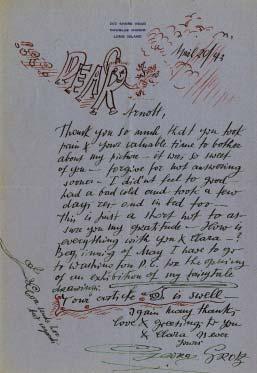
Little Outing Surprised by Two Poets (1942) by artist George Grosz from the Estate of Arnott J. White in 1993. Grosz, known for his politically charged works critical of the government, fled Europe in the 1930s and settled in New York City and, eventually, on Long Island. Included with the painting donation was a book of ephemera and correspondence between Mr. White and the artist. It is very unusual to have such a detailed and specific record of a painting’s history and the relationship between the collector and artist. Provenance, which traces the ownership of the work of art from the current donor back to the artist, can reveal gaps in the work’s history, raising questions of ownership or authenticity.
Since its early days of affi liation with the Fine Arts Department, the department’s faculty have also supported the Museum in a variety of ways: serving as guest curators and advisory committee members, participating in programming, bringing classes to exhibitions and donating works of art.
When sculptor Professor David Jacobs arrived at Hofstra University in the early 1960s, sculptures were not displayed on the grounds. With the opening of the Emily Lowe Gallery, Professor Jacobs began an informal program of displaying sculptural work by faculty and students on the campus. When artist Manolo Pascual donated his sculpture Knight in 1968 after an exhibition of his work at the Emily Lowe Gallery, it was installed in a prominent outdoor location at the north entrance to the gallery. In 1977 then Hofstra President James Shuart, after presenting a student sculpture award, realized the importance of the outdoor sculpture and formalized an agreement with Professor Jacobs to place additional sculptural works on campus. A group of sculptures, works by Long Island sculptors in honor of Long Islanders (known as the Long Island Hall of Fame), were accepted into the
collection in the mid-1980s, and more than 10 of these were placed around campus. The oversight, including installation and maintenance, of the outdoor sculpture came under the auspices of the Museum in the late 1980s. The outdoor sculpture collection currently contains more than 70 works, with pieces by Vinnie Bagwell; Robert Berks; Dan Devine; Richard Heinrich; David Jacobs; Paul Jenkins; J. Seward Johnson, Jr.; Ibram Lassaw; Paul Manship; Antoni Milkowski; Henry Moore; Constantino Nivola; Tony Rosenthal; Jason Seley; Rhoda Sherbell; and Greg Wyatt, among others. In 2008 the University sponsored the Person of Color Sculpture Competition as a component of Hofstra President Stuart Rabinowitz’s diversity awareness initiatives. The international competition ultimately resulted in the selection of the newest outdoor sculpture, Frederick Douglass Circle, by the artist Vinnie Bagwell.
Professor James Gaboda was on the faculty of the Fine Arts Department from 1965 to 1983 and served as its chair from 1980 to 1983. In 1984 he donated five works of art to the Museum, among them an etching by Kenneth Hayes Miller, a drawing by Norman Rockwell, and a painting by Nahum Tachacbasov, along with two pieces of his own work. In 1991 Dr. Joseph Masheck, a faculty member in the Department of Fine Arts/Art History since 1988, donated a dozen works of art. The gift includes paintings by Edward Brezinski, Gerald Horn, Catherine Lee, Margo Margolis, and Charmion von Wiegand; and works on paper by Ivor Abrahams, Zigi Ben-Haim, David Knoebel, and Mike and Doug Starn. In addition to contributing to the growth of the collection, Dr. Masheck has supported the Museum by generously giving of his time to serve on the Museum’s Acquisitions and Collections Committee, which he continues to do to this day.
The Hofstra University Museum presents six to eight exhibitions annually. Exhibitions fulfi ll many purposes (aesthetic, scholarly, educational) and sometimes result in gifts to the collection. The exhibition Appeasing the Spirits: Sui and Tang Dynasty Tomb Sculpture from the Schloss Collection in 1993 was the beginning of a longtime relationship with collector Lillian Schloss. Mrs. Schloss and her late husband, Ezekiel, began acquiring Chinese tomb sculpture in 1952 and created a world-class collection. Mrs. Schloss desired to share these works of art with a larger audience. One aspect of the exhibition was to foster greater appreciation of the beauty, originality and sophistication of ancient Chinese sculpture. At the close of the exhibition, Mrs. Schloss donated a Tang dynasty warrior figure (HU 93.8) to the Museum. Over the following 11 years (1993-2004), the Schloss family donated 14 ceramic works from the Han, Sui and Tang dynasties. Equestrian (2003.9.1) and Equestrienne (2003.9.2) included in this exhibition were fi rst shown at Hofstra as part of the 1993 exhibition.
Since 1988 the Museum has presented a number of exhibitions on the subject of Dutch art. The exhibitions have focused on historical themes such as People At Work: 17th-Century Dutch Art (1988); The Butcher, the Baker, the Candlestickmaker: Jan Luyken’s Mirrors of Dutch Daily Life (1995); and Playing, Learning and Working in Amsterdam’s Golden Age (2004) and contemporary artists in the exhibition New Art van Amsterdam (1990). In acknowledgment of the research carried out in Dutch art that frequent guest curator Donna R. Barnes, retired professor of foundations, leadership and policy studies at Hofstra University’s School of Education, Health and Human Services, undertook on behalf of the Museum, in 2000 The Arthur M. Sackler Foundation donated the painting Canal Scene in Holland (1862) by Dutch artist Johan Barthold
Jongkind. This painting strengthens the Hofstra University Museum’s holdings in 19th-century painting.
Exhibitions continue to be a source of donations to the collection.
Contemporary artists showing their work as part of a Hofstra University Museum exhibition, whether in a group or individually, often offer a piece to the Museum. Over the years the Museum has accepted works by Don Booth, Enzo Cei, Lorenzo D’Angiolo, Amin Gulgee, Jim Moon, Burton Morris and Manolo Pascual. Recently, renowned Long Island painter Stan Brodsky contributed Reaching Towards (2004) to the museum at the close of the 2008 exhibition Stan Brodsky: The Figure, 1951-2006.
Since its beginning the Museum collection has included objects and works of art from a wide range of cultures from around the world. Ethnographic objects arrived at Hofstra in the 1960s with donations of African, Oceanic and pre-Columbian works. Mr. Cedric H. Marks, beginning in 1966 and continuing through 1984, donated more than 100 works of art. Mr. and Mrs. Marks were avid collectors and travelers, accumulating a private collection over 30 years. Their donations to the Museum included pre-Columbian clay figures and bowls, 20th-century Mexican folk masks, and ceremonial and utilitarian objects from Africa and Oceania. The Ancestral Board and Yam Mask on exhibit are from the Melanesian region, specifically New Guinea.
In 1967 Dr. William M. Lannik contributed 50 pre-Columbian clay figures and bowls from the Remojadas region of present-day Mexico. Dr. Lannik, a New York City area physician and pre-Columbian collector, had loaned some of his pieces to a 1965 exhibition at the Emily Lowe Gallery, Pre-Columbian and Contemporary Mexican Art. His gift strengthened this
area of the collection. Although some additional pieces have been added over the years, the foundation of the pre-Columbian collection originates with these gifts from Mr. Marks and Dr. Lannik.
In 1966 Mrs. Joseph (Dolce) Baird donated 20 pieces of African art to the Museum. The group of objects included masks, figures, bracelets and a stool from the present-day countries of the Republic of Benin and the Côte d’Ivoire. The Animal Mask from Côte d’Ivoire included in this exhibition is one of the masks from this early donation.
Since the 1980s African art collectors have added tremendously to this aspect of the collection, in particular New York collectors Mr. and Mrs. Sol and Josephine Levitt and Dr. and Mrs. Gilbert and Rhoda Graham. The Levitts contributed almost 100 works of art from 1981 through 1998. Primarily collectors of African art, they donated 13 paintings and sculptures by American artists in addition to 82 works of African art. The African pieces come from 15 different countries and represent 40 cultures.
The Grahams also were major collectors of African art. They donated their fi rst piece in 1985 and continued to support the Museum by lending their works for exhibition and making donations until 2005. The Graham collection focused on the objects created by the Dogon people of Mali; 55 of the 64 works of art donated are from this culture. The Museum’s holdings in African art currently include 235 works of art from 60 different African cultures or tribal affi liations. Recent acquisitions and bequests continue to strengthen this important aesthetic and educational resource.
The late 1960s and early 1970s saw donations of Indian stone sculpture, Japanese wood carvings and Japanese
scrolls, expanding the collection to include the arts of Asia. The fi rst gift of Asian works on paper was donated by Mr. and Mrs. Daniel Goldberg in the early 1970s. Over the course of four years, they donated about 70 Asian works of art, including Indian bronzes and Japanese wood block prints. The Asian collection currently includes more than 200 works of sculpture, scrolls, and prints from Cambodia, China, India, Japan, Nepal, Tibet and Thailand.
The 1970s also saw the scope of the collection widen to include photography. The fi rst photographs entered the Museum’s collection in 1972. An organization called the Long Beach Friends of Hofstra purchased seven photographs by important artists such as Harry Callahan, Walker Evans, Jerry Uelsmann and Edward Weston. Also included in this early gift was a photograph by the German artist August Sander: The Painter, Anton Räderscheidt (1926) from the series “Man of the 20th Century.” For this project Sander photographed people from every walk of life, treating all as equals in front of his camera. In 2007 the Museum received 12 additional photographs from this series from donors Herb Hochberg, Brenda Hochberg and David Dalgarno. The addition of these 12 Sander photographs allows the Museum to show a representative sample of the artist’s work, more fully illustrating the importance of Sander’s contribution to 20th-century photography.
Mr. Steven Ball and his wife, Susan, began donating photographs to the Museum in 1984. Mr. Ball graduated in 1965 from Hofstra University with a degree in fi nance. Over the past 25 years, the Balls have given portfolios of photographs by Marilyn Bridges, Lucien Clergue, Elliot Erwitt, Andres Feininger, Sally Gall, Ralph Gibson, Mary Ellen Mark, Joel Meyerowitz, Gilles Peress, and Eliot Porter. Their
generosity has continued with yearly gifts of photographs to the Museum that now total more than 200. Most recently, in 2009, they donated the portfolio Tribeca 10013 by American photographer Donna Ferrato. The Balls have also stated their intention to offer the portfolio Ralph Gibson – The Silver Edition Volume I to the Museum in 2010.
In 2008 the Museum was among a select group of college and university museums that, through the generosity of The Andy Warhol Foundation for the Visual Arts, received a gift of Andy Warhol photographs. This donation consisted of 153 original Polaroids and gelatin silver prints. This gift not only enriches the growing photography collection but also expands our ability to contextualize the prints by Andy Warhol already in our collection. The photographs were an integral part of Warhol’s artistic process; the individuals and objects recorded in the photographs often reappeared in his paintings and prints. A selection of these photographs was on exhibit at the Museum’s David Filderman Gallery during the summer of 2009.
The past few years have seen a tremendous growth in the photography collection, with more than 300 photographs added since 2005. This past year (2009) included a gift of 20 photographs by Danny Lyon from his most important series, Bikeriders Lyon immersed himself and became a participant in his subject matter; he became a member of the Chicago Outlaw Motorcycle Club. In addition to prior gifts, this set of images is the fi rst in a series of promised gifts from George Stephanopoulos; over the next three years, the Museum will attain this complete series of photographs.
Since the early gifts from Dr. Leaming and Mr. Freedenberg, prints have comprised a large portion of the collection, numbering more than 2,100.
Continued giving in this area has developed a strong and diverse collection that includes examples of many types of prints: aquatint, engraving, etching, lithograph, mezzotint, screenprint and woodcut. In 1977 Edwin S. Marks donated more than 90 prints, which greatly increased the number and enhanced the quality of the American artists represented in the collection. These artists included Peggy Bacon, Thomas Hart Benton, John Steuart Curry, William Gropper, Jasper Johns, Ellsworth Kelly, Roy Lichtenstein, Robert Motherwell, Robert Rauschenberg, Moses Soyer, Raphael Soyer, Frank Stella and Andy Warhol.
Although most donors want to be credited for their gifts, for a variety of reasons a donor may wish to remain anonymous. Such is the case with two prints donated in 1978: Marc Chagall’s drypoint La Jeune Veuve (The Young Widow) and Max Ernst’s aquatint and etching Les Chiens Ont Soif (The Dogs Are Thirsty). The work of these two major artists had not been previously represented in the collection, and these prints are fi ne examples of their styles.
Carole and Alex Rosenberg have been major contributors to the Museum; from 1985 to 1991, they donated more than 400 works of art to the collection. Their son, Andrew, also contributed to the growth of the collection. Alex Rosenberg is a gallery owner, print publisher, art consultant and appraiser, in addition to being a collector. The Rosenberg gifts were primarily art of the 20th century and covered a wide variety of media, such as all types of prints, paintings, sculpture and photographs. Some of the artists represented are Will Barnet, Romare Bearden, Alexander Calder, Salvador Dali, Alex Katz, Lee Krasner, Jacob Lawrence, Conrad Marca Relli, Robert Matta, Henry Moore, Robert Morris, Gordon Parks, Robert Rauschenberg, Bridget Riley, Larry Rivers, James
Rosenquist, Rufi no Tamayo, Mark Tobey, and Jack Youngerman. In 1987 Mr. Rosenberg was instrumental in the acquisition of the sculpture by Henry Moore titled Upright Motive No. 9 (1979) and in bringing the exhibition Henry Moore: Mother and Child (1987) to Hofstra. Mr. and Mrs. Rosenberg have also generously lent works from their collection to the Museum for exhibitions, most recently lending photographs by Gordon Parks to the exhibition Bearden, Lawrence, Parks: Artists of Influence (2007).
The print collection continues to grow in quality and expands its scope almost yearly. In 2008 Hofstra alumna Judith Jedlicka, former director of the Business Committee for the Arts, Inc. located in New York City, presented the Museum with a selection of prints by contemporary artists such as Louisa Chase, April Gornick, Mary Miss and Alison Saar. These artists had not been previously represented in the collection, and these gifts were a welcome enhancement. The growth of the collection is directly attributed to the dedication and generosity of these and many other donors. The Museum’s collection enables Hofstra students, local school children, and members of the surrounding communities to learn about art, history and culture through experiencing authentic objects.
While limitations of space prohibit us from displaying and exhibiting works of art from all our donors, the Hofstra University Museum thanks each and every one of them. Their generosity over the past 60 years has certainly brought “riches” to the Museum and the University. Gifts from the fi rst decade of the 21st century clearly point toward the continued growth in the quality and refi nement of the collection.
Karen T. Albert
Assistant Director of Exhibitions and Collections Hofstra University Museum
Acquired Riches:
Highlights From the Hofstra University Museum Collection

Africa, Côte d’Ivoire, Baule or Guro
Animal Mask , 19th-20th century
Wood and pigments
12 1/4 x 8 x 5 1/4 in.
Gift of Mrs. Joseph (Dolce) Baird HU 68.16
African masks were worn with colorful costumes for dances and ceremonies that included music, storytelling and mime. There are several types of masks, including those that covered the entire head of the wearer; those with long, carved elements that extended up to five feet; and caps that sat on top of the head with cloth, string or raffia hanging down to cover the face, such as the Animal Mask . This small mask may represent a waterbuck, also known as a roan antelope. When dancing while wearing this mask, the gait of the animal was imitated during the performance.

Africa, Gabon, Mitsohgo
Standing Female Figure with Janus Heads 19th-20th century
Wood and kaolin
52 x 8 1/4 x 9 in.
Gift of Josephine and Sol Levitt
HU 93.5
Figures like this one, created by the Mitsohgo people of Gabon in west central Africa, were erected in cult houses and commemorated human ancestors who were called upon for advice and counsel. Kaolin, the white pigment representative of the spirit world, covers a large portion of the figure. Abstracted eyebrows that form heart-shaped faces, slit mouths and narrow, almond-shaped eyes are distinctive to the sculpture of this area. In Roman mythology, Janus was the god identified with gates, with beginnings and endings; artistically he has been represented with opposite faces. To the Mitsohgo, this guardian figure may represent the all-seeing and all-knowing forces that straddle the two worlds.

Africa, Mali, Dogon
Monkey Mask 20th century
Wood with encrustation
13 x 6 x 4 5/8 in.
Gift of Mrs. Gilbert Graham
HU 2005.3.42
The Dogon are an ethnic group located in an area that is composed of three distinct topographical regions: the plain, the cliffs, and the plateau. The religious beliefs of the Dogon are complex and varied. Dogon religion is defined primarily through the worship of the ancestors and the spirits encountered on their migration to this area. Masks representing hunters or animals, such as this Monkey Mask, are generally used in dances of a celebratory or social nature. The monkey mask is said to reflect the “wild” side of humankind, which is the opposite of what an upstanding Dogon man should strive to be.

Karel Appel
(Dutch, 1921-2006)
La Fille 1956
Oil on canvas
46 x 34 7/8 in.
Gift of Dr. Milton M. Gardner
HU 69.6
© 2010 Karel Appel Foundation / Artists Rights Society (ARS), New York
Born in Amsterdam, Appel studied at the Royal Academy of Fine Arts and was co-founder of the Dutch artists group Reflex (1948), later called CoBRA. Reflex was a reaction against the cool, geometric austerity of Dutch abstraction influenced by Piet Mondrian (1872-1944) and a counterpart to New York’s Abstract Expressionist movement. The name CoBRA was coined when artists from Copenhagen, Brussels and Amsterdam who shared Appel’s ideas joined in this new style.
In La Fille (1956) the paint is applied directly from the tube in thick, impasto layers that create textural waves. The figure is distorted but can be seen through the slashing brushstrokes of strong primary colors. It illustrates Appel’s statement, “Painting is always a fight with yourself and your material … The material is the paint itself – it expresses itself. In the mass of paint I find my imagination and go on to painting.”

Romare Bearden
(American, 1911-1988)
Three Women (Easter Sunday), 1979
Lithograph
20 5/16 x 15 in.
Gift of Carole and Alex Rosenberg
HU 91.19
Art © Romare Bearden Foundation/Licensed by VAGA, New York, NY
As a prominent artist of his generation, Bearden had a great influence on the art and artists of the 20th century. His powerful works represent the places where he lived and worked: the rural American South; northern cities, especially New York’s Harlem; and the Caribbean island of St. Martin. His work references the literary, biblical, mythological, popular culture, and Western and non-Western themes that were part of the African American cultural experience. Three Women (Easter Sunday) illustrates how religion is a key part of African American life. Bearden worked in wide range of media but is best known for his colorful and textured collages. The influence of collage can be seen in this lithograph’s discrete areas of patterned design and solid color.
In 1963 Bearden was a founding member of Spiral, an association of African American artists that supported the civil rights movement, and in 1964 he was appointed to the Harlem Cultural Council, an African American advocacy group. Bearden was also active in the founding of several important art venues, such as the Cinque Gallery and the Studio Museum in Harlem. The recipient of numerous honors, Bearden was a member of the American Academy of Design and the National Institute of Arts and Letters, and in 1987 he was awarded the National Medal of Arts by President Ronald Reagan.

Zigi Ben-Haim
(American, b. Iraq, 1945)
Untitled, 1977
Mixed media on paper
12 x 16 1/2 in.
Gift of Joseph Masheck
HU 91.234
Courtesy of the artist and Stefan Stux Gallery
In the early 1970s, Ben-Haim earned degrees from the Avni Institute, Tel Aviv, and the California College of the Arts, San Francisco. He continued his education, earning a Master of Arts from John F. Kennedy University and a Master of Fine Arts from San Francisco State University, both in California. Ben-Haim experimented with sculptural works of cast paper and became known for his use of unconventional materials. He uses found materials such as crates, newspapers and wire mesh scavenged from the trash in his SoHo, New York, neighborhood along with natural debris to form the basis of his creations. By combining natural elements with the castoffs of urban life, Ben-Haim expresses his philosophy of “co-existence,” a harmony between man and his environment. He is particularly interested in newsprint for its dichotomy, as it is at once an important source of information and very fragile. Ben-Haim was awarded a National Endowment for the Arts Sculpture Grant in 1984 and a grant from the Pollack-Krasner Foundation in 1990.

Frank Weston Benson
(American, 1862-1951)
Duck Blind, 1925
Etching
7 7/8 x 10 7/8 in.
Gift of Dr. D. R. Leaming
HU 56.6
Benson first studied at the Boston Museum School and then traveled to Paris in 1883 to attend the Académie Julien. Upon his return to America, he taught at the Boston Museum School, helping it to become an internationally recognized institution. Benson painted mainly portraits and figure studies that emphasized the effects of light and was one of “The Ten,” a group of artists formed in 1898 who quickly became known as American Impressionists. An avid outdoorsman, in mid-life Benson returned to wildfowl and sporting subjects that had always been his passion. In 1911 he began experimenting with etching techniques in order to capture these images; he showed the same command of light that was demonstrated in his paintings. Duck Blind is an excellent example of the etchings he created in the early 20th century. Benson was one of the most admired artists of his time. Highly praised by critics, he was equally popular with art patrons, as almost everything he created was sold.

Thomas Hart Benton
(American, 1889-1975)
Loading Corn (Shucking Corn) 1945
Lithograph
9 1/2 x 12 3/4 in.
Gift of Edwin S. Marks
HU 77.160
Art © Benton Testamentary Trusts/UMB Bank Trustee/Licensed by VAGA, New York, NY
Benton studied at The Art Institute of Chicago, Illinois, and then at the Corcoran Gallery of Art, Washington, D.C. From 1908 to 1911 he worked and studied in Paris at the Académie Julien and Académie Collarossi. Returning to the United States, he designed movie sets, managed an art gallery and continued to paint. As was the case for many of his peers, he taught at the Art Students League, New York, from 1926 to 1935. Benton first experimented with lithography in 1929 and went on to become a prolific printmaker.
One of America’s foremost Regionalist painters, Benton was a well-known muralist, depicting scenes from across America. Loading Corn (Shucking Corn) (1945) is an example of the Regionalist style; as it focuses on everyday life in rural America, it is rendered realistically and has narrative content. Benton completed several hundred lithographs throughout his career, and most, like this one, were published by Associated American Artists. The lithograph was lent in 2007 to the Loveland Museum and Gallery, Colorado, for the exhibition Art Harvest: Images of the Farm

Paul-François Berthoud
(French, 1870-1939)
Untitled, 19th century Marble and bronze 17 x 16 x 11 in.
Gift of Mrs. W. Halsted VanderPoel
HU 50.4
Art Nouveau sculptor Paul-François Berthoud was among the co-founders of the Salon d’Automne, Paris, from 1907 to 1931. He received an honorable mention at Salon des Artistes Français in 1898, and he participated in the Salon de la Société Nationale des Beaux-Arts from 1926 to 1939. The majority of his works were portrait busts. Berthoud was known for creating sculpture in a variety of media, often making the same sculpture in different materials, such as wax, bronze, marble, painted plaster and patinaed terra cotta. Berthoud’s work was influenced by Italian sculptor Medardo Rosso (1858-1928), whose work he admired and collected. The curvilinear patterns and plant motifs seen on the bronze armor are typical of the Art Nouveau style. This particular work represents one of the earliest gifts to the Hofstra University Museum’s collection.

Stan Brodsky
(American, b. 1925)
Reaching Towards, 2004
Oil and paint stick on linen
46 x 36 in.
Gift of the artist
HU 2008.1
Courtesy of the artist.
An artist and educator, Brodsky is best known for rendering landscape with form, color and light. He earned a bachelor’s degree from the University of Missouri and a Master of Fine Arts from the University of Iowa. He earned a Doctor of Education from Columbia University in 1959. Brodsky taught for many years at C.W. Post Campus, Long Island University, retiring in 1991.
He has explored both abstract and representative styles over his career, usually turning to the figure in times of turmoil or change. The painting Reaching Towards (2004) combines these two different styles with the saturated color of the background similar to his landscapes and the clearly depicted images of faces, arms and hands. Reaching Towards was recently included in the Museum’s original exhibition Stan Brodsky, The Figure: 1951-2006 (2008).

Marc Chagall
(French, b. Russia, 1887-1985)
La Jeune Veuve (The Young Widow), Plate 72 from Les Fables de la Fontaine (The Fables of La Fontaine), 1927-1931; Published by Tériade, Paris, 1952
Drypoint
11 5/8 x 9 3/8 in.
Anonymous donor
HU 78.2
© 2010 Artists Rights Society (ARS), New York / ADAGP, Paris
Born in Russia, Chagall studied at a St. Petersburg art school and continued his art education by traveling to Paris in 1910. He returned to Paris in the 1920s; he lived and worked in France for most of his life. Like many artists of his generation, he left Europe in 1940 for America but returned to France in 1948.
In 1927 Chagall began working on a project with Amboise Vollard, art dealer and publisher, to illustrate The Fables of La Fontaine. Working in a variety of etching techniques in order to capture a more painterly quality in the print, Chagall completed 100 etchings between 1927 and 1931; the book was finally published in 1952. The Fables of La Fontaine illustrates the grand themes of life that interested Chagall in all his work: love, death and human folly.

Jean Charlot (French, 1898-1979)
Procession at Chalma 1947
Lithograph
13 1/2 x 9 3/4 in.
Gift of Louis Freedenberg
HU 61.12
© 2010 Estate of Jean Charlot / Artists Rights Society (ARS), New York
Charlot studied at the École des Beaux Arts in Paris before serving in the French army during World War I. He traveled to Mexico in 1920 where he sketched for archaeologists excavating Mayan ruins. Of Mexican descent, he became interested in his heritage and assisted Diego Rivera and others with a series of murals. Charlot is credited by Rivera for reviving and refining the fresco technique that he used. In 1933 Charlot created, with longtime collaborator Lynton R. Kistler, some of the earliest stone-drawn color lithographs in the United States.
Charlot depicted people in their simple, everyday activities; he wanted to reveal the universality of human nature. Chalma is a pilgrimage site about 60 miles from Mexico City. In this cave the native population worshiped their gods with human sacrifice. In the 17th century Franciscan monks tried to convert the people to Christianity and preached against the sacrifices. A miracle is said to have occurred when, returning to the cave, they found no evidence of sacrifices but a statue of Christ. There is an annual celebration in June that includes a procession and dancing.

China
China
Equestrian 6th century (Late Sui/Early Tang Dynasty) Equestrienne, 6th century (Late Sui/Early Tang Dynasty) White pottery with clear glaze White pottery with clear glaze and pigment traces 10 x 8 3/4 x 4 in. 11 x 8 x 3 1/2 in.
Gift of Mrs. Lillian Schloss, in honor of Mary Wakeford Gift of Mrs. Lillian Schloss, in honor of Mary Wakeford HU 2003.9.1 HU 2003.9.2
The practice of placing ceramic sculptures in tombs arose in about 300 B.C.E. in response to changes in Chinese beliefs concerning society and the afterlife. The figures and animals may have been substitutes for sacrificial victims. The sculptures certainly symbolized a belief in the deceased continuing existence in the afterlife and the maintenance of his social status, military power and/or protection.
The tomb sculpture of the Late Sui and Early Tang Dynasties saw dramatic changes in artistic and religious influences. The works share some basic characteristics: a pale translucent glaze and molded, delicate facial features that express the epitome of Asian beauty. The equestrian figures, both male and female, exhibit a retrained posture. The chunky body of the horses, along with the long curved tail and stylized mane are representative features of this period.


Nathaniel Currier
(American, 1813-1888)
James Merritt Ives
(American, 1824-1895)
Prairie Fires of the Great West, 1871
Color lithograph
8 7/16 x 12 1/2 in.
Gift of Mrs. George Estabrook
HU 64.11
Nathaniel Currier
(American, 1813-1888)
James Merritt Ives (American, 1824-1895)
Saratoga Lake late 19th century
Color lithograph
9 3/4 x 13 in.
Gift of Mrs. George Estabrook
HU 64.132
The firm of Currier & Ives is generally regarded as the most significant 19th-century lithography firm. An estimated 10 million prints with more than 7,000 titles were published and sold during the 73 years the firm was in business. The inexpensive prints, which represented a wide range of subject matter, appealed to a broad public. They give us insight today into the values, customs, and beliefs of the American people living during the latter half of the 19th century.
Advertised as “Publishers of Cheap and Popular Pictures,” the firm employed both in-house and freelance artists to draw images on the lithograph stones; assembly line methods were used to hand-color the prints. After the deaths of Currier and Ives, the business was continued by their sons and others until 1907. The Museum’s collection includes more than 100 prints of Currier & Ives.

John Steuart Curry (American, 1897-1946)
Sanctuary 1944
Lithograph
11 3/4 x 15 3/4 in.
Gift of Edwin S. Marks
HU 77.171
Curry, along with Thomas Hart Benton and Grant Wood, was one of the three great painters of American Regionalism in the first half of the 20th century, which focused on rural nostalgia and the American heartland. He is known for depicting life in his home state of Kansas. His history mural of Kansas decorates its State Capitol Building.
In the 1930s Curry created a painting title Sanctuary, which was inspired by a disastrous flood near Lawrence, Kansas. The event left a strong impression on Curry, and he created a composition of farm animals seeking refuge on a small island in the midst of rising waters. Curry produced a number of versions of this same theme in a variety of media. This lithograph, also titled Sanctuary (1944), depicts a similar image of horses, cows and pigs finding safety on high ground. Due to the printing process, the print is a reverse image of the watercolor painting.

Arthur Bowen Davies
(American, 1863-1928)
Untitled, early 20th century Pastel on board
13 1/2 x 10 1/2 in.
Gift of Mrs. Abby Kenigsberg
HU 2007.1
Davies was a member of the “Group of Eight,” which included George Luks, John Sloan and William Glackens, among others. He was a principal organizer of the historic 1913 Armory Show, which introduced American artists and the American public to 20th-century European styles of artists such as Marcel Duchamp and Pablo Picasso. Davies is best known for his ethereal figure paintings. His characteristic image was of the female figure, often nude, set in a romantic landscape setting. This pastel sketch of a woman is most likely a study for a larger painting.

Edwin Dickinson
(American, 1891-1978)
Rocks, Brewster, 1941 Oil on canvas
10 13/16 x 16 1/8 in.
Gift of Dr. Milton M. Gardner
HU 96.65
An early American modernist, Dickinson has long been admired by artists and critics for his original vision. He may not have attained the same status as many of his contemporaries since his paintings are not easily categorized. From 1913 to 1940 he resided in Provincetown, Massachusetts; in the 1940s he began teaching in New York, spending the winter there. Although Dickinson is perhaps best known for his large, figurative paintings, the majority of his work depicts landscapes. He transformed landscapes using a personal vision that did not comply with traditional portrayals of the time. His use of color and his composition of forms reflect his modernist sensibility. Dickinson believed in direct observation, creating premier coup paintings, literally “first strike,” which were completed in one sitting, usually on site, and not touched again. Dickinson preferred the remoteness and solitude of Cape Cod to think, immerse himself in nature, and paint.
This gift from Dr. Milton M. Gardner (a past trustee of Hofstra University) is one of the more than 200 works art he donated to the Museum’s collection.


Keisai Eisen
(Japanese, 1790-1848)
Fukagawa from the series One Hundred Famous Places in Edo for Flowers ca. 1810-1845
Color woodcut
14 1/2 x 9 5/8 in.
Gift of Mr. and Mrs. Daniel Goldberg
HU 74.05.17
Utagawa Kunisada (Toyokuni III)
(Japanese, 1786-1865)
Untitled, ca. 1857
Color woodcut
14 1/4 x 9 3/4 in.
Gift of Mr. and Mrs. Daniel Goldberg
HU 74.05.14
Ukiyo-e is the term used to designate Japanese prints; it originally implied a sad world of ordinary existence but grew to mean a way of life that concentrated on the fleeting moment. The prints portray beautiful women, famous actors and theater scenes, landscapes, hunting and fishing scenes, and erotic themes.
Although a print is credited to the artist (his signature is recorded on it), three craftsmen played a role in its production. The artist drew the image in black on a thin paper. An engraver transferred the design onto separate wood blocks, one for each color. The printer hand-pulled the prints on a soft paper made from mulberry trees. The prints were then distributed and sold by the publisher, whose seal is marked on each print.

Max Ernst
(German, 1891-1976)
Les Chiens Ont Soif (The Dogs Are Thirsty) 1964
Aquatint and etching
13 1/8 x 8 5/8 in.
Anonymous donor
HU 78.3
© 2010 Artists Rights Society (ARS), New York / ADAGP, Paris
Ernst was one of the most inventive artists of the 20th century. Returning from World War I, he sought a new approach to art. Ernst is considered to be one of the primary pioneers of the Dada and Surrealist movements. His paintings with their fantastic and mythical images, often in visionary landscapes with bird-like animals, are considered icons of the Surrealist style.
Les Chiens Ont Soif was a collaboration between French Surrealist poet and screenwriter Jacques Prévert and Ernst. The publication included two etchings printed in color and 20 lithographic reproductions of drawings to illustrate the text.

Conrad Felixmüller (German, 1897-1977)
Gluckiche Ehe IV (Ehepaar im Winter)/Married Couple in Winter 1919 Oil on canvas
26 x 22 1/8 in.
Gift of Mr. and Mrs. Alexander Rittmaster HU 78.28
© 2010 Artists Rights Society (ARS), New York / VG Bild-Kunst, Bonn
Felixmüller, an important artist of the Weimar Era, attended the Dresden School of Applied Arts and the Dresden Art Academy from 1911 to 1915. Working as a freelance artist, his drawings and prints were published in avant-garde magazines such as Der Sturm and Die Aktion between 1915 and 1926. He founded the Dresden Secession Group, along with Otto Dix and others, in 1919. The group expressed a “yearning to depart forever from the old means and ways and to find … new expressions for the new world surrounding us.” Felixmüller’s works were shown in the 1933 and 1937 German exhibitions of “degenerate” art. Like his colleague George Grosz, he was greatly influenced by the social changes that swept Germany in the early 1920s. Felixmüller’s early work was strongly influenced by German Expressionism and often critical of the government and society. In Gluchkliche Ehe IV Ehepaar Im Winter (1919), he heightens the emotional content of the painting by skewing the perspective, distorting the figures, choosing strong colors and rendering sharp angles.

Ferrato is an internationally recognized photographer. Concentrating on the lesser seen and the darker side of humanity, her images have brought attention to issues such as domestic violence against women and child sexual assault. She has published three books: Amore, Love and Lust and Living With the Enemy. Her photographs have been printed in LIFE, Fortune and The New York Times Magazine
With the Tribeca 10013 portfolio Ferrato aims to document the neighborhood as it stands on the edge of development. In the photograph West Broadway Liquor Store Bar she captures a shadowy figure walking alone down the deserted street.
This recent gift to the Museum’s collection is one of a number of photographic portfolios that have been added through the years, as gifts from Hofstra alumnus Steven Ball and his wife, Susan.
Donna Ferrato (American, b. 1949) West Broadway Liquor Store Bar 2006
From the portfolio Tribeca 10013 Pigments on fiber print 30 x 24 in.
Gift of Susan and Steven Ball HU 2009.3.1
Courtesy of the artist.

Paul Gauguin
(French, 1848-1903)
Portrait of a Woman, 1881-1882
Oil on canvas
13 1/4 x 10 3/8 in.
Gift of Mr. and Mrs. Alexander Rittmaster
HU 64.169
Post-Impressionist painter Gauguin began painting full time in 1883, after serving in the merchant marines and working as a stockbroker. A talented “weekend painter,” from 1879 to 1886 he participated in Impressionist exhibitions. Portrait of a Woman (1881-1882) is an early painting done in an Impressionist style. Gauguin took from Impressionism a knowledge of natural light, a luminous color palette and an independence to defy convention. His work continued to develop through his travels and association with other artists, most notably Vincent Van Gogh. His mature style is exemplified by simplicity of form with intense color and backgrounds reduced to rhythmically curved shapes.
In 2002 Portrait of a Woman was included in a major exhibition at The Metropolitan Museum of Art, New York: The Lure of the Exotic: Gauguin in New York Collections

Ralph Gibson (American, b. 1939)
Enchanted Pool, Hawaii, 1983
From the portfolio Color Landscapes II, 1983
Cibachrome print
20 x 14 in.
Gift of Susan and Steven Ball
HU 84.41.7
Courtesy of the artist.
While in the U.S. Navy, Gibson studied photography and continued his studies at the San Francisco Art Institute. He worked as an assistant to Dorothea Lange and with Robert Frank on two films. Gibson has maintained a lifelong fascination with books and book-making; he has produced more than 40 monographs. His photographs are included in museum collections around the world and have appeared in numerous exhibitions.
The portfolio Color Landscapes II contains 10 photographs by Paul Caponigro, Eliot Porter, William Garrett and Franco Fontana, in addition to Gibson.

George Grosz
(American, b. Germany, 1893-1959)
A Mighty One on a Little Outing Surprised by Two Poets, 1942
Oil on paper on masonite
28 x 20 in.
Gift of the Estate of Arnott J. White
HU 93.9
Art © Estate of George Grosz/Licensed by VAGA, New York, NY
Exhibition Checklist, Associated American Artists, New York,
February 8 through 27, 1943
11 x 8 1/2 in.
HU 93.9.1
George Grosz handwritten letter to Arnott J. White, 4 January 1943
10 1/2 x 7 1/4 in.
HU 93.9.1
George Grosz handwritten letter with drawings to Arnott J. White, 20 April 1943
10 1/2 x 7 1/4 in.
HU 93.9.1
George Grosz double-sided, handwritten letter to Arnott J. White, 7 November 1944
11 x 8 1/2 in.
HU 93.9.1
George Grosz handwritten letter with drawing to Arnott J. White, 13 November 1947
10 x 6 3/4 in.
HU 93.9.1
George Grosz typed letter to Arnott J. White, 30 September 1948
10 x 6 3/4 in.
HU 93.9.1

George Grosz
(American, b. Germany, 1893-1959)
Un Piccolo Si e Un Grande No (A Little Yes and a Big No)
Published Milano, Longanesi, 1948
Inscription and photograph on frontispiece
HU 93.9.2

Grosz, born in Berlin, was a leading member of the Dada movement in Germany. He became known as a politically committed artist, creating many works that criticized the government, important business leaders, and the rise of Adolf Hitler and the Nazi Party. Fleeing Europe in the early 1930s, Grosz immigrated to the United States. He taught at the Art Students League in New York from 1932 to 1955. Grosz became an American citizen in 1938. He returned to Germany in 1959, but died shortly after his arrival.
A Mighty One on a Little Outing Surprised by Two Poets (1942) was given to the Hofstra University Museum through the Estate of Arnott J. White. The painting came with a scrapbook containing exhibition checklists, photographs, and ephemera. Most importantly, it included correspondence between the artist and the painting’s owner; it is extremely rare to have this type of documentation. After the purchase of the painting, White and Grosz developed a friendship and corresponded for many years. The first letters refer to selecting a frame for the painting, and the later ones include invitations to visit the artist and his family at their home.

Johan Barthold Jongkind
(Dutch, 1819-1891)
Canal Scene in Holland, 1862 Oil on canvas
16 5/8 x 21 15/16 in.
Gift of The Arthur M. Sackler Foundation HU 2000.5
Born in Holland, Jongkind traveled to Paris in 1844 and worked in the studios of Eugène Isabey (1803-1886) and Francois-Edouard Picot (1786-1868). In 1862 he traveled to Le Harve, met Eugène Boudin (1824-1898) and Claude Monet (1840-1926), and spent the summer painting. Jongkind focused on capturing the subtleness of the light, making it the central element in his work. He exhibited in the Salon des Refusés of 1863, an exhibition of works rejected by the jury of the official Paris Salon. His paintings, watercolors and etchings most often depicted landscapes and harbor scenes. Jongkind was well-respected by artists and critics of his time. He preferred solitude and settled in a small village near Grenoble. He continued to minimize the importance of the painting’s subject and concentrated on the light effects.

Jacob Lawrence
(American, 1917-2000)
Confrontation at the Bridge, 1975
From the portfolio An American Portrait Screenprint
19 1/2 x 26 in.
Gift of Carole and Alex Rosenberg
HU 91.29
© 2010 The Jacob and Gwendolyn Lawrence Foundation, Seattle / Artists Rights Society (ARS), New York
In the mid-1930s, Lawrence attended classes sponsored by the College Art Association and the Works Project Administration (WPA). He received a two-year scholarship to the American Artists School and then worked in the easel division of the WPA Federal Art Project. He became the first African American artist to be included in the collection of the Museum of Modern Art, New York.
For more than 65 years, Lawrence chronicled and celebrated the African American experience. Concerned with the struggle for freedom, justice and human dignity, he was a storyteller who often documented important historical figures and events in a series format. Lawrence’s compositions experimented with abstraction and representation, using fluid contours, flat shapes, and a limited palette of bold colors. When he was commissioned to create a work for An American Portrait, a portfolio published by the federal government to celebrate the 1976 bicentennial, Lawrence portrayed a nonviolent civil rights demonstration that took place in Selma, Alabama, in 1965. The leader, Martin Luther King Jr., a group of ministers and other demonstrators were prevented from marching into the center of the city and were arrested. The grimaces on the faces of the people, as well as the jagged shapes in the expressively colored print, reflect the tension and emotion of that moment. Only the head of the snarling police dog is shown.
This powerful print gifted to the Museum in 1991 by gallery owner Alex Rosenberg and his wife, Carole, is one of numerous gifts through the years that have enriched the Museum’s collection.

Danny Lyon
(American, b. 1942)
Cal, Springfield, Illinois, 1965-66/2006
Gelatin silver print
13 1/4 x 9 in.
Gift of George Stephanopoulos
HU 2009.7.19
Art © Danny Lyon/Magnum Photos
A self-taught photographer, Lyon earned a bachelor’s degree in history from the University of Chicago. After graduation in 1963, he joined the Student Nonviolent Coordinating Committee as a photographer and documented the civil rights movement. Lyon pioneered a new working style where he became immersed in and interacted with his subject. When he wanted to record the life of “bikeriders,” Lyon became a member of the Chicago Outlaw Motorcycle Club. The series was immensely popular and influential in the 1960s and 1970s.
Lyon wrote of this series, “It is a personal record, dealing mostly with bikeriders whom I know and care for. If anything has guided this work beyond the facts of the worlds presented it is what I have come to believe is the spirit of the bikeriders: the spirit of the hand that twists open the throttle on the crackling engines of big bikes and rides them on racetracks or through traffic or, on occasion, into oblivion.”
This work represents one print in the complete Bikeriders series, which has been promised to the Museum over the next few years by George Stephanopoulos.


Mexico, Remojadas
Bowl, ca. 100 B.C.E. to 800 C.E.
Ceramic
1 3/4 x 2 1/2 x 2 1/4 in.
Gift of Dr. William M. Lannik
HU 67.38
Mexico, Remojadas
Bowl, ca. 100 B.C.E. to 800 C.E.
Ceramic
1 1/2 x 2 x 1 1/2 in.
Gift of Dr. William M. Lannik
HU 67.45
Mexico, Remojadas
Standing Figure, ca. 100 B.C.E. to 800 C.E.
Ceramic
4 1/2 x 3 3/4 x 2 1/4 in.
Gift of Dr. William M. Lannik
HU 67.9
Mexico, Remojadas
Standing Figure, ca. 100 B.C.E. to 800 C.E.
Ceramic
3 1/4 x 2 3/4 x 2 1/8 in.
Gift of Dr. William M. Lannik
HU 67.21
Mexico, Remojadas
Standing Figure, ca. 100 B.C.E. to 800 C.E.
Ceramic
3 3/4 x 3 x 2 in.
Gift of Dr. William M. Lannik
HU 67.20
The pre-Columbian arts of Central and South America were created prior to the arrival of the European colonists in the 16th century. Remojadas refers to both the archaeological site near Vera Cruz, Mexico, and to the culture that existed in the area from ca. 800 B.C.E. to 800 C.E. It was known for its clay pottery, particularly its smiling clay figurines, which feature wide smiles on triangular-shaped heads. The body was often depicted with outstretched arms and with the palms displayed. The role of these figurines is unknown, although it is speculated that they were related to funeral and death practices.

Kenneth Hayes Miller
(American, 1876-1952)
Leaving the Shop (Shoppers Leaving the Shop) 1929, published 1949 Etching
7 7/8 x 9 7/8 in.
Gift of James Gaboda
HU 84.50
Miller was a leading proponent of urban genre painting and an influential teacher. He studied at the Art Students League and, later, with William Merritt Chase at the New York School of Art. Miller taught at the Art Students League from 1911 to 1951. He became an associate of the National Academy of Design in 1942, an academician two years later, and a member of the National Institute of Arts and Letters in 1947.
Throughout his career Miller was an accomplished etcher and drypoint engraver, as well as a painter. The etching Leaving the Shop (Shoppers Leaving the Shop) exemplifies a common subject of Miller’s work, which focused on contemporary themes such as consumer culture, like this lively scene of women shopping in New York City.

Joan Mitchell
(American, 1925-1992)
Metro, 1961
Oil on canvas
20 3/4 x 17 3/4 in.
Gift of Dr. Milton M. Gardner
HU 80.15
Mitchell studied at Smith College (1942-44), Art Institute of Chicago (1944-49) and Columbia University (1950). Living and working in New York City, she was part of the second generation of Abstract Expressionists, greatly influenced by Willem de Kooning and Franz Kline. Mitchell was a member of the Artists’ Club and participated in the “Ninth Street Show” of 1951. She left New York for France, settling there permanently in the late 1950s.
Although she most often worked on large-scale canvases, Metro is a smaller work that retains her characteristic style. The contrasting warm and cool colors seem to float and move over the pale background. The contrast continues with the thinly applied background and the heavy impasto paint at the center. These contrasts, along with the loosely painted style, increase the tension and intensity of the painting.

Henry Moore
(British, 1898-1986)
Storm at Sea, 1970
Etching
5 1/4 x 9 1/4 in.
Gift of Carole and Alex Rosenberg
HU 88.151
© 2010 The Henry Moore Foundation. All Rights Reserved. / ARS, New York / DACS, London
One of the most celebrated sculptors of the 20th century, Moore is best known for his large, abstract bronze and marble sculptures based on the human figure. He studied at Leeds College of Art and the Royal College of Art, London, in the 1920s. Moore frequently visited The British Museum, examining the African and pre-Columbian art on view. Their influence can be seen in many of his works. His sculpture became more abstract as he developed his own style, carving space out of form. Moore, having a very successful career, created the Henry Moore Foundation in 1977. The foundation’s mission is “to encourage public appreciation of the visual arts.” In 1987 the Hofstra University Museum presented the original exhibition Henry Moore: Mother and Child the exhibition focused on Moore’s mother and child imagery in a variety of media.
Moore also completed a number of works in other media and began creating lithographs and etchings in the 1930s. The prints depict a wide range of subject matter such as reclining women, family groups and abstract shapes; some of the images relate directly to sculptural works. With abstracted and minimal lines, Moore captures the motion of a ship being tossed about by a violent sea in the etching Storm at Sea (1970).

Oceania, New Guinea, Papua Gulf
Ancestral Board, 20th century
Balsa wood
54 1/2 x 11 1/4 in.
Gift of Cedric H. Marks
HU 73.75
Hunters, fishermen and farmers, the people of this region also practiced headhunting and cannibalism and engaged in elaborate rituals. They built long houses and canoes, some that measured 60 feet in length. Many objects were carved for ceremonial use: figures, masks, and ancestral boards (gopes). The stylized human figure at the center is typical of this area: the face is an inverted triangle, with small round eyes, a v-shaped mouth and two curved ears. The body and arms are reduced to a diamond pattern; geometric areas are filled in with chevron markings. Local materials were used to create the coloration, such as lime for white and charcoal for black. Due to its slight convex shape, this board was likely carved from an old canoe.
Oceania, New Guinea, Sepik River, Abelam
Yam Mask, 20th century
Balsa, rattan and pigments
20 x 8 3/4 x 13 1/2 in.
Gift of Cedric H. Marks
HU 73.76
The Abelam people, who live along the Sepik River in Papua New Guinea, believe that ancestor spirits return and inhabit inanimate objects. In this agricultural society, yams are the principal crop; there are elaborate yam harvest ceremonies and festivals. Because of the importance of yams to the survival of the society, the individual who can grow the largest yam achieves power and prestige. Yam cultivation can only be done by initiated men who observe strict rules of conduct. They believe that their ancestors aid in the growth of the yams, and many of the ceremonies honor them. The Abelam men compete in growing extraordinarily large yams (more than a meter in length), which they then display during harvest festivals, adorned with basketry masks. The largest yams are given names of important ancestors. The yam masks are an integral part of the ceremonies.


Jane Peterson (American, 1876-1965)
The Lagoon, Venice ca. 1920 Oil on canvas
32 x 32 in.
Gift of Martin Horwitz HU 72.1
Born in Illinois, Peterson studied at the Pratt Institute in Brooklyn under well-regarded artist Arthur Wesley Dow. Beginning in 1908, after a brief career as an art teacher, she traveled abroad to Egypt, England, France, Holland, Italy and Spain. She was exposed to the avant-garde movements of the era and studied for a time in London, Paris and Madrid. Returning to New York, she taught at the Art Students League and continued to travel both domestically, to the artists’ colonies of Massachusetts and Maine, and internationally. After World War I, Peterson returned to Venice, Italy, which was one of her favorite subjects. She married in 1925, and devoted her energies to floral still lifes, resuming her travels after her husband’s death in 1938.
Peterson is known for her paintings, whether in oils, watercolor or gouache, of floral studies and scenes of New England harbors and the lagoons of Venice. Her work contains elements of the Impressionist and Fauvist movements. The Lagoon, Venice incorporates her use of intense colors and bold brush strokes. Her use of complementary colors, blue and orange, heightens the intensity of each color.

Robert Rauschenberg
(American, 1925-2008)
Opal Gospel, 1971
Silkscreen on Plexiglas (10), Plexiglas base and stainless steel case
Each sheet 18 x 20 in., case 20 3/4 x 22 3/4 x 6 3/4 in.
Gift of Carole and Alex Rosenberg
HU 88.82.1-10
Art © Estate of Robert Rauchenberg/Licensed by VAGA, New York, NY
Rauschenberg was one of the most influential artists of the 20th century. His enthusiasm for popular culture led him to reject Abstract Expressionism. His search for a new way of painting led him to use untraditional materials. In the 1960s he began creating his “combines,” which joined together various materials and found objects into works that have been described as three-dimensional collages. In 1998 The Guggenheim Museum put on an exhibition with 400 of Rauschenberg’s works, showcasing the breadth and beauty of his artistry.
Combining objects and images continued to be a central focus of Rauschenberg’s work. Through the 1970s he experimented with creating prints on a variety of media such as aluminum, Plexiglas, fabric, and other surfaces. Opal Gospel (1971) combines his images with Native American stories, songs and poems. The screenprinted Plexiglas panels stand vertically in a Plexiglas base; the order of the panels can be changed, creating different layered images.

James Rosenquist (American, b. 1933)
Drawing #12 for Time Flowers, 1980 Airbrush on paper
33 1/4 x 24 1/2 in.
Gift of Mr. and Mrs. Howard Weingrow HU 81.51
Art © James Rosenquist/Licensed by VAGA, New York, NY
Rosenquist attended the art program at the University of Minnesota and later studied at the Art Students League in New York. A seminal figure of the Pop Art movement, Rosenquist took inspiration from modern commercial culture. His compositions frequently layered symbols and signs of wealth with military imagery, commenting on the relationship between the two in contemporary America. In 2003-2004, The Solomon R. Guggenheim Museum presented the exhibition James Rosenquist: A Retrospective, which was the first comprehensive survey of the artist’s work in all media in more than 30 years.
During the Nixon administration, Rosenquist participated in a public protest against the bombing of Cambodia. He was arrested and spent 20 days in jail, where he scratched 20 lines (nails) on his cell wall to count the days until his release. In 1980 Rosenquist was asked by the deputy finance chairman of the Carter presidential campaign for a contribution; he painted 35 similar works with different nail configurations. Drawing #12 for Time Flowers (1980) is one of these original works of art.
Gifts from Mr. and Mrs. Howard Weingrow have strengthened the Hofstra University Museum collection as well as Special Collections at the Joan and Donald E. Axinn Library.

Georges Rouault
(French, 1871-1958)
Clown , ca. 1920-1925
Oil on paper
6 1/4 x 4 5/8 in.
Rouault received formal training at the Paris École des Arts and the École des Beaux-Arts. He also apprenticed to glaziers and helped restore medieval stained glass windows. This influence can be clearly seen in his signature method of using thick black outlines to divide his composition into sections of color against a generally dark background. His subject matter remained constant throughout his career — religious themes, barren landscapes, and sad clowns were typical. Rouault’s work shows elements of early modernist styles such as Cubism and German Expressionism, but it defies classification to a specific style or group.
Amboise Vollard became Rouault’s sole agent in 1917; Rouault created prints to illustrate a number of Vollard’s publications. Vollard died in 1939, and his heirs retained Rouault’s paintings, including unfinished works. Rouault brought suit against them and won his case in 1948. Knowing he could not complete the works, as a matter of principle, Rouault burned 315 paintings in the presence of the court; no one would have control over his paintings except him. The case became an important one in artists’ property rights law.
Gift of Mr. and Mrs. Jerry and Emily Spiegel HU 75.10
© 2010 Artists Rights Society (ARS), New York / ADAGP, Paris

Alison Saar (American, b. 1956)
Stride Piano, 1993 Woodcut
21 1/2 x 14 1/2 in.
Gift of Judith Jedlicka HU 2008.4.3
Alison Saar, daughter of artist Betye Saar and art conservator Richard Saar, attended Scripps College (Bachelor of Arts in art history, 1978) and Otis Art Institute of Parsons School of Design (Master of Fine Arts, 1981). A multimedia artist, Saar’s work most often explores themes of African cultural Diaspora and spirituality. Her interest in folk art from different cultures also informs her work. Stride Piano (1993) reflects her interest in the stride piano technique of jazz musicians. The print also imparts a sense of assemblage and folk art techniques.
Her work has been exhibited internationally and is included in the collections of the Walker Art Center, the Hirshhorn Museum and Sculpture Garden, The Metropolitan Museum of Art, the Museum of Modern Art and the Whitney Museum of American Art, among many others. Saar has received fellowships from the John Simon Guggenheim Memorial Foundation and the National Endowment for the Arts, as well as a residency at the Studio Museum of Harlem.
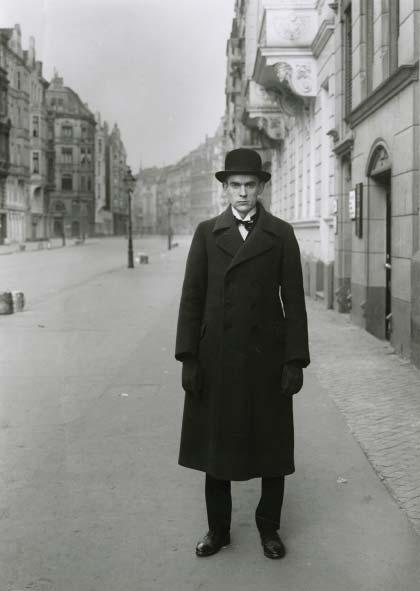
August Sander
(German, 1876-1964)
The Painter, Anton Räderscheidt, 1926 Gelatin silver print
13 3/16 x 9 1/2 in.
Gift of Long Beach Friends of Hofstra HU 72.66
© 2010 Die Photographische Sammlung / SK Stiftung KulturAugust Sander Archiv, Cologne / ARS, NY

August Sander
(German, 1876-1964)
The Painter, Raoul Hausmann, 1930/1974
Gelatin silver print
11 3/8 x 8 1/4 in.
Gift of Brenda Hochberg and David Dalgarno HU 2007.6.3
© 2010 Die Photographische Sammlung / SK Stiftung KulturAugust Sander Archiv, Cologne / ARS, NY
Sander is generally acknowledged to be the embodiment of the portrait photographer and, perhaps, the greatest German photographer of the 20th century. He conceived the idea for the project “Man of the 20th Century” in the early 1920s. He photographed people from all social classes and occupations. Peasants, tradesmen, industrialists, artists, soldiers, working women, disabled individuals, and others were all equal in front of his camera. Sander often photographed people outdoors and/or in their natural surroundings. Sixty images were exhibited in 1927 and published in Faces of Time (1929). In 1934 the Nazis confiscated and destroyed his plates for this book. After World War II, Sander published additional volumes of this series from negatives he had saved; he worked on this project until his death.
The Painter, Anton Räderscheidt (1926) and The Painter, Raoul Hausmann (1930/1974) are two of the subjects for this monumental series. The Hofstra University Museum collection includes 13 photographs taken for the series; all are of artists.

Ben Shahn (American, 1898-1969)
Mask 1958
Gouache on paper
26 1/2 x 20 1/4 in.
Gift of Dr. Milton M. Gardner
HU 70.102
Art © Estate of Ben Shahn/Licensed by VAGA, New York, NY
Shahn was a Lithuanian-born artist who is best known for his social realist style and political activism. Social realists depicted scenes from American life that focused on life’s struggles, social and racial injustice, and economic hardship. His early training in lithography, his apprenticeship with muralist Diego Rivera and his photography for the Farm Security Administration are all evident in his work. From his 1932 paintings of the Sacco and Vanzetti trial to the end of his career, Shahn captured the events of his time.
In 1956-1957, when Archibald MacLeish was writing his play J.B., he asked Shahn to design a devil face and a god face to be worn by the actors. Mask is one of the painted versions of the devil face. It was also produced as a screenprint in 1959 and a lithograph in 1963. In this work the eyes, nose and mouth are given prominence by exposing the paper beneath.


Andy Warhol
(American, 1928-1987)
Wayne Gretzky, 1983 or 1984
Polacolor ER
3 3/4 x 2 7/8 in.
Gift of The Andy Warhol Foundation for the Visual Arts
HU 2008.2.58
Andy Warhol
(American, 1928-1987)
Wayne Gretzky, 1983 or 1984
Polacolor ER
3 3/4 x 2 7/8 in.
Gift of The Andy Warhol Foundation for the Visual Arts
HU 2008.2.59
Andy Warhol
(American, 1928-1987) Hockey Game, n.d. Gelatin silver print
6 x 8 7/8 in.
Gift of The Andy Warhol Foundation for the Visual Arts
HU 2008.2.145
Andy Warhol (born Andrew Warhola) studied pictorial design at the Carnegie Institute of Technology in his hometown, Pittsburgh, Pennsylvania, from 1945 to 1949. After moving to New York City, he worked as a commercial artist and illustrator for magazines and newspapers. In the 1950s he shortened his name to Warhol. Beginning in the 1960s, Warhol created numerous works of art by appropriating images from popular culture. He was also inspired by advertisements and comic strips; his style became known as Pop Art. Warhol worked in various media: painting, printmaking, photography, sculpture and film. A major retrospective of his work was mounted by the Museum of Modern Art in New York in 1989. As a lasting legacy to his work and influence, the Andy Warhol Museum opened in Pittsburgh, Pennsylvania, in 1994.
Much of Warhol’s work was photo-based, and these photographs were an integral part of his artistic process. The individuals and objects recorded in the photographs often appeared in his paintings and prints. Wayne Gretzky is a retired professional ice hockey player and member of the Hockey Hall of Fame; he played for the Edmonton Oilers from 1979 to 1988. The clear influence of the Polaroid image can be seen in Warhol’s screenprint titled Wayne Gretzky (1983 or 1984). Both the photograph and the print show a head and shoulders pose, and Gretzky looks directly out from the image.
These photographs represented a small portion of a 2008 gift of 153 images to the Hofstra University Museum from The Andy Warhol Foundation for the Visual Arts.

Benjamin West
(American, 1738-1820)
Man Throwing Stone, ca. 1785-1800 Red chalk on paper 10 x 12 in.
Gift of Dr. Milton M. Gardner
HU 89.41
West, although American born, was one of the most prominent artists in late 18th-century London, England. He served as president of the Royal Academy from 1792 until his death in 1820. West settled in London in 1763 after spending three years studying painting in Italy. In London, he became an important figure in educating early American artists, such as Ralph Earl, Charles Wilson Peale, Gilbert Stuart and John Trumbull. These American artists brought West’s ideas and techniques back to the United States, establishing a foundation for greater sophistication in American art of the period.
West was primarily a painter of historical and religious themes, although he painted portraits when commissioned to do so. His canvases were often complex compositions with multiple figures. His painting style was greatly influenced by his studies in Italy, incorporating the techniques and styles of the Italian Renaissance and Baroque periods. Man Throwing Stone is most likely a drawing done as a study for inclusion in a painting. There is an incomplete image on the reverse of this drawing.

James McNeill Whistler
(American, 1834-1903)
The Terrace, Luxembourg, 1894
Lithograph
8 3/4 x 9 1/4 in.
Gift of Mrs. Barnes
HU 64.191
Whistler, a major figure in 19th-century art, was a master painter and an etcher. He also created more than 175 lithographs. Most of these were produced late in his career, between 1887 and 1896. As with his work in any medium, Whistler had great concern for the use of line, form and harmonious tonal effects. The subject matter of his lithographs ranges from figure studies, portraits, river and city views to the Luxembourg Gardens in Paris. In late 1893 and early 1894 Whistler created four earlier lithographs of Luxembourg Gardens. The print focuses on the group of figures in the foreground; the background is less detailed, with an urn, a tree and the faint outlines of a building denoting the setting.
Jean Charlot Arthur Bowen Davies Paul Gauguin (French, 1898-1979) (American, 1863-1928) (French, 1848-1903)
Procession at Chalma, 1947 Untitled, early 20th century Portrait of a Woman, 1881-1882 Lithograph Pastel on board Oil on canvas
13 1/2 x 9 3/4 in.
Highlights From the Hofstra University Museum Collection
Acquired Riches:
Africa, Côte d’Ivoire, Baule or Guro
Animal Mask, 19th-20th century
Wood and pigments
12 1/4 x 8 x 5 1/4 in.
Gift of Mrs. Joseph (Dolce) Baird HU 68.16
Africa, Gabon, Mitsohgo
Standing Female Figure with Janus Heads, 19th-20th century
Wood and kaolin
52 x 8 1/4 x 9 in.
Gift of Josephine and Sol Levitt
HU 93.5
Africa, Mali, Dogon Monkey Mask, 20th century Wood with encrustation
13 x 6 x 4 5/8 in.
Gift of Mrs. Gilbert Graham HU 2005.3.42
Karel Appel (Dutch, 1921-2006)
La Fille, 1956
Oil on canvas
46 x 34 7/8 in.
Gift of Dr. Milton M. Gardner
HU 69.6
Romare Bearden
(American, 1911-1988)
Three Women (Easter Sunday), 1979
Lithograph
20 5/16 x 15 in.
Gift of Carole and Alex Rosenberg HU 91.19
Zigi Ben-Haim (American, b. Iraq, 1945)
Untitled, 1977
Mixed media on paper 12 x 16 1/2 in.
Gift of Joseph Masheck HU 91.234
Frank Weston Benson (American, 1862-1951)
Duck Blind, 1925 Etching
7 7/8 x 10 7/8 in.
Gift of Dr. D. R. Leaming HU 56.6
Thomas Hart Benton (American, 1889-1975)
Loading Corn (Shucking Corn), 1945
Lithograph
9 1/2 x 12 3/4 in.
Gift of Edwin S. Marks HU 77.160
Paul-François Berthoud (French, 1870-1939)
Untitled, 19th century
Marble and bronze
17 x 16 x 11 in.
Gift of Mrs. W. Halsted VanderPoel
HU 50.4
Stan Brodsky (American, b. 1925)
Reaching Towards, 2004
Oil and paint stick on linen
46 x 36 in.
Gift of the artist
HU 2008.1
Marc Chagall (French, b. Russia, 1887-1985)
La Jeune Veuve (The Young Widow), Plate 72 from Les Fables de la Fontaine, 1927-1931
Published by Tériade, Paris, 1952
Drypoint
11 5/8 x 9 3/8 in.
Anonymous donor HU 78.2
13 1/2 x 10 1/2 in.
13 1/4 x 10 3/8 in.
Gift of Louis Freedenberg Gift of Mrs. Abby Kenigsberg Gift of Mr. and Mrs. Alexander Rittmaster
HU 61.12 HU 2007.1 HU 64.169
China
Edwin Dickinson Ralph Gibson
Equestrian , 6th century (American, 1891-1978) (American, b. 1939) (Late Sui/Early Tang Dynasty) Rocks, Brewster, 1941 Enchanted Pool, Hawaii, 1983 White pottery with clear glaze Oil on canvas From the portfolio
10 x 8 3/4 x 4 in.
10 13/16 x 16 1/8 in. Color Landscapes II, 1983
Gift of Mrs. Lillian Schloss, in honor of Gift of Dr. Milton M. Gardner Cibachrome print
Mary Wakeford HU 96.65 20 x 14 in.
HU 2003.9.1
Gift of Susan and Steven Ball Keisai Eisen HU 84.41.7
China (Japanese, 1790-1848)
Equestrianne, 6th century Fukagawa from the series One Hundred George Grosz (Late Sui/Early Tang Dynasty) Famous Places in Edo for Flowers, ca. (American, b. Germany, 1893-1959) White pottery with clear glaze 1810-1845 A Mighty One on a Little Outing Surprised and pigment traces Color woodcut by Two Poets, 1942
11 x 8 x 3 1/2 in. 14 1/2 x 9 5/8 in. Oil on paper on masonite
Gift of Mrs. Lillian Schloss, in honor of Gift of Mr. and Mrs. Daniel Goldberg 28 x 20 in.
Mary Wakeford HU 74.05.17 Gift of the Estate of Arnott J. White
HU 2003.9.2 HU 93.9
Max Ernst
Nathaniel Currier (German, 1891-1976) Exhibition Checklist, Associated (American, 1813-1888) Les Chiens Ont Soif American Artists, New York, (The Dogs Are Thirsty), 1964 February 8 through 27, 1943
James Merritt Ives Aquatint and etching 11 x 8 1/2 in.
(American, 1824-1895) 13 1/8 x 8 5/8 in. HU 93.9.1
Prairie Fires of the Great West, 1871 Anonymous donor
Color lithograph HU 78.3
George Grosz handwritten letter
8 7/16 x 12 1/2 in. to Arnott J. White, 4 January 1943
Gift of Mrs. George Estabrook Conrad Felixmüller 10 1/2 x 7 1/4 in.
HU 64.11 (German, 1897-1977) HU 93.9.1
Gluckiche Ehe IV (Ehepaar im Winter)/
Nathaniel Currier Married Couple in Winter, 1919 George Grosz handwritten letter (American, 1813-1888) Oil on canvas with drawings to Arnott J. White, James Merritt Ives 26 x 22 1/8 in. 20 April 1943
(American, 1824-1895) Gift of Mr. and Mrs. Alexander Rittmaster 10 1/2 x 7 1/4 in.
Saratoga Lake, late 19th century HU 78.28 HU 93.9.1
Color lithograph
9 3/4 x 13 in.
Donna Ferrato George Grosz double-sided,
Gift of Mrs. George Estabrook (American, b. 1949) handwritten letter to Arnott J. White, HU 64.132 West Broadway Liquor Store 7 November 1944
Bar, 2006 11 x 8 1/2 in.
John Steuart Curry From the portfolio Tribeca 10013 HU 93.9.1
(American, 1897-1946) Pigments on fiber print
Sanctuary, 1944 30 x 24 in.
Lithograph Gift of Susan and Steven Ball
11 3/4 x 15 3/4 in. HU 2009.3.1
Gift of Edwin S. Marks HU 77.171
George Grosz handwritten letter with drawing to Arnott J. White, 13 November 1947
10 x 6 3/4 in.
HU 93.9.1
George Grosz typed letter to Arnott J. White, 30 September 1948
10 x 6 3/4 in.
HU 93.9.1
George Grosz Un Piccolo Si e Un Grande No (A Little Yes and a Big No)
Published Milano, Longanesi, 1948
Inscription and photograph on frontispiece
HU 93.9.2
Johan Barthold Jongkind (Dutch, 1819-1891)
Canal Scene in Holland, 1862
Oil on canvas
16 5/8 x 21 15/16 in.
Gift of The Arthur M. Sackler Foundation HU 2000.5
Utagawa Kunisada (Toyokuni III) (Japanese, 1786-1865)
Untitled, ca. 1857
Color woodcut
14 1/4 x 9 3/4 in.
Gift of Mr. and Mrs. Daniel Goldberg HU 74.05.14
Jacob Lawrence
(American, 1917-2000)
Confrontation at the Bridge, 1975
From the portfolio An American Portrait Screenprint
19 1/2 x 26 in.
Gift of Carole and Alex Rosenberg
HU 91.29
Danny Lyon (American, b. 1942)
Cal, Springfield, Illinois, 1965-66/2006
Gelatin silver print
13 1/4 x 9 in.
Gift of George Stephanopoulos HU 2009.7.19
Mexico, Remojadas Bowl, ca. 100 B.C.E. to 800 C.E.
Ceramic
1 3/4 x 2 1/2 x 2 1/4 in.
Gift of Dr. William M. Lannik HU 67.38
Mexico, Remojadas Bowl , ca. 100 B.C.E. to 800 C.E. Ceramic
1 1/2 x 2 x 1 1/2 in.
Gift of Dr. William M. Lannik HU 67.45
Mexico, Remojadas Standing Figure, ca. 100 B.C.E. to 800 C.E.
Ceramic
4 1/2 x 3 3/4 x 2 1/4 in.
Gift of Dr. William M. Lannik HU 67.9
Mexico, Remojadas Standing Figure, ca. 100 B.C.E. to 800 C.E.
Ceramic
3 1/4 x 2 3/4 x 2 1/8 in.
Gift of Dr. William M. Lannik HU 67.21
Mexico, Remojadas Standing Figure, ca. 100 B.C.E. to 800 C.E.
Ceramic
3 3/4 x 3 x 2 in.
Gift of Dr. William M. Lannik HU 67.20
Kenneth Hayes Miller (American, 1876-1952) Leaving the Shop (Shoppers Leaving the Shop), 1929, published 1949
Etching
7 7/8 x 9 7/8 in.
Gift of James Gaboda HU 84.50
Joan Mitchell (American, 1925-1992) Metro, 1961 Oil on canvas
20 3/4 x 17 3/4 in.
Gift of Dr. Milton M. Gardner HU 80.15
Henry Moore (British, 1898-1986) Storm at Sea, 1970
Etching
5 1/4 x 9 1/4 in.
Gift of Carole and Alex Rosenberg HU 88.151
Oceania, New Guinea, Papua Gulf Ancestral Board, 20th century Balsa wood
54 1/2 x 11 1/4 in.
Gift of Cedric H. Marks HU 73.75
Oceania, New Guinea, Sepik River, Abelam Yam Mask, 20th century Balsa, rattan and pigments 20 x 8 3/4 x 13 1/2 in.
Gift of Cedric H. Marks HU 73.76
Jane Peterson (American, 1876-1965)
The Lagoon, Venice, ca. 1920 Oil on canvas
32 x 32 in.
Gift of Martin Horwitz HU 72.1
Robert Rauschenberg (American, 1925-2008) Opal Gospel, 1971
Silkscreen on Plexiglas (10), Plexiglas base and stainless steel case Each sheet 18 x 20 in., case 20 3/4 x 22 3/4 x 6 3/4 in.
Gift of Carole and Alex Rosenberg HU 88.82.1-10
James Rosenquist (American, b. 1933)
Drawing #12 for Time Flowers, 1980 Airbrush on paper
33 1/4 x 24 1/2 in.
Gift of Mr. and Mrs. Howard Weingrow HU 81.51
Georges Rouault (French, 1871-1958)
Clown, ca. 1920-1925
Oil on paper
6 1/4 x 4 5/8 in.
Gift of Mr. and Mrs. Jerry and Emily Spiegel HU 75.10
Alison Saar (American, b. 1956) Stride Piano, 1993 Woodcut
21 1/2 x 14 1/2 in.
Gift of Judith Jedlicka HU 2008.4.3
August Sander (German, 1876-1964)
The Painter, Anton Räderscheidt, 1926 Gelatin silver print
13 3/16 x 9 1/2 in.
Gift of Long Beach Friends of Hofstra HU 72.66
August Sander (German, 1876-1964)
The Painter, Raoul Hausmann, 1930/1974 Gelatin silver print
11 3/8 x 8 1/4 in.
Gift of Brenda Hochberg and David Dalgarno HU 2007.6.3
Ben Shahn (American, 1898-1969) Mask, 1958 Gouache on paper
26 1/2 x 20 1/4 in.
Gift of Dr. Milton M. Gardner HU 70.102
Andy Warhol (American, 1928-1987)
Hockey Game, n.d. Gelatin silver print
6 x 8 7/8 in.
Gift of The Andy Warhol Foundation for the Visual Arts HU 2008.2.145
Andy Warhol (American, 1928-1987)
Wayne Gretzky, 1983 or 1984
Polacolor ER
3 3/4 x 2 7/8 in.
Gift of The Andy Warhol Foundation for the Visual Arts HU 20 08.2.58
Andy Warhol (American, 1928-1987)
Wayne Gretzky, 1983 or 1984
Polacolor ER
3 3/4 x 2 7/8 in.
Gift of The Andy Warhol Foundation for the Visual Arts HU 20 08.2.59
Benjamin West (American, 1738-1820)
Man Throwing Stone, ca. 1785-1800
Red chalk on paper
10 x 12 in.
Gift of Dr. Milton M. Gardner HU 89.41
James McNeill Whistler (American, 1834-1903)
The Terrace, Luxembourg, 1894 Lithograph
8 3/4 x 9 1/4 in.
Gift of Mrs. Barnes HU 6 4 .191
Credits
HOFSTRA UNIVERSITY
Stuart Rabinowitz
President
Andrew M. Boas and Mark L. Claster Distinguished Professor of Law
Herman A. Berliner
Provost and Senior Vice President for Academic Affairs
Lawrence Herbert Distinguished Professor
HOFSTRA UNIVERSITY MUSEUM
Beth E. Levinthal
Executive Director
Karen T. Albert
Assistant Director of Exhibitions and Collections
Caroline Bigelow
Senior Assistant to the Executive Director
Tiffany M. Jordan
Development and Membership Coordinator
Marjorie Pillar
Museum Education Outreach Coordinator
Nancy Richner
Museum Education Director
Jamie Babcock
Graduate Assistant
Marcello LoVerme
Undergraduate Assistant
CONSULTANT
James J. Kopp
Collection Manager
Hofstra University Museum gratefully acknowledges the following exhibition sponsors:
Hofstra University
Astoria Federal Savings
Design: Hofstra University Creative Services Department / Denise Sarian
Photography of Hofstra University Museum artworks: Rick Odell


