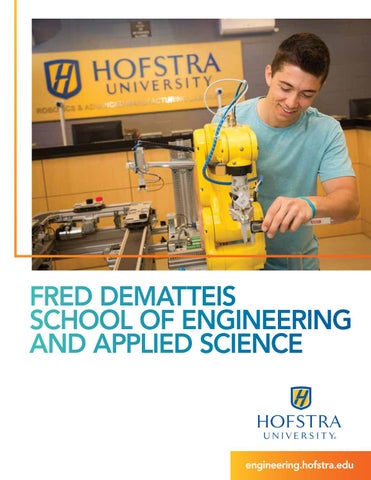
FRED DEMATTEIS SCHOOL OF ENGINEERING AND APPLIED SCIENCE
engineering.hofstra.edu
A MESSAGE FROM OUR DEAN It is my privilege to serve as dean of the Fred DeMatteis School of Engineering and Applied Science. Primarily an undergraduate school committed to educating future generations of engineers and computer scientists, we also offer a Master of Science in computer science and will soon offer a graduate program in engineering management. Just this past year we launched Bachelor of Science programs in bioengineering and in civil engineering within the Department of Engineering, and a Bachelor of Science program in computer science and cybersecurity within the Department of Computer Science. And the DeMatteis School was ranked 38th in the nation for undergraduate engineering programs at schools where a doctorate is not offered, according to the 2018 U.S. News & World Report Best College rankings.
Sina Y. Rabbany, PhD Dean, Fred DeMatteis School of Engineering and Applied Science Jean Nerken Distinguished Professor of Engineering Founding Director of the Bioengineering Program
The DeMatteis School currently serves approximately 750 students pursuing bachelor’s degrees. The rapid and sustained growth we have experienced over the past six years is the result of a great demand for graduates who have the skills and knowledge required to work in the technical sector and to contribute immediately to a company’s mission in the marketplace. To assist in meeting that demand, our Co-op Program, which was established at the beginning of 2015, has already enlisted approximately 150 companies as partners in hiring interested juniors or seniors for six- to eight-month full-time work experiences prior to graduation. Our commitment to our students and partnerships with the community extend even further. Our Center for Innovation allows faculty and students to provide technical and engineering expertise to regional businesses and research centers, thereby supporting the region’s research-based economy and providing students with valuable real-world experience. Another exciting opportunity awaiting motivated students is our Summer Undergraduate Research Program. This program offers competitive stipends for students who wish to go beyond the academic requirements of their degree programs to experience advanced scientific research in a variety of disciplines. This past year, over one-third of our full-time faculty spent the summer months mentoring students on work that typically leads to published papers at scientific conferences or in journals, and which serves as excellent preparation for those who want to pursue graduate studies at prestigious research institutions. These ventures are possible through the hiring and retention of faculty who are passionate about their fields, and who are committed to mentoring students into well-rounded, creative problem solvers who are prepared to help humanity tackle and overcome the challenges of today’s complex technological environment. I am proud to be a part of this exceptional community of scholars, and I strongly encourage students looking toward a career in engineering or computer science to consider a future with us at the DeMatteis School.
t 2
AN EDUCATION AT THE FRED DEMATTEIS SCHOOL OF ENGINEERING AND APPLIED SCIENCE IS MARKED BY: r Inspired teaching inside and outside the classroom. Classes are conducted by Hofstra faculty, not teaching assistants. r Research opportunities under the supervision of faculty mentors who encourage and guide students to present their work at scientific conferences and/or publish in scholarly journals. r Advanced, recently renovated laboratory facilities. Approximately $12 million in laboratory, technology, and facility upgrades have taken place since 2012. r On-the-job, resume-building experience, thanks to strong internship offerings and a newly launched Co-op Program that matches students with full-time, six- to eight-month paid positions at one of approximately 150 participating companies. r Exposure to the liberal arts and sciences. Our students graduate knowledgeable in the social and natural sciences, as well as the humanities, which is an academic and professional asset. r Successful alumni. Nearly 100 percent of recent undergraduate degree recipients who responded to a survey (or other reliable source) reported that they were employed or had started or were planning to start graduate school within one year of graduation. r Insightful feedback and support from an advisory board composed of industry leaders who work with Hofstra faculty and administrators to develop dynamic courses and programs. We also have strong relationships with our more than 2,000 DeMatteis School alumni professionals.
3 t
MISSION STATEMENT The Fred DeMatteis School of Engineering and Applied Science at Hofstra University recognizes that its primary mission is to provide an optimal educational environment for students to gain an understanding of the world as shaped and designed by engineers and computer scientists, and to gain facility in the use of technology to improve the condition of human life on earth. Successful graduates of the degree programs in the DeMatteis School learn to become critical, multidisciplinary thinkers, able to model, analyze, and improve complex systems and thereby achieve innovative solutions to problems. They will consequently enter the professional realm, working harmoniously with other talented people, well qualified to tackle projects benefiting humanity. An ideal environment for nurturing intellectual growth and fostering personal maturity is maintained at the DeMatteis School by staffing its constituent programs with dedicated faculty and other personnel who are devoted to the craft of teaching, who radiate intellectual curiosity through research and scholarship, and who respect each student striving to achieve educational and professional goals. Given the reputation of Hofstra University as, foremost, a teaching institution, care is taken to hire and retain faculty in our programs who will continually inspire students through their pedagogy and through the example they set as mentors. At the same time, many faculty members have attained international recognition for their research. The DeMatteis School of Engineering and Applied Science aspires also to be a school where students may participate fully in faculty-guided research initiatives, and where all laboratory facilities, even the most sophisticated and expensive, are made available for use by undergraduates. This culture of encouraging research offers many highly motivated students the opportunity to engage in scientific work leading to presentations at professional conferences and publications in peer-reviewed journals. Such students will be fully prepared to continue their education in graduate programs, as well as in industries with strong research components.
t 4
Many students take advantage of the opportunity to enhance their skills through participation in the DeMatteis School Co-op Program, which places them in an industry setting as full-time, compensated employees for a six- to eight-month period. Equally valuable are part-time internship opportunities in which students can participate while continuing their education without pause. Hofstra University’s proximity to New York City, where many engineering and computer science firms are headquartered, as well as the large number of technology companies on Long Island, facilitates the procurement of such positions for our students. Hofstra University’s strong foundation in liberal arts and sciences provides students with a full complement of courses in the humanities, social sciences, mathematics, and the natural sciences. Technological advances generated by the engineering and computer science professions have both foreseen and unforeseen effects on human culture and civilization. The broadly educated Hofstra DeMatteis School graduate will mirror the builder/ architect envisioned in classical times by Vitruvius, who, in his De Architectura (Book I, Chapter I) said of the successful craftsman: “He should be a man of letters, a skillful draughtsman, a mathematician, familiar with scientific inquiries, a diligent student of philosophy, acquainted with music ...” Throughout the ages this multiplicity of talents has been personified in individuals such as da Vinci, Pascal, Edison, von Neumann, Timoshenko, and many others who have been interdisciplinary innovators. Graduates who are historically, linguistically, or culturally enriched through their educational experience at Hofstra will be better positioned to assess the effects of technological change on society, and — if necessary — to work to ameliorate any deleterious effects. The DeMatteis School of Engineering and Applied Science also benefits from an active partnership with our advisory board, composed of industry leaders representative of the fields our students are being prepared to enter. Feedback from professionals helps ensure that our degree programs remain dynamic, incorporating new information and new ways of approaching old problems, while never losing sight of the essential foundations of a solid engineering or computer science education.
DEMATTEIS SCHOOL DEGREE PROGRAMS • BA, Computer Science • BA, Engineering Science • BE, Engineering Science, Biomedical Option • BE, Engineering Science, Civil Option • BS, Bioengineering • BS, Civil Engineering • BS, Computer Engineering • BS, Computer Science • BS, Computer Science and Cybersecurity
• BS, Computer Science and Mathematics • BS, Electrical Engineering • BS, Electrical Engineering, Computer Option • BS, Industrial Engineering • BS, Mechanical Engineering • BA/MS, Computer Science • BS/MS, Computer Science • MS, Computer Science
Facilities Hofstra is home to a wide range of tools that enhance our students’ education. A $12 million facilities renovation began in 2012, the school’s inaugural year. Laboratories and classrooms received new technologies, machinery, and equipment, all of which are accessible to engineering and computer science students.
Laboratories include: • 3-D Printer Laboratory • Advanced Applications Laboratory • Aerodynamics and Transport Phenomena Laboratory • Big Data Laboratory • Cell and Tissue Engineering Laboratory • Civil/Environmental Engineering Laboratory •C omputer Architecture, Embedded Systems, and Mobile Computing Laboratory • Concrete/Soils Testing Laboratory • Electrical and Signal Processing Laboratory • Gaming and Graphics Laboratory • Linux Laboratory • Materials Analysis Laboratory • Networking Laboratory • Research and Innovation Laboratory • Robotics and Advanced Manufacturing Laboratory • Scanning Electron Microscope Laboratory • Systems Laboratory • Ultrasound Research Laboratory
Research The DeMatteis School of Engineering and Applied Science offers a wide array of opportunities for highly motivated students interested in pursuing advanced research. Faculty collaborate with these talented students during the academic year and summer months. A number of projects have resulted in students co-writing published papers or presenting at scientific conferences. The availability of summer stipends allows exceptional students to work in the DeMatteis School research facilities without sacrificing the financial benefit of interning, participating in the DeMatteis School Co-op Program, or working at seasonal jobs unrelated to their studies.
5 t
ON-THE-JOB EXPERIENCE The DeMatteis School of Engineering and Applied Science offers a co-operative (co-op) educational program, giving qualified engineering and computer science students real work experience at engineering and technology firms in the local area and outside the region. DeMatteis School students in the Co-op Program are hired by a participating company after the fall or spring semester of their junior year, and then they work on salary for a six- to eightmonth period in a field related to their degree program. After the completion of the co-op experience, students return to Hofstra to complete their degree requirements. This experience may lead to full-time job offers from companies that have had the opportunity to evaluate the potential and skills of their co-op employees. At a minimum, students have a record of professional experience on their resume. The program has the added benefit of cementing ties between the DeMatteis School and technology companies.
For more information about the Co-op Program, visit hofstra.edu/dematteiscoop.
t 6
7 t
MULTIDISCIPLINARY CENTERS These Hofstra centers provide opportunities for DeMatteis School of Engineering and Applied Science students to gain valuable real-world experience, while helping the community at large.
Center for Entrepreneurship The mission of Hofstra University’s Center for Entrepreneurship is to nurture and expand the region’s innovation economy. The center’s focus is on multidisciplinary entrepreneurship support and education, leveraging the research and entrepreneurial activities at the DeMatteis School, as well as Hofstra’s other schools, including the Maurice A. Deane School of Law, the Frank G. Zarb School of Business, and the Donald and Barbara Zucker School of Medicine at Hofstra/Northwell. The goals of the Center for Entrepreneurship are to expand the entrepreneurship curriculum; coordinate business plan competitions, including the Hofstra-Digital Remedy Venture Challenge (see page 23); launch student fellowships; work with the Hofstra Startups Club to coordinate entrepreneurial activities; create a multidisciplinary law and business clinic; facilitate the creation of technology-based startup companies; create programs to assist startup companies; and establish a technology transfer function at the University. The center is poised to become the hub for a dynamic, integrated network of faculty and industry leaders to increase students’ opportunities for firsthand experience in entrepreneurship. Vice President for Economic Development Mark Lesko was appointed in fall 2015 to lead the center. He previously served as executive director of Accelerate Long Island, a collaboration among the area’s world-class research institutions, including Hofstra University, Brookhaven National Laboratory, Cold Spring Harbor Laboratory, The Northwell Feinstein Institute for Medical Research, and Stony Brook University, designed to commercialize research, fund high-tech startup companies, and build the region’s entrepreneurial ecosystem.
Center for Innovation The DeMatteis School of Engineering and Applied Science operates the Center for Innovation, a venture in which Hofstra faculty provide technical and engineering expertise to local businesses and research centers, thereby supporting the region’s research-based economy and providing students with valuable real-world experience. What distinguishes the center from similar university-business partnerships is that any resulting intellectual property is retained by the hiring company. Additionally, overhead cost is kept low, and monies raised by overhead fees are reinvested in DeMatteis School labs, equipment, and software.
t 8
All parties benefit from this Center for Innovation: Faculty have the opportunity to work on practical technical problems of immediate interest to the business community, and students gain experience and exposure to real industry issues. Companies are able to partner with professionals who bring fresh perspectives to issues and projects that are too big for an in-house solution. If no Hofstra faculty members have the specific expertise needed for a particular project, the center will employ consultants who are qualified to see the project through to completion. “This ensures that the team assembled to solve a problem will be the best available, made up of experienced professors, engineers, designers, and scientists,” says Dr. Kevin Craig, professor of mechanical engineering and director of the Center for Innovation and one of its creators. Dr. Craig has many years’ experience teaching at Rensselaer Polytechnic Institute and Marquette University, where he worked on similarly modeled programs.
Center for STEM Research Hofstra’s Center for STEM Research, founded and co-directed by Dr. M. David Burghardt, professor of engineering, operates in frequent collaboration with Brookhaven National Laboratory and Boys & Girls Clubs of America. In the past 20 years, the center has been awarded approximately $35 million for K-12 STEM outreach programs and research. The Center for STEM Research’s community presence is evidenced by a $2.5 million grant awarded by the National Science Foundation in spring 2015. This grant is funding a program that introduces STEM-based learning opportunities to thousands of middle school-aged children through Boys & Girls Clubs on Long Island and in the metropolitan New York area. Approximately 6,600 children are taking part in articulated hands-on and online engineering design activities utilizing animations, simulations, videos, and multimedia links. The project takes place in after-school programs at Boys & Girls Clubs and involves hundreds of learning facilitators specifically trained for this purpose.
9 t
ADVANCED LABS OFFER EXPERIENTIAL LEARNING OPPORTUNITIES Big Data Prepares Students for Big Success The Big Data Lab, under the direction of the Department of Computer Science, was funded in 2014 through a New York state grant of $1 million. It is designed as a laboratory environment in which students learn about all aspects of large and distributed information systems, including system development, testing, maintenance, data security and privacy, data integration, networking, cybersecurity, and application development. Students are prepared for highly skilled jobs in emerging and fast-growing industries in areas such as cloud computing, health care informatics, finance, data integration, and data analytics. The lab consists of a server room and 24 computer workstations. The equipment in the server room is organized as a cluster with an overall memory capacity of 3 terabytes, processing capacity of 420 CPU cores, and total storage of 1000 terabytes. The lab is used by students in advanced courses dealing with data analytics, networking, cybersecurity, and the semantic web. In addition, students and faculty use the lab for research and for senior design projects. Current work includes a National Science Foundation project to implement a fully automated, web-based grading system for thousands of users, along with a project on malware analysis.
t 10
Integrating Modeling and Manufacturing The Robotics and Advanced Manufacturing Laboratory was designed and created by Professor Kevin Craig in 2014 to give DeMatteis School of Engineering and Applied Science students experience in multidisciplinary systems engineering with a combination of academic rigor and best industry practices. It is designed to instill a humancentered, model-based approach to real-world problem solving and rapid prototyping. Equipment in the lab includes 12 two-person lab stations with the latest measurement and control hardware and software; a mechanical prototype tester; laser cutter; 3-D printer; seven degrees-of-freedom robotic arm; and parallel robot. The lab is used in a sequence of junior- and senior-level mechanical engineering lecture and lab courses in a studio mode. Instruction features an integration of presentation, discussion, problem solving by hand and by computer, and hardware used for real-time measurement and control.
Engineering Tissue for Regenenerative Medicine The primary focus of the Cell and Tissue Engineering Laboratory is to study the effects of fluid flow on vascular endothelial cells, the layer of cells lining the walls of blood vessels. This process involves the conversion of the mechanical forces created by the circulating blood flow into chemical signals. Every organ in the human body has a unique vasculature, which is affected by the different types of blood flow in healthy and diseased vessels. Dysfunction in the cell walls of these blood vessels represents an early sign of cardiovascular disease. Under the direction of Dean Sina Rabbany and Drs. Roche de Guzman and Nicholas Merna, undergraduate students working in this state-of-the-art facility focus on several main areas of research, including developing experimental and theoretical fluid shear stress models of blood flow in vessels; using atomic force microscopy to characterize mechanical properties of endothelial cells exposed to shear stress; and using immunofluorescence imaging to quantify changes in cell structure and protein and gene expression. Several publications co-written by students have resulted from these studies.
11 t
DEPARTMENT OF ENGINEERING The Department of Engineering within Hofstra’s Fred DeMatteis School of Engineering and Applied Science is committed to providing undergraduate students with an educational experience that equips them to contribute to making the world a better place. Engineers are problem solvers and creative thinkers who use technology as a means to that end. The department offers bachelor’s degrees in bioengineering, civil engineering, electrical engineering, mechanical engineering, and engineering science (biomedical or civil option), as well as a bachelor’s degree in the interdisciplinary field of industrial engineering. The first two years in all the engineering programs are devoted largely to a common curriculum, with a strong emphasis on mathematics, physical sciences, and fundamental engineering tools for analysis and design. The third and fourth years are devoted to course work in the field of specialization. For example, within the engineering science degree program, aspiring civil engineers take courses in steel and concrete structures, foundation engineering, transportation design, and hydrology and water treatment, while future biomedical engineers concentrate on course work in biomechanics, medical instrumentation, biomaterials, and cell and tissue engineering. Engineers of all specialties are in demand in industry and in research. Nearly 100 percent of recent undergraduate degree recipients who responded to a survey (or other reliable source) reported that they were employed or had started or were planning to start graduate school within one year of graduation. Employment prospects are further enhanced by the new DeMatteis School Co-op Program available to third-year students seeking the experience of real-world engineering work for a six- to eight-month period prior to graduation. Currently, approximately 150 companies participate in the program, and the network is expanding rapidly. Summer internships with engineering firms are another available option. Engineering education is rigorous preparation for a fulfilling career in the service of human society. At Hofstra, that rigor is tempered by a congenial atmosphere in which members of our faculty mentor students throughout their academic careers, in the lecture halls, and in the laboratories, leading to capstone design and/or research projects that prepare them for professional success. Our first-year engineering program focuses on design, a vital topic in all areas of engineering. In the fall semester, we utilize a lecture and laboratory-based course to teach the fundamentals of design using exercises that include teamwork, communication, and creativity. In the spring semester, we broaden the study of design to consider the concepts and issues that engineers face in the implementation of their work. Using the knowledge and skills acquired in this first year, students are prepared to immerse themselves in their studies and research.
t 12
ENGINEERING DEGREE PROGRAMS: BS in BIOENGINEERING Biomedical engineering, or bioengineering, is designed to bridge the gap between the life sciences and physical sciences by applying engineering concepts, methods, and techniques to biology and medicine. An understanding of fundamental physiological processes using engineering methodology requires a broad background in basic engineering, sciences, and mathematics. Biomedical engineers may design instruments, devices, and software; bring together knowledge from many technical sources to develop new procedures; or conduct research needed to solve clinical problems. In industry, they may create products that require an in-depth understanding of living systems and technology. They frequently work in research and development or in quality assurance.
BS in CIVIL ENGINEERING Civil engineering is a diverse field. Civil engineers design and supervise large construction projects, including roads, buildings, airports, tunnels, dams, bridges, and systems for water supply and sewage treatment. They also work in the design of transportation systems, green building solutions, and large-scale environmental projects. Many civil engineers hold supervisory or administrative positions ranging from supervisor of a construction, site to city engineer. Others work in design, construction, or research, and have a tremendous impact on the infrastructure of our region and the world.
BA in ENGINEERING SCIENCE Hofstra offers a BA in Engineering Science designed for students who wish to combine a broad exposure to the main fields of engineering with a focus on the liberal arts or business. Tracks may be structured to accommodate students interested in pursuing careers in medicine or engineering business operations, or in writing for technical publications, among other options.
BE in ENGINEERING SCIENCE The BE in Engineering Science offers options in biomedical and civil engineering, and can serve as a general engineering degree with a strong emphasis on applied science.
BS in ELECTRICAL ENGINEERING Electrical engineers design, develop, test, and supervise the manufacturing of electrical equipment such as electric motors, radar and navigation systems, communications systems, or power generation equipment. Others design the electrical systems of automobiles and aircraft and broadcast and communications systems, from portable music players to global positioning systems (GPS). Many also work in areas closely related to computer hardware. The work of electrical engineers and electronics engineers is often similar. Both use engineering and design software and equipment to perform engineering tasks. Electronics engineers who work for the federal government research, develop, and evaluate electronic devices used in diverse technologies, such as aviation, computing, transportation, and manufacturing. They work on satellites, flight systems, radar and sonar systems, and communications systems.
13 t
BS in ELECTRICAL ENGINEERING (Computer Option) The computer option in the electrical engineering program applies the principles of both electrical engineering and computer science to the design of computers and digital systems, focusing on the interface between hardware and system software.
BS in INDUSTRIAL ENGINEERING Industrial engineering combines engineering and management skills to better design and operate complex systems, such as manufacturing operations, assembly lines, or hospital emergency rooms. It is concerned with the optimal utilization of integrated systems of people, methods, materials, machines, and energy to achieve organizational goals. In the application of principles and methods of engineering analysis and design, industrial engineering is distinguished by its focus on problems that involve human effort and energy; production systems; economy in the use of money, materials, and time; and a high utilization of the social sciences.
BS in MECHANICAL ENGINEERING Mechanical engineering is one of the broadest engineering disciplines. Mechanical engineers research, design, develop, build, and test mechanical devices, including tools, engines, and complex dynamical systems. Design is introduced early in the curriculum, and all graduates are expected to be knowledgeable in both the thermal/fluids and the solid mechanics areas of mechanical engineering. Extensive laboratory involvement provides valuable insights into experimental methods and, in some cases, original research. Mechanical engineering students become proficient in working with computers to produce and analyze designs, and simulate and test dynamical systems. A concentration in aerospace engineering is available to students interested in careers in the aircraft industry.
t 14
MEET OUR FULL-TIME ENGINEERING FACULTY M. David Burghardt (PhD, University of Connecticut) Professor Mechanical Engineering
Manuel Miranda (PhD, Columbia University) Assistant Professor Civil Engineering
Mauro J. Caputi (PhD, Virginia Tech) Director, Freshman Engineering Associate Professor Electrical Engineering
Alexander Pesch (PhD, Cleveland State University) Assistant Professor Mechanical Engineering
Kevin C. Craig (PhD, Columbia University) Director, Center for Innovation Professor Mechanical Engineering Edward Currie (PhD, University of Miami) Associate Professor Electrical Engineering Roche de Guzman (PhD, Wayne State University) Assistant Professor Bioengineering Sleiman R. Ghorayeb (PhD, Iowa State University) Professor Electrical Engineering Saryn Goldberg (PhD, Stanford University) Associate Professor Mechanical Engineering Margaret A. Hunter (PhD, Rice University) Assistant Chair Department of Engineering Associate Professor Civil Engineering Wing Kwong (PhD, Princeton University) Professor Electrical Engineering Nicolas Merna (PhD, University of California, Irvine) Assistant Professor Bioengineering
Richard J. Puerzer (PhD, University of Pittsburgh) Chair, Department of Engineering Associate Professor Industrial Engineering Sina Y. Rabbany (PhD, University of Pennsylvania) Dean, Fred DeMatteis School of Engineering and Applied Science Founding Director, Bioengineering Program Professor Bioengineering Salvador Rojas-Murillo (PhD, University of Iowa) Assistant Professor Industrial Engineering David M. Rooney (PhD, North Carolina State University) Associate Dean, Fred DeMatteis School of Engineering and Applied Science Associate Professor Mechanical Engineering Edward Segal (PhD, Princeton University) Assistant Professor Civil Engineering John C. Vaccaro (PhD, Rensselaer Polytechnic Institute) Assistant Professor Mechanical Engineering David E. Weissman (PhD, Stanford University) Professor Electrical Engineering
15 t
DEPARTMENT OF COMPUTER SCIENCE The Department of Computer Science offers an exciting learning environment in which students may pursue unique paths toward undergraduate and graduate degrees in computer science or computer engineering. They acquire a strong foundation in programming and application development, algorithms, computer architecture, operating systems, networking, and software engineering. In addition, the department offers elective courses in a wide variety of topics such as cybersecurity, data analytics, computer graphics, computer games, mobile and web application development, artificial intelligence, and embedded systems. All programs are approved by New York state and accredited by the Middle States Association of Colleges and Schools. Every year the department introduces new courses to reflect the dynamic nature of the computing field. Recently added courses include data analytics, computational finance, gaming, information retrieval, machine learning, network security, and systems programming. Students may pursue their special interests or research by taking individual independent study courses with our faculty. The BA in Computer Science program allows students to design their own program of study. All full-time faculty members in the department hold PhDs and are active in their research areas. Their expertise includes security, privacy, data mining, software engineering, computer vision, cognitive neuroscience, artificial intelligence, algorithms, and programming languages. Our faculty have been very successful in obtaining research grants from federal institutions such as the National Science Foundation and from private companies, including Google. Our graduates are a reflection of the high-quality education that we provide. Some of our alumni are employed by national corporations such as the S&P 500, Geico, Con Edison, Bank of America, and CA Technologies. Others have pursued graduate studies at institutions such as Princeton University, Columbia University, and Rensselaer Polytechnic Institute.
t 16
COMPUTER SCIENCE DEGREE PROGRAMS BS in COMPUTER SCIENCE The largest program in the Department of Computer Science offers a deep foundation in the main areas of computing, plus flexible choices of technical electives. Students have enough free electives to pursue minors in other departments. The strongest majors often pursue double science degrees.
BA in COMPUTER SCIENCE The BA gives students a solid foundation in computer science. Fewer required courses in the major and more free electives allow students to pursue minors and a second major in other departments. Students may pursue a general track or an individual track that has a sequence of two independent study courses specially designed in collaboration with a faculty member.
BS in COMPUTER ENGINEERING This program includes courses offered by the departments of Computer Science and Engineering. The focus of this program is on design and implementation of whole computer systems for specific needs or applications.
BS in COMPUTER SCIENCE AND CYBERSECURITY This new program provides a solid foundation in computer science, emphasizing expertise in computing systems. The cybersecurity curriculum is designed to cover all the required knowledge units as defined by the National Security Agency’s National Centers of Academic Excellence in Cyber Defense (CAE-CD).
BS in COMPUTER SCIENCE AND MATHEMATICS This program is offered jointly by the departments of Computer Science and Mathematics.
17 t
MS in COMPUTER SCIENCE The objectives of this program are to develop highly qualified professionals capable of adapting with ease to the dynamic field of computing, and to prepare students interested in pursuing doctoral studies in computer science or related fields. The program provides a strong foundation and breadth in computer science, and students may choose an area of specialization. Elective courses are offered in cutting-edge areas, such as data mining and machine learning; networks and network security; distributed, parallel, and mobile computing; computer graphics and computer vision; artificial intelligence; and bioinformatics. In addition, a software management course is offered for interested students who wish to pursue leadership positions. The program’s capstone experience may be in the form of an independent project or a master’s thesis.
DUAL-DEGREE PROGRAMS Computer science majors who are in good academic standing can earn both a bachelor’s degree (BA/BS) and a Master of Science (MS) in five years. Twelve graduate hours can be taken by students in their senior year, and these credits are counted toward both the undergraduate and graduate degrees. A dual-degree program is an excellent opportunity for students interested in developing further expertise and specialization in the computing field or continuing in PhD studies or research.
UNDERGRADUATE CONCENTRATIONS • N etworking and Cybersecurity. Courses in this concentration offer a hands-on approach to learning networking, security, and systems programming. All courses include a significant experiential component. • W eb and Mobile Engineering. Courses in this concentration offer a hands-on approach to learning web and mobile programming. • G aming and Graphics. Courses in this concentration focus on the design and development of video games and game engines, and all include a significant experiential component. • L eadership and Innovation in Computing. Both a concentration (18 credits) and option (9 credits) are designed for students with an entrepreneurial spirit. Students transform ideas into a business plan, and receive feedback and are mentored by local entrepreneurs. The concentration requires four classes in basic business functions, such as accounting and marketing, taught by faculty in Hofstra’s Frank G. Zarb School of Business. The option, which includes the course “Foundations of Leadership and Innovation in Computing,” exposes students to essential business knowledge needed to start a company. Computer science students have a winning track record in the annual Hofstra-Digital Remedy Venture Challenge (see page 23), an entrepreneurial competition. New concentrations in big data, computational finance, and health informatics are being developed.
t 18
INTERDISCIPLINARY MINORS • The minor in cognitive science is for students interested in the study of the mind and reasoning – at the intersection of computer science, psychology, philosophy, and linguistics. • The minor in computer applications and digital media design consists of courses in computer science and fine arts. • The minor in computer science and geographic information systems (GIS) is an interdisciplinary course of study in which students learn the foundations of computational systems and apply that knowledge to visualize, manage, and analyze geographic data.
19 t
MEET OUR FULL-TIME COMPUTER SCIENCE FACULTY
t 20
Simon Ben-Avi (PhD, University of Manchester) Professor Computer Engineering
Gerda L. Kamberova (PhD, University of Pennsylvania) Professor Computer Science
Simona Doboli (PhD, University of Cincinnati) Professor Computer Engineering
Chuck C. Liang (PhD, University of Pennsylvania) Professor Computer Science
Xiang Fu (PhD, University of California, Santa Barbara) Associate Professor Computer Science
Gretchen Ostheimer (PhD, Rutgers University) Professor Computer Science
Krishnan Pillaipakkamnatt (PhD, Vanderbilt University) Chair, Department of Computer Science Professor Computer Science Oren Segal (PhD, University of Massachusetts Lowell) Assistant Professor Computer Engineering Angeliki Zavou (PhD, Columbia University) Assistant Professor Computer Science
HOFSTRA UNIVERSITY HONORS COLLEGE Hofstra University Honors College (HUHC) provides an extraordinary level of curricular and extracurricular support to highly motivated, high-achieving students. Enrollment in HUHC complements whatever course of study a student chooses and offers opportunities to enrich that course of study for honors credit. Engineering and computer science students in HUHC cultivate their skills in and out of the classroom. They explore theory and practice in greater detail, and they may participate in volunteer and service projects, professional societies, and student clubs. HUHC students may receive one of several designations that mark their Hofstra degree as having been achieved with distinction. These designations are noted on a student’s diploma and academic transcript.
FIRST-YEAR CONNECTIONS A student’s first year of college is a time of exciting changes and dramatic transitions. First-Year Connections (FYC) seminars and clusters are designed to get the college experience off to a great start. Clusters are sets of two or three classes, linked by a common theme, that fulfill general education requirements. Many of the clusters involve activities in New York City. Taking a few courses with the same group allows new students to make friends more quickly, form study groups, and come to feel at home on the Hofstra campus. The engineering cluster, “Designing the Human-Made World,” explores the world that humans have designed — the products and processes used in its development. Students work together on design projects and assignments, building prototypes, working as members of a team, and enhancing their communication skills. They also compete in an end-of-term Grand Design Challenge. Students learn about the various engineering majors so that they can decide if a major in engineering is right for them, or which engineering field best matches their interests. The first computer science cluster, “Machines: Math, Logic, and Programming,” explores the field of artificial intelligence (AI), which aims to develop intelligent computer systems that can sense, reason, plan, and act like humans. Students start the journey by building the foundations in mathematics and computer science on which all computer programs are built, including those that are capable of AI. Along the way, through research and discussions, students learn about the people, ideas, and events that shaped AI and explore its frontiers. The second computer science cluster, “Introduction to Computing: Cryptography,” explores the field of cryptography, the study of making codes for secret communication. Modern cryptographic techniques secure online credit card information, assure that downloaded apps have been created by the company stated on the website, and form the basis for the digital currency called bitcoin. In this cluster, students learn some interesting ideas in cryptography and the foundations of computing both applied and theoretical, and a new way of thinking — computational thinking. 21 t
In the words of recent DeMatteis School graduates ... Sony Abraham ’17 BS, Industrial Engineering, Project Manager, Northwell Health Sony’s internship at Northwell Health as an industrial engineer research scholar led to full-time employment after graduation. At Hofstra, he was a co-founder of the LGBT Immigrants of Long Island, a Center for Civic Engagement fellow, treasurer and event creator for Pride Network, a student representative for the LGBTQ+ Task Force, a PRISM mentor, and a finalist in the Hofstra-Digital Remedy Venture Challenge. “The professors at Hofstra played a vital role in my growth and development both academically and personally,” Sony said. “I will always be grateful for the opportunity to learn from such extraordinary professors who have prepared me for my career in so many positive ways.”
Tatiana Boothe, ’17 BS, Computer Science, IT/Telecommunication Manager, Lufthansa Tatiana was a member of the Computer Science Society and Collegiate Science and Technology Entry Program (CSTEP), and she taught coding to third- and fourth-graders at Progressive School of Long Island. In the fall of her sophomore year, she received an email from the Computer Science Department about scholarship opportunities for female students interested in attending a Woman in Cybersecurity Conference. Through that opportunity, Tatiana was able to attend the conference, where she secured a summer internship at ViaSat in California. “The Hofstra computer science professors were consistently connected to what was going on in the job world,” Tatiana said. “They were always available to advise me on which careers to pursue since there are so many fields in computer science. The dedication, passion, and enjoyment in their work were evident and encouraged you to want to succeed.”
Mazharul Onim ’17 BS, Computer Engineering, Software Engineer, Openlink Financial LLC “Hofstra’s rigorous curriculum and state-of-the-art labs made me well prepared for my career,” Mazharul said. “While the computer science courses increased my technical knowledge, the liberal arts courses shaped my communication skills.” In addition to being a member of Hofstra’s Robotics Club, he participated in several Hackathons. His two internships at Openlink Financial LLC as a software development intern on its Performance Engineering team and later as a technical services intern on its Professional Services team led to full-time employment as a software engineer after graduation.
Marin Varney ’17 BE, Engineering Science (Biomedical Option) Master’s in Biomedical Engineering, Cornell University (anticipated May 2018) On campus, Marin was a resident assistant (RA) and worked as a Pride Guide for the Office of Undergraduate Admission and as a peer teacher in the Engineering Department. She also played on Hofstra’s club softball team and was a member of the engineering honor society, Eta Kappa Nu. “My time at Hofstra gave me the opportunity to develop the fundamental skills and techniques that I needed to succeed in my graduate school studies and future career,” Marin said. “The encouragement and guidance I received from my professors and colleagues and the connections I made during my four years at Hofstra are valuable resources for me as I move forward in my career.” t 22
HOFSTRA-DIGITAL REMEDY VENTURE CHALLENGE The Hofstra-Digital Remedy Venture Challenge is an annual entrepreneurial competition that encourages students from all disciplines to take an innovative idea from conception to business plan. Prize money totaling $75,000 is available to Hofstra teams of undergraduate and graduate students. The competition is sponsored by Hofstra alumnus and Board of Trustees member Mike Seiman ’01, who is founder and CEO of Digital Remedy, a digital media company he started while still a Hofstra student. Computer science and computer engineering students have been members of teams that won first place or second place each year since 2013, when the competition began. • 2017: A trio of computer science students – Louis DeVito, Jacob Hochendoner, and Adam Hussain – took second place for their company, LegalSoft Inc., cloud-based software for attorneys. • 2016: Lynn Luong, a first-year student, was a member of the team that won first place for Look, a staring contest mobile app. Taylor Ninesling and Chris Davie were undergraduate members of the team that took second prize for Beacon, a location-based community-building app. Kareem Oluwatobi won third prize in the graduate competition for TobChat, an alternative to social media for developing countries. • 2015: Jacqueline Hsu and Chris Davie were undergraduate members of the team that won second prize for Quik, an Uber-like local delivery service. Matthew Pieri was an undergraduate co-winner of the second prize for Pholder, a hands-free way to hold smartphones while watching videos. • 2014: Brian Blanco and Ashish Pandhi won first place for Q+, a social media management service. Daniel Slamowitz and Himanshu Dhameliya were members of a team that won third place for their Komplaint Box idea. • 2013: Michael Moskie and Shashank Sanjay won first place for Pillar Printing, a low-cost 3-D printer. Alexander Rosenberg won second place for his project, EMR (Electronic Medical Records) Advantage, an innovative system for improving communication of health care records among providers.
23 t
Fred DeMatteis School of Engineering and Applied Science engineering.hofstra.edu | 516-463-6028 HOFSTRA AT A GLANCE Founded in 1935, Hofstra University is a nationally and internationally recognized institution that has been cited on the Best College lists of U.S. News & World Report, The Princeton Review, Fiske, Washington Monthly, Forbes, LinkedIn, and Payscale.com. Hofstra is also the only university to host three consecutive U.S. presidential debates (2008, 2012, and 2016). Hofstra is in the top 7 percent of colleges and universities nationwide for mid-career salary of graduates with a bachelor’s degree, according to the 2017-18 PayScale College Salary Report. r Located in Hempstead, Long Island, 25 miles east of NYC r Private, nonsectarian, coeducational r Hofstra is one of only three schools in the New York metropolitan area with colleges of law, medicine, and engineering. r 116 buildings on 244 acres r 27 academic and 30 total accreditations r Member of Phi Beta Kappa r 100 percent program accessibility for persons with disabilities r Hofstra University has more than 136,000 alumni r Students come from 50 U.S. states and territories, and 82 countries; 50 percent of fall 2017 first-year students were from outside of New York state. r 35 residence halls housing about 3,500 students r 18 eateries, six theaters, and about 270 student clubs r The Hofstra libraries contain over 1 million print volumes and provide 24/7 online access to more than 100,000 full-text journals and 200,000 electronic books. r 17 varsity sports; all sports compete at the NCAA Division I level in the Colonial Athletic Association.
Visit Hofstra We encourage you to visit our campus and discover all that Hofstra has to offer. Go to hofstra.edu/visit for a list of visit opportunities that are customized to your needs. The UpClose Program invites you to experience a day in the life of a Hofstra student. Your guide for the day will be a current student who is pursuing a degree in your major area of interest. More information is available at hofstra.edu/upclose. If you have any questions, please contact us at campusvisit@hofstra.edu or 516-463-6700. 76713:2/18