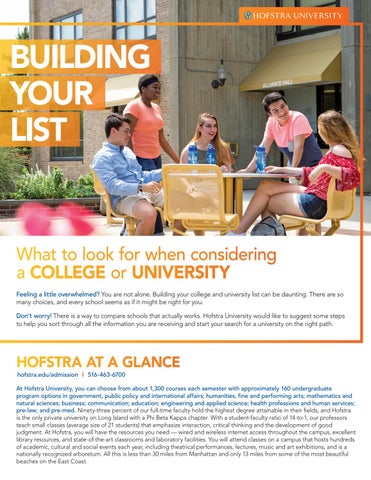
BUILDING YOUR LIST
What to look for when considering a COLLEGE or UNIVERSITY Feeling a little overwhelmed? You are not alone. Building your college and university list can be daunting. There are so many choices, and every school seems as if it might be right for you. Don’t worry! There is a way to compare schools that actually works. Hofstra University would like to suggest some steps to help you sort through all the information you are receiving and start your search for a university on the right path.
HOFSTRA AT A GLANCE hofstra.edu/admission | 516-463-6700 At Hofstra University, you can choose from about 1,300 courses each semester with approximately 160 undergraduate program options in government, public policy and international affairs; humanities, fine and performing arts; mathematics and natural sciences; business; communication; education; engineering and applied science; health professions and human services; pre-law; and pre-med. Ninety-three percent of our full-time faculty hold the highest degree attainable in their fields, and Hofstra is the only private university on Long Island with a Phi Beta Kappa chapter. With a student-faculty ratio of 14-to-1, our professors teach small classes (average size of 21 students) that emphasize interaction, critical thinking and the development of good judgment. At Hofstra, you will have the resources you need — wired and wireless internet access throughout the campus, excellent library resources, and state-of-the-art classrooms and laboratory facilities. You will attend classes on a campus that hosts hundreds of academic, cultural and social events each year, including theatrical performances, lectures, music and art exhibitions, and is a nationally recognized arboretum. All this is less than 30 miles from Manhattan and only 13 miles from some of the most beautiful beaches on the East Coast.
STEP 1:
STEP 2:
Colleges and universities come in different sizes. Large schools typically have more than 10,000 undergraduate students; medium-sized, 4,000 to 9,000; and small, less than 4,000. The size of a school can affect the size of classes, variety of majors available to you and the social life on campus.
You might be surprised at what you find. Large schools may have small classes, and small schools may have many majors to choose from. Consider the impact of the size of the college or university, and figure out which is best for you.
Faculty are at the heart of your collegiate experience. They teach your classes and provide mentoring after college. When considering a school, look closely at the faculty. Here are some questions you should ask about faculty: • What percentage of classes are taught by faculty (not graduate students)? • Are faculty available outside of class for extra help or mentoring? • How many faculty hold doctoral degrees? • When will I have the chance to take classes with the best faculty on campus? • How dedicated are the faculty to teaching undergraduate students, and does the college or university emphasize excellence in teaching as a priority? The answers to these questions will tell you a great deal about the learning environment on every campus. You will better understand the types of environments that will help you achieve your goals.
STEP 3:
STEP 4:
Where a school is located affects your education. Universities and colleges are located in all kinds of settings, from rural to suburban to urban. Figuring out which type of setting is right for you will guide you in your search for the right school.
Every school has a slightly different type of student body. Figuring out the type of student group with which you would best fit and learn is an important part of building your list.
Is access to a city’s internships, cultural activities and social life important to you? Or would you be happier with immediate access to outdoor activities (hiking, biking, skiing, etc.)? Do you fall somewhere in between and want a suburban campus with access to both the city and the country?
• What percentage of students come from out of state or outside the local area? • How ethnically diverse is the student body? • Are the students very involved with on-campus clubs and organizations? • What do students do on the weekends?
CONSIDER THE SIZE
CONSIDER THE FACULTY
Look carefully at the size of the school and consider these questions: • What is the average class size? • How many majors are offered? • How easy is it to meet people? • Is it easy to change majors if your interests change?
CONSIDER THE STUDENTS
CONSIDER THE LOCATION
Answer these questions, and you’ll have a much firmer sense of what type of campus location you want.
Some questions to consider about the student body are:
The more you know about the students you hope to join on campus, the better you’ll know if a school is right for you.
Take our virtual tour by visiting hofstra.edu/virtualtour
STEP 5:
CONSIDER THE INVESTMENT Many students feel that cost is something they should consider when building their list. While costs are important, you should never eliminate a school from your search based solely on costs.
Facebook “f ” Logo
CMYK / .eps
Facebook “f ” Logo
If you haven’t already done so, please visit Hofstra. Visiting the campus is the best way to determine if our university is right for you! Set up a campus tour today at hofstra.edu/visit.
CMYK / .eps
facebook.com/HofstraAdmission
@HofAdmission
youtube.com/HofstraUniversity
hofstrau
hofstrau
73845:8/17
Merit scholarships and financial aid can greatly reduce the amount of tuition students actually pay. So, the costs you see are not necessarily the costs you will pay. If a school seems like a good match for you, then make sure you keep it on your list. Only after you are accepted and receive your financial aid package will you really know what the costs are, and that college or university may be quite affordable after all.