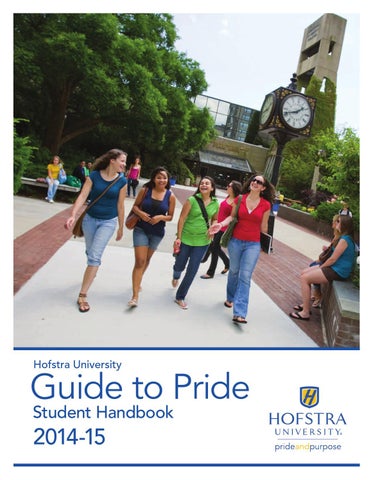
Hofstra University
Guide to Pride Student Handbook
2014-15
ALMA MATER “The Netherlands” Words by Hans J. Gottlieb Sung to “The Prayer of Thanksgiving”
O Hofstra, to honor thy name we foregather, Rejoicing in voicing thy praises anew; By thee we are guided, with counsel provided; Sustain us with thy strength in the paths we pursue. You settlers of Nassau who cleared its broad acres, You sailors and whalers, adventurers bold, Your precepts uphold us, your visions enfold us, Your spirit be emblazoned in blue and in gold! As sons and as daughters to Hofstra united, We never will sever the ties that us bind; The years that pass by us shall never deny us The memories we cherish in heart and in mind.
WELCOME TO HOFSTRA
Dear Hofstra Student: I hope you will enjoy and find fulfillment in every aspect of your experience at Hofstra University. We will provide you with many opportunities to achieve your full potential, and will support you in your quest to do so. At Hofstra, we offer the academic foundation and resources that will help you reach your aspirations. We are proud of our talented and dedicated faculty and staff, state-of-the-art classrooms and facilities, exemplary library resources, and first-rate cultural and athletic programs. This Guide to Pride is designed to help you make the most of your time at the University. Read it and refer to it as needed. Within these pages you will find that Hofstra provides a wide variety of outstanding programs and resources. We urge you to take advantage of all that Hofstra offers.
Sincerely,
Stuart Rabinowitz President
ci
Dear Hofstra Student: What a pleasure it is to be your new vice president for student affairs. Your success and well-being are our highest priority. We strive to help support your academic and personal growth as you progress in your educational journey here at Hofstra. We have a highly skilled team of dedicated and caring professionals here to assist you in all aspects of college life. You will develop PRIDE while you’re at Hofstra – pride in your school, pride in your accomplishments, and pride in who you are. We assure you that if you take steps to get involved and be an engaged student in and out of the classroom, you will graduate with PRIDE. Personal/social responsibility Respect for self and others Integrity, ethics and leadership Diversity and community Expression and free exchange These P.R.I.D.E. Principles guide all our work in the Division of Student Affairs. They require your engagement, and they are yours to claim here at Hofstra. Moving forward, we want you to: • Think about how you can display personal and social responsibility – in your choices and in developing the type of community you want to be part of. • Demonstrate respect for yourself and those around you. • Focus on acting with integrity and developing into an ethical leader. • Explore the rich diversity around you, and how that diversity contributes to our strong community. • Discover the ways that the free exchange of ideas will contribute to your learning and development. Please feel free to stop by any of the offices in the Division of Student Affairs when you have any questions or just want to say hello. I look forward to meeting and getting to know you. Have a terrific year! Sending you best wishes, I remain, Sincerely yours,
W. Houston Dougharty Vice President for Student Affairs
ii
I. Hofstra A to Z
TABLE OF CONTENTS
Academic Records and Registrar, Office of............................................................................................................. 1 Advisement (see University Advisement, Center for) Alumni Affairs, Office for........................................................................................................................................ 1 Arboretum................................................................................................................................................................ 1 Athletics................................................................................................................................................................... 2 Banking.................................................................................................................................................................... 2 Bookstore, Hofstra University................................................................................................................................. 2 Bulletin Boards........................................................................................................................................................ 3 Bus Schedule (see Transportation) Campus Alert Notification Network (CANN) ........................................................................................................ 3 Career Center, The................................................................................................................................................... 3 Clubs and Organizations.......................................................................................................................................... 4 Common Hour......................................................................................................................................................... 4 Community Standards, Office of............................................................................................................................. 4 Computer Center Help Desk (see Student Computing Services) Computer Labs......................................................................................................................................................... 5 Conduct Boards........................................................................................................................................................ 5 Dean of Students Office........................................................................................................................................... 5 Degree Audit ........................................................................................................................................................... 6 Dining Services........................................................................................................................................................ 6 Emergency Telephones............................................................................................................................................. 6 Event Management, Office of.................................................................................................................................. 7 Festivals.................................................................................................................................................................... 7 Financial Aid (see Student Financial Services) Game Room............................................................................................................................................................. 7 Health and Wellness Center..................................................................................................................................... 7 HofstraCard Services, Office of............................................................................................................................... 8 Hofstra Cultural Center ........................................................................................................................................... 8 Hofstra University Museum..................................................................................................................................... 9 HofstraVision........................................................................................................................................................... 9 Honor Code.............................................................................................................................................................. 9 HX Salon................................................................................................................................................................ 10 Interfaith Center..................................................................................................................................................... 10 Job Opportunities (see Student Employment, Office of) Language Learning Center..................................................................................................................................... 10 Library, Joan and Donald E. Axinn........................................................................................................................ 10 Lockers................................................................................................................................................................... 11 Lost and Found....................................................................................................................................................... 11 Mail........................................................................................................................................................................ 11 Meal Plans (see Dining Services) Motorist Assistance Program................................................................................................................................. 12 Multicultural & International Student Programs, Office of (MISPO)................................................................... 12 Music Library........................................................................................................................................................ 13 Off-Campus Living and Commuting Student Services......................................................................................... 13 Parent and Family Events....................................................................................................................................... 13 Parent and Family Programs, Office of ................................................................................................................. 14 Parking................................................................................................................................................................... 14 Portal and Email Accounts..................................................................................................................................... 14 Pride Guide Program.............................................................................................................................................. 15 Print Services (PridePrint)..................................................................................................................................... 15 Public Safety, Department of................................................................................................................................. 15 Recreation and Intramural Sports, Department of................................................................................................. 15 Recycling .............................................................................................................................................................. 16 Residential Programs, Office of ............................................................................................................................ 17 ResNet (see Student Computing Services) Saltzman Community Services Center, Joan and Arnold...................................................................................... 17 Services for Students with Disabilities.................................................................................................................. 17
Spirit Support......................................................................................................................................................... 18 Student Computing Services.................................................................................................................................. 18 Student Counseling Services................................................................................................................................. 18 Student Emergency Assistance Fund..................................................................................................................... 19 Student Employment, Office of............................................................................................................................. 19 Student Escort Service........................................................................................................................................... 19 Student Financial Services..................................................................................................................................... 19 Student Government Association (SGA)............................................................................................................... 20 Student Leadership and Activities, Office of......................................................................................................... 20 Study Abroad......................................................................................................................................................... 21 Sustainability, Office of.......................................................................................................................................... 21 Swim Center/David S. Mack Physical Education Center...................................................................................... 22 Telecommunication Services................................................................................................................................. 22 Transportation........................................................................................................................................................ 22 University Advisement, Center for........................................................................................................................ 23 University Tutorial Program................................................................................................................................... 23 Victim Assistance Program.................................................................................................................................... 24 Wi-Fi (Wireless Internet) Services......................................................................................................................... 24 Writing Center....................................................................................................................................................... 24
II. Code of Community Standards Preamble................................................................................................................................................................ 27 Community Standards Vision and Mission............................................................................................................ 28 Rights and Responsibilities.................................................................................................................................... 28 Family Educational Rights and Privacy Act........................................................................................................... 28 Campus Crime Reporting and Fire Safety Statistics.............................................................................................. 30 Student Conduct Process ....................................................................................................................................... 30 Flow Chart for Student Conduct Proceedings....................................................................................................... 34 Communication Regarding Conduct Matters ....................................................................................................... 35 Documenting the Hearing Process......................................................................................................................... 35 Advisor’s Role in University Proceedings............................................................................................................. 35 Appeal Procedures for Student Conduct Proceedings .......................................................................................... 36 Grounds for Disciplinary Action............................................................................................................................ 37 Student Conduct Codes.......................................................................................................................................... 37 Sanctions ............................................................................................................................................................... 41 Minimum Sanctions............................................................................................................................................... 43 Summary Action.................................................................................................................................................... 43 Student Organizations............................................................................................................................................ 43 Guidelines Concerning Unrecognized Organizations............................................................................................ 44 Violation of Law and Reporting Violations .......................................................................................................... 44 Policy on Alcohol, Illegal, and Other Controlled Substances ............................................................................... 45 Nondiscrimination Policy...................................................................................................................................... 50 Fire Safety Guidelines............................................................................................................................................ 51 Hofstra University Rules and Regulations Regarding Hazing .............................................................................. 54 Student Policy Prohibiting Discriminatory Harassment, Relationship Violence and Sexual Misconduct ........ 56 Missing Student Policy ......................................................................................................................................... 75 Portal and Email Accounts..................................................................................................................................... 75 Computer Networks Acceptable Use Guidelines .................................................................................................. 76 Parking and Vehicle Regulations........................................................................................................................... 76
III. Academic Policies Honor Code............................................................................................................................................................ 78 Faculty Policy Series #11 – Academic Honesty, Undergraduate .......................................................................... 78 Faculty Policy Series #11G – Academic Honesty, Graduate ................................................................................ 79 Faculty Policy Series #12 – Academic Freedom and Civil Liberties of Students at Hofstra University............... 79 Faculty Policy Series #12B – Freedom From Discrimination................................................................................ 79 Faculty Policy Series #42 – Course Grade Appeal Policy ..................................................................................... 79 Faculty Policy Series #43 – Hofstra University Harassment Policy ..................................................................... 79 Faculty Policy Series #50 – Classroom Code of Conduct for Students ................................................................ 79
IV. Accreditations/Board of Trustees......................................................................................................... 80 f
Academic Records and Registrar, Office of
Hofstra A to Z
I. HOFSTRA A TO Z The Office of Academic Records and Registrar is responsible for the maintenance of both undergraduate and graduate student academic records. If you have a question regarding registration, deadlines or the final exam schedule, please contact the Office of Academic Records and Registrar.
Contact:
Office of Academic Records and Registrar 207/213 Memorial Hall, South Campus 516-463-8000, Option #2 hofstra.edu/registrar registrar@hofstra.edu
Alumni Affairs, Office for The Office for Alumni Affairs serves as the main link between Hofstra University and its more than 126,000 alumni who reside throughout all 50 U.S. states and in more than 100 countries. The staff works closely with the Hofstra University Alumni Organization, which is the official body through which former students can remain involved and connected with their alma mater. A variety of programs, affinity groups, regional clubs, events and services enable alumni to continue to help Hofstra University and its current students, as well as fellow alumni.
Contact:
Office for Alumni Affairs Libby and Joseph G. Shapiro Alumni House, South Campus 516-463-6636 hofstra.edu/alumni Follow us on Twitter at HofstraAlumni Follow us on LinkedIn at Alumni of Hofstra University Like us on Facebook at facebook.com/hofstraalumni
Arboretum The Hofstra University Arboretum is a 25-year member of the American Public Gardens Association (APGA), and one of 89 universities and colleges in North America affiliated with the APGA. Guided tours are available by appointment by calling the director of grounds and landscaping.
Contact:
Director of Grounds and Landscaping 127 Physical Plant, South Campus 516-463-5924 Frederick.b.soviero@hofstra.edu hofstra.edu/Community/Arbor
1
Athletics Hofstra sponsors 17 intercollegiate sports, nine for women and eight for men, which compete at the Division I level in the Colonial Athletic Association (CAA) and the Eastern Intercollegiate Wrestling Association (EIWA). Pride teams consistently enjoy a great deal of success, winning several conference championships and advancing to postseason play, with trips to the NCAA Tournament in softball, women’s soccer, wrestling, volleyball and men’s lacrosse; the National Invitation Tournament (NIT) and College Basketball Invitational (CBI) in men’s basketball; and the Women’s National Invitation Tournament (WNIT) in women’s basketball in recent years. Hofstra University hosts approximately 150 intercollegiate athletic events annually at its numerous facilities. Students, faculty and staff are admitted free of charge to all regular season athletic events.
Contact:
Hofstra Athletics 207 David S. Mack Sports and Exhibition Complex, North Campus 516-HOF-TIXX GoHofstra.com
Banking A full-service TD Bank branch is conveniently located in the Mack Student Center, North Campus. ATMs provided by JPMorgan Chase and Nassau Educators Federal Credit Union are also available within the Mack Student Center. Citibank and Nassau Educators Federal Credit Union ATMs are located across from the Axinn Library entrance, South Campus. Bank of America has a branch located west of the Hofstra campus on Hempstead Turnpike. Capital One Bank has a branch located south of the Hofstra campus on Front Street. Each of these locations is a five-minute walk from campus.
Contact:
Office of the Vice President for Financial Affairs and Treasurer 100B Phillips Hall, South Campus 516-463-6820
Bookstore, Hofstra University The Hofstra University Bookstore (A Service of Barnes & Noble) stocks new, used, digital and rental textbooks for all Hofstra classes. We also carry Hofstra apparel and gifts, greeting cards, school supplies, snacks, toiletries and study aids. The Bookstore accepts MasterCard, Visa, Discover, American Express, Dutch Debits, cash and personal checks.
Contact:
2
Hofstra University Bookstore Mack Student Center, North Campus 516-463-6654 hofstra.bncollege.com
All Hofstra University bulletin boards are for the sole and exclusive purpose of promoting University- and student-sponsored events. Promotion of off-campus events is not permitted. To advertise your organization’s event on a bulletin board, submit your flier(s) for approval to your organization’s programming office (e.g., Multicultural & International Student Programs, Recreation and Intramural Sports, Residential Programs, or Student Leadership and Activities). Fliers can be picked up two business days after you submit them.
Contact:
Hofstra A to Z
Bulletin Boards
Office of Student Leadership and Activities 260 Mack Student Center, North Campus 516-463-6914 hofstra.edu/osla osla@hofstra.edu
Campus Alert Notification Network (CANN) Hofstra University utilizes a comprehensive notification structure to alert the campus community in the event of an emergency. All members of the Hofstra community must sign up via the Hofstra portal at My.Hofstra.edu by providing personal telephone contact information and an address where you will be living while attending or working at Hofstra. CANN includes a variety of communication methods, including voice/text message; email message; instant message sent to all computers through the Alertus Desktop; announcement via the public address system, Hofcast network, Hofstra television service and WRHU Radio Hofstra University; alert posted on hofstra.edu and the campus alert page, hofstra.edu/alert; and the Campus Alert Hotline at 516-463-1234.
Contact:
Department of Public Safety Mack Public Safety and Information Center, South Campus (corner of Hempstead Turnpike and California Avenue) 516-463-6606 hofstra.edu/PublicSafety
The Career Center The Career Center is dedicated to helping students find their Path of PRIDE through career planning and preparation services. With a wide variety of in-person and online resources, we help you explore, define, articulate and pursue professional goals, as well as connect you to recruiters, working professionals and Hofstra alumni. Whether you are seeking internships, full-time employment or graduate school, we are here to support and encourage you. Get started by scheduling an appointment or exploring our Pride-CMS system (for job/internship postings and much more), available through My.Hofstra.edu. For updates and information about services, The Career Center is also available on hofstracareercenter.blogspot.com, Facebook, LinkedIn, and Twitter.
Contact:
The Career Center M. Robert Lowe Hall, South Campus 516-463-6060 hofstra.edu/career Careercenter@hofstra.edu
3
Clubs and Organizations Do you want to get involved and make new friends with common interests? The Office of Student Leadership and Activities (OSLA) oversees performance, media, social, academic, pre-professional, politically/socially active, and fraternal clubs and organizations. Through OSLA, student groups coordinate more than 500 social, educational and community service events each year. For more information about Hofstra’s clubs and organizations, please log in to the Hofstra portal at My.Hofstra.edu. Click on the “my apps” tab and select “collegiatelink student community.” Contact:
Office of Student Leadership and Activities 260 Mack Student Center, North Campus 516-463-6914 hofstra.edu/osla osla@hofstra.edu
Common Hour Every Wednesday throughout the academic year, the University designates 11:15 a.m.-12:40 p.m. for Common Hour; no classes are scheduled during this time period. Common Hour is an excellent time to hold organizational meetings and attend special programming. Contact:
Office of Student Leadership and Activities 260 Mack Student Center, North Campus 516-463-6914 hofstra.edu/osla osla@hofstra.edu
Community Standards, Office of The Office of Community Standards is responsible for the development and oversight of Hofstra’s Code of Community Standards, which outlines the rights and responsibilities of all student members of the Hofstra community. Community Standards’ staff works with students who have violated University policy to encourage and support better decision-making skills and personal choices. The office also provides guidance to students who report a violation of their student rights. Contact:
4
Office of Community Standards 240 Mack Student Center, North Campus 516-463-6913 hofstra.edu/communitystandards communitystandards@hofstra.edu
The Student Computing Services group supports two (2) open-access campus labs: Hammer Lab and Calkins Lab. With a valid HofstraCard, students can access these labs equipped with Windows and Mac workstations and printers (including 3D printing), as well as available electrical outlets for those who choose to work with their own mobile devices. Hammer and Calkins labs facilitate collaboration, providing space and equipment for groups to come together to accomplish projects. Further, these open-access labs have staff that can help with technical inquiries, conduct training sessions, and other services. In addition to the open-access labs, there are approximately 28 academic computer labs on campus for specific areas of study. Contact:
Hofstra A to Z
Computer Labs
Student Computing Services Hammer Lab, 125 Axinn Library, South Campus 516-463-7777, Option #1 hofstra.edu/scs/labs
Conduct Boards Conduct Boards have been established to allow students to respond to charges alleging that they have violated one or more of Hofstra’s Student Conduct Codes. Students charged with a violation of community standards may accept responsibility for their actions or bring their case to a conduct board for review. Those students who opt for a conduct hearing may choose to have their case heard by an Administrative Conduct Board (consisting of a panel of three administrators) or a Student Conduct Board (consisting of a panel of four to eight students). Conduct board members are knowledgeable with regard to all University policies and codes, and are trained to evaluate the facts of a case to determine if a student’s behavior violates Hofstra’s Code of Community Standards. If you are interested in becoming a member of the Student Conduct Board, please contact the Office of Community Standards. Contact: Office of Community Standards 240 Mack Student Center, North Campus 516-463-6913 hofstra.edu/conductboard communitystandards@hofstra.edu
Dean of Students Office The Dean of Students Office supports the mission of the University by contributing to students’ academic and personal development. Through educational and social programs, the office encourages students to explore their personal and community identities, understand and appreciate diversity, and develop the skills necessary to become global citizens. Students are challenged to enhance their decision-making skills and become engaged in campus, local, national and global issues. The Dean of Students Office directly supports the following offices: Interfaith Center, Multicultural & International Student Programs, Residential Programs, Off-Campus Living and Commuting Student Services, Recreation and Intramural Sports, Student Leadership and Activities, HofstraCard Services, and Community Standards. Contact:
Dean of Students Office 240 Mack Student Center, North Campus 516-463-6913 hofstra.edu/DeanofStudents deanofstudents@hofstra.edu
5
Degree Audit The degree audit provides students with a list of requirements that must be completed in order to earn a Hofstra University degree. The degree audit is available to students on the Hofstra portal (My.Hofstra.edu), and students should use it to review their requirements before meeting with advisors to plan schedules for the upcoming semester. Contact:
Center for University Advisement 101 Memorial Hall, South Campus 516-463-6770 107 Mack Student Center, North Campus 516-463-7222 hofstra.edu/advisement
Dining Services Look no further than the Hofstra University campus to find great value, variety and convenience! We offer flexible dining plans that fit your busy schedule and stay within your budget. With a variety of locations and convenient hours, you can connect, refuel, and save time and money with one of our declining balance dining plan options. Students have a choice of 18 on-campus dining locations that accept the HofstraCard (your Hofstra student ID card that holds your dining plan points). Our flexible dining plan options allow students to choose the plan that best fits their eating habits. Popular dining locations include Au Bon Pain®, Green Mountain Coffee, Café on the Quad and Café on the Corner featuring Starbucks® Coffee, Nathan’s Famous, Red Mango, Sbarro, Subway®, and Starr Café featuring Peet’s Coffee and Teas. Contact:
Hofstra University Dining Services 111 Mack Student Center, North Campus 516-463-6662 hofstra.edu/dining
Emergency Telephones There are currently 48 emergency telephones located throughout campus, with plans to add more in the near future. These phones provide immediate contact with the Department of Public Safety. All locations are noted in Hofstra University’s Safety Awareness Guide and on the Department of Public Safety’s website. Contact:
6
Department of Public Safety Mack Public Safety and Information Center, South Campus (corner of Hempstead Turnpike and California Avenue) 516-463-6606 hofstra.edu/PublicSafety
Recognized student organizations and campus departments can request the use of campus space and audio and visual services through the Office of Event Management. Contact:
Office of Event Management 112 Mack Student Center, North Campus 516-463-6631 hofstra.edu/OEM eventmanagement@hofstra.edu
Hofstra A to Z
Event Management, Office of
Festivals Each year the Hofstra University campus hosts festivals celebrating the food, traditions and art of the Dutch, Irish, and Italian. Please join us for the following festivals: Italian Experience Festival (Sunday, September 14, 2014); Irish Experience Festival (Sunday, March 15, 2015); and the Dutch Festival (Sunday, May 3, 2015). Contact:
Office of Event Management 112F Mack Student Center, North Campus 516-463-6504 festivals@hofstra.edu hofstra.edu/festivals
Game Room The Game Room, located in 029 Mack Student Center, provides a space complete with games, couches, tables and televisions. The Game Room can be used for relaxing, eating lunch, and having fun with friends. Programs are held throughout the semester, including video game, ping pong and billiards tournaments. Students must present a valid HofstraCard to use the Game Room and its equipment. Hours: Open daily, from 11 a.m. to 11 p.m. (during the fall and spring semesters) Contact: Office of Student Leadership and Activities 260 Mack Student Center, North Campus 516-463-6914 hofstra.edu/gameroom osla@hofstra.edu
Health and Wellness Center At the Health and Wellness Center, confidential medical care is available to all Hofstra students with a valid HofstraCard. Health care providers are available for appointments. Women’s health services, an allergy clinic, and immunizations are also available. Contact:
Health and Wellness Center Republic Hall, North Campus 516-463-6745 hofstra.edu/wellness
7
HofstraCard Services, Office of Every student is issued a Hofstra University identification card, known as the HofstraCard, which must be carried at all times to present to University officials upon request. In addition to being an ID card, the HofstraCard is used to hold dining plan points, withdraw books from the Hofstra libraries, gain access to academic buildings and computer labs, as well as access Dutch Debits. The fee to replace lost student ID cards is $25.
Contact:
Office of HofstraCard Services 110 Mack Student Center, North Campus 516-463-6942 hofstracard@hofstra.edu hofstra.edu/hofstracard
Hofstra Cultural Center The HCC is an internationally renowned organization that includes a Conference and Symposia Program, Music and Theater Programs, and the publications of the proceedings of the Hofstra Cultural Center conferences. The activities of the Hofstra Cultural Center augment the offerings of the academic departments of the University. The Conference and Symposia Program develops educational programs related to the cultural and interdisciplinary experience of students, faculty, staff, alumni and international scholars, and plans and coordinates conferences in the fields of the humanities, business, law and the sciences to promote the University as an international arena of scholarly thought and to foster Long Island as a cultural entity. The Center has sponsored more than 150 conferences and has won international recognition for its Women Writers’ Conferences and for its Presidential Conference Series, which started in 1982 with the Franklin D. Roosevelt Centennial Conference, continued thereafter, with conferences on Harry S. Truman, Dwight D. Eisenhower, John F. Kennedy, Lyndon Baines Johnson, Richard Nixon, Gerald R. Ford, Jimmy Carter, Ronald Reagan, George H.W. Bush and William Jefferson Clinton. A regular series of conferences on popular culture personalities have also been included with conferences on Babe Ruth, Frank Sinatra, Bing Crosby, Louis Armstrong, George Gershwin, James Bond, the New York Mets and Soccer as the Beautiful Game. Conferences have focused on John Steinbeck, the 300th anniversary of the founding of St. Petersburg, Don Quixote, Primo Levi, Jean Cocteau, Margaret Thatcher, Oscar Wilde, F. Scott Fitzgerald, the150th Anniversary of the Emancipation Proclamation and Foucault 2014: Beyond Sexuality. Forthcoming conferences will include the Association of Asian Studies meeting, Asia Transforming: Old Values and New Presences and the George W. Bush Presidential Conference. The Music Program of the Hofstra Cultural Center includes the Joseph G. Astman International Concert Series and special musical events in conjunction with the conferences and symposia.
Contact:
8
Hofstra Cultural Center 243 Gallon Wing, South Campus 516-463-5669 hofstra.edu/culture hofculctr@hofstra.edu facebook.com/hofculctr twitter.com/hofculctr
Integral to the academic mission of Hofstra University, the Hofstra University Museum (HUM) advances knowledge and understanding through experiences with authentic works of art from the world’s diverse cultures. The only American Alliance of Museums (AAM) accredited university museum in the region, the HUM is internationally regarded and houses permanent collections of more than 5,000 objects representing six continents and dating from 5,000 BCE (Before the Common Era). Works include pre-Columbian artifacts to contemporary American art. Each year the museum presents approximately six changing exhibitions in its two on-campus galleries, Emily Lowe Gallery (behind Emily Lowe Hall, South Campus) and David Filderman Gallery (Axinn Library, Ninth Floor, South Campus). In addition the museum cares for approximately 70 outdoor sculptures installed on the University’s 240-acre campus. The museum offers public programs throughout the year to more than 23,000 visitors such as lectures, concerts, movies, symposia and workshops. Admission to Hofstra University Museum exhibitions is free and programs are free to all students, faculty, PEIR members and HU staff with a valid HU ID.
Contact:
Hofstra A to Z
Hofstra University Museum
Hofstra University Museum Emily Lowe Gallery, behind Emily Lowe Hall, South Campus 516-463-5672 hofstra.edu/museum facebook.com/museum
HofstraVision Resident students with a cable-ready television have access to 126 free television stations, including 52 HD channels, courtesy of HofstraVision. Upon check-in to the residence halls, students are provided with a list of available channels.
Contact:
Department of Telecommunications 013 McEwen Hall, South Campus 516-463-6602 hofstra.edu/hofstravision
Honor Code Academic integrity is essential to what we do and who we are as students and scholars at Hofstra University. A visible public commitment to academic integrity also helps communicate to those within and outside the community that a Hofstra diploma accurately represents our graduates’ achievements. These values are embedded in Hofstra’s P.R.I.D.E. Principles, which include the statement: “Hofstra students will demonstrate integrity and ethical behavior in all aspects of their lives, in and out of the classroom.” Hofstra’s Honor Code provides an opportunity for students to show their commitment to demonstrate academic integrity and ethical behavior in all they do.
Contact:
Office of the Provost 200 West Library Wing Joan and Donald E. Axinn Library, South Campus 516-463-5400 hofstra.edu/integrity
9
HX Salon HX Salon offers a full line of salon services, including haircutting, styling, permanent waving, curl relaxing, highlighting, hair coloring, facial waxing, manicures/tips, silk wraps and acrylic tips. Hair care products are also available. The salon is staffed by fully licensed and experienced technicians. Contact: HX Salon 266 Mack Student Center, North Campus 516-463-7647 hofstra.edu/salon
Interfaith Center The Interfaith Center at Hofstra University consists of the Jewish, Muslim, Protestant and Roman Catholic chaplains and their ministries. The Interfaith Center’s mission is to promote spiritual and ethical awareness and growth; participation in the activities of faith and tradition; and interfaith understanding, cooperation and dialogue. The chaplains are also available for religious guidance and informal personal counseling. Contact:
Interfaith Center 213 Mack Student Center, North Campus 516-463-6920 hofstra.edu/interfaith
Language Learning Center The Language Learning Center (LLC), both an on-campus and online resource, offers a variety of opportunities and resources to students learning world languages and English as a Second Language (ESL). The LLC provides Hofstra students and faculty (within a password-protected environment) seamless Internet access to audio and video language resources in Arabic, Chinese, ESL, French, German, Hebrew, Italian, Japanese, modern Greek, Persian, Portuguese, Russian, Spanish, and Swahili. Although the LLC is an on-campus and online resource, many students find it more convenient to visit the center because it is a quiet study environment with state-of-the-art facilities. Contact:
Language Learning Center 207 Calkins Hall, South Campus 516-463-5653 HCSlang@hofstra.edu
Library, Joan and Donald E. Axinn The Joan and Donald E. Axinn Library contains approximately one million print volumes and approximately 10,000 VHS and DVDs, and provides 24/7 online access from campus or home to 150 databases, more than 100,000 full-text electronic journals, approximately 15,000 streaming videos, and 115,000 electronic books via the Internet. Newly renovated facilities provide modern spaces for group and individual study, along with a coffee bar and space for meeting friends. Contact: 10
Joan and Donald E. Axinn Library, South Campus Reference: 516-463-5962
Lockers are provided free of charge on the second floor of the Mack Student Center. Lockers are available on a first-come, first-served basis, beginning the first day of the fall semester. Students wishing to reserve a locker must visit 221 Mack Student Center, North Campus. They must provide the locker number they are requesting as well as a valid HofstraCard. All belongings, including the lock, must be removed by the last day of final exams in May. After that, locks will be cut, and all items left in lockers will be discarded.
Hofstra A to Z
Lockers
Contact: Office of Off-Campus Living and Commuting Student Services 221 Mack Student Center, North Campus 516-463-3469 hofstra.edu/commuting Commuters@hofstra.edu
Lost and Found Lost and Found is located at the Mack Public Safety and Information Center, South Campus, and is open 24 hours a day. Recovered items may be claimed after proper identification has been produced. Any found Hofstra ID cards are sent to HofstraCard Services. Contact:
Department of Public Safety Mack Public Safety and Information Center, South Campus (corner of Hempstead Turnpike and California Avenue) 516-463-6606 hofstra.edu/PublicSafety
Mail The Student Post Office, located on the lower level of the Hofstra University Bookstore, Mack Student Center, North Campus, provides basic mail services. Student Post Office hours for the academic year are Monday, Wednesday and Friday, 10 a.m.-4 p.m., and Tuesday and Thursday, 11 a.m. to 5 p.m. (Summer hours vary; call the Student Post Office for information.) The U.S. Postal Service (USPS) delivers letters and packages that do not require a student’s signature directly to the residence halls Monday through Saturday. Packages delivered to the residence hall that do not fit into a student’s mailbox, are left in the Resident Assistant (RA) Office. Students receive a package slip in their mailbox that informs them they can pick up their package when an RA is on duty in the office each evening between 6-9 p.m. In order to pick up a package, they must show their Hofstra ID and sign for the package. The USPS, as well as couriers such as FedEx and UPS, delivers letters and packages that require a student’s signature to the Student Post Office Monday through Friday. The Student Post Office then notifies the student (via an email to the student’s Hofstra Pride account) that there is a letter or package waiting for pickup. A student must present a valid HofstraCard at the Student Post Office in order to claim a letter or package. When the Student Post Office is closed, students can pick up letters or packages at the Hofstra University Bookstore during normal operating hours with the assistance of any Bookstore employee. continued on next page
11
Weekend deliveries (by the USPS or courier) of letters and packages that require a signature are held for delivery to the Student Post Office until Monday morning. Students can pick up such signature-required mail on Saturday or Sunday, with a valid HofstraCard, at the David S. Mack Public Safety and Information Center, South Campus. Blue USPS mailboxes are located at the entrance of Hofstra USA, North Campus; between Alliance and Bill of Rights Halls, North Campus; and at the entrance to the Netherlands Complex, North Campus. Contact:
Student Post Office Sondra and David S. Mack Student Center, North Campus 516-463-6313
Motorist Assistance Program The Department of Public Safety is available to assist community members with on-campus motor vehicle problems. Public Safety staff can retrieve keys, jump-start dead batteries, and/or tow disabled vehicles to a local service station. Contact:
Department of Public Safety Mack Public Safety and Information Center, South Campus (corner of Hempstead Turnpike and California Avenue) 516-463-6606
Multicultural & International Student Programs, Office of (MISPO) This office is responsible for planning and implementing cultural awareness and diversity education programming for the campus community, and coordinates the University’s culturally themed heritage months. The office also provides leadership and support to our international student population of more than 1,000 students from more than 70 countries. The office staff advises approximately 10 cultural student organizations and works closely with a variety of campus constituencies to ensure that Hofstra University remains a diverse campus that embraces its multicultural identity. In addition to visiting hofstra.edu/mispo, students can learn more about the office on Facebook (Keyword Search: “Hofstra MISPO”). Contact:
12
Multicultural & International Student Programs Office (MISPO) 242 Mack Student Center, North Campus 516-463-6796 international@hofstra.edu hofstra.edu/mispo facebook.com/HofstraMISPO
Augmenting the music reference and circulating collections at the Axinn Library, the Music Library’s collection of books, scores, periodicals and sound recordings supports the curriculum of the Department of Music. Contact:
Hofstra A to Z
Music Library
Music Library 014 Monroe Lecture Center, California Avenue, South Campus 516-463-5492 hofstra.edu/musiclibrary
Off-Campus Living and Commuting Student Services Off-Campus Living and Commuting Student Services Office supports off-campus living and commuter students’ academic and social engagement at Hofstra. Our services and programs support the University’s goal of achieving an environment that encourages and promotes educational excellence and civic engagement. Our office seeks to assist students living off campus in learning how to live safely, successfully and independently in the communities that surround the University. Contact:
Off-Campus Living and Commuting Student Services 221 Mack Student Center, North Campus 516-463-3469 commuters@hofstra.edu hofstra.edu/commuting (office website)
Parent and Family Events The Office of Parent and Family Programs encourages you to invite your parents and family members to all of the following campus events: Parent Orientation (new parents learn about Hofstra’s resources); Welcome and Move-In Day (Hofstra President Stuart Rabinowitz greets both residential and commuting families); Hofstra Fall Festival: Alumni, Student and Family Weekend (the most exciting family event of the year includes the Vibe Live concert and carnival, Parade of Floats, Out Loud comedy show, museum and arboretum tours, and athletic events); Siblings Day (Hofstra students can invite up to two relatives aged 13-17 to enjoy a day of fun and stay overnight in the residence halls); Hofstra Gala (premier formal event of the year raises funds for student scholarships); and the Senior Toast (President Rabinowitz toasts graduating seniors and their families). Students should also encourage their family members to subscribe to Family Link e-newsletter and participate in Parent and Family Programs sponsored Web chats to stay informed about the dates and times of these exciting events. Contact:
Office of Parent and Family Programs 200 Phillips Hall, South Campus 516-463-4698 parents@hofstra.edu hofstra.edu/parents facebook.com/hofstraparents twitter.com/hofstraparents family.blog.hofstra.edu
13
Parent and Family Programs, Office of The Office of Parent and Family Programs informs and engages family members of Hofstra students. The office publishes the Parent and Family Handbook, encourages parents to read and write for the Family Connection blog, communicate on the Hofstra Parents Facebook page, and subscribe to Family Link e-newsletter. The office organizes Parent Orientation and other events throughout the year (see Parent and Family Events above). Parents can be involved as volunteers and apply to serve on Hofstra’s Parent Council and Parent Fund Leadership Committee. Undergraduate students may apply to work as Parent Orientation Leaders during the summer and as volunteers during Hofstra Fall Festival: Alumni, Student and Family Weekend. Contact:
Office of Parent and Family Programs, 200 Phillips Hall, South Campus 516-463-4698 parents@hofstra.edu hofstra.edu/parents facebook.com/hofstraparents twitter.com/hofstraparents family.blog.hofstra.edu
Parking Parking is available for all vehicles registered with the Department of Public Safety. Prompt registration of vehicles (including changes in state license plate numbers), proper display of the University parking permit, and observance of all parking regulations are required to retain these privileges. There is no fee for parking permits. Parking permits may be obtained at the Department of Public Safety, Monday through Thursday from 9:30 a.m. to 4:30 p.m. and Friday from 9:30 a.m. to 3:30 p.m. during the summer, and Monday through Friday from 8:30 a.m. to 4:30 p.m. during the fall and spring semesters. Copies of campus parking and vehicle regulations are also available. Parking for persons with disabilities (“Person First” parking) is available for those who receive authorization from the Hofstra Health and Wellness Center. The proper permit must be displayed. Contact:
Department of Public Safety Mack Public Safety and Information Center, South Campus (corner of Hempstead Turnpike and California Avenue) 516-463-6606 hofstra.edu/PublicSafety
Portal and Email Accounts The Hofstra portal (My.Hofstra.edu) provides access to important information and services. This includes the Hofstra Online Information System, which enables students to register for courses, pay tuition bills, and gain access to their personal, academic and financial information. Other services available through the portal include email, software, printing services, secure file storage, Blackboard, and more. Use of the Hofstra network, email account and all other Hofstra computing facilities is subject to Hofstra University’s Computer Networks Acceptable Use Guidelines, copies of which are available on the Web at hofstra.edu/scs/aug. Contact: 14
Student Computing Services Hammer Lab, 125 Axinn Library, South Campus 516-463-7777, Option #1 scs@hofstra.edu hofstra.edu/scs
The Pride Guide Program is Hofstra’s link to the community of prospective students and their families. Select students share their Hofstra experiences by giving tours of campus and taking prospective students to their classes. They also provide assistance to the Office of Admission staff during all major recruitment events. Want to share your Hofstra experience with incoming students? Please contact our office for further information. Contact:
Hofstra A to Z
Pride Guide Program
Office of Undergraduate Admission Bernon Hall, South Campus Andrew Cohen (516-463-3034) or Courtney Cyr (516-463-6554) hofstra.edu/admission
Print Services (PridePrint) PridePrint enables students to print and make paper copies almost anywhere on campus 24/7. There are 42 PridePrint stations in 23 locations around campus. Contact:
Student Computing Services Hammer Lab, 125 Axinn Library, South Campus 516-463-7777, Option #1 hofstra.edu/prideprint
Public Safety, Department of The Department of Public Safety is located in the Mack Public Safety and Information Center at the corner of Hempstead Turnpike and California Avenue. The Department of Public Safety provides 24-hour security to the Hofstra campus. In the event of an emergency, students may dial x3-6789 from any on-campus telephone for direct contact with a Public Safety dispatcher. Services provided by Public Safety include student escorts, transportation, motorist assistance, lost and found, victim assistance, residential security, campus patrols, parking permits, emergency telephones, and the Campus Alert Notification Network (CANN) system. Contact:
Department of Public Safety Mack Public Safety and Information Center, South Campus (corner of Hempstead Turnpike and California Avenue) 516-463-6606 hofstra.edu/PublicSafety
Recreation and Intramural Sports, Department of The Department of Recreation and Intramural Sports offers a wide variety of sport activities, fitness programs and recreational facilities for the entire campus community. The office, located in the David S. Mack Fitness Center, is on North Campus, east of Colonial Square. The mission of the Department of Recreation and Intramural Sports is to educate the campus community on the value of a healthy lifestyle and to enhance the physical well-being of all, particularly our students. Supporting a healthy lifestyle is accomplished by offering diversified recreational programs along with premier facilities that encourage active participation in both a formal and informal setting. continued on next page
15
The department’s intramural sports offerings include flag football, soccer, volleyball, softball and basketball. We also host special events throughout the year, including “Hofstra’s Strongest,” basketball shootouts, dodgeball tournaments and the “Ready. STEP. Go.” walking challenge. The department also supports 26 club sports, including baseball, equestrian, ice hockey, Quidditch, and swimming. These clubs provide high-quality competitive and recreational sport opportunities for members of the University community. Ultimately, club sports enhance the collegiate and educational experiences of their members. The competitive aspect of the clubs allows their members to compete against other intercollegiate sport teams, while the recreational aspect of clubs offers members the chance to enhance their skills in a sport activity. Finally, there are group exercise classes taught daily at the David S. Mack Fitness Center. These classes — Cycle, Yoga, Cardio Fusion, Koga, Hardcore Abs and Zumba — are taught by caring, certified instructors who are dedicated to helping your student reach their fitness goals. Students may register for classes online through their portal by visiting hofstra.edu/fitcenterclasses. The beautifully designed, state-of-the-art David S. Mack Fitness Center includes: • 63 state-of-the-art cardio pieces • 50+ Cybex strength training pieces • ADA-certified circuit • Cycle Studio • Yoga/Pilates Studio • Aerobics Studio • Indoor track • Lounge and Computer station • Six basketball hoops • and much more! Students are encouraged to utilize the fitness facilities on campus, participate in the many recreational programs offered, and live a healthy lifestyle. The David S. Mack Fitness Center is open Monday through Thursday, 6 a.m. to 10:50 p.m.; Friday, 6 a.m. to 8:50 p.m.; and Saturday and Sunday, 10 a.m. to 7:50 p.m. A valid HofstraCard is required at all times upon entry. Contact: Department of Recreation and Intramural Sports David S. Mack Fitness Center, North Campus 516-463-4037 hofstra.edu/recreation
Recycling Hofstra University strives to make our campus as environmentally friendly as possible. Our efforts include an active recycling program at the following dining facilities: Mack Student Center Dining Room, The Netherlands Café, Bits ‘n’ Bytes and Au Bon Pain. Recycling of plastics, cans and bottles is now done in all residential buildings. This program is constantly expanding so continue to look for new locations. Also removed from the waste stream by Hofstra are the following items: mixed paper, cardboard, cooking grease and oil, lamps, batteries, vehicle used oil, antifreeze and paint thinners. Contact: Physical Plant Department, South Campus 516-463-6619 hofstra.edu/recycling
16
The Office of Residential Programs provides housing and residential services for the approximately 3,500 students living in campus residence halls. Every residential facility is monitored 24 hours a day by resident safety representatives. The office employs more than 140 staff members to assist and support the residential community, including resident assistants (RAs) and resident directors (RDs). Our staff is fully trained to assist every student and help make living on campus a positive experience. Contact:
Hofstra A to Z
Residential Programs, Office of
Office of Residential Programs 244 Mack Student Center, North Campus 516-463-6930 hofstra.edu/ResLife reslife@hofstra.edu
Saltzman Community Services Center, Joan and Arnold The Saltzman Center comprises four clinics and a child care institute offering a variety of services to the community: the Speech-Language-Hearing Clinic; Counseling and Mental Health Professions Clinic; Reading/Writing Learning Clinic; Psychological Evaluation Research and Counseling Clinic; and the Diane Lindner-Goldberg Child Care Institute (a model early childhood education facility). Student Counseling Services, a Division of Student Affairs, is also located at the Saltzman Center. Contact:
Joan and Arnold Saltzman Community Services Center, South Campus 516-463-5660 hofstra.edu/saltzmancenter
Services for Students with Disabilities Services for Students with Disabilities (SSD) arranges academic accommodations and provides support for students with physical, learning and/or psychological disabilities. In addition, it serves as a resource for disability-related issues encountered by members of the Hofstra community. SSD administers a variety of programs to support student success, such as PALS (Program for Academic Learning Skills) and Academic Coaching. For more information about SSD or its programs and services, please visit our Web page or contact us directly. Contact:
Services for Students with Disabilities 040 Memorial Hall, South Campus 516-463-7075 hofstra.edu/ssd ssd@hofstra.edu
17
Spirit Support Spirit Support is composed of the coed cheerleaders, dance team, pep band and the mascots, Kate and Willie. Spirit Support helps increase fan enthusiasm and student involvement at both home and away Hofstra events. Members of Spirit Support are also active in the local community through participation in special events. Hofstra’s coed cheerleaders and dance team compete in various local and national competitions and have been nationally ranked for the past six years. Contact:
Office of Student Leadership and Activities 260 Mack Student Center, North Campus 516-463-6914 hofstra.edu/spiritsupport osla@hofstra.edu
Student Computing Services Student Computing Services (SCS) helps students solve any problems they have with their computers, software or hardware, and provides support for learning with digital tools at Hofstra. Out-of-warranty computer repairs are offered at competitive rates, and vendor-certified technicians provide in-warranty repairs for most Dell, Lenovo and Apple computers. See our website for information about workshops and find us on Facebook at facebook.com/HofstraSCS. Contact:
Student Computing Services Hammer Lab, 125 Axinn Library, South Campus 516-463-7777, Option #1 hofstra.edu/scs scs@hofstra.edu
Student Counseling Services Hofstra University Student Counseling Services provides psychological and educational counseling to students in an effort to facilitate meaningful personal growth and their fullest educational development. Individual and group counseling are available to enrolled students who are having difficulty with emotional, behavioral, adjustment or academic concerns. The collaborative counseling process is used to clarify problems, establish realistic goals, and develop active, short-term treatment solutions. Services are provided by a professional staff in a relaxed and confidential environment. For students arriving on campus with existing mental health service needs, early identification of treatment providers and medication requirements is recommended. In the event of an emergency after regular office hours, on-call counselors may be reached by calling the Department of Public Safety at 516-463-6789. Visit hofstra.edu/studentcounseling for more information. Office Hours: Monday-Friday, 9 a.m.-9 p.m. Summer Hours: Monday-Thursday, 9 a.m.-5 p.m.; Friday, 9 a.m.-4 p.m. Contact:
18
Student Counseling Services Joan and Arnold Saltzman Community Services Center, South Campus 516-463-6791 hofstra.edu/studentcounseling
In the event that a personal emergency arises and impacts a full-time student’s ability to manage necessary expenses (excluding tuition), the student may apply for one-time financial assistance from the Student Emergency Assistance Fund. Monies may be allocated in the form of a gift (no repayment) or a loan (repayment). In all cases, financial need will be reviewed in consultation with Student Financial Services. Contact:
Hofstra A to Z
Student Emergency Assistance Fund
Assistant Vice President for Student Affairs 200A Phillips Hall, South Campus 516-463-6815
Student Employment, Office of The Office of Student Employment offers a variety of employment programs for students throughout their years at the University. Through part-time employment, students may enrich and enhance their academic experiences by applying learned skills and theories in a practical setting, while earning income to assist with college expenses. Contact:
Office of Student Employment Human Resources Center, North Campus 516-463-6782 hofstra.edu/StudentEmployment Student-employment@hofstra.edu
Student Escort Service Student escorts are available daily between dusk and dawn to walk any member of the Hofstra community to his or her car or residence hall. Student escorts receive special training, are equipped with Hofstra University radios, and assist the Department of Public Safety in reporting any suspicious activity. Student escorts wear blue shirts and blue jackets for easy identification. Contact:
Department of Public Safety Mack Public Safety and Information Center, South Campus (corner of Hempstead Turnpike and California Avenue) 516-463-6606 hofstra.edu/PublicSafety
Student Financial Services Student Financial Services representatives are always available to discuss students’ financial accounts, payment options and financial aid packages. The Student Financial Services and Registrar Suite also houses staff that can assist students in registering for classes. In order to serve our students effectively, we maintain a high level of communication with all the University’s academic departments and student service areas. For information regarding registration dates, payment due dates and deadlines, please visit hofstra.edu/deadlines. Find us on Facebook at facebook.com/husfs. continued on next page
19
OFFICE HOURS: (For the most up-to-date walk in hours, please visit hofstra.edu/sfscalendar) Normal operation hours when classes are in session: Monday and Thursday, 9 a.m.-7 p.m. Tuesday, Wednesday, and Friday, 9 a.m.-5 p.m. Summer hours: Monday, 9 a.m.-7 p.m. Tuesday, Wednesday, and Thursday, 9 a.m.-5 p.m. Friday, 9 a.m.-4 p.m. Contact:
Student Financial Services and Registrar Suite 206 Memorial Hall, South Campus 516-463-8000, Option #1 hofstra.edu/sfs studentfinancialservices@hofstra.edu
Student Government Association (SGA) The Student Government Association (SGA) continually addresses student concerns, as well as University actions that may affect student life at Hofstra University. The SGA is elected by full-time undergraduate students and represents the overall student population of the University. SGA is always looking for new members; contact us for more information. Contact:
Student Government Association 207 Mack Student Center, North Campus 516-463-6960 hofstra.edu/sga SGA_President@pride.hofstra.edu
Student Leadership and Activities, Office of The Office of Student Leadership and Activities strives to enrich students’ Hofstra experience by empowering them to actively engage with each other, the University and the larger community through programs, campus traditions, leadership development and community service involvement. The office directly oversees new student orientation, Discovery Program, Welcome Week, Explore Next Door (END) trips, fraternity and sorority life, graduate and undergraduate organization advisement, game rooms, service events, class programming activities, leadership series and programs, spirit support, the Interfaith Center, and educational and social programming. The office encourages students to participate in the many clubs, organizations and campus events that Hofstra offers. Please contact us for more information on getting involved on campus! Contact:
20
Office of Student Leadership and Activities 260 Mack Student Center, North Campus 516-463-6914 osla@hofstra.edu hofstra.edu/osla
Studying abroad is an exciting, fun and educational experience for our students. At Hofstra University, we take pride in the diverse selection of study abroad programs developed by Hofstra faculty members. Students may also choose to participate in study abroad or international internship programs administered by other universities or organizations, but must first seek guidance and obtain permission to do so through the Office of Study Abroad Programs, 107 Roosevelt Hall, South Campus. For information about Hofstra’s study abroad programs, please visit hofstra.edu/studyabroad.
Hofstra A to Z
Study Abroad
Contacts: Assistant Dean for Study Abroad Programs 107 Roosevelt Hall, South Campus 516-463-4765 The Lawrence Herbert School of Communication Dean’s Office 318 The Lawrence Herbert School of Communication, South Campus 516-463-5218 School of Education Dean’s Office 283 Hagedorn Hall, South Campus 516-463-5740 Frank G. Zarb School of Business Dean’s Office 302 Weller Hall, South Campus 516-463-5678 For all non-Hofstra study abroad programs: 107 Roosevelt Hall, South Campus 516-463-4765
Sustainability, Office of Collaboration is the Hofstra model for creating the green environment in which we all want to live. The Office of Sustainability works with student clubs, administrative areas, and service providers to improve energy savings and help students transport, eat, recycle, conserve, and be socially informed and active in the community. The Sustainability Studies interdisciplinary major, the IDEAS Institute, Residential Programs, Kalikow Center, University Relations, and Student Leadership and Activities help keep our students informed. Organizations such as Students for a Greener Hofstra, the Center for Civic Engagement, Hofstra’s Habitat for Humanity Campus Chapter and others lead by example and give everyone the opportunity to create sustainability awareness. Hofstra Dining Services sponsors farmers markets with fresh produce and a “plate first” policy to limit plastic usage. Styrofoam use has been banned in all food service locations. Hydration stations provide clean water for your refillable bottle and are available throughout the campus. Hofstra shuttle buses provide free transportation both on and off campus. Lighting upgrades as well as window and roof replacements are ongoing throughout the campus. Hofstra was included in The Princeton Review Guide to 334 Green Colleges for the fifth year in a row. Contact us with any questions and/or suggestions you may have. Contact: Office of Sustainability 516-463-6619 hofstra.edu/sustainability 21
Swim Center/David S. Mack Physical Education Center The Swim Center/David S. Mack Physical Education Center has an indoor, heated Olympic-sized swimming pool, with four diving boards, two moveable bulkheads that can divide the pool for separate activities, and complete support facilities, including locker rooms, showers, bleachers and offices. The pool includes an underwater observation window and accessibility for individuals with disabilities. A complete range of recreational, instructional and competitive aquatic activities is available. Use of the Swim Center, located in the Mack Physical Education Center, is free to all students with a valid HofstraCard during normal hours of operation. Contact:
Mack Physical Education Center, North Campus 516-463-5081 hofstra.edu/swimcenter
Telecommunication Services Resident students with a cable-ready television have access to 126 free television stations, including 52 HD channels, courtesy of HofstraVision. Upon check-in to the residence halls, students are provided with a list of available channels. Contact: Department of Telecommunications 013 McEwen Hall, South Campus 516-463-6602 hofstra.edu/hofstravision
Transportation The University shuttle bus service provides the Hofstra community with transportation throughout campus. There are also scheduled stops at both the Mineola and Hempstead Long Island Rail Road stations. On weekends, there are scheduled stops at local shopping centers and restaurants. For further information about Hofstra’s transportation services, please visit hofstra.edu/shuttle. During the hours of 10 p.m. to 5 a.m., the Hofstra Night Shuttle has stops on campus and in the residential areas of Uniondale and Hempstead. For the route and arrival times of the Hofstra Night Shuttle, please visit hofstra.edu/nightshuttle. Contact: Department of Public Safety Mack Public Safety and Information Center, South Campus (corner of Hempstead Turnpike and California Avenue) 516-463-6606 hofstra.edu/PublicSafety
22
All undergraduate students can seek general academic advisement and assistance in making informed academic decisions from the Center for University Advisement. Students are assigned an advisement dean to serve as a general academic advisor from admission through graduation. Advisement deans assist students with academic program planning, major exploration, interpretation of academic policies and procedures, campus resources, and other non-major-related questions or concerns. Once students declare a major, they should contact that academic department to also be assigned a faculty advisor for major-related advisement and questions. Hofstra students can rely on both their advisement dean and faculty advisor to support all academic endeavors. The Center for University Advisement also oversees the University Tutorial Program and provides pre-health and pre-law advisement.
Hofstra A to Z
University Advisement, Center for
Contact: University Advisement has two office locations: 101 Memorial Hall, South Campus 516-463-6770 and 107 Mack Student Center, North Campus 516-463-7222 advisement@hofstra.edu hofstra.edu/advisement Quick Question Hours: Monday through Friday, 8-9 a.m. and 3:30-4:30 p.m. Contact the office for an appointment. Evening appointments are available Monday and Thursday, 5-7 p.m.
University Tutorial Program As part of our Academic Success Programs (ASP), Hofstra University offers individual and group tutoring for undergraduate students in nearly every subject, free of charge. In addition, ASP offers a variety of academic success workshops throughout the year. The University Tutorial Program is internationally certified by the College Reading and Learning Association (CRLA). As such, the graduate and undergraduate tutors who lead the tutorial sessions are in excellent academic standing and have shown proficiency in all courses in which they tutor. Students can obtain one-on-one sessions with tutors and/or participate in small group sessions. Tutorial support for certain sections of biology, chemistry, astronomy, physics and computer science is provided in groups only. These sessions are scheduled on a walk-in basis, and the specific days and times are posted online. Students can receive tutoring for 1.5 hours per class in up to three (3) classes per week. Students interested in obtaining a tutor can schedule appointments via the Hofstra portal – click on the my apps icon, and then click on the TutorTrac icon, and follow the instructions. Contact: University Tutorial Program 012 Memorial Hall (lower level) 516-463-3500 hofstra.edu/utp
23
Victim Assistance Program Students, faculty and staff are encouraged to report all incidents of crime to the Department of Public Safety. The Department of Public Safety will assist in reporting incidents to the police, working with the court system, and obtaining medical, counseling and other necessary services. Contact: Department of Public Safety Mack Public Safety and Information Center, South Campus (corner of Hempstead Turnpike and California Avenue) 516-463-6606 hofstra.edu/PublicSafety
Wi-Fi (Wireless Internet) Services Wireless Internet access is extensively deployed around the campus. Wireless hotspots can be found in most common areas, athletic fields, the Mack Sports and Exhibition Complex, Shuart Stadium, and in all of the residence halls. Contact: Student Computing Services Hammer Lab, 125 Axinn Library, South Campus 516-463-7777, Option#1 hofstra.edu/wireless
Writing Center The Writing Center welcomes all interested members of the Hofstra community (students, faculty, staff and alumni) who wish to further develop their writing skills. Writing Center faculty and fellows work with writers at every stage of the writing process, including discovering ideas, developing paragraphs, organizing essays, integrating and documenting evidence, and revising drafts. Tutors help writers improve their grammar, word usage, and editing skills. Students can register and schedule an appointment with the Writing Center online at the website listed below. Contact: Writing Center 102 Mason Hall, South Campus (weekday daytime appointments) and 201G Axinn Library (evening and weekend appointments) 516-463-4908 hofstra.edu/writingcenter (to register and schedule an appointment)
Code of Community Standards *
STUDENTS’ RIGHTS, RESPONSIBILITIES AND PRINCIPLES AS MEMBERS OF THE HOFSTRA COMMUNITY Effective Fall Semester 2014
*As policies are updated, changes will be reflected in this online version of the Code of Community Standards.
26
TABLE OF CONTENTS Preamble...............................................................................................................................................27 Community Standards Vision and Mission...........................................................................................28 Rights and Responsibilities................................................................................................................... 28 Family Educational Rights and Privacy Act..........................................................................................28 Campus Crime Reporting and Fire Safety Statistics............................................................................. 30 Student Conduct Process....................................................................................................................... 30 Flow Chart for Student Conduct Proceedings......................................................................................34 Communication Regarding Conduct Matters.......................................................................................35 Documenting the Hearing Process........................................................................................................ 35 Advisor’s Role in University Proceedings............................................................................................35 Appeal Procedures for Student Conduct Proceedings.......................................................................... 36 Grounds for Disciplinary Action........................................................................................................... 37 Student Conduct Codes......................................................................................................................... 37 Sanctions............................................................................................................................................... 41 Minimum Sanctions.............................................................................................................................. 43 Summary Action................................................................................................................................... 43 Student Organizations...........................................................................................................................43 Guidelines Concerning Unrecognized Organizations........................................................................... 44 Violation of Law and Reporting Violations..........................................................................................44 Policy on Alcohol, Illegal, and Other Controlled Substances...............................................................45 Nondiscrimination Policy......................................................................................................................50 Fire Safety Guidelines...........................................................................................................................51 Hofstra University Rules and Regulations Regarding Hazing..............................................................54 Student Policy Prohibiting Discriminatory Harassment, Relationship Violence and Sexual Misconduct..........................................................................................................................56 Missing Student Policy..........................................................................................................................75 Portal and Email Accounts.................................................................................................................... 75 Computer Networks Acceptable Use Guidelines..................................................................................76 Parking and Vehicle Regulations..........................................................................................................76
Code of Community Standards
II. CODE OF COMMUNITY STANDARDS
PREAMBLE Hofstra University is an institution committed to the development of students as individuals and as members of the greater Hofstra community. As an academic and social community, Hofstra strives to promote intellectual growth, stimulate learning environments, promote mutual tolerance and respect, and encourage freedom of thought and expression. To achieve these goals and their associated benefits, Hofstra community members are held to a standard of conduct designated to uphold and promote an academic community. As such, it is imperative that Hofstra students respect the rights of one another as well as the rules and regulations of the academic community with the expectation that they will continue to foster this respect as future citizens of the global community.
27
COMMUNITY STANDARDS VISION AND MISSION The Office of Community Standards strives to build a community at Hofstra based upon the concepts of trust and respect among all individuals while promoting the lifelong lessons of integrity, responsible citizenship, and accountability, as expressed in the University’s P.R.I.D.E. Principles. Through educational support and guidance, the Office of Community Standards assists students in reaching their academic and personal goals.
RIGHTS AND RESPONSIBILITIES Rights and Responsibilities of Hofstra University Community Members is a document that informs students, faculty, staff, and administrators of policies that specify their rights and responsibilities as members of the Hofstra community. The policies listed in the document speak not only to the rights of community members, but also to processes for recourse in the event that these rights are alleged to have been violated. While comprehensive, the document does not purport to identify all the University’s policies regarding rights and responsibilities. You may view this document in its entirety at hofstra.edu/rightsresponsibilities.
FAMILY EDUCATIONAL RIGHTS AND PRIVACY ACT The Family Educational Rights and Privacy Act (FERPA) affords students certain rights with respect to their education records. These rights include: 1. The right to inspect and review the student’s education records within 45 days of the date the University receives a request for access. Students should submit to the registrar, dean, head of the academic department or other appropriate official, written requests that identify the record(s) they wish to inspect. The University official will make arrangements for access and notify the students of the time and place where the records may be inspected. If the records are not maintained by the University official to whom the request was submitted, that official shall advise the student of the correct official to whom the request should be addressed. 2. The right to request the amendment of the student’s education records that the student believes are inaccurate, misleading, or otherwise in violation of the student’s privacy rights under FERPA. A student who wishes to ask the University to amend a record should write the University official responsible for the record, clearly identify the part of the record the student wants changed, and specify why it should be changed. If the University decides not to amend the record as requested by the student, the University will notify the student of the decision and advise the student of his or her right to a hearing regarding the request for amendment. Additional information regarding the hearing procedures will be provided to the student when notified of the right to a hearing. 3. The right to provide written consent before the University discloses personally identifiable information contained in the student’s education records, except to the extent that FERPA authorizes disclosure without consent. The University discloses educational records without a student’s prior written consent under the FERPA exception for disclosure to school officials with legitimate educational interests. A school official is a person employed by the University in an administrative, supervisory, academic or research, or support staff position (including law enforcement unit personnel and health staff); a person or company with whom the University has contracted (such as an attorney, auditor, or collection agent); a person serving on the Hofstra University Board of Trustees; or a student
28
4. The right to file a complaint with the U.S. Department of Education concerning alleged failures by Hofstra University to comply with the requirements of FERPA. The office that administers FERPA is: Family Policy Compliance Office U.S. Dept. of Education 400 Maryland Avenue, SW Washington, D.C. 20202-5920 Availability of Records
Code of Community Standards
serving on an official committee, such as a disciplinary or grievance committee, or assisting another school official in performing his or her tasks. A school official has a legitimate educational interest if the official needs to review an education record in order to fulfill his or her professional responsibility to the University.
The Family Educational Rights and Privacy Act (FERPA) requires that Hofstra University, with certain exceptions, obtain the student’s written consent prior to the disclosure of personally identifiable information from the student’s education records, including grades, courses, GPA, Social Security number and other personal information. However, Hofstra University may release appropriately designated “directory information” without the student’s written consent, unless the student has advised the University to the contrary in accordance with University procedures. Hofstra University has designated the following information as directory information: the student’s name, address, telephone number, electronic mail address, photograph, date and place of birth, major field of study, dates of attendance, grade level, enrollment status (e.g., undergraduate or graduate; full time or part time), participation in officially recognized activities and sports, weight and height of members of athletic teams, degrees, honors and awards received, and the most recent educational agency or institution previously attended. If students do not want Hofstra University to disclose directory information from their education records without their prior written consent, they must file a form to request nondisclosure of directory information to all third parties. This form can be obtained at the Student Financial Services and Registrar Suite located in 206 Memorial Hall, South Campus. The Solomon Amendment In accordance with the Solomon Amendment, the University will make accessible to the U.S. secretary of defense student recruitment information, including each student’s name, address, telephone listing, age (or year of birth), place of birth, level of education (e.g., freshman, sophomore, or degree awarded for a recent graduate), most recent educational institution attended, and current major(s). Where a student has requested that the University withhold directory information from all third parties under FERPA by filing the form described above, then no information about that student will be released under the Solomon Amendment.
29
CAMPUS CRIME REPORTING AND FIRE SAFETY STATISTICS In compliance with the federal Jeanne Clery Disclosure of Campus Security Policy and Campus Crime Statistics Act and other federal law, detailed information on campus security and fire safety, including statistics, is available by accessing the Hofstra website at hofstra.edu/campussafetyreport. Crime statistics are also available at the U.S. Department of Education (DOE) website at ope.ed.gov/security. The Advisory Committee on Campus Safety will provide upon request all campus crime and fire safety statistics as reported to the U.S. Department of Education. For additional information or a paper copy of the report, please call the Department of Public Safety at 516-463-6606.
STUDENT CONDUCT PROCESS 1. Complaint Any member of the University community may initiate a complaint against a student, as soon as possible after the incident takes place, by filing a report with the Department of Public Safety or Office of Residential Programs. You may contact the Dean of Students Office for any assistance you need with filing a complaint. If there are grounds for disciplinary action, the student will be issued a charge letter or a directive requiring the student to schedule an informational meeting with the assistant dean for community standards or a designated representative. Failure to schedule an appointment within the designated time period and/or keep this appointment will be deemed failure to comply and will carry a $100 fine. As stated in the student’s notice, this will be treated as though the student is “pleading no contest” to the incident/charges, and a decision will be made based upon the information received. Students are responsible for following all directives outlined in the student conduct process. Failing or refusing to sign the notification does not absolve the student of the responsibility for following all directives outlined. For documented emergencies and other unforeseen circumstances, a student may request one (1) postponement of his/her appointment time, provided that the Office of Community Standards is notified at least one (1) business day in advance of the scheduled meeting. Note: The University may pursue disciplinary action against a student for violation of this code at the same time the student is facing criminal charges for the same offense, even if the criminal prosecution is pending or has been dismissed, or the charges have been reduced. 2. Informational Meeting During the informational meeting the student will receive the ACKNOWLEDGMENT OF STUDENT RIGHTS AND CONDUCT PROCEDURES form. This form serves as formal notification of the charges and outlines various resolution options as well as the student’s procedural rights. The student will be encouraged to discuss and review information contained in their conduct file, and the allegation(s) being brought against him/her. Students will answer and may ask questions regarding the allegation(s) as well as the student conduct process. 3. Resolution Options During the informational meeting, the student charged will have the right to choose from the following options:
30
4. Rights of a Student Charged If an Administrative or Student Hearing Board is convened, a student charged with a violation has the following rights:
Code of Community Standards
A) Accept responsibility for his/her actions and verify that the allegation(s) issued are correct. If this option is chosen, or if no option is selected at the conclusion of the meeting, a conduct officer will be assigned to determine the appropriate sanction, and the student will automatically waive his/her rights associated with a hearing (see “Rights of a Student Charged” listed below). B) Deny responsibility for the allegation(s) and request that an Administrative Hearing Board be convened to review the case. C) Deny responsibility for the allegation(s) and request that a Student Hearing Board be convened to review the case. (This option may be selected only during the academic year when the Student Hearing Board is in session.) Note: The Office of Community Standards reserves the right to assign cases directly to the Administrative Hearing Board.
A) The student shall be informed by the Office of Community Standards, in writing, of the date, time and place of the hearing. The student shall be allowed a reasonable amount of time (approximately five (5) calendar days) to prepare a statement and secure supporting information. The student may choose to waive the five (5) days of preparation in order to expedite the hearing process. B) The student charged with an offense shall have the right to speak for himself/herself, to present witnesses, to challenge the evidence, and to question both the accuser and the witnesses if either/ both appear. If not, the student charged may challenge any written statements that were submitted. A student may, upon request, receive a written list of all witnesses mandated to attend the hearing. The student charged may call upon witnesses to speak on his/her behalf. A written list of these witnesses or any signed witness statements must be submitted to the Office of Community Standards for final approval at least two (2) business days prior to the hearing. It is the student’s responsibility to notify his/her witnesses of the time, date and place to appear. Witnesses summoned by the Office of Community Standards are subject to a $100 fine if they do not appear as directed to testify. C) The student charged may review evidence, documents and reports pertaining to the incident prior to the hearing, by making an appointment with an authorized, designated University official from the Dean of Students Office. Should the student charged have any additional evidence in the form of pictures, documents or other written materials that he/she would like to present as evidence, he/ she must submit these materials to the Office of Community Standards for approval at least two (2) business days prior to the hearing. Approval of any additional materials provided by the student charged is at the sole discretion of the University. D) The student charged may elect not to appear at the hearing. Absence shall be noted without prejudice, the hearing will be conducted in the student’s absence, and a decision will be rendered. E) The student charged has the right to request the removal of a member of the board with just cause. The student must be prepared to substantiate this contention. Removal of a member of the board may be granted or denied based on the University’s determination as to whether or not there is just cause.
31
F) The student shall have the right to seek an advisor of his/her choice, who may help the student prepare for the hearing, but may not speak on behalf of the student. Written notification of an advisor and an executed ADVISOR FORM must be submitted to the Office of Community Standards at least one (1) business day prior to the hearing. Advisor substitutions may be made after this point, but only if a previously submitted ADVISOR FORM is on file. G) The student shall be entitled to one (1) adjournment with just cause, as long as the request is made at least one (1) business day prior to the hearing. The Office of Community Standards will determine if an adjournment is warranted. Adjournments cannot be made to accommodate the schedule of an advisor or other student witnesses. Any additional adjournments may be granted or denied at the University’s discretion. 5. Rights of the Complainant The complainant in all cases adjudicated under this Student Conduct Process is Hofstra University, and any accusing student shall not have: A) The right to question the defending student. B) The right to be present at the hearing when not directly testifying. C) Access to the outcome of the proceedings, except as provided below. Note: When a student is alleged to have committed a crime of violence or non-forcible sexual offense, the final results of a disciplinary proceeding regarding that crime or offense will be disclosed to the alleged victim upon written request. Disclosure of results of proceedings under the Student Policy Prohibiting Discriminatory Harassment, Relationship Violence and Sexual Misconduct is governed by that policy. 6. Hearing Process for Administrative and Student Hearings A) The usual format of a hearing is as follows: 1. Cases are introduced, allegation(s) read, and the appropriate oaths issued by the chairperson or designated representative of the Administrative or Student Hearing Board. 2. Opening statement by the student charged. 3. Questions for the student charged from members of the board. 4. Statement(s)/report(s) from witness(es) on behalf of the University. 5. Questions for University witness(es) from members of the board. 6. Questions for University witness(es) from student charged. 7. Statement(s) from witnesses on behalf of the charged student. (No character witnesses are allowed. The acceptance and validity of witnesses and written statements are to be determined by the hearing officer. The University reserves the right to call appropriate University members to serve as witnesses and/or to offer relevant testimony to the case.) 8. Questions for student’s witness(es) from members of the board. 9. Questions for student’s witness(es) from student charged. 10. Final questions for the student charged from members of the board. 11. Closing statement from the student charged. Note: During the hearing, statement reports are provided verbally. If a witness or charged student is absent, written statements pre-approved by the Office of Community Standards will be entered into the record by the hearing officer. 32
C) Hearing boards are empowered to determine responsibility for an incident. The assistant dean for community standards or designee will review outcomes of the hearing board and apply the appropriate sanction(s). D) Final sanctions determined by the assistant dean for community standards or designee will take into consideration the student’s prior disciplinary involvement/sanctions as well as the severity of the current violation. E) The Office of Community Standards shall communicate to the student, in writing via the student’s Hofstra Pride email account, the decision and appropriate sanction(s). It is the student’s responsibility to pick up the written notification of the details pertaining to the hearing from the Office of Community Standards.
Code of Community Standards
B) Responsibility is established based on a preponderance of evidence (i.e., it is more likely than not that the student charged was responsible). Only evidence presented at the hearing shall be considered.
F) Once a student receives the decision letter, he/she may choose to appeal the sanction(s) imposed. He/she may request an appeal of the decision by submitting a written petition for an appeal to the Dean of Students Office within seven (7) calendar days after receiving the decision letter. The student is responsible for picking up the decision letter when notified that a decision has been rendered. The letter of appeal must address one of the reasons for appeal, as stipulated in the section of this code titled “Appeal Procedures for Student Conduct Proceedings.”
33
FLOW CHART FOR STUDENT CONDUCT PROCEEDINGS
Notification to Appear Issued and Charge Letter Sent to Student for Violation of University Policy
Appeal Letter Reviewed by the Assist. V.P. / Dean of Students or Designee
34
Students have the responsibility to promptly respond to all forms of communication regarding conduct matters. The Office of Community Standards communicates with students primarily through their Hofstra Pride account. Additionally, the office reserves the right to use any other reasonable means to notify students regarding conduct issues, including, but not limited to: phone calls/messages, return receipt letters via Residential Programs staff, and certified/returned receipt letters via U.S. mail. Failure to promptly respond to these types of communication may result in fines, immediate conduct sanctioning, deactivation of HofstraCard services, residence hall lock change, and/or temporary removal from class.
DOCUMENTING THE HEARING PROCESS To ensure the integrity of the hearing process and maintain an accurate record of the proceedings, it is the policy of Hofstra University to record all disciplinary hearings. Originals or copies of these recordings will not be released, unless pursuant to a lawfully issued subpoena or court order. Under approved circumstances (by the assistant dean for community standards or designee), students may request to listen to tapes and may take notes on their prior proceedings. The University reserves the right to have a University representative present during the review of taped proceedings. As with other hearing materials, only those directly involved in an appeal (the dean of students, associate dean of students or designee, assistant dean for community standards or designee, the student charged, his/her advisor, the hearing board and appellate hearing board) may request to listen to any part of the recording.
Code of Community Standards
COMMUNICATION REGARDING CONDUCT MATTERS
Note: Only the chairperson of the hearing is allowed to record the hearing on a University recording device. All other recording and/or cell phone devices are not permitted during the hearing.
ADVISOR’S ROLE IN UNIVERSITY PROCEEDINGS The student’s advisor may help the student prepare but may not communicate on behalf of the student at any time during the course of the proceedings. A student’s advisor may attend the hearing and may communicate with the student, both verbally and in writing, at all times during the hearing. In addition, the student may request one recess of no longer than five (5) minutes to confer with his or her advisor outside of the hearing room. An advisor is prohibited from addressing the hearing board or witnesses during the hearing process. If an advisor does so, or if the chairperson determines that the advisor’s presence is causing a disruption, the chairperson of the hearing board shall give the advisor a verbal warning. If the advisor addresses the hearing board or a witness again and/or continues to cause a disruption, the advisor will be asked to leave the hearing. If an advisor refuses to leave when asked, the hearing will be stopped, Public Safety will be called to escort the advisor off campus, and the student will waive his/her right to be present at the hearing.
35
APPEAL PROCEDURES FOR STUDENT CONDUCT PROCEEDINGS I. Grounds for Appeal A student found responsible for an offense shall have the right to appeal within seven (7) calendar days from receipt of the decision letter, on any of the following grounds: 1. There is new evidence to warrant a new hearing. 2. His/her procedural rights have been violated. 3. The sanction(s) is/are too harsh. The student must submit a written petition for appeal to the dean of students supporting one or more of the above grounds. A request on any of these grounds must clearly explain, in detail, the basis for the appeal. The appeal should be based on documentation and should be limited to an inquiry of the issue or issues raised in the complaint. The dean of students or designee will decide whether the board shall hear an appeal or if there is sufficient documentation to modify or uphold the original sanction. These decisions are final. In situations where new evidence is introduced, the dean of students or designee can decide to re-open the case with the original hearing board. Based on the new evidence heard, the original hearing board can uphold or modify its finding. Note: The appellate hearing board does not rehear the entire case, but reviews arguments and documents that support the original grounds for appeal. II. The Appellate Hearing Board 1. The associate dean of students or designated representative, as chairperson 2. The provost or designated representative 3. Three (3) members of the faculty or administration 4. One (1) student appointed by the associate dean of students or designated representative Members of the appellate hearing board may be excused at the request of the appealing student or group with just cause. The student or group must be prepared to substantiate this contention. A student whose case is brought before an appellate hearing board has the same rights and must follow the same procedures as those previously outlined for the administrative/student hearing processes. III. The Appellate Hearing Students may request an appeal according to the following procedure: 1. Students must submit their petition for an appellate hearing to the Dean of Students Office within seven (7) calendar days after a decision or sanction letter has been received. 2. The dean of students or designee will decide whether there are grounds to accept the petition for an appeal. If grounds exist, a letter will be sent to the student or organization representative(s) notifying them when the board will convene, and suggesting that they meet with the assistant dean for community standards to review their rights and responsibilities and the procedures during an appellate hearing. The student shall have the right to seek an advisor of his/her choice who may help him/her prepare for the hearing, but the advisor is prohibited from speaking on behalf of the student. 3. During the appellate hearing, students or organization representative(s) will have the opportunity to address the board with an opening statement, followed by: A) Questions from the board. B) Testimony from any appropriate witness(es). C) Questions from the board to the witness(es). D) Questions from the appealing student or representative(s). E) Final questions for the student charged from the board. F) Closing remarks from the appealing student. 36
GROUNDS FOR DISCIPLINARY ACTION Hofstra University developed this Code of Community Standards in an attempt to ensure the rights of individuals in the context of a community. The following is a list of actions that violate community standards. Any student who commits, aids, or attempts to commit any of the following acts on University property or during the course of a University activity is subject to disciplinary action under the Student Conduct Code and/or the P.R.I.D.E. Principles.
Code of Community Standards
4. In rendering its decision, the appellate hearing board shall examine the evidence. The board may also hear witnesses to the incident. 5. After examining the evidence and reviewing the testimony, the board can recommend: A) Overturning the original hearing board’s decision. B) Modifying the original sanction(s). C) Remanding the case for a rehearing by a different hearing board. D) Upholding the original hearing board’s decision. 6. The board’s decision may be reviewed by the dean of students or designee. 7. All decisions based upon the appellate hearing will be communicated to the student in writing. All rulings on appeals are final.
STUDENT CONDUCT CODES ACTIONS OF GUEST Students may be found responsible for this charge where a guest they have brought on campus violates any of the conduct codes listed below. AIDING AND ABETTING Helping, procuring or engaging another person to violate the Student Conduct Code; any other University policy; or any federal, state or local laws, rules or regulations. ALCOHOL See Policy on Alcohol, Illegal, and Other Controlled Substances ASSAULT Causing or intending to cause physical injury to a person. • Simple Assault – Intentionally or recklessly causing physical injury to a person. • Aggravated Assault – Intentionally causing a serious physical injury to a person (e.g., loss of consciousness, broken bones, loss of teeth), or intentionally using a dangerous weapon with the intent to cause a serious physical injury to another person whether or not an injury results. Where the assault comes within the definition of Domestic Violence or Dating Violence, then the offenses shall be governed by the Student Policy Prohibiting Discriminatory Harassment, Relationship Violence and Sexual Misconduct.
37
COERCION Compelling or inducing another person to act in a certain manner through physical or psychological threats. Examples include, but are not limited to: a. threatening to cause physical injury to a person or damage to property; or b. threatening to file a complaint leading to a conduct charge against a person without a proper basis; or c. threatening to expose a secret or publish information that may subject the person to hatred, ridicule, contempt or embarrassment. DAMAGE Actions that reduce the value of the property of the University or another individual. DISRUPTIVE CONDUCT Acting singularly or in concert with others, in a manner that obstructs, disturbs, interferes with or impairs the normal operations, processes and functions of the University, including University classes, departments, facilities, events, representatives, and/or individuals or groups. Failing to follow University policies when planning protests, demonstrations, etc. DRUGS See Policy on Alcohol, Illegal, and Other Controlled Substances EXPLOSIVES Possessing, using, storing, transporting or concealing any type of explosives and/or ammunition. Examples include, but are not limited to: fireworks, incendiary devices, chemicals that are explosive in nature, bullets, pellets, etc. FAILURE TO COMPLY Failing to comply with a directive or request from a University official or department. Failing to comply with a University or departmental policy. FALSIFICATION/FORGERY Providing any false or misleading information with the intent to defraud, deceive or injure another or to circumvent University procedures/policies and/or the University conduct process. Altering or destroying accurate information on any University record or any record submitted to the University. FIRE AND EMERGENCY SAFETY Acting in a manner that endangers, or may potentially endanger, the life or safety of others. Examples of fire safety violations include, but are not limited to: a. Improper Evacuation – Failing to immediately evacuate any facility when a fire alarm has been sounded or hindering or impairing the orderly evacuation of any University facility; or b. Non-compliance with Safety Personnel – Disobeying a directive given by any University or fire safety official in connection with a fire, alarm or other safety matter; or c. Jeopardizing Equipment – Tampering with, misusing or damaging fire or safety equipment (e.g., alarms, fire extinguishers/hoses, smoke detectors); or d. Unintentional Fire – Causing a fire through the use of prohibited items as outlined in The Living Factor; or e. False Report – Falsely reporting a fire, bomb threat or other safety hazard; or f. Malicious Fire – Intentionally setting a fire; or g. Laws/Policies/Guidelines – Violating New York state laws on fire safety as well as the University’s fire safety guidelines and all related policies as outlined in The Living Factor. 38
HARASSMENT Any of the following constitute harassment: a. Physically or emotionally threatening or taunting another person; bullying another person; whether these actions are taken in-person, electronically or by any other means. b. Engaging in a course of conduct or repeatedly committing acts that alarm or seriously annoy such other person(s) and that serve no legitimate purpose. c. Harassing an individual because of that individual’s race, color, religion, sex, sexual orientation, gender identity or expression, age, national or ethnic origin, physical or mental disability, or marital or veteran status. Where the harassment comes within the definition of Sexual Harassment or Other Unlawful Harassment, then the offenses shall be governed by the Student Policy Prohibiting Discriminatory Harassment, Relationship Violence and Sexual Misconduct.
Code of Community Standards
GAMBLING Participation in any unauthorized lotteries, raffles or other games of chance where some form of payment (monetary or otherwise) is exchanged for a chance to win a prize. These activities are not to be conducted by organizations or individuals, or in connection with University-sponsored events, except for appropriately authorized raffles held in accordance with the University’s raffle policy.
HAZING Individuals who violate Hofstra University rules and regulations regarding hazing are also in violation of the Code of Community Standards. ID POLICY Failure to abide by any regulations applicable to the Hofstra ID Card, including, but not limited to: a. failure to carry the Hofstra ID Card at all times while on campus; or b. failure to present the Hofstra ID Card to University officials on request; or c. unauthorized use, alteration or duplication of the Hofstra ID Card. INFRINGEMENT OF RIGHTS Violating or disregarding the rights of another member or guest of the University community. Examples of infringement of rights include, but are not limited to: a. with the freedom of movement, freedom of speech, the right to personal privacy or the ability to otherwise function within the University community; or b. causing unreasonable noise that disturbs or interferes with other community member(s) or violates the quiet/courtesy hours policy as outlined in The Living Factor; or c. using obscene and/or profane language or gestures or speaking in a way that is inconsistent with the Hofstra Code of Community Standards (see also the P.R.I.D.E. Principles). LEWD/INDECENT BEHAVIOR Intentionally exposing intimate parts of the body in a public place, or in private premises under circumstances in which the student may readily be observed. This includes, but is not limited to, urinating or defecating in places other than appropriately designated areas. PHYSICAL ALTERCATION Shoving, slapping, kicking or subjecting another person to physical contact. 39
RECKLESS ENDANGERMENT Engaging in conduct that creates a substantial risk of serious physical injury to another person or to oneself. Examples of reckless endangerment include, but are not limited to: a. throwing or ejecting an object out of the window; or b. operating a motor vehicle in a manner that causes or could potentially cause physical harm to an individual or property; or c. any other conduct that jeopardizes the heath or physical/emotional safety of an individual. SAFETY AND SECURITY Taking any action that compromises the security of the University, its facilities or its community members. Examples of safety and security violations include, but are not limited to: a. entering campus, facilities, areas or personal spaces without the proper authority/permission or during a time that entry is restricted (including rooftops, athletic fields, labs, etc.); or b. improperly entering or exiting campus, facilities or personal spaces (including through windows, locked gates, fences, by avoiding turnstiles, etc.); or c. propping doors of or within University facilities that are not intended to remain open; or d. using roofs, fire escapes, ledges, balconies, etc., for any purpose other than for escape from fire or threat of fire. SOLICITATION Distributing/providing or inviting someone else to distribute/provide pamphlets, advertisements or other goods or services to members of the University community without the approval of an appropriate University official or in violation of University guidelines. THEFT Taking and/or retaining property that is not yours without the explicit consent of the owner. Using services without paying for those services and/or without receiving proper consent for use of those services. Intentionally writing or cashing bad checks on campus. UNAUTHORIZED POSSESSION Having, borrowing or using property without the knowledge and/or consent of the owner. Examples of unauthorized possession include, but are not limited to: a. borrowing clothing, electronics, toiletries or other personal items without the owner’s permission; or b. removing common area furniture, appliances or other items, and placing in private rooms/suites; or c. taking University signs, equipment and other items for personal use. UNRECOGNIZED GROUPS Participating as a member of a group that has been denied official recognition by the University, suspended by the University, or that has never sought recognition from the University. (See also Guidelines Concerning Unrecognized Organizations.) Examples of participation in an unrecognized group include, but are not limited to: a. wearing or displaying the insignia, name, crest or other identifying symbol of the unrecognized group; or b. reorganizing an unrecognized group under an alias; or c. in-taking, initiating, receiving and/or recruiting new members into an unrecognized group; or d. affiliating a group using Hofstra University’s name, brand or likeness thereof; or e. utilizing Hofstra facilities or services for activities in support of an unrecognized group. 40
VIOLATION OF A BAN Entering any area and/or building from which an individual has been banned or removed by the University. Hosting a banned individual on campus or at a University-sponsored event. WEAPONS AND AMMUNITION Possessing, using, storing, transporting or concealing any dangerous instrument, including, but not limited to: a. firearms and ammunition of any type (rifles, pistols, air guns, pellet guns, bb guns, etc.); or b. knives, razors, cutting instruments; or c. self-defense spray devices; or d. martial arts materials; or e. any other instrument that is adapted, designed or intended to cause harm, or that could reasonably intimidate or cause fear of injury or harm; or f. any object that is visually indistinguishable from a weapon; or g. any item that may be deemed a weapon under applicable law.
Code of Community Standards
VANDALISM Intentionally or recklessly taking actions that result in defacing, damaging or destroying the property of the University or another individual.
Dangerous instruments do not include objects that are authorized, designated and used in accordance with departmental policies for operational, academic and/or recreational purposes (e.g., cutlery used to prepare food, props used in a dramatic production, fencing equipment used in athletics) unless used in a way that is intended to harm another person or property. The University at its sole discretion will grant or deny the authorization and use of such objects.
SANCTIONS Disciplinary actions include, but are not limited to, one or more of the following sanctions: Disciplinary Warning A disciplinary warning is issued to a student for a specific period of time for violating University regulations. Disciplinary warnings notify the offender that subsequent violations will warrant more serious disciplinary action. Educational Sanctions In certain instances where punitive measures are inappropriate or inadequate, an educational sanction may be imposed. This sanction is designed to help educate the student toward responsible behavior. These sanctions may include, but are not limited to, a written apology, educational assignment/paper, task-oriented community work, volunteer services and/or awareness workshops. Fines and Restitution Fines may be levied against students who violate University policy. Students are responsible for all fines levied against them for violating University policy. Student Financial Services will be notified when fines are levied. A student’s failure to pay fines may result in a hold being placed on the student’s account, the student’s account being sent to a collection agency, and/or legal action taken to recover such fines. In addition, restitution may be imposed to recover losses experienced by the University.
41
Disciplinary Probation Probation is issued to a student for a specific period of time. Disciplinary probation is a more serious sanction than a warning. It is a period of review and observation during which the student must demonstrate the ability to comply with University rules, regulations and other requirements stipulated for the probation period. It may limit certain activities or privileges of a student. Students who violate their probation may face sanctions more punitive in nature. Residence Hall Relocation As a result of this sanction, the student is required to vacate his/her current room assignment, and is relocated to another Residential Programs facility determined by the assistant dean for community standards or a designee. The student is responsible for all fees associated with this relocation. For example, a student relocated to a single room from a double room is responsible for the difference in cost. Residence Hall Removal and/or Ban The student’s room license agreement is voided and the student is required to vacate the residence hall. In addition, a ban from all residential facilities is often imposed for the duration of the removal and/or ban. The student’s housing sticker must be relinquished to the Dean of Students Office. Housing deposits and/or payments are forfeited, and the student is responsible for paying all unpaid residence hall fees. The failure of the student to pay all fees incurred may result in the University taking legal action to recover such amount. University Suspension The student is separated and banned from the University for a specific or indefinite period of time. Such period may begin during or at the close of a semester. The student may be readmitted at the end of the specified period. All tuition and fees are forfeited, and the student is responsible for paying all unpaid tuition and fees. The failure of the student to pay tuition and fees incurred may result in a hold being placed on the student’s account, the student’s account being sent to a collection agency, and/or legal action taken to recover such amount. A condition of readmission may be imposed (counseling, community service, participation in a substance abuse program, etc.). All privileges, including campus visitations, are revoked. Deferred Suspension A deferred suspension from the University or the residence halls may be imposed due to severe extenuating circumstances. The suspension begins at a specified date as determined by the Dean of Students Office. This sanction may be utilized only after review by the dean of students or designated representative. Ban A Hofstra student or non-Hofstra student may be restricted from the University, particular areas of the University, or University events, as a result of inappropriate behavior. A Hofstra student who violates this ban will be subject to further disciplinary action, arrest and prosecution; a non-Hofstra student who violates this ban will be subject to arrest and prosecution for criminal trespass. Expulsion The student is permanently separated and banned from the University without opportunity for readmission. All tuition and fees are forfeited, and the student is responsible for paying all unpaid tuition and fees. The failure of the student to pay tuition and fees incurred may result in the University sending the student’s account to a collection agency and/or the commencement of legal action to recover such amount. 42
MINIMUM SANCTIONS Certain violations of regulations may constitute a serious threat to other individuals and/or the community. For the following (and other serious) breaches of University policy, a minimum penalty of suspension from the University (including removal from the residence halls) for at least one full semester to permanent expulsion may be imposed: • Conduct in violation of New York state criminal law or federal law, which poses a serious threat to the University community, including, but not limited to, distribution or possession of illegal drugs or theft of University or personal property. • Serious physical attack upon another person. • Sexual violence. • Willful or malicious damage or defacement of University property or property of another individual. • Possession of firearms, explosives or any type of weapon as defined in the Student Conduct Code entry “Weapons and Ammunition.”
Code of Community Standards
Note: A student and/or organization found responsible for violating the Code of Community Standards may receive one or more of a variety of sanctions tailored to the specific violation(s). Individual mitigating circumstances, as well as aggravating factors, such as past misconduct by the student and/or organization, or failure to comply with previously imposed sanctions, shall be considered when determining the level and scope of the sanction. Generally, a student who is found responsible for additional offenses will be subject to more severe sanctions.
SUMMARY ACTION A student may be summarily suspended where: • The student is accused of any of the five violations listed above under Minimum Sanctions; or • The student is accused of other conduct that poses a serious threat to the University community; or • The student is charged with a felony. In these cases, the student may be summarily suspended if the University determines it is appropriate to do so to protect the health, safety and well-being of the accused student, a complaining student, and/or the University community. In such cases, the student may request an expedited hearing in accordance with the policies set forth in this code. Furthermore, in such situations, the dean of students and/or a designated University official has the discretionary power to summarily relocate or suspend a student’s residence hall privileges. In such cases, the student’s Residential Living Agreement is voided, and he or she is required to vacate the residence hall.
STUDENT ORGANIZATIONS Student groups and organizations may be charged with violating the Code of Community Standards. A student group or organization and its officers may be held collectively and/or individually responsible when violations occur. Organizations should refer to the “Code of Community Standards for Organizations” for more information. Sanctions for group or organization misconduct may include revocation or denial of registration or recognition, in addition to all appropriate sanctions provided herein. Student groups and organizations have the same rights and may appeal sanctions as described in this code for individuals. For more information, please refer to specific policies and constitutions governing student organizations and fraternity and sorority affairs. 43
GUIDELINES CONCERNING UNRECOGNIZED ORGANIZATIONS A. RECOGNITION OF STUDENT GROUPS AND ORGANIZATIONS 1. Students interested in creating a club or organization may petition the Office of Student Leadership and Activities. 2. Students interested in forming a chapter of a fraternity or sorority may petition the Office of Student Leadership and Activities. 3. Students interested in affiliating with an academic department (i.e., Golden Key) may petition that particular department. 4. Authorization to function as a student group is determined by a Registration Committee, composed of student representatives and SGA leadership, as well as staff representatives from the offices of Student Leadership and Activities, Multicultural & International Student Programs, Events Management and Recreation and Intramural Sports. B. UNRECOGNIZED GROUPS Actions that will result in being charged as an unrecognized group include, but are not limited to: 1. Wearing or displaying the insignia, name or crest of the unrecognized organization. 2. Affiliating the group with Hofstra University or using Hofstra’s name or brand without Hofstra’s written permission either in literature, on the Internet, or with an outside source (i.e., restaurant, catering establishment, etc.). 3. In-taking new members, initiating, receiving or recruiting new members into the unrecognized group. 4. Utilizing University services in the name of an individual or group for use by the unrecognized group. All groups that fail to gain recognition are unable to gain access to any University facilities and services in the name of the group. This extends to participation in intramural and recreational programs under the name of the unrecognized group or under a pseudonym where 50 percent of the individuals are members of an unrecognized group. In this case, the director of recreation and intramural sports shall disband the team and disqualify it from further competition.
VIOLATION OF LAW AND REPORTING VIOLATIONS The University reserves the right to report certain acts of misconduct performed on University property to the appropriate civil authorities, including criminal conduct in violation of the laws of the state of New York or federal statute. FELONIES Felonies committed on campus may be reported to civil authorities. In addition, regardless of the location of the incident or the identity of the victim, if a Hofstra University student is charged with a felony, the University, if it determines it is appropriate to do so to protect the health, safety and welfare of the accused student and/or the Hofstra community, reserves the right to summarily suspend the student. The University reserves the right to take action under the Code of Community Standards prior to the disposition of any action that may result from criminal proceedings. Disciplinary action at the University may normally proceed during the pendency of criminal proceedings, and will not be subject to challenge on the grounds that criminal charges involving the same incident have been dismissed or reduced or that no criminal charges have been brought.
44
POLICY ON ALCOHOL, ILLEGAL, AND OTHER CONTROLLED SUBSTANCES I. INTRODUCTION The Policy on Alcohol, Illegal, and Other Controlled Substances is intended to further the educational mission of Hofstra University. Hofstra, in accordance with the P.R.I.D.E Principles, is committed to fostering a campus community whereby each member is responsible for his or her own actions and is expected to respect the rights of others to participate in the academic and social life of the University. Consistent with its educational mission, the University sponsors programs for students regarding the misperceptions about alcohol use among college students, to promote open, honest dialogue about alcohol use and abuse, and to increase awareness of the physical, psychological, social and behavioral effects of alcohol consumption.
Code of Community Standards
RESTITUTION DISPUTES In student disputes involving restitution for damage or loss of personal property, telephone bills and other living expenses, the Office of Community Standards shall address wrongful behavior with appropriate disciplinary action when necessary, but shall not act as an agent of any student in settling a monetary claim. Students who seek restitution are advised to attempt to collect from those responsible and, if they are unable to resolve the matter, they should contact the police or refer the matter to an attorney for adjudication
The policy emphasizes individual and shared responsibility, healthy and informed decision-making, and a caring University environment. All students are expected to be familiar with the Policy on Alcohol, Illegal, and Other Controlled Substances as outlined below. Any violation of these policies by a student will also be considered a violation of the Code of Community Standards. II. ALCOHOL POLICIES A. Standards of Conduct ALCOHOL Violating any federal, state, or local laws or University policies regarding alcohol, including Hofstra University’s Policy on Alcohol, Illegal, and Other Controlled Substances. Violations include, but are not limited to: a. k nowingly remaining in the presence of alcohol in a residence hall room/suite while under the legal drinking age; or b. possessing, consuming, and/or distributing any quantity of alcohol on property owned or controlled by the University or as part of any University activity while under the legal drinking age; or c. distributing any quantity of alcohol to an individual under the drinking age; or d. misrepresenting yourself or using another person’s identity with the intent to purchase, possess and/or consume alcohol; or e. acting in a disruptive/disorderly manner, regardless of age, while under the influence of alcohol. B. Campus Buildings and Spaces Students who are of legal drinking age may consume alcohol on campus only in accordance with all policies listed here, and only in a residence hall room assigned to them or to another student who is also of legal drinking age; or at events held in accordance with section II. D.
45
The possession and consumption of alcohol is strictly prohibited in all public campus buildings and spaces, without prior written approval from a divisional vice president or his/her designee. This includes: a. Buildings and hallways (other than in a residence hall room assigned to them or to another student who is also of legal drinking age; or at events held in accordance with section II. D.) b. Offices c. Student organization office and work spaces d. Lounges e. Outdoor spaces (e.g., intramural fields, quads, lawns, etc.) f. Parking lots (e.g., tailgating) Students residing in or visiting and any guests in a Hofstra residence hall must adhere to all policies outlined, as well as the following: a. Possession or consumption of alcohol in student lounges, floor lounges, study lounges, or hallways is prohibited. b. Bulk alcohol is not permitted. Bulk alcohol is defined as any container other than a bottle or a can, such as wine boxes, beer balls, and kegs. c. Glass beer bottles are not permitted in the residence halls. d. Drinking paraphernalia (e.g., funnels) and drinking games are not permitted in the residence halls. C. Use of University Funds for Purchases of Alcohol No Hofstra University funds, including student organization fees, revenue from organizational fundraisers, member contributions, or gifts, may be used for the procurement of alcohol. D. Events with Alcohol Event sponsors are responsible for following this policy, as well as other relevant University policies, at any authorized University event or activity sponsored by an authorized student or University organization where alcohol is served. Policies include, but are not limited to: a. Alcohol consumption must not be interpreted as the primary focus of any event. b. Authorized servers, such as Lackmann Dining Services, or an approved third party vendor, must provide and distribute the alcohol. c. Alcohol sold must include a price that could not reasonably be interpreted as providing unlimited drink specials (e.g., nickel drafts, specific persons drink free). d. Two forms of identification proving legal drinking age are required to be shown to the server in order to consume alcoholic beverages on campus. e. An appropriate amount of food and nonalcoholic beverages must be offered at the event. f. No one visibly intoxicated may be given or allowed to consume alcoholic beverages. g. If the event is held at an approved off-campus venue (e.g., catering hall, restaurant, etc.), enforcement of alcohol laws rests with the off-campus vendor. h. An approved organization/department advisor must be present at both on- and off-campus events where alcohol is served for the entire duration of the event. E. Promotional Activities/Event Marketing Print, electronic, and broadcast media funded in whole or in part by University funds, or bearing the University’s name, may not contain inappropriate references to alcohol, or emphasize alcohol as the primary purpose of an event. Images of alcohol are strictly prohibited in all advertising, including advertising for events where alcohol is served. 46
It is the expectation of Hofstra University that individuals of the legal drinking age who choose to consume alcohol will do so responsibly. The rapid consumption or excessive drinking of alcoholic beverages is strictly prohibited. Indicators that individuals are not drinking responsibly include, but are not limited to, the following:
a. Drinking games b. Consuming shots of alcohol c. “Shot gunning” alcohol d. Instruments of abuse (e.g., beer bongs, funnels) e. Bulk alcohol (e.g., kegs, wine boxes, beer balls, etc.) f. Alcoholic punch, gelatin shots, or drinks containing grain alcohol.
Students who drink alcohol to excess, whether on campus or off campus, and require medical attention, will be required to meet with a member of the Student Affairs office to discuss/develop more responsible behaviors related to alcohol consumption.
Code of Community Standards
F. Responsible Drinking
G. Health Risks Use of alcohol may result in mood changes, impulsive actions, loss of judgment, and loss of coordination. Excessive use of alcohol may cause heart damage, liver damage, damage to the digestive tract, cancer, brain damage, mental disorders, loss of sexual function, blood disorders and birth defects. In addition, long-term alcohol use may affect relationships, employment, academic and athletic performance, and self-esteem. Consumption of alcohol while using over-the-counter or prescription medications, where such use is contraindicated, can lead to unintended health consequences. Acute alcohol poisoning, occurring when an individual consumes a large amount of alcohol in a short period of time, may result in changes in breathing and heart rate, the gag reflex, and can lead to coma and death. More information regarding the use of alcohol at college and the health risks associated with the consumption of alcohol can be found www.collegedrinkingprevention.gov/. H. University Sanctions for Students Students who violate any of the above alcohol regulations will be subject to a minimum penalty of a disciplinary warning. Subsequent offenses will result in more serious action. For a complete listing of possible sanctions, please refer to the “Sanctions” section in the Code of Community Standards found in the Guide to Pride available at hofstra.edu/guidetopride. I. Violations of Law In addition to sanctions imposed by the University, alcohol violations may be referred to the appropriate external authorities. Under state and local laws, such as the New York State Penal Law, Vehicle and Traffic Law, and Alcoholic Beverage Control Law, violations may result in penalties ranging from fines through suspension of a driver’s license and possible imprisonment.
47
III. POLICY ON ILLEGAL AND OTHER CONTROLLED SUBSTANCES A. Standards of Conduct DRUGS Violating any federal, state, or local laws or University policies regarding drugs, including Hofstra University’s Policy on Alcohol, Illegal, and Other Controlled Substances. Violations include, but are not limited to: a. Remaining in the Presence (Illegal Drugs) – Knowingly remaining in the presence of illegal drugs and/or drug paraphernalia/illegal drug use on campus or at a University-sponsored activity; or b. Drug Paraphernalia – Using/possessing drug paraphernalia on campus or at a Universitysponsored activity. Examples of items that could be defined as drug paraphernalia include, but are not limited to: scales, rolling papers, bowls, pipes, bongs, grinders, spoofs, hookahs or any other device that is fashioned for the purpose of drug use; or c. Improper Use/Abuse/Possession (Legal Drugs) – Improperly using or abusing over-the-counter or prescription drugs and/or possessing legal drugs prescribed to another individual; or d. Use/Possession (Illegal Drugs) – Using and/or possessing illegal drugs; or e. Aiding/Abetting (Drugs) – Aiding and abetting in the sale/distribution/use/possession of illegal drugs or prescription drugs prescribed to another person; or f. Manufacture/Sale/Distribution (Drugs) – Manufacturing, distributing, dispensing, and/or selling\illegal drugs, or prescription drugs prescribed to another person. B. Health Risks The health risks caused by drug use vary depending on the drug involved, and the use of legal prescription and nonprescription drugs without a doctor’s supervision, as well as the use of illegal drugs, may cause serious health difficulties. In addition, the abuse of any substance can adversely affect relationships, employment, academic and athletic performance, and self-esteem. Visit the National Institutes of Health webpage (www.drugabuse.gov/drugs-abuse/commonly-abused-drugs/healtheffects) for the acute and long-term health effects of specific drugs. C. University Sanctions for Students A University conduct charge for Drugs will be issued to students who violate any of the prohibitions listed above. Charges are issued based on evidence suggesting a violation has occurred (including witness statements, smell of marijuana, smoke, towel under door, open window, fan in operation, etc.). Students will have the opportunity to challenge evidence in accordance with the procedures set forth in the Code of Community Standards. Students found responsible for a drug violation will be subject to a minimum sanction of disciplinary warning and mandatory attendance at an educational seminar. Repeat offenders may face more severe penalties, including automatic suspension and/or removal from the residence halls. Students who are found responsible for the distribution of controlled or illegal substances or possession of such substances with the intent to distribute will be subject to a minimum sanction of suspension from the residence halls and/or the University, and could face expulsion from the University. For a complete listing of possible sanctions, please refer to the “Sanctions” section in the Code of Community Standards found in the Guide to Pride available at hofstra.edu/guidetopride.
48
IV. MEDICAL AMNESTY Hofstra University’s priority is for the safety and well-being of the students who attend the University. As such, medical amnesty is in effect to ensure that those individuals who require assistance for themselves or a friend who may have consumed excessive alcohol or drugs will turn to the appropriate personnel to seek emergency medical assistance without fear of reprisal for doing so.
Code of Community Standards
D. Violations of Law In addition to sanctions imposed by the University, drug violations may be referred to the appropriate external authorities. Violations of law, including the New York State Penal Law and the Federal Controlled Substance Act, may result in penalties ranging from fines through imprisonment. If a student is convicted of offenses involving the sale or possession of illegal drugs, he or she will not be eligible for any federal Title IV, HEA grant, loan, or work-study funds, if the conduct occurred while the student was enrolled in school and receiving federal Title IV, HEA student aid.
Students who seek emergency medical attention for themselves or someone else related to consumption of alcohol or drugs will not be charged with violations of the Code of Community Standards related to that consumption (specifically those violations as defined under the alcohol and/or drug codes), provided that the student subsequently complies with any recommended educational intervention and/ or behavioral assessment. Failure to complete this intervention/assessment may result in charges being filed with the Office of Community Standards. Additionally, students will be held accountable for any other violations of the Code of Community Standards related to the incident (endangering the health or safety of others, fire safety/emergency violations, failure to comply, vandalism, etc.). This policy only provides amnesty from violations of Hofstra University’s Student Conduct Codes. It does not grant amnesty for criminal or civil consequences for violations of federal, state, or local law. This policy is not intended to shield or protect those students who repeatedly violate Hofstra’s Code of Community Standards. In cases where repeated violations occur, the University reserves the right to initiate conduct action on a case-by-case basis, regardless of the manner in which the incident was reported. Additionally, the University reserves the right to adjudicate any case in which the violations are considered especially egregious. V. EDUCATION, TREATMENT, COUNSELING, AND RESOURCES Hofstra is committed to supporting the rights of individuals who choose not to drink, and helping individuals who choose to drink to do so in a responsible manner. Educational programs related to alcohol use and alcohol-free social alternatives are held throughout the year. The University provides confidential counseling services to students who are concerned about their alcohol and/or substance abuse. The Office of Student Counseling Services provides individual and group counseling as well as referral resources for community treatment as needed. Student Counseling Services may be reached at 516-463-6791. Additional resources are available at the Health and Wellness Center by calling 516-463-6745. Additional alcohol and drug-related resources may be found on their website, hofstra.edu/wellnessresources.
49
NONDISCRIMINATION POLICY (Rev. June 2014) Hofstra University is committed to extending equal opportunity to all qualified individuals without regard to race, color, religion, sex, sexual orientation, gender identity or expression, age, national or ethnic origin, physical or mental disability, marital or veteran status (characteristics collectively referred to as “Protected Characteristic”) in employment and in the conduct and operation of Hofstra University’s educational programs and activities, including admissions, scholarship and loan programs and athletic and other school administered programs. This statement of nondiscrimination is in compliance with Title VI and Title VII of the Civil Rights Act of 1964, Title IX of the Education Amendments of 1972, Section 504 of the Rehabilitation Act of 1973, the Americans with Disabilities Act Amendments Act, the Age Discrimination Act and other applicable federal, state and local laws and regulations relating to nondiscrimination (“Equal Opportunity Laws”). The Equal Rights and Opportunity Officer is the University’s official responsible for coordinating its overall adherence to Equal Opportunity Laws. Contacts and Resources: For questions or concerns regarding Equal Opportunity Laws or other aspects of Hofstra’s Nondiscrimination Policy qual Rights and Opportunity Officer E EROO@hofstra.edu, 516-463-7310, Office of Legal Affairs and General Counsel, 101 Hofstra University, Hempstead, NY 11549 Harassment Advisor Director of Human Resources, 516-463-6859, HumanResources@hofstra.edu, 205 Hofstra University, Hempstead, NY 11549
Procedures for resolving complaints of discrimination or harassment based on any Protected Characteristic Hofstra University Harassment Policy, Link: hofstra.edu/harassment -and/or Freedom from Discrimination Policy Links: hofstra.edu/FPS12B and hofstra.edu/FPS12 For questions or concerns regarding the University’s efforts to comply with and carry out responsibilities under Title IX (nondiscrimination on the basis of sex) Title IX Coordinator: Jean Peden-Christodoulou, Assistant Vice President for Student Affairs, 516-463-6815, 200F Phillips Hall, Hempstead, NY 11549 50
Deputy Title IX Coordinators: Jennifer Boscarino-Green, Senior Associate Dean, University Advisement, 516-463-4961 Jennifer Christ, Director, Multicultural and International Student Programs, 516-463-6795 Cliff Jernigan, Vice Provost for Academic Affairs & Dean of Graduate Studies, 516-463-4680 Cindy Lewis, Senior Associate Director of Athletics, 516-463-6748 Evelyn Miller-Suber, Director, Human Resources, 516-463-6473 Gary Miller, Executive Director, The Career Center, 516-463-6869 Jennifer Skorzawski-Ross, Assistant Provost for Academic Affairs, 516-463-4680
Disability-Related Issues For students: Director of Services for Students with Disabilities, 516-463-7075, SSD@hofstra.edu, 040 Memorial Hall, Hempstead, NY 11549 For employees: Director of Human Resources, 516-463-6859, HumanResources@hofstra.edu, 205 Hofstra University, Hempstead, NY 11549 Procedure for resolving disability discrimination complaints: Hofstra University Harassment Policy, see link above
FIRE SAFETY GUIDELINES (Rev. August 2014)
Code of Community Standards
Procedures for resolving complaints against students of sexual misconduct, relationship violence, and discriminatory harassment based on any Protected Characteristic Student Policy Prohibiting Discriminatory Harassment, Relationship Violence and Sexual Misconduct Link: hofstra.edu/sexualmisconduct
Each Hofstra University residence hall is equipped with an interior fire alarm system with detection throughout the building, including smoke and heat detectors, and pull-box stations. All residence halls are protected with a building fire sprinkler system. Where required, some residence halls are protected by carbon monoxide detectors. All fire safety and building access systems are monitored by the Department of Public Safety, 24 hours a day, 365 days a year. Additional information about fire safety on campus is available in the Annual Security and Fire Safety Report, which can be accessed at hofstra.edu/campussafetyreport or by calling Public Safety at 516-463-6606. Hofstra University policies relating to fire safety are in accordance with New York state law and Nassau County ordinances. Our primary concern is the safety and well-being of the members of our community, and, as such, new policies have been created and existing policies have been modified to ensure that Hofstra University provides a safe environment and is in compliance with all New York State Fire Codes and those of the Nassau County Fire Marshal’s Office. Students must comply with the specific policies listed below as well as all other policies listed in The Living Factor, Hofstra University’s guide to residential living. In addition, as per the current New York State Fire Code (NYSFC), information and training related to fire safety must be presented to all students enrolled in higher education on an annual basis. Any violation of these guidelines is also considered a violation of the Student Conduct Code. 1. Door Chocking (Propping): A door leading out to a main hallway (common area), used as fire and/or smoke door, should not be chocked (propped) open, blocked or obstructed to prevent the normal self-closing operation of said door. [ref; NYSFC F-703.2] 2. Electric Wall Outlets: All electric cords from devices must be plugged directly into a wall outlet or an approved surge protector strip. All surge protector strips must be plugged directly into the wall outlet. No extension cords are permitted in residential halls. Furniture should not obstruct a wall outlet as to prevent an electrical plug from easily being removed from the outlet (without first moving the furniture). [ref; NYSFC F-605.5] 3. Items Suspended from Ceilings and Walls: No items shall be suspended from the ceiling or within 24” of the ceiling as to obstruct or cover lighting, smoke detectors and/or sprinkler heads. [ref; NYSFC-901.6 and 805.1 and 315.2.1] No decorative, holiday or themed lighting shall be placed/hung on or around doors or windows. 51
4. Decorations: No tapestries or fabric items (including flags) shall be placed on the ceilings or walls of any room. Wall coverings may include pictures and posters, but may not exceed 50 percent of total wall space. Tapestries and/or fabric items (including doormats) shall not be placed in common areas. [ref; NYSFC304.1] No window curtains or valances are permitted to be hung in rooms/suites/apartments. 5. Natural Cut Trees: No natural cut trees of any sort shall be erected in the common or living space of any residence hall [ref; NYSFC 804.1.1] 6. Candles/Incense: No candles (including those used for “decoration only�), incense or anything that burns are permitted in residence halls. 7. Smoking: Hofstra University is a smoke-free environment. There is no smoking or lighting of smoking-type products, including e-cigarettes, in any residence hall/room or facility on the Hofstra University campus. 8. Malicious Damage/False Alarms: The alteration and/or destruction of fire safety equipment affects the safety of all members of the Hofstra community. Malicious damage to any fire safety equipment, including fire extinguishers, exit signs, fire doors, emergency lighting and/or the activation of a fire pull station (when the threat of fire is not present), is a crime, is not tolerated at Hofstra University and will be prosecuted to the fullest extent of the law. 9. Refrigerator/Microwave: Residents may bring their own refrigerator for their residence hall room or suite. The size and number of these refrigerators are limited (one per room or two per suite) due to the electrical current they draw and the limited electrical outlets in the residence hall rooms and suites. The refrigerator must be an energy-efficient model and may not exceed five (5) cubic feet in size. Any refrigerator larger than five (5) cubic feet in a residence hall room and/or suite is a violation of Residential Programs policy. Additionally, personal microwaves are prohibited in on-campus residence hall rooms and suites. The University has made arrangements with a vendor to provide both refrigerator and refrigerator/microwave rental units at competitive prices. (Visit Residential Programs website for contact information for the vendor.) Although students can purchase refrigerator/freezer units of 5.0 cubic feet or less for use in residential rooms, for safety reasons, only those refrigerator/freezer/microwave multi-units rented through a University-sanctioned vendor are permitted in on-campus residence halls. 10. Electrical Appliances Policy: Due to safety issues, the following items are prohibited in the residence halls: hot plates, electrical skillets, toaster ovens, toasters, hot oil popcorn poppers, halogen lights, sun lamps, electric heaters, refrigerators larger than five cubic feet, microwaves, electric grills, deep fryers, coffee makers, humidifiers, multiple outlets, extension cords and any other appliances deemed by the Office of Residential Programs as being inappropriate for residence hall use. Additionally, black light bulbs in University light fixtures are prohibited. Residents of the Graduate Residence Hall are permitted to have coffee makers and toasters (NOT toaster ovens). 11. Cooking Policy: There is a $100 fine, per appliance, for possession of prohibited cooking and/ or electrical appliances in the residence halls. Any additional violation of this policy is grounds for further disciplinary action and/or fines. There are various food and beverage vending machines located in the lobbies or lounges of the residence halls. Report malfunctioning kitchen appliances or vending machines to the Resident Assistant. For refunds for vending machine purchases, follow instructions posted on the front of vending machines. All students must comply fully with all Hofstra University fire safety regulations. Violations may result in monetary, educational, and/or conduct sanctions.
52
• • • •
• • • • • • •
Don’t panic. Stay calm. If possible, take keys, wallets and essential belongings with you. If possible, wear weather-appropriate clothing. If your door feels hot, place a wet towel under it and DO NOT OPEN IT. Instead, open your window slightly, if you need air. While you await rescue, call Public Safety at x3-6789 or 911 to ascertain that they know your location. Make your presence known by waving something from your window. If the hallway is filled with smoke, crouch down as low as possible (smoke rises) and hug the wall. Walls eventually lead to doors. DO NOT USE ELEVATORS. USE ONLY STAIRS; elevators turn into chimneys when there is a fire and may malfunction due to heat/smoke. Close, but DO NOT lock doors. Provide assistance to those with physical disabilities. Evacuate in a safe and orderly fashion to the nearest Evacuation Assembly Point (as determined by University personnel) and await additional instructions. Move away from the building. Do not return to the building until instructed to do so by Public Safety or a residence hall staff member. Find your RA or the RA on duty for the purpose of letting someone know you have safely evacuated the building.
Code of Community Standards
Evacuation/Fire Alarm Procedures: Evacuation is necessary when any building’s fire alarm has been activated or the building becomes uninhabitable because of an event such as a fire, flood, gas leak, contamination, pandemic flu, extreme weather conditions or the loss of critical services. The response depends on the extent of the emergency. Hofstra community members should familiarize themselves with the evacuation routes posted in the buildings they live in or use frequently. If an evacuation order is issued for a building, cooperate fully with Public Safety/emergency personnel and:
General Evacuation Procedures: Public Safety officers will move evacuees to an Evacuation Assembly Point where University personnel will conduct a census to establish that the evacuation is complete. (Each building has been assigned an Evacuation Assembly Point; check with your RA for your building’s Assembly Point.) Evacuation of Individuals With Physical Disabilities: Public Safety officers will assist individuals with physical disabilities in an evacuation, making every attempt to lead them to safety. Hearing-impaired students have TTY phone capability in their residence hall rooms, and the fire alarm system is connected to strobe lights. If you have a disability that could impair your ability to perform any of the above: • P lease inform Public Safety or the Services for Students with Disabilities Office of your circumstances upon arrival to campus and request a meeting to discuss any special emergency response accommodations needed. If you are a resident student: • Please note that a master list of all resident students requiring assistance during a building evacuation is maintained by the Office of Residential Programs. Please contact your Resident Assistant to ensure inclusion on this list. Any student may: • Call the Department of Public Safety at 516-463-6789 or call 911 and tell them where you are and what assistance is needed. • Notify his/her professor that assistance will be needed if an evacuation is deemed necessary.
53
HOFSTRA UNIVERSITY RULES AND REGULATIONS REGARDING HAZING The state of New York has enacted a law that requires the University to file its rules and regulations relating to the subject of “hazing” with the Regents and the Commissioner of Education. The following rules and regulations regarding hazing are hereby adopted by the University and that the same be filed with the Regents and the Commissioner of Education and be disseminated among the University community. Hofstra University recognizes that membership in a fraternity/sorority or other campus organization (herein collectively referred to as an “organization”) can be a meaningful experience in conjunction with other aspects of the educational process. Unfortunately, however, membership or prospective membership in an organization is sometimes accompanied by a wrongful activity commonly known as “hazing.” Hazing is a violation of the Penal Law and other laws of the state of New York as well as the general regulations of the University. Accordingly, the University hereby reaffirms its policy that it will not condone hazing of any kind. To this end, any student, faculty member, staff member, visitor, licensee or invitee who engages in hazing may be removed from the campus and, where appropriate, shall be subject to suspension, expulsion or other disciplinary action. Similarly, the University may take any or all of the following actions against any organization that authorizes hazing or those members (whether individually or in concert) who engage in hazing: rescind permission for the organization to operate on campus property, rescind recognition of the organization, and prohibit the organization from using the University’s name in any manner. Hazing has been defined as generally including, among other things: 1. Any action or situation that recklessly or intentionally endangers mental or physical health or involves the forced consumption of liquor or drugs for the purpose of initiation into or affiliation with any organization. 2. Any other act or series of acts that cause or are likely to cause mental or physical harm or danger. 3. Mistreatment by playing stunts or practicing abusive, humiliating or ridiculous tricks that subject an individual to personal indignity, humiliation or ridicule. 4. Harassment by exacting unnecessary, disagreeable, or difficult work or harassment by banter, ridicule or criticism. Some examples of such prohibited activities are: a. Abnormal or unusual dress holding the wearer up to ridicule, e.g., extraordinary headwear, costumes, underwear, body painting, etc.
b. Performing unusual or abnormal acts, e.g., dancing on tables, standing at attention, standing on windowsills, blindfolding, etc.
c. Excessive or unusual physical activities, e.g., crawling, duck walk, push-ups, sit-ups, skipping, hopping, squatting, etc.
d. Verbal or written harassment or abuse, e.g., yelling, making demeaning remarks, etc.
Violations of any of the foregoing prohibitions are also considered violations of the Student Conduct Codes and shall be dealt with by the University as follows: 1. I n the case of any individual or group that is not a member of the University community: The authorization for such individual or group to remain on University property will immediately be revoked; and if the individual or group thereafter refuses to leave University property, necessary and appropriate action will be taken to remove such person or group from the University property. In addition, the University may, at its sole discretion, take all necessary and appropriate action to prevent any such individual or group that engages in hazing from reentering University property. 54
3. I n the case of a non-student member of the Hofstra community: The person shall be requested to cease and desist from such prohibited conduct and, if he/she fails to do so, necessary and appropriate action will be taken to restrain and remove such person from University property. In addition, charges shall be brought, in accordance with appropriate University policy, against any non-student members of the Hofstra community who engage in such inappropriate conduct. Appropriate disciplinary action will be imposed in accordance with University-approved procedures. 4. In the case of an organization: The organization shall be requested to cease and desist from such prohibited conduct and, if the organization fails to do so, necessary and appropriate action will be taken to eject such organization from University property. In addition, charges shall be instituted pursuant to the disciplinary procedures of the University against any organization that authorizes or engages in hazing. A hearing shall take place and, to the extent applicable, those procedures shall be followed. In addition to the penalties set forth in those procedures, the penalties of temporary or permanent rescission of permission for the organization to operate on campus property and temporary or permanent rescission of use of the University’s name in any manner by such organization may be imposed.
Code of Community Standards
2. In the case of a Hofstra student: The student shall be requested to cease and desist from such prohibited conduct and, if he/she fails to do so, necessary and appropriate action will be taken to restrain and remove such student from University property. In addition, disciplinary proceedings shall be commenced, pursuant to the Code of Community Standards, against any student who engages in hazing. In accordance with those procedures, the penalties of suspension, expulsion or other disciplinary action may be imposed.
5. Whenever, in the opinion of the dean of students or the designated representative, the conduct of any individual or organization poses an imminent threat to the physical or emotional safety of such individual or others or to property, the dean of students or the designated representative may immediately suspend such individual or organization and/or eject such individual or organization from the campus pending an appropriate hearing and final determination. 6. In addition to the foregoing, the University reaffirms its right to utilize and seek the aid of public authorities and such judicial, civil and criminal processes and proceedings, at the discretion of the University, as may be necessary and appropriate. Any penalty imposed by the University shall be in addition to any penalty pursuant to the penal law or any other law to which a violator or organization may be subject. 7. The foregoing rules and regulations shall be part of the bylaws of all organizations operating on the University’s campus. Every organization shall annually review its bylaws with all individuals affiliated with such organization.
55
STUDENT POLICY PROHIBITING DISCRIMINATORY HARASSMENT, RELATIONSHIP VIOLENCE AND SEXUAL MISCONDUCT (Rev. 2014) Table of Contents Introduction.......................................................................................................................................... 57 Definitions............................................................................................................................................. 58 Discriminatory Harassment.......................................................................................................... 58 Sexual Harassment................................................................................................................... 58 Other Unlawful Harassment.................................................................................................... 58 Relationship Violence.................................................................................................................... 58 Domestic Violence......................................................................................................................... 58 Dating Violence........................................................................................................................ 59 Emotional Abuse...................................................................................................................... 59 Stalking..................................................................................................................................... 59 Sexual Misconduct........................................................................................................................ 59 Non-Consensual Sexual Contact............................................................................................. 59 Non-Consensual Sexual Intercourse........................................................................................ 59 Sexual Exploitation................................................................................................................... 60 Consent..................................................................................................................................... 60 General Provisions.............................................................................................................................. 61 Applicability/Scope....................................................................................................................... 61 Interim Protections for Complainants........................................................................................... 61 No Retaliation................................................................................................................................ 61 False Allegations............................................................................................................................ 62 Title IX Coordinator...................................................................................................................... 62 How to Make a Complaint............................................................................................................. 62 Amnesty......................................................................................................................................... 63 Confidentiality............................................................................................................................... 63 Confidential Communications................................................................................................. 63 Responsible Persons: Reporting Incidents of Sexual Violence............................................... 64 Anonymous Complaints, Declining to Pursue a Complaint and/or Requesting that No Investigation Ensue................................................................................................................... 64 Procedures............................................................................................................................................ 65 Complaint....................................................................................................................................... 65 Informational Meeting.................................................................................................................. 65 Options for Resolution................................................................................................................... 66 Administrative Board and Hearing Preparation........................................................................... 66 Rights/Obligations of the Parties.................................................................................................. 67 1. Notice of Hearing.................................................................................................................. 67 2. Witnesses and Other Evidence............................................................................................. 67 3. Removal of Board Member or Hearing Officer................................................................... 67 4. Advisors................................................................................................................................ 68 5. Adjournments....................................................................................................................... 68 6. Failure to Appear.................................................................................................................. 68 56
Hearing Process............................................................................................................................. 68 Deliberation and Decision............................................................................................................. 69 Sanctions and Remedies................................................................................................................ 69 Decisions and Appeals.................................................................................................................. 70
Records.................................................................................................................................................. 71 Appendix I: Resources....................................................................................................................... 71 A. If You Are the Victim of Sexual Misconduct, Relationship Violence or Discriminatory Harassment............................................................................................................................... 71 B. Educational Programs............................................................................................................... 72 C. Crisis Management Team......................................................................................................... 72 D. Disability Resources................................................................................................................. 73 E. Phone Numbers......................................................................................................................... 73 Appendix II: New York State Law.................................................................................................. 73 Sex Offenses.................................................................................................................................. 73 Relationship Violence Offenses.................................................................................................... 73 Domestic Violence..................................................................................................................... 73 Stalking...................................................................................................................................... 74 Bias Crimes.................................................................................................................................... 74
Code of Community Standards
Introduction As an academic institution of higher learning, Hofstra University is dedicated to providing an environment conducive to intellectual and personal growth, with all members of the community encouraged to participate to the fullest extent of their abilities. Our primary mission is to provide a quality education to our students in an environment that encourages, nurtures, and supports learning through the free and open exchange of ideas, for the betterment of humankind. Integral to this mission is a commitment on the part of our entire community to norms of interpersonal respect ensuring that no individuals are subjected to sexual misconduct, relationship violence or discriminatory harassment on the basis of race, color, religion, sex, sexual orientation, gender identity or expression, age, national or ethnic origin, physical or mental disability, marital or veteran status or any other characteristic protected by state or federal laws. These protected traits are referred to throughout this policy as “protected characteristics or beliefs.� The lawful and ethical conduct of our students plays an essential role in achieving our educational mission and upholding our P.R.I.D.E. principles of Personal and social responsibility, Respect for self and others, Integrity, ethics and leadership, Diversity and community, and Expression and free exchange. This Policy prohibits discriminatory harassment, relationship violence and sexual misconduct and provides a complaint process when any Hofstra University student commits, aids or attempts to commit discriminatory harassment, relationship violence or sexual misconduct. Prohibited Conduct is defined below in the Definitions section.
57
Definitions Discriminatory Harassment Harassment, a form of discrimination, consists of either sexual harassment or other unlawful harassment because of a protected characteristic or belief. Protected characteristics or beliefs under this Policy are as follows: race, color, religion, sex, sexual orientation, gender identity or expression, age, national or ethnic origin, physical or mental disability, marital or veteran status or any other characteristic protected by state or federal laws. Sexual Harassment Sexual Harassment is defined as unwelcome sexual advances, requests for sexual favors, and other nonverbal, expressive or physical conduct of a sexual nature when such conduct has the purpose or effect of unreasonably interfering with an individual’s academic performance or creating an intimidating, hostile or offensive environment for learning or enjoying other University opportunities, programs and activities. Examples include: • Unwanted flirtation, advances or propositions of a sexual nature • Insults, humor, jokes that belittle or demean an individual’s sexuality or gender • Unwelcome comments of a sexual nature about one’s clothing or body • Unwarranted display of sexually suggestive objects or pictures • Unwelcome touching • Stereotyping; adverse action based on failure to conform to stereotypical notions of masculinity or femininity Other Unlawful Harassment Other Unlawful Harassment is defined as nonverbal, expressive or physical conduct that denigrates or shows hostility or aversion to an individual on the basis of that person’s protected characteristic or belief. Examples include: • Verbal abuse, insults or ridicule based on a person’s disability • Displaying or distributing offensive materials, pictures or toys that denigrate or show aversion to an individual or group based on religion • Threatening or intimidating an individual because of their gender identity or expression • Stereotyping or using slurs or epithets because of an individual’s or group’s race or gender. In order to constitute Sexual Harassment or Other Unlawful Harassment, the conduct complained of must be so severe or pervasive as to substantially interfere with and/or alter an individual’s academic performance or enjoyment of other University opportunities, programs and activities and create an abusive environment for an individual. Relationship Violence Relationship Violence consists of Domestic Violence, Dating Violence, Emotional Abuse or Stalking, each of which is defined below. Domestic Violence Domestic Violence is defined as violence committed by a current or former spouse of the student, by someone who is or has cohabitated with the student as a spouse, by someone with whom the student has a child, by others to whom the student is related by consanguinity (blood) or affinity (marriage), or by unrelated persons who are (or have been in the past) continually living in the same household.
58
Examples of domestic and dating violence include: • Slapping, kicking, pinching, biting, pulling hair or punching a girlfriend • Threatening to hit, harm, or use a weapon on a boyfriend or a boyfriend’s family • Pushing, grabbing or choking someone with whom you are in an intimate relationship • Physically restraining a spouse • Burning an intimate partner • Hurting or threatening to hurt the pet of a boyfriend Emotional Abuse Emotional Abuse is defined as a pattern of inflicting emotional harm through repeated abusive actions including isolation, humiliation, psychological control, blame, and degradation, where such abuse is committed by a student’s spouse, intimate partner, or any other individual described under domestic or dating violence, above.
Code of Community Standards
Dating Violence Dating Violence is defined as violence committed by a person who is or has been in a social relationship of a romantic or intimate nature with the student. The existence of such a relationship shall be determined based on a consideration of the following factors: (1) the length of the relationship; (2) the type of relationship; and (3) the frequency of interaction between the persons involved in the relationship.
Examples of emotional abuse include: • Psychologically controlling an intimate partner — such as limiting access to a girlfriend’s family or friends or controlling a girlfriend’s social media, like who she can be friends with or what she can or cannot post or tweet • Pattern of degrading, intimidating, spreading rumors about and humiliating a boyfriend (about his money, his grades, his athletic ability, sexual prowess, etc.) whenever you do not get your way. Stalking Stalking is defined as engaging in a course of conduct directed at a specific person that would cause a reasonable person to (1) fear for his or her safety or the safety of others; or (2) suffer substantial emotional distress. Examples of stalking include: • Constantly following a student • Repeatedly appearing at the student’s home, place of business, vehicle or classroom for no legitimate purpose • Leaving unwanted messages, objects, or gifts at the student’s home, place of business, vehicle, or classroom. Sexual Misconduct Sexual Misconduct consists of Non-Consensual Sexual Contact, Non-Consensual Sexual Intercourse and Sexual Exploitation, each of which is defined below. Non-Consensual Sexual Contact is defined as any intentional sexual touching or fondling of a person’s genitals, buttocks, or breasts without consent. Non-Consensual Sexual Contact also includes an individual making a person touch him or her with, or on, any of these body parts. Non-Consensual Sexual Intercourse is defined as any sexual penetration (anal, oral, or vaginal), however slight, with any object or body part, without consent.
59
Sexual Exploitation is defined as taking abusive or non-consensual sexual advantage of another for one’s own benefit or for the benefit of someone other than the individual being exploited. Examples of Sexual Exploitation include: • T aking or transmitting sexual photographs, videos, or audiotapes without consent, or causing or permitting others to take or transmit such photographs, videos, or audiotapes without consent. This includes, but is not limited to, transmitting sexual photographs or videos via the Internet or text message (“sexting”) without consent • Watching another person(s) engage in sexual activity or contact without consent; viewing another nude without consent (e.g., watching someone in the shower without consent); allowing a third party to observe sexual acts without a partner’s consent • Prostituting another student (i.e., personally gaining money, privilege or power from the sexual activities of another) • Attempting to cause or causing the incapacitation of another in order to gain a sexual advantage over that person Consent means the active, knowing, and voluntary agreement to engage in a sexual activity without coercion or fear or threat of harm. Consent may be shown by words or through clear, unambiguous actions. Silence or an absence of resistance does not imply consent. It is the responsibility of the student who initiates sexual contact to obtain this consent; in other words, to confirm that the person with whom he or she is involved has consented to engage in a sexual activity. There is no consent where: • A person is coerced to participate through force or threats of force. • A person is unable to consent for reasons including but not limited to: (i) the person’s physical or mental inability to make an informed, rational judgment due to the person’s use of alcohol or other drugs (ii) the person’s physical or mental disability or other incapacitation (iii) the person’s age (being under age 17, the legal age of consent in New York) Lack of consent will be found where the accused student knew, or a reasonable person in the position of the accused student should have known, of the other person’s inability to consent. For example, there is no consent where the accused student knew, or a reasonable person in the position of the accused student should have known, that the complainant was unable to make an informed rational judgment due to his or her use of alcohol or other drugs. The accused student’s impairment due to use of alcohol or other drugs does not diminish that student’s responsibility to obtain consent. Consent must be obtained before each sexual act; the fact that a person has consented to one form of sexual activity does not mean that he or she consents to all forms of sexual activity. Furthermore, consent may be withdrawn at any time, and the fact that a person has given consent to a sexual activity in the past does not mean he or she consents to the activity in the future.
60
Applicability/Scope Any student who commits, aids, or attempts to commit any form of discriminatory harassment, relationship violence or sexual misconduct, as defined above, on University property, during the course of a University program or activity, including all academic, athletic, and other University- sponsored activities, or at any time or place in such a way as to impact on-campus activity or a University-sponsored off-campus program or activity, is subject to disciplinary action under this Policy. The University reserves the right to adjudicate alleged violations of the Student Conduct Code arising from the same incident as an alleged violation of this Policy in one proceeding according to the procedures set forth in this Policy. Hofstra University remains the official charging party in proceedings under this Policy, but the complainant and accused student have certain rights in these proceedings as set forth herein. The “complainant” is the University employee or student who initiates a complaint against a student alleging a violation of this Policy. The “accused student” is the student accused of violating this Policy.
Code of Community Standards
General Provisions
This Policy is intended to provide a process to address, respond to, and adjudicate complaints of conduct that violates Title IX of the Education Amendments of 1972 (“Title IX”), Section 504 of the Rehabilitation Act of 1973, and Title VI of the Civil Rights Act of 1964, and other applicable laws, as well as Prohibited Conduct under this policy, where such conduct is alleged to have been committed by a Hofstra student. For complaints of violations, including complaints of discriminatory harassment, relationship violence, or sexual misconduct, against a faculty member, other Hofstra University employee, or other non-student, consult the procedures set forth in the Harassment Policy, available at hofstra.edu/harassment. The University may pursue disciplinary action against a student for violation of this Policy at the same time the student is facing criminal charges for the same offense, even if the criminal prosecution is pending or has been dismissed, or the charges have been reduced. Interim Protections for Complainants Upon receipt of a complaint, the University may take steps to protect the complainant and the larger University community as necessary, including, but not limited to, no-contact orders, housing relocation, removal of the accused student from housing, and making a class schedule adjustment. When taking interim measures, the University will minimize the burden on the complainant to the extent practicable. These interim measures may also include summary suspension in accordance with the policies set forth in the Code of Community Standards. Failure of the accused student to adhere to the parameters of any interim measure(s) is a violation of this Policy and may lead to additional disciplinary action. No Retaliation No individual shall be penalized or retaliated against in any way by a member of the University community for his or her participation in the investigation or disciplinary process related to a complaint made under this Policy. This protection includes both the complainant and accused student and individuals who participate in an investigation or hearing related to a complaint made under this Policy. Retaliation as described above is prohibited by Hofstra’s policies and by various federal laws, including Section 504 of the Rehabilitation Act of 1973, Title VI of the Civil Rights Act of 1964, and Title IX of the Education Amendments of 1972. Any such retaliation constitutes Prohibited Conduct and a further violation of this Policy, to be adjudicated under these procedures. 61
False Allegations Complaints of sexual and other discriminatory harassment, sexual misconduct, and relationship violence cannot always be substantiated due to the nature of the offenses. Lack of corroborating evidence should not discourage a complaining party from seeking relief through the procedures in this policy. However, complaints found to have been intentionally dishonest or made maliciously or without regard for the truth will constitute a violation of this Policy. Title IX Coordinator The Title IX Coordinator (“Coordinator”), Jean Peden-Christodoulou, who is also the Assistant Vice President for Student Affairs, can be reached at 516-463-6815. The Coordinator has ultimate oversight responsibility for the University’s efforts to comply with and carry out responsibilities under Title IX, a federal civil rights law that prohibits discrimination on the basis of sex in federally funded education programs and activities. In this regard, the Coordinator is responsible for overseeing the University’s response to reports and complaints under this policy of sexual harassment, relationship violence, and sexual misconduct; and for addressing any patterns or systemic problems revealed by such reports and complaints. The Coordinator will also serve as a Harassment Advisor under the University’s Harassment Policy. The Coordinator is available to meet with students as needed. The following individuals serve as Deputy Title IX Coordinators, who are also available to students to discuss issues related to this Policy and its procedures: Jennifer Boscarino-Green, Senior Associate Dean, University Advisement, 516-463-4961 Jennifer Christ, Director, Multicultural and International Student Programs, 516-463-6795 Cliff Jernigan, Vice Provost for Academic Affairs & Dean of Graduate Studies, 516-463-4680 Cindy Lewis, Senior Associate Director of Athletics, 516-463-6748 Evelyn Miller-Suber, Director, Human Resources, 516-463-6473 Gary Miller, Executive Director, The Career Center, 516-463-6869 Jennifer Skorzawski-Ross, Assistant Provost for Academic Affairs, 516-463-4680 How to Make a Complaint If you believe you have been a victim of discriminatory harassment, relationship violence, or sexual misconduct, you may make a complaint through the Department of Public Safety. Students with questions or concerns about disability-related issues, including discriminatory harassment based on disability, may contact the Director of Services for Students with Disabilities at 516-463-7075 or by visiting 040 Memorial Hall. If you need assistance with filing a disability-related complaint you may contact the Director of Services for Students with Disabilities, as indicated above. Complaints should be made to the Department of Public Safety at 516-463-6606 or by visiting the Mack Public Safety and Information Center located on the corner of Hempstead Turnpike and California Avenue. Public Safety is available 24 hours a day. Public Safety can assist in connecting you with counseling, medical, and academic support services, and will explain the options that are available regarding reporting the incident to the Office of Community Standards and/or to local police. Assistance will be provided in notifying these authorities, if such assistance is requested. Students may choose to proceed through both criminal and University disciplinary processes simultaneously, or may choose to decline to notify outside authorities. For additional information, please refer to the “Public Safety” section of the Guide to Pride or call 516-463-6606. 62
This policy only provides amnesty from violations of Hofstra’s policies in these limited circumstances. It does not grant amnesty for criminal or civil consequences for violations of federal, state, or local law. This policy is not intended to shield or protect those students who repeatedly violate Hofstra policies. In cases where repeated violations occur, the University reserves the right to initiate conduct action on a case-by-case basis, regardless of the manner in which the incident was reported. Additionally, the University reserves the right to adjudicate any case in which the violations are considered especially egregious.
Code of Community Standards
Amnesty Hofstra University’s priority is for the safety and well-being of the students who attend the University. In order to encourage reporting of incidents under this policy, it is the policy of the University not to charge students who report incidents of sexual misconduct, relationship violence, or discriminatory harassment with violations of Hofstra policies relating to consumption of alcohol or drugs arising out of the same incident.
Confidentiality The University encourages students who have been subjected to sexual misconduct, relationship violence, or discriminatory harassment to talk to somebody about what happened – so students can get the support they need, and so the University can respond appropriately. Some University employees, such as counselors in the Student Counseling Center, are required to maintain near complete confidentiality. In order to promote a safe, nondiscriminatory environment at the University, all other employees are encouraged to report all relevant information (including the identities of the both the student complaining and the alleged perpetrator) to the Title IX Coordinator or other University official responsible for oversight of this Policy. This allows the University to investigate the incident and take appropriate steps to protect the University community. Confidential Communications Where complaints are reported to individuals at the University who serve in a professional role in which communication is protected under applicable federal, state or local law or regulation or licensing authority – including counselors in the Student Counseling Center, clinical staff in the Student Health and Wellness Center, and clergy in the Interfaith Center – such reports will not be further disclosed to the extent the communication is protected by law. In other words, if you talk to a counselor at the Student Counseling Center about an incident of harassment or abuse, that counselor will not share the information with school administration or any other parties without your permission except in rare, extreme circumstances. A student who speaks to one of these employees must understand that, if the student wants to maintain confidentiality, the University will be unable to conduct an investigation into the particular incident or pursue disciplinary action against the alleged perpetrator. Where a student notifies any such professional employee of conduct prohibited by this policy – i.e., where the communication is protected by law – it shall not constitute notice to the University of such prohibited conduct. 63
Responsible Persons: Reporting Incidents of Sexual Violence Certain individuals at the University are considered “Responsible Persons,” and are required to report all relevant information about an incident of sexual violence to the Title IX Coordinator or other University official responsible for oversight of this Policy. The following University officials constitute Responsible Persons required to report incidents of sexual violence: • President • All Vice Presidents, Senior Vice Presidents, and Assistant Vice Presidents • All Deans and Vice Deans of Schools or Colleges of the University • All administrators in the Division of Student Affairs This includes but is not limited to Advisement Deans in the Center for University Advisement, Assistant Directors, and Associate Deans/Directors, Residential Life administrators, and Community Standards administrators This does not include administrators covered under Confidential Communications, above • All Resident Assistants (RAs) • All Public Safety Officers and administrators • Title IX Coordinator • Equal Rights and Opportunity Officer • Deputy Title IX Coordinators Information shared with these Responsible Persons about sexual violence will be disseminated only to the Title IX Coordinator and those individuals who have a legitimate need to know, or as reasonably necessary for the purpose of investigating or resolving the complaint. When in doubt ... If you are not sure whether the person to whom you are reporting has a duty to report the information to the Title IX Coordinator and/or other University officials, just ask them before you disclose the information you may wish to keep confidential. Anonymous Complaints, Declining to Pursue a Complaint and/or Requesting that No Investigation Ensue A student may disclose an incident to an employee but ask to remain anonymous, ask that no complaint be pursued and/or request that no investigation into a particular incident be conducted or disciplinary action taken. In any of these instances, the University will weigh that request against the University’s obligation to provide a safe, non-discriminatory environment for all students, including the student making the report. If the University honors the request, a student must understand that the University will have little to no ability to investigate the incident meaningfully and pursue disciplinary action against the alleged perpetrator(s). There are times when the University may not be able to honor a victim’s request because the goal of providing a safe, non-discriminatory environment for all students outweighs the individual student’s desire for confidentiality or anonymity. If the University determines that it cannot maintain a student’s confidentiality, the University will inform the student prior to starting an investigation and will maintain the student’s confidentiality to the extent possible. The University will take ongoing steps to protect the student from retaliation or harm. Retaliation against the victim, whether by students or University employees, will not be tolerated.
64
These procedures are provided for the prompt and equitable resolution of complaints brought by University employees and students alleging discriminatory harassment, sexual misconduct or relationship violence by a student. The process set forth below (not including appeals) may last up to 60 days, depending on a variety of factors including the severity, extent and complexity of the allegations, or availability of witnesses. Complaint Complaints against students should be initiated as soon as possible after the incident takes place by filing a report with the Department of Public Safety. In order to facilitate investigation of a complaint, prompt reporting is encouraged; initial complaints of violation of this Policy must be made within six months (not including the months of the summer or January sessions) of the most recent occurrence of an alleged violation. This timeliness requirement may be waived in extenuating circumstances. Even if the time to file a formal complaint has elapsed, students are encouraged to report violations so that appropriate action may be taken.
Code of Community Standards
Procedures
Students may contact the Dean of Students’ Office or the Title IX Coordinator for any assistance they need with filing a complaint. See also “How to Make a Complaint,” above. On making a complaint, complainants will be provided with a copy of this policy, setting forth their rights and options, including a copy of the additional resources outlined in Appendix I of this policy. Investigations of complaints will be prompt, thorough, and impartial. All investigators will be specially trained in issues relating to discriminatory harassment, domestic violence, dating violence, sexual assault, stalking, and how to conduct an investigation. Where applicable, the University will coordinate investigations with law enforcement agencies. Where grounds for further proceedings have been found, the Office of Community Standards will issue a written directive requiring the students to schedule an informational meeting, discussed below. Informational Meeting Both the accused student and complainant will schedule separate informational meetings. During the informational meeting with the accused student, he or she will receive a Charge Form (the “Charge”), which serves as formal notification that a charge of violation of this Policy has been brought against him or her. The Charge will contain the specific type of violation with which that student is charged. See Sections II and III above, setting forth definitions for violations under this policy. Both the accused student and the complainant will receive the Acknowledgment of Student Rights and Conduct Procedures form, which provides information about the parties’ procedural rights, during their individual informational meetings. Both the accused student and the complainant will be given the opportunity during their individual informational meeting to discuss and review the charges as well as any evidence to the extent permitted under confidentiality laws, including FERPA. Students are not entitled to keep copies of party or witness statements or other documentary evidence. During the informational meeting, students will have the opportunity to ask and answer questions regarding the allegation(s) and the disciplinary process under this policy and will be provided with educational or other resources applicable to the allegations as appropriate. 65
Failure by the accused student to schedule an appointment for the informational meeting within the designated time period and/or keep this appointment will be deemed failure to comply and will carry a $100 fine. This will be treated as though the student is “pleading no contest� to the incident/charges, and a decision will be made based upon the information received. For documented emergencies and other documented unforeseen circumstances, a student may request one (1) postponement of his/her informational meeting, provided that the Office of Community Standards is notified at least one business day in advance of the scheduled meeting. Failing or refusing to sign any forms does not absolve the student of the responsibility for following all directives outlined. Options for Resolution Following the informational meeting, there are three possible options for resolution: 1. The accused student may elect to accept responsibility for his or her actions. In such cases, the University will determine the appropriate sanction in accordance with Sanctions and Remedies set forth below and the accused student will automatically waive his/her rights associated with a hearing. The complainant will receive written notice of: (i) the election to accept responsibility; (ii) the sanction as it relates to the complainant, to the extent consistent with FERPA, and (iii) any individual remedies offered or provided to the complainant. The sanction will be appealable as set forth below. 2. With the consent of both the accused student and the complainant, and if deemed appropriate by the University, the Charge may be resolved informally without a hearing, through measures including education, counseling, changes in housing or academic accommodations, and administrative actions. If the parties are unable to reach a resolution in an informal process, the disciplinary process will proceed to a formal hearing. Furthermore, the complainant has the right to end the informal process at any time and proceed to a formal hearing. Formal, face-to-face mediation shall not be used for cases of sexual violence (including non-consensual sexual contact or non-consensual sexual intercourse). 3. Where the accused student denies responsibility or one or both parties request a formal hearing, the Charge proceeds to a formal hearing according to the procedures set forth below. Administrative Board and Hearing Preparation Only an Administrative Board will adjudicate proceedings under this Policy; student board hearings are not available for these proceedings. The Administrative Board shall consist of three administrators/ faculty assigned by the Vice President for Student Affairs or his or her designee. In cases where sexual misconduct, relationship violence, or sexual harassment has been alleged, the Administrative Board shall include at least one male and one female member. All members of an Administrative Board designated to hear charges shall be specially trained in issues relating to discriminatory harassment, domestic violence, dating violence, sexual assault, and stalking, as well as a hearing process that protects the safety of victims and promotes accountability. A Hearing Officer appointed by the Vice President for Student Affairs or his or her designee will serve as the Chairperson of the hearing and shall conduct the hearing in accordance with this Policy.
66
1. Notice of Hearing. The parties shall be informed by the Office of Community Standards, in writing, of the date, time, and place of the hearing. The hearing will be scheduled reasonably promptly following the investigation of the complaint (generally within fourteen (14) days of the completion of the investigation). The complainant and accused student shall be allowed a reasonable amount of time (approximately seven (7) business days) to prepare their statements and secure supporting information. 2. Witnesses and Other Evidence. The complainant and accused student shall each have the right to speak for themselves, to present witnesses, and to challenge the evidence. Approval of any additional materials provided or witnesses/witness statements offered by parties for use/appearance at the hearing is at the sole discretion of the University. Witnesses i. The parties may call upon witnesses with knowledge of the facts to speak on their behalf. Each party must submit a written list of their proposed witnesses or any signed witness statements to the Office of Community Standards for approval at least five (5) business days prior to the hearing. ii. The Office of Community Standards will send each party a written list of all approved witnesses prior to the hearing date. The University reserves the right to call additional witnesses up to and during the hearing at its sole discretion. iii. It is the responsibility of each party to notify the approved witnesses he or she has called of the hearing time, date, and place to appear. iv. Witnesses summoned by the Office of Community Standards are subject to a $100 fine if they do not appear as directed to testify. Other Evidence i. Parties may also submit any additional evidence in the form of relevant pictures, documents, or other written or electronic materials, subject to the approval of the University. Each party must submit the evidence to the Office of Community Standards for approval at least five (5) business days prior to the hearing. ii. After the Office of Community Standards has had the opportunity to review such additional evidence, each party may review approved evidence by making an appointment prior to the hearing date with the Office of Community Standards. Parties must request such an appointment at least two (2) business days prior to the hearing, to allow adequate time to schedule an appointment to take place at a time prior to the hearing. Parties will not be given access to privileged information or information made confidential under FERPA or other applicable law, and will not be entitled to keep copies of party or witness statements or other documentary evidence.
Code of Community Standards
Rights/Obligations of the Parties When an administrative hearing is conducted under this policy, the parties have the rights and obligations listed below. The University, in its sole discretion, may extend the time frames listed below as necessary and appropriate.
3. Removal of Board Member or Hearing Officer. The parties have the right to request the removal of a member of the board or the Hearing Officer with just cause. The request must be made to the Vice President for Student Affairs, and the party must be prepared to substantiate this contention. Removal of a member of the board or the Hearing Officer may be granted or denied based on the Vice President for Student Affairs’ determination as to whether or not there is just cause.
67
4. Advisors. The parties shall have the right to seek an advisor of their choice, who may help the party prepare for the hearing, but may not speak on behalf of the party. All guidelines stated in “Advisor’s Role in University Proceedings” in the Code of Community Standards apply to proceedings under this Policy. W ritten notification of an advisor and an executed “Advisor Form” must be submitted to the Office of Community Standards at least one (1) business day prior to the hearing. Advisor substitutions may be made after this point but only if a previously submitted “Advisor Form” is on file. 5. Adjournments. Each party shall be entitled to one (1) adjournment with just cause, as long as the request is made at least one (1) business day prior to the hearing. The Office of Community Standards will determine if an adjournment is warranted. Adjournments cannot be made to accommodate the schedule of an advisor or other student witnesses. Any additional adjournments may be granted or denied at the University’s discretion. 6. Failure to Appear. The fact of a party’s absence shall not, in and of itself, be deemed to create any inference regarding the accused student’s responsibility. Hearing Process The usual format of a hearing is set forth below. The Hearing Officer has the discretion to change the order, as he or she deems appropriate. The University reserves the right to call appropriate University members to serve as witnesses and/or to offer testimony at the hearing. Any evidence introduced at the hearing shall be part of the hearing record (“Hearing Record”). The Hearing Officer will conduct the hearing in an orderly manner, state the charges, rule on the relevancy of matters discussed and evidence presented, call witnesses, and coordinate and lead the questioning process. The Hearing Officer shall obtain affirmations from parties and witnesses of their obligation to testify truthfully. 1. Cases will be introduced and charge(s) read by the Hearing Officer. 2. Opening statement by complainant and/or charging party. 3. Opening statement by accused student. 4. Where applicable as determined by the University, statement/report from the investigator regarding the investigation. 5. Where the investigator provides a statement/report, questions for the investigator from members of the board, the complainant, and the accused student. 6. Statement(s)/report(s) from witness(es) on behalf of the complainant and/or charging party. 7. Questions for the witness(es) in Paragraph 6 from members of the board, the complainant, and the accused student. 8. Statement(s)/report(s) from witness(es) on behalf of the accused student. 9. Questions for witness(es) in Paragraph 8 from members of the board, the accused student, and the complainant. 10. Questions for the accused student from members of the board and the complainant. Each student may question the other, but alternative arrangements may be made for complainants who do not wish to be in the same room as the accused. 11. Questions for the complainant from members of the board and the accused student. 12. Closing statement from accused student. 13. Closing statement from complainant and/or University.
68
Note: During the hearing, statement reports are provided verbally. If a witness or party is absent, the Hearing Officer will enter written statements pre-approved by the Office of Community Standards into the record. The parties will have the opportunity to challenge these written statements at the hearing in lieu of questioning. Note: Neither party may ask questions about sexual history unless it is directly relevant to the Charge. There will be a presumption that questions about complainant’s sexual history with anyone other than the accused student are not relevant. Relevance shall be determined by the Hearing Officer. Deliberation and Decision Following the close of the hearing, the Administrative Board shall deliberate, and the Hearing Officer shall serve as a non-voting facilitator for the deliberations.
Code of Community Standards
Note: The Hearing Officer may determine, in his or her discretion, that the parties should not personally question each other or witnesses. In such situations, the parties will be permitted to propose questions to the Hearing Officer for the Administrative Board to ask on their behalf. The Hearing Officer, in his or her discretion, may accept or reject any question so submitted.
The Board may not take into account as evidence of culpability the mere fact that a criminal investigation or prosecution is pending in relation to the events complained of. The Administrative Board shall determine responsibility by choosing one of the following options: (1) Responsible. The Administrative Board finds that it is more likely than not that the accused student violated the Policy Prohibiting Discriminatory Harassment, Relationship Violence and Sexual Misconduct. (2) Not Responsible. Sanctions and Remedies If the accused student is found Responsible, the Hearing Officer or his/her designee determines the sanctions. Potential sanctions are set forth in detail in the Code of Community Standards’ section on “Sanctions,” and include probation, residence hall removal and/or ban, suspension, and expulsion. In determining an appropriate sanction, the Hearing Officer or designee shall consider aggravating factors including (a) any record of past violations, (b) the nature and severity of such past violations, and (c) premeditation/intent to commit a violation. The following should also be considered in determining the sanction: whether the sanction will (a) bring an end to the violation in question, (b) reasonably prevent a recurrence of a similar violation, and (c) remedy the effects of the violation on the complainant and the University community. The University’s policy on “Minimum Sanctions,” as set forth in the Code of Community Standards, shall also apply to violations of this policy. The University will offer counseling and academic support services, as necessary and appropriate, to any student involved in proceedings under this policy. The University will also take additional steps, as appropriate, which could include training sessions and other measures, to prevent recurrence of violations, and remedy their effects.
69
Decisions and Appeals Both parties shall be notified in writing of the decision of the Administrative Board concurrently by the Office of Community Standards. The accused student shall be notified of any sanctions, and, if consistent with FERPA or other applicable law, the complainant will be notified of the sanction as well. Complainants may be notified of sanctions that directly relate to the complainant, including: that the accused student have no contact with the complainant; or that the accused student is prohibited from attending school for a period of time, has been transferred out of classes shared with the complainant or has been relocated away from a residence hall shared with complainant. The complainant shall also be notified as to any individual remedies offered or provided to the complainant, and other steps the school has taken to eliminate any hostile environment and prevent recurrence, if applicable. The accused student will not be notified of any individual remedies offered or provided to the complainant. Either party may request an appeal of the decision and/or sanction(s) by submitting a written petition for an appeal to the Vice President for Student Affairs within seven (7) calendar days after receiving the decision letter, on any of the following grounds: 1) There is new evidence to warrant a new hearing; or 2) The student’s procedural rights have been violated; or 3) The severity of the sanction is inappropriate given the details of the case. The student(s) must submit the written petition for appeal to the Vice President for Student Affairs (“Vice President�) specifying one or more of the above grounds. A request on any of these grounds must clearly explain, in detail, the basis for the appeal, and should include any available documentation. The appeal is limited to an inquiry of the issue or issues raised in the Charge. The Office of Community Standards will notify the party who did not request the appeal in writing and that party will have five (5) calendar days from the date of notification to submit a response to the appeal. In addition to filing a written appeal or response, either party may request a hearing before the Vice President, which the Vice President may grant in his or her discretion. If such hearing is granted, each party will be permitted to present his or her position orally and may be questioned. The Vice President or his/her designee will conduct the appeal in an impartial manner and will decide whether to modify or uphold the original sanction or decision. The decision(s) of the Vice President or his/her designee are final. In situations where new evidence is introduced, the Vice President or his or her designee may decide, based on his or her discretion, to re-open the case with the original hearing board. Based on the new evidence heard, the original hearing board may uphold or modify its decision, and the Vice President may uphold or modify the sanction.
70
To ensure the integrity of the hearing process and maintain an accurate record of the proceedings, Hofstra University records all hearings conducted under this policy. Originals or copies of these recordings will not be released, unless pursuant to a lawfully issued subpoena or court order. Students may request to listen to tapes and may take notes on their prior proceedings under circumstances approved in the discretion of the Dean of Students or designee and to the extent permitted by FERPA. The University reserves the right to have a University representative present during any review of taped proceedings. As with other hearing materials, only those individuals directly involved in an appeal (the dean of students, associate dean of students or designee, assistant dean for community standards or designee, Title IX coordinator or designee, the accused student and his/her advisor, the complainant and his/her advisor, and hearing board and appellate hearing board members) may request to listen to any part of the recording. *Only the chairperson of the hearing is allowed to record the hearing on a University recording device. All other recording and/or cell phone devices are not permitted during the hearing.
Code of Community Standards
Records
The Office of Community Standards is responsible for maintaining the Hearing Record together with the audio recording of the hearing pursuant to the University’s Record Retention Policy. Any publicly available recordkeeping, such as crime statistics reported as part of the University’s Annual Security Report, will be accomplished without the inclusion of identifying information about any victim, to the extent permissible by law.
Appendix I: Resources A. If You Are the Victim of Sexual Misconduct, Relationship Violence or Discriminatory Harassment Your safety and well-being are of paramount importance. What you choose to do after an incident is up to you, but victims are encouraged to take the following actions immediately: 1. Go to a place where you feel safe. 2. Contact or have a friend contact Public Safety at 516-463-6789, and/or the Student Counseling Services at 516-463-6791 (Public Safety will contact Student Counseling Services during non-business hours), and/or the Health and Wellness Center at 516-463-6745, and/or the Domestic Violence Hotline at 516-542-0404. Male and female personnel are available to assist you. 3. Go to a hospital emergency room. Public Safety or the police will provide transportation, if necessary. 4. Medical evidence for use in the prosecution of a criminal offense is collected at the hospital. For this reason, you should not shower, bathe, douche, or change clothes. You may need to bring a change of clothes to the hospital in case what you are wearing is collected as evidence. 5. Do not touch any evidence or straighten up the area where the assault occurred. 6. Do not blame yourself. The person who assaulted you is responsible.
71
Victims should be aware of the following: 1. Victims have the right to counseling, medical treatment, and reporting of their case through the off-campus legal system and on-campus disciplinary process, as well as the right to refuse all of the above. 2. Victims will be treated with dignity and respect by campus personnel. 3. Victims of crimes against one’s person have the right to be reasonably free from intimidation and harm. 4. Victims shall be made aware of existing counseling and other support services that are available, both on and off campus. 5. Any victim who does not wish to remain in his or her present residence hall or class section may be granted a transfer to an available housing space or class section, upon request, if reasonably available. 6. During the investigation and until resolution of the matter, the University may take steps to protect the victim as necessary, including, but not limited to, no-contact orders, housing relocation, removal of the accused student from housing, notification of alternate transportation options, and making a class schedule adjustment. See Interim Protections for Complainants, above. B. Educational Programs You are the key to your personal safety on campus and in the community. We encourage you to educate yourself by attending educational programs that promote the awareness of discriminatory harassment, sexual misconduct, and relationship violence. Educational programs to promote the prevention of discriminatory harassment, sexual misconduct, and relationship violence are conducted for first-year students during New Student Orientation. Other programs on these and related topics are offered throughout the year and are open to the entire Hofstra community. For additional information, please contact the Office of Student Affairs at studentaffairs@hofstra.edu. C. Crisis Management Team The Crisis Management Team responds to crisis incidents reported to Public Safety, including incidents of discriminatory harassment, sexual misconduct, and relationship violence. Members of the team include the following or their designee and will be representative of both genders: • Director of Public Safety and/or his/her designee • Director of Student Counseling Services and/or his/her designee • Dean of Students and/or his/her designee • University Relations representative, if necessary • Legal Counsel, if necessary The Crisis Management Team will be sensitive to the fact that the victim may not want to meet with all members of the team immediately. They will, however, make themselves available to the victim to provide ongoing services and assistance as needed. Options/services offered to the victim will include: • Counseling services, both on and off campus. • Medical services, both on and off campus. • Options and assistance regarding reporting the case to the local police and filing a report internally to begin the on-campus disciplinary process.
72
The Director of SSD is available to assist students with questions or concerns about disability-related issues, including discriminatory harassment, and to provide assistance with filing a disability-related complaint. You can reach SSD at 516-463-7075 or by visiting 040 Memorial Hall. E. Phone Numbers • Hofstra University Public Safety................................................................... 516-463-6789 • Hofstra University Student Counseling Services...........................................516-463-6791 • Title IX Coordinator........................................................................................516-463-6815 • Hofstra University Office of Residential Programs...................................... 516-463-6930 • Hofstra University Student Health and Wellness Center...............................516-463-6745 • Hofstra University Services for Students with Disabilities.......................... 516-463-7075 • Dean of Students Office/Office of Community Standards............................516-463-6913 • Nassau County Rape/Dating/Domestic Violence Hotline.............................516-542-0404
Code of Community Standards
D. Disability Resources The Office of Services for Students with Disabilities (SSD) provides disability related education, services and resources to the Hofstra Community. SSD ensures equal access to education for all Hofstra students, regardless of disability, in compliance with federal law and in keeping with Hofstra’s longstanding commitment to equality and access in its programs and services. SSD respectfully serves Hofstra students by facilitating barrier-free educational opportunities and assisting them in becoming self-advocating, independent learners.
Appendix II: New York State Law Many of the acts covered by this Policy are also considered crimes under New York State law. Sex Offenses Rape, sexual abuse, and other sex offenses are serious crimes under New York State law. Rape is committed when any person engages in sexual intercourse without consent by using forcible compulsion; or where the victim is physically, mentally, or legally incapable of giving consent. Other sex offenses under New York State law include engaging in oral or anal sexual conduct without consent, and certain nonconsensual touching of the sexual or other intimate parts of another person. Criminal penalties in New York for all such acts vary according to the circumstances, but can include prison sentences of up to 25 years. Relationship Violence Offenses Acts of Relationship Violence may also constitute crimes under New York State law and carry severe criminal penalties. The following are New York State definitions of relevant crimes: Domestic Violence Domestic violence is defined as situations where any person over the age of sixteen, any married person or any parent accompanied by his or her minor child or children is a victim, or his or her minor child(ren) are victims, of certain criminal acts and (i) such act or acts have resulted in actual physical or emotional injury or have created a substantial risk of physical or emotional harm to such person or such person’s child; and (ii) such act or acts are or are alleged to have been committed by a family or household member.
73
The law defines “family or household members” to mean the following individuals: (a) persons related by consanguinity (blood) or affinity (marriage); (b) persons legally married to one another; (c) persons formerly married to one another regardless of whether they still reside in the same household; (d) persons who have a child in common regardless of whether such persons are married or have lived together at any time; (e) unrelated persons who are continually or at regular intervals living in the same household or who have in the past continually or at regular intervals lived in the same household; (f) persons who are not related by consanguinity or affinity and who are or have been in an intimate relationship regardless of whether such persons have lived together at any time. Factors that may be considered in determining whether a relationship is an “intimate relationship” include, but are not limited to: the nature or type of relationship, regardless of whether the relationship is sexual in nature; the frequency of interaction between the persons; and the duration of the relationship. Neither a casual acquaintance nor ordinary fraternization between two individuals in business or social contexts shall be deemed to constitute an “intimate relationship.” Stalking Stalking is defined as intentionally and for no legitimate purpose engaging in a course of conduct directed at a specific person, where the person knows or reasonably should know that such conduct: (1) is likely to cause reasonable fear of material harm to the physical health, safety or property of such person, a member of such person’s immediate family or a third party with whom such person is acquainted; or (2) causes material harm to the mental or emotional health of such person, where such conduct consists of following, telephoning or initiating communication or contact with such person, a member of such person’s immediate family or a third party with whom such person is acquainted, and the actor was previously clearly informed to cease that conduct; or (3) is likely to cause such person to reasonably fear that his or her employment, business, or career is threatened, where such conduct consists of appearing, telephoning or initiating communication or contact at such person’s place of employment or business, and the actor was previously clearly informed to cease that conduct. Bias Crimes Also called hate crimes, Bias Crimes are criminal acts, including acts of violence, intimidation, or destruction of property, based upon bias and prejudice. Under the New York State Penal Code, a person commits a hate crime when he or she commits a specified offense and either (a) intentionally selects the person against whom the offense is committed or intended to be committed in whole or in substantial part because of a belief or perception regarding the race, color, national origin, ancestry, gender, religion, religious practice, age, disability or sexual orientation of a person, regardless of whether the belief or perception is correct, or (b) intentionally commits the act or acts constituting the offense in whole or in substantial part because of a belief or perception regarding the race, color, national origin, ancestry, gender, religion, religious practice, age, disability or sexual orientation of a person, regardless of whether the belief or perception is correct. The New York State Penal Code, including the Hate Crimes Act of 2000, subjects Bias Crimes to criminal prosecution and severe punishment. Bias Crimes are prohibited under this Policy as a form of discriminatory harassment, and should be reported as described in the Policy. Resources for victims of discriminatory harassment are described in Appendix I of this Policy. 74
(Resident Students) (Rev. May 2013) It is the policy of the Office of Residential Programs at Hofstra University to investigate any report of a missing student living in one of the University’s residence halls. All students residing in a campus residence hall are requested to complete a Confidential Contact Information Form, available upon checkin to their residence hall. The resident student is asked to identify the name and contact number of the individual(s) to be contacted in the event the student is determined to be missing, as set forth below. This contact information will be registered confidentially and may not be disclosed, except to law enforcement personnel in furtherance of a missing person investigation and authorized Hofstra University officials, including Public Safety officers. Hofstra understands that students may make arrangements to stay outside of the residential halls, and as such the location of students in the halls is not monitored by residential assistants or other University staff. If a student intends to leave his or her residence hall for an extended period of time, the student is strongly encouraged to advise the residence hall staff before leaving, to avoid the student being reported “missing.” If, however, there is reason to believe a resident student is missing, all reasonable efforts will be made to locate the student to determine his or her state of health and well-being. These efforts, which are done in conjunction with Public Safety, include, but are not limited to, checking the student’s room, speaking with friends and/or roommates, checking ID access, locating the resident student’s vehicle and calling the student’s cell phone number or other known contact information.
Code of Community Standards
MISSING STUDENT POLICY
Where a resident student has been missing for 24 hours, students, employees or other individuals should make a report to Residential Programs, the Dean of Students Office, or the Department of Public Safety. All missing student reports will be referred immediately to the Department of Public Safety. If upon investigation by Public Safety, the resident student is determined missing, staff from Public Safety and/or Student Affairs will contact the resident’s designated “Confidential Contact” within 24 hours. For any resident student under the age of 18, Hofstra will notify a custodial parent or guardian, in addition to any other individual designated on the Confidential Contact Information Form, within 24 hours after the time the resident student is determined to be missing by the Department of Public Safety. Public Safety will continue to investigate, utilizing established investigative procedures in collaboration with staff from Residential Programs, other campus offices and local law enforcement agencies. When a “Confidential Contact” cannot be located or has not been assigned, Public Safety will inform the appropriate law enforcement agency and/or make contact with the resident student’s parent or legal guardian. In all cases where the Department of Public Safety determines that a resident student is missing, Public Safety will notify the appropriate law enforcement agency within 24 hours of that determination.
PORTAL AND EMAIL ACCOUNTS All Hofstra students receive an online portal account. Students can use the Hofstra portal account to access various University computer services, such as to connect to the wireless network, access email, print documents and store files on the Hofstra network. Faculty and school administration regularly communicate important information to students via their Hofstra email account. Therefore, students are responsible for accessing their Hofstra email account on a regular basis to check for important communications. Use of the Hofstra Network and email account and all other Hofstra computing facilities is subject to Hofstra University’s Computer Networks Acceptable Use Policy, which are available electronically on the Web at hofstra.edu/scs/aug. 75
COMPUTER NETWORKS ACCEPTABLE USE GUIDELINES To review Hofstra’s Computer Networks Acceptable Use Guidelines, please access the following page on Hofstra’s website: hofstra.edu/scs/aug.
PARKING AND VEHICLE REGULATIONS General Hofstra parking permits can be obtained at the David S. Mack Public Safety and Information Center located on the southeast corner of Hempstead Turnpike and California Avenue. Permits are issued only at the Mack Public Safety and Information Center, Monday-Friday, 8:30 a.m.-4:30 p.m. There is no charge for a parking permit. Parking permits will be affixed to the vehicle by Public Safety staff in accordance with University regulations. Every student, staff, faculty and administrator is allowed to register only one vehicle. If a second vehicle is used, a temporary pass will be issued for a maximum of two weeks. All persons parking their vehicles on campus do so at their own risk. The University is not responsible for the theft of any vehicle or its contents, or for damage sustained to a vehicle parked on campus property. All operators are subject to existing New York state vehicle and traffic laws while on campus. Requirements When Applying for a Parking Permit 1. Applicant must apply in person. 2. Applicant must have a valid HofstraCard. 3. Vehicle must be parked in the Public Safety parking lot in order to affix the permit. Special Parking Privileges Individuals with physical disabilities may receive special parking privileges, if authorized. However, anyone requiring “Person First” parking privileges must first apply through the Hofstra University Health and Wellness Center. If approved by the Health and Wellness Center, a special parking permit may be obtained at the Mack Public Safety and Information Center. Short-term unloading stops in restricted and “No Parking” areas are permitted, but permission must be obtained in advance from Public Safety. In the absence of permission, violations will be cited. Use of Another/Different Vehicle Only one vehicle per person can be registered with the Department of Public Safety. In the event that a second vehicle is being used, a temporary parking pass will be issued for a maximum of two weeks, or violations will be cited. You are responsible for all summonses issued to any vehicle you drive on campus. Parking in a Manner That Warrants Towing/Booting Any vehicle that is not registered as required or is parked in violation of any of the campus traffic regulations will be fined, booted and/or towed at the owner’s expense. You must report to the David S. Mack Public Safety and Information Center to secure the release of your vehicle. The towing fine must be paid in order for the vehicle to be released. If your vehicle has been booted, do not attempt to personally remove the boot. Persons who attempt to remove a boot from a vehicle will be subject to conduct charges and possible fines. The University will not be held responsible for damage to booted or towed vehicles or for personal property lost as a result of having the vehicle booted, towed and/or disposed of. Any vehicle parked on campus (a) without a proper license plate, or (b) for four days or more without a valid University permit, is considered abandoned, and is subject to disposal, for which the University will not be responsible for any damage or loss of property.
76
Citations Citations will be given for the following violations of regulations, among others: 1. Parking in a “Person First” space. 2. Parking within the prohibited distance limits of a fire hydrant. 3. Dangerous or reckless driving. 4. Failure to stop at a stop sign. 5. Speeding. 6. Entering parking field via exit. 7. Leaving parking field via entrance. 8. Leaving the scene of an accident. 9. Parking in front of a closed gate or barricade. 10. Obstructing traffic. 11. Parking in other than specified area when parking privileges have been suspended. 12. Driving or parking on any grass area, walk, ramp, except emergency and maintenance vehicles, or as directed by a Public Safety officer. 13. Parking in a tow away zone. 14. Parking for the purpose of making mechanical repairs. 15. Abandoning a vehicle. 16. Parking in an area not outlined for parking. 17. Parking in wrong field or space. 18. Parking outside of lines. 19. Parking in restricted or reserved space or area. 20. Scofflaw. 21. Failure to properly display a Hofstra University parking permit. 22. Parking in a fire zone.
Code of Community Standards
Student Parking Lots Students may park only in areas marked for student parking, and only between lines that outline the parking space. Do not park in areas marked “Restricted,” “Reserved,” or “Visitors.” This rule applies whenever vehicles are on campus for any reason.
Parking Violations May Be Appealed If you feel that a summons was issued or that your vehicle was towed in error, you may file an appeal as indicated below. Appeals must be submitted within 10 business days of receiving the ticket. All rulings on appeals are final. 1. Student Appeals Students obtain a parking appeal form at the Dean of Students Office located at 243 Mack Student Center. Student appeals are heard by the Student Conduct Board on the first Monday of every month of the fall and spring semesters (dates may vary). Students may attend the appeal, or the board will use the written appeal to make their determination. 2. Faculty/Administration Appeals Faculty and administration appeal to the parking committee of Public Safety; the appeal forms for faculty and administration are available at the Department of Public Safety.
77
Disciplinary Action for Continuous Violators of Parking and Vehicle Regulations The University reserves the right to refuse parking privileges to anyone found to abuse the University’s parking rules and regulations. Students who repeatedly violate University parking regulations could face disciplinary action that may result in, among other penalties, suspension of driving privileges on the Hofstra campus. If a student’s driving privileges are suspended/revoked, that student is not permitted to drive or have his or her vehicle on any part of the Hofstra campus for any reason. The campus speed limit is 15 mph; violators will be cited. *For more information on campus vehicle regulations, consult the Campus Vehicle Regulations brochure available at the Mack Public Safety and Information Center.
III. ACADEMIC POLICIES HONOR CODE The Hofstra community values and expects academic integrity on all levels. Academic integrity is vital to the mission of the University and its pursuit is a shared responsibility of all faculty, students and administrators. All members of our community have the opportunity to express their overall commitment to academic integrity by agreeing to uphold Hofstra’s Honor Code: As a member of the Hofstra community I pledge to demonstrate integrity and ethical behavior in all aspects of my life both inside and out of the classroom. I understand that I am accountable for everything I say and write. I will not misrepresent my academic work, nor will I give or receive unauthorized assistance for academic work. I agree to respect the rights of all members of the Hofstra community. I will be guided by the values expressed in the P.R.I.D.E. Principles. I accept the responsibility to follow this Honor Code at all times. Students may be reminded of their responsibility to uphold the Honor Code when faculty require that assignments and/or exams include the following abbreviated version of the Honor Code: I pledge on my honor that I have done this work with honesty and integrity, without giving or receiving unauthorized assistance. All community members are encouraged to review the entire Honor Code policy (hofstra.edu/integrity) and direct any questions to the Office of the Provost.
FACULTY POLICY SERIES FACULTY POLICY SERIES #11 (Rev. 2012) PROCEDURE FOR HANDLING VIOLATIONS OF ACADEMIC HONESTY BY UNDERGRADUATE STUDENTS AT HOFSTRA UNIVERSITY (See Faculty Policy Series #11A for the Maurice A. Deane School of Law students and Faculty Policy Series #11G for graduate students.) To review Hofstra’s policy regarding violations of academic honesty by undergraduate students, please access the following page on Hofstra’s website: hofstra.edu/FPS and click the link for FPS #11 “Procedures for Handling Violations of Academic Honesty by Undergraduate Students at Hofstra University.”
78
Academic Policies
FACULTY POLICY SERIES #11G (Rev. 2004) PROCEDURE FOR HANDLING VIOLATIONS OF ACADEMIC HONESTY BY GRADUATE STUDENTS AT HOFSTRA UNIVERSITY (See Faculty Policy Series #11 for undergraduate students and #11A for the Maurice A. Deane School of Law students.) To review Hofstra’s policy regarding violations of academic honesty by graduate students, please access the following page on Hofstra’s website: hofstra.edu/FPS and click the link for FPS #11G “Procedures for Handling Violations of Academic Honesty by Graduate Students at Hofstra University.” FACULTY POLICY SERIES #12 (Rev. 2010) ACADEMIC FREEDOM AND CIVIL LIBERTIES OF STUDENTS AT HOFSTRA UNIVERSITY To review Hofstra’s policy regarding academic freedom and civil liberties of Hofstra students, please access the following page on Hofstra’s website: hofstra.edu/FPS and click the link for FPS #12 “Academic Freedom and Civil Liberties of Students at Hofstra University.” FACULTY POLICY SERIES #12B (Rev. 2010) IMPLEMENTATION OF II, B. FREEDOM FROM DISCRIMINATION To review Hofstra’s policy regarding freedom from discrimination, please access the following page on Hofstra’s website: hofstra.edu/FPS and click the link for FPS #12B “Implementation of II, B. Freedom from Discrimination.” FACULTY POLICY SERIES #42 (Rev. 2012) COURSE GRADE APPEAL POLICY (Excluding the Maurice A. Deane School of Law and Hofstra North Shore-LIJ School of Medicine at Hofstra University) To review Hofstra’s policy regarding course grade appeal, please access the following page on Hofstra’s website: hofstra.edu/FPS and click the link for FPS #42 “Course Grade Appeal Policy.”
FACULTY POLICY SERIES #43 (Rev. 2010) HOFSTRA UNIVERSITY HARASSMENT POLICY To review Hofstra’s policy regarding harassment, please access the following page on Hofstra’s website: hofstra.edu/FPS and click the link for FPS #43 “Hofstra University Harassment Policy.” FACULTY POLICY SERIES #50 (Rev. 2010) CLASSROOM CODE OF CONDUCT FOR STUDENTS To review Hofstra’s policy regarding code of conduct in classrooms, please access the following page on Hofstra’s website: hofstra.edu/FPS and click the link for FPS #50 “Classroom Code of Conduct for Students.”
79
IV. ACCREDITATIONS/BOARD OF TRUSTEES ACCREDITATIONS To review Hofstra’s list of current accreditations, please access the following page on Hofstra’s website: hofstra.edu/Academics/acad_accreditations.html.
TRUSTEES OF HOFSTRA UNIVERSITY As of June 2014 OFFICERS Janis M. Meyer,* Chair James E. Quinn,* Vice Chair Peter G. Schiff, Vice Chair David S. Mack,* Secretary Stuart Rabinowitz, President MEMBERS Alan J. Bernon* Tejinder Bindra Kenneth Brodlieb James D’Addario* Robert F. Dall* Steven J. Freiberg* Arno H. Fried Martin B. Greenberg* Leo A. Guthart Peter S. Kalikow* Arthur J. Kremer Diana E. Lake* Karen L. Lutz
80
DELEGATES
Accreditations/Board of trustees
John D. Miller* Marilyn B. Monter* Martha S. Pope Julio A. Portalatin* Edwin C. Reed Robert D. Rosenthal* Debra A. Sandler* Thomas J. Sanzone* Michael Seiman* Leonard H. Shapiro Joseph Sparacio* Frank G. Zarb*
Stuart L. Bass,* Chair, University Senate Executive Committee Andrew F. Corrado*,* President, Alumni Organization William F. Nirode, Speaker of the Faculty Mark Atkinson, President, Student Government Association Nicole Olson, Vice President, Student Government Association Eugene Maccarrone,* Chair, University Senate Planning and Budget Committee James M. Shuart,* President Emeritus Wilbur Breslin, Trustee Emeritus Emil V. Cianciulli,* Chair Emeritus John J. Conefry, Jr., Chair Emeritus Maurice A. Deane,* Chair Emeritus George G. Dempster,* Chair Emeritus Joseph L. Dionne,* Trustee Emeritus Helene Fortunoff, Chair Emerita Lawrence Herbert,* Trustee Emeritus Florence Kaufman, Trustee Emerita Walter B. Kissinger, Trustee Emeritus Ann M. Mallouk,* Chair Emerita Thomas H. O’Brien, Trustee Emeritus Norman R. Tengstrom,* Trustee Emeritus
* Hofstra Alumni
81
UNIVERSITY SEAL AND COLORS The seal of the University is derived from the 1,000-year-old coat of arms of Orange-Nassau, the reigning house of the Netherlands. It depicts a pair of rampant lions (one lion and one lioness) in gold, tongue in red, on an azure field with gold blocks. The lion on the seal’s shield is crowned with a royal crown and holds in the left claw a bundle of seven arrows with gold heads signifying the seven provinces of the Netherlands. The arrows are held together by a golden ribbon. The motto that appears on the University seal, “Je maintiendray,” means “I stand steadfast.” Both the seal and the motto are appropriately significant of the Dutch heritage of Hofstra University and of Long Island, as are the University colors of blue, gold and white. The University seal is used on many official documents, including all Hofstra diplomas. 82
Campus Map DAVID S. MACK FITNESS CENTER
INTRAMURAL FIELDS
DAVID S. MACK PHYSICAL EDUCATION CENTER
HOFSTRA NORTH SHORE-LIJ SCHOOL OF MEDICINE AT HOFSTRA UNIVERSITY
BUBBLE
AU BON PAIN
THE LAWRENCE HERBERT SCHOOL OF COMMUNICATION
MAURICE A. DEANE SCHOOL OF LAW
83
53171:8/14