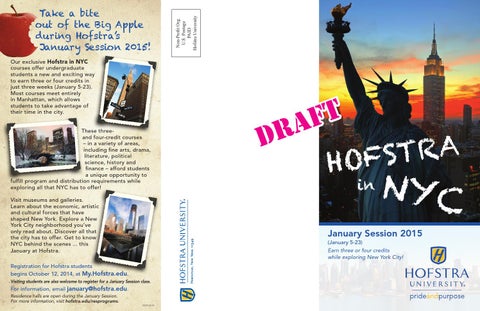
Our exclusive Hofstra in NYC courses offer undergraduate students a new and exciting way to earn three or four credits in just three weeks (January 5-23). Most courses meet entirely in Manhattan, which allows students to take advantage of their time in the city. These threeand four-credit courses – in a variety of areas, including fine arts, drama, literature, political science, history and finance – afford students a unique opportunity to fulfill program and distribution requirements while exploring all that NYC has to offer! Visit museums and galleries. Learn about the economic, artistic and cultural forces that have shaped New York. Explore a New York City neighborhood you’ve only read about. Discover all that the city has to offer. Get to know NYC behind the scenes ... this January at Hofstra.
Non-Profit Org. U.S. Postage PAID Hofstra University
Take a bite out of the Big Apple during Hofstra’s January Session 2015!
r d
t f a
A R T S F HO in
NYC
January Session 2015 (January 5-23) Earn three or four credits while exploring New York City!
Registration for Hofstra students begins October 12, 2014, at My.Hofstra.edu. Visiting students are also welcome to register for a January Session class.
For information, email january@hofstra.edu. Residence halls are open during the January Session. For more information, visit hofstra.edu/resprograms. 55241:9/14
Take a Bite Out of NYC
Explore our Hofstra in NYC course offerings. These courses are offered only in January — so take advantage of this exclusive opportunity!
ART HISTORY – AH 192, sec. 1 Museums of NYC * – 3 s.h.
HISTORY – HIST 177A, sec. 1
RELIGION – RELI 107, sec. 1
Teddy Roosevelt’s NYC – 3 s.h.
Falafel on a Bagel: Religion in NYC* – 3 s.h.
11 a.m.-2 p.m.
12:30-3:30 p.m.
9 a.m.-Noon [NOTE: Course receives distribution credit in IS, Interdisciplinary Studies]
Taught by Aleksandr Naymark This course is an intensive study of the general systematic survey of Western art that draws on the incomparable riches of New York art collections. Students explore the collections of 14 major museums in New York, including The Metropolitan Museum of Art.
Taught by Michael Galgano The class focuses on Roosevelt’s connections to NYC from 1858 (the year of his birth) to 1897, the year he left the New York City Police Department to pursue a job in Washington, D.C., as assistant secretary of the Navy. Students visit venues such as the Theodore Roosevelt Birthplace National Historic Site, American Museum of Natural History, The Metropolitan Museum of Art, The New York City Police Museum, and the New-York Historical Society. Note: The first several meetings of this course will be on Hofstra’s main campus, followed by meetings in New York City. Details to be arranged on the first day of class.
Taught by Hussein Rashid Put on comfortable walking shoes and bring your MetroCard. New York City is the beacon for immigrants coming to the United States, and that immigration has shaped this city, from food to fashion. We will look at how various religious communities, especially Jews, Christians, and Muslims, have sculpted this city into a home. We will read literature, visit museums, and learn about the architecture of the city. Our goal is to understand how religion affects the city, how the city transforms religion, and how they mark each other through the creative imagination.
DRAMA – DRAM 110A, sec. 1 Theatre in NYC * – 4 s.h. 3-6 p.m. Taught by Edward Elefterion Students attend six productions in New York City over three weeks. We do not confine ourselves to Broadway. Rather, students experience a taste of the variety of performing arts in New York City, including off-Broadway and off-off-Broadway. Note: This course meets at Hofstra, January 5-16, 2015, from 9 a.m. to 12:45 p.m.
DRAMA – DRAM 110B, sec. 2 Improv in NYC * – 3 s.h. 7:30-10:30 p.m. Taught by Christopher Dippel Trust, teamwork, honesty, communication, risk. These are the foundations of improvisation, and these skills are useful in every career field. This course employs theater games and performance exercises to help students learn to think on their feet, work collaboratively, communicate effectively, and trust their own creativity and ideas. Students attend performances of various types of improvisation.
FINANCE – FIN 141, sec. 1
Money and Capital Markets – 3 s.h. 9 a.m.-12:45 p.m. Taught by Gioia Bales This course offers an in-depth analysis of the structure of domestic and international money and capital markets and the role the government plays in these markets, as well as the role of investment bankers, brokers, and dealers in the financial markets. Issues pertaining to ethics, innovation, competition, and globalization of financial markets are also discussed. Course content is enhanced by three full-day trips to New York City, including visits to the Federal Reserve Bank of New York, New York Stock Exchange, the NASDAQ, and commercial and investment banks and hedge funds. Note: This course meets at Hofstra, January 5-16, 2015, from 9 a.m. to 12:45 p.m.
FINE ARTS – FA 198, sec. 1
The Art Scene in NYC * – 3 s.h. 12:30-3:30 p.m. Taught by Stephen Keister This course is an examination of the rapidly expanding art scene in its varied manifestations in Manhattan’s Chelsea district and Lower East Side neighborhood, and the Brooklyn neighborhoods of Williamsburg, Greenpoint and Bushwick. Students witness the cross-fertilization of ideas and influence in curated group exhibitions at galleries and museums, and have the opportunity to discuss issues with contemporary artists in their studios.
IRISH STUDIES – IRE 163, sec. 1
Irish American Literature and Culture* – 3 s.h. 12:30-3:30 p.m. [NOTE: Course receives distribution credit in LT, Literature] Taught by Patricia Navarra This course surveys contemporary Irish American literature, music and film in New York City. Students will examine The History of the Irish in America, New World Stories in Irish America, and How Being Irish Became (Mad) Cool. We will examine Irish American identity from the Westies to JFK, and from F. Scott Fitzgerald to the Dropkick Murphys and Black 47. Possible excursions include the Great Hunger Memorial, the Irish Consulate, Ellis Island, the Irish Repertory Theater, the original St. Patrick’s Cathedral in Little Italy, and the offices of the Irish Voice/Irishcentral.com. Note: This course meets at Hofstra, January 5-16, 2015, from 9 a.m. to 12:45 p.m.
LINGUISTICS – LING 181, sec. 2
Decoding NYC: Language and Neighborhoods* – 3 s.h.
WOMEN’S STUDIES/HISTORY – WST 150N, sec. 1/HIST 177A, sec. 2 Greenwich Village 1913: Suffragettes in the City* – 3 s.h. 9 a.m.-Noon [NOTE: Course receives distribution credit in IS, Interdisciplinary Studies] Taught by Patricia Welch This course provides an in-depth look at Greenwich Village just over 100 years ago, at a time of great change. The Village is quickly becoming a haven for immigrants, bohemians and artists. Women don’t have the right to vote, and — just two years after the Triangle Shirtwaist Fire killed 146 workers — it’s a time when labor was just beginning to organize. It’s also the dawn of the age of the New Woman. We will supplement class work with tours of Greenwich Village, The Lower East Side Tenement House Museum, the New York Historical Society, and The Museum of the City of New York.
WRITING STUDIES AND COMPOSITION – WSC 120, sec. 1 (AA) Public Writing, Private Lives* – 3 s.h.
9 a.m.-Noon
11 a.m.-2 p.m. [NOTE: Course receives distribution credit in IS, Interdisciplinary Studies]
Taught by Gregory Kershner To an outsider – and sometimes even to an insider – NYC can be hard to understand. In this course students attempt to decode NYC’s organization of space, the layout of buildings, street grids, fashion, and neighborhoods. Students learn to “read” the city as a system of signs, as a language all its own.
Taught by Deepali Srivastava New York is home to a thriving and internationally influential community of new media writers whose work is blurring the line between public and private. Traditional writers have become digital storytellers. Students will visit with independent media organizations and publishers, and interact with published writers and journalists. They will learn about the craft of story-telling in newsfeatures, the research and interview process, and the promotion process on digital self-publishing platforms and social networks.
POLITICAL SCIENCE – PSC 192, sec. 1
Field Study at the United Nations* – 3 s.h. 11 a.m.-1 p.m. Taught by Tina Adams This course takes advantage of Hofstra’s proximity to the United Nations and its related organizations in New York City. About half of the time available in this course will be devoted to learning about the institution and work of the UN itself. The other half will consist of briefings from the various embassies representing their nations at the UN. Students will have the opportunity to interact directly with diplomats and high-level staff who do the actual work of global politics. With the exception of the first organizational meeting, which will be held on campus, all other sessions will be held in Manhattan.
* Unless otherwise noted, classes meet
Monday through Thursday at Manhattan Eye and Ear Hospital, 210 E. 64th Street, which is between 2nd and 3rd Avenues.