SEPTEMBER 2022 JUNE 2026
Employee of the Month
June PMRecognition
What's Inside 2
Subscribe for the Drive
3
Employee of the Month
accolades parade with their
4
LVH- Pocono Cancer Treatment Pros
as a whole, along with
own outstanding points to
6
American Heart Association Accolades
standout employee
share with the community.
8
Can You Beat the Heat
Pocono Mountain
Fellow newsletter
Regional received
participants joined tyhe
outstanding recognition
recognition.
12 St Luke Excellence Earned 13 Best Ticket in Town
Subscribe Today PMREMS.org
Mailers are Mailers are out! out!
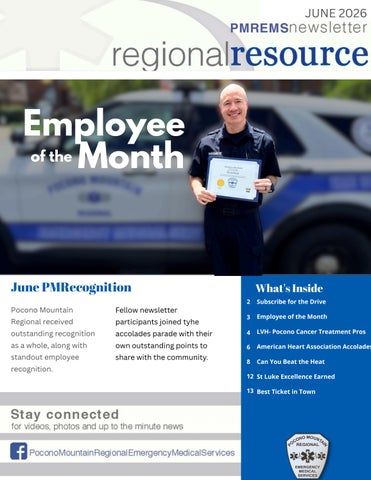
Employee of the Month Meet Paramedic Devin Hunt, Pocono Mountain Regional Emergency Medical Services‘ May 2026 Employee of the Month. Devin Hunt was selected as PMR's employee of the month because of his excellent PCR completion times, quick turnout and hospital clear times, and for his initiative with helping out by filling holes in the schedule - often times being asked last minute to fill in a vacancy. He continues devote his time and skills to PMREMS even while working a busy full time job. Thank you Devin for being a spectacular part of the Pocono Mountain Regional EMS team!
Choose a Surgical Specialist When It Comes to Cancer A multidisciplinary, highly trained care team at LVH–Pocono makes all the difference
Sometimes, people are confused about where to go if they need surgery. Do you choose a general surgeon who treats everything from bodily injuries to disorders of various organs? Or do you consult a specialist specifically knowledgeable about a certain part of the body? For patients who have been diagnosed with cancer, the odds strongly favor a specialist.
How to choose When dealing with cancer, there are reasons to choose a clinician who is experienced – especially with the type of cancer you have – and who is aligned with the resources of Lehigh Valley Topper Cancer Institute, part of Jefferson Health. At Lehigh Valley Hospital (LVH)–Pocono, three surgical oncologists offer highly sophisticated care close to home and give patients an extraordinary level of expertise. The surgeons based at LVH Surgical Oncology–Pocono are Krista Bott, MD, who specializes in breast cancer surgery and benign breast disorders, and Jacqueline Oxenberg, DO, who specializes in surgery for gastrointestinal, melanoma, pancreatic and endocrine cancers. Luke Rodriguez, MD, with LVPG Surgical Oncology–Carbon, specializes in breast cancer tumor removal combined with plastic surgery. The combination of breast cancer surgery and plastic surgery reconstruction is offered at most LVH hospitals. To provide extra-conscientious diagnosis and treatment, surgical oncologists tailor their care by: Performing biopsies to find out if growths are cancerous and explain what the results mean Determining stages of cancer, which helps indicate the best treatment Working with tumor boards to plan the best treatment Accessing clinical trials for advances in treatment that could be lifesaving Explaining the benefits and drawbacks of potential surgical treatments Explaining how to prepare for surgery and what you can expect afterward Supervising your recovery from surgery and treating any complications Performing palliative care surgery to ease cancer symptoms
(Left to Right) Krista M. Bott, MD Jacqueline C. Oxenberg, DO Luke J. Rodriguez, MD
Surgical oncologists know cancer Surgery is used to treat many types of cancer. But surgery is often combined with other treatments, such as radiation and chemotherapy. Surgical oncologists work closely with medical oncologists and radiation oncologists to determine the best approach and make sure everything works together. This is part of the multidisciplinary approach to cancer care that has been successful for so many patients at the Cancer Institute. A surgical oncologist is the best choice when: Your cancer is in an advanced stage, complex or complicated and requires special collaboration Your cancer care team suggests an advanced form of treatment Your cancer has spread to the liver You have a rare type of tumor such as a sarcoma You have an aggressive type of skin cancer like melanoma One example involves a patient who had a case of metastatic cancer of the appendix that spread to the membrane lining the abdominal cavity. Dr. Oxenberg is one of the few clinicians in the region trained to treat this rare cancer. The patient received chemotherapy to decrease the amount of cancer that had spread. Then, she underwent surgery to remove the abdominal lining and tumors inside the abdomen as well as the uterus and a portion of the colon. She was also given novel hyperthermic intraperitoneal chemotherapy (HIPEC). This delivers high doses of heated chemotherapy directly into the abdominal cavity during surgery, treating any remaining tumor cells that can’t be seen after surgical removal on contact. “The heat amplifies the effects of the chemotherapy and kills more cancer cells,” Dr. Oxenberg says. Colleagues agree that HIPEC prolonged the patient’s survival.
Robotic-assisted surgery for certain cancers Another reason to choose surgical specialists for cancer surgery is the fact they are trained and skilled in the latest technology, which ultimately helps the patient. One example is LVH–Pocono has the region’s only positron emission tomography (PET) scanner for detecting cancer. Availability of robotic-assisted surgery is also exceptionally important. We conduct surgery robotically for colorectal cancer, gynecological cancer, lung cancer, prostate cancer and fertility-sparing procedures. Dr. Oxenberg conducts many robotic surgeries for pancreas, gastric and adrenal cancers and others. Along this line, at LVH–Pocono, you’ll find the only interventional pulmonologist performing robotic biopsies, which detect cancer earlier with more accuracy; the only robotically trained urologist; and the only robotically trained colorectal surgeon in the region. To make sure patients reap all the benefits, our surgical robots, across all campuses, are the latest generation of this remarkable technology. Robotic-assisted surgery offers patients smaller incisions, less pain, fewer complications and a faster return home and to normal activities. The minimally invasive aspect is another advantage that many surgical oncologists can provide, which is powerful treatment combined with their exceptional knowledge of, and experience with, a particular type of cancer.
Pocono Mountain Regional EMS has received the American Heart Association’s Mission: Lifeline® EMS Bronze achievement award for its commitment to offering rapid and research-based care to people experiencing the most severe form of heart attacks and strokes, ultimately saving lives. Emergency medical services staff can begin treatment when they arrive — up to an hour sooner than if someone goes to the hospital by car. EMS staff are also trained to provide resuscitation efforts to someone whose heart has stopped. People who arrive by ambulance may also receive faster treatment at the hospital. Mission: Lifeline EMS® is the American Heart Association's national initiative to advance the system of care for patients with high-risk, time-sensitive disease states, such as severe heart attacks and strokes. The program helps reduce barriers to prompt treatment — starting from when 911 is called, to EMS transport and continuing through hospital treatment and discharge. Optimal care for heart attack and stroke patients takes coordination between the individual prehospital providers and health care systems. “Arguably the most important link in the chains of survival for acute stroke and cardiovascular emergencies is emergency medical services and prehospital professionals,” said Kacey Kronenfeld, M.D., FAEMS, chair of the American Heart Association's Mission: Lifeline EMS Taskforce. “Early condition identification, stabilization and prehospital interventions, and initiation of actions within the regional systems of care provide patients with the best chance for receiving expedient definitive therapies leading to optimal outcomes and maximized quality of life. “The American Heart Association Mission: Lifeline EMS awards are an important way to recognize the crucial roles and performances of EMS personnel in stroke and cardiac patients’ care.” The Mission: Lifeline EMS achievement award focuses on agencies’ on-scene care, bringing to the forefront the collaboration and contributions to patient care for prehospital providers. “PMREMS is honored to be recognized by the American Heart Association for our dedication to providing optimal care for heart attack patients,” said Meredith Hamill PMREMS Clinical Coordinator, adding, “The Mission: Lifeline program puts proven knowledge and guidelines to work on a daily basis so patients have the best possible chance of survival.”
Can YOU Can YOU Beat the Beat the Heat? Heat? With temperatures rising as we move into summer, so do the risks of heatrelated emergencies. Heat related emergencies can become a serious and even life threatening health concern. As people are spending more time outdoors, it's important to recognize the signs of heat related emergencies. By understanding the differences between heat related emergencies, recognizing signs and symptoms, and knowing how to prevent them, you and your family can have a safe and healthy summer. Test your knowledge with the trivia questions below to learn more about heat related emergencies and how to stay cool this summer. Heat-related emergencies fall into three main groups and range in severity. Heat cramps, heat exhaustion and heat stroke. Each type of heat related emergency ranges in severity and has differing presentations. Heat cramps are the earliest sign that your body is struggling to cope with the heat. Symptoms include painful muscle cramps or muscle spasms, excessive or heavy sweating and thirst. Cramping sensations usually occur in the arms, legs and abdomen. If you are someone you know are experiencing heat cramps, it is important to not ignore the signs. Move to a cool location, drink plenty of water, and allow your body to rest and cool down.
Question: True or False: Thirst is the best indicator that you need to drink water. Answer: False. By the time you feel thirsty, you may already be mildly dehydrated. Heat exhaustion is a serious precursor to a potential life threatening emergency. Heat exhaustion occurs when the body experiences excessive water and salt loss through sweating.
Question: What symptom is most commonly associated with heat exhaustion? 1.Cool and clammy skim 2.Unconsciousnesses 3.Severe sun burns 4.seizures Answer: A. Cool and clammy skin Question: What percent of the human body is made of water? 1.About 40% 2.About 60% 3.About 75% 4.About 90% Answer: B. About 60% Signs of heat exhaustion include heavy sweating, pale cool clammy skin, weakness/fatigue, dizziness or fainting, headache, nausea or vomiting, rapid or weak pulse.
Question: When treating someone with heat exhaustion, what is the first step? 1.Give them caffeine 2.Move them to a cool area 3.Make them walk around 4.Cover them in blankets Answer: B. Move them to a cool area Heat exhaustion requires quick action. Move to a cool place (preferably air conditioned), loosen or remove excess clothing if possible, apply wet cool cloths to the skin, and rehydrate slowly with water or a sports drink. If symptoms worsen or last longer than an hour, it is important to seek medical attention and call 911.
Question: What is the most serious heat-related emergency? 1.Heat cramps 2.Heat rash 3.Heat Exhaustion 4.Heat Stroke Answer: D. Heat stroke Heat stroke is the most severe heat- related emergency and can be life threatening if not treated quickly. Heat stroke occurs when the body is unable to compensate for a rapid rise in body temperature and can no longer cool itself.
Question: At approximately what body temperature is heat stroke typically diagnosed? 1.99°F 2.100.4°F 3.103°F or above 4.102°F Answer: C.103°F or above Signs and symptoms of heat stroke include hot red skin. Note that skin may be damp or dry. People with heat stroke may experience confusion or a change in mental status, slurred speech, seizures, loss of consciousness, or rapid pulse. If you or someone else is experiencing these symptoms it is critical to call 911 immediately. While you await emergency assistance, move to a cooler location, remove excess clothing and attempt to cool the individual down using cold water, ice packs, or wet towels. It is important not to attempt to give fluids to someone that is unconscious or confused.
Question: Who is at the highest risk of heat-related illness? 1.Teenagers 2.Older Adults 3.Office workers 4.College Students Answer: B. Older adults Anyone is at risk for heat-related emergencies, but there are certain groups that are at a higher risk. Typically older adults above the age of 65 are at the greatest risk, partially due to having a decreased ability to regulate body temperature and being more likely to have chronic medical conditions. Infants and young children also have an increased risk as their bodies heat up faster than adults. People with chronic conditions such as heart disease, diabetes, obesity, and respiratory illness should take extra precautions when exposed to hot temperatures. Keep in mind, certain medications such as diuretics, antihistamines, certain blood pressure medication, and some mental health medications can also increase your risk of experiencing a heat related emergency.
Question: In 10 minutes, how much can the temperature rise inside a parked car on a warm day? 1.5°F 2.10°F 3.About 20°F 4.About 40°F Answer: C. About 20°F
Question: Which summer holiday often results in increased EMS calls due to travel and outdoor activities? 1.Memorial Day 2.Labor Day 3.Independence Day 4.Arbor Day Answer: C. Independence Day (Fourth of July) Question: Which color clothing is generally best for staying cool in the summer sun? 1.Black 2.Dark blue 3.White or light colors 4.Dark green Answer: C. White or light colors. Remember, heat-related illnesses ARE preventable. Staying hydrated, avoiding excess alcohol and caffeinated drinks, dressing appropriately in light weight, loose fitting and light colored clothing are easy things you can do to prevent heat illness. Work together as a community to ensure your neighbors are staying safe as temperatures climb. Check on the elderly and never leave children or pets in parked cars. Always call 911 immediately if a person: Shows signs of heat stroke Becomes unconscious or unresponsive Has a seizure Experiences confusion, disorientation, or unusual behavior Has difficulty breathing Collapses or cannot stand Has a body temperature of 103°F (39.4°C) or higher Prompt medical treatment can prevent permanent injury and save lives.
Created by PMREMS Kelsey Hovi EMT
Download Print & Mail In
ADDRESS 135 TEGAWITHA ROAD, TOBYHANNA PA 18466 PHONE 570.839.8485 WEB PMREMS.ORG