SEPTEMBER 2022 AUGUST 2026
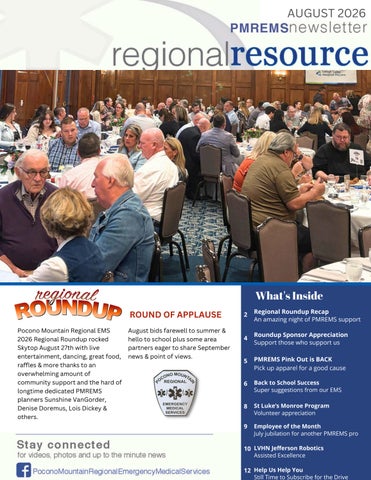
What's Inside ROUND OF APPLAUSE Pocono Mountain Regional EMS 2026 Regional Roundup rocked Skytop August 27th with live entertainment, dancing, great food, raffles & more thanks to an overwhelming amount of community support and the hard of longtime dedicated PMREMS planners Sunshine VanGorder, Denise Doremus, Lois Dickey & others.
August bids farewell to summer & hello to school plus some area partners eager to share September news & point of views.
2
Regional Roundup Recap An amazing night of PMREMS support
4
Roundup Sponsor Appreciation Support those who support us
5
PMREMS Pink Out is BACK Pick up apparel for a good cause
6
Back to School Success Super suggestions from our EMS
8
St Luke’s Monroe Program Volunteer appreciation
9
Employee of the Month July jubilation for another PMREMS pro
10 LVHN Jefferson Robotics Assisted Excellence
12 Help Us Help You
Still Time to Subscribe for the Drive
CLICK FOR A VIEW INTO OUR SPONSOR BOOKLET
It's that time again and we are proud to announce that we are OPEN NOW !! There are more than 200,000 cases of breast cancer every year in the United States alone. With this fundraiser we achieve to help researchers, remember those we have lost, and let everyone know that nobody stands alone. We also wish to raise awareness for the fast and ever growing population of those who need us. Help us help them.
IIN N O OCTOBER CTOBER W WEE W WEAR EAR P PINK! INK!
This year we have new options at a better cost out of pocket. As always, the cost breakdown is the production cost with a $5 increase per item for the fundraiser. 100% of those proceeds will be donated on behalf of PMR EMS, thanks to all of you! So click that link and grab some PINK PMR EMS swag and join the fight!
SHOP NOW SHOP NOW The PMREMS Store lineup for 2026 Different color tee shirts start at just $19! Plus we have these other options: Long sleeve tee shirts Soft style crewneck sweatshirt Hooded sweatshirt Quarter zip sweatshirt
Full zip hooded sweatshirt Unisex embroidered polo Embroidered half zip job shirt Embroidered blanket
As summer comes to a close, a new school year begins. Families are getting ready to transition back into early mornings and busy schedules. This can be a stressful time for many, but by following six simple steps, you can help your child stay focused, healthy, and ready for the school year ahead.
Step 1: Start By Developing Healthy Habits Easing into a school routine before school starts makes for an easier transition. Begin by setting regular bed times, healthy and nutritious meals, and set aside time for physical activity. School aged children and teens perform better academically when they are well rested and get adequate sleep each night. Before school starts, begin the transition towards a set bedtime.
Step 2: Be Proactive in the Fight Against Germs
As many parents already know, school naturally exposes children to a variety of bacteria and viruses. The close contact of students also makes the spread of colds, flu, and other illnesses more common. To help keep your home healthy, encourage children to wash their hands frequently with soap and water, cover coughs and sneezes with a tissue or their elbow, avoid touching their eyes, nose and mouth, and stay home when they are sick to allow for a restful recovery and to protect classmates and staff.
Step 3: Stay Up to Date on Checkups
Before the school year begins, make sure to schedule any needed physicals, vision screenings and dental appointments. Addressing concerns early helps ensure kids are feeling their best and ready to participate in activities and learn.
Step 4: Pack for Success
Healthy meals and nutritious snacks provide students with the energy and nutrients they need throughout the school day. A healthy lunch should include fruits, vegetables, whole grains, lean proteins, and plenty of water. Avoid or limit highly processed foods and limit sugary drinks to help maintain steady energy and concentration.
Step 5: Support Mental Wellness
Returning to school can bring excitement for many, but it can also cause anxiety and stress. Maintain open communications by asking children about their day, listen to their concerns, celebrate accomplishments, and offer support. Encourage positive social connections that can help build a child’s confidence and resilience by maintaining family routines.
Step 6: Be Prepared
Make sure your child’s emergency contact information is up to date. Review basic safety topics including bus safety, bicycle helmet use, knowing trusted adults, and what to do in case of an emergency. Teach children important information such as their home address, a parent's phone number, and how to call 911 when appropriate.
A healthy start to the school year sets the foundation for success both in and out of the classroom. By focusing on physical health, emotional well-being, and healthy daily habits, families can help children make the most of the exciting year ahead.
Pocono Mountain Regional EMS wishes all students, parents, teachers, & school staff a safe, healthy, and successful school year!
MONROE CAMPUS VOLUNTEER PROGRAM On August 22, 2017, the Monroe Campus initiated a Volunteer Program to help support the needs of patients, visitors, and staff throughout the hospital. Since the program began, volunteers have become a vital part of the hospital experience, providing meaningful assistance, comfort, and support in many areas. Their presence helps create a welcoming environment for patients and families, while also supporting staff by escorting patients and visitors to their destinations and providing clerical assistance.
Over the years, the Volunteer Program expanded to include four-legged volunteers, beginning with Casey, whose first day was August 12, 2024! Today, the Monroe Campus is fortunate to have five therapy dogs, with two more in the works. These special volunteers offer patients a sense of calm, comfort, and companionship during their hospital stay, often bringing smiles and easing stress when it is needed most. We are deeply grateful for all of our volunteers — both two-legged and four-legged — for the time, kindness, and support they provide to our patients, families, staff and hospital community.
Employee of the Month Pocono Mountain Regional EMS July employee of the month is EMT Craig Blackmon. Craig was chosen for his quick chart completion times, quick response and hospital clear times, and for helping out with scheduling needs. He also is very dedicated to PMREMS and our patients and provides outstanding compassionate care to all of his patients.
Thank you Craig for being a spectacular part of the Pocono Mountain Regional EMS team!
High Volume Robotic-Assisted Bronchoscopies Offer Patients Exceptional Expertise Pennsylvania pulmonology team surpasses 1,300 procedures Nothing can replace experience when it comes to medical practitioners or health systems and their expertise in performing a certain procedure. For Lehigh Valley Health Network (LVHN), part of Jefferson Health, that experience shows in a recent milestone: the pulmonology team has now performed more than 1,300 robotic-assisted bronchoscopies. The team performs about 400 procedures a year, a number that exceeds the volume of most health systems in the country. Since the program began at Lehigh Valley Hospital–Cedar Crest in 2023, the team has performed 1,200 robotic-assisted bronchoscopies there. At Lehigh Valley Hospital–Pocono, where the program launched in 2025, the pulmonology team has performed 101 robotic bronchoscopies. Together, as of summer 2026, the network has now performed 1,301 roboticassisted bronchoscopies.
What is robotic-assisted bronchoscopy? A bronchoscopy is a procedure that uses a bronchoscope — a thin, flexible tube with a light and camera — to examine the airways and lungs. Physicians can also pass small tools through the bronchoscope to take a biopsy, or tissue sample, from an area of concern, such as a lung nodule. Robotic-assisted bronchoscopy is a more advanced version of this procedure, designed specifically to help physicians reach small nodules located deep in the outer regions of the lung — areas that are difficult to access with a standard bronchoscope. It isn’t used for every bronchoscopy; it’s reserved for cases where a patient has a lung nodule that needs to be biopsied. “The benefit of robotic bronchoscopy is being able to reach hard-to-access areas of the lung with exceptional accuracy, a very low complication rate and an increased ability to get a diagnostic answer,” says Daniel Kennedy-Schwed, MD, Associate Chief, Division of Pulmonary Medicine, who practices at LVPG Pulmonary and Critical Care Medicine–1250 Cedar Crest.
Dr. Kennedy-Schwed explains the robotic system incorporates advanced “shape-sensing” technology, which measures the shape and position of the catheter inside the lung hundreds of times per second. This provides precise location and orientation information throughout navigation and biopsy. A 3D map on a computer screen gives the physician detailed imaging to help navigate to, and biopsy, nodules in hard-to-reach parts of the lung. “The lungs have hundreds of airways, so finding the right location without a map would be extremely difficult,” Dr. KennedySchwed says. “Shape sensing is like a GPS for the lung.”
Are lung nodules common? Lung nodules are common, and the majority turn out to be benign, or noncancerous. They can form for many reasons — most often scarring left behind by a past lung infection, such as a fungal infection or tuberculosis. They can also originate from benign growths called hamartomas, inflammatory conditions, or old injuries. Whether a nodule needs further evaluation depends on factors like its size, whether it’s growing over time, and a patient’s individual risk factors, such as smoking history. If there’s concern, pulmonologists may recommend a biopsy to determine whether it’s cancerous. “The biopsy is done under anesthesia and takes about 90 minutes,” Dr. Kennedy-Schwed says, noting he gets patients in quickly, usually within a week. “A CT scan gives us a map of the airways, and we use that map to navigate close to the nodule. The robotic procedure is very safe, with a low complication rate.” Once the physician collects tissue samples, they’re sent to the pathology lab, where a pathologist examines them. Results are usually available in three to seven days, and about a week later, a pulmonologist meets with the patient to discuss the findings. “It’s satisfying to be able to give our patients an answer, to find out what the nodule is,” Dr. Kennedy-Schwed says. “We’re very experienced, and that’s what makes our results so precise and our safety record so strong. It’s true of any medical procedure: the more you do, the better you become.”
Help Us. Help Us. Help Help You. You.
TIME TO SUBSCRIBE FOR THE DRIVE
OUR BIGGEST FUNDRAISER OF THE YEAR
MARCH 1 THRU DECEMBER 2026
Pocono Mountain Regional EMS is there 24/7, 365 days a year committed to serving our community. Your support makes it possible to have the highest qualified ambulance personnel and life saving equipment. Responding to over 7,600 calls in 2025 shows an
PROFESSIONAL POSITION increasing need for our services. As call volume increases so does operating costs. To help offset these costs and continue to give the quality of care you deserve we turn to our community for help.
SIGNING UP IS
EASIER
THAN EVER
-OR-
OR YOU CAN
MAIL IN
YOUR MEMBERSHIP
SIGNUP ONLINE
ADDRESS 135 TEGAWITHA ROAD, TOBYHANNA PA 18466 PHONE 570.839.8485 WEB PMREMS.ORG