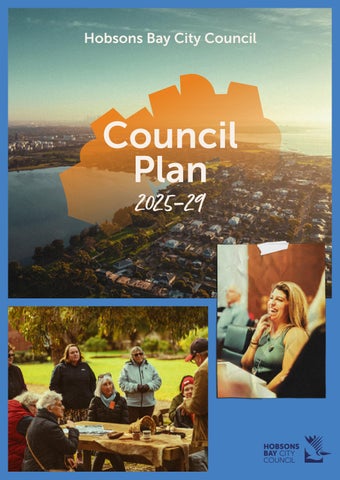
Council Plan 2025-29

Page 1


Hobsons Bay City Council Council Plan 2025–29

Acknowledgement of Country

We acknowledge the Bunurong People of the Kulin Nation as the Traditional Owners of the lands, rivers and coastal areas in Hobsons Bay. We recognise the First Nations peoples’ relationship to this land and offer our respect to their Elders past and present.

How to read this plan

The Council Plan 2025–29 should be read alongside the Hobsons Bay Health, Wellbeing and Safety Plan 2025–29. Together, these plans detail how Council will work towards the community aspirations outlined in the Community Vision.

When reading this plan, you can use the contents page to go to the sections that interest you most or jump straight to page 37 to see a summary of the plan on one page. You can also go directly through to the themes, goals and actions from page 41.

Introduction

1.1.0.

A message from our Councillors

As a council, our community is at the heart of everything we do. Every decision we make and every service we provide aims to enhance or protect the lives of people who live, work or play in Hobsons Bay.

To do that effectively, we need to know our community – who we are, what we value, what our vision is for Hobsons Bay and how we want to get there.

We are proud to present Council Plan 2025–29. It is the roadmap for our city, and will guide our decisions and priorities over this period.

More importantly, it’s the path our community wants us to take.

Months of consultation with residents, community groups and Council staff have identified the priorities our community wants its council to focus on for the next four years.

Broadly, we want to be a healthy community, with a sustainable environment, in a liveable city run by an accountable council.

These four themes will become the foundations of our efforts over the course of this council term.

They are also reflected in our updated long-term Community Vision, which is now that:

“By 2040, we are a safe, sustainable and healthy community supported by an accountable, efficient and transparent Council.”

More than 1,300 people have played a part in helping develop this plan. To all of them we are thankful. Not just that they gave their time, energy and expertise to this important project, but because it shows their passion for making sure Hobsons Bay is the best it can be.

It’s a passion we all share. We look forward to working with our community over this four-year period to deliver the Hobsons Bay we all want to see.

Your Hobsons Bay Councillors

1.2.0.

A message from our Council leaders

Hobsons Bay continues to grow and evolve. Within 20 years, we will have almost another 20,000 residents. The opportunities in front of us are exciting and we will be working to ensure people of all ages and from all walks of life can continue to live happy, healthy and safe lives here.

It’s why we must continue to provide and maintain spaces and opportunities for people to get out and about, be active and socially connected.

That’s why it’s so important we continue to nurture and protect the beautiful and diverse environment around us – from beaches to wetlands, parks, reserves and sporting fields.

It’s why we need to meet the challenges climate change will bring to our bayside municipality with such a precious and unique environment.

It’s why we must continue to focus on doing the basics well –collecting waste; maintaining streets, footpaths and drains; and supporting community and cultural events.

And it’s why our Council must operate as efficiently and effectively as possible – to provide these services our community relies on in a way that makes the best use of its money, while also providing an enriching and safe workplace for the staff that serve Hobsons Bay every day.

In challenging economic times, this is more important than ever, but we are committed to continuing to provide for our community.

We must also continue to be the voice for our community when it comes to advocating to other levels of government about the issues and services that matter to Hobsons Bay.

Our path for the next four years has been set by the considered and passionate response of our community – the community our organisation works for day in, day out.

Kerry Thompson, Interim CEO, March 2025 to January 2026

Phu Nguyen, CEO, January 2026

The unique municipality About Hobsons Bay City Council

The Yalukit Willam clan of the Bunurong People were the first people who lived in the area now known as Hobsons Bay and had strong connections to land and sea. A number of sites of significance to the Aboriginal community are located throughout the municipality, particularly along the coastal trail.

Hobsons Bay is situated at the northern end of Port Phillip Bay, about 10 km west of central Melbourne, and includes the suburbs of Altona, Altona Meadows, Altona North, Brooklyn, Laverton, Newport, Seabrook, Seaholme, South Kingsville, Spotswood, Williamstown and Williamstown North. Each suburb has its own unique character, from the historic seaport of Williamstown with its range of heritage buildings, to the more recently developed residential areas of Altona Meadows and Seabrook.

In 2024, Hobsons Bay had an estimated resident population of 95,633 which is forecast to increase to 113,134 by 2046.

Hobsons Bay covers an area of about 64 km2 and has more than 20 km of coastline.

It is also home to significant coastal wetlands, five creek systems, remnant native grasslands, and important flora and fauna habitats, which make up 24 per cent of the city’s total land area.

Hobsons Bay has a range of major industrial complexes which contribute significantly to the economy of Victoria. It has good access to regional transport facilities such as the West Gate Freeway, the Western Ring Road, CityLink, the National Rail Line, and the ports and airports of Melbourne and Avalon.

These features contribute to the city’s culture, which is strongly linked to its maritime heritage, rich natural environment, industry and lifestyle.

95,633

estimated residential population

10KM from CBD

20KM over of coastline area covered 64KM2

Laverton

Altona North
Altona
Altona Meadows
Seabrook
Altona Ward Cr Daria Kellander
Altona North Ward Cr Rayane Hawli
Laverton Ward CrPaddy Keys-Macpherson
Altona Meadows Ward Cr Diana Grima

Williamstown North Ward Cr Michael Disbury

Our Councillors

The Council is elected to provide good governance in its municipal district for the benefit and wellbeing of its community.

On 26 October 2024, the residents and ratepayers of Hobsons Bay elected this Council for a four-year term. Seven Councillors were elected to a new single-Councillor ward structure.

Williamstown Ward Cr Lisa Bentley

1.3.3.

Our community Population

In 2024, Hobsons Bay had an estimated resident population of 95,633 which is forecast to increase to 113,134 by 2046. The proudly diverse community speaks more than 80 languages and practises more than 40 faiths.

95,633

residents in 2024 1

51% 49%

10,000

2.02%

increase in Hobsons Bay’s population over the next 10 years 2 population growth rate 1

residents

Priority populations

We recognise that there are groups in the community who are more likely to experience social and economic barriers that contribute to poorer health and social outcomes. These priority populations have distinct needs that have been considered in the development of this plan.

628 residents are First Nations 3

Compared to 0.7% of people in Greater Melbourne

More information about priority populations can be found in the Hobsons Bay Health, Wellbeing and Safety Plan 2025–29. 0.7% 27% 13.3% 30.1%

Compared to 11% of people across Victoria

Compared to 34% of people in Greater Melbourne

The top three spoken languages other than English are:

1. Arabic

2. Greek

3. Vietnamese

13.2%

11,372 residents live in low-income households 4 of residents speak a language other than English at home 3

Compared to 13.4% of people in Greater Melbourne

21.3% of residents have a disability 3

Compared to 21.4% of people across Australia

Compared to 35.7% of people in Greater Melbourne of residents identify as LGBTIQA+ 4

Top three overseas countries of birth are:

1. United Kingdom

2. India

3. New Zealand

13.3%

9,963 residents provide unpaid assistance for someone in need of care 4 of residents are born overseas 3

Compared to 12.6% of people in Greater Melbourne

3. Australian Bureau of Statistics (ABS), 2021 Census of Population and Housing. 4. Victorian Agency for Health Information (2025), Victorian Population Health Survey 2023, Victorian Government.

Education and employment

33% of residents have a bachelor’s degree or higher 5

Compared to 34% of people in Greater Melbourne

3.3%

Compared to a rate of 4.5% in Greater Melbourne was the unemployment rate in Hobsons Bay in the 2025 March quarter 6

5. Australian Bureau of Statistics (ABS), 2021 Census of Population and Housing.

6. Australian Bureau of Statistics, Labour force survey and Department of Employment, Small Area Labour Markets.

36,153 in Hobsons Bay 7

24.1% 291

Compared to 26.8% of households in Greater Melbourne people were experiencing homelessness on census night in 2021 9 (or 2,221) households in private rentals in Hobsons Bay are in rental stress

7. Australian Bureau of Statistics (ABS), 2021 Census of Population and Housing.

8. .id Consulting (2025), Hobsons Bay Housing Profile.

9. Australian Bureau of Statistics (2021), Estimating Homelessness: Census

About the Council Plan

2.1.0.

Purpose statement

The Local Government Act 2020 sets out the rules for how Council must operate, make decisions and report to the community. It helps make sure we’re always working in the best interests of Hobsons Bay.

When developing this plan, we also considered a number of other important laws that guide how we plan and deliver services, including:

• Victorian Charter of Human Rights and Responsibilities Act 2006

• Disability Act 2006

• Public Health and Wellbeing Act 2008

• Climate Change Act 2017

• Gender Equality Act 2020

These laws help make sure Council’s work supports fairness, inclusion, health, sustainability and equality across our community.

This plan aims to align the strategies and actions that support Hobsons Bay’s diverse community to the Council’s strategic direction and Community Vision.

2.1.1.

Our commitment to strong governance and culture

Hobsons Bay City Council is committed to strong governance and culture, ensuring we run effectively, transparently and accountably while serving the best interests of our community.

Humanistic leaders who lead by example

Inclusivity & belonging

Support Development

Valuing people

Delivering Community Vision and Council Plan

Community first/alignment with Council Plan

Strategic thinking/ thinking ahead

Line of sight

Safe to speak up

Ensuring sound governance

Creating an environment of trust and integrity

Working together, open communication

Accountability & responsibility

Integrity & transparency

Health, wellbeing and safety

Organisational justice

2.1.2.

Our commitment to strong partnerships

Council’s role in realising the Community Vision 2040

Council plays a vital role in bringing the Community Vision 2040 to life. Recognising the diverse needs of our community, Council adapts its approach, stepping into different roles to achieve the best possible outcomes.

Council plays different roles in delivering community outcomes — we provide, we partner, we educate and we advocate.

Regardless of the role we undertake, Council remains committed to fostering strong relationships — with residents, local organisations, businesses, and all levels of government — to deliver the best outcomes for our community.

These relationships are founded on trust, shared objectives and transparent governance.

Together, they enable us to address both current and future community needs over the next four years and beyond.

We deliver essential services that meet community needs and enhance everyday life in Hobsons Bay.

Provider Advocate Educator Partner

We represent Hobsons Bay’s interests, collaborating with other levels of government and investors to secure additional support and resources for our area.

We share valuable information to build knowledge, promote wellbeing, and keep the community well-informed.

We collaborate with various stakeholders to ensure that the benefits of all projects and services are shared widely and sustained over time.

Strategic context

2.2.1. The integrated planning and reporting framework

The integrated planning and reporting framework provides the strategic direction and activities required to ensure Council’s work is informed, well considered and aligned across the diversity of responsibilities and services that we offer the community. In line with our commitment to strong governance, the framework sets the systems and processes to ensure decision making — both day-to-day and in the Council chamber — deliver the best outcomes for our community.

Strategic four-year plans

2.3.0.

2.3.1.

Strategic resourcing10-year plans

The Council Plan aligns with other key strategic documents — the Health, Wellbeing and Safety Plan 2025-29, the Asset Plan 2025-35 and the Financial Plan 2025-35.

An informed plan for our future

The legislative requirements

In accordance with the legislative requirements of the Local Government Act 2020, the Council Plan and other strategic documents were developed through community consultation and a deliberative engagement process. The process followed Council’s Community Engagement Policy (2023).

2.3.2.

Community engagement

How the plan was developed

To ensure a purposeful, inclusive and transparent engagement process, Council conducted a phased community engagement approach to develop the plan. A detailed community engagement report is included in the appendices.

1. Council surveyed the municipality to identify the top service and program priorities, asset and budget priorities, and health and wellbeing priorities for the next four years, as well as review the Community Vision. In this phase, engagement happened online and in person at community drop-in sessions. A total of 1,063 participants provided their feedback between 30 April and 6 June 2025.

2. The findings of the broad community engagement were further explored by a group of 36 community members. The participants were selected from 117 expressions of interest to represent the demographics of the Hobsons Bay community as closely as possible.

This group met three times in July 2025 to provide specific feedback on a range of topics relevant to the Council Plan, the Health, Wellbeing and Safety Plan and other important strategic focus areas of Council. Themes, goals and actions were then drafted considering the inputs received.

3. The feedback was presented to Council staff across three staff workshops and were modified each time to reflect feedback.

4. Public exhibition of the plan allowed for final community review prior to adoption by Council.

A hope or goal I have for the future is...

“A safer and active community where people love to be living in that space and they feel proud that we are part of this area.”

Community representative, Manu, July 2025

A hope or goal I have for the future is...
What

stood out for me in the workshop process...

“Just a healthier place where people are less sitting in cars but more out and about and enjoying the beautiful environment that we’ve got in Hobsons Bay.”

“Was really just how like minded people are. Even though we come from all different suburbs or different age groups and all, you know, all different lived experiences that we’re just very much the same… Very inclusive, very supportive and just a very positive experience.”

Community representative, Kate, July 2025

2.3.3.

Gender Impact Assessment

As per the requirements of the Gender Equality Act 2020, Council is required to prepare a Gender Impact Assessment (GIA) for all new and updated programs, policies and services that have a direct and significant public impact.

Through the development of this plan, a “gender lens” has been applied to ensure the impact of gender norms, behaviours and roles are considered, and a broad range of genders and population groups have been consulted.

The themes and goals included in the plan take account of people of different genders, particularly in relation to advocacy, programs, and education and awareness. More specifically, the themes and goals have been developed to ensure they address the broad needs of different genders by:

• considering community safety as a health and wellbeing outcome, including both safety in the home as well as in the community

• considering the priorities that ranked highest for women, young people and people with a disability, including health and wellbeing community services, services for children, youth and/or families, and sporting facilities

• creating better social and community connection opportunities to address mental health issues and raise awareness and understanding around family violence

• supporting health and wellbeing through the built environment and open space to improve, maintain or expand public open space and facilities.

The Council Plan

3.2.0.

Hobsons Bay Community Vision 2040

As part of the development of the Council Plan 2025–29, the deliberative engagement process revisited the Community Vision 2030 to ensure the direction and aspirations of the community in the current and future context were being met.

Priorities to achieve Vision

1.

2.

3.

Sustainable, safe and accessible urban planning

Building community wellbeing by engaging with all residents of Hobsons Bay

“By 2040 we are a safe, sustainable and healthy community supported by an accountable, efficient and transparent Council.”

4.

5.

Increased access to local jobs and education

Continuous improvement and conservation of the natural environment

Maintain and expand sustainable practices

6.

Better and more accessible transport options

Hobsons Bay City Council Council Plan 2025–29

GoalsThemes,and Actions

Theme 1: Healthy community

2 Goals

Strengthen community connection Promote physical and mental wellbeing

Reduce harm and build a safer community

Key outcome indicators

1. Community satisfaction with community and cultural activities (Local Government Community Satisfaction Survey).

2. Lower rate of incidents of family violence.

3. Higher life satisfaction of adults and adolescents.

4. Higher proportion of adults, adolescents and children who:

» consume sufficient fruit and vegetables

» are sufficiently physically active

» have very good or excellent self-rated health.

5. Higher proportion of adults:

» who feel valued by society

» feel safe walking in their street at night.

6. Lower proportion of adults:

» experiencing loneliness

» at risk of harm from alcoholrelated disease or injury

» worried about food insecurity

» sitting for seven or more hours on an average weekday.

7. Lower proportion of adults and adolescents:

» who smoke daily

» who vape daily

» have psychological distress.

8. Lower proportion of adults, adolescents and children:

» with one or more long-term health condition (Census of Population and Housing)

» who consume sugar-sweetened beverages daily

» who are overweight or obese.

Advocacy priorities

Relevant plans

• Community Services and Infrastructure Plan (2020–30)

• Sports Needs Analysis (2018–28)

• Aquatic Strategy (2019–30)

Key partners

• Community health services

• Local health and human service organisations

• Victoria Police

• Sport and Recreation Victoria

• State sporting associations

• State government Department of Families, Fairness and Housing

• State government Department of Heath

• State government Department of Education

• Federal government Department of Social Services

• Federal government Department of Health

• Peak bodies for health and human services

• Traditional Owners and First Nations community and groups

• Local sports clubs and organisations

• Local arts and culture organisations

• Local community centres and neighbourhood houses

• Creative Victoria

• Victorian Multicultural Commission

• Neighbourhood Houses Victoria

• North Western Melbourne Primary Health Network

• Western Health Public Health Unit

• Additional mental health services –particularly for young people.

• Increased prevention-focused funding and resources to strengthen community safety.

• Improved access to health and human services for vulnerable groups.

• Improved funding models and service management across aged and community care, youth services, and maternal and child health.

• Stronger harm-reduction policy and regulation of harmful industries (gambling, alcohol, tobacco/vaping), including Electronic Gaming Machine reduction, product, pricing, marketing and outlet controls.

Relevant services we provide

• Aged and disability services

• Early years

• Maternal and child health

• Immunisations

• Youth services

• Libraries

• Community centres and hubs

• Community development

• Social planning and research

• Public health

• Sport and recreation

Theme 1: Healthy community

Actions Role ^ Measures

Goal 1.1: Strengthen community connection

1.1.1 Deliver health and wellbeing initiatives that enable social connection.*

1.1.2 Support opportunities to promote First Nations reconciliation.*

1.1.3 Recognise, support and celebrate the diversity of Hobsons Bay.*

1.1.4 Foster partnerships with community groups and organisations that support community connection, wellbeing and capacity building.*

1.1.5 Work in partnership with older people, community organisations, service providers and other stakeholders to provide and support programs, services and initiatives that respond to their needs and aspirations.*

1.1.6 Partner with young people, families, schools, and service providers to co-design initiatives that respond to their needs and aspirations.*

1.1.7 Provide and support safe, inclusive and accessible services, programs, facilities and public spaces.*

• Provide

• Partner

• Number of programs/events delivered.

• Participant satisfaction/impact of programs/events.

• Provide

• Partner

• Provide

• Partner

• Educate

• Provide

• Partner

• Educate

• Provide

• Partner

• Advocate

• Educate

• Cultural and community development programs/events delivered.

• Engagement with Traditional Owners and First Nations community.

• Number of programs/events delivered and supported.

• Participant satisfaction and impact of programs/events.

• Organisations and partners that Council has worked with and/or supported.

• Number and value of community grants awarded.

• Clients report that services helped them live safely and independently at home.

• Deliver and embed service-improvement initiatives that lift client participation and experience and improve value for money.

• Provide

• Partner

• Advocate

• Educate

• Provide

• Partner

• Advocate

• Educate

• Participation and reach of programs to engage young people.

• List of partners that Council has worked with and/or supported.

• List of changes made to services, programs, events and/or infrastructure to make them more accessible and responsive.

LGPRF:

• LB2 – Recently purchased library collection

• LB5 – Cost of library service

• LB6 – Library loans per population

• LB7 – Library membership

• LB8 – Library visits per population

Theme 1: Healthy Community

Actions Role ^ Measures

Goal 1.2: Reduce harm and build a safer community

1.2.1 Support and deliver harm prevention initiatives to reduce harm from gambling, tobacco, vaping, alcohol and other drugs.*

1.2.2 Prevent and respond to family violence by promoting gender equity and advocating for local access to services.*

• Provide

• Partner

• Advocate

• Educate

• Provide

• Partner

• Advocate

• Educate

1.2.3 Provide public places and infrastructure that enhance perceptions of safety and strengthen partnerships to deliver community safety initiatives.*

• Partner

• Advocate

• Educate

Goal 1.3: Promote physical and mental wellbeing

1.3.1 Apply a life-course approach to identify service gaps, guide future life-stage action plans, and strengthen advocacy and partnerships to improve equitable access to health and community services.*

• List of initiatives Council has delivered or supported.

• Implementation and evaluation of the impact of the Gambling Harm Prevention Policy Statement and the Alcohol Harm Prevention Policy.

• Number of Gender Impact Assessments developed.

• Family violence service engagement and partnership initiatives delivered.

• Number of open space and activity centre projects that have been subject to a Crime Prevention Through Environmental Design (CPTED) review.

• List of partners that Council has worked with and/or supported.

1.3.2 Deliver and support equitable and inclusive programming of open space, libraries, community hubs, arts, and sport and recreation facilities to promote wellbeing.*

• Provide

• Partner

• Advocate

• Educate

• Provide

• Partner

• Educate

• Complete life-course service reviews and partner mapping; implement the recommendations; submit consolidated lists of system improvements, advocacy actions and partner organisations.

LGPRF:

• MC2 – Infant enrolments in the MCH service

• MC3 – Cost of MCH service

• MC4 – Participation in the MCH service

• MC5 – Participation in the MCH service by Aboriginal children

• MC6 – Participation in four-week key age and stage visit

• Number of programs/events delivered or supported.

• Number of community groups and organisations providing programs in Council facilities.

LGPRF:

• AF6 – Utilisation of aquatic facilities

• AF7 – Cost of aquatic facilities

Theme 1: Healthy community

Actions

1.3.3 Upgrade community facilities such as libraries, community hubs, sport and recreation facilities when aligned to feasible strategy to increase participation in physical and mental activities with a focus on attracting under-represented cohorts.*

1.3.4 Support healthy eating and access to nutritious food through education and capacity-building community initiatives.*

1.3.5 Support and deliver services and initiatives that support mental health.*

• Provide

• Number of community facilities that have been upgraded to promote greater participation.

• Increased participation and reach of active and engaging programs for physical and mental health and wellbeing.

• Provide

• Partner

• Advocate

• Educate

• Provide

• Partner

* Goal reflected in the Health, Wellbeing and Safety Plan 2025-29

^ See section 2.1.2 for role definitions

LGPRF = Local Government Planning and Reporting Framework measures

• Community partnerships delivered and supported

• Number of programs/events, initiatives and/or services delivered and/or supported.

• List of partners that Council has worked with and/or supported.

Theme 2: Sustainable environment

Goals

1

2

4 Respond effectively to climate change by reducing emissions and managing risk.

Support the community to respond to climate change.

Key outcome indicators

1. Reduction in:

» gross and net emissions

» fossil fuel use

» overall waste generated

» waste sent to landfill

» contamination in mixed recycling, food and garden and glass bins.

3 Promote and deliver recycling and waste management services that divert waste from landfill.

Promote the conservation and enhancement of our unique natural environments.

2. Community satisfaction with:

» waste services

» environmental sustainability initiatives and services

» the appearance of public areas.

Relevant plans

• Waste and Recycling Strategy (2025)

• Biodiversity Strategy (2024–34)

• Hobsons Bay Response to Climate Change Action Plan (2022)

• Urban Forest Strategy (2020)

Key partners

• Environmental Protection Authority

• Department of Energy, Environment and Climate Action

• Parks Victoria

• Melbourne Water

• Recycling Victoria

• Sustainability Victoria

• Council Alliance for a Sustainable Built Environment

• Western Alliance for Greenhouse Action

• Department of Transport and Planning

• Victorian Planning Authority

• “Friends of” nature and environment groups

Advocacy priorities

• Tighter air-pollution controls and better monitoring to protect community health.

• Improved financial support and policy settings for Council to effectively manage waste and recycling services across the community.

• Investment in new collection and recycling facilities.

• Reduction of unnecessary packaging waste including soft plastics.

• Expansion of product stewardship schemes.

• Increase the quality and efficiency of new homes and ensure they withstand changing weather conditions.

• Funding for rehabilitation of former industrial sites.

• Ensure sustainable development in strategic land use planning.

• Significant external partner funding towards the construction of the Hobsons Bay Wetlands Centre as a regional attraction.

Relevant services we provide

• Environment and sustainability

• Waste and recycling

• Open space, parks and conservation

Theme 2. Sustainable environment

Actions

Role

Measures

Goal 2.1: Respond effectively to climate change by reducing Council emissions and managing risk

2.1.1 Reduce Council’s gross greenhouse gas emissions related to energy use across its buildings and facilities portfolio.

2.1.2 Maintain carbon neutral accreditation.

• Provide • Emissions from energy use within buildings.

• Provide

• Annual greenhouse gas inventory.

Goal 2.2: Support the community to respond to climate change

2.2.1 Provide education, advice and support to the community to reduce emissions and respond to a changing climate.*

2.2.2 Promote energy-efficient and sustainable residential, commercial and industrial development.

2.2.3 Increase the tree canopy to increase natural shade and reduce the urban heat island effect.

• Provide

• Educate

• Educate

• Provide

• Number of programs/events delivered.

• Reach of communication and education materials.

• Number of environmental sustainable design referrals on planning permit applications.

• Sustainability objectives included in delivered planning initiatives.

• Number of new trees planted within the municipality by suburb.

• Survival rate of trees planted.

Goal 2.3: Promote and deliver recycling and waste management services that divert waste from landfill

2.3.1 Develop and implement the new Waste and Recycling Strategy (2025) incorporating confirmation of service levels, community education, and enforcement.

• Provide

2.3.2 Provide education and support to residents and businesses to support effective use of kerbside collection bins and reduction of waste to landfill.

• Provide

• Partner

• Educate

• Waste and Recycling Strategy developed and adopted.

• Reported instances of illegally dumped rubbish.

LGPRF:

• WC1 – Kerbside collection waste diverted from landfill

• WC2 – Kerbside collection bins missed

• WC3 – Cost of kerbside garbage bin collection service

• WC4 – Cost of kerbside recyclables bin collection service.

• Results of contamination audits.

• Education and awareness initiatives delivered.

Theme 2. Sustainable environment

2.3.3 Manage waste and recycling contractual arrangements to maximise environmental outcomes.

2.3.4 Pursue use of sustainable materials within infrastructure projects to facilitate greater uptake of recycling of waste products.

• Provide • Amount spent from waste reserve.

• Tonnes of waste diverted from landfill.

• Provide • Number of capital works projects that have a landfill reduction plan.

• Number of capital works projects that include recycled content materials.

Goal 2.4: Promote the conservation of our unique natural environments

2.4.1 In partnership with relevant groups and organisations, promote and protect the city’s unique local environments including coastal areas, wetlands and grasslands.*

2.4.2 Strengthen and embed land-contamination management practices.

• Provide

• Partner

• Educate

• Number of initiatives delivered from the biodiversity strategy.

• Number of upgrade initiatives delivered from key conservation reserve master plans.

• Provide • Number of public sites where decontamination works were undertaken.

• Percentage of sites that received compliance sign-off when contaminated land was requiring appropriate management.

* Goal reflected in the Health, Wellbeing and Safety Plan 2025-29

^ See section 2.1.2 for role definitions

LGPRF = Local Government Planning and Reporting Framework measures

Theme 3: Liveable city

Goals

1

3 5 2 4

Provide equitable and inclusive community infrastructure.

Increase access to jobs, education and housing.

Deliver and advocate for an accessible transport network.

Key outcome indicators

1. Reduction in:

» level of unemployment and underemployment

» number of reported floods.

Foster community through events and arts.

Address drainage, flooding and stormwater concerns.

2. Increased community satisfaction with:

» recreational facilities

» the appearance of public areas

» local streets and footpaths

» business development

» community and cultural activities.

Relevant plans

• Community Services and Infrastructure Plan (2020–30)

• Economic Development Strategy (2023–28)

• Integrated Transport Plan (2017–30)

• Open Space Strategy (2018–28)

• Public Toilet Strategy (2023–33)

Key partners

• Housing Victoria

• Heritage Victoria

• Department of Families, Fairness and Housing

• Public Transport Victoria

• Department of Transport and Planning

• Department of Education

• Department of Jobs, Skills, Industry and Regions

• Western Melbourne Tourism Board

• West of Melbourne Economic Development Alliance

• Creative Victoria

• Local arts and culture organisations

• Traders associations

Advocacy priorities

• Improved public transport services across the city.

• Funding to manage increased risk of stormwater flooding and impacts of rising sea levels across the municipality.

• Improved state government maintenance of their assets (including roads and the city gateways) to meet community expectations.

• Balanced approach to meeting housing targets while considering neighbourhood character and community needs.

• Connection of active transport corridors with those in neighbouring municipalities and major destinations.

• Advocate for partnership funding (state/federal/private) to revitalise major tourism attractions through site acquisition, renewal and new infrastructure.

• Advocate for sustained funding to expand arts and culture infrastructure and programs to drive visitation, strengthen place identity and build local creative industries.

Relevant services we provide

• Economic development and tourism

• Arts and culture

• Strategic land use planning

• Statutory planning

• Planning and building compliance

• Asset management and maintenance

• Capital works

• Traffic and transport

• Engineering services

Theme 3. Liveable city

Goal 3.1: Provide equitable and inclusive community infrastructure

3.1.1. Review under-utilised Council properties, buildings and land to identify possible disposal, investment or activation opportunities to meet community need.

3.1.2 Renew and upgrade key activity centres to deliver accessible, safe and welcoming streetscapes that reflect suburb identities.

3.1.3 Provide accessible and wellmaintained community facilities that meet community expectations and needs.*

3.1.4 Enhance the existing provision of open space across the municipality through renewal and upgrade to meet community expectations in accordance with the Open Space Strategy.

3.1.5 Respond to the impacts of the predicted rise in sea level including erosion of the coastline and loss of usable recreation space.

• Provide

• Review completed.

• Percentage of properties and buildings under full utilisation.

• Provide

• Provide • Partner

• Number of activity centres/streetscapes subject to upgrade or major renewal works.

• Provide

• Number of community facilities that have been subject to accessibility improvements via upgrades.

• Change in asset renewal gap for building assets.

• Number of parks that have been subject to upgrade or major renewal works.

• Change in asset renewal gap for open space assets.

• Provide

• Partner

• Completion of Adapt West - Shaping our Shores work to guide future adaptation work along the coastline.

• Number of projects delivered that resolve high-risk erosion issues on the coastline.

Goal 3.2: Increase access to jobs, education and housing

3.2.1 Deliver a kindergarten upgrade program to meet increased demand.

3.2.2 Activate retail and service precincts, with a focus on supporting local business, attracting investment and creating vibrant community hubs across the city.

• Provide

• Partner

• Provide

• Partner

• Implementation of the approved Kindergarten Infrastructure and Service Plan.

• Proportion of kindergarten programs at capacity.

• Number of initiatives provided or supported.

• Participant and stakeholder satisfaction with initiatives.

Theme 3. Liveable city

3.2.3 Attract commercial and industrial investment that supports sustainable local employment.

3.2.4 Develop and implement the Plan for Hobsons Bay to guide land use planning for future housing growth, employment, land protection, environmental resilience and heritage outcomes.

3.2.5 Develop and implement a housing strategy to reflect supply forecasts and review the Neighbourhood Character Study.*

3.2.6 Deliver and support education and training initiatives that increase employment pathways, education and skill development.

3.2.7 Develop and implement the Hobsons Bay Tourism Strategy.

• Provide • Partner

• Advocate

• Number of promotional activities undertaken.

• Amount of appropriately located new commercial and industrial investments.

• Provide • Plan for Hobsons Bay developed and adopted.

• Provide

• Housing strategy developed and adopted.

• Neighbourhood Character Study completed.

• Provide

• Partner

• Provide

• Partner

• Number of employment, training and volunteer initiatives delivered or supported.

• Hobsons Bay Tourism Strategy developed and adopted.

• Number of actions from the tourism strategy completed or underway.

Goal 3.3: Deliver and advocate for a safe and accessible transport network

3.3.1 Review and implement the Integrated Transport Strategy and deliver infrastructure to improve movement and accessibility outcomes across the municipality.*

• Provide

3.3.2 Develop and implement a Parking Management Action Plan.

• Provide

• Integrated Transport Strategy reviewed and adopted.

• Number of actions from the Integrated Transport Strategy completed or underway.

LGPRF:

• R1 – Sealed local roads below the intervention level

• R3 – Cost of sealed local road reconstruction

• R4 – Cost of sealed local road resealing

• R5 – Satisfaction with sealed local roads

• C3 – Population density per length of road

• Parking Management Action Plan developed and adopted.

• Number of actions from the Parking Management Action Plan completed or underway.

Theme 3. Liveable city

Goal 3.4: Foster community through events and arts

3.4.1 Develop and implement a Heritage Strategy to protect, manage and celebrate our diverse heritage.

3.4.2 Develop and implement the Hobsons Bay Creative City Arts and Culture Strategy, incorporating the Public Art Strategy.

3.4.3 Provide and support an events and festivals program that showcases the unique features of Hobsons Bay and responds to and celebrates community.

3.4.4 Activate and invest in existing under-utilised spaces and infrastructure to support arts.

• Provide • Heritage Strategy developed and adopted.

• Number of actions from the Heritage Strategy completed or underway.

• Provide

• Strategy developed and adopted.

• Partnerships and arts development initiatives identified and delivered.

• Provide

• Partner

• Provide

• Partner

• Participation and reach of festivals and events in the municipality.

• Community satisfaction with community and cultural activities.

• List of initiatives or upgrades delivered.

Goal 3.5: Address drainage, flooding and stormwater management concerns

3.5.1 Develop and implement a Drainage Strategy that considers the impacts of climate change.

3.5.2 Review and increase the standards for drainage maintenance.

• Provide

• Drainage Strategy developed and adopted.

• Number of actions from the Drainage Strategy completed or underway.

• Provide

* Goal reflected in the Health, Wellbeing and Safety Plan 2025-29

^ See section 2.1.2 for role definitions

LGPRF = Local Government Planning and Reporting Framework measures

• Drainage maintenance program and standards reviewed.

• Maintenance program delivered in line with newly endorsed standards.

Relevant plans

• Community and Local law (2025)

• Governance Rules (2025)

• Rating Strategy (2024–25)

• Listening & Support

Integrated Action Plan (2025)

• Gender Equality Action Plan (2025–29)

• Community Engagement Policy (2023)

Key partners

• Victoria Police

• Fire Rescue Victoria

• Country Fire Authority (CFA)

• Victorian State Emergency Services (SES)

• Ambulance Service

• Emergency Management Victoria

• Federal government departments and agencies

• Victorian state government departments and agencies

• Neighbouring councils and regional council alliances

• Municipal Association of Victoria (MAV)

• Local Government Victoria

• Regional Development Victoria

• Federal and state parliamentarians (local members)

Advocacy priorities

• Fair funding arrangements and cessation of unfunded mandates from state and federal governments, including cost shifting of services and responsibilities.

• Increased federal and state infrastructure funding to address the growing asset renewal gap.

• Review of rate-capping policies, or alternative revenue mechanisms and funding sources.

• Staff unions and professional associations

Relevant services we provide

• Governance and Council support

• Corporate services

• Finance and revenue management

• Communications and community engagement

• Emergency management

• Locals laws and compliance

Theme 4. Accountable Council

Actions

Role Measures

Goal 4.1: Strengthen governance practices and systems

4.1.1 Improve the transparency of Council decisions.

• Provide

• Compliance with transparency policy.

LGPRF:

• G1 – Council resolutions made at meetings closed to the public.

• G3 – Councillor attendance at Council meetings.

• G4 – Cost of elected representation.

• G5 – Satisfaction with Council decisions.

4.1.2 Implement an integrated corporate, strategic planning and reporting framework.

4.1.3 Conduct a review of Council policies and deliver a rolling program of updates.

4.1.4 Embed best-practice governance and compliance across all Council regulatory, governance and corporate services.

• Provide

• Provide

• Provide

• Annual progress reporting against Council Plan published.

• Quarterly organisational performance reporting published.

• Review of Council policies completed and timetable for review of policies developed.

• Best practice frameworks developed and implemented and evaluated.

• Number of staff completing compliance training programs.

LGPRF:

• SP2 – Planning applications decided within required timeframes

• SP3 – Cost of statutory planning service

• SP4 – Council planning decisions upheld at VCAT

• AM1 – Time taken to action animal management requests

• AM2 – Animals reclaimed

• AM7 – Animal management prosecutions successful

• AM6 – Cost of animal management service

• FS1 – Time taken to action food complaints

• FS2 – Food safety assessments

• FS3 – Cost of food safety service

• FS4 – Critical and major non-compliance outcome notifications

• FS5 – Food safety samples

Theme 4. Accountable Council

Actions

4.1.5 Enhance emergency management preparedness and community resilience through updated planning and emergency services coordination.*

4.1.6 Strengthen the delivery of the Gender Equality Action Plan by embedding the Gender Impact Assessment process and providing gender equity training for staff.*

Role

Measures

• SP1 – Time taken to decide planning applications

• SP3 – Cost of statutory planning service

• SP4 – Council planning decisions upheld at VCAT

• Provide

• Partner

• Educate

• Advocate

• Provide

• Educate

• Emergency Management Plan reviewed and updated annually.

• Business continuity plans updated and tested annually.

• Gender Equality Action Plan implementation milestones achieved.

• Annual Gender Equality Action Plan reporting compliance.

• Number of Gender Impact Assessments completed across all relevant projects.

• Percentage of staff completing gender equality training.

• Gender equality policy compliance monitoring results.

4.1.7 Strengthen Council’s commitment to child safety by embedding the Child Safe Standards across policies, services, and facilities, and building staff capability.

• Provide

Goal 4.2: Increase staff satisfaction and safety

4.2.1 Implement the actions from the Integrated Action Plan (2025) relating to valuing people, sound governance and trust and integrity.

4.2.2 Establish an Employee Value Proposition to retain and attract high-performing talent.

• Provide

• Percentage of staff completing mandatory child safety training.

• Child Safe Standards compliance audit results in child safety incident reporting and response timeframes.

• Provide

• Number of actions from the Integrated Action Plan completed against planned timelines.

• Staff feedback on plan implementation effectiveness.

• Employee Value Proposition framework developed and launched.

• Organisational values refreshed and embedded.

• Staff retention rate.

LGPRF:

• C7 – Percentage of staff turnover

Theme 4. Accountable Council

Goal 4.4: Increase effective communications and community engagement

4.4.1 Develop and implement a communications strategy and associated policies with a focus on methods, language, frequency, transparency and closing the loop.

4.4.2 Review and adopt the community engagement strategy and embed across Council.*

• Provide

• Provide

• Communications strategy developed, adopted and embedded across Council.

• Community satisfaction with Council communication.

• Percentage of priority populations receiving Council communications.

• Community Engagement Strategy reviewed and adopted.

• Number of actions from Community Engagement Strategy completed or underway.

• Number of internal process improvements.

LGPRF:

• G2 – Satisfaction with community consultation and engagement

Goal 4.5: Develop strategic partnerships to deliver on community needs

4.5.1 Deliver intergovernmental relations and stakeholder engagement alliances to respond to advocacy priorities.

4.5.2 Establish a partnerships framework and map existing and new collaborations to achieve the Community Vision 2040.*

• Provide

• Partner

• Provide

• Partner

* Goal reflected in the Health, Wellbeing and Safety Plan 2025-29

^ See section 2.1.2 for role definitions

LGPRF = Local Government Planning and Reporting Framework measures

• Number of partnerships and alliances formed.

• Number of joint advocacy initiatives.

• Media coverage and community awareness of advocacy priorities.

• Partnerships framework developed.

• Mapping exercise undertaken.

• Number of new collaborations.

Related documents

4.1.0.

Health, Wellbeing and Safety Plan 2025–29

The Public Health and Wellbeing Act 2008 sets out Council’s responsibility to protect and improve health and wellbeing outcomes for the community.

All councils are required to prepare and report on a Municipal Public Health and Wellbeing Plan. In response to strong input from the community, we have also included a focus on safety – hence the Hobsons Bay City Council Health, Wellbeing and Safety Plan 2025–29.

When developing the Health, Wellbeing and Safety Plan, we also focused on our obligations to the following:

• Responding to the Victorian state government health and wellbeing priorities.

• Addressing the health impacts of climate change.

• Responding to the rising incidence of family violence and considering preventative measures.

• Meeting the needs of our most vulnerable community members by integrating Council’s social policy framework, A Fair Hobsons Bay for All 2024–28, including the Disability Action Plan.

• Meeting the standards and requirements of the Gender Equality Act 2020

4.2.0.

Asset Plan 2025–35

Section 92 of the Local Government Act 2020 requires councils to develop an Asset Plan.

An Asset Plan provides an overview of the infrastructure owned or controlled by Council, allowing for strategic financial decisions to be made over the next 10 years.

The purpose of Asset Plan is to:

• show how Council will manage its assets responsibly in a costeffective way to meet the service delivery needs of the Hobsons Bay community now and in the future.

• ensure there is integration between asset management planning outcomes and the Council Plan, Resource Plan and Financial Plan.

• forecast capital and maintenance expenditure requirements for Council’s assets over the next 10 years.

• provide an improvement action plan for implementation over the next four-year Council Plan term.

• ensure that Council complies with its legislative obligations.

4.3.0.

Financial Plan 2025–35

Section 91 of the Local Government Act 2020 requires councils to develop a Financial Plan. A Financial Plan outlines the resources required to deliver the Council Plan and other strategic documents.

Covering a minimum period of 10 years, the Council Plan must also explain the assumptions and decisions that Council makes when estimating the resources they’ll require.

The development and implementation of the Financial Plan 2025–35 supports Council’s commitment to a well-planned and governed organisation that works towards the realisation of the Community Vision 2040. The Financial Plan also outlines the financial considerations and strategic outcomes needed for the organisation to deliver the Council Plan 2025–29.

Appendices

List of community representatives

Over 1400 community members helped shaped our Council Plan 2025–29 and Health, Wellbeing and Safety Plan 2025–29.

Deliberative community engagement is a fundamental component of the development of the plan and Hobsons Bay City Council would like to acknowledge and thank the following community members who participated in our Community Representative Workshops in July 2025:

James Adams

Perla Alcalá Chávez

Stacey Anne

Melissa Bandara

Gerardo Berbeglia

Andrew Blackstock

Jeff Bogensberger

Amornta Banjongluesak

Michael Casha

Liz Cyarto

Sandra Rita Daly

Kate Douglas

Michael Drozdek

Farzad Daneshgar

Monica Elloso

Adrienne Emmett

Anthony Farrugia

Michelle Galea

Bea Gerada

Kim Hai Ha

Jasmine Harris

Hugh Jones

Siobhan Korbut

Bella Krbaleski

Jeff Lawrence

Dorothy MacKechnie

Manu Mathew Tom

Tara Meadows

Cassandra Morton

Eleanor Naldoza

Madelyn Pickersgill

Evangeline Sands

Keith Sheridan

Diane Willis

Lance Wilson

Alexis Winslow

• Integrated Planning and Reporting Framework

• Hobsons Bay Health Profile

• Hobsons Bay Health Profile: 2025 Summary

• Community Engagement Summary Report (August 2025)

• Health Wellbeing and Safety Plan 2025–29

• Asset Plan 2025–35

• Financial Plan 2025–35

All are available at: www.hobsonsbay.vic.gov.au

A hope or goal I have for the future is...

“a better community - that would be a goal or a vision for Hobsons Bay, a better working community among all the different cultural communities in the Council”

Community representative, Eleanor, July 2025

“to preserve and celebrate the history of our area and in particular the Williamstown area being one of the first settlements that we had in Victoria”

Community representative, Andrew, July 2025

115 Civic Parade, Altona PO Box 21, Altona 3018

Phone 1300 179 944

NRS phone 133 677 and quote 1300 179 944

Email customerservice@hobsonsbay.vic.gov.au

www.hobsonsbay.vic.gov.au

instagram.com/hobsonsbaycc www.facebook.com/HobsonsBayCityCouncil

For further information regarding this plan please contact the Community and Council Plan development team at cp@hobsonsbay.vic.gov.au

Turn static files into dynamic content formats.

Create a flipbook
Issuu converts static files into: digital portfolios, online yearbooks, online catalogs, digital photo albums and more. Sign up and create your flipbook.