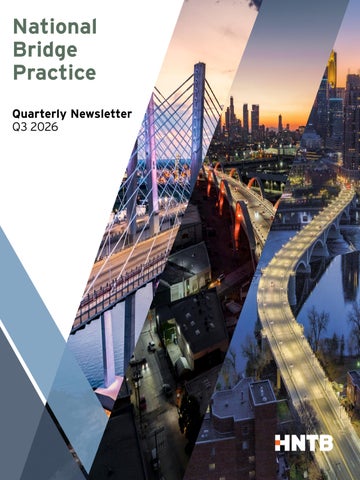
National Bridge Practice Quarterly Newsletter Q3 2026
1
Issue No. 7 Q3/2026 National Bridge Practice Leadership Chris Price Interim National Bridge Practice Lead
Ted Zoli National Bridge Chief Engineer
Christian Brown Rail & Movable Bridge
Seth Medwick Bridge Inspection Program
Tirzah Gregory CED Bridge Lead
Tony Shkurti GLD Bridge Lead
Semyon Treyger WED Bridge Lead
Yung-Nien Wang WED Bridge
Fred Ochoa SED Bridge Lead
FROM THE NATIONAL BRIDGE PRACTICE LEADER HNTB’s bridge practice has been defined by discovery and delivery since the company’s founding in 1914. Throughout that history, every bridge has started with a challenge: connecting people safely, practically, and with purpose. As bridge design professionals, you take on those challenges every day with courage and care. You bring discipline to complex problems, balance creativity with code requirements, and use your judgment to speak up for safety while standing behind sound design decisions when tradeoffs are difficult. That takes focus, confidence, and a real commitment to doing the right thing for the client, the project, and the public. When schedules are tight and the details are difficult, your work matters even more. It takes courage to stay steady under pressure, ask hard questions, and keep safety at the center of every decision. You are designing connections that move communities, support economies, and shape the places we live and work. I am proud of HNTB’s legacy as a bridge design firm, and I am equally proud to be part of our National Bridge Practice. Thank you for the precision, professionalism, courage, and dedication you bring to our clients and to every project we deliver. With gratitude, Chris Price
Rob Rogoff NED Bridge Lead
Interim National Bridge Practice Leader
Larry Rowles MAD Bridge Lead
Jesse Kadekawa Miguel
National Bridge Pract
National Bridge Architecture Lead
Sokol Lluri
Temple Overman
About our Newsletter
National Technical Library Chair
National ABC Committee Chair
Allie Wagner (Project Manager) assembled the National Bridge Practice Newsletter, with information provided by Division Bridge Leads and representatives from the Young Bridge Professional Group.
Allie Wagner
Greg Harrell
National Technical Seminars Chair
Virtual Design & Construction (VDC) Committee Chair
The bridge practice newsletter is published once per quarter.
National Bridge Practice | Q3 2026
04 06 08
Major Project Updates A summary of recent bridge wins and ongoing projects from around the practice
Young Bridge Professionals Leadership Division Leads Jermaine Lawrence Southeast: Ft. Lauderdale/Miami
Southeast Division Spotlight Recent win & a project summary from the Southeast Division
Rachel Wesson
HNTB Legacy Interview – Hans Hutton
Mark Vannoorbeeck
10
Central: North Texas
Great Lakes: Chicago
«Bridge to the Past»
Joshua Philips Mid Atlantic: Alexandria
Emma Healey Northeast: Massachusetts
Stan Musial Veterans Memorial Bridge
Kenneth Sullivan
St. Louis, MO
West: Washington State
14
“Bridge to the Future” A look forward to highlight HNTB innovations in bridge design and construction
Navaz Behkarfar
18
HNTB History Lesson
Behdad Mofarraj
20 22
West: Orange County
Geotech: New Jersey
Article from Steve Hague, PE, SE, HNTB Fellow about the history of our firm
Technology Corner What’s New in CSI Bridge? Our People “Being HNTB” Service awards, certifications & accomplishments, new hires, conference opportunities & presentations, and open bridge positions at HNTB
tice Committee Chairs Anthony Vergara
Jermaine Lawrence
National Software Committee Chair
Young Bridge Professionals Chair
Steve Jacobi
Andy Foden
National Bridge Preservation Chair
National Bridge Preservation Chair
National Bridge Practice | Q3 2026
Office Leads SED
Katy Kolbo – Atlanta Robert Rising IV – Lake Mary Samuel Alfonso – Tampa
CED
Jansen Bundridge – Central States Nathan Greenfield – Central States Justin Rawson – Central Texas Kelly Kennedy – Houston Aravind Tankasala – Gulf Coast
GLD
John Rodrick – Indianapolis Kevin Randall – Ohio Taylor Evans – Michigan Michael Smith – Minnesota Faith Gillen – Wisconsin
MAD
Carley Gonzalez – Capital Region David Bowling – Charleston, WV Nicholas Hart – Raleigh, NC
NED
Dante Guzzi – Maine Hernan Cortez – Connecticut Adi Obeidah – New Jersey Robert Wildish – Northern New England
WED
Calvin Wang – North Cal Pouya Banibayat – Los Angeles
GEO
Olivia Mayleben – New Orleans Ethan King-Polich – Wisconsin Trent Shepherd – Missouri Joseph Patterson – New Orleans
MAJOR PROJECT UPDATES Blatnik Bridge Replacement Contract Value / Fee Construction Value of $929,725,000 Contract Design Fee of $73,200,000 Bridge Practice Leads Andy Kowske (WI) - Project Manager Tom DeHaven (MN) - Design Manager Dan Enser (MN) - Deputy Design Manager Ted Zoli (NYC) - Main Span Lead Tony Shkurti (CHI) - Howard's Pocket Lead Natalie McCombs (KC) - Approach Spans Lead Matt Reigel (NJ) - Geotechnical Lead David Jaromin (CHI) - Deputy Geotechnical Lead Office / Owner Office - Minneapolis, MN Owner - MnDOT and WisDOT
Click Here For More Information
Louisiana Bridge Inspection Retainer HNTB Fees - $4M+ Bridge Inspection Leads - Patrick Roth Office/Owner - Gulf Coast/ LADOTD HNTB Contract Dates - 2026-2032 Location of Projects - Baton Rouge, New Orleans, Shreveport, Lake Charles (all LA), Vicksburg, MS
LADOTD IDIQ Bridge Preservation Services Statewide Fee: $7M Cap Contact: Josh Porter Owning Office: Gulf Coast District
Ongoing Project Recent Win
ATP Airport Extension Fee: $750k Contact: John Dvorak Location: Austin, TX
4
National Bridge Practice | Q3 2026
Hartford Bridge 7 Construction Cost: Approx. $23,750,000 Bridge Lead: Josh Olund Office: Northern New England (178) Owner: Vermont Agency of Transportation (VTrans) HNTB Contract Dates: Opening of New Bridge: October 25, 2024 Bridge Monitoring until December 2028
PennDOT District 4 Local Bridge Inspections HNTB Fee: $4.25M Bridge Lead: Katie Clever Office: 176 (PHI) Contract Dates: Feb ‘26 - Feb ‘31
NCDOT Structures Management Unit Limited Services Contract Fee: $6M Cap Contact: David Hawkins Owning Office: 088 Raleigh
I-4 Express Lanes Project See Southeast Division Spotlight
CEI Services for Venetian Causeway Bridges See Southeast Division Spotlight
LA-1 Phase II Bridge Relocation Leeville to Golden Meadow, Lafourche Parish, LA Contract Value: $6,396,135 First pile driven on December 5, 2022 88% complete with PDA services (482 piles analyzed)
National Bridge Practice | Q3 2026
5
SOUTHEAST DIVI RECENT WIN CEI Services for Venetian Causeway Bridges HNTB has been selected by the Miami-Dade County Department of Transportation and Public Works (DTPW) to provide Construction Engineering and Inspection (CEI) services for the replacement of the Venetian Causeway bridges between Bayshore Drive and Purdy Avenue. Constructed in 1927, the Venetian Causeway extends approximately 2.5 miles and provides a vital connection between Miami and Miami Beach. The causeway and its bridges are designated historic landmarks and are listed in the National Register of Historic Places. After nearly a century of service, the bridges exhibit moderate to severe deterioration and have undergone numerous repairs. The planned replacement bridges will feature increased vertical clearances and resiliency measures to address sea-level rise and improve long-term performance. The structures also will be widened to enhance safety and mobility for all users. HNTB’s scope includes comprehensive construction oversight and inspection services for 10 fixed bridges, one movable bridge, and one temporary bridge. Through these services, HNTB will support the delivery of safer, more resilient infrastructure while helping preserve the historic significance of the Venetian Causeway.
6
National Bridge Practice | Q3 2026
SION SPOTLIGHT PROJECT HIGHLIGHT I-4 Express Lanes Project HNTB’s Tampa office is supporting FDOT through the development of preliminary plans and bridge feasibility assessments for the I-4 Express Lanes Project, which extends approximately 19 miles from the I-75 interchange to just east of the Polk Parkway in Hillsborough and Polk Counties. The project will add one express lane in each direction within the existing corridor, improving mobility and travel reliability along one of Central Florida’s most heavily traveled highways. As part of the effort, the Tampa Structures Team is evaluating 14 bridge widenings, including 12 prestressed concrete beam bridges and 2 steel plate girder bridges. These bridge feasibility assessments will help establish practical widening concepts and support the continued advancement of this important transportation improvement project.
National Bridge Practice | Q3 2026
7
HNTB Legacy Interview HANS HUTTON Hans’ History at HNTB Hans Hutton joined HNTB in 1997, bringing with him 7 years of industry experience, a B.S. in civil engineering from North Dakota State University, and a M.S. in civil engineering from the University of Nebraska. In 29 years at HNTB, Hans has been involved with many iconic cable-stay projects, including the Kosciuszko Bridge in New York City, the Bob Kerrey Pedestrian Bridge in Omaha, NE, and the Stan Musial Veterans Memorial Bridge in St. Louis, MO. While Hans states that he doesn’t have one project that he has enjoyed more than others, he particularly enjoys the role of Engineer of Record. He also enjoys being involved in projects throughout the entire project lifecycle, from pursuit all the way through construction.
Hans Hutton, PE, SE Practice Consultant, KC Chief Bridge Engineer, HNTB Fellow, & Vice President
Kansas City, MO Office Interview conducted by Nathan Greenfield (YBP Central States Co-Lead)
Hans Hutton is the Chief Bridge Engineer in HNTB’s Kansas City office and has served as the Engineer of Record for many of HNTB’s most complex projects. Hans is a vice president, HNTB Fellow, and has been with HNTB for nearly 30 years. Known across the firm for his work on signature bridge projects, Hans has become synonymous with technical excellence, innovation, and unwavering commitment to 4for4 delivery. Few engineers have left a larger imprint on HNTB’s bridge practice than Hans Hutton.
Hans remarks that over the years, he has been involved in approximately 15 to 20 cable-stayed bridge projects. In addition to these cable-stayed projects, he has been involved with several movable bridges, arches, trusses, and suspension bridges. The breadth of Hans’ experience spans across highway, railroad, and pedestrian bridges. In addition to his role at HNTB, Hans serves as a committee member for AREMA, and a Cable Stayed Bridge Committee Member for the Post-Tensioning Institute.
Defining a Leader Hans believes that being a leader means standing up for what is right and leading by example, regardless of the pressure or popularity of the decision. He also states that other marks of great leaders are treating peers with respect, telling the truth, and acting with humility. He emphasized that he believes people should be rewarded for these leadership qualities that sometimes get overlooked.
Buck O’Neil Bridge, Kansas City, MO
8
National Bridge Practice | Q3 2026
A Changing Industry Hans notes that “things have changed a lot” over the course of his 36-year career. In the early days of Hans’ career, structural analysis and design was performed almost exclusively using hand calculations. As one of the first of his peers to work on a computer, Hans has seen the industry evolve to one where complex computer models are commonplace. This development has allowed for the growth of cable-stayed bridges which have become increasingly more common in North America since the widespread adoption of the computer. Hans recalls thinking that “nobody would use” 256 kilobytes of RAM, just a fraction of the amount of computing power needed to run complex models today. Looking to the future, Hans sees the adoption of Artificial Intelligence in its latest iteration to be different than the industry’s attempts in the past. He believes that the sophistication of modern AI “will change our industry more than we have any idea” and that in the future, people will be working for computers rather than computers working for people, as is the case now.
Stan Musial Veterans Memorial Bridge, St. Louis, MO
National Bridge Practice | Q3 2026
Kosciuszko Bridge, New York City
The Mount Rushmore of Mentors Many who have interacted with Hans will point out that he has an affinity for the history of the profession and a deep understanding of how his predecessors have grown and shaped the industry. When asked how mentors have shaped his career, he noted four individuals who have had significant impacts on his career and are outstanding ambassadors of the profession. Two of those individuals are Omer Blodgett and John Fisher. Blodgett was known for his expertise in the field of welding, while Fisher has made a profound impact on the steel industry and the understanding of fatigue and fracture. Hans remarks that both individuals “were true geniuses and humble and respectful to all people.” Another of Hans’ mentors was Maher Tadros. Tadros was a professor of his at the University of Nebraska. Known as an excellent educator and researcher, Tadros prioritized the success of his students, placing that above even his own success. The fourth mentor on Hans’ list was Bill Conway, a former CEO at Modjeski & Masters. Conway began his career as a bridge engineer before rising to the rank of CEO. Hans states that Conway was “the quintessential bridge engineer” who displayed a “mastery of all phases of our business.”
9
Bridge to the Past
Stan Musial Veterans Memorial Cable Stayed Bridge Project: HNTB was the Engineer of Record (EOR) for this bridge – the third longest in the US at the time of construction. The cable-stayed portion consists of a composite steel and concrete superstructure with an 86-footwide roadway and two lanes of traffic in each direction. The two main river piers are each founded on six 11.5-foot diameter drilled shafts anchored into bedrock with 22-foot-long rock sockets. Today, the four-lane I-70 bridge carries 55,000 vehicles per day. The key points to HNTB winning and delivering this award-winning project within budget and schedule were as follows: Collaborating with the Owner for Success: MoDOT and IDOT had different philosophies on leveraging design-build, making advancing the project challenging. HNTB had experience in both states, long-term knowledge of the project, and introduced an innovative approach to project delivery necessary to meet both states’ goals and keep the project moving forward. HNTB became the advisor to the states and worked with them to creatively deliver the plan and in a less expensive way to meet the project goals. Multiple HNTB leaders, including Design Manager Steve Hague were brought to the table in an “institute-like” forum where the project, as it stood, was completely rethought. As a result, the alignment on the Illinois sides was changed dramatically to allow the bridge to be served by both I-64 and I-70. The new solution cost the project only approximately 10 percent more but substantially
10
reduced the overall program by more than 35 percent since the I-70 leg would not need to be constructed. This allowed the project to move forward in Illinois. Project Details Client: MoDOT and IDOT • Design Bid Build • Overall Project Cost: $290M • Final Contract Value (Design): $12M, • Project: 2,772 ft, Mississippi River Crossing featuring a 1,500 ft main span with two 636 ft end spans. Concrete delta shaped pylons that rise 400 ft above the river. Vertical clearance of roadway 80 feet. • Completion Date: 02/2014 (250th anniversary of founding of the city of St. Louis) • HNTB Key Staff: Steve Hague, Larry Rowles, Hans Hutton and Ted Zoli.
National Bridge Practice | Q3 2026
e (I-70) | St. Louis, MO Innovative Approach to Project Delivery: At the time of this project, IDOT was not permitted to implement design-build delivery. Understanding the many benefits of collaborative delivery and the value of early contractor involvement, HNTB worked with MoDOT to implement a design-phase alternative technical concept (ATC) program to deliver this project within budget. This approach allowed MoDOT to capture significant cost savings while HNTB retained the responsibility as EOR. HNTB collaborated with Massman-led joint venture (JV) to construct this award-winning structure.
DBE/Workforce Diversity: Through collaboration, the owner and team learned that the community wanted the workforce to reflect the St. Louis community. Hearing this, MoDOT asked the project team to track not only DBE/WBE participation, but workforce diversity. While it was not a formal goal or contractual obligation, HNTB hired a DBE consultant to track the percentage of time on the job by race and gender. Schedule: HNTB delivered the final design of the cable-stayed unit and approaches in less than one year while meeting MoDOT's DBE and workforce diversity goals.
Coordination with Regulatory Agencies, Utilities, and Other Stakeholders: To ensure smooth transitions between planning, design and construction phases, HNTB coordinated with numerous regulatory agencies, including USACE, USCG, and the Environmental Protection Agency (EPA), among other regional and local agencies.
National Bridge Practice | Q3 2026
11
Bridge to the Past
Stan Musial Veterans Memorial Cable Stayed Bridge (I-70) | St. Louis, M Quality: For design, HNTB developed a projectspecific QA/QC manual and provided training to the various subconsultants which incorporated their standard processes. Massman created a project specific QMP including a full-time on-site quality manager, QC inspectors, testing procedures, material handling processes, QC documentation and record control, QC hold points, corrective action procedures, and tiered QC inspection for subcontracted work. QA for construction was provided by MoDOT. Together, these controls delivered the project efficiently and to MoDOT’s expectations.
Safety: Corporate safety programs from the JV partners were merged into a project safety plan emphasizing the worker’s personal responsibility for team safety. Each worker was empowered to stop work should an activity endanger a worker or the public. Major Project Awards – 2016 American Institute of Steel Construction (AISC) Prize Bridge Award – Major Span 2015 National Council of Structural Engineers Association (NCSEA) Excellence in Structural Engineering Award 2015 American Council of Engineering Companies (ACEC) National Honor Award
Courtesy Massman
12
National Bridge Practice | Q3 2026
MO
Courtesy Massman Project Links: Stan Musial Veterans Memorial Bridge – HNTB Stan Musial Veterans Memorial Bridge Opens Stan Musial Veterans Memorial Bridge
National Bridge Practice | Q3 2026
13
Bridge to the Future
Route 1&9T/New Road Contract 2 | Jersey City, NJ
HNTB is the lead designer for the New Road Program and is currently providing construction support of Contract 2, which includes the replacement of NJ TRANSIT Structure 2.18 carrying the Morristown and Essex (M&E) Line and Structure 2.18 (WYE). The project required balancing complex geometric constraints with the operational demands of one of the busiest rail corridors in New Jersey and the country, where commuter trains pass approximately every six minutes during peak service periods. Construction of Contract 2 is anticipated to be completed in late 2026, approximately one year ahead of schedule. A Modern Take on the Railroad Truss One of the project's most innovative elements is the replacement of the WYE track bridge. The new bridge is constructed on a shifted alignment that improves constructability and minimizes impacts
14
to railroad operations during construction. However, the revised geometry and increased span length required the design team to move beyond traditional railroad bridge solutions. After evaluating conventional through-girder and truss alternatives, the team selected a 160-footlong gusset-less steel truss. Building on experience gained from HNTB's design of the Memorial Bridge in Portsmouth, New Hampshire, the design team collaborated with railroad bridge experts across the firm to validate and refine the concept for application on an active freight and passenger rail corridor. Unlike conventional trusses that rely on gusset plates at panel points, the gusset-less configuration uses moment-resisting connections between truss members. The resulting structure
Preconstruction / Existing Conditions of Project Site, Looking South
The New Jersey Department of Transportation (NJDOT) Route 1&9T/New Road Program is a key component of New Jersey's long-term strategy to improve freight mobility and reduce congestion along the heavily traveled Route 1&9/Tonnelle Avenue corridor in Jersey City. Once completed, the new 1.6-mile roadway will provide a parallel north-south route connecting the NewarkElizabeth port complex, rail facilities, warehouses, and distribution centers throughout Hudson County. By diverting truck traffic from local streets and improving regional freight movement, the project will enhance safety, reduce congestion, and improve quality of life for nearby communities. The overall program was divided into three construction contracts, with Contract 2 focused on replacing two existing NJ TRANSIT railroad bridges to accommodate the new roadway alignment.
National Bridge Practice | Q3 2026
Completed WYE Track Gussetless Truss, West Elevation improves redundancy, simplifies fabrication and erection, and reduces long-term inspection and maintenance requirements. The innovative detailing also allows floor beams to be placed between truss joints, eliminating stringers and simplifying the floor framing system. Today, the Structure 2.18 (WYE) bridge stands as the first gusset-less truss railroad bridge in service, demonstrating HNTB's ability to adapt proven innovations to complex infrastructure challenges. Fun Fact Structure 2.18 (WYE) is only the second gusset-less truss bridge constructed in service in the United States, following HNTB's Memorial Bridge in Portsmouth, New Hampshire.
Building Beneath One of New Jersey's Busiest Rail Corridors While the WYE bridge introduced a novel structural solution, replacement of the adjacent M&E Line bridge presented a different challenge: how to perform major bridge replacement while maintaining rail service for approximately 50,000 daily passengers. The replacement structure carries three tracks and is a 90-foot steel through-girder bridge constructed on a shifted alignment. Because portions of the proposed bridge overlap the footprint of the existing structure, conventional construction methods would have significantly disrupted rail operations. Instead, the design team developed a series of accelerated bridge construction (ABC) solutions that allowed work to proceed while minimizing outages. One of the most innovative elements was the use of a temporary prefabricated jump span beneath the active tracks. The jump span enabled construction of the new east abutment while trains continued operating above, significantly reducing impacts to service. On the west side, limited overhead clearance beneath the existing bridge required the use of micropile foundations and precast abutment components that could be installed during short outage windows. The project sequencing was further complicated by the close proximity of the WYE bridge immediately north of the M&E bridge. Careful coordination between design, construction, and railroad operations teams allowed the new WYE bridge to be constructed first, creating the space necessary for subsequent bridge replacement activities.
National Bridge Practice | Q3 2026
15
Bridge to the Future
Route 1&9T/New Road Contract 2 | Jersey City, NJ Accelerated Construction in Action A cornerstone of the M&E bridge replacement strategy was the use of accelerated bridge construction techniques. The original plan called for lateral slide operations to remove the existing superstructure and install the new bridge during limited weekend outages. During construction, however, NJ TRANSIT requested that an existing signal and communications cable tray mounted to the existing bridge remain in service. Working closely with the contractor and owner, HNTB rapidly evaluated alternatives and supported development of a modified demolition plan utilizing self-propelled modular transporters (SPMTs). The existing bridge superstructure was successfully rolled out during a full weekend outage in June 2025, with the roll out operation completed in approximately one hour. The installation of the proposed bridge superstructure utilized a similar SPMT operation under three-track full weekend outage in November 2025. The ability to respond quickly to changing field conditions while maintaining project objectives highlights the value of close collaboration among the owner, contractor, and design team throughout construction.
Delivering Value Through Innovation Beyond the technical innovations, the Route 1&9T/New Road Program demonstrates the benefits of integrating design, constructability, and operations into a single solution. In Contract 2, the gusset-less truss reduces future maintenance demands while improving redundancy. Accelerated bridge construction methods minimize interruptions to NJ TRANSIT service through a critical rail corridor. Detailed staging and sequencing plans have allowed the contractor to advance construction efficiently while managing risk in an exceptionally constrained environment. The collective result of these innovations is a project that is currently more than 400 days ahead of schedule. Recognized as the 2026 ASCE New Jersey Section Project of the Year, the project serves as an example of how innovative bridge engineering can support broader transportation objectives. Together, the replacement railroad bridges will help unlock a vital freight corridor for northern New Jersey while ensuring safe and reliable rail service for the traveling public. The result is infrastructure that strengthens both regional mobility and economic competitiveness for decades to come.
Bottom Chord Assembly of WYE Track Gussetless Truss
16
National Bridge Practice | Q3 2026
Upper Chord Assembly of WYE Track Gussetless Truss
Jump Span Superstructure Unit Installed
Jump Span Elevation with East Abutment Footing Rebar Cage
National Bridge Practice | Q3 2026
Completed WYE Track Gussetless Truss
17
HNTB’s Family Tree Steven T. Hague, PE, SE, HNTB Fellow While at the National Bridge Practice meeting in Charlotte this past June, I had a couple of conversations regarding HNTB’s history. Our founders, our projects that have won the ACEC Grand Conceptor Award (the winners can be found here: ACEC Grand Conceptor Award Winners), our general bridge-specific history and other miscellaneous items. Much of that history is captured in two books published by the firm: Diversity by Design: Celebrating Seventy-Five Years of Howard Needles Tammen & Bergendoff and Being HNTB: The Story of HNTB, published for our 75th anniversary and centennial, respectively. At the time, I recommended to a couple of you, and now to the entire bridge practice, to find a copy of these books in your office if you’re interested in learning more. As you all know, HNTB dates our founding to 1914; however, our roots precede that date by over a quarter century. We can trace our lineage to John Alexander Low Waddell, a graduate of Rensselaer Polytechnic Institute in 1887, through several partnerships that ultimately led to the HNTB we know today. But there are other firms that can also trace their origins to Waddell. We, and these other firms, are then “cousins” in a way and are all a part of what I call our Family Tree. Waddell, a Canadian, graduated from RPI in 1875. After several years of design and teaching, he settled in Kansas City in 1886 and started his business as a private engineering consultant in 1887. As his business became increasingly successful, he began adding staff, and in 1899, named Ira G. Hedrick to be his partner and included him in the name of his company, Waddell & Hedrick. According to the Arkansas Department of Transportation publication A Contextual Study of Historic Highway Bridges in the State of Arkansas, Hedrick dissolved his partnership with Waddell and 18
went on to found several firms including Hedrick & Cochrane in 1907 and Hedrick & Hedrick in 1916. It was Ira Hedrick’s Broadway Bridge in Little Rock that HNTB modified in 1974 for the McClellan-Kerr Arkansas River Navigation System and replaced in 2017. It may be that some of Hedrick’s firms or their successors are still in business. When the Waddell and Hedrick partnership ended, Waddell chose John Lyle Harrington to be his new partner. Harrington had been a protégé of Waddell’s for many years before joining his firm in 1907. By 1913, there was some friction between the firm’s partners and ultimately they elected to end their partnership. Waddell then took his son and a couple of other engineers from the firm and began a new firm, Waddell & Son with Needham Everett Waddell in 1916. When Waddell chose to relocate the firm to New York City in 1920, Needham chose to stay in Kansas City. Waddell once again found himself on his own and in 1927 took Shortridge Hardesty as a partner in the firm Waddell & Hardesty, a firm which continued to carry Wadell’s name for 7 years after his death in 1938. In 1945, Hardesty took on Clinton Hanover as a partner in the firm of Hardesty and Hanover, which still operates under that name today. Meanwhile, Harrington chose two employees who National Bridge Practice | Q3 2026
Bergendoff. Finally, in 1993 the partnership, chose to incorporate for several reasons; some of which are listed in Being HNTB. Over the years, others have left our company and set out on their own, or with others. Some of these are still in business and others have been acquired, merged or simply failed. Nevertheless, HNTB Corporation has a rich history in bridge engineering, along with other firms and our “cousins” who may also trace their engineering legacy to John Alexander Low Waddell. had originally been hired by Waddell & Hedrick, Ernest Howard and Louis Ash, and in 1914 began the partnership of Harrington, Howard and Ash, which we recognize as HNTB’s origin. By 1928, another divorce was underway, and Harrington and Howard divided the firm into two. They divided the projects that were in process and all the firm’s property between them. I had the opportunity several years ago to read the agreement which included the division of computation files on all their projects and an agreement that should one of the successor firms need access to the other’s files it would not be denied.
There is so much more to our history than the names of firms. There are the engineers who do the work, the projects that span our nation, and the clients who trust us to deliver their most complex projects. It’s a proud tradition and I’m glad to have had a small part in it.
John Lyle Harrington and one of the engineers from Waddell formed the firm of Harrington and Cortelyou, which operated under that name until acquired by Burns & McDonnell in 2010. Ernest Howard and Louis Ash added Enoch Needles and Henry Tammen as partners in 1928 and operated as Ash, Howard Needles and Tammen from 1928 until 1941. Although Ash died during the construction of the Mississippi River Bridge at Vicksburg in 1930, the firm retained his name until 1941. At that point, Ruben Bergendoff was named as a partner in the firm and the name changed to Howard, Needles, Tammen & Announcement of the dissolution of the firm “The Divorce Announcement” - 1928 National Bridge Practice | Q3 2026
19
Bridge Software Update: What’s New in CSiBridge? By Anthony Vergara
When Requests Become Reality Through regular meetings with CSiBridge technical representatives, HNTB continues to advocate for enhancement requests that improve bridge design workflows and influence the future development roadmap of CSiBridge. One of the major pending enhancements of the software includes a new design request for cross-frames. This enhancement was created and championed by the Central States Bridge Group for inclusion in the software with initial implementation as early as version 28. Primary details of the proposed enhancement include: 1) More refined geometry, including added work points and software-calculated braced lengths of members. 2) Table for geometry output. Displays loading information of the frame member at each joint for maximum demand and the concurrent force effects in the other connecting frame member. 3) Design check of axial capacity calculations similar to the girder design report.(1st Phase).
Other HNTB Enhancements in Development 1) Create static load case from LL analysis for the purpose of concurrent forces in other members, similar to LARSA 4D and MIDAS (pending release – may be v27.2). 2) Run design requests for selected girders (avoid having to run all girders). 3) For bridge object models, export deflections to tables similar to how Bridge Object Girder Forces are exported. 4) Use the bridge object to apply loads directly to the girder elements, e.g., wind loads or other construction loads. 5) Report controlling load case in an envelope for a specific member. Upcoming general enhancements in v27.2 (Release Date – TBD) 1) AASHTO LRFD 10th Edition support for Steel IGirder Design Requests 2) Dedicated P-Y springs for foundation objects 3) Upgrade to .NET 10 (improved performance in the software and through the API) Long term enhancements (1 to 2 years) • BrDR integration to import the BrDR XML files into CSiBridge. • AI-driven tools for model results and output.
20
National Bridge Practice | Q3 2026
But Wait, There’s More… CSiBridge Express! This program was originally created by CSi as standalone software application to aid in the simplified, menu-driven design of concrete bridges while still using CSiBridge’s finite element modeling capabilities. Much like Bentley’s LEAP Bridge Concrete, this software features an auto-design function and incorporates the AASHTO LRFD specifications to generate an initial design for further analysis. While it currently supports only precast concrete I-girders and box beams, steel I-girder design is in development for line girder analysis and design of straight steel bridges. The major update is that CSiBridge Express will be incorporated in future CSiBridge releases (perhaps by v28), so be on the lookout for another design tool!
National Bridge Practice | Q3 2026
21
Our People “Being HNTB” Please join us in congratulating and welcoming your colleagues! SERVICE AWARDS 35
50
Mohammadreza Gramy (NY)
Adrian Nicoara (DAL)
20
15
Justin Steinhouse (NY)
Besian Xhixho (NY) Kiva Lints (SEA) Kevin Brayley (PORT)
5 Praveen Majjigapu (DES) Mark Maresko (OVP) Ryan Rogowski (KCO) Michael Golder (NRT) Jared Mace (NRT) Hiren Prajapati (BAL) Scott McKnight (ATL)
25
Taylor Evans (MICH) Yao Wang (MICH) Jonathan Maynor (CHWV) Brian Hansen (SAC) Kevin Randall (OHIO) Thomas DeHaven (MIN)
Jinil Noh (NY)
10 Ayman Bataineh (NJ) Ope Adediji (NJ) Alexander Wen (KCO) Katy Kolbo (ATL) Italo Couto (NJ)
PROFESSIONAL CERTIFICATIONS / ACCOMPLISHMENTS Tasnim Alam (ALX) – Passed the FE Exam Michael Smith (MN) received his PE License (MN) Will Reils (IN) passed the PE Spiro Vlahos (CHI) passed the PE Kayla Leady (CHI) passed the PE Greg Brewer (King of Prussia, PA) passed the PE Exam Julia Szabla (Philadelphia, PA) passed the PE Exam Nhi Nguyen (OKC) – Promoted to Engineer I Elle Dragone (KCO) – Promoted to Engineer I Katie Mancinelli (BOS) – New Bridge Department Manager Ryan Marchall (BOS) – New role as Project Manager I Josh Clogston (LEX) – Promoted to Project Manager II Kove Lambert (LEX) – Promoted to Engineer II Reanne Burgess (BOS) – Promoted to Engineer II Katy Kolbo (ATL) – Promoted to Senior Project Engineer Maxwell Coar (NY) – Member and subcommittee lead of the SEI Fire Protection Committee Osmany Alfonso (MIA) – Accepted an award in the category “Florida’s Best in Construction – Bridge” by the Florida Transportation Builder’s Association for the Reconstruction of SR25/Okeechobee Rd from East of NW 107th Ave. to East of NW 116th Way Katy Kolbo (ATL) – Was recognized by Engineering Georgia as one of the 35 under 35 women to know in GA engineering Robert Hill, Jr (HBG) – Named Chair of the Civil Engineering Department Advisory Board for Penn State Harrisburg
22
National Bridge Practice | Q3 2026
NEW HIRES • • • • • • • • •
Iris Rodriguez (7.6) – Engineer I (OKC) Taylor Wiseley (7.6) – Engineer I (NRT) Lucinda Doogan (7.27) – Engineer I (NY) Elias Boumis (7.27) – Project Manager II (NY) Pablo Ulargui Ramos (8.3) – Engineer I (SEA) Usman Khan (8.10) – Project Engineer (NY) Emily Ellis (8.17) – Engineer I (PHL) Amber Lyons (8.17) – Engineer I (BOS) Christian Alcantara (8.24) – Technician II (NY)
• • • • • • • • •
Jorge Gutierrez Flores (8.24) – Engineer I (NJ) Fareezuddin Mohammad (8.31) – Project Engineer (NY) Tony Lobaito (9.8) - Technician I (DES) Charlotte Olin (9.8) – Engineer I (HAR) Quinn Akerman (9.8) – Engineer I (NY) Wayne Gregory (9.14) – Technician Specialist (KCO) Kimberly Streicher (9.21) – Sr. Project Engineer (LEX) Philip Torikian (9.22) – Intern Engineer (PHI) Maria McNicholas (9.28) – Engineer I (PHI)
Below is a summary of key bridge-related job requisitions at HNTB. Please note that these do not represent ALL of the current bridge openings – there are many more across the company!
Division
Job Requisition
Central
Project Manager - Bridge
R-29599
Central
Project Manager-Bridge
R-30182
Central
Bridge Inspection Senior Project Manager
R-30879
Great Lakes
Geotechnical Engineering Practice Leader
R-29492
Great Lakes
Sr. Project Manager - Bridges & Structures
R-30219
Great Lakes
Bridge Technical Advisor
R-30865
Mid Atlantic
Project Manager II - Bridge
R-29856
Mid Atlantic
Project Manager II - Engineering
R-30590
Northeast
Senior Project Manager - Structures
R-30166
Northeast
Geotechnical Section Manager
R-30675
Sr. Structures Engineer
R-31130
West
National Bridge Practice | Q3 2026
Requisition Number
23
Upcoming Conferences International Cable Supported Bridge Operators Conference (ICSBOC)
Sept 13-17
Malmo, Sweden
AREMA 2026 Annual Conference & Expo
Sept 13-16
Kansas City, MO
ACI Concrete Convention
Oct 11-14
Atlanta, GA
NE and Midwest Bridge Preservation Partnership Meeting
Oct 13-15
Chicago, IL
NSBA Fall Collaboration Meeting
Oct 20-22
Minneapolis-St. Paul, MN
2026 Design-Build Conference & Expo
Nov 4
Cleveland, OH
Biennial Heavy Moveable Structures Symposium
Nov 2-5
Tampa, FL
ASBI 2026 Annual Convention
Nov 9-11
San Antonio, TX
IBTTA - 94th Annual Meeting
Nov 11-15
Arlington, TX
2026 World Bridge Engineering Conference
Dec 1-2
Miami, FL
2027 TRB Annual Meeting
Jan 10-14
Washington, DC
Conference Presentations Jansen Bundridge (KCO) AREMA 2026 Annual Conference & Expo Modular Bridge Solutions for Rail Network Resilience: The BNSF TPG Standard 2026 World Bridge Engineering Conference Rapid Rail Bridge Replacement with Modular TPG Spans
Dan Millman (Presenter) & Peter Wang (White Paper) (NY) Biennial Heavy Moveable Structures Symposium Design of Large Sheaves for Movable Bridges
Christopher White (HOU) ASBI 2026 Annual Convention The San Antonio "Y" at 40, America's First Span-by-Span Segmental Urban Viaduct
Aamir Durrani (OC) 2026 World Bridge Engineering Conference Seismic and Dynamic Considerations for Special Complex Category High-Speed Rail Structures
24
National Bridge Practice | Q3 2026
TELL US WHAT YOU THINK! Thank you for taking the time to read the National Bridge Practice Newsletter. We hope this has helped you to gain a better understanding and appreciation for all things bridge-related at HNTB, and to learn more about what HNTB’s bridge practice has accomplished recently. Are you following our HNTB LinkedIn account? Check us out at www.linkedin.com/company/hntb