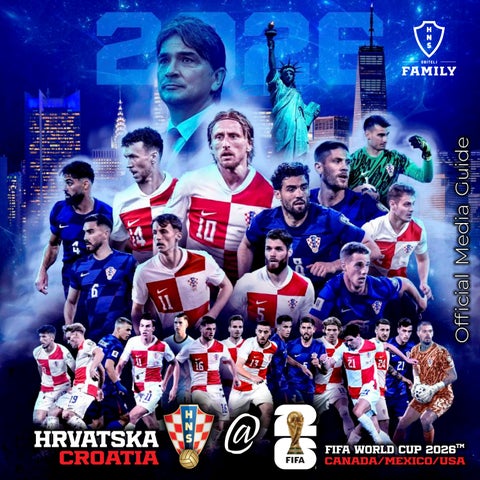
Official Media Guide
HRVATSKA
CROATIA
@
FIFA WORLD CUP 2026
TM
CANADA/MEXICO/USA
100
CROATIA @ 1998 FIFA WORLD CUP FRANCE™ - BRONZE MEDAL CROATIA @ 2018 FIFA WORLD CUP RUSSIA™ - SILVER MEDAL CROATIA @ 2022 FIFA WORLD CUP QATAR™ - BRONZE MEDAL CROATIA @ UEFA NATIONS LEAGUE FINALS 2023™ - SILVER MEDAL CROATIA @ UEFA FUTSAL EURO 2026™ - BRONZE MEDAL
95
75
25
5
0
0-II 5. lipnja 2026. 11:00:28
4 6 8 10 14 18 20 22 24 26 30 31 32 37 38 42 48 50 54 56 58 62 64 68 70 74 76 78 82 84 88 90 94 98 100
Marijan Kustić | HNS President Zlatko Dalić | Head coach Croatian Football Federation | About us Presidents, General secretaries and Head coaches Croatian football history International individual awards Accomplishments & Awards Croatians on top of Europe and the World Road to FIFA World Cup 2026™ All competitive matches of the Croatia national football team in history CROATIA @ FIFA World Cup 2026™ | Head coach CROATIA @ FIFA World Cup 2026™ | Coaching staff CROATIA @ FIFA World Cup 2026™ | Team CROATIA @ FIFA World Cup 2026™ | Delegation members, Medical staff & Logistics Luka Modrić | The heart of Croatian football Croatian internationals Home for Croatian team during World Cup | Alexandria UEFA EURO 1996 ENGLAND | A masterpiece debut 1998 FIFA WORLD CUP FRANCE | They came, they saw, they amazed the world 1998 GOLDEN BOOT | Davor Šuker 2002 FIFA WORLD CUP KOREA/JAPAN | Three-minute frenzy not enough UEFA EURO 2004 PORTUGAL | Effort present, reward absent 2006 FIFA WORLD CUP GERMANY | Emotional rollercoaster without a happy-end UEFA EURO 2008 AUSTRIA/SWITZERLAND | Haunting heartbreak UEFA EURO 2012 POLAND/UKRAINE | Quality work undone by finalists 2014 FIFA WORLD CUP BRAZIL | Opening festivities, closing calamities UEFA EURO 2016 FRANCE | Old place, new fire 2018 FIFA WORLD CUP RUSSIA | (Un)real UEFA EURO 2020 EUROPE | Refusing to disappoint 2022 FIFA WORLD CUP QATAR | Oops, they did it again UEFA NATIONS LEAGUE 2023 | Per aspera ad astra UEFA EURO 2024 GERMANY | The curse of the final seconds The Republic of Croatia | A Jewel on the Adriatic Croatia | A Nation of Athletes HNS Family
Publisher: Hrvatski nogometni savez / Croatian Football Federation, Ulica grada Vukovara 269a, Zagreb Published in June 2026 | Editor: Marko Cvijanović | Graphic and Technical Editor: Nikša Martinac Journalists: Tomislav Pacak, Ivona Hemen, Borna Rupnik | Photo: Drago Sopta, HNS Archives, FIFA, UEFA, CROPIX www.hns.family
x.com/HNS_CFF
www.tiktok.com/@hns.family
facebook.com/cff.hns
instagram.com/hns_cff
hr.linkedin.com/company/croatian-football-federation
youtube.com/@hns.family www.weibo.com/u/7375804392
Dear football friends,
Another FIFA World Cup is upon us – the most cherished competition for every football fan in Croatia and a new opportunity for the Croatian national team to showcase itself on the grandest stage of world football. Few national teams can speak of the consistency of success that Croatia has achieved over the past decade, which is why we approach this tournament with great pride and great optimism. The years behind us have secured a permanent place in the history of Croatian sport. The silver medal in Russia, the bronze medal in Qatar, and the silver medal in the UEFA Nations League are achievements that have firmly established Croatia among the most respected national teams in the world. These successes are not the product of luck or coincidence, but rather the result of quality, unity, dedication, hard work and character that have defined this team for years, as well as the systematic development of Croatian football. Special gratitude goes to head coach Zlatko Dalić and captain Luka Modrić, symbols of an extraordinary era in Croatian football. Their leadership, combined with the experience of our senior players and the energy of a younger generation, has enabled Croatia to remain competitive at the very highest level through several consecutive competition cycles and the inevitable generational transitions we have witnessed along the way. What particularly pleases me is the fact that this team still possesses the same hunger for success that has defined it at previous tournaments. Regardless of everything they have already achieved, our players are always seeking a new challenge and a new opportunity to bring joy to the Croatian people. That desire to prove themselves is one of the foundations of all our greatest achievements.
We are fully aware that an exceptionally demanding tournament lies ahead – one being held across a larger territory than ever before and featuring more teams than ever before. There are no easy opponents at a FIFA World Cup, and every match demands the highest levels of concentration, quality and character. At the same time, we have tremendous faith in our team. We believe in its knowledge, experience and unity, values that have brought Croatia so much success time and again. I would also like to extend a special thank you to our supporters, who are one of the defining symbols of the Croatian national team. Wherever we play, we feel their support and the pride they share with our players. I am certain that this will once again be the case at this World Cup, where our Croatian communities in the United States and Canada will provide us with additional strength after eagerly awaiting this opportunity to support the national team on their own continent. No one can guarantee a particular result at a tournament of this magnitude. What I can guarantee is that the Croatian national team will give everything it has to represent its homeland with pride and dignity, just as it has done so many times before.
Let us enjoy another unforgettable tournament together! Marijan Kustić President of the Croatian Football Federation
Dear supporters, Every major tournament brings special emotions, and the FIFA World Cup holds a unique place in the heart of every player, coach and fan. When you represent Croatia on the greatest stage in world football, you feel pride, responsibility and gratitude for the opportunity to be part of something that transcends sport. A new great challenge lies ahead of us. The FIFA World Cup brings together the best national teams in the world, and this edition will be bigger than ever before. More matches, more opponents and more challenges. That is precisely why qualification for a tournament of this magnitude should never be taken for granted – something four-time world champions Italy know better than anyone, having not appeared at the final tournament since 2014. When I look at our national team, I see a group of players I can be immensely proud of. I see character, unity and professionalism, qualities that have defined us at previous tournaments where we achieved remarkable and unforgettable results. I see players who have accomplished extraordinary things throughout their careers, yet still possess the same desire to work hard, improve and prove themselves. That is one of this team's greatest strengths. Many of our players already know what it means to play in the biggest matches and compete for medals at the highest level. At the same time, a new generation brings additional energy, hunger and motivation. This combination of experience and youth gives us every reason for belief and optimism.
Over all these years, we have learned that talent alone is not enough. Croatia has built its greatest successes on unity, humility, discipline and mutual trust. These are the values we strive to demonstrate in every training session and every match. When we play as a team and when everyone puts the collective goal ahead of personal interests, we become the best version of ourselves. I would like to express my special gratitude to our supporters. Their support follows us wherever we play and often gives us additional strength in the most difficult moments. I am certain that we will once again feel their love for the national team at this World Cup, whether in the stadiums, in Croatia or around the world. I do not want to make grand promises. In sport, no one can guarantee a result in advance. What I can promise is that the Croatian national team will give everything it has in every match, fight for every metre of the pitch and wear the Croatian jersey with pride. I believe in this team. I believe in its character. I believe in Croatia. Let us enjoy another FIFA World Cup together.
Zlatko Dalić Croatia national team Head coach
HRVATSKI NOGOMETNI SAVEZ CROATIAN FOOTBALL FEDERATION Founded: 13. 6. 1912 FIFA affiliation: 17. 7. 1941 / 3. 7. 1992 UEFA affiliation: 17. 6. 1993 President: Marijan Kustić Most caps: Luka Modrić (198) Top scorer: Davor Šuker (45) National team nickname: Vatreni (meaning: The Fiery Ones) FIFA World Cup - 7 final tournaments out of 8 competitions (since 1998) UEFA EURO - 7 final tournaments out of 8 competitions (since 1996)
TM
1/4 Bronze did not group group group final medal qualify stage stage stage
2023
1/4 did not group group round Silver round Bronze Silver group qualified final qualify stage stage of 16 medal of 16 medal medal stage
All time record: 399 matches; 210 wins - 105 draws - 84 losses; goal difference: 695:403 Data correct as of 10 June 2026 1
50
100
FIFA code:
CRO
FIFA World Ranking 3rd place - 1999
Best ranking: Worst ranking: Current ranking:
125th place - 1994 th
11 place - 10/06/2026
Top scorers (20+): 45 Davor Šuker 38 Ivan Perišić 36 Andrej Kramarić 33 Mario Mandžukić 29 Luka Modrić 29 Eduardo da Silva 22 Darijo Srna 20 Ivica Olić
Most caps (100+): 198 Luka Modrić 154 Ivan Perišić 134 Darijo Srna 116 Andrej Kramarić 114 Stipe Pletikosa 113 Mateo Kovačić 106 Ivan Rakitić 105 Josip Šimunić 105 Domagoj Vida 104 Ivica Olić 103 Vedran Ćorluka 100 Dario Šimić
First / Second kit:
2
Republic of Croatia | Area: 56,594 km | Population: 3,871,833 (2021)
2024
2022
2020
2018
2016
2014
2012
2010
2008
2006
2004
2002
2000
1998
1996
200
1994
150
Executive Committee of the Croatian Football Federation top row: Đuro Bukvić, member; Josip Kuterovac, member; Nenad Črnko, member; Ante Kulušić, member; Slavko Prišćan, member; Darko Raić Sudar, member; Mario Smodlaka, member; Kristijan Antolović, member bottom row: Drago Lucić, member; Božidar Šikić, member; Davor Ivić, vice-president; Nenad Horvatić, vice-president; Marijan Kustić, president; Ante Vučemilović-Šimunović, first vice-president; Damir Mišković, vice-president; Ile Topuzović, vice-president; Robert Markulin, member
Croatian Football Federation Management
Petar Krpan Željka Zuanović Jurica Bodrožić Head of Football Finance Head of Development Director General Affairs
Josip Tomaško General Secretary
Vladimir Iveta Deputy General Secretary
Ante Cicvarić Marketing and Promotion Director
Andrea Dokuš Anđelko Ivanjko Miroslav Marković Tomislav Pacak Igor Pristovnik Head of Head of Head of Safety, Head of Head of Competition Referees Prevention Infrastructure Communications Department Department and Integrity and Investments
Iva Olivari Deputy General Secretary
Stipe Pletikosa Technical Director
Ivančica Sudac Head of Club Licensing
Zoričić
Graf
Splivalo
Ćilić
Bajakić
Viđak
Marković
Grabovac
Kolić
Vedriš
Čop
Kustić
Srebrić
Hügl
Barić
Hitrec
Knežević
Šuker
Jakopić
Jozić
Kraljević
Kranjčar
Bogatec
Španjol
Brodarac
Vidošević
Šuklje
Cuvaj
Tepšić
Kustić
Wölfl
Bilić
Vračarić
Matovinović
Vrbanović
Lemešić
Hršak
Kovač
Huber
Veselinović
Mikša
Pavlović
Tomaško
Poklepović
Štimac
Ranogajec
Šoić
Svetina
Jerković
Bakrač
Jurić
Kinert
Blažević
Čačić
Ivić
Dalić
0
F ir
tb st foo all in C ro
upanja 1 in Ž 88
.
ia, at
Newspaper article about the first unofficial match of the Croatian national team against Slavia in Prague (1907).
First official match of the Croatian national team against Switzerland in Zagreb on 2 April 1940.
Croatian football history Croatia. A small country for big football achievements. It would be quite enough to just write that when it comes to Croatian football. And yet... The rich history of Croatian football, of course, carries much more. Although... When the Vatreni sensationally won the bronze medal at the World Championship in France in 1998, no one could have thought that in the years that followed it would become a common practice. The first official Croatian international match after gaining independence was an October 1990 friendly between Croatia and USA, played at Maksimir Stadium in Zagreb. Afterwards, Croatia was successful in the EURO 1996, qualifying and later secured quarterfinal stage. Two years later at the FIFA World Cup in France the national team won the bronze medal. At the same tournament Croatia striker Davor Šuker was the top goalscorer with six goals and has therefore won the Golden Boot award. Additionally, Šuker is the top Croatian goalscorer in history with 45 goals (69 caps). Everyone then thought that it was a success that would be difficult to repeat, but... Twenty years after the great achievement in France, the generation led by captain Luka Modrić achieved the greatest success in the history of Croatian football by winning a silver medal at World cup in Russia 2018. The best promotion for Croatian football in Russia was the Golden Ball in the hands of Luka Modrić. No one was left indifferent, and no one will ever be, to Croatia’s performances at Russian pitches and to the brilliance of the tournament’s best player. Many thought: now and who knows again... They were wrong. Croatia won another medal again at the next World Cup and continued the trend of "a small country for big football achievements". The Vatreni won the golden bronze in Qatar and continued the continuity of great
results. And again, it didn't end there either. In the third edition of the UEFA League of Nations, Croatia qualified for the final tournament and won the silver medal! Unfortunately, the gold slipped away by a few centimeters, the penalties did not go to the Vatreni this time. After the fantastic semi-final victory over the Netherlands, Croatia played another big game in the final against Spain, but luck was on the opponent's side this time. Croatia began its 2026 FIFA World Cup qualifying campaign in impressive fashion. Drawn into a group with the Czech Republic, Montenegro, the Faroe Islands and Gibraltar, the Vatreni opened the qualifiers with a convincing 7:0 away victory against Gibraltar before defeating their main rivals, the Czech Republic, 5:1 in Osijek. Croatia maintained its excellent form throughout the campaign, collecting seven wins and one draw in eight matches, finishing first in the group and securing direct qualification for the 2026 FIFA World Cup in the United States, Canada and Mexico. With 26 goals scored and only four conceded, Zlatko Dalić's side once again demonstrated the quality, consistency and competitive spirit that have characterized one of the most successful periods in Croatian football history. In its short history since gaining independence, Croatia has secured 14 major competitions berths in 16 qualifying rounds, and has produced many successful and talented players. Long Croatian football history dates back to the end of the 19th century, when the English came to Rijeka to build a factory and in their free time played the first football matches on Croatian soil, although the Croats didn't participate.
First match of the Croatian national team in modern history against USA in Zagreb on 17 October 1990.
The English industrialists have afterwards arrived to the Croatian city of Županja. Upon their arrival, they have started to employ local people, and then taught the young citizens of Županja their games, especially football. The English spent their after-work time playing with a small, round, compact leather ball. They passed the ball, kicked it around and soon they explained the rules of the game to the locals and finally left them the ball as a gift. Football continued to be played in Županja, while the first football was found in 1979 in the Vladimir Nazor Street, in a typical bordercrossing guardhouse, approximately two centuries old. The ball was made from natural leather with flaps, one of which was missing. The owner inherited the ball from his ancestors, employed by the tannin factory founded by the English. The first book about football, including the game rules, has been printed in Zagreb in 1896. An improved book of rules, along with explanations and guidelines, has been published in 1908. Football has been played by Croats through the gymnastic organization Croatian Falcon, while the first Croatian sports club committed to football was the First Football and Sports Club Zagreb, founded in 1903. Before the World War I, some English teams have visited Zagreb and Croatia, where they have been defeated by the Croatian club HAŠK, and after the World War I, the Split team played several matches against the teams of English battleship sailors, anchored throughout the Adriatic. Professional coaches arrived to Croatia in 1914 to train and lead Croatian teams. At the beginning of the 20th century, when first football clubs were founded in Croatia, football leaders wanted to found a national football federation, but the political circumstances didn't allow it. After the first public football game between HAŠK and PNIŠK, played in Zagreb in
front of the University Library in 1906, the Croats developed even bigger desire to establish a national football federation. Three years later, the Croatian Sports Federation was founded.
Miroslav Ćiro Blažević, Head coach in France 1998.
Bernard Vukas and Vladimir Beara, members of FIFA «Rest of the World» team in match against England 1953.
In 1912, the oldest and most prominent football employees in Croatia, Milovan Zoričić, Zvonimir Klobučar, Ivan Pipinić, Hinko Würth, Dragutin Albrecht, and Branko Gavella, took over the stage to develop and improve football in Croatia. They can therefore be considered as some of the first members of the newly founded Croatian Football Federation. Although the Croatian Football Federation has been founded in 1912, the Croatia national team played its first international matches already in 1907 in Prague against Slavia HNS continued its work during the World War I and II, including the struggle for equality within the Yugoslav Football Federation. Thus, Croatia participated in a joint football history within the former Yugoslavia, and numerous Croatian teams participated in the European Cup/Champions League and other UEFA competitions, while Croatian players participated in European Championships and World Cups in Yugoslav colours. Among the top goalscorers of the 1960 UEFA EURO and 1962 FIFA World Cup was Croatia striker Dražan Jerković, while Josip Skoblar won a Golden Boot as a Olympique Marseille player in 1970/71. With the establishment of the sovereign, independent and democratic Republic of Croatia in 1990, Croatian football also became independent and the HNS started to work on further development of the most popular sport in the country and the world, Croatia was admitted to FIFA in 1992, although a first admission dates back in 1941, while in 1993 Croatia was admitted to UEFA. And then it all begins...
E D I TSKA! A V HR
PONOSNI SPONZOR
Dražan Jerković
Josip Skoblar
Zvonimir Boban i Rober Prosinečki
Davor Šuker
Luka Modrić
INTERNATIONAL Individual awards 1962 1970 1971 1981 1987 1987 1987 1990 1990 1990 1991 1991 1993
1994 1995 1995 1996 1996 1996 1996 1997 1998 1998 1998 1998 Josip Skoblar 1998 Joint top Goalscorer (World Cup) Dražan Jerković 2001 22nd place (Ballon d'Or) Josip Skoblar 2008 6th place (Ballon d'Or) Zlatko Vujović 2009 19th place (Ballon d'Or) Robert Prosinečki Golden Ball (U-20 World Cup) 2012 Zvonimir Boban Silver Ball (U-20 World Cup) 2015 Davor Šuker 2nd best Goalscorer (U-20 World Cup) 2015 Robert Prosinečki 2016 Best Young Player (World Cup) Davor Šuker - Golden Player & 2016 Top Goalscorer (U-21 EURO) Robert Prosinečki 2016 12th place (Ballon d'Or) Robert Prosinečki 4th place (FIFA Footballer of the Year) 2016 Robert Prosinečki 2016 5th place (Ballon d'Or) Alen Bokšić 2016 4th place (Ballon d'Or)
Zvonimir Boban 24th place (Ballon d'Or)
2017 Davor Šuker 2017 17th place (Ballon d'Or) Zvonimir Boban 2017 23rd place (Ballon d'Or) Davor Šuker 2017 Team of the Tournament (EURO) Davor Šuker 8th place (FIFA Footballer of the Year) 2017 Davor Šuker 2017 6th place (Ballon d'Or) Alen Bokšić 2018 13th place (Ballon d'Or) Davor Šuker 2018 7th place (FIFA Footballer of the Year) 2018 Davor Šuker Golden Booth (World Cup) 2018 Davor Šuker Silver Ball (World Cup) 2018 Davor Šuker All Star Team (World Cup) 2018 Davor Šuker 2nd place (Ballon d'Or) 2018 Davor Šuker 3rd place (FIFA Footballer of the Year) 2018 Alen Bokšić 17th place (FIFA Footballer of the Year) 2018 Luka Modrić Team of the Tournament (EURO) 2018 Ante Pavlović UEFA Order of Merit - Emerald 2019 Mario Mandžukić Joint top Goalscorer (EURO) 2021 Ivan Rakitić 23rd place (FIFA Ballon d'Or) 2022 Luka Modrić FIFA FIFPro World XI Zorislav Srebrić 2022 UEFA Order of Merit - Diamond Luka Modrić 2022 Silver Ball (FIFA Club World Cup) Luka Modrić 2022 UEFA Team of the Year Luka Modrić 2023 17th place (Ballon d'Or) Luka Modrić 2023 FIFA FIFPro World XI Luka Modrić 2023 13th place (FIFA The Best)
Luka Modrić Golden Ball (FIFA Club World Cup) Luka Modrić UEFA Best Midfielder Luka Modrić UEFA Team of the Year Luka Modrić FIFA FIFPro World XI Luka Modrić 6th place (FIFA The Best) Luka Modrić 5th place (Ballon d'Or) Luka Modrić Golden Ball (FIFA World Cup) Luka Modrić Player of the Year (UEFA) Luka Modrić UEFA Best Midfielder Luka Modrić UEFA Team of the Year Luka Modrić FIFA FIFPro World XI Luka Modrić Player of the Year (FIFA The Best) Luka Modrić Player of the Year (Ballon d'Or) Ivan Rakitić 19th place (Ballon d'Or) Mario Mandžukić 25th place (Ballon d'Or) Luka Modrić FIFA FIFPro World XI Luka Modrić FIFA FIFPro World XI Luka Modrić 29th place (Ballon d'Or) Luka Modrić Bronze Ball (FIFA World Cup) Luka Modrić 9th place (Ballon d'Or) Luka Modrić 4th place (FIFA The Best) Luka Modrić FIFA FIFPro World XI Luka Modrić 10th place (Ballon d'Or) Joško Gvardiol 25th place (Ballon d'Or) Marcelo Brozović 11th place (FIFA The Best)
Bronze medal @ FIFA World Cup France 1998™
Silver medal @ FIFA World Cup Russia 2018™
Bronze medal @ FIFA World Cup Qatar 2022™
European Championships 1996 EURO 2004 2004 UEFA Portugal: Group stage EURO 2008 2008 UEFA Austria/Switzerland: Quarterfinals EURO 2012 2012 UEFA Poland/Ukraine: Group stage EURO 2016 France: Round of 16 2016 UEFA EURO 2020 Europe: Round of 16 2021 UEFA EURO 2024 Germany: Group stage 2024 UEFA UEFA EURO 1996 England: Quarterfinals
World Cups FIFA World Cup 1998 1998 France: Third place FIFA World Cup 2002 2002 Korea/Japan: Group stage FIFA World Cup 2006 2006 Germany: Group stage NATIONS FIFA World Cup 2014 LEAGUE 2014 Brazil: Group stage Nations League FIFA World Cup 2018 2023 UEFA Finals 2023: Second place 2018 Russia: Second place Nations League 2025: FIFA World Cup 2022 2025 UEFA Quarterfinals 2022 Qatar: Third place
Accomplishments & Awards Olympic Committee 1992 Croatian award "Matija Ljubek” Best Mover 1994 FIFA of the Year Hassan II Trophy Morocco: 1996 Winners Team of the Year (Croatian 1997 daily "Sportske novosti”) State award for sport 1998 "Franjo Bučar” Team of the Year (Croatian 1998 daily "Sportske novosti”) FIFA Best mover 1998 of the Year FIFA World Ranking 1998 Highest (3rd place) FIFA World Ranking 1999 Highest (3rd place) cup: 1999 Korea Winners
promoter of Croatia of the year 2018 Team 2001 Best (Croatian Olympic Committee) (Croatian Olympic Committee) Team of the Year (Croatian promoter of Croatia (Croatian 2018 Best 2001 daily "Sportske novosti") Olympic Committee) Best promoter of Croatia of the year (Croatian 2018 Team 2005 (Croatian Olympic Committee) daily "Sportske novosti") Best promoter of Croatia of the year 2022 Team 2006 (Croatian Olympic Committee) (Croatian Olympic Committee) promoter of Croatia Best promoter of Croatia (Croatian 2022 Olympic 2007 Best (Croatian Olympic Committee) Committee) Team of the Year (Croatian Team of the year (Croatian 2022 daily "Sportske novosti") 2008 daily "Sportske novosti") Blue flower - Croatian National of the year 2023 Team 2008 Tourist Board award (Croatian Olympic Committee) promoter of Croatia (Croatian Best promoter of Croatia (Croatian 2023 Olympic 2014 Best Olympic Committee) Committee) Best promoter of Croatia (Croatian Team of the year (Croatian 2023 daily "Sportske novosti") 2015 Olympic Committee) State award for sport Cup, Egypt: 2024 ACUP 2018 "Franjo Bučar” Winners of 2018 Charter Republic of Croatia
1970 1976 2008
2009 2012 2013
Hosts X. UEFA Congress UEFA EURO 1976. Final tournament XXXII. UEFA Congress
UEFA Regions' Cup 2009 Final tournament UEFA Futsal EURO 2012 Final tournament UEFA TEP strategy meeting
UEFA U17 EURO 2017 2017 Final tournament UEFA Futsal Champions League 2021 Final tournament Zadar 2021 UEFA U19 Futsal EURO 2023 2023 Final tournament
Prosinečki ‘91
Bokšić ‘93
Šimić ‘03 & ‘07
Bišćan ‘05
Rakitić ‘15
Boban ‘94
Lovren ‘19
Šuker ‘98
Modrić ‘14, ‘16, ‘17, ‘18, ‘22 & ‘24
Mandžukić ‘13
Perišić ‘20
Kovačić ‘16, ‘17, ‘18 & ‘21
Croatians on top of Europe and World Winners & Runners-up UEFA EUROPEAN CUP / UEFA CHAMPIONS LEAGUE 1980 Ivan Buljan, Branko Zebec (coach) (HSV) 1991 Robert Prosinečki (Red Star Belgrade) 1993 Alen Bokšić (Olympique Marseille) 1994 Zvonimir Boban (Milan) 1995 Zvonimir Boban (Milan) 1997 Alen Bokšić (Juventus) 1998 Davor Šuker (Real Madrid) 2002 Marko Babić, Jurica Vranješ, Boris Živković (Bayer) 2003 Dario Šimić (Milan) 2003 Igor Tudor (Juventus) 2004 Dado Pršo (Monaco) 2005 Igor Bišćan (Liverpool) 2007 Dario Šimić (Milan) 2010 Ivica Olić, Danijel Pranjić (Bayern) 2012 Ivica Olić, Danijel Pranjić (Bayern) 2013 Mario Mandžukić (Bayern) 2014 Luka Modrić (Real Madrid) 2015 Ivan Rakitić (Barcelona) 2016 Mateo Kovačić, Luka Modrić (Real Madrid) 2017 Mateo Kovačić, Luka Modrić (Real Madrid) 2017 Mario Mandžukić, Marko Pjaca (Juventus) 2018 Mateo Kovačić, Luka Modrić (Real Madrid) 2018 Dejan Lovren (Liverpool) 2019 Dejan Lovren (Liverpool) 2020 Ivan Perišić (Bayern) 2021 Mateo Kovačić (Chelsea) 2022 Luka Modrić (Real Madrid) 2023 Marcelo Brozović (Inter) 2024 Luka Modrić (Real Madrid)
UEFA CUP WINNERS’ CUP (CWC) / UEFA CUP (UC) / EUROPA LEAGUE (EL) / CONFERENCE LEAGUE (CL) 1967 Zlatko Čajkovski (Bayern, coach - CWC) 1974 Mladen Ramljak (Feyenoord - UC) 1983 Luka Peruzović (Anderlecht - UC) 1985 Zlatko Kranjčar, Otto Barić (coach) (Rapid Vienna - CWC) 1994 Nikola Jurčević, Damir Mužek, Otto Barić (coach) (Austria Salzburg - UC) 1995 Robert Jarni (Juventus - UC) 1998 Zvonimir Soldo (Stuttgart - CWC) 1999 Alen Bokšić (Lazio - CWC) 1999 Mario Stanić (Parma - UC) 2000 Davor Šuker (Arsenal - UC) 2005 Ivica Olić (CSKA - UC) 2008 Ivica Križanac (Zenit- UC) 2009 Darijo Srna (Shakhtar - UC) 2014 Ivan Rakitić (Sevilla - EL) 2015 Nikola Kalinić (Dnipro - EL) 2016 Dejan Lovren (Liverpool - EL) 2018 Šime Vrsaljko (Atletico M. - EL) 2019 Mateo Kovačić (Chelsea - EL) 2020 Marcelo Brozović (Inter - EL) 2022 Kristijan Jakić (Eintracht - EL) 2022 Borna Barišić (Glasgow Rangers - EL) 2023 Ivan Rakitić (Sevilla - EL) 2023 Josip Brekalo (Fiorentina - CL) 2024 Mario Pašalić (Atalanta - EL) 2024 Josip Stanišić (Leverkusen - EL) 2026 Borna Sosa (Crystal Palace - CL) 2026 Igor Matanović (Freiburg - EL)
FIFA INTERCONTINENTAL CUP / FIFA CLUB WORLD CHAMPIONSHIP 1987 Tomislav Ivić (Porto, coach) 1991 Mirko Jozić (Colo Colo, coach) 1994 Zvonimir Boban (Milan) 1996 Alen Bokšić (Juventus) 1998 Robert Jarni, Davor Šuker (Real Madrid) 2001 Niko Kovač, Robert Kovač (Bayern) 2007 Dario Šimić (Milan) 2013 Mario Mandžukić (Bayern) 2014 Luka Modrić (Real Madrid) 2015 Ivan Rakitić (Barcelona) 2016 Mateo Kovačić, Luka Modrić (Real Madrid) 2017 Mateo Kovačić, Luka Modrić (Real Madrid) 2018 Luka Modrić (Real Madrid) 2021 Mateo Kovačić (Chelsea) 2022 Luka Modrić (Real Madrid) 2023 Mateo Kovačić, Joško Gvardiol (Man. City) 2024 Luka Modrić (Real Madrid)
UEFA SUPERCUP 1977 Ivan Buljan (HSV) 1987 Tomislav Ivić (Porto, coach) 1994 Zvonimir Boban (Milan) 1996 Alen Bokšić (Juventus) 1998 Robert Jarni (Real Madrid) 1999 Alen Bokšić (Lazio) 2001 Igor Bišćan (Liverpool) 2001 Niko Kovač, Robert Kovač (Bayern) 2003 Dario Šimić (Milan) 2008 Ivica Križanac (Zenit) 2009 Darijo Srna (Shakhtar) 2013 Mario Mandžukić (Bayern) 2014 Luka Modrić (Real Madrid) 2015 Alen Halilović, Ivan Rakitić (Barcelona) 2016 Mateo Kovačić, Luka Modrić (Real Madrid) 2017 Mateo Kovačić, Luka Modrić (Real Madrid) 2018 Nikola Kalinić (Atletico Madrid) 2018 Luka Modrić (Real Madrid) 2019 Mateo Kovačić (Chelsea) 2020 Ivan Rakitić (Sevilla) 2021 Mateo Kovačić (Chelsea) 2022 Luka Modrić (Real Madrid) 2022 Kristijan Jakić (Eintracht) 2023 Mateo Kovačić, Joško Gvardiol (Man. City) 2023 Ivan Rakitić (Sevilla) 2024 Luka Modrić (Real Madrid) 2024 Mario Pašalić (Atalanta) 2025 Luka Vušković (Tottenham)
6. 6. - EQ for World Cup 2026.
ROAD TO FIFA WORLD TM CUP 2026
Gibraltar - Croatia 0:7 Mario Pašalić 28', Budimir 30', Ivanović 60', 63', Perišić 73', Kramarić 77', 79'
5. 9. - EQ for World Cup 2026.
Faroe Islands - Croatia 0:1 Kramarić 31'
9. 10. - EQ for World Cup 2026.
Czechia - Croatia 0:0
14. 11. - EQ for World Cup 2026.
Croatia - Faroe Islands 3:1 Gvardiol 23', Musa 57', Vlašić 70' / Turi 16'
9. 6. - EQ for World Cup 2026.
Croatia - Czechia 5:1 Kramarić 42', 75', Modrić 62', Perišić 68', Budimir 72' / Souček 58'
8. 9. - EQ for World Cup 2026.
Croatia - Montenegro 4:0 Jakić 35', Kramarić 51', Kuč 85' ag, Perišić 90+2'
12. 10. - EQ for World Cup 2026.
Croatia - Gibraltar 3:0 Fruk 30', Luka Sučić 78', Erlić 90+6'
17. 11. - EQ for World Cup 2026.
Montenegro - Croatia 2:3 Osmajić 3', Krstović 17' / Perišić 37', Jakić 72', Vlašić 87'
All competitive matches of the Croatia national football team in history
QUALIFIERS EURO 1996
QUALIFIERS EURO 2000
QUALIFIERS WC 2006
EST-CRO 0:2 CRO-LTU 2:0 ITA-CRO 1:2 CRO-UKR 4:0 LTU-CRO 0:0 CRO-SLO 2:0 UKR-CRO 1:0 CRO-EST 7:1 CRO-ITA 1:1 SLO-CRO 1:2
IRL-CRO 2:0 MLT-CRO 1:4 CRO-MKD 3:2 MKD-CRO 1:1 YUG-CRO 0:0 CRO-MLT 2:1 CRO-IRL 1:0 CRO-YUG 2:2
CRO-HUN 3:0 SWE-CRO 0:1 CRO-BUL 2:2 CRO-ISL 4:0 CRO-MLT 3:0 BUL-CRO 1:3 ISL-CRO 1:3 MLT-CRO 1:1 CRO-SWE 1:0 HUN-CRO 0:0 2006 FIFA WORLD CUP GERMANY
UEFA EURO ENGLAND 1996 GROUP CRO-TUR 1:0 GROUP CRO-DEN 3:0 GROUP CRO-POR 0:3 1/4 CRO-GER 1:2
GROUP BRA-CRO 1:0 GROUP JPN-CRO 0:0 GROUP CRO-AUS 2:2
QUALIFIERS WC 1998
QUALIFIERS WC 2002
QUALIFIERS EURO 2008
BIH-CRO 1:4 CRO-GRE 1:1 CRO-DEN 1:1 CRO-SLO 3:3 GRE-CRO 0:1 CRO-BIH 3:2 DEN-CRO 3:1 SLO-CRO 1:3 PLAY-OFF CRO-UKR 2:0 PLAY-OFF UKR-CRO 1:1
BEL-CRO 0:0 CRO-SCO 1:1 CRO-LVA 4:1 CRO-SNM 4:0 LVA-CRO 0:1 SCO-CRO 0:0 SNM-CRO 0:4 CRO-BEL 1:0
RUS-CRO 0:0 CRO-AND 7:0 CRO-ENG 2:0 ISR-CRO 3:4 CRO-MKD 2:1 EST-CRO 0:1 CRO-RUS 0:0 CRO-EST 2:0 AND-CRO 0:6 CRO-ISR 1:0 MKD-CRO 2:0 ENG-CRO 2:3
1998 FIFA WORLD CUP FRANCE GROUP CRO-JAM 3:1 GROUP CRO-JPN 1:0 GROUP CRO-ARG 0:1 1/8 CRO-ROM 1:0 1/4 CRO-GER 3:0 1/2 FRA-CRO 2:1 rd 3 PLACE CRO-NED 2:1
2002 FIFA WORLD CUP JAPAN/KOREA GROUP CRO-MEX 0:1 GROUP ITA-CRO 1:2 GROUP ECU-CRO 1:0
UEFA EURO AUSTRIA/ SWITZERLAND 2008 GROUP CRO-AUT 1:0 GROUP CRO-GER 2:1 GROUP POL-CRO 0:1 1/4 CRO-TUR 1:1 (1:3 PEN)
QUALIFIERS EURO 2004
QUALIFIERS WC 2010
CRO-EST 0:0 BUL-CRO 2:0 CRO-BEL 4:0 CRO-AND 2:0 EST-CRO 0:1 AND-CRO 0:3 BEL-CRO 2:1 CRO-BUL 1:0 PLAY-OFF CRO-SLO 1:1 PLAY-OFF SLO-CRO 0:1
CRO-KAZ 3:0 CRO-ENG 1:4 UKR-CRO 0:0 CRO-AND 4:0 AND-CRO 0:2 CRO-UKR 2:2 BLR-CRO 1:3 CRO-BLR 1:0 ENG-CRO 5:1 KAZ-CRO 1:2
UEFA EURO PORTUGAL 2004 SUI-CRO 0:0 CRO-FRA 2:2 CRO-ENG 2:4
QUALIFIERS EURO 2012
QUALIFIERS WC 2018
QUALIFIERS EURO 2024
LVA-CRO 0:3 CRO-GRE 0:0 ISR-CRO 1:2 CRO-MLT 3:0 GEO-CRO 1:0 CRO-GEO 2:1 MLT-CRO 1:3 CRO-ISR 3:1 GRE-CRO 2:0 CRO-LVA 2:0 PLAY-OFF TUR-CRO 0:3 PLAY-OFF CRO-TUR 0:0
CRO-TUR 1:1 KOS-CRO 0:6 FIN-CRO 0:1 CRO-ISL 2:0 CRO-UKR 1:0 ISL-CRO 1:0 CRO-KOS 1:0 TUR-CRO 1:0 CRO-FIN 1:1 UKR-CRO 0:2 PLAY-OFF CRO-GRE 4:1 PLAY-OFF GRE-CRO 0:0
CRO-WAL 1:1 TUR-CRO 0:2 CRO-LVA 5:0 ARM-CRO 0:1 CRO-TUR 0:1 WAL-CRO 2:1 LVA-CRO 0:2 CRO-ARM 1:0
UEFA EURO POLAND/ UKRAINE 2012
2018 FIFA WORLD CUP RUSSIA
GROUP IRL-CRO 1:3 GROUP ITA-CRO 1:1 GROUP CRO-ESP 0:1 QUALIFIERS WC 2014 CRO-MKD 1:0 BEL-CRO 1:1 MKD-CRO 1:2 CRO-WAL 2:0 CRO-SRB 2:0 WAL-CRO 1:2 CRO-SCO 0:1 SRB-CRO 1:1 CRO-BEL 1:2 SCO-CRO 2:0 PLAY-OFF ISL-CRO 0:0 PLAY-OFF CRO-ISL 2:0 2014 FIFA WORLD CUP BRAZIL GROUP BRA-CRO 3:1 GROUP CMR-CRO 0:4 GROUP CRO-MEX 1:3 QUALIFIERS EURO 2016 CRO-MLT 2:0 BUL-CRO 0:1 CRO-AZE 6:0 ITA-CRO 1:1 CRO-NOR 5:1 CRO-ITA 1:1 AZE-CRO 0:0 NOR-CRO 2:0 CRO-BUL 3:0 MLT-CRO 0:1 UEFA EURO FRANCE 2016 TUR-CRO 0:1 CZE-CRO 2:2 CRO-ESP 2:1 1/8 CRO-POR 0:1 AET
GROUP CRO-NIG 2:0 GROUP ARG-CRO 0:3 GROUP ISL-CRO 1:2 1/8 CRO-DEN 1:1 (3:2 PEN) 1/4 RUS-CRO 2:2 (3:4 PEN) 1/2 CRO-ENG 2:1 AET FINAL FRA-CRO 4:2
QUALIFIERS WC 2022 SVN-CRO 1:0 CRO-CYP 1:0 CRO-MLT 3:0 RUS-CRO 0:0 SVK-CRO 0:1 CRO-SVN 3:0 CYP-CRO 0:3 CRO-SVK 2:2 MLT-CRO 1:7 CRO-RUS 1:0
2022 FIFA WORLD CUP QATAR GROUP MAR-CRO 0:0 GROUP CRO-CAN 4:1 GROUP CRO-BEL 0:0 1/8 JPN-CRO 1:1 (1:3 PEN) 1/4 CRO-BRA 1:1 (4:2 PEN) 1/2 ARG-CRO 3:0 3 PLACE CRO-MAR 2:1 rd
UEFA NATIONS LEAGUE 2018/19
ENG-CRO 1:0 CRO-CZE 1:1 CRO-SCO 3:1 1/8 CRO-ESP 3:5 AET
UEFA NATIONS LEAGUE 2024/25 POR-CRO 2:1 CRO-POL 1:0 CRO-SCO 2:1 POL-CRO 3:3 SCO-CRO 1:0 CRO-POR 1:1 1/8 CRO-FRA 2:0 1/8 FRA-CRO 2:0
QUALIFIERS WC 2026
QUALIFIERS EURO 2020
UEFA EURO EUROPE 2020
ESP-CRO 3:0 CRO-ALB 2:2 CRO-ITA 1:1
(4:5 PEN)
ESP-CRO 6:0 CRO-ENG 0:0 CRO-ESP 3:2 ENG-CRO 2:1
CRO-AZE 2:1 HUN-CRO 2:1 CRO-WAL 2:1 SVK-CRO 0:4 AZE-CRO 1:1 CRO-HUN 3:0 WAL-CRO 1:1 CRO-SVK 3:1
UEFA EURO GERMANY 2024
UEFA NATIONS LEAGUE 2022/23 CRO-AUT 0:3 CRO-FRA 1:1 DEN-CRO 0:1 FRA-CRO 0:1 CRO-DEN 2:1 AUT-CRO 1:3
GIB-CRO 0:7 CRO-CZE 5:1 FRO-CRO 0:1 CRO-MNE 4:0 CZE-CRO 0:0 CRO-GIB 3:0 CRO-FRO 3:1 MNE-CRO 2:3
2022 FIFA WORLD CUP USA/CANADA/MEXICO GROUP ENG-CRO 17/6 GROUP PAN-CRO 23/6 GROUP CRO-GAN 27/6 ...
1/2 NED-CRO 2:3 AET FINAL CRO-ESP 0:0 (4:5 PEN)
UEFA NATIONS LEAGUE 2020/21
UEFA NATIONS LEAGUE 2026/27
POR-CRO 4:1 FRA-CRO 4:2 CRO-SWE 2:1 CRO-FRA 1:2 SWE-CRO 2:1 CRO-POR 2:3
CZE-CRO 26/9 ESP-CRO 29/9 CRO-ENG 3/10 CRO-ESP 6/10 ENG-CRO 12/11 CRO-CZE 15/11
100
95
75
25
5
0
26-27 12. lipnja 2026. 10:21:28
CROATIA @ WORLD CUP 2026
TM 26-27 12. lipnja 2026. 10:21:30
100
95
75
25
5
0
HRVATSKA CROATIA Zlatko Dalić was born on 26 October 1966 in Livno. During his time as a player, Dalić played for Hajduk (won Yugoslav Cup in 1983/84 season), Dinamo Vinkovci, Budućnost, Velež and Varteks. After ending his playing career in 2000, he became an assistant coach at Varteks. From May 2002 to May 2005, Dalić worked as the club's sports director, and during the 2003/04 and 2004/05 seasons he simultaneously acted as an assistant coach for Miroslav Blažević. In May 2005, he was appointed manager of Varteks and in his first season at the helm he won third place in the Croatian First Division and reached the final of the Croatian Cup. Later in his coaching career he managed Rijeka, Dinamo Tirana, with whom he won the Albanian Supercup, and, after that, Slaven Belupo. In the 2010/11 season, he became head coach of Al-Faisaly, and the club enjoyed the greatest success in its history, qualifying for the King’s Cup in the Saudi Professional League. During his Middle Eastern career he then managed Al Hilal, with whom he won the Saudi Crown Prince Cup (2012/13) and Al Ain, with whom he won UAE President’s Cup (2013/14), UAE Pro-League (2014/15) and UAE Super Cup (2015). On 7 October 2017, after the sudden departure of Ante Čačić, the Croatian Football Federation appointed Dalić head coach of the Croatia national team. Two days later Dalić led Croatia to a 2:0 win over Ukraine in 2018 World Cup qualifiers, which also secured second place in their group and a place in the play-off. Croatia drew Greece in the play-off round and Dalić led the team to a 4:1 first-leg triumph over Greece, all but securing a place in the 2018 World Cup. In the return leg Croatia drew with Greece (0:0) thus securing a place in the World Cup finals. The rest is history. Dalić led the Croatian national team to the greatest success in the history by winning a silver medal at the World Cup in Russia thanks to group stage victories over Nigeria (2:0), Argentina (3:0) and Iceland (2:1), followed by penalty shootout victories over Denmark (3:2, 1:1) and Russia (4:3, 2:2) in the knockout stages, before the
ZLATKO DALIĆ HEAD COACH
spectacular extra-time victory over England in the semifinals (2:1). Croatia advanced to the final where they lost 2:4 to France. For this achievement, he received the annual Franjo Bučar State Award for Sport. At the UEFA EURO 2020 Croatia qualified for the knockout stage where it was defeated by Spain (3:5) in overtime and one of the most exciting knockout stage matches of all time. Croatia previously qualified for the knockout phase with a win against Scotland (3:1) and a draw against the Czech Republic (1:1), with a loss at the start against England (0:1). In the FIFA WORLD CUP 2022 qualifying campaign, Croatia topped the group and secured its place at the final tournament in Qatar. Under the leadership of Zlatko Dalić, another historic medal of Croatian football was won at the World Cup in Qatar. Croatia won bronze by defeating Morocco (2:1) in the match for third place. For the second time in a row, the Vatreni stayed on the world's biggest stage until the end, unlike Russia in 2018, this time they failed to reach the final, Argentina was better in the semi-final (3:0), but they returned home as winners. On the way to bronze Croatia drew with Morocco (0:0) and Belgium (0:0) and defeated Canada (4:1) at the group stage and in the knockout phase they defeated Japan after penalty shootout (3:1 , 1:1) in the round of 16 and then eliminated the Brazil in an identical way (4:2, 1:1). The honors of the Vatreni did not end there either. Zlatko Dalić led Croatia to the silver medal at the final tournament of the League of Nations. The third was lucky for Dalić and Croatia, in the third edition of the prestigious national team competition, Croatia qualified for the final tournament and in the semi-final match in Rotterdam defeated the Netherlands (4:2) and reached the final against Spain. Unfortunately, in the final match, the penalty shootout this time went in favor of the Spanish team. Croatia secured qualification for UEFA EURO 2024 in Germany, where it was cruelly denied a place in the knockout stage after finishing third in the group. Late equalisers conceded against Albania and Italy proved decisive in a tightly contested section, leaving a sense that the team deserved more for its performances.
The Vatreni responded in impressive fashion in the UEFA Nations League, embarking on another strong campaign that culminated in a quarterfinal clash with France. A superb 2:0 victory in Split ignited hopes of progression, yet France levelled the tie with the same scoreline in the return leg and ultimately advanced to the Final Four after a dramatic penalty shootout. Undeterred, Zlatko Dalić’s side once again demonstrated resilience and quality in the subsequent World Cup qualifying campaign. Croatia sealed their place at the FIFA World Cup 2026 in commanding style, recording seven wins and one draw, with an outstanding goal difference of +22 across eight matches — a qualification run marked by authority, consistency and attacking flair.
COACHING STAFF
STIPE PLETIKOSA
DRAŽEN LADIĆ
IVICA OLIĆ
TECHNICAL DIRECTOR
COACH
COACH
VEDRAN ĆORLUKA
MARJAN MRMIĆ
DANIJEL SUBAŠIĆ
COACH
GOALKEEPERS COACH
GOALKEEPERS COACH
LUKA MILANOVIĆ
MARIN DADIĆ
MARC ROCHON
IVA OLIVARI
FITNESS COACH
FITNESS COACH
VIDEO ANALYST
TEAM MANAGER
GK
@
København (DEN) 4 caps no goals 10.02.2000.
Dinamo (CRO) 75 caps no goals 09.01.1995.
Hull City (ENG) no caps no goals 25.03.2000.
DF
Ajax (NED) 33 caps no goals 28.02.2000.
Manchester City (ENG) 48 caps 4 goals 23.01.2002.
Midtjylland (DEN) 13 caps 1 goal 24.01.1998.
Bayern (GER) 31 caps no goals 02.04.2000.
Real Sociedad (ESP) 38 caps 1 goal 17.09.1996.
HSV (GER) 5 caps 1 goal 24.02.2007.
Fiorentina (ITA) 20 caps no goals 11.09.1997.
Data correct as of 10 June 2026
MF
Milan (ITA) 198 caps 29 goals 09.09.1985.
Como (ITA) 19 caps 1 goal 16.02.2003.
Torino (ITA) 63 caps 10 goals 04.10.1997.
Augsburg (GER) 17 caps 2 goals 14.05.1997.
Manchester City (ENG) 113 caps 5 goals 06.05.1994.
Real Sociedad (ESP) 21 caps 1 goal 08.09.2002.
Atalanta (ITA) 85 caps 12 goals 09.02.1995.
Inter (ITA) 17 caps 1 goal 25.10.2003.
FW MF
PSV (NED) 154 caps 38 goals 02.02.1989.
Orlando City (USA) 15 caps 1 goal 14.09.2000.
Hoffenheim (GER) 116 caps 36 goals 19.06.1991.
Dallas (USA) 11 caps 1 goal 04.03.1998.
Osasuna (ESP) 38 caps 6 goals 22.07.1991.
Freiburg (GER) 9 caps 2 goals 31.03.2003.
Bologna (ITA) 10 caps no goals 12.03.1998.
Rijeka (CRO) 7 caps 1 goal 09.03.2001.
Data correct as of 10 June 2026
S PRAVOM ENERGIJOM SMO NEZAUSTAVLJIVI
MARIJAN KUSTIĆ JOSIP TOMAŠKO TOMISLAV PACAK MIROSLAV MARKOVIĆ
delegation members
PRESIDENT
GENERAL SECRETARY
HEAD OF COMMUNICATIONS
HELENA PUŠKAR MARKO CVIJANOVIĆ EVENT MANAGER
MEDIA OFFICER
IVONA HEMEN MEDIA OFFICER
DRAGO SOPTA
HEAD OF PRESIDENT'S OFFICE
PROTOKOL
TOMISLAV VLAHOVIĆ SAŠA JANKOVIĆ
EDUARD ROD
MEDICAL STAFF AND LOGISTICS
DOCTOR
DOCTOR
MATEJ IVIĆ
MLADEN PILČIĆ
PHYSIOTHERAPIST
KIT MAN
DOCTOR
BRAND SPECIALIST
TICKETING MANAGER
DOMINIK KUMEK
DAVOR COTA
MARKO SVILIĆ SECURITY OFFICER
DIGITAL CREATOR
DIGITAL CREATOR
TIHOMIR MALOČA TONI MANHART LOGISTICS MANAGER
LOGISTICS OFFICER
GORAN BELOGLAVEC NDERIM REDŽAJ MIROSLAV JAMNIĆ NEVEn GOLUBAR PHYSIOTHERAPIST
GORAN VINCEK DENNIS LUKANČIĆ KIT MAN
MARKETING DIRECTOR
PHOTOGRAPHER
BLAGO JAKOVLJEVIĆ MARIJA KOPRIČANEC ANTONIJA BURAZER MISLAV KRZNARIĆ PROTOKOL
ANTE CICVARIĆ NIKŠA MARTINAC
HEAD OF SECURITY
KIT MAN
PHYSIOTHERAPIST
PHYSIOTHERAPIST
PHYSIOTHERAPIST
LUKA KARLO
IVAN HREN
TOMICA ĐUKIĆ
KIT MAN
KIT MAN
CHEF
LUKA MODRIĆ
The heart of Croatian football For two decades, Luka Modrić has embodied excellence, leadership and resilience on the world stage. Widely regarded as one of the greatest midfielders in football history, Modrić has become a symbol of Croatian football and an inspiration for generations of players and fans around the globe. Modrić made his debut for the Croatian national team in 2006 at the age of 20. Since then, he has established himself as one of the most influential players of his generation, representing Croatia with distinction, pride and unwavering commitment. His vision, intelligence, technical mastery and ability to perform under pressure have defined an era of success for Croatian football. In Croatia's second FIFA World Cup match against Panama in Toronto, Modrić is set to make his 200th appearance for the national team - an extraordinary milestone achieved by only a select few players in international football. Reaching 200 caps is a testament not only to his exceptional talent, but also to his consistency, professionalism and dedication to the Croatian jersey over a remarkable twenty-year period. Throughout his illustrious club career, Modrić has collected some of football's most prestigious honours. By winning the UEFA Super Cup in 2024, he became the most decorated player in the history of Real Madrid, claiming his 27th trophy with the club and standing alone at the top of the club's all-time honours list. Following his remarkable success in Madrid, Modrić embarked on a new chapter in his career by joining AC Milan. Upon his arrival, he quickly assumed the role of the team's midfield orchestrator, bringing his trademark vision, experience and ability to control the rhythm of the game. His outstanding performances in Serie A have made him a favourite among supporters, while his leadership, professionalism and winning mentality continue to make him an invaluable presence both on and off the pitch. Regarded as a true leader within the squad, Modrić remains a key figure in Milan's midfield and a role model for younger generations of players. On the international stage, Modrić has represented Croatia at five UEFA European Championships and four FIFA World Cups, serving as the leader of a generation that achieved unprecedented success. As captain, he guided Croatia to a historic silver medal at the 2018 FIFA World Cup and a bronze medal at the 2022 FIFA World Cup. The tournament in Canada, Mexico and the United States marks his fifth FIFA World Cup appearance, a remarkable achievement that further highlights his longevity, consistency and importance to the Croatian national team. A key figure in Croatia's historic run to the 2018 FIFA World Cup Final, Modrić was awarded the Golden Ball as the tournament's best player. Later that year, he became the first Croatian player to win the Ballon d'Or, cementing his place among football's all-time greats. Now, at the age of 40, Modrić continues to amaze the football world with the same elegance, creativity and competitive spirit that have characterised his entire career. His longevity at the highest level of the game is exceptional, and his performances continue to inspire admiration from teammates, opponents and supporters across the globe. More than a football icon, Luka Modrić is an inspiration to every generation. His journey from a young debutant in 2006 to a captain approaching 200 appearances on football's biggest stage demonstrates the values that define both his career and Croatian football: passion, humility, perseverance, unity and excellence. As Croatia continues its journey on the world stage, Modrić remains the heartbeat of the national team and a source of immense national pride. His legacy extends far beyond trophies, records and individual accolades. He represents the enduring spirit of a nation that competes with courage, ambition and belief against the very best.
NATIONAL TEAM HONOURS:
CLUB HONOURS:
FIFA World Cup Russia 2018: silver medal FIFA World Cup Qatar 2022: bronze medal UEFA Nations League 2023: silver medal
Real Madrid:
MOST NOTABLE INDIVIDUAL AWARDS: 6x FIFPro World XI (2015, 2016, 2017, 2018, 2019, 2022) Ballon d’Or (2018) The Best FIFA Men's Player (2018) UEFA Best Player in Europe (2018) Player of the Tournament World Cup Russia (2018) Golden Foot (2019) Bronze Ball World Cup Qatar (2022) 3rd place FIFA The Best (2022)
6x Champion's League Winner (13/14, 15/16, 16/17, 17/18, 21/22, 23/24) 4x Spanish Champion (16/17, 19/20, 21/22, 23/24) 2x Spanish Cup Winner (13/14, 22/23) 1x FIFA Intercontinental Cup (2024) 5x FIFA Club World Cup Winner (2014, 2016, 2017, 2018, 2022) 5x UEFA Supercup Winner (14/15, 16/17, 17/18, 22/23, 24/25) 5x Spanish Supercup Winner (12/13, 17/18, 19/20, 21/22, 23/24) Dinamo Zagreb: 3x Croatian Champion (05/06, 06/07, 07/08) 2x Croatian Cup Winner (06/07, 07/08) Croatian Super Cup Winner (05/06)
Energija koja pokreće Hrvatsku
Energija koja pokreće Hrvatsku
CROATIAN
INTERNATIONALS ENG 3 NED 2 DEN 2 GER 5 CRO 2 ITA 7 ESP 3 Joško Gvardiol Man. City (ENG) Mateo Kovačić Man. City (ENG)
Ivor Pandur
Ivan Perišić PSV (NED)
Josip Šutalo Ajax (NED)
Martin Erlić Midtjylland (DEN)
Dominik Kotarski København (DEN)
Kristijan Jakić Augsburg (GER) Andrej Kramarić Hoffenheim (GER) Igor Matanović Freiburg (GER)
Josip Stanišić Bayern (GER) Luka Vušković HSV (GER)
Toni Fruk Rijeka (CRO)
Dominik Livaković Dinamo (CRO)
Martin Baturina Como (ITA) Luka Modrić Milan (ITA) Nikola Moro Bologna (ITA)
Mario Pašalić Atalanta (ITA) Marin Pongračić Fiorentina (ITA) Petar Sučić Inter (ITA) Nikola Vlašić Torino (ITA)
Duje Ćaleta-Car Real Sociedad (ESP) Luka Sučić Real Sociedad (ESP)
Ante Budimir Osasuna (ESP)
USA
Hull City (ENG)
Petar Musa Dallas (USA)
2
Marco Pašalić Orlando City (USA)
Pravi izbor. Kad želite više od kartice, Premium Visa otvara vam vrata svijetu pogodnosti, posebnih ponuda i osjećaju slobode.
ALEXANDRIA, VIRGINIA
to Host Croatia During the 2026 FIFA World Cup
In December 2025, the Croatian Football Federation selected Alexandria as the team base camp for the Croatian national team during the 2026 FIFA World Cup, which will be hosted across Canada, Mexico and the United States. The team camp consists of the AKA Alexandria hotel and the training facilities at Episcopal High School. The Croatian national team will therefore be based in Alexandria, Virginia, just outside the U.S. capital, Washington, D.C. "We thoroughly analyzed more than 60 potential base camps before the draw. Once the match locations were confirmed, we created a shortlist of camps that met our criteria, which we then visited and evaluated in detail. Upon returning from North America, we presented those options to head coach Zlatko Dalić and the national team's senior staff," said Croatia team manager Iva Olivari. A Croatian Football Federation delegation comprising Technical Director Stipe Pletikosa, Team Manager Iva Olivari and Head of Communications Tomislav Pacak visited eight potential camp locations in the northeastern United States and Canada. Head coach Dalić and his staff unanimously agreed that Alexandria was the best choice. Consequently, Alexandria was the Federation's top priority among the five camp options that each participating association was required to submit. "Alexandria offers us the best combination of an excellent training facility and a comfortable hotel, along with immediate proximity to an airport and a favorable geographic position relative to the cities where we will play our group-stage matches. From a sporting perspective — which is always our primary consideration - we will have truly outstanding conditions at Episcopal High School, from the pitches and fitness facilities to the recovery areas. We had very few doubts; everything felt right from the start, including the welcoming hosts at both the hotel and the training center," said Technical Director Pletikosa. The AKA Alexandria hotel opened in April 2023 and has received multiple awards for its contemporary design by renowned Italian architect Piero Lissoni, in addition to earning excellent guest reviews. Located near the Potomac River, the hotel offers 180 modern guest rooms in the heart of Old Town Alexandria, providing a peaceful environment and excellent amenities for the team, including a fitness center, dining facilities, meeting rooms and lounge areas. Ronald Reagan Washington National Airport is just a six-minute drive from the hotel. «Based on everything we saw and heard, Alexandria was the best option for us, and I am pleased that we were able to secure this location. Many factors contribute to a successful base camp, and we considered them all — from the training facilities and hotel quality to the geographic location, airport access, privacy and overall environment. From everything we observed, Alexandria offers the best combination of those factors. Of course, the experience of any camp is ultimately defined by results, so I hope Alexandria will remain in our memories as fondly as the Woodland Rhapsody in Russia or the Hilton in Doha," emphasized head coach Zlatko Dalić. Episcopal High School is located approximately 15 minutes from the AKA hotel, and its athletic facilities are among the finest in the region. In addition to a top-quality football pitch, the training center features a state-of-the-art fitness center with an indoor track and cardiovascular training equipment, a fully equipped gym and equally impressive recovery facilities, including hydrotherapy, cryotherapy, electrical stimulation and ultrasound therapy. «Our responsibility is always to provide the best possible conditions for the players and staff, both for sporting preparation and for recovery and daily life. Alexandria was our coaching staff's first choice, and I am therefore confident that we will have everything the national team needs there—an outstanding training center, a comfortable hotel and a peaceful environment. We are fully aware that a World Cup spread across such a vast territory will present significant logistical challenges, but we have an excellent, experienced, well-coordinated and hard-working logistics team. With them, our national team is in the best possible hands," said Croatian Football Federation President Marijan Kustić.
Aljoša Asanović Slaven Bilić Zvonimir Boban Alen Bokšić Elvis Brajković Igor Cvitanović Tonči Gabrić Robert Jarni Nikola Jerkan Nikola Jurčević Dražen Ladić Mladen Mladenović Marjan Mrmić Igor Pamić Dubravko Pavličić Robert Prosinečki Zvonimir Soldo Mario Stanić Dario Šimić Igor Štimac Davor Šuker Goran Vlaović Head coach: Miroslav Blažević
UEFA EURO 1996 ENGLAND
A masterpiece debut With the independence war in their homeland barely over, Croatia internationals were on a special mission in England, the cradle of football. They had to introduce their football-loving country to Europe and to the world, and to present the sheer class in Miroslav Blažević's team. Defeating World Cup runner-up Italy away in qualifying campaign, and finishing above the Azzurri, was certainly a good omen. And Croatia did not disappoint, not in the least. Producing some of the historic European Championships moments, Croatia won its premiere, then sent the defending champions Denmark home, and even came close to upsetting future champions Germany in the quest for the semifinals stage. Goran Vlaović was the hero of the clash of the debutants, outrunning Turkey defender Özalan in the 86th minute (1:0), and Davor Šuker's icing on the victorious cake against Denmark (3:0) is still ranked among the best goals of any major competition. Brilliant chip over Schmeichel made Croatia one of the talking points of the tournament. With second round firmly in its hands, Croatia could afford to lose to Portugal (0:3), and was ready to create a sensation against the ever-winning Germans. Klinsmann penalty was a setback, but Šuker had more magic at his disposal. Soon after half-time, he beat Köpke with a masterpiece and it was all back to square one. Minutes later, Igor Štimac was sent off, and Sammer was quick to convert a somewhat doubtful Germany move (1:2). Despite this scenario, Croatia returned home with a head held high. The footballing public was now very familiar with the names of Ladić, Bilić, Jarni, Prosinečki, Boban, Asanović, Šuker, and other Croatian stars, and the more perceptive may have even realized what was about to happen in France.
Br. 1 u svježini i * kvaliteti Već
5.
godinu
*Rezultat se temelji na izjavljenom zadovoljstvu kupca u kategoriji svježeg voća i povrća. YouGov „Fresh Perception”, istraživanje provedeno u veljači 2026. na nacionalno reprezentativnom uzorku 1079 kućanstava na nivou cijele Hrvatske. Kupci ocjenjuju nespecijalizirane trgovce na malo pretežno hranom, pićima i duhanskim proizvodima.
Aljoša Asanović Slaven Bilić Zvonimir Boban Robert Jarni Krunoslav Jurčić Goran Jurić Ardian Kozniku Petar Krpan Dražen Ladić Zoran Mamić Silvio Marić Marjan Mrmić Robert Prosinečki Zvonimir Soldo Mario Stanić Anthony Šerić Dario Šimić Igor Štimac Davor Šuker Igor Tudor Vladimir Vasilj Goran Vlaović Head coach: Miroslav Blažević
1998 FIFA WORLD CUP FRANCE
They came, they saw, they amazed the world
Joining the world elite for the first time, Croatia has written a fairytale to be narrated over and over, a story that helped putting one small, emerging country onto the global map. In 1998, time stopped for a month for the people of Croatia, as their sporting idols embarked on a journey that made football the first topic of the morning and the last in the evening. The French city of Lens became the focus of attention, as the young, football-crazed nation of Croatia awaited the premiere of its national team at the World Cup stage, after impressive EURO 1996 performance and scraping through a difficult qualifying campaign. With Jamaican debutants as opponents, Mario Stanić signed up for the historic first goal. Earle's equalizer did not distract policeman hatwearing coach Miroslav Blažević's troops. A pinch of Robert Prosinečki's magic and the first of Davor Šuker's goals generated three points. Good became even better. Summer heat torture under the French sun against the feisty Japanese was deadlocked until 77th minute, when Šuker once again proved his worth and Croatia made it two out of two, with a place in the knockout stage firmly in hand. Thus, even better became excellent. Defeat against Argentina in the contest for the Group H top spot (0:1), therefore, was quickly forgotten. And excellent soon became euphoric. Blonde-dyed Romanians in the Round of 16 were dealt with another Šuker sang-froid moment, in the dying minutes of the first half, to the anger of the helpless goalie Stelea. Euphoric then became unbelievable. Stade Gerland in Lyon, adorned with an enormous red-white-and-blue flag, from that night on a sacred ground for Croatians, witnessed the fall of the ten-man German giant. Wörns sending off set the scene: for Robert Jarni to shoot from outside of the box to draw the first blood, for Dražen Ladić to produce one of the saves of the tournament, for Goran Vlaović to extend the lead, and for Davor Šuker to put the icing on the cake. Unbelievable became a dream fulfilled. Almost. Croatia was in the World Cup final for one minute. Just after the break of the semifinal showdown with France, Šuker stunned the hosts and Croatia dared to dream. With the dream to be thrashed by an unlikely figure, French defender Thuram. He revived the Les Blues scoring the only two international goals of his career, the immediate equalizer and the 69th minute winner, and Croatia could not recover. What was left for heartbroken Croatia was to win the bronze medal at the Parc des Princes. Mission was accomplished in an entertaining encounter with Netherlands, Prosinečki and Šuker finding the target. The deserved, longlasting celebrations on and off the streets could now take their final shape. Croatia returned home for a hero's welcome, with the memories and pride to last for eternity.
DAVOR ŠUKER
1998 Golden Boot Davor Šuker, the current president of the Croatian Football Federation, carved in France his place in football history. Scoring six goals, he won the Golden Boot award and forever ranks among the greats like Ronaldo, Lineker, Rossi, Kempes, G. Müller, Eusebio, Fontaine, Kocsis and others that have accomplished this feat. To this day, Šuker is also the best goalscorer of the Croatian national team, with 45 goals in 69 matches. Against Jamaica, Japan, and Germany he managed to squeeze the ball behind the opponents' goalkeepers, while against Romania he had to retake his penalty kick and kept his nerve, famously checking his pulse beforehand. Asanović splendidly put him through in the semifinal stage to calmly beat Barthez in one-on-one situation, and for his grand finale he found Van der Sar's opposite corner with surgical precision to claim the goalscoring title and win the bronze-medal match for Croatia.
Boško Balaban Alen Bokšić Tomislav Butina Robert Jarni Niko Kovač Robert Kovač Ivica Olić Stipe Pletikosa Robert Prosinečki Milan Rapaić Zvonimir Soldo Mario Stanić Daniel Šarić Anthony Šerić Dario Šimić Josip Šimunić Davor Šuker Stjepan Tomas Vladimir Vasilj Goran Vlaović Jurica Vranješ Davor Vugrinec Boris Živković Head coach: Mirko Jozić
2002 FIFA WORLD CUP KOREA/JAPAN
Three-minute frenzy not enough Croatia qualified for the World Cup in Japan and South Korea ahead of Belgium, under the head coach Mirko Jozić, the successor of triumphant Miroslav Blažević, and the captaincy of the "golden generation" stars Davor Šuker and Robert Jarni. However, the Japan adventure was brought to a halt in group stage already. The chequered team peaked during the three-minute frenzy against Italy in the second match, when Ivica Olić and Milan Rapaić between 73rd and 76th minute cancelled Vieri's opener and secured a memorable 2:1 win. Euphoria in the Croatian ranks and among the travelling fans, as well as those back in homeland, was not diminished by Italy's disallowed goals, and once again a lot was expected from the World Cup. Back in business, after the opening defeat against Mexico - with Živković sent off and Blanco scoring from the penalty spot - Croatia was left to deal with the debutants Ecuador. The decider was not Croatia's finest hour, and none of the rare opportunities were made to count. The South Americans took their chance, Mendez finding the way to Pletikosa's net at the very beginning of the second half. Jozić's men never recovered and headed back home, though claiming the third place ahead of Ecuadorians on goal-difference, while Mexico and Italy progressed to the second round.
Marko Babić Nenad Bjelica Tomislav Butina Joseph Anthony Didulica Ivan Klasnić Niko Kovač Robert Kovač Jerko Leko Ivica Mornar Mato Neretljak Ivica Olić Dado Pršo Milan Rapaić Đovani Roso Darijo Srna Dario Šimić Josip Šimunić Tomo Šokota Mario Tokić Stjepan Tomas Igor Tudor Vladimir Vasilj Boris Živković Head coach: Otto Barić
UEFA EURO 2004 PORTUGAL
Effort present, reward absent Having missed the 2000 tournament in Belgium and Netherlands, Croatia struggled to reach its second European Championships, and had to eliminate the sturdy Slovenian neighbours in the edgy two-legged qualifying play-offs. The prize was a Group B draw alongside Switzerland, France, and England, and the majority of Croatia's hopes and dreams were invested in the opening match with the Swiss in Leiria. Otto Barić's men had the upper hand, Switzerland had Vogel sent off and an occasional threat, but both teams had ultimately to settle for a single point (0:0). The second task for Croatia was to prove itself against the current European champions France, encouraged by lastgaps victory over the English. In the first half, Tudor own goal gave the French the edge, but in the opening minutes of the second half Croatia reversed the course of the game. Milan Rapaić converted a spot kick to equalize, while Dado Pršo's volley rocked Barthez and suddenly it was France the hunter, and Croatia the hunted. Trezeguet finally took advantage of Croatia defensive lapses (2:2) and the decision was to be made in the final round of matches. France did its job against Switzerland, and England recovered from the Niko Kovač's early goal in Lisbon. A single Scholes goal, alongside Rooney's brace, left Croatia a mountain to climb. Tudor cut the English advantage in half, but it was Lampard to lower the curtain (2:4) on Croatia appearance in Portugal.
Marko Babić Boško Balaban Ivan Bošnjak Tomislav Butina Joseph Anthony Didulica Ivan Klasnić Niko Kovač Robert Kovač Niko Kranjčar Ivan Leko Jerko Leko Luka Modrić Ivica Olić Stipe Pletikosa Dado Pršo Darijo Srna Anthony Šerić Dario Šimić Josip Šimunić Mario Tokić Stjepan Tomas Igor Tudor Jurica Vranješ Head coach: Zlatko Kranjčar
2006 FIFA WORLD CUP GERMANY
Emotional rollercoaster without a happy-end With the world stage set next door, in Germany, Croatia enjoyed plenty of support before and throughout the tournament, and another qualifying campaign without a defeat induced high hopes. Even though Croatia was to learn how to unfold the group stage against Brazil. The title holders, star-packed Brazilians with Ronaldo, Ronaldinho and Adriano, had to rely on Kaka's excellent shooting technique and his ball in the Croatia's top corner just a minute before the break. Lost match, interestingly, gained Croatia even more support: fantastic red-and-white fans at the Olympic Stadium in Berlin and Croatia's defiance through a very good performance earned Zlatko Kranjčar's team deserved praise, thus becoming a "World Cup darling" for many. Another extremely hot day, as in France '98, awaited Croatia's clash with Japan. This time, there was no Šuker moment, as the match ended in a goalless draw, with Croatia missing golden opportunities in the first half, when Kawaguchi stopped Srna's penalty, and Niko Kranjčar hit the crossbar afterwards. The third outing matched the excitement level of the Brazil encounter. Srna's brilliant free-kick in the opening minutes steered Croatia towards the finish line, but the persistent Australians never gave up. Moore equalized after Tomas handballed in the area, only for the captain Niko Kovač - who was to lead Croatia in Brazil 2014 from the bench to restore Croatia's lead, his ball crawling under keeper Kalac. Socceroos' relentless pressure paid off again ten minutes before the end, when Kewell made it 2:2 and paved the way for the mayhem finale with three red cards in total, including the bizarre Šimunić scene. Referee Graham Poll showed him three yellow cards before sending him off. This emotional rollercoaster in Group F remains one of the unforgettable events in Croatia's football history.
Let’s go! Proud Official Carrier of Croatian Football Federation
croatiaairlines.com
Igor Budan Vedran Ćorluka Mario Galinović Nikola Kalinić Ivan Klasnić Dario Knežević Niko Kovač Robert Kovač Niko Kranjčar Jerko Leko Luka Modrić Ivica Olić Mladen Petrić Stipe Pletikosa Nikola Pokrivač Danijel Pranjić Ivan Rakitić Vedran Runje Darijo Srna Dario Šimić Josip Šimunić Hrvoje Vejić Ognjen Vukojević Head coach: Slaven Bilić
UEFA EURO 2008 AUSTRIA/SWITZERLAND
Haunting heartbreak Following the magnificent qualifying night at Wembley, where Croatia left England without a final tournament ticket, the enthusiasm surrounding Slaven Bilić's men was difficult to curb. And they responded in style, winning all three group stage matches. The intense opening in Vienna against one of the hosts, Austria, was resolved by Luka Modrić's penalty after just four minutes (1:0). However, Croatia made their fans tremble in the closing minutes and Croatia goalkeeper Stipe Pletikosa had to give a significant contribution. A full redemption was staged four days later in Klagenfurt, against future finalists Germany. In one of the best Croatia's performances in modern history, Löw's troops fell to Darijo Srna and Ivica Olić strikes, while Podolski's consolation goal (2:1) could not stop red-and-white celebrations and quarterfinal berth was already secured. Therefore, Bilić gave an opportunity to his reserve squad against Poland, but the feedback did not alter: Ivan Klasnić scored the decider (1:0) at the beginning of the second half, and Croatia immediately shifted its focus back to Vienna, to a clash with Turkey. An exhausting, bravely fought encounter by both sides was deadlocked for 119 minutes. Then, the kidney transplantation hero Klasnić found the net to spark Croatian rapture, but there was a cruel twist in waiting. With the last kick of the game, Sentürk managed to equalize and the devastated Croatians could not keep a cool head in the penalty shootout, leaving Turkey to progress to the so-close-yet-so-far semifinals. With the nation in tears, Slaven Bilić said that this match will haunt Croatia for life. Time, it seems, proves him right.
Milan Badelj Jurica Buljat Vedran Ćorluka Tomislav Dujmović Eduardo da Silva Nikica Jelavić Nikola Kalinić Ivan Kelava Niko Kranjčar Mario Mandžukić Luka Modrić Ivan Perišić Stipe Pletikosa Danijel Pranjić Ivan Rakitić Gordon Schildenfeld Darijo Srna Ivan Strinić Danijel Subašić Josip Šimunić Domagoj Vida Šime Vrsaljko Ognjen Vukojević Head coach: Slaven Bilić
UEFA EURO 2012 POLAND/UKRAINE
Quality work undone by finalists With Slaven Bilić at the helm once again, and partially settling the scores with Turkey in qualifying play-offs, Croatia went to Poland to face Republic of Ireland and, as it turned out, future finalists Italy and Spain. The tournament could not have started better for Croatia: Mario Mandžukić long-range header flew past Given after just three minutes, yet St. Ledger soon replied for the Irish. In another key moment, just before half-time, Nikica Jelavić restored the lead, and Mandžukić sealed the 3:1 victory soon after the break. Croatia then stayed in Poznan for the Azzurri encounter, and witnessed a moment of Pirlo's free-kick magic, having to come from behind to salvage at least a point. Twenty minutes from time, Mandžukić appeared in the right place to beat Buffon (1:1) and simultaneously become one of the top tournament goalscorers with three goals, alongside Torres, Ronaldo, Balotelli, Gomez, and Dzagoev. Requiring a win in Gdansk to reach the second round, Croatia did extraordinary well against the reigning champions, the Spanish Tiki-Taka untouchables, and had a glorious Rakitić's chance in the second half, as well as a clear penalty call on Ćorluka denied. In 88th minute, Jesus Navas crushed what was left of Croatia hopes (0:1). This unfortunate group stage exit was also the final act of Slaven Bilić's term as the national team head coach, and Croatian Football Federation turned to Igor Štimac to begin the road to Brazil two years later.
Milan Badelj Marcelo Brozović Vedran Ćorluka Eduardo da Silva Nikica Jelavić Mateo Kovačić Dejan Lovren Mario Mandžukić Luka Modrić Ivica Olić Ivan Perišić Stipe Pletikosa Danijel Pranjić Ivan Rakitić Ante Rebić Sammir Gordon Schildenfeld Darijo Srna Danijel Subašić Domagoj Vida Šime Vrsaljko Ognjen Vukojević Oliver Zelenika Head coach: Niko Kovač
2014 FIFA WORLD CUP BRAZIL
Opening festivities, closing calamities After failing to qualify for 2010 event in South Africa - the first unsuccessful Croatian World Cup campaign - the nation had great expectations of Niko Kovač's men, starting with the desired upset against the Brazilian hosts in the opening match of the tournament. In Sao Paulo, Croatia could taste the miracle in the opening minutes when Olić's ball to Jelavić was diverted by Marcelo into his own net. However, Neymar managed to equalize in the first half, and the disputed penalty in the second half gave Brazil the lead. Finally, Oscar scored in the added time to make it 3:1. Disappointed, Croatia held its head high and returned to winning ways in the tropical Amazonian city of Manaus, against the tricky Cameroonians. Ivica Olić entered history books in the 11th minute, scoring 12 years after his first World Cup goal, and after the break Croatia took full advantage of Song's red card. Ivan Perišić did all of the work for Croatia's second goal, and Mario Mandžukić then took the stage with a brace, scoring a header and a rebound for the final score of 4:0, the biggest Croatian win in a major tournament. Thus, the decider for the second round berth was staged in Recife against the persistent Mexicans. Locked at 0:0 until the 72nd minute, Croatia conceded three goals in just ten minutes (Marquez, Guardado, Hernandez), and Perišić's consolation strike in the closing minutes could not change the outcome (1:3), nor cancel the ticket back home after the group stage.
Milan Badelj Marcelo Brozović Duje Čop Ante Ćorić Vedran Ćorluka Tin Jedvaj Lovre Kalinić Nikola Kalinić Mateo Kovačić Andrej Kramarić Mario Mandžukić Luka Modrić Ivan Perišić Marko Pjaca Ivan Rakitić Marko Rog Gordon Schildenfeld Darijo Srna Ivan Strinić Danijel Subašić Ivan Vargić Domagoj Vida Šime Vrsaljko Head coach: Ante Čačić
UEFA EURO 2016 FRANCE
Old place, new fire
In 2016, Croatia returned to France, the country where a World Cup bronze medal was carved 18 years ago, as the greatest success of Croatian football to date. An excellent generation led by Modrić, Rakitić, Mandžukić, and others, under the helm of head coach Ante Čačić, did not hide its ambition, and in the end it did not disappoint - on the contrary. At the ninth major tournament since gaining independence, Croatia has shined in France. Fantastic goal from Luka Modrić at the start secured the deserved victory over Turkey (1:0), and another praiseworthy performance was seen against Czech Republic. Unfortunately, with Croatia leading 2:0, hooligans' riot made the Vatreni lack concentration in the closing minutes, allowing the Czechs to earn a draw (2:2). This point, however, was enough to secure second round, but Croatia did not stop there. A brilliant, unforgettable victory over the defending champions Spain (2:1) fascinated the entire world. Not just by the outcome, but by the manner as well: without some of the key players such as Modrić, Mandžukić, and Ćorluka. This was a victory of "Croatia in the making", as predicted by head coach Čačić, and the final proof of the bright future for Croatia national team. At this moment, Croatia was the story of the tournament. Many experts agreed that Croatia played the best football of the competition, and the homeland was living a rarely experienced dream. Alas, the draw and fortune did not reward Croatia. In the Round of 16 encounter in Lens, Portugal found the extra-time goal to break Croatian hearts, and went on to lift the trophy. Despite this defeat, The Vatreni were welcomed in Zagreb by hundreds of fans, thrilled by their performances and the atmosphere witnessed in France. National team's effort, unity, skill, success, and celebrations, as well as emotional scenes such as captain Srna's tears following the loss of his father and valuable recognition of extraordinary performances from many international sources have all become another magnificent chapter in the story of the Vatreni in France.
Milan Badelj Filip Bradarić Marcelo Brozović Duje Ćaleta-Car Vedran Ćorluka Tin Jedvaj Lovre Kalinić Nikola Kalinić Mateo Kovačić Andrej Kramarić Dominik Livaković Dejan Lovren Mario Mandžukić Luka Modrić Ivan Perišić Josip Pivarić Marko Pjaca Ivan Rakitić Ante Rebić Ivan Strinić Danijel Subašić Domagoj Vida Šime Vrsaljko Head coach: Zlatko Dalić
2018 FIFA WORLD CUP RUSSIA
(Un)real Following Croatia's premiere at the 1998 World Cup in France, the whole country was quite certain that topping this historic bronze medal would be very, very difficult - perhaps even completely impossible. Zlatko Dalić and his Vatreni, however, begged to differ. Only eight months after assuming his role as the head coach of the Croatia national team - at the time on the verge of losing their ticket to Russia - Dalić took his players on a glorious adventure, the adventure that culminated in the biggest football event on this planet, the FIFA World Cup final. A month-long stay in Russia saw Croatia national team become a symbol of unity, pride, and persistence. Not just for their countrymen, but for football fans worldwide. Praised and congratulated, Croatia won the hearts of many, and as the top story of the tournament, Croatia's passion was a topic in every continent. Naturally, there are no happy endings without the appropriate trials, and most importantly, without the appropriate heroes: Modrić the leader, Rebić and his uncompromising volley, Subašić and his brave saves, calm Rakitić, on-target Perišić, tireless Mandžukić, Ćorluka and his embodiment of team spirit; comebacks, extra-times, and penalty shootouts. It would be difficult to list all the unforgettable memories. "That summer was incredible, especially when we have witnessed how the entire nation was moved. The players have achieved a historic result, for themselves, for Croatian football, and for the whole country. Those days, the nation was living with us, and for us. It will take a couple of years before we realize the magnitude of such an accomplishment, and understand how tough and how brilliant it is for a nation of four million people to win two World Cup medals in 20 years", Dalić said. Tiny Croatia proved how great it can be, when united. Croatia enjoyed the World Cup final when Germany, Brazil, Argentina, Spain, Portugal, and other superpowers had already returned home. The world was waiting for chequered virtuosos, with Messi, Ronaldo, and Neymar could but only watch on TV. That day in Moscow, Croatian people were only a day away from waking up in the homeland of the, no more and no less, world champions. The general public concurred that Croatia internationals managed to restore optimism, faith, and enthusiasm in all the pores of Croatian society, setting an example that should be followed everywhere. For a month, Croatia truly was the happiest place on Earth. The dream became a reality. Vatreni, thank you!
Milan Badelj Borna Barišić Domagoj Bradarić Josip Brekalo Marcelo Brozović Ante Budimir Duje Ćaleta-Car Joško Gvardiol Luka Ivanušec Josip Juranović Lovre Kalinić Mateo Kovačić Andrej Kramarić Dominik Livaković Dejan Lovren Luka Modrić Mislav Oršić Mario Pašalić Ivan Perišić Bruno Petković Ante Rebić Simon Sluga Mile Škorić Domagoj Vida Nikola Vlašić Šime Vrsaljko Head coach: Zlatko Dalić
UEFA EURO 2020 EUROPE
Refusing to disappoint
With a one-year postponement due to pandemic, Croatia embarked on a first major tournament as the current vicechampion of the world, and the first challenge was to face one of the hosts, future finalist England at Wembley Stadium. Unfortunately, for the first time, Croatia lost a European Championship opening match, as Sterling scored the crucial goal on 57 minutes. Zlatko Dalić's men then relocated to Glasgow to meet the Czech Republic, and had to come from behind - Schick converted a penalty - to secure their first point. At the beginning of the second half, Perišić scored a beauty to make it 1:1. Therefore, to reach the second round, Croatia had to defeat another host nation, Scotland at Hampden Park. Vlašić put Croatia on the right track, but McGregor replied just before the break. This set the scene for the national team captain Modrić, who restored Croatia's lead with a superb, trademark outside-of-the-boot effort. His strike was nominated for the goal of tournament, and Perišić's late header confirmed Croatia's first ever victory over Scotland (3:1). The Round of 16 sent the Vatreni to Copenhagen, with Spain on the other side of the pitch. It was a fantastic encounter: Spain opened the scoring with a bizarre own goal, only to respond with three unanswered goals and seemingly cruising until the closing minutes. Again, however, Croatia was not done: substitutes Oršić and Pašalić sent the supporters into a delirium as they managed to send the game into extra time (3:3). Finally, Spain prevailed (5:3) as both teams entered history books: it was the second highest-scoring EURO match ever. Regardless of the exit, Croatia presented quality that would soon be needed to successfully complete the road to the World Cup in Qatar, simultaneously introducing top-class youngsters like Gvardiol. An unusual tournament, with sturdy Croatia refusing to disappoint.
Borna Barišić Marcelo Brozović Ante Budimir Martin Erlić Ivo Grbić
Joško Gvardiol Ivica Ivušić Kristijan Jakić Josip Juranović Mateo Kovačić
Andrej Kramarić Marko Livaja Dominik Livaković Dejan Lovren Lovro Majer
Luka Modrić Mislav Oršić Mario Pašalić Ivan Perišić Bruno Petković
Borna Sosa Josip Stanišić Luka Sučić Josip Šutalo Domagoj Vida
Nikola Vlašić Head coach: Zlatko Dalić
2022 FIFA WORLD CUP QATAR
Oops, they did it again Back in 1998, did anyone honestly believe that Croatia will ever again win another FIFA World Cup medal? In 2018, following the World Cup Final appearance in Moscow, did anyone honestly believe Croatia can amaze the world once again, just four and a half years later? If these historic achievements were incredible, how to describe what happened in Qatar 2022? Zlatko Dalić's men did believe. Even after the opening 0:0 draw against Morocco, and Canada's early lead in the second group stage match. Their response was fierce: Kramarić and Livaja turned the tables before the break, with Kramarić scoring again in the second half, and Majer to seal the 4:1 victory in added time. The showdown against Belgium, with a point required to progress, produced two heroes: Livaković and Gvardiol, who managed to keep the score at 0:0. Next stop was Japan in the Round of 16, and when the game went to penalty shootout - courtesy of Perišić's fabulously headed equalizer - that winning feeling was coming back. Yes, Livaković repeated Subašić's heroics and equaled his World Cup record with three saves. In the quarterfinals, stubborn Croatia faced the top favourites, the mighty Brazil, and managed to come back on 117 minutes, as Petković threw the entire country into a trance. Another penalty shootout, Livaković saves, Marquinhos hits the post... Deja vu, anyone? Here they were, the pride of Croatia in the third FIFA World Cup semifinal in history, against the iconic Messi and his Argentina. This time, it wasn't meant to be, as the Argentinians went on to claim the trophy, but team captain Modrić and his teammates were not done. They had another mission, determined to return home as winners, with another medal around their necks. In the replay of the opening match, they found the way to break Morocco's resistance, as masked Gvardiol flew to score a great setpiece header, and finally Oršić curled a magnificent strike to claim that fantastic bronze. "Only with time shall we become aware of the importance of this success. It was necessary to affirm what we did four years ago. This proves that '98 and '18 medals were no accident, and confirms that Croatian football has enough quality to belong to the world's elite", said Modrić. He couldn't have been more right.
Borna Barišić Dion Drena Beljo Marcelo Brozović Martin Erlić Luka Ivanušec Ivica Ivušić Josip Juranović Mateo Kovačić Andrej Kramarić Nediljko Labrović Dominik Livaković Lovro Majer Luka Modrić Petar Musa Mario Pašalić Ivan Perišić Bruno Petković Borna Sosa Josip Stanišić Josip Šutalo Domagoj Vida Nikola Vlašić Head coach: Zlatko Dalić
UEFA NATIONS LEAGUE 2023
Per aspera ad astra "The Nations League was no fairytale; it was frustrating, and I have criticized the competition. Now it looks much better, as Croatia has the opportunity to lift this trophy", head coach Zlatko Dalić openly admitted as the national team was finding its route towards the Final Four in June 2023. As a reminder, in the first two Nations League seasons, Croatia managed to win just two games, against Spain and Sweden in Zagreb, and was struggling to avoid relegation. There was no way past respectable opponents such as England, Spain, France, and Portugal, and several defeats were hard to handle. On this occasion, however, Croatia defeated France, Denmark and Austria to reach the final tournament, with the younger generation proving ready to take over key roles in the national team. The semifinal draw sent them to Rotterdam, to face the host nation Netherlands, yet at De Kuip it seemed that Croatia was playing at home, due to numerous supporters coming from all over the world to support their football heroes. And Croatia fulfilled their expectations, despite Malen scoring in the first half. In the second, Kramarić and Pašalić turned things around, but Lang found the net in added time to provide extra-time drama. As usual, Croatia had a perfect response: Petković's majestic long-range effort on 99 minutes, and Modrić's late penalty to close the deal (4:2). The trophy was so close. In the final, Croatia and Spain were mostly playing the waiting game, lacking the final touch, and the wait was over in yet another penalty shootout. In Rotterdam, the Spaniards had the upper hand and managed to break Croatia's winning streak on penalties, but another silver was safely around the neck. Three major medals in only five years. The Nations League final tournament will remain a fond memory and another proof of Croatia's potential and mental strength, of unity and support, and of continuity that firmly writes Croatia's name on the world map.
Martin Baturina Marcelo Brozović Ante Budimir Martin Erlić Joško Gvardiol
Luka Ivanušec Ivica Ivušić Josip Juranović Mateo Kovačić Andrej Kramarić
Nediljko Labrović Dominik Livaković Lovro Majer Luka Modrić Marco Pašalić
Mario Pašalić Ivan Perišić Bruno Petković Marko Pjaca Marin Pongračić
Borna Sosa Josip Stanišić Luka Sučić Josip Šutalo Domagoj Vida
Nikola Vlašić Head coach: Zlatko Dalić
UEFA EURO 2024 GERMANY
The curse of the final seconds Following a series of major achievements, including the FIFA World Cup silver and bronze medals, as well as the UEFA Nations League silver medal, Croatia went to nearby Germany on the wings of the fabulous fans' support, after a successful qualifying campaign that saw Zlatko Dalić's men qualify directly, alongside group winners Turkey. The group stage draw, though, did not do any favours: Croatia had to face the powerhouse Spain - that would go on to win the tournament - the enthusiastic Albanian side, and the defending champions Italy. The opening day in Berlin quickly went wrong, with Morata, Ruiz, and Carvajal giving Spain a 3:0 lead before the break. Late in the game, Petković failed to convert the penalty and it was crucial to defeat Albania in Hamburg. However, Laci scored a fast opener for Albania, while the struggle to find the equalizer finally paid off on 74 minutes, when Kramarić took advantage of a nice Budimir's assist. Just two minutes later, Gjasula deflected Luka Sučić's effort into his own net to turn the tables, and it seemed that the job was done. Yet, there was another twist: five minutes into added time, Gjasula made amends to make it 2:2. The showdown with Italy in Leipzig was not for the faint of heart. After the break, Donnarumma saved Modrić's penalty, only for Croatia captain to respond with a goal in the next attack. Croatia was holding on to the decisive victory until the final seconds of the match, the eighth minute of added time - it was Zaccagni who finished off Italy's last move and closed the knockout stage door for Croatia.
2.865.487 facebook 655.000
instagram 894.403
X 287.100
No 1 in Croatia*
No 1 in Croatia*
No 1 in Croatia*
youtube 41.200
weibo 578.000
Tik-TOK 403.900
LINKEDIN 5.884
*The HNS has the most followed social media accounts among all Croatian sports organisations