A Holistic Approach to Farm/Ranch Transfer Planning
BY ANN ADAMS
While farm and ranch transfer planning has always been an important part of planning for an agricultural business, the need for effective farm/ranch transfer planning is greater than ever with the average age of farmers and ranchers increasing worldwide resulting in many more acres/hectares of farm and ranch land changing ownership in the coming years. With so much land in transition and the additional threat of development, the pressure on families to sell to the highest bidder is great. The potential loss of agricultural land to development or corporate interests means that there is an even greater need to support agricultural families in thoughtful transfer planning to keep these working lands in production by local owner-operators and to keep these rural communities strong and productive.
It was with these challenges in mind that HMI took on the task of creating a Farm/Ranch Transfer Planning learning module and manual with the help of the Thornburg Foundation and a
In Practice
team of Certified Educators who had experience using the Holistic Management® Framework as a tool to help step people through the various components of a Farm/Ranch Transfer. We also collected stories from our network of how they had used Holistic Management to help them through the process.
The result is Leaving a Lasting Legacy: A Holistic Approach to Farm/Ranch Transfer Planning which is available on HMI’s store at: https://holisticmanagement.org/product/aholistic-approach-to-farm-ranch-transferplanning-manual/.
As we reviewed the various transfer planning processes and tools, we noted that the key components for a successful and sustainable farm/ranch transfer all started with discussing in general terms the importance of goalsetting and gaining clarity about individual and business vision. Obviously, the holistic goalsetting was a helpful process for naming those values and creating common ground and vision which helped these business owners then with their planning for the other key components that make up a transfer plan:
• Business Plan
• Land Plan
• Estate Plan
• Retirement Plan
• Management Transfer Plan
Farm/Ranch Transfer Planning
• Asset Transfer Plan
Articulated within each of these plans, which had been given context by the family’s holistic goal, were the answers to key questions that I believe each member of a family involved in management and asset transfers should consider:
• What are your values? Using the family’s holistic goal can help identify common ground for multiple generations.
• What is your legacy you want to leave? Using the vision statement in the family’s holistic goal provides guidance for this question.
• What is enough? Should transfer planning be about getting the most money or the most value for the family’s desired outcome?
• What is equitable? Equal is not the same as equitable. Equitable helps us return to the values of each asset and what is the most appropriate transfer to preserve the values of the whole.
• Which assets and which management should be transferred to whom? You can transfer management to one person and assets to another. What are the values that can be supported through appropriate structure of management and asset transfer?
• Is keeping working lands working a key value? It may be easier to sell the assets that may lead to your working land not being used for agriculture in the future. How important is maximum money and ease of asset transfer to you? How important is keeping the land in agricultural production important to you? There is nothing like learning from other people’s experiences. We selected some of the stories from your network that highlights the structures and tools used by the older generation to make sure that they could transfer the management and assets to the younger generation while creating the legacy they wanted to pass on through shared
CONTINUED ON PAGE 18
Healthy Land. Healthy Food. Healthy Lives.® a publication of Holistic Management International MAY / JUNE 2021 NUMBER 197 WWW.HOLISTICMANAGEMENT.ORG
INSIDE THIS ISSUE
Read about the Ranney Family and their journey to complete their ranch transfer plan on page 5.
HMI’s mission is to envision and realize healthy, resilient lands and thriving communities by serving people in the practice of Holistic Decision Making & Management.
STAFF
Wayne Knight Interim Executive Director
Ann Adams Education Director
Kathryn Frisch Program Director
Carrie Stearns Director of Communications & Outreach
Stephanie Von Ancken Program Manager
Oris Salazar Program Assistant
BOARD OF DIRECTORS
Walter Lynn, Chair
Jim Shelton, Vice-Chair
Breanna Owens, Secretary
Delane Atcitty
Gerardo Bezanilla
Jonathan Cobb
Ariel Greenwood
Colin Nott
Daniel Nuckols
Brad Schmidt
Kelly Sidoryk
Brian Wehlburg
HOLISTIC MANAGEMENT® IN PRACTICE
(ISSN: 1098-8157) is published six times a year by: Holistic Management International 2425 San Pedro Dr. NE, Ste A Albuquerque, NM 87110 505/842-5252, fax: 505/843-7900; email: hmi@holisticmanagement.org.; website: www.holisticmanagement.org
Copyright © 2021
Holistic Management® is a registered trademark of Holistic Management International
3R Ranch— A Ranch Transfer
Fairy Tale
BY ANN ADAMS
Betsy & Reeves Brown purchased the 11,000-acre 3R Ranch in 1981 near Beulah, Colorado and have been practicing Holistic Management for the last 30 years. Over the years they have spent a great deal of time and energy improving the health and productivity of the ranch such that in 2010 they won the Southern Colorado Conservation award and in 2020 they won the Colorado Society for Range Management Excellence in Rangeland Conservation Award. They have been able to run about 450 Angus cows on this land for a profitable business.
In more recent years they have been exploring the options for transferring their ranch as their only son, Kelly, is not interested in running the ranch. After considering various “heirs” for the ranch, they finally found the perfect fit—29-year-old Chad Helvey, who is now their ranch manager, business partner, and heir to the 3R Ranch. Chad earned that role without ever knowing he was being vetted for that position.
Management & Asset Transfer
Of course, the most likely candidate for ranch heir would be Betsy and Reeve’s son, Kelly. “Kelly has no interest in the ranch and he tried to figure a way to be involved,” says Reeves. “After those initial efforts, he decided the ranch wasn’t for him. He still comes for the hunting season and helps with that enterprise.” But, given the outcome of that exploration, the decision was made that the Browns would leave Reeves’ liquid assets to Kelly for his inheritance and they would continue to find someone who had a passion for the ranch and the ranching industry to continue their legacy
on the 3R. Likewise, they decided they needed to protect the ranch from development.
In 2008, the Browns put 2,000 acres of the ranch under a conservation easement. At the end of 2020 they were able to complete a conservation easement on all land and water across the ranch through the Colorado Open Lands. One of the reasons it took so long for the complete conservation easement to take place is because the initial valuation was rejected by the IRS who said that the easement had no value. It then took five years to correct that and get the remaining conservation easements back on track. They also had to reeducate some appraisers. While the rules were being re-determined, the state of Colorado stopped the program that paid tax credits for conservation easements.
“How one feels about their legacy and preserving what is of value to oneself is important,” says Reeves. “Conservation of the land preserves it for society and we have the right to control how that goes. If you value what you are doing and want to preserve your work for future generations, then you have to keep it from being broken up.”
The Browns had been looking for someone who would be interested in the management transfer of the ranch with the end goal of also providing an asset transfer to that person if they turned out to be the sort of person that worked well with the Browns. “Chad appeared in our lives,” says Betsy. “As we got to know him, we had a comfort level. We were looking for someone that had like values and was a total package with the same appreciation for the land and the industry that we do. We weren’t sure if Chad would adopt our industry, because he didn’t come from a background of agriculture. We didn’t know if he would buy into the lifestyle of the industry. We had an acquaintance who had worked for us and said we should hire Chad. So we met him and thought it was a good choice and he got to work for us. He’s been working for us for four years. It is such a great relief, and we feel
2 IN PRACTICE h May / June 2021 In Practice Healthy Land. Healthy Food. Healthy Lives. a publication of Hollistic Management International FEATURE STORIES 3R Ranch A Ranch Transfer Fairy Tale ANN ADAMS 2 Conservation Easements A Tool to Save a Family from Hate JACK VARIAN 4 Ranney Ranch— Transfer Plan Lessons ANN ADAMS 5 LAND & LIVESTOCK Date Creek Ranch— Creating a Successful Business in Rough Country HEATHER SMITH THOMAS 8 Date Creek Restoration Photo Essay DAN DAGGET 11 Is Your Pasture or Rangeland Healthy? ROLAND KROOS 12 Mesquite Field Farm From Battleground to Breaking Ground HEATHER SMITH THOMAS 14 NEWS & NETWORK Grapevine 19 Board Chair 20 Certified Educators 21 Market Place 22 Development Corner 24
such happiness and pleasure to have found Chad. Being comfortable with each other is the crowning joy as we work together.”
Chad readily admits he didn’t know what he was getting into. He had been working in a windmill factory for four years after he left college and was ready for something different. “My buddy worked out here,” says Chad. “My wife and I moved up and I put my nose to the grindstone. I did the best I could and learned every day. I don’t think there is any other way to learn than from the Browns.
“I did grow up around horses, but it was just a hobby, but I loved that lifestyle of being away from people and being able to do your own thing. I also think the slower way of life is much nicer and I like being outdoors. The hardest thing to learn is to get to know the process of how things work and the different seasons. There is six to seven months of working seven days a week, but winter time is the hardest adjustment because you have a list of projects to get done and you have to slow down and pace yourself.
“I had no idea that we would inherit the ranch. I just wanted to try the job out. I was just here to do the job the best I could. But one morning after a long, tortuous day of banding steers—eight hours of 200+ steers, I came over to get my paycheck from the Browns. Betsy and Reeves sat me down and they looked really serious. They said ‘We see the work you’ve been putting in and we think you are the right fit to take over the ranch.’ I broke down and couldn’t believe.
“It’s no longer a job for me. A lot of guys working on ranches are like gypsies, but now it’s my life so I approach the work every day differently. It changes your whole mindset to know this is going to be mine. The ranch is a turnkey operation. But, this industry is not a hobby. It’s a lot of dedication to make the ranch work. Betsy and Reeves have it all set up and we call each other partners. I know whatever
decisions we make, I inherit the risk too. Those decisions affect all of us. Any decision is always up for discussion as partners, everything from chicken feed to huge decisions and we talk things out very well.”
And, Chad’s wife, Mackenzie, thoroughly enjoys ranch life as well. She takes care of the cattle records and is a school teacher.
Once the Browns knew Chad was the one, they completed the paperwork. “We worked with an attorney in Colorado to write a will that fits us and Chad” says Betsy. “We tried to take as many tax breaks as possible. We fit under the estate tax limit of $11.2 million we each get and the conservation easement also helped reduce the value of the ranch. The tax credits from Colorado for the conservation easement has given the ranch a good savings account which could help pay estate taxes if necessary.”
While Betsy and Reeve’s approach to transfer planning might seem very different from the standard “family” approach, they have been very clear their primary objective is to protect a working ranch from development.
Her interest in the ranch was also a major selling point for the Browns who have always chosen to interview the couple and not just the ranch manager over the years. “You can’t bring someone on if the team isn’t interested,” says Betsy.
Part of the on-the-job training for Chad was some business management courses. “We wanted Chad to be successful and to introduce him in as much as possible,” says Betsy. “We wanted him to see the scope of everything. I worked with him closely with the cattle and got his feet wet with everything. He took a Holistic Management class with Kirk Gadzia and went to Ranching For Profit and learned what drives success in the cattle business and that was all part of the plan.”
“When I took Kirk’s class I could see a lot of what Betsy and Reeves have been doing and how this stuff works first hand,” says Chad. “I could understand and connect the dots of why things are done the way they are. The whole class was an aha moment and why this stuff really works.”
“The breakup of family operations getting into smaller units so you can’t make a living is a big challenge in the industry,” says Reeves. “We’ve tried to find young people to get into agriculture but it hasn’t been easy. Unfortunately, when ranch families try to be ‘fair’, they end up breaking production units up to the point where no one can make a living. It doesn’t help any young person who wants to ranch.”
While conservation easements may not be the right tool for everyone, the Browns have found it to be the best tool to keep working lands in production and protect them from development. That doesn’t mean they are easy to do. “I really encourage anyone considering a conservation easement to realize it’s a pretty big project,” says Betsy. “It takes a lot of time and energy, but it’s really the only tool that provides that kind of protection for the land.”
And, finding the right person to pass on your land and assets to might not easy either, but thinking outside the box on what your assets mean to you and how you want your legacy to grow under someone else’s management can lead to giving the right person a chance to take over the reins.
Number 197 h IN PRACTICE 3
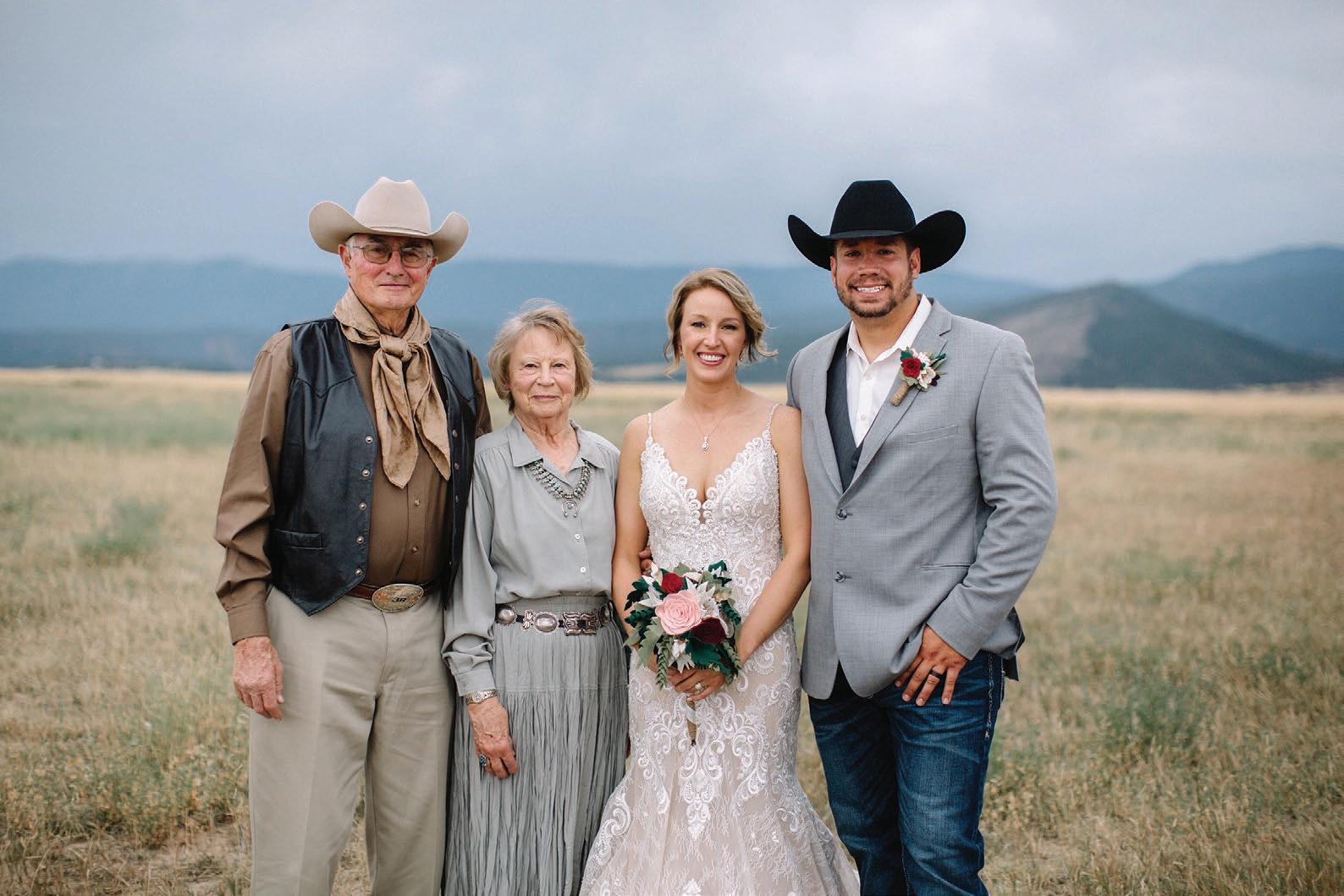
From left to right: Reeves and Betsy Brown, MacKenzie and Chad Helvey.
Conservation Easements— A Tool to Save a Family from Hate
 BY JACK VARIAN
For many years in the past, I have had an overriding fear that the ranch that my wife and I started to build in November of 1961 could become a battlefield for my four children when my wife and I pass from the scene. I think everybody that has something of value to leave to the next generation must wonder, am I bequeathing happiness or hate, opportunity or unwanted struggles?
First, I believe that we must realize that there is a huge difference between commercial property like a parking garage and land you have lived on for years, and there is a great deal of difference between some stocks and bonds and a herd of horses. It’s the degree of affection, devotion and passion that is engendered in each of my children that begs the question. What is the right thing to do? Is there a right answer?
You can all see that the number of ways to divide a pie can be immeasurable when the human emotion is the one that is up for deliberation. Under the headings of “equal and fair” there can be many many subheadings. I’m sure that equal and fair have six different ( my wife, and I, and four children) individual meanings to the six of us. We have nine grandchildren and one great grandchild. Are they to be considered? I believe all these things will determine the length heirs will fight to maintain their perceived share of an estate.
There’s another most important entity that hasn’t even been talked about so far. How about the ranch? It’s been providing a wonderful place to live and make a living. A beautiful place that is graced with trees, grass, and a multitude of wildlife. What is the family’s obligation to all of them? Do you split the ranch into four pieces
thus leaving all this life force and beauty in flux and uncertainty to wonder what will happen?
I think not. As I examine my own feelings toward this place I call home, I think about why it’s as important to me as one of my family members. This ranch that has fed and clothed us all and has led us in the direction of being decent humans and must, by all reason and reward, sit at the head of the table.
The answer came to me quite simply. Don’t do what seldom works. Don’t divide the ranch, but give each an equal share of a ranch that can never be divided. The question that I am always asked is “Did you talk to your children about what we were going to do with the ranch?
one half years to complete the transaction. Then we had a wonderful celebration with the closing of the escrow. The month was April, the year 2001, and the Trust for Public Land in the escrow passed the holder of the easement to the California Rangeland Trust. And so, for the last 19 years, we have had a very nice working relationship with CRT with no regrets where they monitor to see that I maintain the ranch’s Conservation Values.
These Conservation Values that I talk of are what I sold to a group of conservation minded investors. The money that I got from the sale, I used to retire our debt with our lender, leaving the land fiscally solvent. Also it’s important to know that if my heirs decide to sell the ranch, they can, but they must sell it all because of the deed restriction that disallows dividing the property. At the same time my wife and I gave the ranch to the Varian Family LLC. It’s owned by our four children which will avoid whatever inheritance tax might be due. Some might ask, are you worried that your kids might throw you out? We have a life estate that allows the two of us to live in our house till our passing.
Absolutely not. It would only open up a can of four possible answers
It was a year in the late 1990s that I happened to read an article in a magazine about an area back in the state of Massachusetts where they allowed a piece of land to be protected in perpetuity with a Conservation Easement, which is a recorded deed restriction that forbids the land from being divided. This idea rummaged around in my mind for about a year when it was brought to my attention that the Trust for Public Lands headquartered in San Francisco was putting people with land together with people or organizations that had the money and wanted to protect land.
We entered into this agreement that was completely voluntary. It took about two and
The longer we have the Conservation Easement in place the better we all like it, as everybody and every living thing have the peace of mind knowing that their birthright is protected in perpetuity and all ranch management decisions are resolvable except dividing “the land.” Somebody asked me one time how long is perpetuity? I said “I believe it’s a very long time.” So, I hope that my family experience might encourage other ranchers and farmers to look at this tool that puts hate to rest.
Jack Varian ranches on the V6 Ranch in Parkfield, California and can be reached at: jovv6ranch@gmail.com. Reprinted from The Stockman Grass Farmer Magazine. Call 800748-9808 or email sgfsample@aol.com to receive a free Sample Edition.
4 IN PRACTICE h May / June 2021
The Varian Family.
Ranney Ranch— Transfer Plan Lessons
BY ANN ADAMS
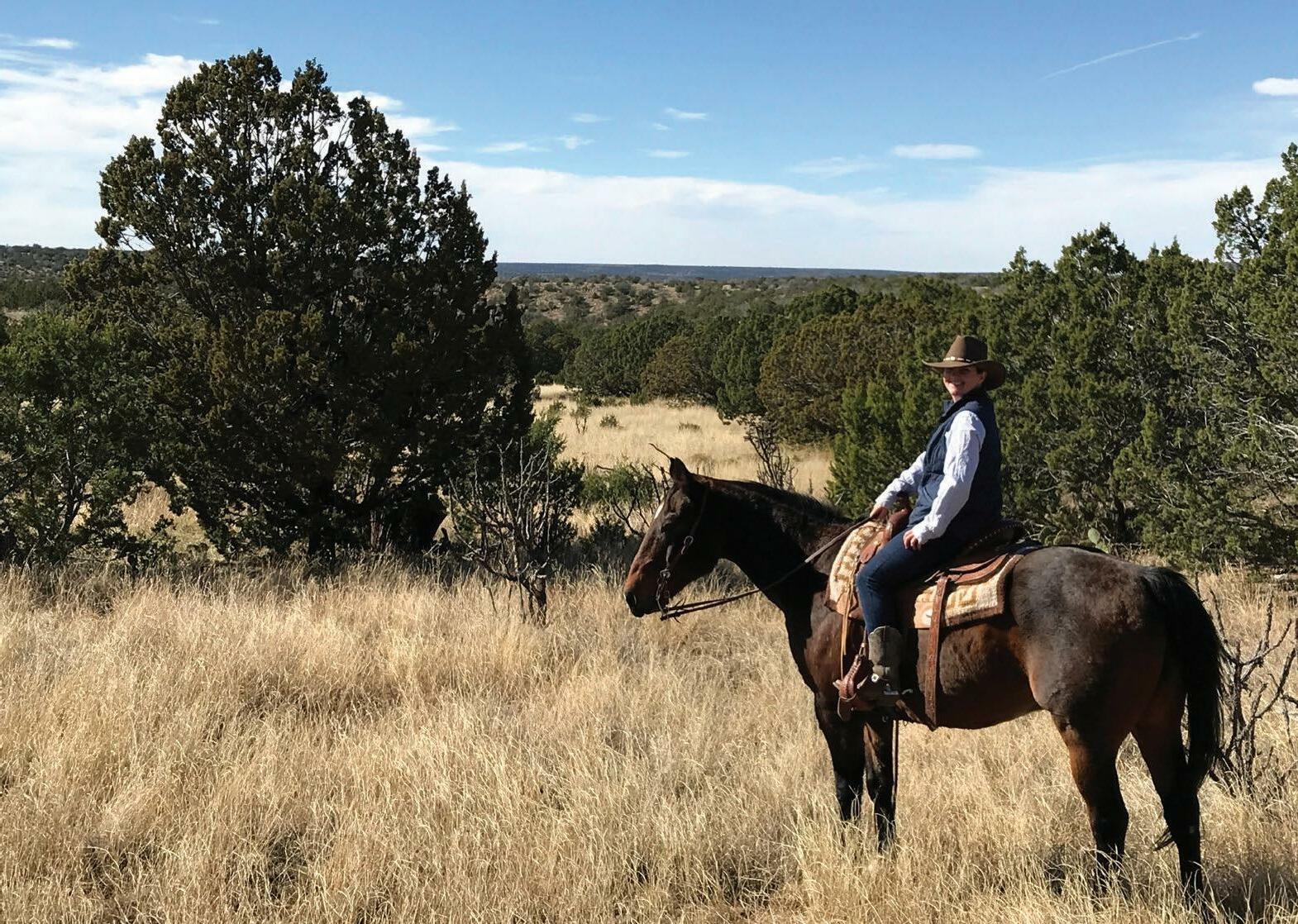
I’ve known Nancy Ranney of the 18,000acre Ranney Ranch near Corona, New Mexico for over 10 years and followed the work she has been doing on the Ranney Ranch for even longer. The Ranney Ranch sits at 6,200 feet in the rugged mesa and canyon country of the Gallo Canyon and was home to ancestral Pueblo people in the 11th-14th centuries, later dryland farmers in the late 1800s and sheep ranchers in the mid-1900s before transitioning to cattle ranches. As Nancy worked with her longtime ranch manager, Melvin Johnson, and consultant and HMI Certified Educator, Kirk Gadzia, she saw her family ranch increase in land health and productivity, even in drought years.
The last couple of years as I’ve talked to Nancy she was focused on how to transition the ranch. She spent time exploring all the options she could think of to make sure the land she and her family had worked so hard to improve would be protected as a working ranch. Those efforts included a conservation
as a result of that grazing planning and implementation.
Nancy also worked to develop a grassfed beef operation and in 2017, the ranch was selected to be the New Mexico pilot ranch for the Audubon Conservation Ranching Program.
to 30 native species (including cool season grasses like Western wheatgrass and vine mesquite) and right away we were seeing the economic benefits, reduced costs of running the herd and increased income from healthier animals and a new income stream. I also had
easement and finding the right buyer.
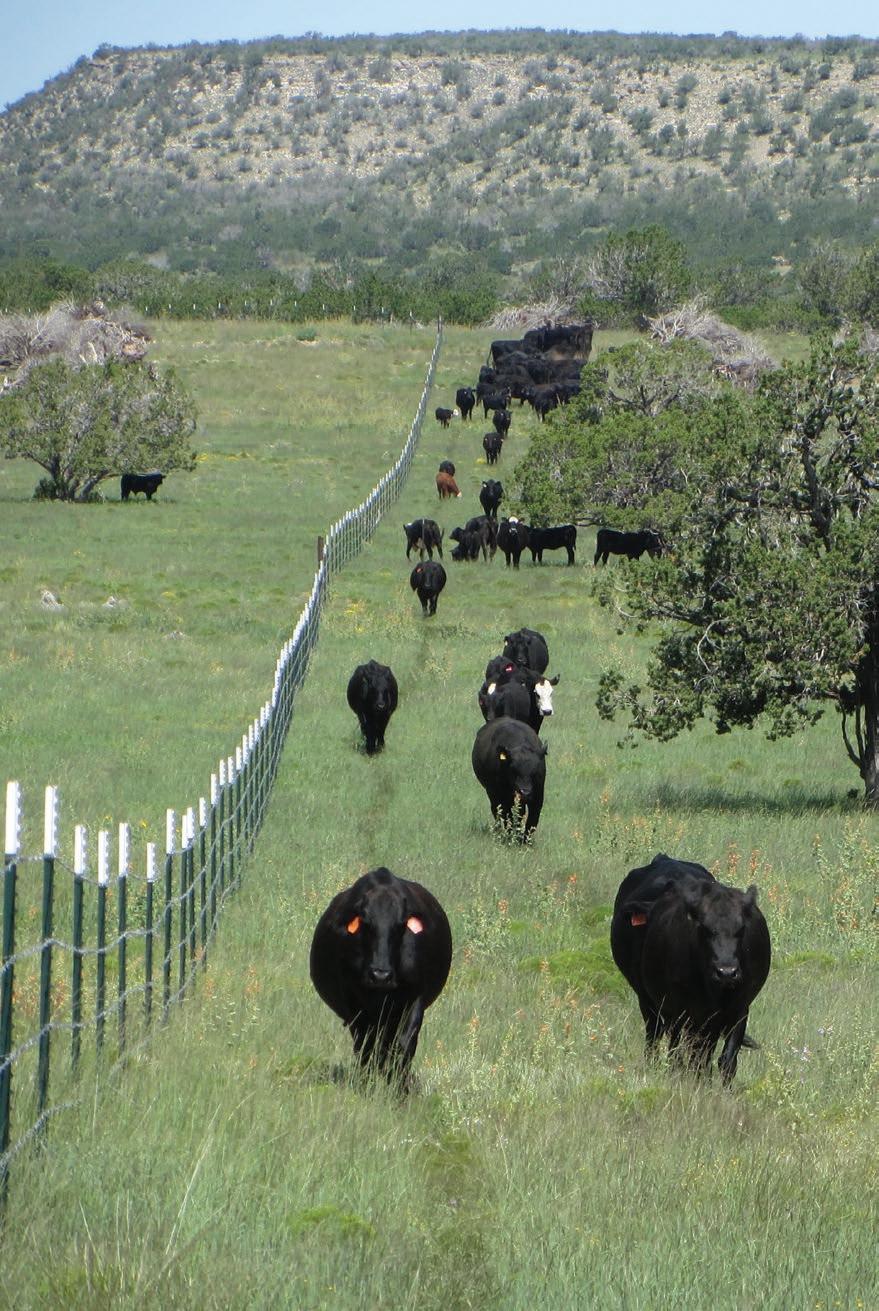
Nancy has spent the last 18 years focused on improving the ranch that her father, George Ranney, first purchased in 1968. When Nancy took over management in 2002 after her father’s death, she and longtime manager, Melvin Johnson, shifted management strategy, combining 18 herds into one and developing a holistic grazing plan with Kirk. The ranch now boasts over 50 species of native grasses
populations of Montezuma and scaled quail (indicators of well-managed rangeland); numerous species of bats and other wildlife have been identified, and more recently, numbers of elk have been seen on the ranch. She also worked with scientists to test carbon sequestration and improved water infiltration on ranch soils (per acre gains of .3 to .5 tonnes C/acre per year have translated into larger total quantities of accrued and salable carbon than from many other areas of the USA).
“There were three real highlights of the ranching experience for me,” says Nancy. “The first was the joy of watching the land recover. We saw remarkable changes in the first three years: from five warm season native species
including Melvin, who had started under my father in 1984. I’ve learned so much from him, from my neighboring ranchers, and all the people I’ve come to know through Quivira, HMI, SWGLA (Southwest Grassfed Livestock Alliance), our NRCS programs and Partners for Fish and Wildlife. And, it’s been an inspiration working with young people. It was a blessing to be part of the Quivira NAP (New Agrarian Program); we hosted three apprentices through NAP, all wonderful young people.”
Ranch Transfer
Nancy and her siblings had visited their parents at the ranch since 1968. In 2002, Nancy stepped up to take over direct management with support from the other family members. “The question then was could we afford to keep this operation going,” says Nancy. “I was excited about the opportunity as I was the most on the ground of my siblings and I have a background in land use planning. I had enough scientific training to be confident about the possibility of range regeneration under new management
CONTINUED ON PAGE 6
Number 197 h IN PRACTICE 5
Jessica Adcock, the Ranney Ranch’s first Quivira NAP apprentice.
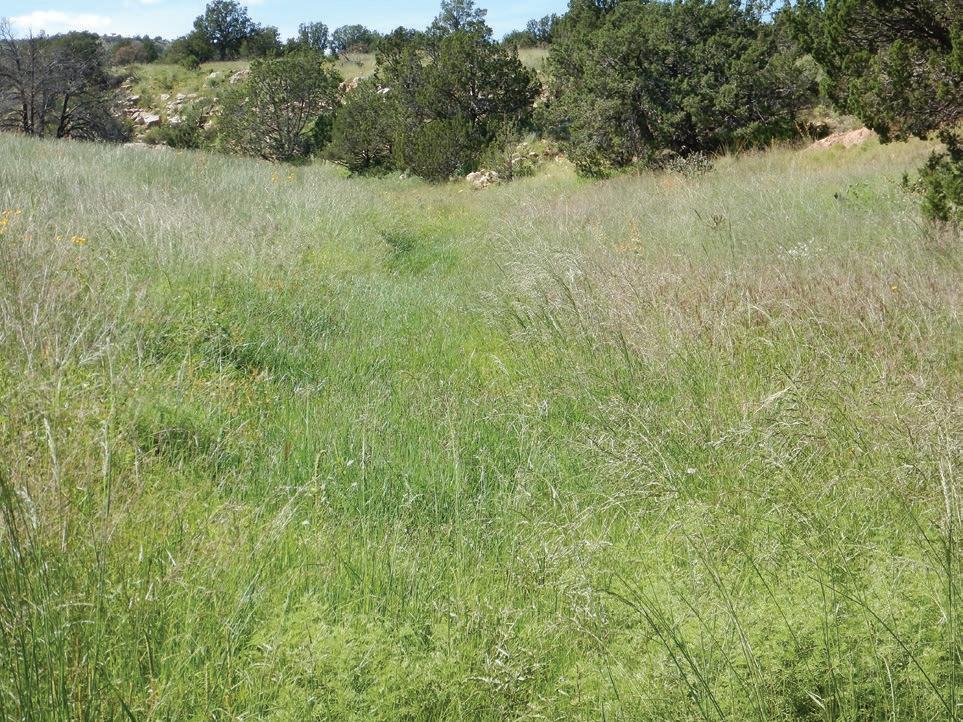
Increased production on a restored arroyo.
Transfer Plan Lessons
CONTINUED FROM PAGE 5
techniques. My father had been a traditional rancher and running a ranch was all new to me, but happily, Melvin was willing to stay on and guide me. I was really working to bring down
Valley Farmland REIT and some newer holding companies but nothing panned out.
“Initially my goal was to find a buyer who would carry on our management practices and was committed to the health of the land and had interest and understanding of the work we had already done,” says Nancy. “As with many
Savory Institute—anyone who might have ideas and connections. As I was beginning, our family decided to put a conservation easement on the ranch of almost 10,000 acres. We had considered this earlier but had also been interested in wind development. In early 2020, it became clear that our area was not going to be developed for wind. At that point we moved ahead with a conservation easement with the New Mexico Land Conservancy and I let interested buyers know this. It was dicey to get the easement on so quickly, but we did it. It is better to do this well in advance of a sale. We were fortunate that both interested buyers at the time were enthusiastic about the conservation easement. I think it was very unusual.”
our costs and make it viable for the family which was a struggle. Along about 2007, we had the prospect of wind energy emerge as a source of income which was exciting both for the family and the community.”
Preparing for the most recent transfer was more difficult. Land values from when George Ranney had purchased the ranch in the ‘60s were now 12-15 times greater. The next generation did not have someone ready to take the management reins or who could afford the transfer value of the ranch. So Nancy had to look further afield and consider alternate financing options. She talked to a number of young people with the idea of having them come together to purchase the ranch, possibly with Nancy and her husband, David Levi, owning part of the ranch and allowing the rest of the family to cash out on a partial sale. She also looked at other investor possibilities including real estate investment trusts like Iroquois
ranches there was a large family involved.
I was grateful that my family gave me an opportunity to look for the buyer before we listed it, that gave me some breathing room. The primary challenge was how remarkably the value of these ranches has increased. It makes it prohibitive for people from ranching backgrounds, particularly young people, to buy ranches.
“So I reached out to rancher friends, HMI, the Quivira Coalition, Audubon, and the
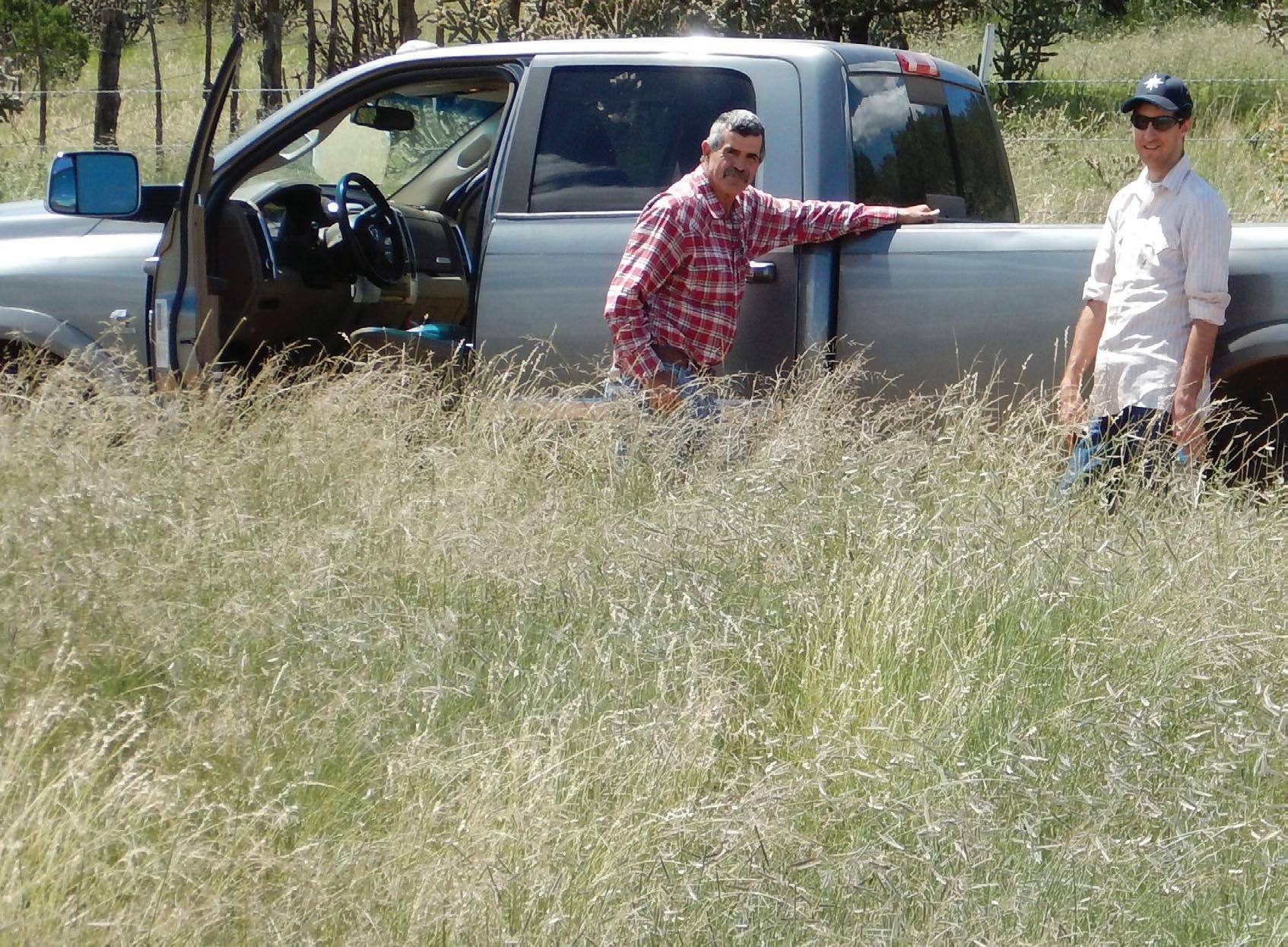
One of the potential buyers that Nancy spent time getting to know were Heriberto and Jaime Ramos from Houston and Midland Texas. The Ramos had hunted at Ranney Ranch for a number of years, were committed to wildlife conservation, and had a family background in ranching. They were interested in the conservation practices Nancy and Melvin had been using and understood the role of livestock to keep the land healthy. They were excited about being on the land and managing it well.
“We didn’t list the ranch so I did much of the work that a realtor does,” says Nancy. “It took several months, working with the
6 IN PRACTICE h May / June 2021
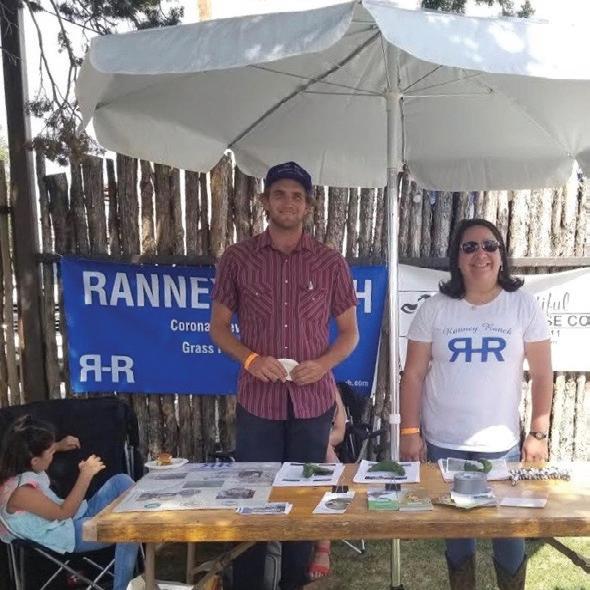
Ranney Ranch, Winner at the 2019 NM Green Chile Cheeseburger Smackdown with Quivira NAP apprentice, Mitchell Robert, and Nancy’s daughter-in-law Hilaree Levi
Melvin Johnson and Nancy’s son, Joseph Ranney Levi.
county and our lawyers, Modrall Sperling in Albuquerque. There was an immense amount of material to go through, water and mineral rights, road easements, historic agreements
buyer who fit my parameters of continuing our management approach.
“I am grateful I had almost 20 years to run the ranch,” says Nancy. “Kirk was encouraging
were, I sent a letter introducing them to our neighbors in the Gallo Canyon.
“In retrospect, it was significant that throughout the sale process, I was in close touch with the Ramos, regular email and phone conversation and even hosting a couple of family visits to the ranch. This became an opportunity to share our experience and values and to offer them ideas for management and names and emails of people they might contact. We are still in close touch, they send photos of their families at the ranch and I can tell that they are thrilled to be there. They are already hunting and riding, they are leasing to Melvin and his son, Marcus Johnson, and have bought some animals for their own.
“I marvel that it worked out so well for all of us, as there were a lot of moving parts. In the end, I believe it was a common vision of work on the land that carried us through.”
with neighbors, State Land leases, previous purchase agreements. Eventually I found two very viable buyers.”
The Ramos emerged as the clear front runners for Nancy given their background and history with the ranch. In addition to the sales agreement, Nancy decided that it would make a good transition for the ranch if she were to provide the buyer with three years of grazing management planning with Kirk Gadzia.
During this process, Nancy worked with her two brothers who are general partners with her. There are 12 limited partners –three spouses and nine offspring—who don’t have decisionmaking power but who do provide input. All of the family has been interested in the ranch beyond its monetary value, and several have helped with aspects of the ranch management including marketing grassfed beef and keeping the books.
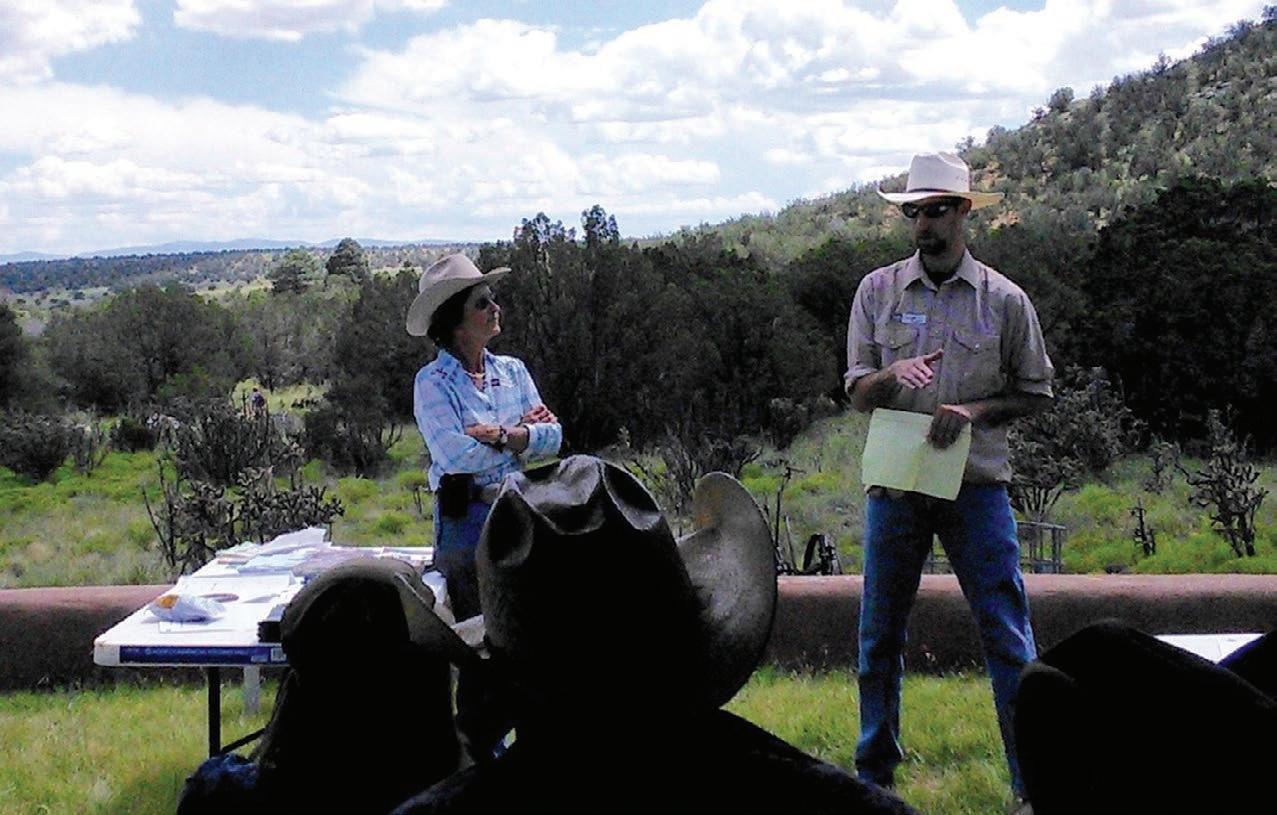
“It helped that my brothers (George and Ed) and I had such a healthy working relationship,” says Nancy. “We had developed it in our years of running the ranch together. Almost every Monday morning we had been on the phone together for our “ranch call”, this clearly contributed to the successful outcome for our family. Also, in the spring of 2019 when George, Ed and I decided to move ahead with the sale of the ranch, I was given a very clear mandate to take up to a year to find a
and gave me a framework to work with. Our family had many value-based conversations on key issues like whether or not to lease to wind development and when and how to sell the land and when to pursue the conservation easement. Over time that understanding of the ranch and what it meant to all of us gelled. I’m amazed at how well we got through it, you hear so many stories of families coming apart. I feel that I had the opportunity to explore other avenues and I learned a lot about different approaches to buying land and how people want to be shareholders in new types of operations.
“I was also in touch early with our neighbors to let them know what we were doing. As soon as I knew who the buyers
Number 197 h IN PRACTICE 7
Nancy Ranney and son Joseph Ranney Levi presenting during an HMI workshop at the Ranney Ranch.
August 2013 coming out of drought.
& LIVESTOCK
Date Creek Ranch— Creating a Successful Business in Rough Country
BY HEATHER SMITH THOMAS
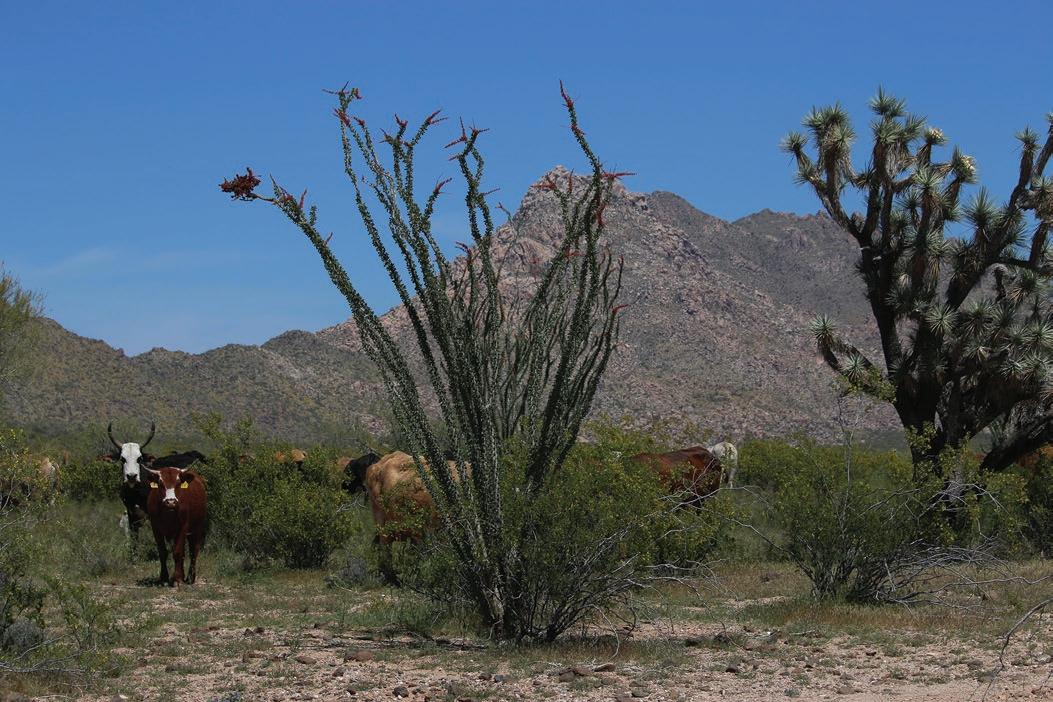
Kimberley Knight and her husband Stefan grow grass-fed beef and lamb, pastured pork and chicken on their unique ranch in a harsh environment (annual rainfall as little as four inches) in Arizona located in the transition zone between the Sonoran and Mojave deserts which includes Joshua trees and saguaro cactus. Date Creek runs through the middle of the ranch and provides habitat for a variety of plants and wildlife, including beaver, wild turkeys and javelina—a wild pig-like animal native to the Southwestern U.S. and Central America.
The ranch is just outside Wickenburg, Arizona which is northwest of Phoenix. “My parents, Phillip and Geri Knight, bought the ranch in 1966. It soon became the focus of our lives as my two brothers and I grew up,” says Kimberley.
“Dad became involved early on with what we used to call Savory grazing, in 1981. Working the land was always a way of life for us and required the entire family’s participation. When I graduated from college in 1983, I moved to Texas where I worked on a ranch, and Stan Parsons was the consultant for the ranch. He was Allan Savory’s original partner and they were a good team.
“After I left that ranch in 1986 Allan Savory had started an HRM (now Holistic Management) degree program and I got in on that and got my HRM degree. They didn’t continue that program very long; there were only a few of us that graduated from it before they dropped the program. I returned to our family ranch in 1997 as an adult and raised my children here, and took over the ranch in 2005. I have been carrying on the ranching tradition since my father passed away in 2007,” she says.
The ranch has been managed holistically since the 1980s. Before that, her dad had already made some very positive changes, not knowing that these would make a big difference that would help contribute to his
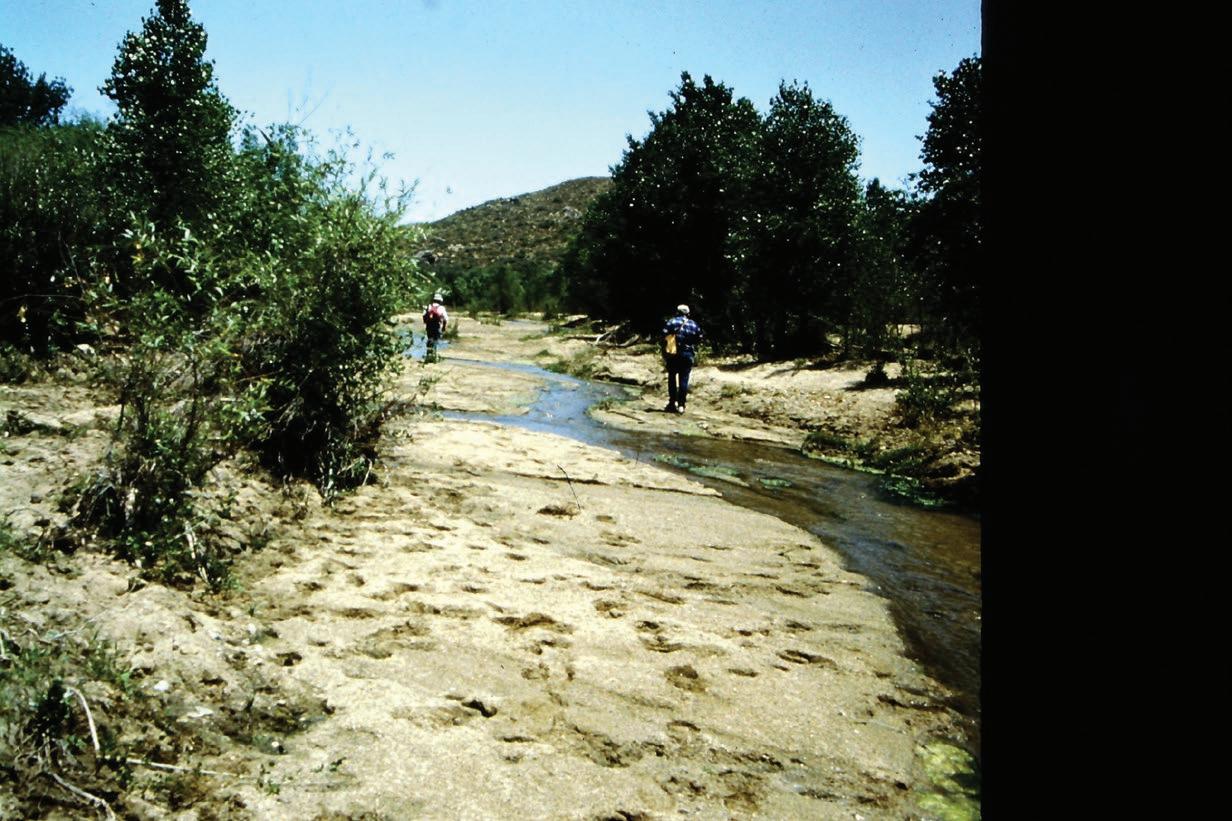
ranching success. At first, Date Creek was not a very good place for livestock or wildlife. When her parents arrived at the ranch, the 3.5 miles of creek that went through it was a mix of ephemeral and perennial stream that was little more than a broad swath of barren sand with some scattered cottonwood and willow trees. Javelina and other native wildlife were rare; the turkeys and beaver had been wiped out many years earlier.
“Dad began a rest/rotation grazing management plan that gave the grass a chance to rest during the growing season and also helped the creek. In 1982, he began applying Holistic Management principles to the land, which gave our pastures even better opportunities to rest and allow the grass to re-grow,” says Kimberley.
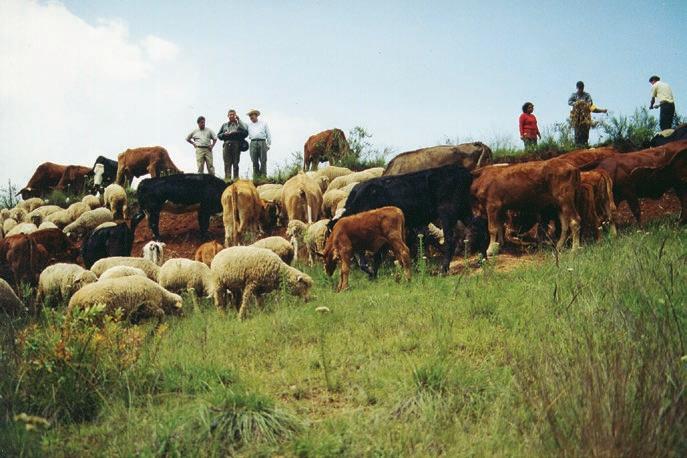

The creek soon made an amazing recovery and by the late 1980s was recognized as one of the healthiest riparian areas in the state of Arizona. “My dad received several awards and was written up in various magazines and newspapers. For his important work on the riparian area of Date Creek he was selected as the 1993 Environmentalist of the Year by the Arizona Game and Fish Department, and in 1994 received the Environmental Stewardship award by the Arizona Cattlemen’s Association,” Kimberley says.
“Determination and land stewardship are musts for ranching in this country, and my father demonstrated both. He began a ranching tradition that was very progressive for his time. In conjunction with Arizona Game and Fish, he reintroduced beaver and wild turkey to our ranch.
“My husband Stefan and I are continuing the same intensively managed grazing and holistic program that my dad started. Healing the land and caring for the wildlife is of primary importance to us.
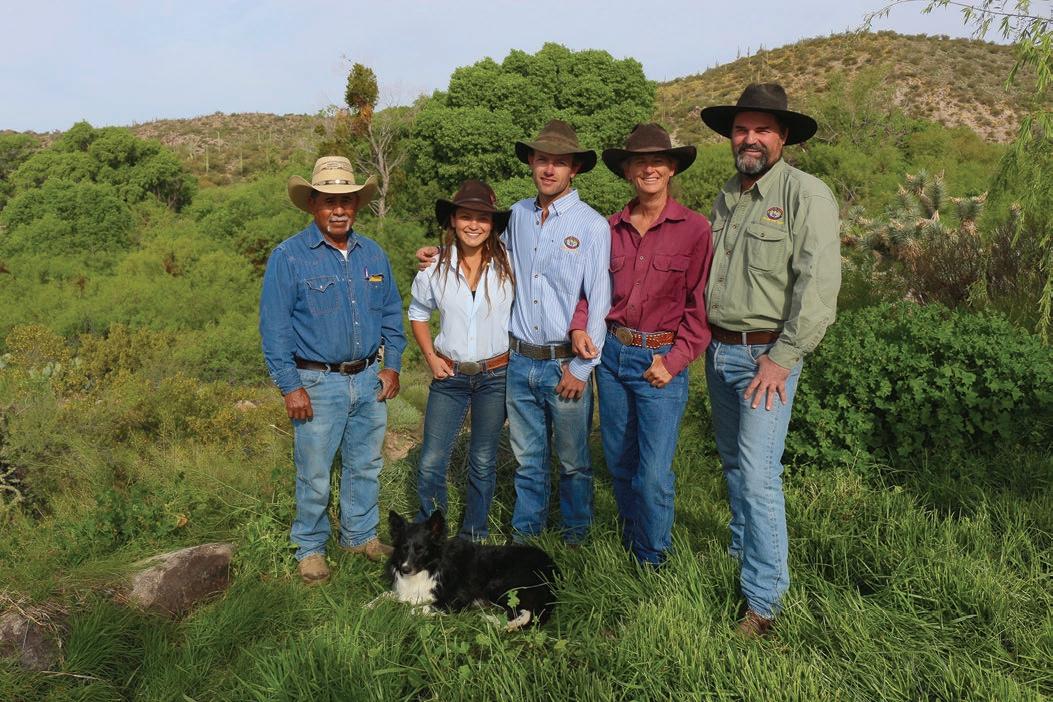
“We have been selling grass-fed beef for the last 12 years and also raise pork and have done chickens and broilers. Currently we have two separate businesses. My son and his wife manage the beef business, which is now completely separate from ours; my husband Stefan and I manage the cow herd.”
Stefan is from Germany and grew up as a city boy. “He always wanted to come to America and live on a ranch; this was a dream of his. We met here at the ranch and it wasn’t hard to get him to stay. He loves it here as much as I do,” says Kimberley.
8 Land & Livestock h May / June 2021
The Date Creek Ranch crew: Paulino, Savannah, Ryan, Kimberley, and Stefan.
The Right Animals for the Land
Kimberley notes that while there have been many positive results from their change in management, what has been particularly helpful about Holistic Management is how they now think about the land and make decisions. “Most people talk about their land and the great progress they’ve made. Our progress is very slow, without any big dramatic changes, but it is all very positive. I tend to emphasize more the changes that Holistic Management has done for our management, and the ways we make decisions and solve problems. This is what has truly made us successful,” she says.
“We don’t run very many cows. If Stefan and I were just running cows the traditional way, at least one of us would have to have a job in town to support the ranch and family. With the small number of cows we have, and because we sell grass-fed beef, we are able to support two families. I know that it’s because I learned early on from Allan Savory’s teachings how to use the HRM (Holistic Management) model to help me make my decisions. To me, that’s what it’s all about.
“The way we manage the land includes holistic planned grazing and we give our plants as much rest as we can, though it’s not always as long as we’d like. We do see a real difference there, however, compared to what other ranchers around us are doing.” The primary grass in this region is called tobosa, which is native to Northern Mexico, and the Southwestern United States. “No one here likes it very much, but it’s what we have, and we work with what we’ve got,” says Kimberley. “This native grass really suffers when overgrazed, but if you rest it too much it’s also hard on it, but it does ok. Nothing wants to eat it when it’s overrested and mature, and every couple years you really need to graze it all off. If you can graze it down to where it really grows nice and fresh, the cows do want to eat it—but that’s hard on it. This is when it needs some protection, so it can be a very challenging grass to work with.
“If you graze it severely it takes longer for it to come back. This grass has its growth points along the stems rather than at its base, so grazing hits it a lot harder. If you let it rest, however, it takes years before it has dead centers because it keeps expanding through rhizomes; it gets stems on the outside that just keep getting bigger until at some point the plant will die—but this takes decades before it will actually die. It can survive fairly well with overrest but then it is not palatable and no animals want to eat it.”
Kimberley notes it’s always a balancing act, to try to take care of the land and also take care of the cows. Sometimes what’s good for the cows is not so good for the land, but the next time around you graze it a bit differently. Flexibility is part of the process, but this is difficult when it doesn’t rain. “It’s been four years now since we’ve had our normal monsoons in July and August, for our primary growing season. In 2020 one small part of the ranch got one little rain, and that was all. The entire Southwest is really dry,” she says.
The rainy season is when the tobosa grass really grows. “If it has hot weather and rain you can actually watch it grow. If it rains in the spring and fall it grows a little bit, but grows best in the heat of summer. In this area
we also grow lots of weeds. If I were to go out to select a ranch to buy, I would not pick this one! It’s been a challenge from the beginning, but I love it here because it’s where I grew up,” Kimberley says.
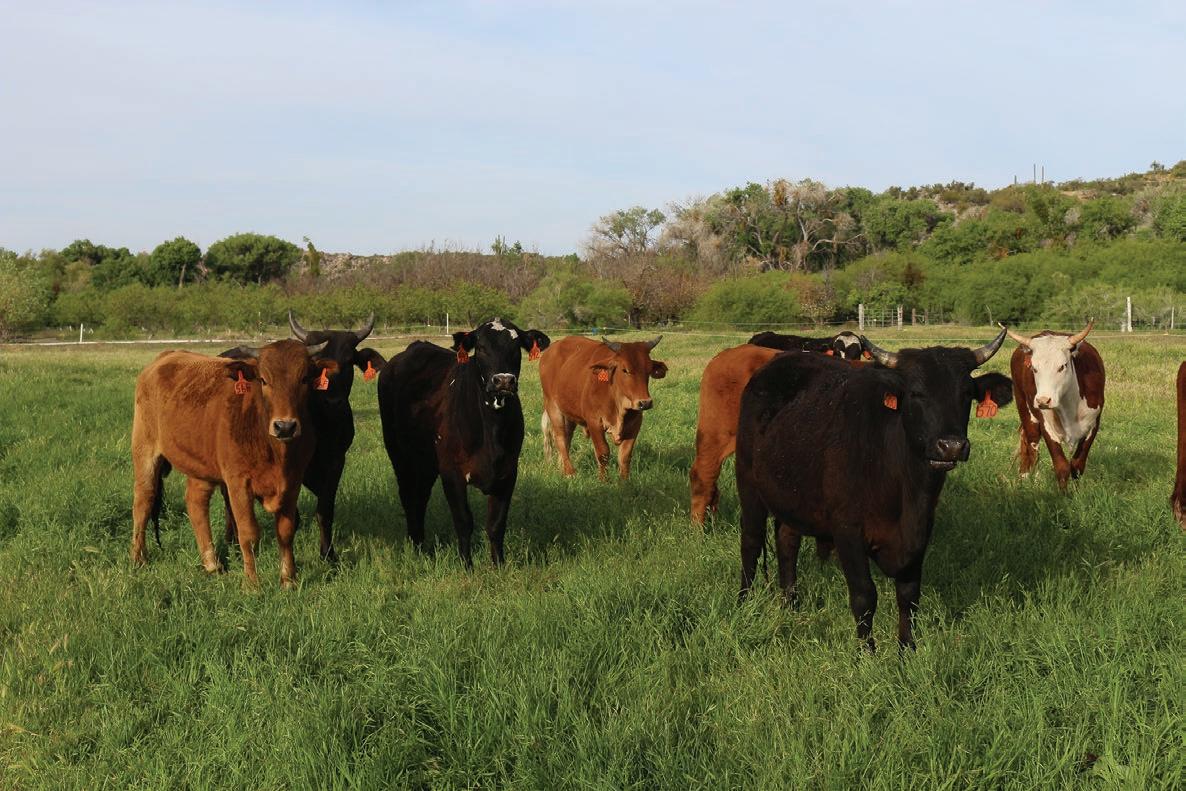
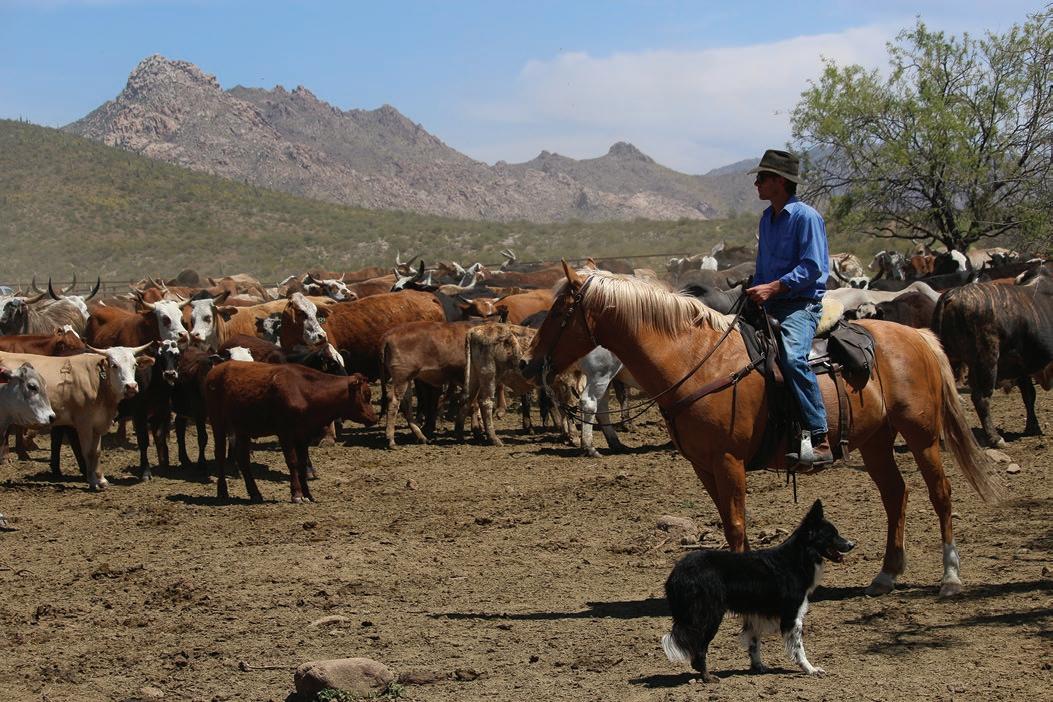
The Date Creek cow herd is well adapted to this harsh environment and are predominantly Brahma crosses. “We like the Brahma crosses,” says Kimberley. “We’ve been using these crosses for a long time because part of the ranch is very mountainous and they don’t mind climbing to the top of the mountains to eat whatever is growing, and they can tolerate the heat. They are very hardy cattle. If they have to stand out in the sun in the summer with no shade, they can handle it.
“Our cows are a BrahmaGelbvieh cross. We really like that cross because they are very nice cows. We used to have Brafords (Hereford and Brahma) and part of our herd is still Braford. What I really like about the Gelbray is that they are more gentle and easier to handle. Even though we’ve gotten our Brafords really gentle, the Gelbray are even more gentle and they don’t have horns,” she says.
Horns can be an advantage, however, in this environment, because there are mountain lions. The cattle with horns are better able to protect their calves from the predators. “We’ll see if it works to have cows with no horns, but in other ways we like the Gelbray because they have good milk production and maintain their body condition very well, and are easy to work with,” says Kimberley.
Not very many ranchers raise Brahma cross cattle, however, because they don’t bring a very good price at the auction markets. “For us, that doesn’t usually matter, however, because we sell everything that we raise—directly to our customers,” says Kimberley. “If we had to sell through an auction, we’d have to switch, like everyone else, and get the Brahma out of our cows, but then they wouldn’t do as well in our environment. “Black cattle in our region really suffer. They need shade, and even if they have shade, they just don’t do as well in the summertime. It’s important to have cattle that fit their environment, and we are sold on the Brahma cross.”
The ranch has many rough and rugged acres in the 38,000 acres they manage; a lot of it is state trust land, and a small piece of private land. “Fortunately we don’t have to deal with federal land like Bureau of Land Management (BLM) or Forest Service. The State Land Department is really easy to work with; they are very cooperative and they like what we do. We can ask for special permission to do things and it’s more of a partnership,” says Kimberley.
Making Successful Transitions
The other big shift at Date Creek Ranch was splitting the cow/calf enterprise from the direct marketing beef business. “My son Ryan Barteau and his wife Savannah Figueroa were working for us for a few years, but it was getting to be too much for us trying to do the marketing,” says Kimberley. “My husband was spending too much time at the desk and on the phone with customers. We had reached a point where we felt like we
Number 197 h Land & Livestock 9
CONTINUED ON PAGE 10
Date Creek Ranch cattle are predominantly Brahma-Gelbvieh crosses that finish well on irrigated pastures.
Creating a Successful Business in Rough Country
CONTINUED FROM PAGE 9
could split the business, so we split it and they took over the beef business and marketing and we manage the cow herd. We share resources and help each other and still work together as a team, but it is two completely separate businesses, which works really well.
“It has enabled us all to have other things in our lives besides just work. We all like to travel, and this has enabled us to get away from the ranch and do some other things. When I was growing up we never took vacations; we worked seven days a week. When my dad got near the end of his life he told me that was a mistake, and that we needed to take time off. That’s something he regretted, and I took heed.
“We have time for some other things, and when we do need extra help, we have it. Sometimes I need three people and instead of having just two of us trying to do it I can call Ryan and he can be there to help us, and vice versa. Like the other day he called to tell us that his 16 butcher steers got out of the corral and were gone—and it took all four of us about five hours to get them back in again. It’s so nice to have someone to call on when you have an emergency.
“I feel really fortunate that we can do this, and have both families here on the ranch. If I hadn’t been introduced to Holistic Management early on, I may have been able to work on a ranch, but I don’t think I would have been able to take this ranch of my dad’s and make a living on it. I would have done it like anybody else and it would not have been sustainable. Holistic Management just gives you an entirely different way of looking at things, in a way that I would never have done.”
Kimberley hopes more people will become acquainted with the principles of Holistic Management. “Many ranchers are hung up on some aspects of it and say it won’t work on their place. I want to say to them, ‘What is there about setting goals and looking at different options, and asking ourselves questions about them, that doesn’t work?’ That should work for everybody, no matter what business they are running,” she says.
“I have lots of ideas and get excited about doing this or that, and then we sit down and look at the model and ask ourselves all the testing questions and then walk away realizing that’s not a good idea and realize we’re not going to do it. Being able to do this, and analyze our plans and goals, is the reason we are successful.
“We’ve all repeated the Holistic Management classes a number of times; Ryan and Savannah have taken them also. I don’t think there is anything more important than learning Holistic Management—especially if you are in agriculture—so you can do a better job with what you do.
“There are so many things we’ve considered doing on our place. We’ve actually had parties and invited people to come help us brainstorm, asking them what we can do—everything from raising camels to whatever. Then you sit down and seriously think about it, in terms of your goals. I am grateful that all of this way of thinking got dropped into my lap because I don’t know how I could have stayed in agriculture without it.
“This was the major turning point that turned my whole thinking around. Sometimes I think the things being taught at the universities are not helpful.” Kimberley thinks there is too much emphasis on maximizing production, use of chemicals and pesticides, strategies that can actually be counterproductive and not the best for the land or the animals.
“Holistic Management by contrast gives the opportunity to look at things in the broader picture and then decide—and determine where you might need a little more education,” says Kimberley. “It gives a better framework, to move forward in life in a way that enables you to look at the whole—much better. We tend to look at things in a narrow way. Like, ‘Oh my gosh, here’s a weed that I need to get rid of.’
“Everything is telling us a story. We have to decide whether to stop and listen to the story and try and learn from it, or just view it as a problem and get rid of it. It might be a problem, or it might be an opportunity, or maybe when you really look at it, it is insignificant.
“They didn’t teach me this at the University of Arizona,
but I am still glad I went. Yet, when I got into the HRM degree program, back when it was Holistic Resource Management, it really turned my life around and gave me a whole new way of seeing things. Without it, I don’t think I could have been in agriculture, even with my dad having a ranch. It
CONTINUED ON PAGE 17
10 Land & Livestock h May / June 2021
Date Creek Ranch’s Brahma-Gelbvieh crosses do well in this harsh country and bring a good price when direct marketed to the Date Creek Ranch grassfed beef customers.
Ryan and his wife, Savannah, now run the beef operation at Date Creek Ranch while Kimberley and Stefan run the cow herd. This transition has worked well for both couples and they share resources and support across both enterprises.
Date Creek Restoration
Photo Essay
BY DAN DAGGET
Date Creek flows through an area where the Sonoran and Mojave Deserts meet. Along its course giant saguaro cactuses and Joshua trees stand side-by-side.
Date Creek 1992. When Phil Knight purchased the Date Creek Ranch much of the three miles of the stream that flowed across the ranch was in the same condition as the stretch on a neighboring ranch shown before that ranch followed Knight’s lead. Phil made it his goal to return Date Creek to a condition as much as possible as it was before ranching came to the area. One measure of the success of that restoration, he decided, would be the return of beaver to this desert oasis they had once inhabited.
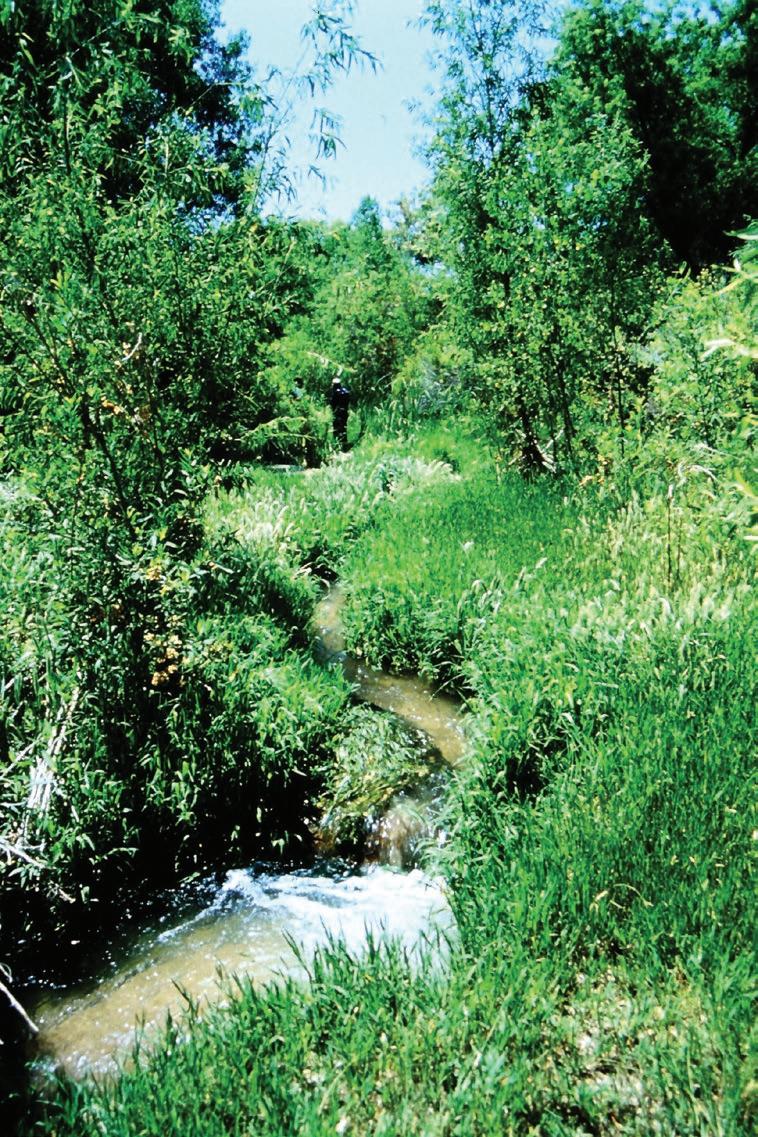
Date Creek 1997. Over the years, the habitat along the stream began to respond in dramatic fashion. On one tour of the area the supervisor of a nearby Nature Conservancy preserve joked that she would kill to get as much biodiversity on her preserve
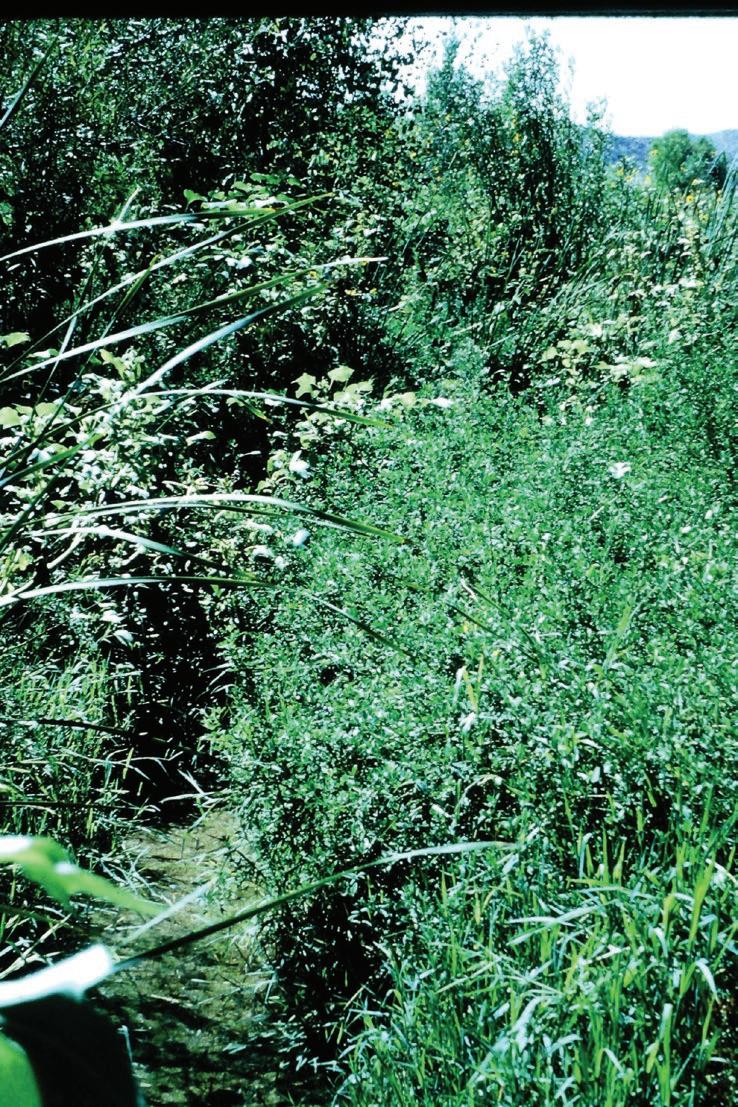
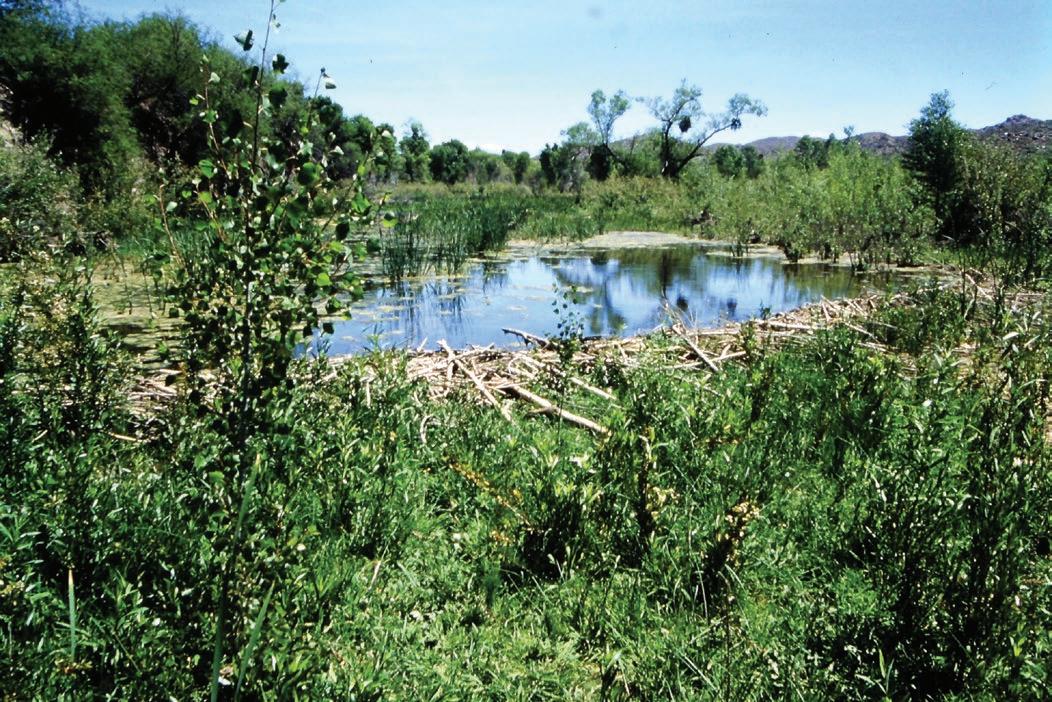
O X Ranch 1997. So far, the Date Creek beaver have survived a 500-year flood and two extremely dry years. One of those years produced only four inches of precipitation. That year the creek nearly dried up, but when the rains returned, and the water started to flow again, the beaver were still there. Originally published on the Ecoresults website: http:// ecoresults.org/restoring-desert-oasis/
Number 197 h Land & Livestock 11
O X Ranch 1997. This photo and the one to the right were taken on the O X in roughly the same area as the top left photo about four years after beaver had been reintroduced.
Is Your Pasture or Rangeland Healthy?
BY ROLAND KROOS
Thirty-seven years ago, I attended my first Holistic Management course taught by Allan Savory. Since I attended that course, the following mantra has been etched in my brain “PLAN – MONITOR –CONTROL— REPLAN.” If you are not monitoring the ecological health of your land, how do you know if the tools you are using are improving the health of
The purpose of this monitoring approach is to give land and livestock managers feedback on whether the land management practices employed are creating the landscape health we all desire.
Site Selection
In all likelihood, you will run out of time before you run out of sites to monitor. Determine which sites have the greatest potential to change. Look for sites that you believe will change the quickest: areas with deep soils, riparian areas, areas where you plan to place a lot of livestock (high stock density) for a very short period. Avoid the temptation to choose monitoring sites on rocky ridges, shallow soils, or areas that currently have very little vegetation. Based on my experience, these sites tend to change very slowly and may not be the best indicators to base your grazing management decisions on.
First, select sites where you plan to make significant changes on the land and where you plan to take actions to create these changes. For example, you might plan to:
• Bale-graze, winter feed, or feed a supplement to increase animal impact.
• Build a cross fence or intensively strip graze an area.
• Use fire to control brush.
• Key wildlife habitat that you are trying to create.
• Document what happens when you change the length of the grazing period and/or recovery period.
• Use an herbicide to control weeds or brush.
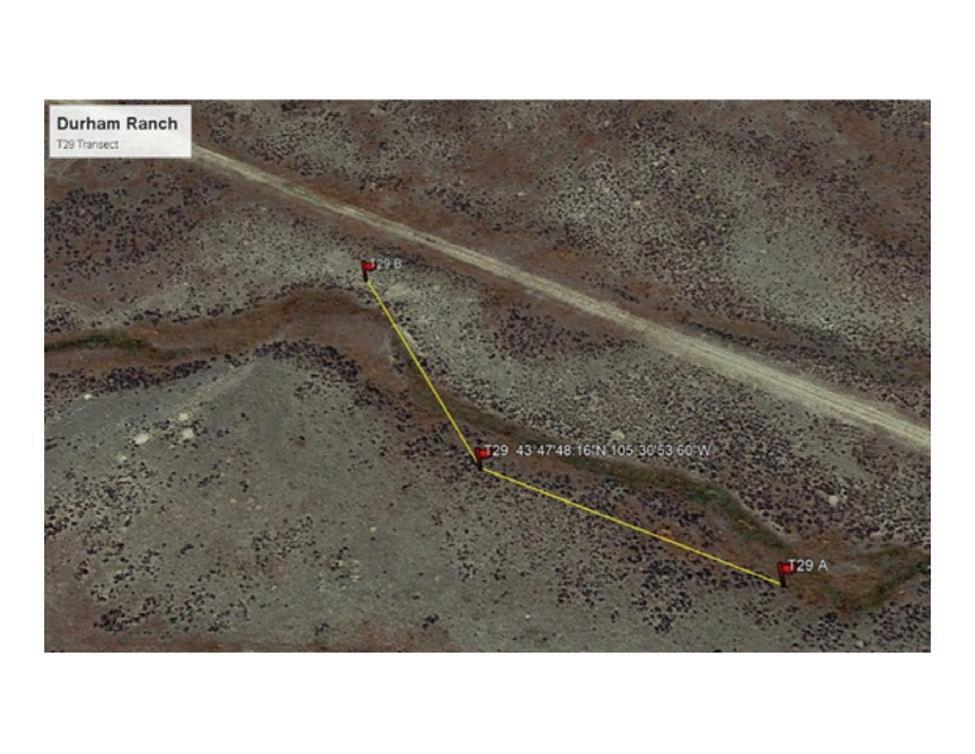
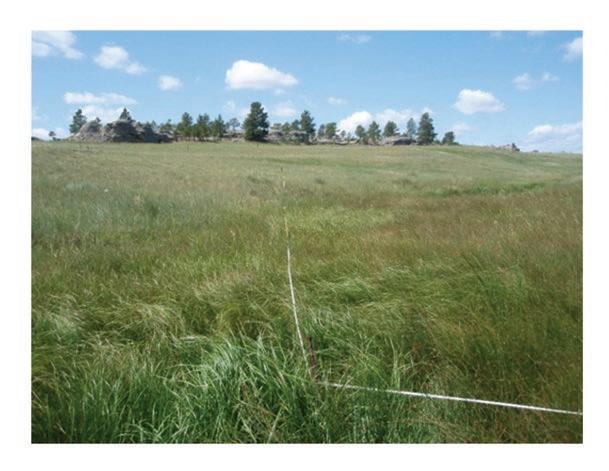
Transect Layout. This photo is from a new transect that I established last year on the Durham Ranch in Wyoming. Today I commonly run two transect lines. Since this transect represents the health of a pasture that is over 700 acres in size, I want to capture as much diversity as possible. Two transect lines allows me to document what changes might be happening in the area. Most of the transects vary between 200–300 feet in length.
As a Holistic Management consultant/educator, I spent the first 10 years teaching ranchers how to setup and collect monitoring data. In following up (monitoring) whether my efforts were creating the change I hoped, I found very few ranchers monitoring land health. I found a few ranchers had setup some monitoring transects, however almost none of them were revisiting these transects on a regular basis and determining whether the land was improving as defined by their Future Landscape Description (as part of their Holistic Goal). So, in 1995, I began offering custom monitoring services. In the last 25 years, I have setup over 300 transects on 40 ranches and here is what I learned.
Purpose
Before you jump in the pickup to start monitoring, give a little thought to why and where you will be monitoring. This will save you a lot of frustration and give you better information. I use a “Background Information Form” for each site that I plan to monitor. By completing the “Background Information Form” it helps me answer the following questions:
1. Why should I monitor this site?
2. What changes in management do I plan to make?
3. What is my landscape description for this site?
4. What parameters will help me determine change?
5. What has occurred on this site in the past?
6. Do I expect this site to change in the near future? Why? What do I plan to do that is different?
7. How much time and/or money do I have to commit to monitoring?
By monitoring these sites, you can quickly determine whether the actions you’ve chosen result in change. If these changes move you towards your future landscape goal, proceed with your plan. If the changes are not desirable, you will have to look for different actions to achieve your future landscape description.
Next, select one or two sites that are representative of pastures, slopes, or soil types that you are currently managing. This will give you baseline
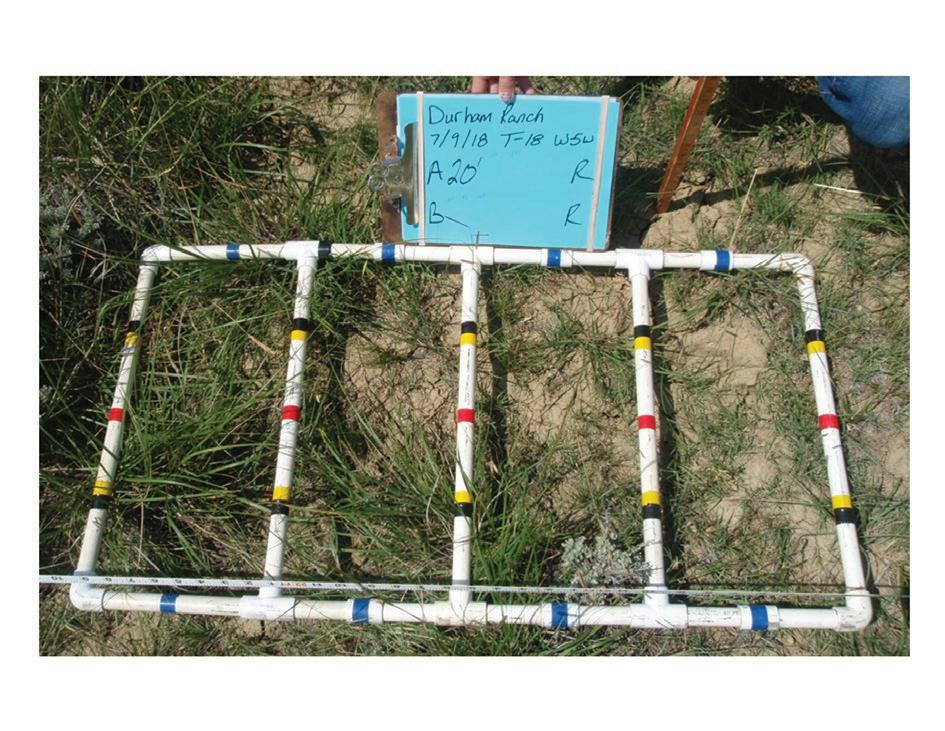
Frame Transect Method. This transect method involves documenting what you see happening within a 4-Quadrant Frame. Each large quadrant represents 25%, however you can see that I’ve further segmented this monitoring frame with colored tape. Using this method, I’m able to come up with a quick ocular estimate of bare ground and other ecological indices. I will lay this frame down three-four times along each transect line. Every time I lay this frame down, I document how the ecosystem is functioning within the frame using 12 different ecological indicators. I also take a picture of each frame, so you can see how things are functioning. I have found it best to visit each transect every two years.
12 Land & Livestock h May / June 2021
For these representative sites consider choosing locations where you or others have special concerns, such as wildlife habitat, undesirable plants, capped/crusted soils, or headcuts.
When to Monitor
Ecological Summary
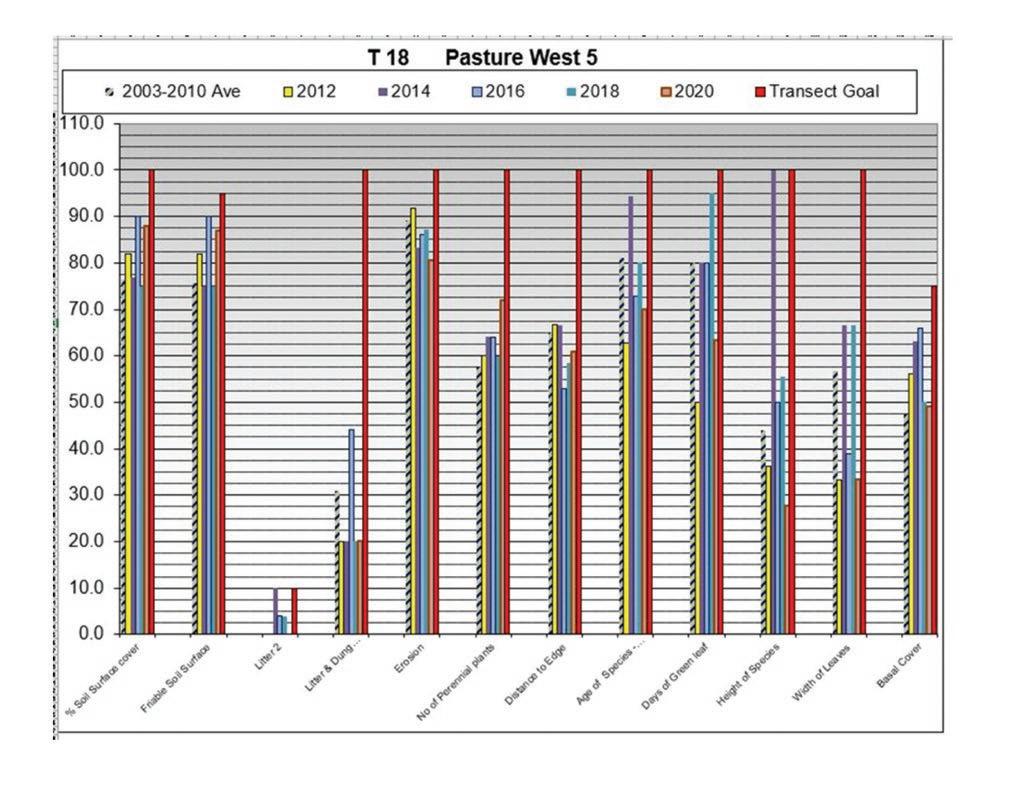
Once you’ve collected the field information, enter the data into an Excel spreadsheet. This will allow you to quickly create an Eco-Graph, which gives you a general sense of how healthy the land is. On this graph record with a red bar how you would like to see this site functioning in 10–15 years for each of the ecological parameter you are monitoring. Also record how the site is functioning for each year that you visit the site. This will allow you to determine whether your land management strategies are creating the change you desire.
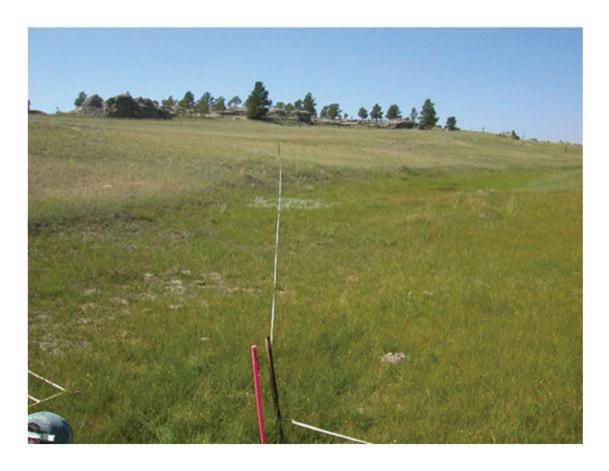
The adage: “A picture is worth a thousand words” is especially true with monitoring. With today’s “smart” phones, most of you have the ability to quickly establish some photo transects. With all the transects that I establish, I take three to four photos of the horizon and six to eight photos of the soil surface. (Photos taken on Milton Ranch Transect 6. The top photo is 2004 and the bottom photo is 2013.)
The best time to monitor is during the height of the growing season. This is when grasses and forbs are easiest to identify. Biological activity of other living organisms will also be highest at this time. I prefer mid-June through July here in the northern plains and Rocky Mountains. Try to do the monitoring when the plants are at the same biological state each year. The exact calendar date is not critical as seasons of growth will vary from one year to another.
To set a consistent timeframe for monitoring, put all the activities that you’re involved in during the growing season on a worksheet. Find a time period where you can spend two-four days monitoring the health of your land. If you cannot find a time period, then consider hiring someone to assist you. Even if you hire a consultant to help you collect this data, plan to accompany this person to several of the monitoring sites. Your understanding of how well the ecosystem processes are functioning on your landscape will be greatly sharpened.
Monitoring Methods
Once you have selected the site, you will have to determine what method of monitoring will give you the best information. Whichever technique you use, it should provide you information about bare ground, litter, plant spacing, plant diversity, and other life forms. You are trying to determine how effective the ecological processes (Water and Mineral Cycle, Biological Diversity, and Energy Flow) are on the land you are managing.
What factor will give you the quickest feedback as to whether you’re on track or not? Soil surface cover! You can notice changes in soil surface (bare ground, amount of litter, and soil surface crust) immediately.
Many monitoring techniques focus on plant diversity and/or key species. It may take several years before you notice a change in plant species. Focusing only on “a key species” is generally not a good idea. All too often the early plants on which the changes build, are commonly thought of as undesirables. This will lead you to believe that your actions are taking you off course and you will abandon your plan based on faulty parameters.
Note the Eco-Graph in this article is of a site that I have been monitoring for 17 years. See how the parameters continue to change every two years. What caused these changes? Precipitation, lack of precipitation, Extreme weather events, recent grazing, extending recovery periods, etc.
The last step to monitoring is to correlate these changes back the land (grazing) management strategies you actually used in this pasture. Now from what we learned, as we create the grazing plan for the upcoming year, what adjustments do we plan to make? Do we need to change the recovery periods? Based on the monitoring data, are we getting the “Gardening from Livestock” (Animal Impact) we desire? Having a good monitoring program can help you answer many of those questions.
Never Too Late
If you have been practicing Holistic Management for several years, however you never did setup any monitoring transects, all may not be lost. I started using a new Rangeland Analysis Platform. This app allows me to look back in time using Satellite imagery to determine changes in soil cover. For more information about this free APP check out https://rangelands.app This app does not replace the need for you to establish monitoring transects. So, make it a priority this year to establish at least three to four transects.
Note: Roland says he is not taking on new clients, actually he is in the process of retiring. So, if there is a young Holistic Management® educator/consultant that wants to learn this monitoring process, he is willing to train them. You must like to travel, however it’s a great way to see the country and learn what grazing strategies causes the most change. Roland is also willing to share many of the monitoring forms he uses, directions on how to build your own monitoring frame, or how to put together your own monitoring kit.
Number 197 h Land & Livestock 13
Ecological Summary.
Mesquite Field Farm— From Battleground to Breaking Ground
BY HEATHER SMITH THOMAS
Doug and Melissa Havemann are passionate about regenerative agriculture and about teaching regenerative principles and strategies to other people, inviting many folks to their farm near Nixon, Texas (about 70 miles east of San Antonio).
Doug grew up on a small family farm in south Texas and loved farming. “When my parents got divorced and we lost the farm, I always wanted to come back to a small farm. I went into the military, thinking about eventually doing this, but first I went into the computer world and spent 20 years working for Fortune 100 companies doing computer engineering and computer architecture around the world,” he says.
Melissa works for a large communications company. “She and I had been talking about a farm for a long time,” says Doug. “While we were both still working we found a 20-acre piece of land and decided to get into agriculture. We had no formal education in agriculture, so it was learn as we went.” The land was covered with mesquite, so Doug cleared it off and planted grass.
“We had no idea how we wanted to go about it,” says Melissa. “I happened to pick up a book in the Las Vegas airport when I was on a business trip, and it was called In Defense of Food, by Michael Pollen. I began to pay attention to our food and how our food is raised,” she says.
Farm Beginnings
They bought their small 20-acre farm in 2007 and put cattle on it in 2012. That was a tough year. “One of the longest droughts hit our area and farmers could not purchase hay to supplemental feed their livestock. A friend of ours was willing to sell us our first four head, and those initial cattle were a Black Baldy, Longhorn, Charolais cross,” Doug says.
“We kept our herd closed for a couple of years, observing their offspring closely. Then we purchased four additional head, including two from our friend, to increase our herd size with the same genetics. The third year we purchased a Red Brangus bull and Red Brangus dairy cross heifer. Our thought was to introduce the milking ability from the dairy cross and the heat tolerance from the Red Brangus. It has worked out well for us. We have since removed all of our bulls and are about to introduce some new genetics into our herd.”
Melissa has a business management degree and more than 15 years of marketing experience, so she is the business operations manager for their farming venture. She attended culinary classes with the Culinary Institute of America and has studied the local, sustainable, Real Food movement through workshops and online courses. She’s also been involved with local buying clubs and understands the requirements of discerning consumers—and is passionate about regenerative agriculture, cooking and learning more about gardening.
“After we bought our farm we started to learn about sustainable
agriculture, which was the buzzword at that time,” says Melissa. “Then a friend of ours who works for the NRCS got me a grant application for the beginning farmers and ranchers program with HMI. He sent it to me and thought it looked like something I’d be interested in. I got the grant and went to the class,” Melissa says. She completed the HMI Beginning Women Farmers and Ranchers Program.
Coincidentally, the weekend of the grazing planning class, Doug had cut their field which had a weed infestation, thinking there was going to be a rain coming in. “But it didn’t rain, so we had nothing in our field,” says Melissa. “I came back from the grazing planning class and suggested we do some cross-fencing. At that time we had no infrastructure besides perimeter fencing. We didn’t have any equipment for electric fencing or high-intensity rotational grazing and decided to try one strand of hightensile wire.
“After about six months of rotational grazing we had a great stand of rye grass. That lit a fire under us about getting more into regenerative agriculture. We really liked the HMI model and everything else that goes with it. We keep trying new ideas, and if they fail, we try something else, learning as we go.
“One of the things we realized early on was that we wanted to teach people. Our food system in this country is based on what has now become traditional agriculture (which evolved over the past 80 years or so, with the advent of modern technology). We don’t think this is healthy, however, so we wanted to be able to teach people about the HMI model.”
Battleground to Breaking Ground
This philosophy led them to get into the Battleground to Breaking Ground (Veteran Farmer Training) program, and to start bringing people out to their farm. “We wanted to be able to show them what we are doing and teach them these principles so they could take some of these ideas back to their own place,” she says.
Doug is a Desert Storm veteran. As a disabled vet (with PTSD and many broken body parts), he has always wanted to help military veterans. His passion shows in his current role as a regenerative farmer and rancher. He calls himself a reformed technologist and is now actively engaged in teaching regenerative agriculture to military veterans who are transitioning to civilian life.
“PTSD is something we wanted to focus on and help people, so we have always opened our farm to military veterans suffering from PTSD. We brought them out here, to get their hands in the dirt and let them pet a 2,200-pound bull and do things they’d never done before. When they can stand between the horns of a bull, it gets their attention! These experiences were helping people, and we noticed that it helped,” Doug says.
“We were still struggling to find our own path but knew we wanted to do sustainable, regenerative agriculture. We’d done all the internet searches because we both came from a technology background. We found Joel Salatin and we’ve seen his place—Polyface Farm—and we went to conferences at TOFGA (Texas Organic Farmers and Growers Association). We met all these people and had a whole new source of people and information to find.
“While we were doing that, we went to a farming seminar in San Antonio and stumbled onto a lady named Melissa Blair from the USDA
14 Land & Livestock h May / June 2021
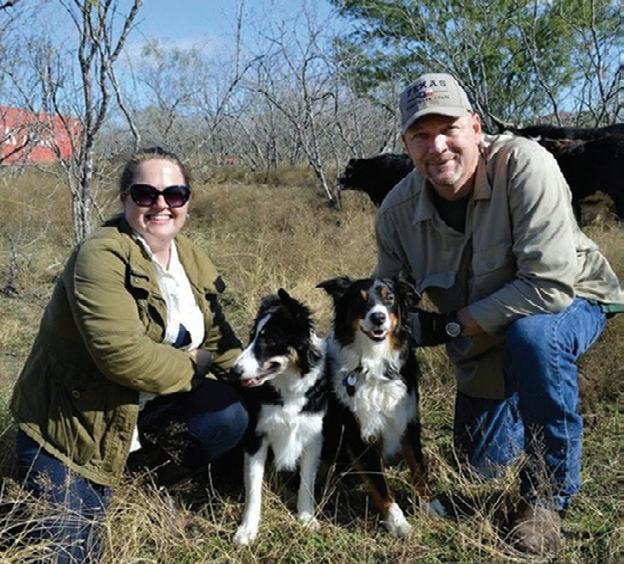
Doug and Melissa Havemann at Mesquite Field Farm
NRCS. She asked us to come by and listen to a group for military people. So we went to that training session the next day and it was called Battleground to Breaking Ground,” he says.
This is an AgriLife program for military veterans getting into agriculture. At that workshop, there were many young vets from recent wars. Some had come looking for work or looking for ways to integrate back into society or ways to distance themselves from the stresses of modern life. Much of what they’d learned and experienced in the military had been focused on sustainability, trying to stay alive, so it isn’t that much of a change to try to fit into an agrarian lifestyle.
Approximately 45% of veterans come from a rural background and are interested in getting back into it. As the average age of farmers in this country gets older, with fewer and fewer young people going into agriculture, this veterans’ program is an effort to address the problem-fewer farmers of working age--with a solution. It’s an effort to match some of the returning veterans who are willing to get their hands dirty and do an honest day’s work with farmers who need some help and are willing to teach the veterans more about farming.
Farming gives veterans a chance to serve their country again by helping feed America. As part of the Texas AgrAbility Project, these workshops help veterans and active duty personnel in obtaining employment and taking advantage of the therapeutic nature of agricultural work. “We are now a mentor farm for these veterans,” says Doug.
Mesquite Field Farm is one of only two mentor farms in the Battleground to Breaking Ground program. “COVID shut us down for a while, but we had an event here at our farm last September. We do a lot of hands-on learning,” he says.
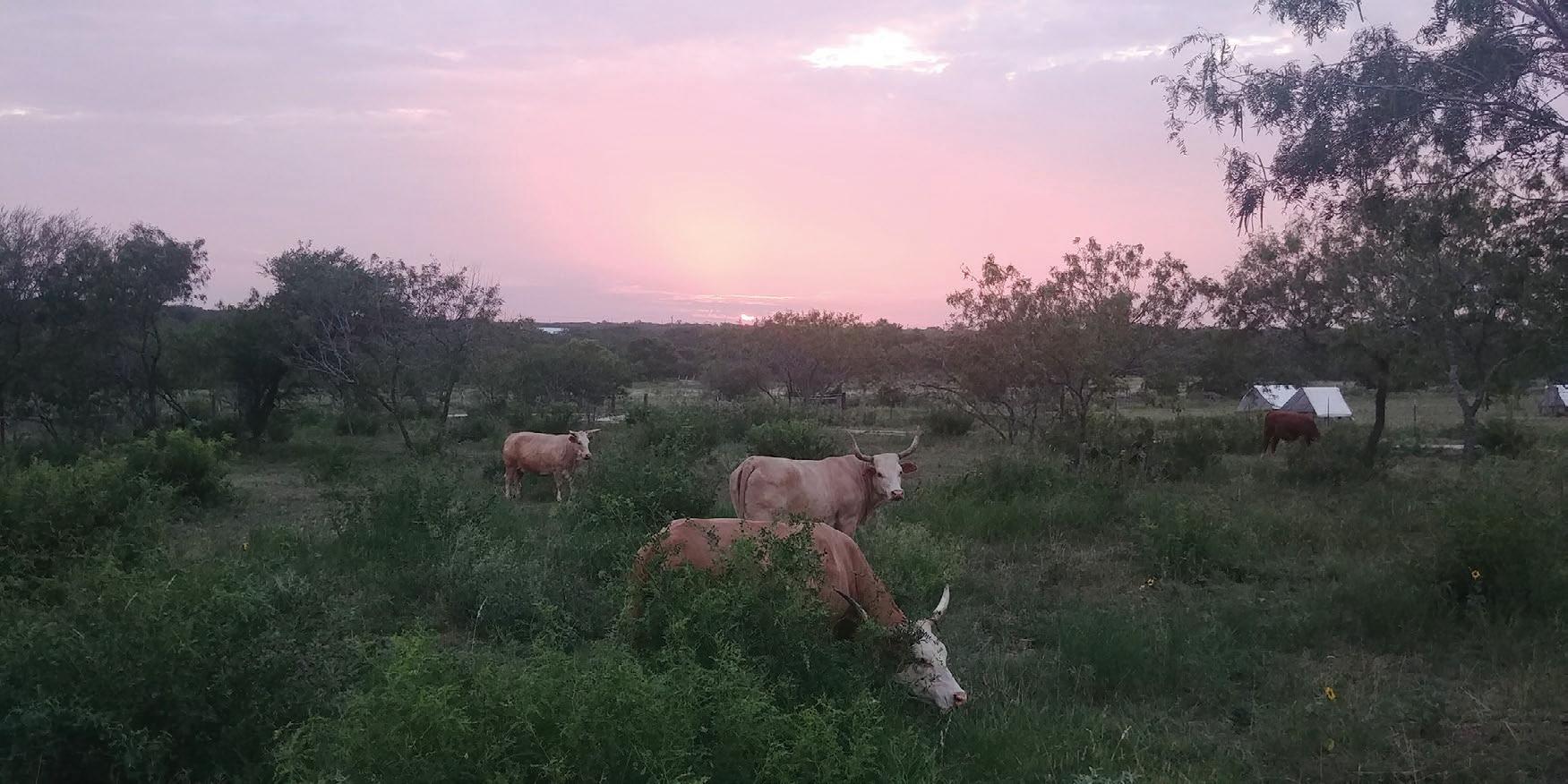
The Battleground program is a three-phase project and takes a year. “In the third phase the veterans must have 100 hours of hands-on learning. On the two mentor farms, with all the standard operations and new things we are implementing, the veterans come to the farm and learn what we are doing,” Doug explains.
The veterans participate in the work and learn by doing. “We just put in a 30 by 72-foot high tunnel that we covered, just before a hurricane came in, and the veterans helped with this,” he says.
The Battleground program has been running now for six years, and Doug has been helping with it and giving talks since the first year. “Now that we are a mentor farm, we get paid to do it, and we love doing it,” he says.
“One of the frustrating things for us has been trying to figure out what to do on our own place,” says Melissa. “You can see how other people do it on their place but that doesn’t necessarily mean it will work on your place. Also, there was a lot of technical data that we didn’t understand until we started doing something. This is one of the things that is very important
that we try to convey to these veterans, or to anyone who comes to our classes. We tell them what we did and what worked and what failed. We want them to ask us things, because we might be able to suggest what not to do. We’ve already done it, it failed, and people can learn from our mistakes!” she says.
“Farming is hard, and not very many people these days are capable of handling the mental and physical aspects of it so we also want to address people’s expectations. When most people think about farming it’s an idealistic idea of bucolic pasture and everything is perfect and that it just happens that way. But getting that wonderful pasture and smoothlyrunning farm took a lot of effort and mistakes. We want to be very realistic about what this life is, so this is very important to us when we are teaching these classes.”
“We had a set of students from the Battleground Program come out to our farm. Phase One is kind of an introduction, just to come look at what we do,” says Doug. “A husband and wife came, who were getting ready to retire from the military. They said they wanted to make $100,000 in profit in their first year, and asked how to do that. I told them that they start by investing $300,000 and then they will make $100,000 by the time
it’s owed. You are not going to make $100,000 in profit your first year. It will take many years before you make a profit, unless you are very lucky. There are some very lucky people out there, if they stumble into an operation that works!
“It’s been all about teaching ourselves and teaching other people, but also about paying attention to keeping our minds open to the other options that are there. No one has the right answer on how all of this is done. Everyone’s piece of soil is different. Everyone’s model is different, and where they live is different. All the variables are different. So that has been our focus.
“If you ask what we do, we’ll tell you that we do grass-fed beef, pastured poultry (layers as well as broilers) and we just installed the high tunnel for some Research and Development work we are doing as we are about to install our orchards.”
Adaptation is Key
Doug and Melissa are focused on improving soil health and improving their cattle, but also maintaining a healthy quality of life for themselves.
CONTINUED ON PAGE 16
Number 197 h IN PRACTICE 15
Doug and Melissa have seen how holistic planned grazing has helped them improve pasture health and productivity.
From Battleground to Breaking Ground
One way they do this is adapting their cattle genetics to reduce stress on the animals and for Doug and Melissa. “I pay attention to my cows. I want to breed large-framed cows and heifers to a smaller-framed bull that sires low-birthweight calves. I don’t want the cows having to struggle to give birth to their calves. So far, I haven’t had to pull a calf. Our life with our cows has been great. We bred for this and have gotten it,” he says. “From the HMI perspective, a lot of what we teach comes right out of HMI’s playbook. Our soil health is the most important thing on the farm.”
Doug had some serious health issues after they moved to the farm including multiple surgeries and doctors who were not correctly diagnosing or treating his diabetes. During that two-year period, he was so weak that there were times he couldn’t even get out of bed. “All of that time we’d spent fixing our land and improving our soil with our cows in an intensive rotation, and managing that, I just couldn’t do much,” says Doug. Melissa was trying to do it all but she was still working 40 hours a week at her job plus commuting for 1.5 hours each way.
changes that will help improve the opportunities and success of small farms and ranches.
For example, Doug works closely with the USDA/NRCS to promote conservation, and with legislators in Austin, Texas and Washington, DC, through the Farm and Ranch Freedom Alliance, to promote commonsense legislation supporting regenerative agriculture and that advocates for small farms at the state and federal legislature.
“I couldn’t always keep up with managing our land,” says Melissa. “This is the amazing thing about Holistic Management and rotational grazing; we had to leave the cattle in one place because we couldn’t manage it anymore. It basically destroyed our pastures. But by that time I knew that, as soon as we were able to put them back into rotation it would improve again and we could recover it. Nature has that ability if you give the land what it needs,” she says.
“I no longer get so stressed out and worried about it when things go wrong. That’s what I love about HMI; it has given me that mental peace of mind. I knew that whenever we could get the cattle back into rotation, within a couple of months (or even a few weeks) we would see an improvement in our pastures. That was a great blessing for me, to have that peace of mind and to have that mental stress and worry taken away.”
Educating Producers & Consumers
The goal for Mesquite Field Farm is not just meat production and education, but to be a “whole plate” farm—where someone could come to their farm and buy everything they needed for making a nutritious meal on one plate. That goal comes from wanting to educate consumers as well as producers. In addition, they spend time trying to help create policy
Doug and Melissa are dedicated to learning all they can so they can share that information with others. They both found HMI’s Beginning Farmers and Ranchers Program a huge help as well as supplemental programs, like HMI’s Drought Mitigation program. Because they both had the training it helped their ability to implement the practices together at home.
“It’s best if both spouses attend a training, so they can speak the same language and understand what I’m saying when we are talking about this,” says Melissa. When Doug took HMI’s Beginning Farmers and Ranchers in Texas, Melissa felt that enabled to take their management of the farm to a new level.
Likewise, the program manager for Battleground to Breaking Ground, Erin Kimbrough, also completed HMI’s Beginning Farmers and Ranchers course with Doug, she is a resource to them as she understands the value of both conventional and regenerative agriculture systems and sends people to Doug and Melissa who want to farm like them.
“We get a lot of people coming here, and have noticed that many more people are coming around to the Holistic Management methodology,” says Doug. “They don’t want traditional ag anymore; they want to produce a better quality product. They don’t want to sell their cattle at an auction barn; they want to sell direct to a consumer.” So they invite producers out to see what they are doing and encourage them to learn these practices.
Likewise, if customers want to know how their food is raised, Doug and Melissa want them to come out and see for themselves. At the far end of their street there is a chicken processing plant and in the summer the odor from it is very unpleasant. “When people come to our farm, by the time they get here, they’ve been able to smell it,” says Doug. “I tell them that’s the chicken they buy in the grocery store, and ask if they really want those—or the happy chickens they can see running around on our place eating bugs. This is one of the best advertisements we could ever have.”
Doug and Melissa spend a lot of time thinking about creative ways to
16 Land & Livestock h May / June 2021
CONTINUED
FROM PAGE 15
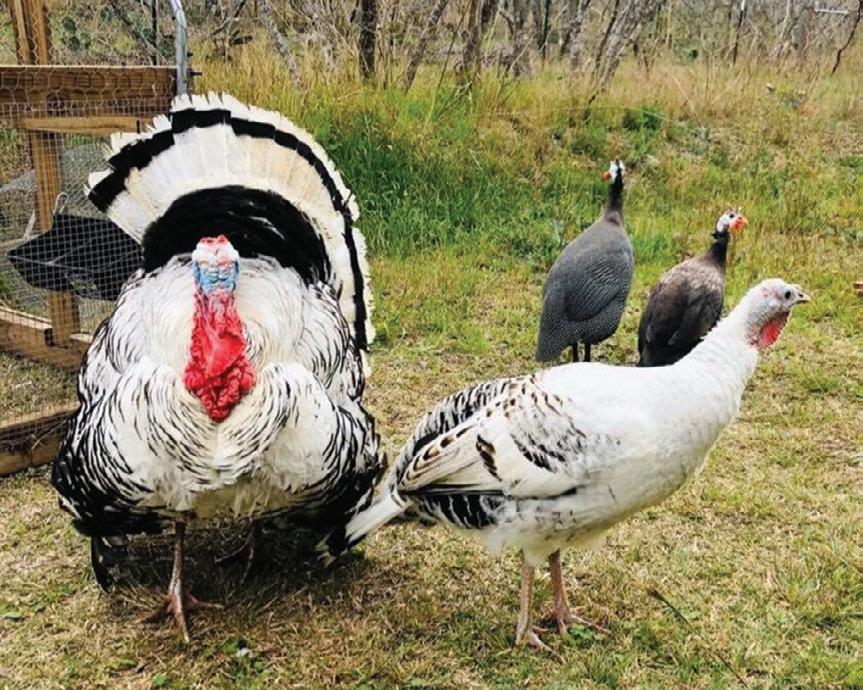
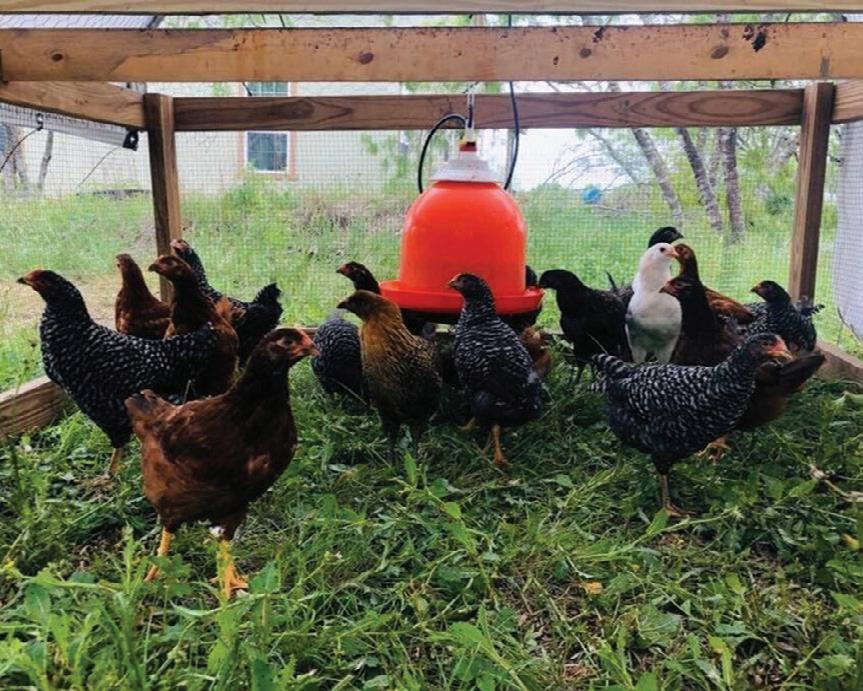
Poultry is a quicker way for small scale producers to develop a profitable enterprise.
get the information about regenerative agriculture to more people. Their goal and intention is to produce the best quality nutrient-dense food for their customers, families, and themselves. “We do this by mimicking the systems found in nature, and there are no monocultures in nature so we do not farm utilizing traditional practices.” Instead, they utilize advances in animal husbandry, fencing technology, geospatial mapping, renewable energy, moisture capture, irrigation tapes, and disease recognition of the last 80 years, and couple those advances with regenerative practices that were utilized prior to the industrial revolution.
“After witnessing how we raise our animals and produce, we are sure people will support not only us, but other local producers in their area,” says Doug. “Many people forget that during World War II, Victory Gardens fed our entire country while industrialized food went to feed our brave soldiers. Today, using proven farming techniques combined with exciting new technologies, local producers can feed the country good, nutritious food, and help train the rest of the world to better feed themselves.”
COVID continues to show the gaps and inefficiencies in our present food system and food supply chain that depends on big business and big agriculture. Doug and Melissa believe we need more diversity and less centralization so they are pushing for the PRIME Act which would loosen federal regulations and allow the states to regulate processors themselves to allow meat such as beef, pork or lamb from custom kill plants to be sold to consumers, restaurants, hotels, boarding houses, and grocery stores.
“We have been on the front lines fighting for changes,” says Doug. “We pushed for the Chicken and Rabbit Processing bill in Texas in the last legislative session. The original regulations said that if a person was going to process 1,000 birds or less, on your small farm, you had to have a $50,000 USDA or state certified facility to do it. We pushed to change this because the agency wouldn’t change the regulations on their own, and the
bill passed after a long-drawn out process so you can now process 1,000 birds on your farm without the benefit of inspection if you label it correctly and have a sanitary operation procedure.
“The Texas Department of State Health Services is in comment period right now and we don’t know if it will pass. We will have to wait and see what they change after the comment period is over, but if it goes into effect as is, if you register your sanitary operation procedure with the DSHS, you will be able to process up to 10,000 birds on your farm without the benefit of inspection. That was a huge change in our favor that we didn’t see coming.”
Melissa points out that many people have been really pushing for this change, because poultry is a quick way for people to get started in agriculture since the turnaround from chick to harvest is only 62 days. “You can potentially make a profit in a short time if you do it right,” says Melissa. “The hardest thing about getting into agriculture is that land and infrastructure is so costly. If we can provide a way for new farmers to start generating revenue on a small place it will be very encouraging.”
Melissa and Doug have seen their customers double because more people are becoming aware of where their food comes from, and care about what they eat and how it was produced. And while they also want to share what they are doing for the land and the animals with more consumers, their primary educational focus is sharing what they have learned with those who want to learn more about regenerative agriculture and Holistic Management, particularly with veterans. Because Doug and Melissa have been willing to experiment and learn from both successes and failures, and to reach out to others in the regenerative agriculture and Holistic Management community to learn more, they have a wealth of experience and knowledge to share and to continue to increase the profitability of Mesquite Field Farm.
Creating a Successful Business in Rough Country
CONTINUED FROM PAGE 10
would have been like a lot of people—you have a ranch and a job in town. The ranch is hard enough work, without having another job!”
Date Creek Ranch is committed to certain goals and strives to maintain an open, friendly, and collaborative environment between employees, family, the whole team, and customers. Kimberley, Stefan, Ryan and Savannah feel that their day-to-day work contributes to personal growth and opportunities (to all people involved) to pursue their personal interests. They try to always have a warm, welcoming, and healing atmosphere for anyone who visits or works here.
“We will continue the cowboy-ranching tradition and will be a part of the agricultural community that provides healthy food to the world community,” says Kimberley. She feels one of the most important things is to maintain open spaces for future generations, and a healthy ecosystem that gives families, children, and groups with like-minded ideas the opportunity to explore nature and to find healing and comfort in their daily lives.
The holistic model helps with quality of life, fostering a balance between work and play, and a good financial plan that helps ensure profit from livestock, crops, eco-tourism, and investments. It also ensures stable, healthy, covered soil in which rainfall soaks in rather than running off, with minimal bare ground and erosion. The land supports a healthy diversity
of cool and warm season grasses, forbs and browse as well as desert trees and cactus, with a well-functioning mineral cycle. Plant material and manure is rapidly broken down and cycled back into the soil—with diverse plant, animal and insect life. There is a healthy predator population and abundant wildlife.
All products offered to customers have been raised holistically and with care. “All of our meat is hormone and antibiotic free, in keeping with our goals,” says Kimberley. “Our beyond-organic beef and lamb is 100% grass fed, and the animals live their lives entirely on native forages and irrigated pasture. Our chicken is a special, delightfully flavored breed from France that thrives on irrigated pasture. Our poultry is organic, non-GMO and soy-free. Our all natural pork is free of hormones, antibiotics, and soy free,” she says.
“Our organic pick-your-own peaches are typically ready for harvest in July and organic apples in September. We have not used any pesticides, chemicals or herbicides on our ranch since 1983,” she says.
“We treat all of our animals quietly, with respect, and gratitude. We believe we have an unwritten contract with all life here on the ranch. We give them the very best life we can and in turn they provide us with a means to feed our family.”
Number 197 h IN PRACTICE 17
A Holistic Approach to Farm/ Ranch Transfer Planning
CONTINUED FROM PAGE 1
values including:
• Gabe and Shelly Brown and how they have gone about planning and implementing their farm transfer to their son, Paul, while considering other asset transfer to their daughter, Kelly.
• Dave and Kay James and how they sold off part of their land and put the rest in a conservation easement to protect the land that is kept in agricultural production by their adult children who each operate individual enterprises while utilizing an LLLP to make decisions about the joint assets shared by the family.
• KTS Farm and how they worked out a lease and purchase arrangement with an employee after first supporting a management transition.
• And numerous other case studies to
Conservation Easements
consider other management and asset transfer options.
It is a given that every family will experience at least one of the “5 D’s.” As the saying goes, there’s nothing certain in life except death and taxes. But families may also experience divorce, disability, disaster, and disagreements. The ability to weather those storms successfully, by keeping the values of the family and business intact, increases when a family had these different components of a transfer plan completed within the context of a holistic goal.
Transfer planning is the type of planning that falls into the categories of “Important but Not Urgent” for most people (as articulated by Stephen Covey). However, if not done in time, it can become “Important and Urgent,” and, in many cases, can result in broken relationships, financial problems, and added stress to all involved. Because transfer planning brings up many emotionally charged issues, working with a facilitator skilled in consensus building, Holistic Management, or other communication tools
can help the process go more smoothly, reduce the time it takes and give you better results in the end.
Because of the inherent complexity of the process, transfer planning is not something to try to do on your own. You will need a resource team of professionals to help you create the needed documents. You will want to be sure your personal legal and financial advisors agree that the plans you create are aligned with your intentions.
Transfer planning can seem daunting because of the multiple plans involved, but we hope your transfer plan provides the legacy you want to give to your family and community. Leading with your values and your vision is an invaluable part of the communication that is required for an effective transfer. Because your holistic goal engages your family in a valuebased discussion it helps your management team articulate the values and desired outcomes now and into the future, as well as define the key behaviors and systems necessary to create
Conservation easements are one of numerous legal tools to help farmers and ranchers address the following objectives:
• Generating income
• Keeping land prices down to make it more affordable for agricultural producers in the future
• Keeping working lands working
• Making sure that certain conservation objectives remain tied to the land
• Reducing tax liability of land
However, there are pros and cons to using this tool which should be considered in the context of all your transfer plan. As you can see from the articles in this issue, the owners had to consider the consequences for the legacies they wanted to leave. Pros
1. Landowner can maintain control (management) and ownership of property
2. Keeps land protected for future generations
3. Gets paid for appreciated value
4. Receives potential income tax benefits from sale of development rights
5. Can assist future generations through potentially reducing estate taxes
6. Land can still be sold
7. Structure of easement can be flexible enough to accomplish a variety of succession, management, privacy, and conservation goals
8. You can limit public access
9. Easement usually goes to non-profit organization, not the government
Cons
1. Your land may not be eligible for a conservation easement (check taxation code)
2. It may take time to find the right land trust to work with you
3. You will likely need a paid professional to make sure your easement works for you (negotiating for your interests)
4. Having a conservation easement reduces the number of buyers who will be interested in your property and may reduce the value of the land (some buyers have lender challenges as well)
5. You will need to get an appraisal to be able to defend the conservation easement value you use on your taxes.
6. You may not be able to stop all forms of development given issues like oil and gas rights, water rights, etc.
7. You can only do it once in a lifetime, so you tie the hands of future generations
Other transfer tools to consider include:
• Affirmative agricultural easements (requiring land to be farmed)
• Options to purchase land at agricultural value (OPAVs) (encouraging land to be re-sold only to farmers)
• Differential assessment/current use programs (lowering taxes on agricultural land)
• Federal farm programs (loans, grants, cost shares)
18 IN PRACTICE h May / June 2021
those outcomes.
While having a holistic goal and vision for the family and the business improves communication, the decision-making testing checklist is a valuable tool that can help guide the development of your plans and continue to improve communication within the management team. Testing and monitoring decisions helps ensure you are addressing human, natural, and financial resources, adapting to changing circumstancxes, and minimizing unintended consequences. Monitoring also helps ensure that you update plans as situations change, new people are added to the family and business and others move on. When children, partners, and/ or employees join the business, they too become
Tips for a Successful Meeting
part of the decision makers managing the land and business holistically.
Statistically, 33% of farms/ranches pass from the first generation to the second. Of the second generation, only 12% pass to the third generation. And, only 4% pass from the third to the fourth generation. By doing this transfer planning work to create a viable transfer plan, you can help reverse this trend of working lands not being kept in production.
Farm and ranch transfers can be particularly challenging with the intertwining of people’s homes, childhoods, career development, business opportunities, and personal and business assets. With the increasing loss of agricultural lands to development pressure, the
Consider the following steps as you develop or refine your transfer meeting process.
1. Have a designated facilitator who leads the meeting and keeps the conversation on track
need to keep working lands working is greater than ever. Providing opportunities for the next generation of farmers and ranchers through successful farm/ranch transfers will help support your family and your local community while leaving a lasting legacy for years to come.
Don Campbell, a Holistic Management® Certified Educator and someone who has used Holistic Management to help develop his transfer plan articulates the rewards of that planning well: “I have had a most successful inter-generational transfer from me and Bev to our sons and their spouses. This would not have happened without Holistic Management. We wouldn’t have had the financial or people skills to make it all work. I enjoy the fruits of that transfer daily.”
2. Have a note taker, send notes to all attendees, and file your notes/minutes after you adopt these at a subsequent meeting.
3. Have an agenda, send it out prior to your meeting, and follow it during the meeting
4. Start on time and end on time
5. Develop a code of conduct and consider using a talking stick.
6. Create guidelines for respectful, honest communication. Address disruptive behavior to develop a “culture” of how you want people to behave and meetings to go. A facilitator may choose to talk with people individually on a sensitive issue and bring it back to the group for discussion.
7. Respect the group’s time. If an idea is not ready for the larger group’s decision-making authority, ask that an individual or committee work to move the idea along and then bring it back to the group.
8. Define your decision-making process so that participants are clear
9. Try to keep your meetings to 90 minutes or less.
10. Create a “parking lot” list to place any items that should be addressed at a later time
11. Follow up on action items from the previous meeting at the beginning of each subsequent meeting.
12. Work to stay on schedule for your meetings. If someone can’t make a meeting, can they provide information on any of their assignments to someone who will be at the meeting and who can present for them?
13. Periodically evaluate the effectiveness of your meetings and adapt techniques to improve.
14. Have fun and celebrate accomplishments and achievements.
In Memoriam
Bob Steger
It is with great sadness that HMI learned of Bob Steger’s passing on February 18, 2021. He is survived by his wife Peggy, of 62 years, and a son Kenneth Wade. Bob earned a bachelor’s degree in Agriculture Education from Texas A&M University in 1962 and his Masters in 1964. He completed his PhD at the University of Wyoming in 1970 and taught at Sul Ross and then became an Area Range Specialist at San Angelo and began ranching.
Bob learned about Holistic Management in the 1978 when he first heard Allan Savory speak at a grazing tour in Mexico and Texas and experimented with, learned about, and taught Holistic Management ever since in the U.S., Canada, and Mexico.
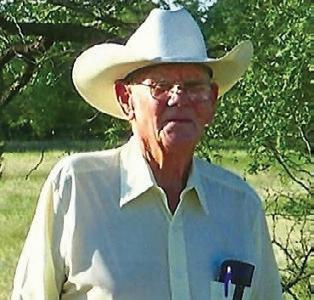
Bob decided to put these ideas to the test on his ranch in 1983. The
weather had been rough that year with not only cold and drought, but a hailstorm had taken out most of his ranch. Bob was trying to figure out what to do with his animals. He couldn’t afford to feed or sell them. So he threw all the animals together—cattle, sheep, and goats. He had about 100 animal units on approximately 2,000 acres that were divided into 4 paddocks. With one herd, he could begin to give the other paddocks longer recovery periods. He remembers that year because as he looked over the valley of his ranch, he could see the three neighbors’ lands on all sides of his ranch. Despite the tough weather, he had green feed and his neighbors didn’t. They ended up having to buy feed or destock, while Bob didn’t. That experience was what convinced Bob that he needed to continue to learn how to practice and teach Holistic Management.
Bob was also instrumental in organizing HRM of Texas, serving as President for six years in the early ‘80s. He also participated in many HMI field days and workshops sharing his experience and knowledge. Bob will be missed greatly missed by the HMI community, and we offer our condolences to the Steger family.
Number 197 h IN PRACTICE 19
Bob Steger
From the Board Chair
BY WALTER LYNN
This month I would like to share about a personal mentor and Holistic Management practitioner. It is with great pleasure to share about a world leader in soil health, David Brandt. I have been to David’s farm on several occasions for field days and mentorship with others and myself.
David just completed a major soil health engagement in Illinois in February, which is the first he had been involved in since his wife’s death in November 2020. He wanted to be “on the court” to share his passion. David’s family operates a family farm and seed business near Carroll, Ohio, 25 miles from Columbus.
On this specific trip, David met with two farmers one-on-one, attended a 60-attendee farmer group meeting, plus shared his story on soil health with two community colleges’ agricultural programs, an Illinois Agricultural Education/FFA staff person, three members of the State NRCS staff, and 20 Zoom meeting participants. He was able to participate in a Regional Conservation Partnership Program advisory group focusing on nitrates and sedimentation for a watershed entailing 592,000 acres in seven central Illinois counties.
David is 74 years old; his life purpose is promoting the awareness and education about soil health. This enthusiasm exudes from him as he connects with a farmer by starting where the producer is currently on the journey. David advocates the “safe to fail” concept to minimize risk and promote change.
A qualitative measure he shares with others is that the first farm he increased paddocks, Joan has kept a low stocking rate because she is concerned about the health of land.
CONTINUED FROM PAGE 24
Because of the increased forage production and diversity, Joan has seen her live weight for bull calves increase by 100 pounds from 2014 to 2020 and 64 pounds for heifer calves for a 14% gain in live weight. She tries to get her bull calves to 700 pounds by eight months.
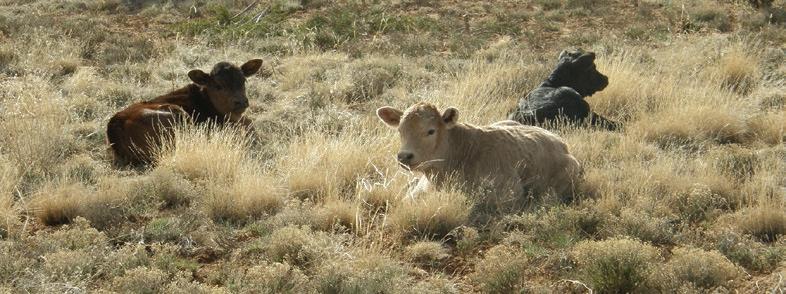
While Joan’s primary career was being a linguistics professor at the University of New Mexico, ranching was in her background. Joan’s maternal grandfather was a rancher in Texas, so she had a ranch to visit when she was a child. Joan helped with the round ups and always wanted a ranch but she never thought she would have one.
“I did like the idea of a place to go to get out of town,” says Joan. “So I acquired this land in pieces and became acquainted with Holistic Management in 2001 and with the Quivira Coalition. Then I got some cattle. I had already decided I wanted to improve the land, then I found out that grassfed beef was good for you. I was friends with Kirk and Tamara Gadzia who encouraged me and I was also inspired by the Ranney Ranch, who helped me understand more about when to take the animals for slaughter. Through them I got a feel for how things worked with a small direct market business. It helped that I had a little bit of ranch background and knew how to handle big animals in a corral.” With increased interest in local meat because of COVID, Joan has seen an
and his wife purchased in 1971 now has a soil organic matter of 8% versus the organic matter of under 1% at the time of purchase. This represents a 7% change in almost 50 years of farming! His practices include no-till farming, cover crops, and diverse rotations. No animal impact was used to accomplish this feat of changing soil organic matter, but today he knows animal impact would speed up the change he accomplished in building the Brandt Family Farm resiliency.
David’s influence in soil health education is not only national, but also international. In 2012, Natural Resources Conservation Service (NRCS) Chief Dave White announced the soil health initiative “Unlock the Secrets in the Soil” on the Brandt farm. Today, the farm is a national training site for the NRCS. In 2015 the French Minister of Agriculture visited Dave’s farm because of innovative carbon sequestration strategies in his farming practices and Dave went to Paris in 2016 to meet with the Minister of Agriculture again.
Dave’s coaching and mentoring is exemplary in relation to the context for HMI. He brings compelling economics for understanding to an Iowa, Illinois, or Indiana farmer. Ecologically his practical experiences are second to none with examples he can cite. The social piece comes into play with how he relates to the producer, and he can share his experience with multi-generational transition on his farm.
Margaret Mead said “Never doubt that a small group of thoughtful, committed citizens can change the world; indeed, it’s the only thing that ever has.” HMI has the resources to help you be a part of creating a better world, whether it is through our courses, programs, or the free resources we share on our website.
increase of 60% in her customer base so she is working with other local ranchers to meet that interest.
Joan tends to an Angus/Charolais cross because the Charolais are good milk producers and the calves get big by eight months when she takes them to slaughter. But, Joan notes that the cows that are more Angus produce good calves, too, and she uses a Black Angus bull.
Joan’s passion for conservation led her to place a conservation easement on her property in 2011. “I’ve always been interested in conservation and had a love of nature, from having time on my grandfather’s ranch,” says Joan. “My parents took us to all the national parks, and I lived in New Mexico as a child. My father was a hunter and fisherman, so I went on lots of fishing trips.”
Joan provides support to HMI and the Quivira Coalition because she likes the educational focus on conservation. “Education is the key to everything, so I like to support organizations that have a good educational component,” says Joan. “Spreading the word about these practices and ideas is critical. It changes society and culture when you have people educated and informed.”
Joan also notes that she does a lot of educating with her customers who are excited about the food she raises. “I get so much gratification from selling good meat to people,” says Joan. “They are so grateful and they say thank you for doing this.”
20 IN PRACTICE h May / June 2021
Mesteño Draw Ranch
Calves lying in some spike muhly and NM feathergrass.
Certified Educators
The following Certified Educators listed have been trained to teach and coach individuals in Holistic Management. On a yearly basis, Certified Educators renew their agreement to be affiliated with HMI. This agreement requires their commitment to practice Holistic Management in their own lives and to seek out opportunities for staying current with the latest developments in Holistic Management.
UNITED STATES
NEW MEXICO
Ann Adams
Holistic Management International
Albuquerque 505/842-5252 ext 5 anna@holisticmanagement.org
Christina Allday-Bondy
Edgewood 512/658-2051 • christina.alldaybondy@gmail.com
Kirk Gadzia
Bernalillo
505/263-8677 (c) • kirk@rmsgadzia.com
Jeff Goebel
Belen
541/610-7084 • goebel@aboutlistening.com
CALIFORNIA
* Lee Altier College of Agriculture, CSU
Chico
530/636-2525 • laltier@csuchico.edu
Owen Hablutzel Los Angeles
310/567-6862 • go2owen@gmail.com
Richard King Petaluma 707/217-2308 (c) rking1675@gmail.com
Doniga Markegard Half Moon Bay 650/670-7984 Doniga@markegardfamily.com
* Kelly Mulville Paicines 707/431-8060 • kmulville@gmail.com
Don Nelson Red Bluff 208/301-5066 nelson-don1@hotmail.com
Rob Rutherford San Luis Obispo 805/550-4858 (c) robtrutherford@gmail.com
COLORADO
* Joel Benson Buena Vista 719/221-1547 joel@paratuinstitute.com
Cindy Dvergsten Dolores 970/882-4222 cadwnc@gmail.com
Tim McGaffic Dolores 808/936-5749 tim@timmcgaffic.com
* Katie Belle Miller Calhan 970/310-0852 heritagebellefarms@gmail.com
KANSAS
William Casey Erie
620/423-2842 bill.caseyag@gmail.com
MARYLAND
Christine C. Jost
Silver Springs
773/706-2705 • christinejost42@gmail.com
MICHIGAN
MISSISSIPPI
* Preston Sullivan Meadville 601/384-5310 (h) preston.sullivan@hughes.net
MONTANA
Roland Kroos Bozeman 406/581-3038 (c) • kroosing@msn.com
* Cliff Montagne Montana State University Bozeman 406/599-7755 (c) • montagne@montana.edu
NEBRASKA
* Paul Swanson Hastings 402/463-8507 • 402/705-1241 (c) pswanson3@unl.edu
Ralph Tate
Papillion 402/250-8981 (c) • tater2d2@cox.net
NEW HAMPSHIRE
Seth Wilner
Newport 603/863-9200 (w) seth.wilner@unh.edu
INTERNATIONAL
AUSTRALIA
Judi Earl Coolatai, NSW 61-409-151-969 judi_earl@bigpond.com
Graeme Hand Franklin, Tasmania 61-4-1853-2130 graemehand9@gmail.com
Helen Lewis
Warwick, QLD 61-4-1878-5285 hello@decisiondesignhub.com.au
Dick Richardson Mt. Pleasant, SA 61-4-2906-9001 dick@grazingnaturally.com.au
* Jason Virtue Cooran QLD 61-4-27 199 766 jason@spiderweb.com.au
Brian Wehlburg Wauchope NSW 61-0408-704-431 brian@insideoutsidemgt.com.au
Larry Dyer
Petoskey 231/881-2784 (c) ldyer3913@gmail.com
CANADA
Don Campbell Meadow Lake, SK 306/236-6088 • doncampbell@sasktel.net
NEW YORK
* Erica Frenay
Brooktondale
607/342-3771 (c) • info@shelterbeltfarm.com
* Craig Leggett
Chestertown
518/491-1979 • craigrleggett@gmail.com
Elizabeth Marks
Chatham
518/567-9476 (c) elizabeth_marks@hotmail.com
Phillip Metzger
Norwich 607/316-4182 • pmetzger17@gmail.com
NORTH DAKOTA
* Joshua Dukart
Hazen
701/870-1184 • joshua_dukart@yahoo.com
OREGON
Angela Boudro
Central Point
541/ 890-4014 • angelaboudro@gmail.com
SOUTH DAKOTA
* Randal Holmquist
Mitchell 605/730-0550 • randy@zhvalley.com
Ralph Corcoran Langbank, SK 306/434-9772 • rlcorcoran@sasktel.net
Blain Hjertaas Redvers, SK 306/452-7723 bhjer@sasktel.net
Brian Luce Ponoka, AB 403/783-6518 lucends@cciwireless.ca
Noel McNaughton Edmonton, AB 780/432-5492 noel@mcnaughton.ca
Tony McQuail Lucknow, ON 519/440-2511 tonymcquail@gmail.com
Kelly Sidoryk Blackroot, AB 780/872-2585 (c) kelly.sidoryk@gmail.com
FINLAND
Tuomas Mattila Pusula 358-407432412 tuomas.j.mattila@gmail.com
TEXAS
Deborah Clark
Henrietta
940/328-5542
deborah@birdwellandclarkranch.com
Kathryn Frisch
Holistic Management International Dallas 214/417-6583
kathyh@holisticmanagement.org
Wayne Knight
Holistic Management International Van Alstyne 940/626-9820
waynek@holisticmanagement.org
Tracy Litle
Orange Grove 361/537-3417 (c) • tjlitle@hotmail.com
Peggy Maddox
Hermleigh
325/226-3042 (c) • peggy@kidsontheland.org
Peggy Sechrist
Fredericksburg 830/456-5587 (c) • peggysechrist@gmail.com
WISCONSIN
* Larry Johnson Madison 608/665-3835 • larrystillpointfarm@gmail.com
* Laura Paine Columbus 608/338-9039 (c) • lkpaine@gmail.com
For more information about or application forms for the HMI’s Certified Educator Training Programs, contact Ann Adams or visit our website: www.holisticmanagement.org.
*
These associate educators provide educational services to their communities and peer groups.
NAMIBIA
Usiel Seuakouje Kandjii
Windhoek 264-812840426 kandjiiu@gmail.com
* Colin Nott Windhoek
264-81-2418778 (c) canott@iafrica.com.na
Wiebke Volkmann
Windhoek
264-81-127-0081
wiebke@afol.com.na
NEW ZEALAND
* John King
Christchurch
64-276-737-885
john@succession.co.nz
SOUTH AFRICA
Jozua Lambrechts
Somerset West, Western Cape +27-83-310-1940
jozua@websurf.co.za
* Ian Mitchell-Innes
Ladysmith, Kwa-Zulu Natal +27-83-262-9030
ian@mitchell-innes.co.za
Number 197 h IN PRACTICE 21
Electra-Lock Fence System
Electra-Lock is a revolutionary fencing system designed to improve livestock containment at a fraction of the cost of traditional fencing methods. It is manufactured in the U.S.A using hi-tensile, class-3 galvanized wire.

•Greater Visual Barrier
•Available in 660’ rolls
•Ability to energize entire fence
•Available in four or five strands
•Easy Installation
(800) 527-0990
Resource Management Services, LLC
Kirk L. Gadzia, Certified Educator
PO Box 1100
Bernalillo, NM 87004 505-263-8677
kirk@rmsgadzia.com
www.rmsgadzia.com
Pasture Scene Investigation
How can RMS, LLC help you?

On-Site Consulting: All aspects of holistic management, including financial, ecological and human resources.
Training Events: Regularly scheduled and customized training sessions provided in a variety of locations.
Ongoing Support: Follow-up training sessions and access to continued learning opportunities and developments.
Land Health Monitoring: Biological monitoring of rangeland and riparian ecosystem health.
Property Assessment: Land health and productivity assessment with recommended solutions.
CORRAL DESIGNS
CORRAL DESIGNS
Interactive Online Learning Courses
“Bud Williams”
Livestock Marketing & Proper Stockmanship
2021 Fall Series
with Richard McConnell & Tina Williams
By World Famous Dr. Grandin Originator of Curved Ranch Corrals
 By World Famous Dr. Grandin Originator
of Curved
Ranch Corrals
The wide curved Lane makes lling the crowding tub easy


Includes detailed drawings for loading ramp, V chute, round crowd pen, dip vat, gates and hinges. Plus cell center layouts and layouts compatible with electronic sorting systems. Articles on cattle behavior. 27 corral layouts. $55.
The wide curved Lane makes filling the crowding tub easy. Includes detailed drawings for loading ramp, V chute, round crowd pen, dip vat, gates and hinges. Plus cell center layouts and layouts compatible with electronic sorting systems. Articles on cattle behavior. 27 corral layouts. $55. Low Stress Cattle Handling Video $59. Send checks/money order to:
Low Stress Cattle Handling Video $59. Send checks/money order to:
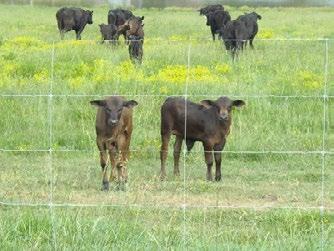
GRANDIN LIVESTOCK SYSTEMS
GRANDIN LIVESTOCK SYSTEMS
2918 Silver Plume Dr., Unit C-3 Fort Collins, CO 80526 970/229-0703
2918 Silver Plume Dr., Unit C-3 Fort Collins, CO 80526 970/229-0703 • www.grandin.com
www.grandin.com
Fundamentos del Manejo Holístico - (ESPAÑOL) 8/11 - 9/15
Learn how good stockmanship can make your livestock handling experiences how livestock marketing based on today’s price (no crystal ball) can help you realize
Financial Planning
8/24 - 9/28
May 25-26 — 2 Day Stockmanship only, Dickinson, ND
Holistic Management® Foundation
10/4 - 11/8
May 30-June 1 — 3 Day Marketing/ Stockmanship, Wawota, SK
$350 per course scholarships available www.holisticmanagement.org/ training-programs/ ®
Coming also to Alberta, Wyoming, and Iowa!
www.handnhandlivestocksolutions.com info@handnhandlivestocksolutions.com
22 IN PRACTICE h May / June 2021 THE MARKETPLACE
Email:
15% OFF any Twin Mountain energizer with your Electra-Lock Fence order. Free Shipping On Complete Fence Set! Contact us for more details!
Office:
Fax: (325) 949-2047
sales@twinmountainfence.com www.twinmountainfence.com Get
More Fence for Your Money! Protect Your Investment $$$$$$ T H E M A R K E T P L A C E 22 IN PRACTICE May / June 2016
Brian Wehlburg
Holistic Management Training
• Decision Making
HMI Grazing Planning Software

• User-friendly excel-based interface
Next Step
Holistic Management®
Comprehensive Training
• Goal Setting
• Goal Setting
• Let the computer do the math while you plan
One-on-one learning all at a fraction of the cost of a consultant!
• Land Planning
• Land Planning
• Easy SAU and ADA calculations
• Account for multiple herds
• Environmental Monitoring
• Environmental Monitoring
• Grazing Planning
• Grazing Planning
Training Individuals and groups (Landcare, TAFE, CMA, etc )
Training Individuals and groups (Landcare, TAFE, CMA, etc.)
• Grazing Manual hyperlinks
• Livestock and Land Performance Worksheet
• And many more features
Introduction to Holistic Management®

Financial Planning
Grazing Planning
Cropping Planning
Contact: +61 4 0870 4431
Contact: 61-2-6587-4353, 61- 04-087-4431 or 61-04087-404-431 (cell)
Contact: 61-2-6587-4353 or 61- 04-087-4431
$150$40
Marketing/Business Planning

Biological Monitoring
Land Planning
Mid-North Coast NSW, Australia Brian@insideoutsidemgt.com.au www.insideoutsidemgt.com.au
Mid-North Coast NSW, Australia Brian@insideoutsidemgt.com.au www.insideoutsidemgt.com.au
“I did this course with Brian and can thoroughly recommend it. It takes land management to a whole new level. He brings a wealth of experience to the table.” Martin Bartlett, Sydney
“This tool has already given us a many fold return beyond our initial investment and we have just begun to use it.”

— Arnold Mattson, Agri-Environment Services Branch, Agriculture and Agri-Food Canada
TO LEARN MORE or TO ORDER:
$700 per module or 5 for $3150 scholarships available bonus materials
www.holisticmanagement.org/ next-step/
Rangeland can provide an abundance of plant varieties for livestock nutrition. But what about the more “developed” pastures and hay meadows? Soil tests from all types of livestock producers show 95+% of all such soils do not have the correct nutrient levels to provide the best nutrition for livestock.
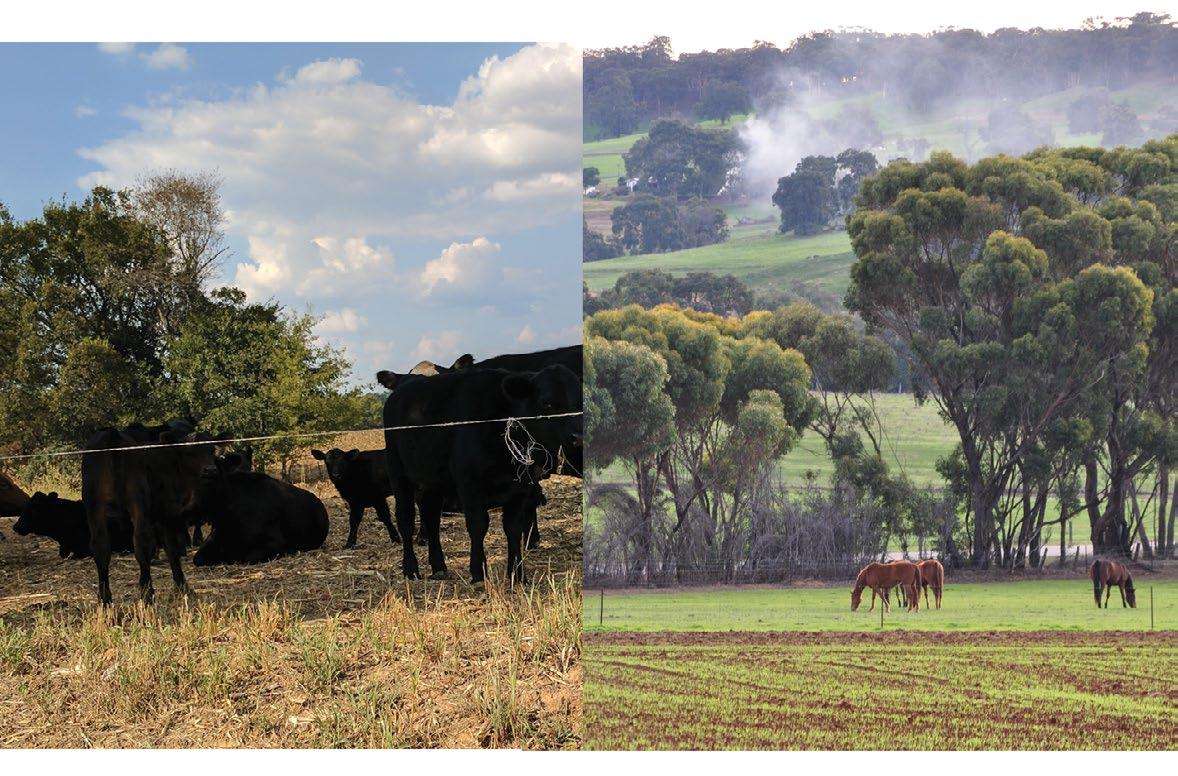
You can change that! Choose an area, split it and soil test both sides separately. Test your hay or forage from both sides too. Treat one side as normal. On the other side, correct the fertility based on soil tests using the Kinsey/Albrecht fertility program.
Test feed quality from both sides again next year. Take soil tests again and treat accordingly. Depending on nutrients requirements it may take two or three years to achieve the top potential. Test each year and, as fertility needs are met, feed value and yield tend to increase for all three years.
Increased yields will more than pay for the investment with increased feed quality as a bonus. Prove it for yourself!
Number 197 h IN PRACTICE 23 THE MARKETPLACE KINSEY Agricultural Services, Inc. INCREASE FEED QUALITY For consulting or educational services contact: Kinsey Agricultural Services, Inc. Ph: 573/683-3880, Fax: 573/683-6227 Charleston, Missouri 63834 www.kinseyag.com • info@kinseyag.com
Call 505/842-5252 or visit us at www.holisticmanagement.org/store/
TO UPGRADE 3 S health
please send address corrections before moving so that we do not incur unnecessary postal fees

DEVELOPMENT CORNER
Mesteño Draw Ranch
BY ANN ADAMS
Between 1991 and 2001 Joan Bybee purchased land near Punta de Agua, New Mexico, leading to the establishment of the 887-acre Mesteño Draw Ranch. In 2012 she purchased additional grazing land in the Estancia Valley to bring her total to 1,370 acres on which she now has 12 pastures and runs 14 cows with a bull. When she originally purchased her land it was a monoculture of blue grama. Now there is a big increase in cool season grasses including western Wheatgrass.
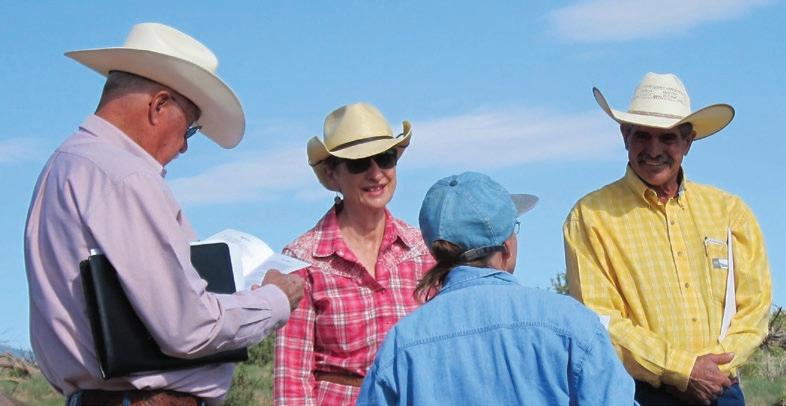
Every pasture now has spike muhly, which, along with wolf tail grass, has gone from rare to abundant. Joan has also seen the threeawn retreat with more vine mesquite and New Mexico feather grass coming in. And while she has always had galleta, it is now more abundant as is the side oats grama. Not only does this increased diversity and production improve her calves’ live weight, but she is now also seeing pronghorn antelope and elk on her property for the first time.
Mesteño Draw runs through the ranch and Joan worked with the Quivira Coalition and US Fish and Wildlife to install rock dams
and other structures to slow the water, create a meander in the watercourse, and capture sediment to improve this important riparian area that is habitat for coyote willows, bluestem willows, white oak and Gambel’s oaks.
Joan readily admits she didn’t start with a good baseline monitoring of her grasses. “I had a lot of grasses like ring muhly, poverty three awn, and blue grama,” says Joan. “I also had a little Western wheatgrass and squirreltail. But, my growing season has changed so now I have green stuff from the beginning of March through half of October. That’s an extra month of grazing. I also have happy cows as they love to go to a new pasture. I can tell when they want to go. We only graze a paddock two to three weeks and we try to only graze a pasture once during the growing season so that’s four to 12 months of recovery.”
When Joan first owned the property she leased her land and insisted that the lessee move the cattle every 28 days. At this point, she had already created six pastures with the help of the NRCS. Then Joan started her herd in 2007 with only six or eight cows. Managed grazing helped to increase groundcover. Then in 2011 she enrolled in the Conservation Stewardship Program and started monitoring her grasses more formally.
In 2017, she noticed a big shift in improved production. At that point she had started using temporary fencing so she could create three more pastures. Even with the increased acreage in 2012 and
CONTINUED ON PAGE 20
Nonprofit U.S POSTAGE PAID Jefferson City, MO PERMIT 210 a publication of Holistic Management International 2425 San Pedro Dr. NE, Ste A Albuquerque, NM 87110 USA RETURN SERVICE REQUESTED Printed On Recycled Paper Healthy Land. Healthy Food. Healthy Lives.
2017-2020
average hanging weight calculated live weight average hanging weight calculated live weight difference in hanging weight difference in live weight heifers 316 574 351 638 35 64 bull calves 347 630 403 732 56 102
Joan Bybee (center) during an HMI field day on her ranch. Mesteño Draw Ranch Liveweight Comparison of 71 cattle at 8 months age
2014-2016 (N=28)
(N=43)
Overset text from page 18
Cons
1. Your land may not be eligible for a conservation easement (check taxation code)
2. It may take time to find the right land trust to work with you
3. You will likely need a paid professional to make sure your easement works for you (negotiating for your interests)
4. Having a conservation easement reduces the number of buyers who will be interested in your property and may reduce the value of the land (some buyers have lender challenges as well)
5. You will need to get an appraisal to be able to defend the conservation easement value you use on your taxes.
6. You may not be able to stop all forms of development given issues like oil and gas rights, water rights, etc.
7. You can only do it once in a lifetime, so you tie the hands of future generations
Other transfer tools to consider include:
• Affirmative agricultural easements (requiring land to be farmed)
• Options to purchase land at agricultural value (OPAVs) (encouraging land to be re-sold only to farmers)
• Differential assessment/current use programs (lowering taxes on agricultural land)
• Federal farm programs (loans, grants, cost shares)
25 IN PRACTICE h May / June 2021
Number 197 h IN PRACTICE 26
