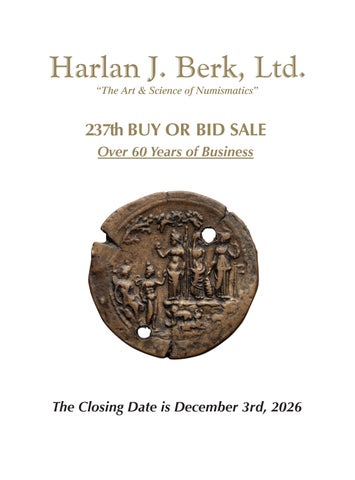
Harlan J. Berk, Ltd. “The Art & Science of Numismatics”
237th BUY OR BID SALE Over 60 Years of Business
The Closing Date is December 3rd, 2026
Order the new smaller 6x9” version for $25 plus shipping!
Over 86 Episodes! Over 700,000 Subscribers
Follow & Subscribe https://www.youtube.com/@coinman.ancient
Harlan J. Berk, Ltd. “The Art & Science of Numismatics”
Tel: (312) 609-0018
31 N. Clark Street • Chicago, Illinois 60602
237th BUY OR BID SALE
www.hjbltd.com Facebook/Harlan J. Berk, Ltd. YouTube/coinman.ancient Istagram/coinman969
Fax: (312) 609-1309 Email: info@hjbltd.com OVER 60 YEARS! Established 1964
The Closing Date is December 3rd, 2026 ALL COINS AND ANTIQUITIES GUARANTEED GENUINE
NO BUYERS FEES! HJBLTD.COM FOR VIDEOS OF EACH LOT
VISA
DISCOVER
MASTERCARD
AMERICAN EXPRESS
PAYPAL
Experts Harlan J. Berk, Ancients • Aaron Berk, Ancients & Antiquities • Curtis Clay, Roman • Phil Davis, Ancients • Jay Harper, Ancients Zach Greenwalt, Ancients • Sophia Cross, Ancients • Jennifer Saban, Antiquities • Laura Wakeland, World Pablo Saban, IT Manager • Photos & Videos by Andrew Steiner & Craig Hard • Layout by Aaron Berk & Craig Hard Harlan J. Berk, Ltd. has presented an innovation in antiquities and numismatics for some time now. The system is simple. When you want an antiquity or coin in the sale, just bid the estimated price by phone, fax, web site, email or post. We will send you the antiquity or coin immediately with no buyer’s fees and no waiting for the closing of the sale. Any and all antiquities or coins not sold before the closing date will be sent to the highest bidder after December 3rd. All items carry a lifetime guarantee of authenticity. See our terms of sale on our web site for further details. EXAMPLE—You bid estimate on an item valued at $100.00 and if your bid is the 1st to reach us, you will receive the item immediately at $100. If on the other hand, you bid $75.00 on the same item and are still the high bidder at the end of the sale, the item will be mailed to you after the closing. There is a 2.5% fee for credit card use. If you are ever in the area, stop in to see us! Of course, it’s best to call first. Harlan J. Berk, Ltd. reserves the right to refuse any bids.
1. 2.
3.
4.
5.
6.
7.
8.
9.
10.
GOLD IONIA, EPHESUS; Lydo-Milesian standard, ca. 650-600 BC, EL 1/3 Stater (Trite), 4.66g. Rosen-257, SNG von Aulock-1768. Obv: Bee viewed from above. Rx: Double incuse squares. Ex Econopoulos Numismatics. EF..........................1700 MACEDONIA, PHILIP II; Lifetime or early posthumous, Pella, ca. 340/36328, Stater, 8.57g. Le Rider-278 (D85/R213). Obv: Laureate head of Apollo r. Rx: ΦΙΛΙΠΠOY, Charioteer driving biga r. holding goad and reins; below, trident head to r. NGC Graded XF 5/5, 4/5. Virtually MS.......................................................6500 MACEDONIA, ALEXANDER III THE GREAT; 330-320 BC, Stater, 8.52g. Price-172. Obv: Head of Athena r., wearing Corinthian helmet adorned with a coiled serpent. Rx: ALEXANDROY; Nike standing l., holding wreath and stylis; tridenthead downward in l. field. MS.............................................................................7500 MACEDONIA, ALEXANDER III THE GREAT; Miletos, struck by Asandros under Philip III, ca. 323-319, Stater, 8.52g. Price-2114. Obv: Head of Athena r. wearing Corinthian helmet decorated with serpent. Rx: AΛEΞANΔΡOΥ, Nike standing l. holding wreath and stylus; to l., monogram of KH; to lower r., labrys. NGC Graded-Ch XF 5/5, 4/5. MS.......................................................................7000 MACEDONIA, ALEXANDER III THE GREAT; Time of Alexander III-Philip III, ca. 330/25-320 BC, Stater, 8.61g. Price-3126 (Salamis), Troxell-New, Group II, 23, dies 12/c. Obv: Helmeted head of Athena r. Rx: AΛEΞANΔPOY, Nike standing l. holding wreath and stylis; to l., eagle standing l. Price. MS.............................9500 MACEDONIA, ALEXANDER III THE GREAT; Time of Alexander III -Philip III. Circa 330/25-320 BC, Stater, 8.53g. Price-3128, Troxell,-New, Group II, 22 (dies 12/b), SNG Ashmolean-2921 (same dies). Obv: Helmeted head of Athena r. Rx: AΛEΞANΔPOY, Nike standing l. holding wreath and stylus; to l., eagle standing r. In NGC encapsulation 8559703-004, graded AU, Strike: 5/5, Surface: 4/5, Fine Style, brushed. MS..............................................................................12500 MACEDONIA, ALEXANDER III THE GREAT; Struck under Seleucus I, Baylon, ca. 311-300 BC, Stater, 8.54g. SC-81.2, Price-3748, HGC-9, 3a. Obv: Head of Athena r. wearing helmet adorned with coiled serpent. Rx: Nike standing l. holding wreath and stylis; MI below wing to l., monogram to r. Ex Spink 24125, March 2025, lot 1139; Ex Freeman and Sear, Manhattan Sale II, Jan. 2011, lot 178. NGC Graded-Ch XF 5/5, 4/5. Virtually MS........................................................7500 PTOLEMAIC, PTOLEMY I; Alexandria, ca. 294-285 BC, Triobol, 1.77g. CPE129, Sv-197, SNG Cop-45. Obv: Diademed head r. wearing aegis. Rx: BAΣIΛEΩΣ ΠTOΛEMAIOY, Eagle standing l. on thunderbolt; MI monogram to l. Ex Stack’s Aug. 2021 ANA Auction, lot 42191. NGC Graded-Ch VF 4/5, 2/5. VF.............2250 ASIA MINOR, ACHEMENID EMPIRE; Time of Artaxerxes I to Xerxes II, ca. 5th cent. BC, Daric, 8.31g. Sunrise-28, Carradice -Type III b. Obv: Persian king or hero in kneeling-running position r. holding transverse spear; quiver over shoulder. Rx: Rectangular incuse punch. Formerly NGC-XF 3/5, 3/5. MS........................2650 VALENS; 364-378 AD, Nicomedia, ca. 367-75 AD, Solidus, 4.02g. RIC-13b. Obv: D N VALENS P F AVG, Pearl-diademed, draped, cuirassed bust r. Rx: GLORIA REI PVBLICAE. Roma, helmeted, seated facing on l., and Constantinopolis, turreted, seated l. with foot on prow, holding between them a shield inscribed VOT/V/ MVLT/X; SMNΘ in exergue. Ex jewelry. gVF.....................................................775
11.
12.
13.
14.
15.
16.
17.
18.
19.
VALENTINIAN III; 425-455 AD, Rome, ca. 435 AD, Solidus, 4.34g. Depeyrot-42/1, RIC-234. Obv: D N PLA VALENTI-NIANVS P F AVG, Bust of Valentinian III to left, wearing consular robes, holding mappa in his raised hand and cruciform scepter in his left. Rx: VOT X MVLT XX R-M COMOB, Valentinian III seated facing on a backless throne, wearing crown with pendilia, holding mappa in his raised right hand and cruciform scepter with his left. Ex Nomos 37, 16 November 2025, lot 260, From the Distinguished Collection, acquired in Germany around the year 2000. EF.......................................................................................................5250 MARCIAN; Constantinople, 450 AD, Solidus, 4.43g. RIC-X 510, Ratto-221, Berk24, Depeyrot-87/1. Obv: D N MARCIANVS P F AVG, Pearl-diademed, helmeted, cuirassed bust facing slightly r., holding spear and shield decorated with horseman motif. Rx: VICTORIA AVGGG B, standing l. holding long jewelled cross; star to r., CONOB in exergue. Ex Roma E119, April 2024, lot 2608. Small scrape on edge at 12:00. VF................................................................................................................975 ANASTASIUS I; 491-518 AD, Constantinople, ca. 492-507 AD, Solidus, 4.50g. DO-3i, MIB-4a, S-3, Berk-30. Obv: D N ANASTA-SIVS P P AVG, Pearl-diademed, helmeted, cuirassed bust facing slightly r., holding spear over shoulder and shield decorated with horseman motif. VICTORI-A AVGGG I, standing l. holding long jeweled cross; star to r., CONOB in exergue. MS................................................1500 FOCAS; Constantinople, ca. 603-7 AD, Solidus, 4.46g. DO-5g, MIB-7, S-618, Berk-99. Obv: O N FOCAS PERP AVC, Draped, cuirassed bust facing, wearing crown with cross and holding globus cruciger. Rx: VICTORI-A AVGG Z, Angel standing facing, holding staff with staurogram and globus cruciger; CONOB in exergue. MS.........................................................................................................1400 FOCAS; Constantinople, ca. 603-7 AD, Solidus, 4.29g. DO-5g, MIB-7, S-618, DO5e. Obv: O N FOCAS PERP AVC, Draped, cuirassed bust facing, wearing crown with cross and holding globus cruciger. Rx: VICTORI-A AVGG Є, Angel standing facing, holding staff with staurogram and globus cruciger; CONOB in exergue. MS. ..............................................................................................................................1400 FOCAS; Constantinople, ca. 603-7 AD, Solidus, 4.32g. MIB-7, S-618, DO-5i. Obv: O N FOCAS PERP AVC, Draped, cuirassed bust facing, wearing crown with cross and holding globus cruciger. Rx: VICTORI-A AVGG I, Angel standing facing, holding staff with staurogram and globus cruciger; CONOB in exergue. Grafitti on right reverse field. MS..........................................................................................1400 FOCAS; Constantinople, ca. 603-7 AD, Solidus, 4.33g. MIB-7, S-618, Berk-99, DO-5c. Obv: O N FOCAS PERP AVC, Draped, cuirassed bust facing, wearing crown with cross and holding globus cruciger. Rx: VICTORI-A AVGG Γ, Angel standing facing, holding staff with staurogram and globus cruciger; CONOB in exergue. Graffiti on top reverse field. MS............................................................1400 FOCAS; Constantinople, ca. 603-7 AD, Solidus, 4.30g. DO-5e, MIB-7, S-618. Obv: O N FOCAS-PЄRP AVς, Draped, cuirassed bust facing, wearing crown with cross and holding globus cruciger. Rx: VICTORIA-AVςЧ Є, Angel standing facing, holding globus cruciger and long staff with staurogram; CONOB in exergue. Graffiti on reverse field. MS.............................................................................................1400 Unlisted Officina FOCAS; Constantinople, ca. 603-7 AD, Solidus, 4.41g. Berk-100, DO-6var
1
4
3
2
5
7
9
8
10
6
12
11
19
20
27
28
35
36
44
13
15
14
21
30
37
38
45
17
24
23
22
29
16
31
25
32
39
40
46
18
33
41
26
34
42
47
43
20.
21.
22.
23.
24.
25.
26.
27.
28.
29.
30.
31.
32.
33.
(unlisted officina), MIB-8, S-619. Obv: O N FOCAS PERP AVI, Draped, cuirassed bust facing, wearing crown with cross and holding globus cruciger. Rx: VICTORIA AVGG I, Angel standing facing, holding globus cruciger and staff with staurogram; N to r., CONOB in exergue. Graffiti on both sides. MS.....1500 HERACLIUS; 610-641 AD, Constantinople, ca. Oct. 610-Jan. 613 AD, Solidus, 4.48g. DO-3b, MIB-5, S-731. Obv: d N hЄRACLI-ЧS P P AVI, Draped, cuirassed bust facing, with short beard, wearing plumed helmet and holding cross. Rx: VICTORIA-AVGЧ Є, Cross potent on three steps; CONOB in exergue. MS....... .........................................................................................................................1500 HERACLIUS; 610-641 AD, Constantinople, ca. Oct. 610-Jan. 613 AD, Solidus, 4.28g. DO-3b, MIB-5, S-731. Obv: d N hЄRACLI-ЧS P P AVI, Draped, cuirassed bust facing, with short beard, wearing plumed helmet and holding cross. Rx: VICTORIA-AVGЧ Є, Cross potent on three steps; CONOB in exergue. Small areas of flat striking at 11:00 on obverse. MS.................................................1300 HERACLIUS, WITH HERACLIUS CONSTANTINE; 610-641 AD, Constantinople, ca. Jan. 613-616 AD, Solidus, 4.47g. DO-8i, MIB-8a, S-734. Obv: dd NN hERACLIЧS ET hERA CONST PP AV, Draped, short-bearded bust of Heraclius facing, wearing crown with cross, on the l; draped and beardless bust of Heraclius Constantine facing, wearing crown with cross, on the r. Rx: VICTORIA AVGЧ Θ, Cross potent on base and three steps; CONOB in exergue. MS...................................................................................................................1500 HERACLIUS, WITH HERACLIUS CONSTANTINE; 610-641 AD, Constantinople, ca. Jan. 613-Oct. 616 AD, Solidus, 4.45g. Berk-118, cf. DO-8j, MIB-8a, S-734. Obv: dd NN hERACLIЧS ET hERA CONST PP AV, On the l., draped, short-bearded facing bust of Heraclius, wearing crown with cross; on the r., draped, beardless facing bust of Heraclius Constantine, wearing crown with cross; between, cross. Rx: VICTORIA-AVGЧ ς, Cross potent on base and three steps; CONOB in exergue. Graffiti on reverse field. MS................................1300 HERACLIUS, WITH HERACLIUS CONSTANTINE; 610-641 AD, Constantinople, ca. 615-25 AD, Solidus, 4.43g. DO-13var (unlisted officina), MIB-11, S-738. Obv: dd NN hERACLIЧS ET hERA CONST PP AV, Crowned, draped, short-bearded bust of Heraclius facing, on the l; crowned, draped bust of Heraclius Constantine facing, with slight beard and moustache, on the r; above, cross. Rx: VICTORIA-AVςЧ Δ, Cross potent on base and three steps; CONOB in exergue. MS....................................................................................................1400 HERACLIUS, WITH HERACLIUS CONSTANTINE; 610-641 AD, Constantinople, ca. 629-Jan. 632 AD, Solidus, 4.34g. DO-26i, MIB-29, S-749, Berk-123. Obv: dd NN hЄRACLIЧS ЄT hЄRA CONST PP AVI, Crowned, draped bust of Heraclius facing, with long beard and whiskers, on the l; crowned and draped bust of Heraclius Constantine facing, with slight beard and mustache, on the r; above, cross. Rx: VICTORIA AVGЧ Θ, Cross potent on base and three steps; CONOB in exergue. Miniscule scrape at 1:00 on reverse edge. MS....1400 Indictional Year 9 HERACLIUS, WITH HERACLIUS CONSTANTINE AND HERACLONAS; 610-641 AD, Constantinople, Dated Indiction Year 9 = 635/6 AD, Solidus, 4.46g. DO-34var (unlisted officina), MIB-40, S-759. Obv: Heraclonas, Heraclius, and Heraclius Constantine standing facing, each wearing chlamys and holding globus cruciger; Heraclius and Heraclius Constantine crowned; cross to upper l. Rx: VICTORIA-AVςЧ Γ, Cross potent set on three steps; Heraclian monogram to l., Θ (date) to r., CONOB in exergue. Rare, four examples known on CoinArchives. MS..........................................................1500 Indictional Year 11 HERACLIUS, WITH HERACLIUS CONSTANTINE AND HERACLONAS; 610-641 AD, Constantinople, Dated Indiction Year 11 = 637/8 AD, Solidus, 4.34g. DO-40a, MIB-47, S-766. Obv: Heraclius, Heraclius Constantine and Heraclonas, wearing crowns with crosses, standing facing, all holding globus crucigers. Rx: VICTORIA AVςЧ A, Cross potent on base and three steps; in field to l., Heraclian monogram, in field to r., A; CONOBΛ in exergue. MS....................................................................................................1500 HERACLIUS, WITH HERACLIUS CONSTANTINE AND HERACLONAS; 610-641 AD, Constantinople, ca. 639-41 AD, Solidus, 4.34g. DO-43a, MIB-50, Ratto-1488, S-769, BNP-67. Obv: Heraclius, Heraclius Constantine and Heraclonas, all wearing crowns with crosses, standing facing, each holding globus cruciger. Rx: VICTORIA AVςЧ B, Cross potent on base and three steps; Heraclian monogram to l., CONOB in exergue. small cross graffiti on reverse. MS.....................................................................................................1400 HERACLIUS; 610-641 AD, Constantinople, ca. 639-41 AD, Solidus, 4.36g. DO-43a, MIB-50, S-769. Obv: Heraclius, Heraclius Constantine and Heraclonas, wearing crowns with crosses, standing facing, all holding globus crucigers. Rx: VICTORIA AVςЧ Z, Cross potent on base and three steps; Heraclian monogram to l., CONOB in exergue. MS.........................................................................1500 CONSTANS II; 641-668 AD, Constantinople, ca. Jan. 642-645 AD, Solidus, 4.29g. DO-1h, MIB-3b, S-938. Obv: d N CONSTAN-TINЧS P P AV, Crowned, draped, beardless bust facing, holding globus cruciger. Rx: VICTORIA AVςЧ H, Cross potent on base and three steps; CONOB in exergue. MS.....................1400 CONSTANS II; 641-668 AD, Constantinople, ca. Jan. 642-645 AD, Solidus, 4.46g. DO-1j, MIB-3b, S-938. Obv: d N CONSTAN-TINЧS P P AV, Crowned, draped, beardless bust facing, holding globus cruciger. Rx: VICTORIA AVςЧ I, Cross potent on base and three steps; CONOB in exergue. Graffiti on obverse field. MS..........................................................................................................1500 CONSTANS II; 641-668 AD, Constantinople, ca. Jan. 642-645 AD, Solidus, 4.44g. DO-1h, MIB-3b, S-938. Obv: d N CONSTAN-TINЧS P P AV, Crowned, draped, beardless bust facing, holding globus cruciger. Rx: VICTORIA AVςЧ H, Cross potent on base and three steps; CONOB in exergue. MS.....................1325 Indictional Year 6 CONSTANS II; 641-668 AD, Constantinople, Dated Indiction Year 6 = 646-7
34.
35.
36.
37.
38.
39.
40.
41.
42.
43.
44.
45.
46.
47.
AD, Solidus, 4.40g. S-948, MIB-15 (Officina A not listed). Obv: d N CONSTANTIN(Ч retrograde)S P P AV, Crowned bust facing, holding globus cruciger. Rx: VICTORIA AVςЧ A, Cross potent set on three steps; S to r, CONOB in exergue. Some of left legend flatly struck from double-striking on reverse, as well on on lower left of obverse. MS................................................................................1500 CONSTANS II; 641-668 AD, Constantinople, ca. 651-4 AD, Solidus, 4.35g. DO-19b, MIB-23, S-956. Obv: δ N CONSTAN-TI[NЧS P P AV] Crowned, draped bust facing, with long beard and moustache, holding globus cruciger. Rx: VICTORIA-AVGЧ B, Cross potent on base and three steps; CONOB in exergue. MS...................................................................................................................1400 CONSTANS II; 641-668 AD, Constantinople, ca. 651-4 AD, Solidus, 4.32g. DO-19d, MIB-23, S-956. Obv: d N CONSTAN-TINЧS P P AVI, Crowned, draped bust facing with long beard and moustache, holding globus cruciger. Rx: VICTORIA-AVGЧ Δ, Cross potent on base and three steps; CONOB in exergue. MS...................................................................................................................1400 CONSTANS II; 641-668 AD, Constantinople, ca. 651-4 AD, Solidus, 4.30g. DO-19j, MIB-23, S-956. Obv: d N CONSTAN-TINVS PP AV, Crowned, bearded bust facing, holding globus cruciger. Rx: VICTORIA-AVGЧ I, Cross potent on base of three steps; CONOB in exergue. MS..................................................1400 CONSTANS II; 641-668 AD, Constantinople, ca. 651-4 AD, Solidus, 4.36g. MIB-23, S-956, DO-19c. Obv: d N CONSTAN-TINVS PP AV, Crowned, bearded bust facing, holding globus cruciger. Rx: VICTORIA-AVGЧ Γ, Cross potent on base of three steps; CONOB in exergue. Miniscule hairlines in reverse fields. MS........................................................................................................1300 CONSTANS II; 641-668 AD, Constantinople, ca. 651-4 AD, Solidus, 4.36g. DO-19g, MIB-23, S-956. Obv: δ N CONSTAN-TINЧS P P A, Crowned, draped bust facing, with long beard and moustache, holding globus cruciger. Rx: VICTORIA-AVGЧ Z, Cross potent on base and three steps; CONOB in exergue. Miniscule hairlines in left field. MS................................................................1400 CONSTANS II, WITH CONSTANTINE IV; 641-668 AD, Constantinople, ca. 654-9 AD, Solidus, 4.35g. MIB-26, S-959, DO-25f. Obv: δ N CONSTANTINЧS C CONSTA P P AV, Crowned, draped bust of Constans II facing, with long beard and whiskers on the l; crowned, draped, beardless bust of Constantine IV facing on the r; above, cross. Rx: VICTORIA-AVςЧ S, Cross potent on base and three steps; CONOB in exergue. MS.......................................................................1400 CONSTANS II; 641-668 AD, Constantinople, ca. 654-9 AD, Solidus, 4.44g. DO-25i, MIB-26, S-959. Obv: δ N CON[STANT]INЧS C CONSTAN, Crowned, draped bust of Constans II facing with long beard and whiskers on the l; crowned, draped, beardless bust of Constantine IV facing on the r; above, cross. Rx: VICTORIA-AVςЧ Θ, Cross potent on base and three steps; CONOB in exergue. Microscopic hairlines. MS..............................................................................1400 CONSTANS II, WITH CONSTANTINE IV; 641-668 AD, Constantinople, ca. 654-9 AD, Solidus, 4.40g. DO-25j, MIB-26, S-959. Obv: d N CONSTANTINЧS C CONSTA, Crowned, draped bust of Constans II facing, with long beard and whiskers on the l; crowned, draped, beardless bust of Constantine IV facing on the r; above, cross. Rx: VICTORIA-AVGЧ I, Cross potent on base and three steps; CONOB in exergue. MS..............................................................1400 CONSTANS II; 641-668 AD, Constantinople, ca. 654-9 AD, Solidus, 4.36g. DO-25h, MIB-26, S-959. Obv: δ N CONSTANTINЧS C CONSTA, Crowned, draped bust of Constans II facing, with long beard and whiskers on the l; crowned, draped, beardless bust of Constantine IV facing on the r; above, cross. Rx: VICTORIA-AVςЧ H, Cross potent on base and three steps; CONOB in exergue. MS....................................................................................................1400 CONSTANS II, WITH CONSTANTINE IV; 641-668 AD, Constantinople, ca. 654-9 AD, Solidus, 4.37g. DO-26b, MIB-28, S-960. Obv: d N CONSTANTINЧS C CONSTAI, Crowned, draped bust of Constans II facing, with long beard and whiskers on the l; crowned, draped, beardless bust of Constantine IV facing on the r; above, cross. Rx: VICTORIA-AVGЧ Γ, Cross potent on base and three steps; CONOBI in exergue. MS......................................................................1300 CONSTANS II, WITH CONSTANTINE IV; 641-668 AD, Constantinople, ca. 654-9 AD, Solidus, 4.40g. DO-27var (unlisted officina), MIB-27, S-961. Obv: δ N CONSTANTINЧS C CONTAN, Crowned, draped bust of Constans II with long beard and whiskers on the l; crowned, draped, beardless bust of Constantine IV on the r; above, cross. Rx: VICTORIA-AVςЧ I, Cross potent on base and three steps; CONOB+ in exergue. MS.....................................................................1550 CONSTANS II, WITH CONSTANTINE IV, HERACLIUS, AND TIBERIUS; 641-668 AD, Constantinople, ca. 659-62 AD, Solidus, 4.30g. DO28g, MIB-29, S-962. Obv: Facing busts of Constans I with long beard on the l., wearing plumed helmet ornamented with cross and chlamys, and Constantine IV on the r., wearing crown with cross and chlamys; cross between, traces of legend around. Rx: VICTORIA AVςЧ B, Heraclius on the l., and Tiberius on the r., standing facing, holding globus crucigers; between, cross potent on base set on three steps; CONOB in exergue. Graffiti on reverse field. MS.......................1400 CONSTANS II, WITH CONSTANTINE IV, HERACLIUS, AND TIBERIUS; 641-668 AD, Constantinople, ca. 659-61 AD, Solidus, 4.32g. DO28h, MIB-29, S-962, Berk-153. Obv: Facing bust of Constans II with long beard on the l., wearing plumed helmet with cross, and Constantine IV on the r., wearing crown with cross; between, small cross. Rx: VICTORI AVςЧ I, Heraclius on the l. and Tiberius on the r., standing facing holding globus crucigers; between, cross potent on base set on three steps; CONOB in exergue. MS............................1400 CONSTANS II, WITH CONSTANTINE IV, HERACLIUS, AND TIBERIUS; 641-668 AD, Constantinople, ca. 661-3 AD, Solidus, 4.32g. DO30f, MIB-31, S-964, Berk-153. Obv: Facing busts of Constans II with long beard on the l., wearing plumed helmet with cross, and Constantine IV on the r., wearing crown with cross; between, cross. Rx: VICTORIA-[AV]ςЧ Z, Heraclius on the l., and Tiberius on the r., standing facing, holding globus crucigers; between, cross
48.
49.
50.
51.
52.
53.
54.
55.
56.
57.
58.
59.
60.
potent on base set on three steps; CONOB in exergue. MS............................1400 CONSTANTINE IV, WITH HERACLIUS AND TIBERIUS; 668-685 AD, Constantinople, ca. 668-73 AD, Solidus, 4.29g. DO-6f, MIB-4c, S-1153. Obv: d N CONST-ANЧS P P, Helmeted, diademed, cuirassed bust facing slightly l., beardless, holding spear. Rx: VICTOR(retrograde)IA-A-VGЧ Z, Heraclius on the l., and Tiberius on the r., standing facing, holding globus crucigers; between, cross potent on base and three steps; CONOB in exergue. Extremely beautiful portrait from early in reign; some flat striking at 12:00 on reverse. MS.........1300 Powerful Portrait CONSTANTINE IV, WITH HERACLIUS AND TIBERIUS; 668-685 AD, Constantinople, ca. 669-74 AD, Solidus, 4.47g. DO-6h, MIB-4c, S-1153. Obv: d N CONS-T-NЧς P, Helmeted, cuirassed bust facing slightly r., with short beard, holding spear over shoulder. Rx: VICTORIA-A-VςЧ Θ, Cross potent on three steps flanked by Heraclius and Tiberius, both wearing crown and chlamys, and holding globus crucigers; CONOB in exergue. From early in in reign; microscopic hairline in right field. MS..........................................................1400 Exceptional Portrait CONSTANTINE IV, WITH HERACLIUS AND TIBERIUS; 668-685 AD, Constantinople, ca. 669-74 AD, Solidus, 4.37g. MIB-4c, S-1153, DO-6b, Berk169. Obv: d N CON-NЧ P, Helmeted, cuirassed bust facing slightly r., with short beard, holding spear over shoulder. Rx: VICTORIA-A-VςЧ B, Cross potent on three steps flanked by Heraclius and Tiberius, both wearing crown and chlamys, and holding globus crucigers; CONOB in exergue. Struck in early in reign. MS.. .........................................................................................................................1400 Exceptional Portrait CONSTANTINE IV, WITH HERACLIUS AND TIBERIUS; 668-685 AD, Constantinople, ca. 669-74 AD, Solidus, 4.31g. DO-4a, MIB-4, S-1151. Obv: δ N CONST-ANЧS P P, Diademed, helmeted, cuirassed bust slightly r., holding spear and shield decorated with horseman over shoulder. Rx: VICTOA-[AV]SЧ A, Cross potent on three steps between standing figures of Heraclius on l. and Tiberius on r., both crowned, globus crucigers; CONOB in exergue. Hairlines in right field of obverse. MS................................................................................1400 CONSTANTINE IV, WITH HERACLIUS AND TIBERIUS; 668-685 AD, Constantinople, ca. 674-81 AD, Solidus, 4.30g. DO-8a, MIB-7a, S-1154, Berk170. Obv: d N CONS-Δ-NЧS P, Diademed, helmeted, cuirassed bust of facing slightly r., bearded, holding spear and shield over shoulder. Rx: VICTOA-[A] VGЧ A, Cross potent on three steps between standing figures of Heraclius on l. and Tiberius on r., both crowned and holding globus crucigers; CONOB in exergue. Microscopic hairlines in obverse fields. MS....................................1350 CONSTANTINE IV, WITH HERACLIUS AND TIBERIUS; 668-685 AD, Constantinople, ca. 674-81 AD, Solidus, 4.32g. DO-8c, MIB-7a, S-1154, Berk170. Obv: d N CN-T-A-NЧS P P, Helmeted, diademed, cuirassed bust facing slightly r., bearded, holding spear and shield decorated with horseman over shoulder. Rx: VICTOA-AVGЧ Є, Heraclius, on the l., and Tiberius, on the r., standing facing holding globus crucigers; between, cross potent on base and three steps; CONOB in exergue. MS.......................................................................1400 CONSTANTINE IV, WITH HERACLIUS AND TIBERIUS; 668-685 AD, Constantinople, ca. 674-81 AD, Solidus, 44.40g. DO-8var (unlisted officina), MIB-7a, S-1154, Berk-171. Obv: D N-A-NЧS P, Helmeted, cuirassed bust facing slightly r., holding spear and shield decorated with horseman over shoulder. Rx: VICTOA-[AVς]Ч Θ, Cross potent, on base and three steps, between Heraclius on l., and Tiberius on r., standing facing and holding globus crucigers; CONOB in exergue. Miniscule hairlines in right field. MS...............................................1400 CONSTANTINE IV, WITH HERACLIUS AND TIBERIUS; 668-685 AD, Constantinople, ca. 674-81 AD, Solidus, 4.36g. DO-10c, MIB-7a, S-1156, Berk170. Obv: d N [C. .]ЧS P, Helmeted, diademed, cuirassed bust facing slightly r., bearded, holding spear and shield decorated with horseman over shoulder. Rx: [VICTOA A]VGЧ Δ, Heraclius, on the l., and Tiberius, on the r., standing facing, holding globus crucigers; between, cross potent on base and three steps; CONOB in exergue.MS.................................................................................................1400 LEO III; Syracuse, ca. 720-35 AD, Tremissis, 1.17g. S-1540C (uncertain Italian mint), DO-48, Spahr-304, BCI-762. Obv: Traces of legend, crowned facing bust of Leo, holding globus cruciger and akakia. Rx: Traces of legend, crowned facing bust of Constantine V, holding cross potent and akakia. MS..........................1250 CONSTANTINE VI AND IRENE WITH LEO III-IV AND CONSTANTINE V; Constantinople, c. 790-92 AD, Solidus, 4.40g. Sear1593, DO-1. Obv: Facing busts of Constantine VI and Irene, both crowned, each holding cross on globe, Irene also holding cruciform scepter; between their heads cross and centering pellet. Rx: Leo III, Constantine V, and Leo IV seated facing, each wearing crown and chlamys. Flatly-struck on face of emperor to left; not unusual for this highly detailed type. Mint State............................................3100 ROMANUS III; Constantinople, 1028-1034 AD, Histamenon Nomisma, 4.37g. DO-1c, S-1819. Obv: +IhS XIS RЄX-RЄςNANTIhm, Nimbate Christ Pantokrator enthroned facing on suppedion, raising hand in benediction and holding Gospels. Rx: ΘCЄ bOHΘ’-RωMAnω Crowned facing figure of Romanus, wearing loros with five pellets at end, placing hand on chest and holding globus cruciger, being crowned and blessed by the Theotokos, nimbate; MΘ, with single macron above, in upper field. MS............................................................................................1800 NICEPHORUS III; Constantinople, 1078-1081 AD, EL Histamenon Nomisma, 4.36g. Berk-336, DO-3b, Sear-1881. Obv: IC-XC, Christ, nimbate, seated facing on low throne, raising hand in benediction and holding Gospels. Rx: + ΝΙΚΗΦ ΔΕC Tω BOTANIAT, Crowned emperor standing facing, wearing loros, holding labarum with saltire on shaft and globus cruciger. Ex HJB BBS 138, lot 38. aVF / EF....................................................................................................................550 THEODORE I, NICAEA; ca. Nicaea, 1208-1222, EL Aspron Trachy, 3.35g. DO-2.1, Sear-2064. Obv: IC-XC, Nimbate Christ enthroned facing, wearing
61. 62. 63.
64.
65.
66.
67.
68.
69.
70.
71. 72. 73.
74.
75.
76.
77.
78.
79.
tunic and pallium, raising his right hand in benediction and holding book of Gospels in his left; at foot of throne on either side fleur-de-lis. Rx: St. Demetrius, nimbate and in military attire on the right, and Theodore, bearded and on the left, standing facing, each holding sheathed sword and supporting, between them, a staff surmounted by eight-pointed star. MS....................................................1700 GREEK SILVER CELTS OF BRITIAN, ICENI; c. 45-50 AD, Unit, 1.25g. Van Arsdell-760-1. Obv: Two opposed crescents, ornamented with pellets. Rx: Stylized horse r; rosette above, ECE below. Virtually MS...........................................................250 CELTIC GAUL, VOLCAE TECTOSAGES; Pentobol, 2.72g. Depeyrot Celtic-72ff. Obv: [Male head l.], two dolphins before. Rx: Ax and crescent in one quadrant of cross. Ex HJB 151, 3 October 2006, lot 49. EF.............................300 CAMPANIA, NEAPOLIS; ca. 275-250 BC, Nomos, 6.41g. HN Italy-586, SNG ANS-407, HGC-1, 454. Obv: Head of nymph to l; torch behind. Rx: Manheaded bull walking r., head facing, crowned by Nike flying r. above; IΣ below, NЄAΠOΛITΩN in ex. Good full portrait of bull. VF......................................600 CALABRIA, TARENTUM; ca. 302-281 BC, Stater, 7.90g. Vlasto-667. Obv. Naked youth crowning stationary horse right, ΣA behind in left field, APE/ ΘΩN below. Rx. TAPAΣ in upper right field; Taras on dolphin left holding tripod, CAΣ below. EF..................................................................................................725 CALABRIA, TARENTUM; 281-272 BC, Stater, 6.21g. Vlasto-803. Obv: Youth on horseback r., crowning self; ZΩ to l., ZAΛO and Ionic capital below. Rx: Phalanthos, holding aphlaston and distaff, riding dolphin l.; ANΘ to r. Toned. EF......................................................................................................................800 CALABRIA, TARENTUM; 281-272 BC, Stater, 6.42g. Vlasto-803. Obv: Youth on horseback r., crowning self; ZΩ to l., ZAΛO and Ionic capital below. Rx: Phalanthos, holding aphlaston and distaff, riding dolphin l.; ANΘ to r. Ex HJB 131, 4 April 2003, lot 40. Beautifully centered. MS...............................1250 CALABRIA, TARENTUM; c. 325-280 BC, Diobol, 1.06g. Vlasto-1348. Obv: Head of Heracles facing, wearing lion skin; club to left, Rx: Heracles wrestling the Nemean lion; club to left. Ex HJB 160, 13 August 2008, lot 33. Hercules offcenter on reverse. EF.........................................................................................600 Very Rare Variety CALABRIA, TARENTUM; c. 280-228 BC, Diobol, 0.93g. Vlasto-1401, HN Italy-1061, SNG Paris BN-2122. Obv: Head of Athena r. Rx: Herakles standing r. grappling with lion, club in l. field, ΦΙ between legs. Very scarce variety; we find only one on Coin Archives. Toned EF..............................................................500 LUCANIA, HERACLEA; ca. 420-390 BC, Diobol, 1.19g. HN Italy-1379, SNG ANS-38, Van Keuren-64-6 (Group C). Obv: Helmeted head of Athena r; on helmet, winged seahorse. Rx: ΗΡΑ, Herakles r. kneeling r. holding club, wrestling the Nemean lion. Ex Gemini XII, Jan. 2015, lot 18. Beautifully struck; wonderfully centered. EF..................................................................................950 LUCANIA, METAPONTUM; ca. 340-330 BC, Nomos, 7.64g. HN Italy-1575, Johnston Class B, 2, SNG ANS-434. Obv: Bearded head of Leukippos r. wearing Corinthian helmet; in field to l., head of lion r. Rx: ΜΕΤΑ, Barley ear with leaf to l; above leaf, vertical club; below leaf, [AMI]. gVF.........................................400 LUCANIA, METAPONTUM, HANNIBALIC PERIOD; c. 215-207 BC, Half Shekel, 3.48g. HN-1632, Robinson, NC 1964, p. 50, 1, SNG ANS-549. Obv: Head of Athena r. Rx: Ear of wheat. EF..........................................................1650 No lot SICILY, LEONTINI; Tetradrachm, 16.93g. SNG ANS-222-31, Gulbenkian-217, Rizzo-pl. XXIII, 1, Boehringer-45. Obv: Head of Apollo right, wearing laurel wreath. Rx: Head of roaring lion right; four barley grains and LEO-(N)-TI-NON around. From the David Allen Collection; Ex. Triton XIV (4 Jan 2011), lot 27. Ex. Hirsch 261 (7 May 2009), lot 76. gVF.........................4750 Exceptional for Issue - Ex Hirsch 1907 SICILY, MESSANA; ca. 412-408 BC, Tetradrachm, 17.12g. Boston-293 (same dies), HGC-795. Obv: Biga of mules driven l. above, Nike flying r. In exergue, two dolphins swimming snout to snout. Rx: Hare leaping l.; below, head of Pan l. Ex Vinchon, 11 April 1988, lot 252. Ex Naville 12, 18-23 October 1926, lot 777. Ex Hirsch 19, 11 November 1907, lot 208. Beautifully centered with dark toning. gEF................................................................................................................12500 Rare Didrachm SICILY, SYRACUSE; ca. 510-485 BC, Didrachm, 8.30g. Boehringer-51 (V28/ R34). Obv: Nude horseman riding to right. Rx: ΣV-RAϘ-OΣI-ON Diademed head of Arethousa to right, wearing circular earring and necklace; around, four dolphins. These coins are only known for one obverse and four reverse dies. This is an exceptional, perfectly-centered coin for this type. EF.........................12500 SICILY, SYRACUSE; ca. 480-475 BC, Tetradrachm, 17.15g. Boehringer-137. Obv: Charioteer, holding kentron and reins, driving quadriga r; above, Nike flying r. crowning horses. Rx: ΣVRΑKΟΣ[ΙΟΝ] Head of Arethusa r. wearing earring, necklace and headband, hair tied in krobylos; four dolphins around. Formerly NGC encapsulation, Ch VF 4/5, 4/5; Ex Kunker Auktion 438, March 2026, lot 152; From the Everglades Collection. aEF.....................................................2150 SICILY, SYRACUSE; ca. 478-475 BC, under Hieron II, Tetradrachm, 17.29g. Boehringer-260 (V117/R179), HGC-2, 1306. Obv: Charioteer driving slow quadriga r; above, Nike flying r. crowning horse. Rx:s ΣVRAKOΣION, Head of Arethusa r. wearing pearl tainia; four dolphins around. Formerly NGC encapsulation, Ch VF 4/5, 5/5. VF..................................................................1800 ILLYRIA, DYRRHACHIUM; ca. 275-270 BC, Drachm, 1.72g. SNG Cop433-6var (Head r, controls). Obv: Head of Herakles l, wearing lion’s skin. Rx: [ΔΥΡ] Pegasus flying r; Monogram and grain ear below. Obverse off-center. VF. ...........................................................................................................................100 DANUBIAN DISTRICT, APOLLONIA PONTICA; ca. 480-450 BC, Drachm, 3.39g. SNG BM-153, HGC-1323. Obv: Upright anchor; crayfish to l., A to r. Rx: Facing gorgoneion with snakes as hair. VF.........................................250
48
49
50
57
58
51
53
52
54
62
71
64
63
73
65
67
66
74
69
68
79
80
83
84
85 86
81
70
77
76 75
82
56
60
59
61
55
78
80.
81.
82. 83. 84.
85.
86.
87.
88.
89.
90.
91.
92. 93.
94.
95.
96.
97.
98.
PANGAEAN DISTRICT, EION; 5th Century BC, Trihemiobol, 0.98g. SNG ANS-274. Obv: Goose standing r. on decorated base, head reverted; above, lizard; below Θ; Rx: Four-part incuse square. Privately purchased from Ed Waddell, c. 2005. VF............................................................................................................950 EMATHIAN DISTRICT, LETE; c. 525-480 BC, Stater, 9.76g. SNG ANS958 and 962. Obv: Naked, ithyphallic satyr standing r., seizing arm of nymph who tries to flee while looking back; the satyr also raises his l. hand towards the nymph’s face; traces of a pellet to r., possibly also a second and third pellet to l. and above, off flan on our specimen. Rx: Incuse square divided by large X. Ex Harlan J Berk BBS 58, June 28 1989, lot 123. Struck in high relief. aEF......1850 THRACE, MESEMBRIA; ca. 420-320 BC, Diobol, 1.22g. SNG BM-268-71, SNG Stancomb-219-22, HGC-3.2, 1560. Obv: Crested Corinthian helmet facing. Rx: M-E-T-A within wheel with four spokes. EF.............................................150 THRACE, THASOS; c. 450-400 BC, Obol, 0.82g. Gross-4217, BM-53. Obv: Satyr kneeling l., holding kantharos. Rx: Amphora. Privately purchased from Ed Waddell, c. 2005. Wonderful, iridescent blue toning. Choice EF.....................750 CELTIC IMITATION, THASOS; ca. 90-75 BC, Tetradrachm, 16.85g. Lukanc-XIe, 764, OTA-Class I/2, Lanz-959. Obv: Head of young Dionysos r. wearing ivy wreath. Rx: [ΗΡΑΚ]ΛΕΟY[Σ] / ΣΩΤΗΡΟΣ / ΘΑΣΙΩΝ, Herakles standing l. holding club, lion’s skin draped over arm; M monogram to inner l. EF......................................................................................................................400 PAEONIA, PATRAOS; c. 340-315 BC, Tetradrachm, 11.36g. BM-4. Obv: Laureate head of Apollo r. Rx: Horseman r. spearing fallen enemy. Ex Paeonia Hoard, same dies as no. 97 in the hoard. Most of king’s name legible Test cut at 12:00; softly-struck obverse. VF / EF...............................................................500 Le Rider 280 (This Coin) - Ex M&M 1948 MACEDONIA, PHILIP II; ca. 342-336 BC, Tetradrachm, 14.46g. Le Rider-280 (this coin), Weber-2052 (same dies), SNG ANS-384, SNG Ashmolean-2461 (same dies). Obv: Laureate head of Zeus r. Rx: ΦIΛIΠ-ΠOY, Naked horseman r., holding palm in r. hand and reins in l.; below, thunderbolt and in exergue, N. Ex Triton XXIII, Jan. 2020, lot 197; From the Matthew Curtis collection; Ex Münzen und Medaillen AG VII, Dec. 1948, lot 432. This is a wonderful example of the portrait of King Philip I as Zeus. Toned EF........14000 MACEDONIA, DEMETRIUS POLIORCETES, 306-283 BC; Uncertain mint, after c. 289 BC, Tetradrachm, 16.92g. Newell-138 (dies CXXXVII/280). Obv: Diademed and horned head of Demetrius r. Rx: Poseidon standing l. with trident, placing r. foot on rock, prow in outer l. field, Φ in inner r. gVF.........2500 ALEXANDER III THE GREAT; Abydus, ca. 328-323 BC, Drachm, 4.28g. Price-1503. Obv: Head of beardless Heracles r. wearing lionskin. Rx: ΑΛΕΞΑΝΔΡΟΥ, Zeus seated l. holding eagle and scepter; Hermes standing l., wearing petasos before, ΗΞ monogram beneath throne. Virtually MS.............600 MACEDONIA, ALEXANDER III THE GREAT; Abydos, struck under Antigonos I Monophtalmos, ca. 310-301 BC, Drachm, 4.30g. Price-1538. Obv: Head of Herakles r. wearing lion skin headdress. Rx: [AΛE]ΞANΔPOY, Zeus seated l. holding scepter and eagle; to l. and below throne, monograms. Ex Leu Web 23, Aug. 2022, lot 3125. Toned EF...........................................................400 MACEDONIA, ALEXANDER III THE GREAT; Miletos, struck under Philoxenos, ca. 325-323 BC, Drachm, 4.33g. Price-2090. Obv: Head of Herakles r. wearing lion skin headdress. Rx: AΛEΞANΔPOY, Zeus seated l. holding scepter and eagle; to l., monogram of Η and Δ. Ex Leu Web 23, Aug. 2022, lot 3130. aEF..........................................................................................................600 MACEDONIA, ALEXANDER III THE GREAT; Lifetime issue, Miletos, ca. 325-323 BC, Drachm, 4.31g. Price-2090. Obv: Head of Herakles r. wearing lion skin headdress. Rx: AΛΕΞΑΝΔΡΟΥ, Zeus seated l. on low throne, holding scepter and eagle; to l., monogram of ΔΗ. NGC Graded CH AU 5/5, 5/5. MS...... ...........................................................................................................................750 MACEDONIA, PHILIP III, 323-317 BC; “Colophon,” c. 323-19 BC, Drachm, 4.35g. Price-P47. Obv: Head of Herakles r., wearing lionskin. Rx: Zeus seated l., monogram in field left, A below throne. MS......................................750 MACEDONIA, ALEXANDER III THE GREAT; 336-323 BC. Struck under Philip III Arrhidaeus, Pella, ca. 323-317 BC, Tetradrachm, 17.31g. Price-206, SNG Berry-204, SNG Cop-709. Obv: Head of Herakles r. wearing lionskin. Rx: ΑΛΕΞΑΝΔΡ[ΟΥ] Zeus seated l. on high-backed throne, feet on footstool, holding eagle and scepter; in l. field, bee perched on rose. Ex Nomos 38, May 2026, lot 232. gEF.............................................................................2350 MACEDONIA, ALEXANDER III THE GREAT; Under Alexarchos, ca. 310-297 BC, Tetradrachm, 17.17g. Price-514, Ehrhardt-62. Obv: Head of Herakles r. wearing lion skin headdress. Rx: ΑΛΕΞANΔΡΟΥ, Zeus seated l. holding scepter and eagle; to left, star on cone above X; below throne, Π below strut. Ex Berk BBS 150, May 2011, lot 138. Exceptional obverse image. Virtually MS...................................................................................................................1800 MACEDONIA, ALEXANDER III THE GREAT, 336-323 BC; Struck in Arados by Ptolemy I as satrap, c. 320-315 BC, Tetradrachm, 17.13g. Price-3426. Obv: Head of Herakles r., wearing lion-skin headdress. Rx: Zeus seated l., legs crossed, holding eagle and scepter; AP monogram in l. field. High-relief obverse. gEF..................................................................................................................1500 MACEDONIA, ALEXANDER III THE GREAT; Byblos, lifetime issue, c. 330-320 BC, Tetradrachm, 17.27g. Price-3426. Obv: Head of Herakles r., wearing lion-skin headdress. Rx: Zeus seated l., legs crossed, holding eagle and scepter; AP monogram in l. field. Obverse somewhat off-center. aEF..............985 ALEXANDER III THE GREAT; Carrhae ca. 315-305 BC, Tetradrachm, 17.03g. Price-3692. Obv: Head of Herakles r, wearing lion skin. Rx: ΒΑΣΙΛΕΩΣ AΛEΞANΔPOY, Zeus std l, holding long scepter and eagle; ΣY in l field, monogram below throne. Part of Zeus’s head off-flan. MS...........................1200 THRACE, LYSIMACHUS; Amphipolis, ca. 288-281 BC, Tetradrachm, 17.12g. Thompson-199, HGC-3, 1750l, Müller-548. Obv: Diademed head of
deified Alexander r. with the horn of Ammon. Rx: ΒΑΣΙΛΕΩΣ ΛΥΣΙΜΑΧΟΥ, Athena Nikephoros, wearing long chiton, peplos and helmet, seated l. on throne, arm resting on shield, holding crowning Nike, transverse spear in background; monograms to inner l. and outer r. NGC Graded Ch VF 5/5, 3/5. aEF...........1650 Mithradates VI 99. PONTIC, MITHRADATES VI; Second Mithradatic War, Odessus, ca. 80-71 BC, in the name of Alexander III, under Lako(n), magistrate, Tetradrachm, 15.85g. HGC-3, 1589, Price-1193, Callataÿ Group 3. Obv: Head of Herakles r. with the features of Mithradates VI of Pontos, wearing lion skin. Rx: AΛEΞANΔPOY BAΣIΛEΩΣ, Zeus Aëtophoros seated l; ΛAKΩ in l. field, [OΔH] in exergue. This is one of the exceptional portraits struck by Mithradates VI before the Second Mithradatic War, which concluded before this issue could be released. EF.....650 Wappenmünzen 100. ATTIC, ATHENS; c. 545-525 BC, Obol, 0.62g. Seltman-pl. XIV (A201/P253), Rosen-187, Dewing-1569. Obv: Four-spoked wheel. Rx: Knucklebone in incuse. Ex Obolos 30, 17 Dec 2023, lot 264. Ex Gemini XI, 12 January 2014, lot 118. This is a rare obol, part of the first issues of silver by Athens. These were, of course struck, before the famous Athena-and-Owl type. ChoiCE toned EF.. 1500 So-Called Civic Mint 101. ATTIC, ATHENS; So-called civic mint, ca. 505-500 BC, Tetradrachm, 16.44g. Seltman-Group G, similar to 292 (A192/P238). Obv: Head of Athena r. wearing plain helmet with geometric decorated crest, long hair in front of helmet ending in large, round, raised curls; disk earring. Rx: Small AΘ[E], small owl standing upright r., head facing; unusual olive branch to l. This is late in a group of trial coins that were issued as experiments to decide on the new Athena-and-Owl type. This coin can be identified as a later pattern issue from just before the Persian War, as it lacks the crescent moon which was added afterwards, a design which continued to be used for hundreds of years. Further indicating that this is a pattern coin is t he fact that it was very carefully minted, with a full-crested helmet on the obverse, and perfectly-centered owl on the reverse. Toned EF...................15000 Full Crest 102. ATTIC, ATHENS; ca. 440–404 BC, Tetradrachm, 17.21g. SNG Copenhagen-31–40, HGC-4, 1597. Obv. Head of Athena right, wearing earring, necklace, and crested Attic helmet ornamented with three laurel leaves and vine scroll. Rx. ΑΘΕ, owl standing right, head facing; olive sprig with two leaves and one berry, crescent moon behind, all within incuse square. This is wonderful example of the early form of the regular issues of Athens, but what makes it truly exceptional is the full crest on a large flan with a perfectly-centered Athena, unlike later issues of this period. MS.............................................................6000 103. ATTIC, ATHENS; ca. 445 BC, Tetradrachm, 17.18g. Kroll-8, HGC-4, 1597, Sv-pl. 14, SNG Cop-31-40. Obv: Helmeted head of Athena r. with frontal eye. Rx: AΘE, Owl standing r., head facing, closed tail feathers; olive sprig and crescent to l; all within incuse square. Ex Goldberg 128, June 2022, lot 946. Toned gEF.......................................................................................................1400 104. ATTIC, ATHENS; ca. 425 BC, Tetradrachm, 17.20g. Kroll-8, Sv-pls. 12-13 passim. Obv: Head of Athena r. wearing crested Attic helmet decorated with three olive leaves and palmette. Rx: AΘE, Owl standing r., head facing; to l., olive sprig and crescent; all within incuse square. Ex Leu Web 24, Dec. 2022, lot 1179. Odd flan; part of nose off-flan, as well as chin. Toned MS...............................700 105. ATTIC, ATHENS; ca. 454-404 BC, Tetradrachm, 17.14g. Kroll-8, HGC-4, 1597. Obv: Head of Athena r; three small upright olive leaves on front edge of Attic helmet; beaded necklace. Rx: AΘE, Owl leaning r; olive twig with two leaves and crescent moon beneath. Virtually MS...........................................1600 100 Greatest Plate Coin 106. ATTIC, AEGINA; 545-525/15 BC, Stater, 12.20g. Milbank-1, Asyut-424 (Group I). Obv: Smooth-shelled turtle with single row of dots down center of shell. Rx: Irregular incuse with thin criss-cross lines. Published in all three volumes of the 100 Greatest Ancient Coins by Harlan J. Berk. Volume 3, Page 60 (this coin). This is a wonderful exmaple of the first issue of the Aegina sea turtle, which has appeared as a plate coin in all three volumes of the 100 Greatest Ancient Coins by Harlan J. Berk. All dots on the shell are strongly visible, showing how exceptional it truly is. EF.......................................................16500 107. ATTICA, AEGINA; c. 485-480 BC, Group VI, Stater, 12.22g. Asyut-531. Obv: Sea turtle. Rx: Incuse square of skew pattern, divided by straight lines into six compartments, five open and one closed. Good Fine........................................750 108. ATTIC, AEGINA; ca. 456-431 BC, Stater, 11.78g. HGC-6, 437, SNG Cop517, Meadows, Aegina-Group IIIb. Obv: Land tortoise with segmented shell. Rx: Large square incuse with heavy skew pattern. High relief. Toned VF..............800 109. CORINTHIA, CORINTH; c. 405-345 BC, Stater, 8.55g. Calciati-163. Obv: Pegasus r., koppa below. Rx: Head of Athena l., aphlaston before. Toned EF..... .........................................................................................................................1650 110. EUBOEA, HISTIAIA; 3rd cent. BC until 146 BC, Tetrobol, 2.48g. BM-56. Obv: Head of nymph Histiaea wearing wreath formed of bunches of grapes. Rx: IΣTIAI - EΩN Nymph Histiaea seated r. on stern of galley, which is usually decorated with wing. EF...................................................................................200 Sir Herman Weber, 1924 111. ARGOLIS, ARGOS; Magistrate Hieronos, c. 90-50 BC, Triobol, 2.31g. BCD1177, BM-114-15, Weber-4192. Obv: Forepart of wolf l. Rx: Large A in shallow incuse, eagle on thunderbolt below, I-[E]/P-Ω/ΝΟ-[Σ] in three lines across field. From the Sir Hermann Weber Collection, published in 1924; stated to have been purchased from Spink in 1888. Ex HJB 210th Buy or Bid Sale, January 2020, lot 72. Toned. EF....................................................................................................950 Olympia, Ex Jameson 2510 (This Coin) - Ex Hess 1917 112. ELIS, OLYMPIA; c. 269-250 BC, Stater, 12.26g. Seltman-237/238 (new combination), Jameson 2510 (this coin), BCD-220 (this coin). Obv: Laureate head of Zeus r. Rx: F-A, eagle with closed wings standing r. on tail of coiled
87
88
89
90
91
93
92
94
100
95
96
97
98
99
101
102
104
103
105
107 106
108
109
110
111
114
113
115
116
112
121
117
118
119
120
serpent, control letters A-R (latter retrograde) across field. Ex Gemini XI, 12 January 2014, lot 145 Ex Gemini I, 11 January 2005, lot 146 Ex BCD Collection (Leu 90, 10 May 2004, lot 220) Ex Stack’s sale, 4 December 1984, lot 99 Ex Jameson Collection 2510 Ex Ars Classica XV, 2 July 1930, lot 810 Ex J. Horsky Collection (Hess 155, 30 April 1917, lot 966) Formerly encapsulated, NGC 3762418-003. This is a powerful exmaple of a portrait of Zeus that was used as money during the Olympics. It is not only Ex Jameson, but also Ex BCD. Extremely rare and desirable. Toned EF.........28500 113. PONTUS, AMISUS; c. 300-250 BC, Hemidrachm, 1.74g. SNG BM-1118. Obv: Head of Tyche r. Rx: Owl facing with wings open standing on shield. EF... ...........................................................................................................................300 114. IONIA, EPHESUS; ca. 380-370 BC, Tetradrachm, 15.06g. BMC-Ionia 51, SNG Cop-237. Polykles, magistrate. Obv: E - Φ, Bee, seen from above. Rx: Forepart of stag running r; palm tree to l, ΠΟΛΥΚΛΗΣ to r. aVF / VF...........950 115. IONIA, MILETOS; Late 6th Cent. BC, 1/12 Stater, 1.15g. SNG Cop-948, SNG Kayhan-462-75. Obv: Forepart of lion l., head turned r. Rx: Stellate design within incuse square. gVF............................................................................................250 116. IONIA, MILETOS; ca. late 6th-early 5th cent. BC, Obol, 0.99g. Klein-424, SNG Keckman-273, SNG v. Aulock-2080. Obv: Forepart of lion r., head turned back. Rx: Star-shaped floral ornament within incuse square. VF.......................55 117. IONIA, PHOCAEA; c. 521-478 BC, Diobol, 1.63g. SNG von Aulock-2116, SNG Kayhan-1428, SNG Keckman-300. Obv: Head of griffin r. with open mouth; Rx: Irregular incuse. Privately purchased from Ed Waddell, c. 2005. Toned EF...........................................................................................................825 118. IONIA, TEOS; ca. 475-465 BC, Stater, Aeginetic standard, 11.92g. Balcer-100 (A100/P132) = Pozzi-2518 (same dies). Obv: Griffin with open jaws, l. foreleg raised, seated r. on ground line over [egg and dart frieze]; to r., owl standing r., head facing. Rx: Quadripartite incuse square. The people of Teos founded the Thracian city of Abdera, which also used a griffin as its coin type; those of Teos face to right (to the East) while their Abderitan cousins are turned to the left (to the West). Ex Nomos 38, May 2026, lot 311; From a European collection acquired from Rauch; Ex Malter XLVII, Feb. 1992, lot 135. EF...................4150 119. PERGAMUM, ATTALUS I; Struck in the name of Philetairos, ca. 241-197 BC, Tetradrachm, 16.69g. Westermark-Group IV.A, SNG von Aulock-1356. Obv: Diademed head of Philetairos r. Rx: ΦΙΛΕΤΑΙΡΟΥ, Athena seated l. on backless throne crowning name with wreath; shield adorned with gorgoneion and spear; below arm, A; ivy leaf in outer l. field, bow in outer r. field. aVF / F....600 120. CARIA, HALICARNASSUS; c. 510-480 BC, Tetrobol or hecte, 2.11g. SNG Keckman-920 (Uncertain Caria), SNG Kayhan-812 (Kindya?), Kagin/Kritt-2 (Kindya). Obv: Head of ketos l. Rx Square segmented frame containing star, all within incuse square. The previously accepted attribution of these appealing coins to Kindya, persuasively argued in Kagan & Kritt, “The Coinage of Kindya,” NC 95, has now been superseded, seemingly definitively, by the appearance in Roma E35, lot 279, of a related ketos type with the clear reverse legend ‘AΛIKAP’. (Ironically, despite the legend naming Halicarnassus, the Roma coin retained the Kindya attribution.) Privately purchased from Ed Waddell, c. 2005. EF..........900 121. CARIA, STRATONICEIA; Melantichos, magistrate, c. 125-89 BC, Hemidrachm, 1.13g. Meadows-125a (this coin, Mugla Hoard), SNG Aul-8143. Obv: Laureate head of Zeus r. Rx: Eagle l., ΜΕΛΑΝΤΙΧΟΣ above, Σ - T at sides, star above pileus before, all within shallow incuse square. Ex HJB 159, 3 June 2008, lot 168. Ex John Twente Animal Collection. Ex Ariadne, 12/1982, lot 112. VF......................................................................................................................400 122. CARIA, RHODES; c. 125-88 BC, Hemidrachm, 1.34g. Jenkins-Group D, 88, SNG Keckman-. Obv: Facing radiate head of Helios, Rx: Rose with buds, torch(?) at bottom l., magistrate’s name MEΛANTAΣ above. Privately purchased from Ed Waddell, c. 2005. Toned EF................................................................950 123. LYCIA, MITHRAPATA; ca. 390-370 BC, 1/6 Stater, 1.33g. Rare rx. symbol, unpublished in standard references. Obv: Facing lion’s scalp. Rx: Triskeles, labrys in one section, all within incuse square. Ex Savoca Blue 1, Sept. 2017, lot 573. EF..............................................................................................................225 124. PAMPHYLIA, ASPENDUS; c. 465-430 BC, Stater, 10.81g. Cf. SNG Aulock-4477 and BM-3. Obv: Naked warrior advancing r. holding sword and large round shield. Rx: Triskeles of human legs, E Σ above, all within incuse square. Weakly-struck obverse, but perfectly centered. VF..............................350 125. PAMPHYLIA, ASPENDUS; c. 400-300 BC, Stater, 10.87g. BM-37, SNG Paris BN-87, SNG Copenhagen-233. Obv: Two wrestlers grappling; ΔΑ between. Rx: Slinger r., triskeles before. Ex HJB 130, 6 January 2003, lot 163. MS / EF.... .........................................................................................................................1500 126. CILICIA, NAGIDUS OBOL; c. 400-380 BC, Obol, 0.70g. SNG Levante-6. Obv: Head of Aphrodite facing, turned slightly r. Rx: Head of Dionysos facing, turned slightly l.; N for Nagidos in l. field on both sides. Ex CNG E496, 21 July 2021, lot 173. Toned EF....................................................................................300 127. UNCERTAIN MINT IN CILICIA; 4th century BC, Obol, 0.60g. SNG Levante-229, SNG von Aulock-5424, SNG Paris BN-472. Obv: Facing head of Herakles. Rx: Eagle standing l. on stag’s head, branch behind. Ex HJB 154, 24 May 2007, lot 177. VF......................................................................................350 128. TARSUS. MAZAIOS. SATRAP OF CILICIA; 361-334 BC, Twelfth stater or Obol, 0.57g. Apparently unpublished, cf. SNG Levante-190 for reverse. Obv: Facing head. Rx: Lion walking l., head facing; winged solar disk above. Privately purchased from HJB in November 2007. VF.................................................. 1100 129. UNCERTAIN MINT IN ASIA MINOR; c. 5th-4th century BC, Obol, 0.99g. Obv: Astragalos; upright club to l. Rx: Owl standing facing with spread wings. Unpublished in the standard references, but others have appeared in the market.
Ex CNG 130, 23-24 September 2025, lot 199. CNG notes that Mallos, Selge, Phaselis and Amisos have been suggested for this coin. Of these, Phaselis is perhaps most likely, due to the existence of similar pieces bearing the ethnic Φ-Α. EF.............................................................................................................750 130. PHOENICIA, ARADUS; 170-169 BC, Drachm, 3.97g. BM-151. Obv: Bee; date to l., monogram to r. Rx: Stag standing r. in front of palm-tree; APAΔIΩN before. Ex HJB 131, 5 February 2003, lot 104. EF...........................................900 131. PHOENICIA, TYRE; CY 162 = 36/7 AD, Shekel, 14.13g. RPC-I, 4666, HGC10, 357, DCA-Tyre 603, DCA-920, Prieur-1426. Obv: Laureate head of Melkart r. wearing [lionskin]. Rx: [TYPOY IEPAΣ KAI AΣ]YΛOY, Eagle standing l. on [prow]; palm behind; to l., PΞB (date) above club; to r., KP above [monogram]; [Phoenician B] between legs. Chin off-flan. VF.............................................1600 132. PHOENICIA, TYRE; CY 176 =50/1 AD, Shekel, 14.02g. HGC-10, 357, RPC-I, 4675, DCA-920, Rouvier-2119. Obv: Laureate bust of Melkart r. wearing [lionskin]. Rx: [ΤΥΡΟΥ] ΙΕΡΑΣ [ΚΑΙ ΑΣΥΛΟΥ] Eagle standing l. on prow; palm behind; to l., POς (date) above club; to r., KP above EPH monogram; Phoenician B between legs. Well-centered for issue. EF...................................................2650 133. PHOENICIA, TYRE; CY 51 (76/5 BC), Half Shekel, 5.43g. HGC-10, 358, Rouvier-2036. Obv: Bust of Melqart r. wearing laurel wreath and [lionskin] around neck. Rx: ΤΥPΟΥ ΙΕΡΑΣ ΚΑΙ ΑΣΥΛΟΥ, Eagle standing l. on [prow], palm frond over r. wing; to l., AN (date) above club; Δ to r., Phoenician B between legs. VF.............................................................................................................900 134. PHOENICIA, TYRE; CY 146 = 20/21 AD, Half Shekel, 6.43g. R2; RPC-I, 4691, cf. BMC Phoenicia-p. 252, 238. Obv: Laureate bust of Melkart r. wearing lionskin. Rx: TYPOY IEPAΣ-KAI AΣYΛOY, Eagle standing l. on [prow], palm behind; PMS (date) and club to l., Phoenician letter A between legs, KP and monogram to r. gVF........................................................................................1500 135. PHOENICIA, TYRE; CY 168 = 42/3 AD, Half Shekel, 6.47g. R2; HGC-10, 358, DCA-922, DCA-Tyre 900, RPC-I, 4700. Obv: Laureate head of Melkart r. wearing lion skin around neck. Rx: TYPOY IEPAΣ-[KAI AΣYΛOY] Eagle standing l. on [prow]; palm behind; to l., PΞH (date) above club; to r., KP above monograms; Phoenician B between legs. aVF................................................1250 136. EDOM (IDUMAEA); c. 5th-4th century BC, AR ma’ah-obol or quarter-shekel. 0.85g. Hendin-6024. Obv: Blank, oval-shaped “dome.” Rx: Owl standing r. F ...........................................................................................................................425 137. UNCERTAIN JUDAEA, PERHAPS PHILISTIA; c. 5th-4th centuries BC, Obol, 0.60g. Obv: Facing head of lion (or perhaps of Bes?) Rx: Concentric circles surrounded by rays (perhaps a much-degraded owl?). We have been unable to conclusively identify this enigmatic coin. Perhaps unpublished; cf. Gitler-XXVIII.3O for a somewhat similar head of Bes. VF.............................300 138. JUDAEA, PHILISTIA; c. mid 5th century-333 BC, AR ma’ah-obol, 0.50g. Gitler-Tal-VI.7O. Obv: Janiform male and female heads. Rx: Forepart of horse r., Phoenician AZ in upper l.; all within dotted square border within incuse square. VF / VF+...........................................................................................................145 139. JUDAEA, PHILISTIA; c. mid 5th century-333 BC, AR ma’ah-obol, 0.71g. Gitler-Tal-VII.3O. Obv: Helmeted head of Athena r. Rx: Owl standing r. Ex CNG E564, 19 June 2024, lot 204. a bit rough. aVF..................................................185 140. JUDAEA, PHILISTIA; c. mid 5th century-333 BC, AR ma’ah-obol, 0.65g. Gitler-Tal-VIII.1Oa (same dies). Obv: Helmeted head of Athena r. Rx: Owl standing r. Ex CNG E595, 10 September 2025, lot 241. High relief reverse. VF.. ...........................................................................................................................175 141. JUDAEA, PHILISTIA; c. mid 5th century-333 BC, AR ma’ah-obol, 0.55g. Gitler-Tal-X.1O. Obv: Helmeted head of Athena r. Rx: Owl standing r. Somewhat encrusted. F / VF...............................................................................................350 Rare Left-facing owl 142. JUDAEA, PHILISTIA; c. mid 5th century-333 BC, Hemiobol, 0.38g. GitlerTal-X.2HO. Obv: Helmeted head of Athena r. Rx: Owl standing l. Very rare with left-facing owl. VF............................................................................................235 143. JUDAEA, PHILISTIA; c. mid 5th century-333 BC, AR ma’ah-obol, 0.60g. Gitler-Tal-XI.3O. Obv: Helmeted head of Athena r. Rx: Owl standing r. Ex CNG E601, 17 December 2025, lot 240. Some deposits. Good VF...........................200 144. JUDAEA, PHILISTIA, PERHAPS GAZA; c. 5th-4th century BC, AR ma’ah-obol, 0.58g. Gitler-Tal-XIV 9O-10O. Obv: Bearded, laureate male head r. Rx: Owl standing r. Some deposits. EF.............................................................975 145. JUDAEA, PHILISTIA; c. mid 5th century-333 BC, AR ma’ah-obol, 0.72g. Gitler-Tal-XIV.10O. Obv: Bearded male head r. Rx: Owl standing r. Some deposits. aVF.....................................................................................................800 146. JUDAEA, PHILISTIA; c. 375-333 BC, AR ma’ah-obol, 0.58g. GitlerTal-XIV.22O. Obv: Hybrid Janiform head: a bearded male human head r., sprouting a dog’s head l. Rx: Owl standing r. Ex CNG E593, 13 August 2025, lot 213 (misdescribed as Samaria, Meshorer/Qedar-216). David Hendin plausibly describes the obverse as a male head wearing a canine cap, rather than a Janiform head. Toned. VF................................................................................................485 Man with Canine Cap 147. JUDAEA, PHILISTIA; c. mid 5th century-333 BC, AR ma’ah-obol, 0.55g. Gitler-Tal-XIV.22O, Hendin-6023. Obv: Hybrid Janiform head: a bearded male human head r., sprouting a dog’s head l. Rx: Owl standing r. David Hendin plausibly describes the obverse as a male head wearing a canine cap, rather than a Janiform head. Dark toning. VF / VF+...........................................................675 Ex Fontanille Collection 148. JUDAEA, PHILISTIA; c. mid 5th century-333 BC, AR ma’ah-obol, 0.68g. Gitler-Tal-XV.3O. Obv: Lion crouching r. in front of wall. Rx: Horse r., male standing at horse’s side restrains it. Ex Jean-Philippe Fontanille Collection. Obverse struck from worn die. F / EF...............................................................850 149. JUDAEA, SAMARIA; c. 375-333 BC, AR ma’ah-obol, 0.68g. Meshorer/ Qedar-1. Obv: Male head l., wearing tiara. Rx: Forepart of Pegasus r. Ex CNG
E593, 13 August 2025, lot 215. Toned. VF.......................................................235 150. JUDAEA, SAMARIA; Mid-late 4th century BC, AR ma’ah-obol, 0.52g. Hendin-, Meshorer/Qedar, Samarian Coinage-pl. 1, 6. Obv: Persian king seated on throne r., smelling flower and holding scepter in his l. hand; in front of him Achaemenian fire altar; above ‘BT’ in Aramaic ‘B(AGABA)T’. Rx: Persian king sacrificing bull. Ex NAC Summer 2025, 30 July 2025, lot 716. Ex NAC 59, 4-5 April 2011, lot 1278. aVF / VF.........................................................................285 aVF/VF 151. JUDAEA, SAMARIA; c. 375-333 BC, AR ma’ah-obol, 0.41g. Meshorer/ Qedar-8. Obv: Helmeted head of Athena r. Rx: Owl standing r., head facing; Öîeb (BDYH) to r. Ex Heritage 3024, 13 April 2013, lot 25774. Ex Heritage 3018/ Shoshana II, 5 September 2012, lot 20036. .....................................................385 152. JUDAEA, SAMARIA OR PHILISTIA; c. 375-333 BC, Obol, 0.64g. GitlerTal-10, SNG ANS-18. Obv: Helmeted head of Athena r.; Rx: Owl standing r., head facing; crescent behind. Some deposits. VF.............................................275 153. JUDAEA, SAMARIA; c. 375-333 BC, AR ma’ah-obol, 0.64g. Meshorer/ Qedar-4. Obv: Persian satrap seated r., inspecting arrow; bow at feet. Rx: Persian king sacrificing bull he holds by horn. Good VF..............................................325 154. JUDAEA, SAMARIA; c. 375-333 BC, AR ma’ah-obol, 0.76g. Meshorer/ Qedar-22. Obv: Sidonian galley l. over waves. Rx: Persian king standing r., holding dagger and battling lion; O between. F / VF........................................100 155. JUDAEA, SAMARIA; c. 375-333 BC, AR ma’ah-obol, 0.51g. Meshorer/ Qedar-52. Obv: Crowned and bearded head of Persian king r. Rx: Lion seated l. within square border; all within incuse square. Some deposits. VF.................500 156. JUDAEA, SAMARIA; Mid-late 4th century BC, AR ma’ah-obol, 0.66g. Meshorer/Qedar-69. Obv: Lion crouching l., head facing; square dotted border. Rx: Lion crouching l., head facing; square dotted border. Ex NAC Summer 2025, 30 July 2025, lot 718. Ex NAC 59, 4-5 April 2011, lot 1281. Some deposits. VF. ...........................................................................................................................225 Ex David Hendin Collection 157. JUDAEA, SAMARIA; ca. 375-333 BC, AR ma’ah obol, 0.67g. Meshorer/ Qedar-80, Hendin-6028. Obv. Facing female head, possibly Arethusa. Rx: Head of bearded male in crested helmet l. Ex HJB 234, November 2025, lot 108. Ex David Hendin collection. Ex Samaria Hoard. Areas of weak strike. MS.........350 158. JUDAEA, SAMARIA; c. 375-333 BC, AR ma’ah-obol, 0.47g. Meshorer/ Qedar-92. Obv: Helmeted head of Athena r. Rx: Head of female r., wearing stephane. Ex CNG E593, 13 August 2025, lot 214. Ex Triton XXVIII, 25 January 2025, lot 5249. Some weak strike. VF..............................................................345 159. JUDAEA, SAMARIA; Mid 4th century BC, AR ma’ah-obol, 0.17g. Hendin-, Meshorer/Qedar-97 var. (Aramaic writing variation). Obv: Sidonian galley l., with oars, rudder and row of shields along bulwark, small figure-head and curved ornament over stern; above, Aramaic writing; Rx: Persian king, wearing kidaris and kandys, kneeling to r., drawing his bow; his daggar projects behind his knee; all in incuse square. Ex NAC Summer 2025, 30 July 2025, lot 719. Ex HJB 173, 15 March 2011, lot 186. EF...............................................................................285 160. JUDAEA, SAMARIA; c. 375-333 BC, AR ma’ah-obol, 0.70g. Meshorer/ Qedar-100. Obv: Persian king seated r., holding scepter and smelling flower. Rx: Crowned, bearded and four-winged male deity with bird’s tail standing r., holding ring(?) in r. hand and flower in l. Ex CNG E596, 1 October 2025, lot 331. Dark toning. aEF........................................................................................................650 161. JUDAEA, SAMARIA; c. 375-333 BC, Obol, 0.73g. Meshorer/Qedar-114. Obv: Facing head of Herakles. Rx: Draped male figure standing l., holding scepter. ..............................................................................................................300 162. JUDAEA, SAMARIA; Mid 4th century BC, AR ma’ah-obol, 0.54g. Meshorer/ Qedar-130, Hendin-1041, 130. Obv: Persian king, bearded and wearing jagged crown and kandys, stands l., holds two lions by their hind legs. Rx: Two males walk l., carry pole over shoulders, animal hangs from it by its feet, another animal stands between men to left, head turned back. Ex NAC Summer 2025, 30 July 2025, lot 720. Ex HJB 173, 15 March 2011, lot 184. Toned. VF......................240 163. JUDAEA, SAMARIA; c. 375-333 BC, AR ma’ah-obol, 0.75g. Meshorer/ Qedar-148. Obv: Cow standing r., head reverted toward suckling calf. Rx: Recumbent stag l., head reverted; olive spray above. Purchased from Forum Ancient Coins. Ex Leu E28, 9 December 2023, lot 1772. Ex Leu E11, 22-23 February 2020, lot 1143. Ex NAC 64, 17 May 2012, lot 1653. VF..................325 Rare Cow and Stag 164. JUDAEA, SAMARIA; c. 375-333 BC, Hemiobol, 0.41g. Meshorer/Qedar-149 Obv: Cow standing r., head reverted toward suckling calf. Rx: Recumbent stag l., head reverted; olive spray above. Very rare; we find only one other on Coin Archives. Ex CNG E596, 1 October 2025, lot 336. Toned. Good VF..............400 165. JUDAEA, SAMARIA; Mid 4th century BC, AR ma’ah-obol, 0.75g. Meshorer/ Qedar-161. Obv: Bearded male head r. Rx: Lion’s head facing. Ex NAC Summer 2025, 30 July 2025, lot 722. Ex NAC 59, 4-5 April 2011, lot 1288. Good VF.345 Exceptional metal quality 166. JUDAEA, SAMARIA; c. 375-333 BC, AR ma’ah-obol, 0.69g. Meshorer/ Qedar-165-6. Obv: Lion head facing. Rx: Female head facing. Exceptional metal quality. Ex CNG E593, 13 August 2025, lot 220. Exceptional metal quality. Good VF......................................................................................................................495 Among the finest known. Exceptional! 167. JUDAEA, SAMARIA; c. 375-333 BC, Hemiobol, 0.50g. Meshorer/Qedar-178. Obv: Warrior on horseback r. Rx: Athena seated r. on rock, holding scepter and shield. Among the finest known of this scarce type. Ex CNG E600, 3 December 2025, lot 221. EF.............................................................................................2000 168. JUDAEA, SAMARIA; c. 375-333 BC, Hemiobol, 0.40g. Meshorer/Qedar-178. Obv: Warrior on horseback r. Rx: Athena seated r. on rock, holding scepter and shield. VF..........................................................................................................575 169. JUDAEA, SAMARIA; c. 375-333 BC, Obol, 0.73g. Meshorer/Qedar-217.
Obv: Crude head of Athena r.; Rx: Owl standing r., head facing; crescent to r. Very scarce; we find one on Coin Archives. F / VF..........................................345 Extremely rare 170. JUDAEA, SAMARIA; 4th century BC, AR ma’ah-obol, 0.59g. M. Johananoff: From Sidon to Samaria: Fourth-Century BCE Autonomous Coins of Samaria with Sidonian Motifs, INR 16 (2021), p. 24, 3, pl. 1:14; Meshorer/Qedar-, Hendin-. Obv: Diademed male head r. Rx: Persian king standing r., holding dagger and battling lion. Extremely rare, perhaps the 4th specimen known. Johananoff knew only the Shick Collection coin; addition examples have since been offered by roma and CNG. VF...........................................................................................675 171. JUDAEA, SAMARIA; c. 375-333 BC, Hemiobol, 0.44g. Meshorer/Qedar-207. Obv: Female head facing (or perhaps Apollo?). Rx: Owl standing r., head facing. Ex CNG E593, 13 August 2025, lot 216. VF....................................................250 172. JUDAEA, SAMARIA; c. 375-333 BC, Obol, 0.76g. Sofaer-57, Meshorer/ Qedar-. Obv: Laureate head of Apollo r. Rx: Head of female l., wearing sphendone. Some weak strike. VF....................................................................285 Unpublished Gorgon 173. JUDAEA, SAMARIA; c. 375-333 BC, AR ma’ah-obol, 0.55g. Meshorer/ Qedar-, Hendin- Obv: Gorgoneion. Rx: Gorgoneion within incuse circle. Unpublished in the standard references, although a handful of examples have appeared in recent years. Ex CNG E600, 3 December 2025, lot 222. VF........350 174. JUDAEA, SAMARIA; c. 375-333 BC, Fouree obol, 0.73g. Meshorer/Qedar-. Obv: Gorgoneion. Rx: Gorgoneion within incuse circle. Unpublished in the standard references. Ex CNG E601, 17 December 2025, lot 236. VF..............300 175. JUDAEA, YEHUD ERA, MACEDONIAN PERIOD; c. 330-306 BC, Quarter obol, 0.19g. Hendin-6069, Meshorer-22. Obv: Facing head. Rx: Owl standing r. Encapsulated by NGC 6342139-008, XF, strike 2/5, surface 3/5. .. 285 176. JUDAEA, YEHUD ERA, MACEDONIAN PERIOD; c. 330-306 BC, Quarter obol, 0.11g. Hendin-6068 var. Obv: Blank. Rx: Forepart of winged and horned lynx r. Encapsulated by NGC 6555596-028, XF, strike 5/5, surface 2/5. NGC encapsulated 5 / 5, 2.................................................................................700 177. JUDAEA, YEHUD ERA, MACEDONIAN PERIOD; c. 306-305 BC, Hemiobol, Hendin-6075b. Obv: Indistinct trapezoidal shape. Rx: Duck standing r., head reverted. Encapsulated by NGC 6555596-009, VF. NGC encapsulated VF......................................................................................................................425 178. JUDAEA, YEHUD ERA, PTOLEMAIC PERIOD; c. 272-260 BC, Quarter obol, 0.17g. Hendin-6081, CPE-711. Obv: Head of Ptolemy I r. Rx: Eagle standing l, YHDH to l. Encapsulated by NGC 8243796-005, AU, strike 3/5, surface 3/5. NGC encapsulated 3 / 5, 3.............................................................375 179. ANCIENT JUDEA, YHD; Gerah, ca. 380-332 BC, AR, 0.44g. Gitler (2006) No. 3, p. 227. Obv: Small male head r. Rx: Owl standing r., head facing; [lily] in l. field, YHD to r. ..............................................................................................450 180. ANCIENT JUDAEA, YHD; Gerah, ca. 380-332 BC, AR, 0.38g. Gitler (2006) O3/R3, p. 220. Obv: Small male head r. Rx: Owl standing r., head facing; [lily] in l. field, YHD to r. Obverse corroded. VG / VF...............................................1000 181. JUDAEA, YEHUD ERA, PERSIAN PERIOD; c. 375-332 BC, Gerah, 0.49g. Hendin-6051. Obv: Helmeted head of Athena r. Rx: Owl standing r., lily in upper l. field. F / VF..........................................................................................350 Clear and Bold Inscription 182. JUDAEA, YEHUD ERA, PERSIAN PERIOD; c. 350-330 BC, Gerah, 0.50g. Hendin-6056. Obv: Head of Persian king wearing crown r. Rx: Owl standing facing, head r.; YHD (in Phoenician) to r. Unusually clear and bold reverse inscription. Obverse encrusted. F / EF.................................................750 183. JUDAEA, YEHUD ERA, PERSIAN PERIOD; c. 350-330 BC, Gerah, 0.41g. Hendin-6056(?). Obv: [Head r.] Rx: Owl standing facing, head r.; YHD (in Phoenician) to r. Somewhat corroded. F......................................................135 Beautiful Falcon 184. JUDAEA, YEHUD ERA, PERSIAN PERIOD; c. 350-330 BC, Half gerah, 0.34g. Hendin-6058. Obv: Head of Persian king wearing jagged crown r. Rx: Falcon standing, wings outspread. VF / EF......................................................550 Rare Incense Bowl 185. JUDAEA, YEHUD ERA, PERSIAN PERIOD; c. 350-330 BC, Gerah or Hemiobol, 0.32g. Hendin-6062. Obv: Incense bowl(?) with flames and smoke. Rx Falcon with wings spread, head r. Rare and desirable; this coin one of two on Coin Archives. Ex CNG 130, 23-24 September 2025, lot 232. Toned. VF....2100 186. JUDAEA, YEHUD ERA, MACEDONIAN PERIOD; c. 330-306 BC, Quarter obol, 0.18g. Hendin-6068, Meshorer-25a. Obv: Facing head. Rx: Forepart of winged lynx r. Ex CNG E599, 12 November 2025, lot 283. Edge chip. VF.............................................................................................................150 187. JUDAEA, YEHUD ERA, MACEDONIAN PERIOD; Before 333 BC, Quarter obol, 0.18g. Hendin-6068. Obv: Blank (facing head?). Rx: Forepart of winged lynx r. Ex Leu E34, 5 July 2025, lot 963. Some encrustation. VF.......360 188. JUDAEA, YEHUD ERA, MACEDONIAN PERIOD; c. 330-306 BC, Quarter obol, 0.18g. Hendin-6069, Meshorer-22. Obv: Facing head. Rx: Owl standing r. Ex CNG E587, 21 May 2025, lot 363. VF......................................475 189. JUDAEA, YEHUD ERA, MACEDONIAN PERIOD; c. 330-306 BC, Half gerah, 0.24g. Hendin-6069. Obv: Facing male head. Rx: Owl standing r., feathers of head form a beaded circle. Edge chip, some deposits. EF..........................1700 190. JUDAEA, YEHUD ERA, MACEDONIAN PERIOD; c. 306-305 BC, Hemiobol, 0.41g. Hendin-6075b. Obv: Indistinct trapezoidal shape. Rx: Duck standing r., head reverted. VF...........................................................................325 191. JUDAEA, YEHUD ERA, MACEDONIAN PERIOD; c. 306-305 BC, Hemiobol, 0.37g. Hendin-6075c. Obv: Uncertain egg shape. Rx: Duck standing r., head reverted. Ex Goldberg 120, 2 February 2021, lot 1032. VF.................500 192. JUDAEA, YEHUD ERA, MACEDONIAN PERIOD; c. 306-305 BC, Hemiobol, 0.29g. Hendin-6075. Obv: Blank. Rx: Duck standing r., head reverted.
122
126
123
131
141
142
153
154
166
167
177
184
132
143
155
168
178
156
145
146
157
158
159
169
147
171
170
186
134
133
144
179
185
128
137
138
129
125
124
130
127
135
148
136
150
149
160
161
172
173
162
151
163
174
175
139
140
152
165
164
176
180
181
182
183
187
188
189
190
VF......................................................................................................................285 193. JUDAEA, YEHUD ERA, PTOLEMAIC PERIOD; c. 302-294 BC, Quarter obol, 0.19g. CPE-249, Hendin-6078. Obv: Young male head l. Rx: Eagle standing l., YHD in Paleo-Hebrew in l. field. Good metal. VF.....................................1000 194. JUDAEA, YEHUD ERA, PTOLEMAIC PERIOD; c. 272-260 BC, Quarter obol, 0.19g. Hendin-6081, CPE-711. Obv: Head of Ptolemy I r. Rx: Eagle standing l. Some encrustation. VF....................................................................100 195. JUDAEA, YEHUD ERA, PTOLEMAIC PERIOD; c. 272-260 BC, Quarter obol, 0.19g. Hendin-6081. Obv: Head of Ptolemy I r. Rx: Eagle standing l. EF.... ...........................................................................................................................400 196. JUDAEA, YEHUD ERA, PTOLEMAIC PERIOD; c. 272-260 BC, Quarter obol, 0.11g. Hendin-6081, CPE-711. Obv: Head of Ptolemy I r. Rx: Eagle standing l. F.......................................................................................................100 197. JUDAEA, YEHUD ERA, PTOLEMAIC PERIOD; c. 272-260 BC, Quarter obol, 0.15g. Hendin-6081, CPE-711. Obv: Head of Ptolemy I r. Rx: Eagle standing l. VF / aEF...........................................................................................350 Ex David Hendin 198. JUDAEA, YEHUD ERA, PTOLEMAIC PERIOD; c. 272-260 BC, Quarter obol, 0.12g. Hendin-6081, CPE-711. Obv: Head of Ptolemy I r. Rx: Eagle standing l. Ex David Hendin/Amphora Coins. VF............................................600 Bust of Alexander 199. SYRIA, SELEUCUS I 305-281 BC; ca. 305-295 BC, Tetradrachm, 17.68g. Lorber-173.1. Obv: Bust of Alexander the Great r, helmet covered with panther’s skin and adorned with bull’s horn and ear, panther’s skin tied over shoulder. Rx: ΣΕΛΕΥΚΟΣ ΒΑΣΙΛΕΩΣ, Nike stg r, placing wreath on trophy; Boetian shield between; in lower l field, monogram. Before a collection recently came onto the market, this issue was bringing over $30,00 at auction, being extremely rare. Coins like this with the Boetian shield symbol showed only 5 examples, making this still a very rare and desirable coin. Virtually MS.....................................6500 200. SYRIA, ANTIOCHUS III; ca. 223-187 BC, Tetradrachm, 17.05g. SC-1025b, WSM-1251. Obv: Diademed head r. Rx: ΒΑΣΙΛΕΩΣ ΑΝΤΙΟΧΟΥ, Apollo Delphinios seated l. on omphalos, holding arrow, other hand resting on bow; monograms in outer fields. Ex Gemini XII, Jan. 2015, lot 187. EF / VF..........600 Exceptional Portrait 201. PTOLEMAIC, PTOLEMY I; Alexandria, ca. 294-285 BC, Tetradrachm, 14.21g. CPE-168, SNG Cop-70-71, Sv-255. Obv: Diademed head of Ptolemy I r. wearing aegis; small Δ behind ear. Rx: ΒΑΣΙΛΕΩΣ ΠΤΟΛΕΜΑΙΟΥ, Eagle with closed wings standing l. on thunderbolt; to l., P above monogram of ΠAP. Ex CNG E462, Feb. 2020, lot 184. Formerly NGC-XF 5/5, 3/5. This is coin is an exceptional early portrait of Ptolemy I, who, as one of the generals of Alexander, took over the finest territory, and whose rule lasted over 250 years. MS......1650 202. PTOLEMAIC, PTOLEMY VI; ca. 174-170 BC, Tetradrachm, 13.20g. CPE-1117, Sv-1489. Obv: Diademed head r. wearing aegis. Rx: ΒΑΣΙΛΕΩΣ ΠΤΟΛΕΜΑΙΟΥ, Eagle with closed wings standing l. on thunderbolt. EF.......400 203. PTOLEMAIC, CLEOPATRA VII; Alexandria, Dated RY 14 (39/8 BC), Tetradrachm, 12.85g. CPE-1706, Sv-1828, SNG Cop-408. Obv: Diademed head of Ptolemy I r. wearing aegis. Rx: ΒΑΣΙΛΕΩΣ ΠΤΟΛΕΜΑΙΟΥ, Eagle with closed wings standing l. on thunderbolt, palm behind; to l., LIΔ (date) above headdress of Isis; ΠΑ to r. Formerly NGC-F. An amazing contrast to the wonderful portrait of Ptolemy I earlier in this sale, this rather weak portrait was struck by his descendent Cleopatra VII. F / VF................................................250 204. CYRENAICA, CYRENE; Magas, as Ptolemaic Governor, ca. 300-282/275 BC, Didrachm, 7.61g. BMC-228-33, SNG Cop-1234-5. Obv: Head of Karneios r. with ram’s horn over ear. Rx: K-Y/P-A Silphium plant with three pair of leaves and fruits; in field to r., cornucopia. Formerly NGC-Ch F. VF.........................500 205. CYRENAICA, CYRENE; Magas, as Ptolemaic Governor, ca. 300-282/275 BC, Didrachm, 7.54g. BMC-234-6, SNG Cop-1236. Obv: Head of Karneios r. with ram’s horn over ear. Rx: KY-[PA] Silphium plant with three pairs of leaves and fruits; in upper field to r., star. NGC-VG. aVF...........................................375 206. CYRENAICA, CYRENE; Magas, as Ptolemaic Governor, ca. 300-282/275 BC, Didrachm, 7.44g. BMC-234-6, SNG Cop-1236. Obv: Head of Karneios r. with ram’s horn over ear. Rx: [KY-PA] Silphium plant with three pairs of leaves and fruits; in upper field to r., star. Formerly NGC-VF. gVF............................650 207. CYRENAICA, CYRENE; Magas, as Ptolemaic Governor, ca. 300-282/275 BC, Didrachm, 7.32g. BMC-253, pl. 23.20, cf. SNG Cop-1242 (Head l). Obv: Bare head of Apollo Karneios r. with ram’s horn above ear. Rx: KY-PA, Silphium plant with three sets of leaves and five flowers; in field to l., tripod; in field to r., monogram of EΠ. Formerly NGC-VF. VF.......................................................650 208. ELYMAIS, KAMNASKIRES V, 54-33 BC; Seleukeia on the Hedyphon mint., Tetradrachm, 15.80g. Van’t Haaff-9.1 var (monogram); Sunrise-. Obv: Bust of king diademed l. with long pointed beard; behind, anchor and star. Rx: Blundered Greek inscription in four lines surrounding diademed, draped male bust l. with short beard, monogram below chin; date missing. Ex Mark Gibbons Collection. EF...................................................................................................450 ROMAN REPUBLICAN SILVER 209. ANONYMOUS; ca. 225-214 BC, Quadrigatus (Didrachm), 6.62g. Crawford-28/3, HN III-334, RSC-23, Syd-64. Obv: Laureate janiform head of the Dioscuri, with separated sideburns. Rx: Jupiter standing r. holding scepter and hurling thunderbolt, in fast quadriga driven by Victory r; below, incuse ROMA on raised tablet. Ex Nomos 38, May 2026, lot 416; Ex NAC 30, Sept. 2024, lot 613. Toned EF.........................................................................................................3250 Ex Cahn 14 Oct. 1931 210. ANONYMOUS; 225-212 BC, Quadrigatus (Didrachm), 6.58g. Cr-28/3. Obv: Laureate head of Janus. Rx: Jupiter holding scepter and hurling thunderbolt in quadriga driven r. by Victory; below, ROMA incuse on tablet. Ex Cahn 14 oct 1931 (sale 71), From the collection of Nourey Bey.Lot 1220. Flan crack at 5:00
on reverse. Virtually MS.................................................................................3250 211. ANONYMOUS; 225-212 BC, Quadrigatus (Didrachm), 6.61g. Cr-28/3. Obv: Laureate head of Janus. Rx: Jupiter holding scepter and hurling thunderbolt in quadriga driven r. by Victory; below, ROMA incuse on tablet. Small loss at 5:00 on obverse. Toned EF......................................................................................1950 212. PUB. SULLA; 151 BC, Denarius, 3.69g. Crawford-205/1, RBW-879, Syd386. Obv: Helmeted head of Roma r; behind, X (mark of value). Rx: P SVLA / ROMA, Victory, holding reins and whip, driving galloping biga r. This moneyer is, by Crawford’s reckoning, most likely the uncle of the famous dictator L. Cornelius Sulla (p. 250). VF.............................................................................250 213. C. JUNIUS C.F.; 149 BC, Denarius, 3.68g. Crawford-210/1, Syd-392. Obv: Helmeted head of Roma r; X (mark of value) behind. Rx: C IVNI C F / [ROMA] The Dioscuri, each holding couched spear and wearing chlamys, cuirass, and pileus surmounted by star, on horseback riding r. VF.......................................225 214. L. ANTESTIUS GRAGULUS; 136 BC, Denarius, 3.80g. Cr-238/1, Syd-451, Antestia 9. Obv: Head of Roma r., GRAG behind. Rx: Jupiter in quadriga r., L.ANTES below horses, [R]OMA in exergue. Toned aVF...............................225 215. Q. FABIUS LABEO; 124 BC, Denarius, 3.96g. Cr-273/1, Fabia-1, Syd-532. Obv: Helmeted head of Roma r., X and LABEO before, ROMA behind. Rx: Jupiter in quadriga r., prow below, Q FABI in exergue. VF / EF......................295 216. Q. FABIUS LABEO; 124 BC, 124 BC, Denarius, 3.80g. Crawford-273/1, Syd532. Rome. Obv. Helmeted head of Roma right; below chin, mark of value X; behind, ROMA; in front, LABEO. Rx. Jupiter driving a quadriga right, holding scepter and thunderbolt; below, Q·FABI and a prow (prora) in exergue. Ex Artemide 68E Lot 383. Good VF......................................................................275 217. D. SILANUS L.F.; 91 BC, Denarius, 3.90g. Crawford-337/3, Syd-646. Obv: Helmeted head of Roma r; behind, D. Rx: [D] SILANVS [L F] / ROMA, Victory driving biga r. Toned EF....................................................................................275 218. L. TITURIUS L.F. SABINUS; 89 BC, Denarius, 3.97g. Crawford-344/1c, Syd-698b. Obv: Bare head of King Tatius right; palm frond below chin, SABIN behind, A PV before. Rx: Rape of the Sabine women; [L TI]TVRI below. Bought from Terry Nix, March 1993. aVF....................................................................250 219. Q. ANTONIUS BALBUS; 83-82 BC, Denarius, 3.83g. Cr-364/1c, Syd-742a, Antonia 1b. Obv: Laureate head of Jupiter r., S C behind, N• before. Rx: Victory in quadriga r., Q ANTO BALB/PR in exergue. Virtually MS...........................385 220. Q. ANTONIUS BALBUS; 83-82 BC, Denarius, 3.97g. Cr-364/1d, Syd-742b, Antonia-1. Obv: Laureate head of Jupiter r., S C behind. Rx: Victory in quadriga r.; below, G. aEF................................................................................................225 221. C. NAEVIUS BALBUS; 79 BC, Denarius, 3.93g. Cr-382/1a, Syd-769, Naevia 6b. Obv: Diademed head of Venus r., I below chin, S C behind, Rx: Victory in triga r, C NAE BALB in ex. Toned MS............................................................315 222. C. NAEVIUS BALBUS; 79 BC, Denarius, 3.99g. Cr-382/1b, Syd-769b, Naevia 6. Obv: Diademed head of Venus r., S C behind. Rx: Victory in triga r., LXVIII above, C NAE BALB in exergue. Virtually MS..................................395 223. P. GALBA; 69 BC, Denarius, 3.59g. Cr-406/1, Sulpicia 7, Syd-839. Obv: Veiled head of Vesta r., S C behind. Rx: Knife, simpulum and ax, AE - CVR in field, P GALB in exergue. aEF......................................................................................285 ROMAN IMPERATORIAL SILVER 224. JULIUS CAESAR; 46 BC, Denarius, 3.29g. Cr-467/1a, Syd-1023, Sear, Imperators-57. Obv: DICT ITER COS TERT Head of Ceres r. Rx: AVGVR PONT MAX Ladle, sprinkler, pitcher, and lituus, D to r. Toned VF................975 225. MARK ANTONY; Military mint moving with Mark Antony (Patrae?), ca. autumn 32-spring 31 BC, Denarius, 3.50g. Cr-544/19, Syd-1223, C-33, Sear, Imperators-356. Obv: [ANT AVG] III VIR R P C, Praetorian galley r. Rx: LEG-VI Legionary eagle r. between two standards. The celebrated Legio VI Ferrata was raised in Gaul by Julius Caesar in 52 BC in preparation for the final confrontation against Vercingetorix and served under Caesar in the struggle against the Pompeians in Spain and at Pharsalus. It was one of Caesar’s favorite units, as he took this legion with him to Egypt, Syria and Pontus, where the ‘veteran Legio VI Ferrata’ won the day at the decisive Battle of Zela, as Caesar himself noted. The legion was disbanded with honors in 45 BC, its veterans being settled in Arelate (Arles), but it was reconstituted by Lepidus one year later, going over to Antony the next year. After Actium, Legio VI mostly served in the East, most notably in Palestine, until being disbanded more than three centuries later by Theodosius I. Ex HJB BBS 206, Nov. 2018, lot 189; Ex HJB BBS 183, March 2013, lot 223; Ex Gemini X, Jan. 2013, lot 472; Ex Randy Haviland Collection. VF......................................................................................................................800 ROMAN IMPERIAL SILVER 226. AUGUSTUS; 27 BC-14 AD, Lugdunum, ca. 2 BC-4 AD, Denarius, 3.77g. BM519, C-43, Paris-1651, RIC-207. Obv: CAESAR AVGVSTVS-DIVI F PATER PATRIAE, Laureate head r. Rx: C L CAESARES in exergue, AVGVSTI F COS DESIG PRINC IVVENT around, Gaius and Lucius Caesars standing holding honorary shields and spears; simpulum and lituus above. EF..........................400 Magnificent Portrait 227. NERO; 54-68 AD, Rome, 65-6 AD, Denarius, 3.22g. BM-90, C-314, Paris-228, RIC-60 (Rare). Obv: [NERO] CAESAR AVGVSTVS Head laureate r. Rx: SALVS Salus seated l., resting l. elbow on armrest and holding patera with r. hand. This is a magnificent, high-relief portrait of Nero. The large portrait and small flan leave the name of Nero, but the identification is unmistakable. MS...... .........................................................................................................................2400 228. GALBA; 68-69 AD, Rome, Denarius, 3.40g. BM-8, Paris-83, C-55, RIC-186 (Rare). Obv: IMP SER GALBA - CAESAR AVG Head laureate r. Rx: DIVA AVGVSTA Livia standing l. holding patera and scepter. As emperor, Galba honors his old benefactress: Suetonius tells us that as a young man Galba benefited from Livia’s favor and was also bequeathed a substantial sum in her will. EF / VF....................................................................................................1850
229. VITELLIUS; 69 AD, Rome, ca. late April-Dec. 69 AD, Denarius, 3.33g. BM34, Paris-71, C-72, RIC-107. Obv: A VITELLIVS GERM IMP AVG TR P, Laureate head r. Rx: PONT-MAXIM, Veiled Vesta seated r. holding patera and scepter. Ex Berk BBS 188, Oct. 2013, lot 141; Ex Philip Ronzone Collection; Ex CNG 50, June 1999, lot 1458. F........................................................................500 230. VESPASIAN; 69-79 AD, Antioch, 72 AD, Denarius, 2.91g. RIC-1558 (C ), BM-510, Paris-318, C-645 (6 Fr.), Hendin-763, RPC-1930. Obv: [IMP C]AES VESP AVG - P M COS IIII Head laureate r. Rx: No legend. Standing emperor, placing l. foot on helmet and holding spear and parazonium, and seated mourning Jewess on either side of palm tree. Some areas of porosity. VF.......................775 231. TITUS; 79-81 AD, Rome, ca. July 79 AD, Denarius, 3.06g. RIC-6 (R2), Paris-1, BMC-p. 432, RSC-270a. Obv: IMP TITVS CAES VESPASIAN AVG P M, Laureate head r. Rx: TR P VIIII IMP XIIII COS VII, Ceres seated l. holding wheat ear and poppy in r. hand, torch in l. Rare early issue of Titus as Augustus not yet naming him P(ater) P(atriae), Father of his Country; Titus apparently accepted this title quite soon after the beginning of his ninth tribunician year on 1 July 79. Ex HJB BBS 198, June 2016, lot 372; Ex Curtis L. Clay Collection; ex Kurpfälzische Münzhandlung 52, June 1997, lot 232. Toned EF / VF.............750 232. DOMITIAN; 81-96 AD, Rome, 95 AD, Denarius, 3.54g. BM-226, Paris-203, C-286, RIC-189. Obv: IMP CAES DOMIT AVG GERM P M TR P XIIII, Laureate head r. Rx: IMP XXII COS XVII CENS P P P, Helmeted Minerva standing l. holding spear and resting l. hand on hip. Ex HJB BBS 143, lot 185. toned virtually ms..............................................................................................400 233. NERVA; 96-98 AD, Rome, 97 AD, Denarius, 3.28g. BM-33, Paris-24, C-48, RIC-24. Obv: IMP NERVA CAES AVG P M TR POT, Laureate head r. Rx: COS III PATER PATRIAE, Priestly implements; simpulum, sprinkler, ewer and lituus. Ex HJB BBS 163, lot 355. Toned EF................................................................400 234. TRAJAN; 98-117 AD, Rome, ca. 108-9 AD, Denarius, 3.41g. BM-281, C-85 corr., RIC-II p. XIV, Addenda to p. 252. Obv: IMP TRAIANO AVG GER DAC P M TR P, Laureate head r. with slight drapery. Rx: COS V P P S P Q R OPTIMO PRINC, Aequitas standing l. holding scales and cornucopia. gEF...................200 Via Traiana 235. TRAJAN; 98-117 AD, Rome, ca. 112-5 AD, Denarius, 3.24g. BM-487, C-648 (6 Fr.), RIC-266, Woytek-398b. Obv: IMP TRAIANO AVG GER DAC P M TR P COS VI P P, Laureate bust r., slight drapery on far shoulder. Rx: VIA TRAIANA S P Q R OPTIMO PRINCIPI, Via Traiana reclining l., head r., holding wheel supported on her knee and branch. Commemorates Trajan’s construction at his own cost of a highway from Beneventum to Brundisium, starting at a triumphal arch in Beneventum which is still standing today. Ex HJB BBS 181, Oct. 2021, lot 499. F / VF...................................................................................................200 236. MARCIANA, DIVA; Plated, Denarius, 2.66g. BMC-656. Obv: DIVA AVGVSTA-[MARCIAN]A, Draped bust r. wearing stephane. Rx: COS-III, Eagle standing r. on thunderbolt, head l. Ex Curtis L. Clay Collection. gVF.............300 237. HADRIAN; 117-138 AD, Rome, ca. late 121-3 AD, Denarius, 3.14g. BMC-314, Cohen-1325, RIC-137a. Obv: IMP CAESAR TRAIAN HADRIANVS AVG, Laureate head r. Rx: P M TR P COS III, Salus seated l. feeding serpent rising from altar with patera and holding long scepter; SAL AVG in exergue. Virtually MS.....................................................................................................................375 238. HADRIAN; 117-138 AD, Eastern Mint, ca. 130 AD, Denarius, 3.39g. Strack-pl. XIX, 29 (same obv. die). Obv: HADRIANVS-AVGVSTVS PP, Laureate head r. Rx: PM T-RP-COS III, Pax seated l. holding Victory on globe and branch. Ex Curtis L. Clay Collection. toned virtually ms...................................................400 RIC 3006 (this coin) 239. HADRIAN; 117-138 AD, Eastern Mint, ca. 130 AD, Denarius, 3.04g. C-1100, Strack-p. 219, 40. Obv: HADRIANVS-AVGVSTVS PP, Laureate head r. Rx: PM TR-P-COS III, Roma seated l. holding Victory and spear, shield behind. Ex Curtis L. Clay Collection; Ex AAH eBay, May 2003. MS..........................................525 Exceptional Portrait 240. HADRIAN; 117-138 AD, Eastern Mint, ca. 132 AD, Denarius, 2.78g. Unpublished copy of Roman FORTVNA AVG type. Obv: HARIANVS-AVG COS III PP, Bare head r. Rx: COS-III, Fortuna standing l. holding patera and cornucopia. Ex Curtis L. Clay Collection; Ex VAuction 236, Nov. 2009, lot 41; Ex Zach Beasley Collection; Ex Atlantis, Jan. 2006. Virtually MS / aEF........500 241. HADRIAN; 117-138 AD, Eastern Mint, ca. 132 AD, Denarius, 3.30g. Unpublished copy of a Roman type, cf. Strack-*64. Obv: HADRIANVS-AVG COS III PP, Laureate head r. Rx: ROM FELIX-PM TRP, seated l. on cuirass holding Victory and spear; shield behind. Ex Curtis L. Clay Collection; Ex Rauch 89I, Dec. 2011, lot 1551. Toned EF..................................................................600 Exquisite High-Relief Portrait 242. HADRIAN; 117-138 AD, Eastern Mint, ca. 130 AD, Denarius, 3.37g. Unpublished rx. copied from Rome, BM-pl. 54.7. Obv: HADRIANVSAVGVSTVS PP, Laureate bust r., slight drapery, Rx: CO-S-III, Concordia seated l. on throne, holding patera and resting arm on statuette of Spes. Ex Curtis L. Clay Collection; Ex Roma E18, June 2018, lot 910. Virtually MS / EF...................650 243. HADRIAN; 117-138 AD, Eastern Mint, ca. 130 AD, Denarius, 2.41g. Rx. type not in Strack, no obv. die match in plates. Obv: HADRIANVS-AVGVSTVS PP, Laureated head r. Rx: TRANQVILLI-TAS AVG PP, standing l. leaning on column, holding scepter. Note the repeated PP in rx. legend. Ex Curtis L. Clay Collection; Ex Pagane group lot. Virtually MS / EF.........................................550 Exceptional Portrait 244. SABINA; Rome, ca. 130-33 AD, Denarius, 3.06g. RIC-399a, BMC-905, Strack-369. Obv: SABINA AVGVSTA HADRIANI AVG P P, Diademed, draped bust r., her hair bound in a plait at the back. Rx: CONCORDIA, seated l. holding patera and long scepter; cornucopia under seat. Portraits of Sabina tend to be rather worn, but this an exquisite, highly-detailed exmaple. MS......................300
First Year of Reign 245. ANTONINUS PIUS; 138-161 AD, Rome, 138 AD, Denarius, 3.46g. Strack-10a (Sofia, ex Reka Devnia hoard). Obv: IMP CAES T AEL HADRI ANTONINVS AVG PIVS, Bare head r. Rx: PONT MAX-TR-POT COS, Diana standing r. holding arrow and bow. Hadrian consecrated; HADRI and PIVS appear in Antoninus’ name. A very short and rare issue. Ex HJB BBS 227, April 2024, lot 7; Ex Curtis L. Clay Collection; Ex Helios, eBay, 21 July 2012. Toned MS.. 1000 Ancient Imitation 246. ANTONINUS PIUS; 138-161 AD, Ancient imitation with rx. of Faustina II, Denarius, 2.38g. Strack-520b (Obv Faustina, dated under Pius, but the sloping lettering suggests it is an imitation). Obv; ANTONINVS AVG-PIVS PP TRP XXII, Laureate head r. Rx: DIANA-LVCIF, standing l. holding torch with both hands. Ex Curtis L. Clay Collection; Ex Gitbud & Naumann eBay, July 2014. Even though it is listed as ancient imitation, it is good enough that it may have been the product of a mint with inferior die-cutters. MS..................................275 247. FAUSTINA I, DIVA; Died 140 AD, Rome, Denarius, 3.07g. BM-339, C-1 (10 Fr.), RIC-343. Obv: DIVA FAVSTINA, Draped bust r. Rx: AED DIV FAVSTINAE, Hexastyle temple with seated figure of Diva Faustina within. The temple depicted still stands today in the Roman forum. Ex HJB BBS 193, March 2015, lot 303; Ex HJB BBS 102, May 1998, lot 430. Toned EF......................300 248. FAUSTINA I, DIVA; Died 140 AD, Rome, Struck under Antoninus Pius, ca. 146-61 AD, Denarius, 3.50g. RIC-369, RSC-109. Obv: Draped bust r., wearing hair bound in pearls on top of head. Rx: Vesta standing l. holding palladium and scepter. MS........................................................................................................175 249. LUCIUS VERUS; 161-169 AD, Rome, ca. 164-5 AD, Denarius, 2.90g. RIC537, BMC-381, Cohen-270. Obv: L VERVS AVG-ARMENIACVS, Laureate head r. Rev. TR P V-IMP II COS II, Roma advancing l. holding Victory and trophy. Toned aEF.............................................................................................250 250. LUCIUS VERUS; 161-169 AD, Rome, ca. 167 AD, Denarius, 3.37g. BMC447, Cohen-297, RIC-576. Obv: L VERVS AVG ARM PARTH MAX, Laureate head r. Rx: TR P VII IMP IIII COS III, Aequitas standing l. holding scales and cornucopia. MS.................................................................................................385 251. MARCUS AURELIUS AS CAESAR; 139-161 AD, Rome, ca. 145-7 AD, Denarius, 2.63g. RIC-429a, Cohen-110. Obv: AVRELIVS CAE-SAR AVG PII F, Bare head r. Rx: COS-II, Togate Honos standing l. holding branch and cornucopia. EF..................................................................................................325 252. MARCUS AURELIUS AS CAESAR; 139-161 AD, Rome, ca. 146 AD, Denarius, 3.44g. BMC-594, Cohen-110 corr. (Honos not Marcus Aurelius), RIC429a. Obv: AVRELIVS CAESAR AVG PII F, Bare head r. Rx: COS II, Honos, togate, standing l. holding branch and cornucopia. Ex Leu Web 26, July 2023, lot 4479. toned virtually ms....................................................................................400 253. FAUSTINA II; Rome, ca. 147-50 AD, Denarius, 2.82g. RIC-506b, BMC-1048, Cohen-155. Obv: FAVSTINAE AVG PII AVG FIL, Draped bust r., hair bound with a string of pearls. Rx: LAETITIAE PVBLICAE, standing l. holding wreath and long scepter. The old collector’s ticket: “Faustina the Younger, noted for her profligacy. Her irregularities was (sic) said to have been known to everyone except Marcus himself. She died in 175, at the age of 50.” . EF......................200 254. COMMODUS; 177-192 AD, Rome, ca. 186-7 AD, Denarius, 3.81g. RIC-157, BMC-222, RSC-397. Obv: M COMM ANT-P FEL AVG BRIT, Laureate head r. Rx: PATER SENAT P M TR P XII IMP VIII COS V P P, Emperor standing l. holding branch and transverse scepter. MS.......................................................225 255. CRISPINA; Rome, Struck under Commodus, ca. 178-92 AD, Denarius, 3.11g. RIC-282, RSC-18. Obv: CRISPINA-AVGVSTA, Draped bust r. Rx: HIL-ARITAS, standing l. holding long palm frond and cornucopia. EF.....................250 256. CLODIUS ALBINUS AS CAESAR; 193-195 AD, Rome, ca. 194-5 AD, Denarius, 2.69g. BM-88, C-9 (12 Fr.), RIC-2. Obv: D CLOD SEPT-ALBIN CAES, Bare head r. Rx: COS II, Asclepius l. leaning on serpent-entwined staff. Ex HJB BBS 196, Sept. 2014, lot 204. Toned MS............................................400 257. CLODIUS ALBINUS AS CAESAR; 193-195 AD, Ancient imitation, Denarius, 2.71g. Cf. BM-45 (holding palladium instead of Victory). Obv: D CLOD SEPT AL-. ., Bare head r. Rx: [ROMAE] AE-T-ERNAE, seated l. over shield holding Victory and scepter. Ex Curtis L. Clay Collection; Ex Beast Coins, July 2005. VF....................................................................................................550 258. SEPTIMIUS SEVERUS; 193-211 AD, Eastern Mint, ca. 193 AD, Denarius, 2.87g. RIC-357, RSC-267. Obv: IMP CAE L SEP SE-V PERT AVG II CO, Laureate head r. Rx: LEG VIII AVO (sic), Legionary eagle between two standards; TCR (sic) P COS in exergue. Ex Curtis L. Clay Collection; Ex CNG E487, March 2021, lot 613. Toned aEF............................................................800 259. SEPTIMIUS SEVERUS; 193-211 AD, Eastern Mint, ca. 193 AD, Denarius, 3.18g. Unpublished, cf. RIC-472a (COS II). Obv: IMP CAE L SEP SE-V PEPT (sic) AVG COS I, Laureate head r. Rx: VICTOR IV-ST AVG, advancing l. holding wreath and palm. Ex Curtis L. Clay collection. Ex Triskeles 21 = VAuction 326, Sept. 2017, lot 433; From the Maple Leaf Collection. MS...............................750 260. SEPTIMIUS SEVERUS; 193-211 AD, Eastern Mint, ca. 193 AD, Denarius, 3.62g. Cf. BMC-p. 617 (Rx. IMPE). Obv: L SEPT SEV P-ERET AVG IMP I-[I] Laureate head r. Rx: IMVICTO-IMPER, Trophy with arms at base. Ex Curtis L. Clay Collection; Ex Time Machine, Chicago show April 1999. MS................450 261. SEPTIMIUS SEVERUS; 193-211 AD, Eastern Mint, ca. 193-4 AD, Denarius, 2.66g. Cf. RIC-417. Obv: L SEPT SEV P-ERTE AVG IMP II, Laureate head r. Rx: SAECVLI FELIC, Crescent with seven stars and six dots. Ex Curtis L. Clay Collection; Ex Freeman & Sear, NY Show, June 1996. EF..............................385 262. SEPTIMIUS SEVERUS; 193-211 AD, Syria, ca. early 194 AD, Denarius, 2.69g. Unpublished. Obv: IMP CE (sic) L SEP SE-M-V PEPT (sic) AVG, Laureate head r. Rx: FELICITAS TEMPOR II COS, Crossed cornucopias, grain between. Ex Curtis L. Clay Collection; Ex Munz-Zentrum Rheinland. Toned EF. ...........................................................................................................................750
191
192
193
200
199
198
206
207
213
214
215
216
224
225
223
231
208
232
209
217
226
196
202
201
205
222
195
194
210
218
227
233
197
203
204
211
212
219
220
221
228
229
230
234
263. SEPTIMIUS SEVERUS; 193-211 AD, Eastern Mint, Muled with rx. of Domna, ca. early 194 AD, Denarius, 3.42g. C--, BMC--. Obv: IMP CAE L SEP-SEV PERT AVG, Laureate head r. Rx: VENERI VICTR, Venus standing r. leaning on column, holding palm and apple. Ex Curtis L. Clay Collection; Ex CNG MBS 43, Sept. 1997, lot 1220. EF...........................................................750 264. SEPTIMIUS SEVERUS; 193-211 AD, Eastern Mint, ca. 194-5 AD, Denarius, 3.18g. Cf. BMC-347 note (FELICTAS, usually FELICIT for this type). Obv: IMP CAE L SEP SE-V PERT AVG COS-II, Laureate head r. Rx: FELECITAS (sic) TEMPOR, Ear of wheat between crossed cornucopias. Ex Curtis L. Clay Collection; Ex Munz-Zentrum Koln 94, May 1998, lot 456. EF......................350 265. SEPTIMIUS SEVERUS; 193-211 AD, Eastern Mint, ca. 194-5 AD, Denarius, 3.38g. Unpublished rx. error with mislabeled type, cf. RSC-334a. Obv: IMP CAE L SEP SE-V PERT AVG COS II, Laureate head r. Rx: F-ORTVN-A-REDVC, Aequitas-Moneta seated l. holding scales and cornucopia. Ex Curtis L. Clay Collection; Ex Jesus Vico Subasta 13, March 2021, lot 2266. EF....................400 266. SEPTIMIUS SEVERUS; 193-211 AD, Eastern Mint, ca. 194-5 AD, Denarius, 2.60g. Cf. BM-343-4 (obv. COS II). Obv: IMP CAE L SEP SE-V PERT AVG II C, Laureate head r. Rx: BONI-E-VENTVS, Fides standing l. holding plate of fruit and grain ears. Ex Curtis L. Clay Collection; Ex Spink 123, Nov. 1997. MS..750 BMC— Choen— 267. SEPTIMIUS SEVERUS; 193-211 AD, Eastern Mint, ca. 194-5 AD, Denarius, 2.49g. BMC--, Cohen--. Obv: IMP CAE L SEP SE-V PERT AVG II C, Laureate head r. Rx: BONI E-VENTVS, Fides Publica standing l. holding plate of fruit and grain ears. Ex Curtis L. Clay Collection; Ex AAH eBay, April 2006. MS.......850 268. SEPTIMIUS SEVERUS; 193-211 AD, Eastern Mint, ca. 197 AD, Denarius, 3.04g. C-704 corr. Obv: I SE?T SEVER I-ERI AVG IMP VII-I, Laureate head r. Rx: [VI]CTO-R-AVG, standing r. inscribing shield set on knee. Ex Curtis L. Clay Collection; Ex Kern, June 1997. MS................................................................285 269. SEPTIMIUS SEVERUS; 193-211 AD, Rome, ca. 208 AD, Denarius, 2.98g. C-312, BMC-560, RIC-216. Obv: SEVERVS PIVS AVG, Laureate head r. Rx: P M TR P XVI COS III P P, Jupiter standing l. wearing cloak, head r., brandishing thunderbolt and holding scepter. MS................................................................200 Brockage 270. SEPTIMIUS SEVERUS; 193-211 AD, Eastern Mint, ca. 194 AD, Denarius Obvese Brockage, 2.90g. Obv: L SEPT SEV P-ERET AVG IMP I-I, Laureate head r. Rx: Incuse mirror image of obv. Ex Curtis L. Clay Collection; Ex CNG E210, Dec. 2008, lot 392. EF............................................................................150 271. JULIA DOMNA; Rome, ca. 196-202 AD, Denarius, 3.53g. BMC-618, Cohen-174, RIC-645. Obv: IVLIA-AVGVSTA, Draped bust r. Rx: SAECVLI FELICITAS, Isis, wearing polos, standing r. resting foot on prow, holding infant Horus at breast and patera; behind, rudder leaning against altar. MS...............135 272. JULIA DOMNA; Eastern Mint, ca. 196-7 AD, Denarius, 3.27g. RIC-623, RSC67, BMC-417. Obv: IVLIA DO-MNA AVG, Bare-headed, draped bust r. Rx: FORT-REDVC, standing l. holding two cornucopias. Very rare, missing from both Reka Devnia and the BPM Collection of Severan Denarii. Ex Curtis L. Clay Collection; Ex Kern, April 2000. Exceptional portrait. EF...............................450 273. JULIA DOMNA; Rome, ca. 208 AD, Denarius, 3.25g. BM-29, C-57, RIC554. Obv: IVLIA AVGVSTA, Draped bust r. Rx: FORTVNAE FELICI, seated l. holding cornucopia and rudder set on globe; to l., nude figure standing r. reaching toward cornucopia. Ex HJB BBS 127, lot 382. Toned MS...............................225 274. CARACALLA; 198-217 AD, Rome, ca. 216 AD, Antoninianus, 4.59g. BMC154, RIC-275c, Cohen--. Obv: ANTONINVS PIVS AVG GERM, Radiate, draped, cuirassed bust r. Rx: P M TR P XVIIII COS IIII P P, Jupiter standing r., head l., holding thunderbolt and scepter. EF.....................................................700 275. CARACALLA; 198-217 AD, Rome, ca. 201 AD, Denarius, 3.35g. BMC-262, Cohen-175, RIC-54b. Obv: ANTONINVS PIVS AVG, Laureate, draped bust r. Rx: PART MAX PONT TR P IIII, Trophy between two seated captives. MS.. 275 276. CARACALLA; 198-217 AD, Rome, c. 207 AD, Denarius, 3.94g. BM515, C-549 (5 Fr.). Obv: ANTONINVS - PIVS AVG Head laureate r. Rx: RESTITVTOR - VRBIS on l. and r., Roma seated l. above shield, holding Palladium. Ex Curtis L. Clay Collection; ex Dixie-Noonam-Webb, 15 March 2012, part lot 1150 (4 den.) Scarce: only 14 specimens in Reka Devnia hoard. Heavy specimen. MS........................................................................................400 277. CARACALLA; 198-217 AD, Rome, ca. 213 AD, Denarius, 3.80g. BMC-48, Cohen-220, RIC-206a. Obv: ANTONINVS PIVS AVG BRIT, Laureate head r. Rx: P M TR P XVI COS IIII P P, Hercules standing l. holding branch and club, lion skin draped over arm. MS..........................................................................250 278. PLAUTILLA; Rome, ca. 203-4 AD, Denarius, 2.33g. BMC-422, Cohen-16, RIC-367. Obv: PLAVTILLA AVGVSTA, Draped bust r. Rx: PIETAS AVGG, standing r. holding scepter and infant. MS........................................................275 Double Portrait 279. GETA AS CAESAR AND CARACALLA; 198-209 AD, Rome, 202 AD, Denarius, 2.86g. BMC-p. 233, *, citing C-7 (60 Fr.) and Wiczay. Obv: P SEPT GETA - CAES PONT Bare-headed bust of Geta r. Rx: ANTONIN PIVS - AVG PON TR [P V] on l. and r., Laureate, draped bust of Caracalla r. Ex Curtis L. Clay Collection; ex Gorny & Mosch 142, 10 Oct. 2005, lot 2735; ex Gorny & Mosch 134, 2004, lot 2908. This is a very rare dated dynastic denarius. Die links prove that on this denarius Geta appears on the obverse and Caracalla on the reverse, rather than vice versa. Near MS......................................................................1750 280. GETA AS CAESAR; 198-209 AD, Rome, ca. 199 AD, Denarius, 3.43g. RIC15a, C-159, BM-229. Obv: P SEPT GETA CAES PONT, Bare-headed, draped bust r. Rx: PRINC IVVENT, Geta, as prince of the youth, standing l. in military attire holding branch and inverted spear. Ex HJB BBS 127, lot 403. Toned MS... ...........................................................................................................................225 Rare Medallic Bust Type 281. GETA AS CAESAR; 198-209 AD, Rome, Denarius, 3.26g. RIC-15b. Obv: P
SEPT GETA - CAES PONT Bare-headed, draped, cuirassed bust r., seen from front. Rx: PR - INC - I - VV - ENT around, Geta in tunic standing l. beside trophy, holding branch and reversed spear. Ex Curtis L. Clay Collection; ex Edgar Owen 51, 14 June 2001, lot 5848. Rare bust type seen from front. Struck in high relief, typical of an aureus die. MS..............................................................................350 282. MACRINUS; 217-218 AD, Rome, ca. March 218 AD, Denarius, 3.31g. BM-12 var., RSC-23e, RIC-67. Obv: IMP C M OPEL SEV-MACRINVS AVG, Laureate, draped bust r. Rx: FIDES MILITVM Fides standing l., head r., placing foot on helmet and holding standard in each hand. One of the latest coins of Macrinus’ second issue, using the broken obverse legend and bust type seen from behind that were to become typical in Issue 3. Scarce variant. Ex HJB BBS 139, lot 328. Toned MS..........................................................................................................450 Only Three of this Type Exist 283. MACRINUS; 217-218 AD, Rome, ca. 217 AD, Denarius, 3.19g. Cf. BMC-29A and RIC-3 notes. Obv: IMP C M OPEL SEV MACRINVS AVG, Laureate and cuirassed bust r. Rx: PONT MAX TRP, Fides standing l. with four standards. Ex Curtis L. Clay Collection. Ex CNG 513, April 2022, lot 432. The specimen in Vienna is from the same dies, first described by Pink in Aufbene. FDC........2400 Unique with Draped Bust 284. MACRINUS; 217-218 AD, Rome, ca. 217 AD, Denarius, 3.30g. BM-14, RIC155var. Obv: IMP C M OPEL SEV MACRINVS AVG, Laureate and draped bust r. Rx: FIDES MILITVM, standing l. with four standards, holding first and third. Ex Curtis L. Clay Collection. Ex Pecunem E17, May 2014, lot 221. Unique bust type for RIC 155. EF.........................................................................................500 285. MACRINUS; 217-218 AD, Rome, Denarius, 3.20g. BMC-41, RIC-26c. Obv: IMP CM OPEL SEV MACRINVS AVG, Laureate, draped, cuirassed bust r. Rx: P M TR P I-I COS P P, Annona standing l. holding wheat ears over modius and cornucopia. Toned MS......................................................................................400 286. DIADUMENIAN AS CAESAR; 217-218 AD, Rome, ca. 217 AD, Denarius, 2.68g. C-6 (Rollin), BM-84 note. Obv: M OPEL DIADVMENIANVS CAES, Bare-headed draped bust r. Rx: PRINC IVVEN-TVTIS, Prince standing facing with two standards to r. This mule denarius carries an obv legend which was superseded by a second with ANT about halfway through the issue. For another specimen of this mule with a different obv, but the same rx die before the removal of the third standard, see Kress 142, 1968, 570. Ex Curtis L. Clay Collection. Ex CNG 469, June 2020, lot 467. Ex John L. Cowan Collection. Ex Pegasi IX, Oct. 2003, lot 507. MS..............................................................................................685 287. DIADUMENIAN AS CAESAR; 217-218 AD, ca. March-June 218, Denarius, 3.76g. RIC-116, BMC--, cf. 94 (dr. only), Cohen--, cf. 21 (dr. only), Clay-Issue 3. Obv: M OPEL ANT DIADVMENIAN CAES, Bare-headed, draped, cuirassed bust r. Rx: SPES PVBLICA, advancing l. holding flower and raising skirt. Ex Leu Web 30, July 2024, lot 2302; From the Rev. Dr. Stephen Knapp Collection, formed since 1982. Toned MS..........................................................................600 288. ELAGABALUS; 218-222 AD, Rome, ca. 219 AD, Denarius, 3.62g. BMC-202, C-43. Obv: IMP ANTONINVS PIVS AVG, Laureate, draped bust r. Rx: FIDE0S MILI-TVM, Legionary eagle between two standards. It is rare to see this type without shields at the bases of the standards. Ex Curtis L. Clay Collection; Acquired from a Bulgarian dealer at NY Show Jan. 2004. MS........................350 289. ELAGABALUS; 218-222 AD, Rome, ca. 219-20 AD, Denarius, 2.86g. BM201, C-44, RIC-78. Obv: IMP ANTONINVS PIVS AVG, Laureate, draped, cuirassed bust r. Rx: FIDES MILITVM, Two standards flanking legionary eagle; shields at bases of all three. Cut in neck on obv. Ex HJB BBS 127, lot 416. Toned MS.....................................................................................................................225 Extremely Rare Quadriga Issue 290. ELAGABALUS; 218-222 AD, Rome, ca. 219 AD, Denarius, 3.16g. Cf. BMC-p. 543 (AV type with PONTIF MAX legend). Obv: IMP CAES M AVR ANTONINVS AVG, Laureate, draped bust r. Rx: P M TR P-II / COS II P P, Emperor driving slow quadriga l., being crowned by Victory. Ex Curtis L. Clay Collection; Ex Lanz eBay, Sept. 2011. aEF....................................................1500 291. ELAGABALUS; 218-222 AD, Rome, ca. 221 AD, Denarius, 3.15g. BMC-231, C-276, RIC-146, Thirion-312. Obv: IMP ANTONINVS-PIVS AVG, Laureate, draped bust r. with horn. Rx: SVMMVS SACERDOS AVG, Emperor sacrificing l. over altar and holding branch; star in l. field. Ex Curtis L. Clay Collection; Ex CNG, Feb. 1998. MS.........................................................................................275 Medallic Bust 292. ELAGABALUS; 218-222 AD, Rome, ca. mid 221 AD, Denarius, 3.04g. BMC-231, C-276, RIC-146, Thirion-312. Obv: IMP ANTONINVS-PIVS AVG, Laureate, draped bust r. with horn. Rx: SVMMVS SACERDOS AVG, Emperor sacrificing l. over altar and holding branch; star in l. field. Ex Curtis L. Clay Collection; Ex Dorotheum 473, March 1994, lot 68. MS.................................300 293. ELAGABALUS; 218-222 AD, Rome, ca. 221 AD, Denarius, 3.14g. BMC-256, Cohen-196, RIC-46. Obv: IMP ANTONINVS-PIVS AVG, Laureate, draped bust r., ‘horned.’ Rx: P M TR P IIII COS III P P, Elagabalus standing l. holding patera and club, sacrificing over altar; to l., star. MS...................................................250 294. ELAGABALUS; 218-222 AD, Rome, ca. 221-2 AD, Denarius, 3.89g. RSC276f. Obv: IMP ANTONINVS-PIUS AVG, Laureate, draped bust r. with horn. Rx: SVMMVS SACERDOS AVG, Emperor sacrificing l. over altar, holding branch. Rare without star in field. Ex Curtis L. Clay Collection; Ex Kern, Chicago Show May 1997. MS.........................................................................................300 Unpublished 295. JULIA MAESA; Eastern Mint, ca. 218-9 AD, Denarius, 2.90g. Unpublished. Obv: IVLIA-MAESA AVG, Draped bust r. Rx: VENVS-VICTRIX, standing r., head l., holding long scepter and cornucopia. Second S above Venus’s head eradicated and replaced by dot. Ex Curtis L. Clay Collection; Ex CNG E272, Jan. 2012, lot 576. MS..............................................................................................600 296. JULIA MAESA; Eastern Mint, Denarius, 3.20g. BMC--, Thirion--, RSC--
279
280
287
288
289
290
296
297
298
299
305
306
281
282
283
291
300
307
285
284
286
292
293
294
295
301
302
303
304
309
310
311
308
312
313
314
315
316
317
318
319
235
236
244
245
253
254
262
271
237
238
246
255
263
264
272
273
239
240
241
242
243
250
251
252
247
248
249
256
257
258
259
260
261
265
266
267
268
269
270
274
275
276
277
278
. Obv: IVLIA MAESA AVG, Draped bust r. Rx: VENVS-VICTRIX, standing r. holding scepter and cornucopia. Above head of Venus, dot engraved over eradicated S. Ex Curtis L. Clay Collection. EF.................................................500 297. JULIA MAESA; Rome, ca. 218-20 AD, Denarius, 3.30g. RIC-263, RSC-29. Obv: IVLIA MAESA-AVG, Bare-headed, draped bust r. Rx: PIET-AS AVG, sacrificing l. over altar and holding incense box. Ex Curtis L. Clay Collection. MS.....................................................................................................................325 298. JULIA MAESA; Eastern Mint, ca. 218-9 AD, Denarius, 2.86g. BMC-295, C-20var, RIC-256. Obv: IVLIA MAESA AVG, Draped bust r. wearing stephane. Rx: IV-NO. standing l. holding patera and scepter; peacock at feet. Rare, particularly with stephane on obverse: all or most of the six specimens of this Eastern denarius in the Reka Devnia hoard were probably without stephane, a commoner variant mistakenly omitted by Cohen 20-21. Ex Curtis L. Clay Collection. MS..................................................................................................300 Not in BMC or Eauze 299. SEVERUS ALEXANDER; 222-235 AD, Eastern Mint, Denarius, 3.43g. Not in BMC or Eauze in Eastern style. Obv: IMP C M AVR SEV ALEXAND AVG, Laureate, draped bust r. Rx: PM TR P-COS PP, Mars standing l. holding branch and spear. Ex Curtis L. Clay Collection. Virtually MS.....................................300 300. SEVERUS ALEXANDER; 222-235 AD, Eastern Mint, Denarius, 3.17g. Unpublished as Eastern. Obv: IMP CM AVR SEV ALEXAND AVG, Laureate, draped bust r. Rx: PM TRP-COS PP, Jupiter standing l. holding thunderbolt and scepter. Ex Curtis L. Clay Collection. MS........................................................400 301. SEVERUS ALEXANDER; 222-235 AD, Eastern Mint, ca. 228 AD, Denarius, 2.89g. BM-473, C-336, Eauze-457. Obv: IMP C M AVR SEV-ALEXAND AVG, Laureate, draped bust r. Rx: PM TRP VII-COS II PP, Mars standing r. holding spear and shield. Ex Curtis L. Clay Collection. Virtually MS..........................250 302. SEVERUS ALEXANDER; 222-235 AD, Rome, ca. 228 AD, Denarius, 2.89g. BM-473, C-336. Obv: IMP C M AVR SEV ALEXAND AVG, Laureate, draped bust r. Rx: PM TRP VII-COS II P P, Mars standing r. holding grounded spear and shield (spearpoint omitted). Ex Curtis L. Clay Collection; Ex Lanz eBay. MS..... ...........................................................................................................................225 303. SEVERUS ALEXANDER; 222-235 AD, Rome, ca. 232-5 AD, Denarius, 3.58g. BMC-895, RSC-544b. Obv: IMP ALEXANDER PIVS AVG, Laureate bust r., slight drapery. Rx: SPES PVBLICA, advancing l. holding flower and raising skirt. Ex Curtis L. Clay Collection; Ex Roma E27, May 2016, lot 207. MS.....................................................................................................................250 304. SEVERUS ALEXANDER; 222-235 AD, Uncertain Eastern Mint (Antioch?), ca. 223 AD, Denarius, 3.11g. BMC--, cf. 1043-7 (single cornucopia), RIC-281var (single cornucopia). Obv: IMP C M AVR SEV ALEXAND AVG, Laureate, draped, [cuirassed] bust r. Rx: LIBERALITAS AVG, standing l. holding coincounter and double cornucopia. An extremely rare variety with the double cornucopia; cf. Leu Web 12, lot 1327. Toned MS.............................................350 305. MAXIMINUS I THRAX; 235-238 AD, Rome, ca. 235 AD, Denarius, 3.03g. BMC-5, Cohen-31, RIC-12. Obv: IMP MAXIMINVS PIVS AVG, Laureate, draped, cuirassed bust r. Rx: PAX AVGVSTI, standing l. holding olive branch and transverse scepter. MS................................................................................300 306. MAXIMINUS I THRAX; 235-238 AD, ca. 235 AD, Denarius, 3.37g. BMC-9 note = C-47 corr. = Greau 3099. Obv: IMP P MAXIMINVS PIVS AVG, Laureate, draped, and cuirassed bust r. Rx: PM TRP-PP, Emperor standing l. in military attire between four standards, normally two. Ex Curtis L. Clay Collection; Ex Lanz E102, May 2001, lot 828. MS..................................................................900 307. MAXIMINUS I THRAX; 235-238 AD, Rome, ca. 235-6 AD, Denarius, 3.45g. BMC-105, Cohen-99, RIC-16. Obv: IMP MAXIMINVS PIVS AVG, Laureate, draped, cuirassed bust r. Rx: VICTORIA AVG, advancing r. holding wreath and palm. It is unusual to see the rx. legend of this type not broken at RI-A or RIA-A by the wreath Victory holds. Toned MS............................................................350 308. GORDIAN II AFRICANUS; 238 AD, Rome, 238 AD, Denarius, 2.73g. BM28, C-12, RIC-2. Obv: IMP M ANT GORDIANVS AFR AVG Laureate, draped and cuirassed bust r. R: VICT – ORIA AVGG Victory advancing l., holding wreath and palm branch. Formerly encapsulated, NGC 2183754-005. Although Gordian I and Gordian II ruled jointly, coins of the latter are much rarer. This is an extremely wonderful example. MS............................................................8750 309. GORDIAN III; 238-244 AD, ca. 239 AD, Mule, Antoninianus, 4.73g. C-141, RIC-223. Obv: IMP CAES GORDIANVS PIVS AVG, Radiate, draped and cuirassed bust r. Rx: LIBERALITAS AVG III, standing l. holding abacus and cornucopia. Ex Curtis L. Clay Collection; Ex VAuction 269, Sept. 2011, lot 212. MS.....................................................................................................................500 310. GORDIAN III; 238-244 AD, Rome, ca. 240 AD, Denarius, 3.53g. Cohen-238, RIC-114. Obv: IMP GORDIANVS PIVS FEL AVG, Laureate, draped, cuirassed bust r. Rx: P M TR-P III COS II P P, Apollo seated l. holding olive-branch, leaning on lyre. MS...........................................................................................275 311. GORDIAN III; 238-244 AD, Eastern Mint, ca. 238 AD, Antoninianus, 3.95g. C-187, RIC-623. Bland (2023) THE COINAGE OF GORDIAN III FROM THE MINTS OF ANTIOCH AND CAESAREA No. 40. Obv: IMP CAES M ANT GORDIANVS AVG, Radiate, draped, and cuirassed bust r. Rx: PM TRI P CON PP, Togate emperor sacrificing l. over tripod. This coin type is known from 7 specimens (Paris, London, Vienna , Dusseldorf, Frennch private collection, German private collection and this one); this coin is specimen 6 in Bland’s study. Ex Curtis L. Clay Collection; Ex Nomisma San Marino 21, April 2002, lot 252. This coin is excessively rare, with only three specimens recorded, all from the same reverse die. MS.......................................................................................750 312. PHILIP I; 244-249 AD, Rome, Secular Games issue, ca. 248-9 AD, Antoninianus, 4.66g. Cohen-198, RIC-25b. Obv: IMP PHILIPPVS AVG, Radiate, draped, cuirassed bust r. Rx: SAECVLVM NOVVM, Roma seated facing within hexastyle temple, holding palladium and scepter. Elkins identifies
this rx. as “the first architectural type of the ‘soldier emperors’” (p. 121). Toned MS.....................................................................................................................250 313. PHILIP II AS AUGUSTUS; 247-249 AD, Rome, Billon Antoninianus, 3.58g. Eauze Hoard-849 (26 specimans), RIC-226 corr. C-6. Obv: IMP M IVL PHILIPPVS AVG, Radiate, draped, cuirassed bust r. Rx: AETERNIT IMPER, Sol advancing l. raising hand and holding whip. Ex HJB BBS 176, Aug. 2011, lot 344. Toned MS..................................................................................................250 314. TRAJAN DECIUS; 249-251 AD, Eastern Mint, Antoninianus, 4.10g. RIC-45, C-9. Obv: IMP CMQ TRAIANVS DECIVS AVG, Radiate, cuirassed bust r. Rx: AEQVITAS AVGG, standing l. holding scales and cornucopia. Ex Curtis L. Clay Collection; Ex Rauch E15, June 2014, lot 316. MS..........................................350 315. TRAJAN DECIUS; 249-251 AD, Eastern Mint, Antoninianus, 3.55g. Unpublished in Eastern style, cf. RIC-11b (Rome). Obv: IMP CM Q TRAIANVS DECIVS AVG, Radiate and cuirassed bust r. Rx: ADVENTVS AVG, Decius on horseback l. raising hand and holding spear. Ex Curtis L. Clay Collection; Ex CNG E34, Sept. 2014, lot 366. MS...................................................................500 316. HERENNIUS ETRUSCUS AS CAESAR; 250-251 AD, Rome, Antoninianus, 4.35g. RIC-138 (R), C-4 (3 Fr.). Obv: Q HER ETR MES DECIVS NOB C, Radiate, draped bust r. Rx: CONCORDIA AVGG, Clasped hands. Ex HJB BBS 197, April 2016, lot 364. Toned MS..................................................................250 317. HERENNIA ETRUSCILLA; Rome, ca. 250-51 AD, Antoninianus, 3.92g. RIC-59b, Cohen-19. Obv: HER ETRVSCILLA AVG, Draped bust r. wearing stephane, set on crescent. Rx: PVDICITIA AVG, seated l. drawing veil from face and holding scepter. MS....................................................................................275 318. HERENNIA ETRUSCILLA; Eastern Mint, Antoninianus, 3.73g. RIC-65a, RSC-19a. Obv: HER ETRVSCILLA AVG, Draped bust r. wearing stephane, set on crescent. Rx: PVDICITIA AVG, seated l. drawing veil from face, holding transverse scepter. Ex Curtis L. Clay Collection; Ex CNG E475, Aug. 2020, lot 295b; From the Richard McAlee Collection. MS.............................................250 319. TREBONIANUS GALLUS; 251-253 AD, Rome, ca. 251 AD, Antoninianus, 4.13g. RIC-63 (mislabelled ‘rx. of Philip I’). Obv: IMP CAE C VIB TREB GALLVS AVG, Radiate, draped bust r. Rx: ROMAE AET-ERNAE, seated l. on shield, holding Victory and reversed spear. Ex Curtis L. Clay Collection; Ex Savoca Blue E13, Dec. 2018. MS.....................................................................500 Unpublished 320. TREBONIANUS GALLUS; 251-253 AD, Bythinian mint, ca. late 252 AD, Antoninianus, 3.66g. Legend var, cf. RIC-50, C-69. Obv: IMP CAE C VIB TREB GALLVS AVG, Radiate, draped, and cuirassed bust r. Rx: LIBERTAS PVBL (sic), Libertas standing l. holding cap and transverse scepter. Ex Curtis L. Clay Collection; Ex CNG E503, Nov. 2021, lot 459. Mint State..............................250 321. VOLUSIAN; 251-253 AD, Mediolanum, Billon Antoninianus, 4.21g. C-32, RIC-205. Obv: IMP C C VIB VOLVSIANVS AVG, Radiate, draped, cuirassed bust r. Rx: FELICITAS PVBL, standing l. holding long caduceus and cornucopia. Ex HJB BBS 181, Oct. 2012, lot 610. Toned MS.............................................250 322. VOLUSIAN; 251-253 AD, Antioch, Antoninianus, 4.94g. RIC-234, C-114. Obv: IMP C V AF GAL VEND VOLVSSIANVS AVG, Laureate, draped, cuirassed budt r; IV below. Rx: ROMAE AETE-[RN]AE AVG, seated l. above shield, holding Victory and spear; in exergue, IV. Scarce V AF GAL VEND Antioch-mint obv. legend; rare variant of that legend in nominative rather than dative case, and with double S in VOLVSSIANVS. Ex Curtis L. Clay Collection; Ex HJB BBS 216, July 2021, lot 247. MS........................................................250 Excessively Rare 323. MACRIANUS; 260-261 AD, Antoninianus, 3.50g. Göbl-1737k corr. (position of star, 3 spec). Obv: IMP C FVL MACRIANVS P F AVG, Radiate, cuirassed bust r. Rx: MARTI PROPVGNATORI, Mars advancing r. holding spear and shield; star in lower r. field. Excessively rare, not known to Cohen. Ex Curtis L. Clay Collection; Ex CNG E442, April 2019, lot 549; Ex Holmes Collection; Ex Burgan 37, Sept. 1994, lot 642. The issues of Macrianus have very standardized reverses, all of which are quite common. This coin, however, shows as excessively reverse that was not even known to Cohen. An extremely interesting coin!. Toned EF....................................................................................................................1500 Lots 324-341: Gallienus Animal Series: The next group of coins are a collection of the animal coin issued by Gallienus, all of which have been chosen for their exceptional condition. Gallienus ruled during an especially volatile time in the history of the Roman Empire, and his reign was plagued by the specter of repeated foreign invasions, attempted revolts and usurpations at home, and finally by an actual plague, which had raged on for more than two decades by the time this series was struck. Sometimes referred to as the “Zoo” of Gallienus, it features coins with a wide variety of animal reverses. All of the animals represented are sacred to or associated with nine gods and goddesses who were particularly revered as Conservator Augusti, “protectors of the Emperor”, invoking their protection against the repeated disasters that had so troubled his reign. The deities chosen may have also been associated with series of public games and rituals intended to further convince them to lend their aid to the ailing Empire. The animal coins are exclusively antoniniani, a denomination which the common people would see and use frequently; thus, by circulating the coins themselves, Gallienus was also circulating the message that the gods still watched over Rome. The coins selected here represent a curated selection of some of the very best examples in our inventory. 324. GALLIENUS; 253-268 AD, Rome, ca. 267-8 AD, Antoninianus, 3.89g. Göbl728b, RIC-177. Obv: GALLIENVS AVG, Radiate head r. Rx: DIANAE CONS AVG, Doe walking r., head turned l; Є in exergue. MS....................................150 325. GALLIENUS; 253-268 AD, Rome, ca. 267-8 AD, Antoninianus, 2.44g.
320
328
321
329
336
344
352
337
345
330
331
332
338
339
340
347
346
353
354
333
334
341
348
355
326
325
324
323
322
349
356
335
342
350
357
327
343
351
358
Cohen-342, Göbl-730b, RIC-207, Wolkow-17a6. Obv: GALLIENVS AVG, Radiate head r. Rx: [IOVI C]ONS AVG, Goat standing l; [ζ] in exergue. Ex Leu Web 21, June 2022, lot 4904; From the collection of Dipl.-Ing. Adrian Lang. MS.....................................................................................................................150 326. GALLIENUS; 253-268 AD, Rome, ca. 267-8 AD, Antoninianus, 2.99g. Cohen-344, RIC-207, MIR-731b. Obv: GALLIENVS AVG, Radiate head r. Rx: IOVI CONS AVG, Goat standing r; ζ in exergue. Ex Naville 79, Feb. 2023, lot 673. MS.............................................................................................................150 327. GALLIENUS; 253-268 AD, Rome, ca, 267-8 AD, Antoninianus, 2.71g. RIC166. Obv: GALLIENVS AVG, Radiate head r. Rx: [APOLLINI CON]S AVG, Griffin walking r; Δ in exergue. Very rare with griffin to r. MS........................200 328. GALLIENUS; 253-268 AD, Rome, ca. 267-8 AD, Antoninianus, 3.14g. Cohen-165, Göbl-716b, RIC-181, Wolkow-7a3. Obv: GALLIENVS AVG, Radiate head r. Rx: DIANAE CONS AVG, Antelope walking l; Γ in exergue. Ex Leu Web 25, March 2023, lot 2455. MS...........................................................150 329. GALLIENUS; 253-268 AD, Rome, ca. 267-8 AD, Antoninianus, 3.12g. Cohen-162, Göbl-747b, RIC-181. Obv: GALLIENVS AVG, Radiate head r. Rx: DIANAE CON[S AVG] Antelope standing r; XI in exergue. MS....................150 330. GALLIENUS; 253-268 AD, Rome, ca. 267-8 AD, Billon Antoninianus, 3.06g. Göbl-743b, Cunetio Hoard-1392 (146 spec.), RIC-245. Obv: [G]ALLIENVS AVG, Radiate head r. Rx: NE-PTVNO CONS AV-G, Hippocamp r; N in exergue. Ex HJB BBS 221, Aug. 2022, lot 315. MS.......................................................125 331. GALLIENUS; 253-268 AD, Rome, ca. 267-8 AD, Antoninianus, 2.82g. RIC--, Cohen--, Göbl-718aa (6 examples recorded), Wolkow-4ua4. Obv: IMP GALLIENVS AVG, Radiate, draped, cuirassed bust r. Rx: APOLLINI CONS AVG, Griffin walking l; Δ in exergue. Ex Leu Web 20, June 2022, lot 2708. MS.. ...........................................................................................................................225 332. GALLIENUS; 253-268 AD, Rome, ca. 267-8 AD, Billon Antoninianus, 2.68g. Göbl-713b (123 spec.), Cunetio-1341 (198 spec.), RIC-230, C-586 (3 Fr.). Obv: GALLI[ENV]S AVG, Radiate head r. Rx: LIBERO P CONS AVG, Panther stalking l; B in exergue. Ex HJB BBS 222, March 2023, lot 231. MS.............250 333. GALLIENUS; 253-268 AD, Rome, Antoninianus ca. 267-8 AD, 1.91g. Cohen-979, Göbl-712b, RIC-283, Wolkow-26a1. Obv: GALLIENVS AVG, Radiate head r. Rx: SOLI CO[N]S AVG, Pegasus springing r. Ex Leu Web 20, June 2022, lot 2711. MS....................................................................................185 334. GALLIENUS; 253-268 AD, Rome, ca. 267-8 AD, Antoninianus, 2.93g. RIC-V.1 230 (sole reign), RSC-586, MIR-713b. Obv: GALLIENVS AVG, Radiate head r. Rx: LIBERO P CONS AVG, Panther walking l; B in exergue. Ex Roma E119, April 2024, lot 1621. MS..................................................................................250 335. GALLIENUS; 253-268 AD, ca. 260-61 AD, 2.54g. Cohen-481, Göbl-996n, RIC-335. Obv: GALLIENVS AVG, Radiate, cuirassed bust r. Rx: LEG II PART VI P VI F, Centaur advancing l. holding globe. Ex Leu Web 20, June 2022, lot 2687. Struck with worn dies. EF.......................................................................250 336. GALLIENUS; 253-268 AD, Rome, ca. 267-8 AD, Antoninianus, 2.80g. RIC283, Göbl-712b, RSC-979. Obv: GALLIENV[S AVG] Radiate head r. Rx: SOLI CONS AVG, Pegasus springing r; A in exergue. MS........................................150 Very Scarce 337. GALLIENUS; 253-268 AD, Antioch, ca. 264-5 AD, Billon Antoninianus, 3.96g. Göbl-1622c (12 spec.), RIC-602, C-844. Obv: GALLIENVS AVG, Radiate, cuirassed bust r., seen from front. Rx: P M TR P XIII / C VI P P, Lion walking l., bull’s head on ground before; [palm branch] in exergue. Ex HJB BBS 233, Oct. 2025, lot 401. MS..............................................................................200 338. GALLIENUS; 253-268 AD, Rome, ca. 260-68 AD, Antoninianus, 3.18g. RIC-V.1 (sole reign) 187, Göbl-1428i, RSC-181a. Obv: GALLIENVS AVG, Radiate head r. Rx: FELICI AVG, standing l. holding long caduceus and cornucopia. Ex Roma E119, April 2024, lot 1601; Ex Roma E81, 25 Feb. 2021, lot 1366; Purchased from Fritz Rudolf Künker GmbH & Co. KG, Oct. 2006. MS.....................................................................................................................225 339. SALONINA; Rome, ca. 267-8 AD, Antoninianus, 3.05g. Cohen-70, Göbl725cc, RSC-16. Obv: COR SALONINA AVG, Draped bust r. wearing stephane, set on crescent. Rx: IVNONI-CONS AVG, Antelope walking l; [Δ] in exergue. softly struck. EF................................................................................................ 110 340. SALONINA; Rome, ca. 267-8 AD, Antoninianus, 1.48g. Cohen-70, Göbl725cc, RSC-16. Obv: [CO]R SALONINA AVG, Draped bust r. wearing stephane. Rx: IVNONI CONS AVG, Antelope walking l; Δ in exergue. MS...................125 341. SALONINA; Rome, ca. 267-8 AD, Antoninianus, 2.59g. Cohen-70, Göbl-725cc, RSC-16. Obv: [COR SALO]NINA AVG, Draped bust r. wearing stephane, set on crescent. Rx: IVNONI-CONS [AVG] Antelope walking l; Δ in exergue. MS.. 200 342. VALERIAN II AS CAESAR; 256-258 AD, Cologne, ca. 257-8 AD, Billon Antoninianus, 3.00g. Cohen-26, MIR-907e, RIC-3 (‘Lugdunum’). Obv: VALERIANVS CAES, Radiate, draped bust r. Rx: IOVI CRESCENTI, Infant Jupiter seated facing on goat standing r. Ex HJB BBS 147, lot 311. EF..........200 Rare Usurper 343. AUREOLUS; Mediolanum, Struck in the name of Postumus, ca. 267-8 AD, Billon Antoninianus, Cunetio-2479, Elmer-612, AGK (corr.) 18c. Obv: [IMP POSTV]MVS AVG, Radiate, draped, [cuirassed] bust of Postumus r. Rx: [FID]ES-E-QV[IT] Fides seated l. holding patera and standard; [P] in exergue. Aureolus was a general who served under Valerian and Gallienus. Around 258, Gallienus stationed a new cavalry unit at Mediolanum to serve as a quick reaction force against any new invasions along the frontier of the central empire. Aureolus was given command of this unit. In 260-1, his forces defeated the armies of the usurpers Ingenuus and Macrianus and recovered the province of Raetia. Following these victories, Gallienus and Aureolus led a Roman army against the breakaway Gallic provinces under Postumus. Gallienus was forced to leave the field after being injured in battle and left the campaign in the hands of Aureolus. Aureolus ended the campaign shortly thereafter, and while the reason
is uncertain, the historical record suggests it was due to either his incompetence or else treachery (he had come to a secret agreement with Postumus). While the former seems unlikely, given Aureolus’ record, the latter is possible, as there are indications that he had been preparing for a revolt as early as 262. Regardless, at some point in 267, Aureolus revolted and established his base at Mediolanum, where Gallienus besieged him in 268. The details of the revolt are unclear, but it appears that Aureolus first appealed to Postumus for aid, failed to gain the Gallic Emperor’s support, and declared himself emperor. About the same time, Gallienus was murdered, and was succeeded by Claudius II Gothicus, who continued to beseige Mediolanum. Soon, though, it appeared that an agreement was reached, and Aureolus emerged from the city to meet Claudius. Any such concord, however, was simply a ruse, as Aureolus was taken into custody and executed. In NGC encapsulation, graded XF. EF.............................................140 344. VICTORINUS; 268-271 AD, Treveri, ca. late 269-mid 270 AD, Antoninianus, 3.17g. RIC-V.4 526, Cunetio-2530, Elmer-682 (‘Cologne’), AGK-14b. Obv: IMP C VICTORINVS P F AVG, Radiate, draped, cuirassed bust r. Rx: PAX AVG, standing l, holding branch and transverse scepter; V-(Star) across. MS...........150 345. VICTORINUS; 268-271 AD, Cologne, ca. mid 269-early 270 AD, Billon Antoninianus, 2.73g. Cunetio Hoard-2567 (1188 spec.), RIC-67, RIC-V.4 573, Elmer-732. Obv: IMP C VICTORINVS P F AVG, Radiate, [cuirassed] bust r. Rx: SALVS AVG, standing r. feeding snake held in arms from patera. Ex HJB BBS 223, June 2023, lot 268. MS.............................................................................200 346. TETRICUS I; 270-274 AD, Treveri, ca. mid 272-mid 273 AD, Antoninianus, 1.72g. RIC-V.4 757, AGK-1a, Cunetio-2602. Obv: IMP C TETRICVS P F AVG, Radiate, draped, cuirassed bust r. Rx: [COMES] AVG, Victory standing l. holding wreath and palm frond. MS...............................................................................125 347. TETRICUS II; 270-274 AD, Cologne, ca. 274 AD, Antoninianus, 3.37g. Cunetio-2647, Elmer-791 (‘Treveri’). Obv: C PIV ESV TETRICVS CAES, Radiate, draped bust r. Rx: SPES AVGG, advancing l. holding flower and raising skirt. Ex Leu Web 21, June 2022, lot 5016; From the collection of Dipl.-Ing. Adrian Lang. MS...............................................................................................200 348. CLAUDIUS II GOTHICUS; 268-270 AD, Cyzicus, Antoninianus, 2.52g. Alföldi-p. 179, pl. 53, 14-5. Obv: IMP C M AVR CLAVDIVS AVG, Radiate, draped, cuirassed bust r. Rx: VICTORIA GVTTICA AVG, Trophy between two seated captives; SPQR in exergue. Ex Curtis L. Clay Collection. aEF.............135 349. SEVERINA; Cyzicus, ca. summer 275 AD, Billon Antoninianus, 3.25g. RIC18, MER-RIC ID 3084 (temp). Obv: SEVERINA AVG, Draped bust r. wearing stephane, set on crescent. Rx: CONCORD-IAE M-ILITVM, standing l. holding standard in each hand; in exergue, XXI. Ex HJB BBS 131, lot 428. MS.........300 Rare Reverse Brockage 350. TACITUS; 275-276 AD, Rome, Rx. brockage, Antoninianus, 3.25g. Paris-1631-5 or 1571-7. Rx: FIDES MILITVM, standing l. holding two standards; XXIS in exergue. Ex Curtis L. Clay Collection. MS.......................200 351. TACITUS; 275-276 AD, Lugdunum, Billon Antoninianus, 3.99g. RIC-57, C-125, Bastien Lyon-106 (32 spec.). Obv: IMP CL TACITVS AVG, Radiate, draped, cuirassed bust r. Rx: SALVS AVG, standing r. feeding serpent held in arms; C-(star) across fields. Ex HJB BBS 221, Nov. 2022, lot 341; From the Philip Ashton Collection, purchased from Alex Malloy, March 2001. MS......250 352. TACITUS; 275-276 AD, Ticinum, ca. early June 276 AD, Antoninianus, 4.39g. RIC-145, Venera-1606-39, RIC-V online 3409. Obv: IMP C M CL TACITVS AVG, Radiate, cuirassed bust r. Rx: MARTI PACIF, Mars advancing l. holding olive branch and spear and shield; S in exergue. Ex Leu Web 21, June 2022, lot 5062; From the collection of Dipl.-Ing. Adrian Lang. MS...............................250 353. FLORIANUS; 276 AD, Lugdunum, Billon Antoninianus, 4.09g. Bastien-148 (28 spec.), RIC-10, C-75. Obv: IMP C M AN FLORIANVS AVG, Radiate, draped, cuirassed bust r. Rx: PROVIDENTIA AVG, standing l. holding wand over globe and cornucopia. Ex HJB BBS 218, Feb. 2022, lot 227. MS...........350 354. PROBUS; 276-282 AD, Ticinum, ca. 277-8 AD, Antoninianus, 3.11g. Cohen-801, RIC-428. Obv: IMP C PROBVS P F AVG, Radiate, cuirassed bust r. Rx: VIRTVS AVG, Mars advancing r. holding spear and trophy over shoulder; PXXT in exergue. MS.......................................................................................125 355. PROBUS; 276-282 AD, Cyzicus, ca. 280 AD, Billon Antoninianus, 3.44g. RIC911. Obv: IMP C M AVR PROBVS P F AVG, Radiate bust l. in consular robes, holding eagle-tipped scepter. Rx: SOLI INVICTO, raising hand and holding whip, driving spread quadriga facing; CM / XXIA in exergue. Ex HJB BBS 129, lot 258. MS........................................................................................................200 356. CARUS; 282-283 AD, Siscia, Antoninianus, 3.72g. RIC-106, Venera-4217-9. Obv: IMP C M AVR CARVS PF AVG, Radiate, draped, cuirassed bust r. Rx: RESTITVT OR-BIS, Emperor standing l. holding globe and scepter, being crowned by female figure; (star)/II between, XXI in exergue. Ex Curtis L. Clay Collection. EF...................................................................................................225 357. CARINUS; 283-285 AD, Siscia, Antoninianus, 3.84g. Venera-4247-8 pl. 32 (both same obv. die). Obv: M AVR CARINVS NOB CAES, Radiate, draped, cuirassed bust r. Rx: PROVIDENTIA AVG, standing l. holding globe and transverse scepter; II to r., XXI in exergue. Ex Curtis L. Clay Collection. MS...... ...........................................................................................................................150 358. NUMERIAN; 283-284 AD, Rome, ca. 283-4 AD, Billon Antoninianus, 4.71g. RIC-416, C-57, Venera-2854-85 (32 spec.). Obv: IMP NVMERIANVS AV, Radiate, cuirassed bust r. Rx: PIETAS AVGG, Mercury standing l. holding purse and caduceus; in exergue, KAΔ. Ex HJB BBS 222, March 2023, lot 240. MS...... ...........................................................................................................................250 359. DIOCLETIAN; 284-305 AD, Rome, Antoninianus, 4.05g. Venera-7227 pl. 51 (same dies), cf. RIC-170-1. Obv: DIOCLETIANVS AVG, Radiate, draped, cuirassed bust r. Rx: LAETITIA FVND, standing l. holding wreath and anchor; XXIZ in exergue. Ex Curtis L. Clay Collection; Ex Antiquarica, March 2006. MS.....................................................................................................................150
360. DIOCLETIAN; 284-305 AD, Lugdunum, ca. 290-1 AD, Billon Antoninianus, 3.52g. Bastien-317 (16 spec.), RIC-28, C-155. Obv: IMP DIOCLETIANVS AVG, Cuirassed bust r. wearing radiate helmet. Rx: IOVI AVGG, Jupiter standing l. holding Victory on globe and scepter; eagle at feet, A in exergue. Ex HJB BBS 133, lot 572. MS................................................................................................125 361. DIOCLETIAN; 284-305 AD, Heraclea, ca. 294 AD, Follis, 11.26g. RIC12a. Obv: IMP C C VAL DIOCLETIANVS P F AVG, Laur head r. Rx: GENIO POPVLI ROMANI, Genius stg l, holding patera and cornucopia; HЄ in ex. Silvered MS.......................................................................................................175 362. CARAUSIUS; 287-293 AD, Uncertain, Billon Antoninianus, 4.83g. Webb1013, RIC-907. Obv: IMP CARAVS[IVS P F AVG], Radiate, draped, cuirassed bust r. Rx: P[AX] AVG, standing l. holding [branch] and spear. Rare variant with Pax holding spear. Ex HJB BBS 138, lot 361. Somewhat off-center. MS........125 Quinarius 363. MAXIMIANUS; 286-305 AD, Siscia, Quinarius, 1.48g. Cf. King-7, pl. 37 (bust var). Obv: IMP MAXIMIANVS P AVG, Laureate, cuirassed bust r. Rx: VIRTVS-AVGG, Emperor on horse rearing r. over enemy. Ex Curtis L. Clay Collection; Ex Rauch 95.I, Sept. 2014, lot 639. EF.............................................................950 364. MAXIMIANUS; 286-305 AD, London, Struck by Carausius, Antoninianus, 3.81g. RIC-34, Carson-18. Obv: IMP C MAXIMIANVS PF AVG, Radiate, cuirassed bust r. Rx: PS[A A]VGGG, standing l/ holding branch and transverse scepter; S-P across, MLXXI in exergue. Ex Curtis L. Clay Collection; Acquired from Andy Singer, CICF April 2005. EF..........................................................400 365. MAXIMIANUS; 286-305 AD, Heraclea, ca. 305-6 AD, Follis, 11.00g. RIC24b. Obv: IMP C GAL VAL MAXIMIANVS PF AVG, Laur head r. Rx: GENIO POPVLI ROMANI, Genius stg l, wearing modius, holding patera and cornucopia; HTΓ in ex. Somewhat silvered. MS..................................................................175 366. MAXIMIANUS; 286-305 AD, Ticinum, ca. 298-9 AD, Follis, 9.96g. RIC-35b, C-87. Obv: MAXIMIANVS NOB CAES, Laureate head r. Rx: GENIO POPV-LI ROMANI, Genius standing l., wearing modius, holding patera and cornucopia; to l., star; PT in exergue. MS.............................................................................250 367. MAXIMIANUS; 286-305 AD, Trier, ca. 301 AD, Follis, 7.22g. Cf. RIC-496b (R; officina I and NN instead of ligate NV). Obv: IMP MAXIMIANVS PF AVG, Laureate, draped, cuirassed bust r., seen from front. Rx: MONETA S AVGG ET CAESS NV / II TR, standing l. holding scales and cornucopia; star in r. field. Ex Curtis L. Clay Collection; Ex R. Bernobich Numisology, Feb. 2010. Near MS.... ...........................................................................................................................200 Abdication Issue 368. MAXIMIANUS AS SENIOR AUGUSTUS; After abdication in 305 AD, Treveri, ca. 305-6 AD, Nummus, 8.17g. RIC-676b. Obv: D N MAXIMIANO FELICISSIMO SEN AVG, Laureate bust r. wearing imperial mantle and holding olive branch and mappa. Rx: PROVIDENTIA DEORVM QVIES AVGG, Providentia standing r. extending hand to Quies standing l. holding branch and scepter; S-F across fields, PTR in exergue. Ex HJB BBS 150, lot 494. MS.....350 369. CONSTANTIUS I AS CAESAR; 293-305 AD, Aquileia, ca. 301 AD, Follis, 8.79g. RIC-32a, Paolucci & Zub-61. Obv: CONSTANTIVS NOB CAES, Laureate head r. Rx: SACRA MONET AVGG ET CAESS NOSTR, Moneta standing l. holding scales and cornucopia; to r., V; AQΓ in exergue. Ex Leu Web 23, Aug. 2023, lot 3947. MS.............................................................................140 370. GALERIUS AS CAESAR; 293-305 AD, Siscia, ca. 295 AD, Follis, 9.86g. RIC-90b. Obv: MAXIMIANVS NOB CAES, Laureate head r. Rx: GENIO POP-VLI ROMANI, Genius of the Roman people standing l. holding patera and cornucopia; to r., Γ, (star)SIS in exergue. MS...................................................150 371. GALERIUS AS CAESAR; 293-305 AD, Aquileia, ca. 299 AD, Follis, 9.90g. RIC-28b, Paolucci & Zub-88. Obv: MAXIMIANVS NOB CAES, Laureate head r. Rx: GENIO POPV-LI-ROMANI, Genius of the Roman people standing l. sacrificing over tripod and holding cornucopia; AQΓ in exergue. Ex Leu Web 23, Aug. 2022, lot 3957. MS...................................................................................250 Rare Quinarius 372. GALERIUS AS CAESAR; 293-305 AD, Siscia, ca. 308-9 AD, Quinarius, 2.43g. Cf. RIC VI 30 (half-aureus of Maximianus). Obv: [MAX]IMIN-VS NOB C, Laureate head r. Rx: ORIEN-S-AVGG, Sol standing l., extending arm, holding whip and globe; SIS in exergue. Ex Curtis L. Clay Collection; Ex CNG E243, Oct. 2010, lot 465. Choice EF...........................................................................750 Extremely Rare Reverse 373. GALERIUS AS AUGUSTUS; 305-311 AD, Siscia, ca. 306-7 AD, Follis, 9.19g. RIC-182b, C-138. Obv: GAL VAL MAXIMINVS NOB C, Laureate head r. (Line on right shoulder, possible drapery?). Rx: PERPETV-ITAS AVGG, Rama seated l. above shield holding Victory and scepter; VI in r. field, SIS Γ in exergue. Ex Curtis L. Clay Collection; Ex Savoca eBay, Nov. 2016. Softly-struck with worn dies. EF....................................................................................................400 374. MAXENTIUS; 306-312 AD, Aquileia, ca. 309-10 AD, Follis, 6.33g. RIC-113, Drost-35b, Paolucci & Zub-173. Obv: IMP C MAXENTIVS P F AVG, Laureate head r. Rx: CONSERV VRBS SVAE, Roma seated l. within tetrastyle temple with shield at side, holding scepter and handing globe to Maxentius holding scepter; at feet, captive seated; on the architrave, she-wolf suckling Romulus and Remus; at each end, Victory presenting wreath; AQΓ in exergue. Ex Leu Web 26, Aug. 2022, lot 3989. MS...................................................................................250 Extremely Rare 375. SEVERUS II AS CAESAR; 305-306 AD, Siscia, Follis, 11.59g. RIC185a (only officina A, R2). Obv: SEVERVS NOB CAES, Laureate head r. Rx: PERPETV-ITAS AVGG, Roma seated l. above shield, holding Victory and scepter; VI in r. field, SISA in exergue. Ex Curtis L. Clay Collection; Ex Sternberg 28, Nov. 1995, lot 187. Not only are the issues of Severus II rare, this issue in particular in excessively so, as he normally used the standardized type of the group of Emperors established by Diocletian. MS....................................875
376. LICINIUS I; 308-324 AD, Thessalonica, ca. 312-3 AD, Follis, 3.63g. RIC-57. Obv: IMP LIC LICINIVS P F AVG, Laureate head r. Rx: IOVI CONSERVATORI AVGG, Jupiter standing l. holding Victory on globe and long scepter; at feet, eagle standing l. holding wreath in beak; TSB in ex. MS.................................135 377. LICINIUS I; 308-324 AD, Antioch, ca. 313 AD, AE 21, 3.58g. RIC--, Failmezger--, 7 spec. in CoinArchives. Obv: IMP C VAL LICIN LICINIVS PF AVG, Laureate head r. Rx: VOTIS/V / MVLTIS/X in wreath. Ex Curtis L. Clay Collection. MS..................................................................................................350 378. LICINIUS I; 308-324 AD, Thessalonica, ca. 230 AD, AE 3, 2.86g. RIC-89. Obv: IMP LICI-NIVS AVG, Laureate head r. Rx: D N LICINI AVG around VOT/ XX; TSAVI in exergue. Ex Curtis L. Clay Collection; Ex CNG E84, March 2004, lot 191. MS........................................................................................................250 379. LICINIUS II AS CAESAR; 317-324 AD, Alexandria, ca. 317-20 AD, Follis, 3.10g. RIC-25. Obv: D N VAL LICIN LICINIVS NOB C, Laureate, draped bust l. holding mappa and globe; behind shoulder, scepter. Rx: IOVI CONSERVATORI CAESS / (crescent) / A / SMAL, Jupiter standing l. holding globe and long scepter. Ex Leu Web 21, June 2022, lot 5346; From the collection of Dipl.-Ing. Adrian Lang, acquired before 2016. MS...........................................................125 380. CONSTANTINE I AS CAESAR; 306-307 AD, Aquileia, ca. 301 AD, Follis, 10.00g. RIC-32a, Paolucci & Zub-61. Obv: CONSTANTIVS NOB CAES, Laureate head r. Rx: SACRA MONET AVGG ET CAESS NOSTR, Moneta standing l. holding scales and cornucopia; to r., V; AQΓ in exergue. Ex Leu Web 23, Aug. 2022, lot 3946. MS.............................................................................250 381. CONSTANTINE I; 307-337 AD, Ticinum, ca. 318-9 AD, Reduced Follis, 3.17g. RIC-83, officina S=2 (r2). Obv: IMP CONSTANTINVS AVG, Helmeted and cuirassed bust l. with imperial mantle, holding spear shoulder. Rx: VICTORIAE LAETAE PRINC PERP, Two Victories holding shield inscribed VOT P R above cippus; ST in exergue. Ex HJB BBS 156, lot 491; Ex Stephen M. Huston, List 123, 1993, lot 77. EF.........................................................................................250 382. CONSTANTINE I; 307-337 AD, Trier, ca. 321-3 AD, AE 3, 2.91g. Cf. RIC-303 note; Alten/Zschucke 172 and 121. Obv: CONSTA-NTINVS AVG, Helmeted, cuirassed bust r. Rx: BEATA TR[A]N-QVILLITAS, Globe on altar inscribed VOT/IS/XX; 3 stars above, (star) STR below. Ex Curtis L. Clay Collection; Ex CGB E250, Jan. 2018, Part 172759. MS...........................................................125 383. CONSTANTINE I; 307-337 AD, Trier, ca. 322 AD, Reduced Follis, 3.13g. RIC-342, officina S=2. Obv: CONSTANT-INVS AVG, Laureate bust r. wearing consular robes and holding eagle-tipped scepter. Rx: BEATA TRANQVILLITAS, Globe on altar inscribed VOTIS XX; three stars above, STR(pellet) in exergue. Ex HJB BBS 128, lot 484. MS..........................................................................200 384. CONSTANTINE I, DIVUS; Died 337 AD, Trier, Die clash, AE 4, 1.95g. RIC-68. Obv: DIV CONSTANTI-NVS PT AVGG, Veiled bust r. Rx: Emperor in quadriga r., hand of God reaching down; TRP in exergue. Traces of veiled head and legend behind rx. head. Ex Curtis L. Clay Collection; Ex First Numismatics eBay, July 2011. MS..........................................................................................100 385. ANONYMOUS; Antioch, Time of Maximinus II, ca. 310-13 AD, AE 15, 1.25g. McAlee-170c, Vagi-2954. Obv: GENIO ANTIOCHENI, Genius of Antioch seated facing; river god beneath. Rx: APOLLONI SANCTO, standing l. holding patera and lyre; SMA in exergue, Γ in r. field. Ex HJB BBS 134, lot 445. VF.150 386. CRISPUS AS CAESAR; 317-326 AD, Lugdunum, ca. 320 AD, AE 3, 3.00g. Bastien--, cf. Supp. 1, 20a (obv. legend var), cf. RIC pp. 127-8 (new bust type for issue). Obv: DN CRISPO-NOB CAES, Laureate, helmeted, cuirassed bust r. holding spear over r. shoulder and shield, slightly draped. Rx: VICTORIAE LAET PRINC PERP, Two Victories holding shield inscribed VOT/PR resting on altar. Ex Curtis L. Clay Collection. This is a rather unusual issue for Crispus, showing him as a beautiful armored bust. EF..................................................300 387. CONSTANS AS CAESAR; 333-337 AD, Heraclea, ca. 333-6 AD, Follis, 2.78g. RIC-140 (R4), LRBC-928. Obv: FL CONSTANS NOB CAES, Laureate, draped, cuirassed bust l. Rx: GLOR-IA EXERC-ITVS, Two soldiers standing facing one another, each holding reversed spear and two standards between them; SMHЄ(star) in exergue. Unusual bust type. EF................................................200 Phoenix 388. CONSTANS; 337-350 AD, Treveri, ca. 348-40 AD, 1/2 Centenionalis, 3.13g. RIC-228, LRBC-33. Obv: D N CONSTA-NS P F AVG, Pearl-diademed, draped, cuirassed bust r. Rx: FEL TEMP REPARATIO, Radiate phoenix standing r. on rocks; TRP in exergue. gVF..............................................................................150 389. CONSTANS; 337-350 AD, Treveri, ca. 340-50 AD, Centenionalis, 4.57g. RIC219. Obv: D N CONSTANS P F AVG, Pearl-diademed, draped, cuirassed bust r. Rx: FEL TEMP REPARATIO, Emperor on galley sailing l., holding Victory on globe and labarum with Christogram, Victory seated steering at helm; TRP in exergue. MS......................................................................................................100 390. DELMATIUS AS CAESAR; 335-337 AD, Alexandria, Follis, 1.51g. RIC-69, C-4. Obv: FL DELMATIVS NOB C, Laureate, cuirassed bust r. Rx: GLORIA EXERCITVS, Two soldiers standing facing each other, each holding inverted spear and resting on shield; standard between; SMALA in exergue. Ex HJB BBS 228, July 2024, lot 344. MS..............................................................................225 391. THEODORA; Constantinople, ca. 337-40 AD, AE 4, 1.52g. RIC-36 (S), officina E=5, C-4 (4 Fr.). Obv: FL MAX THEO-DORAE AVG, Diademed, draped bust r. wearing necklace. Rx: PIETAS-ROMANA, standing l., head r., holding an infant at her breast, CONSE in exergue. Theodora bore six children to Constantius I and through them became the grandmother of Hanniballianus, Dalmatius Caesar, Constantius Gallus Caesar, Nepotian, and Julian II: see RIC VIII, pp. 3-7. Her only coins are scarce small bronzes struck at Constantinople, Trier, and Rome between 337 and 340 AD. EF...........................................................................150 Brockage 392. URBS ROMA; ca. 330s AD, Brockage AE 3, 2.42g. Obv: VRBS-ROMA, Helmeted and mantled bust of Roma l. Rx: Mirror incuse image. Ex Curtis L.
359
360
366
367
373
380
368
374
381
362
361
363
369
375
382
383
365
370
376
384
364
371
377
385
378
386
372
379
387
388
Clay Collection. VF...........................................................................................100 393. CONSTANTIUS II; 337-361 AD, Siscia, ca. 350-51 AD, Centenionalis, 6.15g. RIC-301. Obv: D N CONSTANTIVS P F AVG, Pearl-diademed, draped, cuirassed bust r; Δ in l. field. Rx: CONCORDIA MILITVM, Emperor standing facing, head l., holding labarum inscribed with christogram in each hand; star above, III in l. field, ЄSIS (crescent) in exergue. Ex HJB BBS 138, lot 375. MS.. ...........................................................................................................................350 394. CONSTANTINE II; 337-340 AD, Thessalonica, ca. 320 AD, AE 3, 3.35g. RIC95. Obv: CONSTANTINVS IVN NOB C, Laureate head r. Rx: CAESARVM NOCTRORVM around VOT/V; TSBVI in exergue. Ex Curtis L. Clay Collection; Ex Silenos eBay, Dec. 2005. VF.......................................................................165 395. CONSTANTIUS GALLUS AS CAESAR; 351-354 AD, Constantinople, AE 2, 6.74g. Cf. RIC-107 (dot in l. field, no star). Obv: DN FL CL CONSTANTIVS CAES, Bare-headed, draped, cuirassed bust r. Rx: FEL TEMP R-EPARATIO, Warrior l. spearing fallen horseman; Γ to l., CONSA (star) in exergue. Ex Curtis L. Clay Collection. EF......................................................................................100 396. CONSTANTIUS GALLUS AS CAESAR; 351-354 AD, Siscia, AE 18, 2.41g. RIC-314 (R). Obv: DN CONSTANTIVS IVN NOB, Bare-headed, draped, cuirassed bust r. Rx: VICTORIA-AVGVSTO[RVM] advancing l. holding wreath in each hand, wings spread; SIS in exergue. Ex Curtis L. Clay Collection; Ex F. Robinson 107, Jan. 2019, lot 385. aEF.............................................................130 Phoenix 397. CONSTANTIUS GALLUS AS CAESAR; 351-354 AD, Antioch, AE 3, 2.03g. RIC-137A (R4, officina Z only). Obv: DN CONSTANTI-NVS NOB CAES, Bare-headed, draped, cuirassed bust r. Rx: FEL TEMP RE-PARATIO, Radiate phoenix standing r. on globe; star in r. field, ANT in exergue. This may be the second recorded coin of Gallus with a FEL TEMP phoenix rx. Ex Curtis L. Clay Collection; Ex Lanz eBay, Sept. 2016. VF / EF.......................................150 398. MAGNENTIUS; 350-353 AD, Lugdunum, ca. Jan.-Feb. 350 AD, Centenionalis, 5.42g. RIC-108, Bastien-148. Obv: D N MAGNEN-TIVS P F AVG, Rosettediademed, draped, cuirassed bust r; A behind. Rx: FEL TEMP-REPARATIO / FPLC, Magnentius standing l. holding labarum with Chi-Rho on banner. Ex Curtis L. Clay Collection; Ex CNG E391, Feb. 2017, lot 594; From the FJ Collection. EF...................................................................................................800 399. MAGNENTIUS; 350-353 AD, Rome, ca. spring AD 351-fall AD 352, AE 2, 5.87g. RIC-207 (R), Bastien-469. Obv: D N MAGNEN-TIVS P F AVG, Bareheaded, draped bust r; A behind. Rx: RENOBATIO-VRBIS ROME, Roma seated l. holding Victory on globe and scepter; RS in exergue. Celebrates Magnetius’s defeat of Nepotian, nephew of Constantine, in 350 AD. Ex Curtis L. Clay Collection. aEF................................................................................................2000 400. MAGNENTIUS; 350-353 AD, Treveri, ca. Jan-Aug. 352 AD, Centenionalis, 4.32g. Bastien-67 (23 spec.), RIC-312 (C2). Obv: D N MAGNEN-TIVS P F AVG, Bare-headed, draped, [cuirassed] bust r; behind, A. Rx: VICTORIAE DD NN [AVG ET CA]ES Two Victories holding wreath, within which VOT V MVLT X; TRS in exergue. Ex HJB BBS 153, March 2013, lot 325. Struck on a small flan. MS.............................................................................................................200 401. DECENTIUS AS CAESAR; 350-353 AD, Arles, ca. 351-2 AD, Centenionalis, 4.16g. RIC-180 (C), officina S=2, Bastien-269 (16 spec.). Obv: D N DECENTIVS CAESAR, Bare-headed, cuirassed bust r; A to l. Rx: VICTORIAE D D N N AVG ET CAES, Two Victories standing facing one another, holding wreath inscribed VOT / V / MVL / X in four lines; Є/IS//SAR. Ex HJB BBS 114, lot 423. EF.175 402. JULIAN II; 360-363 AD, Sirmium, ca. 361-3 AD, AE 3, 3.46g. C, RIC-108 (C2). Obv: D N FL CL IVLI-ANVS P F AVG, Pearl-diademed, helmeted, cuirassed bust l. holding spear and shield. Rx: VOT / X / MVLT / XX within wreath with large central jewel; BSIRM in exergue. Ex HJB BBS 146, lot 726. MS.....................................................................................................................250 403. GRATIAN; 367-383 AD, Aquileia, ca. 375-8 AD, AE 3, 2.67g. RIC-16d (R4). Obv: DN GRATIAN-VS PF AVG, Pearl-diademed, draped, cuirassed bust r. Rx: FELICITAS-ROMA[N]ORVM, Victory advancing l. holding wreath and palm; SMAQP in exergue. Ex Curtis L. Clay Collection; Ex Henzen List, July 2000, lot 763. MS.............................................................................................................300 404. THEODOSIUS I; 379-395 AD, Antioch, ca. 379-83 AD, Follis, 2.76g. RIC47d.5. Obv: D N THEODO-SIVS P F AVG, Pearl-diademed, draped, cuirassed bust r. Rx: CONCOR-DIA AVGGG, Constantinopolis, helmeted, head r., seated facing on throne, holding spear and globe; Θ-Φ/K across, ΑΝΤΓ in exergue. Ex obolos 23, June 22, lot 845. MS........................................................................120 405. THEODOSIUS I; 379-395 AD, Antioch, ca. 379-83 AD, AE 3, 3.35g. Cf. RIC46c (only Φ or K in r. field). Obv: DN THEODO-SIVS PF AVG, Pearl-diademed, draped, cuirassed bust r. Rx: CONCOR-DIA AVGGG, seated facing, head l., holding globe and scepter with r. leg bared; Θ to l., ANTΔ in exergue. Ex Curtis L. Clay Collection; Ex HJB, Aug. 2012. EF.....................................................200 406. THEODOSIUS I; 379-395 AD, Antioch, ca. 383-92 AD, Nummus, 1.23g. RIC67b. Obv: D N THEODO-SIVS P F AVG, Pearl-diad, dr and cuir bust r. Rx: SALVS REI PVBLICAE, Victory walking l, holding trophy over shoulder and dragging captive; christogram before, ANTΔ in ex. EF....................................100 407. MAGNUS MAXIMUS; 383-388 AD, Treveri, Clipped Siliqua, 1.50g. RIC84b. Obv: D N MAG MAX-IMVS P F AVG, Pearl-diademed, draped, cuirassed bust r. Rx: VIRTVS RO-MANORVM, Roma seated facing on throne, head l., holding globe and scepter; TRPS in exergue. Ex HJB BBS 234, Dec. 2025, lot 330. Struck on a clipped flan. EF......................................................................200 408. ARCADIUS; 383-408 AD, Mediolanum, ca. 393-4 AD, Clipped Siliqua, 1.44g. RSC-27b, RIC-IX 32b (R3). Obv: D N ARCADI-VS P F AVG, Pearl-diademed, draped, cuirassed bust r., seen from front. Rx: VIRTVS RO-[MA]NORVM, Roma seated l. on cuirass, holding Victory on globe and reversed spear; MDPS in exergue. Ex HJB BBS 188, Nov. 2013, lot 276. Struck on a clipped flan. EF.. 400 409. AELIA EUDOXIA; Cyzicus, ca. 401-3 AD, AE 17, 2.50g. RIC-X 103, LRBC-
2589. Obv: AEL EVDOXIA AVG, Diademed, draped bust r., being crowned by Manus Dei above. Rx: SALVS REI-[PVBLICAE] Victory seated r. on cuirass, supporting shield inscribed with christogram; SMK[?] in exergue. gF..............75 GREEK BRONZE 410. GAUL, THE CORIOSOLITES; Stater, 6.75g. De la Tour-6703. Obv: Celticized head r. Rx: Human-headed horse r. Ex HJB 151, 3 October 2006, lot 51. EF................................................................................................................285 411. BRUTTIUM, CROTON; 4th Century BC, AE 17, 6.85g. SNG Cop-1822, SNG ANS-432, HN-2217. Obv: Head of Herakles r. Rx: Eagle devouring serpent. Ex HJB 158, 26 March 2008, lot 405. gVF......................................................250 412. BRUTTIUM, RHEGIUM; ca. 260-215 BC, AE 22, 8.35g. Weber-1130, HN Italy-2543. Obv: Laureate head of Apollo l. with long hair; behind, plectrum. Rx: RHΓI-NΩN, Lion-legged tripod. EF.................................................................400 413. BRUTTIUM, RHEGIUM; c. 260-215 BC, AE 21, 7.17g. SNG ANS-715, HN Italy-2543. Obv: Head of Apollo l., plectrum behind. Rx: Tripod. Ex HJB 159, 3 June 2008, lot 442. gVF....................................................................................300 414. SICILY, SEGESTA TRIAS; 416-415 BC, Trias, 8.78g. Calciati-17. Obv: Head of nymph r., hair bound with fillet. Rx: Hound standing r., four punched circles around. Ex HJB 148, 29 March 2006, lot 382. EF............................................950 415. SICILY, SYRACUSE, SECOND DEMOCRACY, 466-405 BC; c. 410-405 BC, Hemilitra, 5.11g. Calciati-16/4, SNG ANS-399. Obv: Head of Arethusa l., hair in ampyx and sphendone, E behind. Rx: Incuse square with star of eight rays in circle at center. The E behind Arethusa’s head (unusually bold on this example) is often thought to be an engraver’s signature, perhaps that of Euainetos. Ex HJB 154, 24 May 2007, lot 438. EF..........................................................................400 416. SICILY, HIERON II; 275-216 BC, AE 27, 18.00g. Calciati-195 R1 1/1, Grose-2920-2924. Obv: Young diademed head of Hieron l. Rx: Horseman r., wearing cuirass, helmet and chlamys, holding long spear in r. hand; letter A below upraised foreleg. VF..........................................................................................350 417. UNCERTAIN MINT IN SICILY; Under Roman rule, c. 200-190 BC, AE 20, 4.55g. Calciati-101 (Panormus), HGC-1689. Obv: Laureate head of Janus. I. Rx: Pellet in wreath. gVF.........................................................................................135 418. ANONYMOUS; Aenus, Thrace, ca. 2nd-early 3rd cent. AD, AE 15, 2.63g. RPC-IV.1, 4410 (2 spec). Obv: Draped bust of Hermes r. wearing winged petasos; before, caduceus. Rx: ΑΙΝ-ΙΩΝ, Winged caduceus. The recurring motifs associated with Hermes, going all the way back to the first recorded coinage of Aenus in the 5th century BC, refer to the cult of Hermes Perpheraios. As Callimachus reports, Epeus made a wooden Hermes in addition to the Trojan horse, which was placed in the River Scamander in the Troad, washed up at Ainos, and was found by fishermen. A sanctuary was then built, and the oracle of Apollo ordered that Hermes be worshipped as one of their gods. Ex Curtis L. Clay Collection; Ex HJB, Aug. 2018. Highest points of obverse flatly struck. EF. ...........................................................................................................................300 419. DANUBIAN DISTRICT, ODESSUS; c. 1st century BC, AE 18, 3.84g. SNG BM-, SNG Stancomb-. Obv: Head of Zeus r. Rx: Youthful horseman with billowing cloak r., brandishing spear. Perhaps unpublished with this obverse head, although a small handful of other examples have appeared in recent years. The general types derive from an earlier “great god” coinage of Odessus. Ex HJB 155, 31 July 2007, lot 512. Ex Gorny & Mosch 142, 10 October 2005, lot 1253. gVF....................................................................................................................400 420. MACEDONIA, ALEXANDER III THE GREAT; ca. 336-323 BC, AE 19, 6.17g. Price-332. Obv: Head of Herakles r. wearing lion skin headdress. Rx: ΑΛΕΞΑΝΔΡΟΥ, Bow with quiver and club; below, Α. Ex Leu Web 25, March 2023, lot 337; From a European collection, formed before 2005. EF..............250 421. ACHAIA, PELLENE; 3rd Century BC, AE 13, 2.41g. BM-5, Traite-824, BCD-601 (this coin). Obv: Kithara. Rx: Tripod between Π and E. An exceptional example of a very scarce coinage. Ex HJB 150, 8 August 2006, lot 528. Ex LHS 96/BCD Collection, lot 601. This is rather unusual type, with a lyre struck in high relief. Plate coin in BCD. Virtually MS...........................................................750 422. THESSALY, PELINNA; 400-344 BC, AE 15, 2.69g. Rogers-426. Obv: Horseman r., striking prostrate hoplite, who covers himself with his shield; horseman wears helmet and chlamys. Rx: Warrior charging l., wearing petasos and chlamys and holding a spear and shield adorned with star. Struck from new dies, with exceptional detail on both sides; surely among the finest surviving examples. Ex HJB 167, 3 December 2009, lot 395. Wonderful type on both obverse and reverse; perfectly struck, which is excessively rare for a small bronze coin. MS..........................................................................................................1500 423. PONTUS, AMISUS; Time of Mithradates VI Eupator, ca. 85-65 BC, AE 22, 9.00g. HGC-7, 243, SNG BM-1205. Obv: Head of Dionysos r. wearing wreath of ivy and fruit. Rx: ΑΜΙΣΟΥ, Panther skin and thyrsos on cista mystica; to l., monogram. Ex Leu Web 26, July 2023, lot 944; From a European collection, formed before 2005. Virtually MS....................................................................200 424. TAURIC CHERSONESUS, PANTICAPAEUM; ca. 310-303 BC, AE 20, 7.50g. HGC-7, 113, MacDonald-69, SNG BM-869-71, SNG Stancomb-541-2. Obv: Bearded head of Satyr r. Rx: Π-A-N, Forepart of griffin l; below, sturgeon l. Ex Leu Web 24, Dec. 2022, lot 1243. MS.........................................................350 425. BITHYNIAN, PRUSIAS II, 182-149 BC; AE 21, 4.37g. RG-26 pl. 31.10-11, SNG Cop-640, HGC-629. Obv: Head of young Dionysus r., wreathed with ivy. Rx: Centaur Cheiron standing r., playing lyre; ΛΦ between forelegs. gVF / EF... ...........................................................................................................................400 426. LYDIA, TRALLEIS; 2nd-1st cent. BC, AE 18, 5.30g. SNG Kayhan-1010. Obv: Laureate head of Zeus r. Rx: ΔIOΣ TPAΛΛIANΩN above and below winged thunderbolt, all within laurel wreath. Ex HJB 143, 18 May 2005, lot 366. At that time, the late Dr. David MacDonald explained that this type was unknown until about fifty specimens, all from the same die pair, emerged in a hoard in the 1990s. Curiously, the name of Zeus on the reverse is in the genitive case, implying that
390
389
398
399
407
408
416
392
391
393
401
400
409
417
410
418
402
411
427
403
412
420
419
426
394
396
397
404
405
406
413
421
428
395
414
423
422
429
430 431
425
415
424
this issue somehow belonged to or was authorized by the Zeus worshipped in Tralles. Dr. MacDonald suggested that the issue may exceptionally have been superintended by the city’s priests of Zeus. aEF...............................................350 427. MYSIA, PERGAMUM; AE 17, 3.26g. SNG Paris BN-1925-8. Obv: Helmeted head of Athena r., star on helmet Rx: Owl facing with spread wings. From the Mark Gibbons Collection. MS..........................................................................200 428. PISIDIA, COMAMA; 2nd-1st cent. BC, AE 14, 3.13g. SNG Paris BN-1439, von Aulock, Komama, p. 154, 4 (citing the Paris specimen and four others). Obv: Laureate head of Zeus r. Rx: KO in exergue, lion springing l. Ex HJB 143, 18 May 2005, lot 365. gEF.....................................................................................300 Magnificent Prutah 429. JUDAEA, HEROD ARCHELAUS; 4 BC-6 AD, Prutah, 2.50g. Hendin6227a, RPC I-4917 var. (legends), Meshorer-74. Jerusalem mint. Obv. HPWΔOY (legend below helmet), crested helmet with cheek straps, viewed from front; caduceus to lower left. Rx. EΘNAPXOY, bunch of grapes on vine with small leaf on left. Ex coll. of David Hendin. This is wonderful example of this coin; wellcentered and decently-struck, but the importance is the complete legend below the helmet. gVF................................................................................................600 430. JUDAEA, VALERIUS GRATUS; Year 3 (16/17 AD), Prutah, 1.64g. Hendin-6362. Obv: IOY ΛIA within wreath. Rx: LB, upright palm branch. VF.... ...........................................................................................................................250 Herod III Antipas 431. JUDAEA, HEROD III ANTIPAS. 4 BCE-39 AD; Tiberias, Year 33 (=29/30 AD), Unit, 9.23g. Hendin-6234, Meshorer-79, RPC-4922. Obv: Palm branch, L ΛΓ (date) across field. Rx: TIBE/PIAC in wreath. Scarce. This issue is rather rare. EF....................................................................................................................1800 Herod III Antipas 432. JUDAEA, HEROD III ANTIPAS. 4 BCE-39 AD; Tiberias, Year 33 (=29/30 AD), Unit, 9.69g. Hendin-6234, Meshorer-79, RPC-4922. Obv: Palm branch, L ΛΓ (date) across field. Rx: TIBE/PIAC in wreath. Scarce. aEF.....................1850 Herod III Antipas 433. JUDEA, HEROD III ANTIPAS; 14-37 AD, Tiberias, Galilaea, ca. 33/4 AD, Quarter Unit, 3.00g. RPC-I 4932, Hendin-6244, Meshorer-89. Obv: TIBE/PIAC in two lines within wreath. Rx: HPΩΔOY TETPAPXOY, Palm frond; L-ΛZ (date) flanking. aEF...........................................................................................850 Herod IV 434. TIBERIUS, WITH HEROD IV PHILIP; 14-37 AD, Caesarea Panias, Trachonitis, ca. 33/4 AD, AE 20, 7.06g. Hendin-6364, RPC-I 4964, Meshorer-109. Obv: ΤΙΒΕΡΙΟC CΕΒΑCΤΟC ΚΑΙCΑΡ, Bare head of Tiberius to r. Rx: ΕΠΙ ΦΙΛΙΠΠΟΥ ΤΕΤΡΑΡΧΟΥ, L-Λ-Z across tetrastyle temple. EF....................1000 435. JUDAEA, PONTIUS PILATE; ca. 29/30 AD, Prutah, 1.56g. Hendin-6370. Obv: TIBERIOC KAICAPOC LIϚ, Simpulum. Rx: IOYΛIA KAICAPOC, Three bound ears of grain. EF.....................................................................................325 436. JUDAEA, PONTIUS PILATE; ca. 30-32 AD, Prutah, 1.69g. Hendin-6371-2. Obv: Date within wreath. Rx: TIBEPIOC KAICAPOC, Lituus. EF................220 437. FIRST JEWISH WAR; Yr. 3 = 68/9 AD, Prutah, 2.60g. Hendin-6392. Obv: ‘Year 3’ in Paleo-Hebrew, amphora with broad rim and two handles. Rx: ‘Freedom of Zion,’ Vine leaf on branch with tendril. Issues of this year are of a quite beautiful design, with decorated, lidded amphora, but are frequently struck very off-center, never showing the beauty of the type. This coin, therefore, is a rare and wonderful example. EF......................................................................300 438. JUDEA, THE JEWISH WAR; Yr. 4 (69/70 AD), Jerusalem, 1/8 Shekel, 6.38g. Meshorer-214, Hendin-6398. Obv: ‘To the redemption of Zion,’ Omer cup. Rx: ‘Year Four,’ Lulav bunch flanked by etrogs. EF.............................................1850 439. JUDAEA, THE BAR KOKHBA WAR; 132-135 AD. Year One = 132/3 AD, Middle Bronze 19mm, 9.48g. Hendin-6406. Obv. (‘Shimon Prince of Israel’ proto-Hebrew), palm branch within a wreath. Rx. (‘year one for the redemption of Israel’), wide lyre (nevel or chelys) of six (sometimes four or five) strings. Ex William Rosenblum Mailbid 38C, 5 June 2008, lot 27. Wonderful type. EF.2500 440. JUDAEA, THE BAR KOKHBA WAR; Year 1=132/3 AD, Middle Bronze, 13.68g. Mildenberg-26, Hendin-6406, Meshorer-223. Obv: Palm branch within wreath; around, “Shimon Prince of Israel”. Rx: Chelys-lyre with five strings; around, “Year One of the Redemption of Israel”. Purchased from Apollo Numismatics. Ex NFA XXVIII, 23 April 1992, lot 242. Planchet defect at 10:00. EF.................................................................................................................... 1150 441. BACTRIA, DEMETRIUS I ANIKETOS; 200–185 BC, AE 30, 10.85g. Mitchiner-1086, Bopearachchi-Serie 5E. Obv: Head of elephant with bell hanging from neck. Rx: Caduceus. Ex HJB 155, 31 July 2007, lot 501. Though these coins are quite common at the moment, this is an exceptional example. Broad flan with no problems. Choice EF.........................................................800 442. PTOLEMAIC, PTOLEMY III; ca. 246-222 BC, Drachm, 64.28g. CPE-B395, Sv-964, SNG Cop-171. Obv: Diademed head of Zeus Ammon r. with ram’s horn. Rx: BAΣIΛEΩΣ-ΠTOΛEMAIOY, Eagle with closed wings standing l. on thunderbolt; to l, filleted cornucopia; between eagle’s legs, monogram of XP. EF ...........................................................................................................................800 443. PTOLEMAIC, PTOLEMY III, 246-222 BC; Alexandria, Triobol 37, 36.78g. CPE-B396, Svoronos-965, SNG Cop-173-175. Obv: Diademed head of ZeusAmmon r. Rx: Eagle standing l. on thunderbolt, wings closed; cornucopia bound with royal diadem to l., XP monogram between legs. Ex HJB 131, 2 April 2003, lot 462. EF.........................................................................................................800 444. PTOLEMAIC, PTOLEMY III; ca. 246-222 BC, Drachm, 65.00g. CPE-B395, SNG Cop-172, Sv-964. Obv: Diademed head of Zeus Ammon r. with ram’s horn. Rx: BAΣIΛEΩΣ-ΠTOΛEMAIOY, Eagle with closed wings standing l. on thunderbolt; to l, filleted cornucopia; between legs, XP monogram. EF..........800 445. PTOLEMAIC, PTOLEMY III, 246-222 BC; Diobol, 30.81g. SNG Cop176, Sv-966, CPE-B397. Obv: Head of Zeus Ammon r. with diadem and floral
ornament. Rx: Eagle standing l. on thunderbolt, monogram between legs. aEF.... ...........................................................................................................................200 446. PTOLEMAIC, PTOLEMY IV, 222-204 BC; AE Drachm, 69.54g. CPE-B497, SNG Cop-205, Svoronos-492. Obv: Head of Zeus r. Rx: Eagle standing l. on thunderbolt, cornucopia to l., Σ between legs. aEF........................................1250 447. PTOLEMAIC, PTOLEMY IV; ca. 219-204 BC, Triobol, 36.70g. CPE-B510, Svoronos-993, SNG Cop-212. Obv: Horned head of Zeus-Ammon r. wearing tainia with basileion. Rx: BAΣIΛΕΩΣ-ΠTOΛEMAIOY, Eagle with wings spread standing l. on thunderbolt, head r; ΣE monogram between legs. gVF..............375 IMPERATORIAL & REPUBLICAN BRONZE 448. PTOLEMAIC, CLEOPATRA VII; ca. 47-30 BC, Obol, 8.73g. Sv-1872, SNG Cop-422, CPE-B826. Obv: Diademed and draped bust r. Rx: [BACIΛICCHC KΛEOΠATΡAC] Eagle standing l. on thunderbolt; in l. field, cornucopia and in r. field, M (mark of value). Ex Naville E93, Dec. 2024, lot 257. F......................300 449. ANONYMOUS; After 211 BC, Quadrans, 3.45g. Cr-56/5. Obv: Head of Hercules r., three pellets behind. Rx: Prow r., ROMA above, three pellets below. From the Mark Gibbons Collection. Ex Naville 96, 29 June 2025, lot 453. EF..... ...........................................................................................................................250 ROMAN IMPERIAL BRONZE 450. AGRIPPA; Died 12 BC, Rome, Struck under Caligula, ca. 37-41 AD, As, 11.16g. BM (Tiberius)-161, Paris-77, C-3, RIC-58 (Gaius). Obv: M AGRIPPA L F COS III Head l. wearing rostral crown. Rx: S-C, Neptune standing l. holding dolphin and trident. Ex HJB BBS 147, lot 346. Struck in somewhat high relief. EF......................................................................................................................500 451. NERO CLAUDIUS DRUSUS; Died 9 BC, Mint in NW Spain, struck under Claudius, ca. 41-2 AD, Sestertius, 29.71g. Paris-130 (pl. 23), Von Kaenel-pl. 26. 1480. Obv: NERO CLAVDIVS DRVSVS GERMANICVS IMP, Bare head l. Rx: TI CLAVDIVS CAESAR AVG P M TR P IMP, Claudius togate and holding branch, seated l. on curule chair resting on globe; at feet, shields, spears and a helmet, sword stands upright against the globe. Attributed to an official mint in NW Spain by Besombes and Barrandon, Rev. num. 155, 2000, pl. VI.8. isolated porosity in reverse; obverse fields cleaned. EF / VF.........................................750 Excellent Portrait 452. TIBERIUS; 14-37 AD, Rome, 36-37 AD, As, 11.78g. BM-135. Obv: TI CAESAR DIVI AVG F AVGVST IMP VIII Head laureate l. Rx: PONTIF - MAX TR - POT XXXIIX around, S - C across field, rudder placed vertically across a globe, which is ornamented with a band; below, to r., a small globe attached to blade of rudder. EF..........................................................................................1250 453. CLAUDIUS I; 41-54 AD, Uncertain Thracian Mint, c. 51-4 AD, Sestertius, 28.52g. C-85, RIC-115 (Thracian mintage not recognized). Obv: TI CLAVDIVS CAESAR AVG P M TR P IMP P P Head laureate r. Rx: SPES - AVGVSTA around, S C in exergue. Ex Curtis L. Clay Collection; ex Gitbud & Naumann E21, Pecunem, 7 Sept. 2014, 506. Though bronze coins of this later Thracian mint under Claudius are comparatively common, earlier numismatists have failed to separate them from the two main issues of the mint of Rome, without and with P P, and from the products of a number of other Western branch mints that also copied the types of the mint of Rome, though in different styles. gF.............1400 454. CLAUDIUS I; 41-54 AD, Rome, ca. 41-2 AD, As, 9.97g. BMC-140, Cohen-14, RIC-95. Obv: TI CLAVDIVS CAESAR AVG P M TR P IMP, Bare head l. Rx: CONSTANTIAE AVGVSTI, helmeted and in military dress, standing facing, head l., raising hand and holding spear. aEF.....................................................400 455. CLAUDIUS I; 41-54 AD, Rome, As, 13.26g. C-1, RIC-110. Obv: Head bare l. Rx: CERES AVGVSTA S C Ceres seated l. holding wheat ears and long torch. From the Mark Gibbons Collection. Ex Naville 96, 29 June 2025, lot 555. EF..... ...........................................................................................................................325 456. CLAUDIUS I; 41-54 AD, Rome, 5 Jan-31 Dec. 42 AD, Quadrans, 4.07g. RIC90, C-72, BMC-182. Obv: TI CLAVDIVS CAESAR AVG, Three-legged modius. Rx: PON M TR P IMP P P COS II around large S C. VF.................................100 457. AGRIPPINA I; Rome, Struck under Claudius, ca. 43-4 AD, Sestertius, 27.06g. BM-219, Paris-236, C-3 (8 Fr.), RIC-102. Obv: AGRIPPINA M F GERMANICI CAES[ARIS] Draped bust r. Rx: TI CLAVDIVS CAESAR AVG GERM P M TR P IMP P P around large S C. VF........................................................................900 458. NERO; 54-68 AD, Rome, ca. 65-6 AD, Sestertius, 22.07g. BM-158, Paris-371, RIC-264, C-145/6 (4 Fr.). Obv: [NERO] CLAVD CAESAR AVG - GER P M TR [P IMP P P] Bust laureate r, possibly with [fold of aegis] on front shoulder. Rx: PACE P R TE[RRA MARIQ P]ARTA IANVM CLVSIT S - C Temple of the Twin Janus (Ianus Geminus) near the Roman Forum, closed double doors at r, latticed window on side wall. Ex CNG 35, 20 September 1995, lot 741. Unusual with the legend break above Nero’s portrait. The mint might also have been Lugdunum, if there was originally a globe below Nero’s neck. The reverse legend forms a complete sentence: “Since peace has been established for the Roman people on land and sea, he closed the temple of Janus.” The legend first appears on aurei in 64 AD, so the closure of the temple apparently took place immediately after Corbulo’s settlement with the Parthians in the preceding year, 63 AD. Ex HJB 211th BBS, April 2020, lot 375. EF................................................................1650 459. NERO; 54-68 AD, Rome, ca. 65 AD, As, 11.15g. BMC-241, Cohen-288, RIC312. Obv: NERO CAESAR AVG GERM IMP, Laureate head r. Rx: S-C, Victory flying l. holding shield inscribed S P Q R with both hands. VF.......................400 460. NERO; 54-68 AD, Lugdunum, 66-8 AD, Dupondius, 12.94g. BM-341, Paris-143, C-324, RIC-518. Obv: IMP NERO CAESAR AVG P MAX TR P P P, laureate head r., globe at point of bust. Rx: SECVRITAS AVGVSTI S C Securitas seated r., altar and torch at her feet. Purchased from Spink & Son c. 1980s-1990s, with envelope and ticket. Exceptionally sharp portrait; dark olive patination; minor contact mark in field to right of 12:00. Virtually MS...........................2500 461. NERO; 54-68 AD, Lugdunum, ca. 66-8 AD, Semis, 4.61g. RIC-562, Paris-179. Obv:IMP NERO CAESAR AVG PONTIF, Bare head l., globe at point of neck.
432
433
434
441
438
437
436
435
442
443
448
445
446
439
440
444
449
447
451
450
Rx: CER QVINQ ROMAE CON, Table bearing urn and wreath; on front of l. panel, two gryphons standing vis-à-vis; round shield rests against leg; S-C across. Ex Curtis L. Clay Collection. aEF....................................................................300 Judea Capta 462. VESPASIAN; 69-79 AD, Rome, Judea Capta commemorative, ca. 71 AD, Sestertius, 26.25g. RIC-II.1 167, Hendin-6534, BMC-543, Cohen-239. Obv: IMP CAES VESPASIAN AVG PM TRP PP COS III, Laureate head r. Rx: IVDAE-A-CAPTA / SC, Palm tree; to l., Vespasian standing r., l. foot on helmet, holding spear in r. hand, cradling parazonium in l. arm; to r., Judaea seated r. on cuirass, in attitude of mourning. Scarce variant with rx. legend break IVDAE-A. Acquired from David Hendin, 2008. This is a magnificent exmaple of this highlydesirable coin. Very well-centered, with a powerful portrait of Vespasian. Reverse somewhat weakly-struck, with possible worn dies. EF / VF........................15000 463. VESPASIAN; 69-79 AD, Rome, ca. 74 AD, As, 11.82g. RIC-559b, Cohen-309. Obv: IMP CAESAR VESP AVG COS V CENS, Laureate head l. Rx: PAXAVGVST, standing l. leaning against cippus, holding caduceus and branch. EF / VF......................................................................................................................425 Rare Judea Capta 464. TITUS; 79-81 AD, Rome, Judea Capta commemorative, ca. 80 AD, Sestertius, 25.51g. RIC-II 91, BMC-169, Hendin-6624a (RR). Obv: IMP T CAES VESP AVG PM TRP PP COS VIII, Laureate head l. Rx: IVD-CAP / SC, Jewish woman, in attitude of mourning, seated l. on shields under palm tree; captive standing r., head l., with hands tied behind back, helmet and yoke before. Ex David Hendin Collection. This is a very rare Judea Capta type, with left-facing bust of Titus. Hendin gives it a double “R”, whereas most Judea Capta types receive “c” for common. Small planchet defect at 12:00 of reverse, possibly from time of minting. Perfectly centered. aEF / gVF..........................................................8000 465. TITUS AS CAESAR; 70-79 AD, Rome, 75 AD, Dupondius, 15.35g. RIC830 (C). Obv: [T] CAESAR IMP COS IIII Head radiate r. Rx: FELICITA - S PVBLICA S - C Felicitas standing l. holding caduceus and cornucopia. Ex Curtis L. Clay Collection. Fine....................................................................................300 466. DOMITIAN; 81-96 AD, Rome, ca. 87 AD, As, 10.92g. RIC-II.1 547, BMC402. Obv: IMP CAES DOMIT AVG GERM COS XIII CENS PER P P, Laureate head r. Rx: MONETA AVGVSTI, standing l. holding scales and cornucopia; S-C across. EF..........................................................................................................400 467. DOMITIAN; 81-96 AD, Rome, 88-89 AD, As, 10.06g. BM-416, C-128 (2 Fr.), RIC-642 (C2), Paris-452. Obv: COS XIIII, head laureate r. Rx: FORTVNAE AVGVSTI S - C Fortuna standing l. holding rudder and cornucopia. Near Mint State...................................................................................................................450 Rhinoceros 468. DOMITIAN; 81-96 AD, Rome, Mule, ca. 84-5 AD, Quadrans, 2.83g. RIC252 (this coin). Obv: Rhinoceros walking l. Rx: Olive branch; S-C across. The proper rx. for the rhinoceros type is IMP DOMIT AVG GERM around SC, and the obv. for the branch is a helmeted head or bust of Minerva. Ex Curtis L. Clay Collection; Ex Helios 1, April 2008, lot 265; Ex Frank Kovacs Collection; Ex Classical Numismatic Review 19.2 Supplement, 1994, 227. aEF....................550 469. NERVA; 96-98 AD, Rome, ca. 97 AD, Dupondius, 12.15g. RIC-81, C-32, BMC122. Obv: IMP NERVA CAES AVG P M TR P COS III P P, Radiate head r. Rx: CONCO[RDI]A-EXERCITVVM, Clasped right hands before legionary eagle set on prow; S-C across. Ex Gorny & Mosch 142, Oct. 2005, lot 2458. aEF........500 Boar 470. TRAJAN; 98-117 AD, Rome, ca. 109 AD, Quadrans, 3.02g. Woytek, MIR-598 pl. 121 (same dies), BMC-1062 note. Obv: IMP CAES NERVA TRAIAN AVG, Laureate bust r., slight drapery. Rx: Boar standing r; SC in exergue. Ex Curtis L. Clay Collection; Ex CNG E390, Feb. 2017, lot 484. EF..................................300 471. TRAJAN; 98-117 AD, Uncertain mint in N. Syria, AE 15, 4.39g. RPC-Online III, 6538. Obv: IMP TRAIA[NO / CAE] Eagle with spread wings standing on [thunderbolt], head l. Rx: GER / DAC, Filleted cornucopia. Ex Curtis L. Clay Collection; Ex Lanz eBay, July 2017. VF.........................................................100 472. HADRIAN; 117-138 AD, Rome, ca. 119-20 AD, Sestertius, 21.59g. BMC-1020, Cohen-120, RIC-260. Obv: IMP CAESAR TRAIANVS HADRIANVS AVG P M TR P COS III, Laureate bust r., slight drapery on shoulder. Rx: PROVID[ENTIA] DEORVM, Hadrian standing facing, head l., holding scroll and reaching toward eagle flying r., bearing scepter in its talons; S-C across. EF.............................475 473. HADRIAN; 117-138 AD, Rome, ca. 133 AD, Sestertius, 21.11g. BM-1478, C-82 (10 Fr.), RIC-2076 (R). Obv: [H]ADRIANVS-AVG [COS III P P] Laureate, draped, cuirassed bust r. Rx: AD[VENTV]S-[AVG] Roma, wearing Amazonian garb and holding spear, standing l. clasping hands with togate Hadrian standing r. and holding roll; [S]C in exergue. Commemorates Hadrian’s return to Rome from his second great tour ca. 133 AD. VF...............................................................500 474. HADRIAN; 117-138 AD, Rome, ca. 125-8 AD, Dupondius, 14.68g. BM-1327, C-367, RIC-657. Obv: HADRIANVS AVGVSTVS, Radiate bust r. with fold of cloak on front shoulder. Rx: COS III, Salus seated l. extending patera to snake rising from altar; SC below. Ex HJB BBS 152, lot 343. EF / VF.....................375 475. HADRIAN; 117-138 AD, Rome, ca. 121-2 AD, Semis, 3.90g. BMC-1278, Cohen-1166, RIC-623. Obv: IMP CAESAR TRAIAN HADRIANVS AVG, Eagle standing l., wings spread, head r. Rx: P M TR P COS III, Winged thunderbolt; SC below. Ex Leu Web 26, July 2023, lot 3321; From the collection of Eric ten Brink, formed over the 2010s. EF................................................................................150 476. ANTONINUS PIUS; 138-161 AD, Rome, ca. 140-44 AD, Quadrans, 3.96g. Strack-902, BMC-p. 224 pl. 33.8. Obv: ANTONINVS-AVG PIVS PP, Laureate head r. Rx: COS III, Two capricorns on globe, tails crossed; S-C across. Ex Curtis L. Clay Collection; Acquired from Eric Waddell. F / VF.................................350 477. ANTONINUS PIUS; 138-161 AD, Rome, ca. 139 AD, Quadrans, 2.77g. Strack-811, BM-1174 pl. 26.3. Obv: ANTONINVS-AVG PIVS PP, Laureate head r. Rx: TR P-OT-CO-S II, Crossed club and winged caduceus; S-C across. Ex
Curtis L. Clay Collection; Ex Pagane, Nov. 2003. VF / EF..............................285 478. MARCUS AURELIUS; 161-180 AD, Rome, ca. 167-7 AD, Dupondius, 10.39g. RIC-1179, BMC-1612, C-157. Obv: M ANTONINVS AVG-GERM SARM TR P XXXI, Laureate head r. Rx: IMP [VIII C]OS III P P, Trophy with German captives bound at base; in ex, DE GERM, S-C across. EF / aEF.......685 479. MARCUS AURELIUS; 161-180 AD, Rome, ca. 173 AD, Sestertius, 20.57g. BMC-1441, Cohen-535, RIC-1075. Obv: M ANTONINVS AVG TR P XXVII, Laureate head r. Rx [IMP VI] COS III / RELIG AVG, The Aedes Mercurii: Mercury standing l. on pedestal, holding caduceus and purse, within temple with four herm columns; on tympanum, tortoise, cock, ram, petasos, winged caduceus, and purse; S-C across. Ex Leu Web 34, July 2025, lot 2429. Light green toning. gVF....................................................................................................................300 480. FAUSTINA II; Rome, ca. 147-75 AD, As, 10.51g. BMC-999, Cohen-241, RIC1680. Obv: FAVSTINA AVGVSTA, Draped bust r. Rx: VENERI VECTRICI, Venus, half-nude, standing r. with both hands holding the r. arm of Mars, standing l. holding shield; below, parazonium. A few surviving statuary groups of this type featuring portraits of married aristocrats on the bodies of the Mars and Venus survive from the Antonine period and reflect both the popularity of the motif at the time and the desire of the well to do be portrayed in the guise of deities. This type of group is itself a combination of two famous statue types: the 4th century BC Venus of Capua and the 5th century Ares Borghese. RIC notes that the “fancied allusion of this reverse type to Faustina’s fondness for the gladiator Narcissus, savours of scandal and need not be taken seriously.” This type was issued and rumored a possible love affair betweeen Faustina II and a famous gladiator. aEF.................................................................................................1450 481. LUCILLA; Rome, ca. 164-9 AD, Sestertius, 26.81g. RIC-1756 (Aurelius), BMC-1161, Cohen-54. Obv: LVCILLAE AVG-ANTONINI AVG F, Draped bust r. Rx: PIE-TAS, veiled, standing l. sacrificing over garlanded altar and holding open incense box; S-C across. Choice EF.........................................................550 482. COMMODUS AS CAESAR; 167-177 AD, Rome, 166-177 AD, Sestertius, 22.80g. RIC-III-1576, Cohen-95 (12 Fr.), Sear-5747. Struck under Marcus Aurelius. Obv: Laureate head of young Commodus, r. Rx: DE SARMATIS in exergue; heap of captured weapons and armor (cuirass, shields, arms, trumpets, signum). gVF...................................................................................................1000 Within the group that follows, there are many asses and dupondii of the Roman Emperors. These are all rather scarce, but have been not recognized for their obvious scarcity and therefore sell for—in our opinion—far less than their actual value. Curtis Clay made a specialized collection of these unrecognized, but extremely desirable coins, and we agree with his assessment. 483. JULIA DOMNA; Rome, ca. 204 AD, As, 11.81g. C-153, BMC-p. 313 note. Obv: IVLIA-AVGVSTA, Draped bust r. Rx: PIETAS-AVGG, sacrificing l. incense over altar and holding open box; S-C across. Ex Curtis L. Clay Collection; Acquired from Marcus Beyeler, March 2010. EF / VF.....................................400 Unpublished 484. JULIA DOMNA; Rome, ca. 194 AD, Dupondius, 11.43g. Unpublished. Obv: IVLIA DO-MNA AVG, Draped bust r. Ex: VES-TA, seated l. holding palladium and transverse scepter; S-C across. Ex Curtis L. Clay Collection. Portrait in high relief. EF............................................................................................................800 485. CARACALLA; 198-217 AD, Rome, ca. 216 AD, As, 8.64g. BM-302A. Obv: ANTONINVS PIVS AVG GERM, Laureate, cuirassed bust r. Rx: PM TRP XVIIII COS IIII PP, Serapis seated l. holding scepter and extending hand to Cerberus at feet. Ex Curtis L. Clay Collection. EF...........................................600 486. CARACALLA; 198-217 AD, Rome, ca. 215 AD, As, 12.47g. Cf. C-310, BM-292 note (bust seen from back). Obv: ANTONINVS PIVS AVG GERM, Laureate, cuirassed bust r. Rx: PM TRP XVIII COS IIII PP, Asclepius standing facing, Telesphorus and globe at feet; S-C across. Ex Curtis L. Clay Collection; Ex iNummis Paris, Feb. 2014. EF.....................................................................500 487. GETA AS AUGUSTUS; 209-211 AD, Rome, ca. early 211 AD, Dupondius, 12.03g. C-153var (Rad. r), cf. BM-272 (SEPT, rad). Obv: P SEPTIMIVS GETAPIVS AVG BRIT, Radiate bust r., slight drapery. Rx: PONTIF TRP III COS II, Female figure (Pietas?) standing r. holding scepter and drawing fold from breast, dispensing wheat grains to two nude boys before her; S-C across. Ex Curtis L. Clay Collection; Ex Artemide, Feb. 2014, lot 335. VF.....................................400 488. GETA AS CAESAR; 198-209 AD, Rome, ca. 205-6 AD, As, 10.48g. C-80. Obv: [GE]TA CAES-PONTIF COS, Bare-headed, draped, and cuirassed bust r. Rx: AVGVSTI / COS, Three emperors seated r. on platform, lictor standing before. Ex Curtis L. Clay Collection; Ex Bertolami E93, Jan. 2021, lot 665. Extremely rare type. VF....................................................................................550 Unique New Obverse Legend of Macrinus 489. MACRINUS; 217-218 AD, Rome, 218 AD, Sestertius, 20.96g. Cf. BMC-p. 522, citing Cohen-105 (Paris, 150 fr.), RIC-160 var. (obverse legend). Obv: IMP CAES M OPEL SEV MACRINVS PI[VS F]EL AVG Bust laureate, cuirassed r., seen from front, with fold of cloak on l. shoulder, beard length probably short. Rx: PONTIF MAX TR P II around, COS II P P in exergue, S - C across lower field; Macrinus standing l. in quadriga, holding branch and scepter and crowned by Victory standing behind him. Ex Curtis L. Clay Collection; ex CNG E500, 22 Sept. 2021, lot 805. An interesting numismatic novelty: apparently the first recorded Rome-mint coin of Macrinus to add the titles Pius (dutiful) and Felix (Fortunate) to his obverse legend. Those two titles were quite usual for emperors from the reign of Commodus on: Cassius Dio attests, for example, that both of them were among seven honorary names and titles that Macrinus assumed on his own initiative in his first letter as emperor to the Senate in Rome. So Macrinus apparently held the titles Pius and Felix throughout his 14-month reign. Judging
452
458
453
454
459
460
461
466
465
456
455
462
467
468
464
470
471
457
472
463
469
from its Emperor in quadriga reverse type and the datable titles TR P II and COS II in its reverse legend, the new Pius-Felix sestertius offered in this lot was probably struck in connection with Macrinus’ entry into his second consulship on 1 January 218 AD. F / VF...............................................................................5000 490. MACRINUS; 217-218 AD, Rome, ca. 217 AD, As, 10.95g. BM-109 pl. 82.2. Obv: IMP C M OPEL SEV MACRINVS AVG, Radiate, cuirassed bust r. Rx: FELICITAS TEMPORVM, standing l. holding caduceus and scepter; S-C across. Ex Curtis L. Clay Collection; Ex VAuction 234, Oct. 2009, lot 64. gVF.........500 491. MACRINUS; 217-218 AD, Rome, 217 AD, Sestertius, 27.28g. BM-113, C-80, RIC-121. Obv: IMP C M OPEL SEV MACRINVS AVG, Laureate and cuirassed bust r., seen from front. Rx: PONTIF MAX-TRP PP around, S-C across Felicitas standing l., holding long caduceus and cornucopia. gVF...............................2000 492. MACRINUS; 217-218 AD, Rome, As, 11.90g. BM-148var (cuir. only), RIC159var. Obv: IMP CAES M OPEL SEV MACRINVS AVG, Laureate, draped, cuirassed bust r. Rx: SECVRITAS TEMPORVM, standing l. leaning on column, legs crossed, holding scepter. Ex Curtis L. Clay Collection. VF......................500 493. DIADUMENIAN AS CAESAR; 217-218 AD, Rome, ca. 217 AD, Sestertius, 27.93g. Cf. RIC-215, BMC-149 note. Obv: M OPEL DIADVMENIANVS CAES, Bare-headed, draped, and cuirassed bust r. Rx: [P]RINC IVVENTVTIS, standing l. holding wand and scepter; two standards behind, topped with hand and wreath; SC in exergue. Ex Curtis L. Clay Collection. Ex Bertolami E50, Dec. 2017, lot 422. aVF...........................................................................................1450 494. DIADUMENIAN AS CAESAR; 217-218 AD, Rome, ca. summer 217 AD, Dupondius, 10.33g. Cf. RIC-217 (3 standards). Obv: M OPEL ANTONINVS DIADVMENIANVS CAES, Bare-headed, draped, and cuirassed bust r. Rx: PRINC IVVENTVTIS, standing l. holding baton and spear; two standards to r., SC in exergue. Ex Curtis L. Clay Collection. Ex Classical Cash Mail Bid Sale i. May 1995, lot 737. Struck in somewhat high relief. VF.................................1750 495. ELAGABALUS; 218-222 AD, Rome, ca. 219 AD, Dupondius, 13.02g. RIC346, Thirion-35, C-37. Obv: IMP CAES M AVR ANTONINVS PIV[S AVG] Radiate, draped, cuirassed bust r. Rx: FIDES-EXER-CITVS, seated l. holding eagle and standard; another standard before. Ex Curtis L. Clay Collection; Ex CNG E485, Feb. 2021, lot 549. EF...................................................................450 496. ELAGABALUS; 218-222 AD, Rome, ca. 219 AD, Sestertius, 22.10g. RIC290, C-76, BMC-p. 602. Obv: IMP CAES M AVR ANTONINVS PIVS AVG, Laureate, draped, cuirassed bust r. Rx: P M TR P II CO[S II P] P / LIBERALI AVG II / SC, Emperor seated l. on platform, holding scepter; Liberalitas standing l. before him, holding coin-counter and cornucopia; citizen mounting steps below. Ex Curtis L. Clay Collection; Ex Lanz 100, Nov. 2000, lot 136; with collector’s ticket, “Voxbuni e? Regensburg Jan. 1976.” . EF...........................................1200 497. ELAGABALUS; 218-222 AD, Rome, ca. 220 AD, Dupondius, 12.70g. RIC305, BM-430A, C-170. Obv: IMP CAES M AVR ANTONINVS PIVS, Radiate, draped, cuirassed bust r. Rx: PM TRP III COS III PP, Elagabalus seated l. on curule chair, holding globe and scepter; to r., star; [SC] in exergue. Ex Curtis L. Clay Collection; Ex Leu Web 5, Sept. 2018, lot 736From the G.G. Collection of Roman Imperial third century middle bronzes; Ex Naville 16, 15 July 2015, 567. VF......................................................................................................................400 498. ELAGABALUS; 218-222 AD, Rome, ca. 220 AD, Dupondius, 8.28g. Thirion-168 = Basel I, 1934, 1757 (this coin). Obv: IMP CAES M AVR ANTONINVS PIVS AVG, Radiate, draped, cuirassed bust r. Rx: PM TRP-III[COS III PP] Sol standing l. raising hand and holding whip. Ex Curtis L. Clay Collection. Planchet defect above ear. EF.........................................................550 499. ELAGABALUS; 218-222 AD, Rome, ca. 221 AD, Sestertius, 25.43g. BMC445, pl. 97.4. Obv: IMP CAES M AVR ANTONINVS PIVS AVG, Laureate, draped, and cuirassed bust r. Rx: P M TR P IIII COS III P P, Emperor sacrificing l. at garlanded altar, holding club and patera. No star in l. field; there does not appear to be any examples of this variant on CoinArchives. Ex Curtis L. Clay Collection. Reverse flatly-struck, possibly from worn dies. Exceptional type with emperor wearing horn. VF.............................................................................. 1100 500. ELAGABALUS; 218-222 AD, Rome, Muled with obv. die of Issue IV, struck ca. 221 AD, Sestertius, 25.41g. C-201; Rx. die of BM-444. Obv: IMP CAES M AVR ANTONINVS PIVS AVG, Laureate, draped, and cuirassed bust r. Rx: P M TR P IIII-COS III-P P, Emperor sacrificing l. at garlanded altar, holding club and patera; star in l. field, bull’s head beside altar, S-C across. The obv. portrait lacks the beard and ‘horn’ usually seen in this issue. Ex Curtis L. Clay Collection; Ex Gadoury, Nov. 2019, lot 463. Reverse flatly-struck, possibly from worn dies. aEF..................................................................................................................2000 501. SEVERUS ALEXANDER; 222-235 AD, Rome, ca. 222 AD, Sestertius, 21.34g. RIC-393, C-220. Obv: IMP CAES M AVR SEV ALEXANDER AVG, draped bust of Alexander with laurel wreath. Rx: PM TR P COS PP SC, Salus seated feeding a snake. Ex Curtis L. Clay Collection; Ex Gorny & Mosch 118, Oct. 2002, lot 2311. Wonderful early portrait. Choice EF / VF...................... 1100 Marriage Coin 502. JULIA PAULA; Rome, ca. 219 AD, Sestertius, 22.77g. RIC-386, Thirion-448, Banti-9, BMC-420, C-14. Obv: IVLIA PAVLA AVG, Draped bust r. Rx: CONCORDIA AETERNA, standing facing, joining clasped hands of Paula and Elagabalus. Extremely rare; Banti records only one example. Ex Curtis l. Clay Collection; Ex CNG E85, Sept. 2010, lot 961. Wonderful surfaces. VF........4750 503. SEVERUS ALEXANDER AS CAESAR; 221-222 AD, Rome, ca. 222 AD, Sestertius, 18.80g. BMC-p. 614, C-458. Obv: M AVREL ALEXANDER CAES, Bare-headed, draped bust r., seen from front. Rx: PON-T-IFEX C-OS, driving slow quadriga r., holding eagle-tipped scepter; SC in exergue. Ex Curtis L. Clay Collection; Ex CNG, Oct. 2000; Ex Münzhandlung Basel 8, March 1937, lot 928. EF....................................................................................................................3500 504. SEVERUS ALEXANDER; 222-235 AD, Rome, ca. 230 AD, As, 11.04g. BM-705-8var (bust). Obv: IMP SEV ALE-XANDER AVG, Laureate, draped,
cuirassed bust r. Rx: VICTORI-A-AV-G-VSTI, standing l. holding wreath and palm; S-C across. Ex Curtis L. Clay Collection; Ex Kunker 295, Sept. 2017, lot 993; Ex Sternberg X, 1980, lot 492. some minor, isolated porosity. EF...........750 505. SEVERUS ALEXANDER; 222-235 AD, Rome, ca. 231 AD, Middle Bronze, 10.49g. C-6, Gn. p. 42, 35, BMC-725 note. Obv: IMP SEV ALEXANDER AVG, Laureate, draped, cuirassed bust r., seen from front. Rx: [AD]LOCVTIO AVGVSTI / [C]OS III P P, Emperor standing l. on platform with two officers behind, addressing three soldiers; no SC. Ex Curtis L. Clay Collection; Ex Peus 364, April 2000, lot 266. Excessively rare issue of emperor addressing the troops. VF....................................................................................................................1750 506. SEVERUS ALEXANDER; 222-235 AD, Rome, ca. 232 AD, Sestertius, 20.90g. RIC-648c (4 spec. recorded on OCRE). Obv: IMP ALEXAN-DER PIVS AVG, Laureate, draped bust r. Rx: SPES PVBLICA, advancing l. holding flower and raising hem of skirt. aEF............................................................................450 507. BALBINUS; 238 AD, Rome, ca. April-June 238 AD, Sestertius, 21.20g. BMC34, Cohen-24, RIC-19. Obv: IMP CAES D CAEL BALBINVS AVG, Laureate, draped and cuirassed bust r. Rx: PROVIDENTIA DEORVM, standing l. holding wand over globe and cornucopia; S-C across. F...............................................275 508. GORDIAN III; 238-244 AD, Rome, ca. 243-4 AD, As, 10.45g. RIC-331b, C-100. Obv: [IM]P GORDIANVS PIVS PFL AVG, Laureate, draped, and cuirassed bust r. Rx: FORTVNA REDVX, seated l. holding cornucopia and rudder, wheel under seat; SC in exergue. Ex Curtis L. Clay Collection; Ex Triton VIII, Jan. 2005, lot 2068; Ex Tony Hardy Collection. aEF...............................500 509. MAXIMINUS I THRAX; 235-238 AD, Rome, ca. 236-8 AD, Sestertius, 24.72g. BMC-172, citing C-76 (Elberling Coll.); RIC-84. Obv: MAXIMINVS PIVS AVG GERM, Laureate, draped and cuirassed bust r. Rx: PROVIDENTIA AVG, standing l. holding cornucopia and wand over globe; S-C across. Though common on denarii, this type is for an unknown reason rare on bronze coins of Maximinus’second issue, with victory title GERM in obverse legend. Not in the Paris collection by Cohen’s day, nor in the BM by 1962. Only three specimens (Copenhagen, Milan, Peus Sale 284) were known to Alram in his MIR volume of 1989, p. 82. Absent from the Guelma hoard, which contained 54, 62, 42, 48, and 10 specimens respectively of the five other standard types in the same issue. Ex Curtis L. Clay Collection; Ex VAuction 249, July 2010, lot 38. aVF...............650 510. MAXIMINUS I THRAX; 235-238 AD, Rome, ca. 236-8 AD, Sestertius, 19.66g. BM-139, C-13, RIC-78. Obv: MAXIMINVS PIVS AVG GERM, Laureate, draped, cuirassed bust r. Rx: FIDES MILITVM, standing l. holding two standards; S-C across. Purchased from Frank Kovacs, 1990. excellent surfaces. VF......................................................................................................................385 511. PHILIP I; 244-249 AD, Rome, ca. 244 AD, Dupondius, 9.96g. RIC-191c. Obv: IMP M IVL PHILIPPVS AVG, Radiate, draped, cuirassed bust r. Rx: VICTORIAAVG, advancing r. holding wreath and palm; S-C across. Ex Curtis L. Clay Collection; Ex Triton VIII, Jan. 2005, lot 2068; Ex Tony Hardy Collection. EF... ...........................................................................................................................425 512. PHILIP I; 244-249 AD, Rome, ca. 245-6 AD, Sestertius, 20.83g. RIC-168a, Cohen-26. Obv: IMP M IVL PHILIPPVS AVG, Laureate, draped, cuirassed bust r. Rx: ANNONA AVGG, standing facing, head l., holding grain ears over modius and cornucopia. Ex Leu Web 25, March 2023, lot 2326. Virtually MS............300 513. PHILIP II AS AUGUSTUS; 247-249 AD, Rome, ca. 238 AD, As, 11.78g. RIC--, cf. 262b, C-37 corr. (dupondius). Obv: IMP PHILIPPVS AVG, Laureate, draped, cuirassed bust r. Rx: PM TRP IIII COS II P P, Togate, laureate emperor seated l. on curule chair holding globe and short scepter. Ex Curtis L. Clay Collection; Ex Grun. VF...................................................................................550 514. OTACILIA SEVERA; Rome, ca. 244 AD, As, 9.07g. RIC-205b. Obv: MARCIA OTACIL SEVERA AVG, Draped bust r. Rx: PI[ET]AS AVG, standing l. raising hand and holding box; S-C across. Ex Curtis L. Clay Collection; Ex Solidus eBay, Feb. 2016. EF.............................................................................400 515. TRAJAN DECIUS; 249-251 AD, Rome, ca. 248-9 AD, As, 9.26g. RIC-101f. Obv: IMP CAES C MESS TRAIO Q DECIO AVG, Laureate, cuirassed bust r. Rx: D-ACI-A, standing l. holding donkey-headed standard; S-C across. Ex Curtis L. Clay Collection; Ex CGB, Rome 9, 2001. aEF............................................400 516. TRAJAN DECIUS; 249-251 AD, Rome, ca. 249 AD, Sestertius, 16.84g. RIC107var (Bust dr. and cuir., seen from back; rx. branch points to l.); Cf. Bertolami 15, lot 768 (diff. obv. legend). Obv: IMP CAES C MESS Q DECIO TRAI AVG, Laureate, cuirassed bust r. seen from back. Rx: PAX-AVGVS[TI] standing l. holding branch upwards and transverse scepter; S-C across. Wonderful portrait. EF......................................................................................................................450 517. TRAJAN DECIUS; 249-251 AD, Rome, ca. 250-51 AD, Sestertius, 15.84g. Cohen-87, RIC-124a. Obv: IMP C M Q TRAIANVS DECIVS AVG, Laureate, cuirassed bust r. Rx: PANNONIAE, standing facing, looking l. and r. respectively, each raising hand and holding standard; S-C across. Beautiful blue-green surfaces. MS......................................................................................................485 Special Issue 518. VOLUSIAN; 251-253 AD, Rome, Special emission, ca. 251 AD, Sestertius, 21.46g. RIC-254a, Banti-13. Obv: IMP CAE C VIB VOLVSIANO AVG, Laureate, draped, cuirassed bust r. Rx: LIBERALITAS AVGG, standing l. holding coin-counter and cornucopia; S-C across. Struck on a very broad flan of 35mm. Ex Curtis L. Clay Collection; Ex Hamilton List, July 1984, lot 360; Ex Anderson Collection. This coin is struck on massively large dies, possibly for presentation. It seems the issue must have been extremely large, as the dies are quite worn. VF...................................................................................................600 519. VALERIAN I; 253-260 AD, Rome, As, 9.00g. Göbl-66k (4 spec.), Cohen-111 (4 Fr.). Obv: P C PVALERIANVS [P] F AVG, Laureate, cuirassed bust r., seen from front. Rx: LIBERALITA[S AVG]G, standing l. holding coin-counter and cornucopia; S-C across. Ex Curtis L. Clay Collection; Ex Heritage E271933, Aug. 2019, Morris Pt. 2, 35400. EF..................................................................500
473
474
480
475
487
477
482
481
486
476
478
484
483
488
479
490 491
489
492
485
493
494
520. GALLIENUS; 253-268 AD, Rome, As, 9.12g. Göbl-9hh (1 spec), RIC-V 270. Obv: IMP C P LIC GALLIENVS AVG, Laureate, cuirassed bust r., seen from front. Rx: LIBER[ALITA]S AVGG, standing l. holding coin-counter and cornucopia; S-C across. Ex Curtis L. Clay Collection; Ex CNG E442, April 2019, Holmes lot 4; Ex Baldwin’s, 1992. aVF...........................................................350 521. GALLIENUS; 253-268 AD, Rome, ca. 256-7 AD, As, 4.39g. Göbl-115o (2 spec, same dies as pl. 16). Obv: [IMP] GALLIENVS P F AVG GERM, Laureate, cuirassed bust r. Rx: [V]ICT-O-RI-A AVG, advancing l. holding wreath and palm; S C in exergue. Ex Curtis L. Clay Collection; Ex CNG E442, April 2019, Holmes lot 75; Ex Ars Antiqua I, Nov. 2000, lot 397. VF................................500 522. GALLIENUS; 253-268 AD, Rome, As, 7.90g. Göbl-4099 (2 spec) pl. 7 (same dies). Obv: IMP C P LIC GALLIENVS AVG, Laureate, draped, cuirassed bust r. Rx: VOTIS / DECE/NNA/LIBVS in wreath, SC omitted. Ex Curtis L. Clay Collection. EF...................................................................................................900 523. SALONINA; Rome, ca. 253-7 AD, As, 5.88g. RIC-53 (R), C-63. Obv: CORNELIA SALONINA AVG, Diademed, draped bust r. Rx: IVNO REGINA, standing l. holding patera and scepter. Green patination. VF...........................400 524. POSTUMUS; 260-268 AD, Irregular mint (Mint II), ca. 266-7 AD, 2.41g. Cf. RIC-233 and Bastien, Postume-356. Obv: [IMP C M CASS LAT POS]TVMVS F A[VG] Radiate, [draped, cuirassed] bust r. Rx: [VICTORIA] AVG, advancing l. [toward seated captive?] holding [wreath] and palm. Ex Curtis L. Clay Collection; Ex Malloy Auction 43. VF................................................................................400 525. AURELIAN; 270-275 AD, Antioch, ca. summer 272-spring 273 AD, Antoninianus, 3.31g. RIC-online 3135. Obv: IMP C AVRELIANVS AVG, Radiate consular bust r., mantled and holding eagle-tipped scepter. Rx: RT-ES (sic) AVG, Aurelian in quadriga r., raising hand in salute and holding scepter. Cohen -. RIC -. RIC V online 3135. Of the highest rarity, one of perhaps only four known examples. At last count by Leu in Feb. 2021 (Web 15, lot 2058), there were only four recorded examples of this type. S. Estiot suggests that this enigmatic issue might have been an essay for a series of biniones, which was then quickly and suddenly cancelled. This occurred either because the dies were destroyed for showing a series of errors, like the obv. legend on this coin recut from IMP AVR to IMP C AVR, or perhaps due to recent events such as the second rebellion of the recently subjugated city of Palmyra, causing a victory issue to seem somewhat inappropriate for the moment. Ex Curtis L. Clay Collection; Ex Gitbud & Naumann E11, Dec. 2013, lot 654. F..............................................1000 BYZANTINE COPPER 526. ANASTASIUS I; 491-518 AD, Constantinople, ca. 498-507 AD, Follis, 8.21g. DO-16, MIB-22, S-14. Obv: D N ANASTA-SIVS P P AVG, Diademed, draped, cuirassed bust r. Rx: Large M; cross above, CON in exergue. The wreath and diadem worn by Anastasius appear to be in opposite positions from how they are recorded in the references. However, coins of this type are usually so worn that the only trace of the wreath visible is it’s ties, so it is difficult to ascertain how rare this variant is. VF..............................................................................................450 527. JUSTINIAN I; 527-565 AD, Constantinople, c. 527-538 AD, Follis, 16.46g. DO-30f. Obv: Pearl-diademed, draped, and cuirassed bust right Rx: Large M, stars flanking, cross above. Hair flatly-struck. gVF..........................................200 528. JUSTINIAN I; 527-565 AD. Constantinople, ca. 538-42 AD, Follis, 14.40g. MIB-12. Obv: D N IVSTINIANVS P P AVG, Diad, dr and cuir bust r. Rx: Large M; cross above; star to l, cross to r; Γ below, CON in ex. Ex Prof. David MacDonald collection. VF................................................................................150 529. JUSTINIAN I; Constantinople, 523/9 AD, Follis, 19.07g. Berk-217, MIB-95, Sear-163. Obv: D N IVSTINI - ANVS PP AVC Helmeted, cuirassed bust facing, holding cross on globe and shield; to r., cross. Rx: Large M between A/N/N/O and XIII; above, cross; beneath, officina letter Γ=3; in exergue CON. EF..............750 530. JUSTINIAN I; 527-565 AD, Constantinople, Dated 544/5 AD, Follis, 20.16g. DO-43d, MIB-95d, S-163. Obv: D N IVSTINI-ANVS P P AVI, Helmeted, cuirassed facing bust, holding globus cruciger and shield; cross to r. Rx: Large M; cross above, Γ below, A/N/N/O - X/Ч/III across; CON in exergue. EF......650 531. JUSTINIAN I; 527-565 AD, Cyzicus, Dated 545/6 AD, Follis, 19.28g. DO171b.1, MIB-120a, S-207. Obv: D N IVSTIN-IANVS P P AVI, Helmeted, cuirassed bust facing, holding globus cruciger and shield; cross to r. Rx: Large M, cross above; A/N/N/O - X/ЧI/II/I (date) across; B below, KYZ in exergue. Virtually MS......................................................................................................650 532. JUSTINIAN I; 527-565 AD, Thessalonica, ca. 552-62 AD, 16 Nummia, 5.37g. DO-98d, MIB-169c, S-178, Metcalf-169c, Berk-164. Obv: D N IVSTINI-ANVS PP AVC, Diademed, draped, cuirassed bust r. Rx: A IS P; above, Christogram; TES in exergue. Normally, this issue does not have much of an obverse. This is unusually string with nearly-full legend. VF / EF.............................................250 533. JUSTINIAN I; Carthage, Decanummium, 5.31g. Berk-269, Sear-286. Obv: Diademed, draped, cuirassed bust of Justinian I r. Rx: Large I between two crosses; in exergue, CON. VF...........................................................................120 534. JUSTIN II AND SOPHIA; Cyzicus, Dated 572/3 AD, Follis, 13.60g. S-372. Obv: D N IVSTIN-VS AVI, Nimbate Justin, holding globus cruciger, and Sophia, holding cruciform scepter, seated facing on double throne; above, cross. Rx: A/N/N/O - ЧII across large M; cross above, B below, KYZ in exergue. EF....400 535. HERACLIUS; Constantinople, 610-641 AD, Follis, 10.99g. MIB-164, Berk546. Obv: Heraclius, holding long cross, and Heraclius Constantine, holding globus cruciger, standing facing; cross above. Rx: Large M. EF.....................140 536. HERACLIUS; 610-641 AD. Syracuse, Follis, 5.58g. Berk-610, DO-243, Sear884. Obv: Oval counterstamp containing facing busts of long-bearded Heraclius and short-bearded Heraclius Constantine. Rx: Oval counterstamp containing monogram and letters SCs. Undertype: Follis of Heraclius and Heraclius Constantine from Constantinople. VF...............................................................150 537. LEONTIUS; 695-698 AD, Constantinople, ca. 695/6 AD, Half Follis, 3.11g. MIB-33, S-1335, Berk-787. Obv: Crowned bust, wearing loros and holding
globus cruciger. Rx: Large K; cross above, [A/N/N/O]-A across. Though this coin has been struck a number of times, the portrait of Leontius is quite sharp. VF......................................................................................................................500 538. TIBERIUS III; 698-708 AD, Constantinople, ca. 698/9 AD, Follis, 5.90g. MIB73, DO-7, Berk-795. Obv: Crowned and cuirassed facing bust, holding transverse spear and shield. Rx: Large M, cross above; [A/N/N/O]-I (date) across; A below, [CO]N in ex. aEF..............................................................................................500 539. JUSTINIAN II AND TIBERIUS; Second Reign, 705-711 AD. Syracuse, c. 709-10 AD, Follis, 3.39g. Berk-815, MIB-52, Sear-1438. Obv: No legend; Justinian and Tiberius standing facing, each wearing crown and chlamys, and holding long cross between them. Rx: Large M between two stars; TAN monogram (indistinct) above, SC[L] in exergue. somewhat flatly-struck. gF.. 300 540. THEOPHILUS; Constantinople, 829-842 AD, Follis, 7.02g. DO-15, S-1667. Obv: ΘЄΟFIL bASIL’ Three-quarter length figure of Theophilus standing facing, wearing crown surmounted by tufa, holding labarum and globus cruciger. Rx: +ΘЄO/FILЄ AVς / OVSTЄ SV / ҺICAS in four lines. Ex John Aiello Collection. VF......................................................................................................................150 541. BASIL I; 867-886 AD. Cherson, c. 867-8 AD, AE 13, 1.79g. Berk-914, DO-17, Sear-1720. Obv: Large B standing on exergual line, cross to r. Rx: Large Π, o above, cross to r. F.............................................................................................150 542. CONSTANTINE VII AND ROMANUS I; Constantinople, ca. 931-44 AD, Follis, 5.76g. S-1760, DO-25a, Berk-929. Obv: +RωMAh bASILЄVS RωM, Crowned bust of Romanus I facing, bearded, wearing jewelled chlamys, holding labarum scepter topped by trefoil ornament and globus cruciger. Rx: + RωMA/h’ ЄhΘЄω bA/SILЄVS Rω/MAIωh in four lines. Ex John Aiello Collection. gVF... 200 543. ANONYMOUS, TIME OF BASIL II & CONSTANTINE VIII; c. 9761025 AD, Half Follis, 6.44g. DO-A2.24a 4. Obv: Facing bust of Christ. Rx: Legend in four lines. A later, slightly larger half-follis, but still half weight. gVF. ...........................................................................................................................400 544. ANONYMOUS CLASS A, ATTRIBUTED TO JOINT REIGN OF JOHN I AND BASIL II, WHO WAS NOMINAL CO-EMPEROR SINCE 960 A.D.; Constantinople, 972-976 A.D., Half Follis, 4.20g. DO-A 1.4. Obv: Nimbate bust of Christ facing, holding GospelsRx: “Jesus Christ, King Of Kings” in four lines. aEF...............................................................................................500 545. ANDRONICUS I COMNENUS; Constantinople, 1183-5 AD, Aspron Trachy, 4.08g. S-1985, DO-3b. Obv: MHP-ΘV, The Theotokos standing facing on suppedion, holding medallion of the Holy Infant on breast. Rx: ANΔPONIKOC ΔECΠOTHC, IC – XC across facing figures of Andronicus, wearing crown and loros, holding labarum and globus cruciger, and Christ, holding Gospels and blessing Andronicus. Ex John Aiello Collection. aEF......................................150 ROMAN PROVINCIAL 546. CLEOPATRA & MARK ANTONY; Chalcis, Chalcidice, Cleopatra’s Egyptian year 21 and Phoenician year 6 = 32/1 BC, AE 19, 5.40g. RPC-4771. Obv: BACIΛICCHC KΛE[OΠATPAC] Bust of Cleopatra r. Rx: [E]TOYC KA TOY KAI S ΘEAC NEWTE[PAC] Bare head of Antony r. Even though these coin are quite common, this is an exceptional exmaple of the two unfortunate lovers. EF.......................................................................................................1750 547. CALIGULA; 37-41 AD, Aezanis, Phrygia, Magistrate Lollios Klassikos, AE 19, 5.92g. RPC-3080, SNG Cop-77. Obv: Head laureate r. Rx: Zeus standing l. holding eagle and scepter. From the Mark Gibbons Collection. Colonials of Caligula are quite rare; this is a wonderful, almost Roman-style portrait. EF.. 225 548. GERMANICUS; Aezanis, Phrygia, Lollios Klassikos, magistrate, struck under Gaius, ca. 37-4 AD, AE 16: Hemiassarion, 3.72g. RPC-I, 3801, SNG Cop-71. Obv: ΓЄPMANIKOC, Laureate head of Germanicus r. Rx: ΑΓΡΙΠΠΕΙΝΑ ЄΠΙ ΚΛΑϹϹΙΚΟΥ, Draped bust of Agrippina Senior r. Ex Leu Web 26, July 2023, lot 2244; From a European collection, formed before 2005. aEF..........................300 549. NERO; 54-68 AD, Uncertain Thracian Mint, AE 20, 3.93g. Obv: NER[]AVG GERM PM TR, Bare head l. Rx: VICTORIA AVGVSTI (retrograde) standing l. on [globe] holding wreath and palm. Ex Curtis L. Clay Collection; Ex Savoca eBay, Dec. 2019. Excellent Roman-style portrait; reverse quite worn. VF / aVF.. ...........................................................................................................................300 550. NERO; 54-68 AD, Blaundus, Lydia, Magistrate Tiberius Claudius Kalligenes, c. 55 AD, AE 19, 3.66g. RPC-3060, SNG Cop-86. Obv: Bare-headed, draped bust r. Rx: Four grain ears bound together. From the Mark Gibbons Collection. Beautiful high-relief portrait. EF.......................................................................400 551. VESPASIAN; 69-79 AD, Rome mint for circulation in Syria, AE 19, 4.25g. McAlee-373, RIC-1509 (R2). Obv: [IMP CAESAR] VESPASIAN AVGVST, Laureate head r. Rx: S C within oak wreath. Ex Curtis L. Clay Collection; Ex CNG E272, Jan. 2012, lot 252. Excellent portrait. aEF....................................285 552. VESPASIAN; 69-79 AD, Uncertain mint in Asia Minor, ca. 77-8 AD, AE 19, 4.59g. Unpublished bust var, cf. RIC-1508 (Laur. head r). Obv: [IMP] CAESAR VESPASIAN AVGVST, Laureate head l. Rx: [P]ON MAX TRP PP COS VIII CEN[S] Winged caduceus between crossed cornucopias; S-C across tails. Ex Curtis L. Clay Collection; Ex Helios eBay, Sept. 2010. aEF............................300 553. DOMITIAN; 81-96 AD, Nicomedia, Bithynia, AE 22, 6.86g. RPC-II, 660b. Obv: ΑΥΤ ΔΟΜΙΤΙΑΝΟΣ ΚΑΙΣΑΡ ΣΕΒ ΓΕΡM, Radiate head r. Rx: Η ΜΗΤΡΟΠΟΛΙE ΚΑΙ ΠΡΟΤΗ ΒΙΘΥΝΙ, Snake on prow to l; monograms above. Ex Curtis L. Clay Collection. aEF..................................................................................... 110 554. DOMITIAN; 81-96 AD, Anazarbus, Cilicia, 93/4 AD, Assarion, 8.75g. Ziegler-76, RPC-1749, SNG BM-2019. Obv: Laureate head of Domitian r., star behind. Rx: Draped bust of Domitia l.; IB P across field. From the Mark Gibbons Collection. Ex CNG E584, 2 April 2025, lot 491. aEF.....................................450 555. HADRIAN; 117-138 AD, Aegeae, Cilicia, ca. 117/8 AD, Tridrachm, 8.48g. RPC-III, 3335, Lorber-Michaels O2/R1 (new combo). Obv: ΑΥΤΟΚΡ ΚΑΙϹ ΤΡΑΙΑΝΟϹ ΑΔΡΙΑΝΟϹ ϹΕΒ, Laureate bust facing slightly r., drapery over l.
495
498
497 496
499
501
502
503
504
513
505
506
511
508 507
500
509
514
512
510
515
520
519 516
521
517 518
522
523
529
535
524
525
526
530
531
536
527
532
528
534
533
537
shoulder. Rx: ΑΙΓΕΑΙΩΝ / ΕΤΟΥϹ ΔΞΡ, Amaltheia standing l., head r., holding cornucopia and infant Zeus holding wreath; goat in r. field. Ex Curtis L. Clay Collection; Acquired from Ralph DeMarco. aVF.............................................350 556. ANTONINUS PIUS; 138-161 AD, Anchialus, Thrace, AE 26, 14.15g. RPCIV.1, 25177 (2 spec, one of them this coin), AMNG--. Obv: [ΑΥΤ] ΑΔΡΙΑ ΑΝΤΩ-ΝΕΙΝΟϹ ϹΕΒ, Bare head r. Rx: ΟΥΛΠ ΑΓΧ[Ι]-ΑΛΕΩΝ, Veiled Demeter standing l. holding wheat ears and long scepter. Ex Curtis L. Clay Collection; Ex Roma E20, Aug. 2015, lot 437. Excellent early portrait. EF............................325 Hermes 557. ANTONINUS PIUS; 138-161 AD, Nicomedia, Bithynia, AE 18, 3.25g. SNG v. Aulock-745, cf. RPC-IV.1, 10393 (caduceus at foot of herm). Obv: ΑΥΤ ΚΑΙϹΑΡ-ΑΝΤΩΝE[ΙΝΟϹ] Bare head r. Rx: ΜΗΤΡΟΠΟ[ΛΕ]-ΝΕΙΚΟΜΗΔEI, Herm of veiled Hermes standing facing on base, wearing mantle and crown, crossing arms in front of chest, holding palm. Ex Curtis L. Clay Collection; Ex Gitbud & Naumann eBay, Oct. 2015. It is quite unusual to find Hermes on a coin, even a colonial. VF / gVF.................................................................................150 558. MARCUS AURELIUS AS CAESAR; 139-161 AD, Bizya, Thrace, AE 25, 9.40g. Varbanov--, RPC-Online--, Jurukova--, obv. A with new rx. Obv: Μ ΑΥΡΗΛΙΟϹ ΟΥ-ΗΡΟϹ ΚΑΙϹΑΡ, Bare head r. Rx: ΒΙΖΥ-ΗΝΩΝ, Hercules standing r., resting on club to r., holding bow with lionskin over arm. Ex Curtis L. Clay Collection; Ex Lanz eBay, July 2017. EF.................................................150 559. MARCUS AURELIUS; 161-180 AD, Calchedon, Bithynia, AE 18, 2.78g. RPC-IV.1, 17497 (this coin), RG-. Obv: AVT K-ANTΩNI, Bare head r. Rx: ΚΑΛ-ΧΑΔΟ, Ithyphallic herm l. Ex Curtis L. Clay Collection; Ex Naumann E62, Feb. 2018, lot 422. EF..............................................................................350 560. MARCUS AURELIUS AS CAESAR; 139-161 AD, Nicaea, Bithynia, ca. 161/2 AD, AE 17, 3.97g. RPC--, RG-, cf. RPC-5932 (legend var). Obv: M-AVPHΛION KAI-ΔHMEΞOV, Bare head r. Rx: ϹΩΤΗP ACK-ΛH NIKAIEIC, Asclepius standing facing, head l., holding serpent-staff. Ex Curtis L. Clay Collection; Ex Roma E62, Oct. 2019, lot 659; From the inventory of a UK dealer. EF...........................................................................................................250 561. FAUSTINA II; Philippopolis, Thrace, AE 28, 14.79g. RPC-IV.1, 7491 corr. (smaller flan, ca. 9 g), Varbanov-Philippopolis p. 112, no. 8 (this coin). Obv: [Φ]ΑΥϹΤΕΙΝΑ-ϹΕΒΑϹΤΗ, Draped bust r. Rx: ΦΙΛΙΠΠΟ-ΠΟΛΕΙΤΩΝ, Apollo standing l. holding patera and bow. Ex Curtis L. Clay Collection. VF.............561 562. LUCIUS VERUS; 161-169 AD, Augusta Trajana, Thrace, Q. Tullius Maximus, AE 30, 20.37g. RPC-IV.1, 10341, Varbanov-920, SG-V34. Obv: ΑΥ ΚΑΙ Λ ΑΥΡΗ-ΛΙΟϹ ΟΥΗΡΟϹ, Bare-headed, cuirassed bust r. Rx: [ΗΓΕ ΤΟΥΛ ΜΑΞ] ΙΜΟΥ ΑΥΓΟΥϹΤΗϹ / ΤΡΑΙΑΝΗϹ, City gate between two towers with third tower in background. Ex Curtis L. Clay Collection. F / EF..............................500 563. LUCIUS VERUS; 161-169 AD, Pautalia, Thrace, Q. Tullius Maximus, AE 31, 18.78g. RPC-Online-, Ruzicka-165var (legends). Obv: ΑΥΤ ΚΑΙ Λ ΑΥΡHΛIOC ΟΥΗΡΟϹ, Bare-headed bust r., slightly draped. Rx: Η K ΤΟΥΛ ΜΑΞ[ΙΜ]Ο-Υ ΠΑΥΤΑΛΙΩΤΩΝ, Asklepios standing r., head l., holding serpent-entwined staff. Ex Curtis L. Clay Collection; Ex Rauch E15, June 2014, lot 105. EF.............400 564. CRISPINA; Augusta Trajana, Thrace, ca. 178-82 AD, AE 18, 3.91g. RPC-IV.1, 10350 ( 2 spec.), SG-114, Varbanov-944. Obv: [ΚΡΙ]ϹΠΕΙ[Ν]-Α ϹΕΒΑϹΤ[Η] Draped bust r. Rx: ΑΥ-ΓΟΥϹΤΗϹ-ΤΡ[ΑΙΑΝΗ]Ϲ, City gate between two towers with third tower in background. Ex Curtis L. Clay Collection; Ex sjb eBay, July 2014. aEF..........................................................................................................150 565. COMMODUS; 177-192 AD, Augusta Trajana, Thrace, L. Aemilius Justus, ca. 191-2 AD, AE 29, 16.26g. RPC-10823. Obv: ΑΥ KAI-M AV ΚΟΜΟΔΟ[Ϲ] Laureate, draped bust r. Rx: ΗΓΕ Λ ΑΙΜ ΙΟ[ΥϹΤOY ΑΥ]ΓΟ/CTHC ΤΡΑΙ/ ΑΝΗϹ, City gate with three towers. Coins with named governors are rare for this mint under Commodus. Ex Curtis L. Clay Collection; Ex Freeman & Sear E5, July 2004, part 81. F / VF..................................................................................500 566. COMMODUS; 177-192 AD, Augusta Trajana, Thrace, AE 24, 9.50g. Varbanov-931, SG-113, RPC-IV.1, 10352 (4 spec., none pictured). Obv: [ΑΥΤΟ] ΚΑΙ ΜAΑ (?)-ΑΥ ΚΟΜΟΔΟϹ, Laureate, cuirassed bust r. Rx: ΑΥΓΟΥϹΤΗϹ ΤΡΑΙΑΝΗϹ, Artemis advancing r. holding bow and reaching for quiver; dog running at feet. Ex Curtis L. Clay Collection; Ex Naumann eBay, June 2016. EF. ...........................................................................................................................250 567. COMMODUS; 177-192 AD, Anchialus, Thrace, T. Suelius Marcianus, AE 27, 12.99g. RPC-IV.1, 8114 (2 spec). Obv: ΑΥΤ Κ Μ ΑΥΡ ΑΝΤ-ΚΟΜΟΔΟϹ, Laureate, draped cuirassed bust r. Rx: ΗΓΕ ϹOΥΒΜΑΡΟΥ ΑΝΧΙΑ/ΛΑ, Zeus standing l. holding patera over eagle and long scepter. Ex Curtis L. Clay Collection; Ex Helios eBay, Dec. 2012. EF......................................................220 568. COMMODUS; 177-192 AD, Anchialus, Thrace, Julius Castus, ca. 184 AD, AE 27, 12.28g. RPC-IV.1, 10482 (2 spec), Varbanov-120 (this coin). Obv: ΑΥ Κ Λ ΑΥ-ΚΟΜΟΔΟϹ, Bare-headed, draped bust r. Rx: ΗΓ ΙΟΥ-ΚΑϹΤΟΥ ΑΓΧΙΑΛΕΩΝ, City gate with door closed, surmounted by 2 quadrigas facing outward. Ex Curtis L. Clay Collection; Ex Lanz 114, May 2003, lot 344. EF.700 569. COMMODUS; 177-192 AD, Anchialus, Thrace, Caecilius Servilianus, ca. 188-92 AD, AE 28, 11.37g. RPC-IV.1, 11696, Varb-125. Obv: ΑΥΤ ΚΑΙ Λ ΑΥΡΚΟΜΟΔΟϹ, Laureate, draped, cuirassed bust r. Rx: ΗΓ ΚAI [ϹΕΡ]-ΟΥ-[ΙΛΙΑΝ] ΟΥ / ΑΓΧΙΑΛΕΩΝ, City gate with two towers, surmounted by two quadrigas facing outward. Ex Curtis L. Clay Collection. VF / EF....................................800 570. COMMODUS; 177-192 AD, Anchialus, Thrace, Caecilius Servilianus, ca. 18892 AD, AE 29, 12.26g. RPC-IV.1, 6952, Varbanov--. Obv: ΑΥΤ ΚΑΙ Λ ΑΥΡΚΟΜΟΔΟϹ, Laureate, draped, cuirassed bust r. Rx: ΗΓ ΚAI ϹΕΡΟΥΙΛΙΑ-ΝΟΥ ΑΓΧΙΑΛΕΩΝ, Nude Ares standing l., r. hand lowered, holding shield and spear. Ex Curtis L. Clay Collection; Ex Artemide. EF / VF.............................400 571. COMMODUS; 177-192 AD, Hadrianopolis, Thrace, Iulius Castus, ca. 184 AD, AE 27, 15.02g. RPC-IV.1, 10484 (2 spec., one this coin), Schönert-Geiss-p. 223, no. 4, Jurukova-(V74/R--). Obv: ΑΥ ΚΑΙ Λ ΑΥΡΗ-ΚΟΜΟΔΟϹ ΑΝ, Laureate, draped, cuirassed bust r. Rx: ΗΓΕ ΙΟΥ ΚΑϹΤΟΥ-ΑΔΡΙΑΝΟΠΟ/ΛΕΙΤΩΝ, Zeus
seated l. holding patera over eagle and long scepter. Ex Curtis L. Clay Collection; Ex Lanz 114, May 2003, lot 435. EF................................................................450 572. COMMODUS; 177-192 AD, Hadrianopolis, Thrace, T. Suellius Marcianus, ca. 180-83 AD, AE 27, 14.31g. RPC-IV.1, 10555, Jurukova-109. Obv: ΑΥ Κ Λ ΑΥΡ-ΚΟ[ΜΟ]ΔΟ[Ϲ] Bare-headed, draped, cuirassed bust r. Rx: ΗΓ-ϹΟΥ [ΜΑΡΚΙΑΝΟΥ]-ΑΔΡΙΑΝΟΠO, Nike driving biga r. holding palm. Ex Curtis L. Clay Collection; Ex Gorny & Mosch 278, April 2021, lot 3348; Ex Erwin Link Collection, Stuttgart. aEF / EF..........................................................................200 573. COMMODUS; 177-192 AD, Pautalia, Thrace, Caecilius Maternus, ca. 187 AD, AE 30, 15.50g. RPC-Online-, Ruz-, Varb-. Obv: ΑΥΤ ΚΑΙ ΜΑΡ-ΑΥ ΚΟΜΟΔΟϹ, Laureate head r. Rx: ΗΓΕ ΚΑ-Ι ΜΑΤ-[ΕΡΝΟΥ ΟΥΛΠ]IA[C] / ΠΑ-ΥΤΑΛ-ΙΑϹm Nike alighting l. on globe holding wreath and palm. Ex Curtis L. Clay Collection; Ex Pagane, Jan. 2004. aEF................................................................................300 574. COMMODUS; 177-192 AD, Pergamum, Mysia, M. Aelius Glykonianos, ca. 180-82 AD, AE 34, 20.37g. RPC-IV.2, 3259 (6 spec), Weisser-1130. Obv: ΑΥΤO ΚΑΙ Μ-ΑΥΡΗ ΚΟΜΟΔΟϹ, Laureate, draped, cuirassed bust r. Rx: ΕΠΙ ϹΤ ΓΛΥΚ[ΩΝΙΑΝΟΥ] ΠΕΡΓΑΜ/ΗΝ / ΝΕOΚOΡΩΝ, Winged Eros standing facing, head r., placing arm on top of head; tree to r. Ex Curtis L. Clay Collection; Ex Kairos E3, Feb. 2018, lot 392. Though the obverse rather weathered, the reverse is unusual and quite beautiful. VG / VF............................................................400 575. CLODIUS ALBINUS AS CAESAR; 193-195 AD, Pautalia, Thrace, AE 25, 10.91g. Varbanov-4614. Obv: ΚΛ[ΟΔ Α]ΛΒΕ-ΙΝΟC ΚΑΙ, Bare-headed, draped, cuirassed bust r. Rx: OΥΛΠΙΑC ΠΑΥΤΑ/[Λ]ΙΑC Coiled serpent to r., feeding from altar; to l., grain ear. Only three cities ever issued Provincial coins in the name of Clodius Albinus: Pautalia, Smyrna and Sardes. This is due to the fact that the East was in the hands of Septimius Severus, who only reluctantly accepted Clodius Albinus as his co-ruler before breaking with him in 195. Ex Curtis L. Clay Collection; Ex Lanz eBay, Aug. 2012. Poor Clodius Albinus was fooled by Septimius, and in fact, colonial of his are extremely rare. This is a strong portrait, though somewhat worn. VF.............................................................................400 576. SEPTIMIUS SEVERUS; 193-211 AD, Uncertain mint, possibly Caesaria, Cappadocia, Cistophorus, 8.89g. C-706. Obv: IMP C L SEPTI-SEVERVS P P AVG, Laureate head r. Rx: VICTORI-A-AVGVSTI, advancing l. holding wreath and palm. Ex Curtis L. Clay Collection; Ex Savoca Silver E124, Jan. 2024, lot 351. VF..............................................................................................................400 577. SEPTIMIUS SEVERUS; 193-211 AD, Caesarea, Cappadocia, ca. 206 AD, Tridrachm, 7.77g. BM-224, Syd-Caesarea 397var (rx. legend). Obv: AV KAI Λ CEΠTI-CEOVHPOC, Laureate bust r., slight drapery. Rx: MHTPOΠKAICAPIAC / ETOVC IΔ, Mt. Argaeus surmounted by nude male figure holding globe and scepter. Ex Curtis L. Clay Collection; Ex Agora E4, Jan. 2014, lot 107. VF / EF..............................................................................................................300 Unpublished - Ex Sternberg, Nov. 1981 578. SEPTIMIUS SEVERUS; 193-211 AD, Caesarea, Cappadocia, Year 16=208 AD, Tridrachm, 9.53g. Apparently unpublished, cf. Syd-400 (drachm). Obv: AY KAI Λ CEΠTI - CEOYHPOC AVΓ Head laureate r. Rx: MHTPO KAI CAP NEΩKO around, ET IS in exergue, Mt. Argaeus surmounted by nude male figure standing front, holding globe and scepter. From the same reverse die as a tridrachm of Caracalla, Sternberg, Nov. 1981, 387. Privately purchased from Harlan J. Berk, Ltd. in August 2009. Virtually MS.........................................1450 579. SEPTIMIUS SEVERUS; 193-211 AD, Caesarea, Cappadocia, ca. 210 AD, Tridrachm, 7.63g. Syd-Caesarea Suppl. 403b, Gans-448f. Obv: AVKAI CEΠTICEOVHPOC, Laureate, draped, cuirassed bust r. Rx: MHTPO KAICAPIAC NEΩKO / ЄT IH, Radiate male figure seated l. on Mt. Argaeus, holding branch. Ex Curtis L. Clay Collection; Ex CNG E460, Jan. 2020, lot 412; Ex CNG E227, Feb. 2010, lot 358. VF.......................................................................................500 580. SEPTIMIUS SEVERUS; 193-211 AD, Caesarea, Cappadocia, ca. 211 AD, Drachm, 3.63g. RPC-V.3, ID 66285, Ganschow-456b. Obv: ΑΥ ΚΑΙ Λ ϹΕΠϹΕΟΥΗΡΟϹ ΑΥ, Laureate head r. Rx: ΜΗΤΡΟ ΚΑΙϹΑΡΙΑ ΝΕΩ / ΕΤ ΙΘ, Mt. Argaeus, surmounted by star. Ex Curtis L. Clay Collection; Ex Demos E4, Sept. 2021, lot 470. EF...............................................................................................165 581. JULIA DOMNA; Caesarea, Cappadocia, ca. 208 AD, Tridrachm, 8.38g. RPC-V.3, ID 66351, Syd-448. Obv: ΙΟΥΛΙΑ ΔΟ-ΜΝΑ ΑΥΓΟΥ, Draped bust r. Rx: ΜΗΤΡΟ ΚΑ-Ι-ϹΑPΙ ΝΕΩΚ / ΕΤ ΙϚ, Mt. Argaeus surmounted by statue of Sol r. with orb and scepter. Ex Curtis L. Clay Collection; Ex CNG E361, Oct. 2015, lot 829; From the R.H. Collection. EF / VF............................................450 582. JULIA DOMNA; Caesarea, Cappadocia, ca. 198 AD, Drachm, 2.73g. Obv: IOVΛIA ΔOMNA CERACTH (sic), Draped bust r. Rx: [MHTP]OΠOΛ-CΩC KAICAP / ЄT-IϚ, Aphrodite standing facing, head l., holding apple and scepter. No year 6 coin is recorded in any metal or for any Severan family member. This exact rx. type is also very rare. Ex Curtis L. Clay Collection; Ex Solidus eBay, Oct. 2015. F.......................................................................................................400 583. JULIA DOMNA; Caesarea, Cappadocia, ca. 211 AD, Drachm, 3.23g. RPC-V.3, ID 66311, Hen. 861 (same obv. die). Obv: ΙΟΥΛΙΑ-ΑΥΓΟΥϹΤΑ, Draped bust r. Rx: ΜΗΤΡΟ Κ[ΑΙϹΑΡ]ΙΑ ΝΕ / ΙΔ Γ, Mt. Argaeus, surmounted by star. Ex Curtis L. Clay Collection; Ex Rauch 86, May 2010, lot 938. Toned VF.....................100 584. JULIA DOMNA; Tarsus, Cilicia, Didrachm, 4.12g. RPC-V.3, ID 74737, cf. Prieur-783. Obv: ΙΟΥΛΙΑ ΔΟΜΝΑ ϹΕΒΑϹΤΗ, Draped bust r. Rx: ΤΑΡϹΟ-Υ ΜΗΤΡΟ Α Μ Κ, Nike advancing l. holding wreath and palm. Ex Curtis L. Clay Collection; Ex First Num. eBay, Feb. 2012. EF................................................425 585. CARACALLA; 198-217 AD, Antiochia ad Orontem, Seleucis and Pieria, ca. 204 AD, Tetradrachm, 12.40g. Obv. die of Prieur-187 paired with rx. of Prieur-190. Obv: ΑΥΤ [ΚΑΙ] ΑΝΤΩΝΕΙΝΟϹ ϹΕΒ, Laureate head r. Rx: ΔΗΜΑΡΧ ΕΞ ΥΠ ΤΟ Β ΑΠ, Eagle standing l., wings spread, head r., on leg and thigh of sacrificial animal. Very rare, only 2 spec. recorded on RPC Online. Ex Curtis L. Clay Collection; Ex Dionysos eBay, Oct. 2015. gVF........................350 586. CARACALLA; 198-217 AD, Tarsus, Cilicia, Drachm, 4.09g. Prieur-801A
538
539
545
540
546
547
554
553
561
555
562
541
548
556
563
543
542
549
557
564
544
551
550
558
559
565
552
560
566
(this coin), RPC-V.3, ID 84944 (this coin). Obv: ΑΥ Κ Μ ΑΥΡ ϹΕΟΥΗΡ ΑΝΤΩΝΙΝΟϹ, Radiate, cuirassed bust r. Rx: TAPCO-V MHTP-O A M K, Nike alighting l. holding wreath and palm. Extremely rare, only one specimen, this coin, known to Prieur, and one specimen, this coin, on CoinArchives. Ex Curtis L. Clay Collection; Ex CNG E441, April 2019, lot 363; From the Michel Prieur Collection. Ex CNG E43, Sept. 1997, lot 1028. aEF........................................650 587. SEPTIMIUS SEVERUS; 193-211 AD, Anchialus, Thrace, Statilius Barbarus, AE 26, 11.74g. Varbanov-176, AMNG-458. Obv: AV K Λ CEΠ-CEVHPOC ΠE, Laureate, draped bust r. Rx: HΓ CT BAΡBAΡOV AΓXIAΛ[EΩN] Hygeia feeding serpent held in arms, standing beside Asklepios holding serpent-entwined staff. Ex Curtis L. Clay Collection; Ex Pagane eBay, Dec. 2003. Olive patina. Choice EF..........................................................................................................275 588. SEPTIMIUS SEVERUS; 193-211 AD, Anchialus, Thrace, Statilius Barbarus, AE 26, 11.06g. Varbanov-179, AMNG-455. Obv: AV K Λ CEΠ-CEVHPOC ΠE, Laureate, draped bust r. Rx: HΓE CT-BAΡ-BAΡO-V AΓXIAΛEΩN, Triptolemos flying r. in biga of winged serpents. Ex Curtis L. Clay Collection; Ex Rauch 28, 2011, lot 780. F / aVF.......................................................................................150 589. SEPTIMIUS SEVERUS; 193-211 AD, Anchialus, Thrace, Statilius Barbarus, AE 26, 12.12g. AMNG-454, Varbanov-183. Obv: AV K Λ CEΠ-CEVHPOC ΠE, Laureate, draped bust r. Rx: [HΓ] CT BAΡ-BA-ΡOV A[ΓXIAΛEΩN] Poseidon advancing r., hippocamp wound around extended l. arm. Ex Curtis L. Clay Collection; Ex Gitbud & Naumann E18, June 2014, lot 373. Olive patina. VF..... ...........................................................................................................................200 590. SEPTIMIUS SEVERUS; 193-211 AD, Anchialus, Thrace, Statilius Barbarus, AE 25, 12.47g. Varbanov-186 (same dies), AMNG-461. Obv: AV K Λ CEΠCEVHPOC ΠE, Laureate, draped bust r. Rx: HΓE CT BAΡBAΡOV-AΓXIAΛEΩN, Gate with two towers. Ex Curtis L. Clay Collection; Ex Lanz eBay, May 2013. Obverse has some areas of strong porosity; lighter porosity in reverse. F / aVF...............................................................................................................500 591. SEPTIMIUS SEVERUS; 193-211 AD, Augusta Trajana, Thrace, Statilius Barbarus, ca. 196-8 AD, AE 30, 12.41g. Varbanov-1033, SG-118. Obv: AV K Λ CEΠTIM-CEVHPOC Π, Laureate, draped, cuirassed bust r. Rx: HΓЄ CT BAPBAPOV AVΓOVCTHC TPAIANHC, Cybele seated l. between two lions, holding patera and resting elbow on tympanum. Ex Curtis L. Clay Collection. Wonderful green patina; flan crack at 9:00. EF.................................................225 592. SEPTIMIUS SEVERUS; 193-211 AD, Augusta Trajana, Thrace, T. Statilius Barbarus, ca. 196-8 AD, AE 29, 13.83g. Varbanov-2738, SG-25. Obv: AV K [Λ C]EΠ-CEVHPOC Π, Laureate head r. Rx: HΓЄ CTATI BAPBAPOV TPAIANOΠOΛITΩN, Hygeiea standing l. feeding snake held in arms. Ex Curtis L. Clay Collection. VF......................................................................................175 593. SEPTIMIUS SEVERUS; 193-211 AD, Pautalia, Thrace, C. Caecina Largus, ca. 198-201 AD, AE 31, 16.88g. Varbanov-4636, Ruzicka-274. Obv: ΑΥΤ Κ CEΠTI-CEΥΗΡΟC ΠE, Laureate head r. Rx: ΗΓΕ ΚΑΙΚΙNA ΛΑ-ΡΓΟΥ ΟΥΛΠΙΑC ΠΑΥ/ΤΑΛΙAC, Athena standing r. holding spear and shield resting on ground. Ex Curtis L. Clay Collection; Ex CNG E125, Oct. 2005, lot 141; From the John F. Sullivan Collection. Powerful portrait, beautifully centered. EF...285 Chalice with Sperents 594. SEPTIMIUS SEVERUS; 193-211 AD, Pautalia, Thrace, Q. Sicinius Clarus, ca. 201-4 AD, AE 30, 17.04g. Ruzicka-295. Obv: [AY K Λ CE]Π-CEYPO[C Π] Laureate, draped, cuirassed bust r. Rx: HΓ CIK KΛAPOV OVΛΠIAC ΠAVTAΛIAC, Two snakes resting on vase, drinking from its mouth. Ex Curtis L. Clay Collection; Ex Freedman & Sear, July 2004, part 81. The reverse of this coin if rather unusual, and very well-preserved. VF / aEF..............................350 595. SEPTIMIUS SEVERUS; 193-211 AD, Pautalia, Thrace, C. Caecina Largus, ca. 198-201 AD, AE 28, 16.11g. Varbanov-4627 (same dies). Obv: ΑΥΤ Κ CEΠCEΥΗΡΟ[C Π] Laureate, draped, cuirassed bust r. Rx: ΗΓΕ Γ ΚΑΙΚΙ ΑΡ-ΓΟΥ (sic) ΟΥΛΠΙ ΠΑΥ/[ΤΑ]ΛΙΑC, Asklepios standing r., head l., holding serpententwined staff. Ex Curtis L. Clay Collection; Ex Gorny & Mosch 269, March 2020, lot 768; Ex Erwin Link Collection, Stuttgart. EF....................................200 596. SEPTIMIUS SEVERUS; 193-211 AD, Pautalia, Thrace, Q. Sicinius Clarus, ca. 201-4 AD, AE 29, 16.18g. Varbanov--, Ruzicka--, Moushmov--. Obv: AY K Λ CEΠ-CEYPO[C Π] Laureate, draped, and cuirassed bust r. Rx: [HΓE] CI KΛAPOV OVΛΠIAC ΠAVTAΛIAC, Snake on altar within tetrastyle temple; tree to r. Ex Curtis L. Clay Collection; Ex CNG E143, July 2006, lot 119. EF / gVF....................................................................................................................275 597. SEPTIMIUS SEVERUS; 193-211 AD, Pautalia, Thrace, Q. Sicinius Clarus, ca. 201-4 AD, AE 30, 12.16g. Varbanov--, Ruzicka--, Moushmov--. Obv: AY K Λ CEΠ-CEYPO[C Π] Laureate, draped, and cuirassed bust r. Rx: [HΓE] CI KΛAPOV OVΛΠIAC ΠAVTAΛIAC, Snake on altar within tetrastyle temple; tree to r. Ex Curtis L. Clay Collection; Ex Pagane Yahoo. EF..........................275 598. SEPTIMIUS SEVERUS; 193-211 AD, Serdica, Thrace, AE 18, 4.00g. Varbanov-1914var (bust r.), cf. HHJ-12.14.46.3-4 (all bust r.). Obv: AVTO K Λ CЄΠTIMIOC-CЄVHPOC Π, Laureate head l. Rx: ΟΥΛΠΙΑC-CΕΡΔΙΚΗC, Fountain with three lion-shaped spouts atop mound. Ex Curtis L. Clay Collection; Ex CNG E323, March 2017, lot 217. aVF........................................................300 599. SEPTIMIUS SEVERUS; 193-211 AD, Nicopolis ad Istrum, Moesia Inferior, AE 15, 2.60g. Varbanov-2825, HHJ-8.14.34.23. Obv: AY K Λ CЄ-[CЄYHPOC] Laureate head r. Rx: ΔOMNA (?) NIKOΠΟΛI ΠPOC, Draped bust of Julia Domna r. Ex Curtis L. Clay Collection; Acquired from Alistair Mackay, Sept. 2002. aEF..........................................................................................................150 600. JULIA DOMNA; Pautalia, Thrace, Sicinius Clarus, AE 27, 14.96g. Varbanov-4875. Obv: IOYΛIA-ΔOMNA CE, Draped bust r. Rx: HΓE CIKIN KΛ-APOY OYΛΠI ΠAY / TAΛIAC, Tyche standing l. holding rudder and cornucopia. Ex Curtis L. Clay Collection. EF..................................................375 Three Graces 601. CARACALLA; 198-217 AD, Pautalia, Thrace, AE 29, 19.29g. Moushmov-
4291A, M. Staal (2004) back cover (this coin illustrated), cf. Varb-5175 (bust var). Obv: [AV K M] AV CEV-ANTΩNEINOC, Laureate, draped, cuirassed bust r. Rx: OVΛΠIAC ΠAVTAΛI-AC, The Three Graces, arm in arm: the first with head r., holding amphora from which liquid flows, the second with head r., and the third with head l., holding amphora from which liquid flows; garland above. Ex Curtis L. Clay Collection; Ex CNG E225, Jan. 2010, lot 250; From the Mark Staal Collection of the Three Graces. While the obverse of this coin somewhat corroded, the Three Graces are in far better condition. F / VF.........................500 602. CARACALLA; 198-217 AD, Pautalia, Thrace, C. Caecina Largus, ca. 198201 AD, 16.56g. Varbanov-4965. Obv: AYT M AYPHΛΙΟC-ANTΩNEINOC, Laureate, draped, cuirassed bust r. Rx: ΗΓΕ Γ-KAIKI-NA ΛΑΡΓΟΥ OYΛΠIAC / ΠAYTAΛI/AC, Emperor on horseback r., about to throw spear at enemy below horse. Ex Curtis L. Clay Collection. EF............................................................500 603. CARACALLA; 198-217 AD, Hadrianopolis, Thrace, AE 27, 14.18g. Jurukova-349. Obv: AVT M AVP CEV-ANTΩNEINOC, Laureate head r. Rx: AΔ-PI-ANOΠOΛE-I/TΩN, Emperor on horse charging r., hunting boar; dog running below. Ex Curtis L. Clay Collection; Ex Gitbud & Naumann E21, Sept. 2014, lot 356. EF / gVF.....................................................................................200 604. CARACALLA; 198-217 AD, Hadrianopolis, Thrace, AE 26, 11.56g. Jurukova-258 (V147/R253). Obv: AVΓ M AVPH-ANTѠNEINOC, Heroic laureate, cuirassed bust l. holding shield and spear. Rx: AΔPI-ANO-ΠOΛI/TΩN, Septimius standing l. in military dress, holding scepter, crowned by Victory holding palm. Ex Curtis L. Clay Collection; Ex Lanz eBay, June 2017. aEF..250 605. CARACALLA; 198-217 AD, Plotinopolis, Thrace, AE 27, 10.32g. Varbanov1857var (Laur. head). Obv: [. .] Μ ΑΥP ϹЄY-ΑΝΤΩΝЄΙΝΟ-Ϲ, Laureate, draped, and cuirassed bust r. Rx: ΠΛΩΤЄΙΝΟ-ΠΟΛЄΙΤΩΝ, Homonoia standing facing, head l., holding patera over lit altar and cornucopia. Ex Curtis L. Clay Collection; Ex Gitbud & Naumann eBay, Feb. 2014. EF....................................................300 606. CARACALLA; 198-217 AD, Trajanopolis, Thrace, AE 12, 2.37g. Varbanov-2852 (same dies). Obv: ΑΥΤ Κ Μ ΑΥΡ CΕ-ΑΝΤΩΝΕΙΝΟ-C, Laureate head r. Rx: ΤΡΑΙΑΝΟ-ΠΟΛΕΙΤΩΝ, Telesphoros standing facing. Ex Curtis L. Clay Collection; Ex Silenos eBay, Feb. 2004. EF.............................................150 607. CARACALLA; 198-217 AD, Antiochia, Pisidia, ca. 209/10 AD, AE 35, 25.18g. RPC-V.3, ID 74527 (4 spec, one of them this coin), Krzy-. Obv: IMP CAES M AVR-ANTONINVS AVG, Laureate, cuirassed bust r. Rx: COLONI-CAE-SAPIA ANTIOC, Emperor on horseback r. holding spear; SR in exergue. Ex Curtis L. Clay Collection; Ex CNG E257, June 2011, lot 254. aVF................................400 608. CARACALLA; 198-217 AD, Aradus, Phoenicia, ca. 215-7 AD, Tetradrachm, 11.19g. Apparently unpublished, cf. Bellinger-233-4 (same obv. die) and Prieur-1266-7, RPC--. Obv: ΑΥΤΟ ΚΑΙ ΑΝ-ΤΩΝ-ΙΝΟϹ, Laureate, draped, cuirassed bust r., seen from front, holding eagle-tipped scepter over shoulder. Rx: ΔΗΜΑΡ ΕΧ ΥΠΑΤΟϹ Γ-Δ, Eagle standing facing, head r., wings spread, holding wreath in beak; between legs, crescent. Ex Curtis L. Clay Collection; Ex CNG E353, June 2015, lot 335. VF..................................................................500 609. CARACALLA AND PLAUTILLA; Mopsus, Cilicia, ca. 202/3 AD, AE 35, 20.28g. RPC-V.3, ID 79729, SNG v. Aulock-Mopsos p. 263, 58. Obv: ΑΥΤ ΚΑΙ Μ ΑΥΡ ΑΝΤѠΝΕΙΝΟϹ ϹΕ, Laureate, draped and cuirassed bust r. Rx: ΠΛΑΥΤΙΛΛΑ ϹΕΒΑϹΤΗ ΑΔΡΙΑΝѠΝ ΜΟΨΕΑΤѠΝ, ΕΤ-ΘΞϹ across draped bust of Plautilla r. Ex Curtis L. Clay Collection; Ex Solidus 18, July 2017, lot 189. Bold Fine..............................................................................................385 610. PLAUTILLA; Pautalia, Thrace, Q. Sicinnius Clarus, ca. 201-4 AD, AE 28, 16.30g. Unpublished, no examples on CoinArchives. Obv: IOVΛ ΠΛAVTIΛΛA CEBA, Draped bust r. wearing stephane. Rx: HΓE CIKIN KΛA-POV OVΛΠI ΠAV/TAΛIAC, Tyche standing l. wearing kalathos, holding rudder and cornucopia. Ex Curtis L. Clay Collection. wonderful portrait. EF / F..............250 611. JULIA PAULA; Seleuceia, Pisdia, AE 22, 5.70g. SNG France-1889, RPC-VI, 5820 (this coin). Obv: IOY KOΡ ΠΑVΛA CE, Draped bust r. Rx: [KΛAVΔIO-C] ЄΛ-ЄVKЄΩ, Dionysos standing r. with hand on head, holding long thyrsus (?), panther (?) at feet. Rx described by Naumann as, “Naked Athlete placing crown on head; holding kantharos and sacrificing over tripod; large torch in r field.” Ex Curtis L. Clay Collection; Ex Naumann 82, Oct. 2019, lot 347. aVF..............300 612. GETA AS AUGUSTUS; 209-211 AD, Hadrianopolis, Thrace, AE 27, 10.07g. Jurukova-426 (V219/R414). Obv: AYT K Π CEΠTI-MIOC ΓETAC, Laureate, draped, cuirassed bust r. Rx: AΔPIANO-ΠOΛITΩN, Herakles standing l. fighting hydra. Ex Curtis L. Clay Collection; Ex Silenos eBay, Nov. 2006. VF............200 613. GETA AS AUGUSTUS; 209-211 AD, Hadrianopolis, Thrace, AE 26, 12.78g. Jurukova-431 (V219/R418), Varbanov-3703 (this coin). Obv: AYT K Π CEΠTMIOC ΓETAC, Laureate, draped, cuirassed bust r. Rx: AΔPIAN[OΠO]ΛITΩ/N, Temple of Artemis on high, garlanded rectangular base, between two trees. Ex Curtis L. Clay Collection; Ex Lanz 112, Nov. 2003, lot 702. aEF....................400 614. GETA AS CAESAR; 198-209 AD, Plotinopolis, Thrace, AE 18, 2.83g. Unpublished, same obv. die as Varb-1864. Obv: Λ CЄ ΓЄTAC-[KAI]CAP, Bareheaded and draped bust r. Rx: ΠΛΩTЄIN-OΠOΛЄI/TΩN, Basket of fruits. Ex Curtis L. Clay Collection; Ex Silenos eBay, March 2004. EF..........................150 615. MACRINUS; 217-218 AD, Nicaea, Bithynia, AE 27, 12.71g. RPC-V.2, ID 78614 (this coin), RG-451. Obv: ΑΥΤ Κ Μ ΟΠΕΛ ϹΕΟΥΗΡ-ΜΑΚΡΙΝΟϹ ΑΥΓ, Laureate head r. Rx: NIK-A-I-ЄΩN, Athena standing l. holding Victory and transverse spear, resting arm on shield set on helmet. Ex Curtis L. Clay Collection; Ex Roma E8, May 2014, lot 426. aEF............................................400 616. MACRINUS; 217-218 AD, Nicopolis ad Istrum, Moesia Inferior, Marcus Claudius Agrippa, AE 27, 11.66g. Pick-1719. Obv: AY K OΠΠEΛ CEOY-HPOC MAKΡINOC, Laureate head r. Rx: ΥΠ AΓΡIΠA (sic) [NIKOΠOΛI]-TΩN ΠΡOC / [IC]TPΩ, Semi-circular building with two stories of colonnaded porticos and colonnaded forecourt before body of water. Leu identifies this as a nymphaeum on their specimen (Web 34, 1243, diff. obv): “Nymphaea are monumental fountain structures dedicated to the nymphs - particularly spring nymphs. They
567
568
573
579
587
569
570
574
588
576
575
581
580
582
589
571
577
584
583
590
572
585
591
578
586
592
593
594
595
600
599
605
601
607
606
597
596
602
608
598
603
604
609
610
611 614
612
613
served both cultic and decorative functions. Their appearance on coins is rare and of considerable architectural and historical significance. The present piece depicts the Nymphaeum of Nicopolis, evidently a semicircular structure with two tiers of colonnaded porticos, which was undoubtedly adorned with statues and must have been highly decorative.” Ex Curtis L. Clay Collection; Ex Freeman & Sear E5, July 2004, pt. 81. F / aEF....................................................................350 617. MACRINUS; 217-218 AD, Nicopolis ad Istrum, Moesia Inferior, Statius Longinus, AE 26, 12.32g. HHJ 2012, p. 306 (same dies). Obv: AYT K M OΠEΛ CEY-H MAKPINOC, Laureate cuirassed bust r. Rx: YΠ CTA ΛOΓΓINOY NIKOΠOΛITΩN ΠPOC I/CTPΩN, Virtus (?) leads emperor arriving on horse r. Ex Curtis L. Clay Collection; Ex Naumann eBay, April 2016. gVF................300 618. MACRINUS; 217-218 AD, Nicopolis ad Istrum, Moesia Inferior, Statius Longinus, AE 25, 11.21g. Varbanov-3495 (this coin), HHJ p. 307. Obv: AVT K M OΠΠEΛI CEV-H MAKPEINOC AVΓ, Laureate head r. Rx: VΠ CTATIOV ΛONΓINOV NIKOΠOΛITΩN ΠPO/C ICTPO, Laureate emperor in military dress standing l. holding patera over altar and scepter. Ex Curtis L. Clay Collection; Ex CNG E348, April 2015, lot 433; From the Dr. George Spradling Collection. EF...................................................................................................375 619. DIADUMENIAN AS CAESAR; 217-218 AD, Tyre, Phoenicia, AE 30, 21.48g. RPC-V.3, ID 69733 (this coin), Rouvier-2344 (described by quadriga drawn by stags). Obv: M OP DIADVMENIANVS CAES, Bareheaded, draped bust r. Rx: [SEP T]VRVS METROP / COLONI, Veiled, togate Diadumenian driving quadriga l. holding eagle-tipped scepter and raising hand; murex shell behind wheel. Ex Curtis L. Clay Collection; Ex CNG E375, June 2016, lot 99; From the Dennis Rider Collection. Obverse has spots of deep corrosion. F / VF.. ...........................................................................................................................500 620. ELAGABALUS; 218-222 AD, Philippopolis, Thrace, AE 34, 22.70g. Varbanov-1667 (same dies), RPC-VI, 503. Obv: [ΑΥΤ Κ Μ ΑΥΡ]ΗΛΙΟϹ ΑΝΤΩΝΕΙΝΟϹ ϹΕΒ, Radiate and cuirassed bust r. Rx: ΚΕΝΔΡΕΙϹΕΙΑ ΠΥΘΙΑ ΕΝ ΦΙΛΙΠΠΟ / ΠΟΛΙ / ΝΕΩΚΟΡΩ, Octostyle temple with shield and spear in pediment. Ex Curtis L. Clay Collection. F / VF............................................350 621. ELAGABALUS AND JULIA MAESA; Marcianopolis, Moesia Inferior, Iulius Antonius Seleukos, AE 27, 11.82g. RPC-VI, 1375, AMNG-939. Obv: ΑΥΤ Κ Μ ΑΥΡΗ ΑΝΤΩΝΕΙΝΟϹ ΙΟΥΛΙΑ ΜΑΙϹΑ-ΑΥΓ, aureate head of Elagabalus r. facing draped bust of Maesa l. Rx: ΥΠ ΙΟΥΛ ΑΝΤ ϹΕΛΕ-ΥΚΟΥ ΜΑΡΚΙΑΝΟΠΟ/ΛΙΤΩΝ, Serapis seated l. on throne holding long scepter and extending hand over Kerberos sitting at feet; E to r. Ex Curtis L. Clay Collection; Ex Lanz 117, Nov. 2003, lot 1006. EF..............................................................225 Marriage Coin 622. JULIA MAESA; Tium, Bithynia, AE 30, 14.37g. RPC-VI, 30097 (this coin), cf. SNG v. Aulock-7183 (same obv. die). Obv: IOYΛ MAICA-N CEB, Diademed and draped bust r. holding poppy with both hands. Rx: EICAIΩNATO-KPATOC / TEIANOI, Maesa presiding over the marriage of Elagabalus and unidentified woman, probably Julia Paula. Ex Curtis L. Clay Collection; Ex CNG 55, Sept. 2000, lot 950. Bold Fine....................................................................................400 623. SEVERUS ALEXANDER; 222-235 AD, Marcianopolis, Moesia Inferior, Philopappus, AE 27, 8.91g. RPC-VI, 1606, Pfeiffer-581 (same dies). Obv: ΑΥΤ Κ Μ ΑΥΡ ϹΕΥ-ΑΛΕΖΑΝΔΡΟϹ, Laureate, draped, cuirassed bust r. Rx: ΥΠ ΦΙΡ ΦΙΛΟΠΑΠΠΟΥ ΜΑΡΚΙΑΝΟΠΟΛΙΤΩΝ, Nemesis standing l. holding scales and goad; wheel at feet. Ex Curtis L. Clay Collection; Ex CNG E161, March 2007, lot 116. EF...............................................................................................150 Labor of Hercules 624. SEVERUS ALEXANDER; 222-235 AD, Callatis, Moesia Inferior, AE 26, 12.81g. RPC-VI, 1741, AMNG-331, Varbanov-343. Obv: ΑΥΤ Κ Μ ΑΥΡ ϹΕΥΑΛΕΖΑΝΔΡΟϹ, Laureate, draped, cuirassed bust r. Rx: ΚΑΛΛΑ-ΤΙΑΝΩΝ, Heracles advancing r., lion skin around neck, carrying off Erymanthean boar; E to r. Ex Curtis L. Clay Collection; Ex Savoca eBay, Dec. 2017. F...................300 625. SEVERUS ALEXANDER; 222-235 AD, Nicaea, Bithynia, AE 20, 5.03g. RPC-VI, 3185, RG-620. Obv: [Μ ΑΥΡ ϹΕΥΗ] ΑΛΕΖΑΝΔΡΟϹ ΑΥΓ, Laureate head r. Rx: ΝΙΚΑΙΕΩΝ, Agonistic crown containing palm branch, decorated with six pellets. Ex Curtis L. Clay Collection. aEF / EF...........................................150 Brockage 626. SEVERUS ALEXANDER; 222-235 AD, Nicaea, Bithynia, Brockage AE 24, 4.45g. Obv. die not found in RG, v.Aulock, Leypold, or Lindgren. Obv: M AYP AΛЄΞANΔPOC AYΓ, Laureate head r. Rx: Mirror incuse image. Ex Curtis L. Clay Collection. VF...........................................................................................200 627. PHILIP I; 244-249 AD, Neapolis, Samaria, AE 30, 16.78g. RPC-ID 2294, Harl, Neapolis 65. Obv: IMP C M IVL PHILIPPO P F AVG, Laureate, draped, and cuirassed bust r. Rx: COL SERG-NEAP, Philip I and Philip II, each holding scepter, sacrificing over lit altar between; Mt. Gerizim above. Ex Curtis L. Clay Collection; Ex CNG E444, May 2018, lot 318. aVF / EF................................400 Rare Hermes Reverse 628. PHILIP II AS CAESAR; 245-247 AD, Marcianopolis, Moesia Inferior, Prasrina Messalinus, AE 26, 10.98g. RPC-VIII, ID 27775, AMNG-1209. Obv: Μ ΙΟΥΛΙΟϹ ΦΙΛΙΠΠΟϹ ΚΑΙ/ϹΑΡ AYΓ (sic), Confronted busts of Philip, bare-headed, draped, cuirassed r. and Serapis, draped, l. Rx: ΥΠ ΠΡΑϹΤ ΜΕϹϹΑΛΛΕΙΝΟΥ ΜΑΡΚΙΑΝΟΠΟΛΕΙΤΩΝ, Hermes l., head r., placing foot on ram’s head; turtle at feet, caduceus leaning on tree stump behind. Ex Curtis L. Clay Collection; Acquired from Eric Klinton, Feb. 2004. This type is exceptionally rare in the Roman Series. F / VF................................................180 629. PHILIP II AS CAESAR; 245-247 AD, Marcianopolis, Moesia Inferior, Prasrina Messalinus, AE 27, 13.54g. RPC-VIII, ID 67709, HHJ-6.44.10.1, AMNG-1208. Obv: Μ ΙΟΥΛΙΟϹ ΦΙΛΙΠΠΟϹ ΚΑΙϹΑΡ, Confronted busts of Philip, bare-headed, draped, cuirassed r. and Serapis, draped, l. Rx: ΥΠ ΠΡΑϹΤ ΜΕϹϹΑΛΛΕΙΝΟΥ ΜΑΡΚΙΑΝΟΠΟΛΕΙΤΩΝ, Hermes standing l. holding purse and caduceus; E in l. field. Ex Curtis L. Clay Collection. VF / aEF.......130
630. OTACILIA SEVERA; Etenna, Pisidia, AE 35, 23.34g. RPC-VIII, ID 20951, vAulock-Pisidien II, 650–1 (same dies). Obv: Μ ΩΤΑΚΙΛΙΑ ϹΕΟΥΗΡΑ ϹΕΒ, Draped bust r. wearing stephane. Rx: ΕΤΕΝΝΕΩΝ; Hygieia standing r. feeding snake and Asclepius standing l. holding serpent staff; between, Telesphorus. Ex Curtis L. Clay Collection. F..............................................................................450 631. GORDIAN III; 238-244 AD, Miletoplois, Mysia, Aurelius Hermus, AE 48, 33.67g. RPC-VII, 83. 5 (this coin), Lindgren-III, 263 (this coin). Obv: ΑΥΤ ΚΑΙ-Μ ΑΝΤ ΓΟΡΔΙΑΝΟϹ ΑΥΓΟΥ, Laureate and cuirassed bust r., scepter over shoulder. Rx: EΠI ϹΤΡΑ Α-ΥΡ ΕΡ-Μ-ΟΥ ΜΕΙΛΗΤΟ-ΠΟ/ΛΕΙΤΩΝ, Gordian on horseback galloping r., thrusting lance at lion crouching l. Aside from this coin, only five other specimens are recorded in RPC Online. Ex Curtis L. Clay Collection; Ex CNG E290, Nov. 2012, lot 254; From the R. D. Frederick Collection; Ex Garth R. Drewry Collection (CNG E109), lot 104; Ex Henry Clay Lindgren Collection; Ex Kovacs Sale XIV, 1998, lot 106. Worn, but rather large. F.........................................................................................................................500 632. GORDIAN III; 238-244 AD, Marcianopolis, Moesia Inferior, Tertullian, magistrate, ca. 241-4 AD, AE, 27.28g. AMNG-1011, RPC-VII.2, 1431 (1 spec.). Obv: AYT K M ANTΩNIOC ΓOPΔIANOC, Laureate, draped and cuirassed bust r. Rx: YΠ TEPTYΛΛIANOY MAPKIANOΠOΛEITΩN, Victory standing r. crowning emperor, standing l. in military dress and holding spear. Ex Curtis L. Clay Collection; Ex Auctiones E55, March 2017, lot 102. F............................350 Labor of Hercules 633. TRANQUILLINA; Deultum, Thrace, ca. 241-3 AD, AE 23, 7.69g. RPC-VII.2, 1051, Draganov-1489-90 (o148/r584), Varb-2923. Obv: SAB TRANQVILLINA AVG, Draped bust r. wearing stephane. Rx: COL-FL-PAC DE[VLT] Hercules standing r. wrestling Cretan bull. Ex Curtis L. Clay Collection; Ex Freedman & Sear E5, July 2005, part 81. EF.........................................................................400 634. VALERIAN I; 253-260 AD, Hierapolis, Phrygia, AE 26, 7.87g. RPC-X, ID 77262, GRPCL 717a. Obv: ΑΥ Κ Π Λ ΟΥ-ΑΛΕΡΙΑΝΟϹ, Draped, and cuirassed bust r: priestly wreath containing wheat ears. Rx: ΙΕΡΑΠΟΛΕΙΤ-Ω-[Κ ϹΑΡΔΙΑΝΩΝ] / ΝΕ-ΟΚΟΡΩΝ, ΟΜΟΝΥΑ (sic), Apollo Lairbenos standing r. holding plectrum and lyre, facing Kore of Sardis between two poppies. Ex Curtis L. Clay Collection; Ex Helios eBay, March 2012. EF......................................300 635. PSEUDO-AUTONOMOUS; Germe, Mysia, S. Iulius Faustus, ca. 147-61 AD, AE 24, 8.40g. RPC-IV.2, 11354 (this coin), SNG v. Aulock-1096. Obv: ΙΕΡΑΓΕΡΜH, Turreted and draped bust of Tyche r. Rx: ΓΕΡM-ΗΝ-ΩΝ, ΦΑΥ, Athena standing l. holding patera, resting arm on shield; spear behind. Ex Curtis L. Clay Collection; Ex Agora E23, Dec. 2014, 61. EF..................................................400 636. CLAUDIUS I; 41-54 AD, Alexandria, Egypt, Year 10=49/50 AD, Diobol, 5.50g. Emmett-78.10, Dattari/Savio-140, RPC-5175. Obv: Head of Claudius laureate r., date LI before. Rx: Four ears of wheat bound together, winged caduceus at the center. From the Mark Gibbons Collection. Ex CNG E589, 18 June 2025, lot 439. EF......................................................................................................................300 637. DOMITIAN; 81-96 AD, Alexandria, Egypt, Year 3=83-84 AD, Diobol, 7.62g. Emmett-281, Dattari/Savio-584, RPC-2492. Obv: Laureate head r. Rx: Eagle standing r. on thunderbolt. From the Mark Gibbons Collection. Ex Astarte XXIV, 10 June 2025, lot 211. Ex Naumann 116, 1 May 2022, lot 681. EF.................500 638. DOMITIAN; 81-96 AD, Alexandria, Egypt, Year 11, 91-2 AD, Obol, 3.84g. Dattari-547, RPC-2653. Obv: Laureate head r. Rx: Modius between torches, L-IA in field. From the Mark Gibbons Collection. Ex Naville 95, 27 April 2025, lot 425. aEF / EF.....................................................................................................300 639. HADRIAN; 117-138 AD, Alexandria, Egypt, ca. 129/30 AD, Drachm, 27.04g. RPC-II 5742, Geissen-1018, Dattari-1594. Obv: ΑΥΤ ΚΑΙ ΤΡΑΙ ΑΔΡΙΑ ϹΕΒ, Laur, dr, and cuir bust r. Rx: Hadrian, holding eagle-tipped scepter and raising hand, in triumphal quadriga r; Alexandria stg l before, holding aquila and raising hand in greeting; in ex, LIΔ. Commemorates Hadrian’s arrival in Alexandria. Year 14 coins of this type are much rarer than year 15. Ex CNG XXIX, March 1994, lot 1016, for $77. VF.............................................................................1750 640. HADRIAN; 117-138 AD, Alexandria, Egypt, Year 15 = 130/1 AD, Diobol 24, 6.59g. Cologne-1032, Dattari-1582, BM-871. Obv: [AVT KAI] - TPAI AΔPIA [CEB] Bust laureate, draped, cuirassed r. Rx: Togate, laureate emperor seated l. on galley between small sail and steersman, raising r. hand in greeting and holding scepter in l.; date LI - E across upper field. Commemorates Hadrian’s arrival in Egypt by ship during his second great tour. EF.................................600 641. HADRIAN; 117-138 AD, Alexandria, Egypt, ca. 131/2 AD, Drachm, 22.30g. Dattari-1591var, Geissen-1049, Hunter-348. Obv: ΑΥΤ ΚΑΙ ΤΡΑΙ ΑΔΡΙA CEΒ, Laur, dr and cuir bust r. Rx: Emperor, togate, stg r in quadriga, holding eagletipped scepter and palm; L IϚ to r. Ex Superior Aug. 1994 Mail Bid Sale, lot 2429, for $70. aVF / EF..............................................................................................750 Lighthouse 642. HADRIAN; 117-138 AD, Alexandria, Year 18=133/4 AD, Drachm, 25.60g. Dattari-1758, Köln-1078. Obv. Laureate, draped, and cuirassed bust right Rx. Isis Pharia, holding billowing sail and sistrum, standing right; L IZ (date) in left field. Scarce. These coins will be become very popular in the future, since the Egyptians are attempting to rebuild the lighthouse. F / VF.............................450 Only Egyptian, Greek & Roman Coin 643. ANTONINUS PIUS; 138-161 AD, Alexandria, Egypt, Dated 143/4 AD, Drachm, 21.33g. RPC-IV.4, 685 (this coin depicted), Dattari/Savio-2998, Emmett-1635.7. Obv: ΕΥϹ ΑΥΤ Κ Τ ΑΙΛ ΑΔΡ-ΑΝΤѠΝΙΝΟϹ ϹΕΒ, Laureate head r. Rx: L-Ζ, The Judgement of Paris: Aphrodite, Hera, and Athena standing on raised platform, being judged by Paris while Hermes sits beside him; animals recline in front of the platform, while two Erotes hold a wreath above Venus’ head. The myth of the Judgment of Paris serves as the inciting incident for the Trojan War. Eris, goddess of discord, was excluded from a wedding attended by all the gods and decided to gatecrash anyway. In retribution for being snubbed, she lobbed a golden apple inscribed “for the fairest” into the midst of
615
616
617
621
622
627
628
618
623
629
620
619
624
625
626
630 631
632 633
634
the goddesses. Hera, Athena, and Aphrodite each claimed the apple, and Zeus, being the god of judgement, was asked to decide the winner. Caught between his wife, daughter, and daughter-consort-sister (the nature of their relationship varies from myth to myth) Zeus, understandably, appointed the mortal Paris as judge instead. Each goddess offered Paris a bribe: Athena offered him martial skill, Hera dominion over nations, and Aphrodite the most beautiful woman in the world, Helen of Sparta. Even though Helen was the wife of the Greek king Menelaus, Paris claimed his prize, absconded to Troy with Helen, and set into motion the events of the Trojan War. This double-pierced drachm has been identified by CNG as a funerary token for a Romano-Egyptian mummy: “Coins and other amulets were woven into the fabric of the mummies to serve as talismans against the spirits that would try to harm them on their way to the afterlife, the coin would pay the toll to Charon, the Greco-Roman tradition of paying the ferryman, which had been absorbed into Egyptian customs.” The specimen depicted in Dattari 2998, pl. XXVI is similarly pierced with two holes and may have been used in the same way. Ex CNG Triton XXVI, Jan. 2023, lot 584; Ex Naville 64, Mar. 2021, lot 267. Though this is one of the very last coins in our catalogue, it is one of the most important. Quite rare, this is probably the finest example of this issue, showing the inciting incident of the Trojan War. It is also connected to an important ritual in Roman Egypt: the two pierced holes indicate it was placed and buried with a Roman mummy. This shows the degree of religious and cultural syncretization of Greek, Roman, and Egyptian societies that existed in Roman Egypt at the time. One the finest examples of the Judgement of Paris in existence. Front cover coin................................................................................................................31500 Dattari Collection 644. ANTONINUS PIUS; 138-161 AD, Alexandria, Egypt, Year 11=147/8 AD, Drachm, 24.65g. Obv: Laureate, draped and cuirassed bust r. Rx. L ƐΝΔƐΚΑΤΟV Isis Pharia standing r., holding sail and sistrum. Ex Naville 89, 12 May 2024, lot 333. aEF............................................................................................................985 645. MARCUS AURELIUS; 161-180 AD, Alexandria, Egypt, L Δ=Year 4=163/4 AD, Tetradrachm, 12.93g. Emmett-2085, Cologne-2026 var., Milne-2484 var. Obv: M AVPHΛI ANTWNINOC CEB Laureate bust r. with fold of cloak on front shoulder and behind neck. Rx: Tyche (Fortuna Redux) seated l. on highbacked throne, wearing modius on head and holding rudder and cornucopia, L Δ in l. field. Ex CNG Mail Bid Sale 63, 21 May 2003, lot 1100. Ex Peter Lowrek Collection. Good EF..........................................................................................700 646. COMMODUS; 177-192 AD, Alexandria, Egypt, ca. 192 AD, Billion Tetradrachm, 14.12g. RPC-IV.4, 3571, DS pl. 320, 599. Obv: Λ ΑΙΛ ΑΥΡ ΚΟΜΕΥϹΕ ϹΕ ΕΥΤΥ, Laureate head r. Rx: ΡѠΜΑ-ΙѠΝ-[ΗΡΑΚΛ]ΕΑ, Commodus as Herakles standing l. holding the Golden Apples of the Hesperides and leaning on club, lion skin over arm; behind, Nike crowning him; L ΛΓ (date) in exergue. Ex Curtis L. Clay Collection; Ex CNG E369, Feb. 2016, lot 460. VF.............750 ANTIQUITIES NEAR EASTERN 647. NEOLITHIC TERRACOTTA FIGURE, ca. 5000-4500 BC. Neolithic terracotta female figurine, of highly stylized form, the rounded head surmounting a broad, outstretched upper body, attenuated waist, and flaring lower body, with the truncated arms extending laterally. Sparse incised detailing remains visible on the body, the weathered surface with areas of earthen encrustation. H. 3 3/8” W. 2 1/8” (8.6 cm x 5.4 cm). . ...........................................................................1000 648. MESOPOTAMIAN CYLINDER SEAL, Jemdet Nasr to Early Dynastic 3100-2500 BC. A hero fighting a rearing bull. Mounted. L. 1 3/8” W. 3/4” (3.5 cm x 1.9 cm)......................................................................................................900 649. SUMERIAN STONE MALE VOTIVE, ca. early 3rd Millennium BC. Highly stylized, abstract facial features with a prominent nose, deeply recessed eyes, and collar-like band at the base of the neck. Ex George Mauro, purchased 18 August 1996. Mounted. H. 3 1/2” (8.9 cm)........ .........................................................................................................................4750 650. SUMERIAN CUNEIFORM TABLET, ca. 3rd-2nd Millennium BC. Sumer, ca. 1953-1935 BC. Conical clay tablet with cuneiform inscription around the front of tablet. Inscription continues on top of cone, which is very rare for cone tablets. The cone inscribed with a building inscription in the name of Ishme-Dagan, kins of Isin (1955-1937). It is identical to a cone in the Schoyen collection published by A.R. George in Cuneiform Royal Inscriptions and Related Texts in the Schoyen collection, CLD Press, Bethesda, MD, 2011:89-91. The test is in the Akkadian language, unlike Ishme-Dagan’s other building inscriptions, which employ Sumerian; the text continues from the head to the shaft, and the latter is divided into two columns whose lines are perpendicular to its long axis, instead of parallel. The building whose construction is recorded on this cone is a defensive wall comprising an earthen rampart anmd a ditch (ikum) beyond it. Ishme-Dagan is known to have constructed or restored two city walls: that of Isin, his capital, and that of Durum, a garrison town near Uruk. The former wall is the subject of a well-known cone inscription in Sumerian. Ishme-Dagan’s work on Durum’s wall is recorded in a Sumerian inscription written twice, once on the head and again on the shaft., on asingle clay nail first published in 1937 (Frayne 1990: 42 E4.1.4.11). The present text exhibits a similarity of structure with the latter, especially, but, if line 22 is understood as containing a toponym, it reports a different geographical location. The inscription is also important for its detailed metrology, in a passage which gives two measurements for the width of the wall’s ditch, first in nindan “rod” (the twelve-cubit measure, ca 6 m) and again in another unit, previously
unattested. The inscription ends in an unexplained repetition of nindan, from which it appears that the text is devective or unfinished. 1 d ish-me-dda-g[an] 2 za-ni-in 3 nippuru(nibru)ki 4 tu-ku-ul-ti 5 /urim5/ ki 6 [a-she-er] 7 [eridu(NUN)ki] shaft col. i 8. na-tsi-i[r] 9 mi-i 10 [uruk(unug)]ki 11 [mu-ut esh4]-tár 12 [e]-lum 13 /dshamash(utu) ì/-si-inki 14 shar shu-me-ri-im 15 ì-lí 16 ma-at 17 /wa/-[ri]-/im/ 18 [ta-li-im] 19 [den-líl] 20 [dish-me-dda-gan] 21 [sha-dú-ri-im] 22 [sha? na?-aZ-na-an-ni -im] 23 [e-pé-ri-sh]u? shaft col. ii 24 ki-i!ma!(AB) sha-dì-[im] 25 ú-sha-ash-pí-ik 26 i-kà-am 27 shi-na ù mi-ish-lam 28 i-na / /ni-in-da-an-ni-im 29 ru-pu-ush-shú 30 esh-re-et 31 /i-na/ [we-e]-/li-im/ 32 [ra-pa-ash] 33 [mu-úsh-ra] 34 [ù-sí-ir-shu] 35 [ni-in-da-an] Ishme-Dagan, provisioner of Nippur, mainstay of Ur, provider for Eridu, guardian of the rites of Uruk, sacred spouse of the goddess Ishtar, sun of Isin, king of Sumer, god of the land of Wari’um, brother of the god Enlil. (i), Ishme-Dagan: as for the wall [of] Naznannum(?), its [earthwork(?)] I had piled up as high as a mountain. With a ditch - two and a half its width in rods, ten wide in welum units - I enclosed it to the fore. Losses to back, top of cone missing, else excellent. Ex- F. Zollman Collection, MD; Artemis Gallery, 2013. L. 2 7/8” W. 2 1/4” (7.3 cm x 5.7 cm)...............1250 651. MESOPOTAMIAN ADMINISTRATIVE CUNEIFORM TABLET CONCERNING FISH RATIONS, Ur III, ca. 2000 BC. Envelope, complete and intact. 1 kor 4 bushels 1 gallon of dried fish, rations delivered, received by Shu-Erra from Shu-aba. Month: III. Year (named:) “Shu Suen, king of Ur, built the temple of Shara-ofUmma. Seal impression: illegible. Ex Illinois Collection. 45 mm x 44 mm x 25 mm .........................................................................................................................1850 652. BABYLONIAN INSCRIBED BRONZE ARROWHEAD, Sixth Dynasty, ca. 1000-981 BC. An inscribed Babylonian blade dating to the reign of King Eulmaš-šakin-šumi, featuring a double-edged, leaf-shaped blade with a squaresection, tapering tang. Each side of the blade is inscribed with the name Eulmaššakin-šumi, identifying the object as the property of the king. A comparable type is discussed in Brinkman, A Political History of Post-Kassite Babylonia, 1158– 722 B.C., 1968, p. 161. Provenance: Ex Timeline Auctions, 30 November 2021, lot 0305; Private family collection, London, acquired circa mid-1980s–early 1990s. 62mm x 14mm, 8.20 gm..........................................................................................12500 EGYPTIAN 653. EGYPTIAN PREDYNASTIC VOTIVE PIRIFORM BLACK BRECCIA MACEHEAD, Naqada II to Early Dynastic Period, ca. 3500-2900 BC. The selection of the highly contrasting black-and-white breccia, combined with the rigorous mechanical execution of the tapered bore on such a diminutive scale, reflects the pinnacle of early Nile Valley stone-working technology. As a grave good, this piece transitioned the mace from a brutal weapon of combat into a refined, lasting symbol of authority and the afterlife. 43mm × 36mm; weight 78.16g................................................................................................................900 654. EGYPTIAN STEATITE SCARAB, Middle Kingdom, 2040-1784 BC to Second Intermediate Period, 1785-1554 BC. The inscription carries a four-legged animal, most likely a lion or hippo. L. 3/4” (1.9 cm)........................................450 655. EGYPTIAN FAIENCE CUP WITH HIEROGLYPH, Late Period, ca. 715330 BC. A fine blue-green faience cup decorated with a painted black hieroglyphic inscription incorporating a royal cartouche. The vessel displays a mottled glaze with scattered areas of surface encrustation. The combination of the blue-green glaze and contrasting black inscription provides a particularly appealing example of Egyptian faience craftsmanship.
635
637
636
641
642
643
639
638
644
645
640
646
648
647
651
649
650
657
653 655
656
654
662 659
652
660 661 658
667
663
666 664
670
671
665 668
669
Provenance: Private New York City Egyptologist Collection, acquired from Arte Primitivo; Lot 86. Previously: Private New York City Collection; ex Connecticut Collection; ex John N. Winnie, Jr. Collection, Georgia, acquired during the 1980s–1990s. Excellent condition. H. 2 1/8” (5.4 cm)...................................1850 656. EGYPTIAN FAIENCE USHABTI, 26th Dynasty, 664-525 BC. Servant for the after-life. H. 4 1/2” (11.4 cm)......................................................................600 657. EGYPTIAN FAIENCE EYE OF HORUS, Late Period, ca. 715-330 BC. A pale green faience amulet depicting the Wadjet, or Eye of Horus, one of ancient Egypt’s most enduring protective symbols, associated with healing, restoration, and divine protection. Provenance: George M. Juergens (1897-1986), New York, prior to 11 April 1979. Benjamin-Lustig’s, Syracuse, New York, prior to 21 September 1983. Birkler & Waddell, Washington D.C., prior to 11 November 1983. Donald Wonder (19382023), California & New Jersey; thence by descent. L. 1” (2.5 cm)................400 658. EGYPTIAN BRONZE SEKHMET, Late Period, ca. 715-330 BC. The figure of a lioness-headed goddess, depicted standing upright in anthropomorphic form with the body of a woman and the head of a lioness. Lioness-headed goddesses embodied both protective and destructive aspects of divine power, serving as guardians of the gods and cosmic order while also offering protection to humanity. The figure incorporates several characteristic elements of this iconography, including the upright frontal posture, the lioness’s mane framed by a tripartite wig, and a prominent circular sun disk crowning the head. Mounted. H. 4 5/8” (11.7 cm)...........................................................................................................850 659. EGYPTIAN MOSAIC GLASS FALCON HEAD INLAY, Ptolemaic Period, ca. 2nd-1st Century BC. A rare Egyptian glass mosaic inlay depicting the bust of the falcon-headed god Horus, rendered in vibrant white, green, black, blue, and yellow glass. The falcon bust is visible on both faces of the tile and is framed within a translucent dark blue glass ground displaying subtle areas of iridescence. The vibrant polychromy and finely executed mosaic technique are characteristic of the sophisticated glasswork produced during the Ptolemaic Period. ..........................................................A comparable example is preserved in the Groppi Collection and was published in Christie’s Antiquities, London, 26 April 2012, lot 87. The present example may derive from the same workshop as the Christie’s piece. Provenance: British private collection, circa 1980–2000; Previously in a Swiss private collection, circa 1970s–1980s; Gorny & Mosch, Auction 260, 13 December 2018, lot 408. H. 14 mm W. 13 mm...................................................................................................................4500 660. EGYPTIAN WOODEN DOUBLE-SIDED COMB, Coptic, ca. 4th-7th century AD. A finely carved double-sided comb fashioned from a single piece of wood, featuring two distinct sets of teeth. One side has wider, moderately spaced teeth, while the opposite side displays finer, closely spaced teeth. The central handle is symmetrically waisted, curving inward along both vertical sides to create an elegant and balanced form. W. 3 1/4” H. 3 1/2” (8.3 cm x 8.9 cm)..... .........................................................................................................................1450 TERRACOTTA 661. ASIA CENTRAL INDUS VALLEY TERRACOTTA FIGURE OF A FERTILITY GODDESS, Mehrgarh period, ca. 2800 to 2600 BCE. A characteristic bird-faced female figurine, distinguished by a pronounced hooked, beak-like nose and large, circular, deeply recessed eyes. The figure is depicted in a slight crouching posture, with both arms extended outward. Incised lines across the chest indicate a distinctive layered necklace or pectoral ornament. Bird-faced female figurines of this type occur at sites throughout the greater Indus Valley cultural sphere. Their precise meaning remains uncertain, and the traditional interpretation of such figures exclusively as fertility images is increasingly regarded as overly simplistic. They may instead have embodied a range of religious, social, or symbolic roles, potentially representing a goddess, worshipper, mother, or another significant female figure within the community. The stylized facial features and restrained incised ornament are characteristic of the distinctive figurative tradition of the Indus Valley civilization. Mounted. H. 4 3/8” (11.1 cm); height with mount 5 1/4” (13.3 cm).......................................1850 662. CYPRIOT TERRACOTTA BULL’S MASK, Cypro-Archaic, ca. 600-480 BC. The head with prominent horns, ears, and muzzle. The mask was likely a dedication placed in a sanctuary; the bull figured prominently in rituals in ancient Cyprus. One horn has been repaired. Ex Numismatic & Ancient Art Gallery AG #8, 1990, lot 145. W. 3” H. 2 1/2” (7.6 cm x 6.4 cm).....................................1250 663. GREEK TANAGRA TERRACOTTA HEAD OF A YOUNG BACCHUS, ca. 4th-3rd Century BC. Dionysos, the god of wine, is depicted wearing an ivy wreath adorned with leaves and berries. The portrayal of the god as a youthful, beardless figure derives from Hellenistic Greek art, when his iconography underwent a significant transformation. In earlier Greek art, Dionysos was generally represented as a mature, bearded man, whereas in Hellenistic and Roman art he was increasingly portrayed as a youthful, beardless god. Ex Artemission, London. L. 2 3/8” (6 cm)........................................................850 664. GREEK TARANTINE TERRACOTTA HEAD OF A WOMAN, ca. 4th Century BC. Tarentine terracotta head of a woman, depicted wearing a wreath of leaves and a heavy fillet encircling her head, with large earrings adorning her ears. Her idealized features and elaborate coiffure are characteristic of the refined female types produced in Tarentum during the Hellenistic period. Provenance: Tom Virzi (1881-1974) collection, New York. With Galleria Serodine Ascona (Terrakotten aus Westgriecheland, Casa Serodine Ascona, 1 April 1994-23 May 1994). H. 3 1/4” (8.3 cm)...............................................1850 665. GREEK TERRACOTTA FEMALE FIGURE, Canosa, Hellenistic Period, ca. 3rd Century BC. A finely modeled standing female figure, depicted with her weight resting on her left leg and her left hand placed upon her hip, holding a fan. She wears a finely pleated chiton beneath a draped himation and is adorned with earrings and a leafy wreath atop her head. Her hair is gathered in at the nape of her neck. The figure is covered in white slip with applied pigments in brown,
blue, pink, and lavender. A circular vent hole is present on the back. Ex-Artemis Gallery, 27 January 2020. H. 10 1/4” (26 cm)................................................3250 666. GREEK TERRACOTTA STATUETTE OF EROS, Hellenistic, ca. 3rd-1st Century BC. A hollow-moulded terracotta figure of the winged Eros, standing upon an integral base. The youthful deity is depicted with prominent wings dramatically outstretched and raised behind him. At his right side, he holds a cluster of grapes in his lowered hand, an attribute evocative of the pleasures and festivities associated with Dionysian imagery. H. 5 7/8” W. 4” (14.9 cm x 10.16cm)..........................................................................................................1850 667. ROMAN EGYPT TERRACOTTA STATUETTE OF HARPOKRATES, ca. 1st Century BC - 2nd Century AD. An endearing terracotta figurine of Harpokrates (Horus the Child), depicted in characteristic Hellenistic-Roman style as a plump, youthful deity. The god depicted facing forward, displaying a soft, rounded physique. He wears a distinctively styled, tall headdress typical of Alexandrian domestic cult figures. In his hands, he cradles a lyre against his left side and perches atop a small pot, symbolic of abundance, celebration, and the fertility. The reverse remains mostly unworked, as is standard for molded votives of this period. Some loss to the back, rejoined at the neck and instrument. A charming example of domestic religious devotion in Greco-Roman Egypt. H. 4 3/4” W. 2 3/4” (12.1 cm x 7 cm).......................................................................950 CERAMICS 668. LATE BRONZE AGE TERRACOTTA PILGRIM FLASK, Late Bronze Age-Iron Age I, ca. 14th-11th Century BC. With painted concentric circles on the body. Minor nicks and abrasions consistent with age. Ex-Harlan J. Berk, Ltd. Buy or Bid Sale 146,28 November 2005, lot 883. H. 5 5/8” (14.3 cm) ...........................................................................................................................450 669. LATE BRONZE AGE HOLY LAND PITCHER, ca. 1550-1200 BC. A late Bronze Age pottery pitcher from the Holy Land. Single handle and pointed base. Overall encrustation, intact. Ex-Michigan private collection; Artemis Gallery, March 16, 2007. H. 10 1/2” (26.7 cm)..............................................................300 670. GREEK CORINTHIAN ARYBALLOS, ca. 6th Century BC. A wheel-thrown pottery aryballos of squat form, with a rounded base, spherical body, narrow neck surmounted by a collared rim, and slender handle joining the rim to the shoulder. The buff vessel is decorated on the obverse with a very faded quatrefoil motif, the remnants of the original painted decoration still visible across the surface. Intact. Ex-private NY collection acquired at auction; Artemis Gallery, 20 December 2004. H. 3 1/8” (7.9 cm)..................................................................500 671. HELLENISTIC MAGARIAN REDWARE BOWL, Hellenistic Period, ca. late 3rd-1st Century BC. The surface arranged in multiple registers of lowrelief ornament, including repeated tongues, beaded bands with an egg-anddart variant, a floral frieze of open-petaled blossoms alternating with stemmed tulips, and a band of acanthus leaves with wavy tendrils. The base is finished with a single open-petaled blossom within a beaded border. Bowls of this type functioned as drinking cups, eventually replacing the kantharos; their ornate Megarian-style decoration is thought to emulate the forms and designs of luxury metal prototypes. Ex-Dere Family Collection, New York, NY. Diameter 5 3/8” H. 3 3/8” (13.7 cm x 8.6 cm).................................................................................650 672. GREEK ATTIC STEMMED KYLIX, ca. 5th Century BC. A shallow, twohandled cup commonly used for drinking wine during the symposium. The exterior of the body is decorated with a band of black-painted, stylized floral or vegetal motifs, resembling ivy leaves and buds. Fragmentary and repaired. Exprivate New York collection; subsequently with Artemis Gallery, 20 December 2004. W. to handles 7 7/8” (20 cm).................................................................1000 673. GREEK ATTIC BLACKWARE SKYPHOS, ca. 5th-4th Century BC. A Greek blackware vessel with pedestal base and twin handles. The cup is covered in black slip with a majority of red terracotta showing through on one side. Exprivate Denver, CO collection; Steve Rubinger collection, Los Angeles, CA; Bruce McNall collection, Los Angeles, CA; Artemis Gallery, 13 June 2013. W. to handles 8 5/8” H. 4 1/2” (22 cm x 11.4 cm)......................................................850 674. ATTIC RED-FIGURE KYLIX WITH SEATED YOUTH, ca. 490-480 BC. The interior decorated with a seated youthful male figure, rendered in the Attic red-figure technique. The figure is elegantly composed within the tondo, with details articulated in fine added lines. The vessel is otherwise intact, with no other restoration save for an ancient repair at the center, where the stem was reattached with a lead fill. The damage may have occurred during the ancient drinking game of kottabos, in which participants attempted to strike a target by flinging the dregs of wine from their kylikes. The vessel retains its lustrous black glaze and attractive surface. Provenance: Ex Christie’s Antiquities, New York, circa 2000s. H. 3 1/2” Dia. 10” (8.9 cm x 25.4 cm)..........................................................................................9500 675. ETRUSCAN BUCCHERO KANTHAROS, ca. 7th-6th Century BC. Etruscan bucchero kantharos with a deep bowl and distinctive high, looped vertical handles that rise seamlessly from the lower body to the lip, set upon a flaring pedestal foot. The vessel is fashioned in the characteristic bucchero technique, a specifically Etruscan method of firing that produces a uniform, lustrous black surface. Its delicately potted earthen fabric and glossy, burnished finish are hallmarks of this distinctive ceramic tradition. H. 5 1/4” W. 7 1/2” (13.3 cm x 19.1 cm)....................................................................................................850 676. ETRUSCAN BUCCHERO FOOTED CHALICE, ca. 7th-6th Century BC. With a low, stemmed foot that flares sharply at the base. The deep basin is articulated by concentric grooves and features a small projecting lip or ridge along its lower portion. The vessel’s finely burnished black surface and restrained decoration are characteristic of Etruscan bucchero ware. H. 3 1/2” Dia. 5 3/4” (8.9 cm x 14.6 cm)............................................................................................500 677. VILLANOVAN RARE INSCRIBED IMPASTO KANTHAROS, Central Italy, ca. 7th Century BC. Orvieto type, with arching handles, grooved and punched. On either side: a pair of incised, confronted horses. Ex-M. Studer collection, Lugano; Royal Athena Galleries, New York, 15 April 2000. H. 8 3/8” (21.3 cm).........................................................................................................8750
672 673 674
675
677 676
678
679
680
686
681
683 682
685
684 687
678. DAUNIAN CERAMIC VESSEL WITH A STRAINER SPOUT, ca. 550-400 BC. This sieved pouring device is of typical Daunian style with the decoration in reddish and dark brown decorations. The handle in the form of a human hand was intended to ward off evil spirits. There are linear decorations throughout, and two panels which depict small plants. On the side of the vessel is a sieved pouring spout. Rejoined from fragments. Ex-Harlan J. Berk, Ltd., 13 December 2002. H. 6 5/16” (16 cm) W. to spout 5” (12.7 cm)......................1850 679. APULIAN RED-FIGURE BELL KRATER WITH BANQUET SCENE, ca. 4th Century BC. The krater is decorated with two principal figural scenes. The first depicts three standing male figures engaged in conversation, rendered in a relatively restrained manner with simplified details of their hair and drapery. The more elaborate scene depicts a banquet scene, with three reclining male figures arranged around a dining couch. The two outer figures are bearded and each raises a kylix in the act of drinking. The central figure is attended by a servant who pours wine into his cup. The figure at right holds a beaded necklace in his raised left hand, while clusters of grapes enliven the upper portions of the composition. Beneath the handles, on either side, are palmettes. ......The figural scenes are framed below by a geometric band and above, beneath the rim, by a continuous ivy pattern. Professionally restored, with evidence of an earlier repair dating to the mid-20th century. Provenance: Ex Frank Kovacs Collection, acquired in the 1990s; subsequently from the Cederlind Estate; Private Collection, Chicago. H. 12 3/4” Dia. 12 7/8” (32.4 cm x 32.7 cm)......................................................................................................14500 680. APULIAN RED FIGURE OINOCHOE, ca. 4th Century BC. One side of the vessel features a richly adorned woman in profile, with a small pursed mouth, prominent nose, and elaborately bejeweled coiffure. The reverse features an elegant fan-shaped palmette beneath the high strap handle, while large scrolling palmettes fill the surrounding field. A wave frieze frames the scene above and below. The mouth is shaped into a distinctive trefoil form with three spouts. H. 9 7/8” (25.1 cm).................................................................................................1850 681. APULIAN SKYPHOS, ca. 4th-3rd Century BC. An elegant, large black-glazed terracotta skyphos from Apulia in southern Italy. Unornamented black-glaze pottery was produced extensively during the 4th Century BC. Although these monochrome vessels lacked the elaborate figural decoration of Attic red-figure pottery, their sleek, lustrous surfaces were highly valued for their resemblance to costly silver and bronze banqueting vessels. This well-preserved example retains nearly all of its original glaze, with no evidence of repair or restoration. For a closely related example, see the Brooklyn Museum, New York, acc. no. [05.3], “Greek; Attic; Italiote; Calenian. Skyphos,” third quarter of the 4th century BC. W. 7 1/2” H. 4 1/2” (19 cm x 11.4 cm)....800 682. CAMPANIAN KYLIX, ca. 4th-3rd Century BC. With a black-glazed, silvered surface, modeled after the luxurious silver vessels favored in antiquity. The shallow drinking vessel features a central tondo, which was often embellished with a stamped or impressed design intended to delight the drinker as the wine was consumed. H. 2” w. 6 1/2”.........................................................................850 683. ROMAN GREEN GLAZED ASKOS, ca. 1st Century BC-1st Century AD. Mold-made pottery vessel with a small spout, straight neck, and flared rim, fitted with a three-holed strainer. The body is decorated with a repeating floral pattern and covered in a green glaze with a striking silver iridescence throughout. Ex-H. Sarner Collection, Palm Springs, CA, acquired at Sotheby’s London, lot 409, December 13, 1982; Artemis Gallery, 22 July 2011. H. 6” (15.2 cm) .........................................................................................................................1250 684. ROMAN TRANSPORT AMPHORA, ca. 1st-2nd Century AD. Sea-salvaged wine amphora, with twin handles, a deeply ribbed body, and a pointed foot. The vessel preserves varied marine encrustation across its surfaces, including deposits of calcium, shell, and coral, consistent with its prolonged submersion in a marine environment. Mounted. Ex-private Florida collection; Artemis Gallery, 27 February 2017. H. 23” W. 8 1/2” (58.4 cm x 21.6 cm) ; Height with mount 25 1/4” (64 cm)....................................................................................................2250 685. ROMAN SMALL ENCRUSTED ROMAN TRANSPORT AMPHORA, ca. 1st Century BC-1st Century AD. This stout amphora features significant marine encrustations across its entire surface, indicative of it being a sea salvage specimen. The encrustations are well cemented to the piece, and, interestingly, there is green discoloration present on one side of the vessel, ostensibly from copper-alloy objects at the original findspot leeching oxidation products onto the piece through direct contact over a long period. Overall, a handsome piece without any repairs, at a manageable size, and mounted for display. H. 9” W. 3” (22.9 cm x 7.6 cm)..........................................................................................1000 686. ROMAN REDWARE POTTERY ASKOS, Southern France, Spain, ca. 1st-2nd Century AD. In almost miniature form, the surface is done in a fine, shiny red-slipped finish. While the specific purpose of this particular shape is not know, its likely that it was used to pour liquids at the dinner table. Handle and spout broken and re-glued, otherwise excellent condition. Ex-private Colorado Collection; Artemis Gallery 2010. L. 6 1/4” W. 2” H. 3” (15.9 cm x 5 cm x 7.6 cm).....................................................................................................................950 687. ROMAN NORTH AFRICAN REDWARE BOWL WITH SGRAFFITO, ca. 200-400 AD. Ancient redware pottery plate or shallow bowl, manufactured in the Roman-occupied region of Carthage, in present-day Tunisia. The vessel features a rich deep-red finish and a small, ringed foot. The center is inscribed with the initial “D” in sgraffito. A utilitarian vessel representative of the tableware used by the broader Roman population during the period. Ex-private East Coast collection, acquired at auction; Artemis Gallery, 25 May 2006. Dia. 9 7/8” H. 1 3/4” (25 cm x 4.4 cm).......................................................................................650 688. ROMAN NORTH AFRICAN TERRA SIGILLATA AMPHORISKOS, ca. 3rd-4th Century AD. A well-formed terra sigillata jug with a pair of applied strap handles, each decorated in low relief with spiraling volutes. The vessel with a rounded body, gently tapering neck, and everted rim. Ex-Hotel Drouot, Paris,
1980’s; Ancient Art International, 2013. H. 8” W. 4 3/4” (20.3 cm x 12.1 cm)...... .........................................................................................................................1500 OIL LAMPS 689. ROMAN RARE TEMPLE FROM CAESAREA, Late Roman Early Byzantine, Beit Nattif Terracotta Oil Lamp; 4th-6th Century CE. Extremely rare and desirable lamp showing the frontal view to a temple. A similar lamp was found in the synagogue at Eid Gedi. No restoration and legally exported from Israel. L. 4 1/4” (10.8 cm)...............................................................................3500 690. ROMAN EROTIC OIL LAMP, ca. 2nd Century AD. Erotic scene of a couple atop a chaise. Plain, unmarked base. Published: The Mark Wieclaw Collection of Oil Lamps, 2019. L.4 3/8” W. 3 3/4” (11 cm x 9.5 cm)..................................1400 691. ROMAN NORTH AFRICAN TERRACOTTA OIL LAMP, ca. 3rd-5th Century AD. Featuring an elongated nozzle with a channel, a central discus with two filling holes, a tongue-shaped handle at the rear, and the shoulder decorated with palm design. L. 4 7/8” W. 3 1/4” (12.4 cm x 8.25cm)..............................300 692. ROMAN NORTH AFRICAN TERRACOTTA OIL LAMP, ca. 3rd5th Century AD. Central discus with a figural motif flanked by filling holes, surrounded by grooved shoulder and a prominent pinched handle and nozzle areas. L. 4 3/4” (12 cm).....................................................................................300 693. ROMAN NORTH AFRICAN TERRACOTTA OIL LAMP, ca. 4th-5th Century AD. “Tree of Life” palm tree on the discus flanked by filling holes, surrounded by channeled shoulder with repeating triangles and circles. Provenance: Formerly the collection of Monsieur H. P., Honorary Consul of Belgium, acquired in the 1980s.. L. 5 3/4” W. 3 3/8” (14.6 cm x 8.6 cm). .....850 694. ROMAN NORTH AFRICAN RED-WARE OIL LAMP, CHI-RHO, ca. 5th-6th Century AD. Featuring a recessed discus with two filling holes flanking a central Chi-Rho monogram which is Christ’s initials. The lamp has a pinched handle and embellished shoulders, with an elongated channel leading toward the wick hole, which retains traces of sooting from use. L. 5 3/8” W. 3 1/4” (13.7 cm x 8.3 cm)............................................................................................................600 GLASS 695. ROMAN GREEN GLASS PLATE, ca. 1st Century AD. Small ringed base, straight walls and everted rim. Extremely rare in this size. Ex-Boehmer collection, Germany; Artemis Gallery, 13 December 2005. Dia. 9 1/2” H. 2” (24 cm x 5 cm).......................................................................................................2500 696. ROMAN ROMAN GLASS JAR, ca. 1st-3rd Century AD. The jar in sack shape form with four concave squared sides. The rim flares slightly. Iridescence throughout. Single hole on one side repaired. Ex-collection of Warren Koch, New York City; Artemis Gallery, 2 January 2007. H. 3 3/8” W. 2” (8.6 cm x 5 cm).400 697. ROMAN GREEN GLASS UNGUENTARIUM, ca. 1st-3rd Century AD. Translucent pale green glass with weathering and silvery-white iridescent patches. The vessel is characterized by a slender, elongated neck rising from a gracefully proportioned pear-shaped body and terminating in a rounded to slightly flattened base. Unguentaria of this type were small vessels commonly used throughout the ancient Roman world for storing and dispensing scented oils, perfumes, cosmetics, and other precious liquids. H. 5 1/4” (13.3 cm).............150 698. ROMAN SQUARE SIDED GLASS BOTTLE, ca. 1st-3rd Century AD. Roman pale green glass bottle with a thick, flared rim that folds inward, narrowing to a short cylindrical neck and sloping, rounded shoulders. Its rectangular, flatsided form is characteristic of prismatic glassware produced during the Roman Empire. Unlike rounded flasks and bottles, prismatic vessels could be closely aligned and efficiently packed, making their angular shape particularly practical for storage and transport. An unusual shape. H. 4 5/8” (11.7 cm)...................950 699. ROMAN GLASS BEAKER, ca. 2nd-4th Century AD. Wonderful silver iridescence, small footed base, slightly corseted body. Ex-private Paris, France collection; Artemis Gallery, 20 October 2005. H. 4” (10 cm)........................1250 700. ROMAN DOUBLE HEAD FLASK, ca. 2nd-3rd Century AD. This small amber vase is made with two human faces back to back. The styling, with knoblike hair and puffy facial features, is typical of this variety of Roman head flask. The piece has been rebuilt on one side and the rim has been filed. A very nice rare example of ancient glass work. Ex-Rockford College Art Collection; Harlan J. Berk, Ltd. Buy or Bid Sale 152, December 19, 2006, lot 439. H. 2 7/8” (7.3 cm). ...........................................................................................................................900 701. ROMAN DOUBLE BALSAMARIUM, Eastern Mediterranean, ca. 4th-6th Century AD. A fantastic decorative cosmetic container with a translucent bluegreen double-barrel body, elaborately decorated with applied trailings in a deeper hue and surmounted by an impressive high basket handle. The handle has been repaired, and the body retains a small stable crack. Mounted. Provenance: Ex Gorny & Mosch, Auction 312, 2025, Lot 502; and Auction 300, 2023, Lot 304. Ex Collection of Dr. Wiegand, Bavaria, assembled from the 1960s to 2005. H. 9 1/2” (24 cm)..............................................................................2250 BRONZE 702. LURISTAN BRONZE PIN WITH ANIMAL FINIAL, ca. 1200-800 BC. The slender pin terminating in a stylized horned quadruped finial, the animal rendered with compact body, and curving horns. Open eyelet in the neck area. From the Mark Gibbons Collection. L. 5 1/2” (14 cm)....................................450 703. GREEK BRONZE ARYBALLOS STAND, ca. 4th-3rd BC. An elegant and intact ancient Greek cast bronze stand for an aryballos, the small, round-bottomed vessel used for oil or perfume. The stand features a broad, shallow bowl raised on a slender, tapering central stem, ornamented with a raised ring molding and terminating in a multi-tiered, flared pedestal base. The surface is exceptionally smooth and covered with a rich, dark emerald-green patina. Ex Fortuna Fine Arts, New York, acquired circa 1990s. Subsequently held in a private American collection. H. 2 1/2” W. 2” (6.4 cm x 5 cm).......................1250 704. ROMAN BRONZE BUST APPLIQUÉ, ca. 1st-3rd Century AD. A youthful male or divine figure depicted with short curly hair and stylized facial features. Rendered as a hollow-backed piece, this piece was intended for use as a decorative appliqué or attachment. Dark, weathered patina. H. 1 1/2” (3.8 cm)................750 705. ROMAN STANDING BRONZE FIGURINE, ca. 1st-2nd Century AD. A
690
691
693
692
688 689
696 699
698
694
697
695
700
705
703
701
704 702
706
707
rare Roman bronze figurine of a standing warrior depicted in the act of making a sacrifice. He holds a gladius in his left hand, while his extended right hand originally held a patera, now missing, in the customary gesture of ritual offering. The figure is rendered with idealized, youthful features, with the distinctive coiffure and facial features recalling representations of Alexander the Great. The combination of military and ritual attributes is particularly unusual. Intact, with a rich dark green patina. H. 2 3/4” (7 cm) ........................................................................................................................4950 706. ROMAN BRONZE LAMP STAND WITH EAGLES, ca. 1st-3rd Century AD. A finely cast Roman bronze miniature standard or lamp stand terminal. The piece features a square architectural pedestal base supporting four outward-facing imperial eagles arranged on each corner. Each eagle is rendered with outstretched wings, detailed plumage, and realistic modeling. In the Roman world, the eagle (aquila) was a potent symbol of Jupiter, imperial authority, and military triumph. Miniature stands of this variety typically served as decorative structural components, support terminals, or finials for high-status household items like bronze oil lamp candelabra. Provenance: Pars Coins, San Jose, California; where acquired by a private collector, 21 April 2026; with Freeman’s Antiquities, Pre-Columbian and Ethnographic Art sale, 13 August 2026, lot 80; where acquired by a private collector. H. 2 3/4” (7 cm)....... .........................................................................................................................3750 707. ROMAN BRONZE SANDLED FEET, PAIR, ca. 2nd Century AD. Both feet encased in sandals with thick tongue and substantial sole, the individual toes roughly indicated. Ex Harlan J. Berk, Ltd. Buy or Bid Sale 211, 30 June 2011, lot 511. L. 3” ( 7.6 cm)...........................................................................................950 708. ROMAN RARE BRONZE PALM THIMBLE, ca. 1st-3rd Century AD. A rare cast bronze palm thimble of broad, curved form, pierced at either side with attachment loops and featuring a recessed central groove for receiving the blunt end of a heavy sewing needle. Secured across the palm, it allowed considerable pressure to be applied when sewing thick leather and other resistant materials, and was particularly suited to the work of sailmakers and leatherworkers. The surface with a dark green patina. Ex Joel Malter Gallery, circa 1980’s. H. 1 3/4” (4.5 cm)..................................650 BYZANTINE 709. MEDIEVAL BYZANTINE LARGE BRONZE CROSS, ca. 9th-11th Century AD. Fashioned from two thin hammered sheets of bronze. This bronze Byzantine cross has flaring arms each terminating in pairs of discs. The cross could be carried in a processional and/or, as wear on the lower arm of the cross might indicate, affixed in a stand. L. 8 5/8” W. 5 5/8” (21.9 cm x 14.3 cm)...1850 710. BYZANTINE BRONZE RELIQUARY CROSS HALF, ca. 9th-12th Century AD. Cruciform Christ Pantokrator facing. L. 4” (10.2 cm)................650 JEWELRY 711. LATE ROMAN OR BYZANTINE GOLD AND CARNELIAN FINGER RING, Provenance: Rhoda Baynard Miller (1940-2025), Denver, Colorado, acquired in Ephesus in the 1960s; thence by descent, property from Mari Anne Christie, Aurora, Colorado; Freeman’s Sale 6444, Jewelry Through the Ages, Ancient to Neoclassical, Mar 30, 2026, lot 151. Width 1.7 cm (5/8 inch); Ring size 1; High karat gold; 2.26 grams...............................................................................................................2250 712. ROMAN GOLD AND YELLOW JASPER FINGER RING WITH THE GODDESS FORTUNA-TYCHE, ca. 2nd Century AD. Provenance: Private Collection, Bergen County, New Jersey, formed in the 1970s-2000s; Freeman’s Sale 6444, Jewelry Through the Ages, Ancient to Neoclassical, Mar 30, 2026, lot 180. W. 1” (2.6 cm); Ring size 4 3/4; High karat gold; 4.79 grams.. .........................................................................................................................1950 713. ROMAN SILVER ROMANO-BRITISH DRAGONESQUE BROOCH, ca. 1st-2nd Century AD. Of characteristic dragonesque form, with a thin, flat, S-shaped body terminating in two opposing zoomorphic heads, each with large, upright ears and a tightly curled snout. The body decorated with surviving areas of green and yellow enamel. Dragonesque brooches are generally regarded as Celtic in style rather than Roman or Classical, reflecting the persistence of indigenous Celtic artistic traditions in Roman Britain. L. 3 1/8” (7.9 cm).......650 714. ROMAN BRONZE PHALLIC PENDANT, ca. 2nd Century AD. Modeled as a stylized phallus with a prominent suspension ring attached to the top, designed to be worn for apotropaic purposes. L. 7/8” (2.2 cm).......................................450 715. ROMAN BRONZE PHALLIC AMULET, ca. 2nd Century AD. Patinated bronze amulet in the form of a realistically modelled phallus with integral suspension loop. L. 1 1/2” (3.8 cm)..................................................................950 716. MEDIEVAL BRONZE ARCHERS RING, ca. 12th-14th Century AD. A medieval archers’ ring of sturdy form, featuring a flat-section hoop and a projecting, angular triangular flange. The extended flange was designed to protect the thumb and its knuckle from the tension of the bowstring when drawing a powerful bow. The exterior is ornamented with restrained linear and dot decoration. L. 1 3/8” W. 7/8” (3.5 cm x 2.2 cm).........................................225 717. MEDIEVAL BRONZE ARCHERS RING, ca. 12th-14th Century AD. Flatsection hoop and a projecting, angled triangular flange. The extension protected the thumb and its knuckle when drawing a heavy bowstring. Green and earthen patina. L. 1 1/4” W. 1” (3.2 cm x 2.5 cm).........................................................175 718. MEDIEVAL BRONZE ARCHERS RING, ca. 12th-14th Century AD. Flatsection hoop and a projecting, angled triangular flange. The extension protected the thumb and its knuckle when drawing a heavy bowstring. Simple hatch-mark ornamentation. Dark olive patina. L. 1 7/8” W. 1” (4.8 cm x 2.5 cm)..............225 SCULPTURE 719. ROMAN MARBLE RELIEF FRAGMENT, ca. 1st-2nd Century AD. Sculpted in shallow relief with the figure of a standing male in profile to the right, holding his right hand to his chin, depicted nude but for boots and chlamys fastened on his right shoulder, falling down his back and then draped over his left
arm, a fragmentary draped figure to the right. Provenance: Fine Antiquities Auction, Superior Galleries of Beverly Hills, 12 March 1994, lot 150; Professor and Mrs. Sid Port, California (Christie’s, New York, 12 June 2002, lot 156); Sotheby’s, New York, 9 December 2004, lot 289. H. 26 1/2” (67.3 cm).......................................................................................9850 720. ROMAN MARBLE FRIEZE OF EROS, ca. 2nd-3rd Century AD. A substantial marble fragment depicting Eros, carved in shallow relief as an outstretched nude erote. The figure is rendered with a dramatically twisted torso, the sinuous movement of the body conveying a remarkable sense of motion. One arm extends outward, the palm openly displayed, while a portion of the figure’s wing remains visible behind the body. Beneath the extended arm is a smaller figure, adding further depth and narrative interest to the composition. The fragment may derive from the relief decoration of a Roman sarcophagus. Ex-Christie’s New York; Artemis Gallery, 1 September 2005. L. 22” H. 12 1/2” (55.9 cm x 31.8 cm); H. with base 15 1/4” (38.7 cm).....................................5250 MOSAIC 721. ROMAN MOSAIC OF A BULL, Eastern Mediterranean, ca. 5th Century AD. A rectangular floor mosaic panel showing a bull in a lively flying gallop to the left. The forelegs stretch out ahead of the animal and the hind legs kick back behind it. The head is lifted and seen in profile, with a large almond-shaped eye, an open muzzle, pricked ears and lyre-shaped horns. The tail sweeps up over the back in a long S-curve and ends in a dark tuft. The body is outlined in a single row of black tesserae and filled with pinkishred and ochre stones. Grey and black patches on the flank, shoulder and haunch suggest a dappled or piebald hide, and the underside and genitals are picked out in darker stones. The background is white limestone tesserae laid in loose rows that follow the outline of the animal. Stylized flower buds are scattered across it evenly. Each bud is a small red lozenge edged in black on a short dark stem, a filler motif typical of Late Antique pavements in the eastern provinces. Mounted in cement. Ex-Harlan J. Berk, Ltd. 1987 Antiquity Catalog, lot 57. L. 35” x H. 30” (88.9 cm x 76.2 cm)...................................................................9500 WEAPONS 722. SYRIAN BRONZE SOCKETED AXE HEAD, Bronze Age, ca. 2300–2000 BC. A bronze socketed axe head, probably Syrian or northern Mesopotamian, with a cylindrical hafting socket and broad, flaring blade. The socket is reinforced by raised ribs and a broad central ridge, with two pronounced pointed flanges extending downward from its lower portion. The blade expands from the socket to a broad, thick cutting edge. The surface is covered in a dark green-brown patina with areas of mineral encrustation. From the Mark Gibbons Collection. L. 4 1/4” H. 2 7/8” (10.8 cm x 7.3 cm) ...........................................................................................................................650 723. LURISTAN BRONZE AXE, ca. 1200-800 BC. Cast in bronze with a cylindrical shaft-hole, the upper edge reinforced by a pronounced thickening. The blade projects outward from the socket, expanding toward a broad, convex cutting edge, with the upper profile tapering to a point where it meets the cutting edge. The surface covered in a rich patina with areas of encrustation. From the Mark Gibbons Collection. L. 5” H. 3 1/8” (12.7 cm x 7.9 cm)........................450 724. LURISTAN BRONZE DAGGER OR SHORT SWORD, ca. 1000 BC. Cast bronze, with a tapering, double-edged with slight central ridge. The blade terminates in a distinctive eared pommel of crescent form, characteristic of Luristan bronze weaponry. The compact, balanced form and carefully articulated hilt reflect the distinctive metallurgical and stylistic traditions of the ancient Luristan region. From the Mark Gibbons Collection. L. 13 3/8” (34 cm).....1500 725. LURISTAN LARGE BRONZE POINT, ca. 1200-800 BC. A long Luristan bronze weapon point, of tapering quadrangular section, formed with four distinct flat faces converging to a sharp point. Tang intact. Light green patina. From the Mark Gibbons Collection. L. 13” (33 cm)........................................................450 726. ROMAN IRON SPEAR HEAD, ca. 2nd Century BC. This is a nicely shaped Roman spear head with a large elongated leaf-shaped point and a thin hollow neck for mounting on a shaft. Heavy orange to brown patina, and very nice condition for iron. Ex-Harlan J. Berk, Ltd. Buy or Bid Sale 145, August 2005, lot 591. L. 10” (25.4 cm)........................................................................................600 PRE-COLUMBIAN 727. PRE-COLUMBIAN GUANACASTE-NICOYA POLYCHROME BOWL, Guanacoste Region, Costa Rica, ca. 1450. A finely decorated polychrome bowl with a rich, burnished orange ground, ornamented in red, brown, and black linear pigments. The vessel features a highly structured geometric composition of angular panels and stepped-fret motifs, arranged in a rhythmic pattern around the body. The bold geometric ornament and warm palette are characteristic of the sophisticated polychrome ceramic tradition of the Guanacaste-Nicoya region. Donated to The National Headache Foundation by Antiques Ltd. Merchandise Mart, Chicago, 9 May 1988. H. 3 1/2” Dia. 9 1/8” (8.9 cm x 23.2 cm).........1500 728. PRE-COLUMBIAN TORSO FRAGMENT OF FERTILITY FIGURINE, Archaic Period, ca. 200 BC. Torso fragment of fertility figurine found near Lake Pátzcuaro, Michoacán, Mexico. Around 200 BC, during the Late Preclassic (Formative) period, Lake Pátzcuaro in Michoacán, Mexico, was inhabited by decentralized, village-based farming and fishing societies. Figures like this depict a pregnant woman and were planted with the seed corn as a votive offering to the Goddess of Agriculture. Ex ELB Gallery, New Orleans. L. 3” X W. 1 1/3” (7.6 cm x 3.4 cm)......................................................................................................400
711
708
712 709
714
710
715 717
716
722
718
723
720
726
725
719
727
724
713
728
721
Harlan J. Berk, Ltd. Est. 1964 31 North Clark Street, Chicago, IL. 60602 | 312-609-0018 | www.hjbltd.com Dealers in ancient coins, U.S. & world coins, antiquities, currency, Bullion