
HISTORICAL NOVELS REVIEW
QUIET ACTS OF DEFIANCE
Combating Nazi Art Theft | More on page 8
August 2026
FEATURED IN THIS ISSUE
...
Stranger Than We Think?
Francis Spufford's Nonesuch
Page 10
Celtic Myth & the Regency
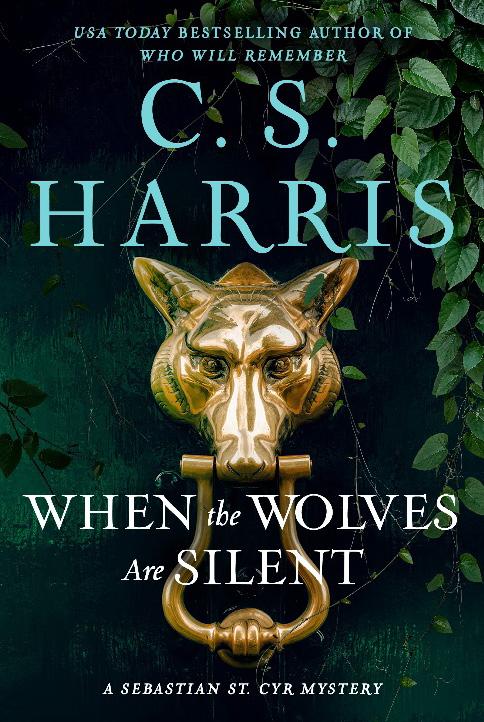
The 21st Mystery in the St. Cyr Series
Page 12
Global Reach, Sensory Detail
Nantucket's Maritime History
Page 12
A Fairy Tale Seasoned with Fact
A Conversation with Catherine Kurtz
Page 14
Story Gold
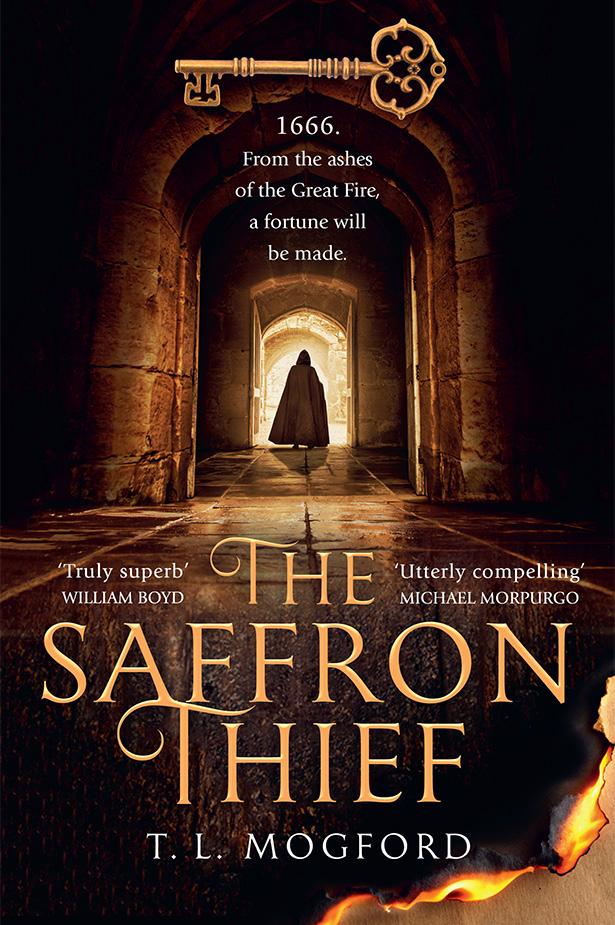
Thomas Mogford's The Saffron Thief
Page 15
Historical Fiction Market News
Page 1
New Voices
Page 4
History & Film
Page 6



HISTORICAL NOVELS REVIEW
ISSN 1471-7492
Issue 117, August 2026 | © 2026 The Historical Novel Society
PUBLISHER
Richard Lee
Marine Cottage, The Strand, Starcross, Devon EX6 8NY UK
<richard@historicalnovelsociety.org>
EDITORIAL BOARD
Managing Editor: Bethany Latham
Houston Cole Library, Jacksonville State University 700 Pelham Road North, Jacksonville, AL 36265-1602 USA <blatham@jsu.edu>
Book Review Editor: Sarah Johnson
Booth Library, Eastern Illinois University, 600 Lincoln Avenue, Charleston, IL 61920 USA
<sljohnson2@eiu.edu>
Publisher Coverage: Bethany House; Bookouture; HarperCollins, IPG; Penguin Random House US; Severn House; Australian presses; university presses
Features Editor: Lucinda Byatt
13 Park Road, Edinburgh, EH6 4LE UK
<textline13@gmail.com>
New Voices Column Editor: Myfanwy Cook
47 Old Exeter Road, Tavistock, Devon PL19 OJE UK <myfanwyc@btinternet.com>
REVIEWS EDITORS, UK
Alan Fisk
<alan.fisk@alanfisk.com>
Publisher Coverage: Aardvark Bureau; Black and White; Bonnier Zaffre; Crooked Cat; Freight; Gallic; Honno; Karnac; Legend; Pushkin; Oldcastle; Quartet; Saraband; Seren; Serpent’s Tail
Ann Lazim
<annlazim@googlemail.com>
Publisher Coverage: All UK children’s historicals
Carolyn Morgan
<carolyn@historicalnovelsociety.org >
Publisher Coverage: Birlinn/Polygon; Bloomsbury UK; Duckworth Overlook; Faber & Faber; Granta; HarperCollins UK; Head of Zeus; Orenda; Pan Macmillan; Simon & Schuster UK; Storm; Swift Press
Aidan Morrissey
<aidankmorrissey@gmail.com>
Publisher Coverage: Allison & Busby; Canelo; Penguin Random House UK; Quercus
Adele Wills
<adele.wills@btinternet.com>
Publisher Coverage: Alma; Atlantic; Canongate; Glagoslav; Hachette UK; Holand; Joffe; Pen & Sword; The History Press
REVIEWS EDITORS, USA
Tracy Barrett
<tracy.t.barrett@gmail.com>
Publisher Coverage: All North American children's historicals
Kate Braithwaite
<kate.braithwaite@gmail.com>
Publisher Coverage: Poisoned Pen Press; Skyhorse; Sourcebooks; and Soho
Bonnie DeMoss
<bonnie@historicalnovelsociety.org>
Publisher Coverage: North American small presses
Peggy Kurkowski
<pegkurkowski@gmail.com>
Publisher Coverage: Bellevue; Blackstone; Bloomsbury; Casemate; Macmillan (all imprints); Grove/Atlantic; and Simon & Schuster (all imprints)
Kristen McDermott
<krismcd59@gmail.com>
Publisher Coverage: Amazon Publishing; Europa; Guernica; Hachette; Kensington; Pegasus; Penzler; and W.W. Norton
REVIEWS EDITORS, INDIE
Karen Bordonaro
<kbordonaro@historicalnovelsociety.org>
Publisher Coverage: all self- and subsidy-published novels
EDITORIAL
POLICY & COPYRIGHT
Reviews, articles, and letters may be edited for reasons of space, clarity, and grammatical correctness. We will endeavour to reflect the authors’ intent as closely as possible, and will contact the authors for approval of any major change. We welcome ideas for articles, but have specific requirements to consider. Before submitting material, please contact the editor to discuss whether the proposed article is appropriate for Historical Novels Review.
In all cases, the copyright remains with the authors of the articles. No part of this publication may be reproduced or transmitted in any form without the written permission of the authors concerned.
MEMBERSHIP DETAILS
THE HISTORICAL NOVEL SOCIETY was formed in 1997 to help promote historical fiction. We are an open society — if you want to get involved, get in touch.
MEMBERSHIP in the Historical Novel Society entitles members to all the year’s publications: four issues of Historical Novels Review, as well as exclusive membership benefits through the Society website. Back issues of Society magazines are also available. For current rates, please see: https://historicalnovelsociety.org/members/join/
TABLE OF CONTENTS
HISTORICAL FICTION MARKET NEWS
HNS EDITORIAL UPDATES
Sarah
Jackie McMahon, Callie Murray, Susan Nolen & Ellen Rachlin | Myfanwy Cook
The Draughtsman's Contract | Douglas Kemp
Thomas
US reviews editor Janice Ottersberg is stepping down after over five years in the role. Many thanks to Janice for her dedication and support and all her excellent contributions to the editorial team. And a welcome to Kristen McDermott, who has recently joined as US reviews editor. Kris is a longtime reviewer and writer of feature articles for HNR, a Professor of English at Central Michigan University, and a writer of scholarly works and historical fiction. Her assigned publishers and contact details are on the masthead.
NEW BOOKS BY HNS MEMBERS
Congrats to all HNS members with new books out! If you’ve written a historical novel or nonfiction work published (or to be published) in March 2026 or after, send the following details to me at sljohnson2@ eiu.edu by October 7: author, title, publisher, release date, and a blurb of one sentence or less. You may also use the “Contact Us” form at the HNS website if you prefer. Please shorten your blurbs down to one sentence, as space is limited. Details will appear in the November 2026 issue of HNR. Submissions may be edited.
In The Falcon’s Heart, by Joyce DiPastena (Sable Tyger Books, Nov. 15, 2025), set in 12th-century Poitou during Henry II’s war with his sons, an exiled archer confronts the woman he believes betrayed him, resolved to uncover the truth behind a long-buried theft before rekindled love is undone by suspicion and war.
Agrippa and Octavia, trusted general and sister to Rome’s rising first emperor, fight to preserve order and their ideals as Augustus’ ascent turns the Republic’s fall into a dangerous, uncertain birth of empire in My Agrippa: Love, Loyalty, and the Fall of the Republic by William Twersky (All Things That Matter Press, Dec. 2, 2025).
Therein Lies the Pearl by Catherine Hughes (Historium Press, Jan. 19) retells the events of the Norman Conquest as experienced through the eyes of two women, Celia and Margaret, who live on opposite sides of the English Channel.
In J. D. Porter’s The Muleskinner and The King (Historium Press; Jan. 26), when the circus rolls into Atlanta, Georgia, in the fall of 1936, a string of murders threatens to close the show and ignite a powder keg of suspicion that stretches far beyond the tent poles.
Fans of Conn Iggulden, Ken Follett, and Robert Graves will be captivated by A Ram for Mars, Book 3 in the “A Slave’s Story” trilogy (NFB Publications, Feb. 9), a richly detailed and immersive exploration of the Jewish revolt against Rome (66-73 AD/CE) through the lens of a pro-Roman Jew in the rural district of Galilee, written by Christopher D. Stanley, an expert on early Judaism.
Randy Elrod’s The Mysteries of Barcelona: An Erotic Gothic Serial (cre:ate Publishing, Feb. 14) is a baroque, erotic Gothic serial set in 1890s Barcelona, following Chloé Permanyer—poisoner, vigilante, dark angel—as she hunts the monsters society protects, one kiss at a time.
Christian Beaudry’s Unfulfilled Expectations – The Untamable (Éditions du Tullinois, Feb. 28) is an emotionally charged WWII era novel set in Canada, centred on Catherine—a fiercely independent young woman whose wartime and post-war journey blends carefully grounded historical detail with her struggle to navigate desire, loyalty, and identity.
Century by Robert Campbell (Independent, Mar. 9.) is inspired by the author’s PhD and newspaper career and follows a young exiled couple at the dawn of the 20th century, running from troubled pasts in Ireland and Germany into the treacherous newsrooms and spyinfested alleyways of New York, London and Cologne.
In The Peacemaker’s Wife by Julie Dorsey (Curtis Publishing Company, Mar. 28), as Polly King helps bring new life into the world as a healer and midwife, she also becomes entangled in a series of mysterious murders haunting her community; through betrayal, loss and forbidden love, Polly must confront danger and ultimately take control of her own destiny.
Dylan Stone’s Journal by W. D. Nelson (Independently published, Apr. 2) is a dual-timeline historical adventure mystery following two American friends who stumble into a hunt for the missing Irish Crown Jewels during a backpacking trip through Europe in 1983— and the nephew who retraces their journey decades later through the protagonist’s journal.
A richly atmospheric, suspenseful adventure set in the American Revolutionary War, Constance Emmett’s Bound (Next Chapter, Apr. 2) is a story of love lived in the shadows, and the cost of claiming one’s own life when the surrounding world denies it.
Set in 1830s Cornwall, The Ties That Bind, the debut novel by Jane Bayly Vaughan (Indian Orchard Press, Apr. 14), first in the series A Story of Grace and based on the author’s family history, is a poignant tale of loyalty, resilience, and the enduring bonds that shape a woman’s courage when everything she cherishes is at stake.
In Chele Crawley’s Lady Dixon’s Niece (Chele Crawley Publishing, Apr. 15), Lady Dixon’s duplicitous scheme to find her niece a rich husband is derailed when her niece falls in love with one brother whilst simultaneously being rumbled by the other.
Set in the pre-First World War period and told in the style of a timeless fable, Straight Lines and Brown Brogues by David Braybrook (Selfpublished, Apr. 16) invites readers to witness the futility of war and the quiet, persistent courage of ordinary people in extraordinary times.
The Murder Investigation of Adolf Hitler (Level Best, Apr. 21) by Peter Clenott, featuring young Munich detective Avi Kreisler, takes place in 1931, as Adolf Hitler is less than two years away from becoming dictator of Germany, and his niece Geli Raubal is found dead of a gunshot wound to the chest in her locked bedroom in Hitler’s flat.
Absent Lives (The Book Guild, Apr. 28), the debut historical novel by Rebecca Pells, is a dual-timeline novel inspired by real events, it tells the story of the Lusitania, sunk by a German torpedo in 1915, and the devastating consequences for one young family who were aboard.
Described as Braveheart meets El Cid, Thomas J. Howley’s Fury in Hispania (Lanyard Press, Apr. 30) is a novel of high adventure and subtle romance: fresh from crushing a huge pagan Viking army at Clontarf in Ireland, Wolf the Quarrelsome and his small band of Celts and Christian Norse sail into the Iberian maelstrom and spark
the unstoppable fire that will kindle the eventual re-conquest of the oppressed Hispanian homeland.
Jude Munro’s The Season of Gold Dust and Gilt (Independently published, May 1) is a lively adventure/romance moving between the glitter of London in the 1850s and the riotous Australian goldfields.
Martha Conway’s We Meet Apart (Regal House, May 5) follows two American sisters trapped in Ireland during World War II—but in separate realities.
Diana Stevan’s A House Full of Strangers (Island House Publishing, May 9), set in the 1940s and 1950s, is a collection of short stories about Ukrainian immigrant landladies, their families, and the people who rent rooms from them.
Helen Parusel’s The Lost Orphans of Lyon (Boldwood, May 16) is a novel inspired by the true story of a remote Huguenot village that saved thousands of children in WW2.
Maelstrom: A Civil War Novel by James D. Best (Queen Beach, June 1) tells the story of the greatest rivalry in American history: that of Abraham Lincoln and Jefferson Davis, showing how each dealt with the same issues, countered the other’s moves, led their respective governments, and used their political powers to sway the outcome.
With Raven Wine: 1153 Orkneyjar, Book 4 in the Midwinter Dragon quartet by Jean Gill (The 13th Sign, June 5) brings to a gripping conclusion this adventurous reimagining of the Viking Orkneyinga Saga, as warrior bard Skarfr and his trader wife Hlif navigate temptation and treachery in Jerusalem, Constantinople and back home in Orkney.
In M. Joy Gorence’s An Unrelenting Tide: The Untold Story of Anne Bonny (Independently published, June 6), rebellious of the role society deems proper for a young woman, Anne Cormac begins her journey in the early 18th century that will introduce her to James Bonny and her future identity as Anne Bonny, the Pirate Queen.
Confidences, by Adela Zamudio, translated by Laura Nagle (Bucknell Univ. Press, June 9) is a story of love, scandal, and religious dogma in central Bolivia at the turn of the twentieth century.
The life of a respected 1870s physician unravels from alcohol and opioid addiction in Betty Brandt Passick’s Anatomy of a Death (BBPcom, Inc. Publishing, June 15).
John Orton’s The Pit Boy (UK Book Publishing, June 16), is the story of his Grandad Teddy, who started down the pit as a trapper boy in 1903 aged 13 after his mother had taken to the drink and abandoned him on a doorstep.
Deadly Ruse, the 14th in the Deadly Series of WWII mysteries by Kate Parker (JDP Press, June 23), concerns the POW camp for German generals at Trent Park House in north London in 1943: British spy Livvy Redmond is brought in to teach sketching to bored German generals and to get them to speak so the listeners in the basement can hear them discuss their secrets.
A historical fiction coming-of-age novel set in 1940s Appalachia, Shelly Chatterelli’s Knowin’ Sugar (Fauve Press, June 23) is an ode to the intertwined natural and human worlds of rural America — a story about what it means to belong to a place and a people, and the wavering line between destiny and choice.
Washington, 1864: with President Lincoln’s reelection in jeopardy, a serial killer runs loose in the Union capital, slaughtering high-ranking officers, and it’s up to renowned detective Allan Pinkerton and his crack team of operatives to hunt the madman down, as told in The Killing Season (VonDen Press, July) by Dennis Keeler.
In Carolyn Morgan’s debut novel Copperopolis (The Book Guild, Aug. 28), set in 1880s Swansea, Wales, a master mariner gambles everything on the deadly copper trade round Cape Horn, while his pioneering wife uncovers the industry’s ruinous toll at home; as ambition and morality collide, their family’s reputation and livelihood hang in the balance.
In Stephanie Simpson’s debut, The Alchemy from Antiquity (Atmosphere Press, Sept. 3), a young Gaulish herbalist from the 6th century journeys to Londinium to train as a midwife and surgeon, working for a progressive military compound general where she dodges raids, plagues, assaults and a conflicted relationship with a high-ranking officer, later becoming a self-actualized woman warrior trained by Pict women during a campaign in Bernicia (Northumberland).
In Manufacturing a Duchess by Tracy Wise (Type Eighteen Books, Sept. 8), when widower Alec Raeburn, Duke of Selkirk, leaves his faltering estate to seek a mate and mother for his young daughter on the London Marriage Mart, his expectations are upended when he meets industrial heiress Aurora Hardcastle, who arrives with ideas of her own.
Inspired by the true story of the Manhattan Project’s secret women at Oak Ridge, TN, award-winning author Tara Lynn Masih’s The Secret Women (Storm Publishing, Sept. 9) is a sweeping, absorbing, and deeply human story about chosen family, moral courage, and what it costs to live with the truth.
Patricia O’Reilly’s The Laverys – Passion. Power. Paint (Cape Press, Oct.) set in London, America, Ireland, and Tangier, is a novel about the enduring power of love, the pull of politics and consuming art: one of the great love stories of the 20th century.
After the End by Kelli Christiansen (Sibylline Press, Oct. 20) finds Holocaust survivor Sarah Morgenstern at a precipice, facing the chaos of Liberation with nothing to her name, launching a quest to solve the mystery of the fate of her family, and navigating the uncertainty of a postwar future she had never dared dream of while living under Nazi rule.
Bring Daybreak (Amphorae Publishing Group, Nov. 3) completes Steve Wiegenstein’s five-book Ozarks historical series with the story of a newspaper editor in the mid-1920s who deals with the resurgence of the Ku Klux Klan, the decline of her prominent family, and her growing attachment to a charming out-of-towner.
NEW PUBLISHING DEALS
Sources include authors and publishers, Publishers Weekly, Publishers Marketplace, The Bookseller, and more. Email me at sljohnson2@eiu. edu to have your publishing deal included. You may also submit news via the Contact Us form on the HNS website.
Nancy Bilyeau’s Champagne at Midnight, about an heiress and fashion editor in 1926 New York City who must untangle a web of buried pasts and lethal deceptions before it’s too late, for 2027, and The Queen’s Set, a fourth Genevieve Planche novel in the 18th centuryset suspense series, about a mission undertaken for Queen Charlotte,
for 2028, were acquired by Becky Slorach for Lume Books Historical Fiction, A Joffe Books Company.
Avon/HarperCollins UK has acquired two new novels from bestselling Molly Green for summer publication in 2027 and 2028. The first is set in the hidden depths of Down Street Station in 1944, where Stephanie Hope cooks for the Railway Executive Committee and is mystified when she finds herself charged with the violation of the Official Secrets Act. The second is located within the BBC where debutante Daniella Higham-Kelly hides a secret that could destroy her career as the first female wartime broadcaster.
Nobel Prize winner Kazuo Ishiguro’s next novel, Miss Lambert Steps Aboard Danger, will be historical fiction. A caper and “exquisite entertainment” in which a man pursues a mysterious woman through England and Scotland in 1938, it was acquired by Angus Cargill, publishing director at Faber, from agent Peter Straus at RCW; Knopf and Knopf Canada will publish it in North America.
Jennifer Galvão’s debut novel, Maria, Maria, set in the 1950s, following the unusual epistolary relationship that develops between the wife of a young Portuguese man in exile in Newfoundland and the Canadian widow who becomes his mistress, both of whom are named Maria, sold to Venetia Butterfield, managing director of Cornerstone/Hutchinson Heinemann (UK/Commonwealth) and to Sara Birmingham at Random House (US).
Beyond the Garden Wall by Katy Sewall, a prequel to Frances Hodgson Burnett’s The Secret Garden centering on the life of Mary Lennox’s mother in Victorian England, sold to Sara Birmingham at Random House via Molly Friedrich and Heather Carr at the Friedrich Agency, for autumn 2027 publication.
Tracy Chevalier’s next historical novel Agnes Wake, based on the historical story of an unsolved murder of a traveling quilt-maker in Northumberland, England, in 1826, seen from the viewpoint of a young woman from the community, sold to Harper for publication in fall 2027 via Duvall Osteen at UTA, on behalf of Jonny Geller (North America).
OTHER NEW & FORTHCOMING TITLES
For forthcoming historical novels through early 2027, please see our guides, compiled by Fiona Sheppard: https://historicalnovelsociety.org/forthcoming-hf/

COMPILED BY SARAH JOHNSON
Sarah Johnson is Book Review Editor of HNR, a librarian, readers’ advisor, and author of reference books. She reviews for Booklist and CHOICE and blogs about historical novels at readingthepast.com. Her latest book is Historical Fiction II: A Guide to the Genre

NEW VOICES
Jackie McMahon, Callie Murray, Susan Nolen and Ellen Rachlin have set out to tantalise their readers by encouraging them to step back into the periods of history that they are fascinated with.




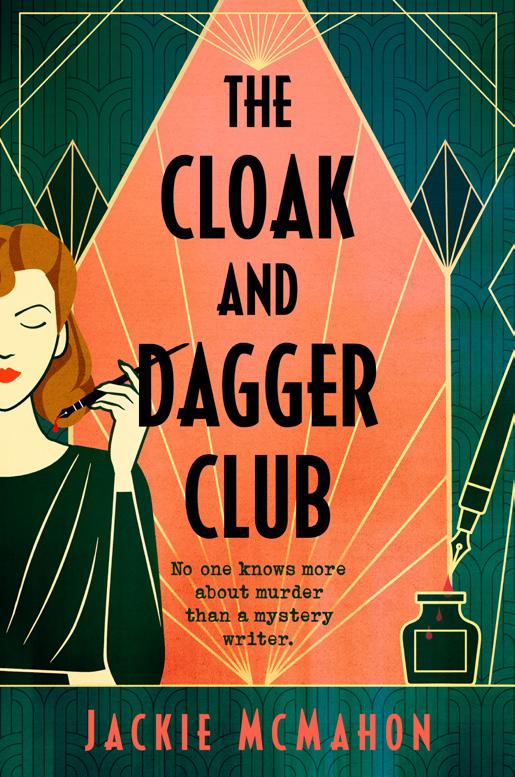
It was when Jackie McMahon learnt about a group called the Detection Club, combined with her “love of Agatha Christie and the Golden Age of Crime Fiction, the peak of British mystery stories in the 1930s and ´40s,” she says, that she was provided with a starting point for The Cloak and Dagger Club (Berkley, 2026).
The Detection Club was formally founded in 1930, though for a few years beforehand, as McMahon explains, “popular crime novelists of the day would meet for dinners at Anthony Berkeley’s house. Some founding members included Berkeley, Dorothy L. Sayers, Agatha Christie, and G. K. Chesterton, who became its first president. For their club mascot, they had a skull named Eric (though many years later, DNA testing would reveal that Eric was actually an Erica), and all members had to place their hand on the skull to swear their club oath.”
For McMahon, “the idea of so many mystery novelists—some still famous, others forgotten—gathering together to talk about their craft was enticing. I wondered what would happen if a murder took place in a group like this. How would these people who know so much about fictional murders solve a real one?”
Lucy, the main protagonist of The Cloak and Dagger Club, uses her skills as a mystery writer to investigate a real crime and prove her former lover is innocent of murder. The members of the group, according to McMahon, “reference popular mystery archetypes and tropes—they also have a club skull, because how can one learn a deliciously macabre detail like that and pass it up?” At the same time, she “wanted to challenge some of the biases and stereotypes found in classic mystery novels.”
It was only after writing the manuscript that she learnt that “Christie herself once toyed with the idea of writing a murder mystery set at
the Detection Club. Ariadne Oliver, her humorous self-insert, would have been the main sleuth. In Christie’s notebook, she wrote down the names of several of her clubmates, indicating fictionalized versions of them.” However, while McMahon is sure Christie’s story would have “been a delight,” she is “glad Christie saved the idea for me” and hopes that “The Cloak and Dagger Club is a fair-play mystery she would have been proud of.”
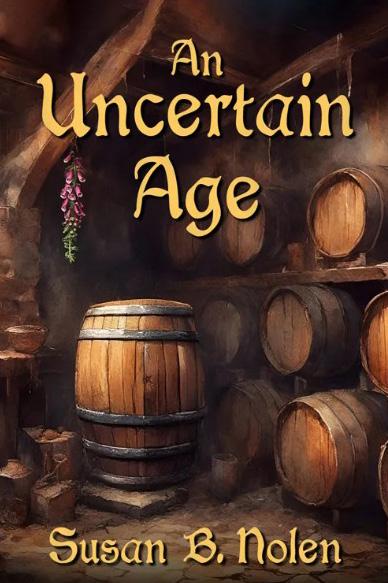
Having just shelved an earlier manuscript, and searching for a fresh idea, Susan Nolen, author of An Uncertain Age (Wild Rose Press, 2026), realised that she “was tired of reading novels about young women, with their seemingly inevitable focus on romantic relationships. Instead, I wanted someone like me—an older woman—as the central character. A scene I’d written earlier kept coming back to me: an old woman in the distant past, kneading bread and mourning the loss of her spouse. So, I decided to spin that out and see where it led.”
Nolen was interested in the medieval period, she says, “but most novels set there focused on the high and mighty. Even non-royal main characters mostly took their conflicts from their relationship to kings and queens.” Instead, Nolen “wanted to try to write about what Philippa Gregory calls ‘ordinary women.’
“I started by doing research on medieval village women and found Judith Bennett’s work on brewsters, women who brewed ale for their families and neighbors, and how that changed after the Black Death. I also read about fourteenth-century widows, learning about the economic and personal advantages of widowhood in that time when most women were legally controlled by either husband, father, or other male relative.” She found that “widows could be autonomous.” As an academic, Nolen “had studied how a person’s identity is constructed within their social context.” As a consequence, she couldn’t help wondering about creating a story around “a woman whose identity had been ‘wife and brewster’ but now had the opportunity to be her own person, whose widowhood gave her the chance to create a new identity.”
Further research then led Nolen back to the County Palatine of Durham, a place she’d “visited multiple times,” she relates. “The unique political, legal, and economic context and the fascinating role of the Black Death in unsettling that context gave me the milieu for my widow’s personal reconstruction. Unlike in much of England at the time, Durham had a ‘widow-right,’ the right of a widow to choose to take over and control all of her husband’s property for her lifetime. Of course, if she remarried, her new husband would take over, and she’d be back where she started. This is Margaret’s central problem, and what sets her on the road to conflict with the village reeve.”
As she wrote, “other characters appeared,” like “eleven-year-old Agnes, abandoned by her father to be Margaret’s servant, and Hild, about whom we learn secrets of a difficult past.” By then she was, “thoroughly hooked” on the story of her main protagonist and those around her.
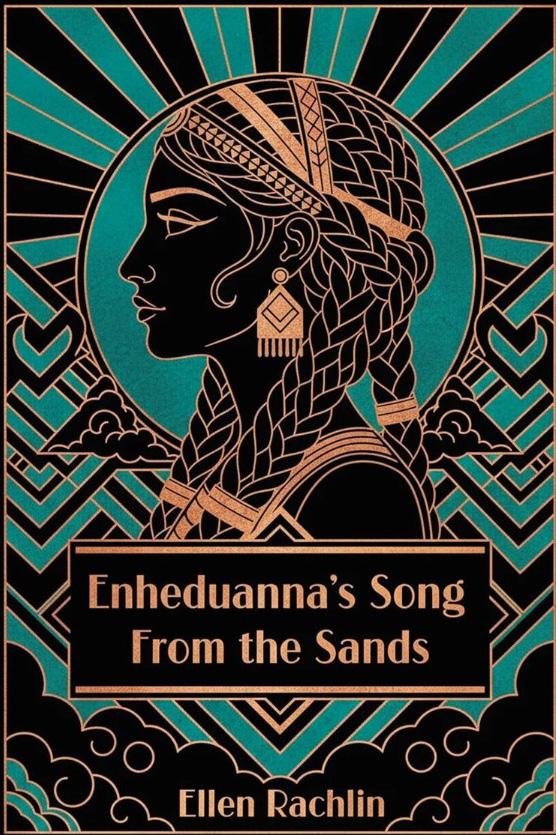
Ellen Rachlin stumbled upon the central character in her novel Enheduanna’s Song from the Sands (Histria Fiction, 2026) “while reading an article on ancient Mesopotamia,” she says. She had known about Sargon the Great, her father, but not about Enheduanna, who lived around 2300 BCE and is considered to be the world’s first named author. Because of this, Rachlin “sought out various translations of the hymns attributed to her and quickly understood why they endured. Yet these works that were copied and presumably revered for centuries after her death eventually disappeared from view.”
Jackie McMahon
Susan Nolen Ellen Rachlin
Callie Murray
© 2026
Ansley Pacetti
Photo credit: Chelsea Mazur
It was Sir Leonard Woolley who unearthed them, “during his 1920s excavations at Ur in what was once Sumer and, in Enheduanna’s time, part of the Akkadian Empire,” Rachlin states. “Even then, the texts remained untranslated for a few more decades. Only in recent years has broader interest in these powerful works, and in Enheduanna herself, begun to grow. The modern rediscovery of her has been a slow burn since the tablets were first recovered.”
Rachlin explains: “Enheduanna was born into great privilege, became a feminist icon, but was little-known in modern times. Her true story was likely well-known throughout the ancient world but now almost entirely lost” and as a result she felt compelled to imagine a possible narrative of her life and loved the challenge.
What Rachlin aimed to explore was “how a woman sent to rule as high priestess in the heart of rebel territory could have defended her authority, led her people, and survived political upheaval and exile. While uprisings were common at that time, the exile of a high priest or high priestess was not. Yet, Enheduanna, High Priestess of Ur and Uruk, was forced out by the rebel, Lugalanne, an ordeal she recounts with striking intensity in Nin-me-šara (The Exaltation of Inanna).”
Additionally, she was drawn “to the ancients’ relationship to the cosmos through their mythology. The night sky was a blank text to write their view of the origins of life and the structure of the cosmos. The stars served as guides, omens, and the scaffolding for stories or myths and the divine powers of their gods.” These cosmological beliefs Rachlin incorporated into the fantasy elements in Enheduanna’s Song from the Sands. Many of her plot elements, she says, “sprung from extant stories from the time period” and were “dependent on many brilliant translators.” While her authorship is disputed, Rachlin was still attracted to “Enheduanna’s story: a woman who inspired and led her people spiritually and to prosperity, had great works of literature attributed to her, and was ultimately restored to her powerful and memorable position as a high priestess.”
A few years ago, when Callie Murray, author of The Brunswick (Revell, 2026), had just finished reading a novel on an aeroplane, it dawned on her when reading the author’s note and acknowledgments: “You’re not just born a novelist—it takes intention and research and lots of other people.”
This discovery prompted Murray for the first time to wonder “if it was something I could do,” she says. “I spent the rest of the plane ride daydreaming what I’d write if I ever wrote a novel of my own.”
Foster care had always been an interest of Murray’s. “I’d always been
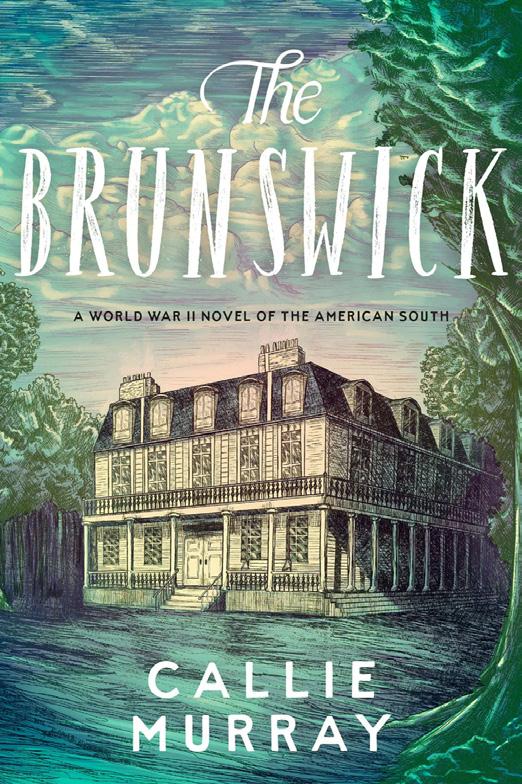
fascinated by how WWII came to be, so I googled the two and found a small story in the Holocaust Encyclopedia about a Jewish American couple who traveled to Austria in 1939 to bring fifty children back to America in a foster care-type scenario. I read the couple’s memoir and watched the film and was then determined to give that story a try.”
The story Murray mentioned “happened in Philadelphia,” she says, “but I could only imagine it in my small town of Norcross, Georgia. I’ve long been fascinated by Norcross’s history, especially The Brunswick hotel, which was just a few doors down from my house. I began to ask ‘what if” questions, like: What if the couple brought the children back to The Brunswick…”
Before she started writing, she continues, “I made a list in my Apple Notes of what I loved about my favorite books: chapters that end with punchy last lines, romances that are clean but full of tension, historical settings that teach you something but a plot that makes it feel fast and relevant. I decided I wanted to write my favorite kind of book.”
Murray’s husband “had been training for a marathon,” she relates, “so I said I wanted to train for a novel! We carved out ‘training time,’ and I set to work. I listened to podcasts about writing, read lots of books, and just started drafting. I wrote the first draft just for myself.” Then she gave it to her husband and a few friends to read. “I realized how fun it is to have readers! That’s when I really decided to give publishing a go.”
Interestingly, what binds these debut novelists together is undoubtedly their desire to share the worlds they have created and to entertain their readers.
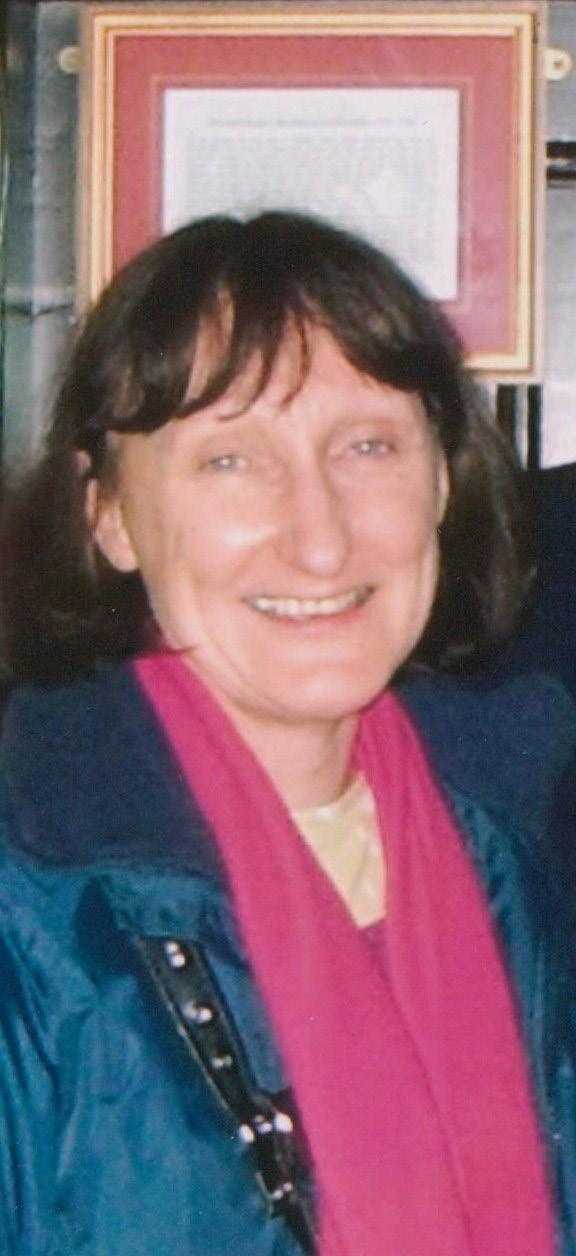
WRITTEN BY MYFANWY COOK
Myfanwy creates HF writing and language-related workshops for universities, charities and other organisations. She is currently highlighting the importance of miners and their families who migrated from Devon and the Tamar Valley during the 19th century. myfanwyc@btinternet.com

HISTORY & FILM
Composing the Past: The Draughtsman’s Contract as Historical Fiction on Screen

Peter Greenaway’s The Draughtsman’s Contract (1982) is set in an English country house in 1694, but it is not “about” the past in the dutiful costume-drama sense. The film is too ceremonious and absorbed with its own baroque artifice for that. Yet it is also much more than an elegant jeu d’esprit in wigs. What Greenaway offers is something recognisable to readers of historical fiction: not a neutral reconstruction of a vanished world, but a polemic about the past made through story, gesture and design. The film asks how late Stuart England might be imagined on screen, and what forms of power become visible when one does so through art, bargaining and display.
Its plot is at once simple and artfully complex. Mr Neville (played by Anthony Higgins) an ambitious draughtsman, is engaged to make twelve drawings of Compton Anstey, an English country house and its estate while the owner, Mr Herbert, is away. The contract is negotiated by his wife, Mrs Herbert (Janet Suzman) and includes sexual favours as part of the fee. As Neville proceeds with his work, suspicious objects begin appearing within his carefully framed views. By the time the absent husband is discovered dead, the draughtsman has become both witness and dupe: a man who prides himself on seeing clearly but proves incapable of reading the human intrigues around him.
This is an excellent premise for a murder mystery, but it is also a pointed foundation for historical fiction. A draughtsman is a maker of ordered surfaces. He records possession, taste and improvement. And in late 17th-century England this is no small matter. The years after the Glorious Revolution were politically unsettled but culturally zealous. A period in which questions of legitimacy, inheritance, Protestant order, household authority and the visible signs of rank all carried particular force. Greenaway’s 1694 is therefore not incidental. It is a moment when the country house represents both privileged residence and political statement.¹
The film strongly portrays the atmosphere of a society organised by property. The house and grounds are not simply a backdrop; they are the essential matter under dispute. Everything in the story is about ownership – who controls the estate, who inherits, who is admitted into the family line, who may circulate through the house, and whose body is used as leverage in securing advantage. Historical novelists often demonstrate that intimate life is structured by law, money and land, and Greenaway does precisely this. The sexual contract at the film’s centre is venal, but it is also revealing. Desire is formalised and negotiated. Seduction becomes a
legalistic game and language itself sounds notarised.
This emphasis on contract, lineage and estate management fits well into the late Stuart setting. The Glorious Revolution had certainly not abolished hierarchy; it had rather rebalanced authority, asserting Parliament’s place against monarchy while leaving the landed order intact and, in many respects, strengthened.² Greenaway is not making a constitutional tract, but the film’s world assumes a culture in which power is mediated through documents, titles, settlement, patronage and performance.
Religion, too, flickers at the edges of the film. Greenaway has said that the period interested him partly as a moment of Protestant hostility to Catholicism, marking the passing of the old, Catholicleaning Stuart order and the arrival of a Protestant, essentially mercantile aristocracy, much of it shaped by northern European influence.³ The film quietly registers that pressure in the exchanges between the rather ridiculous heir to Compton Anstey by marriage, the Protestant Mr Talmann (Hugh Fraser) and the Catholic leaning Neville. The point is not pushed far, but it adds another strand to the atmosphere of unease: this is a world in which property, marriage and status are all shadowed by confessional suspicion.
Where the film becomes especially interesting as historical fiction is in its treatment of manners. No one speaks naturally, if by “naturally” one means conversational realism. The dialogue is Baroque and ostentatiously composed - elaborate, epigrammatic, ceremonious. Greenaway and Janet Suzman both later stressed that the costumes, wigs and dialogue were deliberately stylised, with the artificiality itself forming part of the design.4 This is crucial. The film is not trying to reproduce exactly how educated and wealthy people in English privileged circles in 1694 spoke over supper. It is instead creating a language-world that feels adjacent to Restoration comedy, courtly insult and legal phrasing. The result is historically suggestive rather than philologically exact.
That distinction matters. Novelists rarely reproduce the literal syntax of seventeenth-century speech for fear of producing something dead, obscure or unreadable. They aim, instead, for an idiom that carries the flavour of period thinking while remaining intelligible to the modern reader. Greenaway does the same on screen. His people speak in sentences sharpened beyond probability, but the exaggeration serves a truth. This is a society in which wit, rank and humiliation are public acts, and where civility is often only barely concealed aggression in lace cuffs.
Dress and bodily display work in similar fashion. The film’s costumes are ravishing and intentionally excessive. Contemporary commentary from the British Film Institute notes that Sue Blane’s designs are “more exaggerated and extravagant” than what would have been seen in cultured England in the late 17th century.5 Yet the exaggeration is not random. It builds on real features of 1690s elite fashion: women’s longtrained mantuas, elaborate lace headdresses, men’s fuller coats and towering wigs.6 Greenaway pushes these elements toward caricature, but in doing so he catches something true about rank as spectacle. These are clothes designed to occupy space, to assert precedence, to turn the body into a statement of possession. The film understands that costume in such a world is not decorative garnish; it is social syntax.
So too with the gardens. The clipped hedges, axial paths, statuary and geometric order announce more than cultivated taste. They signal the Dutch-inflected fashion associated with the reign of William and Mary, when gardening and interior decoration became conspicuous languages of elite improvement.7 The estate
in The Draughtsman’s Contract is not merely decorative. It has been composed. Greenaway, trained as an artist, makes us feel that the landscape has already been turned into a picture before Neville ever sets up his frame. That is one reason the drawings matter so much for they do not invent order, they certify it.
And yet the film is full of objects that refuse certification. Shirts, ladders, garments, mobile statues, fruit, dogs, bodies: things keep entering the frame with awkward insistence, as if history were sabotaging design from within. Neville’s confidence rests on a naïve empiricism. If he can see, he can know. If he can draw, he can master. But Greenaway keeps showing that seeing is never innocent. Perspective excludes. Composition flatters. The artist is implicated in the power structures he pretends merely to record.
This is where the film speaks most fruitfully to historical fiction as a genre. The best historical novels do not simply “set a story in the past”; they dramatise the partiality of evidence. Letters lie. Diaries omit. Portraits flatter. Official records conceal coercion beneath formula. Neville’s drawings are visual equivalents of such documents. They appear objective, yet are shaped by vantage point, by commission, by self-interest, by the unseen manipulation of others. Greenaway turns the country-house mystery into a meditation on the making of historical evidence itself.
The servants and subordinate figures are part of this meditation. The film does not sentimentalise them, nor does it grant them a modern democratic voice. They are present as watchers, carriers, arrangers, listeners, bodies moving through the machinery of the house. In that respect Greenaway is truer to 17th-century hierarchy than many costume dramas that smuggle in contemporary assumptions about transparency and equality. The household is not a family in the cosy modern sense; it is a layered structure of service, privilege and intimidation. Even when servants remain at the edge of the action, their edge-presence reminds us that elite ease depends on labour.
There are, of course, anachronistic pressures in the film. The score is one. Michael Nyman’s music draws on Purcell, a fitting 17th-century source, but transforms it through modern minimalism, driving repetition and pulse.8 The effect is marvellous: period-rooted and decisively contemporary at once. One hears not 1694 exactly, but 1694 remembered, formalised and energised through 20th-century sensibility. Again, this is what historical fiction often does. It brings the past close without pretending to dissolve the distance altogether.
The same may be said of the film’s sexual politics. Greenaway is interested in women as plotters, negotiators and survivors within a patriarchal estate culture, but not in a simplistically triumphant way. Mrs Herbert and her daughter, Mrs Talmann (played by Anne-Louise Lambert), use the draughtsman because that is one of the few routes available to them within the structures that confine them. Their superior intelligence does not abolish vulnerability. If anything, the film’s bleakness lies in the suggestion that everyone is acting under pressure from property arrangements that precede and outlast personal feeling. This is another point at which it feels akin to serious historical fiction – agency exists, but never in clean modern terms.
How accurate, then, is The Draughtsman’s Contract? The answer depends on what one asks of historical art. It is not scrupulously documentary. The dialogue is too crafted, the costumes too heightened, the compositions too consciously painterly for that. But accuracy in historical fiction is not merely a question of whether every hemline and phrase would pass inspection. It is also a matter of whether a work grasps the organising pressures of a period –Greenaway does. He understands that late 17th-century elite life was governed by display, lineage, improvement, contractual thinking, household hierarchy and the politics of possession. His stylisation does not cancel those truths but rather illuminates them.
Indeed, one might say that the film’s very artificiality is its historical method. The late Stuart world it depicts was itself highly ritualised: a world of performance, codes, ceremonious insult, arranged spectacle and visible rank. By making his film mannered, Greenaway refuses the false naturalism by which the past is often made reassuringly familiar. He reminds us that 1694 was not simply “people like us in older clothes”. It was a society organised by assumptions at once seductive and alien.
That is why The Draughtsman’s Contract deserves to be thought of as historical fiction on screen at its most intelligent. It neither genuflects before the past nor raids it for picturesque surfaces. Instead, it asks how the past is framed, who does the framing, and what slips into the picture despite all efforts at control. Like the best historical novels, it knows that history is not only what happened, but also what can be seen, inferred, staged and contested. Greenaway’s film is singular, certainly. But its singularity is exactly what makes it valuable. It composes the past with enough wit and perversity to make it live. It is a remarkable film – layered, intelligent and utterly absorbing, and one that rewards repeated viewing.
REFERENCES
1. Sir George Clark, The Later Stuarts, 1660–1714. Oxford University Press, describes it as a survey of the political, social, economic and intellectual history of England from the Restoration to Queen Anne.
2. On the Glorious Revolution as the 1688–89 settlement in which Parliament asserted its rights over the monarchy, see Sir George Clark.
3. Karem Jaehne “The Draughtsman’s Contract: An Interview with Peter Greenaway”, Cineaste Volume 2 No.13 (1984): pp. 13-15
4. Imogen Tilden, “‘The antique tea set was worth more than our entire budget’: How Peter Greenaway and Janet Suzman made The Draughtsman’s Contract,” The Guardian, 14 November 2022
5. Josephine Botting, ‘Papers, plans, diagrams: the making of The Draughtsman’s Contract’, BFI, 6 December 2022.
6. Valerie Cumming, A Visual History of Costume: The Seventeenth Century (London: Batsford, 1984)
7. On William and Mary’s influence over gardening and interior decoration, and the prestige attached to Dutch-inflected taste in the period, see Michael Archer, “Dutch Delft at the Court of William and Mary.”
8. David Cooper and Ian Sapiro, “A Source-Studies Approach to Michael Nyman’s Score for The Draughtsman’s Contract,” Journal of Film Music 3, no. 2 (2010): pp. 121–135.

WRITTEN BY DOUG KEMP
Douglas Kemp is a retired civil servant and former Reviews Editor of the Historical Novel Society. He now divides his time between reading, writing fiction and writing about books and sport, and playing golf with more enthusiasm than distinction.
QUIET ACTS OF DEFIANCE
Combating Nazi Art Theft
Have you ever paused in a museum to study a piece of art? One by Monet or Rembrandt? A sculpture like Michelangelo’s David or Rodin’s The Thinker? I marvel at their beauty, feeling a tangible, albeit tenuous connection to both the creator and their subject across time. These masterpieces transcend geographical boundaries in their value to the world. Yet they also represent national pride and are integral to societal identity. Most of all, they are irreplaceable. If vandalised or stolen, their loss sparks grief, indignation and anger. Recent examples include the theft of the Crown Jewels from the Louvre, or protest stunts of throwing red paint on priceless paintings or monuments.
Similar political acts were also perpetrated by the Nazis, who destroyed or stole cultural goods that didn’t accord with their world view, such as ‘degenerate’ modern art or ‘subversive’ literature. Popular culture has explored this in various ways, including thrillers, detective stories, mysteries and dramas. Movies such as The Train (1964), The Monuments Men (2014), Woman in Gold (2015) and The Last Vermeer (2019) are examples of the topic’s long-term appeal in cinema.
Nazi crimes are also explored in WWII historical fiction in what has virtually become a sub-category within the genre. Two questions consistently arise: is human life more valuable than art? And is it worth risking your life to protect a cultural legacy? Brianna Labuskes’ The Librarian of Burned Books (William Morrow, 2023) highlights the quest to save books from destruction. Chris Lloyd’s The Art of Occupation (Orion, 2026) looks at both art theft and how the Nazis stripped libraries to study their enemies’ vulnerabilities. In each case, the aim of the Regime was to rob people of their tradition, history and collective memory.
Thrillers such as Daniel Silva’s The English Assassin (Berkley, 2003) and Lisa Barr’s Woman on Fire (Welbeck Fiction/Harper, 2022) draw upon art theft as a foundation for their contemporary stories. In doing so, dark histories are revealed and the crimes of the Nazis exposed. Their plots are fuelled by characters driven to exact vengeance
The unravelling of a secret is deployed by Natasha Lester in The Riviera House (Hachette Australia/Forever, 2021). She incorporates a mystery within a braided narrative linking two women to a piece of lost art across two time periods. In doing so, she tells the story of the remarkable Rose Valland, who worked at the Jeu de Paume museum in Paris. At great peril, Valland secretly recorded details of the looted art kept there. Lester wrote the book as a tribute. ‘Without Rose’s heroic efforts,’ she says, ‘it’s certain tens of thousands of priceless artworks would not have been restituted to their rightful owners … She helped to protect and preserve the cultural heritage of a nation … My hope was that, in writing The Riviera House, people in the 2020s and beyond would be able to say: I am inspired by her. Her legacy lives on.’
Author Laura Morelli sees the stripping of heritage as effectively a form of oppression. ‘The appeal of stolen art fiction is because paintings, sculpture, music and books provide both a communal and individual identity,’ she says. ‘Fighting to protect cultural identity provides hope in a time of darkness. It proves there are good people who believe it is worth risking their lives to protect their heritage or bear witness to evil.’ Morelli’s books explore how ordinary people like art historians, curators, archivists and photographers were placed into ‘a crucible of physical danger and ethical choices’. Should they steal or hide the art in order to preserve it? Risk their lives to undertake resistance? These untold personal stories create a rich reservoir which draw on quiet rather than epic feats of heroism.
Lester and Lloyd concentrate on the pillaging of art in occupied France and feature French protagonists. In contrast, Morelli’s books provide both Allied and Axis viewpoints but still focus on theft under occupation. Additionally, The Night Portrait (William Morrow, 2020) cleverly incorporates a timeline set in Renaissance Milan which brings to life Cecilia Gallerani, the Duke of Milan’s mistress, whom Leonardo da Vinci depicted in the portrait, Lady with an Ermine. Edith, a German conservator assigned to Hans Frank, the Nazi governor of occupied Poland, secretly catalogues paintings stolen from Polish institutions and families and protects the Renaissance portrait. The novel includes Dominic, an American soldier travelling with the Monuments Men, who questions the importance of protecting art while his comrades are dying in combat. According to Morelli, focusing a story around a particular piece of art allows the reader to chart its progress in a concrete way which raises the stakes as to
THESE MASTERPIECES transcend geographical boundaries in their value to the world. Yet they also represent national pride and are integral to societal identity. Most of all, they are irreplaceable.
its survival. In The Last Masterpiece (William Morrow, 2023), Morelli pits Eva, a German photographer, against Josie, an American WAC assigned to the Monuments Men. Both women are concerned with protecting Florence’s treasures. Set after Mussolini’s downfall, the Italians have ‘switched sides’ and insist their masterpieces remain within their homeland (a quest developed further in Morelli’s The Keeper of Lost Art (William Morrow, 2025)). The Last Masterpiece is a fascinating exploration of an ordinary American and German woman, both devoted to safekeeping, who each wrongly believe the motivations of the ‘other side’ are venal and callous.
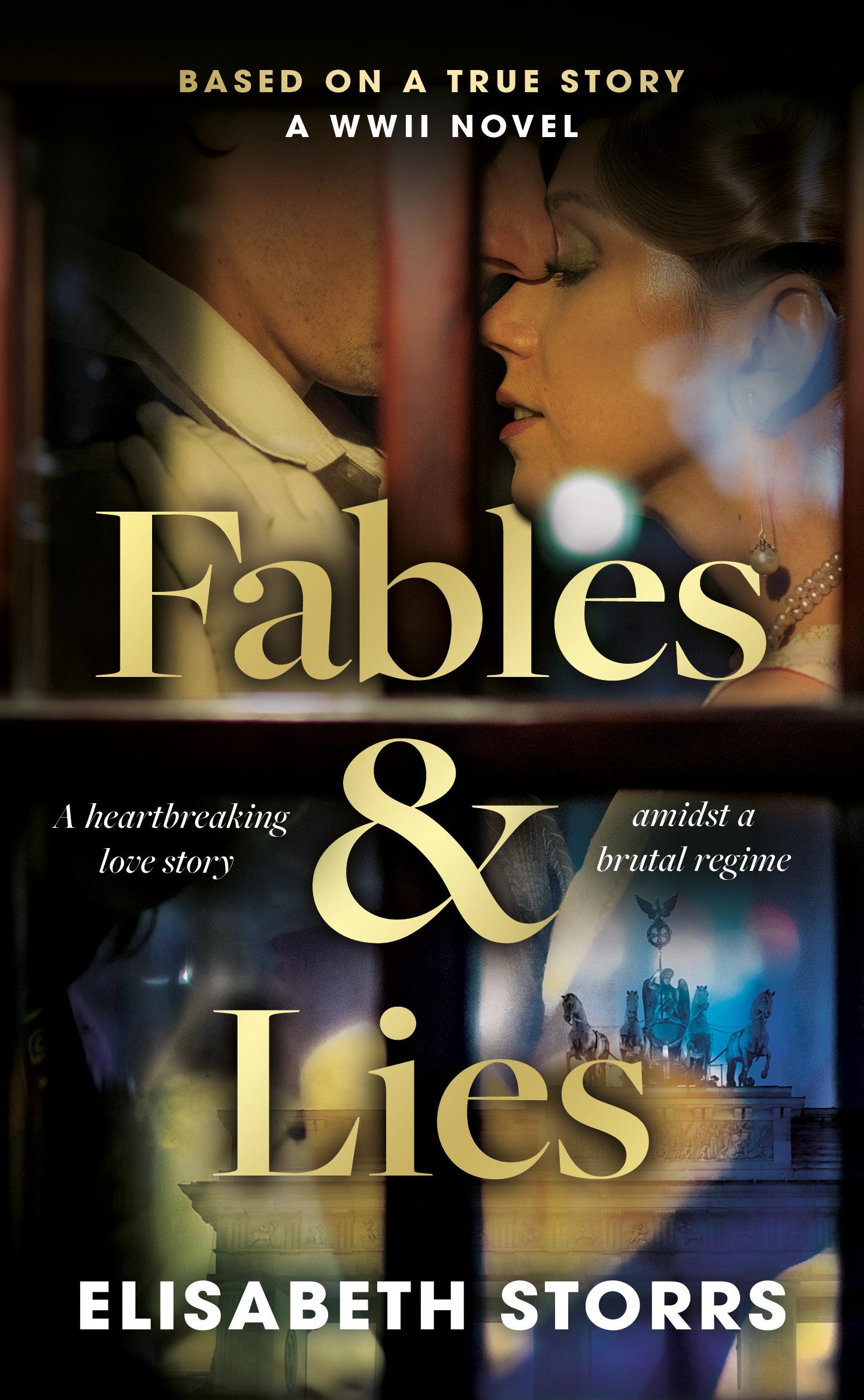
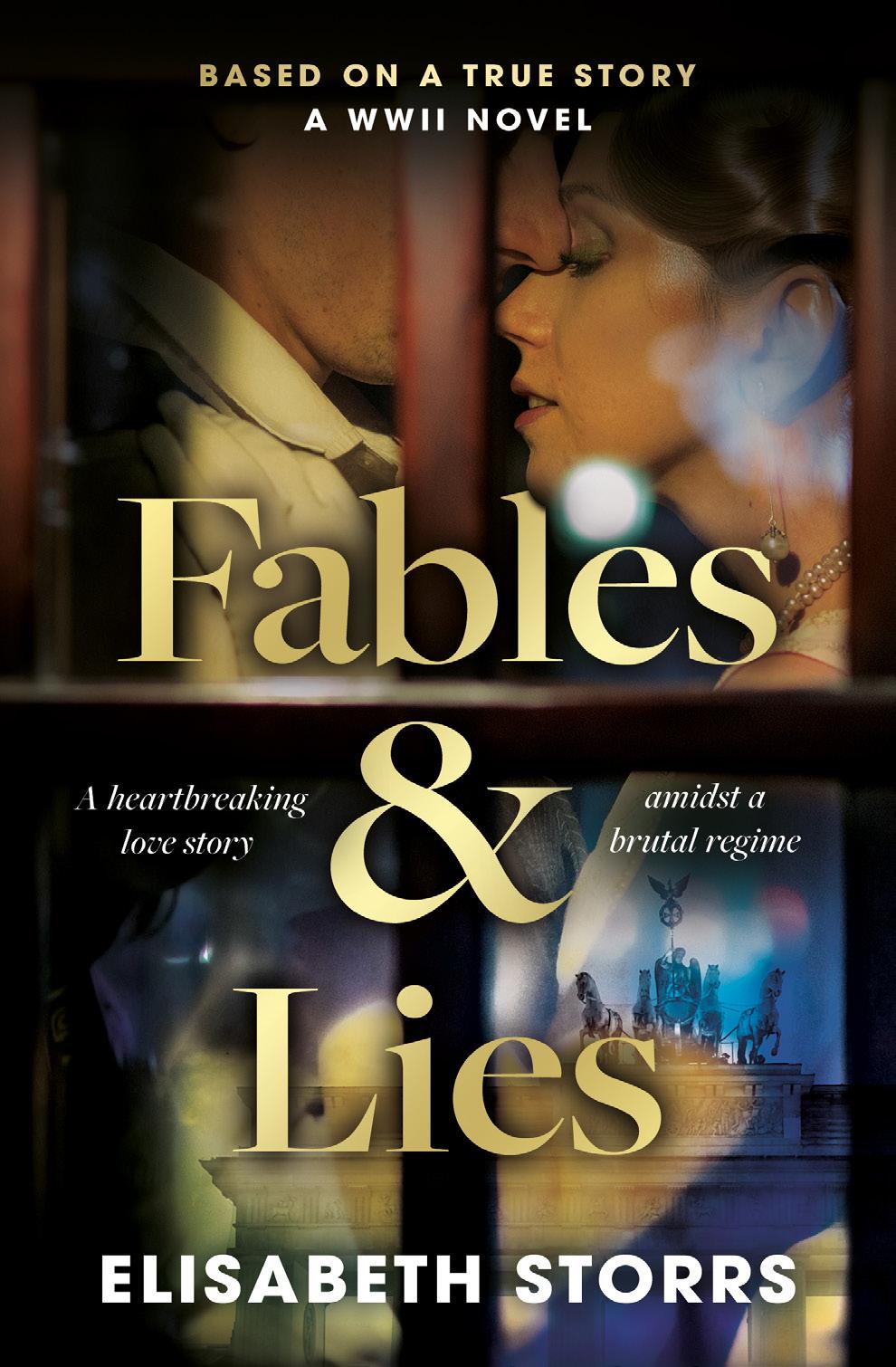
Hitler’s dream of his Linz art museum resulted in what has been termed ‘the rape of Europe’. Millions of cultural treasures were seized across both Western and Eastern fronts. A contest soon erupted among high-ranking Nazi leaders to not only amass art for the Führer but also themselves. Alfred Rosenberg established his Einsatzstab Reichsleiter Rosenberg taskforce (ERR) specifically to plunder valuables across all occupied territories. Goering’s theft and ‘acquisition’ of art for his own collection, particularly that owned by Jewish families, is well known. In contrast, my novel, Fables & Lies (The Book Guild, 2026) concentrates on Himmler’s plundering of cultural treasures in the Eastern Territories, including the mission of his research institute, the SS Ahnenerbe, to sweep clean universities, museums and libraries of their collections in competition with the ERR.
Himmler also sent Ahnenerbe scientists on esoteric expeditions, such as one to Tibet to find evidence of proto-Aryan survivors of Atlantis. His scholars searched for the Holy Grail, which he believed was an ancient sun god’s diadem that bestowed eternal life. Anthony Doerr’s character, von Rumpel, in All the Light We Cannot See (Scribner, 2014), attributes similar supernatural powers to the ‘Sea of Flames’ gem. Spielberg’s Indiana Jones franchise draws heavily on Himmler’s occult fantasies when depicting bizarre Nazi archeological quests, as does Fables & Lies.
More importantly, Fables & Lies provides a fresh perspective on safekeeping by highlighting the bravery of German museum staff who guarded their own nation’s treasures within Germany. I concentrate on antiquities held in Berlin, in particular, the fate of the priceless Priam’s Treasure discovered at Troy by Heinrich Schliemann. Schliemann smuggled the Trojan Gold out of Turkey, then paid the Ottomans compensation before bequeathing the trove to the German people in perpetuity. The treasure was displayed in pride of place in Berlin’s Museum of Pre and Early History, which ominously stood next to Gestapo HQ.
My protagonist, Freyja, is a museum assistant who suffers personal heartache throughout relentless and devastating Allied air raids (twice daily by 1945) as she packs exhibits for storage in bank vaults, palace cellars and eventually in a massive concrete fortress known as a Flak Tower next to the Zoo. The twist is her boss is a Nazi and member of the Ahnenerbe (which is based on a true story). Freyja, indoctrinated by her schooling to believe Nazi dogma, is awakened to the Regime’s lies when she falls in love with archaeologist, Darien Lessing. Adding to the drama, Freyja is trapped in marriage to a fanatical Ahnenerbe scholar, Kaspar Voigt, to save her father. Undercover as an SS wife, she learns archaeologists are twisting history to serve power by using the ‘Aryan Myth’ to justify invasion, dispossession and murder.
Hitler and Himmler saw no value in either the Slavs or their culture. Twenty million people were murdered or starved to death. Palaces, museums, libraries and monuments were trashed. These massacres and acts of desecration became the catalyst for retribution. The Soviets showed no mercy when they eventually conquered Germany. Like Hitler, Stalin planned a ‘Super Museum’ to be filled with art recovered from the enemy. He set up ‘Trophy Brigades’ that were embedded in the Red Army to secure treasure for Mother Russia. In the climax of Fables & Lies, Freyja experiences the bombardment of Soviet artillery fire as she shelters in the Flak Tower with the Trojan Gold. There she meets a Trophy Brigade Major intent on revenge.
Ultimately, the Russians seized millions of cultural goods, including the contents of the Flak Tower, and transported everything to Russia. Some exhibits were eventually returned to East Germany but not Priam’s Treasure. For fifty years, the Soviets asserted the hoard had been lost in post-war chaos until admitting in the 1990s they’d hidden it alongside millions of other pieces of art. They claimed such booty as war reparations – and continue to do so to this day. Both Germany and Turkey are seeking the treasure’s return to their country.
Themes of impossible choices and moral conflicts run deep in Fables & Lies. The reader experiences the war not from the battlefield but from within the fragile walls of daily life. I feature characters whose actions remained unseen at the time, and have been forgotten since. I hope my book shows courage can be found in the quietest acts of defiance, and serves as a warning history can be weaponised – a novel for our times.

WRITTEN BY ELISABETH STORRS
Elisabeth Storrs is the author of the A Tale of Ancient Rome trilogy and Fables & Lies: A World War II Novel She is also the founder of the Historical Novel Society Australasia.
STRANGER THAN WE THINK?
Francis Spufford on Turning Fantasy into a Story that Resonates
Francis Spufford is the author of the historical novels Golden Hill (his 2016 award-winning debut), Light Perpetual (2021, nominated for the Booker Prize) and Cahokia Jazz (2023), as well as non-fiction works of great originality (from I May be Some Time; Ice and the English Imagination to Unapologetic, a personal and passionately argued defence of Christianity).
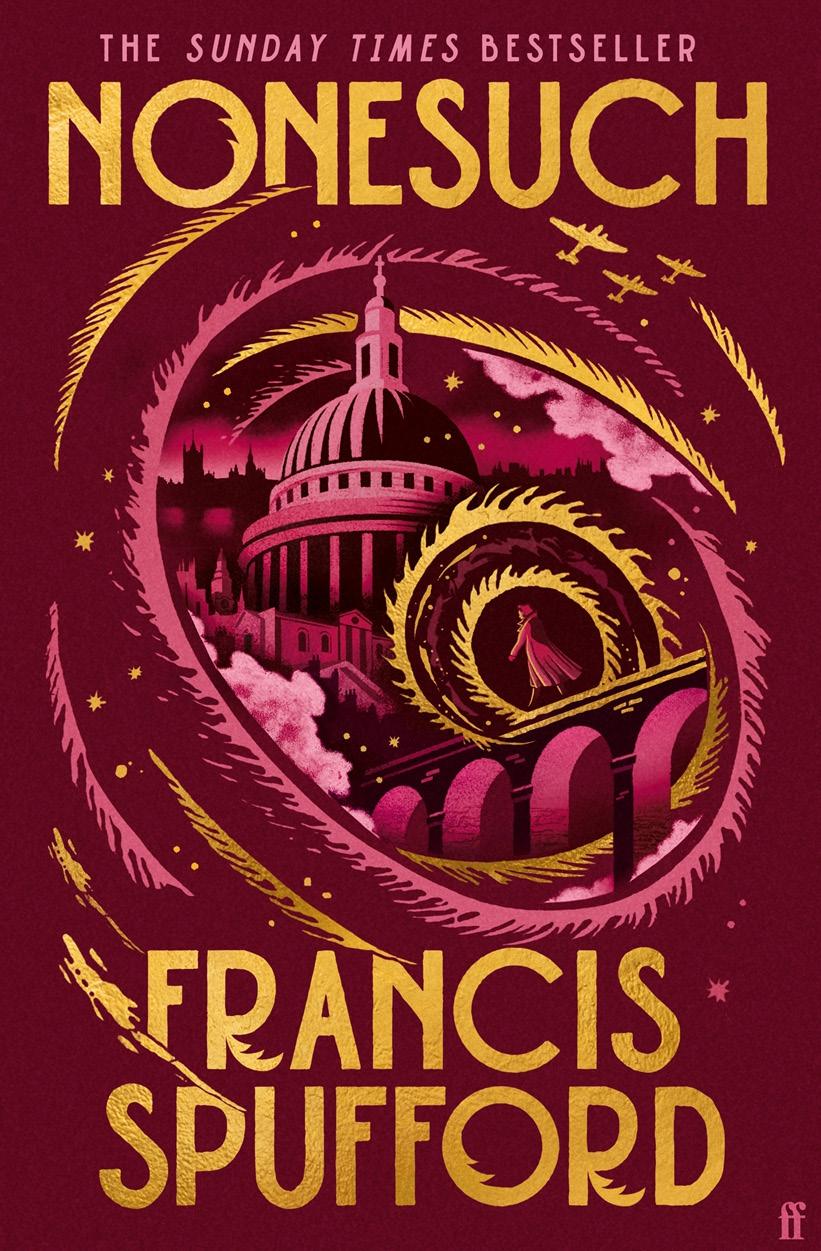
Spufford has now drawn on a “long history of pleasure reading fantasy” to write Nonesuch (Faber/Scribner, 2026), in which he blends a fascination with the early days of television and radio in London, the horrors of the Blitz, and a beautifully crafted speculative history rich in arcane detail. As for inspiration, he says: “The way it seems to work for me, with every book, is that a set of ideas turn up at different places round the horizon of my imagination, and then gradually converge, and reveal that they’re really parts of the same project. So I knew I wanted to write about the unexpected world of pre-WW2 television; I knew I wanted to write about the temporary freedom for women the war brought; and I knew I wanted to write something that brought out the fantastic qualities, the unearthly qualities, of blacked-out wartime London. And then I remembered
the momentary glimpse of her rackety early life that my grandmother had given me, when she was in her nineties. (‘I always preferred going out with married men,’ she said to me suddenly when we were sitting in a restaurant. ‘Because they always spent so much more money on you.’ And then she clammed up again.) The figure of Iris, Nonesuch’s protagonist came to me – clever, brave, greedy, self-reliant, not very scrupulous – and the other things I’d wanted to do slotted into place around her, and I realised that it was one story I was planning. One story with room in it for bombs, bonds, bad behaviour, the television studio at Alexandra Palace, and literal angels among the ruins.”
The appearance of angels is only the start of the strange events in which Iris and Geoff become involved. There is also the mysterious Order, now largely defunct, but the knowledge of how to “bind” and master otherworldly spirits is extremely dangerous in the wrong hands. To me the process of binding, as well as the eventual release, was reminiscent of the movement of minuscule atoms in particle physics, but Spufford corrected me: “Maybe not particle physics, but definitely electromagnetism. I wanted to line up the angels in Nonesuch with the frontier technologies of 1940, which people then were still finding magical or enchanting, as you do with technologies when they’re new: with radio, which had filled the skies of Europe with frightening or desperate voices, and most of all with television, only just invented, which could pluck pictures out of the thin air. The spirits of the air in the book inhabit an atmosphere crowded with jabbering signals, so it seemed right to make them a kind of signal themselves, riding on the radio waves, beings of energy rather than matter.”
Iris works in the City. How the world of finance continued, how the intricate cogs of banking and stockbroking kept turning, even after the onset of the Blitz, is described in vivid detail: “Blitz London is a place we have repeatedly imagined, in a thousand books and films, so the challenge there was to try to find the details that would get past the thick layer of images for it that we all already have in our heads, and make us feel it afresh, and make it come to life newly. […] In my experience it’s pretty much the same kind of detail you want to find for every project. The kind that go straight to the reader’s senses. The ones that tell you what it was like being a body in a particular time and a place. The colour of bomb flashes, the burnt smell of a Blitzed building, the feel of broken glass under your office shoes during your morning commute to work.”
The parallels between the stock market and the magical realm are brilliantly drawn. In particular, the appearance of John Maynard Keynes was unexpected, and I asked Spufford why he chose Keynes in particular, and whether other historical figures had cameo roles in his books. “Well, money is the other great enchanted thing in Iris’s world, and certainly in Iris’s own imagination, flowing from person to person in the form of stock certificates or coins or messages on office teletype machines, but not really made out of paper or gold or electricity, but of something more mysterious and impalpable, behind those things. Iris wants money to transform her, like a wishgranting genie. She wants it to turn her from a clever girl from the suburbs, in a world where women can’t be anything in the City of London but clerks and secretaries, into a tycoon with a fur coat and a yellow Rolls-Royce. Against her are ranged all the crusted rules of patriarchy and the British class system. Now, Keynes, as well as being the great mid-20th-century theorist of money, was also one of the great intellectual modernisers of Britain. He was a mind that helped us see through what was redundant in the older order of things. I don’t
THAT'S THE APPEAL of historical fiction to me, in fact: that there’s always something in the past to illuminate the present, something there to help us recognise our own times better.
know if the real Keynes would have been able to recognise a ruthless twenty-two-year-old secretary as a kindred spirit. But in Nonesuch, at a dinner party by candlelight as the bombs fall, he absolutely can. Also, I just like bringing real famous people on stage in minor roles. There aren’t any others in Nonesuch, but I had Vladimir Nabokov as a guest star in my previous book Cahokia Jazz, and the sequel to Nonesuch, Arcady, due out next year, has at least two more celebrity walk-ons. Who? Not telling.”
Iris and Geoff pit their wits – and their lives – against a group of fascist occultists in London who are determined to use the Order’s fusty secrets to rewrite the historical events of the present. “Tell me where all past years are?” is the question that opens the otherwise invisible walkway to Nonesuch, a place of all times and none, where the sequence of history can be deviated. The passage of time, its loops and jumps, is a topic that Spufford has written about before.“One of the things I liked about bringing the angels into Nonesuch was the contrast it gave me between human beings in one of history’s tightest tight spots, living through months that really did decide whether the world was going to tilt down into a terrible darkness, and all the while not knowing the outcome – and the view you’d have of time if you were outside it, only really visiting 1940, and seeing it as just one place on the great map of the ages. The angels are benign, but very remote from the urgencies of human life and human history. The ‘time machine’ in the book that the 17th-century alchemists made, and the fascist occultists are trying to use now for nefarious purposes, is really a way of shackling and exploiting the angels’ freedom in time. Fantasy lets you take an idea like that literally and work it out as a story instead of a metaphor. I have been very interested in time in my other books, and in all the different ways that human beings experience living in time, from the time of a song up to the time of a lifetime – but Nonesuch let me throw off the limits of realism, and do something wilder with time. All the same, I hope it still resonates with what we genuinely know and feel. We’re stranger than we think, I think.”
The “time machine” in the novel (Spufford describes it as “a network of enslaved angels”) was documented by the alchemists who created it in the 17th century, and the cryptic notes have survived among the Order’s crumbling papers. Spufford’s invented alchemist is Hieronymus Dawe – “I love 17th-century English names,” he notes, “with their combination of very high-flown and very down to earth. Sir Kenelm Digby! Shackerley Marmion! Arise Evans!” To make the plot work, Spufford had to go back in history and “find a juncture when there’d been a problem they thought they desperately had to fix, and where the outcome – an awful warning that using the machine was not a good idea - ended up being worse than the original problem. I won’t say what it is, to avoid spoilers, but I’m quite pleased with how it worked out.” The sequel to Nonesuch, Arcady doesn’t appear until 2027, so this reader will not be alone in waiting to see how and if things ultimately work out for Iris, Geoff and the others.
Looking forward to his next project, and more generally at the appeal of historical fiction, Spufford writes: “I’m thinking about how, to me now at the age of sixty-two, the world seems to be slipping out of a state I found reasonably comprehensible and into one that’s much stranger and more threatening. And it occurs to me that the way to write about that might be to imagine what the world would be like for a myopic Romano-British bookseller in the year 410, also in his early sixties, who finds that the state of things he’s known his whole
life is slipping away as the empire crumbles and the towns empty. That’s the appeal of historical fiction to me, in fact: that there’s always something in the past to illuminate the present, something there to help us recognise our own times better.” That sums up the appeal for a lot of us, I think.


WRITTEN BY LUCINDA BYATT
Byatt is HNR's Features Editor and an honorary lecturer at the University of Edinburgh.
Lucinda
Photo credit: Trinity Hall, University of Cambridge
CELTIC MYTH & THE REGENCY
BY CHRISTINA NELLAS ACOSTA
In an interview about the 21st mystery in the St. Cyr series, When the Wolves Are Silent (Berkley, 2026), C. S. Harris reveals some of her own background and that of Viscount Sebastian St. Cyr.
By interlacing England’s recent past, the Napoleonic Wars, with the nation’s earlier defeat in the American War of Independence, When the Wolves Are Silent develops from specific locales of London into an intrigue of political proportions for the nation. Asked whether this book is an expansion of theme and development as a new facet for the series, Harris sees it as a continuation of the same initial aspects framed by her specialty era as a historian of the French Revolution and Napoleonic Wars. “I’ve enjoyed anchoring the books of this series to their specific time and place. The Regency is so often portrayed as a romantic froth of carriages and grand balls and dashing Regency bucks that it’s easy to forget what a dynamic period of turmoil and transition it actually was. These brief, fascinating years formed a pivotal point in Britain’s rapid transformation from the free-spirited, largely agrarian culture of the 18th century to the stern morality, grim industrialization, and world domination of the coming Victorian age. By adding political agitation stirred by the ideas of the French Revolution plus the economic and social disruptions from the decades-long wars, you have a great setting for a mystery-thriller series. The very first book in the series, What Angels Fear, played out against both war-time espionage and the political maneuvers behind the proclamation of the Regency in 1811.”
In her newest book, the plot is instigated by the ritualist style murders of high-born young men, surrounded by Celtic mythology and a talisman in the form of the carved object of a wolf, but the story broadens into larger themes. In particular, the revelations of rape of young, powerless women appear as deliberate results of the aftermath of murders and revenge killings. Rape has always been a weapon of war, in a persistent line of literature from Homer to current events, so that it may be a reasonable conjecture for the reader to link this theme to today’s culture of rape. But the author describes how she was “more than halfway through writing When the Wolves are Silent when the Epstein scandal bubbled up again, grabbing international attention,” and remembered thinking, “Oh, dear; everyone is going to assume this book was inspired by current events! But as a historian, I’ve always been only too aware of the sickening prevalence of rape both in our society at large and in war. In fact, this story was inspired in part by research I did for a non-Sebastian St. Cyr book I wrote a decade ago called Good Time Coming, set in Louisiana during the Civil War. I personally consider it the best book I’ve ever written, but it was very controversial.”
When the Wolves are Silent details the grief of women victims, the struggles of the poor, and the suppression of freedom of expression and printing presses, all of which resonate with the current political/ social/cultural tenor, seemingly a natural consequence of writing in what feels much like our own time of upheaval. When queried on this parallel, Harris replies that she “suspects all authors are influenced by the currents of their own time, consciously or unconsciously. But interestingly enough, I recently went back and reread this series from the very first book, something I’d never done before. It was quite an experience for a variety of reasons (I found so many mistakes!). But what struck me more than anything was how much even those early
books also now seem to resonate with our current political/social/ cultural climate, even though the first book was published back in 2005. I suspect what has happened in the last twenty-plus years is that we’ve seen such an explosion in vast income inequality, in attempts to squash freedom of speech and of the press, and in the rise of autocratic governments, that so many of the problems and injustices of the early 19th century now seem to mirror our own in a way they didn’t before. It’s quite sobering.”
St. Cyr is firmly established and settled as a married family man since his original character portrait from the earlier novels. Harris outlines his character development with the idea of marriage as a stabilizing force: “When we first meet Sebastian in early 1811, he has recently returned from the war and he is, to put it mildly, a psychological mess. He is suffering from a form of PTSD now recognized as ‘moral injury,’ a result of both what he witnessed in the war and what he himself did. Even six or seven years on, he’s still struggling to come to terms with those events, and he always will. But he has found a sense of purpose and a measure of peace, and I see his marriage to a strong, level-headed woman like Hero and the birth of his children as stabilizing forces in his life. My own father spent three brutal years fighting in the South Pacific in World War II, and my husband did two tours in Vietnam, the first at the time of the Tet offensive. So recognition of the lifelong impact of what war does to the young men we send off to fight our battles is something that is very important to me.”
St. Cyr has his own version of justice for his time and place, and he enacts it by the story’s dramatic end, suggesting both his personal independence and freedom of will. His judgment is countered by no institution or peer even as he stands against his own peers. This is his burden. Will he always be that lone wolf? “Sebastian grew up feeling like an outsider in his own family for reasons he never understood at the time. That, plus his experiences as an adult—his wartime loss of faith and the shattering of his belief in Britain’s moral superiority, combined with the events that led to his various quarrels with his father—forced him to craft his own belief system and moral code. It’s something that will surely evolve with his maturity and experiences, but he’s definitely the kind of man who will always march to his own drummer.”
Christina Nellas Acosta is Managing Editor of the University of California Press journal 19th-Century Music, and a freelance editor for Oxford University Press. She has written reviews for Open Letters Review and the HNS, and has served as a judge for its First Chapters Competition.
GLOBAL REACH, SENSORY DETAIL
BY JANICE DERR
Reimagining the overlooked stories of Nantucket’s maritime history
Julie Gerstenblatt obviously has a deep love for Nantucket. Her website includes a video tour of historic sites that feature in her novels,
family photos taken on the beach and at local shops and restaurants, and even a recipe for a Nantucket Seabreeze, a cocktail that she says “perfectly pairs” with her novel, Daughters of Nantucket
Given the prominent role of place in her novels, I asked Julie what draws her to the seaside city, especially in the mid-19th century. She explained that visiting Nantucket today feels like stepping into the past. “The downtown has been preserved, retaining much of its original charm from the 19th century, with its cobblestoned Main Street and brick sidewalks and dirt and shell paths off the wharves. Because of this old-world charm, Nantucket practically implores visitors, especially ones like me with vivid imaginations, to travel back in time.” As for the time period, “Nantucket in the 18th and 19th centuries was the whaling capital of the world, bringing much wealth to the island’s inhabitants, and just as much loss. Moby-Dick may have put Nantucket on the map, but there are many other stories of heroism and tragedy emanating from this magnificent island that have been overlooked in fiction, particularly surrounding women’s lives. I aim to highlight stories of courage, struggle, and adventure from the past, so that maybe, the next time readers step off the ferry, they can see Nantucket through a new (old?) lens.”
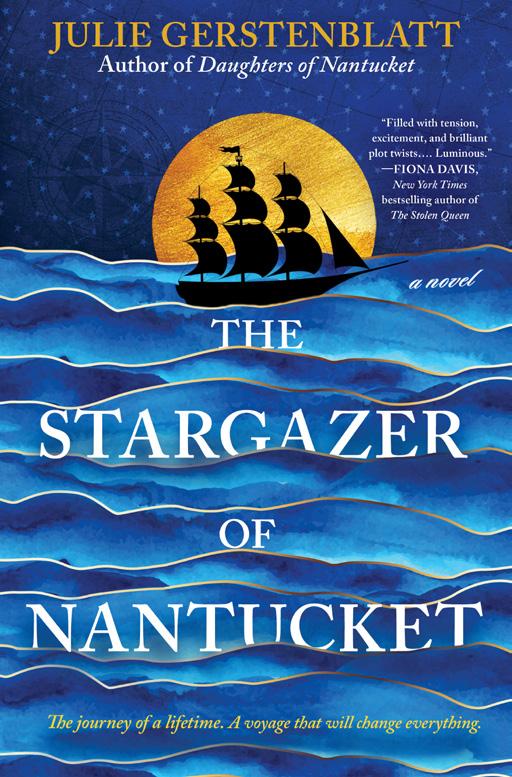
Julie’s first novel, Daughters of Nantucket (MIRA, 2023), centers on three independent, entrepreneurial women living in a whaling community while many of the island’s men are away on ships for long periods. Her second novel, The Stargazer of Nantucket (Park Row, 2026), is set aboard a merchant ship sailing from Nantucket to China in 1851. While the story moves from land to sea, the characters retain the characteristics and spirit so specific to the island’s residents. I asked Julie why she chose to set her latest book on a ship. She responded, “I visited many historic homes and museums, and, in every single one, items imported from China were on display. I wondered about the global shopping sprees that led to every stately home in New England proudly displaying a blue porcelain urn by the fireplace and a silk rug underfoot. Who traveled on those merchant ships and made the decisions about what to purchase, and what was their life like?”
Julie sees her two novels as “bookends that together create a full Nantucket historical fiction experience.” She goes on, “Daughters takes place within one square mile of town. The setting is supposed to feel tightly contained, leading to the spread of gossip and, later, fire. The Stargazer is the complete inverse, highlighting the global reach of intrepid Nantucketers and representative of America at large in the 19th century.”
Stargazer is a standalone, but fans of Julie’s first novel will recognize
some returning characters. She did this as a special nod to her readers. “I left a few strands open at the end of Daughters, and book clubs love to ask me about one plot point in particular regarding Eliza Macy. Since Stargazer is set five years after The Great Fire, I thought it would be fun to play with that. I was able to do a sort of wink-andnod to readers, providing a possible explanation for what happened after the end of the novel. If you know, you know. And if you don’t, it doesn’t alter your reading experience of Stargazer at all.”
She continues, “Without any spoilers, I will say that there is another character from my first novel who reappears in a much bigger way in Stargazer… I loved taking a young character I invented in one book and letting them mature, creating a whole new storyline for them in another novel. It was tremendous fun to link Daughters and Stargazer in this way.”
Most of the characters in Julie’s books are adults, but I couldn’t help but wonder if her ability to create such believable child characters comes from the career she held before becoming a novelist, as a middle school English teacher. She responds, “I like to include as many diverse voices as I can in my fiction, including not only characters from different classes and ethnicities, but age groups as well. There’s something very truthful about a child’s vision of the world, before they are corrupted by adulthood and toughened up by life… Both Joseph Allen in Daughters and Chin in Stargazer hold up mirrors to the adults around them, acting like a foil – and providing levity in very intense, life-and-death moments.”
Along with strong characterization, Stargazer stands out for its vivid detail. The book’s descriptions of the ship’s layout, the weather, the food, and the smells (good and bad) help the reader feel like they are really there. When I asked about her research and how she was able to capture such strong sensory imagery, she said she read “at least twenty books,” including Sea Wife by Amity Gaige, The Wide, Wide Sea by Hampton Sides, The Wager by David Grann, and books about the Flying Cloud, the famous Donald McKay clipper that inspired her fictional ship in Stargazer. She also credits meditation for helping with her writing process. “I practice meditation and yoga, and writing to me is a form of meditation. I take what I’ve learned, and then I let the real world disappear around me, imagining myself there, on deck of a ship in 1851, in slow motion. What do I hear? What do I see? How does it smell?”
In her next book, Julie plans on returning to Nantucket, though in a different era. Scheduled for release in the spring of 2028, her upcoming work is what she calls “recently historical,” taking place in 1989 and 2024. “The story revolves around best friends from
college, one who betrays the other, and the boy who gets between them. I lived on Nantucket in the summer of 1989 and have always wanted to write about that time – and I think readers are going to enjoy seeing a more contemporary version of my favorite island setting.”
Janice Derr is a librarian and has been a reviewer for Historical Novels Review since 2012.
A FAIRY TALE SEASONED WITH HISTORICAL FACT
BY MYFANWY COOK
A conversation with Catherine Kurtz
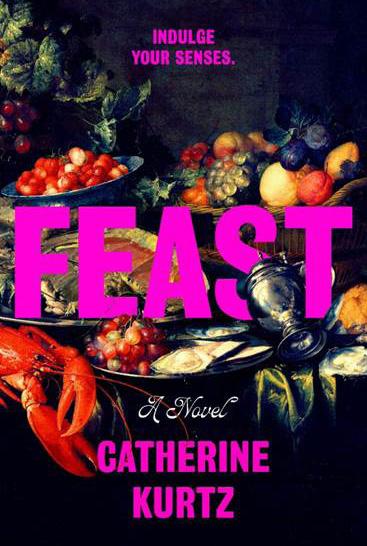
Feast, Catherine Kurtz’s debut novel (Berkley, 2026), opens in London in 1882. Minha, a young mixed-race woman and the central character, is about to set out on a journey of discovery that takes her to the fairy-tale Château de Bellefalaise in France. Minha has an unusual gift, which leads her to become Duc Nicolas’ poison taster.
Like her main character, Kurtz describes herself as mixed race, “Indian, Ashkenazi Jewish and white,” so Kurtz’s experience, she says, informs Minha’s in that regard. “There is something important I am seeking to explore and expose, about the particular rootlessness that can be part of the mixed-race experience, and issues around how some women are exoticized. I think we are both also open, hopeful, wanting to experience the world deeply.”
Author and character also “share a profound relationship with food,” and Kurtz has “always had a heightened awareness of food, of all my senses… I don’t think that has changed. I have just learned more about it, how to use it well. But I have so many memories,” in particular of bread, she states. Although she now uses her sensory skills acting as a judge for international chocolate awards, as a child it was bread she always loved.
“Freshly baked bread seems glorious to me in its delicious diversity, and infinitely comforting. During the summer in France at my grandparents’, we would collect baguettes daily from the baker. The loaves never made it back to the house whole, and the crisp crust, the stretch and the chew, were a big part of the appeal. Equally I have always loved chapatis, which are the simplest of things, just flour and water really, but they have to be puffed on the naked flame before eating. They become lightly charred, in the best way, and also airy. They seemed to me pure alchemy, they still do.” The aroma, texture, colour, taste and even the shape have all been used to help her readers indulge their senses.
She decided to set a large part of her novel in France, because she has “had family living in France for most of my life,” she says. “And I know and love the food, particular dishes—a fresh custardy pain raisin, the perfect salad with bright vinaigrette—and also the markets with their fresh produce and artisan producers and farmers selling just one thing, their speciality. And I know some of the exquisite chateaux very well. Château de Bellefalaise is a fictional place, but very real to me, a composite of places I love dearly and have visited for decades.”
For a food critic France has always been rich in culinary heritage and Kurtz is “fully aware of the food and legacy of Escoffier, who is a great influence on my choice, in that the stature and style of culinary tradition in France owes much to him. I have also, in my food writing experience, interviewed a fair number of French chefs, pastry chefs and chocolatiers, so those people are there in my head, in the background, as I construct dishes, and indulge in tasting fictional French food.”
Surprisingly, although her novel has an almost Gothic fairy-tale quality, Kurtz’s favourite reading as a child was not “about fairy tales exactly, but I dearly loved picture books, and stories. Standouts were Mrs Pepperpot, in which the protagonist has a tendency to suddenly shrink to a tiny size; Pippi Longstocking, which sees Pippi wielding uncommon strength. I also loved Maurice Sendak, in particular In the Night Kitchen, with that magical night baking journey. I think I can sense a pattern here, a love of something a little unreal, and rather special, going on.”
Today although she loves dark chocolate, Kurtz wouldn’t say that her “taste in novels is dark. I love some hope, some resolution. The world has enough darkness in it, so I like to emerge, at least some of the time, at least at the end of a story, into the light.” In part, it is for this reason that she wrote Feast and used it, like her artwork, “to explore what it means to be a woman in our world, and how some of the difficulties we face are amplified for unconventional women,” she shares. “I have created many paintings that look at the pressures and expectations on women. Painting objects, such as high-heeled shoes, make up, or underwear, attempting to expose something about them. A more recent series showed fabric samples, from sheer lace to leather to pretty florals, all in commentary of the multiplicity of roles women are meant to be able to inhabit, and something of the reductive and impossible nature of that.”
Instead of setting her novel in a contemporary setting, she believes “setting something in the past allows us some perspective from which to view things. Certain difficulties that are now perhaps less overt, or more complicated, can be shown clearly. It is useful for the story to use that clarity. Setting something in the past can also help us see how shockingly relevant and current the same issues are.”
She stresses she felt some urgency to write about a search for belonging, and what that can look like, depending on your identity and the behaviour of those around you. She also thinks that “the position of women in the world, some of what is happening to us, needs to be acknowledged, must not be ignored. We must continue to hope for better.”
Kurtz thinks the “particular story of food” in this book will likely be unique but doesn’t imagine she will forget about food in other stories. She does, however, “need to tell more stories, and my immediate preoccupation is to write more about painting, drawing, and art” which undoubtedly is because she notices everything, always, “with my sense of smell, taste, my eyes. This is partly why I can work as a professional taster, but it is also why and how I paint. So those things are inherent in the way I write too, I think. I write from my senses, which is something different I think than just writing about them.”
MOGFORD IS AWARE that anachronism in historical fiction is a calculated risk, but ‘too full an embrace of the mores of the period might be off-putting.’
Myfanwy Cook is the HNR New Voices Column Editor. Her latest project is co-writing a book on creative approaches to Medical Humanities, which includes historical medical facts and fiction.
STORY GOLD
BY SARAH BOWER
Sarah Bower talks to Thomas Mogford about his new historical novel, The Saffron Thief.
Thomas Mogford, who writes historical fiction as T. L. Mogford, is a prolific author of crime novels. The Saffron Thief (HarperFiction, 2026) is his second historical novel, and he brings to it the gifts of fast-paced action and serpentine plotting developed through writing crime. The Saffron Thief is a page-turner but also a solidly researched narrative which sheds light on the English saffron industry in the mid17th century, a corner of English history with which I was unfamiliar until I read the book. It is one of the many joys of reading historical fiction that it can widen the horizons of the reader’s knowledge and entertain at the same time.
In our interview, Mogford expressed some surprise at my ignorance of the history of saffron. When I asked him what drew him to it as a subject for his book, he replied: ‘How could anyone not be drawn to saffron. The world’s most valuable spice, worth almost as much as gold, a stunning colour, an exquisite flavour…’ The clincher, however, was his discovery that it used to be grown in England ‘in vast quantities’. Although crocus sativus, the crocus whose golden yellow stamens give us the spice, was first cultivated in Europe some 3,500 years ago, it almost disappeared after the fall of the Roman Empire and cultivation did not recommence until the 13th century, when the spice became popular as a food colouring which could also display ostentatious wealth. In the following century it was much in demand for its medicinal properties, believed to protect against the Black Death.
Saffron has always been expensive and has, like all valuable commodities from oil to diamonds, or gold to cobalt, a history of causing wars and other economic and social upheavals. In Mogford’s novel, fortunes are made and lost and the values of land and labour contested. There are mystery, romance and adventure aplenty, but at the root of all is an economy in flux. The novel is set in 1666, in London in the aftermath of the Great Fire, and in Saffron Walden (formerly Chipping Walden until the ubiquity and richness of its saffron fields changed its name). The once-comfortable Smith family, poulterers to the Inns of Court, have lost their business and the head of the family. The younger son, Fabian, sets out to restore their fortunes in the wake of a catastrophic gamble made by his feckless older brother, Justin, seduced by the prospect of easy money.
Fabian is an attractive protagonist: thoughtful, intelligent, but also, at times, endearingly naïve. He is good company throughout this novel and bound to be the same in the planned second book in the
series. Mogford declined to say too much about this, except that ‘it features a very different type of saffron – Meadow Saffron – but things become similarly perilous as the story progresses.’ Fabian encounters all kinds of perils during the course of The Saffron Thief, from dubious alchemists to outlawed heretics, erratic employers and even more erratic drunks, a jealous mistress and a very nasty mastiff called Dagmar. He is aided in his adventures by his own level-headedness and moral determination to rebuild his life and his family’s fortunes, as well as by Amye Bloxham, a woman with a short fuse and a mysterious background whom Mogford describes as ‘outspoken and strong’.
I asked Mogford about Fabian’s sensibility, which feels quite modern. Literate himself, he embraces learning for women (as well as Amye, Fabian has an articulate and intellectually able little sister) and is also reluctant to see animals ill-treated. ‘The only complaint readers seemed to have had about The Plant Hunter [his first historical novel],’ he told me, ‘was that the main character’s pet dog, Wilberforce, sadly died near the end of the book… To compensate for that, I made sure… Fabian Smith was very much on the side of our furry friends, even though… there wasn’t a tremendously enlightened approach to animal welfare at that time.’ As for the education of women, Amye, he feels, leaves Fabian little option other than to accept women’s right to learn. Mogford is aware that anachronism in historical fiction is a calculated risk, but ‘too full an embrace of the mores of the period might be off-putting.’ As a writer who works in the contemporary as well as the historical realm, he has a tightrope to walk in order to please his loyal readership.
The Plant Hunter has a 19th-century setting. Although he can immerse himself deeply in the period about which he is writing, and undertakes detailed research, Mogford finds his inspiration primarily in the story rather than focusing on a single period. ‘The story comes first, then I try and choose whichever setting will allow me most effectively to tell it… With The Saffron Thief, I came across a list of English saffron prices going back centuries, and the mid-1660s was the time when it was at its most expensive (a whopping £4,1d per lb), so 1666 seemed the ideal year in which to set the book.’ He was aided in his choice of date by ‘an abundance of historical accounts and books focusing on 1666’ because of the Great Fire.
Mogford’s crime series features a lawyer from Gibraltar called Spike Sanguinetti. ‘I’m not from Gibraltar myself,’ he told me, ‘so had to create Spike’s life as a local through a combination of research and imagination. The process of writing a historical novel is not so different … Another similarity is that however well realised one might make the setting, or period, if the plot mechanics and character development aren’t done properly, then the book won’t work. So there are definitely comparisons to be made between the two genres.’ Mogford’s skill at mining the fictional gold of saffron has resulted in a thoroughly enjoyable read.
The Saffron Thief was published by HarperFiction on July 30th with a second book in the series to follow.
Sarah Bower’s most recent book is Lines and Shadows, a novella of the Cold War set in the period of the Cuban Missile Crisis.
REVIEWS
Due to an ever-increasing number of books for review and space constraints within HNR, selected fiction reviews and all nonfiction reviews are now published as online exclusives. To view these reviews and much more, please visit historicalnovelsociety.org/reviews
Editors’ Choice titles, which come highly recommended by our reviewers, have the HNS logo and cover image alongside the review.
ANCIENT HISTORY
SOUL THIEF
Leah Moyes, Independently published, 2025, $15.99, pb, 328pp, 9798269615110
Leah Moyes’s novel, set in Thebes during the reign of Ramesses III, opens with an arresting premise: a nobleman’s unmarried daughter becomes a tomb robber in order to save the starving labourers who build the pharaohs’ grand burial places. Blending history, romance and adventure, the novel offers an imaginative reversal that gives the story immediate moral tension.
The narrative follows Akila, daughter of a respected pharaonic scribe, and her devoted Nubian protector and former slave, Moises. They risk death and disgrace by raiding royal tombs to aid desperate villagers whose labour enriches the dead pharaohs while leaving the living hungry. Their relationship, and Akila’s unwanted upcoming marriage, form central threads of the plot and add emotional stakes to the dangers they face. Moyes builds this conflict effectively, and the novel delivers numerous twists, a steady accumulation of suspense, and a satisfying surprise reveal. Akila is a sympathetic heroine who undergoes a credible character arc as the dangers she faces force her to grow in courage and resolve.
The book’s chief weakness, however, lies in its prose. Problems of clarity in language, transitions, and the passage of time too often obscure the action and make scenes harder to follow than they should be. Moments that ought to carry drama or urgency can instead become confusing, which blunts the impact of an otherwise lively plot. A major editorial polish would have greatly strengthened the reader’s experience.
Even so, there is an engaging story at the heart of this romantic adventure: inventive in concept, brisk in pace, and driven by characters readers can readily support. Those willing to look past its stylistic shortcomings may find a suspenseful historical tale from an author with genuine narrative energy.
Keira Morgan
ENHEDUANNA’S SONG FROM THE SANDS
Ellen Rachlin, Histria, 2026, $19.99, pb, 272pp, 9781592117543
Could Enheduanna, an ancient Mesopotamian woman who lived around 2300 BCE and whose name was inscribed on still extant clay cuneiform tablets, truly be the first named author in human history? This novel takes that tantalizing historical question and imagines it to be so.
Enheduanna is the daughter of Sargon the Great, the founder of the Akkadian Empire who conquered southern Sumerian cities such as Ur and annexed them to northern Mesopotamia. His wish was to have his daughter become the High Priestess of Ur, a position she assumes but with little support from her royal brothers. A perilous journey to her post brings danger to her physically, politically, and religiously. As High Priestess, her role is not only to protect the people of Ur from the wrath of the gods, but also to provide for their worldly safety and well-being. Her position therefore gives her control of the religious ceremonies as well as the need for beneficial trading conditions and military protection. She further advocates for a growing tolerance of sexual diversity to enrich the fertility of Ur through religious means. Along this rocky path to prosperity, many enemies appear, and she hardens herself to face and conquer them. Her fierceness grows, as does her wish to be remembered.
Filled with murky journeys to the underworld and ephemeral interactions with the many gods who rule over all aspects of Mesopotamian life, this novel is rich with mythology and historical detail. The sense of ever-present and urgent danger suffuses the entire novel as readers witness the transformation of Enheduanna from naïve young woman to dominant powerbroker and leader of mighty religious rituals. Highly recommended for anyone looking for an absolutely unique reading experience.
Karen Bordonaro
CLASSICAL
THE LOST DAUGHTER OF SPARTA
Felicia Day, illus. Rowan MacColl, Gallery, 2026, $28.00, hb, 208pp, 9781668010723 / Simon & Schuster UK, 2026, £12.99, pb, 208pp, 9781398547049
Philonoe has worn a curse upon her face since birth. She grows up isolated, yearning to be loved. When the opportunity for marriage arises, Philonoe will risk everything for a place in society, something previously absent in her life. If she can be beautiful, obedient, and perfect enough, maybe her parents and her future husband will love her. Philonoe seeks
after Aphrodite, the goddess who cursed her and her sisters: Helen of Troy, Clytemnestra, and Timandra. While Aphrodite agrees to lift the curse, Philonoe must first obtain three objects for her. Upon embarking, Philonoe meets the goddess Artemis, who helps her in her quest. Philonoe soon enters a realm of monstrous creatures with the hope of finding acceptance that will guide her to her journey’s end.
Born with a vivid red birthmark, Philonoe has learned what it means to be condemned at a glance—whispered about, shunned, with the weight of loneliness heavy upon her shoulders. Aphrodite’s quest will challenge Philonoe’s physical and emotional strength while throwing monsters in her path, the very creatures she has been taught to fear. Yet it is monsters who begin to crack open everything she thought she knew about love, worth, and belonging. As her view about herself and others is put into question, can the new stories she has learned lead Philonoe toward an entirely new definition about one’s value and love? Along the way, she is guided by the unlikely presence of Artemis, a goddess who shuns love yet helps Philonoe in her personal quest for it.
The artistry in this graphic novel is lovely, with the black-and-white panels enlivened by splashes of red—the shade of Philonoe’s birthmark—drawing the eye, sharpening the moment, and enhancing the emotion of each page. The result is a striking, tender exploration of self-discovery that is uplifting, haunting, and hopeful.
J. Lynn Else
A LAND AFLAME
Ben Kane, Orion, 2026, £20.00/$25.00, hb, 352pp, 9781398714700
The Second Punic War during the Spanish Campaign of 215-206 BCE. Rome has triumphed over Carthage in Italy and Sicily, but in Spain…
Aboard a ship from Sicilia to Iberia after the sack of Syrako (Syracuse), Carthaginian commander Hanno and his Roman wife-to-be Aurelia are seeking Gadir, Qart Hadasht or some ‘safe Carthaginian-held city’, when they are boarded by Lusitanian pirates and taken captive. Their escape relies on hoodwinking the local ruler, Barekbaal the Fat, into believing Aurelia is a Roman noblewoman worthy of ransom.
Quintus, Aurelia’s brother, and Jug, Roman principes, dock at Emporion, intent on joining the new legion of the Scipiones brothers at Saguntum. They are ambushed en route by Suessetani tribesmen and rescued unexpectedly by a troop of Celtiberians. Aurelia supports neither side, wants war to cease. In between battles, she and Hanno marry. Hanno’s commitment to Hannibal’s cause is unshakable, but Aurelia’s ambivalence concerning the conflict comes between the newlyweds.
Romans, Carthaginians, Numidians and various indigenous tribes of Iberia come to battle. I liked that it was not only successful
military manoeuvres which are discussed. Mistakes are made on each side, Hanno’s included, and lives are lost. So, we get an insider’s view of different battle strategies and tactics. Scipio’s conquest of Carthago Nova (Qart Hadasht), for example, relied on a lightning advance and local intel that the lagoon was shallow and marchable. Spoiler alert: Rome wins in the end.
Battle scenes are exciting, with good suspense building using short, sharp sentences and sensory clues. The hardships of marching and the horrors of war are not skipped over, accentuating the resolve and the bravery of the soldiers. The soldiers’ feelings about victory and defeat are sympathetically conveyed. The different cultures are portrayed well. This is Book 4 in the Hannibal series.
Susie Helme
1ST CENTURY

MURDER IN PURPLE AND GOLD
Lindsey Davis, Hodder & Stoughton, 2026, £22.00, hb, 384pp, 9781399747981 / Severn House, 2026, $29.99, hb, 352pp, 9781448320790
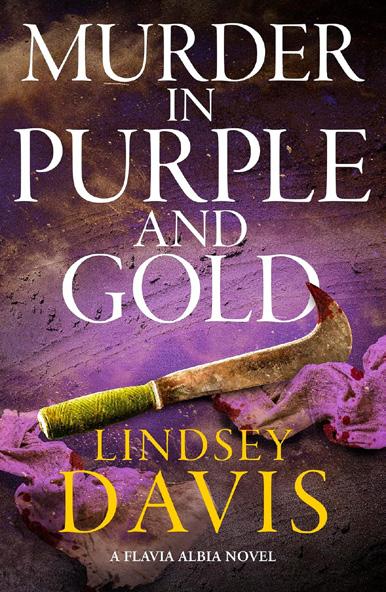
Floralia (April)
90 CE. Roman lady detective Flavia Albia stumbles upon a corpse near the Circus Maximus and enters the glamorous and competitive world of chariotracing.
The victim is Lepo, young star charioteer of the Purples, and suspicion falls upon his rival on the Golds, Agathon. The two have raced against each other 32 times, and their feud is legendary. The Golds hire Albia to clear their man’s name.
The emperor funds both teams, and Domitian sees any trouble in the racing world as being directed at him. Rivalry between the six factions (including Red, Blue, Green, White) permeates every corner of the city. Big prize money is won in the races, and big gambling money is riding on them, too.
Various members of Albia’s extended family and informants help her with clues, plus staff of the chariot teams and stables. Both Lepo and his elder brother, Alceius, had trained with their father, Pedanius. At the Robigalia games, there was a false start, leading to a disqualification of the Blue team. Could be sabotage? Like all murder mysteries, she finds out things in bars. It climaxes, excitingly, with a chariot race.
Albia is the narrator; her voice is colloquial, and it is quite humorous. I especially loved the little comments, both funny and revealing, on
people’s character, e.g,. ‘I was now certain that Licinius Ierenus beat his slaves… carefully, so no marks showed.’
I also love that besides her career as a detective, Albia is a Domina with two small children (adopted), a husband, and a household of servants to berate. There have been umpteen books in the series, and backstory is handled charmingly, as if allowing readers intimacies. The writing is full of great phrases (‘Porcius flung his hair around in another negative’). It’s full of energy and delicious cultural detail.
Susie Helme
WARLORD OF BRITANNIA
Simon Scarrow and T. J. Andrews, Headline, 2026, £22.00, hb, 400pp, 9781472287618
Rome, AD 61. Nero is emperor. Caius Placonius Felicitas, historian and scribe, has accepted a commission from Caratacus, onetime king of the Catuvellauni, now deposed and living in exile in Rome, to write his memoirs. This brings Caius to the attention of Burrus, Commander of the Pretorian Guard, who is anxious that the memoirs will include nothing embarrassing for the Emperor and demands the right to review the work in progress. Caius decides to write two versions, one for Burrus and an uncensored one for posterity.
Once this framework is established, the first-person narrator changes as Caratacus dictates his reminiscences, starting with a victory over the Atrebates in AD 27 and describing in detail his ascent to the throne. A huge cast of characters drawn from five British tribes as well as Rome does not make it easier to follow the power struggles both within Caratacus’s family and between the different tribes. Finally, Caratacus achieves his ambition and is proclaimed King of the Catuvellauni. Adamant to preserve the British way of life, he seeks to unite the British tribes in opposition to the threat from the Roman empire, already established on the other side of the Channel. The story ends abruptly in AD 43 on the eve of the, by then, inevitable Roman invasion.
We know from the outset that all is not going to end well for the disappointed and vanquished Caratacus, whose prosaic recollections lack immediacy and suspense. We are also left wondering what will happen to Caius, an engaging character with a wife and child, who is trying to eke out a living without falling foul of opposing factions in Nero’s Rome. Rather than dividing Caratacus’s memoirs into two parts, for everything suggests that a sequel will follow, the authors would have been better advised to confine these to one volume within an expanded ‘contemporary’ narrative.
Catherine Kullmann
4TH CENTURY
TOO NEAR THE SUN
Bill Page, Troubador, 2026, £8.99, pb, 275pp, 9781806340958
This is the latest in Bill Page’s novels featuring Claudius Caninus (Canio), ex-soldier and owner of a villa in Britannia Prima, in an area we now know as the Severn Estuary. The novel is set in 371 AD, with the region still in a state of shock after the Barbarica Conspiratio of 367-8, when concerted waves of barbarians invaded Britannia, only belatedly suppressed by legions from the continent.
As the province continues to suffer barbarian raids, Canio dreams that his deceased grandfather reveals to him that he was in fact the usurping emperor Allectus, who had survived the battle in which he was supposed to have been killed.
Canio then meets, and is attracted to, Aelia Aureliana, a young widow and a devotee of the sun god Helios, who is convinced that Canio is indeed the grandson of Allectus. Aelia seeks to inveigle Canio in a conspiracy for Britannia to break away from the Roman Empire. At the same time Tribunus Maximus, the local army commander, tries to blackmail Canio into spying on Aelia and the conspirators.
Bill Page possesses an encyclopaedic knowledge of the Roman Empire in the West Country in the 4th century, in what we now know was the twilight of the Roman occupation. A gazetteer and glossary assist the reader. The world of the villa-owning elite is vividly described, as is the landscape, with a loving care reminiscent of H. E. Bates. The contrast between the charmingly cynical Canio and the idealistic Aelia works very well, and the reader is fully engaged in discovering how Canio will navigate his dilemma. A thoroughly entertaining work that tells us much about life in 4th-century Britannia, and how people tried to come to terms with the decline in Roman power.
Iain Ord
5TH CENTURY
PEACOCK
James Hynes, Picador, 2026, £20.00, hb, 448pp, 9781035063437
Late-Roman Spain. Teen sex slave Ganymede flees his burnt-out brothel home only to be sold on to Syrianus, governor of the Empire’s western provinces, but not before he’s been castrated and expertly schooled in the dark arts of the male courtesan. He appreciates the comforts of his new life at Arcadia, Syrianus’ lavish villa, but is locked up alone in his room until required, hated by the other slaves just for being himself, the eponymous ‘Peacock’. He transcends these and other troubles via his long-standing internal totem, Sparrow, whereby he can rise above them, escaping to a stress-free oversight. As the Empire continues to fracture, power struggles grow between the failing emperor, usurpers and foolhardy generals. Rumour confronts truth, and Ganymede is persuaded by Syrianus’ conniving brother
to spy on his master. However, one risk leads to another, danger mounts, and trust shrinks as he negotiates a treacherous path between reward and execution, discovering ultimately who is really on his side.
Writing with a deftly kempt hand in firstperson present tense, Hynes’ wealth of knowledge and depth of descriptive detail immerse us in the macro-micro of Roman life, the humdrum and the exotic, from the empire’s complexities and holy war to Arcadia’s daily grind, from the panoply of dark-sky stars to Earth’s fecundity. The necessarily cock-centric sexual content of the catamite scenes, with their dispassionate active and passive penetrations, is adeptly recounted, underpinning this tale of sexual slavery, trafficking, pain, love, loss and loyalty. Neither are the Gods omitted, nor the Fates and Muses, nor Aristotelian philosophies; perhaps the strongest message though belongs to the Stoics’ ‘eternal recurrence’ notion that nothing lasts forever, the same things happen (even to this day) over and over again. Masterful.
Simon Rickman
6TH CENTURY
TÁCNBORA: Exile and Pagans
Aidan K. Morrissey, Larbok Creative, 2026, £12.99/$17.50, pb, 326pp, 9781068372315
This internally inconsistent novel is set in the 6th-century world of Ireland and Scotland. It’s ostensibly about the man who became Saint Columba or, maybe, about proselytizing Christianity, or it may also be about a fictitious man, Finn, who lives both as a Christian monk and a warrior. Much of the first third of the book depicts, then discusses at length, a battle that Columba fought. Then a focus on Finn takes over. Most of the inconsistencies are characterbased. Columba counsels understanding but arrives in Pictland and immediately holds a Christian mass at a druidic holy site. When the druids show up, Columba does not apologize for his absolute rudeness but only explains God, whereupon the druids shrug and let him go about his business, despite the desecration they had felt two sentences earlier. Finn is a young man, sub-twenty years of age, but somehow knows, and trains a group of Pictish warriors in, the Roman shield-wall technique, in a kingdom where he has been for not even two months. Where this knowledge came from is unexplained.
The book goes from graphic, well-depicted battle scenes to platitudes about God. The whiplash is extreme. When the portion of the book focuses on Finn, he is an old-fashioned hero—all goodness and light without a whiff of a flaw, and all other characters roll over in favor of his expertise, which is completely unearned. But all the characters are flat, operating only in service of the next battle: for to say there is a plot is misleading. The book becomes a picaresque adventure, without culmination, rising action, or resolution. As a reader, I could not tell you what the point of this novel is. The
research is there, undoubtedly, but the mission is missing.
Katie Stine
8TH CENTURY
THE THIEF AND THE VIZIER
A.W. Whinnett, Field of Reeds Books, 2025, £9.99, pb, 401pp, 9781068551420 Baghdad, AD 796. In the bustling multicultural capital of the Abassid caliphate, a petty thief called Nasir steals some rubies and finds himself embroiled in political plots and criminal conspiracies. On the run with his not-so-trusty sidekick Hasan, he must protect his sister from threats of violence by retrieving some stolen letters. It is a perilous mission that leads our reluctant hero into increasingly dangerous situations.
The well-realised period setting and lively tongue-in-cheek style of this tale will feel familiar to fans of the “Thousand and One Nights” tradition, although Whinnett steers clear of magical elements. First-person narration lends the adventure a vibrant immediacy, and you can’t help but sympathise with luckless Nasir in his ever-worsening plight. The twists and turns of the plot can seem a tad repetitive and the villains are perhaps a little one-dimensional, but for me the entertaining set-piece scenes are more than enough to counterbalance those tendencies. Suspense and intrigue are skilfully managed through a gradual reveal of conspiratorial complexities, building to a climax that is satisfyingly dramatic without overstretching our credulity.
Better proofreading should have caught the frequent missing words and persistent spelling errors (e.g., ‘lead’ for ‘led’), but they are mostly minor, and the relentless pace of the story is sufficient to maintain momentum through such potential distractions. Readers of a squeamish disposition should note there are some graphic descriptions of violence. Despite these caveats, however, I do not hesitate to recommend this hugely enjoyable escapade.
Nigel Willits
9TH CENTURY
THE KEYHOLDER
S. Kallistos, Independently published, 2026, $14.99, pb, 120pp, 9798252866413
In this debut novella, Lady of Honour and widow, Theophano, is ordered by the Empress Theodora to investigate the unusual death of a minor secretary. This leads her into a secret society known as the Keyholders who have an encoded book written by the late secretary. As Theophano deciphers it, she gradually discovers a complex conspiracy which touches her own husband’s death and the life of her new lover. The action takes place in 843 AD Constantinople, just after the transition from the iconoclasm back to Orthodoxy. Readers who are unfamiliar with this period
may struggle, as the setting descriptions are sparse, and many offices, such as Logothete and Protasekretis, are minimally explained. Though the setting has a lot of potential for color and richness, the prose is Hemingwayesque in its brevity. Readers may find themselves wishing for lusher descriptions of the city, palace, attire, food, and so on. An unexpected queer love element could also benefit from more historical contextualization. The high-concept novella is well-plotted with a timely reveal. However, as with the setting, the unfolding of the plot could have been more developed. After finishing the book, I wished that it had been expanded to a full-length novel. The Keyholder will appeal to those with some prior knowledge of Byzantine Constantinople who are looking for a quick read.
Alexandra Syrah
11TH CENTURY
AN UNSUITABLE KNIGHT
K. M. Butler, Firsthand Account Press, 2026, $17.95, pb, 452pp, 9781737639183
In this historical adventure-romance, covering 1057-1072, Butler brings to life the true story of highborn noblewoman Judith d’ Evreux, age 17, cousin of William the Conqueror, and Roger de Hauteville, age 27, the twelfth son of a meagre Norman knight. Meticulous research into clothing, hairstyles, armor, manners, speech patterns, and attitudes plunge us into 11th- century France. Roger’s integrity and piety win Judith’s heart. Roger has arrived in Rouen for a tournament. They meet quietly in the garden as he’s sitting reading the Bible. Judith’s father insists on a productive match, leading her to defy him and flee to a convent at Saint-Evroul Abbey until Roger’s return from southern Italy with wealth and status.
After four years of accounts and embroidery, the abbess is pressuring Judith to take her vows. Once again, she escapes, aided by her notorious, worldly monk brother, Robert de Grantmesnil. Warrior Roger is working in southern Italy for his mercenary brother, Count Guiscard, collecting taxes and keeping rebellions at bay. While Guiscard reaps the rewards of Roger’s talent, using diplomacy and restraint to cultivate loyal followers, it also serves to create fear and jealousy in his aggressive brother. Would Roger usurp his power in Calabria? He continuously reneges on his promise to Roger for land and title until the ultimate showdown.
Well-developed characters, pacing, and intrigue make this novel hard to put down. The scene when Roger bursts through the door to behold Judith after four years apart is especially visual and dramatic, with clear film potential. Roger is a tender lover, brilliant strategist and skilled governor, whose “heart is nobler than his blood.” A helpful glossary and historical notes round out this compelling read.
Gail M. Murray
THE RAVEN’S PRICE
J. G. Lewis, Stoneheart Press, 2026, $21.99, hb, 254pp, 9781939941893
The Raven’s Price, set in 1071, is the second book in a mystery series anchored by Queen Margaret of Scotland as the sleuth. Lewis’s prior 10-book series featured Ela of Salisbury as the crime solver. Margaret and her sister, Christina, accompany King Malcolm on a visit to the damp and cold northern court of the Lord of the Isles, a man called The Raven. Margaret’s goal is to rescue a young nobleman serving as an enslaved horse trainer. The young man is the son of a retainer in Margaret’s court. The Raven asks for the hand of Christina as wife. As this group arrives for their visit, the body of a young woman is found. It turns out similar murders have happened from time-to-time over decades. Who could be the murderer? Clearly not The Raven, much as Margaret would desire for him to be guilty, to save her sister from the proposed marriage.
This cozy mystery is a charming, easy read. The tone has modern syntax with anachronisms that distract the reader. The well-depicted setting and shifting candidates for the role of murderer of young girls can hold the reader’s attention. Christina has the widest character arc as she shifts from a desire to become a nun to falling for The Raven’s charms in his pursuit of her as a wife. Margaret is a new mother and still young. As Lewis develops the series, it will be interesting to watch Margaret grow into a role that will lead to sainthood after her death.
Catherine Mathis
12TH CENTURY
THE FALCON’S HEART
Joyce DiPastena, Sable Tyger, 2025, $14.95, pb, 416pp, 9781970402001
This is a romantic adventure and the first of a five-book series set in Poitou, France, during the rebellion of Richard the Lion-hearted against his father, King Henry II, in the late 12th century. Our hero Jevon (yes, you read that right), a squire on the eve of knighthood, was accused of stealing and branded as a thief. He fled and joined a band of mercenaries fighting for the English. Now, seven years later, he has returned. Is he looking for vengeance against the suzerain who punished him for a crime he didn’t commit? Or against the woman who reported his so-called crime? Or is he drawn back by the memory of the woman he once loved—the same woman, parbleu?
This is a romance, so you can guess. But there are also betrayals by friends, a couple of lively battle scenes, and the mystery of who really committed the fateful theft to solve. It’s a fun read, but don’t come looking for richly detailed period settings. The medieval French world is generically suggested at the Renaissance Festival level. And I just couldn’t get over the names. Not a medieval scholar here, but Jevon? Is this meant to be Jehan? Aumary for Amaury? Therri for Thierry?,
etc. I suspect dedicated readers of romance won’t care. The protagonists are attractive characters, and they deserve each other.
Niki Kantzios
THE SIREN’S DAUGHTER
Claire Fuge, The Book Guild, 2026, £9.99, pb, 432pp, 9781835744529
Early in the 12th century, the Norman rulers of England are trying to consolidate their control over Wales. One of their key strategies is the marriage of Norman knights to prominent Welsh women, such as Nesta, who is descended from the kings of Deheubarth. She has limited choice in the matter, despite her rebellious nature. Her new spouse Etienne de Montmorency, Constable of Cardigan Castle, is just the latest in a series of Norman husbands and lovers she has had, including some very powerful figures. We learn about those previous turbulent relationships from her own mouth as she relates her life story to Angharad, her teenage daughter. Angharad herself is betrothed to a Norman knight whom she has never met. Meanwhile, Gruffudd of the Tewdwr dynasty may be plotting yet another Welsh rebellion. Is his sister Nesta conspiring with him, or is she loyal to her husband?
It may seem surprising that the narrative voice of this book is a close 3rd person from Angharad’s point of view, rather than Nesta’s, given that the latter is the central character for most of the plot. However, this choice enables the author to build suspense about Nesta’s true intentions and provides insight into Angharad’s own conflict of loyalties between her mother and her pious Norman upbringing. Perhaps less successful is Fuge’s decision to describe past events through Nesta’s own spoken words (and to a lesser extent Angharad’s), distancing the reader from the drama instead of switching to fully immersive flashbacks.
That caveat aside, I found this an absorbing read with well-rounded characterisation and a thorough grounding in period detail. The claustrophobia of women’s restrictive lives at this time is especially well conveyed without losing narrative thrust.
Nigel Willits
WITH RAVEN WINE
Jean Gill, The 13th Sign, 2026, $18.99/£12.99, pb, 364pp, 9791096459513
The final novel of Gill’s Midwinter Dragon series begins not in Orkney, where its characters were born, but in Jórsalaheim, then on to Byzantium’s capital Constantinople, called Mikligard. The civilizations and challenges of these exotic locations are a fit setting for the daring Vikings and the verses of their warriorpoet Skarfr Kristinsson. He’s composing the saga of the jarl Rognvald as they go, and his verses pepper the text, along with poems of other skalds as chapter epigraphs. The 12thcentury Norsemen are free to worship their gods; they need only to add the White Christ to them. Skarfr speaks his verses in the Nordic tradition, to be passed on to other skalds.
Then he meets the Byzantine Princess Anna, who has written her father’s saga in the Greek manner and says in time he will write down his as well. Skarfr disagrees, in part because many verses are composed spontaneously. Besides the escapades and clashes of the colorful Norsemen is a cast of remarkable women beginning with Skarfr’s wife Hlif, trader and at times a völva with supernatural powers. Throughout the series women demonstrated their freedom, creativity, and courage, as they do here. This series deserves to be read in its entirety, a saga itself, wellresearched, moving, and often tense. But on its own, With Raven Wine is still a lively read with unforgettable characters during a hazardous era. In the end, Skarfr and Hlif return to Orkneyjar, but this indomitable pair is drawn toward Snaeland, or Iceland—a significant destination (though Gill doesn’t explain), where the Orkneyinga Saga was written in Old Norse by an anonymous author in the late 12th century and collected along with other skaldic tales in 13th-century Iceland. We can imagine ‘anonymous’ in this case was Skarfr Kristensson.
Jinny Webber
WARRIORS OF THE FAITH
Alistair Keith, Troubador, 2026, £12.99, pb, 408pp, 9781806342662
Against the churning background of the early days of the Third Crusade in 1189, three Scotsmen, each on a different personal journey in life, cross paths that bind them together on an arduous physical journey. Roland, an aging squire, casts in his lot with William, a young nobleman aspiring to knighthood, who has already agreed to take McTaggart, a Gaelic man serving penance as a monk, on the crusade. Less religious zeal than pragmatic concerns cause all three men to approach the journey for their own individual potential benefits. Yet along the way, they bond with each other as well as with other members who change their group into a more cohesive unit whose growing solidarity rests on more nuanced and expansive viewpoints. The character of Roland, a somber and serious man, frames the narrative between his initial solitary state and one that concludes with acknowledged friendships born of hardship, necessity, reliance on others, and changed perspectives.
The descriptive writing style very much enhances the setting, the plot, and the characters. The engagingly human thoughts and actions of the characters build empathy and heighten the tension of military confrontations as well as the unrelenting physical hazards of the road. The ongoing interactions between members of different ages, social classes, religions, and nationalities bring the twelfth century vividly to life. Readers will feel immersed in a world long gone but still believably real. Recommended for readers interested in many concurrent aspects of medieval European life such as military history, social hierarchies, political
systems, and religious beliefs and practices, as well as for readers who particularly savor the promise and inventiveness of journey motifs in historical fiction.
Karen Bordonaro
14TH CENTURY
QUEEN OF SHADOWS
Anna Belfrage, Timelight Press, 2026, $12.99/£9.99, pb, 406pp, 9789198829945
I read my first historical novel when I was about 12, and it started with a girl my age from a royal family in medieval Europe who is about to be wed to a 14-year-old prince. Anna Belfrage’s new book, Queen of Shadows, reignited my love of that period and type of story. Hers features the complicated relationships among the inner circle of King Alfonso of Castile, whose struggles in the 1330s against Muslim incursions from the south forced him into a loveless, politically expedient marriage with Maria of Portugal while his heart and lifelong passion lay with Leonor de Guzmán. The story is told mainly through the eyes of one of Leonor’s ladies-in-waiting, Alma, a brave, resourceful young woman who struggles to accept the norms of courtly life.
Belfrage clearly knows this period of history extremely well. She provides an enormous amount of detail to immerse us in the time and place. At times, perhaps, a bit too much. One challenge in writing about this period is that so many royals had similar-sounding names, so it can be complicated to keep track of who is who. I don’t normally refer to ‘cast of characters’ listings, but this is one book that could have used one. Certain events, such as attempts on Leonor’s or Alma’s lives, are repeated more than is strictly necessary for the story. I think that with tighter editing, the novel would have been stronger. Even without it, though, it does a wonderful job of bringing the tumultuous times of medieval Spain to life.
Tema Frank
TEACH THE TORCHES TO BURN
Christina Dodd, Kensington/John Scognamiglio, 2026, $28.00/C$37.99/£26.00, hb, 320pp, 9781496750228
This third installment in the Daughter of Montague series continues the adventures of Rosie Montague, the daughter of Romeo and Juliet. While Shakespeare’s famous lovers met a tragic end, in the alternate world of this series they survive and build a thriving, growing family, with Rosie as their eldest child. This novel centers on Rosie’s wedding to the Prince of Verona. Relatives from both the Montague and Capulet families arrive for the celebration, along with ambassadors, dignitaries, and other guests. The festivities are soon disrupted when three murders occur, all connected to a universally disliked relative, leaving Rosie to unravel the mystery.
One particularly well-executed aspect of the book is its treatment of accusations of
witchcraft. The author deftly illustrates how easily such accusations could be made, how difficult they were to refute, and how these cases typically unfolded. The most intriguing aspect of the novel, however, is the author’s deliberate decision to disrupt the suspension of disbelief on which mysteries—and especially historical fantasy mysteries—generally rely. She does this repeatedly. For example, Rosie, as narrator, directly tells readers to look up the fact that folding chairs existed as far back as ancient Rome. This could easily have been confined to an author’s note rather than inserted into the narrative. Similarly, Shakespeare references are occasionally included without any narrative purpose, which also appears to be a conscious choice.
The plotting is solid, and the characters are reasonably engaging. Given those strengths, it is puzzling that the author repeatedly undermines the reading experience with these intrusive asides. Readers who find such metahumor amusing may enjoy the book more than I did.
Kishore Krishna
DREAMING OF JERUSALEM
Susie Helme, Bounds Green Books, 2026, £7.70, pb, 300pp, 9798257403774
Growing up in the chateau of Trépail during the 14th century, Ysabeau prefers to wear men’s clothes and is impatient with needlework. She takes lessons in swordplay instead. When she hears that her father has been murdered by pirates in the Levant, she sets out to take revenge.
She travels through Italy, Constantinople, and the Black Sea, battling pirates and bandits along the way. She meets the Byzantine princess Theodora, who is on her way to Bursa to marry the Ottoman emir, Orhan; and Layla, a harem slave who has escaped from the Mamluk court. Ysabeau and Layla fall in love.
They move on to Egypt, where they take part in the deposition of the Mamluk Sultan al-Nasir Ahmad, who had treated Layla so badly. They finally arrive in Jerusalem. There is more to this novel than just affairs of the heart and sword. Its setting is unusual: Constantinople and Asia Minor in the 1340s make a refreshing change from the usual run of Plantagenets and Tudors. To her credit, Helme has evidently done a great deal of research from which to construct her story. She does sometimes give readers rather more than they might want, though. The numerous fictional and historical characters can be hard to keep track of. Giving some people more than one name does not help, either: even the main character becomes Ayşe halfway through. One might ask, too, whether all the detail is necessary, such as Chapter 16 with its long discussion of the ownership of the church of St Mary of the Mongols.
These minor points aside, the novel works well as Helme’s personal evocation of the struggles of a woman in a man’s world.
Jonathan Harris
15TH CENTURY
TO TREAD ON KINGS
Liz Sevchuk Armstrong, BWL Publishing, 2025, $19.99, pb, 366pp, 9780228638032
The final book in Armstrong’s Epic of Hotspur trilogy opens in 1402 when tensions continue to simmer between Harry “Hotspur” Percy and King Henry IV. As the king’s appointed Warden of the East March, Hotspur leads his forces to a triumphant victory at Homildon Hill against a Scottish invasion, yet the king refuses to pay the troops and expenses due, all the while taxing and spending lavishly on himself. As grievances mount, Hotspur calls for royal reform, only to be branded a traitor. In an attempt to peacefully clear his name, he marches his troops to Shrewsbury, but is denied an audience with Prince Hal, who he loves like a son. It’s there in July 1403 that he encounters Henry’s army and falls victim to another of the king’s many broken promises.
Author Armstrong’s thirty years of in-depth research stands out in the crafting of detailed battle scenes that depict the gore, treachery, and bravery of medieval warfare. The last chapter concludes with the disposition of Hotspur’s body, titles and lands, and includes an achingly poignant poem, “The Fields of Shrewsbury”—original to the novel—which tells of Hotspur’s hawk, Thor, always at his side, never seen again after the battle. An epilogue chronicles the fate of King Henry, Prince Hal, and members of the Percy family whose lives and deaths shape the future of Britain for years to come. Although the series is presented as fiction, the author’s “Afterword: Factoids and Fiction” informs readers that the story is largely true—supported by extensive chapter-by-chapter notes, commentaries and an extensive bibliography. To Tread on Kings is a stirring conclusion to a totally engaging series.
Deborah Cay Wilding
CONSIDER THE RAVENS
Cressida Downing, No Exit, 2026, £9.99, pb, 352pp, 9781835014721
It was meant to be a place of safety. In 1494, the tenth year of Henry VII’s reign, a young woman named Linnet arrives on Lindisfarne, Holy Island, off England’s northeast coast, having walked there during low tide. A trained scribe, she offers her services to Prior Richard while ostensibly waiting for her father, a traveling Obituary Roll-Bearer who’d brought her for visits there as a child. Her old friend Tom, a fisherman with a gambling problem, greets her warmly. But Linnet has a dubious past, one she dares not reveal to the Prior, his monks, or anyone else. Having fled a fearful man named Guy, she intends to take refuge at Lindisfarne and lie low. Then one man dies in odd circumstances, and another, and Linnet suspects they were murdered.
The plot feels somewhat nebulous until Linnet’s backstory is established, about 20% in. With this aspect revealed, satisfyingly so, more questions remain. Who’s doing the killing, and why? And will Linnet’s secrets be uncovered? This historical crime novel has sedate pacing that suits a remote island monastery, and both
mysteries have equal emphasis. There’s also ample internal tension. The monks aren’t thrilled at having an educated woman around the priory; an inspector for the Bishop of Durham is nosing into everyone’s business for his report. Linnet’s principal ally is a half-feral girl with an irksome pet raven. Linnet doesn’t believe the gossip that Isabelle is a witch’s brat, but the bird does act awfully… familiar. Meanwhile, the rhythms and rituals at Lindisfarne continue, and Dowling describes these scenes marvelously: “The Priory Church itself was radiant, the lights from the monks’ candles spilling out into the darkness while their plainsong rose up into the still cold sky.” The novel gets better with each chapter, and it has multiple openings for potential sequels.
Sarah Johnson
16TH CENTURY
SHADOW OF MADNESS
D. V. Bishop, Macmillan, 2026, £20.00, hb, 400pp, 9781035041992
Cesare Aldo is back – and this time it’s personal. In a quest to find out more about his background, he sets out in December 1540 to the Ospedale de’ Pazzi, an institution in the hills outside Florence, where a combination of monks, guards and nuns care for a small group of patients/prisoners deemed too insane to live in the outside world. Travelling with him is his partner – in life and love, as well as in his criminal investigations – the Jewish doctor Saul Orvieto, who is concerned about Aldo’s state of mind after months of following false leads. But when blizzards cut off the Ospedale from the outside world and their driver is found dead in ambiguous circumstances, it’s only the beginning of their troubles as a murderer starts to stalk the isolated community where everyone seems to be nursing a dark secret.
This is a classic closed circle mystery, where the culprit can only be one of a small number of suspects. As with all of Bishop’s books, there is enough information to allow the book to be read as a standalone, but since it is closely intertwined with two of his five previous novels, it might be advisable for new readers to start with the earlier books.
But the claustrophobic, gothic atmosphere of the draughty Ospedale is well evoked; even the minor characters are complex and nuanced (though I did have to flick back occasionally to remind myself what afflicts which mental patient) and the inexorable unravelling of the plot is masterful. I’m only sorry that my proof copy doesn’t contain the maps of the interior of the building that are evidently going to be in the published version, which might have helped me follow the action more precisely. Highly recommended.
Jasmina Svenne
THE HOUSE OF BOLEYN
Tracy Borman, Atlantic Monthly, 2026, $28.00, hb, 368pp, 9780802167859 / Hodder & Stoughton, 2026, £22.00, hb, 416pp, 9781399709477
Oceans of ink have been spilt about Anne Boleyn. She has even recently appeared in a hit Broadway musical. It hardly seems possible that anything new could be said. But Tracy Borman manages to provide readers with a new lens on the famously beheaded queen.
The first half of this novel feels a little scattered. Borman follows several characters: Anne, her parents, her grandmother Margaret, her uncle the Duke of Norfolk, a sly family retainer, older sister Mary, and loyal servants Aphra, Esther, and Millicent.
But be patient and read carefully; Borman is a master weaver, and she brings all of these threads together in a tight, intricate plot bursting with intrigue, betrayal, and a few surprises. The story is not just about Anne, although the queen comes across in vivid strokes. Her passion is not for Henry, but she is dazzled by his attention and loyal to her family. She has extraordinary self-control to fend off the king’s sexual advances until they are betrothed. She is offended by the public’s loyalty to the discarded Catherine and becomes increasingly unhinged as she fails to produce the much-desired male heir.
But Anne is not the mistress of her own destiny. True to its title, the book’s real protagonist is the entire Boleyn family and their servants. These secondary characters are also well-developed. They have their own intrigues and problems, but they all contribute to, glory in, or seek to subvert Anne’s rise. And they all suffer as she falls.
The author is an eminent British historian, so it is no surprise that she also nails the historical detail in this novel, bringing 16thcentury England to brilliant life. Highly recommended.
Kathryn Bashaar
THE EMPEROR OF SEVILLE
Matthew Carr, Sharpe Books, 2025, £9.99, pb, 334pp, 9798244075700
Spain, 1586. There has been a murder of an important banker, Sandro Grandoni, and so magistrate Bernardo de Mendoza has been sent to discover what has been going on and to bring the murderer to justice. On the surface, a straightforward task, but in the murky world of Seville, it is difficult to know who to trust and who is really in charge, and so seeking justice is much more difficult than at first sight. Money is key then as it is now, and corruption, theft and a willingness to overlook misdemeanours in search of it, are all present.
Appearing, too, is the charismatic but mysterious figure of Miguel de Cervantes, who seems to have his own agenda. There is a complex plot involving silver, gangs, violence and illicit sexual liaisons, all under the burning sun of 16th-century Seville, a city of sin as stated by the tagline (“sin city”) but also of religion,
wheeling and dealing and the smells, which are evocatively described.
Appropriate turns of phrase enliven the writing, such as describing a fire that had ‘gone up faster than an Inquisition pyre’ and certainly the time and place are woven into the writing without jarring anachronisms. This is the second novel featuring the character of Mendoza, the first being The Devils of Cardona, although this can easily be read as a standalone.
Ann Northfield
AN UNCHARTED WORLD
Susan Storer Clark, Historymuse Press, 2025, $18.85, pb, 406pp, 9798999969606
Set in the 16th century during the height of the slave trade, An Uncharted World is the true story of Morayo, an African woman. Her journey of captivity and survival takes her around the world during a time ruled by men’s power and will, and when displacement is not only a cultural persecution, but a religious one too. Torn from her homeland, Morayo is moved around through unfamiliar lands and systems of colonial rule. Her identity is constantly reshaped, yet what grants her survival is her resilience and her love for her native spirituality. Along the way she sometimes establishes short moments of trust and human connection. These are the times she can reflect on who she is and what she remembers helps her survive.
The elements of Yoruba spirituality present throughout the story give it a reflective feel without dampening the brutality of slavery. Thus, unseen forces seem to protect Morayo in her journeys, and this becomes a positive belief, although one intertwined with harsh realities. Difficult themes like violence, rape and the lack of human rights are present, and this could be distressing to some readers. But the strong sense of endurance that runs through the novel balances everything else. I especially appreciated Susan Storer Clark’s clarity of writing. It is emotionally grounded. Cruel truths are softened by moments of quiet strength, making An Uncharted World a striking and moving work of historical fiction about survival.
Readers who appreciate emotional fiction grounded in real historical events will enjoy this novel. It will also appeal to book lovers interested in stories about the slave trade, women’s resilience in face of hardship, as well as stories that deal with lost identity, belonging, and cultural displacement.
Patricia Furstenberg
THE CHAMBERMAID
Dorothy K. Fletcher, The Florida Historical Society Press, 2025, $24.95, pb, 153pp, 9781949810301
Set in 1564, this slim novel tells the story of Ellie (accent on the last syllable), a teenage farm girl from France, who becomes the servant of René Laudonnière, a French Huguenot explorer. As she travels with him and a shipload of settlers to what is now
Jacksonville, Florida, she learns to read and write, and becomes a de facto health care provider for the settlement. The colonists endure punishing conditions of bad weather, heat, insects and wildlife, and incursions by the Spanish, who consider them heretics and trespassers who should be eradicated. The worst hardship is probably the severe hunger that the people endure. They seem woefully unprepared to deal with feeding themselves in the New World and almost starve to death. Ellie matures and, in her quiet, unsophisticated way, becomes a strong and admirable woman. While Laudonnière did have a female assistant, Ellie and her personal story are fictitious. The author gives her a satisfying conclusion that enriches the more true-to-life parts of the tale.
This is a fast, entertaining, inspiring read. I think anyone from middle-grade ages to adult would find this story riveting, whether they are particularly interested in Florida history or not.
Elizabeth Knowles
PALE MISTRESS
Naomi Kelsey, Harper North, 2026, £16.99, hb, 336pp, 9780008803766
As children in 16th-century Venice, Bianca and Iago are friends, and because he is four years older, she follows him slavishly. All children are mischievous but even as a child Iago has an evil streak.
The story follows Bianca’s life in Venice, where she grows up and falls in love with Cassio, Othello’s lieutenant, who was promoted ahead of Iago. When Othello and the army are dispatched to Cyprus, Bianca follows to be near Cassio, along with Desdemona, who has eloped with Othello, and Emilia, Iago’s wife. But Iago has sworn revenge for the fact that he was overlooked, spreading rumour and deceit. So that in one terrible night Othello, Desdemona and Emilia all die, Cassio is gravely injured, and Bianca and Iago are charged with murder. By this time Bianca has realised how evil Iago is, but only he can save her from execution. Can she hope that he will tell the truth?
This is a reworking of Shakespeare’s Othello told from Bianca’s point of view. It does not slavishly follow the play, and there are important differences. For instance, Bianca’s parents are not identified in the play but are crucial to the novel. And in the novel, Iago is evil from the start, whereas in the play evil develops in response to being overlooked. So although aspects of the play are recognizable, the novel is not one for Shakespeare purists. But it stands up perfectly well in its own right.
The characterisation is excellent; only Desdemona is wholly good and only Iago wholly evil. And the storyline builds to a crescendo. Chapters alternate between ‘then’ in Venice and Cyprus and ‘now’, wholly in Cyprus. On a few occasions it seems unnecessarily drawn out, but in general it progresses at a good, steady pace. I recommend it.
David Northover
THE QUEEN’S SISTER
Carol McGrath, Headline Accent, 2026, £10.99, pb, 320pp, 9781035421282
Carol McGrath’s The Queen’s Sister shines a light on Elizabeth Seymour, daughter of Sir John Seymour of Wulf Hall and sister of Jane, Henry’s VIII’s third wife.
For those familiar with the political, religious and marital vacillations of Henry’s reign, the historically accurate plot will offer few surprises. However, this is a beautifully written book, slipping down as smoothly as fine Malmsey wine. Well researched, it brings Elizabeth’s life into vivid focus, from her mastery of the lucrative wool industry on her estate in North Yorkshire and the minutiae of running a large household, to the treacheries of the Tudor court.
A portrait by Hans Holbein, once presumed to depict Catherine Howard but now widely believed to represent Elizabeth, shows a demure and thoughtful young woman. McGrath captures this essence of calm intelligence in her own portrayal of Elizabeth, showing her to be unfailingly diplomatic as she distances herself from Robert Aske’s rebellion, and meticulously observes the new religious practices. She is also empathetic and kind, fair to her tenants, and a loving, caring mother.
In this telling, Holbein is commissioned to paint the portrait to celebrate Elizabeth’s marriage to Gregory Cromwell. The union is a happy one, although Elizabeth is wary of her father-in-law, the all-powerful Thomas Cromwell, who she blames for the death of her friend, Anne Boleyn. Anne’s ghost is a presence throughout the book – a shadow here, a rustle of silk there – serving as a chilling reminder of Henry’s terrible power.
At its heart, this is a book about what it takes to survive in a dangerous world where lives are snuffed out at the whim of an unpredictable king. Recommended.
Penny Ingham
THE ARCADIAN
Steven Pressfield, W.W. Norton, 2026, $29.99/ C$39.99/£22.00, hb, 304pp, 9781324124252
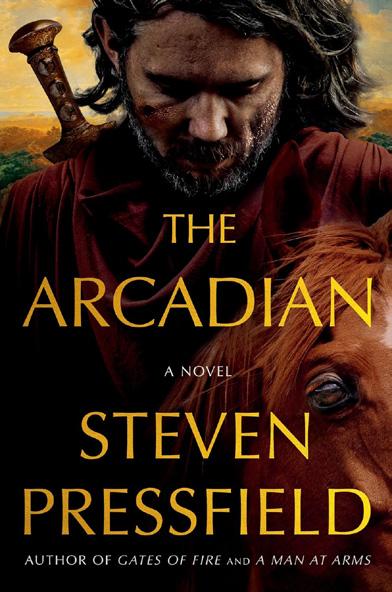
fate. His “curse is to return to life… always as a soldier.” Soon he finds uncannily familiar companions from his past lives through the ages drawn into his orbit and questioning their own faith and sanity as they become entwined into the explosive events surrounding them all. A young girl, an old crone, a priest, a “bookman,” and an enemy commander join in Telamon’s reluctant and unwanted adventure in the company of a spectacular and fascinating cavalry horse. Their ongoing experiences bring, to each, strange glimpses of other, earlier battles going back over millennia.
Acclaimed author of renowned fiction and nonfiction and expert on all matters of military art and science, Steven Pressfield excels in this genre-shifting instant classic. The novel extends beyond history to deeply explore the culture, faith, setting, and military technology of time, place, and people. Consistent with Pressfield’s other widely read books, all of this is conveyed in a highly interesting and surprisingly easy to understand manner.
Despite the graphic, gritty, and realistic accounts of hardship and battles, there are flashes of spiritual and quite human tenderness among and between the characters. Given the suspenseful and incredibly intense climax, the novel closes with a seemingly incongruous but ultimately beatific and uplifting ending. The master has done it again. A must read for all fans of historical fiction of any kind.
Thomas J. Howley
GRAVE MERRIMENT
Angela Ranson, Sapere, 2026, $14.99/£12.99, pb, 307pp, 9780854958498
Set during the Twelve Days of Christmas at Whitehall, this lively Elizabethan mystery follows two seemingly unrelated crime waves that soon threaten both London and the royal court. First, someone is targeting the waifs, pickpockets, and outcasts of the city; second, a series of increasingly deadly practical jokes disrupts Queen Elizabeth’s Christmas festivities.
After finally experiencing the defeat and ejection of the long-dominant, invading Moors in the 1500s, the constantly tumultuous peninsula of Iberia is now undergoing an internal battle between the Christian Spanish and Portuguese kingdoms. Into this particularly violent maelstrom, Telamon, a time-traveling consummate warrior now in the role of an ironsmith, finds himself drawn into the center of conflict, an unwelcome but all too familiar
Determined to preserve order before the arrival of important Irish guests, the queen commands Lady Catrin and queen’s favourite, Robert Dudley, to identify and stop the culprits.
Fast-paced and action-packed, the novel offers an engaging blend of murder mystery, adventure, and court intrigue. The cast of characters ranges from street children and servants to merchants, courtiers, soldiers, villains, and reluctant allies. Numerous suspects, shifting loyalties, and conflicting theories keep the investigation moving briskly and generate suspense. The story drives forward relentlessly and is best read over a short period, as its many characters, subplots, and twists can be difficult to track after even a short break.
The opening chapters are somewhat stiff and burdened by exposition, but the narrative soon finds its footing. The novel’s greatest weakness lies in its abundance of characters and plot threads, which leaves insufficient room to develop character motivations or interior
lives. In particular, the principal villain’s rapid rise to power lacks a convincing explanation. While entertaining throughout, the resolution feels somewhat tidy for a criminal enterprise of such apparent scale and complexity.
Keira Morgan
BEYOND WHERE WORDS CAN GO
Richard Smith, Bauhan Publishing, 2026, $24.00, pb, 224pp, 9780872334007 Poignant. Unique. Extraordinary.
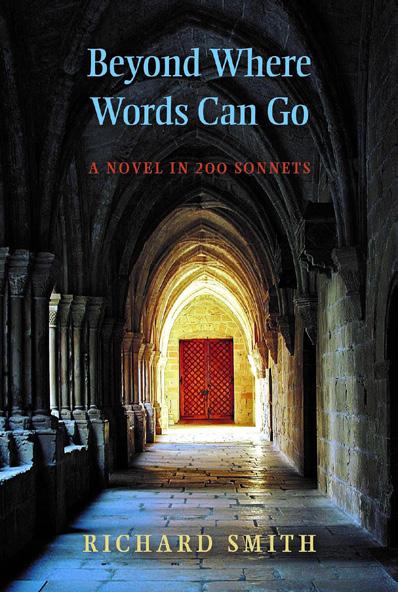
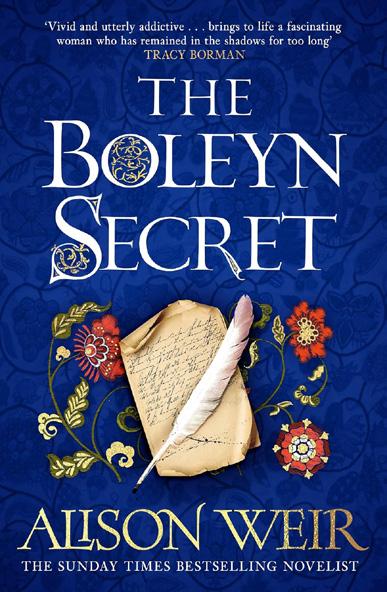
Beyond Where Words Can Go is all of these and much more. In technical terms, it is an historical novel written in the form of a narrative poem in 200 fourteenline sonnets.
Set in a monastery in 16th-century Dorset, England, at its simplest level it is the autobiography of a foundling raised in the monastery during the most fraught period of English religious history. It tells the story of the life of an infant, child, novice, monk, and priest as England moves from a traditional Catholic country through a period of cruel religious upheaval and the effects this has upon the members of the brotherhood and the community. At this level, Smith does an excellent job of creating a vivid tale, with many distinctive, likeable characters, strong conflict, increasing tension, touches of humour, and exquisite writing and cadence.
Beyond this, each page is, quite literally, a piece of poetry, and it is both easy and pleasurable to read. It tells a compelling story. The work explores sin, particularly the many sins of commission and omission that Henry VIII commits as he destroys the monasteries in England. Much more than this, the book is about love and the struggle that love so often is in its many forms: love of God, love of other members of the community, love of family, and forbidden love.
This is poetry that resonates with meaning. I cannot praise it highly enough.
Keira Morgan
THE BOLEYN SECRET
Alison Weir, Headline Review, 2026, £25.00, hb, 560pp, 9781035416240 / Ballantine, 2026, $34.00, hb, 560pp, 9780593974735
This expansive novel, with its extraordinary breadth of knowledge and scrupulous attention to detail, tells the story of a sidelined Tudor personage, Katherine Carey. It spans the Tudor era of Henry VIII through the early monarchy of Elizabeth I. Katherine (here called Kate) is first introduced as a young girl attending Anne Boleyn during her final days, as
a companion to Lady Elizabeth, and as a lady in attendance to Anne of Cleves. She marries Francis Knollys, a true knight, who loves her for life. Married to him, she has fifteen pregnancies with thirteen surviving children.
Through
Kate’s eyes, we see her loving family grow up and her management of a Tudor household at Greys Court. Her care of estates and her life as a loving mother contrast well with her negotiation of the dangerous royal court, with its factions and deceptions. The novel poses questions about who her father really was. After all, she has a striking resemblance to her cousin Elizabeth, including her signature Tudor red hair. Moreover, why does King Henry favour Kate above others at court? What are Kate’s own feelings about this narcissistic, unpredictable king? How will Francis, an ardent evangelical, survive and protect his family during Mary I’s Catholic revival? A thrilling section gives us the flavour of exile in Switzerland, separated from the older Knollys children. Whilst exile ends with Elizabeth’s accession, another kind of exile follows once Kate is appointed Lady of the Bedchamber to the possessive Elizabeth I.
This is another Alison Weir masterpiece, a vivid and completely addictive, pageturning novel. Weir brings to life a fascinating woman, utterly transporting us into the past with fluidity of story, beautiful writing, scenesetting and superbly drawn characters. Weir is an accomplished writer who researches thoroughly and fills in the white spaces of history convincingly.
Carol McGrath
RAGING CLOUDS
Yudori, Fantagraphics, 2025, $34.99/£31.99, hb, 364pp, 9798875001062
Had I noticed the phrase “sexual violence” in the description of Yudori’s Raging Clouds, I never would have picked up this graphic novel. At first, I was alarmed by the sexually explicit images. But I soon realized that the art transforms the story into an experience, forcing the reader to confront what it means to lack bodily autonomy.
The narrative focuses on Amélie, the wife of a wealthy Dutch merchant. Her passion for science and engineering is suffocated by her husband, Hans, and his 16th-century values. When Hans leaves on a long voyage, Amélie is finally free to uncover the mysteries of flight. But when her husband returns, he sees her work as witchcraft, forbids further exploration, and reclaims domain over her body.
As Amélie struggles to survive her husband’s
cruelty, she also wrestles with her complicated feelings toward the enslaved mistress, Sahara, he brought home. Like Amélie, she is young, beautiful, and brilliant, but unlike Amélie, she is far more skilled at navigating the perils of her station. Together, they form an unlikely bond in the pursuit of freedom.
Amélie and Sahara grow closer as Yudori’s art reveals the injustices they endure under Hans. The exaggerated facial expressions in each image, a hallmark of manga art, capture not only the characters’ pain, but also their ability to endure it. Each black-andwhite drawing offers readers an opportunity to recognize themselves in the struggle to transform a system designed to crush them. I highly recommend Raging Clouds to dedicated fans of graphic novels or those eager to read one for the first time.
Melissa Warren
17TH CENTURY
THE DEPOPULATION
Marina Closs, trans. Thomas Bunstead, Bellevue Literary Press, 2026, $17.99, pb, 311pp, 9781954276604
In the wilderness of 17th-century Brazil, two Spanish Jesuit priests—the intense and mystical Father Ruiz and his assistant, Father Maceta— work to bring Catholicism to the indigenous Guaraní people. The sudden appearance of Overá, a strange man who claims to be the Son of God and brother of Jesus, brings chaos to the mission, as does the arrival of slave hunters and Portuguese soldiers who force a mass exodus of the Guaraní into the heart of the jungle.
Closs grew up in Argentina, and her knowledge of the history and rich folklore of South America is evident on every page. I was taken by the magical realism in the book, reminiscent of Márquez, and demonstrated in Ruiz and Overá. Both men, notably Overá, are also comic characters, offering an interesting contrast to the ultimate tragedy that befalls them. In lush, lyrical prose, the novel reveals the devastating effect of colonialism on indigenous populations, as well as the clash between the modern world and a world where magic still reigns. Occasionally, words and phrases in the Guaraní language get in the way of the narrative, but it is a small digression in an otherwise engaging novel.
John Kachuba
GENTLE THINGS
Danielle Giles, Mantle, 2026, £18.99, hb, 352pp, 9781035051274
Aldgate, London, 1668. Lucy North, the late-teenage daughter of a widowed tavern landlady, is a frank and engaging narrator. Initially we have a rather bitterly humorous account of the manoeuvrings of her mother to arrange her daughter’s marriage with an older widower. This attempt at matchmaking ceases when Lucy allows herself to be seduced by a shy young apothecary, Thomas Ashwell, another man with his own business, if a little
less eligible. All seems promising until their wedding day, when Lucy falls into the tavern cellar, sustaining near-fatal head injuries.
Whilst her original protagonist lies ill, the author then rewinds the story by a year for a central section in which the main characters are a Black ballad singer, Kate Eden, and an Irish maidservant, Brigit O’Tegan. These two lively and unusual characters come to work for the then-unmarried Ashwell. A spiky but tender relationship forms between the women. But we as readers are given access to sinister secrets. When the focus returns to the stillconvalescing Lucy, we have a new concern for her safety.
The story compels because of the skill with which Giles embeds us into her characters’ world, using spare descriptions, as intimate and uninhibited as a private diary. Restoration London with its amorality is evoked very well. The dialogue and language seem perfect for character and period. I have a slight reservation about London topography. Aldgate is in fact a little further from St James’s Park and from the river than Giles implies. The predicament of women in history is the focus of many novels, but few others breathe so much life into it.
Feisty and ingenious, Lucy does eventually emerge on top. Seeing her get there is very entertaining.
Ben Bergonzi
THE WOMAN IN THE SEAL SKIN
Lauren Keegan, Affirm Press, 2026, £12.99, pb, 384pp, 9781923293328
In 17th-century Scotland, Malie lives on the wild and windy isle of Orkney, where she and her family eke out a subsistence living. She’s unhappily married to abusive Johne, who fishes with her father and brothers. But the nets are increasingly empty, and the men are looking for someone, or something, to blame.
Malie is drawn to the sea where her mother was said to have come from as a selkie, a magical creature that shapeshifts between seal and human forms to seduce men. Malie’s mother disappeared – back to the sea where she came from, Malie’s father tells her. But is this true?
Malie is expecting her own child and envisions her mother in the pregnant seals swimming in the bay. She is determined to find out why her mother vanished and asks her friend Henrye, who has lost a wife to the waves, for help. But then a woman—or is she a selkie?—washes up on the shore alive. Malie and Henrye want to protect the outsider, who would be blamed for the looming environmental disaster, but face danger doing so.
Mythology, motherhood and lack of female autonomy are the themes of this engrossing novel, the second from Keegan, an Australian ARA Historical Novel Prize longlisted writer. Written from Malie and Henrye’s point of view, the pacing might be too slow for some readers and there is violence against animals that might be distressing. However, this is a gripping novel, and the description of the
island is captivating – you feel you are there among the salt, waves and possibly a few selkies.
Kate Pettigrew
MITHIM
Carina McNally, Mercier Press, 2026, £15.99, pb, 384pp, 9781917453639
It is 1649, and Cromwell’s army has devastated Ireland. Mithim McMurrough, descendant of an ancient and noble Irish clan, flees the burning ruins of her father’s castle to escape alone into the Wexford Forest. The world she has known has gone up in flames, and Mithim must learn to survive with the only resource left to her: the knowledge of herbs and healing bequeathed to her by her mother.
But Mithim is much more than a skilled herbalist: like the trees that surround her in the ancient forest, her feet are firmly rooted in the soil and the ancestral memories of her people. Her powers of perception connect her to the ancient gods of the place, especially the Cailleach Bere, ancient goddess of winter, nature, and the landscape, and Saint Brigid. Mithim will need all these skills to survive in dangerous times, when to be identified as one of the rebel McMurroughs is a death sentence, and treachery is everywhere.
Many books of historical fiction focus on the drama of wars. Instead, McNally writes from the inside looking out, as Mithim holds on to beliefs and a spirituality that are gradually disappearing while the world burns around her. McNally has created a world in which the old gods live, and myth and magic are never far away.
If I were to be critical, I would suggest that the proliferation of Irish words and phrases, while interesting, can sometimes be a distraction from the threads of the story. However, McNally has created a gripping narrative in which Mithim searches for traces of any surviving members of her clan who may have escaped the destruction. In her journey she discovers that love, and hate, take many forms and that in the end she can only survive on her own inner strength.
Jim Loughran
THE SAFFRON THIEF
T. L. Mogford, HarperCollins, 2026, £18.99, hb, 336pp, 9780008789978 / HarperCollins, 2026, $18.99, pb, 384pp, 9780008817961 London, September 1666. In the wake of the Great Fire, brothers Fabian and Justin return to what is left of the city with their mother and sister to discover that although their house has survived, their father and their main source of income have not.
While their mother is grieving, it is up to the twenty-something brothers to find a way to support them all. Fabian returns to his work as a lawyer’s clerk with the vain hope that his older brother, Justin, will restart their father’s business as a poulterer, but instead Justin is tricked by a pair of conmen posing as alchemists. They claim that saffron is one of the key ingredients they need, but at four pounds a pound it is
almost as valuable as gold itself – thanks to the belief that it will ward off the plague – and so, when Justin’s foolishness means that they are set to lose everything, Fabian comes up with another, even more reckless idea to save his family from destitution: to steal enough saffron to repay the debt. And so he sets off for Saffron Walden in Essex.
Despite the high stakes, this is a fairly lighthearted caper with some comedic characters. As a result, there is no great depth to this novel, but it’s an entertaining adventure. This is said to be the first in a new series, although it’s not yet obvious how this will work. The main character’s name is overused – a common issue, showing either the author’s lack of trust in the reader or that the author lacks confidence in their own writing – which fails to create an immersive point of view. Recommended, nonetheless.
Sarah Dronfield
THE SPY AND THE URCHIN
D. A. Parsons, Independently published, 2026, £8.99, pb, 196pp, 9798278106623
Set in 17th-century England in the aftermath of Charles I’s execution and the rise of Oliver Cromwell, The Spy and the Urchin blends historical authenticity with espionage while identities are reshaped by conditioned loyalty. I enjoyed the cast of vividly drawn characters, from hardened spymasters to ambitious traitors. Chastity’s identity is both threatened and changed in a new world of inheritance and political ambition. Ben Gittings, in turn, discovers his talent for decoding hidden messages and is drawn unwillingly into state surveillance. They do not know whom to trust, and neither one fully understands the scale of the forces moving around. It is through their uncertainty that we experience the espionage as both survival and political weapon.
The rich setting also highlights an era of fracture and reinvention: London has taverns and brothels, as well as intelligence offices, while the countryside has disciplined rhythms and obscured tensions. The narrative builds tension not through spectacle alone, but also through psychological pressure, despite moments of emotional rupture.
By throwing ordinary lives into extraordinary historical times, The Spy and the Urchin integrates coming-of-age with national upheaval. It is a read that draws the reader between resolution and uncertainty, as lives were often suspended during a time when “Cromwell’s London was not a safe place.” In this read the next turn of history feels both inevitable and dangerously unstable. Readers of British historical fiction with an espionage twist will find this fascinating.
Patricia Furstenberg
GREET SUZON FOR ME
Vince Rockston, Independently published, 2025, £13.59, pb, 360pp, 9783952493755
The author has clearly done his research! There’s a lot of excellent background
information here, and I enjoyed reading about the daily life of the Huguenot (Protestant) d’Albert family, living in the Normandy town of Alencon. The story is set shortly before, and then after 1685, when Louis XIV revoked the Edict of Nantes which had protected Huguenots for so long. The King was determined to make France a solely Catholic country. He sent dragoons into Huguenot houses and put impossible restrictions on them unless they denied their faith. And although their pastors were expelled, the laity were forbidden to leave the country.
Young Gédéon d’Albert has already been on one perilous trip with his father to pass on information to others of their faith, but then danger comes terrifyingly close to home and the whole family is forced to flee, heading for the coast and Jersey. They are in constant danger, and, when double tragedy strikes, young Gédéon finds himself responsible for his family’s safety.
Greet Suzon for Me is a story of love, of courage, of faith and of spiritual growth and has much to recommend it. However, it would read better with some judicious editing. There are many opportunities in the book where the author could flesh out the characters more fully and build up the tension, for example.
R. Hayes
18TH CENTURY
THE BOY WITH FIVE NAMES
Pamela Belle, Independently published, 2026, £10.99, pb, 296pp, 9781068678479
It will aid the reader to have previous acquaintance with courtesan-turned-coffee shop owner Polly Paradice; her lover, French Huguenot painter André Dark; and her lively maid, Gin. Polly’s actress sister Mattie, central to the plot of books 2 and 3 in the series, also strolls in here. This fourth volume centers around Polly’s business partner, Hannah Evans, whose new motherhood to infant Rose spurs her wish to discover the fate of her son, Kojo, who was separated from her by Hannah’s former enslaver. As the friends team up to locate him, Dark also hopes to recover another enslaved boy he once painted, whose mistress had named him Pompey. Belle is adept at bringing historical detail to breathing life, and this tale spotlights the extensive Black population of London, enslaved persons and free. She skirts the white savior complex by giving Hannah agency and advancing the search through other Black characters, including the hulking Septimius Severus, tapped into the London underworld, and the elegant Lady Lucinda, who enjoys another identity as the equally elegant Luke Bradley. As always, setting is a strength of this series, as when Belle describes central London “with crumbling old houses that had avoided the Fire and were now decaying back into their constituent parts.” Traversing the bustling city is one of the book’s many rewards as characters search through Covent Garden,
Shadwell, Mile End, West Ham, and the East India docks. With a large cast of old friends to involve in the quest, there is little time for character development, but the voice of young Kojo reflecting now and again on the turns of his life suffices for an emotional arc. The calico riots of 1719 also factor into the plot, adding adventure and intrigue to a story rich with the rewards of friendship and found family.
Misty Urban
THE WOMEN WHO SAVED SHAKESPEARE
Mai Black, The Book Guild, 2026, £9.99, pb, 344pp, 9781835744321
The reverence in which Shakespeare is held today as the most famous and preeminent English writer of all is due in no small part to the Shakespeare Ladies Club of 1730s London. This historically authentic group of women dedicated themselves to promoting Shakespeare’s influence and legacy against the growing disapproval and disdain by many men of that era. In the early 1700s, Shakespeare was increasingly considered to be an overrated and undereducated writer by classically trained upper-class men. The performance of Shakespeare’s plays in the theaters was no longer seen as either fashionable or popular. A group of determined women changed this trajectory.
This novel imagines how this group may have coalesced by following the life of one of its founders, Elizabeth Boyd, herself a poet and novelist. As a child, although Elizabeth was not generally allowed in her father’s library, she nevertheless becomes a voracious reader of Shakespeare after she recognizes her grandmother’s comments written in the margins of his plays that speak to her own feelings. When an inadvertent encounter with the Countess of Shaftesbury occurs a few years later, their common admiration and knowledge of Shakespeare become apparent as they both realize the importance of Shakespeare’s words for the lives of women. A bond between them then develops and grows, despite familial pressures to marry and have children and despite coercion to acknowledge that education for women is frivolous. The fear of institutionalization for women who buck the social order also looms.
This novel is populated with memorable characters such as Elizabeth’s profligate twin brother, her often unsupportive sisters and mother, her female colleagues, such as a feisty duchess and a tenacious coffee shop owner, and local men who seem to both admire and despise her. Highly recommended for bringing an important story to light!
Karen Bordonaro
through one woman who, in striving to reign in her inherent wildness, finds agency in nature’s comforting embrace. In late 18th-century pre-industrial rural Britain, Walter Sentance unexpectedly inherits Rose Maunt, raising him to the status of landed gentry. Pridefully surveying his multi-acre estate with a view to his unfolding future, he hires a Master of Works and landscape designer to develop his ‘windfall’ into a private Gentleman’s Park; anyone living on the property to be evicted, despite generations of family history.
Walter’s edict incorporates Haydle Bent, where the Linnet Withycombe and daughter Jael, reside in a small cottage, shielded by an ancient oak tree, the sentinel of centuries of change. Walter’s ambition to subordinate his land—no longer will ‘wayward wildness’ be tolerated—merges with his wish to subjugate his sometimes-improper wife, Hannah. Both should be beautiful, obedient, and maintained in good order. But the more Hannah roams through primitive bracken, boggy marshes and acres of undergrowth, the more attuned she becomes to nature’s seldom-heard murmurings and susurrations. Her soul yearns for freedom and occasional recklessness. Lonely and friendless, she stumbles into an unusual relationship with wise woman Linnet and non-binary Jael.
As she comes to accept there are ‘more things in heaven and earth’, she courteously protests Walter’s refusal to listen to the land, large tracts of which will not contemplate his alterations, exhibited in visible signs of intransigence as the workers discover to their detriment. Hannah’s character arc compliments a tentative friendship with the landscape artist, whose transformation keeps the reader off guard as we discover, along with Hannah, that our ‘dominion’ has taken us too far off course. This enchanting debut draws to a perfect and poignant conclusion.
Fiona Alison
PATRIOT OF THE LOWCOUNTRY
Tracy Lawson, Gray Lion, 2026, $15.95, pb, 320pp, 9798987612385
THE WILDNESS
Anne Keer, Honno, 2026, £10.99, pb, 321pp, 9781916821439
Keer’s debut traverses our human connection with the natural environment
Patriot of the Lowcountry is a first-person historical novel relating the experiences of an actual South Carolina widow during the American War of Independence. In 1779, the world Eliza Wilkinson is building for herself and her dependents after the untimely death of her husband and child is torn asunder by marauding British and Loyalists. Her heart and interests war with her desperate situation. Forced to flee to the assumed safety of Charlestown during the social season, Eliza relies on the readily offered hospitality of friends. However, all is undone when General Benjamin Lincoln surrenders the Continental Army defenders and the city. Thousands of soldiers are confined on prison ships with little provision for their health or welfare, while many who fled to the city before the siege find themselves destitute. Eliza’s efforts to relieve the suffering draw her into a revolutionary
underground of clandestine communication, escapes, and spying. Ultimately, she flees the city to warn Francis Marion, the remaining patriot threat to British rule in South Carolina, of British plans to ambush and destroy him.
For this second book of her Ladies of the Revolution novels, Lawson again creates a fictional history based on a real person. Included excerpts from actual writings of Eliza Wilkinson provide insight into her character and into Lawson’s use of primary materials when she developed her story.
Ron Andrea
THE SAMURAI’S OCTOPUS
Jonelle Patrick, Seventh Street, 2026, $23.95, pb, 292pp, 9781645061151
In the late 18th century, the walled quarter of Yoshiwara in the city of Edo, is renowned for its pleasure gardens and beautiful courtesans and prostitutes. Patrons often pursue business deals within the elegant surroundings of the finest Houses—with courtesans present, trained in manipulating them. Little Bird, or Birdie as she’s known, has lived all her life in the House of Treasures, serving as a child attendant to the Oiran Pearl, the highestranking courtesan. She hopes to become an Oiran herself one day, but as she matures, Birdie sees the darker side of Yoshiwara and has her doubts. But even though courtesans must please and serve these men, they may have power over them if they are clever.
The story begins when a samurai who’s fallen on hard times witnesses a murder. It’s dark, and the city is on fire, so he doesn’t recognize the killer, who escapes on horseback; or the woman he has taken along; or the victim, but he finds an octopus netsuke that fell from the murderer’s sash. He pockets it and flees. This murder and the netsuke haunt the rest of the story as Birdie grows up. Even after she guesses who the murderer is, mysteries keep unfolding.
Jonelle Patrick has written previous novels set in historic Japan, but this is my introduction to her depiction of that closed world: Japan itself, where the only outsiders allowed are Dutch traders, and the gated Yoshiwara quarter from 1784-1788 plus an epilogue. Highly recommended for the portrayal of the exotic Oirans—their clothing, makeup, protocols, and rivalries—and lesser courtesans and geishas, the wealthy men who patronize them, Birdie’s friends who are both inside and outside the adult world around them, and the underlying plots.
Jinny Webber
THE TRAITOR’S BARGAIN
Rajat Roy, Emberline, 2025, $9.99, pb, 250pp, 9781764129909
In 1757 the state of Bengal was one of the wealthiest places on earth. But its ruler is dying, and he insists on naming his beloved and spoilt grandson Siraj ud-Daulah as his heir. Siraj alienates many of his court, leading to disaster. The British East India Company is gaining
power in India and covets the riches of Bengal. The combination of disgruntled courtiers and avaricious merchants leads to an intricate game of plot and counterplot, culminating in June 1757, with the pivotal Battle of Plassey, where Siraj is betrayed by his men. Bengal, and its immense wealth, pass into the hands of the British, who regard the province as a treasure chest to be plundered.
This novel covers the events leading up to Plassey, and the devastation that followed as the British ransack Bengal. Showing us the varied people involved, from the selfish, wilful Sirjah and the avaricious Robert Clive, to the men and women entangled in a complicated web of both greed and good intentions, the author weaves an engrossing tale in which nothing is as simple as “good versus bad people.” Actions undertaken with the best of intentions turn out to be disastrous, and virtue is rarely rewarded. In the end the “traitor’s bargain” is entered into by all the players. The Battle of Plassey is a pivotal event in Indian history, and this book gives the reader a vivid glimpse of the high cost of good intentions.
This novel is a pleasure to read, with rich descriptions and nuanced characterization. While the author has clearly done his research, he presents it subtly; the background is presented elegantly, and he makes complicated political maneuvering easily understandable. I enjoyed it immensely and am already looking forward to Rajat Roy’s next novel.
India Edghill
19TH CENTURY
A LADY FOR ALL SEASONS
TJ Alexander, Vintage, 2026, $18.00/C$26.00, pb, 304pp, 9798217007288
This witty comedy-of-errors is a delightful spin on the traditional Regency-era romance. After Verbena Montrose’s father loses their family fortune, she must find a husband. Her friend Etienne, a wealthy closeted gay French tailor, agrees to a fake marriage. Noted poetess Flora Whitcombe pens a poem about this proposed marriage. When Verbena seeks out Flora at an artists’ club, they feel an instant mutual attraction. But Flora is hiding her identity, as she was born, and moves through society at times, as William Forsyth. Verbena and Flora/William continue to meet at various artist and society venues, including a masquerade ball organized by the real-life Lord Byron.
While Verbena and other characters appeared in TJ Alexander’s A Gentleman’s
Gentleman, this is a stand-alone novel. Alexander wonderfully describes the English and Welsh settings and the customs and dress of this period, including a memorable scene with a “bathing machine.” While each character is fully realized, Flora/William’s dual persona is very well portrayed.
Those seeking a sensationalistic read should look elsewhere. Readers seeking a compelling exploration of gender roles and the artist’s place in society will find much to admire here. Romance readers will get their happily-everafter in this charming story.
Michelle J. Ritholz
EDMONIA
Brianne Baker, Dafina, 2026, $28.00/C$37.99, hb, 288pp, 9781496754875
Mary Edmonia Lewis (1844-1907) was a neoclassical sculptor of Black-Indigenous parentage who gained international renown in the late 19th century yet fell into obscurity decades later. Alongside a recent artistic revival, her life and work should get a deserving boost through Baker’s eloquent biographical novel. Her imagined first-person voice makes a statement. With cool, deliberate pacing and an exalted vocabulary, Edmonia reveals her extraordinary story, from her childhood in northern New York, where she wove baskets with her Ojibwe aunts for tourists, through the height of professional achievement in Rome, where she settled after tiring of racist treatment in her birth country.
Much about Lewis remains shadowy even today. And so, while anchored in the historical record, Baker’s tale includes fictional episodes for dramatic purposes and to fill in gaps. The most unusual events in the narrative really did happen. After attending New York Central College through the financial support of antislavery Baptists, the teenager then known as Mary enrolls at Oberlin College in Ohio, where she endures sniffy racial attitudes and is brought to trial for poisoning two female students. Baker’s explanations for this shocking accusation make logical sense, as does Mary’s decision to use the middle name she was given in baptism, Edmonia, after moving to Boston to start afresh.
A detailed author’s note would have been beneficial, but one could hazard a guess that some secondary characters and unlikely coincidences involving them were invented. What feels entirely real, though, is Edmonia’s strength of will. She is bold, uncompromising, occasionally prickly (even with her benefactors), confident in her abilities, and determined to elevate and showcase the
humanity of her people by sculpting them in marble. What a force she must have been. Edmonia brings to life a woman who refused to be defined by anyone but herself.
Sarah Johnson
THE NEWER WORLD
Sebastian Barry, Faber & Faber, 2026, £20.00, hb, 259pp, 9780571378449 / Viking, 2026, $28.00, hb, 272pp, 9780593654613
Tennessee, 1840, and an unknown narrator tells of ‘my father’ and his courtship of ‘my mother’. It is not until chapter two that we learn the name of this narrator: Tennyson Bouguereau.
Tennyson, we discover, was born as property. Much like a dog or a mule, his value is for labour, or for ‘sport’ – as foxes were hunted for ‘sport’. As for the fox, ‘sport’ can be deadly.
As we follow Tennyson’s life, we see how freedom at the end of the Civil War was manipulated by the powerful into a life still undermined by oppression and hatred. A world in which a person could go to work in the morning and be dead by nightfall. Even when a well-wisher tries to save him, Tennyson himself still is given no choice in the matter.
Despite this, the relating of Tennyson’s inner life reveals a man who loves, who thinks, and who does make choices: Tennyson chooses to survive.
Characters from Barry’s previous novels, Days without End and A Thousand Moons, are featured, but this works as a standalone novel. The narrative style is one long stream, as of a man recalling his life. It mixes Barry’s trademark lyrical description and philosophical musings, with understated, plain telling of abuse, persecution, and murder. The violence is all the more devastating for the starkness of its reporting. Hence, inner life and outer events combine in a vivid imagining of how it might be, to be born as chattel.
There’s a lot packed into a short read: a life that fathoms both depths of hatred, and heights of love. Recommended.
Helen Johnson
THE HEIRESS OF NORTHANGER ABBEY
Nancy Bilyeau, Admiral Road, 2026, $16.99, pb, 260pp, 9798993563046
This enjoyable sequel to Jane Austen’s Northanger Abbey takes place in 1820, twentytwo years after the events of Austen’s original. Catherine Morland is now almost forty, happily married to Henry Tilney, and the mother of two daughters, Phoebe and Susan. Henry’s father has died, and his older brother Frederick now owns Northanger Abbey. Seventeen-yearold Phoebe accompanies Frederick and his wife, a childless couple, to Bath. Catherine learns that Phoebe may be named heiress of Northanger Abbey, which means that Phoebe could become prey to a fortune hunter. When Catherine reads a letter that indicates Phoebe has fallen into the clutches of the scheming Thorpe siblings, John and Isabella, she and Henry travel to Bath to warn Phoebe about
them. They discover that Phoebe has made friends with Isabella’s daughter and has been invited to Isabella’s home, a Gothic house on Dartmoor. Catherine senses her daughter is in danger and accompanies her. Is the danger real, or is Catherine letting her imagination get the better of her?
This is a suspenseful novel in the Gothic tradition, and readers can enjoy it on its own, even though it helps to have read Northanger Abbey first. To readers of Austen’s novel, this feels like a visit with old friends, many years later. I enjoyed the twists and turns of the plot and was never sure whether the events that frightened Catherine, involving a sinister nobleman and family secrets, and including a possible murder, were real or not until the end. I especially loved Bilyeau’s descriptions of Dartmoor. Bilyeau does not attempt to write in Austen’s style, which I didn’t mind, since, in my opinion, many efforts to imitate Austen have fallen flat. This is a well-written, first-person narrative from Catherine’s point of view. I recommend it for fans of Austen and Gothic novels.
Vicki Kondelik
ENRICO G
Angela Page Conti, Spring Cedars, 2026, $17.99, pb, 319pp, 9781963117899
The hero of this fictionalised memoir is the author’s great-grandfather, Enrico Gardini. A real-life hero, Enrico is a courageous but ordinary man who, during the course of a well-travelled life, does extraordinary things. His memoir begins in the late 19th century, in a remote village in the Abruzzo mountains of Italy, where life is steeped in tradition and reliance on the olive harvest. Like many of his generation, he reluctantly emigrates to the USA to earn money to send home. Fortunately, Enrico has a special gift: he is a talented cook. This takes him from potato peeling on a transAtlantic rust bucket to a successful career as a respected New York chef, and eventually dining in first class on his final return voyage. During his very eventful life, he encounters merciless Abruzzo brigands, various badtempered chefs, numerous Italian mafiosi, and a few women of dubious virtue. But Enrico likes women; he even tries to understand them. And the women in his life have strong views, which they are not shy about voicing.
Conti’s Enrico tells his story with a delightful dead-pan humour and a deceptively simple manner. His wry asides reveal his private fears and honest good nature, right up to the point where his well-earned retirement is destroyed by the Nazi occupation of his Abruzzo home. There are some mouthwatering recipes, and a few less-specific poisonings. It’s a compelling,
immersive, sometimes frightening read, but Conti also includes the harsh realities of rural poverty, enforced migration and the ignorant prejudice so many immigrant families endured. Thoroughly enjoyable. Highly recommended. J. G. Harlond
LADY DIXON’S NIECE
Chele Crawley, Independently published, 2026, £13.03, pb, 330pp, 9781068359903
Chele Crawley’s debut novel Lady Dixon’s Niece is an engaging Regency romance featuring a feisty and intelligent heroine in Annaliese Schmidt. Raised in an agricultural community, Anna is worlds apart from the refined society inhabited by her wealthy aunt, Lady Dixon, who invites her to stay. Anna’s background is a secret that could cause scandal if revealed, and once she becomes closely involved with the Rosland brothers, maintaining the deception becomes increasingly difficult.
Emmett Rosland, the eldest son of the Baron of Bovingdon, is the quintessential Regency rogue—handsome, sharp-witted, arrogant and accustomed to getting his own way. In contrast, his younger brother Edward is kind-hearted, thoughtful and altogether more appealing to Anna, whose growing affection for him sparks tension with Emmett. Adding further intrigue is the volatile Hubert Schulze, a man whose interest in Anna is far from innocent and whose presence introduces a darker edge to the story.
Crawley creates a vivid Regency world through strong descriptive writing with attention to historical detail. The novel captures much of the charm associated with Georgette Heyer while also offering a touch of Bridgerton-style drama and romance. The supporting cast is equally well developed, bringing warmth, humour and conflict to the narrative.
Well-paced and highly readable, the story balances romance, family drama and social intrigue with confidence. The plot keeps the pages turning, and as the first instalment in a series, it ends on a tantalising cliffhanger that leaves readers eager to discover what happens next. An entertaining and enjoyable debut.
Samantha Ward-Smith
TIODORA’S LETTERS
Marcelo D’Salete, trans. Andrea Rosenberg, Fantagraphics, 2026, $23.99, hb, 202pp, 9798875001710
The introduction to this graphic novel sets the stage for a tale about an enslaved woman in São Paulo, Brazil, in 1866, who is trying to obtain her freedom. Tiodora enlists a fellow slave who is literate to write a letter for her to her husband, urging him to help save money to buy their freedoms. Benê, a young acquaintance, decides to try to help Tio by delivering the letter himself instead of entrusting it to a drover. Besides the dangers of trekking through the Brazilian forests, and not knowing exactly where Tio’s husband is, he faces danger from white men and overseers.
The story is based on real letters written by Teodora Dias de Cunha, which were entered as evidence in a court case involving her owner
and thus preserved for posterity, giving rare insight into the thoughts of an enslaved person of the period. I liked the aesthetics of D’Salete’s black-and-white panels, sometimes minimalist and dramatic at the same time. A large number of them are dialogue-free, which led me to be grateful for the copious supplemental materials, because I got confused about plot points in one or two sections. The addenda include historical background, texts of the original letters, period photos of São Paulo, and extensive references. This graphic novel would be an excellent way to provide readers a perspective on Afro-Brazilian enslaved people’s experiences, in the approximate time frame when the United States ended slavery. Strongly recommended for both the artwork and the historical material.
B.J. Sedlock
THE STARGAZER OF NANTUCKET
Julie Gerstenblatt, Park Row, 2026, $19.99/ C$25.99, pb, 400pp, 9780778305897
In 1851, 18-year-old Winifred Starbuck decides it’s time she joined her merchant parents on their trading journey to China. Because of a dangerous incident last time Winnie was on board—which Winnie was too young to remember—her parents had no intention of ever taking her to sea.
For Captain Starbuck, this trip is about more than his usual trades. He’s mortgaged the family’s home and taken on a contract to buy illegal opium to pay for his new clipper ship, The Stargazer. Not only is he determined to set a new speed record for the Nantucket-toSan Francisco route, he’s also determined his wife should not learn how he’s financing the voyage.
Winnie stows away with help from the Chinese cabin boy and a sailor named Red, who was fond of five-year-old Winnie last time she sailed. In fact, several other crew members remember the dangerous incident, and one has blackmailed Captain Starbuck ever since. With a robust cast of characters, each with secrets and ambitions, this story moves as fast as The Stargazer. Although the characters aren’t fully fleshed out, the nuances of life aboard ship and the abundance of twists and turns make this a fun read. You’ll cheer for Winnie, her parents, and the crew as they sail the world with misadventures around every corner. While written for adults, this historical novel is also suitable for older teens and up.
Lisa Lowe Stauffer
THE MILLER’S BRIDE
Liz Harris, Boldwood, 2026, £9.99, pb, 314pp, 9781807031183
The Miller’s Bride is set during the midVictorian era, the first in a delightful saga centred around three young women finding their way in an often-strait-laced Scottish society. In this novel, Grace strikes out for independence when her family relocates to a fishing village, a move that is distasteful for
her. Grace accepts an arranged marriage to a miller instead.
Unfortunately, the marriage gets off to a complicated start because Angus, her miller husband, was previously romancing the unsuitable Jessie, a beautiful barmaid. His father disapproves and threatens to allow Angus’s cousin Walter to inherit the mill should Angus not accept a suitable marriage and continue to see Jessie. Angus is honourable within the marriage, if not yet in love with his new attractive wife. Alas, Angus is set up to fail by outside interests and by Walter, who adores Jessie. The story grows intricate as clever plotting follows.
I was very impressed by the attention given to location and historical detail. Nineteenthcentury Scotland and the mill town are vividly portrayed. The work of the mill, the changes as mills are purchased by entrepreneurs seeking power for textile industries are engaging elements. I was also totally immersed in this fictional community that reminded me of novels such as Cranford with its censorious characters such as gossipy sisters and parvenus such as a greedy tycoon. It is a story where lessons are learned, where characters change and right wins over wrong, as does family loyalty and genuine romantic love.
This story is much more than that of how a miller falls in love with his wife. It’s a peephole into Victorian rural life in a particular place at a particular time. There are beautifully executed descriptions that do Scotland justice. The Miller’s Bride is an enjoyable, well-plotted read.
Carol McGrath
FAVORS FROM A GENTLEMAN
Lauren M. Hayworth, Larkmoor Press, 2026, $18.99, pb, 409pp, 9798998722424
Favors from a Gentleman by Lauren M. Hayworth is an engaging historical romance that follows Sophie St. Quinton, a spirited young woman from a noble family, and Rafe Balfour, the handsome son of a merchant. Both are expected to marry for duty rather than love, but when their paths cross, fate has other ideas. As their relationship develops, they must navigate family expectations, social conventions and the barriers of class.
Set against the backdrop of the Napoleonic Wars, the novel explores themes of grief, social anxiety, family obligation and the constraints imposed by society. Hayworth balances these weightier subjects with a warm and enjoyable romance, creating a story that is both heartfelt and entertaining. The relationship between Sophie and Rafe develops through the popular enemies-to-lovers trope, and their growing attraction provides much of the novel’s charm.
Readers looking for strict historical accuracy may need to allow for some creative licence. Sophie’s attitudes towards romance and intimacy feel more modern than might be expected for a young woman of the period, and the couple enjoy a degree of freedom that would likely have raised eyebrows in Regency society. However, this is very much in keeping
with the tone of an accessible historical romance and does not detract from the enjoyment of the story.
Both protagonists are sympathetic characters, each carrying emotional burdens shaped by their families. I particularly enjoyed Rafe’s backstory and the way his father’s controlling influence affected his life. These elements add a touch of Gothic darkness that sets the novel apart from many Regency romances. While Lord Hansbury’s willingness to help Sophie feels a little contrived and the ending perhaps resolves matters rather too neatly, these are minor criticisms of an otherwise enjoyable read.
Fans of Bridgerton and character-driven Regency romance will find much to enjoy here.
Samantha Ward-Smith
PRIDE COMES BEFORE A FALL
Virginia Heath, St. Martin’s Griffin, 2026, $18.99/C$26.00, pb, 336pp, 9781250896117
Leopold
Sloane needs a chaperone for his headstrong sisters, and although other candidates have more experience, he is impressed by Portia Kendall’s superior training as a governess and her convincing arguments during the interview. That she is young and pretty has, of course, no influence on his decision.
The complication is that she is a crusading political reformer whose scathing articles condemn aristocratic privilege and the misuse of power, and he is the Duke of Debden and a local magistrate.
Since this is a Regency romance, readers expect the protagonists to fall in love, learn from their mistakes and marry, despite the daunting difference in class and political beliefs, and the author fulfils these expectations brilliantly. The irony is incisive; the humor entertaining; the heroine an independent-minded delight; the hero “not quite the aristocratic villain that she had been keen to paint him” but “a decent man…trying to do his best under the most challenging circumstances”; his family unexpectedly enlightened and supportive; the villains despicably arrogant and abusive.
What really stands out, however, is the description of how those in authority abuse power (more detailed than is usual in a romance), and Portia’s ringing denunciation is worthy of her Shakespearian namesake: “Can you not see that every single bit of that was wrong? From the overreaction to the protest to the arbitrary arrests by the authorities, to your blue-blooded sister’s release without charge to the constable’s bloody lies to charge
me for her offenses… heaven forbid that I expect the basic courtesy of either the benefit of the doubt or a fair trial in a country that is so unjust, unequal, and institutionally unfair to people—like me—who do not matter.” Words that resonate now more powerfully than ever. Highly recommended.
Ray Thompson
THE LIGHT OF STARS
Jenelle Hovde, Tyndale, 2026, $18.99, pb, 368pp, 9798400502934
Katherine (Kitty) Grenville still remembers her mother, although it has been years since she’s seen her, on the night her grandfather had Kitty and her brother taken away from their home in Hyderabad, India. She is looking forward to the Season in London but is informed that instead, she will be marrying Sebastian Sinclair in accordance with an agreement their grandfathers had made years ago. Sebastian has also been informed of the impending marriage and has been told he will lose his position in his grandfather’s company if he does not go along. He’s not interested in marrying a woman he only met once as a child, but then he meets beautiful, grownup Kitty, who wants to study astronomy and detests the East India Company, to which both their grandfathers are tied.
This Regency romance takes a look at the British East India Company and its crimes in India, as well as the strict, prejudiced society in the ton. The relationship between Sebastian and Kitty is well done, as they go from virtual strangers to partners, looking into the crimes perpetrated against the people of India, possibly by their own families. Kitty is also desperate to find her mother’s family, from whom she was torn as a child. There is a strong message of trusting God in difficult times, and of God’s ability to use a terrible situation for good. Recommended.
Bonnie DeMoss
MRS DICKENS
Emily Howes, Phoenix, 2026, £20.00, hb, 448pp, 9781399610865
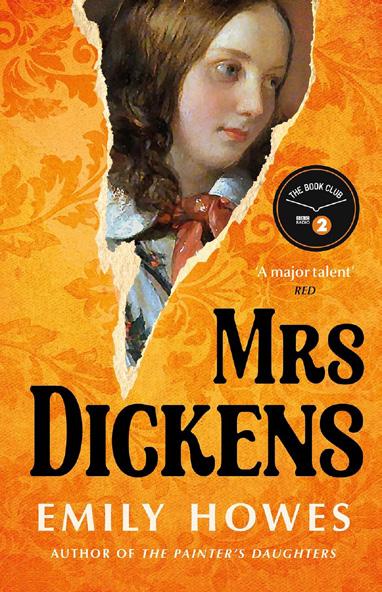
Catherine as a wronged woman whose placid nature almost invites her mistreatment. But Dickens is not simply presented as a heartless monster. Rather, the novel is a tragic portrayal of two deeply mismatched people: Dickens, with his inexhaustible brilliance and wit; and Catherine, with her quiet indolence and tongue-tied passivity. What starts as an attraction of opposites becomes, over the years of gruelling childbirth, irritated aversion, and eventually repulsion.
The novel is a beautifully written evocation of character and dialogue, and there are scenes that have genuine emotional force. The choice of Anne Brown as a narrator is very effective, Anne’s inauspicious beginnings in the London slums and her fear of returning there having many parallels with Dickens. There are heart-rending betrayals, Howes never shying from the painful decisions that Anne faces. The image of the abandoned child here takes on a distressing significance.
We are left with a key question: how can a man, whose works contain such compassion, have treated his wife so shabbily? Howes suggests that the answer may lie in Dickens’s idealisation of women as delicate, emotionally undemanding creatures. Catherine, here, is very much a real woman who suffers mood swings, weight gain and irrational behaviour. Howes balances this with Dickens’s own insecurities and fears. Ultimately, though, what the novel gives is less an understanding of Dickens, and more a powerful, compelling and utterly moving voice to an ordinary woman ill-matched to an extraordinary man. Very highly recommended.
Adele Wills
WHITE ELEPHANT
Mrs Dickens is a heartbreaking examination of the marriage of Charles Dickens and Catherine Hogarth, two different personalities who are joined by love in their younger years, but whose incompatibilities inexorably drive them apart. The story is told from two perspectives: a first-person account from the viewpoint of the Dickenses’ servant, Anne Brown; and a third-person account focused on Catherine’s story. Howes presents
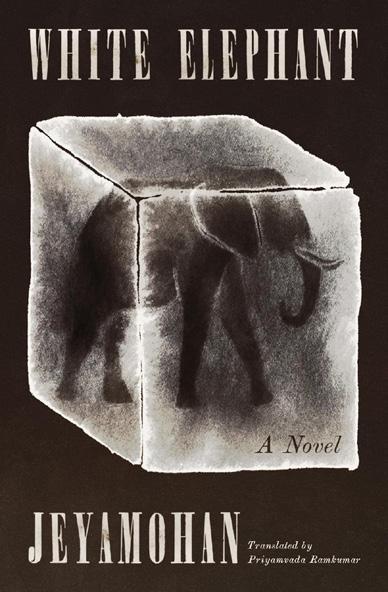
Jeyamohan, trans. Priyamvada Ramkumar, FSG Originals, 2026, $22.00/C$26.00, pb, 320pp, 9780374619428 1878, Madraspatnam, India: Aiden Byrne, an Irishman serving in the British Army, has done well for himself and risen through the ranks. While out riding near the shore one morning he
sees an overseer from the nearby Ice House viciously beating two workers.
An American company owns the Ice House, importing massive thirty-ton blocks of ice from New England to India, to provide ice for the drinks of the British Raj. People toiling in the Ice House are of the lowest, “untouchable” caste and work in oppressive and dangerous conditions for a pittance. Aiden attempts to intervene in the beating and arrests the overseer, but the workers disappear, and the
overseer is eventually released. Aiden then meets Kathavarayan, an educated doctor, also of the lowest caste.
Kathavarayan encourages Aiden to seek justice for the missing workers, and acts as a guide while Aiden journeys deep into the complexities of East Indian society, a society struggling in the relentless Great Deccan Famine in which millions have died. Shocked by what he sees, Aiden attempts to make authorities aware of the dire situation, while Kathavarayan seeks to instill within his countrymen a hope for better treatment.
Jeyamohan is an accomplished Tamil author of over twenty-seven novels, and White Elephant is only the second of his works to be translated into English. This is a deeply moving, multi-layered and nuanced story that deserves to be widely read and savored. Aiden’s journey into the complex soul of India and the British Raj makes for a compelling and moving literary experience—one that will transform and inform everyone who encounters this work. Recommended.
Susan McDuffie
A WOMAN OF AGENCY
Andrew Kass, Holand Press, 2026, £8.99, pb, 276pp, 9798252730028
The writer sets out his stall briskly: espionage, diplomacy and war circling one another in the fraught summer of 1863. A French courier is murdered en route to Liverpool, his papers stolen; in London, Viola Ross, a Boston merchant’s daughter attached to the Adams legation, finds herself drawn from social duties into a web of Confederate intrigue, European opportunism and intelligence work conducted in drawing rooms as much as docks. Parallel strands follow American agents, Confederate operatives and a gallery of intermediaries— boxers, clerks, couriers—until the various threads tighten around missing documents, naval procurement and the wider struggle for advantage in the Civil War.
Kass handles the machinery of plot with confidence. The novel has the busy, manyhanded feel of Alan Furst or early Philip Kerr, with a pleasing sense that history happens in corridors and back alleys as much as on battlefields. The Liverpool material, which includes blockade-running and the legal tightrope of British neutrality, is particularly well realised, grounded in convincing detail without undue exposition. Viola herself is an engaging centre: capable, watchful, and (refreshingly) allowed both intelligence and fallibility.
The narrative occasionally overreaches, with coincidences and convergences that feel engineered rather than organic. And while the breadth of viewpoints adds texture, it can dilute tension, the story cutting away just as scenes gather heat. Even so, this is an assured and often entertaining debut. It sits comfortably alongside Civil War espionage fiction, adding a welcome transatlantic and female perspective. If it sometimes prefers momentum to restraint, it does so with enough
verve to carry the reader along, rather like one of its own trains, steaming busily toward Liverpool with rather more aboard than is strictly declared.
Douglas Kemp
DUST AND WONDER
Kim Kelly, Jazz Monkey, 2026, A$32.99/$17.99/£12.99, pb, 346pp, 9781764567404
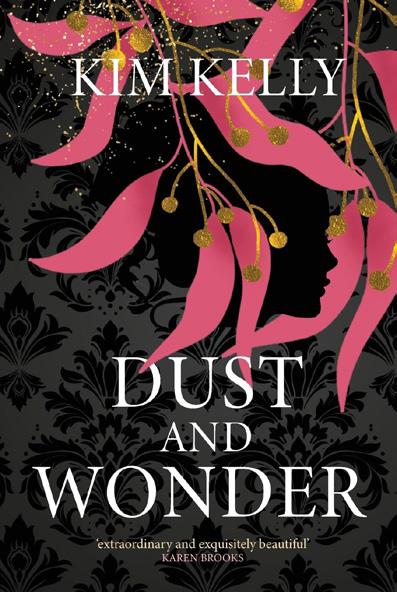
For roughly a decade after Krakatoa erupted on August 27, 1883, its dust whirled around the earth, especially the southern continents. That’s the “dust” of this title, sometimes iridescent and lovely, sometimes frightening, and also blurring vision. As for “wonder”: natural beauty, which the protagonist Ariadne (Ari) Archer sees vividly, creates only part. She inherited other mystical powers from her Irish father, though she’s not fully aware of that, growing up in Sydney with a social-climbing mother who dislikes her. Unusually for a young woman of her status, Ari escapes by taking a job at the spectacular Jenolan Caves. Griff Whitaker, a recently decommissioned lieutenant in the British Army fighting in Egypt over the Suez Canal, also ends up there, a broken man. His saving grace is playing his fiddle, a gift from his Irish mother, but it’s not enough to save him. Both possess “fae” sight, Ari more so, often seeing the world and others, including Griff, through a magical lens. Jerry and Cindy Wilson, the Irish couple who run the resort at the Caves, also have that otherworldly awareness—and every so often there’s a mysterious narrative voice, some sort of all-knowing entity.
This unusual story engages the reader with its poetic style, especially in Ari’s firstperson chapters. Kim Kelly, a much-published Australian author, brings the marvels of the natural world and human connections into dramatic focus. The consequences of war and the rigidity of 19th-century social conventions require bravery to surmount. Griff, known for his daring physical feats, including heroism on the battlefield, must understand what drives himself and find solace within. That’s more difficult for him than for Ari, with her independent spirit, joyful vision and sense of fae, who has only external forces to fight. A compelling, gorgeously written novel.
Jinny Webber
MURDER AT THE GASWORKS
Lisa M. Lane, Grousable Books, 2026, $15.99, pb, 254pp, 9798994365212
London, 1860, and ten-year-old Tommy Jones returns to his lodgings after a day laboring at the gasworks to find his friend, stoker Joe Carter, dead. When Tommy is accused of Joe’s murder, it takes the persistence of City Police Inspector Cuthbert Slaughter to prove his innocence.
In this prequel to her Tommy Jones series, Lane does an excellent job of weaving real people and events into the plot. In particular, the author’s inclusion of the friction between the City Police and the Metropolitan Police, as well as the working conditions and environmental damage of times, are deftly integrated into the storyline. The level of description and research immerse the reader in the story, perhaps slightly at the cost of a depth of character. Although I haven’t read the other books in the series, I’m assuming that the relationship between Cuthbert, his wife Ellie, and Tommy becomes foundational in the future. Although the other storylines, particularly that of women’s empowerment with Lady Emily Peel are enjoyable, I would have rather had more depth to the development of those three characters. That said, seeing introverted Cuthbert step into his discomfort to help prove Tommy’s innocence, and the progression of their interactions, made me want to read more of the series.
Murder at the Gasworks is a quick, enjoyable read. There are just enough diversions to keep the reader guessing at the murderer and busy trying to tie the various character storylines together, but not so much as to distract from a well-crafted plot.
Amy Marie Turner
AN IMMACULATE DECEPTION
Isabela Livino, Gollancz, 2026, £22.00, hb, 320pp, 9781399633208 / Dutton, 2026, $29.00, hb, 304pp, 9798217048373
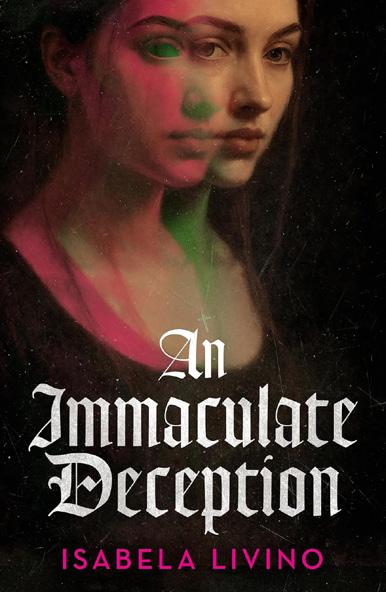
is told from her perspective with abundant misunderstandings, and a complex, twisting plot. Meeting her aristocratic lover, Leandro, at the São João festival, Madalena is reassured by his positive response to the news about the baby, but a terrible accident (fittingly in a violent storm) puts a stop to any further plans.
The classic setting of a ruined castle is here replaced by a decaying sugar mill in the rugged terrain of Pernambuco in Brazil. Amidst the faded grandeur of the estate, Madalena recuperates, but things are no longer as they were. Echoes of Brazil’s colonial past exist in the derelict sugar mill, and the rusty shackles and abandoned senzala bear testament to the brutal conditions in which slaves lived. Dark, disturbing secrets are gradually uncovered.
The second half of the book is told from the perspective of Leandro, and is a clever reworking of events. This includes a skilfully handled and startling narrative twist that I, for one, didn’t see coming.
Livino creates a strong sense of time and place with meticulously researched detail on everyday life supplementing the weirdness. It is a powerful story, well-told, with all the uncanny atmosphere of a Gothic tale but providing a new exploration of female independence in a society dominated by powerful men and religion. Perhaps not so very different to those original Gothic novels. Highly recommended.
Adele Wills
LUCIE DUMAS
Katherine Mezzacappa, Stairwell Books, 2026, £14.00, pb, 236pp, 9781917334228
London, 1890. It’s no secret that Lucie Dumas is a kept woman. Kept by Monsieur, as she calls him. With the salary and leisure hours he provides her, Lucie has the opportunity to write a diary, detailing her life until she ended up in Bloomsbury. After giving birth to an illegitimate son in her native Lyon, Lucie is sent to London by her lover, where she’s promised good work, but is sold into prostitution. After years of working for Madame Louise, Lucie escapes, only to end up back on the streets, where she is found by the writer Samuel Butler.
An Immaculate Deception is the debut novel of Brazilian writer, Isabela Livino – and what an impressive debut it is.
Described as Gothic fiction, the novel uses
aspects of the genre, reinventing them for a new audience. Madalena is the central protagonist, a young, innocent woman in danger. But Madalena is not innocent: at Mass, she is overcome by nausea because she is pregnant—and single. In 1877, we know this will be a big deal. The first half of the novel
This novel does not quite have a dual timeline; the second narrator in the later timeline creates the novel’s framework: Lucie writes in her native French in 1890, which is translated after 1902 by Dr Louis Vintras (whose text is all in italics, which I found hard to read). He’s the chief medical officer at the French Hospital in Shaftesbury Avenue, where Lucie died years earlier.
The diary-as-novel is a nice tribute, an authentic style of novel writing that Lucie would have known. This setup allows Lucie to speak for herself, and as she’s writing, she frequently hints at things to come, which builds suspense and interest. However, the commentary by Vintras is less engaging. Vintras behaves exactly as a Victorian man would, interrupting and inserting his own remarks. This is a historically accurate way to present the novel, and it’s a clever framing device. As a reader, though, I never cared
about Vintras, yet the novel ends with him, which sadly gives the man the last word in this woman’s story. I enjoyed the unhurried pace of the novel, as it grounds readers in Victorian London, and it’s a good choice for those in search of a slow-burning read.
Kelly Urgan
THE LADIES HALL
Vanessa Miller, Thomas Nelson, 2026, $18.99/£9.99, pb, 384pp, 9781400351107
The title refers to the women’s residence at Oberlin College, one of the earliest colleges to admit women and African Americans. Three young ladies are members of the first class of Black women who would graduate in 1884, and who in later life would become prominent activists: Mary Church Terrell, Anna Julia Cooper, and Ida Gibbs Hunt. Mary and Ida are from wealthy families, while Anna’s is poor; she can only afford to attend by working on the side. The three enroll in the four-year “gentlemen’s course” rather than the easier and shorter “ladies’ course,” and achieve high marks, despite jealousy and opposition from some of the white students, such as not wanting to sit next to a Black student in class or being told where Black people may sit in the dining hall. Mary finds that family wealth doesn’t counter prejudice, when she loses literary society debates and elections because of her race. Other white students are supportive, as is the house mother of Ladies Hall, but Mary feels that the struggle for acceptance is so difficult that she moves out of the Hall and boards with a local Black family. But her father says he sent her to a predominantly white school to learn how to fight, for both herself and for others who cannot, and that someday she will change the world.
Besides learning African American history, readers will burn at the injustices the young women face in attempting to get an education but also rejoice when they make steps forward in the fight for equality. An author’s note tells what happened to the girls in their storied careers after they left Oberlin, and explains some changes Miller made to the timeline, which bits are fictional, and gives a bibliography of sources for further reading. Recommended.
B.J. Sedlock
THE MATERNAL ELEMENT
Kate Nicholls, Salt Publishing, 2026, £12.99, pb, 400pp, 9781784633998
In 1793, Maria Kornilyeva is born in Tobolsk, Siberia. With her mother dead, she is raised by her father, Dimitry, and her beloved nurse, Nyanya. Throughout her childhood she is angry with the injustice of the system which allows her brother to go to school but not her, in spite of the fact she is cleverer than him and thirsting for knowledge. Nor is she allowed to visit her father’s factory to witness the miracle of turning sand into glass. She is, however, allowed free access to her father’s extensive
library, giving her an eclectic but unstructured education.
At 16 she marries Ivan Mendeleev. Although it is an arranged marriage, both agree that they are ideally matched. Ivan is a teacher and is happy for Maria to pursue her interests. Successful in his career, Ivan receives a number of promotions, each necessitating moving his wife and growing family. But Ivan is accused of disloyalty to the czar. With his career in crisis, they make the decision to move back to Tobolsk to try to revive the family’s fortunes.
Maria has 17 pregnancies, of which 13 children survive to be baptised. One of them was Dmitri Mendeleev, the genius who created the Periodic Table, bringing order to the chaos of chemical elements. But this is Maria’s story, not Dmitri’s. Based on diaries, letters, and archival material, this is a fictionalised account of a real woman’s fight to gain an education and to save her family. It tells of many challenges, failures and successes.
Maria is a wonderful character, and the other principals, Dimitri, Nyanya, Ivan and the children, are brought vividly to life. The Russian landscape, weather and the enormous size of the country are beautifully portrayed. This is an excellent book, and I recommend it.
David Northover
THEY CAME FOR BLOOD
M. William Phelps, Hat Creek, 2026, $29.99, hb, 216pp, 9798892991230
They Came for Blood is gritty Old West fiction set in 1872. Tom Callahan works his 302-acre ranch with Ponch Tawanee, a mixed Mexican and Ute scout who is Tom’s longtime mentor, friend, and father figure. Tom was sixteen when Ponch found him and raised him within the Ute fold. Now that he has left his government profession behind, the two just want to run cattle, break mustangs, and bask in the beauty of the Nevada remoteness.
All is good until Tom’s former boss, Tobias Stone, rolls up in a black, gold-trimmed government stage, along with his heavies. It appears one of the Enders, a small group of government sharpshooters paid to target the worst outlaws, sold Tom out, causing the death of his wife and son. Tobias, a slippery lawyer-agent of President Grant, wants Tom to avert a possible assassination by Rupert Pence and his gang, who are headed to Carson City. Tobias assures Tom that his wife and son are with Rupert. Tom knows a setup when he sees one, but goes along to disprove the long shot that his wife is alive.
What follows is a bloody trail to California with ambushes and killings, none of which are unexpected, followed by a trail of bodies, but Tom remains mystified about the triple-dealing Tobias’s motives. Prolific crime writer Phelps’ grasp of descriptive language and character building is compelling. Tension runs high as the plot sweeps along, even when things take a downturn. There isn’t a page where the story lags, and Tobias is as convincingly menacing as the two protagonists are likeable
and deadly. Phelps pulls no punches from first chapter to last with his enticing fictional duo, and his intro to Tom Callahan is beyond persuasive. A satisfying read that deserves a sequel.
Fiona Alison
THE SCANDALOUS LADIES FOOTBALL CLUB
Frances Quinn, Simon & Schuster, 2026, £18.99, hb, 416pp, 9781398520738
1897. Living in Crouch End, London, under a false name, Adela feels it’s an uphill struggle to inspire her pupils at a progressive girls’ school to aspire to being more than wives and mothers. Living a life of elegant boredom, Harriet is annoyed at receiving one more letter from her husband, a civil servant in India, disparaging and dismissing everything she does; while Grace leads a life of quiet desperation, at the beck and call of her overbearing father and married older sisters. All three women are brought together when a chance encounter on her way home from work and irritation with her fellow lodgers at her boarding house leads Adela to establish a women’s football team. But the battle to be taken seriously is hard, especially as the publicity the team attracts threatens to expose Adela’s true identity and the life she is running away from.
Inspired by the true story of Britain’s first women’s football club, this is a lively novel which manages to make serious points about female emancipation without becoming preachy or didactic. The characters are all well-developed, quirky and believable as products of the century they live in. Each of them grows and changes, discovering she is capable of much more than she thought possible.
The research is (almost) impeccable –though I did wonder if by late-Victorian times, quills and sand hadn’t been superseded by fountain pens and blotting paper and if perhaps the men’s football team known as 3rd Grenadier Guards might have referred to the 3rd Battalion of the Grenadier Guards, rather the third-best team of the regiment.
I would recommend this book even to readers with no interest in football, since it’s really more about friendship, resilience, perseverance against the odds and finding love in unexpected places.
Jasmina Svenne
SUBLIME DISSONANCE
Kennedy Richardson, Vanguard Press, 2026, $25.99, pb, 402pp, 9781836713029
The power of music to inspire, to encourage, to comfort, and to bear witness in even the most unharmonious of times weaves in and out of the pages of this epic narrative. Beginning in the 19th century in a newly united Germany and ending in the ashes of WWII, it follows the multilayered story of a young
musician’s family and friends in both Germany and the United States.
Karl, born in Oregon to German parents, comes from a family of musicians, but he is the true violin virtuoso. He travels to Stuttgart, Germany, to study at its prestigious music conservatory to further develop his abilities. While there, he makes friends with Otto, a talented cellist from a wealthy family, and Marie, an orphan raised by nuns who is both an excellent oboist and a committed socialist. Touring as a trio to much acclaim, the lives of the three friends take sharply different turns on the eve of WWI. Karl, not having reached the musical pinnacle he craved, makes a new life for himself back in the United States, as Germany lurches through WWI, comes undone in the interwar period, and descends into madness in WWII. Along the way, the dramatic life turns of his friends cause dramatic life turns to Karl as well.
This informative novel imparts both musical knowledge and underscores its importance in connecting people across divides. The empathy of the emotionally engaging characters stands in strong contrast to the stark tumult and dissonance that they are forced to endure. Characters voicing deep thoughts in dark times about scientific progress, socialism, capitalism, and the role of religion are a distinctive feature of this novel as well. Recommended for music lovers as well as those interested in the many facets of German history.
Karen Bordonaro
THE JEWEL KEEPERS
Sara Sheridan, Hodder & Stoughton, 2026, £22.00, hb, 368pp, 9781399741989
In The Jewel Keepers, Sara Sheridan returns to the early 19th-century Edinburgh that she previously explored in The Fair Botanists Araminta McKenzie-Moore has arrived to meet an aunt she never knew about and unravel a mystery that the McKenzie women have been keeping secret for centuries. Araminta, having lived all her life in London, has no idea of the role the McKenzie women played as protectors of the Scottish queens through the ages, and her aunt Eilidh has left her a mystery to solve. Araminta will need to use all her wit and education to follow the map her aunt Eilidh has given her, with the help of a wily nun and some extremely smart and loyal staff. However, Araminta has no idea that she is being followed by a band of ruthless and determined men who will stop at nothing to protect the treasure that the McKenzie women protect.
This is a page-turning, intriguing and incredibly smart historical novel. The adventure is high stakes, filled with exquisite historical detail and incredible world-building. Araminta travels throughout Edinburgh and Scotland in her attempts to come to terms with her family duty and uncover the mystery; she’s an incredibly tough, astute and likeable character, and Sara Sheridan’s writing is spectacular. Her books will appeal to fans of
Laura Shepherd-Robinson, Lesley McDowell and Sally Magnusson.
Lisa Redmond
THE SÉANCE OF MURDER
Lyn Squire, Level Best-Historia, 2026, $17.95, pb, 314pp, 9798898201913
Dunston Burnett is invited to visit a man he’d never heard about before, but who turns out to be a long-lost relative. His grandfather’s older brother, Sir Hugo Crenshaw, is making a final request as he lies dying: join his sons Luke and Toby and others at Crenshaw Hall as they hold a séance on the 50th anniversary of the stabbing death of the oldest Crenshaw brother Randolph. Hours after the séance, Luke is found dead in bed—stabbed by the same weapon that felled Randolph. Soon after, Toby is also stabbed to death, and Sir Hugo succumbs to what is later found to be poisoning.
The Séance of Murder is the third in the Dunston Burnett Victorian three-book mystery series that capitalizes on amateur detective Dunston’s “pre-deduction” skills, or reimaginations of facts to provide investigators with insights leading spot-on to perpetrators. The first, Immortalized to Death (2023), envisions Charles Dickens’ death as murder. The second, Fatally Inferior (2024), uncovers a plot against Charles Darwin’s family. In this novel, Inspector Hescott and Sgt. Lumley consider several theories: a single lefthanded perpetrator, or two murderers working together, or a different killer for each crime, or maybe even Dunston himself.
Characters are colorful. Narrative is witty and engaging. Storyline moves quickly, zigzagging readers from one suspicious occurrence to another. And Dunston’s own pre-deduction does prove true. This séance is indeed spirited.
K. M. Sandrick
THE BEAUTY OF THE DAYS GONE BY
Jason Stone, Atlantic Monthly, 2026, $28.00, hb, 448pp, 9780802167408
West Texas in the 1860s is as dangerous (if not more so) for people than the war-torn eastern part of the country during its civil war. The Comanches have driven the Apaches out and staked claim to the vast land as their own nomadic hunting ground. The few American settlers and cattlemen in this region risk deadly attacks on their persons and property.
RL Terry returns to his homestead from a ride to discover his family is brutally attacked, scalped, or dying and his two young sons missing. Over the course of many years, with the help of other friends and the US military, he searches for his boys who have been taken for assimilation into the Comanche tribe. The story unfolds mostly through the eyes of rancher Charles Goodnight, reflecting on his life and RL’s quest as he ages into the early 1900s, with the help of a caring young woman and fascinated historian. Over the decades,
covering a vast amount of territory, constantly changing events, conditions and advancing expansion and technology, RL perseveres in the search for his sons.
This is a long book written in a literary style. The author’s extensive research on the terrain, people, culture, and technology of that era in Texas is ample and impressive. The characters are written in an intensely detailed and vibrant manner. However, the lack of quotation marks to structure the dialogue makes it difficult to determine who is speaking to whom. The book also switches back and forth between times, events, and speakers with no clear transition or explanation and features quite long sequences of omniscient narration. That said, if the reader can get past the non-standard style, there is much to savor in this gritty western saga.
Thomas J. Howley
THE SLEEPERS
Molly Sturdevant, Regal House, 2026, $22.95, pb, 312pp, 9781646037988
Sturdevant’s riveting novel will stick with readers long after they finish her last page. Inspired by true events, she captures the atmosphere and terror of labor unrest in Leadville, Colorado from 1893-1897. Fran Byrne, a worker in a small print shop, finds herself producing fliers for miners—the sleepers in the title—who want to form a union and plan a strike. She gradually decides to participate in their organizing efforts. Fran is at the center of a group of memorable characters, including sex workers, two Pinkerton spies, miners prepared for violence, miners who resist violence, and a wonderful circle of miners’ wives. Sturdevant centers the book on Fran’s point of view, while deftly bringing in additional perspectives. When the price of silver drops and mine owners claim they are hurting for money, they cut the hours and pay of their workers, ratcheting up the frustrations of the miners and nearly starving them. Readers feel tensions rise and will race toward the end, where the inevitable battle rolls out with predictable violence. Sturdevant never turns away from brutality and pain, describing childbirth, accidents with machinery, and murders that are part of everyday life in Leadville.
The action of the novel occurs against the backdrop of labor history. Readers familiar with that history and eager for more will find much to admire, as I did. For other readers, references to historical events, detailed descriptions of machinery, and the period-specific language may slow down their reading. My only quibble is that Sturdevant skims over the extra burdens the characters of color must have faced. But I urge readers to stick with this amazing novel, so they too can admire the indomitable Fran Byrne.
Marlie Wasserman
LAFITTE LIVES
Christi Keating Sumich, Level Best-Historia, 2026, $17.50, pb, 260pp, 9798898201654
1831 New Orleans. Tobias Whitney, sexton
of a St. Louis cemetery, is maintaining the tomb of Dominique You, who was associated with infamous privateer Jean Lafitte, when he discovers a hidden journal that might contain hints to Lafitte’s lost treasure. He takes it home to his wife, Mary Catherine, who can read French. Tobias and Mary Catherine have been through agony, losing three of their five children to yellow fever, and the translation turns out to be a welcome distraction from grief.
There are many literary connections in this story, which seamlessly combine fact with fiction. Tobias sold his bookshop after his children died and took the job in the cemetery. He still reads to his two remaining sons, and they are currently enjoying The Last of the Mohicans. The translated journal, transcribed by Mary Catherine into English in another leather-bound tome, is a book within a book, or more accurately a biography within a mystery, and is presented in parts as she finishes them, with the Whitneys’ story following in between.
Dominique You indicates early he is actually Lafitte’s older brother, Alexandre, and the story provided of Lafitte’s life is captivating. The journal contains surprising revelations, and You admits to the truth, even when evil or ugly, as well as pointing out the lies, exaggerations, and some of the things Lafitte did that were considered good by the people of Barataria, which is south of New Orleans. One of the most interesting anecdotes involves Lafitte’s role in helping Andrew Jackson and the American forces win the Battle of New Orleans in 1815.
The mystery surrounding the treasure is enjoyable, and surprises abound, but underneath is the tale of a father and a family reeling from loss and trying to find their way forward. Highly recommended.
Bonnie DeMoss
SALTWATER
Elaine Thomson, Sphere, 2026, £18.99/$23.99, hb, 320pp, 9781408724729
Saltwater is the second book in a quartet of ghost stories set in remote Scottish locations at key points of the Celtic calendar. This instalment is set during the summer solstice, perhaps not naturally a spooky time, but Thomson draws out all its uncanny potential to create an unsettling Gothic story.
Our protagonist, Tom Torrance, is a scientist, supposedly immune to life’s wilder fancies but increasingly subject to unnerving otherworldly experiences. It is 1896, and Tom works as an engineer for the Northern Lighthouse Board, constructing lighthouses around the country. The symbol of Victorian industry shedding light on pagan superstition resonates throughout the novel. Tom’s latest commission is to manage the building of a lighthouse on the remote island of Stroma. However, he discovers that the locals, far from welcoming their endeavours, are happy with the status quo, which allows them to supplement their meagre living with goods
salvaged from wrecked ships. And, although midsummer is a time of light, it is also a time when evil spirits can cross into the human world.
The story is told from multiple perspectives, mainly Tom, but other viewpoints give us an alternative view. The setting is glorious, and Tom’s urban eyes give us a glimpse into the beauty of this wild, dangerous place –something that he increasingly appreciates as the novel progresses. There are many genuinely eerie moments, and I enjoyed the references to Scottish folklore. Thomson creates a range of colourful characters and manages a slow build-up of tension with many twists and turns. Ultimately, though, this novel feels less satisfying than the first in this quartet. It may be because the darkness of Halloween –when the first book is set – is naturally scarier than the long days of summer. Nonetheless, this is undoubtedly an enjoyable read; just not quite as engaging as the first.
Adele Wills
BARGAINS OF FATE
Sharon Virts, Flashpoint, 2026, $18.95/£13.99, pb, 368pp, 9781967510115
Bargains of Fate picks up where Virts’ Masque of Honor leaves off, but it is not necessary to read the first one, as Virts does a good job working in the backstory. The lead-up to and conclusion of the famous 1819 MasonMcCarty duel is well-told in Masque of Honor, bringing a depth of well-researched history. Even though dueling has been outlawed, Jack McCarty was coerced into fighting this duel, its outcome haunting him far into Bargains of Fate. Both novels are peopled with real and fictional characters who play a role in the early years of the building of a new America.
Jack is now a lawyer and has married his lifetime love, Lucinda. But it is her younger sister, Fanny, who brings turmoil into the family home. Issues of mistrust and jealousy begin to creep into Jack’s and Lucinda’s marriage. Society in the early 1800s is very focused on reputation where scandal must be avoided at all cost. Personal disputes can be the ruination of a reputation, so Jack must maneuver this minefield as well. The novel is rich in early Virginia politics, rules of society and culture, and the ever-present rules of honor. The strong-willed Fanny balks against the expectations of an obedient spinster, forcing Jack to always be defending the family’s honorable name. Fanny can be a frustrating character, but you can also understand her motivations, making her well-rounded and completely believable. She highlights what women were up against while fighting for autonomy during Regency-era America.
This novel, or duology if you choose to read both, is a fabulous emersion in this 1818-1830 piece of American history – a real page turner with action and characters that never ebb.
Janice Ottersberg
FIRST DAUGHTER
Marlie Parker Wasserman, Level Best-Historia, 2026, $18.95, pb, 324pp, 9798898201531
President Grover Cleveland is two years into his second, famously non-consecutive term. He’s put the scandal that dogged his first election—an illegitimate child, allegedly born to a mistress in Buffalo—behind him. Now in 1895, he’s on vacation in Cape Cod with his young and very pregnant wife Frances and their daughters Ruth and Esther. On the day Frances gives birth to a third daughter, three-year-old Esther goes missing. There is a ransom note demanding a very specific sum, the meaning of which escapes the Secret Service agents assigned to protect the first family. Is the kidnapper a political enemy, a greedy opportunist, or something more?
The author has chosen an unexplored nook of history, and one without a lot to go on. No such kidnapping attempt was ever reported, despite a number of threats against the Clevelands. Ms. Wasserman fills in the gaps as best as one can, with personal details about Grover and Frances that are at times repetitive—1895 must have been a slow news summer, with the work of the Presidency limited to agonizing over political appointments and the occasional appeal for clemency. Otherwise, Mr. Cleveland spends most of his time fishing and playing with his mustache. The lack of an actual crime and the author’s unwillingness to stray far from the historical record leaves the book with insufficient stakes to propel the action forward, until the very end when Frances herself finally steers the book off the historical rails on a dramatic chase to confront the kidnapper.
Richard Banville
TOMORROW, THE WAR
Max Watman, Heresy Press, 2026, $32.99, hb, 408pp, 9781949846768
The lives of drifter Jed and the formerly enslaved Raleigh intersect on the eve of the Civil War in this ambitious tale that explores some of America’s most-troubling growing pains. Jed leaves his Virginia home in the wake of his father’s death to become a soldier in the Mexican American War until circumstances make him an outlaw, and he picks up buffalo hunting. Raleigh and his sister Temple are the enslaved offspring of a Virginia estate owner and his slave, Flora. Upon their father’s death, his heir, Oliver, who is Raleigh and Temple’s half-sibling, returns home. Oliver sets Raleigh and Temple free, and his return becomes an interesting proxy for contrasting educated Northern sensibilities for the rights of man against Southern antebellum racist attitudes and entitlement to enslaved labor.
Tragedy strikes, and Raleigh must flee westward, where his path converges with Jed’s with a real sense of destiny. Jeb has been cast adrift in the chaotic anarchy of the American West, a place where violence rears its head at a moment’s notice. A surprising twist sets Jed and Raleigh on a mission to rescue Temple, and on to a most satisfying conclusion. Jed, Raleigh, and Temple are developed
with depth and texture, and many supporting characters are given point of view turns that, taken together, propel the story forward with increasing fury. The author does a great job of contrasting certain character archetypes: the entitled Southern planter class, Southern Blacks before the Civil War, outlaws, educated Northerners with abolitionist tendencies, Indigenous people of the American West, and Indian fighters. Settings are rendered with immersive period detail. Prose is crisp and teeming with social commentary contemporary to the period, bringing to mind Boston Teran’s terrific 19th- century historical novel, Crippled Jack. A great addition to novels that explore social tensions leading to the Civil War.
Brodie Curtis
MANUFACTURING A DUCHESS
Tracy Wise, Type Eighteen, 2026, $20.99, pb, 344pp, 9798993351902
To help raise his young daughter, Alec Raeburn, the Duke of Selkirk, needs to remarry. To rescue his financially troubled estate, he needs his next wife to be a wealthy heiress as well. Though she is from the middle class and her father’s wealth comes from ownership of a factory, Aurora Hardcastle would appear to be a very suitable candidate. Unfortunately, Alec is attracted to her strikingly beautiful friend, and Aurora suffers from a sense of her own inadequacy. Can they change?
This story of how a proposed marriage of convenience develops into a love match offers perceptive insights into several important, related issues. Snobbery and unkindness pervade the treatment by those higher on the social ladder towards those below them, and these attitudes are passed on to the children they raise. Yet behind the mask of superiority and indifference lurks a deep insecurity lest they lose their cherished status, as well as resentment against those perceived as a threat. They feel such people should know their place in the hierarchy, and it is the duty of their ‘superiors’ to make sure they do. The path to a happy ending is strewn with obstacles, and the warnings are forceful. Strongly recommended.
Ray Thompson
TREAT THEM AS BUFFALO
Blair Palmer Yoxall, Algonquin, 2026, $19.99, pb, 288pp, 9781643756806
In 1885, Niko Eriksen has little to worry about, secure in his maternal family until his cousin Guillaume is kidnapped. His world is upended as more Métis boys begin to disappear and his frightened elders know more than they are telling him. Treat Them as Buffalo is not a book for the fainthearted, but its increasingly harrowing story is told in the pitch-perfect voice of twelve-year-old Niko. His full name, Nikosis, translates from Cree as “my son,” making Niko the representative of all those stolen boys.
Niko’s Métis community, descended from
Indigenous women and French-Canadian trappers, might as well be buffalo in the white authorities’ eyes, gradually being exterminated from the plains. Many of their men have gone to follow Louis Riel, leader of the Métis rebellion against white encroachment, leaving the women on their own. When the Saskatchewan police refuse to investigate the disappearances, and appear to be actually complicit in them, the women of the community take matters into their own hands. Under the leadership of a rancher named Kate McCannon, already known for inflicting a bloody retribution on a man who harmed a young boy, they form a posse to conduct the search. They are more dangerous than the Mounties, and more determined.
Intertwined with Louis Riel’s North-West Rebellion, the action of Treat Them as Buffalo forces Niko’s personal coming of age, where the threat is more immediate and more intimate than he knew. As a reader we may deduce more than Niko does before the explosive ending, but that does not lessen its impact.
Amanda Cockrell
20TH CENTURY
CAGES
Chantel Acevedo, Europa Editions, 2026, $25.99, hb, 208pp, 9798889661900
This slender novel is the story of Cuban zookeeper Felix, but he does not narrate his own story. Rather it is told in an interesting and effective structure by five who knew him well— René, Claudia, Virgilio, Anabél, and Rita— narrated in turn as his estranged daughter Eva visits each and tries to put together a picture of him from their fragments of memory.
In the late 1950s, Felix marries Anabél, “like Marilyn Monroe but Cuban.” Though he seemingly dotes on Anabél, he starts a whirlwind relationship with his coworker at the zoo, René, a relationship that puts both men in danger. In Castro’s Cuba, homosexuality is seen as a poison that threatens the revolution. Both men are married and Felix is a new father; their clandestine relationship jeopardizes more than just their own lives. When a zealous neighbor threatens them with exposure, Felix accepts a job at the London Zoo and moves Anabél and their infant daughter Eva to safety. In London, he meets Claudia, a young aspiring actress with whom he has a brief affair and a child, Rita. Anabél leaves him and takes refuge with her brother Virgilio in Miami. Though Felix visits his family, he does so infrequently, and his relationship with Eva suffers.
The title, Cages, alludes to a childhood story René tells, of being cruelly caged by his father when caught kissing another boy. Felix also feels caged—in his marriage, in the limitations of his culture, in the loneliness of exile—as do each of the other narrators. René is trapped by a love for Felix that can never be returned, Claudia by single motherhood, Anabél by her failure to make Felix happy, and Rita by the
expectations of her father. Through telling their stories, they find freedom.
Jessica Brockmole
HALF LIVES
Krystle Zara Appiah, The Borough Press, 2026, £18.99, hb, 400pp, 9780008528881
This is the second novel from this young talented Ghanian British author, the first being Rootless, but hopefully it will not be the last. The novel follows two sisters, Evelyn, the responsible elder one, and Maggie, the wild child who is hopelessly in love with her friend`s brother, Moses. The inevitable happens, and Maggie finds herself pregnant and unmarried, and as such in 1960s Ghana, a potential disgrace to the family name. Children are one way for women to succeed in this community, but only within the limits of matrimony. Evelyn is lucky enough to be married into a rich family and be able to escape to the land of opportunity and plenty, the USA, but things do not work out in the way she hoped.
Both sisters are so well-drawn, and the reader will be emotionally involved as they face their own difficulties, navigate their fractured relationship and discover secrets about their family. The use of Ghanian phrases spice and flavour the narrative adding atmosphere to the reading experience and embedding the reader into the smells, customs, routines and rhythms of life in Ghana.
A thoroughly enjoyable novel which explores a range of themes such as cultural identity, the difficulties of families, domestic violence and the responsibilities that come with being a parent.
Ann Northfield
TENDERNESS
Rowan Beaird, Flatiron, 2026, $28.99, hb, 304pp, 9781250386694
Set in the 1970s on an island off the coast of Virginia, this is the intimate story of a family wedding. The dynamic Shay O’Connor is to marry Andrew Pruitt, the son of a wealthy family. No expense is spared, although who will pay is somewhat open to question as the bride’s brother has found the family matriarch, and holder of the purse, dead.
The story is told mostly by the brother, William, and Shay’s longtime friend Joel as they struggle to allay concerns about Shay’s recent stay in the cult Synanon. There are whispers that the cult never allows people to leave and that she might still be emotionally tied to them. These whispers are magnified by the family jealousies and secrets that underpin every event and conversation.
William’s decision not to mention the matriarch’s death establishes an atmosphere of underlying secrecy, growing to suspicion, which flourishes as the wedding preparations come to a climax. This atmospheric novel takes the inevitable tensions of the occasion, the small jealousies, and the gossip and intertwines them into a suspenseful whole. Overriding these is the worry about the possible presence
of cult members—a concern that dramatically increases the tension as the story develops.
This author masterfully combines the family story with a quiet, subtly developing mystery. She interprets family feuds, personal histories and preconceptions, weaving them into a solid foundation for transforming the imagined happiness of a wedding into a practical, immediate stage for potential disaster.
Valerie Adolph
THE HALF LIFE
Rachel Beanland, Simon & Schuster, 2026, $30.00, hb, 480pp, 9781668069134
Following the death of her brother in the Vietnam War, Eileen O’Malley buries her grief and pain in a quick marriage to handsome naval officer Paul Archer. The two set off for Paul’s next posting on the small Italian island of La Maddalena, where he will serve aboard a submarine tender as the head of Radiological Controls.
Eileen tries to acclimate to life on the island, learning how to make local dishes, speak the language, and find community with the other Navy wives. But the locals are not pleased with the American presence of nuclear-powered subs in the Maddalena Archipelago, and protests begin to erupt. Things take a dark turn when whistleblowers reveal possible nuclear contamination in the water. Struggling in her marriage and drawn to those protesting the environmental impact, Eileen awakens to new thoughts and ideas, putting her life—and her heart—at risk.
Prepare to take a lovely, meandering stroll around the sun-drenched island of 1970s La Maddalena. But watch out for the shadows of the Cold War as darkness mixes with light and loyalties are tested. You will walk along the winding stone streets with Eileen as she navigates this exotic world and grows from a naïve young wife to a woman whose eyes are now opened to the dangerous realities of the Cold War. Beanland’s incredibly detailed research is evident on every page, delivering an immersive, enjoyable read. Highly recommended.
Melissa A. Amateis
BLACK THURSDAY
H. W. “Buzz” Bernard, Severn River, 2026, $17.99, pb, 244pp, 9781648756528
1943 England and Germany. We follow Colonel Matt Barrington, a pilot and staff officer with the US 8th Air Force before, during, and after Black Thursday, when the 8th Air Force suffered devastating losses of men and aircraft during a mission deep within Nazi Germany.
Reeling from the stress and guilt of losing so many men in raids that he helped to plan, Matt volunteers to fly missions himself to prove to the men that he will put his own life on the line with theirs. He also meets Charlie, an English widow, and they begin a new relationship. The novel is informative and compelling,
and the finite military detail shows meticulous research and military experience, which the author definitely has as a retired Air Force Colonel. The descriptions of the battles are so realistic that the reader feels as if they are there. The author does a great job of showing the camaraderie between the airmen actually fighting together in battle, regardless of rank. As the wife of a retired NCO, I appreciated the respect that Matt showed the NCOs and junior officers with whom he interacted. The romance is a nice distraction from war and does not take over the story. The letters Matt writes to his son are deep and meaningful, and the ending is emotional and surprising. When Heroes Flew is a series of WWII novels with a different protagonist each time. They can all be read as standalones. Recommended to fans of military fiction.
Bonnie DeMoss
VENUS, VANISHING
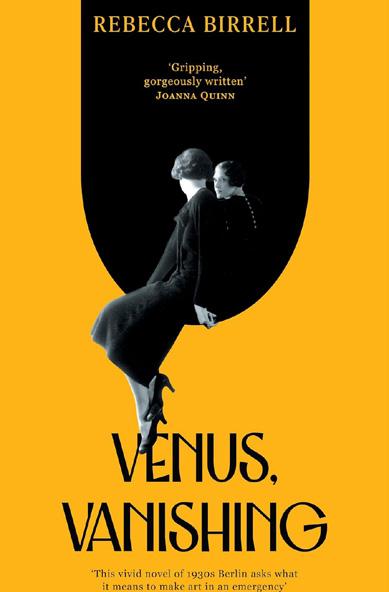
Rebecca Birrell, Picador, 2026, £16.99, hb, 384pp, 9781035085767 / Henry Holt, 2026, $28.99/C$40.99, hb, 352pp, 9781250457233 Venus, Vanishing begins in Berlin in 1927. Hannah Sherman has run away from home to avoid marriage and to pursue her dream of becoming an artist. She soon meets Saul, a museum worker, who tutors her in both love and art. Eventually she juggles two lovers: Saul and Charlotte, a dancer. Both –like herself – are Jewish.
Hannah makes her money as a seamstress and washerwoman until an offer of patronage arrives. Her patron is Elke Grese, with whom she develops a close and obsessive relationship. But as Berlin slides from the hedonism of the 1920s to the fear and repression of the following decade, Hannah’s life starts to unravel. Work for Jews has disappeared, there is no food, and she fears for her life. Almost worse, she discovers that Elke is selling her paintings under an Aryan name, and that they are being purchased by Nazi collectors.
The author states that, although Hannah is a fictional character, her story is based on that of several Jewish women artists. At the start of the book she is strong, and socially and sexually liberated, spending her time painting nudes and drinking in late night clubs. But she is gradually weakened by events outside her control, not just the persecution of Jews but also the politicisation of art and culture. At the same time that she must hide her Jewish identity in order to survive, she is also losing her identity as an artist.
This is Birrell’s first novel, and an impressive debut. Her characters are well drawn, and
she manages to draw together disparate themes: the struggles of an artist, the desire for emancipation, and the ways in which both society and individual lives can change almost overnight. Recommended.
Karen Warren
THE PARIS RESISTANCE
Sarah Bourne, Choc Lit, 2026, £11.99, pb, 320pp, 9781781899946
This historical romance is set in France during World War II. Miriam Renaud’s family is rounded up in Paris and taken away by the Nazis because they are Jewish. Miriam is hidden by family friends and vows to join the Resistance working in Paris. Pierre Vachon is from a farming family in Châteauroux who are all involved with a resistance network. Through their secret work, Miriam and Pierre’s paths eventually cross. It is only after the war, when they are both separately grappling with how loss and justice sit with a return to normality, that they meet again and fall in love.
This fast-paced novel is well-written and seems well-researched for the period. It highlights the dangers that the brave members of the French Resistance and SOE operatives had to face on a daily basis. It is not a cosy, light-hearted romance, as the nostalgic front cover seems to imply. Due to its setting and subject matter, there are lots of dark events and themes throughout, including the Holocaust, concentration camps, torture, murder, violence, betrayal and retribution. The characters’ love stories are more of an additional extra to the action, which is the main event.
This story would suit readers who enjoy novels set during World War II and want to learn more about the French Resistance. If you are looking for a feel-good romance, this is probably not for you.
Lizzie Bentham
THE NOWHERE SISTERS
Jan Casey, Choc Lit, 2026, £10.99, pb, 352pp, 9781807880088
The Nowhere Sisters is the latest addition to the now extensive body of work – literature, drama, TV, radio and even sculpture –inspired by the Kindertransporten. In 19389, ten thousand unaccompanied children, mostly Jewish, were evacuated from Germany, Austria and Nazi-occupied Czechoslovakia to Britain. Most travelled by train, and were taken in by British families who had agreed to ‘sponsor’ them.
The British like to remember this as proof of the welcome they give to refugees, although the reason why the children were unaccompanied was that the British government was reluctant to give the parents visas. Unaccompanied children were OK as they were expected to return home after the crisis. Sadly, this seldom happened, to the great economic and cultural advantage of the British people.
The Nowhere Sisters is really two books.
The first covers the years 1938 to 1946 and centres on three girls who grow up together as sisters in a sponsor family in Surrey. Ilse and Margarete are Kindertransport children aged 4 and 12 in 1938, and Judith is the 10-yearold daughter of the British sponsors. This is by far the better part of the book, conveying the fear and bewilderment of the refugees and the tensions between them and their foster parents. Margarete had ‘adopted’ Ilse as her sister on the journey to England, to comfort and protect her, and then had to live with deceit throughout the war years, dreading being unmasked.
The second part of the book covers the next 60 years, following the lives of the three girls/ women and their ever-extending families. Like the earlier part of the book, this is narrated episodically, but obviously with much more widely separated intervals. The everincreasing cast of characters is confusing and difficult for the reader to engage with. I would have preferred the book without the post-war follow-up, The story of Kindertransport is dramatic enough in itself.
Edward James
THE LAST QUARTER OF THE MOON
Chi Zijian, trans. Bruce Humes, Milkweed, 2026, $20.00, pb, 319pp, 9781571311474
This lyrical epic novel moves from the narrator’s childhood at the beginning of the 20th century to her old age near the end of the 20th century. The narrator, unnamed, is a member of the Eastern Chinese Evenki tribe, a small, reindeer-herding community who which lives off the land and believes in the spiritual power and magic of nature. Their beliefs are based on the interpretation of the wilderness surrounding them and how to protect their way of life.
Her childhood is surrounded by her extended family. Linke and Tamara are her parents. Her sister, Lena, and her brother, Luni, grow up learning chores like milking reindeer, drying meat for jerky, making baskets, canoes, moccasins, and gloves, and baking unleavened bread. Their clan Headsman and Linke’s brother, Nidu, is the narrator’s uncle. He is the only one in the family who speaks with the Malu, or their Spirits, which factors deeply into the soul of the narrator through the novel.
The clan lives on the right side of the Argun River, which is situated between the mountains of eastern China and the Siberian Russian landscape. Their only connection to the outside world is a tradesman, who comes a few times a year, bartering goods like salt, bullets for hunting, liquor, flour, and cloth, in exchange for pelts and reindeer antlers. As political turmoil and wars impinge upon their way of life and the environment, they are forced to move camp, led by ancient customs, reindeer, and the forces of nature.
Throughout her life, the family is forced to make difficult choices that go against their beliefs. The clan endures the trauma while
also relying on each other. The novel elicits emotionally nuanced characters, personifies nature and reindeer as characters, and buffets the complexity of the story.
Monica Carter
AN INFINITE LOVE STORY
Chanel Cleeton, Berkley, 2026, $20.00/C$28.99, pb, 352pp, 9780593816936
In 1968, NASA’s space program is in full swing after President John F. Kennedy’s inspiring vision about landing a man on the moon. Astronaut Joe Mitchell is the mission lead for another lunar expedition, and his beloved wife, journalist Viv, waits at home for him to return. She is a reluctant supporter, not fully convinced that the program is where millions of dollars should be spent, as wives and families live in terror while presenting the façade of perfect families. This plotline is intermixed with Joe and Viv’s earlier love story.
But something has gone very wrong, and the spacecraft is missing. After an agonizing week, no sign of the crew can be found. The men are declared dead. But Viv refuses to believe the dreadful news, especially after she sees clues from her missing husband, messages that seem to tell her Joe could still be alive. No one believes her.
This is a fascinating time, one that still captivates attention today. Cleeton throws us into the action immediately, and we feel Viv’s tension as she waits for news. Cleeton has a deft hand with dialogue and character development, drawing us believably into the scenes. The reader is rooting for this fate-destined couple to be reunited, largely due to the backstory that builds relatability. Also, Cleeton does a terrific job of exposing the hidden costs of the wives and families sacrificing personal freedom and, at times, happiness to support the astronauts.
What I felt was missing was more placement into time and location. At times the dialogue feels too modern, and I would have liked more description and sensory details to make me feel like I was in the 1960s. Overall, I loved the book and the main characters. The momentum builds at a great pace, and Cleeton’s style is engaging and well-written.
Deb Stratas
THE MURDER INVESTIGATION OF ADOLF HITLER
Peter Clenott, Level Best-Historia, 2026, $17.95, pb, 237pp, 9798898201319
Less than a month after he joins the Munich Homicide Division, Avi Kreisler is called to investigate the death of a young woman, her body found crushed against the curbstone in front of her apartment building. An apparent suicide, Kreisler’s superior insists. But the crime scene raises suspicions that the woman was a blackmailer. Although the apartment was carefully ransacked, a letter remained hidden, taped inside a window shade. It’s an intimate
message from Adolf Hitler to his niece, Angela (Geli) Raubal.
When Geli is found dead from a gunshot wound days later, Avi is reluctant to believe what his superiors and members of the National Socialist Party insist—that Geli killed or accidentally shot herself after an argument with Hitler the day before—and follows the facts himself.
The Murder Investigation of Adolf Hitler is based on actual events: Geli’s death, questions about Hitler’s possessive relationship with the girl, and the short-shrift investigation—no inquest or autopsy. The novel rises above a police procedural, placing the murder investigation in historical context: the early days of Nazism, the rise of Adolf Hitler, and the vociferous opposition from some Nazi and other political party leaders as well as the Communist press.
It does stumble, however, in the step-by-step detective story sense. Instead of leading the reader along, the storyline jumps ahead with unexpected lines of investigation. Instead of teasing out bits of information from witnesses, dialogue repeats already known facts. Pages nevertheless turn in the rush to find out what happened and just who did what to whom.
K. M. Sandrick
THE GREAT GAME
Arvind Ethan David, Thomas & Mercer, 2026, $16.99/£8.99, pb, 236pp, 9781662540356
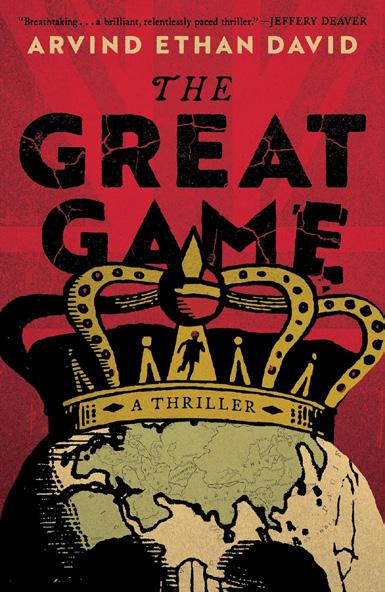
In 1905, A.J. Raffles, the “Gentleman Thief” or “Amateur Cracksman”, is reconnoitering a country house for jewels to burgle when he witnesses the aftermath of a macabre murder. Together with his off-sider “Bunny”, he then happens upon an even worse massacre of three family members. (In this reboot of the Raffles character created by E.W. Hornung, “Bunny” is now Indian trainee barrister, Balvinder dev Singh, who is the story’s narrator.)
When it appears senior public figures or imperial officials are the targets, the undersecretary for the colonies, Winston Churchill, recruits the pair in conjunction with Sherlock Holmes and Dr Watson to help solve the crimes. Singh wonders if Holmes is aware that Raffles is a crook, but he agrees with their inclusion. “Who, after all is better placed to catch a criminal mastermind than a pair of accomplished criminals?” Singh is selected to infiltrate anti-imperialist groups that may be involved. In the process, he meets spirited Irish radical, Maud, with whom he has a relationship.
This reincarnation of both Raffles and Holmes is refreshingly different, as it is seen
through the eyes of one of Britain’s colonial subjects who is conflicted, benefiting from the Empire’s opportunities while also aware of its dark side. In addition to Churchill, there are cameos of other real-life individuals. Plus, there’s another fictional character with a background that some readers may recognise, although here he is far more monstrous than his legendary Hollywood image. The result of an anticipated terrorism event is delightfully quirky, as is the closing scene featuring the latter character with some of his African “friends”.
Written with panache, imagination and wit, as well as displaying shrewd insight into the inequities of the Empire during the Edwardian era, this exceptional mash-up of fiction and reality is vividly entertaining and highly recommended.
Marina Maxwell
WHERE THE SKY BEGINS
Cindy Dees and Mary Wine, Blackstone, 2026, $29.99, hb, 378pp, 9798228506497
The first, and hugely anticipated, race for women pilots started in California in May 1929. Twenty top women pilots of the time, including Amelia Earhart, entered the race. Heading to Cleveland, it was a significant challenge at a time when women were expected to stay at home. There were only seventy women pilots in the US. Few women drove cars. Some were committed to institutions to be cured of their hysteria if they insisted on learning to fly “gallivanting like hoydens.”
Not only were the pilots considered feeble or unfit as women to fly planes, but race officials had no experience organizing flying races or even simple safety precautions for the crowds who turned out to watch. Underworld figures bribed organizers and even hired thugs to sabotage planes. The pilots had only each other for support and advice. Their leader, stunt pilot Florence “Pancho” Barnes, not only maintained morale but verbally bested inept and corrupt officials.
The authors have taken an important event in aviation history—exciting and extraordinary in itself—and developed a novel that keeps even a non-aviation minded reader hooked, turning pages to discover what could possibly happen next. The afterword is a bonus, explaining which (small) parts are fiction and how dramatically the truth played out. It also lists the pilots taking part, a little of their history and how they finished in the race.
But the race itself and the winners are only part of the story. Throughout the novel the reader is jolted by the insults, injustices, and obstacles faced by these competent pilots simply because they were women. They had far more to overcome than men in a similar race. It is a reminder to today’s readers about how very hard women had to struggle to become equal.
Valerie Adolph
THE RUINS
Becky Docton, HQ, 2026, £16.99, hb, 560pp, 9780008730765
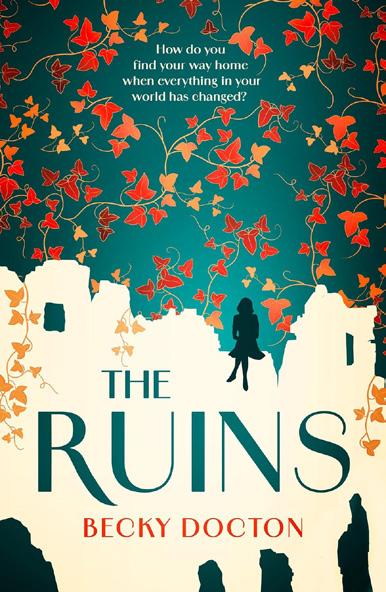
This is a long and richly woven book, written with the assurance of a seasoned storyteller, yet it is Becky Docton’s debut novel. Lucie, a bewildered seven-year-old, newly arrived in England, is delivered by her mother, Ruth, to a cousin, Clifford, at a railway station. Ruth walks over the railway bridge to the platform and never looks back.
Clifford is a tall young man hideously wounded in the Great War, and he takes Lucie to live with him and his wife, Enid, at the family’s country seat known as ‘The Ruins’, an apt name, as it turns out. Both Clifford and Enid are artists; Clifford is kind, but Enid is a drunk with a vicious tongue. Lucie hardly has time to take in her mouldering surroundings before she is sent to a girls’ boarding school. She writes to her mother, begging her to come and fetch her, but Ruth is not given the letters until she and her husband (not Lucie’s father) are sailing back to Malaya.
We hear the inner thoughts of Ruth (driven to despair by an unhappy marriage and constant miscarriages) and Lucie (abandoned, a misfit, yearning for a mother who only sends occasional postcards). As the years go by, we hear from others who enter their lives.
This is a story of Lucie’s self-discovery. As she lives through the forties and fifties, she begins to question the traditional role of women. In Ceylon, trapped in a loveless, barren marriage and stifled by the conventions of expat life, will she at last find the courage to break free and follow her own dreams?
The characters are well fleshed out, and the rotting house and grounds in Devon, the ghastly boarding school, and the tropical sights and sounds of Malaya and Ceylon (Sri Lanka) are all brought into sharp focus by some wonderfully descriptive writing.
R. Hayes
THE LIBRARY OF LEAVING
Emily Dunlay, Harper, 2026, $30.00, hb, 384pp, 9780063354951 / Fourth Estate, 2027, £16.99, hb, 336pp, 9780008695644
The most affecting espionage novels offer high stakes with political and emotional consequences, both, and Emily Dunlay’s second novel (after Teddy) belongs among them. Helen Fox is a woman of secrets. In 1926, she works alone at the American Library of Geneva and lives a tranquil life in its attic apartment. The library receives
shipments of books from American expats in Switzerland who died intestate, and she loves exploring the new arrivals. Then she opens an airmail envelope containing the first chapter of an unpublished novel by a former lover, bestselling author August Hegland. Helen had met him in 1916, when she had served as a volunteer nurse at a hotel-turned-hospital for wounded POWs in the small Alpine town of Saint-Hubert-des-Arbres. Seeing herself in the manuscript’s pages, thinly disguised as “Nurse Pandora,” Helen fears exposure of her wartime activities. After arranging for a new passport, Helen seeks distraction and accepts an invitation to the opera from her current and former protector, Austrian baron Leo von Lamberg. His past entanglements with Helen and August, and with the writer of a WWI-era diary of an arms manufacturer from Singapore, are among the mysteries this story of lost romance and betrayal carefully unfolds.
Appropriate to the milieu, the writing is sophisticated and full of Old-World elegance, augmented with literary references and the furtive atmosphere of wartime in a neutral country where agents on both sides are laying ground for their plans. Anyone dreading a stereotypical depiction about the wild past of a conservative librarian can breathe a sigh of relief; Helen is enigmatic and multifaceted throughout. What choices did she make, and why? Is she the villain of August’s story, or of her own? Dunlay keeps these questions open up to the end of her scintillating novel.
Sarah Johnson
RED SHEET
James Ellroy, Knopf, 2026, $35.00/C$48.99, hb, 518pp, 9780525656814
Set amid the chaos of Los Angeles in 1962, the novel plunges readers into a world where McCarthyism reigns, politicians hunt for closet communists, racial tensions are boiling over, and murder lurks within the corridors of power. Among the central characters are Richard Nixon, Bobby Kennedy, Tom Bradley, John Ehrlichman, Hugh Hefner, and racial activist William Rumford, who pioneered the Fair Employment Practices Act.
The narrator and key protagonist is Freddy Otash, a private investigator assigned by Bobby Kennedy—whom Otash refers to as ‘Ratfuck’—to unmask communists. A man possessed, Otash’s mind and actions operate at warp speed, and beneath his frenzied persona lies a hardened criminal battling a crippling drug addiction.
As the plot unfolds, a torrent of scandals emerges, encompassing murder, police corruption, spying, and blackmail. Ellroy does at least weave in a romantic subplot, although it feels a bit like an afterthought, between Otash and 26-year-old folk singer Judy Henske, providing a modest counterpoint to the novel’s bewildering, and often confusing, main thrust. Otash’s investigation takes him from targeting a communist-linked trade union to tracking the truth behind multiple
murders, some of which leave a trail leading all the way to the Oval Office.
In Red Sheet, however, Ellroy pushes his outlandish prose to extremes. Innumerable staccato bursts of Otash’s jargon-laden verbiage, delivered in an abrasive tone, will strike many readers as exhausting and selfindulgent. The pacing is so feverish and relentless that the novel feels less like a pageturner and more like an arduous marathon. Compounding this, Ellroy repeatedly rehashes familiar content, giving the uncomfortable impression that he is overworking a predictable formula.
A bestselling author of 22 novels and short story collections, Ellroy clearly has a devoted following. Those disciples may prove more willing than most to embrace his increasingly quirky style.
Alan Collenette
LIBRARY OF FORBIDDEN BOOKS
Mario Escobar, trans. Gretchen Abernathy, Thomas Nelson, 2026, $18.99, pb, 304pp, 9781400355815
Set in Germany between 1932 and the early years of WWII, Library of Forbidden Books is a tribute to the power of literature to defy authoritarianism. The novel was inspired by Helene Nathan, a director of a major library in Berlin in those years, though much of her life is fictionalized in this novel.
During the rise of Nazism, Helene becomes a leader in the struggle to protect libraries, bookstores, and literature in general. With the support of her family, friends, and other librarians, Helene finds ingenious ways to create secret libraries and hide books by Jewish writers and political dissidents that otherwise would be destroyed in book burnings. Helene takes enormous risks in these endeavors, and she is especially vulnerable due to her Jewish heritage. Helene’s efforts to preserve this part of German culture for future generations attract the wrath of Nazi leaders who want to eradicate any ideas that challenge their tyrannical vision of German society. Helene and her followers face the full range of Nazi terror—betrayal by informants, imprisonment, torture, and execution.
The author is a historian and prolific writer of WWII fiction, and readers will appreciate his in-depth knowledge of the pre-war era that serves as the backdrop for most of the novel. However, early chapters often describe or refer to internal political struggles among Hitler and competing Nazi leaders. While historically accurate, these details may distract the reader from the book’s central themes. When you are battling Nazis to save your culture, the ruthless infighting that occurred during their rise to power hardly matters. Nevertheless, Library of Forbidden Books is a welcome addition to that body of historical fiction that champions literature, libraries, and bookstores as powerful counterforces against cultural oppression.
Richard Corbett
LIKE WAFERS IN HONEY
Leah Eskin, illus. Jeska Verstegen, Levine Querido, 2026, $28.99, hb, 272pp, 9781646145744
Food provides sustenance, nutrition, and an expression of religious faith. Chicago-based culinary writer Eskin’s fiction debut shows how it also serves as cultural memory, honoring the customs and flavorful creations of a people whose homeland is no more. Its subject is Holocaust survivor Edda Servi Machlin, whose ancestors lived in the Tuscan hilltop town of Pitigliano, called “Little Jerusalem,” for centuries before the Nazis came. She emigrated to New York in 1958, and years later, friends and family urged her to write a cookbook. Machlin’s celebrated The Classic Cuisine of the Italian Jews (1981) introduced Americans to an unfamiliar variety of Italian cuisine.
The structure is unusual. Half takes place in 1940s Pitigliano and the surrounding countryside, as seventeen-year-old Stella Fortuna – Edda’s childhood nickname, meaning “lucky star” – sees her familiar world crumble as Mussolini imposes anti-Jewish laws. Her Christian best friend shuns her; she and her relatives are forbidden to work or attend school. The family business is vandalized, then shuttered. A sympathetic neighbor urges them to flee, and they eventually heed the warning. Stella and three siblings old enough to survive on their own disperse into the woodlands, where a succession of peasant farmers shelter them from Fascists over months. Running in parallel is the story of Edda’s later life in New York. Both are interspersed with over forty delicious recipes.
Poetically rendered yet impressionistic in places, the novel may challenge those preferring a steady, continuous narrative, yet the impressions it makes are vivid. The sharpness of freshly baked sourdough, in which “wild yeast remembered its wild past.” The honey-and-nut sticks called sfratti (“evictions”), which are bittersweet reminders of Jews’ resilience. And Edda herself, realizing with pride how she can memorialize her lost world: I’ve got folk tales too, she whispered. And mine are edible. It all forms a unique survival story and cultural experience.
Sarah Johnson
LITTLE WILD
Laura Evans, Mantle, 2026, £16.99, hb, 352pp, 9781035073061 / Henry Holt, 2026, $28.99, hb, 352pp, 9781250415066
The late 1930s remain fertile ground for fiction, yet Little Wild sidesteps familiar international tensions to explore the quieter, more unsettling terrain of family, memory and psychological fracture in a sultry corner of rural Suffolk in 1937. The novel is narrated by seventeen-year-old Margaret (“Meggie”) Goodall, whose early life has been marked by trauma: her mother’s suicide and a father given to drink and instability. Taken in by the affluent Winther family on whose estate she has lived, Meggie forms a close and intense bond with Joanie, the daughter of the house.
Around them circles landowner Fabian Winther, whose increasingly erratic behaviour introduces a note of menace. The narrative reveals long-buried secrets and the boundaries between imagination, superstition and mental disturbance begin to blur.
As historical fiction, Little Wild wears its period lightly. Evans evokes a convincingly parched Suffolk landscape—the lingering heat of September into autumn, the sense of a world suspended before greater upheaval—without leaning heavily on historical structure. There are, however, occasional moments where the period texture falters: Meggie’s use of the term “ecosystem,” though technically current by the mid-1930s, feels strikingly modern in tone and unlikely in the mouth of a teenage narrator.
The novel’s chief strength lies in its prose; Evans writes with clarity and intelligence. Characterisation is strong, especially in the shifting, sometimes uneasy intimacy between Meggie and Joanie. If the early profusion of names momentarily disorients, the narrative soon settles into a confident rhythm. Blending elements of gothic unease with hints of witchcraft and the uncanny, Little Wild is less a conventional historical novel than a finely written study of adolescence and instability. It is an absorbing, quietly disquieting work that lingers beyond its final pages.
Douglas Kemp
THE NUN OF RAVENSBRŰCK
Cathi Fleming, Hachette Ireland, 2026, £15.99, pb, 320pp, 9781399749282
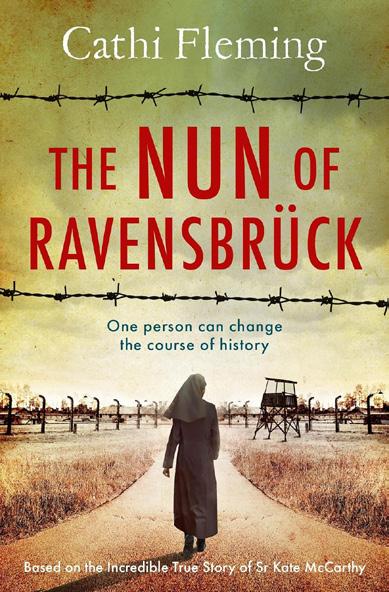
Sister Kate McCarthy spends WWI at the convent at Béthune in France. After the war, she is transferred to Louisiana, but at the start of WWII she is transferred back. One of Kate’s duties is to treat sick and injured prisoners held in a sports stadium. Kate is recruited by Sylvette, leader of the local Resistance, and, in spite of her misgivings, she agrees to help. Sylvette wants to establish ties with the Paris Resistance, but Kate is concerned that it is too dangerous. Inevitably they are betrayed and arrested. Kate is sent via Lyons to the prison in Loos, where she is held in solitary confinement for eight months. She is condemned to death, but the sentence is not carried out and eventually she is moved east through a series of increasingly inhumane camps. She meets up with Sylvette, and they travel together until they are finally moved to the camp that all the prisoners dread, the Hell that is Ravensbrück. But Kate and Sylvette are determined to survive together. This is a fictionalised telling of a true story. It tells of the horrors of prison life, from the
dehumanising effects of solitary confinement to the mindless violence of the camps, which is described in graphic detail. The bravery and resilience of the central characters are breathtaking. There are occasional acts of kindness from strangers, from fellow prisoners and sometimes even from prison guards.
It is not an easy read; pain, suffering and fear are ever-present. But it tells the story of an unsung heroine who faced great dangers and hardships with fortitude and determination. Often wondering if each day would be her last, she carried on in order to tell her story. This is Fleming’s first novel, and she has chosen an intriguing subject. Well-written and moving forward at a pace, I found it deeply moving. I cannot recommend it too highly.
David Northover
THE GLASS KEY
Amanda Geard, Headline Review, 2026, £22.00, hb, 438pp, 9781035413584
This novel belongs to that ever-popular strand of historical fiction in which family secrets reverberate across generations, the past pressing insistently upon the present. Set principally in Ireland and London across the mid-20th century, the novel intertwines wartime dislocation, buried identities and inherited grief with a polished assurance that recalls the atmospheric family dramas of Kate Morton. The story centres on two timelines gradually converging. In the contemporary strand, a discovery among family papers prompts questions about long-suppressed relationships and wartime disappearances. The historical narrative moves through the 1940s and 1950s, marked by loss, secrecy and the emotional aftershocks of war. As revelations accumulate, Geard patiently assembles a puzzle involving hidden parentage, fractured loyalties and the quiet distortions imposed by social convention.
As historical fiction, the novel succeeds less through grand historical incident than through atmosphere and emotional texture. Geard evokes post-war Ireland and Britain with convincing detail – bleak boarding houses, letters, railway journeys, the lingering austerity of the period, and the pervasive culture of silence surrounding illegitimacy and female autonomy. The historical material is carefully integrated rather than displayed, allowing the era to emerge naturally through domestic rhythms and social constraint. The prose is controlled, favouring clarity over flourish. Geard writes particularly well about memory and landscape, and her pacing is measured without becoming sluggish. Characterisation is strongest in the women whose lives are shaped by secrecy and compromise; secondary figures occasionally function more as narrative devices than fully realised personalities.
If the novel follows a familiar architecture of hidden histories and gradual revelations, it does so with intelligence and considerable emotional tact. This is an absorbing and accomplished work of historical fiction,
distinguished by its tone and humane understanding of how private lives are altered by historical circumstance.
Douglas Kemp
GHOST-EYE
Amitav Ghosh, Farrar, Straus and Giroux, 2026, $29.00, hb, 336pp, 9780374298395 / John Murray, 2026, £22.00, hb, 336pp, 9781473686694
In The Great Derangement: Climate Change and the Unthinkable (2017), Ghosh urged his fellow novelists to embrace the unthinkable, the catastrophic, the prodigious, and the uncanny. Nothing short of the improbable, he insists, can capture—and resist—the dominant reality of our time: the speed and scale of the Anthropocene. Only stories that center the marvelous can represent the power of nonhuman forces unleashed by three centuries of capitalist-driven devastation.
In his newest novel, Ghost-Eye, last in a trilogy, Ghosh once again brings extra-human and trans-individual wonders from Bengali folklore to the aid of those most vulnerable to the ravages of climate change: the poor and displaced peoples of the Global South.
The story begins in 1969 with a “case of the reincarnation type.” A three-year-old child born into a strictly vegetarian, wealthy Calcutta family develops an inexplicable craving for fish. Even stranger, she shows an exquisite ability to distinguish among local varieties and to identify their traditional forms of preparation in Bengali cuisine. An investigation into her possible past life by psychologist Shoma Bose and her nephew Dinu unravels over five decades, and the mystery of these exotic talents links the New York Stock Exchange and a Brooklyn fish market to the mud huts and mangrove forests of Bengal’s impoverished and exploited Sundarbans. Solving this mystery promises nothing less than to reverse the course of planetary destruction.
Ghost-Eye sometimes reads like The Great Derangement rendered into fiction, and at such moments the veil between author and narrator becomes quite thin. Yet the novel does something that nonfiction cannot, at least not in the same way. It brings together characters from across continents and through time, drawing them and us towards a fantastic synchronicity. By centering the story in the marvelous, it imagines our collective transformation—one inspired by forms of belief and a respect for the earth that Western progress has despised.
Anna Neill
DAUGHTERS OF NAPLES
Diana Giovinazzo, Alcove, 2026, $19.99/ C$25.99/£16.99, pb, 336pp, 9798892425995
Daughters of Naples is the story of the three Cozzolino sisters living in Naples during 194043. Mussolini has been in power since 1922, and the partigiani are actively opposing his iron-handed rule. Leta, the oldest, has the responsibility of raising her two younger
sisters, Marcella and Bianca, after their mother’s death. In 1931 Leta had abandoned her true love, Pasquale, to marry the kind, gentle Anto, who is able to provide for them – her sisters take priority over her happiness. There is little action in the first part of the novel as the author methodically introduces the sisters – their personalities, backstories, and inner lives. Leta is a dressmaker working in her mother-in-law’s dress shop while Anto is away at war; Marcella is in love with a Fascist sympathizer and apprentice to the midwife, Signora Anuzzi; and Bianca is a lover of books and works at the library with the fatherly Cesare when she is inspired to join the partigiani.
The sisters may have their disagreements and conflicts, but their connection is unbreakable. Their bonds are put to the test as the Nazis move in after Mussolini is ousted and Naples becomes even more treacherous. After we get to know the sisters, the pace builds and the pages turn quicker. The Fascist control over women’s autonomy and reproduction is shown through Marcella’s and Signora Anuzzi’s resistance by secretively providing illegal medical care. The book banning and book destruction carried out by the Fascists is told through the storyline of Bianca and Cesare at the library. Leta is pulled into the partigiani and their resistance activities when her former love, Pasquale, returns as a resistance leader. Yes, this is another WWII novel among so many, but interesting and worth reading because of the Neapolitan experience under Mussolini and Hitler. The ever-evolving relationship of the sisters will strike a chord with many readers.
Janice Ottersberg
MUÑECA
Cynthia Gómez, Putnam, 2026, $30.00, hb, 176pp, 9798217047574
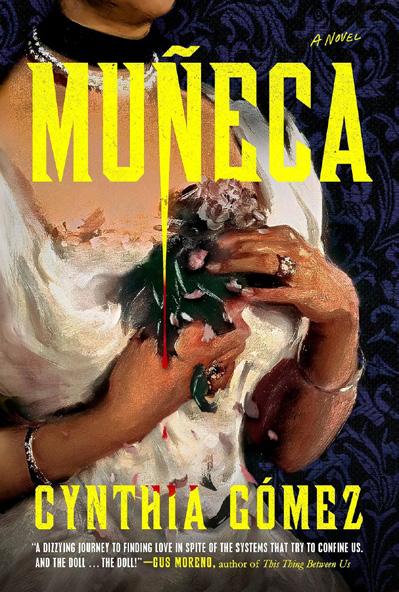
This queer and Latine gothic horror novel is set during an American tipping point. Oakland, California, in 1968 is full of war protests, class wars, and plenty of queer culture that is sick of hiding. Natalia Fuentes grew up with a good and kind mother who worked cleaning for a family from old, colonial Spanish money. The kind of money built on the backs of Indigenous people. But the family’s last scion, the beautiful blonde, blue-eyed Violeta Miramontes, must marry a wealthy Cuban refugee who needs land, as much as the Miramontes need liquid cash.
But young Violeta is struck down the day after her honeymoon, and for six years, Violeta has been practically comatose. And Natalia
thinks she knows why. There is older magic in the world than money. The kind that Natalia’s grandmother knew, and began teaching Natalia, until her good and kind mother put a stop to it. Now, Natalia will help Violeta in exchange for money, but the magic Natalia wields asks for far more than cold, hard cash.
This novel’s seething, righteous anger grips the reader immediately. Sick to the brim of injustice, racial inequities, poverty, and homophobia, Nati is done letting the world take what it wants from her. Her conviction is as period appropriate as it is relatable to the world we live in today. I normally do not read much horror, but in this book, watching Nati build her powers, and feel joy in her abilities, makes a reader not want to stop reading. What else can Nati do? What else will she do? My attention was abducted and held in Nati’s fist from start to finish. Highly recommend for a fast, wild ride.
Katie Stine
GOING HOME
Carolyn Grace, Landow Press, 2026, $14.95, pb, 194pp, 9798989230129
In Going Home, Carolyn Grace traces the changing meaning of family for orphan Georges Marchand: from his abandonment to his adoptive family, surviving WW1 and imprisonment, to eventually hoping to discover that meaning by choosing a new beginning in America.

We witness his transformation from orphan to man, from silent observer to participant in a violent history, from one who longs for belonging to one who must figure out what he must do to endure.
Georges enters life aware that a place at the table must be earned. Taken in by a struggling vineyard family from rural France, his childhood means hard labor and the burden that he’s just an extra mouth to be fed. Yet Georges still experiences moments of fragile joy through the adoption of a stray dog. Although his intelligence and math skill set him apart in school, it is his resilience that defines him, especially during WW1, when he survives, but at a cost. I enjoyed the symbolism of Georges’ life path. How a lesson learned or a decision made help him survive or influence his future. The initial glamour of the army hides an unspoken understanding that something terrible is yet to come. Before turning into a deadly reality, war arrives as an illusion. Brief victory, retreat, follow one another. Boyish joy is stripped down to the will to endure the next step. But his childhood resilience saves him:
during his time as a prisoner of war, the chance at happiness finally enters Georges’ life. The novel’s conclusion is understated, yet its final movement leaves the reader with a sense of hope. What remains is not triumph, but resilience. Readers who enjoy reflective historical fiction will appreciate Going Home for portraying endurance. They will value its depiction of hope as essential to starting over.
Patricia Furstenberg
THE WOMAN WHO HAD EVERYTHING
Stephen Greco, Kensington/John Scognamiglio, 2026, $18.95/C$24.95/£16.99, pb, 416pp, 9781496756657
1967, the Summer of Love, Taylor and Burton are in Rome on the set of Boom! The eponymous woman is Elizabeth Taylor, but a broader theme spotlights two close associates who feel confident they have ‘everything’, because they’re entrenched in her orbit. Elizabeth knows what’s missing in her associates’ lives—an essential part of us all that goes beyond profession, lifestyle, travel, compensation, and heady excitement, all of which they have. Unmarried executive assistant and loyal friend, Jean, tentatively reciprocates glances from a dishy Italian dolly grip; costume designer, Buddy, seeks to be a valued gay partner in this new age of sexual freedom. Heavily invested in their work, neither Buddy nor Jean has felt any need to indulge in love until now.
Elizabeth dislikes female co-stars and surrounds herself with gay men. In this fluid, artsy community, the casual matter-offactness of homosexuality and creativity (meet freelancer, Karl Lagerfeld) anchors the novel. Elizabeth’s intelligence, talent, humour, and infectious energy are colourfully credible, and her consideration and easy work ethic shines with a sincerity and dignity which she grants to everyone. Greco invites us to see the human side of extreme wealth, without highlighting entitlement, which is a pleasant change from the usual ‘lives of the rich and famous’ stereotype.
This unfathomable wealth—a $75,000 bespoke trailer, 130ft luxury yacht, private jet, thirty-carat diamond ring, endless parties and soirees and dining out—seems too fantastical; yet the reality is spontaneously vibrant and bursting with energy. Ignore for a while the screaming, shouting and name-calling, and the stars enjoy an eternal connection which spills over to friends and colleagues.
Greco’s readers will know he loves detailed tangential paths. Rome’s cafes, clubs, and nightlife thrum. Capo Caccia encapsulates a centuries-old cultural way of life. The movie bombed, but this is worth the fun ride.
Fiona Alison
WON’T BE LONG NOW
Elizabeth Hardinger, Kensington/John Scognamiglio, 2026, $27.00/C$37,00/£25.00, hb, 304pp, 9781496758767
Personality and relational difficulties compound Billie Enholm’s bewilderment and wonder as a child beginning to recognize herself and how she fits—or doesn’t—with her family and social circle. This historical novel follows Billie from childhood through early adulthood as she struggles to find her way through life. Her inner focus often disconnects her from knowing where she is and what’s happening around her. Frustration and alienation grow in both Billie and her family. Her personal turmoil accelerates when a tragedy decimates her hometown, for which she partly blames herself. As Billie sorts out blame, she finds herself increasingly the focus of expectations she cannot meet.
Billie’s coming-of-age tale is set in 1950s Kansas, a setting as foreign to contemporary North America as 1930s Kansas was to Oz. Billie Enholm may be this generation’s Holden Caulfield. Though many themes and terms parallel Holden’s chronicle, unlike him Billie struggles to integrate into her contemporary society. She narrates her story as an adult years after the main events.
Hardinger develops a good sense of that time and place through both details and action. She gets many details of life in south central Kansas right, but quibbles occur: beer was hardly “the drug of choice” in ´50s and ´60s Kansas. Limited to 3.2 percent alcohol by weight near beer, it was easily obtained but inadequate as an anesthetic. The profanity conveyed is not typical for language in Kansas seventy-five years ago. Some modern readers will find it offensive.
Ron Andrea
CROSSING THE BRONX
David Hirshberg, Fig Tree, 2026, $28.00, hb, 304pp, 9781941493403
Set in the Bronx in the 1950s, this novel has the immediacy of a screenplay with its wide array of colorful dialogue, characters, and action scenes. The story unravels the drama behind building a major new highway, the Cross Bronx Expressway. Will the planned route tear apart the Bronx’s Tremont neighborhood of immigrants across 176th Street, or can community pressure make power-broker Robert Moses and other politicians favor a less disruptive route along the Northern Edge of Crotona Park?
The narrator, Jay deVenezia, an Italian Jew, is fresh out of prison for conducting illegal wire taps of meetings about the expressway. He relates all to his court-appointed female shrink, Dr. Silverman. A parallel theme offers surprising insights into Jay’s dysfunctional family life. His abusive father, Ike, is a policeman under the thumb of Alberto Giaquinto, a corrupt contractor boss nicknamed 2-Cig. Jay is also estranged from his brother Eric.
The neighborhood organizes to fight its displacement, even producing T-shirts proclaiming, “Don’t Tread on Tremont.” The
battle is fierce; the corruption is deep. Major politicians and bosses who stand to profit bow to Moses’s insistence that the road cross 176th Street. Generous bribes are offered to Tremont’s businesses and homeowners to sell their properties.
The last volume in a trilogy, this is a gritty, moving and entertaining tale of familial dysfunction and political corruption in post-World War II America. Mr. Hirshberg’s unabashed use of the vernacular and slang of the era gives his work extraordinary historical precision and authenticity.
Robin Holloway
THE WITCHES OF CAMBRIDGE
Alice Hoffman, Scribner, 2026, $29.00, hb, 416pp, 9781668074640 / Scribner UK, 2026, 20.00, hb, 416pp, 9781398565296
In a time when “witch hunt” has become a politically charged phrase, Hoffman takes a thoughtful detour from her bestselling, multi-volume exploration of the magical Owens dynasty. Introducing new magical characters and families, she moves her focus to Cambridge, Massachusetts, in the 1950s as two young witches matriculate at Radcliffe College.
Redheaded Ava Abbot is bookish and shy, raised by her dour adoptive parents to see her strange abilities as evils to be suppressed, but knowing in her heart that she could use her powers for good. Platinum blonde Lauren Bell is her opposite—a child of privilege from a powerful magical Cambridge family, she is rebelliously drawn to the dark side of magic. Despite their differences, the girls are drawn into friendship that deepens when they are tapped as the two representatives of their year to join a witchy sorority in Lilith House.
Hoffman offers cozy descriptions of the “practical” folk magic practiced by the sorority; however, both girls also confront the misogynistic forces in both the mundane and magical worlds that are rising to prevent 20th century women from taking their futures into their own hands. The symbolism of the novel is hardly subtle; there are many references to the ongoing anticommunist McCarthy “witch hunts.” Ava must struggle with the fact that the boy she loves is the scion of the sinister Mather clan, the 17th-century witchpersecutors whose main target, an emigre witch named Rose Bridewell, left letters in the rare books of Harvard’s Widener Library for Ava to find.
The two timelines expand the narrative somewhat at the cost of our ability to connect with the two point-of-view characters, but fans of Hoffman’s unique take on witch lore and her customary light/dark approach to romance and suspense will continue to delight her readers.
Kristen McDermott
BELONGING TO THE AIR
Avery Irons, Screen Door Press/Univ. Press of Kentucky, 2026, $27.95, hb, 296pp, 9781967165001
Beginning in 1912, Honest Bennett, known as “Bird,” lives with her mother, Maddy, and blind grandmother, Odelia, in an all-Black town in Illinois, named Bennettsville for their freedmen ancestors. They are somewhat of a family of outcasts, however, since Bird was born out of wedlock, after her preacher father opted to leave Maddy and marry a more conventionally religious woman instead. Maddy has a sewing business, and they live a rather isolated life, but Bird becomes friends and later, lovers, with Bessie, the schoolteacher’s daughter. Knowing about the girls’ relationship, Odelia sends Bird away to stay with her Aunt Vera. As time passes, Bessie marries and Bird’s family life undergoes major changes. Spurred on by this, Bird wants to experience the wider world and migrates to Harlem in 1922. She sets up her own sewing business and is determined to shed her “country” upbringing and become a New Yorker.
African Americans who lived outside the Jim Crow South in that era still had many raceconflict issues to deal with. Bird is nearly caught up in the East St. Louis race riots in 1917 when visiting Vera. Later, when the whites of the neighboring town try to drive the Bennettsville residents out, Bird returns home to help. The experience of women living a clandestine lifestyle in the early 20th century is sensitively portrayed; Bird is lucky to find a lesbian mentor. While the pace is rather leisurely, the rich characterizations and compelling prose and dialogue kept me fascinated to learn whether Bird would reconcile with her past and find a way forward. A book to be savored.
B.J. Sedlock
BENEATH A RADIANT MOON
P. L. Jonas, Scarsdale Publishing, 2026, $16.95, pb, 362pp, 9798247059271
This is the saga of a Slovakian American family that begins in 1907 in Hungary and ends in 1965 in America. The family is fictional but loosely based on the author’s family. The story begins with our protagonist, Mira, living in her beloved village in Hungary with her husband, Janos, and their son. Things are tough for Slovaks at the time, because of the Hungarian policy of Magyarization, aggressive assimilation of other cultures, including the Slovaks. After the Cernova massacre, when villagers protesting Hungarian interference in the consecration of their new church are murdered, Janos decides it is time to move to America. Mira is resistant and does not want to leave her family, although her sister has already departed for America. Janos goes without her and promises to send money and visit as often as he can. This starts a long period of separation, trials, and loss for both of them. When Mira finally agrees to go to America, more trials await, including the
start of the Great War and the Spanish Flu epidemic.
This is an honest, realistic, and captivating family story. The characters are well developed and deeply relatable. This is a story of love, but also heartache, tragedy, loss, and betrayal. Both Janos and Mira show periods of selfishness that affect their marriage. Along the way, they experience tough times, and family secrets begin to surface. I enjoyed the descriptions of Slovakian traditions, customs, and food. There is an honest look at racism at that time, including discrimination against Mira’s friends, who are Jewish, and Janos’s horror at the East St. Louis Massacre in 1917. As the family changes and grows, so does the country and the world. Recommended.
Bonnie DeMoss
BILLIE KING
Shannon Kelly-White, HarperCollins AU, 2026, A$34.99, pb, 320pp, 9781460768891
This anarchic tale is set in and around Orilong, a fictional rural Australian town, between 1918 and 1930. It has three female protagonists: Dulcie, known as “The Lady Bushranger”; Anna, an ill-used wife who keeps a diary; and Billie, her rebellious twelveyear-old daughter.
Dulcie is wanted dead or alive for various crimes, including murder. Anna, who was known to Dulcie, disappeared when Billie was a baby. Circumstances transpire to bring Dulcie back to Orilong years later, and she’s determined to solve the mystery, which results in challenging the three men who must know something, being Billie’s father Ken, the local priest Father Shaun, and powerful landowner Stanley.
While there’s rough language and even rougher behaviour throughout, this entertaining, riveting tale goes further than just a case of retribution. It delves into the nature of motherhood, female friendships and loyalty, and above all, a determination to see justice done, no matter the cost. As the browbeaten Anna observes in a diary entry after seeing an extraordinary natural phenomenon: “I can imagine life getting better. I swear, all of a sudden, I can imagine a whole bunch of things. I reckon it’s because of what I seen today. Seeing something like that changes you. Gets you dreaming. Gets you believing that even dark lives have bright sides.”
One can’t help comparing this novel to Tarantino’s “Kill Bill” movies, with its violent, revenge-seeking kick-ass female protagonist – or two, in this case. The blunt dialogue may challenge some readers with its smatterings of obsolete Australian slang and idioms, but it’s highly recommended to stick with the story, as it all comes together effortlessly when Billie joins forces with Dulcie in an adrenalinloaded conclusion. An excellent, rollicking debut novel from Shannon Kelly-White. Marina Maxwell
THE CASPIAN AMULET
Anne M. Kennedy, Wonky Cat Press, 2026, $13.99/£9.99, pb, 384pp, 9781068630231
In 1901, Baku, now the capital of Azerbaijan, was an oil-producing powerhouse within the Russian Empire. It’s a part of the world and a period that may be new to many, offering a vibrant background to this complex historical mystery. Klara Sabroski’s husband Anton is an oil baron with political aspirations, but his egalitarian views don’t suit everyone in a society rife with rigid class structures and religious differences. As rumors swirl about a recent bank robbery and the subsequent sinking, in the Caspian Sea, of the boat carrying the loot, Anton’s pursuit of the truth attracts enemies. Someone frames Anton for a murder he didn’t commit, and Klara is forced to step up, going to extraordinary lengths to free him. She enlists the help of her friend Miranda, an unhappy wife who feels her life lacks purpose. When Miranda finds an outlet by helping at the local hospital, she’s also able to help Klara’s enquiries into several suspicious deaths.
Readers who choose historical fiction to learn about unfamiliar places and people, while enjoying a high-stakes drama with strong female characters, will be pleased with this one. Klara is an outspoken and unconventional wife, as is Miranda, although her rebellion is less public. Matters are complicated by a missing amulet, the machinations of the sinister Necrolanus, a Rasputin-like figure, and the ruthless Russian secret police, the Okhrana. In her author’s note, Kennedy writes of her time living in Baku, and her intimate knowledge of the geography and history of Baku is evident throughout. Second in a series but can be read as a stand-alone novel.
Kate Braithwaite
A BOTANIST’S GUIDE TO TRADITION AND TREACHERY
Kate Khavari, Crooked Lane, 2026, $29.99, hb, 336pp, 9798892424394
This is book 5 of the Saffron Everleigh mysteries, set in the 1920s, when women have begun claiming new public lives. Saffron is a botanist, and her fiancé Alexander Ashton fully supports her career. But as the two of them take part in an archaeological dig in newly re-formed Turkey, Saffron is the only professional woman among the researchers—and historian Joseph Clark persists in tormenting her, with most of the other men finding Saffron’s troubles either amusing or not worth discussing. The gentle and shy Martin Neill accepts assignment as an assistant to her (with Alexander hoping Martin can keep Saffron safe), but among collapsing ruins, a venomous viper, and Martin’s sudden death, the risks are deadly. And that doesn’t even begin to consider the poisonous plants on which Saffron is an acknowledged expert! After all, her expertise got her into this. Alexander’s a great support, of course, but Saffron’s acutely aware that he doesn’t grasp the forces aligned
against women in the field—he just wants to protect her. “On the expedition, she had to be self-sufficient if she was ever going to win respect on her own.”
Beyond the quick action scenes and repeated threats to Saffron’s life and liberty, Khavari delivers an empathetic yet clearsighted portrait of early feminist challenges and shows they really haven’t vanished after all. Unfortunately, the eventual reveal of the villain may not be ideal for Saffron’s efforts to move beyond the culture of her time.
Beth Kanell
HYPOCRITE’S ROW
Eliot Kleinberg, Level Best-Historia, 2026, $17.95, pb, 246pp, 9798898201630
LOST IN THE SUMMER OF ´69
Eliza Knight, Sourcebooks, 2026, $18.99, pb, 400pp, 9781464255113
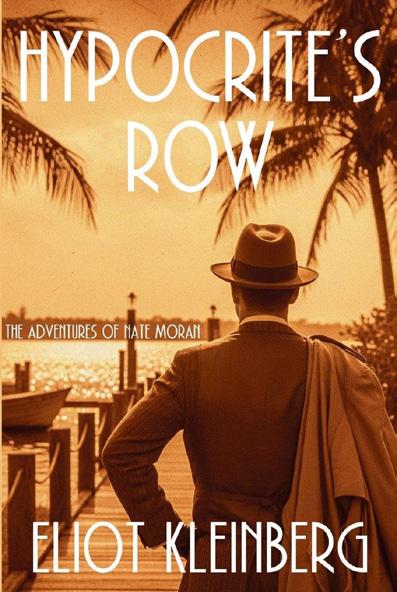
Miami, Florida. This novel begins with tragedy, and Nate Moran, Miami police detective, having to give the worst possible news to the wife of a fellow law enforcement officer. In Miami during the Prohibition era, police were sometimes thought of as the bad guys, and “rum runners” were often hailed as heroes to a public that generally disagreed with Prohibition laws. And, as the author writes, Prohibition was “just a suggestion” in Miami. This is a crime procedural/noir with a fedora-wearing protagonist, but it is so much more. Going over and above the no-nonsense tone of hardboiled fiction, we see vivid description, such as the aftermath of a hurricane, and we feel so much emotion, whether it is the heartbreak of a wife finding out her husband is dead, or the anger at learning a little girl has been murdered. When Moran digs a murdered child out of the ground, every moment is felt. His interactions with his own children and “The Missus” range from lighthearted to deeply emotional moments that add layers to the story. Nate is flawed, but his flaws mostly involve crossing lines when trying to catch murderers instead of the classical moral defects. Small personal details define his individuality. He drinks lemonade. He chews candy cigarettes because The Missus doesn’t like him smoking. It’s a glorious contradiction of character for the genre.
Hypocrite’s Row is inspired by an actual hotel hallway that led to a speakeasy in Palm Beach where elites would go to drink during Prohibition, some of them while actually supporting Prohibition publicly, and Nate definitely finds hypocrisy in this book. This is hardboiled fiction presented in the best possible way, with emotional depth and a refreshingly likeable protagonist. Highly recommended. Bonnie DeMoss
It’s 1969, and widow Eleanor Bell Strickland, age 69, longs for the free-spirited musician days of her youth. Although she’s been a dutiful housewife and mother for decades, she’s kept up with the current music, playing guitar in her own home. A diagnosis of dementia pushes her for one last try at joy, before she can no longer remember. Without telling her daughter or granddaughter of her plans, she flies to California, hoping to perform at an open mic event at a music festival there. Eleanor’s daughter, Leanne, a buttoned-up suburban housewife, is dreading the fall when her only daughter will leave for college. Nineteen-yearold Nora is looking forward to one last summer with her high school friends before she enters Yale in the first class of women admitted there. When Leanne and Nora discover Eleanor has taken off to California, they set out on a cross-country trip trying to “rescue” her. As the summer unfolds each will learn truths about herself, truths about each other, and emerge in the fall to follow new paths.
With lots of references to the great music of the ´60s, readers will find themselves humming along with Eleanor. The only backstory detail I did not find convincing is that teenage Eleanor had a guitar-playing, music-festival career in the era of Ragtime and Vaudeville. But all the 1960s research seems spot on, from my perspective as a child during those years. This will be a great book club book, as it covers three different eras of women’s lives and the choices available in each. Readers will find a lot to discuss, not only about the book, but about the paths their own lives have taken. The book includes a helpful reading group guide.
Lisa Lowe Stauffer
NOTHING TO MY NAME
Kangkang Li Kovacs, Bloomsbury, 2026, £18.99, hb, 389pp, 9781526687289 / Viking, 2026, $29.99, hb, 400pp, 9780593835364
How China has changed in less than a lifetime! This family saga, set in three locations in China between 1948 and 1999, follows the lives of a mother and daughter from when the mother is age 12 until her daughter reaches age 17. Ah Xue (after her marriage we know her as Mimosa) is herself the daughter of an illiterate fisherman’s widow and part-time hairdresser. By the end of the book, her own daughter, Fei, is a physics student at Beijing University.
The story is not narrated chronologically. Initially it is in two timelines, the one beginning in Zhoushan in 1948, in the dying years of the Nationalist regime, and the other in Nanchang in 1989, at the time of the student protest in Tiananmen Square. Even when the timelines merge, there are long stretches of remembered events, filling in gaps in the earlier narrative, so the reader still has to fit together a complex jigsaw. It would also have been useful to
have had a map of China with the principal locations.
But even if this makes demands on the reader, the reward is a series of wonderful set pieces, beautiful, inspiring and sometimes horrifying, some specific to the experience of girls and women in later 20th-century China and others reflecting the universal human experience. Confusing but enjoyable.
Edward James
MEET ME IN THE GARDEN
Nina LaCour, Flatiron, 2026, $29.99, hb, 400pp, 9781250810472
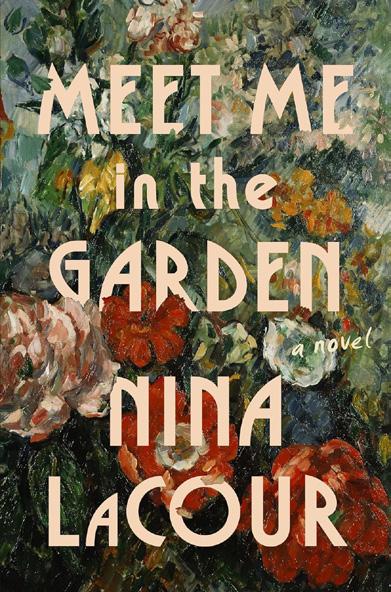
A Creole family saga beginning in New Orleans during World War II, this story is told by Odette, youngest of the three Honore sisters. She is the only one who does not want to be a wife and mother, which she confides to her cousin Delphine in the secret garden where they meet.
Odette wants to be an artist and is in love with a woman, and Delphine loves a white man. “What does it matter, anyway, what anyone thinks of us?” she asks, and for a while they believe that will be their key to freedom and happiness. Then, pregnant, Delphine vanishes with her lover. After the war, Odette finds herself on a very different path than she imagined—now a widow and mother— and travels with her family to California for opportunities away from the racism of Louisiana. Despite the bigotry they discover in Los Angeles, the husbands of Odette’s sisters get jobs at Columbia Records, as does she, living in Compton and sharing childcare.
This complex story reflects the realities of L.A. and social attitudes from 1948 to 1965 for the three sisters, their husbands, children, a wild younger brother-in-law, and those they love. Their lives are challenging, and each person’s heart is even more so. Everyone is conflicted or yearning in one way or another, especially Odette, who creates a unique family of her own but fears following her heart.
LaCour is a brilliant writer, depicting the Watts riots of August 1965, which were motivated by anger at the racist, abusive practices of the L.A. Police Department, employment discrimination, and residential segregation from her characters’ experiences. Their engaging portrayals and the twists of familial connections add to the strength of this novel. Highly recommended.
Jinny Webber
THE VERY SECRETIVE AND PASSIONATE STELLA MILES FRANKLIN
Alexandra Lapierre, trans. Tina Kover, Europa, 2026, $19.99/C$30.95, pb, 496pp, 9798889661887
Reading a brief summary of the tumultuous life of the Australian writer Stella Miles Franklin makes one wonder how she felt when living through those many twists and turns, from her birth into an impoverished farmer’s family in the bush in 1879 to becoming a literary sensation in 1901 with My Brilliant Career, a path-breaking novel about a young woman in Australia. Shortly thereafter Miles, as she prefers, heads to Chicago, working with the feminist Women’s Trade Union League, then to England, where she works as a housemaid in order to write about how badly they’re treated. From there, Miles enlists in the Scottish Women’s Hospitals, serving the Serbian Army in Macedonian Greece; then back to London, returning to Australia in 1932, where she publishes a series of historical novels under a pseudonym, beginning with her descent from an English convict. What kind of woman lived such a life, and how did she feel thorough all those dramatic changes?
Alexandra Lapierre tells us, aided in large part by the bounty Miles Franklin bequeathed to the State Library of New South Wales on her death in 1954: unpublished writings, letters, and private diaries. This novel gets inside Miles’s head: her deep conflicts over love and sex, her commitments to social justice and feminist causes, and her inner strife and her confusion about what best to do with her life. The novel quotes directly from Miles’s diaries and fills in the surrounding stories. The result is not only the compelling story of a remarkable, rebellious woman who brought Australian literature into the mainstream (and established two prizes for Australian writers), but makes a significant contribution to literary history, including bibliographies, photographs, and useful notes. Originally written in French, this translation beautifully captures the secrets and passions of a rare woman.
Jinny Webber
THE CHATEAU ON SUNSET
Natasha Lester, Ballantine, 2026, $20.00, pb, 384pp, 9780593726556 / Sphere, 2026, £2.99, ebook, 385pp, 9781408731819
In this absorbing re-imagining of Jane Eyre in 1950s and ´60s Hollywood, we meet Aria, an orphan whose world revolves around the famous Marmont hotel. The hotel is filled with a colorful cast of characters—everyone from failed actors with lurid secrets to freshfaced young starlets hoping for their big break. Aria starts out as the ugly duckling who just wants to stay under the radar, but two older girls, Flitter and Calliope, take her under their swanlike wings, and the three form a tight bond. As the years go by, Aria becomes the invisible backbone of the Marmont,
helping young women escape the clutches of predatory film directors.
When brooding rock star Theo Winchester buys the Marmont, bringing his teenage daughter Adele to live there, Aria makes a bid to be Adele’s tutor, needing just a few more months of employment to save up enough money to start her own life outside the Marmont’s walls. But her attraction to Theo gets in the way of her individual dreams, and everyone seems to be keeping secrets from her, even her beloved friends Flitter and Calliope.
From the first page, Aria’s voice is sharp and cheeky, and the novel oozes with atmosphere. Lester’s mid-century Hollywood setting is pitch-perfect, and she manages not to allow the stars passing through the hotel to outshine her protagonist. However, the Jane Eyre allusions are blatant and verge on parody rather than homage. The author could have trusted her readers to see the echoes of Brontë’s famous novel for themselves. Overall, this is a page-turner that takes readers on a wild and enjoyable ride.
Clarissa Harwood
FALLEN FOR FRANCE
Elizabeth Letts, Ballantine, 2026, $32.00/ C$44.00, hb, 336pp, 9780593496923

This is the story of Tassa, an Arabian horse, and the people whose lives she braids together for one terrible moment during World War I. There is the boy Beddou, a Moroccan shepherd, who falls in love with the noble mare who appears unexpectedly in his life; Hassan, his charming scalawag of a supervisor, who gambles away the horse then steals her back; and JeanBaptiste, a lumbering pied-noir (Algerianborn Frenchman) who thinks the horse is his. The war breaks out. Colonial troops, two-footed and four-footed, are mobilized and sent to Europe. On the eastern front, Estelle, an independent young Frenchwoman taking care of a disabled brother, enters Tassa’s magic circle. And Thomas, the English veterinarian, whose sense that he caused his sister’s death has curdled his life. Through the Battle of the Ardenne Forest and the German occupation that follows, the characters meet and drift apart, love one another or long for a love remote and unattainable. They show kindness, inhumanity, and a longing to live and grow. And always the pure animal innocence of a horse teaches and heals.
This is a beautiful novel, part War Horse and part A Farewell to Arms. The characters are richly developed, the scenes brought to life with cinematic detail. Letts, best known for
her equestrian books, has lived in Morocco and France, and it shows. The reader will ache for each of the protagonists as happiness seems just to escape their grasp… or does it? What is happiness, after all? The author makes us think about many deep things in a book that I read compulsively. Highly recommended.
Niki Kantzios
MIDNIGHT PATRIOTS
Paul Levine, Nittany Valley Productions, 2026, $18.95, pb, 393pp, 9798994263013
1940. Albert Einstein and Charlie Chaplin are back for another thrilling adventure. Right away, there is trouble, as Chaplin is soon climbing outside of his New York hotel window and trying to escape from a hit man, set upon him by an angry William Randolph Hearst for the crime of sleeping with Hearst’s mistress, Marion Davies. But darker forces are after Chaplin. Adolf Hitler has sent an assassin to take Chaplin out due to his unflattering movie, The Great Dictator. And the action doesn’t stop there. America is trying to persuade Einstein to work on the atomic bomb, a job he keeps refusing. Germany has decided not to ask at all, and is instead planning on kidnapping the eccentric scientist.
This is another impeccably researched and compelling tale starring the powerful duo of Einstein and Chaplin. A plethora of real-life historical figures make an appearance in this novel, and well-known celebrities of the 1940s wander in and out as Einstein and Chaplin travel America. Members of organized crime such as Mickey Cohen figure prominently in the story. Fact and fiction are woven together well. Fritz Duquesne, a notorious Nazi spy, has been ordered to kidnap Einstein, and he is accompanied by a fictional German assassin, who plans to take Chaplin out at the same time. One of my favorite scenes is when Einstein, trapped in a hail of gunfire, figures out how to create nuclear fission.
So many issues are touched upon in this book, including racism, war, workers’ rights, and organized crime’s involvement in Hollywood. Despite the number of characters and issues, the book does not become confusing. Instead, it is a snapshot of early 1940s America. There is also an informative afterword with short bios of the historical figures included. Thrilling, sometimes humorous, and clever. Highly recommended.
Bonnie DeMoss
CHELSEA GIRLS
Catherine Lloyd, Kensington, 2026, $18.95/ C$24.95/£16.99, pb, 320pp, 9781496756619
Mary Quant, the name which still outshines every other as innovator of young women’s fashions in 1950s and ´60s London, is a natural talent, a tenacious worker, a fierce defender of her unusual designs. Alongside her husband, the unorthodox APG (Alexander Plunket Greene), Mary becomes the name behind swinging´60s Britain and one of the early entrepreneurs on run-down King’s Road. In 1955 she opens
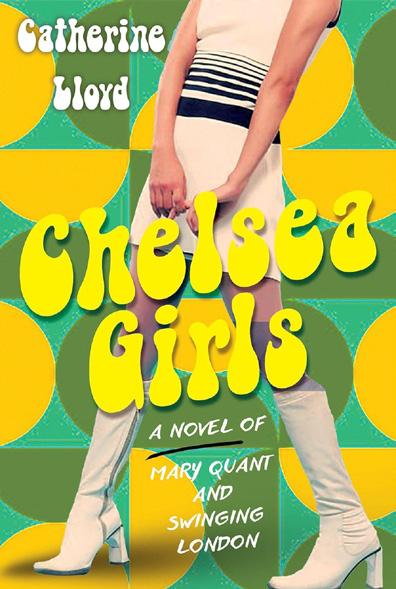
Bazaar—an eclectic bohemian boutique where the customers go gaga over Mary’s innovative look. It sells out in days. In Knightsbridge, the second Bazaar has instore models: Jean Shrimpton, Pattie Boyd (Harrison), Twiggy. The swinging London Youthquake enthusiasm soon takes the US by storm.
Britain is primed for a change, and Mary channels it. Those changes are lived by Lloyd’s three fictional characters: Chrissie meets Mary at Goldsmith’s in 1951, a life-long trusted friend and devoted employee; Daphne, daughter of a peer, first to earn a wage in her family, determined to shape her own destiny as a model; Fern, a teenager from a dysfunctional family, which doesn’t deter her from becoming a top model.
Barbara Mary Quant (1930-2023) designed and made her own clothing in the early ´50s, and became a world-renowned rag-trade designer of hundreds of items per year by the mid-´60s. She was a formidable saleswoman, who never overcame her stage fright, using APG as the company front man. She remained relentlessly dedicated to her customers’ expectations: young women demanding fun, vibrant, sassy clothing, a world away from dowdy wartime makeovers. Lloyd’s novel ripples with Mary’s energy, illustrating her kindness, never expecting more of others than she gave herself. Notable cameo appearances add flavour to the era. I was easily able to conjure those teen days, the atmosphere positively thumping its way through 1960s Britain. Definitely recommended.
Fiona Alison
THE SILENT WOMEN
Tara Lynn Masih, Storm, 2026, $19.99/£16.99, pb, 247pp, 9781837005536
The Silent Women follows the life of one woman through the second decade of her life, which straddles the Second World War. Her name is Song Holloway, not because she is Chinese but because her mother is musical. The story begins in Dust Bowl Oklahoma and continues through New England and Tennessee to Song’s early married life in rural north Florida. The high point is her two years at Oak Ridge, the secret city built by the US army in the Appalachian forest to develop the Manhattan Project (the atom bomb).
Oak Ridge was a huge engineering project and unintentional social experiment, bringing together tens of thousands of young people from every part of America and every social and ethnic background. It was isolated, ultra secure, and wrapped in layers of secrecy. Only
a very few knew the purpose of their work, although the reader can easily guess.
The most impressive aspect of the book is the depth of Masih’s research, which she conveys to us without info-dumping. She tells you what it is like to live in a Quonset hut and how to grow gladioli commercially, and a lot else. This is a coming-of-age story, not only that of Song but also the dawn of the nuclear age and the post-war world.
Edward James
THE CLOAK AND DAGGER CLUB
Jackie McMahon, Berkley, 2026, $30.00/ C$41.99, hb, 368pp, 9798217189557
The Detection Club, a group of celebrated British mystery writers including Agatha Christie and Dorothy L. Sayers, was both social and literary in function and meetings. During this Golden Age of detective fiction (1920s and 30s), on the heels of the Great War’s trauma and destruction, English readers latched onto this genre with its promise: murder and violence would be brought into rational order. They met regularly and dined together, mainly to uplift their genre of detective fiction from the low-end sensational to the serious-minded novels they wrote, agreeing on “fair play” rules and establishing principles of detective fiction.
The clever concept for The Cloak and Dagger Club is based on the real 1930 Detection Club. A much smaller writing club, McMahon’s authors are, of course, suspects in the murder plot. Their leader and most successful of the lot, Horace Hazelmoor, is also a blackmailer and despicable man with a list of names. No surprise there. Who murdered him, by poison and stabbing, creates the mystery puzzle, but there’s little method of forensics or police detection. An excerpt from each club author opens a chapter, hinting at their fictional characters and connections, a nice touch, amid the story of Lucy and Frank, who pair up to solve the murder of diabolical Horace. Childhood friends from Bournemouth, they went to London, where Frank found instant success causing their broken engagement. Only three years later they are well-known writers (implausibly quick work) and, together, trying to prove their innocence.
A facile read, The Cloak and Dagger Club emphasizes the romance between these young, estranged authors, which drives the pace while reconciling their love affair across a hyperbole of overused phrases: he sighed, she bit her lip, and everyone, it seems, is taking a deep breath. This reader wonders: Where are today’s editors?
Christina Nellas Acosta
WHEN THE GLITTER FADES
Jacqx Melilli, Escribano Publishing, 2024, $19.31, pb, 430pp, 9780975680056
In 1920s Australia, two young men, Vinnie and Artis, join a touring entertainment troupe. Both want to escape troubled pasts and achieve fame and fortune. Soon Vinnie
becomes the troupe’s manager, with Artis as his trusted second-in-command. But trouble starts when they both fall in love with Belle, a talented singer and dancer who auditions to join the troupe. Vinnie and Artis part ways, set up rival troupes, and compete for Belle’s attention. When Belle marries Artis, Vinnie becomes obsessed with revenge. What follows is a tragic tale of sabotage and injury, with links to the criminal underworld, played out through the years of the Great Depression and World War II.
When the Glitter Fades is loosely based on the family history of Shirley Barnett, an Australian show business veteran who grew up in a family of vaudeville performers and, as a child, was contracted to perform as Australia’s Shirley Temple. It captures key moments in Australia’s entertainment history from the 1920s until the emergence of television – with details about the Association for the Advancement of the Blind’s travelling variety concerts, vaudeville, burlesque, and circus. It provides insight into the challenges of a career in entertainment. In her author notes, Jacqx Melilli describes her process of interviewing Barnett and researching Australia’s entertainment history before turning to novel form.
When the Glitter Fades is a family saga that traces the actions of multiple characters over many years. It’s written as a chronological narrative and feels more like an historical reflection than a novel that firmly places readers in the action. While the plot is fascinating and readers are left wondering how two men could possibly get so caught up in revenge, readers may feel distant from the text due to its lack of emotive detail and character development.
Judy Gregory
MIRIAM IN THE SHADOWS
John Winn Miller, Bancroft Press, 2026, $27.95, hb, 360pp, 9781610887113
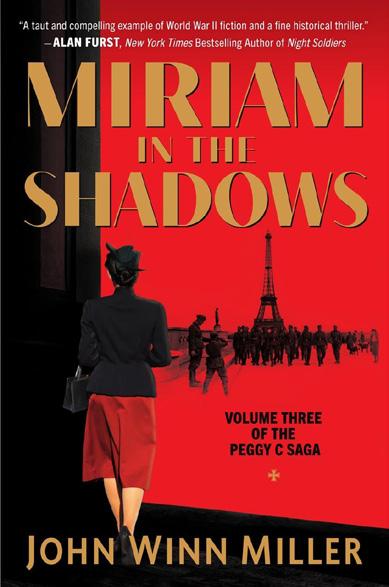
Spring 1944, France/England. Twenty-sixyear-old Miriam Maduro, a Dutch-Jewish member of the Special Operations Executive (SOE), re-emerges from a tortured past when forced to accept a dangerous D-Day mission. She must infiltrate and destroy the Nazis’ hidden V-2 rocket facility in northern France while the Allies prepare to land in Normandy. While she undergoes rigorous training for this dangerous espionage mission, Jake Rogers, an American cargo ship captain who saved Miriam’s life during an earlier assignment, is recruited by Naval Intelligence
to also destroy the facility, yet internal betrayals lead to his capture by the Germans. When Miriam learns of his imprisonment, she must make a heartbreaking choice: complete the mission and save thousands of lives, or risk saving her lover and the father of her child.
John Winn Miller’s third novel in the Peggy C Saga is a tense, fast-paced, action-packed historical thriller. Miller’s meticulous attention to detail, and his thorough research into the international World War II environment, provides a gripping, true-to-life setting for this intricate, immersive story. Miriam is a strong, multi-skilled, and fascinating heroine who is presented as not only extraordinary in her daring, but very human and real in her personal life. Jake Rogers, her lover, is also portrayed with the same human touch in a story that exudes danger and surreal survival events. The additional characters are welldeveloped and allow for greater insight into the main characters and what life during WWII was really like. An engrossing read, mesmerizing in dialogue, plot twists, and surprising events.
Marcy
McNally
BAD SEEDS
Mary Monroe, Dafina, 2026, $28.00/£25.99, hb, 320pp, 9781496743213
Bad Seeds returns readers to Mary Monroe’s scandal-filled Lexington, Alabama, where loyalty, friendship, and love prove far more complicated than they appear. Louise Brooks has spent her life caring for others: helping run her family’s restaurant, raising a child, surviving heartbreak, opening her home to those in need. So, when she finds happiness with charming Malcolm Purdy and continues sharing her life with her longtime friend Della Thornton, she believes she’s finally found peace. What follows is a painful lesson in how easily trust can be misplaced.
Monroe excels at writing characters who feel familiar as well as flawed. Louise’s generosity is her greatest strength and greatest vulnerability. She continues to see the good in people, even when warning signs flash right in front of her. This makes her easy to root for but leaves you bracing for the moment when truth finally catches up.
What struck me most was not the scandal but the emotional betrayal at the heart of the story. Few wounds cut deeper than discovering people you trust the most have been keeping secrets. Monroe lets those revelations unfold gradually, allowing tension to build while showing how easily affection, loyalty, resentment, and self-deception become tangled together.
The novel also explores an uncomfortable question: How far should someone go after learning their entire reality has been built on lies? Louise’s journey is as much about selfdiscovery as it is about revenge. Watching her reckon with those choices keeps you turning pages.
If you enjoy family drama, complicated relationships, and characters forced to confront painful truths, then Bad Seeds delivers. Highly recommended
Williamaye Jones
THE INTRIGUE
Silvia Moreno-Garcia, Del Rey, 2026, $31.00/ C$42.00, hb, 336pp, 9780593874356 / Arcadia, 2026, £22.00, hb, 336pp, 9781529441758
In Mexico in 1943, handsome rogue Ulises Linares must flee from the sons of an angry widow he nearly scammed. He’s been struggling since the death of his father, who had not only the good looks required for romance scams, but the brains to know how to avoid trouble. Although Ulises far prefers large cities, he heads to the small, middle-ofnowhere town of Puerco Ahogado, Veracruz. Far from the men pursuing him, he figures it will be easy to fleece a lonely spinster, Perla, and move on. Things do not go according to plan. Perla turns out to be a far cry from the pushover he’d imagined, and her orphaned, bastard niece, Ines, is determined to find a way to leverage Ulises to get enough money to start a new life independent of her overbearing aunt.
Silvia Moreno-Garcia is best known for her previous novels Mexican Gothic and Velvet Was the Night. Like those, this book is filled with interesting characters who have plenty of secrets, which give it many interesting twists, and prevent it from falling into melodrama or stereotypes. It also reminded me of why I’d never want to live in a small town: it may look friendly and civilized on the surface, but dig a little deeper, and things can get dark.
Nevertheless, The Intrigue is a light, entertaining read. Even though they behave abominably in many ways, Moreno-Garcia manages to make us root for both Ulises and Ines. (And even feel a touch of sympathy for Aunt Perla.) She has also done a wonderful job of giving readers a true sense of Mexican village life in the 1940s.
Tema Frank
THE BRUNSWICK
Callie Murray, Revell, 2026, $18.99, pb, 352pp, 9780800747787
This historical novel, inspired by true events, links plot threads set on the eve of WWII, when rural Georgia and Vienna, Austria, couldn’t seem farther apart. Charlotte is ripped from her secure home in Austria by the oppression and discrimination sweeping the country after its forced unification with Nazi Germany. Cora tries to save her father’s Georgia hotel, The Brunswick, without his help, and Thomas flees to Georgia to escape ignominy in Chicago. Eventually the opportunity to save Jewish children from Hitler’s ethnic cleansing unites them in ways they could not have anticipated. Murray skillfully combines real events with fictional characters representative of their time and place. Cora and Thomas have secrets which they fear will disgrace themselves and their families. Charlotte worries she may lose both father and mother, as she has already lost her home. An effort by American Jews to evacuate Jewish children draws them all together. Nothing goes as planned, and new dangers lurk on both sides of the Atlantic. But
new friends and resources also appear when needed most.
Murray’s capable storytelling and alternating point-of-view characters propel the tale’s action and consequences. Anachronisms of speech, dress, and technology detract from the period feeling, though modern readers may not detect them. Transatlantic telephone calls were by radio until 1956, and Nazis would have driven German, not English, luxury cars.
Ron Andrea
THOSE ARE PEARLS
André Narbonne, Palimpsest, 2026, $21.95/ C$21.95, pb, 200pp, 9781997508175
This sprawling tale of generational trauma begins in South Africa where Harry Short, a Boer War veteran, aspires to marry a woman above his station. Desperate to escape her stifling family, Margaret marries Harry but ends up emigrating to Canada and finds herself in Winnipeg, still a backwater town on the harsh Canadian prairie.
Their miserable marriage drives Harry to enlist in the First World War to escape his growing family. As is the norm in Canadian historic works, he returns broken and a shell of himself. Both parents pass the unhappiness and trauma on to their children. One narrator is a rebellious daughter, a communist and freethinker whose account exposes readers to the most important events of that part of Canada: the aftermath of the Rebellion and the bloody Winnipeg Riot of 1919; another narrator takes us through the Great Flood of 1950.
Narbonne’s writing is engaging, emotional, and occasionally beautiful. However, the story is bleak and unrelentingly dark. The most wellwritten characters are complex to the point of being unlikable, while the few pleasant characters are reduced to cardboard victims or props to drive the story. Those looking for a feel-good look at Canada’s tumultuous growth into a modern country won’t find it here. Canadian and international readers will find an intriguing, dark look at the country’s history that’s often ignored or glossed over in a part of the nation that seldom gets literary attention.
Wayne Turmel
PALACES OF THE CROW
Ray Nayler, Weidenfeld and Nicolson, 2026, £22.00, hb, 384pp, 9781399637596 / MCD, 2026, $29.99, hb, 384pp, 9780374620752
Palaces of the Crow is an inventive, beautifully written work that I cannot recommend highly enough. It is historical fiction – the story is set in Lithuania during WWII with later excursions to 1971 – but it is also so much more: a novel of ideas and speculation; of inspired imagination and insight; of beautifully presented and utterly moving characterisation; and unexpected narrative twists.
The story centres on four children, all at risk as the Nazis start to make headway into the East: Neriya, who is Jewish; Czesław, descended from Polish aristocrats; Kezia, a Roma; and the
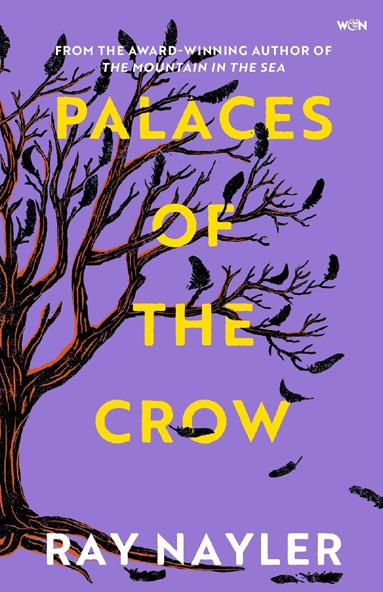
Boy, a younger child whose story is only hinted at, rendered speechless by the atrocities he has witnessed. He is later given the name Innokentiy –Innocence. Every child has lost their family in this new, incomprehensible and violent world.
But the children come together, supporting each other in their bid to survive, assisted by a colony of curiously knowing crows who lead them to sanctuary.
The story is ultimately told from every child’s perspective. While the main narrative is presented in linear fashion – from 1941 to 1944 – there are also flashbacks to earlier times, stories within stories, and finally the flashforward to 1971. The children understand danger but are less aware of the ideological conflicts developing around them: the Soviets, the Nazis, the Lithuanian partisans – but the reader understands them. And we also see the bigger forces at play in the natural world of evolution although, as Nayler suggests through the crows, this may be so much more. The opening epigraph positions Darwin’s ‘mutual struggle’ next to Propotkin’s ‘mutual aid’, the tension at the heart of the novel and its structure.
While undoubtedly a philosophical novel of ideas, it is also a brilliantly handled and utterly moving narrative of human suffering, loss and survival. In the busy field of WWII fiction, this, for me, stands head and shoulders above the rest.
Adele Wills
ROSE & RENZO
Carolyn O’Brien, Northodox Press, 2026, £9.99, pb, 320pp, 9781917005975
Set in 1936, this novel follows sisters Rose and Ivy as they leave their quiet village life after the death of their father and begin anew in Manchester. The bustling city and its vibrant communities are a stark contrast to the world they have known. Rose, a passionate artist, befriends Renzo, an Italian painter newly arrived from Europe. As their relationship deepens, Rose becomes increasingly uneasy about Renzo’s past and the growing influence of fascism within the city.
The novel is rich in historical detail and clearly well researched by O’Brien, particularly in its portrayal of Manchester during the politically tense years before the Second World War. At times, however, the amount of detail slows the pacing, although the descriptions of the city itself are vivid and atmospheric. The streets, factories and neighbourhoods feel convincingly brought to life.
I found it difficult to warm to either of the two sisters, both of whom often come across as selfish and spoilt. Without revealing too
much, there are moments when aspects of their behaviour feel unrealistic, particularly concerning their work at the local factory. Rose is presented as immature and naïve, yet some elements of her characterisation seem inconsistent with this. In contrast, many of the secondary characters, especially Renzo, are more engaging and believable.
Despite my reservations about the central characters, I enjoyed learning more about a period of history with which I was unfamiliar. Essentially a love story, the novel, however, explores themes of political extremism, prejudice and social tension in a way that still feels relevant today. Although I never fully connected with Rose, this is an ambitious and thought-provoking historical novel with a strong sense of place and an interesting political backdrop.
Samantha Ward-Smith
A THOUSAND PAINTED HOURS
Barbara O’Neal, Lake Union, 2026, $16.99/£8.99, pb, 543pp, 9781662514975 London, September 1940. “Do you suppose anyone will use these?” Middle-aged artist Elsie’s husband says, showing her the vial of cyanide tablets their host had offered them at a dinner party. Elsie, born in India to English parents, her father an Indian Civil Servant, spent an idyllic childhood in picturesque Nainital, a Himalayan hill-station town that surrounds a lake. At the impressionable age of ten, she meets Prince Tanveer Singh, who is also ten. The children became good friends, taking part in sketching, stargazing, swimming, witnessing a tiger hunt, and other sporting events. Elsie and Tanveer eventually break cultural barriers and fall in love. Tanveer is sent to a boarding school, and thus begins a regular secret correspondence between them that continues for many years. Elsie is heartbroken when her father is summoned back to England, and she is forced to return with her parents. In England, Elsie continues to paint, fondly remembering her life in India. Her destiny will determine her future, whether she needs to take the cyanide pill or not.
Barbara O’Neal is a bestselling author of numerous women’s fiction novels. This is her impressive debut into historical fiction, spanning two continents and both world wars. Readers are taken on a long journey from the cool, forested Himalayas to rainy England, and for a bit in Cairo, Egypt, as well. World events are seamlessly woven into the plot and naturally form part of the story. A major portion of the novel is written in epistolary form, and its dual timeline is neatly maintained in alternating chapters that keep the narrative’s flow. O’Neal’s extensive research shows in the in-depth descriptions that transport us to the settings. Earlier similar notable British Indian novels have been adapted for film, and one hopes this one will follow suit. Highly recommended.
Waheed Rabbani
DECEPTION
Alan Parks, Baskerville, 2026, £22.00, hb, 352pp, 9781399819718 / Pegasus, 2026, $27.95, hb, 352pp, 9798897101566
Carrying on from the very enjoyable first in the series, Gunner, the man of the title Joseph Gunner, a policeman from Glasgow, is now in New York on a mission to get the US involved in the conflict raging in Europe by fair means or foul. It is 1941, and things are getting desperate. As usual with these things, there is a world beneath the surface where deals are done, threats are made and espionage is the modus operandi. Gunner`s involvement in a honey trap with a prominent politician – all readers will recognise the name – goes badly wrong when the girl in question ends up mysteriously dead in the river.
The smells and feel of New York are conveyed effectively to the reader, from the tenements of Harlem to the grand hotels where the rich and powerful hang out. The exoticism at this time of items such as mozzarella and sushi, for someone from the UK, are evident. Gunner is lost in a web of deception and deceit, unsure of who to trust. This is a fast-moving plot which is conspiracy-laced and character driven.
This novel is as enjoyable as the first book, and I`m already looking forward to more of the adventures of Gunner. The author has been compared to Philip Kerr, Rory Clements and Robert Harris, and as a fan of these writers, I can definitely see the connection. While possible to read as a stand-alone, it does work a little better as a continuation and anyway, why miss out? Evocative, compelling and well worth a read.
Ann Northfield
CHILDREN OF THE WILD
Kevin Powers, Harper, 2026, $30.00, hb, 320pp, 9780063488571 / Atlantic, 2026, £14.99, pb, 320pp, 9781805466000
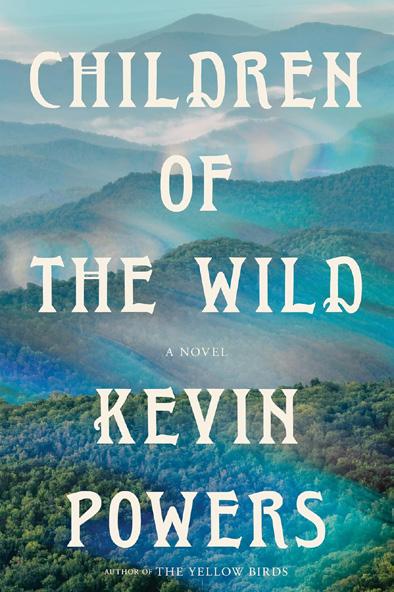
Near Ewer’s Rock, Virginia, Roy and Samantha grow up as wild children, at home in the woods. Sam, the preacher’s daughter, remains rooted in their valley, but Roy Young, whose family owns most of it, loses that intimate connection as he grows older. Home from university and full of ideas for modernizing their farm, he glimpses an orphan boy in the woods, a “noble savage” of sorts. Samantha is the one to bring the boy down to Ewer’s Rock, where he, Ennis Dunn, learns the ways of civilized folk. No longer is he of the world, without a distinction between himself and his surroundings, but in a world he doesn’t fully understand. Samantha is a nature girl in her
own way, and she and Ennis fall deeply in love. Yet when Roy trains as an officer to join the U.S. Army in WWI in 1917, Ennis cannot let him go alone, enlisting in the same Virginia regiment. Close as brothers, though they react to the war very differently, they survive brutal battles together. Afterwards, returning to Ewers Rock and Samantha, they’re changed forever—as is Samantha from her long waiting. Now they face the challenge of recreating their lives.
Kevin Powers has a gift for describing suffering, primal experiences, and loss, on and off the battlefields. The title refers not only to the three central characters’ relation to nature but to others cut off from society. With Ennis, however, more of his solitary survival as a wild child remains. He feels people misunderstand life: it’s simpler than they realize. Powers’ beautifully written, moving novel has the makings of a literary classic, raising profound questions on what constitutes virtue and a worthy life and exploring the many faces of love.
Jinny Webber
PURGATOIRE
Liz Prato, Forest Avenue, 2026, $18.00, pb, 252pp, 9781942436690
Calling itself a “novel in stories,” Purgatoire is a family saga for people who loved Lincoln in the Bardo. It covers three generations of immigrants from the Italian Tyrol who end up in a tiny Colorado mining town in the valley of a river—River of the Lost Souls in Purgatory, better known as the Purgatoire. All of this is real. And so, you’d swear, are the chapter-long stories that start in 1975, then revert to 1910 and the arrival on Ellis Island of Sabé (Elisabetta) and more or less work their way forward again to draw in the voices of her husbands, siblings, children, and their children, and spouses along the way, and even the family cat. Oh, yes, and the voices of the dead.
But it isn’t a fantastic tale. Beautifully written, the book is deeply naturalistic, guaranteed to wring your heart—if not for the women who suffer the infidelity and violence of their husbands but who persevere to hold the family together, then for the children who died young, or the gay man, outed, who has to flee his marriage to stay alive in a brutal world. Famija is everything. Does it matter if there is madness in the DNA? We have no reason to think Perina, who talks to the dead, is anything but eminently sane. Who doesn’t secretly believe that those of our own blood follow and care about us from beyond the grave? You’ll love these people, their story of immigration, courtship, heartache, joy. The format is challenging, but Prato pulls it off with panache. Highly recommended.
Niki Kantzios
CORTO MALTESE: Fable of Venice and Other Adventures
Hugo Pratt, trans. Dean Mullaney and Simone Castaldi, Fantagraphics, 2026, $19.99, pb, 132pp, 9798875001345
Corto Maltese is an adventurous seaman, born of a sailor from Cornwall and a gypsy fortuneteller from Seville in Valetta on Malta in 1887. His father went back to sea while his mother raised him in the Jewish quarter of Cordoba. Corto’s life combines seafaring adventures with magic, fortunetelling, and dream worlds.
He first appeared in a comic, The Salty Sea, written and drawn in Italian by Hugo Pratt in 1967, one of an ensemble cast of characters, and later had his starring role in The Story of Tristam Bantam, included in this volume. Pratt was born in Rimini, Italy, spent his childhood in Venice and his teen years in the then-Italian colony of Ethiopia. Hugo’s father, a Blackshirt, signed up 13-year-old Hugo to fight for Mussolini in WWII. After his father’s death, Hugo and his mother spent the end of the war in a camp, where he discovered comic books.
Corto Maltese (named after Frank Miller’s mysterious island) is now an international phenomenon, adapted into opera and movies. The main story in this volume is a translation of Sotto il segno del Capricorno, the third installment of Corto Maltese’s adventures, covering his years, 1916-1917, in Venice. The story has all the best Corto Maltese elements: Corto’s unsentimental approach to life, his love of adventure, his empathy for underdog characters, his friendships with numerous characters from all walks of life who will all do anything to help him. All with just enough magic to make things dreamy. The plot is reflected in the solid black ink drawings, which make the square jaws even squarer, and the eyes of the women look even more haunted. The overall tone reflects the antifascism Pratt himself developed after his international upbringing and his wartime experiences. To be savored and reread.
Alison McMahan
SWALLOWING THE SUN
Lakshmi Murdeshwar Puri, Pippa Rann Books, 2026, £25.00, hb, 424pp, 9781913738952
Maharashtra, India, 1918: In a village school, two sisters sit cross-legged on a reed mat in a corner of a classroom, separated from the boys. This is no ordinary class. The sisters, Malati and Kamala, are at the vanguard of a movement to give girls access to education. Their father, an iconoclast who cajoles, confronts, and begs the powers that be, is its spearhead. A bully warns them: The sisters must stay within their limits. But they have no limits! This, Malati’s rejoinder, is an early sign of her spunky spirit.
The spirit guides Malati as she and Kamala navigate their pioneering lives, going from village school to an austere boarding school for girls, making their way to college in the big city, breaking glass ceilings, experiencing the pleasures of intellectual challenge and
the intoxication of love, being drawn into the freedom movement, becoming homemakers, and making difficult choices. Historical figures including Annie Besant and Madan Mohan Malaviya make cameo appearances, and the text is rich with poetic extracts, especially Marathi devotional poetry.
This work could have been a soaring epic if it was not for a few flaws. The minor ones are excessive exclamation marks and mixed tenses. The overuse of Marathi or Hindi words before translating them into English is jarring. The global reader might guess what words like maryada and van devi mean, but it is not clear why she should. The city of Benares is situated on the Bhagirathi river instead of the Ganges; this is a major blooper. In keeping with the majoritarian ethos of today’s India, this work glorifies the nationalist Hindu Mahasabha party. I finished this book with mixed feelings, but I did salute the feisty Malati.
A. K. Kulshreshth
ABANDONING THE SCRIPT
Linda Rosen, Black Rose Writing, 2026, $18.95, pb, 307pp, 9781685137236
The lavish descriptions of New York life and meticulously researched insertion of historical figures and events bring the 1921 setting of this novel to life from page one. Lucy Brandt is an educated and passionate woman who yearns to pursue a career on the stage but is thwarted by a husband who insists she be satisfied with her role as doctor’s wife and mother to their two-year-old daughter. Inspired by the freedom and fulfillment enjoyed by friends who champion women’s rights, Lucy sees only one way out: to flee the obligations pinning her down and seek her fortune in Hollywood.
I wanted to cheer for this plucky heroine as she wrestled with the same hard choices and headwinds that still bedevil wives and mothers today, but about halfway through, I found myself feeling more sympathy for the daughter, family, and friends she abandoned with nary a backward glance. Her struggle with the pain she caused by leaving seems to come more from the head than the heart, and the only tears she sheds are for herself, driven by regret for the joyous milestones she’ll be missing by running away. I held out hope that the hardships she’d encounter on her quest for stardom would bring depth and nuance to her struggle, but alas, it’s all smooth sailing for Lucy. She achieves her dream, makes new friends, and even has her last niggling guilt assuaged in the end when her long-lost daughter tracks her down thirty years later and all is forgiven.
This book wants to be a tale about a brave woman fighting constraints men don’t have to contend with, but might have achieved greater impact if the main character had learned from her mistakes and suffered some consequences, as well as triumphs.
Jonelle Patrick
LICENSE TO THRILL: Lily Bollinger
Rebecca Rosenberg, Lion Heart Publishing, 2026, $19.99, pb, 332pp, 9781732969988
In her recent series, Rosenberg’s goal is to shine light on significant women in history who have previously been overlooked. She achieves her goal in this fictionalized biography of Lily Bollinger. This novel is a delight to read, not only for its portrayal of this remarkable woman but also for its vivid history of the champagne world between 1941 and 1972.
Bollinger is a childless widow when she assumes the role as head of the Bollinger champagne empire. The Nazis have invaded both her home and her cellars, but she is not daunted. The novel describes in vivid terms her efforts to rescue her wine, her vineyards, and her family of workers: she hid bottles to give to American soldier liberators; she stole ration cards to feed her workers. She tests each of her three ambitious nephews who want to usurp her leadership. License to Thrill continues to explore Lily’s challenges and adventures after the war—the perfection of her vintage with special vines saved from disease, her trip across the United States to introduce the Bollinger brand to wine connoisseurs, meeting Roger Moore, who chooses Bollinger as his drink of choice as Agent 007, and her international court case to ensure that no other country can appropriate the appellation of “champagne” for their wines.
With her fine skills for vivid detail and absorbing dialogue, Rosenberg keeps her reader well entertained and well informed about the champagne world and its remarkable heroine.
Joanne Vickers
MAYHEM IN THE MOUNTAINS
Jane Loeb Rubin, Level Best-Historia, 2026, $17.95, pb, 319pp, 9798898202637
Mayhem in the Mountains is the 4th book in Jane Loeb Rubin’s Gilded City Series, a fictional exploration of the lives of her greatgrandmother’s immigrant family. I haven’t read the earlier books, and it isn’t essential to follow the story. (That said, I did find the number of characters overwhelming at the beginning.)
The novel starts in June 1924 with 18-year-old Ella taking her younger brother, Robbie, and running away from their abusive father. Ella knows that she’s got relatives on a farm in New York State’s Catskill Mountains and hopes that the relatives will let them stay for the summer.
To her immense relief, the relatives not only welcome them, but they give Ella paid work and a realistic hope of attending nursing school when the summer’s over. At first everything seems idyllic, but as time goes by, she finds herself dealing with threats from both the Ku Klux Klan (who knew the KKK was so far north?) and a major Jewish bootlegger. I liked that so many of the characters have
secrets, which get revealed gradually through the book, and that the women are shown as strong, independent-minded characters. That said, I found that many of the characters spoke and thought in such similar voices that I kept having to refer to the chapter headings to remind myself whose perspective I was getting. Perhaps if I had already known the characters from the earlier books in the series, this would have been less of an issue.
Tema Frank
WHERE WE BELONG
Kim Vogel Sawyer, WaterBrook, 2026, $18.00, pb, 368pp, 9780593600856
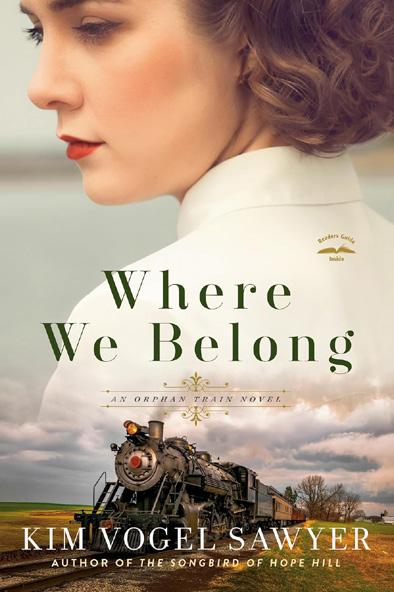
The Depression devastates Callum Hollbrook. He loses a steady job. His wife dies giving birth to their second daughter. He places both girls in a New York City orphanage but promises to take them back when he can. After years of struggle, in 1931 he finds full-time factory work, a small apartment, and enough money left over to reclaim his girls, named Evvie and Winnie. Evvie is now thirteen and Winnie four. But three weeks before Callum could fetch them, the orphanage shipped the girls out on an orphan train headed to the Midwest.
Hester Haak, a 37-year-old widow in smalltown Millersberg, Kansas, runs a modest store and owns a small house. Millersberg is not far from the final stop of the orphan train. Hester yearns to adopt one of the remaining orphans, although single women do not qualify for orphaned children. Both Hollbrook girls and a charming young boy go home with Hester—at least until the authorities might let her keep them.
Callum strives to locate his girls and money for train tickets and get time off without losing his job. The young boy and Winnie quickly bond with Hester, but Evvie plans to flee back to New York and find her dad. She resists everything kind-hearted Hester does for her.
Callum and Hester’s conflicting quests tug at readers. Will Callum find his girls, and will they return to New York? Will Hester finally become a mother and for which children? Accidents and illnesses complicate all plans. The main and many secondary characters think, talk, and act with an authenticity that pulls readers into their feelings and surroundings. It is easy to want both Hester and Callum to succeed and for all the children to thrive, but that seems impossible. Highly recommended as an affecting family saga.
G. J. Berger
THE BREAKWATER
Leslie Shimotakahara, Cormorant, $24.95/ C$24.95, pb, 350pp, 9781770868267
Cathy is a third-generation Japanese Canadian single mother, recovering from a divorce and coping with an aging father. Toronto in the 1980s is hard to navigate, but life becomes more complicated when her father suddenly announces he needs to return to his hometown of Victoria, British Columbia, to visit a dying relative Cathy has never heard of.
This begins a dual storyline about the dramatic multi-generational trip to her father’s birthplace, and the more intriguing tale of two Japanese Canadian brothers growing up on the west coast prior to WW2.
Yas is bound by tradition: duty and suppressed secrets, The younger brother, Stum, tries to break free of the stifling immigrant culture by escaping into the Asian Canadian criminal underworld. One man is caught up in the expulsion of the Japanese to work camps in the harsh BC interior. The other is entangled in a system that results in his incarceration in BC’s most notorious asylums.
The woman and her precocious daughter must deal with their own trauma, not realizing what family secrets are being unveiled until the very end. The characters of the brothers are beautifully written, the author clearly reveling in all the research and exposing bootleggers, brothels and harsh work camps, a part of Canadian history often mentioned but seldom explored in this depth.
Wayne Turmel
ECHOES OF INFAMY
Shaina Steinberg, Kensington, 2026, $27.00/ C$37.00, hb, 336pp, 9781496747846
In this third installment of the Bishop and Gallagher Mystery series, the postwar world looks very different for former OSS agents Evelyn Bishop and Nick Gallagher. The two have married, and Evelyn has replaced her disgraced father as the head of Bishop Aeronautics, while Nick works as a private investigator. After the groundbreaking ceremony to expand the factory, a Japanese American man named Billy Takemura confronts Evelyn and claims they’re building the factory on land stolen from his family during the war. Shocked, Evelyn and Nick decide to investigate his claim, and uncover a twisted web of secrets, betrayal, and greed. The war may be over, but Evelyn and Nick soon realize that old grievances and prejudices lie just beneath the surface.
With a keen eye for detail, Steinberg excels at placing the reader in postwar Los Angeles in all its gritty reality. Evelyn and Nick are dogged in their pursuit of the truth, even when it may come at personal cost. But this book shines in Steinberg’s skillful handling of the deeply traumatic experiences of the Japanese American community as they return to a far different world than the one they left after being interned. Though this is a mystery novel, it also forces us to confront the morality
of choices made to a people during a time of war and how those decisions can have lifelong, devastating consequences.
Melissa
A. Amateis
ROMAN MORNINGS
Matson Taylor, Scribner, 2026, £18.99, hb, 384pp, 9781398524828
Rome, 1970s: Clemmie, a forty-something technical translator, acquires a Vespa, and on its maiden run crashes into Monty, a young carpenter working for a gaffer called Romford Dave, in a crew that’s a sort of Estuary version of Auf Wiedersehn Pet. No longer writing the poetry she loved, Clemmie ‘sensed that people no longer saw her; she’d become a type.’ Monty mourns his lost love (they fell for each other prompted by a shared admiration for Grinling Gibbons), for though homosexuality has been at last legalised in the UK, tolerance has not been universal.
This story isn’t therefore a version of Roman Holiday updated to the grubbier, chaotic city of two decades on. It’s more a story of friendship and renewal, charming but sometimes veering into whimsy. All the ´70s references are there: a woman with Crystal Tipps hair, a Burt Reynolds moustache, ‘a touch of the Frankie Howerds’ and my favourite, ‘the colour of a heavily faded space hopper.’ Moving statues lend a gentle touch of magical realism; there is also a talking cat. One could imagine Clemmie being played by Emma Thompson and her actressy friend Floss by Vanessa Redgrave; characters verge on the stereotypical, but that is perhaps part of their appeal (the story is told entirely through the eyes of a little group of English residents; Italian characters play either comic or sinister bit parts).
The portrait of Rome is a vivid one, though some references are off: ask for a latte in Italy even now, and you’re likely to be given a glass of milk. The plot is slowed by travelogue anecdotes that, for this reader, went on a little too long. But it is Monty’s backstory that gives the book its spine, and it’s poignantly told.
Katherine Mezzacappa
THE SECRET SOCIETY OF LIBRARIANS
Kate Thompson, Hodder & Stoughton, 2026, £22.00, hb, 464pp, 9781399746373
London, 1939, and as Chamberlain declares war, a group of women drink a toast to their absent friend: Dorotha in Poland. They are the Secret Society of Librarians, founded at Library Association Summer School, inspired by passion for the writing of Virginia Woolf. The story mainly follows Joyce, in Camden, London, and Dorotha, in Łodź, Poland. While Joyce suffers the London Blitz, Dorotha endures the Łodź Ghetto. Both believe in ‘Freedom through Reading.’ In London, books offer escape during bombing raids. In Łodź, they offer freedom to remain human. Hence, Joyce and Dorotha determine to bring books to their people.
While Joyce’s mobile library faces
bureaucracy and bombs, Dorotha faces systematic persecution. In the ghetto, the Nazi regime aims to strip people of their humanity, through starvation, theft, disappearances, and murder. Possession of a book risks death. Daunted but not deterred, Dorotha creates a secret library.
Unlike many World War II novels, it’s not all camaraderie and courage. These were tough times, and Thompson doesn’t shy from the horror as bombs in London kill, and friends and family disappear from the ghetto. But it’s not all doom and gloom. Friendship and love emerge as the force to keep people going.
The writing style mirrors typical reports from survivors: straightforward, factual. There is no need for fancy tricks to make it powerful. The Blitz is scary: the horror of the Ghetto worse. Despite this, the book is easy to read, the characters’ lives drawing the reader in.
Thompson is a journalist, accustomed to checking facts. An author’s note describes the extensive researches that justify the cover line: ‘Inspired by True Events’. This is true historical fiction: a lesson from history, transformed into story.
Helen Johnson
A FATAL LOVE
Louisa Treger, Bloomsbury, 2026, £18.99/$27.99, hb, 240pp, 9781037209833
A Fatal Love is a fictionalised account of the life and death of Ruth Ellis, the last woman to be hanged for murder in England, in 1955. It keeps close to the written record, the major fictional element being to give Ruth’s defence lawyer a female assistant, Kitty, who narrates the story jointly with Ruth.
Kitty is desperate to see Ruth acquitted, struggling to ‘get through’ to her and searching for fresh evidence and useful legal precedents, but Ruth is not interested in saving herself. Most people who read this book will know what happens to Ruth; it is why they bought or borrowed it. Like one of the many Titanic books, the tension lies in the sense of doom.
This is a sad and moving book. Perhaps the saddest part is the two-page afterword, summarising the later lives of almost everybody involved in the case. Alcohol, violence and suicide feature prominently. Not that their earlier lives were much better. The book takes us through the seedy pseudo-glamour of the 1950s London nightclubs. Most of the characters were doomed even before they were born. The description of the ghoulish ritual surrounding a hanging is horrifying to modern readers (but 1955 was not so long ago), but Ruth’s decision that it was better than life imprisonment is understandable.
Edward James
MASSAWA
Pam Webber, She Writes, 2026, $17.99, pb, 336pp, 9798896360988
Kit Thomas thinks she is ready. Ready to go undercover in 1942 for the fledgling American
intelligence Office of Strategic Services. Ready to deploy to North Africa where neither Allies nor Axis are prevailing. Ready to detect and either help or thwart friendly and enemy agents embedded in newly liberated Eritrea. Ready to fall in love. But she quickly learns that she isn’t as ready as she thinks.
Webber develops the story through Kit’s first-person tale, limiting the reader to what Kit knows—or thinks she knows. Clues to the unreliability of her narrative are woven into her thoughts. Bright hot days in the port of Massawa near the Red Sea alternate with cool dark nights in the capital of Amara in the mountains, as Kit navigates a maze of mirages. Hostility among supposed allies and hints of betrayal add confusion to Kit’s already dangerous mission.
Massawa provides a personal viewpoint on what might otherwise be a typical spy thriller novel. Separating allies from enemies requires insight she lacks. Everyone hides some issue, goal, or motive. She’s not even sure she can trust her British MI6 partner, Mark Williams, with either her heart or life. Increasingly alone in a conflict-filled night, Kit risks her life to complete her mission.
Kit learns that war is ugly and dangerous, much of it hidden behind successive layers of illusion. Both the nasty side of the fascist regimes and the history of Eritrean exploitation provide well- and little-known backgrounds. While this novel is free of gratuitous profanity or sex, a few scenes involve graphic violence. This excellent historical fiction is set in a littleremembered corner of World War Two.
Ron Andrea
DANCE IN A MADHOUSE
Jess Wright, Montague Books, 2026, $19.99, pb, 288pp, 9781646049325
New York City, 1905. Owen Townsend, a medical intern just recovering from typhoid, suffers a psychotic episode in Central Park. His father, occupied with political ambitions, orders his son confined in an asylum after Owen is diagnosed as schizophrenic. But Owen can’t accept the diagnosis and is determined to prove his sanity and return to medical school and his fiancée, Maude. On Owen’s first day in Fairmount Lodge, one of the doctors is killed in a fire. The police are called, and Owen is a suspect. As the story unfolds and Owen becomes involved with other patients, both he and reader ask themselves: is Owen sane? Is his paranoia real or imagined? And can he find an explanation for what happened to him in Central Park?
Dance in a Madhouse is an enjoyable thriller inspired by real historical events, including the asylum’s hosting evenings where members of the public watch patients dance. Owen is repelled by this, but it’s here that he encounters Celeste, a young dancer damaged by trauma. A central question in the novel is whether Owen is the hero he thinks he is, and in his interactions with Celeste I had my doubts. I did
warm, however, to the secondary characters, most notably the novelist, Lilian, who is entirely sane and only in the asylum for research purposes. That’s her stance on it, anyway. Possibly the first in a series.
Kate Braithwaite
THE TEMBUSU TREE MYSTERY
Ovidia Yu, Constable, 2026, £12.99, pb, 308pp, 9780349000671
The tenth novel in Ovidia Yu’s cosy mystery series, with her female sleuth Chen Su Lin, is set in 1947 Singapore in the aftermath of the Japanese occupation and withdrawal.
The novel opens with Su Lin preparing for the grand opening of a cinema, but the opening never happens, as someone involved in the opening is found murdered. Once Su Lin gets stuck into her investigating, she cannot let up, even if some would prefer her to stop. The body count increases. The novel is told from Su Lin’s perspective: she’s always on the go and forms opinions very quickly as she navigates all of Singaporean society, from the street food hawkers to rich philanthropists.
There are lots of twists as Su Lin’s suspicions turn one way, then another. The author also evokes the multilingual nature of Singaporean life both in Su Lin’s thoughts and in dialogue. However, when Su Lin then explains the phrase to the reader, the narrative flow is broken. In addition, none of the characters require these explanations either. Despite this, a pleasant read for a few evenings, and sufficient backstory is provided for the novel to be read as a standalone.
H-F Dessain
MULTI-PERIOD
THE FORGOTTEN MIDWIFE
Laura Anthony, Gallery, 2026, $29.00, hb, 368pp, 9781668047415
This is a dual-timeline story with Riley Carmichael in New Jersey in 2023 and Margaret (Maggie) Lannigan in Tipperary, Ireland, in 1954. Riley’s story is mostly at the beginning and end of the story. Riley’s grandmother, in a moment of lucidity from her dementia, gives Riley a box. She is unable to explain more, so Riley, along with her fiancé, set out on a journey to Tipperary to uncover the mystery of the Irish birth certificate and the pair of baby booties found in the box.
Maggie’s older sister planned on becoming a nun. When she dies, Maggie is sent against her will to the convent. Apparently, this was not unusual for large Irish Catholic families to pledge one son to the priesthood and one daughter to a convent, whether they agreed or not. Maggie takes her vows and is transferred to a Magdalene Laundry associated with her convent. She helps deliver pregnant young girls and women working at the laundry, despite having no training as a midwife. The physical
and psychological conditions are deplorable, while the nuns live in comfort. Maggie has great compassion for these girls, although she is often thwarted by the matron nun.
The Magdalene Laundries, operated by Catholic nuns in Ireland and elsewhere, were for “fallen women” who worked until they delivered their babies, who were then given up for adoption (whether the mother agreed or not). The laundries were finally shut down in 1996. Justice for more than 10,000 girls and women who were incarcerated in these “mother and baby homes” since the 1920s has been initiated for the remaining survivors. While not an easy read due to the subject matter, Maggie’s story made me understand what it must have been like more powerfully than just reading about these laundries. Highly recommended.
Deborah K. Mayer
THE LOST BOOK OF ELIZABETH BARTON
Jennifer N. Brown, St. Martin’s, 2026, $29.00, hb, 320pp, 9781250383594
In this dual-timeline thriller, present-day manuscript scholar Alison Sage eagerly accepts an invitation to an academic consortium held in a crumbling English manor, hoping to find evidence in its neighboring priory to support her recent discovery of the single surviving copy of the recorded visions of Elizabeth Barton, a Tudor-era prophetess martyred by King Henry VIII.
Brown alternates between Elizabeth’s 16thcentury point of view as she allows influential Catholic clergy to publicize her fever-induced visions of Hell and Purgatory as true visions that warn England not to embrace Lutheranism, and Alison’s efforts to uncover the coded messages about Barton’s downfall in books, paintings, and the eerie Church of St. Sepulchre. The consortium is strangely informal and includes among Alison’s colleagues a former lover with clearly ulterior motives. The convivial round of paper readings and boozy get-togethers is interrupted by a murder outside the church, which swiftly involves Alison in an investigation that is more criminal than academic.
Brown does not manage to make much more of Barton than the compliant pawn she seems to be in the historical record; there is no suspense (and disappointingly little historical atmosphere) in the story. But she does a better job interesting the reader in trying to figure out the hidden agendas of Alison’s colleagues in the consortium, particularly the former lover, whose presence begins to feel decreasingly coincidental.
Alison as a narrator is winningly curious and plucky, although some readers may be annoyed to spot the numerous academic and personal red flags long before she does. The well-constructed plot keeps the pace brisk and presents intriguing puzzles to be satisfyingly solved in the exciting conclusion.
Kristen McDermott
VANISHING POINT
Ellen Prentiss Campbell, Apprentice House, 2026, $26.99, pb, 386pp, 9781627206877
The French-born 19th-century American naturalist painter George Hetzel never received the acclaim he hoped for, even after establishing his own painting school called Scalp Level near Johnstown, Pennsylvania. The Hudson River School (New York) painters were better known. The novel’s prologue, dated 1977, depicts an art curator’s visit to Dorothy Kantner at the Hetzel family farmhouse in Somerset, Pennsylvania. She reviews the gallery of paintings by Dorothy’s grandfather, George, and mother, Lila, for a museum show. The curator likes a painting of a forest by George with two tiny figures at the “vanishing point.” Dorothy, a journalist, reveals she has written a family memoir. The curator asks to read it.
The memoir unfolds in 1880 Pittsburgh with a family tragedy. Two of the Hetzels’ five children are killed in a train explosion, and a third is badly injured. Lila and Frank are unhurt. The family perseveres. Lila is the central character whose artistic ambition and lifestyle encounter the prejudices against independent women of the late 19th and early 20th centuries. The Hetzel family suffers another untimely death, unhappy marriages, and money problems as they try to keep the farmhouse and preserve their father’s legacy.
Regrettably, the memoirist’s narrative voice lacks a distinct personality and perspective, which slows the family saga’s pacing and gives the reader a feeling of detached prose. Each chapter bears a specific year and place heading, which seems unnecessary until Part Four, when the memoir jumps from 1909 to 1952 and shifts abruptly to Dorothy’s epistolary diary for a chapter. The epilogue revisits the curator.
Campbell’s herculean effort spans three generations of Hetzels plus some contemporary characters. A more limited time span could have enriched the cultural and historical context of the novel’s settings and perhaps given a clearer sense of George and Lila Hetzel’s artistic niche.
Robin Holloway
THE HOUSE ON ROOKERY ROCK
Madeleine D’Este, Independently published, 2026, $4.99, ebook, 308pp, 9780645742930
Family history collides with the present in this compelling dual-timeline novel that follows the three Cane daughters in 1895 and their distant relatives in 2024 on a rocky island miles off the coast of Tasmania.
In 1895, eldest daughter, Edith, struggles to hold her family together for sixteen years since her mother died during childbirth. The youngest sister, Pansy, has recently embraced a strict religious life despite her family’s indifference to faith. Second-born Constance retreats into a creative world of poetry, as she refuses to leave the island and remains aloofly engaged to attorney
George Hardwick. Alongside their alcoholic father, this generation lives in near isolation, absorbed by secret notes, lost crops, and potential insolvency, all within their grand granite home — until the devastating storm of 1895 changes everything.
In 2024, Felicity Buchan arrives alongside her distant cousins, Tara Norman and Jools Martell, guided across the water from Trial Harbour by Lachlan Hardwick, family solicitor. Felicity wrestles with doubts, fearing her husband’s claim that the trip is a scam, could be true. Still, she longs for a fresh start and the chance to connect with newly discovered relatives. The once-grand house, left abandoned for decades after serving as the Rookery Rock Home for Girls, is crumbling and in desperate need of repair. The caretaker, Paul, has only managed to address a fraction of the damage.
Alternating chapters create a suspenseful narrative between 1895 and 2024. Each character’s personal desires and conflicting ambitions strain relationships, spark arguments, and threaten violence across both timelines. This novel is ideal for readers who enjoy multigenerational family sagas where the choices of the past reverberate to the present, a fascinating exploration of family legacy, suspicious messages, remote isolation, and the harsh demands of island life.
Anna Dalhaimer Bartkowski
WHEN MIKAN ROAD WAS OURS
D. K. Furutani, Atria, 2026, $29.00, hb, 320pp, 9781668086926
Thirty-four-year-old Mr. Murano (no first name provided) lives alone in South Pasadena, where he teaches high school English. Soon after his Japanese father dies of a sudden heart attack, he is diagnosed with cancer. His long-divorced mother is American. Mr. Murano is depressed and drinks too much. Quite out of the blue, a distant relative gives him his great-uncle’s unpublished memoir, letters, notes, and an old cassette tape. These cover the lives of his many Japanese relatives in the US.
Murano cannot stop reading and researching, ashamed of how little he knew or cared about his Japanese heritage—his father, grandfather, and other relatives. His learning takes on a form of therapy, and slowly he begins to reach out to others and checks his heavy drinking.
The first Murano arrived in 1901 and labored wherever he could find work. In 1905 he, with a group of other Japanese, moved to the Los Angeles suburb of El Monte. More Japanese followed and developed a thriving forty-acre farm and a close-knit Japanese American community. Mikan Road ran through the property. In WWII, the US forced the Muranos and other Japanese families into concentration camps. When their incarcerations ended, the farm, their homes, livestock, and vehicles were gone.
The richly researched memoir, letters, and
other first-person accounts of hard work, pride in family, expertise in farming and science, discrimination and heartbreak will engage readers. The prose and old accounts are error-free and often poetic. This project might have worked better without interspersing the narrow modern-day Mr. Murano story with the sweeping Japanese immigrant ventures. There is enough material for two novels. Either way, it is highly recommended for anyone interested in this time of American history.
G. J. Berger
I AM THE HOUSE
C. B. Harper, Independently published, 2025, $18.99, pb, 248pp, 9789699592287
Narrated by a Victorian house on a rural American lane, this novel traces the layered histories of its site from Indigenous settlement through colonial expansion, revolution, and into the nineteenth century— its “house empath” acting as intermediary voice for the building’s accumulated memory. The structure is episodic rather than conventionally plotted. Early chapters move from the Corchaug people and their spiritual relationship with the land to the arrival of European settlers, the establishment of a farmstead, and the upheavals of the American Revolution. Individual human stories— William and Mariam’s precarious prosperity, Ephraim’s brief tenure, the violence of British occupation—are set within a longer range, before giving way to later occupants and transformations of the property. The effect is less a single narrative arc than a sequence of historical tableaux linked by place.
As historical fiction, the novel is ambitious and often engaging. Harper’s research is evident, though the use of a quasi-mystical “house memory” occasionally blurs the boundary between history and imaginative reconstruction. Dialogue is generally serviceable, if sometimes modern in cadence, and the explanatory passages, particularly where the “empath” includes context, can feel heavy-handed. Stylistically, the prose is earnest and readable, if inclined to repetition and rhetorical flourish. Characterisation is necessarily fleeting, given the generational sweep, and some figures feel more emblematic than fully realised. In the context of much historical fiction, often tightly focalised and character-driven, I Am the House stands apart as a more reflective, almost antiquarian project. It succeeds best as a meditation on place and continuity, less so as a novel of sustained dramatic momentum, but its central conceit is distinctive and thoughtfully pursued.
Douglas Kemp
THE MIDNIGHT GUESTS
Alex Hay, Headline Review, 2026, £20.00, hb, 352pp, 9781035433896 / Hanover Square, 2026, $18.99, pb, 352pp, 9781335001580
The Midnight Guests begins at 2pm on 1 May 1926 with the opening of the upmarket Hotel Artemis in Mayfair, London. The hotel
was created by the socialite, Diana Gold, who needs to sell her extensive jewellery collection before her mysterious patrons are due to arrive at midnight. One of the hotel guests is wealthy Cleo van der Meer, an unconventional American, determined to enjoy two weeks of freedom in London. During the course of the night and early hours of the 2nd May 1926, their paths cross, the body count begins to rise, and secrets are revealed. In a second timeline, the novel follows Joe Carberry, a historian investigating the soon-to-close Hotel Artemis in January 2026, intrigued by a newspaper report of 1929 which claimed that two bodies were found in the vaults of the hotel, and the rumour that the proprietor, Diana Gold, vanished after the opening night.
This is a compelling read, full of intrigue and mystery. Hay has constructed a clever plot fuelled by the conflicting aims of different characters, with many twists and revelations along the way. He masterfully drip-feeds the reader information about the three pointof-view characters (Diana, Cleo and Joe) to keep them guessing who the bodies in the vault are until the end. This novel effectively immerses the reader in a 1920s world of brittle glamour and extravagance, along with its sordid links to organised crime and corruption. Recommended.
Serena Heath
SUMMER OF LOVE
Kerri Maher, Berkley, 2026, $30.00, hb, 368pp, 9780593816394
Sisters Miranda and Winnie Hartley grow up in the wine country north of San Francisco. Each is smart, talented and ambitious. Their father dies under peculiar circumstances when the sisters are nine and six years old. Mother must now manage the family winery until Miranda, who has a knack for business and winemaking, takes over. Soon she stands out as a female producer of fine wines in a profession dominated by male snobs. Winnie graduates from Berkley and yearns to become a famous writer. When Miranda is 24 and Winnie 21, the 1967 Summer of Love celebrates newfound freedoms, music, alcohol, other drugs, and easy sex. A third main character, Miranda’s daughter Dawn, arrives in 1975. Later in life, at almost forty years old, Dawn sets out to find the real identity of the author (writing under a pen name) of a beloved series of children’s books that contain details unique to her family’s Hartley winery.
This novel covers the sisters’ friends, lovers, work and play from 1967 through 2024. Significant topics include farm labor strife, the relationship of French and California wines, the history of winery ownership, and life in Haight Ashbury at the peak of counterculture times. Addiction to alcohol and other drugs infuses the whole story. Bad choices lead to profound life-altering decisions, self-loathing, and family secrets. Readers will cheer for the main characters while suffering with them and their mistakes. The prose and dialogue fit the people and times and heighten the intensity
of dramatic events. The music, settings, roads and vistas are all real. Maher’s story builds to the healing powers of love and deep, soulsearching journal writing. Recommended for readers wanting to revisit the 1960s, learn more about wines, and get wrapped up in a layered family saga.
G. J. Berger
SON OF NOBODY
Yann Martel, W. W. Norton, 2026, $29.99, hb, 352pp, 9781324118138 / Knopf Canada, 2026, C$36.95, hb, 352pp, 9781039001503 / Canongate, 2026, £20.00, 352pp, 9781838859077
Son of Nobody purports to be a PhD dissertation offering a translation and commentary on fragments of a Trojan War epic. Hence, pages are split between poetry on top and footnotes below. Unlike the Iliad, this poem focuses on common soldiers, particularly Psoas, a cheesemaker-turned-soldier.
Psoas describes starvation, filth, and disdain from aristocratic warriors. The powerful shut out the lowly from riches/loot. Above all, Psoas misses his wife and children. The Iliad is often interpreted as undercutting the heroic ethos of glory through war in a humane refocusing of the epic tradition, so Martel’s eloquent message of the futility and mendaciousness of war is not new to this material, but his centering of the common man is.
The footnotes contain explanations that bridge readers unfamiliar with Homer. More importantly, they carry the story of the fictional Canadian at Oxford piecing together his epic – a composite other academics don’t accept, offering an interesting interpretive angle. Like the Greeks, he leaves behind family, a wife and daughter. At the start, he tells us that he failed them. Conversations and scene fragments reveal this emotional core, which parallels losses within both the soldiers’ lives and the myths. One example: “Gail stared hard at me. ‘Really? The good dad thinks sailing off to Troy will solve our problems? How did that work out for the Greeks?’”
Martel’s engagement with the ancient world and the Iliad itself is the less informed and sophisticated aspect of this innovative work. But as something new, Martel’s experiment with epic engages the reader and resonates with poignancy. Its exploration of abuse of the common man by the wealthy and powerful—a remarkably apt theme these days—is especially intriguing. As a meditation on loss, it frequently rings profound.
Judith Starkston

Party to find out more about the rumors that 5,000 to 15,000 field workers and migrant pickers are going on strike. In 2015 author Rivera Garza travels by train to the barren wilderness of Estación Camarón and observes: “Rather than passing, time has swept everything away under its wings,” taking with it information about workers on the cotton fields and the strike.
Autobiography of Cotton is an amalgam— part fiction, part memoir, part genealogy, and part environmental and archival history. It commingles references to historical figures, such as Revueltas, the author of Human Mourning, and actual events with real-time journeys to desolate border towns. It melds personal, present-day experiences with uncertain recollections of the past. It traces the travels of Rivera Garza’s own grandparents and the steady decline of the environment as cotton changes the land and the people who live on it.
Autobiography of Cotton is not like anything this reader has ever read before, leading to a revelation: In these times of encroaching AI, what a marvel it is to encounter a skilled writer who leads readers to unexpected destinations along fresh and engaging paths. Like so many books translated from Spanish, words and phrases flow almost musically, as if the reader can hear the wind as it moves past cotton bolls. Beautiful.
K. M. Sandrick
DAUGHTERS OF THE SUN AND MOON
Lisa See, Scribner, 2026, $29.00/C$41.00, hb, 384pp, 9781982117054 / Scribner Australia, A$40.99, hb, 384pp, 9781761826290 / Scribner UK, £14.99, pb, 384pp, 9781668230152
AUTOBIOGRAPHY OF COTTON
Cristina Rivera Garza, trans. Christina MacSweeney, Graywolf, 2026, $17.00, pb, 288pp, 9781644453698
In 1934, nineteen-year-old José Revueltas ridespast fields of white gold cotton on his way from Mexico City to Estación Camarón near the U.S. border. He’s been sent by the Communist
Los Angeles is a dirty, lawless, and wild place, so the small female population is protected – by either a husband or one of two Chinese gangsters. Two Chinese women tell their stories from January to October 1871. Famine has ravaged China. Petal, a young woman with unbound feet, is taken from her small village by her father to be sold. Dove’s beauty and her bound feet make her very valuable. She is groomed and trained to go to California to marry Old Man Sing, who misses his wife and family in China. Speaking as an old woman in 1926, Moon remembers their arrival. With tenderness, we know these three women become everything to each other. Moon and her husband Gene, both longtime residents of Los Angeles, have made a name for themselves among the white and Chinese population for traditional, effective Chinese
medicine. Both are equally at home in western or Chinese clothing.
Moon is thorough in her documentation of the years leading up to 1871, the Chinese gangland lords, the brutal violence between them, and the violence they perpetrated on the women. These women had no agency, their existence miserable; the exploitation and the details of their daily existence are difficult to read. This book builds and culminates around the Night of Horrors, a murderous, bloodletting-rampage that swept the city.
See is passionate about her people and holds nothing back to excoriate the narrowmindedness and injustices they suffered. We know her father was Chinese American and her mother white, and what that would have meant in such a highly prejudicial time. At the beginning of each part, she begins with a photo and article from the Los Angeles Gazette, the hatred and animosity simmering under the surface. This novel may be brutal, but it is an excellent documentation of early Los Angeles.
Janice Ottersberg
SONGS FROM THIS AND THAT COUNTRY
Gail Sidonie Šobat, Enfield & Wizenty, 2025, $23.95/C$27.95, pb, 379pp, 9781773371412
War, family, violence, music, love and forgiveness: Šobat weaves these human themes together in a beautifully written, unique tale spanning centuries and continents. Danilo, a Serbian Canadian and WWII veteran suffering from PTSD, later brutalizes his wife Luba and their child Mirjam, a caul baby with magic powers. The magic powers are shown early in the novel but dropped as Mirjam ages. Mirjam, like the biblical Miriam, is a gifted singer, and despite their tumultuous home and Danilo’s objections, Luba helps her daughter study operatic singing and begin her career. After her debut opera in Berlin, she travels to Serbia with her cellist lover to sing during the 1990s Bosnian, Serbian and Croatian ethnic wars. She has previously rejected her Serbian roots along with her Serbian father, but she sings to bring beauty to their war-torn lives and, she realizes, to understand herself.
Woven throughout this 20th-century story is the story of Sudbina, the daughter of a despot in 14th-century Serbia. The modern story mirrors the fairy tale storyline, but the fairy tale interrupts the flow of the very strong and well-written 20th century storyline. Nevertheless, Songs of This and That Country is a unique, moving and enthralling novel.
Constance Emmett
THE SINGAPORE SECRET
Clare Willis, Hodder, 2026, £10.99, pb, 368pp, 9781399754101
A cosy, dual-timeline novel set in 2019 England and 1930s/1940s Singapore. We start with the modern timeline where, amidst the likely breakdown of her relationship with
her boyfriend, Annabel heads to Cornwall for her grandmother Dotty’s 100th birthday celebrations. Sadly, soon after, Dotty dies and Annabel comes across a hidden cache of documents indicating that Dotty had actually been in Singapore, despite denying ever having left England.
The novel then moves backwards and forwards between the two timelines as Dotty’s adventures in Singapore are revealed: 1930s high society, then life under the Japanese occupation and Changi prison camp. As Annabel continues her investigating into Singapore, family secrets are gradually revealed although the reader may well have worked them out several chapters before they are confirmed. The death of Dotty’s mother in the 1940s timeline also loses some of its emotional punch, as Annabel has already read her death certificate in the 2019 timeline. Contains a brief open-door sex scene and some light swearing.
An enjoyable debut and a welcome addition to the growing number of novels exploring the impact of WW2 in Asia.
H-F Dessain
TIMESLIP
THE HAUNTING OF A BRONTË
Amelia Blackwell, Macmillan, 2026, £18.99, hb, 400pp, 9781035054145
The Haunting of a Brontë is the second in the Miss Darcy Investigates series. Although Blackwell provides a summary of A Crime Through Time in the opening chapter of this novel, it helps to have read the first book to make sense of the unusual premise. Georgiana Darcy (from Pride and Prejudice) has found a Motorola pager which transports her through time to solve crimes/mysteries. This story opens in 1799, with Georgiana Darcy etching a message to her lover, Quinn, who is in 1995, on the wall of a stone amphitheatre on an estate in Devon. While she is doing this, a mysterious stranger, William Fanshawe, appears. He gives her a Maglite torch and tells her ‘we must go where we are needed.’ Later, Georgiana is transported to Thorp Green Hall in Yorkshire, 1845, where she overhears Branwell and Anne Brontë arguing about Branwell’s belief that he is being haunted. Georgiana poses as the new companion to the family’s oldest daughter and sets about trying to solve various mysteries at Thorp Green Hall.
Blackwell develops the backstory and mechanics of time-travel more fully in this book (although how a pager could still work after eight months without a change of batteries is conveniently ignored). Unfortunately, Georgiana is not a natural detective, and the plot relies heavily on her eavesdropping in order to gain information, as well as being nocturnal (with the lack of sleep having no adverse effects upon her). There are various subplots (not all of which are resolved) and revelations, along with cultural references to
the 1990s, the works of Jane Austen and the lives of the Brontës.
Serena Heath
THE VALLEY OF RAVENS
Barbara Erskine, HarperCollins, 2026, £20.00, hb, 512pp, 9780008561116 / 2027, $19.99, pb, 512pp, 9780008561154
Mid-Wales, present day. After being accused of murdering one of her patients, Eve, a healer, has fled her home in Suffolk to stay with her friend Ann. Eve soon falls in love with an abandoned cottage known as Tŷ’r Wrach – the witch’s house, which she is determined to make her forever home.
She’s not alone in the house, however. The spirit of Alys remains, who in her own time, back in the 13th century, was also a healer. Alys seems happy for Eve to be there, as she sees in her a kindred spirit. But locals believe the ghost could be dangerous because of a curse that has plagued them and the cottage’s inhabitants for centuries – a curse linked to a turning point in Welsh history when the last true Prince of Wales was killed.
Worried for Eve, Ann calls another friend of hers, Jo Clifford, for help. Dedicated fans of Barbara Erskine will recognise this character from her very first novel, Lady of Hay, and so for them this latest offering is unmissable. (I think the ‘present day’ setting is deliberately vague to allow Jo Clifford to feature.)
Rather than actual time-slips or past-life regressions, the truth of what happened back in the 13th century is shown through a dual timeline and revealed to Eve through memories that are embedded in her surroundings and which come to her intuitively or in her dreams. Meanwhile, Eve is haunted by her own past just as much as the cottage’s.
At one point it is implied that the genealogy company Ancestry can help trace ancestors as far back as the 13th century, which is doubtful, but this is a delightfully cosy time-slip novel: fascinating, tragic Welsh history; mystery; romance; beautiful Welsh countryside; (mostly) friendly locals and a smattering of Welsh words.
Sarah Dronfield
ALL WE HAVE IS TIME
Amy Tordoff, Atria, 2026, $29.00/C$41.00, hb, 352pp, 9781668068045
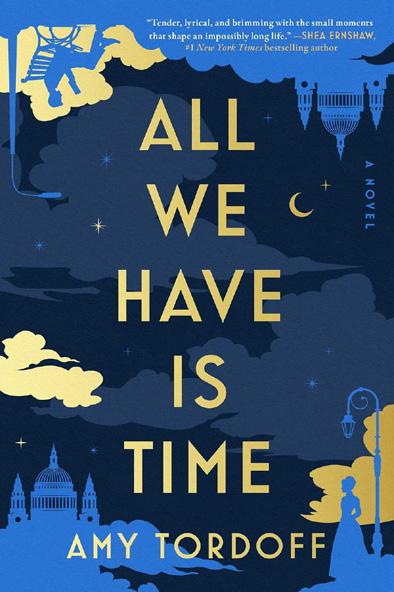
Set across centuries, All We Have Is Time opens in fragments— brief glimpses of moments and places that may initially feel disorienting. But once the novel finds its rhythm, those temporal snippets become part of its design, drawing the
reader steadily into Beatrix’s long, lonely existence.
In 1605 London, Beatrix lives on the margins, marked as “other” by her mismatched eyes and shunned by a society quick to fear what it does not understand. Her isolation deepens when it is finally revealed that she is immortal, the result of a faerie bargain made after her death in childbirth. What begins as a wish simply to live becomes a centuries-long endurance marked by loss, suspicion, and grief. Tordoff captures this loneliness with quiet persistence, allowing it to accumulate rather than relying on melodrama.
The novel gains emotional momentum with the arrival of Oliver, a man out of time whose own borrowed life mirrors Beatrix’s in unexpected ways. Their connection— tentative, urgent, deeply human—forms the heart of the story. While the mechanics of time travel and its governing rules are sometimes left impressionistic rather than fully defined, the emotional logic remains clear. This is a novel more concerned with emotional resonance than with rigid rule-setting, and it largely succeeds on those terms. History appears in vivid but fleeting impressions, offering a sense of movement through time rather than prolonged immersion in any single era. That choice reinforces the novel’s central themes: impermanence, memory, and the way love can anchor even the longest life.
For readers willing to settle into its rhythm, All We Have Is Time delivers a moving, satisfying conclusion. Tordoff’s debut is an ambitious, emotionally driven historical romance that privileges connection and sacrifice over certainty and leaves a lasting impression long after the final page. Highly recommended.
Williamaye Jones
HISTORICAL FANTASY
THE CYCLE OF THE SERPENT
V. W. Black, Independently published, 2026, $18.99, pb, 410pp, 9781067400811
This collection of chronological short stories forms a work of dark, literary historical fiction. Each story shows how the earth via an ‘Entity’, makes an adjustment or correction when human inhumanity and injustice overtake society. Each correction is set in motion by one courageous person who bears an infinity loop scar or mark on his or her hand. These are humble men and women of different ages, who decide when enough is enough. Their actions usher in apocalyptic events such as an all-engulfing blizzard (creating the Ice Age), a volcano (Pompeii), or a plague. Black takes us from 10,000 BCE in the Eurasian Steppe through the Roman Empire, into feudal France, and on to 1945 Silesia, ending with a frightening vision of our current enslavement by social media and AI.
Initially, I was unsettled by glaring anachronisms and references to physics, geology and biology long before these sciences
came into being in Europe. After reading the first two stories, I knew the next probably wouldn’t end well, but hoped it would be as paradoxically satisfying. Black’s writing, however, pulled me in. Imagery evokes the senses, contrasting with the cruelty and greed practiced in beautiful locations. The book in itself can be read as a morality tale. In Pompeii, for example, the protagonist says: “Build your paradise on the backs of the weak, and the earth will break your floor.” The Oklahoma dust bowl: “Plant wheat,” [the government] said. And the rain stopped… And the wheat died. And the soil got up and walked away.” In the ninth tale, technological instruments are the omnipotent, uncaring power.
Weaving history with speculative fiction, The Cycle of the Serpent is an emotive exploration of unbridled power, be it individual bullying or abuse of governmental policy. A well-written, somewhat disturbing, but worthwhile read.
J. G. Harlond
SOME DARK FORCE
Christina Boufis and Victoria Olsen, Penny Dreadful Media, 2025, $21.99, pb, 350pp, 9798999556523
Is darkness ever “some force” at all, or simply the shadow cast by human hands? What if the Ripper murders are not the only source of unease, but the absence of answers is, and it is more terrifying than any truth?
This Victorian thriller moves between two different worlds. A hidden killer terrorizes London, but the truth behind the crimes is far deeper than a single murderer. Women uncover secrets, confront oppression, and form a quiet resistance. They begin to realize that the true “dark force” may be not the killer, but the systems, institutions, and human choices that allow such horrors to exist. On the other side, the distant diamond fields of South Africa reveal a different kind of darkness. This dual setting creates a powerful contrast: civilization and its ambitions on one side, the cost of that ambition on the other.
At the heart of this novel are the women navigating both danger and early feminine power. Maude begins as a woman bound by her marriage. Lucy moves between vulnerability and a strange, growing power. Frances quietly architects change, turning tragedy into opportunity, her vision transforming spaces of male authority into arenas of female power. While everywhere the veneer of Victorian propriety sits over corruption: legal, medical, moral.
I enjoyed reading about women who do not only endure but awaken, investigate and reclaim control. The creation of women-led networks and safe spaces is a quiet revolution foreshadowing a noisier one. While the final chapters carry a sense of uneasy closure, with answers suggested but never fully revealed, the novel excels in excavating those structures that allow crime to exist. The end-resources strengthened the sense of historical grounding making this story appealing to readers of
Victorian-era crime mysteries centered on women’s resilience.
Patricia Furstenberg
IN THE SHADOW OF THE SOLSTICE
Meg Clothier, Wildfire, 2026, £20.00, hb, 320pp, 9781035408962
The principal action of In the Shadow of the Solstice takes place during one winter solstice in 5th-century Britain. Guenevera and her husband, Arthur (known here as the Bear), her half-sister Nin, the Bear’s sisters, Morgana and Anna, their mother Ygraine, and the Bear’s men-at-arms have gathered at Morgana’s hill-top hall overlooking a lake. It is a wild and stormy night, the lake rises, mists swirl, and vengeance-seeking spirits are abroad.
Although the story is told from Nin’s point of view, the identity of the narrator is never clear. The prose veers between first, second and third person. A second, unidentified voice is also introduced in short interludes between chapters.
The language is vernacular, naturalistic, un-educated (“would of”, “wouldn’t never”). There are swear words and misspellings (Seizer for Caesar). Commas are largely eschewed, noticeably in the frequent word lists: “seeping trickling pooling going going ebbing fading”. Contracted forms are liberally used (“his face’d drooped”), as are archaic words (lissen, rimple, dout), and even a few that seem to be made up (I could not find them in the OED, e.g., gargant).
These sorts of devices create an insistent narrative voice which some readers may find distracting and even irritating. Others may experience it as lyrical and poetic. Buried inside it is a story of past crimes and family secrets revealed during one long winter night. There’s an almost Jacobean drama feel to it as old wrongs breed new calamities: murder, rape, assault, adultery, miscarriage, and madness.
The novel is promoted as a “feminist reimagining of Arthurian legend”. The female presence is a powerful one, and there is a strong sense of how women negotiate a brutal patriarchy. Readers who enjoy retellings of the Arthurian legends with a supernatural element may find much to intrigue in this emotionally intense re-imagining.
Lucienne Boyce
ISIS OF EGYPT
Malayna Evans, Alcove, 2026, $19.99/ C$25.99/£16.99, pb, 352pp, 9798892424172
Isis, Goddess of Magic and Wisdom, Goddess of Thrones and Power, came into being at the same time as her sister Nephthys and her brothers Osiris and Set. Atum is their great-grandfather, Shu and Tefut their grandparents, their father Geb is the earth god, and their mother Nut is the sky goddess. These are the major gods in the novel. An array of minor gods and goddesses pop in and out. Atum created mortals from his tears,
but eventually he viewed them as parasites destroying his perfect world of deities.
The epic love of the married Isis and Osiris drives the narrative. Nephthys, who also loves Osiris, has been spurned, so she marries her other brother, Set. Conflict and jealousy among the siblings make for an actionpacked, twisty tale. Isis and Osiris take the welfare of Egypt and the mortals to heart while Set is busy with nefarious plots, allowing the serpent of Chaos to spread his chaos to the point of penetrating the veil to the mortal world, spreading human misery. Isis uses her magic to take power from Atum and gives it to Osiris, making him king of the gods. Set’s trickery imprisons Osiris and a lead-sealed box, and the box disappears, while a bereft Isis spends decades searching for him.
It is difficult to keep most of the minor gods straight, especially those making occasional appearances. The gods’ schemes, trickeries, and plots become very convoluted and intricate, making the plot difficult to follow in places. While Isis wanders the known world searching for Osiris, she is disguised as a human. Her human connections and interactions are the stand-out scenes. Selket, gifted with unlimited combinations of human/ scorpion features, has her army of scorpions, scuttling and twittering, doing her bidding, and spying for, and protecting her and Isis. –and when have scorpions been so delightful and amusing?
Janice Ottersberg
DEMONS AND DIPLOMACY
Megan Frampton, Berkley, 2026, $20.00, pb, 352pp, 9798217189663
It’s 1851, and for starters, Queen Victoria is a vampire. The “Great Revelation” that Her Majesty enjoys feasting on human blood has brought a great number of supernatural species out of hiding. Enter Cora Hastings, human, and Species Ombudsman responsible for keeping the peace between the various fairies, succubi, dhampirs, and other assorted creatures who now populate the realm. When the Devil himself journeys from Hell to visit the Great Exhibition in London, Cora is the obvious choice to make certain this most unusual state visit goes off without a hitch. The hitch? There are a couple. One is an apparent conspiracy to assassinate Satan, which could in fact be a prelude to an invasion from Hell. The other is the Devil’s son, Marcellus, a handsome and seductive demon eager to tempt Cora into an entente cordiale well beyond her diplomatic remit.
This is the first book in the author’s Ministry of Supernatural Affairs series, a strong start that effectively builds an interesting if semiplausible world. I do have some questions: Where were these thousands of supernatural creatures before? With their apparent power over humans, why bother staying hidden? Does the British constitution really allow the sovereign to drain a person’s blood without an act of Parliament or benefit of counsel?
This is not that kind of book. It’s fun and
sexy, with the encounters between Cora and Marcellus building to an unholy yet wholesome alliance. Recommended for fans of the supernatural who can put aside questions such as mine long enough to enjoy an episode of Bridgerton
Richard Banville
THE LOST BOOK OF LANCELOT
John Glynn, Grand Central, 2026, $29.00/ C$39.00/£25.00, hb, 384pp, 9781538775233
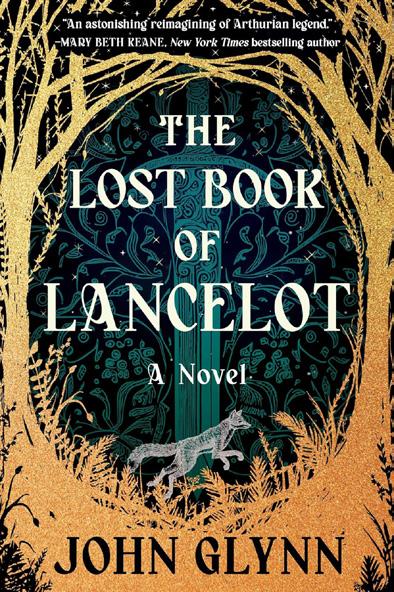
The most famous of King Arthur’s Knights of the Round Table is the central figure in this compelling novel. Raised in secret on the mystical Isle of Women in preRoman Britain, the nameless orphan, under the care of the enchantress Viviana and the sisterhood, learns of a prophecy that reveals his true identity and destiny: he is Lancelot, slated to become a knight of the Round Table and find the Holy Grail. This knowledge will guide him toward his most vulnerable self. He diligently trains to become a knight worthy of the Round Table, joined by the handsome youth Galehaut. As the young men become intimately connected and pledged to each other, circumstances intervene to separate them. The wizard Merlin enters into Lancelot’s orbit with heartbreaking news, forcing the reluctant Lancelot to the wondrous city of Camelot to fulfill his destiny. While searching for the grail, navigating court life, finding new romance, becoming the friend and confidante to both Arthur and Queen Guinevere, the conflicted Sir Lancelot experiences the manipulations and maneuverings of those grasping at power. Meanwhile, the Romans and their allies are closing in, bent on destroying Camelot and the old ways.
Glynn has skillfully distilled various legends and writings concerning Arthur and the Round Table into a provocative and sensitively written narrative. He cleverly utilizes the familiar characters: Sir Gawain, Lady Elaine, the Fisher King, Mordred, Tristan and Isolde, Morgan le Fay—even Galahad makes a brief appearance—in new and insightful ways. But it is Glynn’s multi-faceted portrayal of Sir Lancelot as he evolves into his authentic self and discovers that sometimes your destiny can lead you to where your heart longs to be, that propels the story. Brilliantly conceived, complex, magical, and a grand adventure.
Michael I. Shoop
GALAHAD AND THE GRAIL
Malcolm Guite, illus. Stephen Crotts, Rabbit Room Press, 2026, $34.99, hb, 372pp, 9781951872700
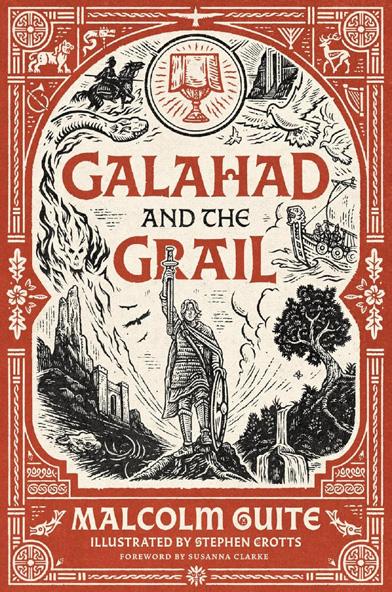
Prophesied to bring healing to the land and newly knighted by Sir Lancelot, Galahad arrives at King Arthur’s court. But anon, he along with a few other knights will venture forth upon a quest for the Grail. This mysterious path shall test their strength, courage, and faith. Wrought within luminous stanzas, Galahad’s tale is nothing short of pure enchantment, and Guite’s lyrical rhythm and deftly crafted rhymes both cast a spell most fair!
Malcolm Guite revives the romanticism of Arthurian times, which is defined by the medieval code of chivalric oath and of courtly grace. It’s a world steeped in prophecies and sages, where women are heralds of destiny and men bear arms forged in mystery. Here, Celtic ways ebb before the rising tide of Christianity, and the dream of Camelot burns brightly for but a fleeting moment.
For lovers of beautiful, artfully designed books, this one is a marvel of colored interiors with illuminated capitals, fine filigree details, & full-page black-and-white illustrations. The intricately fashioned pages will feel like a time capsule to eras prior to mass-produced books. The prose’s cadence sculpts the tone for each page.
The stories are familiar and wellresearched, keeping emphasis on the Christian faith that would likely have guided the characters in this turbulent century, an idea solidified by later Arthurian writers. The book largely focuses on Galahad’s travels, yet his companions’ coinciding adventures also make appearances, rounding out the narrative. While stanzas don’t delve too deeply into character thoughts and feelings, they still manage to add emotional weight through clever wordplay.
Like riding upon a noble steed, both page and prose (serving as shield and sword) will carry readers forth into an age of wonder and myth and will hold a special place on readers’ shelves and in their hearts.
J. Lynn Else
HENRY TUDOR MUST DIE
Jillian Laine, Berkley, 2026, $30.00/C$41.99, hb, 368pp, 9798217189724 / Michael Joseph, 2026, £16.99, hb, 400pp, 9780241815007
Lina (Catalina of Aragon) fakes her death in 1536 and joins the Hellebore Sisterhood, whose mission is to protect women suspected
of witchcraft, those condemned as healers, wise women, and visionaries. First, though, she has to smuggle Anne Boleyn’s bloodletting knife and spell book to her so she can escape execution. Sisterhood founder Marguerite d’Angoulême doubles as Laine’s narrator, with pertinent interjections on wider events and what she hopes to accomplish with the two queens help. They are sent to study at Santa Cruz de Madrid, then charged with the Sisterhood’s business of locating and protecting witches. Their investment in their royal daughters doesn’t hurt, despite Anne and Lina’s embittered history, because they both want Henry dead!
Anne’s magick comes with consequences painful and draining, both physically and mentally. Lina worries when the young queen is rash and impulsive and surrenders too much to her tasks. She urges caution and patience as Anne’s strength drains. The relationship’s ups and downs are an appealing aspect because it’s relayed so credibly, despite its historical unlikelihood. Rumours of Henry’s newly bestowed affection for Katherine Howard, Anne’s vulnerable young cousin, reach the queens. Horrified and fearful for Katherine’s life, Anne and Lina rush to avert disaster.
In this feminist-leaning narrative, four of Henry’s six queens are given a selfdetermination they never had in life, feminism being an underlying theme which never overrides the plot. Magick, murder, love and sex weave through an atmospheric 16th-century world, while historical fact solidly supports the story backbone, making the blend of fact and fiction rather impressive. The plot is pacy and doesn’t lack action. The lesser-known Anna von Kleve joins the formidable team, showing inventive traits and a thoughtful persona. Some scenes are too good to miss: Anne’s execution, and the revenge-driven Anne disquieting a confused Cromwell with a glimpse of what’s to come.
Fiona Alison
FISHBONE CINDERELLA
Elizabeth Lim, Del Rey, 2026, $30.00, hb, 448pp, 9798217092987 / Hodderscape, 2026, £22.00, hb, 448pp, 9781399750813
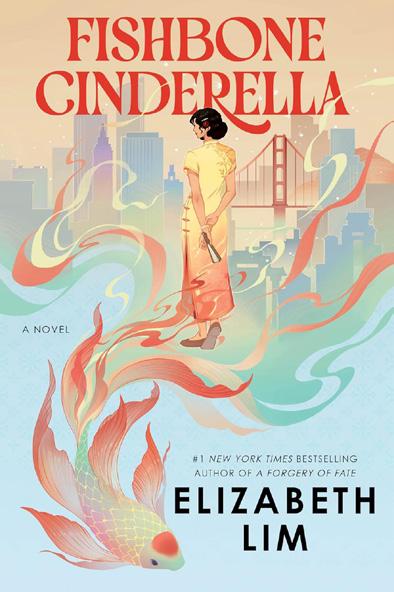
barely tolerated stepchild of a truly wicked stepmother. She is stubborn, beautiful, and resourceful, however, possessing the ability to become invisible when she needs to. This supernatural element – and the Cinderella plotline – are very subtly applied to what is otherwise a realistic and psychologically rich exploration of class and resilience.
Yut Ying escapes her cold, amoral family and makes her way – via a marriage of convenience – to America and a new life. Through her point of view, we learn about the challenges of assimilating and the cost of keeping long-buried traumas hidden. Marigold, like her mother and grandmother, has an uncanny ability that takes the form of unwanted visions of a person’s past when she touches them. This leads her to study medicine and also thwarts her first love. Mother and daughter journey back to Hong Kong in 1980, where Yut Ying’s power to “disappear” has become life-threatening, and Marigold must discover the source of her mother’s pain before she loses her.
Lim’s prose is lyrical and the voices of her characters come through powerfully, creating a page-turner that beautifully balances the story’s magical realism with a sensory feast of detail about the food, music, houses, and landscapes that enrich the family’s lives. This is Lim’s first novel for adults, and she is as successful as Amy Tan or Lisa See at illuminating the lives of Chinese women throughout the ages.
ODESSA
In this absorbing family saga, we meet two fascinating women: Yut Ying, born in Guangdong in 1933, and her daughter, Marigold, born in San Francisco in 1958. Most of the novel narrates Yut Ying’s journey from the war-torn north of China to the handsome middle-class mansion of her father’s second wife in Hong Kong, where the significance of the title becomes clear. Yut Ying finds herself the
Kristen McDermott
Gabrielle Sher, Little, Brown, 2026, $29.00/ C$39.00, hb, 288pp, 9780316595858
The novel opens in 1905 in Odessa, a major seaport on the Black Sea in the Russian Empire. With a multiethnic and cosmopolitan population, Odessa also has a history of violent pogroms against its Jewish residents. Mordechai and Frieda have a daughter, Yetta, and a young son, Ephraim. Frieda wonders what Mordechai does after leaving the furniture shop each night. Fearing more pogroms, Mordechai collects pieces of wood that can be made into weapons by the local blacksmith. He urges his neighbors in the shtetl to learn to fight back.
A loud pounding on the family’s door at night signals another pogrom. Mordecai hides Freida and Ephraim in a small hole in their home. He is severely beaten, and Yetta is dragged out by a young Russian. Dead bodies litter the shtetl streets; blood is everywhere. Mordechai stumbles out of the house and finds Yetta’s murdered body in her white dress in the town square.
A nightmarish gothic tale ensues as Mordecai begs Rabbi Gershon to turn Yetta’s dead body into a golem that will fight back. The Rabbi undertakes the mystic rituals involving mud or clay. They succeed, but Yetta is psychologically lost. Now a golem, Yetta’s transformation is eerily revealed. Ms. Sher’s evocative prose conveys Yetta’s fears, danger, and mental confusion. Fearing her,
Yetta’s family knows she will only find peace by destroying the dybbuk, the malicious spirit that possesses her dead, unsettled soul. The 1905 setting is drawn impeccably, as is the depiction of Jewish life and folklore. The narrative is character driven with alternating chapters titled Frieda, Mordechai, or Yetta. A disturbing novel, readers may be reminded of William Peter Blatty’s The Exorcist, but the novel’s denouement is both unexpected and uplifting.
Robin Holloway
THE IRISH QUEEN
Johanna Wittenberg, Shellback Studio, 2026, $13.99, pb, 266pp, 9781734566482
The Irish Queen (Book 8 of The Norsewomen) continues the epic saga of Queen Ragnhild from Gausel, Norway and Queen Gormlaith from Aileach, Ireland in AD 825 but can be read as a standalone. After she discovers Gormlaith, a powerful sorceress, has gifted her baby son a cursed rattle, Ragnild recruits a volva to break the spell. Nonetheless, her baby disappears on Samhain when portals to the Otherworld allow the Fairy Folk to enter the mortal world. Ragnhild travels with her husband to Ireland to confront Gormlaith about her son’s disappearance. The Irish Queen confesses that a fairy woman warned her baby daughter would be taken by the Tuatha Dé unless she offered Ragnhild’s son instead. However, Gormlaith was tricked because her baby was also taken on Samhain. The only way for the mothers to rescue their babies is to journey to the Otherworld and ask the Dagda for their return. However, both queens are kept as prisoners to lure their husbands into the Otherworld, causing chaos in their realms and raids from sworn enemies. Author Johanna Wittenberg is a masterful storyteller weaving Irish mythology into the tale. The Otherworld and battle scenes are vividly described and cinematic in scope. The fast-paced adventure races to a gripping ending where Norsemen and Irish must find a way to rescue their rulers from the spells of the Tuatha Dé, and to fight off rivals. A list of characters, maps, and glossaries of Norse and Irish terms help the reader to navigate the worlds.
The Irish Queen is a riveting epic adventure that captures the myths and legends of the Irish and seafaring Vikings.
Linnea Tanner
THE LAST LABYRINTH
Gwendolyn Womack, 47North, 2026, $16.99/£8.99, pb, 347pp, 9781662534935
Musical prodigy Magellan finds herself swept back in time to November 1829 after playing on an ancient organ in St. Paul’s Chapel. She awakens within a circle in the center of a garden labyrinth. There she meets Rhys, the handsome lord of the estate which the labyrinth is a part of. The one link tying Magellan to the present and the past is a diary rumored to be that of Merlin’s twin sister. It tells
of a time labyrinth and a great song to save the world. However, pieces of the song are hidden with four different women in four different time periods. Magellan will need to traverse time, identify them, and piece together a symphony in order to stop this disaster. But first, she needs to convince Rhys her story isn’t pure fiction and quickly, because when the winter solstice arrives, everything will collapse.
This book’s heart is a stirring tribute to forgotten women composers and the enduring power of music. The feelings evoked as Magellan performs are palpable, and playing serves as a way for her to cope with her anxieties and the task laid before her. Learning about women of musical genius throughout time is fascinating and a welldetailed story element. However, the sci-fi portions, like dimensional frequencies and dimensional beings, geometric magic and ley lines, cosmic guardians, and planetary great wars all feel out of place. Why the antagonists want our world to end is never clear. By the final chapter, the story stops short of a true resolution. Major moments, lingering plot threads, and a crucial character revelation are left suspended in midair. While romantic tension and apocalyptic urgency are strong, the climax is frustratingly withheld. The novel is filled with striking, imaginative ideas, but its ending is suggested rather than earned.
J. Lynn Else
ALTERNATE HISTORY
FEW AND FAR BETWEEN
Jan Carson, Scribner, 2026, $28.00, hb, 336pp, 9781668056639
This rural Northern Ireland gothic is based on a historical “what if”: What if Irish prime minister Terrence O’Neill had gone ahead with his 1958 scheme to drain a huge lake and thus create a new “county” for his nation?
In Carson’s novel, lowering the water level part way formed islands on which settlers left behind previous divisions of Protestant vs. Catholic, creating an idyllic commune. But many of the settlers have moved on as the story opens, and the time has come to restore the water level for the sake of eradicating a blue-green algae infestation. Aging siblings Marion and Robert-John Connolly will lose their island home and the structure of their lives—which included a reclusive (now deceased) immigrant mother, and a father whose social theories played out among the islanders, so that in a creepy sense he lives on among them.
Disturbed by the arrival of young anthropologist Alex Anderson to dig into that father’s actions and effects, the siblings begin revealing secrets—their own and those of their parents. The islands themselves collaborate, with the very soil pushing buried items upward. Will Marion’s dead baby be among them? Should Robert-John kill himself before another woman rejects him? Can
Alex’s persistent efforts destroy the fragile life of cross-dressing Sandra?
Told in three points of view, with dark humor and suspense, the tale does far more than probe an Irish conundrum: through character collisions (“Alex’s head is running on double time. Marion is finally opening up. While Robert-John’s not here to keep his sister in check…”), Few and Far Between plays with a modern environmental crisis, decisions from 1958 and the 1980s, and the quirky feel of communes, with unforgettable results.
Beth Kanell
WE MEET APART
Martha Conway, Regal House, 2026, $19.95, pb, 268pp, 9781646037025
Imagine two versions of World War II history. In one, Ireland is invaded by the Nazis. In the other, following the historical record, Ireland remains neutral. In We Meet Apart, American sisters Gaby and Sabine find themselves stranded in these separate realities, but both travel from Cork to Kilcurra House near Ballyleam, home of the Grogans, a family they are distantly connected to. Ireland, of course, is a place steeped in myth and magic, so perhaps it’s no surprise that the sisters are able to meet at dusk every day, but only for one hour. For older sister Gaby, believing her sister and parents all died of typhus, it’s a mysterious but vital connection, and her protective instincts are roused when Sabine falls in love with German soldier, Dieter Ott. He’s not the same man in Gaby’s reality as he is in Sabine’s. Younger sister Sabine has a physical disability that has made her always feel second-best to her sister, but in this different reality, her individuality and independence grow.
This is a fascinating and clever story. I really enjoyed the way the same characters and physical artifacts appear in each sister’s version of the world in different ways. Speculative fiction doesn’t always work for me, but Conway’s premise allows her to ask questions about identity and perception, and about family and independence, in an original way. Should Gaby curtail her life to have an hour a day with her sister? Or is Dieter correct when he tells Sabine that sometimes we need to abandon others to become our full selves? I was a little worried about how this novel would end, but Conway provides a satisfying conclusion to both of her worlds. A very different read, but in the best way! Recommended.
Kate Braithwaite
NOW I SURRENDER
Álvaro Enrigue, trans. Natasha Wimmer, Riverhead, 2026, $30.00/C$39.99, hb, 464pp, 9780593084076 / Harvill, 2026, £20.00, hb, 464pp, 9781787301467
Past and present come together to tell a very different story of how the West was won in Álvaro Enrigue’s brutal yet enchanting novel, Now I Surrender. In this literary alt-western that moves
through space and time, Enrigue unspools an impeccably researched history of the Apache Wars and the contested borderlands of Mexico and the U.S. during the 19th century. In 1836, Mexico is a new republic, yet Apaches do not care for the Mexican or the American interlopers: in Janos, they attack a widow’s ranch and take the woman, Camila, hostage. Soon, Lt. Col. José María Zuloaga of the Mexican Army is sent to round up cattle rustlers but instead stumbles upon the trail of this dramatic abduction. He decides to go after Camila and slowly attracts an eclectic and amusing posse to help him find her.
Interjecting this gripping, graphic, yet often hilarious storyline is a modern-day narrator (Enrigue) who discusses at length Apache culture, society, and its vaunted warrior class with a particular emphasis and obsession with the legendary chief Geronimo and the final days leading up to his surrender to U.S. authorities in 1886. The novel shifts halfway through from Zuloaga’s quest to find Camila, to a broader fictionalized account of the American generals and soldiers sent to fight the Apache Wars and bring Geronimo in. Readers must wait to see the resolution of Zuloaga’s rescue mission, as well as Camila’s fate, while the storylines rise and fall at Enrigue’s pleasure.
Now I Surrender is a somewhat uneven mélange of history and historical fiction that engages every sense with its luxuriant prose and impresses with its research.
Peggy Kurkowski
CHILDREN & YOUNG ADULT
STONE WARRIORS
Elizabeth Barber, The Book Guild, 2026, £8.99, pb, 200pp, 9781835743980
It’s not easy to imagine how people lived thousands of years ago but Elizabeth Barber has done just that, bringing the lives of Mesolithic hunter-gatherers sharply into focus for young readers.
Following on from Stone Arrows, her first book set in this period (and shortlisted for the prestigious Historical Association’s Young Quills Award), the reader is re-acquainted with Zeta, Finn, Arden and their friends when their tribe is attacked and overcome by the cruel Crow’s Claw warriors. The young people must somehow find a way to save the day before it is too late.
What is exceptional about Stone Warriors (and its predecessor) is the in-depth research undertaken by the author. This is deftly woven
into these two exciting and fast-paced stories but never once overwhelms them. The books also have the advantage of well-fleshed-out characters to whom young readers can readily relate.
Early human history is on the KS2 history curriculum in primary schools. Reading Stone Arrows and Stone Warriors would be an excellent way of introducing children to the way of life of the early inhabitants of Britain. In my view, these books should be in every primary school library, if not in every primary school classroom.
R. Hayes
THE PATH
Rüdiger Bertram, trans. Claire Storey, Dedalus, 2025, £9.99, pb, 253pp, 9781915568595
The story begins in 1941 in Marseille where Rolf, his journalist father Ludwig, and their dog Adi (whose presence later proves problematic), having escaped from Berlin, are waiting for documents so that they can move on and follow Rolf’s mother Katja, a dancer, to New York. A refugee community of writers, artists and intellectuals resides in Marseille at this time.
The path they plan to take is over the mountains to Spain and thence to Lisbon and a ship to the USA. They are guided by Manuel, a shepherd boy who speaks some German, having learned it from people he has taken over the Pyrenees to safety. Things go awry when Ludwig is captured by Nazi soldiers, and Manuel is reluctantly persuaded to carry on beyond the border with Rolf.
The second half of the book describes their journey, as they encounter resistance fighters, a bear and leap from a moving train. En route they learn to co-operate despite the very different lives they have led. Rolf displays a superior attitude towards Manuel, frequently correcting his grammar. The book was originally written in German so it must have been an interesting undertaking for the translator to render Manuel’s incorrect but perfectly understandable speech into English.
An intriguing aspect of this book having been translated from German, relates to Rolf carrying with him a signed copy of a novel by Erich Kästner, an acquaintance of Ludwig’s who has remained in Berlin. This is not Emil and the Detectives, the most familiar of Kästner’s work to English-speaking readers. It is The 35th of May, a story that Rolf describes in detail to Manuel. It is set in a fantasy land, something that makes Manuel impatient initially. However, this volume becomes a significant symbol when the time comes for them to part.
Ann Lazim
veteran of the Battle of Marathon. They live in dangerous times. Xerxes, King of the Persians, is subjecting Greek cities to imperial conquest. Athens, Sparta and the remaining city states, are fighting body and soul to resist barbarian rule. But some statesmen prefer capitulation to war and have turned traitor to work with the Persians. When Kleon goes missing on state business to Xerxes, the mob attack Nikos and his family as collaborators, forcing them to flee. Meanwhile, Chief Archon, Themistokles, gambles on a decisive naval war against the Persian fleet, but he makes Nikos uneasy, even as he protects Nikos’s family. Themistokles enlists him as a marine and Nikos vows to defend Athens and exonerate his father.
Nikos’s marine adventure leads us seamlessly from the Delphic prophecy of the naval Battle of Salamis (as reported by the Greek historian, Herodotus) to the selfsacrifice of the Spartan 300 at Thermopylae. Despite the cover illustration of a hoplite in battle cry (by Alessandro Valdrighi) and a convincingly murderous combat sequence, this is a story about family life, its affections, tensions and responsibilities. Nikos’s place in Athenian patriarchal domestic and civic culture is meaningfully conveyed. We also get a nice walking tour of the heart of Athens in the 5th century BCE, wonderful visuals of Persian court dress and the glory of Spartan men’s hair. This is the fourth book in the historical novel series for middle grade readers, of which Anglo-Saxon Boy won the Historical Association’s Young Quills Award. Bradman’s series is a boon for its particular appeal to that more difficult readership, young male readers, but it’s highly recommended for all.
Louise Tree
KATA & TOR
Kevin Crossley-Holland, Walker Books, 2025, £7.99, pb, 249pp, 9781406399059 1066, and a shipwrecked youth washes up on England’s east coast. The boy, Tor, is a secret scout for the Norwegian army, supported by Tostig Godwinson, following in a 300-ship fleet. Meanwhile, nine miles south of York in the riverside village of Riccall, fifteen-year-old Kata helps bring in the village harvest. Tor, telling a cover story as an Orkney fisherman, attempts both to gain information, and find his way back to his fleet. When he encounters Kata, there’s an instant spark between the two. Thus opens a story of love and adventure, set against the Norse invasion of Yorkshire in September 1066.
GREEK BOY
Tony Bradman, illus. Alessandro Valdrighi, Walker Books, 2026, £7.99, pb, 224pp, 9781529522136
Nikos and his father, Kleon, were close once, but now Nikos is fifteen, they always seem to be arguing. Kleon expects Nikos to follow in his footsteps as an Athenian statesman and a
The writing, intended for children, is vivid and pacey. There is a strong anti-war theme, showcasing more of what people have in common than what divides them. 1066 is a special interest of mine, and I was delighted to see a book set against these events –especially in the North, where the tragedy of thousands killed became overshadowed by the Conquest at Hastings. I was therefore deeply disappointed at the author’s apparent lack of local research. For example, he describes the castle in York, which would not have been
present in 1066, as it was founded by William the Conqueror two years later. I also feel that the anti-violence theme led to excessive ‘warping’ of the history. For example, Tostig asserts that he would rather be killed himself, than kill his brother, King Harold of England. In fact, Tostig sided with the Norse, precisely because he did wish to kill his brother. However, this is a readable adventure that introduces the 1066 invasions of England - and the eternal sorrow of war.
Helen Johnson
A BOY CALLED HERO
Marie Miranda Cruz, Lerner/Carolrhoda, 2026, $18.99, hb, 248pp, 9798765690734
Hero Del Rosario has recently moved back to the Philippines from California with his family, but now his parents have left him alone with his grandfather while they take his older brother, Patrick, back to the U.S. for a checkup. Hero was conceived as a potential bone marrow donor for Patrick, who had contracted leukemia, but despite having saved his brother’s life he feels invisible. However, he has developed a relationship with his widowed grandfather and an interest in Filipino history, which becomes alarmingly real when he removes a rare book from his grandfather’s cabinet and is transported to the family’s house in 1892. There, he meets his great-great-grandfather Teo, who is also 12 years old at that time, Teo’s twin sister Olivia, and the cruel priest Padre Antonio, who takes Hero’s rare book and spies on the family for any hint of rebellion against the Spanish authorities who rule the islands.
The book, José Rizal’s Noli Me Tangere, is a manifesto for freedom and independence. Hero needs it back to return to the present day. Teo and Olivia, and their father, are smuggling more copies of the banned book into their town, hoping to spark a revolution. This gripping adventure story will appeal to middle graders interested in both history and time travel, and the time travel itself is well executed, with Teo and Olivia in on the secret of Hero’s arrival while their parents and the authorities surveilling them are not, which adds both suspense and humor. Descriptions of the family home, then and now, are vivid (especially the outhouse in a time before indoor plumbing) and depict how life changed from the late nineteenth century to the present day. The novel includes a historical note, glossary of words in Tagalog, and questions for discussion.
Lyn Miller-Lachmann
WE ARE PAN
Andre R. Frattino, illus. Yasmin Florez Montanez, Top Shelf Publications, 2026, $19.99, pb, 184pp, 9781603095921
This graphic novel is based on the true history of Cuba during and after Fidel Castro’s revolution. Almost overnight the future of four youths changes, and their lives may be in jeopardy. The protagonists and their families seek options unthinkable just a year earlier. We Are Pan also explores Operación Pedro Pan, a joint U.S. government and Catholic Welfare Bureau evacuation of 14,000 children from Cuba to the U.S. between 1960 and 1962. Drama builds as many natives of Cuba suddenly find themselves on the wrong side of the revolution, in fact blamed for the oppression of their fellows. Their reactions are as varied as themselves. Ultimately, these four young people join thousands of others who flee to the United States, most expecting a future reunion with their families, which often never happens.
Frattino’s story relies heavily on actual history and real people. He weaves together a convincing plot which of necessity has many threads. Frattino’s storytelling conveys the hopes, fears, and desperation of the protagonists. Flores Montañez’s artwork is striking but unpolished. Coloring by Fabi Marguez is just short of amazing. Young adult. Ron Andrea
THE DETECTIVE’S GUIDE TO OCEAN TRAVEL
Nicki Greenberg, Affirm Kids, 2026, $8.99, pb, 320pp, 9781922400673
In 1927 London, young Pepper Stark wants to connect with her remote sea-captain father in his domain, the RMS Aquitania, aboard which her mother died in an accident when Pepper was a baby. Her father is eventually persuaded to take her aboard. Pepper is thrilled by the opulence of the ship and the prospect of seeing her late mother’s New York City. The notable human and animal passengers include American stage star Perdita West with a pet leopard and the huge Saffron Diamond, a gift from her fiancé. Pepper encounters and befriends an older boy with a blind father and unusual skills, a boy who sneaks up from Second Class eager to meet the pastry chef, and an Irish girl from Third Class with a golden voice hoping to meet Perdita West in the ship’s Night of Stars.
A fancy-dress costume parade where Perdita’s leopard shows up wearing the Saffron Diamond ends with almost everyone in the pool and the diamond disappearing. Everyone is a suspect, and Captain Stark comes under fire for the theft on his watch. With Pepper’s governess constantly seasick and medicated, Pepper decides to investigate and recover the diamond, a search that puts her, her friends, and the ship in peril.
Pepper’s early-teen point of view rings true as she navigates this strange world, and the plot is well paced. The friends are
loyal and passionate; they argue and come together. There are numerous red herrings and apparent dead ends in the mystery before them; its solution will challenge adults as well. The design is lovely, befitting the novel’s opulent and well-rendered setting in the golden age of ocean liners. This is the kind of book for middle-grade readers that made this reviewer fall in love with reading. Andrew Kass
THE GIRL WHO RACED THE WORLD
Nat Harrison, Piccadilly Press, 2026, £7.99, pb, 336pp, 9781835871416
A new version of Jules Verne’s Around the World in Eighty Days, this book tells the story of Magnolia Appleton, known as Maggie, who finds herself caught up in both Mr Phileas Fogg’s bet and a whole web of other intricate plot strands, crimes and perils, whilst being pursued by an angry detective and the threat of the workhouse. Victorian London and many other world cities are evoked with verve and aplomb. A helter-skelter of a novel! Maggie’s only resource after the death of her mother is a letter addressed to a Monsieur Passepartout, but an accidental encounter with a sinister detective named Fix robs her of the letter whilst leaving her with the detective’s notebook and a determined enemy. Maggie and M. Passepartout swiftly find themselves entangled with Phileas Fogg and setting off, with barely a chance to take breath, on a round-the-world tour by train, boat and, at one point, sledge. Friends and dangers pile up as fast as the international cities they pass through, but Maggie proves herself a match for most of them. A striking young woman adventurer, Valentine, takes them under her wing in India, when they are almost arrested for the theft of an elephant. Despite further brushes with the law, and with an elusive colleague of Fogg’s named Sullivan, they manage to just win Mr. Fogg’s bet with the clever use of the International Dateline as a plot device, and at the same time solve the mystery of who exactly robbed the Bank of England.
A whirlwind ride, this book manages to combine excitement with the underlying theme that friends can be family and home is where you are loved. There is lively characterisation and humour, a page-turning style and satisfactory resolution.
A great adventure story for 8 – 12-yearolds. Recommended.
Jane Burke
ROI AND ME AND THE DOUBLE V
Sandra W. Headen, Holiday House, 2026, $17.99, hb, 224pp, 9780823453795
War has already broken out, and by fall 1941, U.S. involvement is imminent. For Black middle schoolers Marvel Zander and Roi Smith living in Wilmington, North Carolina, this means big changes. Roi’s older brother,
Charlie, who has taken care of him and his little sister ever since their mother went to a tuberculosis sanitarium, has enlisted in the Marines after the Army rejected him for lack of segregated barracks. Marvel, an aspiring Olympic track star, has lost her coach, who also signed up to fight. Furthermore, the old farm where Marvel’s track team practices and the Black community has planted a victory garden, is slated to be bulldozed for housing for shipyard workers. Marvel fears the end of her Olympic dreams. Roi, an aspiring journalist, connects with his new teacher, Mr. P., who writes for The Pittsburgh Courier and who helps Roi to create his own newspaper for Wilmington’s Black residents. But will Roi’s newspaper make a difference in a town where the white people have all the power? And is Roi putting himself in danger by speaking out?
In alternating point-of-view chapters, Headen portrays two young people who refuse to have their dreams crushed and their lives circumscribed by Jim Crow segregation. With the help of Mr. P., Marvel and Roi find white allies who understand the contradiction of Black citizens who are the first to risk their lives in the war but are second class citizens at home. Hence, the “Double V”—the quest for victory in World War II and in the U.S. South. Headen’s novel for readers at the older elementary and middle school level shows how WWII played a role in the civil rights movement that would gain national attention a decade later.
Lyn Miller-Lachmann
A MURDER OF ROGUES
Joe Heap, illus. Max Marin, Scholastic, 2025, £8.99, pb, 448pp, 9780702339691
It’s Regency England, and Cascabel Gray is an intelligent but frustrated girl. She wants to go to Oxford University but can’t – females aren’t allowed. Undeterred, with a short haircut and chest binder, she disguises herself as a boy called Pom and fools the authorities.
Once at university, Pom is introduced to the Rogues, a badly-behaved dining club. But disaster strikes when one of the Rogues, Charles Lafleur, says he knows Pom’s secret. While Pom/Cascabel ponders what to do, Lafleur is found dead and police suspect Pom of murder.
After discovering Lafleur had sent all the Rogues blackmail letters, Pom teams up with one of them, William Grenville, to try to find the real killer.
Things get complicated as, when dressed as Cascabel at a ball for an Austrian Prince, she dances with William and realises she has feelings for him. But will he recognise her as Pom? Then while being Pom, a gentle romance develops with a deaf female chambermaid called Mouse.
The novel is a page-turning easy read, and the character of Cascabel/Pom shines with their tender, romantic development well told. They say they feel neither boy nor girl and the non-binary fluid element adds to the character’s depth. There are plenty of red
herrings and double crossings in a bid to find Lafleur’s killer and a very good twist at the end.
I felt Cascabel was in danger of being uncovered more than she was. However, this is a lively read for YA readers who fancy a pacy historical/LGBT/crime mash-up.
Kate Pettigrew
BEHIND FIVE WILLOWS
June Hur, Feiwel & Friends, 2026, $20.99, hb, 306pp, 9781250348081
Set in late 18th-century Korea, Behind Five Willows is a tale of romance, censorship, authenticity, and challenging mores. Five Willows is an innocuous bookstore, but a second, clandestine bookshop is hidden behind a door at the rear. This back room holds transcribed forbidden works of fiction and poetry. Authors write under pseudonyms, and transcribers make copies to be lent or sold.
Haewon is one such transcriber—the daughter of a family caught in financial trouble, destined to be married off. Her sister is being courted by a rich son of a noble; each needs a chaperone, and Haewon is dragged along. Her counterpart, chaperone Seojun, is equally annoyed at his role. But each holds a secret identity: Haewon is a transcriber of illicit books, and Seojun is one such author who writes under the name Black Lotus.
What follows is a tale of layered secrets as Haewon and Seojun struggle to maintain their hidden identity in the face of governmental suppression. They unknowingly become drawn to each other’s secret work, then to the person themselves, and finally making the connection, all while navigating the social and familial customs and laws of the time.
The tension of each character’s internal struggle is palpable. We feel Haewon’s desire to meet the mysterious Black Lotus while fearful of discovery as a secret translator. Seojun likewise wants to meet the mysterious translator while fearful of being named as Black Lotus. The delicate growth of trust between the two is a wonderful journey, expertly told.
Behind Five Willows unfolds languidly and thoughtfully, capturing both the internal and external dynamics of Korean culture through lived experience. The author’s note at the end delves into the history of the ruling behind the censorship, and the brief glossary of names is useful. Young adult.
Steve Shaw
MUD ANGELS
Beth Kephart, illus. Roberto Innocenti, Creative Editions, 2026, $18.99, hb, 32pp, 9781568463711 Florence, Italy. On a bleak day in November 1966, the Arno River burst its banks after days of torrential rain across Tuscany. Fearful for their lives, people rushed to rooftops and upper floors for safety. At the time, illustrator Roberto Innocenti was twenty-six and newly married. Based on his memories, Mud Angels is told from the viewpoint of a young, budding artist who, along with his family, flees upward until reaching the top of a tall building. From there, they watch as filthy water, mud, oil, and debris surge through the cobbled streets of the city’s homes, libraries and museums, in some places reaching more than fifteen feet deep. Finally, miraculously, as news of the catastrophe spread, help arrived in the shape of Gli Angeli del Fango (“the Mud Angels”),
students, first responders, shopkeepers, and artists who converged from all over the world and set to work with “boots, buckets, blankets, and hope,” mopping, scrubbing, and rescuing precious books and art, while also delivering food to residents and helping them clean filth from their homes and shops. For ages 9 and up, in this powerful collaboration Beth Kephart’s emotionally rich storytelling and Roberto Innocenti’s vivid illustrations come together seamlessly to create an engaging reading experience that reminds readers how everyone benefits when people join hands to help one another. For another look at the flood that threatened to destroy the Cradle of the Italian Renaissance, I recommend Robert Clark’s adult nonfiction title, Dark Water: Art, Disaster, and Redemption in Florence Alana White
SERPENT ON THE MOUNTAIN
J. Kasper Kramer, Atheneum, 2026, $17.99, hb, 320pp, 9781665944175
Delilah’s memories of Maw-Maw are deeply connected to the works, or hill magic, practiced in the Appalachian hills she calls home. But as her oldest sister, Eve, enters her teenage years, Delilah feels increasingly sidelined, competing with the new traveling pastor’s son for Eve’s affection and attention. At the same time, her beloved pet raccoon, Freddy, has disappeared, and many families in her small town are facing the loss of their livelihoods. Growing up is difficult enough, but Delilah is determined to keep her sisters close and stay out of trouble.
The arrival of a new church brings even greater conflict. Its members speak in tongues and handle venomous snakes, while the traveling pastor condemns Delilah’s hill magic as witchcraft. Meanwhile, an old childhood story about a rattlesnake begins to feel unsettlingly real as Delilah develops a mysterious connection to the creature.
This novel beautifully captures life in rural Appalachia in the 1970s and the intensity with which adolescents experience the world around them. It explores the full spectrum of childhood emotions with honesty and compassion, revealing the complexity of a child’s inner life. At its heart, the story is about perseverance, family, and finding strength in the face of both personal and societal change. Readers age 10 and up will find their own fears, hopes, and emotions reflected in Delilah’s unforgettable journey.
Miral Khalil
THE IMPOSSIBLE GLADIATOR
M. G. Leonard, illus. Manuel Šumberac, Macmillan, 2026, £7.99, pb, 272pp, 9781035024377
In this third book in the Time Keys series Sim, Jeopardy and Nelson are holidaying in Rome when world-famous illusionist Kinetic vanishes during a live broadcast from the Colosseum. When his sister finds a newly added line to an ancient text she is studying, she is convinced it is a message from the past. The trio investigate
using time doors to ancient Rome and this new and original adventure begins.
This novel could be read as a standalone, as the opening diary entry provides ample detail for the context of the story. Three time periods add to the complexity of the mystery and the delight of the reader as the historic details of each period are skilfully woven in without slowing the pace or interrupting the engaging interaction between these developing characters. It is the personal growth of each that makes them absorbing and credible. The dialogue builds in humour and drama, to what is an action-packed adventure. Linking music into the magic of the door adds an unusual and convincing dimension, again giving the story its own unique rhythm.
These books support the national curriculum, providing an epic series of unputdownable reads. Fun, danger, love, hate, friendship, and magic keep the reader turning pages. How the bonds that bring social strata together or separate them, and the way slavery and cruelty are perceived now as opposed to Roman times, would make an excellent topic for discussion.
This brilliantly written and illustrated book provides easily imagined details for the lifestyle, dress and setting of ancient Rome and is recommended for confident readers of 8+ years, who have an interest in history, adventure, and true friendship.
Valerie Loh
TIME TUB TRAVELLERS AND THE SILK THIEF
Claire Linney, Maryland Press, 2024, £7.99, pb, 227pp, 9781738526307
TIME TUB TRAVELLERS: Circus Mystery
Claire Linney, Maryland Press, 2025, £8.99, pb, 273pp, 9781738526314
These are the first books in a series about two Black children, Zula and Milo, who travel back in time by means of a bathtub in an antique shop run by Zula’s aunt.
In the first book, Zula’s teacher tells her that there were no Black people in Britain in Tudor times. Discovering that this is untrue, she and Milo travel back to 1589, where they become embroiled in an adventure with Jane, the daughter of weaver Reasonable Blackman, an actual historical character.
In Circus Mystery, Zula is again subject to microaggressive racism, this time from a riding teacher who carelessly misnames her Zoe and from other pupils, causing her to want to give up learning to ride. She and Milo time travel in the tub to 1845, where they meet Black circus owner Pablo Fanque, a real character (who has appeared in a children’s book before – E. L. Norry’s Son of the Circus in Scholastic’s Voices series), and Zula learns not to give up on her dream.
These are fast-paced stories with some unexpected twists and turns and wellresearched historical details that affirm the role of Black people in British history and
demonstrate warmth and humour in the relationship between the two main characters and the people of the past and present that they encounter. Claire Linney is of dual British and Nigerian heritage and was prompted to start writing and self-publishing for children by a passion for bringing Black British history to life for children, ignited by reading Miranda Kaufmann’s Black Tudors. She is very active on social media promoting a diverse range of literature.
A third book, Roman Rescue, is due for publication in October 2026.
Ann Lazim
IF THE INVADER COMES
Tom Palmer, illus. Paul Blow, Barrington Stoke, 2026, £7.99, pb, 208pp, 9780008802226
This novel covers many unusual topics for a middle-grade readership in two hundred pages, namely the direct impact of shell shock from World War One on former soldiers and their families, and the sea patrols which were undertaken by fisherman in coastal towns such as in Cornwall, where this novel is set, and the activities of small, clandestine units of soldiers.
Two things will strike any reader. How long-lasting the impact of shell shock can be and the way some people treated those affected, and how brave the fishermen, and sometimes their children, were who took on sea patrol night after night, both protected and endangered by the enforced darkness. Ships were not allowed to show any lights.
Palmer also discusses class and gender prejudices unflinchingly as well as the xenophobia experienced by both the Germans and Americans. This novel will linger in the minds of its readers and is suitable for age eleven and up.
Rebecca Butler
SAWADIKA AMERICAN GIRL
Daria Sommers, Vine Leaves Press, 2026, $17.99, pb, 304pp, 9783988322128
The epigraph for this young-adult book is David Pollock’s definition of a third-culture kid as “a person who has spent a significant part of his or her developmental years outside the parents’ culture.”
Sawadika American Girl takes place in Bangkok in 1968 and alternates between the perspectives of two American teens who both straddle two worlds: Jack, a PFC in Vietnam, and Piper, a gifted classical pianist growing up in Bangkok as her father is part of the Vietnam
War support machine. They fall in love during Jack’s week of R&R in Bangkok.
The author grew up in Thailand, and her firsthand knowledge can be felt in every detail on every page. There is a rich texturing of sights, sounds, and scents. There is a marked visual and tonal contrast between the often-suffocating world of the American diplomatic families whose children attend an international school together and are waited on by a bevy of Thai servants, and the real Thai society beyond, a world of street vendors, tuktuk drivers, bar girls, Buddhist monks, and Thai royalty. Piper and Jack’s efforts to carve an emotional space for themselves bring the conflicts between their worlds into sharp relief, but also highlight the beauty of knowing and living in more than one world. A beautiful coming-of-age story and an unputdownable read.
Alison McMahan
ARMAVENI
Nadine Takvorian, Arthur A. Levine, 2026, $24.99/C$28.99, hb, 344pp, 9781646146369
This autobiographical story, written in graphic novel format, begins with the author in a public high school just outside San Francisco in present times. Nadine is an intelligent and artistically gifted Christian Armenian American student with a deep and abiding interest in her family’s background. Her public school isn’t any help but at a church youth meeting she learns of an opportunity to make a summer pilgrimage to Armenia.
The trip opens her eyes to the little-known history of hideous massacres of Armenians and other Christians, forced conversions, and the attempted erasure of their civilizational heritage through church and cemetery desecrations and outright destruction. Nadine, a regular American girl, realizes she’s still here and can help keep her history alive. Upon return, she finds her enthusiasm is not acceptable to her high-school history teacher and she is publicly accused of bias.
Armaveni is a passionately written, gorgeously illustrated, and magnificently told story. Nadine’s heartfelt emotion and love for her family and its heritage come through intensely in every word and picture. Uncommonly personal, this debut reflects highly on herself and her dogged tenacity in finding out the truth despite apathy and even some resistance. The novel shines light on a harsh historical reality yet is perfect for mature high school age and young adults. It is also a timely warning at a time when Christians continue to be at risk across the Mideast and elsewhere. Among the very few of the best books I’ve reviewed here. My highest recommendation for all readers.
Thomas
J. Howley
dreams, to her internal struggles and darkest thoughts. Written in verse, the story often feels like a diary: self-serving, self-inflated, and self-deprecating. The descriptions are minimal and the action is sparse, but the voice drives the story and the desire to find out what happens next. Characters flit in and out, making it hard to distinguish one from another; however, there is a consistent vein throughout the story of how Plath’s female relationships sustain her creatively while her male relationships tempt her and sooner or later crush her under their (and society’s) endless expectations of who she should be and what she should accomplish. Ultimately, the reader feels like her only companion and confidant as they are witness to her true self, demons, and ambitions.
This book is recommended for young adult readers ages 14 and up due to its themes of depression and suicide. It would also be recommended to have read the works of, or have a base understanding of Sylvia Plath to truly appreciate the craft of this novel.
Sarah Elliott
THE QUEEN’S GRANDDAUGHTER
Diane Zahler, Roaring Brook, 2026, $18.99/ C$25.99, hb, 293pp, 9781250363107
In the year 1200, 12-year-old Blanca, daughter of the king and queen of Castile, tries to convince her grandmother, the formidable Eleanor of Aquitaine, not to take her beloved sister away to marry the French Prince Louis. But her plan backfires when Eleanor decides that Blanca herself would be a better match and hustles her off across the Pyrenees to meet—and eventually marry—Louis. The voyage is perilous; along with Suna, Blanca’s maid and best friend, and Eleanor’s knight William Marshal, Eleanor and Blanca become separated from their retinue and nearly die in a blizzard before taking shelter with pilgrims. But worse is to come as they are kidnapped, escaping through Blanca’s daring and the intervention of a troop of Knights Templar.
Settings are vividly drawn, starting with the multicultural royal court of Castile, where Muslims and Christians work together. An episode when Blanca runs away and takes refuge with Suna’s family adds little to the story and appears to be included to show daily life of a Muslim family.
LOVE, SIVVY
R. L. Toalson, Little, Brown, 2026, $19.99, hb, 416pp, 9780316587136
Love, Sivvy is a biographical novel about the life of author and poet Sylvia Plath during her high school and college education from the years 1948 to 1955. The novel beautifully captures the voice of Plath, from her melancholy musings on her hopes and
More grounded in history than most of Zahler’s award-winning books, this tale of Blanca—better known today as Blanche of Castile—is told with humor and feeling. The author shows how royal offspring were pawns in dynastic struggles, and refrains from having Blanca spout anachronistic protests of “it’s not fair that I don’t get to choose who I marry.” Blanca’s growth from indulged princess to independent young woman with the potential to be a good ruler is believable.
This novel, intended for readers ages 8-12, includes an informative author’s note that provides interesting context for the story and makes clear where the narrative differs from the historical record.
Tracy Barrett
CONFERENCES
The Society organizes biennial conferences in the UK, North America, and Australasia. Contact Richard Lee <richard@historicalnovelsociety.org> (UK), Elizabeth R. Andersen <hnsnaboardchair@gmail.com> (North America), or Elisabeth Storrs <contact@hnsa.org.au> (Australasia).