
HISTORICAL NOVELS REVIEW
May 2026 ISSUE 116
EMPEROR NERO
History, Fiction, or Just for Fun | More on page 8
FEATURED IN THIS ISSUE ...
The Inspirational Abigail
A Founding Mother
Page 10
The Longer View
Ian McGuire's White River Crossing
Page 12
The Young Will Remember
A Conversation with Eve J. Chung
Page 12
A Treasure Trove
Sharon Spaulding's Women Make History
Page 14
A Lucky Find
Shona MacLean on The Cromarty Library Circle
Page 15
Historical Fiction Market News
Page 1
New Voices
Page 4
History & Film
Page 6



HISTORICAL NOVELS REVIEW
ISSN 1471-7492
Issue 116, May 2026 | © 2026 The Historical Novel Society
PUBLISHER
Richard Lee
Marine Cottage, The Strand, Starcross, Devon EX6 8NY UK
<richard@historicalnovelsociety.org>
EDITORIAL BOARD
Managing Editor: Bethany Latham
Houston Cole Library, Jacksonville State University 700 Pelham Road North, Jacksonville, AL 36265-1602 USA <blatham@jsu.edu>
Book Review Editor: Sarah Johnson
Booth Library, Eastern Illinois University, 600 Lincoln Avenue, Charleston, IL 61920 USA
<sljohnson2@eiu.edu>
Publisher Coverage: Bethany House; Bookouture; HarperCollins, IPG; Penguin Random House US; Severn House; Australian presses; university presses
Features Editor: Lucinda Byatt
13 Park Road, Edinburgh, EH6 4LE UK
<textline13@gmail.com>
New Voices Column Editor: Myfanwy Cook
47 Old Exeter Road, Tavistock, Devon PL19 OJE UK <myfanwyc@btinternet.com>
REVIEWS EDITORS, UK
Alan Fisk
<alan.fisk@alanfisk.com>
Publisher Coverage: Aardvark Bureau; Black and White; Bonnier Zaffre; Crooked Cat; Freight; Gallic; Honno; Karnac; Legend; Pushkin; Oldcastle; Quartet; Saraband; Seren; Serpent’s Tail
Ann Lazim
<annlazim@googlemail.com>
Publisher Coverage: All UK children’s historicals
Carolyn Morgan
<carolyn@historicalnovelsociety.org >
Publisher Coverage: Birlinn/Polygon; Bloomsbury UK; Duckworth Overlook; Faber & Faber; Granta; HarperCollins UK; Head of Zeus; Orenda; Pan Macmillan; Simon & Schuster UK; Storm; Swift Press
Aidan Morrissey
<aidankmorrissey@gmail.com>
Publisher Coverage: Allison & Busby; Canelo; Penguin Random House UK; Quercus
Adele Wills
<adele.wills@btinternet.com>
Publisher Coverage: Alma; Atlantic; Canongate; Glagoslav; Hachette UK; Holand; Joffe; Pen & Sword; The History Press
REVIEWS EDITORS, USA
Tracy Barrett
<tracy.t.barrett@gmail.com>
Publisher Coverage: All North American children's historicals
Kate Braithwaite
<kate.braithwaite@gmail.com>
Publisher Coverage: Poisoned Pen Press; Skyhorse; Sourcebooks; and Soho
Bonnie DeMoss
<bonnie@historicalnovelsociety.org>
Publisher Coverage: North American small presses
Peggy Kurkowski
<pegkurkowski@gmail.com>
Publisher Coverage: Bellevue; Blackstone; Bloomsbury; Casemate; Macmillan (all imprints); Grove/Atlantic; and Simon & Schuster (all imprints)
Janice Ottersberg
<jkottersberg@gmail.com>
Publisher Coverage: Amazon Publishing; Europa; Guernica; Hachette; Kensington; Pegasus; Penzler; and W.W. Norton
REVIEWS EDITORS, INDIE
Karen Bordonaro <kbordonaro@historicalnovelsociety.org>
Publisher Coverage: all self- and subsidy-published novels
EDITORIAL POLICY & COPYRIGHT
Reviews, articles, and letters may be edited for reasons of space, clarity, and grammatical correctness. We will endeavour to reflect the authors’ intent as closely as possible, and will contact the authors for approval of any major change. We welcome ideas for articles, but have specific requirements to consider. Before submitting material, please contact the editor to discuss whether the proposed article is appropriate for Historical Novels Review.
In all cases, the copyright remains with the authors of the articles. No part of this publication may be reproduced or transmitted in any form without the written permission of the authors concerned.
MEMBERSHIP DETAILS
THE HISTORICAL NOVEL SOCIETY was formed in 1997 to help promote historical fiction. We are an open society — if you want to get involved, get in touch.
MEMBERSHIP in the Historical Novel Society entitles members to all the year’s publications: four issues of Historical Novels Review, as well as exclusive membership benefits through the Society website. Back issues of Society magazines are also available. For current rates, please see: https://historicalnovelsociety.org/members/join/
TABLE OF CONTENTS
HISTORICAL FICTION MARKET NEWS
NEW BOOKS BY HNS MEMBERS
1 Historical Fiction Market News
Sarah Johnson
Judy Batalion, Moorea Corrigan, Jiyoung Han & Laura Vogt | Myfanwy Cook 6
Barry Lyndon | Ben Bergonzi
Shona
The following Historical Novel Society members are celebrating the release of their new books – congrats to all! If you’ve written a historical novel or nonfiction work published (or to be published) in December 2025 or after, send the following details to me at sljohnson2@eiu. edu by July 7, 2026: author, title, publisher, release date, and a blurb of one sentence or less. You may also use the “Contact Us” form at the HNS website if you prefer. Please shorten your blurbs down to one sentence, as space is limited. Details will appear in the August 2026 issue of HNR. Submissions may be edited.
The Boys from Umgazana (Reach Publishers, Aug. 19, 2025) is the first in Frank Collier’s four-book series exploring the largely unknown and traumatic history of South Africa’s Eastern Cape, about two boys: one a white castaway, the other his foster brother, the son of a tribal chief, who grow to manhood during a period when vastly different cultural groups—migrating from the east and expanding from the Cape Colony—clashed in an untamed landscape.
Finland’s Dawn by Paul Stein (Saksakivi Publishing, Oct. 2025) is a reimagined account of true but extraordinary events and exceptional but real historical characters involved at the start of Finland’s quest for independence from Czarist Russia (1904-05) up to, and including, the infamous gun-running exploits of the ship John Grafton
Corinne Hoebers’ Tethered Spirits (OC Publishing, Oct. 2025) is a story of survival and resilience in the face of displacement, lost culture, and British control in 18th-century Nova Scotia.
Presented as a dual timeline between 1830s Paris and present-day Warsaw, Chopin’s Last Manuscript by Elizabeth Kellam (The Sound of Genius Publishing, October 3, 2025) weaves a tale of genius, love, and revenge, drawing the reader deep into the minds and hearts of its characters.
In Never Let Me Go: A Novel of Love and Loss Set During the American Civil War by Ann Howell (Holand Press, Oct. 30, 2025), Rowan O’Clanahan dresses as a Confederate soldier to follow her already veteran brother back into the Civil War, convinced she must save his life.
Liverpool, 1861: Assassination, assault, robbery, bribery, blackmail; all are tools of the espionage trade as Union and Confederate agents carry on a clandestine war on the streets of this cosmopolitan port city vying for influence with Britain, clawing for advantage through any means available, as told in Bruce Davis’s Proud Waves Be Stilled (Independent, Nov. 1, 2025).
Both informative and entertaining, C.B. Harper’s I Am the House (Independent, Nov. 15, 2025), a 400-year historical saga set on Long Island’s North Fork, is a nuanced exposition of the interplay of humans and houses, ambition and architecture, but inevitably people and their passions, the perfect read for this nation’s semiquincentennial.
Told through the voice of her great-great-grandmother, Laurie Marr Wasmund’s Catching It Lovely (lost ranch books, Nov. 16, 2025) recreates the journey of her ancestors from a textile town in Scotland to and across America with the dream of homesteading in 1875 on the untamed Colorado prairie.
Set in Poland in the years around WW2 and based on real events, Finding Ida by Marya Burgess (The Book Guild, Nov. 28, 2025) casts a light on a family caught in the crossfire of war and turmoil.
In Book I of The Montbard Dynasty Saga: Legacy The Eagle by Eidgar Reice (Amazon KDP, Dec. 5, 2025), set in the dying days of the Roman Republic, a Gallic family’s fateful alliance with Caesar sets in motion a thousand-year legacy of power wielded from the shadows.
Jeri Westerson’s Devil’s Gambit (Old London Press, Jan. 1), book 4 in her King’s Fool Mystery series, is set in London, 1540: King Henry VIII agrees to strengthen Protestant ties by marrying a gentlewoman from Germany, Anne of Cleves; not only does it begin unfavourably, but the young Maid of Honour Anne was allowed to bring with her from Germany harbours a secret that soon manifests itself into murder—one that jester Will Somers must solve.
Meet Edward IV, Richard III, Henry IV, Elizabeth Woodville, and Margaret of Anjou in Susan Appleyard’s Wars of the Roses - 14521492 (Independently published, Jan. 12), an epic trilogy of war, love, betrayal, ambition and murder.
In Leslie Schover’s Fission: A Novel of Atomic Heartbreak (She Writes Press, Jan. 27), a young wife gives up her dreams to follow her husband to Oak Ridge for the Manhattan Project; she is drawn in by a charismatic army engineer, only to realize he may be a Soviet spy.
From pre-war Nazi Germany to blitz-torn London, a mother and her daughter endure persecution, lost love, and hardship in K. LangSlattery’s Ashes and Ruins: Love, War, and the Home Front (Pacific Bookworks, Jan. 31).
Willi Graf’s short life was filled with idealism, danger, courage, and great faith as he sought to bring down the Nazi regime through nonviolent resistance, as Deborah Lee Prescott conveys in her creative nonfiction account, Holy Idealist: Willy Graf, Hero of the White Rose (Westbow Press, Feb.).
The Reckoning, Book 3 of the Rebellion Trilogy by Paul Bernardi (Sharpe Books, Feb. 13) opens in January 1069: Northumbria has risen up again, determined to resist the fast-encroaching Norman overlords; a final reckoning is coming, and the consequences of defeat will be catastrophic.
Baku, 1901: A bank robbery. A mysterious amulet. Two women’s fight for survival. Anne M. Kennedy’s The Caspian Amulet (Wonky Cat Press, Feb. 17) is book two in The City of Winds series.
Set in Northumbria and Ireland, 6th–7th century, Aidan K. Morrissey’s Tácnbora (Larbok Creative, Feb. 26) tells of how after 1500 years, an unnamed body is found buried at the threshold of the Great Palace at Ad Gefrin, and imagines the life of that forgotten man—a warrior-monk who walks between rival kingdoms, faiths, and loyalties in a land always on the brink of war.
Spring Melt by Lori Duffy Foster (Speaking Volumes, Mar. 10) is a historical suspense set in the Adirondacks—a playland for the wealthy, where long-buried crimes awaken danger, expose corruption and shatter lives.
Linda Stasi’s The Descendant (Regalo Press, Mar. 10) tells the story of an Italian immigrant family in the Wild West whose crazy, brave, and magical women overcame impossible odds to become bootleggers, brides—and Mafia bosses.
The Boy with Five Names by Pamela Belle (Independently published, Mar. 18) centers on the search for an enslaved child through early 18th-century London.
When President Grover Cleveland and his pregnant wife, Frances, retreat to their summer residence in 1895, their first daughter vanishes and the family faces chaos in Marlie Parker Wasserman’s First Daughter (Level Best/Historia, Mar. 31).
Carole Penfield’s Jacques’ Fateful Journey (The Midwife Chronicles, Book 4) (Sycamore Lane Press, Mar. 24) recounts the missing years of a Huguenot silk designer arrested under Louis XIV in 1685 who escapes and rebuilds his life while searching for his family.
In Mary Lawrence’s Fool (Red Puddle Print, Apr. 14), a Jester in the court of King Henry VIII faces brutal consequences from eavesdropping and manipulates a plan of extortion to exact revenge on those who wronged him.
A haunting and magical story of a family with hidden gifts and secrets, Song of Belonging by Michelle St. Romain (She Writes Press, Apr. 21) follows Alice as she embarks on a journey to discover the truth about her ancestors and find her place in a lineage of women healers who protect the waters that surround their Louisiana home.
In Susie Helme’s second novel, Dreaming of Jerusalem (Independently published, Apr. 25), an action-adventure set in early Ottoman Anatolia, a young swordswoman finds love, adventure and religion, and has to challenge her beliefs, her dreams and herself to find happiness.
In the brutal Northern Crusades in Livonia, an exiled knight must prove his worth as faith, ambition, and betrayal close in and destroy him in Soldiers of Christ by Jon Byrne (The Book Guild, Apr. 28).
The Vampyre Client (Old London Press, May 1), the fourth book in Jeri Westerson’s Irregular Detective Mystery series, sees former Baker Street Irregular Tim Badger and his partner in detection Ben Watson garner a most unusual client; the strange Mister Jonathan Wicker has come to them in great distress to ask that they convince the villagers in Ashwell that he is not a vampyre!
When their worlds are upended, two women brought together by loss consider what they’re willing to risk for a second chance in These Empty Places by Sarah Loudin Thomas (Bethany House, May 5).
Alison Morton’s HEROICA (Pulcheria Press, May 14) presents three women, three centuries, three reckonings: Carina in 2020, Honoria in 1683 and Statia in 1849, all descendants of the founders of Roma Nova, face choices that threaten both their family’s honour and their state’s survival.
From London, 1875, to Paris and Tokyo, Kate Lord Brown’s The Silver Thread (Simon & Schuster UK, May 21) is a story of three cities, two women and one hundred years, an epic and intimate tale crossing oceans, cultures and timelines.
Thomas M. Wing’s Perilous Shores (Acorn Publishing, June) continues the story colonial sea captain Jonas Hawke as he navigates the tumult of the American Revolution, taking the war to British waters
in search of vengeance.
Chuck Locklear’s A Storm Coming (Histria, June 2) is a sweeping historical novel set in 1710 North Carolina, where a young Tuscarora woman must choose between love and loyalty as colonial forces threaten her people’s survival.
Rue Baldry’s Dwell (Northodox Press, June 11) tells the story of the developing relationship between two traumatised young men who fall in love with one another across class divisions in England in 1919.
In Sparrow’s Song by Marilee Aufdenkamp (Old Fort Press, Sept.), a young German from Russia immigrant woman pursues opportunity through WWI nurse training and WWII school of nursing teaching while confronting prejudice and the costs of assimilation.
In Molly Sturdevant’s debut historical novel The Sleepers (Regal House, Sept. 1), a quiet letter-press printer in a silver-mining camp is on the edge of bankruptcy when she is injured on the job, the same day the nation flips to the gold standard and pits the bosses against her neighbors, her family, and her preference for an apolitical life.
NEW PUBLISHING DEALS
Sources include authors and publishers, Publishers Weekly, Publishers Marketplace, The Bookseller, and more. Email me at sljohnson2@eiu. edu to have your publishing deal included. You may also submit news via the Contact Us form on the HNS website.
Jacquie Rogers has signed a five-book contract with Sapere Books. Her Quintus Valerius series, beginning with The Governor’s Man, is a close-coupled sequence of mystery/thrillers set in 3rd-century Roman Britain. Quintus and his colleague Tiro investigate fraud, rebellion and murder across Britannia, featuring iconic Roman settings.
Katherine Tozer’s debut novel The Art of Poison, historical crime about a scandalous murder trial of socialite Madeleine Hamilton Smith in mid-19th century Glasgow, who was charged with killing her lover, Pierre Emile l’Angelier, sold to Kate Parkin at Firefinch via Kevin Conroy Scott at Tibor Jones for Feb. 2027 publication.
The Lacemaker’s Fortune author Andrea Catalano’s third historical novel The Widow of Mount Holly, about a beautiful young widow who’s recruited by General George Washington to step beyond the boundaries of polite female society and into the world of espionage (based on a mysterious woman from Revolutionary War history), sold to Marilyn Brigham at Lake Union Publishing, in a two-book deal, by Danielle Egan-Miller at Browne & Miller Literary Associates.
Silk and Sensibility, in which academic translator Mengxi Seeley retells Jane Austen’s Sense and Sensibility in Ming Dynasty China, following two different sisters, Ailin and Meilin, who search for happiness during a time of pirate raids, class conflicts, and delicate expectations for Chinese womanhood, sold to Callie Hansen at Shadow Mountain, with Lisa Mangum editing, for September 2026 publication, via agent Lindsey Aduskevich at Martin Literary Management.
The Last Prince of Florence by Zoe Sivak (author of Mademoiselle Revolution), biographical fiction based on the life of Alessandro de’Medici, following a Black woman’s secret plot to see her son become a Renaissance prince, sold to Jen Monroe at Berkley via agent Amy Bishop-Wycisk while at Dystel, Goderich & Bourret. Publication is November 2026.
Craig Shreve’s The Maroon King, reimagining the true story of an early slave uprising, pitched as a tale of rebellion, survival, and the birth of freedom amid 16th-century Spanish colonialism, sold to Dan Lopez at Counterpoint for publication in summer 2027 by Chris Casuccio at Westwood Creative Artists. Simon & Schuster Canada will be the Canadian publisher.
Séverine Cressan’s The Wet Nurse, historical fiction in which a wet nurse swaps an abandoned newborn for a baby who dies in her care, a French bestseller translated into English by Sam Taylor, sold to Liese Mayer at Little, Brown for publication in May 2027, by Emma Thawley at Hachette UK; UK rights sold to Brazen (UK).
The Wildes author Louis Bayard’s next novel The Night Caller, pitched as a Dracula origin story in which Bram Stoker (a young novelist in 1895 London) and his family fall under the sway of a mysterious gentleman caller who insinuates himself into every corner of the family’s life, becoming at once patron, muse, confessor—and ultimately the gravest of threats, sold to Jovanna Brinck at Algonquin by Dan Conaway at Writers House.
Mrs. Dickens by Emily Howes (author of The Painter’s Daughters), focusing on the marriage of Catherine (Kate) Hogarth and Charles Dickens, illuminating the interior life of the overlooked wife who endured his rise to fame in Victorian England and finally found the strength to use her own voice, sold to Nneoma Amadi-obi at Norton, by Andrianna deLone at CAA, on behalf of Susan Armstrong at C+W. Francesca Main at Phoenix (Orion/Hachette UK) acquired the novel for publication in the UK.
ERRATA
In HNR 115: the plot of Ann S. Epstein’s Who Cares?, the senior living community is owned by the city of Ypsilanti, Michigan. Never Let Me Go by Ann Howell doesn’t include the anachronistic phrase “nogo area,” and Shelley Noble’s The Sisters of Book Row takes place in 1915. In Peggy Wirgau’s To Outwit Them All, Major John André is the director of British Intelligence, and several quotations have been corrected. The revised versions of these reviews are reflected at the HNS website.
OTHER NEW & FORTHCOMING TITLES
For forthcoming novels through late 2026, please see our guides, compiled by Fiona Sheppard:
https://historicalnovelsociety.org/forthcoming-hf/

COMPILED BY SARAH JOHNSON
Sarah Johnson is Book Review Editor of HNR, a librarian, readers’ advisor, and author of reference books. She reviews for Booklist and CHOICE and blogs about historical novels at readingthepast.com. Her latest book is Historical Fiction II: A Guide to the Genre

NEW VOICES
Debut novelists Judy Batalion, Moorea Corrigan, Jiyoung Han, and Laura Vogt have added creative twists to historical facts to entertain and enlighten readers.




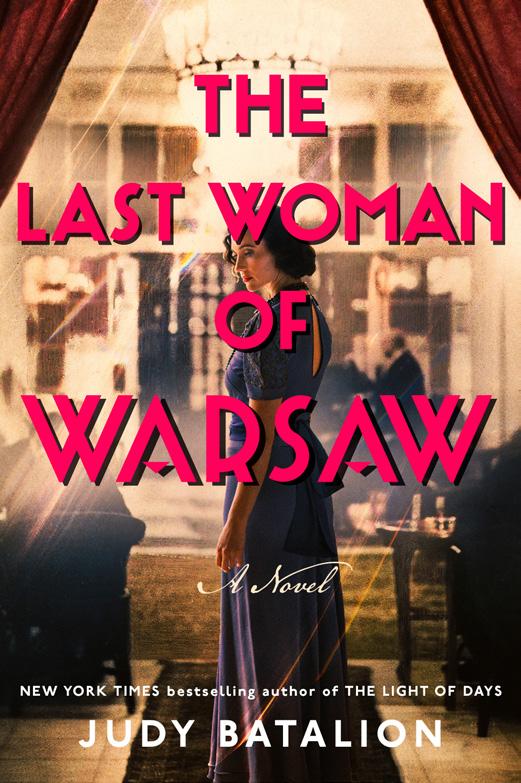
Judy Batalion, author of the historical novel The Last Woman of Warsaw (Dutton, 2026), gained prominence for her previous book, an award-winning bestseller. As she relates: “The Light of Days was a nonfiction narrative history about young Jewish women who risked their lives to resist against the Nazis, acting as couriers, intelligence agents and community leaders who upheld morale and led uprisings.” Their incredible stories made Batalion wonder about the world that created such confident, bright-lipstick-wearing women. What she learned about 1930s Poland challenged many of her expectations.
Batalion points out: “People generally think of pre-war Polish Jewry as a religious and traditional community; Warsaw, Poland’s capital, evokes images of black-and-white destruction. In 1938, however, Warsaw hosted theatres, cabaret, nightclubs with revolving dancefloors, and fashion shows – it was ‘the Paris of the North.’ Onethird of the population was Jewish, and shared in a golden age of poetry, film, comedy, and literature.”
Many of these artists were women. Batalion explains: “Polish women gained the vote in 1918. Education was mandatory for girls through 8th grade. Women worked as poets, novelists, journalists, traders, lawyers and dentists. Women’s magazines featured articles about gender dynamics and birth control. Young women, some of the first not to be match-made and pursuing love relationships, were learning to make their way in the modern world, fuelled by neat haircuts, fitted blazers, and shorter skirts. (One could see the whole shoe! a satirist wrote at the time.)”
As much as this was a creative and gender-progressive moment, Batalion is keen to highlight that “it was also a time of growing nationalism, authoritarianism and antisemitism. I became fascinated by this tension.”
In early 2021, when she “began to put pen to paper,” she says, “we were in the throes of the pandemic. Travel was difficult, and many archives and libraries were shut. So, instead of sleuthing for a ‘true story,’ I decided to create one based on the historical research I’d conducted over 15 years.”
Writing fiction, she believed, would allow her to not only “paint this colorful world but to delve into the characters’ feelings and desires.” And she “began to imagine female characters who were aware of the political conditions around them, but were primarily experimenting with being modern girls, grappling with friendships and romance, with the meaning of art and identity. They had no idea what was coming.”
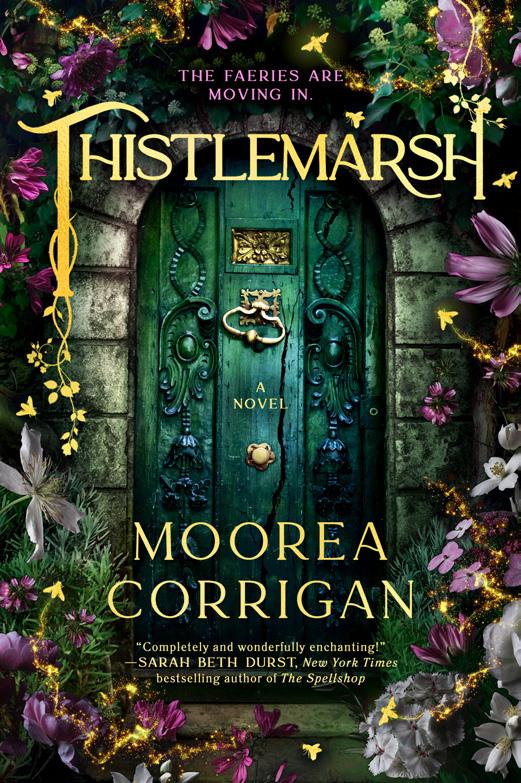
When Moorea Corrigan thinks about the inspiration for Thistlemarsh (Berkley/Del Rey, 2026), she imagines “many different roots all feeding the same plant: The largest roots are my lifelong love of period dramas and the fantasy genre.”
Corrigan grew up “coveting American Girl Dolls,” she says. “I would watch reruns of Anne of Green Gables and Heidi. However, my real love for historical stories bloomed when I saw the 2005 adaptation of Pride and Prejudice. Jane Austen and her novels immediately consumed my life. From there, I joined the Jane Austen Society of North America, watched Masterpiece Theatre with my grandmother on Sunday nights, and read other classic novels with gusto.”
She also “grew up on fantasy novels,” she continues, “particularly the works of Diana Wynne Jones, Gail Carson Levine, and Robin McKinley. Fairy tale retellings of all kinds lined my bookshelves, which branched off into fantasy films, with favorites including Labyrinth (1986), The Last Unicorn (1982), La Belle et le Bête (1946), and the Disney fairy tale classics influencing my imagination. To my delight, I discovered historical fantasy novels like Naomi Novik’s Temeraire series and Susanna Clarke’s Jonathan Strange and Mr. Norrell, which let me indulge both of my greatest literary passions.”
The other roots nourishing Corrigan’s story are “younger, but no less important,” she shares. “Although I eventually returned to Colorado, I went abroad for school, completing my undergraduate degree at the University of Edinburgh. My time in the UK perfectly coincided with the centenary of World War I, which stoked my interest in the period. This, paired with a module in my British History course focusing on the decline of the British manor house and a Fairy Tale course, created the perfect breeding ground for the ideas that would eventually merge into Thistlemarsh.”
Corrigan returned to her childhood home, she says, “to write my master’s dissertation in 2019 and was there longer than planned due to the pandemic. Living in the house I grew up in for long periods of time finally brought all the ideas for Thistlemarsh together, twisting them into a story about restoring a house through a reluctant deal with a fairy.”
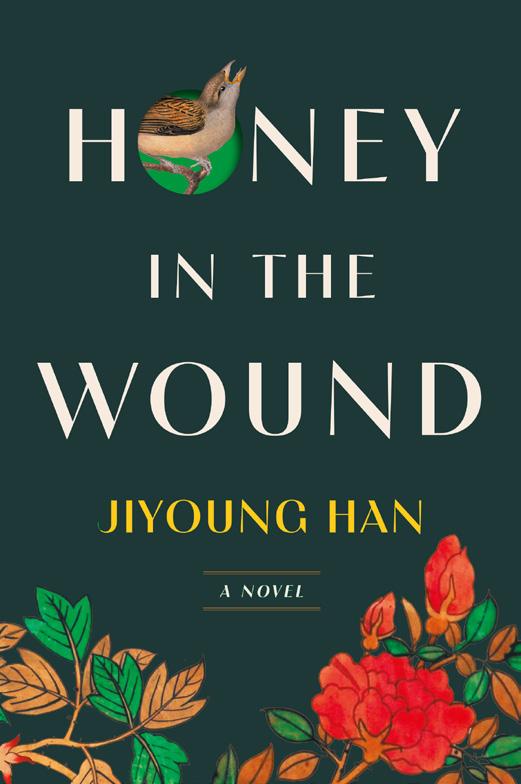
Jiyoung Han wrote Honey in the Wound (Simon & Schuster, 2026) in 2023 after reading that there were only nine surviving comfort women left in Korea. “‘Comfort women’ is the euphemism for the hundreds of thousands of girls and women forced into sexual slavery by the Japanese military in the 1930s and 1940s. That figure nine, in particular, gripped me with its unignorable call to act. Nine is something I can count on my fingers. Nine women in their nineties, facing the possibility of death without even a sincere apology from the Japanese government.”
Judy Batalion
Jiyoung Han
Laura Vogt
Moorea Corrigan
Photo credit: Beowulf Sheehan
Photo credit: Chelsea Mazur
© 2025
John Bosley Photography
Honey in the Wound is Han’s “bid to amplify the voices of these women, pulling from folklore and magical realism to show how one Korean family confronts the long shadow of Japanese colonialism throughout the 20th century,” she says. “Each generation of women here has special gifts: a tiger shapeshifter, a voice that can compel the truth from anyone, the infusion of emotions into cooking, the ability to see into others’ dreams. These powers were meant to represent the agency of these ordinary women, particularly in contexts where they didn’t have much of it. The women thus use their gifts in unexpected ways as they are thrust into war, love, and loss—-not just to fight and survive, but also to heal and bring comfort to their loved ones.”
Towards the end of the book, Han describes how “a ghost pleads for the living to remember and spare her from ‘a second death.’ The idea that each of us dies twice—first, when our bodies give out; second, when no one is left to remember us—is a central tenet of the novel. Many Koreans, myself included, still have living relatives that can tell us firsthand stories of suffering endured under Japanese Occupation.”
For Han, the march of “time is unrelenting. As of February 2026, there are only six Korean comfort women left. Soon, the last survivor of the Occupation will pass. We, their witnesses, will also eventually pass, and all the world will have of that era is what we’ve deemed worthy of recording.”
Han is leaving “Honey in the Wound as part of this record, with hopes that it helps these women to defy a second death.”
Laura Vogt’s In the Great Quiet (Lake Union Publishing, 2026) believes that “stories always begin around the fireplace, don’t they?”
For Vogt, in unexpected quiet moments, “there’s that first glint of something intriguing or puzzling. Over a decade ago, I chatted with my grandmother in her sitting room. Cozy on the couch, mug of tea in my palms, my grandmother telling old tales. She shared of her grandmother Minnie, who ventured alone into the Oklahoma frontier of 1893.”
Vogt immediately saw “Minnie: a vivid, crisp vision of a woman on horseback, red dust clouding, brown hair caught in the wind. Her determination. Her longings and fears … my body snapped to attention. The idea felt ordained. I recognized I glimpsed something important, something long-lost.”
As a historian, she is always “searching for untold stories, lost history, women forgotten in time. I’m passionate about rewriting the history
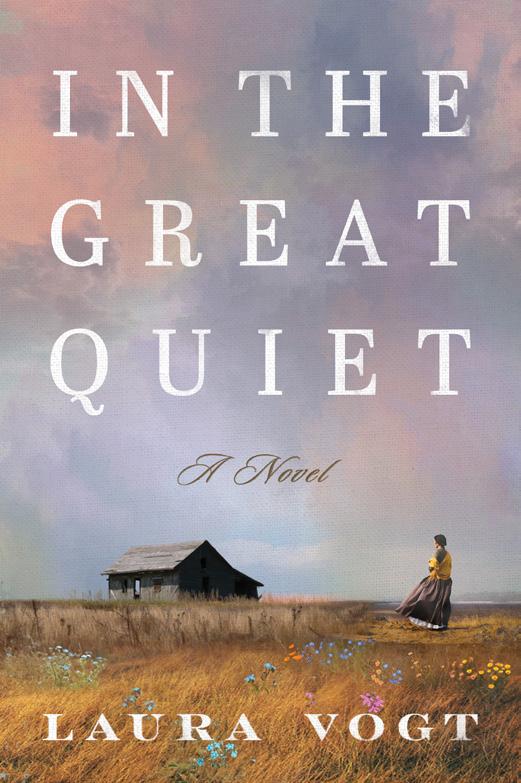
of seemingly ordinary, unremarkable women. Those overlooked, their lives hidden along the fringes of the narrative. In the Great Quiet began with a question: Why on earth would an ‘ordinary’ woman of 1893 dash into such volatile terrain? Was she running? When she tightened her saddle bags onto her horse, was she weary or thirsty? Hopeful or haunted?”
For Vogt, “there’s a fine line between inspiration and compulsion. My characters grasp me by the throat. I’m struck by a visceral, almost tangible portrait of a woman and a moment in time—her posture, the tilt of her jaw, the wonder of her circumstances vibrating with possibility. I see them—but I’m missing so many pieces. I noticed Minnie as she was my ancestor, but the urgency to tell her story rooted more in my curiosity about her journey alongside this forgotten corner of history. Her situation felt arresting, compelling, and one that I believed would resonate with women today. Minnie came boldly to life. She was insistent and unyielding. She wasn’t a voice I could silence or look away from.”
One thing Vogt learned in writing this narrative of my heritage,” she says, “is that we must listen to our family’s stories. When we gather around fires, we must remain open to rediscovering what has been lost.”
Writing about The Last Woman of Warsaw, Judy Batalion underlines the fact that “we readers understand the cataclysmic context in a way the characters do not. They have no sense of the tremendous stakes of their tiniest actions, nor how their friendship will determine their fates.” This description could also appear to fit the characters created by the other debut novelists to inform and charm their readers.
WRITTEN BY MYFANWY COOK
Myfanwy creates HF writing and language-related workshops for universities, charities and other organisations. She is currently highlighting the importance of miners and their families who migrated from Devon and the Tamar Valley during the 19th century. myfanwyc@btinternet.com

HISTORY & FILM
Problem Solved: Stanley Kubrick's Barry Lyndon
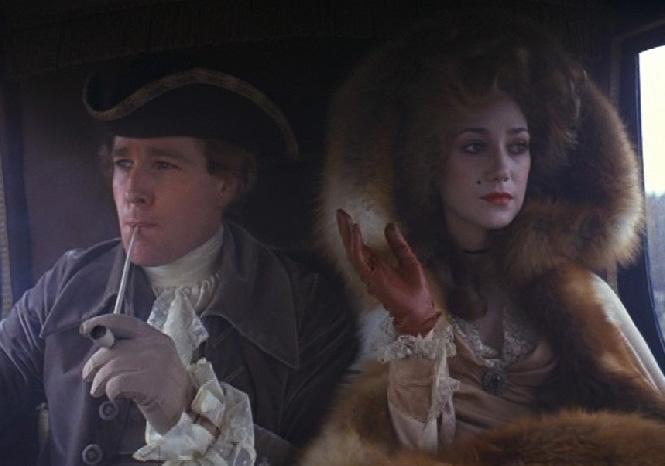
I am assuming that readers of this article have seen Barry Lyndon and know its plot. On release in 1975, it was a commercial failure in the USA but better received in the rest of the world; its popularity and critical reputation have climbed immensely since then. Hundreds of internet pages have been written about it, and two books.1, 2
The origins of Barry Lyndon lie in Stanley Kubrick’s planned film of the life of Napoleon. However, by the early 70s, the director, always conscious of commercial realities despite his unremitting focus on making the films he wanted to make, was prevailed upon to shelve the project. A series of biographical epics were failing epically at the box office – not just Waterloo, in which Rod Steiger played Napoleon, but also Cromwell and Nicholas and Alexandra 3 But Warner Brothers did back Kubrick to make a less expensive historical film which would use some of the research for the Napoleon project. He selected as his raw material Barry Lyndon, by William Makepeace Thackeray, a little-known novel first published in 1844.4 Thackeray’s inspiration was the history of the Irish soldier Andrew Robinson Stoney (1747-1810), who gained great wealth by marriage to Mary Eleanor Bowes, widow of the Earl of Strathmore. Stoney tricked Bowes into marrying him via a conspiracy involving a faked duel. On marriage he incorporated his wife’s name into his own. He starved and beat his wife for years in the attempt to acquire her fortune, but was ultimately unsuccessful and died in prison.
The resemblances between this historical biography and the novel/ film are obvious – Redmond Barry changes his name to Barry Lyndon on marriage to the widowed Honoria, Lady Lyndon, and flies very high in wealthy society, but then loses everything. The book’s writing style has a knowing dryness wherein we can easily spot how the author makes fun of the vanity of his leading man, through whose egotistical eyes the story is told. Thackeray was married to an Irish woman and was obviously fascinated by the melancholic fluctuations, as he saw it, of the Irish psyche. Much of the book concerns itself with class-conscious humour, which has dated. The name of Barry’s nemesis, his stepson Lord Bullingdon, may have been inspired by the Bullingdon Club, a clique of wealthy Oxford University students.
In adapting the book, Kubrick removed some characters and enlarged others and – as any Hollywood adaptor of a Victorian novel would do – improved the organization of the story, whilst also adding far more
emotional heft. The climactic duel between Barry and his stepson was purely Kubrick’s conception and greatly improves on the original, in which Bullingdon only manages to give his stepfather a thrashing.
Another story about a selfish protagonist who negotiates war and poverty, marries for money, but then sees the marriage collapse after the death of a child in a riding accident, is Margaret Mitchell’s Gone with the Wind. The film of the book was, in visual terms alone, outstandingly successful. These visuals are not enough for many people, Kubrick himself among them. As he commented (quoted by Strelow): ‘It’s a really terrible movie.’ Thirty-five years on, did the director approach Barry Lyndon in a competitive spirit? A fascinating speculation.
Warner Bros. insisted that a bankable leading man played the main character. The rather blandly handsome Ryan O’Neal may not have been Kubrick’s first choice, but he turns in a fine performance, conveying more grief and self-doubt than is ever suggested by the bumptious voice of Thackeray’s narration. The script was originally closer to the book, with narration in the first person, and with scenes in Dublin which were never filmed. These changes were made during production. No shooting script was used: everything was organized in the director’s own head.
Kubrick originally planned to film in a converted aircraft hangar in Radlett, near his Hertfordshire home. However, the powerful film industry unions expressed their displeasure at any production outside of a purpose-built film studio. Because the idea of building his own studio was solely intended to maintain control of his unit, Kubrick then made a rapid U-turn and decided to film entirely in the Republic of Ireland. This could readily be justified in terms of the number of period settings available. Other historical films had recently used Irish locations: Lock up Your Daughters (1969) in which Kildare Town stands in for 18th-century London, Sinful Davy (1969) and Ryan’s Daughter (1970).
Aided by expert production designer Ken Adam, a roster of locations was chosen. Initially based in Waterford, from summer 1973 the cast and crew, about 160 people, roved around the countryside, castles and demesnes. Many Irish actors and technicians were employed: some 250 men from the Irish army were recruited as soldier extras, kitted out in costumes sent over from Radlett. At this time the Irish Troubles were at their height, affecting both North and South. In January 1974, a day’s filming in Dublin’s Phoenix Park had to be cancelled due to IRA bomb threats in the city. In February 1974 all production in Ireland was abruptly closed down. It has been widely reported that this was due to a bomb threat, but the truth remains murky. Maria Pramaggiore comments that it may have been a hoax threat made by an extra who had been fired. Following a hurried move, filming continued on English locations for the scenes corresponding to the second part of the story.
This free-wheeling method of production does reveal itself in little mistakes. There is an obvious costume continuity error in the scenes where Barry has temporarily promoted himself from private to lieutenant. When referring to the death of Lady Lyndon’s first husband, the novel states that it happened ‘in the Kingdom of Ireland’, but the film changes that to ‘the Kingdom of Belgium’, Kubrick being unaware that this country did not exist in the 18th century. One character, Lord Wendover, is introduced with the first name of ‘Gustavus Adolphus’ but was later addressed as ‘Neville’. Towards the end, mention is made of the Irish-sounding ‘Doolan’s Farm’, but whilst in the book this part of the narrative happens in Ireland, in the film we see recognizable English locations.
Still, the experience of watching the film is one I always find immensely compelling. We begin with a duel scene filmed in crepuscular light against a mountainous background5; as soon as we start to wonder who is fighting who, the narrator (Michael Hordern) explains that we are witnessing the death of Redmond Barry’s father. The first actor seen in close up is Marie Kean as the widowed Mrs Barry, as she walks through the garden of her Irish cottage on the arm of a would-be suitor, who never appears again. But the first dialogue is the word ‘Killarney’ spoken by Gay Hamilton as Nora Quin at the end of a card game she and Redmond have been playing in a shelllined room beyond whose window rain is falling. The game leads to flirtation, but then flirtation inevitably leads to disappointment, as Nora is stolen away from Redmond by the comically abrasive English officer, Captain Quinn (Leonard Rossiter).
Although the film has a reputation for slowness, it does cover a period of some 30 years as Barry moves from minor Irish gentry to soldiering to gambling and then to great wealth as the husband of a countess: time jumps are handled with some economy. The narration, dryly written in the third person but closely adapted from Thackeray, streamlines the transitions between scenes. Every shot is beautifully set up. Often the zoom lens works dynamically, as a scene starts on a detail and then widens out to show an artfully arranged composition. For many interior shots, the backgrounds are soft, and indeed at times only the eyes of the actors remain in focus. This short depth of field was a consequence of the wide camera aperture that Kubrick required, due to his insistence that only (or mainly) candles should be used for lighting – an approach to authenticity which, like the frequent zooming, counterintuitively draws attention to very fact that we are watching a film.
As people are static and glorious music plays, whilst the mellifluous narration moves the story along, the effect is rather like being in an art gallery that tells a story. It is far from a silent film, however. Much dialogue is adapted from Thackeray, but there are also newly written scenes. Some of these are excellent: late in the film there is a dialogue between Mrs Barry and the chaplain Reverend Runt (Murray Melvin) which is a superb example of how two people’s long-tried civility can dissolve, when circumstances change.
Despite the 18th-century setting, the film’s tone resembles, ultimately, that of late Victorian melodrama, where morality triumphs and women are idealized. In Barry Lyndon only Barry’s mother is a vivid character – the other women are types. The German girl Lischen is used by Thackeray in a farcical mistaken identity scene which is probably the funniest part of the book, livelier than the film’s ponderous little romance between her (Diana Koerner) and Barry. Kubrick’s camera idolizes the beauty of Marisa Berenson, playing Honoria. Although she does good work with her eyes, her vocal variety is limited. Hence the script gives her little to say, and much of that dialogue is stiff. For example, she always calls her first son ‘Lord Bullingdon’ even within the family. Honoria is also a flat character in the book, where her marriage to Redmond takes place only 70 pages from the end. Whilst the film is better structured, she remains a distant ideal, quite different from the vibrant women in films based on 18th- century originals, such as Tom Jones (1963). The death of Barry’s son Brian is glossed over by Thackeray (he finds himself here with an incident at odds with his authorial tone), but in the film there is a poignant, arguably mawkish, deathbed scene and funeral, punishing the protagonist even more severely than Scarlett O’Hara was punished by the death of Bonnie Blue. Strelow calls this, with justification, ‘the most openly emotional sequence in any Kubrick film’. An 18th-century viewer might recognize the look of Barry Lyndon – Hogarth, Gainsborough and others – but be perplexed by its earnest moral tone. Considering how out of key this tone is with the 1970s, it is amazing that this film was funded by a Hollywood studio. Beauty overcomes a lot. This beauty, the notion that the past
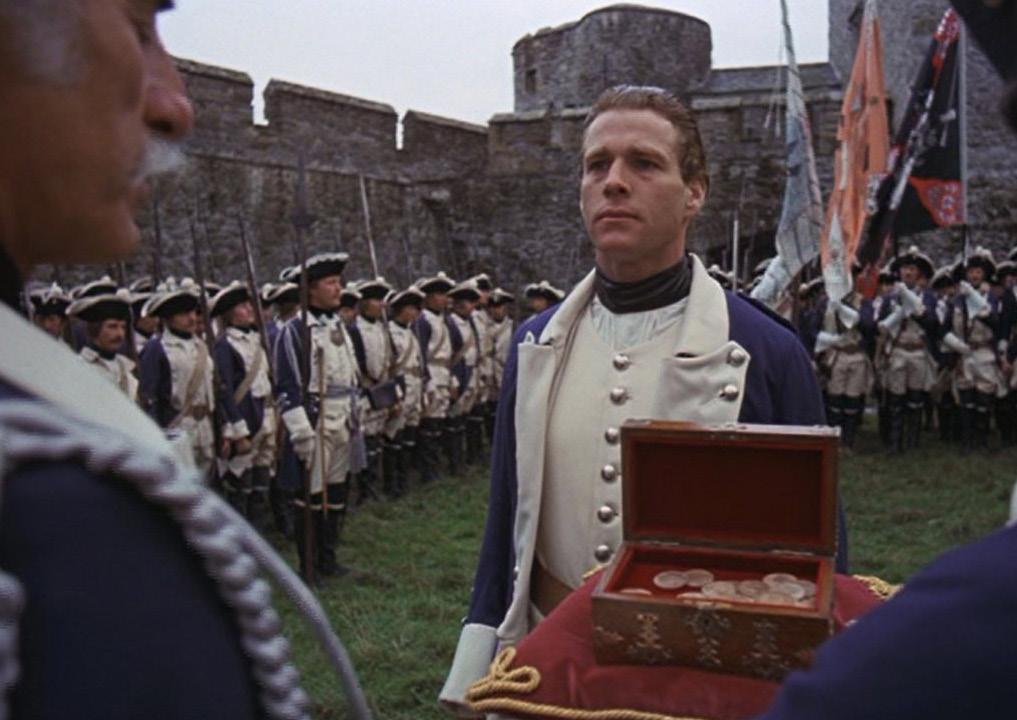
was more picturesque, as well as more eventful, is what draws a lot of us to creating historical fiction. When writing, I often find myself inserting little homages to Barry Lyndon
Let the final word rest with Kubrick himself. In a magazine interview published in 1972, he laid down a challenge (which applies to us novelists too): ‘I don’t think anyone has ever successfully solved the problem of dealing in an interesting way with the historical information that has to be conveyed, and at the same time getting a sense of reality about the daily life of the characters.’ (quoted by Strelow). Having identified this problem, Kubrick then made a film which – despite the few shortcomings I mention above – overcomes it in magnificent style.
REFERENCES
1. Pramaggiore, Maria, Making Time in Stanley Kubrick’s Barry Lyndon, London, Bloomsbury, 2015.
2. Strelow, John, The Big Movie: A Guide to Stanley Kubrick’s Barry Lyndon, independently published, 2023.
3. Two of these three are quite interesting, but rampant inaccuracy deprives Cromwell of any merit.
4. Thackeray, W.M., Sanders, Andrew (Introduction), Barry Lyndon, Oxford: Oxford University Press, 1984.
5. John Strelow proves that the composition of this shot was modelled closely on one in Hell’s Angels (1930).

WRITTEN BY BEN BERGONZI
Ben Bergonzi is an HNS reviewer and a member of the organizing committee for the HNS conference to be held in Ireland this August. His first novel, A Cruel Corpse, published last year, is a crime story with an eighteenth-century military setting. Its sequel, with a theatrical setting, will be published this year.
History, Fiction, or Just for Fun: Historical Fiction Centering on Emperor Nero
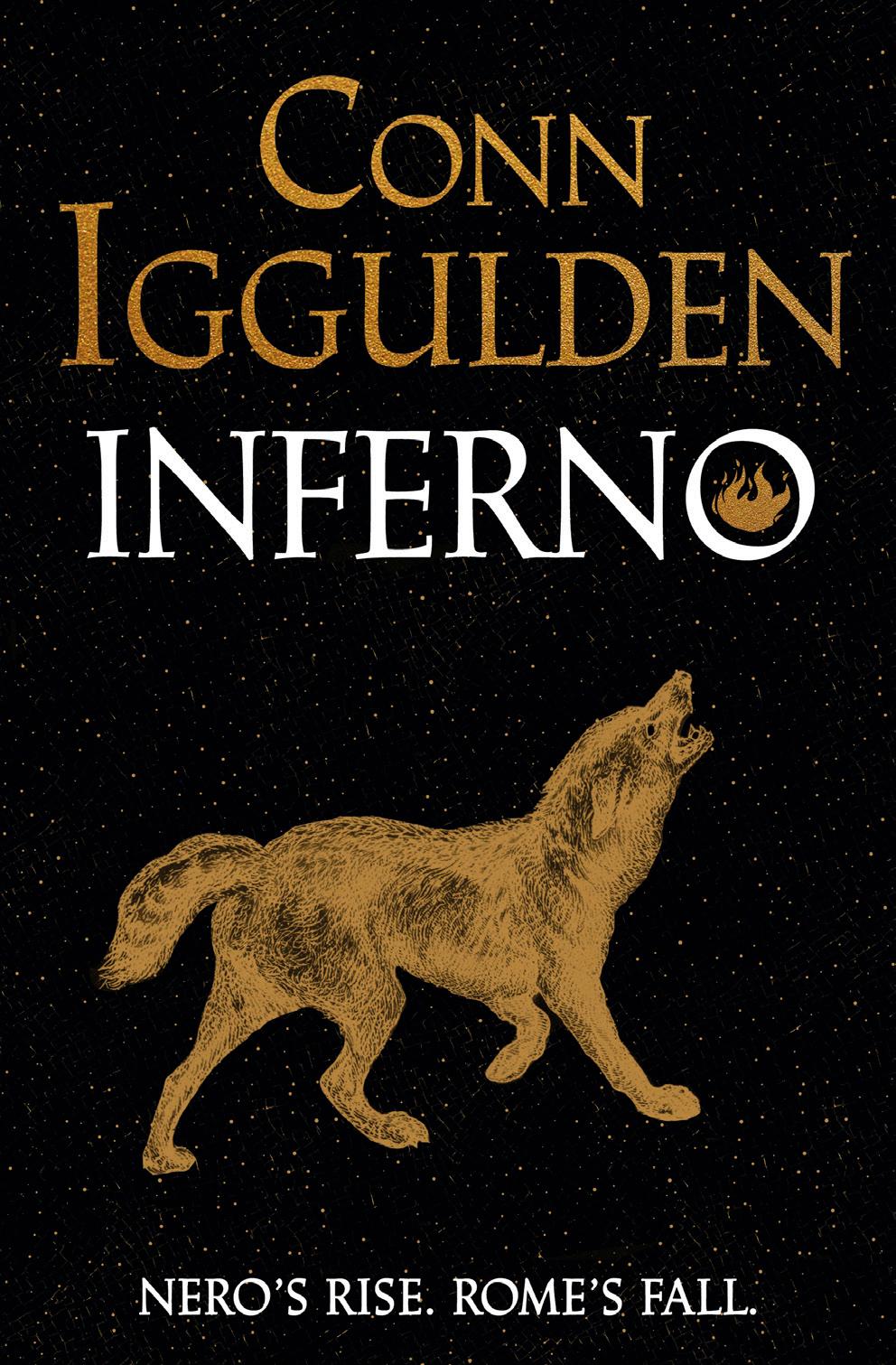
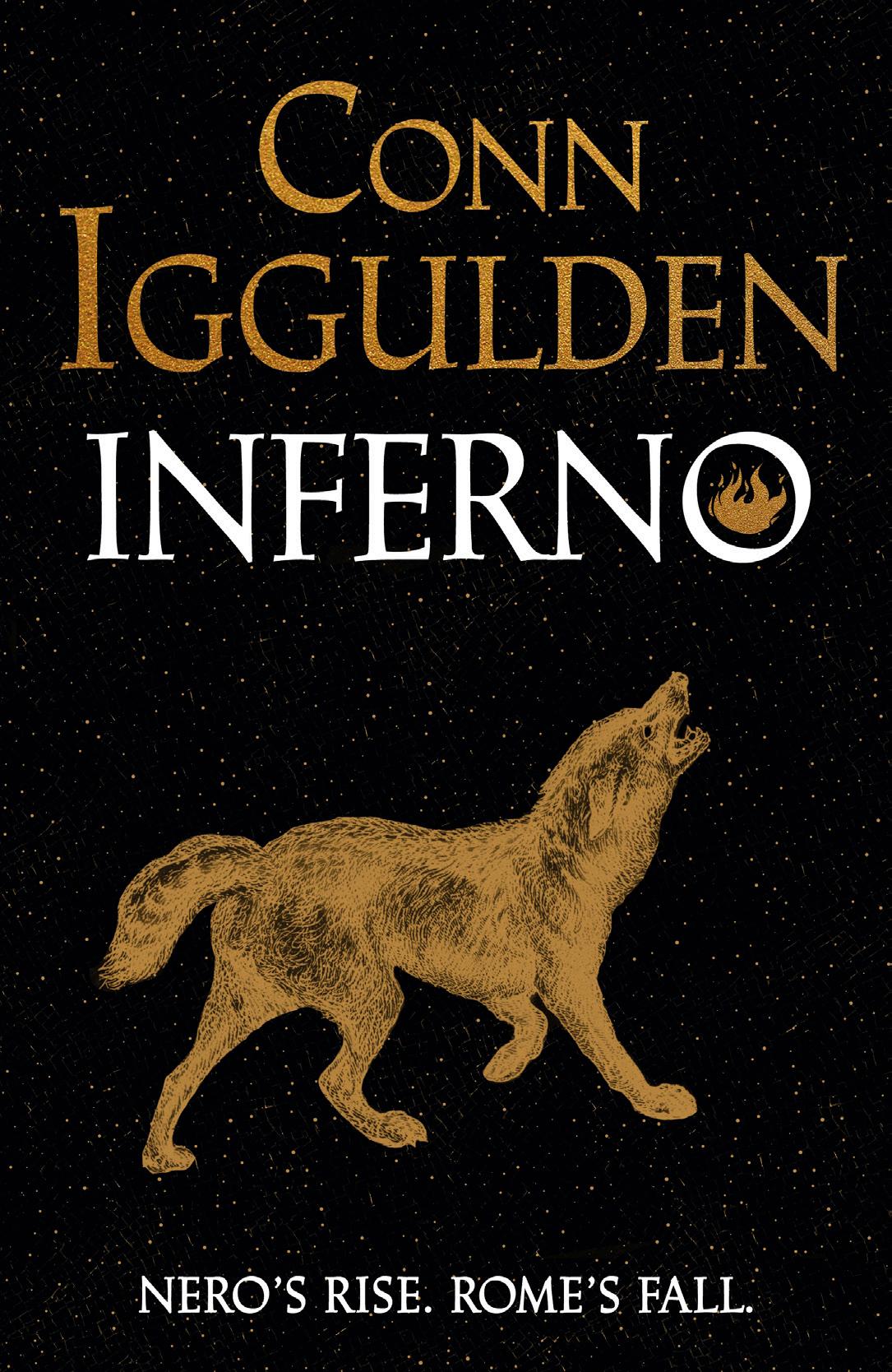
We’ve enjoyed several historical fiction novels about Nero or featuring the infamous Roman emperor as a major character: Among them Manda C. Scott’s Rome tetralogy The Emperor’s Spy (Transworld, 2010), The Coming of the King (2011), The Eagle of the Twelfth (2012), and The Art of War (2013); and Margaret George’s The Confessions of Young Nero (Berkley, 2017) and The Splendour before the Dark (2018). Here my focus is on the more recent trilogy by S. P. Somtow, including Delicatus (Diplodocus Press, 2023), Imperatrix (2023), and Damnatio (2024); Simon Scarrow’s Tyrant of Rome (Headline, 2025); and Conn Iggulden’s trilogy including Nero (Penguin UK/Pegasus, 2024), Tyrant (2025), and Inferno (2026). New histories, too, have appeared.1
How do we capture a character from so ancient a time? Certainly, the aim of fiction is to bring the reader into the protagonist’s world. In historical fiction, we usually try to tally that portrayal with the historical record. But, it’s fiction, so we get to choose whether we believe the ‘sources’ or whether we want to invent stuff.
For example, dialogue. Are our characters portrayed as people just like us, speaking in modern vernacular? Simon Scarrow fits into this
camp. His dialogue is thoroughly modern. Anachronistic, OK, but it lends a feeling of intimacy. It also allows for some cleverness. In Tyrant of Rome, one of his characters lets slip the F-word, then quips, ‘Pardon my Gallic’. Or, is an attempt made to take us inside the first-century mind? One way of doing this is to use the vocabulary of the time. I like this method, although many don’t. Does the Roman swearer say, ‘futuere’? Or, an uthor can use antiquated-sounding language. Make it sound like Tacitus, it sounds convincing.
Secondly, fact or myth, history or rumour? The first-century mind was dominated by gods, religious rituals, magic, superstition – and gossip. A juicy rumour is more fun than a boring historical fact, and the more incendiary the better. People wrote down the spicy gossip they heard in the bathhouses or whispered among their slaves, and we’ve accepted it as ‘history’. Modern historians point out that these wild rumours originated from adversaries of Nero.
In fiction, history can be twisted to suit. Conn Iggulden invents a naumachia (staged naval battle) starring the captive Caractacus.2 He also asks: Did Claudius invade Britain with war elephants? Well, it’s more fun if he did. In Manda Scott’s words, ‘As long as I don’t put Otho before Galba… or stick stirrups on the saddles of my cavalry; if ... I commit no gross anachronistic errors … then I can weave my narrative amongst the many pillars of accepted “fact”.’3 Margaret George says the key is ‘never to go against a known fact’.4 If you want to go further with ‘Nero, just for fun’, there’s the humorous alternate history A Song for Nero by Thomas Holt (Abacus, 2009). What if Nero didn’t die and lived to pursue his musical career?
Fun myths about Nero:
Saved by a snake
Was saved from assassins as a baby by a snake. Probably true. He wore a bracelet set with its skin.
A lunatic and a tyrant
Almost everyone portrays Nero as a tyrant, maybe a lunatic. Suetonius calls him ‘loathsome in every respect’.5 Scarrow describes him as ‘bull-headed’, and in Tyrant of Rome he portrays Rome as descending into anarchy under the volatile rule of an emperor who surrounded himself with sycophants, a danger of which, as an American, I am very familiar. Nero’s insistence on sycophancy goes to extremes. In Iggulden’s Inferno, Nero watches his audience eagerly, in case they register a flicker of inattention to his performances; Vespasian nods off and gets sent to Judaea. George’s Nero is just weak-willed and narcissistic, an artist who would have been a musician or charioteer had his nasty mother not finagled his way to the throne. Iggulden shows what thoroughly awful people they all were, men and women of the nobilitas – cuckolding senators, torturing slaves, murdering rivals and family members. But he admits that ‘there is no way of telling whether the nastier comments on Nero’s character have any basis in truth’. He did put an end to gladiatorial fights to the death. The lower classes weren’t much nicer. They adored the gore in the Circus and ripped enemies of the state to pieces with their bare hands on the Gemonian stairs.
Was addicted to chariot racing and poetry
Serious senators and Pisonian conspirators hated that he dressed in poet’s robes, curled his hair and played female roles on stage. Nero squandered the imperial treasury constructing a ten-horse
IN HISTORICAL FICTION, we usually try to tally that portrayal with the historical record. But, it’s fiction, so we get to choose whether we believe the ‘sources’ or whether we want to invent stuff.
chariot which barely fit into the hippodrome. George and Scott write breathtaking accounts of a chariot race from the charioteer’s point of view.
Fiddled while Rome burned
Tacitus repeated a rumour that Nero sang a song of the Fall of Troy upon hearing the news. Surprisingly, this one has a ring of accuracy. Nero tended to respond to momentous events by composing and singing a song.6 It would have been a cithara, though; violins weren’t invented until the 16th century. In Inferno, Nero stands in his newly built theatre, the roof burning above him, playing the cithara. His own song about Troy, in which Paris is the hero, apparently historically existed but is no longer extant.
Deliberately set the Fire
The rumour was already going around at the time that he or his agents deliberately set the fire to clear land for his Domus Aurea. This one, however, is fake news. By most accounts, Nero, despite his youth, dealt with the disaster as well as he might have done. According to Tacitus, he fought the fires with his own hands, immediately opened the imperial gardens for refugees and reduced the price of grain. Scarrow’s protagonists praise his leadership.
Threw Christians to the lions
A Neronian persecution is not attested to in the early Church writings, but since Tacitus wrote that Christians were set on fire to illuminate Caesar’s gardens, others thrown to dogs, and many were crucified,7 everybody then and now has accepted it as history. Scott has the arsonist as Saulos (St Paul), and Somtow has blaming the Christians as Pontius Pilatus’ idea. In Inferno, the fire is deliberately caused by the Christians, in order to fulfil their prophecy of the End Days, and the out-of-control tyrant Nero personally sets the scapegoats alight in the arena. We meet Paul and Peter, and to give us more footage of the Christians, Iggulden makes prefect Burrus a convert.
Committed incest with his mother
It was widely believed at the time that he had Agrippina killed, and Nero made jokes about it. The more salacious critics say he committed incest with her as well,8 which might as well have been true, he was so dominated by her. She insisted on having her own throne next to her son’s while he gave audience, which was considered shocking by misogynistic Romans. Agrippina’s last words were reportedly ‘Ventre feri (strike my womb)’, and the assassins complied.
Dressed his catamite as a woman and called him Empress
Sometimes, the most salacious of rumours are actually historical. It is precisely because opponents at the time – and Nero had plenty of those – used them as negative propaganda that the traditions were preserved in record. Although homosexuality was more accepted then than it has been in recent modern times, Nero’s and other emperors’ eromenoi were vilified. Somtow’s trilogy depicts Sporus’ horrific abuse by three emperors, Nero, Otho and Vitellius. The society of Rome’s upper class in general is often portrayed as debauched. In The Splendour Before the Dark, George has Petronius (author of Satyricon) leaving a letter outlining all Nero’s sexual exploits, including diagrams.
Dying
words
were ‘What an artist the world loses in me’
Yes, numerous sources quote his last words as ‘Qualis artifex pereo’. Manda Scott writes with intimate cultural detail, taking elements
from Christian legend, Jewish and Roman history and crafting them into new, ever-surprising plots. Her language is so beautiful, it’s believably antique.
Simon Scarrow, Margaret George, Conn Iggulden, newer additions to the canon, offer us a cast of characters less exhaustive than writers like Colleen McCullough, whose Master of Rome series is set during an earlier period. This is less realistic – ancient Roman ruling class society comprised a large set of interconnected families, continually marrying, divorcing and poisoning each other – but it’s easier for the reader to contend with. Iggulden concentrates on intricate relationships between the characters. George’s characters are the more psychological, if a more fictionalised biography. But if we are not to chortle over the sensationalist gossip, is it fun enough? If it’s to read justifications for someone whom we know was guilty of at least some of the stuff he was accused of, is it factual enough? The new spate of novels demonstrates the continuing appeal of Nero, whatever we may say about him. The question – were these stories really true? – remains just as interesting (and fun) 2000 years on.
REFERENCES
1. Thorsten Opper, Nero: The Man Behind the Myth (British Museum Press, 2021); Anthony Everitt & Roddy Ashworth, Nero: Matricide, Murder and Music in Ancient Rome (Random House, 2022); Jacob Abbot, The History of Nero (E-BOOKARAMA, 2019); John F Drinkwater, Nero: Emperor and Court (Cambridge Univ. Press, 2019).
2. Iggulden, Nero, p. 192. This historical spectacle in 52 CE featured a battle between Sicilian and Rhodian fleets.
3. Scott, Author’s Note in The Art of War
4. George, Afterword in The Confessions.
5. Suetonius, Life of Nero, chapter 37.
6. Suetonius, Life of Nero, chapter 42.
7. Tacitus, Annals, Book 15, chapter 44.
8. Tacitus; Suetonius; Cassius Dio. Also George, The Confessions, p. 272.

WRITTEN BY SUSIE HELME
Susie Helme is an editor and an award-winning novelist. The Lost Wisdom of the Magi (2020) won 2021 Killer Nashville Silver Falchion Award for Best Historical. The Genizah Codex and Dreaming of Jerusalem, both Finalists for the 2022 Claymore Award for Best Historical, are coming soon. https://www.susiehelme.co.uk
THE INSPIRATIONAL ABIGAIL
Stephanie Dray & Laura Kamoie's A Founding Mother
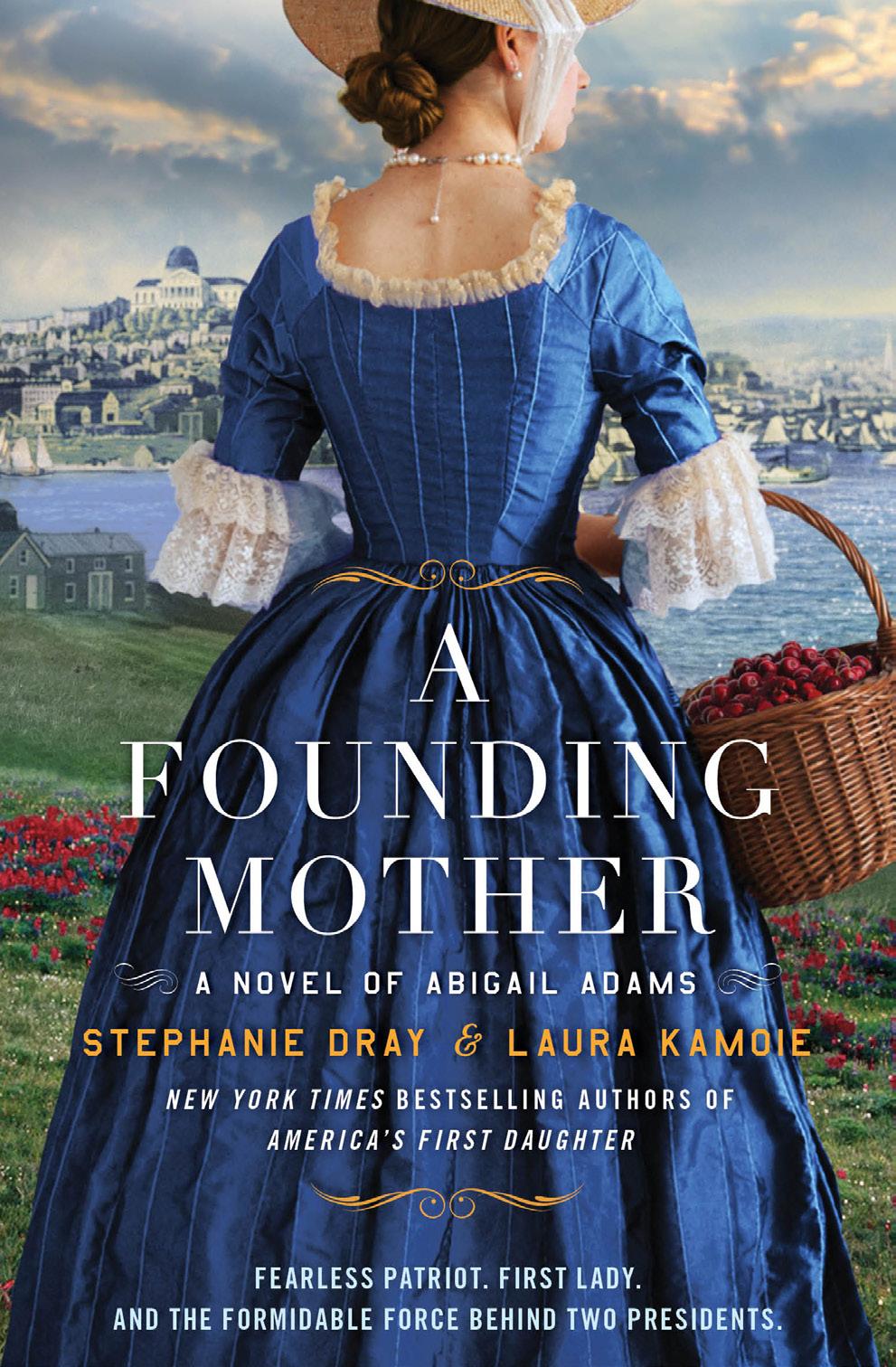
For Americans, Abigail Adams is a household name. Historian Woody Holton, for example, declared that she “lives in the American memory as the most illustrious woman of the founding era.”1 Born in Massachusetts in November 1744, Abigail was the daughter of a parson. Aged twenty she married John Adams, a lawyer nine years her senior, who would in time become Vice President to George Washington and then the second President of the United States from 1797 to 1801. Their son, John Quincy Adams, became the sixth president in 1825: although Abigail did not live to see it, as she died of typhoid fever in 1818, aged 73. She’s known for being one of her husband’s closest advisors, and for holding radical ideas about women’s rights and women’s place in society. But these are just the basic headline facts. There is so much more to know. In 2026, the two hundred and fiftieth anniversary of the July 4th signing of the Declaration of Independence, what better way to intimately explore the story of one of the great figures of that period than in the expert hands of biographical novelists Stephanie Dray and Laura Kamoie? What was Abigail Adams’ character? What did she do, think, and say?
After a brief prologue, A Founding Mother (William Morrow, 2026) opens in 1765 with Abigail and John newly married. Abigail is heavily pregnant but determinedly independent. We meet her ‘waddling’ down the road to avoid being confined at home. The scene sets the tone and establishes Abigail’s singular character. “Her greatest strengths stood out to us immediately,” the authors explain. “She was noble of spirit. She had a strong moral compass. She had a strong mind, a strong personality, and a certain fearlessness. Of course, her weaknesses are a darker reflection of her strengths. She could be quite stubborn. She could be judgmental. And every so often a little bit reckless.”
Match such a character with the tumultuous years between 1765 and 1818, and you have a page-turning novel full of famous names, Abigail’s unique perspective, and a story that goes places many readers won’t expect.
“Readers may be surprised to learn that Abigail was often more radical than her husband,” say Dray and Kamoie. “Her opinions were less measured than his. She was often two steps ahead of getting to the place he might eventually land. I think readers may also be shocked to find that she was an entrepreneur and that John’s public career was enabled not just byher sacrifices on the farm, but also by her business acumen as an investor.”
The ways in which Abigail managed long periods of separation from her public servant husband, and creatively kept the family afloat financially, make for fascinating reading. Her experience surely reinforced her believe in women’s innate abilities, despite their lack of rights. In a famous 1776 letter, for example, Abigail wrote to her husband, urging him to “remember the ladies” when establishing the laws of their new nation. She wrote of men’s tendency toward tyranny over women and questioned whether women should be bound by laws made by bodies where they had no representation and no voice. For his response, you’ll have to read the book.
Of course, with such a well-known and beloved figure, the research must be impeccable.
Dray and Kamoie “started in the usual place. Biographies. Then primary sources—all the letters. So many letters! The National Archives has actually digitized them at Founders.archives.gov. What a gift to every American that these letters are so publicly accessible to every citizen. If that doesn’t make you want to kiss a historian, what will?
“At any rate, reading those letters, it was shocking to see how tart and funny Abigail really could be. And how direct she was, especially compared to the other women we’ve written about. Abigail was not one to suffer fools. And she had a Yankee no-nonsense way about her that was delightful. So one of the most fun things about the research this time is that we reached out to an expert Abigail Adams re-enactor, Carol Cohen, who gave us many juicy details about Abigail… including the part about her making bullets!”
It’s with full confidence then, that the reader can settle into A Founding Mother and enjoy a lively first-person account of her life. Her voice, in this telling, is one of its great strengths. Here for example, speaking of women’s role during the Revolution, she declares: “We, too, were patriots. Which, considering our situation, I considered heroic. After
SHE WAS noble of spirit. She had a strong moral compass. She had a strong mind, a strong personality, and a certain fearlessness.
all, excluded from honors and offices, we would never be rewarded for it. Our property was still subject to the control of our husbands. Deprived of a voice in legislation, obliged to submit to laws imposed upon us without our consent, we ought to have been indifferent to the public welfare.”
She also has choice words at times for her husband and some of his famous colleagues. “What a little cock-sparrow general he made,” she observes of Alexander Hamilton, and of Thomas Jefferson she declares, “Oh, no one on earth knows Jefferson truly. He’s always been a riddle worthy of the sphinx.” I listed a few of the famous men we encounter in the novel, and asked Dray and Kamoie what they felt Abigail really thought of them:
“ The truth is that Abigail Adams admired every single man on that list. But she didn’t always like them. And I think that includes her own husband. There were times she clearly wanted to throttle him. There were also times she was extremely frustrated by her own son. Now, of course, she truly did love Thomas Jefferson, and their falling out was incredibly painful to her. She loved his mind and his manners but came to suspect his morals and detest his politics. And as for Hamilton, of course, she thought he was a brilliant but dangerous devil. So there were times she was rooting for him, but ultimately, I don’t think she shed a tear when Aaron Burr shot him dead.”
As insightful as the novel is to the time and events of Abigail’s lifeline, where it really shines is in its exploration of the ways Abigail and John’s choices impacted their children and wider family. “ This is a theme that runs through all the books that we’ve written together,” the authors confirm. “Certainly, the public service of our Founding Fathers demanded sacrifices and risks from them. But the sacrifices and risks were not theirs alone. They burdened their families tremendously; think of modern military spouses—a spouse may sign up to put his life on the line, but military families are asked to make sacrifices they never signed up for. Especially the children. That was the case for the Adams family as well. It was all well and good for John and Abigail to decide together that they were willing to be ruined in the cause of the new nation; but I doubt they understood, as young parents, what they would be asking of their children. The long absences. The pressures of having to live up to a famous parent. The danger of sea crossings during wartime. And much, much, more.”
The best historical fiction has the capacity to show us how people in the past felt and acted and leave us asking ourselves what we can learn from it. In A Founding Mother we see political divisions in the new nation form quickly, and so I asked the authors if there were lessons to be learned here.
“People often forget that the American Revolution was also a civil war,” they responded. “So there was never a time when Americans were all perfectly united in purpose and opinion. And some of those disagreements between Loyalists and Patriots were very bloody. Because of that, it probably shouldn’t be shocking that practically the moment the new nation is born, the people who survived the war are already divided into camps. And there is some bitter polarization.
“But what strikes us is that the polarization never reaches the level of violence that we see in revolutionary France at the same time, and the nature of the men and women who contributed to the American Revolution was such that they all wanted to see this
enterprise succeed. This is why it seems almost quaint to read the letters between Jefferson and Hamilton when they were both in the cabinet. They absolutely hated each other. They were lashing out at each other in the press, and using surrogates to do it. They probably wished each other dead.
“And yet, the letters they exchanged were civil—on matters of government, even quite cooperative. I was a bit surprised by Hamilton asking Jefferson to remind him of something that had been decided in a cabinet meeting that he could not remember. They had mutually birthed this new nation—so they weren’t going to kill the baby, no matter how much they wanted to kill each other. Honestly, we could use a lot more of that civic spiritedness now.”
Never doubt, however, that this is Abigail Adams’ story. She’s a mother to a nation, but also to a large family, and it’s the depth of her character and experiences that will make this novel popular with readers and book clubs. Abigail’s consistent, determined, advocacy for women makes for a remarkable read from the first page to the last, and the authors aren’t shy about joining the dots between the past and present:
“We particularly want to emphasize what Abigail Adams means to women in 2026. This novel isn’t about a bunch of dusty lace and powdered wigs. It’s shockingly relevant to our world today. Abigail was struggling with many of the same political, economic, and family challenges that we struggle with now. And she speaks to us in a shockingly modern way. We’re all trying to find meaning and courage—fortunately, through historical fiction, we can borrow some of Abigail’s.”
REFERENCES
1. Woody Holton, Abigail Adams, A Life, Atria, 2009.

WRITTEN BY KATE BRAITHWAITE
Reviews editor, reviewer ,and feature writer Kate is also the author of four historical novels, including The Scandalous Life of Nancy Randolph. Her Substack, Sis-Stories, features notable historical novels,where sister stories take center stage. www.kate-braithwaite.com
THE LONGER VIEW
BY BETHANY LATHAM
Ian McGuire’s 18th-century foray into the Canadian wilderness
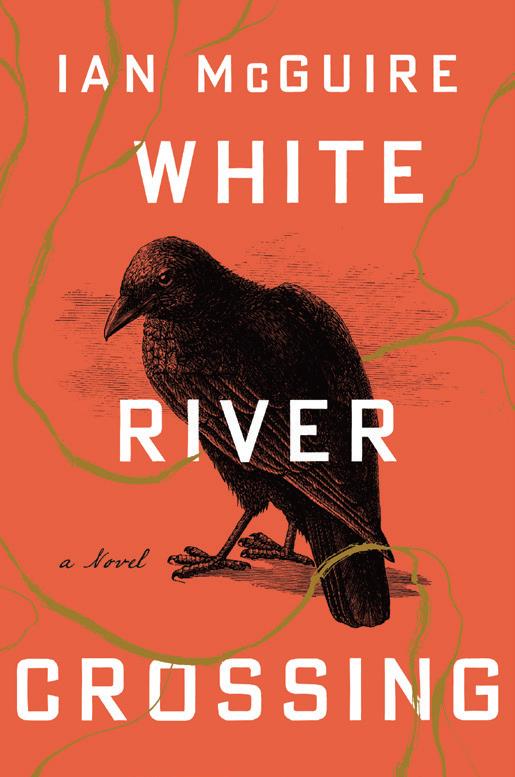
Many authors of historical fiction start with setting – a time, a particular place. Ian McGuire was more amorphous. In 2017, he jotted: “A fort in the west. Winter? A prophet arrives.” Years later, he says, “I reread those words and began to wonder what they could mean. What kind of fort? West of where? And why would a prophet appear? I didn’t know the answer to any of those questions, but I started to read more and think more, and my reading and thinking led me eventually to northern Canada and the Hudson’s Bay Company.” This would become his latest novel, White River Crossing (Crown US / Scribner UK, 2026).
In northern Canada, the Hudson’s Bay Company established a trading post in 1717, christened Prince of Wales’ Fort. McGuire learned that Englishman Samuel Hearne arrived there in the winter of 1770 and became the first European to reach Canada’s northern coast. Hearne wrote a book about his adventures, and after reading it, McGuire knew he had his novel: “The story would focus on a fictional expedition to the far north inspired by Hearne’s real journey,” he explains. Hearne is not the prophet; instead, it’s a shifty fur trader who arrives at the fort in 1766 to show its Chief Factor a stone … shot through with veins of gold. For a price, he’ll share where this gold can be found, and a secret party will be sent out to retrieve it. With the Company none the wiser, the Factor and his deputy, John Shaw, can keep the riches for themselves. Hearne (renamed Thomas), Shaw, and the Factor’s young nephew head into the wilderness with their Indigenous guides.
The relationships amongst different Native American groups play an integral part in the unspooling of the tale. McGuire expounds, “The eighteenth-century fur traders at Prince of Wales’ Fort had direct contact with three Indigenous groups: the Cree, whom they called the Southern Indians; the Dene, whom they called the Northern Indians; and the Inuit, whom they called the Esquimaux. The historical record, although patchy, makes it pretty clear that relationships between all three of these groups were antagonistic and often violent … From the perspective of the Hudson’s Bay Company, warfare tended to get in the way of trade, so they encouraged the different groups to make peace, although these efforts met with limited success until the nineteenth century. In White River Crossing the Europeans, guided by a Dene family, go north into Inuit territory … this brings the two groups closer together in a way which, in the end, proves to be disastrous.”
McGuire’s research included primary sources (e.g., Hudson’s Bay Company archives) and the work of archaeologists, anthropologists, and historians. He found Knud Rasmussen, the Greenlandic-Danish explorer and anthropologist, especially impactful – “in particular,” McGuire says, “his book on the intellectual culture of the group he called the ‘Caribou Eskimo’ produced as part of the Fifth Thule Expedition, 1921-1924. Although my novel is set about 160 years before Rasmussen was active, reading his work, which relies almost entirely on first-hand accounts given by the Indigenous people he meets and talks to, one gets the strong sense that the Inuit culture he’s describing has not changed significantly over that long period. I felt, on reading it, that I was getting a remarkably direct and relatively unfiltered description of a very different world, and that felt tremendously useful.”
This facilitated McGuire’s exploration of characters from disparate backgrounds and cultures. Were there any perspectives that were particularly difficult to capture? He elaborates, “Every character (one hopes) is complex in his or her own way and so figuring out how they think, speak, and behave is never entirely easy. Out of all the characters, we spend the most time with Tom Hearn, who is inspired by the real-life Samuel Hearne. He has the most extensive backstory by far, and he also has a slightly unusual character arc, so he was the character who occupied my mind more than any other. He’s morally complicated, too, so there were moments where it wasn’t immediately obvious to me how he would respond to certain situations, and I had to try out different options before deciding what was best. Hearn’s most obvious antagonist is John Shaw, the leader of the expedition, and the essential difference between them is that Hearn is full of doubts and uncertainty whereas Shaw is overwhelmingly self-assured and always believes he knows best. Having a character who knows exactly what he wants and rarely wavers from that course means their motivations are almost always clear, so it’s slightly harder to lose track of them. I certainly spent a lot less time agonizing over Shaw’s behavior than I did Hearn’s.”
Fans of McGuire’s The North Water (longlisted for the Man Booker) may find interesting parallels with his latest, not just in its cold, wild setting, but also in characterization. Like the protagonist of The North Water, Patrick Sumner, Hearne is a complex and selfreflective character, full of doubt and moral conflict. When asked if there were any callbacks, McGuire says, “White River Crossing is an adventure story, but it is also a story about the British Empire and more broadly about the kind of encounter between European colonists and Indigenous populations that occurred with calamitous consequences all around the world from the sixteenth century onwards. This interest in empire and the violence associated with it certainly connects White River Crossing to my previous two novels, The North Water and The Abstainer. These connections of theme and of style indeed feel so strong and consistent that it strikes me now in hindsight that, although it was never my intention while I was writing them, taken together the three books form a loose kind of trilogy … Their central concerns, the greed and arrogance that drives the imperialistic project and the violence that inevitably follows on from that are more or less the same. Psychological contrasts, certainty versus doubt, for example, definitely recur across all three novels.”
McGuire’s are historical, literary adventure thrillers that evince a compelling, propulsive style. When questioned about his skillful ability to generate and maintain that momentum, McGuire says, “That fast-paced style of writing seems to come quite naturally to me, so it’s not easy to step back from my own process and explain exactly how it’s done … since I’m quite wary of boring the reader, I tend to move briskly from one incident to the next. There’s not a huge amount of pondering or digression in between, which means the writing often feels lean and streamlined. As a reader, I actually enjoy novels which are quite slow and in which plot doesn’t feel central, but as a writer I tend to go in the opposite direction.”
While he doesn’t privilege historical fiction (“I wouldn’t ever want to suggest that historical fiction is superior to fiction set in the present day”), McGuire says the genre offers “something that’s distinctly different and valuable.” When done well, it provides clarifying perspective. “Historical fiction, if it aims to do more than just entertain,” McGuire explains, “is able to encourage the longer view and to remind us that the problems we face nowadays, though they seem brand new, may be rooted in tendencies that persist over hundreds or even thousands of years.”
Bethany Latham is HNR’s Managing Editor.
THE YOUNG WILL REMEMBER
BY EDWARD JAMES
A conversation with Eve J. Chung
When you look out of the window of an aeroplane, do you wonder about the people living below? Do they pause to wonder about the strangers flitting overhead? These brief glances are all we'll ever share … unless something goes wrong and our lives collide.
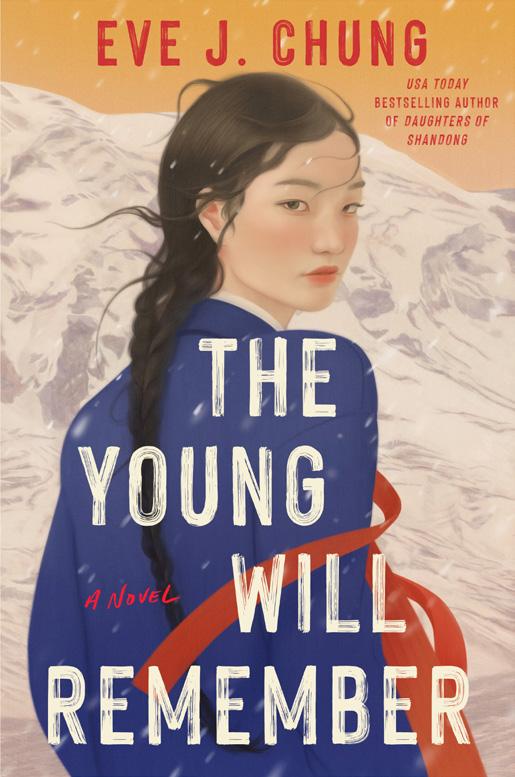
This is how Eve J. Chung’s new novel, The Young Will Remember (Berkley, 2026), begins. An American transport plane is forced down in North Korea in 1950, during the Korean War. Pilot and passengers are shot by a military patrol, but Ellie Chang, a Chinese American war correspondent, is spared by the intervention of a civilian claiming she is her missing daughter. She takes Ellie home to join the Christian pastor and his wife and son with whom she lives. For several months Ellie shares their trials and tragedies until she escapes back to her old life.
This is a novel, a powerful thriller, but based on real events, real people and detailed research. Chung is a human rights lawyer who explores the role of women in war as well as deeper themes about identity and allegiance.
Every war is a compromise. The famous military theorist von Clausewitz, though often accused of advocating ‘total war’, actually said it never happens. Every war is a ‘limited war’, limited by formal conventions and tacit understandings. The major constraint has always been to limit war’s impact on the female population. Female reproductive capacity is limited, male capacity much less so. If human groups are to survive, they should leave warfare to the more expendable males.
What about women who want to go to war? Should we deny equal opportunity? Ellie worries about this. She is attracted to violence, which is why she is a war correspondent, ever-trying to get closer to the fighting, at the same time excusing herself that it is in the cause of peace. ‘The more we know about war the better we could be about preventing it. Though I tried to explain this to my family, my visits often left me worried that something was wrong with me.’
I am divided on this. We should protect women, but we British were happy for them to ‘man’ our anti-aircraft guns during the Blitz, justifying this by
classifying AA guns as defensive weapons. Chung is more concerned about violence against women, particularly rape. Much of the book concerns the search for a Korean girl conscripted by the Japanese in WW2 as a ‘comfort woman’ (Korea was under Japanese colonial rule until 1945). Tens of thousands of young women were pressed into service, mostly Koreans but also from elsewhere in Southeast Asia, to provide sexual services to Japanese troops. Many died of disease, mistreatment, and malnutrition, and it was not until the 1990s that the Japanese government acknowledged their existence and made grudging reparation. The campaign for more fulsome atonement continues.
Ironically, comfort women were introduced in 1937 to avert mass civilian rapes such as followed the Japanese invasion of China in the 1930s. Whether they reduced civilian rapes is unknown. As Ellie observes, ‘every woman knows that in every war, on every side, men rape women, cruelly, viciously and with impunity. American soldiers and American leadership were no exception… This was a type of story no domestic paper would print or cared to print.’
Chung’s other main target is the mass bombing of civilian targets. I thought I knew all about this. I spent much of my childhood in air raid shelters, escaped from the burning debris of my grandmother’s house in 1944 and was evacuated to live with less than welcoming strangers. Yet I was lucky. Bombed-out households in London had at least makeshift food, shelter and medical care and we were evacuated by train. Unlike Ellie, I did not stumble along roads lined with the corpses of other refugees.
Chung describes the total destruction of Pyongyang by the USAF, leaving the survivors to fend for themselves in the rubble or trudge over mountains in search of somewhere with a functioning infrastructure. She estimates this added 50% to the death toll, but often the aftermath was more deadly than the bombs. Most victims were women, children and the elderly, active males having been conscripted for the war.
Today’s guided missiles are more discriminating. The missile that nearly did away with me could not reliably hit a target smaller than London. Yet the ‘collateral damage’ we daily see on television is still distressingly familiar.
Chung does not just tell horror stories. The family which shelters Ellie are loyal North Koreans who see Americans as aggressors, but as they struggle to survive, all our sympathies are with them. As each succumbs, Ellie weeps for them and so do we. Most people do not want war, so why kill each other when it is easier to love each other?
Chung explains that the title of her book is ‘a play off the saying “the old will die and the young will forget”’. I researched this saying and found it is generally attributed to David Ben-Gurion, Israel’s first Prime
Minister, although the only source is his biographer. It is taken to mean that once the Palestinian refugees displaced by the 1948 war have all died, their children will forget ancestral grievances, and they will fade into history.
By replacing ‘forget’ by ‘remember’ Chung is saying that if we keep alive the memories of past horrors, the next generation will not repeat them. Yet Ben-Gurion’s (alleged) prediction proved false. Palestinians have remembered, and war repeats incessantly. No war has been memorialised more than WW1, in words and in stone, but then there was WW2.
Nevertheless I am cautiously optimistic. We have successfully outlawed poison gas and biological weapons and hopefully antipersonnel mines. More importantly we have held back from nuclear war. I will die in peace (which I once doubted). I hope the same for my great grandchildren.
Edward James was a HNR Reviews Editor for 13 years. He is author of The Frozen Dream and Freedom’s Pilgrim and had a career in social policy and as an adviser on social security.
A TREASURE TROVE
BY TRISH MACENULTY
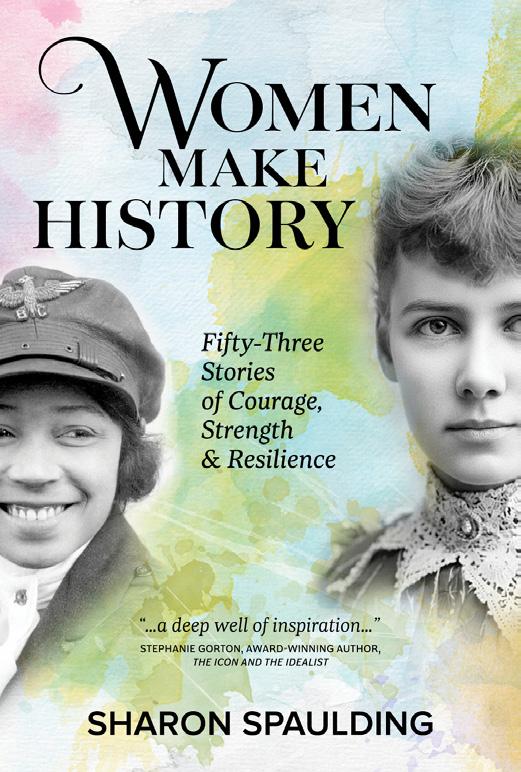
Sharon Spaulding on women who make history
An attic discovery sent Sharon Spaulding on a years-long quest to hunt down the “trailblazing” women history forgot, overlooked, or ignored. In Women Make History: Fifty-Three Stories of Courage, Strength & Resilience (Feb. 2026), Spaulding relates the stories of accomplished women from colonial America through the 20th century. The origin of her quest lies in the late 1970s, when she married Carl Spaulding, great-grandson of women’s rights activist Mary Ware Dennett. Dennett’s accomplishments in the battle for birth control have come to light in recent years, but when Spaulding first heard her husband’s family members talk about this remarkable woman, she had no idea who Dennett was.
“When Mary died, all of her papers, her journals, her private diaries were stored in an attic in the family house,” Spaulding said. “Every time I visited, I would pull out a handful of letters from an old steamer trunk in the bat-infested attic and read her story.”
Over the course of those visits, Spaulding learned Dennett’s history. “As I learned about all her accomplishments, I was dumbfounded that nobody knew about her.”
Spaulding, who has written for Ms. Magazine, Smithsonian.com, and New Hampshire Magazine, eventually decided to write about Dennett. As she researched, she kept finding other women who should have been in our history books and weren’t. While she struggled to corral the vast amounts of information about Dennett’s life and times, Spaulding kept files on the other women she stumbled across.
Finally, she could no longer keep these women’s stories to herself. She published the first “Women Make History: Stories We Should Have Learned in School” newsletter in November 2020. “We started out pretty small. But the newsletter has an open rate of 74 percent. I would hear from readers from all around the country, commenting on the material and suggesting other women to include in the newsletter.”
Spaulding soon amassed a “treasure trove of history-making, lifechanging, groundbreaking, courageous women—role models— whose stories deserved to be shared and passed down.” After a while she realized she had a book—a lively, irreverent, and generous compendium. In early 2025 she began turning the stories into a book. Choosing which ones to include proved to be a challenge. In fact, Spaulding said it was such a difficult task, she’s already planning a second volume: “As I continue to write the newsletter, I have all these new stories I want to include,” she said.
Spaulding has selected women who represent a variety of ethnicities, backgrounds, and fields as well as time periods. “The women I chose were predominantly American, starting in the colonial era, and each is concerned with a different issue,” she said. Two of the women are still alive.
Some of the women are well known, she explained, but most people don’t know the back story. For example, First Lady Edith Wilson served as de facto president when her husband was disabled. Less well known is that she was also a direct descendant of Pocahontas. Other women such as Mary Ellen Pleasant, an indentured servant who became a millionaire and helped to fund the Abolitionist cause, are more obscure.
“Sometimes the women are controversial and sometimes the information is questionable, but if you dig a little bit, you’ll usually find a gutsy, amazing woman,” Spaulding said. Studying these women gave Spaulding a better perspective on the challenges that women activists faced. “Not only did they have to win over other women, they also had to convince men in the halls of power to support them. They needed to shift cultural attitudes in order to bring about concrete actions and results,” she said.
When it came time to publish the book, she turned to an old friend and former colleague, Doug daSilva (dougdasilva.com), who had the artistic and technical know-how to get the book out to the public. “Doug designed the cover and did the layout for me. He did such a great job with the cover that a lot of the people who downloaded it on NetGalley said they did so just because of the cover.”
She had another partner in the creation of the book: her husband, Carl Spaulding, who drew illustrations of each featured woman. “When I first met Carl, he was supporting himself through school as a graphic artist. He went into digital advertising and hadn’t done any art in 40 years when this book gave him the opportunity to pick up a pen,” she said. “It’s been wonderful for him and me.”
Spaulding eschewed an academic style. She envisions the book as a resource for both older and younger women, including high school-aged readers, to learn about their foremothers. “Generally speaking, each entry is about a five-minute read,” she said. “For me, accessibility is key.” Historical fiction writers will also find the book a great resource. Spaulding noted that she met a number of women at the recent HNS conference who were interested in writing bio-fiction. “Any one of the women in the book would make for a great work of fiction.”
Now that Women Make History has launched, Spaulding intends to resume work on her own book about Mary Ware Dennett—the woman who started it all.
Trish MacEnulty’s next book The Woman with the Wicked Face: A Novel Inspired by the Life of Theda Bara will be released by Histria Press, Spring 2027. She is the author of The Delafield & Malloy Investigations series and Cinnamon Girl. She lives in Florida where she teaches a course in magazine writing at Florida A&M University. trishmacenulty.com
I WRITE ENTIRELY from the perspective of trying to reflect my characters’ experiences and worldview and to do it as entertainingly as possible.
A LUCKY FIND
BY LUCINDA BYATT
Shona MacLean talks to Lucinda Byatt about her standalone novel, The Cromarty Library Circle
Most historical fiction authors head for the archives after they’ve decided on the topic of a novel. However, in a reverse process, it was a lucky archival find during research for a work of non-fiction that was the spark for Shona MacLean’s latest novel, The Cromarty Library Circle (Quercus, 2026), set in 1831-32.
Cromarty is a small town on the Black Isle, in northeast Scotland. Many can be excused for not having heard of it, unless you’ve come across its most famous native, Hugh Miller (1802-56). Owing to its location, Cromarty was also a bustling port for the American colonies, shipping goods, people and ideas in both directions. So what was this document?
MacLean says, “I found the document in the Highland Archive Centre in Inverness, where I had gone into look at the records of highland burghs (towns) with a view to starting on a non-fiction project. The Cromarty document more or less jumped out at me, because my eye is always drawn to anything about books or libraries. The document listed the 36 relatively prominent citizens of the town – from titled landed proprietors and high-ranking military personnel down to the schoolmaster and women who appear to have been widows or spinster sisters. The books they had chosen for their library were also listed, as was the order in which they were to be passed between people. It was this last that really sparked the idea. That along with the fact that there were women as well as men in the membership just sparked a vision of all sorts of potential social tensions and dramas between people living around one small town that I just could not shake. For the novel, I cut the number of members down to a more manageable twelve, and invented fictional characters to represent the types of people I thought, or found to have been, actual members.”
MacLean’s earlier novels (see HNR 90, 2019) are first and foremost great stories, grounded in research. Leaping forward from the 17th to the 19th century, she continues to write about a combination of historical figures, often slightly reimagined, and purely fictional characters. In this instance, she says that she avoided including Hugh Miller, “that stonemason, voracious reader, poet, geological pioneer, naturalist and journalist who became a national newspaper editor before committing suicide in his 50s”, because “for him to have been more than a peripheral character would have skewed the book away from the fictional ones I wanted to create.”
I asked MacLean about the challenges and drawbacks of basing characters on historical figures. “Other than the restrictive nature of writing lives that are already known, the biggest boundary for me is the idea of misrepresenting someone to the detriment of their reputation, just for the sake of a story.” MacLean told me about some of the serendipitous finds that led her to reimagine historical figures.
“The idea for my town clockmaker, James Craig, who according to my story had gone to France in the early days of the French Revolution, came from a Hugh Miller newspaper item about a native of Cromarty who had refused, out of radical political principle, to
toast the health of the king.”
Similarly, “The character of Dr Fraser, minister of Resolis, was the result of another stroke of luck. At an early stage of my research, I discovered there was a memoir, Memorabilia Domestica, written by the minister of Resolis of the time, Donald Sage. I found Sage such a huge, compelling figure who expressed himself very resolutely on his contemporaries, that he came to life very vividly in my mind.”
The redoubtable ‘Miss Juniper’ is based on the real Black Isle schoolmistress, Elizabeth Bond. Her Memoirs of a Village Governess, MacLean writes, “had caused a sensation by peeling back the layers of social convention and revealing the flaws and misbehaviours of her neighbours in Fortrose.”
A similar lucky find was the diary of Anne Fraser. As MacLean writes, “it was a real joy when I went back into the archive to read the diary of a young woman of the period – simply to get insight into the interior and exterior lives of women of that period – and discovered the young woman (Anne Fraser) had spent a significant amount of time in Cromarty and been a pupil and companion of the elderly governess (Elizabeth Bond) on whom I based my character, Miss Juniper.”
The historical background is woven into a plot buzzing with social commentary. David Alston (who is mentioned in the Author’s Note) has highlighted the links between this remote Scottish township and the Caribbean sugar plantations which were “hidden in plain sight” until only recently. Exports of salt herring to the Caribbean were a precious source of revenue, while other industries included weaving hemp into bags used in the West India trade, known as Inverness cotton bagging. Mixed-race children were certainly present in Cromarty and across Scotland, as shown by Hester, one of the book’s most evocative characters. The debate over the compensation paid to slave owners, and the question of who benefits from 1832 Great Reform Act are hot topics within the community. Russia has brutally suppressed a rebellion in Poland, and lastly, a major cholera epidemic is encroaching on Cromarty which not only will affect commerce but also individual lives. Many of these themes echo our own worries and concerns, so I asked MacLean how present-day events impact her writing.
“I often realise when I am writing a novel that the research has shown me repeating patterns in history, which can come out in the book as themes which reflect the time of the book’s setting and our own time, too. This is always a realisation, rather than an intention. I write entirely from the perspective of trying to reflect my characters’ experiences and world view and to do it as entertainingly as possible. I think if I tried to write with some sort of ‘lesson’ for the reader in mind, I would be lost. If seeing the reflecting patterns helps the reader reflect on their own times, that is a bonus, I suppose, but not one I’d ever go looking for.”
The Cromarty Library Circle examines personal relations within a small community built on a rigid social hierarchy with a fragile equilibrium. This intriguing plot, involving an ensemble of characters, is amply researched, yet the scholarship is deftly kept out of sight, foregrounding a portrait of global connections and interdependent lives.
Lucinda Byatt is HNR Features Editor and honorary lecturer at Edinburgh University.
REVIEWS
Due to an ever-increasing number of books for review and space constraints within HNR, selected fiction reviews and all nonfiction reviews are now published as online exclusives. To view these reviews and much more, please visit historicalnovelsociety.org/reviews
Editors’ Choice titles, which come highly recommended by our reviewers, have the HNS logo and cover image alongside the review.
ANCIENT HISTORY
THE SAFFRON HORN
Elizabeth Anderbrook, Independently published, 2025, $9.99, pb, 292pp, 9798289106032
Set in the 16th century BCE on the island of Crete, Horn presents the very modern story of Liriya, a Minoan fisherman’s wife whose family life is overturned by the tsunami resulting from the eruption of the volcanic island of Thera, just to the north. The destruction of all boats in the region around Knossos has left her husband bitterly unemployed, and only Liriya’s mysterious new employment in the service of the high priestess is keeping the couple and their two children afloat, so to speak. Who has recommended her? We learn gradually about the event eleven years before that created a wedge between husband and wife. Its painful scars are about to be ripped open as temple life resurrects a ghost from Liriya’s past that threatens not only the happiness of this simple family, but also the very course of the theocratic kingdom of Knossos.
We know unfortunately little about the daily life of the Minoans, but the author has, for the most part, given us plausible reconstructions for just the right amount of local color. The only flat note for this reviewer was the names. The Minoan language has never really been deciphered, but we do have a handful of personal names. She uses none of them (not even that of the goddess Liriya worships) and instead makes up a wild variety of names with no linguistic coherence. This won’t bother a good many readers, and if you’re among that number, you will enjoy this familiar women’s story in fancy dress.
Niki Kantzios
DEATH IN SUMER
James Ferguson, Holand Press, 2026, £9.99, pb, 315pp, 9798250752893
Wildman Enkidu is seduced by harimtu (sacred prostitute) Shamhat. Like Adam, after coupling with the woman, he is changed: he shaves, wears linen clothing, moves to the city, drinks beer. Is Enkidu ‘fallen’ for having slept
with Shamhat, or ‘elevated’? Is losing part of his animal nature a defeat? He battles with Bilgames (Gilgamesh), King of Uruk, whom Enkidu curiously resembles, and the two become friends. They embark on an expedition to the Cedar Forest to cut timber for the doors of Enlil’s temple and slay the monster Huwawa. In revenge for Bilgames’ refusing her advances, the goddess Ishtar sends the Bull of Heaven against him, which he defeats with Enkidu’s help. Cursed, Enkidu is struck with a fever and dies. Grief-stricken Bilgames seeks immortality and goes in search of Uta-napishti, a survivor of the Flood. Meanwhile Enkidu, resurrected, defeats Kish, marries the princess and becomes king in his absence.
I’m a bit over-familiar with the story, and this is not a capturing of the ancient genius loci. It’s a ‘counter-narrative’, inventing new plot points, some of which I found unnecessary, yet with more character drama. It contains some gems of ancient Sumerian life and ritual: e.g., how heavy barges were towed upstream, drinking beer through straws, pouring libations to the gods of circles of flour, maidens chanting in emersal (a dialect mimicking the voices of goddesses). I liked some of the directlytranslated-sounding phrases, like ‘runs with the gazelles’, ‘the birthing one’, ‘sticks-whichhurt’. I loved the double-speaking of the oracle owls of Inanna.
It’s 2700 BCE, when cities were not so separate from the wildness of nature around them. Enkidu is perhaps the personification of the process. It’s an undying story and told well, a mythical tale dating from the dawn of civilisation, behind which we sense some tantalising hints of real history.
Susie Helme
BIBLICAL
ABOMINATION
Jeza Belle, Resource Publications, 2025, $21.00, pb, 206pp, 9798385259601
The Biblical story of David and Jonathan gets a fresh look by author Belle, with the focus on the men’s problematic relationship, while generally keeping within the accepted framework of the events in the Old Testament. Told with honesty and grace in a readable, accessible narrative, and with vivid descriptions of ancient Israel and Judah, the author provides a more modern perspective on the unlikely friendship between the two and their intertwined lives as the historical events unfold. Belle manages to give life to such figures as the half-mad King Saul, who loves the shepherd boy David one minute and then plots to murder him the next; the jealous and ambitious concubine Rizpah, determined to be a queen; the king’s handsome heir Jonathan; the military leader Abner; the motherly queen
Ahinoam; and of course, David, anointed by the prophet Samuel to be the next king of Israel. Her characterization of Jonathan and David as two bisexual men who become lovers and are caught up in a power struggle for the kingdom rings with authenticity and a depth of feeling, as they are attracted to each other from their first meeting after David’s slaying of Goliath, and are drawn together further into adulthood. They perceive themselves as soul mates, and they fight common enemies, suffer long separations, take wives, and father children. The course of their loving relationship is rough, but their bond remains steadfast and strong even as they realize that for David to become the next king Jonathan must give up his place as his father Saul’s heir to Israel’s throne.
Fractured family dynamics, love, loyalty, violence, forbidden desire, courage, and sacrifice abound in this ultimately tragic episode in King David’s life.
Michael I. Shoop
ELISABETH: Mother of John the Baptist
H. B. Moore, Mirror Press, 2025, $15.99/ C$18.99, pb, 240pp, 9781952611537
This gentle story of Elisabeth before she becomes the mother of John the Baptist is an engaging story of an unpretentious woman from a small village who has the courage to accept her own destiny. It takes place in the village of Ein Karem in the southern part of Israel in approximately 30 BCE. As the youngest daughter, Elisabeth lives with her parents and takes care of her ailing mother. Her hand in marriage is sought by Zacharias, another villager who, like Elisabeth, is the offspring of a priestly family. With their marriage, Zacharias and Elisabeth knowingly set up any potential son they may have for a prominent, prestigious religious role in the future. Elisabeth, however, cannot conceive a child and becomes labelled as a barren woman. She serves as a midwife instead, helping other women. She and Zacharias are both devout Jews whose lives change many years later, when he is visited by an angel, who tells him that she will have a son who will be a messenger for the Messiah to come. Elisabeth is very close to her great-niece Mary, who receives her own angelic message, so both women prepare together to face the future with grace and resolve.
Elisabeth is an empathetic character throughout this retelling of her story, which brings the Biblical account to life in a very real way. The novel describes the emotions and actions of people who may have lived two thousand years ago, but their concerns about the well-being of their families, their village, and their future feel very relevant today. Recommended not only for readers of inspirational literature, but also for readers interested in the daily lives of ordinary people in this time and place.
Karen Bordonaro
EVE
B. K. O’Connor, Histria, 2026, $19.99, pb, 323pp, 9781592116690
Eve reimagines the life of the First Woman in gorgeous, spare prose, presenting her curiosity as a great strength, and taking issue with those, including her Creator and her husband, who consider it unfortunate at best. B.K. O’Connor begins with the creation story as Milton envisioned it in Paradise Lost (1667). Milton’s epic poem gives a beautiful Lucifer relatably human motivations, leading 18th-century poet William Blake to say that the pious Milton was “of the devil’s party without knowing it.” Eve does the same for Eve, who among other things, resents God’s absence and Adam’s small-mindedness.
After being expelled from the garden, Adam and Eve nearly die of starvation and thirst. Eve’s ingenuity (and a little help from Lucifer) keeps them both alive, for Adam, overwhelmed by the loss of paradise, cannot. The story shifts then, about a third of the way into the novel, in a way I did not expect, but which allows Eve far greater scope for her ravenous curiosity, her desire to know God’s reasons for creation.
While O’Connor illustrates Adam’s inferiority and the nearly modern ways he (and God) disappoint Eve, this is no screed dressed up as novel. It is a heroine’s journey, a lonely quest. The novel has the feel of an epic poem in Eve’s unwavering commitment to her pursuit of knowledge and her divine beauty even into old age. It has a touch of hell and the deliberation of the gods. But where Odysseus learns the hard way not to defy the gods, where Milton sought “to justify the ways of God to men,” O’Connor’s novel is a paean to disobedience. “Always eat the fruit,” Eve advises. Whenever you have the choice, always eat the fruit.
Melissa
Bloom Bissonette
CLASSICAL
THE CLEANSING
Victoria Alvear, Hypatia Press, 2026, $14.99/ C$19.99, pb, 318pp, 9781839196348
Fifty thousand Romans have died in a single day of carnage at the Battle of Cannae. In a bid to distract the Roman people and avoid blame for the tragedy, the ruling elites scapegoat a priestess named Opimia. They claim that the tragedy was a divine punishment sent because Opimia broke her sacred vows.
It is surprising that, before now, so few authors have chosen to pay much attention to the Vestal Virgins. These priestesses sat atop a strange pedestal in Roman society. They held great wealth and political power, answering to none but the pontifex maximus, Rome’s high priest. For all these privileges, the Vestals still lacked freedom and privacy, a symptom of the social inequalities that this novel analyzes.
Victoria Alvear’s considerable knowledge of Roman history enhances this detailed exploration of Roman culture. Readers come
to know and care for Opimia as she carries out her daily rituals and reflects on her life. Little time goes to waste, as even quiet moments provide a source of insight into her and the civilization she inhabits. Roman society’s injustices and double standards are brought into sharp relief, as its religion and state are weaponized against its own people.
Original, sharply critical, if occasionally over expository, this novel invites a renewed dialogue with Roman antiquity. So many novels set in Rome focus on just a few familiar topics: the dictatorship of Julius Caesar, the conquest of Britain, the fall of the empire. The Cleansing proves that Roman history still has new treasures to offer authors and readers.
Arienne King
APHRODITE IN PIECES
Lauren J. A. Bear, Berkley, 2026, $30.00/ C$41.99, hb, 384pp, 9780593638972
With Aphrodite in Pieces, Lauren Bear offers another powerful feminist Greek myth retelling. Her Author’s Note says: “Misunderstood women are my muses.” Through the framing premise, Aphrodite tells her story to the 2nd century BCE sculptor of Venus de Milo—without the distorting male filters through which she had previously been understood. “Just as she was born, the visitor arrives upon the sea, riding the wavebegotten mist to shore…she moves inward… If he does not listen, she will have to leave and find another.” But Alexandros listens with such depth that he will put her truth into marble.
Her tale moves through her isolated childhood to her forced marriage to Hephaestus, affair with Ares, birth of Eros, and other myths. The plot elements are not surprising; Aphrodite’s take on them is— revolutionary in the way women are or should be viewed and treated.
“I was a good time, a beautiful object… Nothing more,” Aphrodite tells Alexandros early on. From Bear’s engaging scenes among the gods, and particularly, Aphrodite’s conflicts with Zeus, the reader already knows the goddess is far more. Aphrodite shudders hearing how Zeus rapes in the guise of animals. When Apollo excuses Zeus as “addicted to love,” she counters, “That isn’t love.” Apollo rightly says, “It is power.” Not all the male gods are despicable. Of the Trojan War, Aphrodite says, “So much violence in the false name of pleasure, in the false idea of property, in the false pursuit of honor.” Bear slides into her tale more prismatic aspects of subtle and compelling feminist themes than fit into a review. Nothing simplistic here—and that’s central to Aphrodite’s hard-earned self-understanding. She makes devastating mistakes but comes to face them straight-on. Highly recommended.
Judith Starkston
PASIPHAË
Jane Dougherty, The Book Social, 2026, £9.99, pb, 368pp, 9781917163293
Too often, retellings of Greek myths aren’t nearly as exciting as the originals, but Pasiphaë is definitely worth the read. This princess of distant Kolchis finds herself married into the Cretan royal family at a moment when the reign of priestess-queens, devotees of the Mistresses, is about to give way to a more patriarchal, militaristic economy ruled over by Zeus and Poseidon.
She is there to hold the queenship for her husband’s under-age daughter, but Princess Kriti has been drawn into an even older, more blood-soaked cult of the Great Mother. And over everyone and everything broods the dark figure of Kriti’s cruel and ambitious halfbrother Minos. He longs to install the Greek style of warrior-kingship, with women and their goddesses reduced to a minor role.
In Pasiphaë’s later years, her rebellious daughter Ariadne brings final disaster down on the family and the island, and Pasiphaë the mother’s worst fears are brought to pass. The ending is worthy of a Greek tragedy. The book is advertised as a feminist take on myth, but don’t worry. It’s a deeply human drama without polemics. The writing is superb—it will surprise no one that the author is a poet—but it’s also gory, even unto child sacrifice, so a warning to the easily triggered.
The atmosphere of gathering doom is almost unbearable. It didn’t bother me that the characters speak Greek—despite the naturalism of the Knossian setting, this is still the fairytale Knossos of legend. Those searching for a human face to put on the figures of ancient mythology will find a satisfying and gut-wrenching answer to their prayers here. Highly recommended.
Niki Kantzios
SWEETBITTER SONG
Rosie Hewlett, Sourcebooks Landmark, 2026, $17.99, pb, 512pp, 9781728299044 / Bantam, 2026, £16.99, hb, 496pp, 9781787637313
One evening, a nine-year-old slave girl named Melantho meets ten-year-old Princess Penelope, and from that moment on, they are inseparable … until Penelope’s family learns of the friendship and Melantho suffers brutal consequences. Years later, amid the arrival of suitors hoping to be chosen as husband to Penelope’s cousin, Helen, they meet again. However, Melantho’s resentment over both her punishment and Penelope’s silence afterward still lingers. When Melantho and her brother are caught attempting an escape, Penelope saves Melantho from a terrible punishment. Yet Melantho can’t help questioning Penelope’s motives—was this recent rescue born of guilt or is there something deeper between them that neither one can yet name?
Readers should note this sapphic retelling diverges sharply from The Odyssey. Instead of portraying Penelope as a maternal figure to a much younger Melantho, the novel reimagines them as near contemporaries and as romantic
partners. Ultimately, bringing the handmaids (including Melantho) closer to Penelope’s age strengthens both the narrative and the characters’ development. As Penelope sees the mistakes Helen and Clytemnestra make in their circles of influence, she increasingly relies on the women around her when governing Ithaca. While casting hot-tempered Melantho as a similarly aged counterpoint to Penelope’s measured calm may prove divisive for some readers, I found the contrast effective.
Sweetbitter Song explores a powerful friendship amidst life in Ithaca during Odysseus’s absence, revealing both the strain of managing a household under patriarchal social expectation along with an unexpected freedom of life without male control. As Melantho and Penelope grow into womanhood together, their choices reflect the cost as well as the possibilities of reimaging change in their world. At its core, the book’s exploration of childhood friendship, betrayal, reunion across a power divide, and the struggle to claim one’s own power is deeply moving and emotionally resonant. Recommended.
J. Lynn Else
TROY REBORN
Philip Seib, Indie Author Books, 2025, $19.95, pb, 227pp, 9781954517950
Seib explains in his introduction that his intention in retelling Vergil’s classic Aeneid is to describe a “maturing of Aeneas’s attitudes about war, divine authority, and women’s roles.” That is exactly what he does in this eminently readable account of Aeneas’s journey from innocence to maturity.
Seib takes us quickly through Aeneas’s early life to the moment when the Greeks depart from Troy after ten years of war. The Trojans celebrate believing the war is over, and then Aeneas takes us through the horrific destruction of the city and his tortuous Godsdriven journey to found Rome, the new Troy.
We take the classic voyage, but we take it with an Aeneas who loses his beloved wife in the last chaotic moments of Troy’s destruction, who becomes less and less enamoured of war and less confident in the trustworthiness of the direction of the Gods as time goes on. As he learns from women such as Creusa, Dido, and Lavinia and his mother during his travels and is challenged by warlords, monsters, and the feuding gods of Olympus, he becomes more disillusioned and more mature. These lessons are crucial in the creation of Rome. More to the point, as Seib intended, they resonate in today’s world.
Keira Morgan
hides away this tall, muscular robust lad on the rocky island realm of Skyros, disguised as a girl, Pyrrha. Princess Deidamia (Mia) of Skyros, feeling constrained in the women’s quarters, and Pyrrha, suffering dysphoria, secretly leave the palace together for adventures in the outside world. As their friendship blossoms, Mia becomes aware her people are starving while palace stores of grain remain full, and she challenges her father. There’s also a strange attraction between them, which becomes increasingly erotic once Pyrrha is returned to male form and renamed Pyrrhus. The author hints at bisexuality as Pyrrhus (Achilles) craves the company of Patroclus to train together as warriors.
Told from Mia’s point of view, the story is visual and heartfelt. We see beyond the virile warrior in his tenderness towards her and his telling her stories of Chiron the centaur teaching him healing arts, music, and poetry in addition to wisdom and weaponry. Mia becomes a skilled negotiator with the traders who frequent the island, also bringing news of the coming war. Although Starkston reinterprets the myth about his early life, Achilles cannot escape his fate, sailing off to Troy with the wily Odysseus. In Part II, Mia is a single mother dealing with an unruly child, Neoptolemus, who towers above her, an easily angered, volatile youth of twelve with contempt for all mortals, especially the villagers. Not a great candidate to rule someday. What if Achilles had not gone to war? Could he have guided his son? How much influence can a mother have? Starkston spent three weeks living on Skyros, which contributes to the authentic feel, and to her vivid descriptions as she immerses the reader in life in ancient Greece.
Gail M. Murray
1ST CENTURY

INFERNO
Conn Iggulden, Pegasus, 2026, $28.95, hb, 464pp, 9798897100767 / Michael Joseph, 2026, £22.00, hb, 464pp, 9780241587362
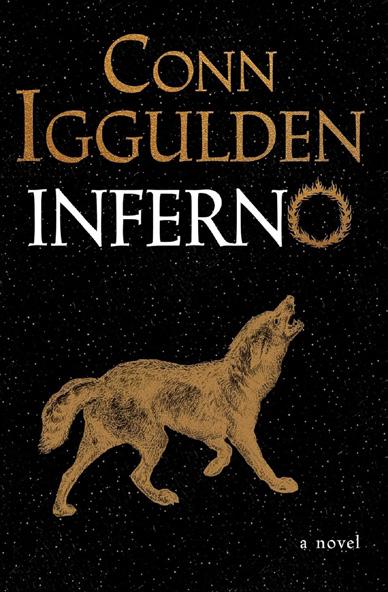
ACHILLES’S WIFE
Judith Starkston, Bronze Age Books, 2026, $19.99, pb, 352pp, 9798990249912
Achilles, celebrated as the greatest Greek warrior of the Trojan War, is destined to die an early death as prophesied by an oracle. At age fifteen, his fierce sea goddess mother, Thetis,
The final chapter of Iggulden’s Nero trilogy provides a fittingly poignant conclusion to the story of one of Rome’s most hated emperors. While the novel takes creative liberties with certain events, it places readers in an authentic Rome. The mindsets of the characters and environment they inhabit feel real and lived in, which is the hallmark of good historical fiction. The prose is well-tuned enough to immerse readers in the action without being overly ostentatious. The pacing has an immediacy that makes this a
genuine page turner, even if one already knows the main beats of Nero’s life.
Nero may be the master of Rome, but he is still a slave to the ancient traditions that govern it. Keenly aware of his own inadequacies, he is faced with the choice of submitting to the expectations of the Roman Senate and citizenry, or attempting to bend them to his will. At no point does the protagonist ever become wholly likable, but there is something undeniably human about his pettiness and flawed judgments. As he descends into fear and isolation, it is impossible not to feel some sympathy.
In the historical note included at the end, Iggulden explains the historical basis of the novel and what Nero means to him. The author is no impartial narrator; he believes that Nero has been unjustly treated by history, and that conviction permeates this novel. The side characters and setting are similarly wellloved by the author, resulting in a detailed and nuanced portrayal of Rome in the 60s AD.
Maps and a genealogical tree help readers to situate the novel within its context. This is an enjoyable and thought-provoking read that will satisfy the trilogy’s fans. It is self-contained enough that new readers may use it as an entry point, but I would still recommend reading the trilogy in chronological order.
Arienne King
GRADARIUS
A. M. Swink, Historium, 2025, $19.99, pb, 366pp, 9781964700564
Swink’s Romano-British historical romance, set in AD 59, centres on the dilemma facing the Briton princess Luciana, also called Luigsech. Where should her loyalty lie when she is forced to aid the Romans who threaten to destroy everything she holds dear: her enslaved people, the Cornovii, or the Roman Decimus, whose slave she is and the man she has come to love?
Gradarius is the second novel in Swink’s Roman Equestrian series. Swink has clearly done her homework, and the novel weaves together several ambitious plots and themes. Although the central story focuses on Luciana and Decimus, that narrative includes a complex spy plot reaching back to imperial Rome, and another darker romantic thread entwining Roman, Celtic, and pre-Celtic mythological lore. Swink’s novel also develops a third relationship that explores same-sex love in the Roman army, and a fourth between a naive young slave and a tavern girl. The tragic story of Boudicca and the Iceni also enters the narrative. Maps, a glossary, and other useful sections help the reader imagine the 1st-century world of Roman Britain.
The novel explores relationships that range from innocent and unrequited love to more explicit encounters. However, the numerous romantic threads dilute the emotional focus of the narrative, and several relationships are thinly drawn. There are several graphic and extended sexual episodes—both heterosexual and homosexual. A lighter touch might have
served the story better, since implication often surpasses description.
Keira
Morgan
3RD CENTURY
CARAUSIUS & ALLECTUS
John Pitts, Independently published, 2026, £9.99, pb, 360pp, 9781837094462
The 3rd century AD saw the once mighty Roman Empire fracture into crisis and chaos. In the year 286, with widespread military support, Carausius, the commander of the Roman fleet, rebelled and declared himself emperor of Brittania and Gaul. This wellresearched book adheres to the known facts while convincingly fleshing out his story. Little is known of Carausius’s early life, giving the author free rein to portray him and his successor Allectus as Welshmen, the sons of tribal leaders taken to be educated by Rome: effectively hostages to secure their fathers’ loyalty.
Carausius finds renown fighting in the Roman army in Gaul; Allectus becomes a Roman financial administrator. History is silent on how Carausius came to be appointed commander of the fleet with the task of defeating the northern pirates, but in this telling, Carausius proves his leadership and seamanship during a terrifying storm. Descriptions are evocative: the ship smelt of ‘wood, salt, pitch and sweat, an acrid perfume of naval force’.
According to Roman historians, Diocletian’s co-emperor Maximian ordered Carausius’s capture for execution based on reports he was keeping the pirates’ plundered goods for himself. In this story, these are false accusations, seized upon by Maximian, who is jealous of Carausius’s growing power and popularity.
Each chapter is told from a particular character’s perspective with fourteen different points of view, making the story feel somewhat disjointed. Paragraphs occasionally veer from first person to third, while tenses wander from past to present. These issues aside, this is a fast-paced, engaging story about a little-known period of Britain’s history under Roman rule.
Penny Ingham
4TH CENTURY
THE DREAM OF MAGNUS MAXIMUS
Nigel Collett, The Book Guild, 2025, £10.99, pb, 320pp, 9781835743126
In 386 AD, the imperial border in Roman Britain is fraying. Magnus Maximus, commander of the Roman army, is ambitious and ruthless. Married to the British princess Elen, he is dissatisfied with his lack of advancement. He uses his British connections as a power base, wins the support of key Britons and wealthy Romans, secures
Britannia, then proclaims himself emperor. He launches an invasion of Gaul, which his army rapidly subdues, careful to claim the support of his childhood friend, the Eastern emperor Theodosius, to cloak his designs.
Collett portrays a man haunted by inner demons. Maximus relies on bribery, corruption, and the machinery of Roman power, as well as his loyal and capable subordinates, allies and family. Yet his rise reveals his dangerous lack of self-awareness, and his victories bring consequences he does not foresee.
The novel sets Maximus’s arc against that of his wife, Elen. It explores major themes of the late Roman world: the clash of pagan, Nicene Christian, and Arian beliefs; the fraying of Roman authority along its western frontiers; and the raids and settlements of so-called barbarians within its borders. Wellpaced and thoughtfully structured, the story highlights Elen’s strong Christian character and development. It will appeal to readers interested in Britain’s development in the twilight of Roman rule.
Keira Morgan
THE FAREWELL OF THE GODS
Q. V. Hunter, Eyes and Ears Editions, 2025, $16.00, pb, 376pp, 9782970108450
The Farewell of the Gods is the final volume in the 4th-century Roman Empire series Embers of Empire, featuring Marcus Numidianus, now Intelligence Chief of the schola, the Empire’s elite spy network.
In a framing prologue, Hunter presents the semi-blind Numidianus at his Roman home, recounting his story to the historian Ammianus Marcellinus, Hunter’s principal source. He poses the question that drives the narrative: was the catastrophic defeat of the Roman army foretold? Numidianus believes it was and blames himself. As Intelligence Chief, it was his sacred duty to foresee disaster. Why did he fail? From that moment, the tale unfolds as both confession and investigation.
At the outset, Numidianus has promised his wife he will retire. Yet his most trusted agente arrives with an urgent plea: as his final service, he must escort an embassy of Gothic leaders across hundreds of miles to meet Emperor Valens and petition for sanctuary from the advancing Huns. Despite his wife’s fury, Numidianus accepts, and from then on, each promise he has made begins to unravel.
Hunter delivers a compelling and closely
researched account of the Gothic crisis, the defeat at Adrianople under Valens, and the gradual destabilisation of the eastern Roman Empire between 376 and 378. Seen through the eyes of Numidianus and his agentes, the events feel immediate and intensely personal. The characters are vivid, the dilemmas harrowing, and the pacing swift as calamities crowd upon one another. I enjoyed it so much that I now want to begin with Book One and read the entire series.
Keira Morgan
5TH CENTURY DAUGHTER OF THE REBELLION
Jamie Ogle, Tyndale House, 2026, $18.99, pb, 368pp, 9798400506611
In April of 402 AD, Rome captures young female Visigoth fighter Adelgard (called Adel) and sells her to one of several schools for gladiators. She becomes the most famous gladiatrix in Rome. However, treacherous overseers remind her that she remains their slave to use as they please. For example, they make her fight with a defective sword while betting she will lose her match. The second main character, Felix, a handsome Roman, has spent years in Alexandria learning how to treat wounds. He comes home to a job as a medicus for gladiators. Telemachus, a former gladiator now Christian monk, wants to save the captive Visigoths from certain death in the arena and get them back to their homeland. Chaotic events and dramatic family stories entangle these three main characters. Felix and Adel fall in love and help Telemachus liberate other gladiators. Christian values of peace and helping others grow ever stronger, but conflict with gladiator duties.
Secondary characters, including the immature Roman emperor Honorius, are well described. The novel’s realistic settings include private and public combat theatres, gladiator training grounds, jails, infirmaries and gladiator living quarters. Nauseating foods, crude medicines, wine laced with opioids ring true. The prose and dialogue usually fit the time and place though sometimes lapse into modern jargon with references to units of time or certain expressions. Over the top descriptions (blood thundered, pulse racing like a team of runaway chariot horses) will distract some readers.
The main storyline builds to Rome’s Victory Games, put on to celebrate Rome’s triumph over the Visigoths. Here the best gladiators from different training schools must fight each other and lions in front of Roman nobility. This novel presents a gritty and realistic portrait of the lives of gladiators, the Rome-Visigoth wars, and early Christianity’s growing influence.
G. J. Berger
8TH CENTURY
DUCHESS OF THE NEW DAWN
Kim Rendfeld, Independently published, 2026, $15.99/C$29.99, pb, 246pp, 9798998540615
Swirling intrigue, alliances made and broken, and ever imminent warfare mark the world of Chiltrude in 740 CE in Francia, land of the Franks. Chiltrude is a Christian woman who believes that changelings steal newborns, dwarves are a menace to humans, and night demons fill the skies in search of unwary travelers. She is also, however, the sole daughter of Charles Martel, and a woman who can read and write, and a sister who can understand the personal motives of warring brothers. All of these elements come together in this stirring novel of a woman who forces her own choices to the fore in a world that is easily able to constrict them.
Chiltrude falls in love with Odilo, duke of the Bavarians, as her father lays dying. Her father refuses to allow this marriage to take place. A series of events take place that Chiltrude uses to her advantage, not the least of which is the knowledge that Bavarian law, unlike Frankish law, permits women to act on their own behalf in marriage negotiations. As Chiltrude takes charge of her own life, she also puts into use the noblewoman’s role of peace weaver between her brothers.
The plot drives this hard-charging narrative. As oaths are made and broken, survival becomes paramount, and Chiltrude’s relationships change constantly due to necessary selfinterest and the need to protect those closest to her. This is a world with little empathy, but a colorful world, nonetheless. Recommended for readers wishing to immerse themselves in the extremely dangerous but very compelling early medieval world two generations before the appearance of Charlemagne in the land of the Franks.
Karen Bordonaro
9TH CENTURY
THE LAST DAYS
Lindsay Jacob, Troubador, 2025, £9.99, pb, 392pp, 9781836285311
In the 9th-century reign of Athelstan of East Anglia, the aeldorman Aelfric is sent to look into a strange attack on monastery lands and the appearance of wandering monks preaching the end of the world. He brings along a tonsured friend, Father Eadred, who is celebrated for his powers of investigation. But all the powers of Church and king will be needed to fight what they uncover in the northern fens. The old ways are far from dead in these remote cloisters, and bodies begin to pile up as the king’s troops seek the truth. While torrential rains break the long apocalyptic drought, ugly truths are brought to light, and the good are dangerously hard to tell from the evil. Our sleuths’ resolution takes on urgency when the diabolic endgame is revealed.
A fast-paced, atmospheric whodunnit, The Last Days is marked by curiously awkward
language in places, as if the author is trying to be too original and ends up misusing the King’s English here and there (e.g., incorrect prepositions). But it doesn’t spoil the fun. If you like the Anglo-Saxon world with its harsh justice and gory murder mysteries with a Satanic twist, you’ll read this with delight.
Niki Kantzios
11TH CENTURY
THEREIN LIES THE PEARL
Catherine Hughes, Historium, 2026, $24.99, pb, 502pp, 9781964700687
The course of English history took a sudden, bitter and permanent turn in the fall of 1066 when Duke William of Normandy, the Conqueror, defeated the Saxon army of King Harold at Hastings. England became Norman. But the ancient Saxon bloodline did not die at Hastings. It was carried on by Edgar, the grandson of Saxon kings, and by his sister, Margaret, known as the Pearl of Scotland. History has a way of overlooking, even denigrating, the women who helped make it. Royal Margaret is a pawn for would be kings. Celia Campion is Norman. But she isn’t royalty. She is an orphan charged with protecting her baby sister. Like the biblical Job, both women are battered by fate but, strong, independent and courageous, they refuse to cower. Celia is in love with Simon, a brawny soldier who goes to fight for William while she is cast as a spy for the Norman duke, placing her at odds with the Saxon princess Margaret.
Like any good historical fiction, Therein Lies the Pearl teaches effortlessly as it pulls you into its tale of love, intrigue, danger and survival. It satisfies the lover of historical fiction and the fan of romances fraught with uncertainty. Can happiness be found in a world of ceaseless violence? Can friendships be forged despite historic animosities and class differences? Sometimes the dialogue seems a bit spot on, in moments of passion, theatric, not crispy enough. A burst of emotion sizzles, while too much inner thought can be repetitive and unnecessary. Even so, the novel never slows down, though the end may startle readers with an unforeseen twist. Therein Lies the Pearl checks off all the boxes for readers wanting to explore a place and time they’ve never been.
Peter Clenott
12TH CENTURY
LADY OF LINCOLN
Rachel Elwiss Joyce, Hedgehog Books, 2026, £12.99/$16.99, pb, 462pp, 9781919337906
Lady of Lincoln centers on minor noblewoman Nicola de la Haye, the female constable of Lincoln Castle in 12th century England. Under the reign of Henry II, teenage Nicola recognizes her duty to marry in order to best care for her family’s estate. However, events take surprising turns, including members of Nicola’s family becoming embroiled in the Great Revolt. Over the course of the novel,
Nicola navigates how to balance family loyalty, leadership responsibility, and her desires for marital happiness and self-fulfillment.
The plot is gripping, and the book can easily be finished in 2-3 sittings. The writing style is not overly literary and will appeal to readers of historical genre fiction. While the feminism can be heavy-handed at times, with phrases like, “If a man could do it, so could she,” these instances are largely confined to the book’s opening and closing sections. Thankfully, Nicola’s genuinely impressive competence and popularity are well shown throughout the novel.
While big-name characters feature, Lady of Lincoln is refreshing in its focus on lesser-known figures. The character arcs are satisfying. We witness Nicola’s transformation from a lovestruck youth to a capable leader. Her husband is perhaps the most complex character and will leave the reader at turns admiring and repulsed. Sticklers for historical accuracy may dislike Joyce’s liberty in using gaps in the historical record to imagine certain characters and their relationships; however, I thought Joyce’s treatment was narratively effective. Joyce also succeeds at weaving in key concerns of medieval life, such as religion and inheritance, in a way that feels natural. Overall, Lady of Lincoln is an easy read that illuminates the nearly forgotten Nicola de la Haye, a remarkable and singular woman. Alexandra Syrah
THE KNIGHT’S PLEDGE
Scott Mariani, Hodder, 2025, £9.99, pb, 339pp, 9781399736831
In 1191, after many months of travel (detailed in a previous episode), King Richard’s army arrives in the Holy Land to support the siege of Acre. Even before they land, they are drawn into a vicious sea battle, which brings Will Bowman to the attention of the king. The siege is a protracted and brutal affair, with heavy casualties on both sides, but eventually Acre falls, and King Richard is able to turn his attention to his new protégé. However, Will is imprisoned after refusing to carry out a particularly brutal order but given a chance to redeem himself by agreeing to undertake a seemingly impossible mission.
The background research is formidable. Descriptions of the terrain and fauna are excellent. Contemporary opinions of Islam are realistic and not marred by modern political correctness. Unfortunately, there are technical issues. There are too many characters, and they come and go with depressing regularity. Will Bowman is a terrible leader. He regularly makes very poor decisions, and this eventually makes his genuine courage look like foolishness and his honour like naiveté. It takes far too long for the quest to start, and the reasoning behind it is ludicrous. A small party despatched hundreds of miles behind enemy lines to find a great treasure? What happens if they get captured and it falls into Muslim hands? There have to be a lot of happy coincidences for our adventurers.
Martin Bourne
14TH CENTURY
ULTRAMARINE
Paul Drayton, The Book Guild, 2025, £10.99, pb, 304pp, 9781835742952
In a coastal community in 14th-century England, three motherless brothers are just beginning to find their way in life, without much help from their father. The eldest brother, Edwin, marries a local miller’s daughter. The next, Gavin, seems to take after his father in some ways, giving him little hope, but his exceptional talent as an artist soon begins to shine through. It is the youngest brother, Oswin, who is the main focus of the story. Oswin is continually drawn to the sea, and this, together with his fascination with music and singing, distracts him from his studies. His family finds his behaviour somewhat odd and even fear for his sanity. He is sent away to a physician, alchemist and astrologer named Jocelyn Lacey, who declares him quite sane and recognises that Oswin possesses an exceptional singing voice, and he arranges for it to be put to good use in an abbey choir.
The book’s title refers to the highly valuable pigment needed by Gavin to achieve the desired effect in his paintings. It could also refer to the sea itself and the life in and beyond it – outside of their small community. Oswin soon finds out what life is like in the wider world, but there are still things to discover back home that could also change his life forever.
Edwin is a steady presence, but rather twodimensional; it is his connection to the Martin family, and his mother-in-law, Judith, in particular, which proves to be important. The daughter of their liege lord, the Lady Isobel is another interesting character, and it feels like there could be a sequel in which she would feature more.
The lyrical prose in this literary novel is delightful – no surprise when one considers that the author is a composer. Heartily recommended.
Sarah Dronfield
AN UNCERTAIN AGE
Susan B. Nolen, Wild Rose Press, 2026, $22.99, pb, 392pp, 9781509265213
Set in 1349–1350 in the Palatinate of Durham, An Uncertain Age is a vividly grounded portrait of life in the uneasy years following the Black Death, when fear, disruption, and opportunity coexisted uneasily. Brewer Tobias Surteys’s decision to expand his cottage ale business brings him into rivalry with the powerful reeve, further complicated by the arrival of Margaret’s abandoned eleven-yearold step-granddaughter, Agnes, a sharpwitted, secretive child with problems of her own. Tobias’s sudden death from an apparent apoplexy shocks the community, but it is Margaret’s response that truly startles it. Newly widowed and no longer young, Margaret claims her widow’s right and takes control of the business. Her bold move draws the hostility of the reeve and his allies. As
the business prospers, several increasingly dangerous mishaps suggest deliberate sabotage and a connection to more than one death. Certain that someone is determined to destroy them, Margaret and Agnes devise a daring plan to expose the culprit, with devastating consequences.
The novel’s strengths lie in its richly realized medieval village, vivid descriptions of brewing and daily labour, and confident command of period law and custom. Margaret and Agnes are compelling, memorable protagonists, supported by a strong cast of characters. As it develops, the narrative gathers momentum and delivers a conclusion both satisfying and true to its historical world. This is an engaging novel, and I eagerly await Nolan’s sequel.
Keira Morgan
16TH CENTURY
THE MARRIAGE CONTRACT
Sasha Butler, Salt, 2025, £10.99, pb, 336pp, 9781784633608
In 1577 Worcestershire, yeoman Thomas Litton, his wife Ruth, and children, Eliza and Henry, live on their thriving farm. Thomas is a cruel, power-hungry man, and the wealthier he becomes, the more his family suffers under his reign of tyranny. Young Eliza has loved Francis, one of her father’s labourers, for as long as she can remember. They were children when he first shared an apple with her and introduced her to his loving family, a world away from her sombre home and her father’s violent outbursts.
When Thomas notices Eliza’s ‘misplaced’ affection, he makes arrangements for her marriage to the son of Warwickshire gentry. The betrothal to Edmund Cecil is complete, the banns read, but Thomas still isn’t satisfied. Before Edmund returns for the marriage ceremony, Thomas wreaks more havoc. This irrevocably changes the trajectory of Francis’s life. Eliza marries Edmund, even as her heart mourns and yearns for Francis. Her new husband is quiet and remote, so there follows a cool relationship whereby he barely acknowledges Eliza’s presence, but as Eliza makes the best of her situation, she becomes embroiled in family secrets which haunt everyone involved.
The Marriage Contract is a family saga set in a vividly drawn Elizabethan England, the kind of romance where you think you know the ending; an exploration of many types of love and the associated emotions. It serves as an interesting study in character development – particularly Eliza, Francis, and Edmund – showing how people can be so different from one’s perception and how experience shapes positive and negative change. Butler’s descriptive passages and character interactions are elegantly unpretentious, the cadence of the sentences simple yet filled with atmosphere. Dialogue leans towards modern while the narrative, as a whole, feels appropriately Elizabethan. Maggie O’Farrell
fans will enjoy this. I did. High praise for this excellent debut.
Fiona Alison WITSH
Mari Ellis Dunning, Honno, 2025, £11.99/$15.25, pb, 220pp, 9781916821361
In 1597 Brecknockshire, Wales, rumours sweep the fictional village of Llynidwen. Local gentry Hywel and Doli Maredudd live a comfortable life at Faen Maredudd. Offering mutual love and support, they are widely respected and often entertain. The only stain upon an otherwise healthy marriage is that Doli has yet to bring a pregnancy to term. After her last loss, related in Dunning’s emotional opening chapter, Doli seeks out wise woman, Sara Gwen. Although somewhat fearful of her, Doli believes wholeheartedly that wise women are part of God’s plan. She willingly accepts the charm Sara writes, although Sara refuses payment, leaving Doli in her debt, foreshadowing a future Sara, no doubt, sees.
Doli keeps her own counsel about her pregnancy, until a maid accidentally sets off a new chain of events. Hywel declares their household to be cursed and blames Doli. He forbids Doli from even speaking Sara’s name, but even then, baby Anwen doesn’t thrive. Doli seems unable to care for her own baby— her guilt is overwhelming, and she’s very much alone, while Hywel spirals downward into religious fervor and is frequently absent.
Chapters are bracketed by an omniscient voice of villagers, spoken as one unit, dispensing whispers, local rumour, and blatant exaggeration. An unsettling mist of fear swirls through the village, as suspicion goes unchecked. Women are accused of witchery—responsible for weak crops, poor milk production, random accidents and dead babies—so someone must be to blame, but Doli is left with little choice. The failure-tothrive solution is well thought out, but the conclusion seems unlikely. As a whole, the novel balances narrowminded faith with God’s gift to bestow healing power on earth. A welcome addition to witchy tales leaning less towards cruelty and torture and more towards 16th-century societal mores and aftereffects.
Fiona Alison
OF HEAVEN AND HELLFIRE
Michelle Elliott, Independently published, 2025, $16.95, pb, 263pp, 9798989199815
England, 1587. Servants Beth and Gareth live and work at Bodsworth Manor, where they uncover a dangerous secret: their employers are secretly practicing Catholicism. Renovations in the manor’s library conceal a hidden priest hole. Meanwhile, Queen Elizabeth’s relentless priest hunters scour the countryside for so-called “Catholic traitors.” When a member of Gareth’s family is arrested, both he and Beth draw the attention of two particularly ruthless hunters. Beth has always cared more about living an honest life than a pious one, but the torture and execution of innocent people, coupled with a dark truth
about her grandparent’s death, will force Beth to risk everything to save those she loves.
The main cast is largely comprised of servants rather than figures of influence or power, making it easy for readers to become invested in their struggles. The pacing builds steadily with rising tension and satisfying twists, though the final chapters feel somewhat rushed. The setting details are well researched and guide readers through grand manor halls, village streets, even the ominous Tower of London. With high stakes and fragile alliances, the novel weaves in a subtle romance while focusing primarily on the impact of Catholic persecution on its characters. Overall, this is a tale of small victories, little acts of kindness from one person to the next, that provide strength in dark times: a story of the small victories of ordinary people, finding strength amid hostility and fear. Rather than grand rebellion, the novel immerses readers in the daily endurance of those living through dangerous times. Recommended.
J. Lynn Else
THE QUEEN’S PAINTER
Wendy Holden, Mountain Leopard, 2026, £20.00, hb, 320pp, 9781035419203
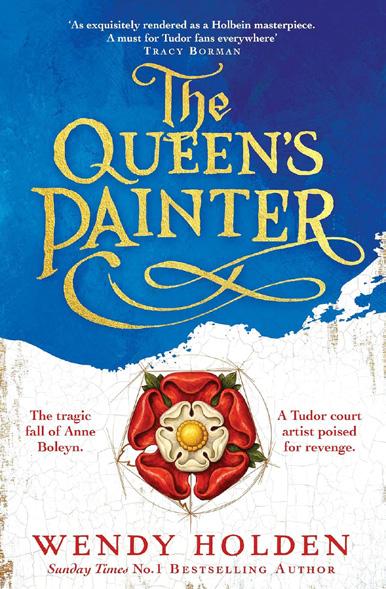
Hans Holbein, portrait painter to the English court, is heartbroken and outraged when his friend and patron, Anne Boleyn, is beheaded. Striking up an unlikely alliance with Thomas Wyatt, they vow to bring down the man they blame for Anne’s death: Thomas Cromwell.
This is such a refreshing perspective of Tudor historical fiction. I devoured this book so quickly that I instantly regretted not savouring every page. Wendy Holden cleverly weaves those famous Holbein paintings into a fastpaced plot that has you rooting for the artist and willing the downfall of Cromwell. Not so long ago readers were weeping for Hilary Mantel’s hero, but in this book you want revenge. Holden positions Anne Boleyn as a ghost who talks to Holbein, a man who, through painting, knows his subjects’ very souls, and it is their friendship – albeit one that Holbein has desired more from – that is at the very heart of the book. Holbein loves Anne, and we get a very intimate, poignant portrayal of the famous queen through his eyes.
Holden’s exploration of Renaissance painting is richly detailed, from the sourcing and blending of pigments to the precision of each brushstroke, yet it never reads like a textbook. Her lifelong admiration for Holbein, noted at the book’s close, is evident in the care and authority she brings to every page.
You will find it difficult to look at Holbein’s
famous The Ambassadors in the same way again once you have read this astonishing book. You will also chuckle when you look at his infamous portrait of Anne of Cleves – another fabulous character richly drawn. The Queen’s Painter will challenge you to go and look at Holbein’s work and as you stand there and wonder: perhaps Holden has a point?
Samantha Ward-Smith
FOOL
Mary Lawrence, Red Puddle Print, 2026, $9.99, ebook, 322pp, 9781734736120
Fool is a hybrid genre novel, mixing historical fiction, mystery, and memoir, told by its hero. Ivo, known as Kronos, is a dwarf abandoned as an infant on a monastery midden and brought up within its walls until the age of sixteen, when he is cast out for preferring women to monastic life. Lawrence has created a tragi-comic protagonist who suffers simply because he is born different in an age that reads physical or mental infirmity as evidence of God’s judgment of diminished humanity. After a series of adventures, Kronos reaches the court of Henry VIII. There he is discovered in a compromising position by Archbishop Cranmer; a moment of inadvertent eavesdropping nearly costs him his life. Brutally maimed and abandoned, he is rescued by an apothecary’s wife and nursed back to health, until the apothecary learns of Kronos’s potential value and seeks to profit from him. Yet Kronos has learned from long humiliation that those who assume small means stupid are the greatest fools of all. Lawrence does not prettify the Tudor world. In her authentic narrative voice, she creates a hero who is crude, cynical, sharp-witted, and deeply human, with a warm heart for those who suffer and show kindness. Vivid and convincing, the novel captures the lethal volatility of Henry VIII’s court. Fool is neither a fast nor an easy read, but as a character-driven novel rich in description and moral sensitivity, it offers a powerful and unsettling portrait of the underbelly of Tudor life. Definitely worth reading.
Keira Morgan
MUSE OF FIRE
Howard Linskey, Canelo, 2026, £18.99, hb, 320pp, 9781804368787
Shakespeare the sleuth, skulking around Whitehall trying to solve a murder? Actually, this novel is an incredibly jolly romp, marrying expert historical knowledge with a masterly command of Shakespeare’s life in 1598. An apparently innocent lady in waiting has died in suspicious circumstances. Robert Cecil is determined to uncover the truth (after all, kind Lady Anne had never mocked his disability). Meanwhile, a dastardly crew of entitled lords are problematic for Cecil as he strives to protect the ageing queen from plots and rebellion. Surely there’s a connection? Cecil judges that Will the playmaker is the last person anyone would suspect of investigating a crime, so he sets him up with a writing desk
and carte-blanche to wander round the palace, interviewing those in the know and reporting back his findings.
Dialogue, description, narration and characterisation are handled deftly. Linskey presents a wonderful cast of historical figures, all intent upon their vaulting ambitions and survival. Here are the Burbage brothers desperately trying to save their theatre and follow Will’s bright idea of dismantling it and rebuilding in Southwark; here’s the arrogant Earl of Essex, gambling that his ancient queen could never live without her beautiful boy – but unaware of the political astuteness that has always been her lodestar. The action cracks along; the idea of Will as Cecil’s investigator is entirely plausible, and the plot unfolds through the most satisfying convolutions. Linskey’s skills in the detective genre are as sure-footed as his interpretation of Shakespeare’s character and emotions. When the villain is revealed, we want to applaud Will for his courage and tenacity, especially as he’s been trying to write Henry V and cope with his feelings for his Dark Lady.
If you’re fond of the Tudors, Shakespeare and a good old whodunnit, this is the novel for you!
Jan Middleton
THE QUEEN’S GAME
Raymond Wemmlinger, Sapere, 2025, £10.99/$12.99, pb, 215pp, 9780854957477
It is 1564. Lady Mary Grey, hunchbacked and mousy, serves as a lady-in-waiting to Queen Elizabeth I. Though a royal cousin, she lives under a cloud as the sister of the executed Queen Jane. The Tudor court hums with gossip and intrigue, always shadowed by anxious speculation over the queen’s succession.
After months of reflection, nineteen-yearold Mary makes a momentous decision. Aware she risks imprisonment, disgrace, or even death in childbirth, she resolves to marry in secret and produce an heir: a son, she hopes. Intelligent, cautious, and accustomed to being overlooked, she turns her isolation into an advantage as she advances her perilous plan. Her sense of danger increases as she observes the fate that arises for her cousins, the ambitious Countess Margaret Douglas and her difficult son, Lord Darnley, when the queen learns he has married Mary, Queen of Scots.
In this engaging and sympathetic portrait, Wemmlinger brings to life a relatively obscure figure from the Tudor chronicle. Mary’s resilience in the face of personal and political peril is convincingly rendered, and the plot unfolds at a steady, believable pace. A concise and touching novel, it will appeal to readers of Tudor fiction interested in the quieter yet perilous corners of Elizabethan court life.
Keira Morgan
DEVIL’S GAMBIT
Jeri Westerson, Old London Press, 2026, $15.99, pb, 268pp, 9798998776724
Devil’s Gambit, book 4 of the King’s Fool Mystery series, brings readers back to Henry
VIII’s court in 1540, where being the king’s jester is far more dangerous than the bells and motley suggest. Will Somers may play the fool, but he sees more than most and often far more than is safe. When Henry’s disastrous first meeting with his new bride, Anne of Cleves, threatens embarrassment at court, Somers finds himself doing what he does best: easing the king’s temper while quietly watching the schemes unfolding around him.
Westerson gives Somers a wonderfully engaging voice: wry, observant, and often surprisingly thoughtful. He’s one of the few people who can speak candidly to Henry, which places him in the middle of everything from court gossip to political maneuvering. Watching him balance loyalty to the king with his own sense of right and wrong adds real depth to the story. The uneasy early days of Henry’s marriage to Anne of Cleves provide a fascinating backdrop. Westerson captures the awkwardness, pride, and misunderstandings that ripple through the Tudor court, reminding readers how easily royal decisions can turn personal tensions into political consequences.
Things grow even more complicated when one of the queen’s ladies quietly asks Somers for help with a secret of her own, one that could create trouble if it reaches the wrong ears. Suddenly the king’s fool is navigating matters of love, loyalty, and family opposition, all while trying to keep peace in a court where tempers and reputations are always on edge. With sharp humor, lively dialogue, and a vivid sense of Tudor life, Devil’s Gambit is an entertaining historical mystery. Highly recommended.
Williamaye Jones
17TH CENTURY
THE WINTER WITCH
Jennifer Chevalier, Simon & Schuster, 2026, $19.50/C$26.99, pb, 384pp, 9781668216422
Two very different sisters board the Saint Jean-Baptiste, a ship taking young women to Canada to be married to colonists. Around 800 young French women became ‘filles du roi’ in the 1660s and 70s, part of a plan to boost colonial expansion in New France, and in The Winter Witch, Jennifer Chevalier imagines two sisters on this journey and their new lives in Quebec. From the outset, Élisabeth, the elder sister, is troubled. She’s anxious, deeply pious, and concerned with a fear of witchcraft: even to the point of wondering if she herself is possessed by the devil. Younger sister, Marthe, is more practical. She enjoys making friends with other young women on the ship, and while she agrees with some of her sister’s theories—including suspecting a fellow passenger of being a witch—she’s not troubled by past difficulties in the same way Élisabeth is. When the sisters arrive in Quebec, their new lives will bring unexpected and different challenges, and their relationship will be dramatically tested.
From a 21st-century perspective, it can be hard to understand the grip of witchcraft
in the 17th century, but Chevalier makes it all make sense. Élisabeth is young and has experienced trauma. It’s easy to sympathize with her confusion and distress. Secondary characters, for example the charmless Maman Poulin, widow of Marthe’s husband’s former employer, are drawn into the drama when fears of witchcraft grip the colony, and more than happy to whip up excitement and alarm. A toxic blend of gossip, superstition, and religious anxiety allows for dangerous misunderstanding to arise, and lives to be put at risk. Meanwhile more tangible dangers—abusive husbands, and the perils of childbirth—are being overlooked. Overall, a gripping tale with a high-stakes ending.
Kate Braithwaite
THE MAGNIFICENT LIES OF MADELEINE BÉJART
Richard Goodkin, Cherry Orchard, 2025, $35.00, pb, 300pp, 9798887198446
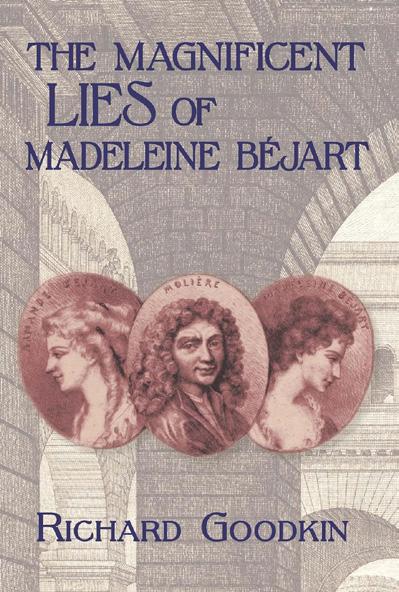
Madeleine Béjart is a magnificent character, at once larger than life and beset by the problems of everywoman: love, loss, and the fraught decisions about what to tell and what never to reveal.
When her ne’er-do-well father disappears, leaving his family destitute, the exquisite red-headed eighteen-yearold assumes the thankless task of caring for his eccentric Parisian household. Only two professions are open to her: prostitution or the stage, which the Church considers equal. Feisty and charismatic, she moves rapidly between them, enchanting theatregoers and the premier playwrights of Paris, Pierre and Thomas Corneille, while providing a generous livelihood for the many lively, talented, and improvident Béjarts. Yet this life brings setbacks. Along with the passion she discovers for the stage, she acquires the arts of deception and disguise, adapting them from theatre to life, as jealous rivals, inconvenient pregnancies, and an unrequited love for the still-developing talent, Molière, interfere with her rise.
This fascinating tragi-comic novel, set in the Golden Age of 17th-century French theatre, brings to life not only the colourful playwrights Pierre and Thomas Corneille, Molière, and Tristan L’Hermite, but also two magnificent actresses, Madeleine and Armande Béjart, and the vibrant world of French theatre in Paris and the provinces. It is a beautifully written tour de force that I highly recommend.
Keira Morgan
THE MAKING OF A WITCH
Judy Molland, She Writes, 2026, $17.99/ C$24.99, pb, 256pp, 9798896363248
The Making of a Witch by Judy Molland opens in Exeter, England, in 1656, where tenyear-old Alice Molland is forced to witness the hanging of a woman she knows not as a witch, but as a healer and friend. The execution of Goodwife Luscombe marks Alice deeply, planting both fear and determination in a child already learning the fragile line between healing and accusation.
From that moment forward, Alice’s world becomes one of watchfulness. Her mother is a healer, too, working quietly with herbs and remedies in a society where such knowledge easily invites suspicion. Alice absorbs everything she can: plants, cures, and the careful way her mother navigates a world ruled by fear and rigid belief. But Alice also carries something else: questions. Dangerous ones about faith, power, and why an innocent woman was allowed to die.
Molland brings 17th-century England vividly to life. The crowded streets, the smell of herbs and livestock, and the constant presence of soldiers and religious authority create a world where survival often depends on silence. What makes the novel compelling is Alice herself. She’s observant, stubborn, deeply curious, especially about healing and the natural world. Yet in a time when knowledge can be mistaken for witchcraft, curiosity itself becomes dangerous.
The Making of a Witch reminds readers how easily fear can turn a healer into an enemy. Watching Alice begin to question the rules of her world makes it clear that the real story is not just about witches, but how one girl might become the very thing society fears.
Williamaye Jones
CROMWELL’S REIGN
Glen Wiley, Independently published, 2025, $12.99, pb, 282pp, 9798263579586
Henry Darcy is a soldier on the Royalist side during the War of the Three Kingdoms, starting in 1649. He is a witness at Charles I’s execution. In a previous volume, Lord Clarke had confiscated Darcy’s lands and treasure after torturing Henry’s father to death for information. Clarke was originally a Royalist but now sides with Cromwell. The fact that Clarke and Darcy hate each other drives Darcy through the subsequent battles as the action moves to Cromwell’s invasion of Ireland. Henry has an Irish brother, James, he’s never met, and when Clarke’s men capture James, they believe he is Henry and exile him, with other Irish captives, to Barbados to become indentured servants. In the meantime, Henry tries to protect his wife, infant son, and James’s sweetheart from falling into Clarke’s hands.
I am not well-versed in this period and was glad to learn some things I didn’t know, such as the shipping of captive Irish to the West Indies after Cromwell conquered the country. Yet I had trouble getting through this book. There is little characterization beyond
the painting of Clarke and his henchman as evil. Wiley provides a list of characters but no further identification beyond whether they were real people or fictional. I had trouble keeping track of which minor character was fighting on which side. There are numerous info dumps, and the book needs several more passes through a proofreader. It lacks commas where there should be some and has others where they shouldn’t be. In addition, there are misplaced apostrophes, choices of the wrong homophone words, and other jarring mistakes. While I admire Wiley’s enterprise in getting a novel published, I’m afraid it was released too early; it needs more work.
B.J. Sedlock
BRAVING THE DAWN
Peggy Joque Williams, Black Rose Writing, 2026, $19.95, pb, 371pp, 9781685136987
Banished from France, the young, beautiful, and pregnant widow, Sylvienne d’Aubert, travels to the French colony of Quebec with a group of women sent to North America as “filles du roi” (Daughters of the King). Unlike the others, who are eager to find husbands, Sylvienne, who had endured an arranged marriage to an abusive man in France, does not want to remarry. Her goal is to return to France and the only man she loves, her condemned lover, Etienne.
Williams sets the stakes for Sylvienne high. She must hide her pregnancy, make herself useful to avoid marriage, and survive the hardships of frontier life, including an unforgiving terrain, a freezing climate, and lifethreatening dangers from man and beast. Her past haunts her. She discovers that old enemies have arrived with her, and she makes new ones as she settles into her new life in Quebec. But she discovers a well of internal strength in the process, along with friendship, adventure and unexpected love.
Williams writes a character-driven, adventure-filled, action-packed story with lots of romance and conflict. The setting in 17thcentury New France is vivid and lively. Sylvienne is a naïve girl who matures as she faces a series of emotional and moral challenges. The ending is strong, with several emotional twists.
Keira Morgan
18TH CENTURY
RELUCTANT REVOLUTIONARY
Ron Andrea, WestBow Press, 2025, $27.99, pb, 412pp, 9798385059263
Viewing the American Revolution in 1776 through the German eyes of a Hessian soldier offers readers a unique opportunity to widen their historical perspectives while sparking their imaginations. Jakob Zeuch, a young farmer, is one of thousands of young men conscripted and sent to fight alongside the British in the American colonies by the Landgrave of Hesse, Friedrich II. Friedrich is a relative of King George III of England, and he personally
profits from hiring out his subjects for military conflicts beyond the borders of Hesse. “Not my king, not my country” is how Jakob initially sees this overseas rebellion into which he becomes involuntarily embroiled. But embroiled he becomes, as he must navigate harsh military conditions, a changing war time landscape, ongoing encounters with civilians on all sides, and shifting opportunities for Hessians to decide their own fates in the rebelling colonies.
A wealth of military details concerning training, tactics, weapons, and fighting maneuvers extensively describes the arduous life of a Hessian fusilier like Jakob. The plot follows Jakob’s journey chronologically through Hesse, England, Nova Scotia, New York, New Jersey, and the Pennsylvania-Maryland border. Along the way, his character becomes ever more empathetic as he faces moral crises that force him to consider what it means to be a man and to consider who his neighbor truly is. This novel will transport readers to a particular time and place but will also confront them with universal questions such as: If you had to choose, which is more important, having a past or having a future? Recommended particularly for military history buffs and readers interested in colonial America, but fans of inspirational fiction will find much to savor here as well.
Karen Bordonaro
KATY: The Woman Who
Signed the Declaration of Independence
Betty Bolté, Mystic Owl, 2026, $17.99, pb, 288pp, 9798986045078
In 1762, Mary Katharine “Katy” Goddard and her widowed mother, Sarah, leave their beloved home in New London, Connecticut, for Providence, Rhode Island, at the behest of Katy’s mercurial brother, William, who has established a printing business there. After the women set William’s hopelessly disorganized shop and its demoralized employees to rights, Sarah makes a proposal to Katy: that she learn the printing trade herself.
Although I live in the state—Maryland— where Katy performed her most famous printing task and spent her last years, I had never heard of her, so I am glad to see that Bolté has taken on the task of bringing the story of this independent, self-reliant woman to a wider audience. The research is sound— among other things, readers will learn a bit about the printing process—and Bolté paints vivid pictures of the various locales in which Katy finds herself. I did find the ending of the novel somewhat abrupt, given my interest in seeing how Katy’s business affairs turned out, but Bolté supplies us with an informative author’s note. I’m off to track down more information about Katy.
Susan Higginbotham
THE HIGHLANDER’S SECRET
Roma Cordon, Oliver Heber Books, 2025, $18.99, pb, 361pp, 9798900430263
During the Culloden uprising, Jacobite sympathizer Phoebe Dunbar is brutally attacked by a ruthless British officer. To regain her honor and avenge this cruel deed, she begins service as a spy for the Scottish rebels. Seven years later, while on a covert mission in England, Phoebe encounters the dashing, charismatic Slade MacLean, her childhood friend and now a Scots Greys colonel. Through a series of dramatic, clandestine, and unexpected events, they are caught in an intricate web of danger, deceit, and intrigue. When scandal threatens their clan reputations, they agree to a marriage of convenience. Slowly, the business arrangement deepens as they explore the memories of their early years together and learn more about one another through their high-risk undercover exploits. As life-threatening circumstances imperil their relationship, and haunting, dark secrets of the past are exposed, will their love survive?
Roma Cordon’s first historical romance in the Scottish Highland Warriors series is a wellpaced, skillfully plotted novel, bringing to life the turbulent 1740s as England and Scotland continue to clash. The Scottish Highlands and English countryside, beautifully described with meticulous attention to historical detail, offer the perfect setting for this lively, lustful tale. The fully developed protagonists, Phoebe Duncan, the captivating heroine, and Slade MacLean, her handsome, rugged lover, are a delight to follow as their political associations become increasingly entangled and personal passions emerge. Their intimate scenes are emotional and vividly portrayed through tough, tender dialogue and sensual, seductive scenes, seamlessly enhanced by the tension of the political events in which they are immersed. Their beautiful bond, built of loyalty, courage, trust, and love, is strengthened as they reveal their vulnerabilities and share painful recollections of the past. Well worth a read!
Marcy McNally
THE THIRTEENTH APOSTLE
R. M. Cullen, Sapere, 2025, £14.99, pb, 362pp, 9780854957378
This is the third mystery in which 18th-century playwright, theatre owner and politician Richard Brinsley Sheridan turns detective. The story takes on a dark tone as he finds that homosexual men are being murdered, starting with one of the actors from his own company. Sheridan and his friend the Bow Street Runner Louis-Pierre Nichols are drawn deep into London’s underworld. Blind alleys lead in all directions before at last the killer is found, a man in thrall to his own warped reading of the Bible – the title is a clue, though one that we only understand once the story is nearly over. There is also a large cast of other characters from Sheridan’s theatre, his family, and politics (including Prime Minister William Pitt, whose life is briefly jeopardized). A journalist, ‘a writer
of scurrilous squibs, a purveyor of gossip and defamatory pronouncements, a denizen of the gutter’ is cleverly compared to Mr Snake in A School for Scandal. A subplot concerns how a young man in Sheridan’s extended family may pursue a political career; despite the Whig sympathies of his aunt and Sheridan, he accepts a seat in the Tory interest.
Sheridan’s restless biography, in which careers and even homes were juggled, is well-evoked by the author, as she tells us: ‘He knew he was something of a funambulist … he pictured himself high above a stage swaying on a perilous tightrope.’ However, at times I did feel that the complexity of the cast list was a little ambitious for a book of this length and genre. There are also some time jumps that rather fight against the immediacy of the tale.
Still, with a suspenseful search and then an exciting chase in its last chapters, and some warm good humour despite the crime theme, this is a most entertaining read.
Ben Bergonzi
CAST AWAY
Francesca de Tores, Bloomsbury Circus, 2026, £18.99, hb, 336pp, 9781526661395
Francesca de Tores’ follow up to Saltblood, which retold the story of pirate Mary Read, continues to retell tales of real people during the Golden Age of Sail, as Cast Away explores the story of Alexander Selkirk, the inspiration for Daniel Defoe’s Robinson Crusoe. Selkirk narrates his abandonment by his crew and his efforts to survive on a remote island hundreds of miles off the coast of Chile, and unlike Defoe’s creation he is no hero.
Stranded on the island by his captain and crewmates after disobeying orders, he is alone, plagued by rats with only cats and goats for company. While he strives to make shelter, find food and survive, Selkirk contemplates the steps that have brought him to where he is. Reading and reinterpreting the Bible, Selkirk imagines one cat and one goat in particular begin to speak, and creates in them companions, minister, and judge. As he creates a kind of blackout poem with the Bible and a piece of charcoal, Selkirk recounts his childhood and what led him to run away to sea. He imagines himself at a trial of his behaviour and begs forgiveness.
De Tores has created a deft character study and an intriguing glimpse into a fascinating period; the early 1700s making a story we think we know anew. Perfect for fans of Defoe’s classic novel and the adventure stories of Wilbur Smith and Colin Falconer, but also of the vivid and beautiful writing of Sally Magnusson.
Lisa Redmond
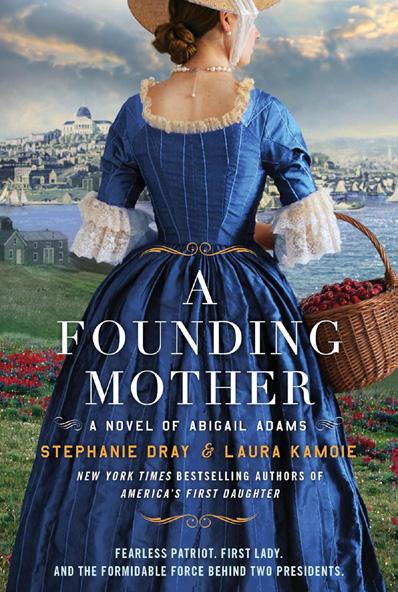
as a founding mother: wife to the second president of the United States, John Adams, and mother of sixth president John Quincy Adams. As Abigail shares her life story, she transports readers from the Massachusetts Bay Colony in 1765 across oceans and continents, and into palaces, riots, and revolutions. She raises her family, endures sacrifices and separations in fifty years of marriage, and sets an example for future presidential wives. Dray and Kamoie have researched tomes of our rich history to provide a masterful retelling of America’s birth as a nation. Opening in 1814, with Washington ablaze and President Madison in hiding, Abigail looks back on her life as a wife, mother, entrepreneur, diplomat, and friend.
Abigail realizes “extraordinary times called for her to be an extraordinary wife and mother.” She is portrayed as a saucy and patient wife, a valuable conversationalist and diplomat, independently wealthy with an enterprising spirit, and a voracious advocate for her children. Relatable to women in today’s world, Abigail balances family demands with those of her role as a founding mother.
As John travels the Colonies and Europe, Abigail’s resolve comes boldly to the surface as she is abandoned with children to raise, a farm to supervise, and finances to manage. She moves households many times, always with determination to make the best of each location and situation. This domestic thread is seamlessly woven with John Adams’ burgeoning career, the political machinations of Hamilton, Jefferson, Ben Franklin, and the writing of the Declaration of Independence. Hurray for patriotic, cheer-worthy, engaging historical fiction!
Dorothy Schwab
THE REPENTANTS
Kate Foster, Mantle, 2026, £18.99, hb, 336pp, 9781035052103
Scotland, 1790, and Florrie Aitken—a wealthy but emotionally neglected housewife— strides out, determined to experience ‘pure bliss’. Unfortunately, just at the moment of bliss—with a sexy Danish merchant—she is arrested and carted off to the Kirk Sessions, accused of immorality. The sexy merchant, of course, disappears.
historical note, the author explains that in Scotland a 1606 Act, not repealed until 1779, bound colliers and salters to their masters for life: effectively serfdom.
Hence, in a story that explores exploitation in many forms, Jonny, Florrie’s avaricious husband, is the owner of bonded labourers, working his coal mines and salt pans. Greedy Jonny is enticed into a ‘get rich quick’ scheme in Iceland, producing salt with forced labour from a British prisoner hulk anchored in Reykjavik harbour. Jonny and Florrie, with embittered Eliza as their servant, embark to Iceland. On the remote island, heavy with oppressive atmosphere, the women, one bound by marriage and the other by serfdom, discover Jonny’s true plans for them.
It’s the set-up for a tense drama, full of twists and turns, as the oppressed and exploited struggle to escape the manipulative and selfish Jonny. I found this a surprisingly gripping read. The historical note at the end reveals that, although a work of fiction, it is very much inspired by real history. Recommended, especially for feminist readers.
Helen Johnson
TETHERED SPIRITS
Corinne Hoebers, OC Publishing, 2025, $22.99, pb, 440pp, 9781989833568
In 1750s Nova Scotia, the British and French fight for North American dominance while the indigenous Mi’kmaq are pushed off their native hunting grounds, forcing their dependence on the French traders. Meanwhile, German settlers who escaped poverty and persecution in their homelands must now endure their own struggles to survive and adapt. French speaking Acadians forcibly being dispersed by the British remain part of the mix of people fighting and struggling as well.
Against this dramatic background, ordinary people’s lives intersect in many ways as this story unfolds. It follows the path of Bear Cub, formerly known as Christian Heber, who has left his German settler family to live and learn with the Mi’kmaq. While his father Michael considers him a traitor and his older sister Elisabeth struggles to understand or accept his choice, his younger sister Hanna respects and admires the values that the Mi’kmaq espouse and sees their dire situation in ways similar to her brother. As the story progresses for both Bear Cub and Hanna, life continues with both joy and sadness as people get married, babies are born, and people die. Hunger and disease are still rampant, however, and fear grows as clashes ensue between the settlers and the Mi’kmaq.
A FOUNDING MOTHER
Stephanie Dray and Laura Kamoie, William Morrow, 2026, $19.99/C$25.99, pb, 464pp, 9780063234765
Abigail Adams, astonishing “President’s Lady,” tells her story just in time for America’s 250th anniversary. Abigail forges her place
Florrie is not alone in enduring the public humiliation deemed appropriate by the Kirk. Also on the bench is Eliza Wood: salt serf, in trouble for failing to attend on the Sabbath.
What—wait—serfdom, in Scotland during its Enlightenment, era of Adam Smith and James Boswell? Surely not? But yes. In a
The characters in this novel are undeniably human in that they exhibit a full range of emotional responses to the events taking place in their world. Some want peaceful coexistence between natives and settlers; others think war is the only answer. Details of daily life enhance an understanding of how people lived at this time and in this setting. Recommended for its multi-faceted depiction of life in eighteenth century North America,
and in particular for its respectful portrayal of the Mi’kmaq in Nova Scotia during this fraught period in history.
Karen Bordonaro
BAXTER’S RANGERS
Thor Hogan, Holand Press, 2025, £3.99, pb, 336pp, 9798266032101
Baxter’s Rangers takes us into the heart of the impending explosion as the American colonies teeter on the brink of rebellion against the repressive taxation of King George III and the intimidation of the colonists by his red-coated soldiers. Hogan captures the moment when a nation is born with precision and skill.
When young Robert (Hob) Baxter arrives in Boston, it is the beginning of his career as an apprentice trader: it is also his introduction into the complexities of Boston politics where he has to choose between seeking wealth and status under the crown or following his own yearning for independence and freedom. It is a choice embodied in the presence of the beautiful sisters Julieta and Sophia: one coquettish and indifferent, the other more sensitive and in tune with Hob’s own true feelings. The choices, which are subtly portrayed, are both personal and political.
Hogan’s attention to detail vividly captures the complexities of life in a Boston on the brink of war in 1785. He marshals his cast of characters with military precision ranging from the rat-like office-manager, Mr Fifett, to the elegant Captain Davenport who is every inch the supercilious aristocrat. Young Hob himself is both credible and engaging. In the course of the novel, Hob evolves from a callow country boy in search of a career into a skilled guerrilla fighter leading his men into battle with courage and determination. He has to face the fact that war is not a tea party. It means pulling a trigger and watching a man’s head explode in a cloud of red.
Baxter’s Rangers traces a young man’s struggle to find his place in a changing world. It is a novel which captures the spirit of the time, but which remains relevant as it addresses the timeless themes of politics, love and friendship.
Jim Loughran
TINKER
Jennifer M. Lane, Independently published, 2026, $7.99, ebook, 290pp, B0GP8XQ481
The violent days of the Whiskey Rebellion in western Pennsylvania in 1794 fuel this dramatic story of a young woman caught up in its midst. Caroline Neville is the daughter of the local tax collector, John Neville. John is unquestioningly loyal to President George Washington’s need to use the whiskey tax to help pay off the new country’s wartime debts. Most of the local citizens do not have the money to pay this tax, however, because they barter with whiskey and are cash poor. A schism between those who can afford to pay the whiskey tax and those who cannot seems inevitable. Tension grows, and a local militia begins destroying the whiskey stills of those who pay the tax. The resulting chaos pits neighbor against neighbor.
It threatens people’s personal safety, property, and livelihoods.
Caroline is sympathetic to those who cannot pay the tax, but she also understands her father’s point of view. This fraught situation causes her to insert herself into the middle by writing anonymous articles as Tom the Tinker which suggest solutions. The letters call upon her father to push for a land tax instead, and call on the local citizens to form a commission to present reasonable alternatives to the tax. Instead of compromise, however, she inadvertently fans the flames. And if that is not enough drama, she also falls in love with a pressman who does not know her true identity.
The fast and furious plot drives the relentless action of this novel. It offers readers a swift and entertaining read. It also calls into question what good government should be and how the will of the people should be recognized. Anyone interested in the early days of the American Republic would find this story to be of considerable interest.
Karen Bordonaro
A STORM COMING
Chuck Locklear, Histria, 2026, $19.99, pb, 242pp 9781592117376
Set in the coastal plains of the British colony of North Carolina from 1710 to 1712, Chuck Locklear’s novel is based on historical Native American characters, including Jane (Runehu’hu), King Blount, Core Tom, and Kearney. It depicts the tense interactions between indigenous tribal societies and the new German and Swiss Protestant settlers encroaching on their agreed-upon territorial boundaries. The Tuscarora Indians also have intertribal disputes with the Seneca, Yamasee, and Coree tribes.
The principal narrator is Jane, whose Tuscoraran name, Runehu’hu, means “turtledove.” Because the tribe is matrilineal, Jane obeys her aunt, who is the Ukuwana or Clan Mother, Annwaraogan. She chooses Jane’s husband and is her mentor. Jane is a free spirit and becomes a scout with her friend Sagaddio, and later a fierce warrior when war breaks out. King Blount, the tribal leader, does not want war, while Core Tom not only wants war but desires Jane as his wife. Kearney is an indentured servant for the colonists who is halfNative American and comes to Jane’s rescue.
Tribal councils of war are held with all the leaders (kings) of the various tribes to decide unanimously whether to wage war to regain their territory. The Yamasee and others with strong trading ties to the colonists fight with them against the Tuscarora.
The brutal violence that erupts once war begins includes heinous slaughter on both sides, as well as the forced servitude of hundreds of native Americans loaded onto slave ships by the colonists. The themes of genocide, white supremacy, the spread of diseases like smallpox among the tribes, and indigenous versus western cultures, are carefully researched and accurately presented as we follow Jane’s dramatic adventures. This is an unusual and captivating historical
novel written from the viewpoint of a strong and resourceful indigenous woman in early colonial America.
Robin Holloway
MRS. BENEDICT ARNOLD
Emma Parry, Zando, 2026, $28.00, hb, 320pp, 9781638933793
One of the most consequential and impassioned love stories of the American Revolution—and its tragic denouement— flutters off the page in Emma Parry’s subtly addictive Mrs. Benedict Arnold.
In 1777, the British redcoats march into Philadelphia in the second year of the colonialist’s War for Independence. One of the city’s eminent families, the Shippens, toes a fine line between Loyalists and Patriots, led by their sober and circumspect patriarch, Edward. Shippen’s youngest daughter, Peggy, is seventeen and wishes only for an end to hostilities. During the one-year occupation of the city, she meets and falls passionately in love (or lust?) with a handsome British intelligence officer, John André. Against the better advice of her parents, she flirts and spends time with this enigmatic man, who instructs her in the ways of invisible ink. But when the British are forced to evacuate the city in 1778 at the approach of Patriot General Benedict Arnold’s colonial army, her heart is heavy. But when Peggy and Benedict lay on eyes on each other at a local salon, the rest is (as they say) history.
Parry writes from Peggy’s perspective throughout, and it is this first-person view that allows Parry to suggest Peggy’s motives— both in love and in war. As Peggy interacts with family, friends, and acquaintances of varying allegiances, she suggests that Peggy’s “anxious nature” drives her to create certainty where none exists. It is a fascinating window into the young and impressionable teenager, one who admits to herself that “I was never such a Loyalist I had trouble seeing the merit in a Patriot.”
Pairing superb writing with sharp psychological insights, Mrs. Benedict Arnold tells America’s most infamous story of betrayal from Peggy’s perspective and never stops enchanting.
Peggy Kurkowski
ADÉLAÏDE: Painter of the Revolution
Janell Strube, Acorn, 2026, $17.99, pb, 418pp, 9798885281355
Janell Strube’s debut novel, Adélaïde: Painter of the Revolution, introduces readers to Adélaïde Labille-Guiard, a young Parisian woman determined to claim a place in a profession that insists women have none. Born to shopkeepers in 18th-century Paris, Adélaïde dreams of painting portraits worthy of the Louvre salons even if the path means defying convention.
Her journey begins with lessons in miniature painting under the tutelage of Monsieur François Vincent, both mentor and emotional
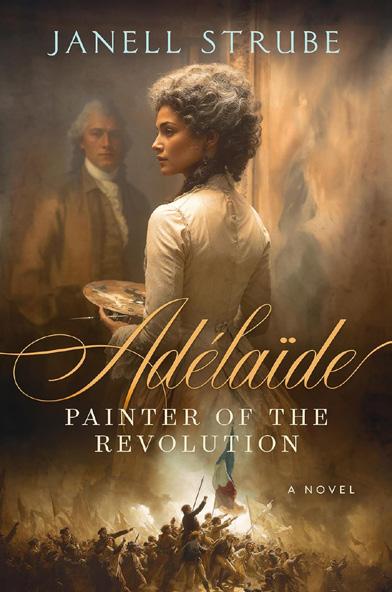
anchor in her life. However, duty and ambition rarely move in harmony. So, bound by a promise to her dying mother, Adélaïde enters an unhappy marriage with Nicolas Guiard even as her artistic ambitions begin to flourish. As her talent gains notice, she fights for admission into artistic circles that remain resistant to women. Patronage, rivalry, and ever-present pressure to prove herself shape her rise in the Parisian art world.
Strube writes with clear affection for the artistic process. The preparation of canvases, the mixing of pigments, and the careful attention to light and texture make Adélaïde’s studio feel vividly real. These quieter moments contrast with the growing unrest in 18thcentury Paris as the French Revolution begins to reshape the world outside her door. Adélaïde herself is a compelling figure: stubborn, passionate, and unwilling to accept the limits placed on her life. At times the narrative unfolds in a somewhat episodic way as it traces the many turns of her career, but the focus on her determination and artistic growth keeps the story engaging.
For readers who enjoy historical fiction centered on art, ambition, and shifting tides of revolutionary France, Adélaïde: Painter of the Revolution offers a vivid portrait of a woman determined to leave her mark. Highly recommended.
Williamaye Jones
THE SALAMANDER
Regan Walker, Patriotic Books, 2026, $15.95, pb, 325pp, 9781735438191
The second book in Walker’s The Dawn of America series opens in Salem, Massachusetts, a colonial city that becomes a major port for privateering after the outbreak of the Revolutionary War. Jonathan Haraden is among the Patriots who joins the Massachusetts Navy, and he finds himself quickly promoted to captain after showing exceptional courage and steadfast resolve under fire. He sets out to sea a heartbroken widower, having recently lost his wife, and leaves behind two young daughters entrusted to a preacher’s daughter. As months pass, the financial welfare of his crew and support for the war effort become top of mind, so he turns to privateering as Captain of the Tyrannicide Many of his voyages take him to the West Indies and across the Atlantic as he transports essential supplies and captures British ships along the way. His unwavering show of daring and seamanship in the face of cannon fire earns him the nickname “The Salamander” in
reference to a mythical creature born in flames that always emerges unharmed.
The Salamander gets off to a slow start with the first two chapters mainly devoted to the Haraden household, the antics of Jonathan’s daughters, and the search for a suitable governess. The remainder of the novel is characterized by some rather uneven pacing as scenes flip back and forth between descriptions of the Haraden children growing up under the care of their governess, a simmering love interest, and battles at sea. That said, Captain Haraden’s experiences as a privateer are hugely engaging and highlight his importance in supplying the colonies with badly needed arms and goods. Author’s notes complement this well-researched novel that’s filled with characters and events drawn from history.
Deborah Cay Wilding
19TH CENTURY
A VERY VEXING MURDER
Lucy Andrew, Corvus, 2026, £9.99, pb, 432pp, 9781805464181 / William Morrow, 2026, $32.00, hb, 432pp, 9780063453647
This romp of a debut novel will endear itself to many readers with its plot twists, frothy excitement, and an unforgettable heroine. The protagonist is Harriet Smith, the put-upon and dominated sidekick of Jane Austen`s famous creation Emma Woodhouse. Part of the fun of this novel is the sly and clever interweaving of Jane Austen references, which the reader has the satisfaction of recognising. We certainly see a different side to Harriet here, which makes the reader want to revisit the source material to compare. In this novel Harriet is a con artist, trained by her father, with whom she has quarrelled. She is feisty, independent, resourceful and in many ways reminiscent of the redoubtable Becky Sharp from Vanity Fair. Harriet is summoned by Mrs Churchill and ordered to stop her nephew Frank becoming too attached to the lovely Jane Fairfax and also to find out who may be trying to kill her. Harriet investigates with the aid of her friend Robert Martin, but struggles to resist the fine figure of Frank. A deliciously diverting tale, as a young lady of the time might have said. It is labelled as book one, and I for one will be most vexed should there not be another book emerging into society in the future.
Ann Northfield
REMEMBER THAT DAY
Mary Balogh, Berkley, 2026, $27.99/C$39.99, hb, 368pp, 9780593818084
Winifred Cunningham is a pacifist; Nicholas Ware a cavalry colonel and veteran of the Napoleonic Wars. She is an adopted orphan with little beauty or marriage endowment; he is handsome, charming, and the brother of the Earl of Stratton. Unsurprisingly, their first meeting does not go well. Besides, she is attracted to his younger brother Owen,
while he is ‘all but betrothed’ to a general’s daughter.
Gradually, however, their feelings change. She recognizes his kindness; he discovers he ‘enjoyed her company too much … Who would have guessed that such a seemingly plain, almost drab creature was so filled to the brim with life and warmth?’ There is, moreover, a spark between them, but how can the formidable obstacles raised by both society’s expectations and their own insecurities be surmounted?
Book Five of the Ravenswood series introduces the Westcott family from a different series, and the cast of characters can be daunting, but with her usual consummate skill, Balogh steers these unlikely, but likeable, lovers to the reward they so richly deserve. Supportive family helps, but it is their own growth in understanding, both of each other and of themselves, that proves crucial. Highly recommended.
Ray Thompson
THORNBY MANOR
Stephanie Bramwell-Lawes, Orenda, 2026, £16.99, hb, 300pp, 9781917764124
1891. Briar Monroe is a young woman struggling with the aftermath of the deaths of her parents. Though believed to be wealthy, she is in fact suffering a secret impoverishment which forces her to accept the hospitality of Lord Wilson Danville, whose wife, mysteriously deceased, was a friend of Briar’s aunt. Moving into Danville’s home, the spooky and unwelcoming Manor, she discovers a governess still in residence, though his lordship’s son Gabriel has long since grown up. Briar comes to suspect this woman of dark motives. At length Gabriel himself appears: arrogant, selfish but exciting.
The safe haven from the fearsome Manor is the neighbouring town of Warwick, where all seems conventional (I can reassure readers the topography of the town is described accurately) except for the fact that a local mental hospital sends out wardens to capture those with mental disorders. This hospital was a real place, its buildings still standing today; Bramwell-Lawes provides some well thought-through discussion of the treatment of the mentally ill, telling us that Briar knows something about this, through previously assisting her doctor father. Clearly attitudes were at this period undergoing rapid change. There is a noticeable contrast between this realistic plot strand, and the story’s Gothic main thrust, where people have strange names, the great house is a vivid character in itself, and behaviour is often more dramatic than logical. At times we seemed not to be the 1890s (when there were telephones, telegraph and rapid train services) but in an earlier period. The character of Briar whilst normally accepting her era’s rigid conventions, has moments of strong and nonconformist individuality, and I would have liked a little more of that from her.
However, if you enjoy a Gothic yarn that is a
little more thought-provoking than some, this story is for you.
Ben Bergonzi
THE LACEMAKER’S FORTUNE
Andrea Catalano, Lake Union, 2026, $16.99/£8.99, pb, 381pp, 9781662526015
Catalano tells the dramatic and engaging tale of a love triangle. The story opens in New York City in 1879, when the Maguire sisters, immigrants from Ireland, struggle to earn a living. Mary works her trade in a brothel, and Eileen creates lace for a milliner. Soon two men enter the picture—wealthy Laurie Bernard, who drowns his ennui in an opium den, and prophet-like, mysterious Stanley Jones, a Catholic minister who rescues Laurie from his sinning ways. Jones convinces Mary, Eileen, and Laurie, along with a ragtag group of others, to accompany him to the West. He will establish a church, and Laurie will buy a silver mine. Halfway through the novel, the setting shifts from New York to Leadville, Colorado, where Laurie, wealthier than ever due to the immediate success of his mine, and Eileen, who tries to adopt a lady’s behavior and wean herself from laudanum, marry in Leadville’s most elegant hotel. Both keep an eye on Stanley Jones with his commanding presence, with results that are both expected and unexpected.
Alternating between Eileen’s point of view and Laurie’s, Catalano creates fully developed characters, especially with Eileen Maguire. Their interior monologues are revealing, and sometimes lengthy. Many of the minor characters—especially Justine the cook and Seamus the butler—are carefully drawn. Catalano includes just enough historical context to anchor her novel in time, but readers who seek substantial information about bias against the Irish, working conditions in mines, and the politics of the era will need to look elsewhere. The plot moves rapidly toward twists, some satisfying and some possibly excessive. The sex in the novel, which takes many forms, is upfront and direct, but always serves the story.
Marlie Wasserman
HOW TO FAKE IT IN SOCIETY
KJ Charles, Tor Bramble, 2026, £22.00, hb, 320pp, 9781035037834 / $18.95/C$25.99, pb, 320pp, 9781250395917
Regency London. Titus Pilcrow rents a small shop from where he runs a modest watercolour and oils paint-making business. A regrettable brief sexual liaison with his fickle landlord, however, prompts the latter to demand a price increase, threatening impoverished Titus with eviction if he doesn’t accede. To get by, Titus visits his wealthy, aged client Miss Whitecross, whose account is overdue, but she is on her deathbed, having ‘fallen’ downstairs. With solicitor and doctor present, this notorious misandrist demands that Titus marry her
there and then to prevent despised others from inheriting her fortune. He agrees, she expires, leaving him the lot.
Consequently, he’s thrust headlong into an unfamiliar social whirl where everyone wants a piece of him, especially Comte Nicolas de la Motte, who appears to have Titus’s best interests at heart, helping him cope by dealing competently with scroungers, exsuitors, tailors and staff. Complications ensue, though, as Titus attempts to repel various intrusions into his mental well-being and new lifestyle, confronting familial critique, lover’s angst and thuggery, all of which contribute to his own eventual self-realisation. A mysterious painting plays a key role.
Unusually for a Regency-era novel, the narrative, vocabulary and dialogue are almost entirely uninhibited 21st century, involving liberal use of the F-word and quite explicit gay sex; historic setting, modern telling. Not for the faint-hearted perhaps, but how many of them remain in these shock resistant, gotthe-T-shirt times? Le plus ça change; almost a century ago, the musical Anything Goes was a big hit, also good fun, as is this finely charactered, gratifyingly humorous love story. Most enjoyable.
Simon Rickman
THE BRIDES
Charlotte Cross, Tor Nightfire, 2026, £18.99, hb, 400pp, 9781035059270 / Hanover Square, 2026, $30.00, hb, 400pp, 9781335000965
In Bram Stoker’s Dracula, three women vampires lurk hungrily in the Count’s castle. The Brides tells us how they came to be his creatures. Their story is told largely through the journals of Lucy North and the letters of Alice Smith. Lucy is in love with Mafalda, a beautiful Hungarian, but their life together is threatened by Mafalda’s impending heterosexual marriage.
When Mafalda returns to Budapest to support her bereaved aunt Reka, she draws Lucy behind her, along with Lucy’s friend, Eliza and her maid, Alice, who provides the refreshing addition of a below-stairs, clairvoyant perspective as the story gathers pace. Alice has the power to see, but not to change what she can see coming.
From Hungary, the women are enticed further away from civilisation into Transylvania and into Dracula’s castle. Once entrapped there, we know what to expect of the predatory aristocrat, and Cross meets these expectations with relish. Five women enter the castle; only two escape.
Cross uses Stoker’s epistolary form which provides, as in the original story, multiple viewpoints. Dr John Seward, the rationalist psychiatrist from Stoker’s novel, has an important narrative role as he treats the survivors, and his fellow Dracula hunters also make cameo appearances.
Readers may find the timeline and array of characters initially confusing, as they move between pre-Dracula and post-Dracula narrative time via their journal entries and letters, but these do drive the pace. For this
reader, the editorial which accompanies some of these documents feels intrusive and unnecessary, but the writing does roll the reader along in the spirit of Stoker’s page-turner. I’m sure this novel will send many readers, old and new, back to where it all began, to meet those women haunting Dracula’s castle with perhaps more compassion and curiosity. Cross reminds us they were once human.
Louise Tree
SHOWBOAT SOUBRETTE
Brodie Curtis, Westy Vista, 2026, $14.95, pb, 318pp, 9781733783545
In the antebellum South, showboats moving up and down the Mississippi provided entertainment for their passengers. On the Lady J, Stella Parrot, a Cherokee Indian, is a talented singer, hoping for a career on stage as ‘the next Swedish nightingale’. However, she is assaulted by Ricky Burton, a member of one of the most evil families on the river. She is saved by Toby Freeman and riverboat gambler John Dee Franklin. Toby is a Black man she assumes is Franklin’s slave until they explain they are close friends and business partners, possibly even half-brothers. In the Old South, though, free or not, no Black man is really safe; Cherokee women are equally unsafe. To save them from the Burton family, the three are put off the Lady J and must find their way through wild country along the Mississippi to find a cotton boat to take them south. On the run they face disasters and evils beyond Stella’s imagination, with the divide between Black and white compounding their problems.
The author has researched life on the Mississippi in the 1840s and 1850s in order to present a detailed picture. He shows the wealth and poverty, the good, the sanctimonious, and the downright evil, the brothels and drug use, and of course the deep cleft at the time between Black people and white people. Stella Parrot, being Cherokee, fits into neither group. This is a novel full of action and adventure, but it is also a clearly presented picture of life on the Mississippi almost 200 years ago. A wide variety of characters (including a cameo appearance by cub pilot Sam Clemens) adds to the busy and colorful setting of this exciting novel. It is an enjoyable addition to the history of the antebellum South.
Valerie Adolph
MURDER AT THE TOWER
N. R. Daws, Orion, 2026, £10.99, pb, 368pp, 9781409199861
Murder at the Tower is a well-crafted locked room murder/mystery following the classic formula, set in the Tower of London towards the end of the 19th century. The ‘locked room’ is the tower itself, with the staff and their families confined to the palace/fortress until the murderer of one of the staff wives has been unmasked.
The Scotland Yard detective assigned to the case is predictably slow and unimaginative, so it falls to Mrs Lydia Bramble, housekeeper at Hampton Court Palace, to play Sherlock
Holmes and solve the mystery. She is called in by her friend, the Rev Weaver, the Hampton Court chaplain who was officiating at a service in the Tower at the time and is the prime suspect. They are ably supported by Mrs Bramble’s maid, Kitty. Despite two deaths, this is all very much cosy crime, concentrating on the interplay between the eccentric characters in a closed community bound by its own codes and rituals.
In true Agatha Christie style, the mechanics of the murder, involving a double dose poisoning, are improbably elaborate, so it is difficult for the reader to beat Mrs Bramble to the denouement. She has already solved a murder at Hampton Court, so it looks as if she is set to do the same at all the historic royal palaces in the course of Daws’ planned series. I am sure they will all be equally entertaining.
Edward James
THE GOOD FORTUNE OF MISS ROBBINS
Melanie Dickerson, Bethany House, 2026, $18.99, pb, 320pp, 9780764245220 England, 1814. Orphaned Charlotte Robbins is governess to the young siblings of William, Lord Brookhaven. Principled, intelligent, and pretty, Charlotte longs for love and a family of her own. William, wealthy but emotionally deprived in childhood, has been hurt by an old love. Despite an immediate connection, Charlotte’s socioeconomic status stifles romance. William tries to include her among his friends, but nothing gels until Charlotte inherits a fortune from a relative she didn’t know she had. Entering society, she discovers that money can cause as many problems as it solves. When she finds the truth about her windfall, she must decide whether she and William can be together, and what honorable, charitable future she can create with her fortune.
I liked the admirable Charlotte, and all the children she dealt with are endearing and well-drawn—especially when puppies are involved. Despite some exciting events like the carriage crash or a Fagin-like villain causing mild mayhem, I thought the love story and plot were thinly stretched over a 320-page novel. This is a long, slow, sweet read that won’t keep anybody up at night turning pages.
Elizabeth Knowles
A HARMONY OF HELLS
Yves Fey, Tygerbright, 2025, $14.99, pb, 408pp, 9798985858082
The novel begins with Averill Charron in Hell, or at least in a Belle Époque Paris café named for it. The menu at L’Enfer gives a choice of decadent thrills and vices that mirror the road ahead for Averill: a love affair with a crime lord who once ordered his murder, a hunt for his beloved sister Jeanette, held in a series of institutions by their abusive father, shootings and stabbings and plenty of la
savate. Can Averill free his sister and win both the revenge and the love he desires?
This is the third book in the author’s Paris trilogy and unfortunately the point in the river where all of the flotsam from the first two books seems to have piled up. Averill is a medical student as well as a poet, rushing from cadaver study, to lover’s apartments, to cabaret, in various states of emotional distress. Old lovers and allies from the series re-appear to start second careers or tie up other loose ends. Every page seems to bring a new backstory element, or highlight an interesting historical note (the elephant at the Moulin Rouge! The Dreyfus Affair!) At times it’s just too much, like absinthe without the sugar.
The sections written in Jeanette’s pointof-view are a bright spot, as she struggles to escape while drifting in and out of a laudanuminduced stupor. Her view of Averill is both charming and taboo, and her synesthesia adds a third or fourth dimension to her brother’s poetry. As an escapist melodrama, it works—but with so much going on, all but the most dedicated readers are going to be hazy about the details.
Richard Banville
COURTLY COLLUSION
Susan Leona Fisher, Independently published, 2025, £9.99, pb, 234pp, 9798275255102
Pier Nugent is unfortunate enough to be born as the tenth child to his parents. An afterthought, several years after his closest sibling, and no one is overly bothered about ensuring he is adequately educated. Not for Piers Eton and Oxford like his three older brothers, no; he’s taught to read and that’s it. Fortunately, Piers has an inquisitive mind, but being so disregarded and ignored leads to him running away from home at the age of sixteen to join the army.
Somehow, he ends up at Sandhurst—and with a commission he knows for a fact his father cannot have afforded to pay. Who is his benefactor? And how come people high up in the confidence of the royal family seem to know more about him than he himself does? A true mystery—one which Ms. Fisher does not quite untangle in her narrative.
Instead, Courtly Collusions is about scandals, primarily the Aylesford scandal which rocked England in the 1870s. Piers, who has ended up as an equerry to the Prince of Wales, is in the thick of things, as is one Elizabeth Harcourt, a very young (but determined) agent of the JMM Inquiry Agency. Piers has as his objective to protect the royals—principally the Prince of Wales whom Piers finds seriously lacking in morality—from the fall-out of the scandal. Elizabeth, meanwhile, is documenting the repeated infidelities of one of the main players in the Aylesford scandal for his wife.
This is a well-researched and interesting read, even if I was quite disappointed by the extremely abrupt ending. Surely Piers,
Elizabeth and the reader deserved more than this? All in all, Courtly Collusion offers interesting insight into Victorian England— and the scandals that rocked society.
Anna Belfrage
LOVE & OTHER MONSTERS
Emily Franklin, Godine, 2026, $30.00, hb, 464pp, 9781567928556
In this luminous and transportive tale, Emily Franklin imagines the “summer” of 1816 at Lake Geneva, Switzerland, where a circle of famous young writers gathered at a mansion in one of the coldest summers on record.
Love & Other Monsters imagines the conversations, secrets, and passionate attachments among the 19th century’s brightest poetic minds: Lord Byron, Percy Shelley, and Mary Wollstonecraft Shelley. But the star of this story is a lesser-known figure: Claire Clairmont, Mary’s half-sister, and a writer in her own right. Along with Byron’s physician, Dr. John Polidori, the five spend a freezing summer at Byron’s rented Villa Diodati. It was here that Mary Shelley penned her masterpiece, Frankenstein, but it was also where Byron and Claire continued their steamy affair begun earlier that spring in London. The story begins in 1879 when Claire discovers a journal she thought was lost, the journal she kept over that spring and summer in 1816 when she first met, seduced, and fell in love with Byron.
Written from Claire’s perspective, readers are transported from the grimy streets of London, where she lives with Mary and Percy, to chilly Lake Geneva, where a resistant Byron succumbs again to Claire’s fiery nature and winsome intellect. Franklin’s research underpins this endearing story, and readers will savor her vivid prose, woman-centered perspective, and the fascinating—if complex— relationship between Mary and Claire she excavates thoughtfully. Claire is revealed as an unappreciated yet pivotal figure in Mary Shelley’s life, and the sexually charged dynamic between Claire and the diffident ladies’ man Byron—who fathered a child with her—is both candid and unfiltered.
In Love & Other Monsters, Franklin returns readers to the electric circle at Lake Geneva and delivers a novel as singular and lightning charged as the moment that inspired Frankenstein itself. Recommended.
Peggy Kurkowski
CALL ME ISHMAELLE
Xiaolu Guo, Black Cat, 2026, $18.00, pb, 448pp, 9780802166494
This is Moby Dick retold, with several twists: the narrator is a young female who dresses as a male to pass as a cabin boy on the whaling ship Nimrod, Captain Seneca is a freed exslave, and the crew is racially diverse, with additional Black freedmen, Japanese sailors, and a Chinese shaman aboard. The voyage takes place in 1860-61.
It has been a long time since I read Moby Dick in school, but I did spot some plot parallels. Ishmaelle befriends a Polynesian harpooner named Kauri, whose near-death experience has a large consequence for Ishmaelle in the climax; Seneca is as obsessed with finding the white whale as Ahab was, similarly having lost a leg to it; and Seneca’s obsession causes him to refuse to help another ship’s search for its missing boat and crew. The differences: Ishmaelle’s sex is discovered in a shocking manner, and instead of Biblical passages, ancient Chinese texts such as the I Ching influence the plot. At the climax, Seneca insists that Ishmaelle is a witch who can lure the whale to the Nimrod and thereby take his vengeance on the beast.
This take on Moby Dick has more straightforward storytelling and fewer digressions, like Melville’s lengthy passages about whale biology. Ishmaelle is a relatable character, whose gender confusion is a running theme—is she female, male, or a third option? There are several passages written from Seneca’s point of view and stream-ofconsciousness thoughts.
I am not a huge fan of reimagined classics, yet I understand others’ desire to update literary masterpieces for today’s audiences. I could see Call Me Ishmaelle as a companion read to Moby Dick, as it certainly gives the story a new spin. Fans of sea stories and tales of 19thcentury proto-feminism will enjoy it.
B.J. Sedlock
THE FOURTH WIFE
Linda Hamilton, Kensington, 2026, $18.95/ C$24.95/£16.99, pb, 304pp, 9781496756893
In 1880s Utah Territory, the polygamous practice of the Mormon church is coming under the scrutiny of Federal officials. Hazel has been raised in a polygamous home to be meek and obedient, her highest achievement to be in a plural marriage, but when she and Samuel plan to marry, they will enter a monogamous marriage against church teachings. While Samuel is away on a mission, Hazel is deceived by church leaders into marrying Jacob, becoming his fourth wife. As the couple journey to his isolated mansion, Jacob is kind and attentive. It appears her life will turn out better than expected. But red flags start appearing.
Run-down and derelict, the mansion is not the elegant home she expected; Jacob’s purported wealth doesn’t exist; there is dissent and turmoil among the other wives, with jealousy toward Hazel as the new, favored wife.
Her new home emits dread and apprehension as she comes to realize it is haunted; add to this her terrifying nightmares. Her husband’s reassurances and promises are gradually revealed as lies and deceit. When the heat is on from Federal agents, he goes on the run, abandoning his wives and children to starve and fend for themselves, and to lie for him. Hazel makes friends with the ghost inhabiting the mansion, who assists her in uncovering the secrets and evil. This is where the novel stumbles. The ghost’s ability to converse and tell its story makes it more human than ghost, which is difficult to buy into.
The Mormon history is interesting. Hazel is a complex character, believably portrayed in her struggles to sort truth from a lifetime of lies indoctrinated into her. We see the oppression and damage done to women by the Mormon church and a patriarchal society in a very affecting way. But beware, this is true gothic horror, haunting and bloody. Readers who enjoyed The Hacienda by Isabel Cañas will enjoy this novel.
Janice Ottersberg
DANGER AT DARKMOOR PARK
Syrie James, Dragonblade, 2025, $15.99, pb, 356pp, 9798270799038
It’s Christmas 1852, and Selena’s patroness is hosting a house party in the stately home that houses her girls’ school. Guests known and notso-well-known from a seaside vacation four years before gather as the snow piles up. Then the charming Mr. Clarke is found at the bottom of the stairs, dead. A doctor happens to have stepped down from the train in the village, and he is called in to pronounce. Only Selena has heard Clarke’s last words: something is hidden “under the dragon,” and little by little it appears that the dead man has concealed a huge sum of money he was carrying to restore to a hospital building fund his partner had tried to steal. Of all the guests, only the doctor seems to be uninvolved with Clarke’s past, so Selena enlists his aid to investigate. Then another guest dies, and our two investigators receive threatening messages. The little group is trapped by the snow, facing a killer who may be out to murder them all.
If you like classic closed-room Victorian mysteries and steamy genre romances, you’ll gorge as happily on this novel as on a rich Christmas pudding. The pace is fast, the red herrings numerous, and the ending properly satisfying. Recommended, except for mysterylovers who may not want to dilute their pleasure with romance.
Niki Kantzios
the famous Polish composer from the time he leaves Poland for a career in Vienna until the end of his life in Paris. The novel covers his self-imposed exile, his personal struggles, and his love affair with the Parisian author and republican George Sand. Kellam weaves in the backdrop of the failed Polish revolution, the Parisian salon scene, and Sand’s own involvement in revolutionary politics to tell a historically rich and sweeping story.
It is obvious that Kellam is a dedicated admirer of Chopin’s music, and her ability to evoke the feeling of playing or listening to his compositions is impressive. Including links to recordings was an interesting idea, connecting the reader to the Polish mazurkas and pieces dedicated to characters in the novel, though they begin to outpace the narrative. Kellam also adds chapters from the perspective of other characters which retell events without adding new information, giving the second half of the novel an unnecessary weight. Musicians and devoted fans of Chopin’s work will find much to love here.
Sarah Taylor
THE TWO DEATHS OF LILLIAN CARMICHAEL
Paulette Kennedy, Lake Union, 2026, $16.99/£8.99, pb, 255pp, 9781662531286
In 1853 South Carolina, Lillian Carmichael faces the noose for the murder of her sister. Though Lillian is innocent, it makes no difference now; her fate is sealed. But on the day of her hanging, she collapses, and when she wakes, she is in a coffin. Somehow, she’s not dead. How? After she manages to claw her way out and escape the family mausoleum, Lillian tries to make sense of her terrifying new reality. She is still a wanted woman, after all. Worse, someone is murdering women in Charleston, and many think Lillian is to blame. She finds refuge on an island across the river and after injuring herself, lands in the arms of the handsome Dr. Alexander Mayhew who lives on the island. But he is not all that he seems. The longer Lillian stays at his plantation house, the more secrets she begins to uncover.
While I normally love Paulette Kennedy’s works, I struggled with this one. Lillian makes odd and even ridiculous choices (as a city girl born and bred, I’m not sure how she thinks she could survive in the wilderness). The story also feels overly complicated with too many plot threads (including the serial killer as a supposed vampire), as though Kennedy couldn’t quite decide what the book should be about. Though Kennedy’s prose is, as always, a pleasure to read, the story itself fell flat for me.
Melissa A. Amateis
CHOPIN’S LAST MANUSCRIPT
Elizabeth Allan Kellam, Sound of Genius Publishing, 2025, $21.99, pb, 506pp, 9798993329017
Chopin’s Last Manuscript tells the story of
WOLF WORM
T. Kingfisher, Tor Nightfire, 2026, £22.00, hb, 288pp, 9781035052721 / $29.99, hb, 288pp, 9781250829825
It is the end of the 19th century, and Sonia Wilson arrives in Siler City, North Carolina,
to start a new job as a scientific illustrator, working for entomologist Dr Matthias Halder.
The scene is quickly set for creepy goings on as locals avoid going out after dark and Sonia is warned not to go the local woods. We learn that the previous illustrator has left in mysterious circumstances while strange lights can be seen glimmering outside at night and local wildlife seems eerily knowing. Sonia’s work involves assisting the brusque and unsympathetic Dr Halder in his work on flesheating insects – including botflies and their parasitic larvae, wolf worms. Sonia works hard to take a scientific approach, repressing her natural revulsion.
The narrative is very skilfully handled with just the right amount of tension coupled with a deliciously slow reveal. The North Carolina setting is evocatively described and Kingfisher also captures the social milieu of that time and place. The story is told from Sonia’s perspective and Kingfisher has created an immensely likeable character, a young woman impelled to call upon hidden reserves of strength that even she is unaware exist.
As an artist, Sonia often sees the world in terms of colour; art for her is both a living and an emotional solace. But the insects she is drawing are little short of disgusting. There are scenes of graphic body horror not for the faint-hearted. They bring to the fore the repugnance of the natural world, a world of which humans are an intrinsic part. With Sonia, we are led to question how far we are animals of instinct and how far we can overcome our natures.
Highly recommended for a well-written slice of Southern Gothic. But be warned: you will learn more about parasitic flies than you bargained for!
Adele Wills
THE FOURSOME
Christina Baker Kline, Mariner, 2026, $30.00, hb, 384pp, 9780063097995
Christina Baker Kline dips into her own family history for The Foursome, a compelling novel based on the true story of two North Carolina sisters who married the worldfamous conjoined twins Chang and Eng Bunker.
The story begins with their unconventional courtship, and it’s told by the older sister, Sallie. It’s her younger sister, Adelaide, who is the driving force in the decision to marry the twins, however. Adelaide is bolder than Sallie and drawn to the unconventional life that—on so many levels—marriage to Chang and Sallie’s marriage to Eng will bring. Once the marriages take place, living in a foursome proves rewarding and challenging. The novel follows the ebb and flow of relationships between the brothers and sisters, as married couples and as siblings, as they try out different ways to make their marriages work. For a time, all four cohabit on a shared farmstead. Then they live 40 miles apart with the brothers alternating between the two homes— one week with Sallie and her children, the
next with Adelaide and hers. It’s emotionally complex, with all four struggling for privacy and their own individuality.
Beyond the foursome, the story also brings awareness of the world these characters inhabit. This is the South in the 19th century, and the four do not see eye to eye on the issues of the day, including slavery and the cause of the South in the Civil War. Overall, a thoughtful exploration of extraordinary lives during extraordinary times.
Kate Braithwaite
WINTER’S SEASON
R. J. Koreto, Histria, 2026, $19.99, pb, 300pp, 9781592116898
This refreshingly different Regency mystery centers on Captain Edmund Winter, a decorated veteran of the Napoleonic Wars, who now serves the home office as a “special emissary.” The son of a farmer who was raised alongside an earl’s heir, Winter moves easily between the glittering world of Regency society and the squalor of the London everyone would prefer to forget about.
Winter has just succeeded in capturing a maniac who has been terrorizing the streetwalkers no one else cares about, when he stumbles across the body of a gently-bred young lady in a back alley, where she never should have been found. Society immediately closes ranks, making it difficult for Winter to even identify the body as Miss Cornelia Silverton, the sister of Sir Augustus Silverton, a self-made man who has married into the nobility. When the autopsy reveals the even more distressing news that Cornelia was pregnant, Winter finds himself investigating a case even his superiors are reluctant to see solved.
Winter’s greatest asset is also the book’s greatest asset: a canny understanding of what is necessary to operate in every stratum of Regency society. But that this ability comes with considerable cost is made clear by Winter’s uncertain relationship with Barbara Lightwood, a demimondaine who is engaged in a constant struggle to maintain the place in society she has won by her beauty and wits alone. Another great strength is the novel’s documentation of the lives of those who cannot afford so much a single misstep that may plunge them into disgrace and penury. A satisfying and engaging start to what should become a long-running series.
Erica Obey
THE ICARUS ASCENT
Mike Lewis, Independently published, 2025, $10.99, pb, 252pp, 9798276501109
Swiss Alps, 1865: the first ascent of the Matterhorn ends in catastrophe. Fifty years later, the loss of four of his seven-men team still haunts Edward Whymper. To him, Lord Francis Douglas, Charles Hudson, Douglas Hadow, and Michel Croz are the “Ghosts of the Matterhorn.” Whymper must finally speak the truth, “Just as I once led them in life, now I, and I alone, shall speak for them in death.”
It started with Whymper’s friend and rival secretly setting out to claim the Matterhorn for Italy. Such stakes were stark, as this first ascent will either secure lasting glory or will confirm humiliating defeat. Whymper rushes to put together a team. One of them is young Hadow, a painter and inexperienced climber. It is through his eyes that we also join them. The ascent has challenges for all, not only physical but emotional too. Soon, the mountain becomes a psychological landscape where alliances form or brake over leadership, technicalities, or inner doubts. Although victory is near, the higher they climb, the more fragile their triumph appears. Soon, only unshared dread joins them and each step marks another mistake. Glory atop the Matterhorn is short lived and not shared, bringing something else for each member. Instead of being remembered as absolute triumph, climbing the Matterhorn turned into a meditation on life’s vulnerability and the fragile exhilaration of youth, dwarfed by nature’s forces.
Lewis uses lyrical attention to detail to reflect the protagonist’s mindset and to balance the technical aspects of the climb. Readers of realistic historical adventures or of tales of personal growth under harsh situations, as well as anyone intrigued by the psychological and physical demands of mountaineering will find this novel appealing.
Patricia Furstenberg
HAVISHAM
Elle Machray, Harper North, 2026, £16.99, hb, 336pp, 9780008560393
Reimagining the lives of canonical characters has become a familiar strand of historical fiction, and Havisham joins this tradition by retelling the story behind one of the most memorable figures in Great Expectations. Rather than encountering Miss Havisham as Dickens’ embittered recluse, Machray presents her earlier life as Charlotte Havisham: brewer’s daughter, businesswoman, and ultimately a woman undone by love and betrayal.
The novel begins some years after Charlotte’s infamous jilting, when she still inhabits Satis House in her decaying wedding dress. A break-in by the resourceful Molly—herself trapped in debt and precarious domestic circumstances—draws Charlotte back into the world she has abandoned. Through their uneasy alliance, the narrative revisits Charlotte’s relationship with the charming
but duplicitous Dominic Compeyson, the loss of her brewery, and the personal humiliation that leads to the well-known bitter figure. The plot gradually moves toward the familiar events of Great Expectations, while supplying motives and emotional context absent from the original.
As historical fiction, the novel is convincing in its evocation of early Victorian England. Machray carefully reconstructs social constraints on women’s property, the legal manoeuvrings of solicitors such as Jaggers, and the uneasy class boundaries between Charlotte and Molly. Machray’s greatest challenge is voice. Charlotte narrates with wit, bitterness and introspection, and while the tone often feels broadly Victorian, it occasionally slips into contemporary idiom and psychological framing that Dickens himself would not have used. Nevertheless, the dialogue is lively and characterisation strong, particularly in Charlotte’s oscillation between wounded pride and fierce determination.
In comparison with Dickens’ original, the novel softens the gothic extremity of Miss Havisham. Yet as an imaginative prequel it succeeds: a thoughtful re-interpretation that asks how a formidable Dickensian archetype might once have been a fully human woman.
Douglas Kemp
THE CROMARTY LIBRARY CIRCLE
Shona MacLean, Quercus, 2026, £22.00, hb, 528pp, 9781529445497
Cromarty, a small town north of Inverness, is the setting for S. G. MacLean’s latest novel, which is published under her own name, Shona, because, she says, this is not a crime novel. Instead, it’s a rich story of people and place, of readers and reading, about family, friendship, love, and relationships. The novel opens with the establishment of a library lending circle composed of selected Cromarty residents, and it follows their lives as events unfold over the course of a year: roughly 1831 to 1832. There’s Charlotte, unhappy wife of the local laird; the minister and his wife; the Rose sisters, a pair of spinsters; and Willie Hossack, the owner of the ropeworks, to name but a few. With a large cast of characters, MacLean has plenty of material, and the lives the reader is immersed in are complex, emotional, and engaging. Although this may not be a crime novel, the darkness of humanity is never far away, whether in the lingering effect of Burke and Hare in the minds of the populace, objections to the Reform Act, or the menacing presence of Fachie, the wastrel son of Willie Hossack.
What MacLean does supremely well here is to integrate the dark reality of Scottish involvement in the Transatlantic slave trade. The laird, Sir William, has extensive Caribbean plantations. Enslaved workers are his property, and he’s not the only character who has vested interest in the continuation of slavery. Fascinatingly, and in multiple ways, the historical context of 1831/2 is integral to these characters, and while Elspeth Rose may
struggle to make members discuss their books without lapsing into too much politics, the novel demonstrates that we are all part of the world we live in, and it is part of us: whether we like it or not.
Kate Braithwaite
THE CORSET GIRLS UNBOUND
Annie R. McEwen, Bloodhound, 2025, $16.99/£9.99, pb, 308pp, 9781917705202
It’s 1894, and London-based corset maker Minerva Hawkins is being blackmailed. Her blackmailer claims that Minerva is heir to a Scottish title and fortune, and asks her to pay for her mother’s ‘care’ in an asylum. All Minerva knows for sure is that she was a foundling. In desperation, Minerva turns to Étienne Sansecours, a former criminal and gang leader who now makes wine in Bordeaux. If Étienne returns to England, he risks arrest. What follows is a race across England, Scotland, Ireland, and France, as Minerva confirms her inheritance and almost loses her freedom, and Étienne is double-crossed and imprisoned at Newgate Prison. Minerva uses her feminine charm and corsetry skills to save the day. Sparks fly on nearly every page as Minerva and Étienne fail to resist their mutual attraction.
The Corset Girls Unbound is a jaunty romp through the countryside. Minerva is a likeable character who is feisty, impulsive, clever, resilient, and ethical – though not a raging beauty. Her ability to solve problems is perhaps too good to be true, but that’s half the fun. Étienne is both rugged and attractive – the type of man who can rescue women and isn’t afraid to kill if there’s a good reason. He’s also prone to self-doubt and is somewhat lacking in agency.
This isn’t an entirely believable story, and it’s a bit thin on historical detail. I struggled with the French and Scottish dialect, and found myself skipping over the dialogue at times. But it’s a light-hearted, enjoyable read that will keep you hooked. It’s more romance than thriller/adventure, though it has elements of both. As you’d hope from this genre, it has a satisfying ending where the bad guys get their due and Minerva’s corsetry skills show the power of women’s labour.
Judy Gregory
MARIANNE
Alice McVeigh, Warleigh Hall, 2025, $14.00, pb, 296pp, 9781738546169
This worthy addition to the huge genre of Austen sequels imagines the afterlife of Sense and Sensibility’s Marianne, widowed after much too brief a marriage to the admirable Colonel Brandon. At loose ends in London and eminently eligible, Marianne finds herself beset on all sides by unsuitable suitors, which include not just her erstwhile love Willoughby, but also a pair of characters from Mansfield Park, Henry Crawford and Mr. Rushworth.
McVeigh cheerfully peoples this version of Regency London with many more cameos from
the Austen character trove, as she convincingly expands Marianne’s character to fulfill the promise of the generous, artistic qualities Austen gave her. Marianne’s indecision about her role as a very young widow, as well as her efforts to protect her headstrong sister Margaret, help keep the reader interested even though it soon becomes very clear what her best path forward romantically might be.
The format of the novel—a mixture of Marianne and Margaret’s journal entries interspersed with chapters in the point of view of several other characters—vividly replicates the gossipy tone of the setting, but might annoy readers who don’t enjoy such rapidly shifting perspectives. Casting Margaret as a would-be Gothic romance writer adds a metafictional level to the story that can get a bit arch sometimes, as when one of her characters muses that her handsome neighbor “would, she thought, have looked quite charming swimming in a lake while wearing a billowing white shirt.” But Austen fans will jump right in and enjoy revisiting the ton, and Austen fans who thought the Crawford siblings got a raw deal in Mansfield Park—or who have fond memories of Greg Wise’s puppy-eyed Willoughby in the 1995 film Sense and Sensibility—will enjoy seeing more of these Austenian “bad boys.”
Kristen McDermott
MRS PEARCEY
Lottie Moggach, Phoenix, 2026, £20.00, hb, 397pp, 9781399626576
In 1890, a double killing of a woman and her baby in Hampstead, north London, was so brutal it was initially suspected to be the work of Jack the Ripper. When Mary Pearcey, the lover of the victim’s husband, was accused of the crimes, the murders became a sensation, unleashing the Victorian’s thirst for true crime. Tabloid hacks gathered outside the accused’s impoverished boarding house in search of news stories. Crowds queued for a spot in the public gallery at the Old Bailey trial and later descended upon Madame Tussaud’s when grisly artefacts from the murder scene went on display.
Lottie Moggach’s fourth novel, Mrs Pearcey, reimagines the events through the lens of Hannah Teale, a young woman who lives a relative life of privilege with her widowed mother in Camden Town. Hannah is engaged to Cosmo, a journalist with The Star newspaper, and it is this connection, and the memory of a chance encounter with Mrs Pearcey in the street, that draws her towards the mystery.
There is much pleasure to be had in the
description of Victorian London. This is a restless, cruel and thrilling city, discovering itself at a moment of change. In rich prose, Moggach conjures up the sensory overload of a city in flux. Fleet Street, for example, where dozens of hacks work for newspapers squeezed into buildings, alongside engravers, boot makers, restaurants and cigar shops. Our protagonist, Hannah struggles with a restlessness of her own. As her entanglement with the case grows, she discovers her own potential and a desire to do more with her life than become Cosmo’s wife.
Mrs Pearcey thrillingly reimagines a disturbing and creepy case, but with a powerful story of emancipation at its heart.
Pete Sherlock
FAITHFUL OF HEART
Tracie Peterson, Bethany House, 2026, $18.99, pb, 304pp, 9780764244285
Late 19th century. Judith Stanford has lost her entire family, including her husband, but continues her work as a philanthropist in Philadelphia until she receives a surprising message. Her wealthy, estranged grandfather wants her to come to Minneapolis, where she is to “audition” to become his heir. Judith initially turns him down, but after he sends her thousands of dollars, she decides to go for the summer, accept the money, and donate it to charity. There is one other condition: Her grandfather must accompany her to church while she is there. In Minneapolis, she runs into Dr. Roman Turner, who had caught her interest when they met years ago. However, Roman is shocked to learn that the man who destroyed his family is Judith’s grandfather.
This is a clean Christian romance which portrays themes of giving to others, forgiveness, consequences of the love of money, salvation, and repentance. There are nuggets of Minneapolis history included as well. Judith is a strong woman who has lost her loved ones but will not give up her mission and is not swayed by money. Her grandfather is a man for whom money is everything, even though he is nearing the end of his life. Judith is determined to talk to him about his soul, not his possessions. Roman is an honorable man who struggles to forgive one particular person, and for good reason. Then there is Bert, her grandfather’s lawyer, who sees Judith as a means to an end and will not take no for an answer. I wasn’t expecting a dramatic surprise near the conclusion of the novel, but it was compelling. The romance, history, and message of this book are perfect for fans of Christian historical fiction.
Bonnie DeMoss
FIVE WEEKS IN THE COUNTRY
Francine Prose, Harper, 2026, $30.00/ C$39.00/£20.00, hb, 304pp, 9780063411814
In 1857, Hans Christian Andersen shows up at Charles Dickens’s country home in Kent, having received an impulsive, soon
to be regretful, invitation from Dickens. He overstays for five weeks. The family greets a very awkward, self-conscious, and gangly man who promptly sinks to the floor, snoring and sleeping soundly. Dickens prods him. “Watching him open his eyes and try to stand was like watching a giant wounded cricket trying to right itself.” A narration in three parts gives the reader a dimensional view of this visit and the family dynamics – first by Dickens’s nine children as one voice, then Dickens, and finally Andersen.
Seeing Andersen through the children’s eyes is amusing and droll. Their lives are disrupted by this strange man who from the start is annoying and becomes intolerable. They see their father’s annoyance and want this intrusive guest sent away, so they enjoy tormenting Andersen and provoking his fearful nature. This nightmare guest earns the disrespect of the servants by his constant demands and his many hypochondriac complaints. When Dickens takes over the narrative, we learn how he met Andersen, their friendship, and what led to this invitation. His unhappy marriage to Catherine, his insecurities, his financial burdens, his affair, and the constant pressure to keep writing paints us a realistic picture of this complicated, tortured man. When Andersen speaks, we learn about his life and view the family through his eyes. He idolizes Dickens, wants to be accepted, and tries to please, yet is oblivious to the chaos he creates.
Prose accurately portrays this real-life visit, adding depth to Dickens’s and Andersen’s personalities. We understand and sympathize with Dickens despite his shortcomings. Prose provides insight into Andersen’s unique childish and fairy-tale-like mind, and his inability to fit in. The narrative moves slowly at times, so read it for the character study and the humor which delights and elevates this novel.
Janice
Ottersberg
A GREAT ACT OF LOVE
Heather Rose, John Murray, 2026, £20.00, hb, 496pp, 9781399823821 / Summit, 2026, $29.00, hb, 384pp, 9781668094914
beheaded during the French Revolution and whose father fled France as a boy to live in Edinburgh and then set himself up as an apothecary in London, a trade he is teaching Caroline. But there follows a series of disasters, culminating in Caroline’s father committing a murder and being sent to the notorious prison on Norfolk Island in Australia. Caroline becomes a governess and then, under her Aunt Henriette’s instruction, a high-class thief, before being rumbled. So she must flee and change persona, fetching up in Van Diemen’s land (modern day Tasmania) where she settles and, with the help of a runaway slave, Cornelius, brings an abandoned vineyard to life.
This is a fast-moving story set in violent times. Rose does not shy away from this violence, particularly when describing her own near rape, the brutality meted out to Cornelius, and the horrors of Norfolk Island and Port Arthur prisons. But this is balanced by joy and humour, too, and all the main characters are nuanced and believable.
It was good to see a real-life character feature (Captain Swanston was one of Melbourne’s founding fathers), but I did wonder why Mrs Swanston never returned from England. And I would also love to have had more details about Henriette’s storyline. She was such a vital force and unrepentant thief!
A thoroughly enjoyable, well researched, layered and satisfactory read from a highly skilled writer.
R. Hayes
LIDIE
Jane Smiley, Knopf, 2026, $30.00, hb, 336pp, 9780593802298
I am new to Heather Rose’s writing, but I can’t remember when I have enjoyed reading a book so much. This is a story of family, flight, deception and reinvention set in beautifully described locations, whether the idyllic vineyards of pre-revolution rural France, Victorian London or the untamed bush of Van Diemen’s Land. The main protagonist is Caroline, whose aristocratic grandparents were
This sequel to Smiley’s The All-True Travels and Adventures of Lidie Newton (1998) opens over Christmas 1857 in Lidie’s hometown of Quincy, Illinois. Lidie seeks refuge back home after a brief marriage, a short time in Kansas Territory, and the murder of her abolitionist husband. Recovering back in Quincy, she lives with one of three much older, oppressive halfsisters from her father’s first wife. Lidie, now twenty-three, is the only surviving child of her father’s second wife.
Lidie bonds again with her slightly younger, beautiful niece, Annie. Annie acts in local plays, where she is discovered by theatre agent/producer, Mallory Cunningham, from Liverpool, England. Mallory invites Annie and a maid (Lidie) to Liverpool at Mallory’s lavish expense. Lidie and Annie jump at the chance and sneak away by train and ship before the sisters can stop them.
Plot tension is constant. Will they survive the passage? Where will they stay in Liverpool? Will Annie fail as an actress with a strange accent? What purpose will Lidie find beyond Annie? The prose meanders with Lidie’s firstperson thoughts and dialogue. However, the narrative fits Lidie as she often jumps from deep musings about big issues such as racism, religion, and her recent past to everyday
concerns about food, clothes, gardening, how people speak, the nasty weather, and where to find what she needs. Lidie, well-read, fiercely independent and clever, is easy to cheer for. Secondary characters from Annie, Mallory and his family, to the locals are all well done with interesting quirks. There is a master gardener, a minister in a small church, a Black teacher, and an unruly young girl trying to cope with horrible eyesight. Highly recommended as a literary portrayal of talented young women making their way in two worlds. Because of unresolved endings, readers of this novel will eagerly hope for another book in the series.
G. J. Berger
AT MORNING’S LIGHT
Lauraine Snelling with Kiersti Giron, Bethany House, 2025, $18.99, pb, 320pp, 9780764245756
In the 1840s, a steady stream of Norwegians emigrated to Iowa in search of cheap arable land, establishing a cultural center in Decorah, immigration reaching its peak by 1890. At over 27,000, they formed the third largest immigrant group to settle in Iowa, where Snelling sets her story. Many were dairy farmers. The two main characters in this Christian historical romance are women – cousins. Amalia Gunderson manages a boardinghouse and is engaged to lawyer Absalom Karlsson. Maya Bredesen was planning to emigrate with her fisherman husband until he drowned at sea. Grief-stricken Maya feels lost but continues to Iowa supported by her brother, who will enter the seminary in Decorah. The themes of love, loss, resilience and family are evident. Family is more than blood relatives, to include chosen family as the empathetic and compassionate Amalia is caring for orphans. Both women become mothers. These hard-working pioneers are constantly building, preparing crops, making cheese, baking bread, and storing food for winter. They embrace their new surroundings, sharing recipes from their homeland. Maya is both physically ill and grieving in the beginning. Later she embarks on a sweet romance with shy, neighboring farmer, Eben Miller. It’s comforting watching it slowly develop. Reading this novel is like sipping a hot cup of tea on a chill winter’s day.
Gail M. Murray
SPARKS FLY UP
Carol Strickland, All Night Books, 2026, $20.00, pb, 405pp, 9781632261687
In 1849, friends of writer Margaret Fuller are surprised and worried—surprised to find out that the woman who insisted she would never marry was traveling with her husband and infant back to the US, and worried because the woman who had reported on the Italian revolution for the New York press was fleeing after the French Army put down the rebellion. Widely regarded as the first female foreign correspondent, editor of the Transcendentalist quarterly The Dial, and champion of women’s rights, Margaret Fuller is as yet largely unknown. Author Strickland aims to rectify
that by focusing on Fuller’s literary years, 1839-44, when she led conversations for women on education, literature, mythology, and philosophy in New York; 1840-42 when she wrote critiques, poetry, and reviews for The Dial; 1844 when she became a literary critic for the New York Tribune; 1845 when the popular and influential Woman in the Nineteenth Century was published; and 1846 when she was foreign correspondent.
The novel shares conversations among poets and authors who knew Fuller—Ralph Waldo Emerson, Nathaniel Hawthorne, Walt Whitman, and Herman Melville—as well as close friends Sophia Peabody Hawthorne, Cary Sturgis Tappan, and Margaret’s sister Ellen and Ellen’s husband, the poet Ellery Channing. But the result is an external view of Fuller as colleagues, friends, and families observe and opine. Fuller does what she does; she acts provocatively, changes her world view significantly, embraces revolutionary ideas. But she does not fully show why or how she feels, making it hard for this reader to get a sense of who she is or understand her story.
K. M. Sandrick
THE FAIR LADY OF CÔTEVERTU
Marcel Viau, Independently published, 2026, C$6.99, ebook, 9782925072164
In September 1866, Miss Dupuis, newly appointed assistant detective to Detective Silas Robinson, discovers an unknown woman dead in a clearing outside Montreal. The victim is elegantly dressed, wears patent-leather shoes and the chain of a religious confraternity.
Identifying her creates more mysteries than it resolves in the tense atmosphere of a city riven with espionage networks lingering from the American Civil War and heated debates over confederation among the British North American colonies. The recent appointment of the woman detective also provokes jealousy and an anti-feminist backlash within Robinson’s detective office. Each new clue reveals aspects of the characters that divide their loyalty and complicate their desires for vengeance or justice.
Viau evokes the febrile atmosphere of 19thcentury Montreal on the eve of Confederation, alive with commerce yet divided by hostile forces. He blends fictional figures with real historical people and documented events, shaping the narrative on the model of a classical Greek tragedy.
Originally released serially in French, The Fair Lady of Côte Vertu retains that structure, with chapters opening in carefully staged miseen-scène that slows their pace. This translation marks the first English appearance of Marcel Viau’s detective, Silas Robinson; several earlier novels featuring him exist only in French. If they match this one’s intrigue, their translation will be most welcome.
Keira Morgan
IN THE GREAT QUIET
Laura Vogt, Lake Union, 2026, $16.99/£8.99, pb, 331pp, 9781662535307
This masterful work of historical fiction tells of the fourth and largest of Oklahoma’s land rushes, which gave away lands previously pledged to displaced Native American tribes. Minnie Hoopes, a real person, and her brothers participated. Her story extends backward and forward from that 1893 event, setting her on a crash course with people who would eventually be her new community—friends and enemies alike.
Excellent voice draws the reader into Minnie’s hopes, fears, thoughts, and emotions as she grows from a clueless wild child to become the center of her community. Her protesting against the results of her own willfulness reveals and deepens her character. In addition to recalled parental and siblings’ voices, she senses the voices of other women tied to this land, past and future.
For an opportunistic land rusher, Minnie is well equipped. She owns four horses, an ivoryhandled Colt Peacemaker, and a Winchester. While details betray an above average wealth for that time and place, anachronisms in information, vocabulary, and hardware occasionally break the spell of the story. The vivid rendering of colors, sounds, and details of country living increases immediacy. The great quiet is very much alive.
Vogt captures the expanse of the frontier, just as it is closing. Marginal land is ripped from those driven onto it a generation earlier and offered to others to wrest a living from it. Like Minnie, many boomers are opportunists seeking a new identity and a new life. She finds hers, but she struggles for it.
Ron Andrea
A PERFECT HAND
Ayelet Waldman, Knopf, 2026, $28.00/ C$38.99/£28.00, hb, 304pp, 9781101875346
Alice Lockey prides herself as a lady’s maid to Lady Jemima. Lady Jemima is frivolous and vain, indolent and quarrelsome, and very reliant on Alice. Lady Jemima has her sights set on Thomas Smythe-Roberts, a womanizing, gambling, ne’erdo-well, whose main activity is conning wealthy women. It is 1879, and Lord and Lady Alderwick are hosting a houseful of guests at Marlecombe Park. Lord Wynstowe, who arrives with his valet, Charlie, is a socially awkward, hypochondriac, and highly solipsistic man who outstays his welcome long after the other guests have departed. Meanwhile, Alice and Charlie strike up a friendship that blooms into love. But
how could they ever be a couple while living and working in separate households? They hatch a plot to remove Smythe-Roberts from Lady Jemima’s affections and convince her that Lord Wynstowe is her man. This will allow Alice and Charlie to marry and live together. With much strategizing and manipulation including a few blunders, the reader happily rides along in this romp of a novel. Issues of class and female autonomy are raised as Alice questions her status in life and becomes involved in the women’s suffrage movement.
Waldman’s writing is clever and witty, and her characters thoroughly entertaining in their quirks and foibles. Delightfully throughout the novel, she often addresses the reader directly: “I warn the most delicate of my readers to skip ahead a page, lest the description that follows trouble their sensibilities,” and “These next chapters in our story bring about its climax, so I suggest to my reader that she find time away from friends and family…” This is a romance turned on its head, a comedy addressing important concerns, and a few surprises thrown in at the end. A perfect hand may be dealt to a person of the upper class, but can an ordinary lady’s maid turn her less-than-ideal hand into a perfect one?
Janice Ottersberg
THE DUKE’S BARGAIN
Megan Walker, Shadow Mountain, 2026, $18.99, pb, 304pp, 9781639934805
An indiscretion has ruined Miss Georgiana Wood’s reputation, but when the Duke of Marlow agrees to accompany her on three outings during the Season in exchange for the return of a family heirloom, she seizes the chance to regain social acceptance. She also offers to help him find a suitable wife, but as readers of Regency romances have come to expect, this close partnership leads to a growing appreciation of each other’s attractive qualities. There are, however, barriers to be overcome before a happy resolution can be achieved, not least their own sense of insecurity.
This they conceal behind a public mask of haughty indifference, but, paradoxically, this protective measure discourages declarations of their true feelings for each other. Especially since they are so insecure. How this conundrum is resolved offers readers a valuable lesson: supportive friends and family are a great help, but in the final analysis we must learn to recognize our own failings, strive to do better, and make sacrifices to win a prize of true value. Recommended. Fourth in the Proper Romance Regency series.
Ray Thompson
THE VAMPYRE CLIENT
Jeri Westerson, Old London Press, 2026, $6.99, ebook, 283pp, 9798998776717
London, 1895. Bats! Who wants them? Just the newest client to walk through the door of 49B Dean Street to engage the Irregular Detectives in a case that is equally strange
and intriguing. Professor Jonathan Wicker has discovered a new species of bat while conducting research at his estate in Ashwell, Herefordshire, but his superstitious neighbors see only a tall, pale, cape-wearing man in dark glasses with bad teeth. They shun him thinking he is a vampyre, and he wants Tim Badger and Ben Watson to persuade them otherwise. He sends them to Ashwell to stay at his estate while he concludes his business in London.
When the pair arrive, accompanied by the scribe to their adventures, columnist Ellsie Littleton, they discover that not only the villagers but also the magistrate, the constable, and the local vicar find Wicker strange. Most distressing of all, Wicker turns up on his front drive with a proverbial pike through his heart. Although Scotland Yard takes over the murder investigation, and Wicker’s London solicitor arrives to read the will, Badger and Watson still pursue their late client’s case with all their wits and skills.
Westerson has crafted extremely likeable characters for this series that derives its inspiration from Doyle’s Sherlock Holmes canon. The plot moves at a good pace with its fair share of red herrings, and the motive turns on property ownership proven by maps from the 15th and 18th centuries. A most satisfying read in an enjoyable series.
Tom Vallar
SPIDER, SPIDER
L. C. Winter, Duckworth, 2026, £18.99, hb, 288pp, 9780715655825 / September Publishing, 2026, $27.95, hb, 288pp, 9780715655825
London, 1857: Spider, survivor of a private asylum, casts her bone sticks with the aid of her pet crow, and plots vengeance from within the labyrinth of the aptly named Hangcorner House, where mushrooms and other flora flourish indoors more through design than neglect. Her object is Jacob Darner, merciless self-styled prophet of the Charitable Brethren. But she is not the only one with Darner in her sights. Nancy, barely more than a child, has escaped from the Brethren and has also ample reason to hate Darner. Who will reach him first?
Darner’s sect is recognisably one of that oddball Victorian crew that included John Wroe’s Christian Israelites or the Agapemonites. But Darner, for all he might also resemble a Puritan witchfinder, recalls more recent figures like David Koresh or Jim Jones, with their ability to totally subjugate their followers.
This haunting, atmospheric novel has more than a tinge of Wilkie Collins, for Winter’s particular gift lies in evoking settings through details: the toys in a shop window, the grind of work beneath the sun in an asylum kitchen garden, the deadly reverberation of bells, the way a corpse swings on the end of a rope.
The story also has elements of magical realism, with Nancy’s supernatural powers. Spider’s powers reside in her knowledge of the malign qualities of certain plants, let’s say.
In a lesser writer’s hands, there is always the risk of the supernatural being used as a short cut to resolving plot issues. Not here; Nancy is not so much endowed with these gifts as has to learn how to use them. The story is told in a series of flashbacks which to start with I found disorientating but which stealthily contributed to the nightmarish, sometimes hallucinogenic atmosphere. This is Winter’s debut; I look forward to more.
Katherine Mezzacappa
20TH CENTURY
THE SISTER BEHIND THE BERLIN WALL
Cynthia Anderson, Embla, 2026, £9.99/$17.99, pb, 352pp, 9781471419065
Are you ready for the latest in that blossoming subgenre of books about women in Occupied France? Orphaned young adult sisters Léa and Rose get drawn into a circle of Résistants. All of the wine of their vintner employer is supposed to be converted into ethanol for der Führer, and when Léa is caught secretly helping to hold back some real wine for the black market, she is sent as a forced worker to Germany.
Rose, an artist, volunteers to go with her so they won’t be separated. In a German factory town producing gunsights, Léa falls in love with the Czech doctor, while Rose attracts the unwanted attention of the local Nazi Kriminalinspektor, who forms a strange crush on her. She parlays his cold infatuation into favours for the Russian women prisoners and into transferring her beau from bombtargeted Berlin to her own village. But the favours have a price.
As the war ends in German defeat and the Russian troops approach with vengeance on their minds, Rose must decide whether she can pay the cost of ransoming her sister’s and friends’ escape. If you can get past the clunky title (which gives away the main plot point), you may like the rest of the book. It’s surprisingly unarousing emotionally, considering everything that happens, but makes an all-right read.
Niki Kantzios
THE MOONSHINE WOMEN
Michelle Collins Anderson, Kensington, 2026, $18.95/C$24.95/£16.99, pb, 400pp, 9781496748300
Moonshine is the most profitable output of farm ground in the Prohibition-era Ozark Mountains. To preserve their rural, handto-mouth existence, the three Strong sisters must carry-on the family business when their widowed father is killed. The youngest, Jace, known as “Shine,” becomes their de facto leader due to her assertiveness and technical proficiency with the stills. Shine must contend with sisters who have very distinct personalities and motivations, and deal with her matriarchal grandmother, whose God complex drives secretive finality into her irreversible decisions. Shine is up
to the task as a memorable protagonist who handles business resourcefully with grit and determination while displaying a keen sense of justice. She parries with law enforcement and improves prospects for the family enterprise until misfortune dumps her in Hot Springs, Arkansas. There, Shine’s persona matures, enabling her to rub shoulders with Al Capone in the boozy Prohibition oasis for shady types. The prose is inviting and evocative in scenes set in the Ozark Mountains, and each of the Strong sisters is fully developed. Homey descriptions convey the simple elegance of mountain living, like when Shine’s sister Rebecca would “(t)ake a currycomb to her horse’s hide and feel the rippling, warm flesh respond to her ministrations.” The three girls’ sexual awakenings are described tenderly and naturally, and the impacts of Grandmother’s stroke are memorably emotive. I would note that the resolution of an interesting relationship that develops between Shine and a law enforcement officer early in the book could have been given a bit more depth. All in all, an exceedingly original, epic family story set in Prohibition-era Missouri that will draw in and retain readers to the end. The author’s love for her Ozark roots seeps through every page.
Brodie Curtis
THE DAFFODIL DAYS
Helen Bain, Bloomsbury Circus, 2026, £18.99, hb, 256pp, 9781526697714 / Scribner, 2026, $28.00, hb, 304pp, 9781668208588
The Daffodil Days covers a period of 18 months during the lives of the poets Sylvia Plath and Ted Hughes. Set mostly in Devon at the beginning of the 1960s, the story is told backwards, starting at the point where the marriage has disintegrated. It then traces events back to the optimistic start to their move from London to a Devon village.
Although Sylvia is the protagonist, we see her only through the eyes of others. The narrative is woven from the varying perspectives of a wide cast of characters, forming a kaleidoscope of views. Although neither Sylvia nor Ted comes across as entirely sympathetic, this style allows a rounded portrayal, with the odd glimpse of understanding and likeability.
We are also invited to immerse ourselves into the lives of the villagers and of the London intelligentsia, and into the social and political landscape of the 1960s. The characters may be provincial, but they have wide horizons – the shop girl who dreams of working in London, or the doctor who once practised in Nigeria.
One of the many pleasures of this book is the complex, multi-faceted, picture that it creates of the period.
The writing is descriptive, with lots of domestic detail, and a minute exploration of nature and the landscape. There are running themes, including disarmament and pacifism, motherhood, childbirth and domesticity. Then there are the march of progress and the need for flexibility, leading to the suggestion that Sylvia finds it hard to adapt. The author is obviously intimately acquainted with Plath’s life and works, and with the literary scene of the day. The book required a close read: the prose is understated and allusive, and it would be easy to miss some of the literary and political references. But it was worth the effort. Thoroughly recommended.
Karen Warren
JUNGLE OF ASHES
Brynn Barineau, History Through Fiction, 2026, $22.95, pb, 376pp, 9781963452334 1928, Fordlandia, Amazonia, Brazil. One evening, seventeen-yearold Joanna, a keen botanist, sets out alone from the American camp, without a flashlight, to explore the jungle. She is the daughter of the assistant manager of the rubber plantation, who is brought to Brazil from Michigan’s Upper Peninsula by Henry Ford to fulfill his dream of growing rubber and making tires free of British control, having acquired over two million acres. Joanna meets Rafael, a Brazilian mechanic, fixing a Ford. He warns her about snakes in the tall grass and, after some sociable banter, agrees to teach her Portuguese; their friendship develops. Both explore their helpful ideas and journalize their interests: Joanna’s passion for plants, and Rafael’s for machines and inventions. Their love defies class and cultural differences, as well as company regulations. Ultimately, they must choose between what their hearts desire and social expectations in the harsh environment.
Brynn Barineau, who has lived in Brazil, has vividly penned this engaging novel about Henry Ford’s somewhat obscure Brazilian project. It realistically transports us into the Amazon rainforest. The characters are well chosen to present the varied political, social, and cultural interests and differences prevalent at that time. Furthermore, the alternating points of view between Joanna and Rafael make the narrative flow smoothly. Their interracial and class-difference romance is so captivating that it makes us cheer them on. True to that period,
both Joanna’s and Rafael’s ideas of how to improve plants’ propagation and machines, respectively, are disregarded—hers because she is a woman and his because he is Brazilian. The conflict between man and nature in attempting to create an industrial enterprise in the middle of a dense forest, resulting in a jungle of ashes, is presented superbly. A page-turner and an informative novel. Highly recommended.
Waheed Rabbani
THE LAST WOMAN OF WARSAW
Judy Batalion, Dutton, 2026, $30.00/C$39.99, hb, 336pp, 9798217045686
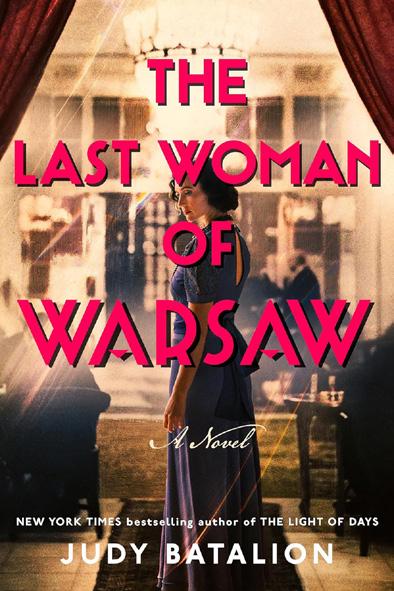
In 1938 Warsaw, often called “the Paris of the East,” two unlikely young women, Fanny Zelshinsky and Zosia Dror, are brought together. Fanny, from a family of Jewish elites, yearns to be recognized as an artist while her mother yearns to see her married into another family of Jewish elites. Zosia, a “shtetl girl,” left her religious family after a trauma to climb the ladder within her Labor Zionist youth movement in a quest to earn a coveted visa to Eretz Israel. The only person who can help them both is the legendary artist Wanda Petrovsky, who happens to be Fanny’s mentor as well as a leader in Zosia’s movement. When Wanda goes missing, Fanny and Zosia must find some common ground between them in order to find Wanda, save her (and themselves). All while the world around them teeters towards war.
By setting her story in pre-war Warsaw, most remembered for its infamous ghetto, Batalion presents a novel unique in the canon of Holocaust fiction. She draws from her meticulously researched nonfiction book, The Light of Days, to create her characters and brings Warsaw’s Jewish community, with all its complexity and contradictions, to life beautifully. The varying Jewish movements— ”socialists, religious, anti-religious, Zionists, anti-Zionists, and every permutation thereof”—provide detail of the community’s complexity. As Fanny and Zosia each strive for their goals, build their friendship, fall in love and out, are bruised and nearly broken, the approaching storm grows palpable. They fight for their lives even before they literally have to fight for their lives. The characters feel real. Their aspirations, fears, and confusion are believable and understandable. This is an excellent reminder that not all Holocaust survivors were victims. Highly recommended. Meg Wiviott
TISIPHONE WALKING
Nicola Belluomo, Independently published, 2025, £9.99, pb, 293pp, 9781068714122
This novel (the second in the Ishtar’s Gate series) enters that crowded field of Second World War fiction with a story rooted in captivity, collaboration and the corrosive effects of despair. Set largely within a German POW castle in the war’s closing months, the novel follows Tomasin (Tommie) West, a young British woman held among Allied prisoners and watched over by conflicted German officers. Around her gather a volatile cast: Simon, the earnest airman; George, a poisonous intellectual evangelist for suicide; and Major Brandt, a damaged intelligence officer whose guarded sympathy threatens both their positions. As the war turns against Germany, escape attempts, political intrigue, and emotional entanglements push the prisoners and their captors toward crisis.
As historical fiction, the novel is ambitious and often persuasive. Details of POW routines, Red Cross supplies, escape politics, and the tensions between British and American prisoners feel well observed. The shadow of the “Great Escape” executions hangs convincingly over the camp atmosphere. German intelligence manoeuvring in the final year of the war also lends the book a credible political backdrop, even when the internal debates become somewhat dense. The title’s reference is classical: Tisiphone is one of the three Furies of Greek myth, spirits of vengeance who punish crimes of blood and refers to the novel’s concern with revenge, moral corruption, and psychological disintegration.
The prose is fluent, at times heightened and almost gothic in tone, particularly in passages of emotional extremity. Characterisation is strong, especially in Tommie and the selfdestructive George, whose philosophical tirades feel theatrically intense but authentic. Within the broad stream of WWII fiction, the novel stands out for its psychological focus and classical undertones. It is an intense, thoughtful novel, occasionally overwrought, but largely convincing in its historical setting and emotional stakes.
Douglas Kemp
GUN GIRL AND THE TALL GUY
Maryka Biaggio, Pegasus, 2025, $18.99, pb, 346pp, 9781804680926
Set in Brooklyn, New York in the Roaring 1920s, this novel is based on a true crime story that captured the nation’s imagination for six months in 1924. Celia and Ed Cooney, newly married, are expecting their first child. Ed has a steady job as an auto mechanic but makes Celia quit her job in a laundry when she gets pregnant. Celia longs to give her baby a better life. Ed agrees. Short on money, they decide to do some local stick-ups to get quick and easy cash. With their first few hauls, they move to a new apartment, buy new furniture on time, and quickly run out of
money. Soon, their robberies make the local news. They are nicknamed the Bob-Haired Bandit (Celia) and the Tall Guy (Ed). Celia threatens the shopkeepers with her 25-caliber pistol while Ed carries two guns and empties the tills. Captain William Casey is put on the case and he’s under pressure from the Police Commissioner to solve it quickly.
Ed and Celia’s exploits are interspersed with newspaper accounts of their crimes as well as Casey’s slow progress on the case. Inevitably, Ed and Celia decide they need one last big job with a substantial haul to set them up for a long time. Then they can quit doing what they both know is wrong. The denouement is a fast-paced portrayal of this sensational crime story from three points of view: the perpetrators, the law, and the public interest inflamed by various newspaper accounts. There is an underlying sadness in the futility of Celia and Ed’s journey into crime and punishment. Yet they remain true to each other and accept their fate. Maryka Biaggio’s novel captures the daring high spirits of the 1920s and the motivation for and allure of crime, as well as its retribution.
Robin Holloway
MARGERY AND ME
Maryka Biaggio, Regal House, 2026, $20.95, pb, 292pp, 9781646036868
Sometimes what makes a book unique is its perspective. The narrator in this novel about the 1920s spiritualism craze is a spirit himself, Walter. An older brother who can’t move on from a train yard accident, Walter follows his younger sister Mina as she leaves their Canadian farm and their abusive father. With a pretty face, a nice figure, and a charismatic demeanor, Mina wrangles two husbands, a cadre of adorers and, thanks to Walter’s persistence, a career as a séance medium, “Margery.”
The novel focuses on Mina’s years proving her authenticity to a spiritualism investigation board for the journal Scientific American Pushed by her second husband, physician Roy Crandon, Mina channels an irreverent Walter for friends, investigators, and luminaries of the day, including Harry Houdini. As years pass, Mina’s hangers-on drop off, and members of the board who once supported her, denounce her as a fraud.
It is difficult to write a book about a real person, as life rarely follows a narrative arc. While the premise is engaging, it was difficult to maintain interest when no real stakes existed for making the investigators believe in Mina’s talents. Since the book is well-written, with an unusual narrator, those with a special interest in either the 1920s or spiritualism would enjoy this.
Katie Stine
new century in 1900 to Sándor von Lázár and Mária, a Hungarian family of nobility. They have a house in Héviz for the winters and a manor in the country for the summers. The Habsburg Empire is on the decline, and we follow them through two world wars and Stalinist rule to the Hungarian uprising in the 1950s. The family is buffeted by world events and political upheavals while their privileged lives spiral into destitution. We see all the episodes of any family, “successes and failures, entanglements and affairs, dreams and fears, illnesses and penchants, broken hearts and sleepless nights.”
Sándor, the baron and patriarch, is tortured by a lost love. When his wife Mária drowns herself, he descends into alcoholism and an untimely death. His brother Imre’s mind is lost to reality. Lajos, now the baron, was in truth born of an affair Mária had with the stable boy. He is happily married to Lilly, but this doesn’t prevent his eye from wandering. He carries the guilt of his role in the segregation and deportation of the Jews in Hungary and is tortured by his inability to stand up and do the right thing. His adjustment to the appropriation of his properties and working in a factory is difficult. His children, Pista and Eva, born in the interwar years, carry on the legacy of the family while navigating their upside-down world.
Based on the author’s own family, it is Lajos’ life that is the center of this novel. The book opens describing him as a “glass child,” translucent with visible organs. This feels like a hook since this physical oddity is not addressed again, although it is not a mark against the novel in its entirety. Lázár is a compulsive, thoughtful read, comparable to Thomas Mann’s Buddenbrooks
Janice Ottersberg
THE WALLS ARE CLOSING IN ON US
Joshua Trent Brown, Malarkey, 2026, $24.00, pb, 310pp, 9781968523039
LÁZÁR
Nelio Biedermann, trans. Jamie Bulloch, Summit, 2026, $28.00/C$39.00, hb, 272pp, 9781668200551
Lajos von Lázár is born at the dawn of a
George is a young half-Choctaw man trapped within walls he doesn’t even know exist. He cannot escape them any more than he can escape his skin. He tries, though— traveling from a reservation in his native Mississippi through a landscape of violence, love, a circus, and multiple deadly fights with man and beast, all the way to North Carolina, where he finally comes to rest until it all inevitably catches up with him. He has lost his Choctaw heritage, he can never be truly white, he is bigger and greater than his fate— but those walls are aways in his way, and they
are getting closer. We want to take care of George, protect him, turn him aside from his bad choices even if they are the only ones he can make. So do many of the people he meets along the way. That is what makes this book a tragedy, and a remarkable one.
Spanning between about 1910 and 1960, told in Southern Gothic style and based on tales of the author’s mysterious ancestor, the narrative voice is raw, unfinished, and superbly appropriate. Mystical elements surround George, sometimes mocking him, sometimes showing him the way, and always just a step out of reach. I’m glad I got to know George, even if only a little. Highly recommended.
Richard Banville
THE TEMPTATION OF CHARLOTTE NORTH
Camilla Bruce, Del Rey, 2026, $18.99/C$27.00, pb, 448pp, 9780593724972
Margaret’s Keep is a small island owned almost entirely by the Norths. Three of their daughters are respectful of their parents, while second-born Charlotte is utterly defiant. In 1910, Charlotte is, as usual, locked in the shed by her mother, and watches as an earthquake demolishes Margaret’s Tower, an old stone structure allegedly built to house an insane wife. Grim legend surrounds the tower, and its destruction foreshadows wickedness.
Sixteen-year-old Charlotte is besotted with Reverend Jasper Hill. It’s no reflection on her if he’s married! When inexplicable events endanger the Norths, they take pains to protect their reputation. Charlotte hears unidentified knocking in the walls and convinces everyone she’s communicating with the ‘knocker’, although the family and staff believe they are all being targeted by evil. Mrs North continues to confine Charlotte, blaming her for all ills. up. Inside the shed Charlotte finds new ways to talk to the knocker. The imminent arrival from the mainland, of elder sister Evelyn’s fiancé means Charlotte’s behaviour may become the subject of rumour and censure, ending the betrothal. Charlotte is moved to the reverend’s house, where godly stewardship could be a last resort.
Schoolteacher Ruth Russell and geologist Benjamin West have both experienced supernatural happenings on North property. Ruth entangles herself in the reverend’s dealings with Charlotte and this interference leads beyond their control.
Charlotte, Jasper and Ruth narrate their own versions of events, as they occur or after the fact. The eerie atmosphere is intensified by the isolated early 20th-century setting and explores the lengths to which families will go to protect their own interests. Charlotte is a naïve yet complex girl seeking self-determination, but despite being unloved by her mother, she is hard to sympathise with overall. This haunting story of obscure mental unwinding and the power of delusion concludes in an unpredictable way.
Fiona Alison
WHERE THE FALSE GODS DWELL
Denny S. Bryce, Kensington, 2026, $18.95/ C$24.95, pb, 336pp, 9781496737892
In this fictional retelling, two American women and one Jamaican woman accompany real-life Black dancer-choreographer Katherine Dunham on an expedition to a remote maroon village in Jamaica in 1935. In real life, Katherine, who was also an anthropologist, traveled on her own from 1935-1937 to four Caribbean countries to study African-inspired dance.
The story is told from the points of view of the three women, but Katherine’s point of view is never revealed. Vivian Jean, who hails from an elite Black Chicago family, is Katherine’s friend. Longing to escape the grief over the loss of her first husband, Vivian Jean joins Katherine’s expedition. Con artist Othella is sent by a Chicago gangster to a party attended by Katherine and Vivian Jean to steal a watch owned by Vivian Jean’s father. Othella attacked, and may have killed, her boyfriend. When her boyfriend’s brother shows up at the party, she is rescued by Vivian Jean, who invites her to join the expedition as her assistant.
The group travels by boat to Jamaica, where they are met by Zinzi, a local woman who is working to unionize sugar plantation workers. Zinzi takes them by mule to a remote maroon village. There they interview residents about their customs and witness local dances. The story ends when the women are caught up in a real-life hurricane, with devastating consequences.
What is particularly striking is how vividly each setting is depicted. Readers can picture the gaiety of the party, the bumpy and insectfilled hours traveling by mule, and the village life and spicy food in Jamaica. While Vivian Jean and especially Othella are fully realized characters, Zinzi’s connection to Katherine seems tenuous. Since Katherine’s backstory is lightly sketched, readers may wish for more exposition from her point of view.
Michelle J. Ritholz
WHIZ KID
Joel Burcat, David S. Burcat, Milford House, 2025, $24.95, pb, 291pp, 9798888193297
It’s Philadelphia in 1950. Camden boy, baseball fan, and war hero Ben Green is finishing his writing degree at Penn alongside his friends, rich main liner Stan and smart, sexy Ilene. His wife, Debby, is expecting, and they’re living with her parents above the family notions store in the Zibbiter, a celebrated Jewish market on Seventh Street. The Phillies are about to win the league championship for the first time in a generation. Ben is faced with job decisions, religious prejudice and the blandishments of an Ilene who wants to be more than friends. Then Debby goes into pre-eclampsia. But you know from the start how everything will turn out. If All-American Frank Capra had been Jewish, this is the movie he would have made. It’s about a generation that came of age after the war, full of hope and ambition,
about Jewish family life, about baseball in a city of “Phanatics.” À la Forrest Gump, historical celebrities pass in and out. It’s predictable, and there isn’t much tension, but—and this is especially true for readers who have lived in Philly like this reviewer—it’s a warm dollop of nostalgia for an age that was both better and worse than our own.
Niki Kantzios
FINDING IDA
Marya Burgess, The Book Guild, 2025, £9.99, pb, 392pp, 9781835743454
This is a structurally surprising book, but it works beautifully. The narrative begins in Singapore in 1955, where Luiza, settled into a happy marriage and preparing for the birth of her third child, receives a letter which promises to either revive or destroy her hope of finding her sister, who disappeared in the turmoil of wartime Europe. Now, the story leaps back to 1927 Poland and follows Luiza through her childhood and young adult years.
This, for me, was the surprising part; although the pivotal point of the book is Luiza’s quest to find Ida, that quest is deferred until the final chapters. Instead, I found myself wholly and richly absorbed – throughout the book – in Luiza’s experience of a world sliding into war.
Told with the realism and insight of a child growing into a woman, the story explores Luiza’s relationships with her family, particularly her adored father, a German with liberal and socialist leanings, who has taken Polish citizenship. A spectrum of well-realized and colourful secondary characters bears candid witness to the art, music, literature, fashions, politics and religion of the time – and the impossible moral and ethical decisions that are forced upon the population by the war.
The story plummets, briefly but shockingly, into the post-war years, into a landscape drained of colour, affection and vitality, where a returning Luiza observes that ‘the whole of Poland has been consumed by the relentless and joyless Soviet enterprise.’
There is a satisfying resolution to this bright, warm and thought-provoking book, but the most delightful surprise of all is the short but uplifting epilogue which tells the story of the story, drawing Luiza out of history and onto the fringes of our own era through the voice of her daughter, the author.
Nicola Belluomo
MORE THAN YOU KNOW
Anne Canadeo, Level Best-Historia, 2026, $17.95, pb, 290pp, 9798898201616
The first scene makes us think this will be the story of a plucky young woman in the aftermath of WWII who loses the job she loved to a returning soldier and must take whatever employment she can get. Grace Russo’s brother Joe, a returning soldier himself, suggests she apply to his army buddy, Harry Shaw, and Grace becomes Shaw’s assistant in his fledgling practice as a private investigator. Then Joe Russo is accused of murder, and the
novel turns into a mystery involving a possibly shady nightclub, The Starlight Room. After the police rough Joe up but fail to get a confession, Harry finds him a lawyer, and he and Grace begin to gather information to help Joe’s defense. Harry often works alone, leaving Grace to organize his office, so she too begins to pursue leads on her own. Suspense builds, both around The Starlight Room and within Grace’s family of traditional Italians devastated by the accusation against Joe, who’s being held without bail.
Grace’s fiancé is MIA, and by 1947 the chance of his returning is slim. She’s a strongminded protagonist, her independent ways frowned on but tolerated by her family. In contrast, her younger sister Rose, engaged to an Italian, anticipates a traditional marriage like their parents have. Harry Shaw remains mysterious, often absenting himself from the office for reasons only the reader knows.
This fast-paced novel deals with post-WWII social issues when the world is changing but Black people, including those who served in the military, are still denied rights, and prejudice runs rampant against women as well. This story is complete in itself, but the ending hints at a sequel. A compelling character, Grace Russo’s return as Harry’s clever sidekick would be welcome.
Jinny Webber
AN INHERITANCE OF LIES
Rebecca A. Carter, Lake Union, 2026, $16.99/£8.99, pb, 317pp, 9781662534706 In 1915, Alexandra Benson, orphaned after her parents are killed in an apparent accident, learns that her father’s will gives his brother control over her bountiful inheritance. If she fails to marry, all will go to Uncle Nigel. She’s disoriented by this betrayal from the father who encouraged her independence— if in fact he wrote that provision. The lawyer assures her that the will stands. All Alix can think to do is fake engagement and marriage to a charming man who was kind to her. For a generous fee, Cameron Asher agrees to play along for a year or two until she secures her inheritance. Her uncle intends to take her to England, so Cameron must come along. So begins a mystery as WWI is building. Along with Alix’s maid and Uncle Nigel’s assistant, they’re scheduled to sail on the Lusitania despite warnings that German U-boats are patrolling British shores. As the story unfolds, risk and danger compound, intensified by
suspicion and espionage. Though raised to be strong and self-reliant, Alix no longer knows who to trust, nor can she be sure of her own feelings.
An Inheritance of Lies is intrinsically suspenseful: most readers know the Lusitania was sunk, and out of almost 2,000 passengers, fewer than 800 survived. How will Alix and Cameron experience this disaster? Rebecca Carter’s plotting intensifies the suspense as Alix keeps discovering that nothing is as it seems. Her childhood memories are unreliable, Cameron is an enigma, and more than one character is driven by murderous intent. This book is fast-paced with Alix drawn into a puzzling romance amidst perils of war and duplicity. The final chapters are so actionpacked and vividly described that the novel feels like a movie.
Jinny Webber
DAUGHTER OF THE TITANIC
Caroline Cauchi, One More Chapter, 2026, £9.99, pb, 432pp, 9780008784539 / $2.99, ebook, 432pp, 9780008784522
Cauchi’s fictional biography introduces Helen Melville (Mel) Russell Cooke in 1973, when researcher, Dr Catherine Haynes, having come across a 1959 David Rolt portrait, requests an interview with the sitter she presumes to be Mel. Eleven interviews, recorded at Pratt’s, Mel’s Oxfordshire home, represent the heart of this compelling fiction.
Captain Edward Smith drowned with his ship, Titanic, in April 1912. Mel is 14, his only daughter. Her dearly beloved father becomes a headline, one that fluctuates with news titbits from survivors, from Halifax and elsewhere. There is no body, no grave, and endless questions. A small suitcase of news articles, obituaries, memorials, letters, tips and pictures is how Mel keeps her father with her, in a reality where she can imagine a future she can’t otherwise have. She is the living embodiment of how history remembers its notable dead, as the world casts her ‘unlucky/ cursed’ family into its own version of myth. She marries Sidney Russell Cooke in 1922a marriage of convenience, love, absences, betrayal and deafening silences. Twins Simon and Priscilla are born in 1923.
The book title and frequent ‘Mrs Russell Cooke’ honorific are a testament to Mel’s belief that women become a footnote to their men. Cauchi proves this self-assessment to be wrong. Mel is vibrant and courageous: a licensed pilot who revels in fast cars, a society gentlewoman who refuses to be hemmed in by public perception. She rejects a life prescribed by media and makes sure her children are not doomed to that fate. Soul searing grief runs parallel with performative grieving, the former speaking to Mel’s truth whilst the latter is forced upon her. She’s accomplished at both. Her story is one of unapologetic raw honesty and vision, a convincing voice of reason
complete with sharp observations converting cliché to truth, in this elegant literary novel.
Fiona Alison
THE YOUNG WILL REMEMBER
Eve J. Chung, Berkley, 2026, $30.00, hb, 448pp, 9780593640562
In the cold month of December 1950, the U.S. command is debating whether to use nuclear weapons in Korea as shivering villagers just try to stay alive. Chinese American journalist Ellie Chang is on a military flight shot down in the north.Only her Asian features and a desperate mother’s search for her missing daughter save her. But now she is trapped in the north, pretending to be a Chinese national since she doesn’t speak Korean. She is taken in by the woman she comes to know as Emma, and the Paks, a Christian pastor and his wife and son. As they begin to trust her, and she them, they struggle south together to escape firebombing by U.S. forces, seeking a possibly dubious safety behind the American lines.
Ellie knows that she may never get out of Korea if the north wins the war, or is obliterated by American bombs, but the story of Emma’s missing daughter begins to obsess Ellie as well as Emma: Song Yun-Hee, taken in the last war by the Japanese army to be a “comfort woman,” a conscienceless euphemism for women provided for Japanese soldiers to rape; a symbol of the atrocity of war in the form of one fourteen-year old girl.
The story of Yun-Hee and the other girls whose lives were stolen and considered of no account haunts the entire novel, as Ellie realizes how complicit so many were in their use as disposable people. The first-person narrative is an authentic voice and contains an enveloping sense of time and place and the freezing cold that claimed life after life along the road south, and yet manages to be, in the end, a narrative both hopeful and uplifting.
Amanda Cockrell
THE WARTIME AFFAIR
Victoria Cornwall, Choc Lit, 2026, £11.99, pb, 320pp, 9781781899779
The Second World War continues to offer novelists an apparently inexhaustible supply of stories, its moral extremities and personal upheavals lending themselves readily to fiction. The Wartime Affair, the third in the writer’s Love in War series, sits squarely within this tradition, combining romance with a sober examination of complicity, courage and survival on both sides of the conflict. The novel opens powerfully on Kristallnacht in 1938, in the small German town of Gollnow, where Elsa Kalbach witnesses the destruction of her Jewish neighbours’ lives and the shaming compromises made by those who look on. From there, the narrative alternates between Elsa’s slow political awakening in Nazi Germany and the parallel story of Sam Howard, a British officer captured during the retreat to Dunkirk and incarcerated in Stalag
XXA in occupied Poland. Their lives intersect indirectly across the years, as war strips away certainties and forces each to confront betrayal, loss and the cost of endurance.
As historical fiction, the novel is carefully grounded. Cornwall’s depiction of civilian life under Nazism, the tightening noose of ideology, and the moral corrosion of silence is convincingly rendered, while the POW sections are particularly strong: the boredom, hunger, and fragile camaraderie of camp life feel well researched and authentic. Period detail is generally sound, from youth organisations and press propaganda to Red Cross parcels and camp routines. Dialogue is mostly appropriate to the period. The prose is clear and fluent rather than showy, with a strong sense of forward momentum. Characterisation, especially of Elsa and Sam, is sympathetic and layered, allowing for doubt, fear and moral inconsistency.
In the crowded field of WWII fiction, The Wartime Affair distinguishes itself by its willingness to inhabit uncomfortable perspectives and its refusal of easy moral absolution. It is a readable, well-structured novel that treats its historical material with seriousness and emotional intelligence.
Douglas Kemp
THE HIRED MAN
Sandra Dallas, St. Martin’s, 2026, $28.00/ C$39.00, hb, 320pp, 9781250352392
Ravaged by the Depression and the Dust Bowl, the residents of a small Colorado farming town try to eke out a living despite drought and despair in 1937. Abuse and anger run rampant as men vent their frustrations on wives and children. Fifteen-year-old Martha Helen Kessler and her family are getting by, trying to help their neighbors—especially the women— where they can. When a drifter named Otis Hobbs shows up and saves a boy from a dust storm, the family takes him on as their hired hand, ignoring the suspicion and prejudice from residents. Handsome Otis proves to be a hard worker with an eye for Martha Helen’s best friend, Frankie, the daughter of an abusive father. Tensions escalate when Frankie is found murdered, and Otis is arrested. Martha Helen doesn’t want to believe him capable of such a foul deed, but she’s witnessed how violent men can be. Will Otis turn out to be different?
Readers feel the gritty, dirty reality of the Dust Bowl both figuratively and metaphorically. Dust seeping inside windowsills, the howl of the wind across the dry land, and the brutal altercations between men and women combine to create a setting that is just as much a character as the characters themselves. Dallas shines a bright light on the strength of women in community, supporting each other in the face of adversity, abuse, and injustice. We see Martha Helen’s innocence disappear as she realizes how hardship and prejudice twist men’s souls.
The Hired Man plants you firmly in 1930s America and reveals the harsh reality of
ordinary folks contending with extraordinary circumstances.
Melissa
A. Amateis
UNDER TWO FLAGS
Janis Robinson Daly, Black Rose Writing, 2026, $18.95, pb, 290pp, 9781685137328
In Fall 1916, prior to America entering the Great War, Josephine Therese Marzynski travels to Germany from Boston to study music. She is met with suspicion and even strip-searched before being allowed into the country, but they never find the American flag she had sewn into the hem of her skirt. She is living with family friends, the Müllers, who have made it possible for her to pursue a career as a professional opera singer, a dream she thought had died with her father in America. Josephine begins her training, but by April 1917, America and Germany are at war, and Josephine has been summoned to the police station and put under regular monitoring.
This is a fictionalized version of Marzynski’s memoir, With Old Glory in Berlin, which may have been ghostwritten by the author’s grandfather. It is the compelling story of a Jewish American student trapped in WWI Berlin. Josephine’s musical training lasted about a year, but the story is centered less on music and more on Germany’s war-centered culture at the time, including propaganda, oppression, and rationing. The author has blended more music into it by effectively adding snippets of operas that relate to Josephine’s experiences. The chapters are laid out as an opera would be, with an overture, acts, scenes, an intermission, and a finale. After America enters the war, the novel is focused mostly on Josephine’s monitoring by the police and her attempts to leave, using influential contacts.
The original work is available in the public domain, and it is interesting to compare the two. The author has taken a simple retelling and breathed new life into it by adding emotion, dialogue, and music. The result is a well-woven tale of a talented young woman attempting to escape a perilous situation. Recommended.
Bonnie DeMoss
THE END OF THE VODKA
Oscar de Muriel, Extraordinary Books, 2026, £16.99, hb, 336pp, 9781917569279
War stories rarely lack for incident, but they require a shaping intelligence to distinguish the merely dramatic from the genuinely revealing. The End of the Vodka opens with the real-life suicide of Dorothy Hale in 1938 and swiftly entangles that tragedy with the orbit of Frida Kahlo, Diego Rivera and the formidable Clare Boothe Luce. What begins as a society chronicle—cocktails, gossip, and brittle wit— darkens into a political and psychological intrigue stretching from New York’s salons to Mexico and wartime Europe, with art, espionage and personal betrayal tightly interwoven.
Oscar de Muriel writes with considerable flair. The prose is often vivid, even painterly,
particularly in its evocation of Kahlo’s canvases and the febrile, performative glamour of late1930s Manhattan. Dialogue crackles with period confidence: Luce’s barbed hauteur and Kahlo’s earthier, more visceral voice are well differentiated and largely convincing. The novel’s structure—braiding documented history with fictional conjecture—gives it momentum, though at times the layering of intrigue risks becoming over-elaborate.
As historical fiction, it is both ambitious and mostly persuasive. The integration of real figures (Kahlo, Rivera, Trotsky, Baruch) is handled with evident research, and key events— the Hale suicide, Trotsky’s assassination—are anchored in fact. Yet plausibility occasionally strains: the density of conspiracy surrounding Hale’s death, and the degree of access granted to certain characters, can feel more novelistic than strictly credible. There are also small tonal slips, where idiom edges towards the modern, particularly in sharper exchanges.
That said, the novel’s greatest strength lies in its thematic coherence. Art, performance and deception mirror one another: lives are staged, histories revised, identities painted over. If the book sometimes prefers flourish to restraint, it nevertheless offers an intelligent, engrossing reimagining of a moment when culture and catastrophe stood perilously close.
Douglas Kemp
FUGGITIVI
Tony and Ty Drago, Milherst, 2026, $10.99, pb, 167pp, 9781515458425
Fuggitivi (Book 1 of The New Americans) opens in Sicily in the early 20th century, where the Donatello family lives under the shadow of poverty, tradition, and forces far more dangerous than either. When young Petru Donatello is threatened by the local Mafia, his mother recognizes the danger immediately. She has already lost one husband to that world, and she refuses to lose her son the same way. Her solution is simple but heartbreaking: Petru must flee to America.
Tony and Ty Drago build this opening installment around family loyalty and the difficult choices survival often demands. Petru is thoughtful and steady beyond his years, while his brothers—reckless Juvanni and gentle Angelu—bring both tension and warmth to the household. At the center stands their mother, Carmela, whose fierce determination to protect her son drives the story forward.
The atmosphere of rural Sicily is vivid: olive orchards, narrow village streets, and the quiet understanding that certain men hold power most families dare not challenge. The Dragos capture how families like the Donatellos must live carefully within that reality where every decision carries consequences.
Because this is the opening of a much larger saga, the story reads as the first movement of a broader journey rather than a fully contained arc. Still, the moment Petru leaves home— knowing everything familiar is behind him— creates a powerful emotional hook.
Readers who enjoy immigrant stories, family
sagas, and early twentieth-century historical fiction will find Fuggitivi a compelling start to the Donatello family’s story and a natural lead-in to the challenges awaiting them in Strangers in Paradiso
Williamaye Jones
SPRING MELT
Lori Duffy Foster, Speaking Volumes, 2026, $17.95, pb, 270pp, 9798890223654
This courtroom drama takes place in the 1920s Adirondack town of Saranac Lake, center of logging and hiking and a refuge for wealthy sufferers of TB. Ella Devine’s doctor husband caters to socialites afflicted by this disease: those who can afford his fees and value his discretion.
When three men are charged with a death that occurred nineteen years earlier, the long-concealed rape Ella suffered as a child is exposed, disrupting her bland, superficial marriage and becoming national news. Chapters alternate between Ella, the prosecutor’s team, and the defense lawyer for the accused men. Henry Roth’s death was treated as an accident at the time, but now questions are raised. What led up to his death, and where does the blame lie? The reader cannot be certain, and often neither can those involved, making this a page-turner as it raises questions of truth and justice. Evidence emerges of Saranac Lake’s lawless past, particularly toward the local Mohawk Indians.
Lori Duffy Foster is a master of suspense and courtroom details, having worked as a crime reporter herself. Adding to the appeal of her novel are the lush descriptions of the Adirondacks, beautiful yet potentially dangerous due to the dense vegetation. It’s not uncommon for hikers to stray slightly from the trail in the wilderness and be lost forever. After Ella returns to walking the hills and lakes, she begins keeping a journal of what she sees, smells, and feels, discovering that writing helps her come into herself after years of being emotionally dulled by repressed pain. Toward the end, plot twists catch us by surprise, increasing the dramatic effect of Spring Melt. Recommended.
Jinny Webber
I AM JOEY
R. Ghrist, Black Rose Writing, 2026, $18.95, pb, 254pp, 9781685137533
This novel starts when Josefina Veluya Guerrero’s life falls apart. Opening in 1941, the story introduces Joey after she has been lifted from rural poverty and obscurity to the highest level of Philippine society in the capital city with a successful, renowned husband and a precious daughter. Almost simultaneously, disease, separation, and war smash Joey, but she uses her status as a social outcast to provide aid and information to the emerging resistance movement as the Japanese empire overruns and occupies the Philippines.
This chronicle of WWII in Manila follows a real protagonist through her actual life
story, although her thoughts, emotions, and some interactions are fictional. Ghrist skillfully relates the ordeal of Joey, who becomes a survivor, spy, hero, and eventually a symbol. I Am Joey is presented as first-person biographical fiction rather than a third-person biography.
Ghrist stays close to Joey’s life story while painting a vivid picture of her inner struggles and indominable spirit which extend beyond the war and liberation. Fact and fiction are skillfully melded to bring the reader into Joey’s doubts, fears, daring, and triumphs. The result is an engaging story of personal struggle and triumph, the substance of which is true.
Ron Andrea
HONEY IN THE WOUND
Jiyoung Han, Avid Reader, 2026, $28.99/ C$41.99, pb, 320pp, 9781668202166 / Manilla, 2026, £16.99, hb, 400pp, 9781786587312
This sweeping family saga combines magical realism with the brutal existence of poverty, Japanese occupation, and shame over four generations of a Korean family beginning at the turn of the 20th century.
While all branches of the family are important, at the heart of the story is YoungJa, who comes of age far too young and far too suddenly when Japanese invaders murder her family at their mountain home. This spurs Young-Ja into a series of events over which she has little control. Like many of the women in her family, she possesses a preternatural skill; hers infuses the food she cooks with her own emotions. While young and happy, she sells sweets easily. But as she endures increasing cruelty, her food takes on the brutality she has experienced, causing the consumers of her food to take shocking actions.
This fascinating and raw story is sprinkled with the supernatural, but it does not undercut the historical truth of the Korean experience in the 1930s under the Japanese military occupation. Nor does it shy away from the shame placed on Korean comfort women and the subsequent denial of the Japanese government after the war. This is an important, emotional, and engaging tale that should not be ignored. Highly recommended.
Katie Stine
THE UNFORGETTABLE MAILMAN
April Howells, Alcove Press, 2026, $19.99, pb, 336pp, 9798892425261
In the fall of 1966, the Chicago post office shuts down for three weeks. Overwhelmed by the growing volume of mail and an outdated facility, ten million pieces of mail are waiting to be delivered. Local resident, 81-year-old Henry Walton’s memory is failing, but he can’t stop thinking about the backlog of letters lying around, undelivered. Those aren’t just sheets of paper tucked into envelopes; they are human connections being halted. Unable to bear the thought of all of that languishing correspondence, he wonders, could he help
by delivering the mail himself? He isn’t as spry as he used to be, and he has a limp from an injury sustained in WWI, but he does have a car and the passion to set things right. Soon, he devises a plan to break into the post office and grab as many letters as he can. But not all of them are addressed to those living in Chicago; some of the intended recipients live far away. With unshakeable determination, Henry loads up the mail and sets out on the journey of a lifetime.
Howells packs her book with interesting characters brought together by Henry’s creative scheme. Especially endearing is the unlikely friendship that forms between Henry and Roger, a bright but adrift teen struggling with his relationship with his estranged father. Cleverly interspersed between the chapters are letters, providing a sweet touch that shows the range of news relayed from trivial to heartbreaking to joyous. Like the letters, some parts of the story are funny, and others are sad, but it is always entertaining. A heartfelt, cozy read.
Janice Derr
LIBERTY ISLAND
Virginia Hume, St. Martin’s, 2026, $29.00/ C$41.00, hb, 320pp, 9781250285645
Hume tells the engaging tale of an extended family of Boston Brahmins who summer off the coast of Maine during the first two decades of the 20th century. She focuses on a pair of appealing characters—Julia Demarest and her Aunt Anna. Young and spirited Julia clashes with her proper grandmother, goes to Barnard College, hobnobs with the radical crowd in Manhattan, and returns to Maine, where she sorts out family secrets and makes sense of her unravelling love life. In the meantime, independent-minded Aunt Anna steps away from her task of writing a biography of Margaret Fuller, choosing instead to write popular children’s books, and returns to Maine where she sorts out misconceptions about her own love life.
Hume succeeds at layering background information on historical movements, including psychoanalysis, communism, free love, and feminism. She succeeds, as well, at capturing the ways Julia and Anna change. Anna comes to realize the importance of picking battles, and Julia realizes that being right is not always the best goal. Julia also sees that social and political movements carried to extremes become dogma. Most of the characters are impressively complex, except for Grandma Lillian, who is a caricature of a bully.
Some readers will find that Hume begins the novel slowly, with dozens of characters— many of whom have barely a cameo appearance— and multiple timelines are introduced too rapidly. About a third of the way into the book, these features become more manageable, particularly the intertwined timelines. This novel will be especially attractive to those
readers who want to see the plot and subplots nicely resolved by the end.
Marlie Wasserman
CITY LIGHTS
Claire M. Johnson, Level Best-Historia, 2025, $16.95, pb, 242pp, 978168512009
Maggie Laurent is on her own. The head of the Nick Moore Detective Agency has moved from San Francisco to Chicago, leaving Maggie to scrounge for cases. She’s soon drawn into a strongarm plot involving union busting and business leaders undermining the men who work for them when a friend’s former fiancé is pushed into the street and run over by a taxicab.
City Lights is the second in the Fog City Noir series. The first, Fog City, won the 2025 Macavity Award for Best Historical Mystery, and City Lights is nominated for the 2026 Lefty Award for Best Historical Novel. It highlights the 1930s labor unrest when cab drivers were beaten and shot, their taxis were burned, companies froze union members out of work and hired lackeys to vote for stooge union leaders, and disguised Pinkerton operatives or cops billy-clubbed heads. The novel has a Sam Spade feel: lean descriptions, tight pacing, nononsense personal observations and to-thepoint dialogue.
Instead of developing from detective spade work, some plot twists pop up coincidentally or conveniently, and some explanations repeat for no clear, dramatic reason. Maggie’s moves through Fog City are nonetheless private eyeworthy. She learns her trade using camera settings for taking pictures through darkened windows, scaling a fire escape, listening at a keyhole, plying a hotel detective or concierge with a box of cigars or a round of drinks, learning to box and fire a weapon, roughing out clues from golfers, acting on tips from gossip columnists, and discovering give-away undercover tells.
Picking up a Brigid O’Shaughnessy quote, Maggie “won’t need much of anybody’s help: You’re good.”
K. M. Sandrick
in Honeysuckle, Louisiana, their bond closer than sisters. Both lost their mothers young, Niecy to murder and Annie to abandonment, and the relatives who take in the girls can’t make up for the emotional loss. Niecy’s Aunt Irene raises her as a young lady, saving coins to send her to Spelman College in Atlanta; Annie’s path to escaping Honeysuckle is more sudden and chaotic, but escape she does, in an old Packard with her intended boyfriend and two others, heading to Memphis where she’s heard her mama lives. Her path to the big city and in life is far from smooth, but neither is Niecy’s, who navigates the challenges of color and class, and her nascent sexuality, with the friendship of other female co-eds.
Niecy and Annie switch off narrating, their distinct voices full of personality and casual wit, but progressively diverging in tone and vocabulary as their lives stretch further apart. The historical atmosphere is first-rate, with unobtrusive details on growing up Black and female in the 1950s Jim Crow South and all that entails: segregated movie theaters, rooming houses “vouched for by the Green Book,” and the compromises that social elevation demands. There are so many extraordinary characters that it feels like the novel could shift focus to any one of them and tell an equally fascinating story. Jones’s ability to unfold a tale is just marvelous—there’s always something going on, but the plot never feels unrealistic. A fierce, occasionally wrenching novel about the meaning of family: those rare beings who see you as you truly are.
Sarah Johnson
THE AMERICAN SUSPECT
Jim Kelly, Allison & Busby, 2026, £22.00/$28.00, hb, 352pp, 9780749032647
KIN
Tayari Jones, Knopf, 2026, $32.00, hb, 368pp, 9780525659181 / Oneworld, 2026, £18.99, hb, 368pp, 9780861543908
“The road Vernice is walking is paved different from yours,” Annie’s grandmother tells her towards the beginning of Jones’s remarkable novel.
“It ain’t fair, but that’s the way life takes us.” Annie and Vernice (Niecy) grow up as “cradle friends”
The American Suspect is a richly atmospheric wartime mystery that deftly intertwines past and present. Set in 1942 Cambridge, with American airmen once again stationed in East Anglia, the novel opens with the discovery of human remains beneath an expanding airfield—remains that appear to belong to a pilot from the First World War. From this intriguing premise, Jim Kelly builds a layered investigation that stretches across decades, uncovering a haunting story of love, loss, and revenge.
DI Eden Brooke is a compelling protagonist, shaped by his own wartime experiences and quiet moral resolve. As the case unfolds— deepened by a second body, a missing parish register, and the troubling conviction of an American soldier—Brooke must navigate not only the complexities of evidence, but also the tensions between military authority and civilian justice.
Kelly’s great strength lies in his evocation of place. Cambridge and its surrounding fens are vividly rendered, their landscapes carrying the weight of memory and history. The dual timelines are handled with elegance, allowing the emotional resonance of the earlier tragedy to seep into the wartime present.
There are moments of real tension—
not least during an air raid scene—and a strong undercurrent of social observation, particularly in the portrayal of ordinary lives under strain. The subplot involving blackmarket activity and missing cats adds texture without distracting from the central mystery. Thoughtful, humane, and quietly gripping, this is historical crime fiction of a very high order.
Aidan K. Morrissey
VIVIAN’S DECISION
Della Leavitt, She Writes, 2026, $17.99, pb, 280pp, 9798896361206
Vivian Jacobson is beyond overwhelmed. The children of Russian Jewish immigrants, she and her loving husband, Mel, moved from Chicago with their family to a new house in suburban Wilmette, so people of her time—1956—may believe she’s achieved the pinnacle of American womanhood. But with four young children needing her undivided attention, Vivian’s completely frazzled. A solo homemaker six days a week, she’s left without transportation while Mel takes their Oldsmobile downtown to work at his family’s eatery. When Vivian learns she’s pregnant again, to her despair, Mel agrees to support her choice to seek an illegal abortion with a doctor her obstetrician recommends. The place is grimy, the provider sarcastic and rude, and Vivian’s too scared to proceed. Now what? She has a week to change her mind.
First-time novelist Leavitt draws us fully into Vivian’s daily life and emotional turmoil as she weighs this most painful of decisions. Alongside, we also see Vivian’s mother, Hannah Kolson, raising a large family in a small apartment in 1923 Chicago. Isolated as a non-English speaker, Hannah contends with a sexist husband who lays frequent claim to her body. She, too, has an unwanted pregnancy, a situation which Vivian gradually discovers. One of many very personal women’s stories, as we see in this compassionate and psychologically involving work, that exist but are rarely spoken about.
Vivian’s Decision is also delightfully full of Jewish wisdom, traditions, and immigrant history, from the classic Settlement Cook Book to a rabbi’s sensible advice. We see how much has changed between the ´20s and the more modern ´50s—wives no longer sit separate from their husbands in shul—but the importance of women’s freedoms remains constant, as it does today. This riveting novel about female friendship and agency is strongly recommended.
Sarah Johnson
WHEN THEY CAME HOME
Terri Lewis, Miami Univ. Press, 2026, $17.00, pb, 152pp, 9781881163763
Based on the lives of the author’s grandparents, this novella depicts the life of Milton Fieth, a 21-year-old farm boy from Missouri who volunteers in 1918 with his brother and a few friends to fight overseas in France during World War I. They travel by train from Kansas across the country to embark
on a ship out of New York with Company K. Shattered by the violent deaths of his good friends Herbert and Socks on the battlefield, Milton returns home in August 1919.
He and his brother Wallace are offered work helping with the harvest on a farm in Enterprise, Kansas. There he meets Edith, whose parents own the farm. Milton is a chatterbox and finds comfort talking to Edith. They get engaged and marry. From this point on, Lewis artfully portrays the contrast between the robust, rural farming existence in America and Milton’s slow psychological disintegration that begins to surface because of his war experiences.
Lewis’s thorough research accurately portrays the effects of shell shock, called Post Traumatic Stress Disorder (PTSD) today. Edith’s struggles to understand what is going on and how she can help her husband are the centerpiece of this compelling story. The government’s failure to compensate its veterans, the therapies Milton undergoes, and Edith’s hopes and fears are told with an unerring eye for detail. Edith’s love for her husband, her faith, and her strong family enables her to cope and do her best to explain Milton’s journey to their two daughters.
Terri Lewis’s work is a poignant and truthful rendition of one World War I veteran’s reintegration into civilian life and the mental problems he faced. Milton’s postwar life story is just one of the over two million American doughboys who served their country and whose service and suffering were largely overlooked.
Robin Holloway
WESTWARD WOMEN
Alice Martin, Virago, 2026, £16.99, pb, 304pp, 9780349019321 / St Martin’s, 2026, $29.99/ C$41.00, hb, 304pp, 9781250375308
Set in 1973 during the Vietnam War, Westward Women combines historical, dystopian, and road trip fiction. A mysterious virus is affecting young women who, compelled by the infection, abandon their homes, head to the Pacific Ocean, and vanish. A man known as the Piper has appointed himself to pick up women and drive them west, but his motives are obscure.
Aimee, a college graduate, is looking for the Piper in the hope of finding her missing friend. Eve, a journalist, is on his trail because she wants to write a story about him and revive her flagging career. Teenie, troubled by the disappearance of her sister many years ago and now infected, is already on his bus.
What starts as an intriguing premiss becomes unsatisfyingly vague as the novel progresses. The virus is never explained, there’s no sense of its progress, no sense that it even exists. Perhaps it should be read as an allegory or metaphor: It’s the sort of question which might appeal to book groups. In spite of their varied back stories, the characters become indistinguishable. The denouement is predictable, and the ending relies on absurd
coincidences that undermine the credibility of the story.
However, historical detail is nicely evoked: bell bottoms, bazooka gum, Janis Joplin. It is a boldly feminist tale, raising issues such as bodily autonomy in prose that is sensuous, even visceral. The sense of smell in particular is vivid: sweat, patchouli, smoke. It is told in multiple viewpoints in first, second and third person and using past and present tenses, and these technical elements are well handled. The imagery is striking, such as multiple references to skin splitting or cutting. Westward Women has a poetic, dream-like quality which will appeal to readers who enjoy a novel that is more atmospheric than plot-driven.
Lucienne Boyce
THE LOST GIRL OF CRAVEN COUNTY
Emily Matchar, Putnam, 2026, $29.00, hb, 320pp, 9798217048007
This story takes place in New Bern and Craven County, North Carolina, in 1939. The protagonist is Millie, a 25-year-old Jewish “old maid” living in a small, prosperous Jewish section of New Bern, an historic riverfront town near the coast. The first part of the book reflects the close-knit life in Jewish communities of North Carolina. Millie had a nervous breakdown after her younger brother died and is treated differently afterwards. Her mother is spending time and energy on finding a husband for her—the only acceptable path for a woman in her community (even though her mother ran the family business). The descriptions of these efforts are conveyed with dry humor as we learn more about Millie, her family, and the loss she experienced.
On an errand, Millie finds an unconscious woman whom she helps. This woman is mute and has no identification. Millie brings her home, where her mysterious new friend is fed and given care while creating a stir in the community. Who is she? Where did she come from? What happened? The second part of the book unfolds as Millie learns the mysterious woman’s identity and plight. In doing so, she uncovers a shameful part of our history that was practiced in North Carolina (and the US) from the early 1900s into the 1970s. During this sleuthing, we see Millie is not the fragile person everyone has been treating her as since her breakdown.
This is a fast-paced and informative mystery that sheds light on life at a crossroad in our history at the end of the Depression but before we entered World War II, particularly among Jews as they both maintained their identities while assimilating into the South. It shows the different ways that love, friendships, and loss are experienced and expressed.
Deborah K. Mayer
PETRA CHÉRIE
Attilio Micheluzzi, trans. Jamie Richards, Fantagraphics, 2025, $34.99, hb, 312pp, 9798875001048
If you think you know comics, think again! And venture into the world of the fumetti, led by Attilio Micheluzzi. Born in Croatia in 1930 to a father serving in Mussolini’s air force, Micheluzzi worked as an architect for many years, designing buildings across North Africa. He was appointed architect for the Royal House of Libya just before Gaddafi overthrew the monarchy. Micheluzzi returned to Italy but found working there as an architect difficult. For the last eighteen years of his life he created comics, all centered around incredible characters.
In the introduction to this complete collection of comics featuring intrepid aviatrix, adventuress and spy Petra Chérie, cartoonist Paul Pope mentions that Micheluzzi’s friends teasingly called him “Hapsburgian,” a description that could apply to Petra herself. The House of Habsburg ruled the AustroHungarian Empire for centuries, including Croatia, Poland, Ukraine, Hungary, parts of Italy, Bohemia, and parts of the Balkans. Petra Chérie moves through all of these countries taking advantage of the extraordinary independence conferred on her by her youth, beauty, wealth, and the chaos of the times. She’s a diplomatic courier, a spy with multiple identities, an aviatrix who brings down German planes.
Micheluzzi draws her starkly beautiful face with spare lines, depicting her world with depth and shadows. As the series progresses, Petra takes more and more risks, always surviving because of her sophisticated wit, her social connections, and her ability to fight in heels and a long skirt. Micheluzzi sometimes inserts himself as a walk-on narrator, issuing warnings without judgement.
Petra’s story ends much as the Hapsburgian monarchy did in 1918: Deprived of the wealth brought to her by oil wells that are now in Bolshevik hands, now stuck in a world without glamor, the aristocratic company she enjoyed all gone. She survives, but her world does not.
Alison McMahan
ELIZABETH AND MARILYN
Julie Owen Moylan, Ballantine, 2026, $20.00, pb, 368pp, 9798217093731 / Michael Joseph, 2026, £18.99, hb, 448pp, 9780241651568
Queen Elizabeth II and Marilyn Monroe (born Norma Jeane Baker) met only once, in 1956, and Moylan’s compelling tale relates how this unusual event came about. Lilibet and Norma Jeane both turn 30 in 1956; raised in vastly different circumstances, they’re fated to live vastly different lives. Marilyn is in England to shoot The Prince and the Showgirl with Olivier. Newly married, she and husband Arthur Miller hope for a small rural cottage where they can honeymoon in private; instead, they are lodged at Parkfield House estate, backing Windsor Great Park.
Speaking in alternate voices in 1936, 1946
and 1956, Norma Jeane and Lilibet relate snippets of their background with honesty, clarity and common sense, spotlighting two irrepressibly shy women forced into public personas —their struggle for agency, their marriages, their hopes and dreams, and what they would do if fate had chosen differently. Occasional symbiotic stories make thoughtful points of comparison. Both women are intensely aware of the burden and responsibility of playing a public role, in a costume which can be discarded only in private, and even then, only with caution. Worries about disappointing family (Lilibet) or the industry and Arthur (Norma Jeane) and ‘letting the side down’ trouble them both.
Amidst a royal scandal, Lilibet becomes aware of the British press’ unkind gossip about Marilyn and has her private secretary invite her to the Royal Command Performance on October 29, 1956. And behind it all lies the shadow of Marilyn’s tragic early death.
This thoughtful fictional bio-of-sorts, built around the minimal facts available, offers warm glimpses into the private lives of two larger-than-life 20th-century icons. No part of the novel plays to rhetoric or melodrama. Norma Jeane’s frequent illness and early drug abuse are considerately discussed. Immersive historical fiction about Britain’s longest reigning monarch and the stunning woman in the gold lamé dress!
Fiona Alison
THE GHOST WOMEN
Jennifer Murphy, Dutton, 2026, $30.00/ C$41.99, hb, 368pp, 9780593474365
Lola Germany has returned to her hometown on Waverly Island, abandoning her dancing dreams in New York City to pick up her father’s detective badge and, eventually, take over as lead detective. Now it’s 1972, and her affable second-in-command tells her to meet him in the forest, Dead Witch Forest in fact, where a grisly murder scene awaits them.
The dead man is young Abel Montague, a promising painter and student at the St. Luke’s Institute of the Arts. Strangely, his corpse is suspended upside-down from a tree known as the Ghost Tree, and arranged in a way that mimics exactly the tarot card stuck in his back pocket. Even more disturbingly in this gripping novel, Abel isn’t the last student to die with a tarot card by his side.
As Lola tries to find the killer, she learns about the strange, witchy ways of Abel’s girlfriend Pearl and her group of female friends. One of them believes firmly in the ghost of her European ancestor, Matilda, who was burned as a witch on this island off the coast of South Carolina over five hundred years earlier – and yes, you did that math correctly.
Nothing about the history of Waverly Island is as it appears, and it’s up to Lola and Pearl to uncover the truth. If they can, they may save more innocents, or perhaps the guilty. And they may have a chance to undo a curse as old as the pre-Columbian St. Luke’s monastery that hosts the school. That particular historical claim
stretches credulity, as do the cartoonishly evil men in blood-red robes who pop up now and then. But overall, the mystery is so engaging that it is easy to let those quibbles wash past, like a South Carolina breeze.
Carrie Callaghan
THERE’S ONLY ONE SIN IN HOLLYWOOD
Rasheed Newson, Flatiron, 2026, $28.99, hb, 304pp, 9781250406149
In 1971, Aaron Touissant is nearing death from cancer when he sends an archivist of Hollywood history his account of the tragedy of charismatic Hollywood star Xavier C. Barlow years earlier. As a child bullied for being a sissy, Aaron practically lived at his Ohio town’s only movie theatre that admitted Black people, even assisting the projectionist. When the Korean War begins, he is seventeen and lies about his age to enlist in the U.S. Navy and escape his brutal father and brother. He becomes the aide of ace Black fighter pilot Horace Dixon and, eventually, his lover. After the war, Aaron accompanies Horace to Hollywood where the pilot’s life story is to be filmed by Skyline Studios. When the movie plan fails, Horace returns to Chicago, leaving Aaron bereft. He becomes a security guard at Skyline Studios and then a fixer, assuring that stars stay in the closet. Marrying a virtuous young woman, he honors his marital vows without disclosing his affair with Dixon. Skyline expects magnetic young Xavier Barlow to become their next Sidney Poitier, so he needs careful watching, and Aaron is assigned to the job. In time Aaron becomes his friend, keeping his attraction to the handsome star in check.
Newson has penned an erotic (sometimes explicit) and revelatory exposé of the underside of Hollywood in the late 1950s and the passions and dangers of gay society in Los Angeles. Xavier looks forward to the day when Black people will be equal and gay people open and accepted. Aaron, who suffered from the treatment of Black people in the navy and is keenly aware of the risks in Hollywood, has smaller dreams. His complicated emotions along with the double-bind experienced by Black performers give depth to the story and provide a unique angle on Black queer history. Recommended.
Jinny Webber
SONGS OF THE DEAD ROAD
Carolyn Newton, Bloodhound, 2025, £10.49/$15.99, pb, 320pp, 9781917705592
Warsaw, June 1939, and nine-year-old Ján loiters on the staircase, watching his parents’ party guests below. It’s a glittering throng, in a glittering mansion. He awaits the summons from his beautiful mother, radiant in satin and jewels. Next day, he’s despatched to study piano in Königsberg, where his uncle is director of a musical academy. When the Nazis invade Poland, Ján is stranded far from home, branded an enemy alien in the Prussian city. As he hears of his family’s death, the distressed child must
hide in plain sight by performing a concert, where his uncle, an ethnic German, claims him as his own. But then the Russians come, and his uncle, too, becomes an enemy alien.
So begins a story encompassing decades, told through carefully selected events, windows into a life. The episodes are vividly told, immersive interludes in which Ján feels very much alive. Events are linked by Ján’s emotional responses, expressed through music heard in his head. He inscribes his compositions into a journal, carried with him always, like a talisman. It’s skilled storytelling, in which one fictional life stands as testament to so many who were displaced by war and the postwar Soviet regime.
It would be a spoiler to reveal too much, but I felt that Part Three was written to an agenda. However, it did lead to a heartwarming resolution — a welcome relief after accompanying Ján through much hardship. Some readers may find Ján’s traumas distressing. However, I highly recommend this for readers interested in the experience of displaced persons —and in human resilience.
Helen Johnson
WE WANT SO MUCH TO BE OURSELVES
Stephen O’Connor, Bellevue, 2026, $18.99, pb, 496pp, 9781954276581
The novel opens in 1924 and follows Günter Zeitz, an eager student of psychoanalysis. Arriving in Vienna from Coblenz, he approaches Sigmund Freud in hopes of persuading him to teach him. Günter later moves from Vienna to Berlin as the rise of fascism begins to take hold. His journey is marked by passion, love, anger, loss, fear, terror, and madness.
While studying and undergoing psychoanalysis with Freud, Günter meets a fellow patient, Josine Rosen. Josine is Jewish and Günter is a gentile, yet they share the belief that they “cannot believe in God.” Their relationship flourishes as Günter begins to distance himself intellectually from Freud. At a conference on psychoanalysis, Günter debases what he sees as the absurdity of Freud’s theory of the death drive, an act that ultimately results in a job position in Berlin. Freud later delivers a response during Josine and Günter’s wedding toast, intimating that the death drive itself is the source of Hitler and the rise of fascism.
The couple move to Berlin for Günter’s position at the Polyclinic of the Psychoanalytic Institute. They have a daughter, Hanna, whom Günter deeply loves, and the family lives together for several years. But a disturbing betrayal alongside the rise of Nazism profoundly shapes both Günter’s and Josine’s lives as their relationship bifurcates and carries them in very different directions.
The plotting of the narrative allows the timeline to slow down and leap forward without sacrificing continuity. The act of deceiving oneself, loving amidst trauma and atrocity, the moral dilemma to participate in evil or face the consequences, emerge as penetrating forces
within the story, adding depth to an already rich novel.
Monica Carter
THE SCANDINAVIAN WAR BRIDE
Désirée Ohrbeck, Embarkation Books, 2026, $14.99, pb, 350pp, 9798994311004
Set in pre- and post-WWII Denmark, this story examines family bonds, women’s resilience, and the cost of survival.
Kirsten is one of three daughters of a patriarchal Danish household that survives through the mother’s strength and intuition. Yet the sisters’ lives see different trajectories. Martha, the eldest, represents a bridge between worlds. Ingrid, the youngest, evokes youth’s overlooked vulnerability, while Kirsten struggles between self-preservation and a secret longing to escape. The story of Kirsten and her sisters is inseparable from post-WWII shadows and the presence of American soldiers in Denmark: Martha meets Forest, a GI among the rubble of postwar streets. Kirsten watches her sister’s new life unfolding alongside a foreign soldier with thrill and dread. It’s a hint of what the world beyond Denmark might hold and a reminder of all that she could have. Or lose.
Ohrbeck uses an intimate storytelling infused with Scandinavian restraint to open Kirsten’s perspective to the reader: poverty, gender expectations, and the lasting psychological effects of parental abuse. Sisterhood bonds, strained yet protective, are tested through choices while resilience forms the thread that keeps past and future together. Kirsten journeys between a world forever changed and one built on the fragile hope of something better.
While some readers might find the ending too blunt, the image of the mother’s dishcloth— echoing the opening scene—lingers. It leaves us wondering whether Kirsten truly found what she was looking for, and whether her life will unfold any differently from that of her mother’s. Readers who love historical fiction focused on family and personal stories will find this novel a gripping look at the challenges of being a woman in post-WWII Europe.
Patricia Furstenberg
THE LAST GYPSY QUEEN
Linda Paul, Black Rose Writing, 2026, $20.95, pb, 290pp, 9781685137397
In 1941, Marisol is a new bride and then a widow very quickly. She does not miss her husband, a violent man with whom she was forced into an arranged marriage. She, her mother, and her grandmother travel with their Romani clan to Buckeye Lake Park in Buckeye Lake, Ohio, where they always work for the summer, and Marisol begins telling fortunes alongside her grandmother. But she really wants to follow in the footsteps of her late grandfather and be a healer. Columbus, Ohio, 1942. Will Worthington
is wealthy but is not interested in a career in his family’s business. His father, William, is already working on a plan to try and get Will out of the draft. But he signs up anyway, against his father’s wishes. Then Will visits Buckeye Lake Amusement Park and meets the most captivating girl he’s ever seen. Then, in 2014, Marisol visits the site of the park that changed her life.
This is a captivating story set in a very real park that existed in Ohio, and we see what life was like there in the WWII era. Marisol’s fight to overcome discrimination, both against her gender and her people, is the focus of the story. The reader will experience the joys of an American amusement park in the summer, as well as the behind-the-scenes difficulties. We also learn about Romani customs and ceremonies, such as weddings and funerals. The story is effectively told from three different points of view: Marisol, Will, and Lila, wife of the park manager. Will and Marisol both symbolize the American ideal of pursuing your own dream, despite who might want to stop you. Through Lila we see the journey of grief and joys of helping others. This enjoyable novel is recommended to fans of U.S.-based, WWII-era fiction.
Bonnie DeMoss
DEATH TIMES SEVEN
Anne Perry and Victoria Zackheim, Ballantine, 2026, $30.00, hb, 288pp, 9780593982518 / Headline, 2026, £22.00, hb, 288pp, 9781472294425
Anne Perry is best known for her successful series, the William Monk novels and the Charlotte and Thomas Pitt novels, along with a series of five World War I novels, twentyone holiday novels, the Elena Standish series, and a series featuring Charlotte and Thomas Pitt’s son, Daniel. This book is the seventh installment in the Daniel Pitt series and Perry’s last book, as she died in 2023.
Perry had written nine chapters of the book at the time of her death, and Zackheim, author and close friend, was tasked with completing it. The plot is gripping: in 1913, Daniel steps in to take over fellow lawyer Toby’s murder case when Toby has to recuse himself after his father shoots his mother dead, then turns the gun on himself, though not fatally. Daniel agrees with Toby that the accused man is probably innocent, even when it turns out that the victim is one of seven, so now his client is an accused serial killer. Daniel and Miriam fight to prove the man’s innocence, while also helping Toby solve his parent’s case.
Perry’s previous mystery books are characterized by believable, but unintrusive, historical settings, fast-paced plotting, and, her trademark, a deep dive into the character development of her leads, both male and female. Her sleuths, Daniel and his wife Miriam, a forensic pathologist, are close observers of others, giving us sharp insights into the supporting characters. Sadly, the story is not as well told as Perry’s earlier
books. The characters are more static, the same insights repeated over and over. Given Perry’s past, it’s ironic that the book focuses on a young man’s love for his parents and his grief over the violence they experience.
Alison McMahan
RUBY FALLS
Gin Phillips, Atlantic Crime, 2026, $28.00, hb, 336pp, 9780802166920
The fist of the Great Depression has hit Chattanooga hard, and it’s just one of the blows Ada Smith has taken on the chin. Widowed and haunted by miscarriages, Ada’s single remaining connection is her friend, Ruby Lambert. Ruby’s husband, Leo, discovers a crowning jewel within the fascinating geology of the caverns inside Lookout Mountain – a 150-foot waterfall he names for his wife. Much money and effort have been spent opening Lookout Mountain Cave to the public, including constructing Ruby Falls Castle with the limestone excavated from the mountain. Ada finds exhilaration and a measure of relief secretly exploring the cave after hours. Economic hardship threatens the venture, and a plan is devised to drum up publicity and sell tickets. A hatpin will be hidden in the cavernous depths, and a renowned psychic will use his powers to locate it. Along for the jaunt are his manager, wife, a Chicago reporter, and two locals – a guide and one of the cave’s investors. Ada, with a second guide, will follow behind, unseen, in case of accident. When one of the party is murdered, Ada knows she’s a sputtering carbide away from being trapped in the dark with a killer.
The mystery often cedes focus to psychological insight and especially Ada’s past experiences, a woman who has no patience “for people who wallow. You can never solve anything if you’re busy wallowing.”
Living in nearby Alabama and having made multiple visits to Ruby Falls myself, I’m perhaps authoritative enough to state: with this novel, Phillips has adeptly captured the setting, culture, and people – from landscape to food to perspective. They say to write what you know, Phillips knows what she’s writing about, and she’s accomplished, crafting vivid pictures of characters, relationships, and the caverns below Lookout Mountain. The tension of the well-developed mystery, for me, was just a bonus.
Bethany Latham
THE MOONIGHT RUNNER
Karen Robards, Park Row, 2026, $30.00, hb, 368pp, 9780778305842
During the Irish War of Independence (19191922), the people of Ireland lived precariously. Although two hundred thousand Irishmen had fought in WWI, Ireland was denied the opportunity to make a case for selfdetermination at the Paris Peace Conference. Irish leaders formed their own governing body, only to have it immediately declared illegal, and the IRA launched a guerilla war against
the vastly superior British forces entrenched throughout the country.
In this setting—uncommon for historical fiction—we follow Rynn Carmichael, a twentyseven-year-old nurse in rural County Donegal who has doubts about Ireland’s ability to take on the mighty British empire. Already under suspicion by British authorities for her brief involvement in a moonlight gunrunning episode, Rynn is drawn ever deeper into the conflict, first by treating wounded IRA men “on the run,” and then by confronting the growing threat to her village by the escalating violence from the notorious Black and Tans.
Rynn, resourceful and courageous yet often barely coping, finds some unexpected support from Owen Maguire, an Irish rogue who, notwithstanding his main occupation of hauling moonshine on his fleet of ships, has charmed his way into high-level negotiations over Ireland’s future. Rynn and Owen learn to work together when they have to make some dire choices in the struggle to form a new Irish nation.
Author Robards skillfully weaves historical and political background into the swift-moving narrative—Michael Collins’s emergence within the IRA, Éamon de Valera’s daring prison escape, Winston Churchill’s advocacy of overwhelming force—to inform the reader about this pivotal conflict in Irish history. The result is a fast-paced story that keeps the reader hooked on Rynn’s quest for freedom— and even some happiness—amid the dangers of a revolution.
Richard Corbett
BROKEN TRUTHS
Alessandro Robecchi, trans. Gregory Conti, Other Press, 2026, $17.99, pb, 288pp, 9781635425680
Manlio Parrini is a long-retired film director who’s decided to make one more film, about Augusto De Angelis, the real pioneer of Italian crime fiction in the 1930s. The fascist Italian government saw crime novels as a threat to their own propaganda machine, so first they put restrictions on writers and publishers, then banned the books altogether. De Angelis became a refugee and was beaten to death by a fascist thug.
The narrative is slow paced, told rather than shown, the meals eaten (pizzoccheri!) and coffee drunk seemingly more important than the crimes investigated. But the theme grabs our hearts and minds with small tendrils that grow and extend until we crack.
As Parrini struggles to finance the film, he finds himself making concessions to the film money people that parallel those De Angelis made to his censors (the villain could never be Italian, etc.) in order to survive. Parrini reflects on the nature of De Angelis’ conformism to oppression, the small concessions that grew larger and larger until he was crushed completely. But there are also small and large acts of resistance, acts Parrini will document in the film.
The story doesn’t allow us the delusion of
assuming that fascist oppression is a thing of the past. Parrini finds himself literally living in the middle of a modern-day murder mystery, part of a tale of black-market rents and extortion with international implications, that Parrini has more or less knowingly conformed to in exchange for his own comfortable and enviably located villa. In the end the book is a meditation on how the small acts of conformism make the larger evil possible, but again, the small acts of resistance, including Parrini’s, can lead to that evil being crushed.
Alison McMahan
THE LUSITANIA CODE
Linda Robertson, Level Best-Historia, 2026, $17.95, pb, 320pp, 9798898201333
In this meticulously researched political thriller, Lady Emmeline “Foxy” Butterschloss is drawn out of her comfortable retirement in the country when confidential documents pertaining to the sinking of the Lusitania are stolen from the desk of her adopted grandnephew, Dinwiddie “Dinny” Custus, at the Admiralty Records Office. Dinny is threatened with dismissal and court martial, as is his friend Addie, who has also uncovered records pertaining to the Lusitania. When the two are nearly killed in a car accident that may well be no accident, Foxy suspects a conspiracy that sheds new, unflattering light on Winston Churchill’s role in WWI, as he prepares to run for parliament in 1922. With the aid of Sir William Ainsworth, an old friend who wishes he were something more, Foxy sets out to use her old connections in the intelligence and code-breaking worlds to clear her nephew’s name.
Foxy’s and William’s service during WWI puts them in a unique position to spot the connections between past tragedies and present conspiracies. However, relying on these two protagonists, as engaging as they are, also diminishes the story’s narrative drive, as Dinny is forced into a largely passive role. That issue is exacerbated by several extended flashbacks where survivors recall the tragedies of WWI that have traumatized them. The result can sometimes feel more like a dramatized history lesson than a novel. But for those who prize carefully researched details of a fascinating historical “what if,” this is an engaging tale with a memorable protagonist in Foxy.
Erica Obey
WHERE THE GIRLS WERE
Kate Schatz, Dial, 2026, $29.00/C$39.00, hb, 368pp, 9780593736975
Feminist writer Schatz knocks it out of the park with her debut novel about a young woman in late ´60s California who—like so many from her generation—gets trapped between the contrasting values of American counterculture and a society that denies her agency over her own body and choices.
The soon-to-be valedictorian at her high school, Elizabeth Baker Phillips is her parents’ pride, the natural culmination of
her studiousness and a loving upbringing overlaid with high expectations. Then her path to Stanford is wrecked after she gets caught up the blissful freedom at her cousin May’s party at San Francisco’s Haight-Ashbury and has a short affair with an attractive hippie. Suddenly Baker, a “good girl” who’d barely touched a man before, finds herself pregnant and lost, a situation presented with deep understanding. Desperate to conceal their family’s shame, Baker’s mother, Rose, drops her off, without her prior knowledge, at a home for unwed mothers. Here, Baker and others are meant to spend months behind locked doors and pressured to sign their babies away for adoption; after going into labor, they’re whisked off and never mentioned again. She gets curious about all the girls made to disappear and ponders what to do next.
The camaraderie amongst the girls is suffused with warmth. Each situation is unique, but they all recognize the unfairness: they’re effectively imprisoned, while for the men, “he just gets to live his life.” Through Baker’s work as a teacher’s assistant, Schatz enhances the themes by interweaving words from the literary women Baker admires. This isn’t a thriller, but with the heightened anticipation of Baker’s actions as her time of childbirth draws near, it often reads like one. The story offers utter believability and character intimacy, including Baker’s observations about the changing body she no longer recognizes. It’s nearly impossible to look away.
Sarah Johnson
ON SUNDAYS SHE PICKED FLOWERS
Yah Yah Scholfield, Saga Press, 2026, $27.00, hb, 240pp, 9781668091210
In this stunning debut novel, a middleaged African American woman flees to the North Georgia woods after a shocking act of violence, forcing her to confront the figurative and literal beasts living within all of us.
Judith Rice is forty-one-years old and lives with her mother, Ernestine, whom she calls “Ma’am.” Her life is one of quiet servitude to Ma’am but also one of unmitigated abuse: emotional, physical, and verbal. In the autumn of 1965, after Ma’am cracks Jude’s skull against the wall, Jude snaps and kills her in their kitchen. She leaves town, finding haven in an abandoned plantation house deep in the forests north of Atlanta. Well, not completely abandoned; the house is full of “haints,” ghosts from the past that rattle walls, move furniture, and kick up a fuss before Jude pacifies them with tokens of goodwill in the closet altar in
the cellar. There is also a creature leaving her fresh meat on the porch. She lives alone for years, finding peace but not the closure necessary to move past the damage Ma’am inflicted on her soul. Until a stranger appears one day, a lovely young woman named Nemoira, who soon becomes Jude’s world: a housemate, friend, and finally, the love of her life. But Nemoira has a secret, one which Jude must reckon with to save her own humanity.
Scholfield pens a poignant and taut tale of racism, violence, death, folklore, and shapeshifting. While difficult topics of abuse, incest, and cannibalism are addressed, the story’s emphasis on hope and healing through Mother Nature (a prominent character itself) and an unlikely romance, offer a blessed reprieve from its darker themes. On Sundays She Picked Flowers is an unforgettable novel from a promising first-time author. Recommended.
Peggy Kurkowski
FISSION
Leslie R. Schover, She Writes, 2026, $17.99, pb, 288pp, 9798896360568
1943 Oak Ridge, Tennessee. Doris and Rob Friedman live in a small prefab bungalow in a military-style compound with their baby daughter. Newly married, Doris had to put aside her dreams of finishing university and becoming a lawyer or even a concert pianist when Rob, a skilled technologist, was offered a good job to be on a team working on the Manhattan Project. While Doris looks after the household (“dust gets everywhere”), Rob works diligently on the secret project and is often too tired to attend to their marital life. Attractive Doris socializes with the other wives but is shocked when one of them makes extremely antisemitic comments. A smart safety officer visits her regularly on the pretence of taking piano lessons and tries to seduce her. Although lonely Doris falls for his charms, after one indiscretion and other events, she realizes he could be a Soviet spy attempting to use her to obtain atomic secrets. Doris faces a dilemma about whether to report him.
Leslie Schover mentions in her author’s note that her father was a part of the group at Oak Ridge, and “stories of Oak Ridge were very much part of our family lore.” Hence, this novel is heavily based on real events, including some humorous anecdotes. While the overall story of the development of the atomic bomb is well known, this novel offers an interesting behind-the-scenes look, particularly into the women who supported their husbands and were thus part of the team that brought the project to fruition. The novel also points out a significant moment in the project: 67 workers signed a petition requesting that the atomic bomb’s power be shown to the Japanese before its deployment. This novel captures the intense effort and sacrifices it took to develop the nuclear weapon.
Waheed Rabbani
THE LAST MOVEMENT
Robert Seethaler, trans. Charlotte Collins, Canongate, 2026, £9.99, pb, 128pp, 9781837265213 / Europa, 2026, $22.00/ C$33.95, hb, 144pp, 9798889661801
Robert Seethaler’s latest work – more novella than novel – is an exquisite examination of the last few weeks in the life of Gustav Mahler as he returns to Vienna following his final concert tour in New York. The novel’s title – The Last Movement – is an obvious musical pun, although this miniature study displays more the small-scale intimacy of a chamber work than the ebullient grandeur of a symphony.
It is 1911, and an ailing Mahler sits on the deck of the SS Amerika contemplating his life. They have been at sea for six days. The reminiscences are not neatly ordered, Mahler’s thoughts always fretful and emotional. We move from his summer months, composing in glorious solitude in his rural hut in the forests of Tyrol; to his challenging of longheld traditions as director of the Vienna Court Opera House (including an attempt to stage Strauss’s Salome). We see his reluctance to pose for Rodin to produce his famous bust; and we feel his obsessive love for Alma and his doubts about their relationship, ultimately, and heart-breakingly, revealed in her affair. We experience his despair at the death of his daughter, Maria; and we hear of his visit to Sigmund Freud, seeking the answers that religion can no longer supply, but still uncomforted and concluding that life is essentially meaningless. Yet artistically, the last work to be premiered in his lifetime – the Eighth Symphony – was massive in its ambition and redemptive in its compass, garnering both critical and popular praise and, in Mahler’s own words, ‘joy-bringing’.
These biographical facts are well-known, but in Seethaler’s hands they become a melancholic, poetic, yet unsentimental, portrait of a great artist and a flawed man. Seethaler cleverly juxtaposes the music and the life: one a resounding success, the other riven with frustration, betrayal and anguish. Highly recommended.
Adele Wills
automotive windshields, but their luxurious life doesn’t bring contentment. Charlotte (Chet), preoccupied by death, secretly pens newspaper obituaries under their brother Graham’s name, while sister Cecile, a bitter woman with potential gangster ties, remains their father’s favorite. At twenty, their halfsister, Marjorie, a whimsical dreamer and aspiring designer, is the recipient of Chet and Graham’s caring protection and her stern father’s everlasting shame. To escape his ire, Marjorie jumps at the chance to covertly enroll in an artist’s residency in Detroit, especially since the debonair, elusive Charles Bonafante is the sponsor. She craves the structure and space to pursue her craft. These she gets, and she befriends two other women (both as charmingly peculiar as Marjorie). However, the residency has strict rules about self-isolation and locked doors. Marjorie also glimpses a disturbing message scratched into her bathroom mirror.
The storyline of this original mystery, bestselling YA novelist Sepetys’ adult debut, is utterly wild in the best way. With its outsize personalities, heaps of arch dialogue, and Gatsbyesque atmosphere oozing out its pores, it could easily lead to sensory overload, but the overall effect dazzles rather than overwhelms. Marjorie makes a vivid first impression: brought to the police station for indecent exposure (she draped herself in leaves to amuse a tree-loving friend), she also can’t cook for herself; someone fun to observe, though perhaps not relatable. That proves incorrect as she works within and without her residency’s confines to discover what’s going on. A hugely entertaining novel about the glamour and darkness of Prohibition-era Detroit, led by a heroine who comes into her own with impressive style.
Sarah Johnson
WHEN NO ONE ELSE WILL
Amanda Skenandore, Kensington, 2026, $18.95/C$24.95/£16.99, pb, 368pp, 9781496741707
A FORTUNE OF SAND
Ruta Sepetys, Ballantine, 2026, $30.00/ C$41.99, hb, 320pp, 9798217093243
One expects some level of eccentricity from the ultra-wealthy, yet Marjorie Lennox’s family sits in a class by itself. In 1927, at their mansion in the Detroit suburbs, they rest secure in their fortune made from
In 1939 Chicago, a frustrated Mimi Lukas watches her new modern refrigerator being wheeled from her house, due to late payments. Husband Stan has been laid off. As the weeks go by, the couple’s strained relationship feeds into a downward spiral as he makes little effort to find work. Money and supplies dwindle and Mimi returns to nursing without Stan’s permission. Armed with a suggestion from a fellow nurse, she finds a private office
in Chicago’s downtown where Dr Josephine Gabler is performing illegal abortions under rigidly strict health and hygiene conditions. The doctor does not believe women should have to resort to unsafe back street abortions.
Over the next 18 months, Mimi becomes increasingly convinced of the righteousness of the cause, knowing if the clinic closes, women would resort to taking their life into their own hands. These are not people who intentionally commit crimes on either side of the aisle – pregnant women or medical staff. Meanwhile, Mimi fails to confide in her family, making endless excuses about late nights and unexpected shifts but has to come clean after a police raid at the clinic.
The novel’s opening scene in a doctor’s office, where Mimi requests birth control without her husband’s approval, is intentionally demeaning. This prologue-esque section spotlights the vice-like patriarchal control on women and their expected roles and responsibilities in society. Mimi and family are fictional, but Skenadore’s story is based on historical characters, places, and events with adjusted timelines. It tells a compassionate tale of the balancing act of a working mother and the lengths to which she will go to protect her children and guide them to always do what they believe is morally right. Skenadore’s timely novel is beautifully told, and pays tribute to people and circumstances of the time in a caring and gentle way.
Fiona Alison
THE DESCENDANT
Linda Stasi, Regalo, 2026, $30.00/C$39.99, hb, 368pp, 9798895653432
The Descendant opens in the Colorado mountains in 1915 with a blizzard raging outside a crude cabin as a child is born into the struggling La Barbera family. The baby, Firenze, doesn’t cry. She howls. When a wolf suddenly appears at the door, the moment feels almost mythic, setting the tone for a story that blends family legend with hard history.
From there, Linda Stasi steps back to trace how the family arrived in America in the first place. The La Barberas leave their Sicilian village after earthquakes, poverty, and desperation push them toward the promise of opportunity overseas. Like many immigrants of the era, they’re lured by promises of land and prosperity, only to end up in the dangerous coal mines of Colorado.
Stasi tells the story in a voice that feels almost like oral history: part folklore, part family memory. Sicilian phrases and proverbs thread the narrative, giving the book a strong sense of cultural identity and reminding readers how deeply language and tradition travel with immigrants.
The historical backdrop is vivid and often harsh. From the devastation of southern Italy to the brutal realities of mining towns in the American West, the novel doesn’t shy away from the hardships immigrant families endured. Yet threaded through that struggle is resilience, particularly in the women who hold their families together. Epic in scope but
grounded in personal stories, The Descendant blends immigrant history, folklore, and family legacy into a sweeping historical saga. Highly recommended.
Williamaye Jones
IN THE FIELDS OF FATHERLESS CHILDREN
Pamela Steele, Counterpoint, 2026, $27.00, hb, 336pp, 9781640097605
Appalachia, 1960s. June is pregnant and sixteen, and that is just the beginning of her problems. The young man she loves, Ellis, is of mixed race and is the son of her racist stepfather’s enemy, escalating a longtime feud.
Then Ellis and June’s brother Tom are sent to Vietnam, and she just tries to survive. But her infant daughter is taken away right after birth by her stepfather, who will not allow a child with dark skin in his house. With help from this world, and the next, June leaves her small town in order to find her child. She begins a long and difficult journey, pursued by someone who cares little for her life and wants to take her daughter for themselves.
Gorgeous, lyrical writing and authentic Appalachian dialect make the culture of a 1960s coal mining town come alive in this standout novel by Pamela Steele. Impressive writing intertwines life in a coal mining town with the faraway war. For example: “Up on the mountain, another explosion. June pictured tree roots wrenched from the earth, dirt and rock bursting up from the ridge, peppering back to the ground, the same way the muted explosions of Vietnam came across Rena’s TV.” As June sets out with her own life on the line in pursuit of her child, other mothers are losing theirs to a war in another land.
The story is told mostly from the points of view of June, her mother, Bethel, and Granny Justice, who has passed away, but cannot move on due to “unfinished business.” This bit of magical realism ties into the spiritual side of Appalachian culture. Nuggets of folklore are also woven into the story, making it even more authentic. Compelling and moving, this novel captures the soul of Appalachia. Highly recommended.
Bonnie DeMoss
era sisterhood is well worth the wait. The two narrators are Birdie Calhoun, a principled young woman desperate to help save her family’s Mississippi Delta farm from foreclosure, and Meg Lefleur, an 11-year-old inmate of the Lafayette County Orphan Asylum in Oxford, Mississippi. When Birdie travels to Oxford to ask her wellmarried younger sister, Frances Tartt, for financial help, she discovers that the genteel home of the Tartt family hides secrets that spell emotional and financial disaster for the sisters. Practical, compassionate Birdie digs in, hoping to help the Tartts escape their own foreclosure, and discovers Meg’s predicament as well – she is a severely neglected “unadoptable” whose mother allegedly abandoned her. When that mother, Charlie, turns up after Meg has already been taken in by a family straight out of a Faulkner novel, she becomes the only hope for both Birdie and Meg when she proposes a new cottage industry for the endangered Tartt mansion – a local home for sex workers catering to the University students of Oxford. This is the simplest possible summary of a sprawling, hilarious adventure that exposes the cruel intentions behind the upstanding “Anti-Vice” citizens of Oxford and the supportive network of Black and white women who push back against the racist and sexist eugenics laws of the Depression-era South. Stockett manages to do justice to both their desperation and their grit, and presents an astounding number of deeply realized characters in the pages of this novel. Her gift for natural dialogue and her evocation of the comforts of 1930s food, music, and fashions create a satisfyingly immersive experience, and the clever plot will keep the reader turning its many pages eagerly.
Kristen McDermott
FABLES & LIES
Elisabeth Storrs, The Book Guild, 2026, £9.99, pb, 584pp, 9781835744086
THE CALAMITY CLUB
Kathryn Stockett, Spiegel & Grau, 2026, $35.00, hb, 656pp, 9781954118812 / Fig Tree, 2026, £20.00, hb, 656pp, 9780241796900 / Doubleday Canada, 2026, C$28.00, pb, 656pp. 9780385703239
Fans of Stockett’s bestseller The Help have waited fifteen years for her next novel, and this long, heartwarming tale of Depression-
After Germany invades Poland and Britain declares war, Berlin-based early and prehistory museum assistant Freyja Bremer starts categorizing and packing up priceless artifacts to protect them from air raids. As she works alongside a Cambridge-educated archaeologist, she begins to question what she has been taught about Aryan heritage. Pushed into marriage with an SS officer charged with usurping artifacts from occupied cities, she learns about plans to replace native populations with pure-blood Aryans.
Fables & Lies delves into aspects of Aryanism unknown at least to this reader, including efforts to resurrect prehistorical
plant species through selective breeding, perpetuate myths associated with Nordic dominance throughout early history, and prove that contrary theories were based on forged findings. Descriptions of Berlin in the 1940s are finely tuned, and attitudes about Nazism among ordinary Germans are sharply contrasted. But while Freyja is surrounded by conflicts among family members, abused by her husband, and challenged about her core understanding of history, science, and beliefs, there is little sense of her emotional turmoil. Freyja witnesses the fables and the lies but is not deeply moved by them, diminishing the power of the narrative and the shocking realities of Aryan philosophy.
K. M. Sandrick
THE ENEMY`S WIFE
Deborah Swift, HQ, 2026, £9.99, pb, 352pp, 9780008739737
Zofia is a visiting tutor for the family of Theo Carter, an American businessman, but unfortunately for this Jewish refugee from Eastern Europe, the time is 1941 and the place is Shanghai. Previously this was a land of opportunity for colonial powers; now the Japanese are invading, and life is about to become a lot worse very quickly. Those who are able to leave make haste to do so, Carter`s wife and children among them, but where will be safe in this maelstrom of war?
Zofia, a strong-minded and independent survivor, takes shelter with Theo along with Hilly, the waif and stray she acquired on the journey from Europe. Another complication for Zofia and a reference to the title is that she is actually married to a mild-mannered, kind Japanese man, but the effects of war are such that no one remains untouched or unchanged.
The horrors and myriad difficulties of war are made evident and the story is gripping and well-researched. While the ending will probably not surprise the reader too much, there are plenty of other twists and turns along the way, and the reader is certainly embedded in the time and place with vivid descriptions of the sights, sounds and scents.
The book is a continuation from an earlier novel called Last Train to Freedom which depicts the escape of Zofia from Nazi-dominated Lithuania. I did not realise this until I had finished the novel, and certainly it can be read as a stand-alone without an issue.
Ann Northfield
A PRIVATE MAN
Stephanie Sy-Quia, Grove, 2026, $27.00, hb, 288pp, 9780802166906 / Picador, 2026, £16.99, hb, 288pp, 9781035052615
David Fletcher commits himself to God and the Catholic priesthood for life, training in a seminary in Rome and savoring the rituals of worship and daily living. As a young woman in the early 1960s, Margaret is drawn to Catholicism to center her aimless life. She is ardent in her faith and excited by the revolutionary attitudes toward women and
sex that appear to be coming to the church. She trains in theology in Rome sometime after David—unknown to her—left, returning to England to teach in a girls’ school in the parish where he serves. When Margaret is old, widowed, and suffering intermittently from dementia, her grandson Adrian comes to France to care for her. Only then does he learn the story of his grandparents’ forbidden love that his mother, their only child, kept secret. So begins David and Margaret’s story, their faith and piety set against their mutual intellectual stimulation and passion. The Second Vatican Council doesn’t bring the church as far into the contemporary world as Margaret had hoped: priests must remain celibate and women cannot be clerics. She and David must make their own way.
This unusual story is compellingly told, but what makes this novel outstanding is SyQuia’s writing. An award-winning poet, her shimmering style enriches her descriptions and illuminates characters’ emotions. It is rare to find a novel that goes so deeply into the complexities of intimately relating to another person in mind, spirit, and body— the sacrifice, joy, and ever-changing nature of human connection. The novel flows and ripples, blurring firm plot lines as it reveals the story. Highly recommended for Sy-Quia’s luminous style and David and Margaret’s unique relationship.
Jinny Webber
THE PRODIGAL OF LENINGRAD
Daniel Taylor, Paraclete, 2026, $21.99, pb, 256pp, 9798893480221
This novel is set mostly during the Nazis’ horrific siege of Stalingrad with flashbacks to the earliest days of the Bolshevik revolution and the cold hell of the Siberian Gulag. Daniil Aslanov, a docent at the Hermitage museum, is leading tours of one of the world’s great art collections. As the war drags on, the pictures are taken for safe storage, and he is reduced to leading tours of empty frames, providing commentary on what people would see if the pictures were there.
In particular, Daniil is entranced by Rembrandt, and specifically The Return of the Prodigal Son, which inspires his memories of life as a boy during the Revolution, and his grandfather, a Russian Orthodox Priest whose faith is unshakable even amid the chaos of war. Daniil’s experiences with his neighbors and his memories bring him to an epiphany about faith and forgiveness, as well as how art speaks to the neediest of souls.
The individual scenes are well-written and rich in detail, especially the tour of empty picture frames, where the more Daniil discusses what should be in that empty gallery, the more he reflects on the biblical lesson of the Prodigal Son itself. Set pieces are beautifully depicted with plenty of detail, much of it heartbreaking. The characters are sympathetic and human, even if the way they speak serves more as exposition and lecture
than actual conversation. The parts set in the Gulag are more meditations on faith rather than natural conversations. The author is perhaps best known for his nonfiction investigations of faith, and it is no coincidence that the book is published by a Benedictine press.
However, this is not a religious pamphlet by any means. It will be appreciated most by art lovers or those who crave a deep dive into WWII-era Soviet Union history.
Wayne Turmel
THE HARBOUR MASTER’S SECRET
Simon Thomas, Rowanvale, 2025, £10.99, pb, 208pp, 9781835841044
Jacques Dumont has lived an eventful life. After a youth spent in the Belgian Congo, where he both finds and loses love, Jacques returns to his Belgian homeland. There, he is drawn into the resistance against the Nazi invaders. The Harbour Master’s Secret follows Jacques’ life under the Nazi regime in Ostend, where he relentlessly searches for the daughter he left behind in Africa.
Thomas based his protagonist on a childhood family friend, and the novel honors the memory of a man who was charismatic, brave, and uniquely able to move between worlds. The narrative is at its strongest when grounded in the historical details of the subject’s life. Particularly impressive is the way Thomas conveys Jacques’s command of languages, weaving French, Dutch, Spanish, and English into the story without ever leaving the English reader behind. This facility with language acts as both a survival tool and a window into Jacques’s character.
The search for his daughter provides a compelling emotional core; the reader can feel his sense of loss and longing throughout. While many World War II novels focus on history-changing battles, this one honors the quieter but no less remarkable story of one man’s impact and survival.
Sarah Taylor
A DAY OF JUDGEMENT
Charles Todd, Mysterious Press, 2026, $28.99/ C$38.99, hb, 368pp, 9781613167236
In this 25th series volume, Inspector Ian Rutledge of Scotland Yard is sent to England’s northeast coast to investigate the murder of a fisherman. The year is 1921, and WWI is fresh and still vivid in the minds of the local people, especially those who had to bring
ashore victims of the German Navy and its submarines. People in the coastal villages Rutledge investigates live hard lives dominated by tides and storms, so it seems strange that the fisherman murdered was Oswin Dunn, who had spent his life studying local sea currents. Dunn, however, had been known as a ‘Hun lover’, or German sympathizer, an accusation that had set him apart especially after local ships and fishing boats had been sunk by submarines. Even after the war he was still a target of local bullies. But then a second body is found on another beach.
Todd has done a masterful job of not only revealing the harsh life on that exposed coast, but also the strong antagonism that lasted for many years after WWI. And, as in most of his mysteries, the reader becomes immersed in the minutiae of the postwar period. From the procedure for starting a large motor car to the correct way for a high-status person to address one of lower status – from the Chief Constable to the bobby on the beat – it is all detailed.
The author has also carefully researched the importance of this northeast coast in the development of early Christianity in the UK, as well as the currents and tides in this part of the North Sea, so there is much to discover in the novel. However, all this detail makes for a story that moves with deliberation rather than excitement.
Valerie Adolph
THE SCORPION THIEF
Janyre Tromp, Grafted Page, 2026, $17.99, pb, 326pp, 9781969773037
It is 1976, and the spectre of war looms over Cairo as American-Israeli museum curator Noura Marquette organizes an exhibition of never-before-seen objects from King Tut’s tomb. The exhibit will tour the United States, a step towards relaxing geopolitical tensions between Egypt and America. Stolen artifacts, and the ominous reappearance of her estranged sister Estelle, threaten to overturn this equilibrium by inviting in the chaos of Noura’s past.
The setting of Cold War-era Egypt is richly detailed, full of local colour and enigmatic characters. Chief among them is Theo, a charming art conservator with a complicated past who seems eager to protect Noura. The novel does not shy away from the cost of war, both in terms of death and the wounds left on survivors. Janyre Tromp masterfully writes lives that have been shaped by conflict. At times, the protagonists seem almost too self-aware of their own trauma, but the cast is largely convincing aside from this, with unique and compelling voices.
Each figure’s agenda gradually reveals itself as Tromp picks up threads of devastation the world over, from New Orleans to Sinai, and weaves them together into a thrilling mystery. A subtle vein of fantasy runs through the novel, evoking unseen powers and the mythological proportions of its central conflict, however, it never fully tips into fantasy. The novel is wrought in beautiful prose, rich in metaphor and lore. The extent of the author’s research
into ancient and contemporary Egypt elevates this heady blend of politics, history, and drama. Arienne King
LITTLE BIRD
Barbara Viniar, Sibylline, 2025, $22.00, pb, 394pp, 9798897409976
Barbara Viniar’s family saga explores Russian Jewish culture and assimilation into American life. Feige’s story from 1910 to 1917 is compassionate and honest, and readers will appreciate the enormity of the changes she is faced with. Feige is sixteen when she journeys to America with her Papa from small-town Russia, in a time of social and economic upheaval. She plays no part in her pre-arranged marriage to Caleb, a wealthy businessman and son of her father’s affluent cousin. Papa immediately starts work for his cousin, to bring the next part of the plan to fruition: saving to bring Feige’s mama and siblings to America. Many families faced this disruption, not all of whom had family waiting in America to guide the way forward, as Feige does. Caleb shows little interest in their marriage beyond the begetting of an heir, but Feige remains committed, despite her unhappiness. Caleb is aloof, cold and miserly to his culture-shocked young wife, who has not even mastered the language yet. In another demeaning move, he demands she use the name Fannie. This further confuses the period of insecurity about her Russian and American identities, not feeling wholly one or the other: a feeling many expats experience. Fannie is resilient and persistent and matures in understanding and determination as the novel progresses. Her newfound American freedoms help her find her way forward. This path is not without its hurdles, but Fannie is no longer the naïve girl who arrived in America. A later section, tied to the ship journey, feels sentimental and for this reader temporarily disrupted what is otherwise a compelling narrative. Viniar’s passionate, heartfelt story is replete with meticulous detail about early 20th-century Jewish life in America, and the cultural accommodation of both old and new traditions.
Fiona Alison
THE DIVA’S DAUGHTER
Heather Walrath, The Book Guild, 2025, £9.99, pb, 400pp, 9781835743324
In 1932, nineteen-year-old Angelika dreams of becoming a famous opera singer like her mother. When her mother dies in the middle of a family scandal, Angelika, her twin brother, and her cold-hearted businessman father leave Vienna for Munich, where her voice attracts the attention of the rising Nazi Party. Angelika hates the Nazis, and when she is given an opportunity to return to Vienna to study with the renowned soprano Lotte Lehmann, she is glad to get away from Munich, even though Vienna is filled with memories of her past life and the events that led to the tragedy of her mother’s death. Angelika finds love with Erich, a young man who has gone to Vienna to get
away from his cruel Nazi father, and she feels a special bond with Daniel, a Jewish opera director who had a past with Angelika’s mother. But the Nazis are relentless in their demands that Angelika sing for them, and they threaten her loved ones if she refuses. Will Angelika find the courage to do the right thing in the face of evil?
This is a beautifully written, haunting novel that stays with you long after you’ve finished. I loved the characters, and Walrath does an excellent job portraying Angelika’s dilemma. The book addresses the important question of whether art and politics should always be separate, or if there comes a point when artists must take a stand. The rise of the Nazis is chillingly portrayed, and we see the courage of the people who chose to resist them, at great personal cost. I also loved Walrath’s descriptions of Angelika’s life in Munich and Vienna, both in happier times and in the “present” of the early 1930s. Also, as a longtime opera-lover, I loved reading about the opera world of the time.
Vicki Kondelik
OUR BETTER NATURES
Sophie Ward, Corsair, 2026, £22.00, hb, 269pp, 9781472156334
Our Better Natures follows the experiences of three woman against the backdrop of early 1970s America, examining ideas about feminism, poetry, the repressive political system, and the continuing impact of the Vietnam War. Phyllis is a grandmother, living in the rural Midwest, who is forced to adjust by the unexpected arrival home of her son (who had been drafted into the US military), his Korean wife and their two children. Andrea, living in the Netherlands, has escaped an abusive marriage and sneaks into a university debate between Michel Foucault and Noam Chomsky, which helps to crystallise her thoughts and opinions before returning to the USA. Muriel is a New York poet, journalist and activist who is battling ill health to continue her work - part of which is to secure the release of an imprisoned South Korean poet.
The characters in Our Better Natures (with the exception of Phyllis’s strand) are based on public figures in the 1970s protest movement: Andrea Dworkin, Muriel Rukeyser and their contemporaries. As a result, this novel is philosophical in nature, especially in the ‘Andrea’ sections. It is beautifully written, with precise, evocative language. The quiet plot gradually unfolds, as the tenuous links between the three strands become apparent to the reader. Each of the viewpoint characters are fully realised, with rich interiority and distinct
voices which pull the reader into the minutiae of their lives. The burgeoning relationship between Phyllis and her granddaughter Soozie is particularly moving. A recommended, thought provoking read.
Serena Heath
A HARLEM WEDDING
Tiffany L. Warren, William Morrow, 2026, $19.99/C$25.99/£10.99, pb, 416pp, 9780063322172
My favorite historical fiction is the kind that breathes life into a revered figure from the past by telling the story of someone else whose life they shaped intimately. A Harlem Wedding does just that.
Yolande Du Bois is the only living child of W.E.B. Du Bois and a society darling who comes of age in the glittering Harlem world of jazz, poetry, art, and fashion. But she also bears the weight of her father’s war against racist America, in particular his faith in the power of the Talented Tenth—an elite class of Black artistic and intellectual giants—to channel African American cultural achievements into the struggle for social and racial equality. Expected to marry and procreate with the talented man of her father’s choosing, Yolande fights to determine her own professional and romantic fate. This is a story of battling wills, domestic betrayal, and the painful consequences of both, as starcrossed lovers are forced together or apart by wider forces of injustice.
The gift of this novel is the way it portrays the glamour and the intellectual and artistic revolutions of the Harlem Renaissance through the experiences of a young woman, at once anxious to make her father proud and defiantly forging her own path. We see the cost to her psyche of paternal and highsociety judgement. We sympathize with her jealousies, her resentments, and her romantic and sexual longings, and we applaud her ambitions. We root for her freedom to love and live according to her own choices. Yet we also see where such freedom is denied, even within the dazzling worlds of avant-garde Harlem and Paris. Glitz meets grit in this warm and compelling book.
Anna Neill
world-acclaimed jewelry collection and conniving socialite friends, Webb melds high society “mean girl” antics and secrets with the untimely death of charismatic jeweler Julien Beaumont. Brimming with mysterious accidents, The Hope Keeper follows the questionably lucky or unlucky lives of owners and the legendary curse of the Hope Diamond.
Struggling to save the family business after Julien’s death, Elisabeth Beaumont (Lizzie) becomes the caretaker of Evalyn McLean’s jewelry collection. Webb’s character development in critical social situations glistens. Glares and acerbic dialogue tangle with shallow attitudes and frivolous conversations, creating animosity and doubt among the socialites. Inhibited, mousy Lizzie is lured into accepting Evie’s amazing generosity, though the friendship does provide access to a whole new group of friends and business possibilities. Even as Lizzie ingratiates herself with the higher echelons of DC society, mimicking Evie’s mannerisms and attitudes, she blossoms and wisely discerns society’s games and exactly how to play. Webb expertly unveils the universal human trait of insecurity while seeking acceptance and approval, creating extremely relatable characters. She masterfully blends self-discovery from the absence of a loved one with Lizzie’s growth in confidence after losing her twin brother.
The suspenseful plot is replete with secrets and suspicions between couples and friends, nestled snugly against sparkling jewelry design and scientific gemstone research. An occasional first-person account of the Hope Diamond’s historic travels and feelings is charmingly mingled into the plot. Historic details of cherry blossoms in Potomac Park, the Washington Monument, and women employed at the Smithsonian add to the worldbuilding in the unfolding captivating mystery of The Hope Keeper. Highly recommended.
Dorothy Schwab
THE MYSTERIOUS DEATH OF JUNETTA PLUM
Valerie Wilson Wesley, Kensington, 2025, $27.00/C$37.00/£25.00, hb, 224pp, 9781496752499
Harlem, where she runs a boarding house for single women, adding that everything is new in Harlem. Since Harriet and Lovey have no place else to go, they use the money Junetta sent to travel to New York City. When Junetta collects them at Penn Station, they don’t know what to make of her. Harriet is surprised at the shabbiness of her house, but at least they have a place to sleep for the night. In the early hours she hears an argument downstairs, and next morning Junetta is found dead at the bottom of her staircase.
“Nothing is as it seems” could be the bywords of this book. The colorful cast of characters includes the boarders Hoyt, a token Black policeman; Junetta’s lawyer, who lives next door with his wife and takes Lovey under his wing; and friends whose relationships to Junetta are hazy. To her shock, Harriet inherits Junetta’s brownstone. The murder mystery unfolds along with her confused sense of obligation. She hesitates to ask prying questions, yet there’s much she needs to know. Valerie Wilson Wesley creates a vivid portrait of Harlem in 1926, where new music, culture, and possibilities for Black people (then called Negroes) flourish, but danger is ever present. By the end, Harriet has mastered enough sleuthing skills that Hoyt suggests she become a private investigator, so a sequel will be forthcoming. Includes discussion questions.
Jinny Webber
QUESTIONS 27 & 28
Karen Tei Yamashita, Graywolf, 2026, $30.00, hb, 464pp, 9781644453810

THE HOPE KEEPER
Heather Webb, Sourcebooks Landmark, 2026, $16.99, pb, 368pp, 9781464221514
This historical mystery set in early-20th century Washington, DC is as captivating as the legend of the Hope Diamond. Basing her book on the real-life Evalyn McLean and her
After all her family dies, Harriet Tubman Stone cannot maintain her life in Hartford, Connecticut. Twenty-six and educated as a teacher, she doesn’t have a job and is responsible for twelve-year-old Lovey, taken in by her father seven years earlier after she was orphaned. While worrying about their next move, Harriet receives a letter from her father’s cousin, Junetta, inviting her to come to
In response to the December 1941 Japanese bombing of Pearl Harbor, in 1942 President Franklin D. Roosevelt issued an executive order authorizing the detention of Japanese Americans on the west coast of the United States in the name of national security. This incarceration was indiscriminate, and many of those forced into inland internment camps were American citizens who spoke no Japanese and had never set foot in Japan. Inmates were given a loyalty questionnaire to prove their allegiance to the United States, but this was less straightforward than assumed. Questions 27 (whether they would enlist in the U.S. military) and 28 (whether they would renounce allegiance to the Japanese emperor) proved contentious. The answers sowed division between friends and families, and their repercussions impacted later generations.
Karen Tei Yamashita’s lyrical and inventive novel explores generations of Japanese
Americans and the trauma wrought by internment and by these loyalty questions. Her book is told through twenty-three vignettes of real Japanese Americans, mostly artists, writers, and scholars. Some of the stories are told through narrative prose; the rest are told through documents like letters, telegrams, oral histories, memoirs, haikus, news articles, and testimonies. One is partially narrated by a collection of cameras. This style gives the feeling of being plunged into an archive to sift the human stories from the typewritten records. Yamashita’s work is literary fiction, but so tightly woven with the historical record that she blurs fact and fiction. She liberally and extensively quotes from primary sources, sometimes creating narrative just in the juxtaposition between excerpted material. And she is successful.
Questions 27 & 28 is emotional, vital, and effective at showing the impact of internment on a population of Americans. Do look up each of these characters after reading to learn more about their remarkable lives beyond the tantalizing sliver in Yamashita’s novel. Superb!
Jessica Brockmole
MULTI-PERIOD
SCRATCH MOSS
David Barnett, Canelo, 2026, £9.99, pb, 352pp, 9781835983195 / $18.99, pb, 352pp, 9798217270422
Scratch Moss is a small village in the heart of Lancashire coal country. Once a thriving community, its relevance declined years before 2025, when 53-year-old writer, Joe Collier, comes home for the first time in 40 years to attend his father Terry’s funeral. His mother’s behaviour is peculiarly erratic, but Joe assumes this is grief. Within days another tragedy strikes, and Joe turns to Ellen, someone he remembers from school. She talks about the strange occurrences and that no one ever leaves Scratch Moss, which feeds into a disturbing sense of inevitability that Joe senses from the townsfolk.
Readers wind backwards incrementally to a sacred burrow on Brigante land in ancient Britannia. The first jump is to 1985, where the coal pit closes for the last time. Everyone is employed there, including Terry Collier, hailed as the town hero. In 1945, Terry’s father, Arthur Collier, a rep from the National Coal Board, puts the plan to nationalise coal to Lord Brody, the owner of the pit—a vast expanse of spectacular grade, highly-sought-after coal. In
1905, Reverend George is sent by the Catholic diocese to his first posting in Scratch Moss. In post-industrial 1895, the Brigante land is purchased by the Brody family who build Scratch Moss Hall and open a coal mine on their land. Everyone prospers from the highquality coal and the riches it brings, but there’s a heavy price to be paid.
As we are drawn forward, through the same years, macabre scenes become more explicit and frightening as details around the same incidents develop further. The woods breathe evil. Ghosts, ancient gods and rumours of sacrifice abound. Will Joe face his own destiny in Scratch Moss? Barnett’s tale is a persuasive one, a folklore horror that pulses with life. This will keep readers guessing until its wildly unexpected ending.
Fiona Alison
HESKET: A Norfolk Haunting
Sara Bayat, Corsair, 2026, hb, £18.99, 240pp, 9781472160034
Sara Bayat’s debut novel is subtitled “A Norfolk Haunting” and presented as ‘unsettling things are happening in rural Norfolk’. It’s true that unsettling things are happening, but this is not a work simply of folk-horror. There are hints of ghostly presences, but this novel is more a sensitive and well-observed novel of character and human behaviour.
The novel opens in 1647 where Alice Spry is accused of witchcraft and subjected to the test of ‘dunking’. From Alice’s perspective, we learn that she probably drowned; her body is never recovered. We later discover that eight other women had also been accused and hanged. Thus, the dark shadow of a troubled past broods over this small rural village.
In the present, the villagers are shaken when a development company proposes a plan to build homes, cutting down a local woodland. What follows is a series of inter-connected, character-driven stories about local people. Death and loss are a regular feature of everyday, mundane life and grief is handled in different ways: séances, obsessive theft, ridiculous superstitions. In the village, the past is ever-present: bones buried under a rowan tree, mummified cats placed in the walls of cottages, strange curses carved on trees. The past and the present interact in a subtle and understated way.
The novel is a finely tuned, beautifully written exploration of character. Hesket’s well-remembered experiences with witchcraft shape its present; and that can never be fully erased. But we also see the challenges of progress and the dangers in trying simply to obliterate this past, not only in personal but in ecological terms.
Overall, this is an impressive debut. It is a short novel, and part of me wanted some more detailed development. But I can also appreciate its concision and the restrained nature of the narrative. Well worth reading.
Adele Wills
THE HOUSE OF HIDDEN LETTERS
Izzy Broom, Berkley, 2026, $30.00, hb, 400pp, 9798217190386 / Penguin, 2026, £9.99, pb, 464pp, 9781804957868
With an intriguing start of a mystery, The House of Hidden Letters introduces us to Skye, who has just won a lottery for a house on a Greek island. Six houses vacant since World War II were on offer, each for just one euro. The reason for their abandonment is not initially clear. As Skye is unlocking her door, a man approaches and she recoils. He’s Andreas, a local builder who would like to renovate her house. It takes most of the book to understand why she rebukes the stranger. Clue by tiny clue, the author weaves the story of Skye’s rejuvenation of both the house’s physical structure and the metaphorical workings of her mind. In this process, she discovers the power of community, learns from the previous owners’ love letters and relics, and renews her belief in the power of love.
This is a book to get lost in over a weekend or vacation. Its language is rich, often serving multiple purposes. For example, when Skye first sends Andreas away, he says, “Slowly, slowly, the unripe grape becomes honey,” which describes both that tentative encounter and the overarching theme of the cautious uncovering of Skye’s true nature. The juxtaposition of cleverly drawn characters from today—and their varied reasons for wishing to escape England—with the tragic pre-WWII characters responding to war and deprivation is powerful. And the continuous building of tension in the flow of the story keeps the reader glued to the page right to the end.
Lorelei R. Brush
WOODSPRING
Elizabeth Buchan, Corvus, 2026, £17.99, hb, 416pp, 9781838955311
This novel is a riveting family saga, split into three separate stories about the owners of Woodspring, a Regency house in Berkshire. The first, “Harry,” is set in 1940 and follows Major Harry Dane who is training to be a commando up in the Highlands of Scotland, during World War II. His marriage is over and his wife and baby girl, Nell, leave for America and safety. By chance he meets Faith Yorke and finds a love worth risking his life for.
The second story, “Nell,” is set in 1975. Nell Dane works for the Red Cross in Geneva. She is completely satisfied with her life in Switzerland, until she inherits Woodspring, after the deaths of both her father and uncle. She falls under the spell of Woodspring and meets an orphaned, five-year-old boy called Joey, who needs her love and protection.
The final story is called “Mia” and is set in 2005. Mia works for MI5 as a surveillance officer, keeping the country safe. She grows dissatisfied with her job when she meets Joey Dane, a handsome vet with a house in the country. Due to the nature of her work, she has
to keep secrets from him, and this threatens their blossoming relationship.
This is a well-written novel which I devoured in one day. These three stories mesh together nicely to tell one family’s tale of love, service and sacrifice. There are a couple of convenient plot coincidences that irked me slightly, but overall, this is a lovely book for a quiet weekend or to take on a summer holiday.
Lizzie Bentham
PORTRAIT OF AN UNKNOWN WOMAN
Camille de Peretti, trans. Hildegarde Serle, Europa, 2026, $19.00/£14.99, pb, 256pp, 9798889661788
Gustav Klimt originally painted Portrait of a Lady in 1910 and retouched it in 1917. Why did Klimt modify the painting? Who was his model? Who stole the painting in 1997? And why was it mysteriously returned in 2019? De Peretti’s intriguing work of historical fiction imagines answers to those questions.
The novel opens in New York in 1929, with an ambitious young shoeshine boy. An immigrant from Austria, Isidore is determined to make a fortune in his new country, especially after he falls in love with an upperclass young lady. Isidore is both very intelligent and very lucky. A tip he receives from one of his shoeshine customers earns him enough money to win both the girl and a place in her family’s business. The reader is then taken back in time, to Isidore’s beginnings as the illegitimate child of the heir of a wealthy family and a young maid in his household, a young maid who also happened to have posed for a certain portrait.
In his old age, Isidore is confronted by his own illegitimate adult child. Determined not to abandon Pearl as he feels his father abandoned him, Isidore embraces her. And it is she who rediscovers the portrait and solves the tragic mysteries of her father’s past. Settings in both New York and Vienna come alive in this beautifully written novel, as do the impassioned, imperfect characters. Recommended.
Kathryn Bashaar
FRIDA’S COOK
Florencia Etcheves, trans. Beth Fowler, Atria, 2026, $29.00/C$41.00, hb, 368pp, 9781668076156
This two-part novel begins in 1939 when fourteen-year-old Nayeli Cruz flees her Oaxaca, Mexico, family to avoid an arranged marriage. She makes her way to Mexico City, where she pauses at the front of La Casa Azul, the home of Frida Kahlo. Nayeli and Frida instantly bond. The great artist takes Nayeli in as her cook and helper. Nayeli lives and works there until close to Frida’s death in 1954. This first part ends with the birth of Nayeli’s daughter in 1955.
The second part of the story, interspersed with the first part, jumps to 2018-19 in Argentina. Paloma Cruz, granddaughter
of Nayeli, watches over Nayeli’s passing in an elder care home. Paloma’s aloof mother had given Paloma as a young girl to Nayeli. Grandmother Nayeli took Paloma into her home and raised her. Paloma is now a musician and performs in a band. Nayeli leaves Paloma her modest house and a mysterious but valuable original painting of a young nude Nayeli. A small but deadly group of art thieves and art forgers, who work together, learn of the painting. As Paloma pursues what to do with the painting and its possible connection to Kahlo, she must evade the art forgers.
The author’s portrayal of Kahlo mesmerizes readers with her pain, passion, and genius. We hurt and stumble with Kahlo’s body, wrecked from childhood polio and multiple broken bones that never set properly after an accident. We watch as she paints, manages her philandering husband, Diego Rivera, and suffers from medications and alcohol. Fans of Kahlo will savor those parts of the novel. The art thieves involve too many characters, points of view, and family subplots, however.
G. J. Berger
ELEGY IN BLUE
Mark Helprin, Abrams, 2026, $28.00, hb, 256pp, 9781419786082
Elegy in Blue is set in Brooklyn and told in the first person by an 82-year-old man. The novel is structured as an elegiac lament by the unnamed narrator in which he mourns the loved ones he has lost, the tragedies he has suffered, and the mistakes he has made during his life. He is a partner in a Wall Street bank, which owns an office tower in Manhattan bearing his name. Memories of childhood tragedies haunt him, and as his life progresses, further calamities befall him, including the murder of his wife, Clare. Circumstances surrounding her death make him a target of the killer’s family. The narrative moves frequently, and sometimes confusingly, between different time periods.
The story’s many surprising, often shocking plot twists are opportunities for page-turning tension, but the lyrical writing detracts from the excitement; in addition, there are numerous peripheral characters who interrupt the main thrust. Sometimes it feels as if certain expressions are there just for show, which can take the reader out of the story, as in ‘exsanguination’, or when the character leaves Harvard ‘for reasons of amour propre’ or he describes ‘the simulacrum of a pot of milk boiling over,’ or ‘tessellated dithyrambs.’
Ultimately the narrator becomes homeless and destitute. Obsessed with reflections on the meaning of his life, he describes himself as being haunted by ‘ghosts’ of his lost loved ones. ‘We are all ghosts, but our traces may be immortal.’ The climax of the novel shows our protagonist seeking revenge for a wrong he has suffered, the retribution he exacts from the wrongdoers, and the detached way in which he processes his actions.
The style’s distinctive and deliberately lyrical voice will suit fans of lengthy introspective
monologues and descriptive passages but will test readers seeking brisk pacing.
Alan Collenette
POLLOCK’S LAST LOVER
Stephen P. Kiernan, William Morrow, 2026, $30.00, hb, 352pp, 9780062878472
In early 2007, just a few months after a Jackson Pollock masterpiece sells for a record amount, an older woman named Ruth Kligman contacts a second-tier New York City auction house to handle the sale of what she claims is a Pollock painting. Young associate Gwen must verify with certainty Ruth’s claim that she received Pollock’s last painting as a personal gift while she was his muse, shortly before he died in 1956.
Gwen’s obsessive investigation impacts her personal life, while flashbacks to the last months of Pollock’s life portray Ruth’s quest for survival upon arrival in the Big Apple, and her calculated entry into Pollock’s world as his much younger, pretty seductress. Ruth’s unabashed social-climbing pursuit of Pollock leads to an illicit affair that is the backdrop for exploring the demons that haunted Pollock and stifled his creativity in the last years of his life.
Ruth’s motivations are explored with depth, as are Pollock’s addiction and behaviors that ultimately made him a tragic character. Story pacing is very good as the reader toggles between Gwen’s quest to validate Ruth’s claim and Ruth’s pursuit of Pollock, with parallels being drawn between young women decades apart both dealing with challenges and yearning for respect, and with the sometime cynicism of surviving difficult big city daily life. Narrative provides impressive detail on the abstract expressionist movement and its painting techniques, and on the inner workings of a New York City auction house. Several sexual scenes, not only within the affair that is central to the story but also in Gwen’s personal life, are presented more suggestively than graphically, and often wittily. A terrific suspenseful novel for readers open to a fictionalized filling-in of some of the blanks of Jackson Pollock’s tragic ending.
Brodie Curtis
THE SILVER THREAD
Kate Lord Brown, Simon & Schuster UK, 2026, £18.99, hb, 480pp, 9781398534834
The Silver Thread is a dual-timeline novel. The main storyline follows Isobel (Bel) Bright between 1875 and 1923. It opens in London. Eighteen-year-old Bel’s father has recently died, with large debts, leaving Bel destitute. She manages to get a job working at the newly opened Liberty store in London. Whilst there, she meets Hiro Kurosaki who is calm, centred and wise, and is drawn to him. But she falls in love with the handsome, ambitious architect, Tom Ferris. This storyline follows Bel’s journey to becoming a designer, and her relationships along the way.
The secondary timeline is set in Paris
in 1985. Mira Hutchinson, an art history graduate, gets a job clearing Isobel Bright’s immaculate apartment as her heir has just died. She meets Ned, an auctioneer based in Japan, sent to value the items by the Kurosaki family. This timeline focuses on solving the mystery of what happened to Isobel Bright after 1923.
Isobel’s timeline is the more interesting of the two and is sprinkled with references to famous people of the time, such as Arthur Liberty, the pre-Raphaelites, Oscar Wilde, Claude Monet and Coco Chanel. It gives the reader an insight into the influence of Japonism, the workings of Liberty & Co in the later 19th century, and the fashion houses of Paris, before and just after the First World War. This book is not fastpaced. Bel’s storyline meanders, covering most of her adult life, and the 1985 strand generally lacks narrative drive, adding little to Bel’s story until near the end.
Overall, The Silver Thread is a readable novel, and will appeal to those interested in this period.
Serena Heath
THE LAST WITCH ON THE KNOCK
Aimée MacDonald, John Murray, 2026, £16.99, pb, 294pp, 9781399827898
In Scotland, 21-year-old Thomasin leaves the city to spend the summer with her Aunt Nancy in a small town in the Highlands. Nancy lives in a flat with her daughter, Nina, and her wolfhound, Finn. The town is remarkable only for straw-filled figures dressed in old clothes which line the streets each summer; Thomasin finds the one outside Nancy’s flat sinister. Just outside the town is a small hill called ‘The Knock’. On a trip to the reservoir, Thomasin gets into difficulties and is saved by the figure she dislikes which floats towards her. But while she is clinging to it, she feels that it is actively supporting her and she is poked in the side, causing an injury which will not heal.
In 1715, Kate is labouring at the Big House where she is raped by the laird. When she rejects his further advances, he has her declared a witch. Kate and Thomasin become entwined, and Kate sees Thomasin as her chance to escape. But Thomasin wants to escape her.
This is an intriguing story based on the legend of one of the last women killed for witchcraft and weaving together the 18th and 21st centuries. It combines long forgotten folk tales with the ordinariness of modern small-town life. It explores toxic relationships between Kate and the laird, and the villagers and the supposed witch, as well as between Thomasin and her controlling boyfriend, her non-caring father and her empty friendships.
It will appeal to anyone interested in the social history of the 18th-century poor and comparing it to the lives of ‘ordinary’ people living in 21st-century small-town Scotland. The central characters: Thomasin, Nancy and Nina but also Kate, her mother and brother, are sympathetically portrayed, while the less
likeable characters remain believable. This is a good story well told. I recommend it.
David Northover
THE LOCH OF THE BEES
Donald S. Murray, Saraband, 2026, £10.44, pb, 282pp, 9781916812635
Guss struggles to his feet beside Loch nan Seillean (Lake of the Bees) after a battle, with bees, messengers to the afterlife, buzzing around the bodies on top of him. He and his clansmen had come to this part of the island to raid. Sometime later, Brother Colm builds his shieling (hut) there, a haven away from St Catan’s Chapel. Supplicants come to seek his healing; Brother Dicuil has told them where he is. Before the Norsemen came.
We feel the raw beauty of the Hebridean isles, winds whistling over treeless hills, cushioned with heathers and lichens, the Northern Lights in the night skies, a heron waiting motionless for a trout. Gods’ country, both the old gods and the new. Here be the demons of Hebridean folklore, the murderous Mac an t-Srònaich, the lake monster Searrach Uisge.
From time to time, the dialogue sounds like it’s been translated from another language, where sometimes I fancy I hear the characters speaking in Gaelic. The novel has an innovative structure. There’s no plot per se; instead, it’s a series of vignettes with the loch as setting. Interspersed are invented news articles, entries from logbooks, and songs in Gaelic. It tells a long story of life around the loch (modelled on Loch Dibadale), from the 8th to the 21st centuries, each age with its own protagonist.
The 8th-century Highlander, the anchorite who can’t escape the crowds, pilgrims seeking miracles from St Catan, the fishermen press-ganged onto a British warship to fight Napoleon, the schoolboy who refuses to speak English, the people driven from the land by Lord Langavat. Each leaves clues in the bog to the mysteries in their lives, mysteries the bees continue to whisper. The author was inspired by the archaeological treasures he’s found in various island lochs.
Susie Helme
LAND
Maggie O’Farrell, Knopf, 2026, $32.00/ C$39.95, hb, 400pp, 9780593320648 / Tinder Press, 2026, £25.00, hb 448pp, 9781472289087
It is 1865, and Ireland has come through the Great Famine. The land still manifests the trauma and scars – cottages in ruins, millions dead or emigrated. Tomás works as a surveyor for England’s Ordnance Survey revising and updating their maps of Ireland. He has his own agenda – to bear witness to the changes that the Famine brought to the land, marking the hundreds of homes obliterated and the mass graves, recording what England won’t acknowledge. His ten-year-old son, Liam, helps with the survey pole and chain. The novel hinges on one mapping expedition with lifechanging consequences. On a peninsula in the southwest, they come across a copse and step into a place untouched for ages by humans,
lush and marshy with ancient trees, rivers and streams, and a mysterious pond. Liam comes out frightened and shaken; Tomás doesn’t reappear for days. He comes out so disturbed, his mind and personality changed and his recovery long and incomplete.
We move back millennia to a child, Brith, with her wolfhound, a protector, who comes across the mystical copse. Brith in this ancient world will inevitably become part of the land. O’Farrell fast-forwards centuries through the many bloody conflicts, people, and events that impact the land, back to Tomás who restores a ruined cottage for his wife and children near this place that has altered him. Strangely a wolfhound appears and becomes the children’s protector. We follow Tomás’ children – Enda, Liam, Rose, and Eugene – into adulthood, through life choices and tragedy.
Land is multi-layered and richly detailed, intimate in its portrayal of a family and epic in its tale of the land. Each of Tomás’s children are exceptional and multifaceted; a family profoundly connected to the land. Ireland’s history, its folklore, its people all making a mark on this land that never forgets. This is an extraordinary novel that will leave an imprint on the reader’s mind.
Janice Ottersberg
HOW TO CHEAT YOUR OWN DEATH
Kristen Perrin, Dutton, 2026, $28.00/C$38.99, hb, 336pp, 9798217047505 / Quercus, 2026, £9.99, pb, 336pp, 9781529445695
The third installment in the delightful Castle Knoll Files mystery series is a perfectly matched pair of intertwining tales, sending Annie Adams to London to visit her mother Laura, a renowned artist. Annie arrives to find Laura’s new assistant Felicity murdered in a way that shockingly echoes a killing that Annie’s Aunt Frances had recounted in her diary, decades before.
Suspecting a connection, Annie follows the breadcrumbs back in time, and the story begins to alternate between the present-day investigation and 1968. There, we encounter the young Aunt Frances, newly befriended by socialite Vera Huntington. Frances is swept up in Vera’s society whirlwind, drawing the enmity of Vera’s vindictive brother as she becomes entangled in family feuds and the murky machinations of the art world. When Vera is found murdered, with her heart surgically removed, Frances vows to track down the killer. Her investigation runs parallel to Annie’s, over half a century later, as long-buried truths and
long-running deceptions are finally brought to light.
This is a wonderful two-timeline mystery— especially for readers who don’t like twotimeline mysteries—because it expertly pulls the two sides of the story together as neatly as the teeth of a zipper. The pacing is pitch-perfect, with each chapter answering questions posed in the alternating timeline. The appealing characters are easy to spend time with as How to Cheat Your Own Death dishes up plenty of twists and potential suspects, with clues along the way that cleverly mislead, but ultimately propel readers toward the surprising, but satisfying, conclusion. Highly recommended.
Jonelle Patrick
MAY WE FEED THE KING
Rebecca Perry, Granta, 2026, £14.99, hb, 272pp, 9781803513867
This remarkable story, set in two eras, begins and ends in the present with a seven centuries-prior medieval in between.
The modern setting features a purposed, methodical curator who is hired to dress rooms for public display in a mansion house that was once palace to a reluctant king. The two main characters, curator and consultation archivist, are non-gender specific, also un-described and un-named. This is narrated from the curator’s first-person point of view.
In the historic strand, in that same building and in standard third person, we meet the king and his court with its daily routines and clandestine machinations. These persons are similarly anonymous, identified only by occupation, e.g., King, Chief Adviser, young Attendant, et al. In neither era is there any dialogue as such, instead, speech is reported, overheard, rumoured, italicised. The refreshingly different narrative style is laid out in numerous brief ‘chapter-ettes’, some very short indeed, each enigmatically titled with a block-capitalised phrase.
With competently evocative writing and a fine turn of phrase (e.g., soil ready for planting becomes “Gums with the promise of teeth”) Perry entices us to watch events dispassionately, much as secret observers might, slowly revealing the underlying mystery, even the inklings of a love story. I endeavour not to repeat my comments in reviews, but for this I’ll make an exception. Remarkable.
Simon Rickman
JAPANESE GOTHIC
Kylie Lee Baker, Hanover Square, 2026, $30.00/C$39.00, hb, 352pp, 9781335001559 / Hodder & Stoughton, 2026, £22.00, hb, 368pp, 9781399755221
Baker’s weird, surreal novel unravels the trials of Lee Turner as he confronts his childhood, the disappearance of his mother, and a murder he committed but doesn’t remember. In the present day, Lee abruptly leaves college in America for his father’s home in Chiran, Japan. His aversion to open spaces locks him into a ghost-like way of life, obsessed with rescuing his mother. Sedatives amplify his hallucinogenic state, and while disconnected from reality, the bizarre imagery in his irrational mind confuses fact with fiction.
In 1877, samurai warrior, Iwasaki Itaro, keeps his family in hiding. Since age five, his only daughter, Iwasaki Sen, has been raised in samurai culture by her fanatical father who, despite dissatisfaction that she is a girl, has even less respect for her brothers. Sen knows nothing except honour, discipline and the ugly stain of shame, and is loyally devoted to her father, despite vividly unpleasant scenes of cruelty during her weapons training.
When a time portal opens, Sen and Lee discover they can both cross from one era to the other. Tentative and wildly suspicious, Sen’s killer instinct is front and centre until Lee convinces her he can prove she is the ghost, not him. Lee stands at a crossroads between life and death, and if he can navigate time barriers with Sen, he’s sure to find his mother.
Baker’s bold narrative thrives in the confusion of Lee’s rambling brain, weaving through the legend of Urashima Taro. It is difficult to grasp and brutally graphic in its scenes of blood, death and dismemberment. Faint-hearted readers beware. Making each piece fit in this puzzle was an intriguing challenge for me, because amidst the gore, Lee and Sen are surprisingly sympathetic. A riveting work of grotesque horror, where Baker manipulates time to pay tribute to all victims of colonialism and intergenerational trauma.
Fiona Alison
ONCE UPON A MARRIAGE
Marj Charlier, Sunacumen Press, 2025, $19.95, pb, 278pp, 9798991496773
Arianism disappears from the kingdom and her husband is eventually canonized).
Had the author focused on this alone, we would have a novel with different and changing perspectives on the topic across time. However, Nicole is saddled with an indifferent fiancé, a failing engagement, a patriarchal (and misogynistic) work environment, a dying mother and a potentially sick father etc. This stretches the suspension of disbelief beyond the breaking point! And, add to that the notion that someone would take off on time-travel adventures with all of this going on. There are other problematic issues: the other protagonist, Sebastian, is also able to time travel, but doesn’t want to discuss it with Nicole, though the two of them are falling in love with each other and meeting secretly every day in the 6th century. Ingund, after not seeing Nicole for five years, asks her ‘are you okay’, yet later in the book she asks Nicole to explain what okay means! Another edit or two could fix such problems.
The book is at its strongest in the 6th century and does introduce us to a time and place that are unusual for historical fiction. Is this enough to ignore the issues above? Let the reader decide.
Kishore Krishna
THE REGENCY SWITCH
Helen Gaskell, HQ, 2026, £9.99, pb, 320pp, 9780008769574
Two very distantly related young women exchange lives and bodies, one from 1817, the other from 2023. How will they adjust to the changes? Will they prefer to return to their former lives, or find happiness in a different era? The process of adjustment is interesting, from practical details like undergarments and technology to larger issues like the unfamiliar conventions governing social behaviour.
Though she had read ‘enough Georgette Heyer novels and seen more than enough episodes of Bridgerton’, Etta was clearly paying closer attention to romantic relationships than to rules of conduct, as her social missteps and thoughtless use of modern idiom reveal, when she finds herself unexpectedly transported into the past. Nor does her impulsiveness help, as she discovers when she runs away with the vague intention of fleeing to the continent.
TIMESLIP
This time-travel novel switches between the 21st-century US and 6th-century France/ Spain. The narrator, Nicole, happens to be a history professor in the 21st century researching proto-feminism in the context of agency and power women exercised in the Middle Ages. Specifically, she is researching the life of Princess Ingund (from France) who marries Hermenegild, a Visigothic Prince (in today’s Spain). Ingund’s claim to fame is her consistent championing of Catholicism in the face of the alternative (Arianism) version of Christianity. She succeeds in converting her husband as well (within a generation
Since she has time to prepare for the switch, Hetty commits fewer errors, though her ignorance of so unfamiliar a world is often a source of embarrassment. The successful treatment of her deep-seated depression by simply taking a pill is a rather optimistic outcome, however.
Both Hetty and Etta were dissatisfied with their lives, but have they the courage to make the required changes when given the opportunity? And can they learn to trust strangers, especially since it can be dangerous? A bit uneven, but it raises interesting issues.
Ray Thompson
PASSAGE TO TOKYO
Poppy Kuroki, Harper Perennial, 2026, $17.99/ C$21.99, pb, 368pp, 9780063410923 / Magpie, 2026, pb, £9.99, 9780861547630
Set in Tokyo in 1923, 1995, and 2025, this New Adult historical fantasy novel will delight readers of historical fiction, time travel and romance.
In 1995, 22-year-old Yui is working in a convenience store and lives with her neglectful single mother and her 12-year-old brother Hiro. Yui is often left to care for Hiro and dreams of moving into her own apartment with her brother. During an outing to a summer festival, Hiro is separated from Yui. When she sees him at the foot of a statue, Yui goes there and discovers a tunnel that she suspects Hiro has entered. When Yui enters the tunnel, she is mysteriously transported to the same location in 1923.
Wandering around the city searching for Hiro, Yui meets and is befriended by a young woman named Chiyo who invites her to stay with her and her Korean-born mother and Japanese father. While looking for Hiro, Yui is also preoccupied with the knowledge that in just a few weeks the city will suffer the devastating real-life Great Kanto Earthquake. The earthquake does indeed take place, and Yui, Chiyo and Chiyo’s parents survive, but are left homeless. They travel to Chiyo’s grandparents’ home in another town and are reluctantly taken in by Chiyo’s grandmother. Amid this turmoil, Yui and Chiyo slowly fall in love.
Threads of history, romance and family bonds are brilliantly interwoven in this novel. Readers will feel as though they are witnessing history as Yui and Chiyo survey the devastation from the earthquake. Traveling back to 1923, especially after a natural disaster, pulls readers into a world of deprivation and scarcity. The traditional values in place prohibit Yui and Chiyo from openly expressing their love, and the societal prejudices against Koreans are poignantly rendered.
Michelle J. Ritholz
MURDER AT THE MOULIN ROUGE
Carol Pouliot, Level Best-Historia, 2025, $17.95, pb, 324pp, 9798898200435
Steven Blackwell is a 1930s police detective. Olivia Watson is a 21st-century journalist. This cozy mystery is their fifth time-travel adventure, with a new twist—the crime did not take place in either of their times, but in 1895 Paris. The victim is a cancan dancer at the Moulin Rouge and former ballerina at the Opéra Garnier, one of several dancers under the “patronage” of a powerful aristocrat. Could this be why someone pushed her off an icy staircase on Montmartre?
In Ms. Pouliot’s Paris it is de rigueur that a meal accompany every interview, and of course no meal is complete without multiple courses of pâté, veal, patisseries, and at least one bottle of wine. Luminaries such as Degas, Toulouse-Lautrec, and, well, the Lumière brothers all make brief appearances.
It’s a fun, indulgent ride for readers who adore la Belle Époque. But traveling to a third time period breaks up the proven formula of
the series, and Blackwell is the odd man out. He serves as Watson’s “Watson,” knowing less about the 19th century than she does despite being just a generation removed from it. I can understand a hardboiled detective not reading Murder on the Orient Express in the year it was published—but how could anyone living in 1934 not recognize the name of Europe’s most famous train? Perhaps if Olivia had partnered instead with local detective Étienne, a formidable ally who approaches every situation with a Gallic shrug—but then it would not be a Blackwell and Watson mystery, n’est-ce pas?
Richard Banville
EVERY LIFETIME AFTER
Jennifer Ross, HQ, 2026, £16.99, hb, 416pp, 9780008703363
Timeslip: 2018 and 1943. The filming of the best-selling novel, The Bomber Boys, brings Hollywood star Claudia Baxter back to North Yorkshire where she spent her earliest years. Staying and working at Doverley Hall, the actual site of the RAF Airbase whose story is told in the book, she plays the leading role of Radio Operative Iris Winterton opposite Nick Turner as Pilot Robbie Grayson, Iris’s childhood sweetheart.
As she and Nick recover from the loss of their baby at twenty weeks, unsure whether their relationship will survive this tragedy, Claudia’s fragile equilibrium is further shaken by recurring episodes of déjà vu where Iris’s experiences are superimposed on her presentday reality. A parallel narrative shows Iris as night after night she counts the bombers out on their air raids over Europe and back again in the morning, always aware that not all will return safely.
This is a story layered with secrets and mysteries, not least the final one when Robbie’s plane returns with only one crew member on board. Ross skilfully blends the story lines, revealing the answers bit by bit and racking up the tension as the plot develops. For this reader, at least, she also raised the question of artistic licence, both for the historical novelist and the film director. Who has the right to determine the true ending?
Catherine Kullmann
HISTORICAL
FANTASY
HOUSE OF SPELLS AND SECRETS
Ivy Cassidy, Alcove Press, 2026, $29.99, hb, 352pp, 9798892424202
Three sisters, triplets, in their late 20s, have just lost their mother when they find a photo of a young girl standing in front of an old house, with the note: “Take me home.” Caraline, Saoirse, and Rowan are not your typical young women in 1971. They know nothing of their family beyond their mother, nothing of the house in the photo. But they do each have magical gifts.
The sisters head off to find the house and quickly end up at Swallow Hall, a weirdly haphazard place slowly sinking into
Chesapeake Bay. The house’s Keeper, it turns out, is their grandmother. Their mother had fled years ago, soon after she discovered she was pregnant.
The house becomes a character in itself. It changes and grows, it mourns, it keeps secrets and reveals hidden rooms and objects, it keeps out people it doesn’t like. It provides each of the sisters with the right space for her particular magic. But the house needs their help. To save it and themselves, they need to discover why their mother left, and to uncover their own history and another branch of the family tree.
Despite the various forms of magic and the twists and turns of plot, there is no particular suspense in this novel. Each time an obstacle arises, the solution comes soon after, whether the house gives up another of its secrets or Rowan summons a powerful new and inexplicable magic. Although Rowan is the main character, I would have liked to see Caraline’s and Saoirse’s magic in action. I would have liked to see their reunion with the father they never knew. I would have liked to know the significance of the town’s other sets of sisters descended from another early settler. There are more mysteries to be solved.
Martha Hoffman
GEORGE FALLS THROUGH TIME
Ryan Collett, William Morrow, 2026, $30.00/ C$37.00, hb, 304pp, 9780063463509
Glum Londoner George is at a crossroads. Laid off from his data entry job and recently dumped by his boyfriend, he’s trying to find meaning in an aimless life. When George is unexpectedly pulled through time to 1300, he has an opportunity to test his mettle in the brutish world of the Middle Ages. Out of a suspicious populace, one believes George’s claim of time travel—a man named Simon, who teaches him the language and the customs of 14th-century England. George is both uneasy and enamored with Simon’s unquestioning devotion and begins to fall in love. But the idea of a peaceful life with Simon is shattered when an envoy from King Edward I arrives at their smallholding. There are reports of a dragon in the countryside around Scarborough and the king calls on the time-traveling George to slay the dragon.
Do not let the bright, cartoonish cover fool you into thinking this is a lighthearted historical fantasy. This is a more serious literary novel than its packaging promises, full of regret, self-loathing, and good old-fashioned ennui. George is, to be frank, a miserable person and seems determined to remain miserable in the past. He shies from allowing himself happiness with Simon, slipping into guilt-riddled memories threaded through with internalized homophobia. Their romance does have some touching, even poetic moments, but these are tucked in between an unrelenting narrative of despondency. Along with this, the novel is light on history. Despite being peopled by real historical figures, their words and attitudes are indistinguishable from those of the 21st century George. George Falls Through Time doesn’t know if it wants to be a historical, a fantasy, a romance, or an intellectual novel. It succeeds at none of them.
Jessica Brockmole
THISTLEMARSH
Moorea Corrigan, Berkley, 2026, $30.00, hb, 432pp, 9780593819883 / Del Rey, 2026, £20.00, hb, 432pp, 9781529943368
1919 England. Mouse Dunne has been left two options: Within 30 days, she must restore a crumbling manor house and its furnishings or get married. If she doesn’t accomplish either, she will lose her uncle’s inheritance, which is the only way she can afford care for her shell-shocked brother who’s remained in a hospital since the war. It seems the only thing that can help is a miracle … until she meets a charming Faerie prince in the forest who calls himself Thornwood and offers a deal. Mouse is stunned; Faeries disappeared from their world over 100 years ago. And while she’s familiar with the stories of dangerous Faerie deals, he’s the only option to save her brother. A deal to restore the house is struck, but as work begins, something resists Thornwood’s magic. Thus, Thornwood and Mouse will need to team up if they hope to meet the deadline, made more complicated by Mouse’s growing feelings for the mysterious Faerie.
This journey is filled with puzzles, mysterious creatures—including a delightfully enduring dog-dragon—and vibrant supporting characters like John and Mickelwaite. As Thornwood and Mouse begin to explore why the Faerie magic isn’t doing what it should, hidden pockets of magic emerge, leading to more questions about the manor’s history. Thornwood tries to keep his own secrets close, but Mouse is slowly able to peel back the layers as they rely on and trust each other more and more. Folklore and reality intertwine seamlessly, and the twists in both character development and plot keep readers guessing. This story is one of survival, healing from grief, and shaping one’s fate. In the same vein of Sarah Beth Durst and Hannah Nicole Maehrer novels, Thistlemarsh is gothic and atmospheric, dark yet hopeful, and, overall, an enchanting read.
J. Lynn Else
THE GIRL WITH A THOUSAND FACES
spirits. Mei Chi, eventually taking the name of Mercy, has an ability to communicate with these spirits and finds work as a “ghost talker” with Cobra Lily, boss of a powerful gang in Kowloon.
In 1975, a series of water-related murders take place in Kowloon, mysterious killings that developers are determined to use as an excuse to demolish the area. Cobra Lily orders Mercy to investigate these slayings, and Mercy soon finds her relatively stable world and identity dissolving, bringing past and present crashing together with the force of a typhoon—allowing Mercy the opportunity to fully remember and confront her bewildering past and all that it entails.
The novel spirits the reader away to a vividly realized world in which the living and the dead are not far apart. Themes of abandonment, grief, loss, revenge, fury, and compassion suffuse the book, bringing satisfying depth to the narrative. The intertwining timelines flow together as the story unfolds.
An entertaining and engrossing fantasy read, The Girl with a Thousand Faces is also a profoundly moving tale of the haunting power of the past and the way forward. Recommended, indeed.
Susan McDuffie
THE QUARTER QUEEN
Kayla Hardy, Ballantine, 2026, $30.00/ C$41.99, hb, 384pp, 9780593976760
Fans of Anne Rice’s vampire novels will love this eventful imagining of the coming-of-age of Marie (“Ree”) Laveau II, the heir to the spiritual legacy of the famous Marie Laveau, the “Voodoo Queen of New Orleans.” Hardy, a scholar of folklore and mythology, packs an amazing amount of cultural detail into this epic clash between the forces of good, evil, and the gods. Both Laveaus were historical figures who played a pivotal role in the lives and activities of the free colored community of the 19th century, combining showmanship, spiritual guidance, and business savvy as they presided over the practice of Vodun/Voodoo (Creole meldings of Afro-Caribbean religions with Catholicism), which spread throughout enslaved cultures from the southern US to South America.
THE ANTIQUARIAN’S OBJECT OF DESIRE
India Holton, Berkley, 2026, $19.00/C$27.00, pb, 368pp, 9780593641491
Amelia Tarrant battled sexism and mischievous enchanted objects to land her professorship in the history department of Oxford University, only for her career to be upended by an innocent hug. Her best friend since childhood, fellow Oxford professor Caleb Sterling, was consoling her after she received bad news … and they were spotted by the history department’s biggest gossip, whose malicious rumor-spreading nearly cost Amelia her job. To preserve Amelia’s career, she and Caleb have to engage in an all-new romance trope: fake hating. The only way to squelch the gossip is to pretend to despise each other. There’s just one problem. Both she and Caleb are finally acknowledging—and trying desperately to ignore—their growing romantic attraction to each other. When they’re sent to the countryside together to catalog a wealthy collector’s horde of possibly magical antiques, they struggle to keep their unruly feelings in check. And it certainly doesn’t help that the magical objects wreak havoc anytime their emotions flare.
In her usual hilarious, whimsical style, Holton has crafted another delightfully bonkers romantic historical fantasy. With laughs on every page, Holton also slips in subtle—and some not-so-subtle—statements on misogyny and society’s expected gender roles. Amelia, like many of Holton’s characters, is neurodivergent, and Caleb, while obviously attracted to women, indulges himself in fine clothing, nail polish, and eye shadow. While the number of times their fooling around is interrupted gets annoying, no one can turn a simile like Holton, and the hysterical appearances by the grouchy ghost of King John of England will keep readers eager for more. It’s another winner.
Sarah Hendess
THE TAROT TERROR
Matthew C. Lucas, Ellysian Press, 2025, $16.99, pb, 386pp, 9781941637951
Sunyi Dean, Tor, 2026, $29.99/C$41.99, hb, 320pp, 9781250810212 / Harper Voyager, £16.99, hb, 320pp, 9780008479497 1942–1975: Chen Mei Chi, a young girl, washes up on a beach near Hong Kong during the Second World War. She remembers nothing of her past except the name scratched in bloody characters on her arm. Troubled by recurring dreams of a strange “Sea Sister,” a mysterious island, and a crumbling temple, she determinedly builds a life for herself in the walled city of Kowloon, a city inhabited not just by humans but also by a ghostly population of bitter and angry
In Hardy’s version, Marie and her daughter’s magic is real, as are the divine loas for whom they are conduits, and the “root medicine” that confers powerful abilities to prophesy and enter the spirit realm. Another source of magic is wielded by the white Alchemists who have preserved an uneasy truce with both Voodoo and the Catholic Church. Hardy narrates in dual timelines, in the points of view of both Maries, as each – 24 years apart – faces a mortal threat involving the man she loves. Marie Senior seizes her own power with the help of her lover, Jon the Conjuror, but learns that the price of that power may be her own daughter. Ree, even more powerful than her mother, must decide between her childhood love – an Inquisitor for the Church sworn to wipe out Les Magiques, the many people of color enslaved to harness their magic – and the destiny that might spell the end of the fragile balance New Orleans has built. The novel builds to a huge, satisfyingly magical conclusion, but promises more to come.
Kristen McDermott
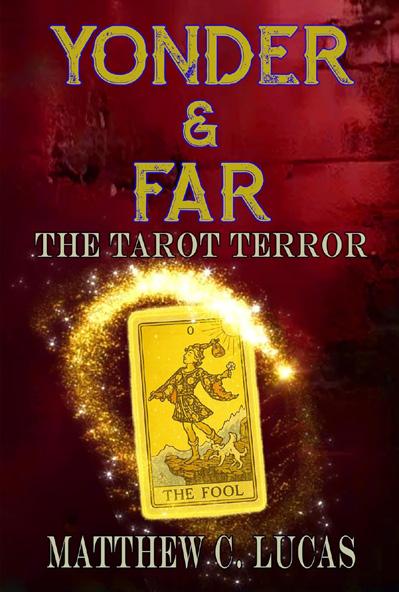
Boston in 1800 is the setting for burgeoning strife between the Federalist and Republican political factions. As if the infant nation doesn’t have enough problems, two extradimensional visitors, Mr. Yonder, a lawyer, and Captain Far, a military officer, have been banished there for a perceived offense against the royalty in their home realm. Their heartfelt desire to get home continues to elude them. Now, along with their existing problems in a strange and dreary (for them) world, a new threat has emerged from their homeland, intent on finishing them off once and for all. Their only allies against this seemingly insurmountable enemy are a small, ragtag
band of local Irishmen and Mary, a matronly, world-weary fortuneteller and her Tarot cards.
Second in a series, much of this novel is constructed in a consistently smart and amusing dialogue in a classic and endearing sort of way. The reader’s vocabulary will improve entertainingly and effortlessly following the bends in the road of this comedic action-adventure fantasy. A banker’s wife, Mrs. Wittenthorpe, a client of Mary, whose naked body is described as “like a mound of milk pudding,” makes an all too short appearance in one of the most unforgettable passages. Captain Far’s demonic personal battle flag first horrifies but then impresses his squad of Irishmen. The final climactic battle against the otherworldly enemies is worthy of comparison with “The Magnificent Seven.” To quote from the novel, one would have to be “dim as a broken lamp post” and risk a “good finger wagging” from Mr. Yonder not to like this book immensely.
I reviewed the first in the series a while back and was very impressed. This one, which reads fine as a standalone, is even better. Uncommonly clever, non-stop humorous and just superb.
Thomas J. Howley
THE GEOMAGICIAN
Jennifer Mandula, Del Rey, 2026, $29.00/ C$39.00, hb, 464pp, 9780593983300 / Del Rey, 2026, £20.00, hb, 464pp, 9781529954005
Jennifer Mandula’s historical fantasy tackles paleontology versus religious ethics along with geomagical happenings. There are five large roles in play, balanced against many bit players, including cameos from 19th-century historical geologists such as Conybeare, Lyell, and Mantell. In Victorian Lyme Regis, following a landslide, fossilist Mary Anning comes across an egg beneath a fossilised mother pterodactyl. Held delicately between her palms, the egg begins to crack, and a pterodactyl pecks his way out, orange beak first. Mary names him Ajax.
Mary, Henry, and Lucy and her brother, Edgar, were inseparable as children, but adulthood saw them pursuing differing interests, three blessed with financial fortune, while Mary still struggles, selling her finds for a pittance. Geologist William Buckland, ever her friend and mentor, faithfully buys her specimens, but poor folk like Mary must sometimes sell their reliq magic to survive. The magic accumulated and stored in a fossil reliq can lawfully be sold to a reliquemist—a shameful thing for those in need. After years alone, Mary is both heartened and apprehensive when Henry reappears in her life. Perhaps she can realise her lifelong dream to be a geomagician with Henry’s and William’s support. Ajax must be presented to the London Geomagical Society, but Mary ignores William’s specific warnings to stay home. Will the irresistible, damnable Henry honour his promise or betray her interests?
This is a strikingly inventive world, and Mandula is an accomplished writer. She sprinkles a bit of magic onto a deliciously clever, believable Victorian world, leaving readers to juggle politics, street demos, scientific study, Protestantism (including the archbishop and his Inquisitors), power plays, greed, betrayal— all recognisable things. Of course, with a live pterodactyl tearing about, the story is not
without its supernatural marvels. Ajax is such a delight, I want to adopt him. Maybe after the sequel? A splendid debut.
Fiona Alison
WAYWARD SOULS
Susan J. Morris, Hodderscape, 2026, £22.00, hb, 400pp, 9781399734875 / Bindery Books, 2026, $19.95, pb, 400pp, 9781967967025
Wayward Souls is the sequel to Strange Beasts, novels set in a fictional world featuring descendants of characters from Bram Stoker’s Dracula and Arthur Conan Doyle’s Sherlock Holmes series.
This instalment picks up from where the first novel ends. It is the early years of the 20th century. Samantha Harker, Helena Moriarty and Jakob Van Helsing are employed by The Royal Society for the Study of Abnormal Phenomena based in London. When four men disappear in mysterious circumstances in Ireland – two of them field agents for the Society – the trio is sent out to investigate, and a complicated story unfolds with many eerie and unsettling twists and turns. With the Irish Separatist Movement growing in strength, feelings against the English are strong and initial hypotheses suggest that the disappearances may have been politically motivated. However, it soon becomes clear that supernatural forces are also at work.
The novel is steeped in a world of Irish folklore and mythology – and there is certainly lots of it (the Dobhar-Chú, the bean-nighe, the sluagh, the Ceol Sidhe, the Morrígan, the Wild Hunt). These references are always interesting although sometimes a bit bewildering in their profusion. There are numerous narrative strands, some, though, hard to follow and not all of them adequately developed. Individual scenes – with some genuinely creepy occurrences as well as some powerful moments of disturbing horror – are arguably more effective than the overall narrative drive with the reasons for events and their interconnections often unclear – at least for this reader.
Overall, I did enjoy this novel, and it is worth reading particularly for its Irish setting. It can be understood without reading the first novel, but I feel that starting with Strange Beasts would make more sense of the character dynamics and back-stories. An entertaining, if flawed, slice of modern Victorian Gothic.
Adele Wills
LOCHBOUND
Rebecca Templeton, Sphere, 2026, £22.00, hb, 400pp, 9781408724873
Lochbound is the debut historical fantasy novel by Rebecca Templeton, a dark reimagining of The Little Mermaid set in Scotland in 1725. The prologue tells us that the monster, Moireach, was created 50 years ago and now lives in the loch outside the village of Kilmara. For six hours every night, the girl imprisoned within the monster is allowed to resume her human form, but she must return to the dark waters at dawn. When a body is found near the village, gruesomely mutilated and with its heart removed, suspicion falls on the monster and a fearsome hunter is summoned by the local laird to kill the vicious beast before more villagers are threatened.
Templeton’s writing is beautiful, and she
works hard to create an atmospheric setting. The isolated location, with its creepy loch and its dark, brooding castle, is very effective. We learn that the laird has systematically executed all women suspected of witchcraft, and the charred stakes and witches’ graveyard remain as a grim reminder of those events. And the use of Scottish folklore – kelpies and Seelies – reveals a place of superstition, mysterious beliefs and other-worldly practices.
The story moves between the viewpoints of the three main characters – Iris (and Moireach); Iris’s long-time admirer and friend, Duncan; and the monster hunter, Henry. This works well to give us different perspectives as events unfold and relationships develop. While I was totally gripped at first, the story started to meander a little as it progressed and would have benefited from greater concision. There are many twists and turns in a complicated plotline, and I found that some of the narrative cliffhangers were not fully resolved. And the ending, although satisfying, took a bit too long to draw to a conclusion.
Overall, though, this is an enjoyable and inventive read particularly for readers interested in Scottish folklore and mythology.
Adele Wills
ALTERNATE HISTORY
THE BEHEADING GAME
Rebecca Lehmann, Crown, 2026, $29.99/ C$39.99, hb, 320pp, 9798217086481 / Harvill, 2026, £16.99, hb, 336pp, 9781787305687
On May 19, 1536, Anne Boleyn’s head is struck from her body by a professional swordsman. Then she wakes in the Tower, escapes carrying her head, steals a sewing box, stitches her head back on, rids herself of the blood-soaked overdress, and sets off to seek retribution. Henry has robbed her of so much! Her reputation, her freedom, her life.
In this new world, Anne must plan cautiously. Alice, a shrewd street woman, shelters and guides her first foray into a world as duplicitous as court circles. Anne steals money, triggering rumours of a dead queen walking and is chased by Tower guards. Alice aids her escape to the Fenlands. They become close, but Anne must return to London to protect her daughter.
This is a highly inventive way to learn about the Anne beneath the bravado, her love for Henry, her fixation on securing Elizabeth’s future. Brave yet insecure, haunted yet resolute, she wanders the countryside protected by a white bull, the Boleyn mascot. She follows the directions given her when leaving the Fenlands, yet sometimes traverses the same ground more than once before finally seeing the distant lights of London.
This is such a good story, bending a traditional narrative and weaving the threads towards a fine conclusion. Of the five tarred heads Anne sees, she cannot distinguish her brother, George, from the others. We feel her grief as painful memories of George play into happy reminiscences of childhood and Anne’s deep love for him. These memories tenderly offset the appalling charges leveled against her. Unlike many fantasies, this has more than its fair share of reality, and we picture a more corporeal Anne outside the rigid court rules, the political game playing, the duplicity,
the grasping and grifting, the danger. Is Anne finally ready to face death? Find out in Lehmann’s historical debut.
Fiona Alison
CHILDREN & YOUNG ADULT
ESCAPE FROM THE CHILD SNATCHERS
Sufiya Ahmed, Andersen Press, 2026, £7.99, pb, 204pp, 9781839136511
The year is 1865. Humza and his little brother Usman are living in Bombay’s (Mumbai’s) poorest area. Their mother works as a servant for a white Englishman and his family in the local mansion. Both boys and their mother are deeply saddened because their older brother, Dani, left on a ship as a lascar or seaman to travel to England. He promised he would come back but has not returned.
Humza is called “useless” by the English wife. Incensed by this, he decides to stow away on a ship to find Dani in England and bring him home. His best friend, Ranj, who is a budding entrepreneur, hears of this plan and won’t let Humza undertake this mission alone. The rest of the narrative follows their perilous journey to England and their attempts both to find Dani and to evade the child snatcher, an evil man called Basil Brookes, who preys on unaccompanied children of colour and enslaves them in his child circus.
This is an information-packed book about a little-known facet of history. The representation of child circuses in Ahmed’s novel is dehumanising, with the children locked in cages despite being visibly ill and their faces painted as clowns. If they did not satisfy Brookes, they could be starved for several days. There is also a hint that young girls in this position could be sexually exploited.
The narrative voice is a little too contemporary at times, very much reinforcing modern thought patterns. While valid, this does interrupt the narrative flow. Visually, the book could be read by upper primary school children, which is deceptive because the contents are suited to middle secondary level. There is discussion of race, class and child slavery.
Rebecca Butler
Gidon, born with a clubfoot and the ability to foresee disastrous weather, has accepted the fact that he’ll likely never have a family of his own. As Moses’s people stand on the brink of crossing into the Promised Land, a family betrayal forces Milcah onto a dangerous new path. Yet it’s better than the alternative: forced marriage to a merciless bully.
The novel unfolds through four different voices from the same family, including the watchful spirit/rapha of the twins’ late brother, Netanel. It’s an emotionally painted portrait of secrets, misunderstandings, and betrayal that fractures one family’s most precious gifts. Our spirit narrator, while unable to effect changes, reflects on the changes coming for his family and the challenges associated with letting go of the past. The author skillfully capitalizes on a poignant interplay of a helpless Netanel who desperately wants to reach to his siblings from beyond the veil and those in a position to help but whose fear blinds them to the truth. Milcah’s and Gidon’s personal struggles and continued ties to grief add heartfelt depth. Each voice is distinct in how it views and interacts with the world. The narrators offer youthful and sympathetic perspectives amidst a setting rich in herbal lore, bygone landscapes, mysticism, and daily life in a tribal culture–anchoring the narrative in time and place. This blend of family turmoil, grounded historical detail, and coming-of-age journeys creates a layered, immersive narrative. Recommended. Young adult.
J. Lynn Else
THE HOME WE DREAMED
Anca Sandu Budisan, Quill Tree, 2026, $19.99/ C$25.99, hb, 40pp, 9780063373051
When a young couple is only allowed a small plot of land by the river, they use their hands to make bricks for a house. Over the years, it becomes a true home, cherished by the generations to come. The tale is told by a now-grown grandchild who spent summers there. Through the changing years and the fall of Communism in Romania, this gentle story evokes nostalgia and comfort. Its soothing tone reassures that home is always there.
With detailed art centered on the house, this story will encourage parents and grandparents to tell their own family stories to children. Ages 4-8.
Lisa Lowe Stauffer
LAST DAYS IN MOAV
Sharon Reiss Baker, Apples & Honey Press, 2026, $19.95, hb, 320pp, 9781681157061
Milcah and Gidon possess a supernatural gift for healing, though some people in their tribe whisper that the twins use magic or the help of Egyptian gods. With an ailing mother and an older brother lost to a flood, they’ve always lived on the margins. At 16, Milcah wants to be seen like other girls instead of feared.
THE CENTER OF THE EARTH
Darlene P. Campos, Blue Handle, 2025, $14.99, pb, 300pp, 9781955058285
Excellent YA historical fiction based on real experiences by Jews and Ecuadorians in Germany and Ecuador. The daughter of an Ecuadorian diplomat in Berlin meets and befriends German Jews on the eve of the Holocaust. Small acts of courage and kindness by her and her family contrast with the brutality practiced on Germany’s Jewish citizens. Kristallnacht, the deportations, and the Holocaust occur in the context of real people’s lives, not as historical dates and numbers.
The relationship and adventures of the Ecuadorian girl and a Jewish boy provide the story’s focal thread. The Holocaust is in the background but incites much of the action,
revealing many people’s characters by their reaction to incidents. Of necessity, the story delves into life-threatening discrimination, violence, and separation.
Who is my neighbor? Who is my family? Many family members disappear into Nazi prison camps, the true nature of which is withheld from their victims. Death and dying are investigated in an age-appropriate manner, not as cartoonish action but as a real hazard. Defying the Nazis’ Final Solution showcases the compassion and daring of Ecuadorian diplomats.
Escape to Ecuador does not finish the story. For there, at the center of the earth, separation and discrimination also weigh on the protagonists. Love and courage may not conquer all, but they make a satisfying response to the outrages of that or any time.
Ron Andrea
SILVER WOLVES
Jerome Charyn, Triangle Square, 2026, $19.95, hb, 256pp, 9781644215180

Magical and grim, urban yet otherworldly, Silver Wolves is a South Bronx fairy tale. On these mean streets, amid brutality and poverty, miracles happen. Perhaps the biggest miracle is the author. At 88, after 50 works in many genres, Jerome Charyn has produced his first young adult novel, a tale of legendary deeds and romance—and gang warfare.
It’s 1952. Our hero, 15-year-old Jonah Salt, languishes in a vile dungeon (juvenile jail). Only a miracle can spring him … His story, however, really began 10 years before, when he and his idolized older brother, Michael, discovered a filthy, bloody, yellow-eyed wolf under their stoop. When washed, its dirty fur turned silver. Although this apparition soon vanished, it inspired the name and insignia of their gang. Led by Michael, the Silver Wolves roamed the Bronx streets wearing jackets with yellow eyes on their backs. Yet they were Robin Hoods, not ordinary hoods. Besides mischief, they did good deeds and kept the neighborhood safe.
But now Michael is a military prisoner in Castle Williams on Governors Island. Rival gangs threaten the Wolves’ territory. It’s all up to Jonah, but fortunately, magical good luck strikes. Aided by his own talents, Jonah enrolls in the High School of Music and Art, which Charyn himself attended in 1952.
Jonah’s further adventures unfold in a wonderworld of castles and palaces (a.k.a. schools, prisons, and police stations), inhabited by a Cafeteria Queen, Kid Galahad (a bare-knuckle fighter), an advertising baron, the Cannibals (a rival gang), a Pickle Man, a fairy godfather, and a high-I.Q. Manhattan princess in a chariot (a wheelchair). Also present: autobiography, insanity, antisemitism, polio, and abortion. Nevertheless, the whole marvelous tale is flavored with humor as tangy as the half-sour pickles that the Pickle Man sells.
Susan Lowell
THE GOLDEN MONKEY MYSTERY
Piu DasGupta, Nosy Crow, 2026, £7.99, pb, 256pp, 9781805137276
This mystery tale from the Raj introduces us to Roma, a charming, reckless heroine, a young Indian girl who can talk to cats – well, one cat, anyhow, her friend, Birala. The search for an evasive golden monkey and a cursed jewel, the Snakestone, propel the action, while Roma’s ebullient love of science and her desire to become a doctor add an ambitious energy.
In this all-out action thriller, Roma has soon left her school to pursue a rare golden monkey into the forest. On the banks of a stream both she and a passing bandit discover that the monkey has somehow retrieved the lost and almost mythical Snakestone, a huge, yellow diamond. The bandits’ decision to sell both monkey and jewel to the nearest feringhee (foreigner) leads to a series of mishaps, the involvement of the notorious bandit queen, Devi, and the recruitment of two English children to Roma’s little band. The heady mixture of banditry, science, adventure and magic is all somehow kept on course by the resourceful Roma, as the children negotiate gunfire, wild animals, train hijacks, and near drowning. The eventual reunion with Roma’s father is not the usual conclusion: he is an affectionate but obtuse and disappointing figure. Roma learns she must think and act for herself if she wishes to succeed in her aims, that ‘she must write her own story’.
With taut, focussed plotting, humour and engaging characters, this novel is a great read, with some new fact or incident emerging on every page. Lovely, riddling line drawings –ambigrams, images whose meaning changes when they are flipped upside down – illustrate the text and offer clues.
The second book in the Snakestone Cycle, this novel also works excellently as a stand-alone work. Recommended for children of 10 – 14.
Jane Burke
SONGS FOR GHOSTS
Clara Kumagai, Zephyr, 2025, £14.99, hb, 464pp, 9781803288086
When Eurasian 17-year-old Adam, a student of the cello and Japanese, is struggling from breaking up with his boyfriend, he discovers a 1911 diary in the attic of the home he shares with his father, stepmother and baby half-brother. The author is a young Japanese girl living in Nagasaki whose words are compelling and captivate Adam. Inspired by Puccini’s Madame Butterfly, this is a deep and sensitive emotional tale of love and loss. The title reflects the importance of music throughout all the characters’ lives both past and present, as ghosts haunt and thread through time. Adam embarks on a haunting quest which leads him from America to Japan where untold family secrets are revealed to him. This is a beautiful and heart-wrenching, tense, supernatural story of: love, death, misogyny, racism, betrayal, conformity, friendships, relationships, homophobia, and identity. There are many layers to this novel that will intrigue and provide opportunity for deeper conversation on any of the above listed aspects. Japanese poetry and songs from the past, traditionally played on ancient instruments by the partially sighted, who performed ghost songs, add a hauntingly beautiful quality to the two timelines of the diarist
and Adam. Aspects of Japan’s history and culture delight as the plot gathers pace.
This is a gentle ghost story that lingers, but the topics raised through the characters’ painful experiences and loving moments resonate with many issues faced by young lovers today, especially understanding personal identity and an individual’s journey of self-discovery.
This brilliantly researched book is recommended for confident readers of 14+ years, who have an interest in music, Japanese myths and history, and ghosts.
Valerie Loh
HEIRESS OF NOWHERE
Stacey Lee, Sarah Barley Books, 2026, $19.99/ C$27.99, hb, 400pp, 9781665978965
The main character of this Gothic, partfantasy, young adult historical novel is 18-yearold Lucy. In 1918 she lives and works on a great estate called Nowhere, owned by Dakon Sanders. The estate, in northwest Washington, includes a grand main house, a thriving shipyard run by Sanders, a church, many smaller structures, and a pristine shoreline. Lucy arrived there as a baby, alone in a green canoe. Sanders took her in, and she has become a talented illustrator of his favorite plants and animals. Lucy can communicate with the local orcas even while she sketches them.
From time to time, severed seal heads show up on beaches, and one otherwise “ordinary” day, Sanders’ own severed head sits on the shoreline. The initial turmoil of the dead boss grows into greater disarray when it is revealed Sanders has willed his estate and fortune to Lucy. Rumors say a malevolent spirit, working through local orcas, killed Sanders and perhaps others. She knows they are harmless to humans. All manner of staff come under suspicion but are ruled out. The local sheriff focuses on Lucy. She must now find the killer or killers, run the entire estate, try to learn the true story of her parents, and sort out a love triangle of two young men who fight over her.
The many characters, helped by delightful names such as “Mrs. Bonefat” for the head housekeeper, all come to life. Beautiful descriptions of the estate and neighboring islands and seas draw readers into each scene. Lucy’s multiple investigations take her (and readers) down many false leads until almost the very end. Her love triangle might not be needed, but both young men help her find answers. This solid addition to the novels of author Lee should intrigue old and new fans.
G. J. Berger
LOOKING AT THE SKY
Amanda West Lewis, illus. Abigail Rajunov, Kids Can Press, 2026, $16.99/C$18.99, hb, 80pp, 9781525310249
Seven-year-old Izaak never knew his father, who died in World War I, and when his mother dies of tuberculosis in 1922, the boy’s older sisters send him to a Jewish orphanage in Warsaw, Poland. The head of the orphanage, Dr. Janusz Korczak (whom the kids call Pan Doctor, Mr. Doctor in Polish) has some interesting approaches to teaching children and taking care of them. All the children work together to keep the orphanage clean and safe, and both children and adults who misbehave face a trial of their peers, with penalties designed to teach rather than punish. Over the years, Izaak goes from being a frightened child helped by older children
to the older child who helps other to adjust, until he turns 14. Then he must leave, but he starts his life outside in good health, with a solid education, and with the confidence to become a productive citizen.
This child-friendly graphic novel for middlegrade readers focuses on the contributions Dr. Korczak made during his lifetime. He is best known for his courageous defense of the Jewish children under his care during the Nazi Holocaust, a decision that led to his murder by Hitler’s regime along with the children and the rest of the staff. However, this tragic event receives less attention than the daily life of the Dom Siderot orphanage that he founded, the generations of children he guided, and the impact his teachings had on young people like Izaak (a composite of several orphans who eventually emigrated from Poland to Canada before World War II) and those who read his books. Sepia-toned illustrations convey the historical setting and the calm, uplifting atmosphere of the orphanage. Backmatter includes an author’s note, glossary, and bibliography.
Lyn Miller-Lachmann
THE MYTHMAKERS
Tamzin Merchant, illus. Katarzyna Doszla, Puffin, 2025, £14.99, hb, 336pp, 9780241610435
This unique version of the famous Arthurian legend holds its own captivating magic.
The engaging characters, coupled with the many mythical creatures, add to the rich tapestry of the plot and time itself. Gwyn and Merlin build a lovely friendship that changes and grows over time, and as Arthur enters the dynamic, humour is woven through the drama as skilfully as the threads on a tapestry.
Nature is described in context with life, song, and time; a natural power that is threatened by the devastation and greed of the retreating Roman army as it withdraws from Britain’s 5th century shores. Can Gwyn stop them from tearing down the ancient magical Oakheart? How can she? With the help of Merlin? What of Arthur? Read on and turn each beautifully illustrated and written page – you will not be disappointed.
From my initial attraction to the book’s beautiful cover, to the absorbing opening lines, there is a pull that builds and intrigues as the dynamic plot begins following young Gwyn on her extraordinary adventure. The skilfully described intricate detail is effortlessly slipped into the action, delighting the reader as each myth becomes their reality and the reader is left pondering where the fine line between the wonder of nature and the magic of myth blurs. This is a beautiful book in so many ways; from the original and engaging retelling of the Arthurian legend to the illustrations that bring nature to life on the page of this magical historical fantasy adventure.
Suitable for 10 – 14 years, but I would highly recommend it for readers of all ages beyond its original target market.
Valerie Loh
FOOTEPRINT
Lindsay H. Metcalf, Charlesbridge, 2026, $18.99/C$22.99, hb, 294pp, 9781623546335
Eunice Newton Foote had a genetic and familial predisposition for science, being a relative of Sir. Isaac Newton himself. But the cultural beliefs of her day limited a woman’s access to scientific study. And should a woman
make a scientific breakthrough and invent something, she had no legal ability to own a patent in her own name for much of history. Despite these educational, cultural, and legal limitations placed upon her, Eunice Foote made her mark on science. She recognized early on that too much carbon dioxide in the atmosphere was an early cautionary sign of global warming. In 1856 she published a paper claiming carbon dioxide in the atmosphere would eventually alter the climate, a phenomenon we now know as the Greenhouse effect. Her work, which came to light in recent years, predates that of John Tyndall, who was formerly thought to have originated the idea. Perhaps having her discoveries credited to a man bolstered her other interest: women’s rights and suffrage.
Metcalf’s book is a work of fiction, based closely on fact. She provides an extensive bibliography with both primary and secondary sources. The free-verse format used by the author gives the book an accessible feel that lends light and air to the telling and infuses the science with emotion, making it a topic today’s young scientists will want to explore. Middle grade.
Rebecca
Langston-George
ROSE BY THE SEA
Rebecca Rose Mooradian, illus. Myo Yim, Atheneum, 2026, $19.99/C$27.99, hb, 48pp, 9781665944137
Dzovinar, which means “rose by the sea,” lives cozily with her sister and parents in a cottage beside a lake, surrounded by flowers. But when Turkish soldiers take their parents, Dzovinar and her sister must emigrate alone, crossing a desert on foot and relying on the kindness of strangers, including a Turkish family that hides them. Later a nun helps them, along with others, board a ship to France. Ultimately, they emigrate to Detroit, in the United States.
With a story centered on colors and beautiful dreamlike art, this book brings the reader through the Armenian genocide with an unexpected gentleness. It’s based on the author’s great-grandmother’s experiences.
This book has done a wonderful job of balancing the girls’ heartache with lyrical colorcentered memories. Its message of strength and hope will resonate with any immigrant today, and provide their classmates a gateway to empathy. Ages 4-8.
Lisa Lowe Stauffer
EVANGELINE’S JOURNEY
Cathie Pelletier, illus. Paige Smiley, Down East Books, 2026, $24.95, hb, 240pp, 9781684750610
Henry Wadsworth Longfellow’s poetry largely fell out of high school curricula long ago, but his poem “Evangeline, A Tale of Acadie” has proven immortal for its depiction of a historical event: the removal by the British of Frenchspeaking Acadians from Canada in 1755. They had created an idyllic rural life 150 years earlier, isolated near the Bay of Fundy, and were left to themselves for decades after the British won Canada from the French. But then the soldiers come, and Evangeline Bellefontaine, the 17-yearold daughter of the richest farmer in the village of Grand Pré, is deported in the chaos that scatters families. Her fiancé Gabriel is loaded onto a different ship with a different destination as
their houses burn behind them, their community and identity destroyed. Cathie Pelletier sticks to Longfellow’s story until the Acadians are sent to the British colonies below the Canadian border. Then her book becomes not simply the chronicle of Evangeline’s search for Gabriel but her personal quest as she makes her way alone, vivid in each moment as she experiences it. As in Longfellow’s version, Evangeline barely misses Gabriel on occasion, but his spirit remains with her, and she never gives up.
The poem “Evangeline” was celebrated in the 19th century, and this contemporary novel is a classic in its own right, accessible and appealing to all ages. It too illuminates the variegated life in the colonies before the Revolutionary War, but in an engaging style with an ending that stirs more satisfying emotions. Evangeline’s struggles embody that of any refugee forced to leave their homeland, trying to survive and create a new life among strangers. Evangeline’s Journey will be an excellent addition to school libraries. Young adult.
Jinny Webber
THE MYSTERIOUS LOPSIDED LETTER
Ellen Schwartz, illus. Margeaux Lucas, Apples & Honey, 2026, $17.95, hb, 80pp, 9781681157207
In 1785 Boston, Catherine Hays, her cousin Judah , and their friend Joseph Revere, son of Paul Revere, play together in the clubhouse in the backyard of the Hays’ home. One day flyers are posted all over Boston protesting the Jewish services held in the home of Moses Michael Hays, Boston’s most prominent Jewish citizen who is Catherine’s father and Judah’s uncle. The flyers claim the gatherings are “unlawful” and that Moses Hays has “insulted Christianity.” While the grownups are busy discussing what should be done, Catherine, Joseph, and Judah act, determined to tear down every flyer they can find, discover who is responsible, and confront them.
Book One in the new Liberty Clubhouse series, this transitional chapter book takes readers on a fast-paced mystery though Boston. It is set in a period when Jews lacked full rights as citizens, without the right to vote, hold office, or even build a synagogue in Boston. Schwartz presents the topics of religious prejudice and religious freedom in a digestible story for readers in second to fourth grade. Young readers will recognize themselves in the characters, despite the 240 years that separate them. Black-andwhite illustrations add details of the historical setting and clothing. A historic map of Boston, with the sites the children visit on their quest marked, will help ground readers as well as be fun. Backmatter includes “Fact or Fiction?,” “May I pour you some tea?,” “By the Numbers” (which includes the fun fact that Joseph Revere had 15 brothers and sisters!), “What did kids do for fun in 1784?,” and “Learn to Curtsy or Bow.” This is not only a good introduction to the period, but an excellent way to introduce religious tolerance.
Meg Wiviott
THE SPIRITUALISTS
Kristin O’Donnell Tubb, Simon & Schuster, 2026, $19.99/C$27.99, hb, 416pp, 9781665985734
Stella is a medium. A fake, of course, except that what Stella is faking is the fact that she really is a spiritualist, in constant contact with the spirit world. Their voices are a gift, but also a burden, and it’s one she bears alone. Apart from her semi-stray cat, Stella is friendless, living hand to mouth in early 20th-century New York City, trying to make a living while being hounded by religious types anxious to drive spiritualists out of business. But when Stella meets Pax, a handsome young man on a mission to get revenge for the death of his sister in the Triangle Shirtwaist Factory fire of 1911, everything changes.
This young adult novel rattles along a great pace. It becomes a heist novel, full of charm and heart, with lots of twists, turns and uncertainties to keep the reader happily engaged. As well as leaning into the true history of the Shirtwaist Factory fire, this story features the legendary Hope Diamond. Pax’s plan to get revenge brings new people and friendships into Stella’s life, and her guilt about her own sister’s death adds to the emotional mix. Tubb weaves history, fantasy, romance, and adventure together beautifully here. Is there potential for future adventures of Stella’s newly found family? I’d hope so.
Kate Braithwaite
THE CAVE EXPLORER
Kate Winter, Puffin, 2025, £14.99, hb, 80pp, 9780241469927
Kate Winter’s previous picture book The Fossil Hunter, a biography of paleontologist Mary Anning, won her the 2024 Klaus Flugge Prize awarded to the most promising and exciting newcomer to UK children’s book illustration, specifically recognising a published picture book by a debut illustrator.
In The Cave Explorer she takes another deep dive uniting the distant past with recent historical thinking. It is the story of the discovery in 1940 by a teenage boy, Marcel Ravidat, and his dog of the prehistoric paintings on the walls of a cave at Lascaux in France. It opens with the words: ‘There are many different ways to tell a story. They can be spoken, written down or made of pictures. A good story tells us something about the world, or something about ourselves. The very best stories do both.’
Kate Winter investigates this story plus facts, ideas and theories around it in a variety of ways that encourage further exploration. Following the story of the discovery and its revelation to the world, she narrates its influence on historical research and methodology more broadly and shows historians and archaeologists asking questions. Especially interesting is the work of Annette Laming-Emperaire who sought meaning in patterns in the artwork rather than ‘creating a theory and then looking for evidence that matched’.
The palette Winter uses in the illustrations, predominantly featuring shades of brown and bluish-grey as befits the gloomy interior of the caves, only serves to make lighting up the paintings even more vivid. This is particularly striking in one of several uses of flap folds, when opened, reveal Marcel’s first sight of the paintings, lit up by his oil lamp.
Ann Lazim
CONFERENCES
The Society organizes biennial conferences in the UK, North America, and Australasia. Contact Richard Lee <richard@historicalnovelsociety.org> (UK), Elizabeth R. Andersen <hnsnaboardchair@gmail.com> (North America), or Elisabeth Storrs <contact@hnsa.org.au> (Australasia).