FA L L 2 0 2 6 ED I T I O N
N O V E M B E R 6– 8, 202 6
A Collector’s Preview
Chase Center on the Riverfront Wilmington, Delaware
Thursday, November 5 6–9 pm
Experience one of the most acclaimed antiques shows in the country, where more than 60 distinguished dealers present an extraordinary showcase of Americana, art, antiques, and design.
Celebrate the opening of the show with cocktails, hors d’oeuvres, and exclusive early shopping. Tickets include entry to all three days of the show and to Winterthur during the show dates.
RESERVE YOUR TICKET!
800.448.3883 | winterthur.org/DAS
SEE THE WEST WITHOUT LEAVING THE SOUTH
EXIT 288 ON I-75 IN CARTERSVILLE WWW.BOOTHMUSEUM.ORG | 770.387.1300 FALL 2026 EDITION
1
The American Ceramic Circle (ACC), founded in 1970, is a community of professionals, collectors, and enthusiasts that share an appreciation and interest in the study of ceramics of all kinds, periods, and origins. The organization hosts multiple events throughout the year to provide opportunities to discover and learn more together. This fall, October 21–23, the annual symposium will be held in Chicago in partnership with the Art Institute of Chicago (AIC). In addition to events, our numerous member benefits include: Member price for Annual Symposium ACC Journal and ACC Newsletter subscriptions Access to the membership directory and archive of ACC publications
To inquire about how to join or to learn more about the annual symposium, visit our website at americanceramiccircle.org or contact
Ripley Lucas-Tagliani, ACC Administrator, at admin@americanceramiccircle.org 2
FREEMAN’S | THE 1805 EDIT
FAL L 2 0 2 6 ED I T I O N
WORDS Ariel Barkan, Tanner Branson, Christopher Brink, Courtney Chapel, Raphaël Chatroux, Lauren Colavita, Julia Comacchio, Ben Farina, Danica Farnand, Ben Fisher, Simon Hucker, Alison Lynch, Tim Luke, John Mackie, April Matteini, Charles Tearle, Adam Veil, Zachary Wirsum, Adrianne Wolkenberg EDITOR Courtney Chapel ASSOCIATE EDITOR Julia Comacchio DESIGN Jennifer Castle PHOTOGRAPHY Zoë Bare, Violet Christian, Carmen Colome, Manuel DaCunha Jr, Richard Hogan, Kristen Hudson, Roberto Martinez, Ola Piatkowska, Mike Reinders, Rachel Smith, Tarji Stewart
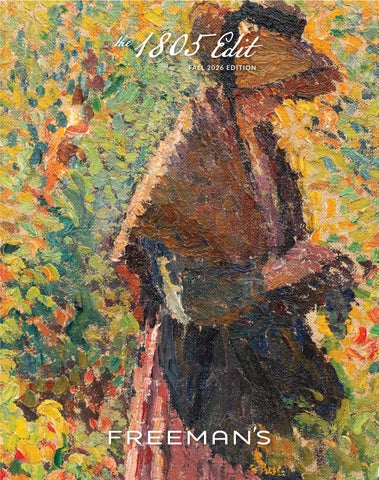
COVER, TO BE OFFERED APRIL 29, NEW YORK Henri-Jean Guillaume Martin (French, 1860-1943) Femme dans une Vigne Tenant une Grappe de Raisin Estimate: $40,000 – 60,000 Estate of Joan Wellhouse Newton Stein
THIS PAGE, TO BE OFFERED SEPTEMBER 23, CHICAGO Lacloche Frères, Art Deco, Diamond, Ruby, Emerald, and Sapphire Lapel Watch Estimate: $30,000 – 50,000 Property from an Important Midwest Collection FALL 2026 EDITION
3
CONTENTS 06 13 15 17 48
LOOKING BACK SNAPSHOTS FROM THE PAST SEASON
LATEST NEWS COMPANY ANNOUNCEMENTS AND UPDATES
AUCTION CALENDAR UPCOMING LIVE AUCTIONS
LOOKING FORWARD A FOCUS ON THE SIGNIFICANT AND NOTEWORTHY PROPERTY COMING UP FOR AUCTION THIS SEASON
BEYOND THE GAVEL: APPRAISALS INSIGHTS UPDATES, HAPPENINGS, AND ADVICE FROM FREEMAN’S APPRAISALS TEAM
52
A TRANSATLANTIC VIEW A VIEW EXTENDING BEYOND THE SHORES OF THE UNITED STATES TO INCLUDE OUR SISTER AUCTION HOUSE IN THE UNITED KINGDOM, LYON & TURNBULL
TO BE OFFERED DECEMBER 8, NEW YORK Frederick Childe Hassam (American, 1859-1935) Looking Up The Side of a Mountain, Harney, 1902 Estimate: $50,000 – 80,000 Estate of Joan Wellhouse Newton Stein FALL 2026 EDITION
5
LOOKING BACK
NOTABLE SUCCESSES SPRING // SUMMER 2026 IN REVIEW
NEW YORK
SOLD FOR $320,000 Richard Mayhew (American, 1924-2024) Finale, 2002 Property from the Collection of James Walter Compton, Chicago, Illinois.
NEW YORK
SOLD FOR $480,000 Important Diamond Ring Featuring an emerald cut diamond weighing 19.12 carats Property from the Estate of the Hon. Sandra Schultz Newman 6
FREEMAN’S | THE 1805 EDIT
PHILADELPHIA
SOLD FOR $352,000 [American Revolution] Franklin, Benjamin. PartiallyPrinted Promissory Note, accomplished and twice signed
PHILADELPHIA
SOLD FOR $230,400 Hermon Atkins MacNeil (American, 1866-1947) The Moqui Prayer for Rain (The Returning of the Snakes), modeled 1895-96; cast ca. 1897
NEW YORK
SOLD FOR $204,800 Pablo Picasso (Spanish, 1881–1973) Portrait de Jacqueline au chapeau de paille, 1962
FALL 2026 EDITION
7
LOOKING BACK
CHICAGO
CHICAGO
An Egyptian Bronze Falcon Late Period, 26th-30th Dynasty, 664-343 B.C. Antiquities of the Garden: A Collector’s Living Ancient World
Larry Vasquez (Aztec-Mayan-Mescalero Apache, b. 1947) 18K and 22K Gold and Gem Grade Turquoise Three-strand Necklace
SOLD FOR $217,600
8
FREEMAN’S | THE 1805 EDIT
SOLD FOR $17,290
LOOKING BACK
CHICAGO
SOLD FOR $140,800 Shakespeare, William (1564-1616). Mr. William Shakespear’s Comedies, Histories, and Tragedies. Published according to the true Original Copies. Unto which is added, SEVEN PLAYS, Never before Printed in Folio. London: Printed [by Robert Roberts, Robert Everingham, and John Macock] for H[enry]. Herringman, and are to be sold by Joseph Knight and Francis Saunders, at the Anchor in the Lower Walk of the New Exchange, 1685.
NEW YORK
SOLD FOR $1,522,000 Josef Šíma (Czech, 1891-1971) Europa, 1927 Property from the Ingersoll Family Collection, Philadelphia, Pennsylvania
NEW YORK
SOLD FOR $89,600 Marina B, Diamond and Yellow Gold ‘Esclave’ Choker Necklace
PHILADELPHIA
SOLD FOR $128,000 A Sand Art Bottle Andrew Clemens (1857-1895) McGregor, Iowa, Circa 1886
FALL 2026 EDITION
9
LOOKING BACK
THE FARBER LIBRARY: A WHITE-GLOVE SUCCESS BY CHRISTOPHER BRINK, AVP, HEAD OF SALE, SENIOR SPECIALIST, BOOKS & MANUSCRIPTS A book was the first item sold by Freeman’s founder, Tristram Bampfylde Freeman, after Governor Thomas McKean appointed him Philadelphia’s official auctioneer. In the more than two centuries since, Freeman’s has established an international reputation for presenting some of the finest and most significant printed works to come to auction. One of the department’s hallmarks has been the presentation of single-owner collections as dedicated auctions, allowing great libraries to remain together and be celebrated as the reflection of the collector who assembled them. This year, we had the great pleasure of offering The Library of Stephen J. Farber. When asked why he chose to consign his collection at auction, Steve’s answer was characteristically simple: “I would want to see these books go to people who will love them.” And that they did. All 274 lots offered found buyers, achieving the coveted “white-glove” status—a feat I have experienced only once in my career. Part of the sale’s success came from the fact that so much of the collection had not appeared at auction in decades,
giving us something every auctioneer loves to hear: “fresh to market.” But just as important was the subject matter. Steve was a collector of everything curious. From a first edition of Bram Stoker’s Dracula to J.R.R. Tolkien’s The Lord of the Rings trilogy, the books were touchstones of our collective imagination. Nearly every shelf seemed to hold something familiar: a dust jacket whose artwork was instantly recognizable, a title from a required school reading list, or the book behind a favorite film. That familiarity may also tell us something about the next generation of book collecting. As new readers enter the market, the books they seek will inevitably reflect the stories that shaped them, just as earlier generations collected theirs. Today, a novel can find an entirely new audience almost overnight through a successful film or Netflix adaptation, introducing millions of viewers to the book that came before it. For collectors and sellers alike, the Farber sale was a reminder that the market for rare books is not static. The books that inspire nostalgia, curiosity, and the desire to own a piece of a beloved story will continue to change with each generation—but the impulse to collect them remains much the same.
TOP Christopher Brink after the white-glove Farber auction LEFT A selection of books from the Library of Stephen J. Farber. 10
FREEMAN’S | THE 1805 EDIT
MARKING AMERICA’S 250TH WITH LANDMARK SALES AT FREEMAN’S BY CHRISTOPHER BRINK, AVP, HEAD OF SALE, SENIOR SPECIALIST, BOOKS & MANUSCRIPTS
For more than two centuries, Freeman’s has helped preserve the legacies of collectors, institutions, and estates across the country, placing the firm in a unique position to commemorate the Semiquincentennial. As America celebrated its 250th anniversary, Freeman’s marked this historic year with a series of landmark auctions, including Fathers and Saviors of Our Country: A Presidential Sale, alongside important material connected to past presidents and pivotal events that have shaped the nation. Taking its title from the iconic Currier & Ives print depicting George Washington as the “Father” and Abraham Lincoln as the “Savior” of the nation, the sale brought together extraordinary artifacts tracing the arc of American [Washington, George (17321799)]. Saint-Memin, Charles Balthazar Julien Févret de (1770-1852). Gold alloy and enamel mourning ring purportedly bequeathed in Washington's last will and testament. Circa 1800. Sold for $70,400 TOP RIGHT Charles Alfred Barry (American, 1830-1892) Abraham Lincoln: The Greek God, 1892. Sold for $102,400
leadership from the founding generation through the crucible of the Civil War and beyond. Several achieved record-setting prices, among them a rare Lincoln-Johnson 34-star eagle parade flag, which realized $281,000 and established a new auction record for an American campaign flag. A fresh-to-market oil portrait of Abraham Lincoln by Charles Barry—one of two known renderings by the artist who captured Lincoln’s first portrait—realized more than $100,000. Yet the material presented throughout the year extended far beyond presidents and politics, encompassing Native American history, the abolitionist movement, westward expansion, immigration, women’s history, and the struggle for civil rights. Together, our sales reflected the remarkable breadth of the American experience and the many people, communities, and traditions that have contributed to it, offering a tangible connection to our shared past. Some told stories of extraordinary achievement and progress; others bore witness to conflict, injustice, and tragedy. Together, they illuminated the complexity of the American story and reminded us that history endures through the objects that have survived it. Participating in this anniversary offered an opportunity to reflect on what it means to be American—and, for Freeman’s, what it means to serve as America’s oldest auction house. As the nation looks back on 250 years, we remain committed to interpreting and bringing to market the objects and stories that allow its history to endure. FALL 2026 EDITION
11
LOOKING BACK
A STANDOUT DEBUT FOR VIETNAMESE MODERNISM On July 21, 2026 Freeman’s presented its inaugural Vietnamese Modernists auction, and the market answered with resounding enthusiasm. Featuring 15 works by artists including Lê Phổ and Vũ Cao Đàm, the sale achieved $1,201,216, with 201% sold by value and a 93% sell-through rate by lot. Notably, new buyers accounted for 38% of participants, underscoring growing collector interest in the category. Leading the sale was Lê Phổ’s luminous Les Fleuristes (1973), which soared past its $120,000 low estimate to sell for $371,200. His 1963 oil on silk Dans le Jardin likewise tripled expectations, achieving $153,600. Both works showcase the artist’s enduring devotion to nature and the quiet poetry of figures within it. The results extended well beyond Lê Phổ. Trần Lưu Hậu’s Hanoi Street (2014) brought $118,403—nearly four times its estimate and the second-highest price ever for the artist. Vũ Cao Đàm’s Le Printemps (1983) and Le Serment (1955) each sold for $89,600, while Fernando Amorsolo’s Philippine Landscape (1920) hammered at $83,200, rounding out a sale that spanned the breadth of Vietnamese and Southeast Asian modern art. “I’m elated with the results of Freeman’s inaugural sale,” said specialist Raphaël Chatroux, Vice President, Head of Department, Impressionist & Modern Art. “It is further proof of the robustness of this emerging market and a confirmation of Freeman’s vital role in it. We can’t wait to put together our next edition come January.” With this milestone debut, Freeman’s cements its position at the forefront of a market whose momentum shows no signs of slowing.
TOP TO BOTTOM Vũ Cao Đàm 武高談 Le Printemps, 1983 Estimate: $40,000 – 60,000 Sold for $89,600 Tran Luu Hau 陳劉厚 Hanoi Street, 2014 Estimate: $30,000 – 50,000 Sold for $118,400 12
FREEMAN’S | THE 1805 EDIT
LATEST NEWS
FRESH FACES AT FREEMAN’S Muys Snijders Freeman’s welcomes Muys Snijders as Chief Executive Officer. With more than 25 years of international leadership in the auction, luxury, and art advisory sectors, Muys most recently served as Senior Vice President and Head of Art Services at AIG Private Client Group, advising collectors and institutions on the management, insurance, and valuation of significant collections. Her career also includes senior roles at Christie’s and Bonhams, where she specialized in Post-War & Contemporary Art. Named one of the Top 50 Women Leaders of New York and selected for the Observer’s 2025 Power Index, Muys brings a global mindset and entrepreneurial vision to the role and will lead Freeman’s next chapter of growth and innovation in the art market. Jelena James Jelena James is Freeman's new Senior Specialist and Head of Sale for Old Masters & 19th Century European Art. With more than two decades of experience in the international auction market, Jelena previously held senior specialist roles
at Bonhams Skinner and served as Director of Fine Art at New Orleans Auction Galleries, where she launched the firm’s first dedicated Fine Art auction and later founded its Modern and Contemporary Art & Design department. Her expertise spans European painting from the Renaissance through the early twentieth century, and she has directed the sale of notable rediscovered works, including a portrait by Thomas Gainsborough and a fifteenth-century portrait attributed to the Manner of Lorenzo di Credi. In her new role, Jelena will lead the department’s sales and advise collectors, estates, and institutions on all aspects of collecting European works of art. Kristin Aronson Kristin Aronson joined Freeman’s this summer as Chief of Staff, bringing more than 15 years of experience across the auction, gallery, and consulting worlds. Based in Philadelphia, she works closely with CEO Muys Snijders and the Executive Leadership Team on strategic initiatives across the firm. Most recently, Kristin worked alongside Muys at Art Business Consulting, following nearly a decade at Christie’s in senior business leadership roles.
FREEMAN’S TAKES THE STAGE AT PUCK’S THE ART OF INFLUENCE CONFERENCE Freeman’s will join leaders from across the international art world for Puck and The FLAG Art Foundation’s The Art of Influence, taking place September 23 in New York. Hosted by Puck Art Correspondent Marion Maneker and FLAG Art Foundation founder Glenn Fuhrman, the daylong conference will bring together artists, collectors, museum directors, advisors, auction executives, and other industry leaders for a series of conversations examining the forces shaping today’s art market. Among the participants will be Freeman’s CEO Muys Snijders and Chairman Jay Krehbiel, who will join Maneker for a conversation titled The Great Wealth Transfer in a Regional Context. Their discussion will explore one of the most consequential shifts facing the art and estate markets today: the transfer of significant family collections and estates from one generation to the next.
Drawing on Freeman’s experience working with collectors, families, and advisors across the country, Muys and Jay will consider how the Great Wealth Transfer is unfolding not only on an international scale, but within individual cities and regions. The conversation will examine the role that local knowledge, longstanding relationships, and regional expertise play as collections enter an increasingly interconnected global marketplace. The broader program reflects this intersection of established relationships and a rapidly evolving art world, with conversations spanning collecting, art advisory, museums, artists, and the future of the auction business. Additional participants include leaders from Christie’s, Pace Gallery, the Guggenheim, The Metropolitan Museum of Art, and other major institutions. FALL 2026 EDITION
13
LATEST NEWS
WHERE ART MEETS THE OPEN ROAD This August, Freeman’s put a fresh spin on philanthropy with the Philadelphia Cycling Classic “Cycles of Change” Charity Fine Art Auction, benefiting the American Association for Cancer Research (AACR). On August 27, two extraordinary artist-designed bicycles crossed the block at Freeman’s Philadelphia, transforming elite cycling engineering into collectible works of contemporary art. French artist Charles Hascoët reimagined a custom Parlee carbon-fiber frame, layering his signature gestural abstraction across the bike’s surfaces in a burst of color and motion. Realizing $7,040, the piece is as much a gallery centerpiece as a rideable machine. Philadelphia-based artist Odili Odita, whose work is held in the permanent collections of the Philadelphia Museum of Art and the Studio Museum in Harlem, brought his bold geometric language
14
FREEMAN’S | THE 1805 EDIT
to a Cannondale Synapse Carbon 4, paired with a matching custom jersey—also selling for $7,040. The bicycles debuted at a preview at Joan Shepp on August 18, before moving to Freeman’s Philadelphia galleries for public viewing August 25–26. The celebration culminated on the 27th with a cocktail reception and live auction, bringing together Freeman’s, AACR, the Philadelphia Cycling Classic, participating artists, and project partners for an evening honoring art, athletic achievement, and philanthropy. Proceeds directly supported AACR’s mission to accelerate lifesaving cancer research.
TOP Charles Hascoët (French, b. 1985) Parlee Force AXS SOLD FOR $7,040
BOTTOM Odili Donald Odita (Nigerian-American, b. 1966) Cannondale Synapse Carbon 4 SOLD FOR $7,040
AUCTION CALENDAR
UPCOMING AUCTIONS SEPTEMBER
NOVEMBER
17 NEW YORK Chinese Snuff Bottles from the Estate of Dr. Thomas Klein
3 PHILADELPHIA Pride of Place: Works from the Estate of Sydney F. Martin - Part II
18 NEW YORK Asian Works of Art 22 CHICAGO Collect: Photographs 23 CHICAGO Important Jewelry 24 CHICAGO Native American Art 25 CHICAGO Après Ski: Property from a Utah Mountain Residence
OCTOBER 1 NEW YORK Post War & Contemporary Art 14 CHICAGO European Furniture & Decorative Arts 22 CHICAGO Pop Fashion: Property from the Estate of Beverly N. Grossman 27 NEW YORK Impressionist & Modern Art 29 NEW YORK Watches
4 NEW YORK Prints & Multiples 5 CHICAGO Fine Printed Books & Manuscripts, Including Americana 10 NEW YORK Old Masters & 19th Century Art 12 PHILADELPHIA American Furniture, Folk & Decorative Arts 17 CHICAGO Modern & Early 20th Century Design 19 CHICAGO Antiquities & Ancient Art
DECEMBER 4 CHICAGO Property from the Kay and Fred Krehbiel Collection, Part IV 8 PHILADELPHIA American Art & Pennsylvania Impressionists 8 PHILADELPHIA Western Art, including Contemporary Native American 11 CHICAGO The Art of the Book, Including the Fine Press Collection of Richard Blacher
FALL 2026 EDITION
15
16
FREEMAN’S | THE 1805 EDIT
LOOKING FORWARD A FOCUS ON THE SIGNIFICANT AND NOTEWORTHY PROPERTY COMING UP FOR AUCTION THIS SEASON
18
THE ALLURE OF EMERALDS
20
WILLIAM MERRITT CHASE: A REPUTATION TAKES SHAPE
22
IMPERIAL MAJESTY: THE “NINE DRAGONS” VASE
24
REDISCOVERING ALEX KATZ’S SWIMMER #2
26
APRÈS SKI: THE ART OF THE MOUNTAIN RETREAT
28
HIDDEN IN PLAIN SIGHT: THE REDISCOVERY OF A GERTRUDE ABERCROMBIE
31
PLUCKED FROM THE PAST
32
THE DR. THOMAS A. KLEIN COLLECTION OF CHINESE SNUFF BOTTLES
34
A TEAR FOR HUMANITY: SAINT FRANCIS THROUGH THE EYES OF ALBERT BIRKLE
36
CHANEL: THE COLLECTOR’S COLLECTION, A JOURNEY THROUGH THE LAGERFELD YEARS
38
FERNAND LÉGER: BUILDING THE MODERN WORLD
40
A LIFE OF COLLECTING: THE KAY AND FRED KREHBIEL COLLECTION
42
RAIN-IN-THE-FACE: A WARRIOR’S OWN HAND
44
THE TIMELESS ALLURE OF VERDURA JEWELRY
46
SCHOLAR, COLLECTOR, CURATOR. DR. THOMAS FOLK ON A LIFE IN AMERICAN ART
FALL 2026 EDITION
17
BY ARIEL BARKAN, GG, SPECIALIST, JEWELRY & WATCHES 18
FREEMAN’S | THE 1805 EDIT
LOOKING FORWARD
brilliant-cut diamond weighing either 1.07 or 1.02 carats. Zambian emeralds are especially known for a deeper, slightly blueish green color, and typically have better clarity than emeralds mined in other regions. The overall effect of these earrings is magnificent. The diamonds expertly balance out the emeralds, enhancing their richness and depth of color. It is easy to understand why collectors worldwide have been drawn to emeralds for centuries. Their rarity, beauty, and versatility in jewelry have secured their status as one of the most expensive and highly coveted gemstones. hroughout human history, emeralds have been used for adornment as a symbol of life and regrowth. Emeralds were a favorite stone of Cleopatra, studied by Pliny the Elder, and crafted into jewelry by the Incas. Today, emeralds are considered one of the most valuable colored gemstones in the market. They are the medium light to dark green variety of the mineral Beryl, sometimes exhibiting a slightly yellow or blue hue. The most important value factor for purchasing emeralds is color, which can often provide clues to its geographic origin and influences the cutting style. Emeralds are cut to intensify their distinctive green color while minimizing weight loss from the original rough stone. Major sources are Colombia, Zambia, and Brazil, although emeralds are found in other locations as well. They are often included and it is expected for emeralds to have eye visible flaws, unlike diamonds. Oil is the most common and accepted clarity enhancement to improve these flaws. Two exquisite emerald and diamond jewels are being offered in the September 23 Important Jewelry auction. The first is a stunning statement ring centering a cushionshaped Colombian emerald weighing approximately 13.50 carats. The emerald is flanked by two pear-shaped diamonds weighing approximately 3.10 carats in total and mounted in a glamorous platinum and diamond setting. Colombian emeralds are famous for their high quality and intensely saturated color, and this stone is indicative of the region. The September 23 Important Jewelry auction will also feature an important pair of earrings, set with two cushionshaped Zambian emeralds, weighing 15.03 and 14.58 carats, respectively. Each emerald is suspended from an emerald-cut diamond weighing 3.51 carats and a round
INQUIRIES: arielbarkan@freemansauction.com VIEWING: September 18 – 22 1550 W Carroll Street, Chicago, IL
TOP LEFT, TO BE OFFERED SEPTEMBER 23, CHICAGO Colombian Emerald, Diamond, and Platinum Ring Estimate: $60,000 – 80,000 Property from an Important Midwest Collection BOTTOM RIGHT, TO BE OFFERED SEPTEMBER 23, CHICAGO Important Emerald and Diamond Earrings Estimate: $125,000 – 175,000
FALL 2026 EDITION
19
20
FREEMAN’S | THE 1805 EDIT
LOOKING FORWARD
William Merritt Chase: A Reputation Takes Shape BY ADAM VEIL, VP, HEAD OF DEPARTMENT, AMERICAN ART AND PENNSYLVANIA IMPRESSIONISTS
W
illiam Merritt Chase painted this portrait while studying in Munich, where he arrived in 1872 after a brief stint at the National Academy of Design in New York. The Munich Royal Academy proved to be his true training ground, and it was here that Chase came to the attention of Karl Theodore von Piloty (1826–1886), the Academy’s director and a leading history painter of the day. Piloty commissioned Chase to paint portraits of his five children—a commission significant enough to be reported in The New York Times, and very likely a welcome piece of publicity for the young American artist. This canvas, depicting one of Piloty’s three daughters, is the only one of the five to have been located. The portrait reflects the double character of Chase’s Munich years. Much of what he absorbed there was the school’s characteristically loose, “slapdash” brushwork, seen at its most exuberant in Keying Up: The Court Jester (1875). But Chase was simultaneously developing a subtler, more refined manner of his own—fine modeling, restrained gesture, a quieter kind of authority—and the present work
belongs to that second strand. The girl stands against a dark, atmospheric ground, her hands clasped before her, her gaze turning back toward the viewer. A gray doublebreasted coat and ruffled white collar are set off by a single note of color: a pink scarf knotted at her throat. The date of the painting is not incidental. Chase painted it in 1877, the same year as Ready for the Ride, the picture critics would later single out as his “strongest” and, decades on, “equal to any portrait ever painted by an American.” That success is thought to have directly prompted Piloty’s commission, and the two works share the same refined idiom, setting them apart from Chase’s looser, more theatrical Munich exercises. Painted, in other words, at the very moment Chase’s reputation was taking shape, Portrait of a Young Lady (Portrait of Piloty’s Daughter) leads Freeman’s marquee American Art & Pennsylvania Impressionists auction on December 8. INQUIRIES: adamveil@freemansauction.com
OPPOSITE, TO BE OFFERED DECEMBER 8, PHILADELPHIA William Merritt Chase (American, 1849-1916) Portrait of a Young Lady (Portrait of Piloty’s Daughter), 1877 Estimate $50,000 – 80,000
FALL 2026 EDITION
21
LOOKING FORWARD
BY ROBERT BRADLOW BEN FARINA, SVP, INTERNATIONAL REPRESENTATIVE, ASIAN ART
22
FREEMAN’S | THE 1805 EDIT
O
n September 18th Freeman’s is honored to present a magnificent and very rare monumental Chinese blue and white “Nine Dragons” vase published by Yamanaka & Company, Inc., in their 1943 catalogue, and cherished in the collection of The Honorable Robert C. Shelton Jr., and his descendants for over 50 years. While unmarked, the dramatic scale (50 inches in height) and decorative motifs strongly suggest an Imperial commission, likely dating from the late 18th to the first part of the 19th century. No directly comparable Qing Dynasty vases of this size and exceptional quality have yet been located. The motif of nine dragons has long symbolized the Emperor and his sons in Chinese culture. It is also reflected in the saying, Long sheng jiu zi, ge bu xiangtong (“The dragon has nine sons, and none are alike”), which recognizes that each child possesses distinct talents and abilities. This motif has been embodied in monumental ceramic form since at least the late 14th century, illustrated by the famed Nine Dragon wall in the Palace compound of the Prince of Dai, son of the Ming dynasty Hongwu Emperor, Datong (Pingcheng). Such screen walls inspired the only two other surviving imperially commissioned, architectural screens of grand scale in Beijing during the 18th century. The first created for the former Imperial gardens in Beihai Park, circa 1756, the other erected in the first part of the 1770s before the “retirement” palace for the Qianlong Emperor (The Palace of Tranquil Longevity, Ningshou Quan Gong). The treatment of the central five-clawed dragon on the present vase is very similar to those seen on Imperial moonflasks from the Qianlong period, where the depiction of an enlarged frontal dragon symbolizes the emperor and beneath it is a smaller, five-clawed dragon rising out of breaking waves, representing the heir-apparent looking up at the larger dragon. This motif is generally known as ‘The Emperor instructing the Crown Prince,’ or ‘The Eastern dragon teaching his son’ (Canglong jiaozi), and it appears on only a small number of Imperial porcelains. While the dragons on the present vase are all of similar scale, the subsidiary dragons emerging from the waves and looking up to the central dragon imply this subject, which was particularly popular from the Yongzheng through Daoguang periods. The stylized archaistic treatment of the dragon handles was also found on large vases of exceptional quality, often
unmarked, from the Qianlong through Daoguang periods, as were the disposition of decorative motifs on the neck, such as the composite pendant surrounded by symmetrical floral scrolls, and the ruyi-head border to the lip. The wan symbol signifies “ten thousand,” or limitless abundance; the descending bat (fu dao) represents the arrival of good fortune and blessings; the twin fish (shuang yu) symbolize harmony and wealth; the peony (mudan) embodies prosperity and honor; and the melon vine, with its abundant seeds, conveys a wish for many children. Together they form a powerful visual message of great happiness and abundance. INQUIRIES: benfarina@freemansauction.com VIEWING: September 14 – 17 32 E 67th Street, New York, NY
OPP0SITE, TO BE OFFERED SEPTEMBER 18, NEW YORK A Magnificent, Monumental, and Extremely Rare Chinese Blue and White “Nine Dragon” Vase, Qing Dynasty, Jiaqing/Daoguang Period Estimate: $40,000 – 60,000 Property from the Collection of the Honorable Robert C. Shelton, Jr. THIS PAGE, TOP RIGHT The “Nine Dragon” Vase published by Yamanaka & Company, Inc., in their 1943 catalogue as item 1248 FALL 2026 EDITION
23
LOOKING FORWARD
REDISCOVERING
Alex Katz’s Swimmer #2 BY LAUREN COLAVITA, SPECIALIST, POST WAR & CONTEMPORARY ART
F
or nearly half a century, Alex Katz’s Swimmer #2 has remained hidden from the public. Acquired directly from Marlborough Godard, the painting entered a private collection in 1976, where it has remained ever since. This autumn, nearly fifty years after it was last seen, Swimmer #2 will return to public view for the first time—offering audiences a rare opportunity to rediscover a remarkable painting that has been quietly preserved and, in many ways, lost to time. Painted in 1973, Swimmer #2 belongs to a distinctive moment in Katz’s career, when he was refining the cool, distilled visual language that would come to define his oeuvre. The composition is immediately recognizable as a Katz: a close-cropped profile of his son, Vincent, emerges from rippling water, rendered in luminous planes of color and sweeping, gestural brushwork. The swimmer’s serene expression contrasts with the energetic strokes of water surrounding him, creating a delicate balance between stillness and movement. This subject held Katz’s attention throughout the 1970s. He returned to the swimmer motif in a small group of related works, including the oils Swimmer and Swimmer #3, both painted in 1973, as well as the prints The Swimmer (1974) and Olympic Swimmer (1976). Across these works, Katz explored repetition and variation, transforming an ordinary moment of leisure into an image of striking graphic clarity and intimacy. Within this small body of work, Swimmer #2 has remained remarkably elusive. While related compositions have entered museums and private collections with the imagery circulating in print, this painting has stayed in the same private hands since 1976. Its return to public view nearly fifty years later offers a rare opportunity to encounter a work that has—until now—been quietly waiting to be seen again. INQUIRIES: laurencolavita@freemansauction.com VIEWING: September 23–26, 28–30 32 East 67th Street, New York, NY
24
FREEMAN’S | THE 1805 EDIT
TO BE OFFERED OCTOBER 1, NEW YORK Alex Katz (American, b. 1927) Swimmer #2, 1973 Estimate: $300,000 – 500,000 Property from the Collection of Susanne Inez Steinberg
FALL 2026 EDITION
25
26
FREEMAN’S | THE 1805 EDIT
LOOKING FORWARD
BY ALISON LYNCH, ASSOCIATE SPECIALIST, EUROPEAN FURNITURE & DECORATIVE ARTS
O
n September 25 Freeman’s presents Après Ski: Property from a Utah Mountain Residence. Over the course of forty years, Interior Designer Nancy Traylor created a timeless and transportive mountain retreat with ski-in / ski-out access to one of Utah’s most beautiful winter destinations. Curating around a European Alps theme, Nancy traveled the world collecting for her family’s cherished winter home. The architecture of the house features heavy timber construction, a sloping roof with wide eaves, and balconies open to sweeping mountain views, all akin to a Swiss chalet. The auction includes over 200 lots, offering collectors an opportunity to bring the tasteful surroundings of this Park City idyll into their own homes. Layers of hand-woven rugs, Continental tapestries, and luxe custom upholstered furniture suggest an environment of warmth and repose. Taxidermy mounts, Black Forest carvings, and paintings reflective of mountain sporting life compliment French and English-styled furniture. INQUIRIES: europeanfurniture@freemansauction.com VIEWING: By Appointment Only
TO BE OFFERED SEPTEMBER 25, ONLINE Interior of the Utah Home INSET, TO BE OFFERED SEPTEMBER 25, ONLINE Exterior of the Utah Home
FALL 2026 EDITION
27
LOOKING FORWARD
BY ZACHARY WIRSUM, SVP, HEAD OF DEPARTMENT, POST WAR AND CONTEMPORARY ART
28
FREEMAN’S | THE 1805 EDIT
n early June, while leading a tour of the stunning Gertrude Abercrombie retrospective The Whole World is a Mystery at the Milwaukee Art Museum, in tandem with curator Thomas Busciglio-Ritter, I told the story of how, when Gertrude’s estate was being settled in the late 1970s, all of the works that did not find institutional homes ended up at the Anshe Emet Synagogue thrift shop on Chicago’s North Side. I learned this tidbit of Abercrombie lore from a consignor who had the good fortune and taste to buy one for a mind-boggling price of $5.00 and, 45 years later, was able to cover their grandson’s college tuition with the proceeds from the sale of that painting. A curious attendee asked if one could still find Abercrombie paintings at thrift stores, to which I replied, “Not anymore, given how much attention she is getting these days, but every once in a while, one will turn up in an estate sale.” Little did I know that one of those “once in a whiles” would occur less than a month later. In early July, I received an email with the intriguing subject line of “Consignment Inquiry for Oil Painting ‘Alderman Merriam’s Shells' by Gertrude Abercrombie.” I was delighted to learn that a miraculous estate sale find of an important and well-documented Abercrombie had indeed occurred and was being presented to us for potential inclusion in a future auction. The email and subsequent conversations revealed how the current owner—who frequented estate sales in search of record albums and MidCentury furniture—had rediscovered the incredible painting in a fairytale fashion, fulfilling every picker’s dream of finding that treasure that rewards their commitment to the hunt. Arriving late to the sale, the owner was not surprised to find the wares rather picked over. But, having made the trip, he browsed the offering just the same, and was surprised to see a charming still life painting of seashells hung high in a dark corner of a hallway leading to the garage that had been passed over by other patrons. Closer inspection of this sensationally simple and strange work found it to bear the signature 'Abercrombie,' a name familiar to the picker and immediately thought to be too good to be possibly true, but certainly worth $30 to find out for sure. And it was worth it—inspired by the possibility of it being an actual Abercrombie, the new owner changed their family vacation plans to make a pilgrimage to the Gertrude Abercrombie exhibition in Milwaukee to learn more about the work there. Not only was more learned, but in a magical way unique to all things Gertrude, an archival image of the work itself was discovered while studying the exhibition catalogue, confirming the authenticity of the work. Accompanying one of the essays was a Article continues on the next page
Scan the QR code to view Julian Baumgartner from Baumgartner Fine Art Restoration and Zachary Wirsum in conversation about Alderman Merriam's Shells and its recent restoration.
OPPOSITE, TO BE OFFERED OCTOBER 1, NEW YORK Gertrude Abercrombie (American, 1909-1977) Alderman Merriam's Shells, 1951 Estimate: $150,000 - 250,000 Property from a Private Collection ABOVE Gertrude Abercrombie FALL 2026 EDITION
29
reproduction of a September 14, 1952, Chicago Tribune review of Gertrude’s show at Newman Brown Gallery. Excitingly, it included an illustration of the estate sale find in the frame it still was housed in, with the actual shells it depicted arranged in front of it, confirming that a treasure had indeed been found. The new owner conducted further due diligence and tracked down Dr. Susan Weininger to officially confirm the work’s authenticity. Having taken note of Freeman’s being a sponsor of the exhibition and seeing my name acknowledged in the catalogue, the owner reached out, and we could not be more thrilled to now steward this magnificent rediscovery to the next chapter of its fascinating story as a leading highlight in our October 1 Post War & Contemporary Art Auction with an estimate of $150,000 to $250,000. Painted in 1951 during the most prolific and formative period of her production, Alderman Merriam’s Shells, as the title suggests, depicts an arrangement of seashells that belonged to Robert Merriam, the Alderman of the Hyde Park neighborhood of Chicago, where Gertrude lived and worked. A carefully composed configuration of nine sensitively rendered shells rests gently on an eerily austere slate-gray surface. A lone conical shell hangs from a thin string on a black wall behind, seemingly levitating in space, spellbound, above the rest, to mesmerizing effect. One of the earliest examples of her shell theme, this delicately executed work demonstrates Abercrombie’s exceptional precision and is a rare instance of her painting directly from life. Of particular note is the smaller central nautilus shell, which bears a hole and a crack that we see often repeated in future solitary snail-shell works, presumed to be an
30
FREEMAN’S | THE 1805 EDIT
THIS PAGE, LEFT TO RIGHT Gertrude Abercrombie with husband Frank and Merriam's son Oliver Alderman Merriam's Shells in the Chicago Tribune, 1952
imagined theme. Now, with evidence from the source, we see it was, in fact, painted from memory. The shell, both a vessel of protection and confinement and a relic of a life once lived, finds new life as an object of fascination following the departure of its original inhabitant. It was a significant symbol to Gertrude. With its enigmatic and hypnotic spiral organization, it served as a talisman of friendship and, as such, was usually gifted to those near and dear. The painting was included in six of Gertrude’s acclaimed solo exhibitions in 1952 and 1953, along with the aforementioned Newman Brown show. It was also exhibited at the Edwin Hewitt Gallery in New York, the Steven Gross Studios in Chicago, the Bresler Gallery in Milwaukee, the Contemporary Arts Gallery in Evanston, and the Illinois Design Center in Chicago. Abercrombie gave the work to Dr. John Reynolds of Kalamazoo, Michigan, in early 1952, in exchange for medical services. Aside from being loaned to various shows, the work remained in Dr. Reynolds’s collection for the rest of his life, until it was rediscovered at his estate sale 75 years after it was painted and purchased for a fraction of the $150 it originally carried. INQUIRIES: zacharywirsum@freemansauction.com VIEWING: September 23–26, 28–30 32 East 67th Street, New York, NY
LOOKING FORWARD
Imperial Professional Model.” Barnhardt’s banjo is modelled after the Southern variety of the instrument, which typically featured a deeper drum than those manufactured in the North.
BY BEN FISHER, MANAGING DIRECTOR, FURNITURE AND DECORATIVE ARTS
The various inlays and carvings of the headstock— quintessential of American folk art—were made from an assortment of objects, including buttons, gaming pieces, and parts of other musical instruments. The inlays are modeled after the professionally made banjos of the period. Additionally, the base of the banjo’s neck is inlaid with an early tintype of Joseph in his military uniform, the buttons on his jacket accentuated by gold paint. This exceptional instrument should be of interest to collectors of musical instruments, American folk art, and Civil War history. In addition, the auction will include a rare 1932 C.F. Martin & Co. 14-fret dreadnought (model no. 000-42S), ordered by the Rudolph Wurlitzer Co. in New York. INQUIRIES: benfisher@freemansauction.com
B
anjos have been a popular instrument in American music since the late 19th century. However, their origins reach back many years and across the Atlantic to Africa, where traditional stringed instruments were made using the body of a gourd in place of the drumhead found on later versions. Enslaved Africans brought these early instruments to the Caribbean islands and North America, where they gradually evolved from simple construction into the more complex instruments we know today. In our November 12 American Furniture, Folk & Decorative Arts auction, Freeman’s will offer a relic of American musical history: a handmade, mother-ofpearl and tintype inlaid banjo, manufactured in the late 1860s. This banjo was made by a veteran of the Civil War, Joseph Culver Barnhardt (1845–1920), who fought in the 148th New York Infantry Regiment. Before and after the war, Barnhardt’s occupation was that of a farmer, where he looked after the family farm, but then had his own farm in Michigan. The underside of the drumhead is inscribed in pencil “Made by / Joseph Barnhardt / Jan 17 1866 / West Bloomfield, NY /
TO BE OFFERED NOVEMBER 12, PHILADELPHIA An American Primitive Mother of Pearl and Tin-Type Inset Banjo Joseph Culver Barnhardt, New York, 1866 Estimate: $4,000 - 6,000 FALL 2026 EDITION
31
LOOKING FORWARD
The Dr. Thomas A. Klein Collection of Chinese Snuff Bottles BY BEN FARINA, SVP, INTERNATIONAL REPRESENTATIVE, ASIAN ART
A
s eminent snuff bottle dealer and collector Clare Chu has written, “Tom Klein’s life was shaped by two enduring passions: medicine and the collecting of snuff bottles…His passion for collecting was thoughtful rather than acquisitive, grounded in appreciation rather than display. These were his companions—objects he handled, studied, and loved for over 40 years.” This year, Freeman’s is privileged to bring Dr. Klein’s collection of Chinese snuff bottles to auction. On September 17, some of the finest examples, held back until now, will become available for the next generation of collectors. These bottles come from some of the most important collections assembled in the last
32
FREEMAN’S | THE 1805 EDIT
quarter of the 20th century, such as the Bloch, Grimberg, J & J., and Bob C. Stevens Collections, and in many cases were handled and published by important dealers in the field such as Hugh Moss, Robert Kleiner, Robert Hall, Clare Chu, and Susan Page. Collections often reveal the personal interests of those creating them, and Dr. Klein’s is no exception. He was particularly known as a strong competitor for puddingstone bottles, and his interest in mineralogical examples is further evidenced by the various jasper, agate, jade, and jadeite bottles in his collection. Glass, particularly monochromes, overlay and carved examples were also a focus, as were “organics” such as amber, coral, and even carved bamboo and coconut. Porcelain bottles, both molded and enameled, round out his collection. Dr. Klein enjoyed a distinguished medical career. A graduate of Harvard University and the University of Rochester, he served as an obstetriciangynecologist in the U.S. Army in senior leadership roles. He spent thirty years at Jefferson Hospital, Philadelphia, retiring in 2023 as Vice Chair of Obstetrics and Gynecology, having trained more than five hundred residents and countless medical students. His legacy will continue through the Thomas A. Klein, MD Professorship in Quality and Safety in Women’s Health. INQUIRIES: benfarina@freemansauction.com VIEWING: September 14 – 16 32 East 67th Street, New York, NY
THIS PAGE, TOP TO BOTTOM TO BE OFFERED SEPTEMBER 17, NEW YORK A Chinese Six-Color Overlay Glass Snuff Bottle, Qing Dynasty, Circa 1800-1850 Estimate: $3,000 – 5,000 TO BE OFFERED SEPTEMBER 17, NEW YORK An Imperial Chinese Turquoise Glass Faceted Snuff Bottle, Qing Dynasty, Circa 1720-1740 Estimate: $2,000 – 3,000 TO BE OFFERED SEPTEMBER 17, NEW YORK An Unusual Chinese Hexagonal Puddingstone Snuff Bottle, Qing Dynasty, Circa 1750-1860 Estimate: $2,000 – 3,000
SPRING 2026 EDITION
33
LOOKING FORWARD
Saint Francis Through the Eyes of Albert Birkle BY ADRIANNE WOLKENBERG, SPECIALIST, FINE ART
lbert Birkle was born in Charlottenburg (later part of Berlin), Germany in 1900, and raised in a family of artists. His maternal grandfather and father were both painters, and Birkle grew up working as a decorative painter alongside his father, apprenticing at his company. In 1918, he attended the Hochschule für die bildenden Künste (College of Fine Arts) in Berlin, the present Universität der Künste, and studied with Arthur Kampf and Ferdinand Spiegel. Later, he joined the Berlin Secession and the Association of Berlin Artists in 1921, studying with Max Liebermann. Birkle was associated early in his career with the Neue Sachlichkeit (New Objectivity) artists, a group which included George Grosz, Otto Dix, and Max Beckmann. The group formed during the Weimar Republic (1919–1933), the era between the two World Wars and before the rise of the Nazi Party. During this period, artists moved away from Expressionism and its visual language of romanticism toward a realism they felt was more befitting of the new circumstances they faced in the aftermath of the First World War.
34
FREEMAN’S | THE 1805 EDIT
While Birkle’s work did include some of the common themes of the group, portraits of workers and scenes of urban decay, he diverged from his counterparts by dedicating significant time to religious themes, particularly crucifixions, while still employing a style characterized by elongated, often malnourished-looking, haunting figures. In the post-World War II years, he made a living painting church murals and frescoes while living in Austria. In the present painting, Francis in the Stable (Franziskus im Stall) from 1925, Birkle places Saint Francis of Assisi in a barn surrounded by cows, a goat, and a horse, with only the glow from a high window behind him, and the saint’s small halo, to light the intimate scene. St. Francis lifts a finger to the viewer as well as to the animals, in instruction, benediction, or warning, as St. Francis understood all creatures to be children of God and therefore the brothers and sisters of man. Preaching humility, simplicity, and piousness, St. Francis sheds a single tear for humanity, for the ills of society.
Birkle believed the artist had a responsibility to “bring something of the breath of a higher spirituality. It is no more than a very modest contribution, but it seems to me that the artist today is called upon more than anyone else—and I hope that he shall succeed with his meager powers—to preserve the human for humanity” (Pfefferkorn, Albert Birkle: Leben und Werk, 1983, p. 97).
INQUIRIES: adriannewolkenberg@freemansauction.com VIEWING: October 19 – 26 32 East 67th Street, New York, NY
The painting was formerly part of the Marvin and Janet Fishman Collection, acquired during the artist’s lifetime from the Neue Münchner Galerie in Munich. The Fishmans later donated the work to Cardinal Stritch University, a school founded and sponsored by the Sisters of St. Francis of Assisi and the Franciscan religious order, which closed in 2023.
TO BE OFFERED OCTOBER 27, NEW YORK Albert Birkle (German, 1900-1986) Francis in the Stable (Franziskus im Stall), 1927 Estimate: $60,000 - 100,000 Property from the Collection of the Sisters of St. Francis of Assisi
FALL 2026 EDITION
35
LOOKING FORWARD
BY TANNER BRANSON, AVP, HEAD OF DEPARTMENT, LUXURY HANDBAGS & COUTURE
T
his fall season, Freeman’s is proud to present CHANEL: The Collector’s Collection, an extraordinary single-owner auction of Chanel pieces spanning over three decades of fashion history. Presented as Property from an Important Private Collector, the collection traces the evolution of Chanel under Karl Lagerfeld, from the late 1980s through 2017, and offers a rare opportunity to examine one of the most influential creative partnerships in modern luxury. The collection stands as one of the most comprehensive single-owner offerings of Chanel accessories to appear
36
FREEMAN’S | THE 1805 EDIT
at auction in recent years. Spanning nearly thirty years of acquisition, its 125 lots document the extraordinary creativity of the Lagerfeld era through a carefully curated selection of handbags, jewelry, and watches. Many pieces remain accompanied by their original Chanel boxes, tags, and presentation materials. The depth of limited-edition, seasonal, and runway examples further distinguishes the collection. When Karl Lagerfeld assumed creative leadership of Chanel in 1983, the house was widely regarded as a sleeping giant. Revered for the legacy of Gabrielle “Coco” Chanel but in
need of contemporary energy, the brand found in Lagerfeld a visionary capable of honoring the past while relentlessly reinventing it. Over the next 36 years, he transformed Chanel into a global cultural force, expertly balancing heritage and innovation. CHANEL: The Collector’s Collection truly highlights this. While Coco Chanel established many of the codes that define the house today, it was Karl Lagerfeld who propelled the Chanel handbag into a modern collector’s object. Under his direction, the iconic quilted flap bag evolved season after season, appearing in new materials, colors, proportions, and increasingly imaginative interpretations. He further cemented the now-famous and instantly recognizable interlocking CC turn-lock as a defining emblem of the house’s leather goods, helping create a silhouette that would become one of the most recognizable luxury accessories in the world. The handbags assembled in this collection reflect that remarkable period of creativity. Several of the lots offered are runway examples that showcase Lagerfeld’s unparalleled imagination. For him, a handbag was never simply an accessory. It was an extension of the collection’s narrative, a vehicle through which he could reinterpret Chanel’s visual language for a new generation. Nothing tells that story more vividly than the handbag.
Among the standout creations represented in the collection is the now-iconic Graffiti Messenger Bag from Chanel’s Spring/Summer 2015 collection. Presented during one of Karl Lagerfeld’s most playful and unconventional periods at the House, the design reimagined Chanel’s traditional codes through a youthful, street-inspired lens, combining canvas construction, colorful embellishments, and graphic detailing with the unmistakable presence of the interlocking CC. The messenger bag exemplified Lagerfeld’s ability to transform luxury into something unexpected, challenging conventional notions of elegance while remaining unmistakably Chanel. For seasoned Chanel enthusiasts and new collectors alike, the sale offers a rare chance to acquire a piece of fashion history. With pieces ranging from iconic flap bags to rare runway treasures, CHANEL: The Collector’s Collection celebrates the enduring appeal of the House of Chanel and the imagination of the designer who redefined it for the modern age. More than an auction, it is an invitation to revisit the Lagerfeld years. INQUIRIES: tannerbranson@freemansauction.com VIEWING: By Appointment Only BELOW, TO BE OFFERED NOVEMBER 24, ONLINE Selection of Chanel handbags and jewelry including "On The Pavement" Graffiti Khaki Toile Messenger Bag, S/S 2015 (Estimate: $8,000 - 10,000)
FALL 2026 EDITION
37
LOOKING FORWARD
BY RAPHAËL CHATROUX, VP, HEAD OF DEPARTMENT, IMPRESSIONIST & MODERN ART
n the early 1950s, Fernand Léger began working on Les Constructeurs, one of the most important series of his late career. Reflecting on post-war Europe’s reconstruction, it also focused on the dignity of working-class labor and the scale of modern industry. Among its key preparatory works is the 1950 gouache Les Constructeurs au Vélo, which Freeman’s will proudly offer for sale in its October 27 Impressionist & Modern Art auction in New York. Léger’s inspiration came during his evening drives to Chevreuse, where he saw construction workers climbing newly erected high-voltage pylons. He recalled being struck by the contrast between the small scale of the workers and the rigid industrial structures around them: “Lost in the rigid, hard, hostile surroundings, the men appeared tiny. I wanted to render this in my paintings, without making any concessions.”
OPPOSITE, TO BE OFFERED OCTOBER 27, NEW YORK Fernand Léger (French, 1881-1955) Les Constructeurs au Vélo, 1950 Estimate: $150,000 – 250,000
“Lost in the rigid, hard, hostile surroundings, the men appeared tiny. I wanted to render this in my paintings, without making any concessions.”
THIS PAGE Fernand Léger, 1939 by Herbert Matter
—FERNAND LÉGER
Les Constructeurs au Vélo brings together the central elements of the series. The lower half is organized around the workers, while the upper half is dominated by intersecting metal structures. A bicycle in the foreground refers to everyday working-class life and mobility. The work also connects Léger’s early interest in Cubism and mechanical forms with his later focus on labor and collective life. Here, the workers become the central figure within the industrial landscape—the human presence at the heart of modern progress. INQUIRIES: raphaelchatroux@freemansauction.com VIEWING: October 19 – 26 32 East 67th Street, New York, NY
38
FREEMAN’S | THE 1805 EDIT
FALL 2026 EDITION
39
A Life of Collecting:
The Kay and Fred Krehbiel Collection BY ALISON LYNCH, ASSOCIATE SPECIALIST, EUROPEAN FURNITURE & DECORATIVE ARTS
40
FREEMAN’S | THE 1805 EDIT
F
ollowing the firm’s memorable auctions in spring 2023 of Kay and Fred Krehbiel’s Chicago and Palm Beach homes, Freeman’s is honored to present Part IV of Property from the Kay and Fred Krehbiel Collection on December 4. The auction, comprising property from the family’s Downtown Chicago apartment, features nearly 300 lots and celebrates the couple’s extraordinary gift for forming a beautiful home around their love of 18th and early 19th century furniture and works of art. Kay and her late husband, Fred, traveled extensively and shared a passion for collecting wherever they went. Fred’s connoisseurship in 18th century furniture, paired with Kay’s discerning taste for porcelain, led to long friendships with dealers and experts such as Robin Kern in London, amongst others. Fred, the former Co-Chairman of Molex Incorporated, helped grow the firm into a Fortune 500 company with locations in over 40 countries. Throughout their travels and business ventures, the Krehbiels showed a particular fondness for Irish heritage, history, and design. Fred embarked on the massive restoration of Ballyfin, a huge
circa-1820 property that would take ten years to complete. Today, it is one of the world’s most celebrated and awarded hotels. As at Ballyfin, an interest in the preservation of country houses is felt in the considered collections that filled their private residences. The Krehbiels’ love and appreciation of beautiful things was enhanced by Imogen Taylor of the renowned English design firm, Colefax and Fowler. Working with Imogen over many years, Fred and Kay formed glorious homes in Chicago, London, and Ireland. They were enormously hospitable—constantly entertaining and sharing their homes with friends and experts within the decorative arts. INQUIRIES: europeanfurniture@freemansauction.com VIEWING: By Appointment Only
ABOVE, LEFT TO RIGHT, TO BE OFFERED DECEMBER 4, CHICAGO View of the Krehbiel living room, dining room, and library looking east Photos Courtesy of Tom Rossiter
FALL 2026 EDITION
41
42
FREEMAN’S | THE 1805 EDIT
LOOKING FORWARD
BY DANICA FARNAND, SVP, HEAD OF DEPARTMENT, NATIVE AMERICAN ART
T
his work, pencil and watercolor on cardstock, depicts a warrior pierced and bound to a Sundance pole. Rather than a conventional portrait, the drawing evokes an act of ceremony. The scene is rendered with dramatic movement and intensity—the warrior twists against the vertical pole, his body conveying both physical endurance and spiritual resolve. The drawing, which has descended through the Sacks family, is inscribed on the back: “Painting made by Rain-inthe-Face – himself / C.O. Sacks Sr. – Who knew him personally – D.F.S.” Few figures of the 19th century carried a reputation as powerful as Rain-in-the-Face (c. 1835–1905). A Hunkpapa Lakota warrior and leader, he became one of the most famous Native figures associated with the “Indian Wars.” By the 1890s, the warrior who had once moved freely across the Plains had become a living symbol of a rapidly changing world. In 1893, that world came to Chicago. The World’s Columbian Exposition drew millions of visitors to the city, where dazzling architecture, electric lights, and technological wonders were presented alongside exhibitions of Indigenous peoples and cultures. Among the attractions was Sitting Bull’s cabin, purchased and transported to the fairgrounds by three entrepreneurs, along with a collection of Lakota objects. Rain-in-the-Face was hired to appear at the cabin, giving visitors a rare opportunity to meet one of the legendary figures of the American West. It was here that Rain-in-the-Face and Clarence O. Sacks Sr. (1878–1960) are believed to have crossed paths. According to Sacks’s obituary, at the age of 16 he joined “Buffalo Bill’s Wild West Show” as a rider, placing him within the colorful
world of cowboys, scouts, Native performers, and frontier personalities surrounding Cody. Preserved through the Sacks family, the drawing offers a rare and intimate connection to Rain-in-the-Face, not simply as a warrior, but as a man whose own artistic expression provides a glimpse into his ceremonial world at a moment of profound change in American history. INQUIRIES: danicafarnand@freemansauction.com VIEWING: September 21 – 23 1550 W Carroll Avenue, Chicago, IL TO BE OFFERED SEPTEMBER 24, CHICAGO Rain-In-The-Face (Lakota, 1935-1905) untitled, Sundance Scene cardstock painted with a sense of movement and motion; image depicts a warrior pierced and tied to a Sundance pole Estimate: $3,000 – 4,000 Collected by Clarence O. Sacks, Sr., and descended through the family.
FALL 2026 EDITION
43
LOOKING FORWARD
The Timeless Allure of Verdura Jewelry BY APRIL MATTEINI, SVP, SENIOR DIRECTOR OF LUXURY
J
ewelry by the house of Verdura ranks among the iconic designs of the 20th century. Known for the juxtaposition of brightly hued semiprecious stones, Verdura jewelry is cheerful and often whimsical, yet grand in scale. Born in 1899 into Sicilian aristocracy, Duke Fulco di Verdura spent his early years in Palermo, Italy. From a young age, he developed an interest in history, antiques, and design. His illustrious career began in 1920s Paris, where he was introduced to Coco Chanel. For nearly a decade, he worked at the House of Chanel, first in textile design and later designing costume jewelry, including the famous Maltese cross bracelets that became synonymous with style and the friendship that developed between Verdura and Coco Chanel. In 1935, Fulco di Verdura relocated again, this time to New York City, and began working for Paul Flato. Flato was known as the jeweler to the stars and boasted a clientele that included Marlene Dietrich. In 1939, Verdura launched his own jewelry house, opening his first showroom on
44
FREEMAN’S | THE 1805 EDIT
Fifth Avenue. Verdura’s early patrons included Cole Porter, Vincent Astor, and Diana Vreeland. Socialites and Truman Capote’s swans, Babe Paley and Slim Keith, helped make some of his most famous pieces iconic. Freeman’s is proud to offer several extraordinary Verdura jewels from an Important Midwest Collection in our September 23 Important Jewelry auction. The collection includes pieces at a wide range of price points for buyers at all levels. Highlights include a pair of ‘Byzantine’ earrings, a bold gold design set with pink tourmalines and amethysts and a timeless, foundational piece for any collection; and a rare, whimsical enamel and gem-set ‘Maharajah’ figural brooch, complete with pearl earrings and a cat perched upon his shoulder. Verdura jewelry motifs are as often derived from nature as from history; shells, including the gem-encrusted Lion’s Paw brooch, are widely featured in his work. Life-size flower brooches were perfect for Verdura’s brilliant color palette. On offer is a stunning tourmaline, citrine, and diamond flower brooch. The petals are set aglow by the diamonds scattered among the citrines, all anchored by the deep green of an emerald-cut tourmaline. An extraordinary cuff bracelet featuring cushion shaped peridots, diamonds, and colored diamonds is a highlight of the sale. Using Verdura’s signature gold rope twist, the design weaves together the brightly colored peridots, placing diamonds subtly between them. The lively peridots create a piece that perfectly captures Verdura’s style: bold yet understated. This bracelet can effortlessly be worn from day to night, and would be the star of any collection. INQUIRIES: aprilmatteini@freemansauction.com VIEWING: September 18 – 22 1550 W Carroll Street, Chicago, IL
TO BE OFFERED SEPTEMBER 23, CHICAGO Verdura, ‘Byzantine’ Yellow Gold and Multigem Clip Earrings Estimate: $4,000 – 6,000 Verdura, Green Tourmaline, Citrine, and Diamond Flower Brooch Estimate: $8,000 – 12,000 Verdura, Gold, Peridot, Diamond and Colored Diamond Bracelet Estimate: $30,000 – 50,000 Property from an Important Midwest Collection
FALL 2026 EDITION
45
LOOKING FORWARD
SCHOLAR, COLLECTOR, CURATOR.
Dr. Thomas Folk on a Life in American Art Adam Veil: Over your career, you’ve engaged with American art from nearly every angle—as an author, curator, educator, and collector. How have these distinct roles informed one another throughout your life, and what new projects are occupying your focus today? Dr. Thomas Folk: I am also a senior and certified member of the Appraisers Association of America. And although I am not teaching anymore, I have been a college professor for over thirty years and have been a curator at the Michener Art Museum as well. Although I have worn many hats, I did not necessarily wear them at the same time. I also published several books, wrote over 40 articles, and curated numerous exhibitions. I now want to host a few exhibitions focused on my American ceramics collection. The first will be “Masterworks of NJ Ceramics, from the Revolution to circa 2000,” which will open at the Morris Museum in Morristown in May 2027. Subsequently, there will be another exhibition on “ Southern Ceramics,” which will be held at a couple of southern museums. Then, I am thinking of working on an exhibition of another Pennsylvania artist, but he is a surrealist, not an impressionist.
ABOVE Dr. Thomas Folk
46
FREEMAN’S | THE 1805 EDIT
Adam Veil: Your forthcoming catalogue raisonné is a milestone in Edward Redfield scholarship, but your connection to the Pennsylvania Impressionists goes back much further. How did your early encounter with this circle lead you to Redfield, and why do you think his work held such dominance in early 20th-century American art? Dr. Thomas Folk: My late mother discovered a painting by Daniel Garber in the 1970s. By that time, it seemed that almost everyone had forgotten him. She had tried to sell it at Sotheby’s, but they had rejected it for auction. As a young man, I thought it was the greatest painting I had ever seen, and I hung it in the front hall, where everyone could admire it. It would no longer be for sale! Later, in graduate school, I wanted to study American art and went to see the other artists who worked around Garber. Redfield was the most prominent, and he soon became my favorite. And he became the basis for my first exhibition, held at Rutgers, which was a considerable success for me at the time. Winter Afternoon, which Freeman’s will be offering this December, was on the cover of that first catalogue. The critics of Redfield’s time felt that he and his circle were the leading landscape painters in America. For the first three decades of the twentieth century, they certainly won all the major awards at the leading American art institutions.
Adam Veil: Redfield’s Winter Afternoon—a highlight of Freeman’s December 8 American Art & Pennsylvania Impressionists sale—is rendered on an expansive 50 x 56 inch canvas. What was the significance of working at this monumental scale for Redfield’s exhibition strategy, and what makes this particular view of Bucks County so memorable? Dr. Thomas Folk: Redfield painted basically in five sizes. At 50 x 56 inches, Winter Afternoon is among his largest. I think it may be because they fit more easily into crates when transported nationally from place to place. The large size helped him to win awards at exhibitions—no doubt about. It’s like looking through a large picture window out onto a snow scene in Bucks County. Such a scene would appeal to most people, both then and now. Redfield actually could have exhibited this painting even more than he did. That’s because I think he liked it and wanted to keep it. It was later acquired from his estate by his granddaughter, who may have admired it from time to time—enjoying its expansive view across the Delaware River toward a New Jersey quarry. Adam Veil: While widely recognized for your scholarship on the New Hope painters, you also maintain a major collection of American ceramics. Where do these two worlds intersect for you, and how did figures like Redfield interact with the prominent ceramic artists and craft leaders of their day? Dr. Thomas Folk: I collect both 19th and 20th century American ceramics, including the work of ceramic artists that Redfield admired, such as Henry Chapman Mercer. However, Redfield had commented that Mercer’s “Fonthill” was not Americanlooking enough in his opinion. He thought it looked like a German “Rathskeller!” Clearly, Redfield had a very specific vision of what defined an authentic “American” aesthetic. Debates like this are precisely why collecting from this era is so fascinating for me. The tension between Mercer’s Old World historical influences and Redfield’s preference for
a distinctly American look captures a pivotal moment in American craft history. Adam Veil: As your catalogue raisonné nears completion, how do you evaluate Redfield’s contribution alongside earlier generations of American Impressionists—such as 'The Ten'—and what central legacy do you hope this record establishes for his work? Dr. Thomas Folk: I have tremendous admiration for 'The Ten' American Painters—particularly William Merritt Chase and Frank Benson—but these artists remained heavily indebted to French Impressionism. Redfield was different. He deeply admired Monet and even married a French woman, yet his canvases remain unapologetically American. In the broader story of American painting, he marks a clear, confident departure from Europe. Viva Redfield! I hope my forthcoming catalogue raisonné makes this point clear to everyone.
ABOVE, TO BE OFFERED DECEMBER 8 Edward Willis Redfield (American, 1869-1965) Winter Afternoon, c. 1917 Estimate: $250,000 - 400,000 FALL 2026 EDITION
47
BEYOND THE GAVEL THE AUTUMN AUDIT: SAFEGUARDING YOUR TREASURES BEFORE THE FIRST FROST BY TIM LUKE, EVP, NATIONAL MANAGING DIRECTOR OF APPRAISALS & VALUATIONS
48
FREEMAN’S | THE 1805 EDIT
UPDATES, HAPPENINGS, AND ADVICE FROM FREEMAN’S APPRAISALS TEAM
As fall paints the canopy in rich amber, russet, and burnished gold, nature stages its most impressive yearly transformation. Cool air encourages us to pull out cozy cashmere sweaters and fleeces, host intimate fireside gatherings, and renew our appreciation for the beautiful objects that anchor our homes. However, as the season shifts and we settle indoors, autumn also brings a quieter, more practical change: the annual tradition of taking stock of the items we cherish most. Under the glow of golden hour, look at the fine art hanging on your walls or the heirloom jewelry sparkling in your velvet-
BEYOND THE GAVEL
lined cases. Over time, these physical expressions of beauty quietly transform in value, either up or down. As autumn leaves change, prices in the art and gemstone markets fluctuate with the seasons. What was insured properly five years ago might now be significantly underinsured—or, conversely, might have inflated replacement estimates that unnecessarily increase monthly premiums. This is where the quiet magic of a USPAP-compliant appraisal proves invaluable.
USPAP-Compliant Insurance Appraisal at a Glance Technical Precision • Full Physical Description of Asset • Provenance & Verification of Physical Characteristics • Replacement Value
The Art of a USPAP-Compliant Appraisal The Uniform Standards of Professional Appraisal Practice (USPAP) is considered the benchmark for valuation in the United States. When a personal property appraiser assesses your art collection or estate jewelry under USPAP, they are not just providing an educated estimate; they are conducting a thorough, justified, independent, and objective review of the marketplace and the asset itself.
Strategic Protection • Prevents Under/Over-Insurance • Upheld By Major Underwriters • Expedites Post-Loss Claims
An appraisal anchored in USPAP offers several critical advantages:
and duties, framing, crating, and transportation." – International Society of Appraisers Core Course in Appraisal Studies Manual, 1-16. Edited by Meredith Meuwly. Chicago: International Society of Appraisers, 2021.
• Unbiased Neutrality: Unlike retail jewelers or gallery owners who might have an incentive to inflate values or push a sale, an independent USPAP appraiser earns an hourly or flat fee for appraisal services— never a percentage of the item's worth. • Deep Market Analysis: An artwork’s value is based on verified comparable sales, current gallery retail prices, condition reports, and provenance research. For jewelry, it includes detailed gemological data, metal weights, and current commodity market trends. • Underwriter Acceptance: Top-tier insurers (such as Chubb, Pure, and AIG) specifically require or prefer USPAP-compliant appraisals on valuable item floaters to establish a clear Replacement Value before any loss, damage, or theft. • Replacement Value Defined: "The amount it would cost to replace an item with one similar and like quality purchased in the most appropriate marketplace within a reasonable amount of time. Replacement value includes not only the costs of acquiring or replicating the property, but also all the relevant costs associated with replacement. These other costs may include all applicable taxes
Preserving Peace of Mind for the Seasons Ahead There is a comforting feeling in knowing your valuables are fully protected before winter storms or holiday travels. Whether it's an inherited Art Deco sapphire ring or a midcentury canvas shining in the autumn dusk, an updated, USPAP-compliant appraisal ensures that if the unexpected happens, your financial recovery will be quick, smooth, and complete. As the days grow shorter and you prepare your estate for the cozy months ahead, consider hiring a Freeman’s Appraisals USPAP-compliant appraiser to give your collection the seasonal checkup it needs. INQUIRIES: timluke@freemansappraisals.com
FALL 2026 EDITION
49
50
FREEMAN’S | THE 1805 EDIT
TO BE OFFERED DECEMBER 8, PHILADELPHIA Charles Marion Russell (American, 1864-1926) Cowboys on the Plains, 1920 Estimate: $300,000 – 500,000 The Estate of Henry V. Nickel
FALL 2026 EDITION
51
A TRANSATLANTIC VIEW: LYON & TURNBULL
A TRANSATLANTIC VIEW
A VIEW EXTENDING BEYOND THE SHORES OF THE UNITED STATES TO INCLUDE OUR SISTER AUCTION HOUSE IN THE UNITED KINGDOM, LYON & TURNBULL
DETAIL, TO BE OFFERED OCTOBER 30, LONDON Paolo Scheggi (Italian 1940-1971) Zone Riflesse, 1963 signed, titled and dated on the reverse pink acrylic on three superimposed canvases 50 x 70 x 5cm £60,000 - 80,000
52
FREEMAN’S | THE 1805 EDIT
PAOLO SCHEGGI AND THE POETRY OF SPACE BY SIMON HUCKER, ASSOCIATE DIRECTOR, SENIOR FINE ART SPECIALIST Zone Riflesse (Reflected Zones) comes from a celebrated series of that title created by Paolo Scheggi in the early 1960s. Scheggi is recognized as one of the leaders of the Italian neo-avant-garde of the period. The series consists of works which are as much sculptures as paintings and constructed of three overlapping monochrome canvases into which irregular, elliptical, or circular openings have been introduced. Born in Settignano in Tuscany in 1940, Scheggi trained at the Istituto Statale d’Arte (State Institute of Art) and the Accademia di Belle Arti (Academy of Fine Arts), both in Florence. A connection with London, unusual for his cohort, began when he was nineteen and moved to the city. He studied graphic design and researched the work of British artists, including Ben Nicholson’s reliefs whose spatial concerns and physicality can be seen informing the younger artist’s eventual oeuvre.
A move to Milan in 1961 resulted in Scheggi’s emergence as an artist of national importance. Zone Riflesse is a beautiful example of what Hugo von Hoffmansthal described as the “extraordinary poetic and formal coherence” of the works he made between 1962 and 1964. It inspires a rich viewer experience, starting with the particular pitch of the ‘rosa’ (pink) acrylic paint which vibrates on the color spectrum somewhere between pink and orange. Shadows cast by the ovoids onto the multiple layers of canvas encourage close and lateral inspection, prompting a physical engagement with the work and the space within which it – and the viewer – exist together. Scheggi’s international reputation was secured by participation in the 33rd Biennale di Venezia (Venice Biennale) of 1966. Zone Riflesse is being sold by the Hugo Burge Foundation to support its charitable endeavours, discover more at www.hugoburgefoundation.org INQUIRIES: simon.hucker@lyonandturnbull.com AUCTION: Modern Made, October 30 | The Mall Galleries, London
FALL 2026 EDITION
53
A TRANSATLANTIC VIEW: LYON & TURNBULL TO BE OFFERED OCTOBER 14, EDINBURGH Christopher Dresser (1834-1904) for James Dixon & Son, Sheffield teapot, circa 1879 silver plate, ebony, stamped maker’s marks JD&s/ ep/ 2774, stamped facsimile signature Chr. Dresser 24.5cm wide, 17cm high, 5.1cm deep £30,000 - 50,000
54
FREEMAN’S | THE 1805 EDIT
A TRANSATLANTIC VIEW: LYON & TURNBULL
TEA WITH CHRISTOPHER DRESSER ,BY JOHN MACKIE, DIRECTOR, HEAD OF DESIGN
A rare silver-plated teapot reveals how one of Victorian Britain’s most radical designers anticipated modernism by decades. At first glance, Christopher Dresser’s silver-plated teapot looks startlingly out of place in the Victorian era. Its uncompromising geometry, diamond-shaped profile, and almost complete absence of ornament seem more at home in the age of Modernism than amid the elaborate decoration of the late 19th century. Yet the teapot was designed for Sheffield manufacturer James Dixon & Sons around 1879, making it a remarkable expression of Dresser’s pioneering approach to industrial design. Now this exceptionally rare object, believed to be one of only three surviving examples of model no. 2774, is being offered by Lyon & Turnbull in its next Design Since 1860 auction, with an estimate of £30,000 - 50,000. The other known examples belong to the Victoria and Albert Museum in London and the Montreal Museum of Fine Arts. Dresser’s radicalism emerged from a period of intense debate about British design. The Industrial Revolution had transformed manufacturing, filling Victorian homes with affordable, highly ornamented goods. But concerns about declining standards and increasing competition from France, Germany, and the United States prompted the establishment of new schools dedicated to improving British design. Among the pupils at London’s Government School of Design, later the Royal College of Art, was a 13 year old Christopher Dresser. Born in Glasgow in 1834, he would become one of the Design Reform Movement’s most influential figures and is widely regarded as the first independent industrial designer. Over his career, he collaborated with more than 50 manufacturers in Britain, France, and the United States, designing everything from ceramics, glass, and metalware to textiles, wallpaper, and carpets.
A transformative moment came with Dresser’s fourmonth journey through Japan in 1876 - 77. He was among the earliest European designers to travel there after the country reopened to the West, and Japanese design profoundly influenced his thinking. Its emphasis on simplicity, functionality, and strong geometric form offered an alternative to the excesses of contemporary Victorian decoration. The teapot designed for Dixon’s soon afterwards epitomizes this synthesis. Inspired partly by polyhedral Japanese tea kettles, it reduces the familiar domestic object to a composition of angular planes, a projecting spout, and an ebony handle. Its apparent simplicity, however, conceals sophisticated manufacturing. Dixon’s 1879 costing book records that the body was assembled from six pieces of metal. Ingeniously, a corner was sawn from the completed body to create the lid, reducing the need for additional material and labor. A square tube passes through its center, while the spout was constructed from four pieces and the handle from turned ebony components. Such attention to production was central to Dresser’s philosophy. He believed designers needed to understand both materials and manufacturing, arguing against valuing precious objects simply by their weight. Form, function, and intelligent construction mattered more. Ironically, this particular teapot may have been too complicated and costly to fulfill Dresser’s ambitions for economical mass production. Its uncompromising appearance may also have proved too radical for Victorian consumers, explaining its extraordinary rarity today. What failed to conquer the mass market, however, helped secure Dresser’s legacy. Stripped of superfluous ornament and shaped by material, function, and manufacture, this small teapot anticipates design principles that would flourish decades later. More than a vessel for tea, it is a glimpse of the modern world emerging from Victorian Britain. INQUIRIES: john.mackie@lyonandturnbull.com AUCTION: Design Since 1860, October 14 & 15 | Viewing in Edinburgh
FALL 2026 EDITION
55
A TRANSATLANTIC VIEW: LYON & TURNBULL
ICONS OF TIME: PATEK PHILIPPE BY CHARLES TEARLE, HEAD OF WATCHES
A landmark London auction celebrates one of watchmaking’s greatest names—and 50 years of the legendary Nautilus. This November, Lyon & Turnbull will turn the spotlight on one of the most prestigious names in Swiss watchmaking with Icons of Time: Patek Philippe, a special one-off auction in London dedicated exclusively to the celebrated manufacturer. Bringing together an exceptional selection of Patek Philippe watches spanning decades of design, innovation, and craftsmanship, the sale explores the enduring appeal of a name that has become synonymous with horological excellence. Founded in 1839, Patek Philippe is renowned for its technical mastery, understated elegance, and remarkable ability to transcend generations. Today, rare and vintage examples are increasingly regarded not simply as luxury watches, but as important objects of design and cultural history, fueling international demand among collectors. The auction also coincides with a significant anniversary. In 2026, the Patek Philippe Nautilus celebrates 50 years since its introduction—half a century after it helped redefine the very idea of the luxury watch. Designed by legendary watch designer Gérald Genta and launched in 1976, the Nautilus was revolutionary. Its portholeinspired case, integrated bracelet, and use of stainless steel challenged the conventions of traditional luxury watchmaking, helping to establish an entirely new category: the luxury sports watch. What was daring and unconventional in the 1970s has since become an icon. Fifty years on, the Nautilus remains among the world’s most sought-after watches, admired for its distinctive design, relative rarity, and profound influence on modern watchmaking. INQUIRIES: charles.tearle@lyonandturnbull.com AUCTION: Icons of Time: Patek Philippe, November 18 | London
56
FREEMAN’S | THE 1805 EDIT
TO BE OFFERED NOVEMBER 18, LONDON Patek Philippe Nautilus 3700/11 £20,000 - 30,000
COLLECT THE UNCOMMON Artwork Credit: Melvin Edwards, Sculptor's Thought, 2015 (detail), lithograph, 28 x 23 ½ in.
Limited-edition contemporary prints by some of today’s most compelling artists, created in collaboration with the expert printers and papermakers of the Brodsky Center at PAFA. Featuring works by Sonia Boyce, Melvin Edwards, Barkley L. Hendricks, William Kentridge, Glenn Ligon, Kiki Smith, Pat Steir, and more, the Brodsky Center at PAFA brings artists and master printmakers together. DISTINCTIVE WORKS. EXCEPTIONAL ARTISTS. MADE TO BE COLLECTED. Explore Available Editions
BRODSKY CENTER AT PAFA 128 N. BROAD STREET, PHILADELPHIA PA 19102
|
Editions from the Brodsky Center are in the collections of the Metropolitan Museum of Art, Museum of Fine Arts Boston, the Victoria & Albert Museum, and other leading institutions and private collections.
į bit.ly/brodsky-center
BRODSKYCENTER.COM
Browse the collection on Artsy
|
BRODSKYCENTERATPAFA@POBOX.PAFA.EDU