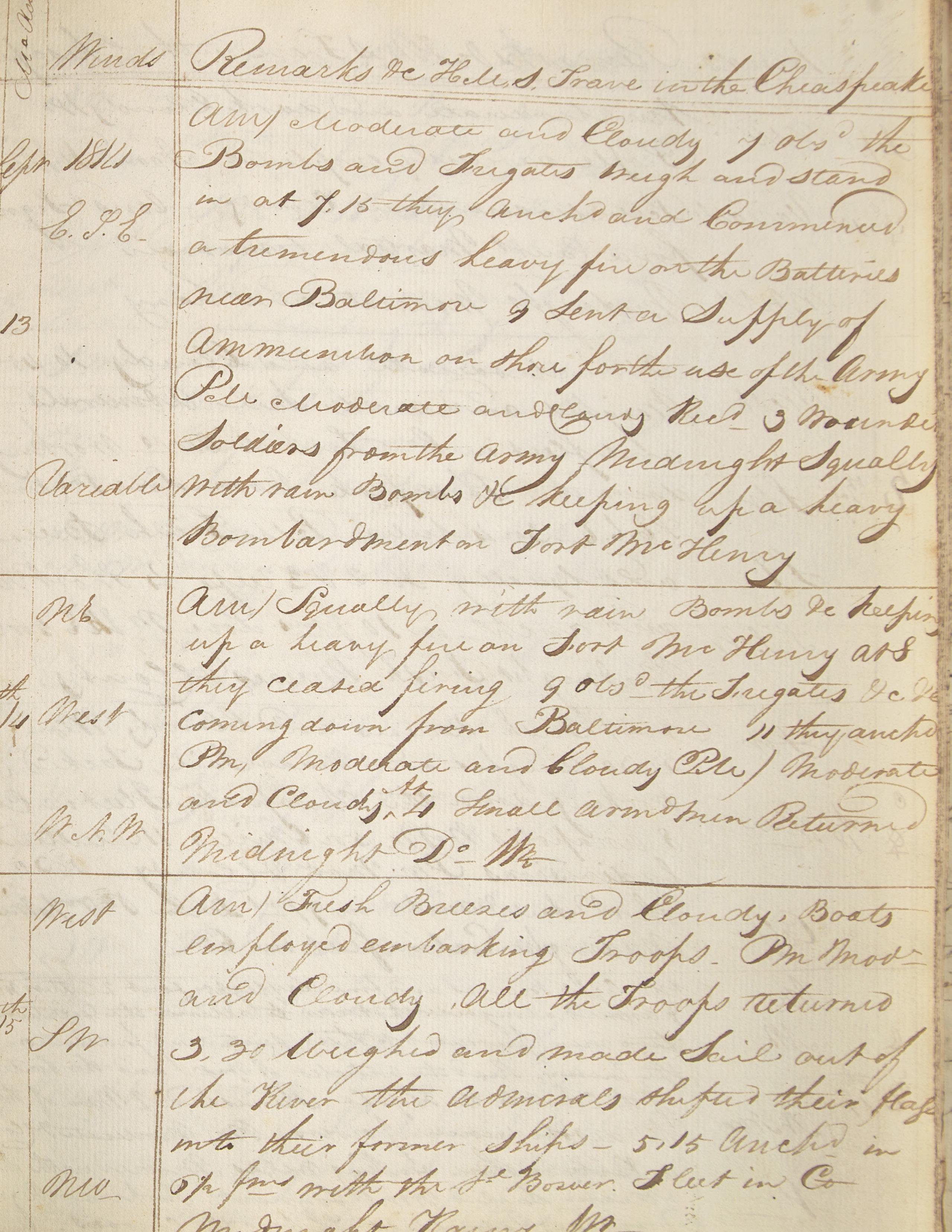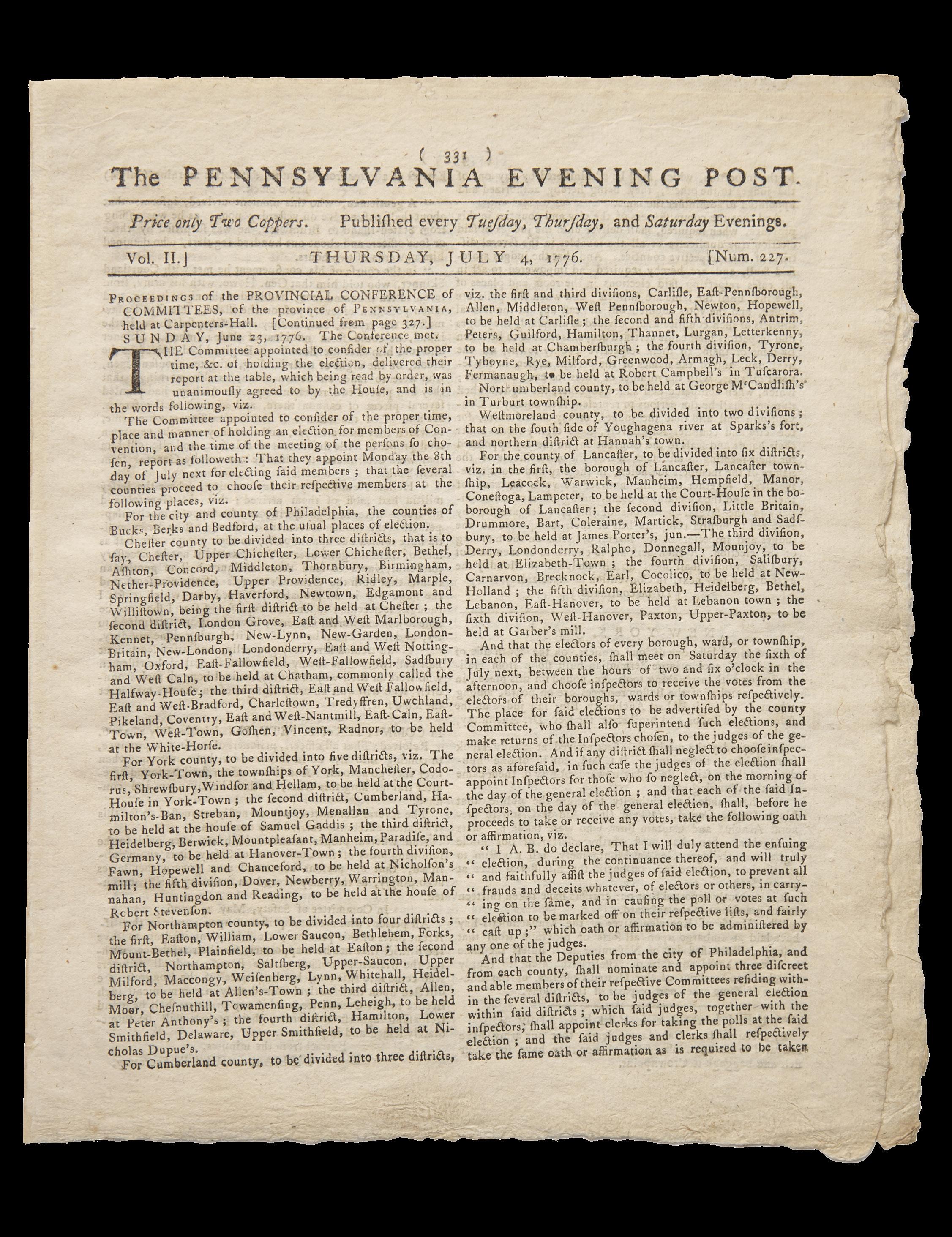
HOW HISTORY UNFOLDS ON PAPER: IMPORTANT AMERICANA FROM THE ERIC C. CAREN COLLECTION, PART X
JUNE 30 | PHILADELPHIA
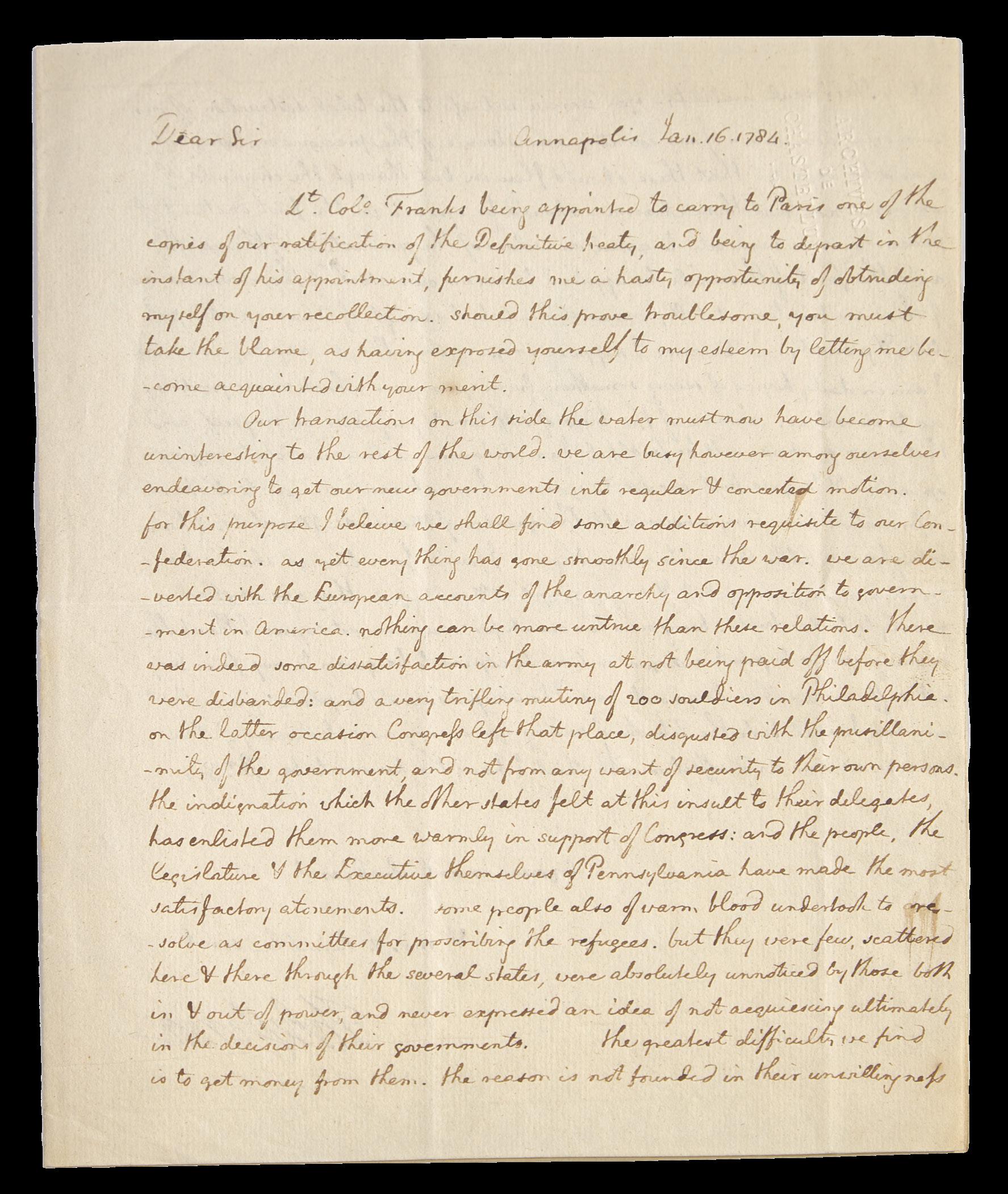
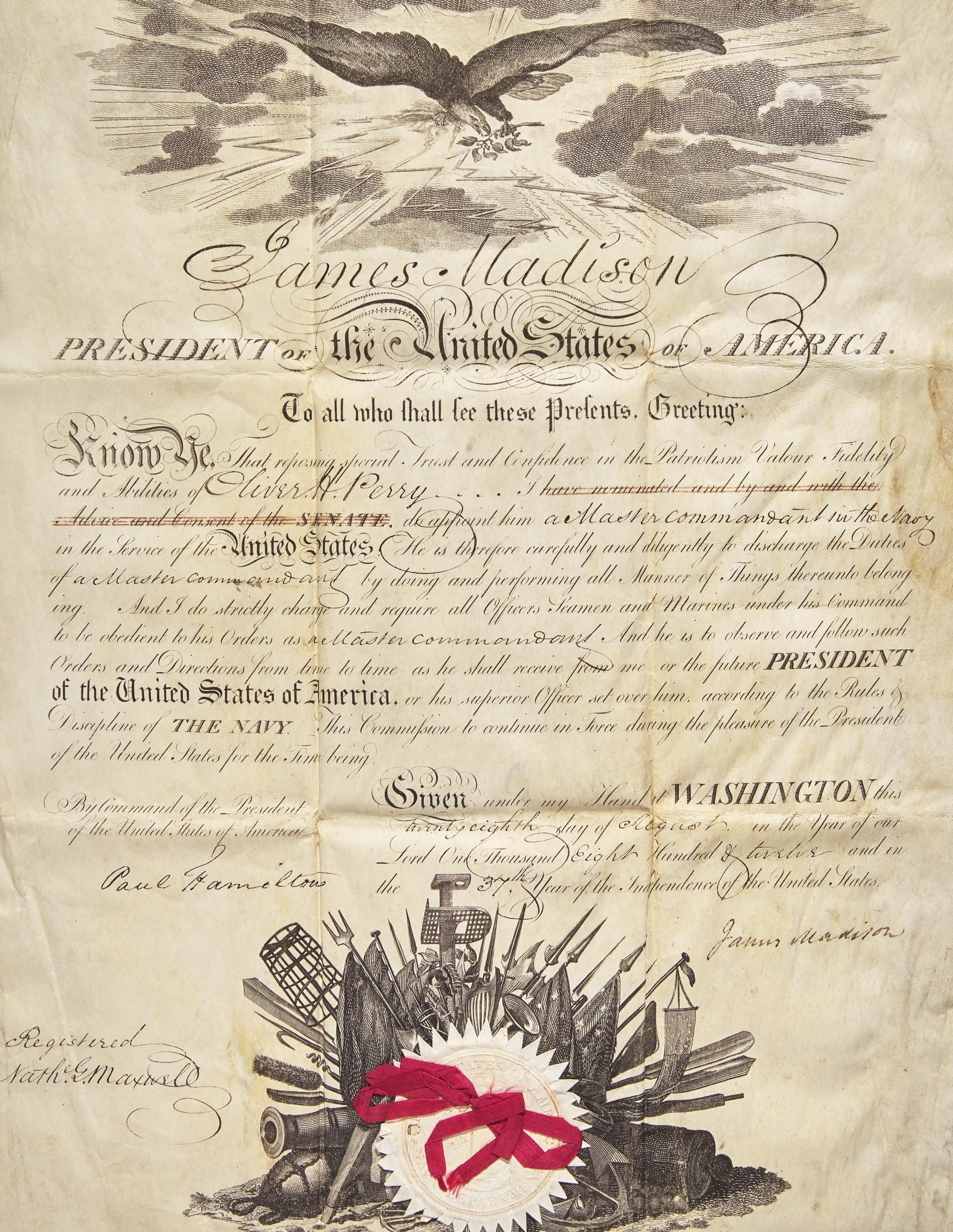
HOW HISTORY UNFOLDS ON PAPER: IMPORTANT AMERICANA FROM THE ERIC C. CAREN COLLECTION, PART X
JUNE 30 | PHILADELPHIA
Sale 6515
June 30, 2026 | Philadelphia 10:00am ET | Live Lots 1–319
PREVIEW
June 22–26 and 29 | 10:00am–4:00pm 1600 West Girard Avenue, Philadelphia, PA books@freemansauction.com
PROPERTY PICK-UP HOURS
Monday–Friday | 9:00am–4:00pm By appointment 312.280.1212
All property must be paid for within seven days and picked up within thirty days per our Conditions of Sale.
All lots in this catalogue with a lower estimate value of $5,000 and above are searched against the Art Loss Register database
To view the complete catalogue, sign up to bid, and read our Conditions of Sale, visit freemansauction.com or the Freeman’s App. All bidders must agree to Freeman’s Conditions of Sale prior to registering to bid. For bid support contact: 312.280.1212 or bid@freemansauction.com.


Esric C. Caren, one of the foremost private collectors of historical paper and documentary material in the United States, is widely regarded as “The Babe Ruth of Historical Collecting”, reflecting both the scope of his holdings and the singular impact he has had on the market for primary-source history.
For more than 50 years, Caren has been assembling a world-class archive of contemporary documentation comprising well over one million original items, including rare newspapers, books, pamphlets, broadsides, manuscripts, early photographs, ephemera, and printed records documenting and illustrating pivotal moments in American and world history.
He is the author of twelve published books, many of which have become standard reference works within the fields of newspapers, ephemera, and historical documentation. His scholarship and advocacy have played a key role in elevating historical paper from a niche specialty to a recognized category within the broader markets of Americana and books and manuscripts.
This auction is Caren’s tenth single-owner sale, following nine earlier landmark dispersals. Each of these auctions has been distinguished by carefully curated material drawn entirely from his personal collection, reflecting his belief that context and provenance are as important as rarity. Appropriately aligned with the approaching 250th anniversary of the United States, he continues to demonstrate that history is not merely remembered, but preserved, contextualized, and re-experienced through the original documents that once carried it forward.
Eric C. Caren is a member of The Grolier Club, The American Antiquarian Society, and The National Press Club; Director Emeritus of the Ephemera Society of America; a former member of the Antiquarian Booksellers’ Association of America (ABAA); and a consultant to the Newseum, where his collection was among the first to be featured.
1
[African-Americana]
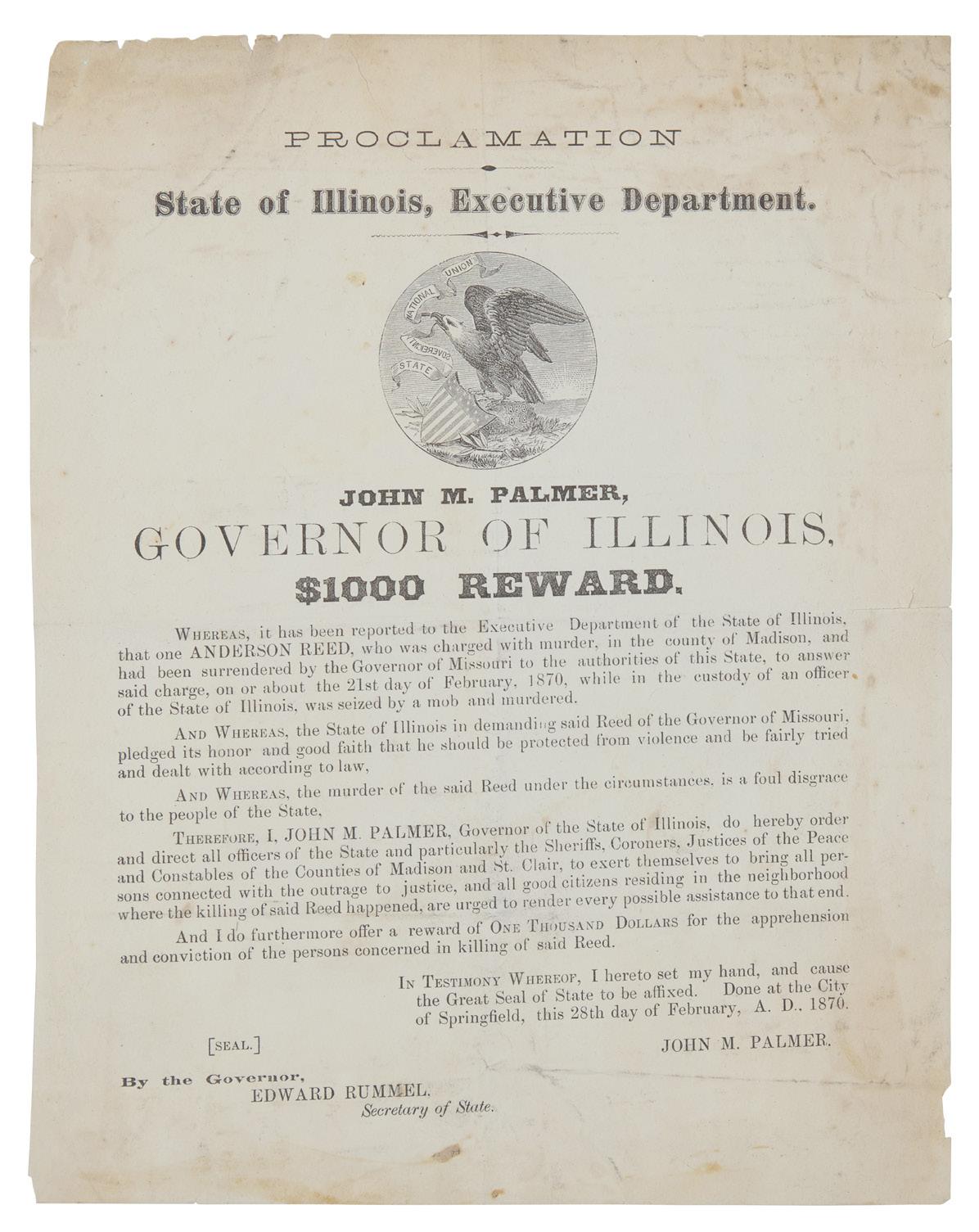
$1,000 Reward Poster for the Capture of the Perpetrators who Lynched an African American Man
Proclamation State of Illinois, Executive Department...$1000 Reward Springfield, Illinois, February 28, 1870. Printed reward poster, issued by Governor John M. Palmer, for the apprehension and conviction of those involved in the lynching of an African American man, Anderson Reed. 10 3/4 x 8 3/8 in. (273 x 213 mm). Creasing from old folds, separation along same at center right; soiling and edge-wear; scattered closed tears along edges; old residue on verso from when mounted.
In December 1868 (some accounts state 1867), Fritz Lurakee (another account gives the name Frederick Sudikee) was murdered in his home near Venice, Illinois, after an apparent attempted robbery. According to contemporary newspaper reports, following the murder, an African American man named Joe Marshall was arrested for the crime. Shortly after his apprehension, he was seized by a white mob and lynched. His apparent accomplice, an African American man named Anderson Reed, who was reported to go by the alias Bill Wilson, escaped the mob and went on to elude authorities until his capture in St. Louis on February 12, 1870. As reported in the St. Louis Times of February 25, «Henry Lemmert, a constable, came over from Venice and demanded the prisoner [Reed]--without a warrant. Captain Lee refused to deliver him up without the necessary requisition, remarking he was satisfied they meant mischief to him, and if he should surrender Anderson without due process of law and he should be lynched, he would be an accessory to murder.» After acquiring the requisite papers, Lemmert took custody of Reed, and took him before a local judge, who convicted him of murder. «Lemmert tied his [Reed’s] hands and feet, placed him in a wagon and proceeded towards Edwardsville. When he had gone about five miles, and as if by preconcerted action, the wagon was surrounded by a mob, who took possession of Reed», who was then summarily murdered.
News of the lynching was reported in newspapers throughout the Midwest. In the present poster, Illinois Governor John M. Palmer issues a proclamation stating that the “the murder of the said Reed under the circumstances, is a foul disgrace to the people of the State” and orders “all the officers of the State and particularly the Sheriffs, Coroners, Justices of the Peace and Constables of the Counties of Madison and St. Clair, to exert themselves to bring all persons connected with the outrage of justice, and all good citizens residing in the neighborhood where the killing of said Reed happened, are urged to render every possible assistance to that end.” He goes on to offer a $1,000 reward for the “apprehension and conviction of the persons concerned in the killing of said Reed.”
We cannot locate another copy at auction, nor recorded in OCLC.
$800 - 1,200
2
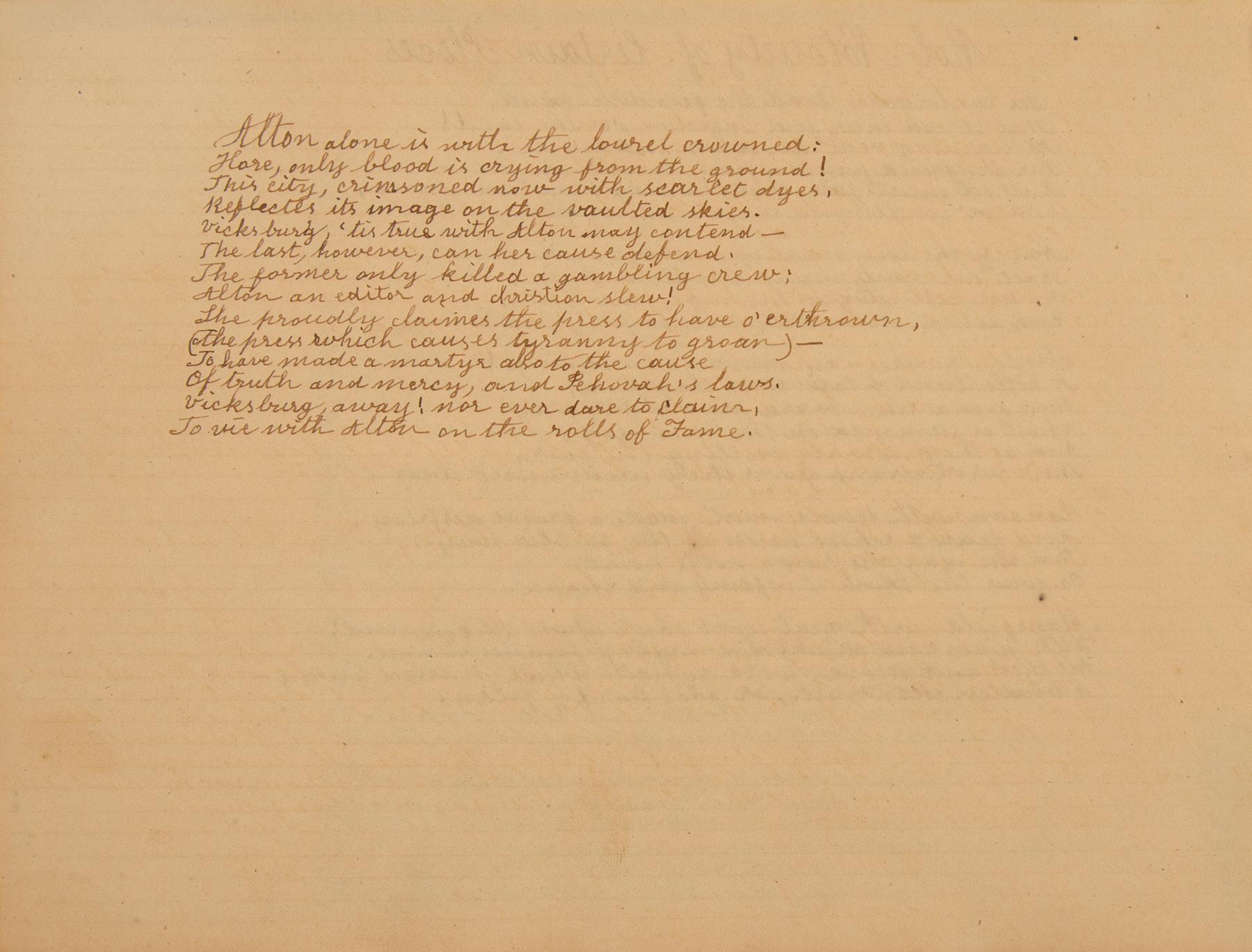
[African Americana] Poem Copied from The Liberator, Mentioning the Murder of Elijah Lovejoy, in a 19th Century American Penmanship Book
Massachusetts, Bridgewater Normal School, ca. 1844. Oblong 12mo. (36) pp. Manuscript copybook, signed by Charles N. Hall on verso of title-page, and containing 32 pages (recto and verso) of his penmanship studies and other copied passages. Stiff paper wrappers, manuscript on front wrapper “Charles N. Hall”; text block loose, with sheets starting or sprung; scattered soiling.
A 19th century manuscript copybook, including a copy of a poem mentioning late Abolitionist printer Elijah Lovejoy. Titled “Mob Notoriety in Certain Places” Reads in part: “...Alton alone is with the laurel crowned; Here, only blood is crying from the ground! This city, crimsoned now with scarlet dyes, Reflectes its image on the vaulted skies. Vicksburg ‘tis true with Alton may contend-The last, however, can her cause defend. The former only killed a gambling crew; Alton an editor and Christian slew! The proudly claimes the press to have o’verthrown, (The press which causes tyranny to groan)-To have made a martyr also to the cause Of truth and mercy, and Jehovah’s laws. Vicksburg, away! Nor ever dare to claim, To vie with Alton on the rolls of Fame.”
The penmanship studies above are the work of a Charles N. Hall (d. 1899), completed while he was enrolled at Bridgewater Normal School (now Bridgewater State College) in Bridgewater, Massachusetts. Bridgewater opened on September 9, 1840, and was one of the first Normal schools in the United States, with its initial mission being the training of school teachers. Hall enrolled on April 8, 1844. Several of the penmanship drills within show the repetitious writing of various quotes, single words, and pen strokes, including “Kings as well as mean men must die,” “Be slow in choosing a friend,” “Flee from every evil thing,” “Idleness has no advocates but many friends,” “Monuments will decay,” and “All earthly bliss will fade and die.”
Other entries by Hall record some of his student expenses for textbooks, as well as a four pages of journal entries documenting his various day to day activities while enrolled. Massachusetts was the northern epicenter of abolitionist sentiment, so it’s no surprise he was exposed to issues of William Lloyd Garrison’s The Liberator. The unattributed poem “Mob Notoriety in Certain Places” first appeared in the January 19, 1838 issue, but was presumably reprinted.
Elijah Lovejoy (1802-1837) was an Illinois Presbyterian minister, abolitionist, and newspaper editor of the Alton Observer. For years Lovejoy ran abolitionist sentiments in his southern Illinois paper, much to the chagrin of local pro-slavery sympathizers from nearby Missouri and Kentucky. On November 7, 1837, an angry mob of protestors stormed Lovejoy’s warehouse in Alton, and he was killed in the subsequent exchange of gunfire. His death was lamented in abolitionist societies and publications across the country, as he became a martyr of anti-slavery cause.
Portions of this copybook are published in Script and Scribble The Rise and Fall of Handwriting by Kitty Burns Florey (2013).
$1,000 - 1,500
3
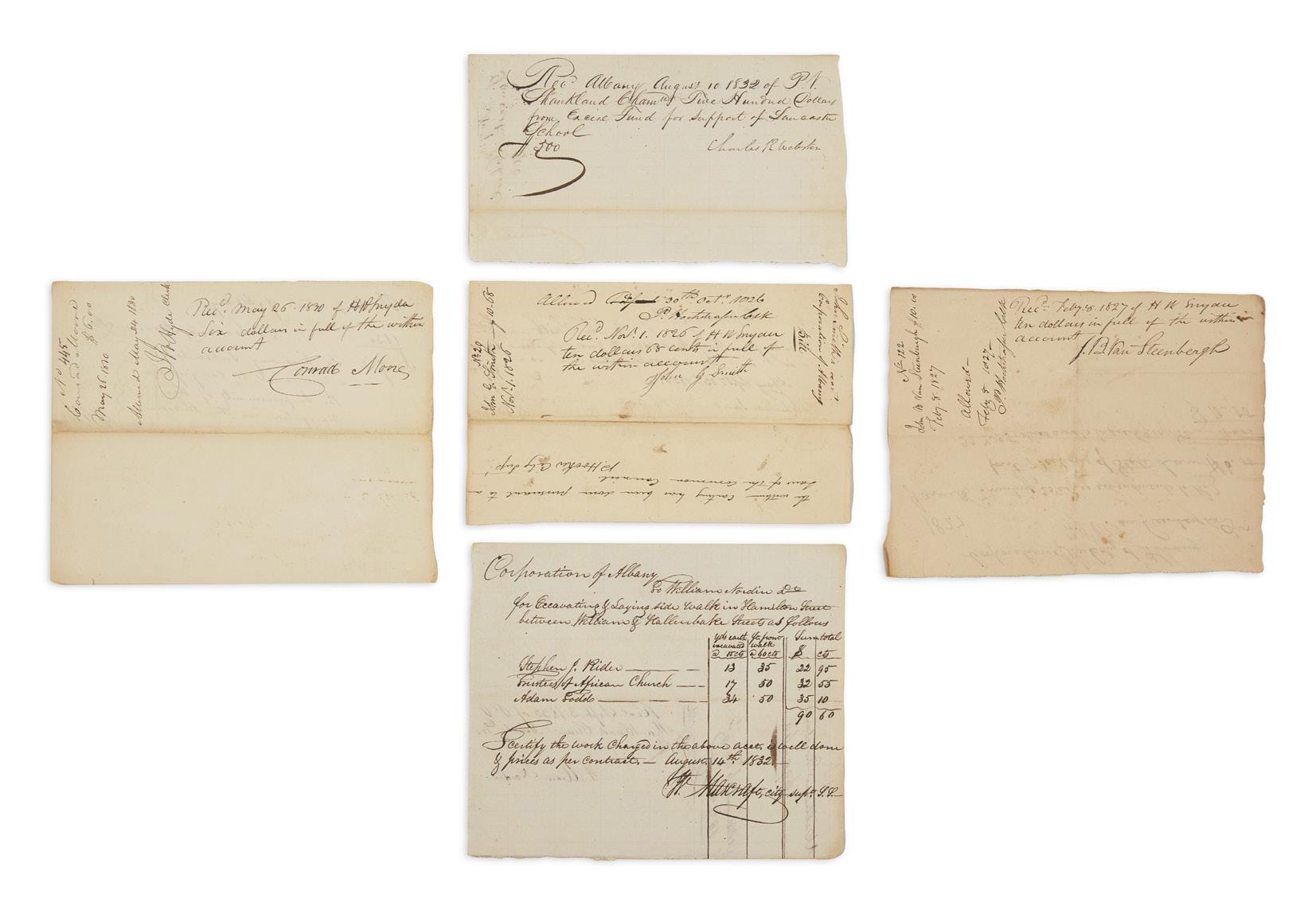
[African-Americana] [Albany] Small Archive of Manuscript Documents from the Corporation of Albany, Including One Signed by an Abolitionist in the Very Year Slavery was Abolished in New York State
Group of Five Manuscript Documents, Being Official Receipts Paid by the Corporation of Albany
Albany, 1826-32. Comprising five documents, including a receipt for a John G. Smith for carting, signed by architect Phillip Hooker, dated September 13, 1826; a receipt for the printing of 25 copies of amendments to state law, signed by abolitionist John B. Van Steenbergh, dated February 8, 1827 (the year full emancipation occurred in New York State); a receipt for “procuring Subscribers to a memorial to Congress for the Improvement of the navigation of the Hudson River”, signed by Conrad Moore, dated May 26, 1830; a donation receipt to the Lancaster School, signed by Charles R. Webster, dated August 10, 1832; a receipt to the “Trustees of African Church”, for excavating work, signed by Willian Nordin, dated August 14, 1832.
Size and condition varies, but generally fine.
$300 - 500
4
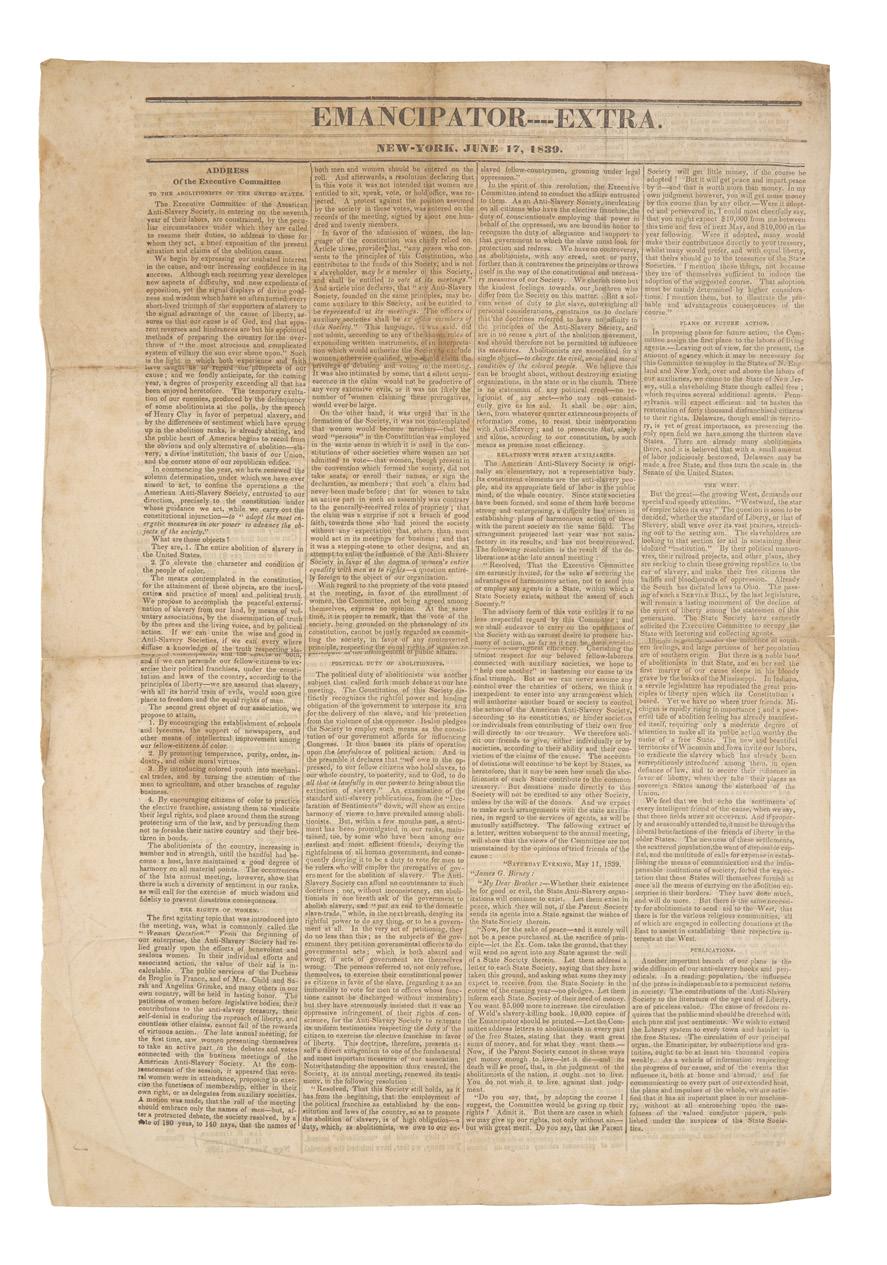
[African-Americana] [American Anti-Slavery Society] Rare Extra Issue of the Emancipator, the Official Newspaper of the American Anti-Slavery Society, Published in the Wake of the Group’s 1839 Annual Meeting
Emancipator--Extra New-York, June 17, 1839. Printed broadsheet newspaper extra, in four columns, 16 1/4 x 11 in. (413 x 279 mm). Creasing from old folds, a few small closed tears along same; scattered toning.
This issue reports on the debate over the “Woman Question” at their recent meeting, and whether or not the names of women should be included as being present in the Society’s records. The issue of women’s role in the formation of Anti-Slavery societies across the country would lead to a major split in the national movement the following year, with Lewis Tappan and his associates forming the American and Foreign Anti-Slavery Society in 1840.
$800 - 1,200
5
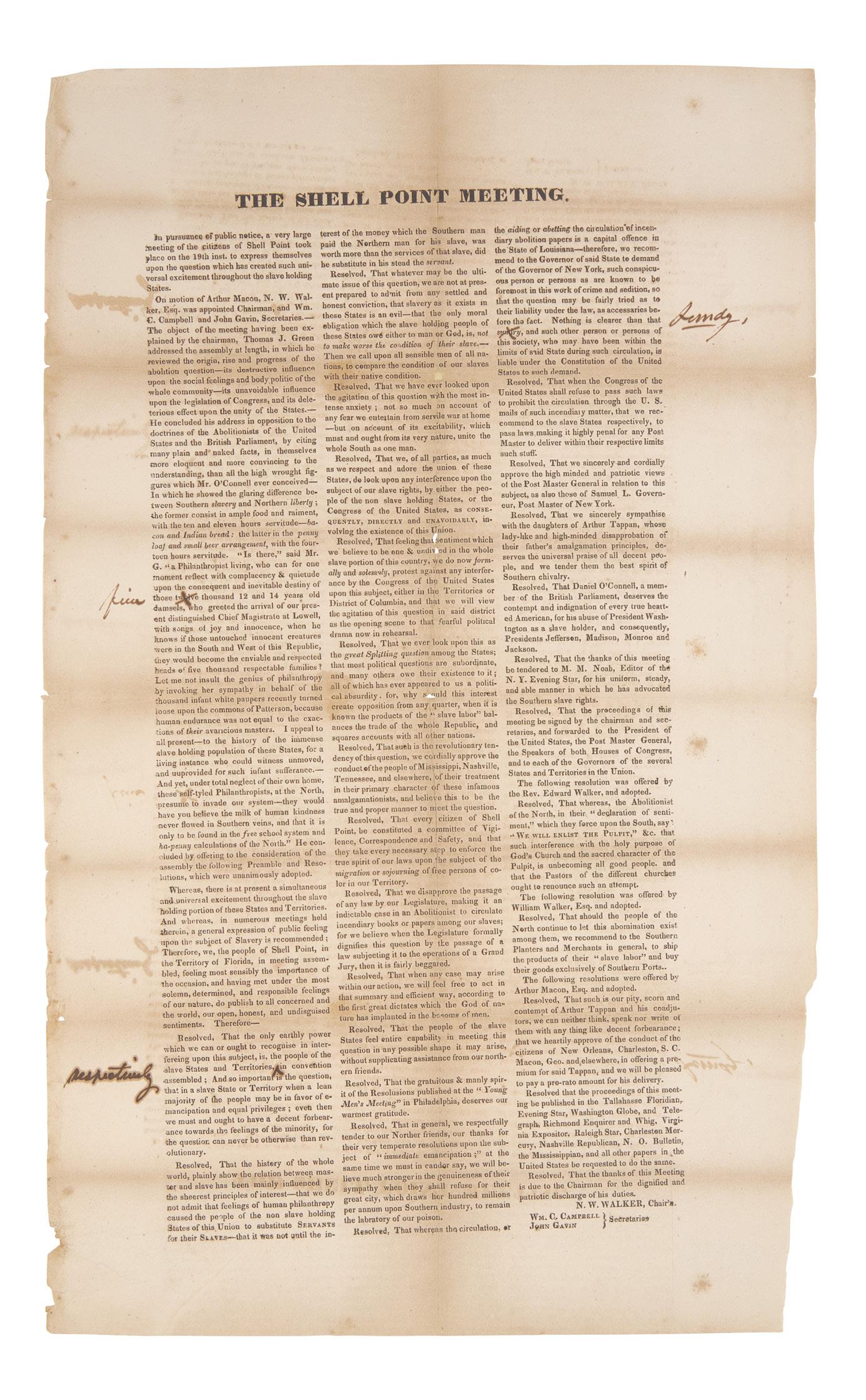
[African-Americana] A Pro-Slavery Reaction to the American Anti-Slavery Society’s Postal Campaign of 1835
“In pursuance of public notice, a very large meeting of the citizens of Shell Point took place on the 19th inst. to express themselves upon the question which has created such universal excitement throughout the slave holding States...”
The Shell Point Meeting (Shell Point, Florida Territory, ca. 1835.) Printed broadside, 19 1/4 x 11 1/4 in. (489 x 287 mm). Text in three columns. Signed in type by Chairman N.W. Walker. Reads in part: “Resolved, that we ever look upon this as the great Splitting question among the States; that most political questions are subordinate, and many others owe their existence to it; all of which has ever appeared to us a political absurdity. For, why should this interest create opposition from any quarter, when it is known the products of the ‘slave labor’ balances the trade of the whole Republic, and squares accounts with all other nations...we disapprove the passage of any law by our Legislature, making it an indictable case in an Abolitionist to circulate incendiary books or papers among our slaves...” Accompanied by original transmittal envelope, addressed «To His Excellency the Govr. of New Jersey.» Creasing from old folds; contemporary manuscript corrections in margins; scattered foxing and offsetting. Not in Sabin, Evans, or Servies (A Bibliography of Florida...)
Excessively rare printed broadside of a passionate proslavery statement issued by the inhabitants of Shell Point, Florida in reaction to the American Anti-Slavery Society’s famous postal campaign.
During the summer of 1835, the American Anti-Slavery Society undertook a massive postal campaign, sending thousands of circulars or other publications of abolitionist literature to towns and cities across the slave-holding states of the South. The reaction in many cases, as seen in this broadside, was swift and hostile. President Andrew Jackson implored Congress to pass legislation against unsolicited circulation of “incendiary” material as he termed it, but was unsuccessful. Nonetheless, his Postmaster General, Amos Kendall, authorized southern post offices to seize and destroy any abolitionist mail.
The citizens of Shell Point, located just south of Tallahassee, directly call out the leaders of the American Anti-Slavery Society, even advocating the capture of its President Arthur Tappan, stating “That such is our pity, scorn and contempt of Arthur Tappan and his coadjutors, we can neither think, speak nor write of them with any thing like decent forbearance; that we heartily approve of the conduct of the citizens of New Orleans, Charleston, S.C. ...and elsewhere, in offering a premium for said Tappan, and we will be pleased to pay a pro-rato amount for his delivery. “ Very rare. We have not been able to locate another copy in the available auction record, and found only one reference of another example coming to market.
A fascinating example of the high tensions surrounding the subject of slavery in the antebellum South.
$2,500 - 3,500
6
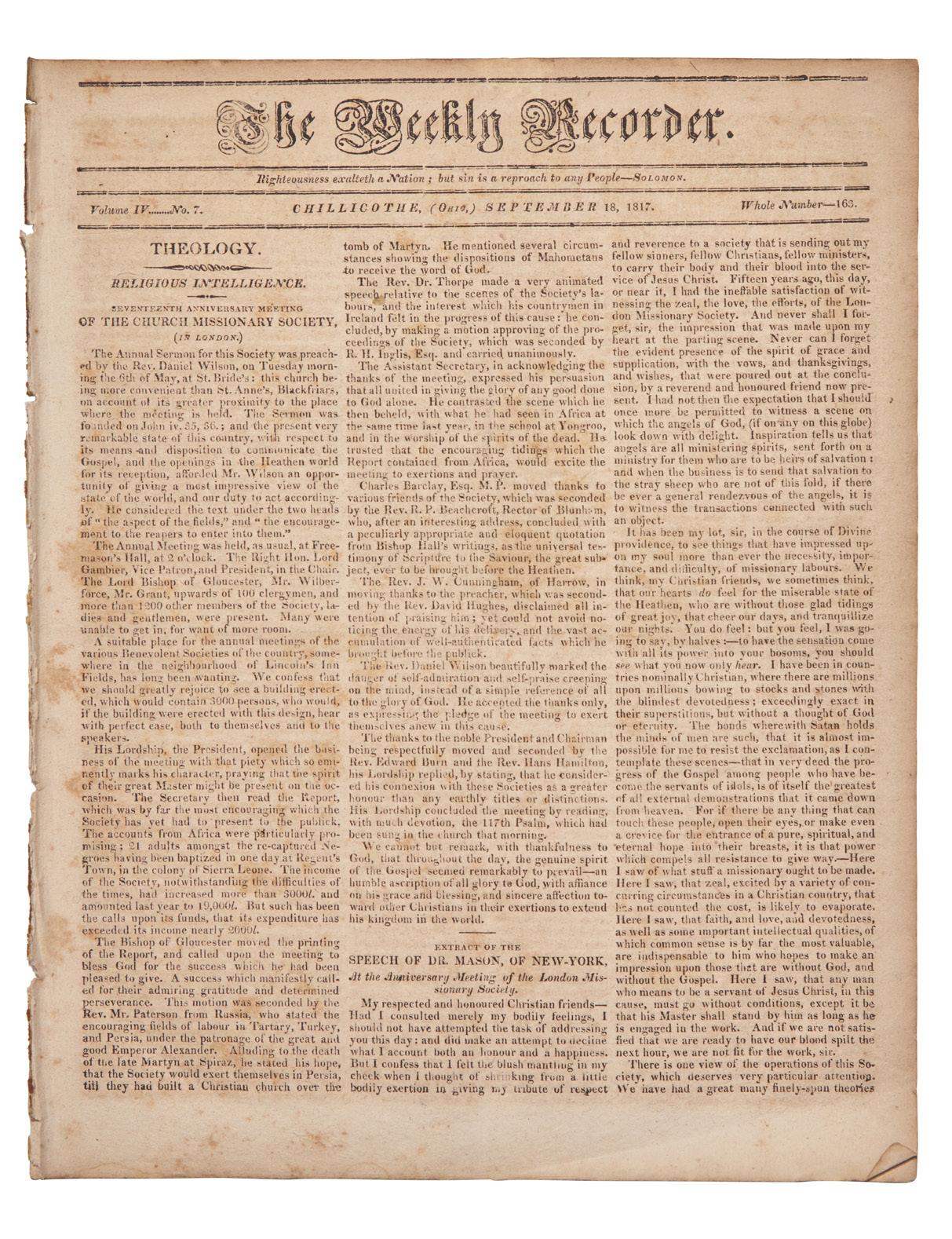
[African-Americana] [Anti-Colonization] Reporting on the January 15, 1817 Mass Meeting at Mother Bethel A.M.E. Church in Philadelphia, the First Large-Scale Black Protest in the United States
The Weekly Recorder Chillicothe, Ohio: John Andrews, September 18, 1817. Volume IV, No. 7, Whole Number 163. Printed newspaper. 4to. pp. (49)-56. Disbound; library ink stamp at bottom of p. 53; foxing.
On p. 54 is reported the January 15, 1817 meeting at Bethel A.M.E. Church in Philadelphia, where 3,000 African American men-nearly the entire Black male population of Philadelphia--met to voice their opposition to the American Colonization Society (ACS) and their plan to resettle Free Blacks to Western Africa.
James Forten, a prominent Black businessman in Philadelphia who initially sympathized with colonization, convened a meeting to discuss the American Colonization Society’s (ACS) proposal for resettlement. He was joined by three distinguished Black ministers, Richard Allen, Absalom Jones, and John Gloucester, who helped organize the gathering and initially spoke in favor of the plan. However, when Forten called for a vote, the room’s reaction was immediate and overwhelming. Not a single voice voted “yes.” Instead, when he asked for “nays,” a single, thunderous “no” erupted from the crowd, reportedly shaking the walls of the church. The attendees had realized that the colonization scheme posed a grave threat to their entire community, both free and enslaved. They understood that removing Black individuals who could challenge slavery would ultimately weaken resistance and strengthen the institution of slavery itself.
The meeting adopted five resolutions, opening with the statement, “Whereas our ancestors (not of choice) were the first cultivators of the wilds of America, we their descendants feel ourselves entitled to participate in the blessings of her luxuriant soil, which their blood and sweat manured; and that any measures, or system of measures, having a tendency to banish us from her bosom, would not only be cruel, but in direct violation of the principles which have been the boast of the republick.” The following resolutions enumerated the community’s stance, in part expressing, “deep abhorrence the unmerited stigma attempted to be cast upon the reputation of the free people of colour, by the promotors of this measure...That we never will separate ourselves voluntarily from the slave population in this country: they are our brethren by the ties of consanguinity, of suffering, and of wrongs; and we feel that there is more virtue in suffering privations with them, than fancied advantages for a season.” The final resolution called for the creation of a committee to communicate the meeting’s sentiments to Congress.
A search of contemporary newspapers shows that this event was scarcely covered, and this newspaper is apparently one of only a few that did so.
Lot includes another issue of the same newspaper (September 11, 1816, Vol. III, No. 7, Whole No. 111), reporting the opening of the Augustine Society, an African American seminary in Philadelphia for the “education of Africans in the higher branches of literature and in sacred theology.” The Society was formed by John Gloucester, William Allen, and Absalom Jones. Largely separated along central vertical fold.
$600 - 900
7
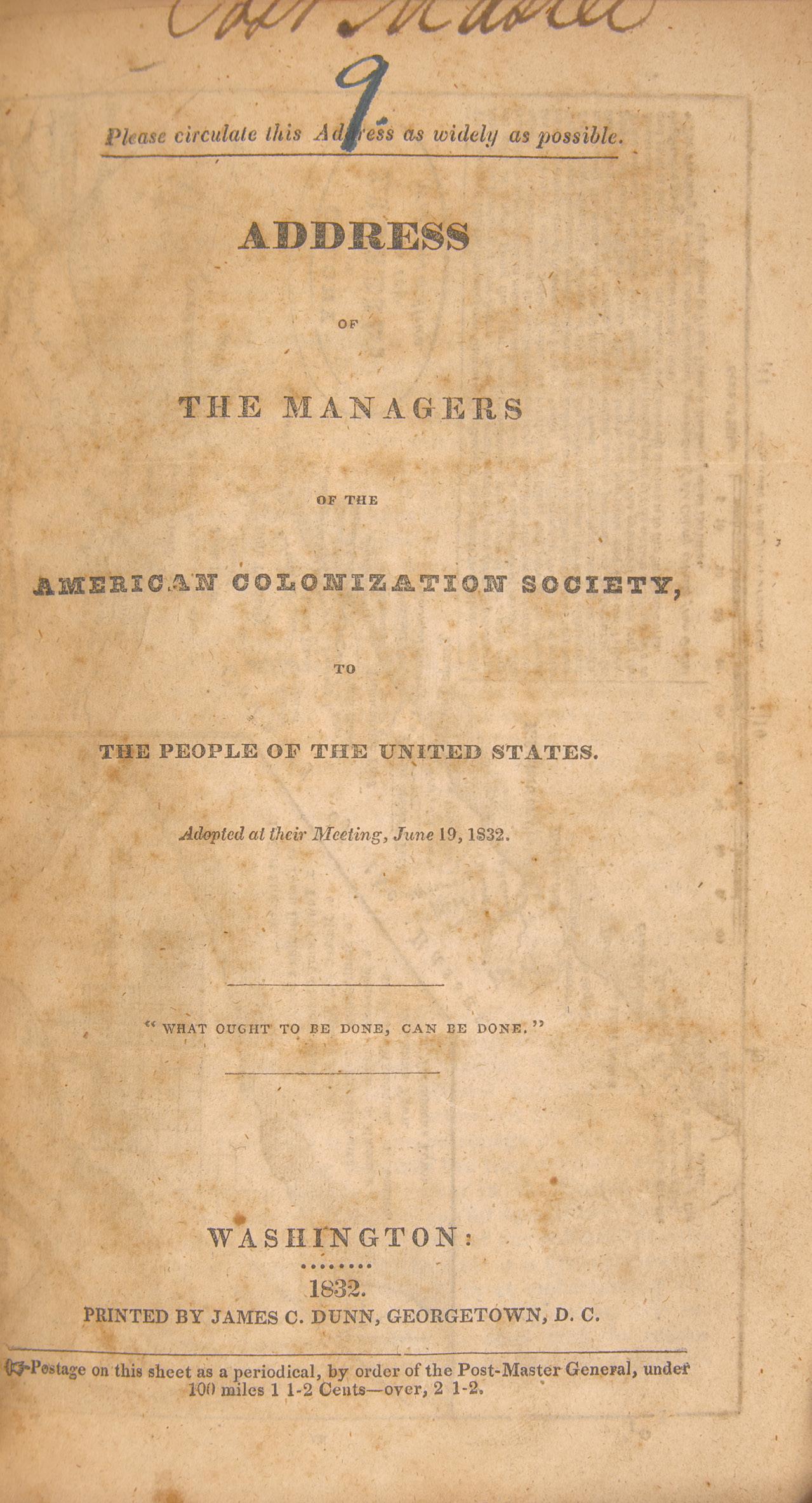
[African-Americana] An Official Public Appeal Aimed to Defend the American Colonization Society Against Abolitionist Critics and Promote the Mission of Relocating Free Black Americans to Liberia
Address of the Managers of the American Colonization Society, to the People of the United States. Adopted at their Meeting, June 19, 1832
Washington: Printed by James C. Dunn, 1832. First edition. 8vo. 16 pp. Drab library-style buckram, red and black morocco spine labels, stamped in gilt, boards worn and soiled; contemporary ownership signature on title-page, partially trimmed away, numerical notation at same; spotting to sheets. Sabin 81763
In this address, Ralph Randolph Gurley defends the aims of the American Colonization Society, which advocated the relocation of free African Americans to Liberia on the west coast of Africa.
Bound with:
An Oration Delivered by Hon. Charles Sumner Under the Auspices of the Young Men’s Republican Union of New York, November 27, 1861. New York: Printed for the Young Men’s Republican Union, 1861. First edition. 8vo. 16 pp.
Bound with:
The Equal Rights of All...Speech of Hon. Charles Sumner, of Massachusetts, in the United States Senate, February 6 and 7, 1866. Washington: Printed at the Congressional Globe Office, 1866. First edition. 8vo. 32 pp.
Together bound with over a dozen assorted pamphlets on various subjects. Several sheets starting or separated; last pamphlet loose.
$600 - 900
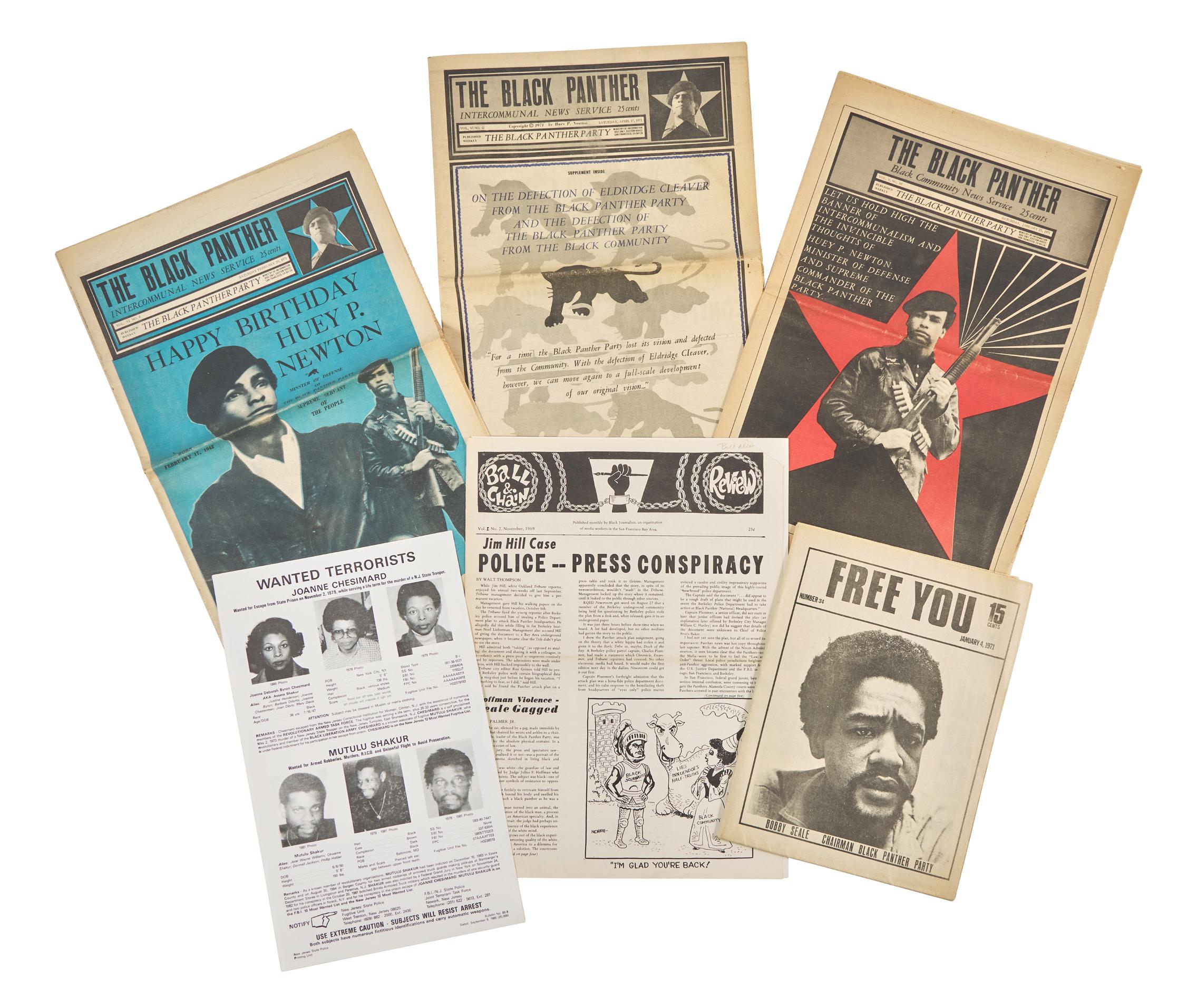
8 [African-Americana] [Black Panthers, etc.] Group of 6 Periodicals, etc.
1. Ball & Chain Review
San Francisco: Published by Black Journalist, November 1969. Vol. I, No. 2. Printed newspaper. Folio. 6 pp. Creased from when folded, tape repairs at fore-edge of same fold.
2. Free You
Palo Alto, California, January 4, 1971. Number 34. Printed newspaper. 4to. 24 pp. Creased from when folded; light wear and toning.
3. The Black Panther Intercommunal News Service
San Francisco: The Black Panther Party, 1971. In three issues (Saturday, January 23, Vol. V, No. 30; Saturday, February 20, Vol. VI, No. 4; Saturday, April 17, Vol. VI, No. 12). Printed newspaper. Folio. 12, 20, and 16 pp., respectively. Creased from when folded; toned; light wear.
4. Printed Wanted Poster (“Wanted Terrorists”) for Joanna Chesimard (Assata Shakur) and Mutulu Shakur
New Jersey: New Jersey State Police Printing Unit, September 9, 1985. Bulletin No. 85-9. Printed broadside; 14 x 8 1/2 in. (356 x 216 mm).
The Black Panther Party was founded in Oakland, California by Bobby Seale and Huey P. Newton in October 1966, intending to address social inequalities which non-violent resistance appeared to have failed. Following the murder of an unarmed Black man by San Francisco police in 1966 and the Hunter’s Point uprising that followed, Newton began to carefully study California gun laws and organize patrols that would follow police through inner-city neighborhoods to monitor their activities. Over time the party began to focus its energies on promoting individual agency to effect larger social changes, beginning with demanding greater education access for inner-city children. The First Free Breakfast for Children program was launched at St. Augustine’s Episcopal Church in Oakland, as it was believed that hungry children would be less able to keep focused in class. Within a decade similar programs were adopted by school districts nationwide.
$300 - 500
9
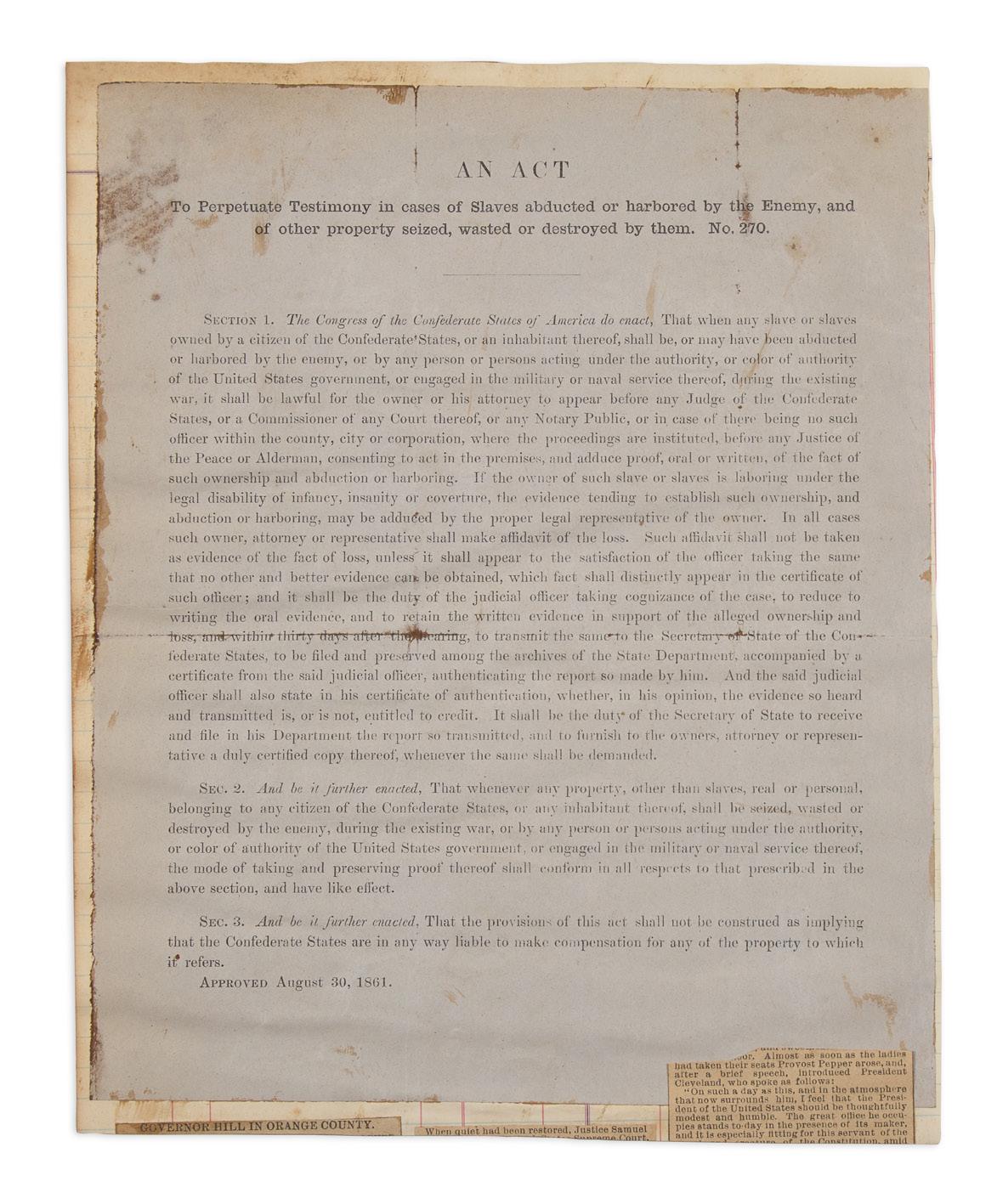
[African-Americana] Broadside of a Confederate Congressional Act Relating to Slaves and Other Property Confiscated by the Union Army
An Act to Perpetuate Testimony in cases of Slaves abducted or harbored by the Enemy, and of other property seized, wasted or destroyed by them. No. 270 (Richmond, Virginia), August 30, 1861. Printed broadside. Mounted to lined sheet (excised from a scrapbook); scattered soiling; newspaper clippings on verso. 10 x 8 1/8 in. (254 x 206 mm).
Scarce official act passed by the Confederate Congress, establishing a framework for southern slaveholders to keep track of their enslaved “property” lost or confiscated by the Union Army during the war.
$200 - 300
10
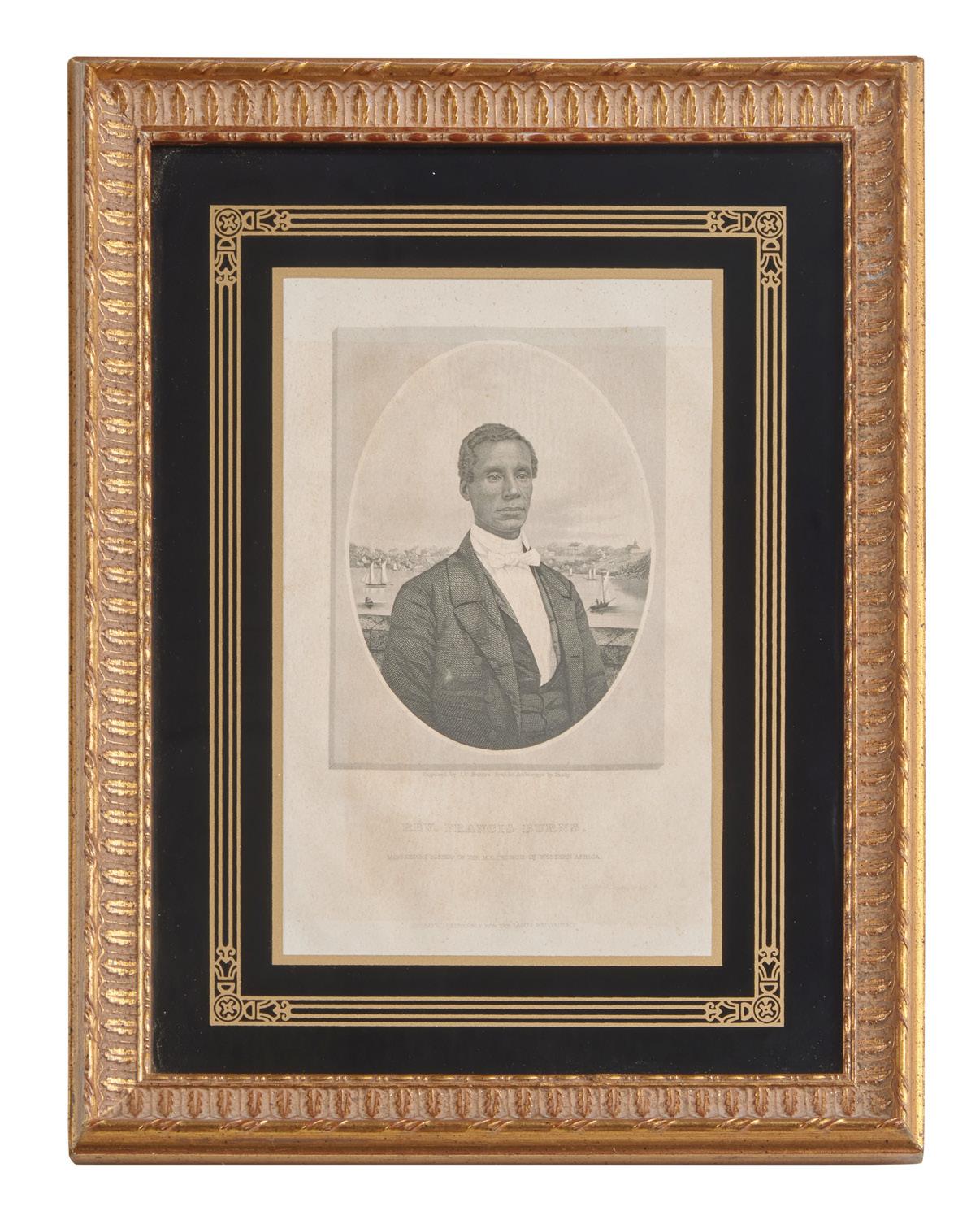
[African-Americana] Buttre, J.C. Engraving of Albany Abolitionist Rev. Francis Burns
(Cincinnati): Middleton Strobridge & Co., (1859). Engraved portrait, by Buttre, after an ambrotype by Mathew Brady; “Engraved Expressly for the Ladies Repository”. Approximately 8 1/2 x 5 5/8 in. (216 x 143 mm) (sight). Unexamined out of frame.
A fine example of this bust-length portrait of the Rev. Francis Burns (1809-63), African American deacon in New York and missionary bishop to Liberia.
$200 - 300
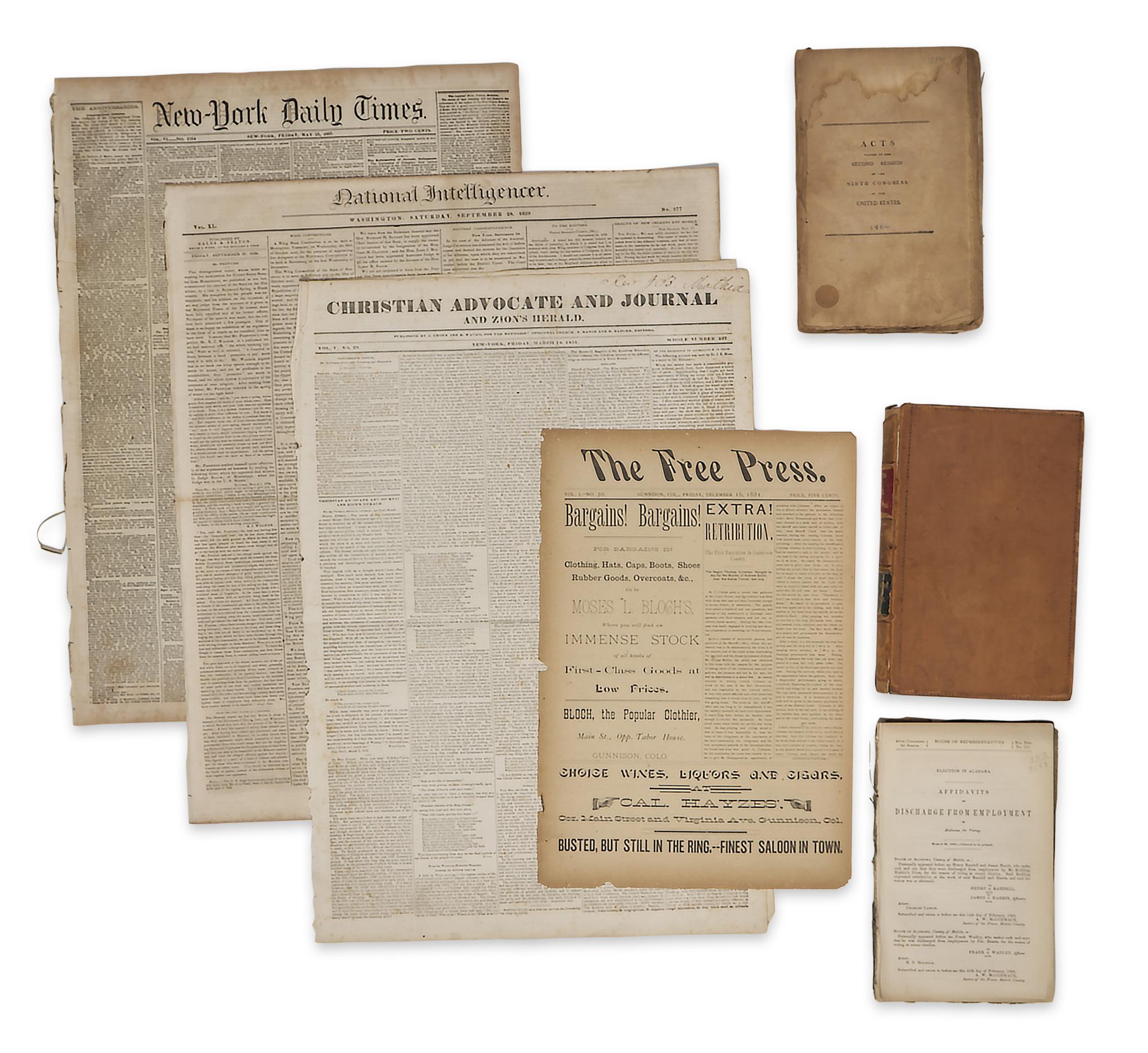
[African-Americana] Collection of 7 Books, Pamphlets, Newspapers, and Broadsides Related to African Americans, ca. 1807-81
Locations vary, ca. 1807-81. Comprising seven items, including: Acts Passed at the Second Session of the Ninth Congress of the United States (1807; 8vo; original wrappers); Christian Advocate and Journal and Zion’s Herald (New-York, March 18, 1831, Vol. V, No. 29; Folio); National Intelligencer (Washington, September 28, 1839, Vol. XL, No. 577; Folio); New-York Daily Times (New-York, May 15, 1857, Vol. VI, No. 1764; Folio); The Reports of the Committees of the House of Representatives...Second Session Thirty-Ninth Congress, 1866-67 (Washington, 1867; 8vo; tan calf); Election in Alabama. Affidavits of Discharge From Employment in Alabama for Voting (Washington, ca. 1868; 8vo; disbound); The Free Press (Gunnison, Colorado, December 16, 1881, Vol. I, No. 30; Folio).
Content covers a range of topics, including anti-slavery and abolitionism; a report on the ongoing case of the Amistad (National Intelligencer); recounting a meeting and minutes of the American Abolition Society (New-York Daily Times); an account of a lynching in Gunnison County, Colorado (The Free Press); as well as Congressional reports, including a lengthy House report (dated March 26, 1868) with dozens of affidavits from African-American men who were fired for voting in an election in Alabama; Acts passed in the second session of the ninth Congress, including suspension of commerce with Haiti, and an Act to prohibit the importation of slaves in 1808, as per the Constitution, etc.
Condition varies, generally very good; wear and soiling; expected wear to newspapers.
$500 - 800
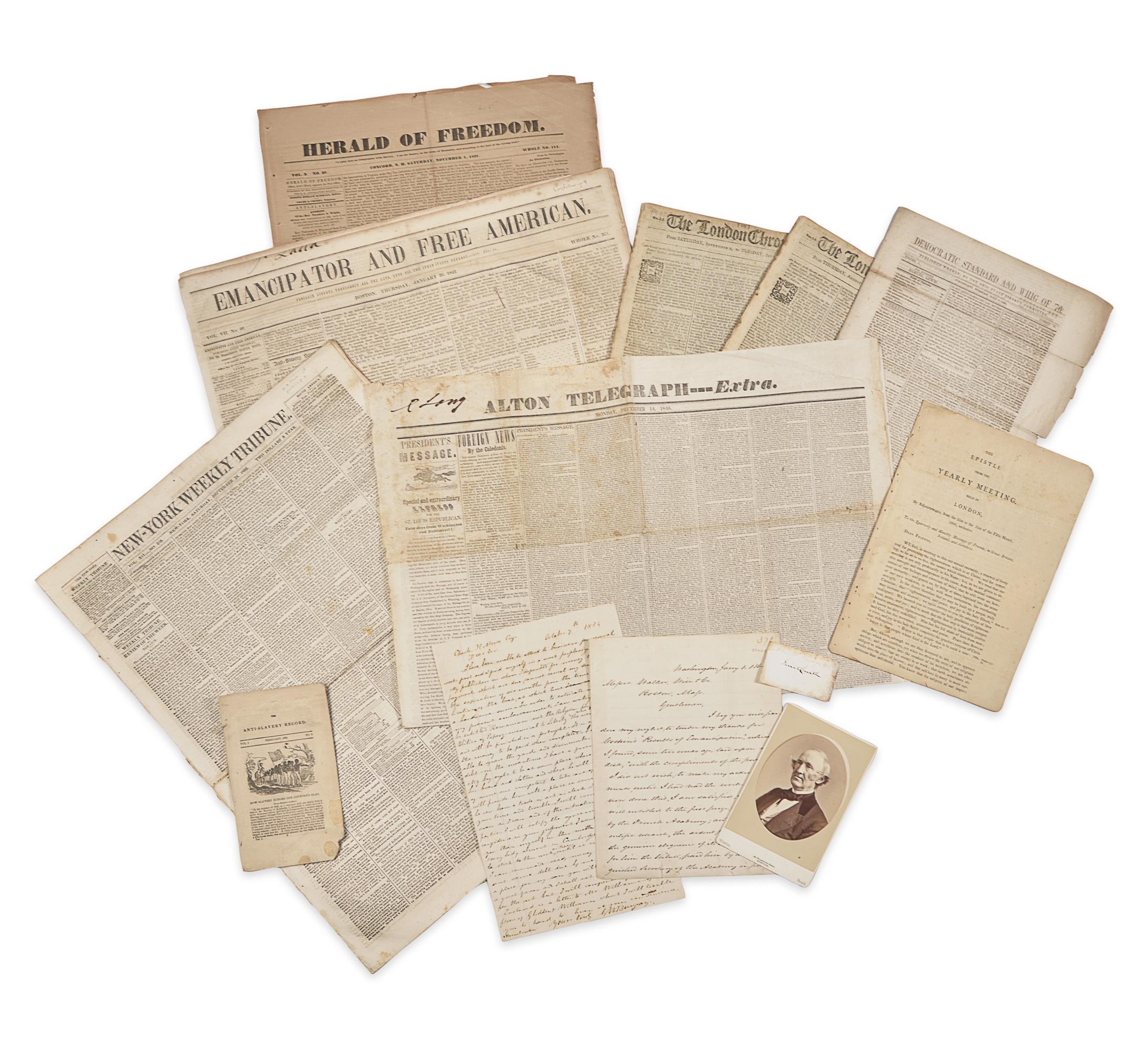
[African-Americana] Collection of 13 Autograph Letters, Newspapers, Pamphlets, and Ephemera Related to Abolitionism, ca. 1786-1863
Location varies, ca. 1786-1863. Comprising 13 items, including: two issues of The London Chronicle (London, August 31-September 5, 1786, Vol. LX, Nos. 4647 and 4648); Epistle From the Yearly Meeting, Held in London...from the 21st to the 31st of the Fifth Month, 1806; The Anti-Slavery Record (February, 1835, Vol. I, No. 2); Herald of Freedom (Concord, New Hampshire, November 4, 1837, Vol. 3, No. 36); Emancipator and Free American (Boston, January 26, 1843, Vol. VII, No. 40); Democratic Standard and Whig of ‘76 (Cincinnati, July 7, 1846, Vol. I, No. 12); Alton Telegraph-Extra (December 14, 1846), Enoch Long›s copy; New-York Weekly Tribune (New York, September 18, 1852, Vol. XII, No. 575); cabinet card of Wendell Phillips (Boston, Warren & Heald, no date); One-page autograph letter, signed by abolitionist George W. Bungay, to Charles H. Morse (October 7, 1854); Two-page autograph letter, signed by George P. Fisher, to Messrs. Walker, Wise & Co. (January 1, 1863); autograph calling card, signed by abolitionist Gerrit Smith.
A large and diverse collection of items relating to abolitionism in America, from the post-Revolutionary years to the Civil War. Topics vary, and include an essay on slavery (in The London Chronicle); a Quaker epistle denouncing the slave trade; a compilation of anti-slavery writings (in The Anti-Slavery Record); two abolitionist newspapers, including numerous articles on anti-slavery, some by Elijah P. Lovejoy (Herald of Freedom and Emancipator and Free American); essays on the 3/5ths Compromise, colonization, etc. (in the Democratic Standard); abolitionist Enoch Long’s copy of the Alton Telegraph (printing President Polk›s second State of the Union Address on the Mexican-American War); a printed letter from Harriet Beecher Stowe to Horace Greeley (in the New-York Weekly Tribune); cabinet card of prominent abolitionist Wendell Phillips; an autograph calling card of abolitionist and financier of Frederick Douglass’s newspaper Gerrit Smith; an autograph letter dated the day of the issuance of the final Emancipation Proclamation, regarding a French work on slavery; an autograph letter signed by abolitionist George W. Bungay on a variety of subjects including an upcoming publication.
Size and condition vary, generally very good, expected wear to newspapers.
$400 - 600
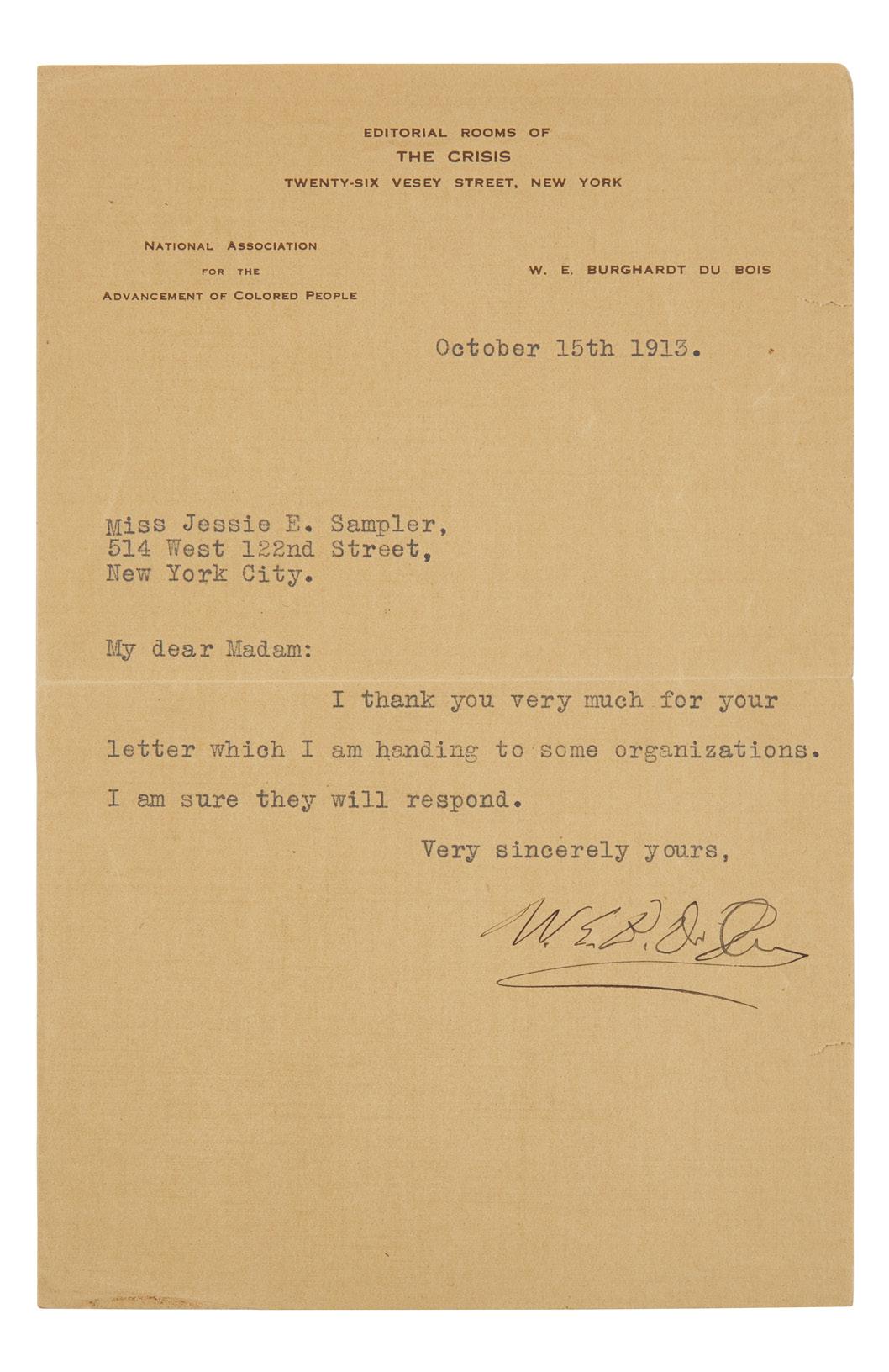
[African-Americana] Du Bois, W.E.B. A Voice of Civil Rights: Typed Letter, Signed by the Co-Founder of the NAACP
Typed Letter, signed New York, October 15, 1913. Bifolium, 8 3/8 x 5 1/2 in. (213 x 140 mm). Typed letter on The Crisis stationery, signed by W.E.B. Du Bois to Jewish author Jessie E. Sampler of Harlem: «My dear Madam: I thank you very much for your letter which I am handing to some organizations. I am sure they will respond. Very sincerely yours, W.E.B. Du Bois». Creased from old fold; two short closed tears in upper and lower fore-edge of each sheet.
The Crisis was the official magazine of the NAACP and was founded in 1910 with Du Bois serving as its first editor.
$400 - 600
14
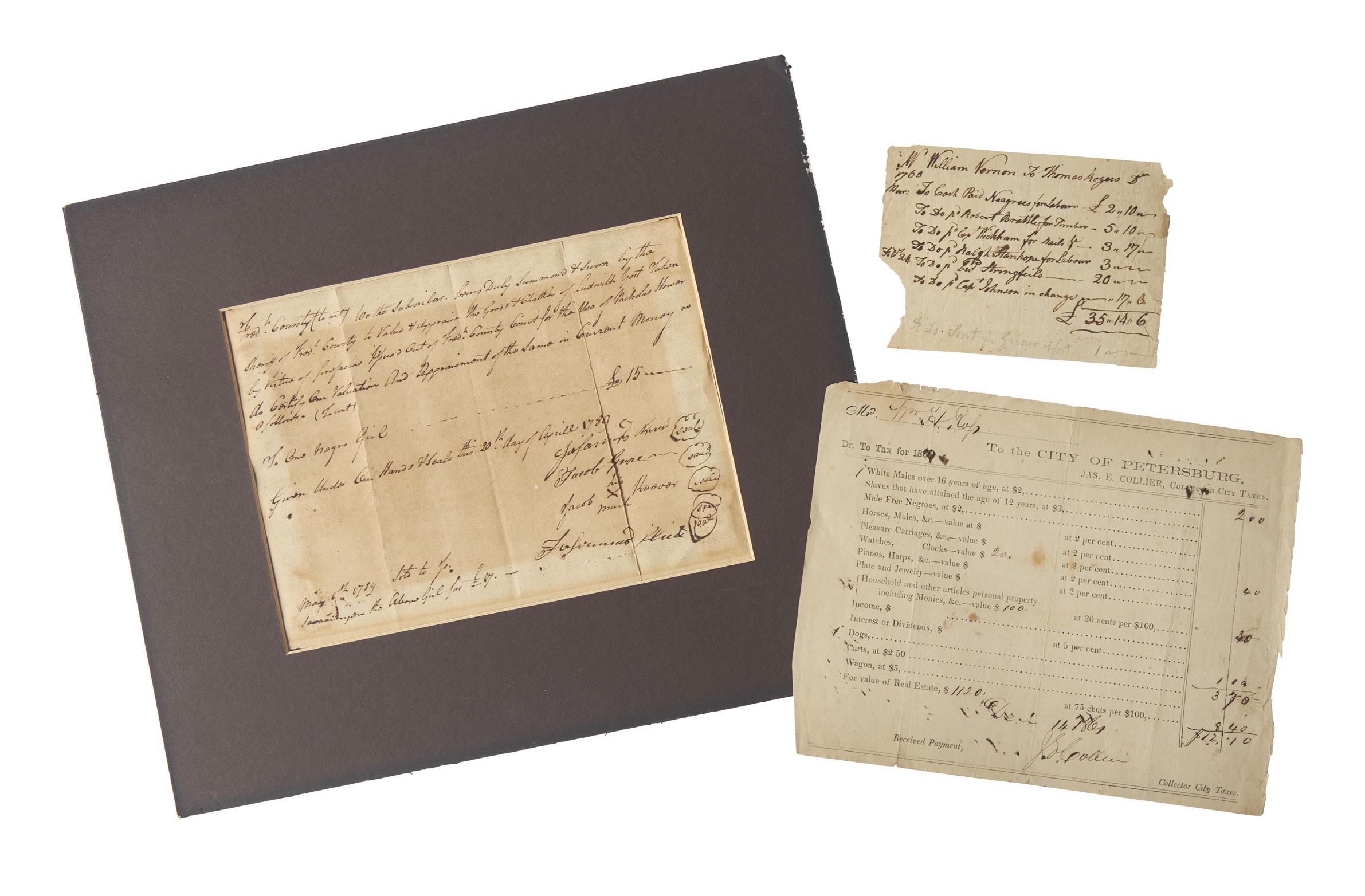
[African-Americana] [Enslavement] Group of 3 Slave-Related Documents
1. Manuscript Receipt
No place (Possibly Newport, Rhode Island), ca. March 1760. Single oblong sheet, 3 1/4 x 4 1/2 in. (82 x 114 mm). Manuscript receipt from a Mr. William Vernon to Thomas Rogers, noting “To Cash Paid Neagroes for Labour £2...” Docketed on verso. Wear along edges.
William Vernon is possibly the same Newport merchant, slave trader, and smuggler (1719-1806), who during the American Revolution outfitted ships for the Continental Navy.
2. Manuscript Appraisal Document Frederick County (Maryland), April 20-May 6, 1789. Single oblong sheet, 5 3/4 x 7 1/2 in. (146 x 190 mm). Manuscript document, being a valuation and appraisal of the “Goods & Chattles of Ludwick Yost Taken by Virtue of fieri facias...One Negro Girl...£15...” Creasing from old folds, separation along same at right side; mat burn. In mat.
3. Partially-Printed Tax Receipt
Petersburg, Virginia, December 14, 1861. Single oblong sheet, 6 x 7 1/2 in. (152 x 190 mm). Partially-printed tax receipt for the city of Petersburg, Virginia, for a Mr. William H. Ross, listing taxes for “White Males over 16 years of age... / Slaves that have attained the age of 12 years... / Male Free Negroes... / Horses, Mules... / Pleasure Carriages... / Pianos, Harps...” Creasing from old folds; light edge-wear and soiling.
$600 - 900
15
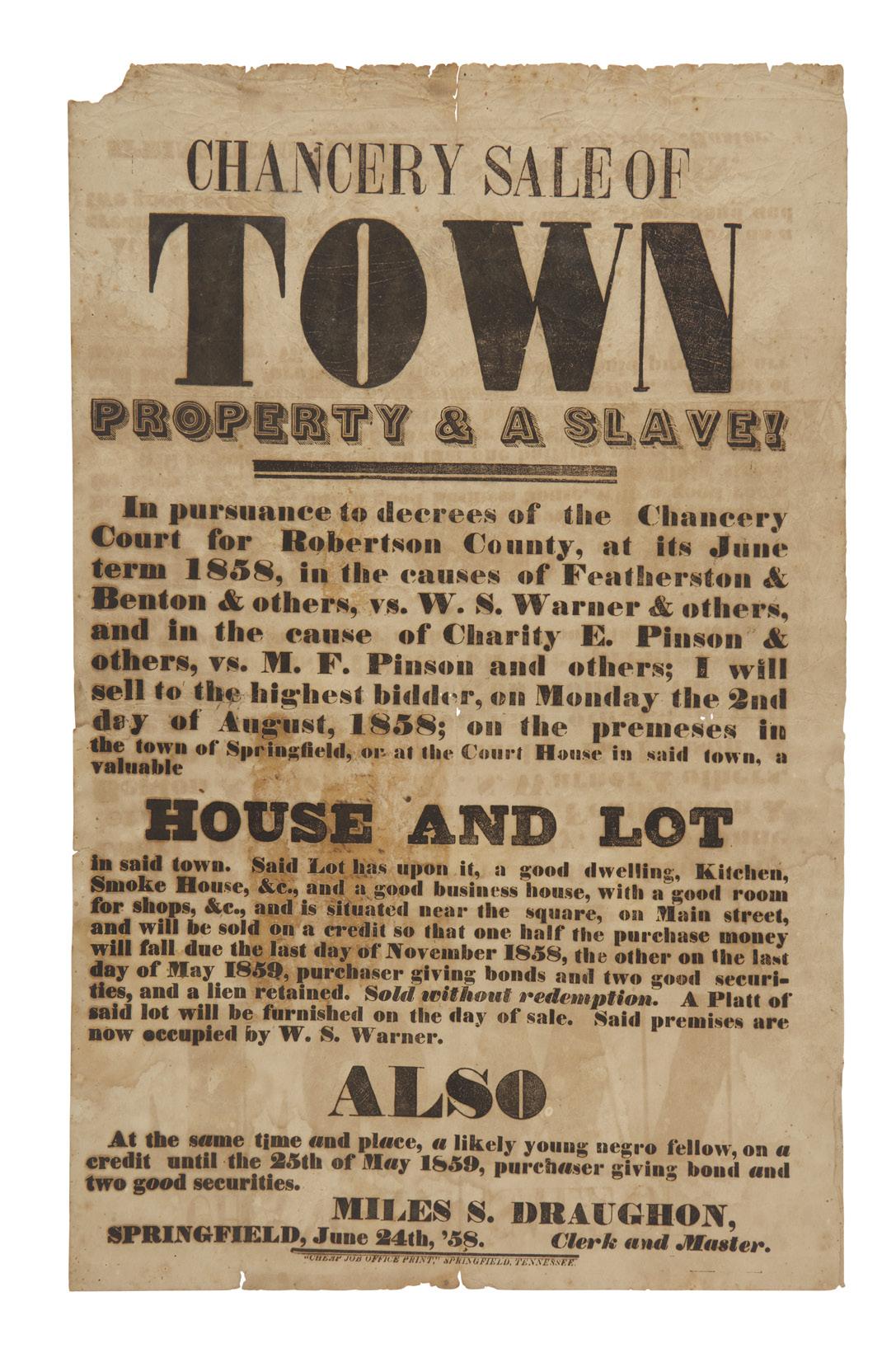
[African-Americana] [Enslavement] “Town Property & a Slave!” for Sale. A Human Life Reduced to a Single Line Item: A Rare Slave Broadside
Chancery Sale of Town Property & A Slave!
Springfield, Tennessee: Cheap Job Office Print, June 24, (18)58. Printed broadside, 19 x 12 in. (482 x 305 mm). Old manuscript and paper remnants on verso; creasing from old folds; scattered closed tears or loss to margins; moderately foxed.
Issued in 1858, this broadside notice of a chancery auction in Springfield, Tennessee, for a house and a young enslaved man, owned by Miles S. Draughon (“Clerk and Master”), offers a stark window into the legal and commercial realities of slavery in antebellum America in the lead up to the Civil War. The broadside devotes far greater attention to the property than to the human being offered alongside it.
$2,500 - 3,500
16
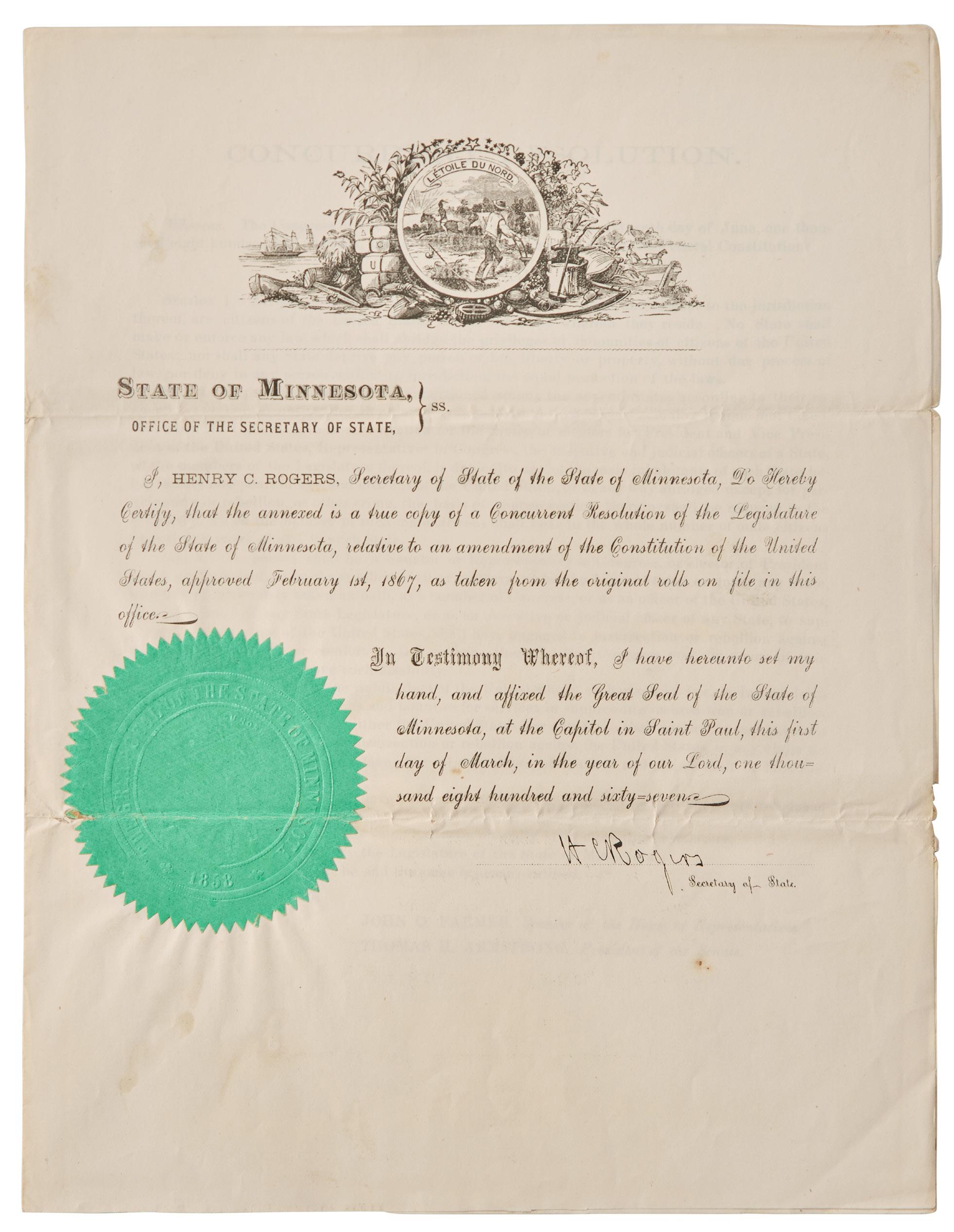
[African-Americana] (Fourteenth Amendment) The State of Minnesota Officially Certifies the Fourteenth Amendment to the Constitution Of the United States
“All persons born or naturalized in the United States, and subject to the jurisdiction thereof, are citizens of the United States...”
Partially-Printed Document, signed St. Paul, Minnesota, March 1, 1867. Bifolium, 11 1/4 x 8 1/2 in. (286 x 216 mm). Partially-printed document, being the official certification of the text of the Fourteenth Amendment approved by the Minnesota State Legislature, signed by Secretary State Henry C. Rogers: “I, Henry C. Rogers, Secretary of State of the State of Minnesota, Do Hereby Certify, that the annexed is a true copy of a Concurrent Resolution of the Legislature of the State of Minnesota, Relative to an Amendment of the Constitution of the United States, Approved February 1st, 1867, as taken from the original rolls on file in this office.” Manuscript docket on verso. Green paper seal present. Creasing from old folds; two closed tears along center repaired with cello tape; scattered foxing.
The official certification of the 14th Amendment by the state of Minnesota, passed by the Minnesota state legislature on January 16, officially approved on February 1, 1867, and certified here by Secretary of Henry C. Rogers. Printing the entirety of the legislation on the attached integral leaf, signed in type by the Minnesota Speaker of the House of Representatives John Q. Farmer and Thomas H. Armstrong, President of the State Senate.
The Fourteenth Amendment was the second of three Reconstruction Amendments, and one of the most consequential pieces of legislation in American history, defining universal citizenship, and equal protection under law at all levels of government.
Despite the ratification of the Thirteenth Amendment in December 1865 formally abolishing slavery, Republicans in Congress remained concerned about the security of the civil rights for Freedmen in America, especially in former states of the Southern Confederacy. In an effort to further protect those formerly enslaved, Congress passed the Civil Rights Act of 1866 which guaranteed citizenship without regard to race. However, it was vetoed by President Andrew Johnson, citing discrimination against Southern states due to their lack of representation at the time. The act was quickly passed again, but this time Johnson’s veto was overridden in both the House and Senate, and the law took effect. While the passage was a victory, many in the Republican party worried about its enforcement, and desired a stricter protection of Freedmen’s civil rights in the form of a constitutional amendment.
In April 1866, after much debate, the Joint Committee on Reconstruction transmitted multiple versions of the amendment to Congress, which were condensed and modified to its present state. While its language received bipartisan support, many Radical Republicans lamented the amendment’s focus on only civil rights, and lacked firm protection of political or voting rights. These grievances were what led those such as Thaddeus Stevens to call for the passage of the Fifteenth Amendment shortly afterwards, protecting universal male suffrage.
The Fourteenth Amendment was forwarded to state legislatures in June of 1866, with Minnesota becoming the twelfth state to ratify it. It took effect on April 9, 1868 after South Carolina became the 28th state convention to pass it, and it has since become one of the most litigated amendments to the United States Constitution.
Very rare. We have been unable to locate any other official state certifications regarding the Fourteenth Amendment in the available auction record.
$8,000 - 12,000
17
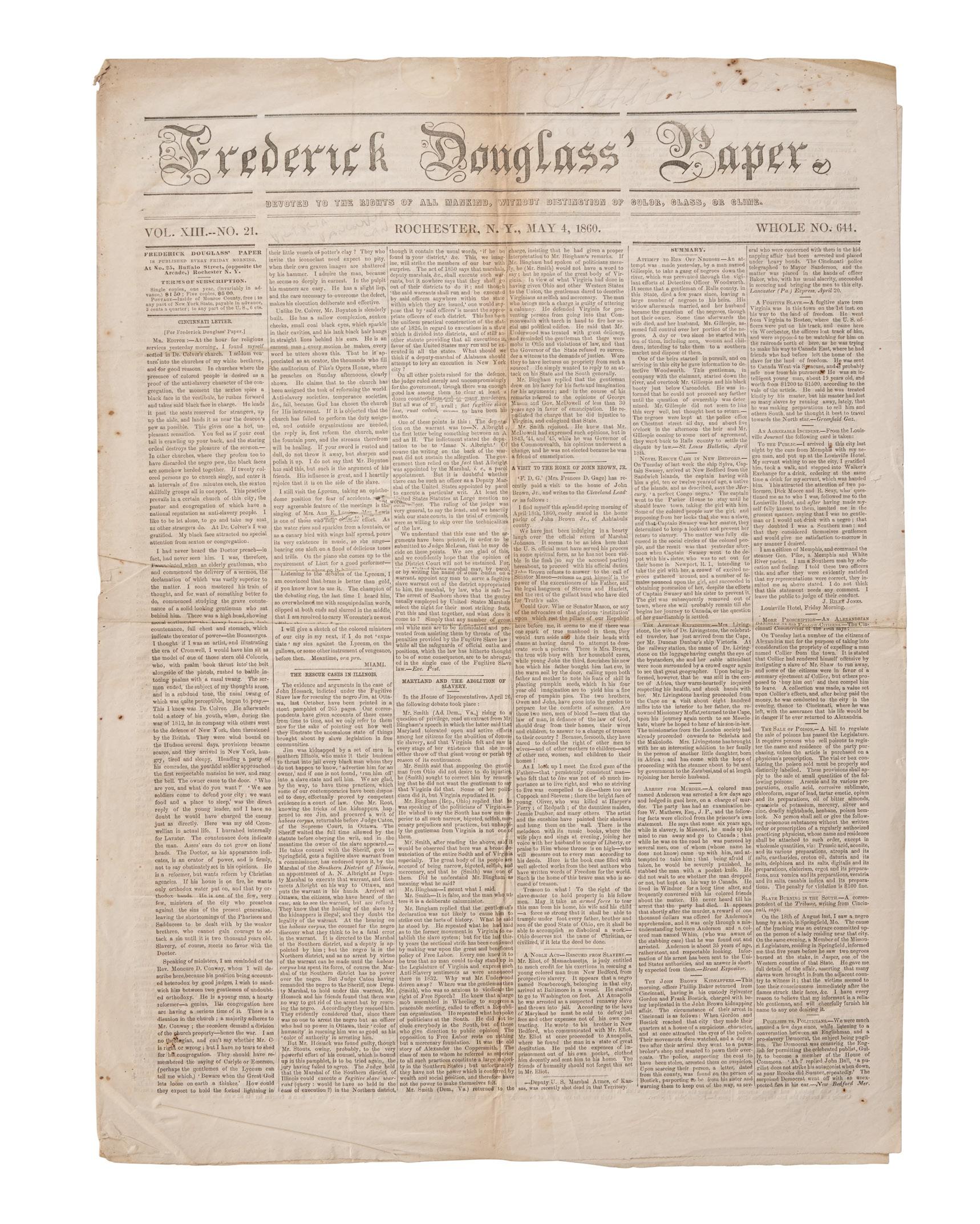
[African-Americana] Frederick Douglass’ Paper, Devoted to the Rights of all Mankind, Without Distinction of Color, Class, or Clime
Rochester, New York, May 4, 1860. Vol. XIII, No. 21, Whole No. 644. Printed newspaper. Folio. 4 pp. Creasing from old folds, toning along same; scattered spotting; two small holes at center of first sheet, repaired tear above same; old ownership signature in pencil at top of first page (“Stephen Reeves”).
A scarce issue of this important newspaper, founded and edited by abolitionist and orator Frederick Douglass. In June 1851, at the encouragement of abolitionist Gerrit Smith, Douglass merged his newspaper The North Star with The Liberty Party Paper (of Syracuse), to form the present publication. Issued weekly, it centered on anti-slavery and other social reform causes. The present representative example reports on a variety of issues, including the rescue of fugitive slaves, a visit to the home of John Brown, accounts of lynching in the south, an account of the life of Elijah P. Lovejoy, various reports of anti-slavery measures, letters from African American authors, and a notification that the newspaper will become a monthly.
$2,000 - 4,000

Colinization (sic) of the Free People of Colour of the United States” (2 pp.); “Report On colonizing the free people of colour of the United States” (5 pp.). Each, (Washington, D.C.), February 11, 1817. 12mo. Disbound; light foxing.
2. The Examiner--Extra. Washington, Pennsylvania, July 25, 1835. Printed broadside, 21 3/4 x 15 1/2 in. (552 x 394 mm).
Contemporary ownership signature, recto and verso. Creasing from old folds, uneven toning from same; light edge-wear; scattered spotting.
Printing the July 4, 1835 address of David McConaughy, President of Washington College, at the meeting of the Washington County Colonization Society.
3. Liberia As It Is. R.M. Johnson, to the Colored Citizens of the American Republic. Philadelphia, 1853. 8vo. 16 pp. Disbound; dampstaining. Sabin 36276
4. Statute Laws of Liberia From 1957 to 1974-75. Sammelband of nine various acts, etc. related to Liberia. Black pebbled leather, typed cover label (“The Property of E.J.S. Worrell, Counsellor at Law, Monrovia”); wear, soiling, and dampstaining; several sheets starting or sprung; library stamps.
Established in 1821 by the American Colonization Society (ACS) to resettle emancipated slaves, Liberia stands as Africa’s oldest republic and the only nation on the continent never subjected to colonial rule. In 1822, the first group of 86 Black volunteers, accompanied by white ACS agents, arrived at Cape Montserrado. By 1824, the settlement was renamed “Monrovia” in honor of President James Monroe, an ACS member, and the nation adopted the name Liberia. Over the next four decades, roughly 19,000 African Americans undertook the journey to Liberia. These settlers, known as Americo-Liberians, were joined by approximately 5,000 Africans liberated from intercepted slave ships, along with a smaller number of immigrants from the West Indies.
$300 - 500
19 [African-Americana]
Alabama, the Carolinas, Louisiana, January 1864-April 1866. Comprising seven printed General Orders. 12mo. Disbound.
1. General Orders No. 7, Department of the South, Folly Island, South Carolina, January 15, 1864. Appointing Col. M.S. Littlefield of the 21st Regiment U.S. Colored Troops, General Superintendent of the recruiting service for colored regiments.
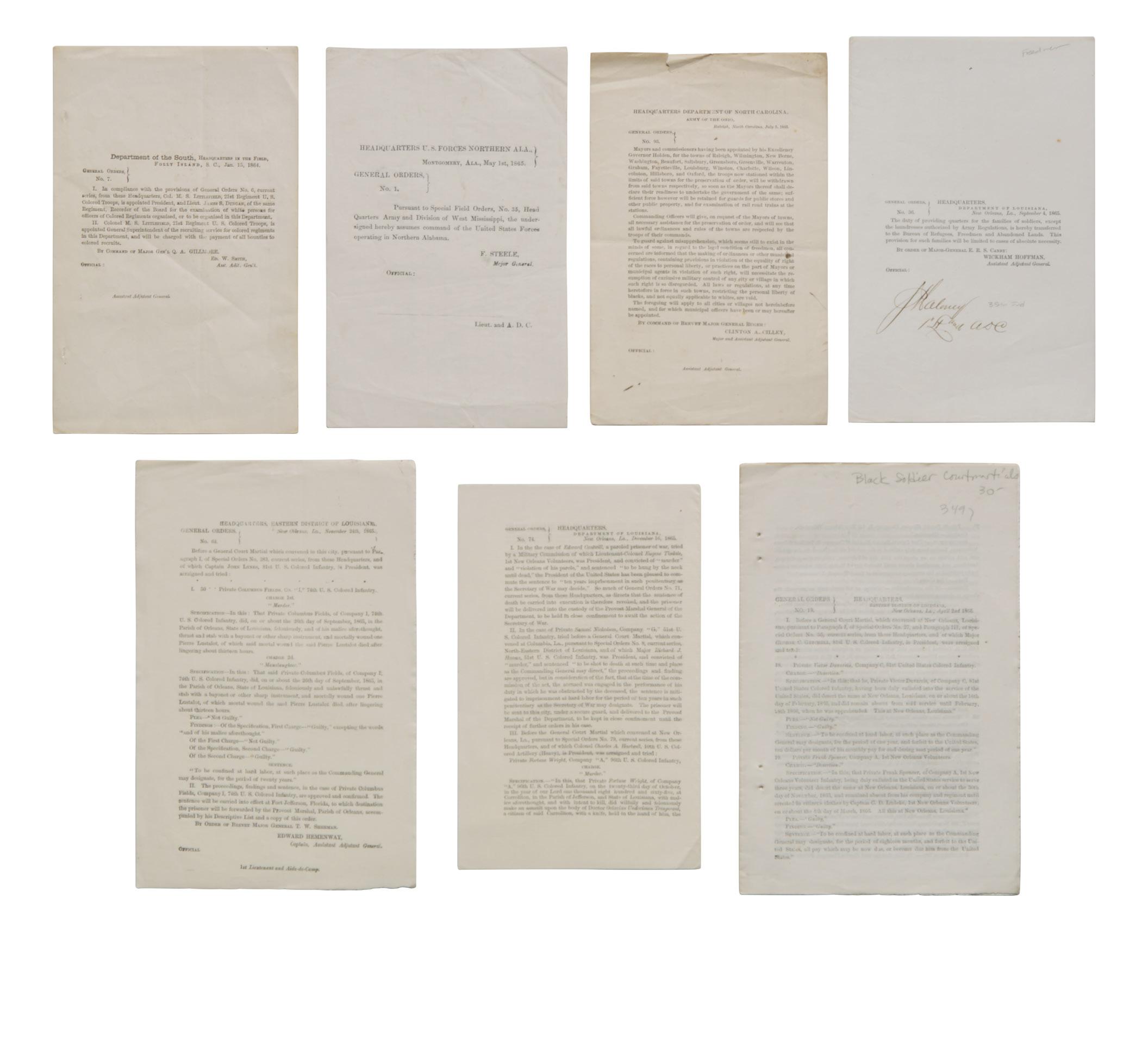
2. General Orders, No. 1, Headquarters U.S. Forces Northern Alabama, Montgomery, May 1, 1865. Being a blank appointment form, signed in type by Major General Frederick Steele. During this time Steele led a force of African-American soldiers, officially designated the “Column from Pensacola”, in Major General Edward Canby’s Army of West Mississippi, between February 18, 1865, and May 18, 1865.
3. General Orders, No. 93, Headquarters Department of North Carolina, Raleigh, July 5, 1865. “To guard against misapprehension...in regard to the legal condition of freedmen, all...are informed that the making of ordinances or other municipal regulations...in violation of the equality of right of the races to personal liberty...will necessitate the resumption of exclusive military control of any city or village in which such right in so disregarded...All laws or regulations... restricting the personal liberty of blacks, and not equally applicable to whites, are void.”
4. General Orders, No. 36, Headquarters Department of Louisiana, September 4, 1865. Transferring the duty of providing housing to families of soldiers to the Freedmen’s Bureau.
5. General Orders, No. 64, Headquarters Eastern District of Louisiana, November 24, 1865. Printing the charges of murder and manslaughter against Private Columbus Fields, of Company I, 74th U.S. Colored Infantry. Fields was found not guilty of murder, and guilty of manslaughter, and sentenced to hard labor.
6. General Orders, No. 74, Headquarters Department of Louisiana, December 16, 1865. Reporting the commuted death sentence of Private Samuel Nickolson, 51st Colored Infantry, for murder; and the indictment, verdict, and sentencing to death of Private Fortune Wright, 96th Colored Infantry, for murder.
7. General Orders, No. 19, Headquarters Eastern District of Louisiana, April 2, 1866. 8 pp. Recording numerous courts martial, including for Black soldiers.
Over the course of the American Civil War approximately 186,097 African-American men joined the Union Army. These soldiers included Northern freedmen and escaped slaves from the South. Though the Confederacy initially considered conscripting slaves for service in the war effort, this idea was not taken seriously until the final weeks of the war, largely due to Confederate fears that arming slaves would lead to an uprising. Enlistment in the Union Army went up following President Abraham Lincoln’s issuance of the Emancipation Proclamation in 1863. Many escaped slaves served as scouts and guides through captured Confederate territory. By war’s end African-American soldiers had participated in over forty major battles and sixteen had been awarded the Medal of Honor. $500 - 800
20
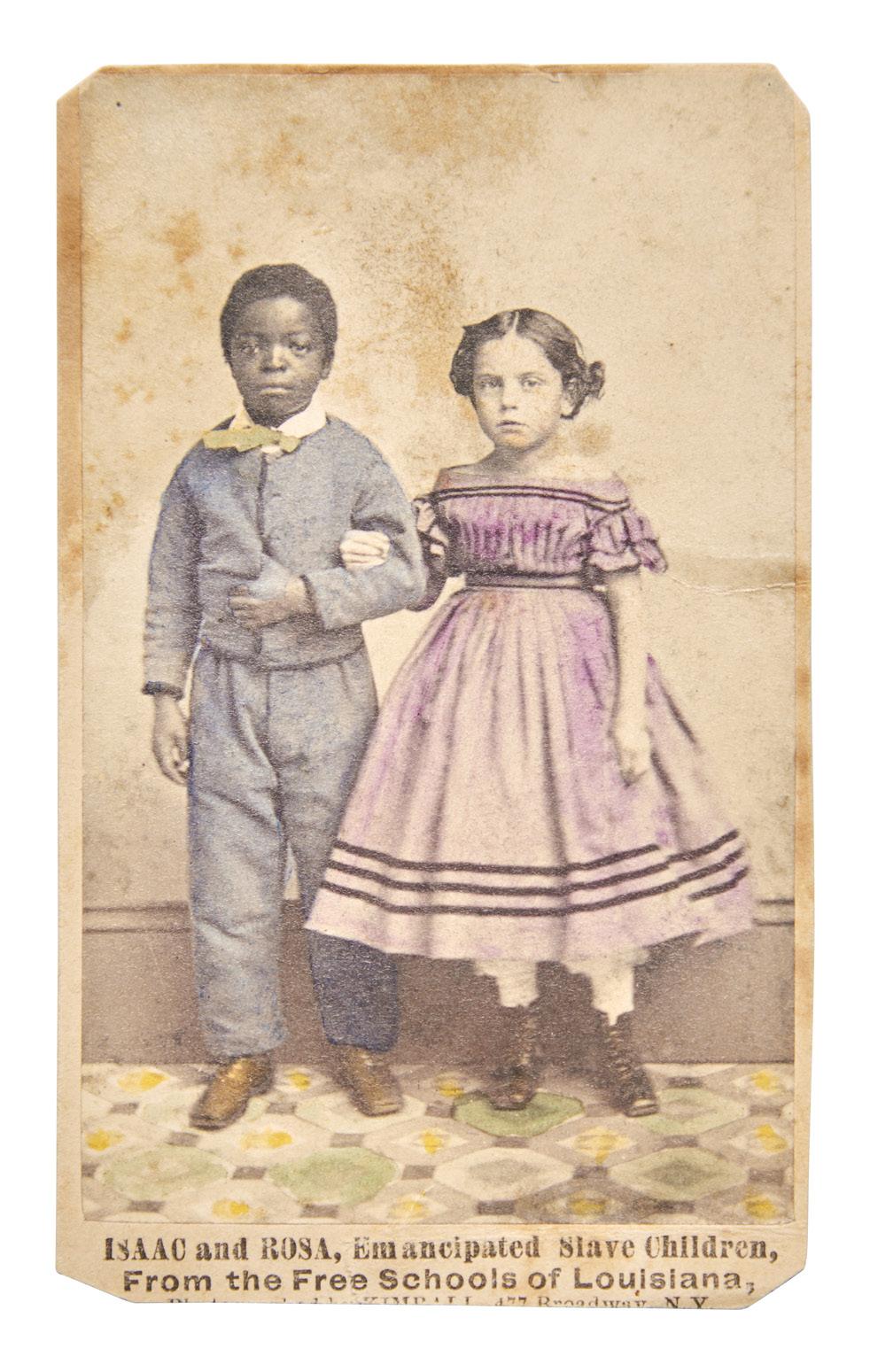
[African-Americana] Hand-colored CDV of Isaac and Rosa, Emancipated Slave Children
(New York: Kimball, 1863). Hand-colored carte de visite; printed caption at bottom “Isaac and Rosa, Emancipated Slave Children, From the Free Schools of Louisiana”. Clipped at corners; trimmed along bottom edge excising imprint; wear in bottom right corner; staining in upper half. 3 3/4 x 2 5/16 in. (95 x 59 mm).
A scarce carte de visite depicting Isaac White and Rosina Downs, born into slavery in the South and freed by the Union Army in 1863. One of a series of photographs sold by the Freedman’s Bureau to raise money for their schools and hospitals in Louisiana.
A January 30, 1864 article in Harper’s Weekly provides a biography of the two emancipated children: «The group of emancipated slaves whose portraits I send you were brought by Colonel Hanks and Mr. Phillip Bacon from New Orleans, where they were set free by General Butler. Mr. Bacon went to New Orleans with our army, and was for eighteen months employed as Assistant-Superintendent of Freedmen, under the care of Colonel Hanks. He established the first school in Louisiana for emancipated slaves, and these children were among his pupils. He will soon return to Louisiana to resume his labor...Rosina Downs is not quite seven years old. She is a fair child, with blonde complexion and silky hair. Her father is in the rebel army. She has one sister as white as herself, and three brothers who are darker. Her mother, a bright mulatto, lives in New Orleans in a poor hut, and has hard work to support her family...Isaac White is a black boy of eight years; but none the less intelligent than his whiter companions. He has been in school about seven months, and I venture to say that not one boy in fifty would have made as much improvement in that space of time...»
RBH locates only one other example of this photograph at auction, that one without hand-coloring.
$600 - 900
21
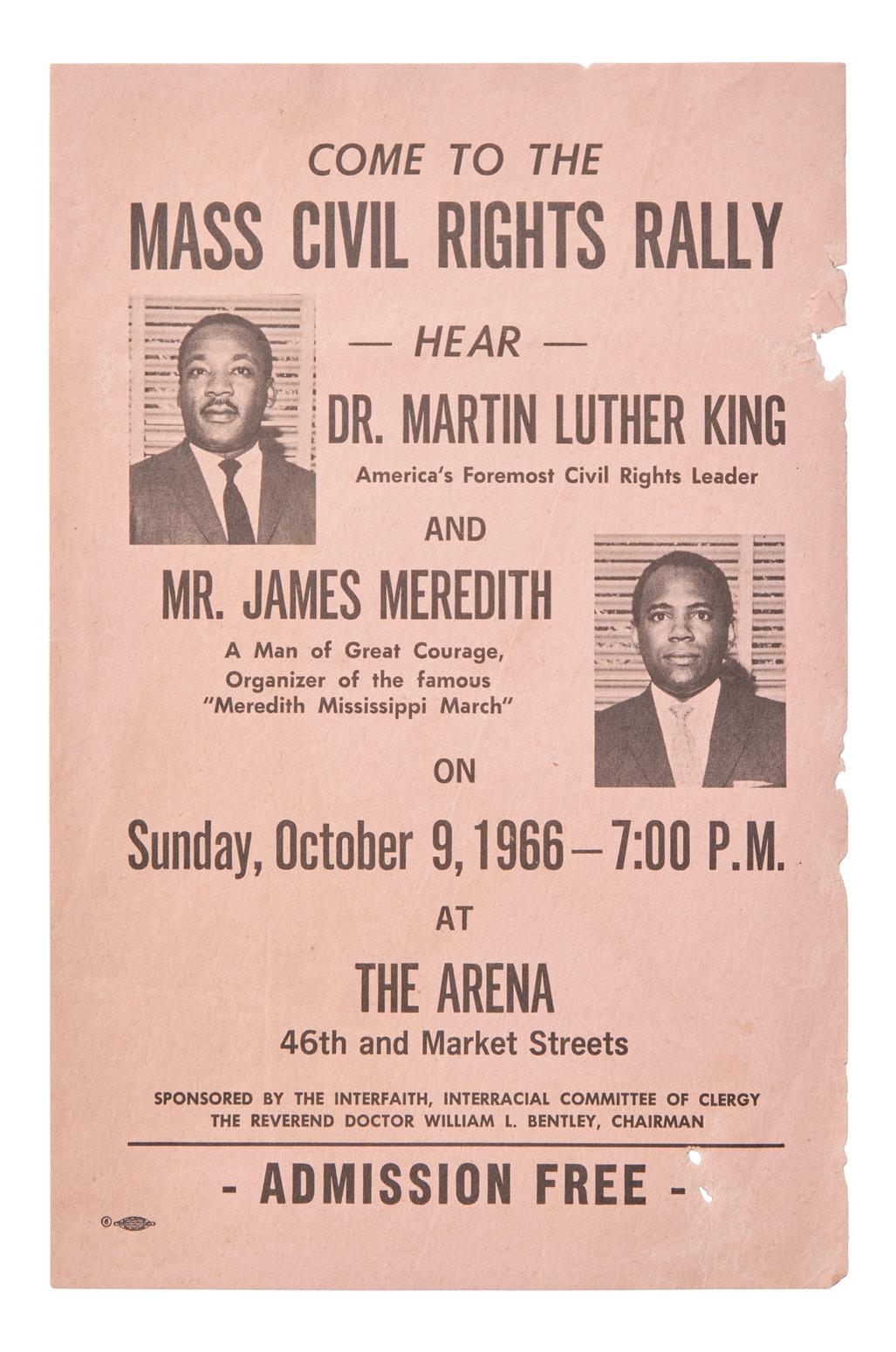
[African-Americana] [King, Martin Luther, Jr.] Printed Handbill for a Mass Civil Rights Rally
Philadelphia, October 9, 1966. Printed handbill on pink paper: “Come to the Mass Civil Rights Rally Hear Dr. Martin Luther King...Mr. James Meredith...On Sunday, October 9, 1966-7:00 P.M. at The Arena 46th and Market Street...” Wear along edges; small holes in bottom right. 8 1/2 x 5 1/2 in. (216 x 140 mm).
Sponsored by the Interfaith Interracial Council, the Sunday, October 9, 1966 civil rights rally was held at The Arena in West Philadelphia, and attracted 1,500 attendees to hear Dr. King speak. Accompanying King at this rally was James Meredith, who in 1962 became the first AfricanAmerican to integrate the University of Mississippi. His admission resulted in the Ole Miss Riot which had to be quelled by President Kennedy sending in 30,000 troops, the largest mobilization for a single instance in the history of the United States.
On June 6, 1966 Meredith began a 220-mile “March Against Fear” from Memphis to Jackson, Mississippi to highlight continuing racial discrimination in the South; he was joined by numerous civil rights leaders including Dr. Martin Luther King, Jr. and Stokely Carmichael. Meredith was shot on the second day, though he had recovered enough to rejoin the march before it reached Jackson on June 26. Meredith’s presence at this rally was one of the great draws, having come so close to death only four months before.
Lot includes a group of five items related to the Civil Rights Movement, including: a Saturday Evening Post poster signed by James Meredith, “My Ordeal In Oxford, ca. 1962; and four black and white press phographs, deciptiing mourners at the tomb of Malcom X, a group of the Little Rock Nine holding their diplomas, a sketch of the damage cause in Martin Luther King Jr,’s assasinsation, and scenes from the Apollo Theater.
$300 - 500
22
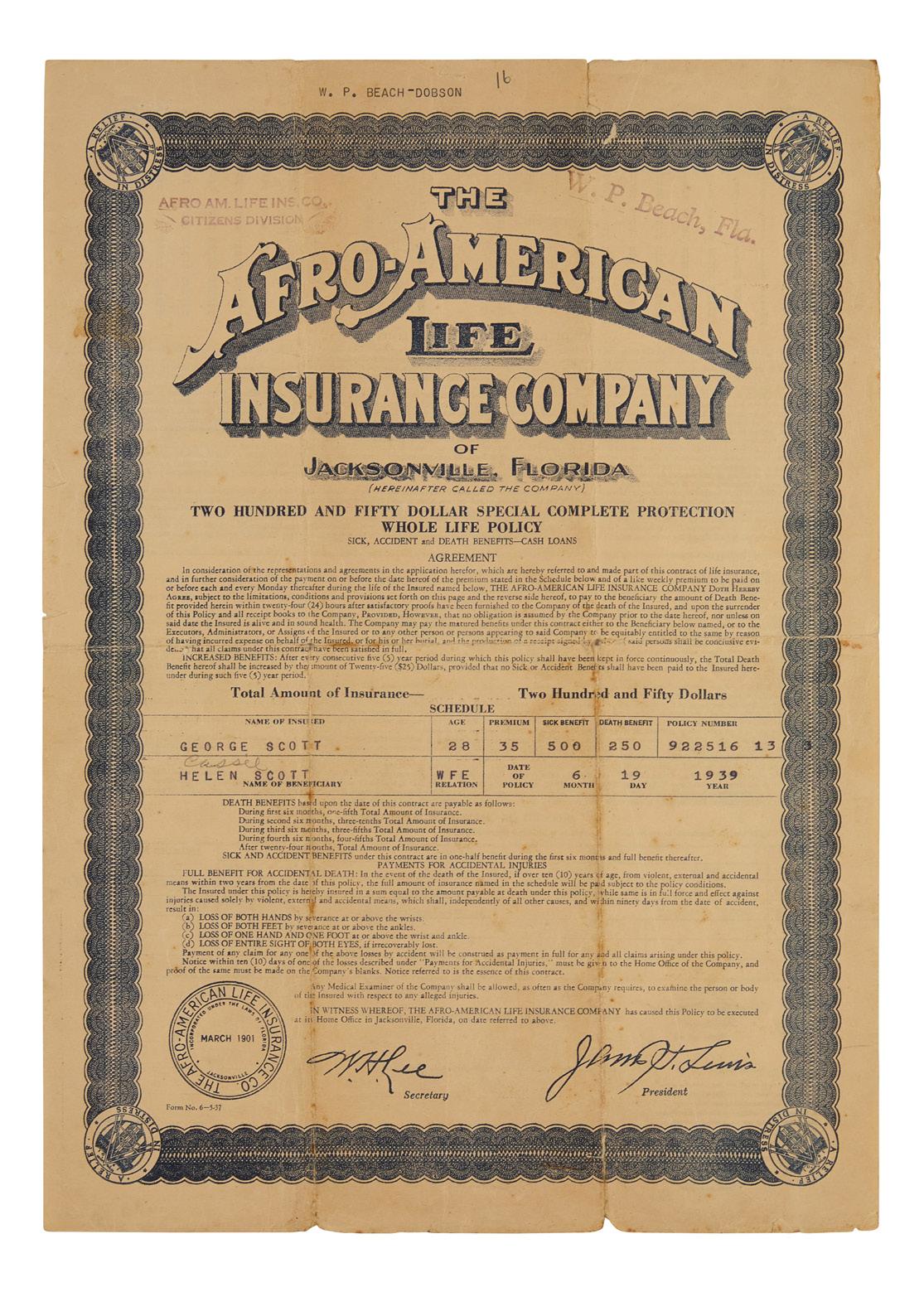
[African-Americana] Life Insurance Policy for a West Palm Beach Resident, Issued by One of the Largest Black-Owned Businesses in the State
The Afro-American Life Insurance Company of Jacksonville, Florida Jacksonville, Florida, June 19, 1939. Single sheet, 15 x 10 3/4 in. (381 x 273 mm). Printed life insurance policy. Ink stamps on recto and verso. Creasing from old folds, small losses and separations along same.
Abraham Lincoln Lewis (1865-1947), a pioneering African-American businessman, philanthropist, and Florida’s first Black millionaire, cofounded along with six associates the Afro-American Industrial and Benefit Association in Jacksonville in 1901, which later became the Afro-American Life Insurance Company, the first life insurance company in Florida. Lewis was elected president of the company in 1919, and under his direction in 1935, he purchased American Beach, a popular beach destination for Black tourists in Nassau County.
This life insurance policy (“Two Hundred and Fifty Dollar Special Complete Protection Whole Life Policy”) including sick, accident and death benefits, was issued on June 19, 1939, to 28-year-old George Scott. The first beneficiary is his wife Helen (Cassel) Scott, however, the two apparently divorced, as she is supplanted by Cassie Scott, in 1955, who in turn is replaced by a cousin, Josephine Fearley, one year later.
$150 - 250
23
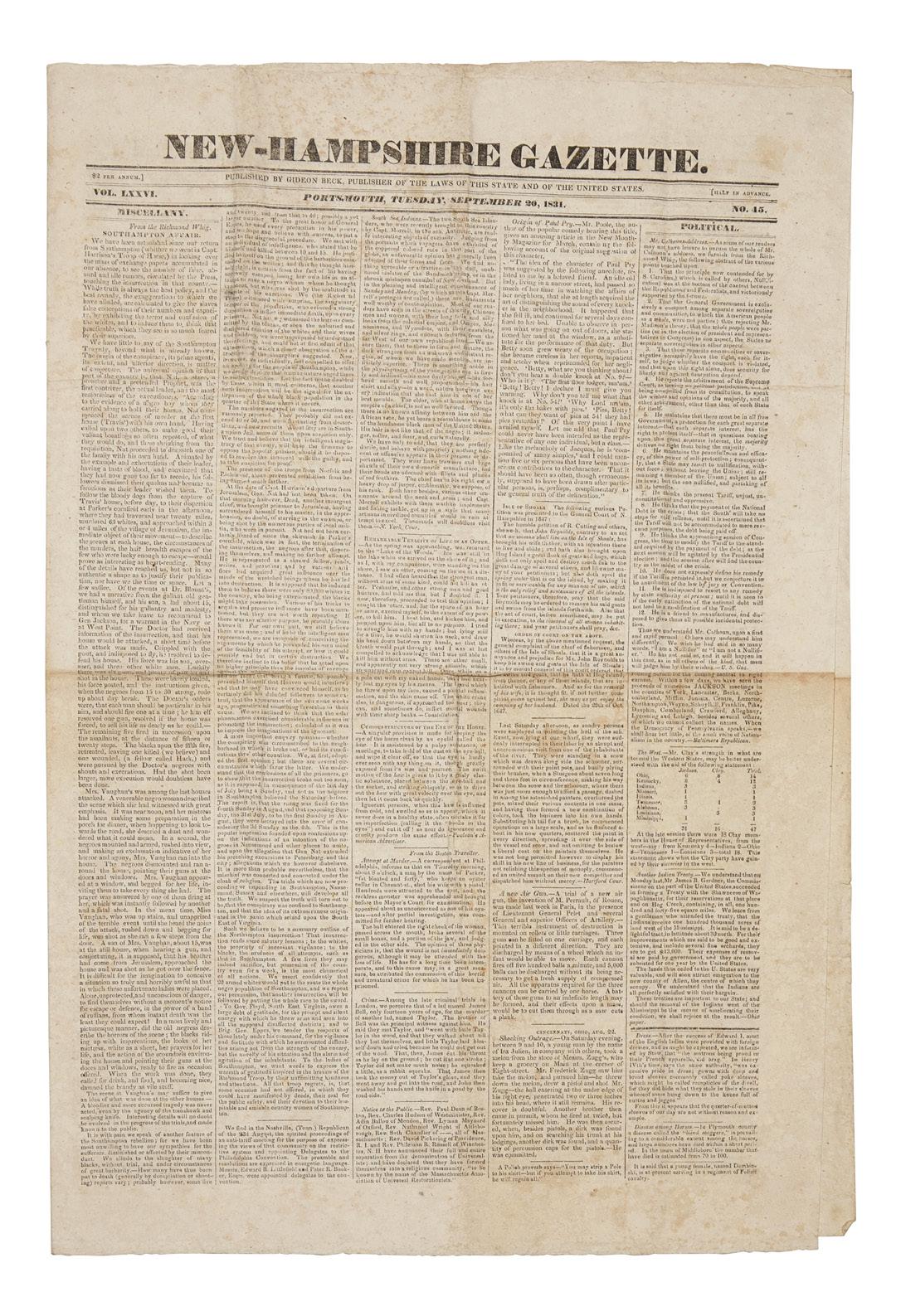
[African-Americana] [Nat Turner Rebellion] New-Hampshire Gazette, with a Highly Detailed Front-Page Report on Nat Turner’s Rebellion
New-Hampshire Gazette
Portsmouth: Published by Gideon Beck, Tuesday, September 20, 1831. Vol. LXXVI, No. 45. Printed newspaper. Folio. (4) pp. Creased from old fold; scattered foxing; light wear along edges.
With a highly detailed report on Nat Turner’s Rebellion and its aftermath, reprinted from the Richmond Whig. The rebellion began in the early predawn hours of August 21, 1831, in Southampton County, Virginia, led by Nat Turner (1800–1831), an enslaved man and preacher. First killing his enslaver, Turner and his growing band of men traveled through the Virginia countryside over the next two days, killing upwards of 65 whites. The local militia and volunteers quelled the uprising, and a brutal retaliatory crackdown ensued, during which over 200 Blacks were murdered. Turner managed to escape, and evaded capture for two months, before being discovered on October 30, 1831. He was hanged on November 11. The deadliest slave revolt in the history of the United States, the uprising intensified the national debate over slavery, and resulted in the passage of harsher slave codes throughout the south.
$300 - 500
24
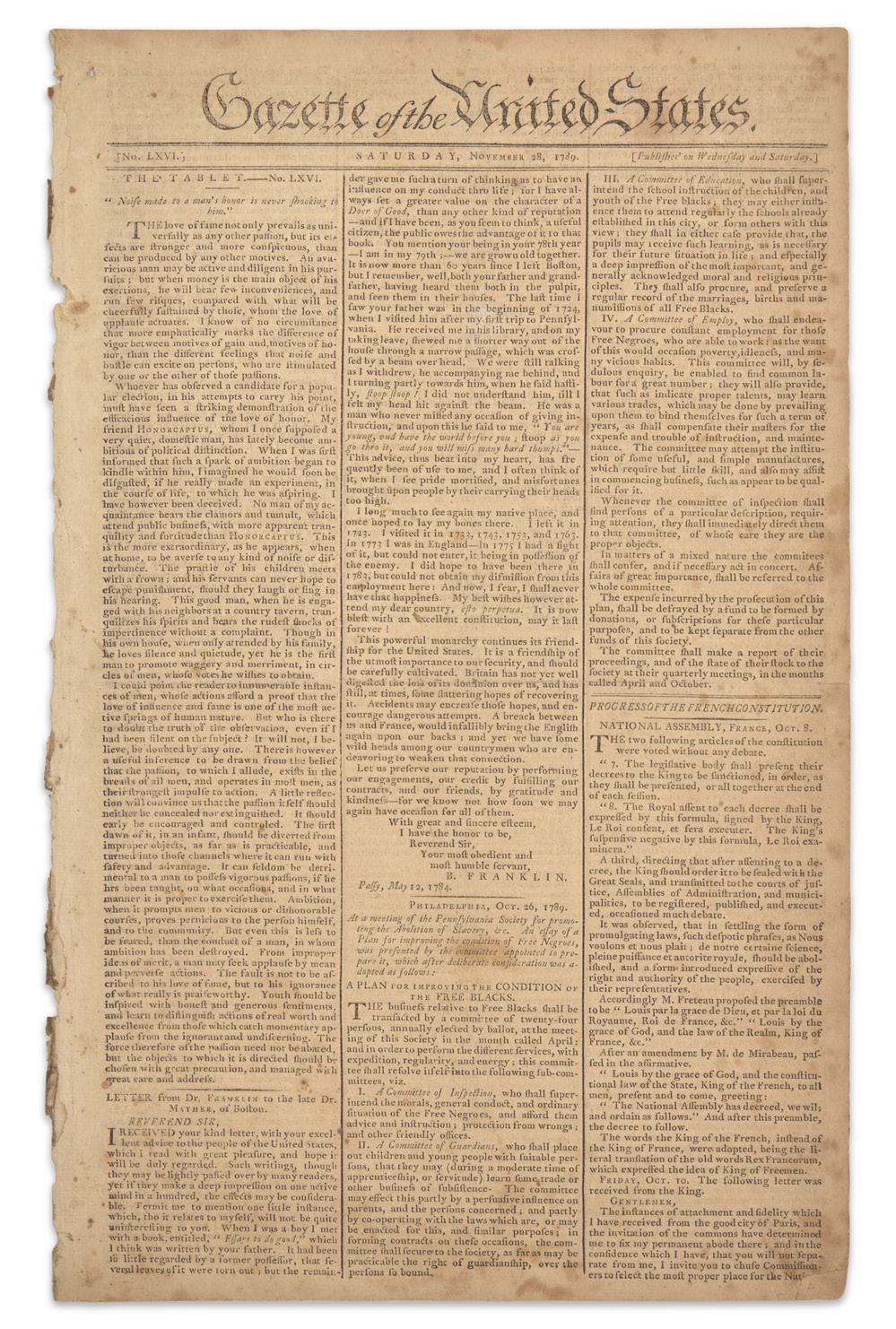
[African-Americana] Pennsylvania Abolition Society’s “Plan for Improving the Condition of the Free Blacks”, Printed in the “Gazette of the United States”
New York: John Fenno, Saturday, November 28, 1789 (No. LXVI). Printed newspaper. Folio. 4 pp. Disbound; separations along central vertical fold; foxing.
Printed on the front page is the Pennsylvania Abolition Society’s (PAS) “Plan for Improving the Condition of the Free Blacks”. Developed by PAS president Benjamin Franklin and put into motion in conjunction with the Free African Society, the Act established the PAS as the “de facto Ministry of Black Affairs” (Library Company of Philadelphia). Created to assist Philadelphia’s Free Black community, the Act established committees that focused on education, safety, employment, as well as on moral and social relations.
Other articles of note include a May 12, 1784 letter from Franklin to Samuel Mather recounting trips he made to Boston over the course of his life, as well as describing the influence Mather’s father, Cotton, made on Franklin through his life; dispatches from France on the Revolution, printing that “The King’s government may now be supposed to be at an end. In fact, he is the prisoner, not of the nation, but of the people of France...”; a report on the opening of the first session of the judiciary.
$500 - 800
25
[African-Americana]
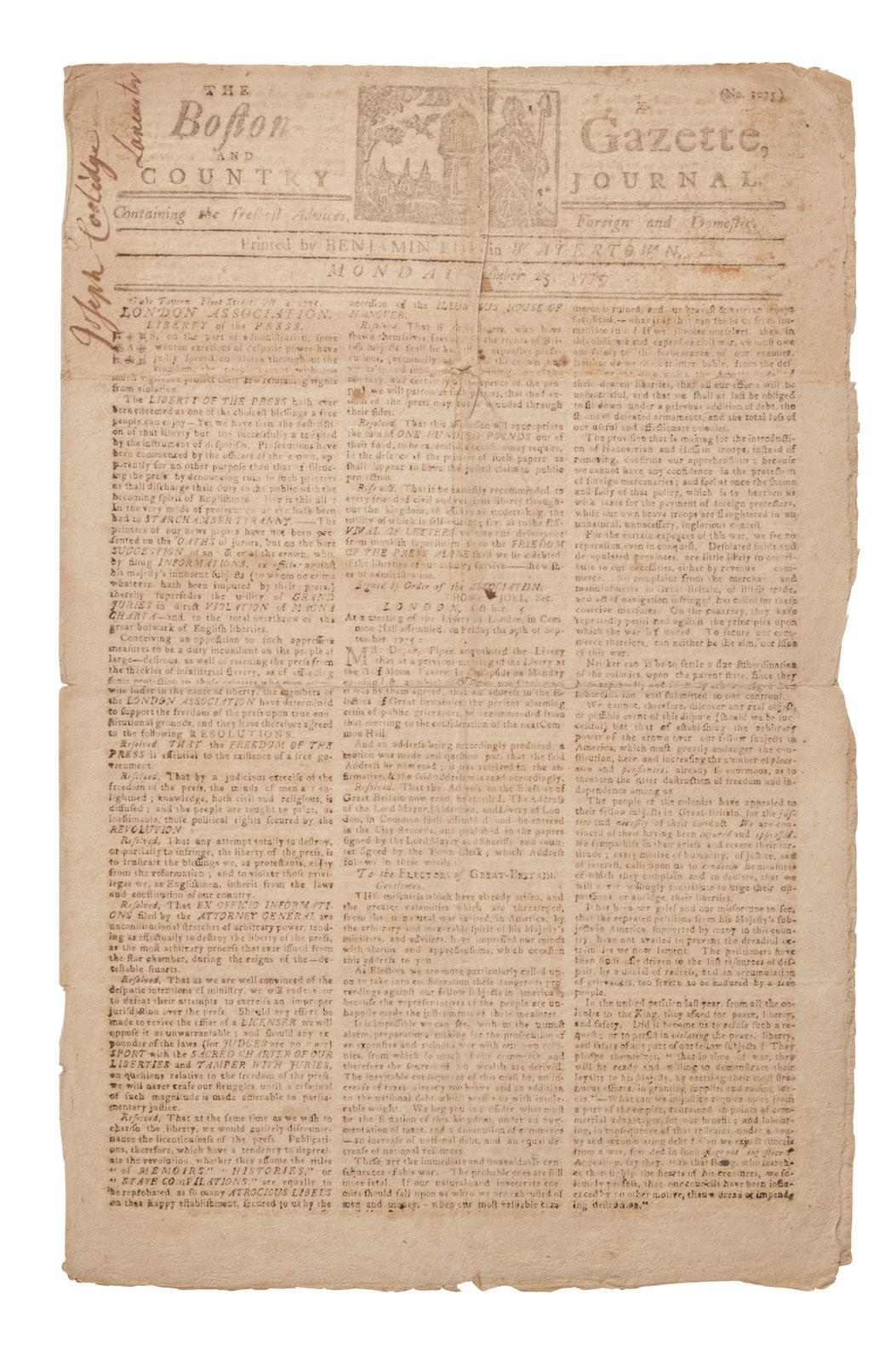
Scarce Issue of The Boston Gazette from the Early Months of the American Revolution, Deriding British Royal Governor Lord Dunmore’s Treatment of Freed Slaves within his Army
The Boston-Gazette and Country Journal
Watertown: Benjamin Edes, December 25, 1775. No. 1075. Printed newspaper, with Paul Revere engraved masthead. Folio. 4 pp. Contemporary ownership signature at top left “Joseph Coolidge / Lancaster.” Creasing from old folds, small closed tears along same; unevenly toned; small chips or loss to extremities.
As the issue describes, “Several persons lately from Norfolk inform that Lord Dunmore was preparing barracks for his army...and that several Scotch tories in that borough commanded black companies, who speak with much confidence of beating us...When his lordship first went down to Norfolk, he gave great encouragement to unwary Negroes, but, such was his baseness, some of them, it is confidently said, he sent to the West Indies, where these unfortunate creatures were disposed of to defray his lordship’s expences... Lord Dunmore issued a proclamation inviting the slaves of rebels, as he pleased to say, to repair to his standard. A considerable number at first went to him, but upon their masters taking the oath of allegiance, they were immediately told they must return...such is the barbarous policy of this cruel man...”
Virginia royal governor Lord Dunmore (1730-1809) issued a proclamation on November 15, 1775, following a victory at the Battle of Kemp’s Landing, promising emancipation to those enslaved in the colony that joined the British Army. While the act was not as successful as he might have hoped, Dunmore was able to form the Royal Ethiopian Regiment from those who joined him. It was the first British regiment during the war to feature Blacks as soldiers, and while it was disbanded not long after its formation, many recruits would go on to serve in other “Black Loyalist” regiments.
$800 - 1,200
26 [African-Americana] [Townsend, Elias Stillwell] “The Patriots Who Secured Our Independence”: Manuscript of an Anti-Slavery Oration
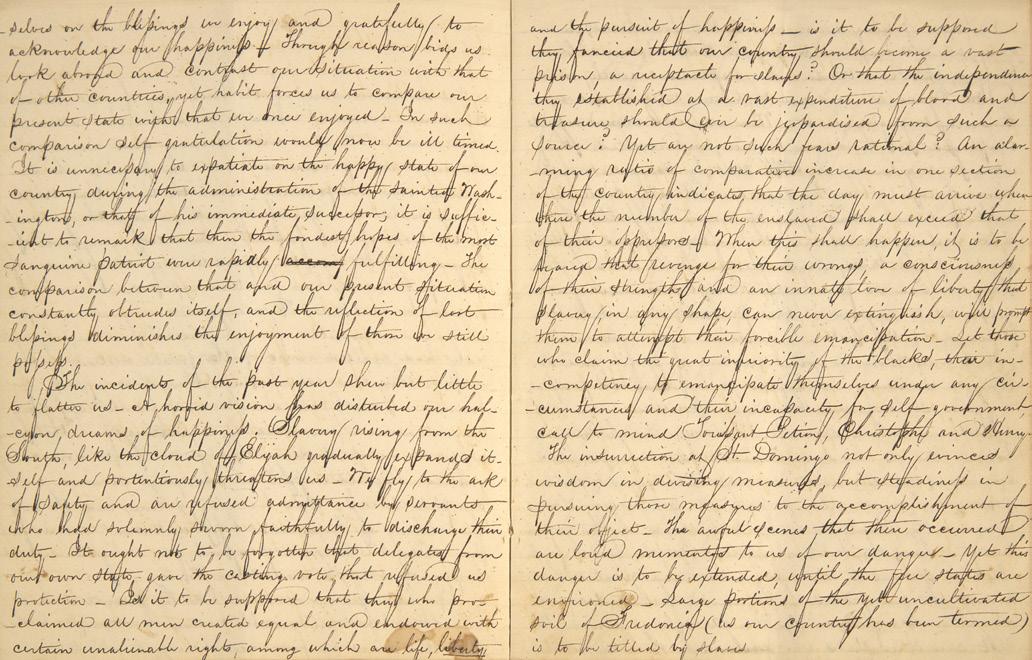
New Haven, Connecticut, July 4, 1820. 18-page manuscript of an antislavery oration. 12mo. Contemporary stiff blue wrappers; old vertical crease.
A fine manuscript of an engaging July 4, 1820 anti-slavery oration, delivered only a few months following the passage of the Missouri Compromise. The orator, Elias Stillwell Townsend (1796-1820), opens by praising “the patriots who secured our independence”, but then asks, “What were the expectations of the founders of our republic, and how far those expectations have been or will be realised”? He answers by bringing attention to the slavery question that had thus roiled the nation, “The incidents of the past year shew but little to flatter us. A horrid vision has disturbed our halcyon dreams of happiness. Slavery rising from the South like the cloud of Elijah gradually expands itself and portentously threatens us.” He goes on to ask, “Let it be supposed that they who proclaimed all men created equal and endowed with certain unalienable rights, among which are life, liberty and the pursuit of happiness--is it to be supposed they fancied that our country should become a vast prison, a receptacle for slaves? Or that the independence they established at a vast expenditure of blood and treasure should ever be jeopardised from such a source?”
Townsend notes that the rising number of enslaved will one day outnumber their oppressors, and will rightly seek revenge, and “attempt their forcible emancipation.” Calling to mind the example of the successful slave uprising and revolution in Haiti, the author praises its leaders “Touissant [Louverture], [Alexandre] Petion, and [Henri] Christophe” for their accomplishments in bringing an end to bondage. He then refers to Missouri, a new slave state following the passage of the Missouri Compromise that previous March, “opening a new market for slaves, in vain are all exertions to prevent that abominable traffic, that slave trade.” The remainder of his long speech touches on numerous topics, including the economic conditions of the enslaver, the larger economic prosperity of the nation, and Connecticut’s larger role within the republic that allows slavery to continue.
$600 - 900
27 [African-Americana] [Underground Railroad] Autograph Letter, signed, by a Dartmouth Student Who Recounts the Arrival of a Runaway Slave
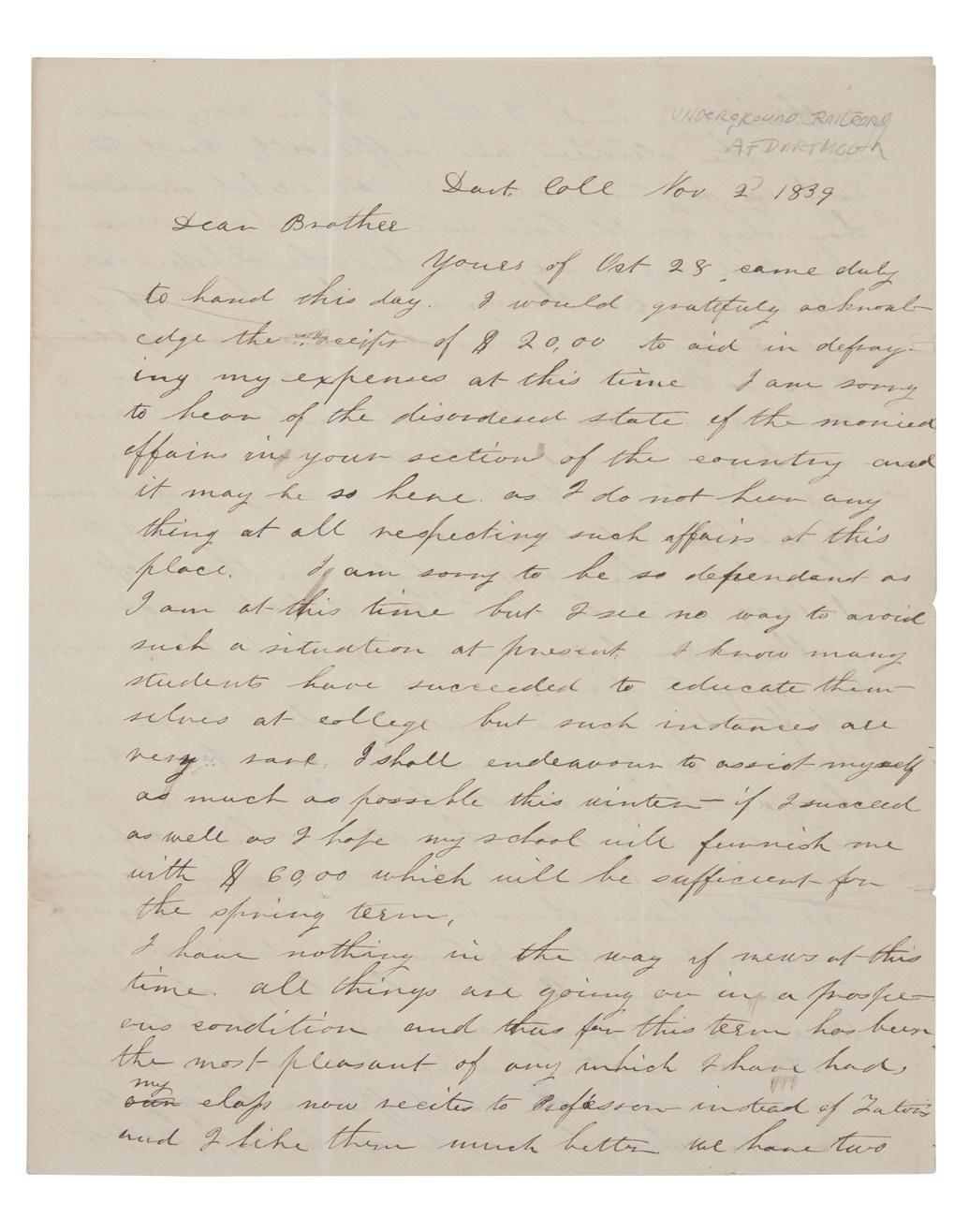
Dartmouth College, Hanover, New Hampshire, November 2, 1839. Bifolium. Three-page autograph letter, signed by Timothy Hill to his brother John in Bangor, Maine, thanking him for money he had sent, recounting his studies, and notably, informing him about the arrival of an enslaved man seeking freedom. Addressed on integral leaf. Creasing from old folds; wear from removed seal when opened.
A Dartmouth student recounts the arrival of a runaway slave who made a long, arduous, and dangerous over-1,000 mile journey from the Deep South: “A few days ago a runaway slave made his appearance here, said he came from Alabama. The students had him go into the chapel and relate the story of his escape from his master and the reasons why. He said he had been the slave of a man in Virginia was kindly treated by him and lived well as long as he was with him, but he finally sold him and his family one in one direction and another in another, and he soon was away from his second master. He was helped on his way to Canada where he may be safe from the prospect being sold...”
Approximately 30,000 to 50,000 enslaved men and women fled bondage to reach Canada before the Civil War. While the Underground Railroad facilitated many escapes, journeys originating from the Deep South were rare due to the immense logistical hurdles and the extreme risks involved. Overland freedom seekers from these regions faced a grueling trek of 800 to 1,300 miles, requiring them to traverse multiple slave states while navigating a sparse and fragmented network of safe houses below the Mason-Dixon line. New Hampshire played a critical role as one of the final northern legs of this route. Hanover, located just 100 miles from the Canadian border, was one of many gateways for those arriving overland. While many enslaved opted for maritime routes, departing from coastal hubs like New Bedford, Massachusetts, to sail directly to Canadian ports, others, including the unnamed individual referenced here, seemingly undertook the arduous journey entirely by land, relying on the clandestine support of abolitionist networks to cross the final stretch into freedom.
$400 - 600
28
[African-Americana] [Wheatley, Phillis] The First Printed Appearance of Phillis Wheatley’s Poem “Recollection”
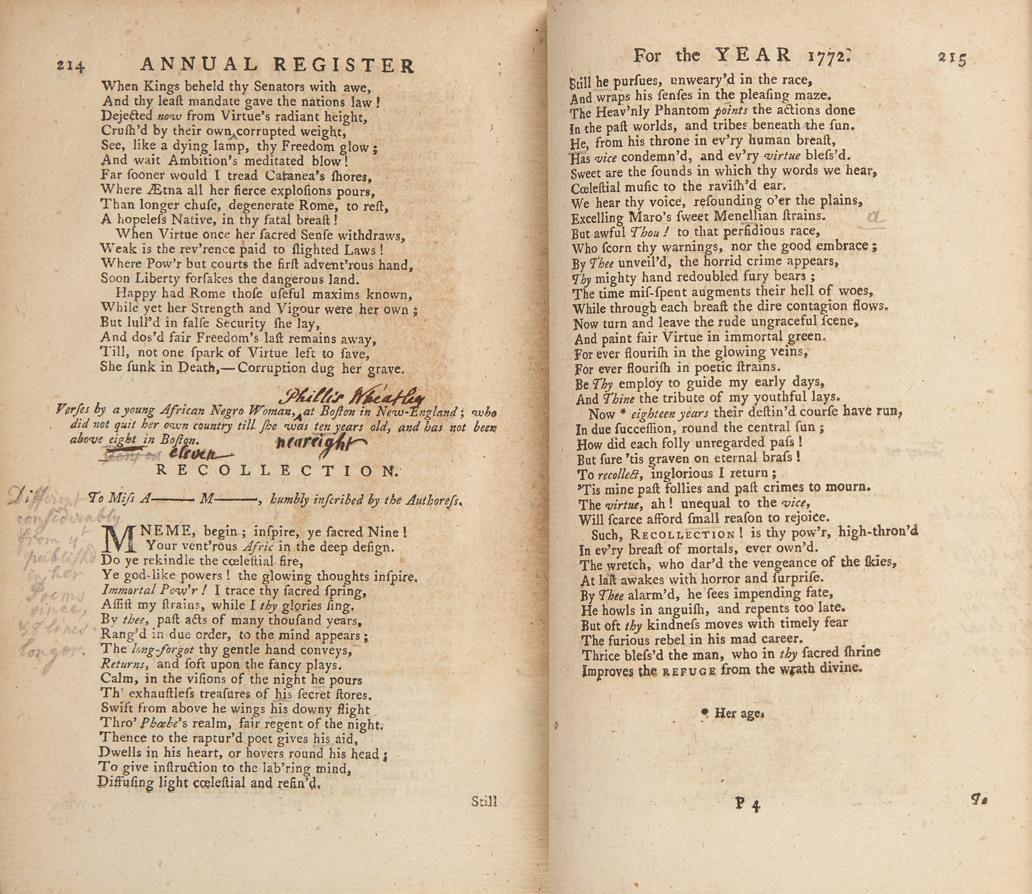
The Annual Register, or a View of the History, Politics, and Literature, for the Year 1772
London: Printed for J. Dodsley, 1773. First edition. 8vo. (iv), 105, (1), 65256, 246, (9) pp. Full contemporary tan calf, stamped in gilt, front board detached, spine dry and worn, rear board starting, boards and extremities rubbed and worn; all edges trimmed, library ink stamps on same; bookplate on front paste-down; contemporary ownership signature on front free endpaper (sheet now detached); library ink stamp on title-page; scattered ink and pencil marginalia; library ink stamp at bottom of D3r.
Printed on p. 214 in the second part of the volume is Phillis Wheatley’s fourth published poem, “On Recollection”, published shortly afterwards in her first book, Poems on Various Subjects, Religious and Moral (published September 1, 1773). Her poem is prefaced with a short description of the poet, noting, «Verses by a young African Negro Woman, at Boston in New-England; who did not quit her own country till she was ten years old, and has not been above eight in Boston.» With contemporary manuscript at same identifying Wheatley by name and amending her age to «eleven». Contemporary pencil at same, «different considerably from published in her Poems since 58 lines longer.»
$500 - 800
29 [African-Americana] [Wheatley, Phillis] Urban, Sylvanus. Phillis Wheatley’s Fourth Published Poem “On Recollection”
The Gentleman’s Magazine, and Historical Chronicle. Volume XLIII. For the Year M.DCCLXXIII
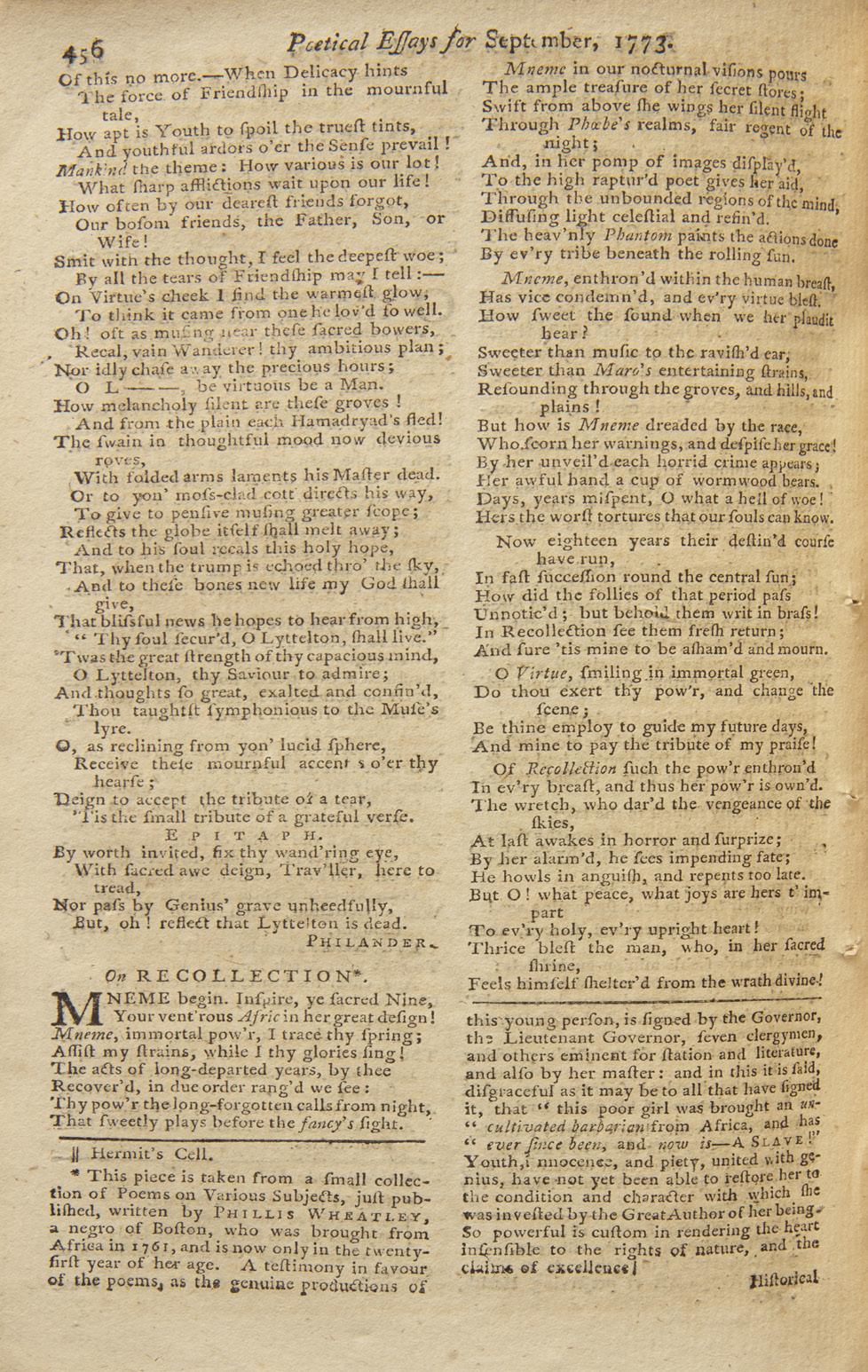
London: Printed for D. Henry, and sold by F. Newbery, 1773. First edition. Thick 8vo. (iv), 655, (17) pp. Illustrated with 20 engraved plates. Threequarter contemporary speckled sheep over drab paper-covered boards, red morocco spine label, stamped in gilt, rear board detached but holding, front board starting, wear at spine ends, loss at lower front corner, soiling; all edges trimmed; some leaves partially unopened; book-plate of Josiah Harrison on front paste-down; loss in bottom corner of pp. 49/50; scattered closed tears; lower portion of final map separated but present; scattered spotting and soiling.
In the September issue (p. 456) is printed Phillis Wheatley’s fourth published poem “On Recollection”, from her simultaneously published Poems on Various Subjects, Religious and Moral (published September 1, 1773). Her poem is followed by a footnote with a short biography and commentary on her: “This piece is taken from a small collection of Poems on Various Subjects, just published, written by Phillis Wheatley, a negro of Boston, who was brought from Africa in 1761, and is now only in the twenty-first year of her age. A testimony in favour of the poems, as the genuine productions of this young person, is signed by the Governor, the Lieutenant Governor, seven clergymen, and others eminent for station and literature, and also by her master: and in this it is said, disgraceful as it may be to all that have signed it, that ‘this poor girl was brought an uncultivated barbarian from Africa, and has ever since been, and now is--A SLAVE!’ Youth, innocence, and piety, united with genius, have not yet been able to restore her to the condition and character with which she was invested by the Great Author of her being. So powerful is custom in rendering thee heart insensible to the rights of nature, and the claims of excellence.”
Wheatley is again mentioned in the May issue (p. 226), in a letter to the editor from John Wheatley. Reads in part: “...Phillis was brought from Africa to America in the year 1761, between seven and eight years of age, without any assistance from school education; and by only what she was taught in the family, she, in sixteen months time from her arrival, attained the English language, to which she was an utter stranger before, to such a degree as to read any the most difficult parts of the sacred writings, to the great astonishment of all who heard her. As to her writing, her own curiosity led her to it; and this she learned in so short a time, that, in the year 1765, she wrote a letter to the Rev. Mr. Occom, the Indian minister, while in England. She has a great inclination to learn the Latin tongue, and has made some progress in it. This relation is given by her master, who bought her, and with whom she now lives.”
$500 - 800
30
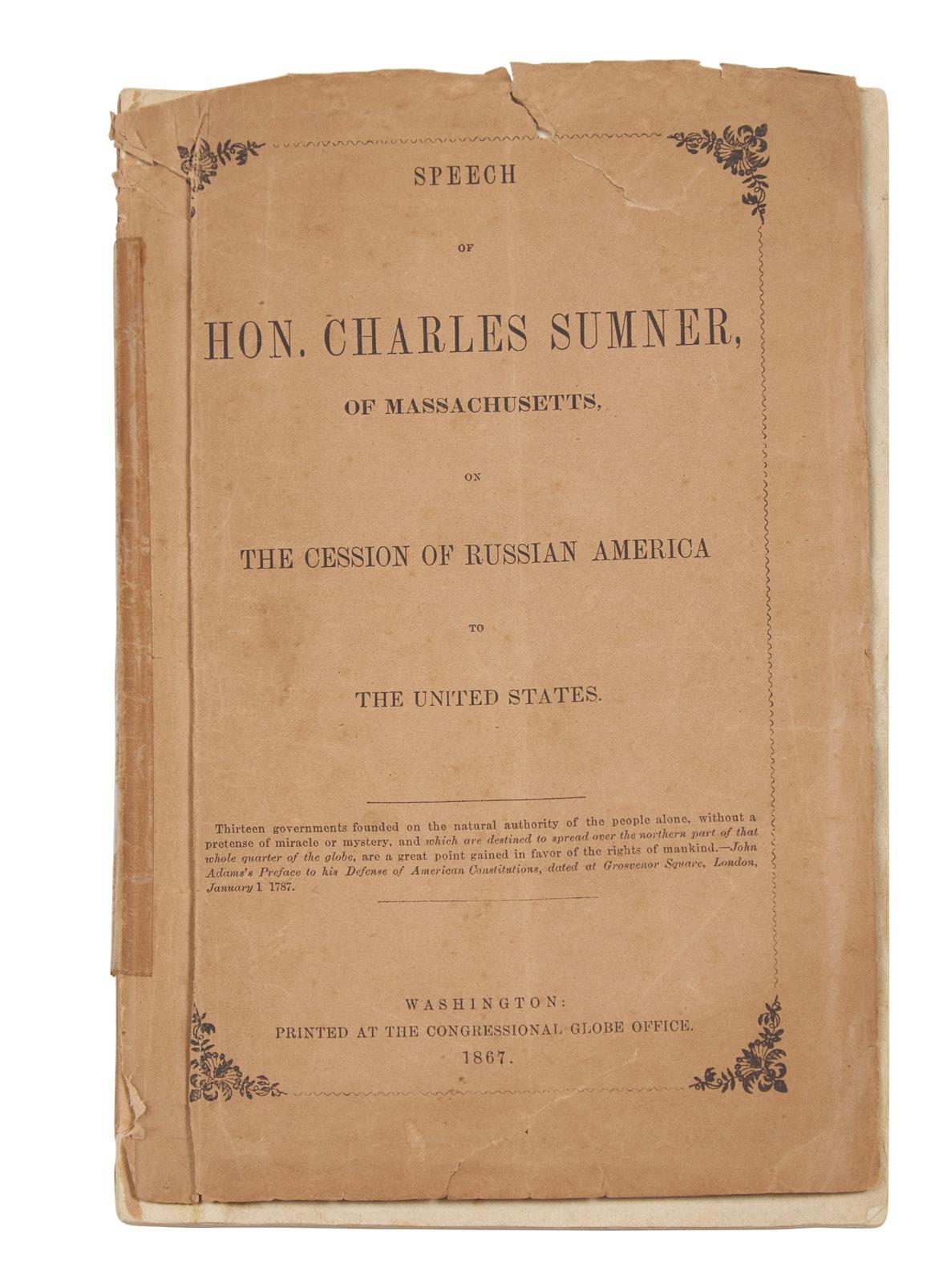
[Alaska] Presentation Copy of Speech of Hon. Charles Sumner, of Massachusetts, on the Cession of Russian America to the United States
Washington: Printed at the Congressional Globe Office, 1867. First edition. Presentation copy, with a one-page tipped-in autograph letter at front, signed by Charles Sumner to an L.J. Campbell, dated October 30, 1868: “Dear Sir, In reply to yours of 14th Oct. I enclose the only copy of the speech on Russia America which I have in Boston. Faithfully yours, Charles Sumner”. 8vo. 48 pp. Illustrated with a large folding frontispiece map of Alaska (second edition “May 1867”, as usual; map not found in all copies per Howes). Original limp printed brown wrappers, spine repaired, wear and closed tears along edges; vertical crease at center from when sometimes folded; all edges trimmed; scattered light wear along edges; scattered spotting and soiling to text and map; repair in gutter of map. Best of the West 171; Howes S-1134; Lada-Mocarski 159; Wagner-Camp 163
First edition presentation copy of Charles Sumner’s April 9, 1867 speech on the purchase of Alaska. “The discourse by Sumner on the history and state of Russian America, which had just become the American territory of Alaska, was a justification for the purchase of the Territory from Russia, famously known as ‘Seward’s Folly,’ after the Secretary of State who negotiated the purchase.” (Best of the West) The large folding map is of particular importance as it is the first published map of the cession area, a land-mass one-third the size of the lower 48 states, and the first map to use the name “Alaska”, labeled such across the mainland.
Presentation copies are rare to auction, according to RBH, we can find only find two others since 1980.
Russian interest in Alaska began in the early 1700s when Czar Peter the Great sent Vitus Bering to explore the territory. Over the following century, Russian traders and explorers established a modest trading network in the resource-rich, but sparsely populated region. However, Russia’s financial constraints, coupled with their defeat in the Crimean War in 1856, diminished their commitment to maintaining a presence there. As the United States expanded westward during the 1800s, Russia sought to counter British territorial ambitions in the area. Consequently, in 1859 Russia offered to sell Alaska to the United States, but the sale was delayed until the conclusion of the Civil War. Secretary of State William H. Seward eventually negotiated the purchase for $7.2 million, and President Andrew Johnson signed the treaty transferring ownership on May 28, 1867. The formal transfer of Alaska took place on October 18 of that year.
Lot includes two photographs related to Alaska, as well as a printed Congressional session leaf, related to Alaska (40th Congress, 2d Session, No. 130, “Treaty with Russia”).
$2,000 - 3,000
[American Centennial] Rare Silk Broadside Celebrating the Centennial Anniversary of the United States in Shanghai, China
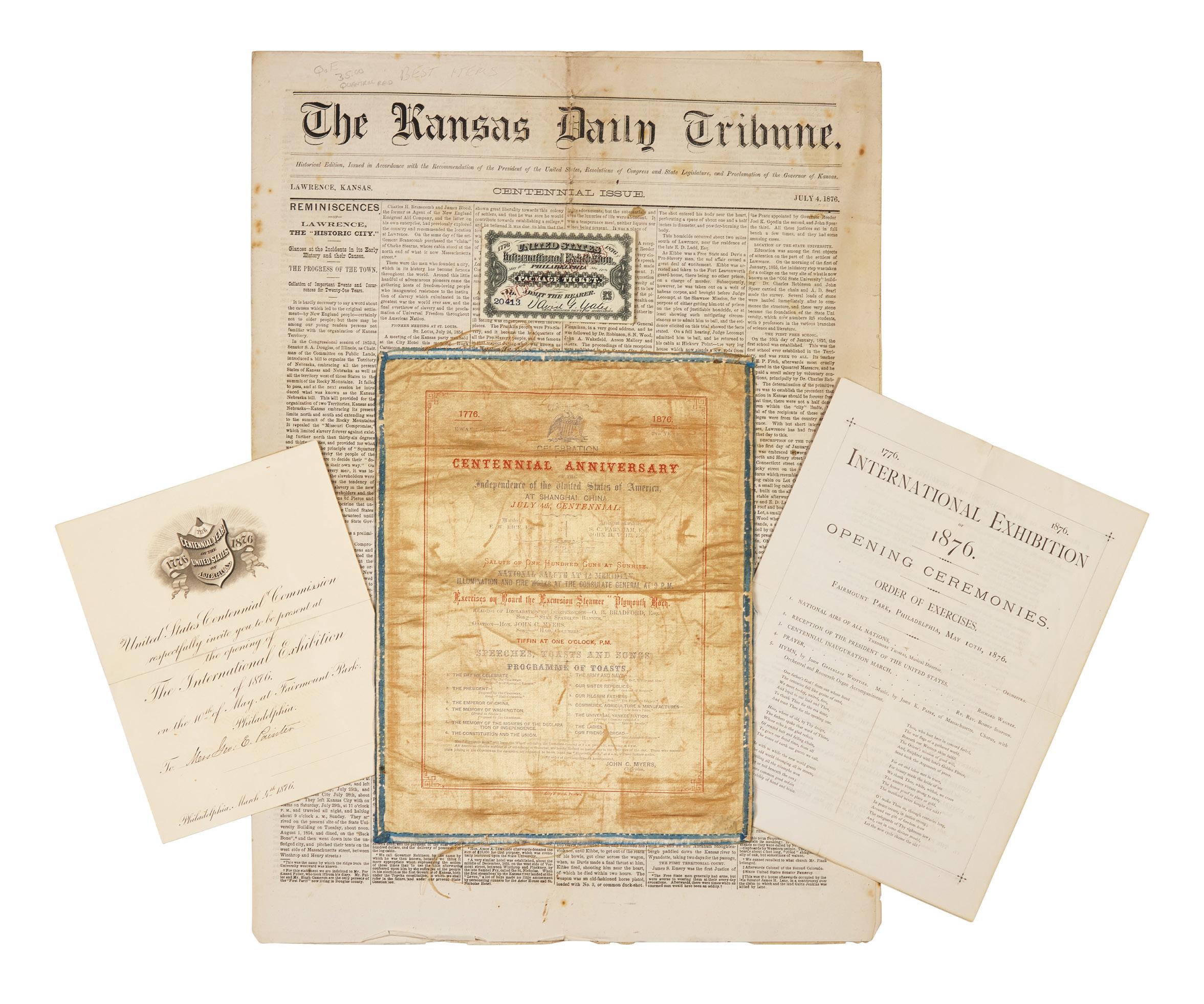
Celebration of the Centennial Anniversary of the Independence of the United States of America, at Shanghai, China. July 4th, Centennial... Shanghai: Kelly & Walsh, 1876. Printed broadside on silk. Toned; scattered wear along edges; horizontal fraying, affecting some words.
A rare broadside on silk announcing the U.S. centennial celebrations in Shanghai, China. The day-long celebration included a “Salute of One Hundred Guns at Sunrise,” “Illumination and Fire Works at the Consulate General,” “Exercises on Board the Excursion Steamer ‘Plymouth Rock’,” “Reading of the Declaration of Independence,” the singing of the Star-Spangled Banner, followed by “Speeches, Toasts and Songs”.
Rare, OCLC locates only one other copy, at the Peabody Essex Museum, while RBH locates only two examples at auction.
Lot includes four other Centennial-related items, including: an engraved invitation to the International Exhibition of 1876 at Fairmount Park in Philadelphia, a printed program and ticket for the same exhibition; a copy of The Kansas Daily Tribune, “Centennial Issue” (Lawrence, Kansas, July 4, 1876).
$1,500 - 2,500
[American Frontier] An Early Northwest Territory Land Indenture Issued to General Washington Johnston
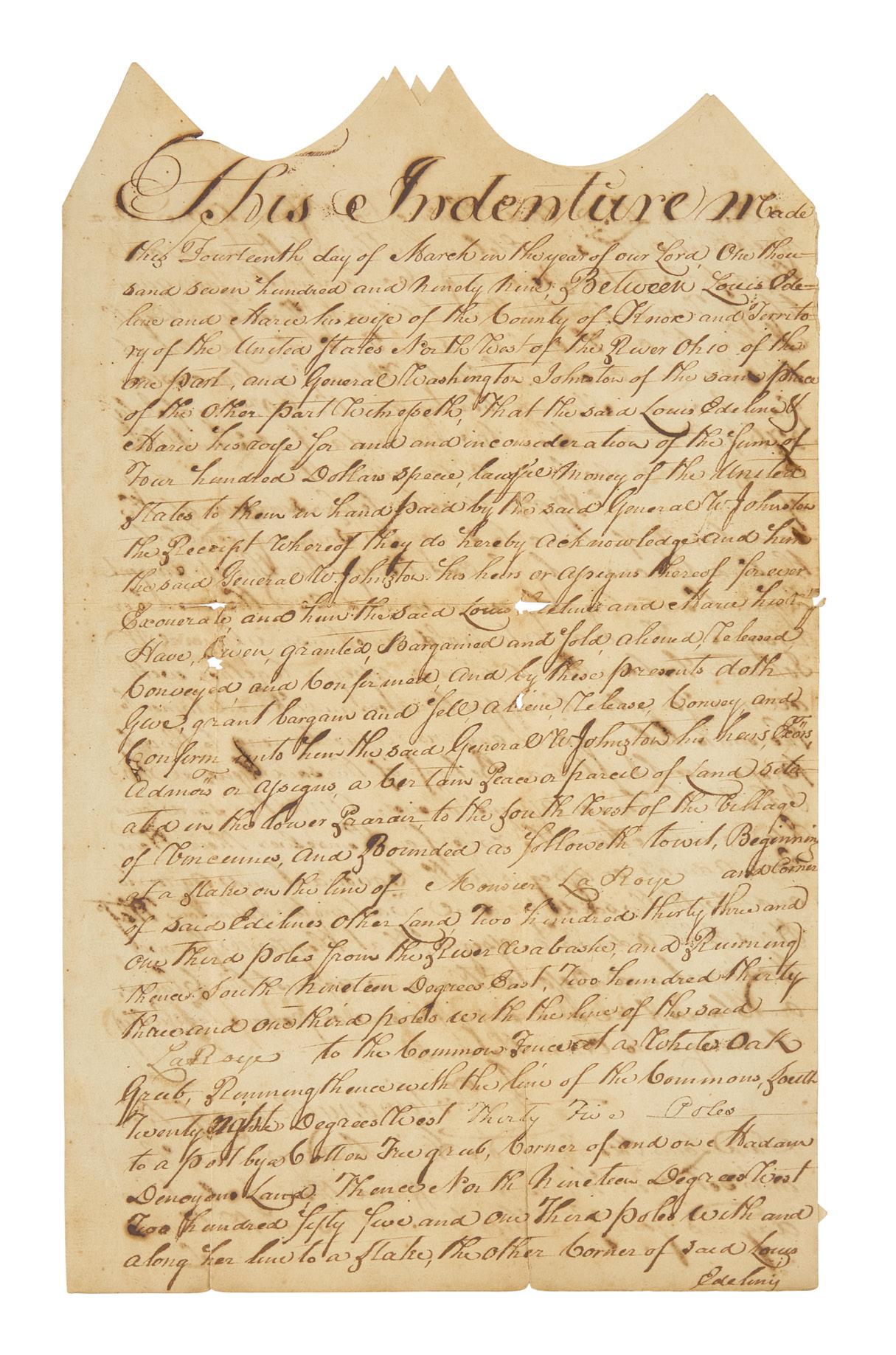
Manuscript Land Indenture
Vincennes, Knox County, Northwest Territory, March 14-15, 1799. Scallop-edge bifolium, approximately 12 3/4 x 7 3/4 in. (324 x 197 mm). Manuscript land indenture between Louis Edeline and his wife Marie, granting General Washington Johnston two arpents of land southwest of Vincennes, at the cost of $400; signed by Edeline, his wife (her mark), as well as witnesses Pierre Gamelin and Charles ____; paper seals intact on third-page. Creasing from old folds, several separations traversing same.
An early Northwest Territory land indenture, for land in Vincennes, Knox County (in current day Indiana), issued to General Washington Johnston (1776-1833).
Born in Culpepper County, Virginia, Johnston came to the Northwest Territory in 1793 at the age of 17, being one of the first Americans to permanently settle in the region. He later served as a private in General William Henry Harrison’s Army at the Battle of Tippecanoe (Johnston’s legal first name was “General”), and then as an aide to General John Gibson. Johnston studied law in Louisville, and became the first man to be admitted to the bar in the Northwest Territory. He became a member of the first Indiana territorial legislature on April 20, 1810, and was elected Speaker on behalf of the first legislature to ever propose Indiana statehood. Once a state, he served as a member of the state legislature for several terms and was elected Speaker of the House of Representatives. He then served as auditor for the Indiana territory and became Treasurer once statehood was achieved. Previously, in 1808, as chairman of a committee debating the question of whether slavery would be allowed in the territory, he supported the anti-slavery platform, which was then unanimously adopted.
Louis Edeline (1730-99) was an early French settler of Vincennes. Born in Longueuil, New France (Canada), he moved to Detroit as a young man, and later married Philadelphia-born Marie-Joseph Thomas there, in 1759. Following the fall of Detroit to the British during the Seven Years’ War, Edeline and his family moved to the remote outpost of Vincennes, where he became a leading town member. During the American Revolution, he signed an oath of allegiance with the Americans, and served under George Rogers Clarke in the siege of Fort Vincennes. He was then appointed one of Vincennes’ four magistrates (alongside Pierre Gamelin, who has signed this indenture), a position he retained for the remainder of his life.
$500 - 800
33
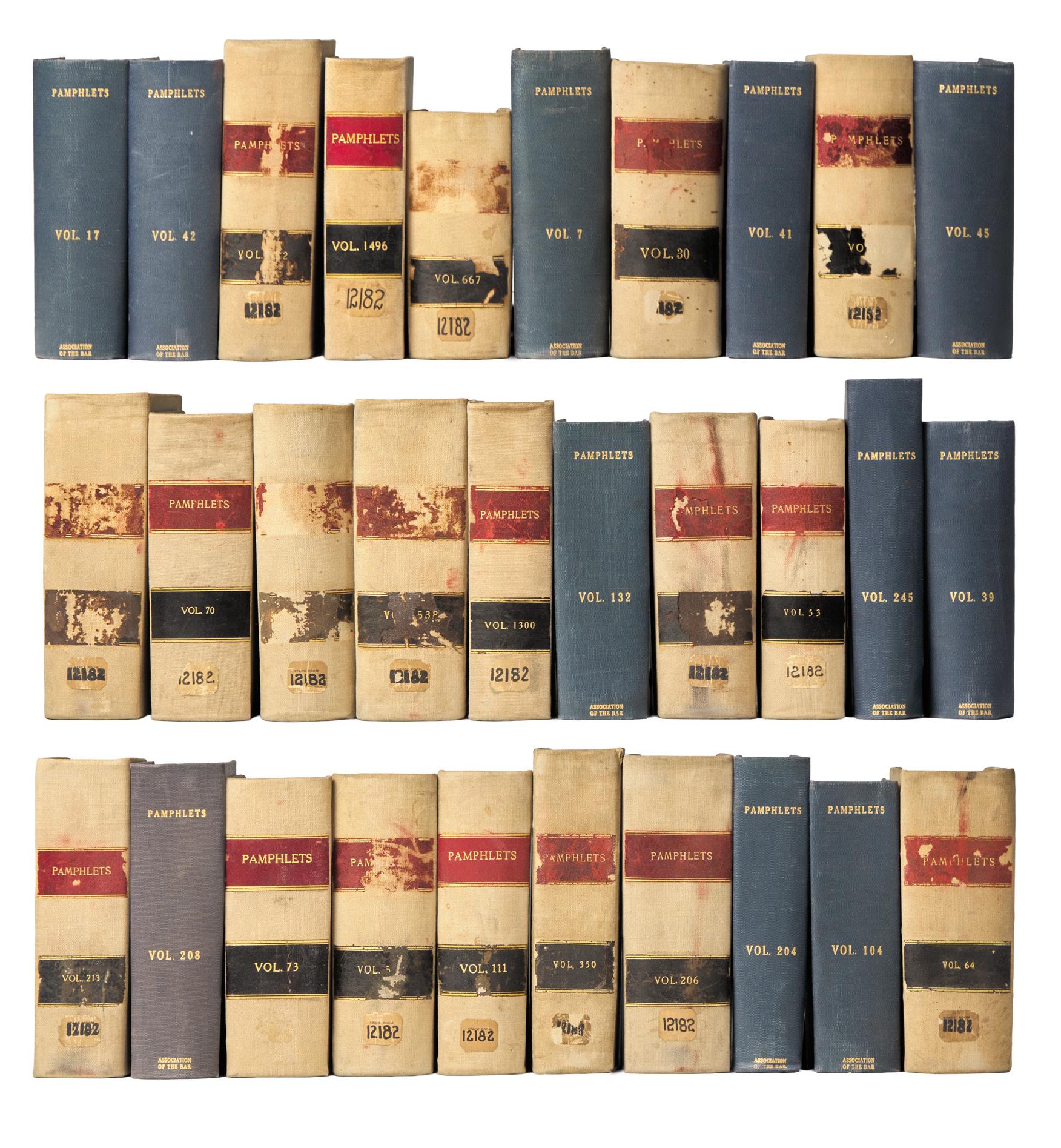
[American Law] A Comprehensive Library of Bound Legal Pamphlets, ca. 17th-20th Centuries
Location and dates vary, largely ca. 1770-1860. In 133 volumes, some containing as few as five pamphlets and some containing as many as 20. Mostly 8vo. Large group of legal tracts on a variety of subjects (largely English-related, the remainder mostly Americanrelated). Each in a library-style buckram binding, many with red and black morocco spine labels; some tracts loose and laid in; each volume with typed contents leaf at front; each pamphlet with ink or blind stamps of the Association of the Bar of the City of New York; some pamphlets with contemporary ownership signatures, or gift inscriptions. Condition varies; wear and soiling throughout, many pamphlets starting or sprung; some possibly imperfect.
A very large and extensive legal library formerly belonging to the Bar Association of New York. Legal topics covered include property law, inheritance and wills, marriage, sporting law, copyright, forgery, selection of juries, canon law, and much more. Notable pamphlets include:
1.The Rights of Tithes Asserted by Our Old Saxon Laws... (London: 1653); 2. The Wickedness of a Disregard to Oaths... (London: 1723); 3. Some Considerations on the Game Laws... (London: A. Dodd, 1753); 4. Sharpe, Granville. A Tract on Dueling... (London: B. White 1790); 5. Paulding, James Kirke. The United States and England: Being a Reply to the Criticism, or Ichiquin’s Letters (New York: A.H. Inskeep, 1815); 6. Webster, Daniel. Report Upon the Constitutional Rights and Privileges of Harvard College... (Russell and Gardiner, 1821); 7. Pamphlets regarding the Greek Frigates Incident of 1826, such as Report of the Evidence and Reasons of Award..., Refutation of the Reasons Assigned by the Arbitrators..., A Vindication of the Conduct and Character of Henry D. Sedgwick...; 8. An Act to Abolish Imprisonment for Debt... (Albany: Croswell, Van Bethuyson, 1831); 9. Adams, John Quincy. The Jubilee of the Constitution... (New York: Samuel Colman, 1839); 10. (Greely, Horace). Mr. Greely’s Letters from Texas and the Lower Mississippi... (New York: Tribune Office, 1871); and many, many others.
$4,000 - 6,000
34
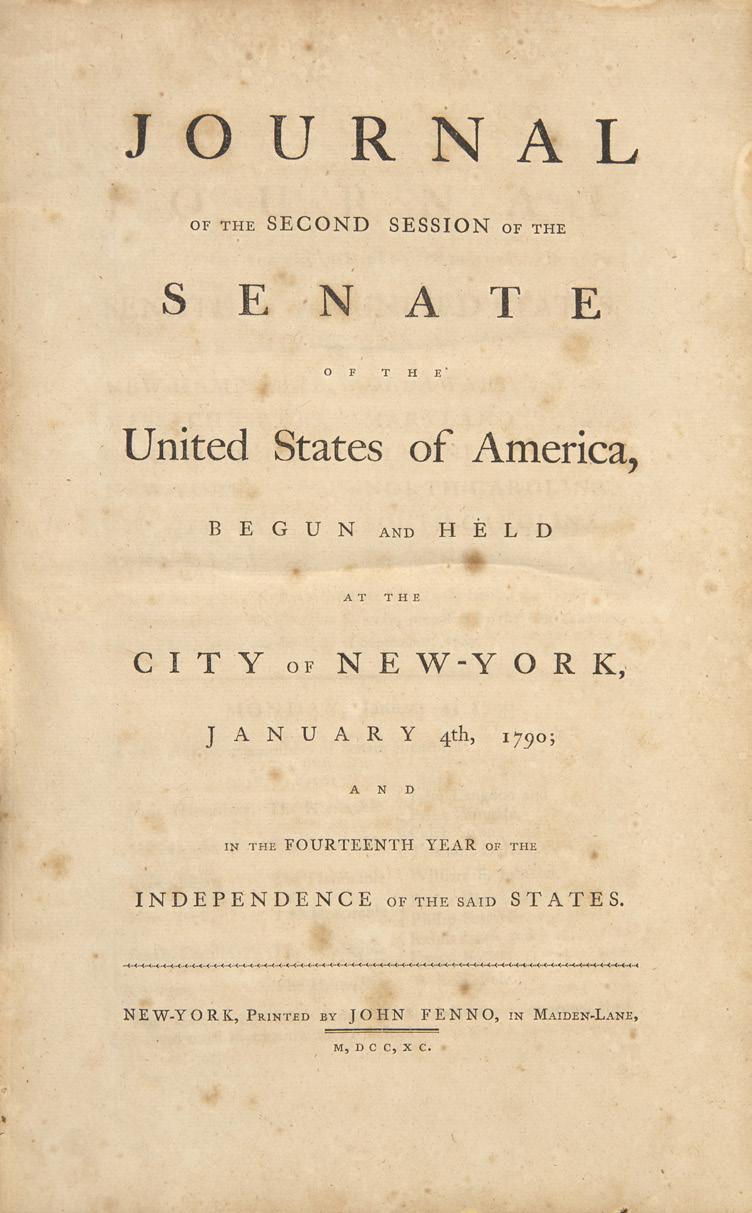
[American Law] First Edition of the Senate Journal for the Second Second Session of the First Congress: Includes the First State of the Union Address
Journal of the Second Session of the Senate of the United States of America, Begun and Held at the City of New-York, January 4th, 1790
New-York: Printed by John Fenno, 1790. First edition. Tall 4to. 124 pp. Three-quarter contemporary sheep over marbled paper-covered boards, signature of Augustus Floyd on front board (“Augustus Floyd Esq / New York”), dampstaining to boards, joints and extremities rubbed; all edges trimmed; scattered foxing to text. Evans 22928
First edition of the Senate journal for the second session of the first Congress. Many important issues were settled in the discussions recorded within, and many significant moments in the nation’s history are treated in depth. These include the first State of the Union Message, discussions of state surrender of western lands, notices of ratification of the Bill of Rights, and discussions concerning the seat of government, as well as Alexander Hamilton’s fiscal proposals.
The Augustus Floyd who signed this book is presumed to be the grandson (1795-1878) of Founding Father William Floyd, Signer of the Declaration of Independence from New York.
$1,000 - 1,500
35
[American Law] Group of 3 Senate Journals, 1795-98, Owned by Two Early New York Politicians
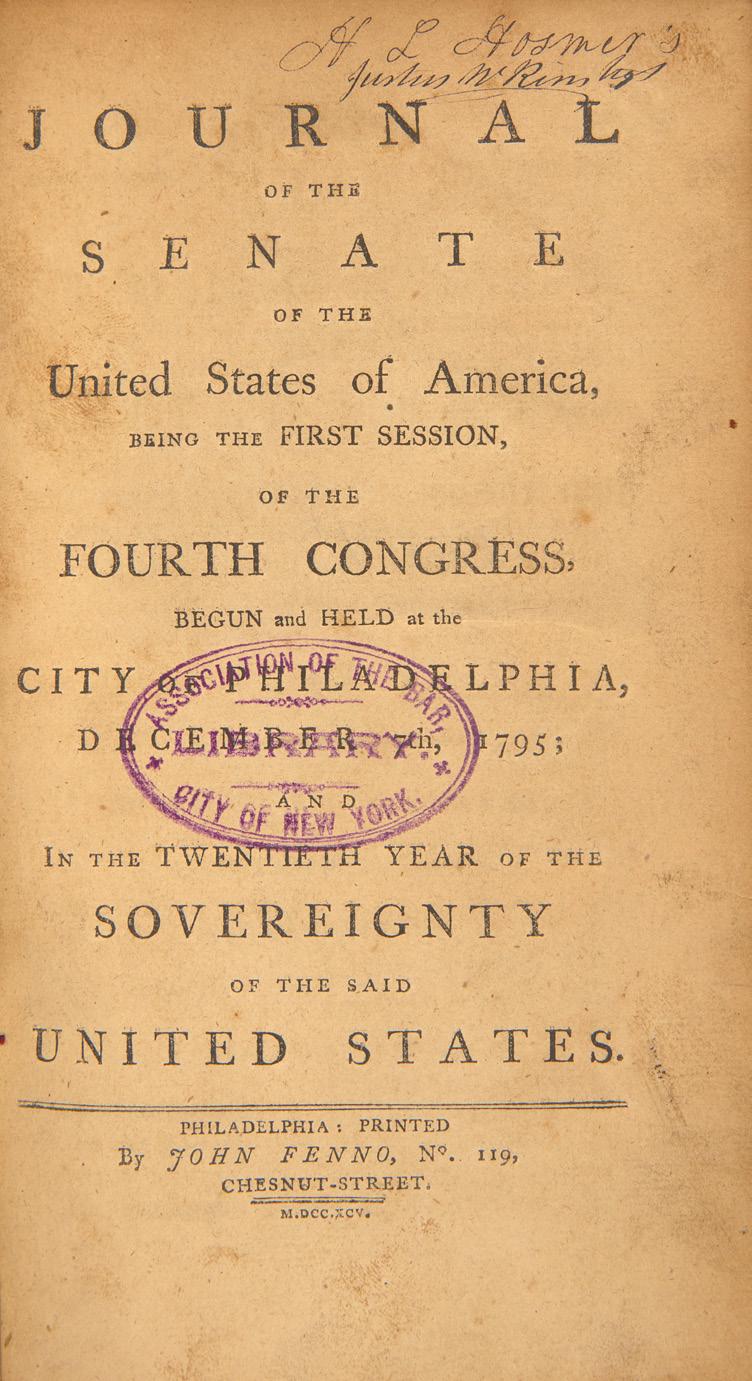
Journal of the Senate of the United States of America, Being the First Session, of the Fourth Congress, Begun and Held at the City of Philadelphia, December 7th, 1795...
Philadelphia: Printed by John Fenno, 1795. First edition. 8vo. 346, vi, xxi pp. Drab library-style buckram, red and black morocco spine labels, stamped in gilt, boards unevenly toned, scattered soiling; all edges trimmed; ownership signature of Hezekiah L. Hosmer (1765-1814), Congressman from New York, on title-page; additional ownership signature below same; Association of the Bar Library, City of New York, ink stamp on title-page; closed tear traversing P3. ESTC W20581 (locating 14 copies); Evans 31355; Sabin 15552
Bound With:
Journal of the Senate of the United States of America, Being the Second Session, of the Fourth Congress, Begun and Held at the City of Philadelphia, December 5th, 1796...
Philadelphia: Printed by John Fenno, 1796. First edition. 8vo. 175, (1), iv, 18 pp. Open tear, O1; scattered spotting. ESTC W20585 (locating 14 copies); Evans 32971
Together with:
Journal of the Senate of the United States of America, Being the Third Session of the Fifth Congress, Begun and Held at the City of Philadelphia, December 3d, 1798...
Philadelphia: Printed by John Ward Fenno, 1799. First edition. From the library of New York lawyer and politician Theodorus Bailey, and with his signature on title-page (“Theodorus Bailey’s”). 8vo. 222, vi, xiv pp. Bound as above, similar toning and soiling; same stamp on title-page (twice). ESTC W20588 (locating 15 copies); Evans 36521
Theodorus Bailey (1758-1828) served in the New York militia during the American Revolution, and the New York state militia from 1786-1805, attaining the rank of brigadier general. He was elected to the House of Representatives in 1793, serving in the 3rd, 4th, 6th, and 7th Congresses. In 1803 he was elected to the Senate, serving until 1804, when he resigned to become Postmaster of New York City, a position he held until his death.
$300 - 500
[American Law] Group of 2 Volumes of New York Session Laws
Laws of the State of New-York...the Eighth Session...(Tenth Session)
New-York: Printed by Samuel Loudon, 1785-87. Three volumes in one (with the Ninth and Tenth sessions). Folio. 104; 137 (but 141), (1); 212 pp. Modern quarter blue niger over marbled paper-covered boards, stamped in gilt; all edges trimmed; ownership inscription of Christopher P. Yates, Clerk of Montgomery County on verso of final leaf of second work; dampstaining and soiling to first title-page; scattered soiling and spotting throughout. ESTC W14083, W14082, W18046; Evans 19133, 19854, 20578
A run of New York state session laws, including a printing of the state’s first statutory bill of rights. Among the earliest state-level declarations of rights of its kind. In 1786, the New York legislature appointed Samuel Jones and Richard Varick to organize and publish all the legal statutes still in force within the state. Acting on this mandate, Jones introduced a Bill of Rights to the Assembly on January 13, 1787. The document consisted of thirteen paragraphs enumerating specific liberties, such as the principle that all power derives from the people and the guarantee of due process, among others. Jones drew upon diverse sources for its creation, including the existing New York Constitution (in which several were already embedded), English common law, the Magna Carta, and the Petition of Right. The bill passed both the Assembly and the Senate without opposition and was signed into law by Governor George Clinton on January 26, 1787.
Together with:
(Jones, Samuel, and Richard Varick)
Laws of the State of New-York, Comprising the Constitution, and the Acts of the Legislature since the Revolution, from the First to the Twelfth Session New-York: Printed by Hugh Gaine, 1789. Volume II only. Folio. (ii), 471, (1), (17) pp. Blue library-style buckram; scattered library ink stamps; gift stamp on title-page, library stamp on same; scattered soiling; wear along edges. ESTC W6820; Evans 22012; Sabin 53735
The second volume only, of the important Varick and Jones edition of New York’s post-Revolutionary laws, from 1778 onward. According to ESTC, the title-page vignette was engraved by Peter Maverick.
Lot includes a bound volume of session laws of Nova Scotia, 1767-68. Bound as above. ESTC W41647, W41646, W41645
Condition varies, generally good; scattered soiling, wear, and library stamps.
$300 - 500
37
[American Law] Group of 4 Volumes of Southern State Session Laws, including an Ordinance Freeing the Family of an Enslaved Black Patriot Spy
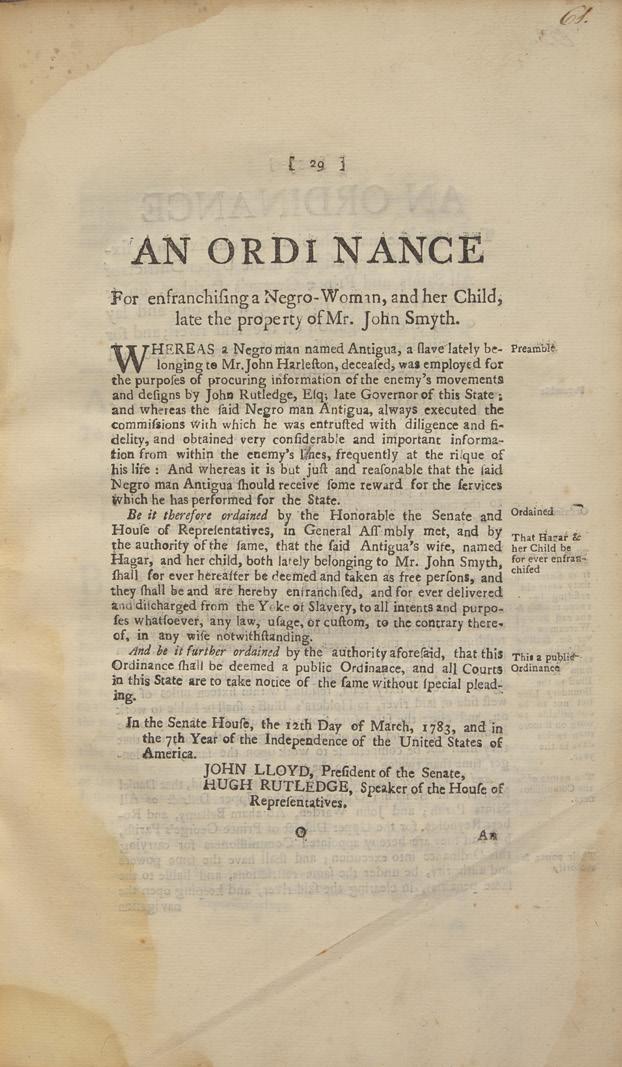
1. Acts and Ordinances of the General Assembly of the State of Carolina, Passed in the Year 1783. (Charleston, S.C. : Printed by John Miller, 1783). 4to. Lacking pp. 5-8, 17/18, and errata. Drab library-style binding; scattered library stamps; soiling and toning; scattered dampstaining. ESTC W30624; Evans 18190
Printing an ordinance dated March 12, 1783, freeing and enfranchising the family of a “Negro man named Antigua”, who “was employed for the purposes of procuring information of the enemy’s movements and designs by John Rutledge, Esq; late Governor of this State; and whereas the said Negro man Antigua, always executed the commissions with which he was entrusted with diligence and fidelity, and obtained very considerable and important information from within the enemy’s lines, frequently at the risque of his life...”
2. Acts, Ordinances, and Resolves of the general Assembly of the State of South-Carolina; Passed in March, 1785 Charleston: A(nn). Timothy, 1785. 4to. Bound as above; similar stamps; scattered contemporary marginalia. ESTC W30620; Evans 19250; Sabin 87369. Bound with: A Message From the Governor... (likely Ann Timothy, 1785; Sabin 87536)
Ann Timothy (1727-92) was one of only a small number of women printers in North America before and shortly following the American Revolution. She worked alongside her husband, Peter, and following his death, took over control of their printing operations, and later became the official printer of South Carolina.
3. Acts of the General Assembly of the State of Georgia...at an Extra Session in May and June, 1825 Milledgeville: Camak & Ragland, 1825. 8vo. 54, (2) pp. Bound as above; same stamps.
Printing the special session regarding the organization and distribution of Creek Indian land. The legislation passed was the Land Lottery Act of 1825, enacting a land lottery to distribute the land.
4. The Acts and Resolutions of the General Assembly of the State of Florida, Passed at its Seventh Session... November 27, 1854. Tallahassee: Dyke & Williams, 1855. 8vo. 101, (1), 10 pp. Bound as above; same library stamps; scattered wear and soiling.
Containing dozens of acts that were passed during the Seventh session, including many pertaining to slavery and African Americans.
$300 - 500

38
[American Law] John Jay’s Copy of These English Legal Statutes, in 8 Volumes, all Signed by Him
An Exact Abridgement of all the Statutes in Force and Use, From Magna Charta, 9 H. 3. to the Beginning of the Reign of King George London: Printed by his Majesty’s Printers. And by the Assigns of Edward Sayer, Sold by R. Gosling, 1725-32. In eight volumes. From the library of John Jay, with his signature on title-page of each volume, and dated by him 1771. Additionally from the law library of his uncle, New York lawyer John Chambers, and signed by him on each title-page as well. 8vo. With one folding table, in Vol. I. Full tan library-style buckram, red and black morocco spine labels, stamped in gilt, light to moderate soiling, labels for Vols. VII and VIII applied on incorrect volumes; all edges trimmed; New York Law Institute Library ink stamp on each title-page (partially affecting some of Jay and Chambers’s signatures); repaired closed tear on title-page of Vol. I, tear in lower gutter of I1 in same volume; Jay’s signature partially covered with paper remnant in Vol. II; Jay’s signature partially covered by ink stamp in Vol. III; Jay’s signature covered by ink stamp in Vol. VIII but still legible; scattered spotting; scattered faint dampstaining throughout. ESTC N31274
A significant copy with fine provenance of this set of English laws, from the library of Founding Father and First Chief Justice of the Supreme Court, John Jay (1745-1829). Bequeathed to Jay by his uncle, New York lawyer John Chambers, whose successful defense of printer and journalist John Peter Zenger at his famous 1735 libel trial marked the first major victory for freedom of the press in the English colonies in North America.
At the time of Chambers’s death in April 1764, it is believed that he owned the largest law library in New York province, half of which he left in his will to Jay, son of his brother-in-law, Peter Jay. In May 1764, the younger Jay graduated from King’s College (now Columbia University) and began his legal studies as a law clerk in the office of Benjamin Kissam, a prominent New York City attorney. It was the beginning of an ascendant legal career that would help define early American jurisprudence, from the Revolution through to the Federal period.
Admitted to the bar in 1768, Jay established his own private law firm in 1771, the same year he signed the present volumes. At 26, he cultivated a reputation as a rising and gifted member of the New York bar, utilizing his legal expertise to build a popular and profitable practice which he would parlay into his public career in politics and diplomacy. His entrance into public life in 1773 coincided with the escalating tensions between the colonies and Great Britain, during which he would later play a critical role. Elected to both the First and Second Continental Congresses, he initially advocated a moderate stance seeking reconciliation with the Crown, and helped draft several of Congress’s early messages that helped define its voice to the states and the world at large. With the failure of his Olive Branch petition, his views evolved toward supporting independence, although he did not vote or sign the Declaration of Independence, as he remained in New York working with the state legislature.
The following year in New York, Jay played a pivotal role in drafting the state’s first constitution, serving as its primary author. He was subsequently appointed as the first Chief Justice of the New York Supreme Court, a post he held until 1779. He later returned to the Continental Congress, where he was elected President in 1778. In 1779, he was appointed Minister to Spain to lobby for financial support for the Revolutionary War. Later, in 1783, as one of three peace commissioners alongside John Adams and Benjamin Franklin, Jay helped negotiate the treaty that ended the war (he was doggedly insistent that Britain accept independence as the starting condition for the negotiations). Following the conflict, he served as the second Secretary of Foreign Affairs under the Articles of Confederation, until 1789. He then accepted the appointment as the first Chief Justice of the United States Supreme Court under the newly ratified Constitution, a document he had vigorously supported, and defended in essays written for The Federalist Papers alongside Alexander Hamilton and James Madison. Jay served as Chief Justice until 1795, and in the process helped develop the nascent federal judicial system. That same year, he negotiated the eponymous «Jay Treaty» with Great Britain to resolve lingering post-war disputes. After resigning from the Court, he was elected Governor of New York, serving two three-year terms. During his governorship, he signed legislation that initiated the abolition of slavery in the state and implemented significant reforms to the judicial system.
John Chambers (1710-64), thence bequeathed to his nephew and godson, John Jay (1745-1829), thence by descent to his son, Peter Augustus Jay (1776-1843), then gifted by him to the New York Law Institute; afterwards deaccessioned.
$8,000 - 12,000
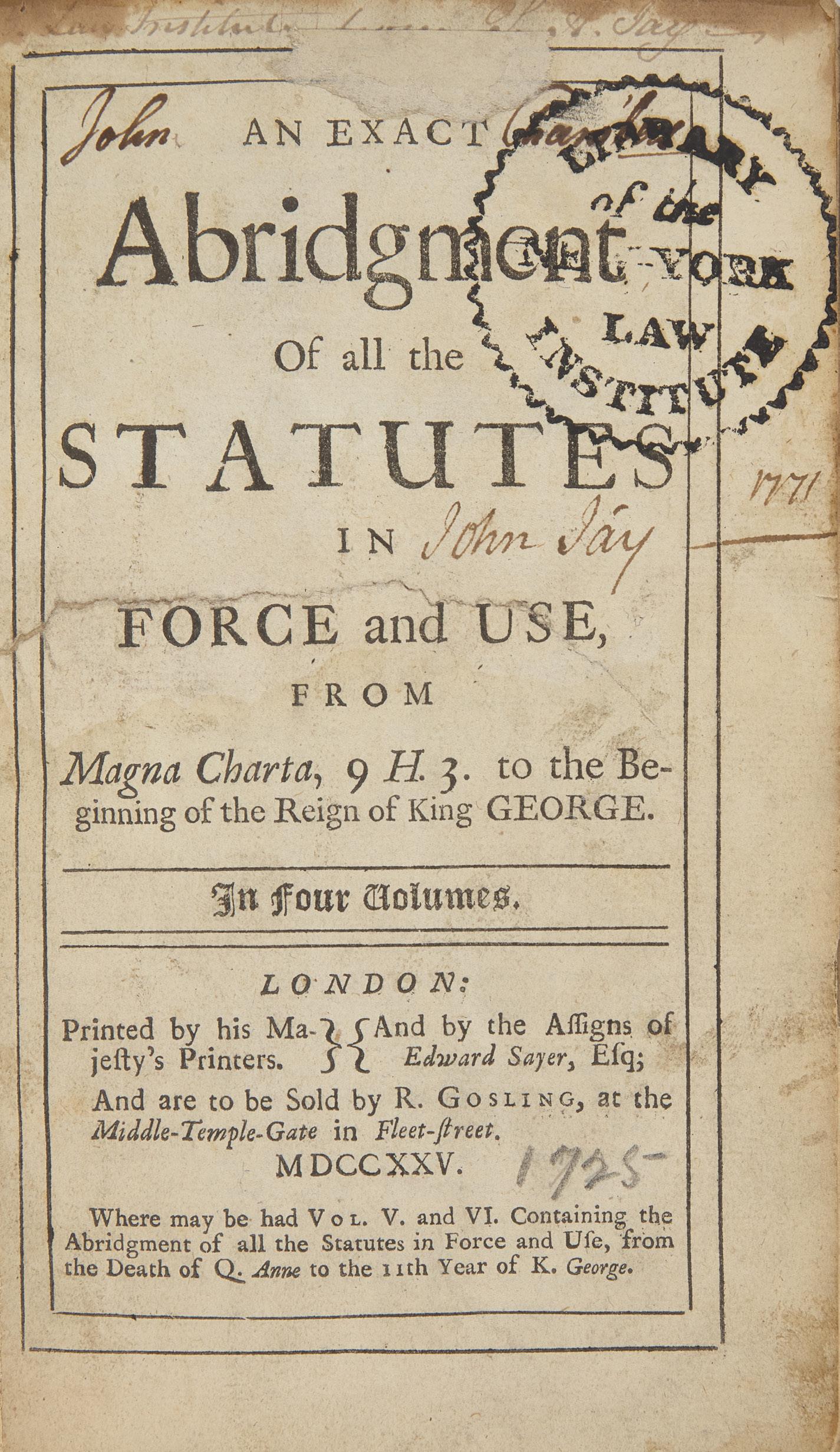
[American Law]
Samuel Jones, the Statesman Behind the Newly Discovered “Jones Declaration”: His Annotated Set Used in His Working Law Library, Some Almost Certainly Used While Compiling New York State Law
Group of 7 Volumes of New York Session Laws, From the Library of Samuel Jones New York: Publishers vary, 1762-1797. Approximately 18 volumes in seven. Comprising:
1. Livingston, William, and William Smith, Jr. Laws of New-York, From The 11th Nov. 1752, to 22d May 1762.... New-York: Printed by William Weyman, 1762. The Second Volume. From the library of New York statesman Samuel Jones, and signed by him on titlepage, and with his marginal notations throughout. Folio. (viii), 268 pp. Full blue buckram, stamped in gilt; all edges trimmed; scattered ink stamps of the Library of the New York Law Institute; scattered spotting. Evans 9213
2. (Laws of New-York) New York, 1762-1771. Folio. pp. 269-822. (with continuous pagination and register from the above volume); plus six leaves of MS. index at front in Jones’ hand. With the imprints of Weyman and Gaine throughout. Bound as above; with Jones’ signature at top of p. 471 and 639 (each partially trimmed away); marginalia throughout (by Jones, some after 1780); leaf at front excised; ownership signature of D.S. Jones (his son) on first text leaf, with remnant of what presumably is Samuel Jones’s signature above; scattered ink stamps as above; scattered spotting and wear.
Bound with broadside, facing p. 639: By his Excellency the Right Honourable John, Earl of Dunmore...A Proclamation...March 4, 1771. With MS. marginalia; tear along left edge, affecting some MS. and type. Evans 12155
3. (Laws of New-York) New York, 1772-75. Folio. pp. 823-949 (but 947), (3), 105, (3), 202, (2) pp. (with continuous pagination and register with above; many renumbered in MS.); plus six leaves of MS. index in Samuel Jones’ hand. Book-plate of Samuel Jones on front paste-down, and with his ownership signature at top of first text leaf. Full contemporary reverse calf, stamped in blind, morocco spine labels, stamped in gilt, front and rear boards detached, boards rubbed and worn, spine dry, paper gift label on front board, dated 1887, ownership signature on upper front board (“D.S. Jones”); contemporary marginalia throughout (in Samuel Jones’ hand); same library ink stamps throughout.
4. Laws of the State of New-York, Passed at the first Meeting of the Seventh Session of the Legislature of said State New-York: Printed by Elizabeth Holt, 1784. Four volumes in one (with: Laws...Eighth Session, Holt, 1784; Laws...Last Meeting of the Eighth Session, Loudon, 1785; Laws...Ninth Session, Loudon, 1786). With Samuel Jones’ signature on title-page, another ownership signature below (D.S. Jones). Folio. (ii), ii-iii, (3)-127, (1); 34; 104; 137 pp. (many renumbered in MS.); plus 10 leaves of MS. index in Samuel Jones’ hand. Bound in blue buckram as above; scattered contemporary marginalia (in Samuel Jones’ hand); scattered library ink stamps as above; scattered spotting, wear, and repairs.
5. Laws of the State of New-York, Passed by the Legislature of said State, at their Tenth Session
New-York: Printed by Samuel and John Loudon, 1787. Two volumes in one (with: Laws...Eleventh Session, Loudon, 1788). Signed by Samuel Jones on title-page, another signature above same (D.S. Jones). Folio. 212; 222 pp., plus 9 leaves of MS. index in Samuel Jones’ hand. Bound as above; scattered marginalia (same as above, post 1801); scattered library ink stamps (same as above); scattered spotting and wear.
6. Laws of the State of New-York, Passed by the Legislature of said State, at their Twelfth Session
New-York: Printed by S. & J. Loudon, 1789. Six volumes in one (with: Laws...Volume the Third,Thirteenth Session, Francis Childs and John Swaine, 1790; Laws...Fourteenth Session, Childs and Swaine, 1791; Laws...Fifteenth Session, Childs and Swaine, 1792; Laws...Sixteenth Session, Childs and Swaine, 1793; Laws...Seventeenth Session, Childs and Swaine, 1794). Folio. 81, (1), (iv); (ii), 48; 38, (2); 74, (2); 63, (1); 36, (2) pp. (many renumbered in MS.); plus 10 leaves of MS. index in Samuel Jones’ hand. Bound as above; Contemporary ownership signature on title-page (D.S. Jones); scattered marginalia (same as above, after 1801); scattered spotting and wear; scattered library ink stamps (same as above).
7. Laws of the State of New-York. Eighteenth Session
New-York: Printed by Francis Childs and John Swaine, 1795. Three volumes in one (with: Laws...Nineteenth Session, Childs, 1796; Laws...Twentieth Session, William Robin, 1797). Folio. 55, (3), (2); 54, (2); 240, (4) pp. (many renumbered in MS.); plus 11 leaves of MS. index in Jones’ hand. Second volume in 8vo and mounted into folio sheets. Bound as above; scattered marginalia (same as above, some after 1804); scattered soiling, spotting, and wear; scattered library ink stamps (same as above); open tear in center of last text leaf of second volume. Evans 2918
An important run of New York session laws, from the library of Samuel Jones (1734-1819), a critical figure in the early republic of the United States whose career in the New York legislature was instrumental in compiling state law, and whose actions were pivotal in orchestrating New York’s passage of the federal Constitution.
These volumes, comprising New York laws from 1762 to 1797, are heavily annotated by Jones. His marginal notes track the legislative status of various bills, marking them as amended, obsolete, repealed, provided for, expired, or suspended, and offer commentary on their progression through the state legislature. Beyond this, Jones has developed an extensive cross-referencing system to facilitate the location of acts across the entire collection and to help clarify relationships between different laws. With the exception of the first volume, each book also includes a lengthy autograph index inserted by Jones at the front or back. Collectively, these annotations attest to his deep mastery of New York state law, strongly indicating that these volumes served as references throughout his extensive legal career, and it is probable that Jones relied on the first five volumes while collaborating with Richard Varick to compile New York state law between 1786 and 1789.
One of Jones’ most enduring contributions appears in the fifth volume: the statutory Bill of Rights for New York (Jones has signed above, perhaps indicating his particular pride in authoring it). Among the earliest state-level declarations of rights of its kind, it served as a precursor to the United States Bill of Rights. In 1786, the New York legislature appointed Jones and Richard Varick to organize and publish all the legal statutes still in force within the state. Acting on this mandate, Jones introduced a Bill of Rights to the Assembly on January 13, 1787. The document consisted of thirteen
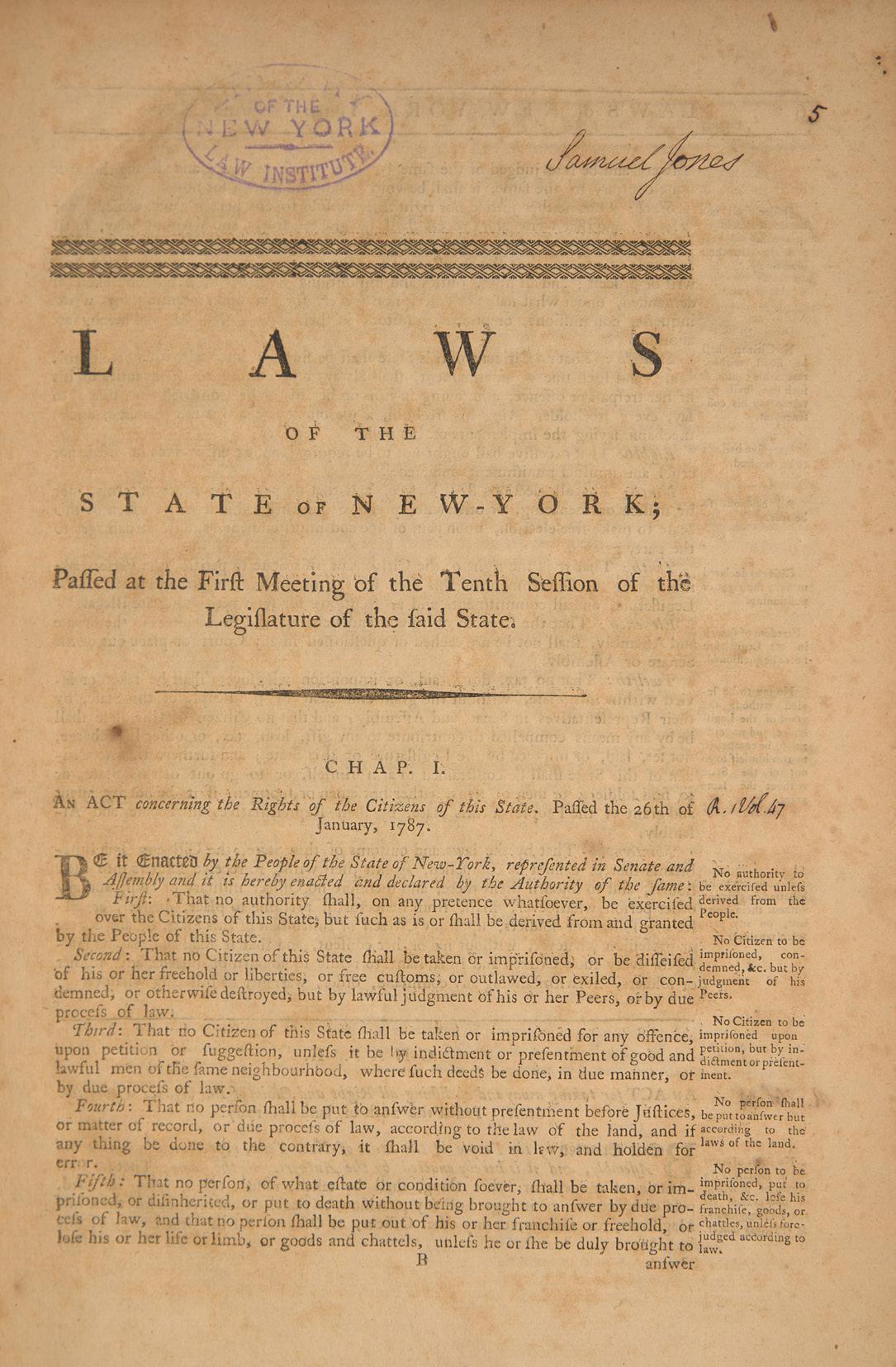
paragraphs enumerating specific liberties, such as the principle that all power derives from the people and the guarantee of due process, among others. Jones drew upon diverse sources for its creation, including the existing New York Constitution (in which several were already embedded), English common law, the Magna Carta, and the Petition of Right. The bill passed both the Assembly and the Senate without opposition and was signed into law by Governor George Clinton on January 26, 1787. Its influence extended to the federal level in two stages. Firstly, John Lansing, Jr., a fellow New York delegate and political associate of Jones, used the bill when drafting a proposed bill of rights that anti-Federalists sought to append to the U.S. Constitution. Secondly, James Madison used Lansing’s proposals, along with recommendations from the other state conventions, and worked them into the amendments he drafted for the federal Constitution. These amendments were ratified by Congress in late 1791.
The achievement for which Jones is perhaps most celebrated was his pivotal role in the New York state ratification convention of June–July 1788. One of the most contentious conventions, it was uncommon in that anti-Federalists, led by Governor George Clinton, held a strong majority over Federalists, outnumbering them 2-1. The anti-Federalists demanded ratification only on the condition that a bill of rights be included. After much deadlock, Jones engineered a breakthrough by proposing a subtle but critical change in the wording of the ratification resolution. He suggested replacing the phrase “on condition that” a bill of rights would follow with “in full confidence that” it would. This linguistic shift allowed the Federalists to accept the resolution without legally binding the state to a conditional ratification, while reassuring the anti-Federalists that their demands would be met. The compromise secured ratification by a razor-thin margin of 31–29, the narrowest of any state convention. This victory not only ensured the Constitution’s legitimacy and survival, but also paved the way for the adoption of the Bill of Rights three years later.
In the years that followed the convention Jones served in numerous offices for the state of New York, including the Recorder for New York City from 1789-97, as a member of the New York Senate from 1791-99, and as the first New York state Comptroller--no doubt using this set as reference to fulfill the duties of these varying roles.
Samuel Jones (1734-1819), thence to his son, David S. Jones (1777-1848)
Gifted to the New York Law Institute, January 19, 1887, by Charles W. Sloane (manuscript label on front board of third volume), thence deaccessioned $6,000 - 9,000
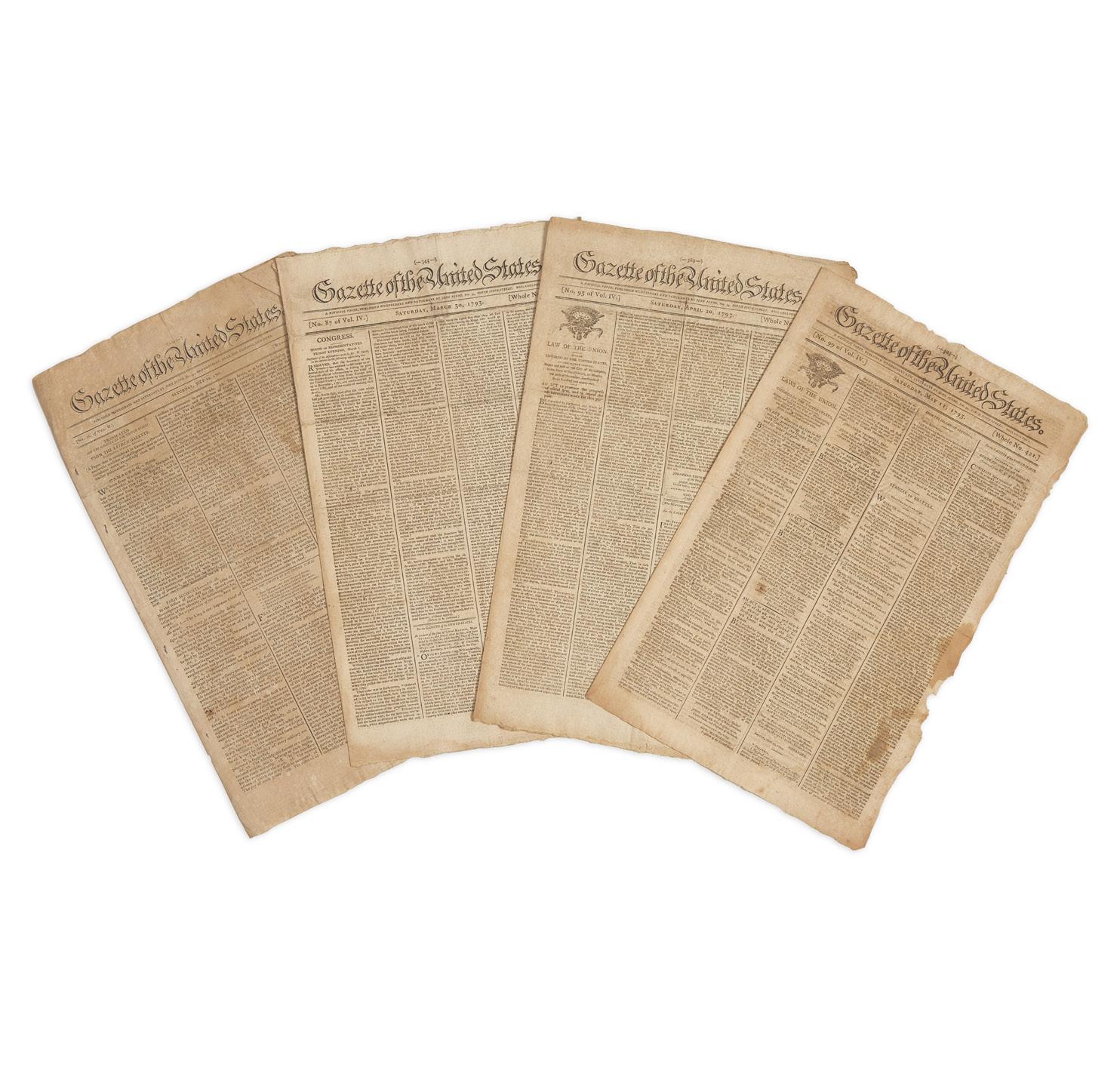
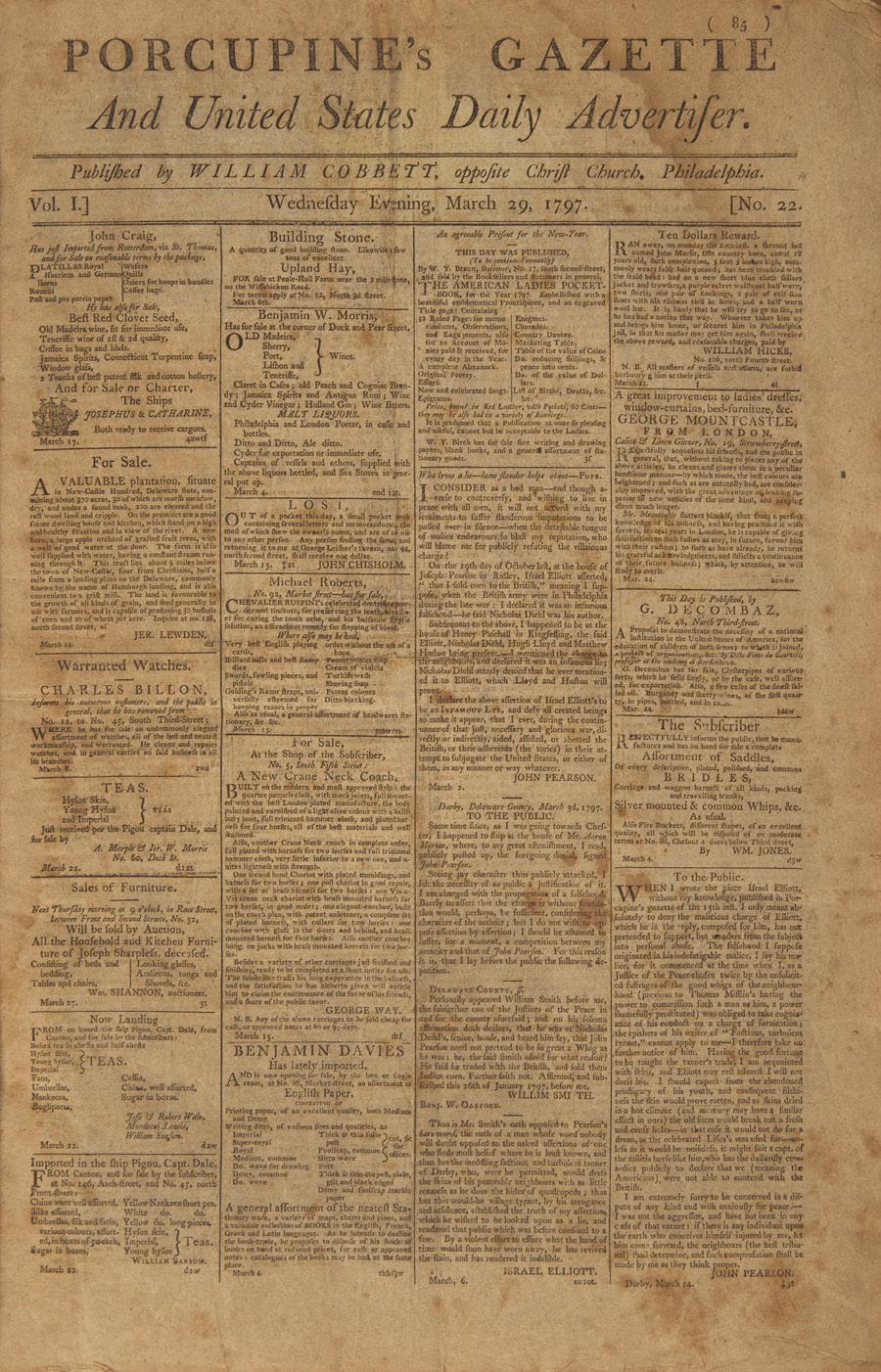
40
[American Newspapers] Group of 4 Issues of the Gazette of the United States: The Semi-Official Organ for President Washington’s Administration, 1789-93
Philadelphia: John Fenno, 1789-93. In four issues, including: Saturday, July 10, 1790 (Vol. II, No. 26); Saturday, March 30, 1793 (Vol. IV, No. 87); Saturday, April 20, 1793 (Vol. IV, No. 93); Saturday, May 11, 1793 (Vol. IV, No. 99). Some disbound; creasing from old folds; scattered spotting, soiling, and wear.
Printing a wide variety of news from the early republic, including an act to hold the first national census in Rhode Island, who had just ratified the Constitution (July 10 issue); debates related to the conduct of Secretary of the Treasury Alexander Hamilton (March 30); the first patent act (April 20), etc.
$300 - 500
41
[American Newspapers] (Cobbett, William) Porcupine’s Gazette And United States Daily Advertiser, Group of Over 100 issues, 1797-99
Philadelphia: William Cobbett, March 29, 1797-March 20, 1799. Vol. I, Nos. 22-34, 36, 37-42, 44-64, 240, 241, 247-252, 257, 335, 453-455; Vol. III, Nos. 467-469, 473-478, 481-483, 485, 486, 489-495, 497-503, 505, 507, 510-513, 516-519, 543, 545, 563-566, 569-571, 574, 575, 588-591, 602-604, 526, 528, 529, 537, 548, 552, 554, 558, 560, 578, 576, 585, 587, 607, 605, 608, 610, 612-621; Vol. IV, Nos. 622, 623, 625, 626, 628, 631, 634, and 635. Folio. Volume also bound with one issue of Claypoole’s American Daily Advertiser (No. 6053, August 28, 1798); one issue of the Philadelphia Gazette & Universal Daily Advertiser (No. 3138, December 29, 1798), and two other unknown issues. Contemporary three-quarter brown calf over marbled paper-covered boards, rebacked, worn; contents foxed with scattered stains; several issues with contemporary ownership signatures; several issues torn or with sections missing.
An extensive run of Porcupine’s Gazette, a Philadelphia daily newspaper published by English polemicist William Cobbett (1763-1835) during his time in America.
Cobbett, a lifelong political writer and instigator, immigrated to Philadelphia at the perfect time in 1793 during the height of power for the political newspaper medium. Papers such as John Fenno’s Gazette of the United States, and Benjamin Franklin Bache’s Philadelphia Aurora had become battlegrounds for ideas of the Federalist and Democratic Republican parties. Cobbett established Porcupine’s Gazette in March of 1797, often defending Federalist positions and British interests, which put him at odds with Bache›s Aurora and its Jeffersonian philosophies that supported the French Revolution. Cobbett published the paper early 1800, when he returned to England.
$1,000 - 1,500
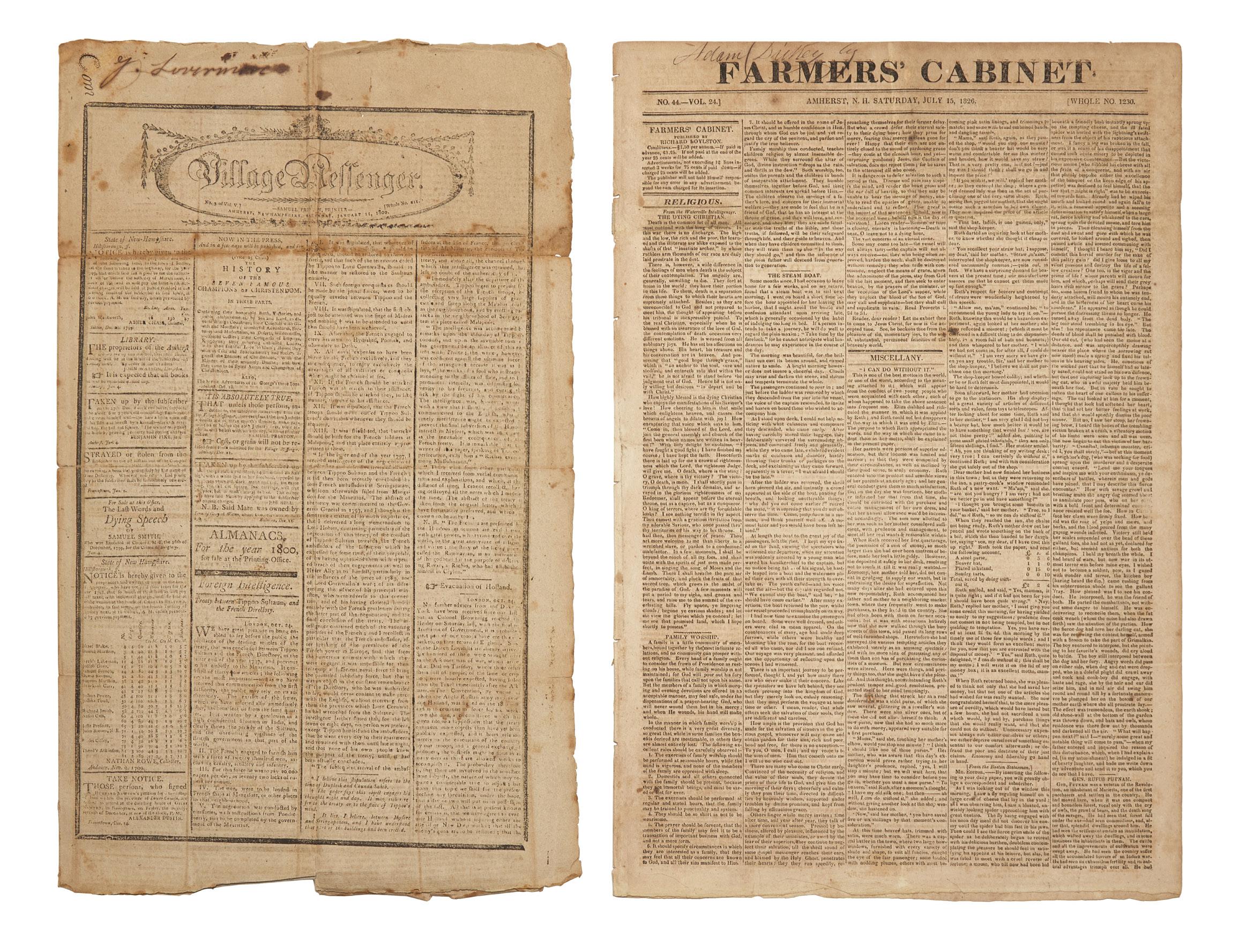
42
[American Newspapers] Group of 2 Newspapers Reporting the Deaths the First Three Presidents of the United States
Village Messenger
Amherst, New Hampshire: Samuel Preston, Saturday, January 11, 1800. No. 3, Vol. V. Printed newspaper. Folio. (4) pp. Contemporary ownership signature at top of front page. Creasing from old folds, wear and small separations along same; scattered soiling.
On the third page are reports concerning the death of President George Washington, including messages of condolence from the New Hampshire legislature, details of a mourning procession in Exeter, followed by a report of resolutions passed by Congress, directing the erection of a monument to Washington in the capital, for a procession in Washington’s honor, and finally, a proclamation issued by President John Adams calling for a 30-day mourning period.
Together with:
Farmers’ Cabinet
Amherst, New Hampshire: Published by Richard Boylston, Saturday, July 13, 1826. No. 44, Vol. 24, Whole No. 1230. Printed newspaper. Folio. (4) pp. Creasing from old folds; scattered spotting.
On the second and third pages report the deaths of Presidents John Adams and Thomas Jefferson, both of whom died July 4, 1826, the 50th anniversary of the Declaration of Independence. Followed by reports from across the nation of “Fiftieth Jubilee” celebrations.
$500 - 800
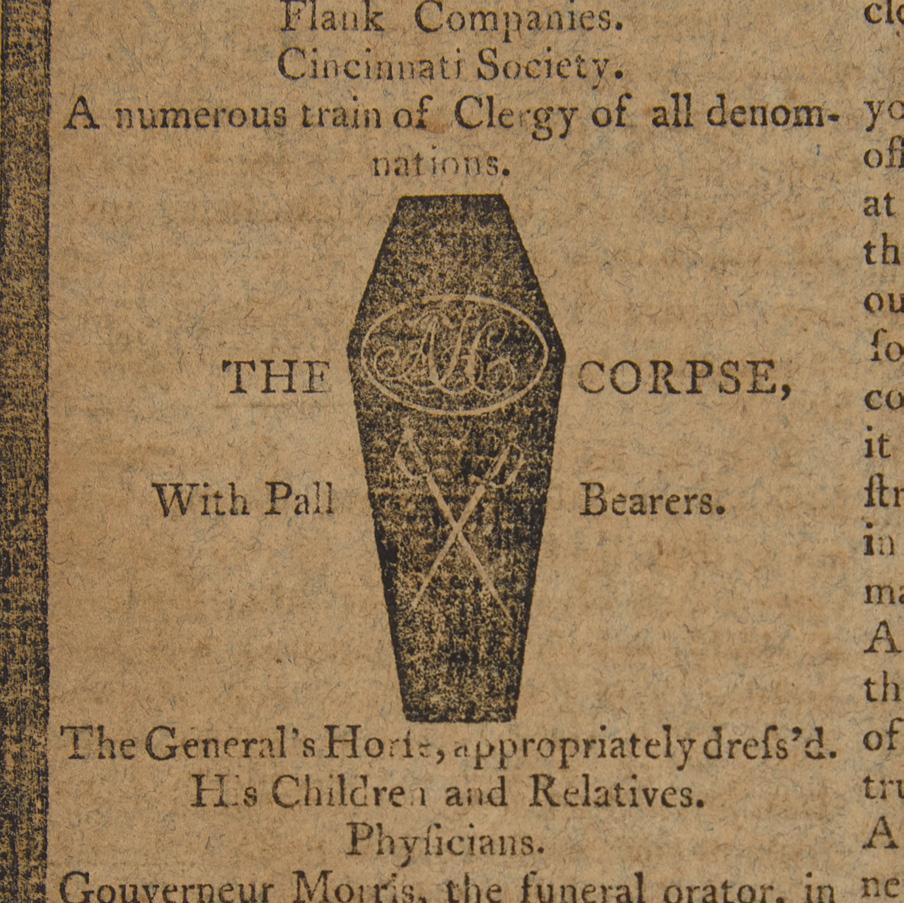
43
[American Newspapers] [Burr-Hamilton Duel] A Scarce Issue of this Connecticut Newspaper Largely Dedicated to the Aftermath of the Fatal Duel Between Alexander Hamilton and Aaron Burr
The Connecticut Courant
Hartford: Printed by Hudson & Goodwin, Wednesday, July 25, 1804. Vol. XL, Numb. 2061. Printed newspaper. Folio. (4) pp. Printed black mourning border on each page. Disbound; dampstaining at bottom of each sheet; scattered spotting.
Printed 13 days after the duel, this black mourning-bordered issue prints the correspondence between the two men and others regarding the duel. Further printed is Hamilton’s will, various tributes to him, and his funeral obsequies with a woodcut print of his coffin.
At dawn on July 11, 1804, Vice-President Aaron Burr and former Secretary of the Treasury Alexander Hamilton met at Weehawken, New Jersey, a popular dueling ground. The meeting was the result of a long-simmering feud between the two men, brought to a climax by what Burr considered to be numerous instances of dishonor against his character, as well Hamilton’s interference against Burr in both the 1800 presidential election and in the 1804 election for governor of New York. Eyewitness accounts vary, but what is known is that two shots rang out and Alexander Hamilton lay crumpled on the ground, mortally wounded. The duel is widely regarded as one of the most consequential in American history, as Hamilton’s death contributed to end of the influence of the Federalists in American politics. Immediately following the duel Burr was charged with murder in New York and in New Jersey, but never stood trial.
$500 - 800
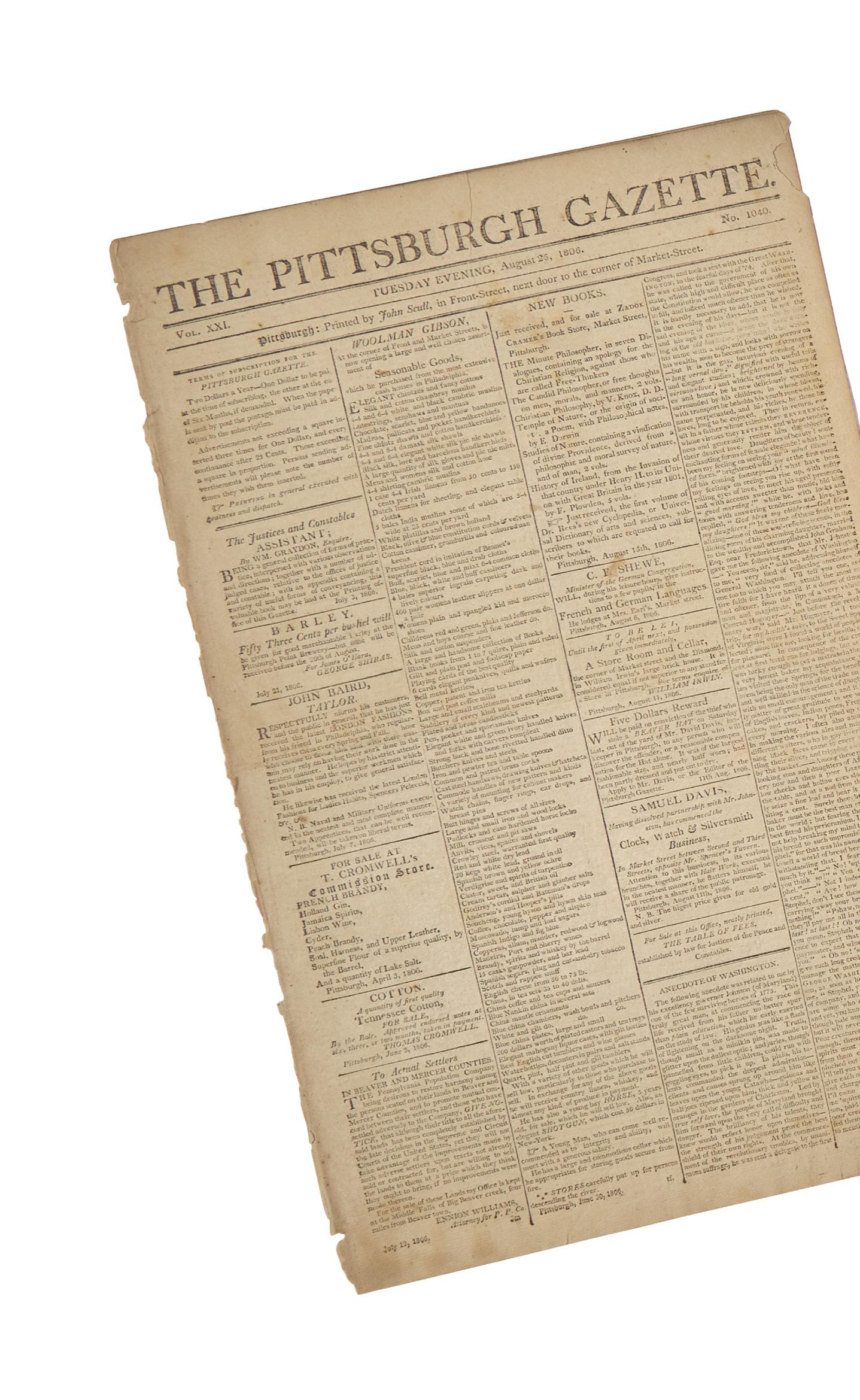
Newspaper Published West of the Allegheny Mountains: Reports on Meriwether Lewis, Native Americans, and Aaron Burr’s Alleged Plot
The Pittsburgh Gazette Pittsburgh: Printed by John Scull, 1806-1809. Group of three newspapers, comprising: Tuesday Evening, August 26, 1806 (Vol. XXI, No. 1040); Tuesday, March 3, 1807 (Vol. XXI, No. 1067); Wednesday, May 10, 1809 (Vol. XXIII, No. 1180). Folio. Each 4 pp. Disbound; one issue creased from when folded; each largely separated along spine; scattered spotting.
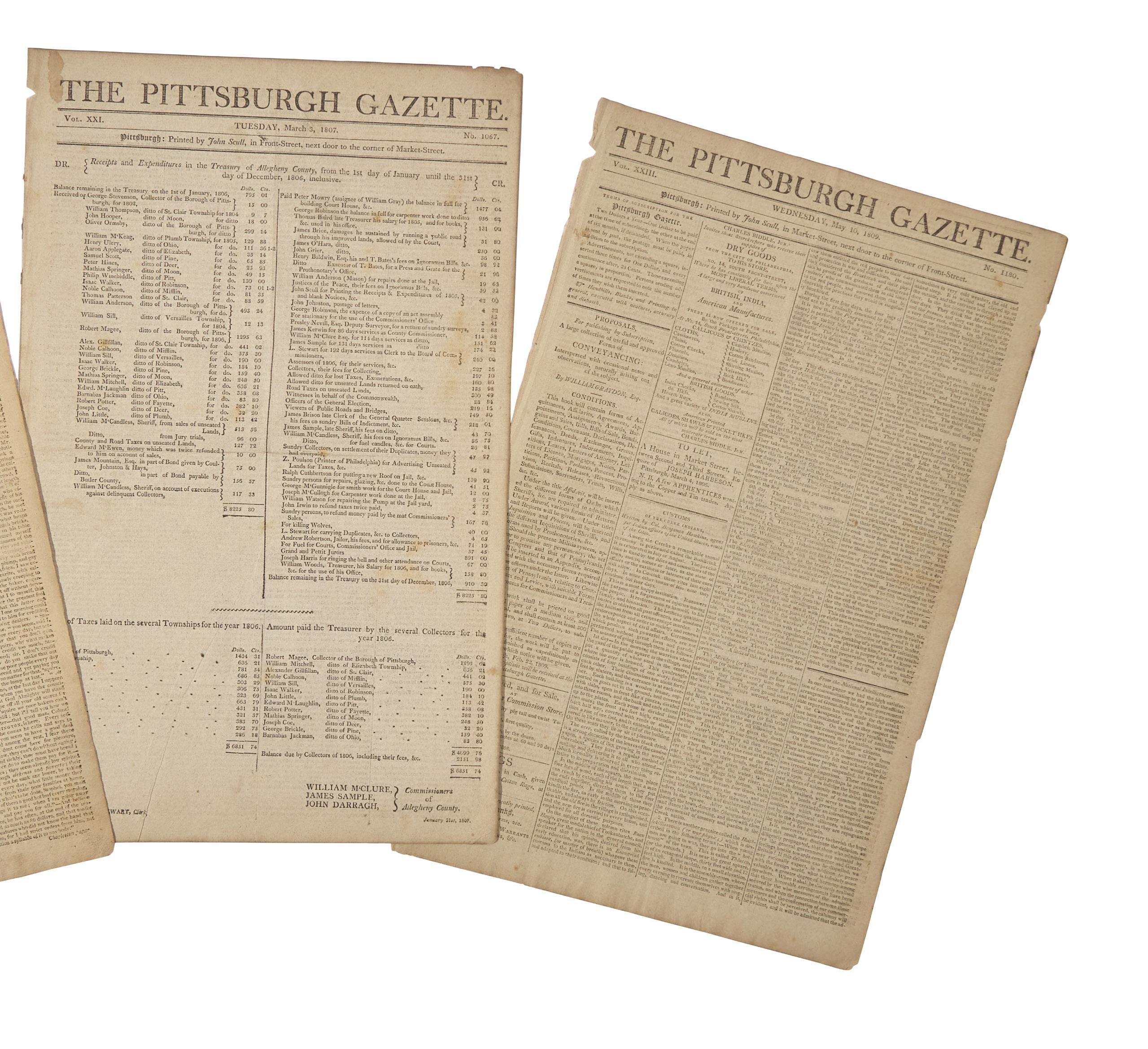
A group of three of these early Pittsburgh newspapers, including a variety of content, local, domestic, and international, including ads for numerous local tradesmen, reports on conflicts in Europe, domestic news on relations with Native American tribes, reaction to Aaron Burr’s alleged plot to form a renegade empire in Louisiana Territory, as well as articles related to Meriwether Lewis, etc.
By the first decade of the 19th century, Pittsburgh had evolved from a frontier fort town and flashpoint of the French and Indian War into an emerging industrial powerhouse. Situated at the strategic confluence of the Allegheny and Monongahela Rivers, which merge to form the Ohio River and provide a vital route to the Mississippi, the city served as the gateway to the Western frontier. During the latter half of the decade, the town’s population grew to just under 2,000. This growth was further accelerated by the War of 1812, which solidified Pittsburgh’s status as a manufacturing hub for steel, brass, glass, and other materials. The present representative group thus provides a fascinating glimpse into this frontier region and its emergent economy.
$500 - 800
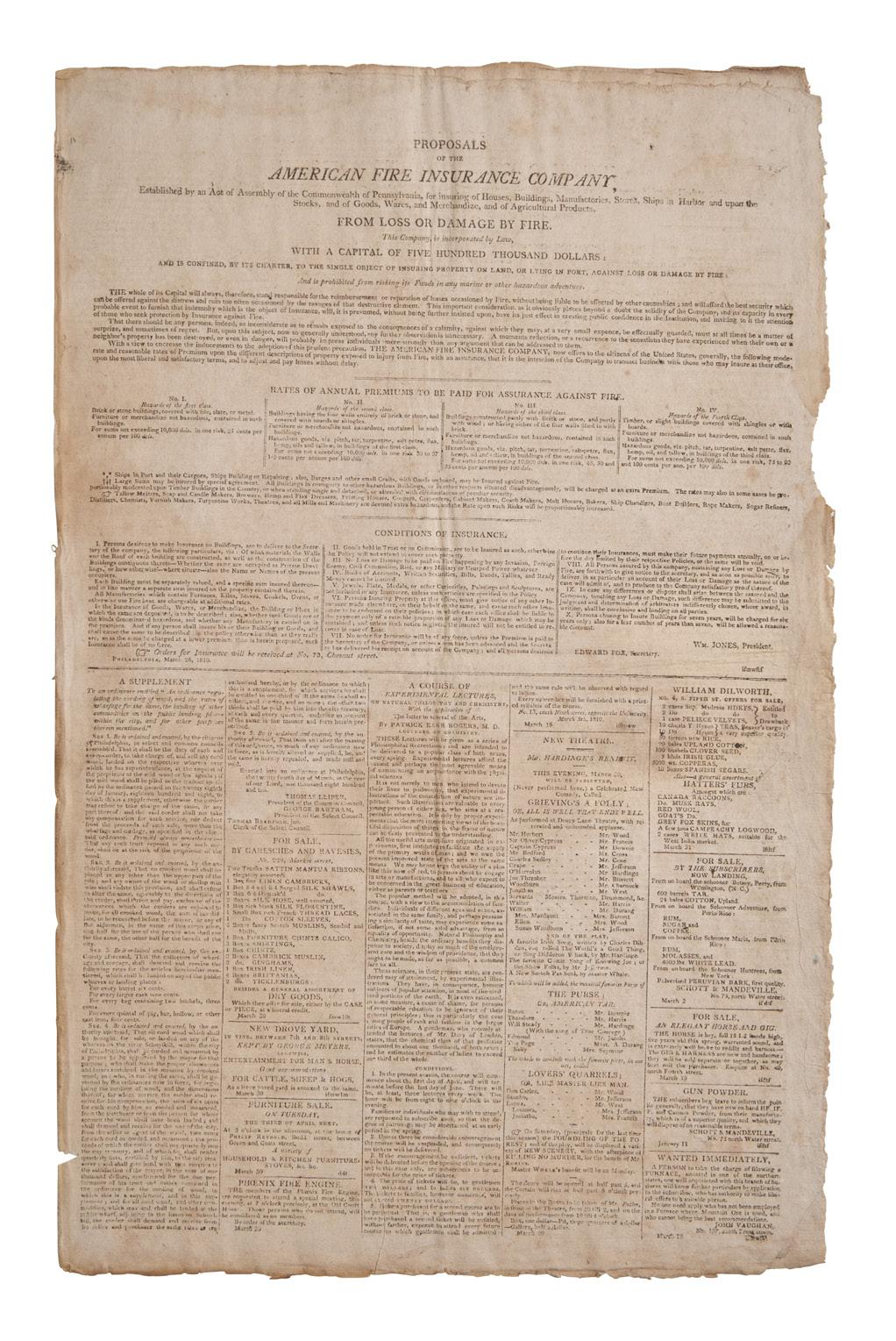
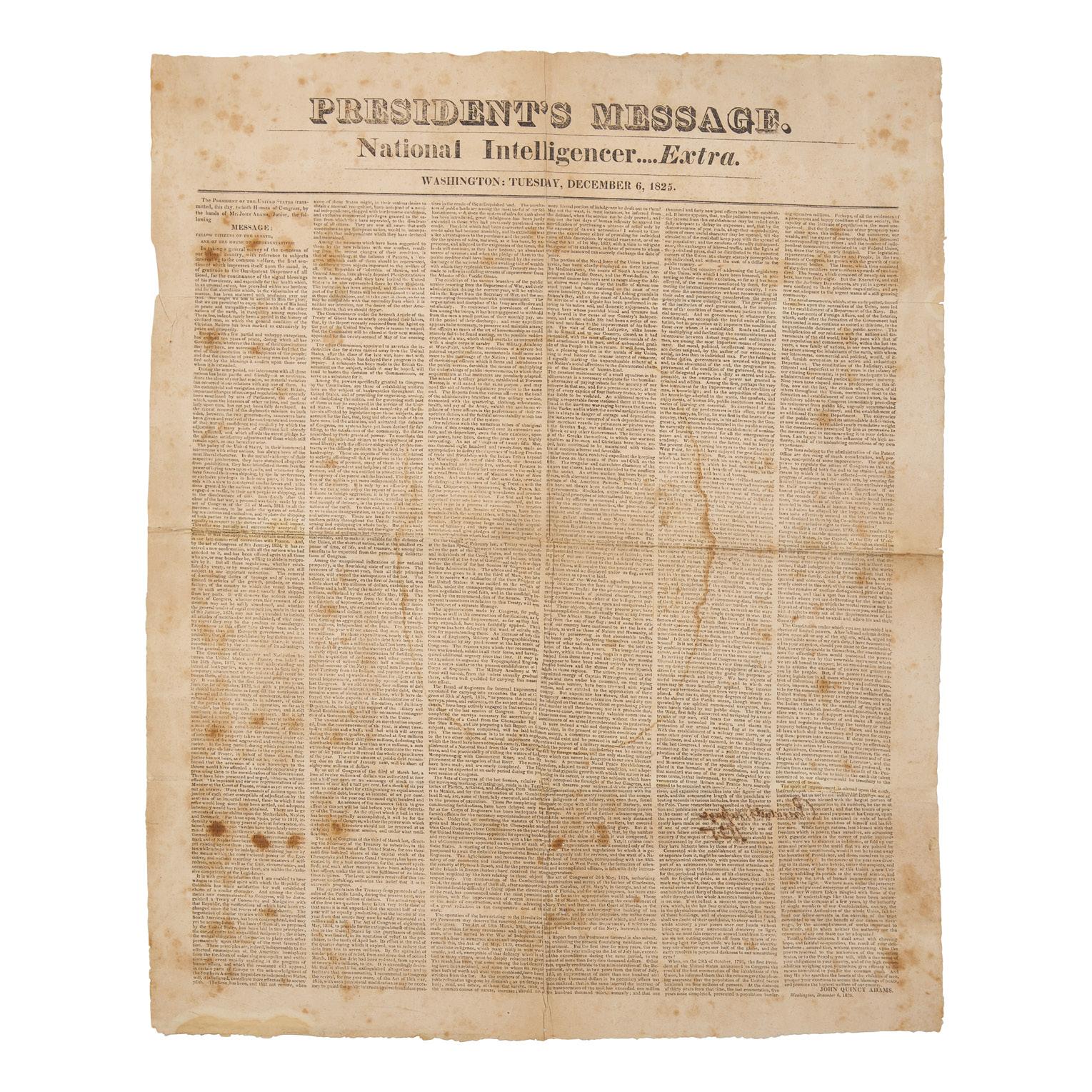
45
[American Newspapers] [Fire Insurance] Group of 2 Issues of the Aurora, with a Large Ad for Early Fire Insurance, and Reports on British Impressment of American Sailors
Philadelphia: Published by Duane & Co., Thursday, March 29-Friday, March 30, 1810. Two printed newspapers. Folio. Two uncut broadsheets. Disbound; scattered soiling and light wear.
With reports on British impressment of American sailors and a Congressional bill authorizing the President to arm public ships to protect its merchant fleet. On the recto of the March 29 issue is a half-page ad for the American Fire Insurance Company, one of the first joint-stock fire insurance companies in the United States, first organized only a month prior, on February 28.
The Aurora emerged as the single most influential newspaper of its day during the time that Philadelphia served as the nation›s capital. Its founder, Benjamin Franklin Bache, the favorite grandson of Benjamin Franklin, was the driving force behind its success with fresh and accurate reporting.
$200 - 300
46
[American Newspapers] (Adams, John Quincy) Broadside First Printing of President John Quincy Adams’ First State of the Union Address
“Among the First Perhaps the Very First, Instrument for the Improvement of the Condition of Men is Knowledge”
President’s Message. National Intelligencer....Extra Washington (D.C.), Tuesday December 6, 1825. Printed broadside in six columns; 23 x 19 in. (584 x 483 mm). Newspaper extra of The National Intelligencer, featuring President John Quincy Adams’ first State of the Union address. Manuscript docketing on verso, “President’s Message 1825.”
Creasing from old folds; closed tear at center fold; scattered foxing; large dampstaining at center; a few small closed tears to extremities.
In his speech of December 6, Adams outlined an ambitious national vision centered on internal improvements, scientific advancement, and cultural development. He advocated for federally supported roads, canals, and a national university, arguing that the United States should promote both intellectual and economic progress alongside territorial expansion.
$500 - 800
47
[American Newspapers] Bilingual Issue of the “Baton Rouge Gazette”
Baton Rouge, Louisiana, Saturday, June 2, 1827. Printed in English and in French. Vol. IX, No. 14. Folio. Separated along central vertical fold; foxing and offsetting; scattered wear along edges.
A bilingual issue of this Baton Rouge newspaper, printed in English and in French, and reporting on a variety of domestic and international affairs, including notices of court cases, ads for runaway slaves, acts passed by Congress, etc.
$200 - 300
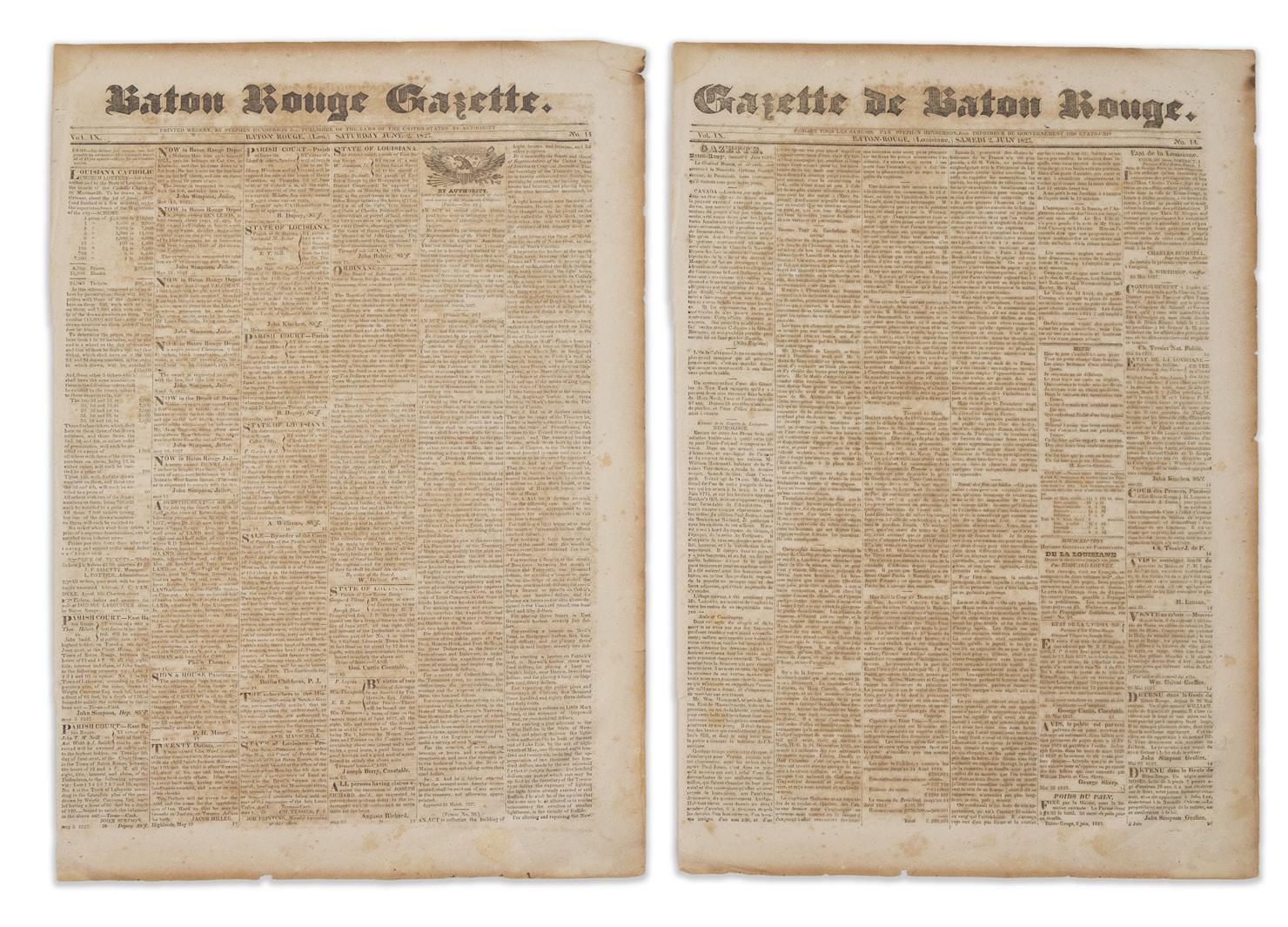
48
[American Newspapers] One of the Final Large Electoral Victories by the Declining Whig Party, Printing a Large and Impressive Victory Display
Albany Journal
Albany: Ten Eyck & Co., November 11, 1853. Vol. 24, No. 2473. Printed newspaper. Folio. 4 pp. Contemporary ownership signature at top of front-page; scattered spotting; wear along edges, including five-inch closed tear in bottom corner of first sheet.
The imposing full-page display on the third page announces, “Whig State Ticket / Triumphantly Elected! / Whig Canal Board! / Whig Senate! Whig Assembly!!” all surrounding an American Eagle with a banner in its beak proclaiming “The Whig Banner Again Floats Over The Empire State!!”. Despite the triumphant Whig sweep in the 1853 state election as evidenced here, on a national level the party was in its final precipitous decline. Already fracturing due to the question of slavery’s expansion into the western territories, with the passage of the Kansas-Nebraska Act the following year the Whig party would collapse. From its ashes would emerge the third-party system and, in the Spring of 1854, the ascendant Republican Party.
$300 - 500
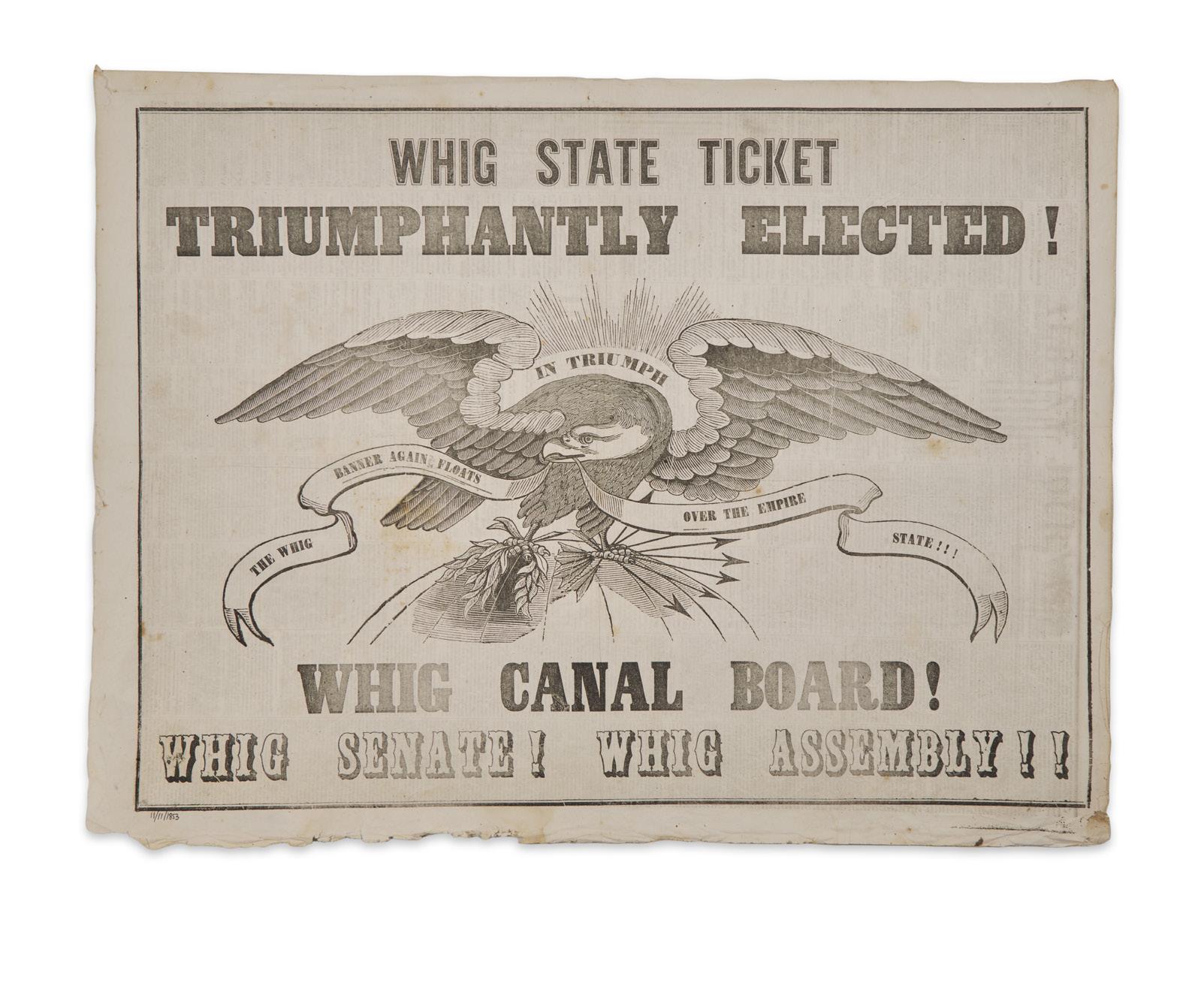

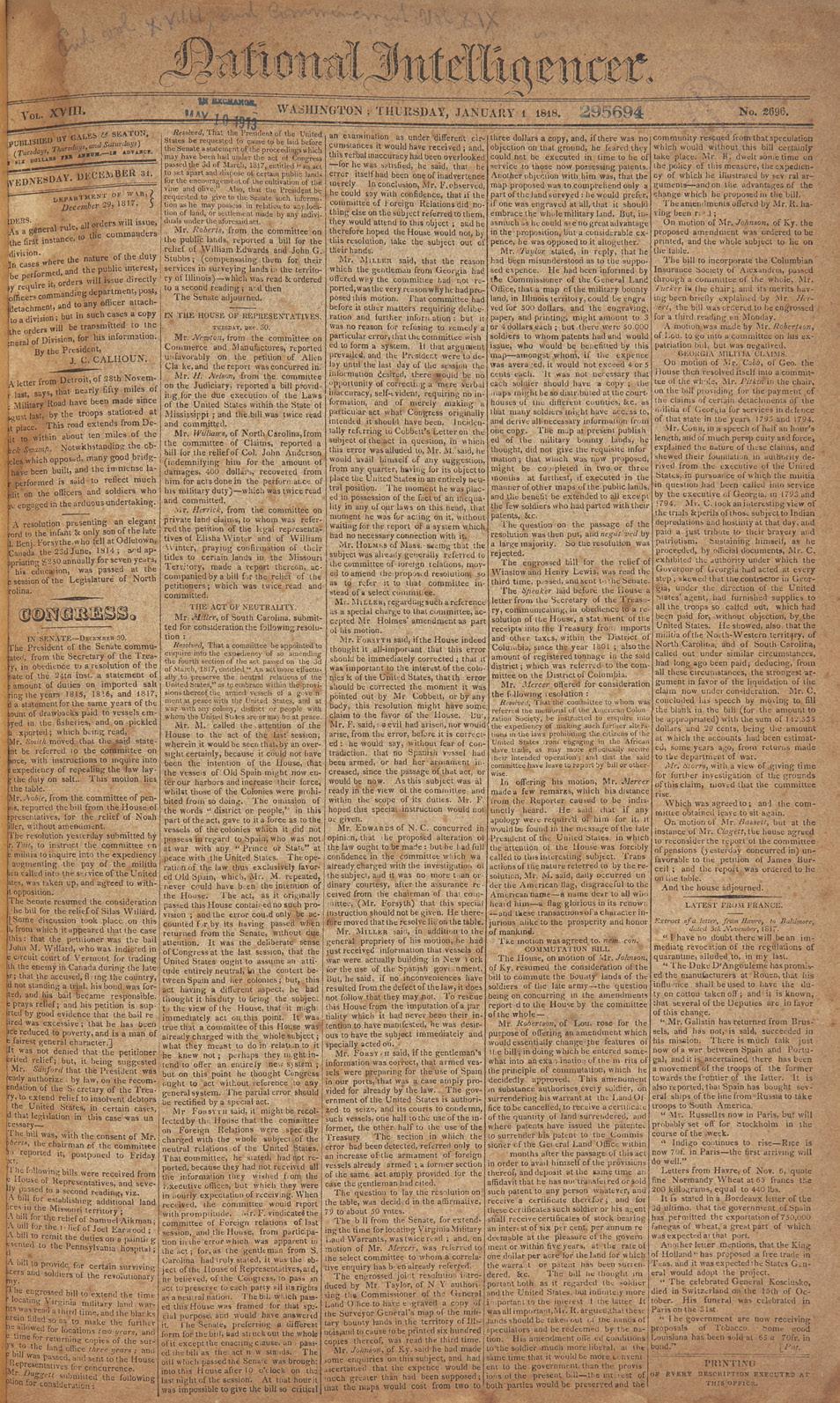
49
[American Newspapers] [Great Depression] The Stock Market Crash of 1929
Chicago Daily Tribune
Chicago: October 30, 1929. Vol. LXXXVIII, No. 260. Folio. 40 pp. With the headline, “STOCK SLUMP ENDS IN RALLY.” Disbound; separations along vertical central fold; creasing from old folds; scattered stains; pinholes at left margin from when bound.
The day after Black Tuesday: scarce Chicago Daily Tribune issue reporting on the one-day «recovery» of the stock market in the midst of the Wall Street Crash of 1929.
On October 29, known as Black Tuesday, 16.4 million shares were traded, with a loss of $14 billion in market value. Despite the slight recovery reported here, on October 30, the market continued to plummet into November, and would usher the United States and the world into the Great Depression.
$800 - 1,200
50
[American Newspapers] Extensive and Consecutive Run of Issues of the National Intelligencer, the Major Newspaper of the Nation’s Capital, Printed During the Second Year of the Presidency of James Monroe
The National Intelligencer
Washington, (D.C.): Printed by Gales & Seaton, January 1-November 17, 1818. Vol. XVIII, No. 2696-Vol. XIX, No. 2831. Bound volume of 135 consecutive issues, a tri-weekly paper, including one supplement (March 24, 1818). Folio. Quarter brown cloth over paper-covered boards; issues unevenly trimmed; printed book-plate of Stanford University Library on front paste-down; unsigned contemporary letter laid in; scattered foxing and stains throughout; tear traversing lower half of front-page of No. 2738; lower half of front page of one issue torn away.
Notable events include, the first printing of the Flag Act of 1818, officially establishing the layout of the American Flag; notice of the death of adventurer George Rogers Clark; an advertisement for Benjamin Tyler Owen’s printing of the Declaration of Independence; events surrounding the First Seminole War and invasion of Spanish Florida; the 1818 Treaty with Great Britain; Illinois statehood; and much more.
$1,000 - 1,500
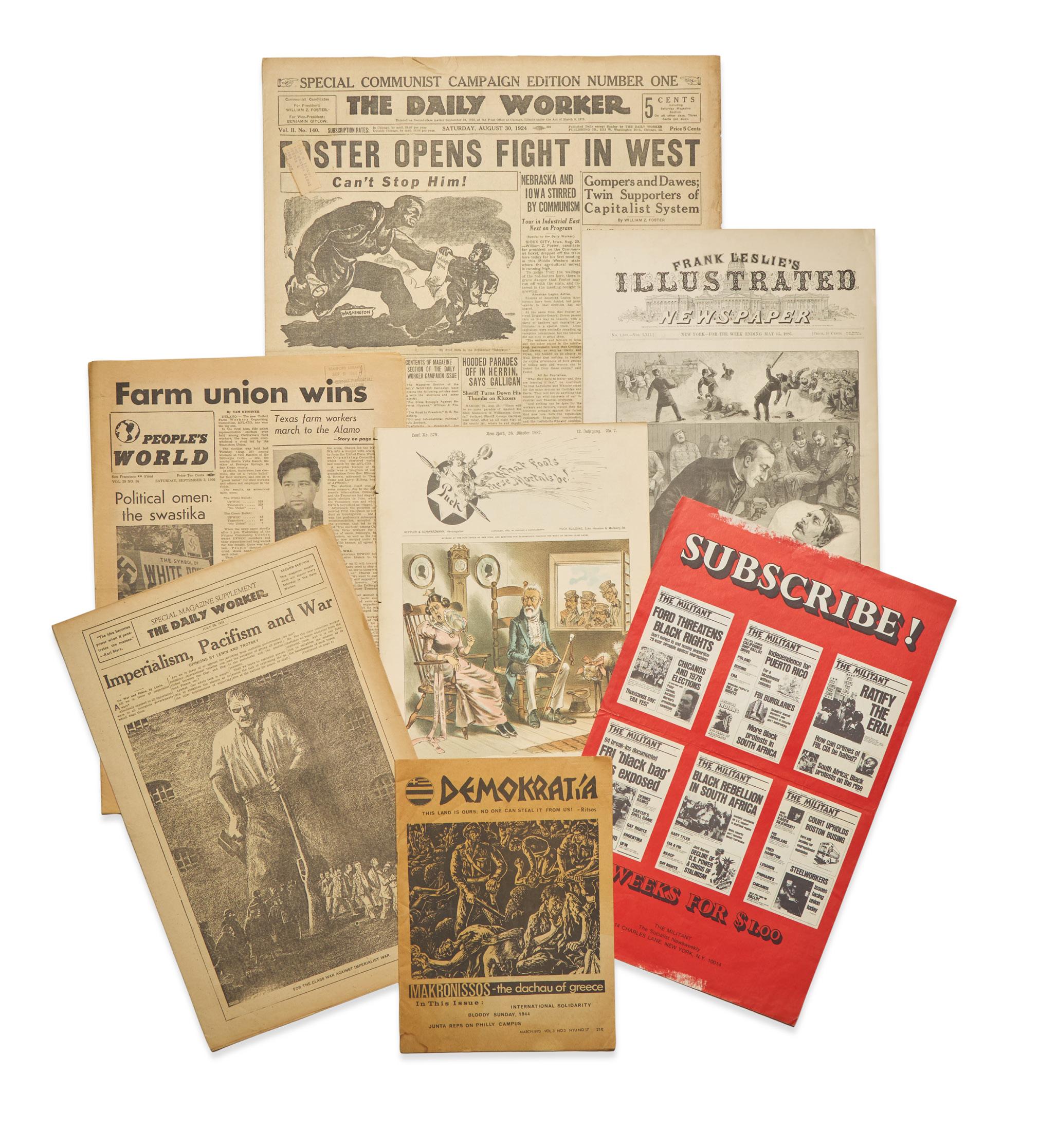
Proletarian News
Chicago, 1939-1950. In 14 issues, comprising: November 1, 1939 (Vol. VIII, No. 7, Whole No. 83); September 1943 (Vol. XII, No, 9, Whole No. 126); September 1944 (Vol. XIII, No. 9, Whole No. 138); July 1945 (Vol. XIV, No. 7, Whole No. 148); November 1946 (Vol. XV, No. 11, Whole No. 164); December 1946 (Vol. XV, No. 12, Whole No. 165); November 1948 (Vol. XVII, No. 11, Whole No. 188); January 1949 (Vol. XVIII, No. 1, Whole No. 190); March 1949 (Vol. XVIII, No. 3, Whole No. 192); August 1949 (Vol. XVIII, No. 8, Whole No. 197); December 1949 (Vol. XVIII, No. 12, Whole No. 201); November 1950, mimeograph (Vol. XIX, No. 11, Whole No. 212); December 1950 (Vol. XIX, No. 12, Whole No. 213); May 1953 (Vol. XXII, No. 5, Whole No. 242). Folio. Each 8 pp.; mimeograph issue 12 pp. Variously toned and soiled.
A run of issues of the Proletarian News newspaper, the official organ of the Proletarian Party of America. Originally founded in 1919 as The Proletarian to serve the left wing of the Socialist Party of Michigan, in 1932 it changed its name to the above, and was discontinued in 1960.
Lot includes a group of eight other items, including: Puck (New York, October 26, 1887); Special Magazine Supplement The Daily Worker (Chicago, July 26, 1924); The Daily Worker (Chicago, August 30, 1924, Vol. II, No. 140); Demokratia (New York, March 1970, Vol. 3, No. 3); Printed broadside ad for “The Militant” (New York, ca. 1976); People’s World (San Francisco, September 3, 1966, Vol. 29, No. 36); an excised front-page from an issue of Frank Leslie›s Illustrated Newspaper (May 15, 1886), illustrating the aftermath of the bombing at Haymarket Square in Chicago. Sizes and condition varies, generally good; usual wear to newspapers.
$400 - 600
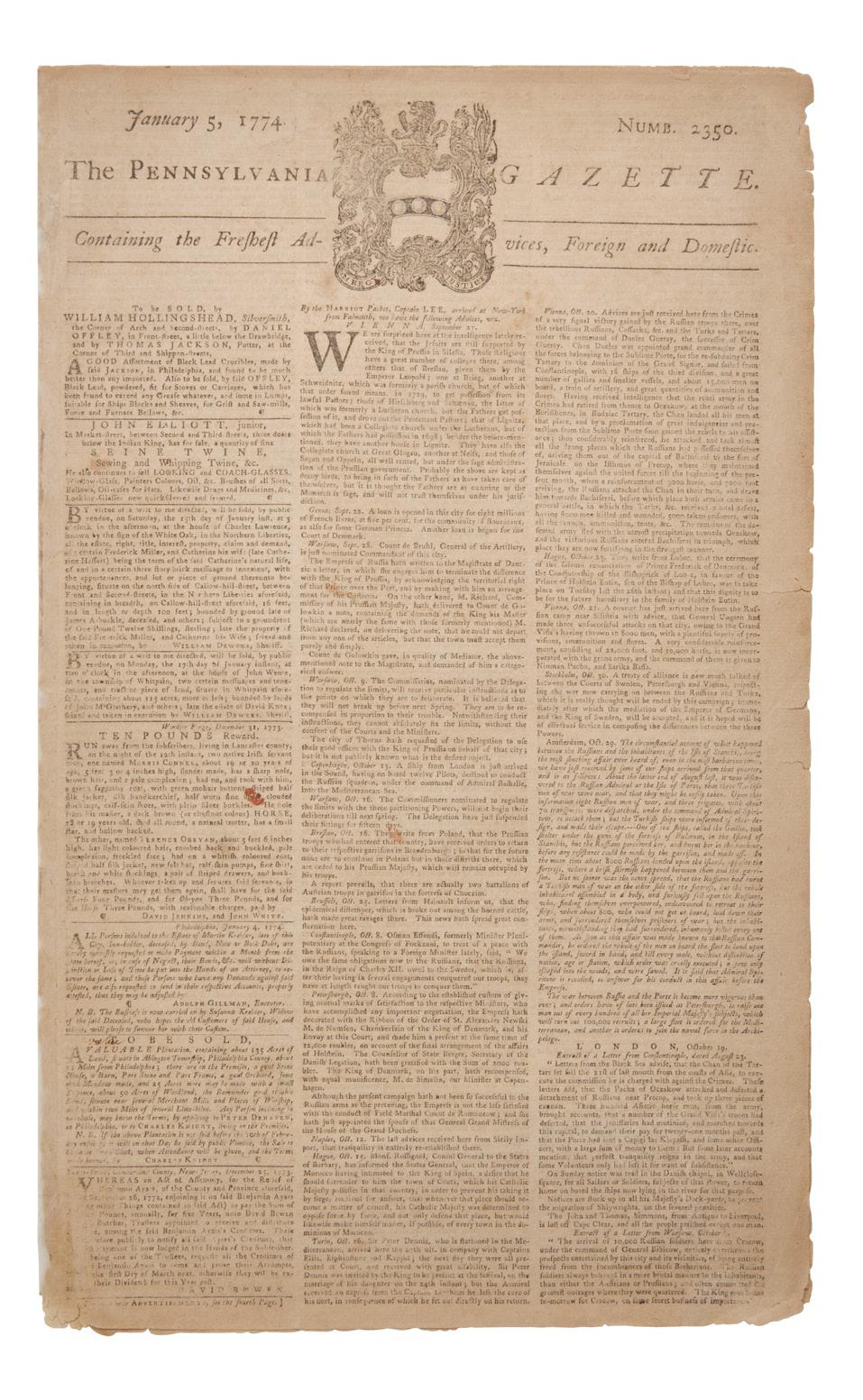
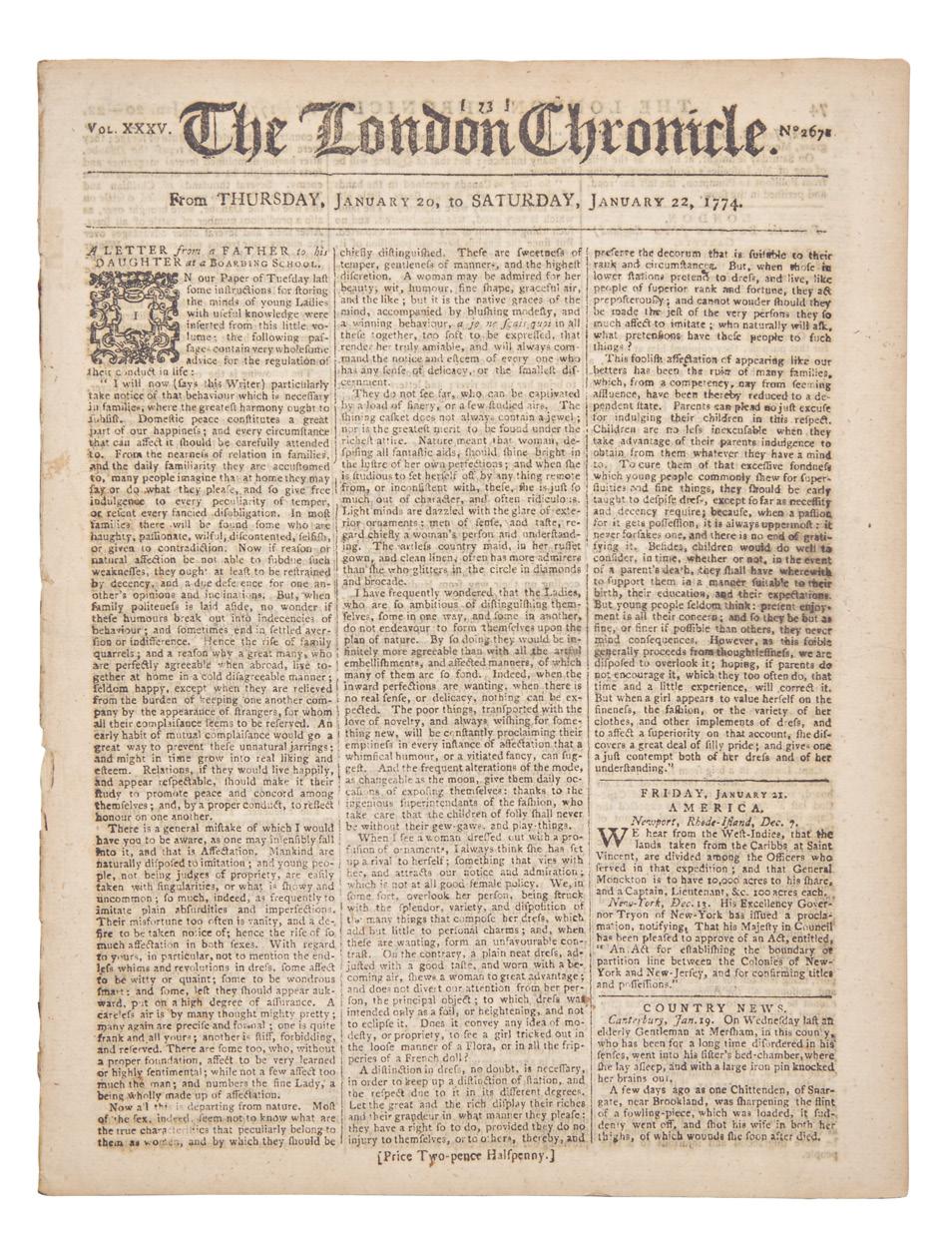
52
[American Revolution] Early Report of the Boston Tea Party, Printed by The Pennsylvania Gazette, One of Most Vocal Voices of Colonial Opposition
The Pennsylvania Gazette (Philadelphia: Hall and Sellers), January 5, 1774. No. 2350. Bifolium, (4 pp.) 16 x 10 in. (406 x 254 mm). Printed newspaper. Split at centerfold repaired with archival tape; toned, scattered stains; small closed tears or chips to extremities.
Rare issue of The Pennsylvania Gazette, the paper formerly printed by Benjamin Franklin, containing an early contemporary report on the Boston Tea Party. The issue relays a report from a writer of the Boston Gazette, “that the People, tho unanimously determined that the East-India Company’s Tea should not be sold nor landed, nor remain in Harbour long enough, to be liable (according to an Act of the British Parliament) to the Payment of the Duty imposed by that Parliament, for the Purpose of raising a Revenue in America...the People, deprived of any other Way to get rid of it, were obliged to destroy it in their own Defence; so that all the Damage the owners owe, &c. sustain by its Destruction, is wholly chargeable upon the Governor, Collector, Owner, &c.”
On December 13, 1774, a large group of the Boston Sons of Liberty, dressed as Mohawk Indians, boarded three merchant vessels anchored in the harbor. Over the course of three hours, the group dumped over 340 chests of tea owned by the British East India Company overboard, destroying the monetary equivalent of almost two million dollars in today’s currency.
The action was in response to the passage of the British Tea Act of 1773, one of a string of legislative duties passed by Parliament that increased financial burdens on American colonists. The Tea Act, along with the Townsend and subsequent Intolerable Acts, were seen by American colonists as violations of their rights as Englishmen, since they represented “taxation without representation.” The Boston Tea Party proved a key incident of escalation of hostilities between Great Britain and the American colonies, which culminated two years later with the Battles of Lexington and Concord, officially starting the Revolutionary War.
$1,500 - 2,500
53
[American Revolution]
Early Reports on the Boston Tea Party
The London Chronicle
London: Sold by J. Wilkie, From Thursday, January 20, to Saturday, January 22, 1774. Vol. XXXV, No. 2678. Printed newspaper. 4to. pp. (73)-80. Disbound; scattered spotting.
Reporting of the Boston Tea Party, reprinted from the December 20, 1773 report in the Boston Gazette: “A number of resolute men (dressed like Mohawks or Indians) determined to do all in their power to save their country from the ruin which their enemies had plotted, in less than four hours emptied every chest of Tea on board the three ships commanded by the Captains Hall, Bruce, and Coffin, amounting to 342 chests, into the sea! without the least damage done to the ships, or any other property.”
A subsequent article reports on, “An inflammatory hand bill” that “was a few days ago distributed in Philadelphia, addressed to the Delaware Pilots, informing them, that a ship loaded with Tea is on her way to that port, being sent out for the purpose of enslaving and poisoning all the Americans...exhorting them to prevent her arrival...” It goes on to report that, “We hear from Philadelphia, that Captain Ayres, in a ship chartered by the East-India Company, to bring their Teas to that place, had arrived at the Cape of Delaware...but that the Pilots had refused to bring her up the river...that if they presumed to come thither, it would be at their peril, and the inevitable destruction of both vessel and cargo...”
$800 - 1,200
54
[American Revolution]
A Boston Newspaper Reports the Escalating Tensions between America and Great Britain, including the Boston Tea Party
“The situation of affairs in America is becoming more truly alarming than ever...”
The Boston Evening-Post
Boston: Printed by Thomas and John Fleet, Monday, April 25, 1774. Numb. 2013. Printed newspaper. Folio. (4) pp. Contemporary ownership signature at top of frontpage, contemporary marginalia on same and final page. Disbound; residue along spine on final page; creased from old fold; separating along spine; toned.
A Boston newspaper reports the escalating tensions between America and Great Britain, including articles on the Boston Tea Party and its aftermath, as well as on Benjamin Franklin’s infamous appearance before the Privy Council at the Cockpit in Whitehall, a watershed event that turned him into a fervent Patriot.
$600 - 900
55
[American Revolution]
George Washington and the Virginia Delegation are Appointed to the First Continental Congress
“It being our Opinion that the united Wisdom of North America should be collected in a General Congress of all the Colonies, we have appointed the Honourable Peyton Randolph, Esq; Richard Henry Lee, George Washington, Patrick Henry, Richard Bland, Benjamin Harrison, and Edmund Pendleton, Esquires, Deputies to represent this Colony in the said Congress, to be held at Philadelphia on the first Monday in September next.”
The Virginia Gazette (Williamsburg); Printed Alex. Purdie and John Dickson, August 11, 1774. Number 1192. Printed newspaper. Folio. 4 pp. Disbound; scattered soiling; toned.
A fine and significant copy of The Virginia Gazette, printing numerous reports on events in the lead-up to the American Revolution, most notably, Virginia’s nonimportation agreement passed by Virginia’s First Revolutionary Convention, and the selection and instructions for the delegates appointed to represent the colony in the First Continental Congress: George Washington, Patrick Henry, Peyton Randolph, Richard Henry Lee, Richard Bland, Benjamin Harrison, and Edmund Pendleton.
Other articles report the Quebec Act of 1774, news of English troops headed to Boston, a declaration of loyalty passed by the Pennsylvania Assembly, and other reports from around the colonies relating to nonimportation and the military rule in Boston.
$3,000 - 5,000
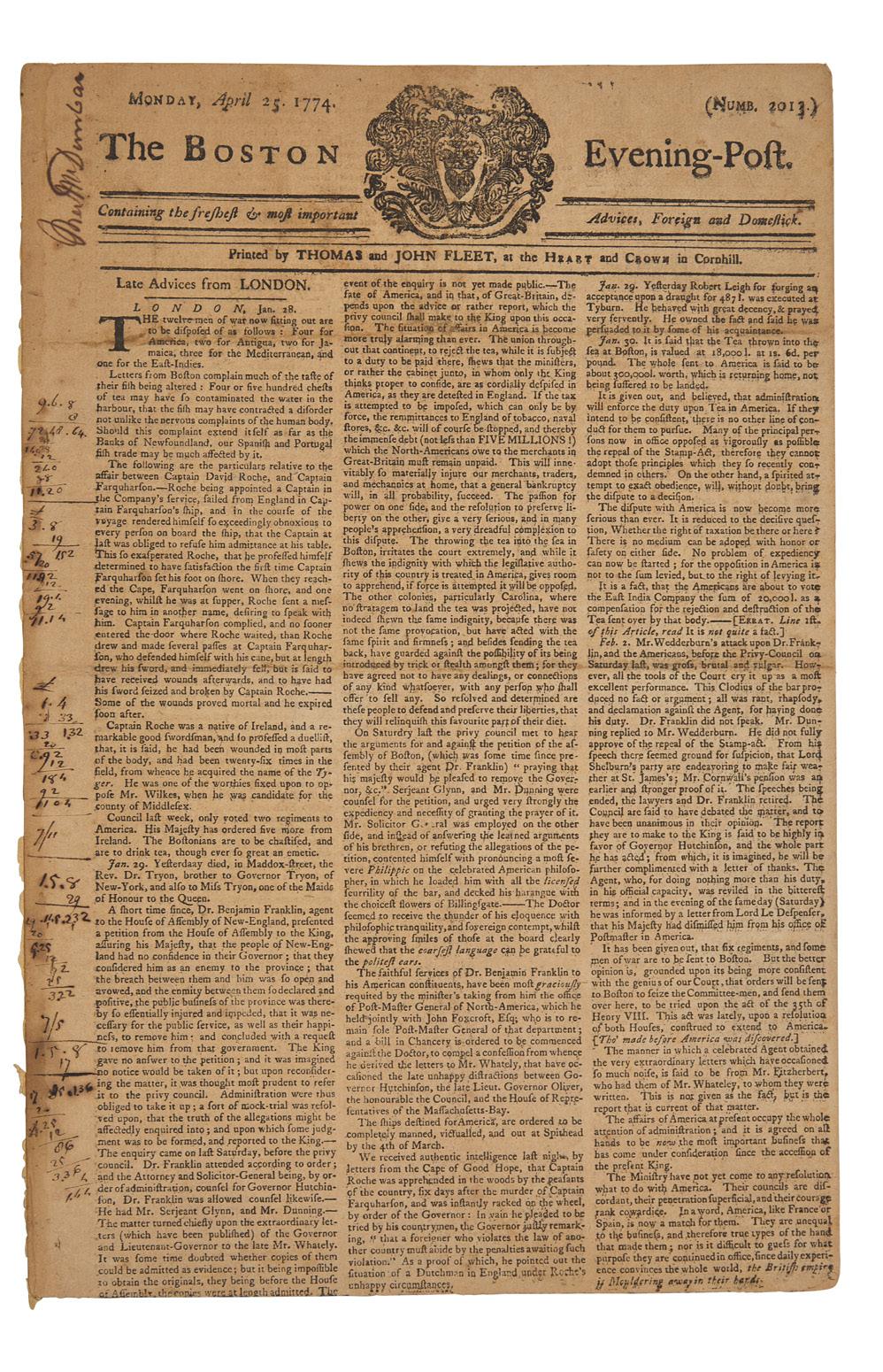
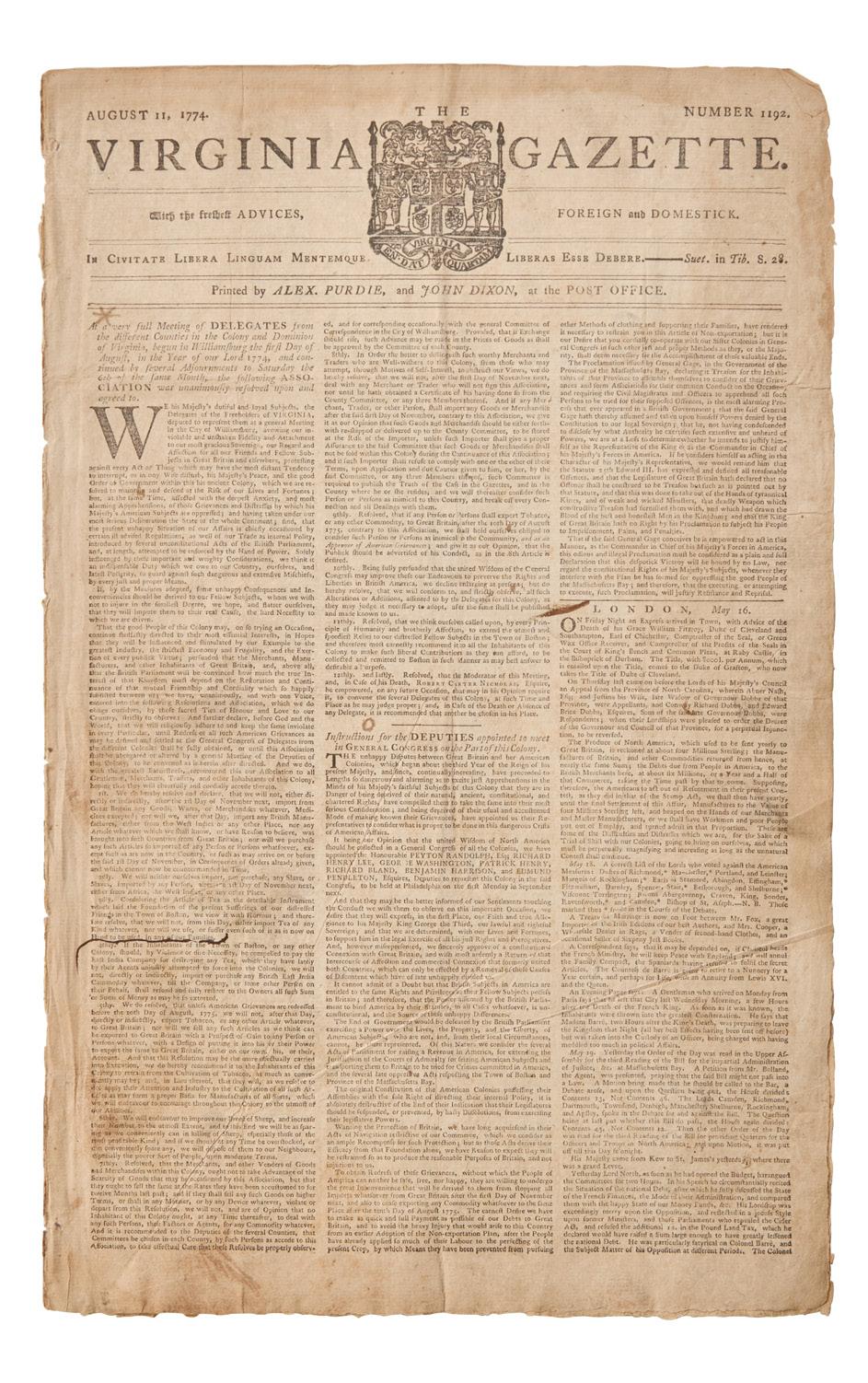
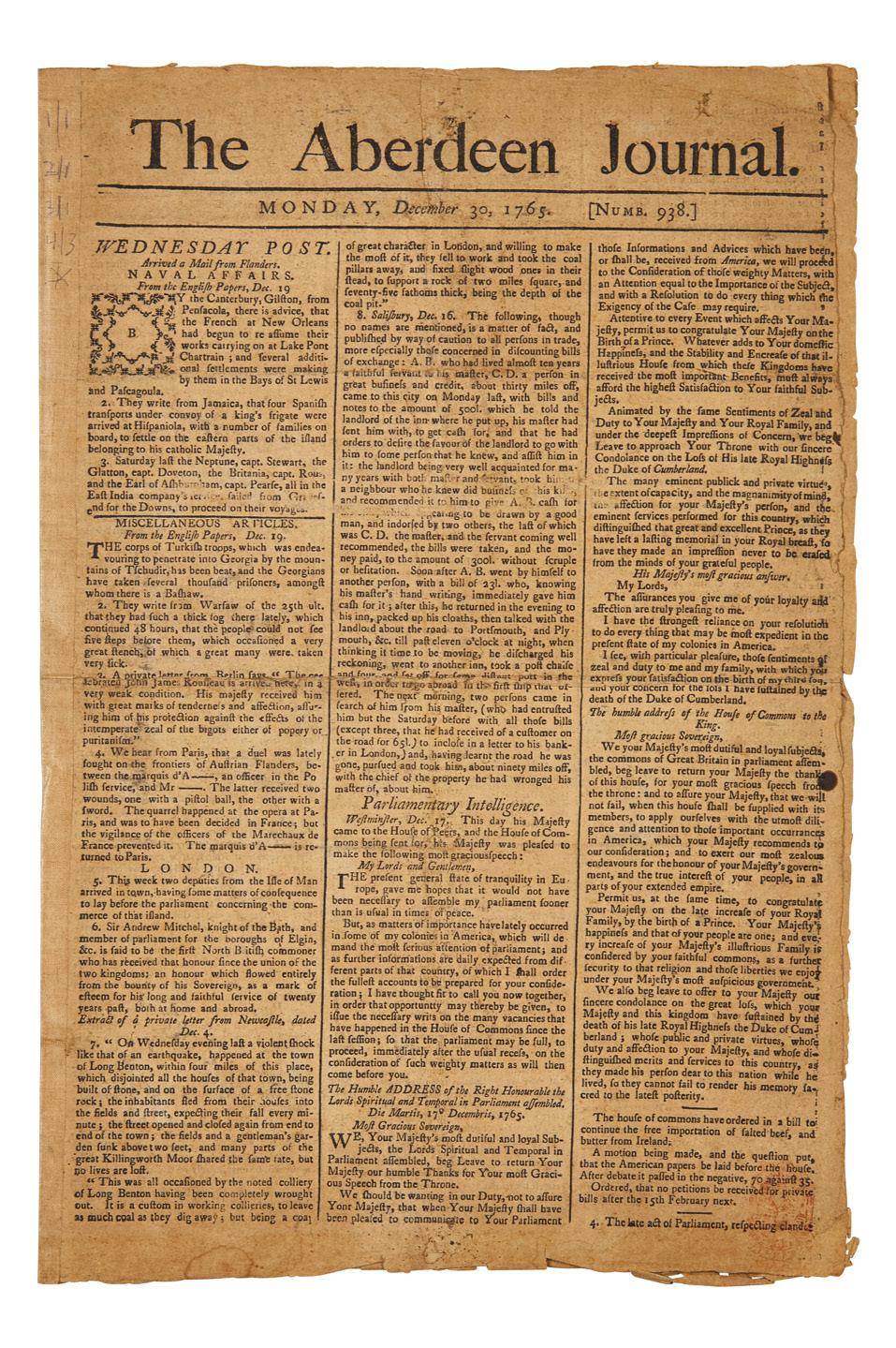
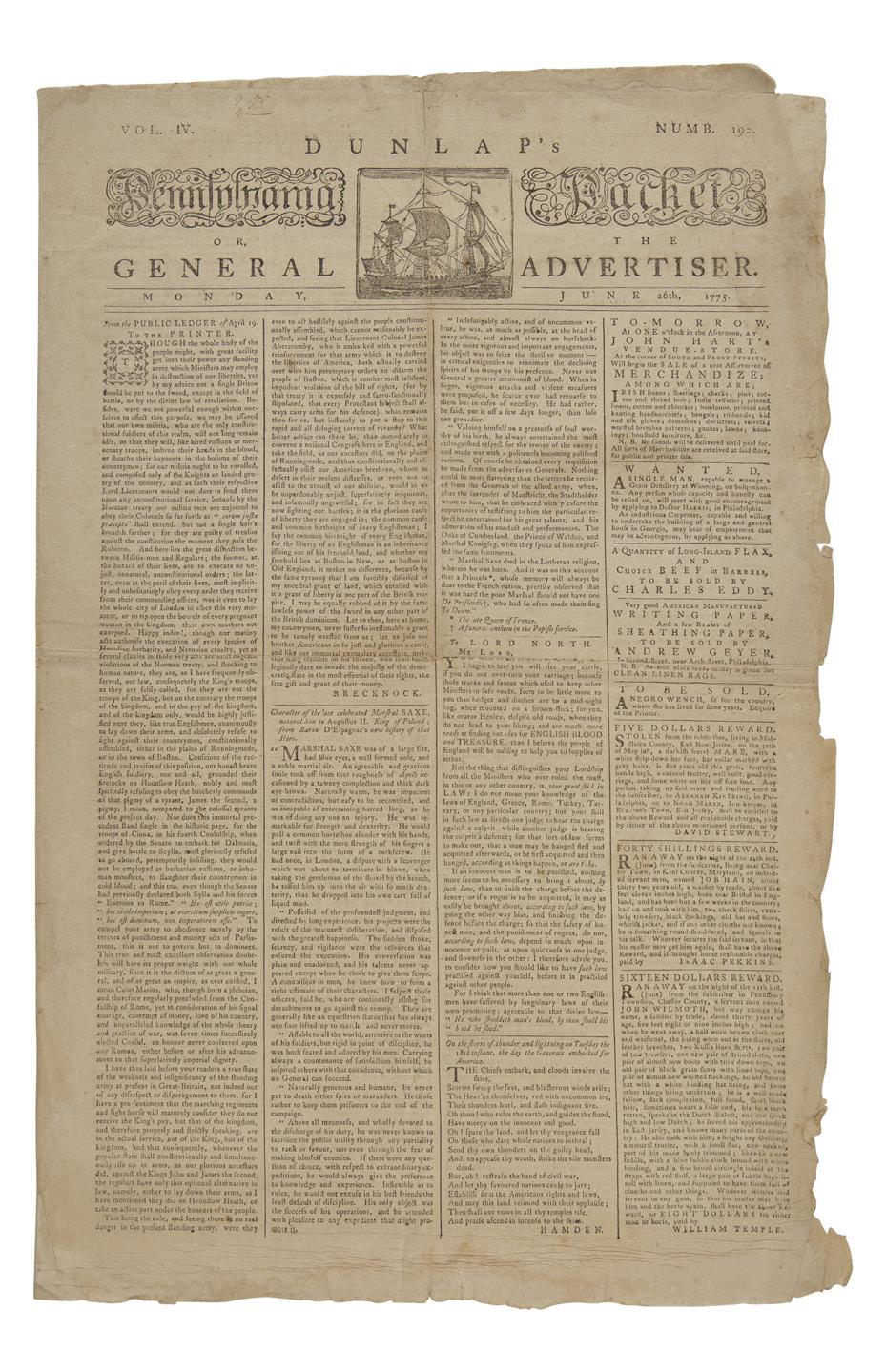
56
[American Revolution] An Article on the Publication of Stephen Hopkins’s Influential Pamphlet Against the Stamp Act
The Aberdeen Journal Aberdeen, (Scotland): Printed and sold by James Chalmers, Monday, December 30, 1765. Numb. 938. Printed newspaper. Folio. (4) pp. Faint British tax stamp in bottom corner of first page. Creased from old fold; Repaired along spine; wear along edges, scattered small open tears along same.
Printed on p. 3 is an article on the publication of Rhode Island Governor Stephen Hopkins’s (1707-85) influential pamphlet against the Stamp Act, The Grievances of the American Colonies Candidly Examined (published in America under the title, The Rights of Colonies Examined) Hopkins first delivered this text as a speech before a special session of the Rhode Island Assembly in November 1764, where he emphasized the economic burden on the colonists of Parliament’s Revenue Act of 1764, and the passage of the Stamp Act in March of 1765. The Assembly then drafted a petition to the King, detailing their grievances and denying Parliament’s right to levy a stamp act on the colony. The legislature than authorized a pamphlet printing of Hopkins’s speech, which was published by William Goddard, printer of the Providence Gazette, shortly after, where it was met with wide acclaim and went through to a second edition before the year ended. A London edition was printed in 1766.
$300 - 500
57
[American Revolution] A Fascinating Revolutionary War Newspaper, Published Only Eight Days Following the Battle of Bunker Hill
Dunlap’s Pennsylvania Packet or, The General Advertiser Philadelphia: Printed by John Dunlap, Monday, June 26, 1775. Vol. IV, Numb. 192. Folio. 4 pp. Printed newspaper in four columns. Creasing from old folds; edges untrimmed; scattered foxing; paper loss and chips in right margin; bottom margin heavily creased.
Featuring British General Thomas Gage’s infamous June 12 Proclamation offering amnesty to “all persons who shall forthwith lay down their arms, and return to the duties of peaceable subjects, excepting only from the benefit of such pardon, Samuel Adams and John Hancock, whose offences are of too flagitious a nature to admit of any other consideration than that of condign punishment.”
Gage’s message was ghostwritten by British Lieutenant General John Burgoyne, but it backfired, as Loyalists did not flock to the British side, and the message’s patronizing tone rallied Patriot militiamen, who subsequently surrounded Boston to drive out the British, culminating in the Battle of Bunker Hill.
Further printed is Captain Elijah Hide’s stirring firsthand account of Bunker Hill. He begins, “On Friday night, the 16th inst. fifteen hundred of the Provincials went to Bunker’s Hill, in order to intrench there...when two thousand Regulars marched out of Boston, landed in Charlestown, and plundering it of all its valuable effects, set fire to it...then dividing their army, part of it marched up in the front of the provincial intrenchment and began to attack.” He goes on to report that as the Regulars inched closer, “Capt. Nolton gave orders to the men not to fire until the enemy were got within fifteen rods, and then not till the word was given.” After two hours of fighting Hide reports the suspected casualties, including that, “Dr. Warren is undoubtedly among the slain.”
On the third page is reported that on the morning of the 26th, Generals George Washington and Charles Lee had left Philadelphia to take command of the newly-established Continental Army, in Massachusetts. Washington was appointed Commander-in-Chief of the Army only six days prior to this publication. Printed on the last page is a report from June 21st, of Washington making his first inspection of the 2,000 soldiers in Philadelphia.
$1,500 - 2,500
58
[American Revolution] Very Rare First Report of the Battle of Bunker Hill Printed in England
The London Gazette
London: Printed by Thomas Harrison, July 22-25, 1775. Numb. 11581. Bifolium, 12 x 7 1/2 in. (305 x 191 mm). Printed newspaper in two columns. Disbound. With the text of an account of the Battle of Bunker Hill by Thomas Gage. In part: “I am to acquaint your Lordship of an Action that happened on the 17th instant between His Majesty’s Troops and a large Body of the Rebel Forces. An Alarm was given...that the Rebels had broke Ground, and were raising a Battery, on the Heights of the Peninsula of Charles-Town...Preparations were instantly made for landing a Body of Men...under the Command of Major-General Howe...The Troops formed as soon as landed...the Attack began by a sharp Cannonade from our Field Pieces...Orders were executed with Perseverance, under a heavy Fire from the vast Numbers of the Rebels...the Loss the Rebels sustained must have been considerable...I inclose your Lordship a Return of the killed and wounded of His Majesty’s Troops...” Partial ink stamp at bottom of second page. Creased; small sections of loss to left margin; scattered stains.
A very rare issue of The London-Gazette, the official mouthpiece of the English Crown, containing the first English appearance of Colonial Governor Thomas Gage’s account of the Battle of Bunker Hill, which took place on June 17, 1775. The issue prints the full text of a letter written by Gage eight days after the battle, to the Earl of Dartmouth, Secretary of State for the Colonies, which took a month to arrive in England. Gage offers an inflated account of the conflict, emphasizing rebel losses while downplaying those of the British. Despite his attempts to control the narrative of the conflict, Gage was dismissed from his office three days after his report was received.
The text from this issue was used in the following days to print a broadside version of Gage’s account. (Evans 13842)
Very rare. We can locate no other copies of this issue featuring Gage›s initial report in the available auction record.
$3,000 - 5,000
59 [American Revolution]
Broadsheet Newspaper Printing of the First American Articles of War, Signed in Type by John Hancock and Charles Thomson
Supplement to the New-York Journal, or General Advertiser
(New York: Printed and Published by John Holt), Thursday, August 10, 1775. Numb. 1701. Printed broadsheet newspaper, 15 1/2 x 9 3/4 in. (394 x 248 mm). Contemporary inscription in top right recto edge (“For John William Hoffman”), and in lower left verso edge; contemporary notation on recto. Toned; wear along edges; repair in upper left edge.
Printing Articles 34-68 of the first American Articles of War, passed by Congress on June 30, 1775, and signed in type by John Hancock and Charles Thomson. The Articles followed those passed by the Massachusetts Provincial Court in May of 1775, and were similar in nature to those of the British, which enumerated various military offenses and described the composition of courts-martial. Its deficiencies would lead to an amended and expanded Articles to be passed in the fall of 1776, largely at the behest of General Washington.
$400 - 600
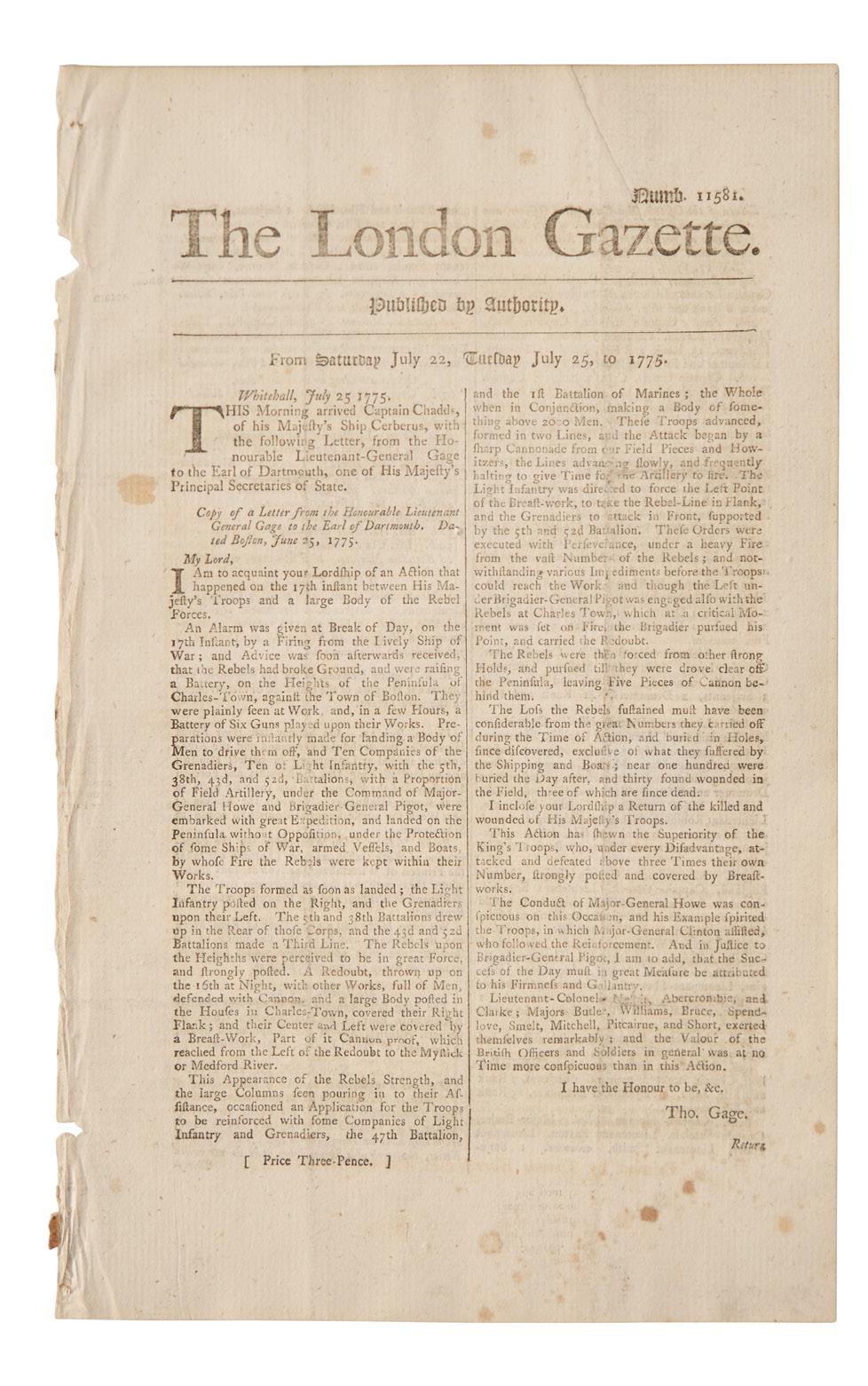
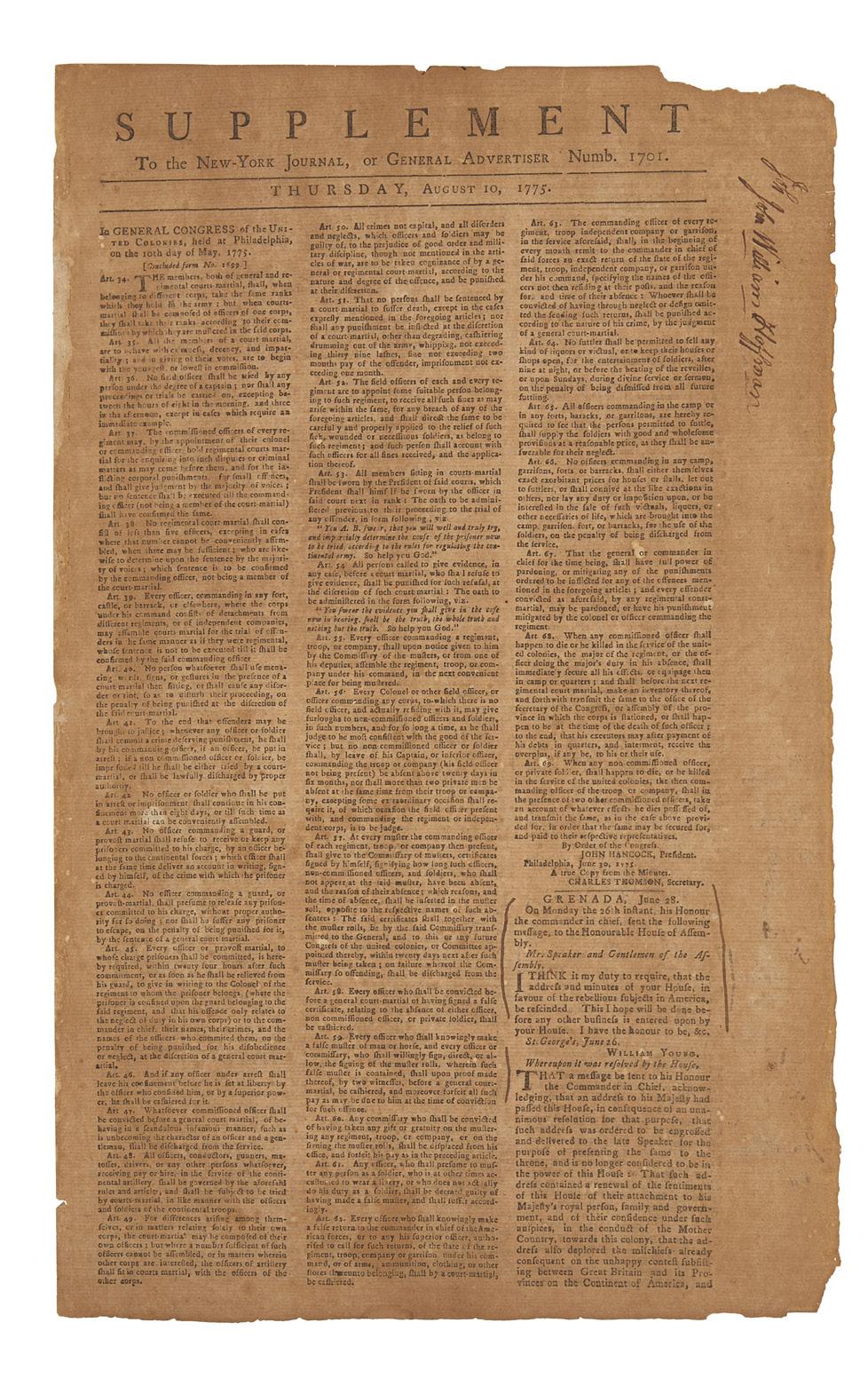
61
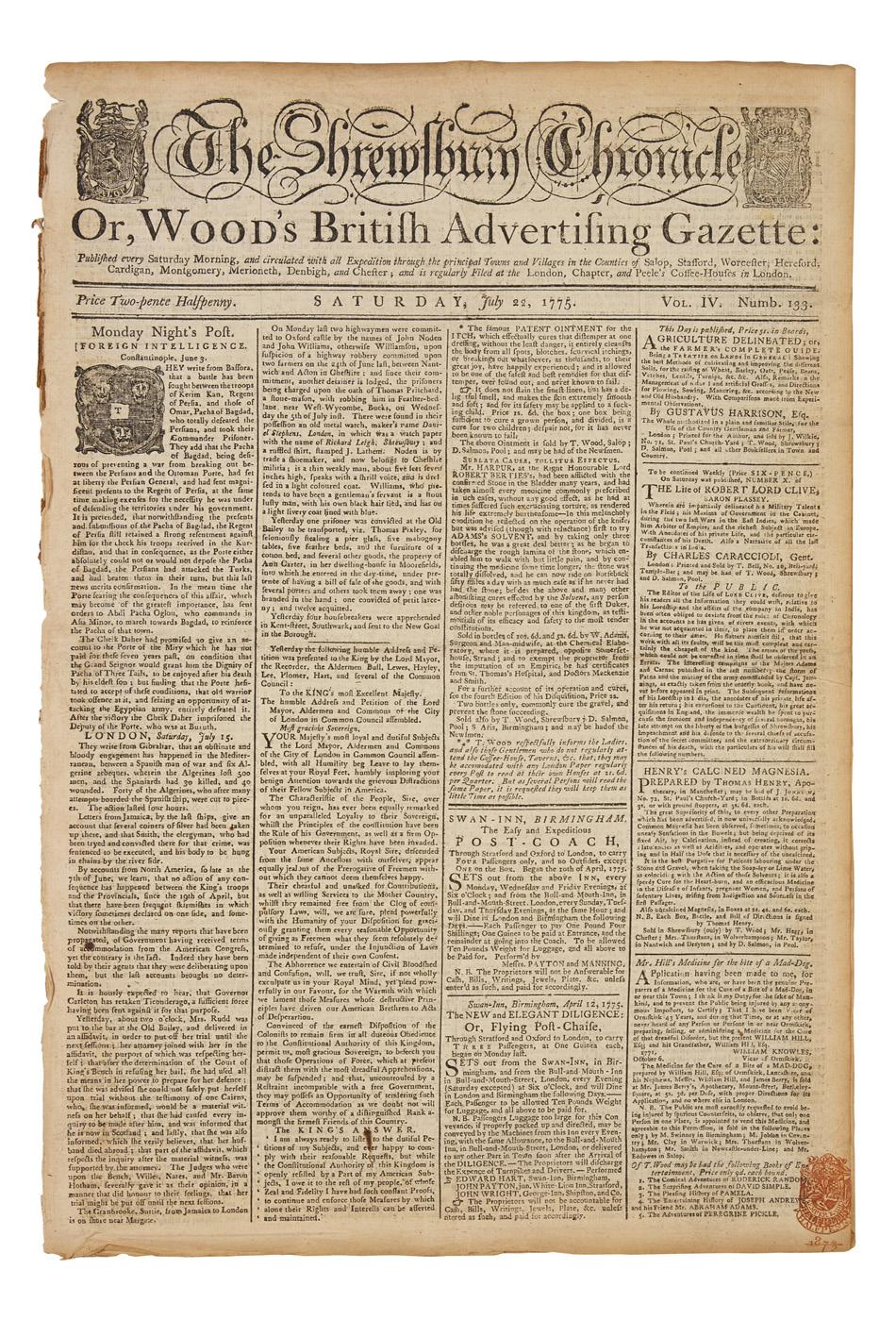
60
[American Revolution]
English Printing of General Gage’s Amnesty Proclamation of 1775, Plus Numerous Articles Pertaining to the Increasing Hostilities in America
The Shrewsbury Chronicle Or, Wood’s British Advertising Gazette Shrewsbury: Printed by T. Wood, Saturday, July 22, 1775. Vol. IV, Numb. 133. Printed newspaper. Folio. (4) pp. English tax stamp in bottom corner of first page. Disbound; separations along spine.
Printed on the second page are numerous reports concerning the Continental Army’s siege of Boston, followed by reports from Virginia of Lord Dunmore’s escape from Williamsburg. On the third page is reported the intense hunt by the British for John Hancock and Samuel Adams, while on page four is printed General Gage’s proclamation offering pardons to all rebels who lay down their arms, “excepting only from the benefit of such pardon Samuel Adams and John Hancock, whose offences are of too flagitious a nature to admit of any other consideration than that of condign punishment.”
$800 - 1,200
[American Revolution] The July 1775 Issue of Thomas Paine’s Important Revolutionary-Era Publication, Featuring an Early Printing of the Declaration of the Causes and Necessities of Taking up Arms
The Pennsylvania Magazine: Or, American Monthly Museum. For July 1775 Philadelphia: Printed by R(obert). Aitken, 1775. 12mo. (v), 296-338 pp. Edited by Thomas Paine. Disbound; sheets toned; scattered spotting and soiling; 2-inch closed tear in bottom edge Tt2.
The Declaration of the Causes and Necessities of Taking up Arms, a resolution adopted by the Second Continental Congress, was a major prelude to the Declaration of Independence. This issue also includes two pieces by Paine, as well as a report on the casualties at the Battle of Bunker Hill.
On June 23, 1775, shortly after the opening salvos of the American Revolution at the Battles of Lexington and Concord and Bunker Hill, the Second Continental Congress formed a committee charged with drafting a declaration on the causes and necessities of taking up arms against the English Crown. It was comprised of five men: John Rutledge, William Livingston, Benjamin Franklin, John Jay, and Thomas Johnson. After some debate, and the creation of a now lost draft by Rutledge which was deemed inadequate, John Dickinson of Pennsylvania and Thomas Jefferson of Virginia were added to help complete the text. Jefferson quickly produced a new draft, which was deemed by some committee members to be too provocative, which Dickinson then revised. The final work, which proved to be more severe than Jefferson’s original, was approved by Congress two weeks later, on July 6. It stands as one of the first attempts by Congress to justify to the American people, and to the world, the necessity for armed resistance, and represents the beginning of a trajectory that would ultimately lead to independence the following year.
The document enumerates numerous grievances and provocations at Parliament, including the losses of personal and property rights, including the suspension of trial by jury, the quartering of soldiers, the use of vice admiralty courts, taxation without representation, and the passage of the hated Coercive Acts and Declaratory Act, among others, that led to the taking up of arms. It then exhorts its constituents by asserting the justice of their cause, before closing with a prayer for reconciliation to avoid a civil war. “If it was possible for men who exercise their reason to believe, that the Divine Author of our existence intended a part of the human race to hold an absolute property in, and an unbounded power over others...the inhabitants of these Colonies might at least require from the Parliament of Great-Britain some evidence, that this dreadful authority over them has been granted to that body....Our cause is just. Our union is perfect. Our internal resources are great, and, if necessary, foreign assistance is undoubtedly attainable...With hearts fortified with these animating reflections, we most solemnly, before God and the world, declare, that...the arms we have been compelled by our enemies to assume, we will, in defiance of every hazard, with unabating firmness and perseverance, employ for the preservation of our liberties; being with one mind resolved to die Freemen, rather than live Slaves.”
$500 - 800
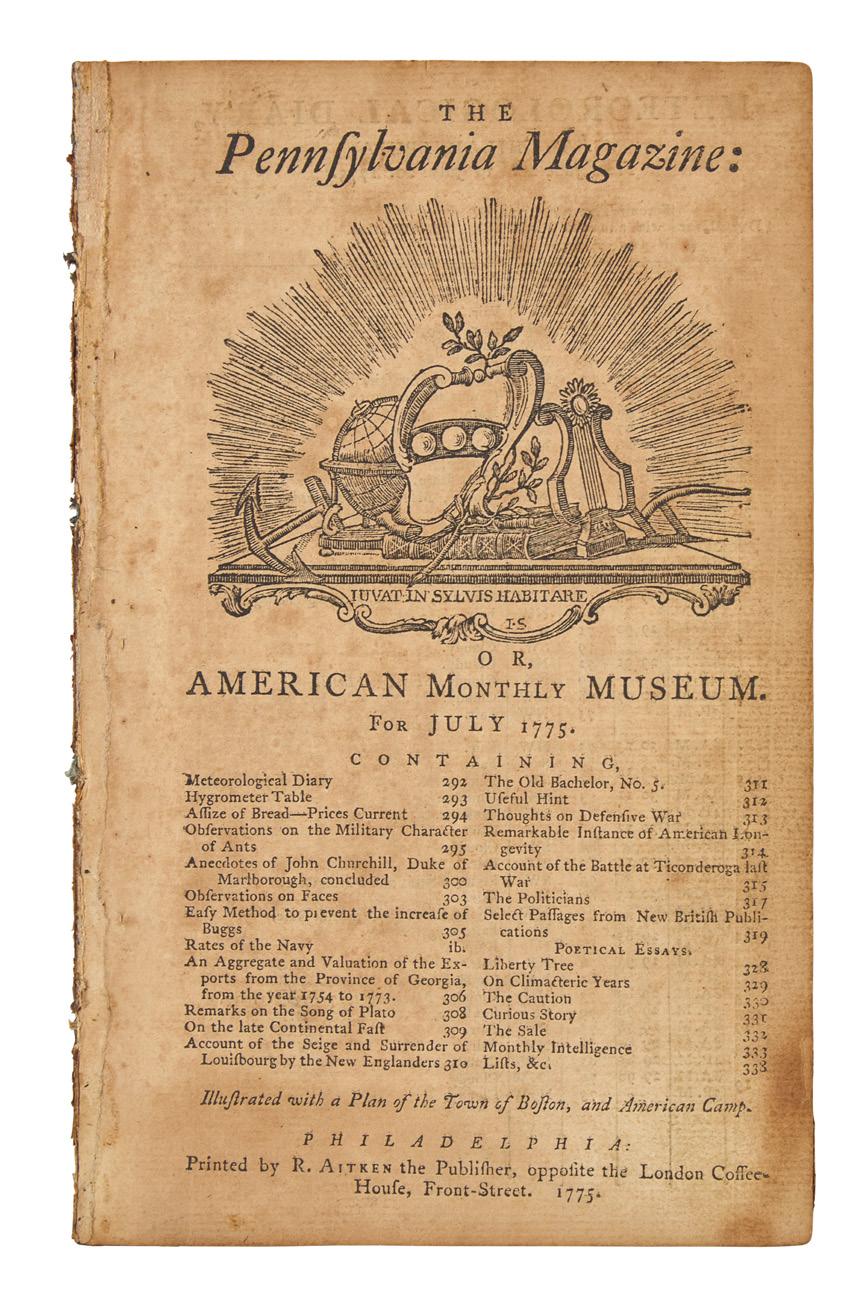
The Pennsylvania Evening Post
Philadelphia: Benjamin Towne, Saturday, July 29, 1775. Printed newspaper. Bifolium. pp. 327-330. Disbound, untrimmed along other edges; separated along spine; creasing from old folds, small scattered holes along same; toned; offsetting; faint ink stamp at top of first page.
A scarce issue of this Pennsylvania newspaper, reporting important information on the outbreak of the American Revolution. Printed three months after the Battles of Lexington and Concord, the front page reports on the British reaction to the hostilities. The first article recounts Captain John Derby’s delivery to England of official American accounts of the battles, and reprints an excerpt from a London newspaper dated May 30, “Captain Darby...arrived...and has brought papers dated the 25th of April last, which mention an engagement having happened on the nineteenth of the same month with the Bostonians, who killed and wounded one hundred and sixty of the regulars...” This is followed by a notice from Arthur Lee, colonial agent in London, informing the public that the official affidavits attesting to the veracity of the battles can be found at the Lord Mayor’s residence “for their inspection.”
Having received no dispatches from General Gage (it would not reach Whitehall until June 10), the news of the confrontation was met with incredulity by Lord North’s government, whose official statement is printed below, “A report having been spread, and an account having been printed and published, of a skirmish between some of the people in the province of Massachusetts-Bay, and a detachment of his Majesty’s troops, it is proper to inform the public that no advices have as yet been received in the American department of any such event...”
In London, reaction to the hostilities was swift as intimated by two reports printed on the third and fourth pages, “the news of the commencement of the American war threw the people in England, especially the city of London, into great consternation, and occasioned a considerable fall of the stocks: That the ministry (knowing nothing of the battle till they saw it published in the London papers)...pretended to believe that there had been none...» On the fourth page, «When the accounts... of the battle were published, Lord North was thunderstruck...the people were much surprised at the account, the merchants distressed on account of their property...»
The newspaper’s reaction to this is printed in fiery language beginning on the first page, “To what does this shuffling state production amount? Is the American MASSACRE less true because no accounts of it have been received at the Secretary’s office? Is this time to talk of departments when HUMAN BLOOD, when the blood of our BRETHEREN is poured out like water by a detachment of his HIS MAJESTY’s troops?...Shall we adopt their language, and call a BLOODY MASSACRE a trifling SKIRMISH? Or are we not to believe that either massacre or skirmish has happened, because the American DEPARTMENT hath not as yet received those advices from General Gage...”
On April 22, the Second Provincial Congress of Massachusetts appointed a nine-member committee to gather testimony from soldiers and others who had participated in or witnessed the battles. In a race to ensure the colony’s account reached England before the British narrative did, Richard Derby, Jr., a member of the Congress, arranged to outfit one of his ships, the Quero, placing it under the command of his younger brother, John Derby. The younger Derby departed on April 28, four days after the British vessel Sukey departed with General Gage›s report, and arrived in England an astonishing two weeks before the British vessel. Derby, who refused a meeting with the British government, secretly departed the country after his delivery and returned to America, as reported within.
$1,500 - 2,500
63
[American Revolution] The Boston-Gazette, and Country Journal, Reporting on the Posting of the Declaration of Independence in Boston
“Last Lords Day the Declaration of Independence was published in the several Churches in this Town agreeable to an Order of the Honorable Council of this State.”
Watertown: Printed by Benjamin Edes, Monday, August 19, 1776. No. 1109. Printed newspaper. Folio. (4) pp. Old ownership signature at top of front-page. Disbound; creasing from old fold; scattered light foxing.
A fine 1776-dated Boston newspaper, reporting the posting of the Declaration of Independence in several churches throughout the city of Boston. The first public reading of the Declaration in Boston occurred on July 18. The day prior, the Massachusetts Council ordered that the “Declaration of Independence be printed; and a Copy sent to the Ministers of each Parish, of every Denomination, within this State; and that they severally be required to read the same to their respective Congregations, as soon as divine Service is ended...And after such Publication thereof, to deliver the said Declaration to the Clerks of their several Towns, or Districts; who are hereby required to record the same in their respective Town, or District books, there to remain as a perpetual Memorial thereof.» It is likely that the Declarations mentioned in the present article were those printed by Ezekiel Russel of Salem, who was commissioned by the Council to print broadsides for their distribution throughout the state. Russell›s broadside is notable for its liberal use of capitalization and italics, so as to aid ministers when reading to their congregations.
$300 - 500
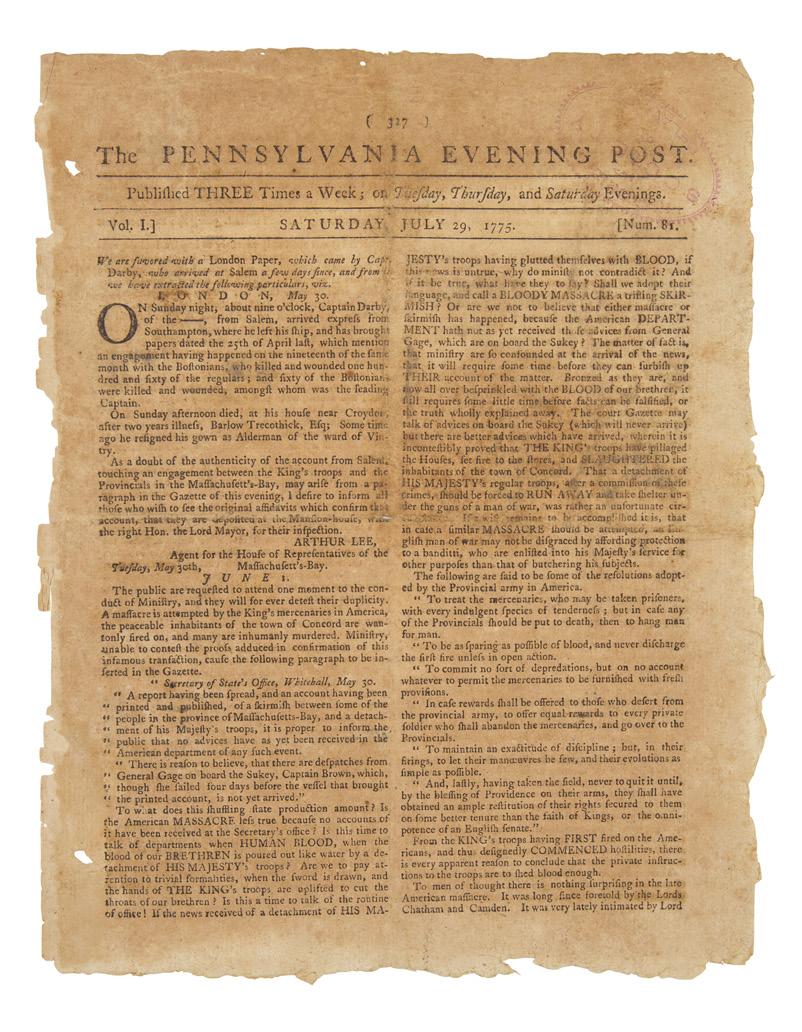
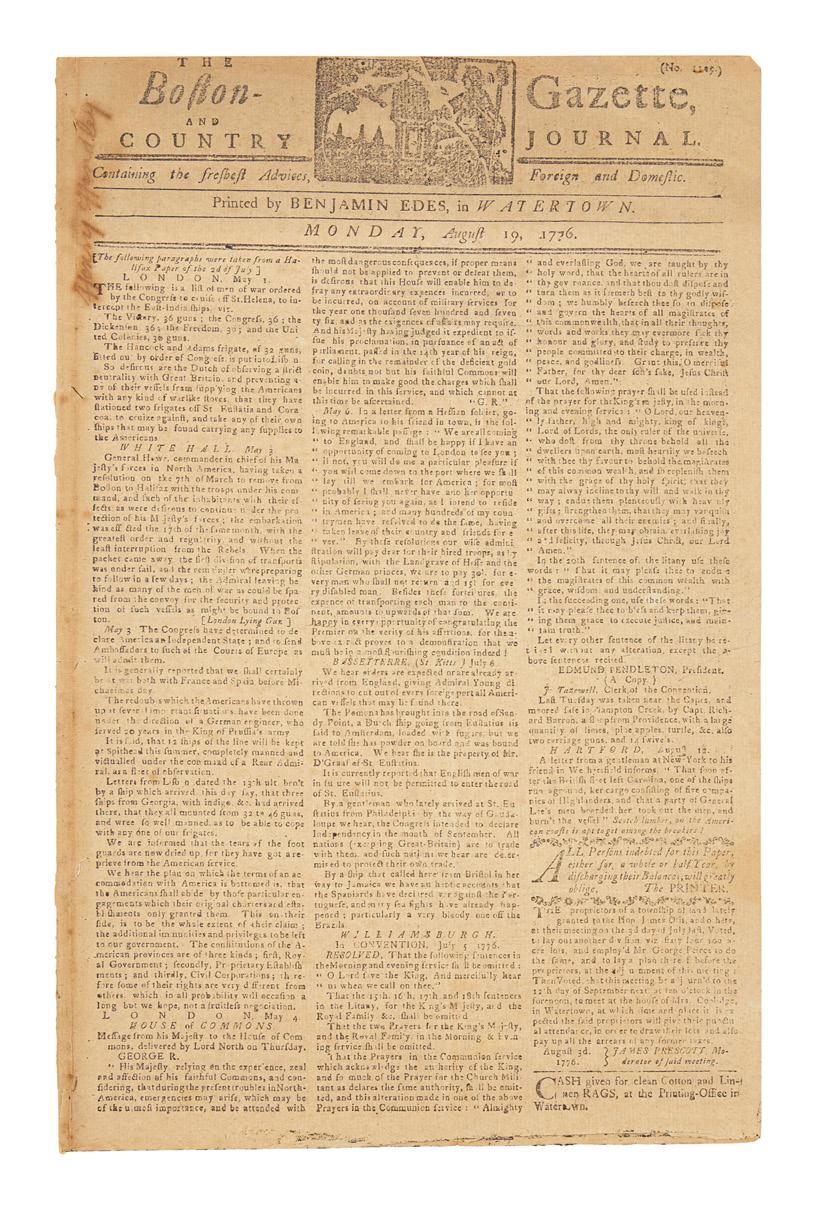
64
[American Revolution]
Born in the USA: First Day of Printing in the United States, July 4, 1776!
The Pennsylvania Evening Post Philadelphia: Benjamin Towne, Thursday, July 4, 1776. Vol. II, Num. 227. Printed newspaper. Folio. (4) pp.
The Pennsylvania Evening Post was founded by Philadelphia printer Benjamin Towne, its first issue published on January 24, 1775, with paper borrowed from James Humphreys. Initially supportive of American independence, the paper was published on Tuesday, Thursday, and Saturday evenings, with its headquarters mere blocks away from the Pennsylvania State House, which served as the central meeting place for the Second Continental Congress. The paper was the first daily newspaper published in the United States.
The present example is significant for being one of only two newspapers printed in the United States on July 4, 1776 (the other being The Maryland Gazette, likely printed in the very early hours of the 4th), with this example likely being the first to be printed after the United States formally declared its independence from Great Britain, marking a truly watershed moment in world history.
Exceedingly rare: This is the only copy of this July 4th newspaper we could locate appearing at auction (we could not locate a copy of The Maryland Gazette). According to online records, we identified only one other surviving copy, held by the Gilder Lehrman Institute of American History.
$15,000 - 25,000
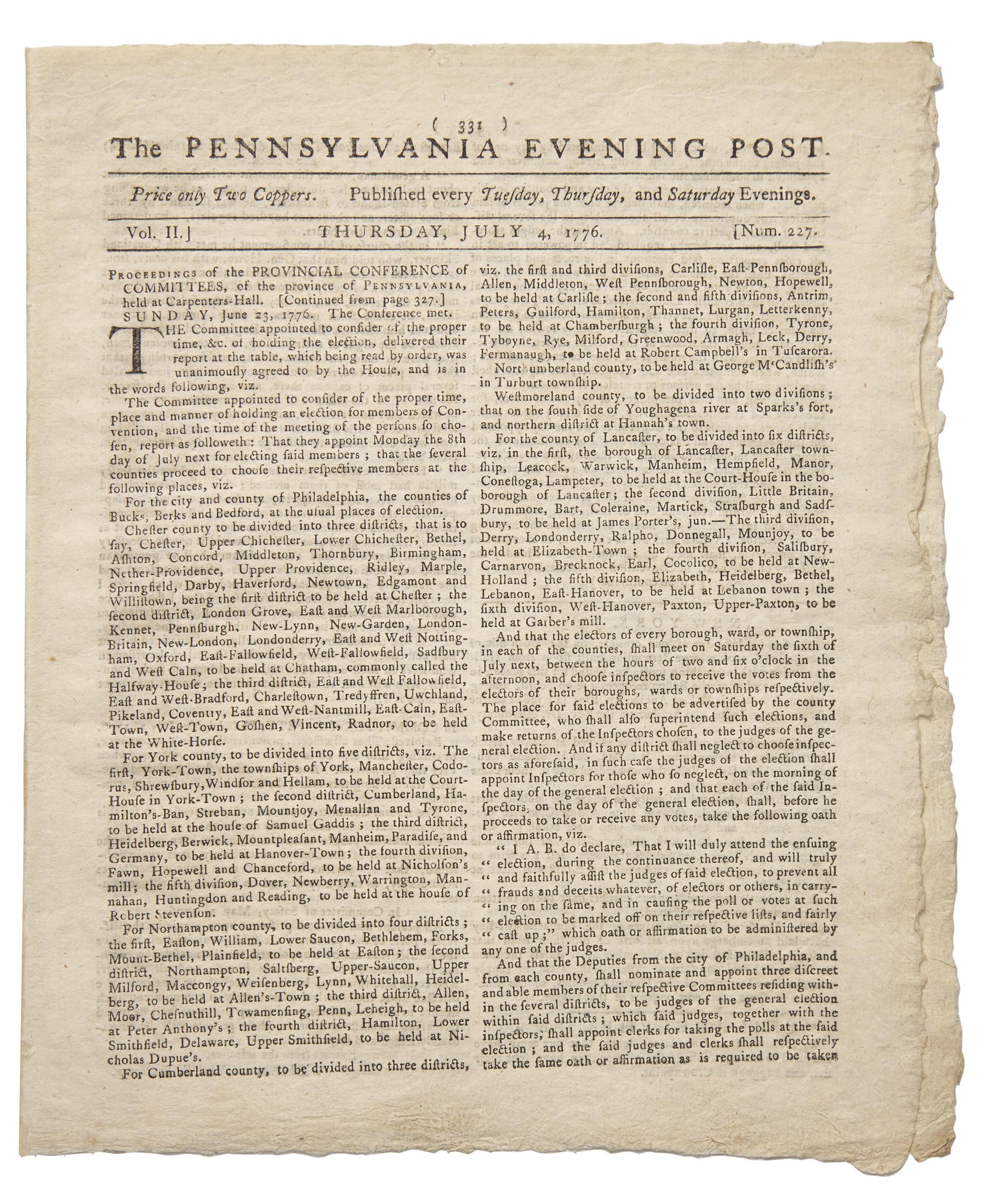
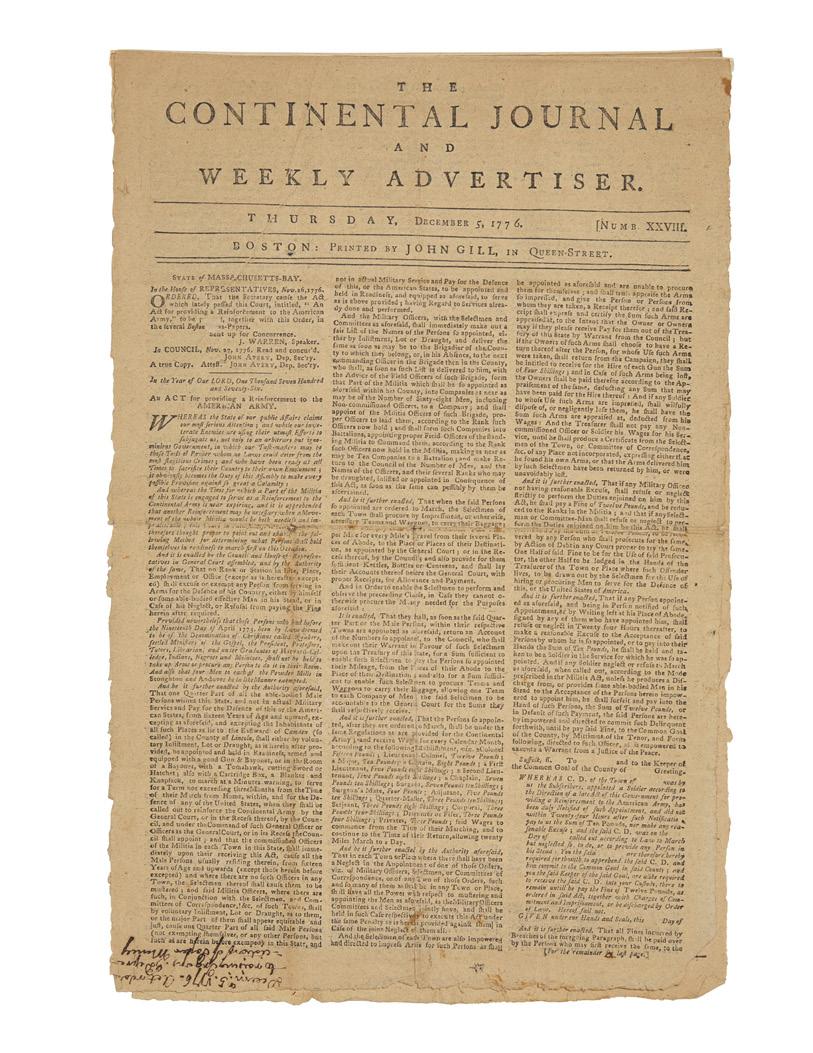
66
65
[American Revolution] The Continental Journal and Weekly Advertiser, with a Front Page Printing of “An Act for providing a Reinforcement to the American Army”
Boston: Printed by John Gill, Thursday, December 5, 1776. Numb. XXVIII. Printed newspaper. Folio. (4) pp. Docketed in contemporary ink at bottom of front-page. Creasing from old folds; separated along spine; top edge of each sheet repaired; two small holes at center folds of first leaf; small repaired hole at top of first leaf; scattered spotting.
A fine 1776-dated Boston newspaper. On the front-page is a printing of the Massachusetts law, “An Act for providing a Reinforcement to the American Army,” followed on the second-page by an act to prevent the counterfeiting of bills of public credit. This is followed by various reports from around the country on matters relating to the Revolutionary War, including news from France; a treaty of alliance between American officials and members of the Delaware, Mingo, and Shawnee tribes; and the return of Massachusetts statesman James Lovell from British incarceration.
$400 - 600
[American Revolution] A Fine Patriot Newspaper with a Paul Revere Masthead, Printing the Final Sections of the 1776 American Articles of War, Passed by Congress on September 20, 1776
The Essex Journal: Or the New-Hampshire Packet, and the Weekly Advertiser Newbury-Port: Printed by John Mycall, Thursday, December 5, 1776. Vol. III, No. 153. Printed newspaper. Folio. (4) pp. With woodcut masthead by Paul Revere. Contemporary ownership signature at top of frontpage. Creasing from old folds; scattered soiling; wear along edges.
First passed the previous year, this revised Articles was largely the result of General George Washington’s dogged effort to institute a stricter code among the fledgling Continental Army’s ranks to help institute a more professional and permanent army. Thirty-three new articles were added to the preexisting code, such as increasing the severity of punishment for various military infractions, greater protection for civilians from plunder and property destruction, and more regulation of the court martial process. The articles are followed by a resolution of Congress, declaring that “all persons not members of, nor owning allegiance to any of the United States of America...who shall be found lurking as spies in or about the fortifications or encampment of the armies of the United States...shall suffer death according to the law and usage of nations...”
$600 - 900
67
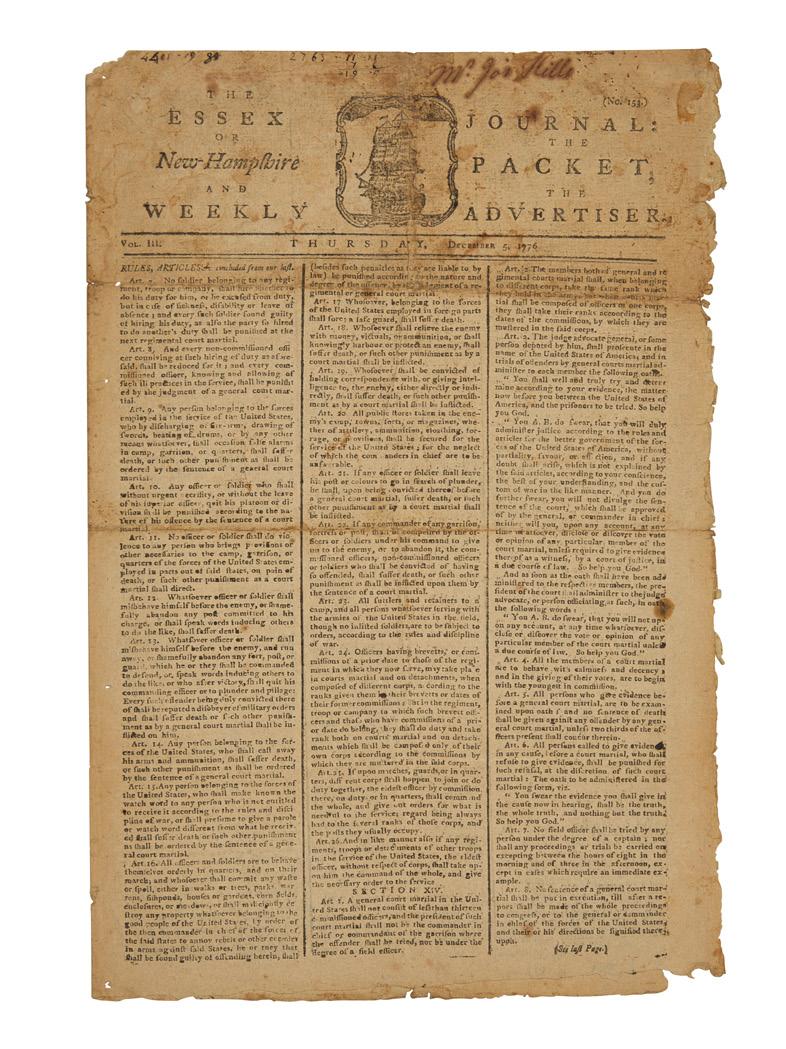
[American Revolution] (Hale, Nathan). A Short-Lived and Rarely Seen Biweekly Periodical Featuring a Report of the Execution of American Spy, Nathan Hale
The Selector
London: Printed and Sold at Laidler’s-Office, 1776. Number II. First edition. 8vo. (ii), 86 pp. Disbound; scattered minor soiling and spotting. ESTC P3129 (locating three copies in two libraries).
Rare and short-lived biweekly periodical with reports on the American Revolution, including an early report on the death of American spy Nathan Hale (p. 78) in a September 25 letter from New York: “On the 22d we hanged a man who was sent as a spy by Gen. Washington.”
Nathan Hale (1755-1776) was an American soldier and spy for the Continental Army. On September 8, 1776 he volunteered to go behind enemy lines on behalf of the Continental Army to gather intelligence on British troop movements in New York City. According to Connecticut shopkeeper and loyalist Consider Tiffany, Hale was recognized by Major Robert Rogers of the Queen’s Rangers at a tavern, who tricked him into betraying his allegiance to the American cause. Hale was promptly arrested and sentenced to death by hanging.
According to British Captain John Montresor, as recorded in the memoirs of American Brigadier General William Hull, “Captain Hale...was calm, and bore himself with gentle dignity, in the consciousness of rectitude and high intentions. He asked for writing materials, which I furnished him: he wrote two letters, one to his mother and one to a brother officer. He was shortly after summoned to the gallows. But a few persons were around him, yet his characteristic dying words were remembered. He said, ‘I only regret, that I have but one life to lose for my country.’” Though the veracity of the quote itself has been disputed in years since, it has became an iconic rallying cry for American freedom and is today regarded as one of the most consequential in American history.
$300 - 500
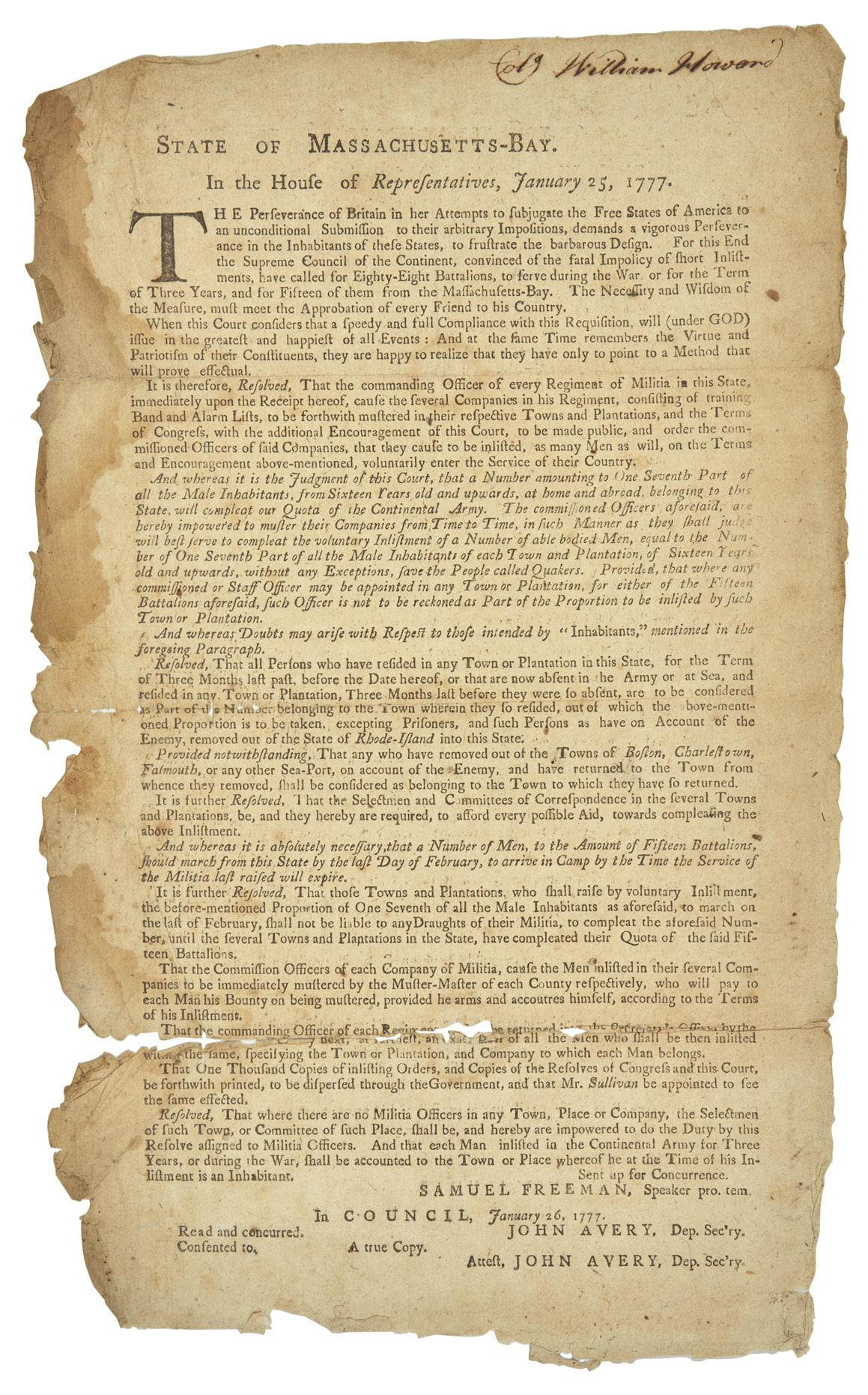
68
[American Revolution] Printed Broadside: A Call to Arms for the Continental Army
(Boston: Printed by Benjamin Edes, 1777). Printed broadside, 13 7/8 x 8 3/4 in. (352 x 222 mm). Ownership signature of Col. William Howard at top. Docketed on verso, additionally signed same (“Winslow”). Creasing from old folds, losses along same at bottom affecting some letters; wear and soiling along left edge. Evans 15425; Ford 2074; Wright, A Guide to Pre-Federal Records in the National Archives, 1989, p. 191
“The Perseverance of Britain in her Attempts to subjugate the Free States of America to an unconditional Submission to their arbitrary Impositions, demands a vigorous Perseverance in the Inhabitants of these States, to frustrate the barbarous Design. For this End the Supreme Council of the Continent, convinced of the fatal Impolicy of short Inlistments, have called for Eighty-Eight Battalions, to serve during the War or for the Term of Three Years, and for Fifteen of them from the Massachusetts-Bay. The Necessity and Wisdom of the Measure, must meet the Approbation of every Friend to his Country...And whereas it is the Judgment of this Court, that a Number amounting to One Seventh Part of all the Male Inhabitants, from Sixteen Years old and upwards, at home and abroad, belonging to this State, will compleat our Quota of the Continental Army...save the People called Quakers.”
The Continental Army that emerged beginning in 1777 was the result of critical legislation passed by the Continental Congress to maintain a more regular army to meet the increasing number of British troops sent to America to crush the nascent rebellion. On September 16, 1776, Congress passed the “Eighty-Eight Battalion Resolve”, that authorized the creation of eighty-eight battalions of the Continental Army for the duration of the war, apportioned among the states based on population, who were to recruit their soldiers and appoint officers (as seen above). The act also extended enlistments for three-year terms (thus to avoid year-end terms that threatened to hobble the army), and subsequently gave General Washington the authority to raise an additional 16 regiments. The legislation also provided land bounties and bonuses for military service, and provided soldiers with a yearly uniform allowance.
Col. William Howard is presumably the same born in Augusta, Maine, in 1740, who served as a lieutenant colonel in the Maine militia, and later as a colonel in the Massachusetts state militia. He died in Augusta in 1810.
$1,500 - 2,500
London: J. Almon, 1779. First edition. 8vo. (ii), 400, (6) pp. Modern quarter brown calf over marbled paper-covered boards; all edges gilt; scattered spotting. Sabin 955; Church 1115; Howes A-182
2. The Independent Ledger and the American Advertiser (Boston): Draper and Folsom, April 8, 1782. Vol. IV, Num. 205. Printed newspaper. Folio. 4 pp. Creasing from old folds; partially separated along central vertical fold; wear along edges, including closed tears; scattered spotting.
Printing various war news, including Henry Laurens’s letter from the Tower of London.
3. The Royal Gazette New-York: James Rivington, February 8, 1783. No. 663. Printed newspaper. Folio. 4 pp. Dampstaining and spotting; light edge-wear.
Loyalist newspaper, printing various war news, including the description of a monument erected in memorial of John Andre, executed for his assistance to Benedict Arnold.
$400 - 600
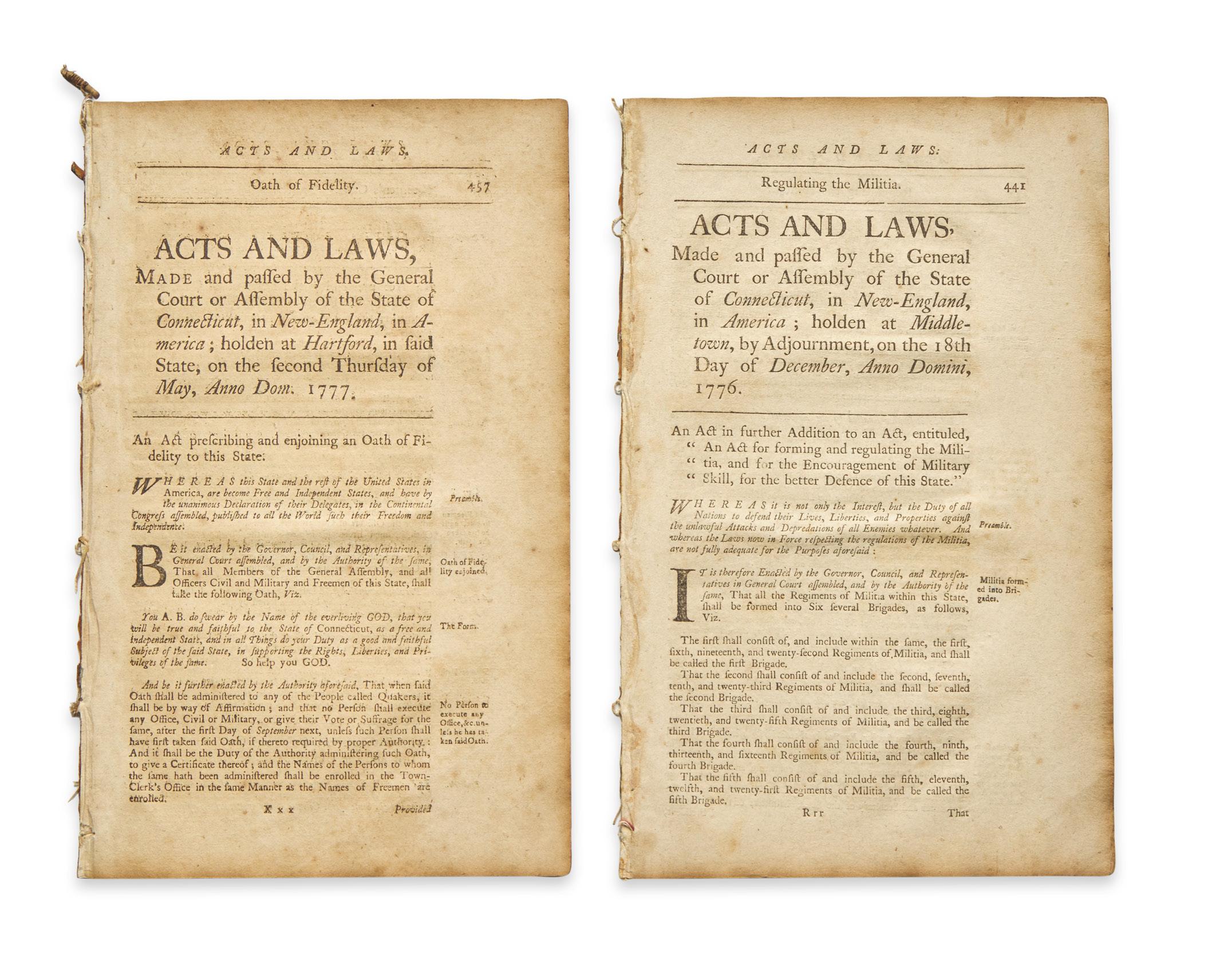
[American Revolution] Acts and Laws Made and passed by the General Court or Assembly of the States of Connecticut...on the 18th Day of December...1776 and second Thursday of May...1777
New London: Printed by Timothy Green, 1777. Folio. pp. 441-471. Each disbound; toned and spotted. ESTC W10875 (first state), W7278 (first state); Evans 15258, 15259
Revolutionary War-era Connecticut session laws, printing acts related to regulating the militia, prescribing an oath of allegiance to the state, and the articles of war for the state militia.
$400 - 600
71
[American Revolution] A Call to Arms in the Months Following the Declaration of Independence: An Early Continental Army Recruitment Poster
An Abstract from Resolves containing the Encouragement offered by the Continental Congress, and by the State of Massachusetts-Bay, to such as shall inlist into the Continental Army (Boston: Benjamin Edes), ca. January 28, 1777. Printed broadside, untrimmed, 13 3/4 x 8 1/4 in. (349 x 209 mm). Signed in type by Speaker Pro Tempore Samuel Freeman, and Deputy Secretary John Avery. Docketed on verso, additional manuscript on same (“Winslow”). Creasing from old folds, expertly repaired along upper horizontal fold; short separation at left side of central horizontal fold; dampstaining at right edge; in quarter green morocco slip case and chemise. Evans 15418; Heartman P15:4; Ford 2076; ESTC W34149; Cushing 981
A rare and early Continental Army recruitment poster, issued only months after the Declaration of Independence, seeking to entice men from Massachusetts to join the fight for independence. Printing the resolutions of the Continental Congress and the Massachusetts Legislature, this broadside lists the inducements offered to potential recruits, including a $20 bounty, 100 hundred acres of land, a new suit of clothing, consisting of two linen hunting shirts, two pairs of overalls, a leather or woolen waistcoat, one pair of breeches, a hat or leather cap, two shirts, and two pairs of shoes. It goes on to offer soldiers “disabled in the Service of the United States of America” a disability pension, as well as a further $20 if they enlist with a “good effective Fire-Arm, and also a Bayonet, or in Lieu thereof, a Sword, Hatchet or Tomahawk, a Cartridge Box and Knapsack”. Finally, every recruit shall receive “a good Blanket”, or a reimbursement of 18 shillings if they provide their own.
This poster reflects crucial reforms enacted by the Continental Congress in late 1776 to transform the fledgling Continental Army into a more professional force capable of a sustained fight against the British. Orchestrated by John Adams at George Washington’s behest, the revisions reorganized the American Articles of War along the lines of British military law. Key changes included extending enlistment terms, professionalizing the officer corps, enhancing monetary and land incentives for service, and instituting stricter penalties for disciplinary infractions. These measures were instrumental in evolving the American army into a more permanent and stable institution, reducing its dependence on often transient state militias.
Rare. ESTC locates only eight institutional copies, while RBH locates only two other copies at auction in over a century.
$6,000 - 9,000
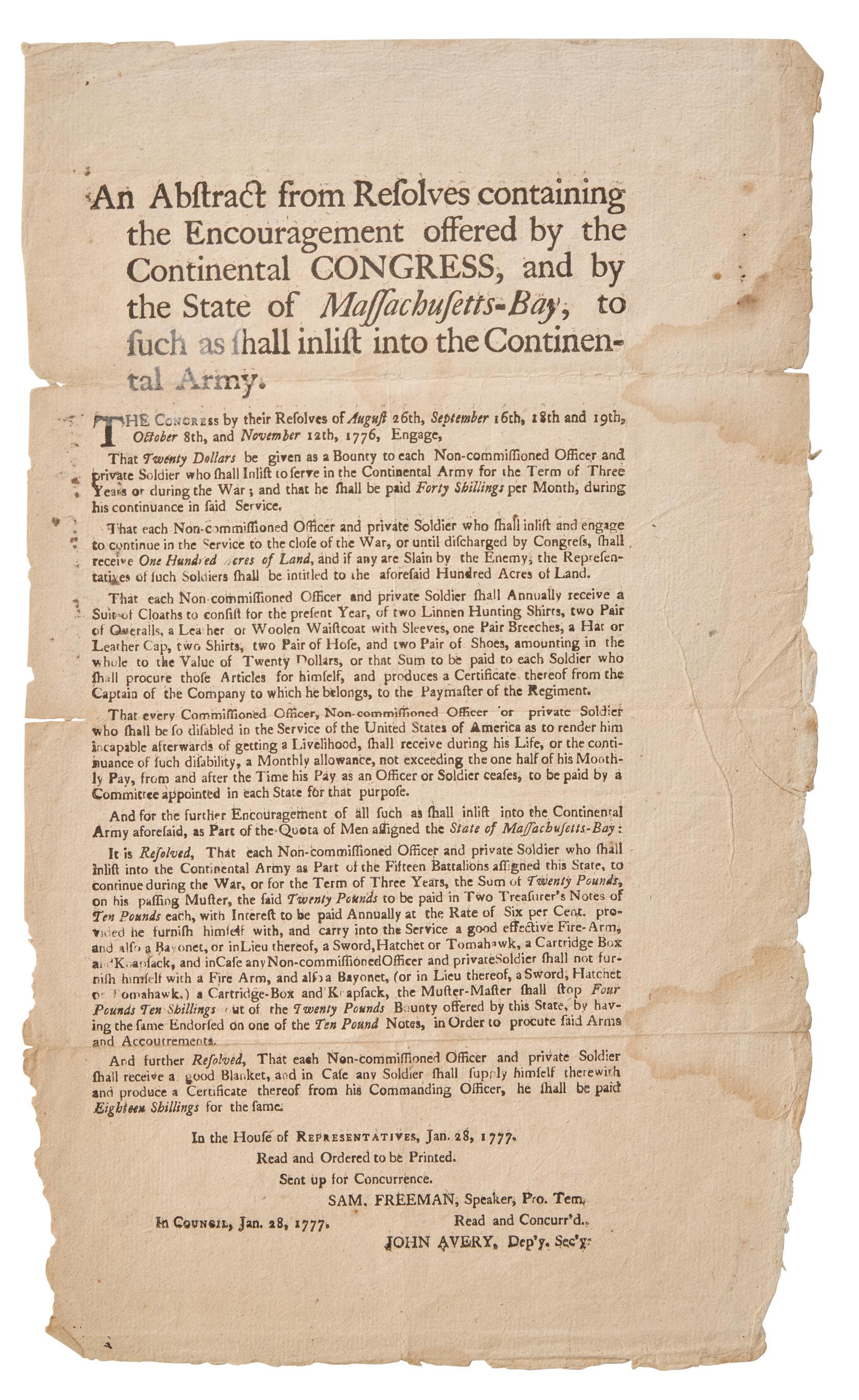
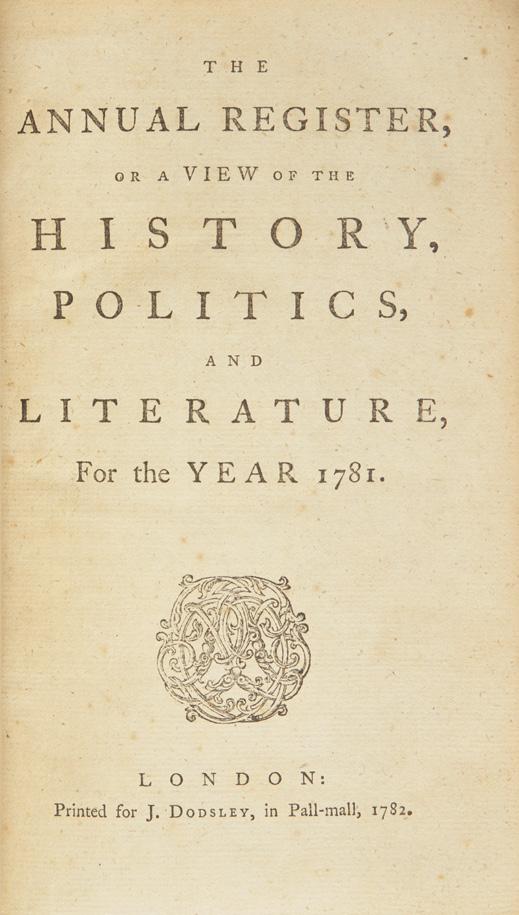
72
[American Revolution] A Detailed Report of Benedict Arnold’s Treason in “The Annual Register”
The Annual Register, or a View of the History, Politics, and Literature, For the Year 1781 London: Printed for J. Dodsley, 1782. First edition. 8vo. (iv), 202, (2), 161-339, (1), 207, (12) pp. Full contemporary tan calf, red and black morocco spine labels, stamped in gilt, front board detached but holding, rear board starting, wear and soiling to boards and extremities; red speckled edges; marbled endpapers; scattered spotting.
Featuring accounts of the ongoing Revolutionary War, with a detailed report on the treason of Benedict Arnold and the execution of John Andre.
$200 - 300
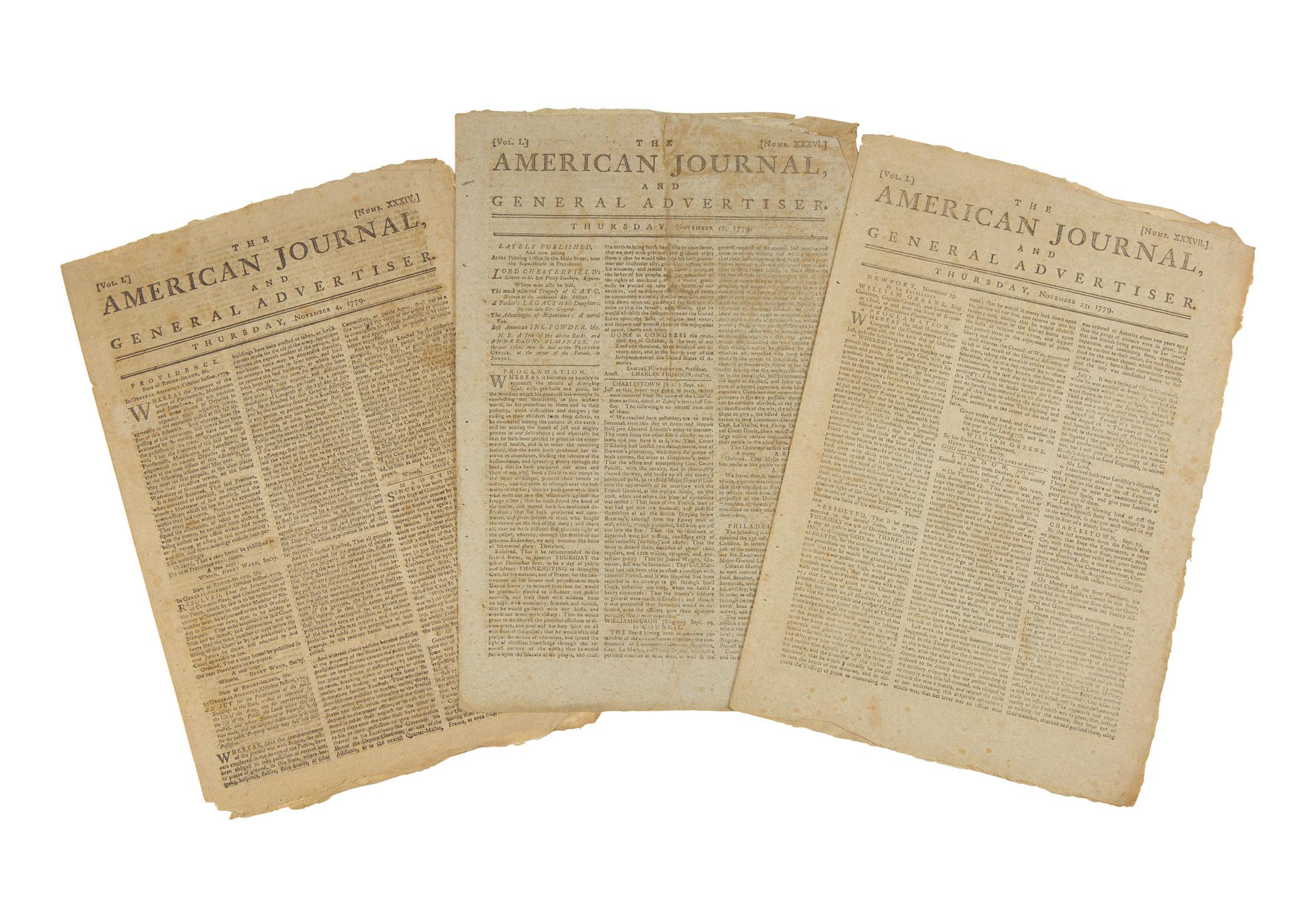
1. Providence: Southwick and Wheeler, Thursday, November 4, 1779. Vol. I, Numb. XXXIV. Printed newspaper. Folio. 4 pp. Disbound; scattered spotting.
2. (Providence: Southwick and Wheeler), Thursday, November 18, 1779. Vol. I, Numb. XXXVI. Printed newspaper. Folio. (4) pp. Creasing from old folds; foxing.
3. (Providence: Southwick and Wheeler), Thursday, November 25, 1779. Vol. I, Numb. XXXVII. Printed newspaper. Folio. 4 pp. Scattered spotting.
Printing numerous reports on the Revolutionary War, as well as a front-page printing of Congress’s October 20, 1779 proclamation appointing December 9, 1779, a day of public Thanksgiving and prayer.
Bennett Wheeler (1753-1806) was originally from Halifax, Nova Scotia, and arrived in Providence, Rhode Island in September 1776. After several months, he began working for the Providence Gazette, where he remained until December 1778. In March 1779, Wheeler partnered with Solomon Southwick to publish The American Journal; and General Advertiser in Providence. Southwick departed the partnership in December 1779, and Wheeler continued publishing the newspaper until August 1781, after which he worked as a journeyman printer.
$500 - 800
74
[American Revolution]
A Scarce and Completely Untrimmed Revolutionary War Broadsheet Related to the Rhode Island Militia
(Providence, Rhode Island): John Carter, (1779). Printed broadsheet. Folio, 15 x 10 1/8 in. (381 x 257 mm). Text printed in three columns, signed in type by Deputy Secretary William Mumford. Untrimmed; scattered light spotting. Alden 800; Bristol B4956; Shipton & Mooney 43698
Issued by the Rhode Island General Assembly during their October session of 1779, being “An Act for the better forming, regulating and conducting the military Force of this State”. Originally introduced in the Assembly’s June session, this act greatly reorganized the Rhode Island state militia, creating a new hierarchy of command and the restructuring of battalions, brigades, and regiments across Rhode Island’s various counties.
RBH locates only four other copies sold since 1935. OCLC locates only copies at the Rhode Island Historical Society and the American Antiquarian Society.
$1,000 - 1,500
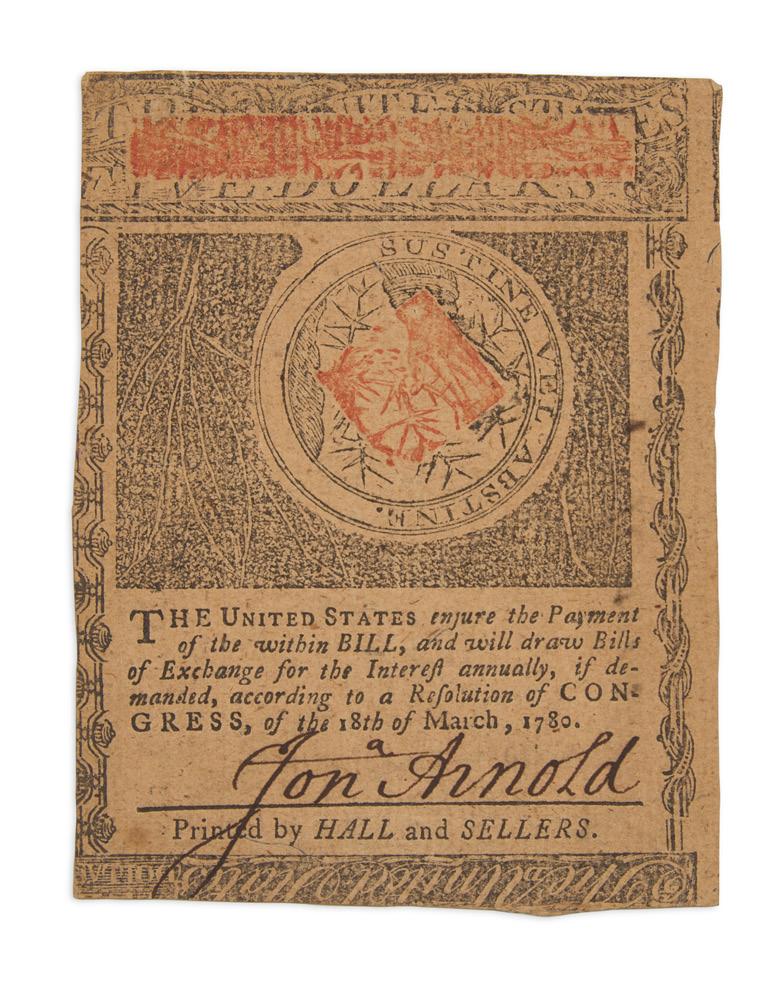
76
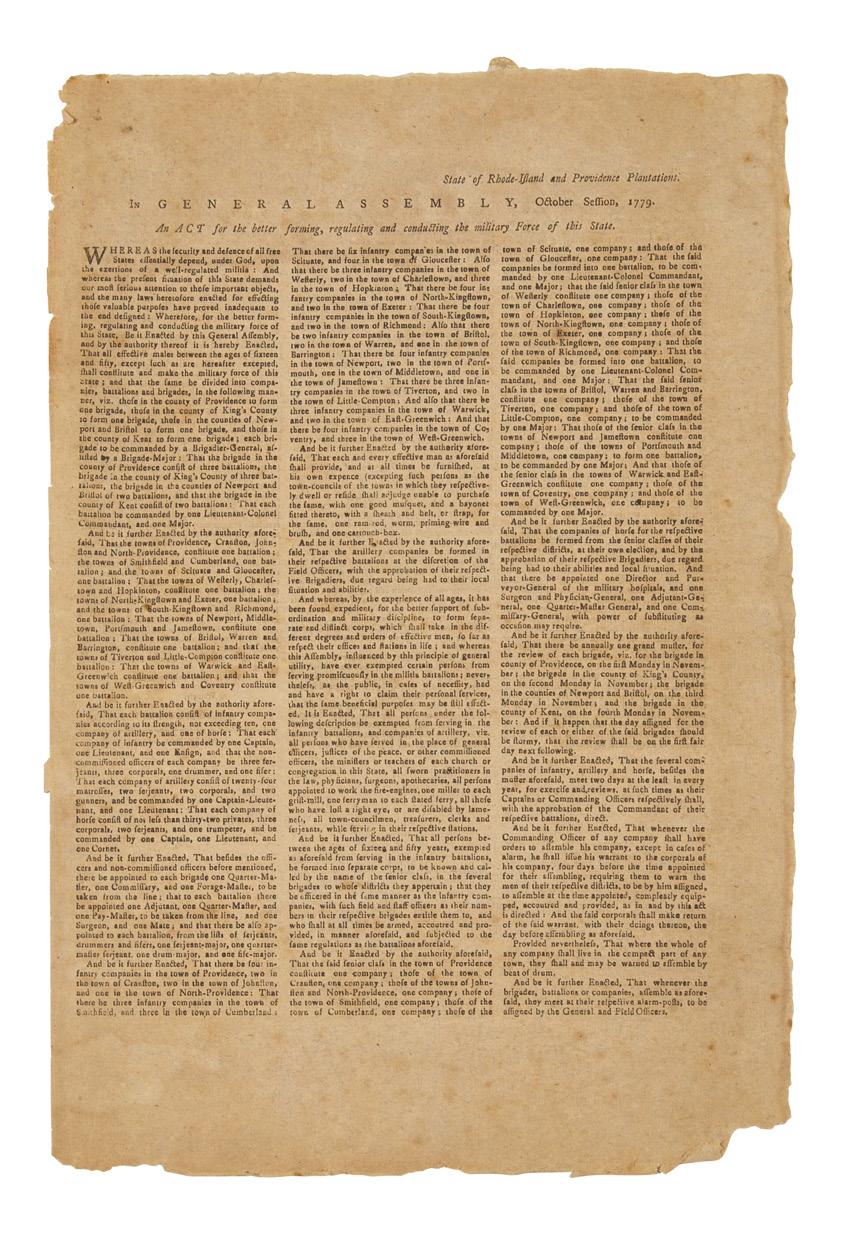
75
[American Revolution] Rhode Island Five-Dollar Note, Signed by a New England Physician and Statesman
State of Rhode-Island and Providence Plantations: Hall and Sellers, July 2, 1780. Five dollar currency, No. 1054; signed by A(dam). Comstock and physician Jonathan Arnold. 3 5/8 x 2 3/4 in. (92 x 70 mm).
Jonathan Arnold (1741-93) was a New England physician and statesman. During the American Revolution he served as a surgeon in the Continental Army and was head of the military hospital in Providence, and served in the Continental Congress, from 1782-83.
$300 - 500
[American Revolution] A Special Issue of the London Gazette, Printing News of British General Cornwallis’s Victory Over General Horatio Gates at Camden, South Carolina
The London Gazette Extraordinary London: Printed by Thomas Harrison, Monday, October 9, 1780. Printed newspaper. Folio. (3) pp. Contemporary manuscript on first and second pages. Disbound; creasing from old folds, small separation along same at fore-edge; scattered light soiling.
“It is with great Pleasure that I communicate to your Lordship an Account of a complete Victory obtained on the 16th Instant, by His Majesty’s Troops under my Command, over the Rebel Southern Army commanded by General Gates.”
The official mouthpiece of the English Crown reports Cornwallis’s victory over General Horatio Gates at the Battle of Camden.
The Battle of Camden (August 16, 1780) was a devastating defeat for the American army in the early stages of the British offensive in the south, resulting in 900 American casualties and the capture of 1,000 American soldiers. Gates’s defeat cleared South Carolina of any organized American resistance, and paved the way for the British invasion of North Carolina. Following the battle, Congress recalled Gates, who was replaced by General Nathanael Greene. The present newspaper prints Cornwallis’s letter to Lord Germain announcing his victory, followed by a summation of his troops, casualties, and field pieces used in the battle.
$300 - 500
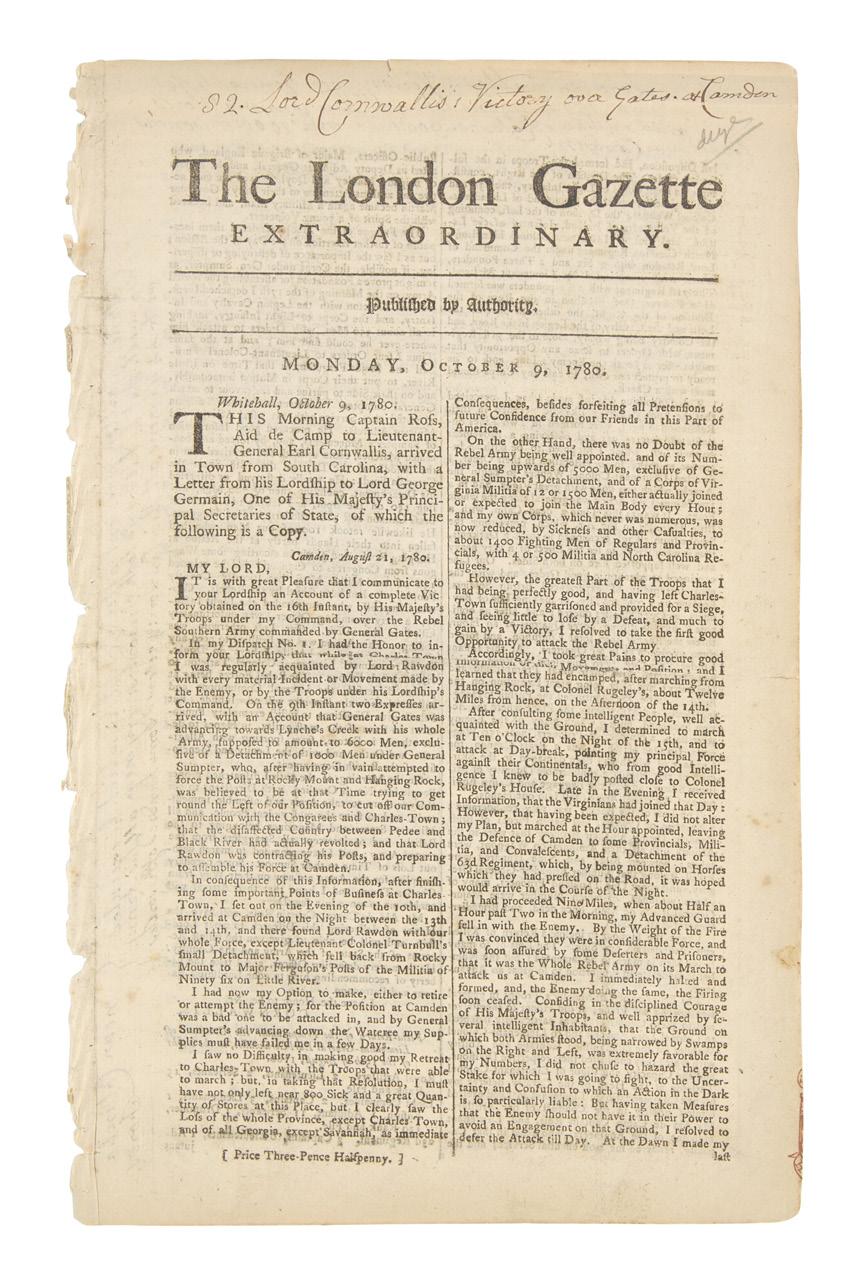
77
[American Revolution]
The English Crown Reports Lord Cornwallis’s Surrender at Yorktown
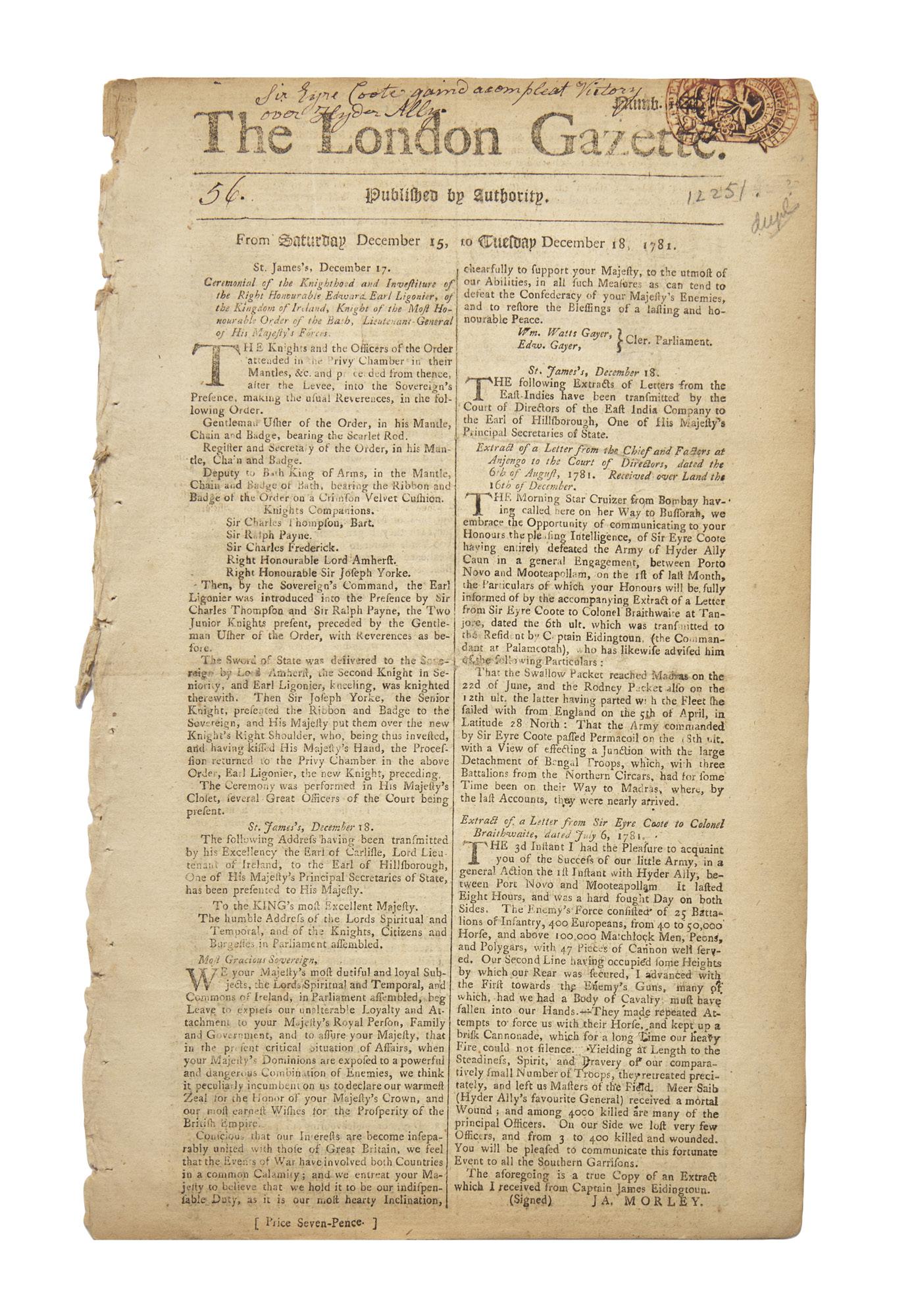
”I have the Mortification to inform your Excellency...”
The London Gazette
London: Printed by Thomas Harrison, From Saturday December 15, to Tuesday December 18, 1781. Printed newspaper. (8) pp. Tax stamp at top of first page and at bottom of fifth page. Contemporary manuscript at top of first page, in left margin of second page (“Lord Cornwallis and Army takin (sic) at York Town and Gloucester: by Washington & Rochambeau.”), left margin of p. 6 (“the Ship Savage was taken by an American Ship of Warr (sic).”), and on the following page. Partially separated along central vertical fold; scattered spotting ; chip in lower fore-edge of final two leaves.
The British reception of the surrender of Lord Cornwallis at Yorktown and the beginning of the end of the American Revolution, printed in the official mouthpiece of the English Crown. Likely the first British newspaper to publish Cornwallis “Mortification” letter and the full articles of capitulation.
Printed on the second page is Cornwallis’s letter to British General and Commander-in-Chief in North America Sir Henry Clinton, announcing his surrender to General Washington, “I have the Mortification to inform your Excellency, that I have been forced to give up the Posts of York and Gloucester, and to surrender the Troops under my Command, by Capitulation, on the 19th Instant, as Prisoners of War to the Combined Forces of America and France.” This is followed by printings of letters between Cornwallis and General Washington negotiating surrender, and then the full articles of capitulation, signed in type by Cornwallis, Washington, et al.
News of Cornwallis’s surrender on October 19, 1781, after a three-week siege by American and French forces, reached British shores by late November 1781. The news sent reverberations through the English public and political circles, amplifying opposition voices within Parliament and entrenching a sense of disgust over the whole American affair. The British press placed most of the loss on the shoulders of Clinton, for his inability to stop Washington’s march south, and then his refusal to reinforce a cornered Cornwallis. Finger pointing continued in the British press in the months that followed, and over time a sense that America was lost became more clear. A preliminary treaty to end the eight-year-long war was signed in November of 1782.
$2,000 - 3,000
78
[American Revolution] A Comprehensive Revolutionary War Manuscript Ledger, Recording Monies Paid to Suppliers and Other Volunteers for the Continental Army, by Paymaster John Squire, in Fairfield, Connecticut, 1780-82
Manuscript Account Ledger
Connecticut, May 15, 1780-December 10, 1782. Tall 4to. Six leaves. Eight-page manuscript account ledger, being “The State of Connecticut in Acct. with John Squire ACP. of Fairfield”. Stab-sewn gatherings; scattered soiling.
“A requisition from Congress upon the States for supplies for the army was also granted during the sitting of the April Assembly. The proportion called for from Connecticut was 78,400 weight of beef, 1,011 bushels of salt, 68,558 gallons of rum, 500 tons of hay. John Squire was appointed to purchase the proportion of supplies to be furnished within the limits of Fairfield and Stratford.” (Schenck, The History of Fairfield County, Vol. II, pp. 410-411)
A revealing record of those who supported the cause of independence.
$800 - 1,200
79
[American Revolution] Possibly the First Printed Announcement of the Definitive Treaty of Peace Ending the American Revolution, September 5, 1783
Supplement a la Gazette
Paris: Imprimerie Royale, Friday, September 5, 1783. Printed broadside; 9 1/2 x 7 1/8 in. (241 x 181 mm). No. 71, p. 317. Bound into full marbled paper-covered boards, green paper spine label, stamped in gilt.
A rare and special extra to the Gazette, the official French newspaper printed by the Imprimerie Royale, announcing merely two days after its signing, the Definitive Treaty of Peace between Great Britain and the United States and France ending the American Revolution. Also announced is the preliminary treaty between Great Britain and the Netherlands, signed on September 2 (a final treaty was signed in May 1784).
The Treaty of Paris officially ended the American Revolution. Signed on September 3, 1783, by American delegates Benjamin Franklin, John Adams, and John Jay, along with British representatives David Hartley and Richard Oswald, the treaty ended eight years of war between Great Britain and the American colonies. After Cornwallis’s defeat at Yorktown in 1781, British leaders became more willing to pursue peace negotiations. Informal talks began in Paris in 1782 between Franklin and Oswald, later joined by Adams and Jay, as well as French and Spanish officials. Although Thomas Jefferson and Henry Laurens were originally appointed delegates, Jefferson did not attend, and Laurens arrived much later after being held captive by the British.
During negotiations, Adams and Jay discovered French and Spanish efforts to limit American interests to secure their own imperial goals. While Franklin wanted to maintain close cooperation with France, he was eventually convinced that a separate treaty with Great Britain would best protect American interests. At the same time, Lord North was replaced by Lord Shelburne, who supported American independence and believed trade would benefit Britain more than continuing the war. Negotiations moved forward once Britain agreed to recognize American independence.
A preliminary treaty reached in November 1782 favored the United States, granting them territory west to the Mississippi River, secured fishing rights near Canada, opened the Mississippi to trade and navigation, addressed repayment of debts, and promised fair treatment of Loyalists. Great Britain later finalized separate agreements with France and Spain in January 1783, while the main terms of the treaty remained mostly unchanged. Congress ratified the treaty on January 14, 1784, and Parliament approved it on April 9.
Although many Parisians probably learned of the final treaty in the broadside above, it was not until after peace went into effect on November 25 that plans for city-wide festivities were made. On December 14, large celebrations were held throughout Paris with large fire-work displays and the distribution of bread, wine, and other foodstuffs. The ceremony was a pageantry celebrating Louis XVI’s triumph and the humbling of an historic foe, but only made limited reference to their ally, the new United States.
Rare, according to RBH, no other copies have come to auction. Furthermore, we cannot locate another copy on OCLC or LibraryHub.
$2,500 - 3,500
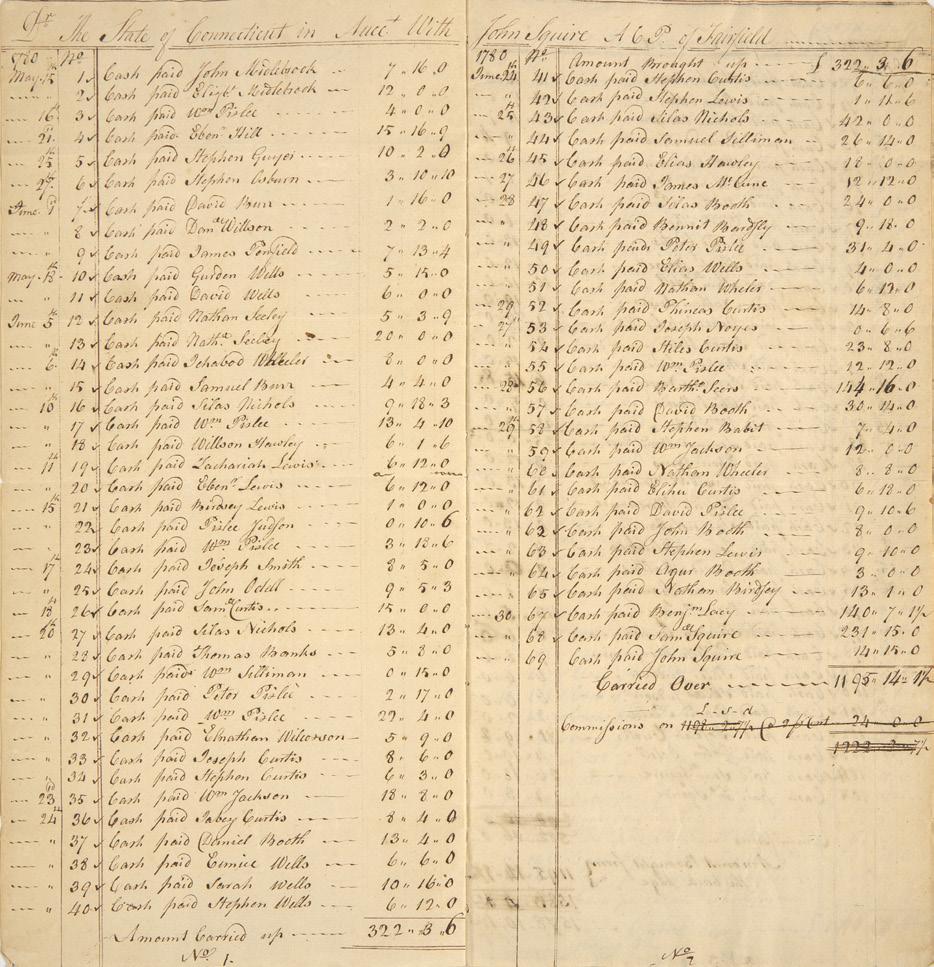
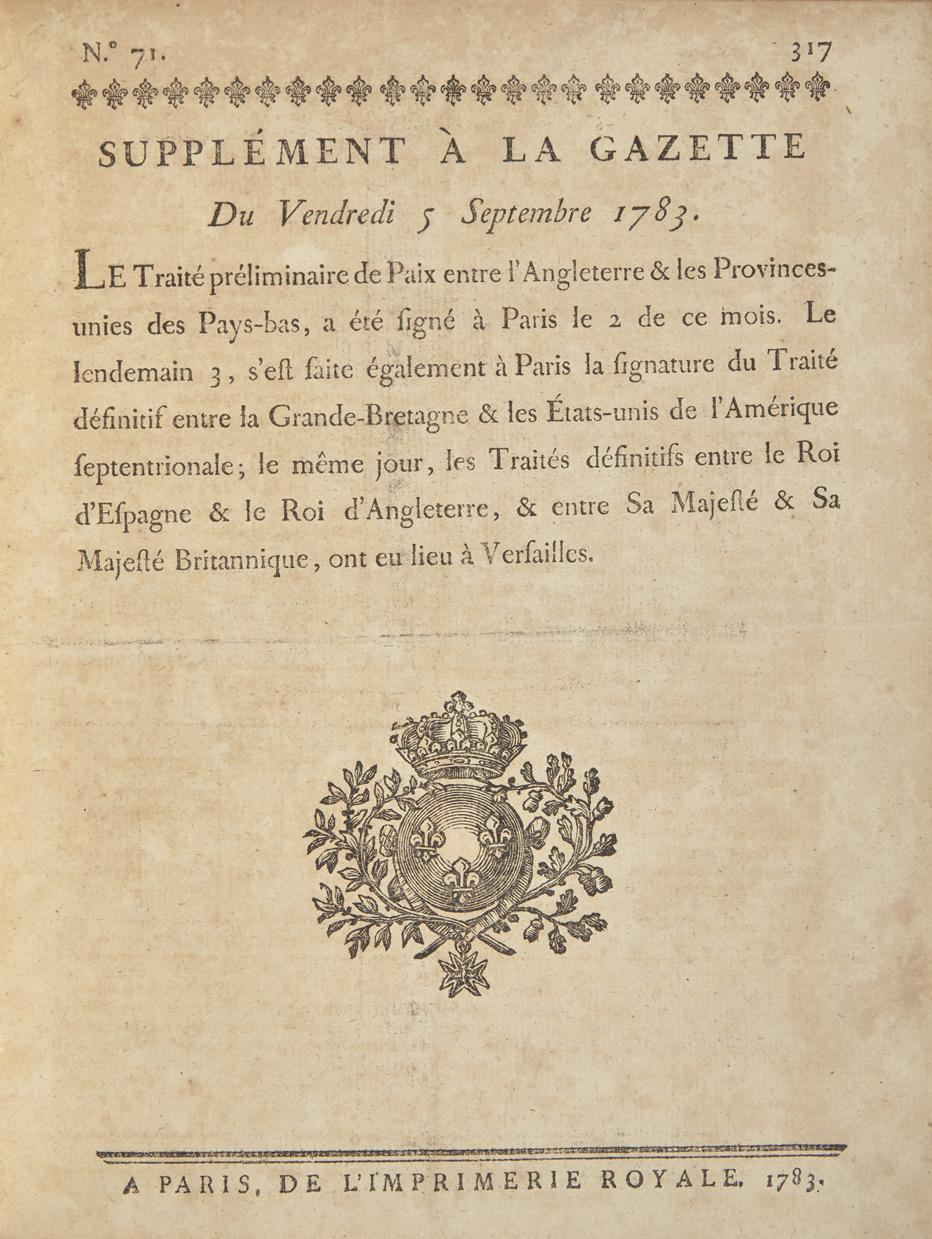
80
[American Revolution] Thomas Jefferson at the Birth of a New Nation: An Important Letter Carried by a Jewish Patriot Communicating the Definitive Treaty of Paris, Projecting American Stability, and Preparations for the Publication of His “Notes on the State of Virginia”, January 16, 1784
Autograph Letter, signed Annapolis, Maryland, January 16, 1784. Bifolium. Fine two-page autograph letter, signed by Thomas Jefferson to Franciois Jean de Beauvoir, Chevalier de Chastellux. Discrete blindstamp of the “Archives de Chastellux”; creasing from old folds. In blue cloth slip case and chemise. Published in Papers, 6:466-467.
A significant and discursive letter written by Thomas Jefferson at the dawn of American sovereignty. Delivered by likely the first Jewish American in the nascent diplomatic corps, it is “reminiscent of others written by Jefferson at the opening of the Revolution in which he endeavored by private communications to influence opinion of America abroad.” (Founders Online).
Three days after the Confederation Congress ratified the Treaty of Paris, officially ending the Revolutionary War, Thomas Jefferson writes from Annapolis, Maryland then the seat of government. Addressing his French ally and fellow writer, the Chevalier de Chastellux, the “Sage of Monticello” shares the news of the treaty’s ratification and informs Chastellux that official copies will soon be dispatched to Paris, for their exchange with the British. Addressing the challenges facing the young nation, particularly dispelling European rumors of American anarchy, Jefferson promotes a sense of stability for the country that had just exited eight years of war. He concludes by discussing the upcoming publication of his future, and only, book, Notes on the State of Virginia. Demonstrating his leadership role in the Republic of Letters, Jefferson encourages Chastellux to publish more about his experiences in America during the Revolution. This would eventually be published in full in 1786 as Voyages de M. le Marquis de Chastellux dans l’Amerique septentrionale..., which Howes describes as “the first trustworthy record of life in the United States.”
Jefferson begins his letter with mention of the ratification of the Treaty of Paris: “Lt. Colo. Franks being appointed to carry to Paris one of the copies of our ratification of the Definitive treaty, and being to depart in the instant of his appointment, furnishes me a hasty opportunity of obtruding myself on your recollection. Should this prove troublesome, you must take the blame, as having exposed yourself to my esteem by letting me become acquainted with your merit.” He goes on to give a general appraisal of the new nation, and primarily, disavows reports of “anarchy” that had reached Europe: “Our transactions on this side the water must now have become uninteresting to the rest of the world. We are busy however among ourselves endeavoring to get our new governments into regular & concerted motion. For this purpose I believe we shall find some additions requisite to our Confederation. As yet every thing has gone smoothly since the war. We are diverted with the European accounts of the anarchy and opposition to government in America. Nothing can be more untrue than these relations. There was indeed some dissatisfaction in the army at not being paid off before they were disbanded: and a very trifling mutiny of 200 souldiers (sic) in Philadelphia. On the latter occasion Congress left that place, disgusted with the pusillanimity of the government, and not from any want of security to their own persons. The indignation which the other states felt at this insult to their delegates has enlisted them more warmly in support of Congress: and the people, the legislature & the Executive themselves of Pennsylvania have made the most satisfactory atonements.”
The real reason for any disturbances, Jefferson explains, is related to monetary issues resulting from the long war that stifled American commerce: “The greatest difficulty we find is to get money from them. The reason is not founded in their unwillingness, but in their real inability. You were a witness to the total destruction of our commerce, devastation of our country, and absence of the precious metals. It cannot be expected that these should flow in but through the channels of commerce, nor that these channels should be opened in the first instant of peace. Time is requisite to avail ourselves of the productions of the earth, and the first of these will be applied to renew our stock of those necessaries of which we had been totally exhausted.”
In the final section, Jefferson discusses their joint prospective publications, including Jefferson’s forthcoming Notes on the State of Virginia: “I am in daily hopes of seeing something from your pen which may portray us to ourselves. Aware of the bias of self love & prejudice in myself and that your pictures will be faithful, I am determined to annihilate my own opinions & to give full credit to yours. I must caution you to distrust information from my answers to the queries of Monsr. de Marbois. I have lately had a little leisure to revise them. I found some things should be omitted, many corrected, & more supplied & enlarged. They are swelled nearly to treble bulk. Being now too much for manuscript copies I think the ensuing spring to print a dozen or twenty copies to be given to my friends, not suffering another to go out. As I have presumed to place you in that number, I shall take the liberty of sending you a copy...”
During the Revolution, Chastellux served as a major general under the Comte de Rochambeau, acting as the primary liaison between the French commander and General Washington. Both a soldier and a man of letters, Chastellux traveled extensively throughout America during the war, documenting the landscape, customs, and people he encountered. He and Jefferson first met in the spring of 1782, when Chastellux stayed at Monticello
during his tour of the United States. He later described Jefferson as “the first American who has consulted the Fine Arts to know how he should shelter himself from the weather.” It was likely at Jefferson’s suggestion that Chastellux visited Virginia’s Natural Bridge in Rockbridge County, which both men would go on to describe in their respective books. Their friendship endured until Chastellux’s death in 1788, during which time they exchanged more than a dozen letters.
Jefferson explains that he hurried to write the present letter because his secretary, Lt. Col. David Franks, was soon departing for Paris with official copies of the finalized treaty. Although Franks’s reputation had been unfairly damaged because of his past connection to Benedict Arnold, Jefferson entrusted him with the safe delivery of the letter. Franks (1740–1793), was likely the first Jewish American to serve in the early American diplomatic corps, and worked for the young State Department as a secretary and to deliver confidential documents. By the time this letter was written, he had worked closely with Jefferson for nearly a year. Born in Philadelphia to a prominent Jewish merchant family, Franks later moved with his relatives to Quebec. At the beginning of the American Revolution in 1775, he lived in Montreal and served as president of the Spanish and Portuguese synagogue there. When American forces under General Richard Montgomery and Colonel Benedict Arnold invaded Quebec, Franks joined the revolutionary cause and became paymaster for the Continental Army there. After the invasion failed, he returned to Philadelphia and continued his service in the Continental Army, eventually becoming an aidede-camp to Arnold. Arnold’s treason in 1780 badly harmed Franks’s standing, even though he had no involvement in the conspiracy. Because of his association with Arnold, many soldiers and officials viewed him with suspicion, a burden that hindered the rest of his career.
To defend his reputation, Franks requested a court-martial from General Washington. After a lengthy investigation, he was fully cleared of wrongdoing. Following the war, he remained in government service as a diplomat, messenger, and secretary. Nevertheless, lingering rumors about his loyalty prevented his advancement and ultimately contributed to his dismissal from government service in 1786. Refusing to accept this outcome, Franks spent years trying to restore his name. He eventually succeeded in petitioning President Washington, who reinstated him in public service as an assistant cashier at the Bank of the United States in Philadelphia. Franks died in 1793 during the yellow fever epidemic that struck Philadelphia. Freeman’s would like to thank Eric C. Caren for his help in articulating Franks’s career and role as a Jewish Patriot in connection to this letter.
A fine letter, written to a key French ally and peer, that touches on crucial aspects of the fledgling young republic at the immediate onset of its achieved independence.
Sotheby’s, New York, The Passion of American Collectors: Property of Barbara and Ira Lipman, April 13-14, 2021, Lot 265
Christie’s, New York, Fine Printed Books and Manuscripts, Including Americana, December 14, 2016, Lot 360
François-Jean de Beauvoir, Marquis de Chastellux, by descent, to Comte Louis de Chastellux
$100,000 - 200,000
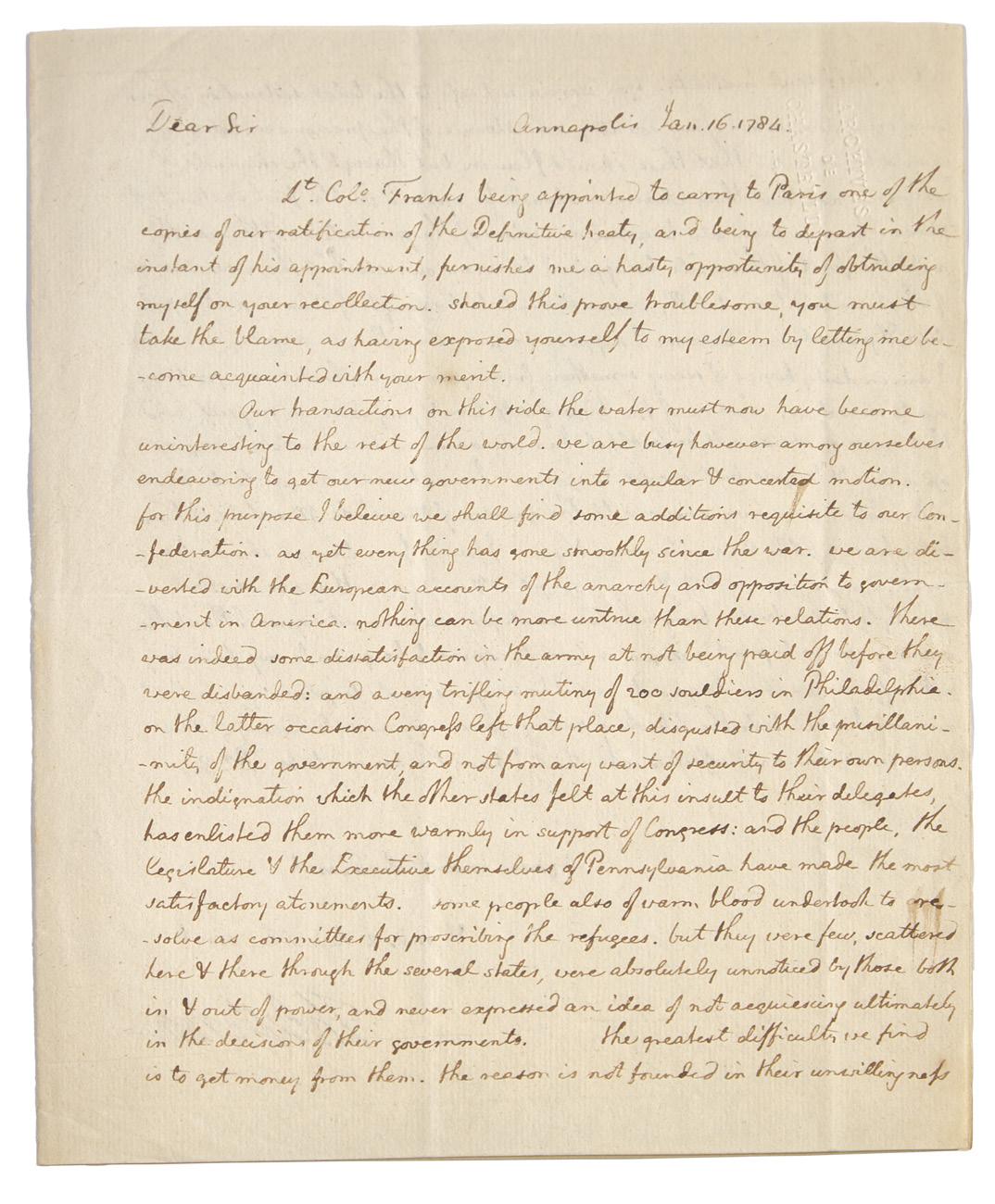
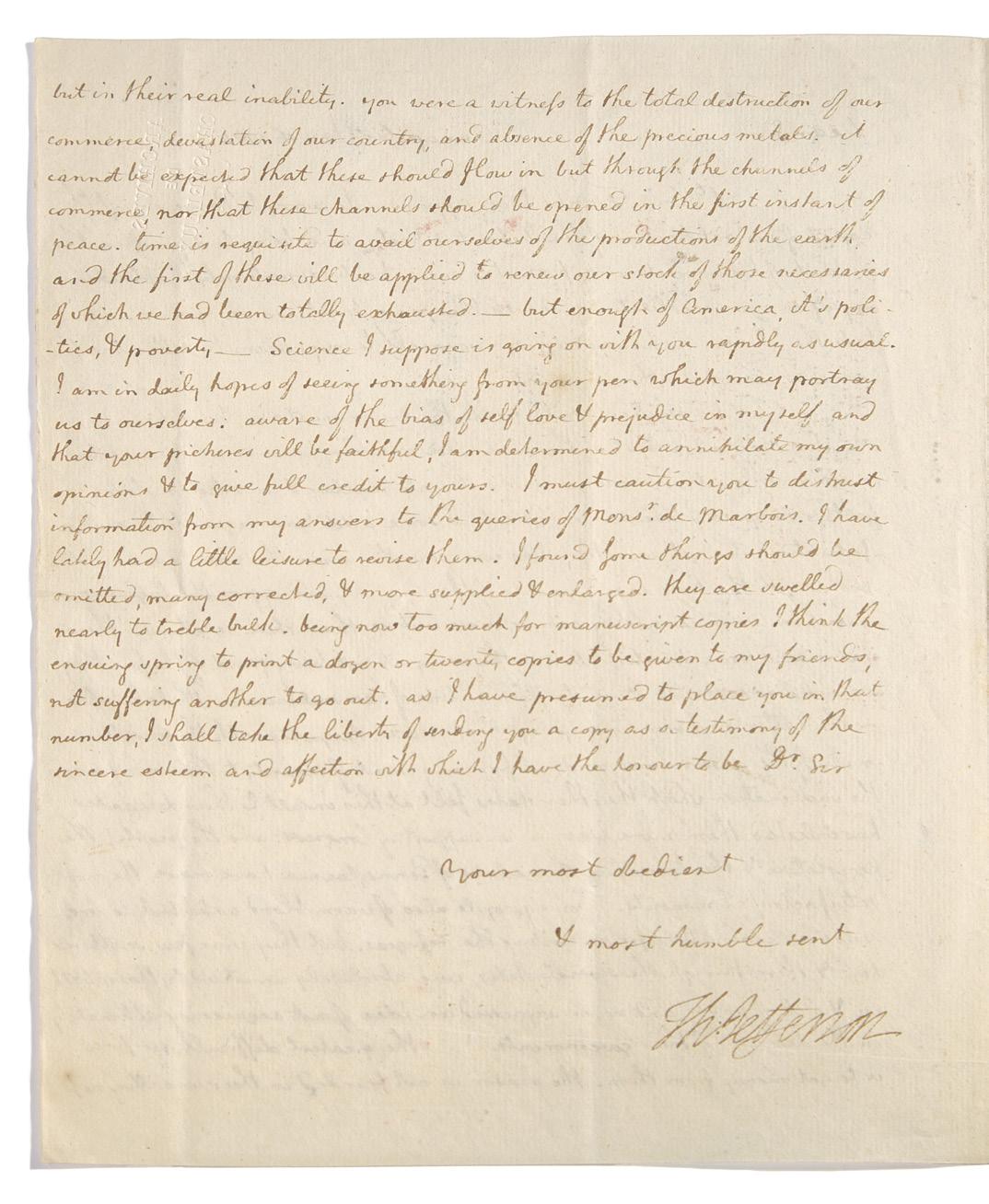
81
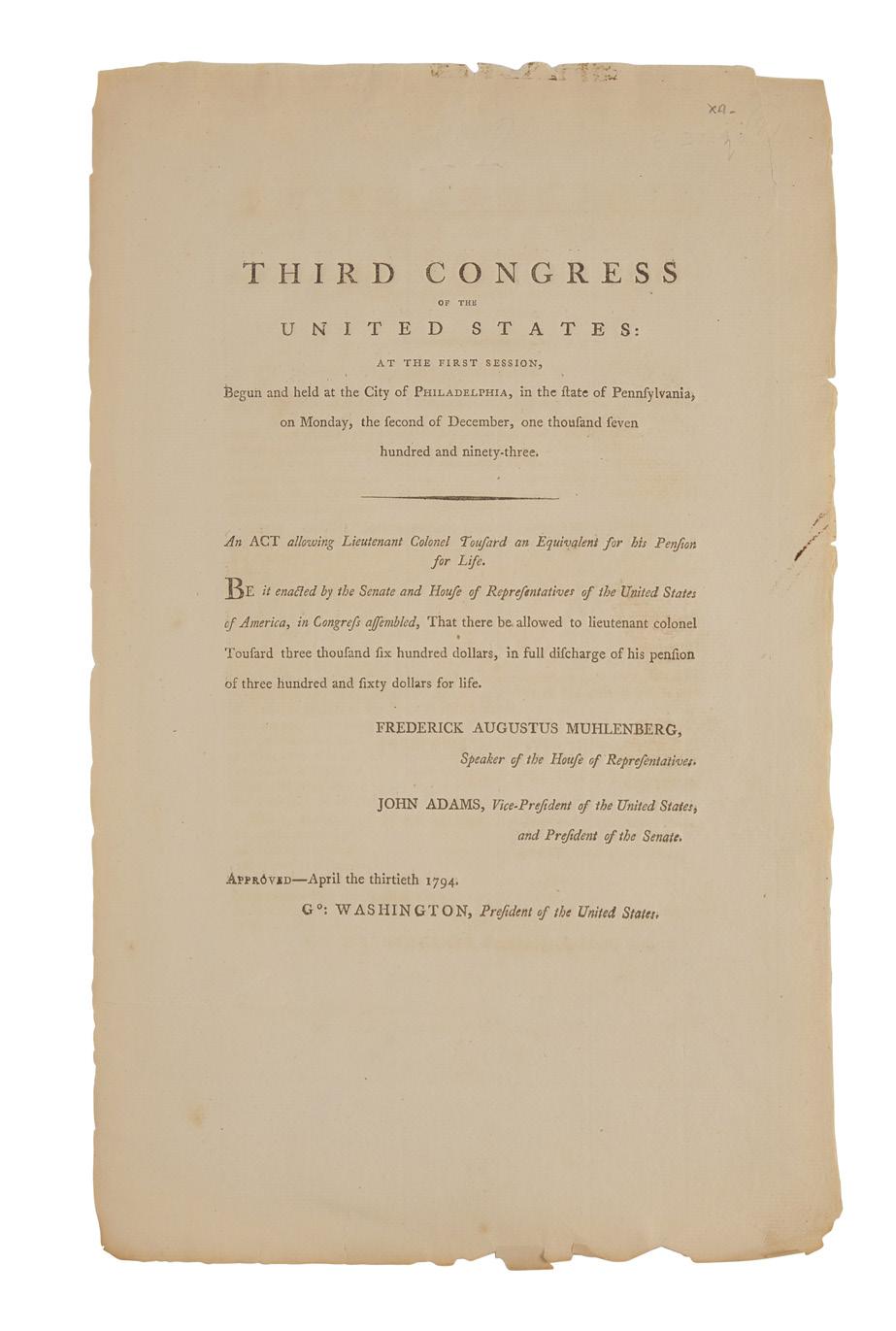
[American Revolution] Group of 2 Documents Related to Revolutionary War Pensions: For a Soldier who Helped Establish West Point Military Academy and a Soldier who Defended West Point as a Fortress
Printed Broadside
Philadelphia: (Francis Childs and John Swaine), April 30, 1794. Printed broadside, 13 1/4 x 8 in. (336 x 203 mm). Small chipping and light scattered wear along edges. Evans 27848
An Act allowing Lieutenant Colonel Tousard an Equivalent for his Pension for Life. Louis de Tousard (1749-1817) was a French artillerist who served in the Continental Army during the American Revolution, and later greatly influenced the formation of the United States Army. Tousard arrived in America in April 1777, and first joined the staff of General George Washington in June 1777, and then as a captain under the Marquis de Lafayette, between 1777-78. He fought in the Battles of Brandywine (September 11, 1777) and Germantown (October 4, 1777), wintered at Valley Forge (1777-78), and fought in the Battle of Rhode Island (August 29, 1778) where he lost an arm in an attempt to capture British artillery. After the war’s conclusion, he returned to France in 1784, where he received the Order of Saint Louis, and was later imprisoned as a Royalist, during 1792-93. In 1794, he led a regiment in Haiti against the slave uprising, and was briefly imprisoned, before he escaped to America.
In 1795, President Washington commissioned Tousard a Major in the Corps of Artillerists and Engineers, and was later promoted to Lieutenant Colonel and Inspector of Artillery, and helped plan several forts along the eastern seaboard, including Fort Mifflin. During this time he was instrumental in establishing a national military school, a proposal for which he sent to Secretary of War James McHenry in 1798, and helped transform the garrison at West Point to an academy, in 1800, and trained the first 12 cadets. His book, American Artillerists Companion (1809) became the standard text for the instruction of artillery use in the United States. He later served as French Vice-Consul in Philadelphia, in 1805, French Consul ad Interim in New Orleans from 1811-1816, and supported the work of General Jackson during the War of 1812. He returned to Paris in 1816, where he died the following year.
Together with:
Partially-Printed Pension Claim
Steuben County, New York, February 3, 1829. Partially-printed war pension claim on bifolium, signed by court clerk John Metcalfe, certifying Samuel Slarrow’s Revolutionary War pension claim. Docketed on verso. Creased from old folds, tape repairs along same verso; unevenly toned; lightly soiled.
Fifty years after serving in the Continental Army, 68-year-old Samuel Slarrow (1759/61-1839) is approved for a war pension. Slarrow enlisted for nine months of service in the Massachusetts Line in June of 1778, and was placed in the company commanded by James Keith, in the 8th Massachusetts Regiment commanded by Col. Michael Jackson (1734-1801; one of the few soldiers who served in the Continental Army for the entirety of its existence). During Slarrow’s service, the 8th Massachusetts was assigned to the Highland’s Department charged with defending the Hudson River north of New York City. For the entirety of his term, Slarrow was likely stationed at the newly erected fortress at West Point, where he was then discharged in “the last of March or April 1779”. In answer to the long time gap in filing a claim, according to the document, Slarrow did try to previously, but it was denied because he “had not sufficient proof” of his service.
Lot includes approximately 46 disbound Congressional reports regarding various veteran’s pensions, ca. 1840s-1880s.
$400 - 600
82
[Atomic Energy Commission] Collection of Press Releases and Reports, 1948-52
Washington, D.C.: United States Atomic Energy Commission, April 2, 1948-April 7, 1952. Comprising approximately 37 mimeographed press releases and reports issued by the Atomic Energy Commission. In blue cloth ring binder; some reports stapled at top corner; scattered wear; “Mr. Fiedler” in pencil in top corner of a report at rear.
The Atomic Energy Commission was created in 1946 following the end of World War II to manage the development, use, and control of atomic, or nuclear, energy for military and civilian purposes. Signed into law by President Harry Truman, it transferred control of nuclear energy from military to civilian hands. Following increasing criticism regarding its regulations, it was abolished in 1974, and its operations were subsumed with the creation of the Department of Energy by President Jimmy Carter in 1976.
The present collection contains reports from the critical years immediately following the agency’s creation, including those by Lewis L. Strauss, W.W. Waymack, David E. Lilienthal, Robert F. Bacher, Lawrence R. Hafstad, among others. Topics covered include those on the nature of atomic energy, on uranium supplies, the Colorado plateau program, the creation of nuclear reactors, plutonium production, foreign distribution of radioisotopes, reports from Congressional committees, minutes of press conferences, a statement on the arrest of German-born British scientist Klaus Fuchs for passing top-secret information about the atomic bomb to the Soviet Union, the application of atomic energy, the discovery of element 98 Californium, the revisal of security clearance procedures, the creation of production plants, weapons tests in Nevada, the creation of nuclear submarines, etc. One report mentions J. Robert Oppenheimer by name.
Lot includes an issue of Prevent World War III (New York: Society for the Prevention of World War III, Inc., Summer 1965, No. 66).
$300 - 500
83
[Aviation] Earhart, Amelia. Rare Signed Cover From Her Ill-Fated Roundthe-World Flight
No place, 1937. Unused red and blue cacheted cover, signed by Amelia Earhart in top left. 3 5/8 x 6 5/8 in. (92 x 168 mm). Lot includes a photograph of Earhart.
A rare cover signed by Amelia Earhart, created for her ill-fated 1937 roundthe-world flight.
To raise money for her flight, Earhart’s husband, George Putnam, arranged with Gimbel Brothers department store in New York to create these special blue and red cacheted covers featuring a portrait of the aviatrix. Around 10,000 were apparently created, several of which were prepaid and addressed, and were to be carried in the nose compartment of her Lockheed Electra. These were signed by Earhart, who then intended to add postage stamps as the flight progressed, and were then to be delivered to collectors following the completion of her journey.
Earhart’s first attempt at an around the world flight began in Hawaii in March 1937, but “during the takeoff attempt in Honolulu, the plane went into a loop (type of fishtail), its landing gear gave way and it crashed. When the plane was sent back to Burbank for repairs, the mail was placed in the custody of the Honolulu postmaster.” (Bowman, Amelia Earhart Philately, p. 4) The present cover, which was flown to Hawaii in preparation for the first attempt, and was signed but never used or addressed, is one of only a few that are known to survive. For her second attempt, newer covers were created, which took off from Miami on June 1. On that flight she carried approximately 7,500 covers, which then disappeared along with Earhart and her navigator Fred Noonan somewhere in the Pacific Ocean.
Rare. According to RBH, this is only the fourth example of this signed cover to come to auction.
$800 - 1,200
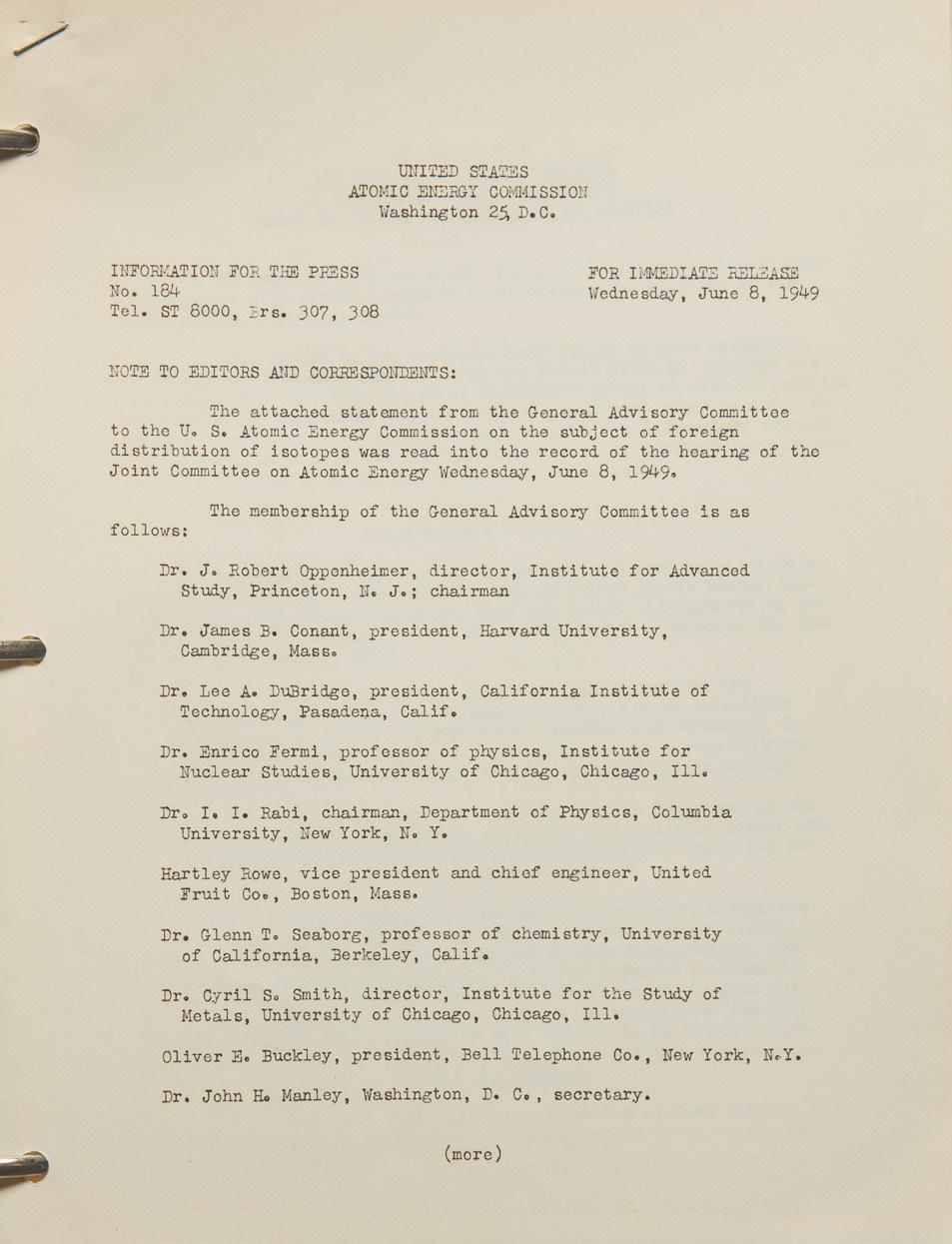
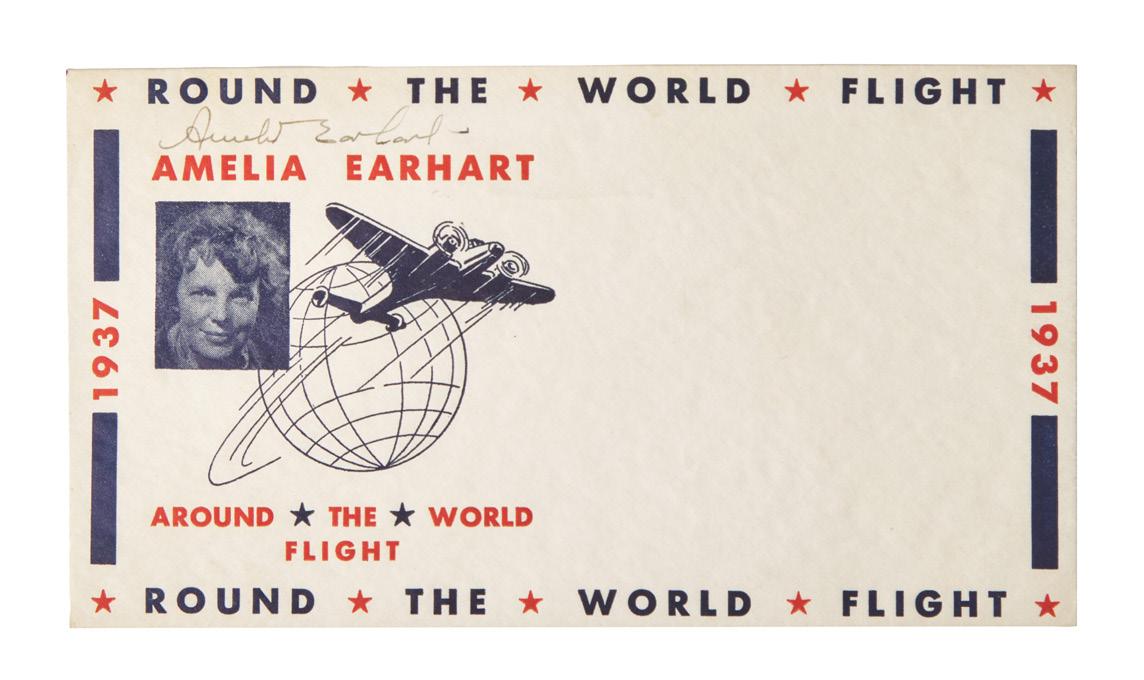
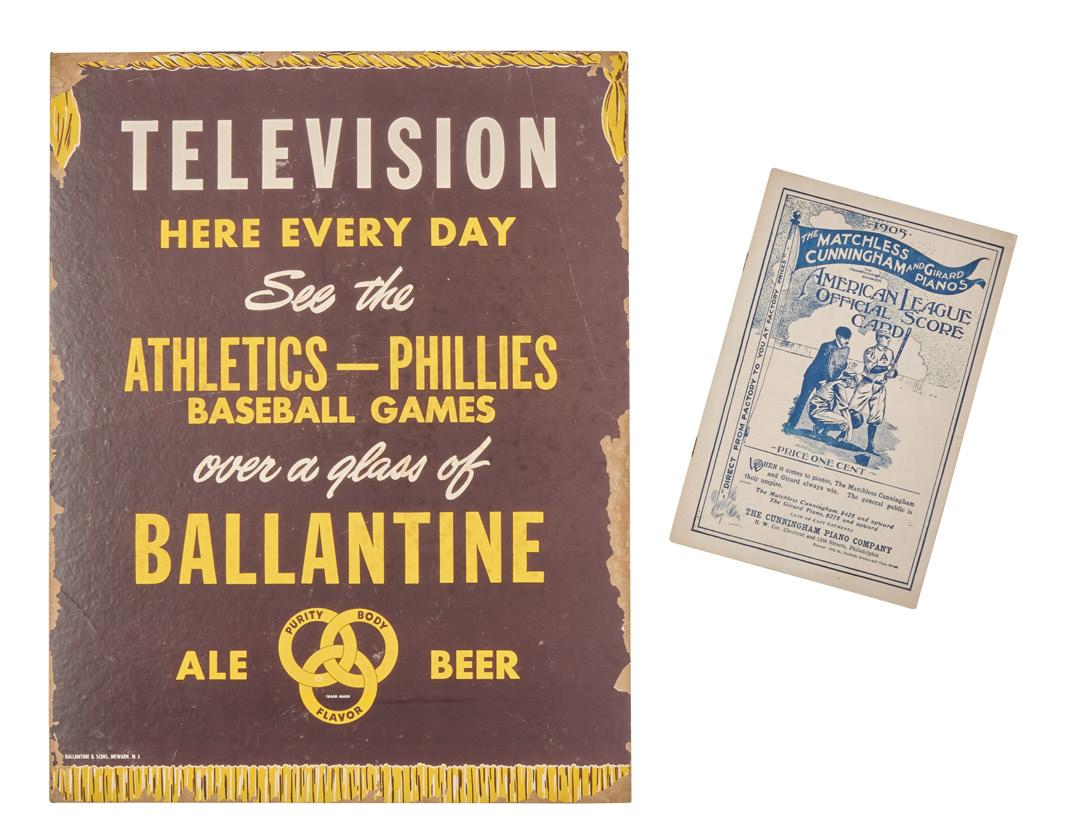
84
[Baseball] Group of 2 Items Related to Early Philadelphia Baseball
Ballantine Beer Advertising Sign for the Philadelphia Phillies and Athletics Newark, New Jersey: Ballantine & Sons, ca. 1940s-50s. Printed easel-back cardboard display sign. 18 x 14 in. (457 x 356 mm). Wear along edges with some loss.
Together with:
1905 Philadelphia Athletics Score Card Philadelphia: Chas. C. Douglass Printing House, 1905. 8vo. Original limp pictorial stapled self-wrappers; contemporary manuscript notations recording box score. scattered light wear.
1905 American League official score card for the first game of a double-header between the Philadelphia Athletics and the Washington Nationals. The A’s shut out the Nationals 5-0, with their future Hall of Famer Chief Bender recording the shutout while only giving up two hits over nine innings. He walked only one batter and struck out seven. The A’s would go on to sweep the Nationals that day.
$300 - 500
85
[Baseball] [Bender,
Biddle Field, Carlisle, Pennsylvania, August 28, 1930. Cabinet card photograph of Charles Albert “Chief” Bender, signed in pencil on mount “N. Guth / .30” at right below image. 7 3/4 x 5 3/4 in. (197 x 146 mm) print on 14 x 10 in. (356 x 254 mm) card. Scattered minor wear to mount.
Charles Albert “Chief” Bender (1884-1954) was a Native American professional baseball pitcher, who is credited with the invention of the slider. Bender spent most of his career pitching for the then powerhouse Philadelphia Athletics (1903-14), where he won nearly 200 games and six World Series, and led the American league in winning percentage. As iconic Athletics manager Connie Mack stated about Bender, “If I had all the men I’ve ever handled, and they were in their prime, and there was one game I wanted to win above all others, Albert would be my man.” In 1915, Bender left Philadelphia to play for the Baltimore Terrapins in the short-lived Federal League, but returned to play for the National League Philadelphia Phillies in 1916 and 1917. During his career he pitched 3,017 innings with an earned run average of 2.46, and a record of 212-127. In the years that followed he worked for a variety of teams as a coach, scout, and manager. He was inducted into the Baseball Hall of Fame in 1953.
The present photograph shows Bender with Frederick Fegan at Biddle Field, at Dickinson College, in Carlisle, Pennsylvania. Bender first started playing baseball at Carlisle Indian School, which he attended from 18961902. Following his graduation he briefly attended Dickinson College’s prep school, while also playing for the semipro Harrisburg Athletic Club, before he got his start in the majors for the Philadelphia Athletics.
$200 - 300
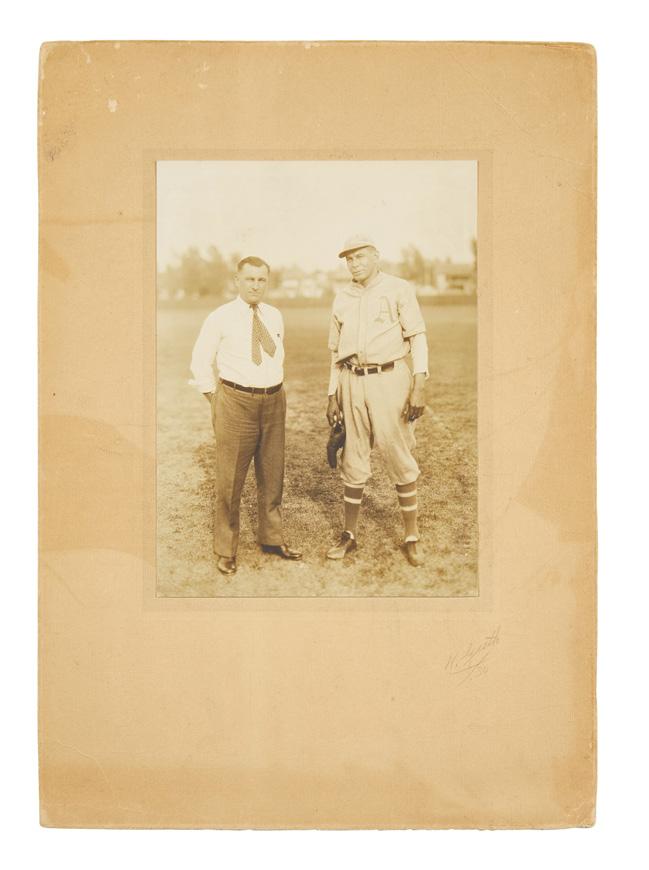
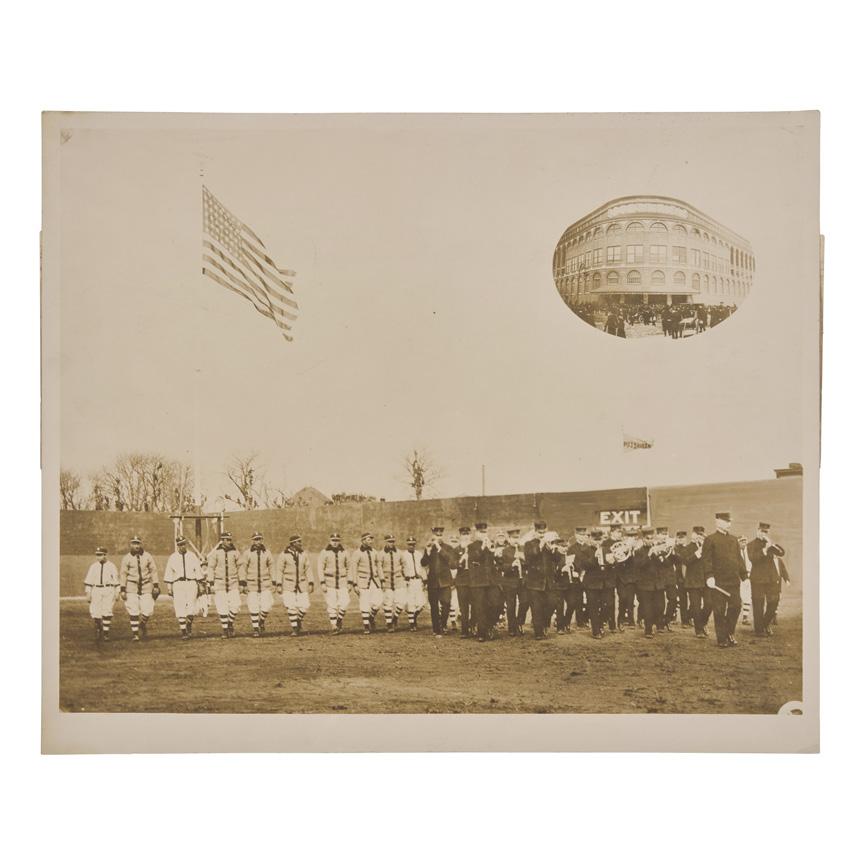
86
[Baseball] (Brooklyn Dodgers) Now Even the Price of Baseball Is Going Up!
(New York, ca. 1913 or later). Large sepia photograph, depicting the Brooklyn Dodgers walking on the field behind a marching band; small inset of the newly completed Ebbets Field at top right. Printed caption mounted to verso reads in part, “Now Even the Price of Baseball Is Going Up! They are going to charge more this season for baseball seats than ever. The day of the 25 cent bleacher seat is fast departing. Why? Costly stadiums and costly players. The New Ebbets field, Brooklyn, is an example...” Lightly creased; some soiling to image; scattered stains on verso. 14 x 17 in. (355 x 432 mm).
Very rare, large format sepia photograph of the Brooklyn Dodgers strolling behind a marching band on the recently completed Ebbets Field. The printed caption mounted to the back laments the rising price of seat tickets, due to the heightened popularity of baseball.
Dodgers’ owner Charles Ebbets began acquiring property for the construction of a new stadium in 1908, and ended up spending a total of $750,000 over five years on the project. The stadium officially opened on April 5, 1913 with an exhibition game against their rivals, the New York Yankees. The Dodgers won 3-2, and outfielder Casey Stengel recorded the first ever home run at the stadium, scoring on an inside-the-park hit.
The New York Tribune reported on the opening of Ebbets Field in their April 6 issue, stating, «the park includes everything that could be thought out by the fertile mind of a master in baseball...The admissions rates will be as follows: general admission, 75 cents...box seats, $1.50...Pavilion general admission 50 cents, North end pavilion 25 cents...Brooklyn owes the fact that she can boast of the finest ball park in the country to Charles H. Ebbets, after whom the park is named...»
$1,500 - 2,500
87
[Baseball] Clarke Bros. Whiskey “All Star” Lineup Advertisement Poster, ca. 1917
“Take a Chance and Win a Bottle 2 of the World’s Greatest Ball Teams 2 of the World’s Greatest Whiskies”
Peoria, Illinois, ca. 1917-18. Printed broadside advertisement for Clarke Bros. & Co.; 11 x 9 in. (279 x 227 mm). With images of whiskey bottles, a distillery, and a fantasy lineup card for the National and American league “all-star” teams. Lacking two original printed small paper tabs. Toned; scattered stains; soiling and small chips to extremities.
Very rare promotional broadside for Clarke Bros. & Co. Whiskey, featuring a list of baseball players from the American and National leagues, including many Hall of Famers.
Lacking two mounted printed tags that would have covered both columns of numbers and the name “Schalk” at center. This poster would have encouraged customers to “Pay amount under tab” by placing their name opposite their favorite player from either column, and the number revealed would be the price for the whiskey that they had to pay (between 1-18 cents).
The National league squad included: Grover Cleveland Alexander, Philadelphia Phillies (pitcher); Bill Raridan, New York Giants (catcher); Jack Daubert, Brooklyn Dodgers (first base); Johnny Evers, Boston Braves (second base); Heine Zimmerman, New York Giants (third base) Honus Wagner, Pittsburgh Pirates (shortstop); Sherry Magee, Boston Braves (left field); Dave Robertson, New York Giants (right field); Cy Williams, Chicago Cubs, (centerfield).
For the American league: Walter Johnson, Washington Senators (pitcher); Ray Schalk, Chicago White Sox (catcher); Dick Hoblitzel, Boston Red Sox (first base); Eddie Collins, Chicago White Sox (second base); Frank “Home Run” Baker, New York Yankees (third base); Donnie Bush, Detroit Tigers (shortstop); Shoeless Joe Jackson, Chicago White Sox (right field); Tris Speaker, Cleveland Indians (left field); Ty Cobb, Detroit Tigers (right field)
$800 - 1,200
88
[Baseball] Poster of Douglass Crockwell’s Iconic Up at Bat Image for the August 10, 1940 cover of The Saturday Evening Post
No place, 1940. Off-set color lithographic poster. 27 5/8 x 21 3/8 in.. (702 x 543 mm). Linen backed.
Bright example of this charming poster of a young girl up at bat.
Douglass Crockwell (1904-1968) was an American illustrator and commercial artist, best known for his cover illustrations for The Saturday Evening Post, and was often compared to Norman Rockwell for his nostalgic depictions of American life.
$200 - 300
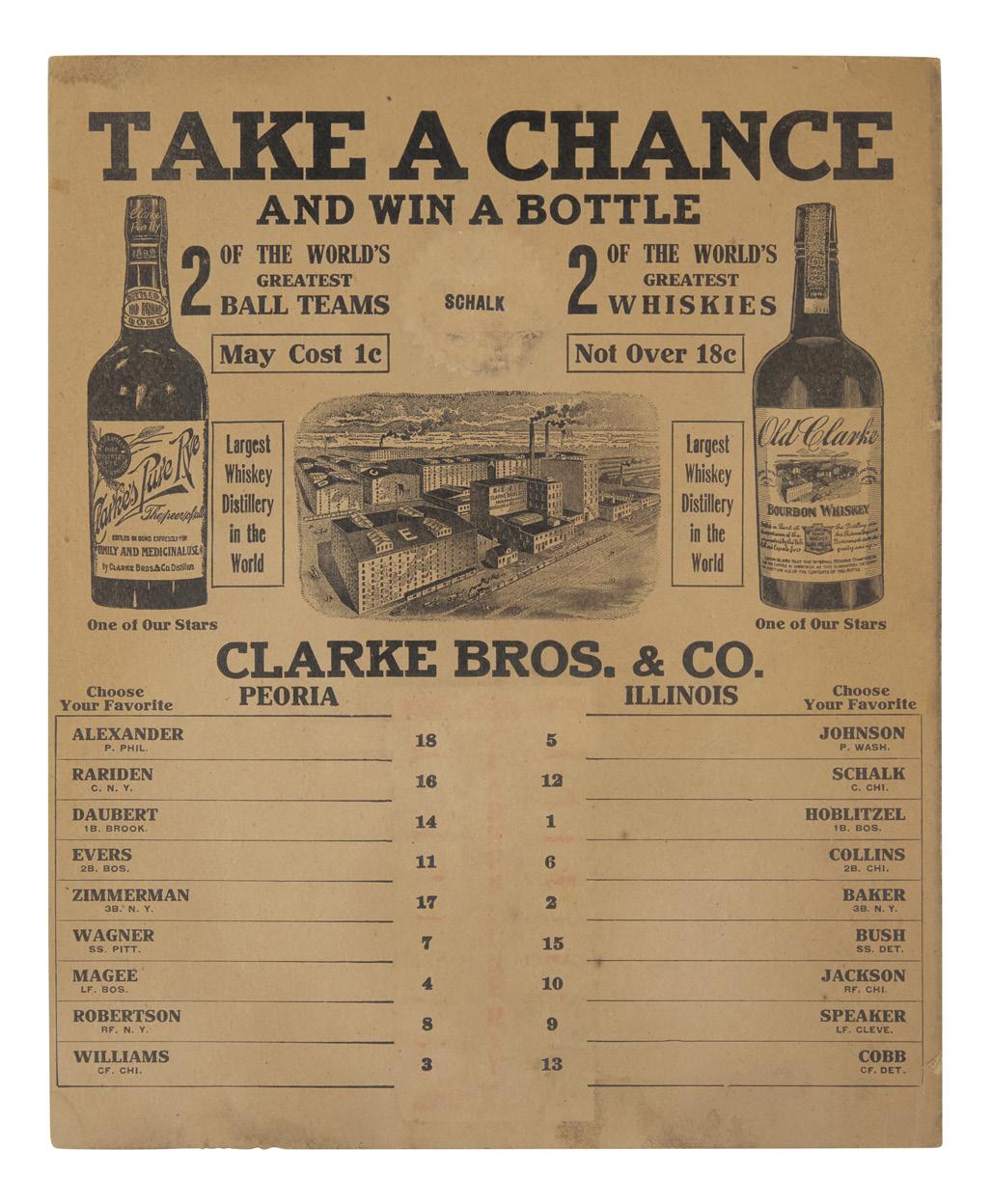
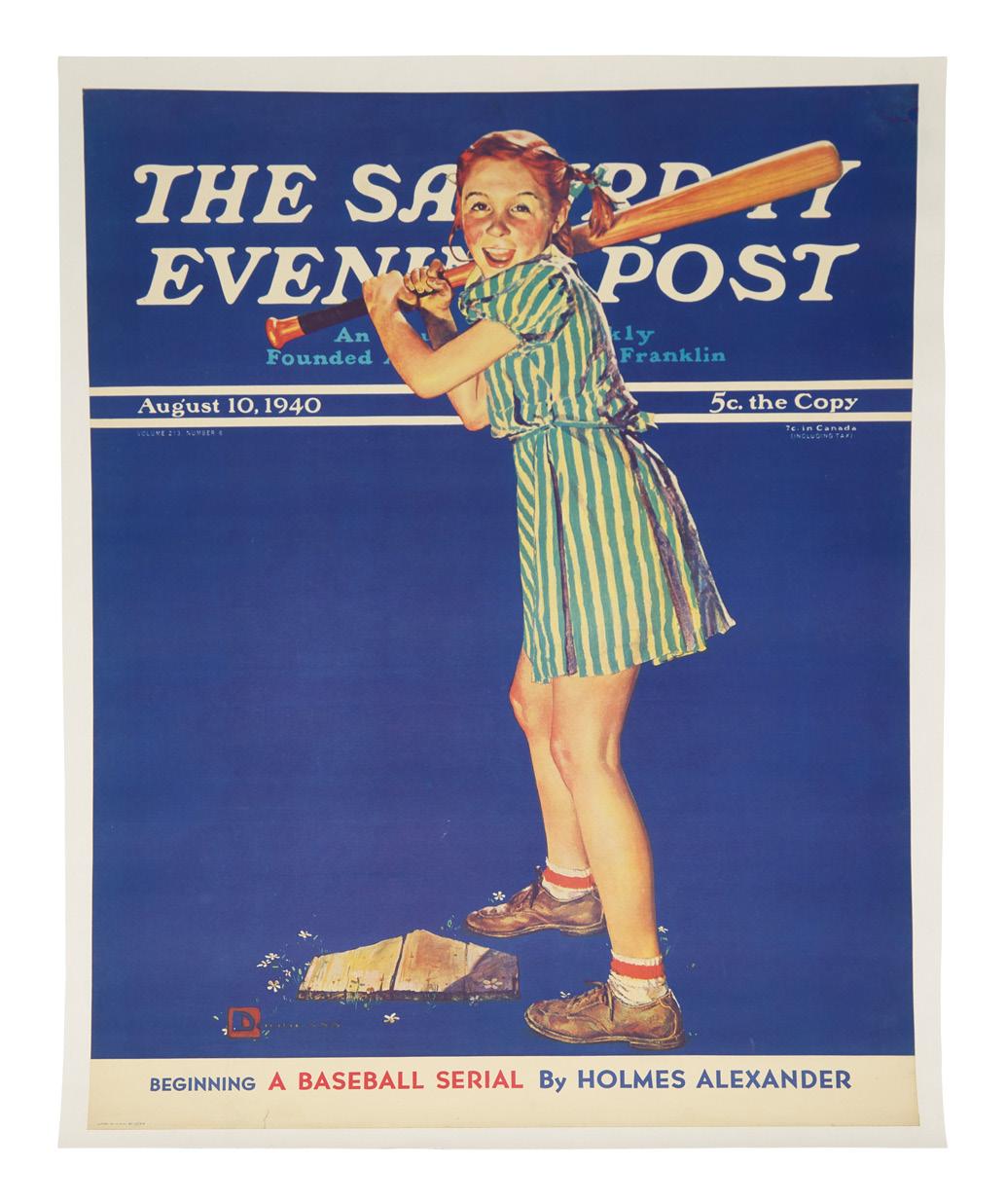
89 [Baseball] “The Two Big Guns of the N.Y. Yanks”: A Striking Type 1 Press Photograph of Lou Gehrig’s Hands
No place, 1927. Press photograph of Lou Gehrig; typed newsreel slip mounted on verso (“The Two Big Guns of the N.Y. Yanks”), dated July 3, 1927. 7 x 5 in. (178 x 127 mm).
A fine and powerful Type 1 press photograph of baseball legend Lou Gehrig, focusing closely on the powerful hands that helped make him one of the most celebrated baseball players of all time. The image recalls the strong tonal contrasts and intimate compositions associated with the work of noted baseball photographer Charles Conlon (1868-1945), whose best-known image of Gehrig was a close-up photograph of his eyes.
Over sixteen years with the New York Yankees, Gehrig amassed a lifetime batting average of .340, with 2,721 hits, and 493 home runs. The 1927 season in particular was noteworthy both for Babe Ruth achieving a record 60 home runs and for Gehrig’s strong showing of a .373 batting average, 218 hits, and 175 RBIs (breaking Ruth’s 1921 record of 168), one of the greatest showings of any batter in baseball history. That year the Yankees swept the Pittsburgh Pirates 4-0 to win the World Series, with Gehrig named MVP. Gehrig’s record of playing in 2,130 games stood until 1995, when passed by Cal Ripken, Jr.
On July 4, 1939 the Yankees retired Gehrig’s number 4 in an elaborate ceremony. Almost two years later, he succumbed to the disease that now bears his name. During his illness, while at the Mayo Clinic, Gehrig had his hands x-rayed. It was found that he had seventeen healed fractures, including each of his fingers having been broken at least once, a testament to the incredible power and strength he’d displayed throughout his legendary career.
We can trace no other examples of this powerful photograph ever being offered on the market, nor can we locate an image of it in online resources or contemporary newspapers.
$8,000 - 12,000
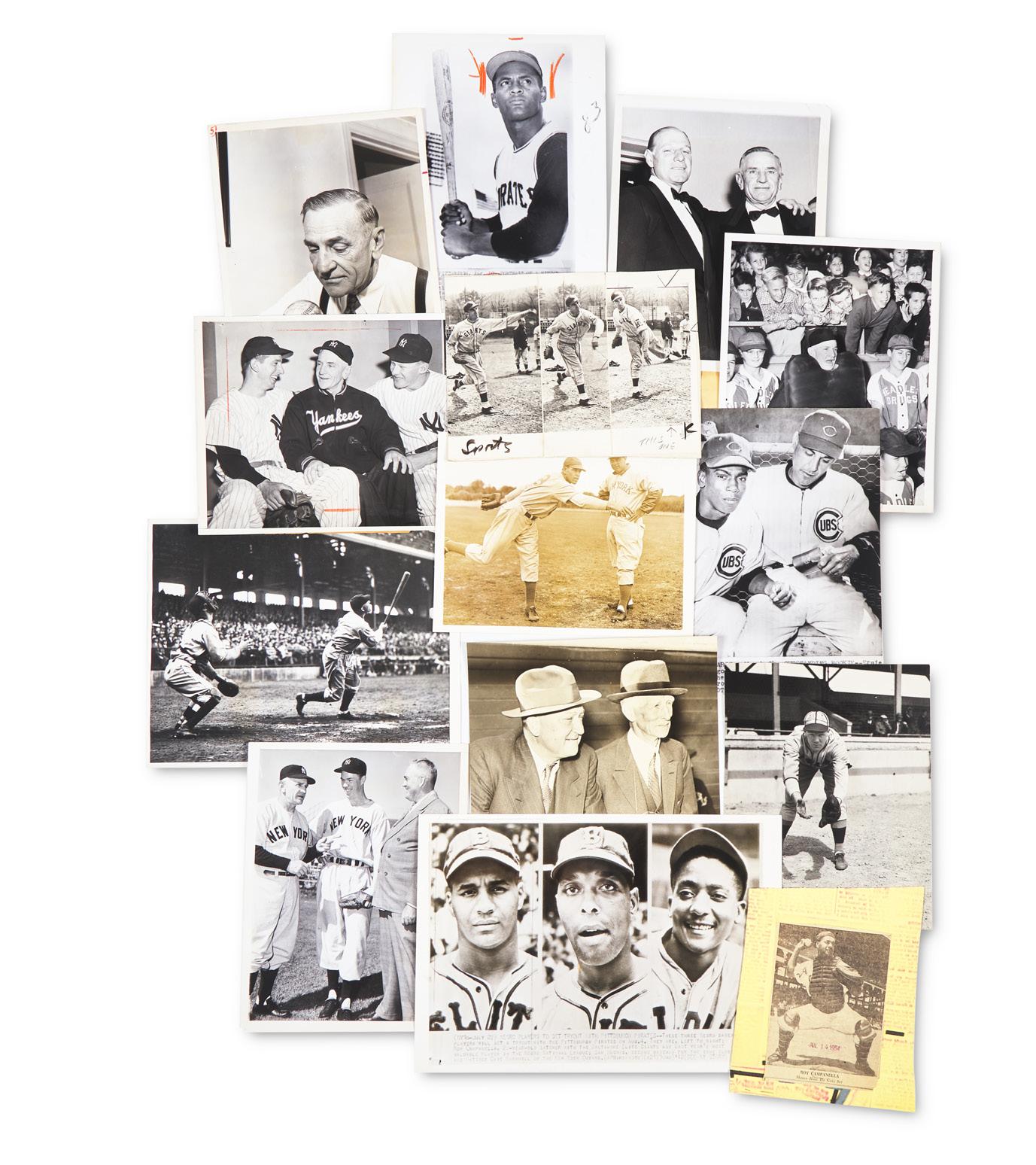
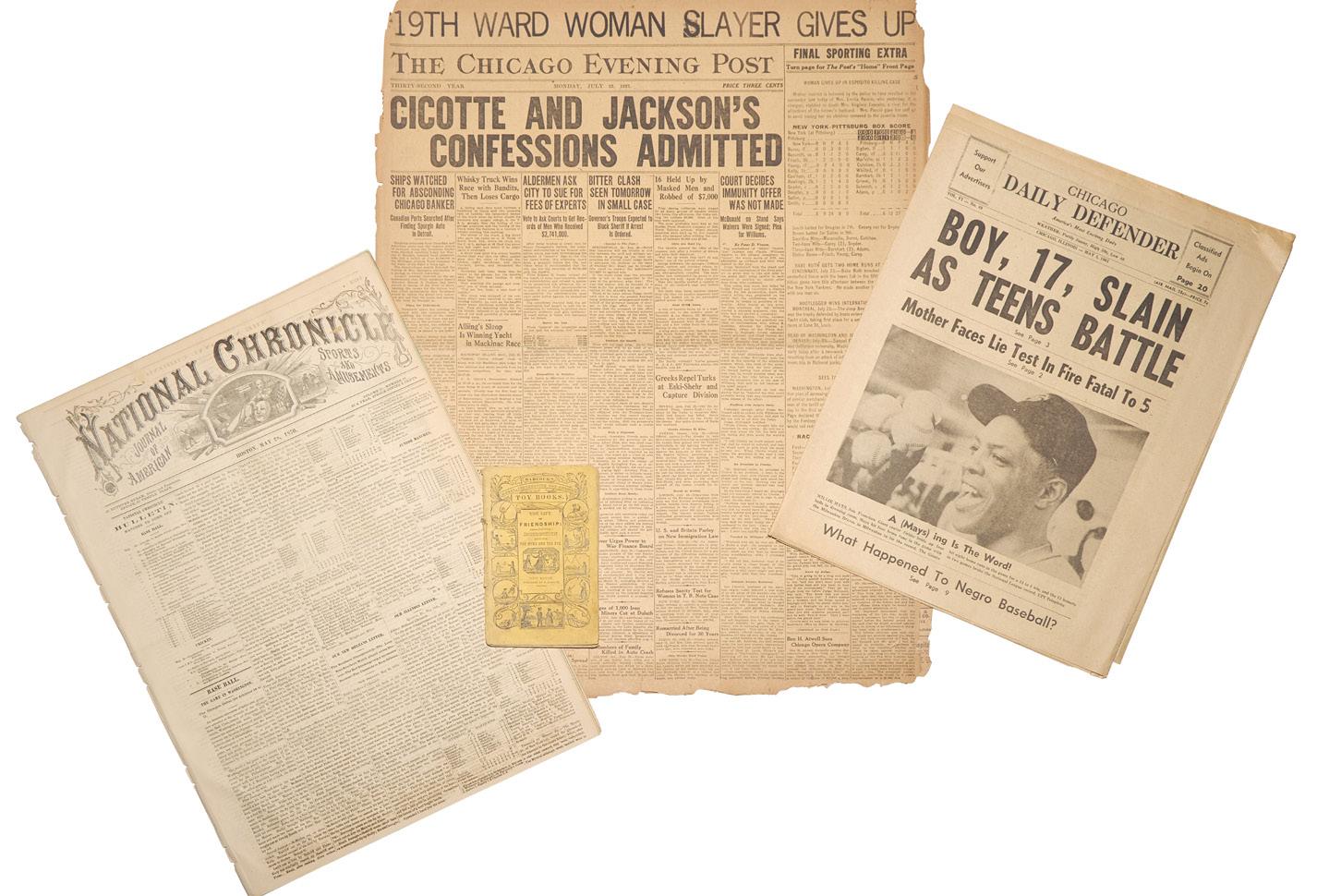
90
[Baseball] Group of 18 Press Photographs of Baseball Legends, including Mickey Mantle, Ty Cobb, Roberto Clemente, and more
Locations and dates vary. Group of 18 black and white press photographs depicting baseball legends including Mickey Mantle, Roberto Clemente, Daffy Dean, Carl Erskine, Casey Stengel, Ernie Banks, Rogers Hornsby, Ty Cobb and Connie Mack, Roy Campanella, Billy Martin, Whitey Ford, Casey Stengel, Carl Hubbell, Red Rolfe, Bill Terry, et al. Many with copyright stamps and printed labels on verso. Condition varies.
$500 - 800
91
[Baseball] Group of 4 Periodicals Related to Baseball, Including an Early 19th Century Illustration of the Game and a Front-Page Image of Willie Mays in an African American Newspaper
1. The Gift of Friendship; Seasoned with Instruction, Both for the Mind and the Eye New Haven: S. Babcock, n.d. [1835]. Woodcut vignettes throughout. Original pictorial yellow wrappers.
The front wrapper depicts an early rendition of children playing baseball. Although variants of the game had existed for decades, modern baseball was not formally codified until 1845, when Alexander Cartwright helped establish the rules for the New York Knickerbockers.
2. National Chronicle Journal of American Sports and Amusements
Boston, May 28, 1870. Vol. II, No. 21. Printed newspaper. Folio. pp. (161)-174. Disbound. Numerous reports and scores of early baseball matches.
3. The Chicago Evening Post Chicago, Monday, July 25, 1921. Printed newspaper. Folio. (ii), 12 pp. Toned and very brittle; wear along edges; worn with losses. Reporting on the 1919 Black Sox game-fixing scandal in a local Chicago newspaper.
4. Chicago Daily Defender Chicago, May 1, 1961. Vol. VI, No. 49. Printed newspaper. Folio. 24 pp. Slightly toned. African American newspaper with a front and rear page image and a report on Willie Mays hitting four home runs in a single game—the first and only time he accomplished the feat in his career. With an article titled “What Happened to Negro Baseball?”
$200 - 300
92
[Baseball] Type 1 Photograph of Hall of Fame Pitcher Walter Johnson
“The Big Train Socks ‘Em Out”
(New York: International Newsreel, ca. March 19, 1929). Black and white photograph, 8 x 5 3/4 in. (203 x 146 mm). Type 1 photograph depicting Washington Senators’ pitching legend Walter Johnson at bat. Original typed caption mounted to verso, copyright stamp on same. Lightly creased. With accompanying PSA Letter of Authenticity.
Walter Johnson (1887-1946) was a Hall of Fame right-handed pitcher, who played for the Washington Senators from 1907-27, and later became their manager in 1929. Generally regarded as one of the greatest to ever throw a baseball, to this day Johnson remains the all-time leader in shutouts (110), second in wins (412), and fourth in complete games (531).
$300 - 500
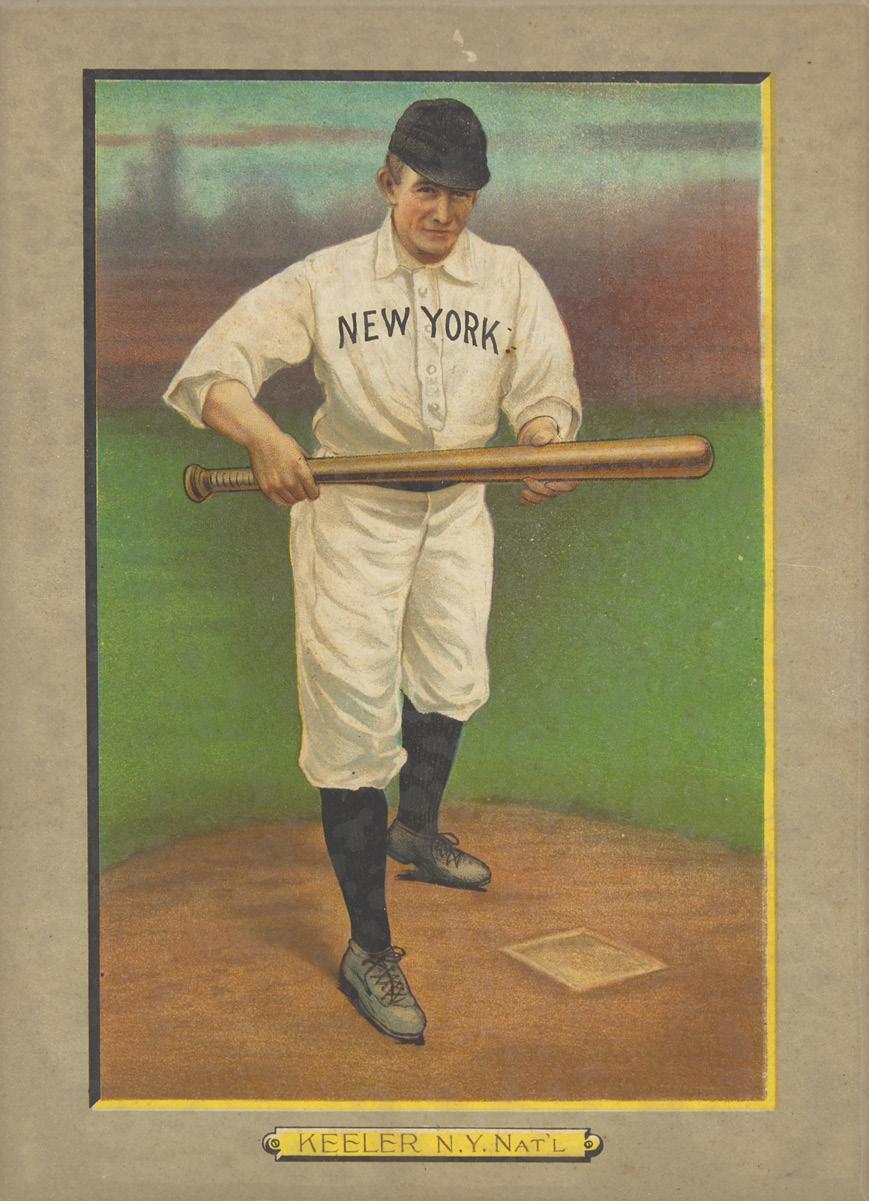
93
[Baseball] Keeler, William Henry. 1910-11 T3 Turkey Red
“Keep your eyes clear and hit them where they ain’t”
1910-11 T3 Turkey Red Cabinets, of Wee Willie Keeler, #101; checklist back (offer); SGC VG-EX 4. Corners lightly worn; small abrasion in upper edge.
A handsome example of New York Giants Hall of Famer Wee Willie Keeler, from the T3 Turkey Red set.
$600 - 900
94
[Baseball] [Mantle, Mickey] Mickey Mantle’s First Cover: The Earliest Front-Page Newspaper Image of Mickey Mantle, “Something Good from Joplin”
The Southwestern Joplin, Missouri, Friday, March 30, 1951. Vol. 17, No. 6. Printed newspaper. Folio. 4 pp. Creased from original fold. Toned.
On the cusp of entering the majors to play for the New York Yankees, a young Mickey Mantle is profiled here in Joplin, Missouri’s hometown newspaper. Featuring a front-page, above-the-fold, image of young Mick, the earliest front-page newspaper image of the baseball legend and Hall of Famer, followed by four columns dedicated to the rising star.
Named after the Yankee legend Mickey Cochrane, Mickey Mantle’s upbringing is described within as being “steeped in Yankee lore.” The paper notes that his formal baseball education started as soon as he could lift a bat and throw a ball, creating a year-round atmosphere of baseball heavily infused with “Yankeeism.” Mantle began his professional career in 1948 in Kansas with the Baxter Springs Whiz Kids. His talent was quickly spotted by Yankees scout Tom Greenwade, leading to a rapid promotion to the minor leagues. In 1949, he was assigned to the Yankees’ Class-D Independence team in the Kansas–Oklahoma–Missouri League, where he played shortstop and posted a .313 batting average. The following year, he was promoted to the Class-C Joplin Miners of the Western Association. As depicted in the accompanying image from the 1950 spring training in Branson, Mantle excelled in Joplin, winning the Western Association batting title with a .383 average. Recognized as “baseball’s most publicized rookie,” Mantle was invited to the Yankees’ instructional camp prior to the 1951 season. He subsequently joined the major league roster that year, playing right field. As the lengthy profile concludes, “We predict that the young, hopeful ballplayers of America are going to have a fine hero to pattern after.”
Exceedingly rare: According to RBH, we cannot locate another copy of this paper at auction, and it is perhaps the only obtainable copy in private hands.
Together with:
The Sporting News The Base Ball Paper of the World St. Louis, April 25, 1951. Volume 131, Number 12. Folio. 37, (3) pp. Toned; wear along edges; closed tear traversing center of pp. 3/4.
Featuring an early cover illustration of Mantle as a young Yankees rookie, dated only four weeks after the above paper.
Together with:
The Sporting News The Base Ball Paper of the World St. Louis, January 31. 1951. Volume 130, Number 26. Folio. 26, (2) pp. Toned; foxing and wear along edges.
On p. 5 is an early report on Mantle: “Yanks to Take Early Look at Mantle, Rated Top Prospect in Minors at 19”.
$8,000 - 12,000
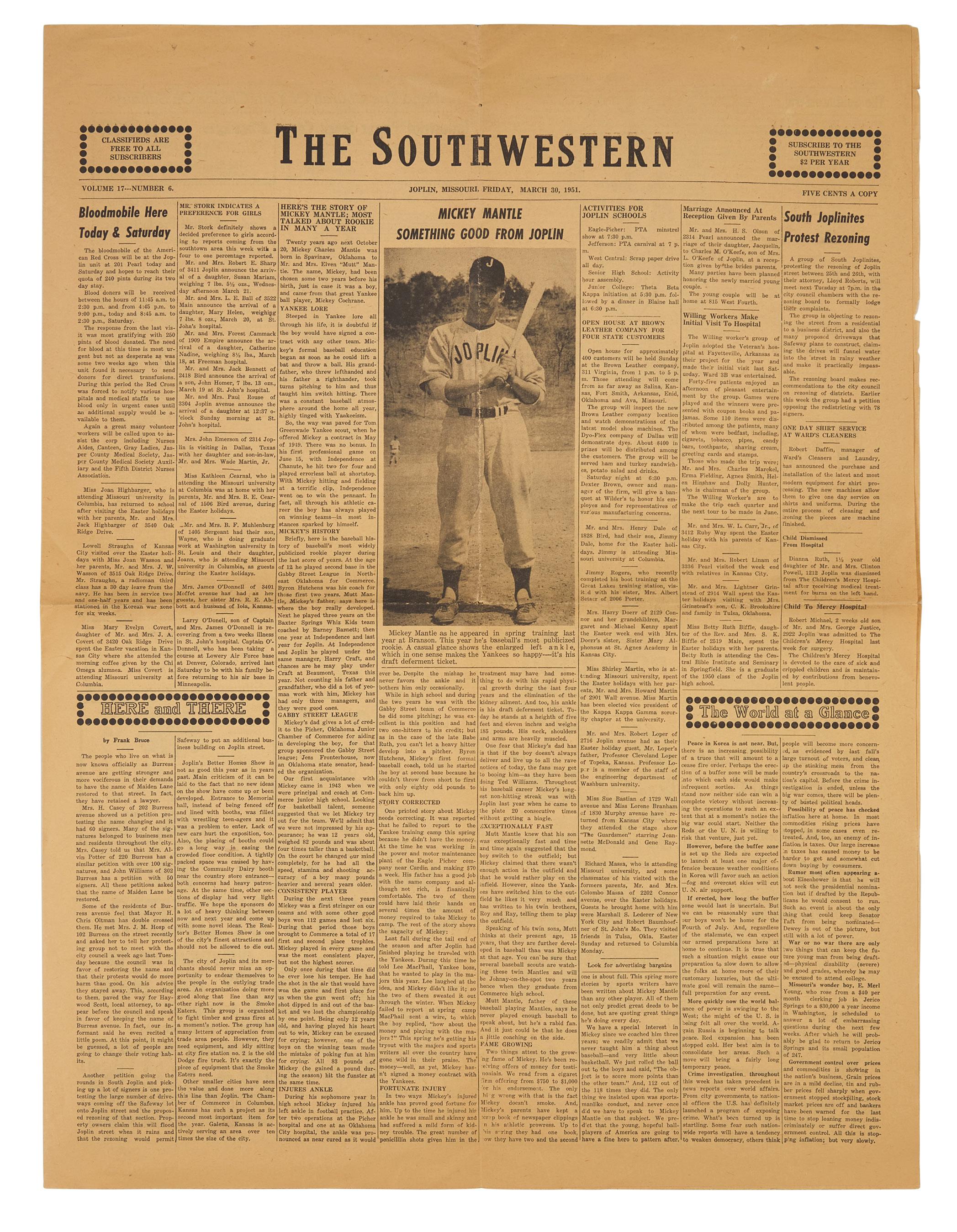
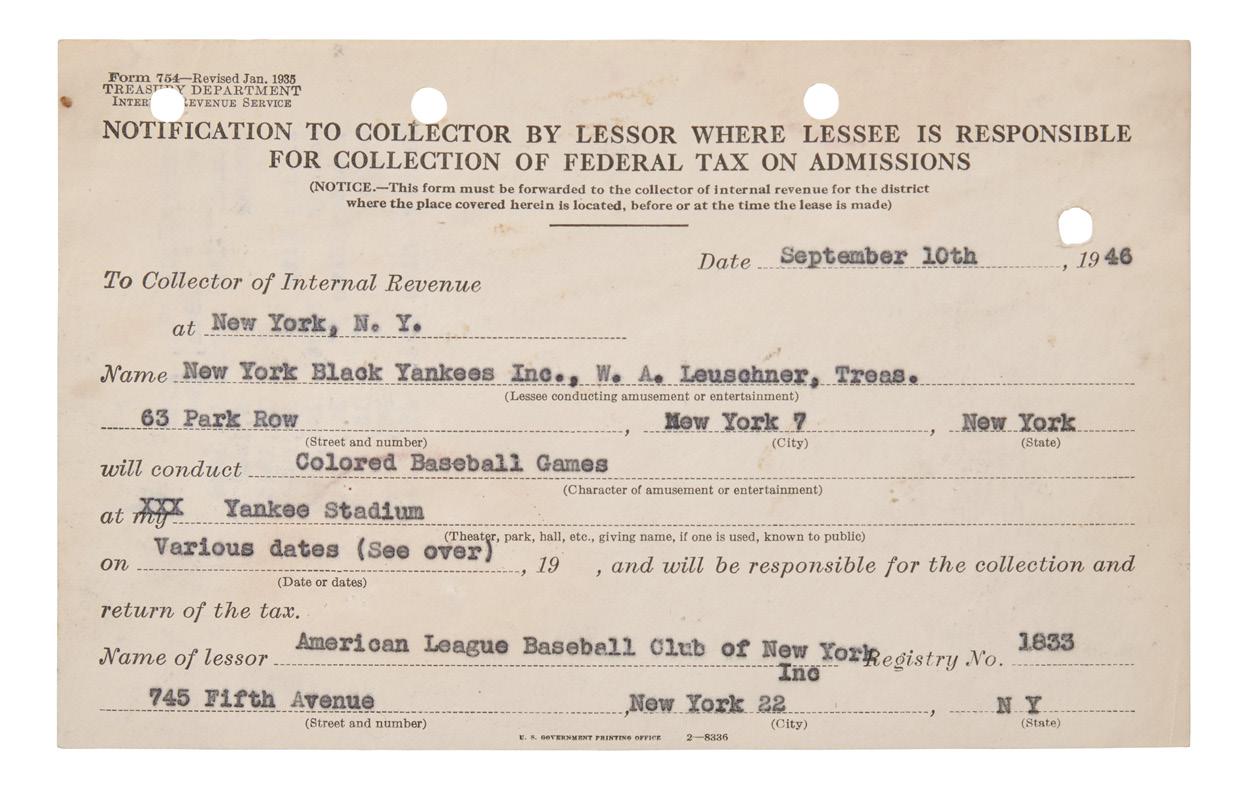
95
[Baseball] [Negro League] Partially-Printed Tax Document for the New York Black Yankees
New York, September 10, 1946. Single oblong sheet, 5 x 8 in. (127 x 203 mm). Partially-printed Internal Revenue Service tax document (“Notification to Collector by Lessor Where Lessee is Responsible for Collection of Federal Tax on Admissions”), for ticket sales for games played by the New York Black Yankees at Yankee Stadium. Type on verso, listing dates of related games. Perforated stamps along top; scattered light soiling.
An IRS tax document for the New York Black Yankees baseball club, issued for taxes collected on ticket sales for games played by them at Yankee Stadium, from JulyOctober 1946.
Originally known as the Harlem Stars, the New York Black Yankees were a professional Negro League baseball team established in 1932, and based in New York City, Paterson, New Jersey, and Rochester, New York. Their early years saw them play the often grueling baseball circuit, and in 1936 they joined the Negro National League. Notable players include legends like Satchel Paige, George “Mule” Suttles, Willie Wells, Clarence “Fats” Jenkins, and Ted “Double Duty” Radcliffe. They played their last game in 1948 when the Negro National League dissolved.
$400 - 600

96
[Baseball] [Reese, Pee Wee] Telegram to Brooklyn Dodger Hall of Famer Pee Wee Reese Congratulating Him on Winning the World Series
No place, October 4, 1955. Single oblong sheet 6 1/4 x 8 in. (159 x 203 mm). Telegram from Van Lingle Mungo to Pee Wee Reese. Creasing from old folds, scattered light stains.
Western Union Telegram sent to Hall of Fame shortstop Pee Wee Reese, from his former Brooklyn Dodger teammate pitcher Van Lingle Mungo and his wife Elouise, congratulating Reese on winning the first World Series in Dodgers franchise history.
The telegram was received at 4:17 P.M, only 30 minutes after the conclusion of Game 7, where the Dodgers beat their rival Yankees 2-0. Brooklyn scored the game’s only runs off of a fourth-inning RBI single and a sacrifice fly in the sixth, both by Gil Hodges, with Reese and catcher Roy Campanella scoring. Dodgers pitcher Johnny Podres recorded the shutout and was subsequently named the series MVP for his performance here as well as in Game 3.
The 1955 contest had been the fifth time in nine years that the Yankees and Dodgers met in the World Series, with the Yankees having won in 1947, 1949, 1952, and 1953. The two teams met again at the end of the 1956 season, but Brooklyn ended up losing the rematch. Brooklyn’s beloved “bums” moved to Los Angeles after the 1957 season.
$300 - 500
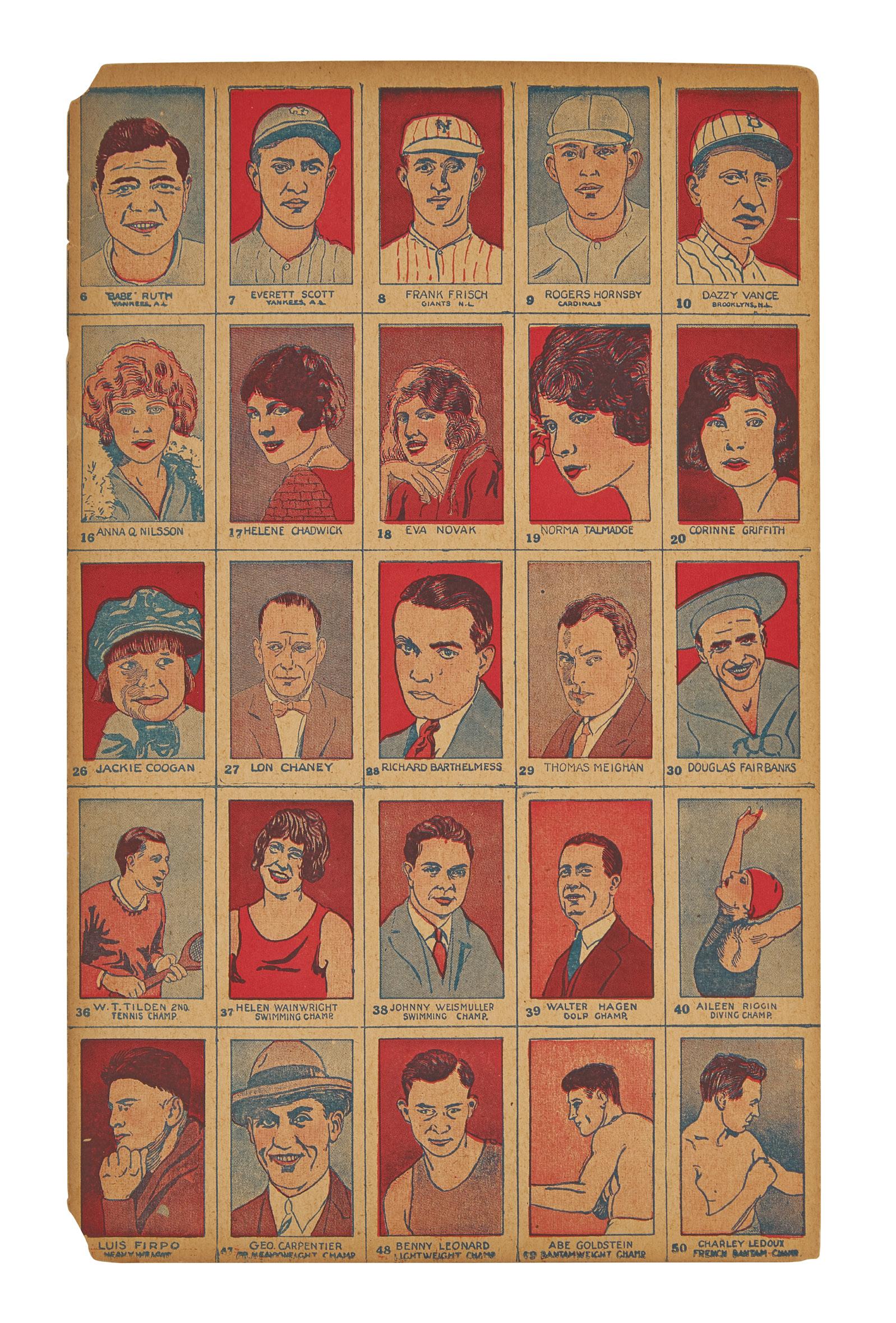
[Baseball] [Ruth, Babe] An Uncut Panel of 1926 W512 Strip Cards
No place, 1926. Single sheet, 11 1/4 x 7 in. (286 x 178 mm). Chip in top and bottom left corners, partially affecting outer border of Babe Ruth image.
This rare uncut sheet captures the energy and star power of the Roaring ‘20s, showcasing some of the era’s most iconic figures—led by none other than Babe Ruth. Unlike the more commonly found single hand-cut cards or five-card strips, this full uncut sheet is a seldom-seen gem. It also features baseball legends Rogers Hornsby and Frankie Frisch, silver screen icons Douglas Fairbanks and Lon Chaney, tennis great Bill Tilden, swimming champion Johnny Weismuller, and golf champion Walter Hagen—bringing together the biggest names in sports and entertainment from a golden age.
$2,000 - 3,000
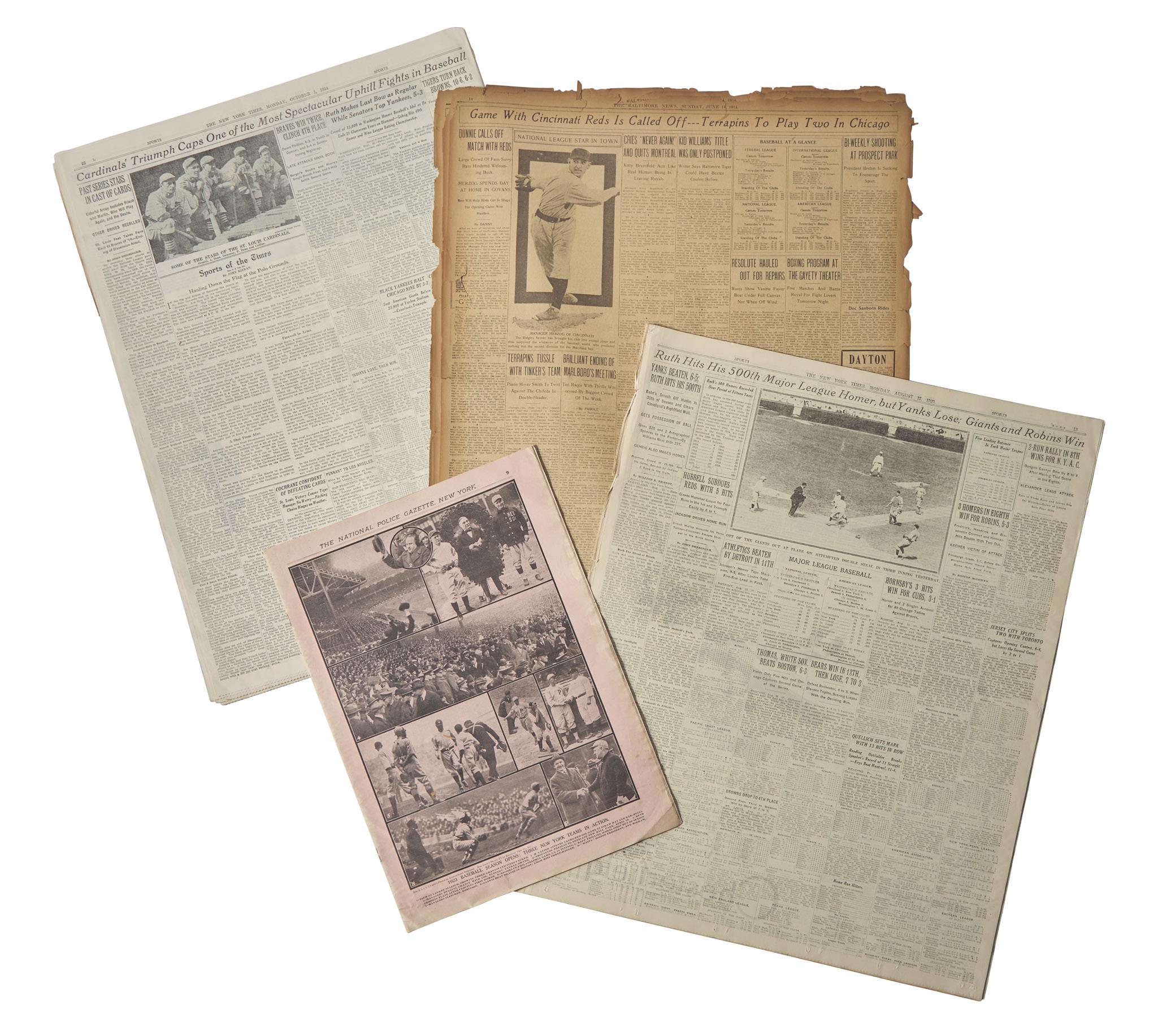
[Baseball] [Ruth, Babe]
A Very Early Report Mentioning Ruth, then in the Minor Leagues Playing for the Baltimore Orioles
The Baltimore News Baltimore, Sunday Evening, June 14, 1914. Vol. LXXXV, No. 41. Printed newspaper. Folio. Toned; paper brittle and chipping; separated along central vertical fold.
With a very early report of Babe Ruth while in the Minor Leagues playing for the Baltimore Orioles: “The opening setto yesterday was a corker, and Babe Ruth was forced to give the best he had, for the Orioles offered him little to work on.”
Together with:
1. The National Police Gazette. New York, Saturday, May 12, 1923. Vol. CXXII, No. 2387. Folio. Scattered soiling and wear.
Full-page coverage of the opening of the new Yankee Stadium, including a photo of Ruth crossing home plate after hitting his first homer there.
2. The New York Times. New York, Monday, August 12, 1929. Vol. LXXVIII, No. 26,133. Printed newspaper, on rag paper. Folio. Disbound.
Reporting Ruth’s 500th home run.
3. The New York Times. New York, Monday, October 1, 1934. Vol. LXXXIV, No. 28,009. Printed newspaper, on rag paper. Folio. Reinforced along central vertical fold.
Special rag printing reporting on Ruth’s last at bat as a regular player.
A fine lot covering the entire career of the “Great Bambino”.
$1,000 - 1,500
99
[Baseball] Type 1 Photograph of Hall of Fame Shortstop Joe Tinker
No place, ca. 1900s. Black and white photograph, 7 1/2 x 5 in. (191 x 127 mm). Type 1 photograph depicting Hall of Fame Chicago Cubs shortstop Joe Tinker, dressed in civilian garb. Sticker at top right of image, “Playing Exclusively for John W. Considine” Lightly creased; contemporary stamp on verso, adhesive residue from mounting on same. Accompanied by PSA Letter of Authenticity.
Joe Tinker (1880-1948) was a Hall of Fame shortstop who played the majority of his Major League career with the Chicago Cubs, from 1902-16, winning four pennants and two World Series championships. He now is best remembered for his inclusion in Franklin P. Adams’ 1910 poem “Baseball’s Sad Lexicon”, and its refrain, “Tinker to Evers to Chance”.
$400 - 600
100
[Basketball] An Early Women’s Basketball Team Photograph
Washoe County, Nevada, ca. 1890s-early 1900s. Silver gelatin print on original cardstock. Corners slightly worn; some scattered stains to mount; dampstaining to verso. Photo: 7 3/16 x 9 3/8 (182 x 238 mm); mount: 10 1/4 x 12 1/2 in. (260 x 317 mm).
An early photograph of a women’s basketball team from Washoe County, Nevada. In the United States, basketball was the first women’s team sport. First played by women at Smith College in 1892, a year after the sport’s creation, it quickly spread throughout the country over the ensuing decade. The early history of the sport was dominated by Senda Berenson, known as the “founding mother of women’s basketball”, who taught the sport at Smith. In line with Victorian norms, she modified the rules of the game to meet social expectations relating to women, such as increasing the number of players and prescriptions on types of playing and maneuvers, in order to reduce physicality and keep physical exposure to a minimum. This is reflected in the present photo by their concealing uniforms, typically comprised of long skirts or bloomers. The first inter-collegiate game was played in 1896, and the first high school game the following year. In 1899, Berenson published the first rules guide for women’s basketball, which was largely adhered to until the 1960s. Over the following decades the rules restraining the types of play were loosened, and in 1978, the first professional league was formed.
$300 - 500
101
[Basketball] [Jordan, Michael] Sissac, Carl V. Type 1 Photo of Michael Jordan
Circa 1995-1996. Original PSA Type 1 color photograph; 6 x 4 in. (152 x 102 mm). Encapsulated. Copyright stamp on verso.
$800 - 1,200
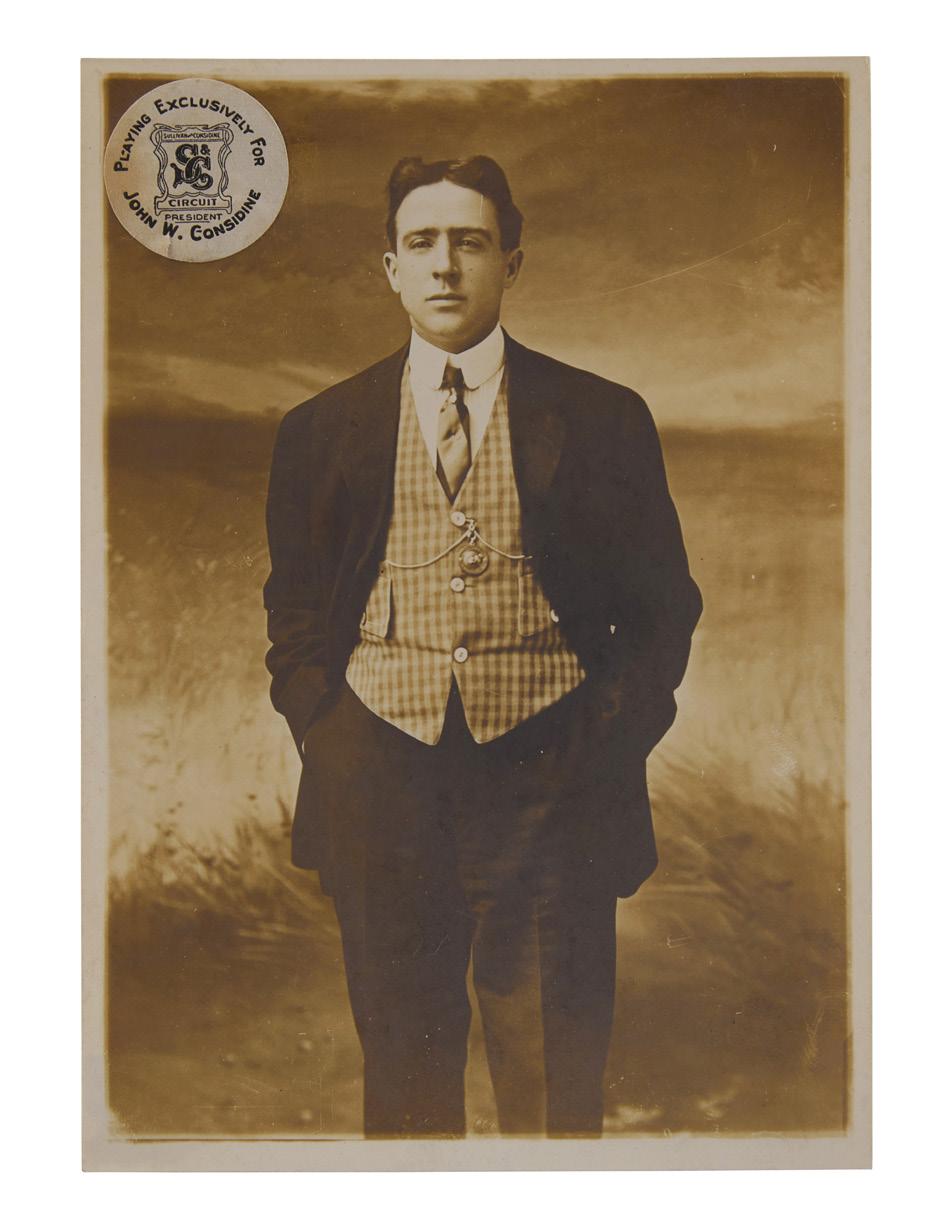
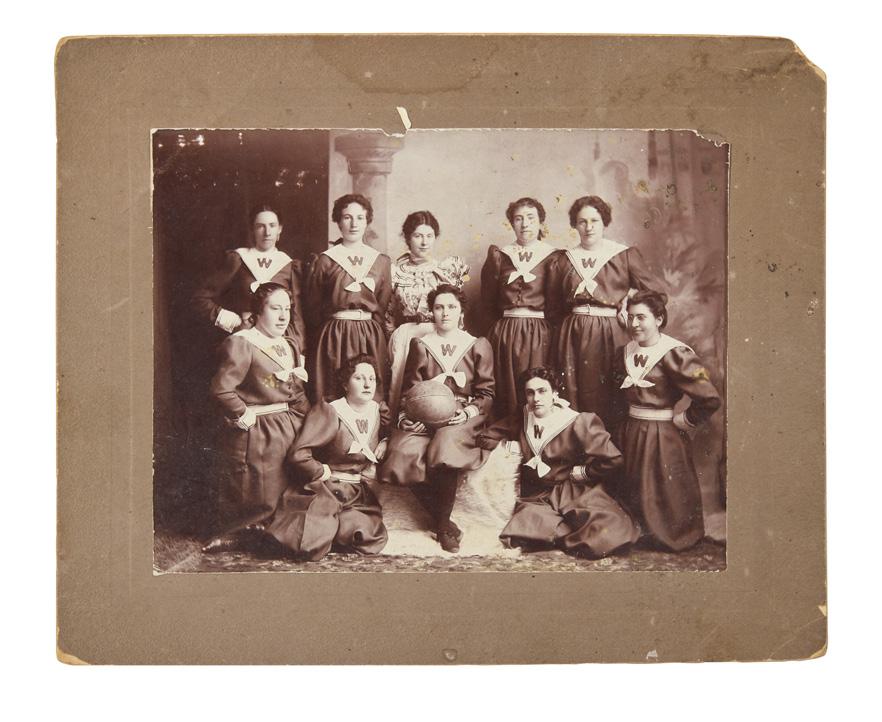
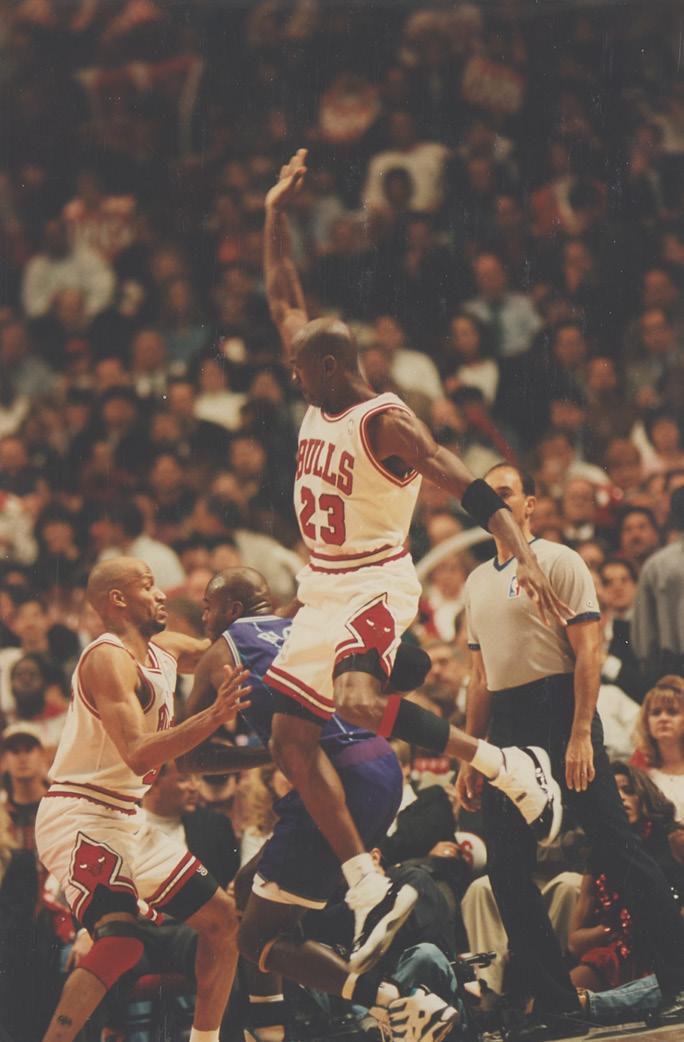
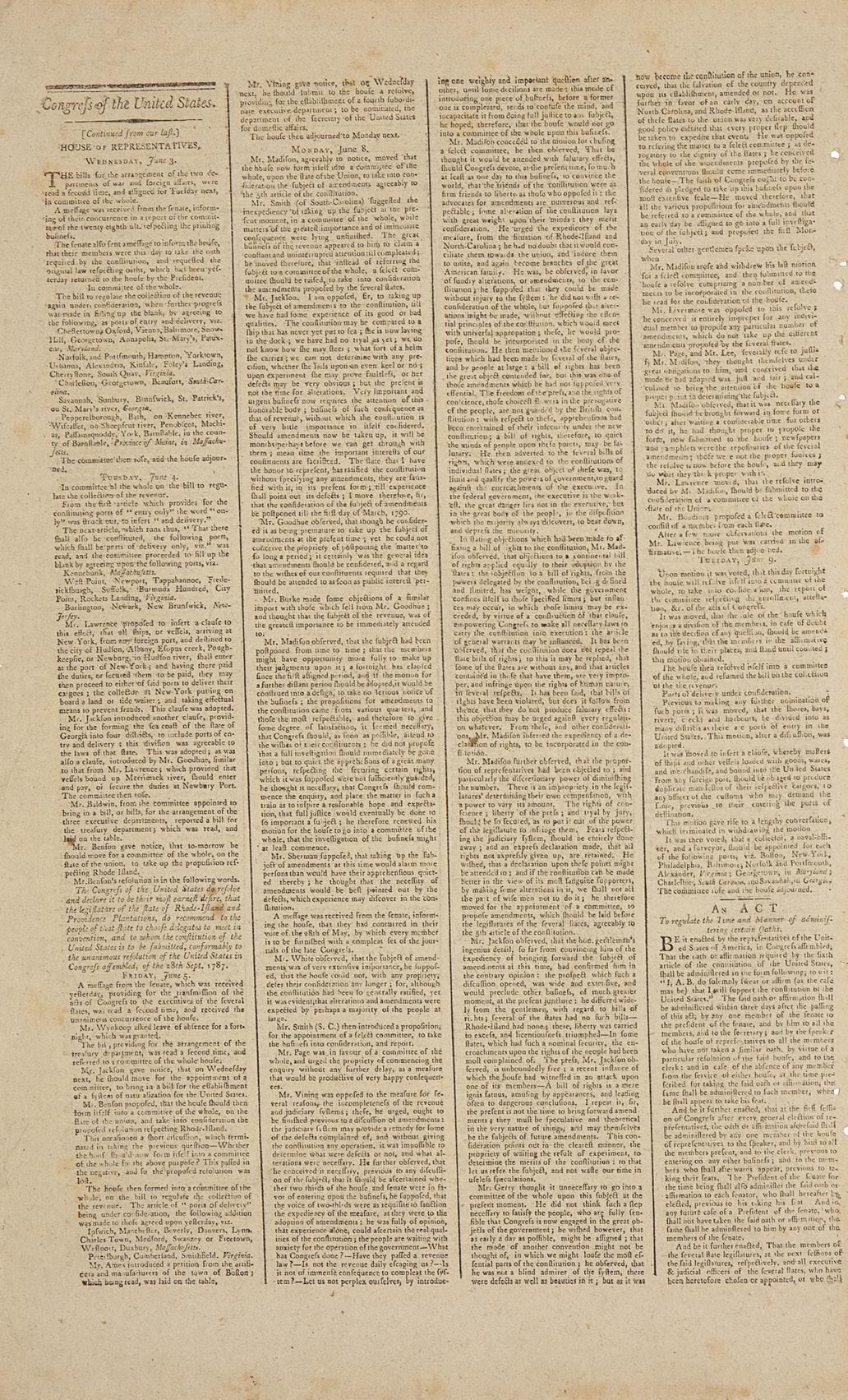
102
[Bill of Rights] Madison Proposes the Bill of Rights in a Local New York Newspaper
The New-York Journal and Weekly Register New-York: Printed and Published by Thomas Greenleaf, Thursday, June 11, 1789. Vol. XLIII, No. 29, Total Numb. 2404. Printed newspaper. Folio. (4) pp. Disbound.
One of the earliest newspapers--possibly only the second--to report on James Madison’s proposed Bill of Rights. On the second page, second column is a report on Madison’s landmark June 8 speech to Congress, where he asked his colleagues “to take into consideration the subject of amendments.” It is followed by a report of debates between members of Congress on the matter, and Madison’s submission of nine proposed amendments.
Madison’s nine proposed amendments, drawn from numerous sources, grew to seventeen, but was then narrowed to twelve. Ten were ultimately ratified by 1791, becoming what would later be referred to as the Bill of Rights. This newspaper reporting is evidently preceded only by the June 10 report in the Gazette of the United States, the semi-official Federalist Party newspaper also based in New York.
According to RBH, we cannot locate another copy of this issue at auction. $800 - 1,200
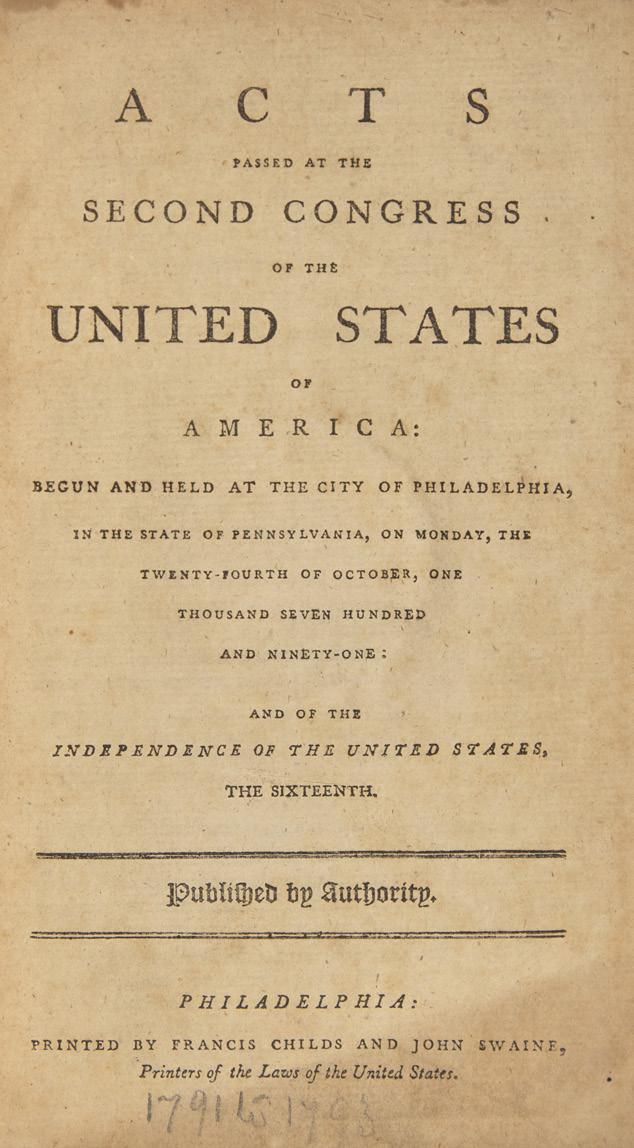
[Bill of Rights] An Early Printing of the Bill of Rights in Acts Passed at the Second Congress of the United States of America
Acts Passed at the Second Congress of the United States of America: Begun and Held at the City of Philadelphia...the Twenty-Fourth of October, One Thousand Seven Hundred and Ninety-One... Philadelphia: Printed by Francis Childs and John Swaine, (1793). First edition. 8vo. 175, iii, (1), 178-291, ii, (25) pp. Full contemporary brown calf, stamped in gilt, blind stamp of the Library of the New York Law Institute on front and rear board, rebacked, boards and extremities rubbed and worn; all edges trimmed; scattered spotting and soiling. Evans 26295; ESTC W14416; Sabin 15499
Printing the Acts passed at the Second United States Congress, held from March 4, 1791-March 4, 1793. Opening with an early printing of the Bill of Rights, and their ratification by the states, on pp. 3-19. Other important Acts passed include the Postal Services Act, the Coinage Act of 1792, the Fugitive Slave Act, etc.
Rare. ESTC locates only seven institutional copies. RBH locates four copies at auction since 2013.
$1,000 - 1,500
104
[Boone, Daniel] Group of 3 Items Related to Daniel Boone
1. The Weekly Register (Baltimore): H. Niles, (March 13, 1813). Supplementary to No. 2, Vol. IV. 8vo. (i), 34-40 pp. Disbound; first and last leaf separated; foxing.
Featuring an excerpt from a memoir on Daniel Boone on the first four pages.
2. Acts Passed at the Second Session of the Thirteenth Congress of the United States (Washington, D.C., 1814). First edition. 8vo. (iii), 244-429, (1), 6 pp. Original stiff blue wrappers, worn, contemporary and later manuscript on spine; text unopened; scattered spotting; library ink number on title-page.
Includes an “Act for the relief of Daniel Boone”, granting him rights to land in Missouri received by the Spanish government (p. 266).
3. The Yankee Boston: Published by Rowe & Hooper, Friday, June 21, 1816. Vol. V, No. 26. Printed newspaper. Folio. (4) pp. Disbound; creasing from when folded; scattered spotting.
Printed on the front page is a letter from an officer at Fort Osage, recounting their meeting Boone.
Daniel Boone (1734-1820) was an American frontiersman who is considered one of the first folk heroes of the United States. Born in Pennsylvania, he steadily made his way west, eventually becoming one of the first white settlers to explore what is now the Kentucky region. Within two decades over 200,000 settlers had made their way into the area through routes established by Boone.
$200 - 300
105
[Boxing] Group of 11 Items Related to Boxing, Including Press Photos, etc.
Locations and dates vary. Group of 11 items related to boxing, including, eight press photographs of boxing greats such as Muhammad Ali (4), Joe Louis (1), Jack Dempsey (1), and Floyd Patterson (1), and Max Baer (1); an issue of the French magazine La vie au grand air (1910), featuring a story on a fight between Jack Johnson and James Jefferies; a small printed ad listing ticket prices for the Tunney-Dempsey match of 1926 in Chicago; a printed color poster, ca. 1894, depicting a fight between James J. Corbett and Peter Jackson.
Sizes vary. Conditions vary but generally fine.
$300 - 500
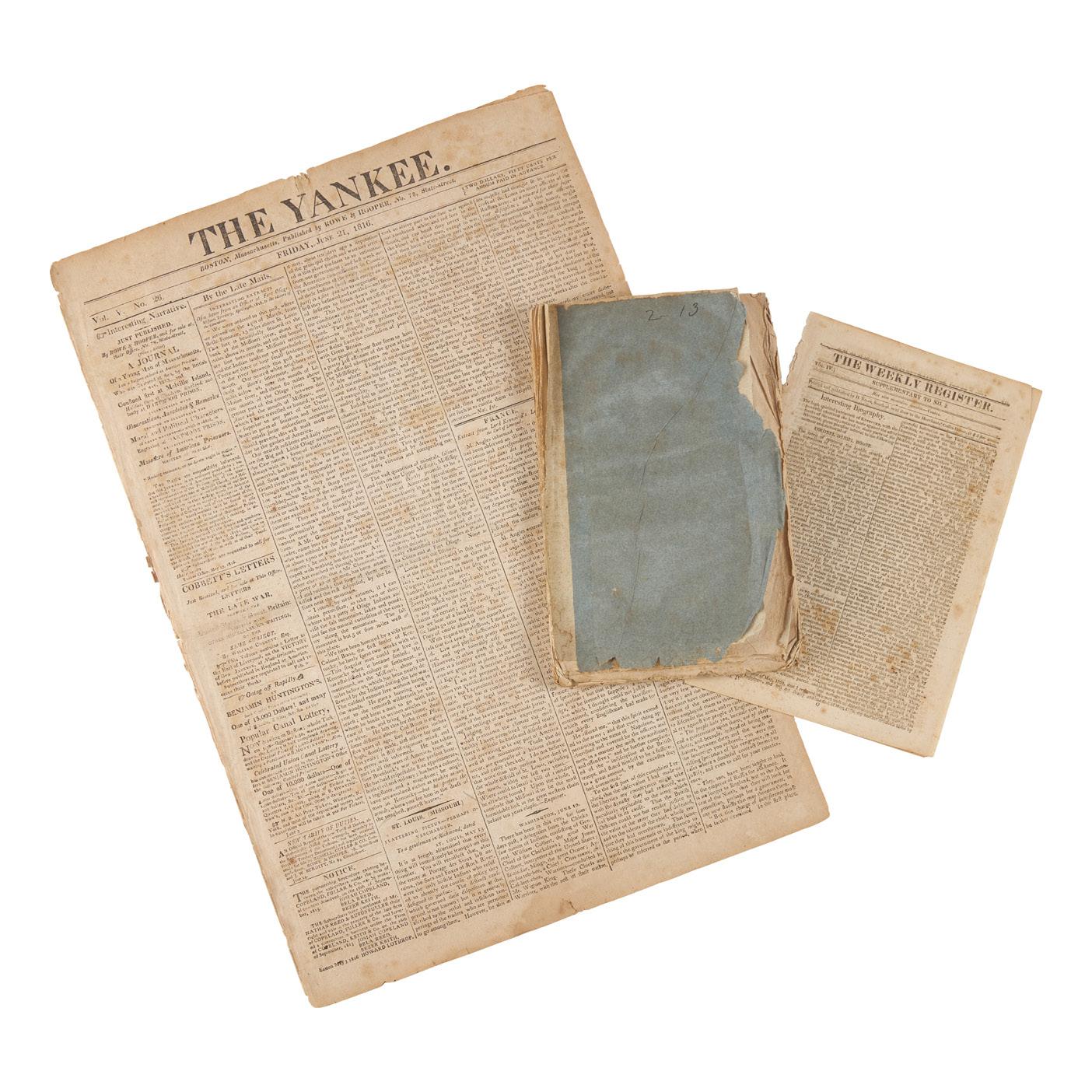
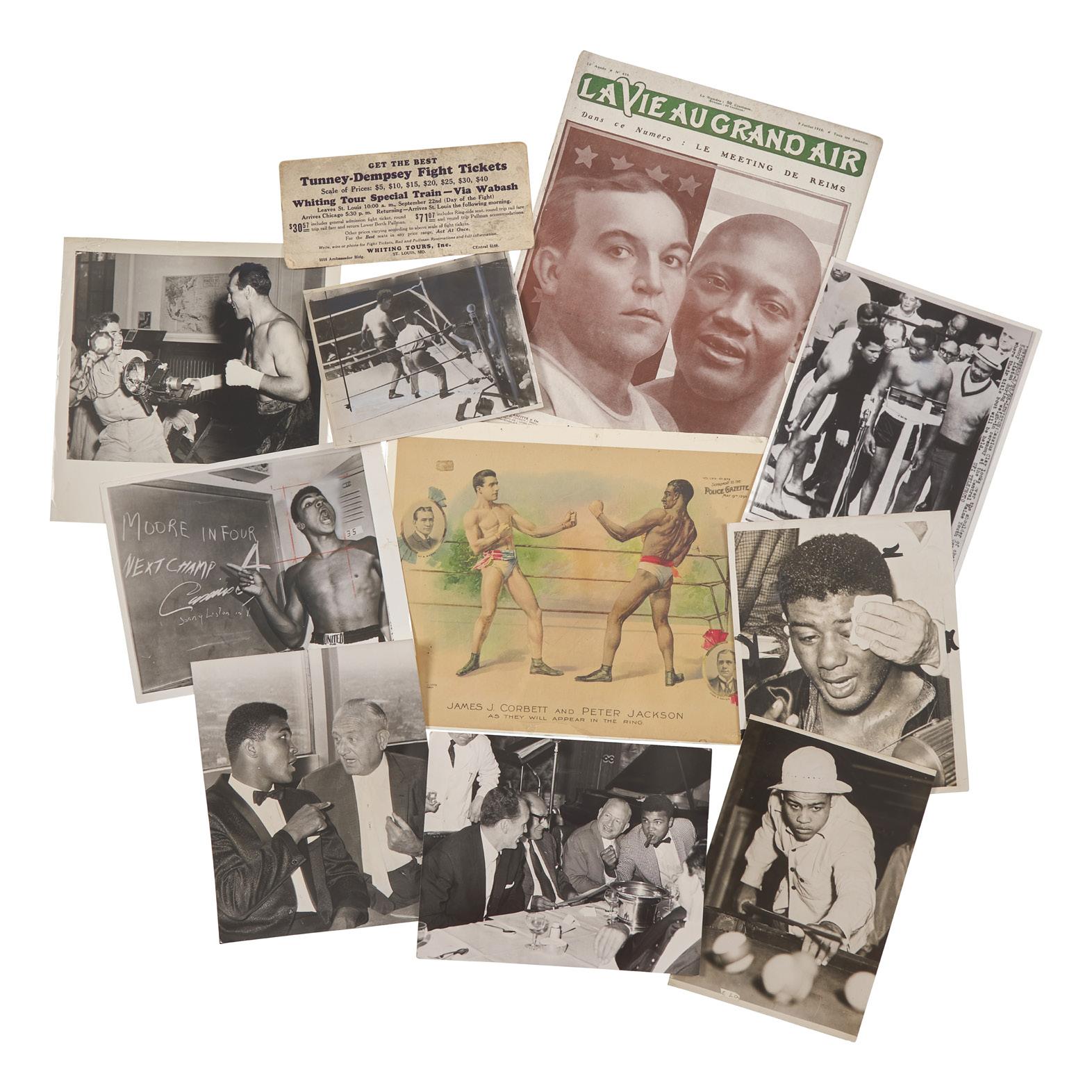
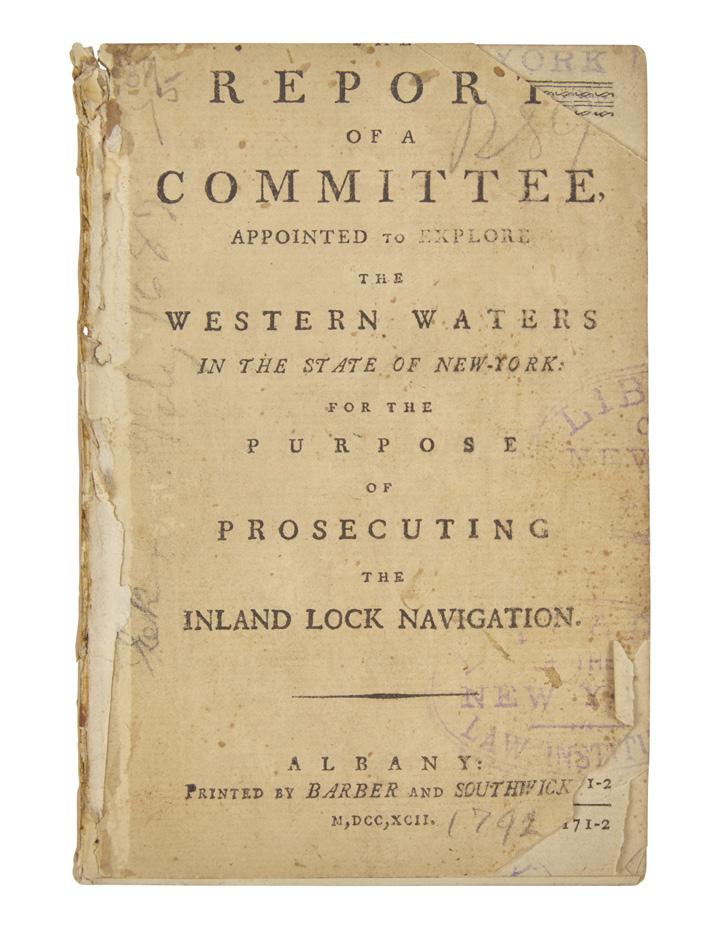
106
[Canal Building] The Predecessor of the Erie Canal
Report of a Committee, Appointed to Explore the Western Waters in the State of New-York: For the Purpose of Prosecuting the Inland Lock Navigation Albany: Printed by Barber and Southwick, 1792. First edition. 16mo. 24 pp. Disbound; corners of title-page clipped, affecting some letters, two library ink stamps on same (“Library of the New York Law Institute”), same ink stamps on pp. 2 and 24; text trimmed close affecting some page numbers at top; creasing and small chip in bottom corner of pp. 3/4; scattered spotting and soiling. In black cloth fall-down-back box. Evans 24604; ESTC W8575; Sabin 22754; Streeter Sale 883
Rare first edition detailing the Western Inland Lock Navigation Company, which constructed New York’s first major canal system along the Mohawk River to Lake Oneida. Incorporated by the New York state legislature in 1792 with General Philip Schuyler (Alexander Hamilton’s fatherin-law) as its president, the company was established to enhance navigation and commerce on waterways west of Albany. Construction commenced in 1793, and within a decade the company had successfully built a network of canals designed to bypass difficult portages at locations such as Little Falls and Rome. Although these improvements revolutionized water transportation in New York, the company’s infrastructure was rendered obsolete by 1825 following the completion of the much larger Erie Canal.
According to RBH, this is the first copy to come to auction since the Streeter Sale.
$1,500 - 2,500
Military Portraits Map of the Seat of War, Uniforms, Arms, &c.
New York: Published by H.H. Lloyd & Co., 1861. Hand-colored engraved poster. Printed by Waters & Son, New York. Small portion of inpainting to copyright line in bottom left. Linen backed; wear along edges. 39 x 29 in. (991 x 737 mm).
Showing military uniforms and dress, 16 large portraits of prominent Union Army leaders (Winfield Scott, George McClellan, John C. Fremont, Benjamin F. Butler, et al.) and a map illustrating the regions of Maryland, Virginia, and the Chesapeake Bay.
Henry Huggins Lloyd (1828-68) was a New York City-based publisher and mapmaker, operating before, during, and after the Civil War. Their extensive output included posters such as these, as well as military campaign charts, patriotic portraits of military leaders, regional and state maps, etc.
Rare to auction, we cannot find a similar example in online records. OCLC locates only two similar examples, at Harvard University and in the David Rumsey Map Collection at Stanford University (the latter depicting fewer military leaders).
$2,000 - 3,000
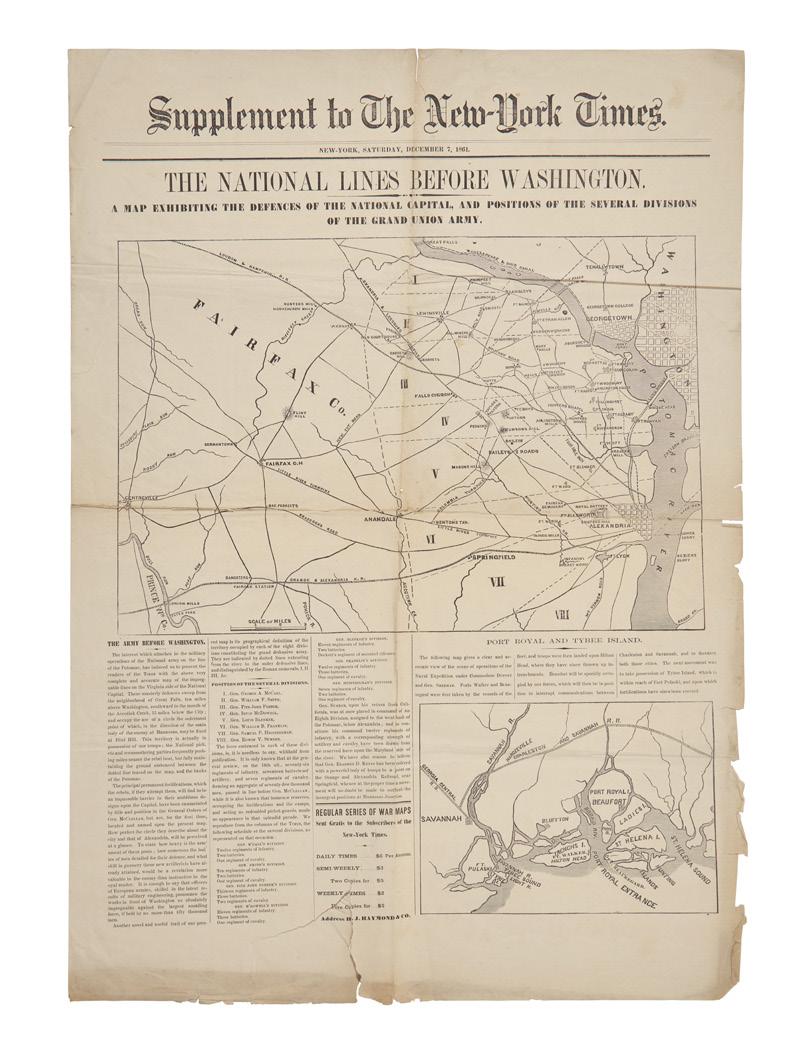
108
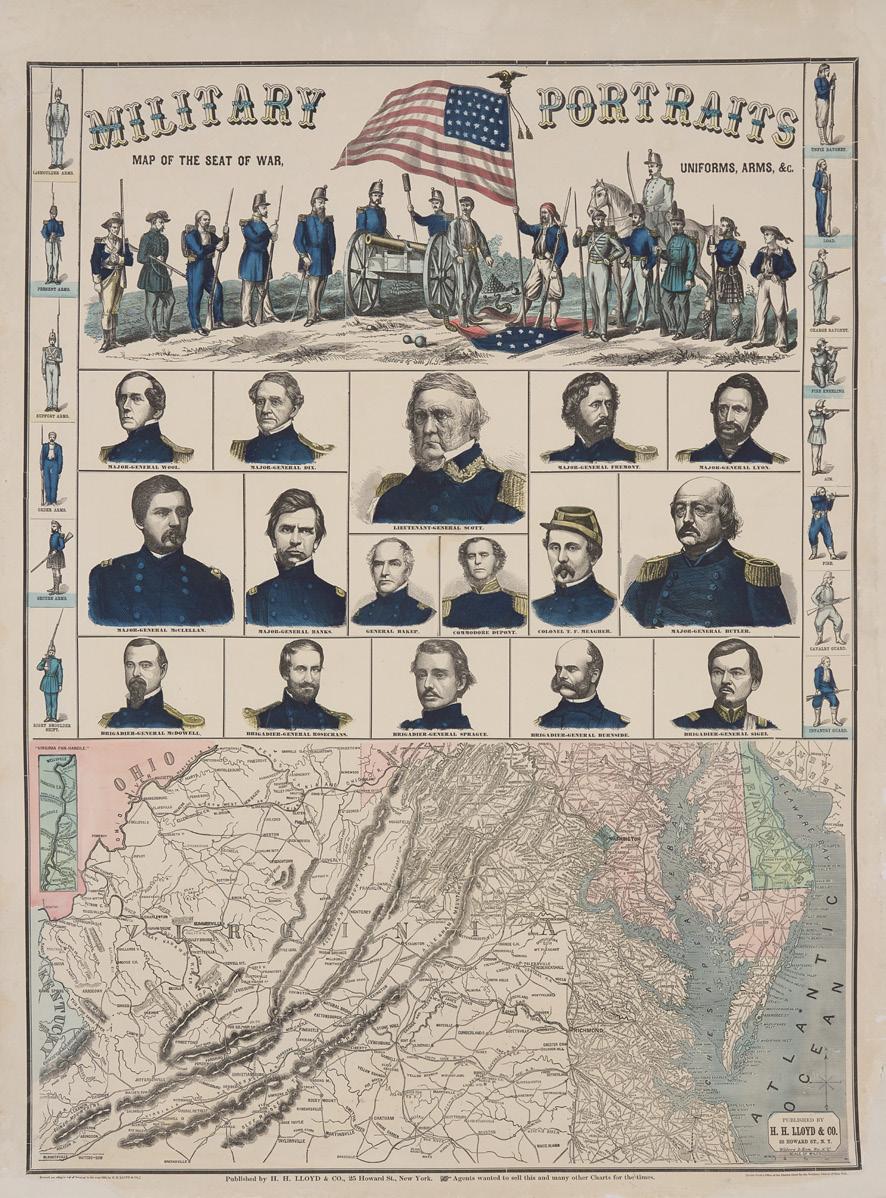
[Civil War] The National Lines Before Washington: Broadside Supplement to The New York Times
New-York, December 7, 1861. Printed broadside; 22 x 15 in. (550 x 385 mm). Illustrated with two engraved battlefield maps. Creasing from when folded, separations along folds; unevenly toned; closed tear in bottom edge; wear along right edge.
An early Civil War map exhibiting the defenses of the national capital, and positions of the several divisions of the Grand Army, part of a series sent free to New-York Times subscribers.
$400 - 600
109
[Civil War] Group of 7 Newspapers with Important Content Related to the Battle of Antietam, a “Negro Confederacy”, the 54th Massachusetts Infantry, and more, 1861-65
1. Daily Appeal. Marysville, California, Thursday Morning, May 23, 1861. Vol. 3, No. 122. Folio. 4 pp. With an anti-Union article on the “Negro Confederacy”.
2. The Philadelphia Inquirer. Philadelphia, Monday, September 22, 1862. Folio. 8 pp. Leaves starting to separate. Front-page report on the Battle of Antietam.
3. Daily Richmond Examiner. Richmond, Virginia, Tuesday Morning, October 7, 1862. Vol. XVI, no. 183. Folio. 4 pp. Text faded. Confederate newspaper, with Confederate-related news.
4. The Tri-Weekly Telegraph. Houston, Texas, Monday, March 2, 1863. Vol. XXVIII, No. 150, Whole No. 8647. Broadsheet. Small holes along central vertical fold. Confederate newspaper, with Confederate-related content.
5. The Commonwealth. Boston, Friday, May 15, 1863. Vol. I, No. 37. Folio. 4 pp. Scattered soiling. With a report on the 54th Massachusetts Infantry Regiment, one of the first African American regiments in the Civil War.
6. The Philadelphia Inquirer. Philadelphia, Thursday, May 25, 1865. Folio. 8 pp. Leaves starting or separated. «The Armies of the Republic. Their Triumphant Return to the National Capital...»
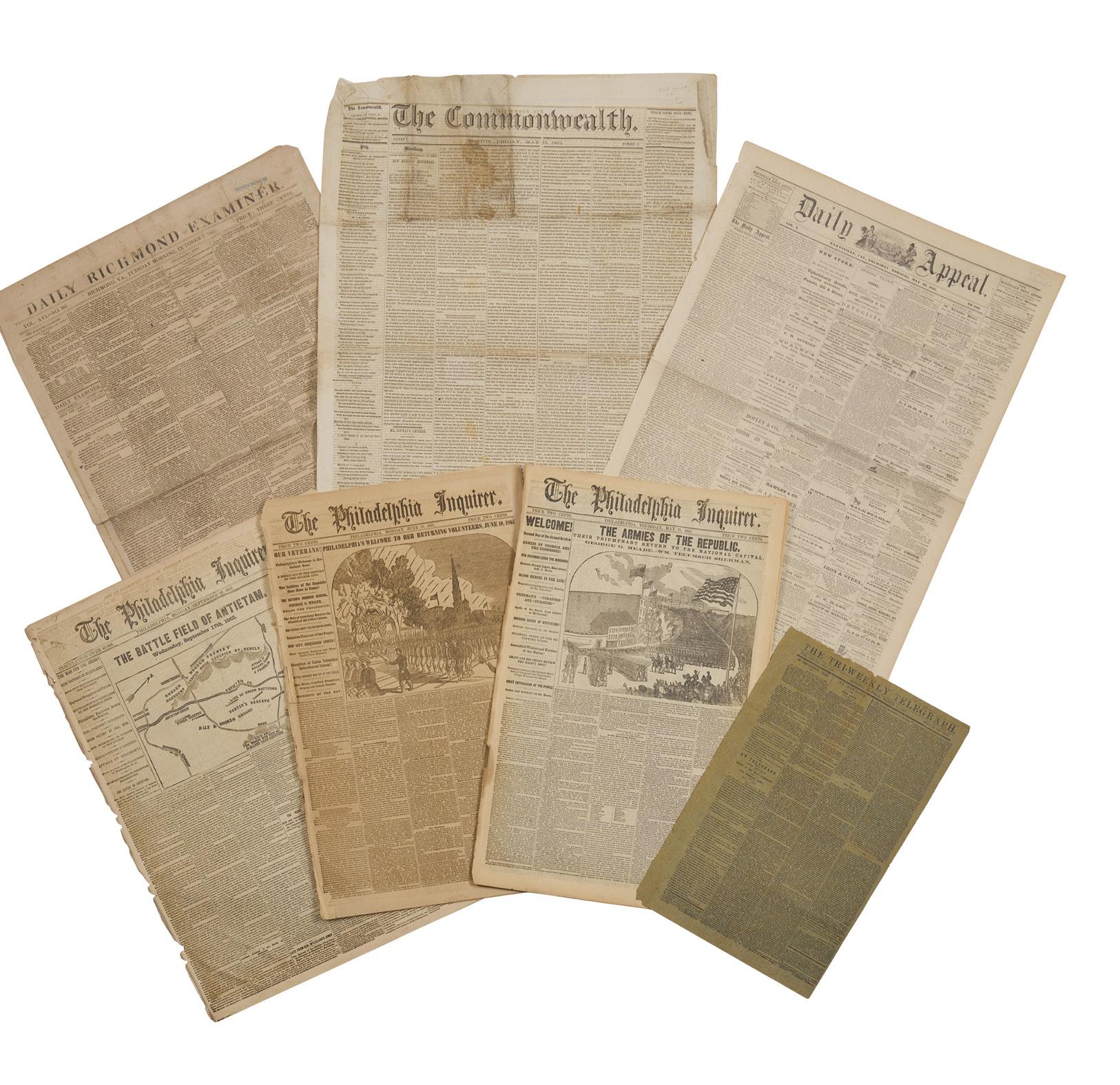
7. The Philadelphia Inquirer. Philadelphia, Monday, June 12, 1865. Folio. 8 pp. Leaves starting or separated, last leaves torn. “Philadelphia’s Welcome to Her Returning Volunteers...”
Condition varies, generally good, with expected creasing, wear, and tears.
An illuminating set of eight Civil War-era newspapers, offering a trans-continental perspective on the conflict.
Lot also includes six cartes de visite of Civil War figures, including of President Lincoln and his son Tad.
$400 - 600
110
[Civil War] General Benjamin F. Butler’s Farewell Address to the Army of the Gulf in New Orleans
Printed Document, General Orders No. 106
New Orleans: Headquarters Department of the Gulf, December 15, 1862. Printed document, being Benjamin F. Butler’s General Orders No. 106, his farewell address to his troops. 12mo. Disbound; reinforced with sello tape along spine.
Butler praises his army for their service and for illustrating the “best traits of the American soldier”. He expresses his admiration for their having “fed the starving poor, the wives and children of your enemies, so converting enemies into friends...you have won the confidence of the ‘oppressed race’ and the slave. Hailing you as deliverers, they are ready to aid you as willing servants, faithful laborers, or, using the tactics taught them by your enemies, to fight with you in the field...”
$300 - 500
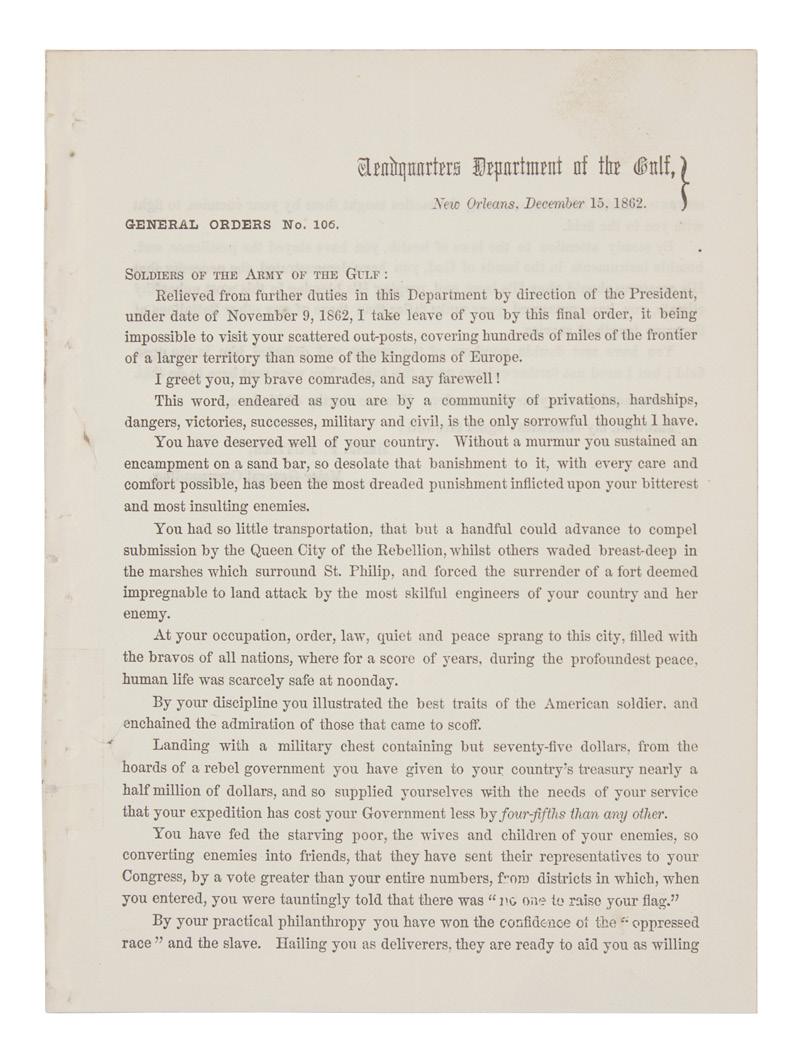
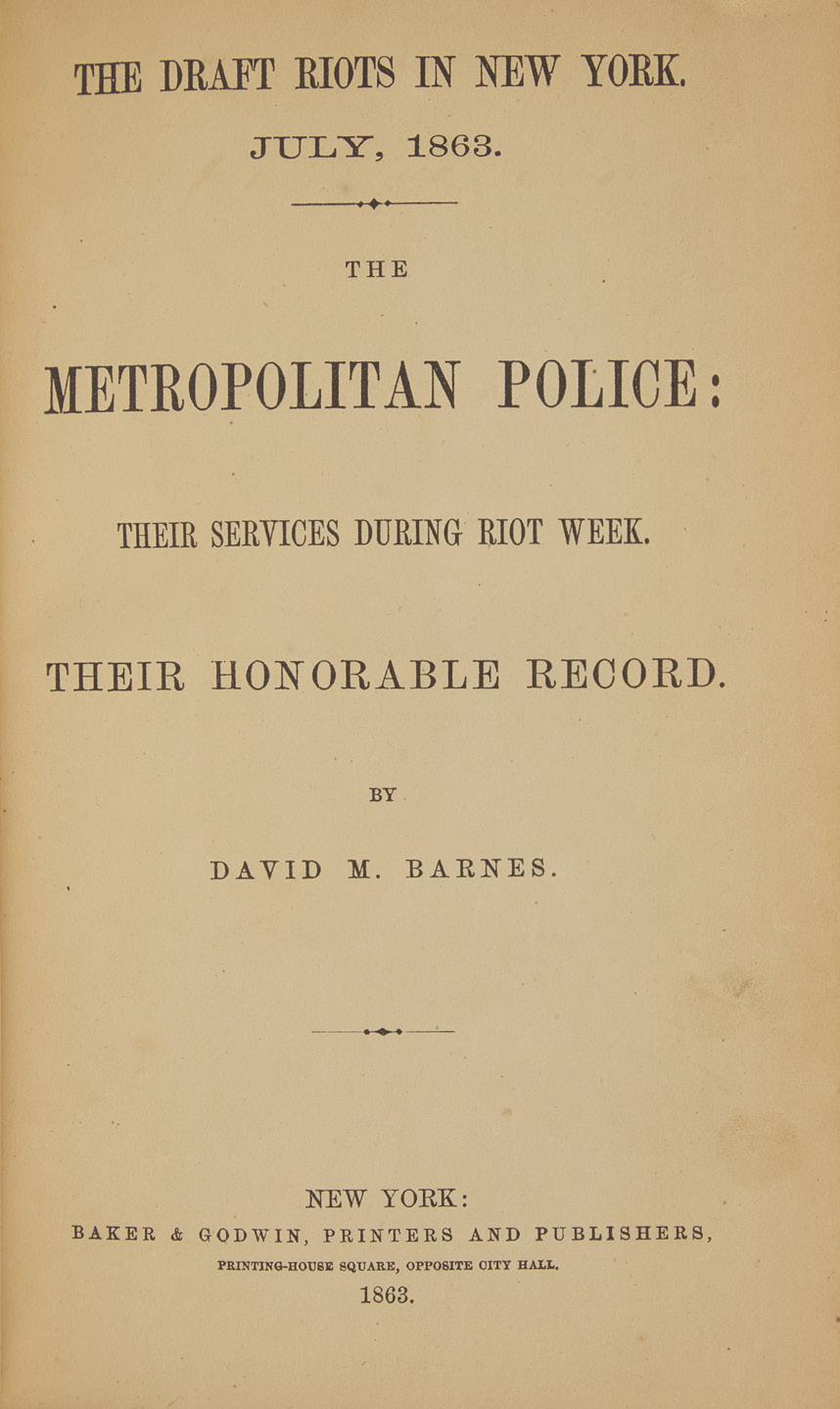

111
[Civil War] Dedication Copy of “The Draft Riots in New York”, Presented to Police Commissioner Thomas C. Acton, Who Led New York’s Police Force to Stamp Out the New York Draft Riots
“To Commissioner Acton are our Citizens indebted in a large degree for the prompt and successful assaults upon the rioters, and to his judicious and energetic action for their subsequent entire defeat and dispersion.” (p. 8)
Barnes, David M.
The Draft Riots in New York. July, 1863. The Metropolitan Police: Their Services During Riot Week. Their Honorable Record New York: Baker & Godwin, 1863. First edition. Dedication copy, inscribed on front blank by the author, and presented to New York Police Superintendent Thomas C. Acton: “Hon Thos C Acton / with the esteem / & respect of his friend / David M Barnes / June. ‘64”. 8vo. 117, (3) pp. Presentation binding of full navy blue morocco, elaborately stamped in blind and in gilt, with “Hon. Thomas C. Acton” in gilt on front board, rebacked, rubbed along extremities; all edges gilt; small loss in top corner of title-page; wear and closed tear at top of Dedication from mounted lined paper and newspaper clipping on verso; small holes at top of p. (5) from removed staple; sheets toned; scattered spotting. Blockson 2741; Sabin 3513
The unprecedented riots that engulfed New York City from July 13 to 16, 1863, were ultimately contained due to the steady command of Metropolitan Police Commissioner Thomas C. Acton. Sparked by backlash against the nation’s first compulsory draft, the riots exploited deep-seated racial and class tensions, resulting in a four-day conflagration that claimed over 120 lives, injured 2,000 people, and caused millions of dollars in property damage.
In the opening hours of the unrest, rioters first targeted the outnumbered Metropolitan Police force, critically wounding Police Superintendent John A. Kennedy, before shifting their focus to viciously attack the city’s Black population. In the wake of this chaos, Acton and fellow Commissioner John G. Bergen assumed control of the city’s police operations. While Bergen coordinated forces in Brooklyn and Staten Island, Acton directed the troops in Manhattan, the epicenter of the most intense violence. “The labor during the first four days was immense, and some estimate of it may be formed by the fact that, in the telegraphic department alone, there were upward of four thousand dispatches received and orders sent, all of which, with but few exceptions, required the personal supervision of Mr. Acton. These, it must be remembered, were only a fraction of the many matters requiring his attention. He was not out of the office, save on official business, and then but briefly, during the first five days of the week--the duration of riot and its symptoms--and had no sleep from six o›clock Monday morning until two o›clock on Friday morning...The position of affairs was one as important and as critical as that on a field of battle; time of as much value; sagacity and decision as necessary. Upward of two thousand men under his control, constant emergencies arising in all sections of the city, immediate action required on information received...Commissioner Acton was equal to his situation, exhibiting wonderful powers of endurance, and a coolness, activity, and vigor which on every occasion led to success...» (pp. 7-8)
$2,000 - 3,000
[Civil War] Scarce Union Newspaper Printed in the South, Reporting Sherman’s March on Augusta, as well as the “Last Great Battle of the War”
The Camp Illuminator Bridgeport, (Alabama), Tuesday, March 7, 1865. Vol. I, No. 9. 8vo. 4 pp. Creasing from old folds; a few short splits along horizontal folds; scattered toning and soiling.
A scarce Union newspaper, printing reports in the waning days of the Civil War, including Sherman’s march on Augusta. Located on the Tennessee River in northern Alabama, Bridgeport served as a critical railroad and supply hub linking Union forces operating in Tennessee and Georgia. Following the Union victory at the Siege of Bridgeport in October 1863, control of this area helped secure vital supply lines into East Tennessee and supported subsequent campaigns deeper into the Confederacy.
$300 - 500
[Civil War] Bound Volume of Over 70 Issues of The Philadelphia Inquirer, October-December, 1864
Philadelphia, Saturday, October 1-December 31, 1864. Printed newspapers in five columns. Bound, non-consecutive run of The Philadelphia Inquirer, a daily paper, comprised of approximately over 70 issues. Covers perished, leather spine remnants, endpapers torn; issues generally worn, margins torn or chipped; many issues with sections torn or excised.
An extensive bound volume of war-dated issues of The Philadelphia Inquirer, providing contemporary commentary on major events of the Civil War and the Presidential Election of 1864. Notable issues feature headlines regarding President Lincoln’s campaign and reelection, the Siege of Petersburg, Sherman’s March to the Sea, the Battle of Nashville, the raids of Confederate Colonel John S. Mosby, the Siege of Fort Fisher, and much more.
$400 - 600
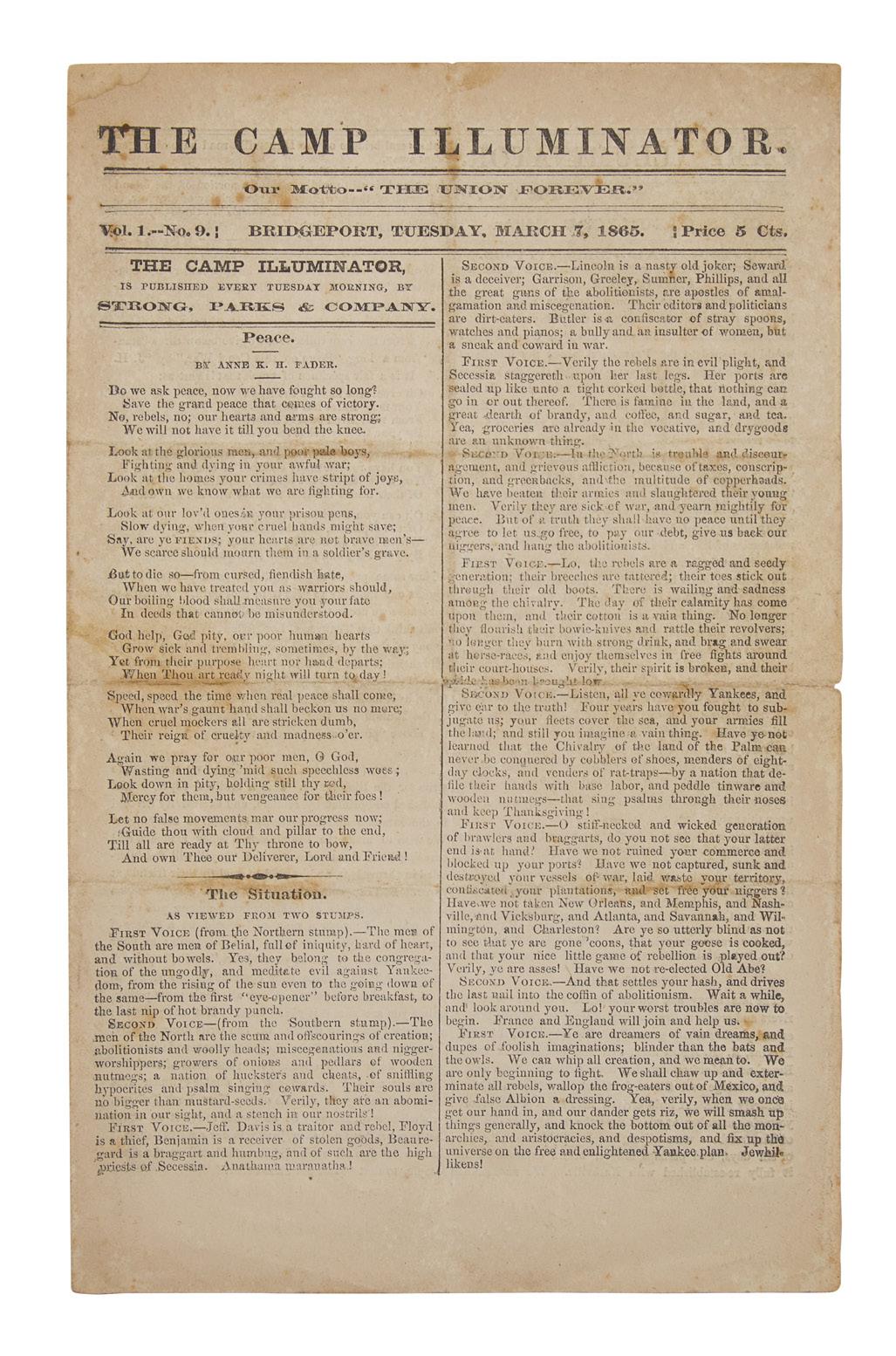
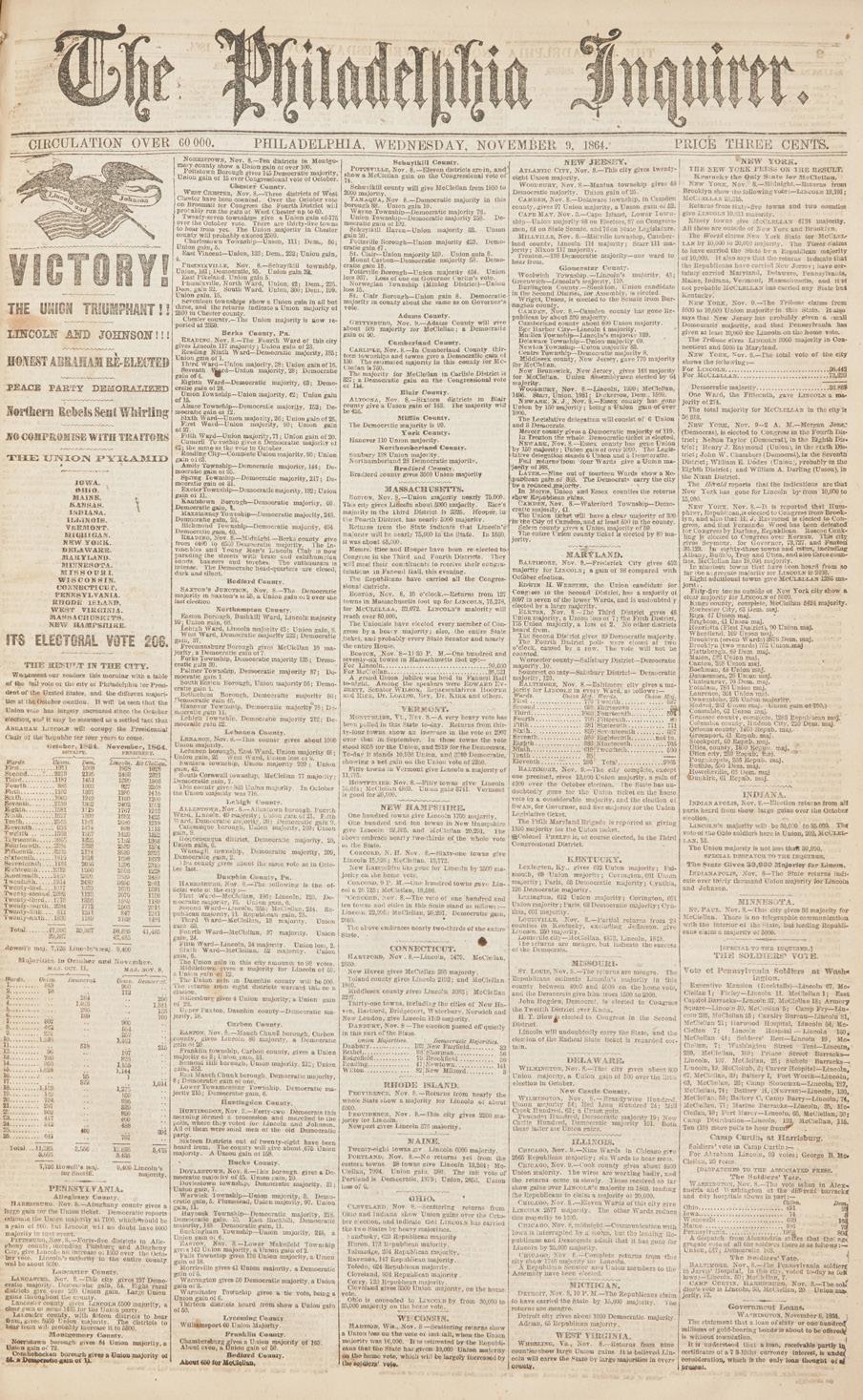
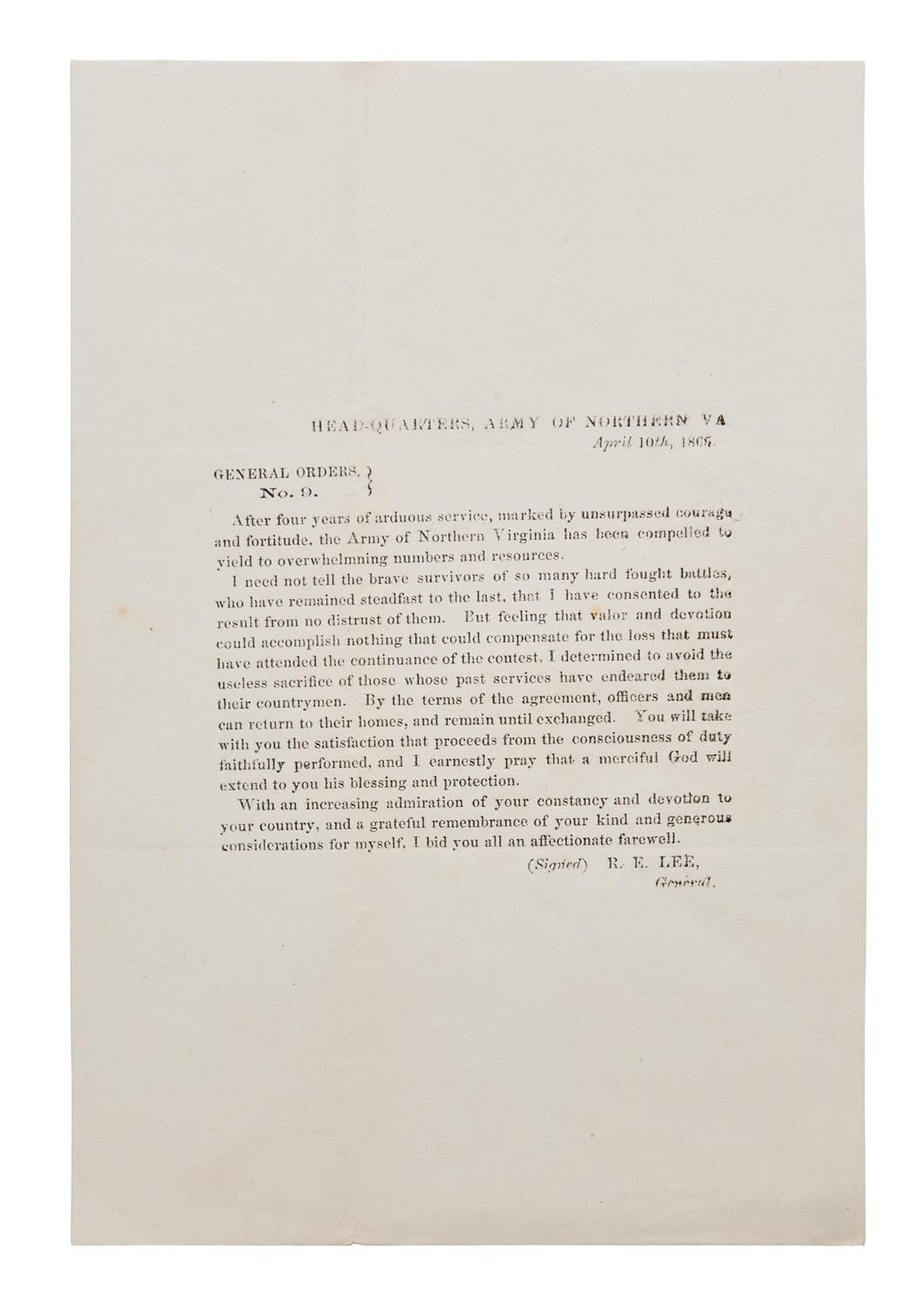
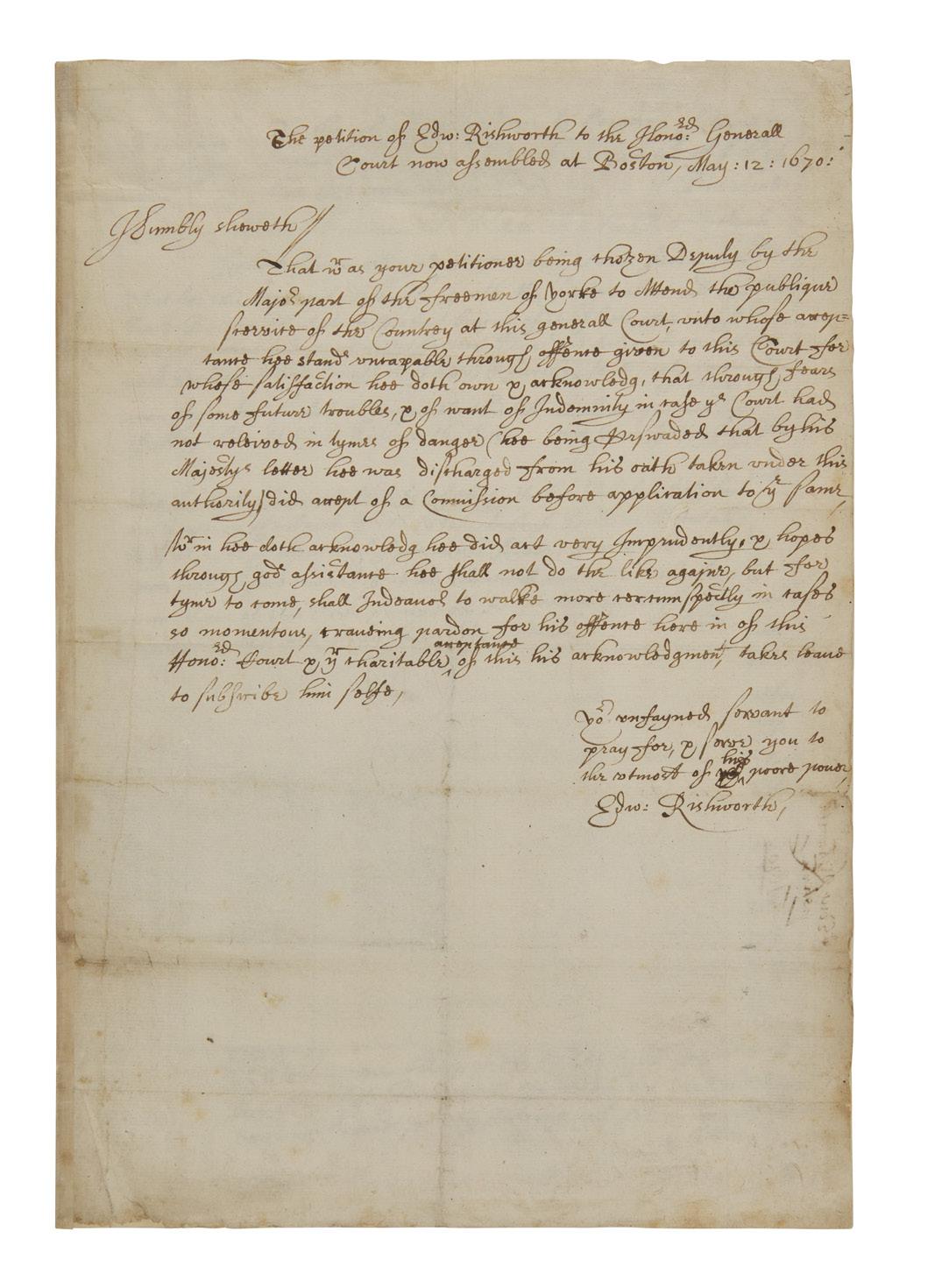
[Civil War] Field Press Printing of General Robert E. Lee’s Farewell Address, April 10, 1865
Head-Quarters, Army of Northern Virginia, April 10, 1865. Letterpress circular of General Orders No. 9, signed in type by Robert E. Lee. Creasing from old folds. 8 1/4 x 5 1/2 in. (209 x 140 mm).
Following the surrender of Confederate General Robert E. Lee to Ulysses S. Grant at Appomattox Court House on April 9, 1865, Lee and his lieutenants retired to his tent, where they sat before a fire and discussed the day’s events and Lee’s own feelings towards his soldiers. It was decided that Lee would draft an address to be distributed to his troops thanking them for their service but acknowledging the Confederate cause was lost, the South defeated.
According to Lee’s aide-de-camp, Colonel Charles Marshall, Lee gave him the use of his ambulance in which to draft the letter, going so far as to place an armed guard before it in order to prevent any distraction on Marshall’s part from the task at hand. Lee then read over the draft, made a few changes, and ordered that it be printed and distributed. While numerous copies were printed as broadsides and sold throughout the South following the war, original field copies are considered quite scarce.
$1,500 - 2,500
114
[Colonial America] Rishworth, Edward. Group of 3 Autograph Legal Documents, signed
1. Boston, May 12, 1670. Single sheet, 12 1/4 x 8 1/2 in. (311 x 216 mm). One-page autograph document, signed by Edward Rishworth, being a petition to the General Court seeking a pardon for accepting a commission contrary to the law. Docketed on verso. Reinforced along edges on verso; creasing from old folds. Mounted along left edge with two below documents.
2. (Province of Maine), May 6, 1681. Single sheet, 5 1/2 x 7 in. (140 x 178 mm). Autograph document, signed twice by Rishworth as Recorder of Maine Province, being a sworn deposition by a Richard Hunnewell (16451703), regarding a land claim in relation to Ambrose Boaden’s plantation. Creased from old folds; laid down on larger sheet.
3. Province of Maine, December 11, 1680. Two sheets, each 11 5/8 x 7 1/2 (295 x 190 mm). Three-page autograph document, signed by Rishworth as Recorder of the Province of Maine, being a copy of a libel suit brought by Collector and Surveyor of New England Edward Randolph (1632-1703) against Ely Nicoll, Master of a Barque. Creasing from old folds; repairs along edges; scattered spotting.
Based primarily in Maine, then part of the Massachusetts Bay Colony, Edward Rishworth served in a variety of civic roles, including as a member of the Governor’s Council and as a justice of the courts. He is perhaps best remembered for his involvement in documenting King William’s War and the frontier conflicts between English settlers and French-allied Indigenous groups in northern New England.
C.F. Libbie & Co., Boston, March 17, 1891, Catalogue of Autographs & Letters...by the Late Prof. E.H. Leffingwell, Lot 5486
$800 - 1,200
115
[Colonial America] Rare First Edition of the Treaty of Whitehall, King James II’s First Treaty and Among the Earliest Between England and France in Relation to America
Treaty of Peace, Good Correspondence & Neutrality in America, Between the most Serene and Mighty Prince James II...And the most Serene and Mighty Prince Lewis XIV...Concluded the 6/16th Day of Novemb. 1686 (London), In the Savoy: Printed by Thomas Newcomb, 1686. First edition. 12mo. 19, (1) pp. Full tan calf, red morocco spine label, stamped in gilt, loss in lower spine with wear to front and rear joints; gilt edges; gilt dentelles; small repair at bottom of title-page; bottom corners of B2 and C2 repaired; scattered spotting. ESTC R477000; Sabin 96532
In this treaty, England and France pledged neutrality in North America, as well as renouncing illegal trade and fishing within the boundaries of each other’s colonies, as well as the aiding of pirates and Native Americans. Despite this, the Treaty was short lived, as King Williams’s War broke out in 1688 (the first of several North American conflicts between the two nations that would culminate in the French and Indian War), and King James II was shortly after deposed.
According to RBH, this is only the second copy to come to auction since 1991.
$1,000 - 1,500
116
[Colonial America] A London Newspaper with Front-Page Addresses from Plymouth Colony
The London Gazette
London: Thomas Newcomb, From Thursday June 14, to Monday June 18, 1688. Numb. 2356 Printed broadsheet newspaper. Light marginal chipping and soiling.
“Nothing can be more valued by a People who on the mere account of Religion left their Native Land, and Transplanted themselves into a Desart...”
With a front-page address from Plymouth Colony and several congregations in New England praising King James II, and reaffirming their loyalty and gratitude to him.
$300 - 500
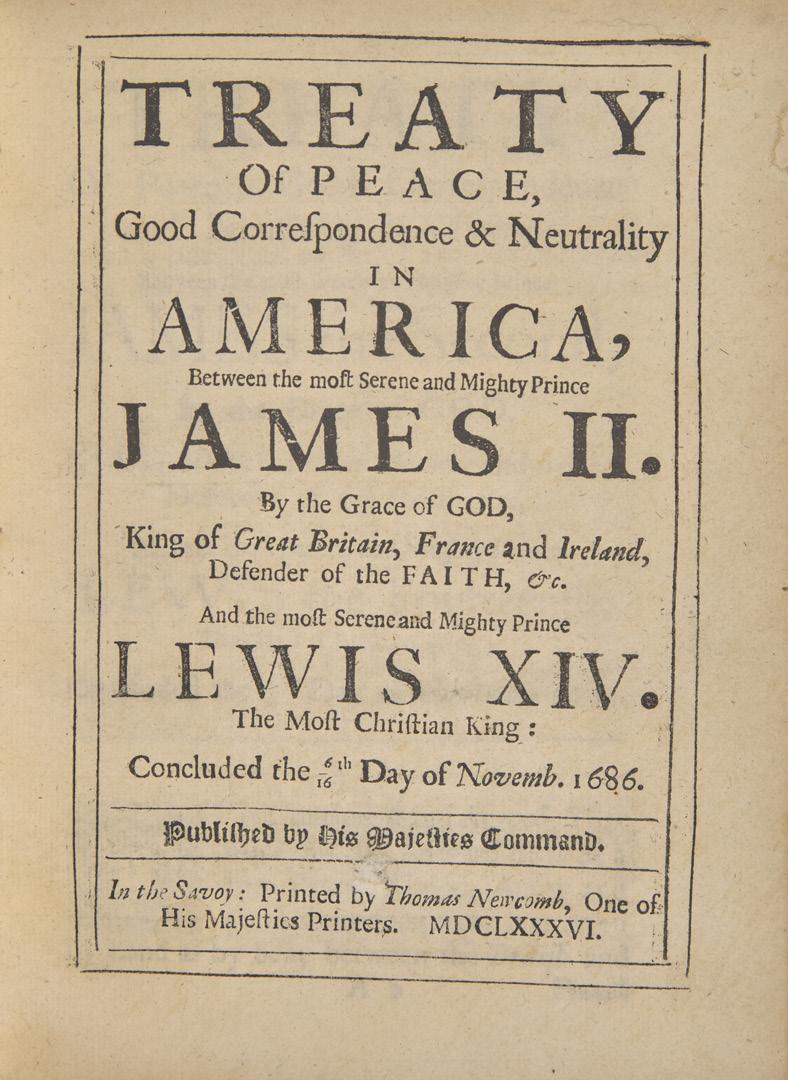
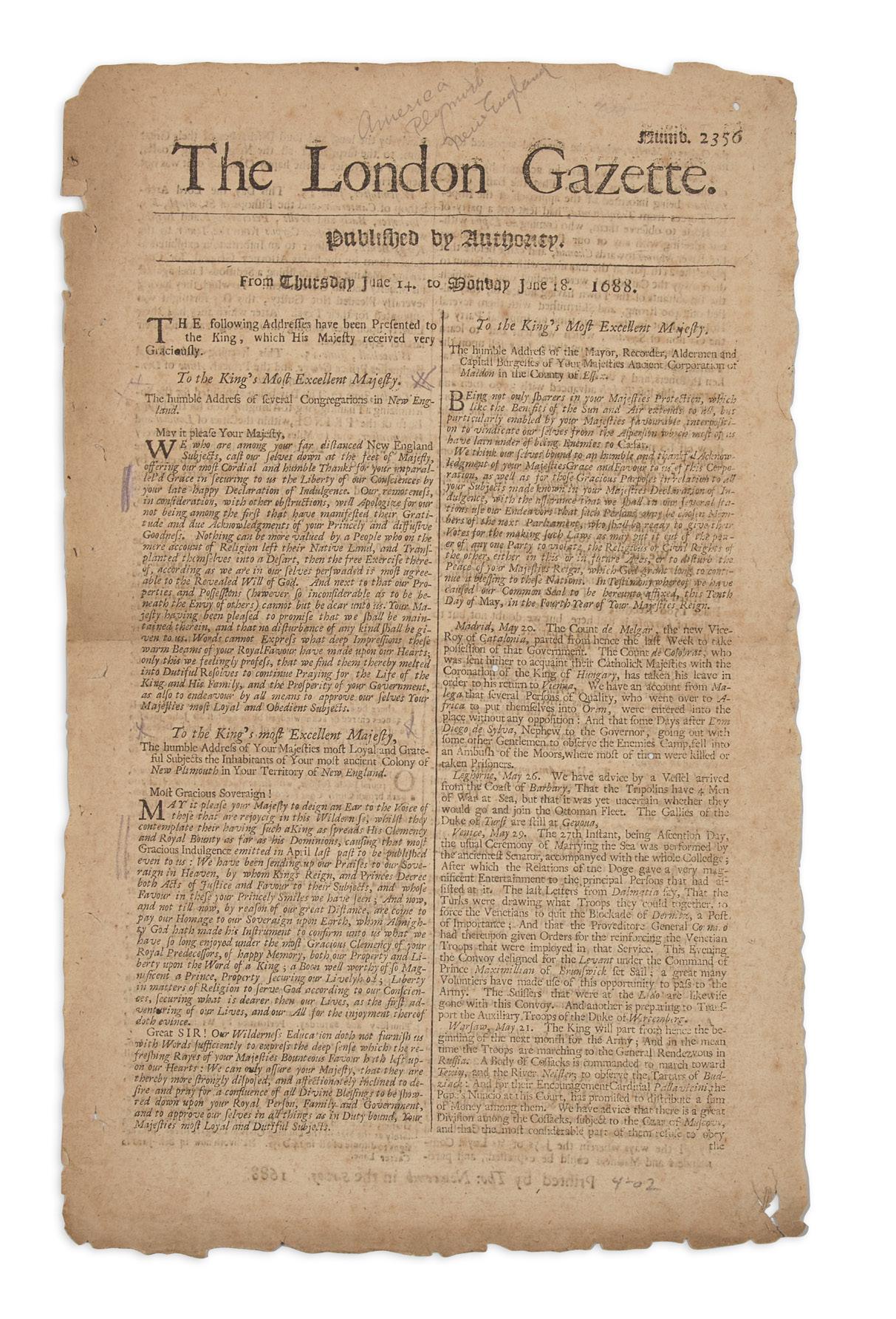
117
[Colonial America] Plymouth Colony Seeks a Royal Charter: A Rare and Important Plymouth Colony Document
Manuscript Document
Plymouth, Massachusetts, March 3, 1690/91. Single sheet, 9 3/4 x 7 3/4 in. (248 x 197 mm). Draft manuscript document, signed by Samuel Sprague, Secretary of Plymouth Colony, regarding negotiations on behalf of the Colony to obtain a separate, independent charter following the dissolution of the Dominion of New England in 1689. Creasing from old folds; small separations and holes along same.
In 1689, after the collapse of the Dominion of New England and the arrest of Governor Edmund Andros, northeastern colonies struggled to re-establish ties with the English Crown. Plymouth Colony, who lacked a royal charter, sent Ichabod Wiswall to England, alongside Massachusetts’s Increase Mather, to negotiate a new and distinct charter that would preserve its political separation from Massachusetts Bay. This manuscript, possibly an early draft, instructs Wiswall, Mather, and Sir Henry Ashurst to secure “Ancient Civill and Religious Liberties” for Plymouth. A deleted clause, that does not appear in the final document, demands orthodox religious preaching, and suggests an attempt to moderate the colony’s Puritanical image. Ultimately, Plymouth did not receive a separate charter. Instead, the 1691 Charter of the Province of Massachusetts Bay merged the two colonies, preventing Plymouth’s absorption into New York, but ending its political independence.
$6,000 - 9,000
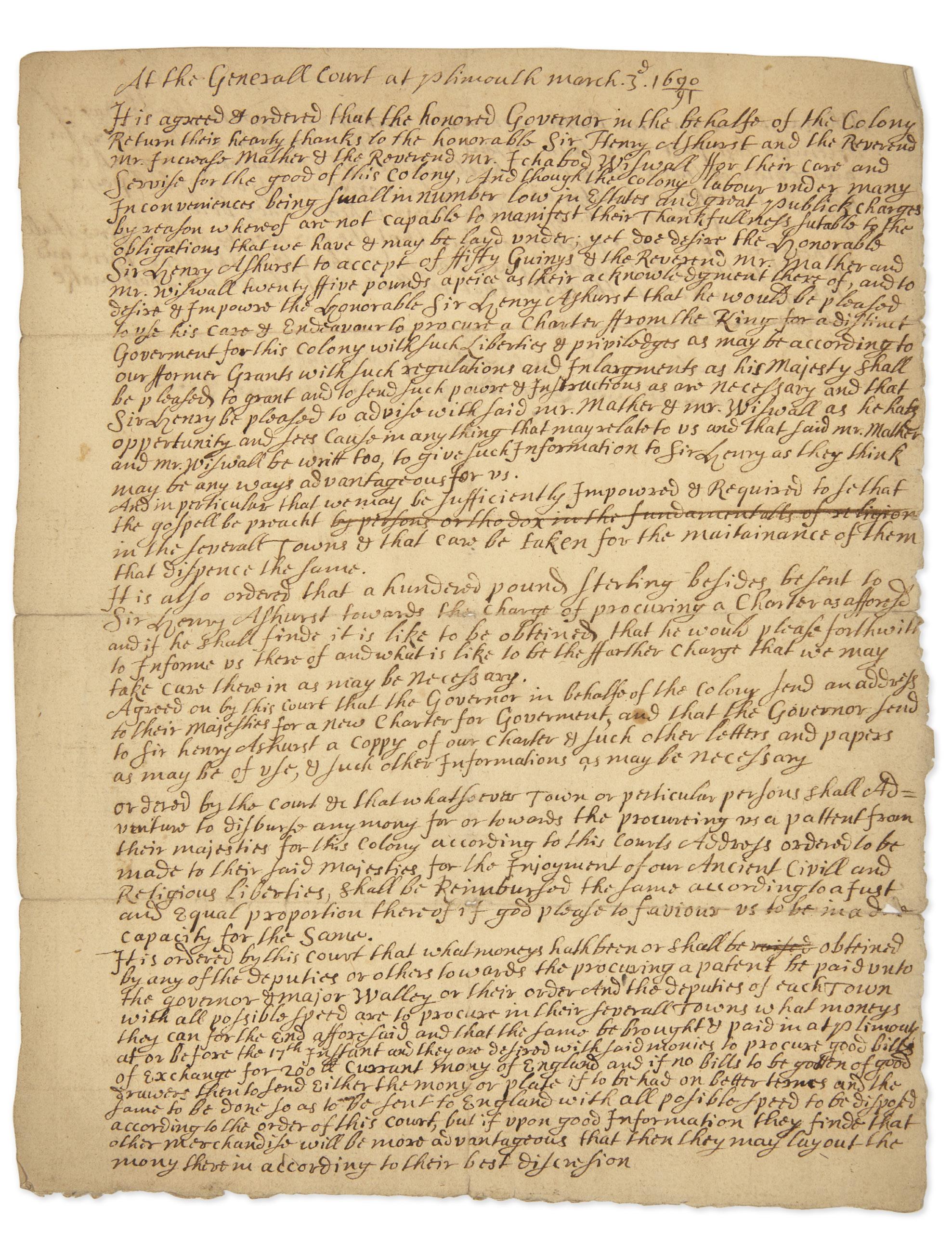
118
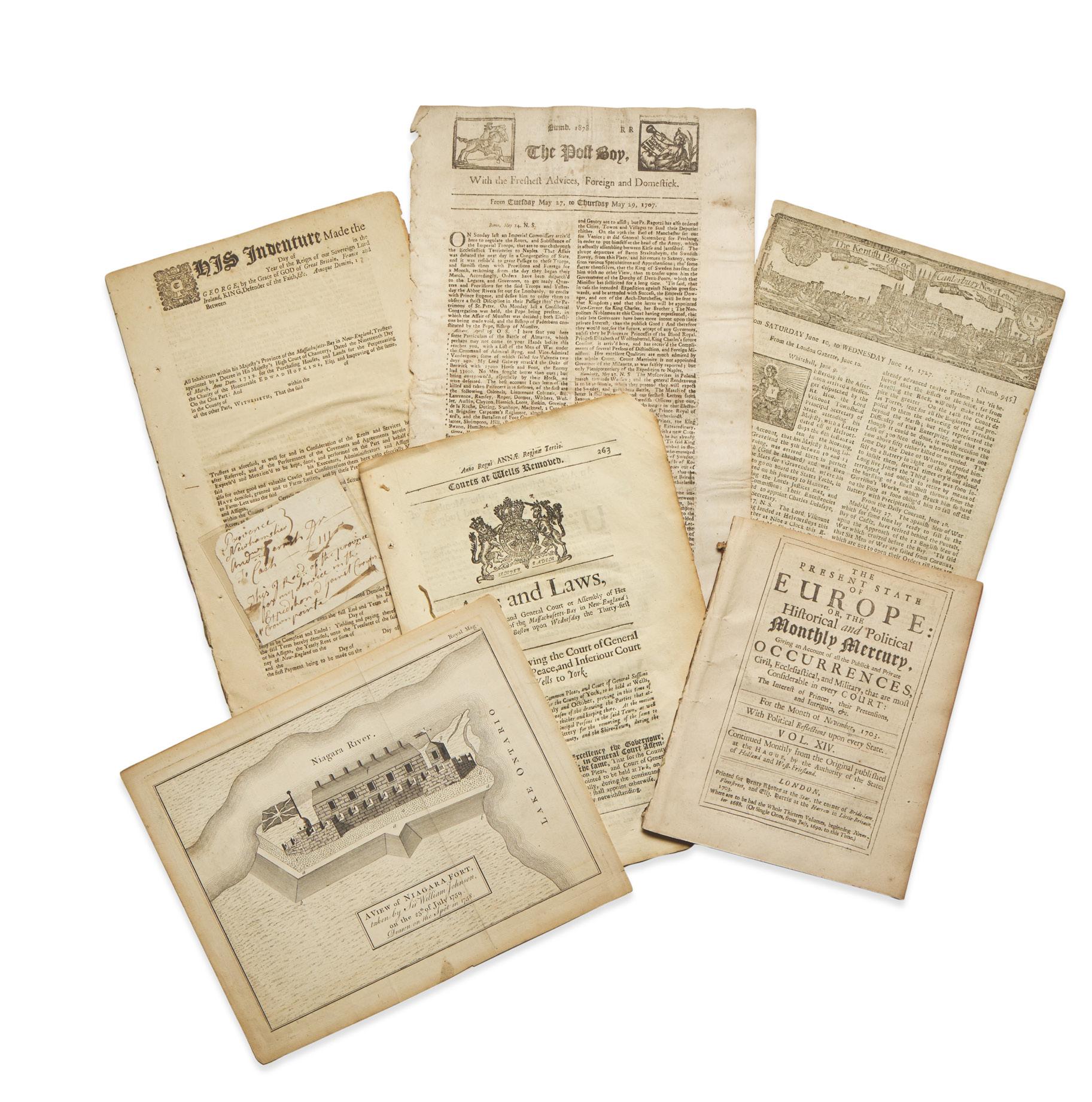
[Colonial America] Group of 7 Items Related to Colonial America, Queen Anne’s War, The Crown Point Expedition, the French and Indian War, and more, ca. 1703-59
1. The Present State of Europe, or the Historical and Political Monthly Mercury... London: Printed for Henry Rhodes, and Elizabeth Harris, 1703. Vol. XIV. 12mo. (ii), 419-456. Disbound.
Reporting news on the ongoing Queen Anne’s War, including mention of Massachusetts-Bay and relations with the Native Americans of the region.
2. Acts and Laws, Passed by the Great and General Court or Assembly of Her Majesties Province of Massachusetts-Bay...Held at Boston upon Wednesday the Thirty-first of May, 1704 (Boston: B. Green), 1704. Folio. pp. 263-266. Disbound; lightly worn and soiled. ESTC W8052; Evans 1167
With two acts related to Queen Anne’s War, including an “Act in further Addition to the Act for Levying Souldiers” and “An Act directing, That the Militia of the Frontiers be provided with Snow Shoes”.
3. The Post Boy, With the Freshest Advices, Foreign and Domestick London: Printed for B. Beardwell, May 27-29, 1707. Numb. 1878. Printed broadsheet newspaper. Scattered soiling.
Reporting news on the ongoing Queen Anne’s War.
4. The Kentish Post: or Canterbury News-Letter Canterbury: Printed and Sold by J. Abree, June 10-14, 1727. Numb. 945.
Printed newspaper. Folio. 4 pp. Tax stamp in bottom right corner of frontpage. Disbound; separating along central vertical fold.
With a report on the last page on the death of Samuel Mills (abt. 16321727) of Jamaica, Long Island, aged 95 years.
5. Unaccomplished Printed Massachusetts-Bay Indenture Massachusetts-Bay, no date (after 1720). Printed unaccomplished indenture, “for the Purchasing Houses, and Lands for the Perpetuating the Charity of the Honourable Edwad (sic) Hopkins...” Folio. Two sheets. Disbound, light spotting.
6. Manuscript Receipt Province New Hampshire, no date (ca. 1756 or after). Single oblong sheet, 3 x 3 5/8 in. (76 x 92 mm). Manuscript receipt, for £111, “Rec’d of the province for my service in the Expedition against Crown pointe.” Creased from old folds. In frame.
The Crown Point Expedition was a failed 1756 English siege of the French stronghold of Fort Saint-Frédéric on Lake Champlain during the French and Indian War.
7. A View of Niagara Fort, taken by Sir William Johnson, on the 25th of July 1759. Drawn on the Spot in 1758. (London), September 1759. Engraving. Excised from the Royal Magazine.
View of the highly strategic fort at the juncture of Lake Ontario and the Niagara River, taken by the British during the French and Indian War on July 25, 1759 under the leadership of William Johnson.
$600 - 900
119
[Colonial America] Church, Benjamin. A Rare Autograph Document, Signed by Benjamin Church, America’s First Ranger
(Likely Little Compton, Rhode Island), October 17, 1709. Single sheet, 5 7/8 x 3 5/8 in. (149 x 92 mm). Autograph document in 18 lines, signed by Benjamin Church, reads in part: “Hanna Woodary on herself apprd this 17 day of October 1709...that Jonathan...hisself a Jun. was the father of afsd child that she is now...with and that it was begot sum time in the beginning of February last past and that he had to...with her at that time and no other...on oth. as aforesaid before me Benjamin Church Just.”; ten-line autograph fragment in Church’s hand on verso and crossed out. Creasing from old folds, separations along same; wear along edges; soiling to recto and verso.
Benjamin Church (1639–1718), recognized as America’s first ranger, was born in Plymouth Colony. He became an early settler of present-day Little Compton, Rhode Island, where he established friendly ties with the local Sakonnet tribe. During King Philip’s War (1675-78), Church commanded a force of English colonists and Native American allies against Sachem Metacom (known to the English as King Philip) and his warriors, who were devastating frontier settlements in New England. Breaking from traditional European tactics, Church adopted indigenous strategies to create a small, highly mobile unit composed of both English and Native soldiers. This mixed force specialized in targeting enemy leadership. In a decisive surprise attack, Church’s men cornered Metacom, leading to the Sachem’s death and effectively ending the war. Church’s military service continued after the conflict, as he fought for the English in both King William’s War and Queen Anne’s War. He dedicated himself to training soldiers in the “ranger” style of warfare he had learned from Native tribes, cementing his legacy as one of the most influential military leaders of the colonial era. His innovative tactics were later refined by Ranger Robert Rogers during the French and Indian War and remained a component of American military strategy during the Revolutionary War.
$800 - 1,200
120
[Colonial America] [Hunter, Robert] A Scarce Summary of Legal Fees
Present in the Colonies of New York and New Jersey, from the Press of the First Printer of New York
An Ordinance For Regulating & Establishing Fees
(New York: William Bradford), 1710. First edition. 4to. 20 pp. Disbound. Signed in type by colonial governor R(obert). Hunter. Scattered toning; some wear to extremities; final leaf loose. ESTC W42635; Evans 1482
William Bradford (1663-1752) began his printing career in London before emigrating to the colonies in 1685, where he established the first printing press in Pennsylvania that year and the first in New York eight years later. A prolific printer of almanacs, newspapers, books, pamphlets, broadsides, and legal notices, in 1689 Bradford was hired to print William Penn’s first charter of Pennsylvania, an incident which resulted in official reprimand from Governor John Blackwell. A year later Bradford partnered with German paper maker William Rittenhouse to establish the first paper mill in North America. For nearly two decades, Bradford’s was the only operating paper mill in the country. In 1709, he printed the very first example of paper currency for the province of New York.
Bradford’s grandson, also named William, was a well-known printer and soldier during the Revolutionary period. In December 1742 he established The Pennsylvania Journal, later famous for featuring numerous essays and letters by Thomas Paine. In 1774 he was named the official printer for the first Continental Congress.
$300 - 500
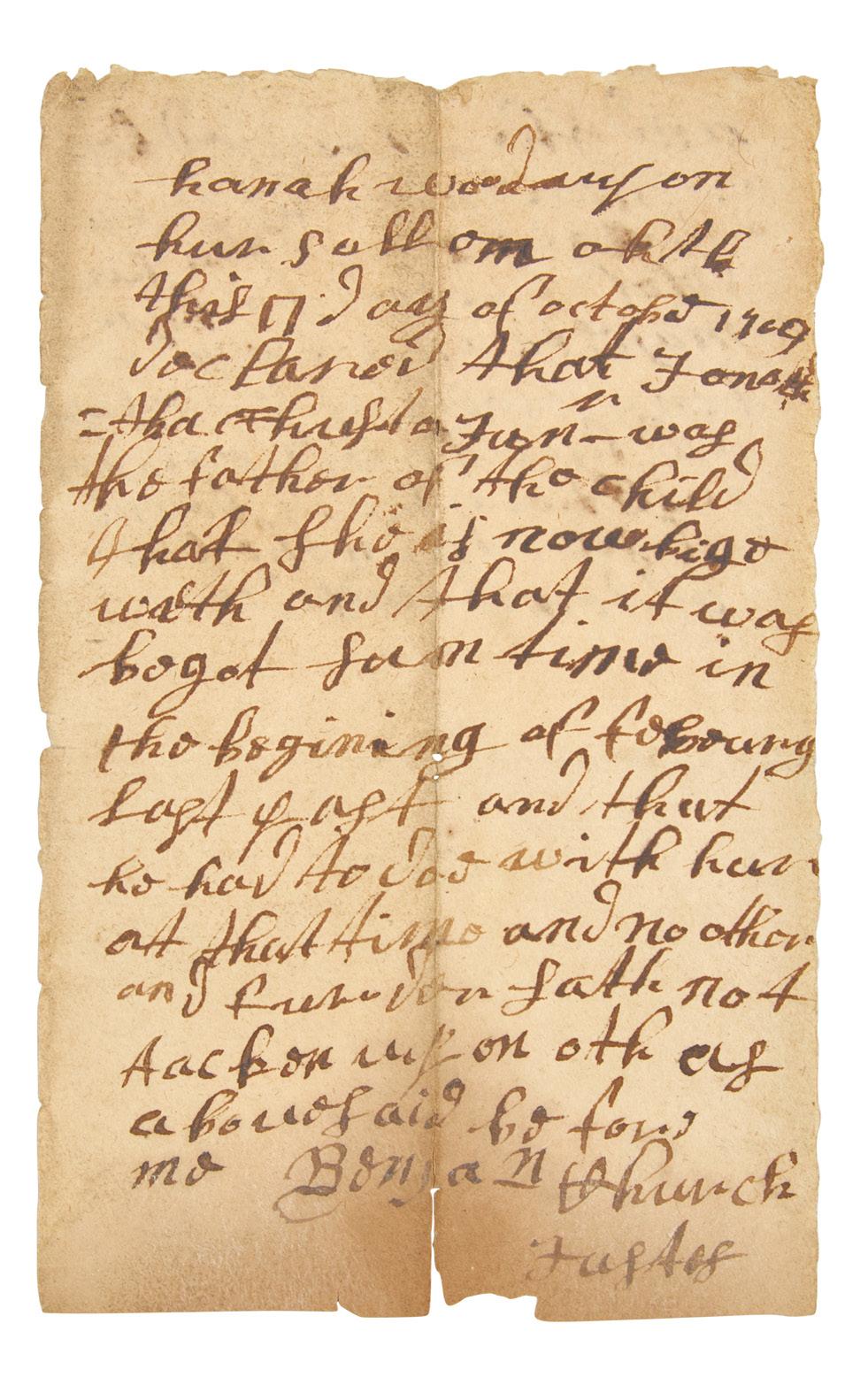
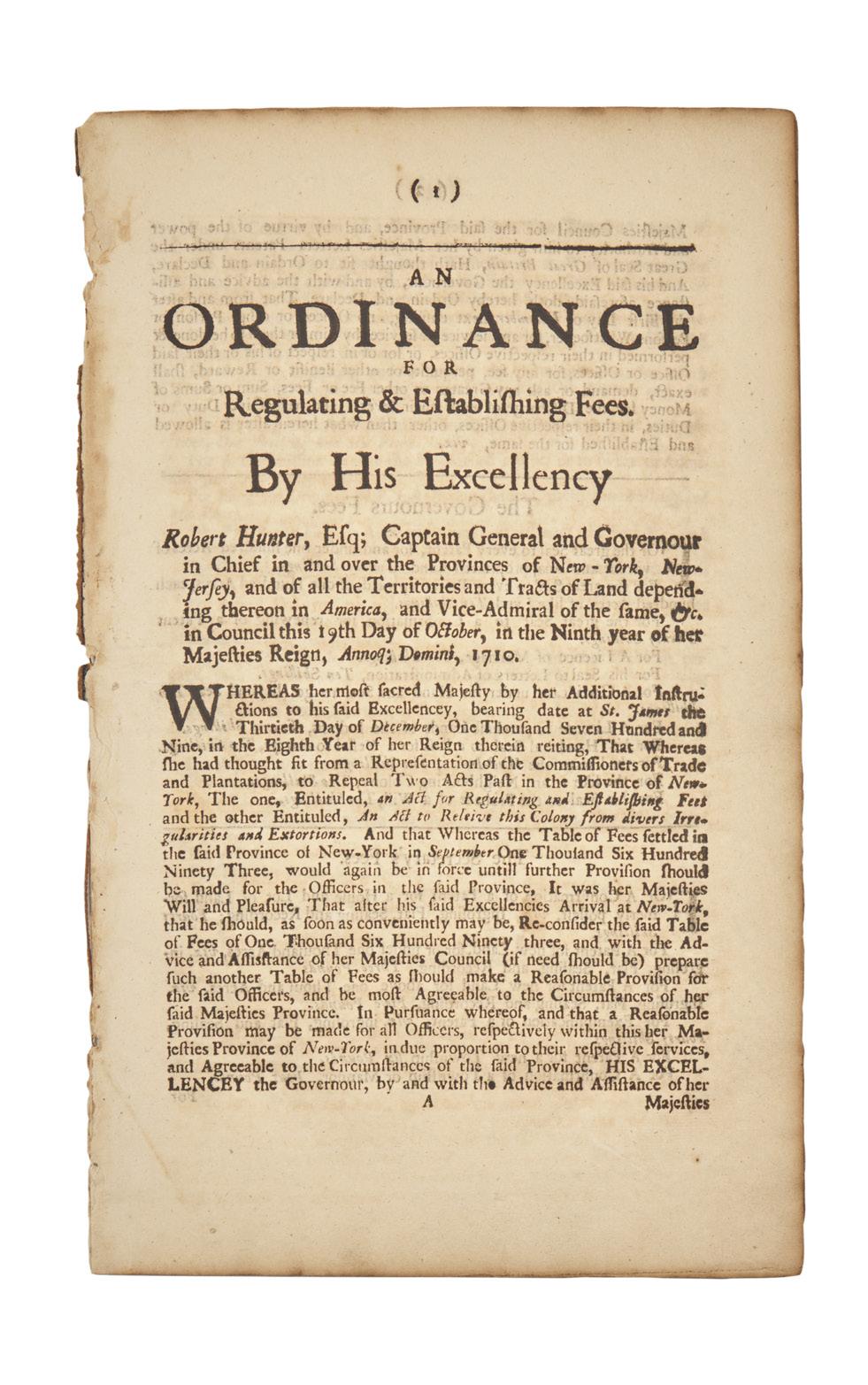
121
[Colonial America] One of the Earliest Works Printed in Connecticut: “Acts and Laws, Of His Majesties Colony of Connecticut in New-England”
Acts and Laws, Of His Majesties Colony of Connecticut in New-England New-London: Re-printed and Sold by Timothy Green, 1715-ca. 1743. Mixed edition. 4to. (xii, “The Table”), (ii), 376 pp. Full modern brown calf, red and black leather spine labels, stamped in gilt; all edges trimmed; scattered spotting, toning, and soiling.
A large and consecutive run of early colonial Connecticut laws. The 1715 imprint is very rare, and is among the earliest printed works in Connecticut. According to RBH, this is only the third copy of early colonial laws, with the 1715 imprint, to come to auction in the past 30-plus years.
Comprising: Table: ESTC W28023 (variant); 1715, first edition: ESTC W35238, Evans 1738 (without table of contents or Charter); 1716, first edition: ESTC W7110, Evans 1808; 1716, first edition: ESTC W7112, Evans 1809; 1717, first edition: ESTC W7113, Evans 1876; 1717: ESTC W7122, Not in Evans (reprint, ca. 1733-43); 1718: ESTC W7124, Not in Evans (reprint, ca. 1733-43); 1718, first edition: ESTC W7141, Evans 1951; 1719: ESTC W7125, Not in Evans (reprint, ca. 1733-43); 1719, first edition: ESTC W7118, Evans 2021; 1720, first edition: ESTC W7142, Evans 2107; 1720: ESTC W7128, Not in Evans (reprint, ca. 1727-33); 1721: ESTC W7130, Not in Evans (reprint, ca. 1726-33); 1721: ESTC W7131, Not in Evans (reprint, ca. 1726-33); 1722: ESTC W7132, Not in Evans (reprint, ca. 1733-43); 1722: ESTC W7133, Not in Evans (presumed reprint, ca. 1726-33); 1723, first edition: W7146, Evans 2423; 1723, first edition: ESTC W7147, Evans 2424; 1724: ESTC W7137, Not in Evans (reprint, ca. 1728-33); 1724, first edition: ESTC W7121, Evans 2516; 1725, first edition: ESTC W7150, Evans 2621; 1725, first edition: Evans 2622, Not in ESTC; 1726, first edition: Evans 2738, Not in ESTC; 1726, first edition: Evans 2739, Not in ESTC; 1727, first edition: Evans 2856, Not in ESTC; 1727, first edition: ESTC W7154, Evans 2857; 1728, first edition: Evans 3012, Not in ESTC; 1728, first edition: ESTC W7156, Evans 3013; 1729, first edition: ESTC W7157, Evans 3150; ESTC W7271, Evans 3151; 1730, first edition: Evans 3264, Not in ESTC. Trumbull 503
$4,000 - 6,000
122
[Colonial America] An Important Work of Connecticut History, Printed by the Pioneering Colonial Printer Timothy Green
The Charter Granted by his Majes(ty) King Charles (II.) To the Governour & Company of the English Colony of Connecticut in New-England... New-London: Printed and Sold by Timothy Green, 1718. First edition. 4to. (ii), 6 pp. Full modern brown calf, red and black leather spine labels, stamped in gilt; portions in upper right of title-page excised, touching some letters, edges of same with scattered wear; light wear along text leave edges. Evans 1952; ESTC W3774; Sabin 15726; Streeter Sale 669; Trumbull 453
An important work of Connecticut history, printed by the pioneering colonial printer Timothy Green. Green was the son of Samuel Green, one of the earliest printers in British North America, who operated the former press of his father at Harvard’s Indian College-the first printing press established in what would become the United States devoted in part to indigenous-language printing. In 1713, Timothy Green was appointed official printer to the Colony of Connecticut and relocated the family press to New London, where he became responsible for printing many of the colony’s laws, proclamations, sermons, and foundational historical texts.
Very rare, according to RBH only two other copies of this first edition have come to auction since 1915 (one bound in session laws, in 2015, and the Streeter-Reese copy, in 2022 and 1967). ESTC records only 11 copies (some bound with session laws).
$4,000 - 6,000
123
[Colonial America] Colonial Massachusetts Document Related to a Case of Fornication, Levied Against an Unmarried Woman Named Elizabeth Wilcox
Partially-Printed Document, signed Dartmouth, August 5, 1729. One sheet, 12 1/2 x 8 in. (317 x 203 mm). Partially-printed document, signed by Bristol County Justice of the Peace Silvester Richmond, being a writ of recognizance, certifying the release of Elizabeth Wilcox, who “Confessed that she is Guilty of fornication & she was begott with Child by Ebenezer Briggs of Dartmouth...” Creasing from old folds; scattered toning and stains.
Fornication, or the act of nonmarital sex, was enacted as a crime in Massachusetts in 1692, at the beginning of the Salem Witch Trials. Throughout much of the 18th century, the law was prosecuted almost exclusively against women, indictments for men hardly ever being charged. Punishments could include fines, flogging, and even public shame by being sentenced to the pillory. The criminal charge of fornication was officially repealed by the Governor of Massachusetts in 2018, although a conviction of it had not occurred since the mid-twentieth century.
$300 - 500
The King of England Declares War Against Spain, Igniting the War of Jenkins’ Ear
His Majesty’s Declaration of War against the King of Spain London: Printed by John Baskett, 1739. Printed broadside, 20 1/2 x 16 1/2 in. (521 x 419 mm). Docketed on verso. Creasing from old folds, 4 1/4 in. closed tear along lower central vertical fold; small worming in each corner from when folded; scattered minor edge-wear. ESTC T36245
The King of England declares war against Spain, igniting the War of Jenkins’ Ear. Rooted in trade disputes and colonial ambitions in the Caribbean and North America, George II cites the “unjust Seizures...and Depredations carried on for several Years in the West Indies” by Spanish vessels, and provides an extensive and detailed list of the grievances that led to his commencement of hostilities. The War of Jenkins’ Ear began in October 1739 and eventually merged with the War of the Austrian Succession (1740-48, known as King George’s War in North America). It received its name after an incident involving English smuggler Robert Jenkins, who alleged in 1738 before the House of Commons that marauding Spaniards had cut off his ear in 1731 off the coast of Florida (according to some accounts he brought the preserved ear along with him for display). The altercation was used as propaganda by those opposed to Prime Minister Robert Walpole’s government, and helped fan the flames of public anger over Spanish actions and pushed the nation into conflict. Although the English saw initial success, including Admiral Edward Vernon’s capture of Puerto Bello, subsequent campaigns, including the 1741 attempt to take Cartagena were met with disaster. Minor skirmishes were met throughout the region, including in North America, such as James Edward Oglethorpe’s failed siege at St. Augustine in 1740, and the Spanish’s failed attack on Georgia in 1742. With the merger into the larger War of Austrian Succession, the conflict shifted attention toward Europe, and ended with the Treaty of Aix-la-Chapelle in 1748.
Rare. RBH locates only one other copy at auction, in 2011. ESTC locates nine copies, including only three in the United States.
$1,000 - 1,500
125
[Colonial America] An Andrew Bradford-Printed Power of Attorney, for a Suit Against William Bladwell, Commander of the Swift, a Man of War Stationed in North Carolina
Partially-Printed Document
Philadelphia: Andrew Bradford, June 5, 1742. Single sheet, 12 1/2 x 7 3/4 in. (317 x 197 mm). Partially-printed document, accomplished in manuscript, and signed by mariner Robert Georges of Philadelphia, being a power of attorney granting John Shewbart authority to collect money, etc. from a William Bladwell, commander of the man of war Swift, in North Carolina. Chipped with losses near the upper corner margin, not affecting text, tiny chip to the lower margin, just below the imprint, and a horizontal crease at the center.
Andrew Bradford was the son of William Bradford, the first printer in Pennsylvania. After his father resettled in New York in 1692, Andrew returned to Philadelphia in 1712 and opened his own print shop, likely making him the only printer in the Pennsylvania colony until competition emerged in 1728. Andrew issued the first newspaper in Pennsylvania and the Middle Colonies, the American Weekly Mercury, which began on December 22, 1719.
$400 - 600
126
[Colonial America]
Deputy Governor of Pennsylvania Province, James Hamilton, Grants Clemency to a Butter Thief, 1761
Manuscript Document, signed Easton, Pennsylvania, March 19, 1761. Bifolium, 12 3/8 x 7 5/8 in. (314 x 194 mm). Manuscript document, being a petition for clemency for a Peter Wannamacker of Northampton County, signed by Wannamacker with his mark (“X”), as well as four justices of the General Quarter Sessions of the Peace of Northampton (Lewis Klotz, Jacob Arndt, Aaron Dupui, and Conrad Hess); inscribed, signed, and dated (April 3, 1761) at bottom by Lieutenant Governor of the Province of Pennsylvania, James Hamilton, granting Wannamacker clemency. Docketed on verso. Creasing from old folds, two small open tears at center folds; scattered light soiling.
Peter Wannamaker was found guilty on March 17, 1761 of stealing 40 pounds of butter belonging to Jacob Haak, and was sentenced to receive 12 lashes and to restore the stolen butter or compensate the owner for the value thereof. A petition was drawn up by Wannamaker’s family (not present), attesting to his character, which was submitted to the Northampton Justices of the Peace, and then sent to Lieutenant Governor of the Province, James Hamilton, which he approved.
James Hamilton (1710-83) served two terms as deputy governor of Pennsylvania, from 1748-54, and from 1759-63. He served as a member of the Pennsylvania Provincial Assembly from 1735-40, and as mayor of Philadelphia from 1745-47.
$500 - 800
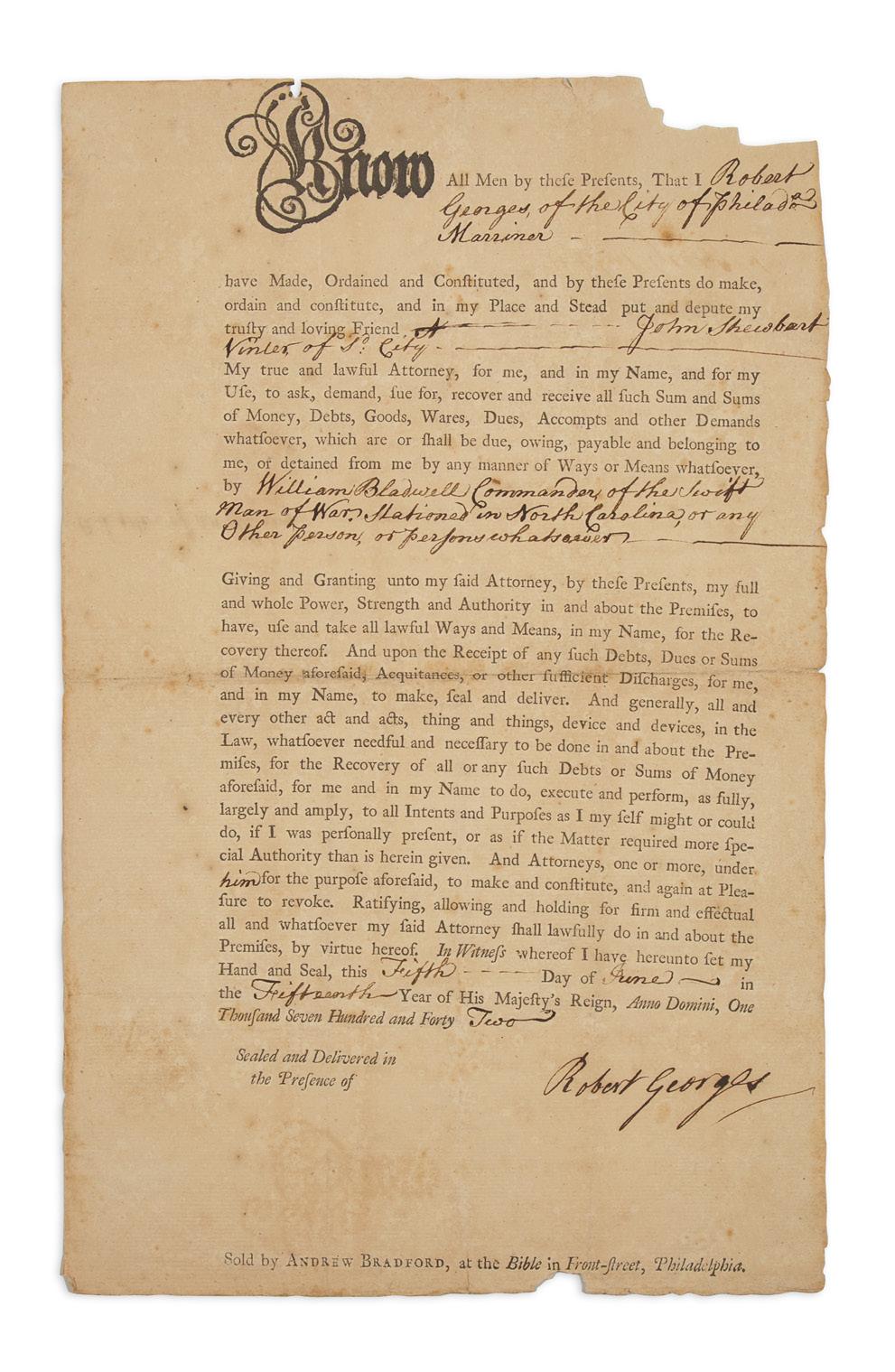
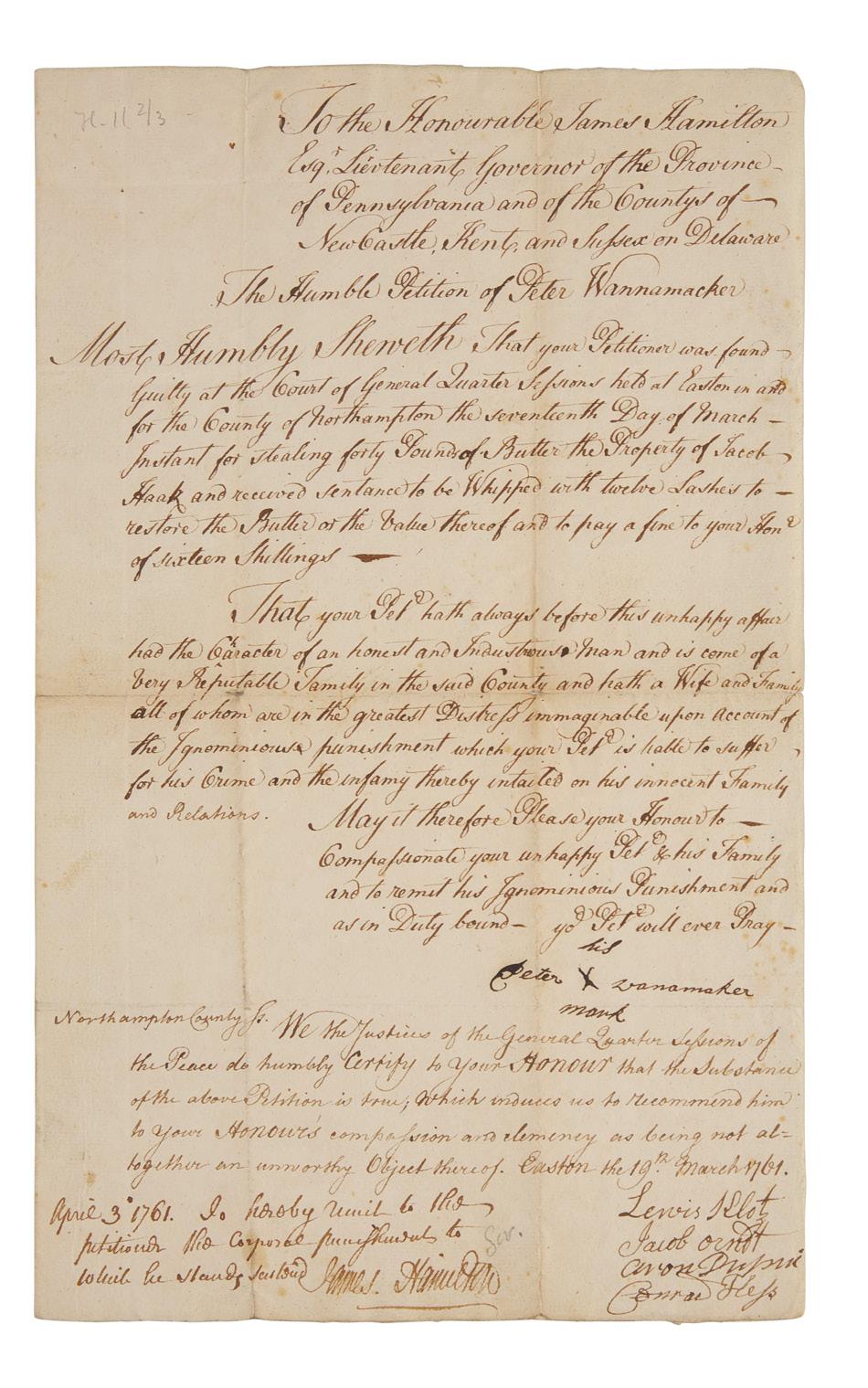
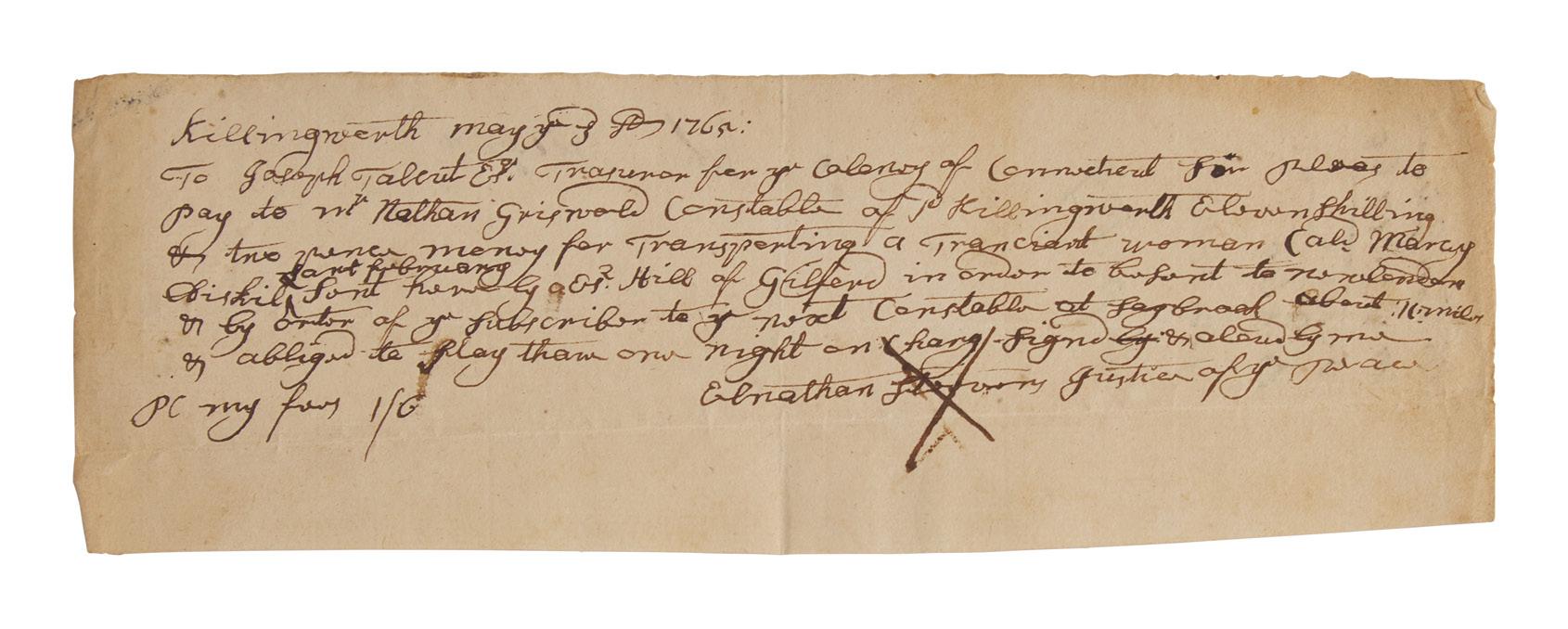
127
[Colonial America] Manuscript Pay Order for Transporting a Transient Woman to New London, Connecticut
Killingworth, Connecticut, March 3, 1765. Single oblong sheet, 2 3/4 x 8 1/4 in. (70 x 209 mm). Manuscript pay order, signed by Justice of the Peace Elnathan Stevens, requesting Connecticut Treasurer Joseph Talcott pay Killingworth Constable Nathan Griswold 11 shilling and two pence for “Transporting a Trancient (sic) woman calld. Marcy Siskil last February Sent here by a Ebz. Hill of Gilford (sic) in order to be sent to New London & by order of yr. subscribers to yr next Constable at Saybrook...” Docketed on verso, signed on same by John Pierson. Creasing from old folds.
A “transient woman” is an archaic term which was particularly common during the 18th and 19th centuries; it generally refers to women suspected or convicted of prostitution. In colonial America prostitution was relatively rare, as its practice was usually confined to port cities. Philadelphia in particular was notorious for prostitution in its “Hell Town” district, today considered to be America’s first red-light district. During this period it was common for authorities in smaller communities to simply transport women suspected of prostitution to other towns, being of the mind that prosecuting them in a smaller town would be a waste of local resources.
$300 - 500
128
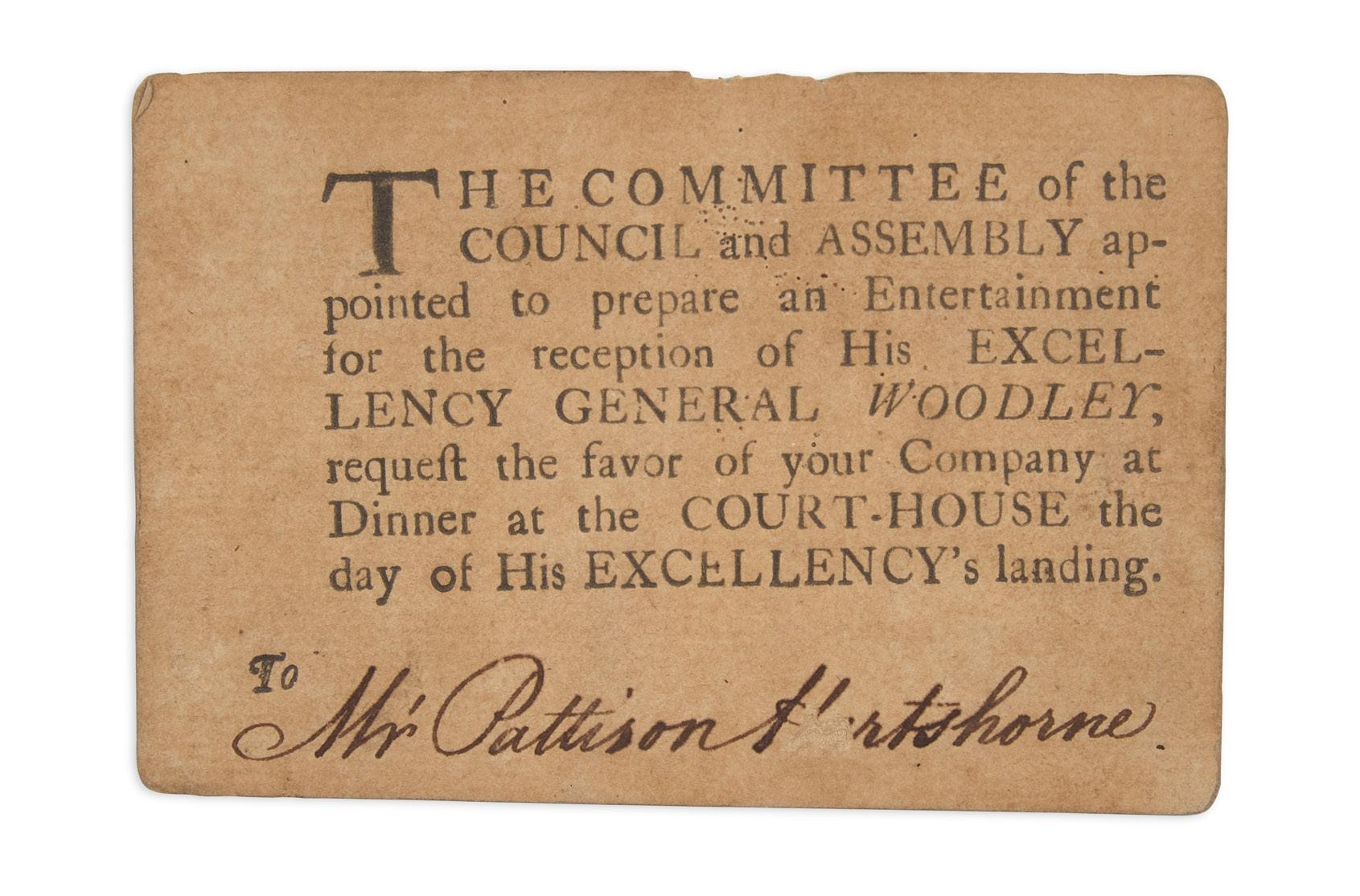
[Colonial Americana] Partially-Printed Invitation From the First Governor of the Leeward Islands, West Indies, to a Philadelphia Quaker
Partially-Printed Invitation Philadelphia, ca. 1760s-70s. Oblong card, given to Mr. Pattison Hartshorne of Philadelphia, likely during an official visit from Woodley. Manuscript notations on verso. 2 1/2 x 3 11/16 in. (63 x 94 mm). Toned.
William Woodley (1728-1793) was appointed Governor of the Leeward Islands in the West Indies, and first served in that role from 1766 to 1771, then again from 1791 until his death. His office covered a wide range of governance issues. His formal instructions of 1767 addressed matters including the council, legislation, trade, finance, currency, customs, religion, fortification, piracy, and the administration of justice across St. Kitts, Nevis, Montserrat, Antigua, Barbuda, and Anguilla.
Pattinson Hartshorne (1745-1828) was a Philadelphia Quaker merchant, son of Hugh and Hannah Hartshorne, and husband of Susannah Waln.
$100 - 150
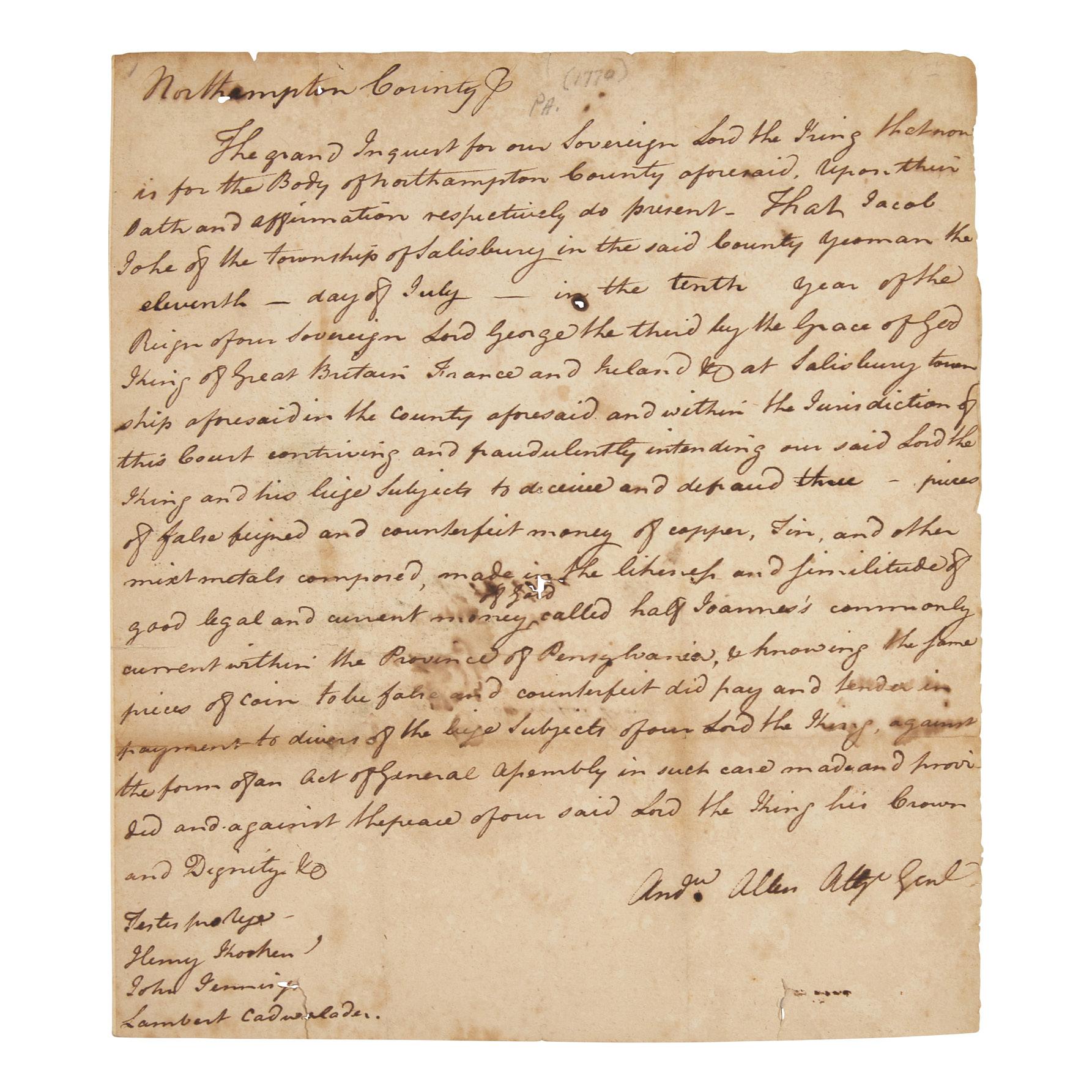
129
[Colonial America] Allen, Andrew. Autograph Legal Document Related to a Money Counterfeiter
Northampton County, Pennsylvania, July 11, 1770. Single sheet, approximately 9 1/4 x 8 1/4 in. (235 x 209 mm) (sight). Manuscript legal document, in the hand of Provincial Attorney General Andrew Allen, being an indictment against Salisbury Township yeoman Jacob Johe, for “contriving and fraudulently intending...to deceive and defraud three pieces of false signed and counterfeit money of copper, tin, and other mix’d metals composed, made in the likeness and similitude of good legal and current money of gold, called half Joanna’s commonly current within the Province of Pennsylvania, & knowing the same pieces of coin to be false, and counterfeit did pay and tender in payment to divers of the wise subjects of our Lord the King...”. Signed by Allen at bottom, and witnessed by four individuals (seemingly in Allen’s hand), including Lambert Cadwalader, John Jennings, Henry Hooker, et al. Docketed on verso. Creasing from old folds, some reinforced on verso; old mounting paper along left verso edge; small dampstaining affecting a few words at bottom, a few small holes at same.
Scarce autograph legal document, signed by Andrew Allen (1740-1825), colonial Attorney General for Pennsylvania and Loyalist convicted of treason in absentia during the American Revolution.
Son of Chief Justice William Allen, the younger Allen was educated at the Academy and College of Philadelphia (now the University of Pennsylvania) and studied law with his father and then at the Temple in London. Upon
his return to Pennsylvania he served in a variety of posts, including Attorney General beginning in 1769, as well as Recorder of Philadelphia and member of the City Council. At the beginning of the Revolution he was sympathetic to the colonial cause, and represented Pennsylvania in the Second Continental Congress, but withdrew due to his opposition to independence. As tensions rose in Pennsylvania, his allegiance teetered, and he finally fled to British lines in New York in December 1776 after he and his family were marked as sympathetic to the British. He made a brief return to Philadelphia in 1777 following the fall of that city, but moved to Great Britain the following year. In 1781, the Pennsylvania Assembly attainted Allen of treason, and confiscated his and his family’s property.
Lambert Cadwalader (1742-1823) was an American merchant, politician, and Patriot. Educated at the University of Pennsylvania, he went into business with his older brother John Cadwalader to become one of the leading merchants in the colony (1742-86), before entering politics. A signer of the non-importation agreement in 1765, he was elected to the Pennsylvania Provincial Assembly in 1774, and was a delegate to the Pennsylvania Constitutional Convention in 1776. He served in the Revolutionary War beginning in 1775, as a captain in the Philadelphia militia known as “The Greens”, and later as a lieutenant colonel of the 3rd Pennsylvania Battalion of the Continental Army. He was taken prisoner by the British following the fall of Fort Washington, but was quickly paroled. He resigned from the army in 1777, and then served as a delegate from New Jersey in the Confederation Congress, and then in the House of Representatives in 1788 and 1792.
$600 - 900
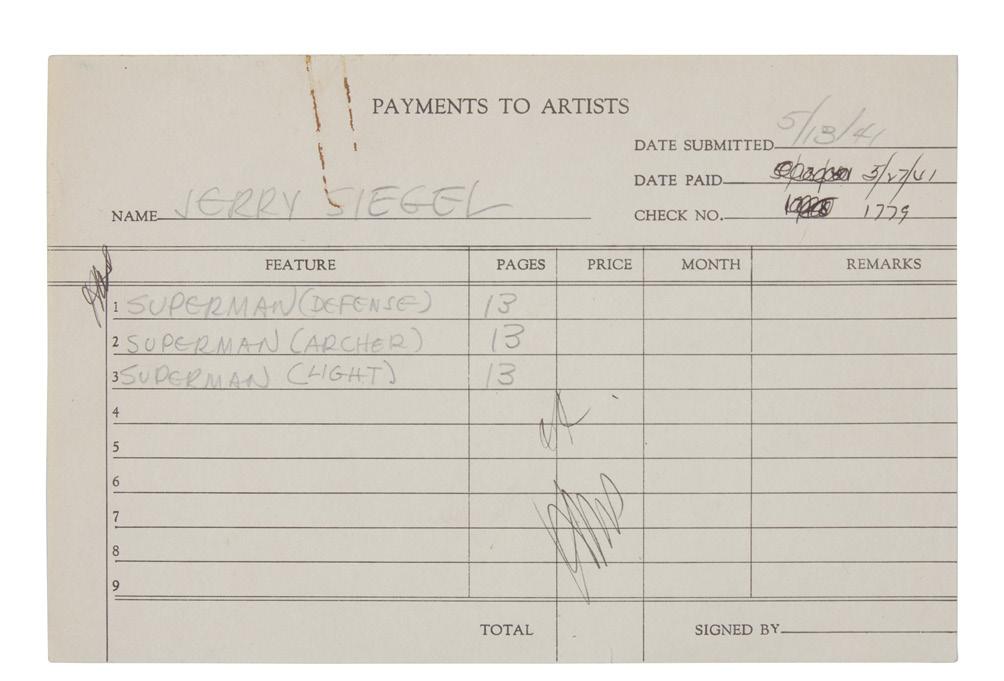
131
[Constitution] Printing of the Proposed Constitution in the Journals of Congress, Uncut and in Original Boards, 1787
(Journal of the United States in Congress Assembled: Containing the Proceedings From the Sixth Day of November, 1786, to the Fifth Day of November, 1787...Published by Order of Congress) (New-York, 1787). Vol. XII. First edition. 8vo. (3)-255, (1), (9) pp.; lacking titlepage. Original paper-covered boards, rebacked, contemporary manuscript on lower front board; all edges untrimmed; text unopened; light spotting to text. Evans 20772
Containing the printing of the proposed Constitution, on pp. 149-163, followed by the Constitutional Convention’s resolutions and George Washington’s letter to Congress, as well as Congress’s resolutions submitting the proposed charter to the states (pp. 163-166).
$500 - 800
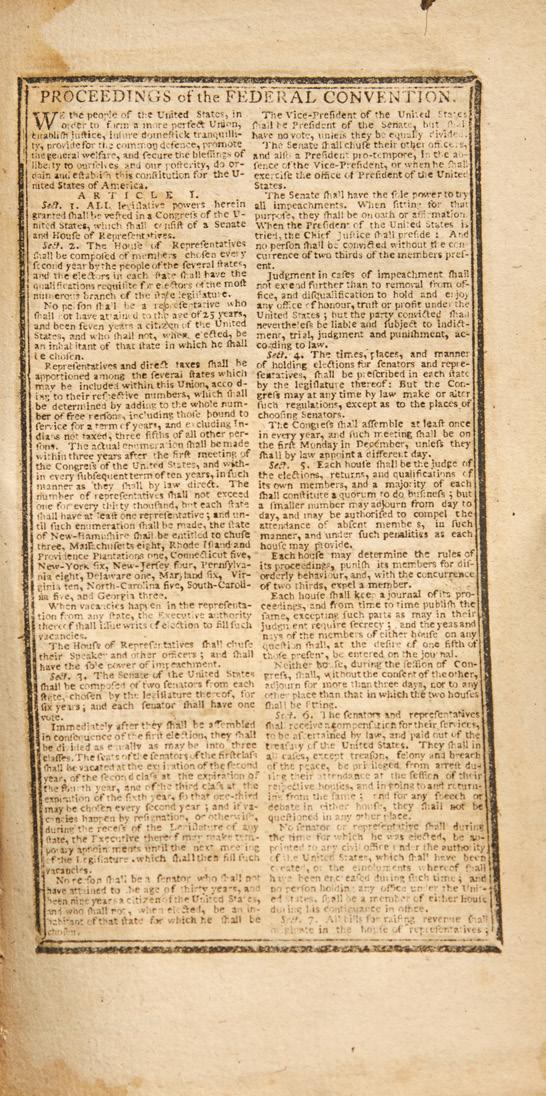
130
[Comics] A Payment Receipt for American Comic Book Writer Jerry Siegel for the Creation of Three Issues of Superman
Partially-Printed Payment Receipt No place, May 1941. Single oblong sheet, 4 7/8 x 7 1/4 in. (124 x 184 mm). Partially-printed receipt (“Payments to Artists”) for Jerry Siegel for three issues of the Superman comic book, accomplished in pencil and pen: “Superman (Defense) / Superman (Archer) / Superman (Light)”, each listed in manuscript as 13 pp.; price column left blank. Residue from now removed paperclip at top.
Jerry Siegel and Joe Shuster created Superman in the early 1930s while still high school students in Cleveland, Ohio. Influenced by pulp science fiction, newspaper adventure strips, and the hardships of the Great Depression, the pair conceived Superman as a heroic champion of the oppressed endowed with extraordinary strength and moral clarity. After years of rejection, the character made his first appearance in Action Comics No. 1 in June 1938, marking the beginning of the modern superhero genre and the rise of the American comic book industry.
$400 - 600
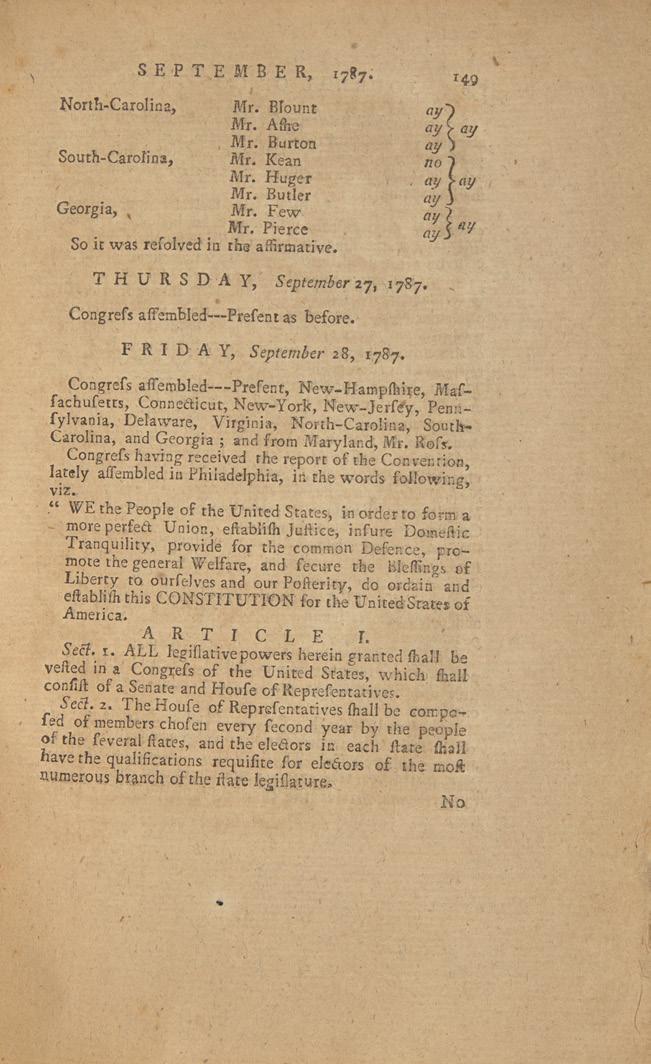
132
[Constitution] Full-Printing of the United States Constitution in Isaiah Thomas’ Almanack, 1787
Thomas’s Massachusetts, Connecticut, Rhode-Island, New-Hampshire & Vermont Almanack, With an Ephemeris, for the Year of Our Lord 1788... Worcester, (Massachusetts): Isaiah Thomas, (1787). 12mo. Unpaginated (24 leaves). Stab-sewn gatherings; thread likely sometime renewed. Dampstaining; scattered chipping and short closed tears along edges. Drake 3400
Includes a full, five-page, printing of the Constitution, headed, ‘’Proceedings of the Federal Convention”, as well as George Washington’s transmittal letter to Congress.
$500 - 800
133
[Constitution]
Rare First Edition of this Pamphlet Published in Support of the Constitution’s Ratification, Containing One of the Earliest Printings of the Proposed Federal Charter
Debates of the Convention, of the State of Pennsylvania, on the Constitution, Proposed for the Government of the United States... Taken accurately in Short-Hand, by Thomas Lloyd Philadelphia: Printed by Joseph James, 1788. First edition. Vol. I (all published). 8vo. 147, (1), (2, index) pp.; errata wanting. Modern red cloth, crimson morocco spine label, stamped in gilt; all edges trimmed, ink stamp along fore-edge; two ink stamps of the Library of the New York Law Institute on title-page, same ink stamp on pp. (3), (5), and 147; library ink notation at bottom verso title-page; soiling and light dampstaining to title-page, top gutter of same repaired, and with abrasion at lower center; sheets light to moderately toned; scattered spotting and soiling to text; scattered edge wear; scattered short closed tears in gutter. Evans 21365; ESTC W31192; Ford 140; Howes L-407; Sabin 60040
Pennsylvania served as a critical early barometer for the proposed federal Constitution. As one of the largest and most diverse states, its decision to adopt or reject the charter would significantly influence the document’s legitimacy and its chances of passing in other states. The convention convened in Philadelphia from November 27 to December 12, 1787, in the very State House where the Constitution had been drafted just months earlier. The pro-ratification Federalists held a numerical majority and sought to secure swift approval to make Pennsylvania the first state to adopt the new framework. To achieve this, they leveraged their advantages to stifle and silence the anti-Federalist opposition. Better organized and largely in control of the state’s print media, the Federalists quickly dominated both the convention proceedings and the public narrative around it. This publication exemplifies the power the Federalists wielded to suppress opposition voices. As the title-page suggests, this was intended to be the first of two volumes, with the present volume containing arguments for ratification, and a second volume for arguments against it. However, following this volume’s release, Federalists blocked the publication of the second volume, ensuring that only proratification arguments circulated. This volume features the speeches of the two primary Federalist speakers, James Wilson and Thomas McKean, as recorded by reporter Thomas Lloyd, who attended the debates and transcribed them in shorthand.
Not surprisingly, the Federalists prevailed in a vote of 46-23 in favor of ratification, making them, despite their efforts, the second state to adopt. Delaware became the first state to ratify, six days earlier, on December 7. On April 1, 1788, the New York American Museum wrote in regard to this publication, «The volume under consideration may be considered as a very useful publication, and calculated to diffuse a true knowledge of the principles of government in general, and particularly of the New Federal Constitution. It may however be enquired, why has the compiler suppressed the speeches of the most able men on the opposite party? Are
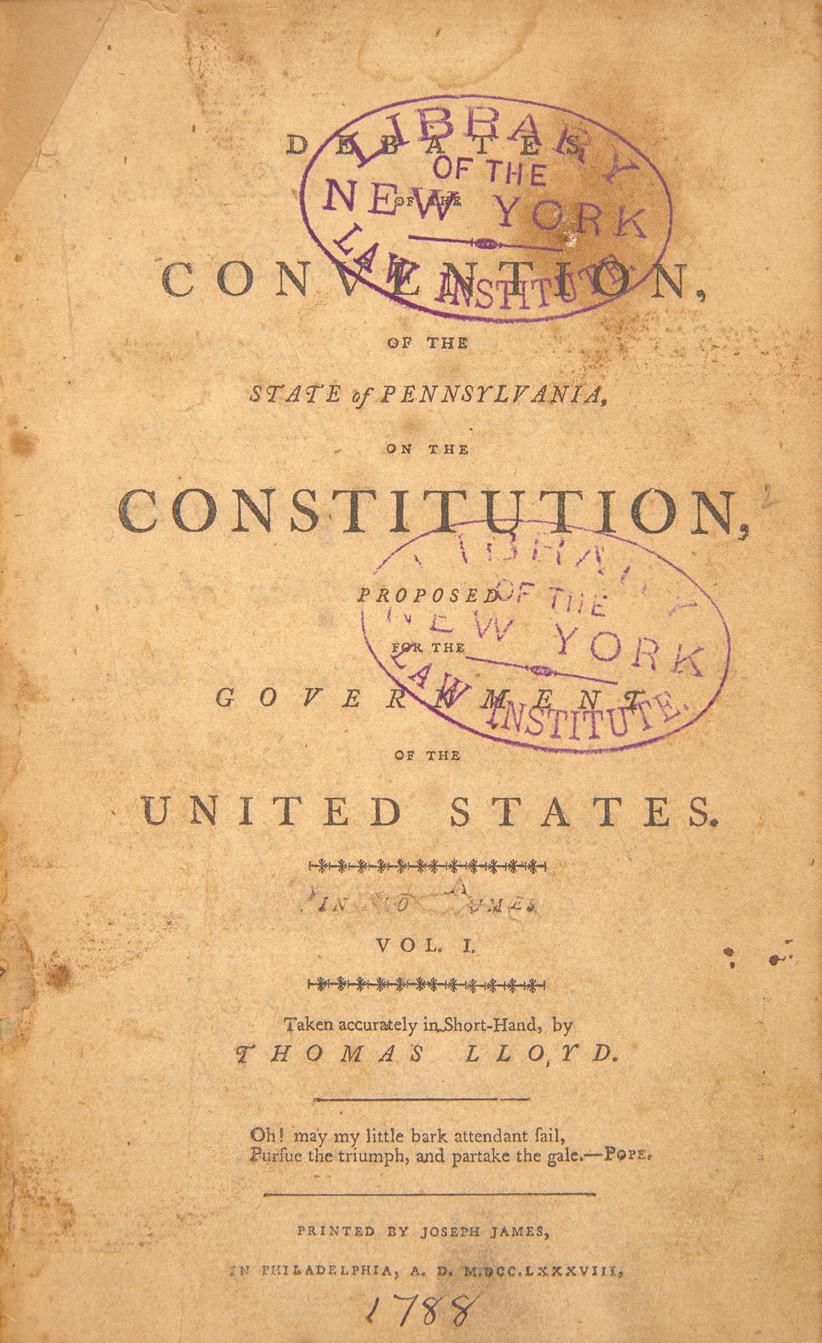
they to appear in the second volume? and if so, will they not be misplaced? It is presumed that the principles of the Constitution, like those of the Christian religion will bear the severest scrutiny; and that its cause will even gain strength by discussion. The omission of the antifederal arguments as stated by the opposition, may give uneasiness to some warm friends to the Constitution.” (DHRC, Vol. 34, 592)
Although Howes calls for an issue with a 1787 title-page, we cannot locate a copy and suspect it to be a ghost. Due to the text of the debates in this volume going to December 11, the printing of Lloyd’s certification on the verso of the title-page dated December 29, and ads from January and early February, 1788 notifying the volume’s publication on February 4, we believe there is almost certainly not an earlier issue.
Rare, according to RBH this is only the fourth copy at auction since 2009.
$3,000 - 5,000
134
[Constitution] [Hamilton, Alexander] Very Rare First Edition of the Debates of the New York Ratifying Convention, Featuring the First Appearance of Alexander Hamilton’s Speeches in Favor of the Adoption of the United States Constitution
The Debates and Proceedings of the Convention of the State of New-York, Assembled at Poughkeepsie, on the 17th June, 1788. To deliberate and decide on the Form of Federal Government recommended by the General Convention at Philadelphia, on the 17th September, 1787... New-York: Printed and Sold by Francis Childs, 1788. First edition. 12mo. (ii), 144 pp. Full modern buckram, red morocco spine label, stamped in gilt; speckled edges; two ink stamps of the Library of the New York Law Institute on title-page, same ink stamp on pp. (i) and recto of rear blank; ownership inscription of Gardiner Baker on title-page (“Gardiner Baker Museum March 27th 1795”); contemporary manuscript corrections and notations, on pp. 115, 143, and 144; sheets toned; scattered foxing and dampstaining. Evans 21310; ESTC W4576; Ford 129; Sabin 53634; Streeter Sale 1054
Based on short-hand notes taken by the printer and publisher, Francis Childs. Despite being outnumbered 47-20, the Federalist faction of the New York convention, led by Alexander Hamilton and John Jay, managed through impressive oratorical skill to overcome the arguments of their AntiFederalist colleagues, and win favor of the charter in the closest margin of any state, 30-27.
Very rare to auction, this is only the fourth copy offered since the Streeter Sale in 1967.
$15,000 - 25,000
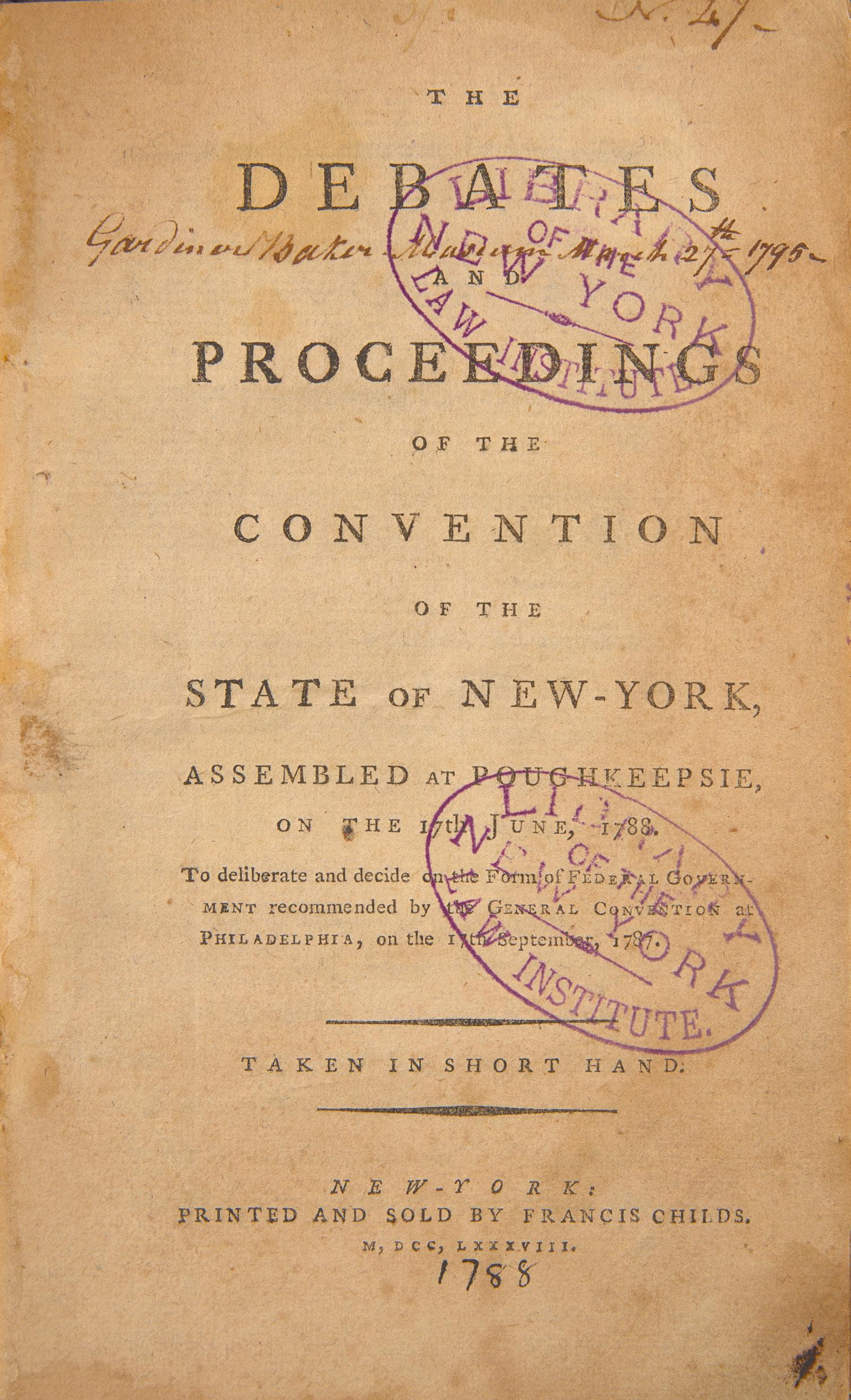
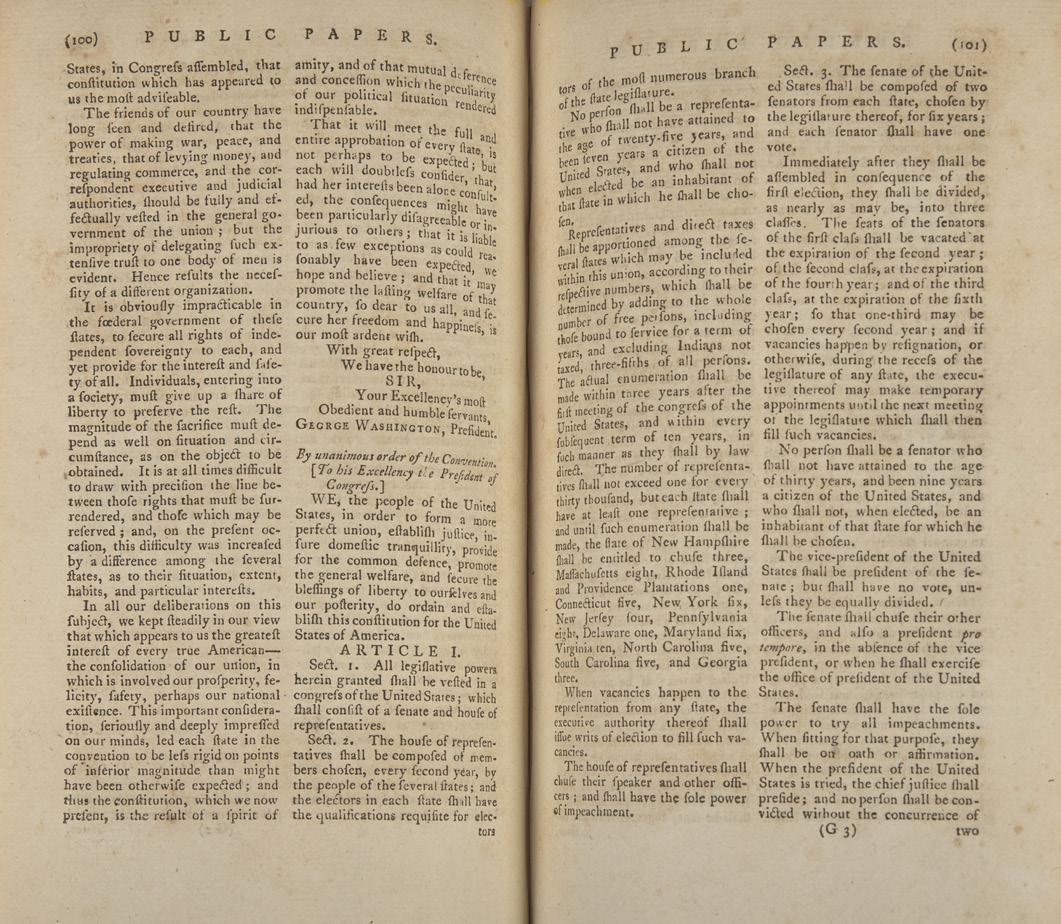
135
[Constitution] A Scarce and Early English Printing of the United States Constitution in The New Annual Register, 1788
London: Printed for G.G. J. and J. Robinson, 1788. Three parts in one volume. First edition. 8vo. (ii), ii, (iv), xxviii, 184, 159, (1), 299 pp. Full contemporary tree calf, red morocco spine label, stamped in gilt, joints worn, extremities rubbed, loss at head of spine; scattered minor spotting. ESTC N20035
A scarce and early English printing of the United States Constitution, on pp. 99-109.
$300 - 500
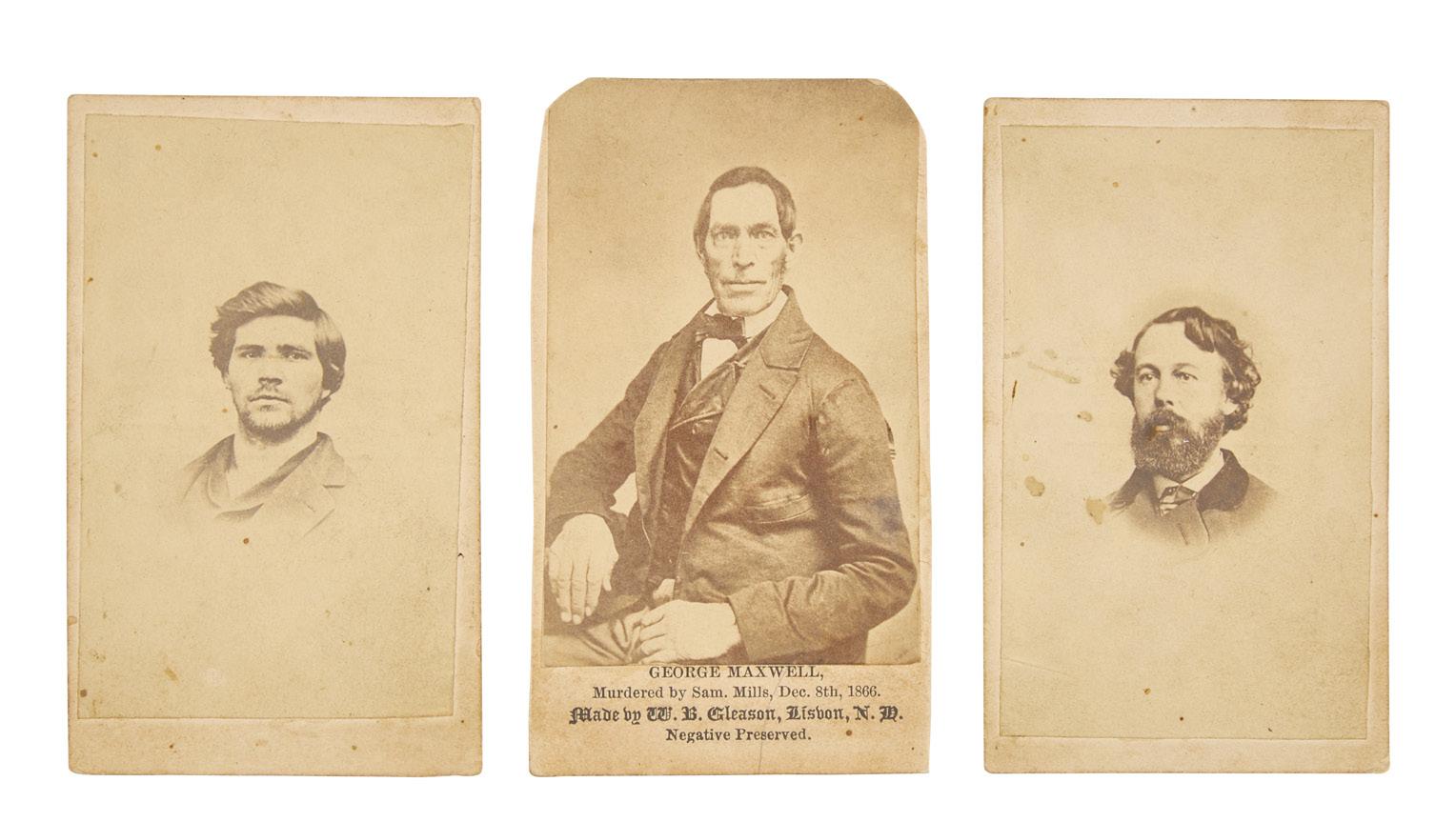
136
[Crime & Punishment] Group of 3 CDVs of a Murderer, His Victim, and the Detective who Brought Him to Justice Lisbon, New Hampshire: W.B. Gleason, ca. 1867. Group of three cartes de visite, of George Maxwell, Samuel Mills, and Moses Sargent; each with printed captions (Maxwell on recto, Mills and Sargent on verso). Scattered soiling.
A group of three cartes de visite showing murder victim George Maxwell, his murderer Samuel Mills, and the detective that brought him to justice, Moses Sargent.
Samuel Mills murdered George Maxwell in Maxwell’s Franconia, New Hampshire home the night of December 8, 1866, purportedly after attempting to seek shelter. Mills then stole Maxwell’s horse, and fled first to Montreal and then elsewhere in Canada. New Hampshire authorities hired Boston private detective Moses Sargent to track down the assailant, who traced him to Canada and then proceeded to trail him through the provinces. Eventually, on January 20, 1867, Sargent arrested Mills in Galena, Illinois and returned him to New Hampshire where he stood trial. In April of 1867 he was found guilty of murder in Haverhill, and sentenced to death. On May 6, 1868, in the last public hanging in New Hampshire, Mills was executed before a crowd of thousands. His last words were “Samuel Mills is guilty of this crime, and I have made my peace with God...” Following mounting criticism of the public practice of execution, within a year the New Hampshire legislature passed a law mandating that they be carried out only within prison walls, resulting in Mills being the last convicted felon in the state to be publicly executed.
$300 - 500
137
[Crime & Punishment] Group of 17 Items Related to Crime and Punishment
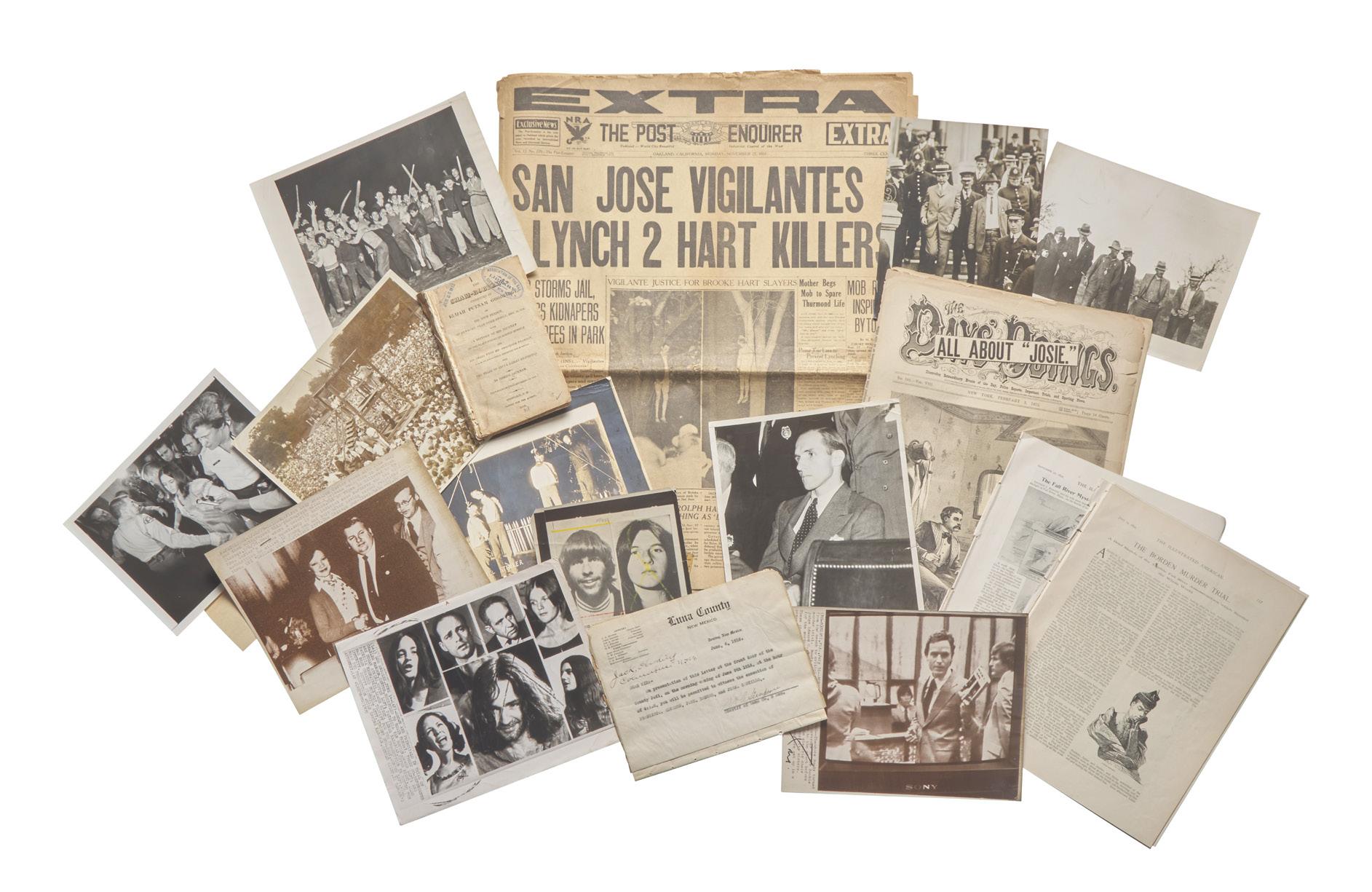
Locations and dates vary. Comprising 11 press photographs and six publications, etc., relating to famous crimes and murderers, etc. Images include an 1895 lynching of four men in Yreka, California; a 1936 hanging in Kentucky; murderers and criminals, such as Ted Bundy, John Wayne Gacy, Charles Manson, Susan “Sexy” Sadie, and more. Publications including two issues of The Illustrated American, with descriptions of the Lizzie Borden murder trial; The Sham-Robbery Committed by Elijah Putnam Goodridge (Concord, New Hampshire, 1819; 12mo); an issue of The Days Doings, with a description of the trial of Edward S. Stokes; an issue of The Post Enquirer (Oakland, November 27, 1933), reporting on the lynching of two men; one printed pass to witness an execution (New Mexico, June 6, 1916). Condition varies.
$400 - 600
138
[Crockett, Davy] The First American Comic Book: Group of 2 Items Related to Davy Crockett, Including Likely the First Mention of Him in an American Magazine
Galaxy of Comicalities
Philadelphia: Printed by Lesher & Shelly, Wednesday, November 27, 1833. Vol. 1, No. 9. 8vo. pp. (65)72. Disbound; spine repaired; scattered soiling.
Likely the first mention of Davy Crockett in an American magazine, featuring a review of, and an excerpt from, Sketches and eccentricities of Col. David Crockett, of the West Tennessee--an unauthorized biography of Crockett, whose authorship has not been definitively determined, and from which some of the frontiersman’s lasting legends originated.
The Galaxy of Comicalities was published in Philadelphia from 1833-34. Each issue profusely illustrated with woodcuts, it is considered to be the first American comic book. The present issue
Together with:
The Albany Journal
New York: Hoffman & White, Friday, May 2, 1834. Volume IV, Number 428. Printed newspaper. Folio. 4 pp. Edited by Thurlow Weed. Creasing from old folds, some separations and open tears along same; scattered foxing.. Old ownership signature in right margin of front-page.
Printed on the second page is an excerpt from a speech given by Crockett at the Philadelphia Exchange, on May 1, 1834, criticizing President Andrew Jackson and his administration: “seven months ago this was the most flourishing country in the world. Look at it now; and what do you see? You behold your commerce suspended; your laborers wandering about for employment; your mechanics starving; and above all, you see the best currency in the world deranged!...what is all this for? To gratify the will of a superannuated old man!! A man whose popularity, like the lightning of heaven, blasts and withers all that comes within its influence. His leading object, in all the mischief he has done, has been to destroy the best monied institution on earth...”
$1,500 - 2,500
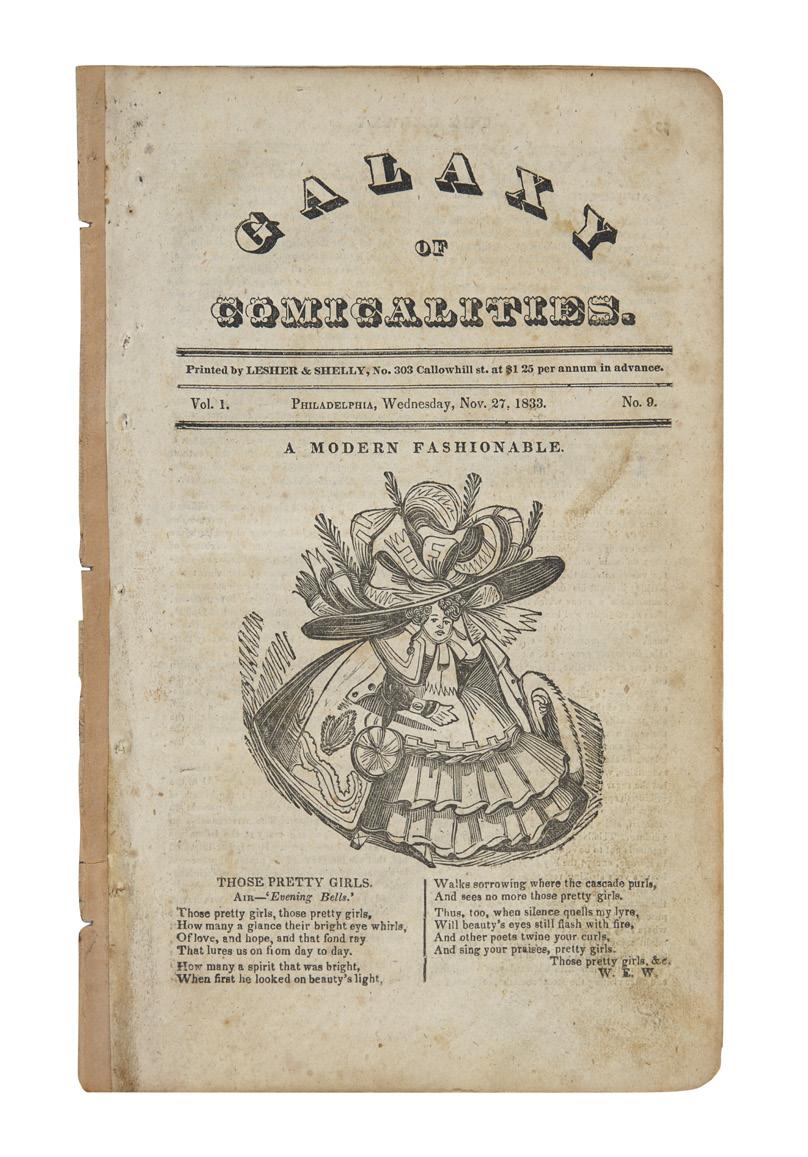
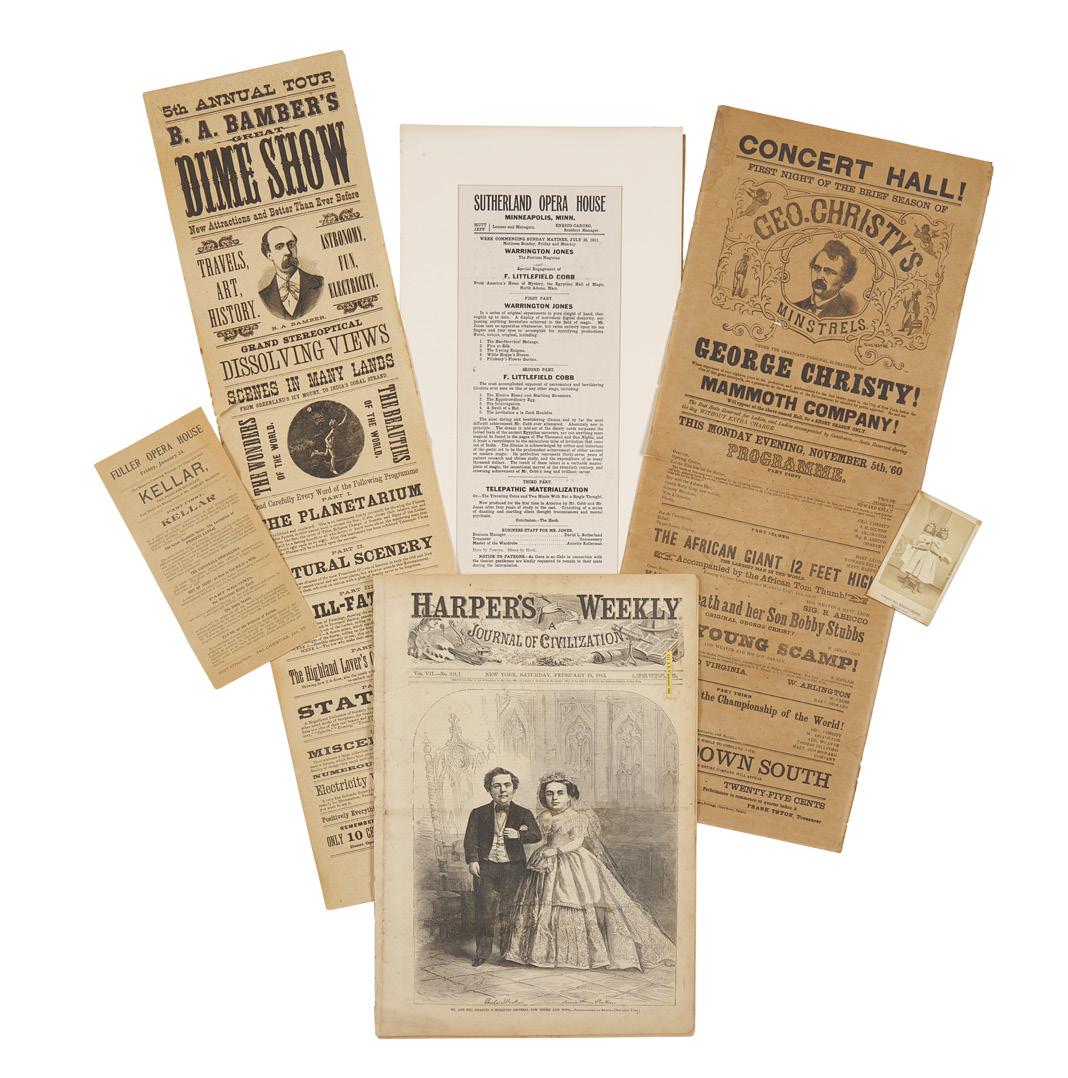
139
[Curiosa] Group of 6 Items Related to Magic, Circuses, Minstrels, and Sideshows
1. Printed Broadside for Christy’s Minstrel Show Philadelphia: U.S. Job Print, 1860. Tall printed broadside, for the “First Night of the Brief Season of Geo. Christy’s Minstrels. Under the Immediate Personal Supervision of George Christy! ... Mammoth Company! ...” Creasing from old folds, largely separated along central horizontal fold, smaller separations along other folds; toned; faint dampstaining along edges; open tear in lower bottom left. 23 5/8 x 9 1/2 in. (600 x 241 mm).
2. Harper›s Weekly. A Journal of Civilization New York, Saturday, February 21, 1863. Vol. VII, No. 321. Folio. pp. (113)-128. Disbound; Scattered toning and spotting.
With an engraved portrait of Mr. and Mrs. Charles S. Stratton (General Tom Thumb) and his wife on the front page, after the photograph by Mathew Brady, and with an article about them on the second page. General Tom Thumb (183883) was an American showman with dwarfism and the first major attraction promoted by P.T. Barnum.
3. Carte de visite of Millie-Crissie, the Two-Headed Girl St. Louis, Missouri: J.H. Fitzgibbon, (ca. 1870). Carte de visite on captioned mount, 4 x 2 1/2 in. (102 x 63 mm). Spotting and soiling along mount edges.
Millie and Christine were born in Whiteville, North Carolina on July 11, 1851, to Jacob and Monemia McKoy, who were enslaved to Jabez McKay. Various enslavers and managers exhibited the twins nationally and internationally, and in 1870, the sisters traveled and performed throughout the Midwest.
4. Tall Printed Broadside for the 5th Annual Tour of B.A. Bamber’s Great Dime Show No place, ca. 1877. Tall printed broadside for B.A. Bamber’s Great Dime Show, 28 x 7 in. (711 x 178 mm). With a wood engraved portrait of Bamber at top and of Hermes at center. Old fold at center; 2 3/4 in. closed tear in upper left edge.
Tall printed broadside for the 5th Annual Tour of B.A. Bamber’s Great Dime Show, featuring exhibitions on “Grand Stereoptical Dissolving Views”, including “scenes in Many Lands From Greenland’s Icy Mount, to India’s Coral Strand”, as well “The Planetarium,” “Natural Scenery,” “The Ill-Fated Ship,” “The Highland Lover’s Courtship for Marriage”, etc.
5. Printed Broadside for a Magic Show Minneapolis, Minnesota: Sutherland Opera House, July 1911. Printed broadside, 13 x 5 3/4 in. (330 x 146 mm). Mounted to card, and in mat.
Advertising the magic show for “The Peerless Magician” Warrington Jones, and F. Littlefield Cobb
6. Printed Handbill for a Harry Kellar Magic Show Madison, Wisconsin: Fuller Opera House, January 24, (1902). Printed handbill program, 8 5/8 x 4 1/4 in. (219 x 108 mm). Toned.
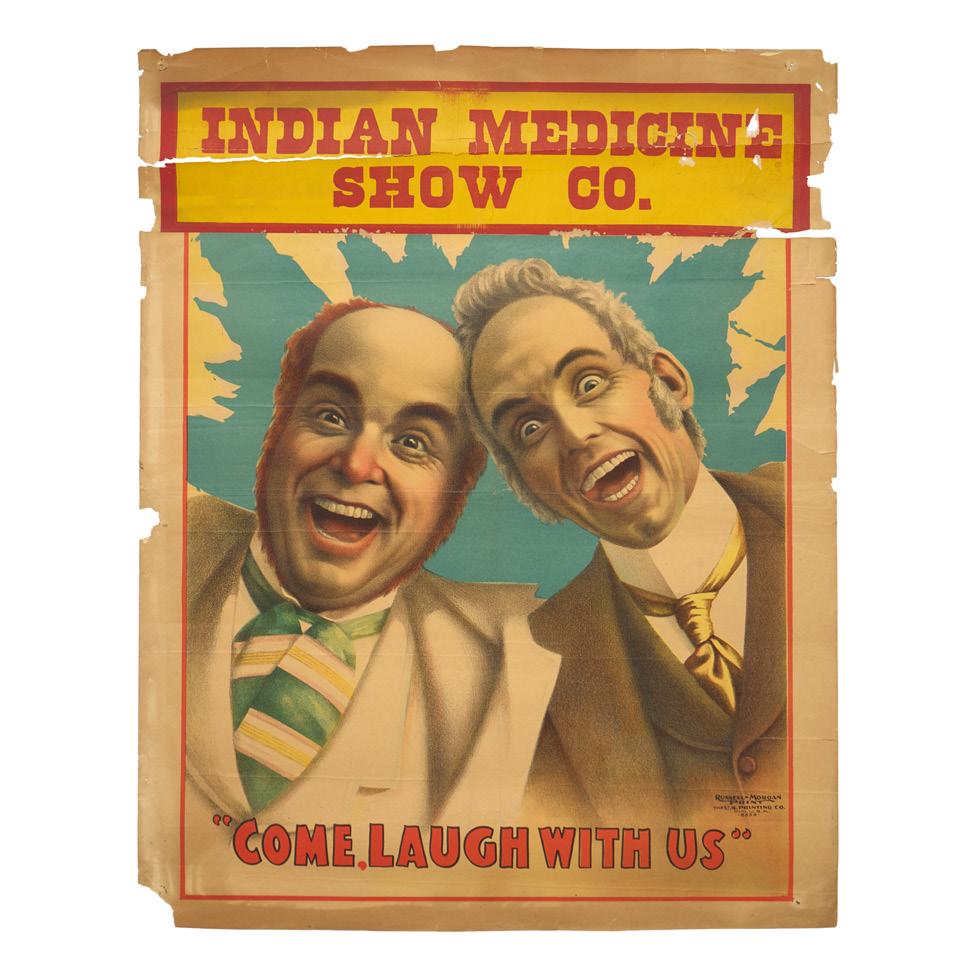
Printed program for famed globe-trotting American magician Harry Kellar’s (1849-1922) January 24, 1902 magic show at the Fuller Opera House in Madison, Wisconsin.
$500 - 800
140
[Curiosa] Indian Medicine Show Co. “Come, Laugh With Us” Poster
Cincinnati, Ohio: Russell-Morgan Print, The U.S. Printing Co., (ca. late 1890s-early 1900s). Color lithographed poster; comprised of two conjoined sheets. Unevenly toned; wear and losses along edges; top edges worn; repaired horizontal separation traversing upper edge, other repairs at same; creasing from old folds.
A rare example of this poster advertising a traveling Indian Medicine Show.
We cannot locate another example of this fragile survival.
$300 - 500
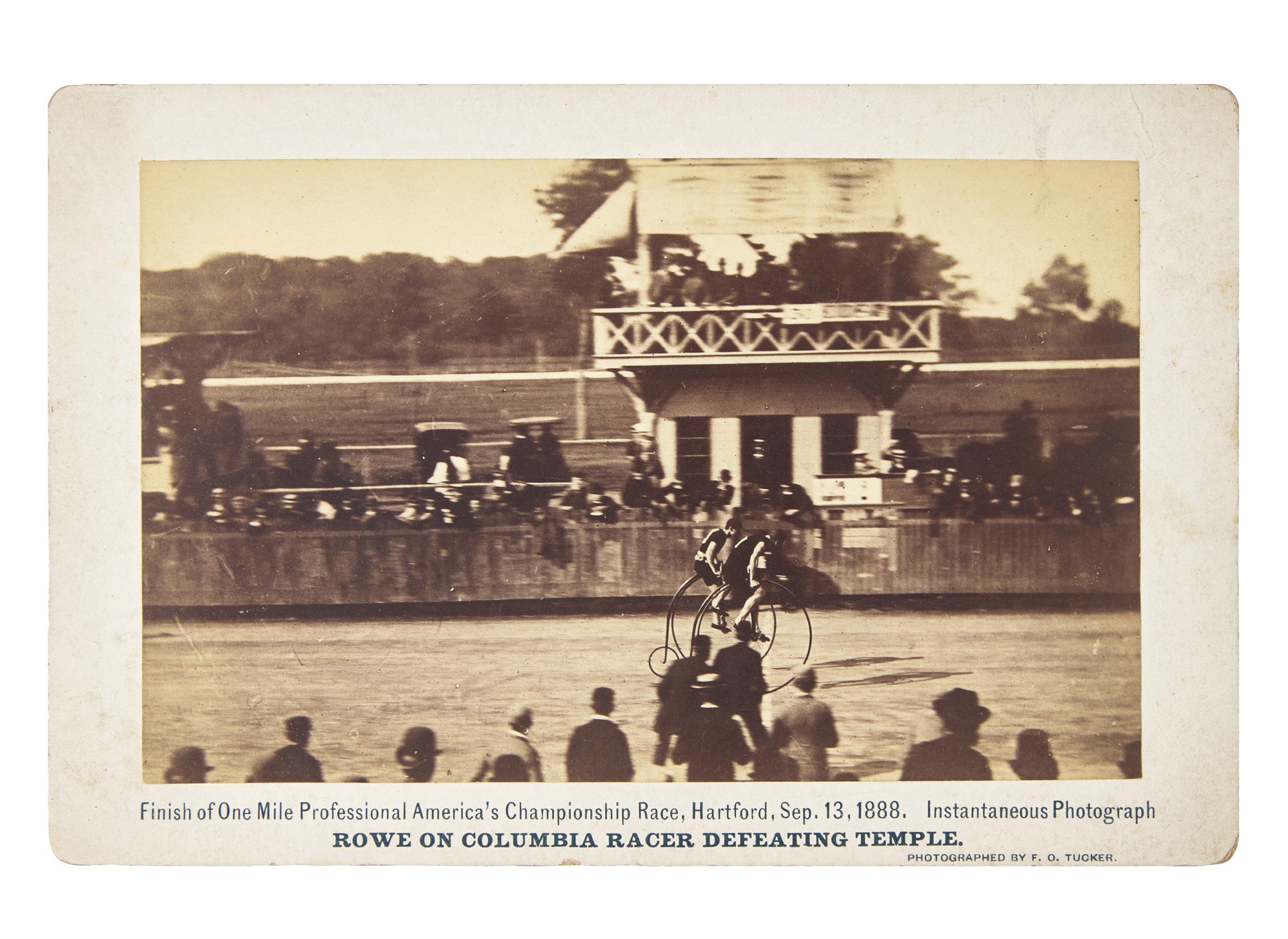
[Cycling] A Photo-Finish: Possibly the Earliest Extant American Photo Finish Race Image and Among the Earliest Action Sport Photos
Rowe on Columbia Racer Defeating Temple Hartford, Connecticut: F.O. Tucker, 1888. Albumen print, mounted to captioned card, “Finish of One Mile Professional America’s Championship Race, Hartford, Sep. 13, 1888. Instantaneous Photograph / Rowe on Columbia Racer Defeating Temple”. Light soiling on card edges. 3 3/8 x 5 1/2 in. (86 x 140 mm) print, on 4 1/4 x 6 1/2 in. (108 xx 165 mm) card.
A rare photograph, showing the dead heat photo finish of American cycling champion William A. Rowe, of Lynn, Massachusetts, defeating Ralph Temple, of Chicago, at the Great International Bicycle Tournament at Charter Oak Park, in Hartford, Connecticut, on September 13, 1888—likely the earliest known extant photograph depicting the photo-finish of an American sporting competition.
As early as the late 1870s, cameras were being called for to determine winners in sports racing to replace the fallible eye of the placing judge. In 1882 the esteemed photographer of movement Eadweard Muybridge lent his voice, claiming that, “in the near future...no race of any importance will be undertaken without the assistance of photography to determine the winner of what might otherwise be a so-called ‘dead heat’.” While the first documented image of a photo finish is attributed to Ernest Marks at a horse race in 1881 in Plainfield, New Jersey (it is not known to survive), the widespread and regular use of cameras to determine winners in dead heats,
or in other instances, did not widely take root until the second and third decades of the 20th century. In the interim, the practice gained steady use by professional and amateur photographers alike, most notably by sports photographer John C. Hamment, whose early extant photographs date to 1890. While being used primarily first for horse racing, the practice then expanded to cycling (as seen in the present photograph), then to a variety of other sports, such as pole vaulting and sailing.
Rowe and Temple were among several racers that competed on highwheel Columbia Racer bikes in the championship match before almost 4,000 spectators. Although Jack Lee, of Nottingham, England, led the race through the first three quarters, it was Rowe and Temple who managed to break away in the final stretch in a neck and neck pursuit of the finish line.
As The Hartford Courant reported the day following the race, «From the third quarter pole Rowe and Temple had it nip and tuck. Up the track came these two great flyers neck-and-neck amid shouts of encouragement. It seemed as if either one might win, but Rowe managed to push his machine over the ribbon ahead of Temple›s and won by less than a foot...»
The Columbia high wheel bicycle pictured here was manufactured by Pope Manufacturing Company, based in Hartford, Connecticut, beginning in the early 1880s. As the first and leading mass producer of bicycles in the United States, their design and use of lightweight steel tube construction, pneumatic tires, among other aspects, helped revolutionize bicycle design and contributed to their increased use across the nation.
$1,500 - 2,500
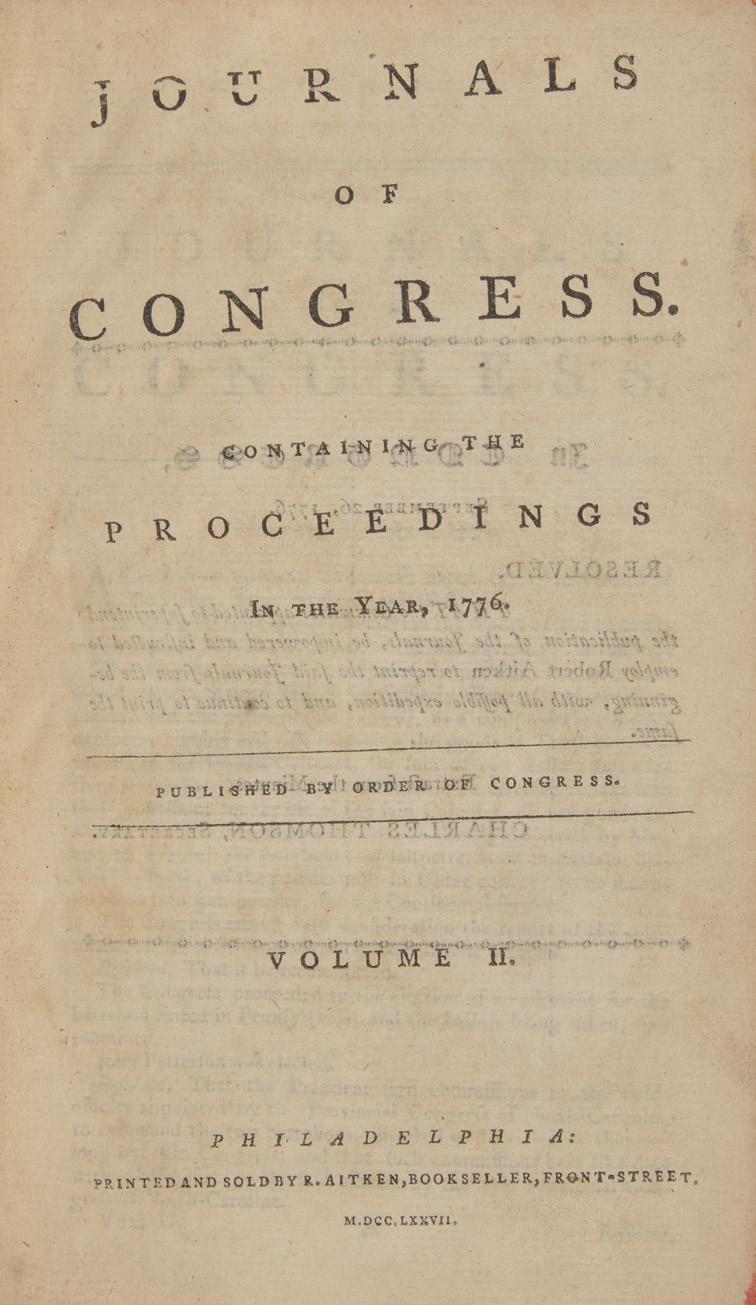
142
[Declaration of Independence] The Important and Increasingly Rare Robert Aitken Issue of the Journals of Congress for the Pivotal Year of 1776, Containing an Early and Complete Printing of the Declaration of Independence, 1777
Journals of Congress. Containing the Proceedings In the Year, 1776 Philadelphia: Printed and Sold by R. Aitken, 1777. Volume II. First edition, first issue. 8vo. (ii), 513, (22) pp. Full contemporary mottled calf, red morocco spine label, stamped in gilt, joints worn, spine and boards dry and scuffed; edges stained red; marbled endpapers; uneven toning at rear. Evans 15684; ESTC W20602; Hildeburn 3577; Reese, The Revolutionary Hundred 48
This is the earliest obtainable printing of the Declaration (pp. 241-246) to print the Signers’ names, as the January 1777 broadside by Mary Goddard (the first to print the Signers’ names) survives in only nine known copies.
On September 26, 1776 Congress authorized Philadelphia printer Robert Aitken to produce a uniform series of the Congress’s journals. For the first volume of that series Aitken reprinted and combined the 1774 and 1775 Journals that covered the First Continental Congress. For the present, second volume in that series, he reprinted his so-called “Cartridge Paper” edition, the monthly issues printed for members of the Second Continental Congress that covered January-May 1776. The second half of this volume was the first publication of Congress’s journals from June to December of that year. It was completed by him in the spring or summer of 1777. According to Aitken’s account book, 532 copies of the first edition were printed. An unclear amount of these copies, along with Aitken’s own press, suffered the plunder of the invading British Army in Philadelphia in the autumn of 1777. Some sheets did find their way to York, Pennsylvania, then the seat of the American government. By Aitken’s own recollection, according to Hildeburn, “I printed 800 copies of the second volumes, 60 were carried to Lancaster, and committed to the care of Mr. Dunlap. I find of the 760 other copies only 682 were delivered. I allow 218 copies as they have been lost or embessled.’’
In May 1778, Congress appointed John Dunlap, printer of the first printed version of the Declaration of Independence, as its new official printer. Using the recovered Aitken sheets (pp. 1-424), he reprinted the remainder of the volume (coming out to a slightly different pagination from Aitken’s version), and added a new title-page, under his imprint at York, and with a notice on the verso noting his appointment as printer to Congress. That is considered the second issue of the present work, and it presumably came out between his appointment on May 2 and the return of Congress to Philadelphia in July 1778.
The present first issue is decidedly more rare than the Dunlap second issue, and is one of the rarest of all editions published in the series. According to RBH, we can find only about five other copies in the past ten years at auction (some included as volumes in complete sets of the Journals).
$6,000 - 9,000
143
[Declaration of Independence] Pratt, Luther. Connecticut Republican Magazine. Number 1, Volume 1, 1802
Suffield,(Connecticut), 1802. 8vo. Original printed wrappers, soiled and worn; uncut; foxing and soiling.
Includes a printing of the Declaration of Independence. Rare: We trace only two copies that have appeared at auction in the past century.
$300 - 500
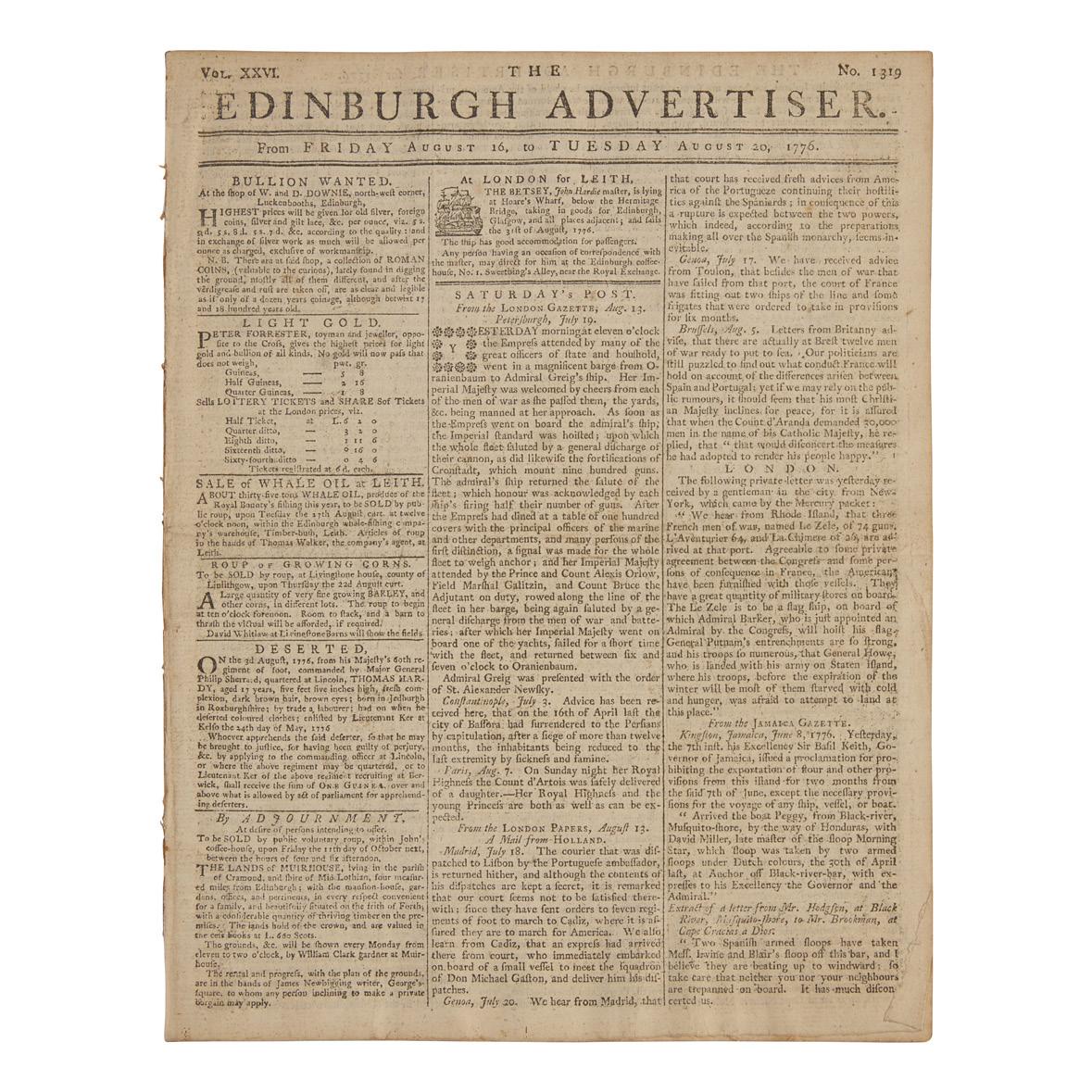
145
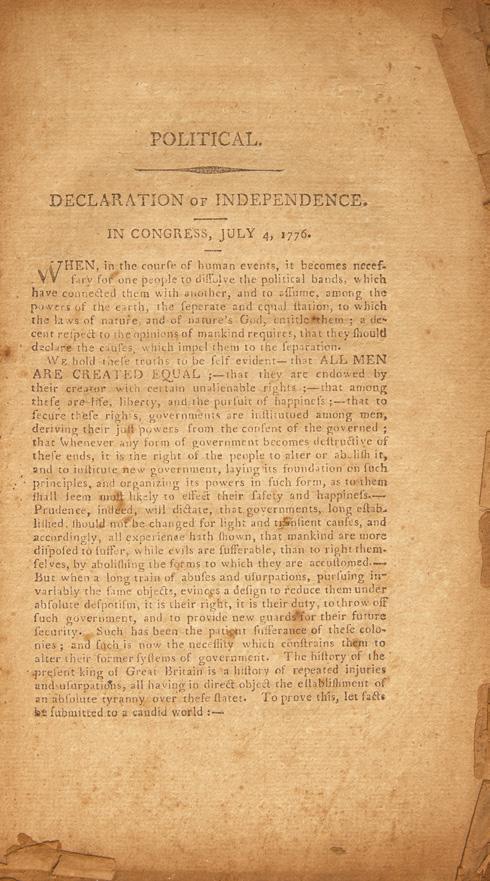
[Declaration of Independence] The First Scottish Printing of the Declaration of Independence
The Edinburgh Advertiser Edinburgh: Printed by and for James Donaldson, From Friday August 16, to Tuesday August 20, 1776. Vol. XXVI, No. 1319. Printed newspaper. 4to. pp. (113)-120. Disbound. Not in Matyas
“General Howe having in his last dispatches mentioned that the Continental Congress had declared the united colonies free and independent states, the following is a copy of the declaration by the representatives of the united states of America, in General Congress assembled, July 4. When in the course of human events...”
The first printing of the Declaration of Independence in Scotland, fully printed on pp. 116-117, six weeks after its adoption by the American Congress. On August 10, news of the Declaration of Independence reached London, and was first printed in newspapers there by August 16. From there, news traveled north, with the present printing believed to be the first in Scotland, which was then closely followed by printings in The Caledonian Mercury and in The Scots Magazine
$3,000 - 5,000
[Declaration of Independence] Rare Issue of the Pennsylvania Evening Post Reporting the Second Reading of the Declaration of Independence in New York City
The Pennsylvania Evening Post
Philadelphia: Printed by Benjamin Towne, July 23, 1776. Vol. II, Num. 235, Folio. 4 pp. Printed newspaper in two columns. Disbound. Featuring a report on the second reading of the Declaration of Independence in New York: In full: “Thursday last the Declaration of the Independancy of the United States of America was published at the Courthouse; where a number of people, true friends to the rights and liberties of this country, attended, and signified their approbation to it by loud acclamations. After which the coat of arms of his Majesty George the III. was torn to pieces and burnt in the presence of spectators...” Scattered foxing and pencil marginalia. Lot also includes an 8 1/2 x 5 in. (216 x 127 mm) engraved portrait of John Hancock.
By order of General George Washington, the Declaration was first read publicly in New York on July 9, 1776. The ensuing fervor of soldiers and civilians lead to the destruction of an equestrian statue of George III on Bowling Green. On July 18, following a resolution passed by the New York City Committee, the Declaration was read again on the steps of City Hall. After being met with thunderous applause, spectators from the crowd removed the King’s coat of arms from the legislative chamber, and burnt it in celebration. An ensuing mob scoured the city destroying similar insignias of Royal authority.
$2,000 - 3,000
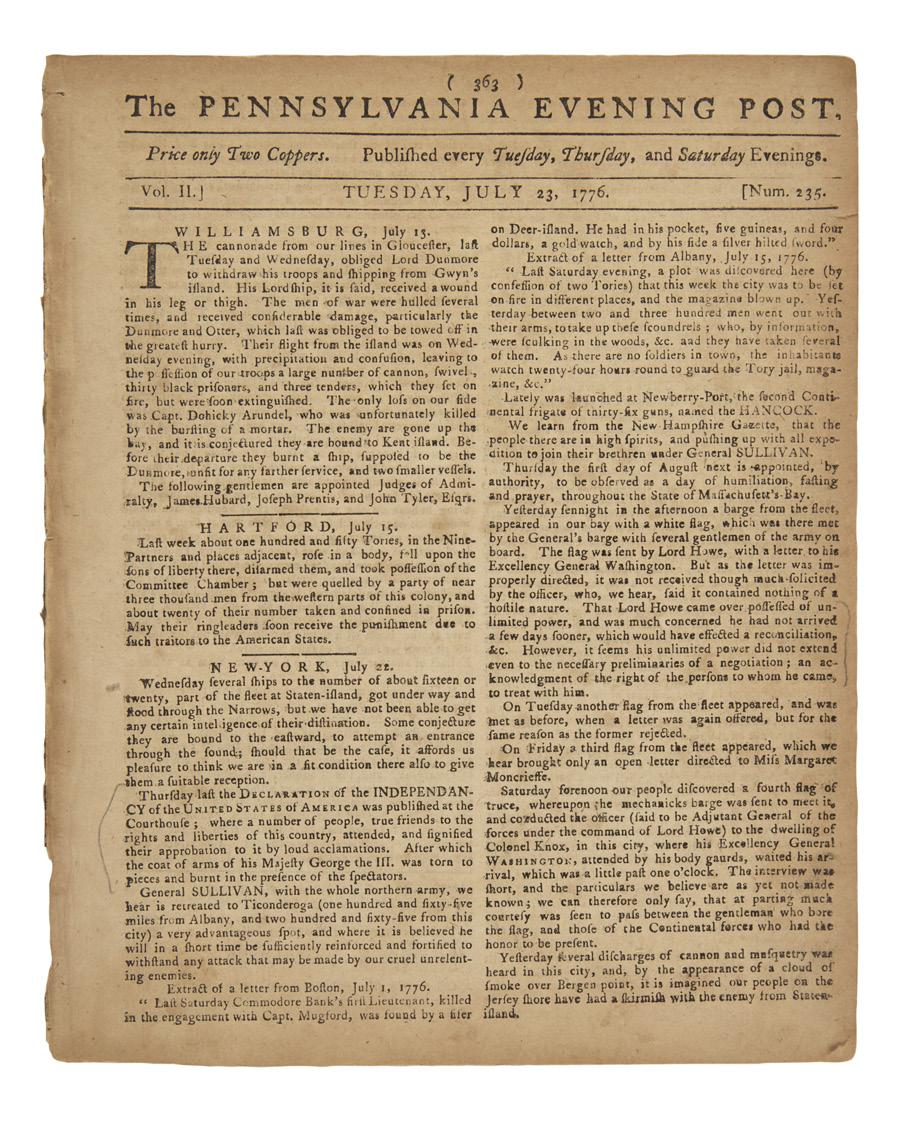
146
[Declaration of Independence] One of the Earliest Printed Announcements of American Independence, in the Exceedingly Rare Original Wrappers, 1776
The Pennsylvania Magazine: Or, American Monthly Museum for June 1776 Philadelphia: Printed by R. Aitken, 1776. Number VI, Volume II. First edition. 8vo. (iv), 253-296 pp. Manuscript on front wrapper (“Mr Ebenezer Hazard / N.C. Co.”). Edited by Thomas Paine. Illustrated with one folding map. Original limp printed wrappers, original thread intact, rear wrapper detached, front wrapper nearly detached, scattered foxing, wear along edges; all edges untrimmed; sheets moderately toned; wear along edges. Sabin 60346
Among the earliest of any type of publication to announce American independence. Although dated June 1776, the monthly issues were traditionally published the first Wednesday of the following month, which would have been on July 3. Due to a temporary paper shortage (“Our customers will excuse us, though the day of publication be sometimes delayed: The great difficulty we have procuring printing paper, renders it impossible for us to publish always on the first Wednesday of the month.”, as printed in the apologia within), the printing was delayed until no later than July 4 or 5, allowing enough time to add at the end of the “Monthly Intelligence” section the important Congressional announcement, that on, “July 2. This day the Hon. Continental Congress declared the UNITED COLONIES FREE AND INDEPENDENT STATES.”
In the column immediately preceding the above news, the text of Pennsylvania’s own declaration of independence reads, in part: “Whereas George the Third... in violation of the principles of the British constitution, and of the laws of justice and humanity... We the DEPUTIES of the people of Pennsylvania, assembled in FULL Provisional Conference for forming a plan for the executing the resolve of Congress of the 15th of May last, for suppressing all authority in this province derived from the crown of Great-Britain, and for establishing a government upon the authority of the people only, DO in this public manner... UNANIMOUSLY declare our willingness to concur in a vote of the Congress declaring the United Colonies free and independent STATES....”
This periodical is preceded by four other printed announcements: Pennsylvania Evening Post, July 2; Die Germantowner Zeitung, July 3; Pennsylvania Journal, July 3; Pennsylvania Gazette, July 3.
Rare to auction, especially in the original wrappers. According to RBH, only three other copies have come to auction since the Laird Park sale in 2000.
Lot includes an engraved portrait of John Hancock, and engraved print of the Declaration after John Trumbull.
$10,000 - 15,000
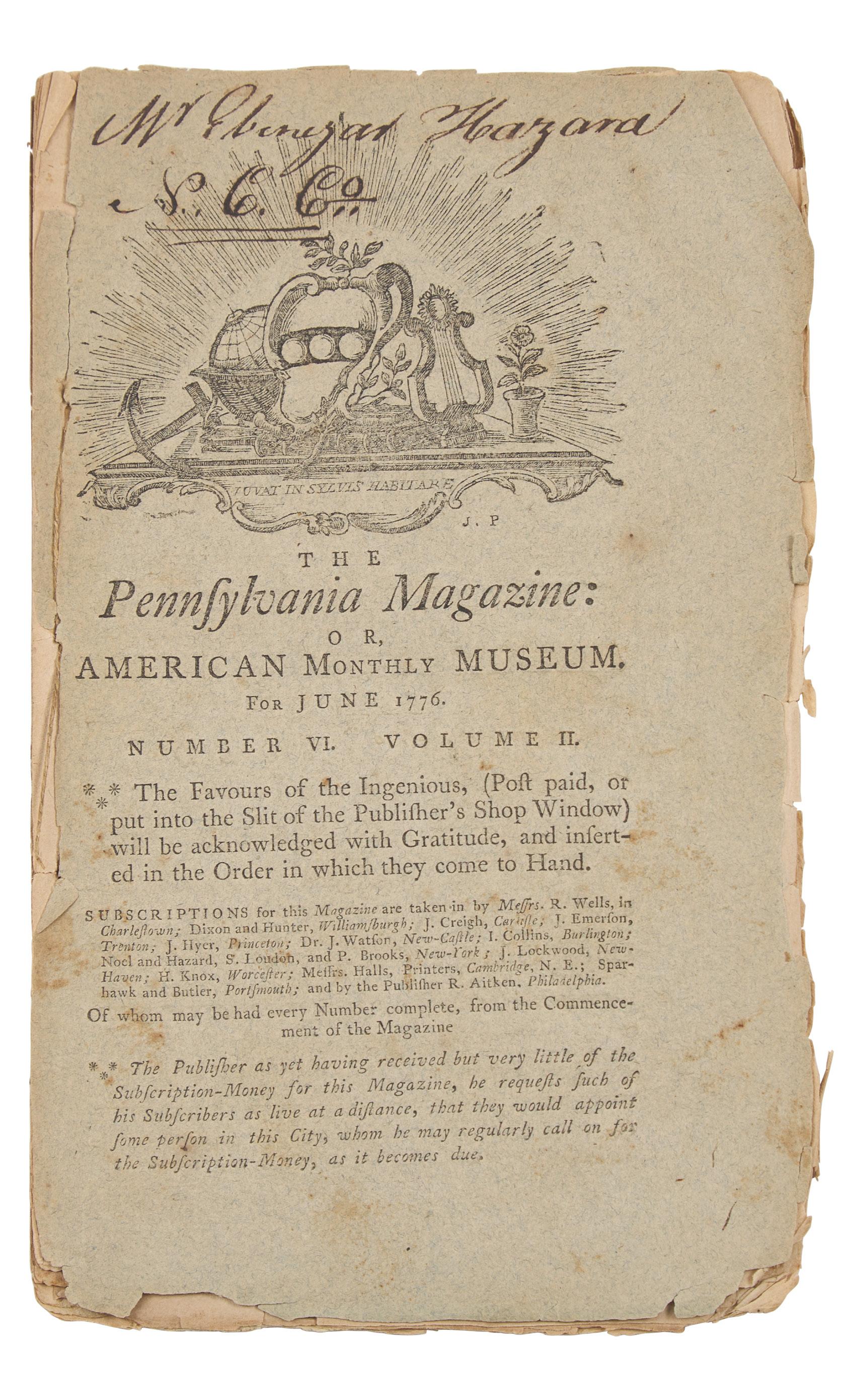
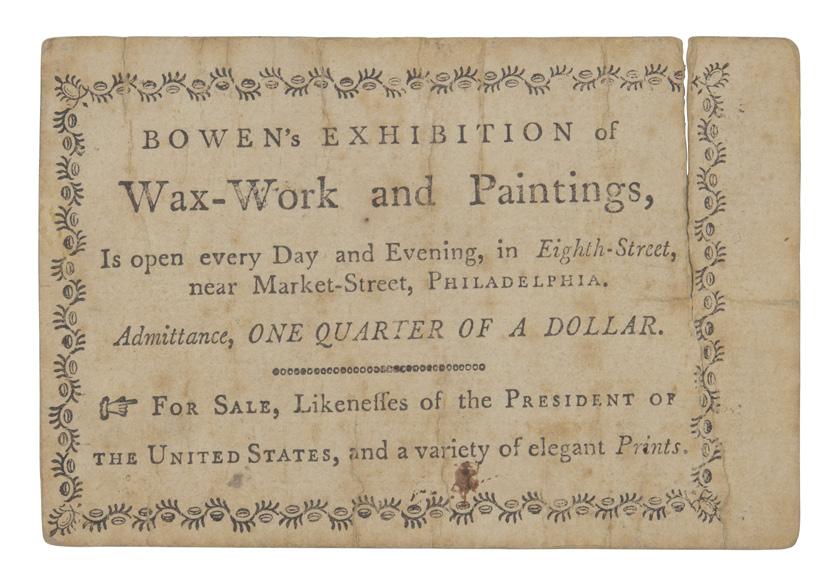
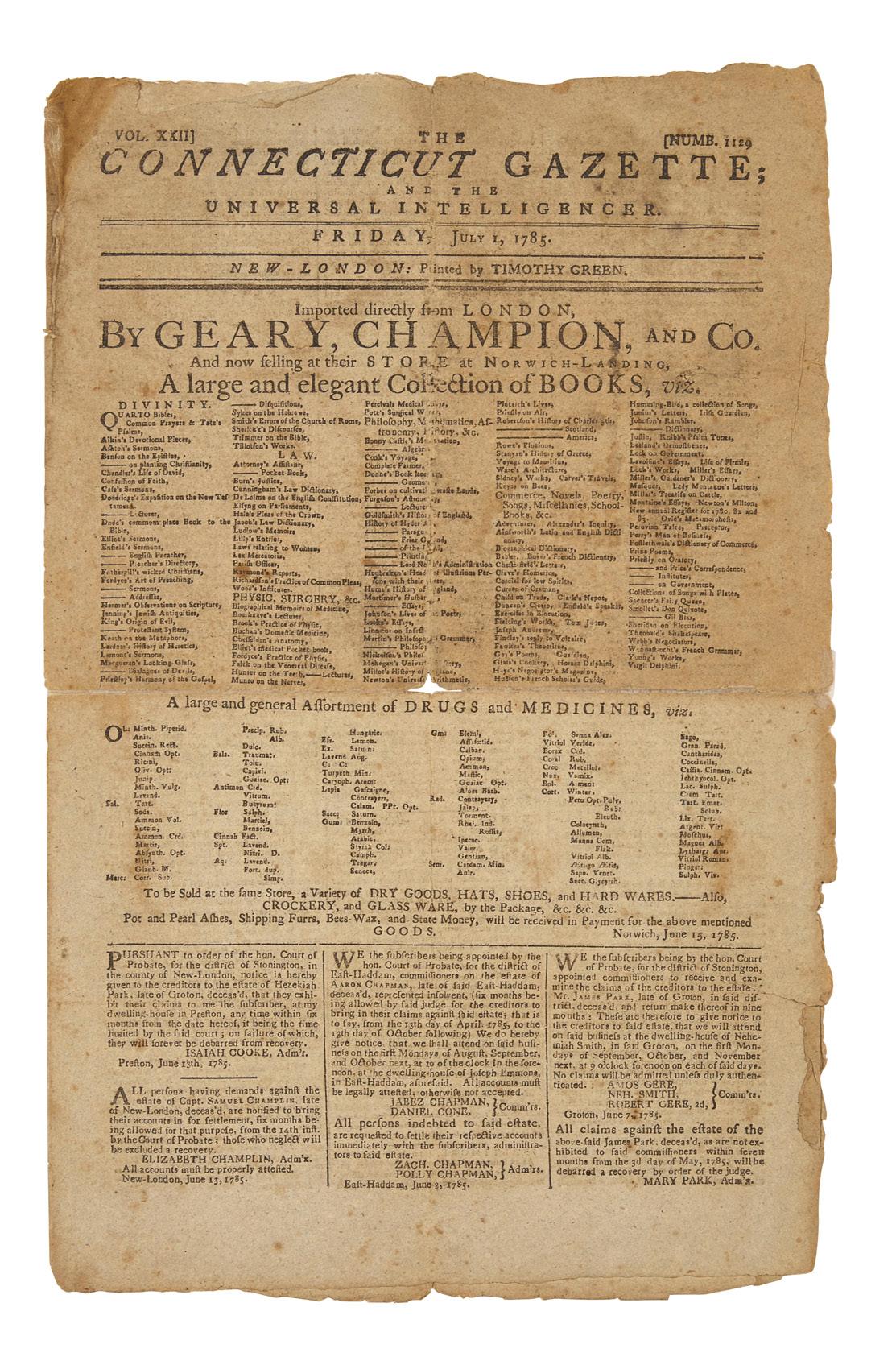
147
[Early American Museum] A Very Early Philadelphia Museum Trade Card for Bowen’s Exhibition of Wax-Work and Paintings
Philadelphia, ca. 1792-93. Printed card, 2 1/2 x 3 3/4 in. (63 x 95 mm). Ornamental letterpress border (Reilly 585, 652, and 784). Two-inch vertical closed tear in top right side; scattered wear along edges; toned and spotted.
A very early museum promotional card, advertising pioneering American museum proprietor and showman Daniel Bowen’s (1760-1856) Philadelphia exhibition of wax-works and paintings.
Born in Rehoboth, Massachusetts, Bowen served in the Revolutionary War under Captain Silas Talbot, and was captured by the British while serving aboard the privateer General Washington. After his release and the conclusion of the war, Bowen was inspired by the pioneering waxworks of Patience Wright, and began a career as a museum proprietor, showman, and artist. He acquired the Wright family’s collection of figures and began touring the Atlantic coast in the late 1780s, exhibiting wax figures of prominent Americans and allegorical scenes.
In the fall of 1792, Bowen opened a museum at No. 9 Eighth Street in Philadelphia, located in the former home of English painter Robert Edge Pine. A friend of fellow Philadelphia museum owner Charles Willson Peale, Bowen’s establishment advertised over 100 paintings (many by Pine) and 30 wax figures depicting “principal characters in America,” including George Washington, Alexander Hamilton, and John Hancock. He also sold his own sculpted wax likenesses of President Washington.
Contemporary newspapers indicate that this Philadelphia exhibition closed in late 1793, likely so Bowen could concentrate on his new venture, the Columbian Museum in Boston, his most well-known endeavor. This institution cemented his reputation as one of America’s earliest leading museum proprietors. Expanding the format of his Philadelphia show, the Columbian Museum eventually featured a vast array of curiosities and natural specimens, as well as hosting lectures, musical and dramatic performances, and circus-like acts. After enduring a series of fires and relocations, Bowen sold his interest in the museum in 1815 and retired.
Rare. While Evans lists two broadsides advertising Bowen’s Columbian Museum, and ESTC locates one broadside for this Philadelphia exhibition, at Yale, neither (nor OCLC) locate promotional cards like the present example. Furthermore, according to RBH, we cannot locate other copies ever having been sold or offered at auction.
$1,500 - 2,500
148
[Early American Trades] A Full Front-Page Ad by an 18th-century American Bookseller for a “Large and Elegant Collection of Books”
The Connecticut Gazette; and the Universal Intelligencer New-London: Printed by Timothy Green, Friday, July 1, 1785. Vol. XXII, Numb. 1129. Printed newspaper. Folio. (4) pp. Creasing from old folds, sello tape repairs to same; scattered soiling; unevenly toned; wear along edges.
With a large front-page ad for Geary, Champion, and Co., of Norwich Landing, for a “large and elegant Collection of Books”, including titles on divinity, surgery, medicine, philosophy, literature, etc. Followed by a list of various medicines and drugs also sold by them, including opium, as well as other dry goods, such as hats, shoes, and hard wares.
The second page reports a resolution passed by the Confederation Congress for the paying of invalid officers and soldiers from the Revolutionary War.
$200 - 300
149
[Early American Trades] Early Printed Boston Furrier Trade Card
Boston, Massachusetts, ca. 1800-10. Single oblong sheet, 3 3/4 x 5 in. (95 x 127 mm). Wood-engraved and letterpress trade card for furrier Samuel Crease. Inscribed and notated by Crease on verso (possibly a receipt). Creasing from old folds; lightly worn.
An early trade card for a Boston furrier and leather dresser. Samuel Crease (1765-1816) operated a store at No. 74 Newbury Street, offering furs, muffs, tippets, trimmings, caps, gloves, and more, while also accepting furs for cash. Crease first appears in the Boston city directory in 1798 at No. 63 Newbury St., and then at the above address from 1800-1810. By 1813 he relocated to Jarvis Row, and does not appear listed in subsequent directories. According to The Ancestors, Kin and Descendants of John Warden and Narcissa (Davis) Warden, His Wife (1901), Crease was successful in business, but lost most of his property due to the Embargo Act of 1807. Crease’s second son, also named Samuel, likewise became a furrier and leather dresser, before his death in 1822 at the age of 31.
$500 - 800
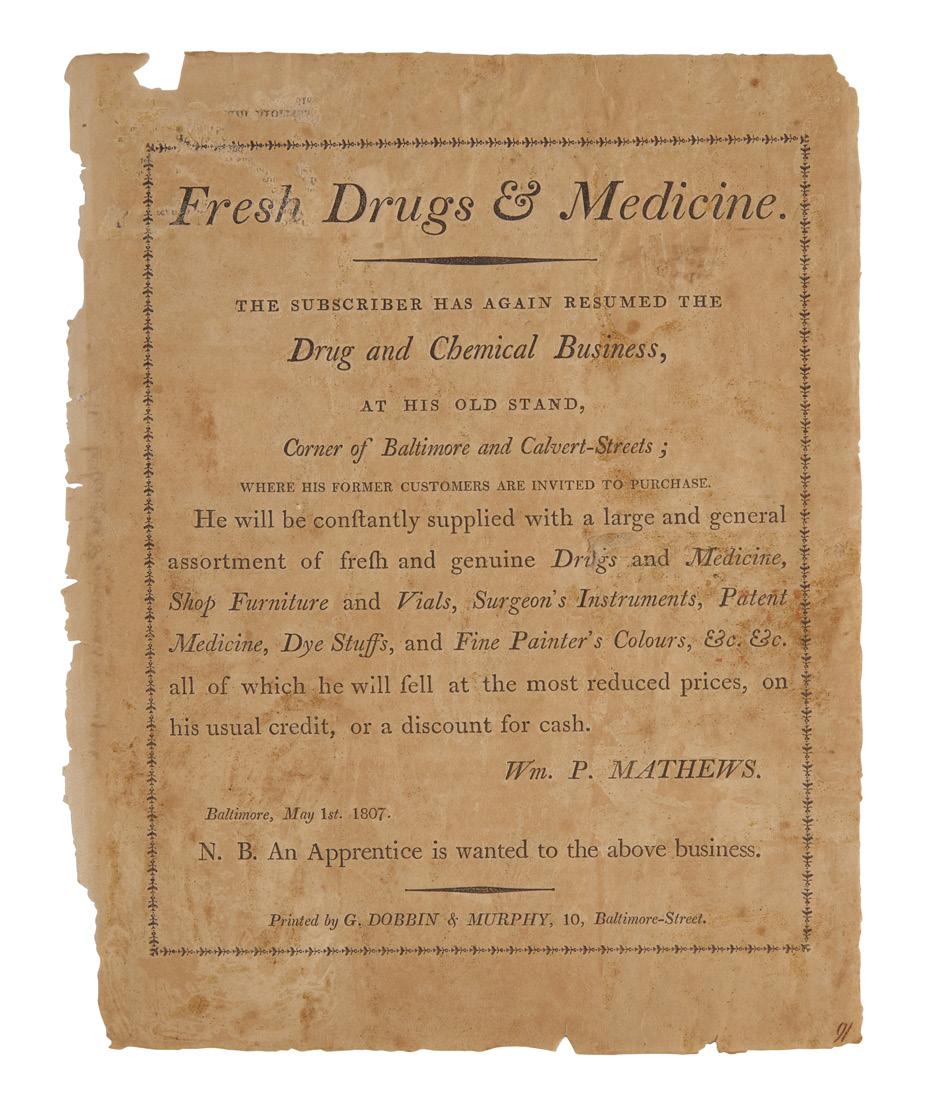
151
[Early American Trades] Early Printed Broadside for a Vermont Dentist
Chelsea, Vermont, May 1, 1835. Printed broadside, mounted to old wood, 15 1/2 x 11 1/2 in. (394 x 292 mm). Printed by Kimball’s Dartmouth Press, Hanover, New Hampshire. Toned; soiling and dampstaining along edges.
“Sebre Gustin, Jr., Surgeon Dentist, of Chelsea, Vt., Would respectfully inform the citizens of Rutland that he has taken Rooms at 11 Main Street where he is prepared to perform any operation on the Teeth...Cleansing, Filling, and Insertion of Artificial Teeth...”
An early 19th-century broadside advertising the services of an itinerant Vermont dentist, containing a testimonial from several prominent citizens and patients attesting to his skills.
$300 - 500
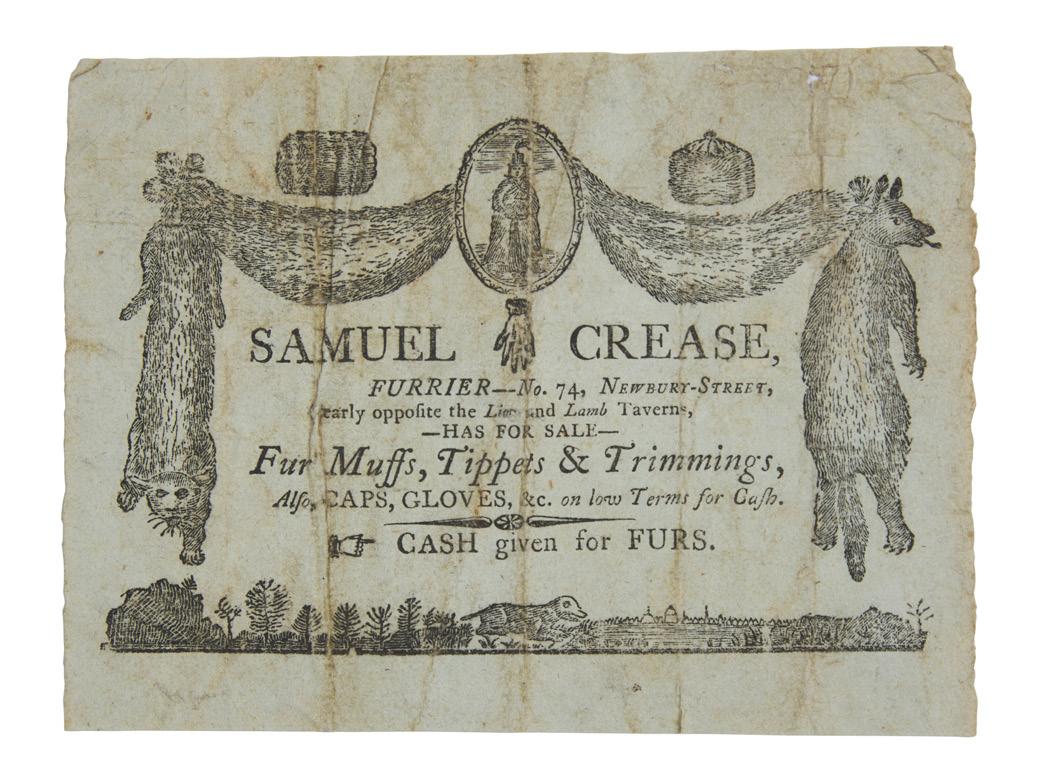
150
[Early American Trades] Rare Early Baltimore Druggist’s Broadside
Baltimore: Printed by G. Dobbin & Murphy, May 1, 1807. Printed broadside, 10 1/2 x 8 1/2 in. (267 x 216 mm). Toned and soiled; old glue and paper residue from when removed from album; old manuscript on verso.
An early nineteenth century broadside for a Baltimore druggist, advertising the “Drug and Chemical Business” of William P. Mathews. Mathews informs his customers that, “He will be constantly supplied with a large and general assortment of fresh and genuine Drugs and Medicine, Shop Furniture and Vials, Surgeon’s Instruments, Patent Medicine, Dye Stuffs, and Fine Painter’s Colours...all of which he will sell at the most reduced prices, on his usual credit, or a discount for cash.”
OCLC locates only one other copy, at the National Library of Medicine in Bethesda, Maryland.
$200 - 300
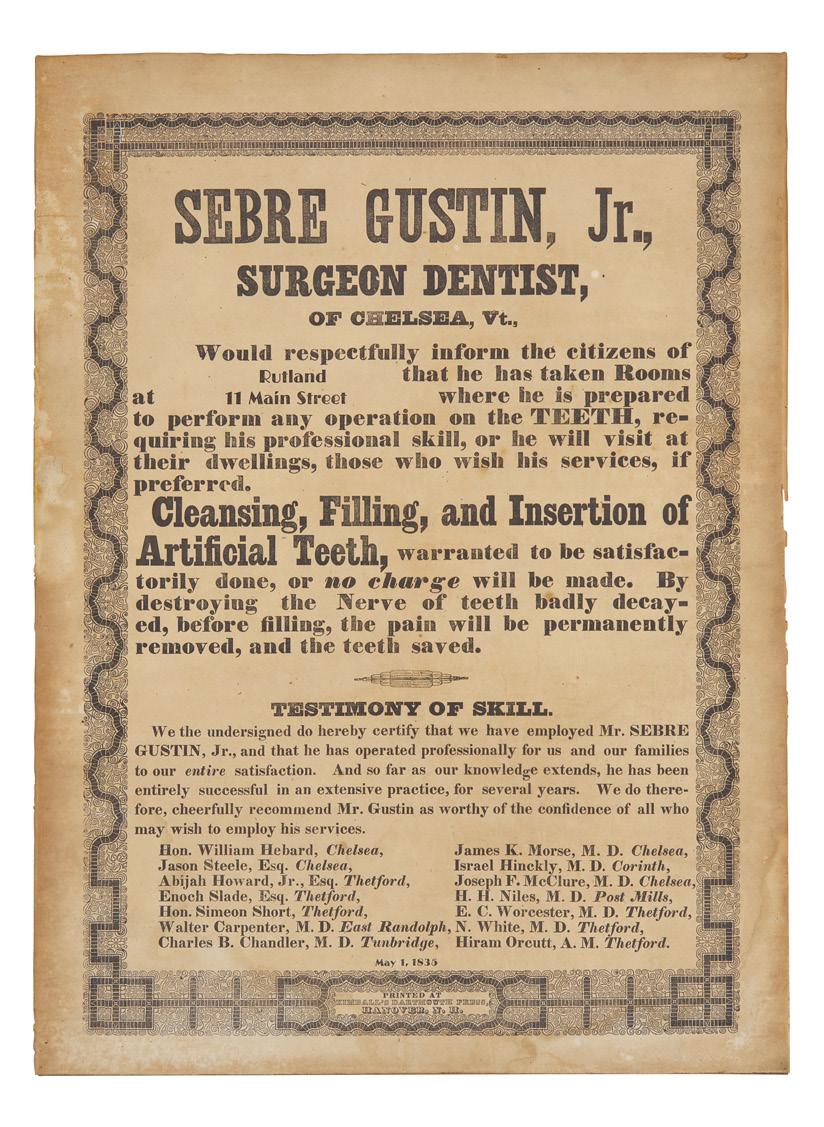
152
[Emancipation Proclamation] One of the Earliest Printings of the Final Emancipation Proclamation, in the “Official Paper” of the U.S. Congress
The Daily Globe Washington, (D.C.): John C. Rives, ca. December 2, 1862-April 18, 1863. New Series, Vol. XVI, No. 1-96 (duplicate issues of 94, 95, 96). Folio. Bound volume of 99 issues. Quarter brown cloth over paper-covered boards; printed book-plate of Stanford University Library on front paste-down; scattered foxing and stains. Eberstadt, p. 17
An extensive volume of the “Official Paper” of the United States Congress, The Daily Globe, printed by John Rives. Importantly, this volume includes a January 2, 1863 issue featuring one of the earliest printings of the final Emancipation Proclamation, issued by President Abraham Lincoln the day before, on January 1st. According to Charles Eberstadt, «We have seen that the (Washington) Star obtained by irregular means and printed the text of the final proclamation during the early afternoon of January 1st...A number of newspapers did not issue on January 2nd because of the previous day›s holiday, but most of those that did carried the final proclamation. Many of the others printed it on January 3rd...(p. 17)
Other news details Congressional minutes and debates, as well as updates on the Civil War as well as other world events, such as, news of the Battles of Fredericksburg, Stones River, Arkansas Post, and a variety of skirmishes; events leading up to the Siege of Vicksburg; the passing of legislation such as the Conscription Act, and much more.
A well-preserved and extensive record of Congressional activity during the height of the Civil War.
$3,000 - 5,000
153
[Emancipation Proclamation] “Slaves of Rebels Proclaimed Free”: Front-Page Printing of Lincoln’s Preliminary Emancipation Proclamation
The Philadelphia Inquirer Philadelphia, Tuesday, September 23, 1862. Printed newspaper. Folio. 8 pp. Disbound; old crease from when folded; scattered spotting; three-inch closed tear in top left edge.
In the summer of 1862, New-York Tribune editor Horace Greeley published a scathing editorial entitled “The Prayer of Twenty Millions,” which harshly criticized President Abraham Lincoln for what Greeley viewed as his not being aggressive enough in defeating the Confederacy and freeing the slaves within its borders. At one point, the fiercely abolitionist editor wrote, “We complain that you… elected as a Republican, knowing full well what an abomination Slavery is…seem never to interfere with its atrocities, and never give a direction to your military subordinates…”
Lincoln, who had spent the last few months secretly drafting a preliminary proclamation formally emancipating all slaves in Confederate-held territories, was nonetheless incensed by Greeley’s editorial. Wanting to keep his cards close to his vest, Lincoln’s response as published in the Tribune on August 22, 1862 forcefully asserted, “If I could save the Union without freeing any slave I would do it, and if I could save it by freeing all the slaves I would do it; and if I could save it by freeing some and leaving others alone, I would also do that.”
The preliminary draft was first read to the cabinet on July 13, and many expressed horror at the idea, believing that emancipating at such a fragile moment in the conflict would either signal weakness or attract additional foreign support for the Confederacy. It was agreed that such a proclamation could be issued only following a major Union victory, which finally came on September 17 with the Confederate defeat at Antietam. Five days later, Lincoln convened his cabinet and announced that he would be issuing the Preliminary Emancipation Proclamation, saying that “I made a solemn vow before God, that if General Lee was driven back from Pennsylvania, I would crown the result by the declaration of freedom to the slaves.”
$800 - 1,200
154
[Emancipation Proclamation] The Emancipation Proclamation, Printed in Full in the New-York Tribune
New-York, Thursday, January 1-Saturday, January 10, 1863. In eight issues (Vol. XXII, Nos. 6,785-6,792). Printed newspaper. Edited by Horace Greeley. Folio. Each 8 pp. Disbound; creased; scattered soiling.
The issue of January 1, announces on p. 5, “Those who will lay down The Tribune to-morrow with disappointment, not finding the New-Year’s Proclamation of Freedom in it, may be assured of reading the paper before sunset. The subject was considered at a Cabinet meeting holden at the usual hour of 11, and adjourned before noon to-day. After its adjournment, the President denied himself to all visitors, and devoted the residue of the day to the composition of the Proclamation to be issued to-morrow...” On page four of the following issue, dated January 2, is printed the entire Emancipation Proclamation in large font, and is signed in type by President Lincoln.
$800 - 1,200
155
[Emancipation Proclamation] The Preliminary and Final Emancipation Proclamation, in “The Evening Journal Almanac. 1863”
Albany, New York: Weed, Parsons & Company, 1863. First edition. 8vo. 143, (1) pp. Original limp blue wrappers, scattered spotting, unevenly toned, wear and creasing in lower front corner, small tear in fore-edge of front wrapper; all edges trimmed; scattered light foxing; small loss in bottom corner pp. 83/84, but not affecting text.
Printed on facing pp. 128 and 129 are President Abraham Lincoln’s Preliminary and Final Emancipation Proclamations.
$600 - 900
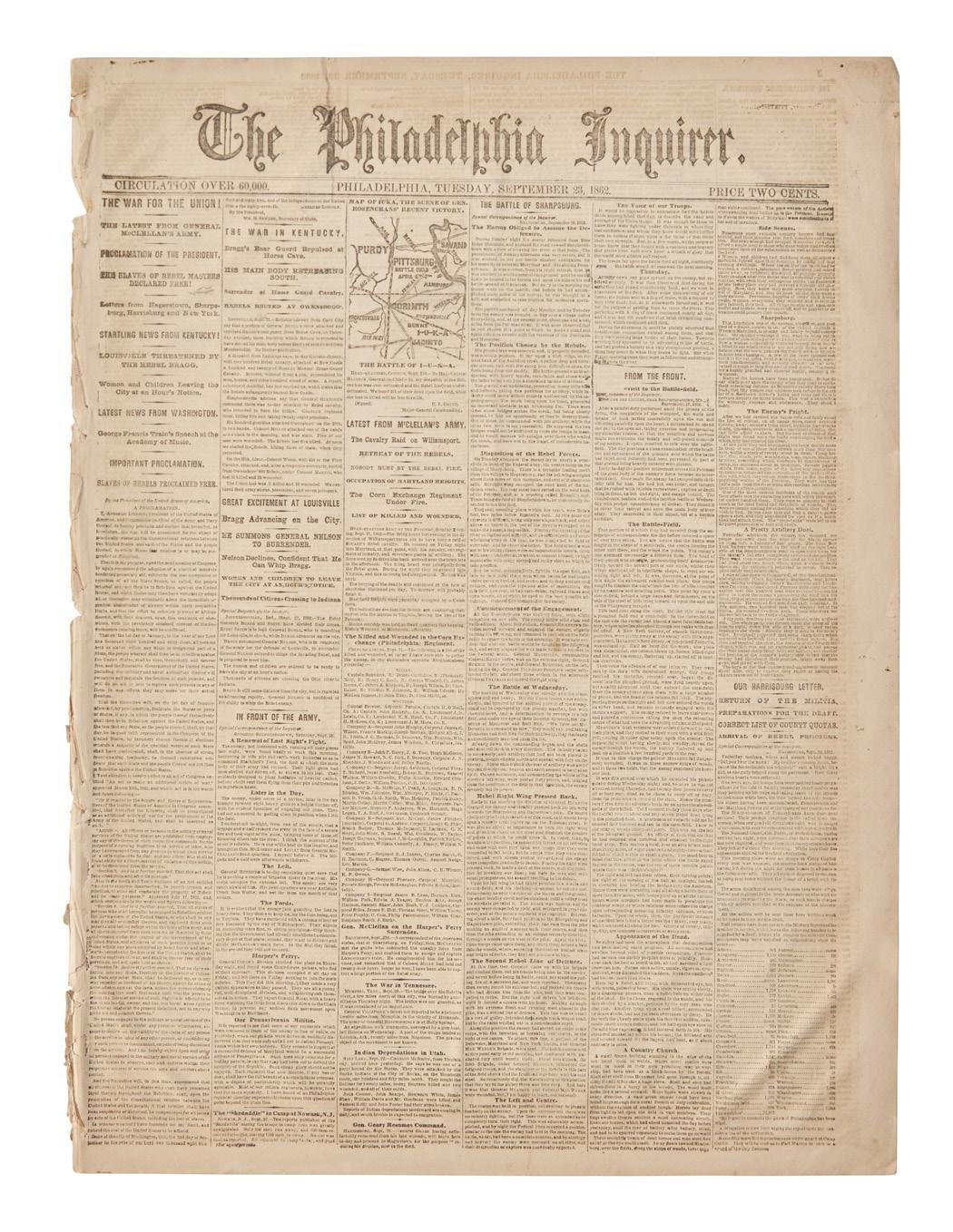
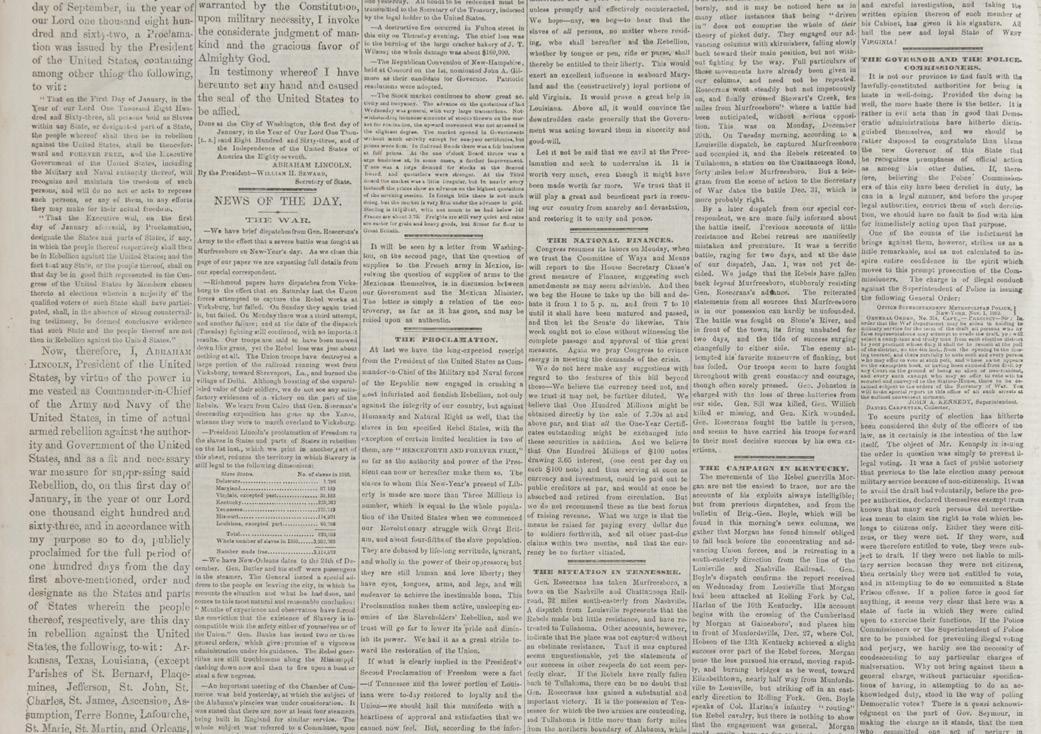
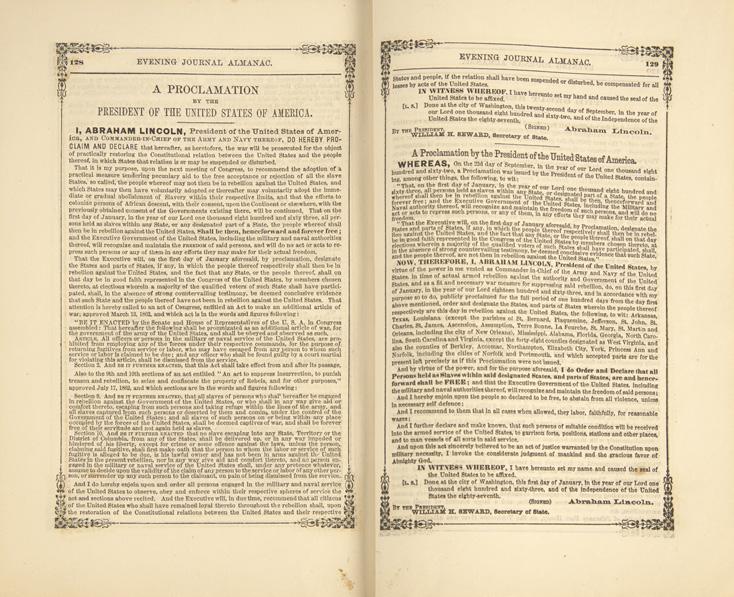
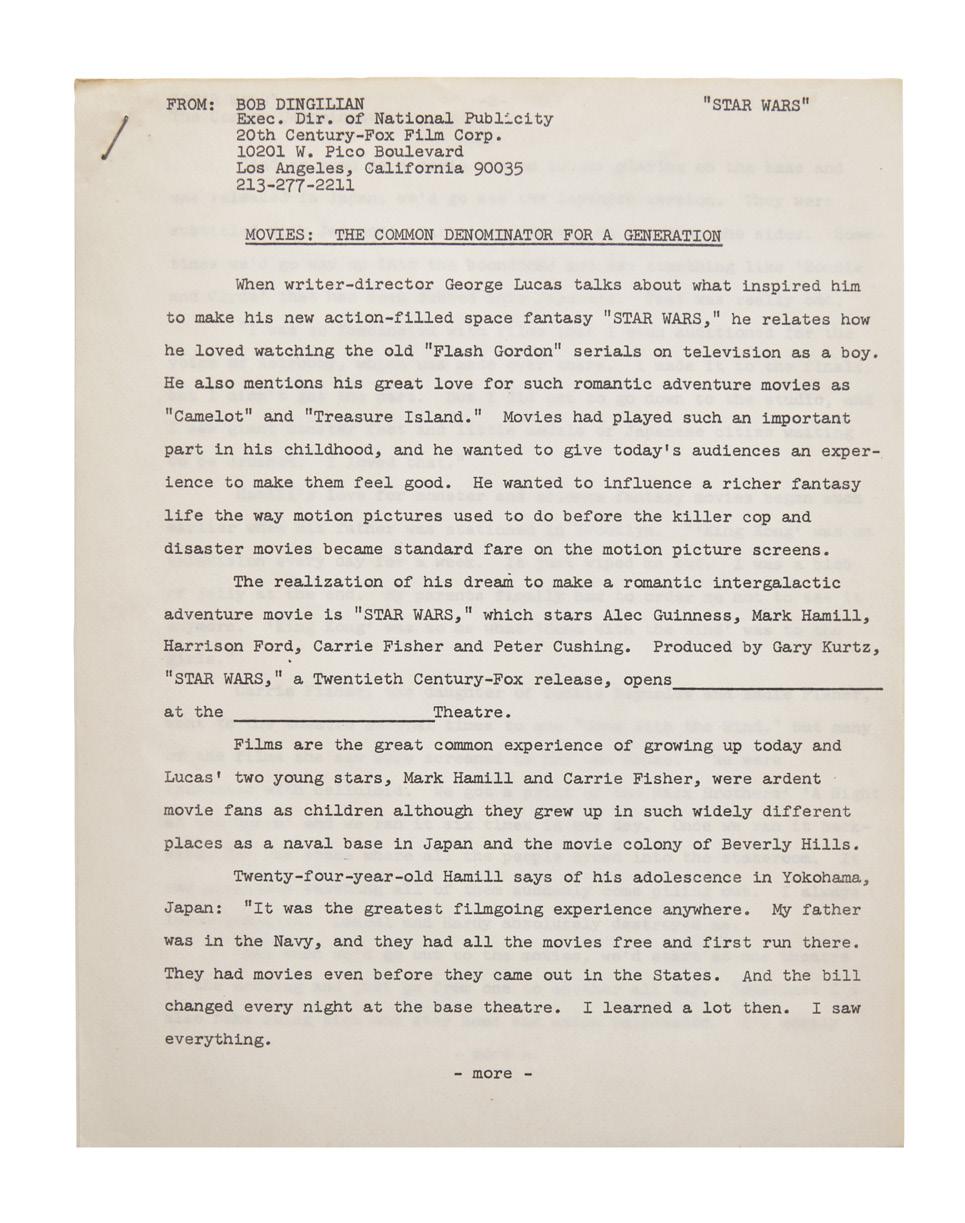
157
[Film] Manuscript Register from a Silent Film Movie Theater, 1925
Possibly New Jersey, ca. July-December 1925. Partially printed manuscript register, titled “Daily Statement of Business...” (accomplished in “N.C.R. Statement Book No. 39”; printed Dayton, Ohio: The National Cash Register Company, no date). 4to. Unpaginated. Register of accounts for an unnamed movie theater, detailing film titles, studios, employee names and wages, and other expenses, from July-December 1925. Quarter brown cloth over black cloth-covered boards, title stamped in white, heavily worn and soiled; dampstain affecting lower margin of most pages.
Fascinating account register of a 1920s movie theater, in the glory years of the silent film era. Notes in the rear of the book suggest the theater could be The Darress Theater in Boonton, New Jersey, which first opened in 1919 and closed by the 1970s.
Notable films shown include: Kiss in the Dark; Her Market Value, Lilies of the Street, The Ten Commandments, and many more.
$300 - 500

156
[Film] Dingillian, Bob. Press Release for Star Wars
Los Angeles, California, 1977. Three sheets, each measuring 11 x 8 1/2 in. (279 x 216 mm); stapled in top left corner.
In the months leading up to its May 1977 release, Star Wars experienced numerous production delays including incomplete special effects, an edit that director George Lucas was initially unhappy with, and the film having gone over budget. To ensure that these delays did not cause the public to forget about the film, 20th Century Fox drafted a press release describing the film from the perspectives of its filmmaker and its stars. Lucas managed to complete the film only one week before its May 25, 1977 release date. According to Lucas, he had completely forgotten that the film was being released on that day and remembered only when he and his wife Marcia went out for dinner that night and saw crowds stretching around the block outside of Mann’s Chinese Theatre to see it. It was the first indication of how it would become one of the most successful franchises in film and popular culture history.
$300 - 500
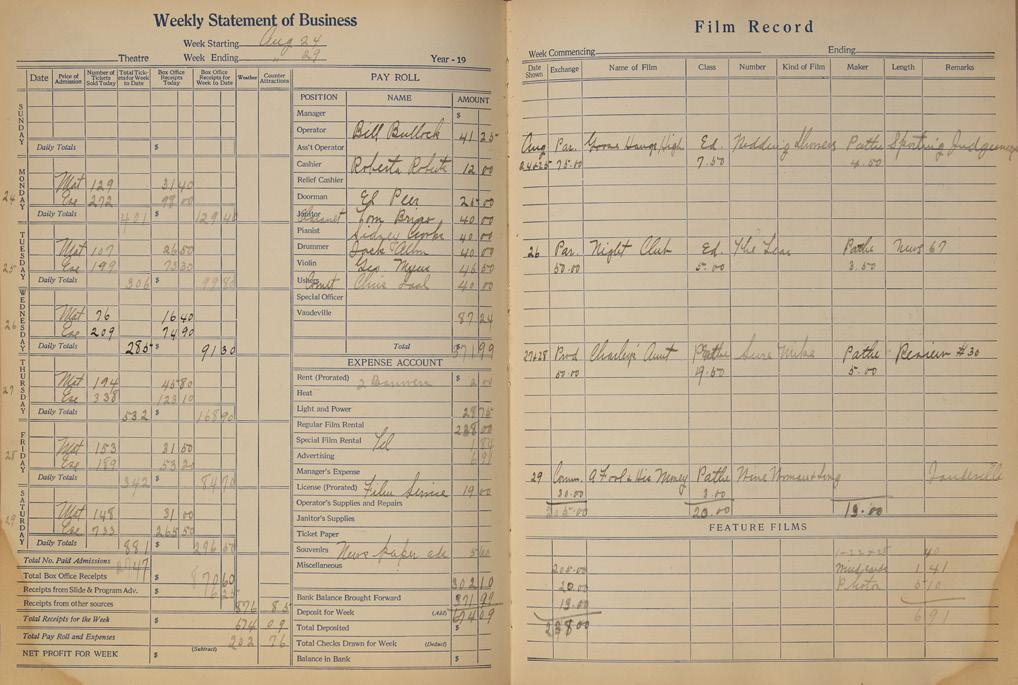
158
[Football] Large Format Silver Print of ca. 1910 Harvard v. Dartmouth Football Game
No place, ca. 1910. Large format silver print, 11 x 14 1/4 in. (279 x 362 mm), mounted to board, 16 x 20 in. (406 x 508 mm). Manuscript on lower mount: “Harvard-Dartmouth / Frothingham stops Dartmouth’s Forward / Pass and gains 35 Yards”. Very small pinholes in corners of print, small wear at same; wear along mount edges.
Likely showing the 1910 or 1911 match between Ivy League rivals Harvard and Dartmouth. T. Frothingham matriculated into Harvard in 1908, and played for the Harvard Crimson as a halfback from 1910-11. Harvard would go on to win both the 1910 and 1911 games.
$300 - 500
159
[Football] “Harvard Beats Yale 29-29”: Mock Wanted Poster for The Famous 1968 Harvard v. Yale Football Game
Wanted the Harvard Killers for Massacring Yale’s Offensive Football Team... (Cambridge, Massachusetts), ca. November 1968. Printed mock wanted poster, 18 x 12 in. (457 x 305 mm). Toned; scattered soiling; pinholes in each corner; tape remnants at top; scattered closed tears along edges. In mat.
A very rare--possibly one of the only extant--mock wanted posters for the famous 1968 Harvard v. Yale football game. Dubbed “The Miracle” and “The Tie”, Harvard scored 16 points in the final 42 seconds to tie the game 2929, inspiring the famous Harvard Crimson headline, «Harvard Beats Yale 2929». This poster was, according to George Howe Colt, one of many at the time that were tacked up around Harvard›s campus in anticipation of the November 23 game. The poster shows mug shots of each Harvard player (formal coat and tie photos culled from the game program) accompanied by gangster-style nicknames like «Two Gun,» «Mad Dog,» «Scar Face,» «Potato Nose,» «Baby Face,» «Pretty Boy,» «Machine Gun,» and more. The large text reads, «Wanted the Harvard Killers For Massacring Yale›s Offensive Football Team on Sat., Nov. 23, 1968 Warning These Men are Considered the Most Dangerous Deffensive Team in the N.C.A.A. Reward Free Trip to Sing Sing».
Played against the backdrop of deep social unrest and college protests over the Vietnam War, this was the 85th edition of the two teams’ longstanding annual rivalry. Each entered the game 8-0, with Harvard’s formidable defense pitched against Yale’s league-leading offense. By the final three minutes of the game Yale had advanced a seemingly insurmountable 2916 lead. With only minutes remaining, Harvard’s prospects dramatically changed, precipitated by a fumble by Yale fullback Bob Levin, which then saw Harvard score two consecutive touchdowns and two two-point conversions, tying the game and sending the crowd into a frenzy. The two teams would go on to share the Ivy League title, the last tied game in their series history. In 2024, the Harvard Crimson ranked this match as the greatest game in the 149-year history of the Harvard-Yale football rivalry.
Lot includes a typed postcard, postmarked Nov. 8, 1909, informing a Theodore Chadwick of Cambridge, Massachusetts of the status of his application for tickets to the Harvard/Yale football game. 3 1/4 x 5 1/2 in. (82 x 140 mm). Lot also includes five press photos related to professional football.
$500 - 800
160
[Fraktur] A Pennsylvania German Fraktur Book-Plate
Bethel, Pennsylvania, January 20, 1827. Manuscript fraktur book-plate, in Die Bibel, oder die ganze heilige schrift des alten und neuen testaments...D. Martin Luthers (Bremen: Carl Schunemann, 1822). Thick 8vo. Original brown sheep, clasps perished, scuffed and moderately worn; all edges trimmed; spotting and soiling.
A Pennsylvania German fraktur book-plate: “This Book Belongs to me Maria Lesch”
Lot includes a copy of almanac, Der Hoch-Deutsche Americanische Calender...1827 (Germantown: M. Billmeyer, 1827).
$300 - 500
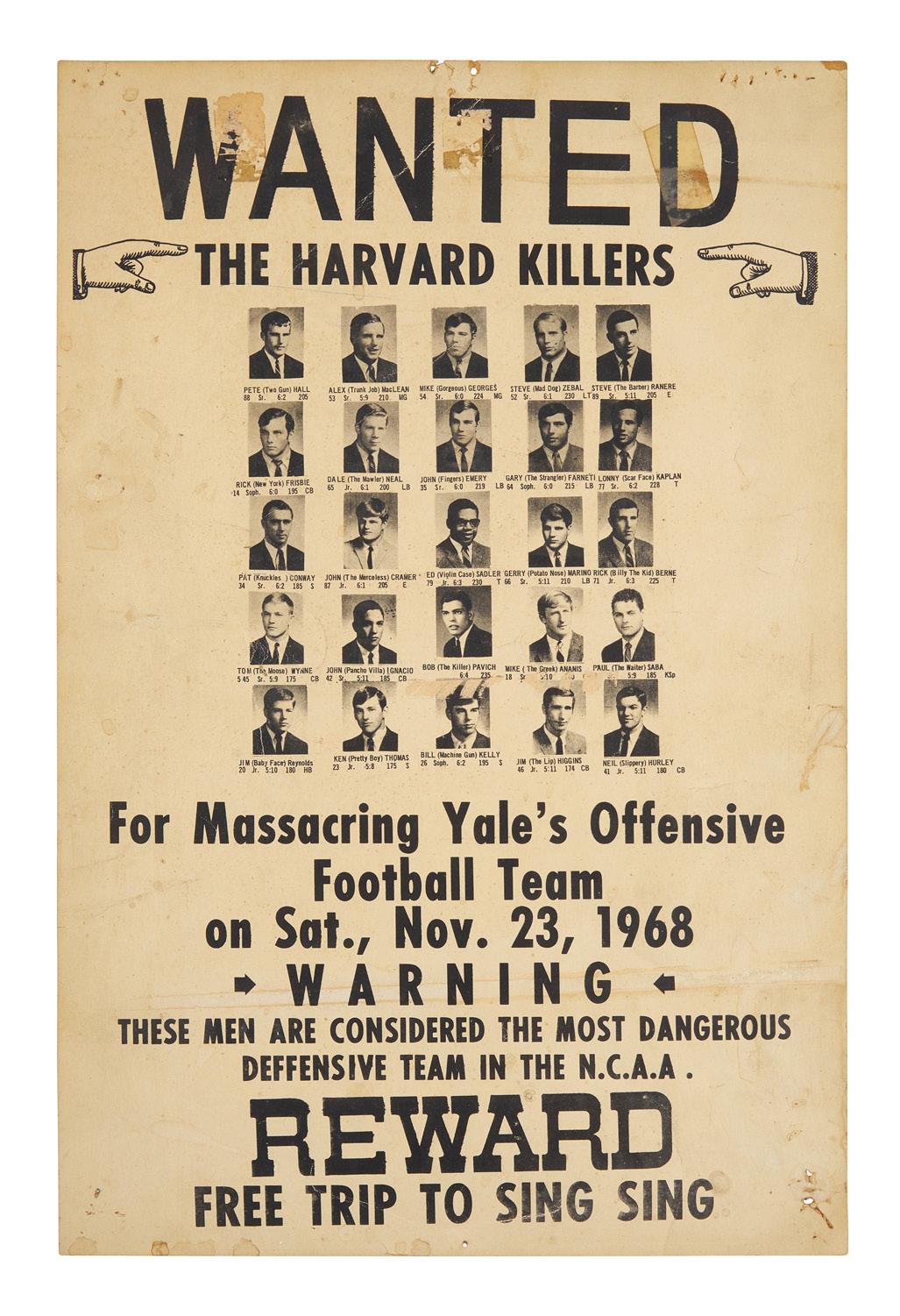
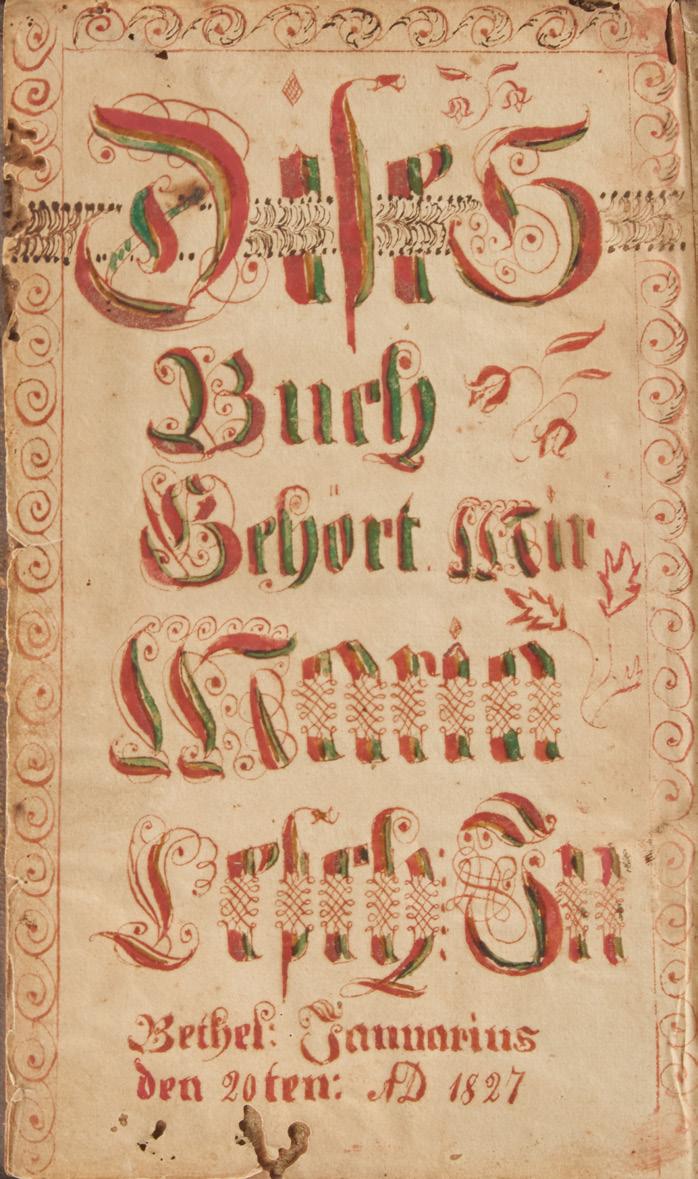
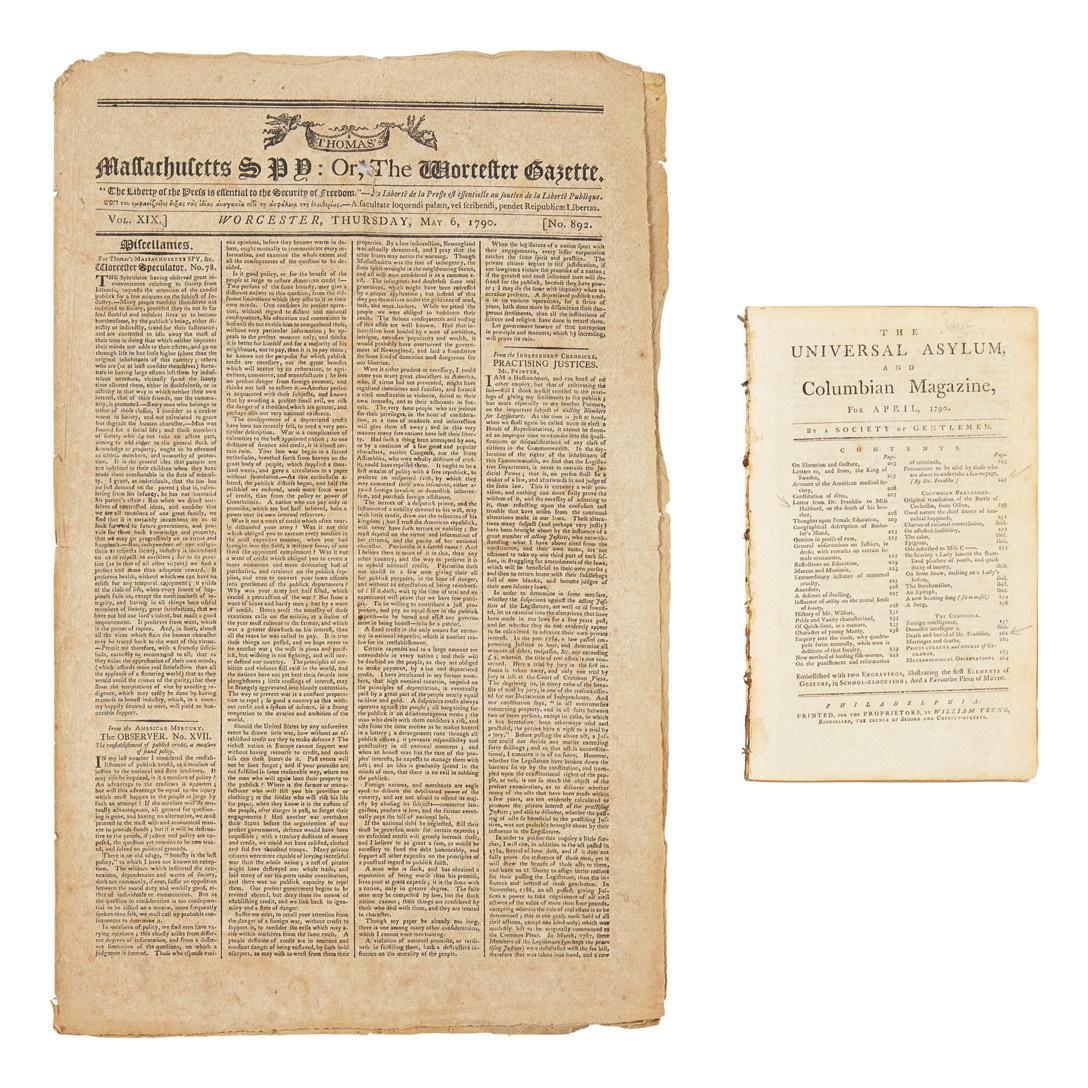
161
[Franklin, Benjamin] A Great American Patriot Isaiah Thomas Reports on the Death of Another: Group of 2 Periodicals Reporting the Death of Benjamin Franklin, April-May, 1790
Thomas’s Massachusetts Spy: Or, The Worcester Gazette Worcester: Isaiah Thomas, Thursday, May 6, 1790. Vol. XIX, No. 892. Printed newspaper. Folio. 4 pp. Light scattered spotting; light wear along edges.
Printed on p. 3 is a report on the death of Franklin and details of his funeral service.
Together with:
The Universal Asylum, and Columbian Magazine, for April, 1790 Philadelphia: Printed, for the Proprietors, by William Young, 1790. 8vo. (ii), (203)-262, (2) pp. Disbound; red speckled edges; short tear in top edge of final rear leaves.
Containing three articles related to Franklin: his February 22, 1756 letter on the death of his brother (p. 208); his article, “Precautions to be used by those who are about to undertake a Sea-Voyage” (pp. 245-248); and a report on Franklin’s death and funeral (pp. 261-262).
$500 - 800
162
[Franklin, Benjamin] Scarce Issue of The Pennsylvania Gazette for November 28, 1745, With the Burning of Saratoga, Printed by Benjamin Franklin
The Pennsylvania Gazette Philadelphia: Printed by B. Franklin, November 28, 1745. Numb. 885. Bifolium, 12 1/2 x 8 1/2 in. (305 x 216 mm). Printed newspaper in three columns. Disbound; worming to top and left margins; edges unevenly trimmed; scattered foxing. Miller 378
A scarce issue of this Benjamin Franklin newspaper. This issue contains a report of the raid and subsequent burning of Saratoga, New York, by French and Indian forces, as part of the ongoing King George’s War. Also included are advertisements for Franklin’s Poor Richard’s Almanack, 1746, various plantations for sale around both Philadelphia and Baltimore, as well as a number of runaway servants or enslaved persons.
$1,500 - 2,500
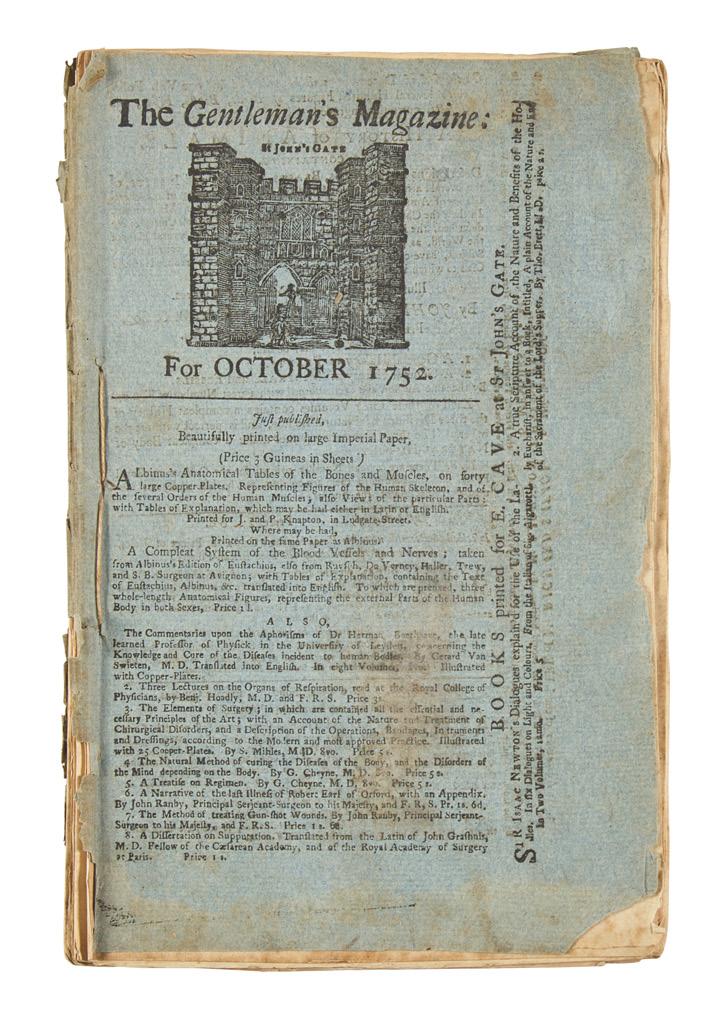

163
[Franklin, Benjamin] Urban, Sylvanus. The Gentleman’s Magazine For October 1752, in the Rare Original Wrappers with Articles on Benjamin Franklin’s Electrical Experiments
London: Printed by E. Cave, 1752. 8vo. (ii), (439)-481, (1) pp. Illustrated with woodcut vignette on title-page, two engraved plates (one folding), one page of engraved sheet music, and one in-text engraving after Catesby. Rare original limp blue wrappers, losses along spine, wear along extremities; scattered spotting.
Printed four months after Franklin’s famous kite and key experiment, this magazine features a discussion on Benjamin Franklin’s famous electrical experiments and their applications, on pp. 450-452.
$500 - 800
164
[French and Indian War] Vaugondy, Robert de. Carte de la Virginie et du Maryland...
Paris, 1755. Engraved map with hand-colored outlining. First state (of five). Old ink stamps at top left and right verso, “Virginie & Maryland.” Creasing from old folds, separations at top and bottom of same vertical central fold; scattered light edge-wear; shallow tidemark in top edge; faint dampstaining in bottom corners.
A handsome first state of this important French map depicting Virginia and Maryland, derived from Peter Jefferson and Joshua Fry’s landmark 1751 map “A Map of the Most Inhabited part of Virginia”, considered the most important map of the region in the 18th century.
$800 - 1,200
165
[Gangsters] (Buchalter, Lepke) Original NYPD $25,000 Reward Poster for a Jewish Gangster
New York: Police Department City of New York, Detective Division, August 8, 1939. Circular No. 11. Printed broadside; 14 1/2 x 7 3/4 in. (368 x 197 mm). Wanted poster for Jewish gangster Lepke Buchalter, headed “$25,000 Reward Dead or Alive”, with printed facsimile of his fingerprints, a description of appearance, and his mugshot. Creasing from old folds, scattered light stains along same. In mat.
Rare NYPD wanted poster for Lepke Buchalter, head of the infamous Mafia hit squad, Murder, Inc.
For most of the 1930s, Buchalter (1897-1944) operated an independent hit squad for various crime families across the country, referred to in later years as “Murder, Inc.” In 1936, he ordered the murder of a Brooklyn candy store owner named Joseph Rosen, whom he suspected of working with New York District Attorney Thomas Dewey. While no convictions were made at the time, Buchalter was soon charged with violating federal antitrust laws in one of his businesses, and a warrant was issued for his arrest.
Buchalter became a fugitive for almost two years and by mid-July 1939, Dewey requested a $25,000 reward for his capture, due to a recent string of gang-related murders. On August 25, 1939, Buchalter surrendered to FBI Chief J. Edgar Hoover, the result of a surrender deal supposedly facilitated by the help of radio broadcaster Walter Winchell. Buchalter was indicted on charges of narcotics trafficking and extortion, but while imprisoned, he was arraigned and indicted by New York authorities for the murders of Joseph Rosen and three others. He and two accomplices were sentenced to death, and Buchalter was executed by electric chair on March 4, 1944, at Sing Sing Prison.
$400 - 600
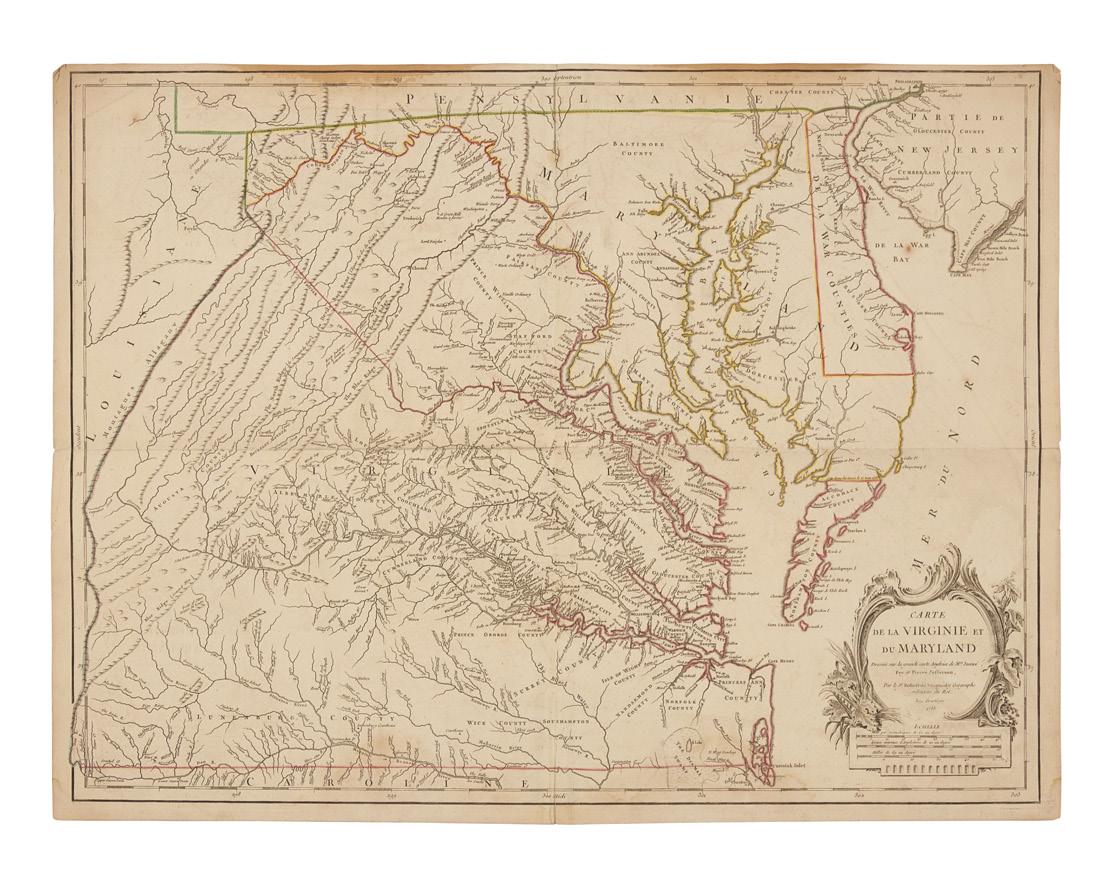
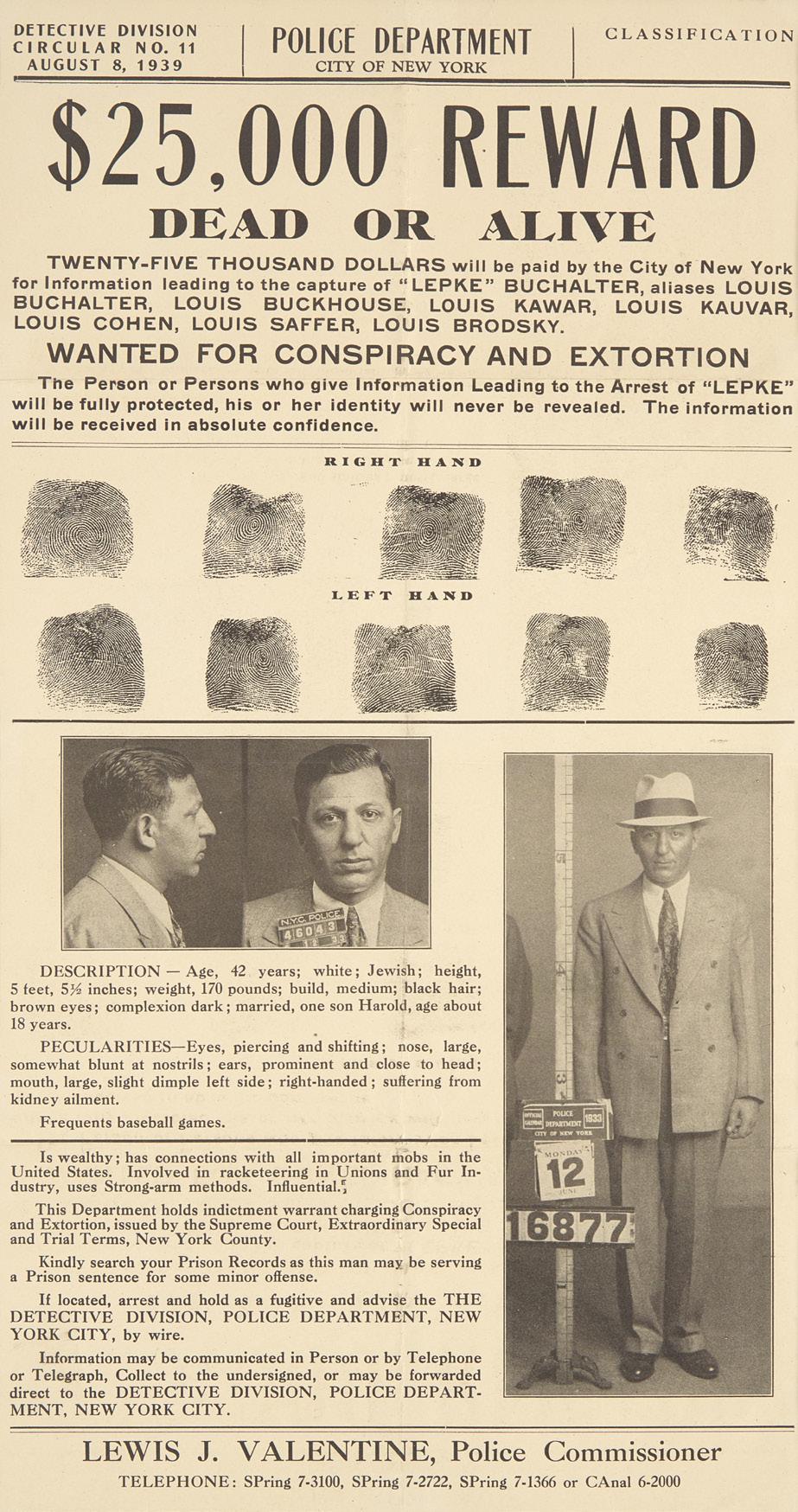
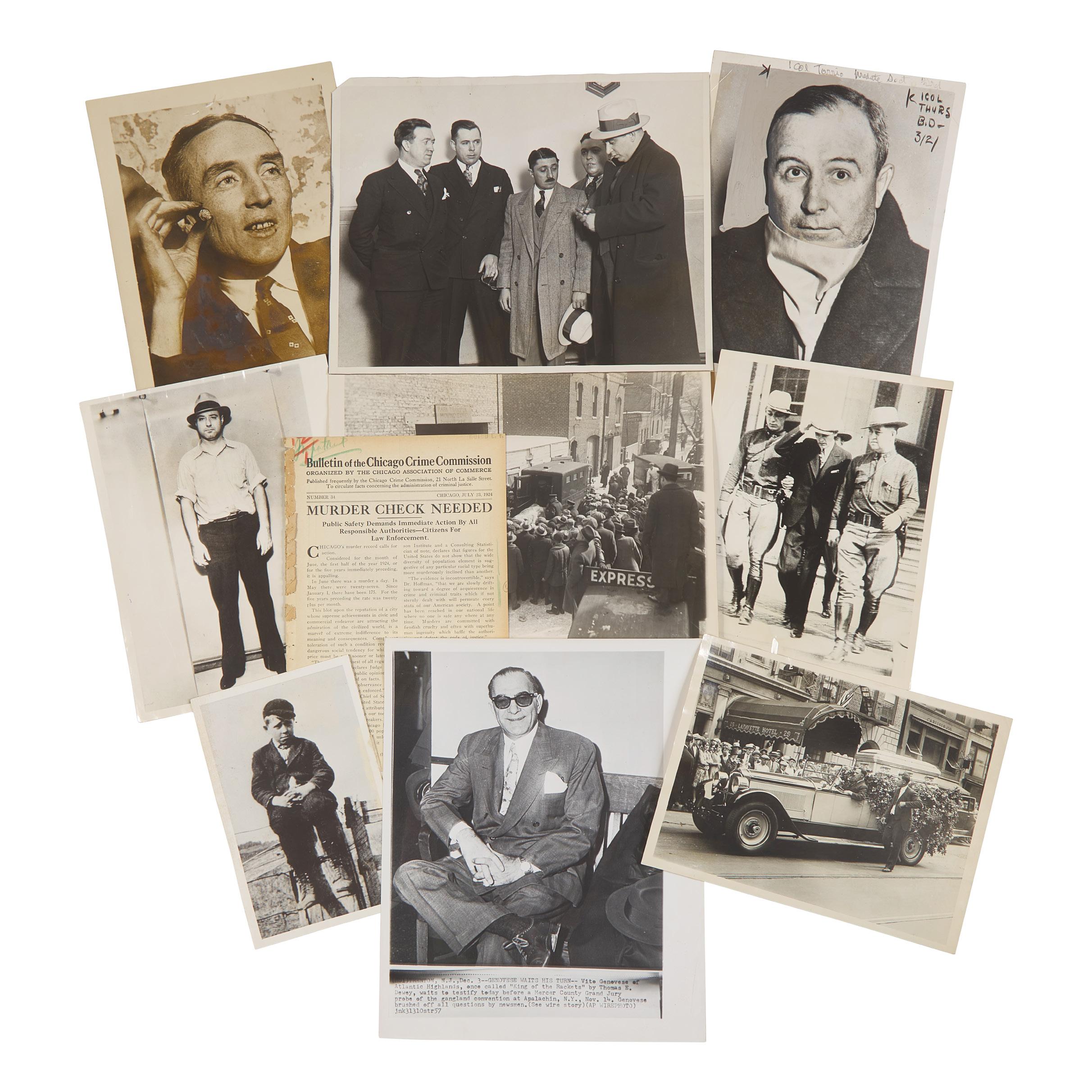
[Gangsters] Group of 9 Press Photos of American Gangsters and Criminals
Locations vary, ca. 1926-60s. Group of nine press photos of American gangsters and criminals, depicting Vito Genovese (leader of the Genovese crime family); Gerald Chapman (“The Count of Gramercy Park”); Frank Nitti (Al Capone’s bodyguard); George R. “Machine Gun” Kelly; Johnny Torrio (leader of the Chicago Outfit); Frankie Yale (Brooklyn crime boss); Jack “Legs” Diamond (IrishAmerican Philadelphia gangster); scene of the St. Valentine’s Day Massacre; and of John Dillinger as a child. Sizes and condition varies, generally very good. Copyright ink stamps and typed slips on versos.
Lot also includes a copy of the Bulletin of the Chicago Crime Commission, dated July 23, 1924 (“Murder Check Needed Public Safety Demands Immediate Action by all Responsible Authorities...”).
$200 - 300
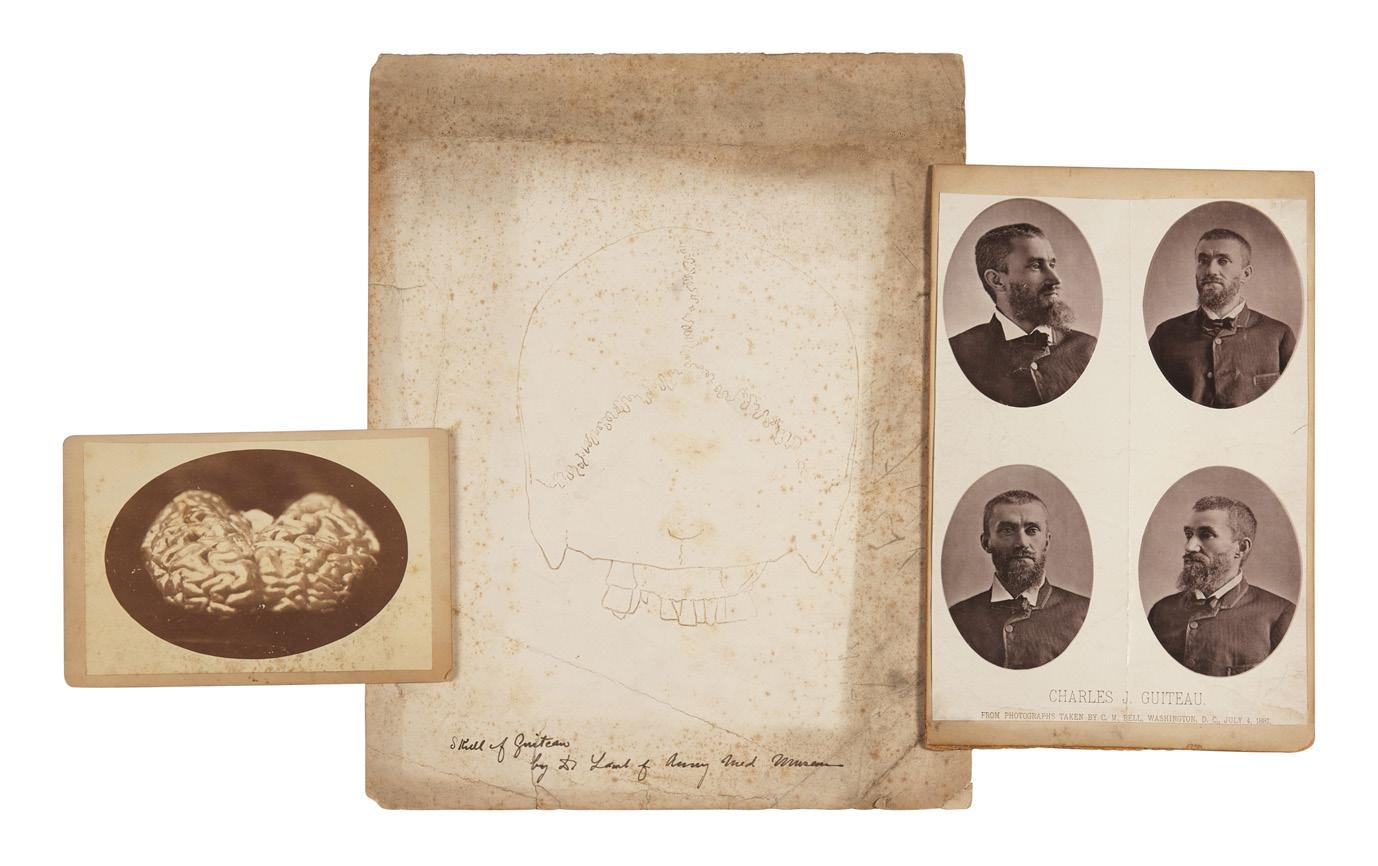
167
[Garfield, James] Group of 3 Items Related to Presidential Assassin Charles J. Guiteau, Previously Owned by Dr. Edward Charles Spitzka
1. Copy of a Drawing of the Skull of Charles J. Guiteau No place, no date (likely ca. 1880s-90s). Printed copy of a drawing; manuscript at bottom, “Skull of Guiteau / by Dr Lamb of Army Med Museum”. Unevenly toned; soiling and creasing; foxing; scattered closed tears along edges. 12 3/4 x 10 1/4 in. (324 x 260 mm).
2. Four-Portrait Mugshot of Guiteau Label on verso “Copyright, 1882 by C.M. Bell. Forbes Albertype, Boston”. Printed caption at bottom recto, “Charles J. Guiteau. / From Photographs Taken by C.M. Bell, Washington, D.C., July 4, 1881.” Mounted to board. Soiling and wear. Image: 8 3/4 x 6 1/4 in. (222 x 159 mm).
3. Cabinet Card of Guiteau’s Brain No place, no date. Cabinet card, manuscript in pencil on verso, “Guiteau”. Light foxing and soiling. 4 1/2 x 6 1/2 in. (114 x 165 mm).
On July 2, 1881, Charles Guiteau stepped out of a crowd at the Baltimore and Potomac Railroad Station in Washington, D.C., and fired two shots
168 [Georgia] [Moore, Francis] Manuscript Document by the Secretary of James Oglethorpe, Founder of the Colony of Georgia
Frederica, Georgia, ca. July 1736. 2 pp. on bifolium. Docketed on verso, “Copy Deposition of John Latter, John Barber, Rice Pyke, David Holmes, Darby Kellihorne, taken 13. Apl. 1736. In D(uke). of Newcastle July 2d. 1736.” 12 x 7 5/8 in. (305 x 194 mm), old folds.
A secretarial copy (presumably in the hand of Francis Moore, secretary of James Oglethorpe) of a deposition of John Latter, John Barber, Richard Pike, David Holmes, and Darby Kallihorne[?], all of Georgia, taken at Frederica on April 13, 1736. Attesting that they traveled with Tomochichi to the Altamaha and St. Johns Rivers and encountered no Spanish settlements in the area, and that the territory north of the St. Johns was in possession of “the Indians.”
In 1736, James Oglethorpe and the Yamacraw leader Tomochichi stood at the center of the increasingly fraught dispute between British Georgia and Spanish Florida over the southern limits of the English settlement. Oglethorpe maintained that Georgia’s boundaries extended to the St. Johns River, citing English charters and agreements negotiated with Native leaders allied to the colony. Tomochichi, whose earlier visit to London with Oglethorpe had lent legitimacy to the Georgia enterprise before the Trustees and the Crown, remained a crucial diplomatic figure in relations between the British and the region’s Indigenous peoples. In a letter dated April 17, 1736, Oglethorpe warned the Duke of Newcastle that the Spanish governor intended to demand that Britain abandon not only Georgia but also territory extending even into Carolina. As the correspondence of the period makes clear, British officials regarded Native alliances as indispensable to securing their claims against mounting Spanish opposition from St. Augustine.
$1,500 - 2,500
from behind into the body of President James A. Garfield. For months Guiteau had been stalking President Garfield, believing that he had played an outsized role in the president’s victory in the 1880 election and was therefore owed a position in the administration. Over two months Garfield’s condition, exacerbated by poor medical treatment, gradually deteriorated, until he finally expired on September 19.
In the lead-up to Guiteau’s trial, his defense hired Dr. Charles Edward Spitzka as an expert witness to bolster their claim that Guiteau was not guilty by reason of insanity. Dr. Spitzka testified that Guiteau was not only insane, but a “moral monstrosity.” Despite this analysis, Guiteau was found guilty and executed by hanging on June 30, 1882. Guiteau’s remains were then dissected in the hopes of finding some trace of abnormality in his brain or in the shape of his skull. An alienist, neurologist, and anatomist, Spitzka likely kept these materials after the trial as mementos and reference materials.
Dr. Charles Edward Spitzka (1852-1914), American alienist and anatomist who served as advisor in the trial of Charles Guiteau.
$800 - 1,200
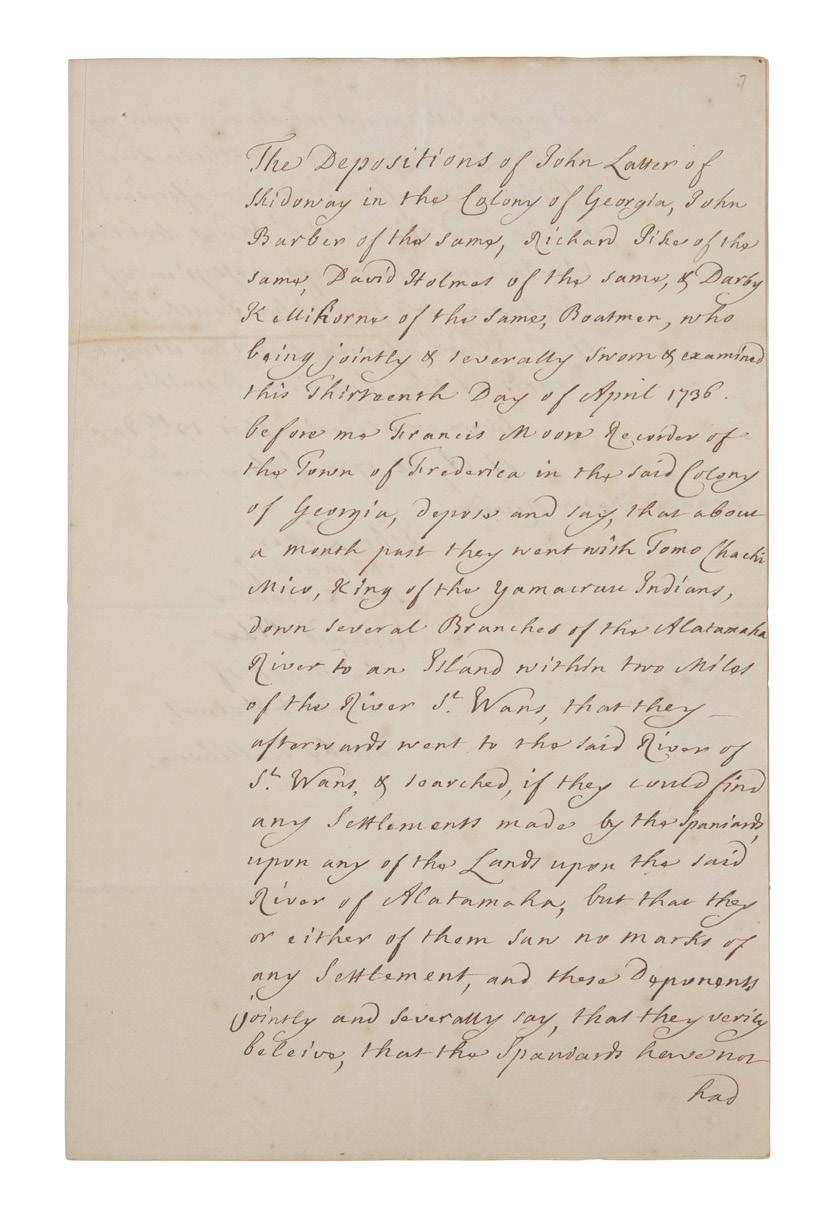
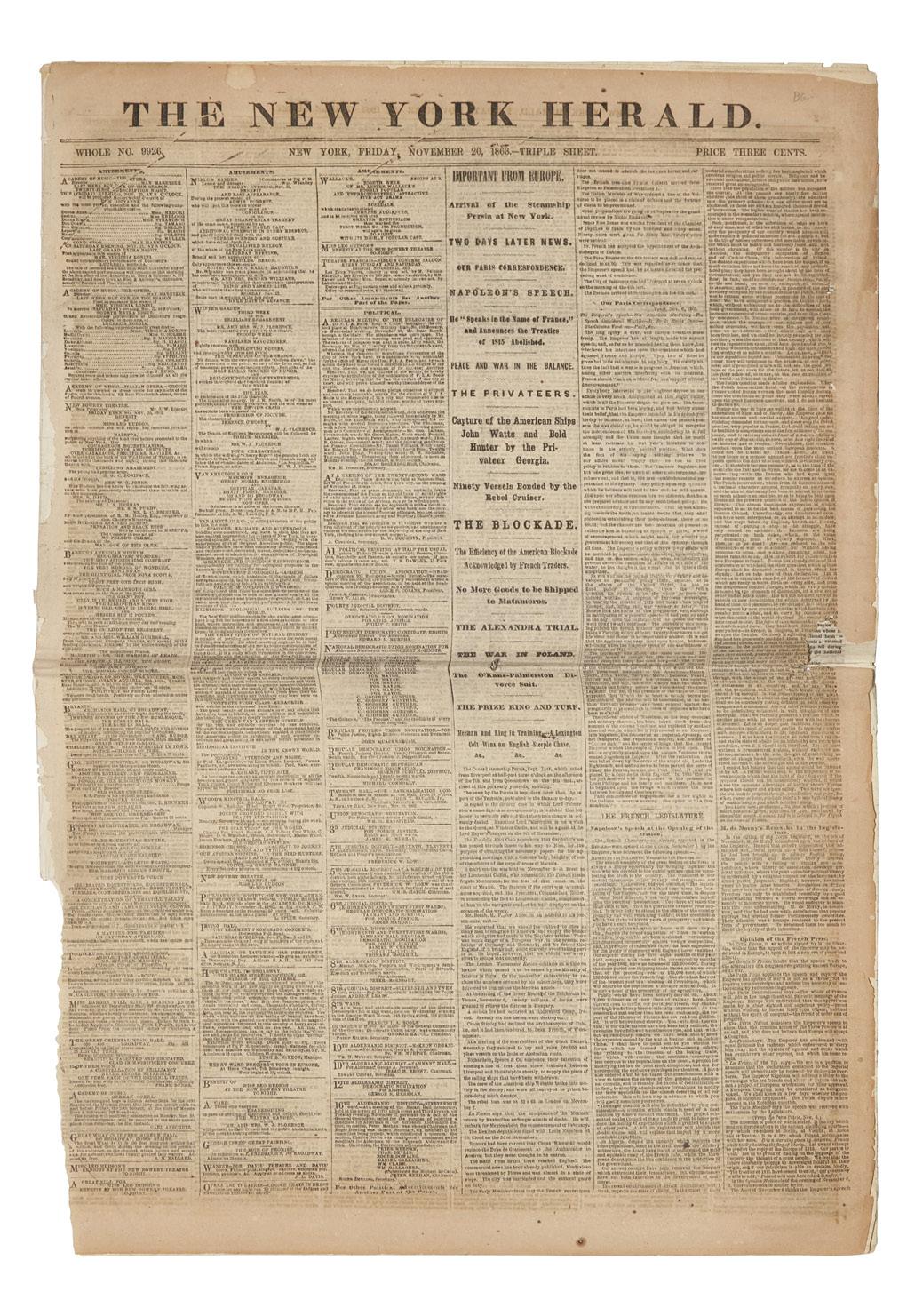
170
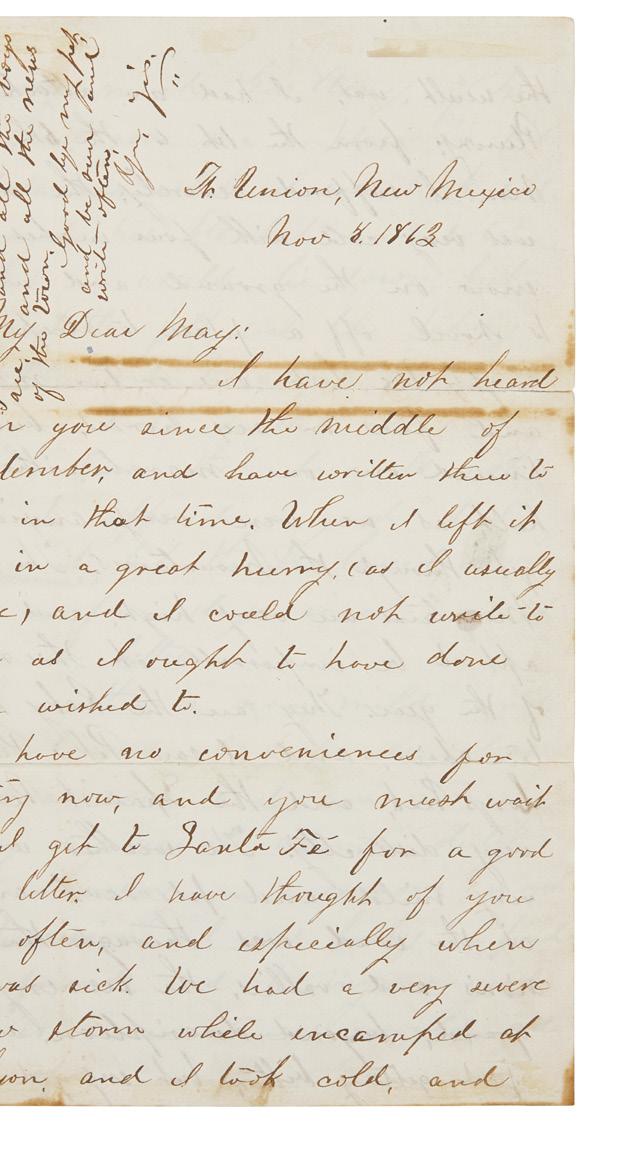
169
[Gettysburg Address]
First Day Printing of the Gettysburg Address in The New York Herald
New York, Friday, November 20, 1863. Whole No. 9926. Printed newspaper. Folio. 10 pp. Creased from old fold, loss at fore-edge of same on first leaf, affecting some text, closed tear at same on subsequent leaves; central fold repaired, with loss at lower half, affecting some letters at bottom; scattered spotting and toning.
Scarce first-day printing of Lincoln’s Gettysburg Address, printed at the bottom of final page (“Dedicatory Speech of the President”). This newspaper also features Edward Everett’s entire speech, as well as reports on the dedicatory ceremonies.
The transcript that gave the world Lincoln’s speech was taken by Associated Press freelancer Joseph L. Gilbert, who was seated on the speaker’s platform. As Gilbert recalled in 1917, during Lincoln’s brief two-minute 272-word speech, he became “fascinated by his intense earnestness and depth of feeling,” and “unconsciously stopped taking notes and looked up at him.” Luckily for Gilbert, Lincoln allowed him to copy his text, from which the press report featured here was made. Lincoln’s speaking copy has since been lost, and the definitive text has been pieced together, from Gilbert’s account, and additional sources.
$2,000 - 3,000
[Gold Rush] Autograph Letter, Featuring a Mention of Frontiersman Kit Carson and the Arizona Gold Rush
“The news we have from Arizona is almost fabulous, and if the accounts are half true, the mines are richer than those of California in 1848...the Navajos are now being drove out by Kit Carson...”
Fort Union New Mexico, November 8, 1863. Bifolium; 9 x 6 1/2 in. (228 x 165 mm). Four-page autograph letter, signed by an unknown Union soldier stationed at Fort Union, New Mexico during the Civil War. In part: “I have no conveniences for writing now, and you must wait till I get to Santa Fe for a good long letter...We had a very severe snow storm while encamped at Ft. Lyon and I took cold, and the result was, I had an attack of pleurisy...the weather was very cold with four inches of snow on the ground and we had to shovel off a place to sleep at night. We lost one or two mules and five or six horses, but continued on our march without a halt, as we were very anxious to get through the mountains. The Raton Mountains are very high, and are apt to be impassable at this season of the year... Gov. Arny, of New Mexico, gave me a place in his ambulance while I was sick, and arranged his blankets and robes so that I could lie down...The weather is now mild and pleasant and I feel almost as good as new, and am now doing my usual camp duty, and devouring an enormous amount of provisions....The news we have from Arizona is almost fabulous, and if the accounts are half true, the mines are richer than those of California in 1848. The rush there will be very great in the Spring...It is said that gold can be found four inches from the surface, and can be dug with a butcher knife. Gov. Arny took with him to Washington some specimens of gold and also gold bullets which he procured from the Navajo Indians; the Indian was sharp, and would not tell him where the gold was to be found, but a military expedition into their country revealed the location of the mines, and the Navajos are now being drove out by Kit Carson...” Creasing from old folds, A few small closed tears along same; scattered toning.
An illuminating letter by a Union soldier stationed at Fort Union describing the ongoing gold rush in the Territory of Arizona, and mentioning frontier legend Kit Carson driving Navajo Indians from the land.
Arizona had been a major stopping off point for settlers making their way to California during the Gold Rush of 1848, but during the late 1850s, major deposits were discovered around the Gila River, leading to a major surge in population for the territory.
Fort Union was an important military outpost for Northern forces, and was the base of operations for General Kit Carson, who took command there in 1862, and defended the western frontier from Confederate incursions until 1865.
$300 - 500
The Illustrated California News San Francisco: Cook & Le Count, November 1, 1850. Vol. 1, No 4. Printed newspaper. 4to. pp. 25-32. Disbound; scattered minor spotting.
The first illustrated newspaper printed on the West Coast, and one of the earliest illustrated newspapers ever printed in America.
An important and scarce California Gold Rush-era illustrated newspaper, The Illustrated California News was a semi-monthly periodical which began publication in September 1850 under the editorship of J.M. Carleton. Over the course of three months, six issues were published before Carleton folded operations, with the focus kept exclusively on recording current events and presenting images and descriptions of the new state›s unique geography. The present issue features a long editorial by Carleton discussing the benefits of bringing more women to California, arguing, «It is upon the solid and substantial weight of those whose family ties bind them to social order which we must depend...The youth who is loose upon the world is an anarchist by nature.»
Of particular interest is a rare pre-settlement view (likely the first ever printed) of Vallejo, then slated to become the first capital of the state of California, of which Carleton writes, “This is a view...[of] Vallejo, the proposed permanent seat of Government for the State of California, and on that account will probably be considered as one of the most interesting subjects that could have been offered our readers.” Though the legislature met here in 1851, the decision was made to move the State Government to Sacramento in 1854; despite the move, Vallejo continued to grow and is today the second-largest city in the Bay Area. The present issue also features views of Portsmouth Square Park, the first public park in San Francisco, and of Dead-Man’s Bar, one of the most gold-rich (and hazardous) areas in the region. Wagner 80.
Together with:
Manuscript Document
No place, no date. Single sheet, 10 1/4 x 8 1/2 in. (260 x 216 mm). Two-page manuscript document in an unidentified hand, titled “The actual & prospective effects of the California gold mines on the United States.” Creasing from old folds; light soiling.
$500 - 800
172
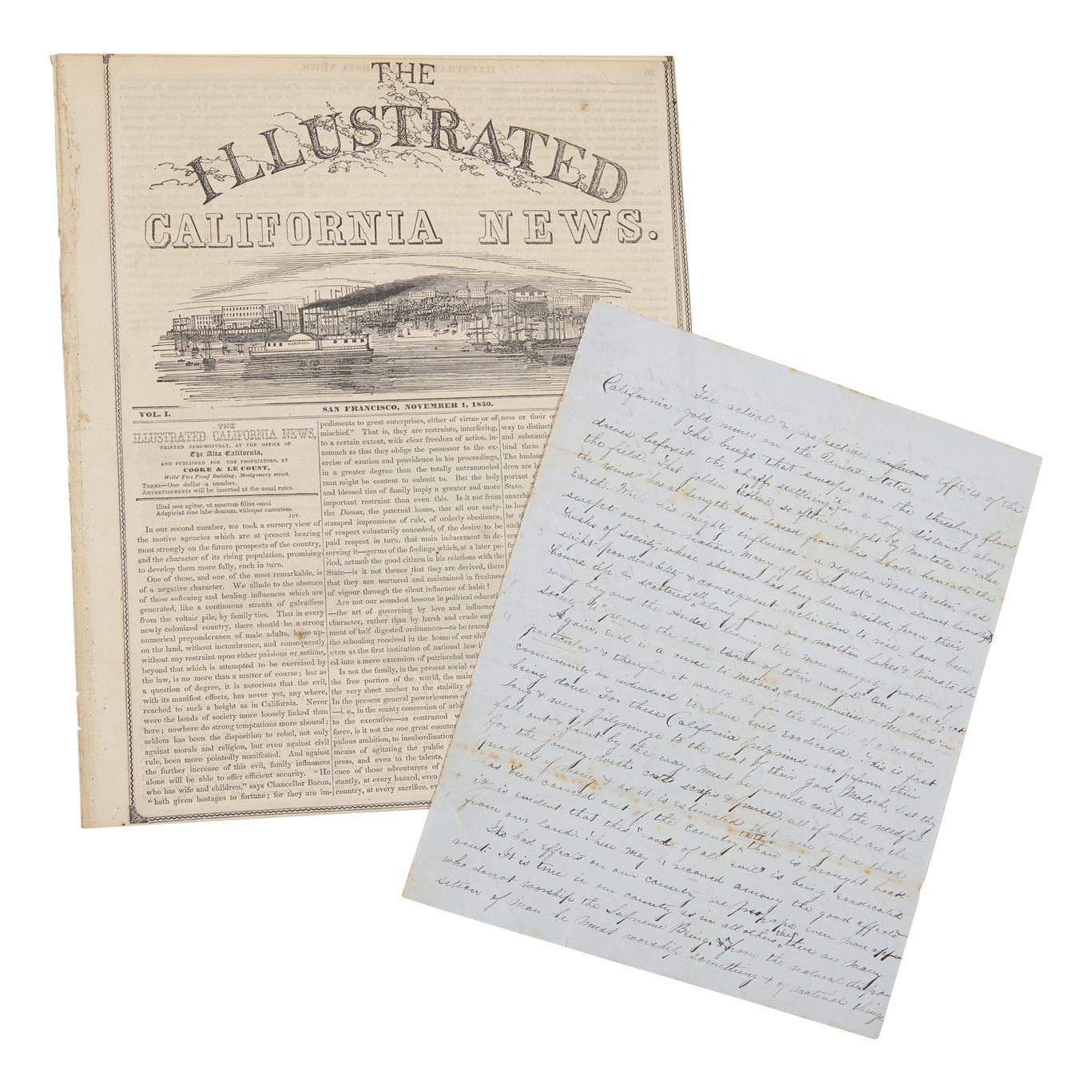
[Guns & Artillery] A Late 19th Century Photograph Album of Ordnance and Artillery from “Freedom’s Fortress” Fort Monroe
No place, no date ca. 1880s. Comprising 23 albumen prints mounted to card; some with manuscript captions. Oblong 4to. Black pebbled clothcovered boards, spine perished, boards and extremities moderately worn and soiled; Fort Monroe library book-plate (“Coast Artillery School”) on front paste-down; cards loose; foxing and soiling to cards; several with Fort Monroe Artillery School ink stamps.
Fort Monroe was constructed between 1819 and 1834 at Old Point Comfort in Hampton, Virginia to guard the entrance to the Chesapeake Bay. The largest stone fort ever built in the United States, it played a vital role in American coastal defense for nearly two centuries. During the Civil War, Fort Monroe remained under Union control and became known as “Freedom’s Fortress” after serving as a refuge for thousands of formerly enslaved people escaping Confederate territory. Following the war, Confederate president Jefferson Davis was briefly imprisoned there.
Lot includes two excised printed Congressional acts, 1860s, related to firearms, as well as sheets from issues of Harper’s, etc., related to guns.
$300 - 500
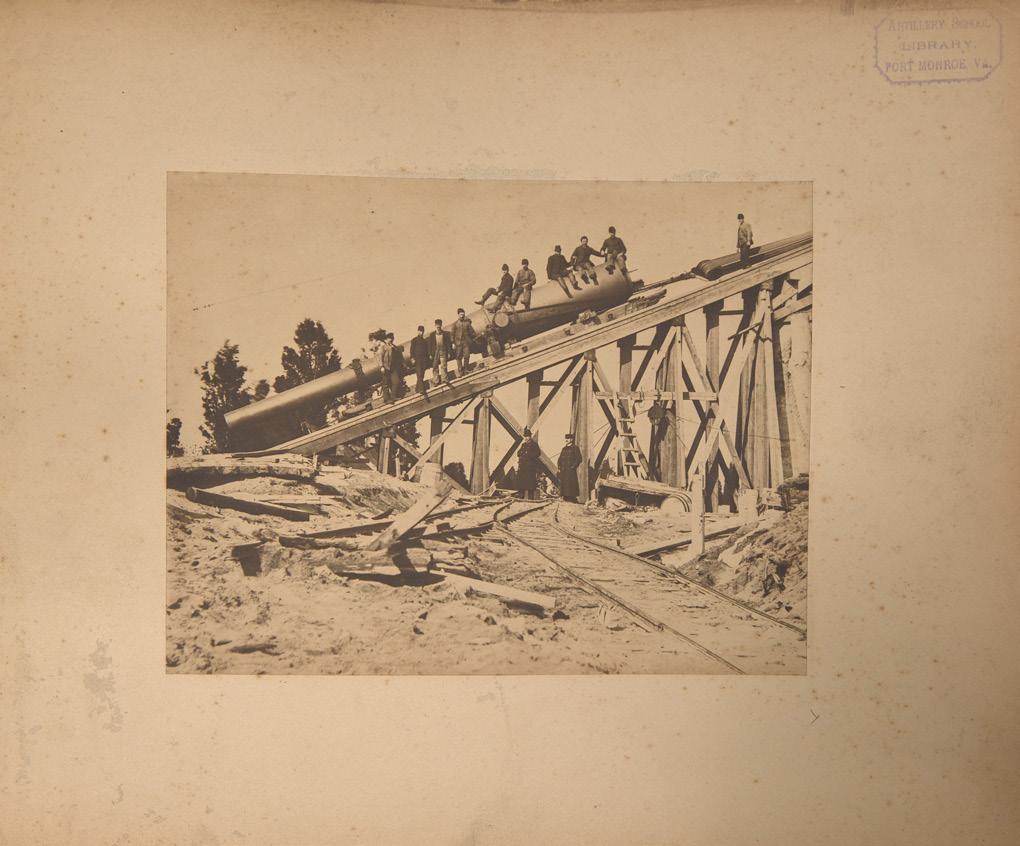
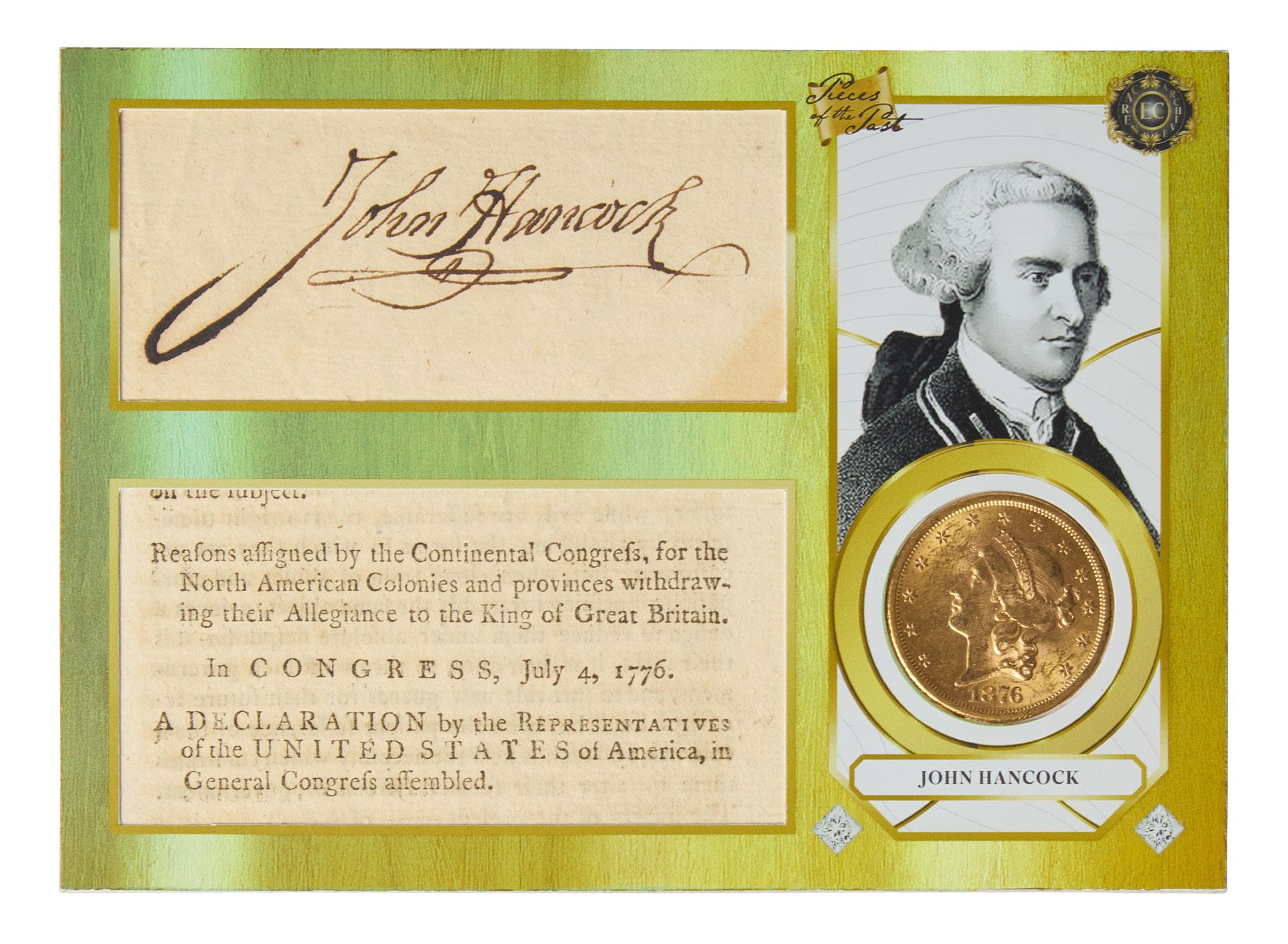
173
[Hancock, John] 1-of-1 Trading Card with Cut Signature of John Hancock and an 1876 $20 Gold Coin, From the “1776: The Freedom Fighters” Card Set, Created by Eric C. Caren
Special one-of-one trading card (2026), with a fine cut signature of John Hancock (excised from a December 20, 1787 military commission), approximately 1 3/4 x 4 in. (44 x 102 mm); with a mounted 1876 Liberty Head $20 gold coin. Together in pictorial presentation card, with fragment of document (“Reasons assigned by the Continental Congress, for the North American Colonies and provinces withdrawing their Allegiance to the King of Great Britain. In Congress, July 4, 1776. A Declaration...”) Housed in wooden pictorial presentation box, with presentation stand.
A fine one-of-one trading card, with a bold cut signature of John Hancock and a Centennial Liberty Head $20 gold coin.
Hancock Signature: RR Auction, Amherst, New Hampshire, July 10, 2024, Fine Autograph and Artifacts..., Lot 167
$5,000 - 8,000
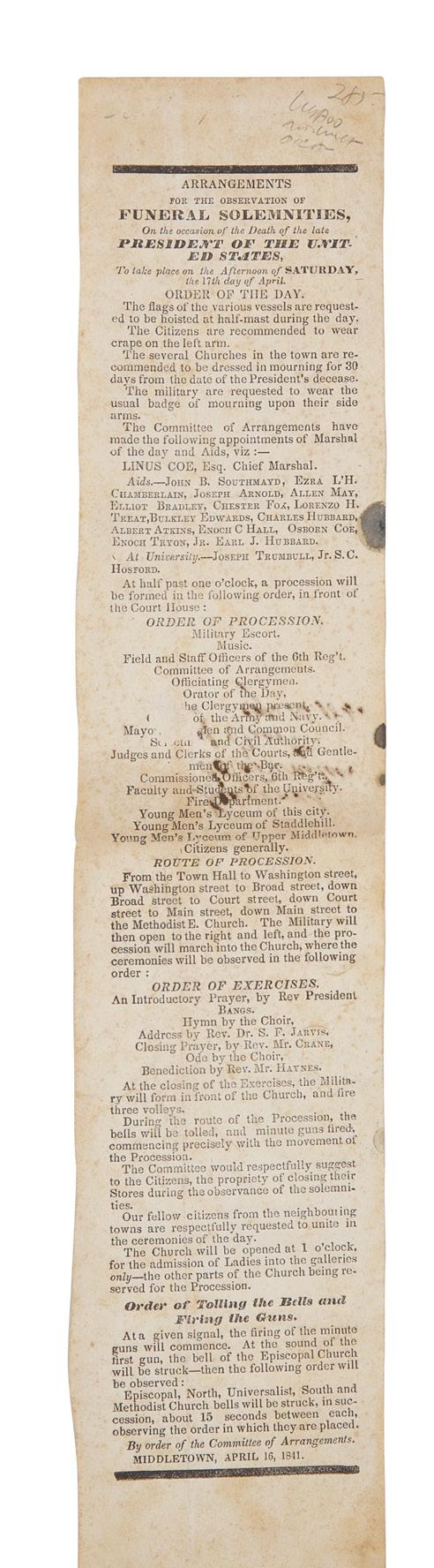
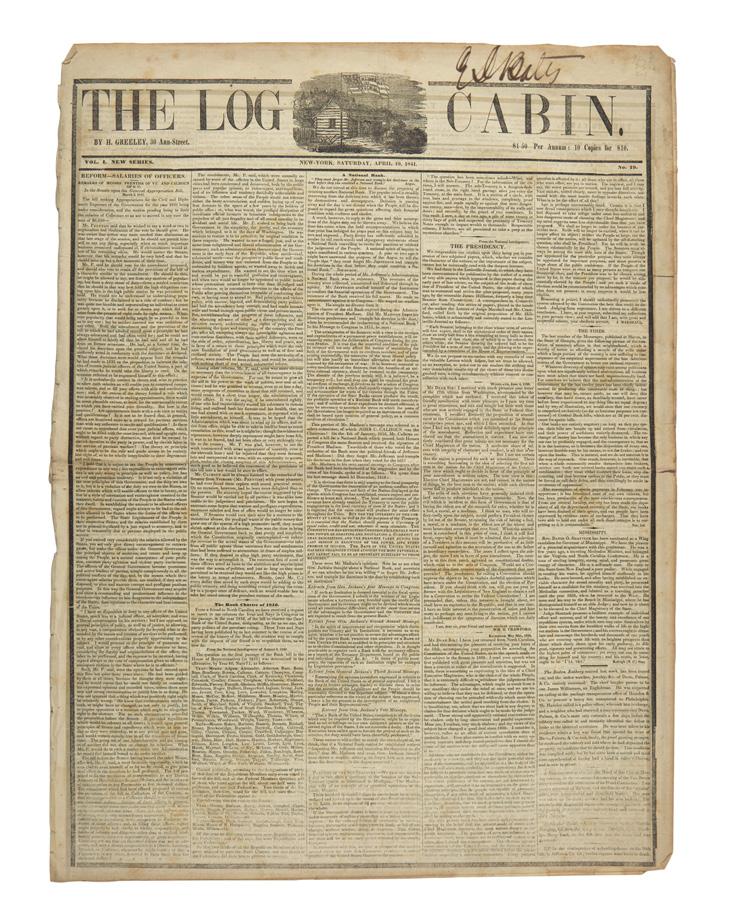
174
[Harrison, William Henry] The Death of American President William Henry Harrison is Announced in his own Newspaper, “The Log Cabin”
The Log Cabin
New-York: (Horace Greeley), Saturday, April 10, 1841. Vol. I, New Series, No. 19. Printed newspaper; black mourning border on each page. Folio. (4) pp. Contemporary ownership signature at top of front page. Disbound; old crease from when folded; separations along central vertical fold; scattered edge-wear; light foxing.
“Death of President Harrison! We are constrained to confirm the painful tidings which have already been borne on the wings of the wind to every portion our land. WILLIAM HENRY HARRISON IS NO MORE!”
The Log Cabin was published from May 1840 to November 1841 to support the candidacy of William Henry Harrison, who unexpectedly died six-days prior to this issue, on April 4, after a brief illness. He was the first President to die in office.
This paper’s wild popularity caused Greeley to establish his most well-known paper, the New-York Tribune.
$200 - 300
175
[Harrison, William Henry] Handbill for the Funeral Service for the First President to Die in Office, April 16, 1841
Arrangements for the Observation of Funeral Solemnities, on the Death of the late President of the United States...
Middletown, (Connecticut), April 16, 1841. Tall printed handbill, 14 7/8 x 3 1/8 in. (378 x 79 mm). Docketed on verso. Creased from old fold; scattered soiling; light foxing.
Handbill for a memorial service for President William Henry Harrison, the first president to die in office. Held in Middletown, Connecticut, on April 17, 1841, two weeks after his sudden death on April 4, the present handbill lists the various ceremonies arranged by the town, including a procession to the city courthouse and a service held by the town’s clergy. Harrison’s unexpected death after only a month in office shocked the nation, and commenced a 30-day period of mourning across the nation, with similar ceremonies being held in most cities and towns.
$150 - 250
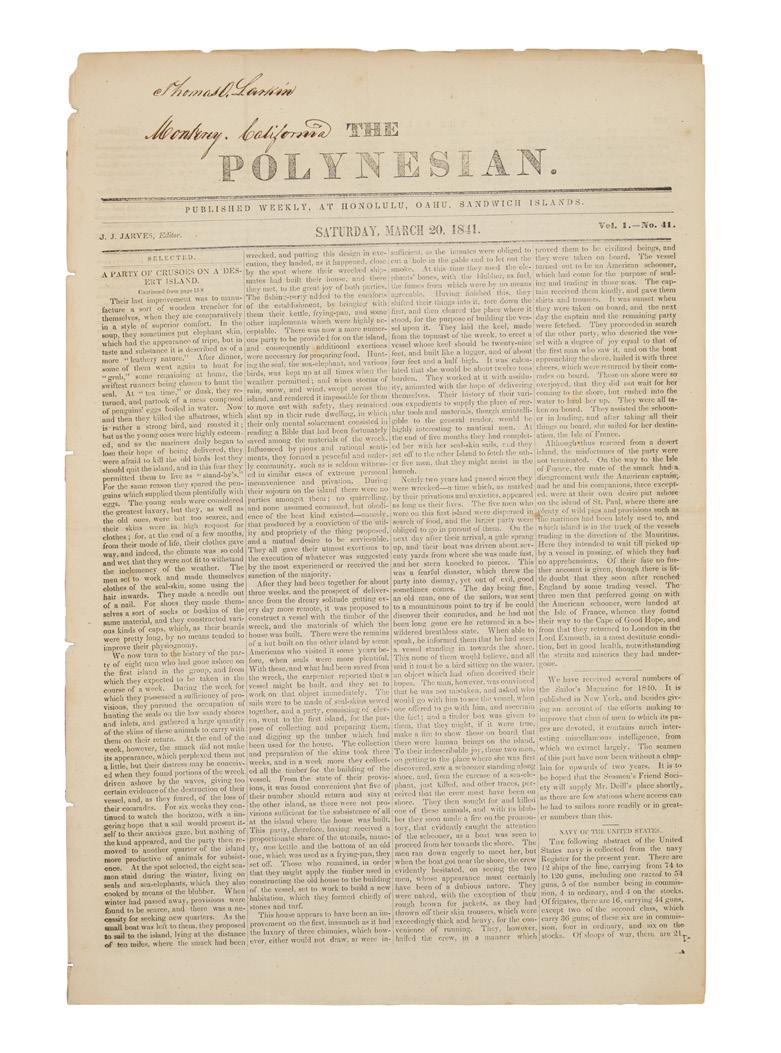
176
[Hawaii] An Early Hawaiian Newspaper, Sent From Hawaii to California in 1841
The Polynesian
Honolulu, Saturday, March 20, 1841. Vol. I, No. 41. Printed newspaper. Folio. 4 pp. Ownership inscription of American diplomat and businessman Thomas O. Larkin (“Thomas O. Larkin / Monterey, California”) at top of front-page. Disbound; creased from old fold.
Thomas O. Larkin (1802–1858) was a Massachusetts-born American diplomat, merchant, and financier, who relocated to California in the early 1830s. Based in Monterey, then part of Alta California, Mexico, he established extensive commercial ties with Mexico and the Sandwich Islands (now Hawaii). During the 1840s, Larkin played a significant diplomatic role in the transition of California from Mexican to American control, serving from 1843 to 1848 as the American Consul to Alta California (the only person to hold this title). During the Mexican-American War he acted as a confidential agent for President James K. Polk and used his influence to support the transfer of California to the United States. In 1849, Larkin also served as a delegate representing San Francisco at California’s Constitutional Convention.
$200 - 300
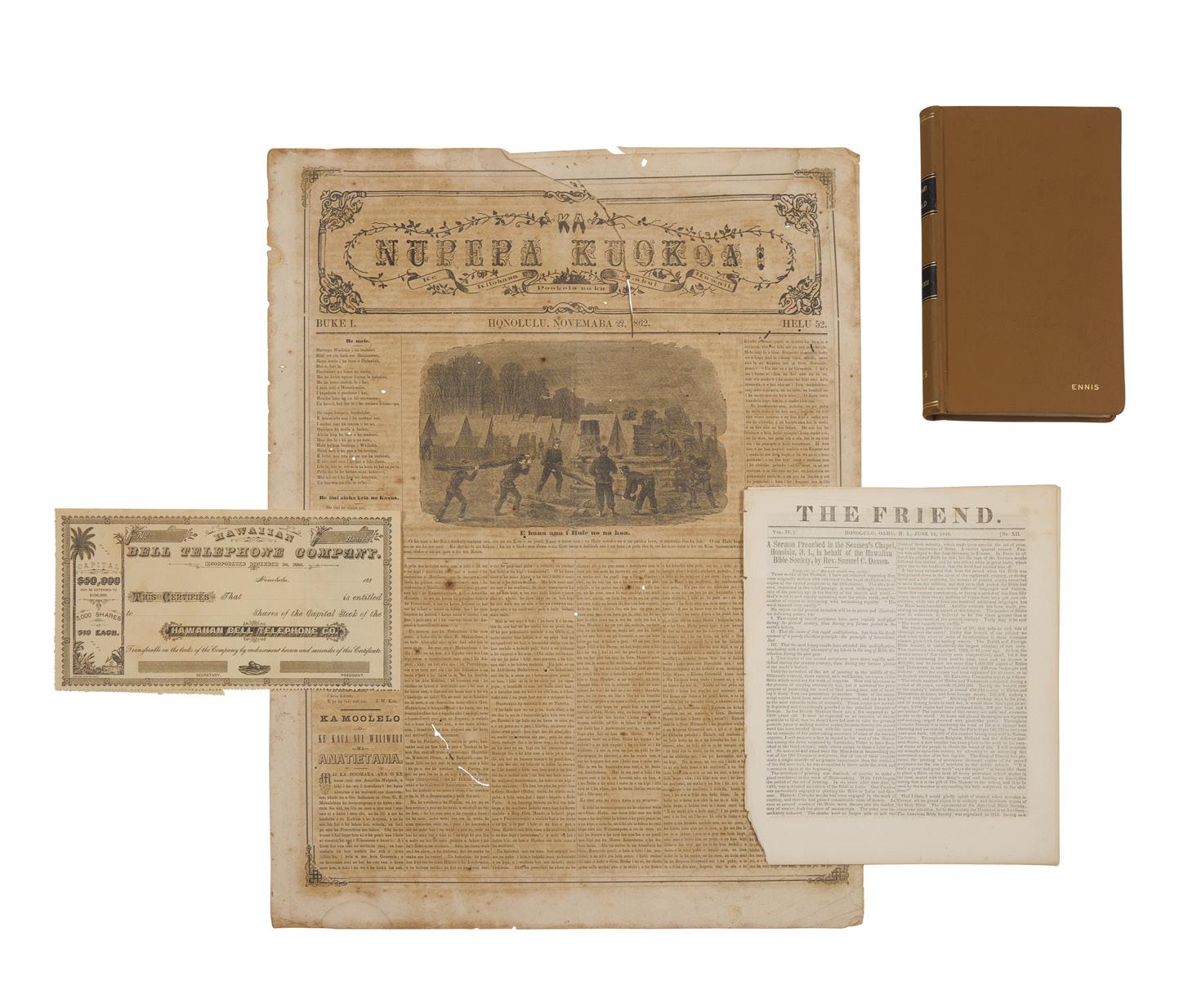
178 [Hollywood] (Dean, James). Unsigned Carbon Copy of a Legal Agreement
(New York), ca. March 1955. Three stapled sheets, 13 x 8 1/2 in. (330 x 216 mm). Unsigned carbon copy of a legal brief, regarding the settlement of a suit between James Dean and Rogers Brackett, in which Dean agrees to pay an outstanding debt. Creasing from old folds; scattered foxing. Lot also includes four black and white press photographs of Dean in various roles.
Legal brief outlining the settlement of a debt between American actor James Dean (1931-55), and radio director Rogers Brackett. The two first met in the early 1950s, with Brackett credited as introducing Dean to a number of executives in the entertainment industry, while also acting as an advisor through much of Dean’s short career. The present document, which resolves small loans and hotel room bills, is dated March 1955, the month that East of Eden premiered, and just six months before Dean›s untimely death.
$300 - 500
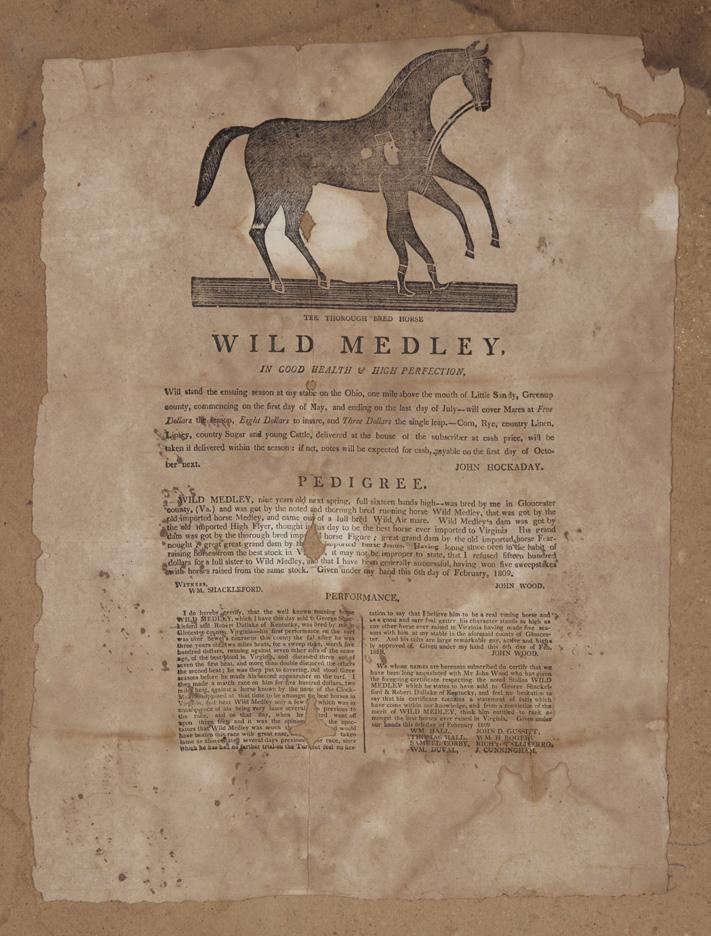
177
[Hawaii] Group of 4 Early Newspapers and Documents Relating to Hawaii, 1826-80s
1. The Missionary Herald. For the Year 1826. Vol. XXII. Boston: Crocker and Brewster, 1826. 8vo. Illustrated with an engraved folding map of Hawaii. Brown library-style buckram, stamped in gilt; all edges trimmed; scattered foxing; gutter split at pp. 296-297.
2. The Friend. Honolulu, Oahu, Hawaii, June 15, 1846. Vol. IV, No. XII. Printed newspaper. 4to. 8 pp. Disbound; bottom left corner torn.
3. Ka Nupepa Kuokoa. Honolulu, November 22, 1862. Vol. I, No. 52. Printed newspaper in Hawaiian. Folio. 4 pp. Toned and worn; scattered worming and tears.
4. Engraved Hawaiian Bell Telephone Company Stock Certificate. Honolulu, ca. 1880s. Unaccomplished.
$300 - 500
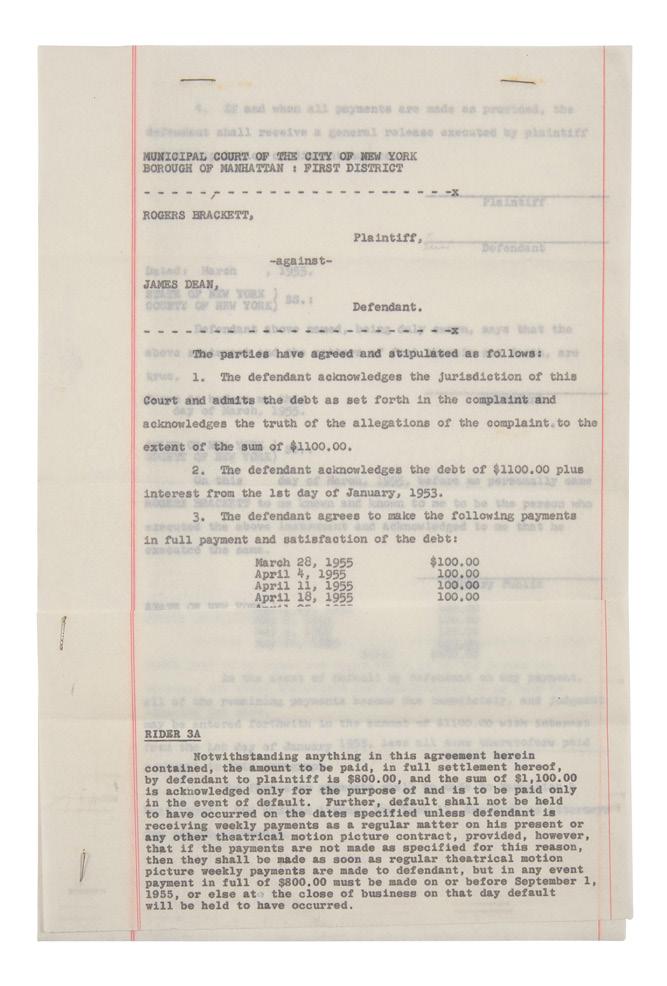
179
[Horse Racing] An Early and Possibly the Only Extant Example of this 19th Century Broadside Advertising the Stud Services of the Celebrated American Thoroughbred Racehorse Wild Medley
The Thorough Bred Horse Wild Medley... Greenup County, Kentucky, ca. October 1, 1809. Printed broadside, 15 3/8 x 11 1/2 in. (390 x 292 mm). Creasing from old folds, losses along central vertical fold, affecting some text; foxed and dampstained; wear along edges; closed tear and small loss in top right corner; manuscript on verso.
This broadside, published for a John Hockaday of Kentucky, advertises that Wild Medley “will stand the ensuing season at my stable on the Ohio, one mile above the mouth of Little Sandy, Greenup country, commencing on the first day of May, and ending on the last day of July--will cover Mares at Five Dollars the season, Eight Dollars to insure, and Three Dollars the single leap...» Printed below is a testimony from a John Wood attesting to Wild Medley›s pedigree, bred by him in Gloucester County, Virginia, «got by the old imported horse Medley, and came out of a full bred Wild Air mare.»
A summation of Wild Medley›s performance is printed at the bottom, and certified by eight acquaintances of Mr. Wood.
Rare, we cannot locate another example on RBH or OCLC.
$600 - 900
180
[Illustration Art] Davies, Wynne W. Color Separation Proof for Cover of “Scarlet Adventuress”
No place, (ca. February, 1936). Offset-lithograph, 13 1/2 x 11 1/2 in. Lightly creased; evenly toned; scattered light stains.
Color separation proof cover illustration for the pulp novel series Scarlett Adventuress
$200 - 300
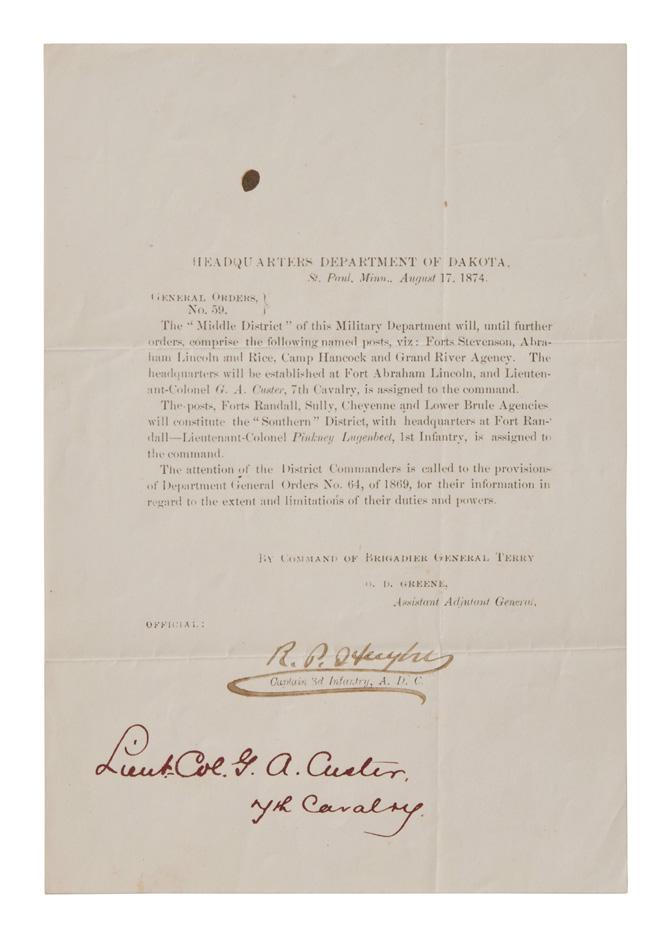
182
181
[Indian Wars] [Custer, George A.] Custer’s Own Copy of Territorial General Orders, Two Years Before the Battle of Little Bighorn
Headquarters Department of Dakota, August 17, 1874. One sheet, 7 1/2 x 5 in. (191 x 127 mm). Printed U.S. Army General Orders No. 59, issued by command of Brigadier General Alfred Terry, signed at conclusion by Capt. R.P. Hughes and addressed by him to recipient, “Lieut. Col. G.A. Custer. 7th Cavalry.” Order reads in part: “The ‘Middle District’ of this Military Department will, until further order, comprise the following named posts, viz: Forts Stevenson, Abraham Lincoln and Rice, Camp Hancock and Grand River Agency. The headquarters will be established at Fort Abraham Lincoln, and Lieutenant-Colonel G. A. Custer, 7th Cavalry, is assigned to the Command...” Creasing from old folds; ink stain not affecting text; light foxing.
George A. Custer’s copy of army General Orders No. 59, establishing Fort Abraham Lincoln as headquarters of the Middle District of the Department of the Dakota.
The Black Hills Expedition led by Lieutenant Colonel George Armstrong Custer departed Fort Abraham Lincoln on July 2, 1874 with orders to find a suitable location for a fort and to investigate the possibility of mining for gold. This expedition was in direct violation of the Fort Laramie Treaty of 1868 which guaranteed that white settlement would be off-limits in the Black Hills, as the region was considered sacred ground to the various Indigenous tribes of the area. While Custer and his soldiers searched for a location for their fort, the citizens who accompanied them began to prospect for gold. Custer received orders to return to Fort Abraham Lincoln on August 15, and two days later received the present message informing him that the fort was now the central headquarters of the Middle District of the Department of the Dakota, with Custer officially appointed commander.
$1,500 - 2,500
[Indian Wars] [Custer, George A.] A Secretary of State’s Copy of This St. Louis Newspaper, Reporting on the Recent Battle of Little Big Horn: “The Horrible Story...Confirmed”
St. Louis Globe-Democrat, July 7, 1876
St. Louis, July 7, 1876. Vol 2. No. 49. Folio. 8 pp. Disbound; creasing from old folds; very small printed tag mounted at top right (“Sec. of State”).
With another issue of the same paper, dated July 5, 1876, bearing the same mounted stamp.
The front-page column reads in part: “Gen. Custer Attacks Sitting Bull in His Camp...Who Massacre Him and His Entire Force...How Awful the News was Received in this City.”
In late 1875 the Grant administration sent an official notification to all tribes in the Dakota Territory that they were to report to designated reservations no later than January 31, 1876 or be deemed “hostile.” Few acceded to this order. In the spring and early summer, Hunkpapa Lakota leader Sitting Bull called a large gathering of Plains tribes together to create a united encampment of Lakota, Northern Cheyenne, and Arapaho on land already belonging to the Crow, who sided with the United States Army to expel them from their lands. On June 25, the 7th Cavalry, led by General Custer, came upon their encampment. Upon realizing his position had been discovered, he ordered his men to attack. What followed was nothing short of a massacre which ended with over fifty-two percent of the 7th Cavalry dead, including Custer himself. This engagement became known as the Battle of Little Bighorn, or “Custer’s Last Stand.”
$200 - 300
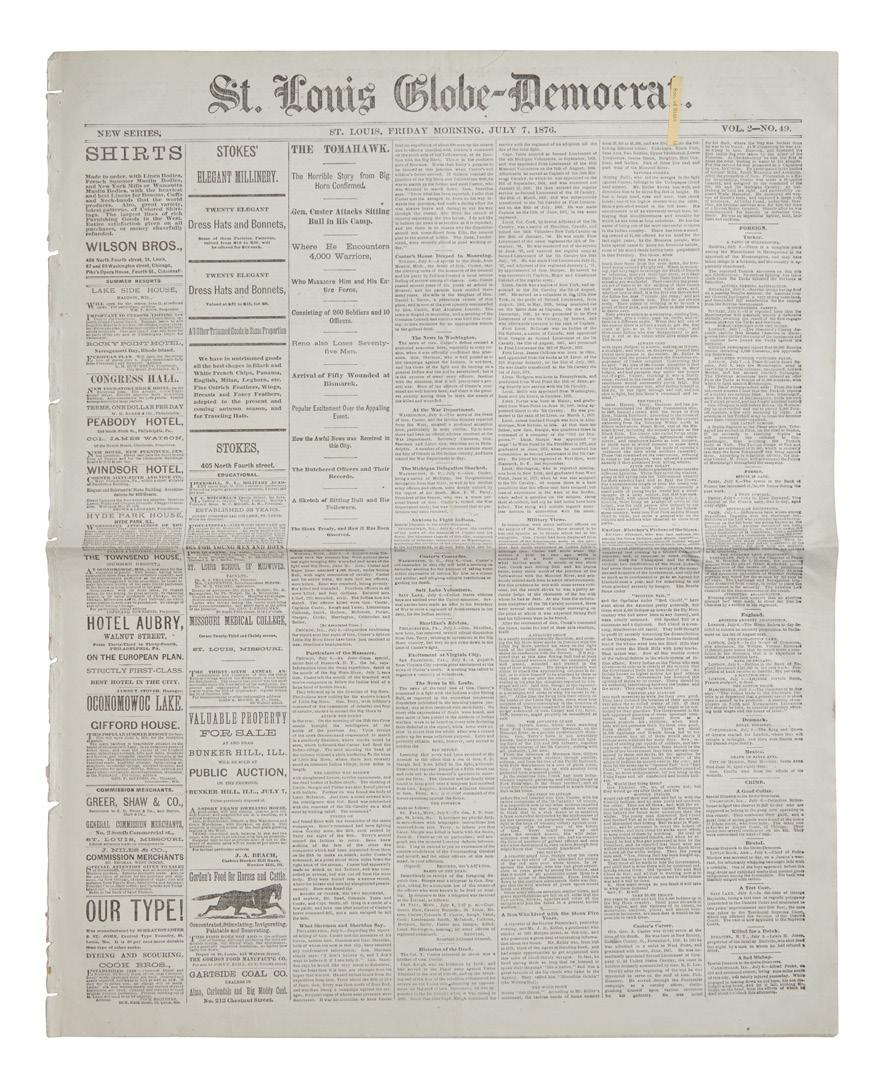
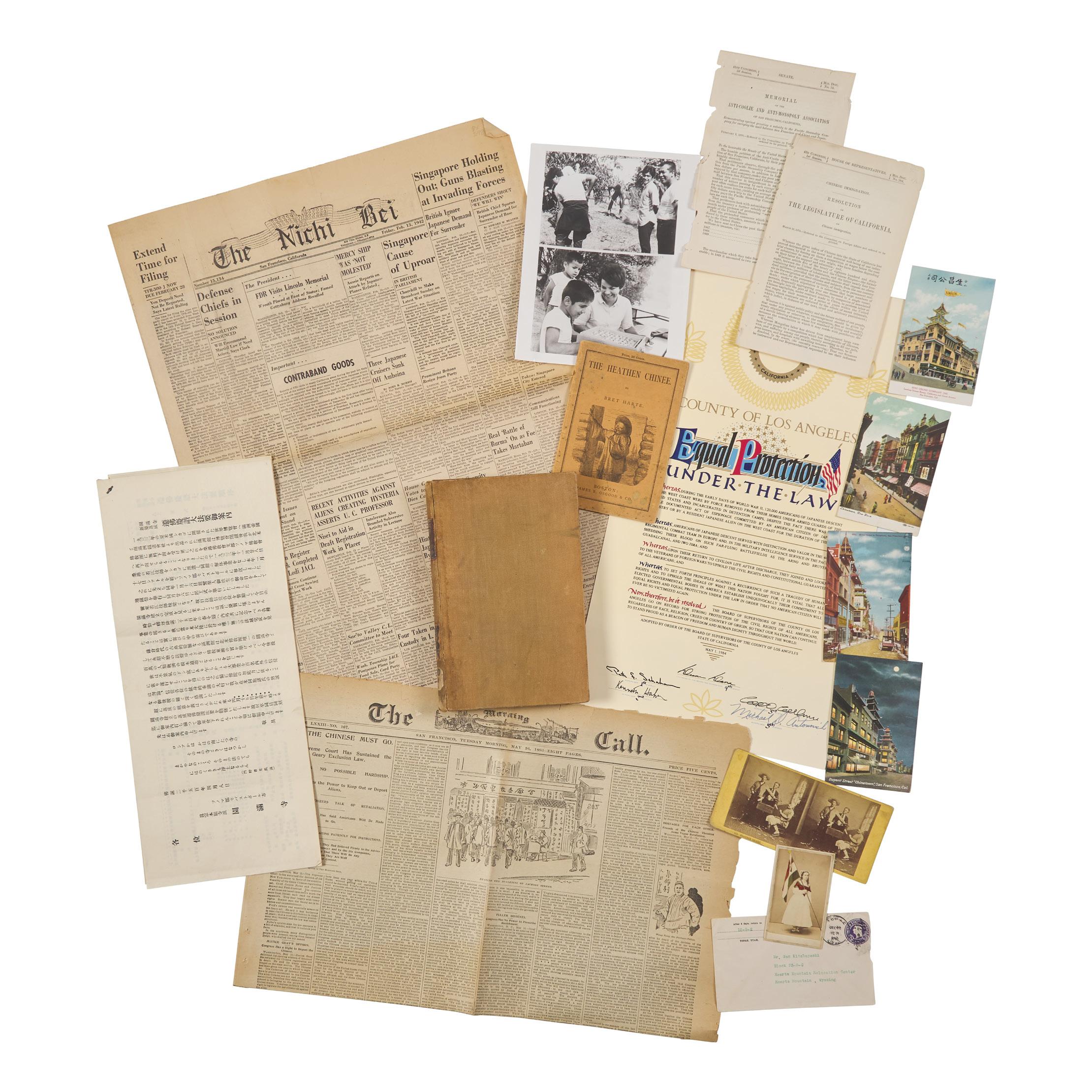
Locations and dates vary. Group of 20 items related to the Asian Immigrant experience in America, including government reports, newspapers, photographs, and postcards. Highlights include a printed proclamation by the County of Los Angeles apologizing for Japanese Internment; a stereoview by J.J. Riley of a Chinese restaurant in San Francisco; a postmarked mailing cover from the Topaz Japanese Internment Camp; and The Heathen Chinee by Brett Harte (Boston: James Osgood, 1871). Size and condition vary.
The first major wave of Asian immigration to the United States began around 1850, largely in response to the discovery of gold in California. Many Chinese immigrants arrived hoping to escape economic inequality and the fallout from the First Opium War. Following the end of the Civil War and the abolition of slavery in the United States, plantation owners in the South began to recruit Asian laborers as a cheap source of labor to replace their former slaves. This exploitation led to tensions between Asian immigrants and nativist groups. Over subsequent years numerous skirmishes broke out, the most infamous being the Rock Springs Massacre which in turn led to Congress passing the Page Act of 1875, the first restrictive immigration bill in United States history.
Despite the repeal of restrictive immigration laws targeting Asian countries over subsequent years, following the Japanese attack on Pearl Harbor on December 7, 1941, President Franklin D. Roosevelt signed Executive Order 9066 which established a series of internment camps specifically targeting citizens of Japanese descent. Following the 1944 presidential election Roosevelt suspended the order, effectively ending the forced internment program. President Gerald Ford terminated the order in 1976, and in 1989 reparations began to be issued to survivors of the camps.
$400 - 600
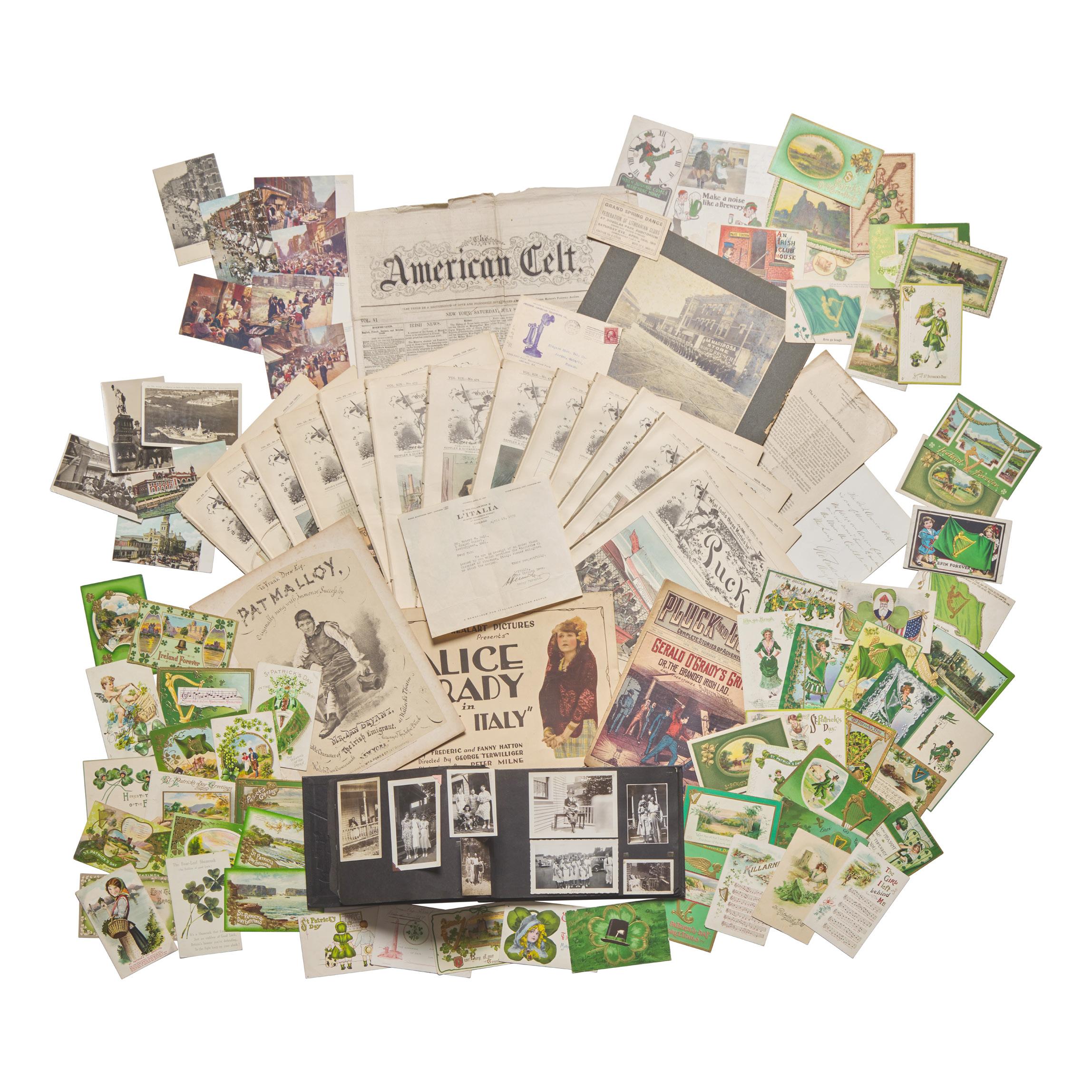
Nationalities represented include Irish, Italian, Hungarian, Polish, Lithuanian, Armenian, Swedish, and more. Items include newspapers, pamphlets, photographs, postcards, posters, a photo album, etc. Highlights include an autograph letter signed by American businessman George Francis Train, a movie poster featuring Alice Brady, for the lost silent film Little Italy, and dime novel, Pluck and Luck. Condition varies, although generally fine.
Between 1492 and 1930 it is estimated that over 60 million Europeans emigrated to the Americas. This wave reached its crest during the late 19th-and early 20th centuries, as a series of economic, agricultural, and social upheavals led to more Europeans seeking better lives on the other side of the Atlantic. The effects of this migration are many and include the near-total annihilation of the Indigenous populations and led to the beginning of a globalization trend which has had profound effects on commerce, culture, and geopolitics.
$300 - 500
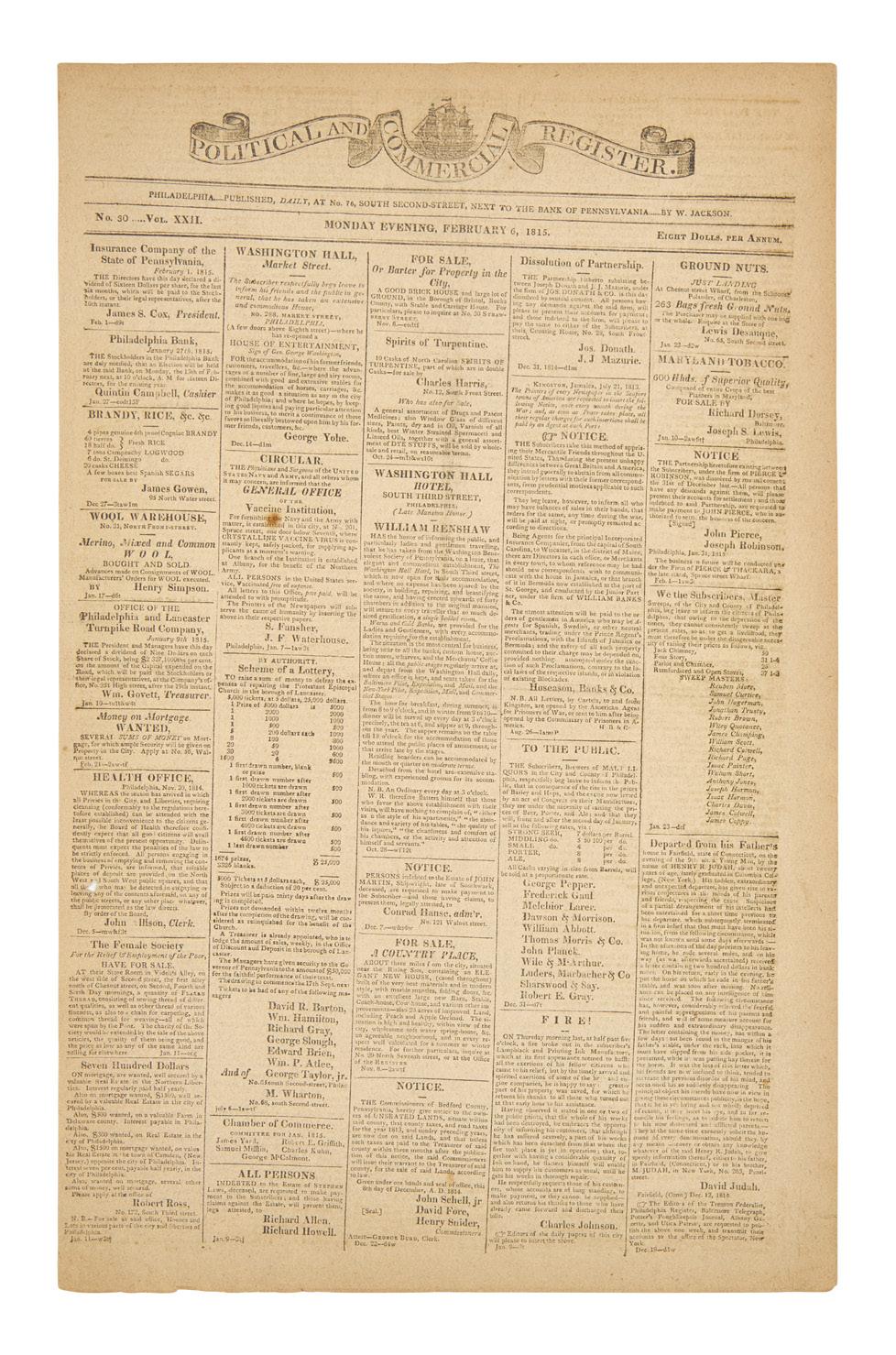
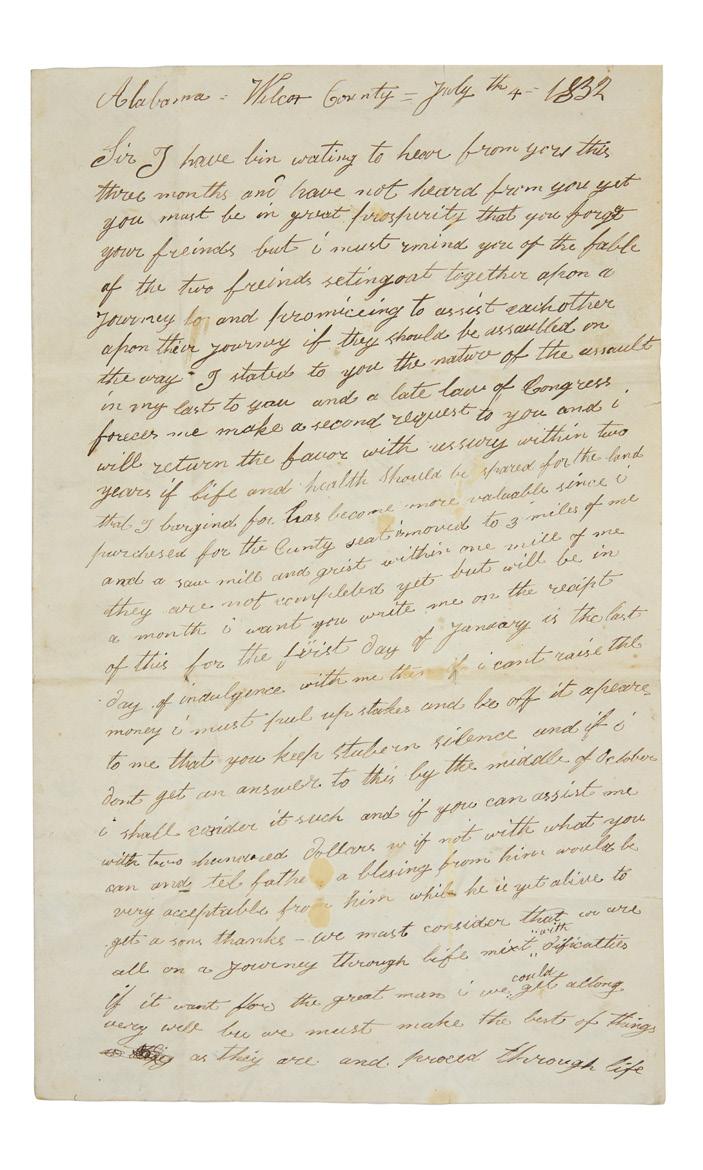
185
[Jackson, Andrew] Group of 2 Newspapers, Reporting on Jackson’s Victory Over the British at New Orleans and His Fourth State of the Union Address
Political and Commercial Register
Philadelphia: Published by W. Jackson, Monday Evening, February 6, 1815. Vol. XXII, No. 30. Printed newspaper. (4) pp. Separated along central vertical fold; scattered minor spotting.
Printed on page two is the “Glorious News” of General Andrew Jackson’s victory over the British at New Orleans, the final battle of the War of 1812, with detailed reports on the engagement.
Together with:
National Intelligencer
Washington: Gales & Seaton, Thursday, December 6, 1832. Vol. XXXIII, No. 4840. Printed newspaper. (4) pp. Separated along central vertical fold; dampstaining at top and along right edge; scattered edge-wear.
Printed on the front page is President Andrew Jackson’s fourth State of the Union Address, where he critically addresses the ongoing Nullification Crisis.
$250 - 350
186
[Jacksonian Era] A Fascinating Contemporary Letter by an American Farmer Written Amid the Nullification Crisis and the Petticoat Affair
Autograph Letter, signed Wilcox County, Alabama, July 4, 1832. Bifolium, 12 3/4 x 7 3/4 in. (324 x 197 mm). Three-page autograph letter, signed by Charles and Jane Connor to his brother William Connor of Fairfield Corner, Maine, regarding family matters, and mentioning the political climate of the United States that has “run mad with nulification”, and mentioning the Petticoat Affair and Peggy Eaton, wife of President Jackson’s Secretary of War. Integral leaf addressed in Connor’s hand. Creasing from old folds; wear and small loss (affecting some text) at fore-edge from seal when opened.
A National Crisis from the Viewpoint of an Everyday Farmer and his Family
Penned by a Charles Connor, and his wife Jane, of Wilcox County, Alabama, to his brother William, in Fairfield Corner, Maine. Connor touches on a variety of family affairs, including the state of his family and farming. In particular, he goes on to mention the Nullification Crisis that then threatened the federal government’s sovereignty as South Carolina sought to void federal law by rejecting the hated Tariff of 1828. The first major test against federal sovereignty, the confrontation nearly led to armed conflict, but was avoided with the passage of the Force Bill and the Compromise Tariff of 1833. Connor states that the “politicks of this country they are run mad with nulification and dont now where it will end but i am in hopes that it will end in the ellection of Henry Clay to Presidentcy”. Connor goes on to make reference to Peggy Eaton, wife of President Jackson’s Secretary of War, and what would be called the Petticoat Affair--a scandal involving Jackson’s cabinet and their wives, who ostracized Mrs. Eaton for what they deemed her loose morals. The scandal resulted in the resignation of Vice President John C. Calhoun and the replacement of Jackson’s cabinet.
$200 - 300
187
[Jefferson, Thomas, and Sally Hemings]
John Quincy Adams’ Racist Satirical Poem Mocking Thomas Jefferson After his Scandalous Affair with his Slave
Boston Gazette. Commercial and Political
Boston: Published by John Russell and James Cutler, Monday, December 27, 1802. Vol. XIII, No. 34. Printed newspaper. Folio. 4 pp. Disbound; creasing from old folds; wear along edges, affecting some text; separations along central vertical fold; spotting and mild dampstaining.
On the second page is printed John Quincy Adams’ satirical poem mocking Thomas Jefferson, following reports of Jefferson’s scandalous affair with his slave, Sally Hemings: “Dear Thomas, deem it no disgrace With slaves to mend thy breed, Nor let the wench’s smutty face Deter thee from the deed...”
In an early September 1802 issue of The Richmond Recorder, journalist James Callendar made the shocking accusation that President Thomas Jefferson had for nearly a decade been engaged in a sexual relationship with one of his slaves, Sally Hemings. Though Callendar claimed to have come to this conclusion after observing several light-skinned enslaved children at Monticello, similar rumors had been whispered about for years, notably during the bitter 1800 presidential contest between Jefferson and then-President John Adams. What few knew was that the original source for these rumors may have been Adams himself, who had possibly hinted about the relationship in letters to his son, John Quincy Adams, following Jefferson’s resignation from George Washington’s cabinet as Secretary of State in 1794. Federalist newspapers across the country eagerly reprinted the story. Though aligned with Jefferson politically, the BostonGazette nonetheless reprinted a racist poem penned by the son of Jefferson’s predecessor and one-time friend, openly mocking the scandal. Originally published in October, the poem was reprinted multiple times.
Jefferson denied paternity of Hemings’s children, as did his children and grandchildren, however DNA evidence has since proven that Jefferson fathered six children with Hemings, four of whom survived to adulthood.
$400 - 600
188
[Jefferson, Thomas] The Formation of the Library of Congress: Scarce Official Senate Report Pertaining to the Sale of Former President Thomas Jefferson’s Library to the United States Congress
Washington City: Printed by Roger C. Weightman, 1814. First edition. 8vo. (4) pp. Likely disbound; separated along center fold; wear and light creasing along edges; light foxing.
Scarce official Senate report pertaining to the sale of former President Thomas Jefferson’s library to the United States Congress.
During the War of 1812, the British entered Washington, D.C. and set fire to the Capitol building, destroying nearly all of the 3,000-plus-volumelibrary within. Jefferson was particularly distressed at the news and offered to sell his library to Congress to help them rebuild. At the time, Jefferson had the largest personal collection of books in the country, held at his plantation, Monticello, in Virginia. He had planned to offer this library to Congress upon his death, but considering the circumstances, and Congress’s likely inability to rebuild on their own, he offered his at any valuation and payment terms Congress saw fit. His only stipulation was that they accept the library in full. This report, dated November 28, 1814, presents the bill to the Senate for Jefferson’s 6,487-volume library, for a price of $23,950. The books were shipped beginning in April 1815, with the last wagonload arriving in Washington that May.
Scarce, according to online records, only two other copies of this report have come to auction since the Streeter Sale, the last copy in these very rooms in 2023.
$800 - 1,200
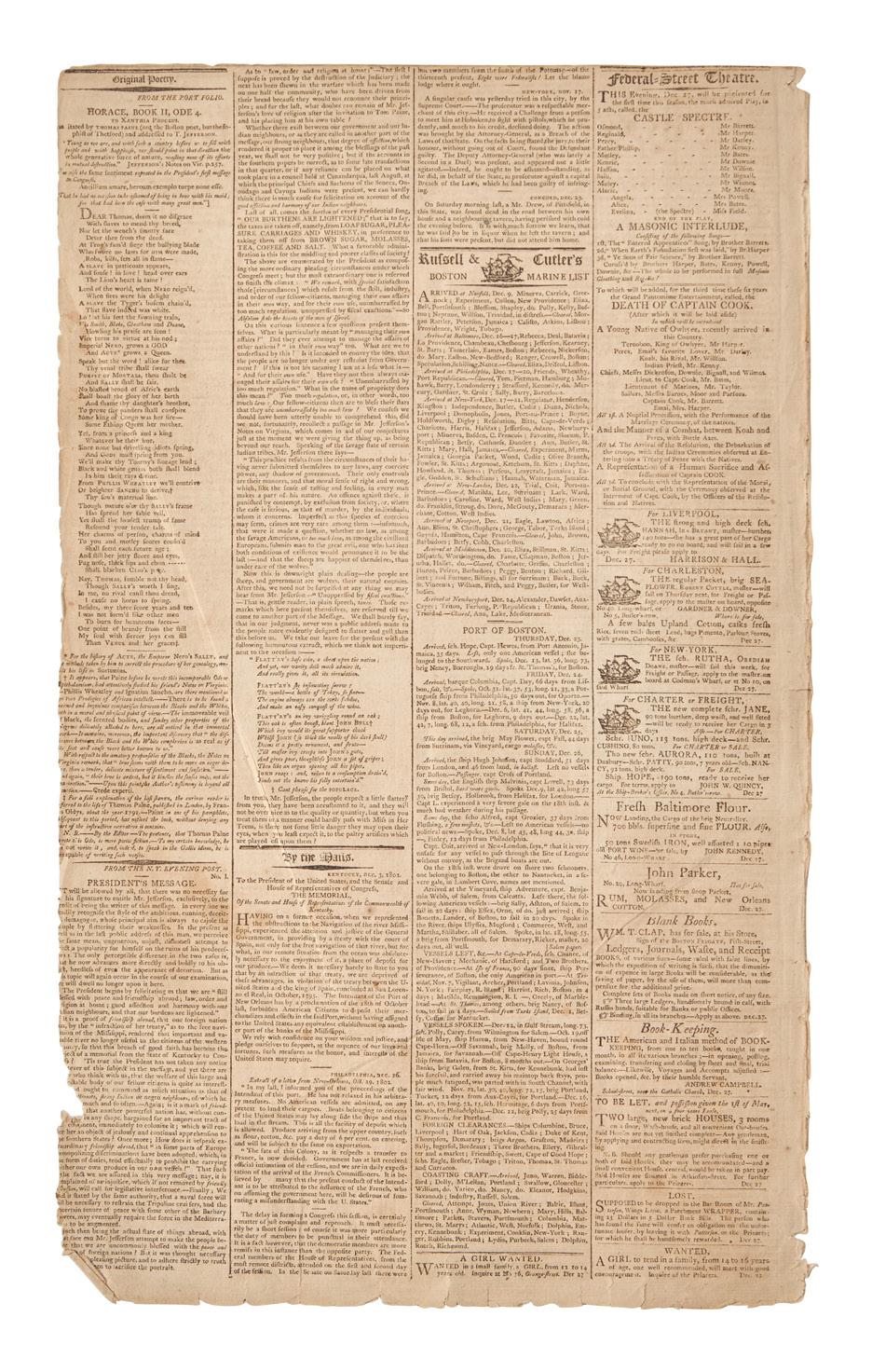
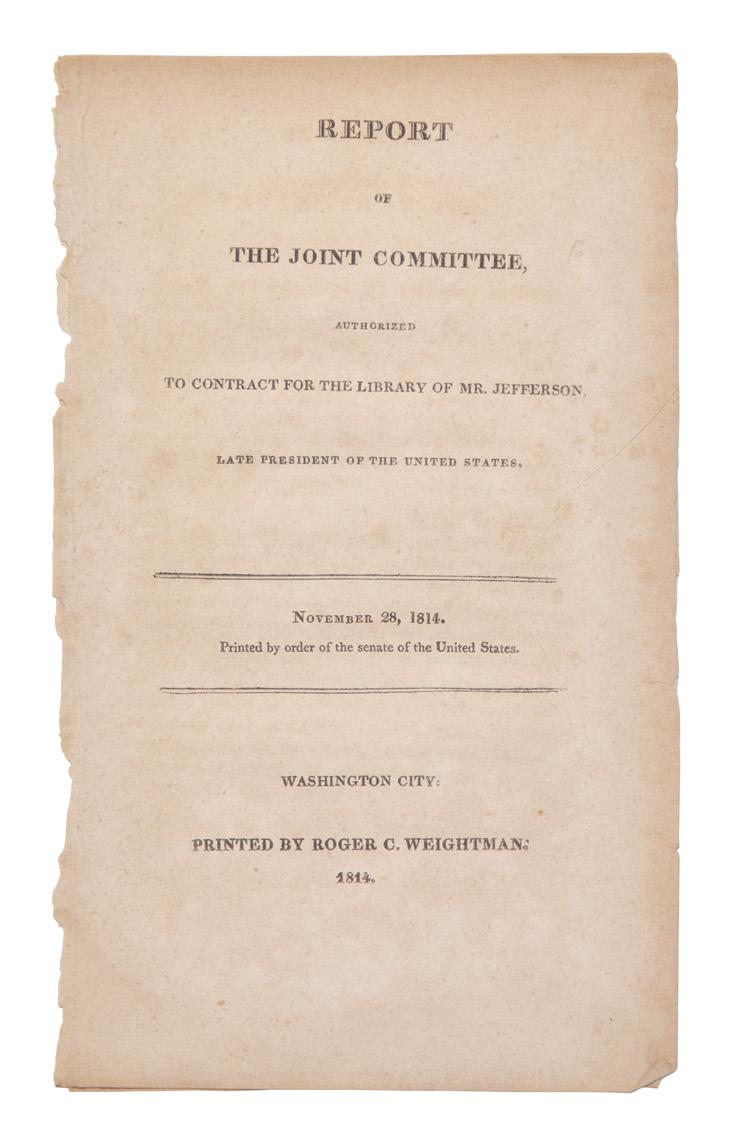
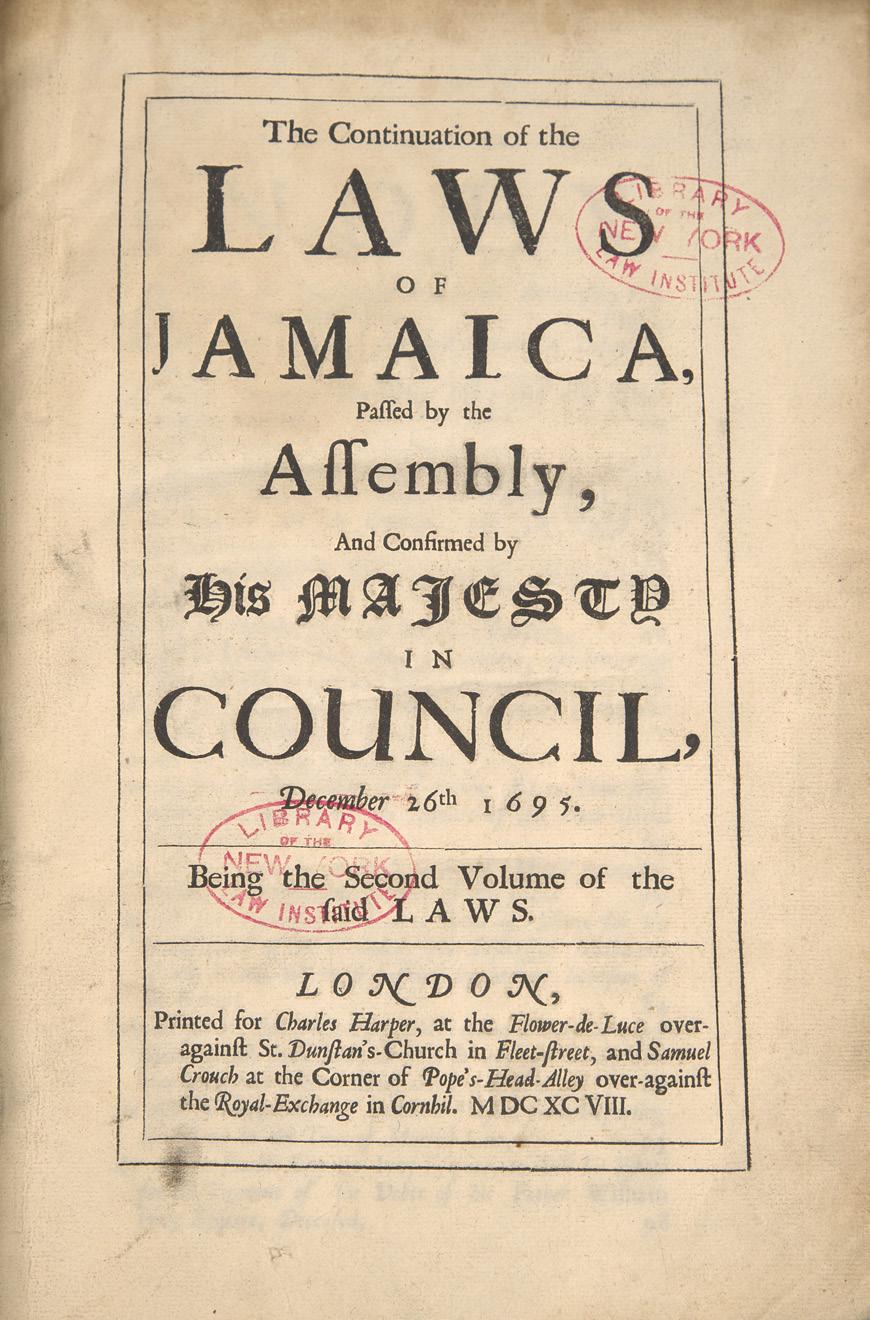
189
[Judaica] One of the Earliest Printed References to Jewish Individuals Living in the New World, 1698
The Continuation of the Laws of Jamaica, Passed by the Assembly, And Confirmed by his Majesty in Council, December 26th 1695. Being the Second Volume of the said Laws. London: Printed for Charles Harper, and Samuel Crouch, 1698. First edition. Folio. (iv), 101, (3) pp. Full contemporary brown calf, stamped in blind, boards worn, scuffed, dry, and soiled, spine and joints dry and worn; all edges trimmed; ink stamps of the Library of the New York Law Institute on title-page and Index. ESTC R42084
One of the earliest printed references in English to members of a Jewish community living in the new world, listing them by name in the collected volume of laws of Jamaica. On pp. 8-10 is printed, “be it further Enacted and Ordained by the Authority aforesaid, that the Nation and People of the Jews Residing within this Island, Pay or cause to be Paid, toward the Raising of the said Sum of Mony (sic)...the full Sum of Seven Hundred and Fifty Pounds Currant Mony of this Island, to be rated, Assessed, Taxed, Collected and Paid in by Solomon Ararii, Jacob de Leon, Moses Toiro, Jacob Mendez Guteres, Jacob Henriques, Jacob Rodrigues de Leon, Moses Jesuram Cardoso, Samuel Gabay, Jacob Lopes Torres, Isaac Coutinho, Isaac Nunes Gonsales and Abraham Nunes...”
While Jews, or those of Jewish descent, had been living in Jamaica since at least the 16th century, mainly of Portuguese and Spanish descent, it was not until the English capture of the island in 1655 that a more organized and intentional community began to take root. Other Jewish communities in the New World had sprung up earlier in the 17th century, among the first considered to be in Recife, Brazil in the latter 1630s, with others in Barbados, Suriname, and Martinique, but it was Jamaica that increasingly became a safe haven for them to openly practice their faith and customs, attracting settlers from Europe and elsewhere. Bolstering this emigration was the island’s religious tolerance, and the English Crown’s granting of citizenship. As the above law demonstrates though, while the Jewish community maintained civic rights, they were nonetheless discriminated against and taxed at a higher rate than their Christian neighbors. The above act relates to the repulsion of a French attack on the island in 1693, with four thousand pounds being subsequently levied, a fifth of which was requisitioned by the Jewish community on the island, and to be paid by their wealthiest and most prominent members (the 12 listed). Failure to pay by the designated date would result in a fine, the confiscation of slaves or other property, or arrest. Other similar taxes followed in the years hence. Despite this oftentimes onerous taxation, the Jewish community continued to thrive, reaching nearly 3,000 in the early 18th century.
Rare. ESTC locates only two other copies, at Harvard University and the Historical Society of Pennsylvania.
$2,000 - 3,000
190
[Judaica] Thorpe’s Original House of David Baseball Club of Benton Harbor, Michigan World’s Champion Traveling Baseball Team
Pensacola, Florida: Mayes Printing Co., ca. 1929. Printed broadside; 22 x 11 1/4 in. (559 x 286 mm). Laid down on card; creasing from old folds.
Formed in 1913 by members of the Adventist commune the Israelite House of David, the House of David Baseball Club was a sensational barnstorming baseball team, known for their long unkempt hair and trick plays a la the Harlem Globetrotters.
Headquartered in Benton Harbor, a small town in southwest Michigan, the Israelite House of David was founded in 1903 by the preacher couple Benjamin and Mary Purnell. Members of this communal society renounced personal property and adhered to strict prohibitions against sex, meat, alcohol, drugs, tobacco, and shaving. The group’s baseball team emerged from Benjamin’s passion for the sport and his belief that physical activity was essential to spiritual discipline. By the 1920s, the team had become a staple of the American barnstorming circuit, competing against both amateur and semi-professional clubs. During the team’s lifetime they achieved remarkable success, drawing massive crowds, due not only to their wild looks, but to their adept playing skills and trick maneuvers. Toward the end of the decade, the team began recruiting professional talent, signing legends such as Grover Cleveland Alexander, Chief Bender, and Satchel Paige. They even occasionally featured Babe Ruth, who would humorously don fake facial hair to blend in with the bearded members of the team.
This rare broadside dates to the year following the death of founder Benjamin Purnell, a period marked by the fallout from his scandalous trial and a subsequent schism within the commune. The split resulted in two factions: one loyal to Mary Purnell and the other remaining faithful to the original leadership. This poster features a full team photograph, an image of manager Francis Thorpe at center left, star player J.L. Tally--dubbed “The Babe Ruth of the Colony Team”--at center right, and John Tucker, known as the “Elongated First Baseman,” at the bottom.
$200 - 300
191 [Judaica] Early Front-Page report Warning Against Adolf Hitler, 1929
Jewish Daily Bulletin
New York: Wednesday, January 2, 1929. Printed newspaper. Vol. V, No. 1256. 4to. 4 pp. Disbound; small chipping and wear along edges.
With an early front-page report warning against Adolf Hitler: “Warns of Danger in Hitler Agitation Among German Peasants...A warning that if not checked, the anti-Semitic Hitler agitation among German peasants will lead to acts of violence...”
Between 1928 and 1930 the Nazi Party in Germany began a sharp rise in popularity, propelled by their eagerness to blame minority groups for the country’s economic instability. Hitler’s scapegoat of choice was the Jewish people, which would eventually result in the Holocaust which saw over 6 million Jews murdered by Hitler’s fascist regime.
$200 - 300
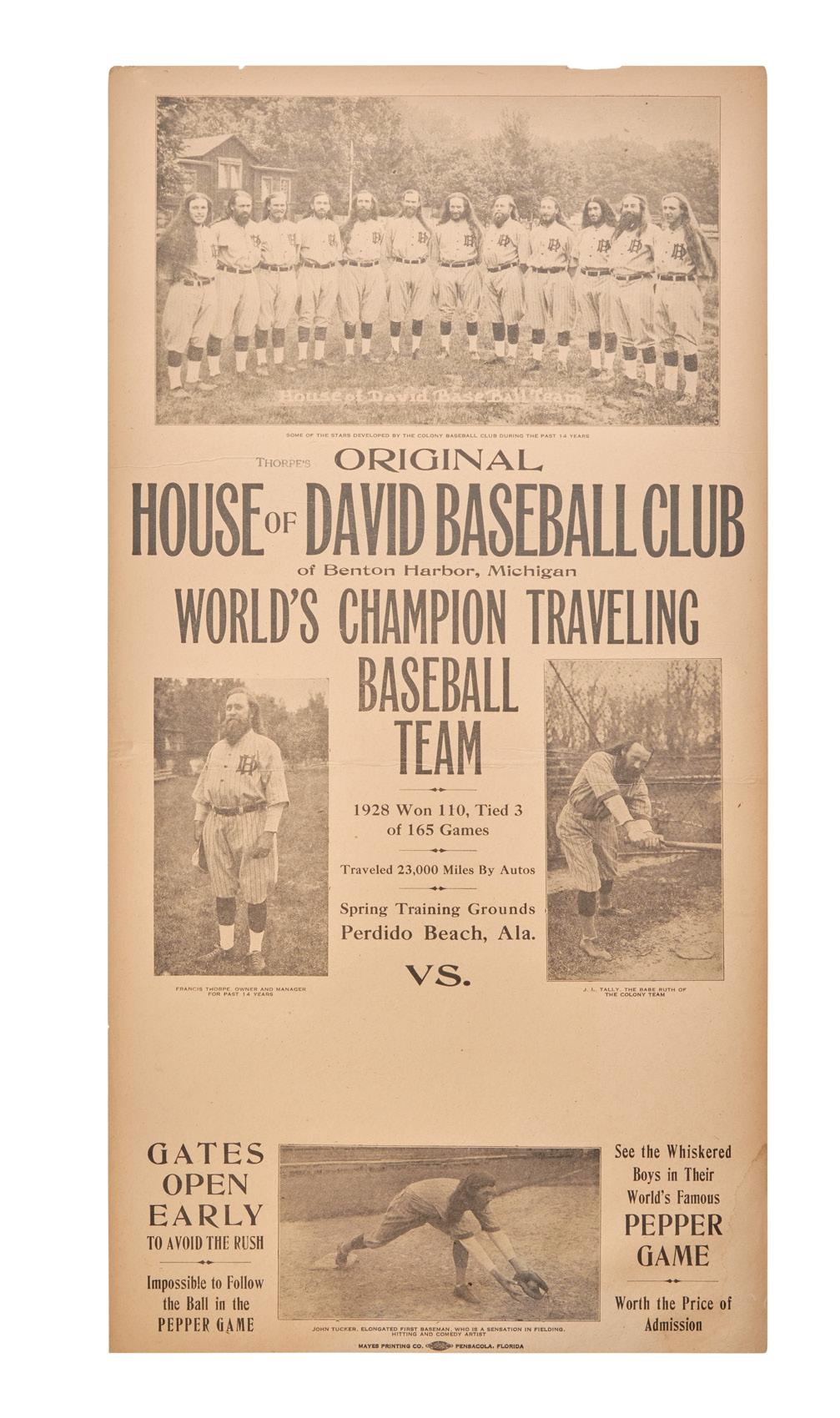
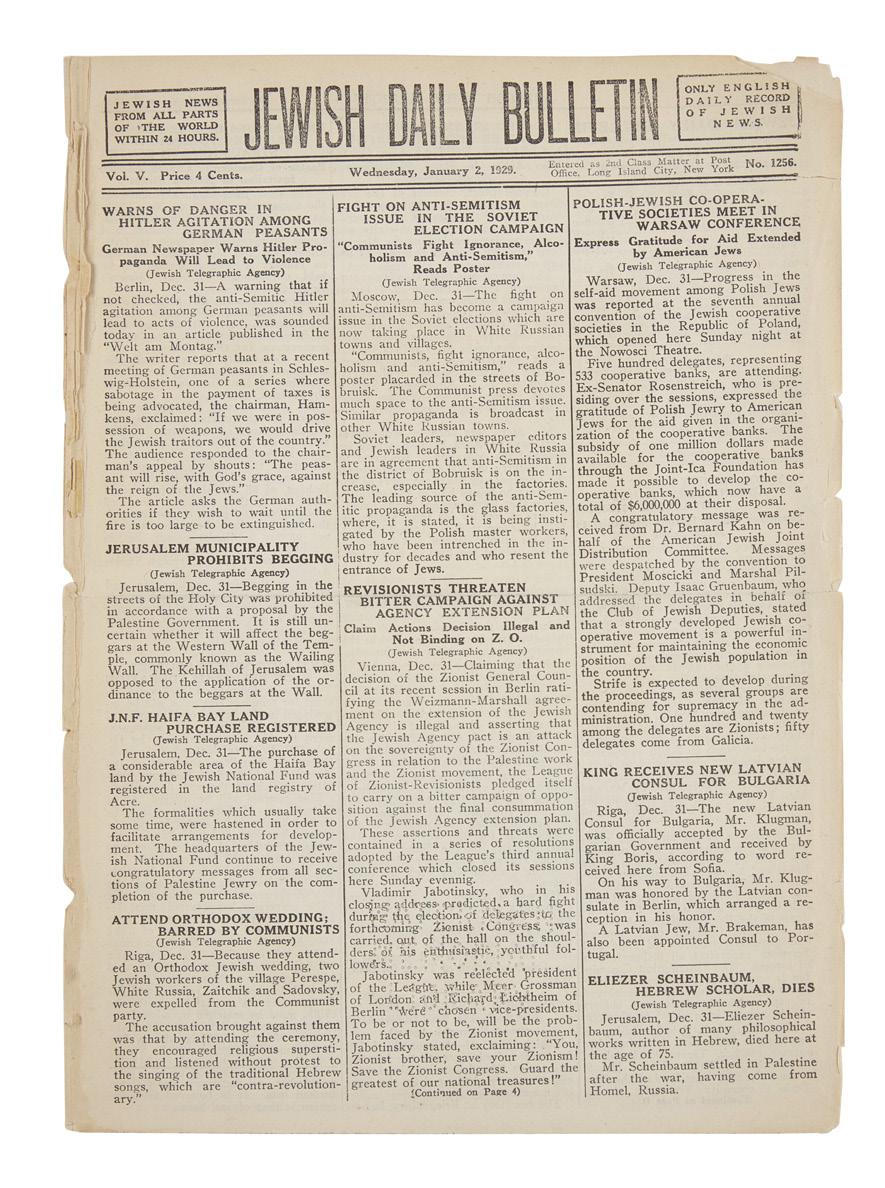
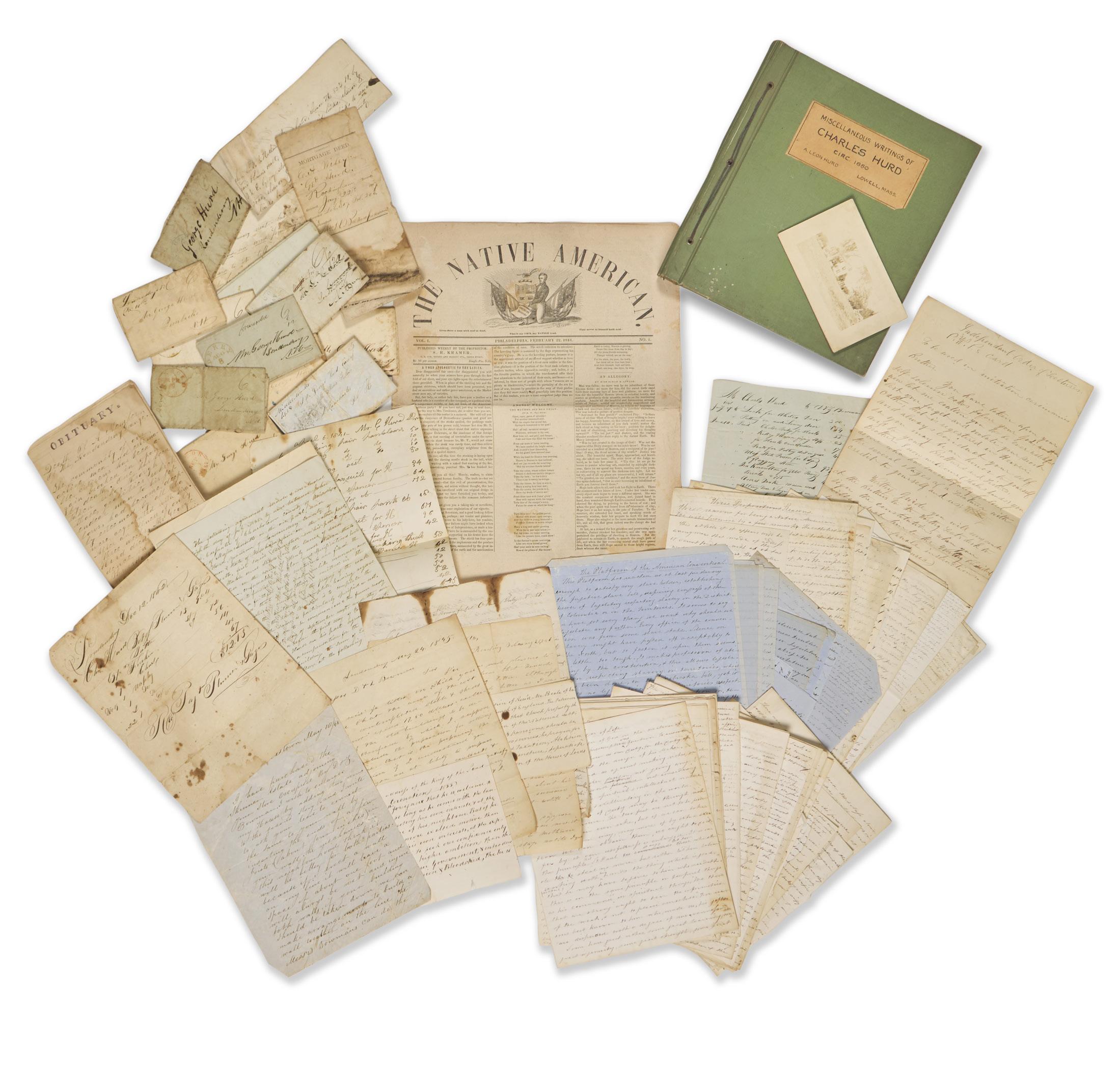
Locations vary, ca. 1830s-1930s. Archive of 218 documents related to Charles Hurd of Londonderry, New Hampshire, as well as his relatives or descendants. Including 165 manuscript pages of speeches and essays by Hurd; approximately 53 manuscript letters, bills, or receipts, by Hurd or his relatives; a small albumen postcard glossed “Hurd Family Farm”; a printed newspaper The Native American (Vol. I, No. I, February 22, 1844). Many documents housed in paper folders, and in green cloth binder titled, “Miscellaneous Writings of Charles Hurd Circ. 1850...” Size and condition varies; some documents heavily soiled.
An extensive archive of original manuscripts, essays, and speeches, by Charles Hurd (1791-1873), an active participant in the Native American political party (also known as The Know Nothings) in the 1840s-60s. His writings cover both his personal and party views on topics such as temperance, nativism, biblical truths or philosophies, anti-Catholic rhetoric, democracy, the Whig Party, tariffs, the Fillmore administration, and much more.
During the 1840s and 50s, as the Whig Party declined in political power, and the Republican Party was still in its beginning stages, the Native American Party or “Know Nothings” rose as an alternative faction to the Democrats. The Know Nothings preached a nativist stance against the growing trend of European immigration, specifically from Roman Catholic nations, while promoting traditional religious and political values, advocating temperance, and taking a neutral position on slavery. In 1856 the Know Nothings nominated former President Millard Fillmore to run on their ticket for the Presidency, but his loss that year to James Buchanan led to the party’s rapid decline and eventual disappearance during the American Civil War.
An extensive archive offering an in-depth look at the ideology of a 19th century American political party.
$3,000 - 5,000
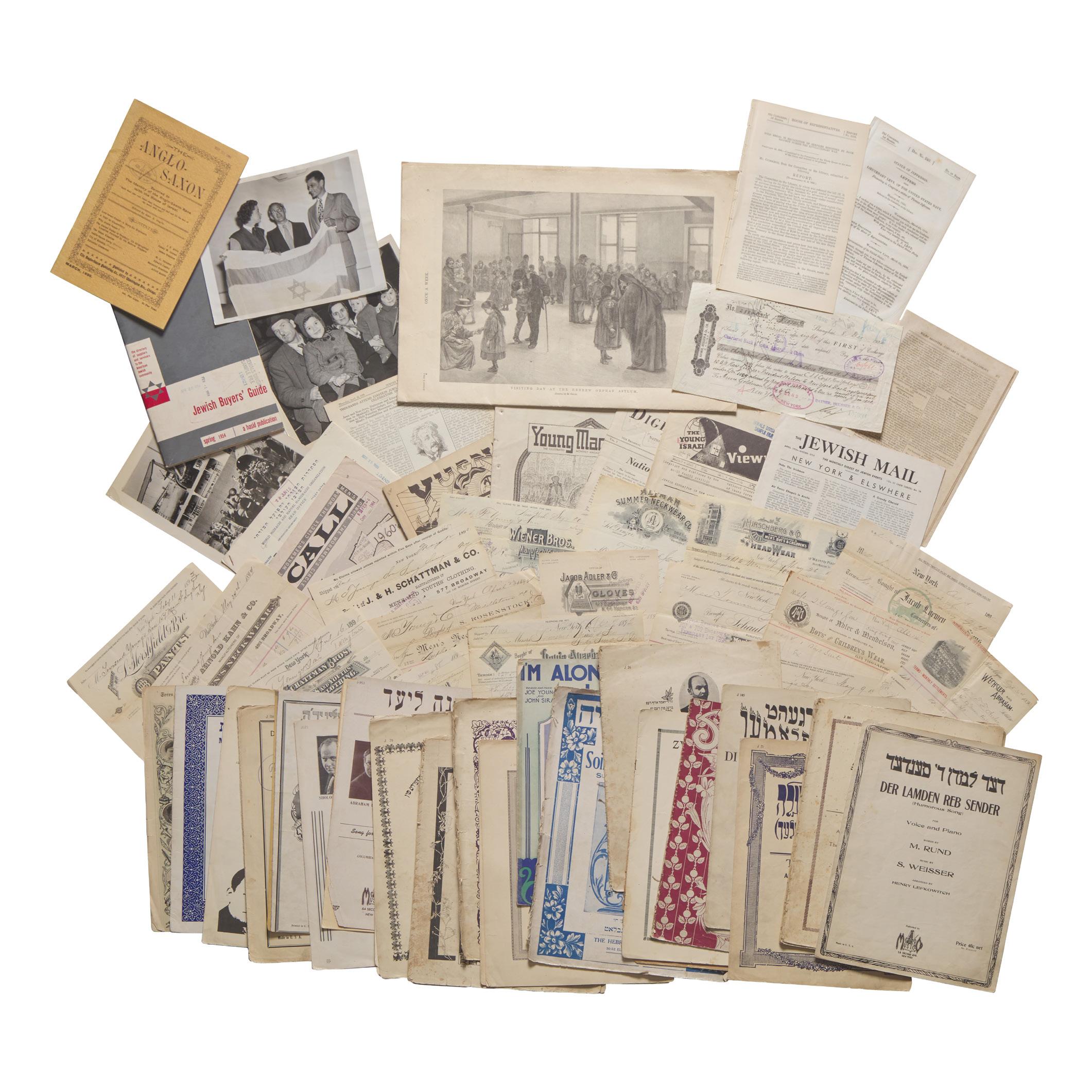
[Judaica] Large Archive of Items Related to Jewish Americans, etc., ca. 1820s-1960s
Locations vary, ca. 1820s-1960s. Comprising over 40 items, including books, pamphlets, newspapers, government reports, printed invoices, etc., as well as three press photos. Publications relate to Zionism or Jewish American immigrants, their businesses, celebrations, and more. Notable content includes: The Anglo-Saxon, March 1899, issue “Devoted to the Identity of the AngloSaxon Race with the House of Israel...”; The Jewish Daily Bulletin, April 18, 1929, featuring an article on Albert Einstein; various Jewish publications such as The Jewish Mail, Yugnt, The Workmen’s Circle, Young Maccabee, Digest and Review...of the American Jewish Congress, Zionist Organization of America, and others (1930s-50s); an 1893 Congressional Report recognizing the service of Haym Solomon during the American Revolution; Jewish Buyers’ Guide, Spring 1954, etc.; Size and condition vary, generally very good.
The first immigrant to the Americas of Jewish descent, Luis de Carabajal y Cueva, arrived at what is now Texas in 1570. During the lead-up to American independence around 2,000 Jews lived in the colonies, many of them supportive of the Patriotic cause. In a 1790 letter to a Jewish congregation, President George Washington wrote, “May the children of the stock of Abraham who dwell in the land continue to merit and enjoy the goodwill of the other inhabitants. While everyone shall sit safely under his own vine and fig-tree and there shall be none to make him afraid.” Jewish immigration increased during the late 19th and early 20th centuries, largely to escape European persecution, and following the Second World War many more European Jews emigrated to the United States.
$300 - 500
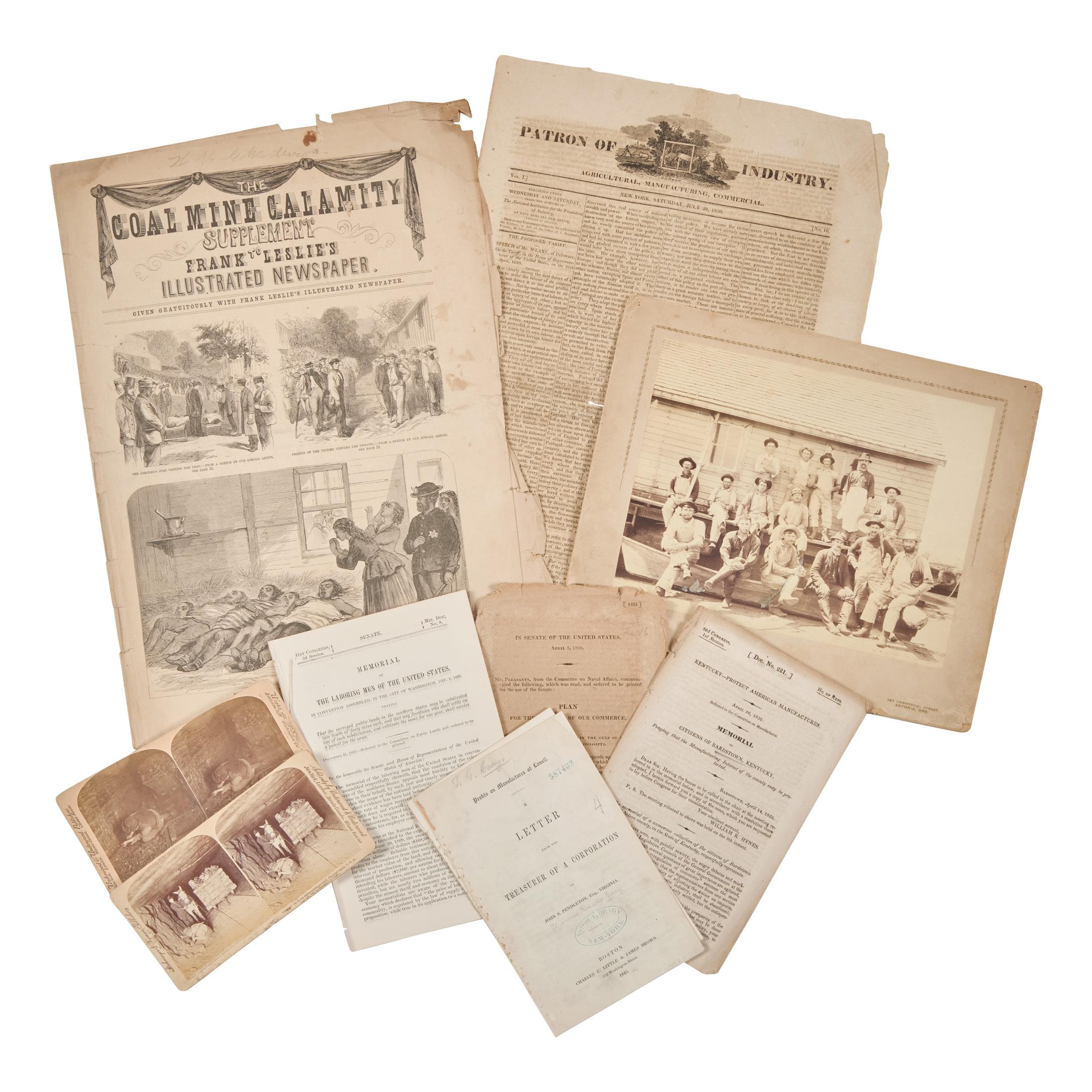
Locations vary, ca. 1820-1992. Comprising nine items, including, Printed Senate Report («Plan for the Defence of our Commerce»). Washington, D.C., April 3, 1820. 8vo.; Patron of Industry. New York, Saturday, July 29, 1820. Printed newspaper. Folio; Printed Congressional Report («Kentucky--Protect American Manufactures»). Washington, D.C., April 26, 1832. 8vo; Profits on Manufactures at Lowell. A Letter From the Treasurer of a Corporation to John S. Pendelton, Esq., Virginia. Boston: Little & Brown, 1845. 8vo; The Coal Calamity Supplement to Frank Leslie’s Illustrated Newspaper. September 25, 1869. Folio; Printed Senate Report («Memorial of the Laboring Men of the United States»). Washington, D.C., December 15, 1869. 8vo; Group of two stereoviews depicting Pennsylvania miners, ca. 1880s; Paxton, A.B. Cabinet card depicting Oregon laborers.
Condition varies, generally very good; documents all disbound; photographs worn.
The roots of the American labor movement stretch all the way back to 1619, when Polish craftsmen organized a strike to protest their being barred from voting in the first elections held in the Virginia colony. Subsequent strikes did little to achieve the goals of the strikers, largely due to a lack of organization and a lack of legal recourse. It was not until the Industrial Revolution came into full swing, as craftsmen found themselves losing their jobs to machines, that workers began to organize and demand protections for their livelihoods. The legality of labor unions was decided by the United States Supreme Court in the 1842 landmark case of Commonwealth v. Hunt
Over subsequent years the debate over worker rights has been played out again and again, often with bloody results, as in the case of the Haymarket Affair and the Pullman Strike. After a decline in union membership during the latter half of the twentieth century, the labor movement has seen a dramatic resurgence over the last two decades, largely in response to concerns over economic inequality and high costs of living.
$200 - 300
195
[Labor] Partially-Printed Indentured Servitude Agreement, Baltimore, 1790
Baltimore: Printed by John Hayes, November 3, 1790. Single sheet, 13 x 8 in. (330 x 203 mm). Partially-printed document, being an agreement of indentured servitude between John William Barkle, and James Dunwoody, the former agreeing to serve the latter for two and a half years; signed by both at conclusion (“Johan Willem Bartels” and “Jas. Dunwadey”), and witnessed by future Mayor of Baltimore James Calhoun. Autograph endorsement signed by Calhoun on verso. Wax seals present. Creasing from old folds, closed tears along same; scattered foxing and stains.
James Calhoun (1743-1816) served as Deputy Commissary General of Maryland during the American Revolution, and later served as the first Mayor of Baltimore from 1794-1804.
$400 - 600
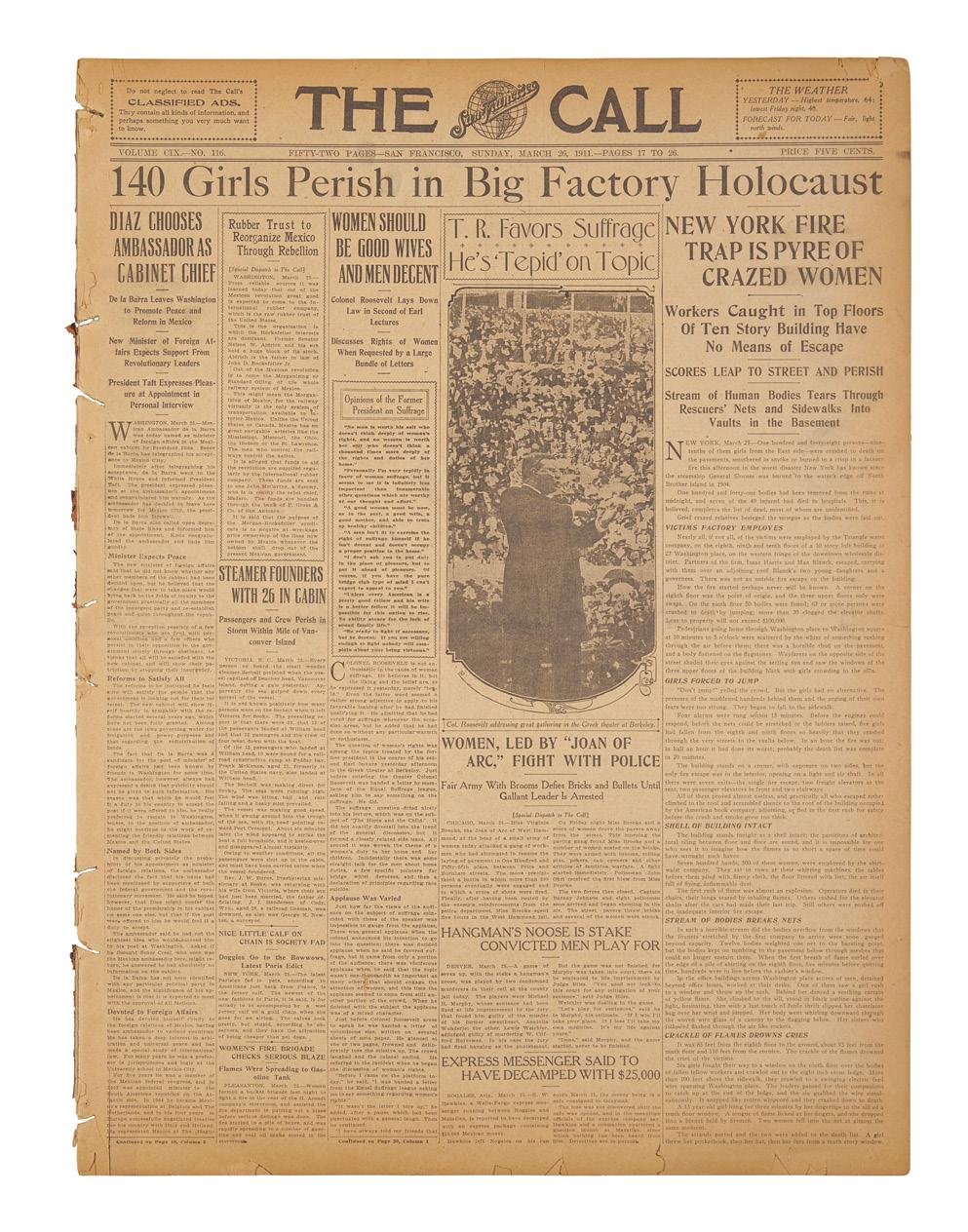
197
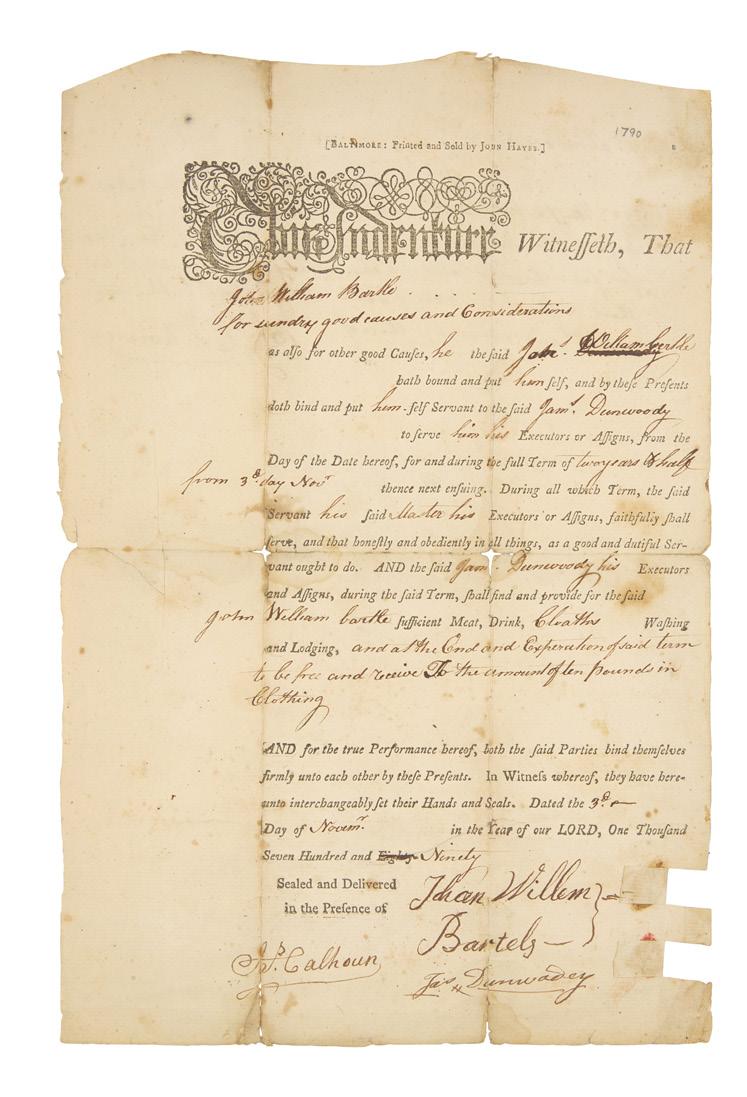
196
[Labor] Report of the Triangle Shirtwaist Factory Fire, the Deadliest Industrial Disaster in United States History: “140 Girls Perish in Big Factory Holocaust”
The Call San Francisco, March 26, 1911. Vol. CIX, No. 116. Folio. pp. 17-52. Printed newspaper. With a front-page report of the Triangle Shirtwaist Factory Fire. Disbound; leaves brittle; creasing from old folds; scattered loss to extremities; moderately toned.
The Triangle Shirtwaist Factory Fire occurred on March 25, 1911 in New York City, resulting in 146 deaths, the majority of which were Jewish and Italian girls.
The sweatshop occupied three floors of a building located in Greenwich Village, and was not outfitted with any sort of sprinkler system. Additionally, the doors to many stairwells had been locked by managers to prevent workers from stealing or taking breaks. The disaster led to a major push by reform groups, especially the International Ladies Garment Workers Union (ILGWU) advocating for improved safety protection and better working conditions for laborers across the country.
$200 - 300
[Lafayette, Marquis de] Sheet Music for The Boston Brigade March, as Performed by the Boston Brigade Band During the Marquis de Lafayette’s Visit During his Triumphal Return and Tour of America in 1824-25
The Boston Brigade March, as Performed by the Brigade Band at the Reception of Genl. Lafayette...
Boston and New York: Published by James L. Hewitt, (ca. 1824). Second state (of two). Printed sheet music. 4to. Two conjoined sheets. Disbound; ink stamp on first leaf (“Hewitt’s Store”); foxing along edges; dampstaining in top edge. Wagner, James Hewitt Selected Compositions, 22a; Wolfe 3684A
Sheet music for a performance by the Boston Brigade Band during the Marquis de Lafayette’s visit to Boston during his triumphal return and tour of America in 1824-25. Lafayette first visited Boston from August 25-September 2, 1824, where he was greeted by over 100,000 people. During his stay he visited Harvard University, the sites of the Battles of Bunker Hill, Lexington, and Concord, and met with former president John Quincy Adams in Quincy, Massachusetts. He returned nearly a year later, in June 1825, after touring the rest of the United States, and laid the cornerstone of the Bunker Hill Monument during the 50th anniversary of the battle, which was attended by 200,000 people.
$200 - 300
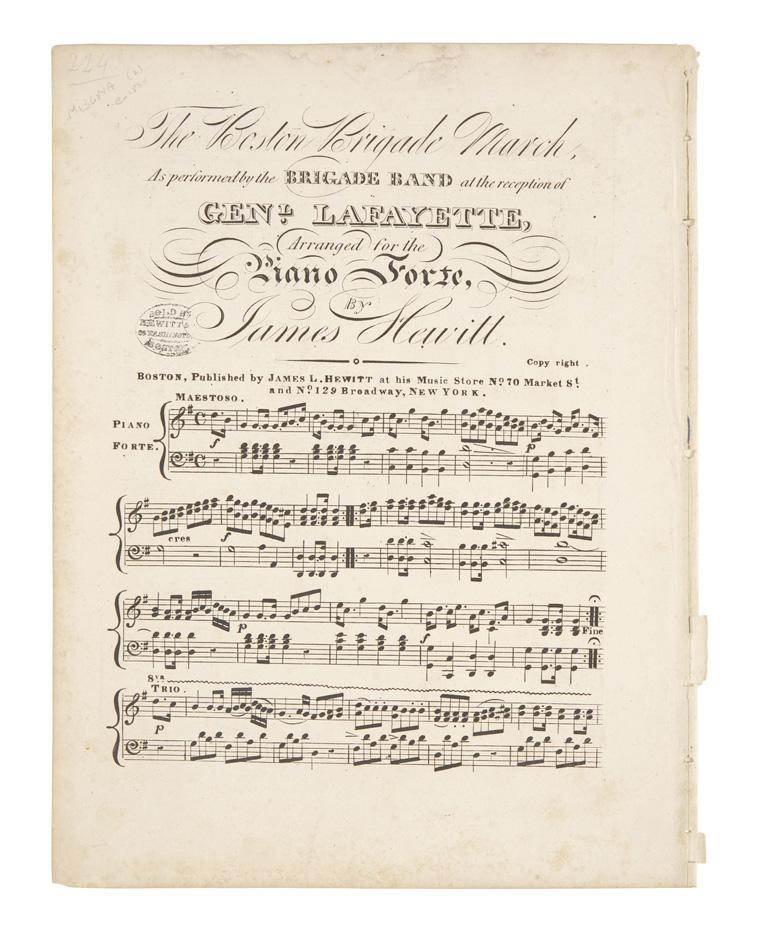
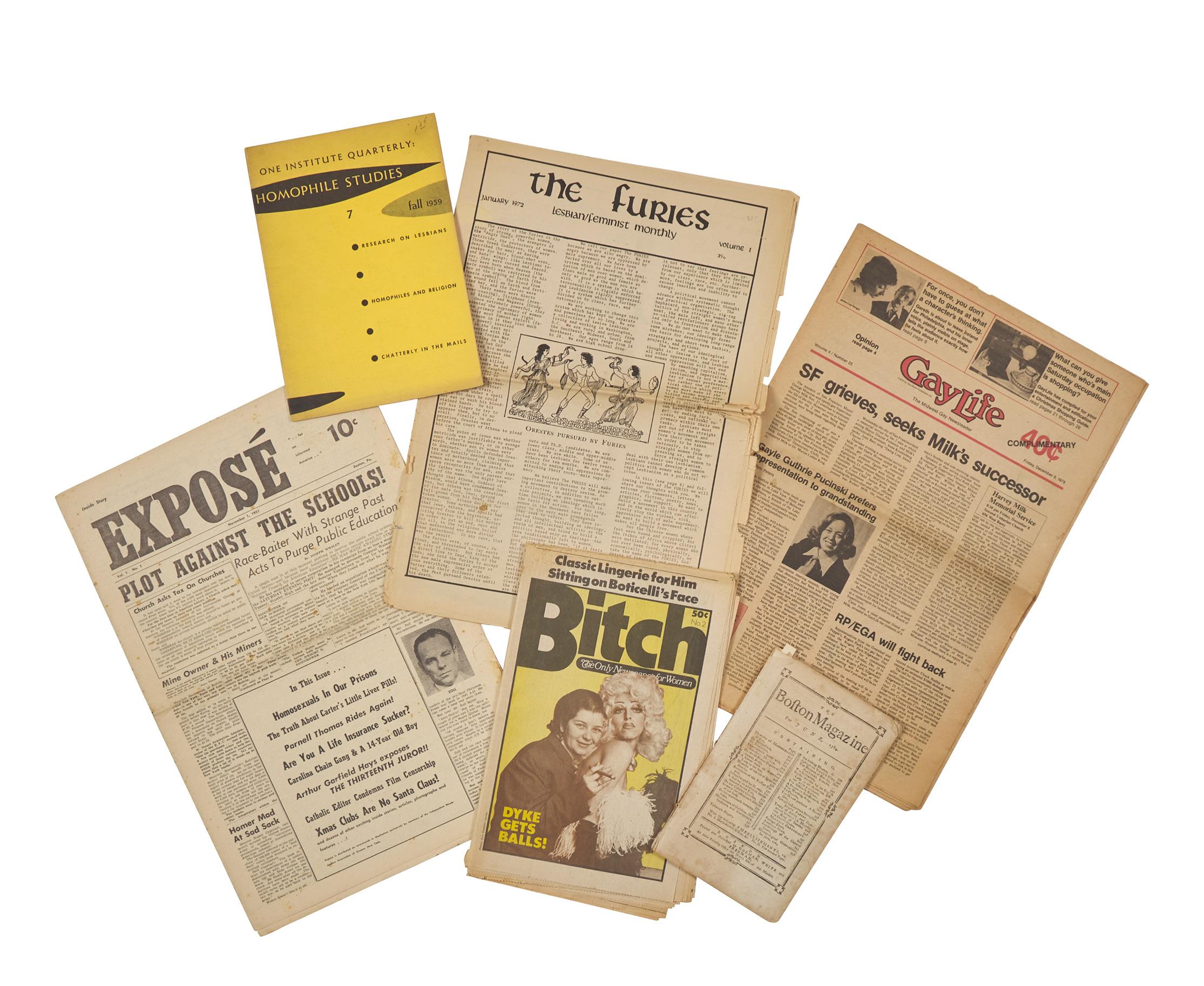
198 [LGBTQ+] Group of 6 LGBTQ+ Related Periodicals, 1784-1978
1. The Boston Magazine for June, 1784. Boston: Norman, White, and Freeman, 1784. 8vo. pp. 317-358, lacking pp. 313-316. Illustrated with two engraved plates, including a portrait of Chevalier D’Eon, a French soldier, spy, and diplomat, and “arguably the most famous male crossdresser in history...” (Bolich, Crossdressing in Context, p. 105). Disbound.
2. The Furies Lesbian/Feminist Monthly Washington, D.C., January 1972. Vol. I. Printed newspaper. Folio. 16 pp. Creased from when folded; wear along edges and at fold.
3. Bitch The Only Newspaper For Women New York: Milky Way Productions, March 1974. Vol. I, No. 2. Printed newspaper. Folio. 24 pp. Creased from when folded; lightly worn.
4. GayLife The Midwest Gay Newsletter (Chicago): YourStyle Publishers Inc., Friday, December 8, 1978. Volume 4, Number 25. Printed newspaper. Folio. 28 pp. Folded; toned.
With a front page report on the aftermath of the November 27 murder of San Francisco Supervisor Harvey Milk, the first openly gay man to be elected to public office in California, and notification of a memorial service for him in Chicago.
Lot includes an issue of Homophile Studies (Fall 1959), and Expose (November 1, 1951).
$300 - 500
199
[LIFE Magazine] Dummy of the First Issue of LIFE Magazine, 1936
New York: Time Inc., ca July 30, 1936. Light creasing to covers.
This first dummy issue was prepared for prospective advertisers and produced and distributed by Time Inc. four months prior to the November 23, 1936 publication of the magazine’s premiere issue.
One of the most important publications in the history of photojournalism, and arguably the most iconic American magazine of the twentieth century, LIFE was among the most widely read periodicals in the United States from its debut in 1936 through the 1960s. First issued as a weekly magazine on November 23, 1936, LIFE revolutionized modern journalism through its emphasis on large-format photographic essays, bringing world events, war, politics, celebrity, and everyday life into American homes with unprecedented immediacy. The magazine continued its weekly run until December 29, 1972, when it ceased regular publication and thereafter appeared only in occasional special editions.
$250 - 350
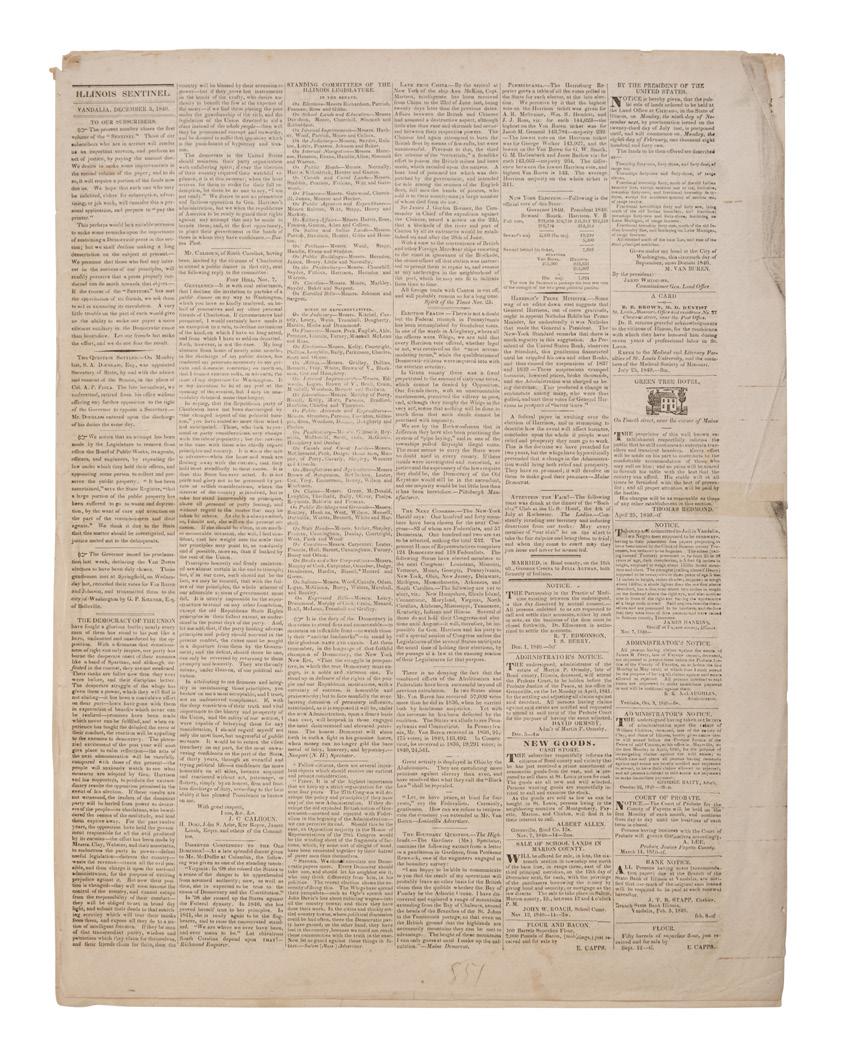
201
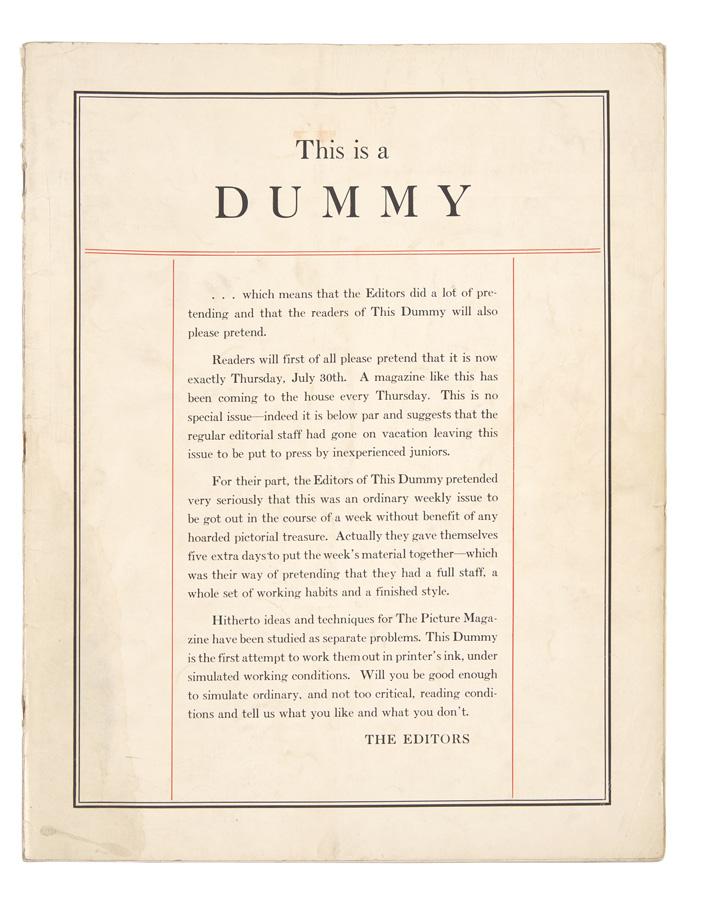
200
[Lincoln, Abraham] Early Mention of Abraham Lincoln as a State Legislator
Illinois Sentinel
Vandalia, Illinois, December 5, 1840. Vol. 1. No. 52. Bifolium sheet, 21 1/2 x 16 in. (546 x 406 mm). Printed newspaper, featuring an early mention of Abraham Lincoln when an Illinois State Congressman. Creasing from old folds, separated at vertical central fold; closed tears repaired with cello tape; small chips to extremities; scattered soiling; ownership signature at top right, “Dept. of State.”
A scarce issue of the Illinois Sentinel, listing the names of those appointed to standing committees within the state House of Representatives, among them a 31-year-old Abraham Lincoln.
Lincoln is listed as a member of the Committee on Canals and Canal lands. Later in his political career, he would have a long-standing commitment to what he called “internal improvements”, for infrastructure projects such as canals, railroads, and other pieces of infrastructure.
$500 - 800
[Lincoln, Abraham] Lincoln’s Famed “Spot Resolutions” in His Local Newspaper: Printing of a Rebuke to the First Major Speech Given by Him as an Illinois Congressman in the House of Representatives
Illinois State Register
Springfield, January 14, 1848. Bifolium, 26 x 19 in. (660 x 483 mm). Printed newspaper. Creasing from old folds, scattered wear to extremities, a few small closed tears; light dampstaining affecting half of text; contemporary inscription at top left of front page.
Printing a rebuke to the first major speech given by Abraham Lincoln as an Illinois Congressman in the House of Representatives. Delivered two days prior on January 12, Lincoln’s “Spot Resolutions” speech argued against the wantonness of the Polk administration whom he claimed incited an unnecessary war with Mexico.
The author of this article, charges “Thank Heaven, Illinois has eight representatives who will stand by the honor of the nation. Would that we could find Mr. Lincoln in their ranks doing battle on the side of his country as valiantly as did the Illinois volunteers upon the battle fields of Buena Vista and Cerro Gordo. He will have a fearful account to settle with them...”
$1,500 - 2,500
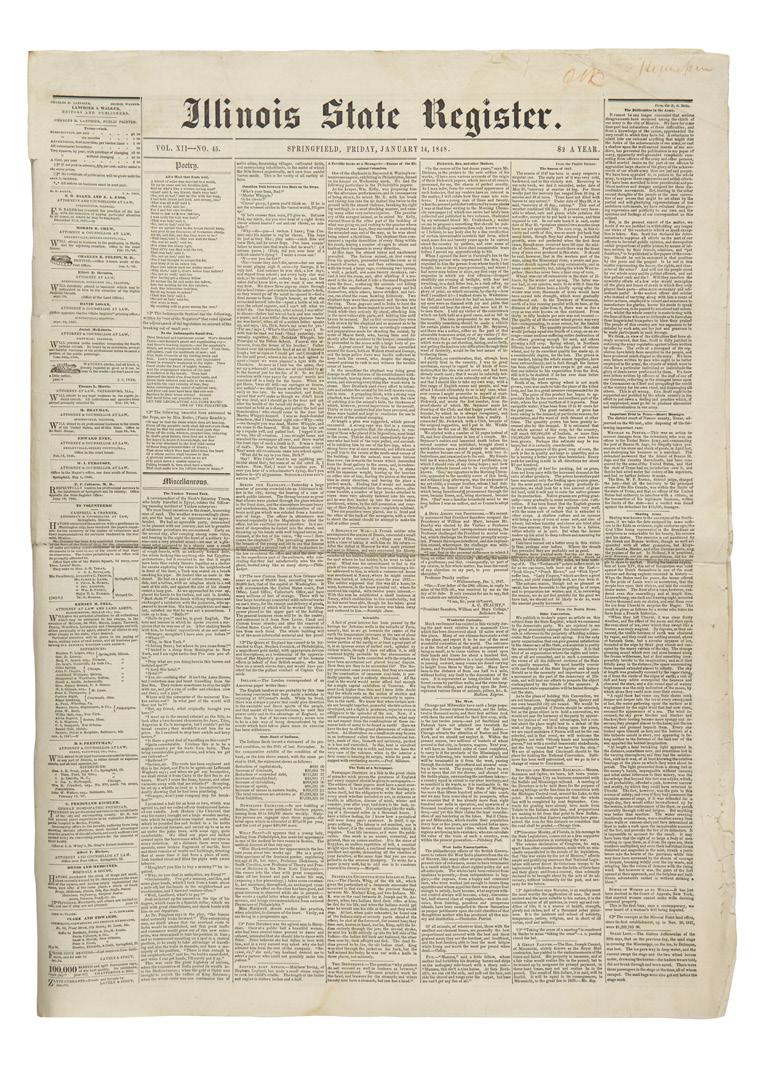
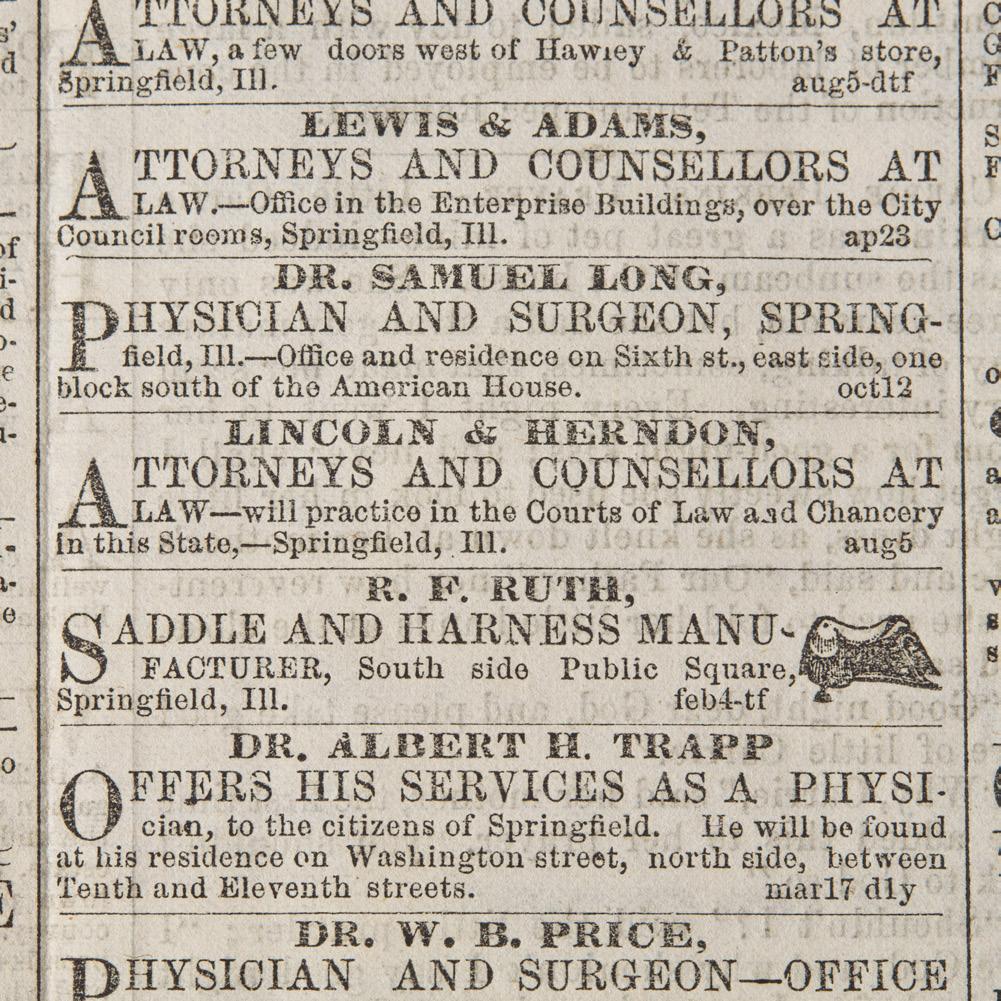
203
202
[Lincoln, Abraham] Front-Page Ad for Lincoln & Herndon’s Law Practice, July 14, 1858
Daily Illinois State Journal
Springfield, (Illinois): Bailhache & Baker, July 14, 1858. Volume XI, Number 26. Printed newspaper. Folio. (4) pp. Creasing from old folds; separated along central vertical fold; wear and creasing along edges.
Featuring an ad for Abraham Lincoln’s law practice on the front page: “Lincoln & Herndon Attorneys and Counsellors at Law...”
$200 - 300
[Lincoln, Abraham, and Stephen Douglas] Very Rare Pamphlet Containing the Text of the Last Debate Between Lincoln and Douglas, the Only Separate Printing of any of Their Historic Debates
Washington (D.C.): Lemuel Towers, 1858. First edition. 8vo. 32 pp. Printed from text in the Chicago Daily Times, October 17, 1858. Limp printed wrappers, foxed; edges unevenly trimmed, small closed tears to extremities; scattered manuscript numbering, foxing throughout. Monaghan 10
Very rare pamphlet containing the text of the final debate between Abraham Lincoln and Stephen Douglas, the only separate printing of any of their historic debates.
After winning the 1858 Republican nomination for the Senate from Illinois, Abraham Lincoln delivered his famous “House Divided” speech and prepared for a hard-fought campaign against Douglas, who continued to oppose any meddling whatsoever with the institution of slavery. Lincoln and his campaign team began following Douglas across the state, delivering campaign speeches immediately after him, until he finally agreed to a series of seven debates with Lincoln between August 21-October 15, 1858, and now remembered as the Lincoln-Douglas Debates.
The present example is only the fourth copy to appear in the available auction record in the last 50 years.
Lot also includes a small tintype portrait of Douglas, and an issue of the Campaign Plain Dealer and Popular Sovereignty Advocate (July 14, 1860);
$1,200 - 1,800
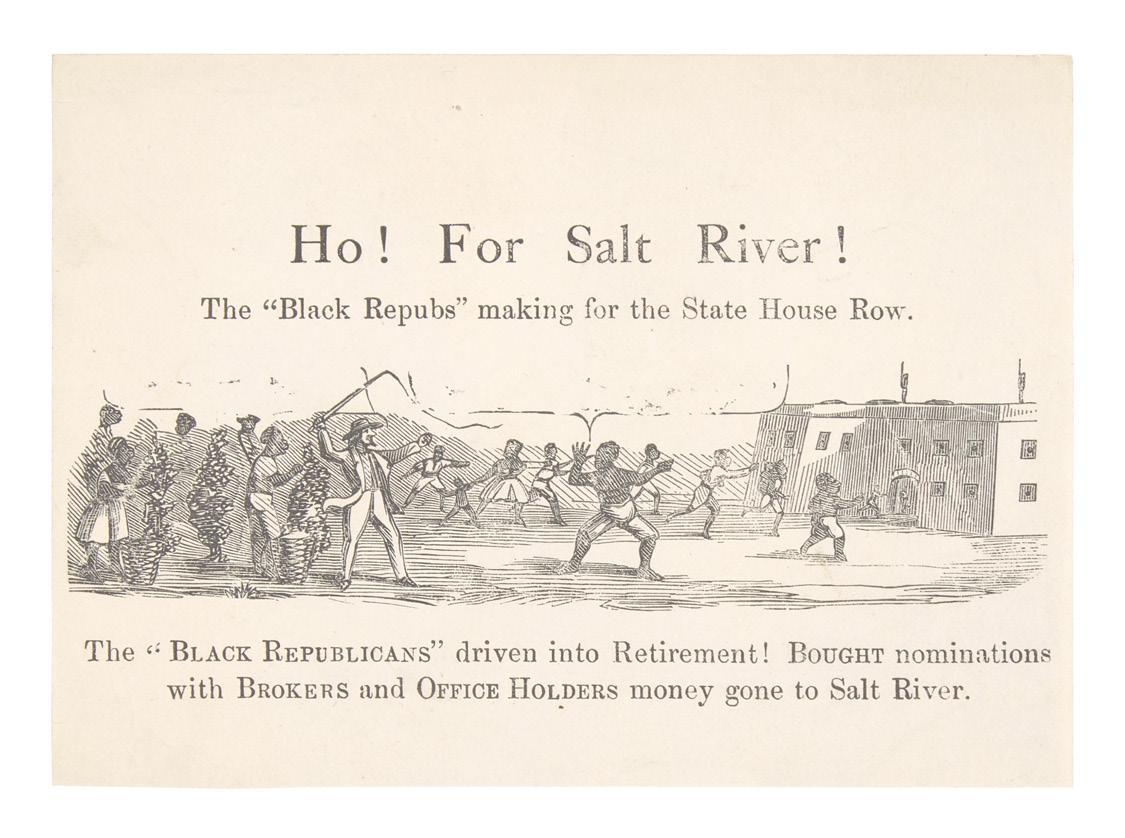
204
[Lincoln, Abraham] Unrecorded Anti-Lincoln Handbill: Ho! For Salt River! The “Black Repubs” Making for the State House Row
No place, no date (ca. 1860-64]. printed handbill. Wood-engraved vignette depicting enslaved men; 3 15/16 x 5 1/2 in. (100 x 140 mm).
“Ho! For Salt River! The “Black Repubs” Making for the State House Row. The ‘Black Republicans’ driven into Retirement! Bought nominations with Brokers and Office Holders money gone to Salt River.”
An apparently unrecorded anti-Lincoln handbill. “Black Republicans” was an epithet coined by pro-slavery Democrats and Southern critics to tar the party with the brush of racial radicalism, implying that Republicans sought not merely to contain slavery’s expansion but to overturn the entire racial order of American society. “Gone to Salt River,” meanwhile, was a well-worn idiom in antebellum political culture, invoking total electoral humiliation. To be sent up Salt River was to be finished, repudiated, swept from the field by the voters.
$400 - 600
205
[Lincoln, Abraham] Group of 4 Items
Related to President Abraham Lincoln, 1860-65
Locations vary, ca. 1860-65. Comprising four items, including, jugate letterhead of Lincoln and Hamlin, ca. 1860 (Milgram AL-107); Message of the President of the United States, July 17, 1862, announcing that Cornelius Vanderbilt has presented the ocean steamer Vanderbilt for service to the government (single sheet, disbound); The Presidential Election. Appeal of the National Union Committee to the People of the United States, September 9, 1864, urging the reelection of President Lincoln (single sheet, 11 1/4 x 8 1/8 in.); American Phrenological Journal and Life Illustrated, New York, May, 1865, Vol. 41, No. 5, Whole No. 317 (4to, original printed wrappers), with an article on the death of President Lincoln. Condition varies, generally good.
$500 - 800
206
[Lincoln, Abraham]. The First Conspiracy to Assassinate Abraham Lincoln, Breaking News in The New York Herald, 1861
The New York Herald New York, Sunday Morning, February 24, 1861. Whole No. 8934. Printed newspaper. Folio. 8 pp. Creasing from old folds; separations along center vertical fold, some repairs to same.
Breaking front-page news of a conspiracy to prevent President-elect Abraham Lincoln from assuming the presidency: “Startling Intelligence” of the “Alleged Plot to Assassinate Him” and his “Sudden Departure” for Washington, D.C.
A special dispatch from Harrisburg, dated the day prior, reports, “the city was startled just now by a rumor that Mr. Lincoln had left by a special train...Two hours before the Herald reporter obtained the facts, but was kept locked in a room, unable to use them, until half an hour before this despatch was written. The details of the whole affair were obtained by him...In brief, Mr. Lincoln, the President elect, left Harrisburg secretly at six o’clock last evening, took a special train over the Pennsylvania Central Railroad to Philadelphia, thence took a special train to Washington...The reason for this movement, so extraordinary and unprecedented, is that Mr. Lincoln’s friends believe, from information acquired--I am not permitted to tell how--that if he carried out his programme, and left by special train at nine this morning, the train would either be run off an embankment, blown up by grenades placed beneath the track, or some way destroyed... or that, this failing, Mr. Lincoln would be mobbed and assassinated in Baltimore...” Further dispatches report more detail on Lincoln’s hurried and secret journey from Harrisburg to Washington, D.C.: reporting his arrival in Baltimore on February 23 in disguise (“Mr. Lincoln arrived here at eight o’clock, incog., and went direct to Washington”), and then his arrival in Washington later that day, where he was received by President Buchanan and other delegations.
On page four is printed Lincoln’s February 22 speech in Philadelphia at Independence Hall, stating “that all the political sentiments I entertain have been drawn, so far as I have been able to draw them, from the sentiments which originated and were given to the world from this hall. I have never had a feeling politically that did not spring from the sentiments embodied in the Declaration of Independence...”
Detective Allan Pinkerton, operating undercover in Baltimore during the two weeks before Abraham Lincoln’s inauguration, uncovered a plot to assassinate the President-elect as he passed through the city en route to Washington, D.C. Pinkerton’s investigation began after Moses Felton, an executive of the Pennsylvania, Wilmington, and Baltimore Railroad, hired him to investigate rumors that secessionists planned to sabotage his rail lines. Disguised as a wealthy Southern stockbroker, Pinkerton infiltrated local business circles and discovered a secret secessionist group
led by Cypriano Ferrandini, a Corsican barber. On February 21, Pinkerton informed Lincoln of the threat. Lincoln initially hesitated, insisting first on a public stop in Harrisburg and then Philadelphia before altering his route. On the night of February 22, he agreed to a covert passage. Disguised in a shawl and accompanied by Pinkerton and others, Lincoln secretly traveled by an overnight train through Baltimore under the cover of darkness. To prevent news of his movement from spreading, the group cut telegraph lines along the route. They successfully arrived in Washington unscathed and unrecognized at dawn on February 23, prompting Lincoln to remark upon exiting the train, “Well, boys, thank God this prayer-meeting is over.”
$2,500 - 3,500
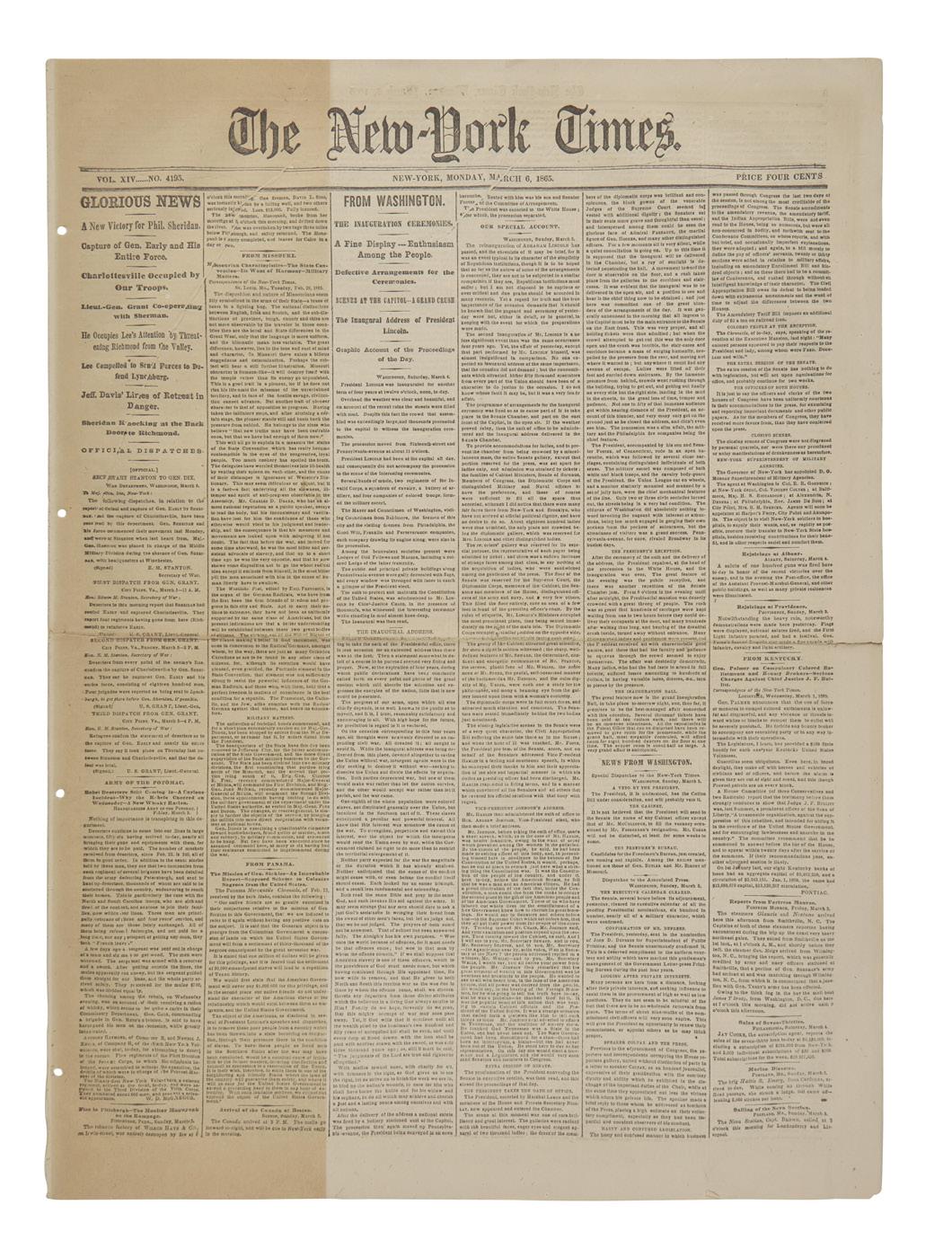
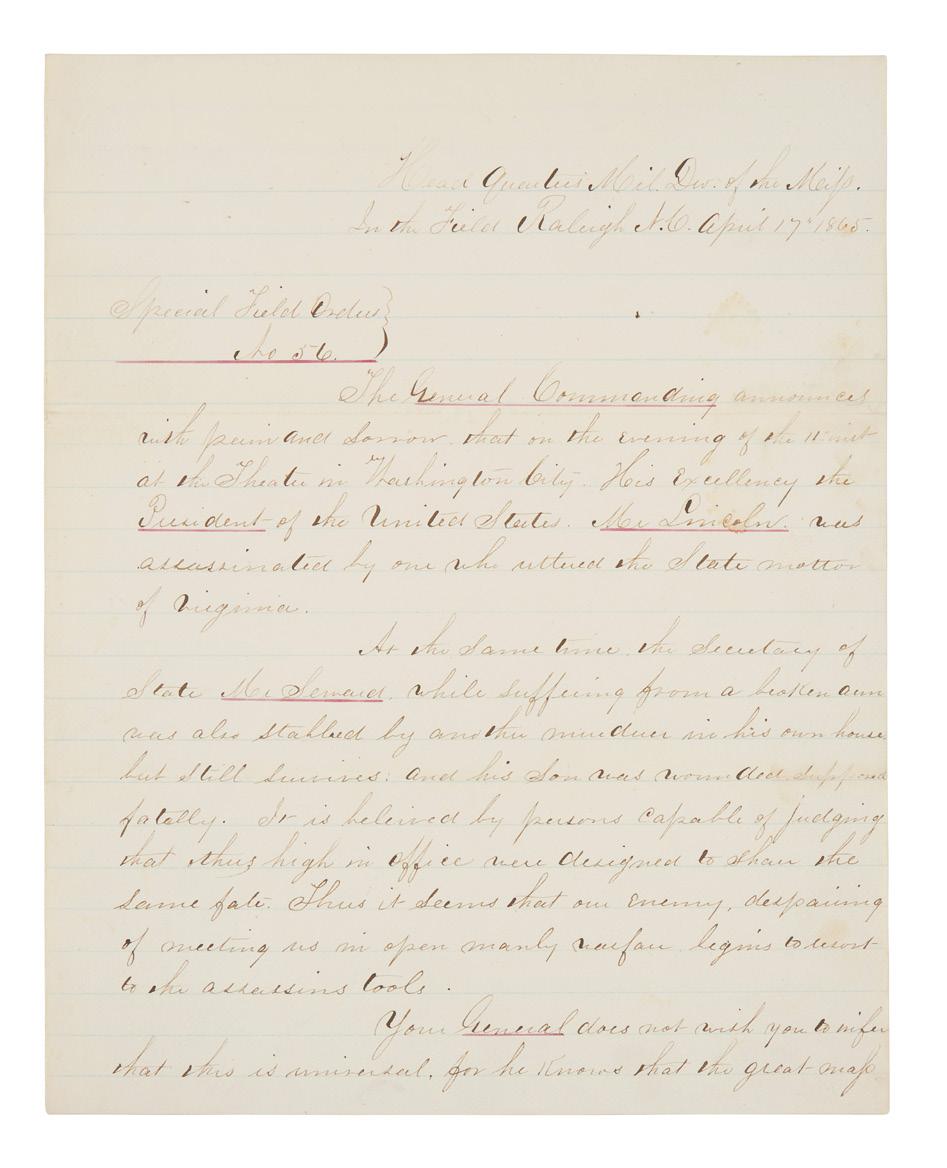
207
[Lincoln, Abraham] “With Malice Toward None, with Charity for All”: Lincoln’s Second Inaugural Address
The New-York Times
New-York, Monday, March 6, 1865. Vol. XIV, No. 4195. Printed newspaper on rag paper. Folio. 8 pp. Disbound; creasing from old folds, unevenly toned from same; short separation at fore-edge of central horizontal fold.
Printed in full on the front page is Lincoln’s second inaugural address, followed by reports on the inauguration ceremonies.
$300 - 500
208
[Lincoln, Abraham] Contemporary Manuscript Copy of Special Field Order No. 56, Announcing the Assassination of President Lincoln, April 17, 1865
“The General Commanding announces with pain and Sorrow that on the evening of the 11th inst. at the Theater in Washington City His Excellency the President of the United States Mr. Lincoln was assassinated by one who uttered the State motto of Virginia...”
Head Quarters Mil(itary). Div(ision). of the Miss(issippi). in the Field Raleigh, N(orth).C(arolina)., April 17, 1865. Lined bifolium, 9 3/4 x 7 3/4 in. (248 x 197 mm). Manuscript document, signed by Captain and Assistant Adjutant General Hubert S. Brown, of the Second Division of the Fifteenth Army Corps, being a contemporary copy of General William T. Sherman’s Special Field Order No. 56. , announcing to the Union Army the assassination of President Lincoln. Docketed on verso. Creasing from old folds, small separations along same; largely separated along central vertical fold; scattered light soiling.
On the morning of April 17, 1865, General William T. Sherman, commander of the Military Division of the Mississippi, was traveling from Raleigh, North Carolina to Durham to negotiate the surrender of Confederate General Joseph E. Johnston. When he was about to depart he received an urgent telegraph from Secretary of War Edwin Stanton: “The following order of the Secretary of War announces to the Armies of the United States the untimely and lamentable death of the illustrious Abraham Lincoln, late President of the United States...at 7.22 o’clock on the morning of Saturday, the 15th day of April, 1865, Abraham Lincoln...died of a mortal wound, inflicted upon him by an assassin. The Armies of the United States will share with their fellow-citizens the feelings of grief and horror inspired by this most atrocious murder...”
Following the meeting and his return to Raleigh, Sherman showed the message to his staff, and cautioned them to keep close observance of the soldiers when the news was broke, as they might retaliate against the civilian population of the city in a fit of emotion. As a precaution, he strengthened the garrison and guard at the roads leading into the various camps, ordered all soldiers on leave to immediately return to their commands, and placed the city on lockdown. Following these preparations, Sherman released his Special Order that evening. “The startling proclamation that Lincoln was dead brought varied reactions from the Federal troops. Fortunately, accompanying Special Field Order No. 56 was the announcement of the first day’s truce talk between Sherman and Johnston. This helped turn the thoughts of soldiers from vengeance to peace.” (Barrett, p. 236)
$1,500 - 2,500
209
[Lincoln, Abraham] Abraham Lincoln Funeral Program with Order of Procession for Washington, D.C., April 17, 1865
Washington, D.C.: War Department, Adjutant General’s Office, April 17, 1865. 12mo. (1), 2-3 pp. Printed mourning border, with diagram of hearse and pallbearers. Signed in type by Assistant Adjutant General W.A. Nichols. Disbound; remnants of original thread.
A scarce and fine example of the official arrangements for Abraham Lincoln’s Washington, D.C. funeral procession. The program lists in detail the several military units, civic and religious figures, family and relatives, as well as cultural and institutional officers that took part in the solemnities, with a printed diagram showing the hearse and pallbearers. It is followed by a description of the procession’s movements, which was to begin at precisely 2 o’clock P.M. on Wednesday, April 19th, following the conclusion of the religious services at the Executive Mansion. The start of the procession was met with the firing of several guns from St. John’s Church, City Hall, and the Capitol, and the ringing of church bells throughout Washington, Georgetown, and Alexandria.
$1,000 - 1,500
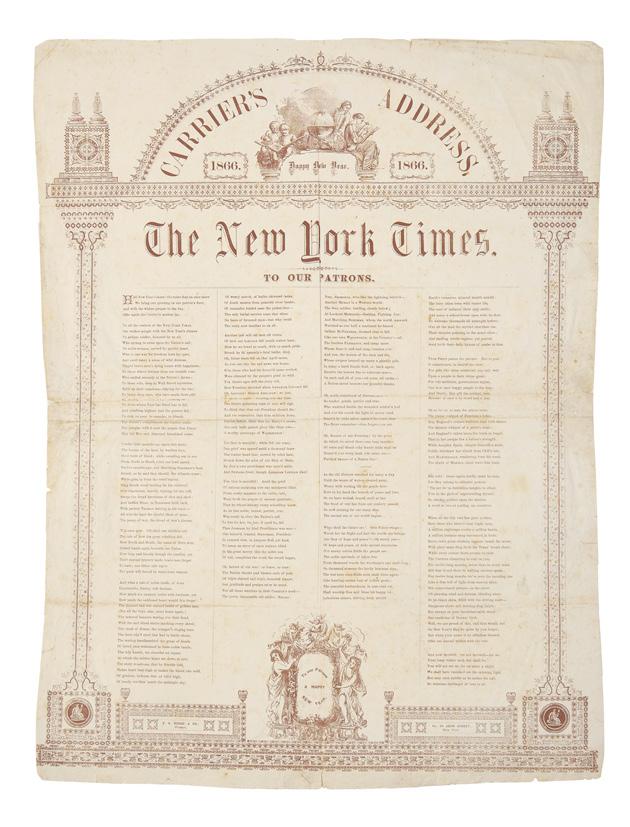
211
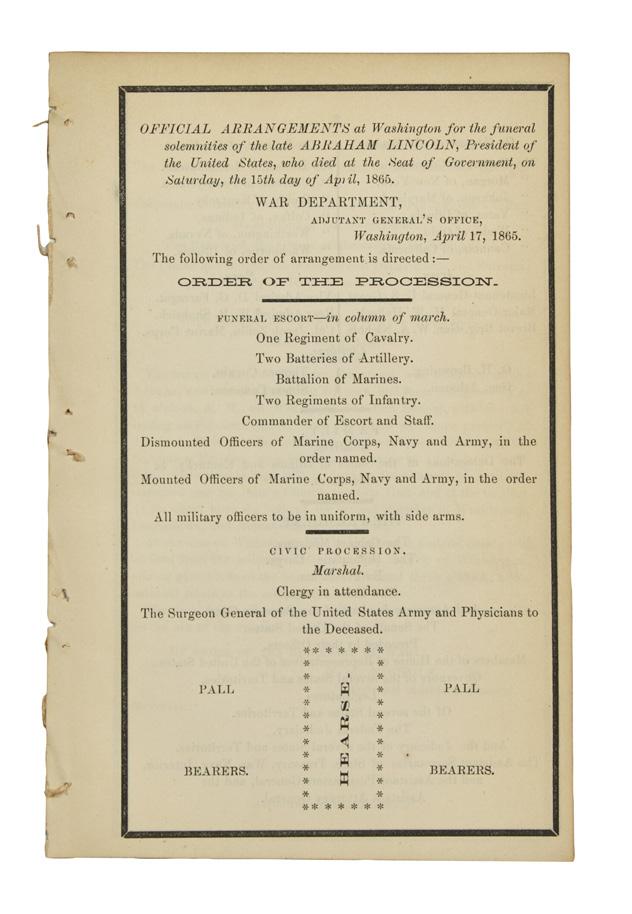
210
[Lincoln, Abraham] Rare New York Times New Year’s Broadside Commemorating the end of the Civil War and the Assassination of President Lincoln
Carrier’s Address. 1866. Happy New Year. The New York Times. To our Patrons
New York: Printed by E.S. Dodge & Co., 1866. Printed broadside, 23 x 16 3/4 in. (584 x 425 mm). Printed in brown ink; text in four columns; printed decorative border; vignette at top and bottom. Creasing from old folds; scattered light spotting; repairs on verso edges; scattered edge-wear.
A rare New Year’s carrier’s address broadside printed for the patrons of The New York Times, commemorating in verse the end of the Civil War and the assassination of President Lincoln: “Another tale will old men oft relate, / Of how our Lincoln fell ‘neath traitor hate; / How he we loved so much, with so much pride, / Struck by th’ assassin’s fatal bullet, died.”
Rare. OCLC records only two other copies, at the New York Historical Society (imperfect), and at the New Jersey Historical Society. According to RBH, no other copy of this broadside has sold at auction.
$300 - 500
[Louisiana Purchase] President Thomas Jefferson Announces the Louisiana Purchase
Connecticut Herald
New-Haven: Printed and Published by J. Woodward and M. Potter, November 1, 1803. Vol. I, No. I. Printed newspaper. (4) pp. Creasing from old folds, small holes along central horizontal fold of each sheet; creasing and wear along edges; scattered soiling and minor dampstaining.
One of the most significant and far-reaching Presidential addresses to Congress, Jefferson’s October 17, 1803 message announcing the Louisiana Purchase: “The enlightened government of France saw, with just discernment, the importance to both nations of such liberal arrangements as might best and permanently promote the peace, friendship and interests of both; and the property and sovereignty of all Louisiana, which had been restored to them, has on certain conditions, been transferred to the United States by instruments bearing date the 30th of April last.” He goes on to stress, “With the wisdom of Congress it will rest to take those ulterior measures which may be necessary for the immediate occupation and temporary government of the country; for its incorporation into our union; for rendering the change of government a blessing to our newly adopted brethren; for securing to them the rights of conscience and of property; for confirming to the Indian inhabitants their occupancy and self-government, establishing friendly and commercial relations with them, and for ascertaining the geography of the country acquired.” The latter a reference to the Lewis and Clark expedition that was then ongoing, tracing the source of the Missouri River.
Other news reported is the passage of the 12th Amendment, to be sent to the individual states for ratification, and which altered the procedure for electing the president and vice president (that led to the contentious election of Jefferson as vice-president during John Adams’ term).
$1,500 - 2,500
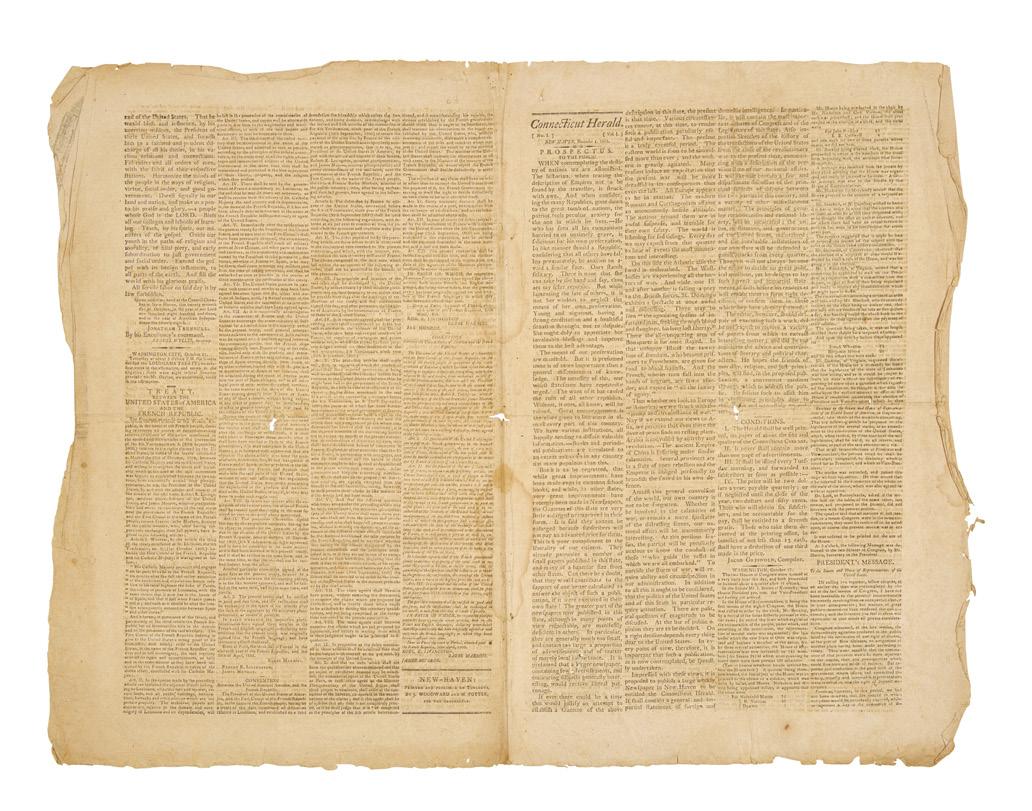
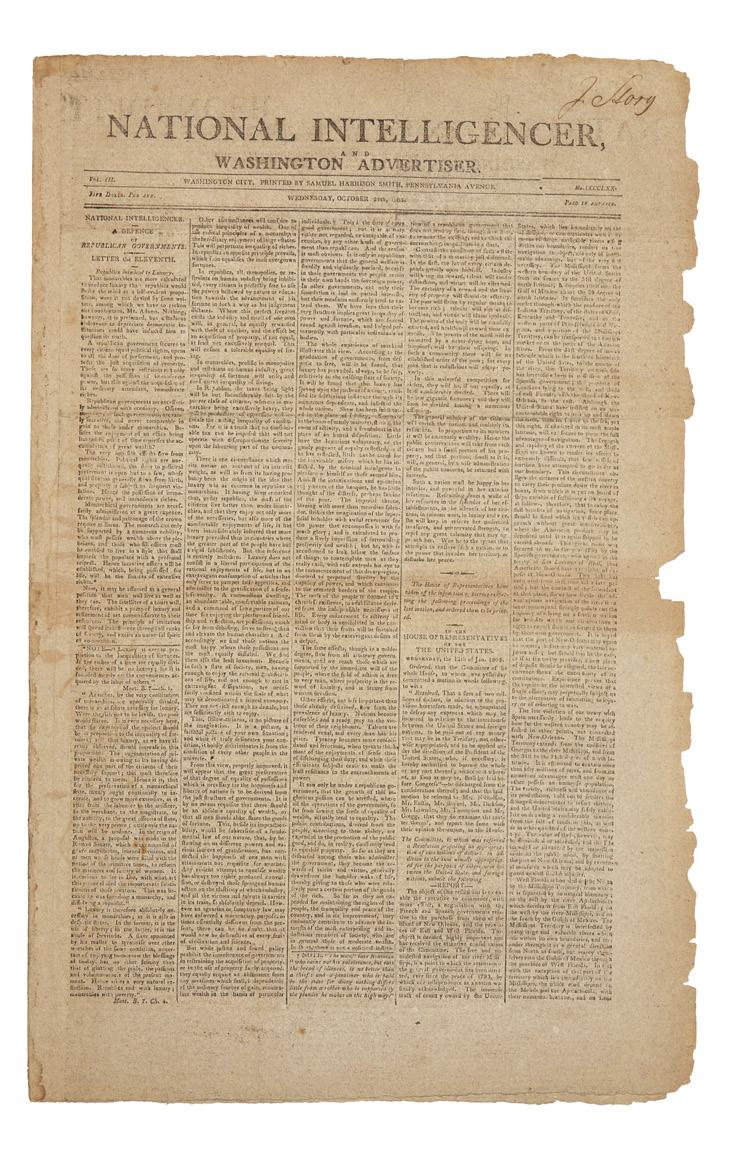
213
[Louisiana Purchase] The Return of Lewis and Clark
The Connecticut Courant
212
[Louisiana Purchase] Report Regarding the Louisiana Purchase in the National Intelligencer, and Washington Advertiser
Washington City: Printed by Samuel Harrison Smith, Wednesday, October 26th, 1803. Vol. III, No. CCCCLXX. Printed newspaper. Folio. (4) pp. Old ownership signature at top of front page. Disbound, old stub along spine; creasing from old folds, separations along same; chipping and wear along fore-edge.
On the front-page is a report regarding the Louisiana Purchase, prefaced with, “The House of Representatives have taken off the injunction of secrecy respecting the following proceedings of the last session, and ordered them to be printed.” Following is a resolution passed by Congress on January 12, 1803, appropriating $2 million for the purchase of New Orleans and East and West Florida from the Spanish and French. On the fourth page is a report from Congress requesting the President provide a copy of the Spanish and French treaty, ceding Louisiana Territory to France. Congress ratified the Louisiana Purchase a week prior to this newspaper, on October 20.
A lengthy article on the second and third pages prints the debates around the passage and ratification of the 12th Amendment to the Constitution.
$400 - 600
Hartford: Printed by Hudson & Goodwin, Wednesday, November 5, 1806. Vol. XLII, Numb. 2180. Printed newspaper. Folio. (4) pp. Old ownership signature at top of front-page. Creasing from old folds.
Printed at the top of the second-page is an October 27 report from Washington, D.C., announcing the return of Meriwether Lewis and William Clark following their over two-year-long expedition into the Louisiana Territory. The article recounts the final leg of their journey, over the Rocky Mountains and along the Columbia River to the Pacific Ocean, and Lewis’s expected journey to Washington, D.C. to be received by President Thomas Jefferson.
$250 - 350

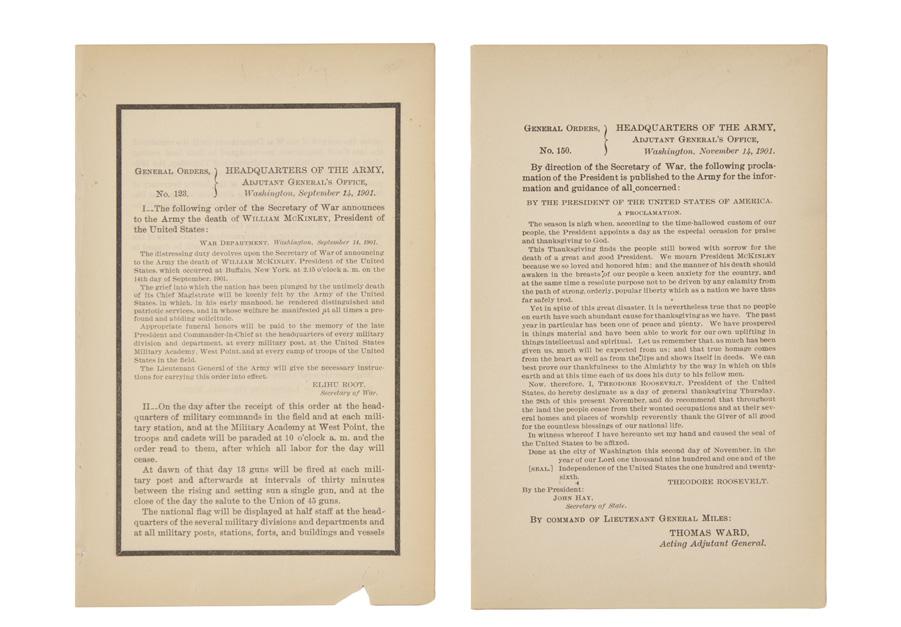
214
[McKinley, William] Pair of General Orders on the Death of President William McKinley
Washington, D.C., September 14-November 14, 1901. Group of two printed documents, each 7 7/16 x 4 7/16 in. (189 x 113 mm). One printed with mourning border. Chip in bottom edge of September document.
The first document (General Orders #123) was issued by Secretary of War Elihu Root on September 14, 1901, announcing to the United States Army, the death of President McKinley.
The second (General Orders #150) was issued by Theodore Roosevelt two months later, on November 14, 1901. “This Thanksgiving finds the people still bowed with sorrow for the death of a great and good President. We mourn President McKinley because we so loved and honored him; and the manner of his death should awaken in the breasts of our people a keen anxiety for the country, and at the same time a resolute purpose not to be driven by any calamity from the path of strong, orderly, popular liberty which as a nation we have thus far safely trod...”
William McKinley was assassinated in Buffalo, New York on September 6, 1901, while attending the Pan-American Exposition. He was shot twice at close range by anarchist Leon Czolgosz, while inside the Temple of Music building during a public receiving line where the President was greeting visitors. McKinley died eight days later on September 14. Following his death, Vice President Theodore Roosevelt assumed the office.
$200 - 300
215
[Monroe, Marilyn] Group of 5 Documents Relating to the Divorce of Marilyn Monroe and Joe DiMaggio
Locations vary, ca. 1955. A small group of papers related to Monroe’s divorce from Joe DiMaggio, comprising two telegrams from Monroe’s attorney Jerry Giesler to attorney Frank Delaney (including one with receipt), a carbon of one typed letter (from Delaney to Monroe, dated February 3, 1955, transmitting a copy of her divorce judgement, the latter not present), and one typed memo, presumably from Delaney, being a list of the locations of her divorce judgement. Lot also includes a press photograph of Monroe and DiMaggio, ca. January 16, 1954. Condition varies, generally fine.
The marriage between film star Marilyn Monroe and baseball legend Joe DiMaggio lasted only 274 days, with the filming of Monroe’s infamous subway grate scene from The Seven Year Itch widely believed to have been the main cause for the couple›s separation; in the divorce proceedings Monroe was represented by Jerry Giesler, who worked closely with Monroe’s legal counsel Frank Delaney to finalize the settlement. Delaney would later prove crucial in establishing Monroe’s independent production company in 1955.
$400 - 600
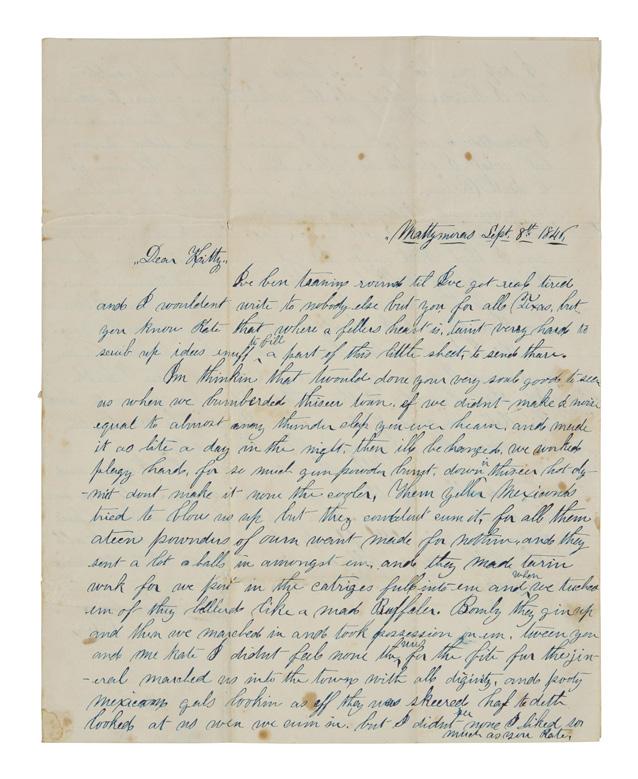
216
[Mexican-American War] A U.S. Soldier Writes to His Love Interest Following the March on Matamoros
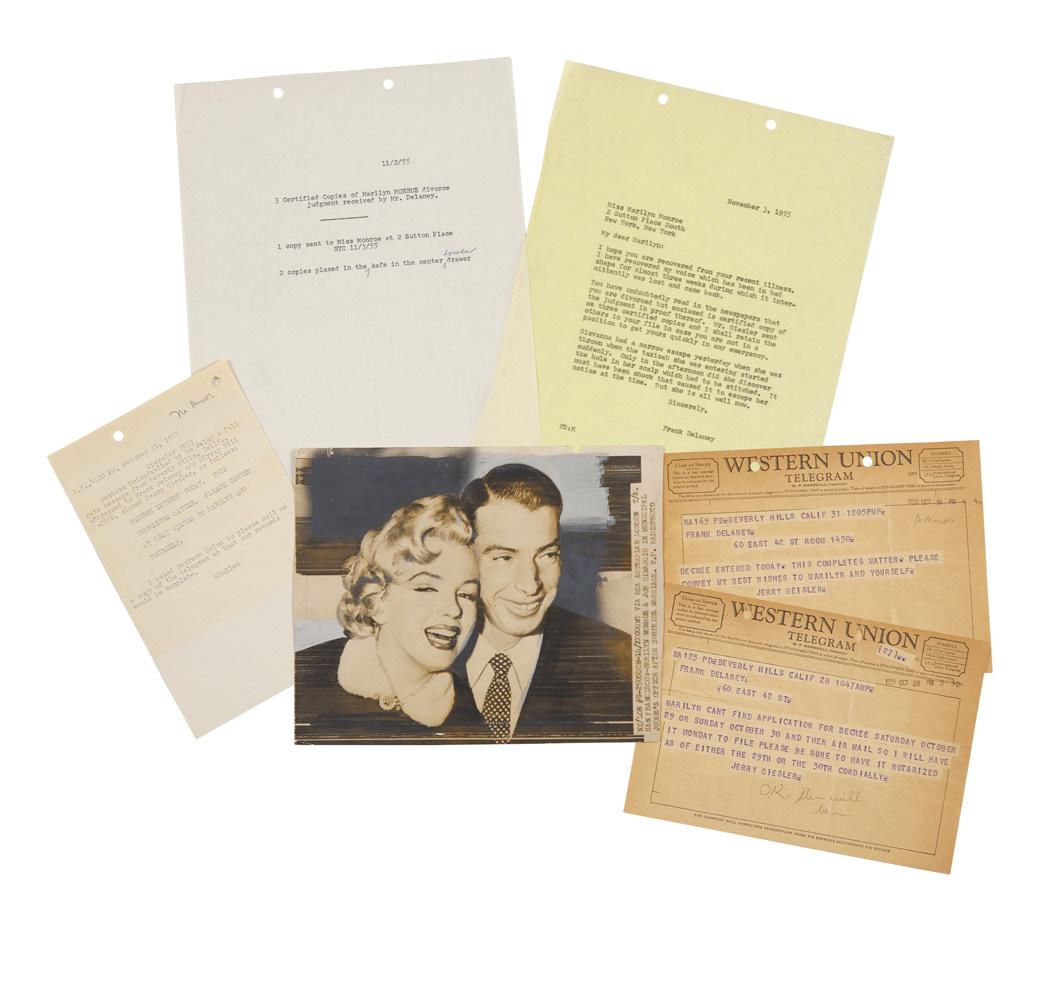
Matamoros, Mexico, September 8, 1846. Bifolium. Two-page autograph love letter in blue ink, signed by a United States Army soldier to his love interest, recounting his unit’s march on Matamoros. Addressed on integral leaf, with additional manuscript in another hand, “Miss Eliza Whiting Eagleville”. Creasing from old folds; scattered soiling.
Early in the Mexican-American War, a United States Army soldier, stationed in Matamoros, Mexico, writes to his love interest, recounting his march on the city: “I’m thinkin that would done your very soul good to see us when we lumbered thiseer town. If we didn’t make a noise equal to almost any thunder clap you ever hearn, and made it as lite a day in the night, then i’ll be hanged. We worked plenty hard, for so much gunpowder burnt down in thiseer hot-clymit don’t make it none the cooler, When yeller Mexicans tried to blow us up but they couldn’t cum it, for all them ateen pownders of ours went made for nothin, and they sent a lot of balls in amongst em and they made turin work for we put in the catriges full into em and when we tuched em of they bellerd like a made Ruffler. B____ they giv up and then we marched in and took possession on em. Tween you and me Kate I didn’t feel none the wurs for the fite fur Jineral marched us into the town with all dignity, and sooty Mexican gals lookin as iff they was skeered haf to deth looked at us wen we cum in but I didn’t see none I liked so much as you Kate. I kep my head up and looked as smart as I could...”
General Zachary Taylor marched on Matamoros, Mexico in mid May 1846, following his victories at Palo Alto and Resaca de la Palma that ended the Mexican Army’s siege of Fort Texas on the Rio Grande River. The city would remain occupied by U.S. forces for the remainder of the war, and serve as a critical staging ground and supply depot for Taylor’s troops as they advanced into the interior of Mexico.
$300 - 500
217
[Mexican-American War] Contemporary Manuscript Naval Document of Instructions for the First Large-Scale Amphibious Invasion in American Military History
No place, (presumably off Lobos Island, Gulf of Mexico), no date (presumed ca. February 1847). Bifolium, 12 1/2 x 8 in. (317 x 203 mm). Three-page manuscript document, being a contemporary copy of General Orders No. 28, detailing naval directions and signals “prescribed by the Genl. in Chief [Winfield Scott]...strictly observed on board of all vessels belonging to his expedition...” Docketed on verso, with further manuscript below, “A copy of G.O. No 28 & sailing directions to be furnished to each master of a vessel--New vols. are already furnished”; creasing from old folds; small stain in lower central fold.
A fascinating contemporary copy of General Orders No. 28, issued by Major General Winfield Scott in preparation for the siege of Veracruz, Mexico during the Mexican-American War--the largest amphibious invasion in American history before the D-Day landings during World War II.
Issued from Army Headquarters aboard the USS Massachusetts, an auxiliary steam-powered packet ship, the present Order details numerous flag signals and directions for vessels to use during the invasion. Aided by Commodore David E. Conner’s Home Squadron, Scott’s 15,000-strong force prepared for their operation off the Island of Lobos in early March 1847. The operation took place on March 9, and in less than 24 hours, facing little resistance, Scott landed 12,000 soldiers onto Mexican shores.
Veracruz, the largest port in Mexico, served as a critical and strategic gateway to the capital of Mexico City, whose capture Scott hoped would force Mexico’s surrender. Protected by the San Juan de Ulúa fortress, Scott chose to surround Veracruz for bombardment instead of the potential risk of taking the fort outright. Bombardment began on March 22, and by the 29th Mexican forces surrendered. The invasion opened the interior of Mexico, and began Scott’s successful campaign toward Mexico City, arriving on the outskirts by August.
$800 - 1,200
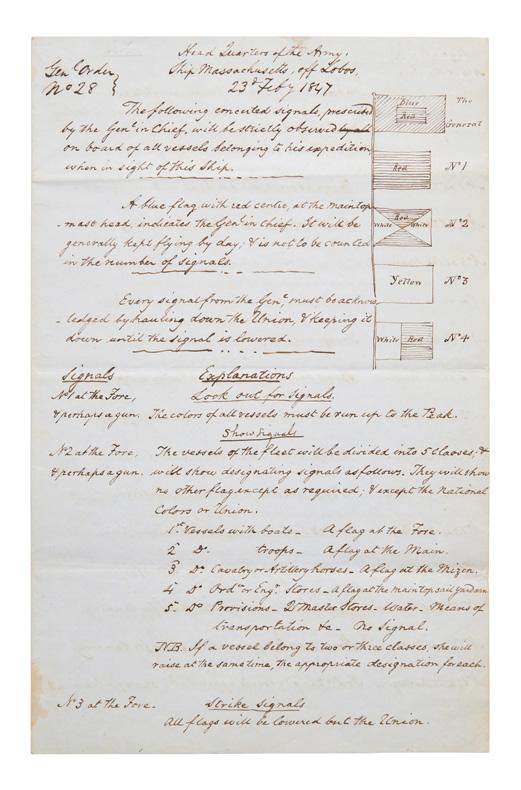
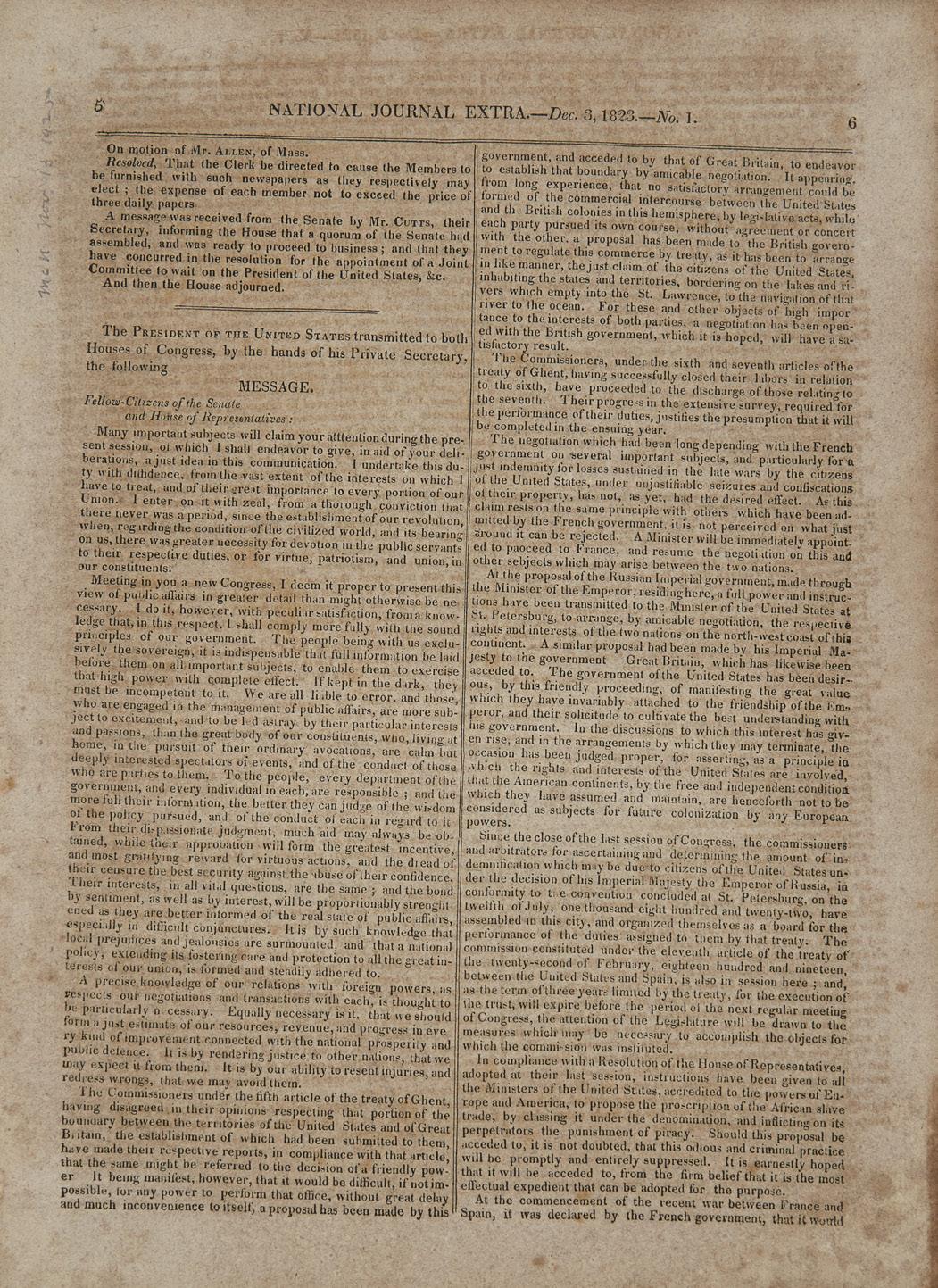
218
[Monroe Doctrine]
One of The Earliest Printings of the Monroe Doctrine
“The American continents, by the free and independent condition they have assumed and maintained, are henceforth not to be considered as subjects for future colonization by any European powers”
National Journal [Extra]
Washington, D.C.: Published by Peter Force, December 3, 1823. Vol. I, No. I. 4to; 12 5/8 x 9 3/8 in. (321 x 238 mm). Six leaves, printed in two columns. Disbound from the National Government Journal, and Register of Official Papers...From December, 1823, to December, 1824; leaves separated; toned; wear and chipping along edges. Library of Congress ink stamp on recto and verso of first leaf (“Surplus Duplicate”). Sabin 25057
A very rare printing of President Monroe’s December 2, 1823 message to Congress, now known as the Monroe Doctrine, one of the most important American state papers and the guiding foreign policy for America’s relations in the Western Hemisphere. Printed in Peter Force’s National Government Journal, and Register of Official Papers, an early predecessor of the Congressional Record. Force produced this special “Extra” edition of his daily newspaper (National Journal, 1823-30) to chronicle the sessions of the federal Congress. It contains the debates in the House and Senate, bills introduced, discussions and votes, and other government business. Although Force’s venture failed after one year (only December 1823-December 1824 was printed), it was the first major separate publication dedicated solely to the printing of Congressional activity, and preceded by a year Joseph Gales, Jr. and William W. Seaton’s Register of Debates (1824), printers of Force’s rival newspaper, the National Intelligencer. The National Intelligencer, and Force’s National Journal, were the de facto and semi-official newspapers of the federal government.
This printing is preceded only by the very rare broadside newspaper “extra” printed by the National Intelligencer, published the day prior, on December 2. Gales and Seaton also published President Monroe’s message to Congress in their Daily National Intelligencer on the same day as this extra by Force.
Very rare to market, according to RBH, we can locate no other copy of this printing having been sold or offered at auction.
$6,000 - 9,000
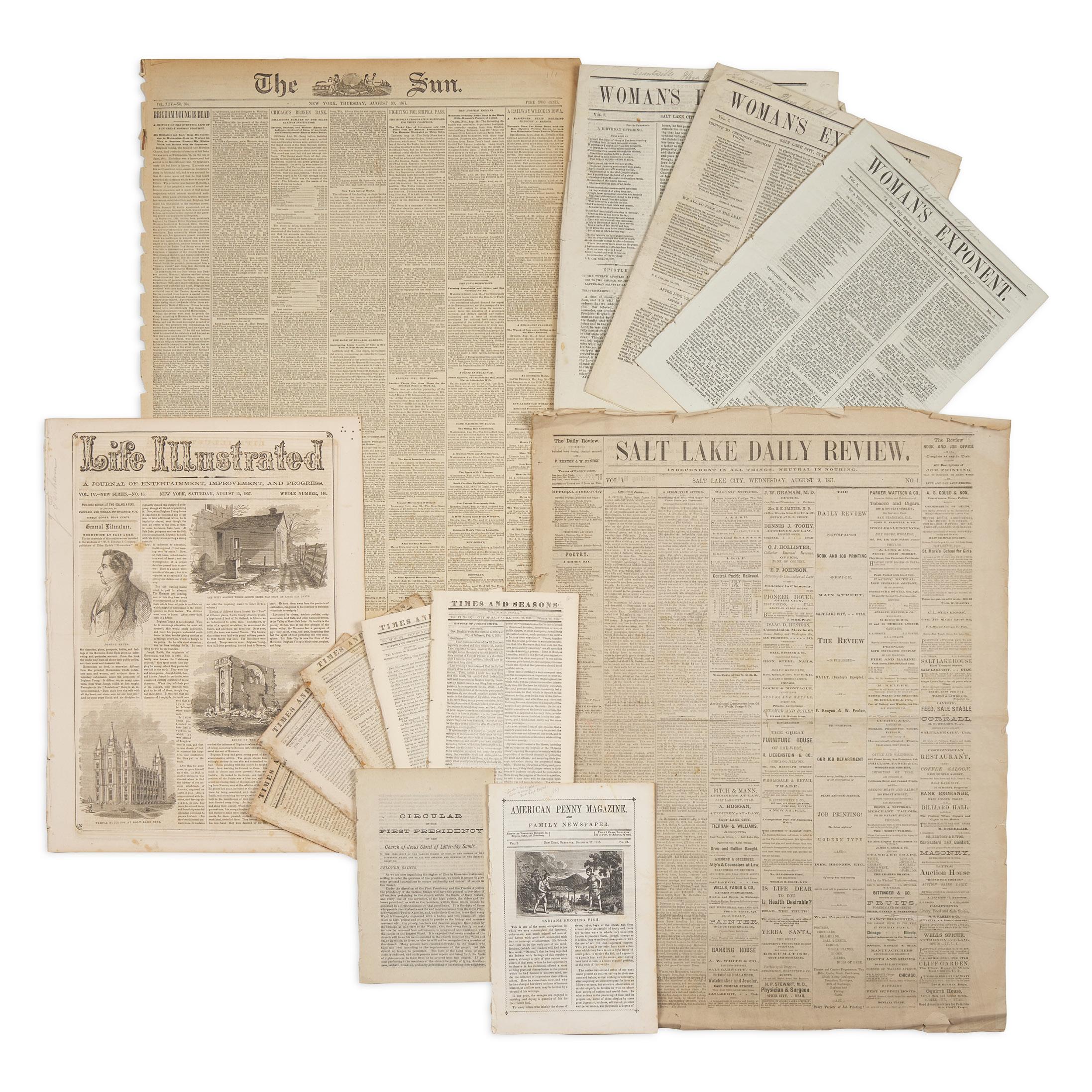
Locations vary, ca. 1842-1879. Group of 13 printed items related to members of the Church of Jesus Christ of the Latter Day Saints, including, five issues of the printed periodical Times and Seasons (Nauvoo, Illinois: 1842-46); printed periodical American Penny Magazine and Family Newspaper (Vol. 1, No. 47, December 27, 1845); printed newspaper Life Illustrated (August 15, 1857, Vol. IV, No. 16); printed pamphlet Circular of the First Presidency of the Church of Jesus Christ of Latter-day Saints (1877); printed newspaper Salt Lake Daily Review (August 9, 1871, Vol. 1, No. 1); three issues of the printed newspaper Woman’s Exponent (Salt Lake City, 1877-79); printed newspaper The Sun, (August 30, 1877, Vol. XLIV, No. 364). Size and condition varies.
Following the 1838 Mormon War and their expulsion from the state of Missouri, Joseph Smith led his church to Illinois, where they bought a small town which they renamed Nauvoo and settled into what proved to be a short-lived period of relative tranquility. Within a few years, however, tensions arose between the Mormons and their neighbors once again. Joseph Smith was murdered by a mob in 1844 and the largest sect of his followers, now led by Brigham Young, fled to the Utah Territory. For the next forty years the Mormon Church remained locked in a statehood dispute with the United States government, mainly over the church’s practice of polygamy. This dispute is generally acknowledged to be the main reason why Utah was not admitted as a state until a formal ban was written into the state’s constitution, a practice which all other western states were forced to add into their own constitutions as well.
$500 - 800
220
[Mormonism] A Unique Contemporary Manuscript Account of Joseph Smith’s Final Words to His Followers, the Day Before his Violent Death, on the Interior of a Postal Cover
“The prophet told his people the day before he was killed, to read the 6th Ch. Revelation; as a part was already fulfilled, and the remainder will shortly be...”
(Nauvoo, Illinois, July, 27, 1844). Single sheet, 9 3/4 x 7 1/2 in. (248 x 190 mm). Autograph note by George Alley, penned to his brother Joseph on verso of an address leaf. In full: “The prophet told his people the day before he was killed, to read the 6th Ch. Revelation; as a part was already fulfilled, and the remainder will shortly be; he cited then more particularly to the 8, 9, 10 & 11 verses of the above chapter-People may say what they please, but just (as) true as there is a God in Heaven who led the Jews out of Egypt, so will all the prophesies be fulfilled, and the doctrine of the Later day Saints stand, it being the True Gospel of Jesus Christ the Son of God.” Hand-addressed on verso, “Mr. Joseph Alley 3rd, Lynn Masstts.” with Sept. 3 post-mark. Creasing from old folds, closed tears along same with loss affecting text; left margin creased with paper loss; address panel on verso offset, wax seal remnant. Accompanied by an autograph letter from George Alley to his brother Joseph, written from Alton, Illinois, dated December 18, 1842, describing his journey west, and his impressions of the landscape, etc.
An extraordinary survival--a contemporary account of the last message of Mormon Prophet Joseph Smith to his followers, given on June 26, 1844, the day before his murder while awaiting trial in prison.
George Alley (1792-1859) was a Massachusetts shoemaker who converted to the Church of the Latter Day Saints through the ministry of apostle Erastus Snow. In 1842 he migrated to the city of Nauvoo, Illinois, which he describes in the aforementioned letter to his brother. In part: “We left the steam boat day before yesterday after a ________ passage so far, of 53 days, having been aground and blocked up in the gorges of ice...We have been three weeks last Friday in getting 17 miles...The weather has been very sever here for this latitude...We will now look on the other side of the picture as regards the prospect...As regards the country, as far as I have been able to see I believe it to be a land particularly prepared by the God of Heaven for the wants of man, and all that is necessary is for man to put in the Seed and reap a full reward for his labour. Every thing in nature seems to be on a grand scale...I do not regret being here even without a cent...This city is 30 miles above St. Louis and 150 below Nauvoo as the river runs...” After settling, the Alleys lived in Nauvoo until 1846, when they moved to the new Mormon settlement in the Salt Lake Valley, in Utah. Alley’s daughter Margaret (1825-52) would later marry church President Brigham Young (1801-77).
In 1844, the prophet Joseph Smith had been President of the Church of Christ (the first name of the Church of Jesus Christ of the Latter Day Saints), for almost 15 years. The settlement of Nauvoo, which Smith helped found, then had the second highest population of any town in Illinois. Despite the success of the movement, Smith was harried by multiple issues over the preceding two years, including, warrants issued for his arrest and extradition to Missouri for episodes of religious violence there in the late 1830s; the excommunication of his friend and benefactor John C. Bennett; and infighting with close church associates over the issue of polygamy.
On June 25, Smith and his brother Hyrum arrived at a jail in Carthage, Illinois, to stand trial for a series of charges laid against them in a dispute with the local press, most critically, treason. As mayor of Nauvoo, Smith had ordered the destruction of the Nauvoo Expositor, a non-Mormon newspaper that had published articles critical of him, such as the practice of polygamy, and his political and religious ambitions (the paper published only one paper before its destruction). It was at the jail in Carthage, when on June 27, a violent mob descended on the building, and attacked and killed both Smith and his brother.
A remarkable survival, as manuscript accounts related to the last days of Joseph Smith are very rare to auction.
$8,000 - 12,000
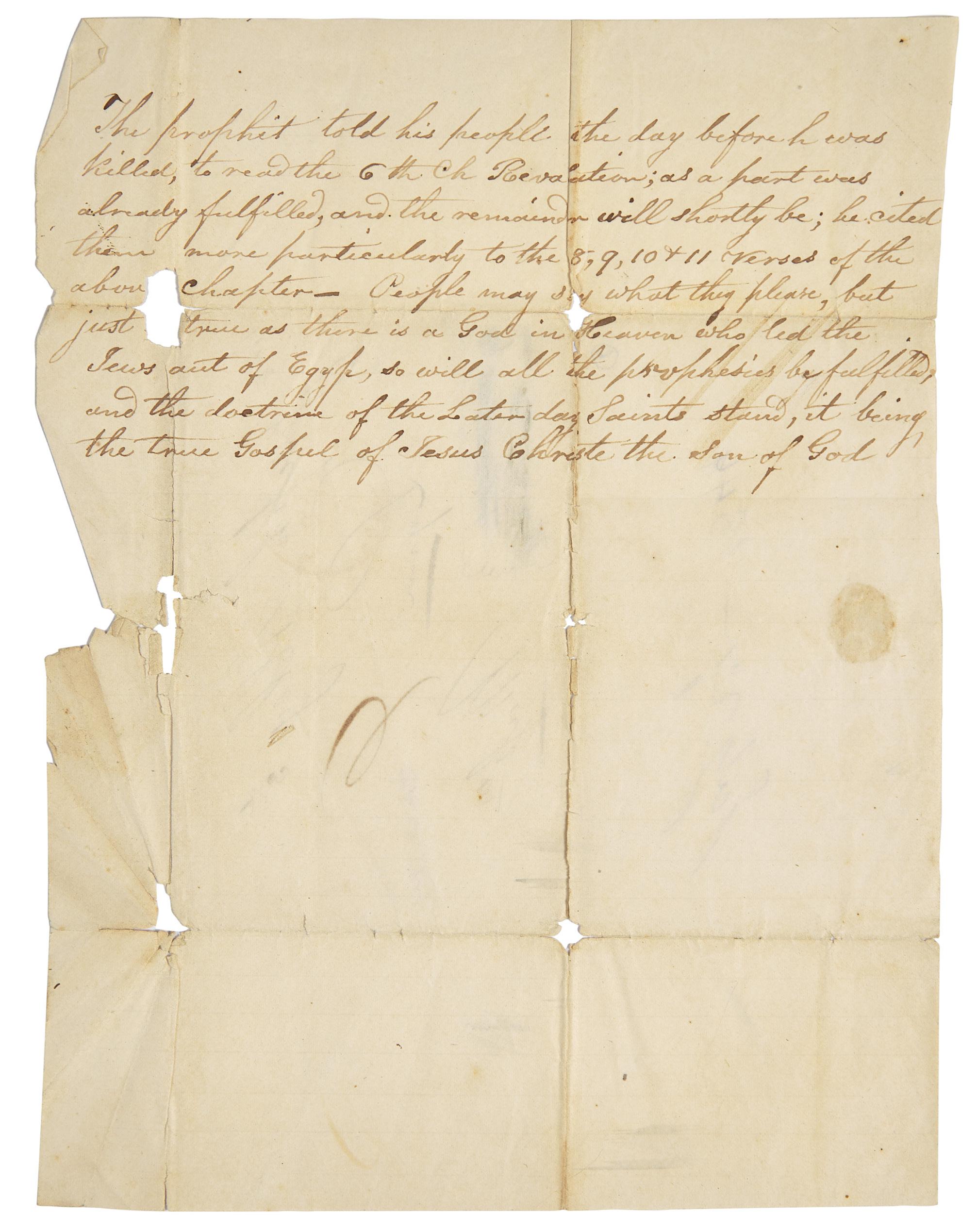
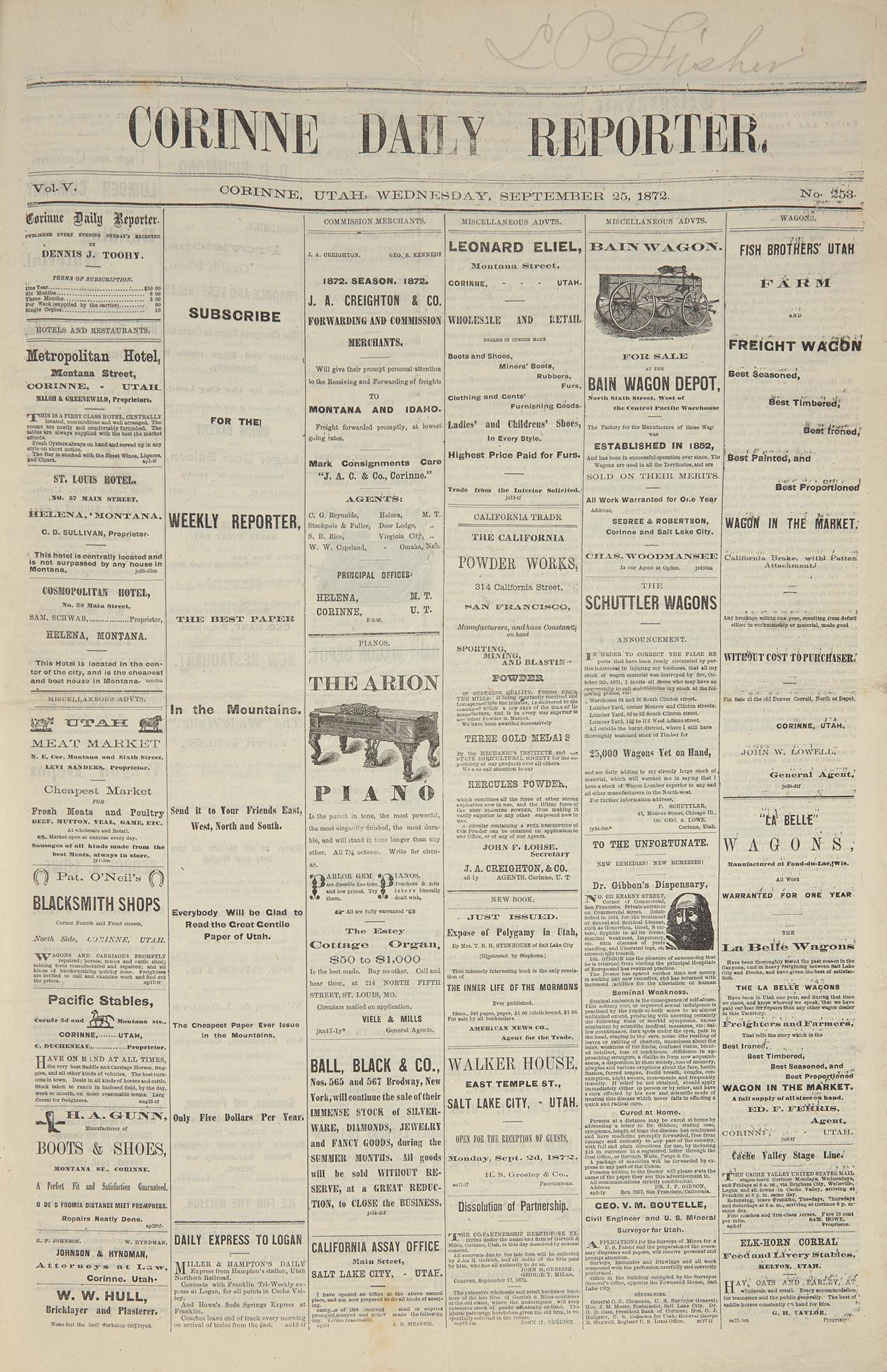
221
[Mormonism] Substantial and Nearly Consecutive Run of an Anti-Mormon Newspaper
Corinne Daily Reporter
Corinne, Utah: Dennis J. Toohy, Monday, July 1, 1872-December 30, 1872. Vol. V, Nos. 181-343 (Nos. at rear misnumbered beginning after No. 289). Comprising 145 near-consecutive issues, lacking Nos. 183, 200, 206, 216, 218, 219, 228, 273, 278, and 308. Folio. Each issue 4 pp. Bound together in worn stiff paper wrappers, typed paper spine labels; contemporary ownership signature at top of each front-page (“L.P. Fisher”); scattered tape repairs and pencil or crayon scrawls; scattered creasing and wear along edges; some issues faded.
A substantial and nearly consecutive run of this anti-Mormon newspaper, founded in 1869 by Dennis J. Toohy, an Irish attorney and prominent leader of Utah’s anti-Mormon Liberal Party. The publication was launched in March of that year in Corinne, a town situated along the Pacific Union railroad. Established by non-Mormon settlers, Corinne earned the nickname “Gentile City” as its founders sought to create a rival economic and political hub to challenge Salt Lake City. This newspaper offered a diverse mix of content, including local, domestic, and international news, advertisements for local businesses, and a significant number of humorous pieces, many targeting and mocking the Mormon Church.
$3,000 - 5,000
222
[Mormonism] Signed Autograph Quote from Ann Eliza Young, Nineteenth Wife of Mormon Leader Brigham Young, Signed During her Divorce Proceedings Against him, 1874
No place, January 13, 1874. Single sheet, 7 1/4 x 4 7/8 in. (184 x 124 mm). Autograph quote, signed by Ann Eliza Young: “God grant your sufferings may never / equal mine. / Ann Eliza Young. / January 13th 1874”. Inscription in purple ink in another later hand at top. Scattered light spotting; faint erased pencil inscription at top; likely excised from an album.
An autograph quote from Ann Eliza Young (1844–1917), the nineteenth wife of Mormon leader Brigham Young, signed during her divorce proceedings against him. Born into the Church of Jesus Christ of Latterday Saints in Nauvoo, Illinois, she married Young on April 7, 1869; at the time, he was 67 and she was a 24-year-old divorcee. In 1873, Ann Eliza filed for divorce, citing neglect, cruel treatment, and desertion. The divorce was granted in 1875. In the years that followed, she became a vocal critic of the Mormon Church, particularly its practice of polygamy. Her activism included testifying before Congress in April 1874 and lecturing in Washington, D.C. about her experiences. Her efforts contributed to the passage of the Poland Act in 1874, which reorganized the Utah Territory and transferred civil and criminal cases from Mormon probate courts to federal jurisdiction. In 1876, she published Wife No. 19, an autobiography detailing her life with Young and her broader critique of Mormonism. Her lectures on her marriage and religion captivated the American public for years and helped shape public opinion and legislation. Her pressure is considered to have influenced the church’s 1890 Manifesto, which advised members to cease marriages forbidden by U.S. law. Polygamy itself was federally outlawed through the Edmunds Act of 1882 and the EdmundsTucker Act of 1887.
$1,500 - 2,500
223
[Motor Racing] Early Race Car Crash at the Daytona Beach Race Course
New York: Burr McIntosh Studio, 1905. Photograph mounted to original card, studio blindstamp in lower right corner of photograph; studio imprint in gilt in lower left corner of card; contemporary typed card stapled to verso, “Both Driver and Mechanic Were Killed in this Wreck at Daytona Beach, Fla. 1905. Mechanic was Killed Instantly; Croker Died Shortly Afterward. Car was Built for Richard Croker Jr. of New York City.” Chipping and small losses to edges of mount, closed tear in bottom of same.
An early and scarce Daytona Beach auto race photograph, showing the fatal wreckage of Frank H. Croker’s (1878-1905) Simplex race car.
At the time of his fatal crash on the afternoon of Saturday, January 21, 1905, Croker was preparing for the Sir Thomas Dewar Trophy race, the top event at the third annual Daytona-Ormond Beach Speed Carnival competitions, held from January 23-28. While practicing the course at Ormand Beach in his 75-horsepower Simplex racecar he attempted to avoid a crash with motorcycle racer Newton Stanley, who was also using the course. Croker’s car turned over several times after hitting a sand dune, ejecting Croker, and instantly killing his mechanic, Alexander Raoul, before coming to rest partially in the sea. Croker suffered critical head and body injuries and was taken to the Hotel Ormond, where he was cared for by numerous doctors, but died the following morning.
Croker was the son of Richard Croker, Jr., a one-time coroner in New York City, and leader of Tammany Hall and New York’s Democratic Party. At the time of his death, Frank was preparing to compete in 15 races over the week-long Speed Carnival, and had raced the pictured Simplex for the first time the previous October at the Vanderbilt Cup race on Long Island. Over 8,000 people attended his funeral in New York City, including the Mayor, and several people from the Democratic Club and Tammany Hall.
$300 - 500
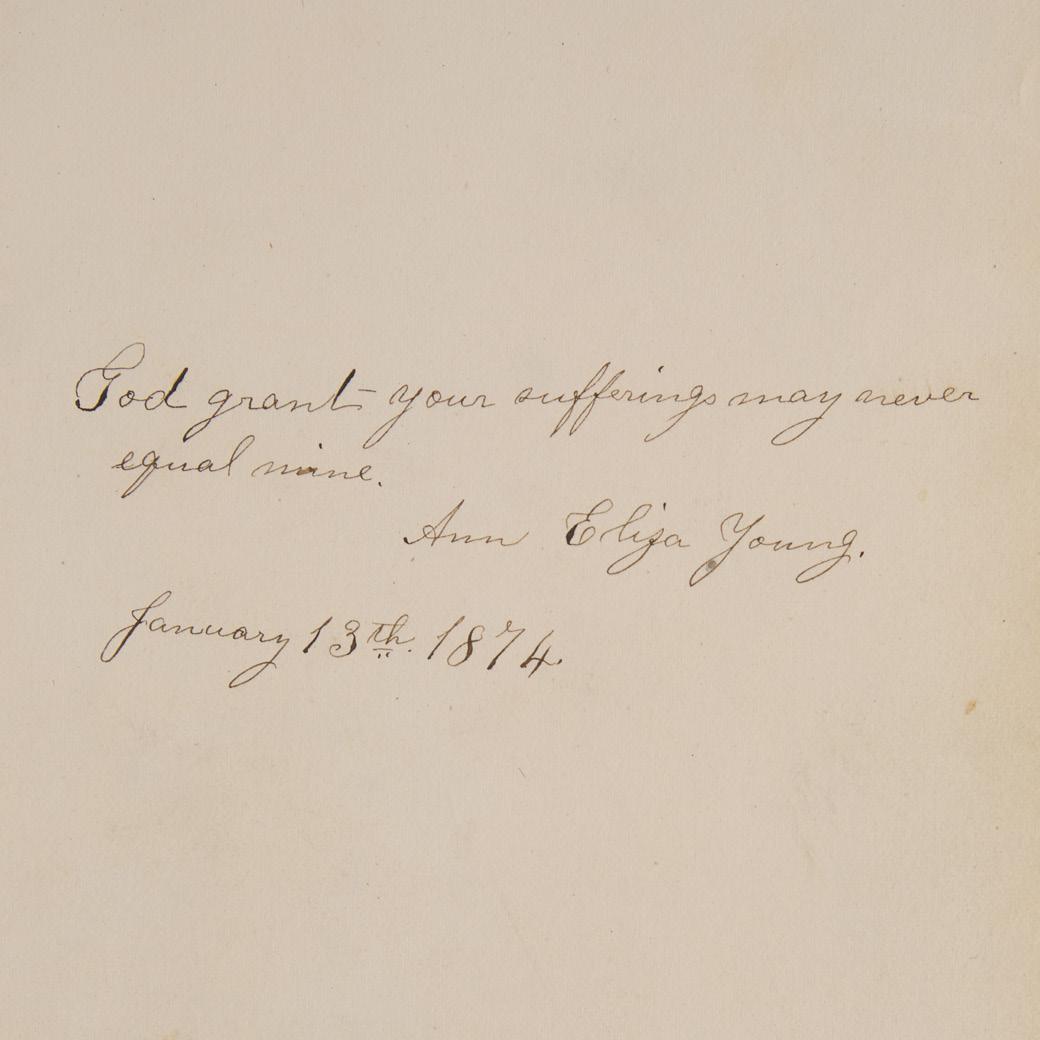
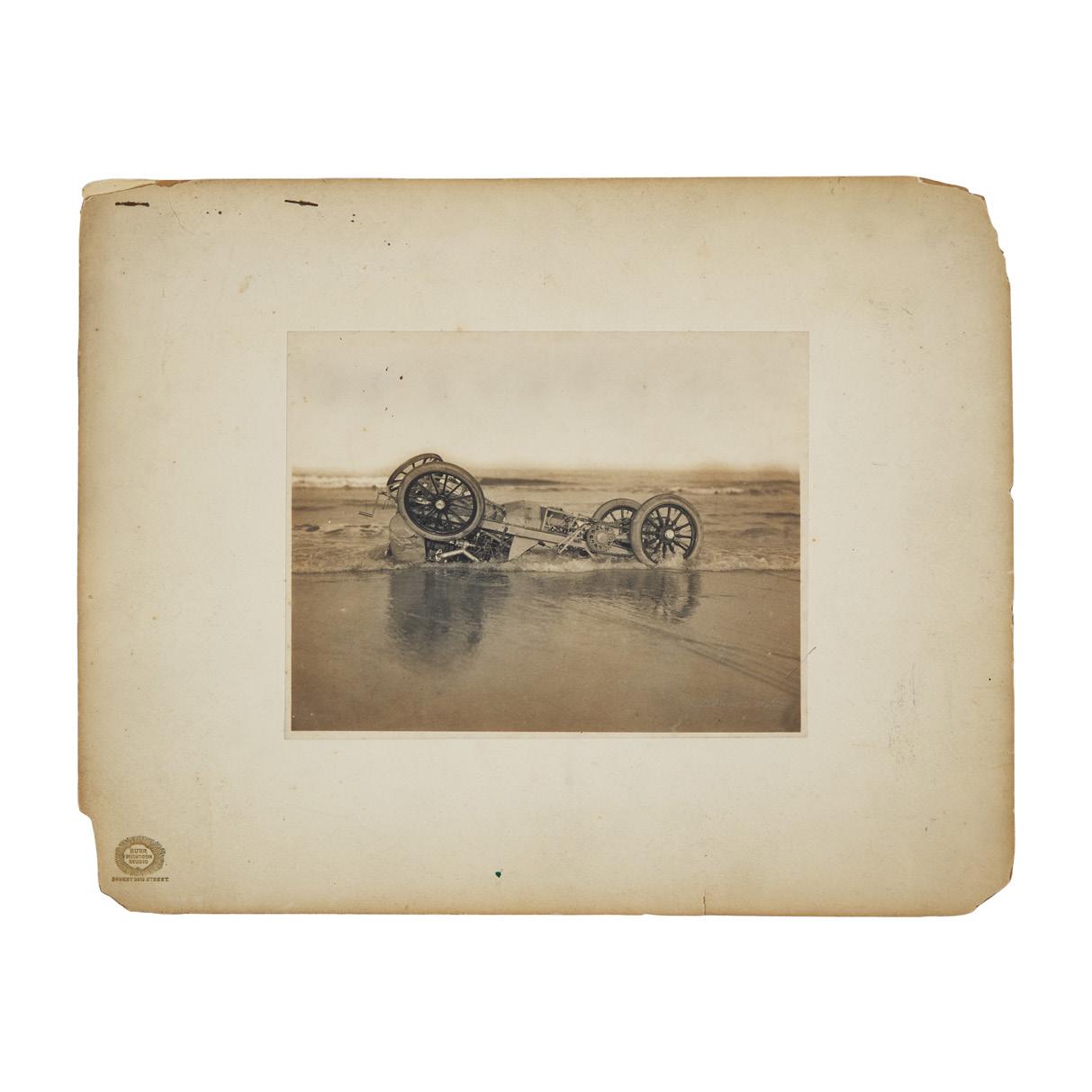
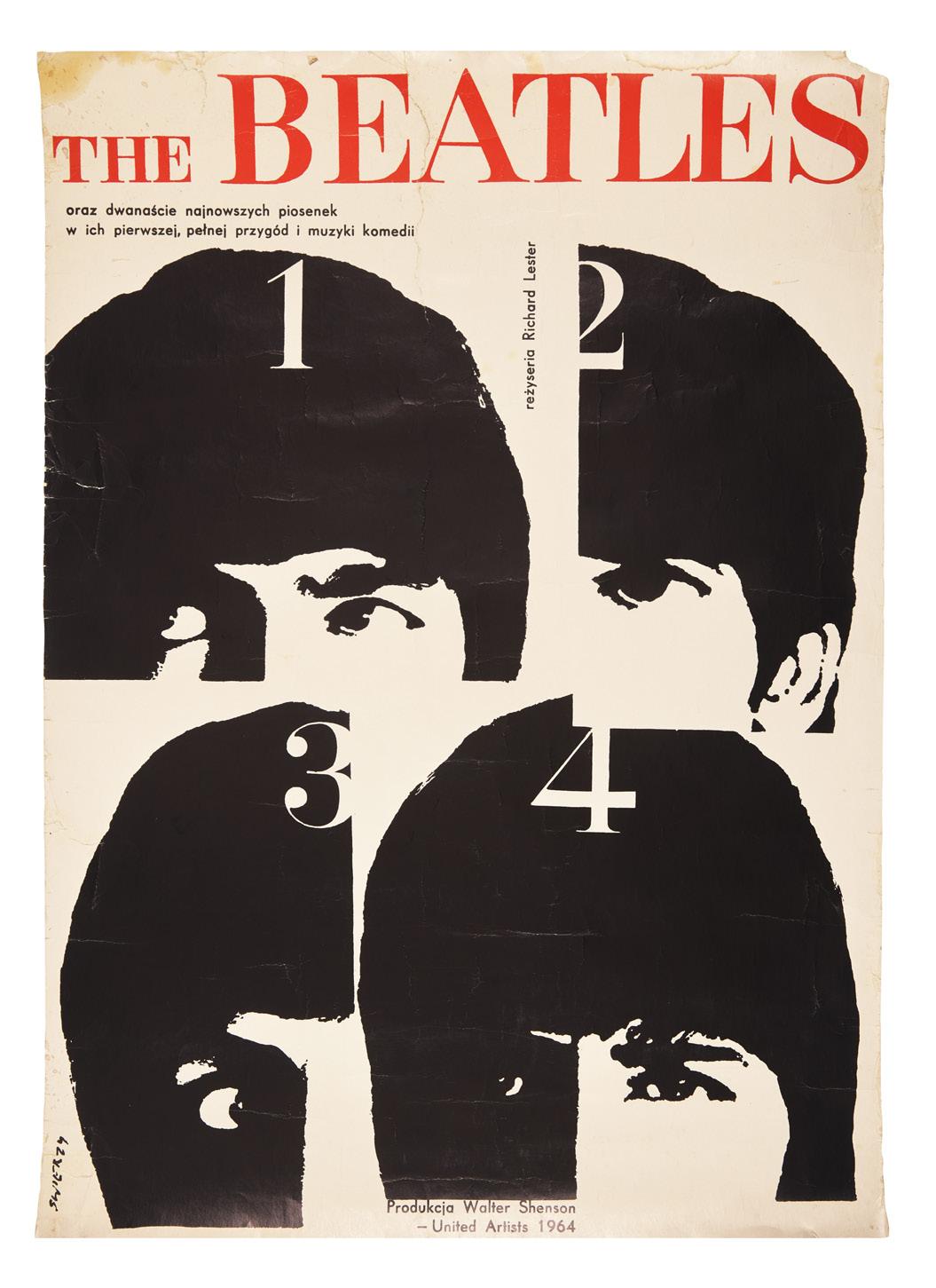
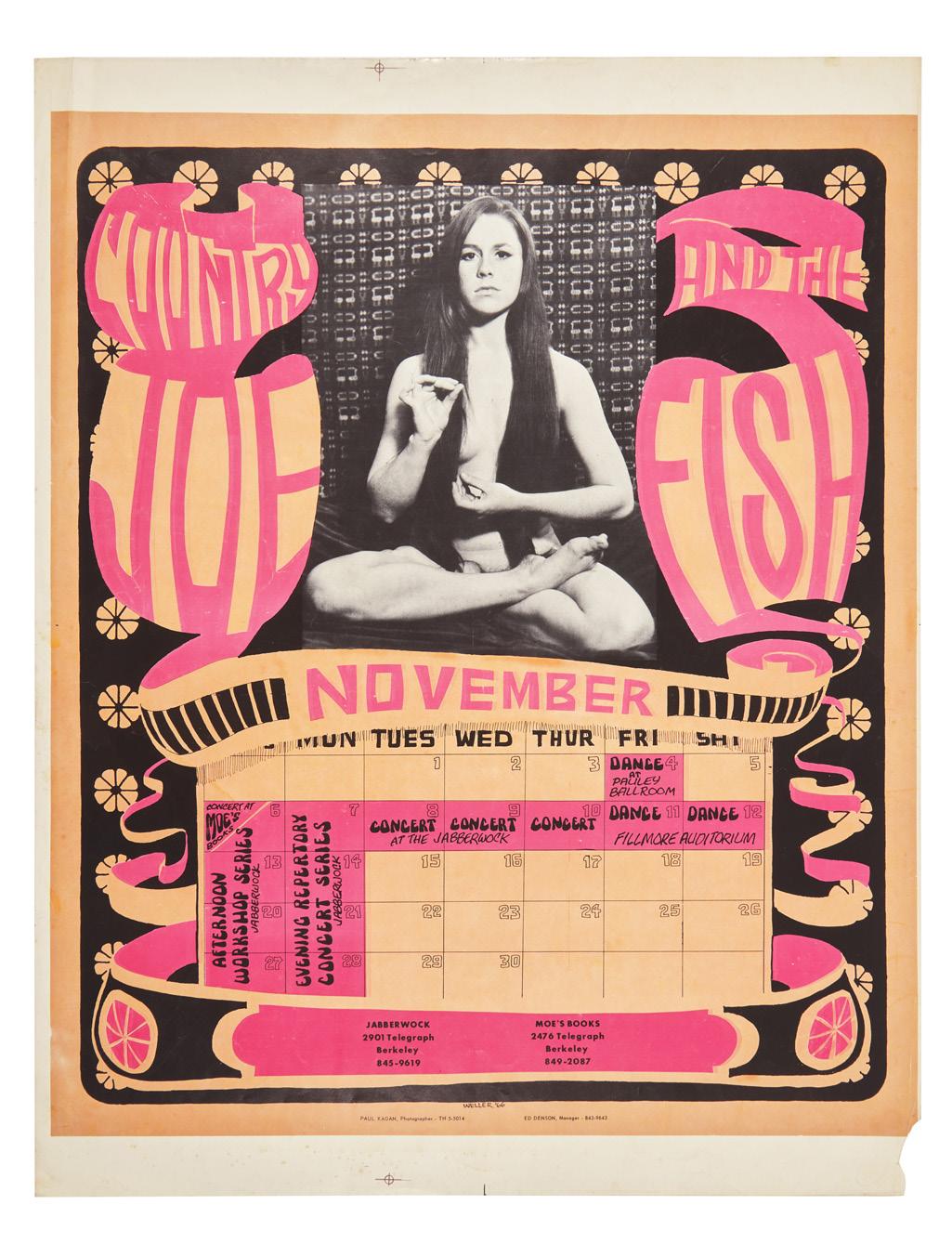
224
[Music] [The Beatles] Scarce Poster Advertising the First Polish Release of The Beatles Film A Hard Day’s Night
Poland: United Artists, 1964. Off-set color lithographed poster. Text in Polish. Designed by Waldemar Swierzy. 33 3/4 x 24 in. (857 x 610 mm). Scattered surface wear and creasing; wear along edges; small loss in top right corner; dampstaining and soiling in top edge; pinholes in corners; large repaired vertical closed tear in top edge, other smaller repaired closed tears along edges.
A scarce poster advertising the first Polish release of the classic 1964 Beatles’ film, A Hard Day’s Night, directed by Richard Lester.
$400 - 600
225
[Music] [Country Joe and the Fish] Group of 2 Psychedelic Concert Posters, 1966-1975
Country Joe and the Fish Likely Berkeley, California, November 1966. Color lithograph designed by “Weller”; photograph by Paul Kagan. Loss in lower right corner. 22 9/16 x 17 5/8 in. (573 x 448 mm).
Promotional poster for Country Joe and the Fish’s performance schedule for November 1966.
Together with:
Be-In A Day to Be-In the Park Presented by Radio Free Madison and the Mad City Be-In Committee...featuring Hemisphere Recording Artists Derringer... Madison, (Wisconsin), September 7, 1975. Screen-print. Hole in upper left side; closed tear upper right side. 17 x 11 (432 x 279 mm).
$200 - 300
226
[Music] [Hendrix, Jimi] Early Concert Contract for The Jimi Hendrix Experience
London: Harold Davison Agency Ltd, December 5, 1966. Unsigned carbon of a contract between manager Philip Haywood and Chas Chandler for “The Jimmy Hendrix Experience”, for a show at the Ricky Tick Club in Windsor, Berkshire, England, on December 23, 1966. Creasing from old folds; stain in bottom left corner; small holes in top left corner from removed staple. 13 x 8 in. (330 x 203 mm).
A very early and scarce carbon of a concert contract for The Jimi Hendrix Experience, for a two-set show at the Ricky Tick night club in Hounslow, England, on December 23, 1966.
By May of 1966, Hendrix had been playing circuit gigs in America for months, earning scant attention and struggling to earn a living. That summer his luck began to change. When playing with Curtis Knight and the Squires at New York’s Cheetah Club, his playing caught the attention of Linda Keith, then girlfriend of the Rolling Stones’ Keith Richards. They became quick friends, and Linda soon referred Hendrix to Chas Chandler, bassist for The Animals who was looking to transition to managing artists. During his final tour with The Animals, Chandler saw Hendrix play at Cafe Wha? Nightclub in Greenwich Village, and mesmerized by his performance of “Hey Joe”, invited Hendrix to London and signed him to a management contract.
By the early fall they began to search for members to fill out a band, and quickly recruited guitarist Noel Redding on bass, and Mitch Mitchell on drums. By mid-October Chandler arranged for the band, now called The Jimi Hendrix Experience, to support French star Johnny Hallyday for a brief tour of France. They played their first-ever live show on October 13 at the Novelty, in Evreux. Shows in Germany and England followed through the fall and winter. Their first single, “Hey Joe” backed by “Stone Free”, was released on December 16, less than two weeks after this contract. Television performances followed, and their single entered the UK charts on December 29 and peaked at #6. It was the beginning of an arc that would catapult the group to the forefront of Rock and Roll, and immortalize Hendrix as one of the greatest guitarists of all time.
$1,000 - 1,500
227
[Music] [Hendrix, Jimi, and Janis Joplin] Winner?/Winner?
No place: L & S Productions, 1970. Offset color lithographic poster. 36 1/4 x 14 1/4 in. (921 x 362 mm). Scattered light edge-wear.
A handsome and uncommon example of this powerful anti-drug poster, depicting musicians Jimi Hendrix and Janis Joplin, both of whom died from drug overdoses in 1970 at the age of 27.
$400 - 600
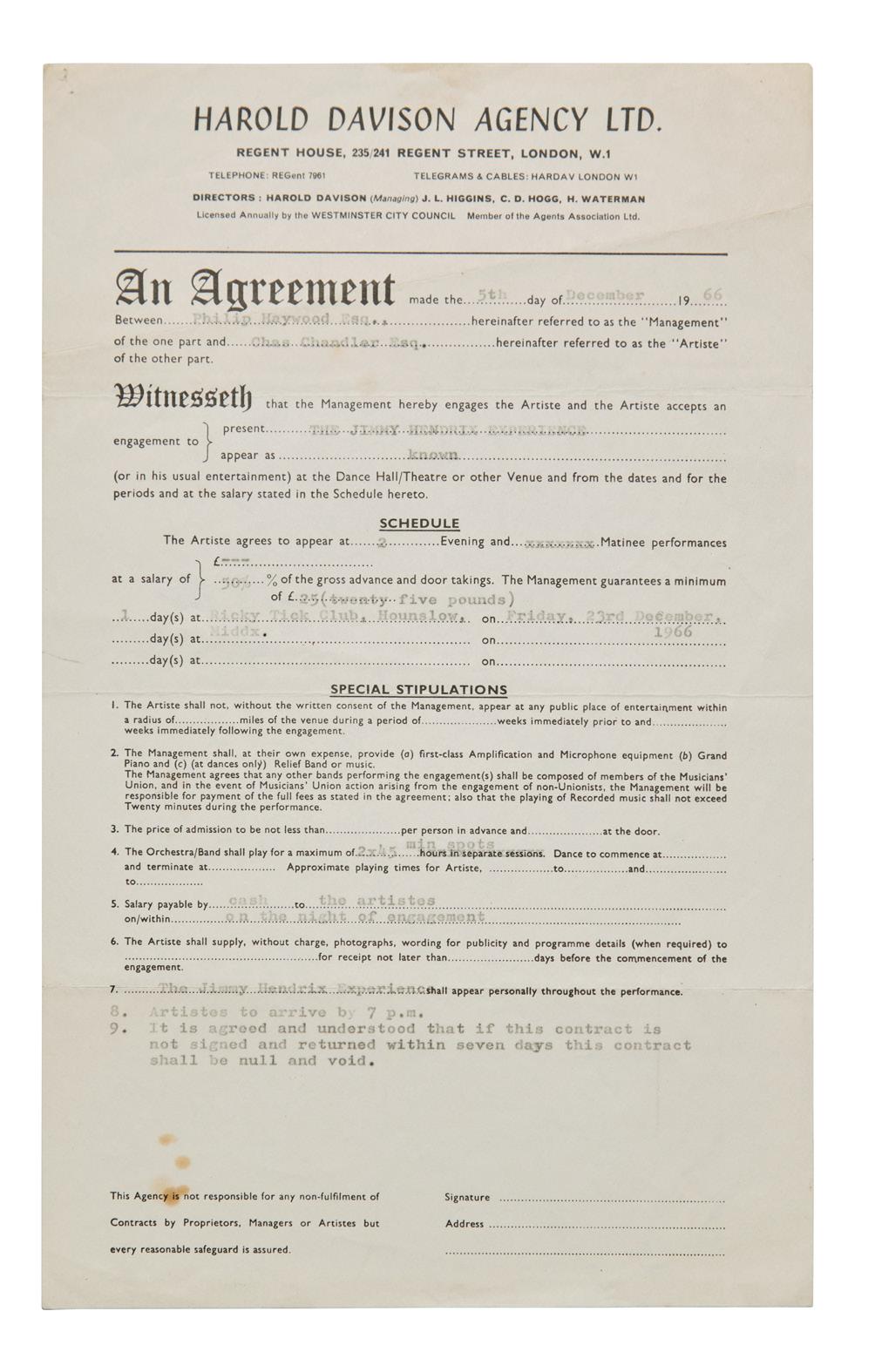
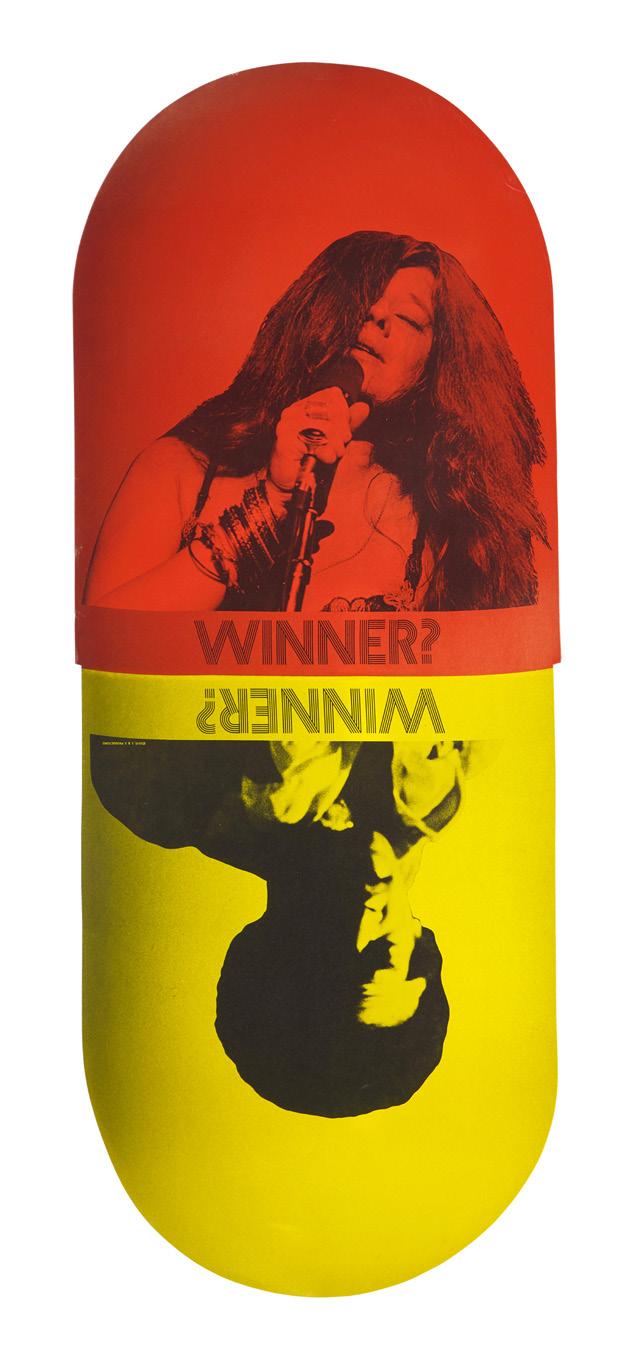
229
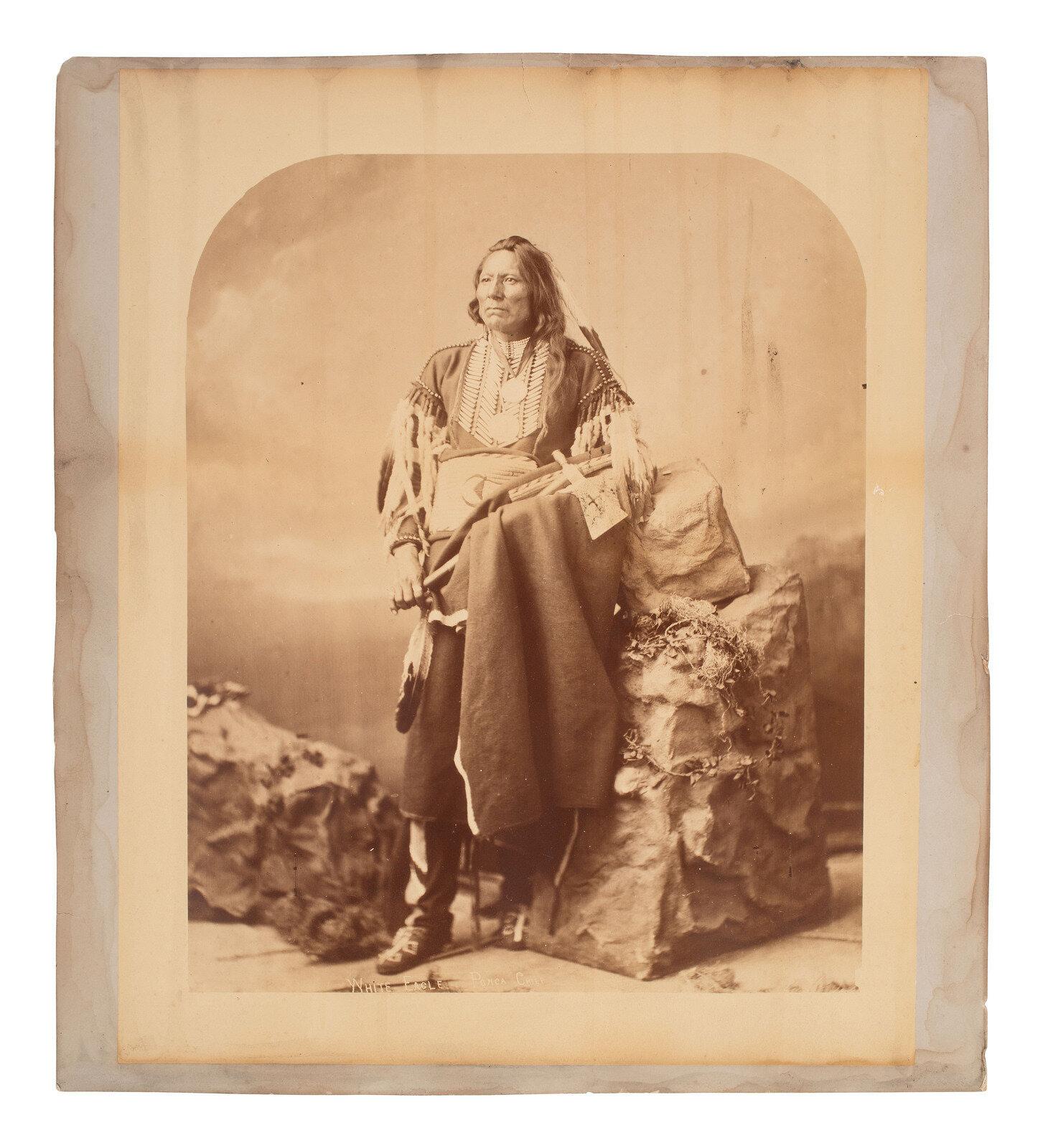
228
[Native-Americana] Bell, Charles M. White Eagle, Ponca Chief, ca. 1877
Washington, D.C., ca. 1877. Mammoth plate albumen photograph on original card; 20 x 18 in. (508 x 457 mm). Scattered foxing and stains.
A striking and large studio portrait of Ponca Chief White Eagle, taken by Charles M. Bell.
The Larry Ness Collection of Native American Photography
$1,000 - 1,500
[Native-Americana] [Eliot, John] The Athenian Mercury, with a Postscript Honoring John Eliot
London: Printed for John Dunton, Saturday, November 28, 1691. Vol. 4, Numb. 18. Printed newspaper. Broadsheet. Disbound; wear along left edge, dampstaining along same.
With a postscript honoring Puritan missionary to the Native Americans in Massachusetts Bay colony, John Eliot (1604-90), who was “so very earnest for the bringing poor Children under the Bond of the Covenant, that he very openly and earnestly maintain’d the Cause of Infant Baptism...”
$200 - 300
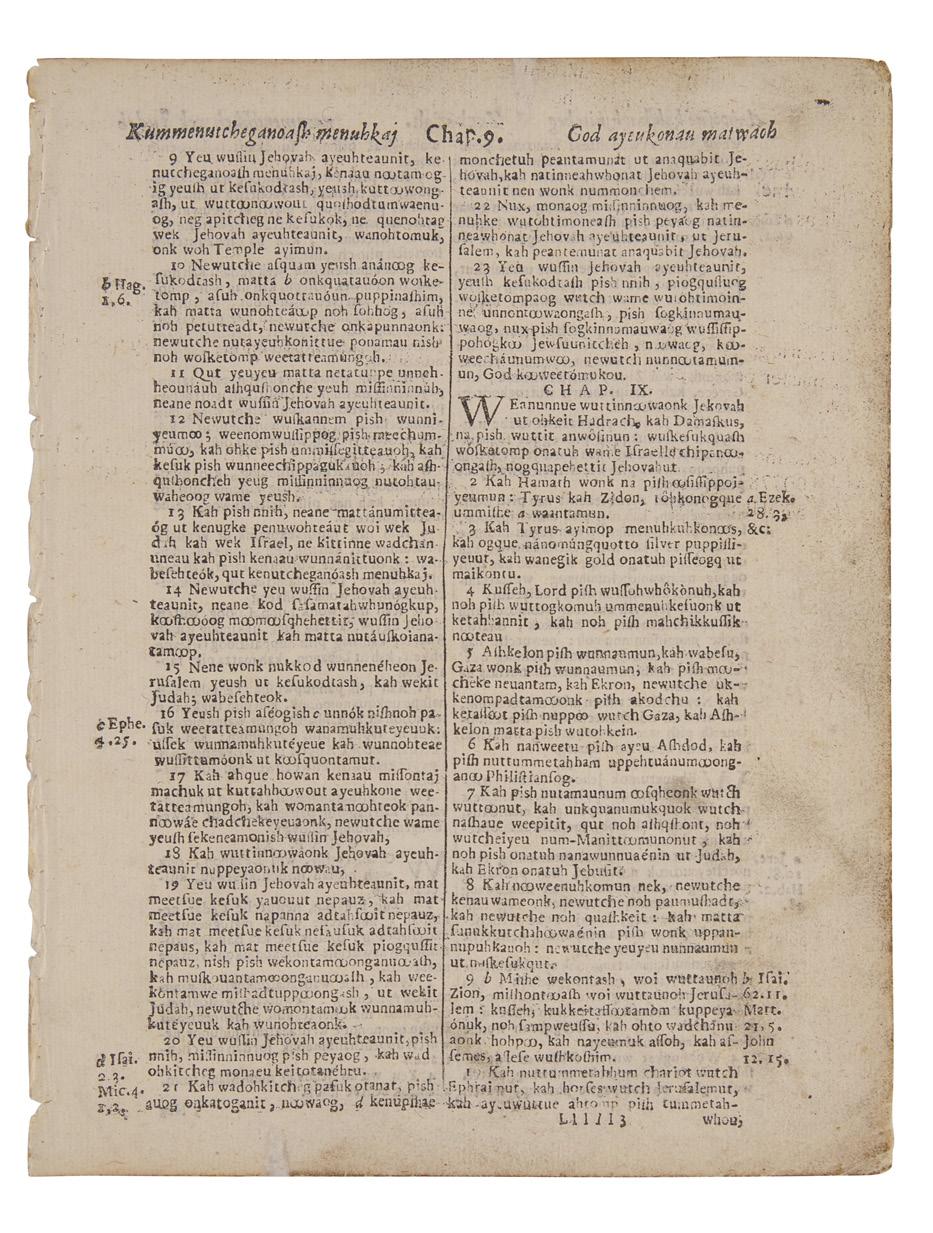

230
[Native-Americana] [Eliot, John] Leaf From the Eliot Indian Bible, the First Bible Printed in America
(Cambridge, Massachusetts: Samuel Green and Marmaduke Johnson, 1663). Single disbound leaf, 7 3/8 x 5 3/4 in. (187 x 146 mm). Printed in two columns. Lightly soiled; small repair in top and bottom edge.
Leaf 5L3 from the first Bible printed in America, and translated into a Native American language, by John Eliot. Featuring portions of Chaps. 9-10 of Zechariah, as well as some surrounding text.
$300 - 500
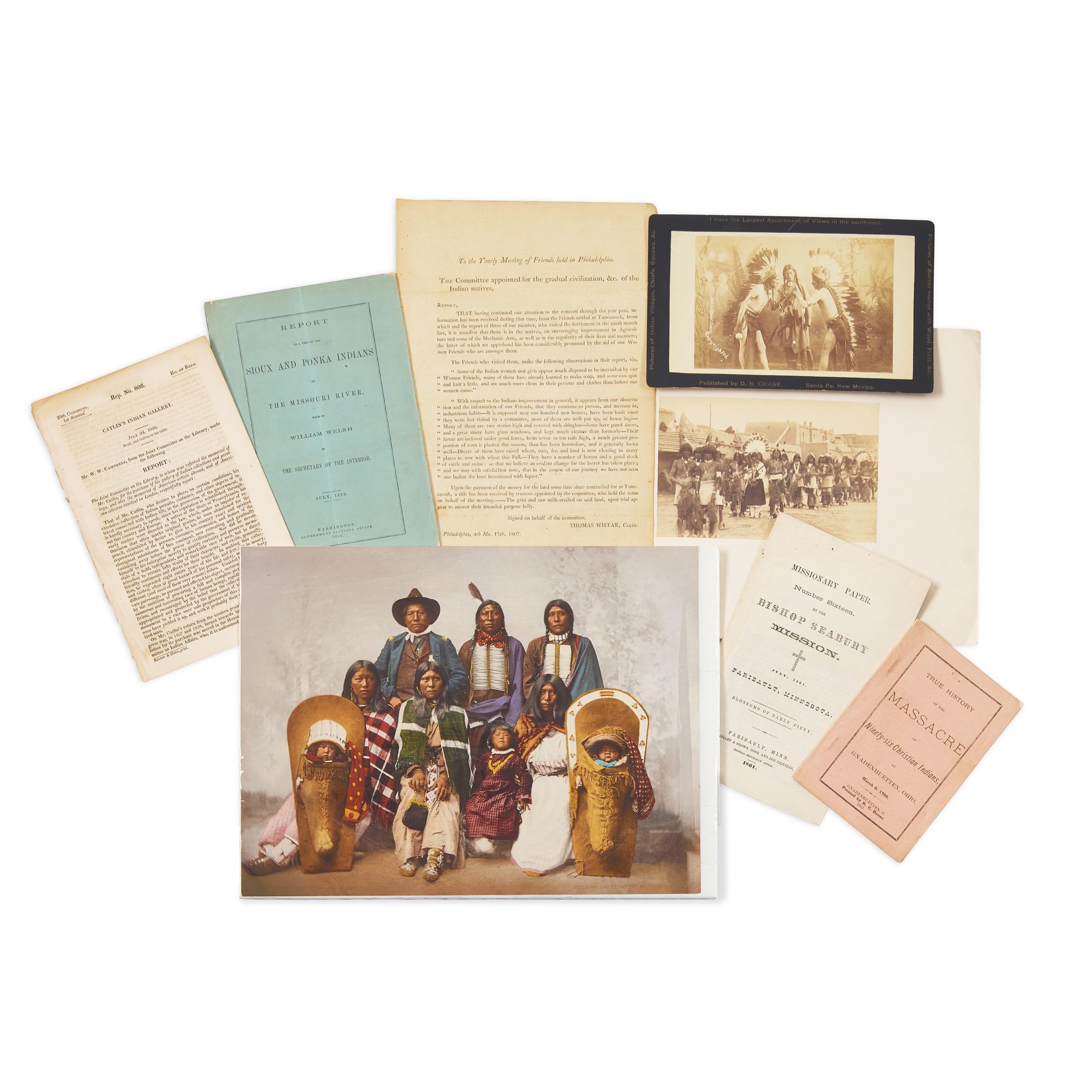
231
[Native-Americana] Group of Nine Photographic and Printed Items Related to Native Americans, ca. 1807-1900
Locations vary, ca. 1807-1900. Group of nine items related to Native Americans, including: a William Henry Jackson albumen print, “Dance in the Pueblo San Juan”; a cabinet card by D.B. Chase, Santa Fe, “Indian Ghost Dance”; a printed circular of the Philadelphia Yearly Meeting, April 17, 1807, discussing Indian advancements in agriculture; two printed Senate of the United States reports, July 24, 1846 and June 23, 1852, regarding the proposed purchase of George Catlin’s collection of paintings; printed pamphlet, Missionary Paper. Number Sixteen. By the Bishop Seabury Mission. July, 1861. Faribault, Minnesota.; printed pamphlet, Report of a Visit to the Sioux and Ponka Indians on the Missouri River, Made by William Welsh... (Washington: Government Printing Office, 1872); printed pamphlet, A True History of the Massacre of Ninety-six Christian Indians... (Gnadenhuetten, Ohio: R.C. House, 1882); color photochrome after William Henry Jackson, 1900, depicting “Ute Chief Sevara and Family”. Condition varies, generally very good.
$500 - 800
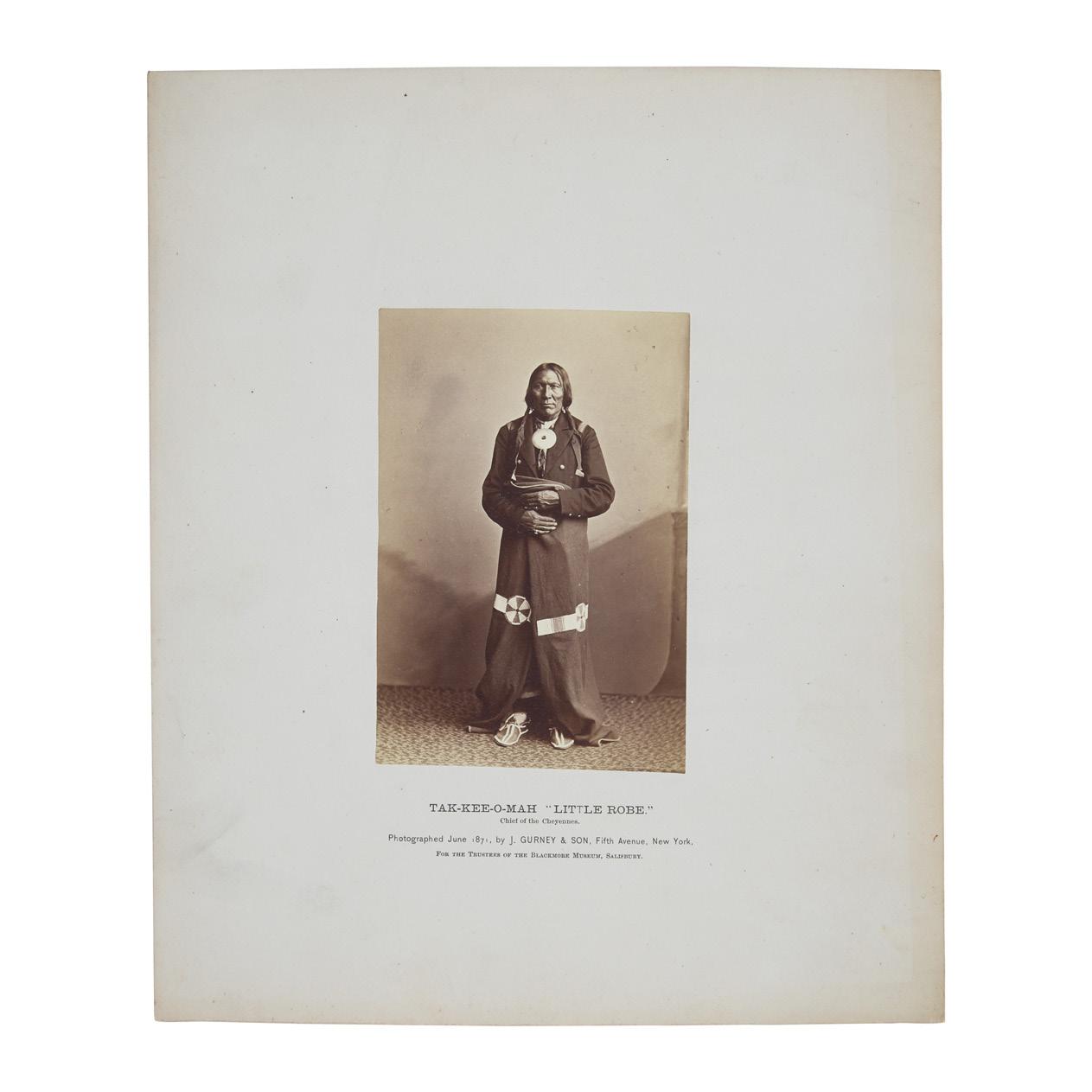

232
[Native-Americana] Gurney, Jeremiah. Tak-Kee-O-Mah “Little Robe” Chief of the Cheyennes
New York: J. Gurney & Son, 1871. Albumen print, mounted to captioned card, 12 x 10 in. (305 x 254 mm). Scattered soiling to mount, uneven toning to same.
A fine portrait of prominent Cheyenne warrior turned peace advocate, Little Robe (Takkeomah). Born in 1828, Little Robe gained distinction as a warrior during the 1850s in battles against the Pawnee and Ute. He rose to a leadership position within his tribe, and survived the 1864 Sand Creek Massacre, where United States troops slaughtered around 200 Cheyenne and Arapaho. Following this, he waged war against white settlers, but soon came to the conclusion that such actions were hopeless and subsequently became an advocate for peace. He signed treaties at both the Little Arkansas in 1865, and Medicine Lodge in 1867, and became a leader of the peace faction of the Southern Cheyenne. He was a delegate to Washington, D.C., in 1871 and 1873, where he met with President Ulysses S. Grant and Congressional leaders, and then retired to his home on the North Canadian River. He died there in 1886.
From Jeremiah Gurney’s portfolio of Native Americans, created for the Trustees of the Blackmore Museum, in Salisbury, England. The Blackmore portfolio contained 12 albumen portraits of Cheyenne, Arapaho and Wichita leaders. Gurney boasted of being the oldest and most extensive photographic establishment in the world, a claim that may well have been true. Born in 1812, he was trained as a jeweler, an occupation he engaged in until 1840 when he took up photography, soon after its invention. He was one of the first to take up the new craft, and as such, had to have French journals translated for instruction, and had to make much of his own equipment. His affable nature combined with great skill made his New York City business a great success. By 1869 he had several studios, including one at 707 Broadway, trading as Gurney & Son, which was described as the most expensive photographic establishment in the world. It was to this studio that this delegation of Native Americans was brought to in June of 1871.
$800 - 1,200
233
[Native-Americana] Kelly, R.L. Cabinet Card Portrait of Spotted Eagle
Pierre, Dakota: Kelly & Odell, ca. 1880s. Cabinet card portrait of Sioux Chief Spotted Eagle, on gilt-bordered cardstock mount, Kelly & Odell imprint below image. Contemporary manuscript on verso: “Spotted Eagle / Sioux Chief / Engaged in the Custer Massacre / in 1876”. Light wear along edges; spotting. 6 1/2 x 4 1/4 in. (165 x 108 mm).
Spotted Eagle, a leader of the Sans Arcs Lakota Sioux, fought at the Battle of the Little Bighorn on June 25, 1876, and played a key role in the defeat of Lieutenant Colonel George Armstrong Custer and the 7th Cavalry. After the battle, he fled to Canada with Sitting Bull before surrendering to U.S. authorities at Fort Keogh, Montana, in October 1880. By the summer of 1881, he had been moved to Standing Rock in the Dakota Territory and later to Cheyenne River.
R.L. Kelly was a Canadian photographer who operated a studio in Hamilton, Ontario, before moving to Pierre in the Dakota Territory. In 1881, he cofounded a studio there with M.B. Odell.
$400 - 600
234
[Native-Americana] Scarce Bound Volume of 5 Issues of Early English Periodical The Political State of Great Britain, Including a Report of Native American Violence in the Colony of South Carolina, etc.
London: Sold by T. Warner, January-June, 1724-25. Five issues bound in one (April issue wanting). 8vo. Full contemporary speckled brown calf, gilt armorial crest of the Scottish Duke of Buccleuch on front and rear board, black morocco spine label, both boards worn and soiled, joints split but holding; scattered foxing and offsetting.
A scarce volume of five issues of an early English periodical. Highlights include a report of Native American violence in the colony of South Carolina, a notice of the death of Czar Peter the Great, an early account of smallpox inoculation performed by Dr. James Jurin, and the Treaty of Vienna between the Spanish and Holy Roman Empires.
$300 - 500
235
[Native-Americana] Rinehart, Frank A. White Buffalo, 1898
Omaha, Nebraska: F.A. Rinehart, 1898. Silver gelatin print, 9 1/8 x 7 1/4 in. (232 x 184 mm). No. 785. Official photograph of White Buffalo of the Cheyenne, taken during the Trans-Mississippi Exposition and Indian Congress. Mounted to board above printed label, lightly foxed; In mat and in frame, 19 x 16 1/4 in. (483 x 413 mm).
White Buffalo (1862-1929) was a Cheyenne chief and an early attendee of the infamous Carlisle Indian School.
The Indian Congress, held concurrently with the 1898 Trans-Mississippi Exposition in Omaha, Nebraska, was the largest gathering of Native Americans at that point in history. The portraits taken by official photographer Frank A. Rinehart (1861-1928) are regarded as some of the best representations of traditional Native dress.
$500 - 800
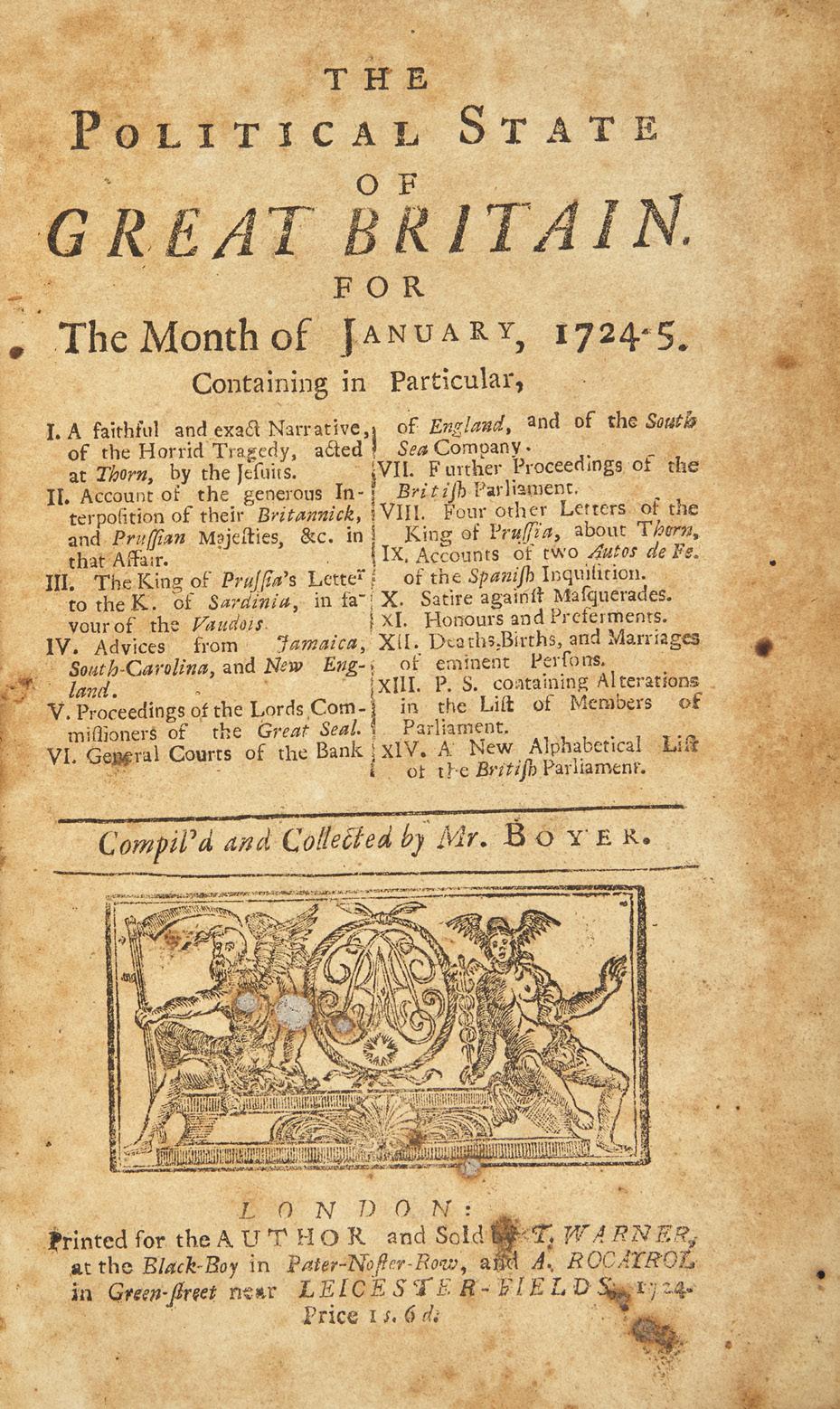
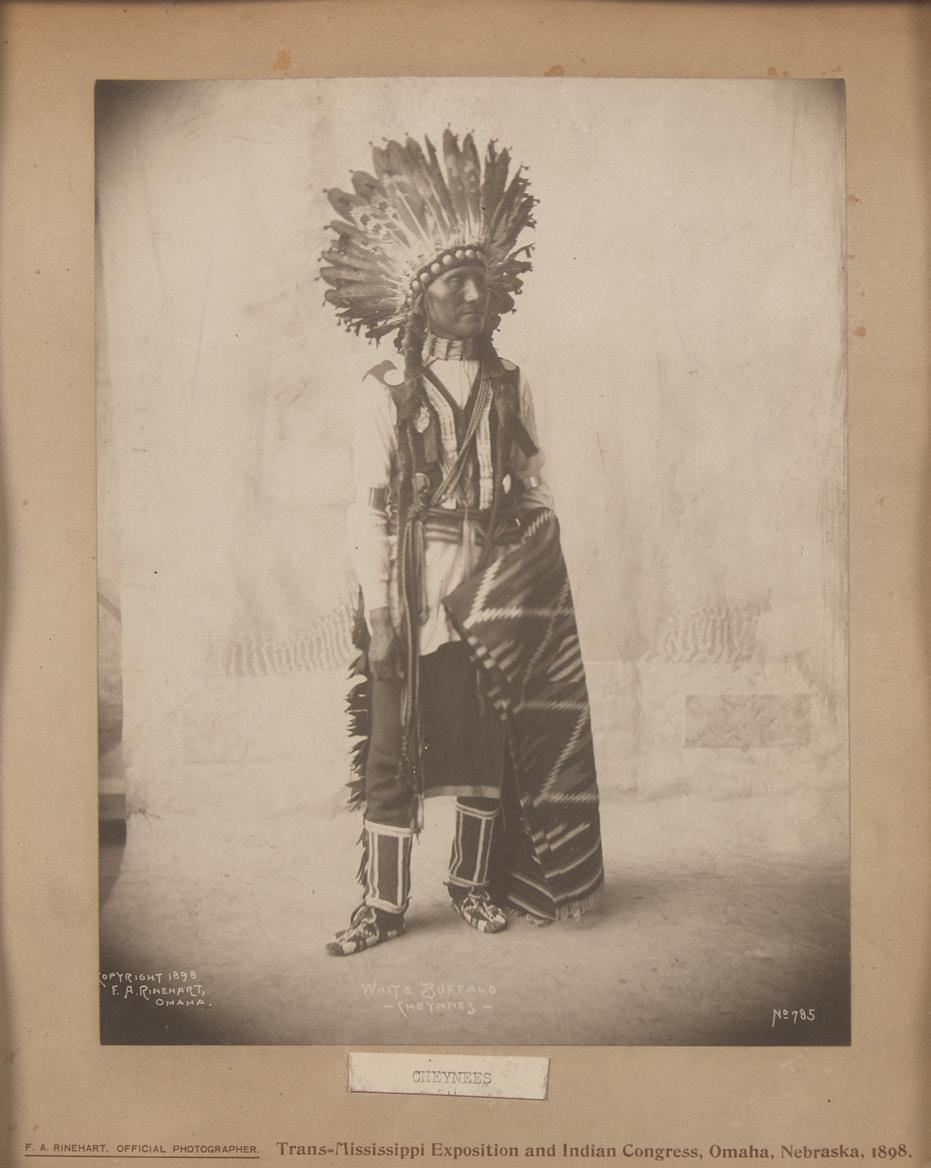
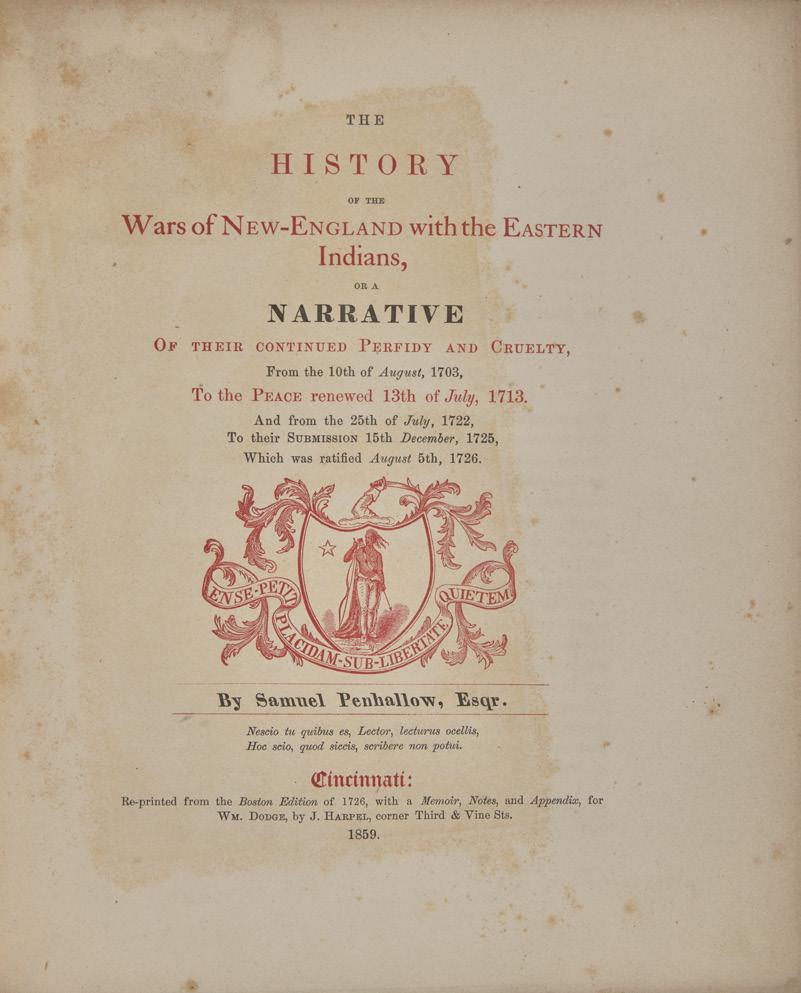

236
[Native-Americana] Penhallow, Samuel. The History of the Wars of New-England with the Eastern Indians..., 1726 (but 1859), with 2 Extremely Rare Colonial American Military Signatures Tipped-in
Cincinnati: Re-printed from the Boston Edition of 1726...for Wm. Dodge, by J. Harpel, 1859. One of 150 copies privately printed. 4to. 7, (4), 10-138, 36 pp., including Appendix (not always found). With two cut signatures mounted to front paste-down (“Samuel Penhallow” and “John Lovewell”). Original quarter linen over blue paper-covered boards, extremities and boards rubbed and worn, spine label perished; text partially unopened; foxing to text.
“The best early summary of New England’s Indian troubles.” (Howes)
Samuel Penhallow (1665-1726) was a Maine colonist and historian during Queen Anne’s and Dummer’s War, who served as commander of Fort Menaskoux during the latter, where he was wounded during the Northeast Coast Campaign (1724).
John Lovewell (1691-1725) was an American militia captain who fought in Father Rale’s War (1722-25), and led three expeditions against the Abenaki in Maine, and killed in the last during the Battle of Pequawket (also known as Lovewell’s Fight).
$500 - 800
237
[Native-Americana] [Sitting Bull] Autograph Letter, Signed by Captain Edmond G. Fechet of the 8th U.S. Cavalry Offering an Account of the Encounter that Ended with the Death of the Famed Lakota Warrior, Sitting Bull, 1890
Fort Yates, North Dakota. December 30, 1890. One sheet, 10 x 7 3/4 in. (254 x 197 mm). Autograph letter, signed by Captain Edmond G. Fechet of the 8th US Cavalry, to Isaac N. Roland. In part: “I am sorry that I cannot comply with your request, as I have nothing of my own to send you. I was too busy when I drove off Sitting Bulls followers from when they had the Indian police penned up, to secure any trophies myself. After the fight was over, some of the police brought me as a present a beautiful buffalo robe, embroidered with porcupine quills which they gave me as a present as it had been the finest Sitting Bull had. I start out with the Cavalry at day light to try and capture the balance of Bull’s band, when I come in again I will see if I cannot get hold of something for you...” Creasing from old folds, closed tears along same; scattered stains.
Captain Edmond G. Fechet of the 8th U.S. Cavalry offers an account of the encounter that ended with the death of famed Lakota warrior, Sitting Bull (1831-1890).
In 1890 Sitting Bull and his Sioux followers had been living on the Standing Rock Reservation, overseen by United States Indian Agent James McLaughlin based at Fort Yates. A year before, the Ghost Dance ceremony began being adopted by many Plains Indian tribes, advocating an end of American westward expansion. United States officials were wary it would lead to a coordinated Indian rebellion, so McLaughlin, fearing that Sitting Bull might join, ordered his arrest that December.
On December 15, over 40 armed police officers entered Sitting Bull’s village, informed him that he was under arrest, and attempted to usher him to Fort Yates. The other Sioux nearby began to surround the officers, and when Sitting Bull refused to comply the tensions erupted. A member of the Sioux fired on the officers, who in turn shot Sitting Bull. Within minutes 14 men were killed or wounded. Sitting Bull’s body was buried at Fort Yates until 1953, when it was exhumed for reinternment near his birthplace in Mobridge, South Dakota.
$500 - 800
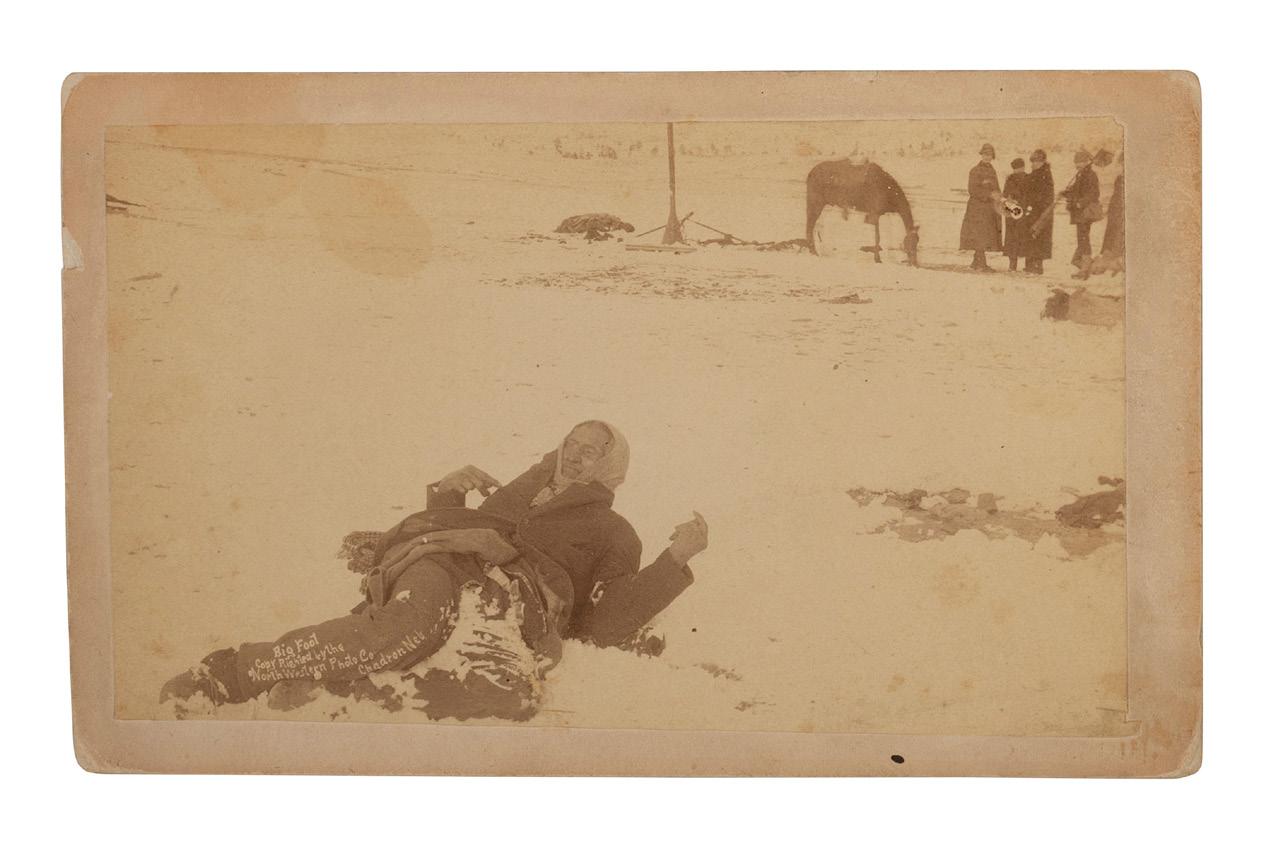
238
[Native-Americana] [Wounded Knee Massacre] Photograph of the Body of Chief Big Foot, ca. 1891
Chadron, Nebraska: Northwestern Photographic Company, ca. 1891. Sepia photograph; 5 1/2 x 7 3/8 in. (140 x 187 mm). Depicting the frozen body of Big Foot on the snow-covered ground at the site of the Wounded Knee Massacre, on January 1, 1891. Titled in the negative, “Big Foot.” Scattered toning and stains.
The Larry Ness Collection of Native American Photography
$400 - 600
239
[Old West] Group of 5 Frontier Newspapers Related to the American West, 1860-86
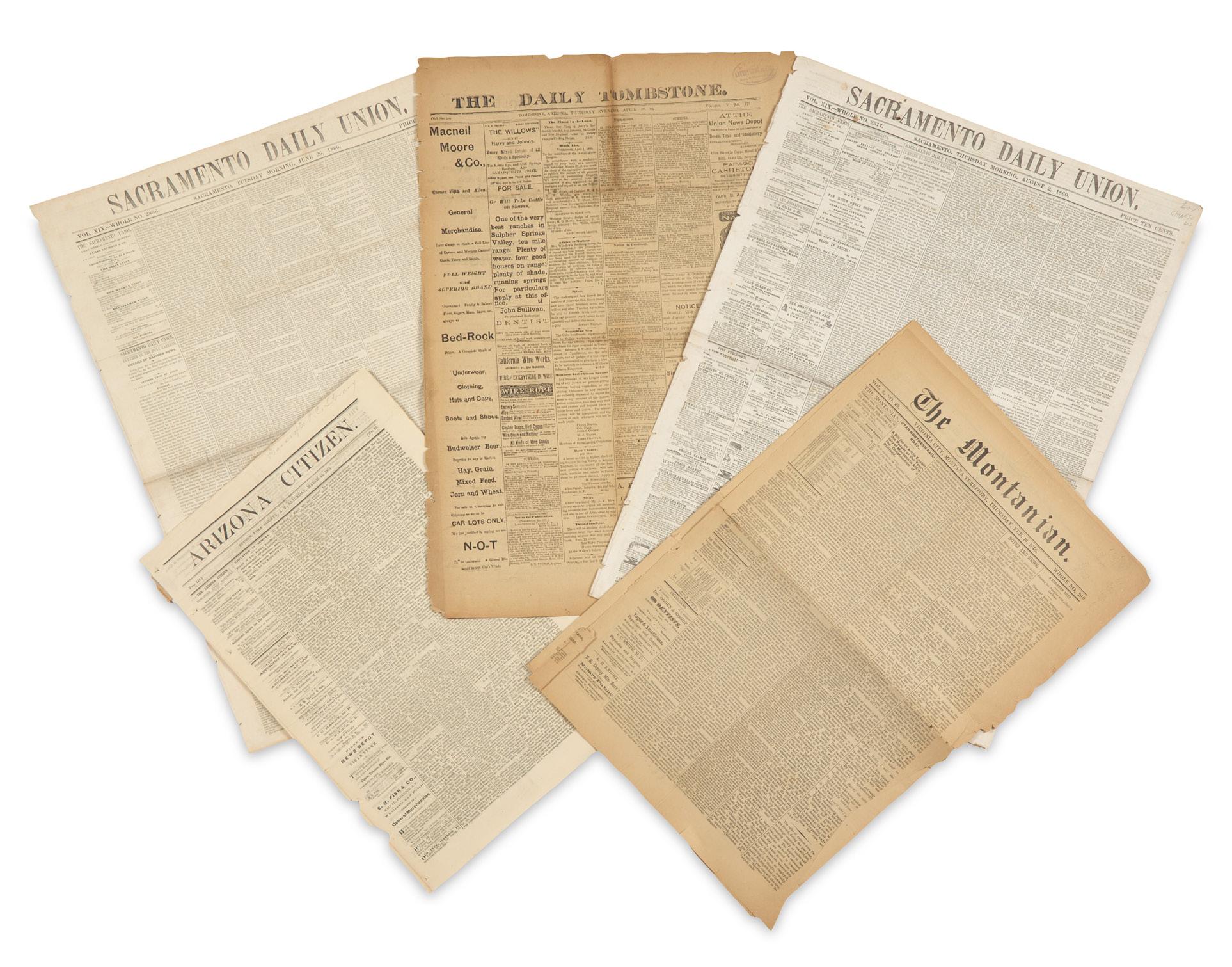
1. Sacramento Daily Union. Sacramento, California. Two issues: June 26 and August 2, 1860 (Vol. XIX, Whole Nos. 2886 and 2917. Folio. Each 4 pp. Each disbound; scattered wear and soiling.
2. Arizona Citizen. Tucson, Arizona. March 15, 1873. Vol. III, No. 23. Folio. 4 pp. Disbound. Old ownership inscription in pencil at top of first page.
3. The Montanian. Virginia City, Montana Territory, February 10, 1876. Vol. 6, No. 29, Whole No. 290. Folio. 8 pp. Disbound; toned; wear and loss along edges; some leaving started or separated.
4. The Daily Tombstone. Tombstone, Arizona, April 29, 1886. Volume V, No. 177. 4 pp. Disbound; toned; wear and losses along edges. With an ad for the O.K. Corral Livery and Feed Stable.
$400 - 600
240
[Old West] A Rare Variant Buffalo Bill Program Insert and a Very Early CDV
Printed Program Insert for Buffalo Bill’s Wild West (Hartford, Connecticut: The Calhoun Printing Company, 1884). Single sheet, being a printed program insert, with lithographed portrait of Cody on verso. Old horizontal crease along center; unevenly toned; abrasions in top edge and top left corner. 8 1/2 x 5 1/2 in. (216 x 140 mm).
Originally included as an insert in a larger chromolithographed program (not included) for Buffalo Bill’s Wild West show for 1884. Also known as a “tip in”, the front features the full program of the show, with events including the grand parade, grand equestrian entree, a Pony Express exhibition, shooting demonstrations by Captain Bogardus and his four sons, a stage coach attacked by Native Americans, a buffalo chase by Cody and Pawnee Indians, and a Native American attack on a settler’s cabin with a rescue by Cody and his men. The program represents the second season of Buffalo Bill’s Wild West with Nate Salsbury as a partner.
Together with:
Early CDV of a Young Buffalo Bill Circa 1870s. Carte de visite of a young and hatless William “Buffalo Bill” Cody; on captioned mount. 4 x 2 3/8 in. (102 x 60 mm).
$800 - 1,200
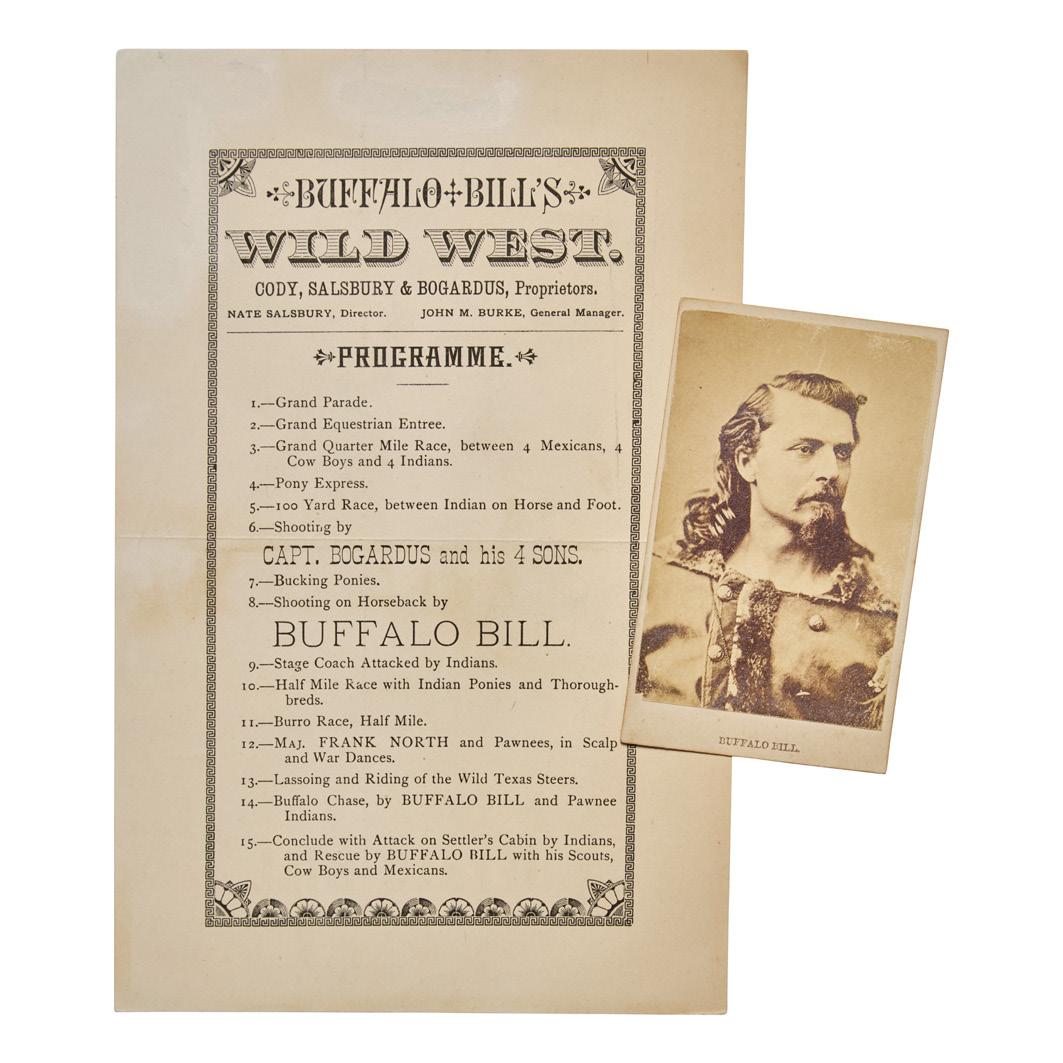
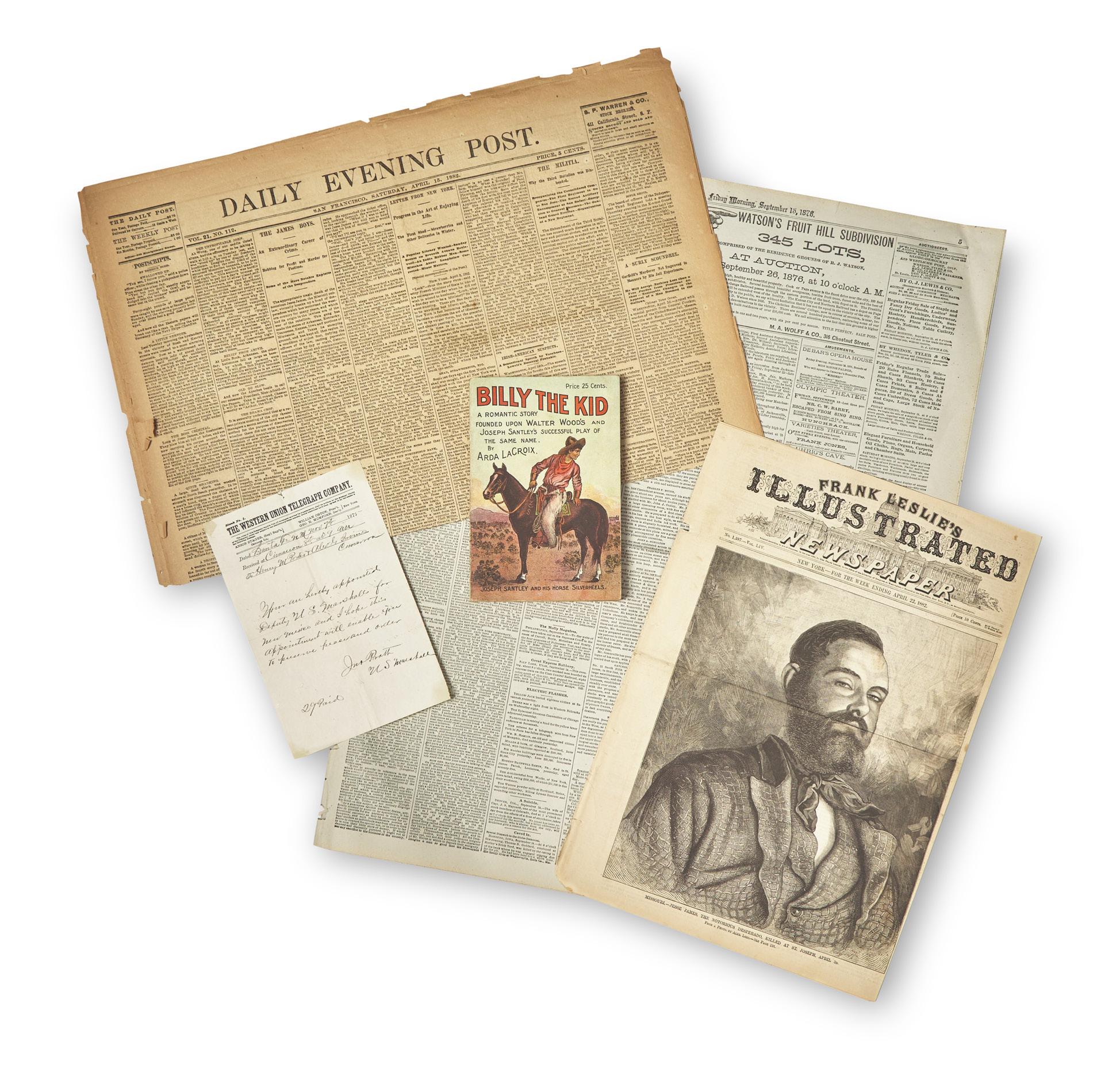
1. Partially-Printed Western Union Telegram. Santa Fe, New Mexico, November 7, 1875. Partially-printed telegram on The Western Union Telegraph Company stationery, accomplished by United States Marshal John Pratt, appointing Henry M. Porter, and Alexander G. Irvine, U.S. Marshals for New Mexico, in order to “preserve pease (sic) and order”.
2. St. Louis Globe-Democrat. St. Louis, Friday Morning, September 15, 1876. Printed newspaper. Folio. 8 pp. Small Secretary of State label on front page; heavily worn along central vertical fold.
Reporting on p. 5 the famous Northfield Bank robbery by the notorious James-Younger Gang. Jesse and Frank James and company (Cole Younger, Jim Younger, Bob Younger, Clell Miller, Bill Chadwell, and Charlie Pitts) attempted the brazen daylight bank robbery in Winona, Minnesota, on September 14. Local citizens, who realized what was happening, sprang into action and a gun fight ensued, with the robbers fleeing. What resulted, as recounted within, was one of the largest manhunts in the history of the United States and the eventual capture of the Younger brothers.
3. Daily Evening Post. San Francisco, Saturday, April 15, 1882. Printed newspaper. Folio. 8 pp. Separated along folds; toned and brittle, chipping and closed tears along edges.
Featuring a front-page two-column report on the exploits of Jesse James and co.: “The James Boys. An Extraordinary Career of Crime. Robbing for Profit and Murder for Pastime. Some of the More Notable Exploits of the Desperadoes.”
4. Frank Leslie’s Illustrated Newspaper. New York, For the Week Ending April 22, 1882. Printed newspaper. Folio. 8 leaves (pp. 129144). Creasing from old folds; scattered soiling; scattered wear along edges.
With a full front-page engraved portrait of Jesse James; a report on his funeral on p. 135; and a full-page engraving depicting the conveyance of his remains, with portraits of the Ford brothers, Robert and Charley.
5. LaCroix, Arda. Billy the Kid. A Romantic Story Founded Upon the Play of the Same Name. New York: J.S. Ogilvie Publishing Company, (1907). 12mo. 128 pp. Original stiff illustrated wrappers. A fine copy.
$500 - 800
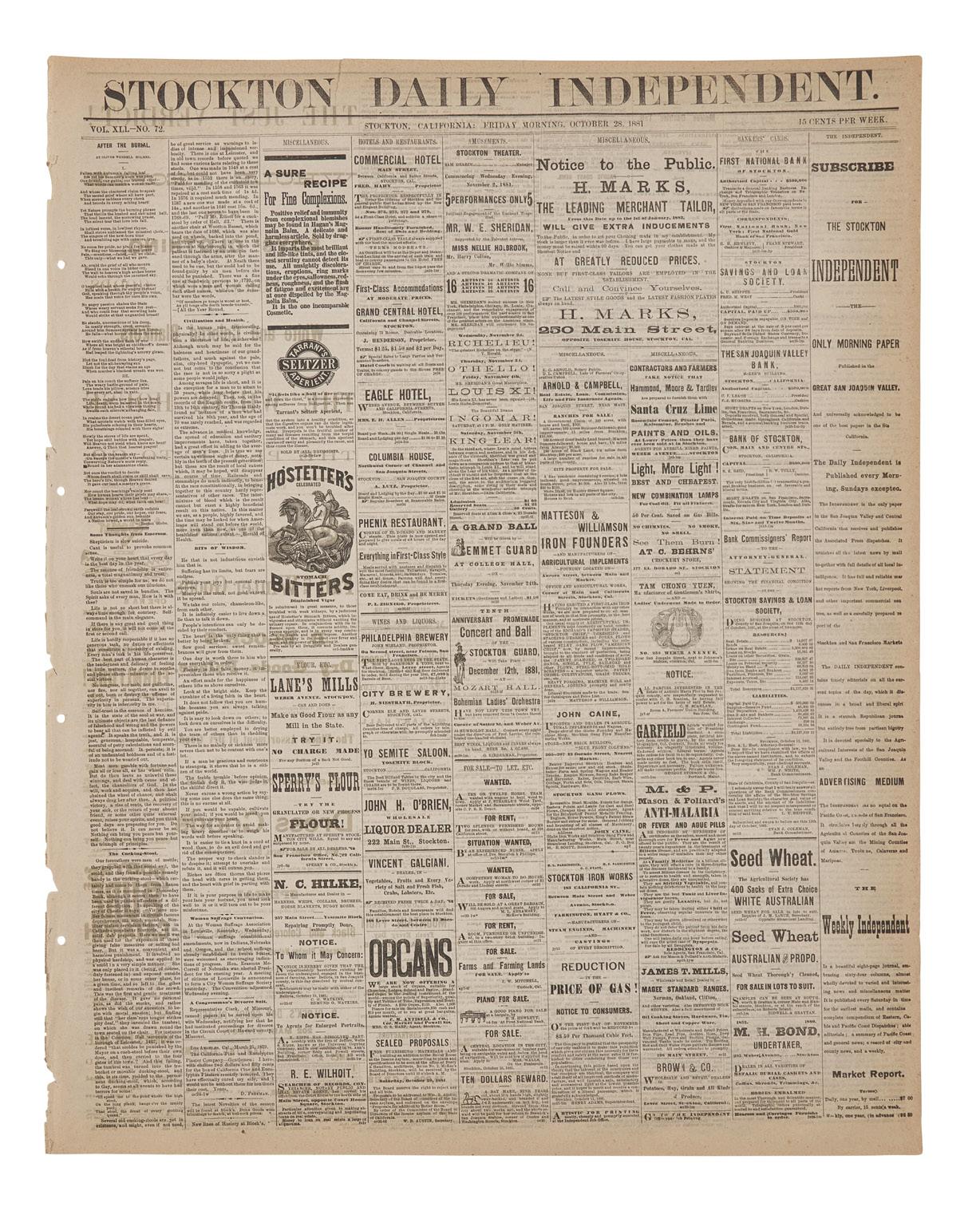
242
[Old West] [O.K. Corral] “A Lively Fight at Tombstone”: California Newspaper Reports the Legendary Gun Fight at the O.K. Corral, 1881
Stockton Daily Independent
Stockton, California, Friday Morning, October 28, 1881. Vol. XLI, No. 72. Printed newspaper. Folio. (4) pp. Disbound; light edge-wear and toning.
Tucked away on the third page is a report on the legendary October 26, 1881 shootout between the Earp brothers and the Clanton-McLaury gang at the O.K. Corral in Tombstone, Arizona: “A Tombstone dispatch of the 26th says: A sanguinary shooting affray occurred on Fremont street this afternoon. Four cow-boys had been in town for a few days past, drinking heavily and making themselves obnoxious by their boisterous conduct. This morning, the City Marshal, V.W. Earp, arrested one for disorderly conduct, and he was fined $25 and disarmed in the Justice’s Court. He left, swearing vengeance on the Sheriff and Marshal Earp ... About three o’clock P. M., the Earp brothers and J. H. Halliday [Doc Holliday] met the four, who drew upon them at once, when a lively fire commenced from the cow-boys against the three citizens. About thirty shots were fired, rapidly. When the smoke of battle cleared away... Jim and Frank McLoury were gasping in the agonies of death. Bill Clarton was mortally wounded and died shortly after. Morgan Earp was wounded in the shoulder...V.W. Earp had a flesh wound... Halliday escaped unhurt...There was great excitement, but no further trouble is anticipated...The Sheriff’s posse is now under arms...”
$600 - 900
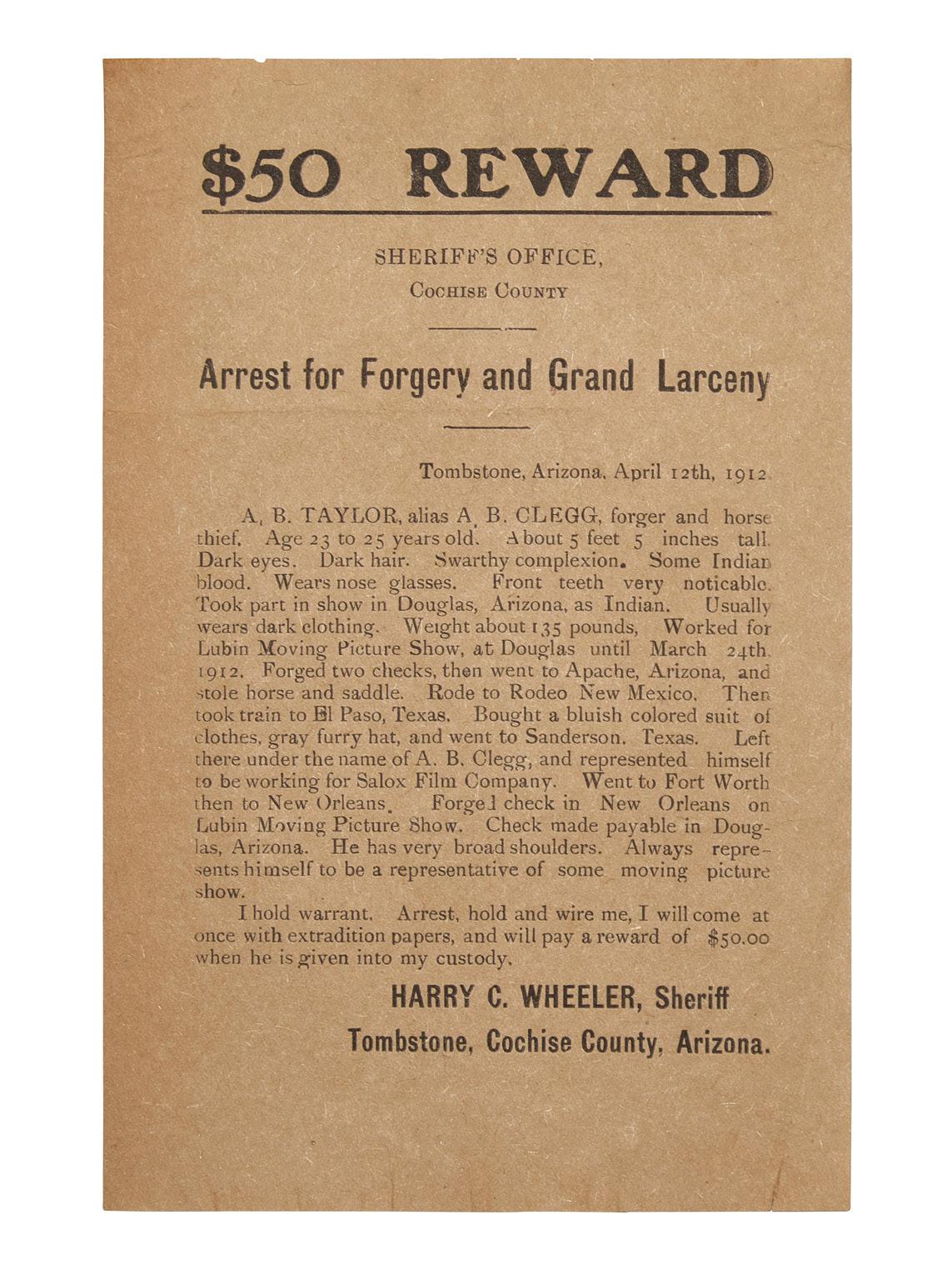
243
[Old West] Tombstone, Arizona $50 Reward Poster for the Arrest of A.B. Taylor, Alias A.B. Clegg, for Forgery and Horse Theft, Issued by Tombstone Sheriff Harry C. Wheeler, with Reference to Early American Cinema
Tombstone, Cochise County, Arizona, April 12, 1912. Printed handbill poster, 8 3/4 x 5 3/4 in. (222 x 146 mm). Toned.
A $50 reward handbill for the arrest of A.B. Taylor, alias A.B. Clegg, for forgery and horse theft, issued by Tombstone sheriff Harry C. Wheeler. The handbill provides a detailed description of Taylor, noting him as “Age 23 to 25 years old. About 5 feet 5 inches tall. Dark eyes. Dark hair. Swarthy complexion. Some Indian blood.” The handbill further notes that Taylor had “worked for Lubin Moving Picture Show...Forged two checks...stole horse and saddle...” and then made his way to New Orleans, where he continued to present himself as a representative of the Lubin Moving Picture Show. Wheeler states, “I hold warrant. Arrest, hold and wire me, I will come at once with extradition papers, and will pay a reward of $50.00 when he is given into my custody.”
A rare survival.
$400 - 600
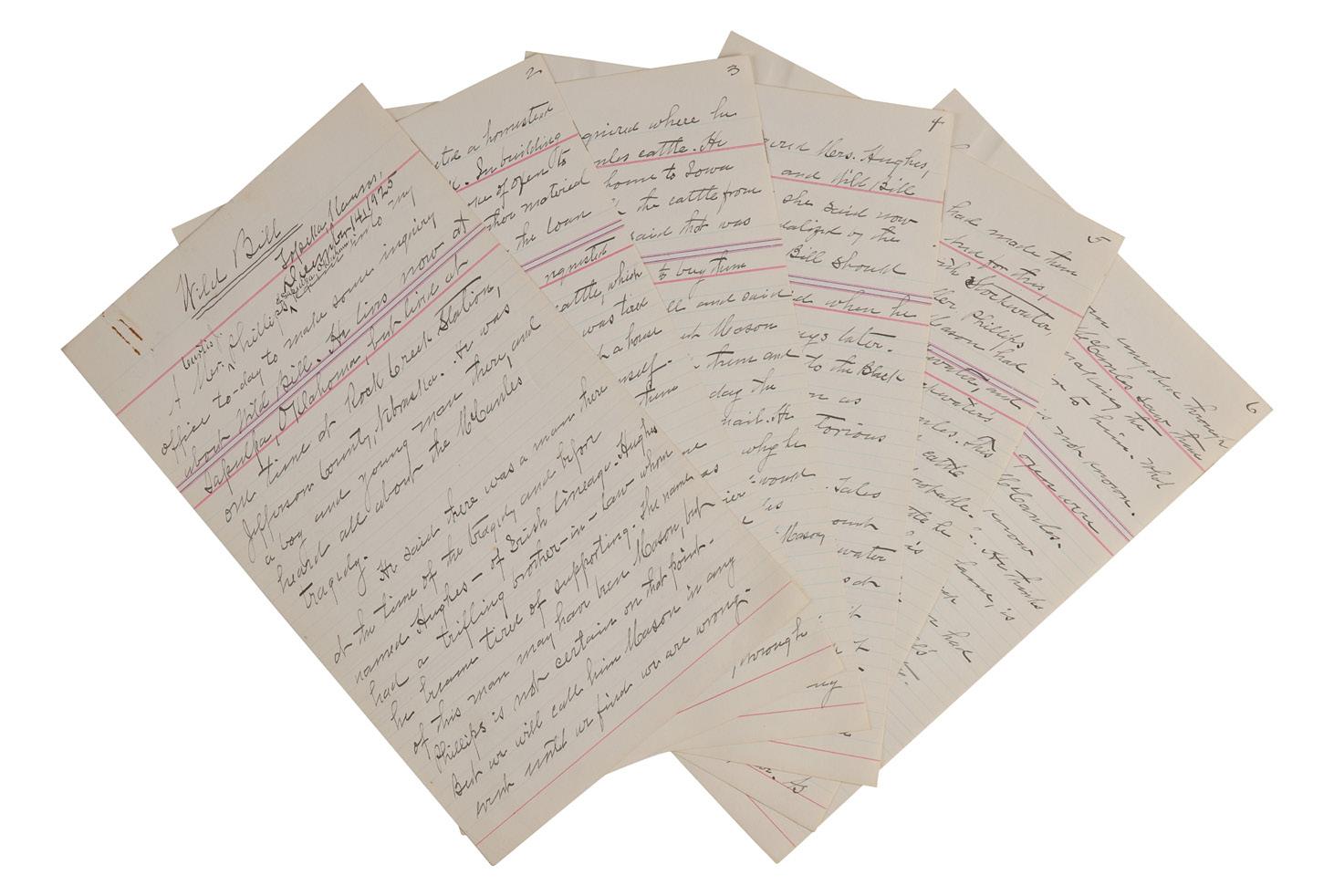
244
[Old West] Autograph Notes on “Wild Bill” Hickok and the McCanles Gang, by Historian William E. Connelley, 1925
Topeka, Kansas, December 14, 1925. Autograph notes on rectos only of six lined sheets, signed by Connelley on final sheet. Residue from removed paperclip in top left corner of first sheet.
William E. Connelley (1855-1930), an American writer, historian, and school teacher, spent 42 years collecting and researching material on James Butler “Wild Bill” Hickok (1837-76), for his posthumously published book, Wild Bill and His Era. As President, and then Secretary, of the Kansas State Historical Society, Connelley had access to a wide trove of documents related to the old American West and gunslinger and folk hero Wild Bill Hickok. Upon Connelley’s death in July 1930, he left behind an extensive manuscript on the frontiersman, which was then completed and published by his daughter. As she indicated in the editor’s note for the book, “Much that is valuable has been removed, and much that was left has been condensed.”
The notes above, penned by Connelley, appear to possibly be one of many vignettes he gathered while researching Wild Bill Hickok (which involved extensive interviews with individuals who knew Hickok directly or indirectly). In this account, Connelley retells the recollections of a Curtis Phillips of Sapulpa, Oklahoma. As a young man, Phillips lived at Rock Creek Station in Jefferson County, Nebraska, the site of Wild Bill’s notorious July 1861 gunfight with the McCanles Gang. Phillips’s story offers perhaps an alternative motive for the shooting. According to Curtis, a man named Hughes lived at the station at the time, along with his “trifling brother-in-law,” Mason. Mason had established a nearby homestead and borrowed cattle from the McCanles brothers. The subsequent events are somewhat unclear, but it appears a postal worker in the area, who had also wanted the cattle, was refused by the McCanles gang. In response, the gang had Mason arrested for cattle theft. This arrest enraged Mrs. Hughes, Mason’s sister. Connelley notes that she and Wild Bill were close friends. Feeling scandalized by her brother’s arrest, she urged Bill to seek revenge, and Bill obliged by killing McCanles a few days later.
$300 - 500
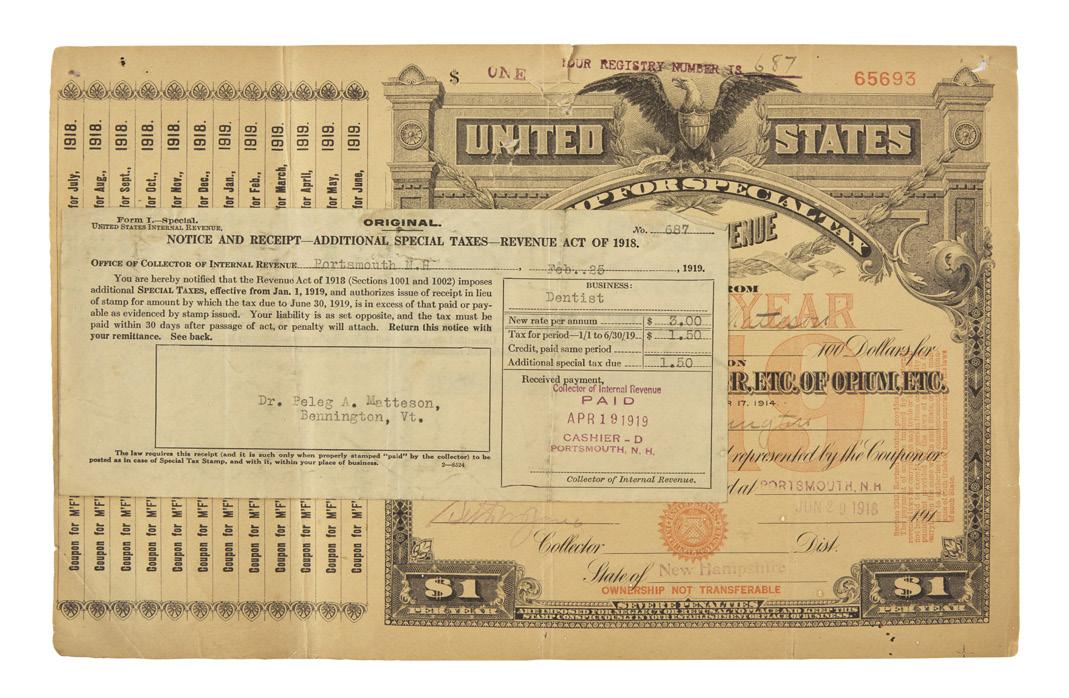
245
[Opium] Fine Engraved IRS Special Tax Document for the Sale of Opium, ca. 1918-1919
Bennington, Vermont, 1918-1919. Engraved Internal Revenue Service $1 special tax document on “Manufacturer, Distributor, Etc. of Opium, Etc.”, received from a dentist Dr. Peleg A. Matteson of Bennington, Vermont, stamp dated June 29, 1918; additional oblong IRS printed slip adhered to recto, “Notice and Receipt--Additional Special Taxes--Revenue Act of 1918”, stamped dated April 19, 1919, and totaling $3. Creasing from old folds, scattered edge-wear.
A fine IRS special tax certificate for the sale of opium. The Harrison Narcotics Act of 1914 required individuals producing, importing, manufacturing, or dispensing (such as physicians or doctors) opium or cocoa leaves to register with the IRS and pay a special tax. The Revenue Act of 1918 raised the tax rate for the same, and removed exemptions for doctors.
$300 - 500
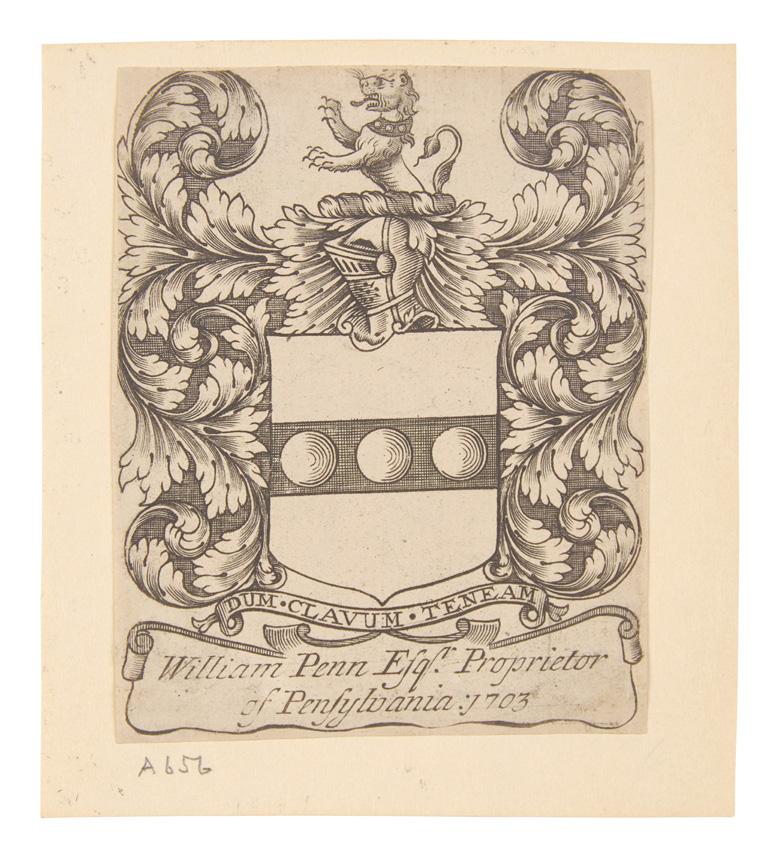
246
[Penn, William] Engraved Armorial Book-Plate of William Penn, Proprietor of Pennsylvania, ca. 1703 (Philadelphia), ca. 1703. Engraved armorial book-plate of William Penn, Proprietor of Pennsylvania. 3 1/2 x 3 in. Scattered light stains; mounted to a larger card.
William Penn (1644-1718) was an English writer and theologian who in 1681 was granted a land charter by King Charles II to repay a debt owed by the king to Penn’s father, creating what the King would name Pennsylvania. The following year Penn founded Philadelphia, which in later years would become the birthplace of the United States of America.
$800 - 1,200
247
[Philadelphia Independence Hall] Pay Order for the Doorkeeper of Independence Hall in the Heat of the American Revolution, Signed by Joseph Reed
Philadelphia, May 2, 1780. Single sheet, 11 1/2 x 7 1/4 in. (292 x 184 mm). Manuscript document, signed by President of the Supreme Executive Council of Pennsylvania Joseph Reed (“Jos. Reed Presidt”), ordering Treasurer David Rittenhouse to pay Frederick Sneider for his wages (“three hundred and fifty five pounds twelve shillings and six pence”) for his services as doorkeeper to the Council Room at the Pennsylvania State House; listing at top his various sundry expenses. Docketed on verso. Creasing from old folds; chipping along bottom edge affecting some letters, including of “Presidt” in Reed’s signature; sheet toned.
Joseph Reed (1741-85) was an American politician who in 1778 was one of the first signatories of the Articles of Confederation. Later that year he was elected President of the Supreme Executive Council, or governor, of Pennsylvania, where he oversaw the gradual abolition of slavery. During this time Reed also became involved in a vicious and highly public dispute with Benedict Arnold, who Reed accused of using his position as military commander of Philadelphia to profit from war-related shipments and supply movements. Eventually, Reed publicly charged Arnold with corruption, leading to Arnold requesting a court-martial from Washington to clear his name. Though Arnold was able to do so, the trial damaged his reputation and led to Arnold committing treason against the United States. During this time Reed also waged a fierce campaign against Loyalist citizens of Pennsylvania, advocating that their property be seized and treason charges be levied against them. He was elected to the Continental Congress a second time in 1784 but declined due to ill health. He died the following year at the age of 43.
Construction began on the Pennsylvania State House in 1732 after a design by Edmund Woolley and Andrew Hamilton. It was completed nearly twenty-one years later, largely due to payments being made in installments over such a long period of time. On June 14, 1775, delegates of the Continental Congress established the Continental Army, and a little over a year later the Declaration of Independence was unanimously approved within its walls, with the Declaration read for the first time just outside in what is now Independence Square. The Continental Congress continued to meet there until December 12, when the approaching British Army forced their evacuation. They returned briefly in 1777 and permanently, from 1778 to 1781.
$800 - 1,200
248
[Perry, Commodore Matthew C.] Manuscript Plan of the Berth Deck of the USS Macedonian, 1852
(Possibly Brooklyn, New York), 1852. Single oblong sheet of translucent paper, 10 1/4 x 36 in. (260 x 914 mm). Manuscript plan of the “Berth Deck” of the USS Macedonian, in black, red, and brown ink, as well as pencil; manuscript notations in ink and pencil; initialed at top; scattered soiling.
In 1852, the USS Macedonian was docked at the Brooklyn Navy Yard to be converted to a sloop-of-war for an expedition to Japan to open foreign trade. The ship was assigned to Commodore Matthew C. Perry›s East India Squadron and put under the command of Captain Joel Abbott. She was one of the American ships to arrive off Uraga, Japan on February 13, 1854, during Perry›s second expedition to Japan. The Treaty of Kanagawa, negotiated by Perry and the Tokugawa Shogunate, was signed on March 31, 1854, and ended Japan›s 220-year-old policy of isolation. Following this, the Macedonian patrolled the north Pacific, from 1854-61, and served with the Home Squadron in the Mediterranean and the Caribbean.
$1,500 - 2,500
249
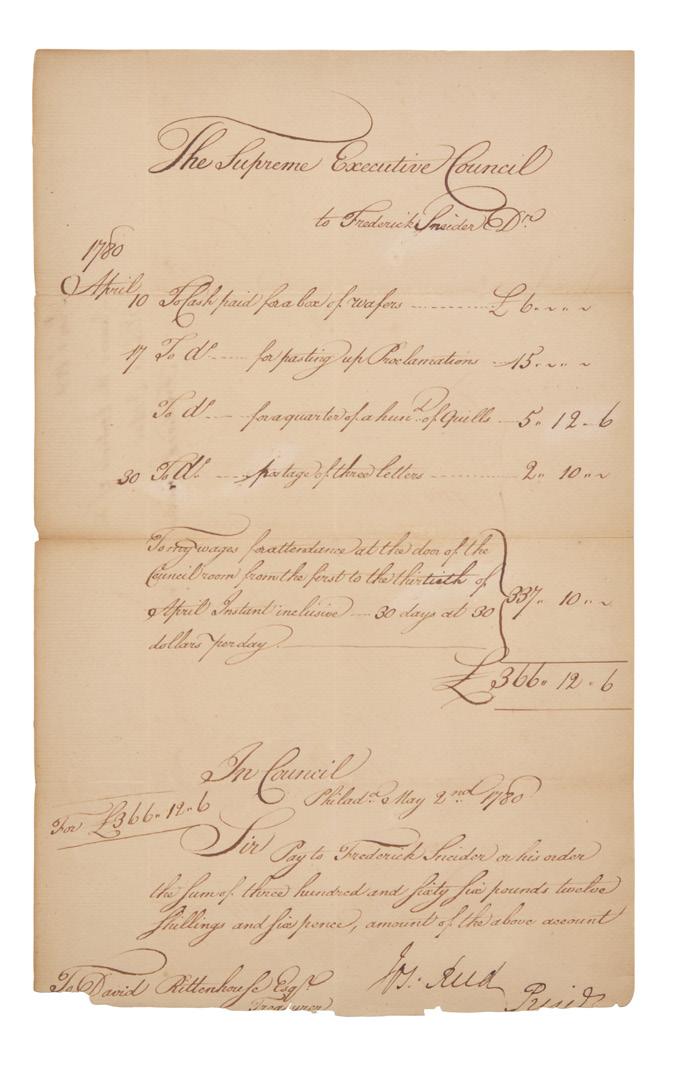
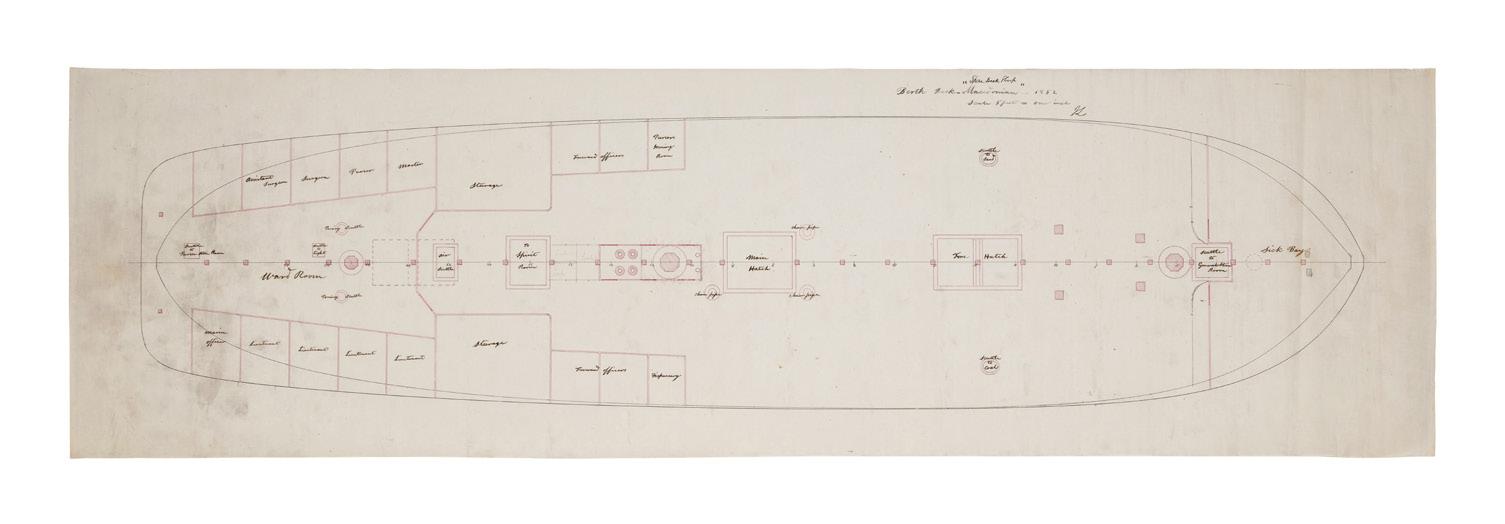
[Piracy] Autograph Letter, Signed by a Representative of Cape May County to New Jersey Governor Jonathan Belcher, Regarding Enemy Privateers Along the Coast of North America and Cape May, 1747
Burlington, New Jersey, August 20, 1747. Single sheet, 12 1/2 x 7 1/2 in. (317 x 190 mm). Autograph letter, signed by Jacob Spicer, representative of Cape May County in the New Jersey House of Assembly, to New Jersey Governor Jonathan Belcher, regarding enemy privateers along the coast of North America and Cape May, and requesting the Governor to take action to help ameliorate the situation. Creasing from old folds, largely separated along central vertical fold; scattered soiling and edge-wear.
Jacob Spier (1717-65) was a prominent Cape May County merchant and farmer who represented Cape May County in the New Jersey House of Assembly from 1744 until his death in 1765. This letter, regarding enemy privateers, relates to the then ongoing King George’s War (1744-48), the third great colonial North American conflict between Great Britain and France. Here, Spicer, on behalf of his constituents, urges New Jersey Governor Belcher to take action against the privateers.
Lot includes two volumes with articles related to piracy and privateers: The Political State for the Month of August, 1729 (see pp. 127-128), 12mo, disbound; Hall, John E. The American Law Journal and Miscellaneous Repertory (Philadelphia: Farrand and Nicholas, 1810), 8vo, library buckram.
$400 - 600
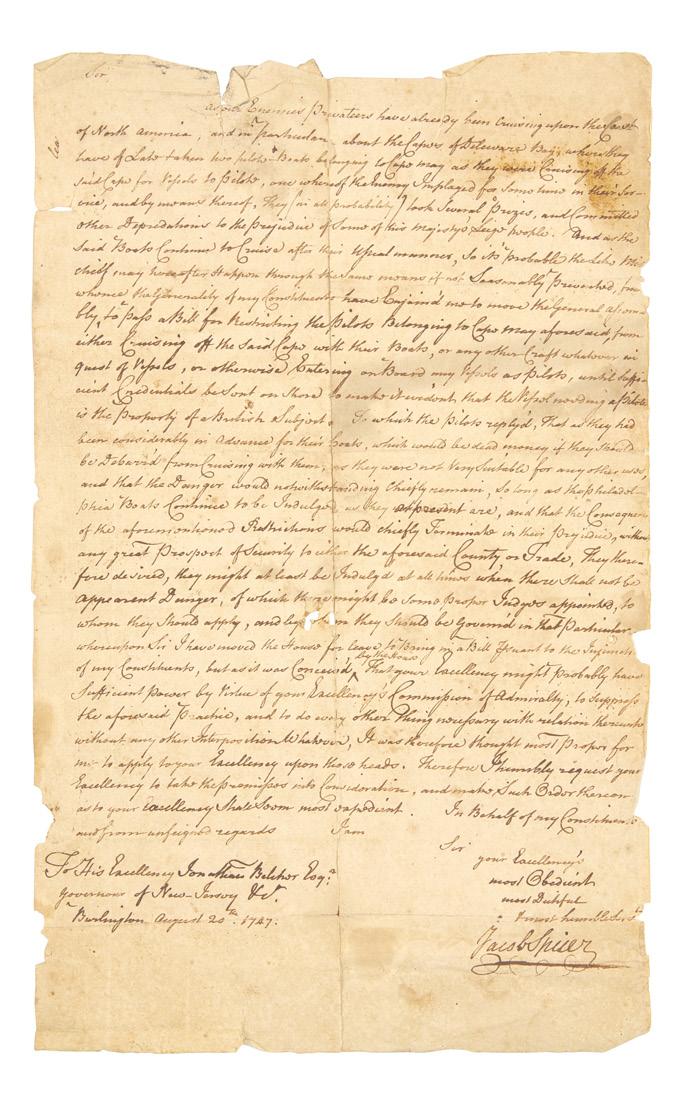
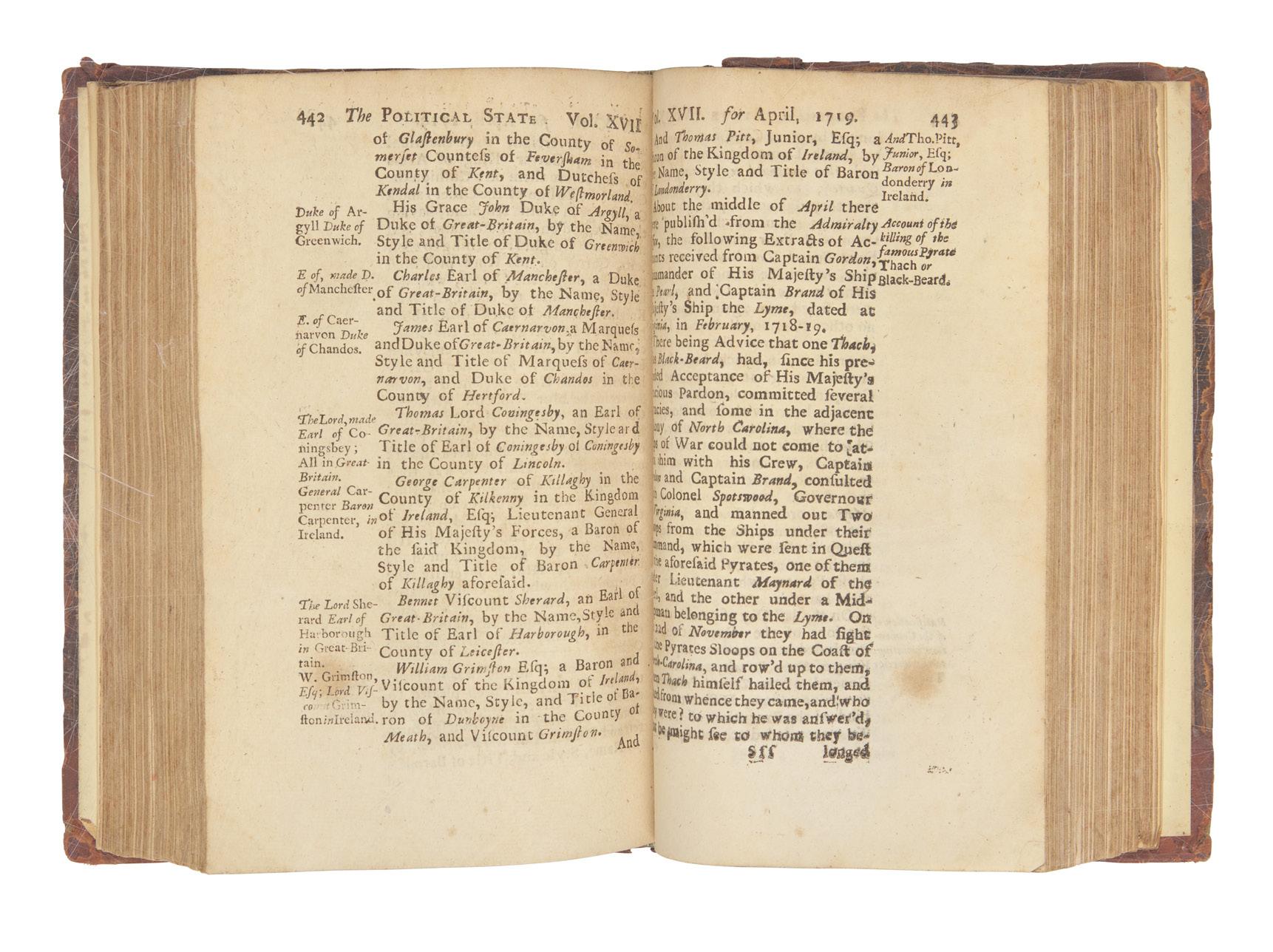
250 [Piracy] Scarce Contemporary Account of the Death of Infamous Pirate Blackbeard, 1719
The Political State of Great-Britain
London: Printed for the Author, and Sold by Tho. Warner, and A. Rocayrol, 1719. Volume XVII; six monthly issues, January-June. First edition. 8vo. (x), 658 pp. (erratic pagination). Full contemporary partially speckled brown calf, red morocco onlay on front board, the latter stamped in blind and in gilt “Secretary’s Office V:T: Foreign Office”, “Foreign Office” stamped in blind on rear board, rebacked, red and black morocco spine labels, extremities and joints rubbed and worn, chipping along spine, library paper label at foot of spine; red speckled edges; Foreign Office Library book-plate on front paste-down; ink stamp on title-page recto and verso; foxing at front and rear; creasing in bottom corner of some leaves at rear.
Pages 443–444 feature an excerpt from a Royal Admiralty report detailing the death of the infamous English pirate Edward Teach (also known as Thatch, Thache, or Thack), better known as Blackbeard (ca. 1680–1718), at the hands of the Royal Navy. While details of his early life remain scarce, it is believed Teach began as a privateer before turning to piracy under the mentorship of Captain Benjamin Hornigold, a prominent Caribbean pirate. Promoted to captain by Hornigold in 1716, by the following year Teach commanded his own flagship, Queen Anne’s Revenge, a captured French slave ship, and terrorized the West Indies. His escapades soon extended to North America. In 1718, he blockaded the port of Charleston, securing a ransom from the colonial government in exchange for halting his attacks. Although he briefly accepted a royal pardon and surrendered to the North Carolina governor, he quickly resumed his piratical ways. Ultimately, Virginia Governor Alexander Spotswood organized a force to capture Blackbeard, dead or alive, to finally end his reign of terror.
What followed is reported within, and reads in part: “Captain Gordon and Captain Brand, consulted with Colonel Spotswood...and manned out Two Sloops from the Ships under their Command, which were sent in Quest of the aforesaid Pyrates, one of them under Lieutenant Maynard of the Pearl...On the 22d of November they had sight of the Pyrates Sloops on the Coast of NorthCarolina, and row’d up to them, when Thach himself hailed them, and asked from whence they came, and who they were? to which he was answer›d, that he might see to whom they belonged by their Colours: Thereupon he drank Damnation to them, and said, that he would neither take nor give Quarter; to which they answered, that they did not expect, nor would give any; upon which he fired upon them with Four three Pounders, and Four Swivel Guns loaded with Small Shot...The Fire continued between them for the space of an Hour, in which Time he killed or wounded great part of the Sloops Companies; but at length they clapp›d him on board with both Sloops, and behaving themselves gallantly, killed Thach himself, and Nine of his Men...after the Action was over, Lieutenant Maynard ordered Thach’s Head to be cut off, which he hung under the Boltsprit of his Sloop, and carried it in that manner to Virginia, where those Pyrates who had been taken were hanged.”
According to RBH, only one other copy of this issue has come to auction.
$5,000 - 8,000
251
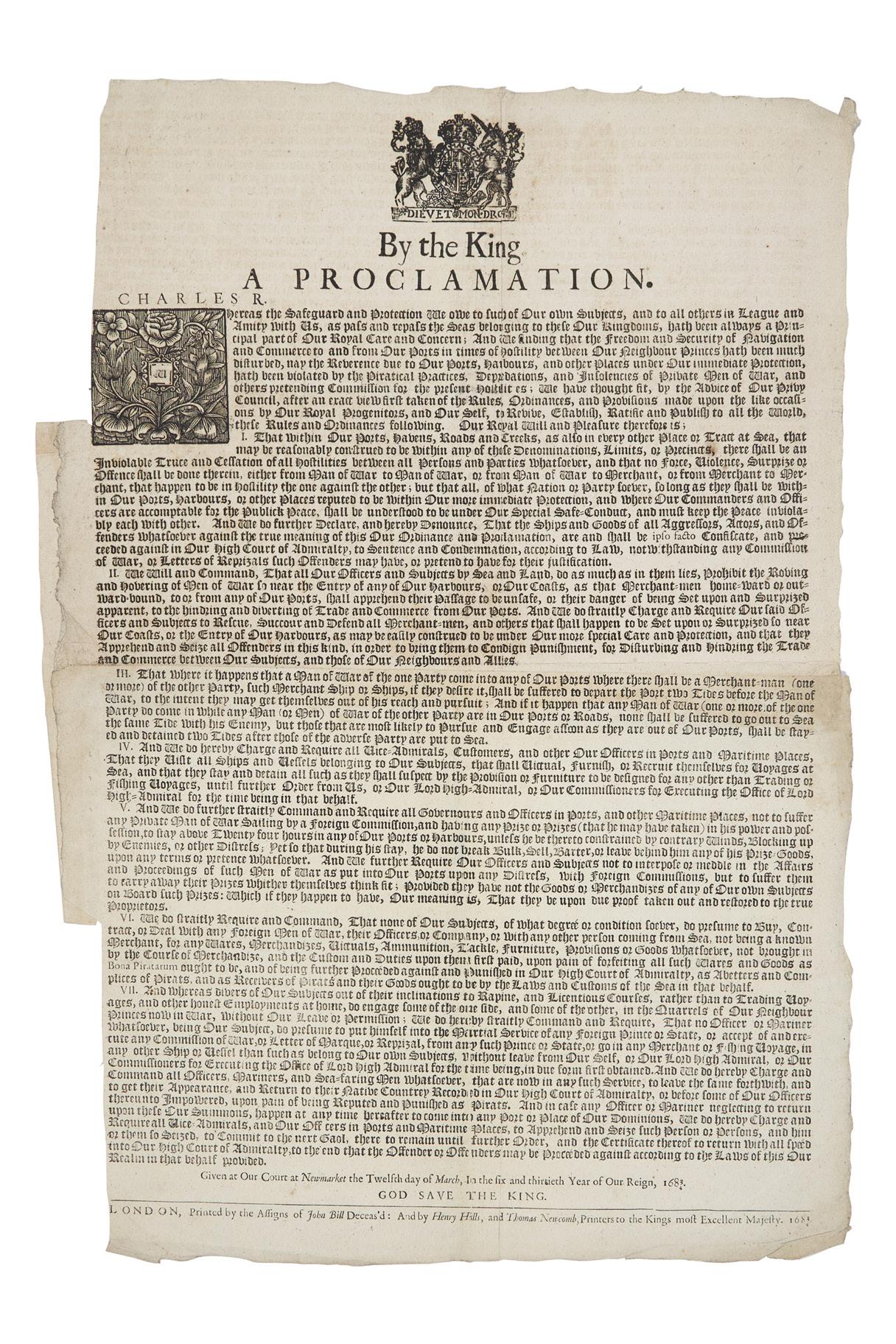
[Piracy] Rare Royal Proclamation Broadside, Issued by King Charles II During the Golden Age of Piracy, Establishing Strict Regulations for Maritime Trade and Navigation to curb the Piratical Practices, Depredations, and Insolences of Private Men of War, March 12, 1683/84
London: Printed by the Assigns of John Bill, and by Henry Hills, and Thomas Newcomb, March 12, 1683/84. Printed broadside, comprised of two sheets; 22 x 15 in. (559 x 381 mm). Large woodcut initial and woodcut royal arms. Creasing from old folds; upper and lower left edge trimmed to text, repair at center of same. Steele, I 3757; ESTC R213166
This rare royal proclamation, issued by King Charles II during the golden age of piracy, establishes strict regulations for maritime trade and navigation in order to curb “the Piratical Practices, Depredations, and Insolencies (sic) of Private Men of War, and others pretending Commission.” Although applicable throughout the English realm, the decree was prompted by a surge of unsanctioned piracy in the Caribbean and along the North Atlantic, which was disrupting English commerce and threatening to violate the 1670 treaty between England and Spain that had resolved territorial disputes in the Americas.
This document outlines seven specific mandates, such as requiring neutrality within ports and areas under British protection, forbidding men of war from cruising near English coasts, dictating how warships must behave toward merchant vessels while in port, and ordering Vice Admirals and other officers to inspect and confiscate ships suspected of privateering. The proclamation also clarifies the rights of foreign privateers and their cargo, while forbidding English subjects from trading with unauthorized vessels, and banning English citizens from serving on ships belonging to foreign princes or states, commanding any currently doing so to return to English service immediately, “upon pain of being Reputed and Punished as Pirats (sic).”
We cannot locate another copy on RBH as having come to auction. ESTC locates only four other copies in the United States, and 14 copies in the United Kingdom and Ireland.
$3,000 - 5,000
252
[Queen Anne’s War] Extraordinarily Large Manuscript Petition Signed by a Who›s Who of Colonial New York Accomplished on Vellum to Queen Anne from the Colony of New York Seeking Reimbursement for a Failed Conquest of New France, November 12, 1709, With Reference to William Penn›s Proprietary Colony of Pennsylvania
“We your Majesties most Dutifull and Loyall Subjects...fore securing the frontier against the French, this Governm’t was drained... we mention this not only to demonstrate that wither this inequality nor the disregard Pensylvania had for your Majesties Command in not furnishing so much as one Man caused any obstructions in our Punctuality Complying and not overexceeding our quota for the Expedition... That at the Intire Charge of this Colony and by the people thereof upwards of One hundred Battoes and as many Burch Canoes were built, capable to have received and Transported all the Army with their Stores and Provisions, That the fforts at Stillwater and the great Carrying place with the Store houses therein, were likewise built at our Charge before any of the Neighbouring Troops came there, That the Great ffort at the Wood Creek with the Severall Blockhouses and Store houses therein, was Cheifly built at the Charge of this Governm’t. That all the Stores and provisions were at the Charge of this Colony Transported not only to Albany but from thence thorrow many difficult passages by Land and water to the Great Carrying place being about Seaventy Miles, that besides the Troops raised and provided for by this Colony, they furnished at their own Charge provisions for your Maj’ties Regular fforces, and for Six hundred of the four Nations and River Indians . . . And that besides the s’d Indians, their wifes and Children being upwards of One Thousand were Vitualled a Considerable time at Albany at the only Charge of this Colony, and so were likewise all the Severall Messages for Engaging them in the Expedition all which Charges amounting to upwards of Six Thousand Pounds wee were the Readier to lay on this Governm’t by reason Collo. Nicholson and Collo Vetch Assured us, that your Maj’tie would Reimburse us”
New York, November 12, 1709. Manuscript document on vellum, in a secretarial hand, and signed by the Lieutenant Governor of New York, Richard Ingoldsby, and 25 members of the New York and New Jersey Provincial Assemblies, seeking reimbursement for an abandoned military assault against French Canada during Queen Anne’s War, and detailing at length the preparations made by the colony at their own expense. Among the signers of this petition are: Col. Pieter Schuyler, first mayor of Albany, Commissioner of Indian Affairs, and later governor of New York; councilman Rip Van Dam; William Nicoll, speaker of the New York General Assembly; David Provost, 24th Mayor of New York; Ebenezer Willson, 29th Mayor of New York; Johannes Jansen, 35th Mayor of New York; Roger Mompesson, Chief Justice of New Jersey, and member of both the New Jersey and New York Council; Robert Livingston, First Lord of Livingston Manor, Secretary of Indian Affairs, and member of the New York General Assembly; councilman Kilian Van Rensselaer; councilman John Barberie; councilman Adolph Philipse; Peter Herring, Johan Hardenbrook, Cornelius Sebring, John Cuyler, Hendrick Beekman, John Stillwell, Hendrick Van Rensselaer, John Van Horne, and others. Dampstaining in center of document, affecting some text. 27 1/8 x 23 1/8 in. (689 x 587 mm).
An important and unique early colonial document, being a petition adopted by the Assembly of the Colony of New York, presented to Queen Anne of Great Britain (1665-1714) seeking reimbursement for expenses and resources provided by them for a failed military adventure to conquer French Canada during Queen Anne’s War (1702-13).
Following the death of Spanish King Charles II in 1700 and the subsequent outbreak of the War of the Spanish Succession in Europe, long-simmering rivalries between the British and French in North America, fueled by trade competition and alliances with Indigenous nations, reached a boiling point. Violent raids and bloody clashes erupted along the poorly defined frontiers of New York and New England. Although both empires initially hesitated to engage in full-scale conflict for fear of disrupting the lucrative fur trade and destabilizing their delicate alliances with the Iroquois and other Native groups, by 1708, the British government grew increasingly pessimistic about its defensive policy. In 1709, colonial leaders Francis Nicholson and Samuel Vetch proposed an ambitious strategy to invade and conquer New France (modern-day Canada). Backed by Queen Anne, the plan mobilized resources and troops from various North American colonies, including New York. The operation was designed as a two-pronged assault: an overland march on Montreal paired with a simultaneous naval attack on Quebec. With colonial cooperation, by autumn, forces were assembled and awaiting the arrival of a British fleet to launch the campaign. By July 1709, however, British strategic priorities shifted. Deeming the European theater more critical to the wider war, the Crown abruptly canceled the Canadian invasion and redirected the incoming fleet to Portugal. This decision was not communicated to the colonial troops until October, and led to a disastrous retreat. Many soldiers deserted their posts and dismantled their fortifications, leaving the Albany frontier virtually undefended. When Robert Hunter assumed the governorship of New York in 1710, he discovered that the state treasury had been nearly exhausted by the costly and ultimately abandoned military preparations of the previous year.
Later in 1709, Vetch and Nicholson were sent to Great Britain to urge the Crown to plan a new assault to take New France, but the British government viewed the undertaking as too daunting and uncertain. A smaller and more manageable plan to invade Nova Scotia was instead approved, and by the summer of 1710 the British had successfully taken control of Port Royal (present-day Nova Scotia). This marked the end of French rule in peninsular Acadia, and the territory became a persistent point of struggle until the British success in the Seven Years’ War over 40 years later.
$8,000 - 12,000
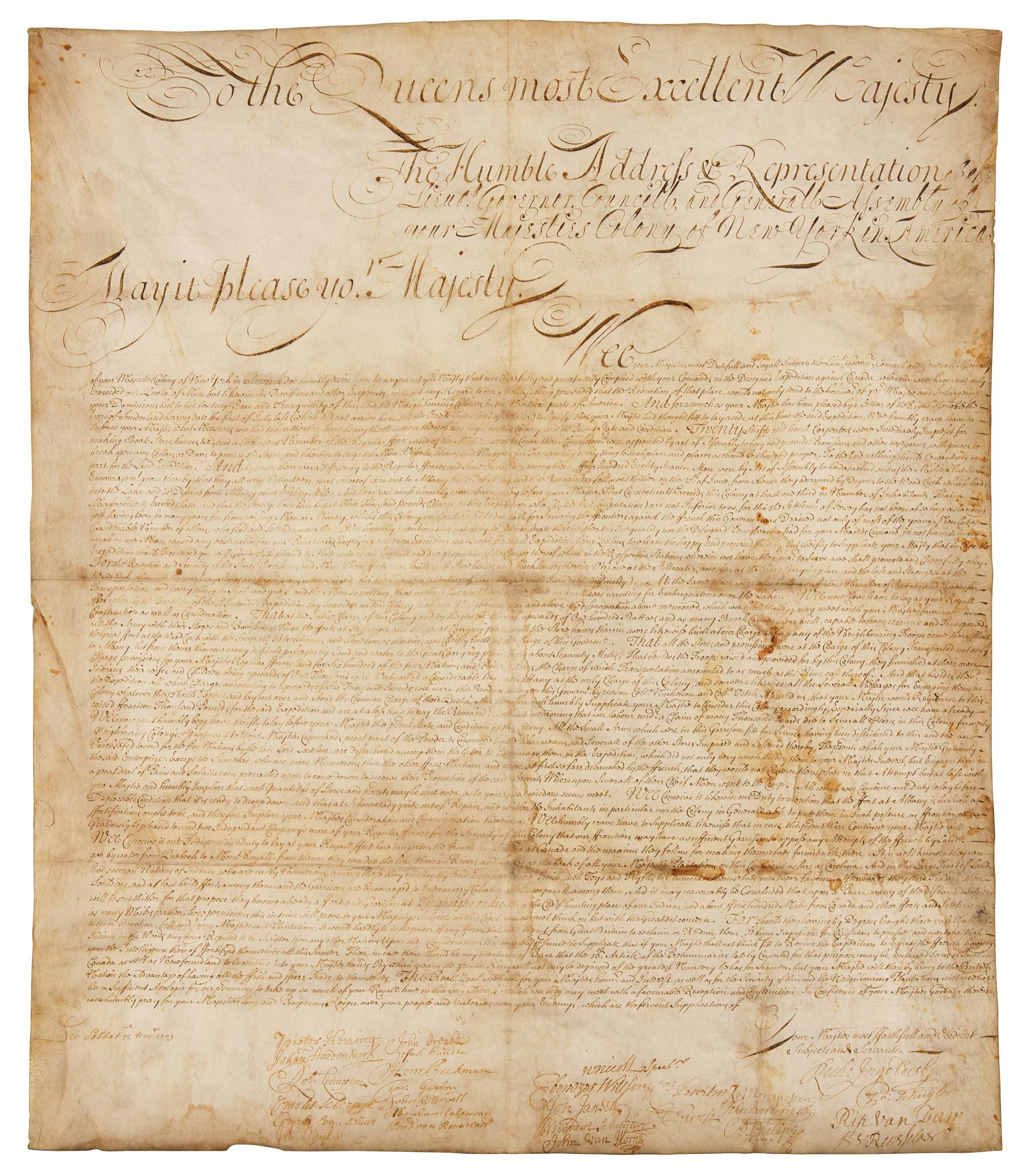
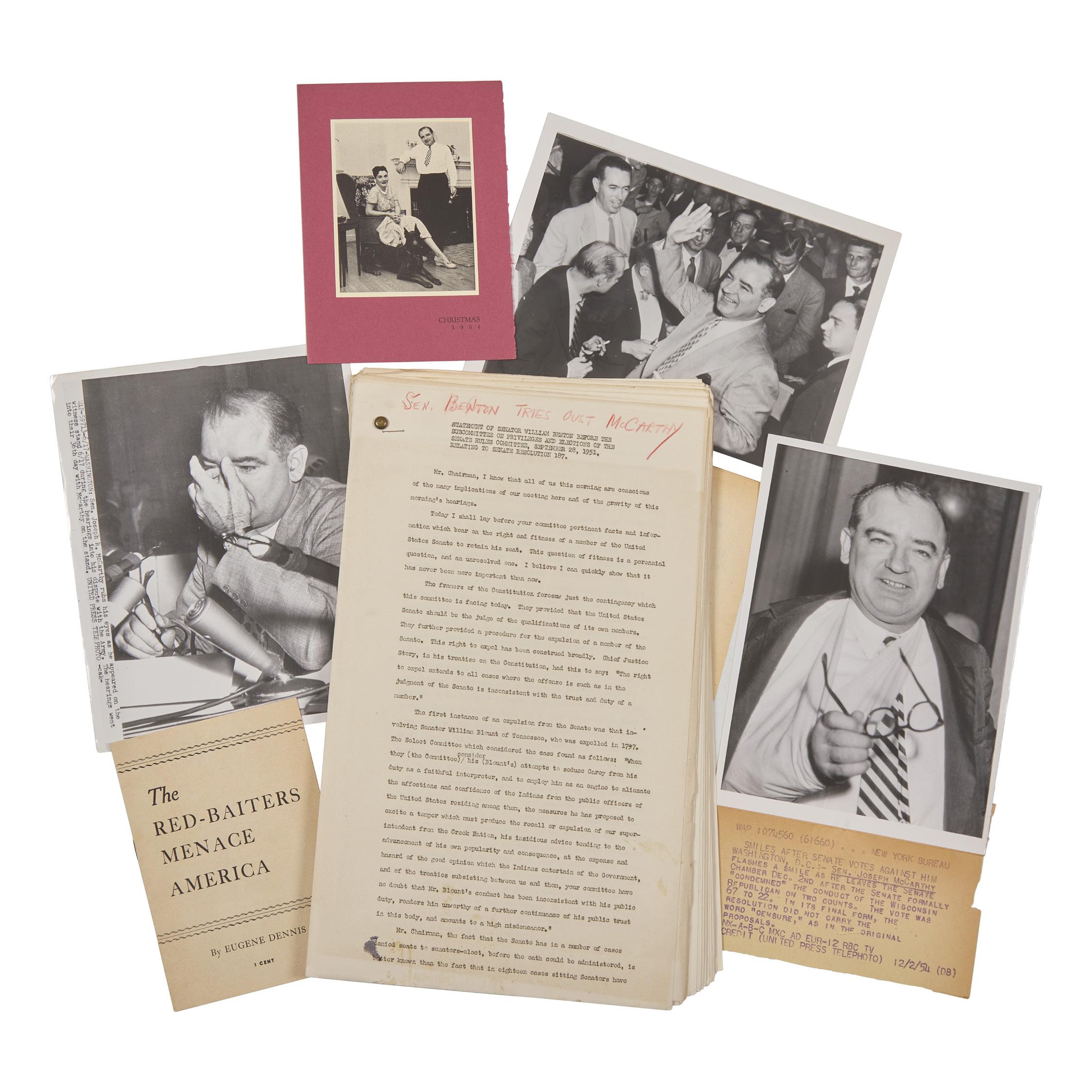
Locations vary, ca. 1946-54. Group of six items related to Senator Joseph McCarthy and the Red Scare, including, a 1954 Christmas card signed in print by McCarthy and his wife, with a mounted black and white image of them; The Red-Baiters Menace America, by Eugene Dennis, a twelve page political pamphlet, ca. 1946; a 59-page typescript titled “Statement of Senator William Benton Before the Subcommittee on Privileges and Election of the Senate Rules Committee, September 28, 1951, Relation to Senate Resolution 187.”; three black and white press photographs of Joseph McCarthy. Condition varies, generally fine.
Beginning in 1950, Republican Senator Joseph McCarthy (1908-1957) became the most visible opponent of communism in America through his accusations of and hearings on widespread communist subversion in the U.S. Government. This period of “McCarthyism” was defined by the senator’s often-unfounded accusations against his social and political opponents, resulting in one of the most notorious periods of American paranoia in the country’s history, ruining thousands of lives and careers and in the estimation of many, including Reagan Administration Secretary of Education William Bennett, “cause[d] untold grief to the country he claimed to love... McCarthy besmirched the honorable cause of anti-communism. He discredited legitimate efforts to counter Soviet subversion of American institutions.”
Senate Resolution 187 was introduced by Senator William Benton of Connecticut, called for McCarthy’s ouster from the Senate, specifically to “make such further investigation with respect to the participation of Senator Joseph McCarthy in the 1950 Senatorial campaign of Senator John Marshall Butler and such investigation with respect to his other acts since his election to the Senate as may be appropriate to enable such committee to determine whether or not it should initiate action with a view toward the expulsion from the United States Senate of said Senator McCarthy.” Ultimately the Senate Rules Committee investigated, but did not remove McCarthy.
$400 - 600
254
[Religion] Group of 6 American Pamphlets on Religious Subjects, 1743-1844
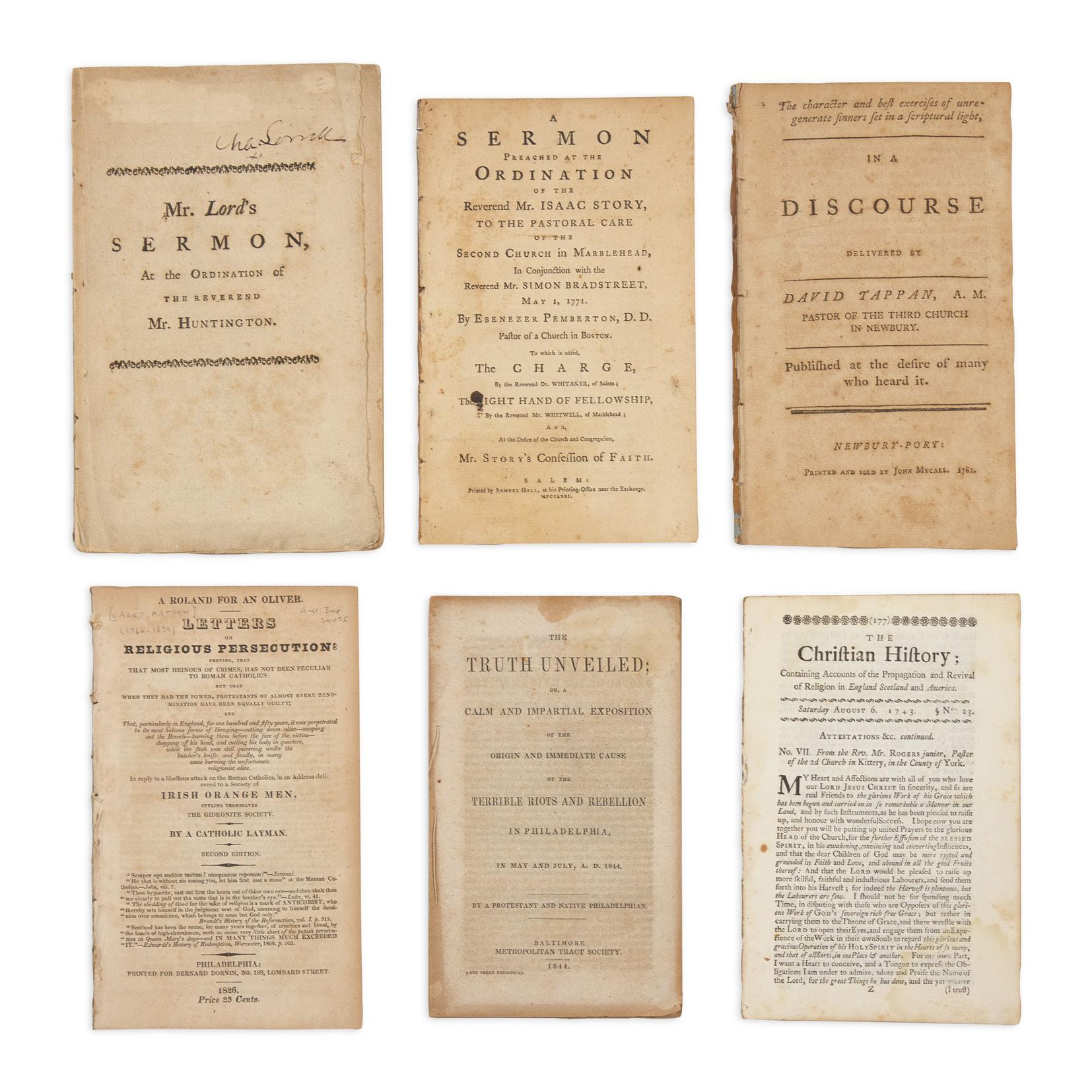
Locations vary, 1743-1844. In six volumes, comprising: The Christian History... (Saturday, August 6, 1743); Lord, Benjamin. A Sermon Preached at the Ordination of the Reverend Mr. John Huntington... (Boston: Edes and Gill, 1763; half-title loose, lacking final blank; ESTC W26200); Pemberton, Ebenezer. A Sermon Preached at the Ordination of the Reverend Mr. Isaac Story... (Salem: Samuel Hall, 1771; ESTC W3200); The character and best exercises of unregenerate sinners set in a scriptural light, in a Discourse Delivered by David Tappan... (Newbury-Port: John Mycall, 1782; ESTC W14016); A Roland for an Oliver. Letters on Religious Persecution... (Philadelphia: Bernard Dornin, 1826); The Truth Unveiled; or, a Calm and Impartial Exposition of the Origin and Immediate Cause of the Terrible Riots and Rebellion in Philadelphia... (Baltimore: Metropolitan Tract Society, 1844). Each 8vo. Disbound; scattered wear.
$200 - 300
255
[Roosevelt, Franklin D.] Official Program For Franklin D. Roosevelt’s First Inauguration, Boldly Signed by FDR
Washington, D.C.: Published by Ransdell Incorporated, 1933. First edition. Boldly signed by Roosevelt on front wrapper. 4to. 64 pp. Original stiff staple-bound pictorial wrappers, lightly worn and soiled; pp. 31-34 sprung. A handsome copy.
Franklin Delano Roosevelt was inaugurated as the 32nd President of the United States on March 4, 1933, amidst one of the most turbulent periods in American history since the Civil War. That year, the American unemployment rate peaked at 24.9%, the highest in U.S. history. His inaugural speech was broadcast into millions of homes, with his words, “let me assert my firm belief that the only thing we have to fear is...fear itself” instantly becoming one of the most memorable phrases of any presidency.
Lot also includes a press photograph of Franklin and Eleanor Roosevelt.
$800 - 1,200
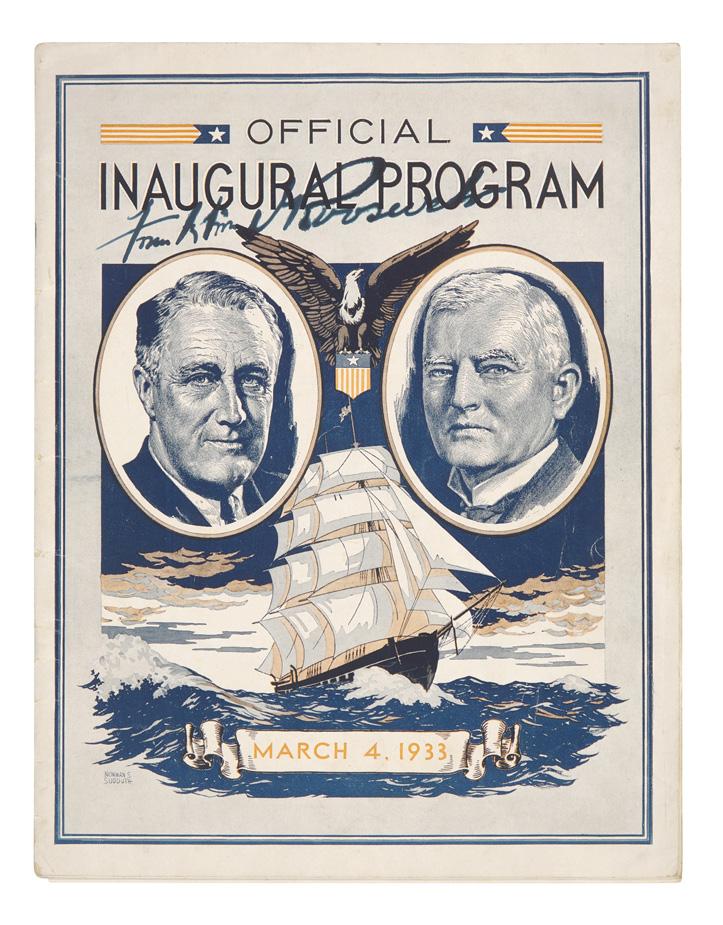
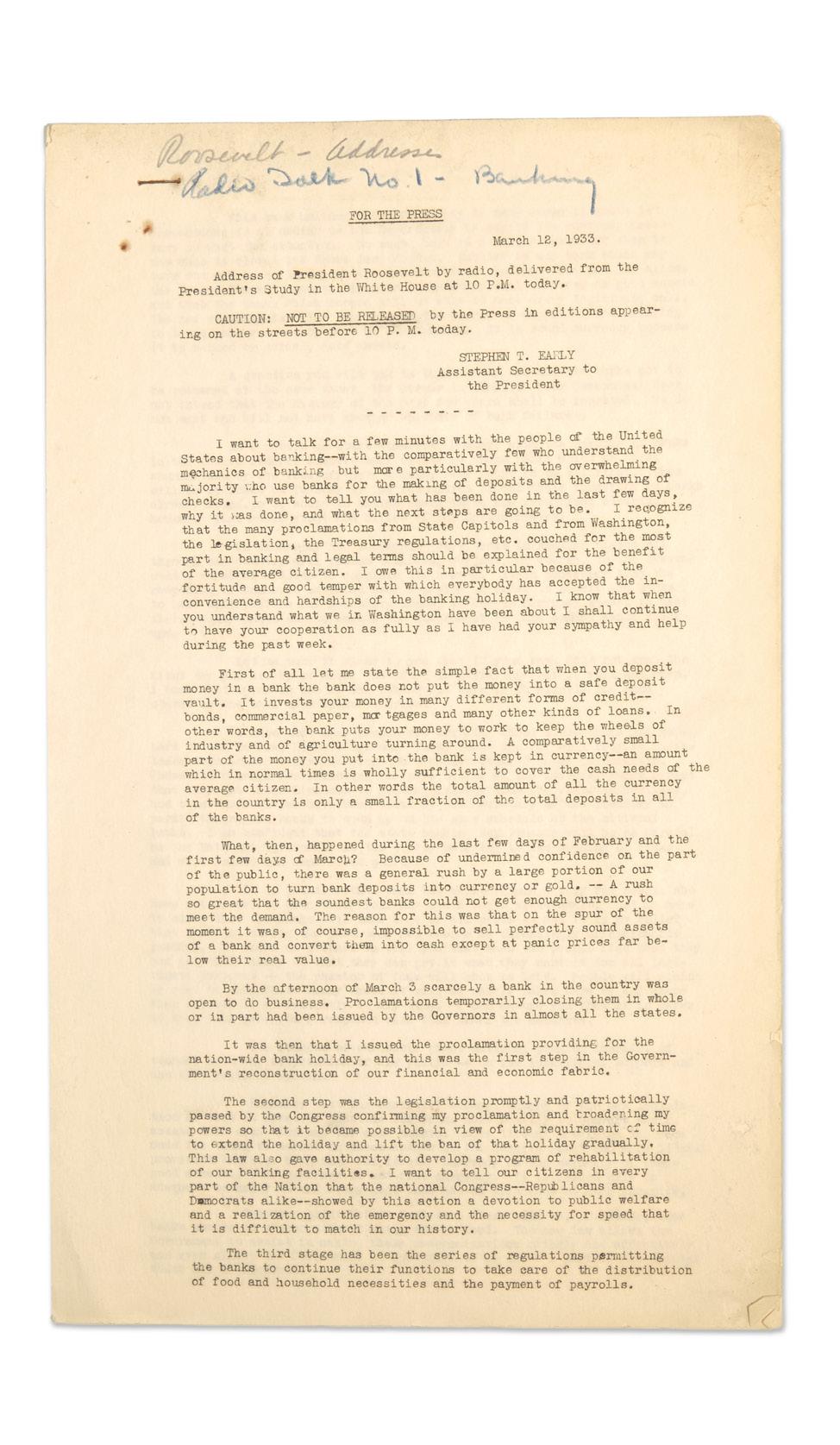
256
[Roosevelt, Franklin D.] Mimeographed Typescript Press Copy of the First Fireside Chat
Washington, D.C., March 12, 1933. Three mimeographed sheets, titled in type “Address of President Roosevelt by radio, delivered from the President’s study in the White House at 10 P.M. today.” Each sheet measuring 14 x 8 1/2 in. (356 x 216 mm); stapled at top. Noted in type “For the Press” at top of first sheet, and below of same, “Caution: Not to be Released by the Press in editions appearing on the streets before 10 P.M. today.”, with manuscript at top of same, “Roosevelt-Address / Radio Desk No. 1-Banking”. Scattered soiling; scattered wear along edges.
Scarce original press release typescript of the first fireside chat delivered by President Franklin D. Roosevelt.
One of the most celebrated and innovative achievements of his presidency, Franklin D. Roosevelt delivered his first “fireside chat” just eight days into his first term, amidst a severe month-long banking crisis that had triggered bank runs and closures nationwide. The broadcast aimed to inform and reassure the distressed public, with Roosevelt explaining what his administration had done in the preceding days, the reasoning behind those actions, and the steps planned for the future. Using direct and accessible language, Roosevelt addressed the events that had eroded public trust in the banking system and outlined his strategy to restore economic stability. His plan included declaring a national bank holiday to temporarily shut down the banking system and stock market, passing the Emergency Banking Act, which established federal deposit insurance, and gradually reopening only those banks deemed financially sound by federal inspectors. As Roosevelt assured listeners, “It is safer to keep your money in a reopened bank than under the mattress.” The fifteen-minute address reached over 60 million Americans and helped restore public confidence, such that in the two weeks that followed, Americans deposited more than half of the currency they had previously withdrawn during the panic. Over the next ten years Roosevelt would go on to deliver approximately 30 more fireside chats that covered topics ranging from New Deal initiatives, economic recovery, to foreign policy and the unfolding events of World War II, and have since been recognized as one of the defining moments of his presidency.
Rare to auction, according to RBH, we can not locate another example at auction. OCLC locates only one other example, at the Hagley Museum and Library.
Lot also includes a press photograph of FDR.
$600 - 900
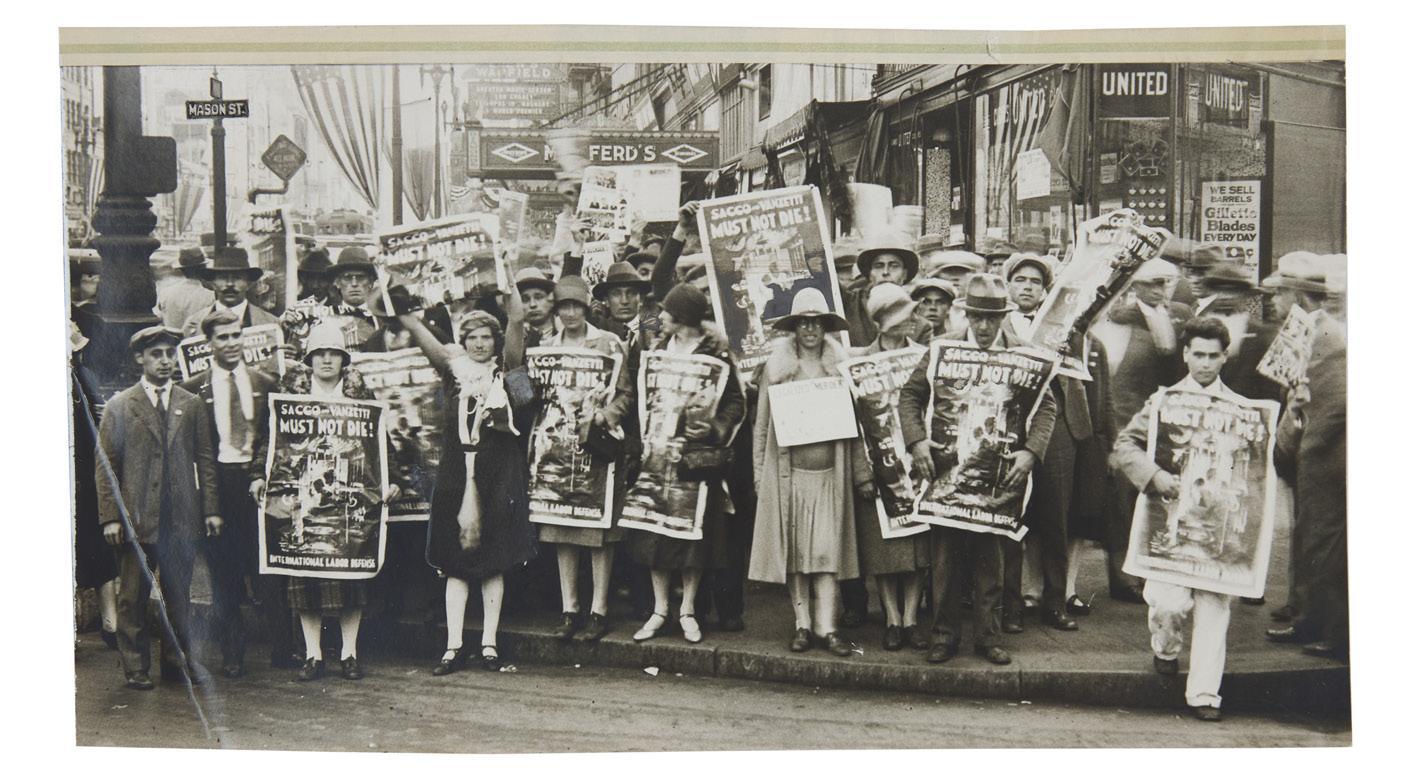
257
[Sacco and Vanzetti] Press Photo of a San Francisco Protest in Support of Italian Anarchists, Sacco and Vanzetti, 1927
San Francisco, August 23, 1927. Press photo, 6 3/8 x 11 1/4 in. (162 x 286 mm). Crease in lower left edge; scattered abrasions; ink addition in top left; manuscript on verso, “Sacco Vanzetti Demonstration S.F.”, date stamped below same, “Aug 23 1927”.
By 1927, the prosecution and possible innocence of Italian anarchists Nicola Sacco and Bartolomeo Vanzetti had become a worldwide cause celebre. Protests were held in every major city in the United States, as well as across Europe, South America, and as far away as Australia. The present photo, showing a demonstration in San Francisco is date-stamped August 23, 1927, the day both men were executed by electric chair.
$250 - 350
258
[Salem Witch Trials] Printed Ad for Increase Mather’s “Tryals of the NewEngland Witches”, in The Athenian Mercury
London: Printed for John Dunton, Tuesday, June 20, 1693. Vol. 10, Numb. 12. Printed broadsheet newspaper, 12 1/4 x 7 1/2 in. (311 x 190 mm). Light toning and wear long edges.
On the second page is an ad for Increase Mather’s A Further Account of the Tryals of the New-England Witches, the earliest printed book on the Salem Witch Trials.
Increase Mather (1639-1723) was a Puritan minister who was a highly influential religious and political figure during the Salem Witch Trials of 1692-93. Mather had published a book on witchcraft in 1684 and his son Cotton had written one shortly afterwards in which he defended the courts which had condemned twenty people to death. Mather’s A Further Account of the Tryals of the New-England Witches was often bound with copies of his son’s account, entitled Wonders of the Invisible World
$200 - 300
259
[Sauer, Christoph] The First Book Printed with German Type in America: Zionitischer Weyrauchs Hugel oder: Myrrhen Berg, 1739
Germantown: Christoph Sauer, 1739. First edition, second issue (with the correct imposition of signature B). 8vo. (xii), 792, (14) pp. Likely contemporary boards, spine perished, original leather removed, boards detached but holding; all edges trimmed; marbled paste-downs (free endpapers perished), partially exposed contemporary waste-paper under same; spotting and toning; one leaf of manuscript at rear. Evans 4466; Hildeburn 617; Sabin 106364
The first book from the press of Christoph Sauer, and possibly the first book printed with German type in America.
Christoph Sauer (1695-1758) was the first German printer and publisher in America. Emigrating from Schwarzenau, Germany (now Berleburg) to Germantown, Pennsylvania in 1724, he established a press there in 1738 to serve the needs of the growing German-speaking population in the colonies. The present volume, comprised of hymns created by Johann Conrad Beissel (founder of the Ephrata Community in Lancaster County, Pennsylvania) and others, was compiled for the use by the Ephrata Community, and is considered the Community’s “largest and most important collection of the hymns”. “As the edition was small and the book was in common use for devotional purposes, it has become extremely scarce, nearly all of the few known copies being imperfect.” (Hildeburn)
$2,500 - 3,500
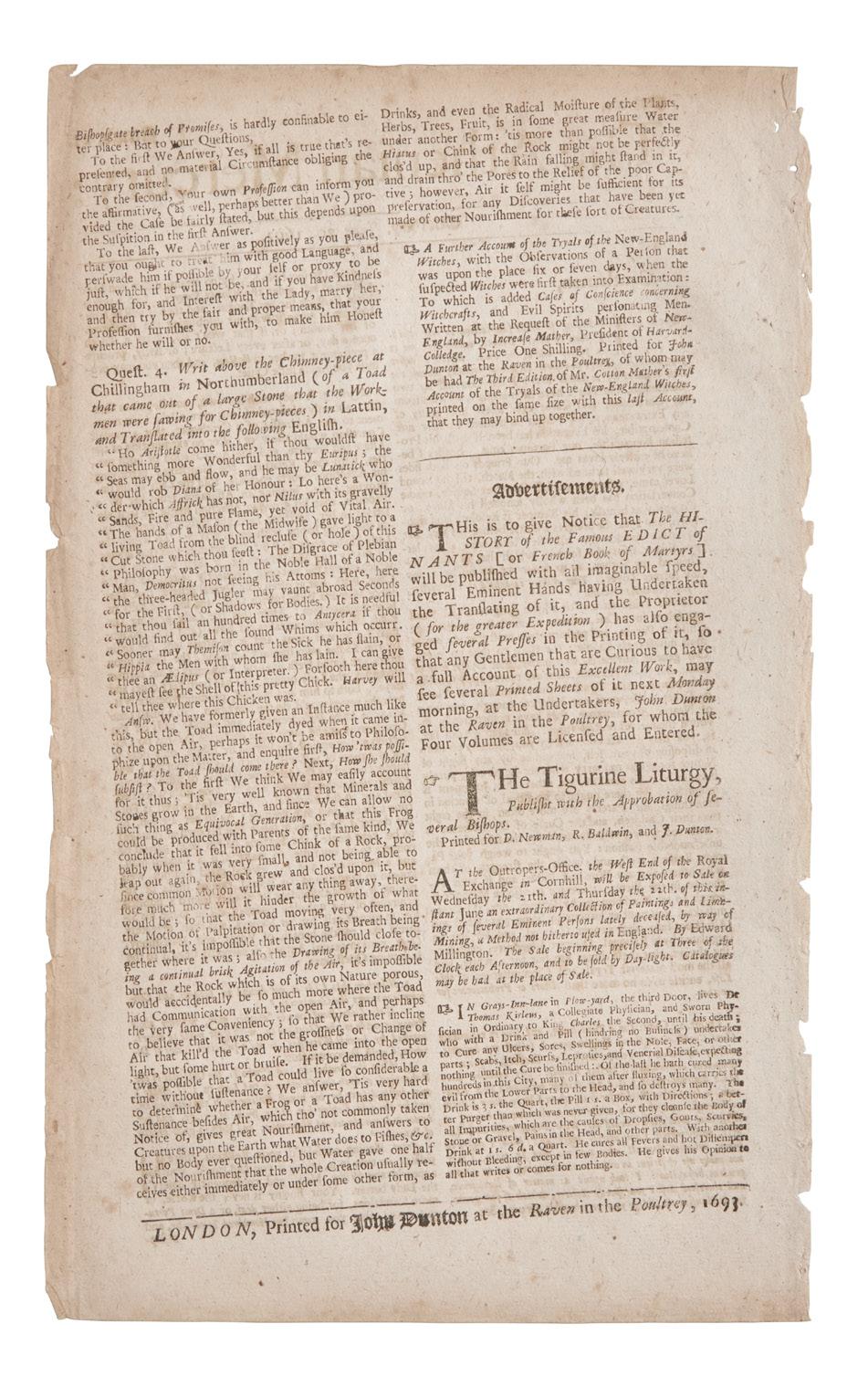
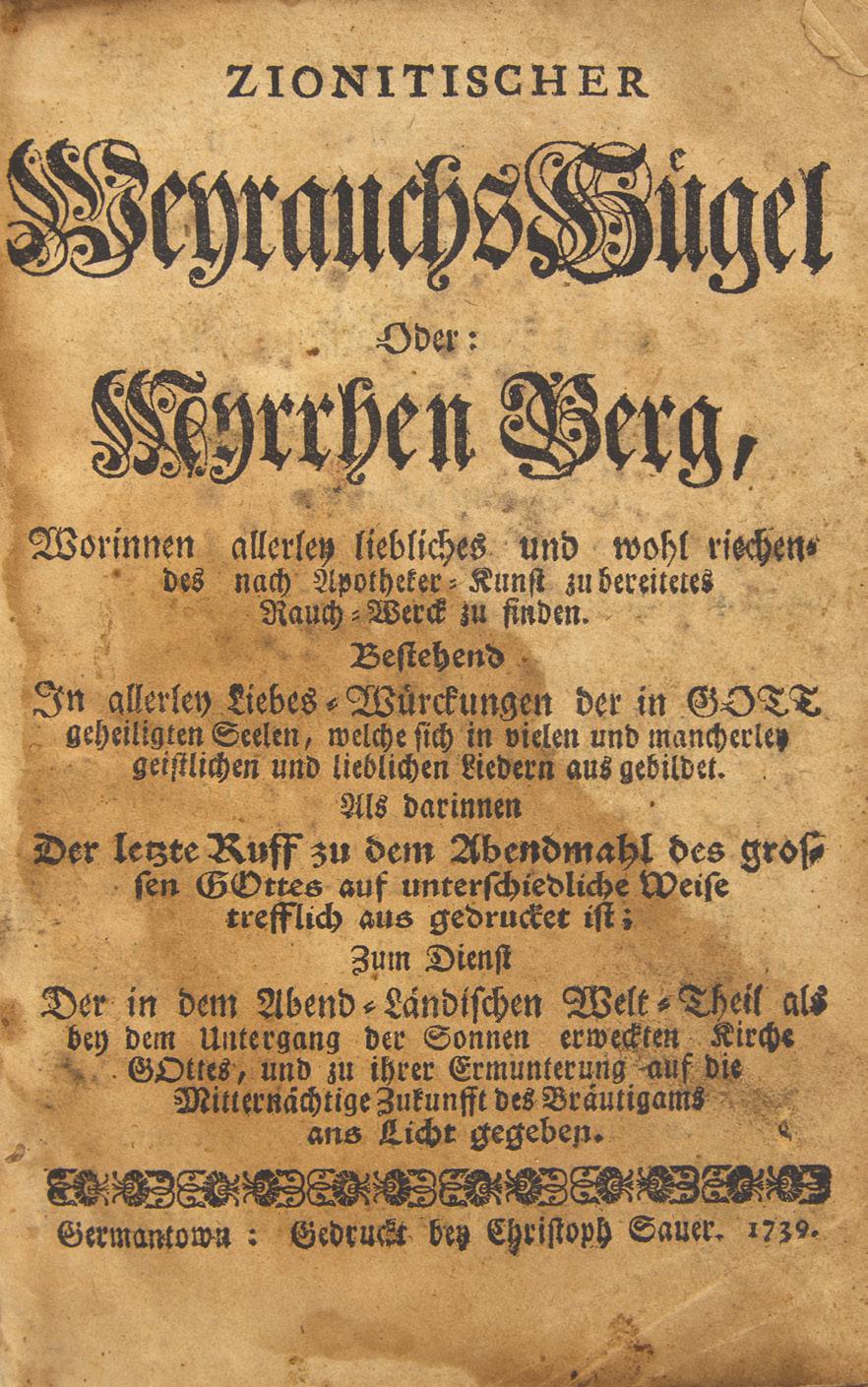
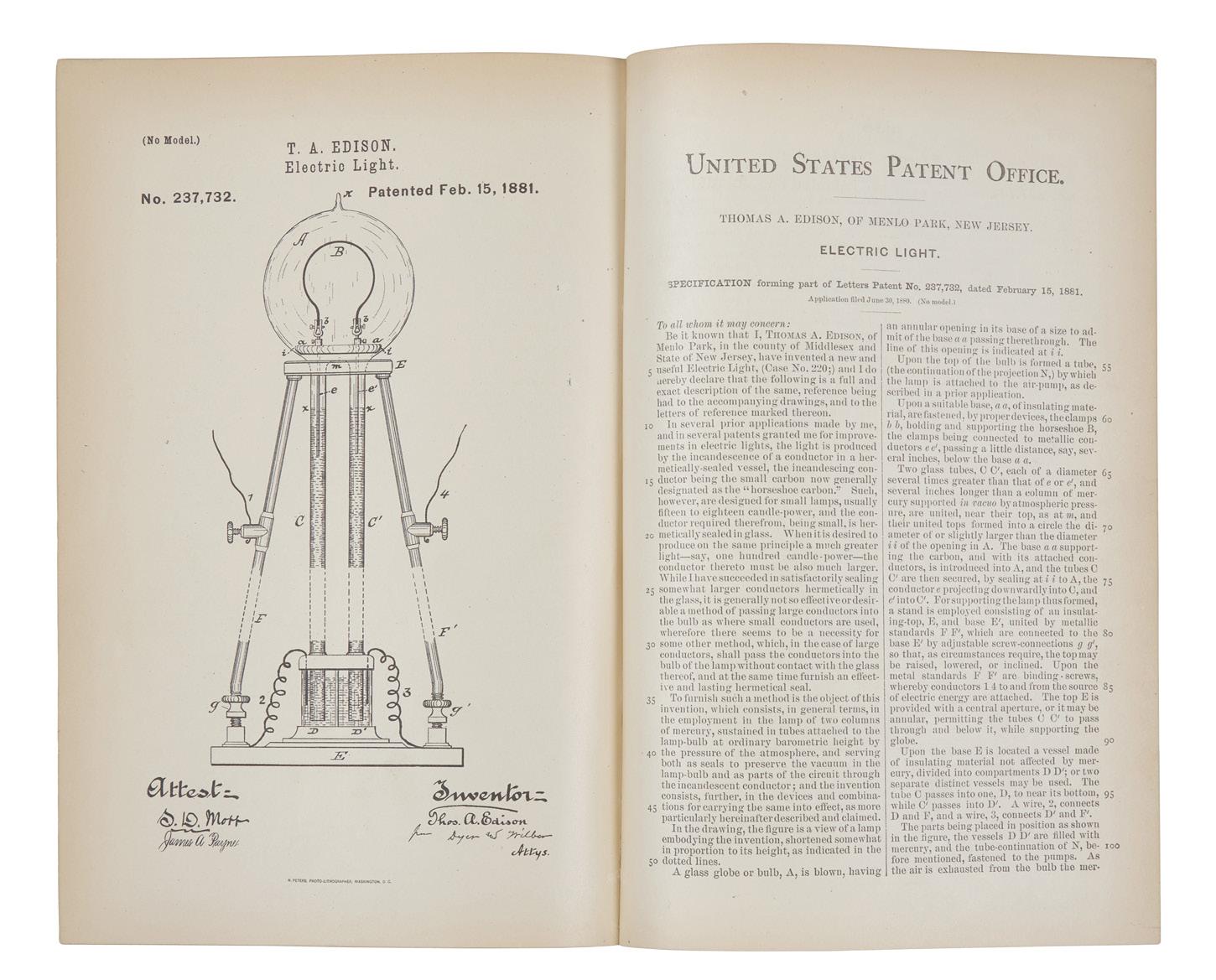
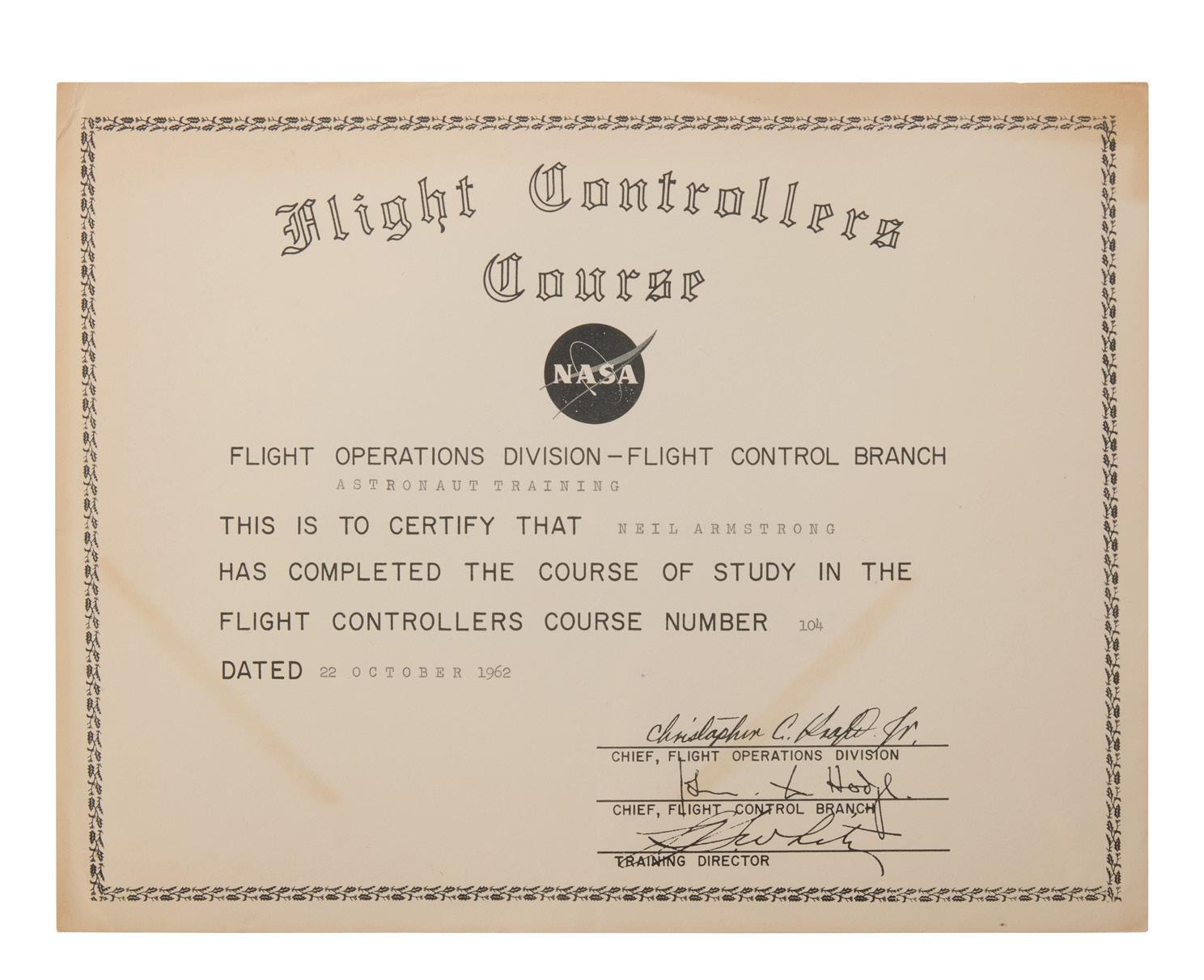
260 [Science & Technology] Thomas Edison’s Laboratory Copy of a Patent for an Electric Light, 1881
(Washington, D.C.: United States Patent Office), February 15, 1881. Printed patent for Thomas A. Edison’s Electric Light, patent No. 237,732. Two conjoined sheets. 4to. Illustrated with lithographed diagram of an electric light. Disbound; toned along edges.
From the collection of Charles L. Clarke and extracted from his bound collection of U.S. Patents granted to Edison. Clarke (18531941) was Chief Engineer and first President of the Edison Electric Light Company and was responsible for the Pearl Street Station in New York, the world’s first commercial power plant. In February 1881, Edison established the headquarters of the Edison Electric Light Company in New York City, seeking to power lower Manhattan, which was achieved through the work of his engineers like Clarke.
The Edison Electric Light Company began operations on October 15, 1878. It was one of many business entities founded by Edison, and was a patent-holding corporate entity, backed by J.P. Morgan and the Vanderbilt family, for the purpose of funding Edison’s experiments with the incandescent bulb and electric lighting.
$1,000 - 1,500
261
[Space] Neil Armstrong’s 1962 Astronaut Training Certification in the Flight Controllers Course, from the Armstrong Family Collection
No place, October 22, 1962. Printed oblong sheet, 8.5 x 11 in. (216 x 279 mm). Official NASA-printed document, accomplished in type, certifying that “Neil Armstrong Has Completed The Course of Study In The Flight Controllers Course Number 104...” With facsimile signatures of Christopher Kraft, John Hodge, and one other. Lightly creased; scattered foxing; two bands of offsetting. Encapsulated and certified by Collectibles Authentication Guaranty.
First man on the Moon, Neil Armstrong’s personal certification for the completion of the Flight Controllers Course, issued just one month after his joining the NASA Astronaut Corps.
After his graduation from Purdue, Armstrong became an experimental test pilot for the National Advisory Committee of Aeronautics (NACA). He officially became an employee of NASA when it was established in 1958. When Project Mercury began to take applications for the program, Armstrong was not eligible due to his status as a civilian test pilot. This requirement was waived in 1962 for Project Gemini, and he was selected alongside Elliot See as the first civilians recruited for a NASA program. He would serve on, or in the backup crews of, Gemini 5, 8, and 11, as well as Apollo 9, before his appointment to the command of Apollo 11, in December of 1968.
A remarkable piece of space memorabilia, from the Armstrong Family Collection.
Heritage Auctions, Space Exploration Signature Auction, November 1, 2018, Lot 52136
$2,000 - 3,000
262 [Space] 11 Moon Landing
1. Mimeographed NASA Press Release Washington, D.C., July 6, 1969. Release No: 69-83K Apollo 11. 35 stapled sheets. “The United States will launch a three-man spacecraft toward the Moon...with the goal of landing two astronaut-explorers on the lunar surface...”
2. NASA Apollo Blueprint Optical Co., Inc., ca. 1967. Blueprint, apparently related to the Apollo Command Module, titled at bottom “LEM Correlation Chart Electrical Drawings (L&A Electronics & Probe)”, drawing No. 120999. Kennedy Space Center Simcom Library Master Copy, stamped at bottom right (possibly in image). Creasing from when folded, small hole at center; unevenly toned.
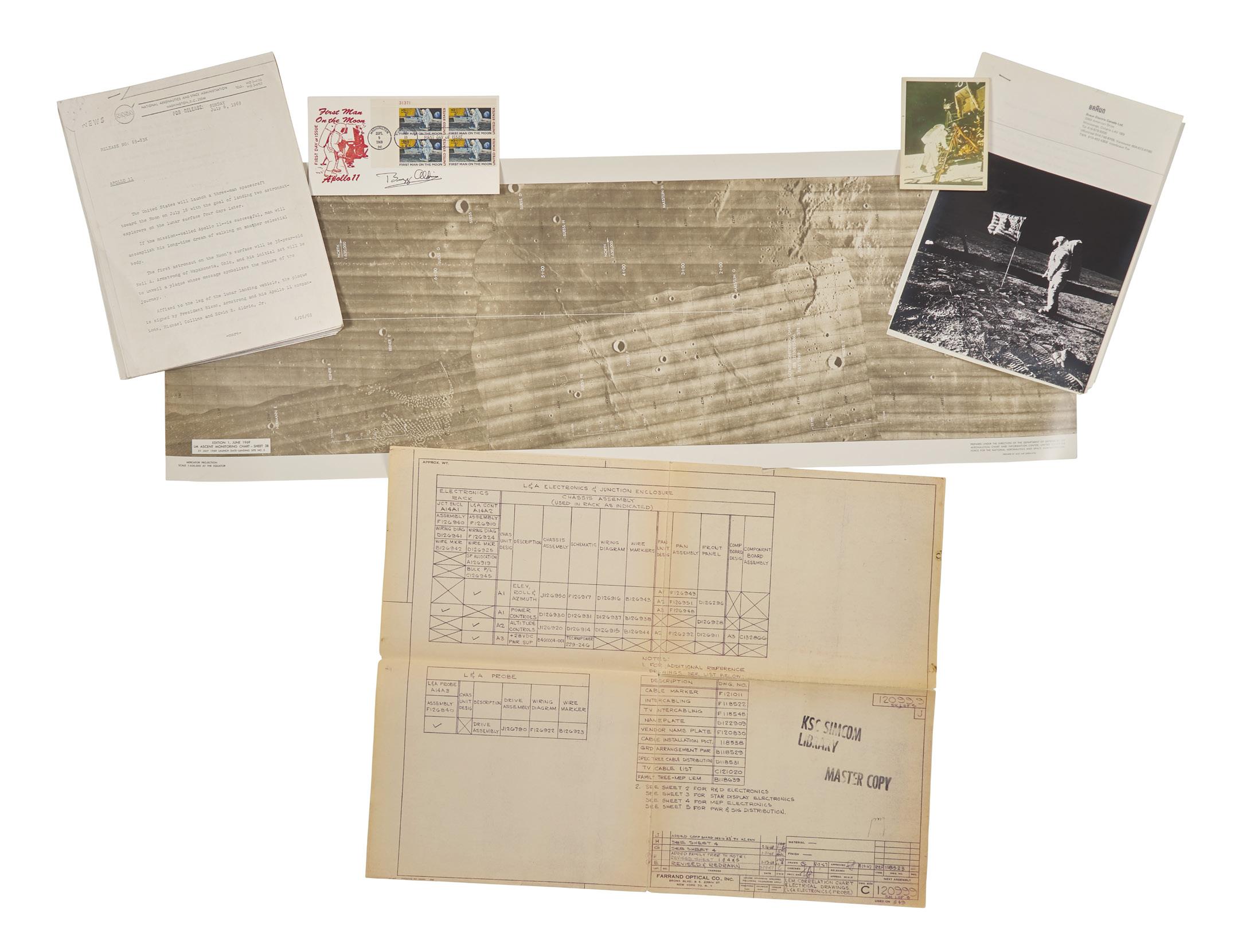
3. Lunar Module Ascent Monitoring Chart for the Apollo 11 Mission. Washington, D.C.: Prepared Under the Direction of the Department of Defense by the Aeronautical Chart and Information Center, July 21, 1969. Sheet 3B, showing landing site No. 5. 12 1/2 x 36 in. (317 x 914 mm).
4. Printed Braun Electric Canada Report. Two stapled sheets; original photograph of the moon landing mounted to first sheet (copyright stamp on verso “Hasselblad”). “’Stars and Stripes’ Billows on a Windless Moon”.
5. Aldrin, Buzz. Signed “First Man on the Moon Apollo 11” Cover. With postal stamps.
Lot also includes a small photograph of an astronaut disembarking a lunar module.
$500 - 800
263
[Star Trek] William Shatner-Signed Script of the Pilot Episode of Star Trek
No place, November 30, 1964 (but later reprint). Star Trek «Final Draft» of pilot episode «The Cage», signed by William Shatner on front wrapper. (iv), 81 pp. Original stiff blue printed wrappers.
A William Shatner-signed final draft script for the pilot episode of Star Trek Written by Gene Roddenberry and completed in January of 1965, the pilot was rejected by NBC for being too cerebral. Another pilot was ordered, and the footage for the present episode was worked into the season one twopart episode “The Menagerie”.
$200 - 300
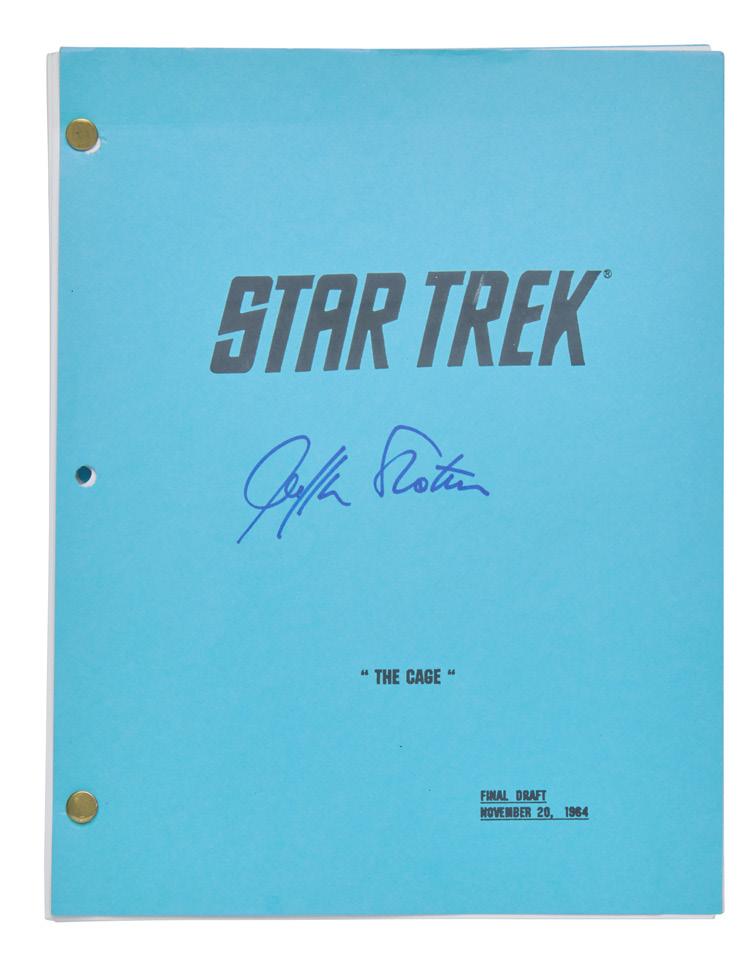
264
[Star-Spangled Banner] Eyewitness Account of the Shelling of Fort McHenry in the War of 1812, in a Manuscript Logbook from the HMS Trave, Present at the Battles of Baltimore and New Orleans, 1814-16
“Bombs and Frigates weigh and stand in...commenced a tremendous heavy fire on the batteries near Baltimore...Midnight squally with rain Bombs &c keeping up a heavy bombardment on Fort McHenry...AM squally with rain Bomb &c keeping up a heavy fire...”
Locations vary, ca. May 3, 1814-May 30, 1816. Unpaginated (approx. 185 leaves). 4to. Manuscript logbook kept by British midshipman Charles Robert Malden of the Royal Navy and signed by him at conclusion, detailing daily or hourly entries of the ship’s bearings, latitudinal and longitudinal coordinates, weather conditions, and other notes while serving on the HMS Trave. Later 19thcentury three-quarter brown calf over cloth covered boards, extremities worn, boards soiled; speckled edges; front gutter split but still holding; book-plate of descendant John Malden on front paste-down; partial near-contemporary manuscript biography of Malden on front endleaves; scattered light foxing to interior.
Voluminous manuscript log detailing naval movements of the British fleet under Admiral Alexander Cochrane (1758-1832), at the height of the Chesapeake Campaign during the War of 1812. Included in the reports is a remarkable survival, one of the only known eyewitness accounts of the British bombing of Fort McHenry during the Battle of Baltimore, the inspiration of Francis Scott Key’s “Star-Spangled Banner.”
The Trave was a Pallas-class French frigate built in 1812, captured by the Royal Navy in a Napoleonic War engagement, and repurposed as the HMS Trave in April of 1814. The author, Charles Robert Malden (1797-1855) was a midshipman while writing the present account, but would rise to the rank of First Lieutenant. He later became an accomplished explorer and surveyor, assisting in the construction of harbors in the Sandwich (Hawaiian) Islands in the mid-1820s, and discovering his eponymous Malden Island in the central Pacific. After retiring from the navy, Malden founded a preparatory school in Newport, England, living out the rest of his days as an educator until his death in 1855.
Malden’s log provides a fascinating narrative of events, as well as day-to-day commentary on maritime life and duties. Among other things, he records the names of punished seamen for various crimes or infractions; lists the names of those who’ve died, deserted, or been impressed into British service; and tracks salutes for holidays or celebration of victories, some from the Napoleonic conflicts. His narrative of events follows the Trave crossing the Atlantic, anchoring at Bermuda, heading to the Chesapeake Bay, landing at Benedict, Maryland, sailing up and down the Potomac, crossing the Gulf of Mexico, the Battle of New Orleans, sailing to Mobile Bay, returning to England, and much more.
During the first two years of the War of 1812 with the United States, Britain was engaged in hostilities with Napoleonic France, limiting its capabilities and manpower in North America. As a result most skirmishes were centered around the Great Lakes regions of Upper and Lower Canada with the British fighting from a defensive position. This ended however in April 1814, with Napoleon’s abdication and banishment, which in turn freed thousands of British forces to join the war across the Atlantic. A large brigade under Major General Robert Ross (1766-1814) set sail for Bermuda in July (which the HMS Trave was attached to), and by the time they arrived on the eastern seaboard, the Royal Navy took complete control of the Chesapeake Bay and its tributaries. On August 24, being ferried by the ships of Admiral George Cockburn, the British engaged American forces at Bladensburg, Maryland, and the latter›s subsequent defeat resulted in the burning of the nearby capital, Washington, D.C.
The British then turned their attention to Baltimore, with Admiral Alexander Cochrane anchoring his ships in the Patapsco River on September 12. After the initial British landing force was repulsed at North Point, with General Robert Ross himself being killed, and American forces holding ground at Hampstead Hill, Cochrane withdrew his fleet from range and resorted to a heavy bombardment of the nearby Fort McHenry. On the 13th, the 19 ships in the British fleet began a 25-hour barrage of cannonballs, mortars, and “Congreve” rockets, with minimal effective damage. The following morning, the garrison at Fort McHenry lowered the battle-torn flag that was flying over it, and raised a massive, oversized “star-spangled banner” in its place, a testament to the Americans’ resolve.
Maryland lawyer Francis Scott Key (1779-1843) was aboard the HMS Tonnant anchored in the harbor when the Battle of Baltimore commenced, pleading for the release of a friend who had been captured by the British. Not allowed to return to shore, Key witnessed the shelling of the Fort from the ship’s deck. Inspired by the large American flag raised the next morning, he began writing a poem on the back of a letter he had in his pocket. It was published the next day under the title “Defence of Fort M’Henry” and meant to be sung to the popular tune “Anachreon in Heaven.” Subsequent newspapers in Baltimore and across the country coined its now famous name “The Star-Spangled Banner”. It was adopted as the American National Anthem in 1931.
Very rare. We have been able to locate only two other contemporary manuscript accounts of the shelling of Fort McHenry: Key›s original handwritten one, now at the Maryland Historical Society), and Fort Commander George Armistead›s official account sent to the Secretary of War, in the Smithsonian Museum of American History. The present log is presumably the only contemporary English account that has come to market.
Charles R. Malden, thence by descent in the family
$60,000 - 80,000
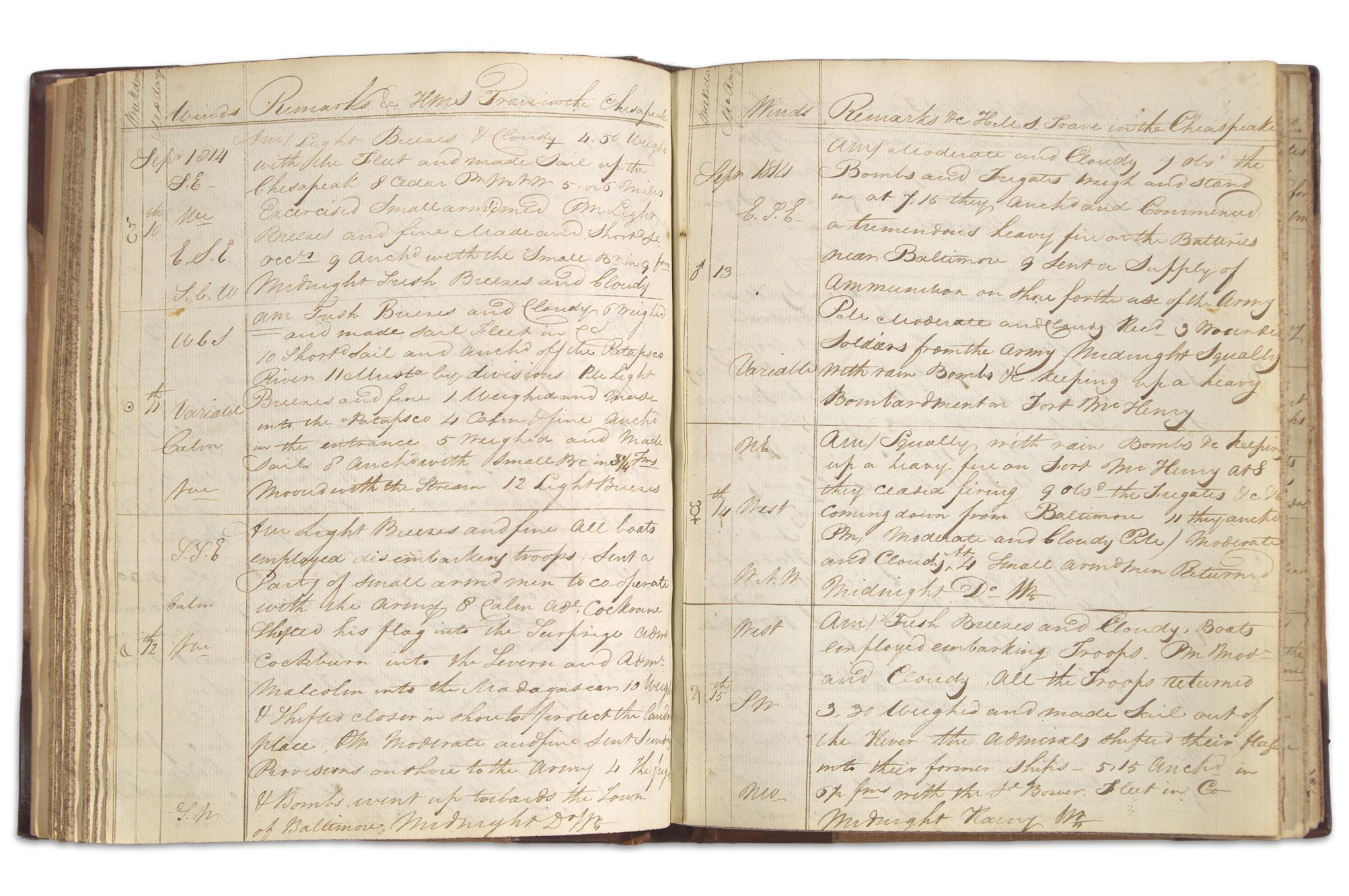

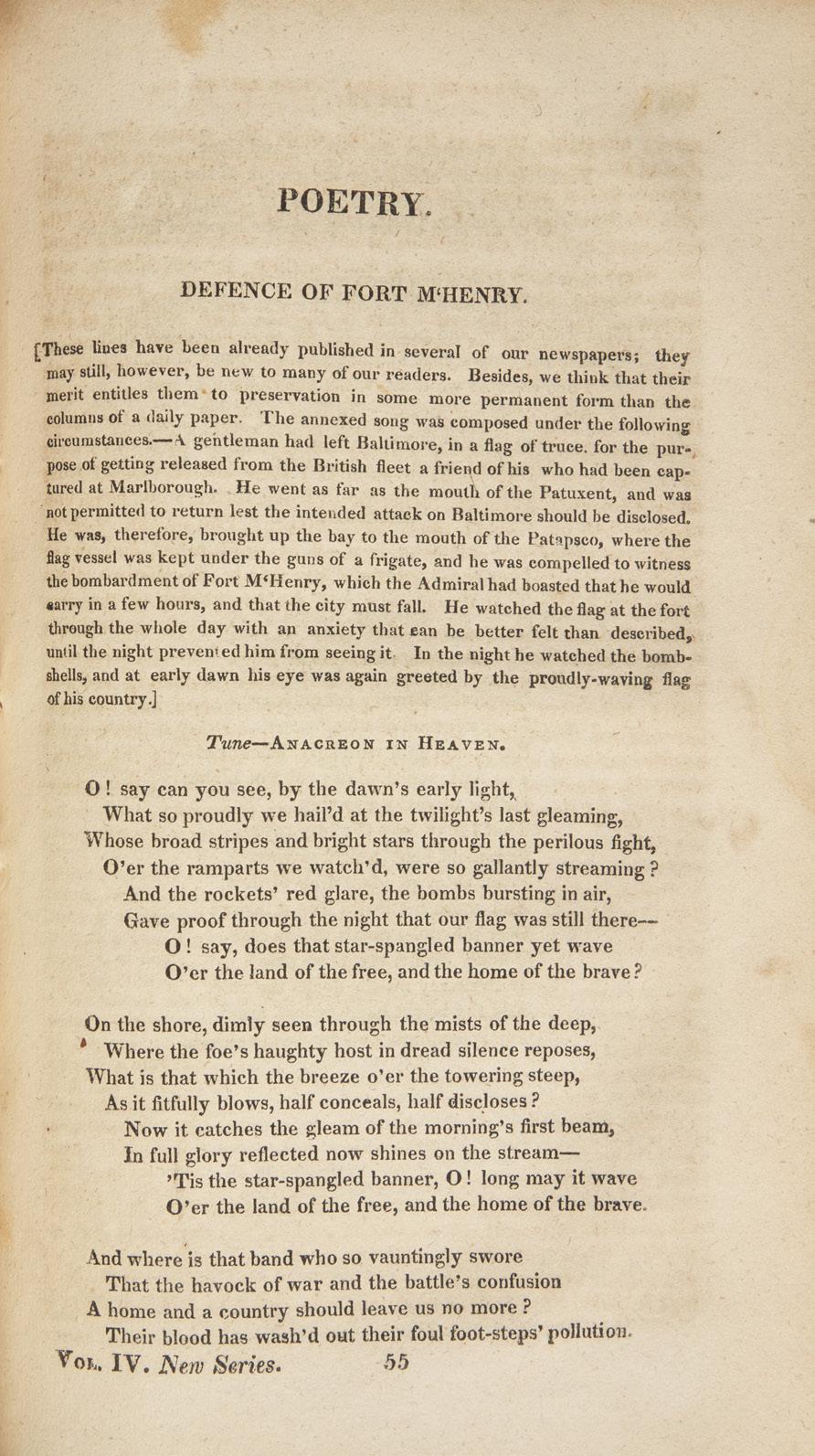
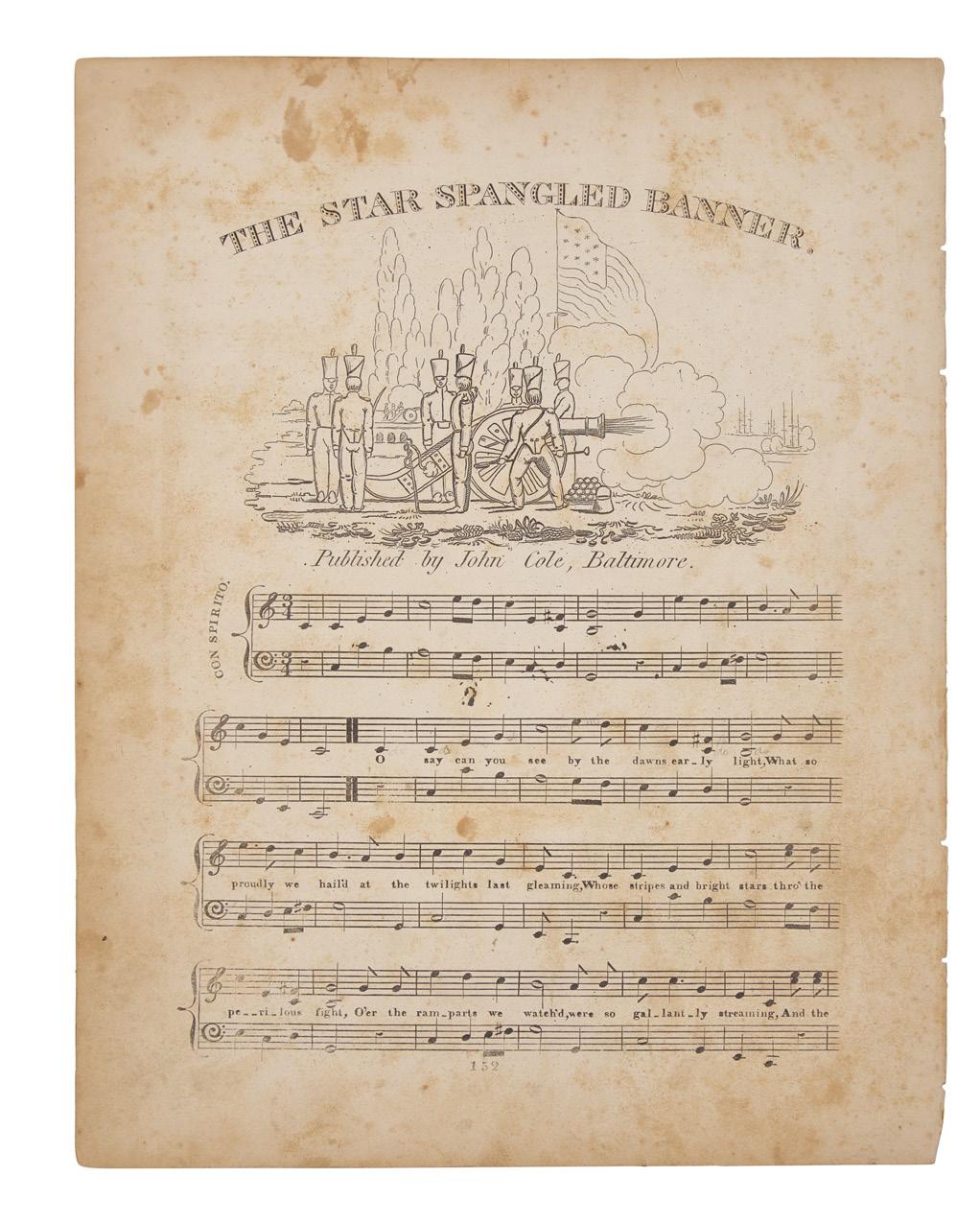
265
[Star-Spangled Banner] The First Magazine Appearance of Francis Scott Key’s “Star-Spangled Banner”, 1814
The Analectic Magazine
Philadelphia: Published and Sold by Moses Thomas, 1814. Vol. IV only. First edition. 8vo. iv, 524 pp. Illustrated with an engraved frontispiece portrait, engraved vignette title-page, and four engraved portraits. Contemporary three-quarter brown calf over marbled paper-covered boards, stamped in gilt, boards and extremities rubbed; yellow-stained edges; foxing to endpapers and leaves at front and rear; scattered offsetting. BAL 11081G; Filby B18; Streeter Sale II:1070
The first magazine appearance of Francis Scott Key’s “Star-Spangled Banner”, printed on pp. 433-434 in the November issue.
$700 - 1,000
267
[Star-Spangled Banner] Early Example of Printed Sheet Music for the Star-Spangled Banner
Baltimore: John Cole, (ca. 1825). Printed sheet music. Two joined sheets, printed on rectos only. 4to. Disbound; foxing and soiling. Filby S-18
$300 - 500
266
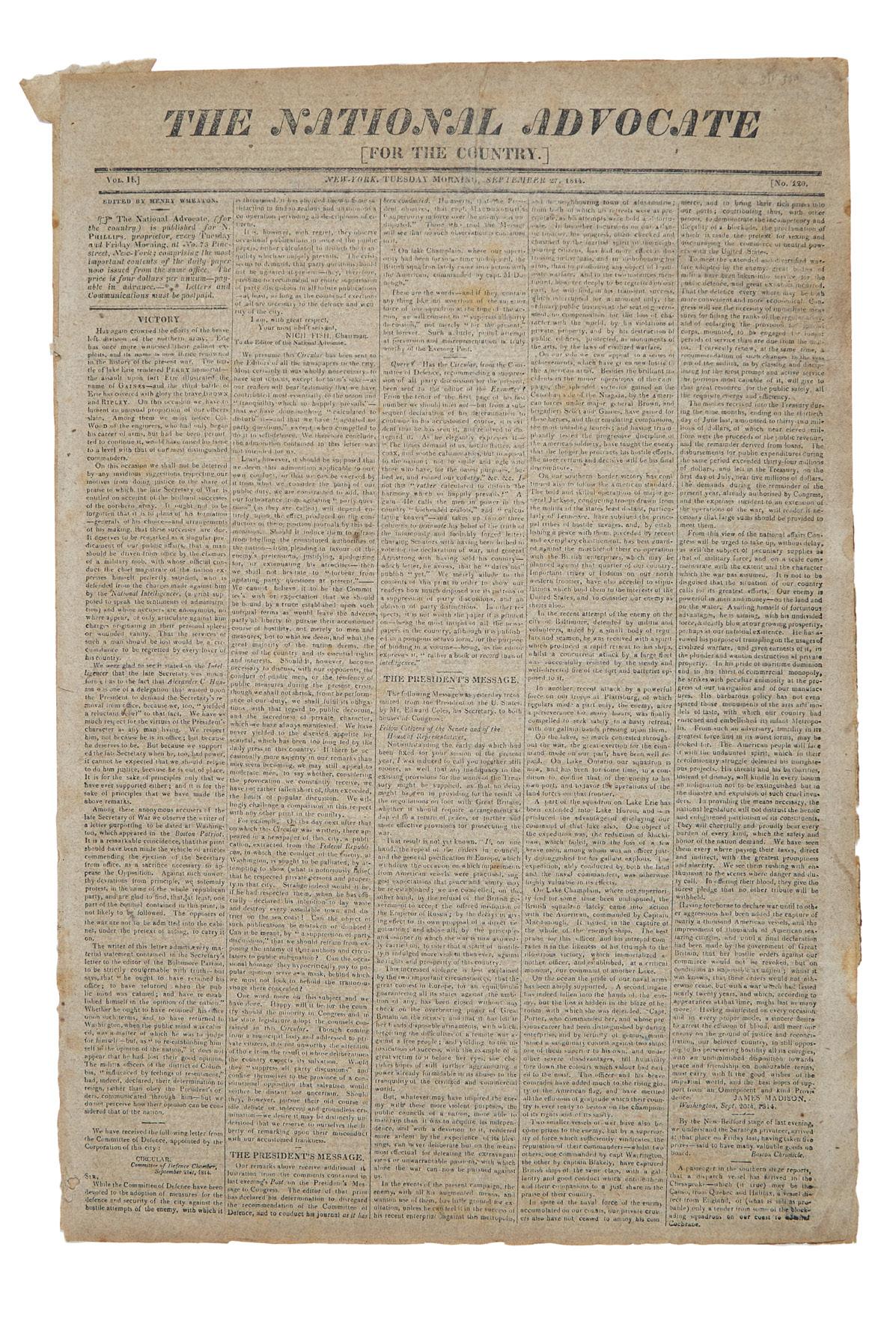
[Star-Spangled Banner] One of the Earliest Obtainable Newspaper Printings of the Star-Spangled Banner, September 27, 1814
The National Advocate New-York: N. Phillips, Tuesday Morning, September 27, 1814. Vol. II, No. 120. Printed newspaper. Folio. (4) pp. Separated along central vertical fold; scattered spotting; closed tears in bottom edge of each leaf; light edge wear; scattered small repairs; printing defect in top of central vertical fold. Filby N-13
A very early newspaper printing of the Star-Spangled Banner. Reprinted from the Baltimore Patriot, the editor prophetically introduces Francis Scott Key’s poem--printed anonymously with its original title the “Defence of Fort M’Henry”--as “destined long to outlast the occasion, and outlive the impulse, which produced it.” They go on to provide some detail to the poem’s creation, stating, “A gentleman had left Baltimore, in a flag of truce for the purpose of getting released from the British fleet a friend of his, who had been captured at Marlborough. He went as far as the mouth of the Patuxent, and was not permitted to return lest the intended attack on Baltimore should be disclosed. He was therefore brought up the bay to the mouth of the Patapsco, where the flag vessel was kept under the guns of a frigate, and he was compelled to witness the bombardment of Fort M’Henry, which the Admiral had boasted that he would carry in a few hours, and that the city must fall. He watched the flag at the Fort through the whole day with an anxiety that can be better felt than described, until the night prevented him from seeing it. In the night he watched the Bomb Shells, and at early dawn his eye was again greeted by the proudly waving flag of his country.” Key’s identity was first published in the September 24 issue of the Frederick-Town Herald, but that news had evidently not yet reached the editors of this newspaper.
Key’s poem was widely printed at the time, and was first published in a newspaper a week prior to this printing, on September 20, in the Baltimore Patriot & Evening Advertiser. Five other newspapers and some broadsides precede this newspaper, all quite rare, while this printing precedes the first magazine appearance (November 1-3, 1814), the first sheet music appearance (ca. October 19, 1814), and the first book appearance (later 1814).
According to online records, we cannot locate another copy of this issue at auction.
$3,000 - 5,000
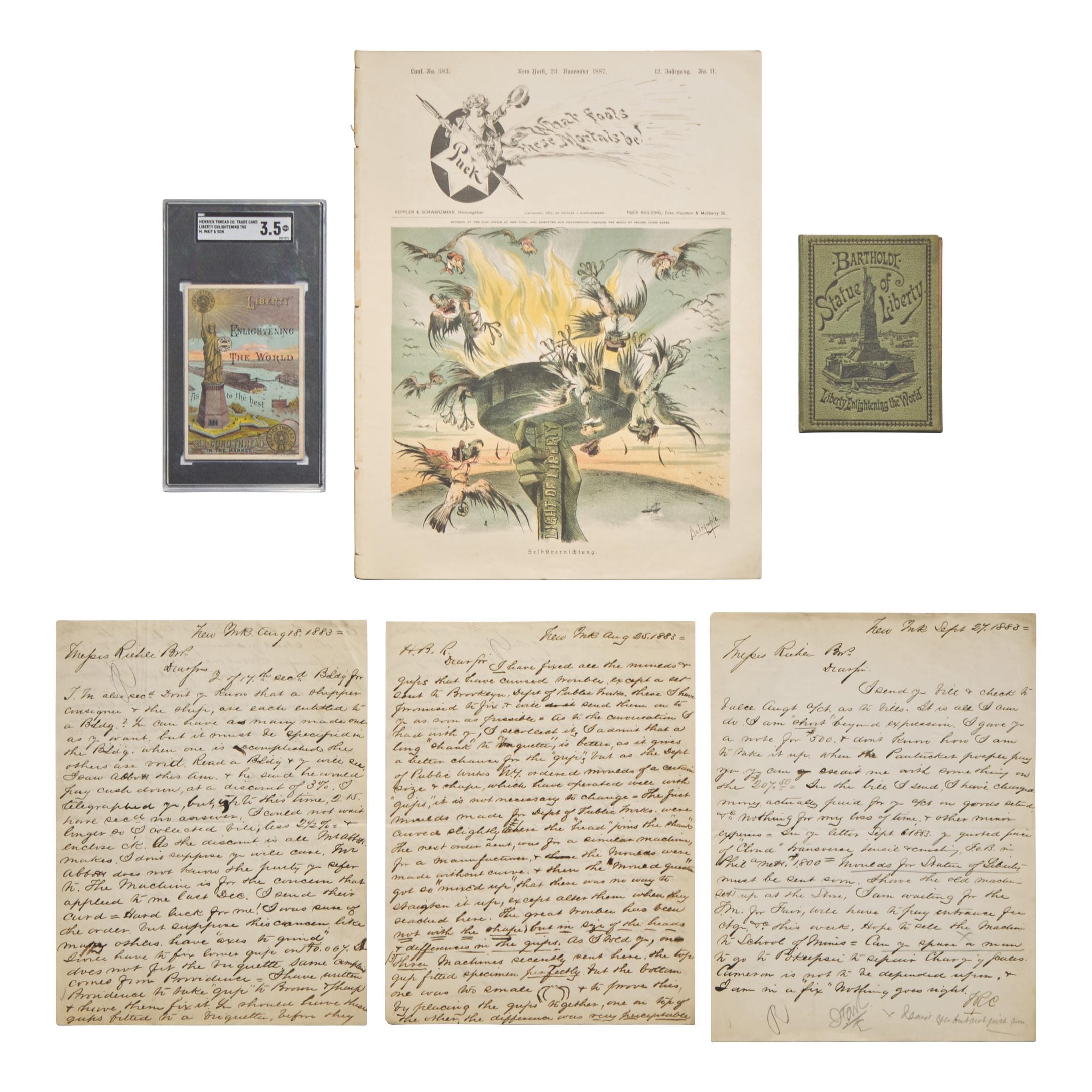
Locations vary, ca. 1883-87. Group of items related to the Statue of Liberty, including, a Merrick Thread Co. trading card, “Liberty Enlightening the World” (encapsulated by SGC, 3.5 VG+); Bartholdi Statue of Liberty. Liberty Enlightening the World (1884, 24mo), a series of small black and white illustrations; an 1887 German edition of Puck magazine discussing the Statue; three manuscript letters, New York, August-September 1883, discussing moulds for the Statue of Liberty. Size and condition varies, but generally fine.
The idea of presenting the American people with a monumental statue representing liberty was first proposed in 1870 by French president of the Anti-Slavery Society Édouard René de Laboulaye, who wanted to honor the Union’s victory in the Civil War. Laboulaye also hoped to inspire the French people with the great strides in human rights achieved by their compatriots in the United States to demand a democracy of their own. Architect Frédéric Auguste Bartholdi was inspired by depictions of Columbia and of Libertas, Roman goddess of freedom. Original designs included Liberty holding a broken chain to symbolize the end of slavery, however it was decided that this was too divisive a message so soon after the end of the Civil War.
Construction began in Paris in 1877, with the statue’s head completed just in time to be displayed at the Paris World’s Fair the following year. While this was going on, a pedestal was constructed on Bedloe’s Island, in Manhattan harbor. On July 17, 1885 the French ship Isère arrived in New York carrying the parts of the statue. Upon completion of the pedestal, the statue was assembled and a dedication ceremony presided over by President Grover Cleveland, was held on October 28, 1886. Poet Emma Lazarus was commissioned to compose a short verse to be included on the statue which reads in part, «Give me your tired, your poor / Your huddled masses yearning to breathe free.» Lazarus had been heavily involved in relief efforts for immigrant communities in New York and elsewhere, and she would later write that she wished to «dedicate» the statue as a welcoming beacon to those seeking safety from persecution in the United States.
$300 - 500
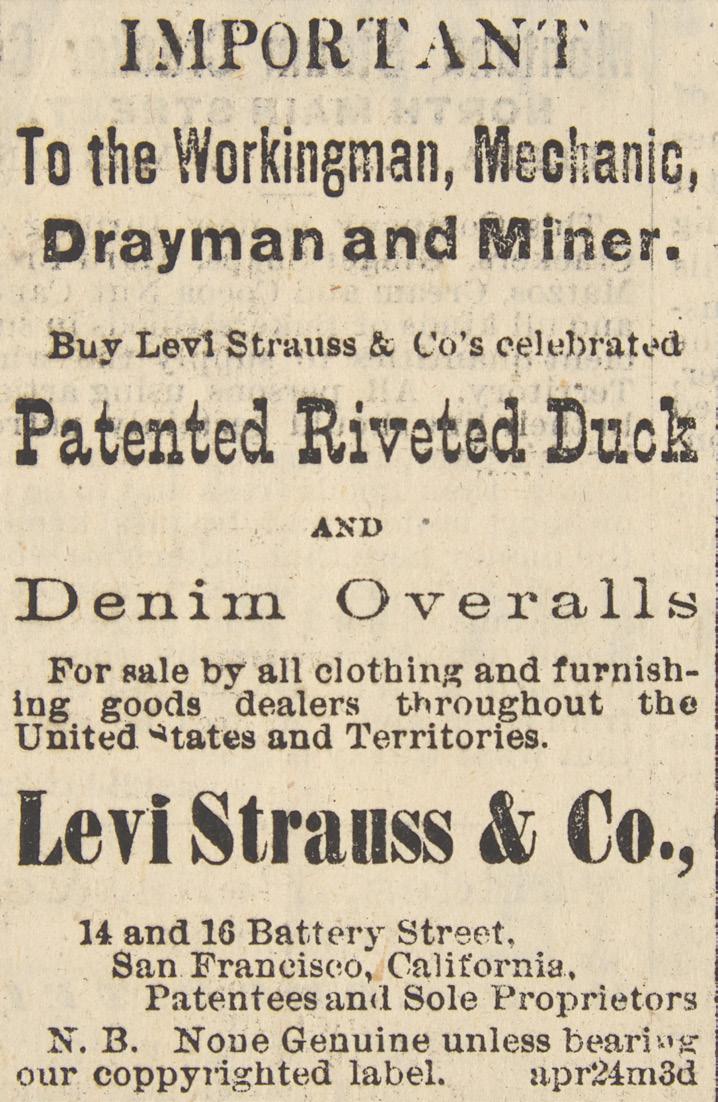
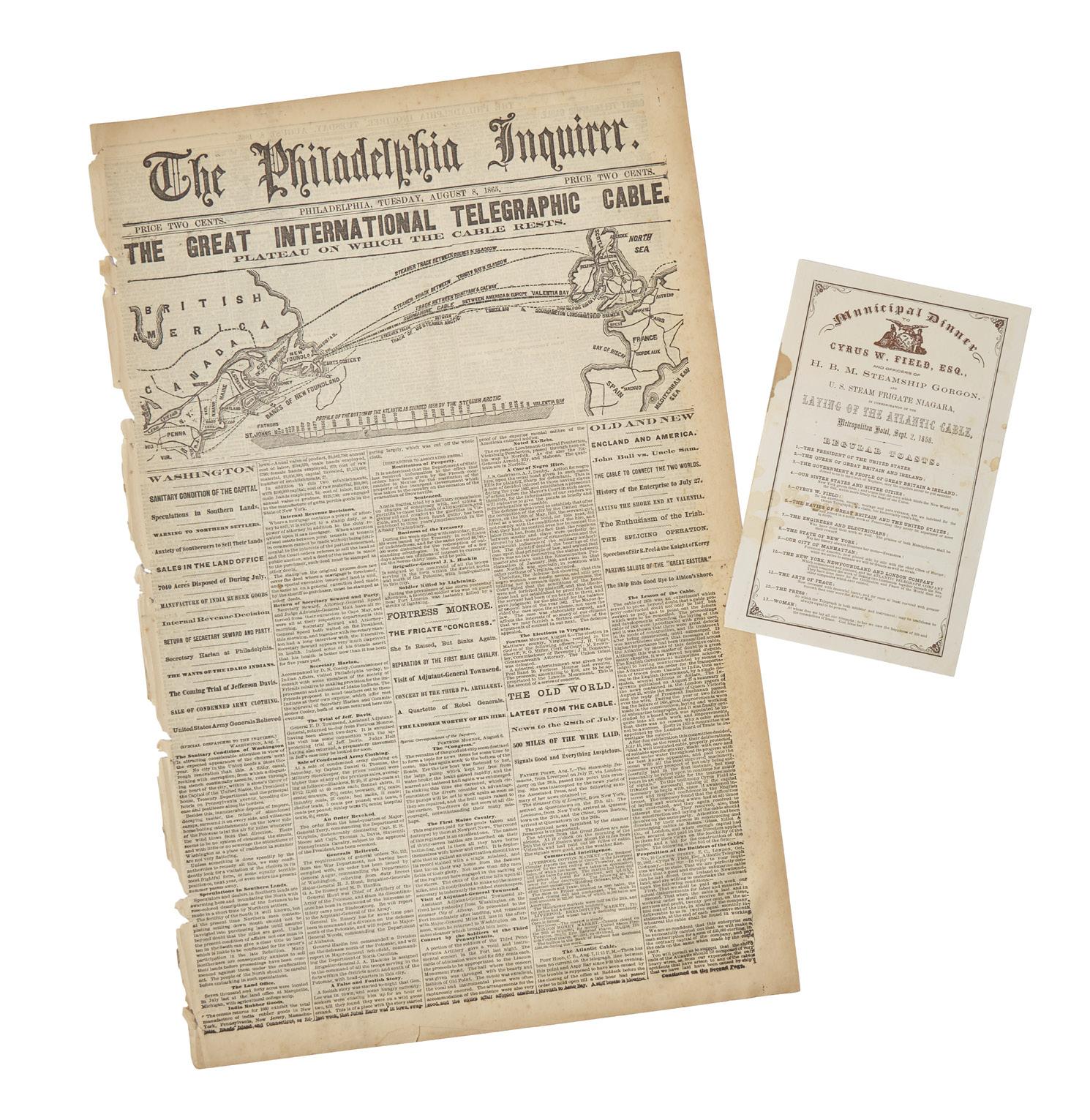
269
[Strauss, Levi]. The Birth of Iconic American Blue Jeans: The First Ad for Levi Strauss & Co.
“Important To The Working Man, Mechanic, Drayman and Miner. Buy Levi Strauss and Co.’s celebrated Patented Riveted Duck and Denim Overalls...”
The Daily Independent Helena, Montana. May 7, 1874. Vol. I, No. 37. Printed newspaper. Folio. 4 pp. Creasing from old folds; scattered foxing; contemporary ownership signature at top right of first page; four-inch closed tear at same, affecting signature.
A fine example of this Montana newspaper, featuring the first ad for German-American businessman Levi Strauss’s iconic blue jeans, printed during the company’s inaugural ad campaign.
Levi Strauss (1829–1902) emigrated from Germany to the United States in 1847. By 1853, he had established a dry goods store in San Francisco to supply miners during the California Gold Rush with durable workwear and provisions. Recognizing the demand for sturdier trousers, Strauss partnered with tailor Jacob Davis in 1871. Davis had developed a method of reinforcing denim pants with metal rivets. Two years later, the pair secured a patent for the garment, effectively creating the first modern blue jeans. As evidenced by this advertisement, the product was initially marketed to working-class laborers, however, its durability and comfort quickly propelled propelled it as a popular choice across all social classes and professions. Today, Levi’s is a global fashion staple, yet retains its status as a symbol of rugged American heritage.
According to online records, the above ad began circulation in newspapers in California, Nevada, Montana, and Idaho in early April of 1874 (the oldest evidently being an April 10 ad in the San Francisco Chronicle, headquarters of Levi Strauss & Co.). According to the same records, we cannot locate earlier ads with different content.
$500 - 800
270
[Technology] Group of 2 Items Related to the Atlantic Cable
Printed Handbill
No place, ca. September 2, 1858. Printed handbill; 7 7/16 x 5 in. (189 x 127 mm). Likely disbound; scattered stains and toning.
The Atlantic telegraph cable of 1858 marked the first successful submarine telegraphic connection between Europe and North America, an achievement widely heralded as a triumph of modern science and engineering. Promoted by Cyrus West Field and undertaken by the Atlantic Telegraph Company, the cable briefly enabled direct communication across the Atlantic for the first time in history. On August 16, Queen Victoria transmitted a formal message to James Buchanan inaugurating the line. Though the cable failed after only a few weeks, its temporary success demonstrated the feasibility of transatlantic telegraphy and paved the way for the permanent Atlantic cable, completed in 1866.
Together with:
The Philadelphia Inquirer Philadelphia, August 8, 1865. Printed newspaper. Folio. 8 pp. With a vignette map related to the cable. Some marginal toning; small dampstaining in upper margin.
The international telegraph cable expedition of 1865 was the second attempt to secure direct telegraphic communication between Europe and North America. Organized by the Atlantic Telegraph Company, and again, under the leadership of Cyrus West Field, the attempt followed the brief success and subsequent failure of the 1858 cable. Departing aboard the massive steamship SS Great Eastern, the expedition laid thousands of miles of cable across the Atlantic before the line parted and was lost in deep water. Though unsuccessful, the project would pave the way for the successful completion of the transatlantic cable in 1866, an achievement that fundamentally altered international communication.
$200 - 300
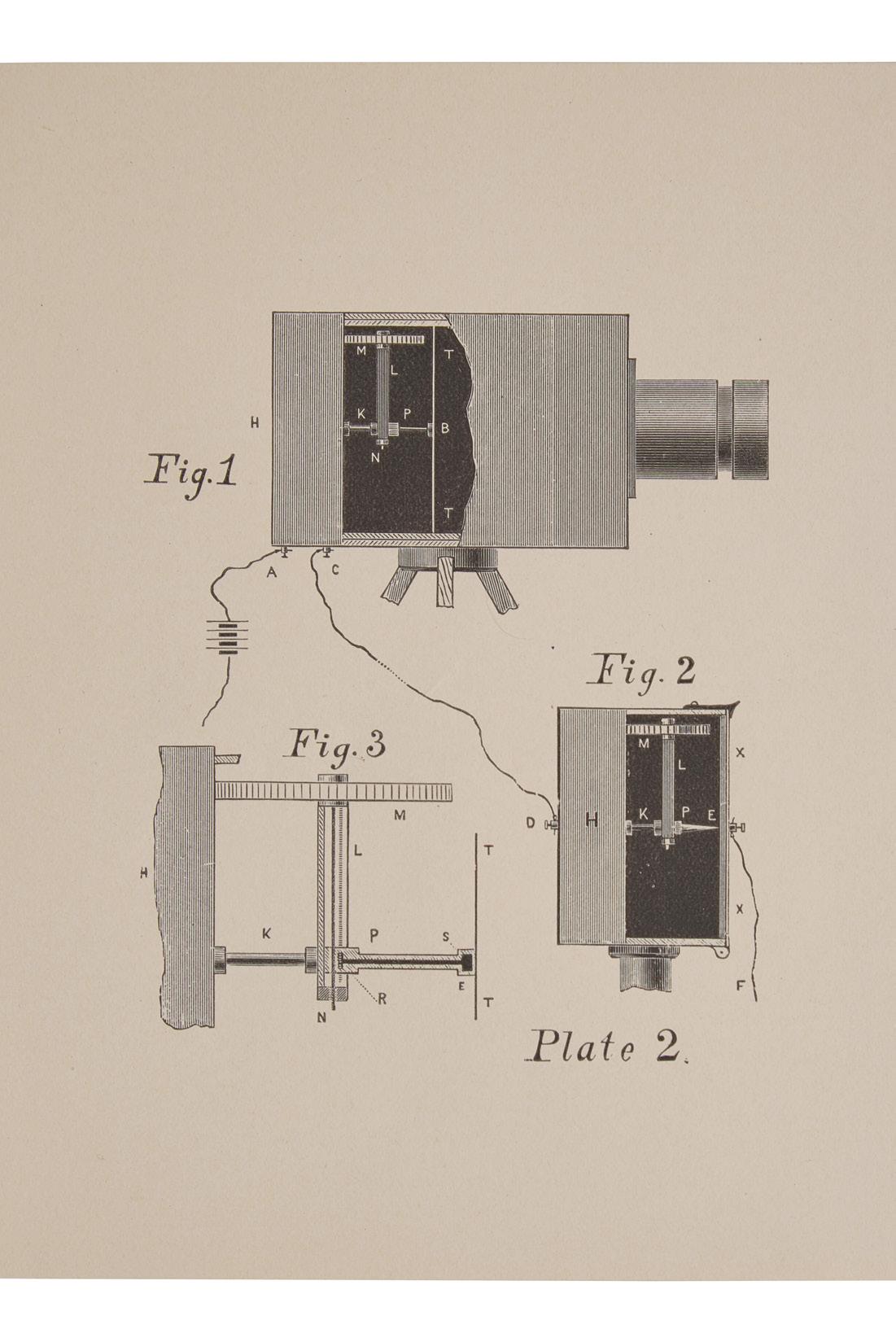
271
[Technology] Partially-Printed Patent for a Precursor of the Television
Washington, D.C.: The United States Patent Office, March 30, 1880. Single sheet, 11 7/8 x 7 3/4 in. (302 x 197 mm). Partiallyprinted document, being a one-year patent caveat issued to George R. Carey, relating to an improvement in “Electrical Fac-simile Transfer Instruments”; signed in print by Commissioner of Patents H.E. Paine; red paper seal in lower left. Creasing from old folds; offsetting from seal from when folded. Lot includes two engraved diagrams depicting Carey’s selenium camera.
In the May 17, 1878 issue of Scientific American, it was reported that, “some very ingenious and curious applications of selenium, in which its peculiar property of changing its electrical conductivity when exposed to light varying in intensity is utilized. The several devices are the invention of Mr. George R. Carey...” Carey (1851–1906), a city surveyor for Boston, based his work on the 1873 research of electrical engineer Willoughby Smith. Smith had discovered selenium’s photoconductive properties and, by 1875, had developed a rudimentary method for transmitting images.
In early June 1880 (two months following the issue of this preliminary patent) Scientific American further reported on Carey›s «wonderful instruments», publishing illustrations of his devices (see the two included diagrams) and explaining their components and function, describing them as «instruments for transmitting and recording at long distances, permanently or otherwise, by means of electricity, the picture of any object that may be projected by the lens of a camera...The operation of this device depends upon the changes in electrical conductivity produced by the action of light in the metalloid selenium...» (June 5, 1880, Vol. XLII, No. 23, p. 355)
As one of the first proposed systems for pictorial transmission, Carey’s device was an early stepping stone towards the development of television, and was influential to the work of scientists such as Constantin Selencq, who invented the first prototype television around the same time. (see Shelton, The Invention of Television, p. 50)
$4,000 - 6,000
272
[Technology] United States Patent Issued to a Pioneer in Sound Film, 1927 (Washington, D.C.: United States Printing Office), 1927. Comprising eight sheets, three with printed text recto and verso, five with printed diagrams; stapled in top left corner. Printed patent issued by the United States Patent Office for Charles A. Hoxie, assignor to the General Electric Company, for a “Method and Apparatus for the Transmission of Pictures and Views”. Scattered ink stamps.
A patent issued to Charles A. Hoxie (1867-1941), a pioneering electrical engineer in talking motion pictures and radio communication, for an apparatus to transmit pictures and views. Raised in Constable, New York, and educated in Boston, Hoxie joined General Electric in 1912, where he first worked on measurements for establishing standards of capacity, inductance, resistance, and electromotive force. With an interest in telephony, in 1920 he developed a visual and photographic receiver for transatlantic wireless communication, which received messages thirty-times faster than the most skillful operator. It was in relation to this work that led Hoxie to the creation in 1922 of his pallophotophone, a machine that could record sound on film. An early basis for the RCA Photophone, one of four major devices that helped revolutionize the film industry with the introduction of sound. Hoxie applied for a patent for the above device on September 23, 1924, and it is likely related to his experiments with sound film. The first major sound film, The Jazz Singer, was released a month prior to this patent, on October 6, 1927.
$800 - 1,200
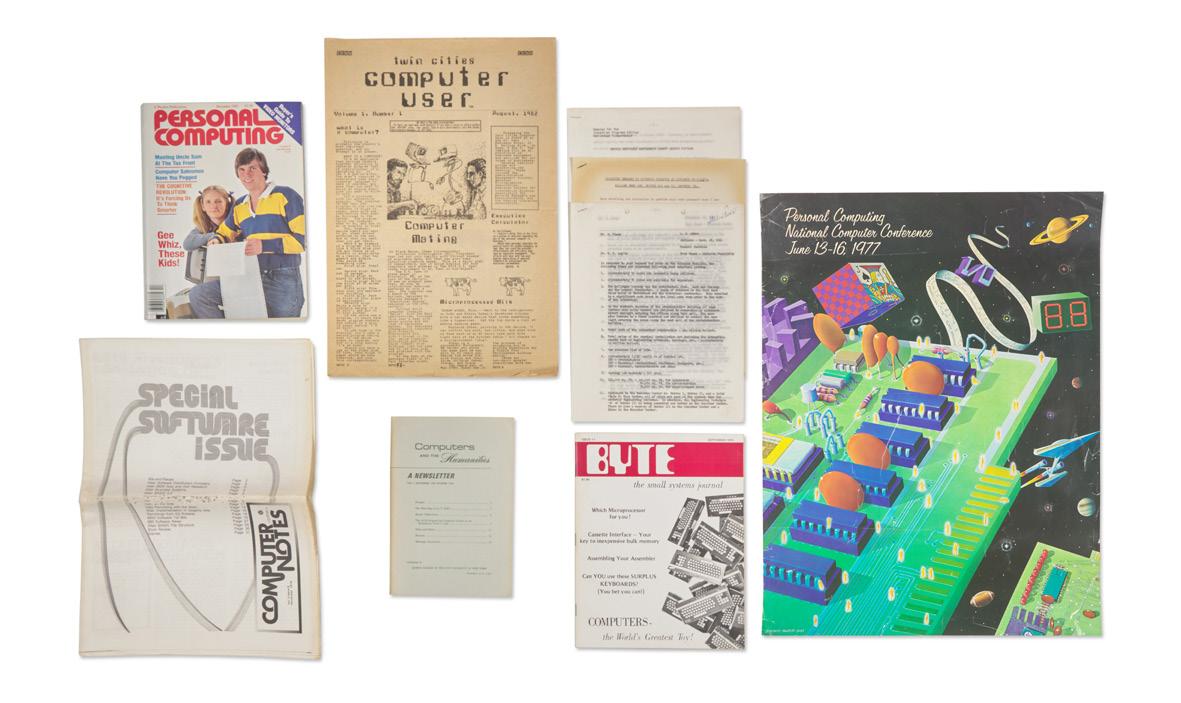
273
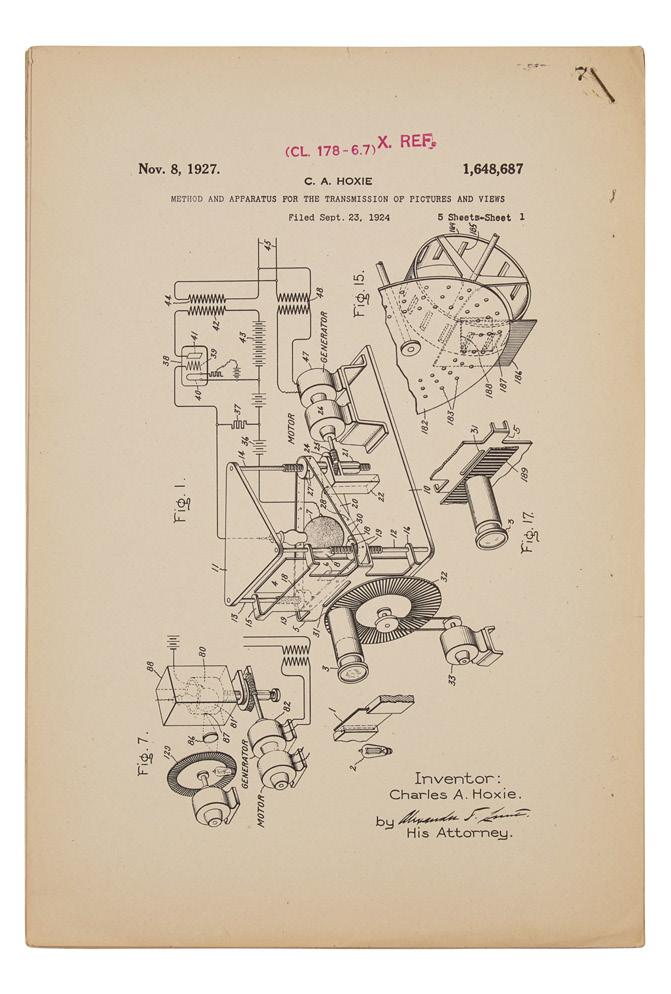
[Technology] Group of 9 Printed Items on Early Computing, ca. 1966-82
Locations vary, ca. 1966-82. Group of nine items including: printed pamphlet, Computers and the Humanities (Vol. No. 1, September 1966); printed newspaper, Computer Notes (“Special Software Issue”, Vol. 2, Issue 6, November 1976); three typed reports relating to the UNIVAC Division of the Sperry Rand Corporation (ca. 1961-67); printed magazine, Byte (Issue #1, September 1975); printed magazine, Personal Computing (December 1982, Vol. 6, No. 12); printed newspaper, Twin Cities Computer User (Vol. 1, No. 1, August 1982); one poster, Personal Computing National Computer Conference June 13-16, 1977. Size and condition varies.
The hardware that served as the foundation for modern computers was first developed in the early 1960s, marked primarily by a transition from vacuum tubes to transistors and integrated circuits. These leaps in technological innovation resulted in the 1966 development of the Apollo Guidance Computer, the 1971 invention of the 8-inch floppy disk, and the 1977 introduction of the Apple II personal computer system. The developments outlined in the materials comprised here served as the foundation of our modern technological age.
$800 - 1,200
274
[Technology] Designer of the First American Commercial Computer, J. Presper Eckert’s Corrected Copy of a Speech on Computing
“...new thoughts have been coming in much more slowly in the last 10 years than they did in the first 10 years of computers, we are not yet at a plateau...”
Denver, Colorado, March 23, 1967. 17 leaves. Typescript speech, on rectos only. Each sheet, 11 1/2 x 8 1/2 in. (292 x 216 mm). Titled, “The Computer - A Bridge From Nanoseconds to Seconds”, given by J. Presper Eckert, Vice President of UNIVAC, a Division of the Sperry Rand Corporation, at a meeting of the Mile High Chapter Data Processing Management Association. Annotated throughout in pencil and in ink, with notes and emendations. Lightly creased; scattered light ink stains; Old paperclip at top left, with associated stains; small closed tear to right margin of last page.
Computer pioneer J. Presper Eckert’s corrected copy of a 1967 speech given before a chapter of the Data Processing Management Association.
Eckert (1919-1995), along with physicist John Mauchly (1907-1980), developed the first general purpose computer in 1945 (ENIAC). The two worked together on subsequent integrations of the invention including the BINAC and UNIVAC I. Together they founded the Eckert–Mauchly Computer Corporation which was fundamental in developing key computer concepts such as nesting, subroutines, and stored programming. Their work would contribute to the worldwide explosion of technological advancements in computing in the late 1940s and early 1950s. However, they soon fell on hard economic times, and the company was sold to Remington Rand, who later merged with the Sperry Corporation, forming Sperry Rand.
A fascinating piece of technological history from one of the fathers of computer engineering.
$2,000 - 3,000
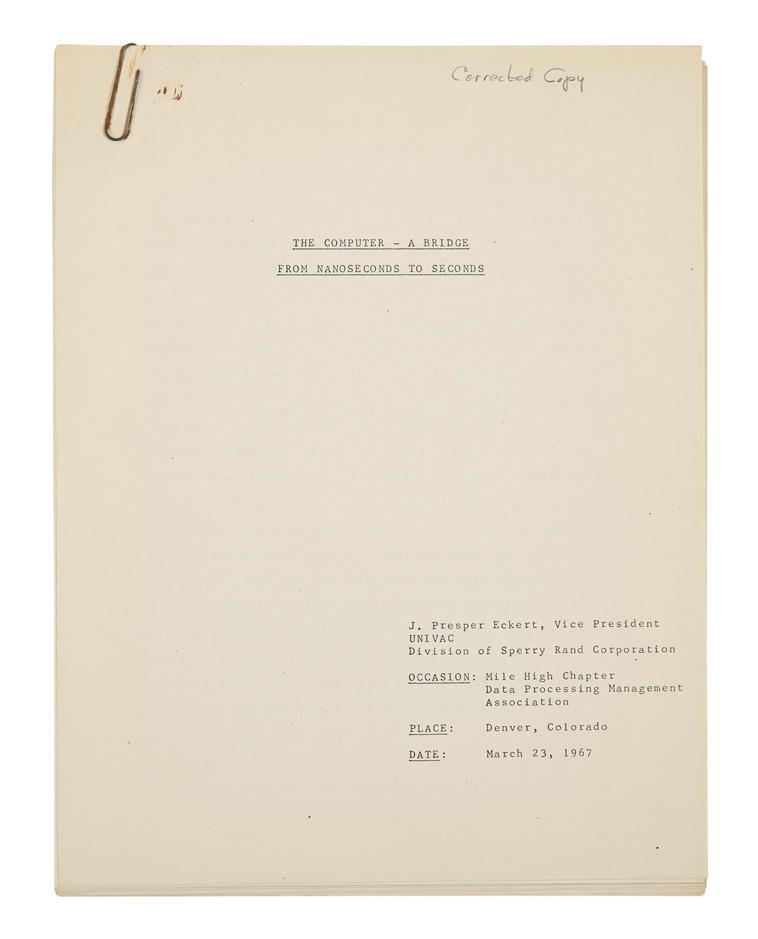
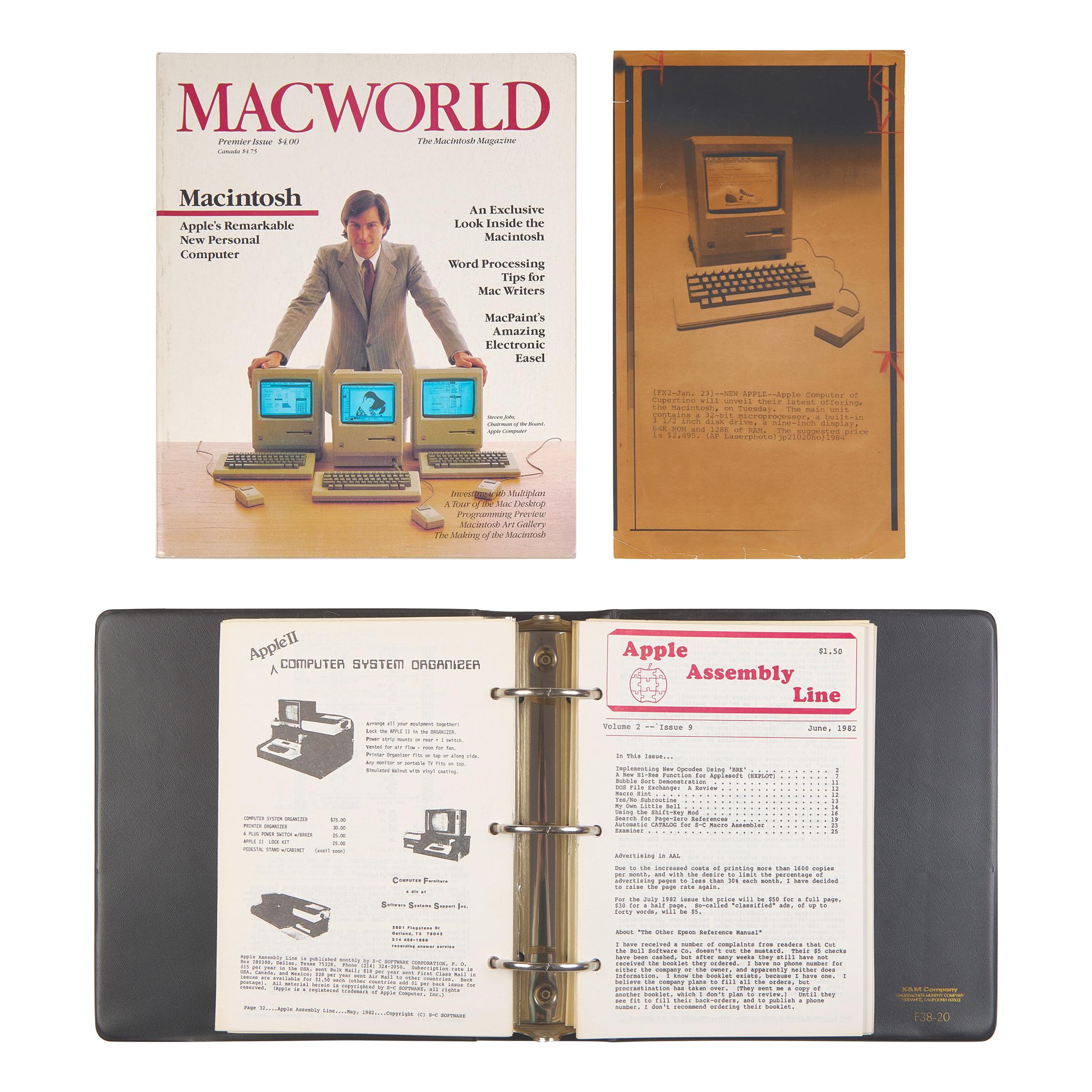
275
[Technology] Group of 3 Items Related to Apple Computers, Including the First 36 Issues of Apple Assembly Line, 1980-88
Press Photo of the Macintosh Computer. Stamped on verso “Jan. 24 1984” and “Feb 1 1988”. Light wear and creasing along edges. 11 x 6 1/4 in. (279 x 159 mm).
Together with:
Apple Assembly Line Richardson, Texas: S-C Software, October 1980-September 1983. Comprising 36 consecutive issues (Vol. 1, Issues 1-12, Vol. 2, Issues 1-12, Vol. 3, Issues 1-12). Original limp printed wrappers. In black spiral-bound binder.
A scarce and early monthly newsletter devoted to Apple computer products. Edited and published by Bob Sander-Cederlof from October 1980 through May 1988, it focused on assembly language programming for the Apple II personal computer.
Lot includes the premiere issue of Macworld The Macintosh Magazine, with a cover image of Steve Jobs (1984, Vol. 1, No. 1). 4to.
$300 - 500
276
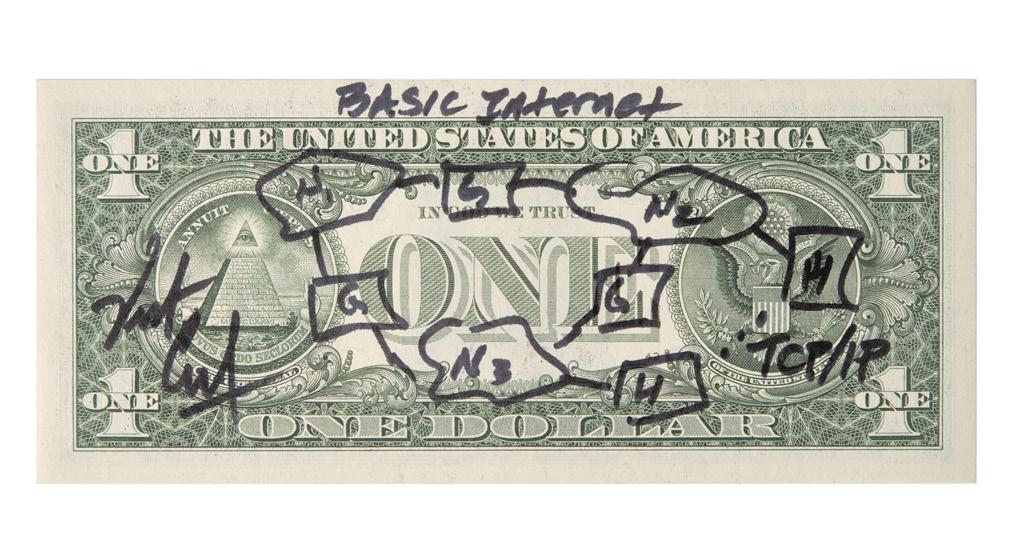
[Technology] Signed Sketch of the “Basic Internet”, by one of its “Fathers,” Vint Cerf
No place, after 2017. Original sketch by Vint Cerf in black ink on the reverse of a one-dollar bill, titled “Basic Internet”, and signed by him. 2 3/4 x 6 in. (70 x 152 mm).
The sketch shows a basic diagram of the connections between gateways, hosts, and networks that comprise the Internet.
$300 - 500
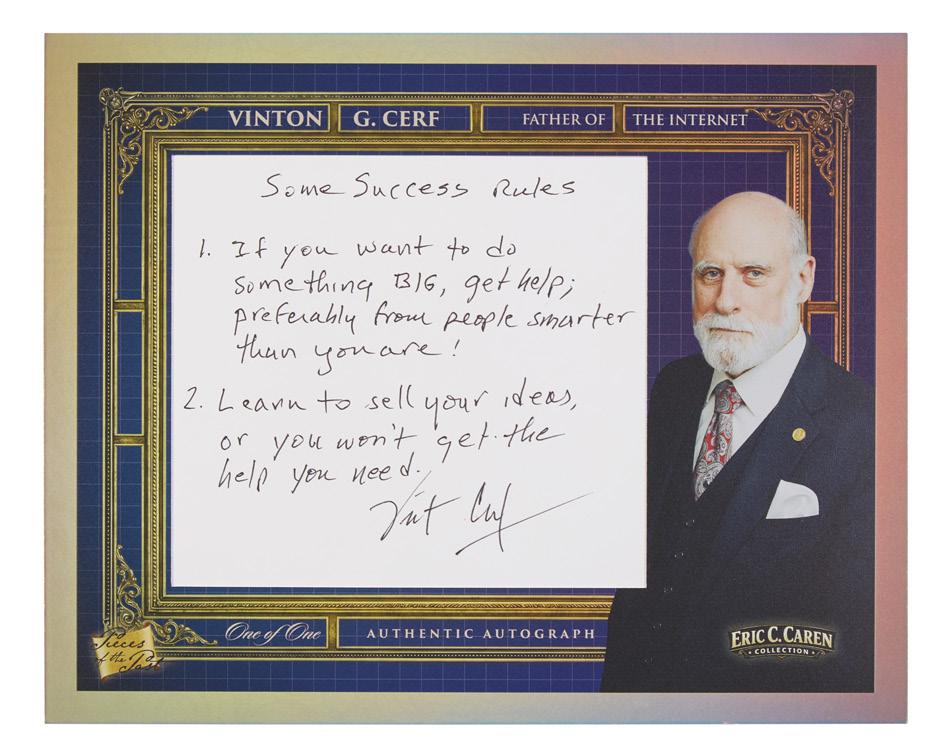
277
[Technology] 1-of-1 Trading Card with an Autograph Note, Signed by One of the “Fathers” of the Internet, Vint Cerf
No place, no date. Autograph note, signed by the “Father of the Internet”, Vint Cerf: “Some Success Rules 1. If you want to do something Big, get help; preferably from people smarter than you are! 2. Learn to sell your ideas, or you won’t get the help you need. Vint Cerf”. Approximately 5 x 5 1/2 in. (127 x 140 mm). In pictorial presentation mat with a portrait of Cerf.
All proceeds from this lot will benefit a mutually supported not-for-profit.
Vint Cerf, thence to Eric C. Caren
$300 - 500
278 [Temperance] Rare Prohibition Broadside for the “Maine Law”, the First Statewide Prohibition law in the United States
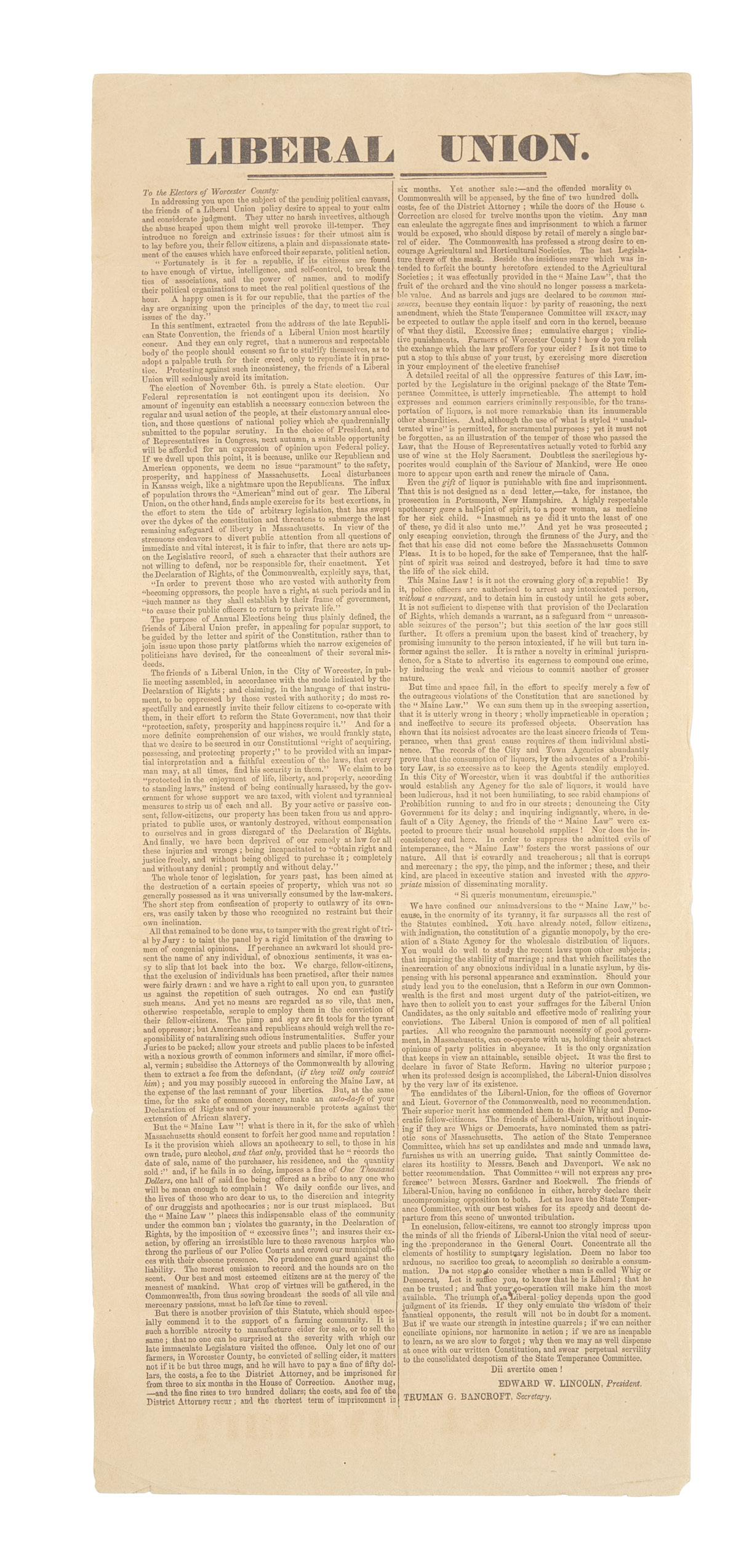
Worcester County, Massachusetts, ca. 1851. Printed broadside in two columns, signed in type by Edward W. Lincoln and Truman G. Bancroft; 21 3/8 x 9 in. (543 x 229 mm).
A rare prohibition broadside addressing the electors of Worcester County in regards to the passing of the “Maine Law”: the first statewide prohibition law in the United States.
Passed in 1851 in the state of Maine under the leadership of Neal Dow (considered the “Napoleon of Temperance”), the law prohibited the manufacture and sale of alcoholic beverages except for medicinal, mechanical, or sacramental purposes. In this address, the president of the Liberal Union writes a scathing letter: “We claim to be ‘protected in the enjoyment of life, liberty, and property, according to standing laws,’ instead of being continually harassed, by the government for whose support we are taxed, with violent and tyrannical measures to strip us of each and all...” He goes on, “This Maine Law! is not the crowning glory of a republic!...Observation has shown that its noisiest advocates are the least sincere friends of Temperance, when the great cause requires of them individual abstinence...”
$300 - 500
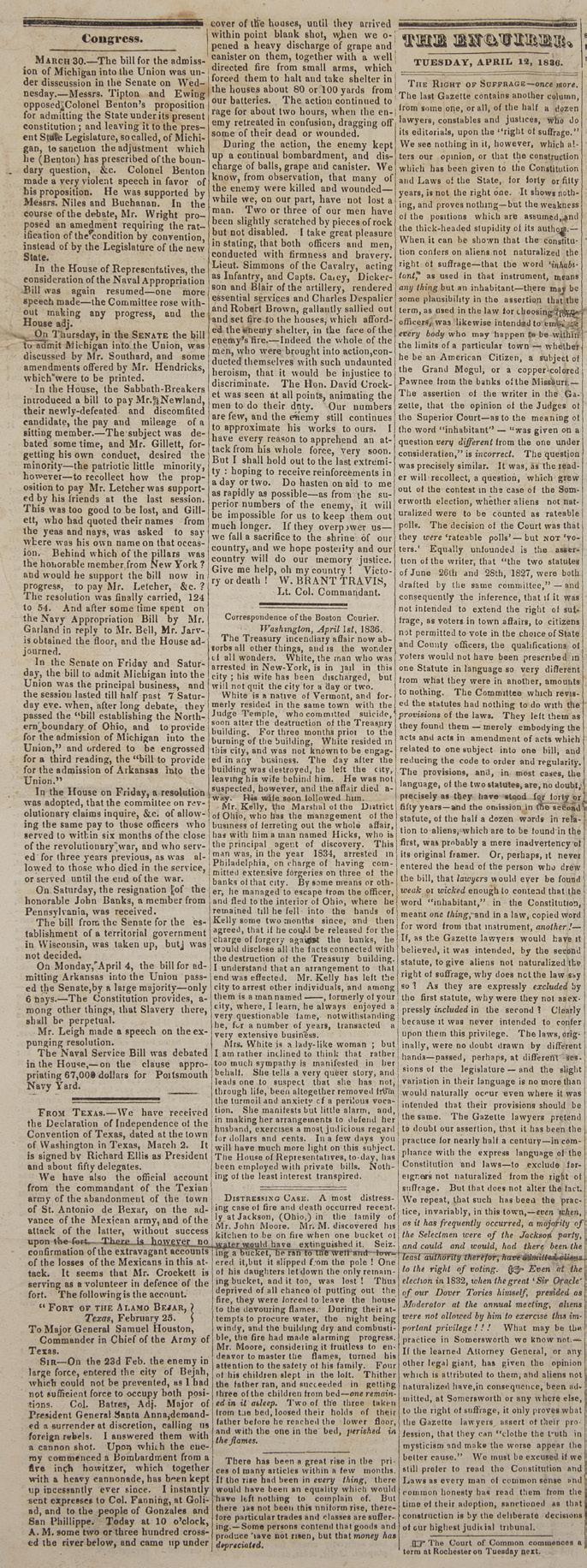

279
[Texiana] Group of 4 Items Related to Early Texas, Including a Report of the Reception of Texas’s Declaration of Independence, ca. 1836-64
1. Dover Enquirer. Dover, New Hampshire, Tuesday Morning, April 12, 1836. Printed newspaper. Folio. 4 pp. Creasing from old folds, small separations along same; scattered soiling; old ownership signature at top of front page.
On the second page is reported the reception of Texas’s Declaration of Independence of March 2, 1836, followed by a complete printing of Lt. Col. Commandant William Bryant Travis’s famed and passionate letter from the last stand at the Alamo, to Sam Houston, requesting aid in the face of advancing Mexican forces, and ending with his send off, “Victory or Death!”
2. The New York Herald. New York, Sunday Morning, September 1, 1845. Printed newspaper. Folio. 4 pp. Toning along edges, scattered wear along same.
With a front-page printing of an engraved map of Texas showing the disputed land areas with Mexico, and followed by articles reporting on General Zachary Taylor’s forces there.
3. Printed Senate Report. May 17, 1852. Single sheet, 8 3/4 x 5 5/8 in. (222 x 143 mm). Disbound.
United States Senate report No. 221, denying compensation for Texas Ranger Col. John Coffee Hays (1817-83), for his service in the Mexican-American War.
4. Printed Resolution of the State of Texas. Texas, House of Representatives, May 4, 1864. Single sheet, 9 1/2 x 6 1/4 in. (241 x 159 mm). Signed in type by Secretary of State R.J. Townes. Scattered spotting; toning along edges; circular ink stamp at top.
A joint resolution issued by the Texas legislature during the Civil War, reaffirming their secessionist stance and their faith in the Confederate government: “That now that our presumptuous enemy treads our soil, in heavy numbers and menacing attitude, we bid him a proud and scornful defiance... we pledge to our sister States that in this struggle our authorities and our people will evince a patriotism and endurance as great as the occasion and as prolonged as the conflict...we here record our full confidence in the patriotism and ability of President Davis...we would not exchange him for any citizen of the Confederacy, as the pilot to carry us through the present stormy struggle for liberty, as a people, and for independence as a nation.»
$1,000 - 1,500
280
[Texiana] Partially-Printed Republic of Texas Payment Order Issued to one of the “Immortal 32” Gonzales Rangers Killed in Action While Defending the Alamo in 1836
Houston, Texas, January 22, 1839. Partially-printed payment order, No. 10396, for $2.66, for “payment of the Military. Services in the army”. Issued by the Treasurer of the Republic of Texas Francis Lubbock to J.D. Clements, executor of the estate of Thomas R. Miller. Creasing from old folds; scattered stains and foxing.
Thomas Redd Miller (1804-1836) was a Virginia store owner who moved to the Republic of Texas in 1830. He was one of the “Immortal 32” rangers from the nearby town of Gonzales who responded to William Barrett Travis’s request for aid as Antonio López de Santa Anna’s army approached the Alamo in February 1836. Miller had served as a member of the Texas Consultation tasked with deciding a response to the aggressive actions of Santa Anna. Led by George C. Kimble, the Gonzales Rangers arrived at the Alamo ten days later, and at 3:00 a.m. on March 1 slipped past Santa Anna’s forces and into the fortress. Four days later Santa Anna began his final assault on the Alamo, which resulted in 189 Texan defender casualties, including every member of the Gonzales Rangers. Miller’s estate took nearly a decade to settle due to inconsistent record-keeping and his own considerable debts.
Often referred to as the “Lexington of Texas,” Gonzales was the site of the first major skirmish of the Texas Revolution. It was the only city to send aid to the Alamo and immediately following the battle, General Sam Houston ordered it burned to the ground, fearing that it would be Santa Anna’s next target.
$1,500 - 2,500
[Titanic] The Official British Government Report on the Sinking of the Titanic, 1912
Shipping Casualties (Loss of the Steamship “Titanic”). Report of a Formal Investigation into the circumstances attending the foundering on 15th April, 1912... London: Published by His Majesty’s Stationery Office, Printed by Jas. Truscott and Son, 1912. Tall 4to. (ii), 73, (1) pp. Illustrated with an in-text engraved diagram of the Titanic. Full tan buckram, red morocco spine label, stamped in gilt (chipped), library label at foot of spine, boards soiled; all edges trimmed; original blue wrappers bound in, front wrapper loose and chipped along edges, same with “Association of the Bar Library City of New York” ink stamp at top; library ink stamps at top of title-page; leaves with vertical center crease from when sometime folded.
Following the sinking of the RMS Titanic on 15 April 1912 a formal inquiry into the disaster was convened by Lord Mersey. Hearings were held over two months at the London Scottish Drill Hall which saw over 100 witnesses questioned. Unlike the American inquiry, no blame was placed on the White Star Line or Captain Edward J. Smith for the disaster.
The final report, issued in July 1912, provides a highly detailed account of the entire event, including notes on the Titanic’s composition, its crew, the ship’s journey, as well as reports on its speed, the weather, iceberg warnings, and a description of its collision (“The injuries to the ship...were of such a kind that she foundered in two hours and forty minutes”). The report further describes damages to the ship, its sinking, an account of the rescue operations, the number of those saved, and the number of casualties. The final section lists recommendations from the Commission, regarding water-tight compartments, lifeboats and rafts, etc.
Bound with:
Report of the Merchant Shipping Advisory Committee Respecting the Statutory Regulations as to Boats and Life-Saving Appliances and Other Means of Ensuring Safety of Life at Sea... London: Published by His Majesty’s Stationery Office, Printed by Darling and Son, Ltd., 1912. (ii), 175 pp. Illustrated with two maps (one folding). Original blue wrappers bound in; same library ink stamp on front wrapper and title-page; scattered short closed tears.
Landmark report issued by the Merchant Shipping Advisory Committee on behalf of the Board of Trade following the sinking of the Titanic, being their detailed investigation into English ship safety regulations and sea casualties, and their recommendations for changes. Five further safety reports include those issued by a sub-committee on the construction of lifeboats, on wireless telegraphy, Atlantic steamship routes, life saving appliances on passenger ships, and a statistical report on life saving devices on ships prior to 1910.
$800 - 1,200
282
[Tobacco Cards] Rare Salesman’s Dummy of an Uncut Sheet of William S. Kimball Tobacco Cards of Women, ca. 1880s
Rochester, New York: W.M. Kimball & Co., no date (ca. 1880s). Salesman’s copy of uncut sheet of 24 tobacco cards, mounted to gilt captioned card. Light edge-wear. 15 5/8 x 10 in. (346 x 254 mm).
An uncommon uncut salesman’s dummy sheet of 24 tobacco cards of women celebrities, sold by William S. Kimball & Co.
$500 - 800
283
[Transportation] Circa 1860 Broadside Advertising the USS Daylight, a Freight Ship Operating Between New York and Boston, Later Acquired by the Union Navy for Service in the Civil War
New York, ca. 1860. Printed broadside, 16 x 11 1/4 in. (406 x 286 mm). Two engraved vignettes of ships. Top left corner chipped; scattered soiling.
A broadside advertising the use of a freight ship between New York and Boston. The USS Daylight was a 682-ton screw steamship built in Brooklyn by Samuel Sneden, later acquired by the Union Navy in May 1862 for Civil War service. It functioned as an armed gunboat patrolling the Atlantic Coast and Virginia waterways. Later in 1862, the Daylight joined the bombardment and capture of Fort Macon, North Carolina, receiving a damaging shot in her hull. It was sold in 1865.
$300 - 500
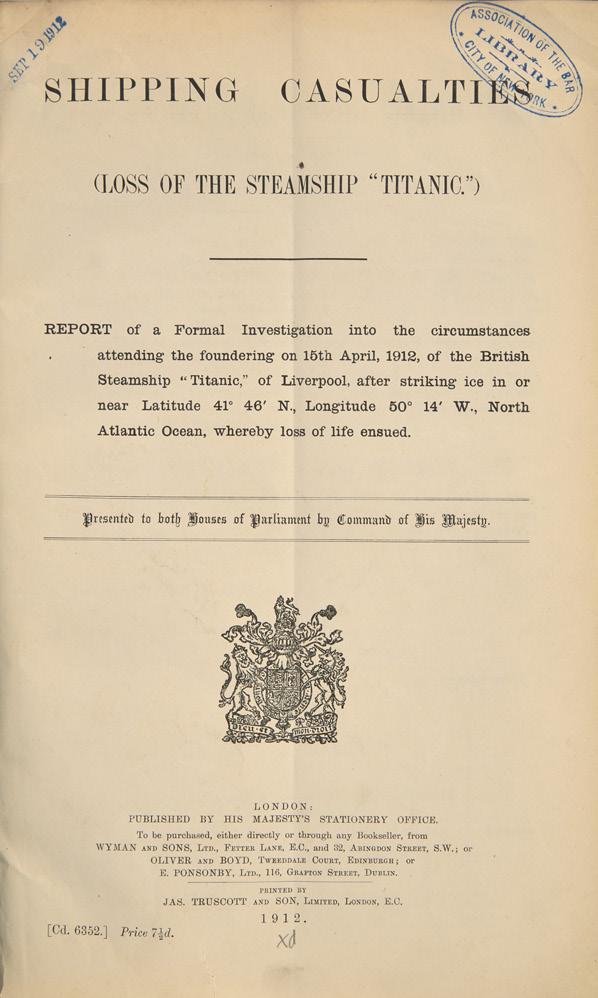
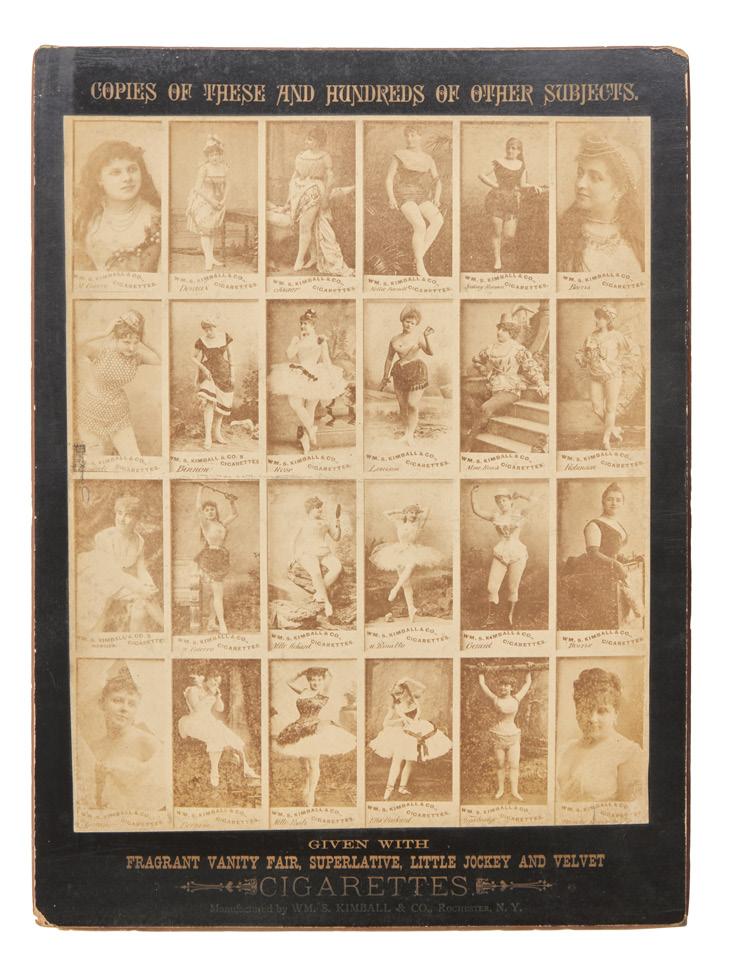
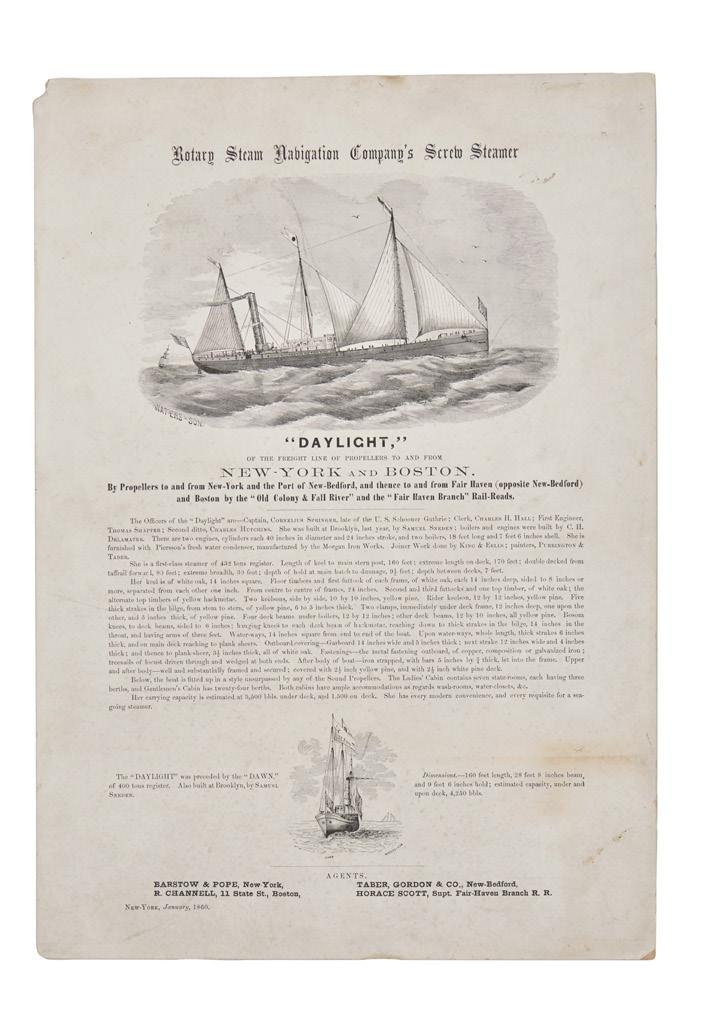
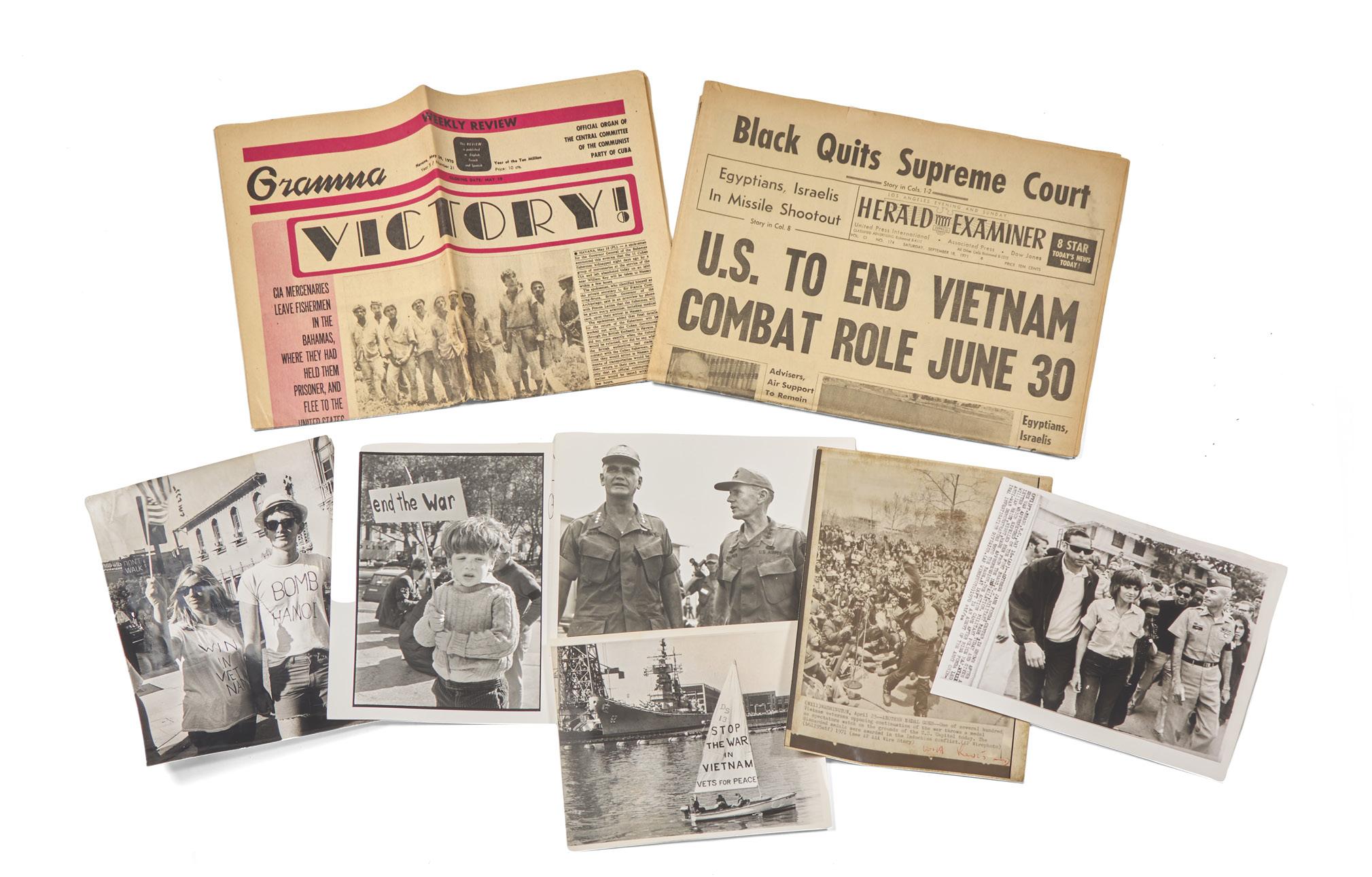
[Vietnam War] Collection of 6 Press Photos and 2 Newspapers, Related to the Vietnam War, 1960s-70s
Locations and dates vary, ca. 1960s-70s. Comprising eight total items, including six press photos, of protesters, military commanders, etc., as well as two newspapers, including the Los Angeles Evening and Sunday Herald Examiner, dated September 18, 1971 (“U.S. to End Vietnam Combat Role June 30”), and Havana’s Granma, dated May 24, 1970 (“Victory!”). Condition varies, generally very good.
$150 - 250
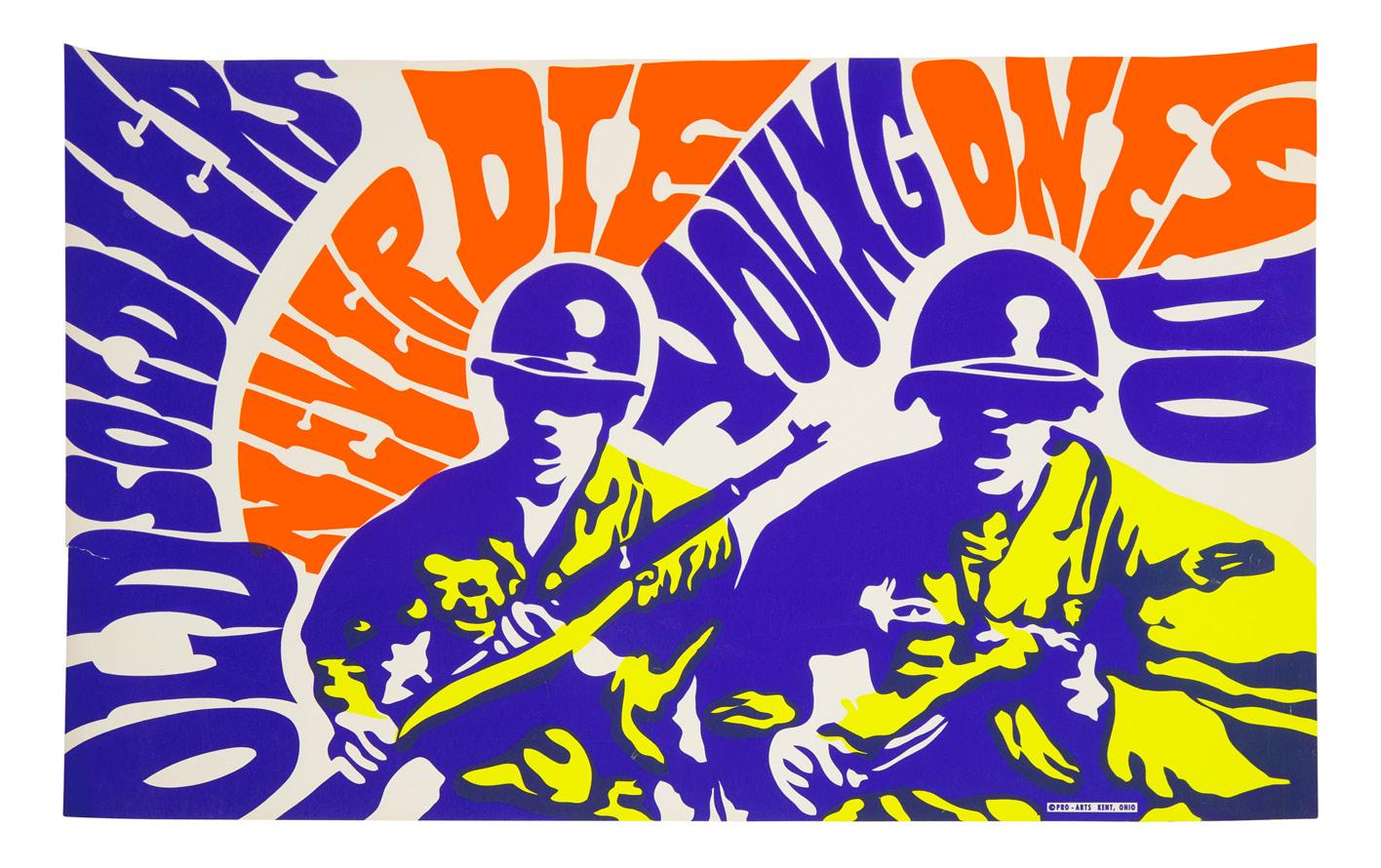
285
[Vietnam War] Old Soldiers Never Die Young Ones Do, Anti-Vietnam War Poster Kent, Ohio: Pro-Arts, ca. 1968. Color screen-print. 19 5/8 x 32 1/4 in. (498 x 819 mm). 1 1/4 in. closed tear in lower left edge.
“Old soldiers never die, young ones do” was often paraphrased by the 1960s antiwar movement from General Douglas A. MacArthur’s 1951 farewell address to the United States Congress: “Old soldiers never die; they just fade away”.
$150 - 250

286
[Vietnam War] Mederos, Rene. Rare Cuban Pro-Vietnam War Poster: Como en Vietnam Mes de la Mujer Vietnamita
Cuba, ca. 1970. Color screen-print poster on thick paper, by Rene Mederos; 29 1/4 x 19 1/4 in. (743 x 489 mm). Creasing and scattered closed tears along top edge, 1 3/4 closed tear along same; loss in top right and bottom left corners.
In 1969, Cuban artist Rene Mederos traveled to Vietnam on assignment from the Cuban government’s Department of Revolutionary Orientation to create scenes of the ongoing war, which were later turned into posters, such as this example. Expressing solidarity with the North Vietnamese in their struggle against American forces, the present poster celebrates the month of the Vietnamese Woman.
Rare, according to RBH we can locate only one other example of this poster at auction.
$300 - 500
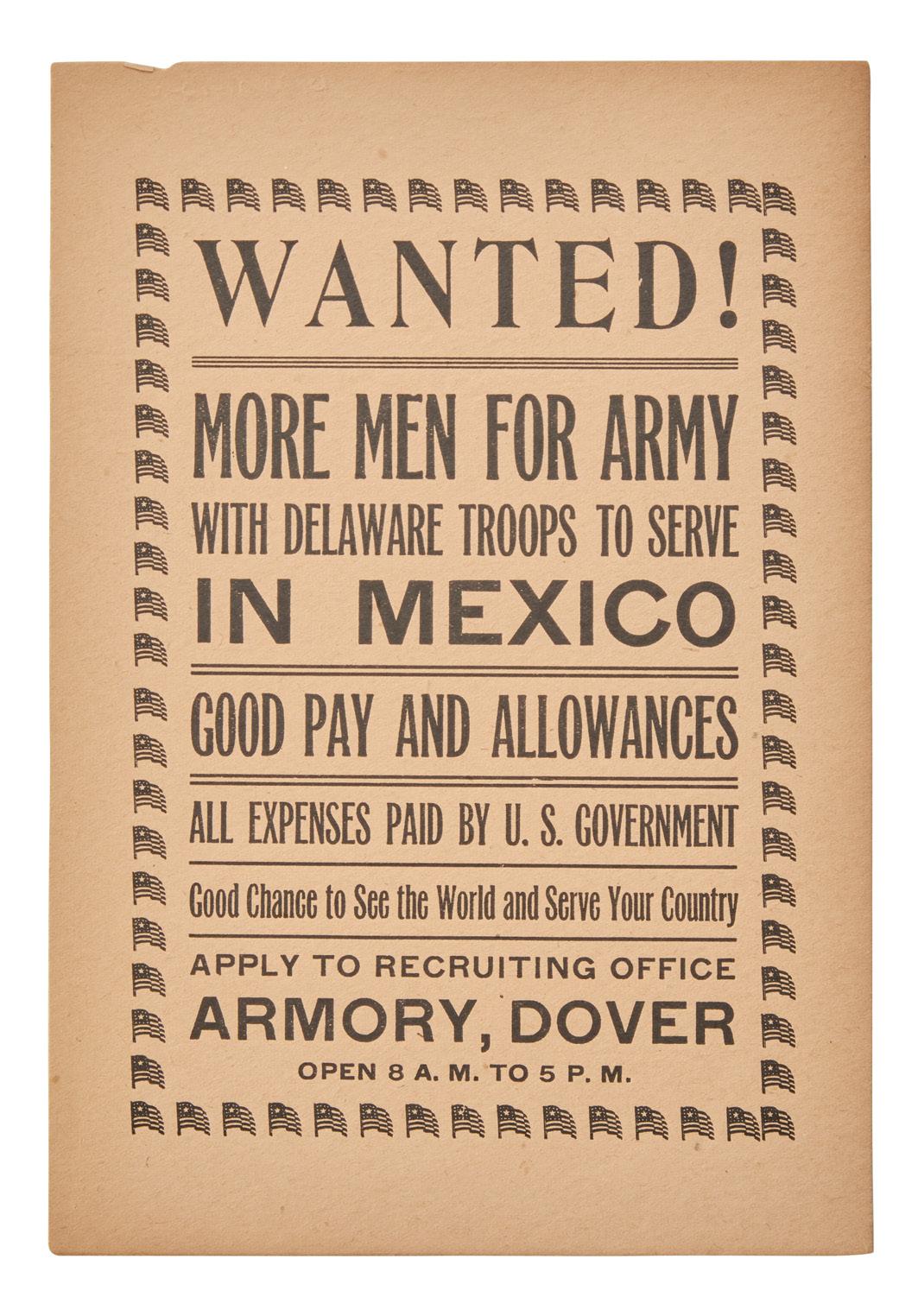
287
[Villa, Pancho] Rare Enlistment Poster During the American “Punitive Expedition” of 1916 Against Mexican Revolutionaries
Wanted! More Men for Army With Delaware Troops to Serve in Mexico... (Dover, ca. 1916). Printed broadside, 8 3/4 x 6 in. (222 x 152 mm). Lightly toned, small chip of paper loss at top margin.
Rare printed poster for enlistment in the Delaware National Guard during the American “Punitive Expedition” of 1916 against Mexican Revolutionaries led by Pancho Villa (1878-1923). During this period Villa had fallen out of favor with the United States government as a potential leader of Mexico in favor of Venustiano Carranza, as President Woodrow Wilson believed Carranza potentially offered a more stable government. In retaliation, Villa ordered a cross-border attack on Columbus, New Mexico in March 1916. This proved to be the last straw for President Wilson, who then ordered troops into Mexico to capture Villa.
$500 - 800
288
[War of 1812] The Beginnings of a Naval Hero: Commodore Oliver Hazard Perry’s 1807 Lieutenant’s Commission, His First Official Promotion in the Navy, Signed by Thomas Jefferson
Washington, D.C., January 15, 1807. Single vellum sheet, 17 1/2 x 14 1/2 in. (444 x 368 mm). Partially-printed military commission, signed by President Thomas Jefferson, appointing Oliver H(azard). Perry a lieutenant in the United States Navy; counter-signed by Secretary of the Navy Robert Smith. Engraved vignette at top and bottom, original paper seal intact at bottom. Creasing from old folds, very small holes at same at top.
Six years before the stunning victory against the British at Lake Erie that would make him a national hero, 21-year-old Oliver Hazard Perry (1785–1819) is appointed a lieutenant in the United States Navy by President Thomas Jefferson, Perry’s first official promotion in the service.
Perry’s naval career began on April 7, 1799. Influenced by his father, the 13-year-old joined the Navy as a midshipman and sailed under his father’s command aboard the USS General Greene. During this service, in 1800, Perry saw his first combat, off the coast of Haiti, at the time still embroiled in its struggle for independence, and where the General Greene assisted the revolutionary Toussaint Louverture in the blockade of Jacmel.
Despite the subsequent downsizing of the Navy following the end of the Quasi-War and the election of Thomas Jefferson, Perry was retained in the ranks. He went on to serve on the USS Adams under Captain Hugh Campbell, within a squadron commanded by Commodore Richard Morris, during the First Barbary War. Sailing to the Mediterranean in 1802, the Adams participated in the blockade off Gibraltar. It was during this period that Perry became an acting lieutenant, marking his first serious duty. He returned to the United States in 1803 and was dispatched to the Mediterranean again in 1804, this time aboard the USS Constellation. His service continued on several other vessels, including the USS Nautilus (where he served as first lieutenant), the USS Constitution, and the USS Essex (as second lieutenant under Commodore John Rodgers).
The year 1807 proved consequential for both Perry’s professional and personal life. It was then that he met his future wife, Elizabeth Champlin Mason, whom he would married in 1811. Professionally, he was given the present commission from Jefferson in January, and received the document in April. As noted by historian Alfred Fenton, “For five years he had waited for this official document...which would allow him to show the public at large he was a qualified lieutenant.” Beyond validation, the commission secured his place in the line of junior officers awaiting commands. Of the five years he had served as an acting lieutenant, one was spent on shore and the rest on the “monotonous work in the Mediterranean,” but “now perhaps he would be considered for more important things...” (Fenton, p. 162). Later that year, Secretary of the Navy Robert Smith directed Perry to oversee the construction of a gunboat flotilla in Newport and Westerly, Rhode Island, to enforce the Jefferson Embargo Act. While this was his first significant command, Perry reportedly found the assignment displeasing.
These events unfolded against the backdrop of the June 22, 1807, attack on the USS Chesapeake by the British ship Leopard, an incident in which four American sailors were killed and 17 injured. Upon hearing of the engagement, Perry is reported to have said, “This means war.” The confrontation served as an early catalyst for the War of 1812, a conflict in which Perry would distinguish himself as an American hero by leading the decisive victory at the Battle of Lake Erie.
A fine and early document, never before offered at auction, marking the rise of one of the Navy’s most lionized commanders. It stands as arguably one of the most important naval commissions still in private hands.
$30,000 - 50,000
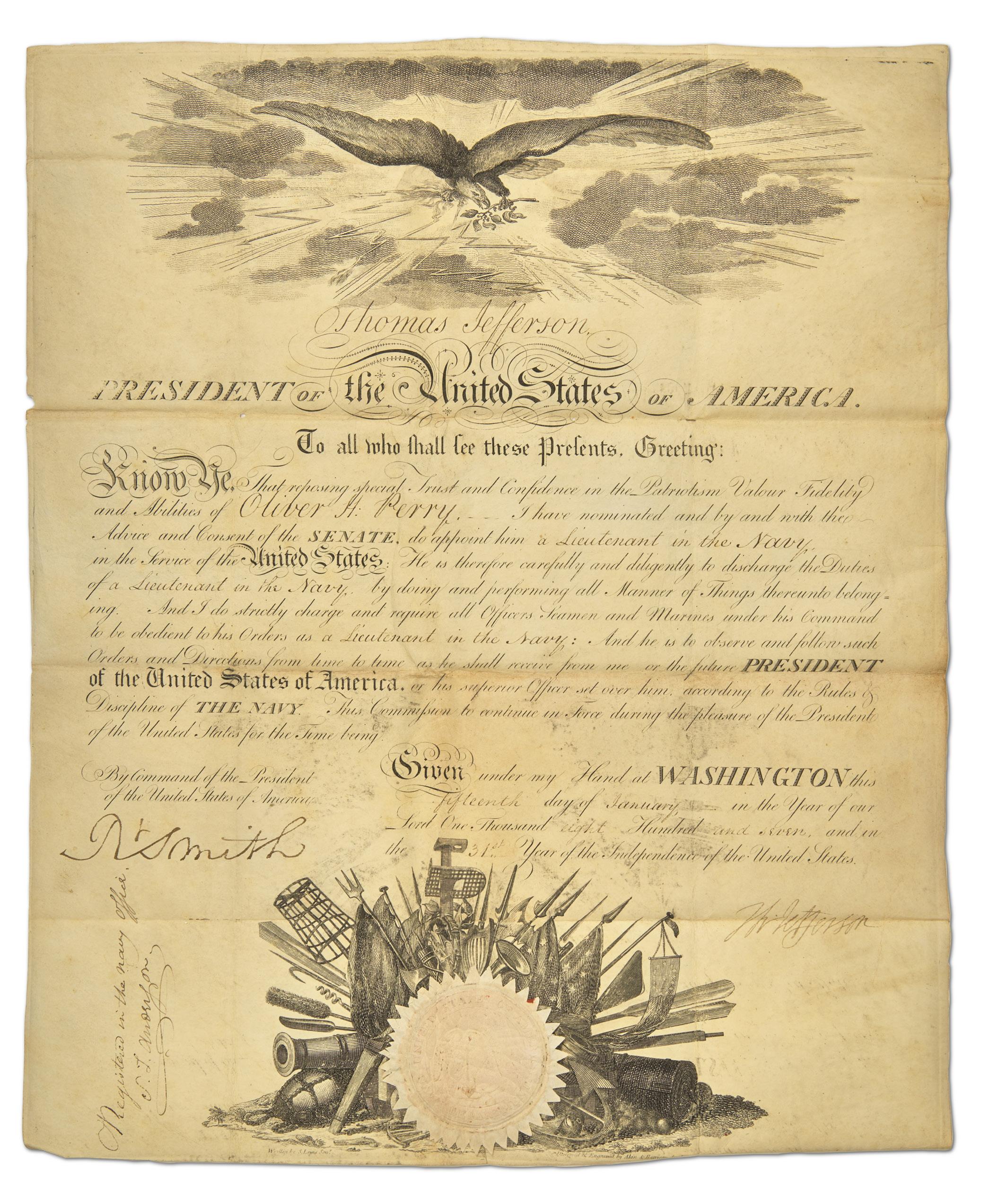
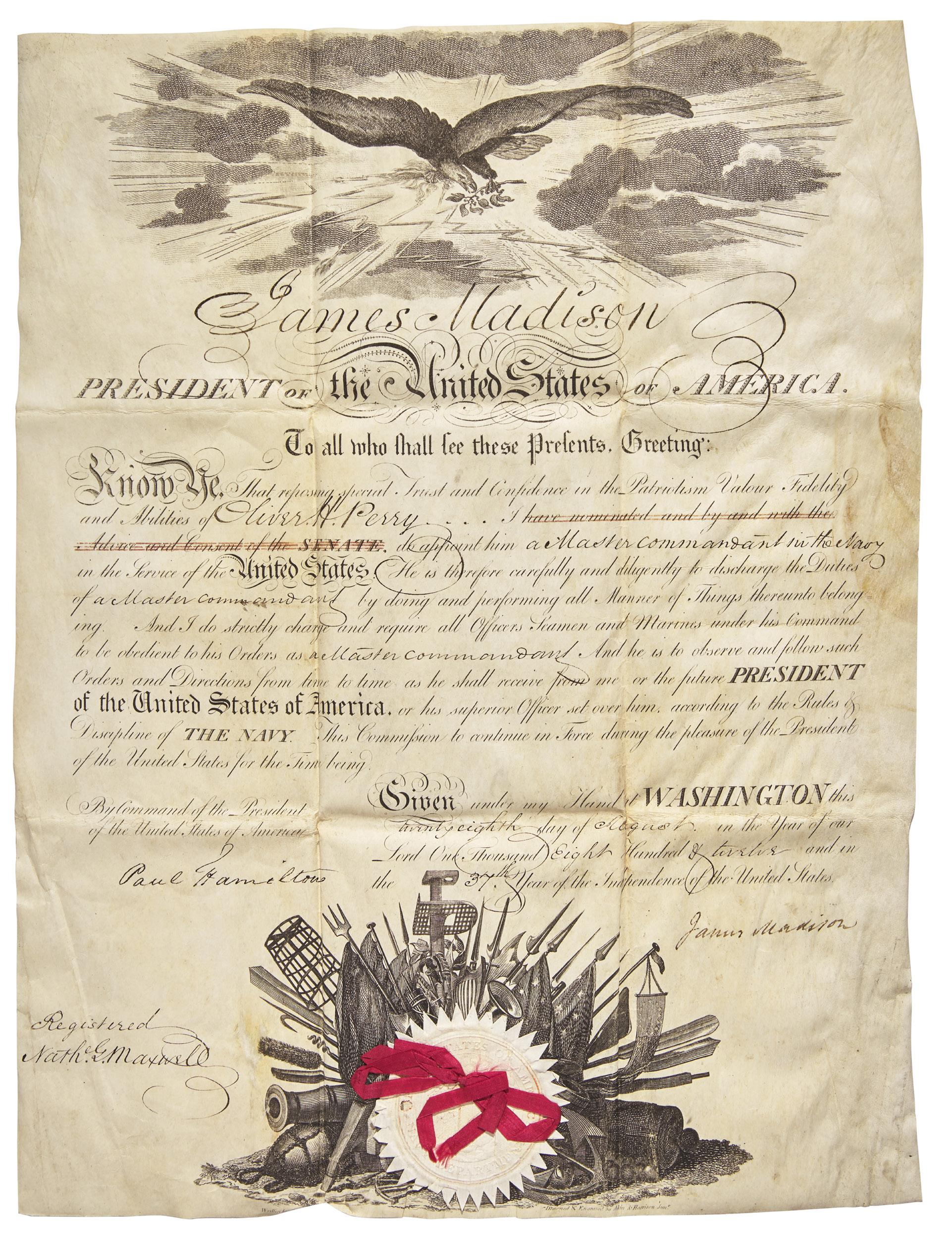
289
[War of 1812] “We Have Met the Enemy and They are Ours”: The Critical Promotion of a Naval Hero, Oliver Hazard Perry is Appointed Master Commandant in the United States Navy, Commission signed by James Madison, 1812
Washington, D.C., August 28, 1812. Partially-printed military commission on vellum, signed by President James Madison, appointing Oliver Hazard Perry Master Commandant in the United States Navy; counter-signed by Secretary of the Navy Paul Hamilton. Engraved vignette at top and bottom, paper seal with ribbon intact at bottom. Creasing from old folds; lightly soiled.
A year before his pivotal victory at Lake Erie that would make him a national hero, Oliver Hazard Perry is appointed Master Commandant in the United States Navy, a promotion that would ultimately place him in command of that critical battle.
By June 1812, following years of British harassment against American merchant vessels, President Madison declared war on Great Britain. At the time, 27-year-old Lieutenant Perry, one of the Navy’s most promising officers, had recently returned to Newport, Rhode Island to oversee gunboat construction after a brief furlough following the wreck of the USS Revenge, his first command. For a year, he waited for an opportunity to return to sea. With war now declared, he saw his chance to regain a command and prove his worth. The disastrous American campaign to invade Canada later that year exposed the army’s severe unpreparedness and resulted in the British capture of the Detroit frontier. More alarmingly, the British seized control of Lake Erie, exposing Ohio, Pennsylvania, and the western territories to invasion.
Perry recognized the strategic importance of the lake and aggressively lobbied for a command in the region, but his numerous requests to Washington went unanswered for months. In October 1812, he received the present commission as Master Commandant, which strengthened his resolve for a command. Early in 1813, Secretary of the Navy William Jones finally granted his request, ordering Perry to the Lake Erie region to oversee the construction of a fleet capable of challenging British supremacy and assert American control over the northern and western theaters of the war.
When Perry arrived at Presque Isle Bay (present-day Erie, Pennsylvania) in March 1813, construction of a nine-ship fleet was already underway. Constructed with materials sourced largely from Pittsburgh, the fleet took shape over the summer. It was led by two large brigs: the flagship USS Lawrence, commanded by Perry, and its sister ship, the USS Niagara, helmed by Jesse Elliott. These were supported by seven smaller sloops and schooners. Perry’s British rival, Commander Robert Heriot Barclay, led an outnumbered six-ship fleet. In July, Barclay attempted to disrupt the American construction but was thwarted by a sandbar protecting the bay’s entrance. Forced to retreat by late July due to supply shortages and poor weather, Barclay’s withdrawal gave Perry the opening he needed, and he immediately moved his completed flotilla across the sandbar. He then proceeded to Sandusky to recruit the necessary crew, and then anchored at Put-in-Bay, Ohio. There, he enforced a five-week blockade on Barclay’s fleet. By early September, with supplies nearly exhausted, Barclay had no choice but to engage.
On the morning of September 10, Perry spotted Barclay’s fleet approaching. The Lawrence, named for Perry’s friend Captain James Lawrence, who had died in battle earlier that year, flew a flag emblazoned with Lawrence’s final words, the battle-cry, “Don’t Give Up The Ship.” Although the British fleet’s cannons had greater range, they lacked the devastating firepower of Perry’s short-range 32-pounder carronades. To close the distance, Perry ordered the Lawrence and the Niagara to set full sail directly toward the British line. As they advanced, the Niagara inexplicably lagged behind, a failure that would spark a bitter feud between Perry and Elliott for years to come. Consequently, the Lawrence bore the brunt of the British fire. Perry later commented about the battle, “In this situation she [Lawrence] sustained the action upwards of two hours, within canister shot distance, until every gun was rendered useless, and a greater part of the crew either killed or wounded.” After his last cannon was wrecked, Perry refused to surrender, and in a dramatic maneuver under heavy fire, he abandoned the disabled Lawrence and transferred to the Niagara via rowboat. Taking command of the Niagara, Perry renewed the assault, supported by his smaller vessels. Riding favorable winds, he led his fleet to utterly decimate the British flotilla. With the lake secured, Perry sent his now-famous dispatch to General William Henry Harrison: “We have met the enemy and they are ours.”
Perry’s victory stands as one of the most celebrated naval triumphs in U.S. history, and despite being one of the smallest battles, it altered the course of the war. It provided a desperately needed boost to national morale, and marked a rare instance of a complete Royal Naval squadron surrendering. The victory triggered a cascade of strategic gains: it forced the British to withdraw from Fort Detroit, secured the Northwest Territories and Pennsylvania from invasion, and contributed to the eventual defeat of Tecumseh’s Indian Confederacy. The United States held control of the lake for the remainder of the war.
Following the battle, Perry returned to Newport to oversee gunboat construction and was promoted to Captain later that fall, the highest rank in the Navy at the time. In July 1814, he was offered command of the new 44-gun frigate Java, though it never saw action in the war. His final major command came a few years later, leading an expedition to South America, where he tragically succumbed to yellow fever at the young age of 34.
Never before offered at auction, this document represents one of the most significant military commissions still in private hands.
$40,000 - 60,000
290
[War of 1812] Tooled Leather Wallet, Purportedly Once Belonging to Commodore James Biddle
Leather wallet, tooled with border design and naval imagery, including an eagle and anchor motif, ca. 1840s. 3 1/2 x 6 3/4 x 1/2 in. (89 x 172 x 12 mm). Pencil notation under primary flap, “Commodore James Biddle U.S.N.” Early 20th century sticker mounted below above, with manuscript, “wallet used by James Biddle in Japan.” Wear commensurate with age and use; early crude stitched repair to leather fastener.
Commodore James Biddle (1783-1848), of the Philadelphia Biddle family, joined the U.S. Navy in 1800. In 1845, Biddle was named head of a naval squadron headed to the far east, with the objective of delivering a letter from Secretary of State John C. Calhoun to the American ambassador in China, Caleb Cushing. The letter authorized him to attempt negotiations with the government of Japan with the hopes of establishing a trade agreement. However, when the fleet arrived in Macau, they found Cushing had already left for America, and his successor Alexander Everett was too ill to make the journey. Biddle decided to attempt the negotiations himself, and on July 20, 1846 he anchored his ships off Uraga. His reception with the Japanese delegation was disastrous, and at one point, while aboard the ship of the Shogunate, Biddle was knocked to the ground by a samurai guard after misunderstanding instructions. Apologies were exchanged, but the Americans were told that Japan forbade all commerce with foreign nations other than the Dutch, and the squadron departed shortly thereafter. Japan remained closed to American trade until Commodore Matthew Perry’s expedition seven years later.
$500 - 800
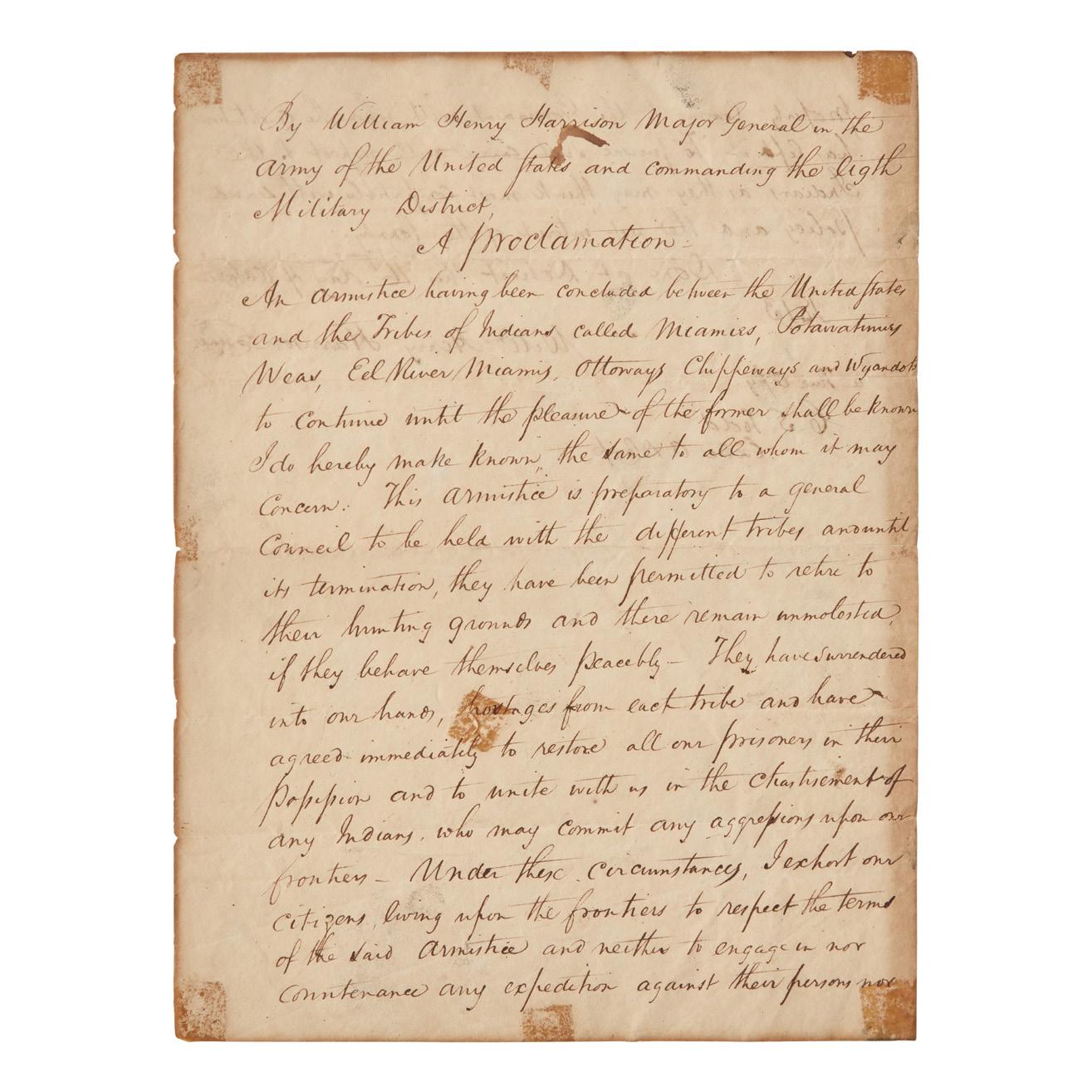
[War of 1812] Manuscript Copy of the Proclamation of Armistice, Issued by Future President William Henry Harrison During the War of 1812
Detroit, ca. October 16, 1813. One sheet, 10 1/4 x 8 in. (260 x 203 mm). True copy of a proclamation by order of General William Henry Harrison, in the hand of his aide Charles Stewart Todd, signed by him at conclusion. In part: “An armistice having been concluded between the United States and the Tribes of Indians called Miamies, Potawatomis, Weas, Eel River Miamis, Ottoways, Chippeways, and Wyandot to continue until the pleasure of the former shall be known. I do hereby make known the same to all whom it may concern. This Armistice is preparatory to a general council...the different tribes...have been permitted to retire to their hunting grounds...if they behave themselves peaceably...I exhort our citizens living upon the frontiers to respect the terms of the said armistice...” Creasing from old folds; moderately toned; scattered tape stains.
Manuscript copy of the proclamation of armistice issued by future President William Henry Harrison, following his victory over British forces and a confederation of their Indian allies at the Battle of the Thames, on October 5, 1813. Harrison’s victory at the Battle of the Thames resulted in American forces taking back Detroit from British control. Perhaps the most consequential result of the battle was the death of Shawnee Chief Tecumseh, leader of the British allied Indian confederation, which afterwards was dissolved.
$500 - 800
292
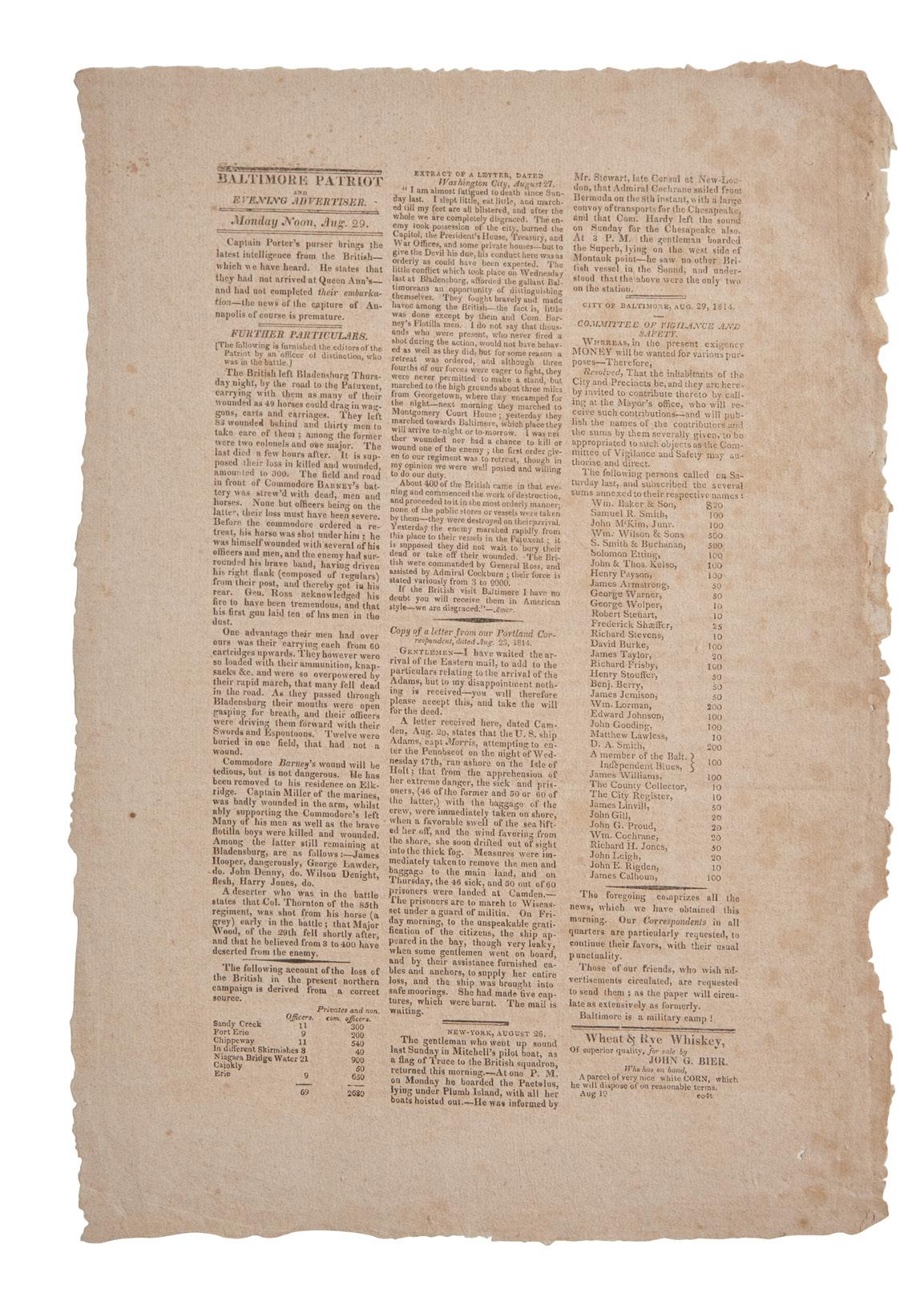
[War of 1812] Likely the Earliest Broadside of this Catastrophic Event, Containing a Description of the Burning of Washington D.C. on August 24, 1814
“The enemy took possession of the city, burned the Capitol, the President’s House, Treasury, and War Offices...but to give the Devil his due, his conduct here was as orderly as could have been expected...”
Baltimore Patriot and Evening Advertiser
Baltimore, Monday Noon, August 29, (1814). Printed broadside in three columns, 15 1/2 x 10 1/2 in. (mm). Containing an extract of a letter describing the Burning of Washington, D.C. In part: “I am almost fatigued to death since Sunday last. I slept little, eat little, and marched till my feet are all blistered, and after the whole we are completely disgraced. The enemy took possession of the city, burned the Capitol, the President’s House, Treasury, and War Offices, and some private houses--but to give the Devil his due, his conduct here was as orderly as could have been expected...About 400 of the British came in that evening and commenced the work of destruction...”
Disbound; untrimmed; scattered spotting.
Rare broadside printed by the Baltimore Patriot and Evening Advertiser containing a description, presumably from a letter of an American soldier, of the Burning of Washington, D.C. on August 24, 1814.
In the wake of the British victory at the Battle of Bladensburg, James Madison and the rest of the American government fled the Capitol, taking refuge in the nearby town of Brookville.
When British soldiers under the command of General George Ross entered the city of Washington, which was flying white flags of truce, the remaining Americans reportedly opened fire, killing two men and wounding Ross. This act, according to biographer John McCavitt, is what led Ross to first order the burning of the U.S. Capitol and the White House. British forces in the coming days would set fire to the Treasury building, the War Offices, the Washington Naval Yard, and even destroy the offices of the National Intelligencer, tearing it down brick by brick.
According to RBH, we cannot locate another copy at auction.
$3,000 - 5,000
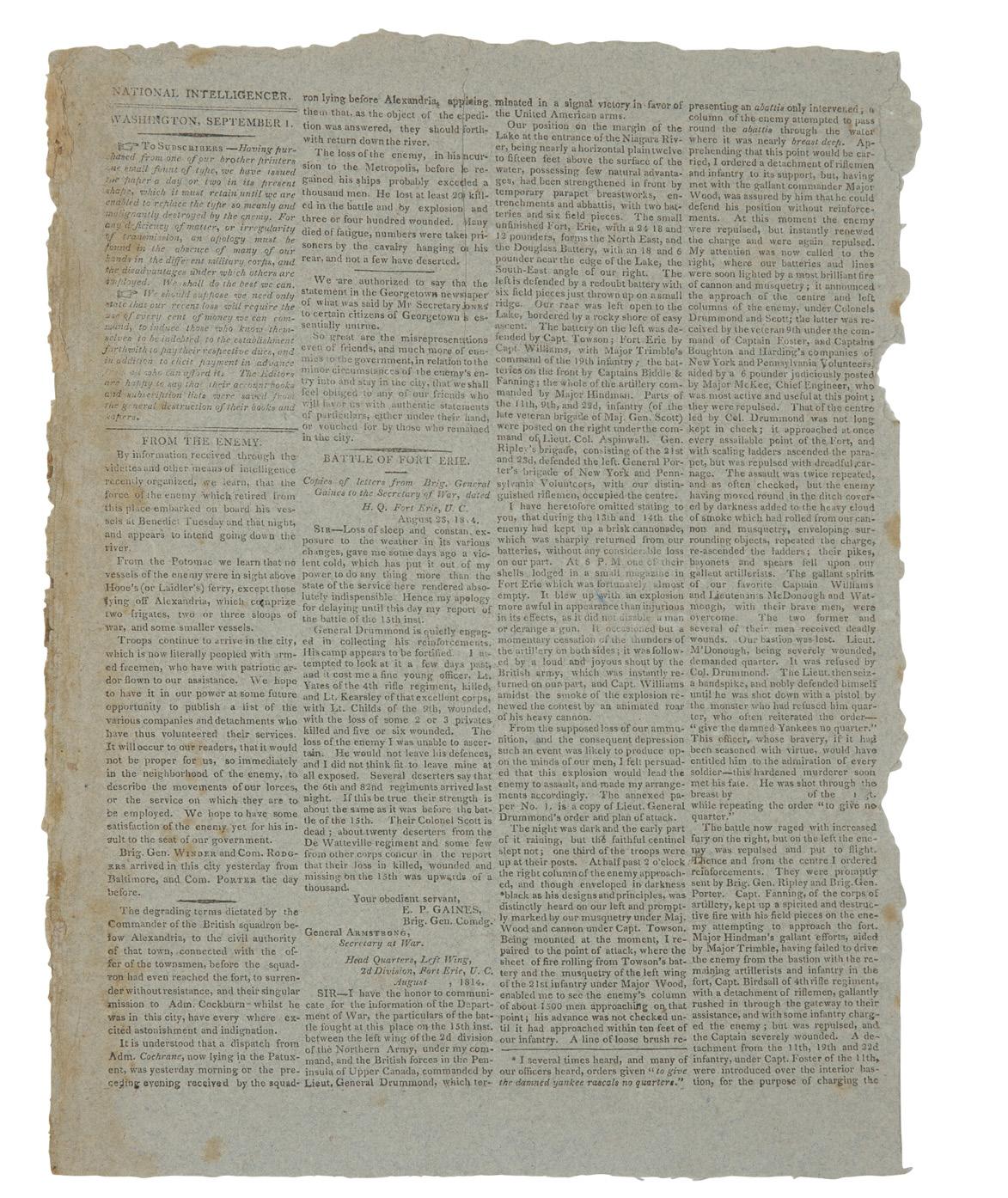
293
[War of 1812] The National Intelligencer’s Third Issue, Published After Its Press and Building Were Destroyed in the Burning of Washington, D.C., September 1, 1814
“We have issued one paper a day or two in its present shape, which it must retain until we are enabled to replace the type so meanly and malignantly destroyed by the enemy...”
Washington, September 1, (1814). Two sheets, each 13 1/2 x 10 1/4 in. (342 x 260 mm). Printed newspaper in four columns, on rectos only. Featuring the paper’s address to its constituents, reading in full: “Having purchased from one of our brother printers one small fount of type, we have issued one paper a day or two in its present shape, which it must retain until we are enabled to replace the type so meanly and malignantly destroyed by the enemy. For any deficiency of matter, or irregularity of transmission, an apology must be found in the absence of many of our hands in the different military corps, and the disadvantages under which others are employed. We shall do the best we can. We should suppose we need only state that our recent loss will require the use of every cent of money we can command, to induce those who know themselves to be indebted to the establishment forthwith to pay their respective dues, and in addition to elicit payment in advance from all who can afford it. The Editors are happy to say that their account books and subscription lists were saved from the general destruction of their books and papers.” Disbound, sheets now joined; untrimmed; lightly creased; scattered foxing especially to left margin.
Rare issue of the National Intelligencer, Washington, D.C.’s first newspaper, addressing its readers after its offices and press were destroyed by British Admiral George Cockburn during the Burning of Washington on August 24, 1814.
The editors of the Intelligencer, William Seaton and Joseph Gales, had been highly critical of Cockburn, branding him a “ruffian” in many of their reports on the war. When British forces entered Washington after their victory against the Americans at the Battle of Bladensburg, Cockburn resolved to burn the newspaper’s building down but yielded to the pleas of civilians who feared its conflagration would spread to their homes. Instead he decided to tear the building down “brick by brick”, and destroy all of their “C” type, so they could not print his name again.
$800 - 1,200
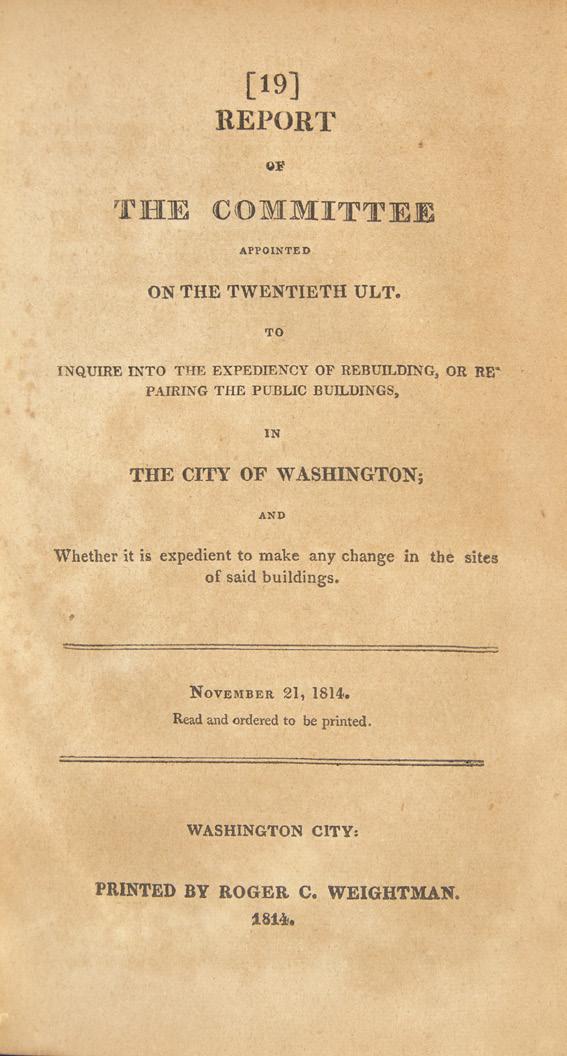
294
[War of 1812] Report of the Committee Appointed...to Inquire into the Expediency of Rebuilding, or Repairing the Public Buildings, in the City of Washington...
Washington City: Printed by Roger C. Weightman, 1814. First edition. 8vo. 4 pp. Quarter brown calf over marbled paper-covered boards, stamped in gilt, spine and joints rubbed; sheets moderately toned. Sabin 69797
Lot includes a fragment of, Report of the Committee...to Inquire into the Causes and Particulars of the Invasion of the City of Washington, by the British Forces in the Month of August, 1814. November 29, 1814. Washington: A. and G. Way, 1814. First edition. 8vo. pp. 1-52 only (of 370) With one (of two) letterpress folding table. Disbound; library stamp at front; foxing.
Sabin 69796
$500 - 800
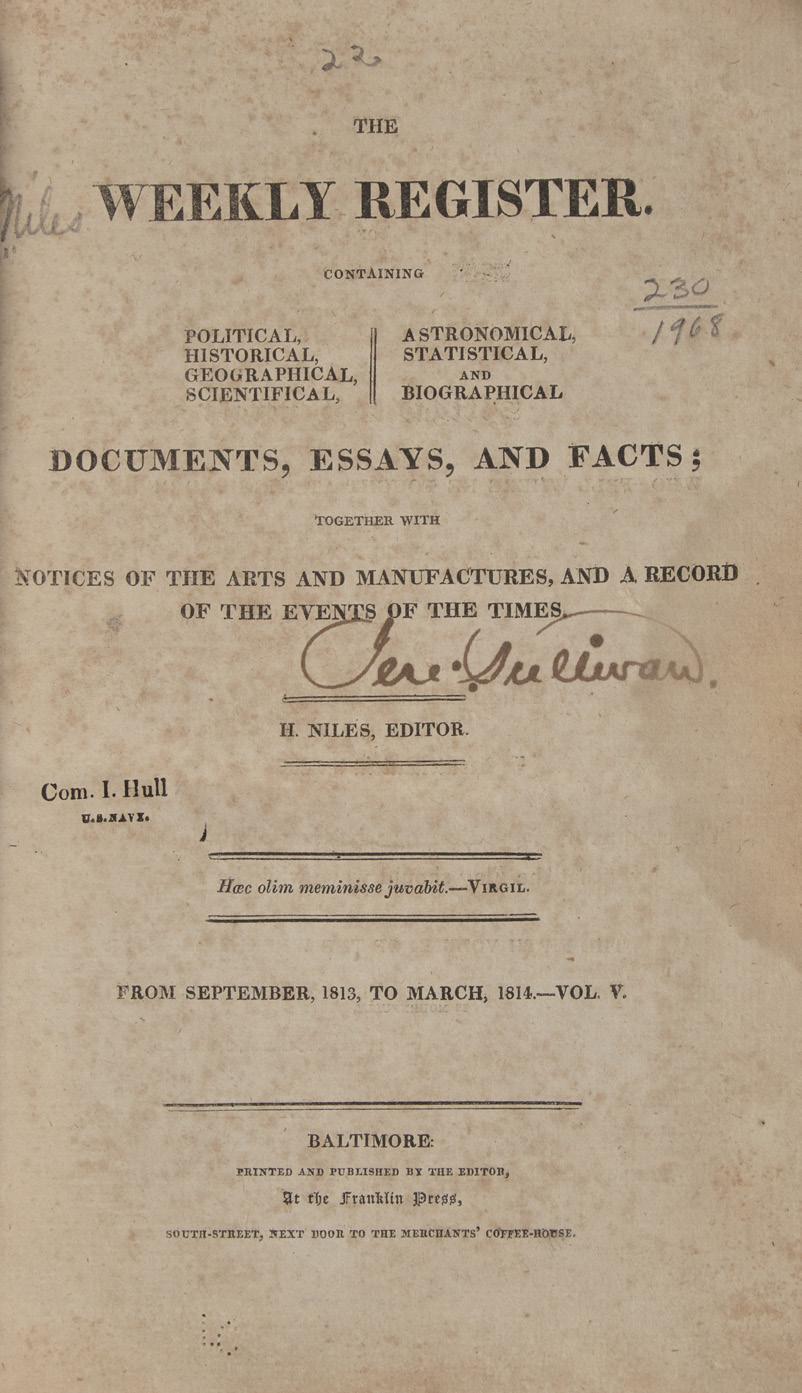
295
[War of 1812] The Weekly Register, Commodore Isaac Hull’s Copy, with Extensive Coverage of the War of 1812, and more
The Weekly Register... Baltimore: H. Niles, September 1813-March 1814. Vol. V, Nos. 1-26, plus two supplements and two addenda. Red library buckram, stamped in gilt, library label on spine, stain on front board; all edges trimmed; Library of Congress book-plate on front paste-down, surplus ink stamp on same; ink stamp “Com. I. Hull / U.S. Navy” on title-page and front blank; ownership signature on title-page (“Jer. Sullivan”); manuscript on front and rear blanks; foxing and toning throughout.
Commodore Isaac Hull’s copy, with his ownership stamps, on a run of periodicals printing extensive coverage of the War of 1812. The front and rear endpapers feature incomplete ship’s log notes from an unknown voyage in the Pacific, dating from March and October, 1823.
Isaac Hull (1773-1843) was a naval officer who served in the Quasi-War with France, the Barbary Wars, and the War of 1812. In the latter conflict, he commanded the famous USS Constitution during its engagement and capture of the HMS Guerriere, the event that earned the ship its moniker, “Old Ironsides.”
Lot also includes:
1. Federal Republican, and Commercial Gazette. Georgetown, September 22, 1813. Vol. VII, No. 1013. Printed newspaper. Folio. (4) pp. Creasing from when folded; scattered spotting.
Printing on the second page, Oliver Hazard Perry’s message of his victory at Lake Erie to Secretary of the Navy William Jones.
2. The Weekly Register. Baltimore: H. Niles, Saturday, March 27, 1813. Vol. IV, No. 4, Whole No. 82. 8vo. pp. (57)-72. Disbound; sheets toned; scattered spotting.
Printing a laudatory message to America’s naval commanders on the first page.
3. Daily Federal Republican. Georgetown (Washington D.C.), August 23, 1814. Vol. IX, No. 1259. Bifolium, 19 1/4 x 12 1/2 in. (mm). Printed newspaper. Disbound. Creasing from old folds, moderately toned; scattered stains; contemporary ownership signature “D.P. Clark” on front page.
Lot includes a separate printed Congressional report for a proposed memorial for Commodore Isaac Hull, as well as one leaf of printed sheet music, titled “Yankee Thunders.”
$500 - 800
296
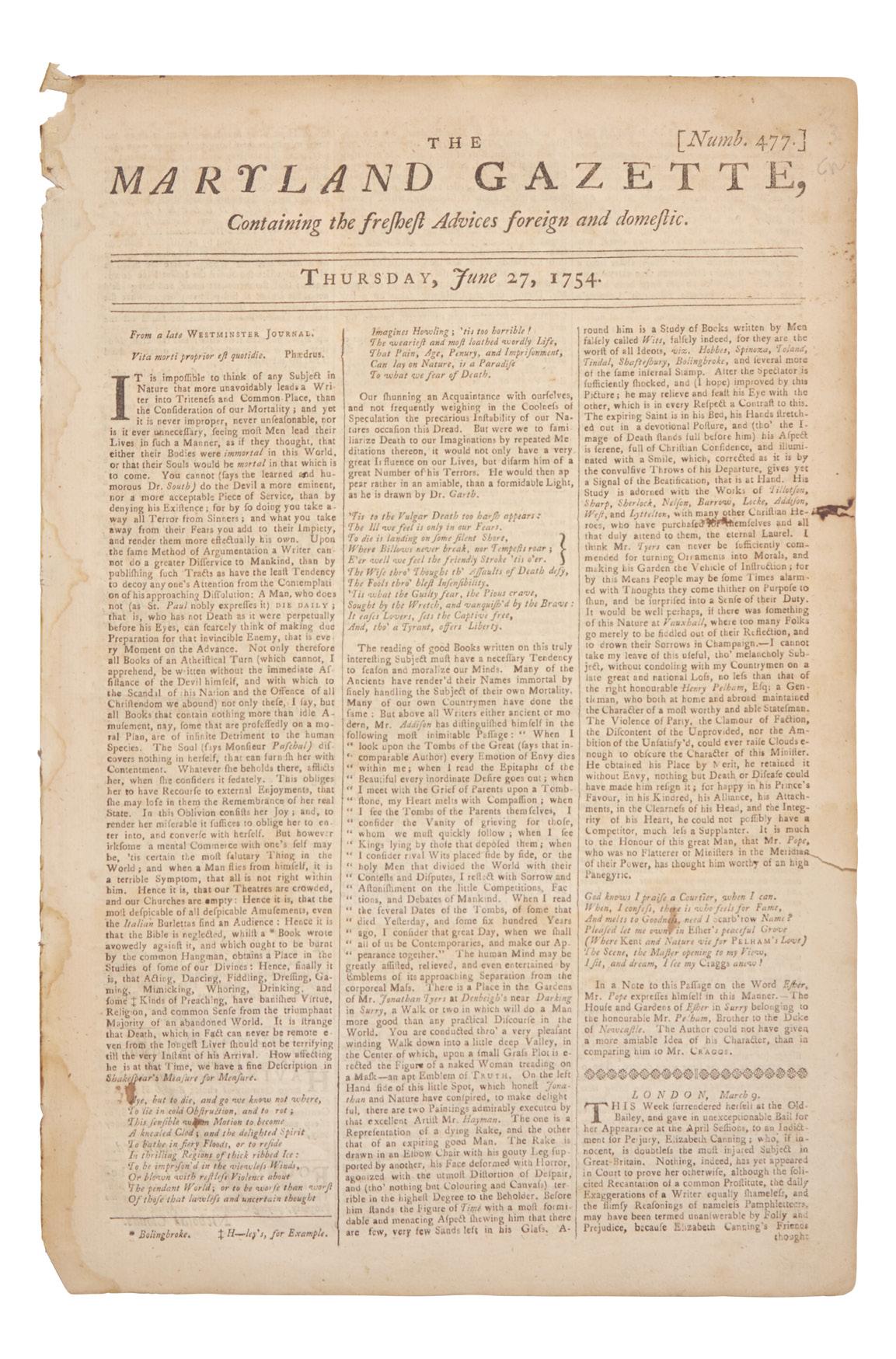
[Washington, George] Early report of a 22-year-old George Washington, printed following the skirmish at Jumonville Glen, Pennsylvania, that Ignited the French and Indian War
The Maryland Gazette
Annapolis: Printed by Jonas Green, Tuesday, June 27, 1754. Numb. 477. Printed newspaper. Folio. (4) pp. Disbound; dampstaining along spine and in lower half of each leaf; singe mark in upper fore-edge of first leaf, short closed tear in lower fore-edge of same; scattered spotting.
An early report of a 22-year-old George Washington, printed following the skirmish between Washington’s men and French soldiers at Jumonville Glen, Pennsylvania, that ignited the French and Indian War.
Printed on the second page, third column, reports, “We have certain Information, that Nine of the French Soldiers, from the Fort which was delivered up by Ensign Ward...have Deserted, and come over to Major Washington. Upwards of 300 Soldiers are now at Alexandria, and more expected every Day, who are to march in a few Days, to join and reinforce Major Washington, so that it is hoped his Army will soon be able to withstand and repel any Attacks that may be offered him by the French.”
On May 28, 1754, Washington and Mingo Chief Tanacharison, known as “Half-King”, led a party of 40 men in an ambush against 29 French soldiers at current-day Jumonville Glen in Western Pennsylvania. Following an earlier three-month expedition into the Ohio Valley, Washington had reported to Virginia Governor Robert Dinwiddie about French intentions to establish a military presence in the region. Dinwiddie ordered Washington to proceed to the frontier and establish a fort at the fork of the Ohio River to prevent the French from taking root. By April, Washington had learned that French forces had overtaken a small British contingent already in that area, and he ordered his men to build a defensive position nearby. On May 27, Washington spotted a small contingent of French forces close to his position, and ordered the resulting ambush the next day against French leader Joseph Coulons de Villiers de Jumonville, which led to the death of ten French, and the capture of numerous others. A month later, in retaliation, 600 French soldiers overtook Washington’s position at Fort Necessity, forcing his surrender. It was the beginning of the French and Indian War, which would eventually force the French from North America.
$3,000 - 5,000
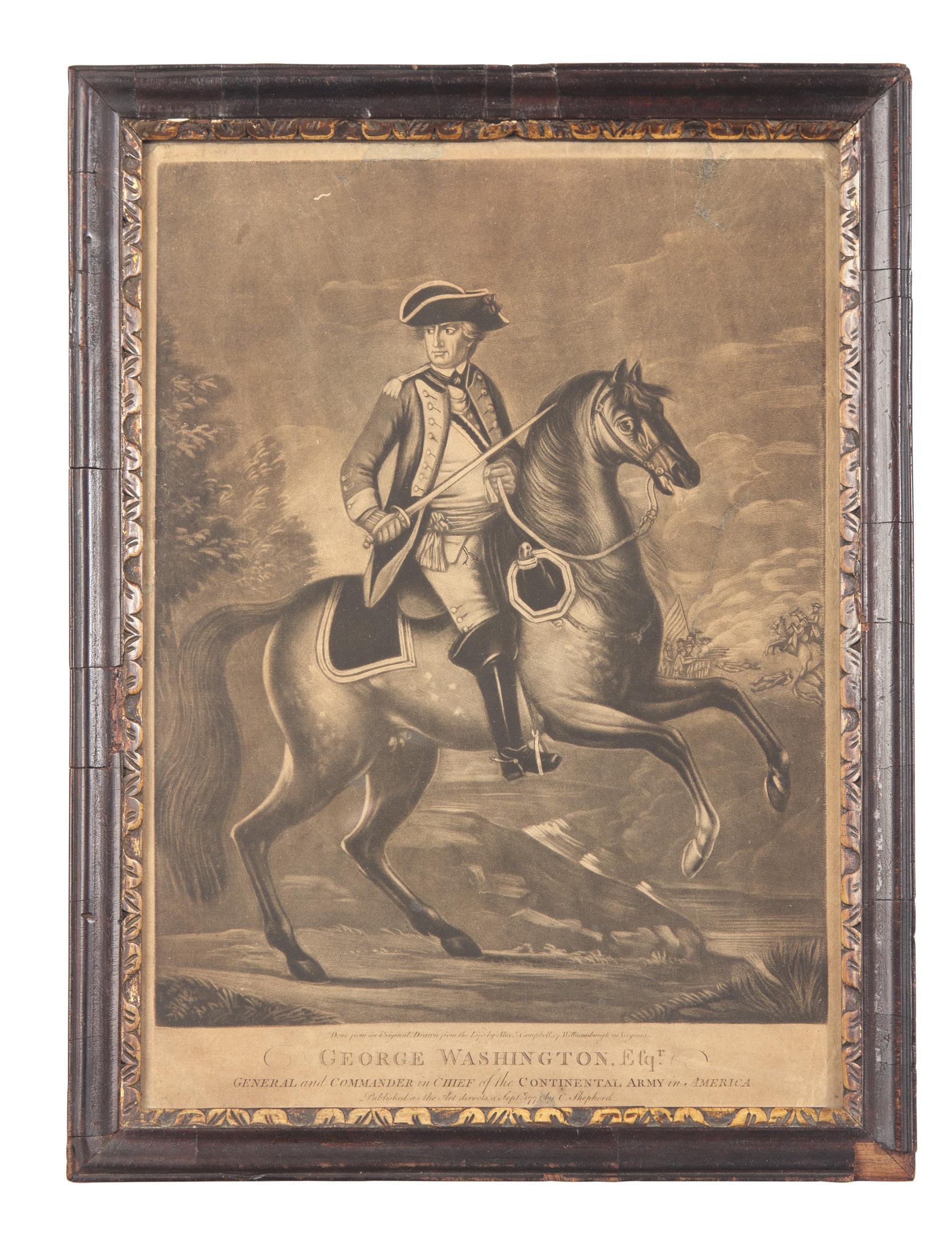
297
[Washington, George] One of the Earliest Engraved Portraits of George Washington, and the First to be Published in London and in Europe, 1775
George Washington, Esqr. General and Commander in Chief of the Continental Army in America (London): C. Shepherd, September 9, 1775. Mezzotint, “Done from an Original, Drawn from the Life by Alexr. Campbell”. Trimmed to plate mark. Approximately 14 x 10 in. (356 x 254 mm) (sight). Toned; scattered wear and repairs. Unexamined out of old frame. Baker 46; Hart 721; Fowble 75; Wick, pp. 18-22
One of the earliest engraved portraits of George Washington, and the first to be published in London and in Europe. Upon Washington’s commission as commander of the Continental Army on June 15, 1775, demand abroad for images of his likeness skyrocketed. As English and European publishers had no authentic portraits to base their work on, the resulting images were typically inauthentic, and as seen here, based on fictitious sources (there is no record of an Alexander Campbell ever existing, and Washington denied that he had ever sat for a portrait by him). Nonetheless, in response to this image, Washington wrote, “Mr. Campbell...has made a very formidable figure of the Commander-in-Chief, giving him a sufficient portion of terror and countenance.” This image of Washington proved incredibly influential in helping establish the English and European public’s perception of Washington and the American Revolution more generally, and it was copied throughout the continent for prints, textiles, and medals.
$2,500 - 3,500
298
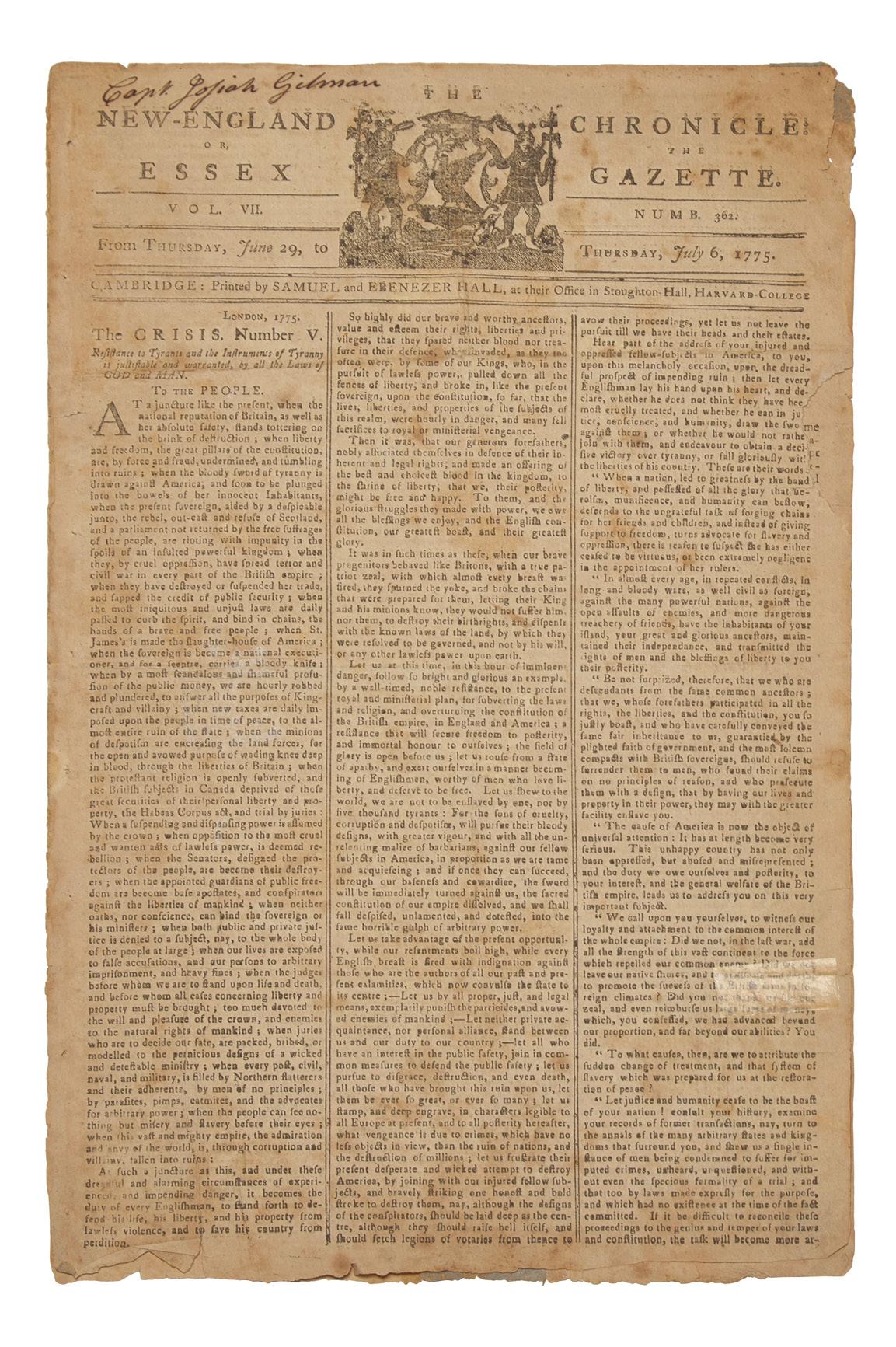
[Washington, George] General Washington Arrives in Cambridge to Take Command of the American Army
The New-England Chronicle: or, the Essex Gazette Cambridge: Printed by Samuel and Ebenezer Hall, From Thursday, June 29, to Thursday, July 6, 1775. Printed newspaper. Folio. (4) pp. Ownership signature of Capt. Josiah Gilman at top of first page; largely separated along center fold; wear along edges, with loss in upper fore-edge of first leaf, affecting some text; loss in top corner of last leaf, affecting some text; residue in top corners and bottom edge of third-page from when mounted; foxing and toning.
Newly appointed as Commander-in-Chief of the Continental Army, George Washington arrives in Boston to take command of the American forces.
On the second page is an address from the New York Provincial Congress congratulating Washington on his recent appointment, rejoicing “in the appointment of a Gentleman, from whose abilities and virtue, we are taught to expect both security and peace,” and having “the most flattering hopes of success, in the glorious struggle for American Liberty...’’; followed by Washington’s response of the “highest gratitude”.
On the third page is a lengthy letter from the Massachusetts Congress, congratulating Washington on his safe arrival, and applauding his appointment, and his disinterested virtue and patriotism. The letter then goes on to offer a picture of the Army then gathered around Boston, assuring Washington that they “will, at all Times, be ready to attend to such Requisitions as you may have Occasion to make to us; and to contribute all the Aid in our Power, to the Cause of America...” Washington’s response follows, thanking them, and stating that “I only emulate the Virtue and publick Spirit of the whole Province of Massachusetts-Bay, which with a Firmness, and Patriotism without Example in modern History, has sacrificed all the Comforts of social and political Life, in Support of the Rights of Mankind...”
At the end of the third-page is a report on the British casualties suffered at the Battle of Bunker Hill. The first page also prints part V of The Crisis, a pro-American journal printed in London, while the final page prints the controversial letters of Massachusetts governor Thomas Hutchinson.
$1,500 - 2,500
299
[Washington, George] Report of George Washington Arriving in Philadelphia on his way to his First Inauguration
The London Chronicle
London: Sold by T. Wilkie, From Thursday, June 4, to Saturday, June 6, 1789. Vol. LXV, No. 5097. Printed newspaper. 4to. pp. (537)-544. Disbound; separations along spine; wear in top edge; scattered spotting.
George Washington arrives in Philadelphia on his way to his first inauguration: “Every countenance seemed to say, Long, long live George Washington, the Father of the People!”
On p. 542 is a report of April 22, on President-elect George Washington’s arrival in Philadelphia, on his journey to take the oath of office in New York: “His Excellency rode in front of the procession on horseback. The number of spectators who filled the doors, windows, and streets, which he passed, was greater than on any other occasion we ever remember. The bells were rung through the day and night, and a feu de joy was fired as he moved down Market and Second-streets to the City Tavern. The joy of the whole city upon this august spectacle cannot easily be described...His excellency, having travelled with great expedition from Mount Verno[n], proceeded yesterday morning for New York, where he will receive that power which is infinitely preferable to an hereditary crown, inasmuch as it is conferred upon merit by the unanimous and free suffrages of the representatives of near three millions of affectionate and grateful people.»
$400 - 600
300
[Washington, George] Announcing the Inauguration of George Washington as the First President of the United States
“The illustrious Washington was yesterday installed in the dignity of First Magistrate of the United States of America, to which he had been called by the unanimous suffrages of the nation...”
The London Chronicle
London: (Sold by T. Wilkie), Tuesday, June 23 to Thursday, June 25, 1789. Vol. LXV, No. 5105. Printed newspaper. 4to. 8 pp. (pp. 601-608). Text in three columns. Disbound, first and last leaves loose. Scattered foxing; royal tax stamp at bottom left of second page.
The London Chronicle announces the inauguration of George Washington as the first president of the United States, on April 30, 1789. “Yesterday arrived a mail from Halifax, brought to Falmouth by the Tankerville packet in 22 days. Extract of a Letter from New York, May 1. The illustrious Washington was yesterday installed in the dignity of First Magistrate of the United States of America, to which he had been called by the unanimous suffrages of the nation...» The same letter admiringly observes that «Mr. Washington on this, as on former occasions, refused to receive any lucrative recompence for the services he had done his country.»
Lot also includes the following issue of the same newspaper (No. 5106, June 25-27, 1789).
$400 - 600
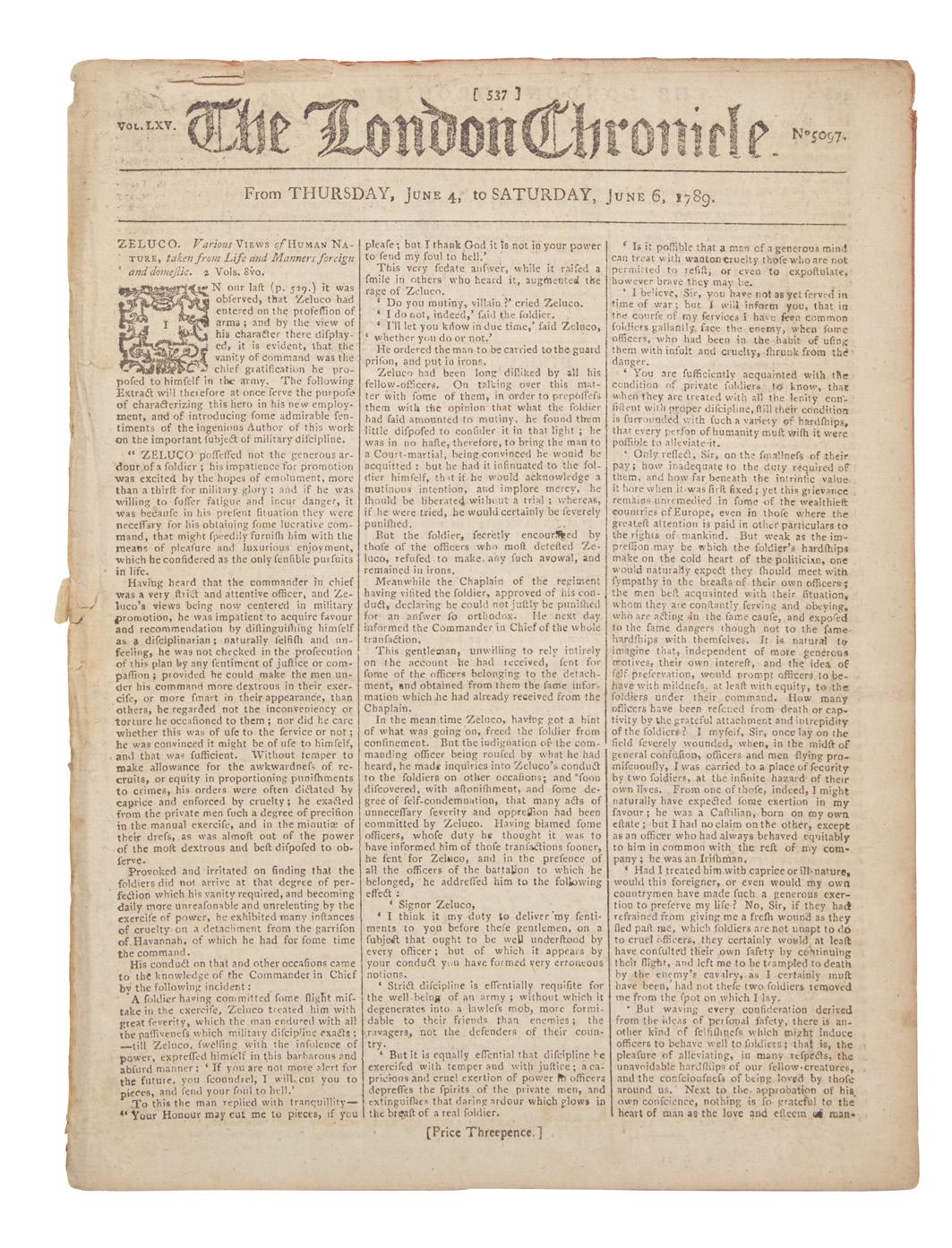
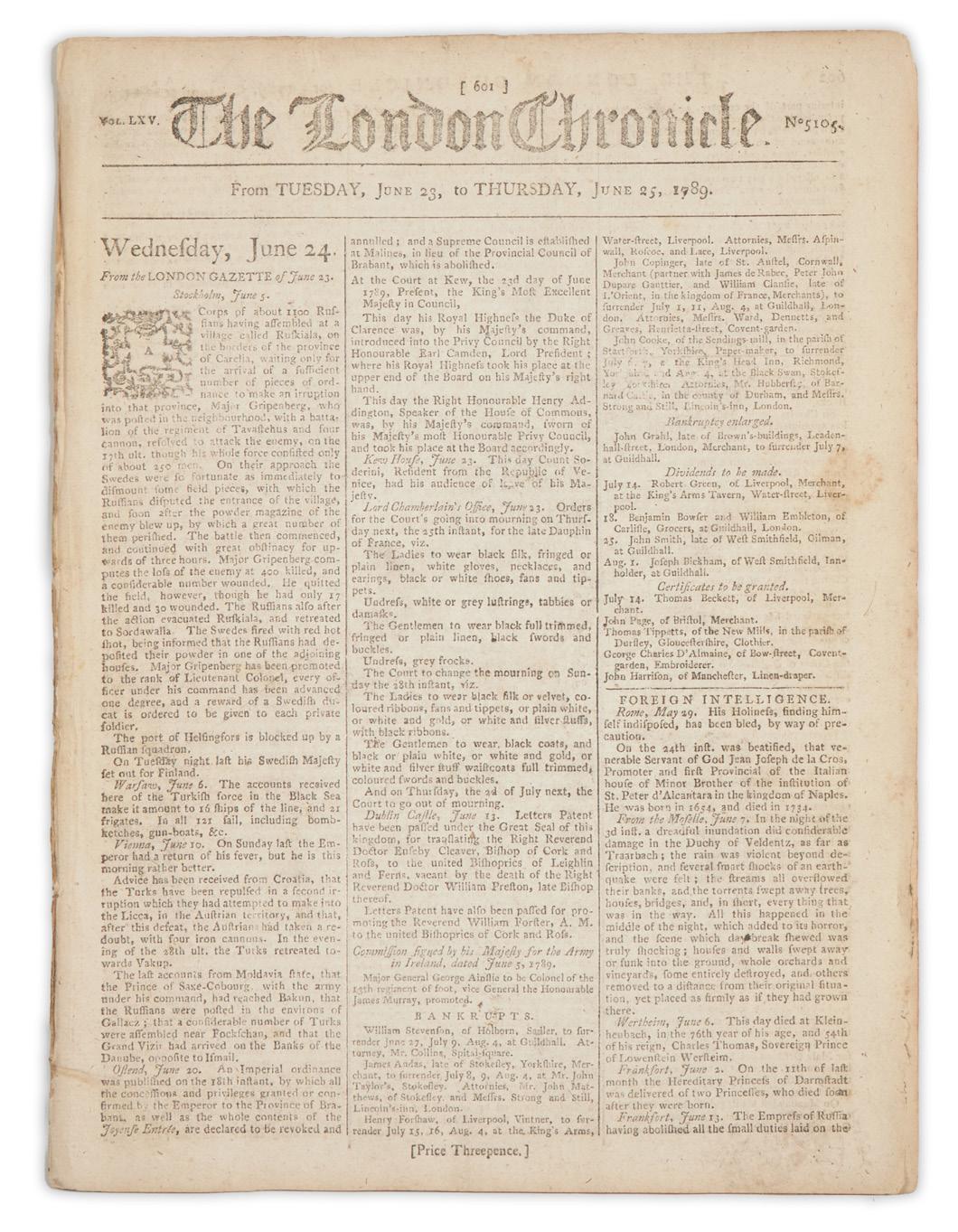
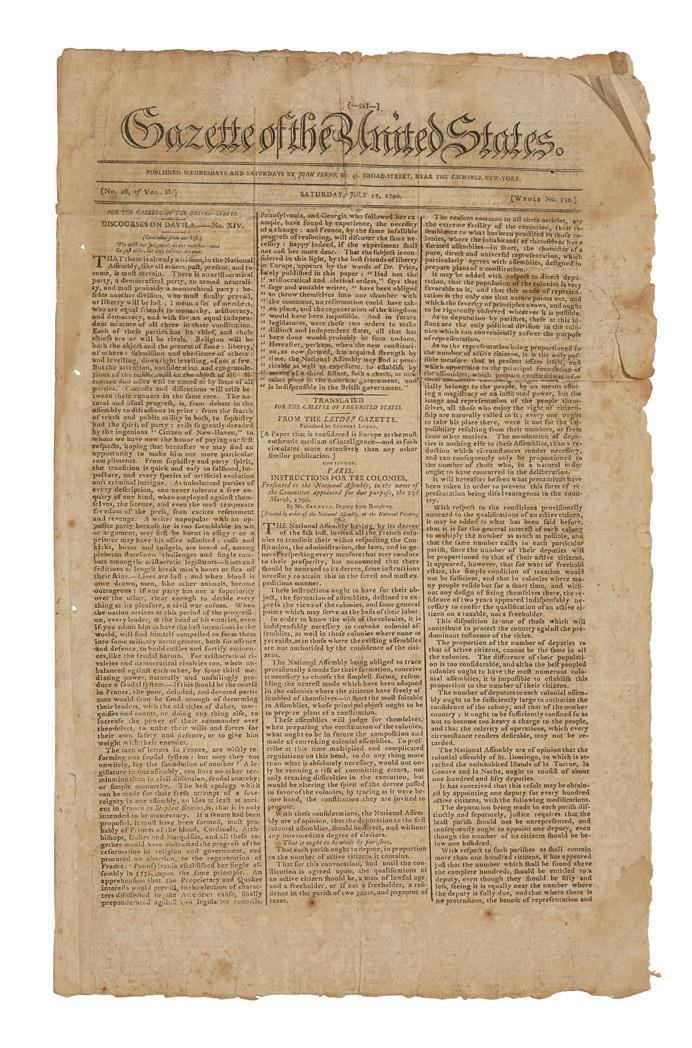
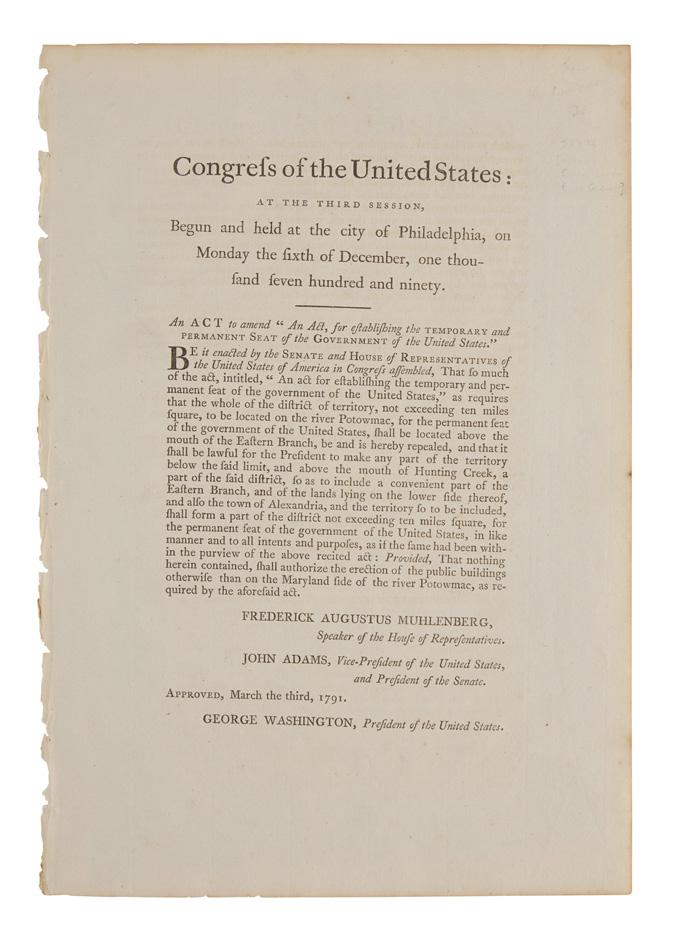
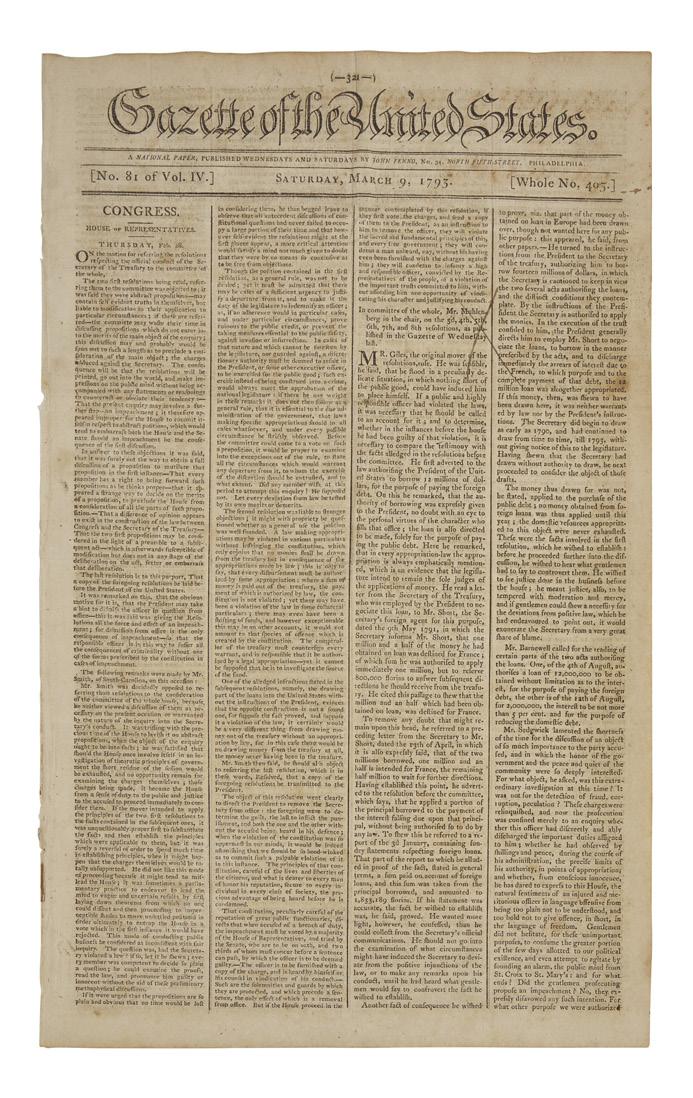
301
[Washington, D.C.] The First Newspaper Printing of the Residence Act of 1790, Establishing Washington, D.C. as the Capital City, in the Gazette of the United States
New-York: John Fenno, Saturday, July 17, 1790. No. 28, Vol. II, Whole No. 132. Printed newspaper. Folio. pp. (525)-528. Disbound; creasing from old folds; wear along edges; spotting.
The first newspaper printing of the 1790 Residence Bill that established the permanent seat of government in Washington, D.C., printed in the semi-official organ of Washington’s administration. The bill, printed on the third page and signed in type by President Washington, is preceded by a printing of the debates on the matter. The site of the capital in on the Potomac River in the Southern United States came after a compromise between Secretary of the Treasury Alexander Hamilton and Secretary of State Thomas Jefferson and James Madison, whereby Hamilton received their support for his plan for the federal government to assume state debts in exchange for the permanent federal capital be located in the south.
$800 - 1,200
302
[Washington, D.C.] Rare Congressional Act, Amending the Residence Act of 1790, Establishing Washington, D.C. as the Permanent Seat of Government
Philadelphia: (Francis Childs and John Swaine), March 3, 1791. Printed broadside, 11 3/8 x 8 in. (289 x 203 mm). Signed in type by President George Washington, Vice-President John Adams, and Speaker of the House of Representatives Frederick Augustus Muhlenberg. Disbound; light wear along edges. Evans 23869; ESTC W14409
Rare Congressional act, amending the Residence Act of 1790, that established Washington, D.C. as the permanent seat of government and Philadelphia as the temporary seat. This act, approved on March 3, 1791, repeals a portion of the Act that required the new district to be placed above the mouth of the Eastern Branch, stating that “it shall be lawful for the President to make any part of the territory below the said limit, and above the mouth of Hunting Creek...so as to include a convenient part of the Eastern Branch, and of the lands lying on the lower side thereof, and also the town of Alexandria...” Finally, the Act affirms that “nothing herein contained, shall authorize the erection of the public buildings otherwise than on the Maryland side of the river Potowmac, as required by the aforesaid act.”
According to RBH, this is only the second example offered at auction since 1917. Furthermore, ESTC locates only three copies
$2,000 - 3,000
303
[Washington, George] President Washington’s Second Inaugural Address, in the Gazette of the United States
Gazette of the United States
Philadelphia: John Fenno, Saturday, March 9, 1793. No. 81, Vol. IV, Whole No. 405. Printed newspaper. Folio. (4) pp. (pp. 321-324). Disbound; creasing from old folds; light spotting.
At the bottom of third page, under the header “Address of the President of the United States previous to his taking the Oath required by the Constitution, on Monday last”, is printed Washington’s second inaugural address. The shortest inaugural address ever given, Washington’s speech consisted of only 135 words, and compared to his wide-ranging first address, focused on his presidential duties and the consequences should he break them.
$400 - 600
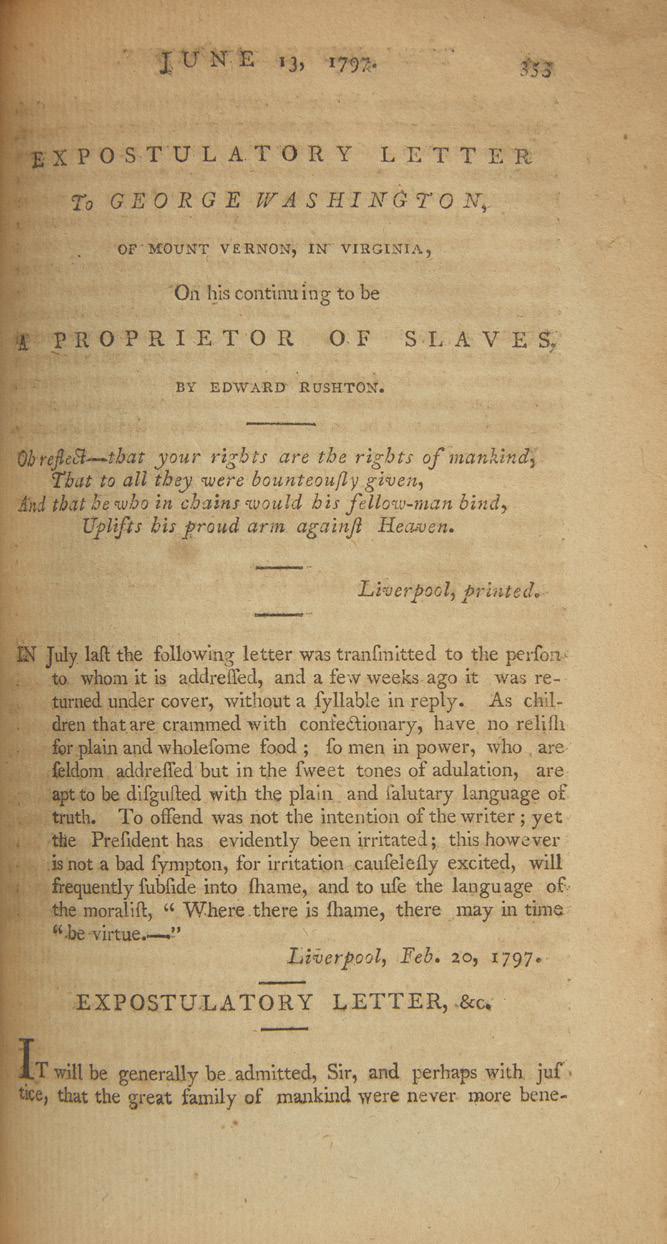
304
[Washington, George] A Lengthy Lifetime Attack on President Washington for Being a Slaveholder, 1797
The American Universal Magazine Philadelphia: Printed by Richard Lee, 1797. In four issues (Monday, April 3, Vol. II, No. IX; Monday, May 15, Vol. II, No. XII; Monday, May 29, Vol. II, No. XIII; Monday, June 13, Vol. II, No. XIV). 8vo. 52 (i.e. 48); (3), 198-402, (4) pp. Quarter brown leather over marbled paper-covered boards, red morocco spine label, stamped in gilt, cocked, boards and extremities rubbed and worn; all edges trimmed; front free endpaper wanting; library ink stamp along gutter of first title-page; scattered soiling and dampstaining; remnants of removed library label on rear free endpaper.
A published attack on President Washington as a slaveholder, almost certainly the first magazine printing of this important letter, printed during Washington’s lifetime, in the June issue, on pp. 353-360.
British poet and bookseller Edward Rushton’s “Expostulatory Letter to George Washington,” fiercely criticizes then-President Washington for his ownership of slaves. In his younger years Rushton had worked on slave ships and became an abolitionist as a result. In one particularly horrific instance, Rushton was aboard a slave ship when an ophthalmia outbreak occurred. Upset, he first tried sneaking extra food and water to the enslaved passengers before eventually reprimanding his own captain, which resulted in Rushton being charged with mutiny. As a result of his prolonged contact with the sick, Rushton contracted the disease himself, resulting in his losing all sight in his left eye and developing a cataract in his right. This incident effectively ended his sailing career, and he retired to Liverpool.
In 1796, Rushton wrote letters to Thomas Paine and George Washington heavily criticizing them for their continued involvement in human enslavement. His letter to Washington read in part, “...you who conquered under the banners of freedom–you who are now the first magistrate of a free people are (strange to relate) a slave holder...Shame! Shame! That man should be deemed the property of man or that the name of Washington should be found among the list of such proprietors...Ages to come will read with Astonishment that the man who was foremost to wrench the rights of America from the tyrannical grasp of Britain was among the last to relinquish his own oppressive hold of poor unoffending negroes. In the name of justice what can induce you thus to tarnish your own well earned celebrity and to impair the fair features of American liberty with so foul and indelibile a blot.” The letter was returned, Rushton noted, without a syllable in reply, leading him to decide to publish it.
Despite Washington’s own personal and evolving stance against slavery, at the time Rushton sent his letter George Washington was engaged in a desperate search for a runaway slave, Ona Judge, who had fled the president’s household on 21 May 1796. Newspaper ads were printed and numerous attempts were made to trick her into returning, all of which failed; Washington even sent a letter to his nephew, Burwell Bassett, Jr., two months before his death asking for his help in recapturing Judge. Washington died in December 1799, and Judge died a free woman in New Hampshire on February 25, 1848.
George Washington inherited his first enslaved persons at the age of eleven after the death of his father in 1743. As a young man, he relied heavily on enslaved labor at Mount Vernon, the estate he inherited in his early twenties, and he actively participated in the buying and selling of enslaved people. His marriage to Martha Dandridge Custis in 1759 significantly expanded the number of enslaved individuals under his control, increasing it by more than eighty people. Between the early 1750s and the 1770s, Washington purchased at least seventy-one enslaved individuals. With the outbreak of the American Revolution, Washington reduced his direct involvement in the slave trade, though he continued to acquire enslaved people through natural increase and the settlement of debts. By the time of his death in 1799, Mount Vernon’s enslaved population numbered 317 people, 123 of whom Washington personally owned. In his will, he granted immediate freedom to his valet, William Lee, and directed that the rest of the enslaved people he owned be freed upon Martha Washington’s death. Martha later emancipated them during her lifetime, officially freeing them on January 1, 1801.
Rushton’s letter is scarce in any printing. According to Sabin (74280), a privately printed pamphlet version was also printed in Liverpool in the same year, likely preceding this printing. Sabin also notes an 8vo printing, published in Boston in 1831 (74281), while Evans notes a broadside printed possibly in Boston, around the same time (32786). Kentucky Imprints furthermore notes that the Kentucky Gazette in 1797 advertised an edition printed at its offices in September 1797, but no copy of that edition has been located (HRS 64). According to RBH, we can locate only two copies of this June issue at auction since 1975.
$3,000 - 5,000
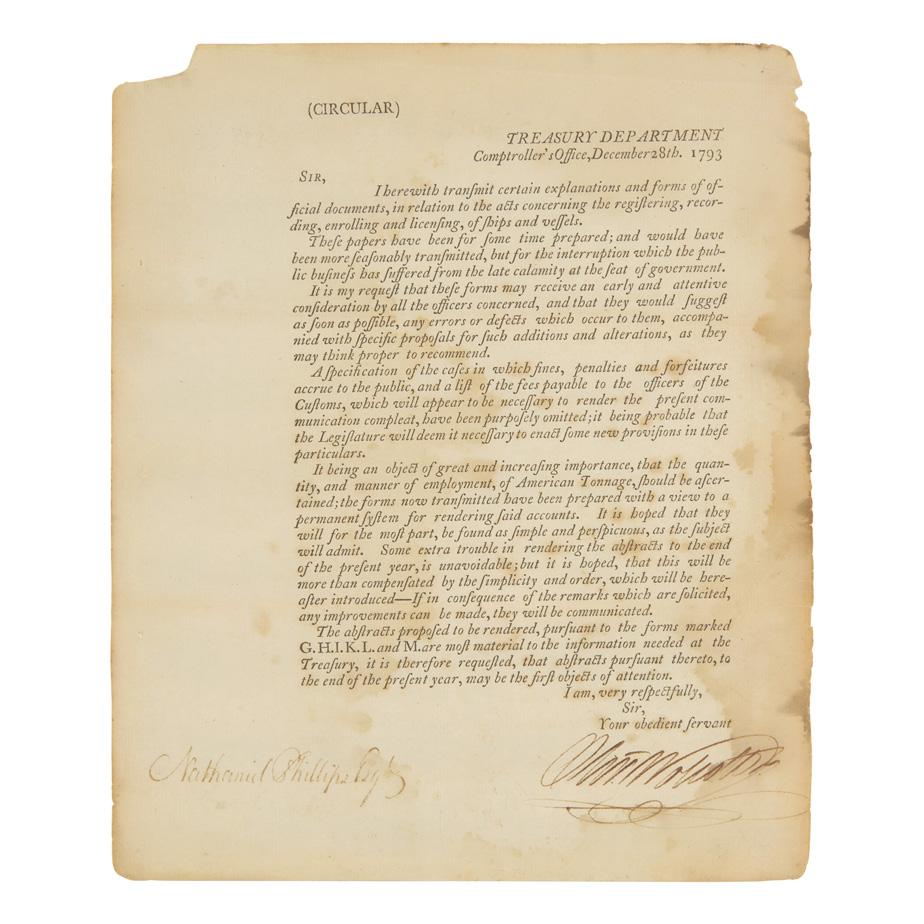
306
305
[Wolcott, Oliver] Rare Printed Circular Signed by Treasury Secretary Oliver Wolcott, Transmitting New Laws on Maritime Commerce
Printed Treasury Department Circular, signed (Philadelphia): December 28, 1793. Single sheet, 9 3/4 x 8 in. (248 x 203 mm). First page (of 33) of an official printed Treasury Department circular addressed to Nathaniel Phillips, transmitting documents on recent maritime legislation, signed by Wolcott at conclusion. Creasing from old folds; pin holes at left margin; paper loss at top left; scattered foxing; large dampstaining at right margin affecting signature. 33 pp. wanting. Bristol B8530; Shipton & Mooney 46897
This document explains that “these papers have been for some time prepared; and would have been more reasonably transmitted, but for the interruption which the public business has suffered from the late calamity at the seat of government...”
The calamity being the Yellow Fever outbreak that ravaged Philadelphia from August through November, 1793. The disease caused over 5,000 deaths, and prompted nearly half the city’s population to flee, including many in the Federal Government, ceasing its operation for a time.
$800 - 1,200
[Women’s Rights] New-York Weekly Tribune, Advertising First Women’s Rights Convention Held in Pennsylvania, May 8, 1852
New-York, Saturday, May 8, 1852. Vol. XI, No. 556. Printed newspaper. Folio. 8 pp. Disbound; leaves unopened; creased from when folded; light spotting.
“The friends of Justice and Equal Rights are earnestly invited to assemble in Convention, to consider and discuss the present Position of Woman in Society, her Natural Rights and Relative Duties.”
Advertised on the front page is a notice of the first women’s rights convention held in Pennsylvania.
The Pennsylvania Woman’s Convention at West Chester was held in West Chester, Pennsylvania, on June 2 and 3, 1852. Held four years after the famous Seneca Falls, New York convention, the West Chester Convention was called for by leading activists, including Lucretia Mott, Sallie P. Lewis, Hannah M. Darlington, and others. Looking to discuss and examine the “legal, educational, and vocational disabilities» that women suffer, over the two days the Convention was held, its well-attended audience passed numerous resolutions regarding women›s suffrage, equal pay, education, and legal issues.
$500 - 800
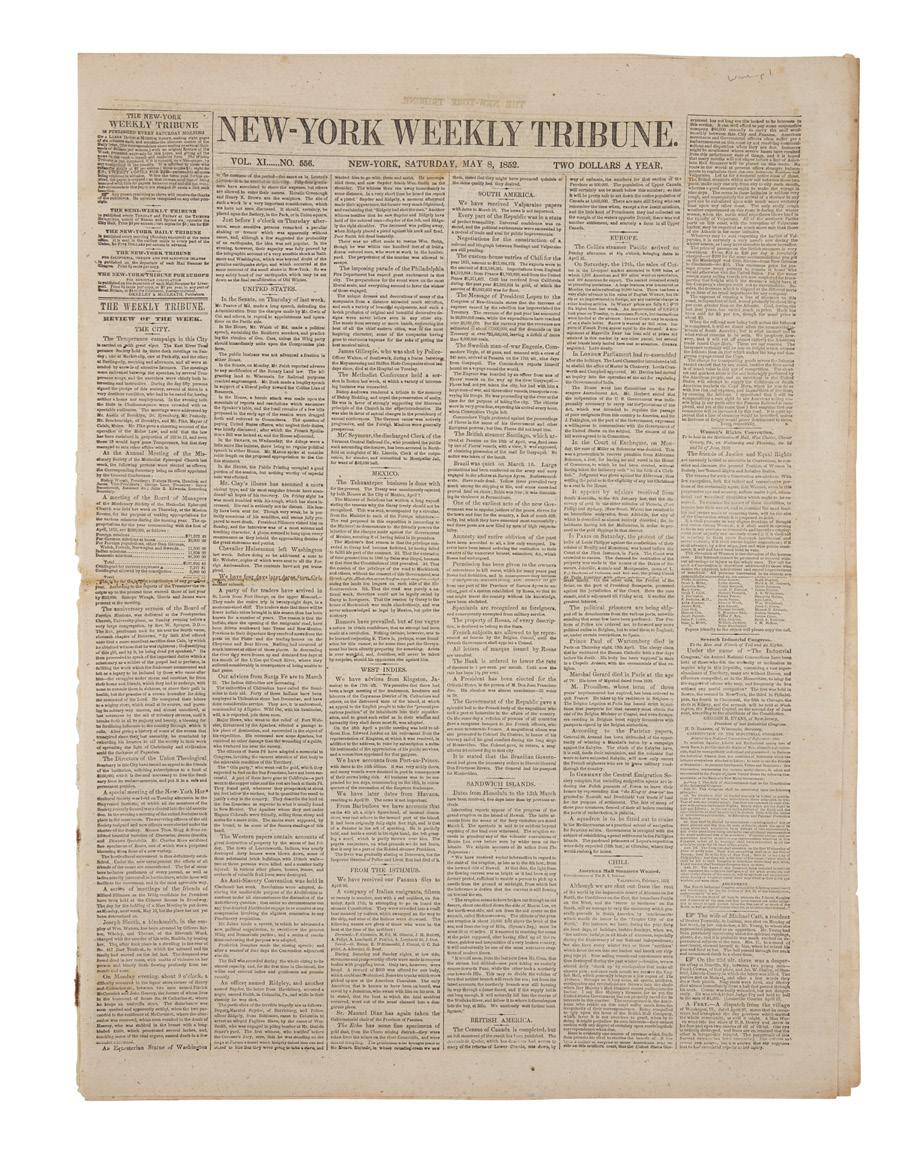
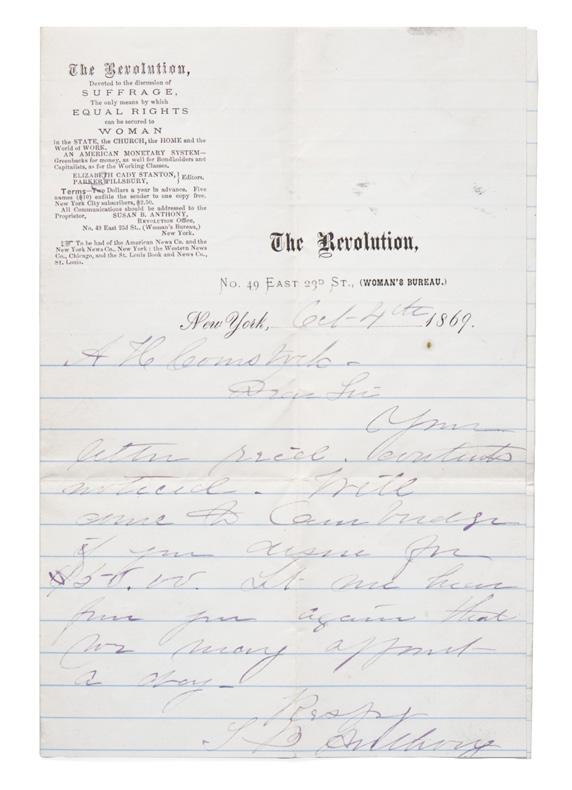
307
[Women’s Rights] Autograph Letter, signed by Susan B. Anthony, 1869, Written on the Stationery of The Revolution: The First Women’s Suffrage Periodical
New York, October 4, 1869. Bifolium. One-page autograph letter on The Revolution stationery, signed by Susan B. Anthony in purple ink to A.H. Comstock of Cambridge, New York, regarding a speaking engagement: «Dear Sir Your letter rec›d contents noticed. Will come to Cambridge if you agree for $50.00. Let me hear from you again that we may appoint a day--Resp S.B. Anthony». Creasing from old folds. Includes original mailing envelope addressed by Anthony.
Susan B. Anthony writes a brief note to A.H. Comstock of Cambridge, New York, regarding a possible speaking engagement. Comstock ran a small lecture series in the small city, whose 1869-70 season also attracted the likes of Mark Twain.
Written on the stationery of The Revolution, the newspaper founded by Anthony and Elizabeth Cady Stanton in New York City in 1868. The stationery’s headline reads, in part: “Devoted to the discussion of Suffrage, The only means by which Equal Rights can be secured to Woman in the State, the Church, the Home and the World of Work. An American Monetary System-Greenbacks for money, as well for Bondholders and Capitalists, as for the Working Classes...”
$1,500 - 2,500
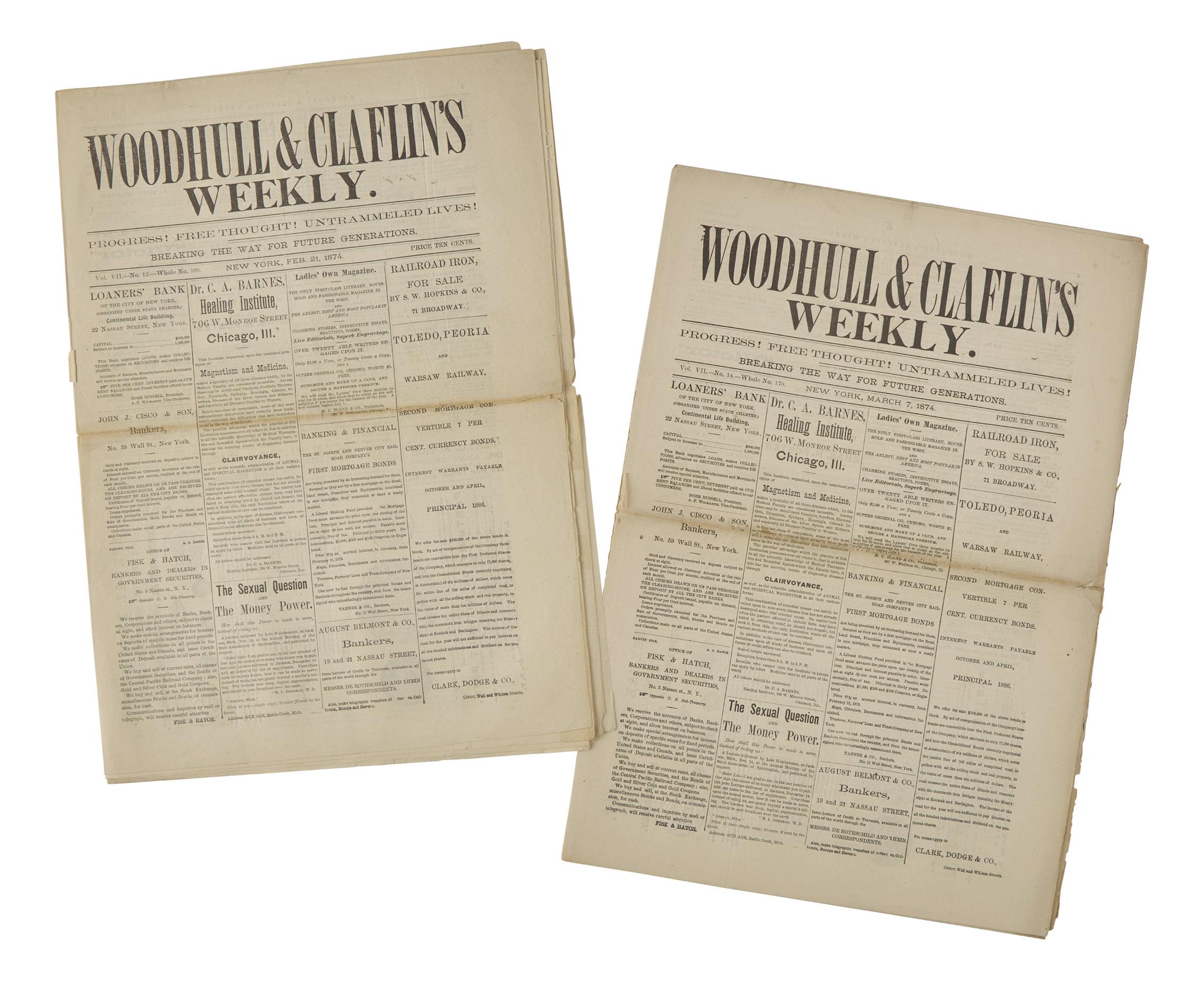
[Women’s Rights] Group of 2 Issues of Woodhull & Claflin’s Weekly, one of the First American Newspapers Published by Women New York, 1874. In two issues, comprising: February 21 and March 7 (Vol. VII, Nos. 12 and 14, Whole Nos. 168 and 170). Folio. Each 8 pp. Creased from old folds; each unopened; wear and repairs along edges.
A group of two issues of women’s rights activists Victoria Woodhull and Tennessee Claflin’s radical and notorious newspaper, one of the first American newspapers published by women. Published from May 1870 to June 1876, the newspaper featured articles on topics ranging from spiritualism, vegetarianism, free love, and socialism, but was largely a vehicle for promoting women’s suffrage.
$500 - 800
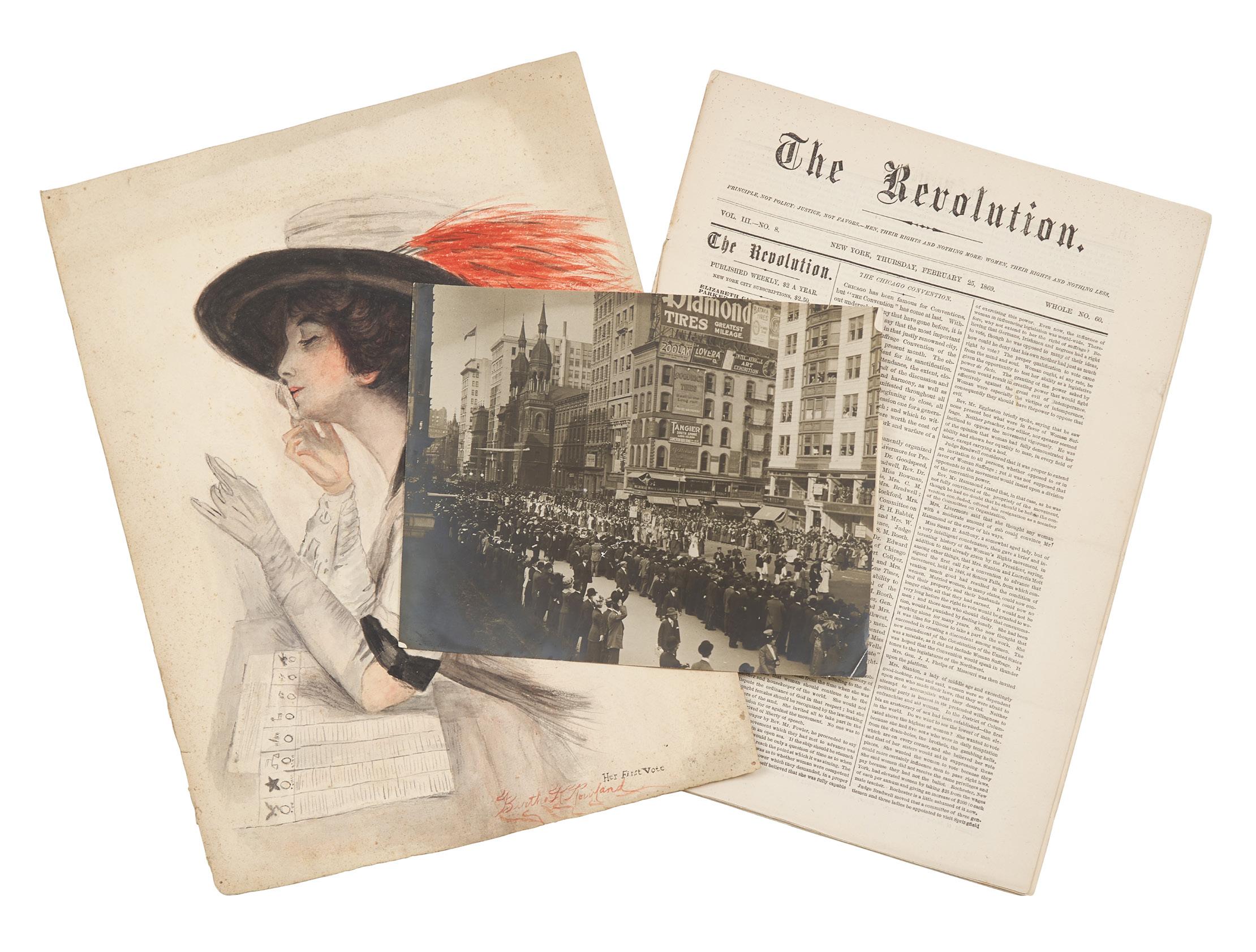
309
[Women’s Rights] Group of 3 Items Related to Women’s Suffrage, ca. 1869-1915
1. The Revolution New York, Thursday, February 25, 1869. Printed newspaper. Vol. III, No. 8, Whole No. 60. pp. (113)-128. Creasing from old folds; light toning and spotting; minor edgewear.
Susan B. Anthony and Elizabeth Cady Stanton’s influential weekly women’s rights newspaper. Includes extensive coverage of the February 11-12 women’s suffrage convention in Chicago, the first women’s suffrage convention in Illinois.
2. Press Photo of a Women›s Suffrage March New York, no date (ca. 1910-15). Silver gelatin print, 6 5/8 x 8 1/2 in. (168 x 216 mm). Printed press slip attached to verso, “General view of the parade of 5,000 suffragettes passing down Fifth Avenue in New York last Saturday...” Creasing and light wear.
3. Rowland, Bertha K., after Clarence F. Underwood Her First Vote No place, ca. 1915. Watercolor and crayon on thick paper, 13 1/4 x 10 1/2 in. (336 x 267 mm). Spotting and uneven toning.
Lot also includes a sammelband of over 30 pamphlets and documents related to anti-women’s suffrage. 8vo. Black library-style buckram.
$400 - 600
310
[World War I] Do Your Duty Join the U.S. Marines Poster
No place, ca. 1917. Color lithographic recruitment poster, signed “PW”; 26 1/4 x 17 1/2 in. (667 x 444 mm). Ink and perforated stamps along bottom edge; wear along edges; ink stamps at bottom verso.
“The Great War / New York State Library / Cuyler Reynolds” rubberstamped on verso. Reynolds (1866-1934) was a newspaperman, librarian, and historian, in Upstate New York. His papers are held at the New York State Library in Albany.
$150 - 250
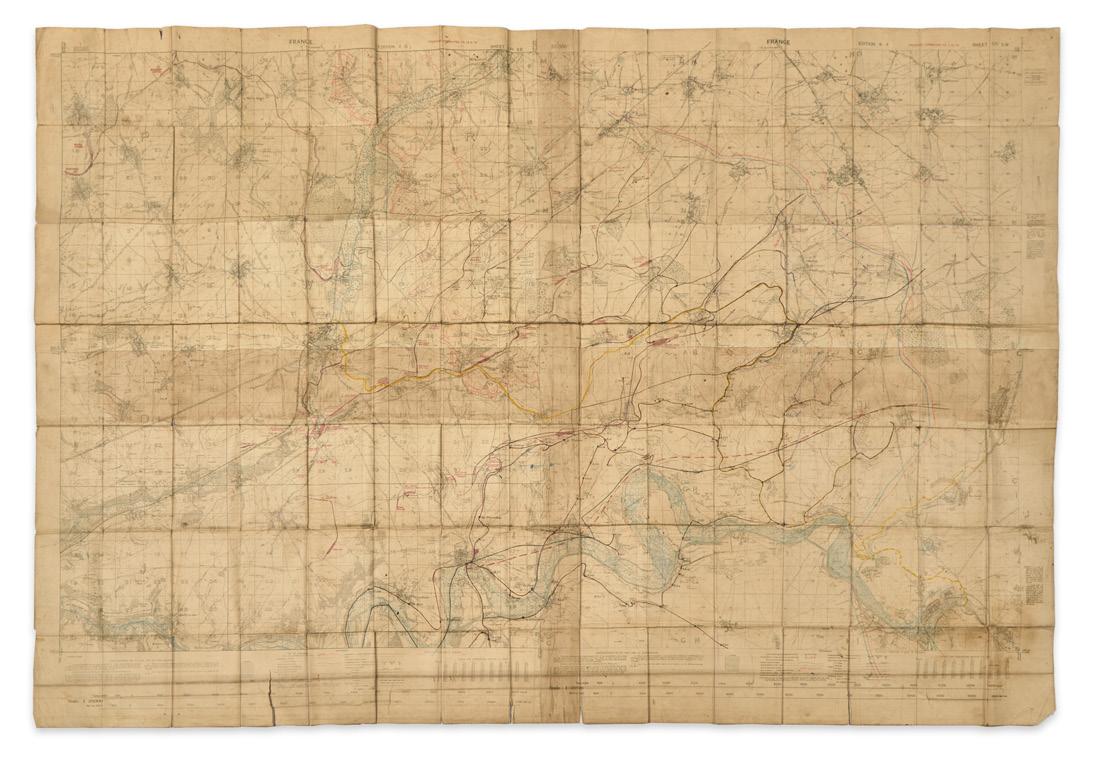
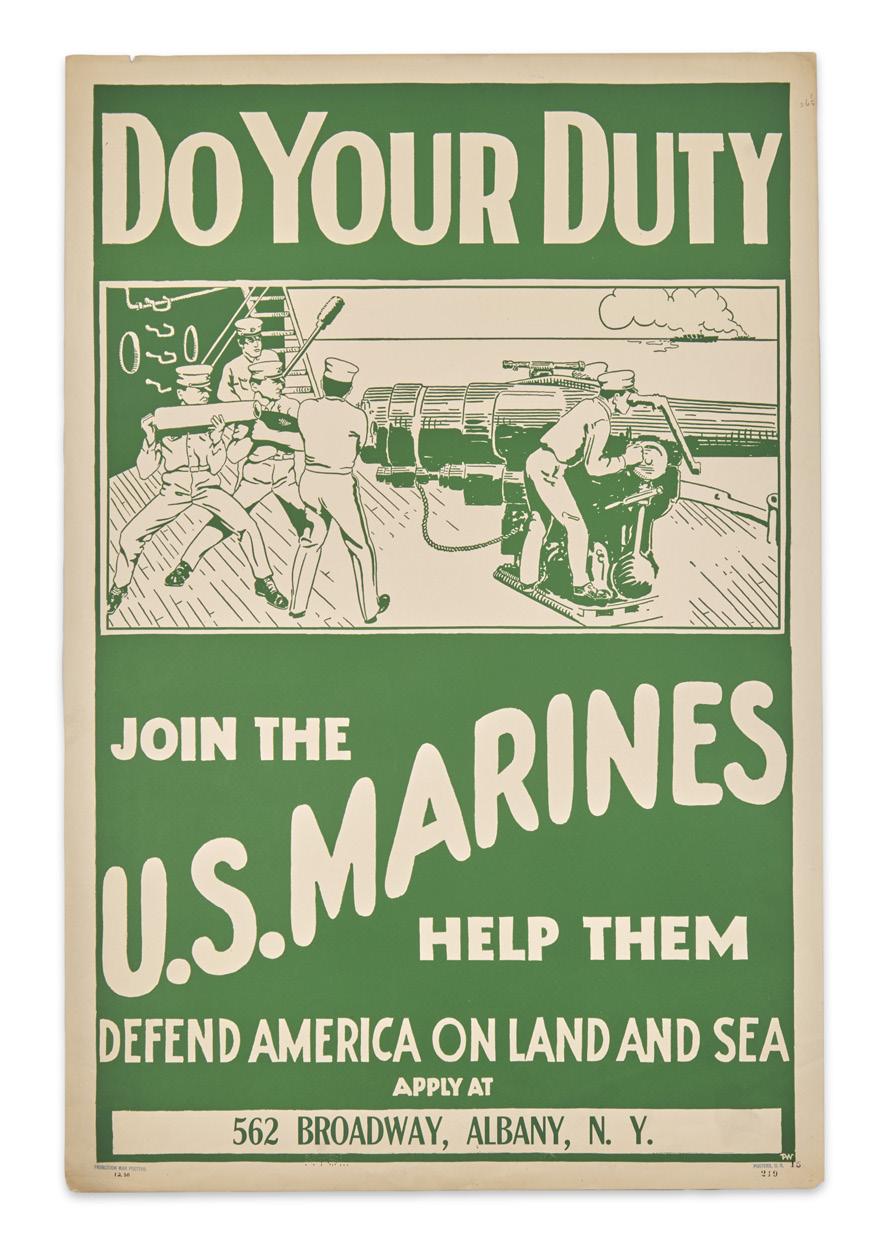
311
[World War I] Group of 3 Items: Trench Map, Poster, Newspaper
Location and dates vary, ca. 1914-17. Comprising three items, including: a copy of the Dawson Daily News, dated August 7, 1914 (“War Extra German Navy Swept From the High Seas”); large folding trench map (“Trench Map. France. Sheet 57D S.E. Edition 2. D...”); a lithographed poster (“Over the Top”, showing heroic American soldiers). Condition varies, scattered soiling, toning, and tears.
$200 - 300
312
[World War II] European Theater Allied Military Government of Occupied Territory Proclamation No. 1
No place, 1943. Printed broadside, in English and in Italian; signed in type by General H.R. Alexander, commander of British and American forces in the 165th Army Group in Italy. Creasing from old folds; light wear. 27 1/2 x 19 1/4 in. (698 x 489 mm).
Allied Force broadside announcing military control of Italy, the dissolution of the Fascist party, and the removal of the power of the King.
$200 - 300
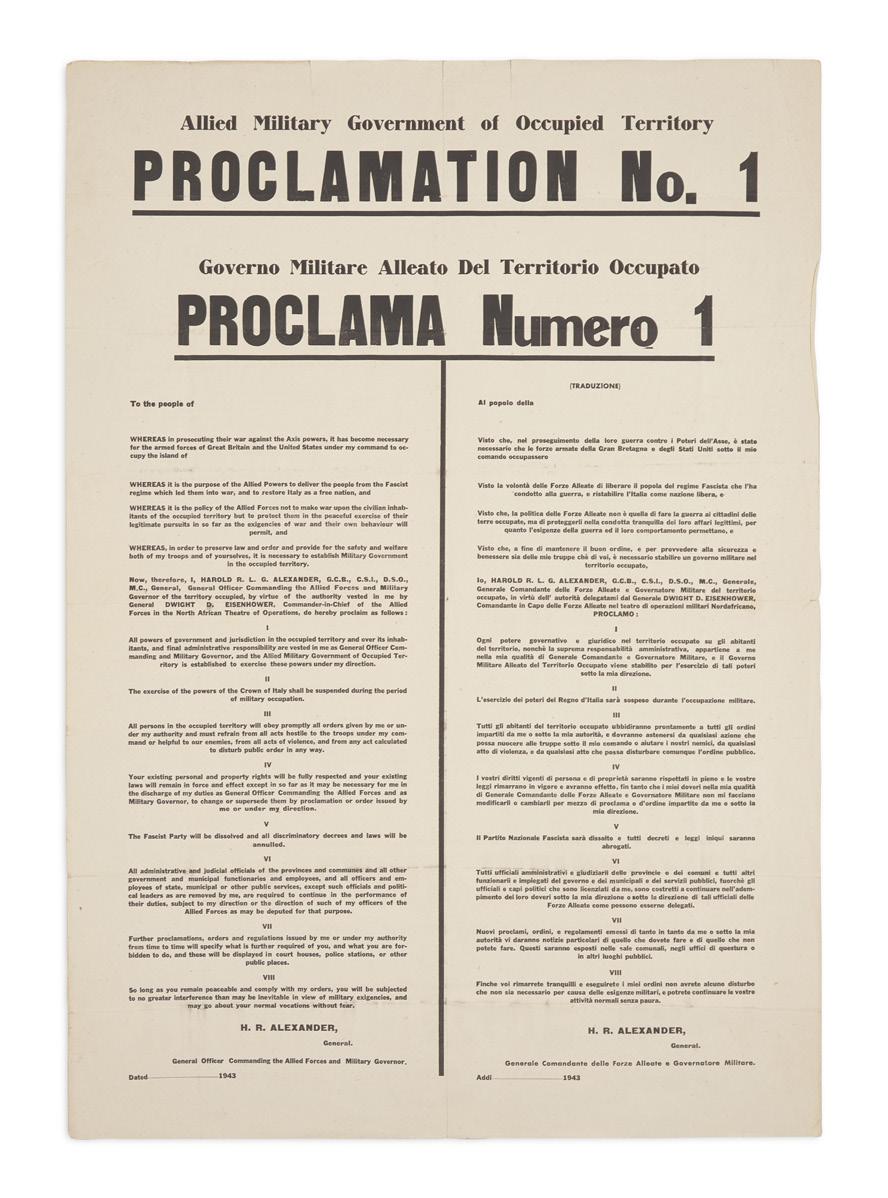
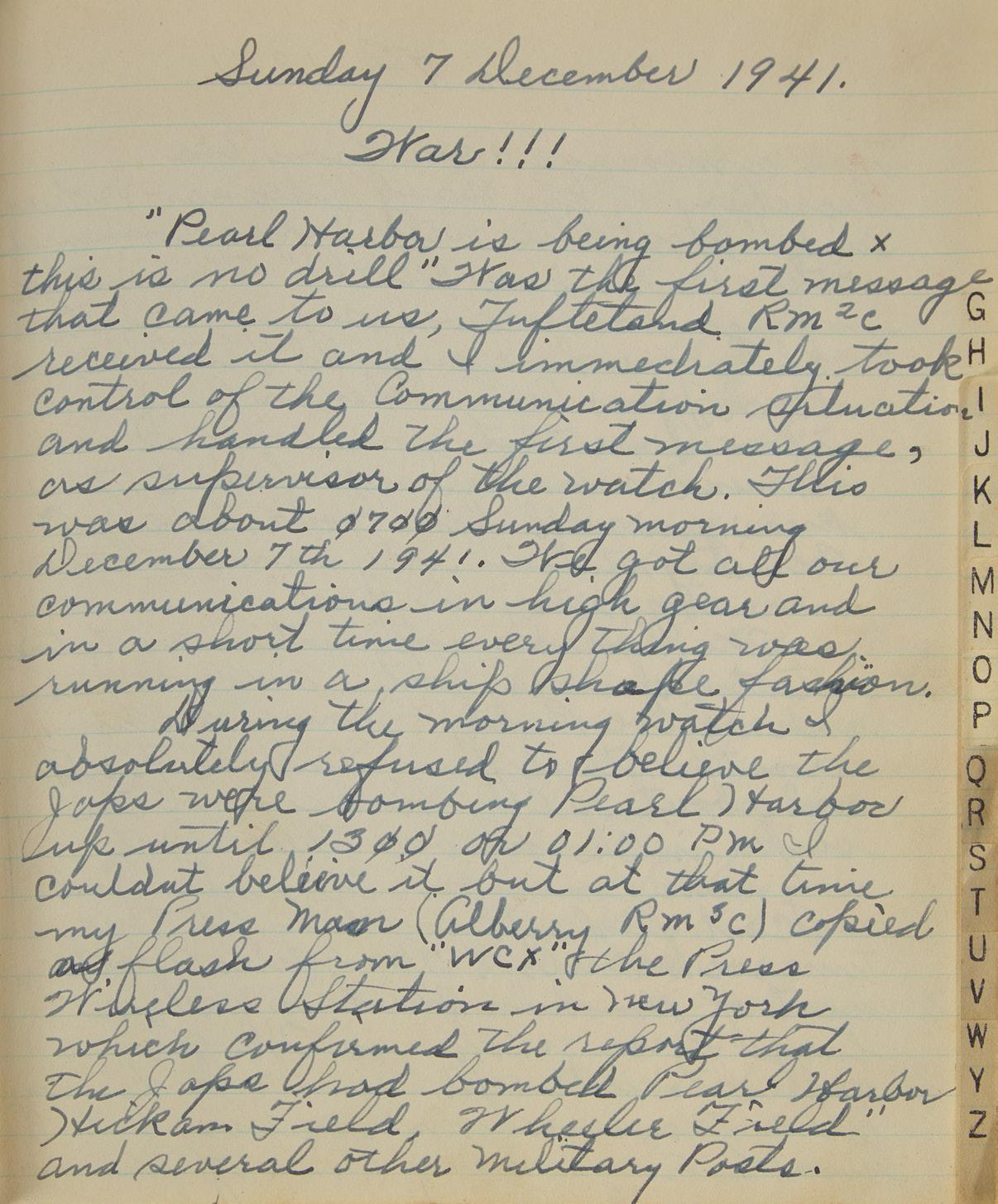
313
[World War II] An Incredibly Vivid Manuscript Diary Reporting the Attack on Pearl Harbor, ca. 1941-42
“Pearl Harbor is being bombed...this is no drill”
Hawaii, ca. 1941-1942. Manuscript journal in ink, comprising 24 pages (entries dated December 7, 1941-January 5, 1942), written within blank journal (The National Daily Journal for 1942, No. 5197, New York, etc.: National Blank Book Company). Square 8vo. Original three-quarter burgundy cloth over black pebbled cloth-covered boards, stamped in gilt, gilt on front board “National / 1942 / Excelsior”, gilt on spine, “1942 / 5197”; green-stained edges; printed calendar on paste-downs; running printed headlines (Thursday, January 1, 1942-Thursday, December 31, 1942, etc.).
This vivid manuscript journal chronicles the experiences of an unidentified U.S. Navy sailor serving in the Pacific Fleet around Honolulu during the attack on Pearl Harbor. Likely a communications or radio specialist, the author served in Cruiser Division 4 of the Scouting Fleet under Vice Admiral John H. Newton.
As the author recounts, on the morning of December 7, 1941, he received the urgent radiogram: “Pearl Harbor is being bombed x this is no drill.” As the watch supervisor, he expressed disbelief at the possibility of such an attack until subsequent messages confirmed the reports. With his family residing near Hickam Field, just blocks from the harbor, he wrote of being “worried sick” for their safety. At the time of the attack, his vessel was part of Task Force 12, led by the USS Lexington, then transporting Marine aircraft to Midway and positioned about 700 miles northeast of Honolulu.
The fleet was soon recalled to search for Japanese forces, rendezvousing with the USS Indianapolis and Enterprise
The author describes an atmosphere of confusion and anxiety in the immediate aftermath of the attack, and speculates on the scale of the destruction, describes the mechanics of the attack, and references the Roberts Commission (appointed December 18, 1941). He notes the use of torpedo planes and midget submarines by the Japanese, praises the resilience of U.S. sailors who kept firing even while their ships sank, and graphically describes the deaths of men burning alive while trying to swim to safety. Subsequent entries cover the U.S. declarations of war against Japan and Germany, as well as the fleet’s pursuit of enemy vessels.
By December 13, the author’s ship returned to Pearl Harbor. He relates climbing a machine gun platform to witness the devastation firsthand, describing beached fighter planes, burning wreckage, and the demolished hangar at Ford Island. His account details the catastrophic damage to the American fleet at the harbor: the Nevada run aground, the California flooded to the main deck, the West Virginia with a mangled superstructure, and the Oklahoma capsized. He reserves his most harrowing description for the USS Arizona, noting that its forward magazine exploded after a torpedo hit, causing a fire that raged for three days. He estimates that of the 1,600 men aboard, only a few survived, as most had no chance to escape.
The remainder of the month’s entries document the sailor’s birthday on December 17, an aborted mission to raid Jaluit to relieve pressure on Wake Island, Christmas Day, and the ongoing hunt for Japanese vessels and aircraft. Upon later returning to Pearl Harbor, he learned that his family had been safely evacuated to San Francisco. The journal concludes with notes on Rear Admiral Frank J. Fletcher assuming command of his fleet, and short entries from January 1–5 describing patrol duties around Oahu.
As the United States military restricted American servicemen from keeping personal diaries, this account was likely made at a later date than those recorded (perhaps later in 1942), either from memory, or from contemporary notes or other sources.
$2,000 - 3,000
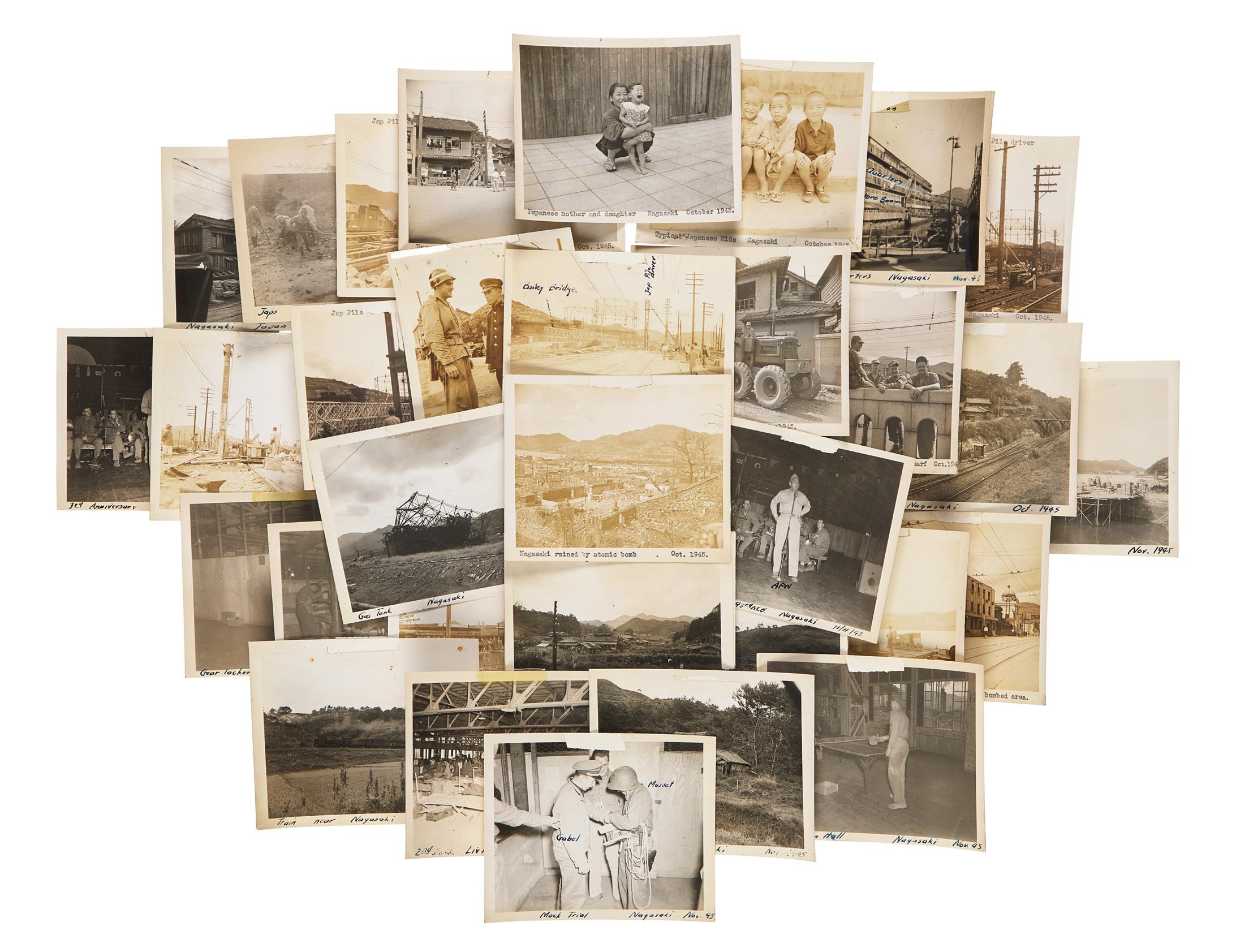
314
[World War II] Group of 35 Photographs of Post-Atomic Bomb Nagasaki and the Efforts of Reconstruction, 1945
Nagasaki and environs, Japan, September-December 1945. Group of 35 black and white and/or sepia-toned photographs; each measuring 4 x 5 in. (102 x 127 mm); each with typed or manuscript caption at bottom or within photo (one with additional manuscript on verso). Scattered surface soiling; each with tape remnants, or wear from removed tape, along top edge.
Several of these photographs are reproduced in the 1946 United States Navy Reserve cruisebook The Log (Mobile Power 43rd Construction Battalion 1942-1946).
Taken with a Speed Graphic camera by an unidentified member of the United States 43rd Naval Construction Battalion (Seabees), these 35 photographs show scenes in and around the vicinity of Nagasaki in the three months following its destruction by an atomic bomb on August 9, 1945. Several photographs document the bomb’s destructive power, including scenes showing ruined landscapes, buildings, and infrastructure, as well as the efforts by the Seabees and Japanese soldiers to clean and rebuild roads, bridges, railroad tracks, and other sites. Several photographs depict the occupying American forces, within the city environs and in their barracks, with notations identifying the 43rd and 93rd Naval Construction Battalions. Specific individuals are also identified, including Lieutenant Commander William A. Weeks, Edward A. Gabel, Theodore A. Musset, Melvin George Gerlinger, and George Frank Koester. Some photographs show Japanese citizens, including a mother and child, a group of children, a Japanese police officer, and a large group around the Nagasaki railroad depot.
The 43rd Naval Construction Battalion was established in Danville, Rhode Island on November 12, 1942. Following the Japanese surrender on August 15, 1945, the 43rd debarked at Nagasaki on September 23, consisting of about 770 men. During their time in and around the city they undertook and oversaw repair work on buildings, roads, warehouses, railroad tracks, airfields, and docks. By October the number of men had been cut in half, many due to discharges, and by early December its last remaining members departed.
$400 - 600
315
[World War II] One of the Few Surviving Letters From Hemingway to His Third Wife, Martha Gellhorn, Written While a FrontLine War Correspondent in France
“Your journalism is ok and perfectly done. But for me it is bad. So I will just write the stories as well as I can.”
(Likely Mont-Saint-Michel, Normandy, France), August 6, 1944. Lengthy six-page autograph letter in pencil on tan graph paper (on rectos only), signed by Ernest Hemingway (“E. Hemingway, War Correspondent”), to his third wife Martha Gellhorn, regarding his war correspondence in France. Creasing from old folds. Each sheet 8 1/4 x 5 1/4 in. (209 x 133 mm).
A very rare World War II-dated letter from Ernest Hemingway while a front-line war correspondent for Collier’s, written to his third wife and fellow war correspondent and writer, Martha Gellhorn. Evidently one of only two known extant letters to her from Hemingway remaining in private hands.
Only a few weeks before the liberation of Paris, and with their marriage essentially ended, Hemingway writes to Martha, informing her on myriad events while attached to an advancing American military unit in Nazi-occupied France. Hemingway opens, “Dearest Mook Today got mail. First in 4 weeks and Just got your letter mailed July 16. Am so glad you are happy and haveing a fine time and getting some sun. Am sure you will get good stories too and anyway liveing and being happy is better than stories. Please take everything I say straight and do not read in hidden meanings nor insults.” He goes on to inform her of his movements since arriving in France shortly after D-Day, including the capture of a Mercedes Benz, “I came over to France about 4 weeks ago. Hung around with some flying pals a while then hooked up with an infantry Division for this last show. It has been going 12 days and have made 11 infantry attacks. Know the people good now from general though regimental, Battle company and platoon commanders (not all of course and always being replaced). But how many outfits well and have been at front and in line all time. Sort of what Bob L. promised and didn’t produce. Have jeep and also motor cycle and driver. Prefer latter. We took 6 S.S. Panzer bastards prisoner Aug 2--You may have seen something about it in Aug 5 Stars and Stripes...We captured a Mercedes Benz staff car and have it running like a Rolls Royce although the steering column was shot through and wiring shot up.”
Notably, Hemingway then communicates his near brush with death, when he, along with photographer Robert Capa, were attacked by a Nazi regiment, during which Hemingway reportedly played dead and suffered a second traumatic head injury (the first occurring weeks earlier in England via a car crash), “Day before yest. while in advance of infantry I got knocked down by a tank shell-Enemy tank then fired on us, and on me playing dead by road with machine gun. Threw dirt all over head and cut leaves from hedge all over helmet. They also had at least 2 machine pistols in cross fire on each side of road. Two Germans crawled up to Hedge and could hear them talking. Was quite a time. We recovered motor cycle and equipment finally altho motor cycle shot up. But being repaired today. If we had not run into that place first they would have killed many people. Am very good at imitating a dead under such circumstances.”
He then mentions his plans on the articles he would contribute to Collier’s, “Now division is going to rest few days and am going to some place on sea shore and write piece. Think instead of piece will write short stories of life in Division. Have good ones and will write them and cable them. _____ said he would like some stories. The stuff is too wonderful to write as journalism. Your journalism is ok and perfectly done. But for me it is bad. So I will just write the stories as well as I can. Please do not think I have been being a crazy. Have been working very close to the bull but every thing have done has been useful.”
In finishing his letter, Hemingway reveals his relations with his unit, and his plans for the future, “General likes me and asks me to lie down on same blanket with him when we is dead tired and tell him how it goes at all places have been. Being good general is very tough job this general is very good and has just given me bottle of Bourbon whisky to take away to write and has said ‘I shall miss you, Ernie, both personally and officially.’ So you see have good life and sleep sound every night...[Robert] Capa is here now and we are happy to make Few days rest. Although hard to stop when going good. Also he influences my English in writing better. We have wonderful time with French...Buddy North is somewhere around but have not seen him. Tonight sleep in bed first time since offensive started. Good American Division is wonderful. Really as good as our Civil War. Probably better. Any way I am going to Today with it. I don’t care about being the first into any place nor about ‘the story’ Would rather be with those who do the fighting in some useful capacity and then go home finally and write book or be buried in a good country like France which have always loved very much anyway and see and love better now than ever did before only hope I can write as well about it as I should.”
At 45 when this letter was written, Ernest Hemingway was one of America’s most celebrated authors when he chose to return to the role of war correspondent. He had first met Martha Gellhorn, a 28-year-old journalist and writer, in 1936 while both were covering the Spanish Civil War. They married four years later. However, by the Spring of 1944 their relationship had effectively collapsed, fueled by their conflicting large personalities, their increasing mutual distrust, and various emotional and professional insecurities. Initially reluctant to cover another conflict, Hemingway, who was in the midst of a writing slump, changed his mind after Martha’s insistent encouragement, as she was then employed by Collier’s as a correspondent. He was immediately given an assignment by Collier’s as their front-line correspondent (Martha no doubt knowing this would be the case when encouraging him). He arrived in France during the D-Day landings, but as a civilian correspondent, he was not permitted to land with the initial assault forces and instead observed the operations from a ship (Martha, meanwhile, beat him ashore by stowing away on a hospital ship, landing at Omaha on June 7, the day after the first landings). Once on the ground, he was attached to the 22nd Regiment, commanded by Colonel Charles «Buck» Lanham, and accompanied them as they advanced toward Paris.
Although Hemingway spent ten months in Europe, he produced only six articles for Collier’s. Instead of focusing solely on writing, he spent a large portion of his time blurring the lines between correspondent and soldier. Leveraging his knowledge of French terrain and prior military experience, he assisted troops and even led a group of Free French partisans in irregular combat and intelligence operations as they advanced toward Paris, removing his reporter’s insignia and brandishing a weapon. By October 1944, his actions
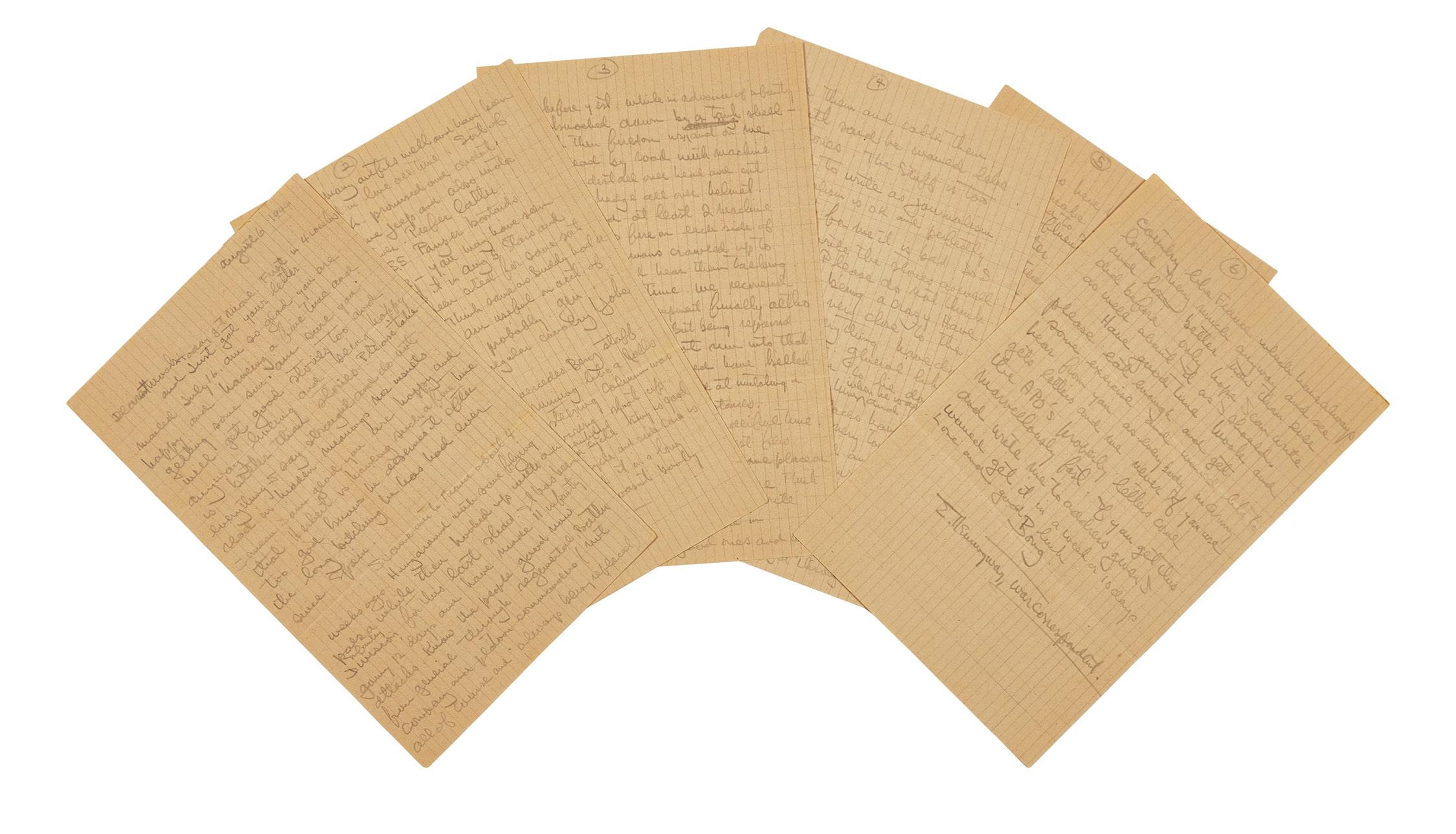
drew the attention of military authorities, as they were a violation of the Geneva Conventions that prohibited correspondents from engaging in combat. He was summoned before the Inspector General to face accusations of taking up arms, but successfully argued against them and avoided formal charges. Reflecting on this period in 1951, he explained, “I had an assignment to write only one article a month for Colliers and I wished to make myself useful between those monthly pieces. I had a certain amount of knowledge about guerilla warfare and irregular tactics as well as a grounding in more formal war and I was willing and happy to work for or be of use to anybody who would give me anything to do within my capabilities.” Following this, Hemingway continued to push forward with the Allied advance, reaching the Hürtgenwald Forest in Germany in the fall of 1944, where he witnessed the grueling 88-day battle, often under intense enemy fire. By March 1945 his service was over and he had left Europe to return to America, making a stop in London where he saw Martha for a final time.
Two months before composing this letter, Hemingway met his future fourth wife Mary Welsh in England while preparing for his deployment to France. During his time as a correspondent, he maintained regular correspondence with both Mary and Martha, often covering the same events (see Baker, Selected Letters, pp. 561–563, for a similarly dated letter to Mary that covers similar ground).
According to Martha’s son, shortly before her death in 1998 she destroyed a large amount of her files and correspondence, including many of her letters from Hemingway. The correspondence that was not destroyed was subsequently given to Boston University, which included some Hemingway letters. Consequently, this letter is of a very small number from him to her to survive in general, and is evidently only one of two that have ever come to market.
Not in Baker, this letter is apparently unpublished.
Christie’s, New York, November 8, 1996, Printed Books and Manuscripts Including Americana, Lot 30, “The Property of a Lady”
Thomas A. Goldwasser, Catalog 23, ca. 2013
Schulson Autographs, Catalog 176, June 2017
$7,000 - 10,000
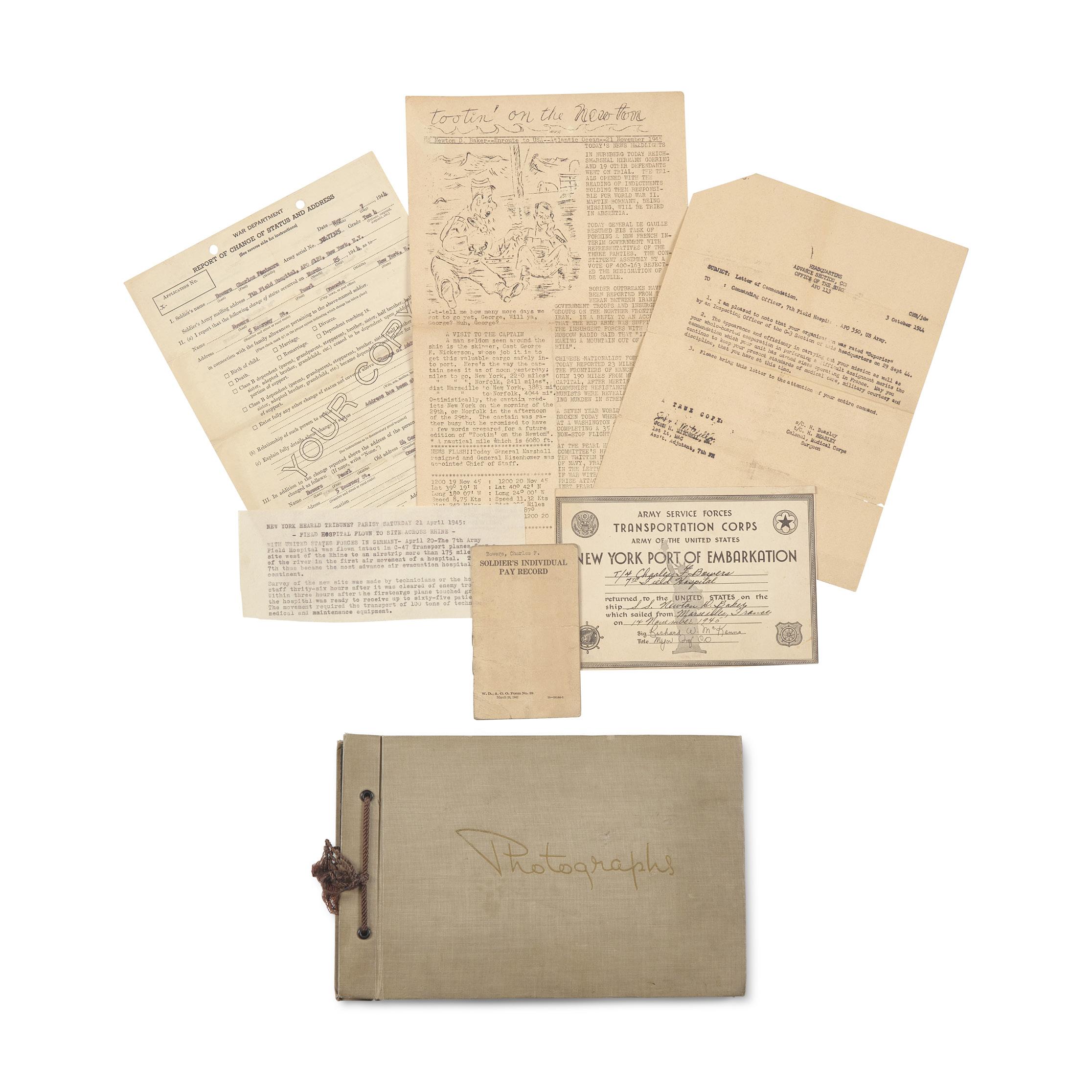
[World War II] United States Army Field Medic’s Photo Album and Assorted Service Ephemera, Including Images of Liberated Buchenwald Concentration Camp, ca. 1940s
France, Germany, etc., ca. 1940s. Album of 102 original photographs; sizes vary (from 2 1/4 x 4 1/4 in. to 5 1/4 x 3 1/2 in.
Depicting the service of field medic Charles Fenimore Bowers (73 of the war, the balance depicting Bowers’s family members in the United States); several with Bowers’s manuscript captions on verso. Oblong 8vo. Original cloth-covered boards, stamped in gilt; several photos loose or starting.
United States Army PFC field medic Charles Fenimore Bowers’s personal photo album chronicling his service in World War II.
Attached to the 7th Field Hospital, Bowers’s images capture his units advance across Europe, starting in Normandy, France and ending in Nuremberg, Germany, showing downed and bullet ridden Nazi aircraft, the aftermath of the battle of Saint-Lô, France, various allied aircraft, Bowers’s fellow servicemen, scenes in Nuremberg, and notably, images from liberated Buchenwald concentration camp (of which Bowers’s unit was an advance party), including images of liberated prisoners, corpses, barracks, and gallows (seven total photos). Other images appear to antedate the war, showing Bowers’s various family members.
Lot includes an additional six pieces of ephemera related to Bowers’s service, including his New York Port of Embarkation certificate, a Commendation Letter, War Department Report of Change of Status and Address document, one typed slip related to a field hospital, Soldier’s Individual Pay Record booklet, and one mimeographed newsletter (“Tootin on the Newton”).
Original photos showing liberated concentration camps, especially from soldiers who helped do so, are uncommon.
$400 - 600
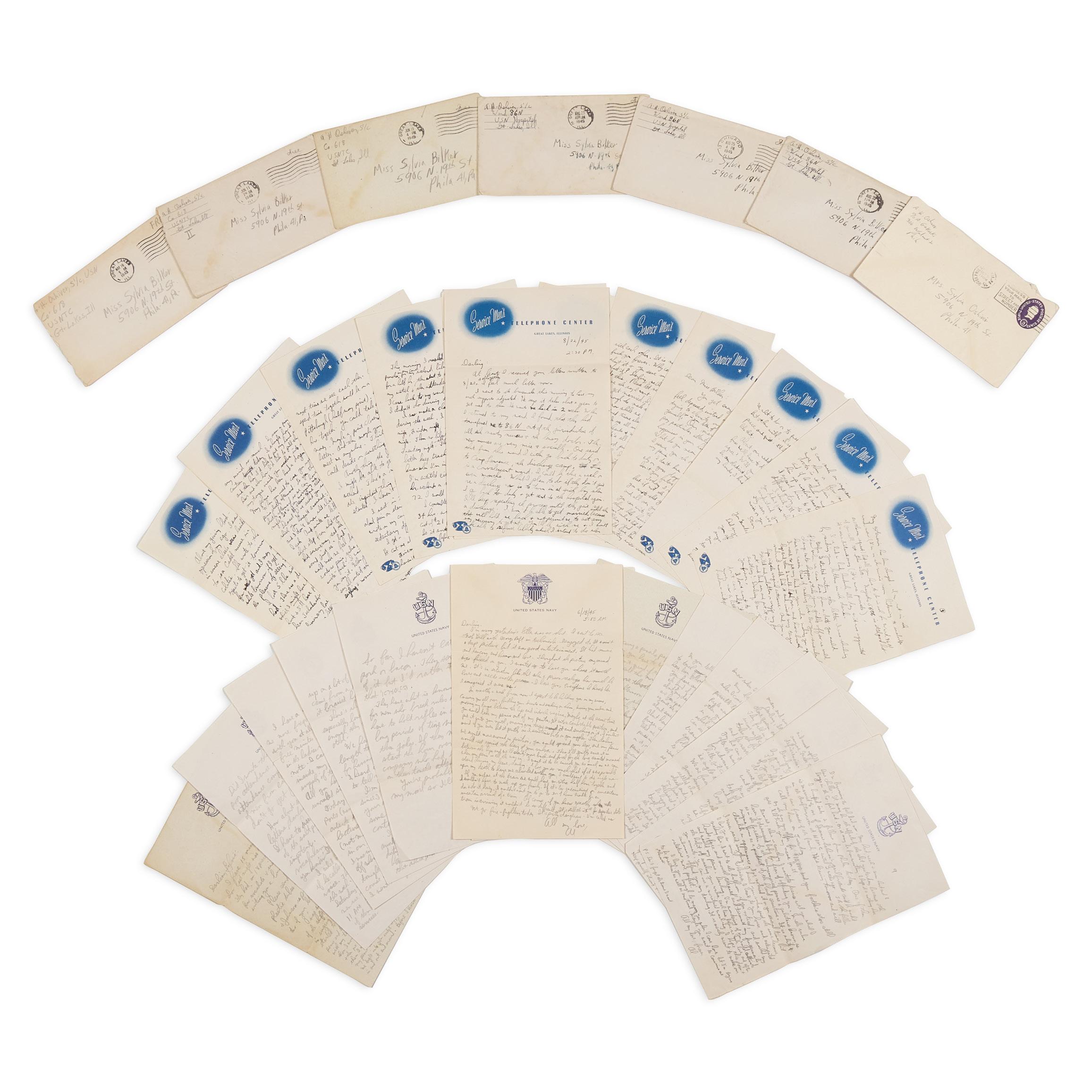
Great Lakes, Illinois, and Philadelphia, Pennsylvania, ca. May-August, 1945. Group of seven autograph letters, from American Jewish sailor Albert H. Oshiver, addressed to his love interest and later wife, Miss Sylvia Bilker, relaying personal updates as well as explicit content. Accompanied by original mailing envelopes. Creasing from old folds, scattered light foxing.
$300 - 500
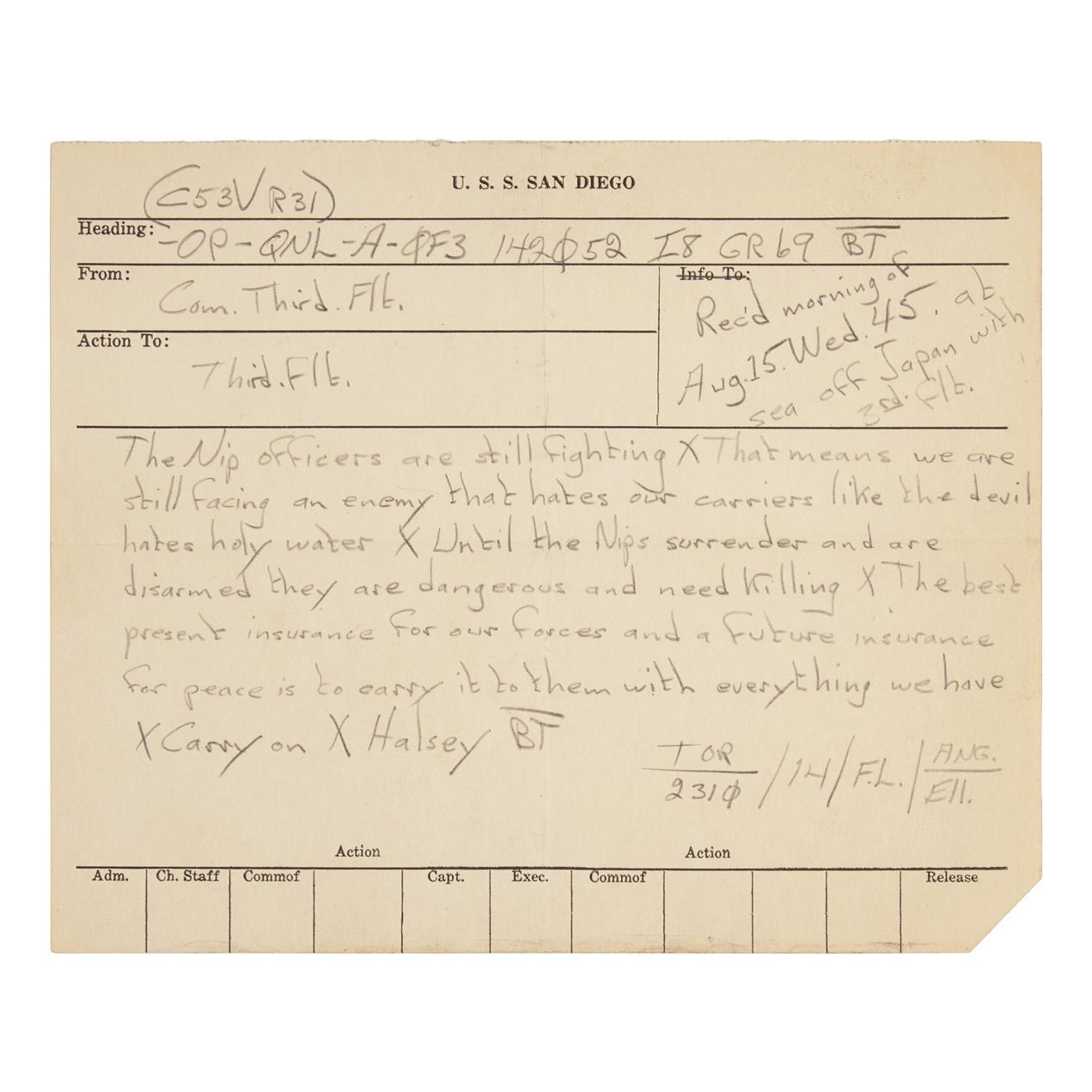
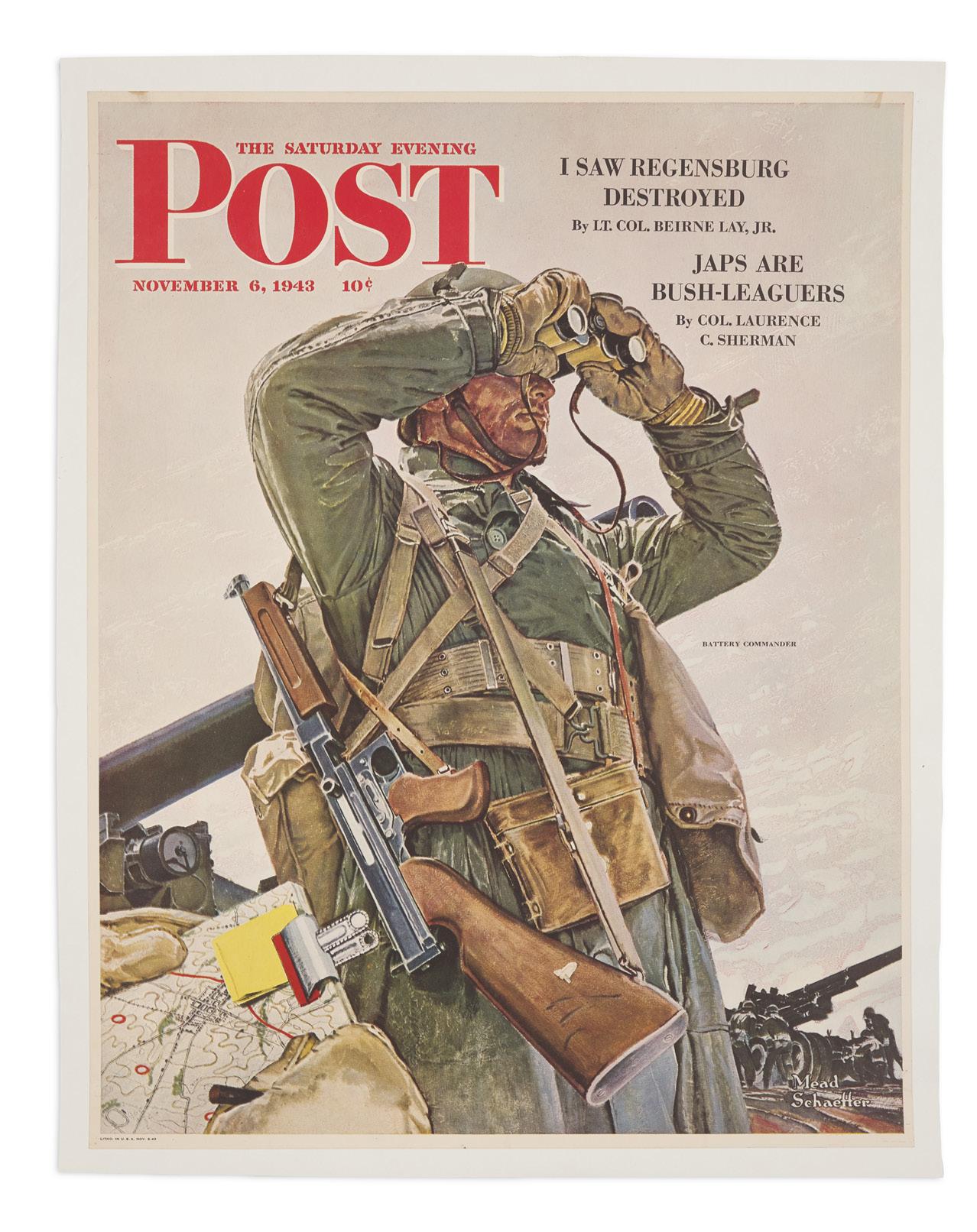
318
[World War II] Passionate Pacific Theater Manuscript Naval Dispatch, August 15, 1945
“Sea off Japan”, USS San Diego, August 15, 1945. Single sheet, 6 1/2 x 8 in. (165 x 203 mm). Manuscript naval dispatch in pencil received from Admiral William F. Halsey, Jr., Commander of the Third Fleet. Reads, in part: “Rec’d morning of Aug. 15. Wed. 45. ab sea off Japan with 3rd. flt. The Nip officers are still fighting X That means we are still facing an enemy that hates our carriers like the devil hates holy water X Until the Nips surrender and are disarmed they are dangerous and need killing X The best present insurance for our forces and a future insurance for peace is to carry it to them with everything we have X Carry on X Halsey...” Creasing from old folds.
A passionate Pacific Theater Naval dispatch, sent on the day of Japan’s surrender. The USS San Diego, an Atlantaclass light anti-aircraft cruiser, was one of the most decorated United States ships in World War II (awarded 18 battle stars), and on August 27 was the first major Allied warship to enter Tokyo Bay after the surrender of Japan. Japan’s surrender was announced by Japanese Emperor Hirohito later the same day that the San Diego received the present dispatch from Third Fleet commander Admiral William F. Halsey, Jr., on August 15, 1945. The official surrender of Japan would take place on September 2, aboard the Third Fleet flagship, Iowaclass battleship USS Missouri.
$400 - 600
319
[World War II] Saturday Evening Post Poster by Mead Schaeffer, November, 1943
No place, November, 1943. Color lithographic poster advertising the November 6, 1943 issue of The Saturday Evening Post; 28 x 21 3/4 in. (711 x 552 mm). Linenbacked.
Mead Schaeffer (1898-1980) was one of the foremost American illustrators of the twentieth century. Trained at the Pratt Institute under Harvey Dunn and associated with the Brandywine tradition of illustration, Schaeffer first gained prominence illustrating classic literary works before becoming a major contributor to The Saturday Evening Post, for which he produced 46 covers. During WWII, he served as a war correspondent and created some of the era’s most iconic patriotic imagery.
$200 - 300
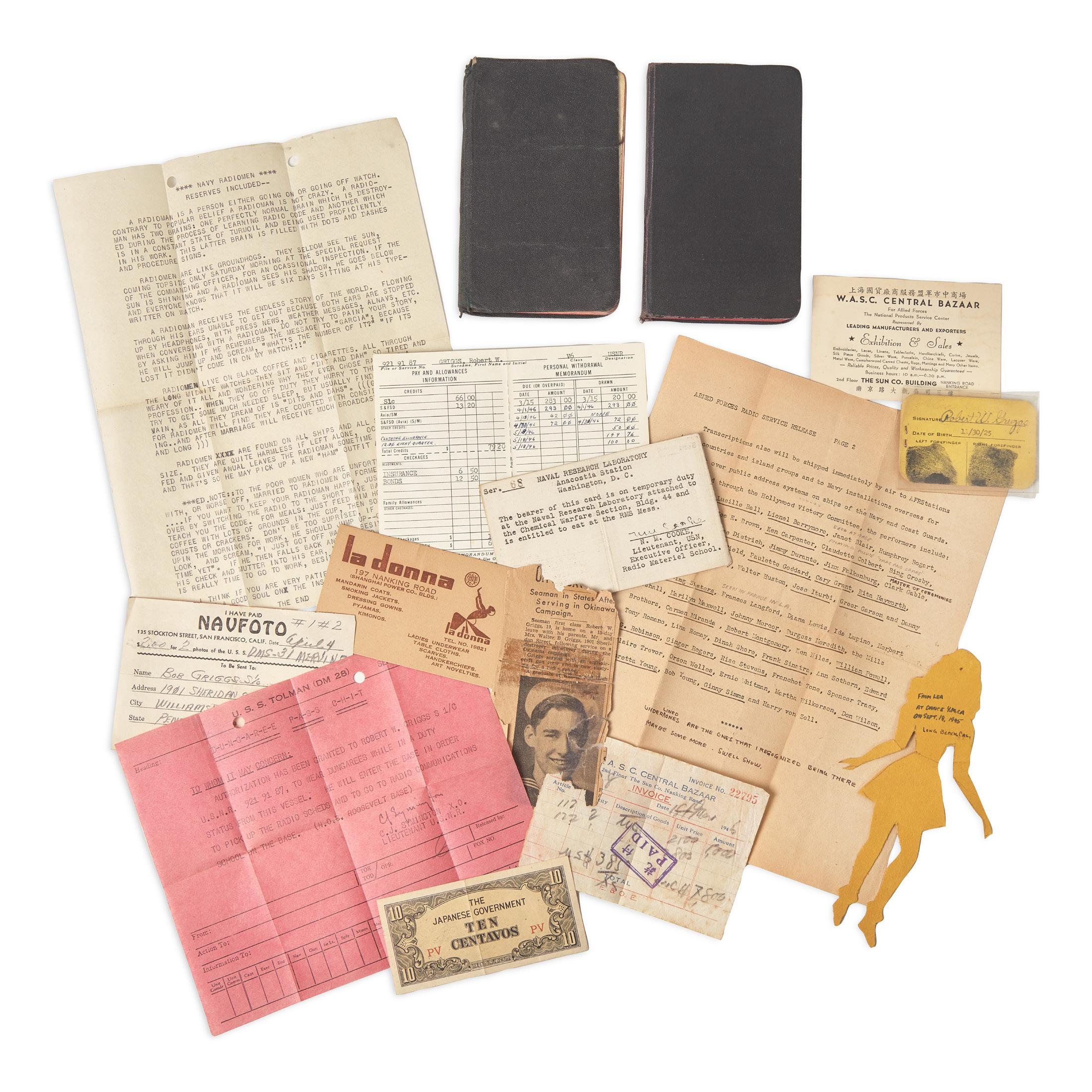
Japan’s Surrender
California, Japan, China, July 20, 1945-May 18, 1946. In two volumes. Tall 24mo. Approximately 198 manuscript pages, in ink and in pencil. Original black cloth, first volume worn, some sheets sprung or starting.
Personal diary of United States Navy seaman Walter B. Riggs, detailing his service in the Pacific from July 20, 1945-May 18, 1946. The first volume relates to Griggs’s training as a radioman, and includes his various notes and schematics, such as types of messaging, communication procedures, lists of frequencies, symbols, ship nomenclature, the addresses of his shipmates, and his account of money spent while on leave in Japan, China, etc. The second volume is Griggs’s daily journal, covering nearly a year of his service in the Pacific. Beginning in Los Angeles and his training in radio school, the journal then proceeds to Griggs’s deployment on the USS Tolman, first to Pearl Harbor, and then to Sasebo, Japan, Shanghai, China, Yoko Suka and Tokyo, Japan, and then back to the United States, with his discharge in Shoemaker, California. Griggs keeps meticulous records of his daily actions, noting his various duties, activities while on leave, descriptions of the various locales in Japan and China, including Tokyo, and his interactions with their inhabitants. Notably, Griggs mentions both the dropping of the atomic bomb, as well as Japan’s surrender and VJ day.
Lot includes 13 pieces of Griggs’s personal ephemera, including his Leave Card, pay card, receipts, business cards, etc.
$500 - 800

CHRISTOPHER BRINK
Associate Vice President, Senior Specialist, Head of Sale, Books & Manuscripts, Chicago
312.334.4217
christopherbrink @freemansauction.com

DARREN WINSTON Senior Vice President, Head of Department, Books & Manuscripts, Philadelphia
267.414.1247 darrenwinston @freemansauction.com

JOSHUA MCCRACKEN Cataloguer, Books & Manuscripts
312.447.3287 joshuamccracken @freemansauction.com

COLIN FOLEY, Associate Specialist, Books & Manuscripts
217.414.1246 colinfoley @freemansauction.com
ADAM DIAS Cataloguer, Books & Manuscripts
267.441.6033 adamdias @freemansauction.com

JACK CARDOZA Department Coordinator, Books & Manuscripts
jackcardoza @freemansauction.com

MUYS SNIJDERS
Chief Executive Officer
muyssnijders @freemansauction.com

JAY FREDERICK KREHBIEL Executive Chairman jaykrehbiel @freemansauction.com
JARRETT ANISTRANSKI Chief Operating Officer
212.243.3000 jarrettanistranski @freemansauction.com

MOLLY MORSE LIMMER Executive Vice President, Deputy Chairman
312.447.3275 mollylimmer @freemansauction.com

MOLLY E. GRON, J.D. Managing Director
312.334.4235 mollygron @freemansauction.com

JULIA FITZGERALD Chief Marketing Officer
312.334.4213 juliafitzgerald @freemansauction.com
ATLANTA
404.800.0192 ATLANTA@FREEMANSAUCTION.COM
BOSTON@FREEMANSAUCTION.COM